
Autodesk Revit Architecture 2013 Fundamentals
|
|
|
- Madison Gaines
- 9 years ago
- Views:
Transcription
1 Autodesk Revit Architecture 2013 Fundamentals Supplemental Files SDC P U B L I C AT I O N S Schroff Development Corporation Better Textbooks. Lower Prices. Tutorial files on enclosed CD

2 Chapter 2 BIM and Autodesk Revit Architecture In this chapter you learn about Building Information Modeling (BIM) and how it is used in the Autodesk Revit Architecture software. You investigate the software interface and terminology, learn how to start projects, and work with the viewing commands including zoom controls, 3D isometric, and perspective views. This chapter contains the following topics: Building Information Modeling Overview of the Interface Standard Terminology Starting Projects Viewing Commands 2 1

3 2 2

4 Learning Objectives BIM and Autodesk Revit Architecture This chapter provides instruction to enable you to do the following: 2.1 Building Information Modeling Understand the concept of Building Information Modeling and its workflow in relation to the Autodesk Revit software. 2.2 Overview of the Interface Navigate the graphic user interface. 2.3 Standard Terminology Use typical terms and concepts found in the software. 2.4 Starting Projects Start new projects using templates. 2.5 Viewing Commands Manipulate 2D and 3D views by zooming and panning. Create 3D Isometric and Perspective views. Set the Visual Style of a view. 2 3

5 Autodesk Revit Architecture 2013 Fundamentals 2.1 Building Information Modeling Understand the concept of Building Information Modeling and its workflow in relation to the Autodesk Revit software. When a change is made anywhere in the model, all of the views update automatically. For example, if you add an element in a plan view, it displays in the related section view and in schedules (if applicable). Building Information Modeling (BIM) is an approach to the entire building life cycle. The BIM process supports the ability to coordinate, update, and share design data with team members throughout the design, construction, and management phases of a building s life. The Autodesk Revit software is a Parametric Building Modeler, and is an important part of the BIM process. Parametric means you can establish a relationship between two building elements; when one element changes the other element changes as well. Building signifies that this software is designed for working with buildings, as opposed to gears or roads. Modeler signifies how a project is built in a single file around the building model (as shown on the left in Figure 2 1). All views, such as plans (as shown on the right in Figure 2 1), elevations, sections, details, schedules, as well as all design sheets printed for construction documents, are automatically generated based on the model. Figure 2 1 The Autodesk Revit Architecture software coordinates with two other software packages: Autodesk Revit MEP (Mechanical, Electrical, and Plumbing) and Autodesk Revit Structure. It also enables you to check for interferences between disciplines. 2 4

6 BIM and Autodesk Revit Architecture Workflow and BIM BIM has changed the process of how a building is designed. The Autodesk Revit software is a true BIM product in that it is much more than a drafting software. By creating complete models and associated views of those models, the software takes much of the tediousness out of producing a building design. In the traditional design process, plans create the basis for the model, from which you then create sections and elevations, as shown in Figure 2 2. Construction Documents (CDs) can then be created. In this workflow, changes are made at the plan level and then coordinated with other documents in the set. Figure 2 2 In the BIM, the design process revolves around the model, as shown in Figure 2 3. Plans, elevations, and sections are simply 2D versions of the 3D model. Changes made in one view automatically update in all views. Even Construction Documents update automatically with callout tags in sync with the sheet numbers. This is called bidirectional associativity. The elements that you create in the software are smart elements that know they are walls, windows, doors, or stairs. Because they are smart elements, they display properly in plan, elevation, or 3D views. This ensures that drawings are coordinated across the project because the same model generates all of the necessary views. Figure

7 Autodesk Revit Architecture 2013 Fundamentals Views and Sheets In the traditional workflow, the most time-consuming part of the project is the construction documents. With BIM, the base views of those documents (i.e., floor plans, ceiling plans, elevations, sections, and schedules) are produced automatically and update as the model is updated, saving hours of work. The views are then placed on sheets that make up the construction document set. For example, to create a Life Safety Plan, a floor plan is created from the model and then duplicated to create the Life Safety Plan. In the new view, certain categories of elements are turned off (such as grids and section marks), while furniture elements are set to halftone. Annotation is added in regard to exits and room classifications. The plan is then placed on a sheet, as shown in Figure 2 4. Figure 2 4 Work can continue on a view and is automatically updated on the sheet. 2 6

8 BIM and Autodesk Revit Architecture 2.2 Overview of the Interface Navigate the graphic user interface. The Autodesk Revit interface is designed for intuitive and efficient access to commands and views. It includes the Ribbon, Quick Access Toolbar, Application Menu, and Status Bar, which are common to the newer versions of all Autodesk software. It also includes tools that are specific to the Autodesk Revit software, including the Properties palette, Project Browser and View Control Bar. The interface is shown in Figure Figure Quick Access Toolbar 2. InfoCenter 3. Application Menu 4. Ribbon 5. Options Bar 6. Properties Palette 7. Project Browser 8. Drawing Area 9. View Control Bar 10.Status Bar 2 7

9 Autodesk Revit Architecture 2013 Fundamentals 1. Quick Access Toolbar The Quick Access Toolbar provides access to commonly used commands, such as Open, Save, Undo and Redo, Dimension, and 3D View, as shown in Figure 2 6. Figure 2 6 The Quick Access Toolbar is easily customizable. Select the arrow at the end of the toolbar. You can choose from the list of commands or click Customize Quick Access Toolbar to bring up a dialog box where you can modify the location of the tools on the toolbar as shown in Figure 2 7. Figure 2 7 You can also customize it by adding commands from any of the Ribbon tabs. Right-click on the command in the Ribbon and select Add to Quick Access Toolbar as shown in Figure 2 8. Figure

10 BIM and Autodesk Revit Architecture 2. InfoCenter The InfoCenter enables you to quickly search for help on the web, as shown in Figure 2 9. You can specify which Help documents to search and collapse or expand the Search field to save screen space. You can also sign into Autodesk Online to access additional services and use the Autodesk Exchange Apps website. You can collapse or expand the Search field to save screen space. Figure Application Menu The Application Menu provides access to file commands, settings, and documents, as shown in Figure Hover the cursor over a command to display a list of additional tools. If you click the primary icon rather than the arrow, it starts the default command. Figure

11 Autodesk Revit Architecture 2013 Fundamentals At the bottom of the menu, click to open the Options dialog box or click to exit the program. Recent Drawings To display a list of recently used documents click (Recent Documents) in the Application menu. The documents can be reordered as shown in Figure Figure 2 11 Click (Pin) next to a document name to keep it available, even if more documents are opened than can be displayed. It displays with the push pin tacked in ( ). Open Drawings To display a list of open documents and views, click (Open Documents). The list displays the open documents and each view that is open, as shown in Figure You can use the Open Documents list to change between views. Figure 2 12 Click (Close) to close the current project. 2 10

12 BIM and Autodesk Revit Architecture When you expand (Open) there is a new option ( (Sample Files)) that takes you to a folder containing the sample files supplied with the software. 4. Ribbon The Ribbon contains tools in a series of tabs and panels as shown in Figure Selecting a tab displays a group of related panels. The panels contain a variety of tools, grouped by function. Figure 2 13 When you start a command that creates new elements or you select an element, the Ribbon displays the Modify contextual tab. This contains general editing commands and command specific tools at the end of the tab, as shown in Figure Figure 2 14 When you hover over a tool on the Ribbon, tooltips display the tool s name and a short description. If you continue hovering over the tool a graphic displays (and sometimes a video) as shown in Figure Figure

13 Autodesk Revit Architecture 2013 Fundamentals Many commands have shortcut keys. For example, type AL for Align or MV for Move. They are listed next to the name of the command in the tooltips. Do not press <Enter> to execute shortcuts. The order in which the Ribbon tabs are displayed can be modified. Select the tab, hold down <Ctrl>, and drag it to a new location. The location is remembered when you restart the program. Any panel can be dragged by its title into the drawing area to become a floating panel. Click the Return Panels to Ribbon button as shown in Figure 2 16 to replace the panel. Figure 2 16 Hint: You are always in a command when using the Autodesk Revit software. When you are finished working with a tool, you typically default back to the Modify command. To end a command, use one of the following methods: In any Ribbon tab, click (Modify). Press <Esc> once or twice to revert to Modify. Right-click and select Cancel... Start another command. 2 12

14 BIM and Autodesk Revit Architecture 5. Options Bar The Options Bar displays options that are related to the selected command or element. For example, when the Rotate command is active it displays options for rotating the selected elements, as shown at the top of Figure When the Place Dimensions command is active it displays dimension related options, as shown at the bottom of Figure Properties Palette Figure 2 17 In the Properties palette you can make extensive modifications to views and elements. If nothing is selected and you are not in a command, the Properties palette displays options for the current view, as shown on the left in Figure If a command or element is selected, it displays options for the associated element, as shown on the right in Figure Figure 2 18 Items that are grayed out are read-only. 2 13

15 Autodesk Revit Architecture 2013 Fundamentals The Properties palette is usually kept open while working on a project to easily permit modifications at any time. It can be placed on a second monitor as well as floated and resized. If the Properties palette does not display, click PP. (Properties) in the Modify tab>properties panel, or type When multiple elements are selected, you can filter the elements selected in the Properties palette using the drop-down list, as shown in Figure Figure 2 19 When you start a command or select an element, you can set the element type in the Type Selector as shown in Figure Right-click on the Type Selector to add it to the Quick Access Toolbar and/or to the Ribbon Modify tab. Figure

16 BIM and Autodesk Revit Architecture Hint: Type Properties Type Properties are parameters that are common to all of the elements in a specific family. When a single type of element is selected, click (Edit Type) in Properties to open the Type Properties dialog box, as shown in Figure Figure

17 Autodesk Revit Architecture 2013 Fundamentals The Project Browser displays the name of the active project. 7. Project Browser The Project Browser lists the views that can be opened in the software as shown in Figure This includes all views of the model in which you are working and any additional views that you create, such as floor plans, ceiling plans, 3D views, elevations, sections, etc. It also includes views of schedules, legends, sheets (for plotting), families (such as doors and walls), groups, and Revit Links. Figure 2 22 Double-click on an item in the list to open the associated view. To display the views associated with a view type, click (Expand) next to the section name. To hide the views in the section, click (Contract). Right-click on a view and select Rename or press <F2> to rename a view in the Project Browser. If you no longer need a view, you can remove it. Right-click on its name in the Project Browser and select Delete. The Project Browser can be floated, resized, and customized. 2 16

18 BIM and Autodesk Revit Architecture How to: Search the Project Browser 1. In the Project Browser, right-click on the top level Views node as shown in Figure Figure In the Search in Project Browser dialog box, type the words that you want to find (as shown on the left in Figure 2 24), and click. 3. In the Project Browser, the first instance of that search displays as shown on the right in Figure Figure Continue using and to move through the list. 5. Click when you are done. 2 17

19 Autodesk Revit Architecture 2013 Fundamentals 8. Drawing Area Each view of a project opens in its own window, as shown in Figure Each view displays a Navigation Bar (for quick access to viewing tools) and the View Control Bar. Navigation Bar In 3D views you can also use the ViewCube to rotate the view. View Control Bar Figure 2 25 Each view of a project opens in its own window. You can use the Project Browser or press <Ctrl>+<Tab> to cycle through the open views. If you have multiple views open you can select a view by name. In the Quick Access Toolbar or View tab>windows panel, expand (Switch Windows) and select from the list. If you have more than one view open, click (Cascade) or (Tile) in the View tab>windows panel to arrange them in the selected order on the screen. You can also use the shortcut keys WC for Cascade and WT for Tile. 2 18

20 BIM and Autodesk Revit Architecture 9. View Control Bar The View Control Bar (shown in Figure 2 26), displays at the bottom of each view window. It controls aspects of that view, such as the scale and detail level. It also includes tools that display parts of the view and hide or isolate elements in the view. 10. Status Bar Figure 2 26 The Status Bar provides information about the current process, such as the next step for a command, as shown in Figure Figure 2 27 Other options in the Status Bar are related to Worksets and Design Options (advanced tools) as well as selection methods and filters. Hint: Right-click Menus Right-click menus help you to work smoothly and efficiently by enabling you to quickly access the required commands. These menus always provide access to basic viewing commands as well as recently used commands, as shown in Figure The other options vary depending on the selected element or command that you are using. Figure

21 Autodesk Revit Architecture 2013 Fundamentals Certification Topic: Elements Objectives: Modify an element's type parameters 2.3 Standard Terminology Use typical terms and concepts found in the software. As you start working with BIM based software, you should know the typical terms used to describe items in the Autodesk Revit software. There are several types of elements, as shown in Figure 2 29, and described in the following table. Host Annotation Datum Hosted Component Stand-alone Component Elevation View Figure 2 29 Host Components Views Datum Annotation Built-in-place construction elements (such as floors, walls, roofs, ceilings, stairs, and ramps). They can stand alone in the project. Elements that need to be attached to host elements (such as doors, windows, and railings), as well as stand-alone items (such as furniture and equipment). Enables you to display and manipulate the project. For example, you can view and work in floor plans, ceiling plans, elevations, sections, schedules, and 3D views. You can change a design from any view. All views are stored in the project. Elements that define the project context. These include levels for the floors, column grids, and reference planes that help you draw. 2D elements that are placed in views to define the information drawn in the project. These include dimensions, text, tags, and symbols. The view scale controls their size. 2 20
22 BIM and Autodesk Revit Architecture Property Types There are two types of properties for most elements in the software: Instance Properties: Parameters that can be set for the individual element you are drawing or modifying. They display in the Properties palette. Type Properties: Control options for all elements of the same type. If you modify these parameters, all elements of the selected type change. Instance properties display in the Properties palette, and can be toggled on/off in the Modify tab>properties panel (as shown in Figure 2 30) or by typing the shortcut PP. Type Properties Properties Figure 2 30 To display the type properties, click (Edit Type) in Properties to open the Type Properties dialog box, as shown in Figure Any changes you make in the Type Properties dialog box impact all instances of the type in the project. The parameters shown in the dialog boxes vary according to the type of element selected. Figure
23 Autodesk Revit Architecture 2013 Fundamentals Certification Topic: Elements Objectives: Use Revit family templates 2.4 Starting Projects Start new projects using templates. File operations to open existing files, create new files from a template, and save files in the Autodesk Revit software follow standard Windows procedures, as shown in the Open dialog box in Figure There are three main file types: Figure 2 32 Project files (.rvt): Your primary drawing files. This is where you do the majority of your work in the building model with views and sheets. They are initially based on template files. Family files (.rfa): Separate components that can be inserted in a project. For example, the Single Flush and Double Glass door families include a variety of door sizes, and the Desk family includes a number of desk sizes and styles. Title block and Annotation Symbol files are special types of family files. Template files (.rte): Designed to hold standard information and settings for creating new project files. The software includes several templates for residential, commercial, and structural projects. You can also create custom templates. 2 22
24 BIM and Autodesk Revit Architecture When you first open the Autodesk Revit software, the Startup Screen displays, showing lists of recently used project and family files. This screen also displays if you close all projects. Hint: Opening Workset-Related Files Worksets are used when the project becomes large enough for multiple people to work on it at the same time. At this point, the project manager creates a central file with multiple worksets (such as element interiors, building shell, and site) that are used by the project team members. When you open a workset related file it creates a new local file on your computer as shown in Figure Do not work in the main central file. Figure 2 33 Starting New Projects How to: New projects are based on a template file. The template file includes preset levels, views, and some families, such as wall styles and text styles. Check with your BIM Manager about which template you need to use for your projects. Your company might have more than one based on the types of building you are designing. Start a New Project 1. In the Application Menu, expand (New) and click (Project), as shown in Figure Figure
25 Autodesk Revit Architecture 2013 Fundamentals 2. In the New Project dialog box (shown in Figure 2 35), select the template that you want to use and click. The list of Template files is set in the Options dialog box in the File Locations pane. It might vary depending on the installed product and company standards. Figure 2 35 You can select from a list of templates if they have been set up by your BIM Manager. You can add (New) to the Quick Access Toolbar. At the end of the Quick Access Toolbar, click (Customize Quick Access Toolbar) and select New, as shown in Figure Figure 2 36 Saving Projects Saving your project frequently is a good idea. Click (Save) in the Quick Access Toolbar to do this at any time. If the project has not yet been saved, the Save As dialog box opens, where you can specify a file location and name. To save an existing project with a new name, in the Application Menu, expand (Save As) and click (Project). 2 24
26 BIM and Autodesk Revit Architecture If you have not saved in a set amount of time, the software opens the Project Not Saved Recently alert box, as shown in Figure Select Save the project. If you want to set reminder intervals or not save at this time, select the other options. Figure 2 37 You can set the Save Reminder interval to 15 or 30 minutes, 1, 2, or 4 hours, or to have No reminders display. In the Application Menu, click to open the Options dialog box. In the left pane, select General and set the interval as shown in Figure Saving Backup Copies Figure 2 38 By default, the software saves a backup copy of a project file when you save the project. Backup copies are numbered incrementally (e.g., My Project.0001.rvt, My Project.0002.rvt, etc.) and are saved in the same folder as the original file. In the Save As dialog box, click to control how many backup copies are saved. The default number is three backups. If you exceed this number, the software deletes the oldest backup file. 2 25
27 Autodesk Revit Architecture 2013 Fundamentals Hint: Saving Workset-Related Projects If you use worksets in your project, save locally and to the central file. Save the local file frequently just like any other file. Then, every hour or so, click (Synchronize Now) in the Quick Access Toolbar to save your changes back to the main file. After you save to central, save the local file again. If you use (Synchronize with Central), you can specify that the local file is saved before or after the synchronization. 2 26
28 2.5 Viewing Commands BIM and Autodesk Revit Architecture Manipulate 2D and 3D views by zooming and panning. Create 3D Isometric and Perspective views. Set the Visual Style of a view. Zoom commands are crucial to working efficiently in most drawing programs and the Autodesk Revit software is no exception. Once in a view, you can use the Zoom controls to navigate within it. You can zoom in and out and pan in any view. There are also special tools for viewing in 3D. Zooming and Panning Using Your Mouse to Zoom and Pan Use your mouse wheel (as shown in Figure 2 39) as the main method of moving around the drawing. Mouse Wheel Figure 2 39 Scroll the wheel on the mouse up to zoom in and down to zoom out. Hold down the wheel and move the mouse to pan. Double-click on the wheel to zoom to the extents of the drawing. In a 3D view, hold down <Shift> and the mouse wheel and move the mouse to rotate around the model. 2 27
29 Autodesk Revit Architecture 2013 Fundamentals Zoom Controls A number of additional zoom methods enable you to control the screen display. Zoom and Pan can be performed at any time while using other commands. You can access the Zoom commands in the Navigation Bar in the upper right corner of the view (as shown in Figure 2 40). You can also access them from most right-click menus and by typing the shortcut commands. (2D Wheel) provides cursor-specific access to Zoom and Pan. Figure 2 40 Zoom Commands Zoom In Region (ZR) Zoom Out(2x) (ZO) Zoom To Fit (ZF or ZE) Zoom All To Fit (ZA) Zoom Sheet Size (ZS) Previous Pan/Zoom (ZP) Next Pan/Zoom Zooms into a region that you define. Drag the cursor or select two points to define the rectangular area you want to zoom into. This is the default command. Zooms out to half the current magnification around the center of the elements. Zooms out so that the entire contents of the project only display on the screen in the current view. Zooms out so that the entire contents of the project display on the screen in all open views. Zooms in or out in relation to the sheet size. Steps back one Zoom command. Steps forward one Zoom command if you have done a Previous Pan/Zoom. 2 28
30 BIM and Autodesk Revit Architecture Viewing in 3D Even if you started a project entirely in plan views, you can quickly create 3D views of the model, as shown in Figure There are two types of 3D views: isometric views created by the 3D View command and perspective views created by the Camera command. Figure 2 41 Working in 3D views helps you visualize the project and position some of the elements correctly. You can create and modify elements in 3D views just as in plan views. Once you have created a 3D view, you can save it and easily return to it. How to: You can spin the view to a different angle using the mouse wheel or the middle button of a three-button mouse. Hold down <Shift> as you press the wheel or middle button and drag the cursor. Create and Save a 3D Isometric View 1. In the Quick Access Toolbar, click (Default 3D View).The default 3D Southeast isometric view opens, as shown in Figure Figure Modify the view to display the building from other directions. 2 29
31 Autodesk Revit Architecture 2013 Fundamentals You can also rename perspective views. 3. In the Project Browser, right-click on the {3D} view and select Rename Type a new name in the Rename View dialog box, as shown in Figure 2 43, and click. Figure 2 43 When changes to the default 3D view are saved and you start another default 3D view, it displays the Southeast isometric view once again. If you modified the default 3D view but did not save it to a new name, the Default 3D View command opens the view in the last orientation you specified. How to: Create a Perspective View 1. Switch to a Floor Plan view. 2. In the Quick Access Toolbar or View tab>create panel, expand (Default 3D View) and click (Camera). 3. Place the camera on the view. 4. Point the camera in the direction in which you want it to shoot by placing the target on the view, as shown in Figure Figure
32 BIM and Autodesk Revit Architecture A new view is displayed, as shown in Figure Use the round controls to modify the display size of the view and press <Shift> + the mouse wheel to change the view. Figure 2 45 Visual Styles Any view can have a visual style applied. The Visual Style options found in the View Control Bar (shown in Figure 2 46), specify the shading of the building model. These options apply to plan, elevation, section, and 3D views. Figure 2 46 The Shaded and Consistent Colors visual styles give you a sense of the materials, including transparent glass, as shown in Figure Figure
33 Autodesk Revit Architecture 2013 Fundamentals The Realistic visual style displays what is displayed when you render the view. It takes a lot of computer power to execute this visual style; therefore, it is better to use the other visual styles most of the time as you are working. The Ray Trace visual style is useful if you have created a 3D view that you want to render. It gradually moves from draft resolution to photorealistic. You can stop the process at any time. Hint: Using the ViewCube The ViewCube provides visual clues as to where you are in a 3D view. It helps you move around the model with quick access to specific views (such as top, front, and right), as well as corner and directional views, as shown in Figure Figure 2 48 Move the cursor over any face of the ViewCube to highlight it. Once a face is highlighted, you can select it to reorient the model. You can also click and drag on the ViewCube to rotate the box, which rotates the model. (Home) displays when you roll your cursor over the ViewCube. Click it to return to the view defined as Home. To change the Home view, set the view as you want it, right-click on the ViewCube, and select Set Current View as Home. The ViewCube is available in isometric and perspective views. 2 32
34 BIM and Autodesk Revit Architecture Practice 2a Open and Review a Project Navigate the graphic user interface. Manipulate 2D and 3D views by zooming and panning. Create 3D Isometric and Perspective views. Set the Visual Style of a view. Estimated time for completion: 15 minutes In this practice you will open a project file and view each of the various areas in the interface. You will investigate elements, commands, and their options. You will also open views through the Project Browser and view the model in 3D, as shown in Figure Figure 2 49 Task 1 - Explore the interface. 1. Open the project file Modern-Hotel-Final.rvt. It is found in your class directory and is a version of the main project you will work on throughout the course. 2. Take time to review the floor plan to get acquainted with it. 2 33
35 Autodesk Revit Architecture 2013 Fundamentals 3. Review the various parts of the screen. 4. In the drawing window, hover your cursor over one of the doors. A tooltip displays describing the element, as shown in Figure Figure Hover the cursor over another element to display its description. 6. Select a door. The Ribbon changes to the Modify Doors tab. 7. Click in an empty space to release the selection set. 8. Hold down <Ctrl> and select several elements of different types. The Ribbon changes to the Modify Multi-Select tab. 9. Click in an empty space to release the selection set. 10.In the Home tab>build panel, click (Wall). The Ribbon changes to the Modify Place Wall tab and displays specific tools you can use to create walls at the end of the Ribbon tab. The rest of the Ribbon displays the same tools that are found on the Modify tab. 11. In the Select panel, click (Modify) to return to the main Ribbon. 12.In the Home tab>build panel, click (Door). The Ribbon changes to the Modify Place Door tab and displays the options and tools you can use to create doors. 2 34
36 BIM and Autodesk Revit Architecture Task 2 - Look at views. You might need to widen the Project Browser to display1 the full names of the views. 1. In the Project Browser, expand the Floor Plans node. Double-click on the 1st Floor Furniture Plan view. 2. The basic floor plan displays with the furniture but none of the annotations you saw in the other view. Open the 1st Floor Life Safety Plan view. 3. The walls and furniture display, but the furniture is grayed out and red lines describing important life safety information display. 4. In the Project Browser, scroll down and expand Elevations (Building Elevation). Double-click on the East elevation to open the view. 5. Expand Sections (Building Section) and double-click on the East-West Building Section to open it. 6. In the View Control Bar, click (Visual Style) and select Shaded. The elements in the section are now easier to read. 7. In the Project Browser, scroll down to the Sheets (all) node. 8. View several of the sheets. Some have views already applied, such as the A4.1 Reflected Ceiling Plan shown in Figure Figure Which sheet shows the view that you just set to Shaded? 2 35
37 Autodesk Revit Architecture 2013 Fundamentals Task 3 - Practice viewing tools. 1. Return to the Floor Plans: 1st Floor view. 2. In the Navigation Bar, click and select Zoom In Region or type ZR at the Command Line. Zoom in on one of the stairs. 3. Pan to another part of the building using the middle mouse button or wheel. Alternatively, you can use the 2D Wheel in the Navigation Bar. 4. Double-click on the mouse wheel to zoom out to fit the extents of the view. 5. In the Quick Access Toolbar, click (3D View) to open the default 3D view, as shown in Figure Figure Hold down <Shift> and use the middle mouse button or wheel to rotate the view. 7. In the View Control Bar, change the Visual Style to (Shaded). Then try (Consistent Colors). Which one works best when you view the back of the building? 8. Use the ViewCube to find a view that you want to use. 9. In the Project Browser, expand 3D Views and right-click on the {3D} view. Rename it. 2 36
38 BIM and Autodesk Revit Architecture 10.Look at the two other 3D views that have already been created. 11. Return to the Floor Plans: 1st Floor view. 12.In the Quick Access Toolbar, expand (Default 3D View) and click (Camera). 13.Click the first point near the Lobby room name and click the second point outside the building, as shown in Figure st Point 2nd Point Figure The furniture and planters display even though they did not display in the floor plan view. This file is not set up to work with Raytrace. 15.Set the Visual Style to (Realistic). 16.Save the view as Lobby Seating Area. 17.In the Quick Access Toolbar, click project. (Save) to save the 18.In the Application Menu, select Close. This closes the entire project. 2 37
39 Autodesk Revit Architecture 2013 Fundamentals Chapter Review Questions 1. When you create a project in the Autodesk Revit software, do you draw in 2D or 3D? 2. What is the purpose of the Project Browser? 3. Which part of the interface changes according to the command you are in? 4. When you start a new project, how do you specify the base information in the new file? 5. What is the main difference between (3D View) and a Camera view? 2 38
40 Command Summary Button Command Location 3D View Camera Consistent Colors Door Hidden Line Home BIM and Autodesk Revit Architecture Quick Access Toolbar Ribbon: View tab>create panel Ribbon: View tab>create panel> 3D View>Camera View Control Bar: Visual Style> Consistent Colors Ribbon: Home tab>build panel Shortcut: DR View Control Bar: Visual Style>Hidden Line Shortcut: HL ViewCube Modify New Next Pan/Zoom Open Documents Previous Pan/Zoom Ray Trace Realistic Recent Documents Save Scale Synchronize Now/ Synchronize and Modify Settings Quick Access Toolbar Ribbon: <name of contextual> tab> Select panel Shortcut: MD Contextual Ribbon Quick Access Toolbar (Optional) Application Menu: New>Project Shortcut: <Ctrl>+<N> Navigation Bar Right-click Menu Application Menu: Open Documents Navigation Bar Shortcut: ZP View Control Bar: Visual Style>Ray Trace View Control Bar: Visual Style> Realistic Application Menu: Recent Documents Quick Access Toolbar Application Menu: Save Shortcut: <Ctrl>+<S> View Control Bar Quick Access Toolbar 2 39
41 Autodesk Revit Architecture 2013 Fundamentals Shaded Visual Style View Control Bar: Visual Style> Shaded Shortcut: SD View Control Bar Wall Wireframe Zoom All to Fit Zoom In Region Zoom Out 2x Zoom Sheet Size Zoom to Fit Ribbon: Home tab>build panel Shortcut: WA View Control Bar: Visual Style> Wireframe Shortcut: WF Navigation Bar Shortcut: ZA Navigation Bar Shortcut: ZR Navigation Bar Shortcut: ZO Navigation Bar Shortcut: ZS Navigation Bar Shortcut: ZF or ZE 2 40
TABLE OF CONTENTS. INTRODUCTION... 5 Advance Concrete... 5 Where to find information?... 6 INSTALLATION... 7 STARTING ADVANCE CONCRETE...
 Starting Guide TABLE OF CONTENTS INTRODUCTION... 5 Advance Concrete... 5 Where to find information?... 6 INSTALLATION... 7 STARTING ADVANCE CONCRETE... 7 ADVANCE CONCRETE USER INTERFACE... 7 Other important
Microsoft Word 2010. Quick Reference Guide. Union Institute & University
 Microsoft Word 2010 Quick Reference Guide Union Institute & University Contents Using Word Help (F1)... 4 Window Contents:... 4 File tab... 4 Quick Access Toolbar... 5 Backstage View... 5 The Ribbon...
Introduction to Autodesk Inventor for F1 in Schools
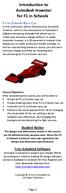 Introduction to Autodesk Inventor for F1 in Schools F1 in Schools Race Car In this course you will be introduced to Autodesk Inventor, which is the centerpiece of Autodesk s digital prototyping strategy
House Design Tutorial
 Chapter 2: House Design Tutorial This House Design Tutorial shows you how to get started on a design project. The tutorials that follow continue with the same plan. When we are finished, we will have created
Introduction to Autodesk Inventor for F1 in Schools
 F1 in Schools race car Introduction to Autodesk Inventor for F1 in Schools In this course you will be introduced to Autodesk Inventor, which is the centerpiece of Autodesk s Digital Prototyping strategy
Multi-user Collaboration with Autodesk Revit Worksharing
 AUTODESK REVIT WHITE PAPER Multi-user Collaboration with Autodesk Revit Worksharing Contents Contents... 1 Autodesk Revit Worksharing... 2 Starting Your First Multi-user Project... 2 Autodesk Revit Worksets...
Microsoft PowerPoint 2010 Handout
 Microsoft PowerPoint 2010 Handout PowerPoint is a presentation software program that is part of the Microsoft Office package. This program helps you to enhance your oral presentation and keep the audience
Handout: Word 2010 Tips and Shortcuts
 Word 2010: Tips and Shortcuts Table of Contents EXPORT A CUSTOMIZED QUICK ACCESS TOOLBAR... 2 IMPORT A CUSTOMIZED QUICK ACCESS TOOLBAR... 2 USE THE FORMAT PAINTER... 3 REPEAT THE LAST ACTION... 3 SHOW
Internet Explorer 7. Getting Started The Internet Explorer Window. Tabs NEW! Working with the Tab Row. Microsoft QUICK Source
 Microsoft QUICK Source Internet Explorer 7 Getting Started The Internet Explorer Window u v w x y { Using the Command Bar The Command Bar contains shortcut buttons for Internet Explorer tools. To expand
Welcome to CorelDRAW, a comprehensive vector-based drawing and graphic-design program for the graphics professional.
 Workspace tour Welcome to CorelDRAW, a comprehensive vector-based drawing and graphic-design program for the graphics professional. In this tutorial, you will become familiar with the terminology and workspace
Excel 2007 Basic knowledge
 Ribbon menu The Ribbon menu system with tabs for various Excel commands. This Ribbon system replaces the traditional menus used with Excel 2003. Above the Ribbon in the upper-left corner is the Microsoft
Snagit 10. Getting Started Guide. March 2010. 2010 TechSmith Corporation. All rights reserved.
 Snagit 10 Getting Started Guide March 2010 2010 TechSmith Corporation. All rights reserved. Introduction If you have just a few minutes or want to know just the basics, this is the place to start. This
WHAT S NEW IN WORD 2010 & HOW TO CUSTOMIZE IT
 WHAT S NEW IN WORD 2010 & HOW TO CUSTOMIZE IT The Ribbon... 2 Default Tabs... 2 Contextual Tabs... 2 Minimizing and Restoring the Ribbon... 3 Customizing the Ribbon... 3 A New Graphic Interface... 5 Live
Sample Table. Columns. Column 1 Column 2 Column 3 Row 1 Cell 1 Cell 2 Cell 3 Row 2 Cell 4 Cell 5 Cell 6 Row 3 Cell 7 Cell 8 Cell 9.
 Working with Tables in Microsoft Word The purpose of this document is to lead you through the steps of creating, editing and deleting tables and parts of tables. This document follows a tutorial format
Introduction to Word 2007
 Introduction to Word 2007 You will notice some obvious changes immediately after starting Word 2007. For starters, the top bar has a completely new look, consisting of new features, buttons and naming
Microsoft Access 2010 handout
 Microsoft Access 2010 handout Access 2010 is a relational database program you can use to create and manage large quantities of data. You can use Access to manage anything from a home inventory to a giant
Project Setup and Data Management Tutorial
 Project Setup and Heavy Construction Edition Version 1.20 Corporate Office Trimble Navigation Limited Engineering and Construction Division 5475 Kellenburger Road Dayton, Ohio 45424-1099 U.S.A. Phone:
Windows XP Pro: Basics 1
 NORTHWEST MISSOURI STATE UNIVERSITY ONLINE USER S GUIDE 2004 Windows XP Pro: Basics 1 Getting on the Northwest Network Getting on the Northwest network is easy with a university-provided PC, which has
Worksharing is a design method that allows multiple team members to work on the same project model at the same time.
 Revit Worksharing Introduction Worksharing is a design method that allows multiple team members to work on the same project model at the same time. On many projects, team members are assigned a specific
Sharing Presentations, Documents, and Whiteboards
 Chapter 19 19 Sharing Presentations, Documents, and Whiteboards Your user role in an event determines your level of sharing. Whichever role you take, the following table describes the basic tasks associated
Content Author's Reference and Cookbook
 Sitecore CMS 6.5 Content Author's Reference and Cookbook Rev. 110621 Sitecore CMS 6.5 Content Author's Reference and Cookbook A Conceptual Overview and Practical Guide to Using Sitecore Table of Contents
Building Information Modeling with Autodesk Revit Building. Student Workbook
 Building Information Modeling with Autodesk Revit Building Student Workbook Contents Introduction 4 Unit 1 7 Theory: CAD Versus BIM... 7 Autodesk Revit Building: Introduction, Interface, and Sketching...
Creating Drawings in Pro/ENGINEER
 6 Creating Drawings in Pro/ENGINEER This chapter shows you how to bring the cell phone models and the assembly you ve created into the Pro/ENGINEER Drawing mode to create a drawing. A mechanical drawing
Collaborating Across Disciplines with Revit Architecture, MEP, and Structure
 Collaborating Across Disciplines with Revit Architecture, MEP, and Structure David Cohn AB104-3 Are you ready to take the next step and use building information modeling to share data across the entire
SolidWorks Tutorial 3 MAGNETIC BLOCK
 SolidWorks Tutorial 3 MAGNETIC BLOCK Magnetic Block In this exercise you will make a magnetic block. To do so, you will create a few parts, which you will assemble. You will learn the following new applications
Word basics. Before you begin. What you'll learn. Requirements. Estimated time to complete:
 Word basics Word is a powerful word processing and layout application, but to use it most effectively, you first have to understand the basics. This tutorial introduces some of the tasks and features that
PowerPoint 2013: Basic Skills
 PowerPoint 2013: Basic Skills Information Technology September 1, 2014 1 P a g e Getting Started There are a variety of ways to start using PowerPoint software. You can click on a shortcut on your desktop
Learning Autodesk. Modeling, Analysis and Animation SDC. Randy H. Shih. Better Textbooks. Lower Prices. PUBLICATIONS www.sdcpublications.
 Learning Autodesk Inventor 2012 Modeling, Analysis and Animation Randy H. Shih SDC Better Textbooks. Lower Prices. PUBLICATIONS www.sdcpublications.com Schroff Development Corporation Visit the following
Microsoft Office Excel 2007 Key Features. Office of Enterprise Development and Support Applications Support Group
 Microsoft Office Excel 2007 Key Features Office of Enterprise Development and Support Applications Support Group 2011 TABLE OF CONTENTS Office of Enterprise Development & Support Acknowledgment. 3 Introduction.
Sharing Files and Whiteboards
 Your user role in a meeting determines your level of file sharing. The type of files you can share include documents, presentations, and videos. About Sharing Files, page 1 Changing Views in a File or
Windows 8.1 Update 1 Supplement
 Illustrated Series Guide to Windows 8.1 Update 1 Changes June 2014 Table of Contents (CTRL+Click a link to navigate directly to Part 1, 2, 3, or 4.) Part 1: What Version of Windows Am I Using? Part 2:
House Design Tutorial
 Chapter 2: House Design Tutorial This House Design Tutorial shows you how to get started on a design project. The tutorials that follow continue with the same plan. When you are finished, you will have
CATIA Basic Concepts TABLE OF CONTENTS
 TABLE OF CONTENTS Introduction...1 Manual Format...2 Log on/off procedures for Windows...3 To log on...3 To logoff...7 Assembly Design Screen...8 Part Design Screen...9 Pull-down Menus...10 Start...10
SMART Notebook: Basics and Application
 SMART Notebook: Basics and Application Table of Contents TESS Connection... 3 Version Number... 3 Tour of the Window... 5 The Main Toolbar... 5 The Sidebar... 18 Page Sorter... 19 The Gallery... 23 Searching...
Sweet Home 3D user's guide
 1 de 14 08/01/2013 13:08 Features Download Online Gallery Blog Documentation FAQ User's guide Video tutorial Developer's guides History Reviews Support 3D models Textures Translations Forum Report a bug
SpaceClaim Introduction Training Session. A SpaceClaim Support Document
 SpaceClaim Introduction Training Session A SpaceClaim Support Document In this class we will walk through the basic tools used to create and modify models in SpaceClaim. Introduction We will focus on:
PowerPoint 2007 Basics Website: http://etc.usf.edu/te/
 Website: http://etc.usf.edu/te/ PowerPoint is the presentation program included in the Microsoft Office suite. With PowerPoint, you can create engaging presentations that can be presented in person, online,
Formatting & Styles Word 2010
 Formatting & Styles Word 2010 Produced by Flinders University Centre for Educational ICT CONTENTS Layout... 1 Using the Ribbon Bar... 2 Minimising the Ribbon Bar... 2 The File Tab... 3 What the Commands
Excel 2003 Tutorial I
 This tutorial was adapted from a tutorial by see its complete version at http://www.fgcu.edu/support/office2000/excel/index.html Excel 2003 Tutorial I Spreadsheet Basics Screen Layout Title bar Menu bar
ECDL. European Computer Driving Licence. Spreadsheet Software BCS ITQ Level 2. Syllabus Version 5.0
 European Computer Driving Licence Spreadsheet Software BCS ITQ Level 2 Using Microsoft Excel 2010 Syllabus Version 5.0 This training, which has been approved by BCS, The Chartered Institute for IT, includes
Microsoft Excel 2010 Tutorial
 1 Microsoft Excel 2010 Tutorial Excel is a spreadsheet program in the Microsoft Office system. You can use Excel to create and format workbooks (a collection of spreadsheets) in order to analyze data and
Microsoft PowerPoint 2010
 Microsoft PowerPoint 2010 Starting PowerPoint... 2 PowerPoint Window Properties... 2 The Ribbon... 3 Default Tabs... 3 Contextual Tabs... 3 Minimizing and Restoring the Ribbon... 4 The Backstage View...
Excel basics. Before you begin. What you'll learn. Requirements. Estimated time to complete:
 Excel basics Excel is a powerful spreadsheet and data analysis application, but to use it most effectively, you first have to understand the basics. This tutorial introduces some of the tasks and features
This Skill Builder demonstrates how to define and place sketched symbols in drawings.
 Sketched Symbols This Skill Builder demonstrates how to define and place sketched symbols in drawings. A sketched symbol is a user-defined symbol. You create sketched symbols in the sketch environment
Embroidery Fonts Plus ( EFP ) Tutorial Guide Version 1.0505
 Embroidery Fonts Plus ( EFP ) Tutorial Guide Version 1.0505 1 Contents Chapter 1 System Requirements.................. 3 Chapter 2 Quick Start Installation.................. 4 System Requirements................
Advanced Presentation Features and Animation
 There are three features that you should remember as you work within PowerPoint 2007: the Microsoft Office Button, the Quick Access Toolbar, and the Ribbon. The function of these features will be more
Microsoft PowerPoint Tutorial
 Microsoft PowerPoint Tutorial Contents Starting MS PowerPoint... 1 The MS PowerPoint Window... 2 Title Bar...2 Office Button...3 Saving Your Work... 3 For the first time... 3 While you work... 3 Backing
The CAD interface is comprised of two different screens: the graphic/drawing screen and the text screen.
 That CAD Girl J ennifer dib ona Website: www.thatcadgirl.com Email: [email protected] Phone: (919) 417-8351 Fax: (919) 573-0351 Overview of AutoCAD or IntelliCAD with Carlson Software Screens and
3D-GIS in the Cloud USER MANUAL. August, 2014
 3D-GIS in the Cloud USER MANUAL August, 2014 3D GIS in the Cloud User Manual August, 2014 Table of Contents 1. Quick Reference: Navigating and Exploring in the 3D GIS in the Cloud... 2 1.1 Using the Mouse...
Effective Collaboration
 AUTODESK BUILDING SOLUTIONS Effective Collaboration Exporting Revit Architecture Models as ACIS Solids for Use in AutoCAD MEP The intent of this paper is to explain a process by which architects using
Microsoft Outlook 2010 Part 1: Introduction to Outlook
 CALIFORNIA STATE UNIVERSITY, LOS ANGELES INFORMATION TECHNOLOGY SERVICES Microsoft Outlook 2010 Part 1: Introduction to Outlook Spring 2012, Version 1.0 Table of Contents Introduction...3 Starting the
Microsoft PowerPoint 2011
 Microsoft PowerPoint 2011 Starting PowerPoint... 2 Creating Slides in Your Presentation... 3 Beginning with the Title Slide... 3 Inserting a New Slide... 3 Adding an Image to a Slide... 4 Downloading Images
NAVIGATION TIPS. Special Tabs
 rp`=j~êëü~ää=påüççä=çñ=_ìëáåéëë Academic Information Services Excel 2007 Cheat Sheet Find Excel 2003 Commands in Excel 2007 Use this handout to find where Excel 2003 commands are located in Excel 2007.
Chapter 1. Creating Sketches in. the Sketch Mode-I. Evaluation chapter. Logon to www.cadcim.com for more details. Learning Objectives
 Chapter 1 Creating Sketches in Learning Objectives the Sketch Mode-I After completing this chapter you will be able to: Use various tools to create a geometry. Dimension a sketch. Apply constraints to
MS Word 2007 practical notes
 MS Word 2007 practical notes Contents Opening Microsoft Word 2007 in the practical room... 4 Screen Layout... 4 The Microsoft Office Button... 4 The Ribbon... 5 Quick Access Toolbar... 5 Moving in the
Produced by Flinders University Centre for Educational ICT. PivotTables Excel 2010
 Produced by Flinders University Centre for Educational ICT PivotTables Excel 2010 CONTENTS Layout... 1 The Ribbon Bar... 2 Minimising the Ribbon Bar... 2 The File Tab... 3 What the Commands and Buttons
Task Force on Technology / EXCEL
 Task Force on Technology EXCEL Basic terminology Spreadsheet A spreadsheet is an electronic document that stores various types of data. There are vertical columns and horizontal rows. A cell is where the
Adding Comments in Microsoft Excel 2003
 Adding Comments in Microsoft Excel 2003 Introduction Microsoft Excel has a very useful facility which allows you to add explanatory notes to your worksheet. These can be used, for example, to explain what
Contents. Launching FrontPage... 3. Working with the FrontPage Interface... 3 View Options... 4 The Folders List... 5 The Page View Frame...
 Using Microsoft Office 2003 Introduction to FrontPage Handout INFORMATION TECHNOLOGY SERVICES California State University, Los Angeles Version 1.0 Fall 2005 Contents Launching FrontPage... 3 Working with
POWERPOINT BASICS: MICROSOFT OFFICE 2013
 University of North Carolina at Chapel Hill Libraries Carrboro Cybrary Chapel Hill Public Library Durham County Public Library POWERPOINT BASICS: MICROSOFT OFFICE 2013 GETTING STARTED PAGE 02 Prerequisites
Windows 8.1 Tips and Tricks
 Windows 8.1 Tips and Tricks Table of Contents Tiles... 2 Removing, Resizing and Moving Existing Tiles... 2 Adding New Tiles... 2 Returning to the Start Screen (Charms)... 3 The Search Feature... 3 Switching
Using Microsoft Office XP Advanced Word Handout INFORMATION TECHNOLOGY SERVICES California State University, Los Angeles Version 1.
 Using Microsoft Office XP Advanced Word Handout INFORMATION TECHNOLOGY SERVICES California State University, Los Angeles Version 1.0 Spring 2004 Contents Advanced Microsoft Word XP... 3 Customizing Word
Outlook Email. User Guide IS TRAINING CENTER. 833 Chestnut St, Suite 600. Philadelphia, PA 19107 215-503-7500
 Outlook Email User Guide IS TRAINING CENTER 833 Chestnut St, Suite 600 Philadelphia, PA 19107 215-503-7500 This page intentionally left blank. TABLE OF CONTENTS Getting Started... 3 Opening Outlook...
In this session, we will explain some of the basics of word processing. 1. Start Microsoft Word 11. Edit the Document cut & move
 WORD PROCESSING In this session, we will explain some of the basics of word processing. The following are the outlines: 1. Start Microsoft Word 11. Edit the Document cut & move 2. Describe the Word Screen
Adobe Illustrator CS5 Part 1: Introduction to Illustrator
 CALIFORNIA STATE UNIVERSITY, LOS ANGELES INFORMATION TECHNOLOGY SERVICES Adobe Illustrator CS5 Part 1: Introduction to Illustrator Summer 2011, Version 1.0 Table of Contents Introduction...2 Downloading
IT Quick Reference Guides Using Windows 7
 IT Quick Reference Guides Using Windows 7 Windows Guides This sheet covers many of the basic commands for using the Windows 7 operating system. WELCOME TO WINDOWS 7 After you log into your machine, the
LEGO Digital Designer 4.3 User Manual
 LEGO Digital Designer 4.3 User Manual The Readme file contains system requirements and the latest information about this software release. Please refer to it first if you encounter any problems. Contents
Done. Click Done to close the Capture Preview window.
 The Capture Preview window allows you to preview, edit, and customize a screen capture before it is saved to a file, inserted into your document, attached to an e-mail, or sent to a variety of other Output
Manual English KOI Desktop App 2.0.x
 Manual English KOI Desktop App 2.0.x KOI Kommunikation, Organisation, Information Comm-Unity EDV GmbH 2010 Contents Introduction... 3 Information on how to use the documentation... 3 System requirements:...
Appointment Scheduler
 EZClaim Appointment Scheduler User Guide Last Update: 11/19/2008 Copyright 2008 EZClaim This page intentionally left blank Contents Contents... iii Getting Started... 5 System Requirements... 5 Installing
Microsoft Outlook 2010 Part 1: Introduction to Outlook
 CALIFORNIA STATE UNIVERSITY, LOS ANGELES INFORMATION TECHNOLOGY SERVICES Microsoft Outlook 2010 Part 1: Introduction to Outlook Spring 2015, Version 1.4 Table of Contents Introduction...3 Starting Outlook...3
Excel 2007: Basics Learning Guide
 Excel 2007: Basics Learning Guide Exploring Excel At first glance, the new Excel 2007 interface may seem a bit unsettling, with fat bands called Ribbons replacing cascading text menus and task bars. This
MICROSOFT OUTLOOK 2010 WORK WITH CONTACTS
 MICROSOFT OUTLOOK 2010 WORK WITH CONTACTS Last Edited: 2012-07-09 1 Access to Outlook contacts area... 4 Manage Outlook contacts view... 5 Change the view of Contacts area... 5 Business Cards view... 6
PowerPoint 2013 Basics for Windows Training Objective
 PowerPoint 2013 Basics for Windows PowerPoint 2013 Basics for Windows Training Objective To learn the tools and features to get started using PowerPoint more efficiently and effectively. What you can expect
Getting Started Guide
 3D Architect Home Designer Getting Started Guide Produced and published in the UK by Eleco Software Limited 2014 Eleco plc. All rights reserved. The software and hardware names and labels used in this
Microsoft Outlook 2007 Calendar Features
 Microsoft Outlook 2007 Calendar Features Participant Guide HR Training and Development For technical assistance, please call 257-1300 Copyright 2007 Microsoft Outlook 2007 Calendar Objectives After completing
Microsoft Outlook 2013 Part 1: Introduction to Outlook
 CALIFORNIA STATE UNIVERSITY, LOS ANGELES INFORMATION TECHNOLOGY SERVICES Microsoft Outlook 2013 Part 1: Introduction to Outlook Fall 2014, Version 1.0 Table of Contents Introduction...3 Starting Outlook...3
Google Docs Basics Website: http://etc.usf.edu/te/
 Website: http://etc.usf.edu/te/ Google Docs is a free web-based office suite that allows you to store documents online so you can access them from any computer with an internet connection. With Google
ACCESS 2007 BASICS. Best Practices in MS Access. Information Technology. MS Access 2007 Users Guide. IT Training & Development (818) 677-1700
 Information Technology MS Access 2007 Users Guide ACCESS 2007 BASICS Best Practices in MS Access IT Training & Development (818) 677-1700 Email: [email protected] Website: www.csun.edu/it/training Access
Data Visualization. Brief Overview of ArcMap
 Data Visualization Prepared by Francisco Olivera, Ph.D., P.E., Srikanth Koka and Lauren Walker Department of Civil Engineering September 13, 2006 Contents: Brief Overview of ArcMap Goals of the Exercise
Chapter 23: Drafting in Worksheet View
 Chapter 23: Drafting in Worksheet View Worksheet View is a powerful, 2D production drafting module. Here you can find all of the drawing and editing tools needed to create fast, accurate, detailed working
Microsoft Word 2010 Training
 Microsoft Word 2010 Training Microsoft Word 102 Instructor: Debbie Minnerly Course goals Learn how to work with paragraphs. Set tabs and work with tables. Learn about styles Use the spelling and grammar
SMART Board Beginning
 SMART Board Beginning Downloading the Software... 2 600 Series SMART Board... 2 800 Series SMART Board... 3 SMART Board Cleaning Options... 4 SMART Board Pens... 4 SMART Board Help... 4 Using the On Screen
User Guide. emoney for Outlook
 User Guide emoney for Outlook Table of Contents INTRODUCTION... 2 SYSTEM REQUIREMENTS... 2 Required Installations... 2 INSTALLATION PROCESS... 2 FIRST TIME SETUP... 8 EMONEY CLIENT PANE... 17 Client Contact
Creating 2D Drawings from 3D AutoCAD Models
 Creating 2D Drawings from 3D AutoCAD Models David Piggott CrWare, LP GD205-2P This class explores the various techniques in creating 2D part and assembly drawings from 3D AutoCAD models. As part of the
Microsoft Access 2010 Part 1: Introduction to Access
 CALIFORNIA STATE UNIVERSITY, LOS ANGELES INFORMATION TECHNOLOGY SERVICES Microsoft Access 2010 Part 1: Introduction to Access Fall 2014, Version 1.2 Table of Contents Introduction...3 Starting Access...3
Autodesk Fusion 360 Badge Guide: Design an F1 in Schools Trophy
 Autodesk Fusion 360 Badge Guide: Design an F1 in Schools Trophy Abstract: Gain basic understanding of creating 3D models in Fusion 360 by designing an F1 in Schools trophy. This badge may be claimed by
Multi-user Collaboration with Revit Worksets
 Autodesk Revit White Paper Multi-user Collaboration with Revit Worksets Starting Your First Multi-user Project On many building projects, designers work in teams with each assigned a specific functional
Excel -- Creating Charts
 Excel -- Creating Charts The saying goes, A picture is worth a thousand words, and so true. Professional looking charts give visual enhancement to your statistics, fiscal reports or presentation. Excel
Introduction to MS WINDOWS XP
 Introduction to MS WINDOWS XP Mouse Desktop Windows Applications File handling Introduction to MS Windows XP 2 Table of Contents What is Windows XP?... 3 Windows within Windows... 3 The Desktop... 3 The
Introduction to Google SketchUp (Mac Version)
 Introduction to Google SketchUp (Mac Version) This guide is handy to read if you need some basic knowledge to get started using SketchUp. You will see how to download and install Sketchup, and learn how
Introduction to Windows 8
 Introduction to Windows 8 Windows 8 is a completely redesigned operating system developed from the ground up with touchscreen use in mind as well as near instant-on capabilities that enable a Windows 8
Creo Parametric - Advanced Primer Exercise Guide
 Creo Parametric - Advanced Primer Exercise Guide Authored and published using Copyright 2009 Parametric Technology Corporation. All Rights Reserved. Copyright for PTC software products is with Parametric
Module One: Getting Started... 6. Opening Outlook... 6. Setting Up Outlook for the First Time... 7. Understanding the Interface...
 2 CONTENTS Module One: Getting Started... 6 Opening Outlook... 6 Setting Up Outlook for the First Time... 7 Understanding the Interface...12 Using Backstage View...14 Viewing Your Inbox...15 Closing Outlook...17
Introduction to dobe Acrobat XI Pro
 Introduction to dobe Acrobat XI Pro Introduction to Adobe Acrobat XI Pro is licensed under the Creative Commons Attribution-NonCommercial-NoDerivatives 4.0 International License. To view a copy of this
TurboCAD Architectural
 TurboCAD Architectural Version 15 Getting Started Guide IMSI/Design LLC, US 100 Rowland Blvd. Novato. CA 94945, USA Tel: +1-415-878-4000 Fax: +1-415-897-2544 Web Site www.imsisoft.com www.turbocad.com
Basic Microsoft Excel 2007
 Basic Microsoft Excel 2007 The biggest difference between Excel 2007 and its predecessors is the new layout. All of the old functions are still there (with some new additions), but they are now located
JumpStart Guide. Trimble QuickPen PipeDesigner 3D Software
 L JumpStart Guide Trimble QuickPen PipeDesigner 3D Software Revision A February 2013 F Englewood Office Trimble Navigation Limited 384 Inverness Parkway, Suite 200 Englewood, Colorado 80112 (800) 234-3758
Sample- for evaluation purposes only! Introductory OneNote. teachucomp, inc. A publication of TeachUcomp Incorporated. Copyright TeachUcomp, Inc.
 A publication of TeachUcomp Incorporated. Copyright TeachUcomp, Inc. 2013 Introductory OneNote teachucomp, inc. it s all about you Copyright: Copyright 2013 by TeachUcomp, Inc. All rights reserved. This