
My Classroom Management Philosophy
|
|
|
- Paul Hicks
- 9 years ago
- Views:
Transcription
1 My Classroom Management Philosophy I believe one of the hardest things for new teachers to build is their classroom management plan. I have seen many different types of classroom management plans throughout my school experience and my field experiences. Some have worked and some have not. What works with one group of students, may not work for another set of students. Some classroom management plans may work better with the lower grades rather than the upper grades and vice versa. So I believe a teacher s classroom management plan is always changing and evolving as they gain more knowledge in the field of teaching. There are always new studies coming out on how students learn best and how teachers should deal with behavioral problems within the classroom. Two classroom management philosophies that I have had the opportunity to observe and work with is the concepts of PBIS (Positive Behavioral Interventions & Supports) and Dr. Becky Bailey s Conscious Discipline. It is my belief that combining the ideas behind both of these philosophies will ensure that students are set up in an environment of success. These philosophies coupled with providing students with predicting routines will help students feel confident and safe to ensure student learning. The PBIS (Positive Behavioral Interventions & Supports) philosophy is a problem-solving approach. Rather than solely using consequences to control inappropriate behaviors, this philosophy of PBIS emphasizes prevention, or changing problem environments, and teaching so that the student learns alternative means for addressing their needs. I believe PBIS should be implemented school-wide, known as SWPBS. In SWPBS, there is a continuum of three levels of intervention that vary in intensity based on the students needs. The first level is known a Primary Prevention which targets all students in a school to prevent problem behaviors by emphasizing on establishing and teaching appropriate, acceptable behaviors. These acceptable behaviors are posted throughout the school and taught school wide. When these acceptable behaviors are seen they are rewarded. For example, in my last student teaching placement of Donelson Hills Elementary in Waterford, they had some of the students make a movie on how to walk in the hallways of the school, how to act during a school assembly, how to play on the school playground, etc. When students are seen implementing these appropriate and acceptable behaviors the class may be rewarded Complement Points and/ or a student may be rewarded a Dragon Ticket (or some form of complement ticket) that would be placed in the school bucket for a school wide drawing for a prize. The students really enjoyed this and they wanted to receive as many Classroom Complement Points or Dragon Tickets for they love receiving prizes. The second level of intervention is known as Secondary Prevention which targets students who are not sufficiently responsive to the Primary Prevention level and may be unnecessary for the next level. Secondary Prevention provides a group-based intervention. Students at this level are generally considered at risk for pervasive behavioral challenges it their needs go unaddressed over time. For example, a couple of my third grade students took part in a boys only social group. The group was led by one of the school s male social workers. The boys in this group had issues with conflict resolution, social problem solving, and mostly anger management. The group met a couple times a month to discuss strategies on how to deal appropriately to these conflicts. The social worker was not only the group s leader but also a mentor to the boys. He was just a phone call away when one of the boys was having a difficult day and making some wrong choices. He always knew how to calm them down and think about their actions in order to plan the next steps they were going to take. Lastly, the last level of intervention deals with the individual. This level is known as the Tertiary Prevention. It consists highly on individualized behavior support of students who are not sufficiently responsive to the first two levels and present pervasive or persistent behavioral challenges. These students often require specialized interventions and supports that are uniquely tailored to their circumstances and learning needs. In the case of the child s challenging behavior persists despite consistently implemented interventions, the child s behavior places the child or others at risk of harm of injury and school personnel are considering more intrusive and restrictive procedures and/or a more restrictive placement for the child; an Individualized Positive Behavior Plan is made. One of my students had a difficult time with controlling his anger when he did not get his way. My cooperating teacher along with the principal and myself made a Support Plan for the student. When the student s anger rose that there was no talking

2 to him, he was asked to go to one of his support teachers until he is able to calm himself down enough to be able to come back into the classroom. Dr. Becky Bailey s Conscious Discipline philosophy is similar to the PBIS philosophy. Conscious Discipline deals with the social and emotional intelligence. It empowers the teacher and the student by first fostering the emotional intelligence of the teacher then the student. Conscious Discipline provides the teachers with the tools to change from the traditional model of discipline of rules and consequences to the relationship-based community model of being a classroom family that is built on communicational skills and how to be a problem solver. I have seen this philosophy of Conscious Discipline implemented not only in lower grades like kindergarten but also in the upper grades of third, fourth, and fifth grade. The first couple weeks of school, I believe it is important to focus on building your classroom family. The students play an important role in creating that classroom family. As a classroom family, they will decide what appropriate behaviors are acceptable in the classroom, in the halls, in the lunch room, on the playground, etc. These behaviors need to be written in a positive way and posted so that everyone in the classroom can see it. The behaviors will be modeled and practiced with the students. I also believe it is important for each student to become problem solvers, no matter their age, to learn how to deal with their own conflicts in a positive way. The students need to learn that if someone is bothering them they have three steps they should follow. These three steps are known as the 3 Steps of Problem Solving. Step 1 is to move away from the person or people that are bothering them. If the student or students are still bothering them, go to step 2 of using an I Statement. Tell the student or students the action you did not like, why you do not like it, and what you want the student or students to do. If the student or students still continues to bother them they need to go to step 3 which is telling an adult. The ONLY time the students go directly to step 3 is if there is a potential of someone seriously getting hurt. The 3 Steps of Problem Solving should be modeled and posted with the students. The students also need to know that everyone makes mistakes but we need to accept our mistakes and apologize for them. The idea of the Clean Up and I Statement cards allow the students to do this appropriately. I made laminated cards of both of these for my third grade class. It was very resourceful for the students for the reason they could take a card from the basket, ask the student or students they had a conflict with, and quietly excuse themselves from the classroom to deal with the situation without disturbing the rest of the class. Another way to reinforce a classroom family and encourage the students to be a problem solver is by the use of a classroom meeting. In my third grade class, we started by having a classroom meeting in the morning and one in the afternoon. Another class, I subbed in, only has a classroom meeting once a day. No matter if you have one, two, or several a day, I believe it is important to have a classroom meeting. In a classroom meeting, the students can share an issue that is happening in the classroom without the use of using another student s name. After the issue is shared, a few of the student s fellow classmates can share some problem solving strategies that can help the student deal with the issue and the student can decide what problem solving strategy they want to try to use. When we come back together for another classroom meeting we will revisit the issue. We will see if the issue was resolved and earn a celebration or need more help in solving the issue. This is done before another student s issue can be discussed. Conscious Discipline also suggests that your classroom has a safe place. Students who might be having a rough day and just need a safe place where they can calm down can come here. The students can do one of Dr. Becky Bailey s breathing techniques of the drain, balloon, pretzel, or star to calm themselves down. The safe place may also include some stress toys that can be plated with or some social books that the student can read. Another idea that was introduced to me in my last third grade placement that I would incorporate is having a Behavioral Improvement Plan. This plan would be sent home to a student that continues to have difficulties following one or more of the classroom rules, which usually deals with how the student s actions were not safe, responsible, and/or respectful.
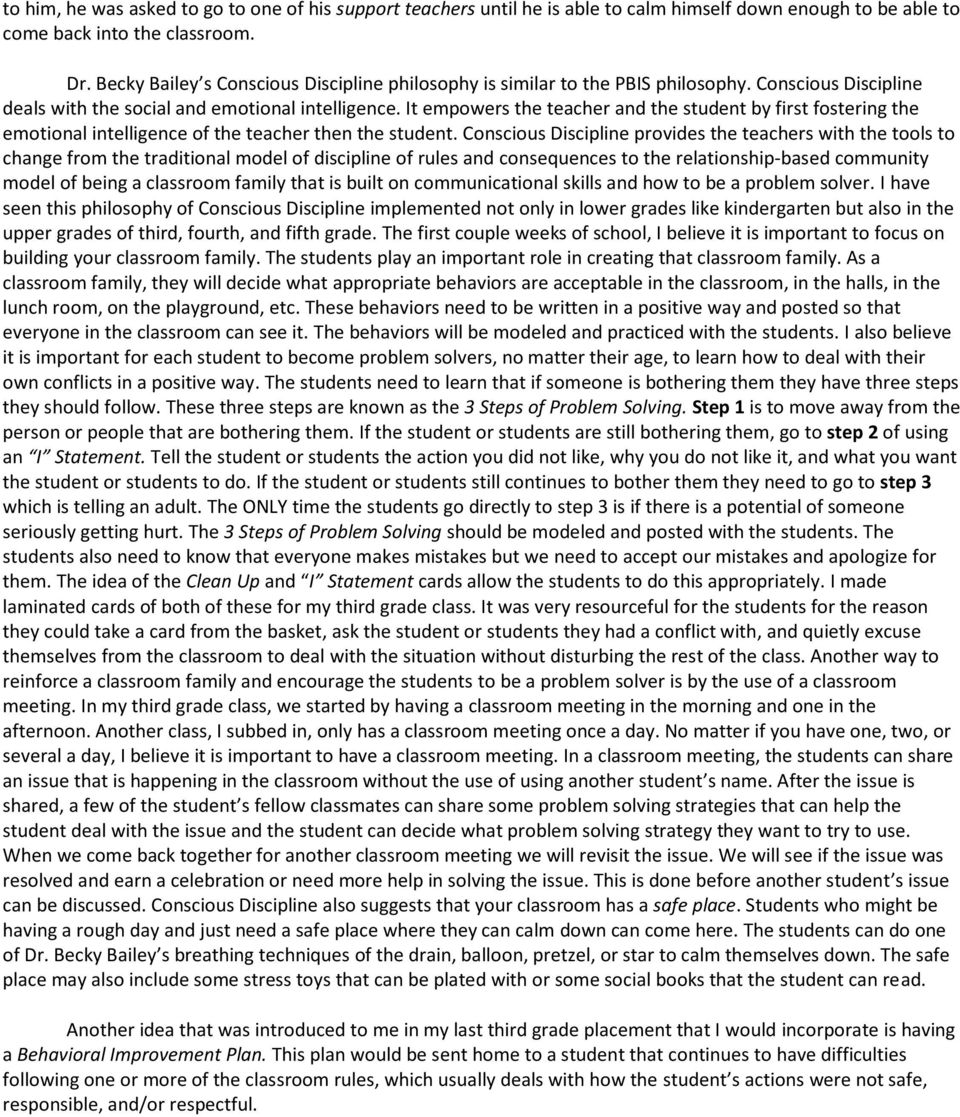


3 Behavioral Improvement Plan Lower Grades Student Name: Date: I have been having difficulty following one or more of our classroom rules. The following is the rule(s) that I am struggling with: Being Safe Being Responsible Being Respectful Keeping our hands to ourselves Keeping our feet to ourselves Do my best on my work Participating Respect my fellow classmate(s) Respect my teacher Using walking feet This is what I did Using our classroom materials as intended Completing all my work Responsible for my actions Write or draw Respect my guest teacher Respect our classroom volunteer Next time I am going to Write or draw Did I apologize? Student Signature: Teacher Signature: Parent Signature: Return the following school day
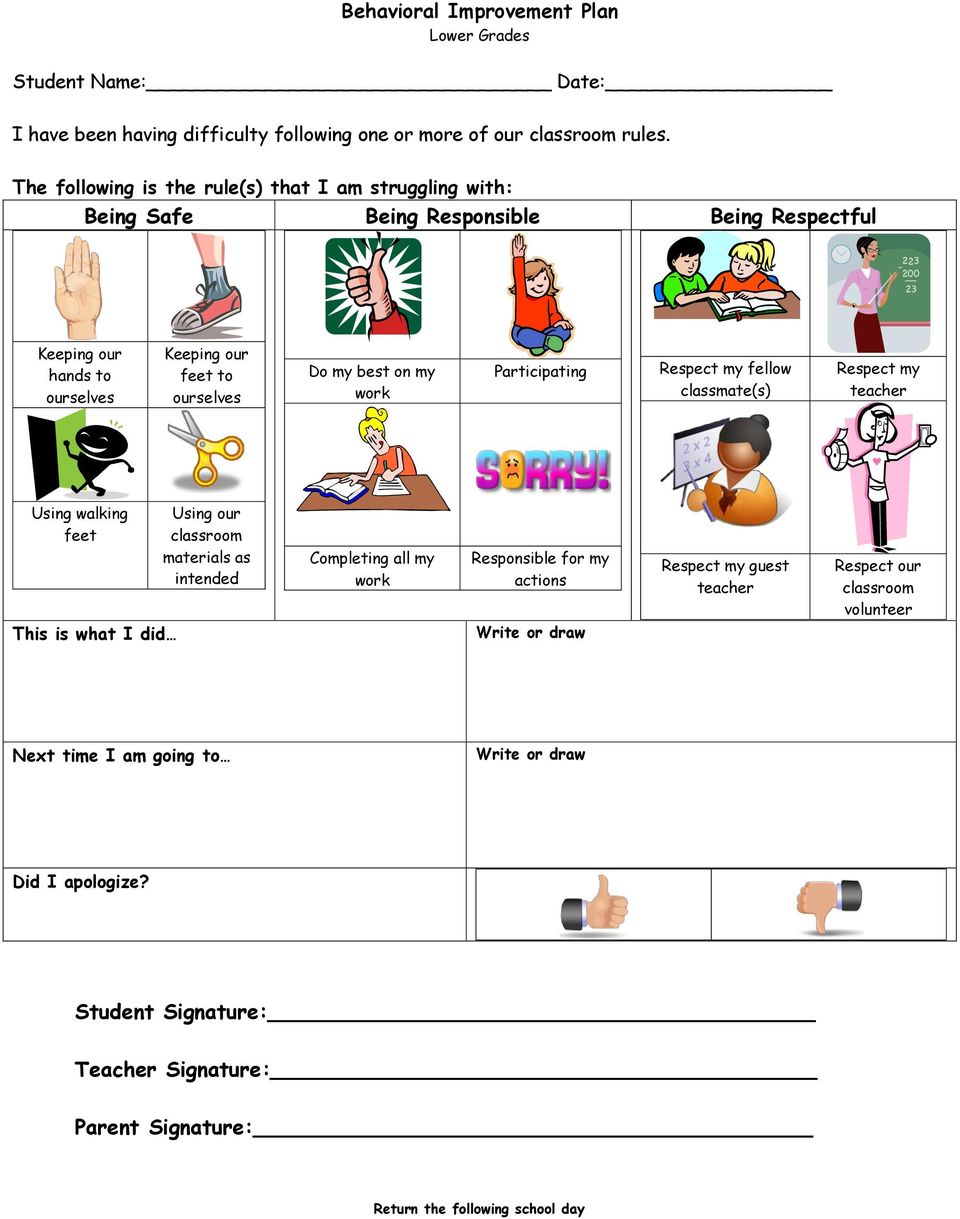
4 Behavioral Improvement Plan Upper Grades Student Name: Date: I have been having difficulty following one or more of our classroom rules. The following is the rule(s) that I am struggling with: Being Safe Keeping my hands and feet to myself Using walking feet Using my classroom materials as intended Using the problem solving steps Being Responsible Doing my best Participating Completing my work Being Respectful Respecting my fellow classmates Respecting my teacher and/or guest teachers This is what I am going to do to help myself remember to follow the rule(s): This is what Miss Colasanti can do to help me remember to follow the rule(s): This is what my parents can do to help me remember to follow the rule(s): Student Signature: Teacher Signature: Parent Signature: Return the following school day filled out
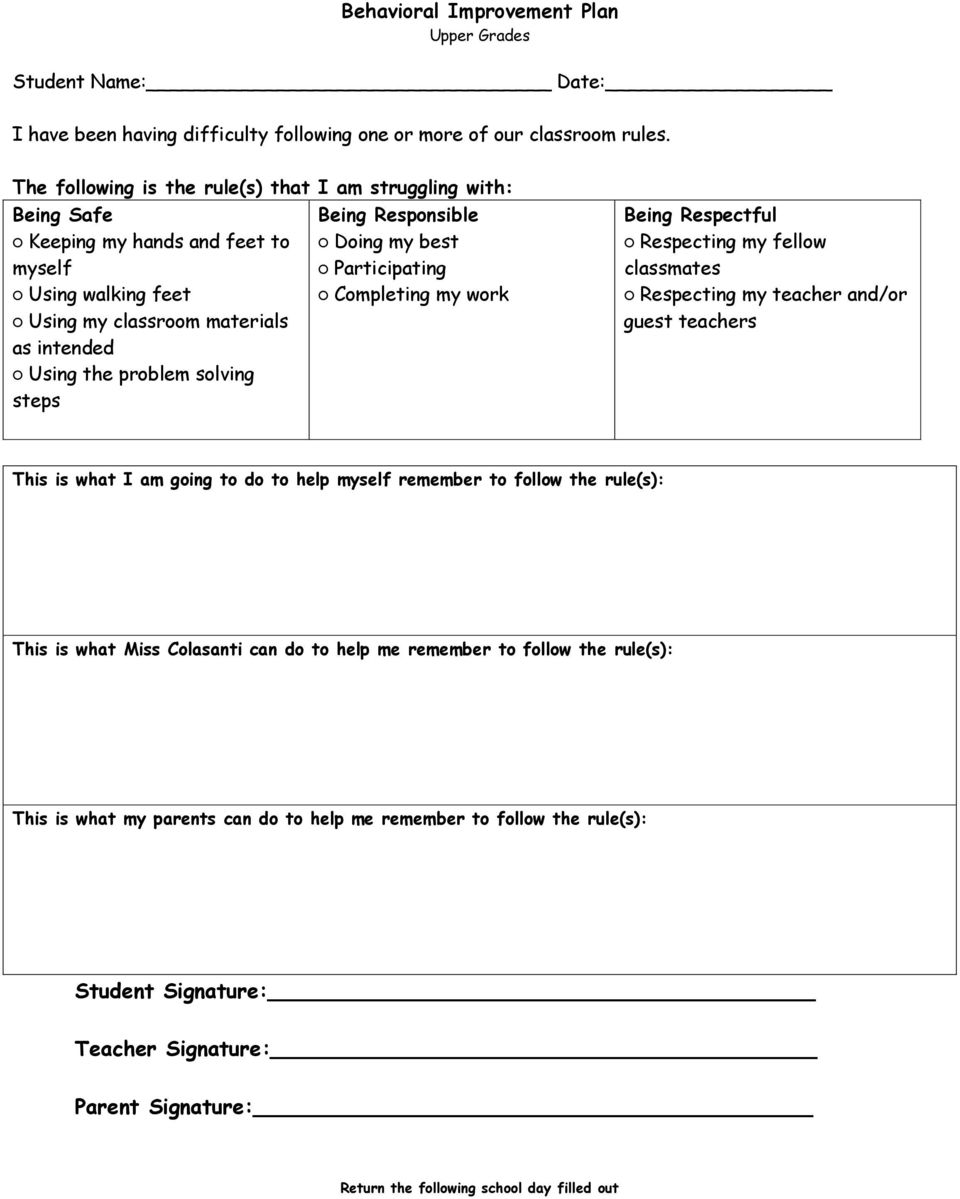
5 The safe place in my kindergarten classroom Morning handshakes adapted from Dr. Becky Bailey s Conscious Discipline (Used in my 3 rd grade)
6 Models of the brain adapted from Dr. Becky Bailey s Conscious Discipline (Used in my 3 rd grade)

PBIS and the Responsive Classroom Approach
 PBIS and the Responsive Classroom Approach Positive Behavioral Interventions and Supports (PBIS), an evidence-based framework for developing positive behavior, is used in schools nationwide to create a
Lower Elementary Montessori Classroom Management Plan and Parent Information
 Lower Elementary Montessori Classroom Management Plan and Parent Information 2013-2014 Ms.Brown, Ms.Gary, and Ms.Holt Dear Parents, Welcome to the 2013-2014 school year. As you know, these next few weeks
What does compassion look like?
 Lesson One: What does compassion look like? Learning Objectives: Students will: Demonstrate an understanding of the concept compassion. Identify elements of compassion shown in various images. Begin to
Classroom Management Plan
 Classroom Management Plan Jeanna Collins EDUC 360 C: Classroom Behavioral Management November 26, 2007 Collins 1 Descriptive Statement: The purpose of this document is to outline my current beliefs about
Classroom Behavior Management Plan
 Haffner 1 Classroom Behavior Management Plan Daniel Haffner November 20, 2009 EDUC 348 Haffner 2 Philosophy of Classroom Management Classroom management is a course taught at every teacher college across
Mindset: The New Psychology of Success Carol S. Dweck, Ph.D.
 Mindset: The New Psychology of Success Carol S. Dweck, Ph.D. Chapter 1: The Mindsets Chapter 1 presents the two different mindsets fixed and growth. Ms. Dweck reveals that she came upon the idea of researching
Classroom Management Plan for the Resource Room, Grades 4 and 5. Student materials (binders, lesson books, pencils) available in crates as they enter
 Classroom Management Plan for the Resource Room, Grades 4 and 5 A. Physical Arrangement Student materials (binders, lesson books, pencils) available in crates as they enter Puzzles, educational games,
Grade 2 Lesson 3: Refusing Bullying. Getting Started
 Getting Started Lesson Concepts You can refuse to let bullying happen to you or to others. Being assertive is one way to refuse bullying. Key Words Refuse, assertive Objectives Students will be able to:
California Treasures High-Frequency Words Scope and Sequence K-3
 California Treasures High-Frequency Words Scope and Sequence K-3 Words were selected using the following established frequency lists: (1) Dolch 220 (2) Fry 100 (3) American Heritage Top 150 Words in English
Bullying: A Systemic Approach to Bullying Prevention and Intervention
 Bullying: A Systemic Approach to Bullying Prevention and Intervention Session 3 Educators and Teachers icare.ebrschools.org An Alcohol, An Alcohol, Drug Abuse Drug Abuse and Violence and Violence Prevention
How To Use School Wide Positive Behavior Support
 School-wide Positive Behavior Interventions and Support (SW-PBIS): Information for Parents What is SW-PBIS? School-wide positive behavior interventions and support is a system that is developed by a school
PROFESSIONAL BACKGROUND
 Statement of Benjamin S. Fernandez, MSEd, Lead School Psychologist Loudon County Public Schools, Virginia NASP Briefing: Effective Discipline Policies and Practices Thursday, April 18, 2013 My name is
Landmark School Bullying Prevention & Intervention Plan
 I. Introduction Landmark School Bullying Prevention & Intervention Plan Landmark School believes that a healthy environment depends upon every student's trust in the safety and integrity of the community.
YOUTH SOCCER COACHES GUIDE TO SUCCESS Norbert Altenstad
 The Reason Why Most Youth Soccer Coaches Fail Lack of knowledge to make and keep practice fun and enjoyable for the kids is really the primary cause for failure as a youth soccer coach, it s sad. It s
LESSON TITLE: Jesus Visits Mary and Martha THEME: Jesus wants us to spend time with \ Him. SCRIPTURE: Luke 10:38-42
 Devotion NT249 CHILDREN S DEVOTIONS FOR THE WEEK OF: LESSON TITLE: Jesus Visits Mary and Martha THEME: Jesus wants us to spend time with \ Him. SCRIPTURE: Luke 10:38-42 Dear Parents Welcome to Bible Time
Positive Behaviour Support Plan for Jane. Brief Summary of the Critical System Strengths and Concerns (for school):
 Brief Summary of Focus Person: Positive Behaviour Support Plan for Jane Jane is a 6 year old girl with ADHD, oppositional defiant disorder, prenatal exposure to cocaine and possible fetal alcohol spectrum
SUGGESTIONS FOR WORKING WITH STUDENTS WITH AUTISM SPECTRUM DISORDERS (ASD) Provided for Information and sharing only
 SUGGESTIONS FOR WORKING WITH STUDENTS WITH AUTISM SPECTRUM DISORDERS (ASD) Provided for Information and sharing only 1. I have attached an informational handout about autism spectrum disorders and the
Building Strong Families
 Building Strong Families How to Discipline by Mary Gosche Adapted January 2000 Further adapted and simplified by Gail Rice, Literacy Specialist, December 2002 equal opportunity/ada institution Table of
LESSON TITLE: Parable of the Workers in the Vineyard
 Devotion NT255 CHILDREN S DEVOTIONS FOR THE WEEK OF: LESSON TITLE: Parable of the Workers in the Vineyard THEME: God is more concerned with our heart s attitude than our service. SCRIPTURE: Matthew 20:1-16
What Is the Olweus Bullying Prevention Program?
 Dear Parent/Guardians, Your child s school will be using the Olweus Bullying Prevention Program. This research-based program reduces bullying in schools. It also helps to make school a safer, more positive
Building Strong Families
 Building Strong Families How to Discipline by Mary Gosche, Human Development Specialist Adapted January 2000 Table of Contents What is Discipline?... 1 What is the Difference Between Discipline and Punishment?...
Nick s Plan. My case study child is a young boy in the third grade. I will call him Nick. Nick is a
 Jamie Oliver Nick s Plan My case study child is a young boy in the third grade. I will call him Nick. Nick is a student who has cerebral palsy. He remains in a wheelchair all day long while in school.
Chapter One Love Is the Foundation. For Group Discussion. Notes
 Group Study Guide How can you learn to speak each of the fi ve love languages with your children and fi ll their love tank? This interactive guide includes study questions and exercises for you, for your
Part 5. Dinosaur School Notes to Teachers. 1. Introduction. 2. Iguanodon Unit: How to be Successful in School
 Part 5 Dinosaur School Notes to Teachers 1. Introduction 2. Iguanodon Unit: How to be Successful in School 3 & 4. Triceratops Unit: Detecting, Understanding and Talking About Feelings 5. Stegosaurus Unit:
Arkansas State PIRC/ Center for Effective Parenting
 Increasing Your Child s Motivation to Learn In order to be successful in school and to learn, students must stay involved in the learning process. This requires students to do many different activities
Online Study Guide For personal or group study
 Online Study Guide For personal or group study Chapter One Understanding Today s Teenagers 1. Recall the mental and physical challenges you faced as a teen. From your experience, what assurances or relevant
Behavior Impedes Learning
 Behavior Impedes Learning ARSD 24:05:27:01.02. (1) In the case of a student whose behavior impedes his or her learning or that of others, consider the use of positive behavioral interventions and supports
Classroom Management Plan
 Classroom Management Plan Katie Stoneburner EDUC 360 Nancy Hanback 30 November 2005 Stoneburner 1 I will choose the expectations for the students and myself in my upper elementary and/or middle school
Professional Development Needs Assessment for Teachers
 Professional Development Needs Assessment for Teachers Name _ Grade Level / Subject Date ABOUT THIS INSTRUMENT: RCB Medical Arts Academy places a high priority on the continuing professional development
OUR CLASS BEHAVIOUR AGREEMENT
 Dr Bill Rogers was the keynote speaker at the ABN/SSEN conference Positive Ethos, Positive Discipline, Effective Learning held in Edinburgh in March 2004. The copyright is held by Bill Rogers. OUR CLASS
Back to School: Working with Teachers and Schools
 Back to School: Working with Teachers and Schools Starting school each fall is a challenge for the student and parents. The following article offers some valuable suggestions as your child starts a new
Teaching Children Self-Control
 Teaching Children Self-Control Written by: Hannah Chancellor, SSP ECUSD7 School Psychologist Self-control is the ability to maintain composure in challenging situations or to stop and think before acting.
It is my pleasure to welcome families, friends, teachers, and our. younger students to graduation day at Wilmington Montessori
 Graduation Welcome Speech June 2010 It is my pleasure to welcome families, friends, teachers, and our younger students to graduation day at Wilmington Montessori School. Earlier this morning, I spoke to
Sample Behavior Intervention Plan for Child With Attention Deficit Disorder and Conduct Problems
 Sample Behavior Intervention Plan for Child With Attention Deficit Disorder and Conduct Problems for Developed by: Date: This behavior intervention plan has been created to support the goals and objectives
Classroom Management Plan
 Classroom Management Plan EDUC 360 Jay Sheets 22 November 2010 Descriptive Statement Throughout this document you will be reading about my classroom management plan. In this plan you will discover my current
What qualities are employers looking for in teen workers? How can you prove your own skills?
 Sell Yourself 4 Finding a job The BIG Idea What qualities are employers looking for in teen workers? How can you prove your own skills? AGENDA Approx. 45 minutes I. Warm Up: Employer Survey Review (15
DISCIPLINE POLICY DISCIPLINE POLICY
 DISCIPLINE POLICY 4370 Weston Pointe Drive Zionsville, IN 46077 317-873-9400 (ph) 317-873-6400 (fax) www.indymontessori-intl.org DISCIPLINE POLICY Maria Montessori developed the concept of "normalization"
Cranmere Primary School ANTI-BULLYING POLICY
 Cranmere Primary School reviewed Autumn 2015 Governors committee: Learning and Achievement Part i) Advice for children ANTI-BULLYING POLICY Bullying is never right. If you are being bullied tell someone.
What is KING S KIDS? New Name, New Excitement, New Friendships
 You shall love the Lord your God with all your heart, and with all your soul, and with all your might. Keep these words that I am commanding you this day in your heart. Recite them to your children and
Social Skills for Kids with ADD (ADHD)
 Social Skills for Kids with ADD (ADHD) "Nobody wants to play with me." "I never get invited to birthday parties." "The kids were teasing me today at school." "I don't fit in." Sound familiar? We've all
St. Gregory s Catholic Primary School Behaviour Policy
 St. Gregory s Catholic Primary School Behaviour Policy We believe in Jesus Christ, through him, with him, in him, anything is possible Date approved: 01/11/2015 Frequency of review: HT free to determine
Parable of the Faithful Servant Lesson 3 February 14 & 15
 Parable of the Faithful Servant Lesson 3 February 14 & 15 Session Title: Parable of the Faithful Servant Bible Passage: Matthew 24:45-51; Luke 12:42-48 Big Picture Question: What should we always be ready
Bullying Prevention and Intervention:
 Bullying Prevention and Intervention: A Guide for the Individualized Education Program (IEP) Team Dr. Carol R. Johnson Superintendent Boston Public Schools 26 Court St. Boston, MA 02108-2528 www.bostonpublicschools.org
Creating and Maintaining Positive Partnerships With Parents. Mona Spells Adou
 Creating and Maintaining Positive Partnerships With Parents Mona Spells Adou Creating and Maintaining Positive Partnerships with Parents Partnerships are: Mutually supportive interactions between families
Standards for Student Interpersonal Skills
 Standards for Student Interpersonal Skills Grades PreK 12 Pennsylvania Department of Education TABLE OF CONTENTS Introduction. THE ACADEMIC STANDARDS Self-Awareness and Self-Management.. A. Managing Emotions
STEP 5: Giving Feedback
 STEP 5: Giving Feedback Introduction You are now aware of the responsibilities of workplace mentoring, the six step approach to teaching skills, the importance of identifying the point of the lesson, and
Acknowledge, Ask, Adapt Negotiation Practice
 Sample Issue ~ Late for School Again Sunshine Center s Parent Handbook clearly outlines the center s policy that parents must have their children to the center by 9am at the latest. All parents review
Awareness Training for VIM Volunteers and Staff
 Awareness Training for VIM Volunteers and Staff To have every volunteer: Understand what HIPAA is. Know the meaning of Protected Health Information (PHI). Understand the significance of Treatment, Payment,
Classroom Management Plan Nicole Short EDUC 360
 Classroom Management Plan Nicole Short EDUC 360 The purpose of this classroom management plan is to address my philosophy and beliefs about discipline, state classroom procedures, and the implementation
Making Friends at College
 Unit 1 1 Making Friends at College Study Buddies Passage 02 One of the most challenging aspects of college life is finding the right balance between social and academic activities. Everyone wants to have
WHY DO WE GET ANGRY? EVERYONE FEELS ANGRY SOMETIMES
 FEELING ANGRY? WHY DO WE GET ANGRY? There are lots of things that can make us angry. Here are a few examples... EVERYONE FEELS ANGRY SOMETIMES It s normal and healthy to get angry when there is a good
EARLY CHILDHOOD BEHAVIOR INTERVENTION MANUAL. Goals, Objectives, and Intervention Strategies
 EARLY CHILDHOOD BEHAVIOR INTERVENTION MANUAL Goals, Objectives, and Intervention Strategies Stephen B. McCarney Copyright 1992 by Hawthorne Educational Services, Inc. All rights reserved. No part of this
THEME: God tells us how we can be leaders in His church.
 Devotion NT338 CHILDREN S DEVOTIONS FOR THE WEEK OF: LESSON TITLE: So You Want to Be a Leader? THEME: God tells us how we can be leaders in His church. SCRIPTURE: 1 Timothy 3:1-16 Dear Parents Welcome
Even Geniuses Work Hard
 Directions: This article will provide you with a better understanding of how this course will be run throughout the semester. There are no secrets and everyone can be successful!! Copy and Paste the article
Positive behavior is requisite to school success. And positive
 Responsive Classroom and PBIS Can Schools Use Them Together? Positive behavior is requisite to school success. And positive behavior can and must be taught, just as math, reading, science, and art are
Parenting Children with Disabilities. National Dissemination
 Parenting Children with Disabilities Resources Developed by: National Dissemination Center for Children with Disabilities 1 Table of Contents* Disorder Page # Attention Deficit/Hyperactivity Disorder (AD/HD).3
FAMILY LIFE EDUCATION ACPS Fifth Grade
 Table of Contents UNIT I FAMILY...2 Relatives and Family Friends...2 Similarities and Differences among Families...2 UNIT II PERSONAL AND SEXUAL SAFETY... 3 Sexual Safety Good and Bad Touching... 3 UNIT
Field Experience 1 Reflection Paper. Timothy D. Koerner. Research I (EDU 757) Professor Vicki Good
 FE 1 Reflection: -1- Field Experience 1 Reflection Paper Timothy D. Koerner Research I (EDU 757) Professor Vicki Good FE 1 Reflection: -2- Part: 1 Demographic Analysis of the Class Ms. Case s third grade
A bigger family, a better future.
 A bigger family, a better future. Child sponsorship is changing for the better Sponsors like you are a vital part of our big, supportive family. Like us, you want the very best for your sponsored child.
Contents. Preface 7. Contents
 Contents Contents Preface 7 Part One: Twelve Steps 9 Step One 10 Step Two 15 Step Three 19 Step Four 25 Step Five 31 Step Six 35 Step Seven 39 Step Eight 43 Step Nine 47 Step Ten 52 Step Eleven 56 Step
CHARACTERISTICS OF AN EFFECTIVE PHYSICAL EDUCATION TEACHER 1
 CHARACTERISTICS OF AN EFFECTIVE PHYSICAL EDUCATION TEACHER 1 Characteristics of an Effective Physical Education Teacher Alecia Hudson St. Edward s University CHARACTERISTICS OF AN EFFECTIVE PHYSICAL EDUCATION
Classroom Management Plan
 Classroom Management Plan Through the years, my experiences as both a student and a teacher in the classroom have impacted my current beliefs about education and classroom management. For years I have
Cyber-bullying is covered by this policy: all members of the community need to be aware that
 DUKE OF KENT SCHOOL A8 ANTI-BULLYING POLICY Aims and Objectives: Duke of Kent School values every individual in the community and believes each deserves to be treated with respect. Sensitivity to the feelings
A Parenting Roadmap. Understanding Applied Behavioral Analysis and Using Behavioral Strategies at Home
 A Parenting Roadmap Understanding Applied Behavioral Analysis and Using Behavioral Strategies at Home By Deborah Hammer Autism Coordinator Arlington Public Schools (703) 228-2133 [email protected]
Sexual Behavior and Children: When Is It a Problem and What To Do About It
 Sexual Behavior and Children: When Is It a Problem and What To Do About It The Harborview Center for Sexual Assault and Traumatic Stress has services to help families of children with sexual behavior problems.
Bullying 101: Guide for Middle and High School Students
 Bullying 101: Guide for Middle and High School Students A guide to the basics of bullying, what it is and isn t, the role of students, and tips on what you can do. 952.838.9000 PACERTeensAgainstBullying.org
Kindergarten Newsletter
 Kindergarten Newsletter September 2015 From the desk of: Mrs. Bomann Welcome to Kindergarten at Classical School! Welcome to Classical and to the 2015-2016 school year. My name is Mrs. Bomann and I will
Learning Center System. Preschool Resource Guide. Muriel Wong
 Learning Center System Preschool Resource Guide Muriel Wong TABLE OF CONTENTS Overview and purpose 3 Page Supporting Children s Learning 4 Daily Routine 8 The Classroom Environment 10 Learning Centers
Pamper yourself. Plan ahead. Remember it s important to eat and sleep well. Don t. Don t revise all the time
 Plan ahead Do Have your own revision timetable start planning well before exams begin. Your teacher should be able to help. Make your books, notes and essays user-friendly. Use headings, highlighting and
Positive Behavioral Interventions and Supports
 Great Public Schools for Every Student An NEA Policy Brief Positive Behavioral Interventions and Supports: A Multi-tiered Framework that Works for Every Student The most effective tool teachers have to
Increasing the Effectiveness of School-Wide Recognition Systems
 Increasing the Effectiveness of School-Wide Recognition Systems The current recognition system: Allows opportunities for rewards and recognition on a monthly and/or quarterly basis Rewards students who
Place Value (What is is the Value of of the the Place?)
 Place Value (What is is the Value of of the the Place?) Second Grade Formative Assessment Lesson Lesson Designed and revised by Kentucky Department of Education Mathematics Specialists Field-tested by
Reading aloud to a child
 Reading aloud to a child Festivals and celebrations: introduction Me and my culture: festivals and celebrations Contents Festivals and celebrations: teachers notes Festivals and celebrations: classroom
Lesson 2: How to Give Compliments to Tutees
 Kids As Reading Helpers: A Peer Tutor Training Manual Copyright 2002 by Jim Wright www.interventioncentral.org L2-1 Lesson 2: How to Give Compliments to Tutees Introduction When correctly used, compliments
Numbers Must Make Sense: A Kindergarten Math Intervention
 Numbers Must Make Sense: A Kindergarten Math Intervention Paula Kitchen Metropolitan School District of Pike Township Do you have students who do not recognize their numbers or cannot count to ten? We
Module 3: Self-Knowledge
 Module 3: Self-Knowledge Go to: Puzzle Activity Task Word Preference Description Preference Task Picture Preference Task Personality Score Sheet Word Choice Activity Evaluation One of the most important
James is a five year old boy and spends his days at the. spends time with each individually. One of activities James loves is to sit down on the
 Sarah Neuhalfen Case Study Child Development May 12, 2006 James is a five year old boy and spends his days at the Manchester Early Learning Center. He is the average size for his age and has blond hair
Introduction to Teacher Aide
 Introduction to Teacher Aide TEACHER AIDES WHAT THEY ARE AND WHAT THEY ARE NOT Teacher aides come in all sizes, shapes, and ages. Some are junior high students who tutor elementary school students. Other
For Parents and Kids
 Dear Parents, Our class is beginning Too Good For Violence, a violence prevention/character education program developed by the Mendez Foundation for kindergarten through eighth grade. This program teaches
Change#10-2008 Shared Parenting October 2008
 1201 CHILD PLACEMENT SERVICES CHANGE # 10-2008 October 2008 XI. SHARED PARENTING The implementation of shared parenting meetings in child placement cases is one of the Multiple Response System Strategies.
The Six Steps of PBS. The following six steps are essential to the process of PBS.
 Technical Assistance Center on Social Emotional Intervention for Young Children (TACSEI) The Process of Positive Behavior Support http://www.challengingbehavior.org/explore/pbs/process.htm The Six Steps
Role Plays for Teacher Classroom Management
 Role Plays for Teacher Classroom Management Collaboration, Workshop 1 After Vignette #4 Making connection with quiet child Practice making a connection with a child who is quiet, shy, or sad. Think about
School & Program Guide. A Family Centered Public Cyber Charter School
 School & Program Guide A Family Centered Public Cyber Charter School 1 ccaeducate.me CCA: A Family Service Organization With An Expertise In Education Each and every child can learn, and Commonwealth Charter
Guide 7 Iceberg beliefs underlying beliefs that can undermine our resilience
 Guide 7 Iceberg beliefs underlying beliefs that can undermine our resilience Some of our beliefs are difficult to identify because they are deeper and more complex. These beliefs operate at an unconscious
A Guide for Parents. of Elementary and Secondary School Students
 A Guide for Parents of Elementary and Secondary School Students The effects of bullying go beyond the school yard. As a parent, here s what to watch for, what you can do, and where you can go to get help.
Classroom Behavior Management Packet Extending PBS into the Classroom. Chris Borgmeier, PhD Portland State University cborgmei@pdx.
 1 Classroom Behavior Management Packet Extending PBS into the Classroom Chris Borgmeier, PhD Portland State University [email protected] 503/725-5469 Mapping School-Wide Rules to Classroom Behavioral Expectations
6864 NE 14th Street, Suite 5 Ankeny, IA 50023 800.277.8145 Toll free 515.289.4567 Dsm area www.ifapa.org Website ifapa@ifapa.
 About IFAPA The Iowa Foster and Adoptive Parents Association (IFAPA) is a non profit organization serving as a resource to foster, adoptive and kinship families in Iowa. Membership with IFAPA is free for
Mental Health Role Plays
 Mental Health Role Plays Goals: To discuss various mental health issues and mental illnesses. To discuss stigma, support and treatment options surrounding mental health issues and mental illnesses. Requirements:
SuperSpeed Math. Addition, Subtraction, Multiplication, Division And the Gnarlies!
 SuperSpeed Math, copyright Chris Biffle SuperSpeed Math Addition, Subtraction, Multiplication, Division And the Gnarlies! Chris Biffle Crafton Hills College Yucaipa, California [email protected] SuperSpeed
Jean Piaget: Cognitive Theorist 1. Theorists from centuries ago have provided support and research about the growth of
 Jean Piaget: Cognitive Theorist 1 Theorists from centuries ago have provided support and research about the growth of children in many different developmental areas. Theorists have played and still play
Starting a Booktalk Club: Success in Just 12 Weeks!
 Starting a Booktalk Club: Success in Just 12 Weeks! It s wonderful that you re interested in starting a booktalk club at your school! Before you even begin, you may want to familiarize yourself with some
Classroom Management Plan
 Classroom Management Plan 1 Classroom Management Plan Miss. Jessica Stiffler Classroom Management Plan 2 Classroom Management Plan Jessica Stiffler Education 360 November 22, 2010 Classroom Management
HOW TO PREPARE FOR YOUR PARENT INTERVIEW By The Testing Mom
 HOW TO PREPARE FOR YOUR PARENT INTERVIEW By The Testing Mom If you are applying to a private kindergarten, the parent interview is just one of the hoops you ll be jumping through. Many gifted programs,
Teamwork in the Workplace
 Teamwork in the Workplace Objectives Group vs. Team Comparison Stages of Team Growth Characteristics of Effective Teams Teamwork in Interviewing Team Definition A team comprises a group of people linked
Chris Bedford, Ph.D. Licensed Psychologist Clinic for Attention, Learning, and Memory
 Chris Bedford, Ph.D. Licensed Psychologist Clinic for Attention, Learning, and Memory WHO AM I? WHAT DO I DO? Psychologist at the Clinic for Attention, Learning, and Memory CALM Work with children, adolescents,
The Ideal Classroom Community Member: Establishing Expectations for Classroom Behavior
 The Ideal Classroom Community Member: Establishing Expectations for Classroom Behavior Collaborative rule making promotes mutual respect, cooperation, self discipline and personal responsibility while
Classroom Management Plan: Upper Elementary School/6 th Grade. Effective classroom management has six dimensions to it. As a future teacher, it
 1 Valerie Tracht Classroom Management Plan: Upper Elementary School/6 th Grade Effective classroom management has six dimensions to it. As a future teacher, it is crucial that I have a deep understanding