
Finishing Your Dissolution of Marriage (Divorce) by Default
|
|
|
- August Harrington
- 9 years ago
- Views:
Transcription
1 Finishing Your Dissolution of Marriage (Divorce) by Default Instructions and Forms December 2012

2 Table of Contents Section 1: Introduction and Important Information... 1 A. Should I use this packet?... 1 B. What if I have questions that this packet does not answer?... 2 Section 2: Words You May Need To Know... 3 Section 3: Steps to Take To Finish Your Marital Dissolution Section 4: What Forms Are In This Packet? Section 5: What Other Forms And Packets Will I Need? Section 6: Follow These General Instructions Before You Begin To Fill Out Any of the Forms Section 7: Instructions for Filling Out Each Form A. Motion and Declaration for Default WPF DRPSCU B. Order of Default WPF DRPSCU C. Findings of Fact and Conclusions of Law ( Findings ) - WPF DR D. Decree of Dissolution - WPF DR Section 8: Filing and Serving Your Final Papers A. If Your Spouse Did not Appear or File a Response, You May Be Able to Use a Note for Dissolution Calendar B. Instructions for the Note for Dissolution Calendar Form C. If Your Spouse Appeared, But Did not Respond, Give Your Spouse Notice of Your Motion for Default Using a Note for Motion Docket D. Instructions for the Note for Motion Docket Form E. Filing Your Note for Dissolution Calendar or Note for Motion Docket Form F. Serving Notice of the Motion for Default and Presentation of Final Orders G. Giving the Papers to the Other Party by Mail or Personal Delivery Section 9: Preparing for and Going to Your Hearing A. Working Papers and Confirming Your Hearing B. Going to the Hearing Table of Contents Page 1

3 Section 10: If the Other Party Files a Response and You Do Not Reach an Agreement, Get Ready to Go to Trial Section 11: Blank Forms EN This publication provides general information concerning your rights and responsibilities. It is not intended as a substitute for specific legal advice. This information is current as of December Northwest Justice Project (Permission for copying and distribution granted to the Alliance for Equal Justice and to individuals for noncommercial use only.) Table of Contents Page 2

4 Section 1: Introduction and Important Information A. Should I use this packet? This packet will help you fill out and file the forms and papers needed to complete a dissolution (divorce) case when your spouse has not filed a Response to the dissolution papers. It explains how to make a motion for default. To use this packet, you must have already filed and served your spouse with the papers that start your dissolution. This packet (and in cases with children, this packet together with a related packet on Parenting Plans and Child Support) will help you get final orders signed by the judge dissolving your marriage, dividing property and debts, deciding parenting arrangements and child support, changing your name (if desired), awarding maintenance (alimony) to one spouse, and entering a restraining order (if desired). Effective December 6, 2012, state law about marriage and marital dissolution also applies to marriages between same-sex couples. The Legal Voice s publication called Questions and Answers: Marriage for Same-Sex Couples in Washington has more information. See This packet also includes a very short discussion of taking your case to trial. If the other party files a Response after you move for default, you cannot finish your case by default. You must reach agreement or go to trial. You will see footnotes in this packet. Footnotes will tell you the law or court case that supports the statement that comes before the footnote, or will give you special tips, links to relevant websites, or other additional information. Use the legal references in the footnotes to look up the law at your local law library, or to tell the court when you are trying to make a legal argument. CR is the Civil Rules of Washington. GR stands for General Rules. RCW stands for Revised Code of Washington, which is the law of Washington State. Court cases have names, such as In re Custody of Child. The references to the law are up to date as of the date this packet is published. The law sometimes changes before the packet can be updated. This packet is not a substitute for legal advice. Get advice from a lawyer about your situation. Finishing Your Dissolution Page 1

5 B. What if I have questions that this packet does not answer? Talk to a lawyer familiar with family law before you file anything with the court. Many counties have family law facilitators who can help you fill out forms, or have free legal clinics where you may get specific legal advice about your case. Apply online with CLEAR*Online - Or Call CLEAR at Also, read one of our publications called Ending Your Marriage in Washington with Children The Basics or Ending Your Marriage in Washington without Children The Basics, which provides general information about the law of divorce in Washington. Finishing Your Dissolution Page 2

6 Section 2: Words You May Need To Know This list of words is in our parentage, dissolution, and parenting plan modification self-help materials. You may not need every definition in this section. Adequate Cause Hearing: (sometimes called a threshold hearing) a hearing required before trial in some kinds of cases, such as parenting plan modifications. The purpose of the hearing is to decide whether or not the requesting party has presented enough basis to allow the case to go to trial. Acknowledgment of Paternity: See Paternity Affidavit. Alleged father - The man (or men) who might be the father of a child, but whose paternity has not been legally established. See RCW (3). Appearance: Informing the court and the parties of your whereabouts and your desire to participate in your case, either in person at a Court hearing, or in writing, usually by filing and serving a Notice of Appearance. Certain informal actions, such as negotiating, telephoning about the case, or writing a letter, that show a knowledge of the claims in the case and an intent to defend, might also be considered an appearance. Assisted Reproduction: means a pregnancy that was not conceived through sexual intercourse. Examples include egg or embryo donation, in vitro fertilization, and sperm injection. Attachment: a document stapled to a court form and referred to in the form. Attachments should follow any format rules for court forms. (Basic information about the format rules is in the General Instructions section of this packet.) Bailiff: A member of the judge s staff who is in charge of courtroom procedure and security. The bailiff may sometimes be the same person as the clerk. Calendar: The court s schedule of cases to be heard. Also called a Docket. Caption: The heading of each legal document, containing the name of the court, the names of the parties, the case number, the name of the document itself, and, sometimes, the type of case. Case Schedule: A printed schedule issued by the court in some counties, showing major dates and deadlines in your case. Certified Copy: A copy of a document from the court file made by the court clerk that has an official stamp on it stating it is a true copy. Usually, you pay for a certified copy. Clerk of the Court: An officer of the court who handles clerical matters like keeping records, entering judgments and providing certified copies. Each courthouse has a Superior Court Clerk s Office. Someone from the clerk s office staff is also usually in the courtroom during hearings. Commissioner/Court Commissioner: This person is similar to a judge, but only makes decisions relating to a specific subject matter. Many counties have family law commissioners who decide only family law cases 1. 1 Many decisions in family law cases are made by court commissioners instead of judges. However, to make this packet simpler, in most places we just use judge. Finishing Your Dissolution Page 3

7 Confirm a Hearing or Trial: Notifying the court that you still plan to have the hearing or trial scheduled in your case. The way to confirm your hearing or trial differs from county to county, and is not required in all counties. Often a phone call to the court a few days before the hearing or trial is required. Local rules explain each county s requirements. If notice is required and not given, the hearing or trial may be cancelled. Conformed Copy: A copy of any court document that has been filed with the clerk. It must be stamped with the date filed. If the document is an order, it must also have the name of the judge who signed it written or stamped on it. Contested Case: A case in which opposing parties participate and disagree about the outcome of the case. Continuance: Delaying your court hearing to a later date. In some counties, the judge must approve any request for a continuance. Custodian (also Custodial Parent): The person the children live with most of the time. Custody Decree: a court order, other than a parenting plan or residential schedule, that decides custody of a child. Since the law changed in 1987, most court orders in Washington dissolution and parentage cases are called residential schedules or parenting plans, not custody decrees. (The final order in a nonparental custody case is still called a decree.) Orders from other states may still be called custody decrees, and in some circumstances, a Washington court has the right to modify another state s custody decree. 2 DCS: Division of Child Support: The state office (part of DSHS) that establishes, enforces and sometimes modifies child support obligations in many cases. DCS used to be called CSD, OSE and SED. Declaration: A written statement made to the court under oath. Decree: One type of final court order. Default: The failure to respond to court papers within the legal deadline. Default Order: An order that can be requested if the respondent (or in modification cases, the nonmoving/nonrequesting party) fails to file a Response before the deadline, or, if s/he has appeared in the case, if s/he fails to file a Response after being served with a Motion for Default. Dispute Resolution: the part of the parenting plan that states how the parties will try to resolve disagreements about the parenting plan (examples: mediation, counseling, court action). A Residential Schedule form usually has no dispute resolution provision. Dissolution: The legal word in the state of Washington for divorce. 2 Our publication, Which Court has the Right to Enter a Custody Order: Frequently Asked Questions and Answers about Whether or Not a Washington Court Has Jurisdiction gives general information about when Washington has the right to consider modifying another state s custody decree and when it does not. Finishing Your Dissolution Page 4

8 Docket: the court s schedule of cases to be heard on a particular day. Domestic Partner: When a court form refers to domestic partner, it usually means a domestic partnership registered with the Secretary of State under RCW Ch Ex Parte: Going before the court without notifying the other party. Sometimes also refers to the courtroom where you see a judge without notifying the other party. Ex Parte Restraining Order: An order signed by the judge if emergency circumstances require protection before a temporary hearing can be held. Exhibit: Documents, records, and photographs introduced into evidence at trial or hearing. Attachments to legal forms might also be called exhibits. If so, they should follow the format rules for court forms. (Basic information about the format rules is in the General Instructions section of this packet.) Filing: Giving court papers to the Court Clerk to place in the case file. Grantee: In a disso case where the parties own real property (house or land) together, the grantee is the person who gets or buys a share of the property. Grantor: In a disso case where the parties own real property (house or land) together, the grantor is the person who gives or sells their share of the property. Guardian ad Litem (GAL): a person the court appoints in some cases to investigate the issues and make recommendations to the court about the children s best interests. If a GAL is appointed, you must serve him/her with any papers filed. The GAL may be considered a party, and his/her signature may be required on court orders. Hearing: Going before a judge to request a court order or to defend against another party s request. Hearings usually take place before the trial date and concern specific issues (example: temporary relief). Hearings on important issues (example: motions to dismiss) may end the case. In many counties, the court does not allow live witness testimony at hearings. Instead, the parties must file and serve materials in advance in writing. In some counties, the outcome of certain types of modification cases may be decided by hearing rather than by full trial. Judgment: One type of final court order. Jurisdiction: The court s authority to make decisions regarding certain people and issues. If a court does not have jurisdiction, it has no authority to make orders over the person or subject affected. LEIS: abbreviation for Law Enforcement Information Sheet. Maintenance: (used to be called alimony ): The amount one spouse is ordered to pay for the support of the other spouse while the case is pending and/or after it is over. RCW lists some factors to use when deciding if maintenance is to be ordered and, if so, in what amount and for how long. RCW authorizes the court to order temporary maintenance, where appropriate. Mediation: A meeting between the parties to a court case and a neutral third party (examples: a mental health professional, judge, retired judge, or attorney not otherwise involved in the case), Finishing Your Dissolution Page 5
9 during which the parties try to mediate, or reach an agreement, about all of the legal issues in their case. Modification/adjustment case: a court case for a major or minor modification or an adjustment of a parenting plan/residential schedule/custody decree. Modification/adjustment cases are also sometimes filed to change child support. Motion: A formal request to the court for an order, usually about a specific issue. Motion Docket: The court s schedule of motions to be heard. Moving Party: in modification/adjustment cases, the moving party is the person who files the petition for modification/adjustment. in motions, the moving party is the person who filed the motion. The moving party can be either a Petitioner or the Respondent in the original case. Note: Some court forms have been changed to say requesting party rather than moving party. Noncustodial parent: The parent the child does not live with most of the time. Nonmoving party: in modification/adjustment cases, the nonmoving party is the party who did not file the petition for modification/adjustment. in motions, the nonmoving party is the person who did not file the motion. The nonmoving party can be either a Petitioner or the Respondent in the original case. Depending on the case, there could be one or more nonmoving parties, such as your spouse, the other parent, the State of Washington, a Guardian ad Litem, or someone with custody of a child in the case. Note: Some court forms use nonrequesting party rather than nonmoving party. Nonrequesting party: in modification/adjustment cases, the nonrequesting party is the party who did not file the petition for modification/adjustment. in motions, the nonrequesting party is the person who did not file the motion. The nonrequesting party can be either a Petitioner or the Respondent in the original case. Depending on the case, there could be one or more nonrequesting parties, such as your spouse, the other parent, the State of Washington, a Guardian ad Litem, or someone with custody of a child in the case. Note/Notice of Hearing/Note for Motion Docket: A form which lets the clerk know to schedule a hearing and tells the other parties the subject of the hearing and when and where the hearing will take place. Notice of Appearance: A paper filed with the court and served on the other parties showing that a party wants to participate in the case and where to send papers filed about the case in the future. Order: A court document signed by a judge that requires someone to do (or not do) something. Examples: restraining orders, orders re adequate cause, Residential Schedules or decrees. The Finishing Your Dissolution Page 6

10 judge must have signed them for them to take effect. If you disobey an order of the court, you may be held in contempt of court. Note: An order is not in effect until a judge has signed it. Check if an order you are served with is only a proposed order or if the judge has actually signed it. (See proposed order definition.) Order to Show Cause: A court order scheduling a hearing and requiring a person to come to court at the time and place set for the hearing. Other party: Every party to the case, other than yourself. In court forms, the other party can also mean one particular party. Example: when the Motion for Default says other party, it means the party you believe is in default. Parent the child lives with most of the time: Many people would say this means the parent who has custody. However, the law does not usually use the words custody and visitation between parents anymore. The parent the child lives with most of the time is usually the one the parenting plan/residential schedule in paragraph 3.1 or 3.2 says the child resides with. Parent the child does not live with most of the time: Many people would say this is the parent who has visitation. However, the law does not usually use the words custody and visitation between parents anymore. The parent the child does not live with most of the time is usually the parent whose residential time is shown in paragraphs 3.1 or 3.2 of the parenting plan/residential schedule after the words except for the following days and times when the child(ren) will reside with or be with the other parent: Parentage: Is the legal name for the legal relationship between an unmarried parent and their child. Also the name of the type of court case. Parentage Case: A court case to determine parentage (paternity) of a child of unmarried parents, or a court case to establish a parenting plan/residential schedule for a child whose paternity was established by paternity affidavit, or a modification of a parenting plan/residential schedule order in one of these types of cases. Parenting Plan: A proposal or, if signed by a judge, a court order which states when the child will be with each party, who will make major decisions about the child, and how future disputes about the child will be resolved. In parentage cases, the parties may ask the court for either a parenting plan or a residential schedule. (The residential schedule form has no dispute resolution or decision-making parts. A parenting plan form does.) Party: A Petitioner or Respondent. GALs and the State of Washington may also be parties. Paternity Affidavit: A special form, known after July 22, 2011 as a Paternity Acknowledgment, typically used by unmarried parents to state who the father of the child is. In Washington, these forms are often offered to the mother in the hospital right after a child s birth. The form must be signed by the mother and the father (and presumed father) of a child and filed with the Washington State Department of Health. If the form is filed after July 1, 1997, and is not rescinded, it is a final legal determination of parentage. If the form was filed before July 1, 1997, there is a legal presumption that the father named on the form is the child s father, but the form is not a final legal determination of parentage. Finishing Your Dissolution Page 7
11 Petition: The document that starts a case and asks the court for a decree, judgment, or final order. (Parentage cases filed by the State of Washington are often filed as the State of Washington on behalf of the child.) Petitioner: The person who first files a legal case. The petitioner in the caption of a form does not change, even when motions are filed later by the other party. Presumed parent. A person who is recognized under law as the parent of a child until the parentchild relationship is established (or disestablished) by court order or paternity affidavit or acknowledgment. Under the UPA, generally, you can become the presumed father parent of a child in one of these ways: (1) you are married to or in a domestic partnership with the child s other parent before, at the time of, or 300 days before a child s birth; (2) you signed a paternity affidavit before July 1, 1997; (3) for the first two years of the child s life, you lived in the same home as the child and openly held the child out as yours. Pro Se: Acting without a lawyer; representing yourself in court. Process: Written notice to appear in court. Proposed Order: A document one party will be asking the judge to sign. It will not yet have the judge s signature on it. Many counties require the parties to file and serve proposed orders with motions or responses to motions, to show how that party wants the court to decide the motion. Even where proposed orders are not required, we recommend that you prepare and serve them and deliver copies to the court. A proposed order becomes an order if the judge signs it. Requesting Party: in modification/adjustment cases, the requesting party is the person who files the petition for modification/adjustment. in motions, the requesting party is the person who filed the motion. The requesting party can be either a Petitioner or the Respondent in the original case. Residential Schedule: A proposal or, if signed by a judge, a court order which states when the child will be with each party. In dissolution cases, the Residential Schedule is one part of the Parenting Plan. In parentage cases, the parties may have a Residential Schedule without the decisionmaking or dispute resolution parts of a Parenting Plan, or the parties may have a full Parenting Plan. Respondent: The person against whom a legal case was originally filed. Response: A formal written answer to a Petition filed with the court. The term can also be used to describe the papers a person files in response to a motion, so it can be confusing. Here, Response with a capital R refers to the Response form. We ll say response with a small r for all types of responses, including for example, responses to motions as well as to petitions. Restraining Order: A court order to prevent a party from doing some act that may harm the other party or child. Ruling: A decision by the court. Finishing Your Dissolution Page 8
12 Service: Giving court papers to the other party. The law defines ways of service that are legally acceptable. When a petitioner starts a case, such as dissolution or parentage case, or files a petition to modify a parenting plan/residential schedule, s/he must arrange for the Summons and Petition and other papers that begin the case to be properly hand-delivered or, in some cases, and with advance court permission, sent by certified mail or published in a newspaper. After the initial Summons and Petition have been served, many later papers can be served by first class mail, with legally sufficient advance notice. Settlement Conference: A formal meeting between the parties to a court case and a neutral third party (such as a judge, retired judge, or attorney not otherwise involved in the case), during which the parties try to settle, or reach an agreement, about all of the legal issues in their case. Some counties require parties to family law cases to have a settlement conference before going to trial. Some counties have programs to provide family law settlement conferences available free of charge. Summons: A written notice that a case has been started. Temporary Order: An order entered after a case is filed and before it is finished, which is only in effect while the case is going on. Some temporary orders may end at a fixed time, even before the case ends. Time to Respond (or deadline to respond): The length of time a party has to respond to something filed by another party. The length of time to file a Response to a Summons is 20 to 90 days after service, depending upon the type and location of service. The length of time to respond to motions is usually much shorter. Transfer Payment: the amount of money one parent is ordered to pay as that parent s share of basic child support. Trial: The proceeding at which the judge listens to live testimony from parties and witnesses, considers evidence properly introduced, hears argument, and decides the outcome of the case. Venue: The county where the case should be filed. Proper venue depends upon the type of case. Finishing Your Dissolution Page 9

13 Section 3: Steps to Take To Finish Your Marital Dissolution We explain many of the steps listed in the paragraphs below in more detail later in this packet. 1. Check for Special Local Rules and Forms. o Some counties have case schedules that must be followed. Check with the court clerk s office or the family law facilitator in the county where your dissolution was filed, to find out about case schedules and local court rules for dissolution cases. Some family law facilitators have their own packets which assist in finishing dissolution by default. If your family law facilitator has one, use that packet instead of ours. If you use our packet, get any other local forms that you will need. If your dissolution case involves children, the court must: *check the judicial information system and databases to identify any information relevant to placing the child before entering a permanent or modified parenting plan and *in cases where a limiting factor such as domestic violence or child abuse is claimed, have both parties screened to determine whether a comprehensive assessment s appropriate to determine the effect of the limiting factor on the child and the parties. Ask your local court clerk or family law facilitator about procedures your court is using under this law. You may need to use local forms and procedures not described in this packet. 2. Get Any Other Packets or Forms That You Need. 3. Wait for 90 days After Service. Wait at least 90 days (three months) after the dissolution papers were filed and served on the responding spouse to enter final orders. Do this even if your spouse does not respond to the petition. You may need to wait longer than 90 days if you served your spouse by publication or certified mail. Talk with an attorney if you have questions. During the 90 day waiting period: File a motion for temporary orders or a motion for emergency orders. See our packets called Filing a Motion for Temporary Orders and Filing a Motion for Emergency Orders. Obtain an Order for Protection, if you need one. See our packet Domestic Violence: How the Legal System Can Help Protect You. Also during the waiting period: Complete any locally required procedures, such as parenting classes Participate in any investigation, if a GAL or other child custody evaluator has been appointed Finishing Your Dissolution Page 10

14 If you have not had the Notice re: Military Dependent served or mailed to your spouse, complete this step more than 23 days before you plan to file your motion for default (20 days, if the notice is personally delivered rather than mailed). This form is in our Filing for a Dissolution packet. After 90 days has passed, check to see if the other party has filed a Response. The other party should send you a copy of the Response, if s/he files one. If you receive no Response, call the clerk s office of the court where you case was filed to ask whether a Response has been filed. If the other party filed a Response, do not file a motion for default. Go to the clerk s office to get a copy of the Response and any other papers the other party s filed in your case. You must either try to reach agreement with the other party, or prepare for trial. This packet has a short discussion of trials. We also have a separate packet on finishing your case by agreement. There is no packet just on going to trial. If the other party filed no Response, file a motion for default. Do not wait much longer than 90 days to file your motion for default and enter final dissolution papers if your spouse does not Respond. If more than one year passes after you served your spouse before you enter your final papers, you must serve your spouse with notice of the motion for default by certified mail or personal service. 3 If you do nothing in your dissolution case for months, the court may fine you or dismiss your dissolution case and make you start over. 4. Follow the General Instructions for the Forms. 5. Complete the Motion for Default and Final Dissolution Papers including: Note for Dissolution Calendar OR Note for Motion Docket Motion and Declaration for Default Order on Default Findings of Fact and Conclusions of Law Decree of Dissolution Final Parenting Plan (if you have children) Order of Child Support and Child support worksheets (if you have children) Order for Protection (if you are asking for one) Law Enforcement Information Sheet (LEIS), if your final dissolution papers include a restraining order or protection order. (Do not serve the LEIS on any other party.) 3 Civil Rule (CR) 55(f). Finishing Your Dissolution Page 11

15 Residential Time Summary report (if you have children) Locally required forms 6. If the State of Washington (through the prosecuting attorney or attorney general) or a Guardian Ad Litem filed a Notice of Appearance in your dissolution, or if there are other parties, deliver the originals of your final orders to them for their signature. You cannot enter final orders without their approval. Give them at least two weeks to review the orders and get them back to you. 7. Follow the Instructions for Filing and Serving the Note for Dissolution Calendar or Note for Motion Docket, motion for default, and proposed final papers. (Service is required if the respondent has appeared in the case. Although serving the motion, proposed final papers, and notice of the hearing is not required if the respondent has not appeared in the case, we recommend that you serve in all cases.) 8. Go to your hearing. If your spouse does not come to the hearing, ask the judge to sign the Order of Default and your other final papers (Decree, Findings, and if applicable, Parenting Plan, Order of Child Support, and Child Support Worksheets, Order for Protection). If your spouse comes to the hearing, ask the judge to set a deadline by which your spouse must file a Response. The judge probably will not sign your Order of Default or final papers at this time. 9. The Last Steps: Take these steps after the judge has signed your orders, you have filed the originals with the clerk, and you have gotten copies for yourself and the other party/parties (you need conformed copies of most orders, and two certified copies of any Protection Order or Order containing a safety restraint): Keep one certified copy of any restraining order or protection order with you at all times. Keep the other court papers from your case in a safe place. Provide copies to the other parties as follows: If you have no restraining order or protection order in your papers, have your server mail copies of the final orders the judge signed to the other party/ies at his/her last known address, have your server fill out a Certificate of Mailing or Personal Delivery, and file your Certificate of Mailing with the court clerk If you have a restraining order or a protection order and you are the protected party, file a completed Law Enforcement Information Sheet (LEIS) with the court clerk. Do not serve a copy of the LEIS on the other party/ies. If you have a restraining order in your papers and you are the protected party, make sure the protection order s personally served on the restrained party for it to become effective. Have the restrained party personally served with the orders the judge signed (including a certified copy of the order that has the restraint), have your server fill out a Return of Service form (instructions for personal service and the return of Service are in our Filing for Dissolution packet), file the Return of Service with the Finishing Your Dissolution Page 12

16 court clerk, and deliver a copy of it to the law enforcement agency named in your order. If you have a protection order in your papers, and you are the protected party, make sure the protection order is personally served on the restrained party in order to become effective. In most cases, the protection order will include an order for the clerk to forward a copy to the law enforcement agency where the restrained party lives for personal service on the restrained party free of charge. The other final orders do not need to be personally served. Mail copies to the other parties as described above. Service may also be ordered by mail or publication. Read the Service section on the final page of the Order for Protection to determine what method of service is ordered, and who is responsible for arranging it. If law enforcement is not serving the protection order for you, then arrange for service as described in the protection order. Have your server fill out a Return of Service form, file the Return of Service with the court clerk, and deliver a copy of it to the law enforcement agency named in your order. 10. Keep your copies of the final dissolution papers in a safe place. 11. Complete After-Divorce Tasks such as the following, where appropriate: If necessary, give a copy of your parenting plan and any restraining orders or Order for Protection to your children s school/daycare. Change your will, if you have one. Change beneficiaries on your life insurance, bank accounts, and so on, if applicable. Deal with necessary issues about changing health insurance. If you changed your name, update your Driver s license Social Security card Passport or immigration documents If you receive Social Security, inform them about your dissolution. Make sure that title to any property that was awarded is changed. Follow the court s orders. Finishing Your Dissolution Page 13

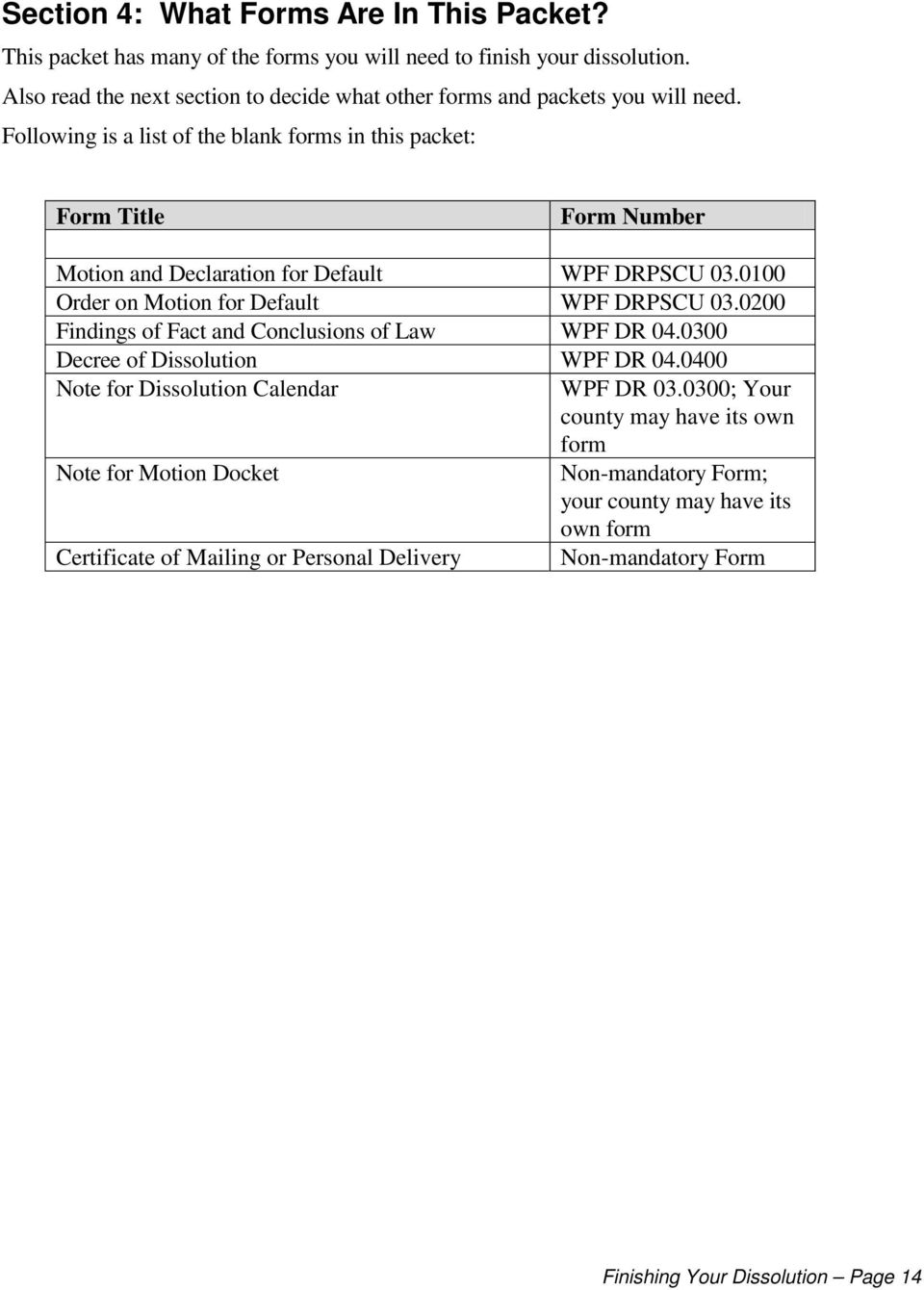
17 Section 4: What Forms Are In This Packet? This packet has many of the forms you will need to finish your dissolution. Also read the next section to decide what other forms and packets you will need. Following is a list of the blank forms in this packet: Form Title Form Number Motion and Declaration for Default WPF DRPSCU Order on Motion for Default WPF DRPSCU Findings of Fact and Conclusions of Law WPF DR Decree of Dissolution WPF DR Note for Dissolution Calendar WPF DR ; Your county may have its own form Note for Motion Docket Non-mandatory Form; your county may have its own form Certificate of Mailing or Personal Delivery Non-mandatory Form Finishing Your Dissolution Page 14
18 Section 5: What Other Forms And Packets Will I Need? You may need other forms or packets to finish your dissolution case. Read the information below carefully. Check the boxes by the other packets or forms you need. Then get the other packets or forms you need from or, if you are low-income and have no internet access, by calling CLEAR at Your county s Note for Motion Docket or Notice of Hearing form and local court rules. Some counties have their own note for motion or notice of hearing form. Some counties also have special rules for where/when you can note a motion for default. You will need the local note for motion form and the local rules to file your motion for default. Your county s Note for Dissolution Calendar. Some counties have their own Note for Dissolution Calendar form. Use this form to file your motion for default. To get your local rules and local forms, visit the Family Law Facilitator s office in the county where your dissolution is filed. If there is no family law facilitator, see the court clerk. Some counties forms and local rules are online. Find them on the OAC website at Parenting Plans and Child Support - if you have any children under 18 in common with your spouse or if one spouse is pregnant with the other s child, use this packet to enter a final parenting plan, order of child support, and child support worksheets. Declaration Regarding Public Assistance: WPF SRPSCU : This form is available at the Administrator of the Courts website It is not in our packets. It is optional. Our instructions tell you to serve the State in any case where TANF, Medicaid, or foster care is involved. We instruct you to get the State s signature on all default and agreed orders where the State might have an interest in the child support obligation in your case. However, some people may need the form if required in your county, or if you must verify that no public assistance has been paid or that the children are not in foster care or out-of-home placement. How to Serve Papers on the State - if any party is asking for an order regarding child support, and any of the children have gotten public assistance (TANF), or medical coupons/medicaid or is in foster care or out of home placement, get this packet. Include the state as a party. Serve them with papers you file. Return of Service Form, WPF DRPSCU If your court order includes a safety restraining order or an Order for Protection, you are the protected party, and the restrained party was not in court when the order was signed and s/he did not sign the order, then have the restrained party served with a certified copy of the order after the judge signs it. (See below.) Finishing Your Dissolution Page 15

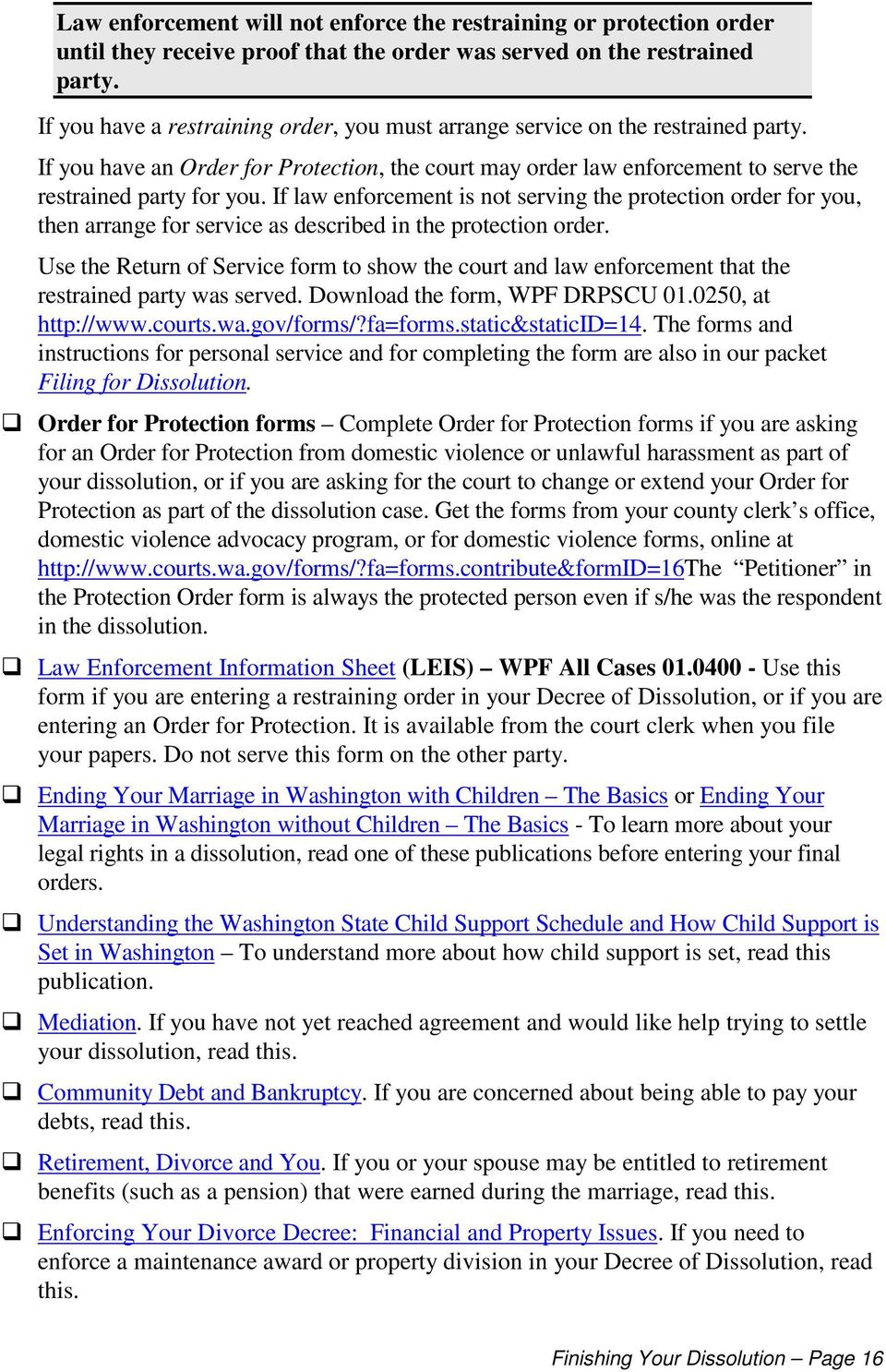
19 Law enforcement will not enforce the restraining or protection order until they receive proof that the order was served on the restrained party. If you have a restraining order, you must arrange service on the restrained party. If you have an Order for Protection, the court may order law enforcement to serve the restrained party for you. If law enforcement is not serving the protection order for you, then arrange for service as described in the protection order. Use the Return of Service form to show the court and law enforcement that the restrained party was served. Download the form, WPF DRPSCU , at The forms and instructions for personal service and for completing the form are also in our packet Filing for Dissolution. Order for Protection forms Complete Order for Protection forms if you are asking for an Order for Protection from domestic violence or unlawful harassment as part of your dissolution, or if you are asking for the court to change or extend your Order for Protection as part of the dissolution case. Get the forms from your county clerk s office, domestic violence advocacy program, or for domestic violence forms, online at Petitioner in the Protection Order form is always the protected person even if s/he was the respondent in the dissolution. Law Enforcement Information Sheet (LEIS) WPF All Cases Use this form if you are entering a restraining order in your Decree of Dissolution, or if you are entering an Order for Protection. It is available from the court clerk when you file your papers. Do not serve this form on the other party. Ending Your Marriage in Washington with Children The Basics or Ending Your Marriage in Washington without Children The Basics - To learn more about your legal rights in a dissolution, read one of these publications before entering your final orders. Understanding the Washington State Child Support Schedule and How Child Support is Set in Washington To understand more about how child support is set, read this publication. Mediation. If you have not yet reached agreement and would like help trying to settle your dissolution, read this. Community Debt and Bankruptcy. If you are concerned about being able to pay your debts, read this. Retirement, Divorce and You. If you or your spouse may be entitled to retirement benefits (such as a pension) that were earned during the marriage, read this. Enforcing Your Divorce Decree: Financial and Property Issues. If you need to enforce a maintenance award or property division in your Decree of Dissolution, read this. Finishing Your Dissolution Page 16
20 Section 6: Follow These General Instructions Before You Begin To Fill Out Any of the Forms These general instructions will apply to all the forms you complete. The instructions cover all types of family law cases. Some of the information may not be used in your case. A Sample form at the end of this section may help you understand these instructions better. The caption. The caption includes the name of your case, the case number, the name of the court, the title of the court paper, and sometimes, the type of case. It appears at the top of the first page of every form. Name of the court: Write in the name of the county where the case was filed in the blank space where the form reads "Superior Court of Washington County of." Case name. Copy the case name from the petition. Case number. When the petitioner first files the papers to begin the case and pays the filing fee (or has the fee waived), the court clerk will assign a case number. All parties must write that case number on every paper they file with the court and serve on the other parties during the case. Write the case number near the top on the right hand section of the first page of every form after "No." (abbreviation for number ). When the petitioner first files the case, s/he may be able to use a special stamp at the court clerk s counter to stamp the case number on each paper. It does not matter if the case number is written or stamped. If you are filing a modification/adjustment case in the same court that entered the order you are asking to modify/adjust, use the case number on that order. You must write or stamp the case number on the first page of every copy of every paper you file with the court and on the copies you make for other parties. If you do not, your papers may be lost, or they may be returned to you. Some courts will also fine you for filing incorrect forms. Title. Each form has a title. The title is on the right-hand side of the form under the case number. Sometimes the full title is pre-printed on the form. Sometimes you must add more information to finish it. (Example: on a declaration, you write in the name of the person completing the declaration.) Format: Pleadings (legal forms) that you file with the court and attachments to those pleadings must follow the court rules about size and margins (GR 14(a)). You must use regular size (8 ½ x 11 ) white paper and you may write on only one side of the paper. The first page of each paper that you file must have a 3-inch margin (3 inches of space) at the top. The other margins (left, right and bottom, and the top from the second page on) must be at least oneinch wide. Use black or dark blue ink. If your forms do not follow these rules, the court clerk may refuse to file them or may make you pay a fine. Finishing Your Dissolution Page 17

21 The contents. Fill out each form according to the instructions for that form. In most counties you may print or type the information, but it must be readable and you must use BLACK OR DARK BLUE INK. A few counties require that all documents be typed. After filling out each form, reread it. Make sure you have correctly filled in all the blanks you need to. Any corrections must be neat and readable. Do not write in the margins of any page. The clerk may reject your form. Dates. On the last page of most forms (not including orders), there is a space for the person who fills out a form to write the date that the form is signed. Dates in orders will be filled in by the judge when s/he signs the order. Signatures. Your signature After you fill out a form, look for the place(s) requiring your signature: o Some forms have one signature line for petitioner or respondent. After you fill out a form such as the petition, sign at the place that applies to you. Look carefully. Some forms require you to sign in more than one place. Some forms also require a date, and the place (city, state) that you signed the form. o When you prepare and file motions, you are the moving party. After you prepare a motion look for each place marked signature of moving party or lawyer. Look carefully. Some forms require you to sign in more than one place. Some forms also require a date, and the place (city, state) that you signed the form. o When you prepare an order and plan to present it for the judge to sign, look for each place marked presented by. Sign in the space underneath. Judge s Signature: Leave the judge s signature line and the date blank. Other party s signature: Certain forms you prepare have a place for other parties to sign. You cannot force another party to sign a court paper. S/he can choose to sign, or not. However, if you have prepared an order after a hearing, the other party may be willing to sign the form you have prepared if s/he agrees it accurately states the judge s decisions (or the judge may require the other party to sign), even if the party is not happy with the decision itself. o Agreed orders. If the other party agrees with the orders you have written, that party should sign in the appropriate place (petitioner/respondent/moving or nonmoving party) on each court order that is agreed. o Approved for entry/notice of Presentation Waived. If you are the respondent or nonmoving party, or if you did not prepare the order, you may be asked to sign in a blank under these words. If you check Approved for entry, you are agreeing that the judge should sign the order as it is written. If Notice of Presentation Waived is checked, you are agreeing that the other party can give the order to the judge for him/her to sign without letting you know when the other party is going to take that order to the judge. Other signatures/declarant s Signature: If someone else must sign a form (such as a Finishing Your Dissolution Page 18
22 witness or the person serving papers), be sure they fill out all information correctly and sign in the proper space provided. The declarant is the person who is writing the declaration. Place signed. Declarations and Returns of Service must include the place they are signed, as well as the date. (Example: Signed this 10th day of October 2005 at Seattle, WA.) Identifying Information. Court rules try to protect privacy but also allow for public access to certain information in court files. The three boxes discuss these rules: GR 15, GR 22 and GR 31. Box #1 Things You Should Not Write in Most of Your Court Papers: General Rules 22 & 31 try to protect privacy in family law cases. Almost all pleadings, orders and other papers filed with the court are available to the public (except for some aspects of parentage cases), and may be available to the public on the internet. Except where instructions about a specific form tell you otherwise (example: the forms in Box #3), use these rules for papers you file with the court. Residence Address (Where you Live) and Telephone Number: You do not have to write these in court papers. You do need to write in an address where you can get mail from the court. You should also give the court a phone number where you can be reached. Social Security/Driver s License, ID Numbers of Adults and Children: You do not have to write these in court papers. If you do, write only the last four digits, not the whole number. Dates of Birth of Children: Do not write them in court papers. Bank Account, Credit Card Numbers: Write the bank name, type of account (savings, checking, and so on), and only the last four digits of the account number. Box #2: Private Information That Should Be Filed With Sealed Cover Sheets: If a sealed cover sheet is used, this information is usually available to the other party and the court but is not placed in the public file. Financial Information: If you file paystubs, checks, loan applications, tax returns, credit card statements, check registers, W-2 forms, bank statements, or retirement plan orders, attach them to a Sealed Financial Source Documents form. Then they will not be available to the public. Finishing Your Dissolution Page 19
23 Medical or Mental Health Records or Information: If you file papers that have health or mental health information (information about past, present, or future physical or mental health of a person, including insurance or payment records), you must attach the papers to a Sealed Personal Health Care Records form. Then they will not be available to the public. Confidential Reports: Reports such as Parenting Evaluations, CPS Reports, Domestic Violence Assessments, and Guardian ad Litem Reports that are intended for court use must have a public section and a private section. The private section of the report should be attached to a Sealed Confidential Reports Cover Sheet. Retirement Plan Orders: Certain retirement information belongs in the public file. Retirement Plan Orders do not. Use the Sealed Financial Source Documents Cover Sheet for the Retirement Plan Order. See GR 22 for the definition or see a lawyer if this affects your case. Other Kinds of Confidential or Embarrassing Information Not Mentioned Above. If the paper that you want to keep confidential is not in the above list, you may need to file a motion with the court to ask permission to have that paper, or part of a paper, sealed under General Rule (GR) 15. There is no packet that tells you how to do this. There are presently no mandatory forms for this type of motion. Talk to a lawyer. Box #3 When You Should Write Private Information In Court Forms: These forms are not placed in the public file. Information in them is usually not available to the other party. You must fill in your personal information completely (including children s full names, dates of birth, your residence address, social security numbers, and so on): Confidential Information Form, Vital Statistics Form, Domestic Violence Information Form, Foreign Protection Order Form, and Law Enforcement Information Sheet. If you are afraid to give your address on these forms, talk to a lawyer, or call CLEAR at Finishing Your Dissolution Page 20
24 Fill in the name of the Petitioner here. Fill in Respondent s name. Superior Court of Washington County Of Evergreen In re the Marriage of: JANE DOE, Fill in the county where you are filing or where your case was already filed. SAMPLE FORM This sample case name is for dissolution cases. This information may be different depending upon the type of case you are filing. Your court case number. Assigned by the court when you file your case. NO Form title. and JOE DOE, Petitioner, Opposing party. Note for Motion Docket (No Mandatory Form Developed) TO THE CLERK OF COURT AND TO: Joe Doe 99 Railway Lane Treelane, WA Please take notice that this case will be heard on the date below and the clerk is requested to note this issue on the docket for that day. HEARING DATE: Monday, October 4, 2008 HEARING TIME: LOCATION: COURTHOUSE ROOM: 2 ADDRESS: 10:00 a.m. Treelane Superior Courthouse 102 West Broadway Treelane, WA NATURE OF MOTION: Temporary Orders regarding parenting plan, child support, and restraining orders. Jane Doe, Petitioner Finishing Your Dissolution Page 21
25 Section 7: Instructions for Filling Out Each Form A. Motion and Declaration for Default WPF DRPSCU You may ask the court to enter an order of default against the respondent any time after the time period for responding has ended. 4 Wait 90 days from the date your spouse was served with the petition to get the dissolution decree entered. Wait 90 days to file the motion for default, and note the presentation of your final dissolution orders at the same time. Caption. Fill out the caption. Section I. Motion Write your name in the first blank. Write the name of the party you believe is in default in the second blank. If you are moving for default against more than one party, use a separate form for each. Write the date and sign your name on the line for the "requesting party." Print your name and write the date in the places indicated. Section II. Declaration. In this declaration, the other party is the party you believe is in default. Paragraph 2.1. Proper Jurisdiction and Venue Fill in the county/state where the petitioner lives, where the children in the case live, and where the respondent lives. Check the other box to explain any unlisted reason why venue is proper. Then write that reason in. Example: if your case is a petition to modify a parenting plan, one additional reason for proper venue could be that this is the court where the final order, decree or judgment that you are asking to modify was entered. Paragraph 2.2. Jurisdiction Over the Other Party Fill in information about the party you believe is in default. Check all of the boxes that apply in your case. If there is any reason why Washington has jurisdiction besides those listed, check the last box. Write that reason in the blank. Paragraph 2.3. Service on Other Party In the first blank, write the title of every form that was served on the party you believe is in default. Include the Summons, Petition, and all the other documents served. Include everything. Check your Return of Service form to be sure. If you do not have enough room in the blank, write See attached Exhibit A. Then list the documents on a separate sheet of paper, write Exhibit A at the top of the paper, and staple it to the Motion. Fill in the date s/he was served with these papers. If the other party was served in Washington, check the first box. 4 If your spouse was personally served in Washington State, s/he has 20 days to respond, not including the date of service. If your spouse was personally served out of state, s/he has 60 days to respond, not including the date of service. If your spouse was served by publication, s/he has 60 days from the date of first publication to respond. If your spouse was served by certified mail, s/he has 90 days to respond from the date the forms were mailed. Finishing Your Dissolution Page 22
26 If the other party was served outside Washington, check the second box. Write in the blank space the state or country where they were served. In the space at the end of the paragraph, write a brief explanation about why you could not serve that party in Washington. (Example: if s/he lives out of state, write (name) lives out of state. ) Paragraph 2.4. Time Elapsed Since Service on the Other Party. Remember: Wait the appropriate length of time (based on the kind and place of service) before moving for default. If the other party was personally served in Washington, check the first box. If the other party was personally served outside of Washington, check the second box. If the other party was served by certified and first class mail (in or out of state), check the third box. If the other party was served by publication (in the newspaper), check the fourth box. Paragraph 2.5. Appearance of the Other Party If you have not been contacted by the other party since s/he was served with the petition, and s/he has never filed or served a Notice of Appearance or a Response form, or come to a court hearing, check the first box. If you have been contacted by the other party since s/he was served, or if s/he appeared in the case, but s/he never filed or served a Response, check the second box. Paragraph 2.6. Service Members' Civil Relief Act Statement This paragraph states whether you believe the other party is a member on active duty in the military 5 or the dependent of a resident of Washington who is on active duty and is a National Guard member or a Reservist. Dependents are spouses or minor children or persons for whom the service member provided most of the support for the last six months. 6 You must try to find out whether or not the other party is on active duty in the military, or is a dependent of someone in the military. Check the following website: or contact the Defense Manpower Data Center, 1600 Wilson Blvd., Suite 400, Attn: Military Verification, Arlington, VA ; Telephone (703) or 5790 fax (703) Service members who are protected by the federal act include all members on Federal active duty, including regular members of the Armed Forces (Army, Navy, Air Force, Marine Corps and Coast Guard); Reserve, National Guard and Air National Guard personnel who have been activated and are on Federal active duty (whether as volunteers or as a result of involuntary activation); inductees serving with the armed forces; Public Health Service and National Oceanic and Atmospheric Administration Officers detailed for duty with the armed forces; persons who are training or studying under the supervision of the United States preliminary to induction; and National Guard and Air National Guard personnel on duty for training or other duty authorized by 32 U.S.C. 502(f) at the request of the President, for or in support of an operation during a war or national emergency declared by the President or Congress. U.S. Coast Guard Legal Assistance Service Members Civil Relief Act Guide at For Washington State s Service Members Civil Relief Act, see RCW et seq. 6 RCW lists people considered dependents of a service member. Finishing Your Dissolution Page 23
27 To try to make sure the other party is not a dependent of someone on active duty, also serve the Notice re: Dependent of a Person in Military Service form. (If you already served this Notice with your petition, do not serve it again.) Paragraph Service member status 7. In paragraph A, fill in the other party s name. Check the appropriate box(es) showing that party s service member status. In paragraph B. after factual basis, o o If you checked the website the first box. Staple the report you received to this form. If you have other or additional reasons for checking the item you did in paragraph 2.6.1A, check the box other factual basis. Then write in what you know about whether the other party is in the military, and whether they re on active duty. Describe all the efforts you made to find out about the other party s military status, and the results of each effort. Example: describe contacts with the other party s friends, family, and employers. Or, if you contacted the Defense Manpower Data Center by fax or mail, explain that. Attach any certificate about military service you received in reply. In paragraph C, if the other party is on active duty, check the box at the beginning of 1C and the appropriate box(es) under it that apply. If you check the last item, check the appropriate box in the text of that item. Otherwise, skip this item. Paragraph Dependent of a service member status. Paragraph A Write the other party s name. Then check the box below it that applies. In paragraph B: o If you had a Notice re: Dependent of a Person in Military Service 8 mailed to the other party at least 23 days ago (or served more than 20 days ago), and s/he did not respond to it, check the box next to the other party failed to respond to a notice. Check the box that applies. Fill in the date requested. Otherwise, skip that box. o Under other factual basis, write in what you know about whether the other party is or is not a dependent of a resident of Washington who is on active duty and is a National Guard member or a Reservist. 7 The Service Members Civil Relief Act, RCW Ch (state law), and the Service Members Civil Relief Act of March 4, 1918, as amended, 50 U.S.C. App., 501 et.seq. (federal law) provide special protection for members of the military, including National Guard and Reservists, who are on active duty, and certain dependents. If the other party is on active duty or is a protected dependent, consult an attorney for more information about these special rights. The court s likely to appoint an attorney to represent the other party and may stay (delay or stop) your case until the other party comes back from active duty. 8 This form is in the Filing packet for your type of case. Our instructions there tell you to serve it with the Petition. This form can be served later, but our packets do not tell you how to do this. Finishing Your Dissolution Page 24
28 In paragraph C: if the other party is a dependent of a resident of Washington who is on active duty and is a National Guard Member or a Reservist, check the box at the beginning of 2 C. Then check the box(es) under it that apply. If you check the last item, check the appropriate box in the text of that item. Otherwise, skip this item. Paragraph 2.7. Other Leave this blank. Signature. Sign and date the form and write in the place you signed it (example: Yakima, Washington ). B. Order of Default WPF DRPSCU This is the form you will ask the judge to sign at your hearing. Caption: Fill out the caption as shown in the general instructions. Section I. Basis. Write your name in the blank. Section II. Findings Paragraph 2.2. Service on Nonrequesting Party In the first blank, write nonrequesting party s name. (This is the party you believe is in default.) In the next blank, write the title of every paper that was served on this party when you filed the case. (Look back at the Motion for Default and at the Return of Service to be sure you have included everything.) In the last blank, write the date that the other party was served with the Petition and other papers. Paragraph 2.3. Time Elapsed Since Service Check the same item that you checked in the Time Elapsed paragraph of the Motion for Default. Paragraph 2.4. Appearance Check the same item that you checked in the Appearance paragraph of the Motion. Paragraph 2.5 Service Members Civil Relief Act Statement. Paragraph Service member status. Check the appropriate box(es) showing the nonrequesting party s service member status. Paragraph Dependent of a service member status. Check the box that applies. If you know that the nonrequesting party is not a dependent of a resident of Washington who is on active duty and is a National Guard Member or a Reservist, check the first box. Finishing Your Dissolution Page 25
29 If you know that the nonrequesting party is a dependent of a resident of Washington who is on active duty and is a National Guard Member or a Reservist, check the second box. If you are not sure whether the nonrequesting party is a dependent of a resident of Washington who is on active duty and is a National Guard Member or a Reservist, but you had a Notice re: Dependent of a Person in Military Service mailed to him/her at least 23 days ago (or served more than 20 days ago), and s/he did not respond to it, check the third box is presumed not a dependent. Paragraph 2.6. Other Leave this blank. III. Order. The judge will check the appropriate box. Signature. Sign the form under Presented by. Print your name and the date in the blank below your signature. Do not write the date or sign on the Judge/Commissioner lines. The judge will do that. C. Findings of Fact and Conclusions of Law ( Findings ) - WPF DR Most of the information you need for this form MUST BE the same as in the Petition. Have a copy of the Petition for Dissolution in front of you while completing the Findings and the Decree. Section I - Basis For Findings Check the second box. Write in the date the court signed the Order of Default, if different than the date the judge will sign the Findings and Conclusions. If you do not know the date, leave the space for the date blank, but make sure the judge fills it in when s/he signs the Findings. Section II Findings of Fact Paragraph 2.1. Residency of Petitioner. If the petitioner lives in Washington, check the first box. If the petitioner does not live in Washington, check the second box. If the petitioner s been in the military stationed in Washington for at least 90 days, check the third box. Paragraph 2.2. Notice to Respondent. Check the second box. In the blank space write a short description of how your spouse (or other party) was served. Example: if your spouse was served personally, write by personal service in the state of Washington. Finishing Your Dissolution Page 26
30 Paragraph 2.3. Basis of Personal Jurisdiction Over the Respondent If your spouse has never lived in Washington, the two of you could not have conceived your child in Washington, and your spouse has not agreed to jurisdiction in Washington or waived his/her objection to jurisdiction, check the first box. Otherwise, check the second box and at least one of the indented boxes in this paragraph. If your spouse currently lives in Washington, check the first indented box. If you and your spouse ever lived in Washington during the marriage, check the second indented box. If you or your spouse may have gotten pregnant here with one of your children in Washington, check the third indented box. If there is another reason that Washington has personal jurisdiction over your spouse, check the last box. Write the reason in the blank space. Paragraph 2.4. Date and Place of Marriage Fill in the date and place of your marriage as stated in your Petition for Dissolution. If you were in a domestic partnership in Washington State: Check the box under the first sentence. Then fill in the date that you registered your domestic partnership. Use the other box if there is any unusual information about the way your relationship began that you think the court should know. Paragraph 2.5. Status of the Parties Fill in the date of separation as stated in your Petition for Dissolution. Paragraph 2.6. Status of the Marriage Check the first box only. Paragraph 2.7. Separation Contract or Prenuptial Agreement If you have no separation contract or prenuptial agreement, check the first box. (Most couples have no separation contract or prenuptial agreement.) If you have a separation contract or prenuptial agreement, check the second box. Fill in the blank. Check the appropriate indented box. If you have signed a separation contract or prenuptial agreement, or you do not know whether or not you have signed one, talk with an attorney. Paragraph 2.8. Community Property Look at the property paragraph of your petition for dissolution. Any property that you list in the Findings under paragraph 2.8 & 2.9 must have been listed in your Petition for Dissolution. If you want the court to award one party property that was not listed in your Petition, you must amend your petition and serve it on your spouse again. Finishing Your Dissolution Page 27
31 Community property, in general, is all property acquired between the date of the marriage and the date of separation, except for property received by gift or inheritance. 9 In paragraph 2.8, list all community property, regardless of whether you want the petitioner or respondent to receive it. If you have a separation contract or prenuptial agreement, check the third box. Skip the rest of this paragraph. If you have no community property at all (including money, clothes, and household items), check the first box. If you have a long list of community property, check the second box. Write A in the blank after Exhibit. Attach a copy of the list of all of your property (regardless of who should get the property in the dissolution) as Exhibit A. If you have a short list of community property and you did not check box one, two or three, check the fourth box. In the blank space, list all of the property you listed as community property in the Petition. Do not write your entire bank account number or similar information on any of the court papers in this packet. These papers will become part of the public record once filed with the court, and they will be available to the public online. If you need to identify which bank account you are referring to, use the bank name, type of account, and last four numbers only. Do the same for other accounts (such as credit card accounts) that have identifying numbers. Paragraph 2.9. Separate Property In general, separate property is property (including money) that is acquired before the marriage or after separation, as well as gifts or inherited items. 10 In paragraph 2.9, list all separate property, whether it belongs to the petitioner or the respondent. If you have a separation contract or prenuptial agreement, check the third box and skip the rest of this paragraph. If the petitioner has no separate property, check the first box. If the respondent has no separate property, check the second box. If the petitioner or respondent has a long list of separate property, check the fourth and fifth boxes. Write B in the blank in the fourth box and C in the blank in the fifth box. Attach two lists: all of the petitioner s separate property (Exhibit B), and all of the respondent s 9 To find out more about community property, talk with a lawyer, or read our publication Ending Your Marriage in Washington with Children The Basics or Ending Your Marriage in Washington without Children The Basics. 10 There are exceptions. To find out more about separate property, talk with a lawyer, or read our publication Ending Your Marriage in Washington with Children The Basics or Ending Your Marriage in Washington without Children The Basics. Finishing Your Dissolution Page 28
32 separate property (Exhibit C). Otherwise, check the sixth and seventh boxes. List in the blanks provided the petitioner s and respondent s separate property. Paragraph Community Liabilities Look at the debts and liabilities paragraph of your petition for dissolution. Any debts that you list in the Findings under paragraph 2.10 and 2.11 must have been listed in your petition. If you left out some important debts that should be awarded to one spouse or the other, you must amend your petition and serve it on your spouse again. Debts created during the marriage are almost always community debts, even if only one of you actually created or knew about the debt. (Example: Your spouse was the only one who ever used the VISA card. It is still a community debt if the debt happened during the marriage.) 11 In this paragraph, list all community debts, whether they will be paid by the petitioner or respondent. If you have a separation contract or prenuptial agreement, check the third box. Skip the rest of this paragraph. If there are no community debts (debts created during the marriage), check the first box. If the parties have a long list of debts and liabilities, check the second box, write D in the blank, and attach to the Findings a separate list of debts as Exhibit D. Otherwise, check the fourth box and list the community debts of the petitioner and respondent. Paragraph Separate Liabilities In this paragraph, list all separate debts, whether they will be paid by the petitioner or respondent. If you have a separation contract or prenuptial agreement, check the fourth box. Skip the rest of this paragraph. If the petitioner has no known separate debts (debts created before the marriage or after separation), check the first box. If the petitioner has a long list of debts, check the third box, write E in the blank, and attach a separate list of the petitioner s debts as Exhibit E. If the petitioner has a short list of debts, check the sixth box. List the debts the petitioner s separate debts in the space. If the respondent has no known separate debts, check the second box. If the respondent has a long list of debts, check the fifth box. Write F in the blank, and attach a list of the respondent s debts as Exhibit F. Otherwise, check the seventh box, and list the respondent s separate debts in the space provided. Paragraph Maintenance If the parties have a separation contract or prenuptial agreement that addresses maintenance, check the second box. Skip the rest of this paragraph. 11 Our publication Ending Your Marriage in Washington with Children The Basics or Ending Your Marriage in Washington without Children The Basics has more information. Finishing Your Dissolution Page 29
33 If neither party asked for maintenance, check the first box. If you asked for maintenance, and the other party did not Respond, check the fourth box. Copy what you wrote in the maintenance paragraph of the petition for dissolution into the blank space on the Findings. Paragraph Continuing Restraining Order If no restraining order is being entered in your case, check the first box. If you asked for a restraining order in your petition for dissolution, and you still believe that one is necessary, check the second box. Then check whether the petitioner or respondent should be restrained. In the blank, write briefly why a restraining order is needed. Paragraph Protection Order. If no Protection Order is being entered in your case, check Does Not Apply. Skip the rest of the paragraph. If a Protection Order is being entered in this case, check the second box. Check the box showing which kind of protection order it is. Check the date the judge signed the protection order, if different than the date the judge will sign the Findings form. If you do not know the date, leave the space for the date blank. Make sure the judge fills it in on the date of the hearing. Also, complete the Order for Protection and LEIS forms. Make sure your protection order form has the expiration date you need. Make sure the no contact and custody/visitation items there do not conflict with your parenting plan. If you have a Protection Order originally entered under a different case number, and it should be changed or extended, check the second box. Check the box showing which kind of protection order it is. Check the date the judge signed the new protection order, if different than the date the judge will sign the Findings form. If you do not know the date, leave the space for the date blank. Make sure the judge fills it in on the date of the hearing. Also check the Other box under Write in what you are asking the court to do. Example: The Protection Order entered on [date] under Case No. XXXX should be consolidated into this case, incorporated into the final order in this case, and modified as follows: 1) The no contact and custody provisions should be changed to follow the Final Parenting Plan; and 2) the expiration date should be changed so that the Protection Order s permanent, as authorized by RCW (1) and RCW (2). Also, fill out a LEIS and a new Order for Protection, including the changes you asked the court to make. Paragraph Fees and Costs If you do not want your spouse to pay you for court costs and attorney fees, or you did not ask for payment in your petition, check the first box. If you have a separation contract or prenuptial agreement that provides for the payment of attorneys fees and costs, check the second box. Skip the rest of this paragraph. If you want your spouse to pay for court costs and attorney fees, you must have already asked for that in your petition for dissolution. If you want attorney s fees and costs, check the third box. Complete the other boxes and blanks in that paragraph. Finishing Your Dissolution Page 30
34 Paragraph Pregnancy If neither spouse is pregnant, check the first box. If a spouse is pregnant, check the second box. If a spouse became pregnant after the dissolution was filed, see a lawyer before trying to finish your case. You may need to amend your petition. If a spouse is pregnant, the law presumes that the other spouse is the other parent. If this is not true in your case, there is a specific procedure and usually only a limited time for challenging this legal presumption. The following steps are not enough to reverse the legal presumption that a spouse is the parent: Denying the husband s paternity in the dissolution papers. Leaving the unborn child out of the parenting plan and child support orders. Naming someone else as the father in the dissolution papers. If a spouse is pregnant and the other spouse is not the other parent, talk with a lawyer. The court should not stop you from getting a decree of dissolution if you are pregnant, but the court may keep part of your case open until the paternity of your child can be established. If one spouse is pregnant and the other is the parent, the court can still end your marriage and complete most of the parts of your dissolution, but you cannot enter child support and a parenting plan for this child until after s/he was born. Paragraph Dependent Children If you and your spouse have no children under age 18 (or still dependent on you for support) who were born during the marriage, check the first box. If either you or your spouse has children (whether together or not), check the second box. Fill in the requested information for each child. This section includes children from other relationships, as well as the children of the marriage. Paragraph Jurisdiction over the Children Look at your petition for dissolution. Check the same information that you checked in the petition. Fill in any blanks in the paragraphs you have checked. However, read the boxes rather than just count them, since item #2 is not in the petition. You will only check item #2 in the Findings if the court has no jurisdiction over the children. If the court has jurisdiction over the children, check the third box and the indented box(es) that apply. Fill in the necessary blanks in any item you checked. Paragraph Parenting Plan If you have no children under age 18 with your spouse, check the first box. Otherwise, check the second box, and fill in the date the judge signed the final parenting plan, if different than the date Finishing Your Dissolution Page 31
35 the judge will sign these Findings. If you do not know the date of the parenting plan, leave the space for the date blank, but make sure the judge fills it in on the date of the hearing. Also, check the box other. Write in This parenting plan s entered pursuant to an order of default. Paragraph Child Support If you have no children who are under age 18 or still dependent upon you for support, check the first box. Otherwise, check the second box. Fill in the date the judge signed the Final Order of Child Support, if different than the date the judge will sign the Findings. If you do not know the date, leave the space for the date blank, but make sure the judge fills it in on the date when s/he signs the Findings. Paragraph Other Look at the Other" paragraph of the petition for dissolution. Copy any information from the petition into this paragraph. Also, if you are consolidating and incorporating a protection order from another case into this case, or requesting a permanent protection order, see the instructions to paragraph 2.14 of the Findings, above. Otherwise, leave this paragraph blank. If one spouse is pregnant at the time the court signs the final papers dissolving the marriage, write in, The court should reserve all issues relating to the unborn child until after the child s birth. Section III - Conclusions Of Law Paragraph 3.1 and 3.2. Jurisdiction and Granting of a Decree Check the first box in each paragraph. Paragraph 3.3. Pregnancy. If neither spouse is pregnant, check the first box, does not apply. If a spouse is pregnant, check the second box. Read the paragraph. Paragraph 3.4. Disposition. Read this paragraph. Paragraph 3.5. Continuing Restraining Order Check the first box if you are not asking for a restraining order, or the second box if you are asking for one. Paragraph 3.6. Protection Order. If you are not asking for a protection order, check the first box. If you are asking for one, or are asking that a protection order entered under a different case number be approved and incorporated, check the second box. Show which type of protection order you are asking for. Finishing Your Dissolution Page 32
36 Paragraph 3.7. Attorney Fees and Costs Check "does not apply," unless you asked the court to order your spouse to pay attorney's fees and costs in the petition for dissolution. 12 Paragraph 3.8. Other Look at paragraph 1.16 & the other section of relief requested in the petition for dissolution. Copy any information in those two paragraphs of the petition into this paragraph. If you are incorporating a protection order from another case, or asking for a permanent protection order in this case, write in the court should enter the requested protection order. Otherwise, leave this paragraph blank. If the wife is pregnant at the time the court signs the final papers dissolving the marriage, write in, The court should reserve all issues relating to the unborn child until after the child s birth. Signature Sign and date, and print your name on the left side under "Presented by." DO NOT fill in the date or sign on the line that says Judge/Commissioner. The Judge will fill those lines in when you have your Findings signed. D. Decree of Dissolution - WPF DR When you ask the judge to sign a default Decree of Dissolution, you cannot ask for things in the Decree that you did not ask for in the petition for dissolution. You cannot change what you are asking for without re-serving your spouse with an amended petition (or amended parenting plan or child support worksheets, if that is what you want to change) and giving him/her another chance to respond. Caption. Fill out the Caption and check the box for "Decree of Dissolution" under the case number. If you are including a restraining order, check the boxes next to Clerk s Action Required and Law Enforcement Notification. If you are including a real property (real estate) or money judgment summary in your decree, check the box next to Clerk s Action Required. Section I. Judgment/Order Summaries. In this section, fill in a summary of any real property judgment or money judgment. A money judgment might include money you or your spouse owes the other for back maintenance or attorney's fees, or might be related to the property and debt division. If you are entering the order by default, you can only enter a judgment if you clearly asked for the judgment in the Petition. 12 Our packets do not explain when or how to request attorney fees. Finishing Your Dissolution Page 33
37 Paragraph 1.1. Real Property Judgment Summary If you own no real property (real estate such as a home, building or land), check the first box, does not apply. Skip the rest of this paragraph. If you own real property and you or your spouse is being awarded the home, building or land in the divorce, check the second box. Write the assessor s property tax parcel or account number in the first blank. Write the legal description in the second blank. If you do not know the tax parcel number or legal description, try to get it from the county assessor s office in the county where the property is located, or from a title company. In most cases where there is real property, try to have a lawyer look at your final papers before you ask the judge to sign them. Paragraph 1.2. Money Judgment Summary If you or your spouse will owe each other money as a result of the decree, enter that information here. Add up any amounts one spouse owes to the other related to unpaid maintenance, property division, or attorney s fees and costs. You cannot ask for anything that you did not request in your petition. DO NOT enter a back judgment for child support here. That will be in the child support order. If there is no money judgment, check does not apply. If you are entering a money judgment, check the box judgment summary is set forth below and fill in the blanks: A. Judgment Creditor: Write in the name of the person who is owed money. B. Judgment Debtor: Write in the name of the person who owes the money. C. Principal Judgment Amount: Write the total amount owed. D. Interest to Date of Judgment: Write the total amount of interest, if any, which will be owed by the date the court will sign the final orders. E. Attorney Fees: Write in the total amount of any attorney fees one party owes the other. F. Costs: Write in the total amount of costs one party owes the other. G. Other recovery amount: Write in any additional money owed by one party to the other. H. Principal Judgment shall bear interest at. Enter any amount up to 12%. I. Attorney fees, costs and other recovery amounts shall be interest at. Enter any amount up to 12%. J. Attorney for judgment creditor. If the person who is owed money has a lawyer in this case, write in the lawyer s name. K. Attorney for judgment debtor. If the person who owes money has a lawyer in this case, write in the lawyer s name. L. Other. Leave this blank, unless you need to write more information. Finishing Your Dissolution Page 34
38 Section III. Decree. Caution: If you have a retirement plan (example: a pension or military retirement benefit), at least ask a lawyer for advice about the retirement issues, and to prepare the retirement papers you need when you finish your case. Example: a Qualified Domestic Relations Order (QDRO or quadro ) and the retirement division portion in your dissolution decree. Our packets do not describe retirement benefits and property. Paragraph 3.1. Status of the Marriage Check the first box. Paragraph 3.2. Property to be Awarded the Husband If you have a separation contract or prenuptial agreement that determines the division of property, check the second box. Write the date that the contract or agreement was signed. Check the box showing whether or not you are filing a copy with the court. Skip the rest of this paragraph. If the husband will be awarded a long list of property, check the first box. Write A after Exhibit. Attach the list of the property to the Decree as Exhibit A. Otherwise, check the third box, and list all of the property to be awarded to the husband. Usually, you will check the third box, write all property currently in his possession, and then list any major items (such as cars), whether or not they are in his possession, and any items that need to be turned over by the wife to the husband. Paragraph 3.3. Property to be Awarded to the Wife If you have a separation contract or prenuptial agreement that determines the division of property, check the second box. Skip the rest of this paragraph. If the wife will be awarded a long list of property, check the first box. Write B in the blank after Exhibit. Attach the list of the property to the Decree as Exhibit B. Otherwise, check the third box, and list all of the property to be awarded to the wife. Usually, you will check the third box, write all property currently in her possession, and then list any major items (such as cars), whether or not they are in her possession, and any items that the husband needs to turn over to the wife. Paragraph 3.4. Liabilities to be Paid by the Husband If there are no debts to be paid by the husband, check the first box. If there is a separation contract or prenuptial agreement that provides for the division of debts, check the third box. Skip the rest of this paragraph. If there is a long list of debts for the husband to pay, check the second box. Write C after Exhibit. Attach the list of debts the husband will pay as Exhibit C. Otherwise, check the fourth box. List the debts to be paid by the husband in the blank space. Finishing Your Dissolution Page 35
39 Paragraph 3.5. Liabilities to be Paid by the Wife If there are no debts to be paid by the wife, check the first box. If there is a separation contract or prenuptial agreement that provides for the division of debts, check the third box. Skip the rest of this paragraph. If there is a long list of debts for the wife to pay, check the second box, write D after Exhibit. Attach the list of debts the wife will pay as Exhibit D. Otherwise, check the fourth box, and list the debts to be paid by the wife in the blank space. Paragraph 3.6. Hold Harmless Provision Entering a decree requiring one spouse to pay a debt does not stop creditors from trying to collect from both parties. Checking the first box means that, if a person fails to pay one of the debts s/he is ordered to pay in the Decree, the other party can sue for attorney s fees and costs as well as the amount of the debt. This can be useful if you think your spouse will fail to pay debts s/he is ordered to pay. But it could also cost you a lot if you do not pay debts that you are ordered to pay in the Decree. Paragraph 3.7. Maintenance If no maintenance is ordered, check the first box. If there is a separation contract or prenuptial agreement that addresses payment of maintenance, check the third box. Skip the rest of this paragraph. Otherwise, check the fourth box. Check whether husband or wife is going to pay. Write the amount of maintenance to be paid in the blank. Check the box indicating how often maintenance will be paid ( semi-monthly = twice per month). Write in the date that the first maintenance payment is due. To make sure maintenance does not end upon death or remarriage, write the date that maintenance should end in the blank space. Payment shall be made: If you want maintenance to be paid directly to the receiving spouse, check the first box. If the party receiving maintenance is having child support collected by the Division of Child Support (DCS), check the second box stating that payments shall be made to the Washington State Support Registry. If you want maintenance to be collected by the clerk, and your spouse will not be paying child support, check the third box. If the spouse paying support might have a pension or benefits under the Washington State Department of Retirement Systems and the spouse receiving maintenance would like to be able to garnish those benefits if the paying spouse falls behind on maintenance payments, talk with an attorney to ensure that you fill out this portion of the Decree correctly. Paragraph 3.8. Restraining Order Check the first box if there is not going to be a restraining order. If there will be a restraining order, check the third box. Write in the date this order is signed. If you had a temporary restraining order that is now over, check the second box. Write in the name of the police department that patrols the area where you live. Finishing Your Dissolution Page 36
40 Paragraph 3.9. Protection Order If there will not be a Protection Order (also called an Order for Protection), check the first box. If there will be a Protection Order, check the second box. Check the text box showing the type of protection order. Fill in the date the judge signed the protection order, if different than the date the judge will sign this decree. If your petition for dissolution asked for a protection order, fill out and ask the judge to sign the appropriate Order for Protection form when you prepare the decree. Make sure: o the no contact, custody and visitation provisions of the protection order are consistent with your final parenting plan; o the expiration date and other relief in the protection order is the same as you requested, or as the judge otherwise orders; and o add the following language to the protection order in paragraph 8. Other: This Order for Protection s issued under RCW chapter 26.09, and is not subject to the one-year limitation on restraining the respondent from contacting the respondent s minor children. RCW (2). If you are changing an existing protection order, also follow the additional instructions in Paragraph 3.15 other. Paragraph Jurisdiction over the Children If you and your spouse have no dependent children, check the first box. If you and your spouse have children together who are under age 18 or still dependent on you for support, check the second box. Paragraph Parenting Plan If you and your spouse have no children together, check the first box. If you and your spouse have children together and you are entering a parenting plan, check the second box. Fill in the date the court signed the final parenting plan, if different than the date the judge will sign this decree. If you do not know the date, leave the space for the date blank, but make sure the judge fills it when s/he signs the Decree. Paragraph Child Support If you and your spouse have no children together, check the first box. If you and your spouse have children together who are under 18 or still depend on you for support, check the second box. Fill in the date the court signed the Final Order of Child Support, if different than the date the judge will sign this decree. If you do not know the date, leave the space for the date blank, but make sure the judge fills it when s/he signs the Decree. Paragraph Attorney Fees, Other Professional Fees and Costs If no attorney fees or costs will be awarded, check the first box. If attorney s fees or costs will be paid under a separation contract or prenuptial agreement, check the second box. Finishing Your Dissolution Page 37
41 If attorney fees and costs are awarded, check the third box. In the blank, write the name of the spouse who owes fees and costs to the other spouse, and the amount that will be paid. (Example: Respondent will pay petitioner $300 for attorney s fees and costs. ) Paragraph Name Changes If neither spouse is changing their name, check the first box. If the wife is changing her name, check the second box. Write the wife s full new name in the blank. If the husband s name is being changed, check the third box. Write the husband s full new name in the blank. Paragraph Other Fill this in only if you need to add more orders that you requested in your petition. If you have a Protection Order that was originally entered under a different case number, and you asked in your Petition for Dissolution for the court to change it or extend the expiration date, write in what you asked the court to do. Example: The Protection Order entered on [date] under Case No. XXXX is consolidated under this case number and it is approved and incorporated herein, except it is modified as follows: 1) The no contact, custody and visitation provisions are changed to follow the Final Parenting Plan; and 2) the expiration date has changed so that the Protection Order is permanent, as authorized by RCW (1) and RCW (2). The parties shall comply with that Order for Protection. Also, fill out an LEIS and a new Order for Protection, including the changes you asked the court to make. See instructions for paragraph 3.9, above. If a spouse is pregnant, write in: The court reserves all issues relating to the unborn child until after the child s birth. Signature. Finish the form by signing it and printing your name on the left side under "Presented by." DO NOT fill in the date or write on the judge/commissioner line. The Judge does that. Before you file your motion for default: If you have children with your spouse, get the Parenting Plans and Child Support for Dissolutions and Modifications of Dissolution packet. Complete the final parenting plan, order of child support, child support worksheets, Residential Time Summary Report. If you are asking for an order for protection, complete the order for protection and LEIS forms. If the children have ever gotten public assistance (TANF), or Medicaid, or if they are in foster care or out-of-home placement, the prosecuting attorney's office also must sign your final papers before the Judge will sign them. If a Guardian ad Litem was appointed for either spouse, or to represent the best interests of any child of the marriage, the GAL must also sign the decree and, if appointed for a child, the parenting plan. Finishing Your Dissolution Page 38
42 Section 8: Filing and Serving Your Final Papers A. If Your Spouse Did not Appear or File a Response, You May Be Able to Use a Note for Dissolution Calendar If your spouse filed no Response, Notice of Appearance, or any other paper in the case, and/or did not appear at any court hearings, and if your default and final orders hearing will take place less than one year after you served your spouse with the Summons and Petition for dissolution, 13 then you can file a motion for default and (assuming only two parties in your case) ask the court to sign your final divorce orders without giving any notice to your spouse. 14 You should give notice anyway, as we describe later in this packet. Orders that are entered by default may sometimes be vacated (cancelled) later, if the other party files a motion to vacate and persuades the court to do so. Having proof that you gave the other party another chance to respond before final orders were entered may help you to keep the other party from convincing the court to vacate (cancel) your orders later. Also, some courts require that you file a note for motion calendar to schedule a hearing to enter your final orders even if you do not need to give notice to the other party. Use the Note for Dissolution Calendar form to set up a hearing to ask the court to sign your final orders for dissolution of marriage. Some counties require you to use their own Note for Dissolution Calendar form. Others may require a different form. It may be called a Note for Motion Docket, a Notice of Issue, a Note for Hearing or a Notice of Hearing. If your spouse appeared, give your spouse notice of your motion for default. (See If Your Spouse Appeared instructions below.) You may need to note your final orders and your motion using a Note for Motion Docket or Note for Hearing rather than a Note for Dissolution Calendar. Check with the Family Law Facilitator or court clerk in the county where your dissolution was filed to see if your county has a special form. If not, use the form included here. 1. How do I Get a Date for my Hearing? Check your local court rules (at the law library), ask your Family Law Facilitator s office (if your county has one), or call the court clerk s office to find out what days and times to schedule entry of your final dissolution orders by default. Motions for entry of final orders by default in dissolution cases are usually scheduled in the ex parte department, but may be scheduled on the family law calendar or with a judge. Hearings to enter final dissolution orders may only be scheduled on certain days or at certain times. If the State is a party to your case (such as when the children have gotten public assistance), you may have to schedule your hearing on a date that the prosecutor s present for family law motions. 13 If more than one year has passed since you served your spouse with the summons and petition for dissolution, you must give your spouse notice of the motion for default and for presentation of your final papers by certified mail or personal service. See CR 55(f). 14 If there are other parties to the case, you must get their signatures on the findings of fact and conclusions of law, the decree, and any parenting plan and child support papers, before presenting them to the judge. Finishing Your Dissolution Page 39
43 2. How Much Notice Do I Need to Give the Other Party? Under the Washington civil rules, you must give your motion and other legal papers to the other parties and the court at least five court days (business days that are not court holidays) before the hearing date. 15 Do not count weekends or holidays. Some counties require more than five court days notice for family law hearings. Check with your local court rules, your Family Law Facilitator s office, or the court clerk to find out how many days notice to give. Remember: count Day 1 as the day after you delivered or mailed the papers. Add Days for Mailing. Mailing. If the papers are mailed, instead of personally delivered, add at least three days 16 to the number of days notice your county s rules require. Example: if you mail a document on a Monday, it will be presumed to have been served on Thursday. If the third day after the papers are mailed is a weekend or holiday, add days so that the papers arrive on a business day that is not a legal holiday or weekend. 17 Try to give more than the minimum number of days for notice of your hearing. If for some reason the other party does not get enough notice of your hearing, you must reschedule your hearing, even if the other party does not show up and object. B. Instructions for the Note for Dissolution Calendar Form Caption. Fill out the caption. To the Clerk and to: Fill in the name(s) of your spouse and of any other parties. Paragraph 1: Write the name of the items you are putting on the court calendar, for example Motion for Default, and Entry of Decree of Dissolution and related relief. Paragraph 2: Write the date, time, place and courtroom number of your hearing. Signature: Date the form. Sign it on the line that says Signature of Requesting Party or Lawyer. Print your name and mailing address on the lines below your signature. If you do not want to give your home address, fill in an address where you can reliably receive mail like a post office box or a friend s address. C. If Your Spouse Appeared, But Did not Respond, Give Your Spouse Notice of Your Motion for Default Using a Note for Motion Docket If your spouse appeared, but did not file a Response, file your motion for default, and give your spouse (and other parties, such as the State) notice of the motion and of your intent to ask the court to sign your final papers and provide copies of your proposed final papers. If your spouse came to 15 Civil Rule (CR) 6(d). 16 Three days are clearly required under CR 5. There is one legal argument that, reading CR 5 and CR 6 together, you must give at least six days. 17 CR 6(a) & (e); CR 5(b)(2). Finishing Your Dissolution Page 40
44 any hearing, or filed or served any paper about the case, assume that your spouse has appeared. Give notice of the final hearing. Use the Note for Motion Docket form to let the court and the other parties know the date, time, location, and reason for your hearing. Many counties require you to use their special form. Check with your Family Law Facilitator s office or court clerk s office to find out if your county uses a special Note for Motion form. If not, use the form included here. 1. How do I Get a Date for My Hearing? See the How do I Get a Date for My Hearing? section above. 2. How Much Notice Do I Need to Give the Other Party? If more than one year has passed since you served your spouse, give your spouse at least ten days notice of the motion. Serve the notice of the motion personally or by certified mail. 18 If less than one year has passed, see the information in How Much Notice Do I Need to Give the Other Party? above. D. Instructions for the Note for Motion Docket Form Caption. Fill in the caption. To the Clerk of the Court and to. In this section, fill out the names of the other parties. The other parties in your case include your spouse, and may also include, for example, if the State appeared, the Prosecuting Attorney s office. 19 If there is a Guardian Ad Litem in your case, fill in his/her name. Hearing Date/Time: Fill in the date and the time of your hearing. Location: Fill in the name of the courthouse (example: Thurston County Superior Court). Courthouse Room: Fill in the Room Number where your hearing s scheduled. Address: Fill in the address of the courthouse. Nature of Motion: Write in Motion for Default and Presentation of Final Dissolution Orders. Signature: Sign and print your name, and your address, and fill in the date. 18 CR 55(f). 19 Our packet How to Serve Papers on the State has more information about serving the State of Washington. Finishing Your Dissolution Page 41
45 E. Filing Your Note for Dissolution Calendar or Note for Motion Docket Form Before going to the courthouse, copy and organize your papers. Make one copy of every paper see the checklists in this packet for yourself and one for every other party who will receive notice of your hearing. Any party who has appeared IS entitled to notice. You should give notice even where you do not have to. Include the State of Washington if your children have gotten public assistance (TANF) or Medicaid, or if any child in the case is in foster care or outof-home placement. Also include the Guardian ad Litem, if one has been appointed in your case. Make one more copy for the judge if you need working papers. See the section Working Papers below. 20 Do not make a copy of the law enforcement information sheet (if you are using this form) for any other party. Organize the copies into sets so that each set contains a copy of every paper you are filing (except the Certificate of Mailing and the law enforcement information sheet). Make sure that your papers are filed in time to give the court enough notice before the hearing date. See the information above in How do I Get a Date for My Hearing? and How Much Notice Do I Need to Give? Take the originals and the copies to the county court clerk s office in the superior courthouse where you are filing your motion. Give the clerk the original of all of your forms for filing except o Ask the clerk what to do with the originals of the proposed orders the Order of Default, the Findings and Conclusions, the Decree, and, in cases with children, the parenting plan, Order of Child Support and Child Support Worksheets. Some cases may also include a proposed Order for Protection or other papers. Follow the clerk s instructions. o Do not give the clerk the LEIS at this time (if you have filled out this form). You do not need that form until the judge signs an order containing safety restraints. Ask the clerk to stamp the copies to show the date that you filed the originals. Take the stamped copies back from the clerk. The clerk will keep the originals. F. Serving Notice of the Motion for Default and Presentation of Final Orders Unless more than one year has passed between the date you served your spouse with the Summons and dissolution petition and the date of your default and final papers hearing, do not have your spouse personally served with the motion, note for hearing, and final papers. Arrange for service by first class mail or hand delivery as described below. (If more than one year has passed, special service rules apply. 21 ) If there are other parties, the papers must be mailed or delivered to them also. 20 You must notify every party, unless s/he has entirely failed to appear in the case (you should still give notice even in this situation). 21 CR 55(f). Finishing Your Dissolution Page 42
46 Make sure your motion is served in time to give the other party enough notice before the hearing date. See the Instructions for the Note for Motion Docket and How Much Notice Do I Need to Give? above. Serve all the parties on time. This includes your spouse, and any other parties such as the GAL or prosecutor. For more information on serving the prosecuting attorney, see our packet How to Serve Papers on the State. Copy and Organize Your Papers. Make one copy of every paper (including the proposed orders) for each of the other parties. If you need Working Papers, make another copy for the judge (see the Working Papers section below). Make a set of the papers for each of the other parties and the judge. Compare it to the checklist in this packet to make sure that you included everything. (Do not give the other parties the Certificate of Mailing or LEIS.) Keep a full set of copies for yourself. Put each of the other parties sets of papers in an envelope, addressed to that party, with your return address. These are the sets you will use for service. Follow the instructions below for giving the papers to the other parties. G. Giving the Papers to the Other Party by Mail or Personal Delivery While the case is going on, if the party you are serving has given an address for receiving legal papers in the case, send the papers to him/her at that location. (The other party s address may be, for example, at the end of the Summons, the Response form, a Notice of Appearance, an Amended Notice of Appearance, or any updated notice changing the address for service.) If the party has a lawyer in this case, serve the lawyer. Although many county courts allow a party to serve his/her own papers after the Summons and Petition have been served, other counties do not. To be safe, do not deliver or mail the papers yourself. Ask an adult friend or relative to do it for you. When your friend has mailed or delivered the papers to a party, have him/her fill out the Certificate of Mailing or Personal Delivery the same day. Your friend should fill out a separate form for each person s/he mails or delivers the papers to. Then, file the original certificates with the court clerk. Keep a conformed copy for your records. Make sure that papers are mailed or delivered before your deadline. When counting, do not count the day of delivery or mailing, weekends, or court holidays. Add Days for Mailing. Mailing. If the papers are mailed, instead of personally delivered, add at least three days 22 to the number of days notice required by your county s rules. Example: if you mail a document on a Monday, it will be presumed to have been served on Thursday. If the third day after the papers 22 Three days are clearly required under CR 5. There is one legal argument that, reading CR 5 and CR 6 together, you must give at least six days. Finishing Your Dissolution Page 43
47 are mailed is a weekend or holiday, add days so that the papers arrive on a business day that is not a legal holiday or weekend. 23 Try to give more than the minimum number of days for notice of your hearing. If for some reason the other party does not get enough notice of your hearing, you must reschedule your hearing, even if the other party does not show up and object. If a document is sent by regular first class mail, and if you think another party will not show up at a hearing, have an extra copy sent by certified mail, return receipt requested, for more proof of mailing. Staple the green return receipt card to the Certificate. Personal Delivery. Your friend may deliver the papers to the other party, rather than mail them. Delivering the packet of papers to another party (or the other party s lawyer) means: handing it to the lawyer or to the party; or leaving it at his office with his/her clerk or other person in charge of the office 24 ; or, if there is no one in charge, leaving it in a place in the office where someone can easily find it (for example, on top of the front desk); or, if the office is closed or the person to be served has no office, leaving it at his dwelling house or usual place of abode (home) with some person of suitable age and discretion then residing there Instructions for the Certificate of Mailing or Personal Delivery (no mandatory form) Make some blank copies of this form. You may need to fill it out and file it several times. Use this form to show that copies of papers you file in court have been given to the other parties. Use a separate form for each party to whom papers were mailed or delivered. Caption. Fill in the caption. In the first paragraph, write the date the papers were mailed or delivered in the first blank, and the name of the party served in the second blank. (If you are serving an attorney for a party, write in the party s name here and information about the attorney in the paragraphs below.) After with the following documents: write the name of every form sent/delivered to that person. If you leave out a form, you will have no proof it was served. If the papers were served by mail, check the first box. Add the name and address of the person the papers were mailed to. If you mailed an additional copy by certified mail, write that in. If the papers were hand delivered, check the 23 CR 6(a) & (e); CR 5(b)(2). 24 Although CR 5(b)(1)-(2) appears to allow a person to be served at his/her office, and you can usually deliver papers to an attorney or GAL at his/her office, we recommend that you NOT serve other parties at their offices, unless they have used that as their service address in a Notice of Appearance, Petition, or Response form. 25 CR 5(b)(1). A person of suitable age and discretion means someone who is an adult (or at least an older teenager) with no mental impairment preventing him/her from understanding that the legal papers should be given to the other party. Finishing Your Dissolution Page 44
48 second box. Fill in the time and address of delivery in the blanks provided, and the name of the person to whom the papers were delivered. Signature. The person who delivered or mailed the papers should sign and date the form, state the place signed (city and state), and print his/her name in the places indicated. 2. Filing the Certificates of Mailing or Personal Delivery Make one copy of each completed Certificate. Do not give copies of this form to the other parties. If you mailed a copy of the forms by certified mail, and have a certified mail receipt back from the post office, attach the original receipt to the Certificate of Mailing you file with the clerk. Make a copy for your records. If you used certified mail but do not have the green receipt back when filing the Certificate, file the receipt later, attached to a page labeled with your case caption. Finishing Your Dissolution Page 45
49 Section 9: Preparing for and Going to Your Hearing A. Working Papers and Confirming Your Hearing In many counties, you must: deliver an extra copy of all of papers (including proposed orders) for your hearing for the judge to read. This set of copies is called Working Papers. confirm the hearing a few days before the hearing date. Confirming the hearing means telling the court that the hearing will take place as scheduled. B. Going to the Hearing Take Your Court Papers with You. Bring along all the proposed orders and other original papers you will ask the judge to approve. If you have already delivered the original proposed orders to the court, take along an extra copy in case the judge needs it. Bring your own copies of those papers and your hearing papers. Also, take copies of your proofs of service (Returns of Service and the Certificates of Mailing or Personal Delivery). The judge may want to see them. Also bring your own copy of all the papers you filed and served on the other parties earlier in the case. The judge may have a question about them, but not have the court file. Get to Your Hearing Early. Try to dress neatly. Bring a pad of paper and black pen to write notes with. Bring your set of the papers and the originals of your orders. Try not to bring your children, if you can help it. The judge will usually not let them sit in the courtroom. If you are not there on time, the hearing will be cancelled (or the other party may win). When You Get to the Courtroom. When you get there, tell the person in charge in the courtroom (often called the clerk or the bailiff) your name and the name and number of your case. Take a seat. When the judge walks in the room, stand. When your case name is called, tell the court that you are present. Stay in court until your case is called for hearing. Presenting Your Papers. When you are told to come forward, do so. Give the court the originals of your final papers (Order of Default, Findings, Decree, and, if applicable, your Final Parenting Plan, Order of Child Support and Child Support Worksheets, and Order for Protection). The judge will usually ask if any other party is there. The judge may ask you to explain what you are asking the court to approve, and why. Be brief. Make your statement directly to the judge. If any other party appears at the hearing, the judge may allow him/her to speak, or the judge may ask questions. Getting a Default Judgment. If the other party does not appear, ask the judge to sign your orders. (Order of Default, Findings, Decree, and, if applicable, your Final Parenting Plan, Order of Child Support and Child Support Worksheets, and Order for Protection.) The judge may want to see your Return of Service (the form that shows that you served the other party with the Summons, Petition and other papers) or the Certificate of Mailing or Personal Delivery. Finishing Your Dissolution Page 46
50 Do not interrupt the judge. The judge may ask you questions about your final papers to make sure they are complete and correct. The judge may also swear you in and go through the Findings of Fact, asking you questions about each paragraph. Example: the judge may ask what county you live in, where the other party lives, whether a spouse is pregnant, whether there are children, and so on. This is called formal proof. It shows the court that there is evidence to support the judge signing the final orders. If you do not understand judge s questions, ask him/her to explain. If the other party shows up at the hearing, the judge will probably not grant your motion for default. Ask the judge to enter an order setting a deadline by which the other party must file a Response, and ask for a review (repeat) hearing to make sure that your spouse files the Response. o If the respondent does not file a Response by the court s deadline, go to the review hearing. Ask the judge to sign your Order of Default and your final papers. o If the respondent does file a Response before the review hearing, you cannot get an order of default against that respondent. You must either reach agreement or prepare for trial. o DO NOT LEAVE THE COURTHOUSE WITH OR CHANGE OR DESTROY COURT ORDERS THAT HAVE BEEN SIGNED BY THE JUDGE. If the clerk in the courtroom gives you the original orders the judge has signed, file them with the court clerk s office. If you do not know what to do with the original orders, ask s at the clerk s office for help. Getting Copies of the Orders. You will need copies of the orders as signed by the judge. You need certified copies of any order with a safety restraint and of any Protection Order. (Get one certified copy for yourself, and one certified copy for each restrained party that you need to serve.) Get conformed copies of other orders. Ask the clerk how to get the conformed and certified copies you need. Follow those instructions. o For certified copies, the clerk will need to make them, and may charge you a fee (example: $5 for the first page and $1 for every extra page). o For conformed copies, the clerk may allow you to take the original orders and make copies in the library or at the clerk s office. Or, if the copies of proposed orders you brought to court are exactly the same as the orders the judge signed, the clerk may tell you to stamp those copies with the date filed stamp and the judge s signature stamp. If the judge signed your order(s), properly deliver copies of the papers to the other parties. See the Steps to Take section. Finishing Your Dissolution Page 47
51 Section 10: If the Other Party Files a Response and You Do Not Reach an Agreement, Get Ready to Go to Trial If o your spouse files a Response contesting the petition and o the court does not dismiss the case for another reason, and o you reach no agreement about final orders, then o both the Petitioner(s) and Respondent(s) must prepare to go to trial. Follow the court s rules about trial preparation. In some counties, you have a case schedule or other notice that tells you about some of the things to do to prepare for trial. Talk with your family law facilitator for more information. If you do not have a case schedule, do not wait until the last minute to get ready for trial. Start weeks, if not months, in advance. Find out about how your trial s scheduled. Sometimes a case schedule or the court announces the trial date, and sometimes the parties must ask for a trial date. If child custody or visitation is an issue in your case, and if there is a Guardian ad Litem or other custody evaluator in your case, you should receive a report from him/her before the trial. If you have a trial, each party will have the chance to tell the judge why the judge should rule in that party s favor. Each party must present the judge with evidence (examples: admissible documents or testimony) that helps prove that party s claims. We have no packet specifically about how to prepare for trial. Our publications called How to Subpoena Witnesses and Documents and Basic Tips on How to Prepare for a Court Hearing or Trial have some information. Talk to a lawyer for specific advice. At the end of your trial, the judge will announce his/her decision and give reasons for it. The case is not finished until the judge signs final papers: Findings of Fact and Conclusions of Law, a Decree, and, in some cases, other papers. If there are dependent children, the final papers will include a parenting plan and an Order of Child Support and Child Support Worksheets, assuming the court has jurisdiction to decide these issues. The judge will usually ask one of the parties or his/her attorney to prepare the final papers for the judge to approve. Those papers will be presented to the judge at a presentation hearing. Sometimes the judge at the end of the trial will tell the parties the date of the presentation hearing. If the judge does not set a date, then the person who prepares the final papers must give the other parties advance notice of the time and place of this hearing. The person who prepares the paper must provide the other parties with copies of the papers s/he wants the judge to sign. S/he s supposed to prepare the final papers to say exactly what the judge ordered not what that party wanted. Any party who does not think the proposed final papers say what the judge ordered can come to the hearing to explain the objection. In some counties, the person who disagrees must prepare and provide final papers that s/he believes more accurately show the judge s decision. Finishing Your Dissolution Page 48
52 If another party has prepared final papers after trial and asks you to sign them, read each paper carefully to see if it accurately states what the judge decided at your trial. If you believe any paper does not show the judge s decision correctly, or if you are not sure, insist that the other party set a presentation hearing and give you notice of that hearing. Go to the presentation hearing. Explain why you believe the language in the final papers does not show the judge s decision. You may have to prepare your own proposed final papers. After the judge signs the final papers, read the information in the Going to Your Hearing section about getting copies of the order the judge has signed. If the judge signed your order(s), properly deliver copies of the papers to the other parties. See the Steps to Take section of this packet. Finishing Your Dissolution Page 49
53 Section 11: Blank Forms The rest of this packet has blank forms for you to complete. Make a copy of each form so that you have an extra in case your first draft needs lots of changes. You may need forms from other packets. You may not need all the forms in this packet. Finishing Your Dissolution Page 50
54 Superior Court of Washington County of In re : and Petitioner, Respondent. I. Motion No. Motion and Declaration for Default (MTDFL) (Name of requesting party) moves the court for an order of default against (name of other party being defaulted). Venue of this action is proper as set forth in the Declaration below. Dated: Signature of Requesting Party or Lawyer/WSBA No. 2.1 Proper Jurisdiction and Venue Print Name II. Declaration The court has proper jurisdiction and venue pursuant to the allegations of the petition at the time of filing. The petitioner resides in (county and state only). The child(ren) reside(s) in (county and state only). Respondent resides in (county and state only). Mtn/Decl for Default (MTDFL) - Page 1 of 4 WPF DRPSCU Mandatory (06/2012) - CR 55(a); RCW
55 [ ] Other: 2.2 Jurisdiction Over the Other Party This court has jurisdiction over the other party because: [ ] the other party is currently residing in Washington. [ ] the petitioner and respondent lived in Washington during their marriage or domestic partnership and the petitioner continues to reside, or be a member of the armed forces stationed, in this state. [ ] the petitioner and respondent may have conceived a child while within Washington. [ ] The other party was personally served with summons and petition within this state. [ ] The other party submits to jurisdiction of this state by consent as evidenced by joinder or consent to jurisdiction signed by respondent. [ ] The other party engaged in sexual intercourse in the state of Washington as a result of which the child may have been conceived. [ ] The other party resided with the child in this state. [ ] The other party resided in this state and provided prenatal expenses or support for the child. [ ] The child resides in this state as a result of the acts or directives of the other party. [ ] Other: 2.3 Service on Other Party The other party was served with (documents) on (date) : [ ] in the state of Washington. [ ] in (state or country where served). Service within the state of Washington could not be made for the following reasons: 2.4 Time Elapsed Since Service on the Other Party [ ] The other party was served within the state of Washington and more than 20 days have elapsed since the date of service. [ ] The other party was served outside the state of Washington and more than 60 days have elapsed since the date of service. [ ] The other party was served by mail and more than 90 days have elapsed since the date of mailing. Mtn/Decl for Default (MTDFL) - Page 2 of 4 WPF DRPSCU Mandatory (06/2012) - CR 55(a); RCW
56 [ ] The other party was served by publication and more than 60 days have passed since the date of first publication. 2.5 Appearance of the Other Party [ ] The other party has failed to appear. [ ] The other party has appeared, but has failed to respond. 2.6 Servicemembers Civil Relief Act Statement A. Service member status -- (name of other party) : [ ] is not a service member; [ ] is on active duty in the U.S. armed forces (excluding National Guard and reserves); [ ] is on active duty and is a National Guard member or a Reservist residing in Washington; [ ] is not on active duty in the U.S. armed forces (excluding National Guard and reserves); [ ] is not on active duty and is a National Guard member or a Reservist residing in Washington; [ ] I am unable to determine whether the other party is or is not on active duty in the U.S. armed forces; [ ] I am unable to determine whether the other party is or is not on active duty as a National Guard member or a Reservist residing in Washington. B. Factual basis: [ ] See the attached Department of Defense Manpower Data Center Status Report Pursuant to Servicemember Civil Relief Act (SCRA) obtained from (You must have the person s social security number to search in this site.) [ ] Other factual basis: C. [ ] As indicated above, the other party is on active duty and (check all that apply): [ ] The other party is represented by an attorney. [ ] The court has appointed an attorney to represent the other party. [ ] A stay of these proceedings [ ] has [ ] has not been entered by the court A. Dependent of a service member status -- (name of other party) : [ ] is not a dependent of a resident of Washington who is on active duty and is a National Guard member or a Reservist; Mtn/Decl for Default (MTDFL) - Page 3 of 4 WPF DRPSCU Mandatory (06/2012) - CR 55(a); RCW
57 [ ] is a dependent of a resident of Washington who is on active duty and is a National Guard member or a Reservist; [ ] I am unable to determine whether the other party is a dependent of a resident of Washington who is on active duty and is a National Guard member or a Reservist. B. Factual basis: [ ] The other party failed to respond to a notice to him or her as a dependent of a person in Military Service that was [ ] served on [ ] mailed by first class mail on (date), therefore he or she should be presumed not a dependent of a resident of Washington who is on active duty and is a National Guard member or a Reservist. [ ] Other factual basis: C. [ ] As indicated above, the other party is a dependent of a resident of Washington who is on active duty and is a National Guard member or a Reservist and (check all that apply): [ ] The other party is represented by an attorney. [ ] The court has appointed an attorney to represent the other party. [ ] A stay of these proceedings [ ] has [ ] has not been entered by the court. 2.7 Other I declare under penalty of perjury under the laws of the state of Washington that the foregoing is true and correct. Signed at (city), (state), on (date). Signature of Requesting Party Print Name Mtn/Decl for Default (MTDFL) - Page 4 of 4 WPF DRPSCU Mandatory (06/2012) - CR 55(a); RCW
58 Superior Court of Washington County of In re the Marriage of: Petitioner, and Respondent. No. Order on Motion for Default (ORDFL) [ ] granted (ORDFL) [ ] denied (ORDYMT) I. Basis A motion for default has been presented by (name of requesting party). II. Findings The court finds: 2.1 Proper Jurisdiction and Venue The court has proper jurisdiction and venue. 2.2 Service on Nonrequesting Party (Name of nonrequesting party being defaulted) was served with on (date). Ord of Default (ORDFL) - Page 1 of 3 WPF DRPSCU Mandatory (6/2008) - CR 55(a); RCW
59 2.3 Time Elapsed Since Service [ ] The nonrequesting party was served within the state of Washington and more than 20 days have elapsed since the date of service. [ ] The nonrequesting party was served outside the state of Washington and more than 60 days have elapsed since the date of service. [ ] The nonrequesting party was served by mail and more than 90 days have elapsed since the date of mailing. [ ] The nonrequesting party was served by publication and more than 60 days have passed since the date of first publication. 2.4 Appearance [ ] The nonrequesting party has failed to appear. [ ] The nonrequesting party has appeared but has failed to respond. 2.5 Servicemembers Civil Relief Act Statement 2.6 Other Service member status --- It appears the nonrequesting party: [ ] is not a service member; [ ] is on active duty in the U.S. armed forces (excluding National Guard and reserves); [ ] is on active duty and is a National Guard member or a Reservist residing in Washington; [ ] is not on active duty in the U.S. armed forces (excluding National Guard and reserves); [ ] is not on active duty and is a National Guard member or a Reservist residing in Washington Dependent of a service member status --- It appears the nonrequesting party: [ ] is not a dependent of a resident of Washington who is on active duty and is a National Guard member or a Reservist; [ ] is a dependent of a resident of Washington who is on active duty and is a National Guard member or a Reservist; [ ] is presumed not a dependent of a resident of Washington who is on active duty and is a National Guard member or a Reservist. Ord of Default (ORDFL) - Page 2 of 3 WPF DRPSCU Mandatory (6/2008) - CR 55(a); RCW
60 It is Ordered: III. Order [ ] The motion is denied. [ ] The nonrequesting party is in default. Dated: Presented by: Judge/Commissioner Signature of Requesting Party or Lawyer/WSBA No. Print Name Date Ord of Default (ORDFL) - Page 3 of 3 WPF DRPSCU Mandatory (6/2008) - CR 55(a); RCW
61 Superior Court of Washington County of In re the Marriage of: and Petitioner, Respondent. No. Findings of Fact and Conclusions of Law (Marriage) (FNFCL) I. Basis for Findings The findings are based on: [ ] agreement. [ ] an order of default signed by the court on this date or dated. [ ] trial. The following people attended: [ ] Petitioner. [ ] Petitioner s Lawyer. [ ] Respondent. [ ] Respondent s Lawyer. [ ] Other: II. Findings of Fact Upon the basis of the court records, the court Finds: 2.1 Residency of Petitioner The Petitioner [ ] is a resident of the state of Washington. [ ] is not a resident of the state of Washington. [ ] is a member of the armed forces and has been stationed in this state for at least 90 days. Fndngs of Fact and Concl of Law (FNFCL) Page 1 of 10 WPF DR Mandatory (12/2012) CR 52; RCW ;.070(3)
62 2.2 Notice to the Respondent The respondent [ ] appeared, responded or joined in the petition. [ ] was served in the following manner: 2.3 Basis of Personal Jurisdiction Over the Respondent [ ] There are no facts to establish personal jurisdiction over the respondent. [ ] The facts below establish personal jurisdiction over the respondent. [ ] The respondent is currently residing in Washington. [ ] The parties lived in Washington during their marriage and the petitioner continues to reside, or be a member of the armed forces stationed, in this state. [ ] The parties may have conceived a child while within Washington. [ ] Other: 2.4 Date and Place of Marriage The parties were married on (date) at (city and state only). [ ] Other: [ ] The parties had previously entered into a Washington State registered domestic partnership on (date). 2.5 Status of the Parties Petitioner and respondent separated on (date). 2.6 Status of Marriage [ ] The marriage is irretrievably broken and at least 90 days have elapsed since the date the petition was filed and since the date the summons was served or the respondent joined. [ ] The petitioner wishes to be legally separated. [ ] The petitioner is petitioning for a declaration concerning the invalidity of the marriage. The court finds the following facts concerning the validity of the marriage: Fndngs of Fact and Concl of Law (FNFCL) Page 2 of 10 WPF DR Mandatory (12/2012) CR 52; RCW ;.070(3)
63 2.7 Separation Contract or Prenuptial Agreement [ ] There is no written separation contract or prenuptial agreement. [ ] A written separation contract or prenuptial agreement was executed on (date) and is incorporated herein. [ ] The separation contract or prenuptial agreement should be approved. [ ] The separation contract or prenuptial agreement should not be approved because: [ ] Other: 2.8 Community Property [ ] The parties do not have real or personal community property. [ ] The parties have real or personal community property as set forth in Exhibit. This exhibit is attached or filed and incorporated by reference as part of these findings. [ ] The parties have real or personal community property as set forth in the separation contract or prenuptial agreement referenced above. [ ] The parties have the following real or personal community property: [ ] Other: 2.9 Separate Property [ ] The petitioner has no real or personal separate property. [ ] The respondent has no real or personal separate property. [ ] The parties have separate property as set forth in the separation contract or prenuptial agreement referenced above. Fndngs of Fact and Concl of Law (FNFCL) Page 3 of 10 WPF DR Mandatory (12/2012) CR 52; RCW ;.070(3)
64 [ ] The petitioner has real or personal separate property as set forth in Exhibit. This exhibit is attached or filed and incorporated by reference as part of these findings. [ ] The respondent has real or personal separate property as set forth in Exhibit. This exhibit is attached or filed and incorporated by reference as part of these findings. [ ] The petitioner has the following real or personal separate property: [ ] The respondent has the following real or personal separate property: [ ] Other: 2.10 Community Liabilities [ ] There are no known community liabilities. [ ] The parties have incurred community liabilities as set forth in Exhibit. This exhibit is attached or filed and incorporated by reference as part of these findings. [ ] The parties have community liabilities as set forth in the separation contract or prenuptial agreement referenced above. [ ] The parties have incurred the following community liabilities: Creditor Amount [ ] Other: Fndngs of Fact and Concl of Law (FNFCL) Page 4 of 10 WPF DR Mandatory (12/2012) CR 52; RCW ;.070(3)
65 2.11 Separate Liabilities [ ] The petitioner has no known separate liabilities. [ ] The respondent has no known separate liabilities. [ ] The petitioner has incurred separate liabilities as set forth in Exhibit. This exhibit is attached or filed and incorporated by reference as part of these findings. [ ] The parties have separate liabilities as set forth in the separation contract or prenuptial agreement referenced above. [ ] The respondent has incurred separate liabilities as set forth in Exhibit. This exhibit is attached or filed and incorporated by reference as part of these findings. [ ] The petitioner has incurred the following separate liabilities: Creditor Amount [ ] The respondent has incurred the following separate liabilities: Creditor Amount [ ] Other: 2.12 Maintenance [ ] Maintenance was not requested. [ ] Maintenance shall be paid as set forth in the separation contract or prenuptial agreement referenced above. [ ] Maintenance should not be ordered because: [ ] Maintenance should be ordered because: [ ] Other: Fndngs of Fact and Concl of Law (FNFCL) Page 5 of 10 WPF DR Mandatory (12/2012) CR 52; RCW ;.070(3)
66 2.13 Continuing Restraining Order [ ] Does not apply. [ ] A continuing restraining order against the [ ] petitioner [ ] respondent [ ] both parties is necessary because: [ ] Other: 2.14 Protection Order [ ] Does not apply. [ ] The [ ] domestic violence [ ] antiharassment Order for Protection signed by the court on this date or dated, is approved and incorporated as part of these findings Fees and Costs [ ] There is no award of fees or costs. [ ] Attorney fees, other professional fees and costs shall be paid as set forth in the separation contract or prenuptial agreement referenced above. [ ] The [ ] petitioner [ ] respondent has the need for the payment of fees and costs and the other spouse has the ability to pay these fees and costs. The [ ] petitioner [ ] respondent has incurred reasonable attorney fees and costs in the amount of $. [ ] Other: 2.16 Pregnancy [ ] Neither spouse is pregnant. [ ] (Name) is pregnant. Note: Under RCW , the other spouse is the presumed parent. If petitioner or respondent believes the other spouse is not the parent, this presumption may be challenged up to four years after the birth of the child or as otherwise provided in RCW through [ ] Other: 2.17 Dependent Children [ ] The parties have no dependent children of this marriage. [ ] The children listed below are dependent upon either or both spouses. Fndngs of Fact and Concl of Law (FNFCL) Page 6 of 10 WPF DR Mandatory (12/2012) CR 52; RCW ;.070(3)
67 Name of Parent s Parent s Child Age Name Name [ ] Other: 2.18 Jurisdiction Over the Children [ ] Does not apply because there are no dependent children. [ ] This court does not have jurisdiction over the children. [ ] This court has jurisdiction over the children for the reasons set forth below. [ ] This court has exclusive continuing jurisdiction. The court has previously made a child custody, parenting plan, residential schedule or visitation determination in this matter and retains jurisdiction under RCW [ ] This state is the home state of the children because: [ ] the children lived in Washington with a parent or a person acting as a parent for at least six consecutive months immediately preceding the commencement of this proceeding. [ ] the children are less than six months old and have lived in Washington with a parent or a person acting as parent since birth. [ ] any absences from Washington have been only temporary. [ ] Washington was the home state of the children within six months before the commencement of this proceeding and the children are absent from the state but a parent or person acting as a parent continued to live in this state. [ ] The children and the parents or the children and at least one parent or person acting as a parent, have significant connection with the state other than mere physical presence; and substantial evidence is available in this state concerning the children s care, protection, training and personal relationships; and [ ] the children have no home state elsewhere. [ ] the children s home state has declined to exercise jurisdiction on the ground that this state is the more appropriate forum under RCW or.271. Fndngs of Fact and Concl of Law (FNFCL) Page 7 of 10 WPF DR Mandatory (12/2012) CR 52; RCW ;.070(3)
68 [ ] Other: [ ] All courts in the children s home state have declined to exercise jurisdiction on the ground that a court of this state is the more appropriate forum to determine the custody of the children under RCW or.271. [ ] No other state has jurisdiction. [ ] This court has temporary emergency jurisdiction over this proceeding because the children are present in this state and the children have been abandoned or it is necessary in an emergency to protect the children because the children, or a sibling or parent of the children is subjected to or threatened with abuse. RCW [ ] There is a previous custody determination that is entitled to be enforced under this chapter or a child custody proceeding has been commenced in a court of a state having jurisdiction under RCW through The requirements of RCW (3) apply to this matter. This state s jurisdiction over the children shall last until (date). [ ] There is no previous custody determination that is entitled to be enforced under this chapter and a child custody proceeding has not been commenced in a court of a state having jurisdiction under RCW through If an action is not filed in (potential home state) by the time the child has been in Washington for six months, (date), then Washington's jurisdiction will be final and continuing Parenting Plan [ ] Does not apply. [ ] The parenting plan signed by the court on this date or dated, is approved and incorporated as part of these findings. [ ] This parenting plan is the result of an agreement of the parties. [ ] Other: 2.20 Child Support [ ] Does not apply. [ ] There are children in need of support and child support should be set pursuant to the Washington State Child Support Schedule. The Order of Child Support signed by the court on this date or dated, and the child support Fndngs of Fact and Concl of Law (FNFCL) Page 8 of 10 WPF DR Mandatory (12/2012) CR 52; RCW ;.070(3)
69 worksheet, which has been approved by the court, are incorporated by reference in these findings. [ ] Other: 2.21 Other III. Conclusions of Law The court makes the following conclusions of law from the foregoing findings of fact: 3.1 Jurisdiction [ ] The court has jurisdiction to enter a decree in this matter. [ ] Other: 3.2 Granting a Decree [ ] The parties should be granted a decree. [ ] Other: 3.3 Pregnancy [ ] Does not apply. [ ] (Name) is pregnant. Any challenge to the other spouse s presumed parentage shall be initiated by: 1) signing and filing a valid denial of paternity and a valid acknowledgement of paternity under RCW through ; or, 2) a proceeding to determine the parentage of the unborn child under RCW through Fndngs of Fact and Concl of Law (FNFCL) Page 9 of 10 WPF DR Mandatory (12/2012) CR 52; RCW ;.070(3)
70 3.4 Disposition The court should determine the marital status of the parties, make provision for a parenting plan for any minor children of the marriage, make provision for the support of any minor child of the marriage entitled to support, consider or approve provision for maintenance of either spouse, make provision for the disposition of property and liabilities of the parties, make provision for the allocation of the children as federal tax exemptions, make provision for any necessary continuing restraining orders, and make provision for the change of name of any party. The distribution of property and liabilities as set forth in the decree is fair and equitable. 3.5 Continuing Restraining Order [ ] Does not apply. [ ] A continuing restraining order should be entered. 3.6 Protection Order [ ] Does not apply. [ ] A [ ] domestic violence [ ] antiharassment Order for Protection should be entered. 3.7 Attorney Fees and Costs [ ] Does not apply. [ ] Attorney fees, other professional fees and costs should be paid. 3.8 Other Dated: Presented by: Judge/Commissioner Approved for entry: Notice of presentation waived: Signature of Party or Lawyer/WSBA No. Signature of Party or Lawyer/WSBA No. Print or Type Name Date Print or Type Name Date Fndngs of Fact and Concl of Law (FNFCL) Page 10 of 10 WPF DR Mandatory (12/2012) CR 52; RCW ;.070(3)
71 Superior Court of Washington County of In re the Marriage of: and Petitioner, Respondent. 1.1 Real Property Judgment Summary: No. I. Judgment Summaries [ ] Decree of Dissolution (DCD) [ ] Decree of Legal Separation (DCLGSP) [ ] Declaration Concerning Validity (DCINMG) (Marriage) [ ] Clerk s action required [ ] Law Enforcement Notification, 3.8 [ ] Does not apply. [ ] Real Property Judgment Summary is set forth below: Name of Grantor: Name of Grantee: Assessor s property tax parcel or account number: Or Legal description of the property awarded (including lot, block, plat, or section, township, range, county and state): 1.2 Money Judgment Summary: [ ] Does not apply. [ ] Judgment Summary is set forth below. A. Judgment creditor B. Judgment debtor C. Principal judgment amount $ D. Interest to date of judgment $ E. Attorney fees $ F. Costs $ G. Other recovery amount $ Decree (DCD) (DCLGSP) (DCINMG) - Page 1 of 7 WPF DR Mandatory (12/2012) - RCW ;.040;.070 (3) See Page for full legal description
72 H. Principal judgment shall bear interest at % per annum I. Attorney fees, costs and other recovery amounts shall bear interest at % per annum J. Attorney for judgment creditor K. Attorney for judgment debtor L. Other: End of Summaries II. Basis Findings of Fact and Conclusions of Law have been entered in this case. It Is decreed that: 3.1 Status of the Marriage III. Decree [ ] The marriage of the parties is dissolved. [ ] The petitioner and respondent are legally separated. [ ] The marriage of the parties is invalid. [ ] The marriage of the parties is valid. 3.2 Property to be Awarded the Petitioner [ ] The petitioner is awarded as separate property the property set forth in Exhibit. This exhibit is attached or filed and incorporated by reference as part of this decree. [ ] The petitioner is awarded as separate property the property set forth in the separation contract or prenuptial agreement executed by the parties on (date). The separation contract or prenuptial agreement is incorporated by reference as part of this Decree. The prenuptial agreement or, pursuant to RCW (5), the separation contract [ ] is [ ] is not filed with the court. [ ] The petitioner is awarded as separate property the following property (list real estate, furniture, vehicles, pensions, insurance, bank accounts, etc.): [ ] Other: Decree (DCD) (DCLGSP) (DCINMG) - Page 2 of 7 WPF DR Mandatory (12/2012) - RCW ;.040;.070 (3)
73 3.3 Property to be Awarded to the Respondent [ ] The respondent is awarded as separate property the property set forth in Exhibit. This exhibit is attached or filed and incorporated by reference as part of this decree. [ ] The respondent is awarded as separate property the property set forth in the separation contract or prenuptial agreement referenced above. [ ] The respondent is awarded as separate property the following property (list real estate, furniture, vehicles, pensions, insurance, bank accounts, etc.): [ ] Other: 3.4 Liabilities to be Paid by the Petitioner [ ] Does not apply. [ ] The petitioner shall pay the community or separate liabilities set forth in Exhibit. This exhibit is attached or filed and incorporated by reference as part of this decree. [ ] The petitioner shall pay the community or separate liabilities as set forth in the separation contract or prenuptial agreement referenced above. [ ] The petitioner shall pay the following community or separate liabilities: Creditor Amount Decree (DCD) (DCLGSP) (DCINMG) - Page 3 of 7 WPF DR Mandatory (12/2012) - RCW ;.040;.070 (3)
74 [ ] Other: Unless otherwise provided herein, the petitioner shall pay all liabilities incurred by the petitioner since the date of separation. 3.5 Liabilities to be Paid by the Respondent [ ] Does not apply. [ ] The respondent shall pay the community or separate liabilities set forth in Exhibit. This exhibit is attached or filed and incorporated by reference as part of this decree. [ ] The respondent shall pay the community or separate liabilities as set forth in the separation contract or prenuptial agreement referenced above. [ ] The respondent shall pay the following community or separate liabilities: Creditor Amount [ ] Other: Unless otherwise provided herein, the respondent shall pay all liabilities incurred by the respondent since the date of separation. 3.6 Hold Harmless Provision [ ] Each party shall hold the other party harmless from any collection action relating to separate or community liabilities set forth above, including reasonable attorney's fees and costs incurred in defending against any attempts to collect an obligation of the other party. [ ] Other: Decree (DCD) (DCLGSP) (DCINMG) - Page 4 of 7 WPF DR Mandatory (12/2012) - RCW ;.040;.070 (3)
75 3.7 Maintenance [ ] Does not apply. [ ] The [ ] petitioner [ ] respondent shall pay maintenance as set forth in Exhibit. This exhibit is attached or filed and incorporated by reference as part of this decree. [ ] Maintenance shall be paid as set forth in the separation contract or prenuptial agreement referenced above. [ ] The [ ] petitioner [ ] respondent shall pay $ maintenance. Maintenance shall be paid [ ] weekly [ ] semi-monthly [ ] monthly. The first maintenance payment shall be due on (date). The obligation to pay future maintenance is terminated upon the death of either party or the remarriage of the party receiving maintenance unless otherwise specified below: Payments shall be made: [ ] directly to the other spouse. [ ] to the Washington State Child Support Registry (only available if child support is ordered). [ ] to the clerk of this court as trustee for remittance to the other spouse (only available if there are no dependent children). [ ] If a maintenance payment is more than 15 days past due and the total of such past due payments is equal to or greater than $100, or if the obligor requests a withdrawal of accumulated contributions from the Department of Retirement Systems, the obligee may seek a mandatory benefits assignment order under Chapter RCW without prior notice to the obligor. [ ] The Department of Retirement Systems may make a direct payment of all or part of a withdrawal of accumulated contributions pursuant to RCW (3). [ ] Other: 3.8 Restraining Order [ ] No temporary personal restraining orders have been entered under this cause number. [ ] All temporary Restraining Order(s) signed by the court under this cause number are terminated. Clerk s Action. The clerk of the court shall forward a copy of this order, on or before the next judicial day to: law enforcement agency where the protected person resides which shall enter this order into any computer-based criminal intelligence system available in this state used by law enforcement agencies to list outstanding warrants. Decree (DCD) (DCLGSP) (DCINMG) - Page 5 of 7 WPF DR Mandatory (12/2012) - RCW ;.040;.070 (3)
76 [ ] The parties shall comply with the final Restraining Order signed by the court on this date or dated, under this cause number. The Restraining Order signed by the court is approved and incorporated as part of this decree. 3.9 Protection Order [ ] Does not apply. [ ] The parties shall comply with the [ ] domestic violence [ ] antiharassment Order for Protection signed by the court on this date or dated, in this cause number. The Order for Protection signed by the court is approved and incorporated as part of this decree Jurisdiction Over the Children [ ] Does not apply because there are no dependent children. [ ] The court has jurisdiction over the children as set forth in the Findings of Fact and Conclusions of Law Parenting Plan [ ] Does not apply. [ ] The parties shall comply with the Parenting Plan signed by the court on this date or dated. The Parenting Plan signed by the court is approved and incorporated as part of this decree Child Support [ ] Does not apply. [ ] Child support shall be paid in accordance with the Order of Child Support signed by the court on this date or dated. This order is incorporated as part of this decree Attorney Fees, Other Professional Fees and Costs [ ] Does not apply. [ ] Attorney fees, other professional fees and costs shall be paid as set forth in the separation contract or prenuptial agreement referenced above. [ ] Attorney fees, other professional fees and costs shall be paid as follows: 3.14 Name Changes [ ] Does not apply. [ ] The respondent's name shall be changed to (first, middle, last name). Decree (DCD) (DCLGSP) (DCINMG) - Page 6 of 7 WPF DR Mandatory (12/2012) - RCW ;.040;.070 (3)
77 3.15 Other [ ] The petitioner's name shall be changed to (first, middle, last name). Dated: Judge/Commissioner Petitioner or petitioner s lawyer: Respondent or respondent s lawyer: A signature below is actual notice of this order. A signature below is actual notice of this order. [ ] Presented by: [ ] Presented by: [ ] Approved for entry: [ ] Approved for entry: [ ] Notice for presentation waived: [ ] Notice for presentation waived: Signature of Petitioner or Lawyer/WSBA No. Signature of Respondent or Lawyer/WSBA No. Print or Type Name Date Print or Type Name Date Decree (DCD) (DCLGSP) (DCINMG) - Page 7 of 7 WPF DR Mandatory (12/2012) - RCW ;.040;.070 (3)
78 Superior Court of Washington County of [ ] In re the Marriage of: [ ] In re the Domestic Partnership of: Petitioner, and Respondent. No. Note for Dissolution Calendar (Non-Contested Case - Optional Use) (NTC) Clerk s Action Required To the Clerk of Court and to: 1. Please note that this case will be placed on the non-contested dissolution calendar for hearing on, on the date set out below. 2. A hearing has been set for the following date, time and place. Date: Time: a.m./p.m. Place: Room/Department: Dated: Signature of Requesting Party or Lawyer/WSBA No. Print or Type Name Notice to party: (you may list an address that is not your residential address where you agree to accept legal documents. Any time this address changes while this action is pending, you must notify the opposing parties in writing and file an updated Confidential Information Form (WPF DRPSCU ) with the court clerk.) Address Note for Disso Calendar (NTC) - Page 1 of 1 WPF DR (6/2008) - CR 40
79 Superior Court of Washington County of In re the Marriage of: Petitioner, and No. Note for Motion Docket [No Mandatory Form Developed] Respondent. TO THE CLERK OF COURT AND TO: Please take notice that this case will be heard on the date below and the clerk is requested to note this issue on the docket for that day. HEARING DATE: HEARING TIME: LOCATION: COURTHOUSE ROOM: ADDRESS: NATURE OF MOTION: Note For Motion Docket - Page 1 of 2
80 Dated: Signature of Lawyer or Party Print or Type Name Notice to party: you may list an address that is not your residential address where you agree to accept legal documents. Address Note For Motion Docket - Page 2 of 2
81 Superior Court of Washington County of In re the Marriage of: No. and Petitioner, Certificate of Mailing or Personal Delivery (No Mandatory Form Developed) Respondent. I hereby certify that I am over the age of 18 and competent to be a witness. On, I served, with the following documents: following manner Via first class U.S. Mail, postage prepaid; to (Name & Address of Party Being Served): in the Hand Delivery At the following address: Certificate of Mailing or Personal Delivery - Page 1 of 2
82 by handing to and leaving with (name) a true and correct copy of said pleadings at a.m./p.m. I declare under penalty of perjury under the laws of the State of Washington that the foregoing is true and correct. DATED this day of, 20 at (city), (state). Signature Print or Type Name Certificate of Mailing or Personal Delivery - Page 2 of 2
83 Finishing Your Dissolution of Marriage by Default - 12/12 EVALUATION FORM Your comments are appreciated and will help to make this packet more useful to others. Please take a moment to complete this form and return it to: LeeAnn Friedman Northwest Justice Project 500 W. 8 th, Suite 275 Vancouver, WA Where did you get this packet? 2. What is your primary language? 3. Are you a *low-income person? [ ] yes [ ] no [*$1800 per month for household of 1; $2400 for 2; $3000 for 3; $3675 for 4; $4300 for 5] 4. What is the last grade you completed in school? 5. Did you read the instructions? [ ] yes [ ] no 6. Did you also need the help of an agency, court facilitator, or advocate to complete your case? [ ] yes [ ] no 6a. If yes, what agency or individual helped you? 7. Did you use the legal forms? [ ] yes [ ] no 8. Did you find anything difficult to understand? [ ] yes [ ] no 8a. If yes, please tell us what. 9. Did you find any mistakes? [ ] yes [ ] no 10. Today s Date: Other Comments or Suggestions:
Finalizing Your Divorce (without Children or Restraining Orders) by Agreement
 Finalizing Your Divorce (without Children or Restraining Orders) by Agreement Instructions and Forms May 2016 Table of Contents Section 1: Introduction... 1 A. Should I use this packet?... 1 B. What if
Filing a Motion for Contempt in a Parentage Case. Instructions and Forms March 2013
 Filing a Motion for Contempt in a Parentage Case Instructions and Forms March 2013 Table of Contents Section 1: Introduction... 1 A. How much does a Motion for Contempt cost?... 2 B. Where should I file
3219EN - Dismissing Your Petition for Dissolution of Marriage (Divorce) or Domestic Partnership. Instructions and Forms December 2013
 3219EN - Dismissing Your Petition for Dissolution of Marriage (Divorce) or Domestic Partnership Instructions and Forms December 2013 Table of Contents Section 1: Introduction and Important Information...
Filing for Temporary Family Law Orders: Divorce Cases and Petition to Change Parenting Plan Cases
 3217EN Rev. 5/2016 Filing for Temporary Family Law Orders: Divorce Cases and Petition to Change Parenting Plan Cases Instructions and Forms May 2016 3217EN Rev. 5/2016 Table of Contents Section 1: Introduction
3110EN - Responding to a Motion for Contempt in a Family Law Case. Forms and Instructions January 2014
 3110EN - Responding to a Motion for Contempt in a Family Law Case Forms and Instructions January 2014 Table of Contents: Section 1: Introduction and Important Information... 1 A. Should I Use this Packet?...
Filing a Motion for Change of Venue in a Family Law Case
 Filing a Motion for Change of Venue in a Family Law Case Should I use this packet? This packet has the instructions and forms you will need to ask the court to move your family law case to a different
3209EN - Parenting Plans and Child Support for Dissolution Cases and Modifications of Dissolution Cases. Instructions and Forms January 2014
 3209EN - Parenting Plans and Child Support for Dissolution Cases and Modifications of Dissolution Cases Instructions and Forms January 2014 Table of Contents Section 1 : Introduction and Important Information...
How to Write a Declaration in a Family Law Case
 How to Write a Declaration in a Family Law Case What is a Declaration? A declaration is a written statement, sworn to be the truth under penalty of perjury by any person who has direct knowledge about
How to Write a Declaration in a Family Law Case
 How to Write a Declaration in a Family Law Case What is a Declaration? It is a written statement, sworn to be the truth under penalty of perjury by someone with direct knowledge about the issues in a court
How to Write a Declaration in a Family Law Case
 How to Write a Declaration in a Family Law Case What is a Declaration? It is a written statement, sworn to be the truth under penalty of perjury by someone with direct knowledge about the issues in a court
Getting a Trial Date in Cowlitz County
 9950EN 6/2015 Getting a Trial Date in Cowlitz County Is this publication for me? Yes, if You have a civil case in Cowlitz County Superior Court AND The respondent/defendant in the case has filed a response
Information for pro se litigants navigating the divorce process in King County Superior Court
 Information for pro se litigants navigating the divorce process in King County Superior Court DIVORCE ROADMAP Purpose To help people going through a divorce better understand and navigate the legal system.
INSTRUCTIONS FOR COMPLETING THE PETITION TO CORRECT A BIRTH CERTIFICATE
 INSTRUCTIONS FOR COMPLETING THE PETITION TO CORRECT A BIRTH CERTIFICATE About the Petition Who can file a petition to amend a birth certificate? You can only apply to amend a birth certificate if you are
8904EN - Anti-Harassment: Petition for Order of Protection. August 2014 Forms and Instructions
 8904EN - Anti-Harassment: Petition for Order of Protection August 2014 Forms and Instructions Table of Contents: 8904EN Rev. 08/2014 Section 1: Introduction...1 A. What is an anti-harassment petition?...
INSTRUCTIONS FOR FILING A COMPLAINT FOR DIVORCE WITHOUT MINOR CHILDREN
 INSTRUCTIONS FOR FILING A COMPLAINT FOR DIVORCE WITHOUT MINOR CHILDREN GENERAL COMMENTS This is the form packet for people who want to file their own divorce in Clayton County, and who do not have any
INSTRUCTIONS FOR FILING A PETITION FOR LEGITIMATION AND CUSTODY/VISITATION
 INSTRUCTIONS FOR FILING A PETITION FOR LEGITIMATION AND CUSTODY/VISITATION GENERAL COMMENTS This is the form packet for a biological father of a child born out of wedlock to file on his own a Petition
INSTRUCTIONS FOR FILING YOUR MODIFICATION OF CHILD SUPPORT
 INSTRUCTIONS FOR FILING YOUR MODIFICATION OF CHILD SUPPORT A modification of child support is allowed if the parties can show a change in income or financial status. If the parties agreed on child support
PACKET 9. Forms for a Petition for Temporary Custody When:
 PACKET 9 Forms for a Petition for Temporary Custody When: 1. You are Extended Family or you reasonably believe that you are the father of the Minor Child(ren) 2. The child(ren) reside with you. EIGHTH
When should this form be used?
 INSTRUCTIONS FOR FLORIDA SUPREME COURT APPROVED FAMILY LAW FORM 12.905(a), SUPPLEMENTAL PETITION TO MODIFY CUSTODY OR VISITATION AND OTHER RELIEF (03/08) When should this form be used? This form should
Domestic Violence: Can the Legal System Help Protect Me?
 Domestic Violence: Can the Legal System Help Protect Me? What is domestic violence? Domestic violence is a pattern of physically and/or emotionally abusive behavior used to control another person with
DIVORCE PACKET YOUR LEGAL RIGHTS MAY BE BETTER PROTECTED WITH THE HELP OF AN ATTORNEY
 DIVORCE PACKET YOUR LEGAL RIGHTS MAY BE BETTER PROTECTED WITH THE HELP OF AN ATTORNEY IF YOU AND YOUR SPOUSE HAVE A CHILD OR CHILDREN, OWN A HOME OR BUSINESS, OR IF EITHER SPOUSE HAS A PENSION OR RETIREMENT
INSTRUCTIONS FOR FLORIDA SUPREME COURT APPROVED FAMILY LAW FORM 12.901(b)(1), PETITION FOR DISSOLUTION OF MARRIAGE WITH DEPENDENT OR MINOR CHILD(REN)
 INSTRUTIONS FOR FLORIDA SUPREME OURT APPROVED FAMILY LAW FORM 12.901(b)(1), PETITION FOR DISSOLUTION OF MARRIAGE WITH DEPENDENT OR MINOR HILD(REN) When should this form be used? This form should be used
GENERAL INSTRUCTIONS For Use with All DOM REL Forms
 Please read these instructions before you file your papers. These instructions may contain some legal words that are not familiar to you. A list of common legal words and their definitions is attached.
COMPLAINT FOR DIVORCE WITH MINOR CHILDREN
 SUPERIOR COURT OF DEKALB COUNTY STATE OF GEORGIA vs. Plaintiff, Defendant.,, Civil Action Case Number COMPLAINT FOR DIVORCE WITH MINOR CHILDREN My name is and I am representing myself in this divorce action.
INSTRUCTIONS FOR FLORIDA SUPREME COURT APPROVED FAMILY LAW FORM 12.905(c), SUPPLEMENTAL PETITION FOR MODIFICATION OF ALIMONY (11/15)
 INSTRUCTIONS FOR FLORIDA SUPREME COURT APPROVED FAMILY LAW FORM 12.905(c), SUPPLEMENTAL PETITION FOR MODIFICATION OF ALIMONY (11/15) When should this form be used? This form should be used when you are
The Uncontested Divorce Process in Texas
 This guide is intended to help you use the uncontested divorce forms provided by www.texaslawhelp.org The Uncontested Divorce Process in Texas Do not use these forms or this guide if: Your divorce is contested*
Original Petition for Divorce
 NOTICE: THIS DOCUMENT CONTAINS SENSITIVE DATA. Cause Number: (The Clerk s office will fill in the Cause Number and Court Number when you file this form.) IN THE MATTER OF THE MARRIAGE OF Petitioner: Print
SELF- SERVICE GUIDE FOR DIVORCE CASES SUPERIOR COURT OF ARIZONA
 SELF- SERVICE GUIDE FOR DIVORCE CASES SUPERIOR COURT OF ARIZONA This booklet is designed to give you in depth information about getting a divorce in Arizona and to let you know the usual steps which are
Updated: March 10, 2005
 Updated: March 10, 2005 The Self Help Legal Center SIU School Of Law Carbondale, IL 62901 (618) 453-3217 Disclaimer Please read 2 This packet of information was prepared to answer general questions and
The Uncontested Divorce Process in Texas
 The Uncontested Divorce Process in Texas This guide is intended to help you use the uncontested divorce forms provided by www.texaslawhelp.org Is your divorce contested? -Or- Is your divorce uncontested?
Introduction to Family Law in Montana
 Introduction to Family Law in Montana Table of Contents 1. Warning... 2 2. Where Can I Get Help?... 3 3. How to Use this Packet... 3 4. Introduction to Family Law... 4 A. Dissolution of Marriage... 4 B.
Name Change. Introduction. How do I get a court-ordered name change? How do I change my name at marriage and divorce?
 Name Change Introduction In Washington State, if you are over eighteen years of age, you can choose and use any name you wish, as long as you are not trying to defraud someone. Example: it is not legal
INSTRUCTIONS FOR THE
 SELF-HELP RESOURCE CENTER INSTRUCTIONS FOR THE LA. C.C. ART. 103 (5) DIVORCE FORM PACKET THE FAMILY COURT OF EAST BATON ROUGE PARISH SELF-HELP RESOURCE CENTER Located on the Fourth Floor Nineteenth Judicial
Terms and Definitions. Used in family law in Nova Scotia
 Terms and Definitions Used in family law in Nova Scotia A publication of the Court Services Division of the Nova Scotia Department of Justice May 2008 Terms and Definitions A Access........................................1
In Your Child s Best Interest
 In Your Child s Best Interest A Handbook for Separating/Divorcing Parents Includes information about: Includes information about: Court Ordered Programs Parenting Plan Deploying Military Parents Mediation
RULES OF THE CIRCUIT COURT OF THE THIRD JUDICIAL CIRCUIT, STATE OF ILLINOIS (BOND AND MADISON COUNTIES)
 RULES OF THE CIRCUIT COURT OF THE THIRD JUDICIAL CIRCUIT, STATE OF ILLINOIS (BOND AND MADISON COUNTIES) Rule No. 2.01: Assignment and Coordination of Cases Involving Custody and Visitation A. Each child
DIVORCE BROCHURE Rev 10/2009
 DIVORCE BROCHURE Rev 10/2009 Dear Circuit Court Patron: My staff and I are dedicated to providing the best possible service to those using the Court. With this goal in mind, we developed the attached handout
BRETT N. BENDER 420 SW WASHINGTON ST / STE 400 PORTLAND, OR / 97204 P: 971-373-8491 F: 503-270-5281 [email protected]
 BRETT N. BENDER 420 SW WASHINGTON ST / STE 400 PORTLAND, OR / 97204 P: 971-373-8491 F: 503-270-5281 [email protected] HOW I WILL HANDLE YOUR OREGON DIVORCE 1. GROUNDS: Oregon has adopted the concept
UNCONTESTED DIVORCE:
 . UNCONTESTED DIVORCE: Advice for Persons Who Want to Represent Themselves Read this booklet before completing any forms! Copyright 2010, Southeast Tennessee Legal Services, www.selegal.org. Non-commercial
Instructions and Forms
 Instructions and Forms Divorce: No Children Court Personnel Cannot Help You Fill out the Form(s) in this Packet. You may only use these forms if your answer to all of the following statements is "yes"
Does your child need a lawyer?
 This information can help you if a divorce, custody or visitation case is pending in a Connecticut court and you and the other parent disagree about custody or visitation rights. If your child is involved
The Uncontested Divorce Process in Texas
 The Uncontested Divorce Process in Texas This guide is intended to help you use the divorce forms provided by www.texaslawhelp.org for an uncontested divorce. Is your divorce contested? -Or- Is your divorce
INSTRUCTIONS FOR CUSTODY BY A THIRD PARTY
 INSTRUCTIONS FOR CUSTODY BY A THIRD PARTY YOU MAY NEED AN ATTORNEY IF: 1. The case is contested and your opponent has a lawyer. 2. You cannot find your opponent to serve him or her with your papers. 3.
Basic Guide to Divorce/Legal Separation
 Basic Guide to Divorce/Legal Separation Table of Contents 1. Basic Steps for Getting a Divorce or Legal Separation 2. Important Court Related Offices and Services 3. Legal Issues to Consider 4. County
How To Divorce In Arizona
 DIVORCE General Information Packet#1 Are you heading for a Divorce? This first packet of information will give you an overall view of what is needed in order for you to get a divorce. You will find out
DIVORCE AND SEPARATION
 DIVORCE AND SEPARATION What are the reasons for a divorce? In Virginia, you can get a divorce for six reasons. Two reasons don't need a waiting period: Adultery, sodomy or buggery. These are very difficult
CIRCUIT COURT. Uncontested Divorce Procedures Manual
 CIRCUIT COURT Uncontested Divorce Procedures Manual Adopted November 1, 2004. Last Revision: April 24, 2013 Uncontested Divorce Procedures Procedure 1. Requirements for divorce to be uncontested and appropriate
EIGHTEENTH JUDICIAL CIRCUIT SEMINOLE COUNTY CIVIL/FAMILY DIVISION G ADMINISTRATIVE POLICIES AND PROCEDURES GUIDELINES
 EIGHTEENTH JUDICIAL CIRCUIT SEMINOLE COUNTY CIVIL/FAMILY DIVISION G ADMINISTRATIVE POLICIES AND PROCEDURES GUIDELINES JUDGE MICHAEL J. RUDISILL (UPDATED MAY 2015) INDEX Hearings: Trials: Scheduling...
WEST VIRGINIA PETITIONER S DIVORCE PACKET INSTRUCTIONS * IMPORTANT INFORMATION * TIME DEADLINES
 WEST VIRGINIA PETITIONER S DIVORCE PACKET INSTRUCTIONS * IMPORTANT INFORMATION * YOUR RIGHTS MAY BE BETTER PROTECTED WITH THE HELP OF AN ATTORNEY. You can obtain a divorce without the assistance of an
CIRCUIT COURT. Uncontested Divorce Procedures Manual
 CIRCUIT COURT Uncontested Divorce Procedures Manual Adopted November 1, 2004. Last Revision Date: August 10, 2015 Notice to party proceeding pro se (without an attorney) If you are representing yourself
Emancipation of Minors Packet
 Department of Judicial Administration Barbara Miner Director and Superior Court Clerk (206) 296-9300 (206) 296-0100 TTY/TDD Emancipation of Minors Packet The information offered is made available as a
How To File For Divorce In New York
 Uncontested Divorce Booklet For Uncontested Divorces Without Children Under 21 Instructions and Practice Forms New York State Unified Court System This instruction booklet and official divorce forms are
LAKE COUNTY, ILLINOIS
 GUIDE FOR FAMILY LAW CASES NINETEENTH JUDICIAL CIRCUIT LAKE COUNTY, ILLINOIS PREPARED BY THE JUDGES OF THE NINETEENTH JUDICIAL CIRCUIT AND THE LAKE COUNTY BAR ASSOCIATION The materials contained herein
DIVORCE ANSWER PACKET
 DIVORCE ANSWER PACKET * IMPORTANT INFORMATION * YOUR RIGHTS MAY BE BETTER PROTECTED WITH THE HELP OF AN ATTORNEY. You can obtain a divorce without the assistance of an attorney, but if minor children will
Family Law in the NWT. Rights. Responsibilities. Answers. Information.
 Family Law in the NWT. Rights. Responsibilities. Answers. Information. March 2013 HOW TO USE THIS GUIDE v Table of Contents Section 1 Family Law in the NWT WHAT IS FAMILY LAW? 1-1 ACTS AND REGULATIONS
GOING TO COURT WITHOUT A LAWYER Handbook for Litigants
 GOING TO COURT WITHOUT A LAWYER Handbook for Litigants A Guide for Handling Uncontested DIVORCE LEGAL SEPARATION Going to Court Without a Lawyer Handbook for Litigants A Guide for Handling Uncontested
ESTABLISH LEGAL DECISION MAKING (CUSTODY), PARENTING TIME and CHILD SUPPORT
 ESTABLISH LEGAL DECISION MAKING (CUSTODY), PARENTING TIME and CHILD SUPPORT 1 To Get The First Court Order When Paternity has already been legally established (Part 1: Forms and Instructions) Superior
HANDLING YOUR OWN DIVORCE CASE MATERIALS FOR PARTICIPANTS IN THE PRO SE DIVORCE WORKSHOP
 HANDLING YOUR OWN DIVORCE CASE MATERIALS FOR PARTICIPANTS IN THE PRO SE DIVORCE WORKSHOP Do I have to have a lawyer? HANDLING YOUR OWN DIVORCE CASE Under West Virginia law, you are not required to have
JUDICIAL CIRCUIT, IN AND FOR ORANGE AND OSCEOLA COUNTIES, FLORIDA
 ADMINISTRATIVE ORDER NO. 2004-14-02 IN THE CIRCUIT COURT OF THE NINTH JUDICIAL CIRCUIT, IN AND FOR ORANGE AND OSCEOLA COUNTIES, FLORIDA AMENDED ADMINISTRATIVE ORDER RE: FAMILY MEDIATION PROVIDING FOR MANDATORY
INSTRUCTIONS: HOW TO RESPOND TO DISSOLUTION (DIVORCE) PAPERS FOR A NON-COVENANT MARRIAGE WITHOUT MINOR CHILDREN
 INSTRUCTIONS: HOW TO RESPOND TO DISSOLUTION (DIVORCE) PAPERS FOR A NON-COVENANT MARRIAGE WITHOUT MINOR CHILDREN DOMESTIC VIOLENCE: Domestic violence can be part of any marriage. Domestic violence includes
January 9, 2006. The Self Help Legal Center. Southern Illinois University School Of Law Carbondale, IL 62901 (618) 453-3217
 January 9, 2006 The Self Help Legal Center Southern Illinois University School Of Law Carbondale, IL 62901 (618) 453-3217 2 TABLE OF CONTENTS Table of Contents 2 Disclaimer 3 Warning to all readers 4 Who
How To File A Family Law Case In California
 DIVISION 7 FAMILY LAW Rule Effective 700. Subject Matter of the Family Law Court 07/01/2011 700.5 Attorneys and Self Represented Parties 07/01/2011 700.6 Family Law Filings 01/01/2012 701. Assignment of
Family Law Handbook. Understanding the legal implications of MARRIAGE AND DIVORCE in Washington State
 Family Law Handbook Understanding the legal implications of MARRIAGE AND DIVORCE in Washington State July 2014 Table of Contents INTRODUCTION... 1 CHAPTER 1 MARRIAGE IN WASHINGTON STATE... 2 CHAPTER 2
INSTRUCTIONS FOR FLORIDA FAMILY LAW FORM 12.905, PETITION FOR GRANDPARENT VISITATION. When should this form be used? What should I do next?
 INSTRUTIONS FOR FLORIDA FAMILY LAW FORM 12.905 PETITION FOR GRANDPARENT VISITATION When should this form be used? This form should be used when grandparents are requesting visitation in one of the following
Divorce Law in Iowa. Iowa Legal Aid. When the Family. Questions and Answers. iowalegalaid.org. About Iowa Law on Divorce Issues
 Divorce Law in Iowa When the Family Has Questions and Answers About Iowa Law on Divorce Issues Iowa Legal Aid iowalegalaid.org IMPORTANT NOTICE: READ THIS INFORMATION BEFORE USING ANY PART OF THIS PUBLICATION
When should this form be used?
 INSTRUTIONS FOR FLORIDA SUPREME OURT APPROVED FAMILY LAW FORM 12.901(b)(3), PETITION FOR DISSOLUTION OF MARRIAGE WITH NO DEPENDENT OR MINOR HILD(REN) OR PROPERTY When should this form be used? This form
Final Decree of Divorce
 Print court information exactly as it appears on your Petition for Divorce Cause Number: IN THE MATTER OF THE MARRIAGE OF Petitioner: Print first, middle and last name of the spouse filing for divorce.
POST-DECREE OR POST-FINAL ORDERS
 District Court El Paso County, Colorado Court Address: 270 S. Tejon, PO Box 2980, Colorado Springs, CO 80901 (719) 448-7700 Petitioner: COURT USE ONLY Case Number: Respondent / Co-Petitioner: DOMESTIC
THE BASICS Getting Spousal Support in New York State
 THE BASICS Getting Spousal Support in New York State In this booklet, we call the person who receives support the wife or ex-wife. And we call the person who pays support the husband or ex-husband. This
CONTEMPT OF CUSTODY ORDER SELF-HELP KIT
 LYCOMING COUNTY CONTEMPT OF CUSTODY ORDER SELF-HELP KIT REMEMBER The law often changes. Each case is different. This self-help kit is meant to give you general information and not to give you specific
THE BASICS Changing Your Name and Social Security Number in New York State
 THE BASICS Changing Your Name and Social Security Number in New York State WHY WOULD I WANT TO CHANGE MY NAME? You can change your name for any reason. Sometimes, when a person has been harassed or abused,
STEP-PARENT ADOPTIONS AND TERMINATION OF PARENTAL RIGHTS
 SUPERIOR COURT OF STANISLAUS COUNTY SELF HELP CENTER STEP-PARENT ADOPTIONS AND TERMINATION OF PARENTAL RIGHTS Material prepared and/or distributed by the Superior Court Clerk s Office IS INTENDED FOR INFORMATIONAL
CHILD CUSTODY AND VISITING RIGHTS MANUAL FOR INCARCERATED PARENTS
 CHILD CUSTODY AND VISITING RIGHTS MANUAL FOR INCARCERATED PARENTS This manual (November 28, 2012) is written for incarcerated parents in California prisons and jails who want to have visits with their
AFFIDAVIT OF PLAINTIFF (FOR UNCONTESTED DIVORCE) FC-D No.
 FC-D No. This document is prepared by: Plaintiff Attorney for Plaintiff Name (Full Name) v. PLAINTIFF Address City, State, Zip Code (Full Name) DEFENDANT Telephone Number STATE OF HAWAI I ) ) CITY AND
PACKET 2. Regular Dissolution of Marriage WITHOUT Children. Forms Associated with Florida Supreme Court Forms for Filing a EIGHTH JUDICIAL CIRCUIT
 PACKET 2 Forms Associated with Florida Supreme Court Forms for Filing a Regular Dissolution of Marriage WITHOUT Children EIGHTH JUDICIAL CIRCUIT Revised December 21, 2015 For Forms Revised November 2015
This Case Management Order has been: Emailed to: Hand Delivered to: Mailed to: Date: Judicial Assistant/Deputy Clerk:
 District Court, Douglas County, Colorado 4000 Justice Way Castle Rock, Colorado 80109 303-663-7200 Petitioner, And COURT USE ONLY Respondent/Co-Petitioner. Case Number: Division: 3/4/4W Domestic Relations
Emancipation of Minors in Washington State
 4901EN Rev. 05/2014 Emancipation of Minors in Washington State Do I need this packet? If you live in Washington and are 16 or 17, and you want to be legally considered an adult, you can use this packet
Information About How to File Papers In Essex Probate and Family Court
 Information About How to File Papers In Essex Probate and Family Court A Family Law Handbook Series Produced by Neighborhood Legal Services through the generous support of the Massachusetts Bar Foundation
SELF-REPRESENTED UNCONTESTED DIVORCE IN NEW YORK STATE Rural Law Center of New York, Inc.
 This material is provided to answer general questions about the law in New York State. The information and forms were created to assist readers with general issues and not specific situations, and, as
Divorce Law in Iowa. Working for Fairness. iowalegalaid.org
 Divorce Law in Iowa Working for Fairness Iowa Legal Aid iowalegalaid.org IMPORTANT NOTICE: READ THIS INFORMATION BEFORE USING ANY PART OF THIS PUBLICATION This booklet is a general summary of the law.
LOCAL RULES SUPERIOR COURT of CALIFORNIA, COUNTY of ORANGE DIVISION 7 FAMILY LAW
 DIVISION 7 FAMILY LAW Rule Effective 700. Subject Matter of the Family Law Court 07/01/2011 700.5 Attorneys and Self Represented Parties 07/01/2011 700.6 Family Law Filings 01/01/2012 701. Assignment of
Child Support In Philadelphia
 The hub of pro bono legal assistance in Philadelphia since 1981 Child Support In Philadelphia Brenna Simonson Philadelphia VIP Legal Intern Prepared July 2015 Philadelphia VIP I 1500 Walnut Street, Suite
EXHIBIT A IN THE CIRCUIT COURT OF THE 11 TH JUDICIAL CIRCUIT IN AND FOR MIAMI-DADE COUNTY, FLORIDA ISSUED PURSUANT TO ADMINISTRATIVE ORDER NO.
 EXHIBIT A IN THE CIRCUIT COURT OF THE 11 TH JUDICIAL CIRCUIT IN AND FOR MIAMI-DADE COUNTY, FLORIDA ISSUED PURSUANT TO ADMINISTRATIVE ORDER NO. 14-13 STATUS QUO TEMPORARY DOMESTIC RELATIONS ORDER, WITH
INSTRUCTIONS FOR FLORIDA SUPREME COURT APPROVED FAMILY LAW FORM 12.980(a), PETITION FOR INJUNCTION FOR PROTECTION AGAINST DOMESTIC VIOLENCE (06/12)
 INSTRUCTIONS FOR FLORIDA SUPREME COURT APPROVED FAMILY LAW FORM 12.980(a), PETITION FOR INJUNCTION FOR PROTECTION AGAINST DOMESTIC VIOLENCE (06/12) When should this form be used? If you are a victim of
Ohio Judicial Conference Family Matters: The Legal System
 Ohio Judicial Conference Family Matters: The Legal System People go to a divorce lawyer for many reasons. Some want to get their spouse's attention, change behavior or send a warning. Others, having given
DIVORCE - WITH MINOR CHILDREN For Respondent Only
 DIVORCE - WITH MINOR CHILDREN For Respondent Only Response Part 3: Respond to a Divorce Petition (Forms Packet) Superior Court of Arizona in Maricopa County Packet Last Revised December 2008 DRDC3fc -
WHAT ARE THE GROUNDS FOR DIVORCE?
 INTRODUCTION As a parent contemplating or going through a divorce, the whole process may seem complex, unintuitive, or just plain absurd. With this report you can begin to get an understanding of the courts
DIVORCE WITHOUT MINOR CHILDREN For Respondent Only
 Revised 1.1.15 DIVORCE WITHOUT MINOR CHILDREN For Respondent Only PINAL COUNTY NON-COVENANT MARRIAGE Response to Divorce Petition INSTRUCTIONAL FORMS Provided as a Public Service by Amanda Stanford Clerk
FAMILY LAW FORMS, COMMENTARY, AND INSTRUCTIONS GENERAL INFORMATION FOR SELF-REPRESENTED LITIGANTS (09/13)
 FAMILY LAW FORMS, COMMENTARY, AND INSTRUCTIONS GENERAL INFORMATION FOR SELF-REPRESENTED LITIGANTS (09/13) You should read this General Information thoroughly before taking any other steps to file your
When should this form be used?
 INSTRUCTIONS FOR FLORIDA SUPREME COURT APPROVED FAMILY LAW FORM 12.980(j), MOTION FOR MODIFICATION OF INJUNCTION FOR PROTECTION AGAINST DOMESTIC VIOLENCE, REPEAT VIOLENCE, DATING VIOLENCE, OR SEXUAL VIOLENCE
Things You Should Know About
 Things You Should Know About Divorce in Arizona This booklet is designed to give you general information about getting a divorce in Arizona and to let you know what steps are involved in taking a case
How to Claim the Personal Property of Someone Who Has Died: Do-It-Yourself Affidavit Procedure for Small Estates
 How to Claim the Personal Property of Someone Who Has Died: Do-It-Yourself Affidavit Procedure for Small Estates How do I use this packet? This packet has four parts. Section 1 answers questions so you
DIVORCE AND FAMILY LAW IN WASHINGTON STATE
 DIVORCE AND FAMILY LAW IN WASHINGTON STATE I. Divorce CONTENTS a. How do I start, when will it be over, and what happens in the interim? b. Child Custody/Parenting Plans c. Child Support d. Maintenance
Family Law in Oregon
 Family Law in Oregon Visit our website: www.oregonlawhelp.org Marriage Registered Domestic Partnerships Protection from Abuse Includes Financial, Housing, Employment and Immigration Information Legal Separation
How to Subpoena Witnesses and Documents
 How to Subpoena Witnesses and Documents This publication is a summary of law found in laws and court cases. If you want to do more research, we have included citations. A citation is the place where you
South Carolina. The information below applies only to South Carolina. 1. How can I find out if I have a IV-D child support case in this state?
 South Carolina Office of Child Support Enforcement Administration for Children & Families U.S. Department of Health and Human Services Changing a Child Support Order in Your State The information below
Non-Custodial Parent Rights in South Carolina July 2010
 Non-Custodial Parent Rights in South Carolina July 2010 The legal information in this publication is designed to help you learn about the laws that apply when you have a child and you are not married to
CONTESTED DIVORCE: Advice for Persons Who Want to Represent Themselves. Read this booklet before completing any forms!
 . CONTESTED DIVORCE: Advice for Persons Who Want to Represent Themselves Read this booklet before completing any forms! Table of Contents INTRODUCTION... 1 THE PURPOSE OF THIS BOOKLET... 1 SHOULD YOU HIRE
MOHAVE COUNTY JUSTICE COURT. If you want to file a SMALL CLAIMS ANSWER
 MOHAVE COUNTY JUSTICE COURT If you want to file a SMALL CLAIMS ANSWER MOHAVE COUNTY JUSTICE COURT You (the defendant) have TWENTY (20) calendar days to file an answer to the small claims complaint. The