
3209EN - Parenting Plans and Child Support for Dissolution Cases and Modifications of Dissolution Cases. Instructions and Forms January 2014
|
|
|
- Toby Robertson
- 9 years ago
- Views:
Transcription
1 3209EN - Parenting Plans and Child Support for Dissolution Cases and Modifications of Dissolution Cases Instructions and Forms January 2014

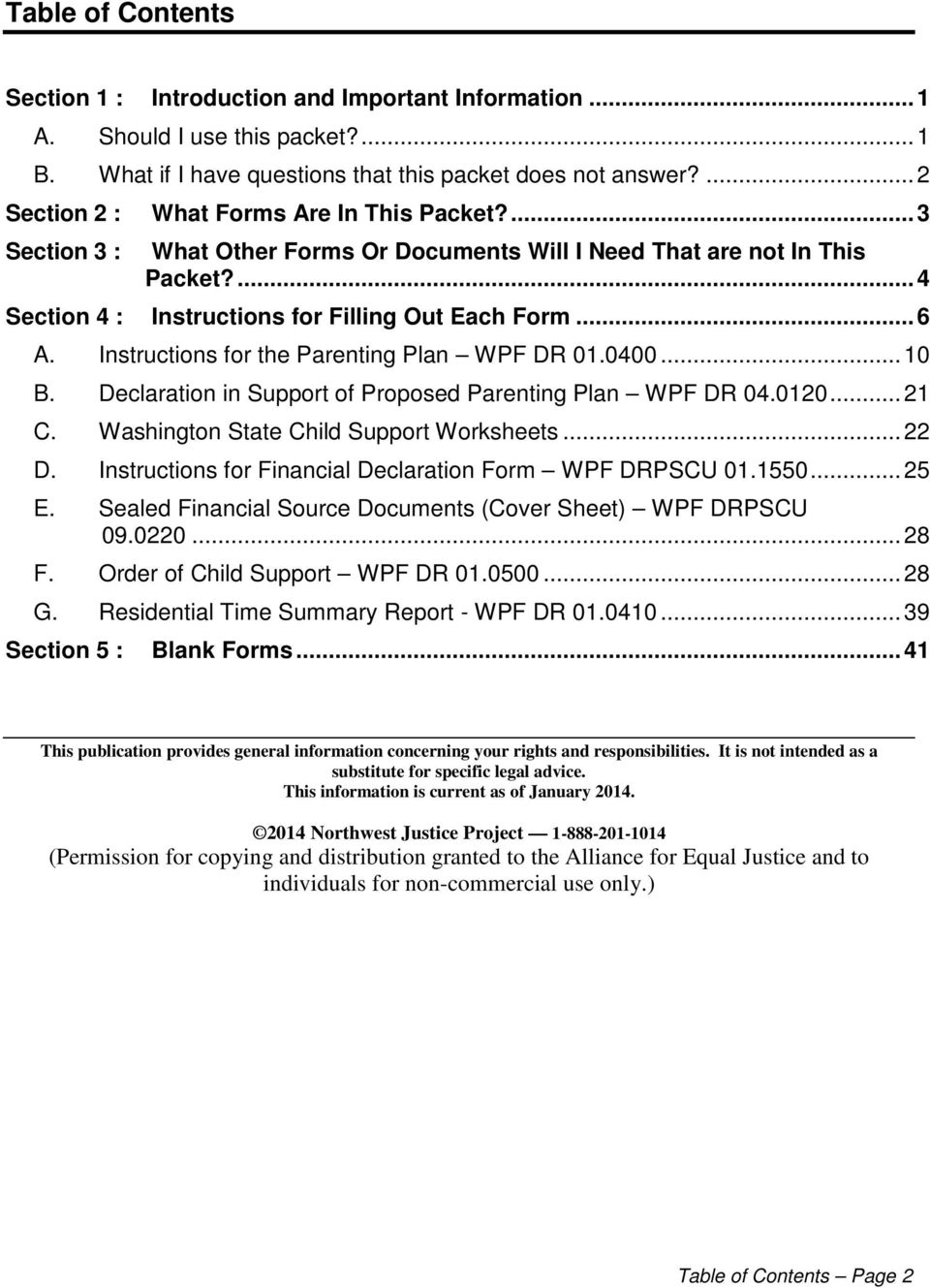
2 Table of Contents Section 1 : Introduction and Important Information... 1 A. Should I use this packet?... 1 B. What if I have questions that this packet does not answer?... 2 Section 2 : What Forms Are In This Packet?... 3 Section 3 : What Other Forms Or Documents Will I Need That are not In This Packet?... 4 Section 4 : Instructions for Filling Out Each Form... 6 A. Instructions for the Parenting Plan WPF DR B. Declaration in Support of Proposed Parenting Plan WPF DR C. Washington State Child Support Worksheets D. Instructions for Financial Declaration Form WPF DRPSCU E. Sealed Financial Source Documents (Cover Sheet) WPF DRPSCU F. Order of Child Support WPF DR G. Residential Time Summary Report - WPF DR Section 5 : Blank Forms This publication provides general information concerning your rights and responsibilities. It is not intended as a substitute for specific legal advice. This information is current as of January Northwest Justice Project (Permission for copying and distribution granted to the Alliance for Equal Justice and to individuals for non-commercial use only.) Table of Contents Page 2
3 3209EN Rev. 01/2014 Section 1: Introduction and Important Information A. Should I use this packet? This packet should help you fill out the forms and papers for parenting plans and child support. Do not use this packet by itself. Combine it with the other packet(s) you are using, for example Filing for Dissolution of Marriage. Use this packet only if you are the petitioner (the one who is starting the court case) or the respondent (the one who is responding to the court case) in a dissolution of marriage or domestic partnership, or if you are the petitioner or respondent in a case to modify a custody decree or parenting plan in a dissolution of marriage or domestic partnership. State law about marriage and marital dissolution now also applies to marriages between same-sex couples. The Legal Voice s publication called Questions and Answers: Marriage for Same-Sex Couples in Washington has more information. See Before using this packet, read our publications called Understanding the Washington State Child Support Schedule and How Child Support is Set in Washington, Parenting Plans, and (for dissolution cases) Ending Your Marriage or Domestic Partnership in Washington with Children: The Basics. If either you or the other party is in the military, read our publication called Military Service and Parenting Plan Modifications: Your Rights in Washington State. Also, get the other do-it-yourself family law packets needed in your case. This packet often refers to the other parent to mean the other party or person involved in your court case. The other party could be someone other than a parent (example: a grandparent or other party petitioning for custody of a child). Where your case involves parties other than the parents, anything required for the other parent is also required for every other party. This packet does not cover other types of claims for child custody/visitation that a person who is not a biological or adoptive parent might make, such as a petition for recognition as a de facto parent 1. This packet has no forms or instructions for filing and serving the papers or for preparing for or going to hearings. The other packets listed below have information on these issues. 1 See In re Parentage of L.B. 155 Wn. 2d 679, 122 P.3d 161 (2005), cert denied, 547 U.S (2006) and In re Parentage of J.A.B. W. App. (August 25, 2008).and In re Parentage of M.F. 141 Wn. App. 558 (2007). Parenting Plans and Child Support - 1

4 3209EN Rev. 01/2014 You will see footnotes in this packet. They tell you the law or court case that supports the statement that comes before the footnote, or give you special tips, links to websites, or other information. Use the legal references in the footnotes to look up the law at your local law library, or to tell the court when you are trying to make a legal argument. CR is the Civil Rules of Washington. GR stands for General Rules. RCW stands for Revised Code of Washington, the law of Washington State. Court cases have names, such as In re Custody of Child. The references to the law are up to date as of the date we published this packet. The law sometimes changes before we can update the packet. B. What if I have questions that this packet does not answer? Talk to a lawyer familiar with family law before you file anything with the court. Many counties have family law facilitators who can help you fill out forms, or have free legal clinics where you may get legal advice about your case. Apply online with CLEAR*Online - Or Call CLEAR at Parenting Plans and Child Support - 2

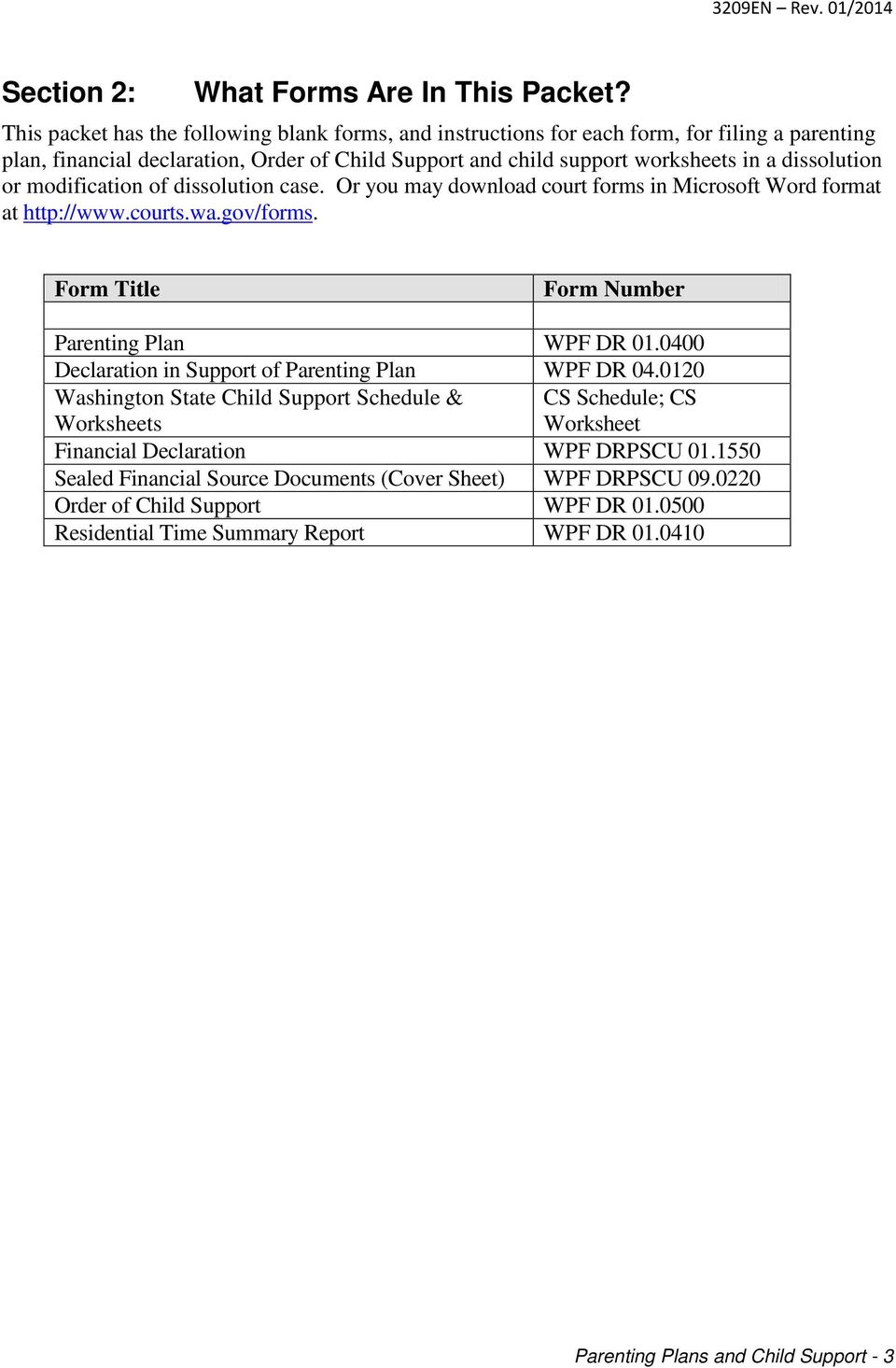
5 3209EN Rev. 01/2014 Section 2: What Forms Are In This Packet? This packet has the following blank forms, and instructions for each form, for filing a parenting plan, financial declaration, Order of Child Support and child support worksheets in a dissolution or modification of dissolution case. Or you may download court forms in Microsoft Word format at Form Title Form Number Parenting Plan WPF DR Declaration in Support of Parenting Plan WPF DR Washington State Child Support Schedule & Worksheets CS Schedule; CS Worksheet Financial Declaration WPF DRPSCU Sealed Financial Source Documents (Cover Sheet) WPF DRPSCU Order of Child Support WPF DR Residential Time Summary Report WPF DR Parenting Plans and Child Support - 3
6 3209EN Rev. 01/2014 Section 3: What Other Forms Or Documents Will I Need That are not In This Packet? Our do-it-yourself packets are designed to provide you with only the forms you need at the stage you need them. You will need more than one packet to file and finish your case. How many other packets you need depends on your case. You may also need other forms or papers that are not in our packets. Read the information below carefully. Check the boxes by the other packets and papers you think you will need. Then get the other packets you need from our website or by calling CLEAR at In some cases, there are separate packets for Dissolution of Marriage and for Dissolution of Domestic Partnership. Filing for a Dissolution of Marriage or Domestic Partnership to start a dissolution of marriage (divorce) or domestic partnership. Responding to a Dissolution of Marriage or Domestic Partnership if you have been served with a petition for dissolution of marriage (divorce). Finishing Your Dissolution of Marriage with Children by Agreement or Finishing Your Dissolution of Domestic Partnership with Children by Agreement; or Finishing Your Dissolution of Marriage by Default or Finishing Your Domestic Partnership by Default if you have already filed or responded to a dissolution of marriage but have not finished it yet, get one of our packets on how to finish your dissolution of marriage. Filing for Modification of a Custody Decree or Parenting Plan if you already have a final custody decree or parenting plan and you want to change it. Responding to a Modification of a Custody Decree or Parenting Plan if you have been served with a petition to modify your custody decree or parenting plan. Finishing Your Modification of a Custody Decree or Parenting Plan if you have already filed or been served with a petition to modify a custody decree or parenting plan and you need to finish your case. Filing a Motion for Temporary Orders or Filing a Motion for Emergency Orders - if you want the court to enter an order covering the time period between the time your case is filed and the final orders are signed, or you want to appoint a GAL. These packets contain the Sealed Personal Health Care Records Cover Sheet and the Sealed Confidential Reports Cover Sheet. Responding to a Motion for Temporary or Emergency Orders - if the other party has served you with a motion for a temporary parenting plan or temporary child support. Declaration Regarding Public Assistance: WPF SRPSCU : We do not include this form in our packets. It is an optional form. Our instructions tell you to serve the State in any case where TANF, Medicaid, or foster care is involved. We instruct you to get the state s signature on all default and agreed orders where the state might have an interest in the child support obligation in your case. You may need the form if required in your county, or if you need to verify that no public assistance has been paid or that the children are not in foster Parenting Plans and Child Support - 4
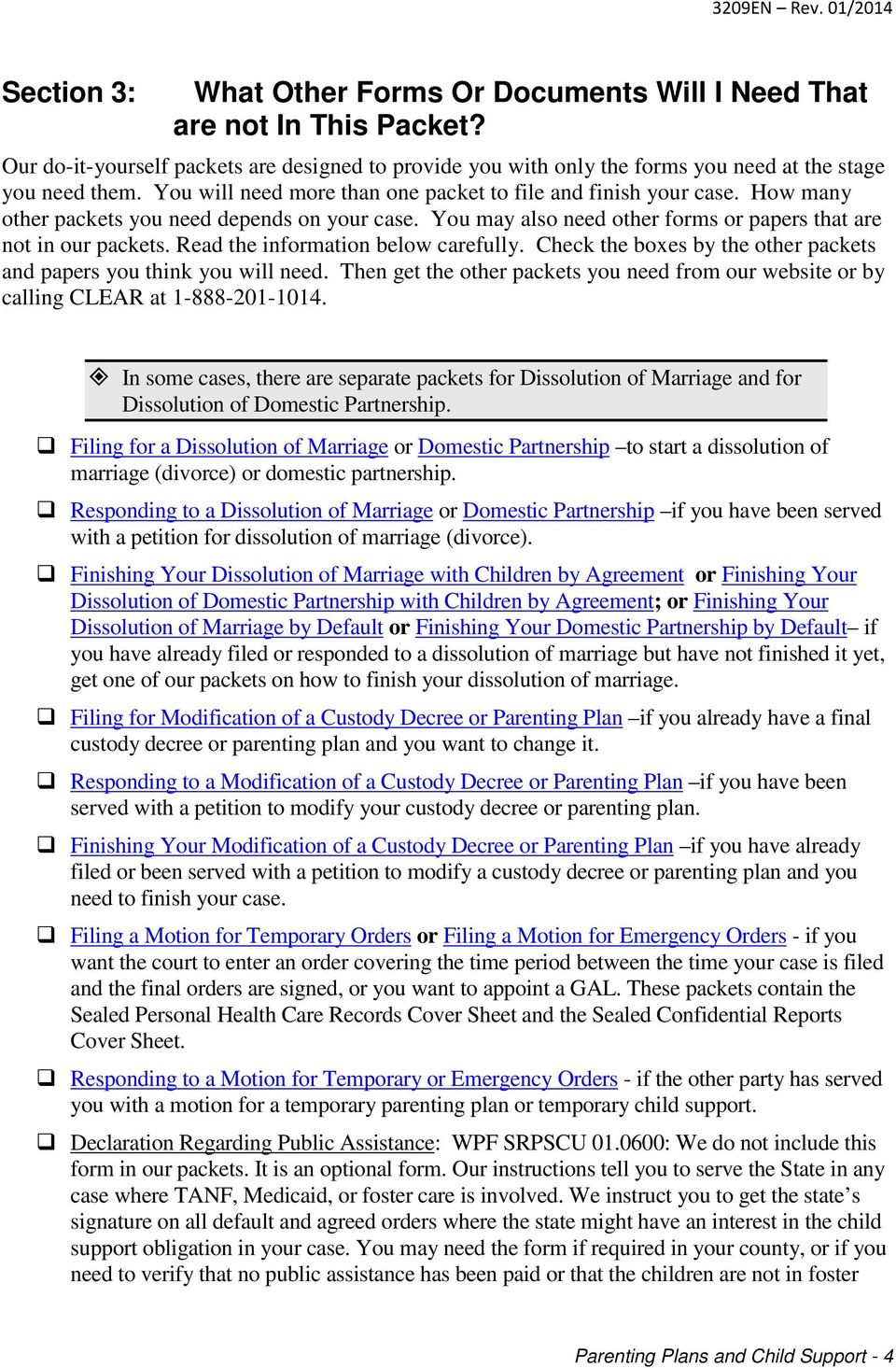
7 3209EN Rev. 01/2014 care or-out-of home placement. Get it at the Administrator of the Courts website How to Serve Papers on the State - if any party is asking for an order regarding child support, and any of the children has gotten public assistance (TANF) or medical coupons/medicaid, or is in foster care or out-of-home placement, get this packet. Include the state as a party. Serve them with papers you file. Other: Local Do-it-Yourself packets: In some counties, you may need other forms or packets during your family law case that local court rules require. Check with your court clerk s office, or Family Law Facilitator (if your county has one), to find out if your county needs more information. Legal Voice ( or has a do-ityourself packet about following the case management schedule for cases filed in King County, and also has informational publications on other issues. State law says the court must: *check the judicial information system and databases to identify any information relevant to placing the child before entering a permanent or modified parenting plan, and *in cases where a limiting factor such as domestic violence or child abuse is claimed, have both parties screened to determine whether a comprehensive assessment is appropriate to determine the effect of the limiting factor on the child and the parties. Ask your local court clerk or family law facilitator about procedures your court is using under this law. You may need to use local forms and procedures not described in this packet. Parenting Plans and Child Support - 5

8 3209EN Rev. 01/2014 Section 4: Instructions for Filling Out Each Form The General Instructions provide important information that applies to all of your forms, including how to fill out the caption of your forms. Follow those general instructions for all of the parenting plan and child support forms you use before going on to the instructions for the individual forms below. Case number. When the petitioner first files the papers to start the case and pays the filing fee (or has the fee waived), the court clerk will assign a case number. All parties must write that case number on every paper they file with the court and serve on the other parties during the case. Write the case number near the top on the right hand section of the first page of every form after "No." (abbreviation for number ) When the petitioner first files the case, s/he may be able to use a special stamp at the court clerk s counter to stamp the case number on each paper. You may write or stamp the case number. If you are filing a modification/adjustment case in the same court that entered the order you are asking to modify/adjust, use the case number on that order. You must write or stamp the case number on the first page of every copy of every paper you file with the court and on the copies you make for other parties. If you do not, your papers may be lost, or the clerk may return them to you. Some courts will fine you for filing incorrect forms. Title. Each form has a title. The title is on the right-hand side of the form under the case number. Sometimes the full title is on the form. Sometimes you must add more information to finish it. (Example: on a declaration, you write in the name of the person filling out the declaration.) Format: Pleadings (legal forms) that you file with the court and attachments to those pleadings must follow the court rules about size and margins (GR 14(a)). You must use regular size (8 ½ x 11 ) white paper. You may write on only one side of the paper. The first page of each paper that you file must have a three-inch margin (three inches of space) at the top. The other margins (left, right and bottom, and the top from the second page on) must be at least one-inch wide. Use black or dark blue ink. If your forms do not follow these rules, the court clerk may refuse to file them or may make you pay a fine. Parenting Plans and Child Support - 6

9 3209EN Rev. 01/2014 The contents. Fill out each form according to the instructions for that form. In most counties, you may print or type the information, but it must be readable and you must use BLACK OR DARK BLUE INK. A few counties require you to type all documents. After filling out each form, re-read it. Make sure you have correctly filled in all the blanks you need to. Any corrections must be neat and readable. Do not write in the margins of any page. The clerk may reject your form. Dates. On the last page of most forms (not including orders), there is a space for the person who fills out a form to write the date that the form is signed. The judge will fill I n dates in orders when s/he signs the order. Signatures. Your signature After you fill out a form, look for the place(s) to sign your name: o Some forms have one signature line for petitioner or respondent. After you fill out a form such as the petition, sign at the place that applies to you. Look carefully. You may have to sign in more than one place. You may have to write the date and the place (city, state) you signed the form. o When you prepare and file motions, you are the moving party. After you prepare a motion, look for each place marked signature of moving party or lawyer. Look carefully. You may have to sign in more than one place. You may have to write the date and the place (city, state) you signed the form. o When you prepare an order and plan to present it for the judge to sign, look for each place marked presented by. Sign in the space underneath. Judge s Signature: Leave the judge s signature line and the date blank. Other party s signature: Some forms have a place for other parties to sign. You cannot force another party to sign a court paper. S/he can choose to sign, or not. If you have prepared an order after a hearing, the other party may be willing to sign the form you have prepared if s/he agrees it accurately states the judge s decisions (or the judge may require the other party to sign), even if the party is not happy with the decision itself. o Agreed orders. If the other party agrees with the orders you have written, s/he should sign in the right place (petitioner/respondent/moving or nonmoving party) on each court order that is agreed. o Approved for entry/notice of Presentation Waived. If you are the respondent or nonmoving party, or if you did not prepare the order, the other party may ask you to sign in a blank under these words. If you check Approved for entry, you are agreeing that the judge should sign the order as written. If Notice of Presentation Waived is checked, you are agreeing that the other party can give the order to the judge for him/her to sign without letting you know when the other party is going to take that order to the judge. Other signatures/declarant s Signature: If someone else must sign a form (such as a witness or the person serving papers), they must fill out all information correctly and sign in the right space. The declarant is the person who is writing the declaration. Parenting Plans and Child Support - 7

10 3209EN Rev. 01/2014 Place signed. Declarations and Returns of Service must include the place you signed them and the date. (Example: Signed this 10th day of October 2014 at Seattle, WA.) Identifying Information. Court rules try to protect privacy but also allow for public access to some information in court files. The three boxes discuss these rules: GR 15, GR 22 and GR 31. Box #1 Things to Not Write in Most of Your Court Papers: General Rules 22 & 31 try to protect privacy in family law cases. Almost all pleadings, orders and other papers filed with the court are available to the public (except for some aspects of parentage cases), and may be available to the public online. Except where instructions about a specific form tell you otherwise (example: the forms in Box #3), use these rules for papers you file with the court. Residence Address (Where you Live) and Telephone Number: You do not have to write these in court papers. You do need to write in an address where you can get mail from the court. You should also give the court a phone number where you can be reached. Social Security/Driver s License, ID Numbers of Adults and Children: You do not have to write these in court papers. If you do, write only the last four digits, not the whole number. Dates of Birth of Children: Do not write them in court papers. Bank Account, Credit Card Numbers: Write the bank name, type of account (savings, checking, and so on), and only the last four digits of the account number. Box #2: Private Information That You Should File With Sealed Cover Sheets: If a sealed cover sheet is used, this information is usually available to the other party and the court. It is not available to the public. Financial Information: If you file paystubs, checks, loan applications, tax returns, credit card statements, check registers, W-2 forms, bank statements, or retirement plan orders, attach them to a Sealed Financial Source Documents form. Then they will not be available to the public. Medical or Mental Health Records or Information: If you file papers that have health or mental health information (information about someone s past, present, or future physical or mental health, including insurance or payment records), you must attach the papers to a Sealed Personal Health Care Records form. Then they will not be available to the public. Confidential Reports: Reports such as Parenting Evaluations, CPS Reports, Domestic Violence Assessments, and Guardian ad Litem Reports that are intended for court use must have a public Parenting Plans and Child Support - 8

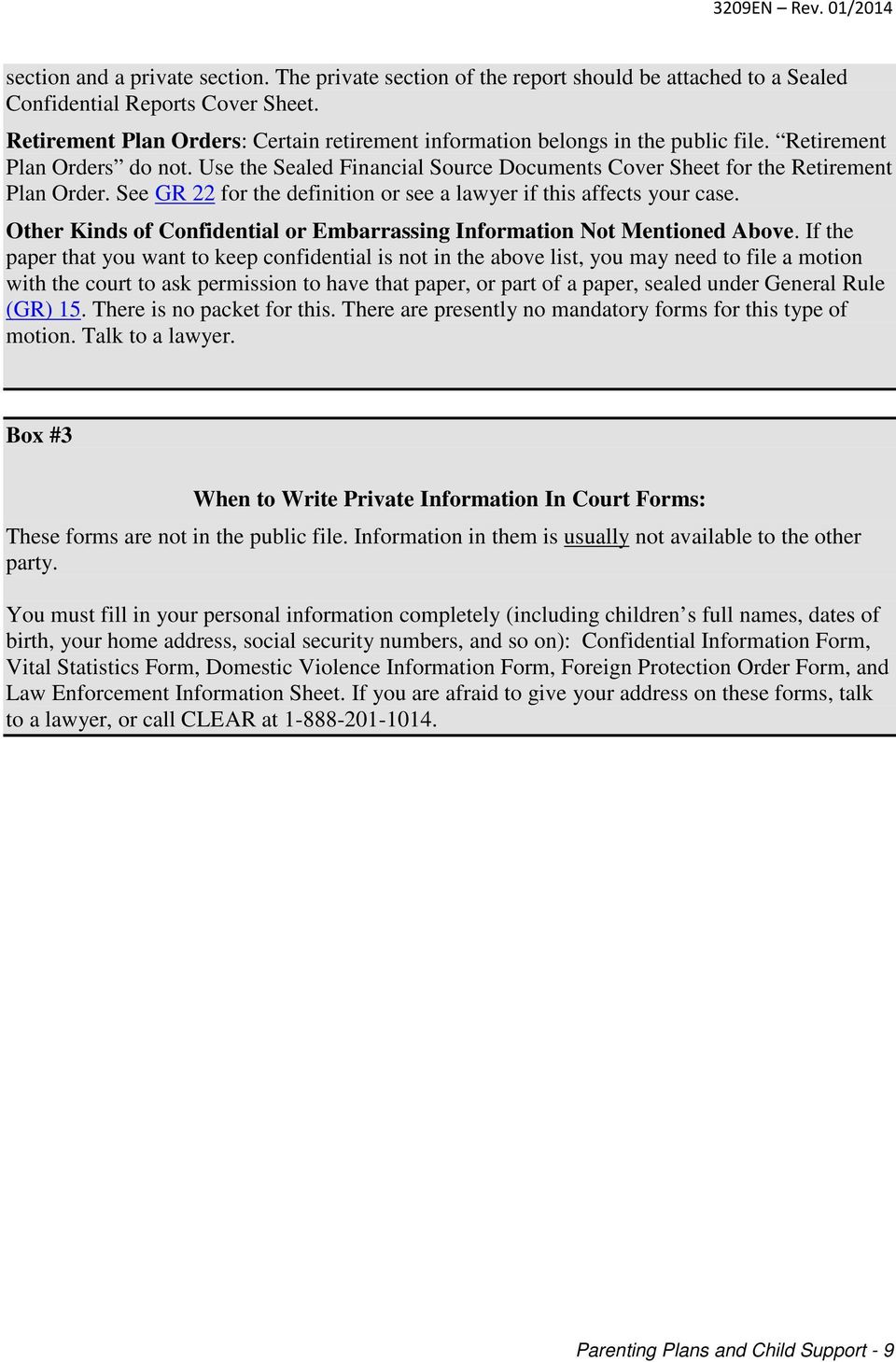
11 3209EN Rev. 01/2014 section and a private section. The private section of the report should be attached to a Sealed Confidential Reports Cover Sheet. Retirement Plan Orders: Certain retirement information belongs in the public file. Retirement Plan Orders do not. Use the Sealed Financial Source Documents Cover Sheet for the Retirement Plan Order. See GR 22 for the definition or see a lawyer if this affects your case. Other Kinds of Confidential or Embarrassing Information Not Mentioned Above. If the paper that you want to keep confidential is not in the above list, you may need to file a motion with the court to ask permission to have that paper, or part of a paper, sealed under General Rule (GR) 15. There is no packet for this. There are presently no mandatory forms for this type of motion. Talk to a lawyer. Box #3 When to Write Private Information In Court Forms: These forms are not in the public file. Information in them is usually not available to the other party. You must fill in your personal information completely (including children s full names, dates of birth, your home address, social security numbers, and so on): Confidential Information Form, Vital Statistics Form, Domestic Violence Information Form, Foreign Protection Order Form, and Law Enforcement Information Sheet. If you are afraid to give your address on these forms, talk to a lawyer, or call CLEAR at Parenting Plans and Child Support - 9
12 3209EN Rev. 01/2014 A. Instructions for the Parenting Plan WPF DR Before you begin, make at least one extra copy of the parenting plan and keep it. You may need three or more versions of your parenting plan: one that you will file with your petition or your response, one that you will file when you want to finish your case, and one if you have a motion for temporary or emergency orders. If you will be asking for the same parenting plan with your petition (or Response) and your motion for temporary orders, save yourself some work by making copies of the form after filling most of it out. To do this, fill out the entire Parenting Plan except do not check the boxes under the title of the form in the caption and in the first section of the form (above the words IT IS HEREBY ORDERED, ADJUGED AND DECREED). Make several copies. Then check the appropriate boxes under the title and caption. Read the instructions carefully. Take your time. If you need hands-on help, your county superior court may have a Family Law Facilitator who can give you more information or help filling out problem spots in the forms. Contact your local superior court clerk to find out if your county has one. If you are completing this form as a proposed parenting plan (example: with your petition, or as part of a motion for emergency or temporary orders), complete it to show the decisions you would like the court to make. If you are filling in this form after the judge has made a decision (at a temporary orders/show cause hearing or after a trial), complete it to show the decision actually made by the judge, even if different than what you asked for. If you and the other party have reached an agreement, fill it in to show the agreement you have made. Caption. Fill in the caption. The caption is the same one that is used for the dissolution or modification case. Dissolution Parenting Plan: Title/This Parenting Plan Is If you are filing this Parenting Plan with your Petition or your Response to the Petition for Dissolution of Marriage or Domestic Partnership (or for modification of a parenting plan entered in a dissolution), check the box next to Proposed (PPP) in the title, and the fourth box under the sentence This parenting plan is. Write your name in the blank. If you and the other parent agree on the parenting plan, write both of your names in the blank. Parenting Plans and Child Support - 10

13 3209EN Rev. 01/2014 If you are filing this parenting plan with your Motion for Temporary Orders or Motion for Emergency Orders, or your response to one of those motions, check the box next to Proposed (PPP) and next to Temporary (PPT) in the title, and the fourth box under the sentence This parenting plan is. Write your name in the blank. If you are filing this parenting plan as a final order with a Decree of Dissolution, check the box next to Final Order (PP) under the title, and the first box under the sentence This parenting plan is. Fill in the date the judge signs your final papers. If you are filing this parenting plan as a final order in a modification of a parenting plan, check the box next to Final Order (PP) under the title, and the second box under the sentence This parenting plan is. Fill in the date the judge signs your modification/adjustment order. I. General Information List the names and ages of the minor children of this relationship. This means biological or adopted children, under age 18, that you and the other parent had together. Do not list stepchildren or children you have from other relationships. II. Basis for Restrictions Paragraph 2.1. Parental Conduct. This Paragraph and Paragraph 2.2 are where you tell the Court whether the other parent s time with the child(ren) ought to be restricted, and if so, why. Fill out this section if you believe that the other parent s behavior is harmful to the child(ren) and want the Court to restrict contact between the other parent and the child(ren), or if, at your hearing or trial, the court found there was harmful behavior and ordered restrictions. If the other parent or a person living with the other parent has not done any of the things listed in paragraph 2.1, check the first box for "Does not apply". If the other parent or person who lives with the other parent has done any of the behavior listed in the three sections, and you believe the behavior is harmful to the child(ren) (or the court found it was), check the second box. Check mother or father for the other parent. If it was/is the other parent who engaged in the bad conduct, check the box before this parent. If the person who engaged in the bad conduct is someone living with the other parent, check the box before a person residing with this parent. Then check any of the three boxes that apply. If the Court agrees that the behavior exists (that is, if the other parent never responds or you prove the allegations after the other parent responds) then it is likely that it will order restrictions. Example: the court may decide to order supervision of the other parent s time, or may order that the other parent cannot make any major decisions about the children. 2 Paragraph 2.2. Other Factors. 2 The Washington law related to paragraphs 2.1 and 2.2 of the parenting plan is RCW Parenting Plans and Child Support - 11
14 3209EN Rev. 01/2014 If the other parent has not done any of the things listed in paragraph 2.2, check the first box for "Does not apply." If there are any factors present and you believe that these are harmful to the child(ren) (or the court found that they are harmful), check the second box. Then check the box next to mother or father. Then check the box(es) that apply. If a harmful factor exists, but is not listed, check the box other and write it in. If neither parent has done any of the things listed in paragraph 2.2, check the first box for "Does not apply." III. Residential Schedule This section may be confusing. Talk with a lawyer or your Family Law Facilitator for help completing this section. Our publication called Ending Your Marriage or Domestic Partnership in Washington with Children - The Basics may help. The residential schedule states in writing which parent the child(ren) will be with and when. This section is purposefully very specific. You do not have to be that specific. You may write your parenting plan in the blank section at 3.13 Other. You may find the specific paragraphs very useful if you want a detailed schedule for reasons of stability and planning. Make sure the schedule you write is best for your children. What if I think the other parent should spend no time with the children? You may want to ask the court to order that the other parent should not have any time with the children -- on a temporary or a permanent basis. Or, the court may already have restricted the other parent s contact with the children in a separate order, such as an Order of Protection. To ask the court to restrict the other parent from having any contact with the child, (or if the court orders this), do this: Under paragraph 3.1 or 3.2 (only 3.2 if the children have all reached school age), check the box to show which parent the children should live with. For time with the other parent, check the other box. Then write, [Other parent s name] shall have no contact with the children until the parent has provided [your name or the court ] with proof that he/she has successfully completed the requirements set forth in paragraph 3.10 of this parenting plan. Once these requirements have been completed the [ ] mother [ ] father [mark the restricted parent] may file a petition for modification to seek visitation." Under paragraphs , write see paragraphs 3.1/3.2 and Go to the instructions for paragraph 3.10 Paragraph 3.1. Schedule for Children Under School Age If all your children are in school already, check the first box. Move on to School Schedule. Parenting Plans and Child Support - 12

15 3209EN Rev. 01/2014 If you and the other parent have any children who are not yet in school (usually age birth through five years), check the second box. Fill out this section. Check the box to show whether the children will live with mother or father. Write out the specific days of the week and times the children will spend with the other parent. Check whether the child will spend those days with the other parent every week, every other week, and so on. Every other week is different from first and third week. There are sometimes five weeks in a month. Paragraph 3.2. School Schedule Fill out this section even if none of your children is yet in school. Check the box to show whether the children will live with most of the time with mother or father. Fill in the days of the week and the specific times the children will spend with the other parent. Check whether the child will spend those days with the other parent every week, every other week, and so on. Every other week is different from first and third week. There are sometimes five weeks in a month. Check the boxes that indicate if the school schedule will start when the child is in kindergarten or first grade. Paragraph 3.3. Schedule for Winter Vacation Check the box for mother or father. In the blank, write in any time the children will spend with the other parent. Here are some ways of splitting school vacations: splitting the vacation each year (1/2 vacation with each parent); alternating years (even years with dad, odd years with mom); or, where parents live far away from each other, designating that all of the vacation time will be spent completely with the parent who does not have primary custody of the child(ren) to make up for not being able to have more regular time during the school year. Be sure the vacation schedule is consistent with paragraphs 3.7 and 3.8, regarding holidays and special occasions. Paragraph 3.4. Schedule for Other School Breaks. Check the box for mother or father. In the blank, write in any time that the children will spend with the other parent. Common ways of dividing other school breaks include splitting them in half between parents each year, alternating the years, or designating that just the non-custodial parent get the time. Paragraph 3.5. Summer Schedule Paragraph 3.5 generally is for children who have started school. If you want it to apply to younger children, write in at what age the summer schedule will apply. Check the box to show which parent the children will live with during the summer. If you will follow the same schedule in the summer as during the school year, check the box for Same as school year schedule. If the summer schedule will be different, check the Other box. Write in the blank the dates and times the children will spend with the other parent during the summer. You may set specific dates, or you may write that one or both parents notify each other by a certain date of the time they would like for that summer. Example: The children will live with the father during the summer except for four weeks with the mother. The mother shall inform Parenting Plans and Child Support - 13

16 3209EN Rev. 01/2014 the father by May 15 th of which weeks she would like. You may also specify whether the time will be all at once or split up. Example: Four weeks, taken in two, two-week sessions. Another option is to provide for time or phone contact with the primary parent during long times with the other parent. Example: If the children usually live with the mother and will be with the father for two, three-week periods in the summer, you could propose that the mother have the middle weekend of each session with the children, and phone contact as often as the children want. Paragraph 3.6. Vacation with Parents If neither parent will have vacation time with the child, check Does not apply. If either parent will have vacation time, check The schedule for vacation with parents is as follows. Write in the blank any vacation time the children will have with each parent. (This refers to vacations a parent takes from work). Example: you could write, Each parent shall have two weeks of vacation with the child each summer. Paragraph 3.7. Schedule for Holidays You do not need to give specific time on the holidays. If you will follow the school schedule, check the last box next to other. Write same as school schedule. If you will make a special schedule for holidays, fill in the space in the same row as each holiday to show which parent the children will spend each holiday with. If you will alternate holidays by year, specify odd and even years. If you will split a holiday each year (example: Christmas morning with mom, Christmas afternoon and evening with dad), write Every in the blank for both parents. Fill out the split times for that holiday in the section below in the other section. You may write a other holidays in the blank spaces if you have special religious or cultural holidays to include. Some of the listed holidays may not be important in your family while the form does not list other important holidays, particularly if you are not Christian. You may mark out or change the listed holidays so that they show what is important to your family. Check the box next to For the purposes of this parenting plan, a holiday shall begin and end as follows. Write in the times for holiday visits to begin and end. You might write special times for holidays like Christmas Day, which often begin early in the morning, or July 4th, when you might want to watch the fireworks late at night. If Friday and Monday holidays will include the weekend, check the second box. Checking this box will usually give the parent with whom the child does not live most of the time extra weekends that s/he would not have had under the school schedule. Paragraph 3.8. Schedule for Special Occasions List who the child will be with on Mother s Day and Father s Day. You may write even/odd as explained under the holiday schedule instructions, or every depending on your situation. List any special occasions you did not list under holidays that will be in the parenting plan. Examples: some people include the child s birthday, the parent s birthdays, an annual family Parenting Plans and Child Support - 14

17 3209EN Rev. 01/2014 reunion, and so on. You may write even/odd as under the holiday schedule, or every if that is what you want. You may want to check the other box and write in the special occasion time with the parent the child does not live with most of the time shall begin and end as follows and write in the times for special occasion visits to begin and end. Paragraph 3.9. Priorities Under the Residential Schedule This section tells what happens when parts of the residential schedule of your parenting plan conflict, such as when mom s Christmas Day falls on dad s weekend. Check the second box. Then, you may choose: to number the lines showing which types of time with the children have priority in what order (and check any box appearing in front of the paragraph containing this list of priorities). Example: if holidays will be more important than the school schedule, you would write #1 in the blank next to holidays, and #2 next to school schedule, and so on or to make it simpler, check the box (Other). Write your own priorities. Paragraph Restrictions This is where you write any limitations on the other parent s time needed for your children to spend time safely with the other parent. If limiting factors exist in Paragraphs 2.1 and/or 2.2 and you are at risk of harm if you have contact with the other parent, the limitations may help protect your safety. 3 If you checked the does not apply boxes in Paragraphs 2.1 and 2.2, check the first box. If you checked boxes in 2.2, but you do not think there should be any restrictions on the other parent s time with the children (or the court has decided this at your hearing), check the third box and the mother or father box. Write in the blank why you do not need restrictions. If you are preparing a proposed parenting plan, your explanation will need to convince the court that even though there are factors present, your children will be safe when they are with the other parent. If you do not explain to the court why your children would be safe despite the factors, the Court might not sign your parenting plan. If you check boxes in Paragraph 2.1 or 2.2 and you want the court to order restrictions on the other parent s time (or the court did order restrictions at your hearing), check the second box and either mother or father. Write in the blank any restrictions put on the other parent. The following paragraphs have some suggestions for restrictions. You may ask for these or other restrictions in appropriate cases when you write a proposed parenting plan, and/or the judge might order these types of restrictions at your hearing: Following Requirements of Other Court Orders: You may ask the court to order the other parent to successfully complete requirements already required by another court order (such as a dependency order or an Order for Protection) 3 RCW (2)(m)(i) Parenting Plans and Child Support - 15

18 3209EN Rev. 01/2014 before the other parent can have residential time with the children (or, in some cases to have unsupervised residential time with the children). You may also ask the court to order the other parent to provide written proof of the successful completion of the requirements. Example: You have a Protection Order requiring the other parent to complete domestic violence treatment. You may write [Other parent] shall successfully complete all domestic violence treatment required under the Order of Protection entered on [date] under case number [protection order case number], and provide written proof of such successful completion to the court and all parties, before he/she may request residential time with the children. Drug and Alcohol Abuse: You may ask the court to order the other parent to complete a drug and alcohol treatment program approved and certified by the State of Washington before it will allow unsupervised visits (or in severe cases, any visits). You may also ask the court to order the other parent to have random urinalyses (urine tests) or other appropriate tests for drugs or alcohol. You may ask the court to place further restrictions on the other parent s residential time with the children if s/he fails to pass a random urine test. You may ask the court to order other restrictions such as prohibiting the other parent from driving with the children. Neglect: You may ask that visitation be supervised until the other parent has successfully completed a parenting skills program and provides the court and you with written proof of having done so. Domestic Violence: You may ask the court to order the other parent s residential time with the children be supervised (or otherwise restricted or denied) unless the other parent takes steps to get treatment for domestic violence from a certified provider and shows that he/she is not going to commit domestic violence again. Example: you may ask that the other parent have supervised visits while s/he is evaluated for domestic violence by a statecertified agency and, if recommended by the evaluator, participates and successfully completes a state-certified batterer s treatment program. You may ask the court to suspend immediately the other parent s visits if the other parent commits further acts of domestic violence or if s/he stops treatment. Abusive Use of Conflict: If the other parent has made derogatory comments to the children about you or is making untrue accusation to others (example: makes repeated calls to CPS on you with no reason to do so), you may ask the court to restrain the other parent from doing these things. You may also ask the court to suspend visits if the other parent engages in this behavior and that no visits start up again until the other parent has completed a parenting skills class. Supervised Visits: If you are asking that visits with the children be supervised you need to specify who will supervise, when and where the supervised visits will take place, and who will pay for the supervision, if applicable. The supervisor can be any adult you trust or a professional visitation supervisor. It must be someone who can and will protect the children from harm. If you Parenting Plans and Child Support - 16
19 3209EN Rev. 01/2014 choose a family or household member to supervise visits, the plan must include conditions to be followed during residential time. The court will not appoint someone who does not want to be a supervisor. If you have supervised visits, make sure that the visitation times in paragraphs 3.1 through 3.9 are consistent with the supervision in this paragraph. Example: if visitation lasts all weekend, can someone realistically supervise? The supervisor may have to follow any standard supervised visitation order used in your court and/or the court can set conditions during the visitation such as the supervisor being continuously present and being required to intervene to stop any conduct potentially harmful to the children. Here is an example of how to write up the supervision: Visitation will be supervised by (identify relationship to the parties and qualifications of supervisor or name of professional visitation center). It will take place on the first and third Saturdays of the month from 10:00 a.m. until 3:00 p.m. The visits will be at (write in the location of the visits). The supervisor shall be provided and shall agree to follow (insert the title of any supervised visitation order used in your county or other written visitation rules that apply) when supervising visitation under this plan/schedule. Specify if the mother or father shall pay all costs of supervision. Conditions to Lift Restrictions: You should specify the conditions under which the court may lift restrictions. Example: Your plan denies all visits at present. It orders the other parent to complete a state-certified batterer s treatment program. You could add, Once this treatment requirement has been completed the [ ] mother [ ] father [mark the restricted parent] may file a petition for modification to seek visitation. Parenting Plans and Child Support - 17

20 3209EN Rev. 01/2014 Removal of Children from the State: You may write in that the other parent may not remove the child(ren) from the State of Washington without written consent from you. Example: If you already know that the other parent will be taking the child to another state for an annual family reunion, state that as an exception. Neutral Exchange Site: You may choose and write a neutral place to drop the children off and pick them up. This is usually a public place, like a local fast food restaurant or park. Do this if you know that you and the other parent will fight in front of the children or if you have reason to be scared the other parent will hurt you. You may write in more safeguards to protect your safety if you are at risk during exchanges. Paragraph Transportation Write down who will drive the children back and forth for visits and/or where you will meet the other parent to exchange the children. Arrangements for the cost of transportation should be written in the Order of Child Support. Paragraph Designation of Custodian Check the box for the parent the children will be living with most of the time (more than half of the time). That parent is the children's custodian for purposes of other state and federal laws. 4 If you and the other parent have agreed on joint custody, and you will each have the child(ren) one half of the time, you may alternate the designation by odd/even year. Get legal advice about your case. Find out whether this would be a good idea for you. Paragraph Other If there are other rules you would like to write in your parenting plan, such as giving or denying access to school or medical records, being able to go to or get notice of school or extra-curricular events (sports, church events, music recitals, and so on), or phone contact, put those rules in this space. You could also put those rules in Section VI, explained below. Paragraph Relocation This section gives you information about the laws that apply when a parent wants to relocate (move) with the children. You do not have to write anything here. You do need to read it. You may not delete or change this paragraph. 4 RCW Parenting Plans and Child Support - 18

21 3209EN Rev. 01/2014 IV. Decision Making Paragraph 4.1. Day-to-Day Decisions. You do not need to write anything in this paragraph. You may not change it. Either parent may make emergency decisions and day-to-day decisions about the child. 5 Paragraph 4.2. Major Decisions. Education decisions. If one parent should make the decisions about the child s education (example: where the child goes to school), check the appropriate box for mother or father. If both parents should make the decision, check joint. Do the same for non-emergency health care - the child s regular check-ups and trips to the doctor, dentist, and so on - and religious upbringing. If there are major issues y not listed elsewhere, put them in the blank lines provided. Some other examples of issues include getting a driver s license or getting married before age 18, or enlisting in the military before age 18. If your parenting plan provides that both parents will make major decisions, then you and the other parent must discuss major problems regarding your children before you make a decision. Paragraph 4.3. Restrictions in Decision Making If there were no factors that you checked in paragraphs 2.1 or 2.2, check the does not apply box. Check the second box if you think only one parent should have decision-making authority. Check the box beside the appropriate parent. Check the appropriate box showing the reason. (If you checked any of the factors in paragraph 2.1, you must restrict decision-making.) If you checked a limiting factor in paragraph 2.2 but are not restricting mutual decisionmaking, check the last item in paragraph 4.3. Explain why you do not need restrictions. Look back at paragraph 4.2. Make sure what you have written does not conflict with paragraph 4.3. (Example: if you checked the sole decision-making box in paragraph 4.3, you usually should not have any joint decision-making boxes checked in paragraph 4.2.) V. Dispute Resolution The parenting plan has three alternative dispute resolution processes. If one of the options is marked, you must use it every time you and the other parent have a major difference regarding the children that you cannot work out by yourselves. The process may cost a lot. Still, sometimes it is easier and cheaper than going back to court. Counseling is when you and the other parent meet with a counselor to try to reach agreement. Mediation, which is more commonly used, is when you and the other parent meet with a mediator (a neutral person who could be a lawyer, professional mediator, or a mental health professional) to try to work out the problems by agreement. Arbitration is when you and the other parent meet with an arbitrator (a neutral person who is usually a lawyer or retired judge), who will listen to both of you and make a decision that you both must follow if you cannot reach an agreement. 5 RCW (4). Parenting Plans and Child Support - 19
22 3209EN Rev. 01/2014 If you mark one of these processes, check the first box at the start of the paragraph and the appropriate box indented under it. Write in the name of the person or organization you will use for the counselor, mediator or arbitrator. You must also check the box for how to divide the cost of dispute resolution between you. You may choose to divide the cost or some other percentage, to divide it based on your incomes as shown on the child support worksheet, or to let the mediator, counselor or arbitrator help you decide. If you mark one of these processes, you must also check the box showing how to start the dispute resolution process by letter, by certified mail, or some other way. Alternative dispute resolution may not be good to use in some cases, such as when one parent has committed domestic violence against the other. One parent may fear the other. The Parenting Plan should not require mediation or some other alternative to court if any of the restrictions in Paragraph 2.1 of the parenting plan are present. 6 Check the last box: No dispute resolution process, except court action is ordered. If a victim of domestic violence requests meditation, the court may allow it if the court finds mediation is appropriate in the circumstances and the victim can have a supporting person present. Another reason that dispute resolution may not be a good idea is if you cannot afford it. If you do not want dispute resolution, or the court orders that there will not be alternative dispute resolution, check the last box: No dispute resolution process, except court action... VI. Other Provisions If there are other rules to write in your parenting plan, and you did not write them in paragraph 3.13, write them in this section. Here is some sample language for rules that you might want to include or that the court might order: Phone Calls Each parent shall be allowed to call the children at reasonable times when they are with the other parent; Activities Outside of School Neither parent shall sign the child(ren) up for activities which will interfere with the other parent's time without the agreement of the other parent. Address and Phone of Parents Both parents shall keep the other advised of their current home address and phone number. School and Activities Both parents shall have the right to go to school, sports, and other activities of the children. VII. Declaration for Proposed Parenting Plan If you are writing this parenting plan as a court order, check the first box. If you are using it as your proposal, check the second box. Sign and fill in the date and place in the space depending upon whether you are the mother or father. If the other parent agrees with the parenting plan you are proposing, s/he should also sign and date in these spaces. 6 RCW Parenting Plans and Child Support - 20
23 3209EN Rev. 01/2014 VIII. Order By the Court If you are using this parenting plan for a final order or a temporary parenting plan, sign your name on the line under Presented by. Print your name in the blank below. If the other parent agrees with the order, ask that parent to sign under Approved for entry and print that parent s name on the line below his/her signature. When you have finished filling out your Parenting Plan, read through your parenting plan several times. Make sure you understand it and have filled everything in you want. B. Declaration in Support of Proposed Parenting Plan WPF DR Should I Complete One of These Forms? Use this form only if you are filing a motion for temporary or emergency orders, or you are responding to a motion for temporary or emergency orders. Otherwise, skip this section. If you use this form, fill out a separate form for each child in the case. For general information about writing declarations, the instructions in the temporary and emergency orders packets for the Declaration form will help, too. Caption. Fill out the caption. This declaration is made by the Check the box showing which party you are. Paragraph 1. Write the name of the child in the first blank. In the space below, list the name(s) of each person the child lives and has lived with, the dates and length of time that the child lived with that person. If you do not know or cannot remember all the information, fill in as much as you know. Paragraph 2. In this paragraph and the paragraphs that follow, write in the current information about the child. Write in past information that relates to the proposed temporary parenting plan, and/or that shows details of child s relationship with each party. (a) Write in the blank what this parent does and has done to take care of the child s daily needs. Explain when and for how long s/he has done these things. Examples of daily needs: making their meals, dressing them, changing diapers, taking them to school/appointments, or other things that the children need daily. Parenting Plans and Child Support - 21
24 3209EN Rev. 01/2014 (b) Write this parent s work schedule. (Example: Monday Friday, 8:30 a.m. to 5:00 p.m.) Paragraph 3. (a) Write in the blank what that this parent does, and has done, to take care of the children s daily needs. Explain when, and for how long, s/he has done these things. Examples of daily needs: making their meals, dressing them, changing diapers, taking them to school/appointments, or other things that the children need daily. (b) Write this parent s work schedule. (Example: Monday Friday, 8:30 a.m. to 5:00 p.m.) Paragraph 4. (a) Write the child s schedule, including school, child-care schedule (daycare, or the time that the child was in the care of a regular babysitter or nanny), and other activities. Paragraph 5. Write in any limiting factors that may place the child at risk and that may require restrictions on the time and contact a parent has with the child. Examples: domestic violence, drug/alcohol abuse, neglect, or other limiting factors identified in your proposed parenting plan/residential schedule. Paragraph 6. Write in any other information that you think the court should know regarding the child. Examples: who takes care of the child, the child s special needs, his/her relationship with each parent, and his/her activities and interests. Signature. Write the city, state, and date, and sign and print your name. C. Washington State Child Support Worksheets When child support is an issue, each party fills out a set of child support worksheets, using the instructions and schedule that come with the worksheets. You may have to file and serve worksheets more than once during the course of your case: First with the Petition and Response, and New worksheets when there are motions and hearings involving child support (to update information in your first set of worksheets). The judge will sign a set of worksheets s/he approves when entering an order that sets child support. The judge may sign worksheets previously prepared by one party. Or the judge may ask a party to prepare a new set of worksheets with the specific income, expense, and child support amounts the judge announced. The instructions and worksheets included in this packet are current as of June Use this set of instructions along with the Washington State Child Support Schedule published by the Administrative Office of the Courts. Get it from their website at or call (360) Also, read our publication called Understanding the Washington State Child Support Schedule and How Child Support is Set in Washington. Parenting Plans and Child Support - 22
25 The instructions below are for filling out the worksheets based on the income, child support amounts, and expense figures you propose at the start of the case or before a hearing or trial. If you are filling in these worksheets after the judge has announced a decision, use the income, child support amounts, expenses, and other information announced by the judge, even if you disagree with them and even if they are different from what you proposed. If you want to use the Child Support Calculator to estimate the amount of support that might be ordered in your case and/or for help in preparing proposed child support worksheets, it is on the DCS (Division of Child Support) website, at: The calculator has a printable help section and instructions. The estimate will be more useful if the information you put into the calculator is correct. The calculator may not work if you are asking for a deviation from the standard child support calculation. (Examples: People often ask for deviations in situations where the parents share joint custody of the children, when there are children from other relationships, and where each parent has custody of one of the children.) 1. Caption your worksheets: At the top of worksheet page 1, fill in, where indicated, the name of the mother and father, the name of your county, and the case number. 2. Above the caption, check the box to show whether these worksheets are proposed or an order signed by the judge. If they are proposed, check the box next to Proposed by. Write the name of the person proposing them. 3. List the names and ages of the children you have with the other parent in the very first box. 4. To fill out the worksheets, follow the instructions in the Washington State Child Support Schedule. The instructions explain the meaning of gross and net income. They also explain how to list your income. They also tell you how to fill in the rest of the financial information. 5. Fill in the columns of the Worksheet that apply to you (Father or Mother). 6. Fill in the information for the other parent, if you know or can estimate his/her income and expenses. If you have used estimates, write that on the form. If you have any income information for the other parent, even an estimate, use that information. Explain in the Other Factors for Consideration at Line 26 any income information you listed which is not based on wage stubs or tax returns. The other parent will have the chance to correct any information that is wrong. If you cannot get accurate income information about the other parent and cannot estimate his/her income based on what you know, follow the instructions for imputing income to the other parent in page 2, paragraph 6 of the Instructions. 7. Low-income limitations. If you are very low-income, there are three different ways to adjust your child support payment using the worksheets. See the Limitation Standards section of the Schedule, page 3, paragraphs 2 4. (Paragraph 1 of that section describes a method you can use to adjust your income when you are filling out the Order of Child Support.) Parenting Plans and Child Support - 23
26 8. Health Care Expenses. If you pay uninsured medical expenses for the children that you want to include in the transfer payment, write the expenses in section 10 of the worksheets. Only include regular expenses (such as a monthly health insurance premium) in this section. Do not include doctor bills that may change over time. On line 10a, fill in any payments that either parent makes for the children s health insurance premiums. You should only include that part of the premium that the parent actually pays for the child or children in the order of child support. DO NOT INCLUDE the part paid by the employer, or parts for the parent or other family members. On line 10b, fill in any other monthly uninsured medical expenses. Child Support adjustment and modification cases only: If your existing order includes uninsured medical expenses in the transfer payment, and the expense has changed, fill in the new expense in section 10 of the worksheets. 9. Daycare, Education & Travel Expenses May Be Included. In section 11, fill in your daycare, tuition or other special childcare expense if you want that amount included in the transfer payment. If you do this, mark the first box in paragraph 3.15 of the Order of Child Support. However, in most cases, you should not list your daycare, education and travel expenses in the worksheets at all. Instead, include them under paragraph 3.15 of the Order of Child Support. Child Support adjustment and modification cases only: If your existing order includes day care education and travel expenses in the transfer payment, and the expense has changed, fill in the new expense in section 11 of the worksheets. Think carefully about whether to include your daycare amounts in your worksheets. Daycare expenses tend to change over time. They may go down as your children get older and no longer need to be in daycare. If you include daycare in the transfer payment, but your daycare expenses later are not as large as the amount in your worksheets, the other parent may file an administrative or a court action to try to make you repay the overpaid daycare. The court may order you to repay the daycare if you were overpaid by 20% or more. 7 You could end up owing the other parent a large debt. You may want to have DCS compute and collect daycare. See the instructions for paragraph 3.15 of the Order of Child Support If there are other adults contributing money to you or to the other parent's household, or if you or the other parent has other children to support, or has many debts to pay, or if there is other income, or if there are other special circumstances, list such information on the worksheet. See the Limitation Standards and the "Deviation Standards" on pages 3-4 of the Definitions and Standards section of the Washington State Child Support Schedule to decide what information to give. 11. On the last page of the worksheet, you can write in more information. You can explain how you calculated the support amount. State how you calculated each parent s income. If the income you put for either parent is imputed or estimated, write how you figured out 7 RCW (3). Parenting Plans and Child Support - 24
27 the income amount. If you believe support should be less than the standard calculation, state how much it should be and why. Make Sure You Fill in the Worksheet Completely. There are many lines on the worksheets. It takes time and patience to fill them out completely. Fill them out as well as you can. The court decides the child support payment or transfer payment based on the information on this worksheet. Signature: Sign where indicated. Show the date and place (city) you signed. D. Instructions for Financial Declaration Form WPF DRPSCU If there is more than one other party for whom you need to give the court financial information, make at least one more copy of page 2 & 3 (paragraphs 3.1 & 3.2) of the blank Financial Declaration form. Caption. Fill in the caption, your name, and your date of birth. I. Summary of Basic Information. Skip this section. Come back to it after you have filled out the rest of the form. II. Personal Information. Paragraph 2.1. Under occupation, write your current job. Examples: You might be a teacher, software engineer, farm worker, unemployed, and so on. Paragraph 2.2. Fill in the highest year of education you finished. Paragraph 2.3. Check yes or no. If you are working now, fill in only 2.3a. If you are not working now, fill in only 2.3 b. III. Income Information. This section asks for information about the parties incomes. If you do not know another party s income, give your best estimate, or use the support schedule s instructions for imputing income. You do not have to fill in sections 3.1 and 3.2 if you are a parent and fill out the child support worksheets. Nonparents using this form need to fill out sections 3.1 and 3.2 about their own financial situation. If the nonparents have not filled out child support worksheets detailing the parents finances, they should put the parents income information here. Write your name above one column and the other party s name above the other column. If there are more parties, make another copy of page 2 and 3 of the Financial Declaration. Write on it Parenting Plans and Child Support - 25
28 your case number, and the other party s name and financial information. If you need to attach this separate page, write on this financial declaration form that you are attaching the other party s information. Make sure you write the name of the party you are describing in each column of the form and your attachment. Example: If the other parties are the children s mother and father, write your name and financial information in the first column of this financial declaration. Write the father s information in the second column. Attach a separate copy of page 2 and 3 with one of the columns filled out with the mother s name and financial information. Fill in the income information and income deduction information requested. Make sure you use the correct column for each party named at the top of the column. Income from Benefits. Do not include income from needs-based public assistance (TANF, SSI, VA benefits, food stamps) under section If a parent gets Social Security Disability (SSDI) or workers compensation (L&I, or other disability benefits from an employer), fill that amount in under 3.1.e Other Income. Work-Related Disability Benefits: If the child/ren get dependent benefits as a result of a parent s disability (if the parent gets SSDI, L&I and some employer-paid disability benefits) or Social Security retirement, the payments they get directly count as income to that parent even if the money actually goes to the other parent or custodian. Add those amounts to income of the parent who gets SSDI, L & I) under 3.1.e. You should also credit those benefits as child support paid by the parent. The paying parent s support should go down dollar for dollar by the amount of the dependent benefits his/her children get directly for current child support. See RCW ; In re Marriage of Maples, 78 Wash. App. 696 (1995). Deductions From Income. If you include deductions from income other than income tax, FICA, and L&I payments, provide documents that prove each deduction. 10 Pay stubs may show union and pension plan deductions. You will need to have extra documents (such as some pages from a collective bargaining agreement or employee handbook, or a letter from the employer) showing that these deductions are required. If pension deductions are voluntary, show documents to prove that the deduction has been taken for at least two years. Otherwise, the court may not allow it. If you are claiming business expenses, be ready to present business records and receipts showing what your expenses are if the other party disputes your claims. Follow the instructions at the end of the Financial Declaration Form. Attach private financial information to the Financial Source Documents Cover Sheet. Paragraph 3.3 Follow the instructions to fill in monthly net income. Paragraph 3.4. Miscellaneous Income. Under miscellaneous income, fill in any money you get regularly. Describe it in the blanks. This is the place to fill in how much TANF, SSI, and/or food stamps a party gets. 9 RCW (4). 10 RCW (5). Parenting Plans and Child Support - 26
29 Paragraph 3.5. Income of Other Adults in the Household. Fill in the gross monthly income of the other adults in the household. That income will not be included in calculating the basic child support obligation. It might be considered by the court if someone asks for a deviation from the standard child support amount. Paragraph 3.6. Disputed income. If you think the income of any party will be disputed, state what you believe the correct amount of income is for that party. Explain why you believe that is the true amount. IV. Available Assets. Fill in your assets. Liquid assets are cash, things that you own that could easily be sold for cash. (Examples: stocks, bonds, and so on.) V. Monthly Expense Information. Fill in your monthly household expenses. In the first sentence, fill in the number of dependents who actually live with you (examples: number of children in your household). This does not include children who do not live with you most of the time. Fill in your best estimate of each expense. Many expenses are not paid every month. For those expenses, take the actual amount you pay. Calculate the monthly average. Example: If you pay your car insurance every six months, take the amount you pay, divide it by 6, and put that amount in the blank under 5.5. Your total monthly expenses may end up being more than your net monthly household income. When you do not have enough money to meet all of your expenses, you may put off paying a certain bill, or you might make other cutbacks in your expenses. You do not need to make sure that your monthly expenses are equal to or less than your income. On the other hand, if your expenses are far greater than your income, the court might ask questions about how you are meeting your expenses. Be ready to show the court how you are doing it. Paragraphs Installment Debts & 5.11 Other Debts. Section 5.10 is for more details about expenses that you already listed as expenses in 5.1 through 5.8. Example: You would fill in your mortgage and your car loan here, even though you probably already included your mortgage as an expense under 5.1. If you have other debts, such as credit card debts that you have not already included as expenses in sections , fill them in under Paragraph Total Expenses. Add paragraphs 5.9 and VI. Attorney Fees. If you hire a lawyer for this case, fill in those expenses, as well as any costs (for serving the other party, mailing, filing fees, and so on) here. If you owe a lawyer for another case, put that in section Parenting Plans and Child Support - 27
30 E. Sealed Financial Source Documents (Cover Sheet) WPF DRPSCU You must use this form whenever you file private financial documents with the court. Keep a blank copy of this form in case you need to file more financial documents later. You may attach one form to a stack of documents. 1. Caption. Fill in the caption. 2. Check the boxes next to each type of paper that you are filing. The instructions to the child support worksheets tell you which documents you need to file if you are submitting child support worksheets. 3. If you are afraid for your safety or the safety of the children, you may block out information that identifies location on the copies that you file with the court and deliver to the other parties. 4. The person submitting the form should sign under submitted by. F. Order of Child Support WPF DR Our instructions for the Order of Child Support cover several different types of family law cases. You will need to find and follow the instructions for your type of case or for the exact stage of your case. - If you are writing the order as a proposed order, fill it in to show the decision you are asking the court to make. - If you are preparing it because you have reached agreement, fill it in to show your agreement. - If you are preparing it after the judge has announced his/her decision, fill it in to show the decision the judge made, even if you disagree with it. After the judge signs a temporary or permanent Order of Child Support, get a conformed copy from the court clerk. (The main packets you are using have more information about orders the judge has signed.) Caption. Fill in the caption. On the right side, under your case number, check the box to show whether this order is temporary (entered before your case is over) or final (entered with other final orders at the end of the case). I. Judgment Summary. There are now two separate judgment summaries. 1.1 is for non-medical support only. 1.2 is for medical support. The instructions below work for both. Parenting Plans and Child Support - 28
31 Check the second box and fill in the judgment summary if you will use this Order of Child Support as a final order with your Findings and Judgment or Decree, or with your Order on Modification of Parenting Plan or Child Support, and the other parent owes back child support or attorney s fees. Otherwise, check the first box, Does Not Apply. If you are modifying a past support order, in most cases, the court may not change the child support amount any earlier than the date that the petition for modification was served on the other party. You may be able to ask for a judgment for back support if you asked for a judgment for back child support in your Petition or Response, or if the Periodic Adjustment paragraph (3.16) of your current Order of Child Support allows you to adjust support to a date effective before the date that you served the petition. In that case, fill out the judgment summary section. A. Judgment creditor: Fill in the name of the person owed support. B. Judgment debtor: Fill in the name of the parent who owes the support. C. Principal judgment amount: Fill in the total back non-medical or medical support owed, and the dates for which it is owed. D. Interest to the date of judgment: Write the total amount of interest due for the back (medical or non-medical) support. By Washington law, child support earns simple interest of 12% per year, even if your Order of Child Support does not mention interest. If you want to collect interest, you must figure it out yourself. Generally, you apply any payments made toward back support to the oldest unpaid support payments. You would multiply the outstanding principal from each month by 1% per month. E. Attorney s Fees: If you are asking for attorney s fees or the court awards them at your hearing/trial 11, write the amounts in here. F. Costs: Fill in any costs of your legal case (filing fee, service fees, and so on). G. Interest: Interest should be no higher than 12%. H. Attorney s fees. See G, above. I & J. Attorneys: Fill in the lawyer for each party, or pro se if a party did not have a lawyer. K. Other: If needed, use this space to explain the judgment in more detail. II. Basis. Paragraph 2.1 This paragraph identifies the type of case and the stage of the case. Check the box that shows your type of order. If you are not sure, look at the other order(s) the judge is signing now as part of your case. 11 This packet doesn t tell you how to request attorney s fees or when the court might allow them. Parenting Plans and Child Support - 29
32 III. Findings and Order. Paragraph 3.1. Children for Whom Support is Required. Write in the names and ages of the children this order covers. Paragraphs 3.2 Person Paying Support and 3.3 Person Receiving Support. Fill out as much of the information as you can for the person who will be paying the support and the person who will get it. Do not fill in your home address if you are concerned about your address being in a public record. Do list an address where you can get your legal mail on a regular basis even after the case is finished. If you change your address for legal mail, you must give your new address to DCS, the other party and to the court right away by filing an updated Confidential Information Form. If you do not update your address information with the court, the other party, and with DCS, you could be served with legal papers at the address you filled in on this form, and the court could enter orders without notice to you. If you write your home address on this form, it will be available to the other parties in your case. It will also be in the public court record. If you are afraid to give out your home address, do not write your home address on this form. Use a P.O. Box or an address of a stable friend or relative who will get mail to you quickly. You may be able to get a safe address from your local domestic violence program or shelter. If you are preparing a proposed order: The net income listed in paragraphs 3.2 and 3.3 should be the same net income information you used in line 3 of the child support worksheets. If the income in the worksheets is based on actual numbers, then you should check the box next to Actual Monthly Net Income. Then write in the same net income information that you used in line 3 of the child support worksheets. You can in some cases exempt some overtime pay or pay from a second job. If you believe the paying parent in your case should get that exemption, check the box next to The court excludes. Then check the appropriate box or boxes underneath. You should also exclude that amount of income from the wages and salaries listed in the worksheets on line 1a, and disclose the excluded income in the worksheets on line 22c. If a parent has no income, or you do not know what it is, you must impute income to that parent in the worksheets on line 1f. For more information about imputing income, see pages 2 and 5 of the Washington State Child Support Schedule Definitions and Standards, and RCW (6). If you impute income, check the box next to the net income of the obligor/oblige is imputed at. Then write the same net income information that you used in line 3 of the child support worksheets. Then, check one of the three boxes below, based on your reason for imputing income. The amount of imputed income must be based on one of the methods listed in the child support order after the part that begins The amount of imputed income is based on... You must use the first option for which you have information, starting with current rate of pay information, and Parenting Plans and Child Support - 30
33 ending with the Median Net Monthly Income Table. Check the appropriate box(es) showing how you imputed income. If you are preparing an order based upon the judge s decision at your trial or hearing, fill in the income information the judge announced for each parent. State whether the judge found that the income is net or imputed. If it is imputed, check the appropriate box to show the reason for imputing. Then check what information the judge based his/her imputation on, as appropriate. Paragraph 3.5. Transfer Payment. Paragraph 3.5 shows the obligated parent s basic share of the monthly child support obligation for the children. Write in the children s names. If support will be the standard calculation child support amount (and not a deviation), write the amount listed at line 17 of the child support worksheets for the parent covered by this order in the blank next to Total Monthly Transfer Amount. On the other hand, if you are requesting or if the court ordered a deviation from the standard calculation, write in the blank the amount this parent will be ordered to pay. For detailed explanations of standard calculation, deviations and limitations, see pages 2-4 of the Washington State Child Support Schedule Definitions and Standards. Do not fill in the blanks above the Total Monthly Transfer Amount line unless you need to write in how much of the total child support payment is for each child. You can do this where one child is going to turn 18, graduate from high school very soon and will no longer need support (see instructions for paragraph 3.13), or if one of the children is going to turn 12 soon. If you specify the child support amount for each child, write in the blanks next to each child s name the amount of support that this parent will pay for each child. To figure out the child support for each child, multiply the basic support obligation for that child (in the left-hand box at line 5 on the child support worksheets) by this parent s proportional share of income (line 6 of the worksheets). Make sure the amounts you write in for each child all add up to the Total Monthly Transfer Amount you have written on the last line. After you have filled out the Total Monthly Transfer Amount section, read items #1 to #4 below to see if you also need to check any of the boxes in Paragraph Check the box ( The parents combined monthly ) if the parents combined monthly net income is over $12,000 and the paying parent will pay more than the presumptive child support amount for combined monthly incomes of $12,000. Then explain why the transfer payment should be higher than the presumptive amount. Parenting Plans and Child Support - 31
34 Special rules apply to set child support when both parents combined monthly net income is over $12,000. A parent in this situation can probably afford a lawyer. This packet has no details about the special rules that apply to wealthier households. See the Washington State Child Support Schedule at pages 3 for more information. RCW and Check the next box ( The court finds that the exceeds 45% of his or her net income ) if the total child support the paying parent owes for all his/her children would be more than 45% of his/her net income if s/he were ordered to pay the amount at line 17 (called the standard calculation). 45% of each parents net income is calculated on line 18 of the worksheets. Put child support owed for children from other relationships on line 24 of the worksheets. The court decides whether to lower the transfer payment to avoid more than 45% of the paying parent s net income going to support based on the best interest of the children and the circumstances of each parent. The court must consider the paying parent s child support obligations to all of his/her children, but can only lower the amount owed the children involved in this court case. If you are preparing a proposed order, check the appropriate boxes for whether you believe it would be just to apply the 45% limitation. Then give your reasons for why it would be just or unjust to apply the limitation in the space after the words based upon the best interests of the child(ren) If it is just to apply the limitation, you should lower the transfer payment amount you have listed above in paragraph 3.5, to reflect the 45% limitation. If it is unjust to apply the limitation, the transfer payment should be the same as the standard calculation. 3. Check the next box ( If one of the children ) if child support will change. Examples: one of the children no longer needs child support, or turns 12. Fill in the information about the future obligation. To find out how much child support should go up after the child turns 12, look at the Economic Table at page 10 of the Washington State Child Support Schedule, column B, for the number of children that are in the support order. To find out how much child support should be paid for a child after that child s sibling graduates and no longer needs support, look at the basic child support obligation in the Economic Table for the family size one child smaller than the number of children in your support order. 4. Check the third box (downward modification or the fourth box (upward modification) if this order changes an earlier support order and there is now an overpayment or underpayment. Fill in the over/underpayment amount. Fill in how the parent will pay. 5. Check other if the paying parent is getting credit for benefits that the children get directly because of that parent s disability. Write in the blank that the paying parent is Parenting Plans and Child Support - 32
35 getting credit for disability payments to the children. Write in the monthly benefits amount. If a child gets Social Security or Labor and Industries benefits or other disability benefits on behalf of a disabled parent, that parent should ask the court to credit the amount paid to the child as part of the parent's child support payment. The parent should only get credit if the benefits are actually paid. Parents sometimes become able to work and stop getting benefits. Also, be sure the SS or L&I income for both the disabled parent and the children is listed on the child support worksheets as income to the disabled parent. Paragraph 3.6. Standard Calculation. Write the amount listed at line 17 of the worksheets you proposed, even if you are not asking the court to set that amount. If you are writing this order after the judge made a decision, write in the figure on line 17 of the worksheets the judge approved. Paragraph 3.7. Reasons for Deviation. Check the first box the child support amount. does not deviate unless you are asking for (or agreeing to) deviation or the court ordered a deviation at your hearing. If there will be a deviation, check the second box the child support amount deviates. Check each box after that applies to your situation. There are several reasons for deviation in the Washington State Child Support Schedule at pages 3-4. Another reason for deviation may be a parent's temporary unemployment to receive schooling or training. You could write that in. Under factual basis, write a short reason why each deviation applies. (Example: Mother supports two other children from a previous marriage. ) Paragraph 3.8. Reasons Why Request for Deviation Was Denied. If no one asked for a deviation, check "A deviation was not requested." If you are writing a proposed order, the other parent requested a deviation and you agree with it (or if you are the parent asking for the deviation), check the box for Does not apply. A deviation was ordered. If you are writing a proposed order and if a parent asked for a deviation but you do not agree with it, mark the last box showing that deviation is denied. Show who requested that deviation. Mark the box next to no good reason exists for the deviation. If the judge has already made a decision, check the first box if a deviation was given. Check the second box if no one requested a deviation. Check the third box if someone requested a deviation but the court denied it. Show who requested the deviation and the reason the court denied it. Paragraph 3.9. Starting Date and Date to be Paid. Write the date when child support due under this order will start, and the day each month it will be due. (In most cases, the earliest that a new Order of Child Support can become effective is the date the petition was filed and served.) If the judge has set a date at your hearing or trial, write Parenting Plans and Child Support - 33
36 that in. If the parent will be paying other than once a month, note that here. Be careful how you word this section if DCS collects your support. If you want to have half of the support paid by one date and half by another, be specific. Do not write 1st and 15 th. This may confuse DCS about whether the paying parent must pay the transfer payment twice per month. Instead, use language like this: Day(s) of the month support is due: ½ of the transfer payment is due on the first and ½ is due on the 15 th of each month. Paragraph Incremental Payments. In most cases, you will check "Does not apply." If this order changes an earlier support order, and the child support payment is going to go up by more than 30% over the previous amount, consider allowing the paying parent to increase the payments gradually (or the court may order this). If you want to do this, or if the court orders it, check the second box. Then fill in a date six months from the start date of the order (paragraph 3.9). Paragraph How Support Payments Shall be Made. Check the first box (and the appropriate boxes in that paragraph s text) if the child has ever gotten public assistance or you would like (or the court orders) the Division of Child Support (DCS) to help you collect your child support. It is usually good to have DCS collect your support. DCS must help if the parent paying support becomes overdue or stops paying. DCS will have documented proof of the dates and amounts of all payments. If you want DCS to keep records of child support payments, but not try to collect, check the second box. If you want the paying parent to pay child support to the receiving parent directly, check the third box. For more information about the differences between enforcement and payment processing services, contact your local DCS office. Paragraph Wage Withholding Action. Usually, child support is deducted from the paying parent s wages and sent to the support registry. That means most people will not check anything in this paragraph. If you want (or the court orders) a special exception made to the usual rule, check the first box, and the boxes after that apply to your case. The court should order immediate wage withholding in most cases. The court must find good cause not to order wage withholding. Parenting Plans and Child Support - 34
37 Your employer should not fire you because your paycheck is being garnished for child support. 12 If your employer threatens to fire you for this, contact DCS, a lawyer, your local legal services office, or CLEAR at Paragraph Termination of Support. Our instructions for this form cover several types of support cases. In completing this paragraph, you need to identify the correct stage of your case. There are three types: Temporary orders. If you are filing this form with a motion for temporary or emergency orders (or a response to a motion) (or after the court makes a temporary support decision at a hearing), check the first box. Modification of final support orders. If you asked the court to change the date support ends in your petition for Modification or Response, check the box showing when you want support to end. If you are writing this order after trial, write in the date the judge ordered support to end. Most parents check the second box. Otherwise, check the same boxes that are checked on your current Order of Child Support. (The order of boxes in the form has changed. Read the text. Do not just count the box number if you are copying from your current order.) Final orders in dissolution and parentage cases. If your children are not yet in high school and are not disabled, check the second box (ordering support through high school or age 18, whichever is later), unless the court has ordered otherwise. If one of your children is disabled and will need your support even after age 18, check the fourth box. Write in the child s name. If your children are high school age and you want the parent to be ordered to pay for college or vocational school (or the court has ordered this), check the fifth box. If you want child support to end at some other time (or the court has ordered this), check the sixth box. Write in when support will end. It is usual for child support to end when the child turns 18 years old or finishes secondary (high school) education, whichever is later. Paragraph Post-Secondary Educational Support. This paragraph is about support for college or vocational education after high school. Identify the correct stage of your case in filling out this paragraph. Then follow the instructions for that stage. Child support Modification cases. If you asked the court to set post-secondary support, or to change this part of your current Order of Child Support, check the box showing whether you want the court to order post-secondary support, and when. If you prepare this form after trial, show the judge s decision. Most parents of children younger than high school age check the first box. If you did not ask the court to change this provision, check the same boxes that are checked on your current Order of Child Support. (The order of boxes in the form has changed. Read the text. Do not just count the box number if you are copying from your current order.) 12 RCW (8). Parenting Plans and Child Support - 35
38 Final Orders in dissolution or parentage cases. If you know that you never want either parent to have to help pay for your child s college (or if the court has ordered this), check the third box no post-secondary educational support. If you do not know the child s need for support to for school after high school because the child is too young or plans not yet certain, but you want to return to court before the child s 18 th birthday about this (or the court has said you could return later), check the first box the right to petition is reserved. If you know that both parents should pay for college, but the child is not going to college soon, check the second box, the parents shall pay. If you want to write in a requirement that post-secondary support be paid, and how it should be paid (or if the court has ordered this), check the last box. Then write that information in the blank. Paragraph Payment for Expenses Not Included in the Transfer Payment. Fill out this section based on whether there are daycare and educational expenses for the children that the paying (noncustodial) parent should be ordered to help pay, or that the court ordered this parent to pay when you had your trial or hearing. If daycare or other expenses were included in Sections 8 and 9 of the worksheets, or you do not want the paying parent to pay for daycare, educational or long distance transportation expenses (or the court denied this), check the first box does not apply. Skip the rest of the paragraph. If you have daycare, educational, or long distance transportation expenses (such as when the parents live in different states), and you would like each parent to contribute to those expenses based on a percentage amount (or if the court ordered this at trial), check the second box and the appropriate indented box(es). Fill in the income proportions from line 6 of the child support worksheets. (Example: You would fill in.60 on line 6 as 60% of the daycare expense.) You must check either the box requiring payment to be made to the daycare (or other service) provider, or to the receiving parent. If daycare or other expenses were not included in Sections 8 and 9 of the worksheets, but the paying parent should be ordered pay a fixed amount towards these expenses (or the court ordered this), check the third box. Check each indented box that applies. Fill in the information in any box you checked. If you want DCS to collect daycare for you, check the box requiring that payments be made to the parent receiving support. Also check other. Then write in: The receiving parent shall provide receipts for daycare to DCS, which shall calculate and collect the paying parent s proportionate share of daycare from her/him at least once every six months. The paying parent s proportionate share of daycare is (fill in proportion from line 6 of child support worksheets). Paragraph Periodic Adjustment. In most cases, you will check Does not apply. If this paragraph says Does not apply, you may change this order according to Washington law. If you would like the child support amount adjusted periodically, such as every year due to small changes in income (or if the court ordered this), check the second box. Then specify when Parenting Plans and Child Support - 36
39 adjustments should occur. (You will still have to go back to court to get the adjustment. It will not automatically happen.) Paragraph Income Tax Exemptions. Read the instructions for the proper stage of your case. Proposed orders in Modification cases: If you asked the court to change the income tax exemption in the Petition for Modification or Response, check the box you would like to apply (or that the court orders at your modification trial). If you did not ask the court to change the income tax exemption, check the same box as the one checked in your current child support Order. Proposed Orders in dissolution and parentage cases: If you want the custodial parent to claim the children as dependents on their federal income taxes, check the first box. If you want to divide the dependent exemptions for the children, check the second box. Then write in which parent should claim the exemptions. You may split the exemptions between the parents, or alternate even/odd years. If the paying (noncustodial) parent is going to claim the exemptions part of the time, check the third box that requires the parents to sign an IRS form that tells who gets the tax exemptions. If you are the parent getting support, check the fourth box. Then write in that the obligor may claim the exemption only if the obligor has fully paid all child support, daycare, and uninsured medical expenses that are owed as of December 31 st of the relevant tax year. That way, if the other parent does not pay support payments on time, s/he cannot take the exemption. Orders entered after hearing or trial. If the court has decided about income tax exemptions, fill in this paragraph to show the judge s decision. Paragraph Medical Support. If you are filling this out as a proposed order: In general, show what you are asking the judge to order. If you do not have enough information, or if you do not want the court to make a ruling about medical support, check A.(1): There is insufficient evidence Go down to C. and check the first box. Skip to Paragraph Be aware: the provisions of Paragraph will apply even when the court does not make a specific ruling about medical support. If you have information about whether health insurance coverage is available: First, check A.(2): There is sufficient evidence Next, check the second box under B. There is a chart right below the first two check boxes for B. Fill in the name of each parent in the first two top boxes of the chart. The column below each name is the column for that parent. Check the boxes as they apply to each parent. Next, check the second box for C. Fill out the chart and columns the same as you did for B. Where you are given room to explain why a box is checked, after because, try to do so briefly. If you are filling this out after a hearing: Show what the judge ordered, even if different from what you asked for. Use the support worksheets approved by the judge. Parenting Plans and Child Support - 37
40 Paragraph Uninsured Medical Expenses. Most people should write in the father s proportional share of income from the worksheets at line 6 in the first blank and the mother s proportional share of income from the worksheets at line 6 in the second blank. If the court orders a different amount in your case, write in what the court orders. Paragraph Back Child Support. In most cases, you will check the second box: Back child support that may be owed is not affected by this order and the fifth box: Back interest that may be owed is not affected by this order. If you want the court to set back support (or if the court set back support at your hearing or trial), check the third box. Write in the dates for which back support should be paid and the amount. For more information on computing back support, look at the section above on the Judgment Summary. Caution: Do not check the first box unless you know that the paying parent owes no back child support or unless the court ordered this. If you check the first box, the paying parent could be excused from paying any back support owed. If you want the court to set back interest (or the court set back support at your hearing or trial), check the third box. Write in the dates and the amount of back interest that the parent should pay. For more information on computing back interest, look at the section above on the Judgment Summary. Caution: Do not check the fourth box unless you know that the paying parent owes no interest on back child support at all or unless the court ordered this. If you check the fourth box, the paying parent could be excused from paying any interest owed. Paragraph Past Due Unpaid Medical Support. If you are filling out a proposed order, check the boxes to show what you want the judge to order. If you are filling this out after a hearing, check the boxes to show what the judge ordered, even it is not what you asked for. You should also include a declaration and supporting documents to prove the debt. Paragraph Other Unpaid Obligations. If you are filling out a proposed order, check the boxes to show what you want the judge to order. If you are filling this out after a hearing, check the boxes to show what the judge ordered, even if it is not what you asked for. You should also include a declaration and supporting documents to prove the debt. Parenting Plans and Child Support - 38
41 Paragraph Other. Read the instructions for your type of case. Modifications of Child Support. Unless one party requested a modification of this paragraph or the court ordered it, look at your current Order of Child Support and fill in any information written under Other. If this paragraph is being modified from your existing order, write in the changes being requested, if you agree with them, or if you have had your hearing or trial, write in the judge s decision. Dissolution and parentage cases. Write in any other rules you would like to include or that the judge ordered. Signature. DO NOT fill in the date or Judge s signature. The Judge will do that when s/he approves the final order. Sign and print your name on the lines below "Presented by." Check the box about full support enforcement services and sign if you would like the Division of Child Support to help you collect your child support. (Read the item about when DCS may charge an annual $25 fee.) If the other parent agrees with the Order of Child Support, s/he should sign and print his/her name on the lines below Approved for entry, Notice of presentation waived. If the State of Washington is a party in your case, the Deputy Prosecuting Attorney must sign your order before you present it to the judge. G. Residential Time Summary Report - WPF DR File this form with the final parenting plan in a dissolution case or modification. Do not use it with temporary orders. The judge does not sign it. Use the same form for all the children in the parenting plan, unless they have different residential schedules. If they have different residential schedules, fill out a separate form for each schedule. Paragraph 1. The Parenting Plan. In the first box, fill in the date the court signs the parenting plan. In the second box, on the left side, check whether both parties agreed to the plan or whether it was ordered by default, or ordered after a contested hearing or trial. In the second box, on the right side, check whether the parenting plan is ordered at the end of your dissolution case, or as part of a modification. In the last box, fill in the number of children covered by this residential schedule. Paragraph 2. Residential Schedule from Part III of the Parenting Plan Look at the Residential Schedule in your parenting plan (Part III of the Parenting Plan form) when completing this item. Check the one row that best summarizes the percent (%) of time that the schedule shows the children will spend with the father and the percent (%) of time the children will spend with the mother. Parenting Plans and Child Support - 39
42 Example: if the children spend four days every two weeks with the father (4 x 26 = 104 days), plus one week at winter school break (seven days) and one month in the summer (30 days), check the row that says 60% of the time with the mother and 40% with the father. ( = 141 days total divided by 365 days in the year = 38% with father.) Paragraph 3. Information about the Parents. Use the first box for the father, and the second for the mother. For each parent: check whether that parent represented him/herself or had a lawyer. look back at paragraphs 2.1 and 2.2 of the parenting plan. Check the box showing what the parenting plan states. Paragraph 4 Look back at Part V of the Parenting Plan. Check the box showing the Dispute Resolution ordered in Part V. The person preparing this form signs and dates it on the last line. Parenting Plans and Child Support - 40
43 Section 5: Blank Forms The rest of this packet has blank forms for you to fill out. Make a copy of each form so that you have an extra in case your first draft needs lots of changes. You may need forms from other packets. You may not need all the forms in this packet. You may also download court forms in Microsoft Word format at Parenting Plans and Child Support - 41
44 Superior Court of Washington County of [ ] In re the Marriage of: [ ] In re the Domestic Partnership of: and Petitioner, No. Parenting Plan [ ] Proposed (PPP) [ ] Temporary (PPT) [ ] Final Order (PP) Respondent. This parenting plan is: [ ] the final parenting plan signed by the court pursuant to a decree of dissolution, legal separation, or declaration concerning validity signed by the court on this date or dated. [ ] the final parenting plan signed by the court pursuant to an order signed by the court on this date or dated, which modifies a previous parenting plan or custody decree. [ ] a temporary parenting plan signed by the court. [ ] proposed by (name). It Is Ordered, Adjudged and Decreed: I. General Information This parenting plan applies to the following children: Name Age Parenting Plan (PPP, PPT, PP) - Page 1 of 11 WPF DR Mandatory (6/2008) - RCW ,.181;.187;.194
45 II. Basis for Restrictions Under certain circumstances, as outlined below, the court may limit or prohibit a parent s contact with the child(ren) and the right to make decisions for the child(ren). 2.1 Parental Conduct (RCW (1), (2)) [ ] Does not apply. [ ] The [ ] petitioner s [ ] respondent s residential time with the child(ren) shall be limited or restrained completely, and mutual decision-making and designation of a dispute resolution process other than court action shall not be required, because [ ] this parent [ ] a person residing with this parent has engaged in the conduct which follows: [ ] Willful abandonment that continues for an extended period of time or substantial refusal to perform parenting functions (this applies only to parents, not to a person who resides with a parent). [ ] Physical, sexual or a pattern of emotional abuse of a child. [ ] A history of acts of domestic violence as defined in RCW (1) or an assault or sexual assault which causes grievous bodily harm or the fear of such harm. 2.2 Other Factors (RCW (3)) [ ] Does not apply. [ ] The [ ] petitioner s [ ] respondent s involvement or conduct may have an adverse effect on the child(ren) s best interests because of the existence of the factors which follow: [ ] Neglect or substantial nonperformance of parenting functions. [ ] A long-term emotional or physical impairment which interferes with the performance of parenting functions as defined in RCW [ ] A long-term impairment resulting from drug, alcohol, or other substance abuse that interferes with the performance of parenting functions. [ ] The absence or substantial impairment of emotional ties between the parent and child. [ ] The abusive use of conflict by the parent which creates the danger of serious damage to the child s psychological development. [ ] A parent has withheld from the other parent access to the child for a protracted period without good cause. [ ] Other: III. Residential Schedule Parenting Plan (PPP, PPT, PP) - Page 2 of 11 WPF DR Mandatory (6/2008) - RCW ,.181;.187;.194
46 The residential schedule must set forth where the child(ren) shall reside each day of the year, including provisions for holidays, birthdays of family members, vacations, and other special occasions, and what contact the child(ren) shall have with each parent. Parents are encouraged to create a residential schedule that meets the developmental needs of the child(ren) and individual needs of their family. Paragraphs 3.1 through 3.9 are one way to write your residential schedule. If you do not use these paragraphs, write in your own schedule in Paragraph Schedule for Children Under School Age [ ] There are no children under school age. [ ] Prior to enrollment in school, the child(ren) shall reside with the [ ] petitioner [ ] respondent, except for the following days and times when the child(ren) will reside with or be with the other parent: from (day and time) to (day and time) [ ] every week [ ] every other week [ ] the first and third week of the month [ ] the second and fourth week of the month [ ] other: from (day and time) to (day and time) [ ] every week [ ] every other week [ ] the first and third week of the month [ ] the second and fourth week of the month [ ] other: 3.2 School Schedule Upon enrollment in school, the child(ren) shall reside with the [ ] petitioner [ ] respondent, except for the following days and times when the child(ren) will reside with or be with the other parent: from (day and time) to (day and time) [ ] every week [ ] every other week [ ] the first and third week of the month [ ] the second and fourth week of the month [ ] other: From (day and time) to (day and time) [ ] every week [ ] every other week [ ] the first and third week of the month [ ] the second and fourth week of the month [ ] other: Parenting Plan (PPP, PPT, PP) - Page 3 of 11 WPF DR Mandatory (6/2008) - RCW ,.181;.187;.194
47 [ ] The school schedule will start when each child begins [ ] kindergarten [ ] first grade [ ] other: 3.3 Schedule for Winter Vacation The child(ren) shall reside with the [ ] petitioner [ ] respondent during winter vacation, except for the following days and times when the child(ren) will reside with or be with the other parent: 3.4 Schedule for Other School Breaks The child(ren) shall reside with the [ ] petitioner [ ] respondent during other school breaks, except for the following days and times when the child(ren) will reside with or be with the other parent: 3.5 Summer Schedule Upon completion of the school year, the child(ren) shall reside with the [ ] petitioner [ ] respondent, except for the following days and times when the child(ren) will reside with or be with the other parent: [ ] Same as school year schedule. [ ] Other: 3.6 Vacation With Parents [ ] Does not apply. [ ] The schedule for vacation with parents is as follows: 3.7 Schedule for Holidays The residential schedule for the child(ren) for the holidays listed below is as follows: Parenting Plan (PPP, PPT, PP) - Page 4 of 11 WPF DR Mandatory (6/2008) - RCW ,.181;.187;.194
48 With Petitioner (Specify Year Odd/Even/Every) With Respondent (Specify Year Odd/Even/Every) New Year s Day Martin Luther King Day Presidents Day Memorial Day July 4th Labor Day Veterans Day Thanksgiving Day Christmas Eve Christmas Day [ ] For purposes of this parenting plan, a holiday shall begin and end as follows (set forth times): [ ] Holidays which fall on a Friday or a Monday shall include Saturday and Sunday. [ ] Other: 3.8 Schedule for Special Occasions The residential schedule for the child(ren) for the following special occasions (for example, birthdays) is as follows: With Petitioner With Respondent (Specify Year (Specify Year Odd/Even/Every) Odd/Even/Every) Mother s Day Father s Day [ ] Other: 3.9 Priorities Under the Residential Schedule [ ] Does not apply because one parent has no visitation or restricted visitation. [ ] Paragraphs have priority over paragraphs 3.1 and 3.2 in the following order: Parenting Plan (PPP, PPT, PP) - Page 5 of 11 WPF DR Mandatory (6/2008) - RCW ,.181;.187;.194
49 [ ] Rank the order of priority, with 1 being given the highest priority: [ ] Other: winter vacation (3.3) holidays (3.7) school breaks (3.4) special occasions (3.8) summer schedule (3.5) vacation with parents (3.6) 3.10 Restrictions [ ] Does not apply because there are no limiting factors in paragraphs 2.1 or 2.2. [ ] The [ ] petitioner s [ ] respondent s residential time with the children shall be limited because there are limiting factors in paragraphs 2.1 and 2.2. The following restrictions shall apply when the children spend time with this parent: [ ] There are limiting factors in paragraph 2.2, but there are no restrictions on the [ ] petitioner s [ ] respondent s residential time with the children for the following reasons: 3.11 Transportation Arrangements Transportation costs are included in the Child Support Worksheets and/or the Order of Child Support and should not be included here. Transportation arrangements for the child(ren), between parents shall be as follows: 3.12 Designation of Custodian The children named in this parenting plan are scheduled to reside the majority of the time with the [ ] petitioner [ ] respondent. This parent is designated the custodian of the child(ren) solely Parenting Plan (PPP, PPT, PP) - Page 6 of 11 WPF DR Mandatory (6/2008) - RCW ,.181;.187;.194
50 for purposes of all other state and federal statutes which require a designation or determination of custody. This designation shall not affect either parent s rights and responsibilities under this parenting plan Other 3.14 Summary of RCW , Regarding Relocation of a Child This is a summary only. For the full text, please see RCW through If the person with whom the child resides a majority of the time plans to move, that person shall give notice to every person entitled to court ordered time with the child. If the move is outside the child s school district, the relocating person must give notice by personal service or by mail requiring a return receipt. This notice must be at least 60 days before the intended move. If the relocating person could not have known about the move in time to give 60 days notice, that person must give notice within 5 days after learning of the move. The notice must contain the information required in RCW See also form DRPSCU , (Notice of Intended Relocation of A Child). If the move is within the same school district, the relocating person must provide actual notice by any reasonable means. A person entitled to time with the child may not object to the move but may ask for modification under RCW Notice may be delayed for 21 days if the relocating person is entering a domestic violence shelter or is moving to avoid a clear, immediate and unreasonable risk to health and safety. If information is protected under a court order or the address confidentiality program, it may be withheld from the notice. A relocating person may ask the court to waive any notice requirements that may put the health and safety of a person or a child at risk. Failure to give the required notice may be grounds for sanctions, including contempt. Parenting Plan (PPP, PPT, PP) - Page 7 of 11 WPF DR Mandatory (6/2008) - RCW ,.181;.187;.194
51 If no objection is filed within 30 days after service of the notice of intended relocation, the relocation will be permitted and the proposed revised residential schedule may be confirmed. A person entitled to time with a child under a court order can file an objection to the child s relocation whether or not he or she received proper notice. An objection may be filed by using the mandatory pattern form WPF DRPSCU , (Objection to Relocation/Petition for Modification of Custody Decree/Parenting Plan/Residential Schedule). The objection must be served on all persons entitled to time with the child. The relocating person shall not move the child during the time for objection unless: (a) the delayed notice provisions apply; or (b) a court order allows the move. If the objecting person schedules a hearing for a date within 15 days of timely service of the objection, the relocating person shall not move the child before the hearing unless there is a clear, immediate and unreasonable risk to the health or safety of a person or a child. 4.1 Day-to-Day Decisions IV. Decision Making Each parent shall make decisions regarding the day-to-day care and control of each child while the child is residing with that parent. Regardless of the allocation of decision making in this parenting plan, either parent may make emergency decisions affecting the health or safety of the children. 4.2 Major Decisions Major decisions regarding each child shall be made as follows: Education decisions [ ] petitioner [ ] respondent [ ] joint Non-emergency health care [ ] petitioner [ ] respondent [ ] joint Religious upbringing [ ] petitioner [ ] respondent [ ] joint [ ] petitioner [ ] respondent [ ] joint [ ] petitioner [ ] respondent [ ] joint [ ] petitioner [ ] respondent [ ] joint [ ] petitioner [ ] respondent [ ] joint [ ] petitioner [ ] respondent [ ] joint [ ] petitioner [ ] respondent [ ] joint 4.3 Restrictions in Decision Making [ ] Does not apply because there are no limiting factors in paragraphs 2.1 and 2.2 above. [ ] Sole decision making shall be ordered to the [ ] petitioner [ ] respondent for the following reasons: [ ] A limitation on the other parent s decision making authority is mandated by RCW (See paragraph 2.1). [ ] Both parents are opposed to mutual decision making. Parenting Plan (PPP, PPT, PP) - Page 8 of 11 WPF DR Mandatory (6/2008) - RCW ,.181;.187;.194
52 [ ] One parent is opposed to mutual decision making, and such opposition is reasonably based on the following criteria: (a) The existence of a limitation under RCW ; (b) The history of participation of each parent in decision making in each of the areas in RCW (4)(a); (c) Whether the parents have demonstrated ability and desire to cooperate with one another in decision making in each of the areas in RCW (4)(a); and (d) The parents geographic proximity to one another, to the extent that it affects their ability to make timely mutual decisions. [ ] There are limiting factors in paragraph 2.2, but there are no restrictions on mutual decision making for the following reasons: V. Dispute Resolution The purpose of this dispute resolution process is to resolve disagreements about carrying out this parenting plan. This dispute resolution process may, and under some local court rules or the provisions of this plan must be used before filing a petition to modify the plan or a motion for contempt for failing to follow the plan. [ ] Disputes between the parties, other than child support disputes, shall be submitted to (list person or agency): [ ] counseling by, or [ ] mediation by, if this box is checked and issues of domestic violence or child abuse are present, then the court finds that the victim requested mediation, that mediation is appropriate and that the victim is permitted to have a supporting person present during the mediation proceedings, or [ ] arbitration by. The cost of this process shall be allocated between the parties as follows: [ ] % petitioner % respondent. [ ] based on each party s proportional share of income from line 6 of the child support worksheets. [ ] as determined in the dispute resolution process. The dispute resolution process shall be commenced by notifying the other party by [ ] written request [ ] certified mail [ ] other: Parenting Plan (PPP, PPT, PP) - Page 9 of 11 WPF DR Mandatory (6/2008) - RCW ,.181;.187;.194
53 In the dispute resolution process: (a) (b) (c) (d) (e) Preference shall be given to carrying out this Parenting Plan. Unless an emergency exists, the parents shall use the designated process to resolve disputes relating to implementation of the plan, except those related to financial support. A written record shall be prepared of any agreement reached in counseling or mediation and of each arbitration award and shall be provided to each party. If the court finds that a parent has used or frustrated the dispute resolution process without good reason, the court shall award attorneys fees and financial sanctions to the other parent. The parties have the right of review from the dispute resolution process to the superior court. [ ] No dispute resolution process, except court action is ordered. [ ] There are no other provisions. [ ] There are the following other provisions: VI. Other Provisions VII. Declaration for Proposed Parenting Plan [ ] Does not apply. [ ] (Only sign if this is a proposed parenting plan.) I declare under penalty of perjury under the laws of the state of Washington that this plan has been proposed in good faith and that the statements in Part II of this Plan are true and correct. Petitioner Date and Place of Signature Parenting Plan (PPP, PPT, PP) - Page 10 of 11 WPF DR Mandatory (6/2008) - RCW ,.181;.187;.194
54 Respondent Date and Place of Signature VIII. Order by the Court It is ordered, adjudged and decreed that the parenting plan set forth above is adopted and approved as an order of this court. WARNING: Violation of residential provisions of this order with actual knowledge of its terms is punishable by contempt of court and may be a criminal offense under RCW 9A (2) or 9A (2). Violation of this order may subject a violator to arrest. When mutual decision making is designated but cannot be achieved, the parties shall make a good faith effort to resolve the issue through the dispute resolution process. If a parent fails to comply with a provision of this plan, the other parent s obligations under the plan are not affected. Dated: Presented by: Judge/Commissioner Approved for entry: Signature of Party or Lawyer/WSBA No. Signature of Party or Lawyer/WSBA No. Print Name Print Name Parenting Plan (PPP, PPT, PP) - Page 11 of 11 WPF DR Mandatory (6/2008) - RCW ,.181;.187;.194
55 Superior Court of Washington County of In re: and Petitioner, Respondent. No. Declaration in Support of Parenting Plan (DCLSPP) (Complete a separate form for each child and use additional pages, if necessary) Complete this declaration with current information. You may also include past information related to the proposed temporary residential schedule. This declaration is made by the [ ] petitioner [ ] respondent. 1. (Name of child(ren)) has/have resided with the following person(s): Length of Time Child(ren) Resided With Name This Person 2. (a) The petitioner s performance of parenting functions relating to the daily needs of the child(ren) (RCW (2)): Decl in Support of Parenting Plan (DCLSPP) - Page 1 of 2 WPF DR Mandatory (11/2010) - RCW (1)
56 (b) The petitioner s work schedule: 3. (a) The respondent s performance of parenting functions relating to the daily needs of the child(ren) (RCW (2)): (b) The respondent s work schedule: 4. The child s schedule including child care, school, and other activities: 5. Information regarding circumstances under RCW that are likely to pose a serious risk to the child(ren) and that warrant limitation on the award to a parent of temporary residence or time with the child(ren) pending entry of a permanent residential schedule: 6. Other information for the court to consider: I declare under penalty of perjury under the laws of the state of Washington that the foregoing is true and correct. Signed at (city), (state) on (date). Signature of Party Print Name Decl in Support of Parenting Plan (DCLSPP) - Page 2 of 2 WPF DR Mandatory (11/2010) - RCW (1)
57 WASHINGTON STATE CHILD SUPPORT SCHEDULE Including: Definitions and Standards Instructions Economic Table Worksheets Effective Dates: Definitions & Standards June 10, 2010 Instructions - only August 26, 2013 Economic Table October 1, 2009 Worksheets July 28, 2013 Worksheets RDP July 28, 2013 Order forms--voice mail telephone number (360) Internet--download forms: Questions about the Instructions or Worksheets? Contact: Merrie Gough Tel. (360) Fax (360) [email protected] or [email protected] Child Support Hotline, State DSHS, 1 (800) 442-KIDS
58 WASHINGTON STATE CHILD SUPPORT SCHEDULE DEFINITIONS AND STANDARDS Definitions Unless the context clearly requires otherwise, these definitions apply to the standards following this section. RCW Basic child support obligation: means the monthly child support obligation determined from the economic table based on the parties combined monthly net income and the number of children for whom support is owed. Child support schedule: means the standards, economic table, worksheets and instructions, as defined in chapter RCW. Court: means a superior court judge, court commissioner, and presiding and reviewing officers who administratively determine or enforce child support orders. Deviation: means a child support amount that differs from the standard calculation. Economic table: means the child support table for the basic support obligation provided in RCW Instructions: means the instructions developed by the Administrative Office of the Courts pursuant to RCW for use in completing the worksheets. Standards: means the standards for determination of child support as provided in chapter RCW. Standard calculation: means the presumptive amount of child support owed as determined from the child support schedule before the court considers any reasons for deviation. Support transfer payment: means the amount of money the court orders one parent to pay to another parent or custodian for child support after determination of the standard calculation and deviations. If certain expenses or credits are expected to fluctuate and the order states a formula or percentage to determine the additional amount or credit on an ongoing basis, the term support transfer payment does not mean the additional amount or credit. Worksheets: means the forms developed by the Administrative Office of the Courts pursuant to RCW for use in determining the amount of child support. Application Standards 1. Application of the support schedule: The child support schedule shall be applied: a. in each county of the state; b. in judicial and administrative proceedings under titles 13, 26 and 74 RCW; c. in all proceedings in which child support is determined or modified; d. in setting temporary and permanent support; e. in automatic modification provisions or decrees entered pursuant to RCW ; and f. in addition to proceedings in which child support is determined for minors, to adult children who are dependent on their parents and for whom support is ordered pursuant to RCW The provisions of RCW for determining child support and reasons for deviation from the standard calculation shall be applied in the same manner by the court, presiding officers and reviewing officers. RCW (1). 2. Written findings of fact supported by the evidence: An order for child support shall be supported by written findings of fact upon which the support determination is based and shall include reasons for any deviation from the standard calculation and reasons for denial of a party s request for deviation from the standard calculation. RCW (2). 3. Completion of worksheets: Worksheets in the form developed by the Administrative Office of the Courts shall be completed under penalty of perjury and filed in every proceeding in which child support is determined. The court shall not accept incomplete worksheets or worksheets that vary from the worksheets developed by the Administrative Office of the Courts. RCW (3). 4. Court review of the worksheets and order: The court shall review the worksheets and the order setting child support for the adequacy of the reasons set forth for any deviation or denial of any request for deviation and for the adequacy of the amount of support ordered. Each order shall state the amount of child support calculated using the standard calculation and the amount of child support actually ordered. Worksheets shall be attached to the decree or order or if filed separately, shall be initialed or signed by the judge and filed with the order. RCW (4). Income Standards 1. Consideration of all income: All income and resources of each parent s household shall be disclosed and considered by the court when the court determines the child support obligation of each parent. Only the income of the parents of the children whose support is at issue shall be calculated for purposes of calculating the basic support obligation. Income and resources of any other person shall not be included in calculating the basic support obligation. RCW (1). 2. Verification of income: Tax returns for the preceding two years and current paystubs shall be provided to verify income and deductions. Other sufficient verification shall be required for income and deductions which do not appear on tax returns or paystubs. RCW (2). 3. Income sources included in gross monthly income: Monthly gross income shall include income from any source, including: salaries; wages; commissions; deferred compensation; overtime, except as excluded from income in RCW (4)(h); contract-related benefits; income from second jobs except as excluded from income in RCW (4)(h); dividends; interest; trust income; severance pay; annuities; capital gains; pension retirement benefits; workers compensation; unemployment benefits; maintenance actually received; bonuses; social security benefits; disability insurance benefits; WSCSS-Schedule 6/2010 Page 1
59 and income from self-employment, rent, royalties, contracts, proprietorship of a business, or joint ownership of a partnership or closely held corporation. RCW (3). Veterans disability pensions: Veterans disability pensions or regular compensation for disability incurred in or aggravated by service in the United States armed forces paid by the Veterans Administration shall be disclosed to the court. The court may consider either type of compensation as disposable income for purposes of calculating the child support obligation. See RCW Income sources excluded from gross monthly income: The following income and resources shall be disclosed but shall not be included in gross income: income of a new spouse or domestic partner or income of other adults in the household; child support received from other relationships; gifts and prizes; temporary assistance for needy families; Supplemental Security Income; general assistance; food stamps; and overtime or income from second jobs beyond forty hours per week averaged over a twelve-month period worked to provide for a current family s needs, to retire past relationship debts, or to retire child support debt, when the court finds the income will cease when the party has paid off his or her debts. Receipt of income and resources from temporary assistance for needy families, Supplemental Security Income, general assistance and food stamps shall not be a reason to deviate from the standard calculation. RCW (4). VA aid and attendant care: Aid and attendant care payments to prevent hospitalization paid by the Veterans Administration solely to provide physical home care for a disabled veteran, and special compensation paid under 38 U.S.C. Sec. 314(k) through (r) to provide either special care or special aids, or both to assist with routine daily functions shall be disclosed. The court may not include either aid or attendant care or special medical compensation payments in gross income for purposes of calculating the child support obligation or for purposes of deviating from the standard calculation. See RCW Other aid and attendant care: Payments from any source, other than veterans aid and attendance allowance or special medical compensation paid under 38 U.S.C. Sec. 314(k) through (r) for services provided by an attendant in case of a disability when the disability necessitates the hiring of the services or an attendant shall be disclosed but shall not be included in gross income and shall not be a reason to deviate from the standard calculation. RCW Determination of net income: The following expenses shall be disclosed and deducted from gross monthly income to calculate net monthly income: federal and state income taxes (see the following paragraph); federal insurance contributions act deductions (FICA); mandatory pension plan payments; mandatory union or professional dues; state industrial insurance premiums; court-ordered maintenance to the extent actually paid; up to five thousand dollars per year in voluntary retirement contributions actually made if the contributions show a pattern of contributions during the one-year period preceding the action establishing the child support order unless there is a determination that the contributions were made for the purpose of reducing child support; and normal business expenses and self-employment taxes for self-employed persons. Justification shall be required for any business expense deduction about which there is a disagreement. Items deducted from gross income shall not be a reason to deviate from the standard calculation. RCW (5). Allocation of tax exemptions: The parties may agree which parent is entitled to claim the child or children as dependents for federal income tax exemptions. The court may award the exemption or exemptions and order a party to sign the federal income tax dependency exemption waiver. The court may divide the exemptions between the parties, alternate the exemptions between the parties or both. RCW Imputation of income: The court shall impute income to a parent when the parent is voluntarily unemployed or voluntarily underemployed. The court shall determine whether the parent is voluntarily underemployed or voluntarily unemployed based upon that parent s work history, education, health and age or any other relevant factors. A court shall not impute income to a parent who is gainfully employed on a full-time basis, unless the court finds that the parent is voluntarily underemployed and finds that the parent is purposely underemployed to reduce the parent s child support obligation. Income shall not be imputed for an unemployable parent. Income shall not be imputed to a parent to the extent the parent is unemployed or significantly underemployed due to the parent s efforts to comply with courtordered reunification efforts under chapter RCW or under a voluntary placement agreement with an agency supervising the child. In the absence of records of a parent s actual earnings, the court shall impute a parent s income in the following order of priority: (a) Full-time earnings at the current rate of pay; (b) Full-time earnings at the historical rate of pay based on reliable information, such as employment security department data; (c) Full-time earnings at a past rate of pay where information is incomplete or sporadic; (d) Full-time earnings at minimum wage in the jurisdiction where the parent resides if the parent has a recent history of minimum wage earnings, is recently coming off public assistance, general assistance-unemployable, supplemental security income, or disability, has recently been released from incarceration, or is a high school student; (e) Median net monthly income of year-round full-time workers as derived from the United States bureau of census, current population reports, or such replacement report as published by the bureau of census. (See Approximate Median Net Monthly Income table on page 6.) RCW (6). Allocation Standards 1. Basic child support: The basic child support obligation derived from the economic table shall be allocated between the parents based on each parent s share of the combined monthly net income. RCW (1). 2. Health care expenses: Health care costs are not included in the economic table. Monthly health care costs shall be shared by the parents in the same proportion as the basic support obligation. Health care costs shall include, but not be limited to, medical, WSCSS-Schedule 6/2010 Page 2
60 dental, orthodontia, vision, chiropractic, mental health treatment, prescription medications, and other similar costs for care and treatment. RCW (2). 3. Day care and special child rearing expenses: Day care and special child rearing expenses, such as tuition and long distance transportation costs to and from the parents for visitation purposes, are not included in the economic table. These expenses shall be shared by the parents in the same proportion as the basic child support obligation. RCW (3). 4. The court may exercise its discretion to determine the necessity for and the reasonableness of all amounts ordered in excess of the basic child support obligation. RCW (4). Limitations Standards 1. Limit at 45 percent of a parent s net income: Neither parent s child support obligation owed for all his or her biological or legal children may exceed 45 percent of net income except for good cause shown. a. Each child is entitled to a pro rata share of the income available for support, but the court only applies the pro rata share to the children in the case before the court. b. Before determining whether to apply the 45 percent limitation, the court must consider the best interests of the child(ren) and the circumstances of each parent. Such circumstances include, but are not limited to, leaving insufficient funds in the custodial parent s household to meet the basic needs of the child(ren), comparative hardship to the affected households, assets or liabilities, and any involuntary limits on either parent s earning capacity including incarceration, disabilities, or incapacity. c. Good cause includes, but is not limited to, possession of substantial wealth, child(ren) with day care expenses, special medical need, educational need, psychological need, and larger families. RCW (1). 2. Presumptive minimum support obligation: When a parent s monthly net income is below 125% of the federal poverty guideline, a support order of not less than fifty dollars per child per month shall be entered unless the obligor parent establishes that it would be unjust to do so in that particular case. The decision whether there is a sufficient basis to go below the presumptive minimum payment must take into consideration the best interests of the child(ren) and circumstances of each parent. Such circumstances can include leaving insufficient funds in the custodial parent s household to meet the basic needs of the child(ren), comparative hardship to the affected households, assets or liabilities, and earning capacity. RCW (2)(a). 3. Self-support reserve: The basic support obligation of the parent making the transfer payment, excluding health care, day care, and special child-rearing expenses, shall not reduce his or her net income below the self-support reserve of 125% of the federal poverty level, except for the presumptive minimum payment of fifty dollars per child per month or when it would be unjust to apply the self-support reserve limitation after considering the best interests of the child(ren) and the circumstances of each parent. Such circumstances include, but are not limited to, leaving insufficient funds in the custodial parent s household to meet the basic needs of the child(ren), comparative hardship to the affected households, assets or liabilities, and earning capacity. This section shall not be construed to require monthly substantiation of income. (See the Self-Support Reserve memorandum on the courts website and at RCW (2)(b). 4. Income above twelve thousand dollars: The economic table is presumptive for combined monthly net incomes up to and including twelve thousand dollars. When combined monthly net income exceeds twelve thousand dollars, the court may exceed the maximum presumptive amount of support upon written findings of fact. RCW (3). Deviation Standards 1. Reasons for deviation from the standard calculation include but are not limited to the following: a. Sources of income and tax planning: The court may deviate from the standard calculation after consideration of the following: i. Income of a new spouse or new domestic partner if the parent who is married to the new spouse or the parent who is in a domestic partnership with the new domestic partner is asking for a deviation based on any other reason. Income of a new spouse or domestic partner is not, by itself, a sufficient reason for deviation; ii. Income of other adults in the household if the parent who is living with the other adult is asking for a deviation based on any other reason. Income of the other adults in the household is not, by itself, a sufficient reason for deviation; iii. Child support actually received from other relationships; iv. Gifts; v. Prizes; vi. Possession of wealth, including but not limited to savings, investments, real estate holdings and business interests, vehicles, boats, pensions, bank accounts, insurance plans or other assets; vii. Extraordinary income of a child; or viii. Tax planning considerations. A deviation for tax planning may be granted only if child(ren) would not receive a lesser economic benefit due to the tax planning; ix. Income that has been excluded under RCW (4)(h) if the person earning that income asks for a deviation for any other reason. RCW (1)(a) b. Nonrecurring income: The court may deviate from the standard calculation based on a finding that a particular source of income included in the calculation of the basic support obligation is not a recurring source of income. Depending on the circumstances, nonrecurring income may include overtime, contract-related benefits, bonuses or income from second jobs. Deviations for nonrecurring income shall be based on a review of the nonrecurring income received in the previous two calendar years. RCW (1)(b). WSCSS-Schedule 6/2010 Page 3
61 c. Debt and high expenses: The court may deviate from the standard calculation after consideration of the following expenses: i. Extraordinary debt not voluntarily incurred; ii. A significant disparity in the living costs of the parents due to conditions beyond their control; iii. Special needs of disabled child(ren); or iv. Special medical, educational or psychological needs of the child(ren). v. Costs anticipated to be incurred by the parents in compliance with court-ordered reunification efforts under chapter RCW or under a voluntary placement agreement with an agency supervising the child. RCW (1)(c). d. Residential schedule: The court may deviate from the standard calculation if the child(ren) spend(s) a significant amount of time with the parent who is obligated to make a support transfer payment. The court may not deviate on that basis if the deviation will result in insufficient funds in the household receiving the support to meet the basic needs of the child or if the child is receiving temporary assistance for needy families. When determining the amount of the deviation, the court shall consider evidence concerning the increased expenses to a parent making support transfer payments resulting from the significant amount of time spent with that parent and shall consider the decreased expenses, if any, to the party receiving the support resulting from the significant amount of time the child spends with the parent making the support transfer payment. RCW (1)(d). e. Children from other relationships: The court may deviate from the standard calculation when either or both of the parents before the court have children from other relationships to whom the parent owes a duty of support. i. The child support schedule shall be applied to the parents and children of the family before the court to determine the presumptive amount of support. ii. Children from other relationships shall not be counted in the number of children for purposes of determining the basic support obligation and the standard calculation. iii. When considering a deviation from the standard calculation for children from other relationships, the court may consider only other children to whom the parent owes a duty of support. The court may consider court-ordered payments of child support for children from other relationships only to the extent that the support is actually paid. iv. When the court has determined that either or both parents have children from other relationships, deviations under this section shall be based on consideration of the total circumstances of both households. All child support obligations paid, received, and owed for all children shall be disclosed and considered. RCW (1)(e). 2. All income and resources of the parties before the court, new spouses or domestic partners, and other adults in the household shall be disclosed and considered as provided. The presumptive amount of support shall be determined according to the child support schedule. Unless specific reasons for deviation are set forth in the written findings of fact and are supported by the evidence, the court shall order each parent to pay the amount of support determined by using the standard calculation. RCW (2). 3. The court shall enter findings that specify reasons for any deviation or any denial of a party s request for any deviation from the standard calculation made by the court. The court shall not consider reasons for deviation until the court determines the standard calculation for each parent. RCW (3). 4. When reasons exist for deviation, the court shall exercise discretion in considering the extent to which the factors would affect the support obligation. RCW (4). 5. Agreement of the parties is not by itself adequate reason for any deviations from the standard calculations. RCW (5). Post-Secondary Education Standards 1. The child support schedule shall be advisory and not mandatory for post-secondary educational support. RCW (1) 2. When considering whether to order support for post-secondary educational expenses, the court shall determine whether the child is in fact dependent and is relying upon the parents for the reasonable necessities of life. The court shall exercise its discretion when determining whether and for how long to award post-secondary educational support based upon consideration of factors that include but are not limited to the following: age of the child; the child s needs; the expectations of the parties for their child(ren) when the parents were together; the child(ren) s prospects, desires, aptitudes, abilities or disabilities; the nature of the post-secondary education sought and the parent s level of education, standard of living and current and future resources. Also to be considered are the amount and type of support that the child would have been afforded if the parents had stayed together. RCW (2). 3. The child must enroll in an accredited academic or vocational school, must be actively pursuing a course of study commensurate with the child s vocational goals and must be in good academic standing as defined by the institution. The courtordered post-secondary educational support shall be automatically suspended during the period or periods the child fails to comply with these conditions. RCW (3). 4. The child shall also make available all academic records and grades to both parents as a condition of receiving post-secondary educational support. Each parent shall have full and equal access to the post-secondary education records as provided by statute (RCW ). RCW (4). 5. The court shall not order the payment of post-secondary educational expenses beyond the child s twenty-third birthday, except for exceptional circumstances, such as mental, physical or emotional disabilities. RCW (5). 6. The court shall direct that either or both parents payments for post-secondary educational expenses are made directly to the educational institution if feasible. If direct payments are not feasible, then the court in its discretion may order that either or both parents payments are made directly to the child if the child does not reside with either parent. If the child resides with one of the parents, the court may direct that the parent making the support transfer payments make the payments to the child or to the parent who has been receiving the support transfer payments. RCW (6). WSCSS-Schedule 6/2010 Page 4
62 WASHINGTON STATE CHILD SUPPORT SCHEDULE INSTRUCTIONS FOR WORKSHEETS Worksheets: Fill in the names and ages of only those children whose support is at issue. Part I: Income Pursuant to INCOME STANDARD #1: Consideration of all income, only the income of the parents of the child(ren) whose support is at issue shall be calculated for purposes of calculating the basic support obligation. (See page 1.) Pursuant to INCOME STANDARD #2: Verification of income, tax returns for the preceding two years and current paystubs are required for income verification purposes. Other sufficient verification shall be required for income and deductions which do not appear on tax returns or paystubs. (See page 1.) Gross Monthly Income Gross monthly income is defined under INCOME STANDARD #3: Income sources included in gross monthly income. (See page 1.) Income exclusions are defined under INCOME STANDARD #4: Income sources excluded from gross monthly income. (See page 2.) Excluded income must be disclosed and listed in Part VIII of the worksheets. Monthly Average of Income: If income varies during the year, divide the annual total of the income by 12. If paid weekly, multiply the weekly income by 52 and divide by 12. If paid every other week, multiply the two-week income by 26 and divide by 12. If paid twice a month (bi-monthly), multiply the bimonthly income by 24 and divide by 12. LINE 1a, Wages and Salaries: Enter the average monthly total of all salaries, wages, contract-related benefits, bonuses, and income from overtime and second jobs that is not excluded from income by RCW (4)(h). LINE 1b, Interest and Dividend Income: Enter the average monthly total of dividends and interest income. LINE 1c, Business Income: Enter the average monthly income from self-employment, rent, royalties, contracts, proprietorship of a business, or joint ownership of a partnership or closely held corporation. LINE 1d, Maintenance Received: Enter the monthly amount of maintenance actually received. LINE 1e, Other Income: Enter the average monthly total of other income. (Other income includes, but is not limited to: trust income, severance pay, annuities, capital gains, pension retirement benefits, workers compensation, unemployment benefits, social security benefits and disability insurance benefits.) LINE 1f, Imputed Income: Enter the imputed gross monthly income for a parent who is voluntarily unemployed, underemployed or if you do not have records of a parent s actual earnings. Refer to INCOME STANDARD #6: Imputation of income. (See page 2.) Impute income using the first method possible based on the information you have in the following order: Calculate full-time earnings using either: 1. Current rate of pay; 2. Historical rate of pay based on reliable information; 3. Past rate of pay, if current information is incomplete or sporadic; or 4. Minimum wage where the parent lives when the parent has a history of minimum wage or government assistance is recently released from incarceration or is a high school student. Historical rate of pay information may be available from the Division of Child Support. Use form : Request for Income Information for Purposes of Entering a Child Support Order, available online at: If you impute income using one of the four methods, above, enter the amount in line 1f. Also, in line 26 of the Worksheets, explain which method you used to impute income and how you calculated the amount of imputed income. If you cannot use any of the above methods, impute the parent s net monthly income using the table below, and enter the appropriate amount for the parent s age and gender on line 1f and on line 3. The table, below, shows net income, after deductions. So if you impute using this table, you will not enter any deductions on the worksheet under line 2. Leave lines 2a through 2i blank. For this parent, go to line 4. Also, in line 26 of the Worksheets, explain that net income was imputed using the Approximate Median Net Monthly Income Table. WSCSS-Instructions 08/2013 Page 5
63 Approximate Median Net Monthly Income MALE age FEMALE $1, $1,632 $2, $2,446 $3, $2,693 $3, $2,714 $3, $2,814 $4, $2,960 U.S. Census Bureau, Current Population Survey, 2009 Annual Social and Economic Supplement, Table PINC-01. Selected Characteristics of People 15 Years Old and Over by Total Money Income in 2008, Work Experience in 2008, Race, Hispanic Origin, and Sex, Worked Full Time, Year Round. [Net income has been determined by subtracting FICA (7.65 percent) and the tax liability for a single person (one withholding allowance).] LINE 1g, Total Gross Monthly Income: Add the monthly income amounts for each parent (lines 1a through 1f) and enter the totals on line 1g. LINE2f, Voluntary Retirement Contributions: Enter the monthly cost of voluntary Retirement Contributions. Divide the amount of the voluntary retirement contribution, up to $5,000 per year, by 12 to calculate the monthly cost. (For more information regarding limitations on the allowable deduction of voluntary retirement contributions, refer to INCOME STANDARD #5: Determination of net income. See page 2.) LINE 2g, Maintenance Paid: Enter the monthly amount of maintenance actually paid pursuant to a court order. LINE 2h, Normal Business Expenses: If self-employed, enter the amount of normal business expenses. (Pursuant to INCOME STANDARD #5: Determination of net income, justification shall be required for any business expense deduction about which there is a disagreement. See page 2.) LINE 2i, Total Deductions From Gross Income: Add the monthly deductions for each parent (lines 2a through 2h) and enter the totals on line 2i. LINE 3, Monthly Net Income: For each parent, subtract total deductions (line 2i) from total gross monthly income (line 1g) and enter these amounts on line 3. Monthly Deductions from Gross Income Allowable monthly deductions from gross income are defined under INCOME STANDARD #5: Determination of net income. (See page 2.) Monthly Average of Deductions: If a deduction is annual or varies during the year, divide the annual total of the deduction by 12 to determine a monthly amount. LINE 2a, Income Taxes: Enter the monthly amount actually owed for state and federal income taxes. (The amount of income tax withheld on a paycheck may not be the actual amount of income tax owed due to tax refund, etc. It is appropriate to consider tax returns from prior years as indicating the actual amount of income tax owed if income has not changed.) LINE 2b, FICA/Self Employment Taxes: Enter the total monthly amount of FICA, Social Security, Medicare and Self-employment taxes owed. LINE 2c, State Industrial Insurance Deductions: Enter the monthly amount of state industrial insurance deductions. LINE 2d, Mandatory Union/Professional Dues: Enter the monthly cost of mandatory union or professional dues. LINE 2e, Mandatory Pension Plan Payments: Enter the monthly cost of mandatory pension plan payments amount. LINE 6, Proportional Share of Income: Divide the WSCSS-Instructions 08/2013 Page 6 LINE 4, Combined Monthly Net Income: Add the parents monthly net incomes (line 3) and enter the total on line 4. LINE 5, Basic Child Support Obligation: In the work area provided on line 5, enter the basic support obligation amount determined for each child. Add these amounts together and enter the total in the box on line 5. (To determine a per child basic support obligation, see the following economic table instructions.) Economic Table Instructions To use the Economic Table to determine an individual support amount for each child: Locate in the left-hand column the combined monthly net income amount closest to the amount entered on line 4 of Worksheet (round up when the combined monthly net income falls halfway between the two amounts in the left-hand column); Locate on the top row the family size for the number of children for whom child support is being determined (when determining family size for the required worksheets, do not include child(ren) from other relationships); and circle the two numbers in the columns listed below the family size that are across from the net income. The amount in the A column is the basic support amount for a child up to age 11. The amount in the B column is the basic support amount for a child 12 years of age or older. Part III: Health Care, Day Care, and Special Child Rearing Expenses
64 monthly net income for each parent (line 3) by the combined monthly net income (line 4) and enter these amounts on line 6. (The entries on line 6 when added together should equal 1.00.) Part II: Basic Child Support Obligation LINE 7, Each Parent s Basic Child Support Obligation without consideration of low income limitations: Multiply the total basic child support obligation (amount in box on line 5) by the income share proportion for each parent (line 6) and enter these amounts on line 7. (The amounts entered on line 7 added together should equal the amount entered on line 5.) LINE 8, Calculating low income limitations: Fill in only those that apply: To calculate the low-income limitation standards in lines 8b and 8c, you will need to know the self-support reserve amount, which is 125 % of the current federal poverty guideline. As of January 20, 2011, self-support reserve is $1,134. The guideline and self-support reserve change roughly annually. To check the current self-support reserve amount go to the courts web site at: or go to Enter the self-support reserve amount in the space provided in line 8. (For more information, see Limitation Standard #2 on page 3 of the Definitions and Standards.) 8a. Is combined net income less than $1,000? If combined net monthly income on line 4 is less than $1,000, enter each parent s presumptive support obligation of $50 per child. Do not enter an amount on line 8a if combined income on line 4 is more than $1,000. 8b. Is monthly net income less than self-support reserve? For each parent whose monthly net income on line 3 is less than the self support reserve, enter the parent s presumptive support obligation of $50 per child. Do not use this box for a parent whose net income on line 3 is greater than the selfsupport reserve. 8c. Is monthly net income equal to or more than selfsupport reserve? Subtract the self-support reserve from line 3 and enter this amount or enter $50 per child whichever is greater. Do not use this box if the amount is greater than the amount in line 7. LINE 9, Each parent s basic child support obligation after calculating applicable limitations: For each parent, enter the lowest amount from line 7, 8a 8c, but not less than the presumptive $50 per child. LINE 11d, Other Special Expenses: Identify any other special expenses and enter the average monthly cost of each. Pursuant to ALLOCATION STANDARD #4: the court may exercise its discretion to determine the necessity for and the reasonableness of all amounts ordered in excess of the basic child support obligation. (See page 2.) Pursuant to ALLOCATION STANDARD #2: Health care expenses and #3: Day care and special child rearing expenses, health care, day care, and special child rearing expenses shall be shared by the parents in the same proportion as the basic support obligation. (See page 2.) NOTE: The court order should reflect that health care, day care and special child rearing expenses not listed should be apportioned by the same percentage as the basic child support obligation. Monthly Average of Expenses: If a health care, day care, or special child rearing expense is annual or varies during the year, divide the annual total of the expense by 12 to determine a monthly amount. Health Care Expenses LINE 10a, Monthly Health Insurance Premiums Paid For Child(ren): List the monthly amount paid by each parent for health care insurance for the child(ren) of the relationship. (When determining an insurance premium amount, do not include the portion of the premium paid by an employer or other third party and/or the portion of the premium that covers the parent or other household members.) LINE 10b, Uninsured Monthly Health Care Expenses Paid For Child(ren): List the monthly amount paid by each parent for the child(ren) s health care expenses not reimbursed by insurance. LINE 10c, Total Monthly Health Care Expenses: For each parent add the health insurance premium payments (line 10a) to the uninsured health care payments (line 10b) and enter these amounts on line 10c. LINE 10d, Combined Monthly Health Care Expenses: Add the parents total health care payments (line 10c) and enter this amount on line 10d. Day Care and Special Expenses LINE 11a, Day Care Expenses: Enter average monthly day care costs. LINE 11b, Education Expenses: Enter the average monthly costs of tuition and other related educational expenses. LINE 11c, Long Distance Transportation Expenses: Enter the average monthly costs of long distance travel incurred pursuant to the residential or visitation schedule. Part VI: Standard Calculation/Presumptive Transfer Payment WSCSS-Instructions 08/2013 Page 7
65 LINE 11e, Total Day Care and Special Expenses: Add the monthly expenses for each parent (lines 11a through 11d) and enter these totals on line 11e. LINE 12, Combined Monthly Total of Day Care and Special Expenses: Add the parents total expenses (line 11e) and enter this total on line 12. LINE 13, Total Health Care, Day Care and Special Expenses: Add the health care expenses (line 10d) to the combined monthly total of day care and special expenses (line 12) and enter this amount on line 13. LINE 14, Each Parent s Obligation For Health Care, Day Care And Special Expenses: Multiply the total health care, day care, and special expense amount (line 13) by the income proportion for each parent (line 6) and enter these amounts on line 14. LINE 15, Gross Child Support Obligation: For each parent, add the basic child support obligation (line 9) to the obligation for extraordinary health care, day care and special expenses (line 14). Enter these amounts on line 15. Part V: Child Support Credits Child support credits are provided in cases where parents make direct payments to third parties for the cost of goods and services which are included in the standard calculation support obligation (e.g., payments to an insurance company or a day care provider). LINE 16a, Monthly Health Care Expenses Credit: Enter the total monthly health care expenses amounts from line 10c for each parent. LINE 16b, Day Care And Special Expenses Credit: Enter the total day care and special expenses amounts from line 11e for each parent. LINE 16c, Other Ordinary Expense Credit: If approval of another ordinary expense credit is being requested, in the space provided, specify the expense and enter the average monthly cost in the column of the parent to receive the credit. (It is generally assumed that ordinary expenses are paid in accordance with the child(ren) s residence. If payment of a specific ordinary expense does not follow this assumption, the parent paying for this expense may request approval of an ordinary expense credit. This credit is discretionary with the court.) LINE 16d, Total Support Credits: For each parent, add the entries on lines 16 a through c and enter the totals on line 16d. LINE 17, For Each Parent: subtract the total support credits (line 16d) from the gross child support obligation (line 15) and enter the resulting amounts on line 17. If the amount is less than $50 per child for either parent, then enter the presumptive minimum support obligation of $50 per child, instead of the lower amount. Part VII: Additional Informational Calculations LINE 18, 45% of Each Parent s Net Income From Line 3: For each parent, multiply line 3 by.45. Refer to LIMITATIONS Standards #1: Limit at 45% of a parent s net income. LINE 19, 25% of Each Parent s Basic Support Obligation from Line 9: For each parent, multiply line 9 by.25. Part VIII: Additional Factors for Consideration Pursuant to INCOME STANDARD #1: Consideration of all income: all income and resources of each parent s household shall be disclosed and considered by the court when the court determines the child support obligation of each parent. (See page 1.) LINE 20 a-h, Household Assets: Enter the estimated present value of assets of the household. LINE 21, Household Debt: Describe and enter the amount of liens against assets owned by the household and/or any extraordinary debt. Other Household Income LINE 22a, Income of Current Spouse or Domestic Partner: If a parent is currently married to or in a domestic partnership with someone other than the parent of the child(ren) for whom support is being determined, list the name and enter the income of the present spouse or domestic partner. LINE 22b, Income of Other Adults In The Household: List the names and enter the incomes of other adults residing in the household. LINE 22c, Gross income from overtime or from second jobs the party is asking the court to exclude per INCOME STANDARD #4, Income sources excluded from gross monthly income (see page 2). LINE 22d, Income of Children: If the amount is considered to be extraordinary, list the name and enter the income of children residing in the home. WSCSS-Instructions 08/2013 Page 8
66 LINE 22e, Income from Child Support: List the name of the child(ren) for whom support is received and enter the amount of the support income. Do not include the child(ren) for whom support is being determined. LINE 22f, Income from Assistance Programs: List the program and enter the amount of any income received from assistance programs. (Assistance programs include, but are not limited to: temporary assistance for needy families, SSI, general assistance, food stamps and aid and attendance allowances.) LINE 22g, Other Income: Describe and enter the amount of any other income of the household. (Include income from gifts and prizes on this line.) LINE 23, Nonrecurring Income: Describe and enter the amount of any income included in the calculation of gross income (LINE 1g) which is nonrecurring. (Pursuant to DEVIATION STANDARD #1b: Nonrecurring income, depending on the circumstances, nonrecurring income may include overtime, contract-related benefits, bonuses or income from second jobs. See page 3.) LINE 24, Child Support Owed, Monthly, for Biological or Legal Child(ren). List the names and ages and enter the amount of child support owed for other children, (not the children for whom support is being determined). Is the support paid? Check [ ] Yes or [ ] No. LINE 25, Other Child(ren) Living in Each Household: List the names and ages of children, other than those for whom support is being determined, who are living in each household. LINE 26, Other Factors For Consideration: In the space provided list any other factors that should be considered in determining the child support obligation. (For information regarding other factors for consideration, refer to DEVIATION STANDARDS. See page 3.) Also use this space to explain how you calculated the income and deductions in lines 1 and 2. Nonparental Custody Cases: When the children do not reside with either parent, the household income and resources of the children s custodian(s) should be listed on line 26. WSCSS-Instructions 08/2013 Page 9
67 WSCSS-Economic Table 10/2009 WASHINGTON STATE CHILD SUPPORT SCHEDULE ECONOMIC TABLE MONTHLY BASIC SUPPORT OBLIGATION PER CHILD (KEY: A = AGE 0-11 B = AGE 12-18) Combined Monthly Net One Child Family Two Children Family Three Children Family Four Children Family Five Children Family Income A B A B A B A B A B For income less than $1,000, the obligation is based upon the resources and living expenses of each household. Minimum support shall not be less than $50 per child per month except when allowed by RCW (2)
68 The economic table is presumptive for combined monthly net incomes up to and including twelve thousand dollars. When combined monthly net income exceeds twelve thousand dollars, the court may exceed the maximum presumptive amount of support upon written findings of fact. WSCSS-Economic Table 10/2009
69 Washington State Child Support Schedule Worksheets Proposed by (name) State of WA Other. (CSWP) Or, Signed by the Judicial/Reviewing Officer. (CSW) Mother Father County Case No. Child(ren) and Age(s): Part I: Income (see Instructions, page 6) 1. Gross Monthly Income Father Mother a. Wages and Salaries $ $ b. Interest and Dividend Income $ $ c. Business Income $ $ d. Maintenance Received $ $ e. Other Income $ $ f. Imputed Income $ $ g. Total Gross Monthly Income (add lines 1a through 1f) $ $ 2. Monthly Deductions from Gross Income a. Income Taxes (Federal and State) $ $ b. FICA (Soc.Sec.+Medicare)/Self-Employment Taxes $ $ c. State Industrial Insurance Deductions $ $ d. Mandatory Union/Professional Dues $ $ e. Mandatory Pension Plan Payments $ $ f. Voluntary Retirement Contributions $ $ g. Maintenance Paid $ $ h. Normal Business Expenses $ $ i. Total Deductions from Gross Income (add lines 2a through 2h) $ $ 3. Monthly Net Income (line 1g minus 2i) $ $ 4. Combined Monthly Net Income (add father s and mother s monthly net incomes from line 3) $ 5. Basic Child Support Obligation (enter total amount in box ) Child #1 Child #3 Child #5 Child #2 Child #4 $ 6. Proportional Share of Income (each parent s net income from line 3 divided by line 4) Part II: Basic Child Support Obligation (see Instructions, page 7).. WSCSS-Worksheets - Mandatory (CSW/CSWP) 07/2013 Page 1 of 5
70 7. Each Parent s Basic Child Support Obligation without consideration of low income limitations. (Multiply each number on line 6 by line 5.) $ $ 8. Calculating low income limitations: Fill in only those that apply. Self-Support Reserve: (125% of the Federal Poverty Guideline.) $ a. Is Combined Net Income Less Than $1,000? If yes, for each parent enter the presumptive $50 per child. $ $ b. Is Monthly Net Income Less Than Self-Support Reserve? If yes, for that parent enter the presumptive $50 per child. $ $ c. Is Monthly Net Income equal to or more than Self-Support Reserve? If yes, for each parent subtract the self-support reserve from line 3. If that amount is less than line 7, enter that amount or the presumptive $50 per child, whichever is greater. $ $ 9. Each parent s basic child support obligation after calculating applicable limitations. For each parent, enter the lowest amount from line 7, 8a - 8c, but not less than the presumptive $50 per child. $ $ Part III: Health Care, Day Care, and Special Child Rearing Expenses (see Instructions, page 8) 10. Health Care Expenses Father Mother a. Monthly Health Insurance Premiums Paid for Child(ren) $ $ b. Uninsured Monthly Health Care Expenses Paid for Child(ren) $ $ c. Total Monthly Health Care Expenses (line 10a plus line 10b) $ $ d. Combined Monthly Health Care Expenses (add father s and mother s totals from line 10c) $ 11. Day Care and Special Expenses a. Day Care Expenses $ $ b. Education Expenses $ $ c. Long Distance Transportation Expenses $ $ d. Other Special Expenses (describe) $ $ $ $ $ $ $ $ e. Total Day Care and Special Expenses (add lines 11a through 11d) $ $ 12. Combined Monthly Total Day Care and Special Expenses (add father s and mother s day care and special expenses from line 11e) $ 13. Total Health Care, Day Care, and Special Expenses (line 10d plus line 12) $ 14. Each Parent s Obligation for Health Care, Day Care, and Special Expenses (multiply each number on line 6 by line 13) $ $ Part IV: Gross Child Support Obligation 15. Gross Child Support Obligation (line 9 plus line 14) $ $ Part V: Child Support Credits (see Instructions, page 9) 16. Child Support Credits a. Monthly Health Care Expenses Credit $ $ b. Day Care and Special Expenses Credit $ $ c. Other Ordinary Expenses Credit (describe) WSCSS-Worksheets - Mandatory (CSW/CSWP) 07/2013 Page 2 of 5
71 WSCSS-Worksheets - Mandatory (CSW/CSWP) 07/2013 Page 3 of 5 $ $ d. Total Support Credits (add lines 16a through 16c) $ $ Part VI: Standard Calculation/Presumptive Transfer Payment (see Instructions, page 9) 17. Standard Calculation (line 15 minus line 16d or $50 per child whichever is greater) $ $ Part VII: Additional Informational Calculations % of each parent s net income from line 3 (.45 x amount from line 3 for each parent) $ $ % of each parent s basic support obligation from line 9 (.25 x amount from line 9 for each parent) $ $ Part VIII: Additional Factors for Consideration (see Instructions, page 9) 20. Household Assets Father s (List the estimated present value of all major household assets.) Household a. Real Estate $ $ b. Investments $ $ c. Vehicles and Boats $ $ d. Bank Accounts and Cash $ $ e. Retirement Accounts $ $ f. Other (describe) $ $ 21. Household Debt (List liens against household assets, extraordinary debt.) 22. Other Household Income a. Income Of Current Spouse or Domestic Partner (if not the other parent of this action) Name Name b. Income Of Other Adults In Household Name Name $ $ $ $ $ $ $ $ $ $ c. Gross income from overtime or from second jobs the party is asking the court to exclude per Instructions, page 8 $ $ d. Income Of Child(ren) (if considered extraordinary) Name Name e. Income From Child Support Name Name $ $ $ $ $ $ $ $ $ $ $ $ $ $ $ $ Mother s Household
72 f. Income From Assistance Programs Program Program g. Other Income (describe) $ $ $ $ $ $ $ $ 23. Non-Recurring Income (describe) 24. Child Support Owed, Monthly, for Biological or Legal Child(ren) $ $ Father s Household Name/age: Paid [ ] Yes [ ] No $ $ Name/age: Paid [ ] Yes [ ] No $ $ Name/age: Paid [ ] Yes [ ] No $ $ 25. Other Child(ren) Living In Each Household (First name(s) and age(s)) $ $ Mother s Household 26. Other Factors For Consideration Other Factors for Consideration (continued) (attach additional pages as necessary) WSCSS-Worksheets - Mandatory (CSW/CSWP) 07/2013 Page 4 of 5
73 Signature and Dates I declare, under penalty of perjury under the laws of the State of Washington, the information contained in these Worksheets is complete, true, and correct. Mother s Signature Father s Signature Date City Date City Judicial/Reviewing Officer Date This worksheet has been certified by the State of Washington Administrative Office of the Courts. Photocopying of the worksheet is permitted. WSCSS-Worksheets - Mandatory (CSW/CSWP) 07/2013 Page 5 of 5
74 Superior Court of Washington County of In re the Marriage of: Petitioner, and Respondent. No. Financial Declaration [ ] Petitioner [ ] Respondent (FNDCLR) Name: Date of Birth: I. Summary of Basic Information Declarant s Total Monthly Net Income (from 3.3 below) $ Declarant s Total Monthly Household Expenses (from 5.9 below) $ Declarant s Total Monthly Debt Expenses (from 5.11 below) $ Declarant s Total Monthly Expenses (from 5.12 below) $ Estimate of the other party s gross monthly income (from 3.1f below) [ ] $ 2.1 Occupation: 2.2 The highest year of education completed: 2.3 Are you presently employed? [ ] Yes [ ] No II. Personal Information [ ] unknown a. If yes: (1) Where do you work. Employer's name and address must be listed on the Confidential Information Form. (2) When did you start work there (month/year)? Financial Declaration (FNDCLR) - Page 1 of 6 WPF DRPSCU (6/2006) - RCW (1)
75 b. If no: (1) When did you last work (month/year)? (2) What were your gross monthly earnings? $ (3) Why are you presently unemployed? III. Income Information If child support is at issue, complete the Washington State Child Support Worksheet(s), skip Paragraphs 3.1 and 3.2. If maintenance, fees, costs or debts are at issue and child support is Not an issue this entire section should be completed. (Estimate of other party s income information is optional.) 3.1 Gross Monthly Income If you are paid on a weekly basis, multiply your weekly gross pay by 4.3 to determine your monthly wages and salaries. If you are paid every two weeks, multiply your gross pay by If you are paid twice monthly, multiply your gross pay by 2. If you are paid once a month, list that amount below. Name Name a. Wages and Salaries $ $ b. Interest and Dividend Income $ $ c. Business Income $ $ d. Spousal Maintenance Received From $ $ e. Other Income $ $ f. Total Gross Monthly Income (add lines 3.1a through 3.1e) $ $ g. Actual Gross Income (Year-to-date) $ $ 3.2 Monthly Deductions From Gross Income a. Income Taxes $ $ b. FICA/Self-employment Taxes $ $ c. State Industrial Insurance Deductions $ $ d. Mandatory Union/Professional Dues $ $ e. Pension Plan Payments $ $ f. Spousal Maintenance Paid $ $ g. Normal Business Expenses $ $ h. Total Deductions from Gross Income $ $ (add lines 3.2a through 3.2g) 3.3 Monthly Net Income (Line 3.1f minus line 3.2h or $ $ line 3 from the Child Support Worksheet(s).) 3.4 Miscellaneous Income a. Child support received from other relationships $ $ b. Other miscellaneous income (list source and amounts) Financial Declaration (FNDCLR) - Page 2 of 6 WPF DRPSCU (6/2006) - RCW (1)
76 $ $ $ $ $ $ $ $ c. Total Miscellaneous Income (add lines 3.4a through 3.4b) $ $ 3.5 Income of Other Adults in Household $ $ 3.6 If the income of either party is disputed, state monthly income you believe is correct and explain below: IV. Available Assets 4.1 Cash on hand $ 4.2 On deposit in banks $ 4.3 Stocks and bonds, cash value of life insurance $ 4.4 Other liquid assets: $ V. Monthly Expense Information Monthly expenses for myself and dependents are: (Expenses should be calculated for the future, after separation, based on the anticipated residential schedule for the children.) 5.1 Housing Rent, 1st mortgage or contract payments $ Installment payments for other mortgages or encumbrances $ Taxes & insurance (if not in monthly payment) $ Total Housing $ 5.2 Utilities Heat (gas & oil) $ Electricity $ Water, sewer, garbage $ Telephone $ Cable $ Other $ Total Utilities $ Financial Declaration (FNDCLR) - Page 3 of 6 WPF DRPSCU (6/2006) - RCW (1)
77 5.3 Food and Supplies Food for persons $ Supplies (paper, tobacco, pets) $ Meals eaten out $ Other $ Total Food Supplies $ 5.4 Children Day Care/Babysitting $ Clothing $ Tuition (if any) $ Other child-related expenses $ Total Expenses Children $ 5.5 Transportation Vehicle payments or leases $ Vehicle insurance & license $ Vehicle gas, oil, ordinary maintenance $ Parking $ Other transportation expenses $ Total Transportation $ 5.6 Health Care (Omit if fully covered) Insurance $ Uninsured dental, orthodontic, medical, eye care expenses $ Other uninsured health expenses $ Total Health Care $ 5.7 Personal Expenses (Not including children) Clothing $ Hair care/personal care expenses $ Clubs and recreation $ Education $ Books, newspapers, magazines, photos $ Gifts $ Other $ Total Personal Expenses $ Financial Declaration (FNDCLR) - Page 4 of 6 WPF DRPSCU (6/2006) - RCW (1)
78 5.8 Miscellaneous Expenses Life insurance (if not deducted from income) $ Other $ Other $ Total Miscellaneous Expenses $ 5.9 Total Household Expenses (The total of Paragraphs 5.1 through 5.8) $ 5.10 Installment Debts Included in Paragraphs 5.1 Through 5.8 Description Month of Creditor of Debt Balance Last Payment 5.11 Other Debts and Monthly Expenses not Included in Paragraphs 5.1 Through 5.8 Description Month of Amount of Creditor of Debt Balance Last Payment Monthly Payment Total Monthly Payments for Other Debts and Monthly Expenses $ 5.12 Total Expenses (Add Paragraphs 5.9 and 5.11) $ VI. Attorney Fees 6.1 Amount paid for attorney fees and costs to date: $ 6.2 The source of this money was: 6.3 Fees and costs incurred to date: $ 6.4 Arrangements for attorney fees and costs are: $ $ $ $ $ $ $ 6.5 Other: Financial Declaration (FNDCLR) - Page 5 of 6 WPF DRPSCU (6/2006) - RCW (1)
79 I declare under penalty of perjury under the laws of the state of Washington that the foregoing is true and correct. Signed at, [City] [State] on [Date]. Signature of Declarant Print or Type Name The following financial records are being provided to the other party and filed separately with the court. Financial records pertaining to myself: [ ] Individual [ ] Partnership or Corporate Income Tax returns for the years including all W-2s and schedules; [ ] Pay stubs for the dates of. [ ] Other:. Do not attach these financial records to the financial declaration. These financial records should be served on the other party and filed with the court separately using the sealed financial source documents cover sheet (WPF DRPSCU ). If filed separately using the cover sheet, the records will be sealed to protect your privacy (although they will be available to all parties in the case, their attorneys, court personnel and certain state agencies and boards.) See GR 22 (C)(2). Financial Declaration (FNDCLR) - Page 6 of 6 WPF DRPSCU (6/2006) - RCW (1)
80 Superior Court of Washington County of In re the Marriage of: Petitioner(s), and Respondent(s). No. Sealed Financial Source Documents (Cover Sheet) (SEALFN) Clerk s Action Required Sealed Financial Source Documents (List documents below and write "Sealed" at least one inch from the top of the first page of each document.) [ ] Income Tax records [ ] Pay Stubs [ ] Credit Card Statements [ ] Bank statements [ ] Checks or the equivalent [ ] Check registers [ ] Loan application documents [ ] Retirement plan orders [ ] Other Submitted by: Notice: The other party will have access to these financial source documents. If you are concerned for your safety or the safety of the children, you may redact (block out or delete) information that identifies your location. Sealed Fin Source Doc (SEALFN) - Page 1 of 1 WPF DRPSCU (6/2006) - GR 22(b)(8). (f))
81 Superior Court of Washington County of [ ] In re the Marriage of: [ ] In re the Domestic Partnership of: No. and Petitioner, Respondent. Order of Child Support [ ] Temporary (TMORS) [ ] Final Order (ORS) Clerk s Action Required I. Judgment Summary 1.1 Judgment Summary for Non-Medical Expenses [ ] Does not apply. [ ] Applies as follows: A. Judgment creditor B. Judgment debtor C. Principal judgment amount (back child support/other obligations) $ from (date) through (date) D. Interest to date of judgment $ E. Attorney fees $ F. Costs $ G. Other recovery amount $ H. Principal judgment shall bear interest at % per annum I. Attorney fees, costs and other recovery amounts shall bear interest at % per annum J. Attorney for judgment creditor K. Attorney for judgment debtor L. Other: 1.2 Judgment Summary for Medical Support [ ] Does not apply. [ ] Applies as follows: Order of Child Support (TMORS, ORS) - Page 1 of 16 WPF DR Mandatory (6/2010) - RCW ;
82 A. Judgment creditor B. Judgment debtor C. Judgment for medical support $ from (date) through (date) D. Interest to date of judgment $ E. Attorney fees $ F. Costs $ G. Principal judgment shall bear interest at % per annum H. Attorney fees, costs and other recovery amounts shall bear interest at % per annum I. Attorney for judgment creditor J. Attorney for judgment debtor K. Other 2.1 Type of Proceeding II. Basis This order is entered under a petition for dissolution of marriage or domestic partnership, legal separation, or declaration concerning validity: [ ] decree of dissolution, legal separation or a declaration concerning validity. [ ] order for modification of child support. [ ] hearing for temporary child support. [ ] order of adjustment. [ ] order for modification of a custody decree or parenting plan. [ ] other: 2.2 Child Support Worksheet 2.3 Other The child support worksheet which has been approved by the court is attached to this order and is incorporated by reference or has been initialed and filed separately and is incorporated by reference. It Is Ordered: III. Findings and Order 3.1 Child(ren) for Whom Support is Required Name (first/last) Age 3.2 Person Paying Support (Obligor) Name (first/last): Order of Child Support (TMORS, ORS) - Page 2 of 16 WPF DR Mandatory (6/2010) - RCW ;
83 Birth date: Service Address: (You may list an address that is not your residential address where you agree to accept legal documents.) The Obligor Parent Must Immediately File With the Court and the Washington State Child Support Registry, and Update as Necessary, the Confidential Information Form Required by RCW The Obligor Parent Shall Update the Information Required by Paragraph 3.2 Promptly After any Change in the Information. The Duty to Update the Information Continues as long as any Support Debt Remains due Under This Order. For purposes of this Order of Child Support, the support obligation is based upon the following income: A. [ ] Actual Monthly Net Income: $. B. [ ] Monthly net income after exclusion requiring findings: OR Actual monthly gross income $ from which the court excludes $ because the court finds that the obligor earned that income from overtime or from second jobs beyond 40 hours per week averaged over a 12-month period to: [ ] provide for a current family s needs; or [ ] retire past relationship debts; or [ ] retire child support debt; and that the income will cease when the obligor has paid off his or her debts. Monthly net income after allowed exclusion: $. OR C. [ ] The net income of the obligor is imputed at $ because: [ ] the obligor s income is unknown. [ ] the obligor is voluntarily unemployed. [ ] the obligor is voluntarily underemployed. The amount of imputed income is based on the following information in order of priority. The court has used the first option for which there is information: [ ] current rate of pay. [ ] reliable historical rate of pay information. [ ] Past earnings when there is incomplete or sporadic information of the parent s past earnings. Order of Child Support (TMORS, ORS) - Page 3 of 16 WPF DR Mandatory (6/2010) - RCW ;
84 [ ] minimum wage in the jurisdiction where the parent lives at full-time earnings because the parent: [ ] has a recent history of minimum wage jobs, [ ] recently came off public assistance, general assistanceunemployable, supplemental security income, or disability [ ] was recently released from incarceration, or [ ] is a high school student. [ ] Median Net Monthly Income Table. [ ] Other: 3.3 Person Receiving Support (Obligee) Name (first/last): Birth date: Service Address: (You may list an address that is not your residential address where you agree to accept legal documents.) The Obligee Must Immediately File With the Court and the Washington State Child Support Registry and Update as Necessary the Confidential Information Form Required by RCW The Obligee Shall Update the Information Required by Paragraph 3.3 Promptly After any Change in the Information. The Duty to Update the Information Continues as Long as any Monthly Support Remains Due or any Unpaid Support Debt Remains Due Under This Order. For purposes of this Order of Child Support, the support obligation is based upon the following income: A. [ ] Actual monthly Net Income: $. OR B. [ ] Monthly net income after exclusion requiring findings: Actual monthly gross income $ from which the court excludes $ because the court finds that the obligee earned that income from overtime or from second jobs beyond 40 hours per week averaged over a 12-month period to: [ ] provide for a current family s needs; or [ ] retire past relationship debts; or [ ] retire child support debt; and that the income will cease when the obligee has paid off his or her debts. Order of Child Support (TMORS, ORS) - Page 4 of 16 WPF DR Mandatory (6/2010) - RCW ;
85 Monthly net income after allowed exclusion: $. C. [ ] The net income of the obligee is imputed at $ because: [ ] Other: OR [ ] the obligee s income is unknown. [ ] the obligee is voluntarily unemployed. [ ] the obligee is voluntarily underemployed. The amount of imputed income is based on the following information in order of priority. The court has used the first option for which there is information: [ ] current rate of pay; [ ] reliable historical rate of pay information; [ ] Past earnings when there is incomplete or sporadic information of the parent s past earnings; [ ] minimum wage in the jurisdiction where the parent lives at full-time earnings because the parent: [ ] has a recent history of minimum wage jobs; [ ] recently came off public assistance, general assistanceunemployable, supplemental security income; or disability [ ] was recently released from incarceration, or [ ] is a high school student; [ ] Median Net Monthly Income Table. The obligor may be able to seek reimbursement for day care or special child rearing expenses not actually incurred. RCW Service of Process Service of Process on the Obligor at the Address Required by Paragraph 3.2 or any Updated Address, or on the Obligee at the Address Required by Paragraph 3.3 or any Updated Address, may Be Allowed or Accepted as Adequate in any Proceeding to Establish, Enforce or Modify a Child Support Order Between the Parties by Delivery of Written Notice to the Obligor or Obligee at the Last Address Provided. 3.5 Transfer Payment The obligor parent shall pay the following amounts per month for the following child(ren): Name Order of Child Support (TMORS, ORS) - Page 5 of 16 WPF DR Mandatory (6/2010) - RCW ; Amount
86 Total Monthly Transfer Amount $ [ ] The parents combined monthly net income exceeds $12,000 and the court sets child support in excess of the presumptive amount for $12,000 because: $ $ $ $ [ ] The court finds that the obligor s child support obligations owed for all his or her biological or legal children exceed 45% of his or her net income and it is [ ] just [ ] unjust to apply the 45% limitation based upon the best interests of the child(ren) and the circumstances of each parent as follows: [ ] If one of the children changes age brackets, the child support shall be as follows: [ ] This is a downward modification that has caused an overpayment of $. This amount shall be repaid or credited as follows: [ ] This is an upward modification that has caused an underpayment of $. This amount shall be paid as follows: [ ] Other: The Obligor Parent s Privileges to Obtain or Maintain a License, Certificate, Registration, Permit, Approval, or Other Similar Document Issued by a Licensing Entity Evidencing Admission to or Granting Authority to Engage in a Profession, Occupation, Business, Industry, Recreational Pursuit, or the Operation of a Motor Vehicle may Be Denied or may Be Suspended if the Obligor Parent is not in Compliance With This Support Order as Provided in Chapter 74.20A Revised Code of Washington. Order of Child Support (TMORS, ORS) - Page 6 of 16 WPF DR Mandatory (6/2010) - RCW ;
87 3.6 Standard Calculation $ per month. (See Worksheet line 17.) 3.7 Reasons for Deviation From Standard Calculation [ ] The child support amount ordered in paragraph 3.5 does not deviate from the standard calculation. [ ] The child support amount ordered in paragraph 3.5 deviates from the standard calculation for the following reasons: [ ] Income of a new spouse or new domestic partner of the parent requesting a deviation for other reasons; [ ] Income of other adults in the household of the parent requesting a deviation for other reasons; [ ] Child support actually paid or received for other child(ren) from other relationships; [ ] Gifts; [ ] Prizes; [ ] Possession of wealth; [ ] Extraordinary income of child(ren); [ ] Tax planning which results in greater benefit to the child(ren); [ ] Income from overtime or second jobs that was excluded from income of the parent requesting a deviation for other reasons; [ ] A nonrecurring source of income; [ ] Extraordinary debt not voluntarily incurred; [ ] A significant disparity in the living costs of the parents due to conditions beyond their control; [ ] Special needs of disabled child(ren); [ ] Special medical, educational, or psychological needs of the child(ren); [ ] The child(ren) spend(s) a significant amount of time with the parent who is obligated to make a support transfer payment. The deviation does not result in insufficient funds in the receiving parent s household to meet the basic needs of the child(ren). The child(ren) do(es) not receive public assistance; [ ] Child(ren) from other relationships; [ ] Costs incurred or anticipated to be incurred by the parents in compliance with courtordered reunification efforts or under a voluntary placement agreement with an agency supervising the child(ren); [ ] The obligor has established that it is unjust to apply the presumptive minimum payment of $50.00 per child; [ ] The obligee has established that it is unjust to apply the self-support reserve. [ ] Other reason(s) for deviation: The factual basis for these reasons is as follows: 3.8 Reasons why Request for Deviation Was Denied [ ] Does not apply. A deviation was ordered. Order of Child Support (TMORS, ORS) - Page 7 of 16 WPF DR Mandatory (6/2010) - RCW ;
88 [ ] A deviation was not requested. [ ] The deviation sought by the [ ] obligor [ ] obligee was denied because: [ ] no good reason exists to justify deviation. [ ] other: 3.9 Starting Date and Day to Be Paid Starting Date: Day(s) of the month support is due: 3.10 Incremental Payments [ ] Does not apply. [ ] This is a modification of child support. Pursuant to RCW (9)(a) and (c), the obligation has been modified by more than 30 percent and the change would cause significant hardship. The increase in the child support obligation set forth in Paragraph 3.5 shall be implemented in two equal increments, one at the time of this order and the second on (date) six months from the entry of this order Making Support Payments Select Enforcement and Collection, Payment Services Only, or Direct Payment: [ ] Enforcement and collection: The Division of Child Support (DCS) provides support enforcement services for this case because: [ ] this is a public assistance case, [ ] this is a case in which a parent has requested services from DCS, [ ] a parent has signed the application for services from DCS on the last page of this support order. (Check all that apply.) Support payments shall be made to: Washington State Support Registry P. O. Box Olympia, WA Phone: or [ ] Payment services only: The Division of Child Support will process and keep a record of all payments but will not take any collection action. Support payments shall be made to: Washington State Support Registry P. O. Box Olympia, WA Phone: or [ ] Direct Payment: Support payments shall be made directly to: Name Mailing Address A party required to make payments to the Washington State Support Registry will not receive Order of Child Support (TMORS, ORS) - Page 8 of 16 WPF DR Mandatory (6/2010) - RCW ;
89 credit for a payment made to any other party or entity. The obligor parent shall keep the registry informed whether he or she has access to health insurance coverage at reasonable cost and, if so, to provide the health insurance policy information. Any time the Division of Child Support is providing support enforcement services under RCW , or if a party is applying for support enforcement services by signing the application form on the bottom of the support order, the receiving parent might be required to submit an accounting of how the support, including any cash medical support, is being spent to benefit the child(ren) Wage Withholding Action Withholding action may be taken against wages, earnings, assets, or benefits, and liens enforced against real and personal property under the child support statutes of this or any other state, without further notice to the obligor parent at any time after entry of this order unless an alternative provision is made below: [If the court orders immediate wage withholding in a case where Division of Child Support does not provide support enforcement services, a mandatory wage assignment under Chapter RCW must be entered and support payments must be made to the Support Registry.] [ ] Wage withholding, by notice of payroll deduction or other income withholding action under Chapter RCW or Chapter 74.20A RCW, without further notice to the obligor, is delayed until a payment is past due, because: [ ] the parties have reached a written agreement that the court approves that provides for an alternate arrangement. [ ] the Division of Child Support provides support enforcement services for this case [see 3.11] and there is good cause [as stated below under "Good Cause"] not to require immediate income withholding which is in the best interests of the child(ren) and, in modification cases, previously ordered child support has been timely paid. [ ] the Division of Child Support does not provide support enforcement services for this case [see 3.11] and there is good cause [as stated below under "Good Cause"] not to require immediate income withholding. Good Cause: 3.13 Termination of Support Support shall be paid: [ ] provided that this is a temporary order, until a subsequent child support order is entered Order of Child Support (TMORS, ORS) - Page 9 of 16 WPF DR Mandatory (6/2010) - RCW ;
90 by this court. [ ] until the child(ren) reach(es) the age of 18 or as long as the child(ren) remain(s) enrolled in high school, whichever occurs last, except as otherwise provided below in Paragraph [ ] until the child(ren) reach(es) the age of 18, except as otherwise provided below in Paragraph [ ] after the age of 18 for (name) who is a dependent adult child, until the child is capable of self-support and the necessity for support ceases. [ ] until the obligation for post secondary support set forth in Paragraph 3.14 begins for the child(ren). [ ] Other: 3.14 Post Secondary Educational Support [ ] The right to request post secondary support is reserved, provided that the right is exercised before support terminates as set forth in paragraph [ ] The parents shall pay for the post secondary educational support of the child(ren). Post secondary support provisions will be decided by agreement or by the court. [ ] No post secondary educational support shall be required. [ ] Other: 3.15 Payment for Expenses not Included in the Transfer Payment [ ] Does not apply because all payments, except medical, are included in the transfer payment. [ ] The petitioner shall pay % and the respondent % (each parent s proportional share of income from the Child Support Schedule Worksheet, line 6) of the following expenses incurred on behalf of the child(ren) listed in Paragraph 3.1:) [ ] day care. [ ] educational expenses. [ ] long distance transportation expenses. [ ] other: Payments shall be made to [ ] the provider of the service [ ] the parent receiving the transfer payment. [ ] The obligor shall pay the following amounts each month the expense is incurred on behalf of the child(ren) listed in Paragraph 3.1: [ ] day care: $ payable to the [ ] day care provider [ ] other parent; [ ] educational expenses: $ payable to the [ ] educational provider [ ] other parent; [ ] long distance transportation: $ payable to the [ ] transportation provider [ ] other parent. [ ] other: Order of Child Support (TMORS, ORS) - Page 10 of 16 WPF DR Mandatory (6/2010) - RCW ;
91 3.16 Periodic Adjustment [ ] Does not apply. [ ] Child support shall be adjusted periodically as follows: [ ] Other: 3.17 Income Tax Exemptions [ ] Does not apply. [ ] Tax exemptions for the child(ren) shall be allocated as follows: [ ] The parents shall sign the federal income tax dependency exemption waiver. [ ] Other: 3.18 Medical Support Health Insurance Each parent shall provide health insurance coverage for the child(ren) listed in paragraph 3.1, as follows: Health Insurance (either check box A(1), or check box A(2) and complete sections B and C. Section D applies in all cases.) A. Evidence (1) [ ] There is insufficient evidence for the court to determine which parent must provide coverage and which parent must contribute a sum certain. Therefore, the court is not specifying how insurance coverage shall be provided. The petitioner s and respondent s medical support obligations may be enforced by the Division of Child Support or the other parent under RCW as described in paragraph , below. OR (2) [ ] There is sufficient evidence for the court to determine which parent must provide coverage and which parent must contribute a sum certain. Fill in B and C below. B. Findings about insurance: [ ] Does not apply because A (1) is checked, above. [ ] The court makes the following findings: (Parent s Name) (Parent s Name) Order of Child Support (TMORS, ORS) - Page 11 of 16 WPF DR Mandatory (6/2010) - RCW ; Check at least one of the following findings for each parent.
92 [ ] [ ] [ ] [ ] [ ] [ ] [ ] [ ] [ ] [ ] Insurance coverage for the child(ren) is available and accessible to this parent at $ cost (child(ren) s portion of the premium, only). Insurance coverage for the child(ren) is available and accessible to this parent at $ cost (child(ren) s portion of the premium, only). Insurance coverage for the child(ren) is available but not accessible to this parent at $ cost (child(ren) s portion of the premium, only). Insurance coverage for the child(ren) is available but not accessible to this parent at $ cost (child(ren) s portion of the premium, only). Neither parent has available or accessible insurance through an employer or union; but this parent is able to provide private coverage at a cost not to exceed 25% of this parent s basic support obligation. Neither parent has available or accessible insurance through an employer or union; but this parent is able to provide private coverage at a cost not to exceed 25% of this parent s basic support obligation. (Check only one parent) Both parties have available and accessible coverage for the child(ren). The court finds that this parent has better coverage considering the needs of the child(ren), the cost and extent of each parent s coverage, and the accessibility of the coverage. Other: C. Parties obligations: (Parent s Name) [ ] Does not apply because A (1) is checked above. [ ] The court makes the following orders: (Parent s Name) [ ] [ ] [ ] [ ] Order of Child Support (TMORS, ORS) - Page 12 of 16 WPF DR Mandatory (6/2010) - RCW ; Check at least one of the following options for each parent. This parent shall provide health insurance coverage for the child(ren) that is available through employment or is union-related as long as the cost of such coverage does not exceed 25% of this parent s basic support obligation. This parent shall provide health insurance coverage for the child(ren) that is available through employment or is union-related even though the cost of such coverage exceeds 25% of this parent s basic support obligation.
93 It is in the best interests of the child(ren) to provide such coverage despite the cost because: [ ] [ ] [ ] [ ] This parent shall provide private health insurance coverage for the child(ren) as long as the cost of such coverage does not exceed 25% of this parent s basic support obligation. This parent shall provide private health insurance coverage for the child(ren) even though the cost of such coverage exceeds 25% of this parent s basic support obligation. It is in the best interests of the child(ren) to provide such coverage despite the cost because: [ ] [ ] [ ] [ ] [ ] [ ] This parent shall pay $ towards the health insurance premium being paid by the other parent. This amount is this parent s proportionate share of the premium or 25% of this parent s basic support obligation, whichever is less. This payment is only required if this parent is not providing insurance as described above. This parent s contribution to the health insurance premium is calculated in the Worksheet and included in the transfer payment. This parent shall be excused from the responsibility to provide health insurance coverage and from the responsibility to provide monthly payment towards the premium because: (Only one parent may be excused.) D. Both parties obligation: If the child(ren) are receiving state financed medical coverage, the Division of Child Support may enforce the responsible parent s monthly premium. The parent(s) shall maintain health insurance coverage, if available for the child(ren) listed in paragraph 3.1, until further order of the court or until health insurance is no longer available through the parents employer or union and no conversion privileges exist to continue coverage following termination of employment. A parent who is required under this order to provide health insurance coverage is liable for any covered health care costs for which that parent receives direct payment from an insurer. A parent who is required under this order to provide health insurance coverage shall provide proof that such coverage is available or not available within 20 days of the entry Order of Child Support (TMORS, ORS) - Page 13 of 16 WPF DR Mandatory (6/2010) - RCW ;
94 of this order to the other parent or the Washington State Support Registry if the parent has been notified or ordered to make payments to the Washington State Support Registry. If proof that health insurance coverage is available or not available is not provided within 20 days, the parent seeking enforcement or the Department of Social and Health Services may seek direct enforcement of the coverage through the other parent s employer or union without further notice to the other parent as provided under Chapter RCW Change of Circumstances and Enforcement A parent required to provide health insurance coverage must notify both the Division of Child Support and the other parent when coverage terminates. If the parents circumstances change, or if the court has not specified how medical support shall be provided, the parents medical support obligations will be enforced as provided in RCW If a parent does not provide proof of accessible coverage for the child(ren) through private insurance, a parent may be required to satisfy his or her medical support obligation by doing one of the following, listed in order of priority: 1) Providing or maintaining health insurance coverage through the parent s employment or union at a cost not to exceed 25% of that parent s basic support obligation; 2) Contributing the parent s proportionate share of a monthly premium being paid by the other parent for health insurance coverage for the child(ren) listed in paragraph 3.1 of this order, not to exceed 25% of the obligated parent s basic support obligation; or 3) Contributing the parent s proportionate share of a monthly premium paid by the state if the child(ren) receives state-financed medical coverage through DSHS under RCW for which there is an assignment. A parent seeking to enforce the obligation to provide health insurance coverage may apply for support enforcement services from the Division of Child Support; file a motion for contempt (use form WPF DRPSCU , Motion/Declaration for an Order to Show Cause re Contempt); or file a petition Uninsured Medical Expenses Both parents have an obligation to pay their share of uninsured medical expenses. The petitioner shall pay % of uninsured medical expenses (unless stated otherwise, the petitioner s proportional share of income from the Worksheet, line 6) and the respondent shall pay % of uninsured medical expenses (unless stated otherwise, the respondent s proportional share of income from the Worksheet, line 6) Back Child Support [ ] Back child support that may be owed is not affected by this order. [ ] Back interest that may be owed is not affected by this order. [ ] (Name) is awarded a judgment against (name) in the amount of $ for back Order of Child Support (TMORS, ORS) - Page 14 of 16 WPF DR Mandatory (6/2010) - RCW ;
95 child support for the period from (date) through (date). [ ] (Name) is awarded a judgment against (name) in the amount of $ for back interest for the period from (date) through (date). [ ] No back child support is owed at this time. [ ] No back interest is owed at this time. [ ] Other: 3.21 Past Due Unpaid Medical Support [ ] Unpaid medical support that may be owed is not affected by this order. [ ] Back interest that may be owed is not affected by this order. [ ] (Name) is awarded a judgment against (name) in the amount of $ for past due unpaid medical support for the period from (date) through (date). [ ] (Name) is awarded a judgment against (name) in the amount of $ for back interest for the period from (date) through (date). [ ] No past due unpaid medical support is owed at this time. [ ] No back interest is owed at this time. [ ] Other: 3.22 Other Unpaid Obligations [ ] Other obligations that may be owed are not affected by this order. [ ] Back interest that may be owed is not affected by this order. [ ] (Name) is awarded a judgment against (name) in the amount of $ for [ ] child care [ ] ordered contributions to extracurricular activities [ ] long distance transportation costs [ ] educational expenses [ ] post secondary [ ] other for the period from (date) through (date). [ ] (Name) is awarded a judgment against (name) in the amount of $ for back interest for the period from (date) through (date). [ ] No other obligations are owed at this time. [ ] No back interest is owed at this time. [ ] Other: 3.23 Other Order of Child Support (TMORS, ORS) - Page 15 of 16 WPF DR Mandatory (6/2010) - RCW ;
96 Dated: Presented by: Judge/Commissioner Approved for entry: Notice of presentation waived: Signature of Party or Lawyer/WSBA No. Signature of Party or Lawyer/WSBA No. Print Name Print Name [ ] I apply for full support enforcement services from the DSHS Division of Child Support (DCS). (Note: If you never received TANF, tribal TANF, or AFDC, an annual $25 fee applies if over $500 is disbursed on a case, unless the fee is waived by DCS.) Signature of Party [ ] Approval required in Public Assistance cases. The DSHS Division of Child Support received notice required by RCW This order has been reviewed and approved as to: [ ] Current Child Support [ ] Back Child Support [ ] Medical Support [ ] Other: Deputy Prosecuting Attorney/WSBA No. Order of Child Support (TMORS, ORS) - Page 16 of 16 WPF DR Mandatory (6/2010) - RCW ;
97 Superior Court of Washington County of In re the Marriage of: and Petitioner, No. Residential Time Summary Report (RTSR) Clerks Action Required Respondent. Submit with final Parenting Plan, only. This form is for statistical reporting purposes only. 1. The Parenting Plan The court signed the Parenting Plan on (Date). It was: [ ] by agreement of the parties It is: [ ] an original order [ ] after a contested hearing or trial [ ] a modification of a prior order [ ] by default How many children under the parenting plan have the residential schedule summarized in paragraph 2, below? 2. Residential Schedule from Part III of the Parenting Plan If the same schedule does not apply to all children, fill out a separate Residential Time Summary Report for each schedule. Check the box that comes closest to representing the time spent with each parent: % of time the children spend with Petitioner [ ] 0% 100% [ ] 10% 90% [ ] 20% 80% [ ] 30% 70% [ ] 40% 60% [ ] 50% 50% [ ] 60% 40% [ ] 70% 30% [ ] 80% 20% [ ] 90% 10% [ ] 100% 0% % of time the children spend with Respondent 3. Information about the Parents Res. Time Summary Rpt (RTSR) - Page 1 of 2 WPF DR Mandatory (12/2012) RCW ,
98 Petitioner: has the following relationship to the child(ren) [ ] mother [ ] father [ ],and is [ ] self-represented [ ] represented by an attorney. The court found under paragraphs 2.1 and 2.2: [ ] does not apply, or Petitioner [ ] committed domestic violence [ ] abused or neglected a child [ ] has chemical dependency issues [ ] has mental health issues [ ] other: Respondent: has the following relationship to the child(ren) [ ] mother [ ] father [ ], and is [ ] self-represented [ ] represented by an attorney. The court found under paragraphs 2.1 and 2.2: [ ] does not apply, or Respondent [ ] committed domestic violence [ ] abused or neglected a child [ ] has chemical dependency issues [ ] has mental health issues [ ] other: 4. Dispute Resolution from Part V. of the Parenting Plan [ ] Arbitration [ ] Mediation [ ] Counseling [ ] No dispute resolution process except court action Prepared by:, on (Date). Res. Time Summary Rpt (RTSR) - Page 2 of 2 WPF DR Mandatory (12/2012) RCW ,
99 PARENTING PLANS AND CHILD SUPPORT FOR DISSOLUTION EVALUATION FORM Your comments are appreciated and will help to make this packet more useful to others. Please take a moment to complete this form and return it to: LeeAnn Friedman Northwest Justice Project 500 W. 8 th, Suite 275 Vancouver, WA Where did you get this packet? 2. What is your primary language? 3. Are you a *low-income person? [ ] yes [ ] no [*$1800 per month for household of 1; $2400 for 2; $3000 for 3; $3675 for 4; $4300 for 5] 4. What is the last grade you completed in school? 5. Did you read the instructions? [ ] yes [ ] no 6. Did you also need the help of an agency, court facilitator, or advocate to complete your case? [ ] yes [ ] no 6a. If yes, what agency or individual helped you? 7. Did you use the legal forms? [ ] yes [ ] no 8. Did you find anything difficult to understand? [ ] yes [ ] no 8a. If yes, please tell us what. 9. Did you find any mistakes? [ ] yes [ ] no 10. Today s Date: Other Comments or Suggestions:
How to Write a Declaration in a Family Law Case
 How to Write a Declaration in a Family Law Case What is a Declaration? It is a written statement, sworn to be the truth under penalty of perjury by someone with direct knowledge about the issues in a court
How to Write a Declaration in a Family Law Case
 How to Write a Declaration in a Family Law Case What is a Declaration? A declaration is a written statement, sworn to be the truth under penalty of perjury by any person who has direct knowledge about
Finishing Your Dissolution of Marriage (Divorce) by Default
 Finishing Your Dissolution of Marriage (Divorce) by Default Instructions and Forms December 2012 Table of Contents Section 1: Introduction and Important Information... 1 A. Should I use this packet?...
3110EN - Responding to a Motion for Contempt in a Family Law Case. Forms and Instructions January 2014
 3110EN - Responding to a Motion for Contempt in a Family Law Case Forms and Instructions January 2014 Table of Contents: Section 1: Introduction and Important Information... 1 A. Should I Use this Packet?...
Filing a Motion for Contempt in a Parentage Case. Instructions and Forms March 2013
 Filing a Motion for Contempt in a Parentage Case Instructions and Forms March 2013 Table of Contents Section 1: Introduction... 1 A. How much does a Motion for Contempt cost?... 2 B. Where should I file
How to Write a Declaration in a Family Law Case
 How to Write a Declaration in a Family Law Case What is a Declaration? It is a written statement, sworn to be the truth under penalty of perjury by someone with direct knowledge about the issues in a court
Filing for Temporary Family Law Orders: Divorce Cases and Petition to Change Parenting Plan Cases
 3217EN Rev. 5/2016 Filing for Temporary Family Law Orders: Divorce Cases and Petition to Change Parenting Plan Cases Instructions and Forms May 2016 3217EN Rev. 5/2016 Table of Contents Section 1: Introduction
3219EN - Dismissing Your Petition for Dissolution of Marriage (Divorce) or Domestic Partnership. Instructions and Forms December 2013
 3219EN - Dismissing Your Petition for Dissolution of Marriage (Divorce) or Domestic Partnership Instructions and Forms December 2013 Table of Contents Section 1: Introduction and Important Information...
An electronic version of this document is available at: www.extension.umn.edu/parentsforever
 1 W1 We Agree: Creating a Parenting Plan Parenting Agreement Worksheet Minnesota Version This worksheet will help parents put together a parenting plan that meets the needs of their children as they parent
Filing a Motion for Change of Venue in a Family Law Case
 Filing a Motion for Change of Venue in a Family Law Case Should I use this packet? This packet has the instructions and forms you will need to ask the court to move your family law case to a different
Emancipation of Minors in Washington State
 4901EN Rev. 05/2014 Emancipation of Minors in Washington State Do I need this packet? If you live in Washington and are 16 or 17, and you want to be legally considered an adult, you can use this packet
Getting a Trial Date in Cowlitz County
 9950EN 6/2015 Getting a Trial Date in Cowlitz County Is this publication for me? Yes, if You have a civil case in Cowlitz County Superior Court AND The respondent/defendant in the case has filed a response
THE BASICS Custody and Visitation in New York State
 THE BASICS Custody and Visitation in New York State This booklet answers common questions about custody and visitation when the parents cannot agree about who is responsible for taking care of the children.
Finalizing Your Divorce (without Children or Restraining Orders) by Agreement
 Finalizing Your Divorce (without Children or Restraining Orders) by Agreement Instructions and Forms May 2016 Table of Contents Section 1: Introduction... 1 A. Should I use this packet?... 1 B. What if
Domestic Violence: Can the Legal System Help Protect Me?
 Domestic Violence: Can the Legal System Help Protect Me? What is domestic violence? Domestic violence is a pattern of physically and/or emotionally abusive behavior used to control another person with
INSTRUCTIONS FOR FILING A PETITION FOR LEGITIMATION AND CUSTODY/VISITATION
 INSTRUCTIONS FOR FILING A PETITION FOR LEGITIMATION AND CUSTODY/VISITATION GENERAL COMMENTS This is the form packet for a biological father of a child born out of wedlock to file on his own a Petition
In Your Child s Best Interest
 In Your Child s Best Interest A Handbook for Separating/Divorcing Parents Includes information about: Includes information about: Court Ordered Programs Parenting Plan Deploying Military Parents Mediation
INSTRUCTIONS FOR COMPLETING THE PETITION TO CORRECT A BIRTH CERTIFICATE
 INSTRUCTIONS FOR COMPLETING THE PETITION TO CORRECT A BIRTH CERTIFICATE About the Petition Who can file a petition to amend a birth certificate? You can only apply to amend a birth certificate if you are
How To Divorce In Arizona
 DIVORCE General Information Packet#1 Are you heading for a Divorce? This first packet of information will give you an overall view of what is needed in order for you to get a divorce. You will find out
Information for pro se litigants navigating the divorce process in King County Superior Court
 Information for pro se litigants navigating the divorce process in King County Superior Court DIVORCE ROADMAP Purpose To help people going through a divorce better understand and navigate the legal system.
Huron County Juvenile Court
 Huron County Juvenile Court Instructions for: CHILD CARE POWER OF ATTORNEY AND CARETAKER AUTHORIZATION AFFIDAVIT This packet was prepared for your convenience and ease in filing a child care power of attorney
When should this form be used?
 INSTRUCTIONS FOR FLORIDA SUPREME COURT APPROVED FAMILY LAW FORM 12.905(a), SUPPLEMENTAL PETITION TO MODIFY CUSTODY OR VISITATION AND OTHER RELIEF (03/08) When should this form be used? This form should
Child Abuse, Child Neglect. What Parents Should Know If They Are Investigated
 Child Abuse, Child Neglect What Parents Should Know If They Are Investigated Written by South Carolina Appleseed Legal Justice Center with editing and assistance from the Children s Law Center and the
In The Matter Of The Marriage Of / In The Interest Of. And
 In the 219th Judicial District Court of the State of Texas Scott J. Becker, Judge Presiding No.219 - - In The Matter Of The Marriage Of / In The Interest Of And PARENTING PLAN This form may be used for
Emancipation of Minors Packet
 Department of Judicial Administration Barbara Miner Director and Superior Court Clerk (206) 296-9300 (206) 296-0100 TTY/TDD Emancipation of Minors Packet The information offered is made available as a
PACKET 9. Forms for a Petition for Temporary Custody When:
 PACKET 9 Forms for a Petition for Temporary Custody When: 1. You are Extended Family or you reasonably believe that you are the father of the Minor Child(ren) 2. The child(ren) reside with you. EIGHTH
Grandparent Custody and Visitation Issues
 Chapter 14 Grandparent Custody and Visitation Issues Melody K. Fuller, Esq.* Melody K. Fuller, P.C. SYNOPSIS 14-1. Grandparent Visitation Issues 14-2. Custody of Grandchildren 14-3. Resources This chapter
WHEREAS, children caught in the middle of high parental conflict are more likely to be harmed; and
 THE ELEVENTH JUDICIAL CIRCUIT MIAMI-DADE COUNTY, FLORIDA CASE NO. 06-1 (Court Administration) ADMINISTRATIVE ORDER NO. 06-03 IN RE: PARENTING COORDINATION IN FAMILY LAW CASES WHEREAS, children caught in
Issue Brief. Arizona State Senate LEGAL DECISION-MAKING AND PARENTING TIME INTRODUCTION DETERMINING LEGAL DECISION-MAKING AND PARENTING TIME
 Arizona State Senate Issue Brief January 17, 2014 Note to Reader: The Senate Research Staff provides nonpartisan, objective legislative research, policy analysis and related assistance to the members of
INSTRUCTIONS FOR FILING A COMPLAINT FOR DIVORCE WITHOUT MINOR CHILDREN
 INSTRUCTIONS FOR FILING A COMPLAINT FOR DIVORCE WITHOUT MINOR CHILDREN GENERAL COMMENTS This is the form packet for people who want to file their own divorce in Clayton County, and who do not have any
INSTRUCTIONS FOR FILING YOUR MODIFICATION OF CHILD SUPPORT
 INSTRUCTIONS FOR FILING YOUR MODIFICATION OF CHILD SUPPORT A modification of child support is allowed if the parties can show a change in income or financial status. If the parties agreed on child support
EMANCIPATION OF MINORS IN WASHINGTON STATE
 EMANCIPATION OF MINORS IN WASHINGTON STATE When do I need this packet? If you are a resident of Washington and are at least 16, but not yet 18, and you want to be legally considered an adult, you can use
Parenting Plan Tool. A companion to Making Plans
 s e r v i n g c a n a d i a n s Parenting Plan Tool A companion to Making Plans Parenting Plan Tool Aussi offert en français sous le titre : Échantillon de clauses pour un plan parental Permission to
8904EN - Anti-Harassment: Petition for Order of Protection. August 2014 Forms and Instructions
 8904EN - Anti-Harassment: Petition for Order of Protection August 2014 Forms and Instructions Table of Contents: 8904EN Rev. 08/2014 Section 1: Introduction...1 A. What is an anti-harassment petition?...
The Uncontested Divorce Process in Texas
 The Uncontested Divorce Process in Texas This guide is intended to help you use the divorce forms provided by www.texaslawhelp.org for an uncontested divorce. Is your divorce contested? -Or- Is your divorce
THE BASICS Changing Your Name and Social Security Number in New York State
 THE BASICS Changing Your Name and Social Security Number in New York State WHY WOULD I WANT TO CHANGE MY NAME? You can change your name for any reason. Sometimes, when a person has been harassed or abused,
INSTRUCTIONS FOR FLORIDA SUPREME COURT APPROVED FAMILY LAW FORM 12.901(b)(1), PETITION FOR DISSOLUTION OF MARRIAGE WITH DEPENDENT OR MINOR CHILD(REN)
 INSTRUTIONS FOR FLORIDA SUPREME OURT APPROVED FAMILY LAW FORM 12.901(b)(1), PETITION FOR DISSOLUTION OF MARRIAGE WITH DEPENDENT OR MINOR HILD(REN) When should this form be used? This form should be used
Grandparent s Power of Attorney Information and Forms
 NOTICE AND DISCLAIMER Grandparent s Power of Attorney Information and Forms The forms in this packet have been provided to you as a public service by the Butler County Juvenile Court. Although you may
WHAT ARE THE GROUNDS FOR DIVORCE?
 INTRODUCTION As a parent contemplating or going through a divorce, the whole process may seem complex, unintuitive, or just plain absurd. With this report you can begin to get an understanding of the courts
A BRIEF INTRODUCTION INTO DIVORCE LAW: THE BASICS OF OHIO DIVORCE LAW By BETH SILVERMAN, J.D.
 A BRIEF INTRODUCTION INTO DIVORCE LAW: THE BASICS OF OHIO DIVORCE LAW By BETH SILVERMAN, J.D. How can a marriage be terminated in Ohio? There are two primary ways to terminate a marriage: Dissolution or
NOTICE TO GRANDPARENT
 A Power of Atrney may be created if the parent, guardian, or cusdian of the child is any of the following: 1. Seriously ill, incarcerated, or about be incarcerated 2. Temporarily unable provide financial
A Guide for Larimer County Parents
 Services Child Protection A Guide for Larimer County Parents This booklet was prepared by the Program Committee of the Larimer County Child Advocacy Center in consultation with the Larimer County Department
Non-Custodial Parent Rights in South Carolina July 2010
 Non-Custodial Parent Rights in South Carolina July 2010 The legal information in this publication is designed to help you learn about the laws that apply when you have a child and you are not married to
PERMANENT PARENTING PLAN ORDER
 STATE OF TENNESSEE COURT (Must be completed) COUNTY(Must be completed) PERMANENT PARENTING PLAN ORDER PROPOSED AGREED ORDERED BY THE COURT FILE N0. (Must be completed) DIVISION PLAINTIFF (Name: First,
Establishing Court-Ordered Paternity: A Guide for Unmarried Parents
 Utah Guidelines Establishing Court-Ordered Paternity: A Guide for Unmarried Parents This information is provided for unmarried parents who seek paternity orders from a Utah court to establish parenting
Domestic Violence Case Management Plan
 Domestic Violence Case Management Plan From the commencement of litigation to its resolution, whether by trial or settlement, it is the goal of this Court to reduce delay and enable just and efficient
CHILD PROTECTIVE SERVICES (CPS) and DEPENDENCY ACTIONS. The Role of CPS
 CHILD PROTECTIVE SERVICES (CPS) and DEPENDENCY ACTIONS If you are involved with Child Protective Services, but no court action has been filed, see the first section of this memo, The Role of CPS. Legal
Non-custodial parent This is the parent who does not have primary physical custody of the child.
 A GUIDE TO LEGAL ISSUES FOR N ON-CUSTODIAL PARENTS THIS BOOKLET EXPLAINS LEGAL TERMS AND SOM E GENERAL LAWS. IT IS NOT A SUBSTITUTE FOR HIRING A LAWYER. IN ORDER TO FULLY UNDERSTAND AND PROTECT YOUR LEGAL
BRETT N. BENDER 420 SW WASHINGTON ST / STE 400 PORTLAND, OR / 97204 P: 971-373-8491 F: 503-270-5281 [email protected]
 BRETT N. BENDER 420 SW WASHINGTON ST / STE 400 PORTLAND, OR / 97204 P: 971-373-8491 F: 503-270-5281 [email protected] HOW I WILL HANDLE YOUR OREGON DIVORCE 1. GROUNDS: Oregon has adopted the concept
PARENTING PLAN. Packet #9
 PARENTING PLAN Packet #9 These forms must not be used to engage in the unauthorized practice of law. The court is not responsible for (1) actions taken by the users of these forms or (2) their reliance
Grandparent Power of Attorney (POA) Checklist
 Grandparent Power of Attorney (POA) Checklist Check off all statements which are true. If any statement is not true, do not check the statement. The POA cannot be filed unless all statements are checked
Name Change. Introduction. How do I get a court-ordered name change? How do I change my name at marriage and divorce?
 Name Change Introduction In Washington State, if you are over eighteen years of age, you can choose and use any name you wish, as long as you are not trying to defraud someone. Example: it is not legal
ADULT NAME CHANGE FREQUENTLY ASKED QUESTIONS
 PC-NC-21.0-Adult (Rev. 7-2015) ADULT NAME CHANGE FREQUENTLY ASKED QUESTIONS 1. Q. How much does it cost to change my name? A. The cost to file a Name Change Application in the Probate Court is $128.00
When you file a custody action, the courts will generally determine both legal custody and physical custody.
 5. Child Custody What is child custody? Child Custody is the legal right to keep, control, guard, and care for a minor child and includes the terms legal custody and physical custody. Pennsylvania law
Original Petition for Divorce
 NOTICE: THIS DOCUMENT CONTAINS SENSITIVE DATA. Cause Number: (The Clerk s office will fill in the Cause Number and Court Number when you file this form.) IN THE MATTER OF THE MARRIAGE OF Petitioner: Print
PARENT GUIDE TO THE JUVENILE COURT CHIPS PROCESS
 PARENT GUIDE TO THE JUVENILE COURT CHIPS PROCESS INTRODUCTION This booklet has been prepared to help parents gain a better understanding of what to expect in Juvenile Court CHIPS proceedings (Chapter 48
HANDBOOK FOR PARENTS, GUARDIANS, AND CUSTODIANS --------- IN CHILD ABUSE AND NEGLECT PROCEEDINGS. Fifth Edition 2014
 HANDBOOK FOR PARENTS, GUARDIANS, AND CUSTODIANS --------- IN CHILD ABUSE AND NEGLECT PROCEEDINGS Fifth Edition 2014 This handbook and companion DVD will help you, as the parent, guardian, or custodian,
INSTRUCTIONS FOR FLORIDA SUPREME COURT APPROVED FAMILY LAW FORM 12.980(a), PETITION FOR INJUNCTION FOR PROTECTION AGAINST DOMESTIC VIOLENCE (06/12)
 INSTRUCTIONS FOR FLORIDA SUPREME COURT APPROVED FAMILY LAW FORM 12.980(a), PETITION FOR INJUNCTION FOR PROTECTION AGAINST DOMESTIC VIOLENCE (06/12) When should this form be used? If you are a victim of
Stipulation and Order for Custody and/or Visitation of Children Packet
 STANISLAUS COUNTY SUPERIOR COURT Family Law - 1100 I Street, Modesto, CA 95356 209-530-3100 Self Help Center 800 11 th Street, Room 220, Modesto CA 95356 Phone 530-3299 http://www.stanct.org Revised 7/12
DIVORCE LAW IN HAWAI I
 DIVORCE LAW IN HAWAI I Important: Every state has its own divorce laws. If you are getting divorced in another state, or if you have received divorce papers from a state other than Hawai i, this brochure
APPLICATION FOR EMANCIPATION
 Revised 04.22.13 APPLICATION FOR EMANCIPATION PINAL COUNTY TO REQUEST A COURT ORDER FOR EMANCIPATION OF A MINOR INSTRUCTIONS AND FORMS Provided as a Public Service by Amanda Stanford Clerk of the Superior
Divorce Law in Iowa. Iowa Legal Aid. When the Family. Questions and Answers. iowalegalaid.org. About Iowa Law on Divorce Issues
 Divorce Law in Iowa When the Family Has Questions and Answers About Iowa Law on Divorce Issues Iowa Legal Aid iowalegalaid.org IMPORTANT NOTICE: READ THIS INFORMATION BEFORE USING ANY PART OF THIS PUBLICATION
Parent s Guide. to Child Protective Services (CPS) Children s. Administration. Division. of Children. and Family. Services
 Parent s Guide to Child Protective Services (CPS) Children s Administration Division of Children and Family Services Table Of Contents Topic Page What Is Child Protective Services (CPS)?... What Is Child
Does your child need a lawyer?
 This information can help you if a divorce, custody or visitation case is pending in a Connecticut court and you and the other parent disagree about custody or visitation rights. If your child is involved
Landlord/Tenant Issues for Survivors of Domestic Violence, Sexual Assault, and/or Stalking
 Landlord/Tenant Issues for Survivors of Domestic Violence, Sexual Assault, and/or Stalking Introduction Tenants who are victims of domestic violence, sexual assault, unlawful harassment or stalking now
*****THIS FORM IS NOT A PROTECTIVE ORDER APPLICATION OR A PROTECTIVE ORDER*****
 SHAREN WILSON CRIMINAL DISTRICT ATTORNEY OF TARRANT COUNTY, TEXAS PROTECTIVE ORDER UNIT Family Law Center Phone Number 817-884-1623 200 East Weatherford Street # 3040 Fax Number 817-212-7393 Fort Worth,
HANDBOOK FOR NONCUSTODIAL PARENTS
 HANDBOOK FOR NONCUSTODIAL PARENTS INTRODUCTION The purpose of this handbook is to inform noncustodial parents about paternity establishment and child support services. The Office of the Attorney General
PACKET 5. Forms Associated with. Modification of Parenting Plan/Time Sharing EIGHTH JUDICIAL CIRCUIT
 PACKET 5 Forms Associated with Modification of Parenting Plan/Time Sharing EIGHTH JUDICIAL CIRCUIT Revised June 12, 2015 For Forms Revised 03-2015 95 pages $14.25 Pg2 CONTENTS 1. Warning to Self-Represented
Guardianship and Third Party Custody Law Sample Pleadings for Indiana Attorneys (These Documents Should Not be Used by Unrepresented Parties)
 Guardianship and Third Party Custody Law Sample Pleadings for Indiana Attorneys (These Documents Should Not be Used by Unrepresented Parties Attachment A: Verified Petition for Appointment of Temporary
What Happens Next? A PARENTS' A PARENTS GUIDE TO NEW YORK STATE CHILD PROTECTIVE SYSTEM
 What Happens Next? A PARENTS' A PARENTS GUIDE TO NEW YORK STATE CHILD PROTECTIVE SYSTEM Revised: April 2012 Adapted by Prevent Child Abuse New York, Inc. from a piece of the same name by Margo Hittleman,
*****THIS FORM IS NOT A PROTECTIVE ORDER APPLICATION OR A PROTECTIVE ORDER*****
 SHAREN WILSON CRIMINAL DISTRICT ATTORNEY OF TARRANT COUNTY, TEXAS PROTECTIVE ORDERS Family Law Center Phone Number 817-884-1623 200 East Weatherford Street # 3040 Fax Number 817-212-7393 Fort Worth, Texas
This Case Management Order has been: Emailed to: Hand Delivered to: Mailed to: Date: Judicial Assistant/Deputy Clerk:
 District Court, Douglas County, Colorado 4000 Justice Way Castle Rock, Colorado 80109 303-663-7200 Petitioner, And COURT USE ONLY Respondent/Co-Petitioner. Case Number: Division: 3/4/4W Domestic Relations
ESTABLISH LEGAL DECISION MAKING (CUSTODY), PARENTING TIME and CHILD SUPPORT
 ESTABLISH LEGAL DECISION MAKING (CUSTODY), PARENTING TIME and CHILD SUPPORT 1 To Get The First Court Order When Paternity has already been legally established (Part 1: Forms and Instructions) Superior
How to Become a Probate Guardian of a Child in San Francisco
 How to Become a Probate Guardian of a Child in San Francisco Written by San Francisco Superior Court Probate Department The following people and organizations have made this book possible: Honorable John
GOING TO COURT WITHOUT A LAWYER Handbook for Litigants
 GOING TO COURT WITHOUT A LAWYER Handbook for Litigants A Guide for Handling Uncontested DIVORCE LEGAL SEPARATION Going to Court Without a Lawyer Handbook for Litigants A Guide for Handling Uncontested
Protective Orders Including: Order of Protection and Injunction Against Harassment
 Things You Should Know About Protective Orders Including: Order of Protection and Injunction Against Harassment This booklet is designed to provide general information about protective orders for domestic
Family Law in the NWT. Rights. Responsibilities. Answers. Information.
 Family Law in the NWT. Rights. Responsibilities. Answers. Information. March 2013 HOW TO USE THIS GUIDE v Table of Contents Section 1 Family Law in the NWT WHAT IS FAMILY LAW? 1-1 ACTS AND REGULATIONS
County Court Restraining Orders
 Answers to Your Questions About County Court Restraining Orders Excellence in Customer Service Colorado Judicial Branch http://www.courts.state.co.us June 2002 CIVIL LAW In a civil case, the person seeking
MOTION TO CHANGE CUSTODY
 FD/FOC 4018 MOTION TO CHANGE CUSTODY USE THIS SET OF FORMS IF: You still have at least one child on this case that is under 18 years old You want to change physical custody of the child(ren) in your case
DIVORCE PACKET YOUR LEGAL RIGHTS MAY BE BETTER PROTECTED WITH THE HELP OF AN ATTORNEY
 DIVORCE PACKET YOUR LEGAL RIGHTS MAY BE BETTER PROTECTED WITH THE HELP OF AN ATTORNEY IF YOU AND YOUR SPOUSE HAVE A CHILD OR CHILDREN, OWN A HOME OR BUSINESS, OR IF EITHER SPOUSE HAS A PENSION OR RETIREMENT
INSTRUCTIONS UNCONTESTED DIVORCE PACKET WITH CHILDREN (For the Island of O ahu)
 INSTRUCTIONS UNCONTESTED DIVORCE PACKET WITH CHILDREN (For the Island of O ahu) WHO CAN FILE FOR DIVORCE? In order to file a divorce action in the Family Court of the First Circuit (on O ahu), you must
Common Questions About Adoptions
 Common Questions About Adoptions By George Alan Elliott, Regional Counsel for Legal Aid of NorthWest Texas {Author s Note: Chapter 161 of the Texas Family Code deals with Termination of the Parent-Child
South Carolina. The information below applies only to South Carolina. 1. How can I find out if I have a IV-D child support case in this state?
 South Carolina Office of Child Support Enforcement Administration for Children & Families U.S. Department of Health and Human Services Changing a Child Support Order in Your State The information below
WEST VIRGINIA PETITIONER S DIVORCE PACKET INSTRUCTIONS * IMPORTANT INFORMATION * TIME DEADLINES
 WEST VIRGINIA PETITIONER S DIVORCE PACKET INSTRUCTIONS * IMPORTANT INFORMATION * YOUR RIGHTS MAY BE BETTER PROTECTED WITH THE HELP OF AN ATTORNEY. You can obtain a divorce without the assistance of an
Family Law Handbook. Understanding the legal implications of MARRIAGE AND DIVORCE in Washington State
 Family Law Handbook Understanding the legal implications of MARRIAGE AND DIVORCE in Washington State July 2014 Table of Contents INTRODUCTION... 1 CHAPTER 1 MARRIAGE IN WASHINGTON STATE... 2 CHAPTER 2
INSTRUCTIONS FOR CUSTODY BY A THIRD PARTY
 INSTRUCTIONS FOR CUSTODY BY A THIRD PARTY YOU MAY NEED AN ATTORNEY IF: 1. The case is contested and your opponent has a lawyer. 2. You cannot find your opponent to serve him or her with your papers. 3.
STEP-PARENT ADOPTIONS AND TERMINATION OF PARENTAL RIGHTS
 SUPERIOR COURT OF STANISLAUS COUNTY SELF HELP CENTER STEP-PARENT ADOPTIONS AND TERMINATION OF PARENTAL RIGHTS Material prepared and/or distributed by the Superior Court Clerk s Office IS INTENDED FOR INFORMATIONAL
DIVORCE AND SEPARATION
 DIVORCE AND SEPARATION What are the reasons for a divorce? In Virginia, you can get a divorce for six reasons. Two reasons don't need a waiting period: Adultery, sodomy or buggery. These are very difficult
CONTEMPT OF CUSTODY ORDER SELF-HELP KIT
 LYCOMING COUNTY CONTEMPT OF CUSTODY ORDER SELF-HELP KIT REMEMBER The law often changes. Each case is different. This self-help kit is meant to give you general information and not to give you specific
The Uncontested Divorce Process in Texas
 This guide is intended to help you use the uncontested divorce forms provided by www.texaslawhelp.org The Uncontested Divorce Process in Texas Do not use these forms or this guide if: Your divorce is contested*
POST-DECREE OR POST-FINAL ORDERS
 District Court El Paso County, Colorado Court Address: 270 S. Tejon, PO Box 2980, Colorado Springs, CO 80901 (719) 448-7700 Petitioner: COURT USE ONLY Case Number: Respondent / Co-Petitioner: DOMESTIC
CHILD CUSTODY AND VISITING RIGHTS MANUAL FOR INCARCERATED PARENTS
 CHILD CUSTODY AND VISITING RIGHTS MANUAL FOR INCARCERATED PARENTS This manual (November 28, 2012) is written for incarcerated parents in California prisons and jails who want to have visits with their
DOMESTIC VIOLENCE RESTRAINING ORDER RESPONDENT PACKET
 SUPERIOR COURT OF CALIFORNIA COUNTY OF SAN DIEGO DOMESTIC VIOLENCE RESTRAINING ORDER RESPONDENT PACKET FORMS INCLUDED IN THIS PACKET How Can I Respond to a Request for Domestic Violence Restraining Order?
 Divorce in Florida CAN YOUR MARRIAGE BE SAVED? Before you take any legal steps to end your marriage, you should make sure that you have tried all possible ways to save it. Do you want professional help
LONG DISTANCE PLAN: (Only to be used when the parents live over 225 miles apart.) SIXTH JUDICIAL DISTRICT PARENTING PLAN ***HOW TO USE THIS PLAN***
 LONG DISTANCE PLAN: (Only to be used when the parents live over 225 miles apart.) SIXTH JUDICIAL DISTRICT PARENTING PLAN ***HOW TO USE THIS PLAN*** This plan is a guide only. It is the policy of the court
What You Need to Know About Divorce
 What You Need to Know About Divorce There are four main steps in a divorce: 1. 2. 3. 4. Your lawyer writes the divorce papers and files them with the court. The sheriff s department gives (serves) your
SOME THINGS TO CONSIDER WHEN FILING FOR CUSTODY OR VISITATION MYTHS AND REALITIES
 SOME THINGS TO CONSIDER WHEN FILING FOR CUSTODY OR VISITATION MYTHS AND REALITIES The father is the parent responsible for supporting the child. The law states that both parents have an equal obligation
SUPERIOR COURT OF ARIZONA PINAL COUNTY
 Name of Person Filing: Street Address: City, State, Zip Code: Telephone Number: Email Address: ATLAS Number (if applicable): Representing Self (No Attorney) or If Attorney, Bar Number: Represented by Attorney
C H A P T E R 9 CHILD CUSTODY. JENNIFER K. DIERINGER, ESQ. Western Massachusetts Legal Services, Springfield
 C H A P T E R 9 CHILD CUSTODY JENNIFER K. DIERINGER, ESQ. Western Massachusetts Legal Services, Springfield SUSAN R. ELSEN, ESQ. Massachusetts Law Reform Institute, Boston STEPHANIE E. GOLDENHERSH, ESQ.