
Family Law in the NWT. Rights. Responsibilities. Answers. Information.
|
|
|
- Mary Williamson
- 10 years ago
- Views:
Transcription
1 Family Law in the NWT. Rights. Responsibilities. Answers. Information. March 2013

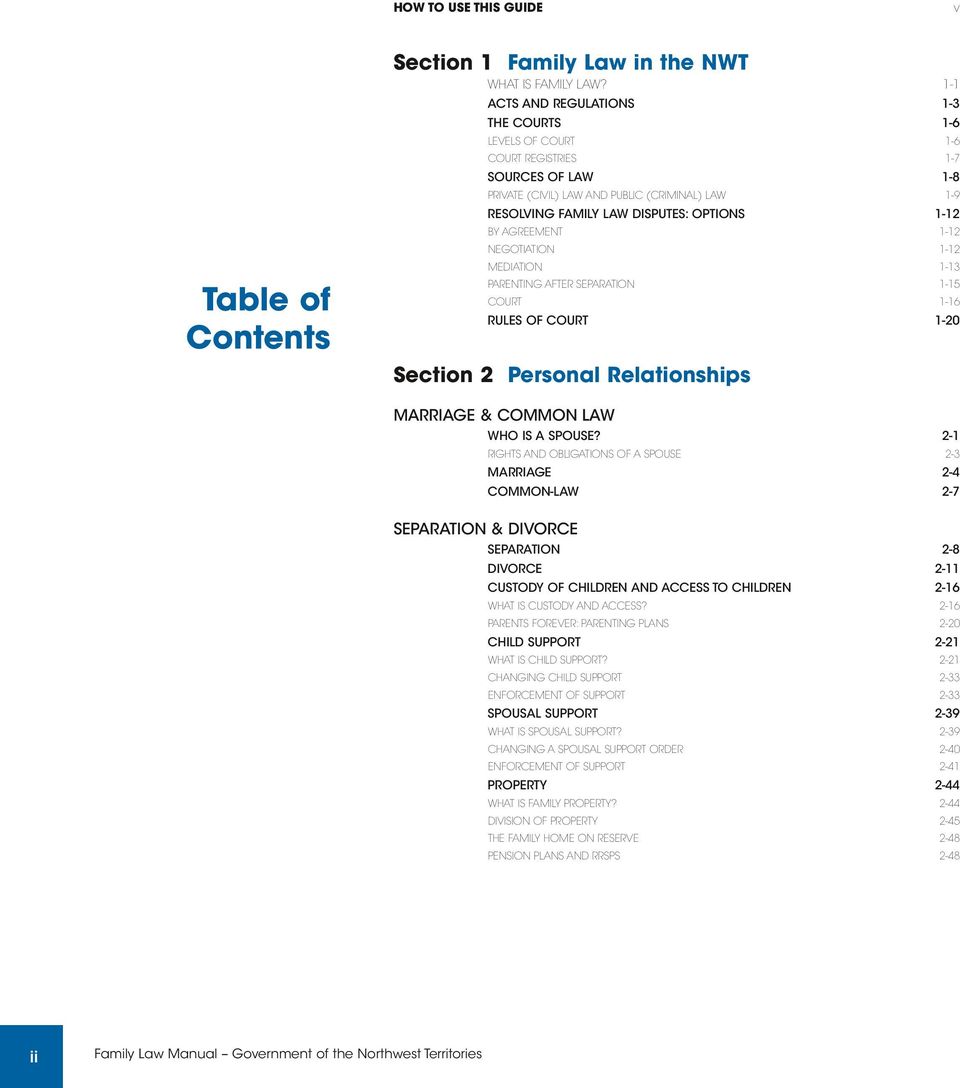
2 HOW TO USE THIS GUIDE v Table of Contents Section 1 Family Law in the NWT WHAT IS FAMILY LAW? 1-1 ACTS AND REGULATIONS 1-3 THE COURTS 1-6 LEVELS OF COURT 1-6 COURT REGISTRIES 1-7 SOURCES OF LAW 1-8 PRIVATE (CIVIL) LAW AND PUBLIC (CRIMINAL) LAW 1-9 RESOLVING FAMILY LAW DISPUTES: OPTIONS 1-12 BY AGREEMENT 1-12 NEGOTIATION 1-12 MEDIATION 1-13 PARENTING AFTER SEPARATION 1-15 COURT 1-16 RULES OF COURT 1-20 Section 2 Personal Relationships MARRIAGE & COMMON LAW WHO IS A SPOUSE? 2-1 RIGHTS AND OBLIGATIONS OF A SPOUSE 2-3 MARRIAGE 2-4 COMMON-LAW 2-7 SEPARATION & DIVORCE SEPARATION 2-8 DIVORCE 2-11 CUSTODY OF CHILDREN AND ACCESS TO CHILDREN 2-16 WHAT IS CUSTODY AND ACCESS? 2-16 PARENTS FOREVER: PARENTING PLANS 2-20 CHILD SUPPORT 2-21 WHAT IS CHILD SUPPORT? 2-21 CHANGING CHILD SUPPORT 2-33 ENFORCEMENT OF SUPPORT 2-33 SPOUSAL SUPPORT 2-39 WHAT IS SPOUSAL SUPPORT? 2-39 CHANGING A SPOUSAL SUPPORT ORDER 2-40 ENFORCEMENT OF SUPPORT 2-41 PROPERTY 2-44 WHAT IS FAMILY PROPERTY? 2-44 DIVISION OF PROPERTY 2-45 THE FAMILY HOME ON RESERVE 2-48 PENSION PLANS AND RRSPS 2-48 ii Family Law Manual Government of the Northwest Territories
3 Section 3 Keeping Children Safe CHILD ABUSE 3-1 WHAT IS CHILD ABUSE? 3-4 WHAT ARE THE CONSEQUENCES OF CHILD ABUSE? 3-6 PROTECTION OF CHILDREN 3-7 REPORTING ABUSE AND NEGLECT 3-9 CUSTODY ORDERS 3-15 VOLUNTARY SUPPORT SERVICES 3-17 Section 4 Family Violence WHAT IS FAMILY VIOLENCE? 4-1 THE CYCLE OF VIOLENCE 4-5 SPOUSAL ABUSE 4-6 CONSEQUENCES OF VIOLENCE 4-8 EFFECTS OF FAMILY VIOLENCE 4-10 IF YOU ARE BEING ABUSED 4-11 STEPS TO APPLYING FOR AN EMERGENCY PROTECTION ORDER 4-15 STEPS IF A HEARING IS CALLED ON THE EMERGENCY PROTECTION ORDER 4-16 STEPS TO RESPONDING TO AN EMERGENCY PROTECTION ORDER 4-16 PROTECTION ORDERS 4-17 RESTRAINING ORDERS/PEACE BOND: 4-21 VICTIM SERVICES 4-23 Section 5 Additional Information ADOPTION 5-2 DEPARTMENTAL ADOPTIONS 5-4 PRIVATE ADOPTIONS 5-4 STEP-PARENT ADOPTIONS 5-5 INTERNATIONAL ADOPTION 5-6 ABORIGINAL CUSTOM ADOPTION 5-7 CHANGE OF NAME 5-8 LAWYERS 5-9 MEETING YOUR LAWYER 5-9 NEED A LAWYER: LEGAL AID 5-11 OFFICE OF THE CHILDREN S LAWYER 5-14 WHAT THE CHILDREN S LAWYER DOES 5-14 ROLE OF THE CHILDREN S LAWYER 5-14 WHEN A CHILDREN S LAWYER CAN BE ASSIGNED 5-15 APPENDIX A-1 COMMUNITY RESOURCES A-3 WOrksheets W-1 INFORMATION SHEET FOR YOUR LAWYER W-3 DEVELOPING A PARENTING PLAN W-21 Glossary G-1 Table of Contents iii

4 Second Printing, March 2013 Government of the Northwest Territories Department of Justice For information regarding this publication, please contact iv Family Law Manual Government of the Northwest Territories
5 How to Use This Guide This guide is an overview of family law and the legal system in the Northwest Territories as of March, It is for anyone who might need information about family law in the Northwest Territories. Family law refers to any of the laws making rules about family relationships in various situations, such as when people marry, when families change through divorce or separation, when children in a family are not properly cared for, or when a child is adopted. Dealing with lawyers and the court system can be confusing. The words and processes that are used can be hard to understand and there are special rules for dealing with things in family court. This guide is designed to help make things easier to understand. How to use this guide v
6 We have included some definitions in the glossary at the end of the guide to help with words that have specific meanings within the law. You can refer to the topics on the side of the page to help you quickly find what you are looking for. It is important to understand that this guide provides general information only. How the law affects you will depend on the facts of your case. You also need to know that family law changes from time to time when the federal and territorial governments make new laws (legislation and regulations) and the courts make decisions (the common law). If you have a legal problem or need specific legal advice, it is best to talk to a lawyer who practices family law. This guide is to help you figure out if you have a legal problem and to prepare you for meeting with your lawyer. To find a lawyer, you can look in the phone book, call Legal Aid, or use the lawyer referral service through the Law Society of the NWT. If you need a lawyer and can t afford one, Legal Aid may be able to provide one at minimal or no cost to you. You can also find more step-by-step instructions on some of the topics in the guide, in brochures available from the Department of Justice or at If you need help finding a lawyer, a shelter, or other assistance, go to the Community Resources section, found on page A-3. vi Family Law Manual Government of the Northwest Territories v
7 ? Family Law in the NWT What is Family Law? Family law is a general term referring to any of the laws that make rules about family relationships. This can include rules about how to marry, who can get married, how to separate or divorce, how adoption works, and how to protect children who are not being properly cared for. Family law includes federal and territorial legislation and regulations. It also includes decisions made by judges about family relationships and the responsibilities and rights of the people in those relationships. You should contact a lawyer for advice specific to your situation. Section 1 - Family Law in the NWT 1-1
8 1-2 Family Law Manual Government of the Northwest Territories

9 [ Territorial laws make rules about separation between spouses dealing with: arrangements for children, responsibilities, how to divide property, financial support, adoptions, the protection of children and the enforcement of court orders for financial support for children and spouses. Acts and Regulations [ Territorial law sets out different ways to protect victims from violent family members. The rules for family law in the NWT are written in several Acts or sets of laws. The family laws of the Northwest Territories may not be the same as the other provinces and territories throughout Canada. The acts that are used most often are the Family Law Act, the Children s Law Act, the Divorce Act, and the Child and Family Services Act. Each of these acts is described briefly on the following two pages. Section 1 - Family Law in the NWT 1-3
10 Family Law Act The Family Law Act sets out the laws about the rights and responsibilities of married and common-law spouses, both before and after separation. It also deals with spousal support and how people divide their property after separation or divorce. Acts and Regulations Children s Law Act The Children s Law Act deals with things such as custody, support, access, and parentage. Custody involves determining where a child will live and who will make decisions about the care and upbringing of the child. Access means the time that a parent who does not have the day-to-day care of the child is able to spend with the child. Sometimes there is a question of who is the mother or the father of a child and the Act sets out the rules for determining who is considered to be the child s parent. Rules for determining who the parents of a child are in cases which involve assisted reproduction are set out in this Act, as well as the Vital Statistics Act. Divorce Act The Divorce Act applies only to people who are legally married and sets out the rules for ending a marriage. It does not apply to people who live together without being married, also known as common-law relationships. The Divorce Act is a federal law and is the same everywhere in Canada. The Divorce Act is a federal law. It applies to married spouses who want a divorce and deals with: arrangements for children; custody and access; child and spousal support. 1-4 Family Law Manual Government of the Northwest Territories

11 Child and Family Services Act The Child and Family Services Act provides for protection for children under the age of 16 years where there is a concern that they are being abused or neglected or are otherwise in danger from their family. Maintenance Orders Enforcement Act The Maintenance Orders Enforcement Act sets up the Maintenance Enforcement Program (MEP) and provides for various ways to enforce payments to make sure that child and spousal support orders or agreements are paid. The program is a free service and available if you register through the MEP office. Acts and Regulations Other Family Law Acts Other acts may apply to family relationships, and are referred to throughout this guide. These include the Adoption Act, the Aboriginal Custom Adoption Act, the Change of Name Act, the Marriage Act, the Vital Statistics Act, the Protection Against Family Violence Act, and the Inter-jurisdictional Support Orders Act. Section 1 - Family Law in the NWT 1-5

12 Levels of Court There are four levels of court in the NWT: Justice of the Peace Court, Territorial Court, Supreme Court and the Court of Appeal. Each level of court has certain responsibilities and decision-making powers for different legal matters. The Courts Justices of the peace are people who have some training in legal issues. ❶ ❷ Justices of the Peace Justices of the peace are people who have some training in legal issues. Justice of the Peace Court can make decisions in some child protection matters, like making a finding that a child is in need of protection. (Child and Family Services Act) Some justices of the peace have been trained to take emergency applications and can make Emergency Protection Orders in situations where a family member is violent. (Protection Against Family Violence Act) Territorial Court The Territorial Court can hear and make decisions regarding child protection, and can make decisions regarding custody, access and financial support for children of a relationship and maintenance enforcement. (Children s Law Act, Family Law Act, Maintenance Enforcement Act, Inter-jurisdictional Support Orders Act, Child and Family Services Act). 1-6 Family Law Manual Government of the Northwest Territories
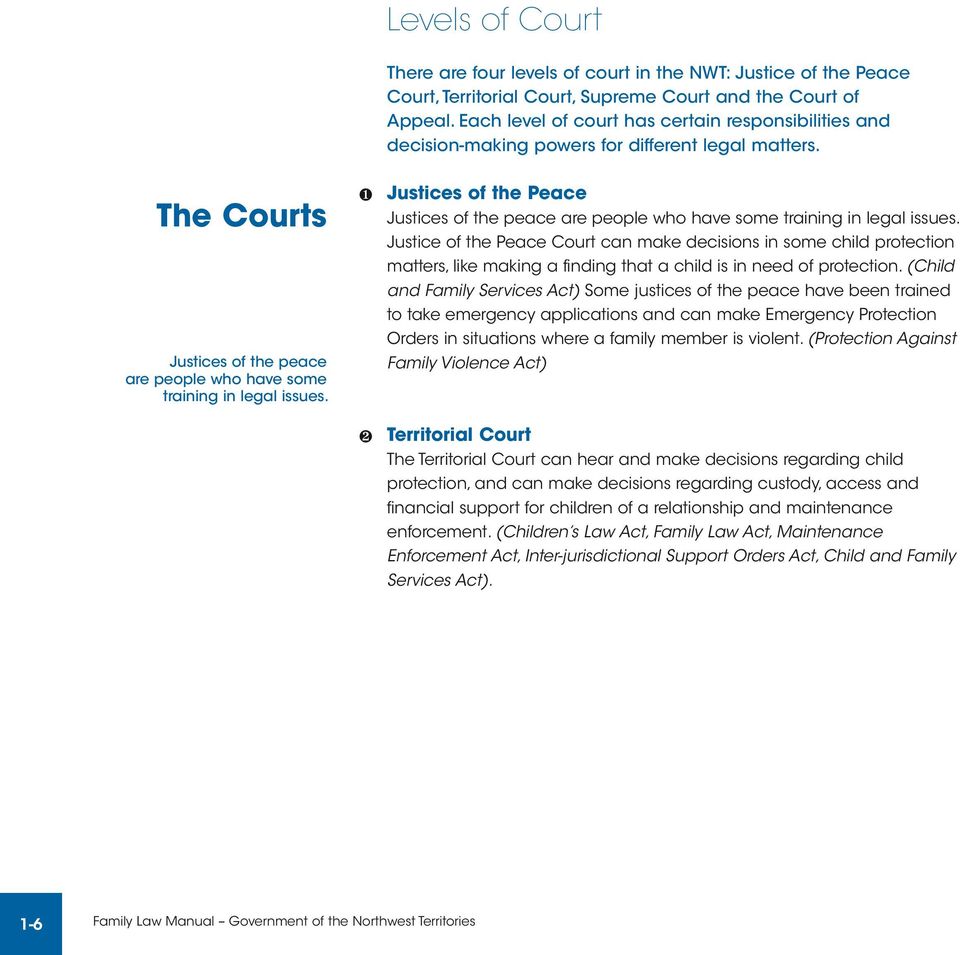
13 ❸ Supreme Court of the Northwest Territories The Supreme Court can hear and make decisions on all issues under the Divorce Act and most other matters involving children and families, such as custody, child and spousal financial support and the division of family property. The Protection Against Family Violence Act is under the jurisdiction of the Supreme Court and the court reviews all emergency protection orders made by designated justices of the peace. ❹ Appeals The Court of Appeal does not conduct trials. It hears appeals, both civil and criminal, from the lower courts. To appeal means to ask a higher court to reconsider a case if a judge has made a mistake about the law. The reasons for an appeal from a lower court decision are limited to the judge making an error about the law. It is not enough that you disagree with the decision or that you disagree with the decision the judge made about who was telling the truth. If you think this may have happened in your case, you should talk to your lawyer about it. The Supreme Court hears appeals of rulings made in Justice of the Peace Court and in the Territorial Court. The Court of Appeal hears appeals from the Supreme Court. In rare circumstances where there is a unique issue of law, an appeal from the Court of Appeal can be made to the Supreme Court of Canada. Supreme Court Territorial Court Justice of the Peace Court of Appeal Court Registries There are three Territorial Court registries in the NWT. They are in Inuvik, Yellowknife, and Hay River. There is one Supreme Court registry, located in Yellowknife. Court registries keep records of all court actions that have been started in the NWT. If you want to start an action for custody, child support or another family law matter, you have to file documents at the court registry. You can call the Yellowknife registry at (867) or toll free at Section 1 - Family Law in the NWT 1-7

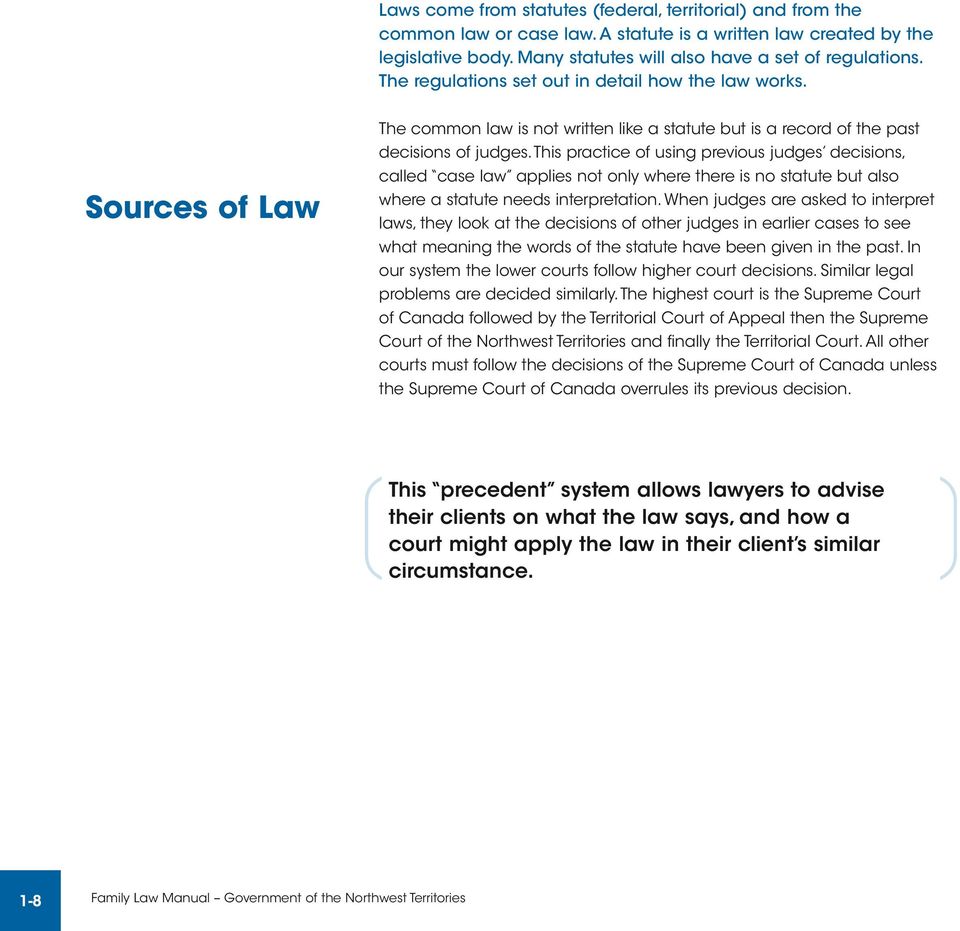
14 [ Laws come from statutes (federal, territorial) and from the common law or case law. A statute is a written law created by the legislative body. Many statutes will also have a set of regulations. The regulations set out in detail how the law works. Sources of Law The common law is not written like a statute but is a record of the past decisions of judges. This practice of using previous judges decisions, called case law applies not only where there is no statute but also where a statute needs interpretation. When judges are asked to interpret laws, they look at the decisions of other judges in earlier cases to see what meaning the words of the statute have been given in the past. In our system the lower courts follow higher court decisions. Similar legal problems are decided similarly. The highest court is the Supreme Court of Canada followed by the Territorial Court of Appeal then the Supreme Court of the Northwest Territories and finally the Territorial Court. All other courts must follow the decisions of the Supreme Court of Canada unless the Supreme Court of Canada overrules its previous decision. [This precedent system allows lawyers to advise their clients on what the law says, and how a court might apply the law in their client s similar circumstance. 1-8 Family Law Manual Government of the Northwest Territories
15 Private (Civil) Law and Public (Criminal) Law Private or civil law matters concern the rights of individuals in relationships with one another. Private law deals with the rights of individuals to enter into personal relationships (family law, children s law) make agreements with others (contract law, commercial law) own and deal with property (property law, will and estates) to be free from unwanted or harmful actions from others (tort law) Most family law issues are civil matters such as divorce, child custody, family property division and the enforcement of maintenance payments. In family law cases, the party who starts the action (applies to court) looking for a solution is usually called the petitioner or applicant. The person who must respond to the application is called the respondent. A civil law dispute might be resolved by applying common law, interpreting a statute or by a combination of both. Public law regulates the relationship between individuals and the government. It broadly affects the community and the public obligations that are the concern of the state. This includes criminal law, administrative law and constitutional law. Section 1 - Family Law in the NWT 1-9

16 Private (Civil) Law and Public (Criminal) Law Our criminal justice system is a system of public prosecution because the interests of the community are harmed by criminal acts. Society as a whole has agreed that certain conduct is unacceptable and imposes a penalty for individuals who commit such acts. The criminal law is broad but in general criminal offences are set out in the Criminal Code of Canada and other federal statutes such as Controlled Drugs and Substance Act. Offences established by territorial statutes or municipal by-laws may have penalties but are not criminal offences. The person charged with committing a criminal offence is known as the accused. Criminal proceedings are conducted in the name of the Queen to represent the interest of the state. The lawyer representing the Queen is called the Crown Counsel and in the Northwest Territories is an employee of the Office of the Director of Public Prosecutions, Canada Family Law Manual Government of the Northwest Territories
17 Private Law (Family law) the aim is to resolve matters between individuals; you must bring action (start the legal process) yourself; costs for filing and the lawyer are your responsibility; you can change your mind and decide not to go to court; the parties can make an agreement and settle at any time; you must prove your case on a balance of probabilities (lower standard than criminal); and the parties to the action have the most interest in its result. Private (Civil) Law and Public (Criminal) Law Public (Criminal Law) the aim is to protect and regulate society, punish offenders and offer rehabilitation; the government through the Crown brings the action on the information of the complainant; in most instances the Crown does not allow the complainant to decide whether the matter will proceed; the case must be proven beyond a reasonable doubt (criminal standard of proof); and society has an interest in justice being done. Section 1 - Family Law in the NWT 1-11

18 [ [ Solutions can be reached in different ways. Depending on the circumstances of your family, some may work better than others. Resolving Family Law Disputes: By Agreement If you agree on the terms of your separation, you can write them into an agreement. You may have a lawyer put it into a formal agreement that you can both sign. Options Each of you should consult your own lawyer to make sure you understand your rights and responsibilities and that the agreement means what you wanted and is enforceable. Negotiation Separating couples that cannot reach an agreement may negotiate an agreement through their lawyers. Your lawyer will work with the other side s lawyer to come up with a reasonable solution. The lawyers will give you advice based on their knowledge of family law and what the outcome would most likely be if you had to go to court. Most family law matters are resolved this way. When lawyers are involved, negotiations are normally done through the exchange of letters setting out suggestions for settlement until a compromise is reached that everyone can agree to Family Law Manual Government of the Northwest Territories

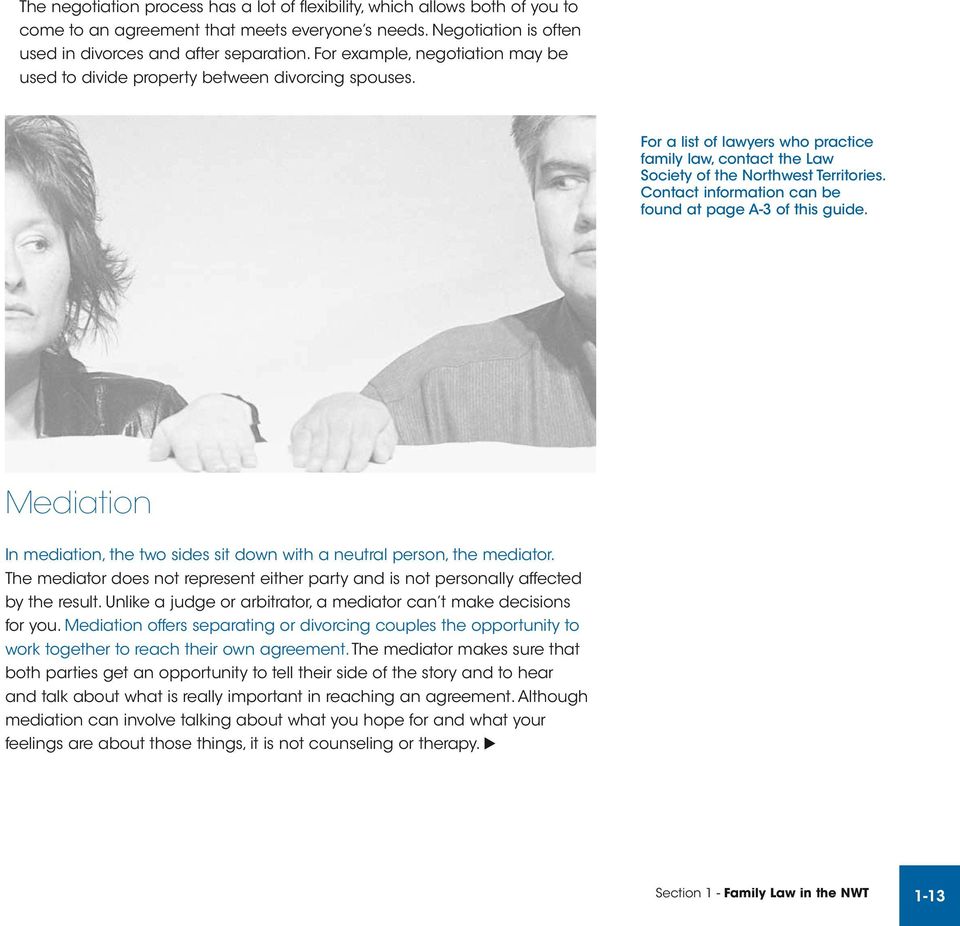
19 The negotiation process has a lot of flexibility, which allows both of you to come to an agreement that meets everyone s needs. Negotiation is often used in divorces and after separation. For example, negotiation may be used to divide property between divorcing spouses. For a list of lawyers who practice family law, contact the Law Society of the Northwest Territories. Contact information can be found at page A-3 of this guide. Mediation In mediation, the two sides sit down with a neutral person, the mediator. The mediator does not represent either party and is not personally affected by the result. Unlike a judge or arbitrator, a mediator can t make decisions for you. Mediation offers separating or divorcing couples the opportunity to work together to reach their own agreement. The mediator makes sure that both parties get an opportunity to tell their side of the story and to hear and talk about what is really important in reaching an agreement. Although mediation can involve talking about what you hope for and what your feelings are about those things, it is not counseling or therapy. Section 1 - Family Law in the NWT 1-13
20 [ The benefits of using mediation are: Both people, who best know their needs and resources and those of their children, control the decision-making. Private and confidential that means you do not have to tell anyone what you talked about. Neither of you can use anything said in mediation in court later. You decide what should happen. Because you are making the agreement, you are both much more likely to be happy with it and to follow through. Mediation Having succeeded in reaching agreement once, you are more likely to deal successfully with differences that develop later. You can avoid the trial process, which is often painful for children, parents and extended family. Any agreements that you reach during mediation will be included in a document prepared by the mediator. If you want this document to become a legally binding separation agreement, additional steps are needed and may involve getting legal advice and having a lawyer draft a more complete agreement for you both to sign. Call to talk with the mediator. Mediation services for a limited number of hours are available through the Department of Justice at no charge for parents who are divorcing or separating to deal with issues regarding their children or spousal support. [ There are family lawyers who also provide mediation services, for contact information call the Law Society of the Northwest Territories Family Law Manual Government of the Northwest Territories

21 [ Parenting After Separation Parenting after Separation is a free workshop that is offered Yellowknife. The goal of the program is to make separation or divorce easier for both children and parents. You will learn how to cope with difficult issues that arise during and after separation or divorce. You will also learn how to help your children deal with their emotions in a positive way. The workshop focuses on a variety of things such as: the changing family, dealing with separation and loss, ways to communicate effectively, legal issues like custody, access and child support and planning for your future as a separated parent. You will learn why it is important to follow child support and custody/access agreements. Child support is also explained. Collaborative Approach If you live in Yellowknife, you are required to provide a certificate showing attendance at the workshop before you can begin family law proceedings in the Supreme Court of the Northwest Territories. Other situations may require your attendance as well. If you are uncertain you should speak with your lawyer or contact the Yellowknife Court Registry at or toll free at [ More information about the workshop and how to register is available online at: ParentingAfterSeparationandDivorce.shtml Section 1 - Family Law in the NWT 1-15
22 Starting a Court Process This is a very general description of court procedure for separation and divorce. Court procedures in other family matters are different so check for more information in the other chapters of the guide. Court Court proceedings begin when you file specific documents at the court registry. The documents that begin a family court proceeding are usually a petition (in the case of a divorce) application, originating notice (if the court in the NWT has never dealt with this matter) or notice of motion (if the court has dealt with this matter before) and may include a notice to respondent (directions to the other person). The party who files the documents is called the petitioner, the applicant, or sometimes the plaintiff. [ People who have brought a legal disagreement to the courts for a decision are called parties. Anyone who wants the help of the court must apply to the court. [ 1-16 Family Law Manual Government of the Northwest Territories
23 Notice or Service of Documents After you have filed the documents with the court, you must give one copy of each document to the other person. This is called serving the other person. Documents served usually give notice of a legal proceeding and the copies of all papers filed with the court. Some documents may be served by mail or left with a designated person on behalf of the named person. Other documents must be served personally by putting the documents into the hands of the named person. Court Process Under the Divorce Act, if service is required, a third party (not one of the spouses) must serve the documents. The documents may not be served on his/her lawyer unless the lawyer agrees to accept the documents for their client. Reply If you disagree with the claims or statements of the other party or if you wish to make a claim against them, you must respond to the documents served on you and file your response with the court registry. This may be done as a counter petition (in a divorce) or as a reply (for a child support matter or counterclaim). Speak with your lawyer. Serving Documents There are a number of ways to serve documents: the Rules of Court provide for the type of service required and the number of days required to be given to the other party to respond. The documents must be delivered to the correct person. Section 1 - Family Law in the NWT 1-17
24 Uncontested Proceedings If the other party (usually called the respondent) does not file an answer to the application within the time the court allows, the hearing may proceed without the respondent. Court Process The applicant may submit documents to the court, for example, financial information. The applicant will testify under oath or affirmation and may call witnesses to testify on his or her behalf. At the conclusion of the hearing the court may make an order. Interim Orders Family law cases often take a long time. There are some issues that need to be resolved much earlier and this can be done at an interim hearing. This can provide a temporary solution to parenting arrangements and child support. For this reason either party may make a court application (a motion) for a temporary order (interim order) at any time after the court proceeding has started. These usually occur in chambers. Chambers A hearing before a judge that is based on written evidence. The applicant must serve the motion documents on the other party unless the applicant can convince the judge that serious harm would result if notice were given to the other side. The parties give their evidence by means of affidavits. An affidavit is a document in which a person sets out the facts relevant to the motion and swears, or solemnly affirms, the truth of the statements. The affidavits must not contain irrelevant or purely inflammatory statements. If they do, the court may reject all or parts of them and penalize the party who filed them. The judge will review the filed documents, and the parties lawyers can argue their cases before the judge at an appointed time. Oral evidence is usually not provided at an interim hearing Family Law Manual Government of the Northwest Territories
25 You (if you are acting for yourself) or your lawyer are responsible for preparing a written order as directed by the judge, in the proper form for the court to sign. Each of you will receive a copy of the signed order. Consent Orders If at any time in the proceedings, the parties can agree on any issues in their dispute, the court can issue a consent order without the parties having to attend a court hearing. Court Process Pre-Trial Before the final court hearing (trial), there are steps taken to make sure that the parties are ready for the trial. These should include reaching agreement on as many issues as possible to shorten the trial time or eliminate the need for a trial. Examinations for Discovery If you need more information about the other person s claim, you can require the other person to provide relevant documents and come to an examination for discovery. It generally takes place outside of court at a lawyer s office. Your lawyer can ask the other person questions about the case. For example, your lawyer might ask about the other person s plans for caring for the children or the person s financial situation. A court reporter records all the questions and answers and a printed record (transcript) is produced. Section 1 - Family Law in the NWT 1-19
26 Rules of the Court These rules are procedures that people must follow. The rules guide every step of the hearing and set time limits for when certain things must be done. The Rules of Court also include official court documents called court forms that must be used if a person is filing any document with the court. For example, if parties file for a divorce, they must follow the Supreme Court of the Northwest Territories Divorce Rules. The Rules of Court are available on-line at on the Department of Justice website at nt.ca/legislation/legislation_rules.shtml and at the Courthouse Library. Court Process The Trial At trial, both of you can testify under oath and call witnesses to testify on your behalf. Everyone who testifies at a court hearing may also be cross-examined by the other party or his or her lawyer. After all the evidence is given, each party can make a final presentation to the court. Each party summarizes the evidence and the law and tries to convince the judge that his or her position is the correct one. After the hearing the judge will consider all the evidence, which includes the testimony given in court and any documents accepted by the judge as evidence during the trial. The judge will also review any legislation or case law submitted by the parties. The judge will make a decision and give it to the parties, either orally in court or in a written decision (usually issued later). You (if you are acting for yourself) or your lawyer are responsible for preparing a written order as directed by the judge, in the proper form for the court to sign. Each of you will receive a copy of the signed order Family Law Manual Government of the Northwest Territories
27 ? Personal Relationships Who is a Spouse? A spouse is a person who: is married to another person; has lived in a marriage-like relationship with another person for two years or more; or has lived in a marriage-like relationship with another person for less than two years, but who has a natural or adopted child with that person. In the Northwest Territories, if you are in a spousal relationship you have certain rights and obligations to your spouse and any children of the relationship. Section 2 - Personal Relationships 2-1
28 2-2 Family Law Manual Government of the Northwest Territories
29 [ Spouses are expected to support each other. They are required by law to contribute to the financial needs of the family to the extent that they are able. In some families, this could mean that one of the spouses may stay home and take care of children or manage a household while the other goes to work. In other families, both spouses may work and both incomes will be used to meet the family s financial needs. Both spouses are entitled to use the family home and assets. This means that one spouse cannot deny the other access to the family home, money, or possessions without a court order. Rights and Obligations of a Spouse [ Being a spouse gives you certain rights and responsibilities if the relationship ends and you separate. See the section entitled Spousal Support on page 2-39 for more information on support for spouses and other rights and responsibilities you have when a relationship ends. Child support is separate from spousal support. See the section entitled Child Support on page 2-21 for more information on child support. Section 2 - Personal Relationships 2-3
30 You have the right to a share of the property you and your spouse have acquired during the relationship. You may also have the right to receive support from your former spouse to help you meet your own financial needs. It is also possible that you will be required to provide money to your former spouse to help support him or her. This is called spousal support. Rights and Obligations of a Spouse You should talk to your lawyer if you have any questions about spousal support. Whether you are entitled to receive money from your spouse or must pay money to your former spouse after separation depends on many things. Some things that will be taken into account by the courts are: how long the couple lived together; the role each person played in the family during the relationship; whether or not there are children of the relationship; and the ability of spouses to support themselves. Who can Legally Marry? You can only marry if you are not already married to someone else. If you have been married, you must have proof of divorce, annulment, or that your former spouse has died before you can get married again. Marriage You cannot marry certain relatives. In the NWT you must be 19 to get married. If you are younger than 19, you can get married if you have your parent s or guardian s consent or if you have met certain conditions. You should contact a lawyer or Legal Aid for advice in this situation. Same-sex couples can legally marry. 2-4 Family Law Manual Government of the Northwest Territories
31 [ How a Valid Marriage Takes Place To be married, you must go through a legally recognized marriage ceremony with another person. The ceremony can be a religious or civil one. Before you can get married there are several things you have to do. After you have made sure that you are legally allowed to marry, you must either get a marriage license or have a member of the clergy do a publication of the banns for two consecutive weeks. Banns are published when a member of the clergy names the two people who plan to get married during a regular worship service. Marriage A marriage commissioner, which includes members of the clergy, must perform the ceremony. Once you are married you stay married until one of you dies, you divorce or your marriage is annulled. You are married whether or not you live together. Even if you separate and decide to end your relationship, you are still married until you take the legal steps to formally end the marriage. A member of the clergy is someone who is ordained or appointed by his or her religious body, and is authorized by the Marriage Act to formalize marriage. [ For a list of marriage commissioners in the Northwest Territories, contact the Department of Health and Social Services at (867) or toll free Section 2 - Personal Relationships 2-5
32 [ How to Get a Marriage License Marriage licenses are available from the Health Services Administration Unit of the Department of Health and Social Services in Inuvik. You may also obtain a marriage license from a marriage license issuer, located in many communities. Marriage In most cases, you will have to make an appointment with the marriage license issuer. Both people who plan to marry must attend this appointment. You will need to provide the following documents or information: birth certificate; social insurance number; full names for both sets of parents (including mothers' maiden names); place of birth for both sets of parents; There is a fee to get a marriage license. immigration documents (if applicable); a decree absolute or certificate of divorce if either person has been divorced; and death certificate(s) (if either person has been widowed). [ For the location of the marriage license issuer nearest you, call the Department of Health and Social Services at (867) or (toll-free). 2-6 Family Law Manual Government of the Northwest Territories
33 What is a Common-Law Relationship? As soon as you move in with someone you share a marriage-like relationship with, you have entered a common-law relationship. Until you have been living together for two years or have a child together, however, you have very few rights or obligations if the relationship ends. For example, you may not be entitled to support or a division of property. A common-law relationship is defined as two people living together as a couple. If you do not live together, you are not considered to be in a common-law relationship, and do not have to take any formal steps or legal action in order to end the relationship. Common-Law Relationships Under NWT family law, people do not have rights or obligations as spouses unless they have lived together for two years or have a child together. However, some federal laws recognize relationships as common-law after different amounts of time. For example, the Income Tax Act says that a couple is can be recognized as common-law after living together for 12 months. See the section entitled Spousal Support on page 2-39 for more information on support for spouses. See section entitled Property on page 2-44 for information on division of property. Section 2 - Personal Relationships 2-7
34 Separation and Divorce When a relationship ends, you can choose to make it final with a separation agreement or divorce. If you are legally married, you can get a separation agreement, a divorce, or both. If you are not legally married, but live in a common-law relationship, you can get a separation agreement to formally end the relationship. You can also ask the court to make an order about children, property and support if you are unable to reach an agreement on these issues with your former partner. Separation There is no such thing as a legal separation. You are separated in the eyes of the law when one spouse moves out, and does not intend to reconcile. Sometimes, you can also be considered separated even if you still live under the same roof as your spouse. A lawyer can help you figure out if this applies to you. For example, if it is hard to find housing in your community and you cannot move out, you may still be considered separated in certain circumstances. The date of your separation is important. Under the Family Law Act, the date of separation is used to determine the value of the things you and your spouse own together. For example, any bank accounts will be divided according to how much was in the account on the date of separation. Once you separate, you and your former spouse will have to resolve issues such as who will care for your children or how you divide the things you own (like your house) this is called division of property. These matters are often resolved by agreement between the spouses. 2-8 Family Law Manual Government of the Northwest Territories
35 An agreement can be made in writing or simply agreed on orally. In order for an agreement to be legally binding however, it must be in writing, signed by each of the former spouses, and witnessed. This is called a separation agreement. A separation agreement may address things like: where the children will live; how you and your former spouse will share the costs of raising the children (called child support); whether one spouse will give money to the other to help with living costs (called spousal support); and how property the things owned by the couple and any debt they might have is divided. Separation and Divorce Both common-law and married couples can make separation agreements. It is a good idea for both people to talk to lawyers before making a written agreement. This is to make sure the agreement covers all of the major issues, and so that each of you understands how an agreement might affect your rights. Before signing a written agreement check with a lawyer for advice. Separation Agreements If you are having difficulty reaching an agreement with your former spouse, a lawyer can help you to negotiate the terms of an agreement. Once an agreement is reached, a lawyer can also help you put the agreement in writing and make sure that it is complete. See the section entitled Spousal Support on page 2-39 for more information on support for spouses. Section 2 - Personal Relationships 2-9
36 If you are married and enter into a separation agreement, you are still able to get a divorce later if you choose. You will need a divorce if you want to get married again. Separation and Divorce See section entitled Property on page 2-44 for information on division of property. Separation agreements are an effective way to deal with the end of a relationship. Everyone agrees on how to divide the things you own, arrangements for the children, how much support should be paid for children and/or for spouses and other issues that may arise on separation, without having to go to court. If you can t agree on everything, you can make an agreement on some things and let a judge decide the rest. If you are married, but are planning to seek a divorce, you and your former spouse can, through a separation agreement, deal with some issues ahead of time. This can make the divorce process quicker and easier Family Law Manual Government of the Northwest Territories
37 Divorce If you are legally married and decide to end your legal relationship with your spouse you will have to ask the court to grant you a divorce. Divorce is the legal way to end a marriage. Many couples also choose to deal with issues like custody, access, support, and division of property at the same time as the divorce. If you already have a separation agreement that deals with these things, that agreement may be added into the divorce order. Requirements for Divorce Before you can get a divorce in the NWT, you must meet certain requirements. You or your spouse must have lived in the NWT for one year before starting the divorce action. (Residency requirement) and Separation and Divorce See page 1-15 for information on attending the Parenting After Separation workshop, which may be required for those living in Yellowknife prior to beginning family law proceedings in the Supreme Court of the Northwest Territories. You must have grounds for divorce. The law will allow a married couple to divorce when the marriage has broken down. Marriage break down can be shown if: You and your spouse have been living separate and apart (separated) for one year or more; or Your spouse has committed adultery. This is when a married person has voluntary sexual intercourse with a person other than their spouse, whether or not they are still living with their spouse; or Your spouse has treated you with such cruelty as to make it intolerable to continue living together. This can be physical or emotional cruelty. Section 2 - Personal Relationships 2-11
38 The Divorce Process The Divorce Process If you and your spouse are willing to work together, you may choose to file a joint petition. This means that both of you are asking the court for the divorce. This is used when both spouses have come to agreement on the issues. It is the simplest way to get a divorce. The papers are signed and no one has to go to court. Once the papers for the joint petition are filed, a court can issue a divorce judgment. Thirty-one days after the court grants the divorce judgment, the divorce becomes final. See the section entitled Spousal Support on page 2-39 for more information on support for spouses. The court will require proof that there is no child of the marriage or if there is a child of the marriage, that reasonable arrangements have been made for the support of the child that comply with the Child Support Guidelines. If you don t file a joint petition, one of you will have to file a petition for divorce, which is then served on the other spouse. If the other spouse fails to respond, the court assumes that nothing is contested, and the spouse who petitioned for divorce can ask the court for a divorce judgment to end the marriage Family Law Manual Government of the Northwest Territories
39 The steps in a simple, uncontested divorce are: 1. A petition for divorce is filed with the court. 2. The petition is served on the other spouse (respondent). 3. The respondent has 25 days if served in the Northwest Territories and 30 days if served outside of the Northwest Territories to file an answer or counter-petition. 4. If no answer or counter-petition is filed, the person seeking the divorce must swear an affidavit outlining the facts and circumstances of the marriage, the separation, the children of the marriage and other relevant facts. This affidavit, along with a number of other necessary documents, can then be presented to the court with a request that a divorce be granted. The Divorce Process 5. A judge will look at the documents and, if satisfied that all of the conditions for a divorce have been met and that child support has been addressed for any children of the marriage, will grant a divorce judgment. 6. The divorce judgment is sent to the respondent by the court. The respondent has 30 days from the date that the judgment was granted to appeal the judgment if he or she wishes to do so. 7. If the judgment has not been appealed, it becomes final on the 31st day. At this time, a request can be made for the court to issue a certificate of divorce. This document is the evidence that will be required to prove your divorce should you need to do so for any reason. An uncontested divorce usually takes at least three months to complete but may take longer depending on the circumstances. When the judgment is issued, the court may make a corollary relief order. This is an order of the court that can deal with custody, child support, and spousal support. The court may also issue a property order that sets out how the property and debts of the couple are to be divided. See section entitled Property on page 2-44 for information on division of property. Section 2 - Personal Relationships 2-13
40 A divorce judgment becomes final thirty-one days after it is made by the court. After that time, it cannot be appealed and it is final. When a divorce judgment becomes final, you have to ask the court to issue a divorce certificate. This is the document you need to prove that you are no longer married. The Divorce Process In order to obtain a divorce certificate you must contact the Supreme Court Registry that granted the divorce order. If you are not sure of the location of the registry where your divorce was filed, you can contact the Central Registry of Divorce Proceedings for Canada. They will not be able to give you the document but will be able to tell you at which registry your divorce was filed. [ The Central Registry of Divorce Proceedings flas-padf/crdp-bead/index.html or Telephone: , or Facsimile: [ See section entitled Children on page 2-21 for information on child support Family Law Manual Government of the Northwest Territories
41 [ The Court Process Whether you are married or have lived common-law with your spouse, if you are unable to resolve the issues when your relationship ends, you can ask the court to decide the issues for you. It is almost always better to resolve your differences with your former spouse without going to court because you can have some control of the outcome. If you go to court, you are asking the judge to make the decision. A judge does not have as much flexibility as you do to create a result that meets the needs of everyone, including your children. A court may not always consider things that you think are important when making a decision. Because your time in court is limited, it is sometimes difficult to explain to the judge why you think the issues should be resolved in a particular way, the reasons you are taking certain positions, or why you have done things in certain ways. The Court Process Your lawyer can continue to help you to negotiate an agreement while you are taking the steps necessary to prepare for trial, or you can ask for the help of a mediator. You and your spouse can negotiate or mediate things like custody, child and spousal support, and division of property. If, in the end, these negotiations fail, you will have to go to trial. A trial can be long, complex and expensive. You will likely need a lawyer. [ Even after a court action has been started, you can still try to resolve the issues by agreement. Section 2 - Personal Relationships 2-15
42 What is Custody and Access? Custody of Children and Access To Children When parents separate, they have to decide where their children will live and who will meet their day-to-day needs. The legislation that helps parents resolve these issues are the Children s Law Act and the Divorce Act. There are a number of options for parents, including sole custody, joint custody, shared custody, and split custody. Access When a child lives with one parent, the other parent almost always has the right to visit the child. The legal word is access. Access recognizes that it is in the best interest of the child to continue to have a relationship with both parents after they separate. Sometimes an access order says that the parent who doesn t have custody should have reasonable and generous access. This leaves it up to the parents to arrange visiting times. Custody This is a legal term that says which parent or other person is responsible for making decisions regarding the children. The four types of custody are sole custody, joint custody, shared custody and split custody. In the NWT it is presumed that parents will have joint custody unless they agree or a court orders otherwise Family Law Manual Government of the Northwest Territories
43 Sole Custody Sole custody means that one parent has day-to-day care of the child and makes most decisions about the child. This parent is called the custodial parent. The custodial parent can and must make medical and schooling decisions, determine what faith the child is raised in (if any), and make all the other major decisions about the child s life. The other parent is normally able to spend time with the child as agreed between the parents or as ordered by a judge. Joint Custody Joint custody means that both parents continue to have input into the major decisions that affect the child s life. The child may live with one parent or may move back and forth between the parents homes on a regular basis, depending on what the parents decide. The parents work together to make decisions that are in the best interest of the child, and must be willing to cooperate with each other to do this. Custody of Children and Access To Children Shared Custody Shared (and joint) custody occurs when the child lives with each parent for about an equal amount of time but at least 40 percent of the time in a year. For example, the child may spend two weeks with one parent then two weeks with the other. Most parents who share custody will make decisions for the child together. This type of custody works best when both parents live in the same community. Section 2 - Personal Relationships 2-17
44 Split Custody Split custody can happen when there are two or more children and some children live with each parent. In this situation each parent is primarily responsible for the care of at least one child. Custody of Children and Access To Children When parents settle on a living arrangement which splits the children between two homes, legal responsibilities can be shared in a number of ways: each parent may have sole custody of the child or children in his or her care; the parents may have joint custody of all of their children for the purpose of making decisions affecting the children s lives; or one parent may have sole custody of one or more children and the parents can share joint custody of others. If the parents cannot agree where a child should live or which parent should make decisions about the child s life, lawyers or mediators can help parents work toward an agreement. If no agreement can be reached, even with the help of a lawyer or mediator, either of the parents may ask a court to make that decision. If this happens, the judge will focus on the best interests of the child, not the interests and rights of the parents. The judge will base their decision on what they believe is best for the child and what arrangement can best meet the child s needs. Although many people don t know this, parents have no legal right to custody of or access to their children. This means that you are not guaranteed custody or access just because you are a parent. If it is in the best interest of the child to deny custody or access, a judge may choose to do so. The judge must decide what living arrangement will best meet the child s needs Family Law Manual Government of the Northwest Territories
45 [ The judge considers many factors when deciding what is in the best interest of the child, including: the child s normal routine; how settled the child is in their school and community; who the child s primary caregiver was before the parents were separated; whether there has been violence against a member of the household or family; which parent the child is closer to; Custody of Children and Access To Children what cultural issues, if any, need to be considered; how open each parent is to providing ongoing contact with the other; whether there will be ongoing interaction with the child s extended family; and what each parent s parenting plans are. [ Sometimes, when parents cannot agree on a custody arrangement, or if there are allegations of abuse or neglect, parents may ask for an assessment to be done. An independent professional recognized by the court, who is trained in assessing parenting abilities and the needs of children, can do an assessment. Because there are only a few people qualified to do assessments in the NWT, an assessment can be expensive and difficult to arrange. The parents usually split the cost, but the court may direct that the parents divide the cost in some other way. The court may even require one parent to pay the full cost of the assessment. The assessor will complete a report and provide it to all of the parties and the court. The judge may use this information to help make a decision about what is in the best interests of the child. Section 2 - Personal Relationships 2-19
46 Parents Forever: Parenting Plans Custody of Children and Access To Children Although separation and divorce are adult answers to adult problems, children are affected. When parents move away from the family home, children may feel loss, anger, sadness and even guilt. Children may react less or be better able to manage their feelings if parents can continue to co-operate and parent together. A parenting plan is a way for parents to set out how they will carry on with their parenting responsibilities following a separation. The sooner a parenting plan can be put into place, the better, even if it is only a short term plan. That way everyone knows what is supposed to happen and when. The most helpful parenting plans for both adults and children have a lot of detail. A detailed plan is especially necessary for parents where there is a lot of conflict. Parentage There are no illegitimate children: all children are equal under the law, regardless of the parents marital status. An example of a parenting plan is included in this guide and was designed to help you make arrangements for your children and to talk with them and other involved family members. The plan contains information, guidance and sections for you to fill in, if you wish. Every family and their circumstances are different and you will need to work out what suits your family the best. The plan may be used for just information or use it as a guide to the issues that you need to talk about with each other and your children. It is designed to help parents make their own arrangements. Children grow up and situations change so you will need to revise the plan from time to time Family Law Manual Government of the Northwest Territories
47 [ What is Child Support? A child has the right to financial support. Parents have a joint financial responsibility to maintain the children of the relationship. Child support is the amount of money one parent pays to another for the financial support of a child. Child Support Guidelines Child Support Guidelines make sure the treatment of children is fair and that parents in similar circumstances pay (or receive) the same basic amounts of child support. The Guidelines are based on studies of the average costs of raising children. They are a set of rules and tables for calculating the amount of child support parents should pay so that children continue to benefit from the financial means of both their parents after separation. Child Support The Guidelines are also intended to reduce conflict and tension between parents by making child support calculations fairer, more objective and by encouraging agreement between parents. If you know in advance what your child support amount will likely be, it may be easier for you and the other parent to agree on what should be paid. [ There are legal guidelines that direct how much money must be paid to support a child. These are called Child Support Guidelines and are law. Section 2 - Personal Relationships 2-21
48 The Child Support Guidelines set out the amount of child support to be paid based on things such as the income of the paying parent, the number of children being supported, and where the paying parent lives (due to differences in income tax rates). For more information about Child Support Guidelines or to see a copy of the tables that set out how much support should be paid, go to (click on Child Support ). The Child Support Guidelines payable under the Children s Law Act of the NWT are contained in regulations. Child Support For example: John and Susan have separated. They have one child who lives with Susan. If John s income is $50,000 per year, he will pay Susan approximately $443 per month in child support. The steps to calculate child support: Age of majority is 19 years in the NWT A child may continue to be dependant if attending school or is unable to become independent because of a disability. Step 1: Do the guidelines apply? If you are divorced or planning on divorcing then the Federal Child Support Guidelines apply. If you are already divorced and you or the other parent want to change your child support order and you both live in the NWT the Federal Guidelines apply. If you are separating and you both live in the NWT then the Territorial Guidelines apply. Step 2: Determine the number of children Decide which children are being considered for support; then decide if any of the children who have reached the age of majority will be considered dependant. If you cannot agree as to whether a child is a dependent you can take the issue to court for a decision by the judge Family Law Manual Government of the Northwest Territories
49 Step 3. Determine the parenting arrangement Sole physical custody where all children live with one parent more than 60 percent of the time over the course of the year. Shared custody a child or children live at least 40 percent of the time with each parent over the year. Split Custody when there is two or more children and one or more children live with one parent more than 60 percent of time and one or more children live with the other parent more than 60 percent of the time. Joint Custody - the child or children may live with one or both of the parents, however, both parents make decisions about the child's interests together. Child Support Step 4. Find the right table (the guidelines have attached tables based on residence and the number of children) If you or the other parent has sole custody and you live in different provinces or territories use the federal table for the province or territory the paying parent lives in. If you or the other parent has sole custody and you or the other parent lives outside of Canada use the federal table for the province or territory of the parent who lives in Canada. Step 5. Calculate annual income ( use the workbook provided by the Department of Justice to figure out child support amounts.) If your income is needed to calculate child support amounts, you must provide income information for the last three tax years. Both of you must provide income information when: you have a split or shared custody arrangement; there are special expenses; there is a claim of undue hardship; a child is at or over the age of the majority; or a paying parent earns more than $150, a year. Section 2 - Personal Relationships 2-23
50 [ If your case goes to court, the paying parent or both parents depending on the facts must provide complete and accurate information. If either parent fails to do so, the judge can order them to comply. The judge can also impose a penalty (such as awarding costs to the other side). If the parent still does not comply, the judge can, for example, set the amount of income for the parent that will be used to determine child support. (Impute income) Child Support Step 6. Find the table amount Using the paying parent s table find the paying parent s annual income and then find the column for the number of children. Agreements Parents can agree between themselves how much child support should be paid. However, the agreement must be reasonable and must normally meet the minimum amounts set out in the Child Support Guidelines. Unlike most other agreements, a judge does not have to accept an agreement about child support if he or she feels it does not meet the needs of the children. For example, if the amount agreed by the parents is less than the amount suggested in the Child Support Guidelines, a judge can refuse to accept the agreement and make the parent pay more. If a judge makes such a change, they can make the change apply from the date of the original agreement. This means the paying parent would [ For more information about Child Support Guidelines or to see a copy of the tables that set out how much support should be paid, go to Family Law Manual Government of the Northwest Territories
51 have to pay the difference between what the judge ruled should have been paid, and what was actually paid in the past. If a parent can show that they have met the child s financial needs in other ways, the court may allow child support payments that are lower than the Child Support Guidelines suggest. It may be, for example, that the parent has given the family home to the parent with custody of the child. If parents agree on child support that is less than the amount set out in the Child Support Guidelines, the agreement should be in writing and should include the reasons why they have chosen this amount. If you are making this kind of agreement, talk to your lawyer so that you understand how it may affect you in the future. Child Support Special Expenses Expenses that the amounts in the child support tables do not cover. The guidelines define special expenses as expenses that are: necessary because they are in the child s best interests; reasonable in relation to the means of the parents and the child and consistent with the family s spending pattern before the separation. The amounts in the tables are starting points, in some cases, parents will pay or receive additional support to pay for special or extraordinary expenses of the child. You and the other parent may agree on how to divide payment for special expenses and may agree on the amount to be added to the table. Special expenses include things such as day care, medical and dental costs, some special education costs, Section 2 - Personal Relationships 2-25
52 post secondary schooling, and sometimes the cost of extra-curricular activities. The Child Support Guidelines set out that these costs may be divided between the parents according to how much each earns. For example: John and Susan s child needs braces, which will cost $3,000. John earns $50,000 per year, and Susan earns $25,000 per year. Child Support If John earns twice as much as Susan, he would normally pay twice as much. In this case, John would pay $2,000 and Susan would pay $1,000. Extraordinary Expenses The term extraordinary expenses means: Expenses that are higher than those the custodial parent can reasonably cover, in light of the parent s income (including the child support amount), or Expenses that are not higher than those that the parent requesting an amount for the extraordinary expense can reasonably cover, but that are extraordinary taking into account: The nature and number of programs and extracurricular activities, Any special needs and talents of the child, The overall cost of the programs and activities, and Any other similar factor that is relevant. You and the other parent are free to decide if a special expense is reasonable and necessary and how much each of you will contribute. As a general rule, you will share in the special expense in proportion to your incomes, but you may agree to any other arrangement Family Law Manual Government of the Northwest Territories
53 If you cannot agree on which special expenses are reasonable and necessary or how to pay for them either of you can ask a judge to decide. Calculating Child Support for Split Custody When one or more children live with each parent, child support is calculated by first determining how much each parent would have to pay for the children in the other parent s care. The difference between the two amounts is the amount that must be paid. Child Support For example: Susan and John have four children. Two children live with each parent. The amount of child support would be determined by looking at the Child Support Guidelines to see how much each parent would have to pay for two children given their income and other criteria. If Susan would have to pay $500 per month for two children and John would have to pay $300 per month, Susan would pay John the difference of $200 per month. Calculating Child Support for Shared Custody When parents have shared custody and the child lives with each parent about half the time, child support is calculated differently. In the case of shared custody, the court must look at the Child Support Guidelines but does not have to follow them. The law recognizes that both parents sharing time with the child can increase the cost of meeting the child s needs. This is because some costs, such as housing have to be paid by each of the parents. See section entitled Custody and Access, page 2-16 Section 2 - Personal Relationships 2-27
54 The law says it is also important to look at whether one parent assumes more financial responsibility for the child than the other. It may be, for example, that although the child is living with each parent about half the time, one parent still pays for most of the child s clothing, extra-curricular costs, and school and travel costs. Courts have said that all of the costs associated with raising a child should be divided between the parents according to their income. Child Support Child Support for Children over 19 When a child is over age 19, the court can order payments that are either more or less than the amount set out in the Child Support Guidelines. The guidelines may apply to children at or over the age of 19 who are still dependent on their parents due to illness, disability or other cause. Generally the courts recognize the pursuit of post-secondary education as a valid other cause. The court can consider, for example, how much the child earns from part- or full-time employment, or any educational grants, scholarships, or loans they receive. Parents may be required to continue paying support for a child over the age of 19, if the court determines that should be the case. If a Parent Earns More than $150,000 When a parent s income is more than $150,000, the amount of child support is determined differently. The parent paying child support must pay at least the amount listed in the Child Support Guidelines for $150,000 of income. However, for the amount of income over $150,000, the court is allowed some flexibility. The court will consider a number of factors such as the age of the child, their financial expectations, and their pre-separation lifestyle. The court will take into account each parent s ability to contribute what is necessary to meet the child s reasonable needs Family Law Manual Government of the Northwest Territories
55 Child Support for Step-children Sometimes child support will be paid by a step-parent, or someone who has acted as a parent of the child. In this situation, the court may consider the Child Support Guidelines and the child s overall financial circumstances, including any support being paid by a natural parent. Undue Hardship In some circumstances the amount of child support set out in the guidelines, combined with other factors, could create undue hardship for the paying parent, the receiving parent or for the child. Child Support There are two steps to reviewing whether a parent or child is experiencing undue hardship: Step 1: If you ask for a change in your child support amount based on undue hardship, you must show that your circumstances would make it difficult to: Pay the required amount, or Support the child on that amount. Your circumstances could include: Unusually high debts from supporting your family before the separation; High costs associated with access to the child; A legal duty to support another person; or A legal duty to support a person who, because of illness, disability, or other cause (including education), cannot support him or herself. Section 2 - Personal Relationships 2-29
56 Step 2: Before a claim for undue hardship can be accepted, you would have to show that the standard of living in your household is not higher than the standard of living in the household of the other parent. Child Support The guidelines provide one way to calculate the standard of living for the two households. It looks at the income of each member of both households to compare households standard of living. But you, the other parent, or your lawyer can also use any other means to compare the standard of living of the two households. See Child Support Guidelines. In cases of undue hardship, a new spouse s income is considered in comparing the standard of living of the two households. If you or the other parent has remarried or is living with a new partner, you must take that person s income into account. This is not relevant in any other situation under the guidelines. Determining Income and Financial Disclosure The income of the parent paying support is one of the main factors used to determine how much support should be paid. The amount to be paid, as set out in the Child Support Guidelines, is based on total income before any deductions (gross income). This includes all the money the parent receives from all jobs, even if some of the money earned is earned under the table Family Law Manual Government of the Northwest Territories
57 The parent must provide the court with proof of his or her income. The documents that must be provided to establish the parent s income level include the parent s: income tax returns for each of the last three years; copies of the Notices of Assessment received from Revenue Canada in each of the last three years; most recent pay slip or a letter from their employer (if employed) showing total income paid for the year to date including all overtime and bonuses; financial records (if he is self employed) for the business including a statement showing all salaries, benefits, and management fees paid to direct relatives; partnership income (if a professional or working in a partnership) in the last three years; financial statements of any incorporated company and its subsidiaries (if the parent is a majority shareholder of an incorporated company) including a statement showing all salaries, benefits, and management fees paid to direct relatives; trust fund (if they have one), with details of the fund. Child Support In most cases, income will be determined by using the most recent pay information. However, if the parent s income varies from month to month or year to year, the court can estimate the amount that is likely to be received in the current year based on his present earnings and what has been earned in the past three years. Both parents may be required to prove how much they earn. For example, where custody is split or shared, or one parent is claiming hardship, or if a parent is claiming special or extraordinary costs such as day care, both parents will have to provide financial information. Section 2 - Personal Relationships 2-31
58 If either parent fails to provide the information when requested to do so, or if the information provided does not show a complete income picture (for example, it leaves out any income earned under the table ), the court can make its own decision how much it thinks the real income is and order support to be paid based on that income. Similarly, if a parent quits his or her job to avoid having to pay child support, a judge can decide that they should be earning a specific amount and base child support on that assigned (imputed) income. Child Support After an order for child support has been made, the parent paying support can be required to provide updated financial information once a year. This is so that support can be adjusted to reflect the parent s current income. See section entitled Special or Extraordinary Expenses, page 2-25 If a parent is asking for contributions toward special or extraordinary costs such as day care, he or she must provide the court with proof of the costs. Proof can be in the form of receipts or a letter from the daycare provider confirming the costs. Imputed income In the case of missing financial information, or an attempt to avoid paying child support, a judge can assign an estimated income to a parent for the purpose of determining child support payments. This is known as imputed income Family Law Manual Government of the Northwest Territories
59 Obtaining, Changing, and Enforcing a Child Support Order You can apply to the court to change (vary) a child support order. To justify changing the order, you must present information about your finances and show that there has been a change in your circumstances. The court may consider it a change of circumstances if: the original order was made before May 1, 1997 (this is when the Child Support Guidelines regulations went into effect); the financial situation of the parent paying or receiving support has changed; the children s circumstances have changed (for example, if one parent originally had day-to-day care for three children and one of the children has since gone to live with the other parent). Child Support There are a number of Acts that affect how a child support order is made or changed. Each of these Acts applies in specific circumstances, as described in the sections that follow: If both parents live in the NWT the normal process applies. Either party can make an application to the Supreme Court of the Northwest to change a child support order. If a parent lives outside the NWT, he or she is still required to pay child support. How that child support is decided, enforced, or changed (varied) will depend on where the parent lives, and whether he or she agrees with the support order. There are laws in place, including The Children s Law Act and the Inter-jurisdictional Support Orders Act, that deal with situations where one parent lives outside the NWT. Section 2 - Personal Relationships 2-33
60 The Children s Law Act A parent living in the Northwest Territories can apply for support in the NWT court system, even if the other parent lives in another part of Canada. If the other parent agrees to have the Northwest Territories court deal with the matter, this court can make a support order that is valid and enforceable. Child Support The Inter-jurisdictional Support Orders Act (ISOA) If the paying parent does not agree to have the NWT court deal with the matter, the parent who has custody of the children can use the Inter-jurisdictional Support Orders Act (ISOA) to obtain an order for support. The ISOA has two main purposes: to provide for enforcement of a child or spousal support orders made outside of the NWT; and to make it possible for a person in the NWT to apply to establish or vary a child or spousal support order without having to go to the jurisdiction where the other party resides. The ISOA sets out how to obtain or vary child support orders when: the parents were never married; the other parent lives outside of the Northwest Territories; and the other parent will not agree to let the court in the NWT determine the amount of child support he or she should pay. If the other parent lives somewhere that is a reciprocating jurisdiction, this Act sets out the steps that must be taken to obtain or change a child support order in the other jurisdiction Family Law Manual Government of the Northwest Territories
61 This means that if the other parent who is also responsible for support of a child is living in another province or territory (for example living in Alberta) you can get a support order issued by the courts there. Residents of the other province, state, or country can also obtain and enforce support orders against NWT residents. All Canadian provinces and territories and all American states are reciprocating jurisdictions. So are many foreign countries. To apply for or change (vary) a support order when a parent lives outside of the NWT, a number of forms must be completed and submitted to the Maintenance Enforcement Program (MEP) which will send them to the maintenance enforcement office where the other parent lives. The parent will be notified of the application and the court will make the appropriate support order. Child Support The MEP can assist with information if the application involves either another province or territory in Canada, the United States and other jurisdictions with which we have an agreement. They may also have information on particular non-reciprocating countries that may be of assistance, but they will not assist in the application process. A complete list of countries with whom we have agreements can be found at the end of the Inter-jurisdictional Support Orders Regulation at SUPPORT%20ORDERS/Interjurisdictional_Support_Order.pdf.. Section 2 - Personal Relationships 2-35
62 Child Support If you want to enforce an existing support order or agreement and it is already registered with the Maintenance Enforcement Program (MEP) but collection may have not been successful, get in touch with the MEP office and provide them with all the information you have about the payor. If the MEP was not aware that the payor lives outside the NWT, they would not have been able to ask another jurisdiction to enforce the order. Copies of the forms and applications are available on the Department of Justice website: For further information, contact the Maintenance Enforcement Program office: 3rd Floor, YK Centre East P.O. Box 1770 Yellowknife NT X1A 2L9 Telephone: (867) Fax: (867) Toll Free: (800) Family Law Manual Government of the Northwest Territories
63 Appealing An Order Made in Another Jurisdiction If the order made in the other jurisdiction under this process does not reflect the amount that the parent in the Northwest Territories feels should have been required, that parent may appeal that decision to a higher court, but the appeal must take place in the province or territory in which the order was made. The Divorce Act Parents who are married and who live in the Northwest Territories may ask the NWT court to make an order for the support of their children. They can do this whether or not the other parent lives here, as long as the request is made within a divorce action. When a support order has been made in a divorce proceeding, it is enforceable in any Canadian jurisdiction. Child Support Taxation of Child Support The parent who receives child support does not have to pay tax on those payments. However, if you made your agreement before May 1, 1997, you may still have to pay tax on child support payments. There are three exceptions to this rule: the agreement has been changed since May 1, 1997; the order or agreement provided for the new tax rules to apply; or the parents choose to file a joint tax return with the Canada Revenue Agency agreeing that the income will not be taxable nor a deduction. The parent who pays child support cannot claim child support payments as a tax deduction unless: the child support order or agreement was made before May 1, 1997, and has not be varied; and no joint return has been filed with Canada Revenue Agency. Section 2 - Personal Relationships 2-37
64 To file a joint return, both parents fill out and sign a CRA Form T1157, Election for Child Support Payments, and send it to the Canada Revenue Agency (CRA) For more information on this form, contact the CRA at or visit Child Support To find out more about the tax rules, contact: Income Tax Rulings Directorate Policy and Legislation Branch Canada Revenue Agency (CRA) 16th Tower a Place de Ville 320 Queen Street Ottawa ON K1A 0L5 General Inquiries Line: Fax: Family Law Manual Government of the Northwest Territories
65 What is Spousal Support? When a couple separates, both spouses may not have the same ability to support themselves financially. In this case it may be possible for the spouse who earns less to receive support. The spouses may choose to include support in an agreement, or they may leave the decision up to a judge. If the spouses were married and one of them has begun a divorce action, the Divorce Act is used to determine if a spouse should get support. If the spouses were not married or if married spouses have separated but are not seeking a divorce, the Family Law Act of the Northwest Territories applies to spouses who live in the Northwest Territories. The law, in either case, is very similar. In the case of spouses who were not married, however, a spouse must apply for support within two years of the end of the relationship to be eligible for support under the Family Law Act. Spousal Support In determining whether a spouse should have to pay support to their former partner, the judge must first decide whether the spouse has a legal claim to support after the end of the relationship. In making this decision a judge will consider: any financial advantages or disadvantages to the spouse resulting from the relationship or the breakdown of the relationship; whether the spouse seeking support has responsibilities for child care which may limit their ability to earn income; whether either of the spouses has experienced financial hardship due to the breakdown of the marriage. See the section entitled Separation and Divorce, on page 2-8 for more information on separation and divorce agreements. Section 2 - Personal Relationships 2-39
66 [ Once it has been determined that support should be paid, the judge then decides how much should be paid and for how long. In deciding this, a judge will consider: how long the couple lived together; the education level of the spouses; the earning ability of the spouses; the age of the spouses; and the income of the spouses. Spousal Support Support for spouses can be paid as one lump sum or as several payments over time. Unlike child support, the paying spouse can claim the payment as a tax deduction in most cases, while the receiving spouse must pay tax on the support. [ If the spouse receiving support has difficulty collecting support, help is available from the Maintenance Enforcement Program. Changing a Spousal Support Order A spousal support order can be changed (varied). Before a judge can do this there must have been a change in the condition, means, or other circumstances of one of the spouses since the original order was made. See the section entitled Enforcement of Support, on page 2-41 for more information on the Maintenance Enforcement Program. For example, it may be that the paying spouse has retired and now has a lower income. Or the receiving spouse may have been responsible for the care of young children and was not able to work but the children are now all in school full-time, making it possible for the spouse to work. Whether the order was made under the Divorce Act or the Family Law Act, you can make an application to vary the terms of the order in any jurisdiction in Canada. You may have to take steps to register the Order in the other jurisdiction before it can be varied there Family Law Manual Government of the Northwest Territories
67 Enforcement of Support Collecting and Paying Support The MEP can enforce child and spousal support orders all over Canada, the United States and many other countries. There are two main reasons for registering: one is collection and the other is that both parties want an accurate record of payments and may not wish to deal directly with each other. Either party to the agreement or the court order may apply to the MEP to register. Enforcement of Support If you register with the MEP, the other person is notified. In the case of the payor (the one who is required to pay support) commonly called the debtor MEP will attempt to make arrangements with them to pay the amount ordered. If the debtor does not pay the MEP will take enforcement action that may include: Federal garnishee The MEP can take money the Federal Government owes the debtor (such as employment insurance, income tax refunds, GST rebates, Canada Pension Plan payments) to pay support; Wage attachment A portion of the debtor s wages can be paid directly from the debtor s employer to the MEP; Non-wage garnishee The MEP can take money from the debtor s bank accounts. The MEP can also redirect other payments, such as WCB payments and GNWT payments, to pay child support. Section 2 - Personal Relationships 2-41
68 Enforcement of Support The MEP can place a lien on property and seize assets. A lien on property is a notice filed with the Land Titles Office. It tells people who want to purchase the land that there is a debt owing and the land is security for that debt. This means that the buyer may be responsible for the debt unless the lien is removed. Because a purchaser will usually not want that responsibility, the debt will have to be paid before the property can be sold. When assets are seized, a court official can take possession of the asset and sell it. The money received from the sale can then be used to pay the support. The MEP can ask the Federal Government to cancel the debtor s passport, or other federal licenses. The MEP can issue a summons to the debtor to appear in court, for a default hearing at which time the debtor will be required to disclose financial records and income. The Maintenance Enforcement Office can also ask the court to put someone in jail for failing to pay child or spousal support. If you pay support and want proof of your payments, you can make your payments through the MEP. They keep records of money received and paid out on behalf of debtors. In this case, you must register with the MEP and make all your payments to the Program. MEP will then give the money to the person who is receiving support Family Law Manual Government of the Northwest Territories
69 To register with the MEP, complete and submit the form in the registration package along with the court order or agreement that requires support to be paid. There is no cost to register with the MEP. To get copies of the forms, contact your lawyer or the Maintenance Enforcement Office at: 3rd Floor, YK Centre East P.O. Box 1770 Yellowknife NT X1A 2L9 Enforcement of Support Telephone: (867) Fax: (867) Toll Free: (800) Section 2 - Personal Relationships 2-43
70 What is Family Property? Property includes all assets such as homes, household furnishings, family businesses, and cars. It includes things like bank accounts, pensions, and investments that you and your spouse acquire during your relationship. It also includes debt that you and your spouse took on during the relationship. Property Definitions: Real (immovable) Personal (movable) Matrimonial Home: kind of real property, it is where the family lives The legal system treats property differently depending on whether it is real property (examples of which are land and the building on it such as the family home) or personal property (examples include clothes, jewellery, furniture, tools, vehicles and money in a bank account) The law as a general rule considers there to be an equal contribution whether financial or otherwise by each spouse, entitling each to an equal share of the value of the net family property. The court can order a division of property that is not equal in some circumstances Family Law Manual Government of the Northwest Territories
71 Division of Property When a relationship ends, property owned by the couple is divided. Under the law, spouses have certain rights to ownership of property during and after a relationship. As detailed in the section entitled Marriage and Common Law Relationships, you are a spouse if: you are married; you have lived with another person in a marriage-like relationship for two years or more; or you have lived with another person in a marriage-like relationship for less than two years and have had a child together. Property How do you divide your property? The first step is to determine what property is being divided. Under the Family Law Act, the general rule is that if you are spouses the "net family property" of each spouse is to be calculated and then divided equally. Net family property is defined as the increase in net worth of an individual during the relationship this consists of all the assets a spouse has at the separation date. This takes into account the value of businesses, homes, cars, snowmobiles, jewelry, tools, furniture, art, savings, shares, stock options, other investments, bonds, aeroplan points, tax refunds, and retirement savings. All debts held on the separation date are subtracted from this total including mortgages, car loans, or credit card debt. Some property is not included when determining a spouse's net family property: any property that was excluded in a pre-nuptial agreement or other marriage contract; and damages or a right to damages for injuries received from a spouse. Section 2 - Personal Relationships 2-45
72 Some types of property are calculated differently, including gifts from third parties, inheritances or money received from a life insurance payout. In these cases, a spouse must determine either the value of that property when it was first obtained and deduct that value of that property, or its value on the date of separation. They may use whichever amount is lower. Property If one or both spouses brought property into the marriage or relationship that still exists at separation, the value of that property at the start of the relationship/marriage is deducted from the spouse's net family property value upon separation. In that way, the other spouse only gets half of the increased value of that property. This most often happens when one spouse had a home, business or savings before the relationship that increased in value during the relationship. If one spouse leaves the relationship with more value than the other, that spouse would be required to compensate the other spouse. This payment ensures that both spouses leave the relationship with half of the total net family property in cash or in goods Family Law Manual Government of the Northwest Territories
73 The house or apartment that you and your spouse shared at the time of separation is called the family home. Both you and your spouse have an equal right to live in the family home after separation. If the home is only in the name of one spouse, the other spouse s right to occupy the home ends six months after they have separated. The term family home includes a rental premises. Upon separation, each of the spouses is equally entitled to possession of the family home. This right applies to both rental accommodations and to homes which the parties own. However, when the home is rented, and the lease is only in the name of one of the spouses, the court may only give the other spouse exclusive possession of the home for a period of not more than 90 days unless the landlord agrees to a longer period of time. Property In some cases, a court can make an order saying that only one spouse has a right to be in the family home after the spouses have separated. If an order like this is made, the other spouse no longer has the right to go into the family home, and can be charged with a criminal offence if he or she enters the home without permission. To reach an agreement on family property that is fair, reliable and final, spouses must fully disclose to each other an account of all their property. Full disclosure implies sharing unbiased and complete information. That includes sharing copies of all bank statements, loan statements, investment reports, and third party appraisals of more expensive items that can be difficult to value without professional assistance (like a home or business). Having this full financial disclosure ensures that spouses can make the best decisions by relying on the best information. [ [ Check with Legal Registries at (877) to see whose name is on the title to the family home. Section 2 - Personal Relationships 2-47
74 The Family Home On Reserve Territorial law cannot change the rights of individual Band members to their land. Property This means that if a Certificate of Possession has been issued to only one spouse for land where the family home is located, the other spouse will not be able to obtain even temporary possession of the home, even if that spouse has custody of the children. If both spouses have their names on the COP, neither spouse can prevent even temporarily the other spouse from staying in the family home. Off reserve, courts can decide which spouse gets to stay in the family home regardless of whose name is listed on the legal documents. The Indian Act does not provide rules on how to divide property or the rights of spouses to matrimonial property when a marriage or common law relationship breaks down. The courts may set a value of an interest in the family home and in a reserve land allotment in calculating an equalization payment. Pension Plans and RRSPs Pensions and RRSP contributions are considered assets like any other, and can be divided after separation. Pensions are sometimes forgotten about when spouses divide property, but they are often the most valuable assets people own. The Government of the Northwest Territories and the Government of Canada have a formula to determine how government pensions are divided upon separation or divorce. It is a simple matter to request a statement calculating pension value from the GNWT or federal government pension administrators. They will need to know the date you began living together and the date of separation. This report is prepared free of charge. Arriving at a reliable value for non-government pension plans can be complicated, and you will likely need the advice of a lawyer Family Law Manual Government of the Northwest Territories
75 Canada Pension Plan The law requires that everyone who is an employer must deduct and give to the Receiver General of Canada a contribution from both the employer and the employee for payment to the Canada Pension Plan. Through your own contributions and your employer s contributions, you earn a retirement pension. The CPP provides basic benefits to you when you retire or if you become disabled; when you die, benefits may be provided to your spouse or common-law partner and dependent children. The amount of the retirement pension you or your survivor will receive is dependent on how long and how much you have contributed and in some cases your age. Property Splitting Canada Pension Plan: Divorce or Separation The pension credits earned under the Canada Pension Plan by either spouse during a marriage or common-law relationship can be divided equally between them on separation or divorce. To equalize the existing Canadian Pension Plan credits of spouses, a written agreement or court order must be provided as proof of the separation. More information and the appropriate forms are available at: shtml Section 2 - Personal Relationships 2-49
76 For further information on the division of Canada Pension Plan credits, contact Social Development Canada: Property Yellowknife Office Avenue, Yellowknife, Northwest Territories X1A 3Z4 Mailing address: P.O. Box 1170 Yellowknife, Northwest Territories X1A 2N8 Although in most instances there is an attempt to achieve equal division of property, the Family Law Act allows for an unequal division of property if it would be unconscionable to share the assets and debts equally. This kind of order is rare. If a court must decide this issue, the spouse who wants a higher share of the property must prove to the court that it would be exceedingly unfair given the circumstances, to refuse their request. If spouses do not reach agreement on the division of their family property, the Family Law Act gives a spouse two years from the date of separation to file a claim with the court asking for the division of property. This time can be extended in some circumstances, but is not easy. If a time extension is not granted, the spouse will lose their entitlement to half of the other spouses' net family property Family Law Manual Government of the Northwest Territories
77 ? Keeping Children Safe What is Child Abuse? Child abuse is the mistreatment of a child or adolescent or a disregard for the developmental needs of the child/ adolescent by a parent or caregiver resulting in injury, emotional/psychological harm or threat of harm. (When a child is hurt on purpose, or when a parent or caregiver does not provide care.) There are different forms of abuse - physical abuse, sexual abuse, emotional abuse, neglect and witnessing family violence. Section 3 - Keeping Children Safe 3-1
78 3-2 Family Law Manual Government of the Northwest Territories
79 [ All children have a right to live free from abuse and are entitled to protection from abuse, harm and neglect. Children depend on their parents to love, nurture and protect them. Parents have a duty to provide for the emotional and physical well-being of their children. All of us have a special duty to keep children safe. We all play a role in ensuring that children and young people are free from harm, and to ensure their wellbeing and quality of life. The Child and Family Services Act recognizes that each of us and our communities has a role in supporting and promoting the best interests of children and the well-being of families in the community. The Act provides for the provision of supports and services to families who request help through voluntary support service agreements with the local Health and Social Services Authority representatives of the Director of Child and Family Services. Services under a voluntary support services agreement may include counselling, in home support, respite care, parenting programs, drug and alcohol treatment and services to the family to deal with the illness of a child. Child Abuse Voluntary support services agreement services at the request of the family: may be counselling, in-home support, respite care, services to improve the family s financial situation, family s housing, drug or alcohol treatment and rehabilitation, mediation of disputes, services to assist in illnesses of child or family member, or any other services agreed to. [ You as a parent or family can ask for help when struggling with caring for your children. The child protection worker can help you care for your child if the child is not in need of protection. Section 3 - Keeping Children Safe 3-3
80 What is Child Abuse? Child abuse is the mistreatment of a child or adolescent or a disregard for the developmental needs of the child/adolescent by a parent or caregiver resulting in injury, emotional/psychological harm or threat of harm. (When a child is hurt on purpose, or when a parent or caregiver does not provide care.) Child Abuse There are different forms of abuse: physical abuse, sexual abuse, emotional abuse, neglect and witnessing family violence. Physical Abuse The child has suffered, or is at threat of suffering physical harm at the hands of their parent or caregiver or because they did not act or provide for the child s safety. Physical abuse includes beating, hitting or shaking. It also includes any other dangerous or harmful use of force or restraint. Physical abuse is often said to be discipline. Research states physical discipline is not a helpful method to positively influence your child s behaviour and the use of physical force as a means of discipline is much more likely to move to more and more violent beating. Physical force even as a form of discipline may be against the law. Sexual Abuse Sexual abuse refers to the inappropriate touching, abuse or exploitation of children for sexual purposes. A key consideration in determining child abuse is the age of the participants involved. Child sexual abuse is not meant to include sexual activity between consenting teenagers who are old enough to give consent. 3-4 Family Law Manual Government of the Northwest Territories
81 Neglect The child has suffered harm or their safety or their development has suffered because of the failure by the parent (caregiver) to provide for them or protect them. Examples of neglect include not providing the right food, clothing and/or shelter for a child, ignoring the child s medical, physical needs or not providing age appropriate levels of supervision. Neglect also includes permitting or encouraging criminal behaviour, abandonment and educational neglect where the parent knowingly allows chronic truancy or fails to enrol their child or repeatedly keeps the child at home. Child Abuse Neglect has been shown to have a more devastating effect on children than other forms of maltreatment because it is often an ongoing pattern of parenting. Emotional Abuse The emotional abuse of a child often does not involve a specific event or visible injury. Rather, it is a form of repeated and sustained mental violence. Such parental behaviour as rejecting, degrading, terrorizing, isolating, corrupting/exploiting and withholding positive emotional responses are considered forms of emotional abuse of a child. Exposure to Domestic Violence (Family Violence) This is when a child has been exposed directly or indirectly to violence between their parents or caregivers. Children may be physically present and see the violence or they may be in another room and able to hear the violence. Children may not see or hear anything but notice the result, such as smashed furniture, physical injuries to their parent or the emotional tension between their parents. The majority of children who witness family violence see and listen to the assault on their mother. Section 3 - Keeping Children Safe 3-5
82 What are the consequences of Child Abuse? Consequences of Child Abuse Child abuse is not a short-term crisis in a child s life. Although children may be removed from violent homes or leave violent parents to live on their own, the effects of experiencing abuse in their childhood follow them through life. Abuse may affect every part of a child s life; it may have consequences that are physical, physiological, behavioural, academic, sexual, interpersonal, self-perceptual or spiritual. The effects of abuse may appear right away, or not be seen until adolescence or adulthood. We know that girls and boys are affected differently by abuse. Girls are more likely to internalize their response to abuse, resulting in suicidal ideation, eating disorders, low-self-esteem and psychological disorders. Boys are more likely to externalize their response, displaying increased aggression and delinquency. Boys who have been exposed to violence in their homes are more likely to be violent in their adolescent and adult relationships. 3-6 Family Law Manual Government of the Northwest Territories
83 [ Protection of Children The Child and Family Services Act recognizes that each of us has a responsibility for the well-being of children. It sets out that a person who has information of the need of a child for protection shall, without delay, report the matter to a child protection worker or a police officer. Who is a child? In the Northwest Territories anyone under the age of 16 years is a child. If a youth looks about this age but you are not sure, be cautious and assume that he or she is a child. Signs of Physical Abuse Unexplained bruises, welts, bite marks, burns, fractures or head injuries A number of injuries or repetitive injuries Cannot remember how injuries occurred or the story does not match the injury May cringe or jump if touched unexpectedly, cautious of adults Infants may stare vacantly Very aggressive or very withdrawn Seeks affection from inappropriate people Very obedient and eager to please Protection of Children Signs of Child Abuse [ If you have concerns about a child, please call your local Health and Social Services Authority immediately. In an emergency, call the local RCMP. Section 3 - Keeping Children Safe 3-7
84 Signs of Sexual Abuse Sexualized play with toys, self or others and/or sexualized drawings Bizarre or unusual sexual knowledge Prostitution, seductive behaviour Unusual or excessive itching in the genital or anal area Injuries to the genital or anal area: bruising, swelling or infection, sexually-transmitted infections Signs of Child Abuse Signs of Emotional Abuse Severe depression, extreme withdrawal or aggressiveness Very agreeable, too well mannered, too neat or clean Extreme attention seeking Bed wetting that is non-medical Frequent psychosomatic complaints: headaches, tummy aches, nausea Child fails to thrive Signs of Neglect It is important to know that most parents do not intend to neglect their children. It usually comes from not understanding how to care for their children or an inability to plan ahead. Pale, listless, scruffy, poor personal body care Frequently absent from school or falling asleep in school Wrong clothing for the weather, dirty clothing Involved in high-risk behaviour, criminal acts, alcohol/drug abuse Frequently forgets a lunch Unattended physical problems or medical needs (dental work, glasses) Consistent lack of supervision 3-8 Family Law Manual Government of the Northwest Territories
85 Reporting Abuse and Neglect If you have information that a child is a victim of abuse or neglect, you must report your concerns to child protection at your local Health and Social [Services Authority. What happens when a report is made? When a report is received, the Director must investigate the report and take any steps needed to protect the child. That means a child protection worker must investigate every report. They may investigate by going to your home and interviewing you and your child. [ Reporting Child Abuse A child may need protection if: the child has suffered physical harm at the hands of parent or by another person because the parent was unable to protect the child, or there is a risk that the child will suffer physical harm; the child has been sexually molested by a parent or by another person because the parent was unable to protect the child, or there is a real risk that the child may be sexually molested; the child is showing signs of severe anxiety, depression, self-destructive behaviour, aggressive behaviour toward others or other severe behaviour that suggests that the child has suffered emotional abuse; the child appears to have been neglected; the child has witnessed repeated domestic abuse; the child s health is threatened by their use of alcohol, drugs, solvents or other similar substances; Section 3 - Keeping Children Safe 3-9
86 the child does not get enough to eat; or the child s parents have died and there does not appear to be any other family to care for the child. Investigating Child Abuse What happens when the child protection worker is investigating a report? The child protection worker will talk with you and will talk with your children. The child protection worker can talk with your child without telling you first, but parents have a right to know what the report is about. Some examples of why a child protection worker would investigate: you are not providing reasonable care or supervision of your child; your house is unhealthy or unsafe for your child; you are not feeding your child; you are not giving your child the medical attention they need; you are having problems with drugs, alcohol or gambling and it is affecting your child; your child is being abused physically or sexually; your child is being exposed to family violence; your child is being left alone Family Law Manual Government of the Northwest Territories
87 What happens once the investigation is over? If the child protection worker does not find a problem in your home, then nothing will happen unless you want assistance. If there are problems and the child is NOT in need of protection then the child protection worker can still work with the family under a voluntary support services agreement to address the problem. What happens if there is a problem? If upon investigation the child protection worker has reasonable grounds to believe the child needs protection and the child s health and safety is in danger, they can immediately remove the child from the parent s care. An application for a court order to confirm the apprehension must be made to the court within four days of a child being apprehended. An application must be returnable within nine days after it is filed, and an apprehension hearing must be completed within 45 days of when the child was apprehended. Investigating Child Abuse 1: Return of the Child After apprehending a child, the child protection worker may discover information that makes them believe that the child does not need protection. When this happens, the child is returned to the care of the family, usually within three days (72 hours) of the apprehension. 2: Plan of Care If the child has not been returned to the care of their parents within three days (72 hours) of being apprehended, the child protection worker must establish a Plan of Care Committee. This is a group of people made up of the child s parent or parents, the child (if they are 12 years of age or older), a member of the community, and the child protection worker. It will also sometimes include another member of the child s extended family or other people who may be able to help the family. This committee's job is to try to develop a plan of care for the child and to get agreement from everyone to follow the plan. Section 3 - Keeping Children Safe 3-11
88 A plan of care may include such things as: o where the child will live, and who they will live with; o what support services might be needed to make the child s home safe; o counselling for the child or for the parents; o how much time each parent will be able to spend with the child; Investigating Child Abuse o what kind of things the child will do for fun; o whether a parent should help to pay the costs of raising the child while they are in care. A plan of care can last up to twelve months, but it can be renewed for up to another twelve months. Typically a plan of care committee is made up of the parents, social worker and the child, if over the age of 12. The plan of care committee must make a plan within 15 days of the time the child was removed from her home. If the committee can not make a decision, the child protection worker must ask the court to make an order for the protection of the child. 3: Court Hearing The child protection worker must go to the court for a decision if: the person from whom the child is apprehended decides that they do not want to participate in a Plan of Care Committee and elects to go to court; or the child (ONLY if they are over the age of 12 years) decides that they do not want to participate in the Plan of Care Committee process and elects to go to court. no plan of care agreement is reached Family Law Manual Government of the Northwest Territories
89 This application to the court must be made within 45 days of the day the child was apprehended or made an election. The following people must be notified and given copies of the court application: the parents, the child (if over 12 years of age) and, if the child is of Aboriginal descent, their aboriginal organization. If there has been a Plan of Care Committee or a Child and Family Services Committee, the chairperson of each committee will also be notified of the court application. At the hearing, a judge will decide whether a child is in need of protection and, if so, what order should be made to protect the child. Investigating Child Abuse In court, the worker, through the Director s lawyer will give reasons why the child was removed from the home, and must provide a plan of care to the court including provisions for: where the child will live; who the child will live with; support services to make the child s home safe for the child; Elects under the CFS Act the parent or the child (if over 12 years old) can choose to go to court instead of participating in the Plan of Care Committee process. Their parent or child should seek legal advice before electing. counselling; visits with the child by a parent (if necessary); child s education; the child s social and recreational activities and any other matter the judge thinks is necessary for the best interests of the child. Parents and guardians have the right to be represented by a lawyer, give evidence, and call witnesses to give evidence for them. Because court proceedings are very serious, you should always seek legal advice. Section 3 - Keeping Children Safe 3-13
90 Children who are 12 years old and older may also take part in the proceedings. The Court may sometimes appoint a lawyer for the child, in this case the lawyer will be provided by Legal Aid. Others who are notified may ask the court for the right to take part. After hearing all the evidence and submissions, a judge may: order that the child be returned to their home; Investigating Child Abuse order that the child be returned home under the supervision of Child and Family Services, with conditions set by the judge, for as long as the judge feels is necessary; order that the child be placed in the temporary custody of the Director of Child and Family Services for up to 12 months; or order that the child be placed in the permanent custody of the Director of Child and Family Services. See the Child and Family Services Act for more detail Family Law Manual Government of the Northwest Territories
91 Custody Orders Temporary Custody Order Under a temporary custody order, the Director of Child and Family Services becomes the child s guardian and is responsible for that child. A temporary custody order can last up to twelve months. It can be extended, but it cannot continue for more than a total of 24 months. While a temporary custody order is in effect, the child protection worker and the family can work together to resolve the problems that required the child to be removed from the care of their parents. If they are able to resolve these problems before the court order ends, the parents or the worker may ask the court to end the order and allow the child to return home. The child cannot be placed with a parent unless the child was apprehended from that parent, or that parent has lawful custody. If after trying to work with the family, the worker does not think the child should return home, they may ask the court to make the order permanent. Custody Orders Permanent Custody Order Where a judge makes a permanent custody order, the Director of Child and Family Services becomes the child s permanent guardian, taking the place of the parents. The Director, through the community social service worker, will make all decisions about the child s care and may place the child for adoption. The parents no longer have rights and responsibilities for the child. The Director shall give them information about the placement, education or health of the child if it is in the best interests of the child. The court may order that the parents be allowed to have ongoing contact with the child. Section 3 - Keeping Children Safe 3-15
92 Voluntary Support Services Voluntary Support Services Sometimes parents need help raising their children. Child and Family Services role is to help children and families. Child protection workers work with children and families to find solutions and arrange services that the family might need. Voluntary Support Services Agreements (Mature Teens) Young people between the ages of 16 and 19 can also enter into an agreement with the Director to get help caring for themselves for up to six months at a time when they are not receiving the care they need from their parents. Permanent Custody For The Purpose Of Adoption (by consent) Sometimes a parent may want to place the child in the care of the Department of Health and Social Services in order to find a family for the child. When this happens, the parent will have to sign a consent form giving the Director of Child and Family Services permanent care of the child. Once a parent has placed their child into permanent care of the Director, there is a ten-day waiting period before the parent can give final consent for adoption. This is to allow a parent time to think over the decision, and make sure it is final. Once a parent has agreed to give the Director permanent care of a child, the Director of Child and Family Services becomes the legal guardian of the child. That means the Director takes the place of the child s parents and makes decisions about the child s care. This includes placing the child up for adoption. A parent can withdraw their consent any time before a court actually makes the permanent care order Family Law Manual Government of the Northwest Territories
93 The consent must be withdrawn in writing. Both parents of a child must consent to an order to give up care of their child. In some cases, if only one parent has provided consent, the Director must get the consent of the other parent or ask the court to make an order that says that the other parent s consent is not needed. The parent who has not consented should receive notice of the court application so that they can go to court and explain why they do not want to give consent. [ Adoption is final; once completed, the adoption cannot be reversed. Once the adoption process has been completed, birth parents may no longer have any rights to see their child. [ Voluntary Support Services This decision is very serious. If you are thinking about placing a child for adoption make sure you have thought about all options. Before the Director of Child and Family Services can accept your consent for adoption, the Director must be sure that you have been provided with information about all the alternatives and services available to assist you and your child. Talk with a lawyer before making a final decision for you and your child. Section 3 - Keeping Children Safe 3-17
94 3-18 Family Law Manual Government of the Northwest Territories
95 ? Family Violence What is Family Violence? Family violence occurs when someone through their action or inaction causes any of the following to happen against the will and well-being of another person in a family or intimate relationship: hurts or damages a person or property; causes someone to fear for their safety; causes someone to fear for the safety of a child in their care; causes a child in their care to fear for his or her safety; sexual abuse of a person or child in their care; forcible confinement; or psychological, emotional or financial abuse that causes harm or fear of harm to an individual or a child in their care. Section 4 - Family Violence 4-1
96 4-2 Family Law Manual Government of the Northwest Territories
97 [ [ All violence is unacceptable. Not all violence is the same and there is not one type of behaviour that is spousal abuse. Instead, there is a range of behaviours that are abusive. In Canada, about one in four couples who get separated or divorced have experienced the type of family violence called spousal abuse. People who have been separated or divorced are more likely than married people to say their spouse has abused them. Spousal Abuse Spousal abuse is a way to control another person through fear. This type of abuse includes many different kinds of abuse, mistreatment or neglect. If you are afraid that your spouse will hurt you or your children, or if he has in the past, you need to protect yourself and your children. Call the RCMP if you are in immediate danger of being hurt or you ve been hurt. You can also call the YWCA Alison McAteer House toll-free at and speak confidentially with a counsellor. Remember that violence in relationships often gets worse at the time of separation or divorce. The risk of serious injury or death increases after separation. Section 4 - Family Violence 4-3
98 Abuse between spouses is not just a private problem. Assaulting, threatening or harming another person is a crime, whether or not they are your spouse. The law applies equally regardless of gender or the status of the relationship. Both women and men can be victims of violence from a family member and violence can occur in heterosexual and same-sex relationships. However, throughout this section, the words she and her are used to describe the victim and the words he and him are used to describe the violent person. This reflects the fact that women are much more likely than men to be victims of family violence (85% of victims are female). 4-4 Family Law Manual Government of the Northwest Territories
99 The Cycle of Violence Spousal abuse occurs in all income and age groups. The incidence of spousal abuse is higher in: lower income groups; among younger couples; common-law relationships; and among Aboriginal Canadians. Almost one half of women who had separated and been physically abused in a prior relationship also reported serious emotional abuse in that relationship. Victims of spousal abuse always do what they can to stop, avoid, or reduce the violence. Often a victim's behaviour can be pathologized. For example, drug and alcohol use can be seen as the problem, when it may be how an individual is responding to the problem. This is especially common when there is frequent physical and emotional abuse. However, even a single act of physical abuse can be very intimidating or psychologically destructive especially when combined with emotionally abusive or degrading conduct. Cycle of Violence Women are much more likely to be injured or terrorized by their spouse s abuse. In separating/divorcing families both men and women may be involved in verbal and physical aggression. Women are much more likely to be injured or terrorized by their spouse s abuse just because most men are physically stronger and can protect themselves better against female aggression. Section 4 - Family Violence 4-5
100 Spousal Abuse Abuse includes a range of actions taken against the will and well-being of another. These behaviours may or may not involve physical violence. Types of Abuse by Perpetrators Physical Abuse Physical abuse is any act intended to control, harm, injure or inflict physical pain on another person. It may happen just one time or it may happen over and over again. Physical abuse can range from spitting on someone to committing murder. It is aggressive behaviour directed at another person, including: pushing; pinching; grabbing; biting; slapping; punching; kicking; choking; throwing objects; or using a weapon. These actions will often result in serious injuries. Many spouses who are abused do not have injuries their friends or neighbours can see. Many abusers will hurt parts of the body that are usually covered by clothing on purpose. 4-6 Family Law Manual Government of the Northwest Territories
101 Sexual Abuse No one, not even a spouse, has the right to force a person to participate in sexual activity if she does not want to. Sexual abuse and exploitation includes all forms of sexual assault, sexual harassment, or sexual exploitation. Forcing someone to participate in unwanted, unsafe or degrading sexual activity, or using ridicule or other tactics to try to denigrate, control or limit an individual s freedoms and choices are all sexual abuse. Sexual abuse includes elements of physical abuse and emotional abuse. Types of Abuse Psychological/Emotional Abuse Psychological and emotional abuse is any kind of abuse that affects the mind rather than the body. It may slowly wear away at the victim s self-confidence, sense of self-worth, and trust in their own thinking. It causes emotional pain and suffering by doing things to control or degrade another person, such as: continuous verbal attacks on self-esteem; repeated accusations of infidelity; threats of suicide or harm to others; control over clothes and money and contact with friends. It can include anything from verbal abuse and constant criticism to more subtle tactics, such as intimidation, manipulation, and refusal to ever be pleased. Section 4 - Family Violence 4-7
102 What are the consequences of living with a violent family member? Consequences of Violence Trying to avoid, stop, or reduce family violence takes a tremendous amount of resources and energy and can result in constant stress. This can cause or aggravate many psychological, physical or emotional conditions. Explanations which try to understand why people are violent often focus on issues such as alcohol or childhood abuse. This can lead to excusing perpetrators from responsibility for their behaviour. Effects on victims are complicated, and sometimes focus on poor self-esteem or depression and anxiety. These descriptions, while potentially helpful, can also often paint the victim as somehow sick, deficient or partially responsible for the abuse. 4-8 Family Law Manual Government of the Northwest Territories
103 What we know about family violence: Whenever people are treated badly (against their will and well-being), they resist. Resistance can take numerous forms ranging from subtle shifts in behaviour and language when interacting with a perpetrator, to taking physical action. There is no such thing as a passive victim. Abuse can be very dangerous so victims often resist in ways that are not obvious, or noticed. Perpetrators make plans to stop victims from resisting. For example, a woman may resist her spouse s abuse by leaving the house. Knowing this, some men will try to stop her by taking shoes, money, bank cards and car keys. Others might take or smash her cell phone to prevent her from calling for help. Spousal Abuse The fact that perpetrators plan for victim s resistance shows their behaviour is deliberate. Threatening to get angry or choosing where and when to be abusive also show the deliberate nature of violent behaviour. Onlookers cannot easily see what occurs in family violence situations. Most perpetrators and victims don t tell others what is going on. Perpetrators cover up their behaviour, blame the victim and are friendly and charming to the outside world. Victims often don t tell the full story because it may be unsafe to do so and they don t want people to think negatively of them. Section 4 - Family Violence 4-9
104 Family Violence and Children Some Effects of Family Violence on You and Your Child [ The consequences of family violence on children can be very serious. Children s health is linked with children s safety and security. Children living in a home with family violence are at risk of significant harm both from direct abuse by the violent parent and from hearing or witnessing harm to their non-violent parent. Children s health can also suffer as the family violence reduces the ability and capacity of the non-abusing parent to parent effectively. [ Youth from violent families have an increased risk of self-harm, drug and alcohol misuse and running away from home. Men who are violent to their female partners are also likely to be violent to their children. The overlap between men s violence toward women and physical abuse of their children is estimated as in the range of 30-66%. Family violence is associated with a raised incidence of miscarriage, low birth weight, premature birth, foetal injury and foetal death. A third of family violence starts or escalates during pregnancy. Children experiencing family violence often miss school and cannot concentrate because they are worried about what may happen to their mother. They are also likely to experience isolation and bullying, because of the fear, shame and secrecy surrounding abuse. They often feel they are to blame for violence in their family, and it diminishes their self-esteem and makes it difficult for them to develop positive relationships Family Law Manual Government of the Northwest Territories
105 If You Are Being Abused Whether a woman makes a choice to stay in the relationship or leave the relationship there are many questions to answer. Finding a Safe Place One way to protect yourself and your children is to leave the home and stay with other family, friends or check into a hotel. You can also choose to go to an emergency shelter for abused women and children if available in your community. The RCMP if asked will generally help you leave the home to go to a safe place. The community social service worker can also help by providing air flight or transportation out of your community to one of the shelters in the NWT. Children Parents share custody when they are living together. If they are separating, they will have to decide who will have the children or how they will share custody of the children. If the parents cannot agree, then an application may be made to the courts for a decision which will take into account the best interest of the child, including the child s safety. If You Are Being Abused If a woman is forced to leave the home for her own safety and she takes the children with her, she should contact a lawyer IMMEDIATELY to settle the custody matter. If a woman is forced to leave the home for her own safety and does not take the children with her, but believes she will want custody of them, she should contact a lawyer IMMEDIATELY to seek legal advice. Section 4 - Family Violence 4-11
106 Legal Protection from Family Violence For anyone suffering from family violence or at risk of family violence, there is protection under the law. The Protection Against Family Violence Act gives people in abusive situations ways to protect themselves from their abusers. Under the act, a victim of abuse can get a protection order or emergency protection order to keep them safe from spouses and violent family members. Legal Protection The act defines family violence to include abuse that is physical, sexual, emotional, or financial abuse that causes harm or fear of harm to a person or that person s child. It also includes denying help to someone in need of aid and confining someone against their will. Emergency Protection Orders If you are in immediate danger, you can apply for an emergency protection order (EPO). An EPO can be issued in several circumstances: if family violence has occurred; if someone is at immediate risk and needs protection; or if there is an immediate risk of property damage. An EPO can be issued by a Justice of the Peace in an ex parte hearing (only one party gives evidence and it is without notice to the other party) and is effective immediately. It can protect you from: a spouse or former spouse; someone who lives with you or who has lived with you in a marriage-like or family relationship; a parent of your child; your child or grandchild Family Law Manual Government of the Northwest Territories
107 When you apply for an EPO, several things will be looked at, including: the nature of the family violence; the history of family violence; whether there is immediate danger to person or property; the best interests of the person applying for the order or any child involved (including those under the care of the person applying for the order). In an EPO, a judge or justice of the peace may direct that: the person who has committed the family violence (the respondent) not communicate with you; Emergency Protection Orders you have the exclusive right to occupy a residence; the police are to remove the other person from a residence; the police are to accompany you to a residence so that you can collect your belongings; you should temporarily be entitled to exclusive use and possession of other items; the respondent cannot damage, sell, or take property that you also own; the respondent turn over to the police, any weapon that he owns or any document that permits him to own or purchase weapons within a specified period not exceeding 90 days. Section 4 - Family Violence 4-13
108 Emergency Protection Orders An EPO is an ex parte order that may not exceed 90 days in length. The EPO will usually be reviewed within three working days of being received by the Supreme Court in Yellowknife. The Supreme Court can uphold the decision of the Justice of the Peace and confirm the EPO making it an order of the Supreme Court. If the Supreme Court judge does not think that the order should have been made, or if there is some question about the terms of the order or the evidence, the judge can call for a hearing of the matter. Everyone involved will be provided notice of the hearing date and time and will have the opportunity at the hearing to participate. Ex parte order an order made by the court upon application of one party to an action without notice to the other. The original order remains in effect until the Supreme Court either confirms the original order, changes parts or all of the order, or cancels the order altogether. [ A review hearing of the EPO may be done over the telephone. In order to set up a teleconference contact the Supreme Court Registry in Yellowknife at It is necessary to contact the Court Registry immediately regarding the hearing if making a request to be heard by telephone. [ 4-14 Family Law Manual Government of the Northwest Territories
109 How to Apply for an Emergency Protection Order 1. Call or your local RCMP and tell them that you want to apply for an Emergency Protection Order (EPO). 2. You will need to tell them what is happening at your home and why you need help right away. 3. The person you call will help you talk to a specially trained Justice of the Peace, who will decide whether you need emergency protection. 4. If the Justice of the Peace decides that you need emergency protection, they will grant the order. The RCMP will give you and the abusive person a copy of the Emergency Protection Order and will help to make sure you are safe. They will also help you if the other person disobeys the order. Emergency Protection Orders 5. The Supreme Court in Yellowknife will review the order and either confirm the order or direct that a hearing be held. You will receive notice of the decision. 6. Contact the court worker closest to your community or Legal Aid immediately if you receive notice of hearing. Note: The Territorial Courts have no jurisdiction over property located on a reserve under the Indian Act, and may not make an order dealing with the use of the family home when it is located on a reserve. Section 4 - Family Violence 4-15
110 Steps if a Hearing is called on the Emergency Protection Order 1. The Supreme Court in Yellowknife reviews all EPO granted within 3 days of receiving them, and the Justice of the Peace will forward the EPO, the tape recording of the application and any notes for review by the court. 2. A judge of the Supreme Court will review the order and either call for a hearing on the evidence or confirm the order. Emergency Protection Orders 3. If a hearing is called both parties will receive notice from the court with the date and time of the hearing. 4. The Emergency Protection Order remains in effect until the Judge makes a decision at the hearing. 5. Contact the Court Worker closest to your community or Legal Aid IMMEDIATELY if you are served notice of a hearing. Steps to Responding to an Emergency Protection Order 1. The RCMP will serve (give you a copy of) the Emergency Protection Order; the Order has immediate effect so read and obey the conditions carefully. 2. If you disagree with the Order or the conditions of the Order, contact the Court Worker for your community or call Legal Aid at Disobeying the conditions of the Order is an offence and you could be subject to a fine of up to $5, or jail up to 6 months or to both. 4. You have the right to apply to the Supreme Court in Yellowknife to either set aside or change the Order. Contact the Court Registry at toll free You have the right to seek a lawyer for advice on what your rights are and what you are required to do respecting this Order Family Law Manual Government of the Northwest Territories
111 Protection Orders A protection order applies when the immediate situation is not an emergency and you need protection for longer than 90 days and there are further matters to deal with. The length of a protection order is not limited by the legislation. It takes longer to get this kind of order and it is helpful to have a lawyer make this application. The Protection Order is an order of the courts and is granted only after a hearing of the matter in front of a judge. Protection Orders The judge making a protection order has more options under the legislation and can do things that cannot be done with an EPO. For example, the judge can order the respondent to go to counselling, or to pay for medical and dental costs, repair or replacement of items destroyed, counselling services, or other costs caused by the respondent s violence. You do not need to go to court to get a protection order. Your lawyer can bring the application on your behalf and the matter may be heard in chambers through sworn affidavits. A protection order can be granted ex parte but is not effective until the other party who was not at the hearing, has been served with a copy of the order granted at the hearing. In the case of a hearing for a protection order at which the other party does not appear even though they have had notice of the hearing be sure that the other party is served with the order (given a copy of the order). Section 4 - Family Violence 4-17
112 Warrants of Entry Warrants of Entry A judge can grant a warrant of entry allowing the police to enter a home where there is reason to believe that someone is being kept from communicating with others and may be suffering from family violence. This warrant will allow the police to enter a home and search it. The police can then assist or examine the person who may be suffering from family violence if they are in the home, remove them from the home, and remove anything that may show that the person is or has been the subject of family violence. Restraining Orders Restraining Orders A restraining order is a protection order made by a judge in family court to help protect you from another person. The order will list certain conditions, depending on what you ask for, that your spouse or ex-spouse must follow. Most of the time the order will say that your spouse or ex-spouse can have no direct or indirect contact with you or your children no visiting the home or workplace, no phone calls or letters, and no messages through other friends or relatives. Talk with a lawyer about getting the order and discuss the conditions that will keep you and your children safe. The order can be obtained by making a court application under the Children s Law Act or the Family Law Act. When you apply for a restraining order you are called the applicant and the other person against whom the order is being sought is called the respondent. The court will not automatically order specific terms of the order. You must be sure to ask the court for the terms that are going to apply in your 4-18 Family Law Manual Government of the Northwest Territories
113 circumstances and which are going to help keep you safe. A restraining order can be very detailed and specific to your needs. You should speak to a lawyer about applying for an order. Most people apply for a restraining order at the same time they are making an application on other family law matters. If you have suffered from family violence but are not currently in an emergency situation, you can apply for a restraining order at the same time as other family matters. Restraining Orders In a non-emergency situation, notice of the application for a restraining order must be given to the respondent. That person can then go to the application hearing and tell the judge their side of the events and speak against the order being granted. In an emergency it is possible to make an application for a restraining order, ex parte, without giving the other person notice of the hearing. If an order is granted on an ex parte application, the court will set a date to review the order so that the person named in the restraining order can be there to present their side if they wish to. The order will be effective as long as the order has been served on the respondent. (A copy must be given to the respondent) A restraining order can force your spouse or ex-spouse to: stay away from you or any children in your lawful custody; not communicate with you or children except as the order allows; surrender any weapons to authorities; keep from possessing certain property. A person who breaks a condition on a restraining order can be arrested without a warrant. Make sure that you have a copy of the restraining order to provide to the police. Section 4 - Family Violence 4-19
114 Peace Bond [ If you agree to see the other person or invite them home to talk while the restraining order is in effect they may then be able to apply to the court for the order to be lifted because even you are not keeping the terms. Peace Bond A peace bond can be used when you are afraid for your safety, your children s safety or the safety of your property. A peace bond cannot protect you from emotional or financial abuse. It is an order from a criminal court and requires someone to keep the peace and obey any other conditions that the court puts on the order. There must be a real or perceived threat from the person you are getting the peace bond against. [ You need to make a formal complaint to the RCMP and you must give and swear to a statement called an information giving the details of why you are afraid for your safety. The RCMP will then direct the process, you will need to attend a hearing of the matter and give evidence usually in a JP Court in the community. The court will require evidence in order to justify restricting the freedom of another person. A peace bond can be granted for a maximum of 12 months and is enforceable anywhere in Canada. Breach of a peace bond is a criminal offence for which the person can be arrested and charged. Make sure you have a copy of the peace bond. If you agree to see the other person or invite him home to talk while the peace bond is in effect he may then be able to apply to the court for the order to be lifted because even you are not keeping the terms Family Law Manual Government of the Northwest Territories
115 Difference Between Peace Bonds and Restraining Orders PEACE BONDS (Criminal Court) RESTRAINING ORDERS (Family Court) A peace bond is an order made by a judge with conditions such as to be on good behaviour and keep the peace and likely to have no contact with the victim. A restraining order is made by a judge upon the application of one party and usually along with another order for custody of the children. Peace Bonds/ Restraining Orders You can apply for a peace bond for protection from anyone, including someone you have only been dating relationship with like an ex-boyfriend. You must have been in a relationship: either married, common-law or have had child together. You must have reasonable grounds to believe that the other person will harm you or your children or your property. Section 4 - Family Violence 4-21
116 PEACE BONDS (Criminal Court) RESTRAINING ORDERS (Family Court) Peace Bonds/ Restraining Orders If you fear for your safety or the safety of your children you should go to the RCMP. You can apply for a restraining order with the assistance of your lawyer if you are afraid for your safety, or for less serious problems such as to stop the person from coming over to your home when not invited or phoning you every day. You do not need a lawyer to apply for a peace bond, the RCMP will apply for you and Crown (the government lawyer or representative of) will be there in criminal court. You may apply yourself but a lawyer is recommended. You will be responsible for paying the lawyer s fees, unless you qualify for legal aid. If there is a hearing it will be in family court. There are no fees for applying for a peace bond. You are responsible for the cost of getting a restraining order. A peace bond will end in one year. A restraining order has no time limit, the judge will set a date for the order to end. A peace bond is enforceable anywhere in Canada. If you move out of the NWT it is likely you will have to reapply for another restraining order Family Law Manual Government of the Northwest Territories
117 Changing An Order Before you make a request for any changes to a peace bond, restraining order or emergency protection order, speak with your lawyer, a victim service worker or a counsellor from Alison McAteer House. Talk to them about how this will affect your safety and the safety of your children. Remember the order was put in place to protect you. Victim Services Victim services programs provide referrals, information, assistance and support to victims of crime both reported and unreported. Information Victim Services workers provide information to people about: the criminal justice system and processes; the progress of their cases; Victim Services the role of the RCMP and Crown counsel; the recovery of property; being a witness and what it involves; and other local resources and types of assistance available. Practical Help Victim Services workers help people with: medical forms, offender restitution and Victim Impact Statements; home security checks; visiting various agencies and the courts; and arranging childcare and transportation. Section 4 - Family Violence 4-23
118 Emotional Support Victim Services workers help to provide: emotional support from the time of first contact throughout the court process and if necessary beyond; a helping relationship. Victim Services Court Orientation Victim Services workers assist people involved in the court process by; familiarizing them with the court setting; explaining procedures, terms and the roles of court personnel; and going to court with the person when necessary. Community Resources and Referrals Victim Services workers refer people to outside resources in the community providing: medical services; financial help; child protection; counselling or mental health services; transitional housing; and rehabilitation services Family Law Manual Government of the Northwest Territories
119 ? Additional Information Adoption Change of Name Meeting Your Lawyer Office of the Children's Lawyer Section 5 - Additional Information 5-1
120 5-2 Family Law Manual Government of the Northwest Territories
121 Adoption Adoption is the process by which someone who is not a child s natural parent legally becomes the parent of a child. Once an adoption is completed, the child s natural parents no longer have any rights or obligations toward the child. The adoptive parents take on those legal rights and responsibilities as if the child had been born to them. There are a number of rules that apply to adoptions under the Adoption Act (non-custom adoptions): In order to adopt a child in the Northwest Territories, the adoptive parents must be resident in the Northwest Territories, over the age of 19 years; Adoption Either a single person or couple may adopt including same-sex couples; A child who lives in the Northwest Territories cannot be placed for adoption with a family who lives outside of the Northwest Territories without first getting the consent of the Director of Adoptions. The Director of Adoptions works for Health and Social Services and makes the decisions about who can adopt a child. In most cases, before a child is placed in a home for adoption, the Director of Adoptions must prepare a pre-placement report and agree to the placement. There are penalties for people who do not get approval from the Director of Adoption before assuming care of the child. Before an adoption order can be made, the natural parents of the child must consent (agree) to the adoption. In the case of a newborn, this consent cannot be given until the child is ten days old. The consent must be in writing and must be witnessed by another person. Before parents consent to an adoption, they must be given information about their rights and options if they ask for it. Section 5 - Additional Information 5-3
122 The birth parent has up to 30 days after giving consent to an adoption to revoke that consent. If a birth parent refuses to give consent or cannot be found to provide consent, the court can be asked to dispense with the need for that parent s consent in certain circumstances. In most cases, when the child to be adopted is 12 years old or older, the child must also consent to the adoption. Adoption Before an adoption can be finalized, the Director of Adoptions must do a further study and prepare a family union report to be presented to the court in support of the adoption, along with the Director s approval of the adoption. When an adoption order is made, the new parents can choose a name for the child and that name will become the child s new legal name. The child s birth records will be changed to show the new name. There are three kinds of non-custom adoptions: departmental adoptions, private adoptions, and step-parent adoptions. 5-4 Family Law Manual Government of the Northwest Territories
123 Departmental Adoptions Departmental adoptions are adoptions of children who are in the permanent care of the Director of Child and Family Services. In the case of departmental adoptions, consent from the child s birth parents is not needed. In these cases, the Director of Child and Family Services has the legal rights of a parent and is the person who must consent to the adoption. A person who wants to adopt a child through the department must apply to the Director of Adoptions to be put on a list of eligible parents. The Director will prepare the pre-placement report and, once approved, the person s name will be put on a list of people who wish to adopt. The Director can then place children for adoption in accordance with a set of rules. These rules include considering the child s culture and background when making placements. Departmental Adoptions For more information on children in the care of the Director, see the section on Protection of Children, page 3-7. Private Adoptions A private adoption takes place when a birth parent chooses the person they would like to adopt the child. In most cases, both of the child s birth parents must consent to the adoption. Private Adoptions Section 5 - Additional Information 5-5
124 [ Step-parent Adoptions Step-parent Adoptions A person who is married to the natural parent of a child, or who is a common-law partner of that parent, may apply to court to adopt the child. When the adoption order is made the natural parent continues to have all the rights and responsibilities of a parent, and the new parent gains those same rights and obligations. In most cases, when a step-parent wishes to adopt a child in these circumstances, they must get the consent of the child s other natural parent. That parent may oppose the adoption. Where a birth parent objects to a step-parent adoption, a judge may make an order allowing the adoption to continue if they believe it is in the child s best interests. Adult Adoption An adult can be adopted. The only consent required when an adult is adopted is the consent of the person to be adopted. An order of adoption of an adult may be made without the need to obtain either a pre-placement report or a family union report from the Director of Adoptions. [ For more information about adoptions in general, see the following websites: and for_birth_parents.pdf 5-6 Family Law Manual Government of the Northwest Territories
125 [ Adoption Registry The Department of Health and Social Services keeps an Adoption Registry where details of all non-custom adoptions are recorded. In most cases, in addition to basic facts about the adoption, family histories are gathered from the child s natural parents and extended families. This information is available, upon request, to a small list of people, including the adopted child, the child s natural parents and grandparents, and any natural siblings of the child over the age of 19. No information about the child can be released, however, until after the child is 19 years old. Adoption Registry International Adoption The Department of Health and Social Services is responsible for international adoption although the federal Department of Citizenship and Immigration is responsible for the immigration process that allows the child who is adopted or is intended to be adopted by Canadian parents to come to Canada. International Adoption [ For more information about the Adoption Registry, see the following websites: services.pdf Section 5 - Additional Information 5-7
126 Aboriginal Custom Adoption Aboriginal Custom Adoption A custom adoption is a privately-arranged adoption in accordance with traditional and customary aboriginal laws. Most of the time, there are no lawyers involved in a custom adoption process. The Aboriginal Custom Adoption Recognition Act provides a method for these adoptions to be recorded. When a family wants to make a custom adoption, they will meet with the Adoption Commissioner in the community. The Adoption Commissioner will gather the necessary information and help the family to fill out some forms. If the Adoption Commissioner is satisfied that a child has been adopted in accordance with local tradition and customs, they will complete a certificate that is then sent to the Supreme Court of the Northwest Territories in Yellowknife to be recorded. The Supreme Court will only record custom adoptions that the Adoption Commissioner says were done in the traditional way. Once a custom adoption has been recorded, the child s birth records are changed to show the child s new name and the details of his parentage. [ Adoption Commissioners are people appointed under the Aboriginal Custom Adoption Recognition Act. They are chosen by the community and appointed by the Minister of Health and Social Services. Adoption Commissioners are often elders in the community, who are very knowledgeable about customary laws and practices. [ 5-8 Family Law Manual Government of the Northwest Territories
127 Change of Name Changing your name is very simple. If you are changing your name because of marriage or divorce you do not need to apply to change your name. If a person is not legally married, they must file with the Registrar General of Vital Statistics a declaration signed by the person and their spouse confirming the spousal relationship. If you wish to change your name for any other reason, you must make an application to the Registrar General of Vital Statistics to have your name changed under the Change of Name Act. Change of Name To do this you must submit an application to the Registrar General including information about yourself and why you want to change your name. You will also have to pay a small fee. In some cases you will need someone else to agree before you can change either your name or your child s name. See section entitled Adoption and Custom Adoption on page 5-2 for more information about adoption. The Change of Name Act does not apply to any name changes due to adoption. These are covered under the Adoption Act. [ For information on the documents that must be submitted as well as a copy of the Application for Change of Name Form, visit the Health and Social Services website at: default/files/application_for_change_of_name_ package.pdf [ Section 5 - Additional Information 5-9
128 Meeting Your Lawyer The Law Society of Northwest Territories regulates the conduct of Territorial lawyers. It sets the standards a lawyer must meet in order to practice law. Lawyers must be competent in the law and have the necessary skills to practice. In providing services, a lawyer should: keep you reasonably informed; respond to your telephone calls; Lawyers respond within a reasonable time to communications that require a reply; tell you about proposals of settlement and explain them properly; not keep information from you or mislead you in order to cover up negligence or mistakes; and make a prompt report when the work is finished. When you meet with your lawyer, the lawyer will ask you a lot of questions about your relationship and your family. Once he or she has the basic information needed and has determined the kinds of issues that might arise, the lawyer will most likely provide you with some basic and preliminary information about a number of things, including: various options you might want to use to resolve the issues; some basic and early information about your legal rights and obligations; an early plan for your next steps and process Family Law Manual Government of the Northwest Territories
129 Some of the questions you might want to make sure you ask at the first meeting might relate to whether this is the right lawyer for you: How much is this going to cost? What can I do to help keep my costs down? How long will this take? Do you have a lot of experience doing this kind of work? Do I really have to go to court? A lawyer has a duty to hold in strict confidence all information acquired about you in the course of the professional relationship. As well, a lawyer owes a duty to you not to withdraw services except for good cause and upon notice appropriate in the circumstances. Meeting Your Lawyer What not to expect from a lawyer: lawyers are not family counselors; and lawyers are not available 24 hours a day. Before you go to your first meeting with your lawyer, you should gather any information and documents that may be of help. If support is going to be an issue, either for yourself, your spouse or your children, you may want to bring some financial information with you, such as: copies of your income tax returns for the last three years; copies of any Notices of Assessment received from the tax authorities for the past three years; a copy of your most recent pay slip showing your year to date earnings or a letter from your employer providing that information; copies of any receipts you might have for day care costs for your children for the last several months. Section 5 - Additional Information 5-11
130 If you own any property, like houses or investments, your lawyer will probably ask you to provide information you might have about the value of the property, for example: recent bank statements showing savings as at the date of separation; recent statements showing the value of any investments, including RRSPs and pensions; paperwork showing the amount of debts owing, including mortgages and other bank loans; other documents showing the value of major debts and assets. Need a Lawyer: Legal Aid Legal Aid is legal advice and representation by a lawyer for people who cannot afford to pay for such services. Legal Aid For more information on the Legal Services Board, please contact: The Legal Services Board th Street 3rd Floor, Panda II Centre PO Box 1320 Yellowknife NT X1A 2L9 Telephone: (867) Fax: (867) [email protected] Legal Aid is provided if you are: financially eligible; and your case is one that legal aid covers Family Law Manual Government of the Northwest Territories
131 And will provide a lawyer for: Criminal and Youth Criminal Justice Act charges: serious (indictable) offences under the Criminal Code and other Federal laws less serious (summary) offences when you might go to jail or lose your way of making a living some appeals of court decisions Family and Civil Cases child support, custody and access cases Legal Aid division of property and divorce, when related to child support, custody or access spousal support protection and restraining restraining orders child welfare matters some problems with government services Wrongful dismissal cases in certain circumstances at the discretion of the Executive Director. NOTE: In 2012 the NWT Legal Services Act was replaced with the Legal Aid Act. Changes brought forward in the new Act included a renaming of the "Legal Services Board of the Northwest Territories" to the Northwest Territories Legal Aid Commission." Although the Act received assent in November 2012, the name change is not expected to take effect until the Fall of This change will make it clear that the Commission is indeed responsible for legal aid, and it also makes the title consistent with other provincial and territorial legal aid commissions across the country. Section 5 - Additional Information 5-13
132 What does the Children s Lawyer Do? Office of the Children s Lawyer The children s lawyer represents children in custody and access court cases, as well as cases with Child and Family Services. The lawyer makes sure that the court knows about any views, preferences, or wishes a child has expressed, and informs the court of important issues related to the child s best interests. The lawyer will encourage parents to put the child first, and to make agreements that will meet the child s needs. They also attempt to help reduce any trauma or anxiety a child may experience during a court case while empowering the child to have a voice in proceedings. They answer any questions that children may have about their rights and about the court processes. How does the Children s Lawyer do this? The Children s Lawyer meets and talks with the child and other people like parents, social workers, teachers, doctors and counselors. They collect information and present information to the court which may involve calling relevant witnesses. The Children s Lawyer may question witnesses in court, including those called by the other parties. Role of the Children s Lawyer The Children s Lawyer represents the child s interests, as expressed by the child and determined by the evidence. They provide an independent point of view the court will consider as ONE factor in deciding an outcome. The judge might not do what the child wants, but must take the child s views into consideration when deciding what is in the child s best interest. The Children s Lawyer will ensure the child knows what is happening, and that they understand the judge s decision and how it affects them Family Law Manual Government of the Northwest Territories
133 [ When Can a Children s Lawyer be Assigned? Usually a court order is required to have the Children s Lawyer appointed. If a child has been apprehended by Child and Family Services or is otherwise involved with Child and Family Services, they can ask a social worker to request a lawyer for them. If parents are involved in a custody and access dispute, they can ask the court to order a lawyer to represent their children. Office of the Children's Lawyer Any youth who is 16 years or older and is involved with Child and Family Services can apply to be represented by the Office of the Children s Lawyer. The Children s Lawyer acts for children only in family and child protection matters. The Children s Lawyer helps children when ordered by the court, or when a youth in permanent custody of Child and Family Services has a legal issue. They will not act for youth in criminal matters - Legal Aid will provide a lawyer for youth involved with the criminal justice system. Costs for the legal representation for children in child protection or family law matters is provided by the Department of Justice, Government of the Northwest Territories [ Any information a client provides to a lawyer is confidential, no matter the age of the client. Section 5 - Additional Information 5-15
134 5-16 Family Law Manual Government of the Northwest Territories
135 Appendix Appendix A-1
136 A-2 Family Law Manual Government of the Northwest Territories
137 Community Resources Community Resources This is a short list of community resources available to assist with obtaining further support or information. To find a complete list of services in your community check the list at the Department of Health and Social Services: and look for Reports: Programs and Services Inventory of Northwest Territories. National Kids Help Phone National, bilingual, 24 hour, toll-free confidential phone and web counseling, referral and information service for children and youth. Cybertip.ca Emergency Protection Orders Applications (Toll free) Maintenance Enforcement Program or (Yellowknife) Fax them at: (867) Website at mep Report online sexual exploitation of children Northwest Territories Legal Aid See contact information in your region (on the following pages) or call (867) Law Society of Northwest Territories Lawyer Referral Line (867) Family Law Mediation Program Office of the Children s Lawyer Supreme Court Registry (toll free) Victims Services (867) (collect calls accepted) NWT Help Line (available evenings only 7:00 11:00 PM) Appendix A-3
138 Beaufort-Delta Region Beaufort-Delta Legal Services Clinic Fort McPherson Community Counselling Program Community Social Services Worker Inuvik Regional Health and Social Services Authority Inuvik Transition House Society Suicide Prevention Team Aklavik Community Wellness Worker Court Worker RCMP Tl oondih Healing Society Community Counselling Program Community Social Services Worker Victims Services or (cell) Ulukhaktok Court Worker Community Counselling Program RCMP Community Social Services Worker Victims Services or (cell) Community Wellness Centre Ulukhaktok Help Line A-4 Family Law Manual Government of the Northwest Territories
139 RCMP Victims Services or (cell) Inuvik Community Social Services Worker or (After hours) Inuvik Court Registry (toll free) Court Worker Paulatuk Community Counselling Program Community Social Services Worker Court Worker RCMP Victims Services or (cell) Sachs Harbour Inuvik Transition House Society Community Counselling Program Mental Health and Addictions Community Social Services Worker RCMP Court Worker Suicide Hotline RCMP Victims Services or (cell) Victims Services or (cell) Appendix A-5
140 Tsiigehtchic Community Counselling Program Court Worker RCMP Victims Services or (cell) Tuktoyaktuk Community Counselling Program Community Social Services Worker Court Worker RCMP Victims Services or (cell) Sahtu Region Sahtu Health and Social Services Authority Regional Mental Health Colville Lake Community Counselling Program Community Social Services Worker Court Worker RCMP or (if not answer at the above) Victims Services Deline Community Counselling Program Community Social Services Worker Court Worker A-6 Family Law Manual Government of the Northwest Territories
141 Mental Health and Addictions Counsellor RCMP Victims Services Fort Good Hope Community Counselling Program Community Social Services Worker or Court Worker Family Violence RCMP Mental Health and Addictions RCMP Victims Services Tulita Community Social Services Worker Community Wellness Agency Court Worker RCMP Victims Services Victims Services Norman Wells Community Social Services Worker Court Worker Behchoko Friendship Centre Appendix A-7
142 Community Counselling Services RCMP Community Social Services Worker Victims Services ext 1323 Court Worker RCMP Victims Services ext 1323 Gamètì Whatì Community Social Services Worker Court Worker Healing Path Wellness Centre Community Social Services Worker RCMP Court Worker RCMP Victims Services ext 1323 Wekweètì Community Social Services Worker Court Worker Deh Cho Region Deh Cho Health and Social Services Authority (867) Enterprise RCMP or (Hay River) Fort Liard Community Counselling Program Community Social Services Worker A-8 Family Law Manual Government of the Northwest Territories
143 Court Worker RCMP Victims Services or Fort Providence Community Social Services Worker Court Worker Family Life Program Mental Health and Addictions Program RCMP Mental Health and Addictions Program RCMP Victims Services or (cell) Jean Marie River Community Social Services Worker (867) Court Worker (867) RCMP (867) Victims Services or (cell) Kakisa Victims Services Community Social Services Worker ZhatiKoeFriendship Centre RCMP Fort Simpson Nahanni Butte Community Social Services Worker Court Worker Community Social Services Worker (867) RCMP Appendix A-9
144 Trout Lake Community Social Services Worker Court Worker RCMP Victims Services or (cell) Wrigley Community Social Services Worker Court Worker RCMP Victims Services or (cell) South Slave Region Fort Resolution Community Counselling Program Community Social Services Worker ext 222 Court Worker Deninu Health and Social Services Office RCMP Victims Services Fort Smith Community Social Services Worker Community Wellness Office Court Worker Fort Smith Health and Social Services Authority RCMP Sutherland House Women and Children s Safe Shelter or (crisis line) A-10 Family Law Manual Government of the Northwest Territories
145 Trailcross Treatment Centre RCMP Victims Services Wellness Facilitator and Youth Mentor ext 6 Hay River Victims Services or Lutsel k e Court Worker Community Counselling Program Community Social Services Worker Hay River Court Registry (toll free) Lutselk e Community Wellness Agency Lutselk e Health Centre RCMP Court Worker Family Support Centre/Safe Home Network or (24h crisis line) Victims Services or or (cell) Hay River Health and Social Services Authority Appendix A-11
146 Yellowknife, Dettah and N dilo Region Alison McAteer House or (crisis line) Child and Family Services Community Counselling Program Yellowknife Court Registry Court Worker Healing Drum Society Legal Aid Clinic Mental Health Clinic Native Women s Association of the NWT NWT Help Line or RCMP Transitional Housing Project Tree of Peace Community Wellness Program Victims Services or or (cell) Yellowknife Health and Social Services Authority Yellowknife Legal Aid Clinic A-12 Family Law Manual Government of the Northwest Territories
147 Worksheets Information Sheet for your Lawyer Developing a Parenting Plan Worksheets W-1
148 W-2 Worksheets
149 The following is an example of the general information that your lawyer will wish to have from you when discussing a separation or divorce application. Information Sheet for your Lawyer General Information SPOUSE Name: Surname at Birth: Other Surnames: Address: Phone No. (Res): (Bus): (Cell): Occupation: Birth Place: Birth Date: Citizenship: Length of Residence in Province/Territory: SPOUSE Name: Surname at Birth: Other Surnames: Address: Phone No. (Res): (Bus): (Cell): Occupation: Birth Place: Birth Date: Citizenship: Length of Residence in Province/Territory: Worksheets W-3
150 Marriage Information Date: Date of Separation: Place: Details of Separation: Attempts at Reconciliation: Marriage/Co-Habitation Agreement? (Please provide copy) Children of the Marriage (names and birth dates): Children of Previous Relationships (names and birth dates): SPOUSE SPOUSE Custody and Child Support Agreements/Orders from Previous Relationships SPOUSE SPOUSE W-4 Worksheets
151 Assets, Liabilities and Income Real Estate SPOUSE Description: SPOUSE Description: Est. Fair Market Value*: $ Est. FMV*: $ Date of acquisition and source of funds: Date of acquisition and source of funds: Encumbrances: Use: Contribution (direct or indirect): Description: Encumbrances: Use: Contribution (direct or indirect): Description: Est. Fair Market Value*: $ Est. FMV*: $ Date of acquisition and source of funds: Date of acquisition and source of funds: Encumbrances: Use: Contribution (direct or indirect): Encumbrances: Use: Contribution (direct or indirect): Worksheets W-5
152 Interest in Inter vivos or Testamentary Trusts SPOUSE Description of interest: SPOUSE Description of interest: $ $ * FMV = Fair Market Value Stocks SPOUSE Name of issuer: Description of shares: SPOUSE Name of issuer: Description of shares: Fair Market Value $ FMV. $ Date of Acquisition and source of funds: Date of Acquisition and source of funds: Tax on Disposition: Use (income and capital): Contribution (direct or indirect): Tax on Disposition: Use (income and capital): Contribution (direct or indirect): * FMV = Fair Market Value W-6 Worksheets
153 Stocks SPOUSE Name of issuer: Description of shares: SPOUSE Name of issuer: Description of shares: Fair Market Value $ FMV. $ Date of Acquisition and source of funds: Date of Acquisition and source of funds: Tax on Disposition: Use (income and capital): Contribution (direct or indirect): Tax on Disposition: Use (income and capital): Contribution (direct or indirect): * FMV = Fair Market Value Worksheets W-7
154 Bonds SPOUSE Name of issuer: Description of bonds: SPOUSE Name of issuer: Description of bonds: Fair Market Value $ FMV. $ Date of Acquisition and source of funds: Date of Acquisition and source of funds: Tax on Disposition: Use (income and capital): Contribution (direct or indirect): Tax on Disposition: Use (income and capital): Contribution (direct or indirect): Mortgages Description of property: Principal amount of mortgage $ Payment schedule: Term of mortgage: * FMV = Fair Market Value W-8 Worksheets
155 Pension Plans etc. SPOUSE SPOUSE R.R.S.P. $ R.R.S.P. $ C.P.P. $ C.P.P. $ Superannuation $ Superannuation $ Other $ Other $ Description of benefits, including commencement date: Description of benefits, including commencement date: Date of Acquisition and source of funds: Date of Acquisition and source of funds: Worksheets W-9
156 Business SPOUSE Names of companies, partnerships and sole proprietorships: SPOUSE Names of companies, partnerships and sole proprietorships: Percentage ownership: Agreements between owners: Transferability of interest: Brief description of operations: Percentage ownership: Agreements between owners: Transferability of interest: Brief description of operations: $ $ Name of Accountant: Name of Accountant: Date of acquisition and source of funds: Date of acquisition and source of funds: Contribution (direct or indirect): Contribution (direct or indirect): W-10 Worksheets
157 Life Insurance SPOUSE Group or Personal: SPOUSE Group or Personal: $ $ Term or whole life: Ownership: Designated Beneficiary: Term or whole life: Ownership: Designated Beneficiary: Group or Personal: Group or Personal: $ $ Term or whole life: Ownership: Designated Beneficiary: Term or whole life: Ownership: Designated Beneficiary: Worksheets W-11
158 Cash in Bank SPOUSE Name and Address of Bank: SPOUSE Name and Address of Bank: Number and Type of Account: Number and Type of Account: $ $ Source of Funds: Use: Name and Address of Bank: Source of Funds: Use: Name and Address of Bank: Number and Type of Account: Number and Type of Account: $ $ Source of Funds: Use: Source of Funds: Use: W-12 Worksheets
159 Boats, Cars, Planes, etc. SPOUSE SPOUSE $ $ $ $ $ $ $ $ $ $ Furnishings (including Art and Paintings) SPOUSE SPOUSE $ $ $ $ $ $ $ $ $ $ $ $ $ $ $ $ Worksheets W-13
160 Other Assets (description and details regarding acquisition, contribution and use) SPOUSE SPOUSE $ $ $ $ $ $ $ $ Debts SPOUSE SPOUSE Bank Loans: Description: Name of Lender: Description: Name of Lender: Principal Amount $ Principal Amount $ Payment Schedule Security Granted Payment Schedule Security Granted Other Debts: Name of Lender: Name of Lender: Principal Amount $ Principal Amount $ Name of Lender: Name of Lender: Principal Amount $ Principal Amount $ Name of Lender: Name of Lender: Principal Amount $ Principal Amount $ W-14 Worksheets
161 Income (sources) SPOUSE SPOUSE $ $ $ $ $ $ Nature and Value of any Foreign Assets, Liabilities or Income SPOUSE SPOUSE $ $ $ $ $ $ Worksheets W-15
162 Maintenance Background Information SPOUSE Education: SPOUSE Education: Work History: Work History: Present Employability: Present Employability: Future Employability: Future Employability: Intentions Concerning Employment: Intentions Concerning Employment: W-16 Worksheets
163 Custody and Access Background of Parents SPOUSE Health: SPOUSE Health: Education: Education: Employment (including hours of work): Employment (including hours of work): Description of Present Housing: Description of Present Housing: Location of Present Housing to School: Location of Present Housing to School: Worksheets W-17
164 Background of Children CHILD Health: CHILD Health: Special Schooling Requirements: Special Schooling Requirements: Extracurricular Activities: Extracurricular Activities: Involvement with Friends: Involvement with Friends: Involvement with Family: Involvement with Family: Relationship with Siblings: Relationship with Siblings: Other: Other: W-18 Worksheets
165 Background of Children CHILD Health: CHILD Health: Special Schooling Requirements: Special Schooling Requirements: Extracurricular Activities: Extracurricular Activities: Involvement with Friends: Involvement with Friends: Involvement with Family: Involvement with Family: Relationship with Siblings: Relationship with Siblings: Other: Other: Worksheets W-19
166 Care of Children Who has been responsible for day-to-day care (feeding, cleaning, assistance with school work, discipline, etc) since birth: Where are the children presently residing? SPOUSE Time spent by each parent with children since separation. SPOUSE Time spent by each parent with children since separation. Parental issues that might impact on the children s well being. Parental issues that might impact on the children s well being. W-20 Worksheets
167 Developing a Parenting Plan Your responsibilities for your children remain although you are no longer living together. If it does not prove possible to work together to make arrangements, you can seek help from friends, family, a family mediator, a counselor or a lawyer. The Parenting Plan is designed to help you make arrangements for your children and to discuss these with them and others who may be involved. It contains information, guidance and sections you can fill in, if you wish. But every family and their circumstances are different and you will need to work out what suits you all best. You don t have to fill out the Plan. You may just wish to read the information or use it as a guide to the issues you need to talk about with your former partner and your children. The Plan is not designed to cover money matters. But there is a money checklist. You may need to seek advice about this see the Community Resources section. If you do complete the Plan, you may want to make sure that you each have a copy of the completed Plan and think about who else should have a copy, for instance children or grandparents. In some situations, for example if there has been domestic violence or risk of harm to a child, the Plan may not be appropriate. In this case you should seek advice from a lawyer. If you fill in a Plan and sign it, it is a statement of your intentions as parents. It is not a legal document. It is not an order of the court, nor is it intended to be enforced by the court. If you feel there may be a need for a court order, you should discuss this with a lawyer. The Plan is simply designed to help you make your own arrangements. Children grow up and situations change so you will need to revise the Plan from time to time. Worksheets W-21
168 Children Need to feel involved in planning for their future. Should be helped to maintain the best possible relationship with both parents. In most cases, need to keep in regular contact with each parent. Need love and care given in a consistent and predictable way. Benefit from stability in relationships with family and friends, in living environment, in school, in clubs and activities. Find change even small changes hard. Need clear and honest explanations, and information appropriate to their age, about what is happening and why. Need opportunities to express their views, and should be listened to. However, they should not be forced to express a view (for example which parent they prefer to live with) or made to feel that the responsibility for any decision rests with them. Need their views to be taken into account before any final decisions are made. If decisions are made against their wishes, this should be acknowledged and the reason for doing so explained to them. Need to know their family history, origins and relationships in order to have a clear sense of belonging. Usually want to keep in touch with their wider family (brothers and sisters, stepfamily, aunts, grandparents, etc) and family friends. Need to know how they can keep in touch with people they care about, for example by contact visits, letters, phone, , video/audio tapes. May feel insecure about their parents' new relationships, if and when they occur. It is important to introduce new long-term partners sensitively. Each child's needs are different, and arrangements for one child may not be appropriate for their brother or sister. Needs change as children grow up and as your circumstances change. Try to look ahead and discuss the impact of change together, and with your children, before difficulties occur. Access arrangements should be discussed with your children and their needs and wishes taken into account. There is no right set of arrangements that will suit everyone. W-22 Worksheets
169 Access visits are meant to be enjoyable, but they can be stressful at first, for all concerned. They are worth persevering with, because they can benefit you all. It is helpful for children to have a regular pattern of contact visits. The pattern for access visits should be established as soon after separation as possible. The best pattern of visits will vary with the age of the child. Shorter, more frequent visits may work better for younger children. If visits are very short, or very infrequent, it may be difficult for a parent and child to feel relaxed together. Overnight stays, where possible, are important in allowing the parent and child to experience ordinary daily routines together. Failure by either parent to stick to the arrangements for contact may be distressing for a child and make them feel less secure. It is not always helpful to see arrangements after separation as a simple extension of what has gone before you may want to do different activities together now, see each other at different times, etc. Because emotions are often raw following a separation, it may be difficult for parents to agree on access arrangements. If a child does not want to go on an access visit it is important to try to understand why and to discuss this with those involved. Worksheets W-23
170 Discussing changes in your family situation can benefit you and your children. It can help avoid misunderstandings and friction between you as parents. It will show your children that they continue to be important to you. Clear communication will also help make the changes run as smoothly as possible. When Discussing Changes with Each Other Think about when, where and how often you are going to discuss things. Respect each other s views. Support each other as parents in, for example, discipline or the children s education. Think about your continuing responsibilities as parents, rather than the difficulties of your past relationship. Try not to fight or criticize each other in front of your children. Remember that we all make mistakes, and just because one particular topic provokes a fight, it does not mean that you should give up talking altogether. When Discussing Changes with your Children Make time to talk to each child separately, as well as together. Show your children that you support each other as parents, even though you can no longer live together. Use words and ways of talking that don t show blame. Explain your plans clearly and what affects these will have, and listen carefully to your children s views. Reassure your children wherever possible. [ Remember that each child is different, and will react in its own way to your separation or divorce. Above all, discuss arrangements with your children and listen to their views. [ W-24 Worksheets
171 Main Information Parent: Parent: In the spaces provided below, give the full names and date of birth of each child. If any of your children have a different parent, indicate this after their name below. First name Family name Date of birth Name of any other person with an interest in and relationship to child, i.e. grandparent, separated parent. Worksheets W-25
172 Living Arrangements There can be a variety of living arrangements when parents separate. Children usually spend more time with one parent than the other for practical reasons. In most cases children will live with one parent and see the other on visits, but this may not suit your children or your circumstances. You will need to discuss this carefully with each other and your children, if they are old enough and understand what is happening. Do not put pressure on your children to decide, but listen to their views. You also need to think carefully about issues concerning the day-to-day care of your children. Where will your children mostly live? How will they spend time with each of you? What travel arrangements will be made, and who will pay? If a visit needs to be postponed, who will explain this to your children, and how will another visit be organized? W-26 Worksheets
173 What will be the arrangements for phoning or receiving phone calls from one parent, while staying with the other parent? If your children are old enough, will they have a cell phone? Who will pay for this? Who will have access to the number? Will your children have access to ? Worksheets W-27
174 Rules How will you discuss rules for your children with each other and with them? What are the three most important rules that you both agree are essential (examples: on smoking, the use of alcohol and drugs, curfews, snowmobile use, motorbikes) Are there issues you find it hard to agree on and will this be a problem? (for example time for bed, staying out late, going out alone, attending school) How will you talk about other people who might sometimes be looking after your children? ( for example: new partners, babysitters, neighbors, relatives) W-28 Worksheets
175 Children usually want to keep in touch with their friends and members of the wider family (brothers and sisters, step- and half brothers and sisters, grandparents, stepparents, cousins, etc). Which friends and how will they stay in touch? How often will family members be in contact? Is there anyone else that you as parents feel is important for your children to stay in touch with? Worksheets W-29
176 Special Occasions Children like to celebrate birthdays, religious festivals, and other special days in a variety of ways. They also like to be included, as appropriate, in other special family or community events, such as weddings, funerals, anniversaries, and celebrations. What days are special for your family or community? Do you agree to discuss whether your children will be involved in these occasions? What arrangements will need to be made? If your children are being raised in a particular faith or cultural tradition, what arrangements are you making for this to continue? Is there a particular role for a parent, grandparent or community leader that you need to discuss and agree? How and when will you do that? If your children speak a language other than English, is it important that they continue to do so? How will this be encouraged? W-30 Worksheets
177 School & Extra-Curricular Activities How will the school(s) be informed of your children s changed family circumstances? How will the parents not living with the children keep in touch with the school? Receive school reports? Receive information about school events? Will you attend school functions together or separately? Parents evenings Sports events Other school events If there needs to be a change in your children s schooling, how will you discuss this? Worksheets W-31
178 How will a choice of school for each of your children be made? How will other important choices for your children be made, such as the picking of courses in high school? Participation in physical education (PE) Career Advice? Anything that arises? Will you both allow your children to go on school trips out of the country and, if so, how will these be paid for? W-32 Worksheets
179 Do any of your children have out-of-school classes or activities? Who will make the arrangements for these? How do your children s out-of-school activities or a part-time job fit in with contact visits? Worksheets W-33
180 Holidays Can either of you take your children away on holiday? How will you agree on plans for holidays? Can you each take them out of the country? Who will obtain and hold their passports? How will you decide what your children do in their school holiday time? How will you divide the time between each of you? How much time will your children spend with: grandparents, other family members and friends? What travel arrangements will need to be made, and who will pay? What will happen on days when the school may be closed? (statutory holidays, professional days) W-34 Worksheets
181 Who will be responsible for arranging Routine medical and dental checks, vaccinations? Any regular medication? Any routine equipment? (for example: inhaler) Home-based therapy or educational programs? Any speech/language therapy or hospital appointments? Any special needs for example allergies or special diets? Will you each have a note of these arrangements? How often will they be updated? Who will do this? If one of your children suffers from a chronic or permanent condition or illness, how will you make sure they get the treatment they need, whoever they are staying with? Worksheets W-35
182 If one of your children requires emergency or urgent medical attention, how will you let each other know what is happening? If one of you is ill and unable to continue looking after your children, either all the time or during a visit, how will you handle this? Will the ill parent make the arrangements and inform the other or will you discuss this first? Who can you call on in an emergency to help with childcare? If you are living far apart from each other, or in different countries, how will you ensure that you are both aware of any health issues that might affect your children s well-being? Will your children be able to continue with any special arrangements for sport, drama, music, groups or other special interests? How will your children learn to drive? Who will pay? Who will help them get a Saturday job? Anything else? W-36 Worksheets
183 New Circumstances Moving house, new job, new school, new partners, and new babies. Not only do children s needs change, but adults needs change too. New circumstances may mean that the arrangements for your children need to be changed. You need to decide how you will go about changing the plans. Some parents arrange to meet at regular intervals to assess how things are going. Others review their arrangements as and when circumstances change. What changes do you consider important, and how and when will you tell each other when the need for change arises? How are you going to review the arrangements for your children when changes do occur? How will you involve the children? Worksheets W-37
184 The Plan This Plan has been read and discussed by us as parents and with our children, and we sign to indicate our commitment to it. As things change over the years we will hope to discuss matters in a similar way, discussing any changes with our children as appropriate. Parent Parent Signature Signature The Plan can also be signed by other people if you think it will help everyone to feel committed to what has been discussed your children, a step-parent, grandparent etc. Name Relationship to Family Name Relationship to Family Signature Date Signature Date W-38 Worksheets
185 We acknowledge that each of us remains a parent and we are jointly responsible for the welfare and development of each child. We are responsible for the day to day care, control and discipline of each of our children while they are in our immediate care. Who will look after this plan? Who will have a copy of this plan? When do you plan to consider revisions? You may also be making arrangements for the financial support of your children. If your plan for your children is going to succeed, you need to be clear with each other what can be afforded and who is going to pay for what. These are some of the things that you will need to consider Are there regular payments already being made by either of you? Who will pay for clothes, shoes for the children? Worksheets W-39
186 Who will pay for school or club uniforms, sports equipment? Who will pay for travel visits to parent, grandparents, and other people? Who will pay for school trips? Who will pay for large items such as bicycle, computer, musical instrument, driving lessons? How will you give your children pocket money? How will you support your children through college, university or other training courses? W-40 Worksheets
187 Glossary These key words will help you understand some of the legal terms that you may come across in a family law matter. These definitions do not replace legal advice from a lawyer on what these terms mean and how they may apply in your situation. These definitions may be worded differently than the definitions in a statute (law) so that they are easier to understand. If there is a difference between a definition here and what is in a statute, the definition in the statue applies. Glossary G-1
188 Access Access is the right of parents whose children do not live with them (non-custodial parent), to visit or spend time with their children. The court order or separation agreement describes the access allowed. There are usually three types of access: unspecified access, specified access and supervised access. Adjournment When a court hearing or trial is delayed or postponed. Adultery When a married person has sexual relations with someone other than their husband or wife, they commit adultery. Adultery is grounds for divorce. Affidavit If a written statement of facts is sworn under oath as being the truth, it is called an affidavit. A person may file an affidavit as a way to give evidence to the court. An affidavit is sworn in front of someone who is allowed to hear an oath such as a lawyer, justice of the peace, commissioner of oaths or notary public. Age of Majority Alternative Dispute Annulment Answer & Counter Petition Appeal Appeal File Appellant Applicant Application The age of majority is when children reach the full legal age of adulthood. This age is not the same in all provinces and territories. The age of majority in the NWT is 19 years. Ways to settle differences without involving the courts. Methods of alternative dispute resolution include settlement conferences, mediation, collaborative law or negotiation. An annulment is a declaration that nullifies or voids a marriage. It is different from a divorce in that a divorce ends a marriage but an annulment establishes that a marriage never existed. This is the formal written response to a petition for divorce made by one spouse. This document states the other spouse s position and is filed with the court. A person who does not agree with the decision of a court (or a board or other body) may be able to appeal the decision to a higher court (or the court named in the legislation that applies to the situation). The court reviews the earlier decision. The court file that contains appeal documents. The person who appeals a decision of one court to a higher court. The person who starts an application in court is the applicant. A person who wants to ask the court to make an order files an application (e.g. petitions, notices of motion and writs of summons). The application says what type of order the person wants. G-2 Family Law Manual Government of the Northwest Territories
189 Application to Vary When a person applies to a court to change an order, this is called an application to vary. An application to vary is usually filed when financial circumstances or the care and control of dependents have changed since the original order was made. Parties have the right to oppose the other s application to vary. Apprehend A child has been apprehended when he or she is taken away from his or her parent and put into the care of the Director of Child and Family Services. Arrears The amount of money that has not yet been paid under a court order or agreement. The arrears grow larger each time a payment is missed. Arrears may be claimed against a person s estate. Assessment An assessment is done by an independent professional who has training in assessing parental capacity and ability to meet the needs of the children. Banns Banns can take the place of a marriage license in the NWT. Banns are published when a priest or minister names the two people who plan to get married during a regular Sunday church service. Best Interests The test that judges use when they make custody and access decisions about children. The needs and well-being of the children are the most important factors. The judge must decide what is best for the children rather than what is best for the parents. Business Name The name registered by the person for their business. A business name is important when identifying financial assets and income in a court application. Certificate of Divorce The document that says a divorce is final Chambers A courtroom, private room or office where a judge carries out business Chattels The legal term for a person s property other than real estate. Child & Family Services Committee A group of people appointed by the community council to help deal with child protection issues when they arise. Child Support Money paid by one parent to the other parent for the support of their children. Someone other than a parent may be ordered by the court to pay child support. Child Support Guidelines The rules used for calculating how much child support a parent (or another person) will have to pay. They are laws that include support amount tables for each province and territory. The guidelines also include rules for calculating special or extraordinary expenses, claims of undue hardship and child support amounts when the custody of children is split or shared. Glossary G-3
190 Child Support Tables There are tables (charts) for each province and territory. They set out the basic amount of child support based on the gross annual income of the paying parent and the number of children covered by the support payments. Clergy A member of the clergy is someone who is ordained or appointed by his or her religious body and is authorized by the Marriage Act to formalize marriage. Common-Law Relationship A marriage-like relationship in which you and your partner live together but are not married. This makes a difference in your rights and obligations to your partner. Contempt of Court A charge that can occur when a person intentionally does not follow the terms of a court order (such as a support order). This charge can lead to arrest or jail. Contested Hearing A contested hearing takes place when one or both parents do not agree with what the other is asking the court to do. Contract A written or oral agreement that is legally binding. Corollary Relief A court order issued on or after the date of a divorce judgment. It usually addresses custody, access, child support, spousal support and the division of property. Costs A judge may order one side or the other to pay costs after a contested hearing or trial. Costs help successful parties with their legal expenses. Costs usually do not cover all lawyer fees. Additional costs may be ordered against a person who does not follow the court s directions before or during a trial. Court Order A written record of the decision the judge made after a hearing or trial. A court order deals with the issues presented to the court (such as custody, access and maintenance). Court Registries Offices where records are kept, actions are filed, and fines are paid. There are three Territorial Court registries and one Supreme Court registry in the NWT. Creditor A person to whom money is owed. The person who is to receive child support. Custodial Parent The parent with whom the children usually live. Custody A legal term that says which parent or other person is responsible for making decisions involving the children. The four types of custody are sole custody, joint custody, shared custody and split custody. G-4 Family Law Manual Government of the Northwest Territories
191 Custom Adoption When a child is adopted according to traditional aboriginal customs. Debtor A person who owes money to another person. The person who is to pay child support. Default Hearing A hearing held to determine the reasons why a debtor who owes monies under a support order has failed to make the payments. Departmental Adoption When a child is adopted either privately, or through the Director of Child and Family Services. Division of Property After a relationship breakdown, a decision needs to be made on how property owned by the couple is divided. This can be done by agreement or by a judge. Divorce The legal ending of a marriage. Divorce Judgment A document issued by a court, which says that a marriage is over. If the judgment has not been appealed within thirty days, the divorce will become final. Documents Documents can be court forms, notices, and affidavits. Emergency Protection Order A court order that protects you from a violent family member. It can be issued by a justice of the peace and is effective immediately. An EPO can protect you from a spouse or ex-spouse, someone who lives with you, or who has lived with you in an intimate or family relationship and a parent of your child. Enforcement Remedies Processes used by the MEP to collect support owing to a parent or spouse as a result of a support order or agreement. These remedies may include taking money directly off the payor s cheque. Evidence The information presented to the court. It can be given by the parties or by other witnesses. Evidence is given orally or in writing (in an affidavit). Judges use this information to help them make decisions. Exclusive Possession Exhibit The right of one party to be the only one to use a residence or other asset, usually the family home or its contents. This may be one of the terms of a separation agreement or the court may award exclusive possession when one of the parties applies for it. Ex Parte A paper, document, or piece of physical evidence provided to the court at a trial or hearing or attached to an affidavit. Glossary G-5
192 Ex Parte Order Done or made for the benefit of one party only and without notice to, or hearing from, any person who is opposed. Usually for temporary or emergency relief. Family Property An order made by the court on the application of one party to an action without notice or without hearing argument from the other party. The family home and other property owned by one or both spouses and used by one or more family members when the spouses lived together. Family property may have been acquired before or during the marriage or common law union. Some things are generally not considered family property. These include gifts, inheritances or trust, awards for settlement or damages, insurance proceeds, reasonable personal effects, property exempted under a marriage contract or separation agreement. Family Home The house or apartment that a couple shared at the time of separation. Fees The money payable to the court for certain services. Parties must pay a fee to the court to file documents or to obtain a legal document such as an order. Filing Documents This is the process of adding documents to a court file by giving the original and one or more copies to the court clerk at the court registry. There is a fee to file some documents. Final Order/Judgment A court order that ends a family court process. Financial Statement A document that sets out a person s income from all sources and estimates monthly expenses. A financial statement also list s a person s assets and debts (what a person owns and what a person owes). There is a form used by the courts and it is required to be sworn under oath. Garnishment A process most often used by the MEP to take money for maintenance (support) payments. This money may be salary, other income (e.g. investment income) or other money e.g. (tax refunds, bank accounts). Grounds for Divorce The law will allow a married couple to be divorced where the marriage has broken down. You can show the marriage has broken down if: Your spouse has committed adultery. This is when a married person has sexual intercourse with a person other than his/her spouse, whether or not they are no longer living with their spouse. Your spouse has treated you with such cruelty as to make it intolerable to continue living together. This can be physical or emotional abuse. You and your spouse have been living apart (separated) for one year or more. G-6 Family Law Manual Government of the Northwest Territories
193 Hearing A proceeding in a courtroom for the purpose of deciding issues of fact or of law, sometimes with witnesses giving evidence. Home Study An evaluation done by a professional to investigate, assess and report to the court on the needs of the children and the ability of the parents to meet those needs. A judge can order an assessment in cases that involve custody or access. Imputed Income In the case of missing financial information, or an attempt to avoid paying child support, a judge can assign an estimated income to a parent for the purpose of determining child support payment. Information A sworn statement by a person or a police officer. An information may be sworn as evidence to support a criminal charge being laid or in support of an application for a peace bond. An Information gives the time and place or incident and the law that is thought to have been broken. Interception A garnishment issued to take money (intercept) owed under a federal government program to an individual. This money could include tax refunds, GST rebates or employment insurance. An interception can be used only by MEP. Interim Order A temporary order that deals with the matters that the parties are discussing. The interim order is in effect until it is replaced by a final order or another interim order. Joint Custody The term used when both parents make day-to-day decisions about the children when the children are in their care. Parents make major decisions about the children together. In some cases, the children may live with one parent most of the time, but they see the other parent regularly. In other cases, the children may spend equal amounts of time living with each parent. Joint Petition This means that both spouses are asking the court for the divorce. This is used when both spouses agree on the major issues, like custody and property. It is the simplest way to a divorce. Leave of the Court The court s permission to proceed with certain types of applications or to proceed in a certain way. Legal Guardian A legal guardian is an adult who has custody of a child. The Department of Health and Social Services may be the legal guardian of a child who has either been put up for adoption or permanently taken from his family. Glossary G-7
194 Legally Binding Any agreement or contract that is legally binding can be enforced under the law. This means that you cannot simply ignore an agreement, you have to live by the rules or decision in the agreement. Lien on Property A notice filed with the Land Titles Office which tells people wanting to purchase the land that there is a debt owing for which the land is security, and that they may be responsible for the debt unless it is removed. Maintenance Money paid as child support or as spousal support Maintenance Enforcement Program (MEP) In the NWT, court orders or separation agreements for maintenance (made in the NWT or in another jurisdiction) may be filled with the NWT Maintenance Enforcement Program (MEP). The payor then makes payments through the program. If the payor fails to make payments required in the court order or separation agreement, the MEP may take action to enforce the order. Maintenance Order An order of the court that sets out the amount and details of support that a parent, spouse or other party must pay. Maintenance The amount an individual is legally obliged to pay under an order or agreement for the financial support of children or a spouse. This is also called a support payment. Marriage Commissioner A person who has the legal authority to marry people. Justices of the peace and most religious ministers are marriage commissioners. Marriage License A license you need for a legal marriage in the NWT. You can get one by contacting the Department of Health & Social Services. There is a fee for the license. Mediation A type of dispute resolution where a trained, impartial mediator helps people reach agreements to resolve a dispute. Non-Custodial Parent A parent who does not have custody of his or her children. Notice of Intention to Act in Person A court document that tells the court and the other parent that you are representing yourself in the family court process if a lawyer previously represented you. Notice of Motion A form used for a type of application to the court. It sets out what the party who prepares the Notice of Motion is asking for and the reason for the request. Notice of Hearing A document filed with the court and delivered to the other party. A Notice of Hearing says when and where an application will be heard by the court. G-8 Family Law Manual Government of the Northwest Territories
195 Oath People who swear an oath on a holy book are swearing that everything they are about to say or have written is true. They can also affirm without a holy book that what they are about to say or have written is true. Parentage The state of being a parent. If there is a question about whether or not a person is the parent of a child, the court can make an order determining parentage based on a set of legal rules. Parties The people who are formally named in the proceeding. Parties have the right to appear in court and ask the court for an order. Paying Parent/Payor The person who pays maintenance for child or spousal support. Peace Bond A formal, legal promise that a person makes to the court not to contact another person or go to a certain place. If a peace bond is broken, the person who signed it may be fined or jailed. Petition An application to the court. Petition for Divorce An application to start a divorce proceeding. Spouses may file a petition for divorce together or seperately. Petitioner A person who starts a divorce or other proceeding by petition. Plaintiff A person who starts a lawsuit by filing a Writ of Summons. Plan of Care An agreement made by a committee to decide how a child will be cared for and may include: where the child will live, and who he will live with, what support services might be needed to make the child s home safe, counseling for the child or for the parents, how much time each parent will be able to spend with the child, what kind of recreational activities the child will participate in and whether a parent should contribute to the costs of raising the child while they are in care. Plan of Care Committee A group of people made up of the child s parent or parents, the child if he or she is 12 years of age or older, a member of the community and the Child Protection Worker. It will also sometimes include another member of the child s extended family or other people who may be able to assist the family. The role of this committee is to try to develop a plan of care for the child and to enter into an agreement to put that plan into action. Glossary G-9
196 Preservation of Property Order This order prevents either spouse from damaging or selling family property before it is divided when a couple is separating. Pre-Trial Conference An administrative procedure that can be ordered by the court or requested by the parties. A judge hears information from both parties. The purpose of pre-trial conference is to determine if both parties are ready for trial. Property Anything that is owned by a couple or individual. It includes but is not limited to homes, vehicles, furniture, bank accounts, investments, household goods, real estate, pensions and RRSPs. Property Order A direction of the court that sets out how the assets and debts of the couple are to be divided. Protection Order A protection order is similar to an Emergency Protection Order, except it applies when the situation is not an emergency and it takes longer to get the order. Once the order is made, however, it does not have to be reviewed by the court. Reciprocating Jurisdiction A province or territory or country that enforces the same laws as used in the NWT. It usually refers to the MEP and the Inter-Jurisdictional Support Orders Act Reconcile To re-establish a relationship to get back together Residency Requirement The length of time that you have to have been living in one province of territory to be able to ask the court for certain things. For example, either you or your spouse must be resident in the NWT for at least one year before you can begin a divorce action here. Respondent A respondent is a person or party who responds to a document that is filed in court (sometimes called a defendant). Restraining Order An order that places conditions on the other party in a family matter to have no contact with you or your children, stay physically away from the family home, surrender any weapons to authorities and to keep from possessing certain property. Rules of Conduct These rules are procedures that people must follow. The Rules of Conduct also include forms that must be used when a person is filing any document with the court. For example, if parties file for a divorce, they must follow the Divorce Rules. G-10 Family Law Manual Government of the Northwest Territories
197 Seize Assets When assets are seized, a court official will usually take possession of the asset and the asset will be offered for sale to the general public. The money received from the sale can then be used to pay the amount which the debtors owe. Separation Agreement A document that sets those things you and your former spouse agree to and can include as much or as little as you like. Serve The process you use to give legal documents to someone you are starting an action against. Settlement The purpose of a settlement conference is to attempt to resolve issues between the parties without going to court. Both parties must agree to participate in the process. A judge hears information from both parties. The judge at a settlement conference cannot be the trial judge if the matter goes to court. Separation Two people who are married or who lived in a common-law relationship but who no longer live together are separated. These people do not need a legal or other document to be separated. Separation Agreement A separation agreement is a contract between two parties who used to live together, to live apart. The agreement states the terms and conditions for the separation. These usually include custody and access, maintenance and the division of family assets and debts. Service Service is the word used to describe when court documents are given to the proper person. Documents served usually give notice of a legal proceeding. Some documents may be served by mail or left with a designated person on behalf of the named person. Other documents must be served personally by putting the documents into the hands of the named person. Shared Custody Shared custody occurs when either parent exercises the right of access to the children or has physical custody of the children at least forty percent of the time in the year Special or Extraordinary Expenses These expenses include things such as day care, medical and dental costs, some special education costs, post secondary schooling and sometimes the cost of extra-curricular activities. Sole Custody Sole custody means that the children live with one parent (the custodial parent) and the other parent usually has the right to visit with the children. The custodial parent is responsible for making decisions about the children, but the other parent may be allowed to contribute to these decisions. Glossary G-11
198 Split Custody Split Custody is the term used when the parents have more than one child and each parent has custody of one or more of those children. Spousal Support After a separation, one spouse may be required to pay money to the other spouse to help cover living expenses. This is sometimes referred to as spousal support or alimony. Spouse A spouse is a person who is married to another person, has lived in a marriage-like relationship with another person for two years or more or has lived in a marriage-like relationship with another person for less than two years, but who has a natural or adopted child with that person. Standing A person who has standing has the right to participate in a court proceeding. Statement of Information This is a document that shows all sources of gross income. It sometimes includes financial estimates of monthly expenses. If child support is an issue, the statement of financial information must include information required by the Child Support Guidelines. Subpoena This is a document that tells a person that he or she is required to appear to give evidence at a court hearing. A person who is served with a subpoena but who fails to appear in court may be arrested. Summons This is when someone is instructed to appear in court. There can be penalties for ignoring a summons. Support Money paid by one person to another to help pay for basic needs, such as but not limited to food, clothing and shelter. Swear/Affirm These words are used when any party or witness swears on a holy book (like the Bible) to tell the truth, or makes a solemn affirmation (a promise) that he or she will tell the truth to the court. Table Amount This is the amount calculated using only the Child Support Guidelines tables. Uncontested Hearing This is a court hearing where no one disagrees with what the court is asked to do. Undue Hardship Undue hardship refers to a decision by the court that it would cause too much difficulty if the paying parent were required to pay the table amount of child support. A hardship application can be made by either parent, but is more often made by the paying parent who seeks to pay less than the table amount. G-12 Family Law Manual Government of the Northwest Territories
199 Vary/Variation This is the process to change or alter an order such as a spousal support order or a child support order. The party applying to vary a previous order must show that there has been a material change of circumstances since the last order was made. Voluntary Care Agreement This is when a parent enters into a written agreement with the Director of Child and Family Services to have their child placed in care for a period of up to six months to allow them to get the help they need to make a better home for their child. Warrant This is a court document that orders the police or other peace officers to arrest someone. The court can issue a warrant if someone fails to appear in court or does not obey a court order. Warrant of Entry A warrant of entry allows the police to enter a home where there is reason to believe that someone is being denied the ability to communicate with others and that he or she may be suffering from family violence. This warrant will allow the police to enter a home and search it, to assist or examine the person who may be the subject of family violence if they are in the home and to remove them from the home and to remove anything that may provide evidence that the person is or has been the subject of family violence. Writ A writ is a document that directs the sheriff or other person to carry out its terms (i.e. to seize property or garnish money or to take some other specified action). Some writs are issued by the court. Some writs are filed with the court. Glossary G-13
200 G-14 Family Law Manual Government of the Northwest Territories
Family Law Client Information Package
 Family Law Client Information Package The end of a relationship can be very difficult. In addition to the obvious emotional issues, couples are often faced with challenging financial and legal problems.
Family Law. Terms and Definitions. Second Edition
 Family Law Terms and Definitions Second Edition Introduction The purpose of this booklet is to provide Newfoundlanders and Labradorians with a reference for the terms and definitions that are commonly
Terms and Definitions. Used in family law in Nova Scotia
 Terms and Definitions Used in family law in Nova Scotia A publication of the Court Services Division of the Nova Scotia Department of Justice May 2008 Terms and Definitions A Access........................................1
RULE 63 DIVORCE AND FAMILY LAW
 RULE 63 DIVORCE AND FAMILY LAW Definitions (1) In this rule, Application claim for relief includes a child support order, a spousal support order, a custody order, a property order, and corollary relief
 Divorce in Florida CAN YOUR MARRIAGE BE SAVED? Before you take any legal steps to end your marriage, you should make sure that you have tried all possible ways to save it. Do you want professional help
Courts & Our Legal System
 Courts & Our Legal System 2012 (Version 1.0) This booklet has been prepared, published and distributed by the Public Legal Education Association of Saskatchewan (PLEA). The purpose of PLEA and this booklet
An Introduction to Child and Family Law. August 12, 2014
 An Introduction to Child and Family Law August 12, 2014 Outline Court system Marriage and common-law spouses Breakdown of a marriage or common-law relationship Division of family property Support Custody/access
INFORMATION ON DIVORCE IN FLORIDA
 INFORMATION ON DIVORCE IN FLORIDA CAN YOUR MARRIAGE BE SAVED? Are you sure your marriage cannot be saved? Before you take any legal steps to end your marriage, you may consider possible ways to save it.
Applying for a Divorce
 Family Law Applying for a Divorce Family Law Self-Help Guide istockphoto.com/ Nubia Eisenlohr Justice Court Services Yukon Government Legal Information Resources Family Law Information Centre 867-456-6721,
Ohio Judicial Conference Family Matters: The Legal System
 Ohio Judicial Conference Family Matters: The Legal System People go to a divorce lawyer for many reasons. Some want to get their spouse's attention, change behavior or send a warning. Others, having given
Legal Information for Same Sex Couples
 Community Legal Information Association of Prince Edward Island, Inc. Legal Information for Same Sex Couples People in same sex relationships often have questions about their rights and the rights of their
DIVORCE ANSWER PACKET
 DIVORCE ANSWER PACKET * IMPORTANT INFORMATION * YOUR RIGHTS MAY BE BETTER PROTECTED WITH THE HELP OF AN ATTORNEY. You can obtain a divorce without the assistance of an attorney, but if minor children will
WEST VIRGINIA PETITIONER S DIVORCE PACKET INSTRUCTIONS * IMPORTANT INFORMATION * TIME DEADLINES
 WEST VIRGINIA PETITIONER S DIVORCE PACKET INSTRUCTIONS * IMPORTANT INFORMATION * YOUR RIGHTS MAY BE BETTER PROTECTED WITH THE HELP OF AN ATTORNEY. You can obtain a divorce without the assistance of an
INSTRUCTIONS FOR FILING YOUR MODIFICATION OF CHILD SUPPORT
 INSTRUCTIONS FOR FILING YOUR MODIFICATION OF CHILD SUPPORT A modification of child support is allowed if the parties can show a change in income or financial status. If the parties agreed on child support
INSTRUCTIONS FOR FILING A COMPLAINT FOR DIVORCE WITHOUT MINOR CHILDREN
 INSTRUCTIONS FOR FILING A COMPLAINT FOR DIVORCE WITHOUT MINOR CHILDREN GENERAL COMMENTS This is the form packet for people who want to file their own divorce in Clayton County, and who do not have any
Yukon Department of Justice. G u i d e to Family Law. Justice
 Yukon Department of Justice G u i d e to Family Law Justice Yukon Department of Justice Guide to Family Law 2004 Yukon Department of Justice 2004 ISBN 1-55362-189-1 Editing: Liz McKee, RumKee productions
Divorce. Consumer Pamphlet Series
 Divorce Consumer Pamphlet Series Foreword Divorce affects, directly or indirectly, virtually every family in the country. The following information is designed to briefly summarize Georgia s divorce laws.
Alternatives to court
 Chapter 7 Do not use this guide for legal advice. It provides information only, and that information only applies to British Columbian law, services, and benefits. Consult with a lawyer for advice related
THE BASICS Custody and Visitation in New York State
 THE BASICS Custody and Visitation in New York State This booklet answers common questions about custody and visitation when the parents cannot agree about who is responsible for taking care of the children.
PACKET 9. Forms for a Petition for Temporary Custody When:
 PACKET 9 Forms for a Petition for Temporary Custody When: 1. You are Extended Family or you reasonably believe that you are the father of the Minor Child(ren) 2. The child(ren) reside with you. EIGHTH
GENERAL INSTRUCTIONS For Use with All DOM REL Forms
 Please read these instructions before you file your papers. These instructions may contain some legal words that are not familiar to you. A list of common legal words and their definitions is attached.
BRETT N. BENDER 420 SW WASHINGTON ST / STE 400 PORTLAND, OR / 97204 P: 971-373-8491 F: 503-270-5281 [email protected]
 BRETT N. BENDER 420 SW WASHINGTON ST / STE 400 PORTLAND, OR / 97204 P: 971-373-8491 F: 503-270-5281 [email protected] HOW I WILL HANDLE YOUR OREGON DIVORCE 1. GROUNDS: Oregon has adopted the concept
DIVORCE AND SEPARATION
 DIVORCE AND SEPARATION What are the reasons for a divorce? In Virginia, you can get a divorce for six reasons. Two reasons don't need a waiting period: Adultery, sodomy or buggery. These are very difficult
Child Abuse, Child Neglect. What Parents Should Know If They Are Investigated
 Child Abuse, Child Neglect What Parents Should Know If They Are Investigated Written by South Carolina Appleseed Legal Justice Center with editing and assistance from the Children s Law Center and the
The Woodlands Divorce Guide. Answers to common questions about getting divorced in Montgomery County
 The Woodlands Divorce Guide Answers to common questions about getting divorced in Montgomery County What is a Divorce? Divorce is a legal procedure to end a legal marriage relationship. It is available
Divorce Law in Iowa. Iowa Legal Aid. When the Family. Questions and Answers. iowalegalaid.org. About Iowa Law on Divorce Issues
 Divorce Law in Iowa When the Family Has Questions and Answers About Iowa Law on Divorce Issues Iowa Legal Aid iowalegalaid.org IMPORTANT NOTICE: READ THIS INFORMATION BEFORE USING ANY PART OF THIS PUBLICATION
THE BASICS Getting a Divorce in New York State
 THE BASICS Getting a Divorce in New York State Either the wife or the husband can ask a Court for a divorce. In this booklet, we say that the wife is the person who will go to Court to request a divorce
Basic Guide to Divorce/Legal Separation
 Basic Guide to Divorce/Legal Separation Table of Contents 1. Basic Steps for Getting a Divorce or Legal Separation 2. Important Court Related Offices and Services 3. Legal Issues to Consider 4. County
Guidelines for Guardians ad Litem for Children in Family Court
 Guidelines for Guardians ad Litem for Children in Family Court Preamble The following are guidelines for attorneys and non-lawyer volunteers appointed as guardians ad litem for children in most family
SOUTH CAROLINA BAR. Divorce and the Law
 SOUTH CAROLINA BAR Divorce and the Law GROUNDS FOR DIVORCE In South Carolina there are five grounds for divorce: separation of the spouses for at least one year (the no-fault divorce ), adultery, physical
INSTRUCTIONS FOR FLORIDA SUPREME COURT APPROVED FAMILY LAW FORM 12.901(b)(1), PETITION FOR DISSOLUTION OF MARRIAGE WITH DEPENDENT OR MINOR CHILD(REN)
 INSTRUTIONS FOR FLORIDA SUPREME OURT APPROVED FAMILY LAW FORM 12.901(b)(1), PETITION FOR DISSOLUTION OF MARRIAGE WITH DEPENDENT OR MINOR HILD(REN) When should this form be used? This form should be used
When should this form be used?
 INSTRUCTIONS FOR FLORIDA SUPREME COURT APPROVED FAMILY LAW FORM 12.905(a), SUPPLEMENTAL PETITION TO MODIFY CUSTODY OR VISITATION AND OTHER RELIEF (03/08) When should this form be used? This form should
SELF-REPRESENTED UNCONTESTED DIVORCE IN NEW YORK STATE Rural Law Center of New York, Inc.
 This material is provided to answer general questions about the law in New York State. The information and forms were created to assist readers with general issues and not specific situations, and, as
PART 15: FAMILY LAW PROCEEDINGS
 PART 15: FAMILY LAW PROCEEDINGS What this Part is about: This Part applies to family law proceedings, which include proceedings under The Adoption Act, 1998, The Child and Family Services Act, The Children
The Family Law Act in PEI
 Community Legal Information Association of Prince Edward Island, Inc. The Family Law Act in PEI This pamphlet provides an overview of the Family Law Act. This Act defines the term spouse and covers the
Family Law in Alberta
 Family Law in Alberta ACCESSING JUSTICE Series Legal Information for Frontline Service Providers This guide was developed for frontline service providers in Alberta who work with vulnerable individuals.
Family Law Handbook. Understanding the legal implications of MARRIAGE AND DIVORCE in Washington State
 Family Law Handbook Understanding the legal implications of MARRIAGE AND DIVORCE in Washington State July 2014 Table of Contents INTRODUCTION... 1 CHAPTER 1 MARRIAGE IN WASHINGTON STATE... 2 CHAPTER 2
HANDLING YOUR OWN DIVORCE CASE MATERIALS FOR PARTICIPANTS IN THE PRO SE DIVORCE WORKSHOP
 HANDLING YOUR OWN DIVORCE CASE MATERIALS FOR PARTICIPANTS IN THE PRO SE DIVORCE WORKSHOP Do I have to have a lawyer? HANDLING YOUR OWN DIVORCE CASE Under West Virginia law, you are not required to have
Divorce in Virginia. What are the Grounds for Divorce?
 Divorce in Virginia Given the increase in marital breakdown in our society, almost everyone has been or could be affected in some way by a separation or divorce. Dissolving a marriage often involves property
STUDENT LEGAL SERVICES. CUSTODY & ACCESS Children of Married Parents Seeing a Divorce A GUIDE TO THE LAW IN ALBERTA REGARDING OF EDMONTON
 COPYRIGHT AND DISCLAIMER A GUIDE TO THE LAW IN ALBERTA REGARDING CUSTODY & ACCESS Children of Married Parents Seeing a Divorce version: 2010 STUDENT LEGAL SERVICES OF EDMONTON GENERAL All information is
CIRCUIT COURT. Uncontested Divorce Procedures Manual
 CIRCUIT COURT Uncontested Divorce Procedures Manual Adopted November 1, 2004. Last Revision Date: August 10, 2015 Notice to party proceeding pro se (without an attorney) If you are representing yourself
DIVORCE PACKET YOUR LEGAL RIGHTS MAY BE BETTER PROTECTED WITH THE HELP OF AN ATTORNEY
 DIVORCE PACKET YOUR LEGAL RIGHTS MAY BE BETTER PROTECTED WITH THE HELP OF AN ATTORNEY IF YOU AND YOUR SPOUSE HAVE A CHILD OR CHILDREN, OWN A HOME OR BUSINESS, OR IF EITHER SPOUSE HAS A PENSION OR RETIREMENT
Divorce in Ohio Instruction Packet
 Divorce in Ohio Instruction Packet Table of Contents You Can Get a Divorce in Ohio If...3 What Else to Do, Other than Get Divorced?...4 Counseling...4 Dissolution of Marriage...4 Legal Separation...4 What
In Your Child s Best Interest
 In Your Child s Best Interest A Handbook for Separating/Divorcing Parents Includes information about: Includes information about: Court Ordered Programs Parenting Plan Deploying Military Parents Mediation
Representing Yourself. Your Family Law Trial
 Representing Yourself at Your Family Law Trial - A Guide - June 2013 REPRESENTING YOURSELF AT YOUR FAMILY LAW TRIAL IN THE ONTARIO COURT OF JUSTICE This is intended to help you represent yourself in a
Issue Brief. Arizona State Senate LEGAL DECISION-MAKING AND PARENTING TIME INTRODUCTION DETERMINING LEGAL DECISION-MAKING AND PARENTING TIME
 Arizona State Senate Issue Brief January 17, 2014 Note to Reader: The Senate Research Staff provides nonpartisan, objective legislative research, policy analysis and related assistance to the members of
What you should know about IN ONTARIO
 What you should know about IN ONTARIO This booklet contains information about the law as it was at the time it was written. The law can change. Check the Ministry of the Attorney General website at http://www.attorneygeneral.jus.gov.on.ca
Child Support in BC REVISED 2013. This booklet contains basic information about child support in BC. Inside you will find information on:
 REVISED 2013 Child Support in BC This booklet contains basic information about child support in BC. Inside you will find information on: What child support is and who has to pay it; Your duty as a parent
Original Petition for Divorce
 NOTICE: THIS DOCUMENT CONTAINS SENSITIVE DATA. Cause Number: (The Clerk s office will fill in the Cause Number and Court Number when you file this form.) IN THE MATTER OF THE MARRIAGE OF Petitioner: Print
DOMESTIC VIOLENCE AND THE NEW MEXICO FAMILY VIOLENCE PROTECTION ACT
 DOMESTIC VIOLENCE AND THE NEW MEXICO FAMILY VIOLENCE PROTECTION ACT This information guide is general in nature and is not designed to give legal advice. The court does not guarantee the legal sufficiency
ALBERTA S JUSTICE SYSTEM AND YOU
 ALBERTA S JUSTICE SYSTEM AND YOU This brochure will give you the facts about your justice system the major participants and the important roles that each plays. In addition, it will help you better understand
INSTRUCTIONS FOR CUSTODY BY A THIRD PARTY
 INSTRUCTIONS FOR CUSTODY BY A THIRD PARTY YOU MAY NEED AN ATTORNEY IF: 1. The case is contested and your opponent has a lawyer. 2. You cannot find your opponent to serve him or her with your papers. 3.
INSTRUCTIONS: HOW TO RESPOND TO DISSOLUTION (DIVORCE) PAPERS FOR A NON-COVENANT MARRIAGE WITHOUT MINOR CHILDREN
 INSTRUCTIONS: HOW TO RESPOND TO DISSOLUTION (DIVORCE) PAPERS FOR A NON-COVENANT MARRIAGE WITHOUT MINOR CHILDREN DOMESTIC VIOLENCE: Domestic violence can be part of any marriage. Domestic violence includes
A Guide to. Procedures in. Family Court
 Inside this Guide 1 Information before You Start 2 Starting a Family Case Application (General) Simple Application Divorce only Joint Application 3 Answers A Guide to Procedures in Family Court 4 Financial
What services are available to people involved in family law matters in Newfoundland and Labrador?
 General: What is family law and when does it apply? Family law deals with many different issues related to families, especially during the breakdown of a relationship. These issues include: marriage, divorce,
DIVORCE LAW IN HAWAI I
 DIVORCE LAW IN HAWAI I Important: Every state has its own divorce laws. If you are getting divorced in another state, or if you have received divorce papers from a state other than Hawai i, this brochure
Divorce Magazine Interviews Judith S. Charny
 Divorce Magazine Interviews Judith S. Charny Judith Charny explains child custody laws in New Jersey including interstate relocation, college costs, post-divorce modifications and different approaches
A GUIDE TO DIVORCE. The law
 A GUIDE TO DIVORCE Deciding that your marriage has ended can be very difficult. If you are not sure whether your marriage is at an end, there are relationship counselling services which may be useful in
Child Custody, Access, and Parenting Plans
 Family Law Series Separation and Divorce Child Custody, Access, and Parenting Plans nyul/123rf.com Cathy Yeulet/123RF.COM February 2012 If you speak French In many cases, you have the right to government
Traffic. Court. What you need. to know when you ve been charged with a provincial offence. website at: www.albertacourts.ab.ca
 Traffic Court What you need? to know when you ve been charged with a provincial offence website at: www.albertacourts.ab.ca Table of Contents 1. You Have Been Charged With an Offence. Now What? ----------------1
Criminal Justice System Commonly Used Terms & Definitions
 Criminal Justice System Commonly Used Terms & Definitions A B C D E F G H I J K L M N O P Q R S T U V W X Y Z Accused: Acquittal: Adjudication: Admissible Evidence: Affidavit: Alford Doctrine: Appeal:
DIVORCE GUIDANCE IN HILLSBOROUGH COUNTY, FLORIDA Office of the Staff Judge Advocate, MacDill Air Force Base, Florida (813) 828-4422
 DIVORCE GUIDANCE IN HILLSBOROUGH COUNTY, FLORIDA Office of the Staff Judge Advocate, MacDill Air Force Base, Florida (813) 828-4422 ECONOMIC ISSUES REGARDING MARRIAGE AND DISSOLUTION OF MARRIAGE ASSETS
RESTRAINING ORDERS IN MASSACHUSETTS Your rights whether you are a Plaintiff or a Defendant
 RESTRAINING ORDERS IN MASSACHUSETTS Your rights whether you are a Plaintiff or a Defendant Prepared by the Mental Health Legal Advisors Committee October 2012 What is a restraining order? A restraining
JEWISH DIVORCE? Why do I need a. Questions & Answers about Divorce for Jewish Women. www.acttoendvaw.org. 4 Color.
 Why do I need a JEWISH DIVORCE? Questions & Answers about Divorce for Jewish Women The views expressed in these materials are the views of Act to End Violence Against Women and FLEW and do not necessarily
UNCONTESTED DIVORCE:
 . UNCONTESTED DIVORCE: Advice for Persons Who Want to Represent Themselves Read this booklet before completing any forms! Copyright 2010, Southeast Tennessee Legal Services, www.selegal.org. Non-commercial
The Family Law Guide for Newfoundlanders and Labradorians. Second Edition
 The Family Law Guide for Newfoundlanders and Labradorians Second Edition The Family Law Guide for Newfoundlanders and Labradorians Second Edition Public Legal Information Association of Newfoundland and
If you can t get a lawyer for your criminal trial:
 If you can t get a lawyer for your criminal trial: How to make an application to have a lawyer appointed (Rowbotham Application) if you have been denied representation through Legal Aid Alberta and cannot
PARENT GUIDE TO THE JUVENILE COURT CHIPS PROCESS
 PARENT GUIDE TO THE JUVENILE COURT CHIPS PROCESS INTRODUCTION This booklet has been prepared to help parents gain a better understanding of what to expect in Juvenile Court CHIPS proceedings (Chapter 48
How To File A Family Law Case In California
 DIVISION 7 FAMILY LAW Rule Effective 700. Subject Matter of the Family Law Court 07/01/2011 700.5 Attorneys and Self Represented Parties 07/01/2011 700.6 Family Law Filings 01/01/2012 701. Assignment of
Domestic Violence Case Management Plan
 Domestic Violence Case Management Plan From the commencement of litigation to its resolution, whether by trial or settlement, it is the goal of this Court to reduce delay and enable just and efficient
CIRCUIT COURT. Uncontested Divorce Procedures Manual
 CIRCUIT COURT Uncontested Divorce Procedures Manual Adopted November 1, 2004. Last Revision: April 24, 2013 Uncontested Divorce Procedures Procedure 1. Requirements for divorce to be uncontested and appropriate
YOU VE been CHARGED. with a CRIME What YOU. NEED to KNOW. Justice
 YOU VE been CHARGED with a CRIME What YOU NEED to KNOW Justice 1 This booklet is intended to provide general information only. If you require specific legal advice, please consult the appropriate legislation
INSTRUCTIONS FOR COMPLETING THE PETITION TO CORRECT A BIRTH CERTIFICATE
 INSTRUCTIONS FOR COMPLETING THE PETITION TO CORRECT A BIRTH CERTIFICATE About the Petition Who can file a petition to amend a birth certificate? You can only apply to amend a birth certificate if you are
Domestic Violence: Can the Legal System Help Protect Me?
 Domestic Violence: Can the Legal System Help Protect Me? What is domestic violence? Domestic violence is a pattern of physically and/or emotionally abusive behavior used to control another person with
Basic Virginia Divorce Procedures. By: Richard J. Byrd
 Basic Virginia Divorce Procedures By: Richard J. Byrd Basic Virginia Divorce Procedure By: Richard J. Byrd * The formal requirements to obtain a divorce in Virginia are basically the same for a contested
How to Save Money on Your Divorce
 How to Save Money on Your Divorce An overview of the Divorce process in California, and how to choose the right Attorney for your budget. Brought to you by: Legal Action Workshop The Law Firm that offers
Community Legal Information Association of Prince Edward Island, Inc. Custody and Access
 Community Legal Information Association of Prince Edward Island, Inc. Custody and Access Separating parents must make arrangements for child custody, access and visitation. This pamphlet explains some
Texas Paternity Law: Frequently Asked Questions
 Texas Paternity Law: Frequently Asked Questions This brochure answers basic questions about Texas paternity law. It is not a substitute for the help and advice of a lawyer. Talk to a lawyer if you have
Grandparent Custody and Visitation Issues
 Chapter 14 Grandparent Custody and Visitation Issues Melody K. Fuller, Esq.* Melody K. Fuller, P.C. SYNOPSIS 14-1. Grandparent Visitation Issues 14-2. Custody of Grandchildren 14-3. Resources This chapter
How will I know if I have to give evidence in court?
 Being a Witness What is a witness? A witness is a person who is required to come to court to answer questions about a case. The answers a witness gives in court are called evidence. Before giving evidence,
Toward justice for all... Proceeding before the Montana Supreme Court without an attorney CIVIL HANDBOOK
 Toward justice for all... Proceeding before the Montana Supreme Court without an attorney CIVIL HANDBOOK The Supreme Court of Montana Mike McGrath Chief Justice Justice Building 215 North Sanders PO Box
For Your Protection. Peace Bonds and Family Law Protection Orders
 For Your Protection Peace Bonds and Family Law Protection Orders Information for women in relationships who need protection from violence or the threat of violence March 2013 Revised for the new BC Family
CHARGED with a CRIME What YOU
 YOU VE been CHARGED with a CRIME What YOU NEED to KNOW Visit the Alberta Justice website at: www.justice.alberta.ca This booklet is intended to provide general information only. If you require specific
A Guide for Childhood Sexual Abuse Survivors
 You are not alone. It was not your fault. You have courage. You have choices. You have power. We re here to help. A Guide for Childhood Sexual Abuse Survivors Breaking the silence. Raising Awareness. Fighting
The Uncontested Divorce Process in Texas
 This guide is intended to help you use the uncontested divorce forms provided by www.texaslawhelp.org The Uncontested Divorce Process in Texas Do not use these forms or this guide if: Your divorce is contested*
The Divorce Process. What to Expect. Cassandra P. Hicks
 The Divorce Process What to Expect By Cassandra P. Hicks It is impossible to cover what can happen in any given case so the following is an effort to explain in general terms the overall divorce process
4 Criminal and Family Law
 4 Criminal and Family Law ENG 004/2010 FAMILY LAW FOR WOMEN IN ONTARIO All Women. One Family Law. Know your Rights. Criminal and Family Law This booklet is meant to give you a basic understanding of legal
WHEREAS, children caught in the middle of high parental conflict are more likely to be harmed; and
 THE ELEVENTH JUDICIAL CIRCUIT MIAMI-DADE COUNTY, FLORIDA CASE NO. 06-1 (Court Administration) ADMINISTRATIVE ORDER NO. 06-03 IN RE: PARENTING COORDINATION IN FAMILY LAW CASES WHEREAS, children caught in
PATERNITY. Unmarried
 PATERNITY GuideFor Unmarried Parents A child born to unmarried parents does not automatically have a legal father. Legal fatherhood can mean a lot to your child and to you as parents. Children with two
What You Need to Know About Divorce
 What You Need to Know About Divorce There are four main steps in a divorce: 1. 2. 3. 4. Your lawyer writes the divorce papers and files them with the court. The sheriff s department gives (serves) your
Child Custody and Parenting
 Families and the Law Child Custody and Parenting This booklet explains the law about custody and parenting in Alberta. There is information about: custody guardianship parenting plans how to make agreements
RESPONSE TO PETITION TO ESTABLISH PATERNITY, LEGAL DECISION-MAKING AND PARENTING TIME
 Revised 04.29.15 RESPONSE TO PETITION TO ESTABLISH PATERNITY, LEGAL DECISION-MAKING AND PARENTING TIME PINAL COUNTY FORMS Provided as a Public Service by AMANDA STANFORD Clerk of the Superior Court REPRESENTING
The Uncontested Divorce Process in Texas
 The Uncontested Divorce Process in Texas This guide is intended to help you use the divorce forms provided by www.texaslawhelp.org for an uncontested divorce. Is your divorce contested? -Or- Is your divorce
Common Questions About Adoptions
 Common Questions About Adoptions By George Alan Elliott, Regional Counsel for Legal Aid of NorthWest Texas {Author s Note: Chapter 161 of the Texas Family Code deals with Termination of the Parent-Child
A BRIEF INTRODUCTION INTO DIVORCE LAW: THE BASICS OF OHIO DIVORCE LAW By BETH SILVERMAN, J.D.
 A BRIEF INTRODUCTION INTO DIVORCE LAW: THE BASICS OF OHIO DIVORCE LAW By BETH SILVERMAN, J.D. How can a marriage be terminated in Ohio? There are two primary ways to terminate a marriage: Dissolution or
NEW JERSEY DIVORCE A LEGAL ROADMAP By Christopher Rade Musulin, Esquire Visit: www.burlingtoncountydivorce.com (Revised 4.8.2015)
 P a g e 1 NEW JERSEY DIVORCE A LEGAL ROADMAP By Christopher Rade Musulin, Esquire Visit: www.burlingtoncountydivorce.com (Revised 4.8.2015) INTRODUCTION The topic of divorce law in the State of New Jersey