
HEALTH AND SAFETY POLICY LEWIS & RABY ENGINEERS LTD
|
|
|
- Colin Russell
- 9 years ago
- Views:
Transcription
1 HEALTH AND SAFETY POLICY LEWIS & RABY ENGINEERS LTD Birchall Road Knowsley Industrial Estate Liverpool L33 7TG
2 TABLE OF CONTENTS STATEMENT OF SAFETY POLICY... 3 STATEMENT OF INTENT... 4 HEALTH & SAFETY RESPONSIBILITIES... 6 GENERAL ORGANISATION AND ARRANGEMENTS... 8 Directors Duties... 8 All Employees Duties Sub-Contractors & Coordination and Communication for interface with contractors HEALTH & SAFETY ARRANGEMENTS ARRANGEMENTS FOR IMPLEMENTING HEALTH AND SAFETY General Communications and Consultation With Employees Training Young persons / Work experience placements Risk Assessment Pre-Site Planning Accident Reporting First Aid Fire - procedures and equipment Emergency Evacuation Procedures Alcohol/Drugs Welfare Access / Egress Electricity Plant (General) Abrasive Wheels Cartridge Operated Tools Manual Handling Control of Substances Hazardous to Health (COSHH) Asbestos Health Surveillance PPE Hard Hats Stacking and Storing Work at Height Noise Excavations Offices Transport Monitoring and Review TRAINING NEEDS ANALYSIS GUIDELINES FOR COMPILATION OF COMPANY TRAINING PLAN FOR CONSTRUCTION AND MAINTENANCE COMPANIES Page - 1 -

3 Appendices Section 1. Risk assessment and method statement process flowchart in compliance with HSG 65 and ISO 9001/OSHAS Safety inspection, monitoring, review and audit process flowchart in compliance with HSG 65 and ISO 9001/OSHAS Procurement and management of sub contractor safety process flowchart in compliance with HSG 65 and ISO 9001/OSHAS Employee competency and training needs analysis flowchart ensuring continuous development of employees 5. Communication and Consultation with Employees Process Flow Chart Page - 2 -

4 SECTION 1 STATEMENT OF SAFETY POLICY Page - 3 -

5 STATEMENT OF INTENT 1. Lewis & Raby Engineers Ltd recognises and accepts its responsibility as an employer and contractor to clients for ensuring a safe and healthy workplace and working environment for all of its employees and of any other person who may be affected by the actions of Lewis & Raby Engineers Ltd. Safety is the prime consideration for the Directors of Lewis & Raby Engineers Ltd and they will apply this policy statement with due diligence to ensure full compliance with proactive safety management being pursued at all times. 2. Lewis & Raby Engineers Ltd will take steps within its power to meet this responsibility paying particular attention to the provision and maintenance of: - A. A safe place of work and safe access to it. B. A safe and healthy working environment. C. Plant, equipment and systems of work that are safe. D. Safe arrangements for the use, handling, storage and transport of articles and substances. E. Sufficient information, instruction, training and supervision to enable all employees to avoid hazards and to contribute to their own safety and health at work F. Adequate welfare facilities G. Adequate first aid facilities As required by Section 2 of the Health and Safety at Work Act 1974 Additionally, Lewis & Raby Engineers Ltd will ensure an active regime of Risk Assessment is applied to all the activities carried out by Lewis & Raby Engineering Ltd in full compliance with the Management of Health and Safety at Work Regulations To ensure continued safe conditions of work Lewis & Raby Engineers Ltd will, ensure the provision of competent technical advice on safety and health matters, and will engage fully qualified professional safety advisers Rawlings Safety & Training Consultancy Services as their competent safety consultant. 4. Lewis & Raby Engineers Ltd appoints competent employees only, and co-operates fully with these employees providing them with the facilities and training to carry out their work in a safe manner. Lewis & Raby Engineers Ltd reminds its employees of their own duties under Section 7 of the Health and Safety at Work Act to care for their own safety and that of other workers, client employees, public etc. All employees of Lewis & Raby Engineers Ltd shall co-operate fully with Lewis & Raby Engineers Ltd so as to enable it to carry out its own responsibilities successfully. Page - 4 -
6 5. It is the policy of Lewis & Raby Engineers Ltd to do all that is reasonably practicable to prevent personal injury, property damage and to protect everyone, including other contractors, client s employees and members of the public from foreseeable work hazards, which may result from any work carried out by Lewis & Raby Engineers Ltd As required by Section 3 of the Health and Safety at Work act, and to employ an active Risk Assessment strategy as required by the Management of Health and Safety at Work Regulations 1999, Regulation 3 and the supporting guidance HSG 65 for successful safety management. 6. Employees of Lewis & Raby Engineers Ltd know and understand their duty to cooperate in the operation of this policy under Section 7 of the Health and Safety at Work Act-: A. By working safely at all times B. By using protective clothing and equipment C. By reporting accidents and hazards D. By adhering to procedures and systems of work at all times E. By co-operating and liaising with the clients of Lewis & Raby Engineers Ltd as necessary A copy of this Safety Policy will be issued to all employees, including sub-contract workers. This policy will also be amended added or modified from time to time as industry practice improves or changes or in view of new legislation. It may also be supplemented with further statements, risk assessments, (as required by the Management of Health and Safety at Work Regulations 1999) or method statements as necessary in the future. Clients of Lewis & Raby Engineers Ltd will be provided with risk assessments and method statements as necessary. The Director of Lewis & Raby Engineers Ltd accepts fully overall responsibility for fulfilling this safety policy and ensuring its effective implementation, and for practically applying this policy on all contractual works. This statement of safety policy is fully supported with the commitment of the Director of Lewis & Raby Engineers Ltd, validation signature is detailed below. Signed Director:. Date:. Page - 5 -

7 SECTION 2 HEALTH & SAFETY RESPONSIBILITIES Page - 6 -
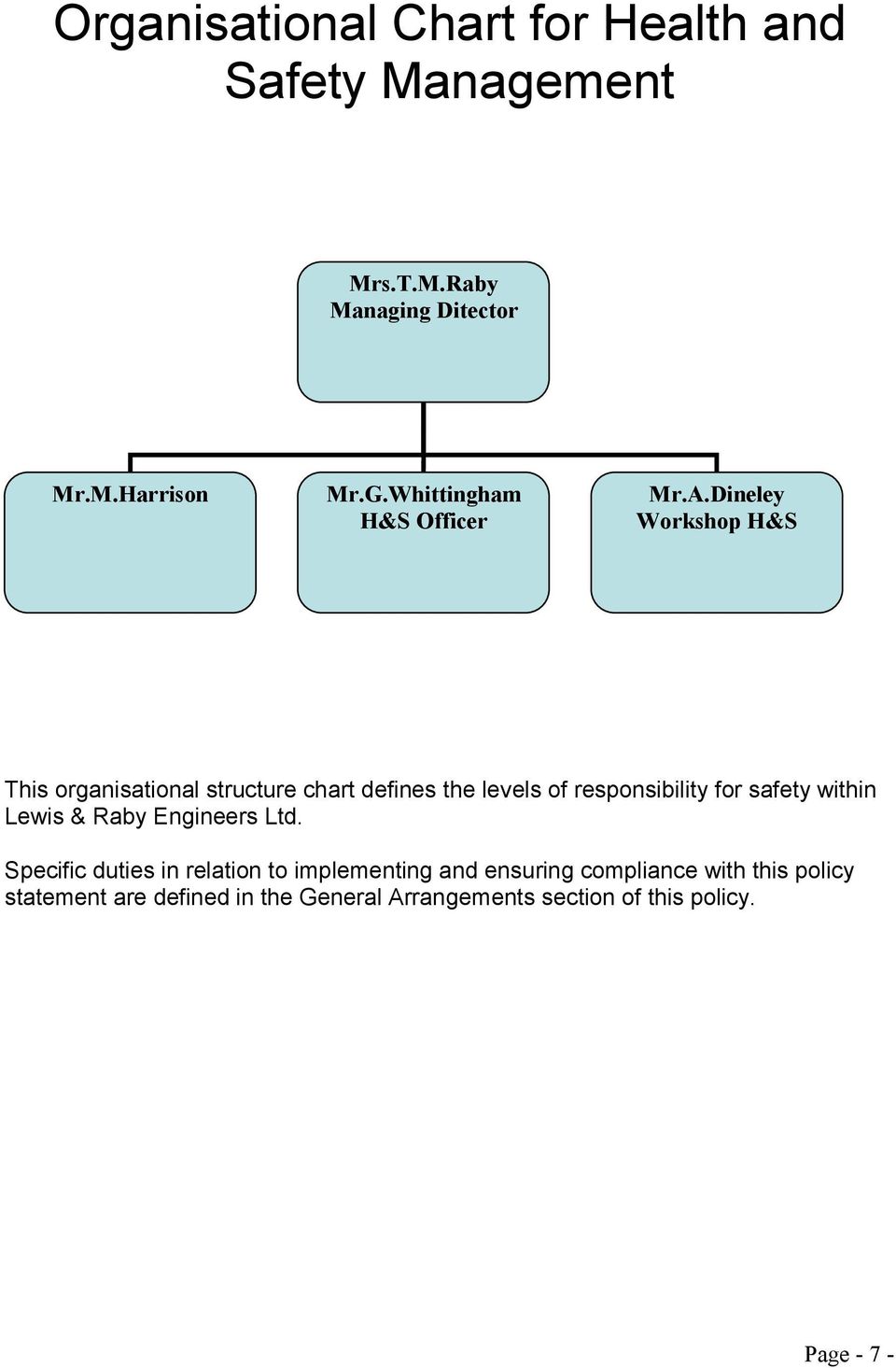
8 Organisational Chart for Health and Safety Management Mrs.T.M.Raby Managing Ditector Mr.M.Harrison Mr.G.Whittingham H&S Officer Mr.A.Dineley Workshop H&S This organisational structure chart defines the levels of responsibility for safety within Lewis & Raby Engineers Ltd. Specific duties in relation to implementing and ensuring compliance with this policy statement are defined in the General Arrangements section of this policy. Page - 7 -
9 GENERAL ORGANISATION AND ARRANGEMENTS In accordance with the Health and Safety at Work Act and all other Health and Safety legislation, Lewis & Raby Engineers Ltd, as the employer is responsible for the Health, Safety and Welfare of all its employees and all other persons who may be affected by their work. Directors Duties The Director of Lewis & Raby Engineers Ltd is fully committed to the safety of its employees and those affected by their activities. Directors of Lewis & Raby Engineers Ltd is also committed to following HSG 65, successful health and safety management and applying appropriate management systems and quality control in line with OSHAS In particular the three process flow charts within the appendices of this safety policy arrangements section define and confirm our practical safety management system, our approach and how safety is effectively applied and implemented across our business. These safety process flowchart define our quality control measures to ensure effective safety management is applied in all core areas of our business, and that safety is monitored and reviewed regularly. In achieving the above, directors will specifically; DIRECTORS DUTIES A. Ensure that employees under their direct control, contracts managers, supervisors etc, know and understand their responsibilities and are issued with this safety policy. This is done by issuing the safety policy to all employees and requesting that they acknowledge the receipt and understanding of the safety policy. B. Ensure that adequate resources are made available to meet the requirements of the Health & Safety Policy and allowing other management and staff under their control to actively implement the required safe systems. This is done by applying adequate financial and personnel resources to each project and employing competent employees and consultants. C. Ensure that only competent sub contracted workers are employed, by having effective contractor control systems, which can be implemented. (See sub contractors section and flow chart in appendix 3) D. Ensure that Lewis & Raby Engineers Ltd has access to competent safety advice as required by Regulation 7 of the Management of Health and Safety at Work Regulations. Lewis & Raby Engineers Ltd employs Rawlings Safety & Training Consultancy Services as their retained competent Health and Safety Consultants, and will also employ internal safety competent personnel, to Page - 8 -
10 ensure full and competent safety advice is available to all aspects of the business. E. Ensure that they appoint in writing key staff to undertake specific duties to comply with the Health & Safety Policy and all applicable legislation. F. Ensure that there is an active monitoring inspection and audit regime of all works carried out by, or under the control of Lewis & Raby Engineers Ltd (See flowchart in appendix 2). G. Ensure that Health and Safety receives full consideration in all work activities. This is done via the procedures and arrangements laid down within this safety policy, which enables management and staff to effectively manage health and safety: H. Ensure that employees under their direct control, have suitable and sufficient training to carry out their work activities and that information, instruction and supervision is available at all sites/workplaces to contribute towards a safe and healthy environment. I. Ensure that all work is managed and organised so that its execution is to the required standard, which will minimise the risk to employees, sub-contractors and the public. The Directors will ensure that all projects are adequately resourced. J. Ensure that adequate welfare provisions are allowed for on site, which comply fully with the Construction (Design and Management) Regulations 2007 K. Ensure that employees under their direct control and sub contractors are kept fully informed of the standards required by Lewis & Raby Engineers Ltd. L. Ensure this policy is reviewed at periodic intervals in accordance with the flowchart in appendix 2 Page - 9 -

11 Contracts Manager / Site Agent / Foremen The Contracts Manager/Site Manager/Foreman of Lewis & Raby Engineers Ltd assists the Director of Lewis & Raby Engineering Ltd in the practical implementation of the Health and Safety Policy. In addition The Senior Manager is often the person who is responsible for on site liaison with clients of Lewis & Raby Engineers Ltd. The Contracts Manager/Foremen of Lewis & Raby Engineers Ltd shall: - A. Ensure all site work is carried out in a safe manner in accordance with the safety policy, method statement or on site requirements of the clients of Lewis & Raby Engineers Ltd and in accordance with safe working practices. B. Ensure that all equipment and machinery is checked prior to use. (Reference should be made to The Provision and Use of Work Equipment Regulations (PUWER), and the Lifting Operations and Lifting Equipment Regulations 1998 (LOLER), which requires that a risk assessment be undertook for work equipment or lifting equipment used by anyone at work. C. Ensure that good standards of housekeeping are kept at all times. D. Ensure that all work is carried out with compliance to the relevant legislation. E. Ensure that all lifting equipment is tested and results reported to the Directors of Lewis & Raby Engineers Ltd. (As stated earlier reference should be made L.O.L.E.R.). F. Ensure that all work is adequately supervised at all times, and those young people are given extra supervision and assistance in their role. G. Ensure that site access and egress is maintained and that work areas are secure from intrusion where necessary. H. Ensure all accident or site hazards are reported immediately to the Director of Lewis & Raby Engineers Ltd and if relevant to the client. I. Ensure that adequate and suitable personal protective equipment is available at all times and is used by the employees of Lewis & Raby Engineering Ltd. J. Ensure that employees under their control who are placed on non-routine work are adequately supervised and instructed on safe working. K. Will be accountable to the Director of Lewis & Raby Engineers Ltd. Page

12 L. Ensure that any employee or sub contractor not discharging their duties are stopped from working and reported to the Directors of Lewis & Raby Engineers Ltd. M. Ensure effective liaison on site with clients of Lewis & Raby Engineers Ltd, ensuring compliance with the requirements of the client. N. Ensure that any employee or sub contractor not discharging their duties are stopped from working and reported to the Directors of Lewis & Raby Engineers Ltd O. Ensure effective liaison on site with clients of Lewis & Raby Engineers Ltd, ensuring compliance with the requirements of the client. P. To ensure that employees are adequately trained, competent and supervised in their work. Q. Ensure that adequate first aid facilities are available and regularly checked and employees under their control know its location. R. Ensure that permit to work systems are adhered to and supervised as work is carried out, as required by clients of Lewis & Raby Engineers Ltd. S. Ensure that colleagues, client s staff and members of the public are never placed at risk as a result of work carried out by Lewis & Raby Engineers Ltd. In addition to ensure the effective implementation and compliance with the safety policy and procedures of Lewis & Raby Engineers Ltd. Page

13 All Employees Duties The employees of Lewis & Raby Engineers Ltd are competent and well trained; they assist the Director of Lewis & Raby Engineers Ltd in fulfilling their responsibilities for health and safety. In addition they assist the foreman in the practical, effective implementation of the health and safety. The employees of Lewis & Raby Engineers Ltd will: - A Always conform to the rules and regulations applicable to their work and follow the instructions of Senior Officer. B Always be aware of safe working procedures and specific method statements of work and follow those procedures. C Always wear the personal protective equipment provided by Lewis & Raby Engineers Ltd. D Always be fully aware of and adhere to the fire and emergency procedures for each site. E Always check plant and equipment for safety prior to use, and report any defects. F Always report hazards, defects and any accidents to the Senior responsible person. G Always understand their responsibility under Section 7 of the Health and Safety at Work Act, to ensure they carry out their work in a safe manner so as to prevent any risk to themselves or to other persons who may be affected by their actions. In addition to co-operate with the employer/ Lewis & Raby Engineers Ltd at all times. H To always comply with safe systems, procedures and controls as defined by risk assessments undertaken for your area of work. I Always co-operate with Senior Officers and clients of Lewis & Raby Engineers Ltd ensuring compliance with specific on site rules and regulations. J Always maintain good standards of housekeeping at all times, particularly on the premises of sites of clients of Lewis & Raby Engineers Ltd K Refrain from any intentional or reckless interference with safety equipment. L Avoid horseplay at all times. M Undertake job instruction and training as required by the Director of Lewis & Raby Engineers Ltd N Always keep welfare facilities in good order. Page

14 Sub-Contractors & Coordination and Communication for interface with contractors The Lewis & Raby Engineers Ltd is fully committed to applying effective and practical procedures and systems that ensure the effective and practical procedures and systems that ensure the effective procurement and management of contractors employed by Lewis & Raby Engineers Ltd. The procurement and management of contractors process is defined in detail within flowchart 3 of the appendices of this safety policy and this section of this safety policy. All contractors will be subject to a full Pre Qualification Questionnaire and pre vetting procedure by Lewis & Raby Engineers Ltd, in addition pre start meetings will occur to ensure full clarity of the task in question and the safety standards to be applied, this will include a full validation of the sub contractors Risk Assessment and Method Statement for the specific task, including validation of the competency of the employees of the sub contractor who are carrying out the task in question. Sub Contractors will be subject to the monitoring and inspection processes applied by Lewis & Raby Engineers Ltd as per appendix 2 of this safety policy. At all times for all activities this flowchart will be applied to ensure effectiveness in the management of contractors, uniformity of approach and the safety of all site staff, contractors and all persons affected by the contracted activity. General duties which will be implemented for all sub contractors are; A All sub-contractors will be expected to comply with Lewis & Raby Engineers Ltd Policy for Health, Safety and Welfare and must ensure their own Company Policy is made available on site whilst work is carried out. B All work must be carried out in accordance with the relevant statutory provisions and taking into account the safety of others on site and the general public. C Scaffolding used by sub-contractor s employees (even when scaffold erected for other contractors) must be inspected by their employer or a competent person appointed by their employer to ensure that it is erected and maintained in accordance with the Regulations and Codes of Practice. D Sub-contractor s employees are not permitted to alter any scaffold provided for their use or interfere with any plant or equipment on the site unless authorised. E All plant or equipment brought onto site by sub-contractors must be safe and in good working condition, fitted with any necessary guards and safety devices and with any necessary certificates available for checking. F No power tools or electrical equipment of greater voltage than 110 volts may be brought onto site. All transformers, generators, extension leads, plugs and sockets must be to latest British Standards for industrial use, and in good condition. Page

15 G Any injury sustained or damage caused by sub-contractor s employees must be reported immediately to this Company s Site Representatives. H Sub-Contractors employees must comply with any safety instructions given by this Company s Site Representative. I This Company has engaged Rawlings Safety & Training Consultancy Services Ltd to advise on health and safety matters. Sub-contractor s informed of any hazards or defects noted during inspections will be expected to take immediate action. Sub-contractors will provide the Site Agent with the name of the person they have appointed as Safety Supervisor. J Suitable welfare facilities and first aid equipment in accordance with the Regulations must be provided by sub-contractors for their employees unless arrangements have been made for the sub-contractors employees to have the use of Lewis & Raby Engineers Ltd facilities. K Any material or substance brought on site which has health, fire or explosion risk must be used and stored in accordance with Regulations and current recommendations and that information must be provided to any other person who may be affected on site. L Sub-contractors are particularly asked to note that workplaces must be kept tidy and all debris, waste materials etc cleared as work proceeds. M It is the policy of Lewis & Raby Engineers Ltd that all operatives, sub-contractors, visitors etc on Lewis & Raby Engineers Ltd sites will wear safety helmets at all times other than in areas specifically designated as no risk areas by site management. N A detailed Method Statement will be required and actively procured prior to work commencing from sub-contractors carrying out any activities on site e.g. Asbestos removal, steel erection, demolition, roofing, entry into confined spaces etc. The Method Statement must be agreed with the Site Manager before work begins and copies made available on site so that compliance with the agreed Method Statement can be maintained. Page

16 Coordination and communication for interface with contractors Lewis & Raby Engineers Ltd will at all times, ensure effective communication on site between contractors. Lewis & Raby Engineers Ltd will ensure that when working activities and risk assessments / method statements interface with other contractors, that prior to work commencing. Lewis & Raby Engineers Ltd risk assessment / method statement will be issued to the relevant contractors via tool box talk site meeting process using form SMS 28 Tool Box Talk Register of this pack. When issuing this information, Lewis & Raby Engineers Ltd will ensure that all hazard and risk information is discussed and disseminated to all relevant parties that may interface on site, and control measures are clearly defined taking on board appropriate feedback at all times when completing the tool box talk / site meeting. Accordingly, if other contractors activity impinges upon clients working activity, Lewis & Raby Engineers Ltd will cease work and communicate with the contractor and complete the coordination process, and as necessary Lewis & Raby Engineers Ltd will ensure add or amend risk assessments and method statements for the work in question. Lewis & Raby Engineers Ltd will not allow commencement or continuance of any work activity unless this communication and coordination process has occurred with contractors who may interact with Lewis & Raby Engineers Ltd activities on site. Retained Professional Safety Advisors (As required by Regulation 7 of the Management of Health and Safety at Work Regulations 1999) Rawlings Safety & Training Consultancy Services Ltd will advise management on the preparation and review of a Company Safety Policy for Health, Safety and Welfare including the organisation and arrangements for carrying out the Policy. Rawlings Safety & Training Consultancy Services employed by Lewis & Raby Engineers Ltd will give advice, support, guidance and unlimited phone support throughout the year to management/employees and provide monthly safety information bulletins and will advise as requested on:- (a) (b) (c) (d) (e) Legal requirements affecting health, safety and welfare. Prevention of injury and damage. Provision, selection and use of protective clothing and equipment. New working methods, equipment or materials which could reduce risks. Proposed and actual changes in legislation. Page

17 (f) (g) (h) (i) (j) (k) (m) (n) (o) (p) Potential hazards on new sites before works starts, health and safety factors affecting the selection of plant and equipment, sub-contractors and so on. Prepare (or assist with) the Construction Phase Plan. Carry out regular inspections of sites and workplaces to determine whether work is being carried out in accordance with Company Policy, Method Statement and the relevant statutory provisions. Provide an inspection report to site supervisions and send a copy of the report to the Construction Manager and Directors. Assist management in any dealings with the Health and Safety Executive. Carry out investigations of serious accidents in accordance with the Company Policy. Provide advice on training requirements where required. Comment or advise on the suitability of risk assessments/method statements etc were requested Undertake site audits at intervals agreed with the construction manager Assist with the formulation and review of company safety policies, procedures and arrangements for effective health and safety management. Attend meetings as required, including quarterly safety meetings with the managing directors of Lewis & Raby Engineers Ltd, and provide annual audit support. Page

18 SECTION 3 HEALTH & SAFETY ARRANGEMENTS Page
19 ARRANGEMENTS FOR IMPLEMENTING HEALTH AND SAFETY General This safety policy and the arrangements therein will be stringently applied by the Lewis & Raby Engineers Ltd, and appendices 1, 2, 3, 4 and 5 are critical and fundamental to achieving this and ensuring compliance with HSG 65 successful health and safety management and in line with ISO 9001/ Accordingly, this arrangements section should be read in conjunction with the appendices section of this policy, as these process flow charts are an integral feature of the policy and management safety systems and show the practical processes and procedures to be applied to ensure this policy is effectively and actively applied. Lewis & Raby Engineers Ltd carries Employers' Liability (Compulsory Insurance) and Public Liability Insurance. It will be the policy of Lewis & Raby Engineers Ltd to ensure that adequate Welfare Facilities including first aid are provided on all sites. Employees, sub-contractors and self employed have a duty to respect these facilities and assist in maintaining them to a suitable standard. Good housekeeping is the responsibility of employees and sub-contractors. It is expected that all workers will keep a clean and tidy work place, clear waste and debris as work proceeds and do not block or restrict access routes. Do not leave tripping hazards on roofs, roof edges or by stairs, ladders etc. Generic risk assessments and COSHH assessments will be kept in a place accessible for all workers. Specific risk as identified will be addressed either by the site manager / foreman or other competent person. All personnel must comply with these special arrangements. All employees and sub-contractors who do not have their own safety policy approved by Lewis & Raby Engineers Ltd will abide by the conditions of this policy and will also conform to any Principal Contractors Health and Safety Plan that may be applicable. Page

20 Communications and Consultation With Employees All employees shall receive the necessary training, instruction and information as appropriate, to enable them to carry out their job role in compliance with Regulations 10 (Information for Employees) and 13, (Capability and Training) of The Management of Health and Safety at Work Regulations All employees are inducted, were they are provided with a copy of the safety policy and advised of Lewis & Raby Engineers Ltd organisational arrangements and procedures for safety management, including this policy and all other procedures. Continuous and regular communication and consultation will occur with employees at all times as per appendix 5 of this safety policy and communication procedures A,B,C,and D, defined within this process flow chart. Monthly safety bulletins with support from our consultants Rawlings Safety & Training Consultancy Services Limited are posted on notice boards and issued to all employees to ensure safety is continually communicated to the workforce, and all employees are kept aware of current safety trends and risks, this process is also supplemented by direct communication on a week by week basis, upon task allocation, and if incidents have occurred appropriate information to those who may be affected. Managers will ensure records are kept of such communication. Site specific inductions and toolbox talks are also carried out were the specific risks associated with the site are discussed and the associated risk assessments and method statements are gone through. Records of any inductions/toolbox talks and training provided will be held on file. The tool box talk process is a two way communication process, and allows consultation with the workforce and for an safety issues or concerns to be raised, when conducting Tool box talks Lewis & Raby Engineers Ltd will allow adequate time for employees to raise any concerns /issues, and shall act upon such concerns and address the issue raised immediately. In addition, Lewis & Raby Engineers Ltd will ensure representation of the employees is present at safety review meetings at site level, and at the monthly/quarterly /annual management review to ensure direct in put from the employees at site level as per the process detailed in appendix 2 of this policy. Lewis & Raby Engineers Ltd respects, supports, and appreciates the in put of its employees and will always consult as above in all key aspects of safety management to achieve success, and prior to the purchase of new plant and equipment or when substantial operational changes are occurring that may impinge on safety. Page
21 Training All employees/self employed will be instructed and trained to carry out their tasks in a safe manner. This includes the specific risks associated with the task, the substances, the safe use of plant, machinery and portable tools etc. Training and tool box talks will be given prior to the commencement of on site activity and all personnel will sign to accept such training and information, if the scope/task changes in any way Company will cease work and re issue risk assessments with a repeat of the training/tool box talk. The need for safety training will be appraised at the regular Management Meetings and a formal review of safety training needs will be completed on an annual basis as per appendix 2 (Monitoring) and appendix 4 (Training) of this safety policy, these are the practical process flow charts that will be stringently applied, opportunity will also be taken to analyse training needs at each site safety meeting and at the formal quarterly safety reviews. Contracts Manager/Site Manager/Foreman will ensure that all persons under their control have an induction of health and safety on their first day on site and before starting work. Where there is a special need identified, then further training will be provided. This may be in the form of tool box talks or a recognised training course. It is the intention of Lewis & Raby Engineers Ltd that safety training is carried out on a regular basis, employees and self employed are expected to co-operate in this requirement. All sub-contractors must ensure that their own personnel meet these requirements Lewis & Raby Engineers Ltd will ensure that all sub contractors provide evidence of training as part of their submission for the work. It is Lewis & Raby Engineers Ltd policy to ensure that all persons are trained and have health and safety information, Lewis & Raby Engineers Ltd will ensure a well planned and executed training programme is maintained at all times, and will keep abreast of training needs and any changes or enhancements required for employees with support from their safety consultants Rawlings Safety & Training Consultancy Services Limited, via their monthly bulletins, and personal company review meetings. All employees will be given adequate instruction, and supervision, as is necessary to ensure that their work is carried out efficiently and safely. Contracts Manager/Site Manager/Foreman will monitor their performance and take remedial action where bad practices are identified. Lewis & Raby Engineers Ltd is fully committed to the safety of its employees and understands that competence is essential to achieve personal and the organisations safety excellence. Page
22 As per appendix 4 of this safety policy the competency flow chart will be applied as a practical company standard by Lewis & Raby Engineers Ltd to ensure continuous development of all personnel. The flow chart confirms that Lewis & Raby Engineers Ltd company training needs analysis will be undertaken and reviewed periodically there after to ensure continuous competency development of employees. This continuous employee development process will be stringently applied. All statutory health and safety training will be provided including task specific safety training and enhanced training for managers and supervisors as defined in the training needs analysis process. All employees will be consulted about their training needs via a personal review and development process, job role and tasks will be analysed to ensure all safety risks are considered when defining the training to be delivered, and to ensure an effective, competency based training plan is applied by Lewis & Raby Engineers Ltd company. The Company will always follow and apply the training process flow chart in appendix 4, and also the more extensive training needs guideline document SMS 25 and this will be the standard of training competence to be applied to our workforce, this document is part of our safety management system and defines the training standards and competencies that the Company will apply and achieve for its workforce. Young persons / Work experience placements The Management of Health and Safety at Work Regulations 1999 define a young person as someone under the age of 18. Lewis & Raby Engineers Ltd shall ensure that young people are protected against any risks to their health and safety at work, which are due to their inexperience, immaturity and lack of awareness of risks. As such, a risk assessment will be carried out. The results of the risk assessment will identify work activities, etc involving risks or harm to young people. No young person may be employed in work which: is outside their physical and/or mental capacity involves exposure to agents which are toxic, carcinogenic, cause heritable genetic damage, harm unborn children or cause any other chronic health effects involve exposure to radiation involve exposure to risks which cannot be perceived or avoided by young people due to their insufficient attention to safety or lack of experience or training Page
23 involves a risk from extreme hot or cold, noise or vibration. All young persons employed by Lewis & Raby Engineers Ltd will be given a full induction prior to being allowed on site. At this induction the safety rules will be fully explained, including emergency procedures, fire procedures, location of first aid box, first aid supplies and the accident book. Also at this induction any specific risks associated with this site, i.e. working at height, use of work equipment etc, will be fully explained along with the appropriate controls, which are in place and which should be followed at all times. The highest levels of supervision possible will be applied to oversee the safety of the young person in question and risks will be minimised at all times by Lewis & Raby Engineers Ltd. Risk Assessment Lewis & Raby Engineers Ltd is committed to applying an effective, valid and practical risk assessment process to all its activities. This risk assessment process is defined in detail within appendix 1of this Safety Policy, which is the risk assessment and method statement process flow chart that will be stringently applied to ensure effective,well planned, and specific risk assessments, which are monitored and reviewed as per the flow chart. At all times and for all activities, this flow chart will be applied to ensure effectiveness of the risk assessment process, quality control, uniformity of approach and the safety of all affected by the risk assessments produced. It also defines the procedure for communicating the full content of risk assessments and reviewing and amending such risk assessments as required. Lewis & Raby Engineers Ltd uses Rawlings Safety & Training Consultancy Services as their key support in formulating Risk Assessments with the advice of Chartered Safety Practitioners assisting Lewis & Raby Engineers Ltd managers in the task. Many of the things we do and products we use are hazards which could cause harm. We know that we need to think about these and the safety measures needed so that the risk of someone getting hurt or becoming ill is small. Hazard means anything that can cause harm. Risk is the chance, high or low that someone will be harmed by the hazard. Identification of hazards, assessment of the risk and the establishment and enforcement of control measures, are the cornerstones of effective Risk Management. Lewis & Raby Engineers Ltd will ensure control measures are defined in the form of written safe working procedures, method statements and construction phase safety plans ( as applicable )are relayed to the persons at risk by line management, through formal information channels, instruction and training. Page
24 In addition to the legal requirement of the Management of Health & Safety at Work Regulations 1999, for general Risk Assessments, Lewis & Raby Engineers Ltd understands other statutory provisions require specific risk assessment measures, as an example the following list in some form or other requires the need to assess risk, suitability or competency. The Health and Safety (Display Screen Equipment) Regulations The Workplace (Health, Safety and Welfare) Regulations The Manual Handling Regulations The Personal Protective Equipment Regulations 1992 The Provision and Use of Work equipment Regulations 1998 The Construction Design and Management Regulations 2007 The above list is not a comprehensive list rather a sample. Site specific risk assessments will at all times be completed for each project/works as per the process flow chart in appendix 1. Lewis & Raby Engineers Ltd understands it is important that each site is also carefully considered to make sure that any special or unusual factors of the site do not allow the remaining risks to increase Company will ensure this is done for all work activity. When work starts on a site, the Contract Manager or other competent person will undertake a risk assessment in accordance with our written procedure. The most common cause of death on construction sites is falling from height and this, together with fire prevention, preventing objects falling, minimising risk to the public and others and all the other hazards will be considered by the Company. The results of this risk assessment/method statement will be recorded in a site specific Method Statement. This document describes the special safety control measures and safe systems of work that will be followed on that site. The Contracts Manager/Site Manager/Foreman will not start work until he has the Method Statement. He will check that he understands the work to be done and safety measures needed. He will brief the other operatives and comply with any of our Lewis & Raby Engineers Ltd safety induction procedures. The Contracts Manager/Site Manager/Foreman will inspect the work area and use his own practical knowledge and experience to make sure that no significant risk exists from, perhaps other contractors, scaffolding etc, before starting. If the Contracts Manager/Site Manager/Foreman is not sure the area is safe he will leave the area and report the situation to the site office immediately so that advice can be given. Page
25 Permit to work Were work activities involving a significant risk are undertaken and subsequently a greater degree of management control is required, Lewis & Raby Engineers Ltd will implement a permit to work procedure. This will cover work activities involving hot works, excavations and confined spaces. This allows Lewis & Raby Engineers Ltd to further enhance their safety management approach to the particular work activity and ensures the safety of the operatives involved and any persons affected. Construction Design and Management Regulations 2007 Lewis & Raby Engineers Ltd is aware of the impact of the Construction Design & Management Regulations 2007 and the responsibility of duty holders under these regulations. Lewis & Raby Engineers Ltd has an efficient management system in place and has within its employ competent persons who are adequately trained to take on duties, or to assist other duty holders to comply with their responsibilities as required under the regulations. CDM requires the registering with the HSE of construction work that will take more than 30 days to complete, or work that will involve more than 500 person s days, or is demolition or dismantling. (This excludes work undertaken for private householders). A copy of the F10 notification will be posted on site by the Principal Contractor. The Client: When a commitment is made to the project, he must employ a competent CDM Co-ordinator and a competent Principal Contractor. He must give information on the land and development that is reasonable for him to know. He must ensure that the safety plan is sufficiently developed before work begins on that phase of the project. He must receive the safety file from the CDM Co-ordinator at the end of the project and allow others to see it, who may have cause to. He must pass on the file to the new client if the building etc is sold off. Designers: Must be competent. Use techniques of risk assessment to eliminate risk where reasonable practicable, so as to ensure that the construction can be built, maintained and eventually demolished safely. To give safety information about the design, to co-operate with the CDM Co-ordinator. Page
26 CDM Co-ordinator: Check the competence of designers and ensure their co-operation and coordinate their activities. Give advice to the client and contractors as required. Provide to the Principal Contractor an outline safety plan. Collect information for the safety file. To notify the HSE on F10(rev) as to the project. Principal Contractor: Develop the health and safety plan for managing the residual risks on site. To ensure that only competent persons are employed. To develop risk assessments and method statements. To ensure that resources are available and properly used. To ensure that all sub contractors and self employed are competent, have resources and co-operate with him and follow the safety plan. Ensure that all persons on site have safety training as required and set up communication of health and safety for operatives. Prevent entry onto site of unauthorised persons. Monitor the systems and keep records. Contractors and the Self Employed: Must co-operate with the Principal Contractor so that he may fulfil his statutory duty. They must only employ competent persons and ensure that they have suitable safety training. They must use resources correctly and complete risk assessments and method statements as required. Pre-Site Planning Tenders will include sufficient resources to cover methods of working and adequate welfare facilities etc that can be assessed as necessary from the information provided at tender stage. At the planning stage, action will be taken to ensure compliance with all relevant regulations. In particular; Adequately trained management and operatives. The most appropriate order and method of working. The drawing up of Hazard / Risk Assessments where necessary. Method Statements as required. The arrangements for a safe supply of electrical power and the provision of adequate lighting. Allocation of responsibilities with sub-contractors Page
27 Discussion with sub-contractors as to control and supervision of safety on site. Identify the overall safety supervisor for site. The prevention of hazards which might arise from overhead or underground services. Facilities for welfare and first aid suitable to the site. Adequate fire precaution and permits to work if necessary. Identification of and planning for, any special risks relevant to the contract through Hazard / Risk Assessment. Provision will be made where required for adequate and clear instructions, to establish working methods, to explain the sequence of operations, to outline potential hazards at each stage, to indicate precautions to be adopted in case of emergency e.g. fire or explosion and particularly in occupied factories etc. To check over working methods and precautions with site management before work commences. To ensure that work, once started, is carried out as planned or that a revised method is drawn up and that the relevant regulations and guidance are observed on site. That sub-contractor has the necessary equipment and expertise to enable them to carry out their day to day activities in a safe and competent manner. Where subcontractors employ 5 persons or more a copy of their current Safety Policy will be required. In addition, subcontractors must nominate a Safety Supervisor who shall be adequately trained / experienced. To organise the provision of protective clothing and equipment. Special Hazards Unusual or special hazards known at planning stages will be built into safe work methods and implemented by site staff. Situations developing on site will be dealt with where possible or works stopped until all necessary arrangements are made. Including a revision of the Risk / Hazard Assessment and if necessary, a new work Method Statement. New Processes etc All relevant information will be obtained prior to taking into use any new process. Information etc will be passed to those involved and specific training organised if necessary. Copies of relevant detailed Codes of Practice and other safety literature are available covering all aspects of Lewis & Raby Engineers Ltd activities. This information will be disseminated as necessary or by request to any person to whom it is relevant. Page
28 Steps will be taken to ensure that all necessary authorities are informed and / or consulted. Subcontractors will be provided with a copy of the Safety Policy and will be expected to work strictly within the bounds of current legislation and codes of safe working practice. They will also be informed of any known hazards on site. The appointed Company Safety assistants, Rawlings Safety & Training Consultancy Services will be consulted as necessary at planning stages and may be required to carry out site inspections and monitoring the effectiveness of the policy. Accident Reporting All accidents will be reported and an entry made in the accident book at the site office and in any accident book which exists on site. The accident book will be made available for the competent persons, so that accidents and their causes can be investigated. RIDDOR:(1995) Certain types of accidents and dangerous occurrences must be reported to the HSE i.e. Fatalities, broken bones, amputations, electrocution, asphyxiation etc (see Regulations for full details). The Contracts Manager/Site Manager/Foreman must ensure that any incidents that are required to be reported under RIDDOR are notified to the responsible person at Lewis & Raby Engineers Ltd office immediately so that appropriate action can be taken. Lewis & Raby Engineers Ltd will ensure that action is followed by completing and sending to the HSE the form F2508 within 10 days of the accident or incident. RIDDOR report will be made on line at or by phone to the incident contact centre on Full reporting guidance and process and procedure is within section 9 of the safety management system of Lewis & Raby Engineers Ltd. Appendix 1 of this form defines the procedure of Lewis & Raby Engineers Ltd in the event of an accident occurring, appendix 1 of the accident investigation procedure form will be actively applied by Lewis & Raby Engineering Ltd and is repeated below All RIDDOR incidents/accidents will be fully investigated by a competent person and the report issued to the Directors and Contracts Managers of Lewis & Raby Engineers Ltd. Page
29 First Aid When working for a Principal Contractor it is expected that Lewis & Raby Engineers Ltd will arrange to share facilities of welfare and first aid. However, on sites where Lewis & Raby Engineers Ltd is the Principal Contractor, Contracts Manager/Site Manager/Foreman or others will be trained as first aiders or appointed persons under the regulations. They will be in charge of the first aid box, to ensure that it is fully stocked and kept in a clean and accessible place. They will offer first aid to persons who have accidents on sites or premises under the control of Lewis & Raby Engineers Ltd. They must ensure that the accident book is completed. In the event of a serious accident or illness, they will undertake the responsibility to call an ambulance, keep a record in the accident book of the event and notify the responsible person. Offices and yards are provided with their own first aid facilities and appointed person. Fire - procedures and equipment Head Offices or other permanent buildings. A fire risk assessment of the office-building complex is to be carried out annually by the relevant competent person. He is to ensure that all findings and actions arising from the assessment are actioned accordingly. The assessment is to be revised annually. Emergency Procedures Emergency procedures for Office Buildings are to be posted next to all fire exits in the building and reception area. These procedures are to be tested regularly, on the instruction of a responsible person, at intervals not exceeding 12 months. External Sites At the beginning of each contract a fire risk assessment will be carried out by the Site Supervisor with guidance from a responsible person, if required that will determine: a. The number and type of fire extinguishers and/or other fire fighting equipment to be made available. b. Communication arrangements with the emergency services. c. Effective evacuation places with adequate means of escape. d. Storage areas for flammable liquids and containers for flammable waste. Page
30 Responsibility It is the responsibility of the Site Supervisor to ensure the findings and actions arising from the fire risk assessment are fully implemented and tested. A responsible person will monitor these during audits. In the event of a serious fire, the emergency services must be called and the relevant Company Health & Safety Department informed. Prevention of Fire Lewis & Raby Engineers Ltd will ensure all employees have sufficient information / training and at all times exercise good housekeeping techniques. Keep site clean. If the site operates a permit to work system ensure that this is fully understood and followed. All personnel are instructed in emergency procedures and advised of the following precautions: 1. Make certain you know your escape route 2. Keep fire doors and shutters clear and unobstructed 3. Do not obstruct access to fire extinguishers and know how they operate 4. Clothing should not be hung over or near heating equipment 5. Keep a clear work area. Paper, oily rags or rubbish must not be allowed to accumulate 6. The No-Smoking Rule must be strictly adhered to 7. Use proper containers for flammable liquids, not open tins or buckets 8. Handle flammable liquids at a safe distance from possible sources of ignition 9. Check before and after using blowlamps, welding and cutting equipment 10. Do not pile flammable materials in corners, use skips provided 11. Switch off from the mains any electrical equipment when not in use Page
31 Fire extinguishers: The site supervisor will ensure the correct fire extinguisher is available on site and will instruct employees and contractors not to attempt to fight fires unless they have received adequate training and are sure they will not put themselves at risk. Red / Red label - contains water - fires of wood, paper, rubber etc Red / Cream label - contains foam - fires of liquid, petrol, paint, oils Red / Blue label - contains powder - most types of fire, including electric Red / Black label - contains CO 2 - any fire Emergency Evacuation Procedures Gas Escape Fire Explosion Civil Disturbance Bomb Alert When one of the above has occurred all personnel will, as the first priority, arrange for the alarm to be raised by shouting or by other appropriate means, fire alarms etc. 1. All personnel where possible without putting life at risk are to close all doors, windows and turn off all equipment and plant; then immediately proceed in an orderly manner to the safety point of exit from the premises. If, en route, other people are seen, then they must similarly be told to vacate the premises. 2. As soon as possible, after arriving at a place of safety, a check of the employee register and visitors book will be carried out to ensure that all known others are clear of danger. 3. If an occasion arises when known others cannot be accounted for, the employee must give the full details to the emergency services, under no account must the premises be re-entered until authorised to do so. Note: Lewis & Raby Engineers Ltd will, if required, inform the Enforcing Authorities, i.e. HSE of the occurrence on Form F2508 or by telephone to the HSE incident Call centre. Page
32 Alcohol/Drugs All persons working or representing Lewis & Raby Engineers Ltd are expected to support Lewis & Raby Engineers Ltd image and conduct themselves in a responsible manner at all times. Alcohol or drugs, or persons under the influence of alcohol / drugs will not be tolerated on site. Any person breaching this rule may be subject to instant dismissal. Welfare Welfare will generally be provided by arrangements with the Principal Contractor. Lewis & Raby Engineers Ltd will supply these facilities as per current regulations if they are the Principal Contractor. Access / Egress Access / egress means any pathway, steps, stairs, ladders, entrance or exit etc. These must always be kept clear from clutter. Do not store anything in these places and unless there is not alternative, do not work in this space or obstruct them in any way. All persons at work or otherwise have a right to expect clear access and egress. Lewis & Raby Engineers Ltd expects that all persons carrying out business for, or on their behalf, will provide to all a duty of care. Electricity Generally it is expected that the Principal Contractor, via the electrical supply and distribution units, will ensure that only the correct voltages are available for use and safety i.e. 240V for huts and offices etc and 110V for the use of portable tools and equipment. To reduce the risk of electric shock, it is Lewis & Raby Engineers Ltd policy to use 110 volts or battery operated for portable electric tools. All portable electrical equipment and appliances will be tested and maintained at intervals not exceeding 6 months and records kept by the Contracts Manager. Other electrical systems will be inspected and maintained every 2 years and records kept. Portable generators used for the supply of site electricity must be double insulated or effectively earthed and these appliances must be maintained as per manufacturer s instructions. The Contracts Manager will inspect all electrical tools before issue and whenever they visit site. The user will visually inspect any electrical tool before using it. Page
33 Plant (General) All plant such as generators, compressors, hoisting equipment, angle grinders, drills, pumps etc used on site must meet the requirements of PUWER Regulations They must be fit for their purpose and use. They must be maintained as set out in the manufacturer s instructions and records kept. Persons using this type of plant must have sufficient information and training to perform their operations in a safe manner. Care must be used to ensure that exhaust fumes, or other fumes do not enter buildings or excavations etc. Operators should also ensure that hoses and leads do not cause tripping hazards and erect barriers and display signs as is necessary. Keep lids and covers in place to reduce the noise levels. The Contracts Manager will inspect all plant before issue and when they visit site. The user will inspect all plant before use. Abrasive Wheels All persons who change or mount the disks / wheels or angle grinders or bench mounted abrasive wheels must have been trained to do so. They must be appointed in writing and their names entered in the Abrasive Wheels Register F2345. Persons who use abrasive wheels must ensure that they have the correct disk mounted for the task. The must take precautions to prevent dust, grip or sparks from causing a nuisance to others. If working near the edge of site and there is a risk of sparks / dust etc being discharged in a manner likely to cause danger or interference to members of the public - then a secure fence or barrier should be erected to prevent this nuisance. Also sparks can cause fire, therefore ensure that all carbonaceous materials are cleared for at least 2 metres and or Highly Flammable Liquid's or Liquefied Petroleum Gas's for 6 metres. Alternatively and if possible, cover or wet down the materials at risk. Safety guards must be properly adjusted. Ensure the working area is uncluttered and provides safe footing. Safety glasses and dust masks must be worn and other PPE which is necessary. Page
34 Cartridge Operated Tools These tools will only be operated by trained and named personnel. They will ensure that at all times the tool is not misused and that no unauthorised person is permitted to use it. It will be kept in a secure locked container when not being used. Cartridges will also be kept in a locked container. Misspent cartridges will be collected and disposed of under the guidance or instruction from the competent person. Eye protection and ear protection must be worn when using this tool. The cartridge operated tool must be regularly maintained as per manufacturer s instructions. Splatter guards must be kept in position. No person under the age of 18 years is to use this tool. Operators must check that the area both behind and alongside is clear of persons before firing, (in case of ricochet or shoot through). Manual Handling Where reasonably practicable mechanical aids will be used to reduce the need for Manual Handling. When manual handling must be undertaken then a manual handling risk assessment will be carried out to ensure the task can be carried out safely and without risk. When tasks must be carried out manually, then ensure the path is clear from obstructions and that lighting is sufficient. Heavy and awkward loads may require team lifting, and then one person will act as team leader to ensure safest operation of lift. Care should be taken for the protection of hands when lifting objects with sharp edges, or hot / cold surfaces. Extra care is necessary when carrying or moving bucket of hot bitumen or asphalt. The correct method of lifting makes the operation seem easier, less tiring and safer. Lifting should be carried out by the proper use of muscles. Back and abdominal muscles are weak, the leg and thigh muscles are strong. The spine has a natural shape when a man is standing, if he bends over, the spine is arched and becomes weaker. If therefore the back can be kept in its natural erect position and the leg muscles brought into play, and the load is kept close to the body, a man can operate like a human elevator. This results in heavier loads being lifted, with less physical effort. This is the basis for manual handling. In practice there are six significant points: Grip A good grip makes maximum use of the palm of the hand, the ball of the thumb and the base of the fingers. Using the sensitive fingertips can cause considerable damage and the continued use of them leads to strained fingers or strained forearm muscles. Page
35 Back The back should be kept straight to maintain it in its natural and strongest position. This requires bending at the knees and ankles to get down close to the load and then to raise it, pushing upwards with the leg muscles to regain the vertical position. Chin The chin should be kept well in so that it is fairly near to the chest, as this helps to keep the spine in its natural upright shape. Feet The proper position of the feet is approximately the width of the hips apart and with one foot slightly in front of the other. Arms Arms should be kept as close to the body as possible so that its own members do not unbalance the body itself. Body The body, being kept in its normal position, should act as a counterweight to the load. Providing these principles are applied, the average man can expect to lift his own weight but even this depends on his age and physical build. Up to 25 years of age, a well-developed young man could expect to lift it. At 40 years of age lifting capacity can be considerably less. The main thing is that operatives should know how much they could lift and not be afraid to ask for help when the load is beyond them. To this end Manual Handling Risk Assessment will be carried out on all operations identified as having significant risk, remedial action taken by the site manager. Control of Substances Hazardous to Health (COSHH) Employees of Lewis & Raby Engineers Ltd should only use hazardous chemicals if they are authorised to do so, have received adequate training in the risks associated with them and have the associated hazard data sheets available. Employees should only use hazardous chemicals for the task intended. Unauthorised use could result in mixed chemicals giving off dangerous fumes or undergoing a violent reaction Hazardous chemicals must only be stored in the containers intended for such storage. The hazard warning labels appropriate to the contents should be clearly displayed on the container. The Contracts Manager / site agent / foreman should ensure material safety data sheets are obtained where hazardous chemicals are stored, handled, transported and or used. Lewis & Raby Engineers Ltd will ensure a competent person has conducted a COSHH assessment sheet that must be kept up to date and must describe the chemical, its reaction, what to do in an emergency, how to dispose of the chemical, how to dispose of Page
36 the container etc. These sheets should be available / accessible for all staff likely to be exposed to the chemical. The Contracts Manager / site agent / foreman will ensure that containers which have held hazardous chemicals are disposed of as per the supplier s instructions. The person who buys or supplies hazardous chemicals within Lewis & Raby Engineers Ltd has a duty to obtain the necessary hazard data sheet and to ensure that it is distributed. In the majority of instances only small quantities of hazardous substances will be stored or available on site. It will be the responsibility of persons in charge to ensure that the safety information on the labels are read, understood and adhered to. Special attention must be given to substances that are mineral oil based, bitumens and felts etc. Asbestos Lewis & Raby Engineers Ltd acknowledges the health hazards arising from exposure to asbestos and will protect those employees and other persons potentially exposed to asbestos as far as is reasonably practicable by minimising exposure through the use of effective management and proper control measures combined with work methods supported by regular training of employees. This policy requires the full co-operation of management and staff at all levels. Arrangements for Securing the Health and Safety of Workers No work shall commence without assessment of the potential exposure of employees and others to asbestos as a result of the work and a statement of a suitable plan of work shall be made before the work commences. All employees are responsible for adhering to this policy and complying with all the requirements detailed within the policy. Information, Instruction and Training It is the policy of Lewis & Raby Engineers Ltd to ensure that all persons who may potentially interface with asbestos are provided with information, instruction and training so they are fully aware of the risks posed by asbestos containing materials and the correct working methods, the use of control measures, the use of protective equipment and hygiene procedures. HSE information has been provided for operatives. Page
37 Control Measures Prior to commencing work on client s premises, full liaison will occur with the client s facilities/maintenance manager with regard to asbestos. The client s asbestos register will be referenced along with any other appropriate documentation to establish whether or not there is any potential for interface with asbestos through the work being carried out. Dependant upon the findings of the asbestos register or following consultation with the client s representative, the employees of Lewis & Raby Engineers Ltd will take the appropriate measures and these will be reflected within the specific risk assessments and method statements produced for the works. No works will occur on clients premises until risk assessments and method statements have been prepared and approved internally by Lewis & Raby Engineers Ltd and were required by the client. Adequate materials and control equipment will be provided and maintained in an effective condition to minimise, so far as is reasonably practicable, the exposure of employees and others to asbestos. Under no circumstances will work commence were there is a risk of exposure to asbestos. The potential interface with asbestos (were applicable) will be covered in the site specific risk assessment and method statement. If at anytime employees disturb asbestos containing materials they are instructed to cease work immediately and report this to the site supervisor and client s representative for a sample to be taken. No further works will occur until the material has been identified and appropriate controls have been taken. In addition, reference will also be made to the accompanying approved code of practice and guidance, including Asbestos Essentials Task Manual (HSG 210), Introduction to Asbestos Essentials (HSG 213) and Controlled Asbestos Stripping Techniques (HSG 189/1) Page
38 Health Surveillance Lewis & Raby Engineers Ltd will advise all operatives of any potential occupational health risks posed by their work activities. This may include potential hazards associated with exposure to noise, dust, hand/arm vibration, asbestos etc. We will ensure that were through the risk assessment process any of these potential hazards has been identified, then suitable control measures will be implemented to eliminate or reduce the risk to a low as level as practical. Lewis & Raby Engineers Ltd will ensure that Health Surveillance is provided as necessary and assessed with a questionnaire upon induction, and periodically there after. Lewis & Raby Engineers Ltd will ensure all operatives are provided with information, instruction and training as part of our risk control strategy for managing occupational health risks. PPE All Personal Protective Equipment (as identified in Risk Assessments) will be available. It will be suitable for the task and if more than one piece of equipment is to be worn, then the competent person will ensure its compatibility. Operatives will maintain and store all PPE as necessary. Operatives must wear/use PPE correctly and ensure it is maintained to an efficient standard. Misuse is not acceptable. Report all defects to their Contracts Manager/Site Manager/Foreman. Hard Hats: For all site occasions unless it is clearly stated by the contracts / site manager that they are not required. Safety Footwear: For all site situations Gloves: Impervious for the protection against liquids and liquid irritants. Hide for protection against skin cuts and abrasions. Dust Masks: For the protection of the respiratory system against the inhalation of dust. Fume Masks: For the protection of the respiratory system against the inhalation of gasses and fumes. Goggles: For the protection of the eyes (many types available) Overalls: For general protection and hygiene High Visibility Clothing: To ensure that you can be seen in poor lighting conditions etc Others: As per risk assessment. Page
39 PPE will generally be issued as new. Operatives should keep the equipment safe until it appears used when they should request replacement. Hard Hats To comply with the Construction Head Protection regulations 1989 all site personnel and visitors are expected to abide by the policy. Safety helmets will be worn where there is a risk of injury from anything falling onto the head, or anything striking the head, when the Principal Contractor's Site Manager instructs their wearing or when the Contract Manager instructs their wearing. The Contracts Manager/Site Manager/Foreman may use his discretion only if permission to do so is given in writing as part of a Contract Work Instruction. Subcontractors not able to produce a suitable safety helmet will be provided with one and / or may be asked to leave site. Stacking and Storing Poor stacking/storing arrangements are often instrumental to accidents and damage. It is the policy of Lewis & Raby Engineers Ltd to reduce the risk at source, and ensure effective and safe stacking and storage of goods. Therefore: Stacking and storing must: - be controlled to allow for safe handling and to maintain safe access. not to interfere with or obstruct any emergency exits or services. have regard for the site personnel and not stacked too high. Consideration must be given as to how and when the commodities will be used. If temporarily stacking or storing materials on the public roads or footpaths, then proper signs and barriers must be used (this includes lights during the hours of darkness). It may be necessary to seek permission from the Local Authority. The site will be kept securely locked when not in use. Relevant notices will be displayed. All Highly Flammable Liquids and Liquefied Petroleum Gas e.g. Propane will be stored in cages or metal lock ups, adequate fire extinguishers will be correctly placed for emergency use. Page
40 Work at Height Statistics show that falls from height are the most common cause of fatal injury and the second most common cause of major injury to employees. Lewis & Raby Engineers Ltd will take all reasonable steps to provide a safe working environment for all employees who may be affected by work at height activities. Lewis & Raby Engineers Ltd recognises that where work at height cannot be avoided, the risks will need to be controlled to ensure that the task can be undertaken from a safe place. In addition, where other persons may be at risk, for example from falling materials, precautions will be taken to protect them. Where there is a requirement to work at height, due consideration will be given to where the work will be done and an assessment made to ensure adequate precautions are taken to minimise the risks identified. If there is no existing structure that can provide safe access and a safe place of work, then an extra working platform will need to be provided. The most appropriate platform will be determined by the nature and duration of the work to be undertaken. A place is at height if a person could be injured falling from it, even if it is at or below ground level. There is no such thing as a 2 metre rule. Work includes moving around at a place of work (except by a staircase in a permanent workplace) and will include use of ladders for access/egress. Principals for Safe Work at Height No work will be undertaken at height unless it is essential Where work at height is necessary then a risk assessment will be undertaken prior to work commencing and a suitable method and safe system of work established and implemented Any access equipment or working platform (fixed or mobile) will be checked to ensure that it is: suitable; stable and secure (for example ladders or scaffolds tied to supporting structure; mobile elevated working platforms on level, stable ground etc.); will support the weight of workers using it and any equipment and materials likely to be used on it; has guard rails, barriers and edge protection (including floor edges, floor openings and roof edges) (in particular where someone could fall) so as to prevent falls; being used in accordance with, and conforms to, available guidance and best practice. Page
41 Where the potential for falls cannot be practicably totally eliminated then means to minimise the consequences of a fall should one occur will be used (e.g. fallarrest harnesses, nets etc.) Precautions will be taken to prevent injury to any person who may be, or pass, in the area beneath the work at height Ladders Only ladders of suitable and sufficient strength for their intended purpose will be used. All ladders will be placed on a firm level surface. Ladders will only be used for light duty work of short duration. The four to one rule will be strictly adhered to (i.e. the point of rest should be four times the distance between the vertical plane (at the point of rest) and the foot of the ladder) so as to give the ladder an angle of 75 degrees from horizontal. Where practicable, the ladder will be secured to prevent slipping / displacement (preferably by tying at the top though side or bottom supports/ties may be appropriate), particularly where the ladder is 3 metres or more in length. Alternatively, a person will be positioned at the foot of the ladder ( footing the ladder). A person at the foot of, or below, a ladder shall wear a safety helmet. Care will be taken to ensure that the work can be undertaken without stretching that may lead to instability and a fall. All ladders will be carefully stored and periodically inspected to ensure continued integrity and safety. Stepladders are easily overturned by any degree of side loading. All operatives will be instructed in safe usage. The top step of a stepladder will not be used as a working platform unless there is a knee-rest The area around the base of the ladder will be assessed and suitably protected as required from impact, for example from vehicle movements. Special purpose ladders may be required e.g. roofing and steeplejacks ladders. Training will be required for the safe use of such equipment this will be provided as appropriate. Some ladders, especially long ladders, may need more than one person to erect safely. Page
42 Ladders and step ladders will only be used were the risk assessment has determined that they are the most appropriate and safe means of access and working. HSE guidance Ladders guidance, i.e. guide on the safe use of ladders and stepladders (INDG402), which is aimed at employers, the self-employed and people who work from ladders, will be available to operatives. A ladder register of inspection will be held by Lewis & Raby Engineering Ltd, only industrial class 1 ladders will be used. Access and Working Scaffolds Unless a scaffold is a basic configuration described in recognised guidance e.g. NASC Technical Guidance TG20 for tube and fitting scaffolds or manufacturers' guidance for system scaffolds, the scaffold should be designed by calculation, by a competent person, to ensure it will have adequate strength and stability. All scaffolding will be erected, dismantled and altered in accordance with either NASC guidance document SG4 for tube and fitting scaffolds or the manufacturers' erection guide for system scaffolds. Safe access to the working platforms will be provided, for example, by the use of tied ladders projecting sufficiently above the landing (i.e. 1200mm). To restrict access any ladder access will be removed or boarded over to prevent unauthorised use if scaffold is to remain in position unattended Scaffold access and working platforms will be provided with guard-rails, mid-rails & toe boards (or by brick guards) Sheeting will not be applied to scaffolds unless it is designed to take the extra wind-loading Good standards of housekeeping will be maintained on working platforms to reduce the risk of materials/ tools falling and slips/ trips. All scaffolding will be inspected by a competent person and a written record will be kept: before first use; after any substantial modification (modification to be performed by a competent person); after any event likely to have affected its stability (e.g. strong winds, vehicle or other major impact); at regular intervals not exceeding 7 days Page
43 Tower Scaffolds The use, erection and dismantling of tower scaffolds will be undertaken in accordance with manufacturer s instructions by a competent person with particular regard to height and stability. If the scaffold is hired an instruction manual will be obtained with the equipment. Mobile tower scaffolds will only be assembled and altered by trained competent persons with recognised industry certification provided. Towers will only be used on firm level surface and the following height to minimum base dimension ratios will be observed: outdoors work maximum 3:1; indoor work maximum 3.5:1 or less according to circumstances. Outriggers or stabilisers will be used to increase stability when practicable. Ties may also be required. Safe access to the working platform will be provided, for example, by the use of an internal ladder or where the frame has a purpose built in ladder or ladder frame. Any trapdoors in the working platform will be closed during use. Edge protection (guard-rails and mid-rails & toe boards or other suitable barriers) will be provided at platforms where a person or materials could fall. Care will be exercised where towers: are likely to be exposed to strong winds; are sheeted; have heavy materials lifted up the outside; or the base is too small to ensure normal stability - tie to a fixed structure or fit stabilisers Where towers are in public places, barriers will be erected at ground level to restrict access and ladder access will be removed or boarded over to prevent unauthorised use if scaffold is to remain in position unattended Scaffolds towers will be inspected by a competent person prior to first use and thereafter at intervals not exceeding 7 days if it remains in situ. Scaffold towers fitted with wheels will have them locked during work and will not be moved with persons or equipment on the working platform Ladders will not be placed on top of scaffold towers in order to gain additional height the risk of instability or overturning is significantly increased by this dangerous practice Page
44 Mobile Elevated Work Platforms Mobile Elevated Work Platforms may be used to access work areas that are high and/or awkward to reach by other means. When these appliances are used, Lewis & Raby Engineers Ltd will ensure to get, distribute, and comply with the manufacturers instructions, check the maintenance procedure and keep any records that may be required by statute. Persons operating or using these appliances will be trained in the safe use and stability of these appliances, and will carry the appropriate competency cards at all times. The appliance must be on firm level ground or be able to be levelled using outriggers / stabilisers. The person within the platform will use a safety harness, anchored to the guard rail, if identified within the risk assessment. The platform will not be overloaded and protection must be given for those who may be affected below, (use cones / barriers etc). Operatives will be made aware of any overhead cables or obstructions and will not over reach outside the platform. Be aware of the wind speed and the wind chill factor. Wear warm clothing and ensure that you can communicate with other persons on the ground. All activity utilising mobile elevating platforms shall be subject to a specific risk assessment by Lewis & Raby Engineers Ltd Safety Harnesses Safety harnesses and lanyards will be provided and used when other control measures to prevent falls are not practicable. Due to the risk of tripping etc they will be considered as a last resort and are not normally appropriate for work other than of short duration undertaken on a day work basis. Where there is any risk of falling more than 2m (6'6 ), and it is not possible to erect a working platform, safety harnesses must be worn and attached to a secure and tested anchor or horizontal cable. Safety harnesses must conform to BSEN358 and, depending on the circumstances, may be used in conjunction with a fall arrest device, which will conform to BSEN :1993. Whenever using a personal fall protection system involving safety harness use, preference will always be given to fall restraint equipment as opposed to fall arrest. Were fall arrest equipment is used, the Lewis & Raby Engineers Ltd will ensure suitable emergency and resource procedures are in place also. Safety harnesses will be subject to regular inspection and maintenance as per the manufacturers guidance. Lewis & Raby Engineers Ltd will ensure all employees that use and inspect harnesses are competent to do so and will provide appropriate training. Page
45 Noise Lewis & Raby Engineers Ltd will take all reasonable steps necessary to ensure that the risk of hearing damage to employees who work with noisy equipment or in a noisy environment is reduced to a minimum. Lewis & Raby Engineers Ltd also recognises that noise levels below those which cause hearing damage, in a Boiler Room for example, can still cause problems such as disturbance, interference with communication and stress and will take all reasonable steps to reduce noise levels as far as possible. The organisation will also take all reasonable steps to minimise the disturbance caused by noise from the organisation s premises affecting people in the neighbourhood. Lewis & Raby Engineers Ltd will carry out regular noise exposure assessments and noise level surveys of noisy areas / processes and equipment. These will be used as the basis for formulating action plans for remedial measures when necessary. Assessments and surveys will be recorded and updated regularly, particularly when changes in work practice cause changes in noise exposure levels of employees. Lewis & Raby Engineers Ltd will, as far as is reasonably practicable, take all steps to reduce noise exposure levels of employees by means other than the use of personal protection. This will include use of reduced exposure time to ensure that the dose rate of 85dB(A) for 8 hours is not exceeded. Lewis & Raby Engineers Ltd accepts that the use of ear protectors is a last resort, and is committed to continuing to seek and introduce alternative methods for reducing noise exposure levels whenever possible in the future. Lewis & Raby Engineers Ltd will provide suitable and effective ear protection to employees working in high noise levels, as indicated as necessary by the results of noise exposure assessments. It will also provide for the maintenance and repair or renewal of the protective equipment, and provide training in the selection and fitting of protectors and details of the circumstances in which they should be used. All employees of Lewis & Raby Engineers Ltd will be required to use these procedures and equipment correctly promptly report any defects or deficiencies through the appropriate channels. Page
46 Excavations All excavations will be under the control of a competent person. A risk assessment will be produced and operatives will comply with requirements. All excavations at 1.2 metres deep or more will be supported with suitable materials (timbers, sheet pile or proprietary systems etc). These will be inspected daily to ensure that no movement has taken place. Action to be taken as required by the competent person. Edges of excavations will be kept clear of materials or spoil to ensure safe passage and access. A means of access must be provided for persons working in excavations, it must be kept in position as they may need to escape in a hurry. Heavy plant should not be allowed near edges of excavations as this may weaken the supports and cause collapse. Checks will also be made to ensure that the atmosphere in the excavation is suitable to sustain life i.e. sufficient oxygen, no toxic gases and not flammable or explosive atmospheres. Offices When on sites, office based employees will of course comply with the relevant sections of this policy. The office environment contains extra hazards that require care. Take particular care with lifting if you are not used to such action and ask for help. Lewis & Raby Engineers Ltd has a code of practice for safe working with display screen equipment (DSE) which describes the standards and operating procedures required to maintain safety for users. The code contains information on the risks when using DSE and the precautions which users should take. The workstation should be adjusted to suit the individual requirements and should meet the following standards: the screen should be clear with well defined characters free from movement or flicker, it should be adjustable for brightness and contrast and free from reflective glare; the keyboard should be separate from the screen to allow positioning which avoids fatigue to the hands or arms, it should have a Matt finish to avoid glare, with clear legible symbols; the work surface should be large of low reflectance and should allow for a flexible arrangement of the hardware and related equipment; the document holder (where provided) should be stable and adjustable to avoid unnecessary eye, neck or head movement; Page
47 the chair should be stable and afford a comfortable position. The seat should be adjustable in height and the backrest should be adjustable in both height and tilt. A footrest should be available if needed; the environmental conditions should allow for a change of position at the workstation, have suitable lighting which eliminates glare or distracting reflections on the screen and be free from noise, excess heat or humidity. Transport Lewis & Raby Engineers Ltd will upon employment and annually there after carry out driving licence checks before an operative can drive a vehicle. Vehicles and pedestrian traffic will be separated on site. Always walk around a vehicle and check the operation of all lights etc before driving. Always walk around a vehicle before reversing and ask for someone to guide you if you cannot clearly see. Drive with care and consideration at all times and ensure your speed is appropriate to the conditions. Concentrate on your driving and do not operate mobile telephones etc whilst driving. Keep screens and windows clean and do not allow loose items in the vehicle. If driving a vehicle over 3.6t gross weight be aware of and comply with the driver s hours and tachograph rules. On longer journeys take regular breaks. Monitoring and Review Lewis & Raby Engineers Ltd is fully committed to a system of safety inspection, monitoring, review and audit. This system is defined in appendix 2, safety inspection, monitoring, review and audit process. At all times and for all activities this flow chart will be stringently applied to ensure all activities are continuously monitored and reviewed to ensure Lewis & Raby Engineers Ltd are reaching and achieving the highest standard of safety compliance possible. This process flow chart forms a fundamental part of Lewis & Raby Engineers Ltds safety management systems and will be actively applied to ensure compliance with HSG 65 successful health and safety management and in line with OSHAS safety and quality control standards The overall responsibility for monitoring the effectiveness of this Health and Safety Policy is with the Director of Lewis & Raby Engineers Ltd and on site by the senior person. They will ensure the policy is being adhered to by all operatives and also by Page
48 operatives of any sub-contractors used. This is done via tool-box talks and also regular inspections of workplaces and work equipment etc. A formal recorded system of inspection, monitoring and review, is established to enable all tiers of management to assess control measures and identify problem areas, as per appendix 2. These include weekly safety inspection reports completed by the Foreman. These arrangements are supplemented by independent monitoring and auditing by the Safety Consultants. Senior Management will review these reports and all subsequent corrective actions are reviewed by the Directors. As part of a continuous improvement programme, monthly review meetings will be held by Senior Management to assess performance and set objectives. The policy is reviewed annually by the Director of Lewis & Raby Engineers Ltd and in conjunction with their appointed competent person organisation, Rawlings Consultancy Services. A review of this policy may occur if there are changes in relevant Health and Safety legislation, or following an accident or incident, or simply to reflect changes in industry best practice. Page
49 Appendix One Page
50 Appendix Two Page
51 Appendix Three Page
52 Appendix Four Training Needs Analysis Guidelines for Compilation of Company Training Plan for Construction and Maintenance Companies These policy and guidelines will be followed as part of Lewis & Raby Engineers Ltd safety policy (page 18) and shows the practical application, standards, that will achieved, and continuous development process to be applied by Lewis & Raby Engineers Ltd. These guidelines are to support the company in its training needs analysis and to deliver a training plan which is aligned to the business needs, as well as the statutory legally binding health and safety responsibilities of the organisation. Each core area of training is defined and explained, with recommendations for whoever should attend the course. Lewis & Raby Engineers Ltd will apply these standards to their workforce. Lewis & Raby Engineers Ltd will apply with these guidelines and approach training and development of employees following the four stages below. The essence of an effective and professional training needs analysis and planning protocol will be applied by Lewis & Raby Engineers Ltd following the 4 stages below and the process flow chart appended to this document. This 4 stage process is a continuous process and can be linked to your annual management review and employee personal review and development process to ensure continuous professional development of your employees. For an easy reference flow chart guide on the whole process, please refer to the flow chart attached within this document. Page
53 Employee Competency and Training Needs Analysis Process Flow Chart ensuring continuous development of employees The company completes Annual Training Needs Analysis as part of the Annual Review Identify Training Needs Reference. Job description, statutory duties, individual personal review development process, annual management review/ business action plan, client/tender requirements Identify the training event / design the programme for individual / groups Import the training needs onto the training plan spreadsheet doc/sms/26 Deliver the training event Evaluate the course delivery and suitability also if applicable course exam success Evaluate the improvement in knowledge and performance of attendee via appraisal of work, and personal review and development of individual Identify further training needs as part of the annual training needs analysis incorporated within the annual management review Continuous cyclical process Appendix 5 Page
54 Appendix Five Page
55 Lewis & Raby Engineers Ltd ACCEPTANCE OF HEALTH AND SAFETY INFORMATION Record of Issue and Signature of Acceptance of: Safety Policy Safety Information Date of issue:.. I confirm receipt of the above document(s) and confirm also that I have been instructed it it s use and /or purpose. Signature of acceptance: Print Name:. Page
Health and Safety Policy and Procedures
 Health and Safety Policy and Procedures Health & Safety Policy & Procedures Contents s REVISION AND AMENDMENT RECORD : Summary of Change Whole Policy 4.0 05 Nov 08 Complete re-issue Whole Policy 4.1 10
SUPPLY CHAIN PREQUALIFICATION PACKAGE
 SUPPLY CHAIN PREQUALIFICATION PACKAGE 2015 PREQUALIFICATION AS AN APPROVED SUBCONTRACTOR / SUPPLIER In order for your company to be registered as an approved Vendor with StructureTone Limited, we require
Health and safety policy
 1. General statement of intent The Company recognises and accepts its responsibilities as an employer to ensure, so far as is reasonably practicable, the health, safety and welfare of its employees and
Health and Safety Policy Part 1 Policy and organisation
 Health and Safety Policy Part 1 Policy and organisation ICO H&S Policy Policy and organisation, June 2014 Page 1 of 6 1. Scope 1.1 The Health and Safety policy applies to all employees of the Information
HEALTH, SAFETY AND WELFARE POLICY HSM010
 HEALTH, SAFETY AND WELFARE POLICY HSM010 REVIEWED AND REVISED 1 SEPTEMBER 2011 Reviews and Revisions Action Date Reason Initial Policy 12 July 1999 Various revisions 1999 to 2006 Personnel and legislation
SMS0045 Construction Health and Safety Policy and Procedures
 SMS0045 Construction Health and Safety Policy and Procedures March 2015 Version 8 Please note that for projects utilising a CDM Co-ordinator under the transitional arrangements of CDM 2015 (between 6 April
OAKPARK SECURITY SYSTEMS LIMITED. Health & Safety Policy. Requests or suggestions for amendment to this procedure
 OAKPARK SECURITY SYSTEMS LIMITED Requests or suggestions for amendment to this procedure should be submitted to the owner of the process PROCESS OWNER: MANAGEMENT TEAM Current version: PREVIOUS VERSION
1. GENERAL STATEMENT OF COMPANY HEALTH, SAFETY AND ENVIRONMENTAL POLICY
 1. GENERAL STATEMENT OF COMPANY HEALTH, SAFETY AND ENVIRONMENTAL POLICY Dumfries Timber Co. Ltd. is committed to comply with our legal duties in order to provide a safe and healthy working environment
REPORT 4 FOR DECISION. This report will be considered in public
 REPORT 4 Subject: Safety Readiness for the Summer 2013 Events Programme Agenda item: Public Item 7 Report No: 4 Meeting date: 28 May 2013 Report to: Board Report of: Mark Camley, Interim Executive Director
Safety Systems Review Facilities Management Guidance and specification Version 1 2014
 Safety Systems Review Facilities Management Guidance and specification Version 1 2014 Membership Training Qualifications Audit and Consultancy Policy and Opinion Awards Contents Page Safety Systems Review
HEALTH AND SAFETY POLICY AND PROCEDURES
 HEALTH AND SAFETY POLICY AND PROCEDURES 1 Introduction 1. The Health and Safety at Work etc. Act 1974 places a legal duty on the University to prepare and revise as often as may be appropriate, a written
GLASGOW SCHOOL OF ART OCCUPATIONAL HEALTH AND SAFETY POLICY. 1. Occupational Health and Safety Policy Statement 1
 GLASGOW SCHOOL OF ART OCCUPATIONAL HEALTH AND SAFETY POLICY CONTENTS PAGE 1. Occupational Health and Safety Policy Statement 1 2. Occupational Health and Safety Management System 2 3. Organisational Management
Principal Designer Guidance
 Principal Designer Five or more employees 1 CONTENTS INTRODUCTION 3 Further reading / additional resources 3 QUESTION 1: POLICY AND ORGANISATION 4 4 4 QUESTION 2: ARRANGEMENTS/PROCEDURES FOR HEALTH AND
QUALIFICATION HANDBOOK
 QUALIFICATION HANDBOOK Level 2 and 3 NVQ Certificate in Rail Engineering Traction and Rolling Stock (7597-05/10) September 2011 Version 1.1 (September 2011) Qualification at a glance Subject area Rail
Health and Safety Policy
 Health and Safety Policy October 2014 1 October 2014 Contents: Introduction 1. STATEMENT OF INTENT AND POLICY OBJECTIVES 2. RESPONSIBILITIES AND ACCOUNTABILITIES FOR HEALTH AND SAFETY 2.1 The Director
Housing, Construction and Building Services. Supplementary Occupational Health and Safety Policy
 Supplementary Occupational Health and Safety Policy Statement Page 1 of 26 Housing, Construction and Building Services Supplementary Occupational Health and Safety Policy Date Author Version Status Reason
HEALTH & SAFETY POLICY
 HEALTH & SAFETY POLICY 1. STATEMENT OF INTENT & POLICY OBJECTIVES The Council, as the governing body of the School, recognises and accepts the responsibilities placed on it as 'Employer' by the Health
No. Name of Legislation Applicable Issues and Requirements Demonstration of Compliance 1. Health and Safety at Work Act 1974
 The Police Treatment Centres Health and Safety Legal Compliance Register No. Name of Legislation Applicable Issues and Requirements Demonstration of Compliance 1. Health and Safety at Work Act 1974 2.
Corporate Health and Safety Policy
 Corporate Health and Safety Policy November 2013 Ref: HSP/V01/13 EALING COUNCIL Table of Contents PART 1: POLICY STATEMENT... 3 PART 2: ORGANISATION... 4 2.1 THE COUNCIL:... 4 2.2 ALLOCATION OF RESPONSIBILITY...
Corporate Health and Safety Policy Issue 9
 Corporate Health and Safety Policy Issue 9 July 2011 1 Contents Foreword by the Chief Executive 3 1. General health and safety policy statement 4 a Our responsibilities 5 b Health and safety management
Nigel Smith Plumbing & Heating Contractors (Lincoln) Ltd
 Nigel Smith Plumbing & Heating Contractors (Lincoln) Ltd Health & Safety Policy 1 INDEX SECTION 1 1.1 Health and Safety Welfare Policy Statement SECTION 2 2.0 Company Organisation and Responsibilities
Asbestos Policy ASBESTOS POLICY. Version 2 / Jun 2015 Page 1 of 11 Asbestos Policy
 ASBESTOS POLICY Version 2 / Jun 2015 Page 1 of 11 Asbestos Policy This is a controlled document. It should not be altered in any way without the express permission of the author or their representative.
Clients in Construction Best Practice Guidance
 Clients in Construction Best Practice Guidance Published in 2009 by the, Metropolitan Building, James Joyce Street, Dublin 1. Copyright The January 2009 Clients in Construction: Best Practice Guidance
CJ s health and Safety Law poster is displayed in the staff lobby.
 Introduction has a responsibility to ensure that Health and Safety of all it employees while at work. We aim to fulfil these responsibilities by taking steps to work in accordance with relevant Health
Risk assessment code of practice
 Risk assessment code of practice Document control information Published document name: Risk assessment code of practice Date issued: 01 May 2011 Version: 2.0 Previous review dates: Next Review Date: Related
Corporate Health and Safety Policy
 Corporate Health, Safety & Wellbeing Service Corporate Health and Safety Policy Contents 1. Introduction... 2 2. Policy Statement... 2 3. Scope... 3 4. Definition of Manager... 4 5. Responsibilities...
School or service safety advisor (SSA) role
 School or service safety advisor (SSA) role Document control information Published document name: ssa-role-gn Date issued: January 2012 Version: 1.0 School or service safety advisor (SSA) role Previous
The Management of Asbestos containing Materials
 The Management of Asbestos containing Materials Status Owner Approval by University Court Draft Head of Estates and Building 1 Purpose... 1 2 Scope... 3 3 Principles... 4 4 Procedure... 5 5 Accountabilities...
ASBESTOS MANAGEMENT PLAN
 ASBESTOS MANAGEMENT PLAN PREPARED BY: Scott Gregory: Estates - Property Services DATE: 18/04/2014 STATUS: Draft ISSUE: 2014 (02) September 2014 NEXT REVISION DATE: April 2014 Contents 1.0 Introduction
THE UNIVERSITY OF SHEFFIELD WORK AT HEIGHT POLICY
 THE UNIVERSITY OF SHEFFIELD WORK AT HEIGHT POLICY CONTENTS Page No 1 INTRODUCTION 2 2 LEGISLATION 2 3 HIERARCHY OF CONTROL 2 4 WORK AT HEIGHT POLICY 3 5 ROLES AND RESPONSIBILITIES 3 6 RISK ASSESSMENTS
HARTLEY CIVIL ENGINEERING LTD
 HARTLEY CIVIL ENGINEERING LTD HEALTH & SAFETY POLICY 2014 Hartley Civil Engineering Ltd 1 Introduction 5 Part One - Policy Statement Health and Safety Policy Statement... 7 Environmental Policy Statement...
WEDNESFIELD HIGH SCHOOL A SPECIALIST ENGINEERING COLLEGE
 WEDNESFIELD HIGH SCHOOL A SPECIALIST ENGINEERING COLLEGE HEALTH AND SAFETY POLICY Health and Safety Policy December 2012 Page 1 CONTENTS PAGE Statement 4 Organisation Governors Headteacher Leadership Team
A Short Guide to The Safety, Health and Welfare at Work Act, 2005
 A Short Guide to The Safety, Health and Welfare at Work Act, 2005 3 A Short Guide to the Safety, Health and Welfare at Work Act, 2005 Published in August 2005 by the Health and Safety Authority, 10 Hogan
POLICY ON HEALTH AND SAFETY (GENERAL)
 POLICY ON HEALTH AND SAFETY (GENERAL) General Statement It is the policy of Serenity Homecare Limited to ensure, so far as is reasonably practicable, the health, safety and welfare of its employees and
Health and Safety at Work Policy
 Health and Safety at Work Policy Introduction Management of health and safety issues is an integral part of our business and is given the highest priority. Compliance with Health and Safety legislation
Health and Safety Policy
 Health & Safety Policy 1.Introduction Health and safety is the concern of everyone within Escape Community Arts (Escape). This policy is intended to provide a practical framework for the implementation
Health and Safety Management Agreement between NHS Greater Glasgow and Clyde and The University of Glasgow
 Health and Safety Management Agreement between NHS Greater Glasgow and Clyde and The University of Glasgow 1.0 The application of the agreement Agreed: September 2015 Review date: September 2018 NHS Greater
WHS Contractor Management Procedure
 Wudinna District Council 1. Overview Wudinna District Council as part of its commitment under its Policy recognises its obligation to: Ensure, so far as is reasonably practicable, the health and safety
University of Leicester Sports and Recreation Service. Statement on Safety in University Sports Facilities
 University of Leicester Sports and Recreation Service Statement on Safety in University Sports Facilities Introduction The Sport and Recreation Service is an independent service within the University.
Health & Safety Policy DH Associates Limited
 General Statement of Policy Health & Safety Policy DH Associates Limited It is the policy of DH Associates Ltd to comply with the terms of the Health and Safety at Work etc Act 1974 and subsequent legislation
Employee Health and Safety Induction Training Record
 COMPANY NAME Employee Health and Safety Induction Training Record Employee name Job Title Department Start Date - PBS 2010/2 Employee Health & Safety Induction Training Record Page 1 of 6 INDUCTION TRAINING
BLOOM AND WAKE (ELECTRICAL CONTRACTORS) LIMITED QUALITY ASSURANCE MANUAL
 130 Wisbech Road Outwell Wisbech Cambridgeshire PE14 8PF Tel: (01945) 772578 Fax: (01945) 773135 Copyright 2003. This Manual and the information contained herein are the property Bloom & Wake (Electrical
This document is meant to be a starting point for any company wanting to implement the safety passport scheme for their contractors on site.
 Introduction This document is meant to be a starting point for any company wanting to implement the safety passport scheme for their contractors on site. It was put together by members of the Food & Drink
Risk management a practical approach
 Risk management a practical approach Introduction Preventing work related accidents and injuries is the primary concern for all those involved in health and safety. Work related accidents and injuries
WHS Policies and Procedures Package
 WHS Policies and Procedures Package The following is an extract to highlight the style and layout of this publication, as well as a snapshot of the content. Some samples may not be included in their entirety
Site Induction Presentation
 ABC Contracting Site Induction Presentation This presentation provides a mock site induction and serves to help those people in the process of preparing and delivering site inductions It is essential that
Health and Safety Policy Introduction
 Health and Safety Policy Introduction Armstrong Learning, Access to Music, and Cheshire Training Associates recognise that risks to our health, safety and welfare are ever present in our day-to-day working
Health and Safety Policy
 Health and Safety Docu. No. JTL-001 Rev. No. 00 JTL Fire Ltd Health and Safety Prepared by: Date: Signature Signature Signature Page 1 of 7 Checked Released by by: Contents Health and Safety... 1 Safety
HEALTH AND SAFETY MANAGEMENT
 Health & Safety Services Unit name goes here Safety Code of Practice 2 Part A 5 th Edition, November 2015 Unit name goes here HEALTH AND SAFETY MANAGEMENT Organisation and Responsibilities University of
UNIT D: REVIEW HEALTH AND SAFETY PROCEDURES IN WORKPLACES
 Elements in this unit are: UNIT D: REVIEW HEALTH AND SAFETY D.1 Prepare to undertake a review of health and safety in a workplace D.2 Carry out a review of workplace health and safety implementation Unit
HEALTH AND SAFETY POLICY
 HEALTH AND SAFETY POLICY JPD Contracts Units C & D Reg's Way Bardon 22 Industrial Estate Coalville Leicestershire LE67 1FL Tel: 01530 834965 Fax: 01530 832591 Prepared by Derwent Safety Centre Ltd Chester
Health and Safety in the Engineering Workplace
 Unit 1: Health and Safety in the Engineering Workplace Unit code: QCF Level 3: Credit value: 10 Guided learning hours: 60 Aim and purpose T/600/0249 BTEC National This unit will give learners an understanding
Health and Safety Policy
 Health and Safety Policy Status: Final Next Review Date: Apr 2014 Page 1 of 16 NHS England Health and Safety: Policy & Corporate Procedures Health and Safety Policy Policy & Corporate Procedures Issue
Health & Safety Policy For Locations Hosting Film Production Companies
 Health & Safety Policy For Locations Hosting Film Production Companies Throughout this document, the location will be referred to as The Venue and the film production company as The Contractor. The following
CONTRACTOR SAFETY MANAGEMENT PROCEDURE
 CONTRACTOR SAFETY MANAGEMENT PROCEDURE Version 1.0 TRIM file number Short description Relevant to Authority Responsible officer Responsible office Date introduced July 20, 2015 Date(s) modified June 11,
Contractor Safety Management
 1.0 Introduction Memorial University will ensure that a diligent contractor management process is established. This procedure establishes requirements for contract administration and oversight of contractor
HEALTH & SAFETY POLICY
 HEALTH & SAFETY POLICY -1- Contents General Policy Statement Organisation Arrangements Training Health & Safety Promotion Housekeeping Hazard & Risk Assessment Safe System of Work Management of Health
Health and Safety Policy
 Health and Safety Policy 1.0 INDEX OF CONTENTS Page 1.0 INDEX OF CONTENTS 2 2.0 DOCUMENT CONTROL 2 a Amendment Record 2 b Approval for Issue 2 3.0 HEALTH AND SAFETY POLICY STATEMENT 3 4.0 POLICY OBJECTIVES
SAFETY and HEALTH MANAGEMENT STANDARDS
 SAFETY and HEALTH STANDARDS The Verve Energy Occupational Safety and Health Management Standards have been designed to: Meet the Recognised Industry Practices & Standards and AS/NZS 4801 Table of Contents
Document ref: MG(M)201 Version no: 01 Page no: 1 / 12. Contractor rules
 Page no: 1 / 12 Contractor rules Table of Contents Purpose... 2 Scope... 2 1. Responsibilities... 2 2. Planning Stage... 3 3. Site induction, emergency procedures and documentation... 3 4. Risk Assessment
This document must be read in conjunction with the Permit to Work and Service Interruption Notice policy.
 UNIVERSITY OF HERTFORDSHIRE HIGHER EDUCATION CORPORATION SITE RULES FOR CONTRACTORS The University s Site Rules for Contractors are issued on the authority of the Director of Estates, Hospitality and Contract
Benchmark OHS Consulting Pty Ltd Self Assessment WHS Audit Tool
 Benchmark OHS Consulting Pty Ltd Self Assessment WHS Audit Tool This WHS Auditing System Tool is to be used as a self-assessment of YOUR COMPANY compliance with AS 4801 and the Work Health and Safety Act
OCCUPATIONAL HEALTH AND SAFETY Global Policy
 OCCUPATIONAL HEALTH AND SAFETY Global Policy Each of us should behave in a manner that promotes a positive safety culture Our commitment Diageo is firmly committed to ensuring the occupational health,
Excavation & Trenching Procedure
 Excavation & Trenching 1. Overview The will ensure, as far as is reasonably practicable, that the conduct of work relating to excavation and trenching will not be harmful to the health and safety of employees
Aylesford School. and Sixth Form College. wonder aspiration respect discipline RISK MANAGEMENT POLICY. Finance and Premises Committee
 Aylesford School and Sixth Form College wonder aspiration respect discipline RISK MANAGEMENT POLICY Written: January 2015 Review Date: January 2017 Lead: Site Manager Via: Finance and Premises Committee
ASA HEALTH AND SAFETY POLICY
 ASA HEALTH AND SAFETY POLICY Policy statement The ASA places great importance on the health and safety of all its employees, visitors and the general public. Temporary staff, contractors and visitors will
Workshop Self Inspection Checklist WORK01
 Workshop Self Inspection Checklist WORK01 General Mechanical Workshops Location Assessor Date This core checklist is provided by the Health and Safety Department as a template, which provides a basic framework
INDEX 1.0 HEALTH, SAFETY & ENVIRONMENT 1.1 INTRODUCTION 1.2 OBJECTIVES 1.3 HEALTH, SAFETY & ENVIRONMENT STATEMENT 1.4 ENVIRONMENTAL STATEMENT
 INDEX 1.0 HEALTH, SAFETY & ENVIRONMENT 1.1 INTRODUCTION 1.2 OBJECTIVES 1.3 HEALTH, SAFETY & ENVIRONMENT STATEMENT 1.4 ENVIRONMENTAL STATEMENT 2.0 HEALTH, SAFETY & ENVIRONMENT MANUAL 2.1 HAZARD MANAGEMENT
Event Planning Guidance Notes EVENT PLANNING GUIDANCE NOTES
 EVENT PLANNING GUIDANCE NOTES 1 Event Planning Guidance Notes Important issues This documentation is not a full and authoritative statement of the law, statutory guidance or best practice in planning,
Quantum Risk Management Ltd t/a Quantum Compliance 23 Hanover Square, London W1S 1JB 34 Greenbox, Westonhall Road, Stoke Prior B60 4AL T:0800 644
 Contents Accident Investigation and Prevention 3 Asbestos Awareness 4 BOHS 901 Legionella - Management and Control of Building Hot and Cold Water Systems 5 BOHS 903 Legionella - Management and Control
1.1. EMERGENCY PROCEDURE On discovering a fire or being informed of an emergency;
 Fire Action Plan FIRE ACTION PLAN SEStran aims to provide and maintain safe & healthy working conditions, equipment and systems of work for all our employees, and to provide such information, training
Health and Safety: A code of practice for Approved Contractors
 d. Buildings used as workshops or stores shall be steel or concrete framed structure clad with non-flammable materials eg metal sheeting, concrete panels, brick or blockwall. e. Buildings uses as portable
Six steps to Occupational Health and Safety
 Six steps to Occupational Health and Safety This booklet gives basic guidelines for workplace health and safety systems to help industry in NSW comply with the "duty of care" principle outlined in the
Scaffold Standard (Standard to Managing and Appointing Scaffolding Contractors on University College London (UCL) Projects) Management Standard
 Scaffold Standard (Standard to Managing and Appointing Scaffolding Contractors on University College London (UCL) Projects) Management Standard UNIVERSITY COLLEGE LONDON Engineering, Maintenance & Infrastructure
Health and safety guidance on the risks of lone working
 Working alone Health and safety guidance on the risks of lone working Introduction This leaflet provides advice and guidance on how to keep lone workers healthy and safe. It is aimed at anyone who employs
Houses of Parliament. Health and Safety Policy Supplement (PS1) Accident and Incident Reporting
 Health and Safety Policy Supplement (PS1) Accident and Incident Reporting This policy supplement has been prepared by the Parliamentary Safety Risk Management team and endorsed by the Director General
WORKPLACE HEALTH AND SAFETY AUDITING GUIDELINES
 WHS UNIT WORKPLACE HEALTH AND SAFETY AUDITING GUIDELINES Contents 1 Purpose... 1 2 Scope... 1 3 Definitions... 1 4 Responsibilities... 1 4.1 WHS Unit... 1 4.2 Auditor(s)... 1 4.3 Managers of Faculties
Policy Number: 054 Work Health and Safety July 2015
 Policy Number: 054 Work Health and Safety July 2015 TRIM Ref: TD14/318 Policy Details 1. Owner Manager, Business Operations 2. Compliance is required by Staff, contractors and volunteers 3. Approved by
Corporate Health and Safety Policy
 Corporate Health and Safety Policy Publication code: ED-1111-003 Contents Foreword 2 Health and Safety at Work Statement 3 1. Organisation and Responsibilities 5 1.1 The Board 5 1.2 Chief Executive 5 1.3
WHS CONTRACTOR MANAGEMENT PROCEDURE
 1. Overview The Port Augusta City Council as part of its commitment under its WHS Contractor Management policy, recognises its obligation to: Ensure, so far as is reasonably practicable, the health and
SLIPS, TRIPS AND FALLS POLICY
 SLIPS, TRIPS AND FALLS POLICY First Issued Issue Version Purpose of issue/description of change Planned Review Date 2 Root cause analysis (RCA), RIDDOR August 2012 and inspection of communal areas referenced
SITE CONTRACTOR PROCEDURES
 SITE CONTRACTOR PROCEDURES Asset Collection Type B Assets are considered High risk ; the site activities must be in accordance with Graysonline contractor procedures and are to be collected by appointment
GHD EPCM Standard operating procedure Working at height May 2013 v1
 GHD EPCM Standard operating procedure Working at height May 2013 v1 Table of contents 1. Purpose 2. Scope 3. Duty of care 4. Lifesaving rules; An overview 5. Roles and responsibilities 4.1 Operating centre
AFTRS Health and Safety Risk Management Policy
 AFTRS Health and Safety Risk Management Policy Responsible Officer Contact Officer Authorisation Director, Corporate and Student Services Head of Human Resources Chief Executive Officer Effective Date
Work Health and Safety Management Plan
 Work Health and Safety Management Plan Controlled COPY No. 1 Issue No. 1.0 Date: 01 Jan 2013 This is a controlled document. Only registered holders of controlled copies will receive updates Wo Document
Asbestos Management Policy (Version 3)
 Asbestos Management Policy (Version 3) Contents Page Introduction 3 College Policy Statement for Asbestos Management 3 Objectives (of this Policy and Procedure) 3 Application of Policy 4 Licensed Asbestos
Health and Safety Policy and Guidance for Personal Protective Equipment
 Health and Safety Policy and Guidance for Personal Protective Equipment Document Reference: H&S No.5/03 This document includes a statement of Policy of Glasgow Caledonian University together with summary
ACCIDENT REPORTING POLICY AND PROCEDURE
 ACCIDENT REPORTING POLICY AND PROCEDURE Policy Statement This organisation recognises its responsibility to ensure that all reasonable precautions are taken to provide working conditions that are safe,
RISK ASSESSMENT POLICY
 RISK ASSESSMENT POLICY Sensible risk management is about practical steps to managing real risks, not bureaucratic back covering. Address the real risks, not only to pupils, but also to the health and well-being
Working at Height. Procedure
 Procedure *All Forth Valley College Health, Safety and Welfare Procedures are covered under the overarching Health, Safety and Welfare Policy. Status: Date of version: Reviewed by: Author/Contact Person;
HEALTH & SAFETY POLICY
 HEALTH & SAFETY POLICY Last Updated: November 2014 Finance & General Purposes Committee: November 2014 Corporation Approval: December 2014 Review Date: November 2016 HEALTH AND SAFETY POLICY 1. Policy
HEALTH SAFETY & ENVIRONMENT MANAGEMENT SYSTEM
 HEALTH SAFETY & ENVIRONMENT MANAGEMENT SYSTEM September 2011 OUR HEALTH, SAFETY AND ENVIRONMENT POLICY OUR PRINCIPLE OF DUE CARE We care about the wellbeing of our people and our impact on the environment.