
Intel Desktop Board DH55TC Product Guide. Order Number: E
|
|
|
- Loraine Stafford
- 9 years ago
- Views:
Transcription
1 Intel Desktop Board DH55TC Product Guide Order Number: E

2 Revision History Revision Revision History Date -001 First release of the Intel Desktop Board DH55TC Product Guide October 2009 If an FCC declaration of conformity marking is present on the board, the following statement applies: FCC Declaration of Conformity This device complies with Part 15 of the FCC Rules. Operation is subject to the following two conditions: (1) this device may not cause harmful interference, and (2) this device must accept any interference received, including interference that may cause undesired operation. For questions related to the EMC performance of this product, contact: Intel Corporation, 5200 N.E. Elam Young Parkway, Hillsboro, OR This equipment has been tested and found to comply with the limits for a Class B digital device, pursuant to Part 15 of the FCC Rules. These limits are designed to provide reasonable protection against harmful interference in a residential installation. This equipment generates, uses, and can radiate radio frequency energy and, if not installed and used in accordance with the instructions, may cause harmful interference to radio communications. However, there is no guarantee that interference will not occur in a particular installation. If this equipment does cause harmful interference to radio or television reception, which can be determined by turning the equipment off and on, the user is encouraged to try to correct the interference by one or more of the following measures: Reorient or relocate the receiving antenna. Increase the separation between the equipment and the receiver. Connect the equipment to an outlet on a circuit other than the one to which the receiver is connected. Consult the dealer or an experienced radio/tv technician for help. Any changes or modifications to the equipment not expressly approved by Intel Corporation could void the user s authority to operate the equipment. Tested to comply with FCC standards for home or office use. Canadian Department of Communications Compliance Statement This digital apparatus does not exceed the Class B limits for radio noise emissions from digital apparatus set out in the Radio Interference Regulations of the Canadian Department of Communications. Le présent appareil numerique német pas de bruits radioélectriques dépassant les limites applicables aux appareils numériques de la classe B prescrites dans le Réglement sur le broullage radioélectrique édicté par le ministére des Communications du Canada. Disclaimer INFORMATION IN THIS DOCUMENT IS PROVIDED IN CONNECTION WITH INTEL PRODUCTS. NO LICENSE, EXPRESS OR IMPLIED, BY ESTOPPEL OR OTHERWISE, TO ANY INTELLECTUAL PROPERTY RIGHTS IS GRANTED BY THIS DOCUMENT. EXCEPT AS PROVIDED IN INTEL S TERMS AND CONDITIONS OF SALE FOR SUCH PRODUCTS, INTEL ASSUMES NO LIABILITY WHATSOEVER, AND INTEL DISCLAIMS ANY EXPRESS OR IMPLIED WARRANTY, RELATING TO SALE AND/OR USE OF INTEL PRODUCTS INCLUDING LIABILITY OR WARRANTIES RELATING TO FITNESS FOR A PARTICULAR PURPOSE, MERCHANTABILITY, OR INFRINGEMENT OF ANY PATENT, COPYRIGHT OR OTHER INTELLECTUAL PROPERTY RIGHT. Intel products are not intended for use in medical, life saving, or life sustaining applications. Intel may make changes to specifications and product descriptions at any time, without notice. Intel Desktop Board DH55TC may contain design defects or errors known as errata which may cause the product to deviate from published specifications. Current characterized errata are available on request. Contact your local Intel sales office or your distributor to obtain the latest specifications and before placing your product order. Copies of documents which have an ordering number and are referenced in this document, or other Intel literature, may be obtained from Intel Corporation by going to the World Wide Web site at: or by calling Intel is a trademark of Intel Corporation in the United States and other countries. * Other names and brands may be claimed as the property of others. Copyright 2009, Intel Corporation. All rights reserved.

3 Preface This Product Guide gives information about board layout, component installation, BIOS update, and regulatory requirements for Intel Desktop Board DH55TC. Intended Audience The Product Guide is intended for technically qualified personnel. It is not intended for general audiences. Use Only for Intended Applications All Intel Desktop Boards are evaluated as Information Technology Equipment (I.T.E.) for use in personal computers (PC) for installation in homes, offices, schools, computer rooms, and similar locations. The suitability of this product for other PC or embedded non-pc applications or other environments, such as medical, industrial, alarm systems, test equipment, etc. may not be supported without further evaluation by Intel. Document Organization The chapters in this Product Guide are arranged as follows: 1 Desktop Board Features: a summary of product features 2 Installing and Replacing Desktop Board Components: instructions on how to install the Desktop Board and other hardware components 3 Updating the BIOS: instructions on how to update the BIOS A Error Messages and Indicators: information about BIOS error messages and beep codes B Regulatory Compliance: describes the board s adherence to safety standards and EMC regulations and its product certifications Conventions The following conventions are used in this manual: CAUTION Cautions warn the user about how to prevent damage to hardware or loss of data. NOTE Notes call attention to important information. iii

4 Intel Desktop Board DH55TC Product Guide Terminology The table below gives descriptions of some common terms used in the product guide. Term Description GB Gigabyte (1,073,741,824 bytes) GHz Gigahertz (one billion hertz) KB Kilobyte (1024 bytes) MB Megabyte (1,048,576 bytes) Mb Megabit (1,048,576 bits) MHz Megahertz (one million hertz) iv

5 Contents 1 Desktop Board Features Supported Operating Systems...11 Desktop Board Components...12 Processor...14 Intel H55 Express Chipset...14 Main Memory...15 Graphics Subsystem...15 Integrated Graphics...15 Analog Display (VGA)...15 High-Definition Multimedia Interface* (HDMI*)...16 Digital Visual Interface (DVI-D)...16 PCI Express* x16 Graphics...16 Audio Subsystem...16 LAN Subsystem...17 USB 2.0 Support...18 Serial ATA Support...18 Expandability...18 Legacy I/O...19 BIOS...19 Serial ATA Auto Configuration...19 PCI*/PCI Express Auto Configuration...19 Security Passwords...19 Hardware Management...20 Hardware Monitoring and Fan Speed Control...20 Fan Monitoring...20 Power Management...21 Software Support...21 ACPI...21 Hardware Support...21 Power Connectors...21 Fan Headers...21 LAN Wake Capabilities...22 Instantly Available PC Technology V Standby Power Indicator LED...23 Wake from USB...23 PCI PME# Signal Wake-up Support...23 PCI Express WAKE# Signal Wake-up Support...24 Wake from PS/2 Devices...24 Wake from Serial Port...24 ENERGY STAR*, e-standby, and ErP Compliance...24 Speaker...24 Real-Time Clock Subsystem...25 v

6 Intel Desktop Board DH55TC Product Guide 2 Installing and Replacing Desktop Board Components Before You Begin...27 Installation Precautions...28 Prevent Power Supply Overload...28 Observe Safety and Regulatory Requirements...28 Installing the I/O Shield...29 Installing and Removing the Desktop Board...30 Installing and Removing a Processor...31 Installing a Processor...31 Installing a Processor Fan Heat Sink...36 Connecting the Processor Fan Heat Sink Cable...36 Removing the Processor...36 Installing and Removing System Memory...37 Guidelines for Dual Channel Memory Configuration...37 Two or Four DIMMs...37 Three DIMMs...38 Installing DIMMs...39 Removing DIMMs...41 Installing and Removing PCI Express x16 Graphics Cards...41 Installing a PCI Express x16 Graphics Card...41 Removing a PCI Express x16 Graphics Card...42 Connecting Serial ATA (SATA) Cables...44 Installing an Intel Z-U130 USB Solid-State Drive (or Compatible Device)...45 Connecting to the Internal Headers...46 Front Panel Audio Header...47 Internal Mono Speaker Header...47 S/PDIF Header...48 Parallel Port Header...48 Alternate Front Panel Power LED Header...49 Front Panel Header...49 Front Panel USB 2.0 Headers...50 Serial Header...51 Connecting to the Audio System...51 Connecting Chassis Fan and Power Supply Cables...52 Connecting Chassis Fan Cables...52 Connecting Power Supply Cables...53 Setting the BIOS Configuration Jumper...54 Clearing Passwords...55 Replacing the Battery Updating the BIOS Updating the BIOS with the Intel Express BIOS Update Utility...63 Updating the BIOS with the ISO Image BIOS Update File or the Iflash Memory Update Utility...64 Obtaining the BIOS Update File...64 Updating the BIOS with the ISO Image BIOS Update File...64 Updating the BIOS with the Iflash Memory Update Utility...65 Recovering the BIOS...66 vi

7 Contents A Error Messages and Indicators BIOS Error Codes...67 BIOS Error Messages...68 B Regulatory Compliance Safety Standards...69 Place Battery Marking...69 European Union Declaration of Conformity Statement...70 Product Ecology Statements...71 Recycling Considerations...71 Lead-free 2LI/Pb-free 2LI Board...74 Restriction of Hazardous Substances (RoHS)...75 EU RoHS...75 China RoHS...76 EMC Regulations...78 Ensure Electromagnetic Compatibility (EMC) Compliance...79 Product Certifications...80 Board-Level Certification Markings...80 Chassis and Component Certifications...81 Figures 1. Intel Desktop Board DH55TC Components LAN Connector LEDs Location of the Standby Power Indicator Installing the I/O Shield Intel Desktop Board DH55TC Mounting Screw Hole Locations Unlatch the Socket Lever Lift the Load Plate Remove the Socket Cover Remove the Processor from the Protective Cover Install the Processor Lower the Load Plate Secure the Load Plate in Place Connecting the Processor Fan Heat Sink Power Cable to the Processor Fan Header Example Dual Channel Memory Configuration with Two DIMMs Example Dual Channel Memory Configuration with Four DIMMs Example Dual Channel Memory Configuration with Three DIMMs Use DDR3 DIMMs Installing a DIMM Installing a PCI Express x16 Graphics Card Removing a PCI Express x16 Graphics Card Connecting a Serial ATA Cable Installing an Intel Z-U130 USB Solid-State Drive (or Compatible Device) Internal Headers Back Panel Audio Connectors Location of the Chassis Fan Headers Connecting Power Supply Cables Location of the BIOS Configuration Jumper Block Removing the Battery Intel Desktop Board DH55TC China RoHS Material Self Declaration Table...77 vii

8 Intel Desktop Board DH55TC Product Guide Tables 1. Feature Summary Intel Desktop Board DH55TC Components LAN Connector LEDs Front Panel Audio Signal Names for Intel HD Audio Front Panel Audio Header Signal Names for AC 97 Audio Internal Mono Speaker Header S/PDIF Header Signal Names Parallel Port Header Alternate Front Panel Power LED Header Signal Names Front Panel Header Signal Names Front Panel USB Header (with Intel Z-U130 USB Solid-State Drive (or Compatible Device) Support) Signal Names USB 2.0 Header Signal Names Serial Port Header Jumper Settings for the BIOS Setup Program Modes BIOS Beep Codes Front-panel Power LED Blink Codes BIOS Error Messages Safety Standards Lead-Free Second Level Interconnect Marks China RoHS Environmentally Friendly Use Period Mark EMC Regulations Product Certification Markings...80 viii
9 1 Desktop Board Features This chapter briefly describes the features of Intel Desktop Board DH55TC. Table 1 summarizes the major features of the Desktop Board. Table 1. Feature Summary Form Factor Processor Chipset Memory Graphics Audio Expansion Capabilities MicroATX ( millimeters [9.60 inches] x millimeters [9.60 inches]) Intel Core i7, Intel Core i5, Intel Core i3 and Intel Pentium processors in an LGA1156 socket: Integrated graphics processing (processors with Intel Graphics Technology) External graphics interface controller Integrated memory controller Intel H55 Express Chipset consisting of the Intel H55 Express Platform Controller Hub (PCH) Four 240-pin DDR3 SDRAM Dual Inline Memory Module (DIMM) sockets Support for DDR MHz and DDR MHz DIMMs Support for 1 Gb and 2 Gb memory technology Support for up to 16 GB of system memory with four DIMMs using 2 Gb memory technology Support for non-ecc memory Integrated graphics support for processors with Intel Graphics Technology: VGA High-Definition Multimedia Interface* (HDMI*) DVI-D Discrete graphics support for PCI Express* 2.0 x16 add-in graphics card Intel High Definition Audio via the Realtek* ALC888S audio codec and the HDMI interface One PCI Express 2.0 x16 add-in card connector Two PCI Express 2.0 x1 add-in card connectors One PCI* bus connector continued 9
![60 inches] x 243.84 millimeters [9.](/docs-images/46/21314463/images/page_9.jpg "60 inches]) Intel Core i7, Intel Core i5, Intel Core i3 and Intel Pentium processors in an LGA1156 socket: Integrated graphics processing (processors with Intel Graphics Technology) External graphics")
10 Intel Desktop Board DH55TC Product Guide Table 1. Feature Summary (continued) Peripheral Interfaces LAN Support BIOS Instantly Available PC Technology Hardware Management Twelve USB 2.0 ports: Six ports are implemented with stacked back panel connectors Six ports are implemented with three dual-port internal headers; one header supports an Intel Z-U130 USB Solid-State Drive (or compatible device) Six Serial ATA (SATA) 3.0 Gb/s ports, two ports compatible with esata adapters One serial port header One parallel port header One PS/2 back panel connector Intel 82578DC Gigabit (10/100/1000 Mb/s) Ethernet LAN controller including an RJ-45 back panel connector with integrated status LEDs Intel BIOS resident in an SPI Flash device Support for Advanced Configuration and Power Interface (ACPI), Plug and Play, and SMBIOS Support for PCI Local Bus Specification Revision 2.2 Support for PCI Express Base Specification Revision 2.0 Suspend to RAM support Wake on PCI, PCI Express, LAN, front panel, PS/2, serial, and USB ports Intel Quiet System Technology (Intel QST) implemented through the Intel Management Engine (Intel ME) in the H55 PCH Voltage sense to detect out of range power supply voltages Thermal sense to detect out of range thermal values Three fan headers using PWM control 4-pin headers for processor, front, and rear fans 4-wire and 3-wire (linear) fan speed control support for front and rear fans Support for Platform Environmental Control Interface (PECI) 10

11 Desktop Board Features Supported Operating Systems The Desktop Board supports the following operating systems: Microsoft Windows* 7 Ultimate 64-bit edition Microsoft Windows 7 Ultimate 32-bit edition Microsoft Windows 7 Home Premium 64-bit edition Microsoft Windows 7 Home Premium 32-bit edition Microsoft Windows 7 Home Basic 64-bit edition Microsoft Windows 7 Home Basic 32-bit edition Microsoft Windows Vista* Ultimate 32-bit edition Microsoft Windows Vista Business 32-bit edition Microsoft Windows Vista Home Premium 32-bit edition Microsoft Windows Vista Home Basic 32-bit edition Microsoft Windows Vista Ultimate 64-bit edition Microsoft Windows Vista Business 64-bit edition Microsoft Windows Vista Home Premium 64-bit edition Microsoft Windows Vista Home Basic 64-bit edition Microsoft Windows* XP Media Center Edition 2005 Microsoft Windows XP Professional Microsoft Windows XP Professional x64 Edition Microsoft Windows XP Home 11

12 Intel Desktop Board DH55TC Product Guide Desktop Board Components Figure 1 shows the approximate location of the major components on Intel Desktop Board DH55TC. Figure 1. Intel Desktop Board DH55TC Components 12
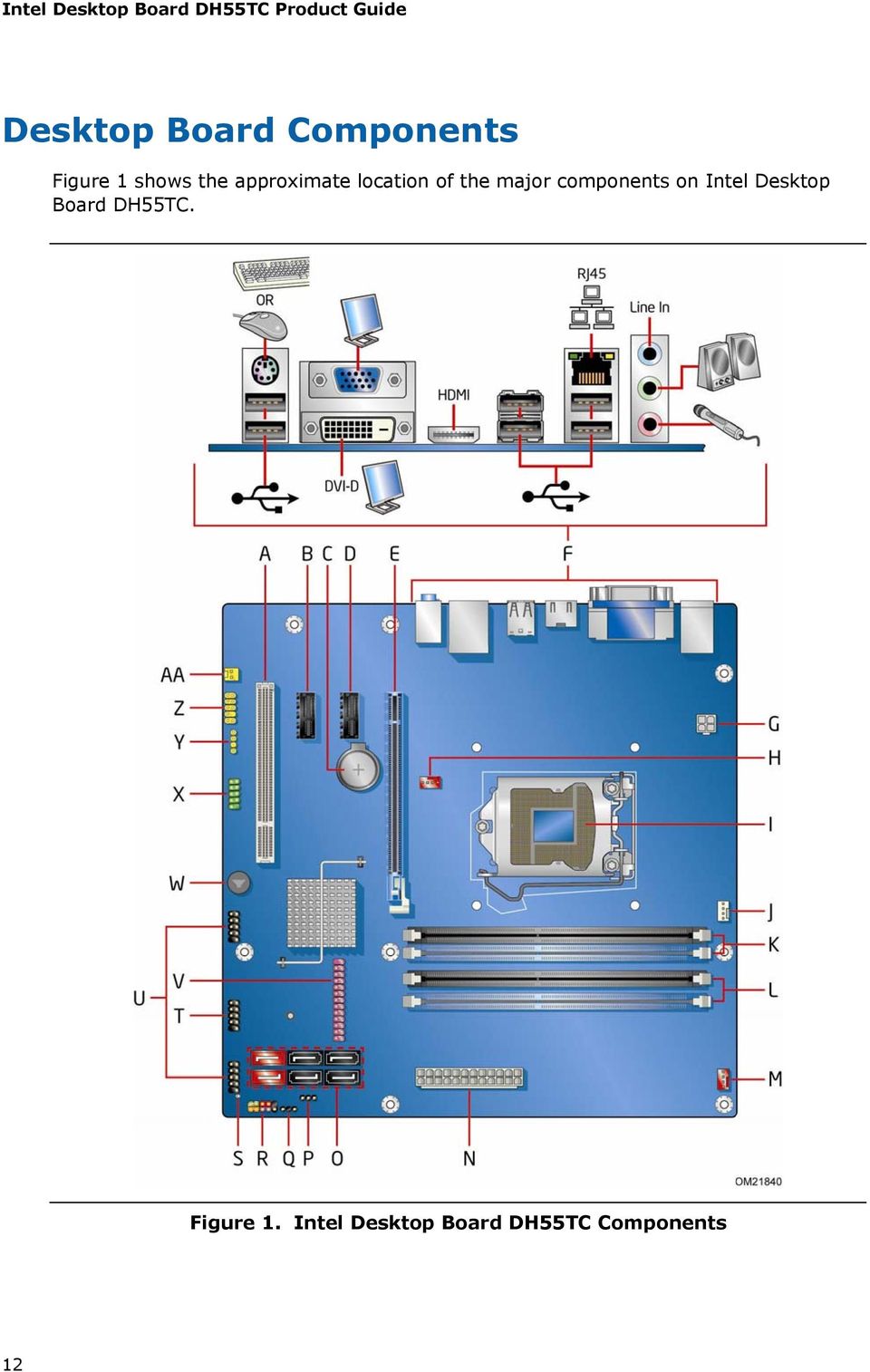
13 Desktop Board Features Table 2. Intel Desktop Board DH55TC Components Label A B C D E F G H I J K L M N Description PCI bus add-in card connector PCI Express 2.0 x1 add-in card connector Battery PCI Express 2.0 x1 add-in card connector PCI Express 2.0 x16 add-in card connector Back panel connectors 12 V processor core voltage connector (2 x 2 pin) Rear chassis fan header Processor socket Processor fan header DDR3 Channel A, DIMM 0 and DIMM 1 sockets DDR3 Channel B, DIMM 0 and DIMM 1 sockets Front chassis fan header Main power connector (2 x 12 pin) O Serial ATA connectors (6) P Q R S T BIOS configuration jumper block Alternate front panel power LED header Front panel header Standby power indicator LED Front panel USB header with support for an Intel Z-U130 USB Solid-State Drive (or compatible device) U Front panel USB 2.0 headers (2) V W X Y Z AA Parallel port header Speaker Serial port header S/PDIF header Front panel audio header Internal mono speaker header 13

14 Intel Desktop Board DH55TC Product Guide Online Support For more information on Intel Desktop Board DH55TC consult the following online resources: Intel Desktop Board DH55TC Desktop Board Support Available configurations for Intel Desktop Board DH55TC Supported processors Chipset information BIOS and driver updates Integration information index.htm op/dh55tc index.htm x.htm Processor CAUTION Failure to use an appropriate power supply and/or not connecting the 12 V (2 x 2 pin) power connector to the Desktop Board may result in damage to the board, or the system may not function properly. Intel Desktop Board DH55TC supports the Intel Core i7, and Intel Core i5, Intel Core i3, and Intel Pentium processors in an LGA1156 socket. Processors are not included with the Desktop Board and must be purchased separately. The processor connects to the Desktop Board through the LGA1156 socket. For information on supported processors for Intel Desktop Board DH55TC, go to Intel H55 Express Chipset The Intel H55 Express Chipset, consisting of the Intel H55 Platform Controller Hub (PCH), provides interfaces to the processor and the USB, SATA, LPC, audio, network, display, PCI, and PCI Express x1 interfaces. The PCH is a centralized controller for the board s I/O paths. 14
15 Desktop Board Features Main Memory NOTE To be fully compliant with all applicable Intel SDRAM memory specifications, the board should be populated with DIMMs that support the Serial Presence Detect (SPD) data structure. If your memory modules do not support SPD, you will see a notification to this effect on the screen at power up. The BIOS will attempt to configure the memory controller for normal operation. The board has four DIMM sockets and supports the following memory features: Two independent memory channels with interleaved mode support Support for non-ecc, unbuffered, single-sided or double-sided DIMMs with x8 organization 16 GB maximum total system memory (with 2 Gb memory technology) Minimum total system memory: 1 GB using 1 Gb x8 module Serial Presence Detect DDR MHz and DDR MHz SDRAM DIMMs NOTE 32-bit operating systems are limited to a maximum of 4 GB of memory. These operating systems will report less than 4 GB because of the memory used by add-in graphics cards and other system resources. NOTE When using a processor without Intel Graphics Technology, memory must be installed in either or both of the DIMM 0 (blue) memory sockets for the system to boot. Graphics Subsystem The board supports either integrated graphics (Intel Graphics Technology) or PCI Express 2.0 x16 graphics. Integrated Graphics The board supports integrated graphics through the Intel Flexible Display Interface (FDI) for processors with Intel Graphics Technology. Analog Display (VGA) The VGA port supports analog displays. The maximum supported resolution is 2048 x 1536 (QXGA) at a 75 Hz refresh rate. The VGA port is enabled for the POST whenever a monitor is attached, regardless of the HDMI and DVI connector status. 15

16 Intel Desktop Board DH55TC Product Guide High-Definition Multimedia Interface* (HDMI*) The HDMI port supports standard, enhanced, or high-definition video, plus multichannel digital audio on a single cable. It is compatible with all ATSC and DVB HDTV standards and supports 8-channel digital audio. The maximum supported resolution is 1920 x 1200 at 60 Hz refresh (WUXGA). The HDMI port is compliant with the HDMI 1.3 specification. The HDMI port is enabled for the POST whenever a monitor is attached, regardless of the VGA and DVI connector status. Digital Visual Interface (DVI-D) The DVI-D port supports digital DVI displays. The maximum supported resolution is 1920 x 1200 at 60 Hz refresh (WUXGA). The DVI-D port is compliant with the DVI 1.0 specification. The DVI-D port is only enabled for POST when there are no monitors attached to the VGA or HDMI connectors. PCI Express* x16 Graphics The Intel Core i7, Intel Core i5, Intel Core i3, and Intel Pentium processors in an LGA1156 socket support discrete add-in graphics cards via the PCI Express 2.0 x16 add-in card connector. The board supports the following PCI Express speeds: PCI Express GEN2 frequency of 2.5 GHz which results in 5.0 Gb/s in each direction (500 MB/s) per lane. The maximum theoretical bandwidth on the interface is 8 GB/s in each direction, simultaneously, when operating in x16 mode. PCI Express GEN1 frequency of 1.25 GHz resulting in 2.5 Gb/s each direction (250 MB/s) per lane. The maximum theoretical bandwidth on the interface is 4 GB/s in each direction, simultaneously, when operating in x16 mode. Audio Subsystem The board supports Intel High Definition Audio through a Realtek ALC888S audio codec as well as through the HDMI interface. The Realtek ALC888S-based audio subsystem provides the following features: Advanced jack sense for the back panel audio connectors that enables the audio codec to recognize the device that is connected to an audio port. The back panel audio connectors are capable of retasking according to the user s definition, or can be automatically switched depending on the recognized device type. Stereo input and output via back panel connectors Headphone and Mic in functions for front panel audio connectors A signal-to-noise (S/N) ratio of 90 db The board provides onboard audio headers and back panel connectors. 16

17 Desktop Board Features The onboard audio headers include the following: Front panel audio (a 2 x 5 pin header that provides headphone and mic in signals for front panel audio connectors) S/PDIF audio header (1 x 4 pin header) Internal mono speaker header (1 x 2 pin header) Front panel headphone output is supported by a separate audio channel pair, allowing multi-streaming audio configurations such as simultaneous 6-channel (5.1) surround sound playback and stereo audio conferencing (through speakers connected to the back panel audio connectors and a headset connected to front panel audio connectors). The onboard internal mono speaker header allows connection to an internal, lowpower speaker for basic system sound capability. The subsystem is capable of driving a target speaker load of 8 Ω at 1 W (rms) or 4 Ω at 1.5 W (rms). The onboard S/PDIF header allows connection to coaxial or optical adapters for digital audio output. The back panel audio connectors (see Figure 24 on page 51) are configurable through the audio device drivers. Audio software and drivers are available from LAN Subsystem The LAN subsystem includes: Intel 82578DC Gigabit (10/100/1000 Mb/s) Ethernet LAN controller RJ-45 LAN connector with integrated status LEDs LAN software and drivers are available at Two LEDs are built into the RJ-45 LAN connector located on the back panel (see Figure 2). These LEDs indicate the status of the LAN as shown in Table 3. Figure 2. LAN Connector LEDs 17

18 Intel Desktop Board DH55TC Product Guide Table 3. LAN Connector LEDs LED LED Color LED State Indicates A (Link/Activity) Green Off LAN link is not established B (Link Speed) On Blinking LAN link is established LAN activity is occurring N/A Off 10 Mb/s data rate Green On 100 Mb/s data rate Yellow On 1000 Mb/s data rate USB 2.0 Support The board supports up to twelve USB 2.0 ports provided by two EHCI host controllers in the PCH that allow the use of EHCI-compatible drivers. The port arrangement is as follows: Six ports via stacked back panel connectors Six front panel ports via three dual-port internal headers; one header supports an Intel Z-U130 USB Solid-State Drive (or compatible device) USB 2.0 support requires both an operating system and drivers that fully support USB 2.0 transfer rates. Serial ATA Support The board provides six internal SATA connectors through the PCH, four for internal storage (black connectors) and two for internal as well as external SATA (esata) storage (red connectors). Expandability Intel Desktop Board DH55TC provides the following expansion capability: One PCI Express 2.0 x16 port Two PCI Express 2.0 x1 ports One PCI bus interface 18

19 Desktop Board Features Legacy I/O The board s Legacy I/O Controller provides the following legacy features: One serial port header One parallel port header with Extended Capabilities Port (ECP) and Enhanced Parallel Port (EPP) support Serial IRQ interface compatible with serialized IRQ support for PCI Conventional bus systems PS/2-style keyboard/mouse interface Intelligent power management, including a programmable wake-up event interface PCI Conventional bus power management support BIOS The BIOS Setup program provides configuration options for the Legacy I/O controller. The BIOS provides the Power-On Self-Test (POST), the BIOS Setup program, and the PCI Express and SATA auto-configuration utilities. The BIOS is stored in the Serial Peripheral Interface (SPI) Flash device. The BIOS can be updated by following the instructions in Chapter 3 starting on page 63. Serial ATA Auto Configuration If you install a Serial ATA device (such as a hard drive) in your computer, the autoconfiguration utility in the BIOS automatically detects and configures the device for your computer. You do not need to run the BIOS Setup program after installing a Serial ATA device. You can override the auto-configuration options by specifying manual configuration in the BIOS Setup program. PCI*/PCI Express Auto Configuration If you install a PCI or PCI Express add-in card in your computer, the PCI/PCI Express auto-configuration utility in the BIOS automatically detects and configures the resources (IRQs, DMA channels, and I/O space) for that add-in card. You do not need to run the BIOS Setup program after you install a PCI or PCI Express add-in card. Security Passwords The BIOS includes security features that restrict whether the BIOS Setup program can be accessed and who can boot the computer. A supervisor password and a user password can be set for the BIOS Setup and for booting the computer, with the following restrictions: The supervisor password gives unrestricted access to view and change all Setup options. If only the supervisor password is set, pressing <Enter> at the password prompt of Setup gives the user restricted access to Setup. 19

20 Intel Desktop Board DH55TC Product Guide If both the supervisor and user passwords are set, you must enter either the supervisor password or the user password to access Setup. Setup options are then available for viewing and changing depending on whether the supervisor or user password was entered. Setting a user password restricts who can boot the computer. The password prompt is displayed before the computer is booted. If only the supervisor password is set, the computer boots without asking for a password. If both passwords are set, you can enter either password to boot the computer. For instructions on resetting the password, go to Clearing Passwords on page 55. Hardware Management The hardware management features of Intel Desktop Board DH55TC enable the board to be compatible with the Wired for Management (WfM) specification. The board has several hardware management features including the following: Fan speed monitoring and control Thermal and voltage monitoring Hardware Monitoring and Fan Speed Control The features of the hardware monitoring and fan speed control include: Intel Quiet System Technology, delivering acoustically-optimized thermal management Thermal sensors in the processor and PCH, as well as near the CPU voltage regulators and system memory Monitoring of system voltages to detect levels above or below acceptable values Thermally monitored closed-loop fan control for all three fans that can adjust fan speed as needed Fan Monitoring Fan monitoring can be observed via the BIOS Setup program, Intel Desktop Utilities, or third-party software. 20

21 Desktop Board Features Power Management Power management is implemented at several levels, including software support through the Advanced Configuration and Power Interface (ACPI) and the following hardware support: Power connectors Fan headers LAN wake capabilities Instantly Available PC technology (Suspend to RAM) +5 V standby power indicator LED Wake from USB PCI Power Management Event signal (PME#) wakeup support PCI Express WAKE# signal support Wake from PS/2 devices Wake from serial port Software Support ACPI ACPI gives the operating system direct control over the power management and Plug and Play functions of a computer. The use of ACPI with the Desktop Board requires an operating system that provides full ACPI support. Hardware Support Power Connectors ATX12V-compliant power supplies can turn off the computer power through system control. When an ACPI-enabled computer receives the correct command, the power supply removes all non-standby voltages. When resuming from an AC power failure, the computer returns to the power state it was in before power was interrupted (either on or off). The computer s response can be set by using the Last Power State feature in the BIOS Setup program s Boot menu. The Desktop Board has two power connectors. See Figure 26 on page 53 for the location of the power connectors. Fan Headers The function/operation of the fans is as follows: The fans are on when the board is in the ACPI S0 or S1 state. The fans are off when the computer is in the ACPI S3, S4, or S5 state. Each fan header is wired to a tachometer input. All fan headers support closed-loop fan control that can adjust the fan speed or switch the fan on or off as needed. 21
22 Intel Desktop Board DH55TC Product Guide All fan headers have a +12 V DC connection (up to 12 V DC when using 3-wire chassis fans. All fan headers are controlled by Pulse Width Modulation. The front and rear chassis fans support Linear Fan Control on 3-wire fans. The Desktop Board has a 4-pin processor fan header and two 4-pin chassis fan headers compatible with 4-wire and 3-wire chassis fans. LAN Wake Capabilities CAUTION For LAN wake capabilities, the 5 V standby line for the power supply must be capable of delivering adequate +5 V standby current. Failure to provide adequate standby current when using this feature can damage the power supply. LAN wakeup capabilities enable remote wake-up of the computer through a network. The LAN subsystem monitors network traffic and upon detecting a Magic Packet* frame, it asserts a wake-up signal that powers up the computer. Instantly Available PC Technology CAUTION For Instantly Available PC technology, the 5 V standby line for the power supply must be capable of delivering adequate +5 V standby current. Failure to provide adequate standby current when using this feature can damage the power supply and/or effect ACPI S3 sleep state functionality. Instantly Available PC technology enables the board to enter the ACPI S3 (Suspend-to- RAM) sleep state. Instantly Available PC technology enables the board to enter the ACPI S3 (Suspend-to-RAM) sleep-state. While in the S3 sleep-state, the computer will appear to be off (the power supply is off and the front panel power LED will behave as configured by the BIOS S3 State Indicator option). When signaled by a wake-up device or event, the system quickly returns to its last known wake state. When signaled by a wake-up device or event, the computer quickly returns to its last known awake state. The Desktop Board supports the PCI Bus Power Management Interface Specification. Add-in cards that support this specification can participate in power management and can be used to wake the computer. The use of Instantly Available PC technology requires operating system support and PCI 2.2 compliant add-in cards, PCI Express add-in cards, and drivers. 22
23 Desktop Board Features +5 V Standby Power Indicator LED CAUTION If the AC power has been switched off and the standby power indicator is still lit, disconnect the power cord before installing or removing any devices connected to the board. Failure to do so could damage the board and any attached devices. The Desktop Board s standby power indicator, shown in Figure 3, is lit when there is standby power still present on the board even when the computer appears to be off. For example, when this green LED is lit, standby power is still present at the memory module sockets and the PCI bus connectors. Figure 3. Location of the Standby Power Indicator For more information on standby current requirements for the Desktop Board, refer to the Technical Product Specification at Wake from USB NOTE Wake from USB requires the use of a USB peripheral that supports Wake from USB and an operating system that supports Wake from USB. USB bus activity wakes the computer from an ACPI S1 or S3 state. PCI PME# Signal Wake-up Support When the PME# signal on the PCI bus is asserted, the computer wakes from an ACPI S1, S3, S4, or S5 state. 23
24 Intel Desktop Board DH55TC Product Guide PCI Express WAKE# Signal Wake-up Support When the WAKE# signal on a PCI Express bus add-in card is asserted, the computer wakes from an ACPI S1, S3, S4, or S5 state. Wake from PS/2 Devices PS/2 device activity can wake the computer from an ACPI S1, S3, S4, or S5 state. When the computer is in the S4 state, any key can be used to wake the computer provided a supported operating system is installed. When the computer is in the S5 state, the only PS/2 activity that will wake the computer is either the Alt-Print Screen key combination or the Power key that is available on some keyboards. The BIOS can be used to select between either of the key combinations. Wake from Serial Port Serial port activity wakes the computer from an ACPI S1 or S3 state. ENERGY STAR*, e-standby, and ErP Compliance The US Department of Energy and the US Environmental Protection Agency have continually revised the ENERGY STAR requirements. Intel has worked directly with these two governmental agencies in the definition of the new requirements. Intel Desktop Board DH55TC meets the following program requirements in an adequate system configuration, including appropriate selection of an efficient power supply: Energy Star v5.0, category A EPEAT Eco-Smart Korea E-Standby European Union ErP For information about ENERGY STAR requirements and recommended configurations, go to Speaker A piezoelectric speaker is mounted on the Desktop Board. The speaker provides audible error code (beep code) information during the Power-On Self-Test (POST). Refer to Appendix A for a description of the board s beep codes. 24
25 Desktop Board Features Real-Time Clock Subsystem A coin-cell battery (CR2032) powers the real-time clock and CMOS memory. When the computer is not plugged into a wall socket, the battery has an estimated life of three years. When the computer is plugged in, the standby current from the power supply extends the life of the battery. The clock is accurate to ± 13 minutes/year at 25 ºC with standby power applied by the power supply. NOTE If the battery and AC power fail, date and time values will be reset and the user will be notified during the POST. When the battery voltage drops below a certain level, the BIOS Setup program settings stored in CMOS RAM (for example, the date and time) might not be accurate. Replace the battery with an equivalent one. Go to page 56 for instructions on how to replace the battery. 25
26 Intel Desktop Board DH55TC Product Guide 26
27 2 Installing and Replacing Desktop Board Components This chapter tells you how to: Install the I/O shield Install and remove the Desktop Board Install and remove a processor Install and remove memory Install and remove a PCI Express x16 card Connect Serial ATA cables Install an Intel Z-U130 USB Solid-State Drive (or Compatible Device) Connect to the internal headers and connectors Connect to the audio system Connect chassis fan and power supply cables Set the BIOS configuration jumper Clear passwords Replace the battery Before You Begin CAUTIONS The procedures in this chapter assume familiarity with the general terminology associated with personal computers and with the safety practices and regulatory compliance required for using and modifying electronic equipment. Disconnect the computer from its power source and from any telecommunications links, networks, or modems before performing any of the procedures described in this chapter. Failure to disconnect power, telecommunications links, networks, or modems before you open the computer or perform any procedures can result in personal injury or equipment damage. Some circuitry on the board can continue to operate even though the front panel power button is off. Follow these guidelines before you begin: Always follow the steps in each procedure in the correct order. Set up a log to record information about your computer, such as model, serial numbers, installed options, and configuration information. Electrostatic discharge (ESD) can damage components. Perform the procedures described in this chapter only at an ESD workstation using an antistatic wrist strap and a conductive foam pad. If such a station is not available, you can provide some ESD protection by wearing an antistatic wrist strap and attaching it to a metal part of the computer chassis. 27
28 Intel Desktop Board DH55TC Product Guide Installation Precautions When you install and test the Intel Desktop Board, observe all warnings and cautions in the installation instructions. To avoid injury, be careful of: Sharp pins on connectors Sharp pins on printed circuit assemblies Rough edges and sharp corners on the chassis Hot components (such as processors, voltage regulators, and heat sinks) Damage to wires that could cause a short circuit Observe all warnings and cautions that instruct you to refer computer servicing to qualified technical personnel. Prevent Power Supply Overload Do not overload the power supply output. To avoid overloading the power supply, make sure that the calculated total current loads of all the modules within the computer is less than the output current rating of each of the power supplies output circuits plus enough headroom for desktop board power consumption. Observe Safety and Regulatory Requirements Read and follow the instructions in this section and the instructions supplied with the chassis and associated modules. If you do not follow these instructions and the instructions provided by the chassis and module suppliers, you increase your safety risk and the possibility of noncompliance with regional laws and regulations. If the instructions for the chassis are inconsistent with these instructions or the instructions for associated modules, contact the supplier to find out how you can ensure that your computer meets safety and regulatory requirements. For information about the Desktop Board s regulatory compliance, refer to Appendix B. 28
29 Installing and Replacing Desktop Board Components Installing the I/O Shield The Desktop Board comes with an I/O shield. When installed in the chassis, the shield blocks radio frequency transmissions, protects internal components from dust and foreign objects, and promotes correct airflow within the chassis. Install the I/O shield before installing the Desktop Board in the chassis. Place the shield inside the chassis as shown in Figure 4. Press the shield into place so that it fits tightly and securely. If the shield does not fit, obtain a properly sized shield from the chassis supplier. Figure 4. Installing the I/O Shield 29
30 Intel Desktop Board DH55TC Product Guide Installing and Removing the Desktop Board CAUTION Only qualified technical personnel should perform this procedure. Disconnect the computer from its power source before performing the procedures described here. Failure to disconnect the power before you open the computer can result in personal injury or equipment damage. Refer to your chassis manual for instructions on installing and removing the Desktop Board. Figure 5 shows the location of the mounting screw holes for Intel Desktop Board DH55TC. Figure 5. Intel Desktop Board DH55TC Mounting Screw Hole Locations 30
31 Installing and Replacing Desktop Board Components Installing and Removing a Processor Instructions on how to install the processor on the Desktop Board are given below. Installing a Processor CAUTION Before installing or removing a processor, make sure the AC power has been removed by unplugging the power cord from the computer; the standby power LED should not be lit (see Figure 3 on page 23). Failure to do so could damage the processor and the board. To install a processor, follow these instructions: 1. Observe the precautions in "Before You Begin" on page Unlatch the socket lever by pushing the lever down and away from the socket (Figure 6, A and B). Figure 6. Unlatch the Socket Lever 31
32 Intel Desktop Board DH55TC Product Guide 3. Rotate the socket lever to lift the load plate away from the socket (Figure 7, A). Make sure that the load plate is in the fully open position (Figure 7, B) while being careful not to damage adjacent components. Figure 7. Lift the Load Plate 32
33 Installing and Replacing Desktop Board Components 4. Remove the protective socket cover from the socket by placing your thumb against the front edge of the cover and resting your index finger on the rear grip (Figure 8, A). Lift the front edge of the socket to disengage the cover from the socket and lift the cover up and away from the socket (Figure 8, B). Do not touch the socket contacts. NOTE Do not discard the socket cover; save it for possible future use. Always replace the socket cover if you remove the processor from the socket. Figure 8. Remove the Socket Cover 33
34 Intel Desktop Board DH55TC Product Guide 5. Remove the processor from its protective cover. Hold the processor only at the edges, being careful not to touch the bottom of the processor (see Figure 9). NOTE Do not discard the processor cover. Always replace the processor cover if you remove the processor from the socket. Figure 9. Remove the Processor from the Protective Cover 6. Hold the processor with your thumb and index finger oriented as shown in Figure 10 to align your fingers with the socket finger cutouts. Make sure that the processor Pin 1 indicator (gold triangle) is aligned with the Pin 1 chamfer on the socket (Figure 10, B) and that the notches on the processor align with the posts on the socket (Figure 10, C). Lower the processor straight down without tilting or sliding it in the socket (Figure 10, A). Figure 10. Install the Processor 34
35 Installing and Replacing Desktop Board Components 7. Lower the load plate over the processor while leaving the socket lever in the open position (Figure 11). Figure 11. Lower the Load Plate 8. Lower the socket lever (Figure 12, B) while making sure that the front edge of the load plate slides under the shoulder screw cap as the lever is lowered (Figure 12, A). Latch the socket lever under the load plate tab (Figure 12, C, D). Figure 12. Secure the Load Plate in Place 35
36 Intel Desktop Board DH55TC Product Guide Installing a Processor Fan Heat Sink Intel Desktop Board DH55TC has mounting holes for a processor fan heat sink. For instructions on how to attach the processor fan heat sink to the Desktop Board, refer to the boxed processor manual or boxed thermal solution manual. Connecting the Processor Fan Heat Sink Cable Connect the processor fan heat sink power cable to the 4-pin processor fan header (see Figure 13). A fan with a 4-pin connector as shown in Figure 13 is recommended. Figure 13. Connecting the Processor Fan Heat Sink Power Cable to the Processor Fan Header Removing the Processor For instructions on how to remove the processor fan heat sink and processor, refer to the processor installation manual. 36
37 Installing and Replacing Desktop Board Components Installing and Removing System Memory Desktop board DH55TC has four 240-pin DDR3 DIMM sockets arranged as DIMM 0 and DIMM 1 in both Channel A and Channel B. NOTE A DIMM must be present in at least one of the DIMM 0 sockets when you are using only one or two DIMMs with a processor that does not support Intel Graphics Technology. Guidelines for Dual Channel Memory Configuration Before installing DIMMs, read and follow these guidelines for dual channel memory configuration. Two or Four DIMMs Install a matched pair of DIMMs equal in speed and size (see Figure 14) in the DIMM 0 (blue) sockets of channels A and B. Figure 14. Example Dual Channel Memory Configuration with Two DIMMs 37
38 Intel Desktop Board DH55TC Product Guide If additional memory is to be used, install another matched pair of DIMMs in the DIMM 1 (black) sockets of channels A and B (see Figure 15). Figure 15. Example Dual Channel Memory Configuration with Four DIMMs Three DIMMs If you want to use three DIMMs in a dual-channel configuration, install a matched pair of DIMMs equal in speed and size in the DIMM 0 (blue) socket of channel A and the DIMM 0 (blue) socket of channel B. Install the third DIMM in the DIMM 1 (black) socket of either channel A or channel B (see Figure 16). Figure 16. Example Dual Channel Memory Configuration with Three DIMMs NOTE All other memory configurations will result in single channel memory operation. 38
39 Installing and Replacing Desktop Board Components Installing DIMMs To make sure you have the correct DIMM, place it on the illustration of the DDR3 DIMM in Figure 17. All the notches should match with the DDR3 DIMM. Figure 17. Use DDR3 DIMMs 39
40 Intel Desktop Board DH55TC Product Guide To install a DIMM, follow these steps: 1. Observe the precautions in "Before You Begin" on page Turn off all peripheral devices connected to the computer. Turn off the computer and disconnect the AC power cord. 3. Remove the computer s cover and locate the DIMM sockets (see Figure 18). 4. If a full length PCI Express graphics card is installed in the PCI Express x16 connector, remove the card to gain full access to the DIMM sockets. Figure 18. Installing a DIMM 5. Make sure the clips at either end of the DIMM socket(s) are pushed outward to the open position. 6. Holding the DIMM by the edges, remove it from its anti-static package. 7. Position the DIMM above the socket. Align the small notch at the bottom edge of the DIMM with the keys in the socket (see inset in Figure 18). 8. Insert the bottom edge of the DIMM into the socket. 9. When the DIMM is inserted, push down on the top edge of the DIMM until the retaining clips snap into place. Make sure the clips are firmly in place. 10. Reinstall the PCI Express graphics card if one was removed in Step Replace the computer s cover and reconnect the AC power cord. 40
41 Installing and Replacing Desktop Board Components Removing DIMMs To remove a DIMM, follow these steps: 1. Observe the precautions in "Before You Begin" on page Turn off all peripheral devices connected to the computer. Turn off the computer. 3. Remove the AC power cord from the computer. 4. Remove the computer s cover. 5. If a full length PCI Express graphics card is installed in the PCI Express x16 connector, remove the card to gain access to the DIMMs. 6. Gently spread the retaining clips at each end of the DIMM socket. The DIMM pops out of the socket. 7. Hold the DIMM by the edges, lift it away from the socket, and store it in an anti-static package. 8. Reinstall the PCI Express graphics card if one was removed in Step 5 and reconnect any other parts you removed or disconnected to reach the DIMMs. 9. Replace the computer s cover and reconnect the AC power cord. Installing and Removing PCI Express x16 Graphics Cards Installing a PCI Express x16 Graphics Card CAUTION Before installing a PCI Express x16 graphics card, make sure that the tabs on the DIMM sockets are in the upright position (closed); otherwise, they may be damaged by the PCI Express card during installation. CAUTION When installing a PCI Express card, ensure that the card is fully seated in the PCI Express connector before you power on the system. If the card is not fully seated in the connector, an electrical short may result across the connector pins. Depending on the over-current protection of the power supply, certain Desktop Board components and/or traces may be damaged. Follow these instructions to install a PCI Express x16 graphics card: 1. Observe the precautions in "Before You Begin" on page Place the card in the PCI Express x16 connector (Figure 19, A) and press down on the card until it is completely seated in the connector and the card retention notch on the card snaps into place around the retention mechanism pin on the connector. 3. Secure the card s metal bracket to the chassis back panel with a screw (Figure 19, B). 41
42 Intel Desktop Board DH55TC Product Guide 4. Connect a monitor to the graphics card according to the manufacturer s instructions. Figure 19. Installing a PCI Express x16 Graphics Card Removing a PCI Express x16 Graphics Card Follow these instructions to remove a PCI Express x16 graphics card from a connector: 1. Observe the precautions in "Before You Begin" on page Disconnect the monitor cable from the graphics card back panel connector. 3. Remove the screw (Figure 20, A) that secures the card s metal bracket to the chassis back panel. 4. Push the card ejector lever down using the tip of a pencil or similar tool (Figure 20, B) in the notch. This will release the card from the connector (C). 5. Pull the card straight up to remove it. 42
43 Installing and Replacing Desktop Board Components Figure 20. Removing a PCI Express x16 Graphics Card 43
44 Intel Desktop Board DH55TC Product Guide Connecting Serial ATA (SATA) Cables SATA cables support the Serial ATA protocol. Each cable can be used to connect one internal SATA drive to the Desktop Board. For correct cable function: 1. Observe the precautions in Before You Begin on page Attach one end of the SATA cable to one of the SATA connectors on the board (Figure 21, A) and attach the other end of the cable to the SATA drive (Figure 21, B). Figure 21. Connecting a Serial ATA Cable 44
45 Installing and Replacing Desktop Board Components Installing an Intel Z-U130 USB Solid-State Drive (or Compatible Device) An Intel Z-U130 USB Solid-State Drive (or compatible device) can be installed on the Desktop Board by using the onboard USB 2.0 header indicated in Figure 1, T. This header provides support for the solid state drive. To install an Intel Z-U130 USB Solid-State Drive (or compatible device) on the Desktop Board, follow these steps: 1. Observe the precautions in "Before You Begin" on page Align the connector (Figure 22, A) on the bottom of the solid state drive with the USB 2.0 header on the Desktop Board. The connectors are keyed and will mate correctly when the solid state drive is oriented as shown in Figure Secure the solid state drive to the Desktop Board with the screw (Figure 22, B) included with the board. Figure 22. Installing an Intel Z-U130 USB Solid-State Drive (or Compatible Device) If not used with an Intel Z-U130 USB Solid-State Drive (or Compatible Device), this USB header can be used as an additional dual-port front panel USB header. 45
46 Intel Desktop Board DH55TC Product Guide Connecting to the Internal Headers Before connecting cables to any of the internal headers, observe the precautions in Before You Begin on page 27. Figure 23 shows the location of the internal headers and connectors on Intel Desktop Board DH55TC. Figure 23. Internal Headers 46
47 Installing and Replacing Desktop Board Components Front Panel Audio Header The front panel audio header shown in Figure 23, A supports both Intel High Definition (HD) Audio and AC 97 Audio. Table 4 shows the pin assignments and signal names for HD Audio and Table 5 shows the pin assignments and signal names for AC 97 Audio. Table 4. Front Panel Audio Signal Names for Intel HD Audio Pin Signal Name Pin Signal Name 1 PORT 1L (Microphone) 2 GND 3 PORT 1R (Microphone) 4 PRESENCE# 5 PORT 2R (Headphone) 6 SENSE1_RETURN 7 SENSE_SEND 8 KEY (no pin) 9 PORT 2L (Headphone) 10 SENSE2_RETURN Table 5. Front Panel Audio Header Signal Names for AC 97 Audio Pin Signal Name Pin Signal Name 1 MIC 2 AUD_GND 3 MIC_BIAS 4 AUD_GND 5 FP_OUT_R 6 FP_RETURN_R 7 AUD_5V 8 KEY (no pin) 9 FP_OUT_L 10 FP_RETURN_L Internal Mono Speaker Header The internal mono speaker header is shown in Figure 23, B. Table 6 shows the pin assignments and signal names for the internal mono speaker header. Table 6. Internal Mono Speaker Header Pin Signal Name 47
48 Intel Desktop Board DH55TC Product Guide S/PDIF Header Figure 23, C shows the location of the S/PDIF output header. Table 7 shows the pin assignments and signal names for the S/PDIF output header. Table 7. S/PDIF Header Signal Names Pin Description 1 Ground 2 S/PDIF Out 3 Key (no pin) 4 +5 VDC Parallel Port Header Figure 23, D shows the location of the parallel port header. Table 8 shows the pin assignments and signal names for the parallel port header. Table 8. Parallel Port Header Pin Standard Signal Name ECP Signal Name EPP Signal Name 1 STROBE# STROBE# WRITE# 2 AUTOFD# AUTOFD#, HOSACK DATASTB# 3 PD0 PD0 PD0 4 FAULT# FAULT#, PERIPHREQST# FAULT# 5 PD1 PD1 PD1 6 INT# INT#, REVERSERQST# RESET# 7 PD2 PD2 PD2 8 SLCTIN# SLCTIN# ADDRSTB# 9 PD3 PD3 PD3 10 GROUND GROUND GROUND 11 PD4 PD4 PD4 12 GROUND GROUND GROUND 13 PD5 PD5 PD5 14 GROUND GROUND GROUND 15 PD6 PD6 PD6 16 GROUND GROUND GROUND 17 PD7 PD7 PD7 18 GROUND GROUND GROUND 19 ACK# ACK# INTR 20 GROUND GROUND GROUND 21 BUSY BUSY#, PERIPHACK WAIT# 22 GROUND GROUND GROUND 48
49 Installing and Replacing Desktop Board Components Pin Standard Signal Name ECP Signal Name EPP Signal Name 23 PERROR PE, ACKREVERSE# PE 24 GROUND GROUND GROUND 25 SELECT SELECT SELECT 26 KEY (no pin) KEY (no pin) KEY (no pin) Alternate Front Panel Power LED Header Figure 23, E shows the location of the alternate front panel power LED header. Pins 1 and 3 of this header duplicate the signals on pins 2 and 4 of the front panel header. If your chassis has a three-pin power LED cable, connect it to this header. Table 9 shows the pin assignments for the alternate front panel header. Table 9. Alternate Front Panel Power LED Header Signal Names Pin Signal Name In/Out 1 Front panel LED+ Out 2 No pin 3 Front panel LED- Out Front Panel Header Figure 23, F shows the location of the front panel header. Table 10 shows the pin assignments and signal names for the front panel header. Table 10. Front Panel Header Signal Names Pin Description In/Out Pin Description In/Out Hard Drive Activity LED Power LED 1 Hard disk LED pull-up to +5 V Out 2 Front panel LED+ Out 3 Hard disk active LED Out 4 Front panel LED- Out Reset Switch On/Off Switch 5 Ground 6 Power switch In 7 Reset switch In 8 Ground Power 9 Power Out 10 No pin Not Connected NOTE When connecting individual wires from your chassis front panel to the front panel header, be sure to observe the connection polarity. Positive wires are usually solid color and negative wires are usually white or striped. 49
50 Intel Desktop Board DH55TC Product Guide Front Panel USB 2.0 Headers Figure 23, G shows the location of the front panel USB 2.0 header (with Intel Z-U130 USB Solid-State Drive (or Compatible Device) Support) and Table 12 shows its pin assignments and signal names. Table 11. Front Panel USB Header (with Intel Z-U130 USB Solid-State Drive (or Compatible Device) Support) Signal Names Pin Signal Name Pin Signal Name 1 +5 VDC 2 +5 VDC 3 D- 4 D- 5 D+ 6 D+ 7 Ground 8 Ground 9 KEY (no pin) 10 LED# Figure 23, H shows the location of the standard front panel USB 2.0 header and Table 12 shows its pin assignments and signal names. Table 12. USB 2.0 Header Signal Names Pin Signal Name Pin Signal Name 1 Power (+5 V) 2 Power (+5 V) 3 D- 4 D- 5 D+ 6 D+ 7 Ground 8 Ground 9 Key 10 No Connection NOTE Computer systems that have an unshielded cable attached to a USB port might not meet FCC Class B requirements, even if no device or a low-speed USB device is attached to the cable. Use a shielded cable that meets the requirements for a full-speed USB device. 50
51 Installing and Replacing Desktop Board Components Serial Header Figure 23, I shows the location of the serial header. Table 13 shows the pin assignments and signal names for the serial header. Table 13. Serial Port Header Pin Signal Name Pin Signal Name 1 DCD (Data Carrier Detect) 2 RXD# (Receive Data) 3 TXD# (Transmit Data) 4 DTR (Data Terminal Ready) 5 Ground 6 DSR (Data Set Ready) 7 RTS (Request To Send) 8 CTS (Clear To Send) 9 RI (Ring Indicator) 10 Key (no pin) Connecting to the Audio System After installing the Realtek audio driver from the Intel Express Installer DVD-ROM, the multi-channel audio feature can be enabled. Figure 24 shows the back panel audio connectors. The default connector assignments are shown in the table. Item A B C Description Line in Line out (front speaker/headphones) Mic in Figure 24. Back Panel Audio Connectors NOTE The back panel line out connector is designed to power either headphones or amplified speakers only. Poor audio quality may occur if passive (non-amplified) speakers are connected to this output. 51
52 Intel Desktop Board DH55TC Product Guide Connecting Chassis Fan and Power Supply Cables Connecting Chassis Fan Cables Connect chassis fan cables to the chassis fan headers on the Desktop Board. Figure 25 shows the location of the chassis fan headers. Figure 25. Location of the Chassis Fan Headers 52
53 Installing and Replacing Desktop Board Components Connecting Power Supply Cables CAUTION Failure to use an appropriate power supply and/or not connecting the 12 V power connector (Figure 26, A) to the Desktop Board may result in damage to the board or the system may not function properly. Figure 26 shows the location of the power connectors. The 2 x 12 pin main power connector (Figure 26, B) is backwards compatible with ATX12V power supplies with 2 x 10 connectors. NOTE If your power supply has a 2 x 10 main power connector, it is recommended that you do not install a PCI Express x16 graphics card unless it has a direct connection to the power supply. Figure 26. Connecting Power Supply Cables 1. Observe the precautions in "Before You Begin" on page Connect the 12 V processor core voltage power supply cable to the 2 x 2 pin connector (Figure 26, A). 3. Connect the main power supply cable to the 2 x 12 pin connector (Figure 26, B). 53
54 Intel Desktop Board DH55TC Product Guide Setting the BIOS Configuration Jumper NOTE Always turn off the power and unplug the power cord from the computer before moving the jumper. Moving the jumper with the power on may result in unreliable computer operation. Figure 27 shows the location of the Desktop Board s BIOS configuration jumper block. Figure 27. Location of the BIOS Configuration Jumper Block 54
55 Installing and Replacing Desktop Board Components The three-pin BIOS jumper block enables board configuration to be done in the BIOS Setup program. Table 14 shows the jumper settings for the BIOS Setup program modes. Table 14. Jumper Settings for the BIOS Setup Program Modes Jumper Setting Mode Description Normal (default) (1-2) The BIOS uses the current configuration and passwords for booting. Configure (2-3) After the Power-On Self-Test (POST) runs, the BIOS displays the Maintenance Menu. Use this menu to clear passwords. Recovery (None) The BIOS recovers data in the event of a failed BIOS update. Clearing Passwords This procedure assumes that the board is installed in the computer and the configuration jumper block is set to normal mode. 1. Observe the precautions in "Before You Begin" on page Turn off all peripheral devices connected to the computer. Turn off the computer. Disconnect the computer s power cord from the AC power source (wall outlet or power adapter). 3. Remove the computer cover. 4. Find the configuration jumper block (see Figure 27). 5. Place the jumper on pins 2-3 as shown below. 6. Replace the cover, plug in the computer, turn on the computer, and allow it to boot. 7. The computer starts the Setup program. Setup displays the Maintenance menu. 55
56 Intel Desktop Board DH55TC Product Guide 8. Use the arrow keys to select Clear Passwords. Press <Enter> and Setup displays a pop-up screen requesting that you confirm clearing the password. Select Yes and press <Enter>. Setup displays the maintenance menu again. 9. Press <F10> to save the current values and exit Setup. 10. Turn off the computer. Disconnect the computer s power cord from the AC power source. 11. Remove the computer cover. 12. To restore normal operation, place the jumper on pins 1-2 as shown below. 13. Replace the cover, plug in the computer, and turn on the computer. Replacing the Battery A coin-cell battery (CR2032) powers the real-time clock and CMOS memory. When the computer is not plugged into a wall socket, the battery has an estimated life of three years. When the computer is plugged in, the standby current from the power supply extends the life of the battery. The clock is accurate to ± 13 minutes/year at 25 ºC with 3.3 VSB applied. When the voltage drops below a certain level, the BIOS Setup program settings stored in CMOS RAM (for example, the date and time) might not be accurate. Replace the battery with an equivalent one. Figure 28 on page 61 shows the location of the battery. CAUTION Risk of explosion if the battery is replaced with an incorrect type. Batteries should be recycled where possible. Disposal of used batteries must be in accordance with local environmental regulations. PRÉCAUTION Risque d'explosion si la pile usagée est remplacée par une pile de type incorrect. Les piles usagées doivent être recyclées dans la mesure du possible. La mise au rebut des piles usagées doit respecter les réglementations locales en vigueur en matière de protection de l'environnement. FORHOLDSREGEL Eksplosionsfare, hvis batteriet erstattes med et batteri af en forkert type. Batterier bør om muligt genbruges. Bortskaffelse af brugte batterier bør foregå i overensstemmelse med gældende miljølovgivning. 56
57 Installing and Replacing Desktop Board Components OBS! Det kan oppstå eksplosjonsfare hvis batteriet skiftes ut med feil type. Brukte batterier bør kastes i henhold til gjeldende miljølovgivning. VIKTIGT! Risk för explosion om batteriet ersätts med felaktig batterityp. Batterier ska kasseras enligt de lokala miljövårdsbestämmelserna. VARO Räjähdysvaara, jos pariston tyyppi on väärä. Paristot on kierrätettävä, jos se on mahdollista. Käytetyt paristot on hävitettävä paikallisten ympäristömääräysten mukaisesti. VORSICHT Bei falschem Einsetzen einer neuen Batterie besteht Explosionsgefahr. Die Batterie darf nur durch denselben oder einen entsprechenden, vom Hersteller empfohlenen Batterietyp ersetzt werden. Entsorgen Sie verbrauchte Batterien den Anweisungen des Herstellers entsprechend. AVVERTIMENTO Esiste il pericolo di un esplosione se la pila non viene sostituita in modo corretto. Utilizzare solo pile uguali o di tipo equivalente a quelle consigliate dal produttore. Per disfarsi delle pile usate, seguire le istruzioni del produttore. PRECAUCIÓN Existe peligro de explosión si la pila no se cambia de forma adecuada. Utilice solamente pilas iguales o del mismo tipo que las recomendadas por el fabricante del equipo. Para deshacerse de las pilas usadas, siga igualmente las instrucciones del fabricante. WAARSCHUWING Er bestaat ontploffingsgevaar als de batterij wordt vervangen door een onjuist type batterij. Batterijen moeten zoveel mogelijk worden gerecycled. Houd u bij het weggooien van gebruikte batterijen aan de plaatselijke milieuwetgeving. ATENÇÃO Haverá risco de explosão se a bateria for substituída por um tipo de bateria incorreto. As baterias devem ser recicladas nos locais apropriados. A eliminação de baterias usadas deve ser feita de acordo com as regulamentações ambientais da região. 57
58 Intel Desktop Board DH55TC Product Guide AŚCIAROŽZNAŚĆ Існуе рызыка выбуху, калі заменены акумулятар неправільнага тыпу. Акумулятары павінны, па магчымасці, перепрацоўвацца. Пазбаўляцца ад старых акумулятараў патрэбна згодна з мясцовым заканадаўствам па экалогіі. UPOZORNÌNÍ V případě výměny baterie za nesprávný druh může dojít k výbuchu. Je-li to možné, baterie by měly být recyklovány. Baterie je třeba zlikvidovat v souladu s místními předpisy o životním prostředí. Προσοχή Υπάρχει κίνδυνος για έκρηξη σε περίπτωση που η μπαταρία αντικατασταθεί από μία λανθασμένου τύπου. Οι μπαταρίες θα πρέπει να ανακυκλώνονται όταν κάτι τέτοιο είναι δυνατό. Η απόρριψη των χρησιμοποιημένων μπαταριών πρέπει να γίνεται σύμφωνα με τους κατά τόπο περιβαλλοντικούς κανονισμούς. VIGYÁZAT Ha a telepet nem a megfelelő típusú telepre cseréli, az felrobbanhat. A telepeket lehetőség szerint újra kell hasznosítani. A használt telepeket a helyi környezetvédelmi előírásoknak megfelelően kell kiselejtezni. AWAS Risiko letupan wujud jika bateri digantikan dengan jenis yang tidak betul. Bateri sepatutnya dikitar semula jika boleh. Pelupusan bateri terpakai mestilah mematuhi peraturan alam sekitar tempatan. OSTRZEŻENIE Istnieje niebezpieczeństwo wybuchu w przypadku zastosowania niewłaściwego typu baterii. Zużyte baterie należy w miarę możliwości utylizować zgodnie z odpowiednimi przepisami ochrony środowiska. PRECAUŢIE Risc de explozie, dacă bateria este înlocuită cu un tip de baterie necorespunzător. Bateriile trebuie reciclate, dacă este posibil. Depozitarea bateriilor uzate trebuie să respecte reglementările locale privind protecţia mediului. 58
59 Installing and Replacing Desktop Board Components ВНИМАНИЕ При использовании батареи несоответствующего типа существует риск ее взрыва. Батареи должны быть утилизированы по возможности. Утилизация батарей должна проводится по правилам, соответствующим местным требованиям. UPOZORNENIE Ak batériu vymeníte za nesprávny typ, hrozí nebezpečenstvo jej výbuchu. Batérie by sa mali podľa možnosti vždy recyklovať. Likvidácia použitých batérií sa musí vykonávať v súlade s miestnymi predpismi na ochranu životného prostredia. POZOR Zamenjava baterije z baterijo drugačnega tipa lahko povzroči eksplozijo. Če je mogoče, baterije reciklirajte. Rabljene baterije zavrzite v skladu z lokalnimi okoljevarstvenimi predpisi.. UYARI Yanlış türde pil takıldığında patlama riski vardır. Piller mümkün olduğunda geri dönüştürülmelidir. Kullanılmış piller, yerel çevre yasalarına uygun olarak atılmalıdır. OСТОРОГА Використовуйте батареї правильного типу, інакше існуватиме ризик вибуху. Якщо можливо, використані батареї слід утилізувати. Утилізація використаних батарей має бути виконана згідно місцевих норм, що регулюють охорону довкілля. 59
60 Intel Desktop Board DH55TC Product Guide 60
61 Installing and Replacing Desktop Board Components To replace the battery, follow these steps: 1. Observe the precautions in "Before You Begin" (see page 27). 2. Turn off all peripheral devices connected to the computer. Disconnect the computer s power cord from the AC power source (wall outlet or power adapter). 3. Remove the computer cover. 4. Locate the battery on the board (see Figure 28). 5. With a medium flat-bladed screwdriver, gently pry the battery free from its connector. Note the orientation of the + and - on the battery. 6. Install the new battery in the connector, orienting the + and - correctly. 7. Replace the computer cover. Figure 28. Removing the Battery 61
62 Intel Desktop Board DH55TC Product Guide 62
63 3 Updating the BIOS The BIOS Setup program can be used to view and change the BIOS settings for the computer. You can access the BIOS Setup program by pressing the <F2> key after the Power-On Self-Test (POST) memory test begins and before the operating system boot begins. This chapter tells you how to update the BIOS by either using the Intel Express BIOS Update utility or the Iflash Memory Update utility, and how to recover the BIOS if an update fails. Updating the BIOS with the Intel Express BIOS Update Utility With the Intel Express BIOS Update utility you can update the system BIOS while in the Windows environment. The BIOS file is included in an automated update utility that combines the functionality of the Intel Flash Memory Update Utility and the ease of use of Windows-based installation wizards. To update the BIOS with the Intel Express BIOS Update utility: 1. Go to the Intel World Wide Web site: 2. Navigate to the DH55TC page, click Latest BIOS and driver updates, select BIOS Update [TCIBX10H.86A], and download the Express BIOS Update utility file. 3. Download the file to your hard drive. (You can also save this file to a removable USB device. This is useful if you are updating the BIOS for multiple identical systems.) 4. Close all other applications. This step is required. Your system will be rebooted at the last Express BIOS Update window. 5. Double-click the executable file from the location on your hard drive where it was saved. This runs the update program. 6. Follow the instructions provided in the dialog boxes to complete the BIOS update. 63
64 Intel Desktop Board DH55TC Product Guide Updating the BIOS with the ISO Image BIOS Update File or the Iflash Memory Update Utility You can use the information in this section to update the BIOS using either the Iflash Memory Update Utility or the ISO Image BIOS update file. Obtaining the BIOS Update File You can update to a new version of the BIOS by using the ISO Image BIOS update file (recommended), or Iflash BIOS update file. The ISO Image BIOS update file is a standardized image of a bootable CD-ROM that can be used to create a bootable CD that will update the BIOS. The Iflash BIOS update file is a compressed file that contains the files you need to update the BIOS. The Iflash BIOS update file contains: New BIOS file (including the Intel Management Engine Firmware Image) Intel Integrator Toolkit Configuration File (optional) Intel Flash Memory Update Utility You can obtain either of these files through your computer supplier or by navigating to the Intel Desktop Board DH55TC page on the Intel World Wide Web site at: Navigate to the DH55TC page, click Latest BIOS and driver updates, select BIOS Update [TCIBX10H.86A], and download the ISO Image BIOS Update or Iflash BIOS Update utility file. Updating the BIOS with the ISO Image BIOS Update File The ISO Image BIOS update allows for the update of an Intel Desktop Board BIOS to the latest production release regardless of the operating system installed on the computer's hard drive and without the need to remove the BIOS configuration jumper. It requires a blank CD-R, a read/writeable CD drive, and software capable of uncompressing and writing the ISO image file to CD. The image is bootable and automatically launches a script to update the BIOS via the Iflash utility. 64
65 Updating the BIOS CAUTION Do not interrupt the process or the system may not function properly. Follow these instructions to upgrade the BIOS using the ISO Image BIOS file: 1. Download the ISO Image BIOS file. 2. Using software capable of writing an ISO image file to CD, burn the data to a blank CD. NOTE Copying the ISO Image BIOS file to CD will not work. The completed CD should contain multiple files and a directory. 3. Insert the CD that was created in the CD-ROM drive of the computer to be upgraded and boot the system. 4. When the "Press ENTER to continue booting from CD-ROM" prompt appears, press the Enter key. The system will boot from the hard drive if no key is pressed within 15 seconds. 5. At the "Welcome to the Intel Desktop Board BIOS Upgrade CD-ROM" page, press any key to confirm the BIOS upgrade operation. 6. Wait for the BIOS upgrade process to complete. CAUTION DO NOT POWER DOWN YOUR COMPUTER before the update is complete. The update may take up to 5 minutes. Updating the BIOS with the Iflash Memory Update Utility With the Iflash Memory update utility you can update the system BIOS from a bootable CD-ROM, bootable USB flash drive, or other bootable USB media. The utility available on the Intel World Wide Web site provides a simple method for creating a bootable CD-ROM that will automatically update your BIOS. The Iflash BIOS update files can also be extracted locally to your hard drive and copied to a bootable USB flash drive or other bootable USB media. The Iflash Memory update utility allows you to update the BIOS and Intel Management Engine in flash memory NOTE Review the instructions distributed with the update utility before attempting a BIOS update. 65
66 Intel Desktop Board DH55TC Product Guide CAUTION Do not interrupt the process or the system may not function properly. 1. Uncompress the BIOS update file and copy the.bio file, IFLASH.EXE, and.itk file (optional) to a bootable USB flash drive or other bootable USB media. 2. Configure the BIOS or use the F10 option during POST to boot to the USB device. 3. Manually run the IFLASH.EXE file from the USB device and manually update the BIOS. Recovering the BIOS It is unlikely that anything will interrupt the BIOS update; however, if an interruption occurs, the BIOS could be damaged. Due to BIOS size and recovery requirements, a CD-R with the.bio file in the root directory will be required. For more information about updating the Intel Desktop Board BIOS or recovering from a BIOS update failure, go to 66
67 A Error Messages and Indicators Intel Desktop Board DH55TC reports POST errors in two ways: By sounding a beep code and blinking the front panel power LED By displaying an error message on the monitor BIOS Error Codes Whenever a recoverable error occurs during POST, the BIOS causes the board s speaker to beep and the front panel power LED to blink an error message indicating the problem (see Table 15). Table 15. BIOS Beep Codes Type Pattern Frequency/Comments F2 Setup/F10 Boot One 0.5 second beep when the BIOS is 932 Hz Menu Prompt ready to accept keyboard input BIOS update in progress None Video error (no addin graphics card installed) Memory error Thermal trip warning On-off (1.0 second each) two times, then a 2.5-second pause (off), the entire pattern repeats (beeps and pause) once and the BIOS will continue to boot. On-off (1.0 second each) three times, then a 2.5-second pause (off), the entire pattern repeats (beeps and pause) until the system is powered off. Alternate high and low beeps (1.0 second each) for eight beeps followed by system shut down. 932 Hz For processors requiring an add-in graphics card 932 Hz High beep 2000 Hz Low beep 1500 Hz 67
68 Intel Desktop Board DH55TC Product Guide Table 16. Front-panel Power LED Blink Codes Type Pattern Note F2 Setup/F10 Boot None Menu Prompt BIOS update in progress Video error (no addin graphics card installed) Memory error Thermal trip warning Off when the update begins, then on for 0.5 seconds, then off for 0.5 seconds. The pattern repeats until the BIOS update is complete. On-off (1.0 second each) two times, then a 2.5-second pause (off), the entire pattern repeats (blink and pause) until the system is powered off. On-off (1.0 second each) three times, then a 2.5-second pause (off), the entire pattern repeats (blinks and pause) until the system is powered off. Each beep will be accompanied by the following blink pattern:.25 seconds on,.25 seconds off,.25 seconds on,.25 seconds off. This results in a total of 16 blinks. For processors requiring an add-in graphics card BIOS Error Messages When a recoverable error occurs during the POST, the BIOS displays an error message describing the problem. Table 17 gives an explanation of the BIOS error messages. Table 17. BIOS Error Messages Error Message CMOS Battery Low CMOS Checksum Bad Memory Size Decreased No Boot Device Available Explanation The battery may be losing power. Replace the battery soon. The CMOS checksum is incorrect. CMOS memory may have been corrupted. Run Setup to reset values. Memory size has decreased since the last boot. If no memory was removed, then memory may be bad. System did not find a device to boot. 68
69 B Regulatory Compliance This appendix contains the following regulatory compliance information for Intel Desktop Board DH55TC: Safety standards European Union Declaration of Conformity statement Product Ecology statements Electromagnetic Compatibility (EMC) regulations Product certifications Safety Standards Intel Desktop Board DH55TC complies with the safety standards stated in Table 18 when correctly installed in a compatible host system. Table 18. Safety Standards Regulation CSA/UL , First Edition EN :2006, Second Edition IEC :2005, Second Edition Title Information Technology Equipment Safety - Part 1: General Requirements (USA and Canada) Information Technology Equipment Safety - Part 1: General Requirements (European Union) Information Technology Equipment Safety - Part 1: General Requirements (International) Place Battery Marking There is insufficient space on this Desktop Board to provide instructions for replacing and disposing of the Lithium ion coin cell battery. For system safety certification, the statement below or an equivalent statement is required to be permanently and legibly marked on the chassis near the battery. CAUTION Risk of explosion if the battery is replaced with an incorrect type. Batteries should be recycled where possible. Disposal of used batteries must be in accordance with local environmental regulations. A suitable caution label is included with Intel Desktop Board DH55TC. For information about replacing the battery, go to page
70 Intel Desktop Board DH55TC Product Guide European Union Declaration of Conformity Statement We, Intel Corporation, declare under our sole responsibility that the product Intel Desktop Board DH55TC is in conformity with all applicable essential requirements necessary for CE marking, following the provisions of the European Council Directives 2004/108/EC (EMC Directive) and 2006/95/EC (Low Voltage Directive). The product is properly CE marked demonstrating this conformity and is for distribution within all member states of the EU with no restrictions. This product follows the provisions of the European Directives 2004/108/EC and 2006/95/EC. Čeština Tento výrobek odpovídá požadavkům evropských směrnic 2004/108/EC a 2006/95/EC. Dansk Dette produkt er i overensstemmelse med det europæiske direktiv 2004/108/EC & 2006/95/EC. Dutch Dit product is in navolging van de bepalingen van Europees Directief 2004/108/EC & 2006/95/EC. Eesti Antud toode vastab Euroopa direktiivides 2004/108/EC ja 2006/95/EC kehtestatud nõuetele. Suomi Tämä tuote noudattaa EU-direktiivin 2004/108/EC & 2006/95/EC määräyksiä. Français Ce produit est conforme aux exigences de la Directive Européenne 2004/108/EC & 2006/95/EC. Deutsch Dieses Produkt entspricht den Bestimmungen der Europäischen Richtlinie 2004/108/EC & 2006/95/EC. Ελληνικά Το παρόν προϊόν ακολουθεί τις διατάξεις των Ευρωπαϊκών Οδηγιών 2004/108/EC και 2006/95/EC. Magyar E termék megfelel a 2004/108/EC és 2006/95/EC Európai Irányelv előírásainak. Icelandic Þessi vara stenst reglugerð Evrópska Efnahags Bandalagsins númer 2004/108/EC & 2006/95/EC. Italiano Questo prodotto è conforme alla Direttiva Europea 2004/108/EC & 2006/95/EC. Latviešu Šis produkts atbilst Eiropas Direktīvu 2004/108/EC un 2006/95/EC noteikumiem. 70
71 Regulatory Compliance Lietuvių Šis produktas atitinka Europos direktyvų 2004/108/EC ir 2006/95/EC nuostatas. Malti Dan il-prodott hu konformi mal-provvedimenti tad-direttivi Ewropej 2004/108/EC u 2006/95/EC. Norsk Dette produktet er i henhold til bestemmelsene i det europeiske direktivet 2004/108/EC & 2006/95/EC. Polski Niniejszy produkt jest zgodny z postanowieniami Dyrektyw Unii Europejskiej 2004/108/EC i 2006/95/EC. Portuguese Este produto cumpre com as normas da Diretiva Européia 2004/108/EC & 2006/95/EC. Español Este producto cumple con las normas del Directivo Europeo 2004/108/EC & 2006/95/EC. Slovensky Tento produkt je v súlade s ustanoveniami európskych direktív 2004/108/EC a 2006/95/EC. Slovenščina Izdelek je skladen z določbami evropskih direktiv 2004/108/EC in 2006/95/EC. Svenska Denna produkt har tillverkats i enlighet med EG-direktiv 2004/108/EC & 2006/95/EC. Türkçe Bu ürün, Avrupa Birliği nin 2004/108/EC ve 2006/95/EC yönergelerine uyar. Product Ecology Statements The following information is provided to address worldwide product ecology concerns and regulations. Recycling Considerations As part of its commitment to environmental responsibility, Intel has implemented the Intel Product Recycling Program to allow retail consumers of Intel s branded products to return used products to selected locations for proper recycling. Please consult for the details of this program, including the scope of covered products, available locations, shipping instructions, terms and conditions, etc. 中 文 作 为 其 对 环 境 责 任 之 承 诺 的 部 分, 英 特 尔 已 实 施 Intel Product Recycling Program ( 英 特 尔 产 品 回 收 计 划 ), 以 允 许 英 特 尔 品 牌 产 品 的 零 售 消 费 者 将 使 用 过 的 产 品 退 还 至 指 定 地 点 作 恰 当 的 重 复 使 用 处 理 请 参 考 了 解 此 计 划 的 详 情, 包 括 涉 及 产 品 之 范 围 回 收 地 点 运 送 指 导 条 款 和 条 件 等 71
72 Intel Desktop Board DH55TC Product Guide Deutsch Als Teil von Intels Engagement für den Umweltschutz hat das Unternehmen das Intel Produkt-Recyclingprogramm implementiert, das Einzelhandelskunden von Intel Markenprodukten ermöglicht, gebrauchte Produkte an ausgewählte Standorte für ordnungsgemäßes Recycling zurückzugeben. Details zu diesem Programm, einschließlich der darin eingeschlossenen Produkte, verfügbaren Standorte, Versandanweisungen, Bedingungen usw., finden Sie auf der Español Como parte de su compromiso de responsabilidad medioambiental, Intel ha implantado el programa de reciclaje de productos Intel, que permite que los consumidores al detalle de los productos Intel devuelvan los productos usados en los lugares seleccionados para su correspondiente reciclado. Consulte la para ver los detalles del programa, que incluye los productos que abarca, los lugares disponibles, instrucciones de envío, términos y condiciones, etc. Français Dans le cadre de son engagement pour la protection de l'environnement, Intel a mis en œuvre le programme Intel Product Recycling Program (Programme de recyclage des produits Intel) pour permettre aux consommateurs de produits Intel de recycler les produits usés en les retournant à des adresses spécifiées. Visitez la page Web pour en savoir plus sur ce programme, à savoir les produits concernés, les adresses disponibles, les instructions d'expédition, les conditions générales, etc. 日 本 語 インテルでは 環 境 保 護 活 動 の 一 環 として 使 い 終 えたインテル ブランド 製 品 を 指 定 の 場 所 へ 返 送 していただき リ サイクルを 適 切 に 行 えるよう インテル 製 品 リサイクル プログラムを 発 足 させました 対 象 製 品 返 送 先 返 送 方 法 ご 利 用 規 約 など このプログラムの 詳 細 情 報 は ( 英 語 )をご 覧 ください Malay Sebagai sebahagian daripada komitmennya terhadap tanggungjawab persekitaran, Intel telah melaksanakan Program Kitar Semula Produk untuk membenarkan pengguna-pengguna runcit produk jenama Intel memulangkan produk terguna ke lokasi-lokasi terpilih untuk dikitarkan semula dengan betul. Sila rujuk untuk mendapatkan butir-butir program ini, termasuklah skop produk yang dirangkumi, lokasi-lokasi tersedia, arahan penghantaran, terma & syarat, dsb. 72
73 Regulatory Compliance Portuguese Como parte deste compromisso com o respeito ao ambiente, a Intel implementou o Programa de Reciclagem de Produtos para que os consumidores finais possam enviar produtos Intel usados para locais selecionados, onde esses produtos são reciclados de maneira adequada. Consulte o site (em Inglês) para obter os detalhes sobre este programa, inclusive o escopo dos produtos cobertos, os locais disponíveis, as instruções de envio, os termos e condições, etc. Russian В качестве части своих обязательств к окружающей среде, в Intel создана программа утилизации продукции Intel (Product Recycling Program) для предоставления конечным пользователям марок продукции Intel возможности возврата используемой продукции в специализированные пункты для должной утилизации. Пожалуйста, обратитесь на веб-сайт за информацией об этой программе, принимаемых продуктах, местах приема, инструкциях об отправке, положениях и условиях и т.д. Türkçe Intel, çevre sorumluluğuna bağımlılığının bir parçası olarak, perakende tüketicilerin Intel markalı kullanılmış ürünlerini belirlenmiş merkezlere iade edip uygun şekilde geri dönüştürmesini amaçlayan Intel Ürünleri Geri Dönüşüm Programı nı uygulamaya koymuştur. Bu programın ürün kapsamı, ürün iade merkezleri, nakliye talimatları, kayıtlar ve şartlar v.s dahil bütün ayrıntılarını ögrenmek için lütfen web sayfasına gidin. 73
74 Intel Desktop Board DH55TC Product Guide Lead-free 2LI/Pb-free 2LI Board The electronics industry is transitioning to European Union (EU) Restriction of Hazardous Substances (RoHS)-compliant products. The RoHS legislation restricts the use of six materials. One of these restricted materials is lead. Lead is the most common and problematic of the RoHS restricted materials. There are exemptions in RoHS that allow the use of lead in some very limited locations in electronic products. Maximum lead concentration values have been established for RoHS-compliant electronic products that allow up to 1000 ppm of lead. Lead-free/Pb-free is a nickname that is often used (or misused) for RoHS-compliant products. In this case, the term "Lead-free/Pb-free" means that lead has been removed where required by the RoHS legislation but still may exist as an impurity below 1000 ppm. The term "Lead-free 2LI/Pb-free 2LI" means lead-free second level interconnect (2LI). The balls, leads, or pads used to connect the component to a printed circuit board are lead-free, but the first level interconnect (FLI) is not lead-free. The use of lead in the FLI is acceptable because of the RoHS "flip chip" or "die bump" interconnect exemption. Intel Desktop Board DH55TC is a lead-free second level interconnect product. Table 19 shows the lead-free second level interconnect marks as they appear on the board and accompanying collateral. These marks are based on JEDEC standard J-STD-609, Marking and Labeling of Components, PCBs and PCBAs to Identify Lead, Lead Free and Other Attributes. For more information concerning Intel s lead-free initiatives, refer to: 74
75 Regulatory Compliance Table 19. Lead-Free Second Level Interconnect Marks Description This symbol is used to identify electrical and electronic assemblies and components in which the Pb concentration level in the Desktop Board substrate and the solder connections from the board to the components (second-level interconnect) is not greater than 0.1% by weight (1000 ppm). Mark or or Restriction of Hazardous Substances (RoHS) EU RoHS EU RoHS Directive 2002/95/EC restricts the use of the following six materials in various types of electronic and electrical equipment: Lead Mercury Cadmium Hexavalent chromium Polybrominated biphenyls (PBB) Polybrominated diphenyl ether (PBDE) The maximum concentrations allowed are 0.1% or 1000 ppm (except for cadmium, which is limited to 0.01% or 100 ppm) by weight of homogeneous material. Intel Desktop Board DH55TC complies with these restrictions. 75
76 Intel Desktop Board DH55TC Product Guide China RoHS China RoHS is the term used by industry generally to describe legislation implemented by the Ministry of Information Industry (MII) in the People's Republic of China for the control of pollution by electronic information products (EIP). The official title of the China RoHS regulation is Management Methods for Controlling Pollution by Electronic Information Products. China RoHS bans the same substances and has the same limits as EU RoHS. However, the China RoHS regulation requires specific product marking and a selfdeclaration of the controlled substances contained in each product. Intel Desktop Board DH55TC is a China RoHS-compliant product. The required China RoHS mark indicates the product s Environmental Friendly Usage Period (EFUP). The EFUP is defined as the number of years for which listed controlled substances will not leak or chemically deteriorate while in the product. The EFUP for Intel Desktop Boards has been determined to be 10 years. The EFUP for Intel Desktop Board DH55TC is shown in Table 20. Table 20. China RoHS Environmentally Friendly Use Period Mark Description This is an example of the symbol used on Intel Desktop Boards and associated collateral. The color of the mark may vary depending upon the application. The Environmental Friendly Usage Period (EFUP) for Intel Desktop Boards has been determined to be 10 years. Mark 76
77 Regulatory Compliance The China MII stipulates that a material Self Declaration Table (SDT) must be included in a product s user documentation. The SDT for Intel Desktop Board DH55TC is shown in Figure 29. Figure 29. Intel Desktop Board DH55TC China RoHS Material Self Declaration Table 77
78 Intel Desktop Board DH55TC Product Guide EMC Regulations Intel Desktop Board DH55TC complies with the EMC regulations stated in Table 21 when correctly installed in a compatible host system. Table 21. EMC Regulations Regulation (Class B) FCC 47 CFR Part 15, Subpart B ICES-003 Issue 4 EN55022:2006 EN55024:1998 EN55022:2006 CISPR 22:2005 +A1:2005 +A2:2006 CISPR 24:1997 +A1:2001 +A2:2002 VCCI V-3/ , V-4/ KN-22, KN-24 CNS 13438:2006 Title Title 47 of the Code of Federal Regulations, Part 15, Subpart B, Radio Frequency Devices. (USA) Interference-Causing Equipment Standard, Digital Apparatus. (Canada) Limits and methods of measurement of Radio Interference Characteristics of Information Technology Equipment. (European Union) Information Technology Equipment Immunity Characteristics Limits and methods of measurement. (European Union) Australian Communications Authority, Standard for Electromagnetic Compatibility. (Australia and New Zealand) Limits and methods of measurement of Radio Disturbance Characteristics of Information Technology Equipment. (International) Information Technology Equipment Immunity Characteristics Limits and Methods of Measurement. (International) Voluntary Control for Interference by Information Technology Equipment (Japan) Korean Communications Commission Framework Act on Telecommunications and Radio Waves Act. (South Korea). Bureau of Standards, Metrology and Inspection. (Taiwan) Japanese Kanji statement translation: This is a Class B product based on the standard of the Voluntary Control Council for Interference from Information Technology Equipment (VCCI). If this is used near a radio or television receiver in a domestic environment, it may cause radio interference. Install and use the equipment according to the instruction manual. 78
79 Regulatory Compliance Korean Class B statement translation: This is household equipment that is certified to comply with EMC requirements. You may use this equipment in residential environments and other non-residential environments. Ensure Electromagnetic Compatibility (EMC) Compliance Before computer integration, make sure that the power supply and other modules or peripherals, as applicable, have passed Class B EMC testing and are marked accordingly. Pay close attention to the following when reading the installation instructions for the host chassis, power supply, and other modules: Product certifications or lack of certifications External I/O cable shielding and filtering Mounting, grounding, and bonding requirements Keying connectors when mating the wrong connectors could be hazardous If the power supply and other modules or peripherals, as applicable, are not Class B EMC compliant before integration, then EMC testing may be required on a representative sample of the newly completed computer. 79
80 Intel Desktop Board DH55TC Product Guide Product Certifications Board-Level Certification Markings Intel Desktop Board DH55TC has the product certification markings shown in Table 22. Table 22. Product Certification Markings Description UL joint US/Canada Recognized Component mark. Includes adjacent UL file number for Intel Desktop Boards: E Mark FCC Declaration of Conformity logo mark for Class B equipment. Includes Intel name and DH55TC model designation. CE mark. Declaring compliance to European Union (EU) EMC directive and Low Voltage directive. Australian Communications Authority (ACA) and New Zealand Radio Spectrum Management (NZ RSM) C-tick mark. Includes adjacent Intel supplier code number, N-232. Japan VCCI (Voluntary Control Council for Interference) mark. S. Korea KCC (Korean Communications Commission) mark. Includes adjacent KCC certification number: CPU-DH55TC (B). Taiwan BSMI (Bureau of Standards, Metrology and Inspections) mark. Includes adjacent Intel company number, D Printed wiring board manufacturer s recognition mark. Consists of a unique UL recognized manufacturer s logo, along with a flammability rating (solder side). V-0 80
81 Regulatory Compliance Chassis and Component Certifications Ensure that the chassis and certain components; such as the power supply, peripheral drives, wiring, and cables; are components certified for the country or market where used. Agency certification marks on the product are proof of certification. Typical product certifications include: In Europe The CE marking signifies compliance with all applicable European requirements. If the chassis and other components are not properly CE marked, a supplier s Declaration of Conformity statement to the European EMC directive and Low Voltage directive (as applicable), should be obtained. Additionally, other directives, such as the Radio and Telecommunications Terminal Equipment (R&TTE) directive may also apply depending on product features. In the United States A certification mark by a Nationally Recognized Testing Laboratory (NRTL) such as UL, CSA, or ETL signifies compliance with safety requirements. Wiring and cables must also be UL listed or recognized and suitable for the intended use. The FCC Class B logo for home or office use signifies compliance with electromagnetic interference (EMI) requirements. In Canada A nationally recognized certification mark such as CSA or cul signifies compliance with safety requirements. The Industry Canada statement at the front of this product guide demonstrates compliance with Canadian EMC regulations. 81
82 Intel Desktop Board DH55TC Product Guide 82
Intel Desktop Board DP35DP Product Guide. Order Number: D87462-003
 Intel Desktop Board DP35DP Product Guide Order Number: D87462-003 Revision History Revision Revision History Date -001 First release of the Intel Desktop Board DP35DP Product Guide April 2007-002 Second
Intel Desktop Board DH61WW Product Guide. Order Number: G23562-003
 Intel Desktop Board DH61WW Product Guide Order Number: G23562-003 Revision History Revision Revision History Date -001 First release of the Intel Desktop Board DH61WW Product Guide February 2011-002 Second
Intel Desktop Board DP67BA Product Guide. Order Number: G14707-001
 Intel Desktop Board DP67BA Product Guide Order Number: G14707-001 Revision History Revision Revision History Date -001 First release of the Intel Desktop Board DP67BA Product Guide October 2010 Disclaimer
Intel Desktop Board DP67BG Product Guide. Order Number: G13846-001
 Intel Desktop Board DP67BG Product Guide Order Number: G13846-001 Revision History Revision Revision History Date -001 First release of the Intel Desktop Board DP67BG Product Guide November 2010 Disclaimer
Intel Desktop Board DH67BL Product Guide. Order Number: G13836-001
 Intel Desktop Board DH67BL Product Guide Order Number: G13836-001 Revision History Revision Revision History Date -001 First release of the Intel Desktop Board DH67BL Product Guide October 2010 Disclaimer
Intel Desktop Board DQ67OW Product Guide. Order Number: G15481-001
 Intel Desktop Board DQ67OW Product Guide Order Number: G15481-001 Revision History Revision Revision History Date -001 First release of the Intel Desktop Board DQ67OW Product Guide December 2010 Disclaimer
Intel Desktop Board D945GNT/D945GTP Product Guide. Order Number: D10471-003
 Intel Desktop Board D945GNT/D945GTP Product Guide Order Number: D10471-003 Revision History Revision Revision History Date -001 First release of the Intel Desktop Board D945GNT/D945GTP Product Guide March
Intel Desktop Board DG31PR Product Guide. Order Number: D99182-001
 Intel Desktop Board DG31PR Product Guide Order Number: D99182-001 Revision History Revision Revision History Date -001 First release of the Intel Desktop Board DG31PR Product Guide June 2007 If an FCC
Intel Desktop Board D925XECV2 Specification Update
 Intel Desktop Board D925XECV2 Specification Update Release Date: July 2006 Order Number: C94210-005US The Intel Desktop Board D925XECV2 may contain design defects or errors known as errata, which may cause
Intel Desktop Board DQ45CB Product Guide. Order Number: E37720-001
 Intel Desktop Board DQ45CB Product Guide Order Number: E37720-001 Revision History Revision Revision History Date -001 First release of the Intel Desktop Board DQ45CB Product Guide June 2008 If an FCC
Intel Desktop Board D915GEV/D915GUX/ D915GAV/D915GAG Product Guide. Order Number: C64136-002
 Intel Desktop Board D915GEV/D915GUX/ D915GAV/D915GAG Product Guide Order Number: C64136-002 Revision History Revision Revision History Date -001 First release of the Intel Desktop Board D915GEV/D915GUX/
Intel Desktop Board DQ67EP Product Guide. Order Number: G15491-001
 Intel Desktop Board DQ67EP Product Guide Order Number: G15491-001 Revision History Revision Revision History Date -001 First release of the Intel Desktop Board DQ67EP Product Guide December 2010 Disclaimer
Intel NUC Kit DC3217IYE User Guide. Intel NUC Kit DC3217IYE
 Intel NUC Kit DC3217IYE User Guide 1 Before You Begin CAUTIONS The procedures in this user guide assume familiarity with the general terminology associated with personal computers and with the safety practices
EVGA Z97 Classified Specs and Initial Installation (Part 1)
 User Guide EVGA Z97 Classified Specs and Initial Installation (Part 1) - 1 - Table of Contents Before you Begin 3 Parts Not in the kit.4 Intentions of the kit 4 Motherboard Specifications 5 Unpacking and
Executive Series. Intel Desktop Board DB75EN Executive Series MicroATX Form Factor
 Intel Desktop Board DB75EN MicroATX Form Factor product brief Built for Business: Intel Desktop Board DB75EN maximizes employee productivity, PC performance, and data security with Intel Small Business
Intel Desktop Board D865GBF/D865GLC Product Guide. Order Number: C24485-002
 Intel Desktop Board D865GBF/D865GLC Product Guide Order Number: C24485-002 Revision History Revision Revision History Date -001 First release of the Intel Desktop Board D865GBF/D865GLC Product Guide. March
Getting Started. Chapter 1
 Chapter 1 Getting Started Thank you for choosing the 7728 v2.x Series Micro-ATX mainboard. The 7728 v2.x Series mainboards are based on Intel H61 chipsets for optimal system efficiency. Designed to fit
Installation Guide. Wyse VX0L and VX0LE Thin Clients 1-GB RAM Upgrade Option Kit. Issue: 022808 PN: 883884-07L Rev. A
 Installation Guide Wyse VX0L and VX0LE Thin Clients 1-GB RAM Upgrade Option Kit Issue: 022808 PN: 883884-07L Rev. A ii Copyright Notice 2008, Wyse Technology Inc. All rights reserved. This manual and the
Compaq Presario Desktop Products. Upgrading and Servicing Guide
 Compaq Presario Desktop Products Upgrading and Servicing Guide The information in this document is subject to change without notice. Hewlett-Packard Company makes no warranty of any kind with regard to
Intel Desktop Board DH55TC
 Intel Desktop Board DH55TC Technical Product Specification January 2010 Order Number: E81940-001US The Intel Desktop Board DH55TC may contain design defects or errors known as errata that may cause the
Intel Desktop Board DQ45CB
 Intel Desktop Board DQ45CB Specification Update July 2010 Order Number: E53961-007US The Intel Desktop Board DQ45CB may contain design defects or errors known as errata, which may cause the product to
Intel Desktop Board DP965LT
 Intel Desktop Board DP965LT Technical Product Specification September 2006 Order Number: D56017-002US The Intel Desktop Board DP965LT may contain design defects or errors known as errata that may cause
Intel Desktop Board D865PERL Product Guide. Order Number: C24490-003
 Intel Desktop Board D865PERL Product Guide Order Number: C24490-003 Revision History Revision Revision History Date -001 First release of the Intel Desktop Board D865PERL Product Guide. March 2003-002
Intel Desktop Board DG45FC
 Intel Desktop Board DG45FC Specification Update July 2010 Order Number: E46340-007US The Intel Desktop Board DG45FC may contain design defects or errors known as errata, which may cause the product to
Upgrading and Servicing Guide
 Upgrading and Servicing Guide The only warranties for Hewlett-Packard products and services are set forth in the express statements accompanying such products and services. Nothing herein should be construed
Intel Desktop Board D945GNT
 Intel Desktop Board D945GNT Specification Update Release Date: November 2007 Order Number: D23992-007US The Intel Desktop Board D945GNT may contain design defects or errors known as errata, which may cause
Intel Desktop Board DX79TO
 Intel Desktop Board DX79TO Technical Product Specification November 2013 Order Number: G44010-005 The Intel Desktop Board DX79TO may contain design defects or errors known as errata that may cause the
EVGA X99 Classified Specs and Initial Installation (Part 1)
 User Guide EVGA X99 Classified Specs and Initial Installation (Part 1) - 1 - Table of Contents Before you Begin 3 Parts Not in the kit.4 Intentions of the kit 4 Motherboard Specifications 5 Unpacking and
Intel Desktop Board DG43NB
 Intel Desktop Board DG43NB Specification Update August 2010 Order Number: E49122-009US The Intel Desktop Board DG43NB may contain design defects or errors known as errata, which may cause the product to
Getting Started. Chapter 1
 Chapter 1 Getting Started Thank you for choosing the 7667 v2.2 Series (MS-7667) Micro-ATX mainboard. The series mainboards are based on Intel P67 chipsets for optimal system efficiency. Designed to fit
Power Over Ethernet Adapters POE101
 Power Over Ethernet Adapters POE101 Installation Guide Introduction NETGEAR POE101 Power over Ethernet adapters are designed to supply operational power to devices through an Ethernet cable. These adapters
Intel Desktop Board DP55WB
 Intel Desktop Board DP55WB Specification Update July 2010 Order Number: E80453-004US The Intel Desktop Board DP55WB may contain design defects or errors known as errata, which may cause the product to
Intel Desktop Board D945GCZ
 Intel Desktop Board D945GCZ Specification Update December 2007 Order Number D23991-007US The Intel Desktop Board D945GCZ may contain design defects or errors known as errata, which may cause the product
Intel Desktop Board DG43NB
 Intel Desktop Board DG43NB Technical Product Specification July 2008 Order Number: E41953-001US The Intel Desktop Board DG43NB may contain design defects or errors known as errata that may cause the product
HP Advanced Wireless Docking Station. User Guide
 HP Advanced Wireless Docking Station User Guide Copyright 2014, 2015 Hewlett-Packard Development Company, L.P. Intel is a trademark of Intel Corporation in the U.S. and other countries. Windows and Windows
A+ Guide to Managing and Maintaining Your PC, 7e. Chapter 1 Introducing Hardware
 A+ Guide to Managing and Maintaining Your PC, 7e Chapter 1 Introducing Hardware Objectives Learn that a computer requires both hardware and software to work Learn about the many different hardware components
Dell Inspiron 660s Owner s Manual
 Dell Inspiron 660s Owner s Manual Computer model: Inspiron 660s Regulatory model: D06S Regulatory type: D06S001 Notes, Cautions, and Warnings NOTE: A NOTE indicates important information that helps you
PN-TPCi7W7 User Guide. Version 1
 PN-TPCi7W7 User Guide Version 1 Getting Started Getting Started Introduction to PN-TPCi7W7 The PN-TPCi7W7 is a full-featured High Definition PC based upon Intel H67 architecture, and powered by an Intel
Intel Desktop Board DP55WB
 Intel Desktop Board DP55WB Technical Product Specification September 2009 Order Number: E70716-001US The Intel Desktop Board DP55WB may contain design defects or errors known as errata that may cause the
Intel Desktop Board DG31PR
 Intel Desktop Board DG31PR Technical Product Specification July 2007 Order Number: E14051-001US The Intel Desktop Board DG31PR may contain design defects or errors known as errata that may cause the product
Intel RAID Controller Troubleshooting Guide
 Intel RAID Controller Troubleshooting Guide A Guide for Technically Qualified Assemblers of Intel Identified Subassemblies/Products Intel order number C18781-001 September 2, 2002 Revision History Troubleshooting
BIOS Update Release Notes
 BIOS Update Release Notes PRODUCTS: DH55TC, DH55HC, DH55PJ (Standard BIOS) BIOS Version 0040 - TCIBX10H.86A.0040.2010.1018.1100 October 18, 2010 Integrated Graphics Option ROM Revision on HC/TC: 2017 PC
HP SuperSpeed USB 3.0 PCIe x1 Card. User Guide
 HP SuperSpeed USB 3.0 PCIe x1 Card User Guide Copyright 2010 Hewlett-Packard Development Company, L.P. The information contained herein is subject to change without notice. Microsoft, Windows, and Windows
BIOS Update Release Notes
 BIOS Update Release Notes PRODUCTS: DH61BE, DH61CR, DH61DL, DH61WW, DH61SA, DH61ZE (Standard BIOS) BIOS Version 0120 - BEH6110H.86A.0120.2013.1112.1412 Date: November 12, 2013 ME Firmware: Ignition SKU
Intel architecture. Platform Basics. White Paper Todd Langley Systems Engineer/ Architect Intel Corporation. September 2010
 White Paper Todd Langley Systems Engineer/ Architect Intel Corporation Intel architecture Platform Basics September 2010 324377 Executive Summary Creating an Intel architecture design encompasses some
Rack Mount Kit Install Guide: Intel Entry Server Chassis SC5295-E UP/DP/WS/BRP Intel Entry Server Chassis SC5299-E DP/WS/BRP
 Rack Mount Kit Install Guide: Intel Entry Server Chassis SC5295-E UP/DP/WS/BRP Intel Entry Server Chassis SC5299-E DP/WS/BRP A Guide for Technically Qualified Assemblers of Intel Identified Subassemblies/Products
User Guide USB 2.0 LAPTOP DOCKING STATION WITH VIDEO N2953
 USB 2.0 LAPTOP DOCKING STATION WITH VIDEO 410-1864-001B / ACP51US 1 YEAR LIMITED WARRANTY: We pride ourselves on the quality of our products. For complete warranty details and a list of our worldwide offices,
Intel Desktop Board DZ77SL-50K
 Intel Desktop Board DZ77SL-50K Technical Product Specification October 2012 Part Number: G58188-002 The Intel Desktop Board DZ77SL-50K may contain design defects or errors known as errata that may cause
EPSON USB/Parallel Adapter User s Guide
 EPSON USB/Parallel Adapter User s Guide EPSON Stylus COLOR 440 EPSON Stylus COLOR 800 EPSON Stylus COLOR 600 EPSON Stylus COLOR 850 EPSON Stylus COLOR 640 EPSON Stylus COLOR 1520 EPSON Stylus Photo EX
H97M-E/CSM. Chipset. Memory. Graphic. Expansion Slots. Storage
 H97M-E/CSM Intel Socket 1150 for the 5 th /New 4 th /4 th Generation Core i7/core i5/core i3/pentium /Celeron Processors Supports Intel 22 nm CPU Supports Intel Turbo Boost Technology 2.0 * The Intel Turbo
Getting Started. Chapter 1
 Chapter 1 Getting Started Thank you for choosing the 7681 v3.2 Series (MS7681) ATX mainboard. The series mainboards are based on Intel P67 chipsets for optimal system efficiency. Designed to fit the advanced
IPN73-BA Motherboard layout reference Contents
 IPN73-BA Motherboard layout reference Contents Specifications summary Motherboard layout Rear panel connectors Function selectors Status indicators Internal connectors February 2008 Specifications summary
PCI Express USB 2.0 Adapter Card
 PEXUSB400 Instruction Manual PCI Express USB 2.0 Adapter Card 4-Port (Independent) PCI Express to High Speed USB 2.0 Adapter Card FCC Compliance Statement This equipment has been tested and found to comply
Intel Desktop Board DH67CF
 Intel Desktop Board DH67CF Technical Product Specification October 2012 Order Number: G15488-003 The Intel Desktop Board DH67CF may contain design defects or errors known as errata that may cause the product
Intel Desktop Board D101GGC Specification Update
 Intel Desktop Board D101GGC Specification Update Release Date: November 2006 Order Number: D38925-003US The Intel Desktop Board D101GGC may contain design defects or errors known as errata, which may cause
Intel X58 Express Chipset
 Product Brief Intel X58 Express Chipset Highest performing desktop platform for extreme gamers and demanding enthusiasts Desktop PC platforms based on the Intel X58 Express Chipset and Intel Core i7 processor
85MIV2 / 85MIV2-L -- Components Locations
 Chapter Specification 85MIV2 / 85MIV2-L -- Components Locations RJ45 LAN Connector for 85MIV2-L only PS/2 Peripheral Mouse (on top) Power PS/2 K/B(underside) RJ45 (on top) +2V Power USB0 (middle) USB(underside)
Z97-PRO GAMER Especificaciones
 Z97-PRO GAMER Especificaciones CPU Intel Socket 1150 for the 5 th /New 4 th /4 th Generation Core i7/core i5/core i3/pentium /Celeron Processors Supports Intel 22 nm CPU Supports Intel Turbo Boost Technology
4x3.5" Hot-Swap Drive Cage Kit Installation Guide for Intel Server Chassis/System
 4x3.5" Hot-Swap Drive Cage Kit Installation Guide for Intel Server Chassis/System Order Number: G23758-002 G23758-002 This document provides instructions for installing the following accessory kit: FUP4X35HSDK
USB Mini Print Server PS121. Installation Guide
 USB Mini Print Server PS121 Installation Guide Introduction Thank you for purchasing a NETGEAR PS121 USB Mini Print Server. With this print server you can share your printer with all the computers in your
USB 2.0 USB 2.0 ETHERNET AUDIO JACK AND RCA VIDEO HDMI MICRO SD CARD MICRO USB POWER
 3 USB 2.0 USB 2.0 ETHERNET 4 1 MICRO SD CARD HDMI MICRO USB POWER AUDIO JACK AND RCA VIDEO 2 TO SET UP YOUR RASPBERRY PI YOU WILL NEED: ITEM MINIMUM RECOMMENDED SPECIFICATION & NOTES 1 microsd card Minimum
ZOTAC ZBOX User s Manual
 ZOTAC ZBOX User s Manual No part of this manual, including the products and software described in it, may be reproduced, transmitted, transcribed, stored in a retrieval system, or translated into any language
1 Port PCI Express IDE Controller Adapter Card
 1 Port PCI Express IDE Controller Adapter Card PEX2IDE *actual product may vary from photos DE: Bedienungsanleitung - de.startech.com FR: Guide de l'utilisateur - fr.startech.com ES: Guía del usuario -
Backup Battery Kit Install Guide: Intel Storage Controller AXXSCM3S
 Backup Battery Kit Install Guide: Intel Storage Controller AXXSCM3S A Guide for Technically Qualified Assemblers of Intel Identified Subassemblies/ Products Intel Order Number: E13860-004 Disclaimer Information
UPGRADING AND SERVICING GUIDE
 UPGRADING AND SERVICING GUIDE HPTouchSmart 610 PC Computer features may vary by model. Removing and Replacing a CD/DVD Drive...2 Removing the CD/DVD Drive... 2 Installing a New CD/DVD Drive... 5 Removing
Motherboard Specifications, A8M2N-LA (Naos)
 HP Customer Care > Compaq Presario SR2010NX Desktop PC Motherboard Specifications, A8M2N-LA (Naos) Support details» Motherboard specifications table» Motherboard layout and photos» Clearing the BIOS settings»
FB-500A User s Manual
 Megapixel Day & Night Fixed Box Network Camera FB-500A User s Manual Quality Service Group Product name: Network Camera (FB-500A Series) Release Date: 2011/7 Manual Revision: V1.0 Web site: Email: www.brickcom.com
Digital Satellite Receiver
 USER GUIDE Digital Satellite Receiver Models DSR207, DSR317, DSR505, and DSR530 CONTENTS IMPORTANT SAFETY INSTRUCTIONS...1 DSR BASICS SYMBOLS/ICONS...6 Front Panel...6 Back Panel...7 CONNECTING YOUR DSR...10
SABERTOOTH Z97 MARK 2
 SABERTOOTH Z97 MARK 2 Intel Socket 1150 for the 5 th /New 4 th /4 th Generation Core i7/core i5/core i3/pentium /Celeron Processors Supports Intel 22 nm CPU Supports Intel Turbo Boost Technology 2.0 *
IDE ATA/133 Controller
 IDE ATA/133 Controller 2 Port PCI ATA-133 IDE Adapter Card PCIIDE2 Actual product may vary from photo FCC Compliance Statement This equipment has been tested and found to comply with the limits for a Class
WUA-0605 300Mbps Wireless USB Network Adapter
 WUA-0605 300Mbps Wireless USB Network Adapter User Manual V1.0 Certification FCC CE FCC Statement This equipment has been tested and found to comply with the limits for a Class B digital device, pursuant
4 Port PCI Express Gigabit Ethernet PoE PSE Network Card
 4 Port PCI Express Gigabit Ethernet PoE PSE Network Card ST4000PEXPSE *actual product may vary from photos DE: Bedienungsanleitung - de.startech.com FR: Guide de l'utilisateur - fr.startech.com ES: Guía
ScreenLogic Wireless Connection Kit. Installation Guide. pool/spa control system
 pool/spa control system ScreenLogic Wireless Connection Kit Installation Guide P/N 520663 - Rev B 8 Technical Support Contact Technical Support at: Sanford, North Carolina (8 A.M. to 5 P.M.) Phone: (800)
StorTrends 3400 Hardware Guide for Onsite Support
 StorTrends 3400 Hardware Guide for Onsite Support MAN-3400-SS 11/21/2012 Copyright 1985-2012 American Megatrends, Inc. All rights reserved. American Megatrends, Inc. 5555 Oakbrook Parkway, Building 200
Intel Desktop Board D945GCPE
 Intel Desktop Board D945GCPE Technical Product Specification July 2007 Order Number: D98324-001US The Intel Desktop Board D945GCPE may contain design defects or errors known as errata that may cause the
Gateway Port Replicator User Guide
 Gateway Port Replicator User Guide Using the Port Replicator Identifying features Connecting and disconnecting the port replicator 1 Using the Port Replicator Top Power button Component Icon Description
XFX Motherboard Series
 User Guide XFX Motherboard Series nforce 630i with Geforce 7150 nforce 630i with Geforce 7100 nforce 610i with Geforce 7050 with Integrated Graphics ii XFX nforce 630i/610i Motherboard Before You Begin
SATA PCI Express Adapter PEXSATA22I
 SATA PCI Express Adapter PEXSATA22I FCC Compliance Statement This equipment has been tested and found to comply with the limits for a Class B digital device, pursuant to part 15 of the FCC Rules. These
USB to VGA Adapter USB2VGAE2. Instruction Manual. USB 2.0 to VGA Multi Monitor External Video Adapter
 USB to VGA Adapter USB2VGAE2 Instruction Manual USB 2.0 to VGA Multi Monitor External Video Adapter *Please ensure that the driver installation is complete prior to the physical installation of the USB
Specifications for the Gateway M1300 Tablet PC
 Specifications for the Gateway M1300 Tablet PC Specifications are subject to change without notice or obligation. Processor and Core Logic Processor options Chipset Processor packaging Level 2 cache Core
AP480-S Motherboard layout reference Contents
 AP80-S Motherboard layout reference Contents Specifications summary Motherboard layout Rear panel connectors Function selectors Internal connectors JUL 2008 Specifications summary CPU Chipset Front Side
Express5800/120Ed. Rack Mount Kit Installation Procedures PN: 455-01607-001
 Express5800/120Ed Rack Mount Kit Installation Procedures PN: 455-01607-001 Proprietary Notice and Liability Disclaimer The information disclosed in this document, including all designs and related materials,
Data Sheet ESPRIMO P1500. The wide-ranging home office and multimedia PC ESPRIMO P1500
 Pages: Data Sheet The wide-ranging home office and multimedia PC Issue: November 2009 The wide-ranging is the ideal home office and multimedia PC for families. Equipped with powerful Intel processor and
Technical Information Jumpers, Connectors and Memory JXM7031 (7031-xxx) MicroATX Motherboard Dual Jasper Forest Processors
 Technical Information Jumpers, Connectors and Memory JXM7031 (7031-xxx) MicroATX Motherboard Dual Jasper Forest Processors Dimension Diagram * = Pin 1 = Card Slots are on.800 centers Notes: All dimensions
How To Write An Infelt Server Board S1200Kp (I2) (I3) (Ii2) And I3 (I4) (Io2)
 Intel Server Board S1200KP Technical Product Specification April, 2012 Enterprise Platforms and Services Division Marketing Revision History Error! No text of specified style in document. TPS Revision
HP ProLiant DL165 G7 Server. Installation Instructions
 HP ProLiant DL165 G7 Server Installation Instructions Identifying server components Front panel components Figure 1 Front Panel Components / 4 3.5 HDD Item 1 Thumbscrews for rack mounting 2 Drive status
Lenovo Miix 2 8. User Guide. Read the safety notices and important tips in the included manuals before using your computer.
 Lenovo Miix 2 8 User Guide Read the safety notices and important tips in the included manuals before using your computer. Notes Before using the product, be sure to read Lenovo Safety and General Information
EPSON USB/Parallel Adapter User s Guide
 EPSON USB/Parallel Adapter User s Guide EPSON Stylus COLOR 440 EPSON Stylus COLOR 1520 EPSON Stylus COLOR 600 EPSON Stylus COLOR 3000 EPSON Stylus COLOR 640 EPSON Stylus Photo 700 EPSON Stylus COLOR 660
INSTALLATION GUIDE ConnectLine TV Adapter Getting started
 INSTALLATION GUIDE ConnectLine TV Adapter Getting started PURPOSE OF THIS GUIDE READ THIS FIRST Before your hearing instruments can receive sound from the TV, the adapter must be connected to the TV and
110244-003. PrintPAD CN3/4/3e/4e. User Guide
 110244-003 PrintPAD CN3/4/3e/4e User Guide TABLE OF CONTENTS PrintPAD CN3/4 & PrintPAD CN3e/4e Printer Views...1 Open View...1 Closed View...1 Using Batteries: General Guidelines...1 Installing and/or
USB2VGA. Instruction Manual. USB to VGA Adapter. USB 2.0 to VGA External Multi Monitor Video Adapter
 USB to VGA Adapter USB2VGA Instruction Manual USB 2.0 to VGA External Multi Monitor Video Adapter FCC Compliance Statement This equipment has been tested and found to comply with the limits for a Class
Universal Push2TV HD Adapter PTVU1000 Installation Guide
 Universal Push2TV HD Adapter PTVU1000 Installation Guide 2011 NETGEAR, Inc. All rights reserved. No part of this publication may be reproduced, transmitted, transcribed, stored in a retrieval system, or
Electronic Emission Notices
 WARNING! Electronic Emission Notices Federal Communications Commission (FCC) Statement This equipment has been tested and found to comply with the limits for a Class B digital device, pursuant to Part
GS-SR112. Rackmount Server System Installation Guide
 GS-SR112 Rackmount Server System Installation Guide 1-i Contents 1. SAFETY, CARE AND REGULATORY INFORMATION 1-1 2. INTRODUCTION 2-1 2.1. PREFACE 2-1 2.2. FEATURES 2-1 3. PACKAGE CONTENTS 3-1 4. SYSTEM
IPMIP-GS Series Motherboard layout reference
 IPMIP-GS Series Motherboard layout reference Contents Specifications summary Motherboard layout Rear panel s Internal s This manual is meant as a general reference guide. Refer to the product itself for
HP SATA/SAS hard drive and Solid State Drive installation
 HP SATA/SAS hard drive and Solid State Drive installation This document describes how to install Serial ATA (SATA) and Serial Attached SCSI (SAS) hard drives or Solid State Drives (SSD) in an internal
HP Pavilion All-in-One MS200 series PC. Upgrading and Servicing Guide. Printed in
 HP Pavilion All-in-One MS200 series PC *579907-001* *579907-001* Printed in Upgrading and Servicing Guide Replacing a Wireless Keyboard or Mouse...2 Before You Begin... 2 Replacing the Keyboard or Mouse...
HDMI Switch USER MANUAL VS481A
 HDMI Switch USER MANUAL VS481A FCC Information This equipment has been tested and found to comply with the limits for a Class B digital device, pursuant to Part 15 of the FCC Rules. These limits are designed
Docking station for two laptops
 Docking station for two laptops USB3DDOCKFT DE: Bedienungsanleitung - de.startech.com FR: Guide de l'utilisateur - fr.startech.com ES: Guía del usuario - es.startech.com IT: Guida per l'uso - it.startech.com