
arxiv: v1 [math-ph] 29 Apr 2010
|
|
|
- Dwight Nichols
- 9 years ago
- Views:
Transcription
1 On Darboux-Treibich-Verdier potentials A. P. Veselov arxiv: v1 [math-ph] 29 Apr 2010 Department of Mathematical Sciences, Loughborough University, Loughborough, LE11 3TU, UK and Moscow State University, Moscow, , Russia address: To V.B. Matveev on his 65-th birthday Abstract It is shown that the four-parameter family of elliptic functions u D (z)=m 0 (m 0 + 1) (z)+ 3 m i (m i + 1) (z ω i ) introduced by Darboux and rediscovered a hundred years later by Treibich and Verdier, is the most general meromorphic family containing infinitely many finite-gap potentials. Mathematics Subject Classifications: 34M05, 81R12 Keywords: finite-gap potentials, trivial monodromy 1 Introduction In 1882 in a short Comptes Rendus article Darboux [5] introduced and studied the following differential equation as a generalisation of the famous Lamè equation: d2 y dz 2 +(m 0(m 0 + 1) sn 2 + m 1(m 1 + 1)dn 2 z z cn 2 + m 2(m 2 + 1)k 2 cn 2 z z dn 2 z + m 3 (m 3 + 1)k 2 sn 2 z)y=λy, (1) where m i, i=0,1,2,3 are 4 integer parameters and sn,cn,dn are the standard Jacobi elliptic functions with parameter k (see [24]). In a more convenient Weierstrass form the family of the corresponding potentials is u D (z)=m 0 (m 0 + 1) (z)+ 3 m i (m i + 1) (z ω i ), (2) where ω 1,ω 2,ω 3 are the half-periods of the corresponding elliptic curve [24]. 1

2 A hundred years later this family was rediscovered by Treibich and Verdier [21, 22] in the context of the finite-gap theory. Almost at the same time Inozemtsev [14] considered it in relation with the generalisations of the elliptic Calogero-Moser system. The family (2) was known as Treibich-Verdier potentials until about 10 years ago V.B. Matveev pointed out that it was already in the old Darboux note [5]. Following [18] we will call it Darboux-Treibich-Verdier (DTV) family. The aim of this note is to show that this family is actually a very special one: this is the most general linear family of meromorphic functions, which contains infinitely many finite-gap potentials (see a precise formulation below). I did not see this claim in the literature but I would not be surprised if in some form it was known to the experts. I should say that the proof simply follows from the modern finite-gap theory in combination with the classical theory of differential equations in the complex domain. This note was written on the occasion of 65-th birthday of Vladimir Borisovich Matveev, who was the first to appreciate and to demonstrate the importance of Darboux ideas for the modern theory of integrable systems. 2 Claim and a proof In 1974 S.P. Novikov [19] made a remarkable discovery: he showed that a real periodic Schrödinger operator having commuting differential operator L= D 2 + u(z), D= d dz, A=D 2n+1 + a 1 (z)d 2n a 2n (z) of an odd order 2n+1, has at most n gaps in its spectrum (see also Lax [17]). Dubrovin [8] showed later that the converse is also true: for any such operator L there exists an odd-order differential operator A such that [L,A]=0. (3) Slightly abusing terminology, we will call any Schrödinger operator L (not necessary real and in general with singularities) with this property and the corresponding potential u(z) as finite-gap. Note that the commutativity equation (3) is equivalent to nonlinear ordinary differential equation on u(z), which is the stationary higher KdV flow [19]. Historically 2
![The family (2) was known as Treibich-Verdier potentials until about 10 years ago V.B. Matveev pointed out that it was already in the old Darboux note [5].](/docs-images/46/21263299/images/page_2.jpg "Following [18] we will call it Darboux-Treibich-Verdier (DTV) family.")
3 this equation was first investigated (without any relation to spectral theory) by Burchnall and Chaundy [2], who proved that the operators L and A satisfy the algebraic relation A 2 = P(L) (4) for some polynomial P(x) of degree 2n+1. When the corresponding curve is nonsingular the potential can be expressed explicitly in the hyperelliptic theta-functions as it was shown by Its and Matveev [15]. Further development was due to Krichever, who introduced an important general notion of Baker-Akhiezer function [16]. The following property of the finite-gap operators will play crucial role in our considerations. Painlevè property. All the finite-gap potentials u(z) are meromorphic in the whole complex plane. The same is true for all solutions ψ(z) of the corresponding Schrödinger equation ψ + u(z)ψ = λψ for all λ. In generic situation this follows immediately from Its-Matveev formulas [15], the general case see in Segal and Wilson [20]. Let f 0 (z),..., f N (z), z C be some meromorphic functions and V be finite-dimensional linear subspace spanned by them: V ={u(z)= N i=0 α i f i (z), α i C.} (5) We will call such a subspace finite-gap if V contains an infinite subset K V consisting of finite-gap potentials, such that K is dense in V in Zariski topology. This means that if a polynomial is vanishing at the points of K then it must vanish identically. We also say that V is maximal if V is not contained in a larger finite-gap family. Let (z) be the classical Weierstrass elliptic function with periods 2ω 1,2ω 2 and ω 3 = ω 1 + ω 2 (see [24]). Theorem 2.1 Modulo shift in z there are only 3 maximal finite-gap subspaces, consisting of the following elliptic, trigonometric and rational potentials respectively: u ell (z)= 3 u trig (z)=α 1 a 2 α i (z ω i )+α 4 (z)+α 0, (6) a 2 sin 2 az + α 2 cos 2 az + α 0, (7) u rat (z)=α 1 1 z 2 + α 0. (8) 3
![Further development was due to Krichever, who introduced an important general notion of Baker-Akhiezer function [16].](/docs-images/46/21263299/images/page_3.jpg "The following property of the finite-gap operators will play crucial role in our considerations. Painlevè property. All the finite-gap potentials u(z) are meromorphic in the whole complex plane.")
4 The fact that the potentials u ell (z) are finite-gap for parameters from the set K ={α i = m i (m i + 1), m i Z,,...,4,α 0 C} is due to Treibich-Verdier [21]. Note that the set K is indeed dense in V C 5 in Zariski topology. The trigonometric potentials u trig (z)= m 1(m 1 + 1)a 2 sin 2 az + m 2(m 2 + 1)a 2 cos 2 az with integer m 1,m 2 sometimes are called Pöschl-Teller potentials, although they were studied already by Darboux [6]. They are known to be the result of Darboux transformations applied to u=0 (see e.g. [10]) and thus are finite-gap. The same is true about rational case when α 1 = m(m+1) with integer m. Note that trigonometric and rational families can be considered as a limits of the elliptic family when one or both of the periods go to infinity. Thus we must show only that there are no more maximal finite-gap subspaces. To prove this we need the following crucial fact, showing the relation of this question with groups generated by reflections. Let V be a finite-gap subspace. Consider its singular set Σ = Σ(V), which is the union of the singularity sets (poles) of the corresponding functions f 0,..., f N. Let z 0 Σ be any such pole and consider the symmetry s with respect to z 0 : s(z)=2z 0 z. We claim that s(σ)=σfor any z 0 Σ. Proposition 2.2 The singular set Σ(V) of any finite-gap subspace V is symmetric with respect to each of its points. Moreover, every potential in V is invariant under such a symmetry. To prove this we use the Painlevè property of the finite-gap operators and Frobenius analysis of the corresponding Schrödinger equation ψ + u(z)ψ = λψ in the complex domain. Without loss of generality we can assume that f 0 = 1 and z 0 = 0 is the pole of f 1 (z) (all other f i can be assumed regular at 0). It is known that the finite-gap potentials have only second-order poles with zero residues (see e.g. [20]), so the same must be true for the functions f 1,..., f N. The Laurent expansion at zero of the potentials from V has the form u(z)= c 2 z 2 + c 0+ c 1 z+c 2 z (9) with c 2 = α 1 and other c i = c i (α 0,...,α N ) are certain linear functions of the parameters. Let us consider the corresponding Schrödinger equation ϕ + u(z)ϕ = λϕ (10) 4

5 and ask when it has all solutions meromorphic in the vicinity of z = 0 for all λ. In that case we will say that (10) has trivial monodromy around z=0. The following important lemma looks classical, but as far as I know first appeared in Duistermaat and Grünbaum [9]. Lemma 2.3 [9]. The equation (10) has trivial monodromy around z = 0 if and only if the Laurent coefficients of the corresponding potential (9) satisfy the conditions: c 2 = m(m+1), m Z + (11) and c 2k 1 = 0, k=1,...,m. (12) The proof follows the classical Frobenius line: the solutions must be meromorphic, so ϕ = z µ (1+ ξ i z i ). Substituting this into equation and equating the coefficents we see that µ must satisfy the characteristic equation µ(µ+ 1) = c 2, which implies (11). This is not enough yet since ϕ may have a logarithmic term. A simple analysis [9] shows that the logarithmic terms are absent for all λ if and only if in addition to (11) we have (12). Now we can prove the proposition. Since finite-gap potentials have Painlevè property they have trivial monodromy. Thus we have infinitely many potentials (9) with parameters c 2 = m(m+1) for infinitely many integers m. This means that we have all odd coefficients c 2k 1 (α) = 0 for the corresponding α =(α 0,...,α N ) K. Now because K is Zariski dense this implies that c 2k 1 = 0 for all potentials from V. This means that all the potentials from V are even functions and hence their singularity set is symmetric with respect to z 0 = 0, which completes the proof. Now we need the following elementary geometric Lemma 2.4 Suppose that a discrete set Σ C is invariant under reflection z 2z 0 z with respect to every point z 0 Σ. Then there are only 3 possibilities: Σ={z=z 0 + k 1 ω 1 + k 2 ω 2, k 1,k 2 Z, ω 1 /ω 2 / R}, (13) Σ={z=z 0 + kω, k Z, ω 0}, (14) Σ={z=z 0 }. (15) The proof is simple: if we have two different points z 0,z 1 Σ then the composition of the symmetries with respect to them gives a shift z z+2ω, ω = z 1 z 0. This means that the set must contain the one-dimensional lattice {z=z 0 + kω, k Z}. If we have more points then it is easy to see that we have either larger one-dimensional or two-dimensional lattice. The only remaining case is a one-point set. 5

6 To derive our main result consider first the case (13) when Σ is a shifted twodimensional lattice. The group generated by reflections with respect to the corresponding points acts on Σ and has 4 orbits corresponding to the different parities of k 1 and k 2. The corresponding meromorphic functions are elliptic and must have the Darboux-Treibich-Verdier form (6) shifted by z 0. In the case (14) the potentials are trigonometric functions and according to Airault, McKean and Moser [1] must be of the general form u(z)= N m i (m i + 1)a 2 sin 2 + const, a=π/ω. a(z z i ) In order to fit (14) up to a shift in z they must be of the form (7). The remaining rational case is similar. This completes the proof of Theorem 2.1. Remark. As we can see from the proof Zariski density can be replaced by the condition that K is not contained in any hyperplane in V. 3 Concluding remarks What we saw here is another demonstration of a deep link between finite-gap property and trivial monodromy in the complex domain. The last property was extensively studied in the end of XIX-th century starting from the work by Hermite and Picard s work in 1870s. Darboux work [5] also appeared in this context. The famous S. Kowalevskaya s work on integrable case in rigid body dynamics was further development of this idea. A link with Kowalevskaya s work had been emphasized already at a very early stage of the modern finite-gap theory by Dubrovin, Matveev and Novikov in [7], the relation of Picard s work with elliptic finite-gap potentials was studied in detail by Gesztesy and Weikard [11]. I should mention that there are Schrödinger operators with trivial monodromy, which are not finite-gap. A simple example is given by u(z)= m(m+1) z 2 + P(z) for any even polynomial P(z). For more interesting examples, including Painlevè-IV transcendents, we refer to [12, 13, 23]. Note that as it follows from the proof Proposition 2.2 is still valid if we replace finite-gapness by trivial monodromy property. An obvious question is about multi-dimensional analogue of our result. It is natural to expect that the answer would be related to the reflection groups and should be given by the corresponding generalised quantum Calogero-Moser systems, see the elliptic case in [14, 3]. I would like to note also that the multi-dimensional trivial monodromy condition plays a key role in the theory of Huygens principle [4]. 6

7 References [1] Airault, H., McKean, H.P., Moser, J. Rational and elliptic solutions of the Kortewegde Vries equation and a related many-body problem. Comm. Pure Appl. Math. 30 (1977), [2] Burchnall J.-L., Chaundy T.W. Commutative ordinary differential operators. Proc. London Math. Soc. 21 (1923), ; Proc. Royal Soc. London (A) 118 (1928), [3] Chalykh O., Etingof P., Oblomkov A. Generalized Lamè operators. Comm. Math. Physics. 239 (2003), no 1-2, [4] Chalykh O.A., Feigin M.V., Veselov A.P. Multidimensional Baker-Akhiezer functions and Huygens principle. Comm. Math. Physics, 206 (1999), [5] Darboux G. Sur une équation linéare. C. R. Acad. Sci. Paris, t. XCIV (1882), no. 25, [6] Darboux G. Lecons sur la théorie des Surfaces. Vol. 2. Paris: Gauthier-Villars, pp [7] Dubrovin B.A., Matveev V.B., Novikov S.P. Non-linear equations of the KdV type, finite-gap linear operators and abelian varieties. Russian Math.Surveys, 31 (1976), [8] Dubrovin B.A. Periodic problems for the Korteweg-deVries equation in the class of finite-gap potentials. Functional Anal. Appl., 9 (1975), [9] Duistermaat, J.J., Grünbaum, F.A. Differential equations in the spectral parameter. Commun. Math. Phys. 103 (1986), [10] Gaillard P., Matveev V.B. Wronskian and Casorati determinant representations for Darboux-Pöschl-Teller potentials and their difference analogue. J. Phys. A: Math. Theor. 42 (2009). [11] Gesztesy F. and Weikard R. Picard potentials and Hill s equation on a torus. Acta Math., 176 (1996), [12] Gibbons J., Veselov A.P. On the rational monodromy-free potentials with sextic growth. J. Math. Phys., Vol. 50 (2009), No.1, [13] Hemery A.D., Veselov A.P. Whittaker-Hill equation and semifinite-gap Schrödinger operators. arxiv: (2009). To appear in JMP. [14] Inozemtsev V.I. Lax representation with spectral parameter on torus for integrable particle systems. Lett. Math. Phys., 17 (1989),
![, Oblomkov A. Generalized Lamè operators. Comm. Math. Physics. 239 (2003), no 1-2, 115 153. [4] Chalykh O.A., Feigin M.V., Veselov A.P. Multidimensional Baker-Akhiezer functions and Huygens principle.](/docs-images/46/21263299/images/page_7.jpg "Comm. Math. Physics, 206 (1999), 533 566. [5] Darboux G. Sur une équation linéare. C. R. Acad. Sci. Paris, t. XCIV (1882), no. 25, 1645-1648. [6] Darboux G. Lecons sur la théorie des Surfaces. Vol. 2. Paris: Gauthier-Villars, 1915.")
8 [15] Its A.R., Matveev V.B. Schrödinger operators with finite-gap spectrum and N- soliton solutions of the Korteweg-de Vries equation. Theor. Math. Phys., 23 (1975), [16] Krichever I.M. Methods of algebraic geometry in the theory of non-linear equations. Russian Math. Surveys 82 (6) (1977), [17] Lax P.D. Periodic solutions of the KdV equation. Commun. Pure Appl. Math., 28, No. 2 (1975), [18] Matveev V.B., Smirnov A. On the link between the Sparre equation and Darboux-Treibich-Verdier equation. Lett. Math. Phys., 76 (2006), pp [19] Novikov S.P. The periodic problem for the Korteweg-deVries equation. Functional Anal. Appl., 8 (1974), [20] Segal G. and Wilson G. Loop groups and equations of KdV type. Publ. Inst. Hautes Etudes Sci. Publ. Math., 61 (1985), [21] Treibich, A., Verdier, J.-L. Solitons elliptiques. Progr. Math. (The Grothendieck Festschrift, vol. 3). v.88. Birkhäuser-Boston, Boston, pp (1990). [22] Verdier J.-L. New elliptic solitons. In Algebraic Analysis (M. Kashiwara and T. Kawai, eds.), pp Academic Press, Boston, [23] Veselov A.P. On Stieltjes relations, Painlevé-IV hierarchy and complex monodromy. J. Phys A.: Math and Gen., 34 (2001), [24] Whittaker E.T., Watson G.N. A Course of Modern Analysis. Cambridge Univ. Press,
![On the link between the Sparre equation and Darboux-Treibich-Verdier equation. Lett. Math. Phys., 76 (2006), pp. 283-295. [19] Novikov S.P. The periodic problem for the Korteweg-deVries equation.](/docs-images/46/21263299/images/page_8.jpg "Functional Anal. Appl., 8 (1974), 236-246. [20] Segal G. and Wilson G. Loop groups and equations of KdV type. Publ. Inst. Hautes Etudes Sci. Publ. Math., 61 (1985), 5-65. [21] Treibich, A.")
CURVES WHOSE SECANT DEGREE IS ONE IN POSITIVE CHARACTERISTIC. 1. Introduction
 Acta Math. Univ. Comenianae Vol. LXXXI, 1 (2012), pp. 71 77 71 CURVES WHOSE SECANT DEGREE IS ONE IN POSITIVE CHARACTERISTIC E. BALLICO Abstract. Here we study (in positive characteristic) integral curves
Similarity and Diagonalization. Similar Matrices
 MATH022 Linear Algebra Brief lecture notes 48 Similarity and Diagonalization Similar Matrices Let A and B be n n matrices. We say that A is similar to B if there is an invertible n n matrix P such that
1 Motivation. Definition of the Painlevé property
 Summary of the one-hour tutorial Introduction to the Painlevé property, test and analysis 1 Robert Conte Centre de mathématiques et de leurs applications, École normale supérieure de Cachan et CEA/DAM,
Mathematics Course 111: Algebra I Part IV: Vector Spaces
 Mathematics Course 111: Algebra I Part IV: Vector Spaces D. R. Wilkins Academic Year 1996-7 9 Vector Spaces A vector space over some field K is an algebraic structure consisting of a set V on which are
Chapter 20. Vector Spaces and Bases
 Chapter 20. Vector Spaces and Bases In this course, we have proceeded step-by-step through low-dimensional Linear Algebra. We have looked at lines, planes, hyperplanes, and have seen that there is no limit
SURVEY ON DYNAMICAL YANG-BAXTER MAPS. Y. Shibukawa
 SURVEY ON DYNAMICAL YANG-BAXTER MAPS Y. Shibukawa Department of Mathematics, Faculty of Science, Hokkaido University, Sapporo 060-0810, Japan e-mail: [email protected] Abstract In this survey,
PYTHAGOREAN TRIPLES KEITH CONRAD
 PYTHAGOREAN TRIPLES KEITH CONRAD 1. Introduction A Pythagorean triple is a triple of positive integers (a, b, c) where a + b = c. Examples include (3, 4, 5), (5, 1, 13), and (8, 15, 17). Below is an ancient
Introduction to Algebraic Geometry. Bézout s Theorem and Inflection Points
 Introduction to Algebraic Geometry Bézout s Theorem and Inflection Points 1. The resultant. Let K be a field. Then the polynomial ring K[x] is a unique factorisation domain (UFD). Another example of a
How To Prove The Dirichlet Unit Theorem
 Chapter 6 The Dirichlet Unit Theorem As usual, we will be working in the ring B of algebraic integers of a number field L. Two factorizations of an element of B are regarded as essentially the same if
RESONANCES AND BALLS IN OBSTACLE SCATTERING WITH NEUMANN BOUNDARY CONDITIONS
 RESONANCES AND BALLS IN OBSTACLE SCATTERING WITH NEUMANN BOUNDARY CONDITIONS T. J. CHRISTIANSEN Abstract. We consider scattering by an obstacle in R d, d 3 odd. We show that for the Neumann Laplacian if
THE GENERALIZED CHAZY EQUATION AND SCHWARZIAN TRIANGLE FUNCTIONS 1
 THE GENERALIZED CHAZY EQUATION AND SCHWARZIAN TRIANGLE FUNCTIONS 1 M.J. Ablowitz, S. Chakravarty, and R. Halburd Department of Applied Mathematics, University of Colorado at Boulder, Boulder, CO, 80309-56,
Finite dimensional C -algebras
 Finite dimensional C -algebras S. Sundar September 14, 2012 Throughout H, K stand for finite dimensional Hilbert spaces. 1 Spectral theorem for self-adjoint opertors Let A B(H) and let {ξ 1, ξ 2,, ξ n
Continued Fractions and the Euclidean Algorithm
 Continued Fractions and the Euclidean Algorithm Lecture notes prepared for MATH 326, Spring 997 Department of Mathematics and Statistics University at Albany William F Hammond Table of Contents Introduction
4.5 Linear Dependence and Linear Independence
 4.5 Linear Dependence and Linear Independence 267 32. {v 1, v 2 }, where v 1, v 2 are collinear vectors in R 3. 33. Prove that if S and S are subsets of a vector space V such that S is a subset of S, then
THE DIMENSION OF A VECTOR SPACE
 THE DIMENSION OF A VECTOR SPACE KEITH CONRAD This handout is a supplementary discussion leading up to the definition of dimension and some of its basic properties. Let V be a vector space over a field
Au = = = 3u. Aw = = = 2w. so the action of A on u and w is very easy to picture: it simply amounts to a stretching by 3 and 2, respectively.
 Chapter 7 Eigenvalues and Eigenvectors In this last chapter of our exploration of Linear Algebra we will revisit eigenvalues and eigenvectors of matrices, concepts that were already introduced in Geometry
s-convexity, model sets and their relation
 s-convexity, model sets and their relation Zuzana Masáková Jiří Patera Edita Pelantová CRM-2639 November 1999 Department of Mathematics, Faculty of Nuclear Science and Physical Engineering, Czech Technical
FACTORING POLYNOMIALS IN THE RING OF FORMAL POWER SERIES OVER Z
 FACTORING POLYNOMIALS IN THE RING OF FORMAL POWER SERIES OVER Z DANIEL BIRMAJER, JUAN B GIL, AND MICHAEL WEINER Abstract We consider polynomials with integer coefficients and discuss their factorization
Complex Function Theory. Second Edition. Donald Sarason >AMS AMERICAN MATHEMATICAL SOCIETY
 Complex Function Theory Second Edition Donald Sarason >AMS AMERICAN MATHEMATICAL SOCIETY Contents Preface to the Second Edition Preface to the First Edition ix xi Chapter I. Complex Numbers 1 1.1. Definition
ON THE NUMBER OF REAL HYPERSURFACES HYPERTANGENT TO A GIVEN REAL SPACE CURVE
 Illinois Journal of Mathematics Volume 46, Number 1, Spring 2002, Pages 145 153 S 0019-2082 ON THE NUMBER OF REAL HYPERSURFACES HYPERTANGENT TO A GIVEN REAL SPACE CURVE J. HUISMAN Abstract. Let C be a
CITY UNIVERSITY LONDON. BEng Degree in Computer Systems Engineering Part II BSc Degree in Computer Systems Engineering Part III PART 2 EXAMINATION
 No: CITY UNIVERSITY LONDON BEng Degree in Computer Systems Engineering Part II BSc Degree in Computer Systems Engineering Part III PART 2 EXAMINATION ENGINEERING MATHEMATICS 2 (resit) EX2005 Date: August
Numerical Analysis Lecture Notes
 Numerical Analysis Lecture Notes Peter J. Olver 5. Inner Products and Norms The norm of a vector is a measure of its size. Besides the familiar Euclidean norm based on the dot product, there are a number
FUNCTIONAL ANALYSIS LECTURE NOTES: QUOTIENT SPACES
 FUNCTIONAL ANALYSIS LECTURE NOTES: QUOTIENT SPACES CHRISTOPHER HEIL 1. Cosets and the Quotient Space Any vector space is an abelian group under the operation of vector addition. So, if you are have studied
Ideal Class Group and Units
 Chapter 4 Ideal Class Group and Units We are now interested in understanding two aspects of ring of integers of number fields: how principal they are (that is, what is the proportion of principal ideals
LEARNING OBJECTIVES FOR THIS CHAPTER
 CHAPTER 2 American mathematician Paul Halmos (1916 2006), who in 1942 published the first modern linear algebra book. The title of Halmos s book was the same as the title of this chapter. Finite-Dimensional
Extrinsic geometric flows
 On joint work with Vladimir Rovenski from Haifa Paweł Walczak Uniwersytet Łódzki CRM, Bellaterra, July 16, 2010 Setting Throughout this talk: (M, F, g 0 ) is a (compact, complete, any) foliated, Riemannian
Short Programs for functions on Curves
 Short Programs for functions on Curves Victor S. Miller Exploratory Computer Science IBM, Thomas J. Watson Research Center Yorktown Heights, NY 10598 May 6, 1986 Abstract The problem of deducing a function
THE FUNDAMENTAL THEOREM OF ALGEBRA VIA PROPER MAPS
 THE FUNDAMENTAL THEOREM OF ALGEBRA VIA PROPER MAPS KEITH CONRAD 1. Introduction The Fundamental Theorem of Algebra says every nonconstant polynomial with complex coefficients can be factored into linear
Computing divisors and common multiples of quasi-linear ordinary differential equations
 Computing divisors and common multiples of quasi-linear ordinary differential equations Dima Grigoriev CNRS, Mathématiques, Université de Lille Villeneuve d Ascq, 59655, France [email protected]
DIFFERENTIATION AND INTEGRATION BY USING MATRIX INVERSION
 Journal of Applied Mathematics and Computational Mechanics 2014, 13(2), 63-71 DIFFERENTIATION AND INTEGRATION BY USING MATRIX INVERSION Dagmara Matlak, Jarosław Matlak, Damian Słota, Roman Wituła Institute
1 A duality between descents and connectivity.
 The Descent Set and Connectivity Set of a Permutation 1 Richard P. Stanley 2 Department of Mathematics, Massachusetts Institute of Technology Cambridge, MA 02139, USA [email protected] version of 16 August
Linear Algebra I. Ronald van Luijk, 2012
 Linear Algebra I Ronald van Luijk, 2012 With many parts from Linear Algebra I by Michael Stoll, 2007 Contents 1. Vector spaces 3 1.1. Examples 3 1.2. Fields 4 1.3. The field of complex numbers. 6 1.4.
Associativity condition for some alternative algebras of degree three
 Associativity condition for some alternative algebras of degree three Mirela Stefanescu and Cristina Flaut Abstract In this paper we find an associativity condition for a class of alternative algebras
FINITE DIMENSIONAL ORDERED VECTOR SPACES WITH RIESZ INTERPOLATION AND EFFROS-SHEN S UNIMODULARITY CONJECTURE AARON TIKUISIS
 FINITE DIMENSIONAL ORDERED VECTOR SPACES WITH RIESZ INTERPOLATION AND EFFROS-SHEN S UNIMODULARITY CONJECTURE AARON TIKUISIS Abstract. It is shown that, for any field F R, any ordered vector space structure
MICROLOCAL ANALYSIS OF THE BOCHNER-MARTINELLI INTEGRAL
 PROCEEDINGS OF THE AMERICAN MATHEMATICAL SOCIETY Volume 00, Number 0, Pages 000 000 S 0002-9939(XX)0000-0 MICROLOCAL ANALYSIS OF THE BOCHNER-MARTINELLI INTEGRAL NIKOLAI TARKHANOV AND NIKOLAI VASILEVSKI
Research Article The General Traveling Wave Solutions of the Fisher Equation with Degree Three
 Advances in Mathematical Physics Volume 203, Article ID 65798, 5 pages http://dx.doi.org/0.55/203/65798 Research Article The General Traveling Wave Solutions of the Fisher Equation with Degree Three Wenjun
ON TORI TRIANGULATIONS ASSOCIATED WITH TWO-DIMENSIONAL CONTINUED FRACTIONS OF CUBIC IRRATIONALITIES.
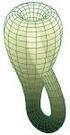 ON TORI TRIANGULATIONS ASSOCIATED WITH TWO-DIMENSIONAL CONTINUED FRACTIONS OF CUBIC IRRATIONALITIES. O. N. KARPENKOV Introduction. A series of properties for ordinary continued fractions possesses multidimensional
RINGS WITH A POLYNOMIAL IDENTITY
 RINGS WITH A POLYNOMIAL IDENTITY IRVING KAPLANSKY 1. Introduction. In connection with his investigation of projective planes, M. Hall [2, Theorem 6.2]* proved the following theorem: a division ring D in
88 CHAPTER 2. VECTOR FUNCTIONS. . First, we need to compute T (s). a By definition, r (s) T (s) = 1 a sin s a. sin s a, cos s a
 88 CHAPTER. VECTOR FUNCTIONS.4 Curvature.4.1 Definitions and Examples The notion of curvature measures how sharply a curve bends. We would expect the curvature to be 0 for a straight line, to be very small
3. Prime and maximal ideals. 3.1. Definitions and Examples.
 COMMUTATIVE ALGEBRA 5 3.1. Definitions and Examples. 3. Prime and maximal ideals Definition. An ideal P in a ring A is called prime if P A and if for every pair x, y of elements in A\P we have xy P. Equivalently,
8.1 Examples, definitions, and basic properties
 8 De Rham cohomology Last updated: May 21, 211. 8.1 Examples, definitions, and basic properties A k-form ω Ω k (M) is closed if dω =. It is exact if there is a (k 1)-form σ Ω k 1 (M) such that dσ = ω.
arxiv:math/0601660v3 [math.nt] 25 Feb 2006
![arxiv:math/0601660v3 [math.nt] 25 Feb 2006](/thumbs/40/21422467.jpg "arxiv:math/0601660v3 [math.nt] 25 Feb 2006") NOTES Edited by William Adkins arxiv:math/666v3 [math.nt] 25 Feb 26 A Short Proof of the Simple Continued Fraction Expansion of e Henry Cohn. INTRODUCTION. In [3], Euler analyzed the Riccati equation to
NOTES Edited by William Adkins arxiv:math/666v3 [math.nt] 25 Feb 26 A Short Proof of the Simple Continued Fraction Expansion of e Henry Cohn. INTRODUCTION. In [3], Euler analyzed the Riccati equation to
MATH 52: MATLAB HOMEWORK 2
 MATH 52: MATLAB HOMEWORK 2. omplex Numbers The prevalence of the complex numbers throughout the scientific world today belies their long and rocky history. Much like the negative numbers, complex numbers
CONTRIBUTIONS TO ZERO SUM PROBLEMS
 CONTRIBUTIONS TO ZERO SUM PROBLEMS S. D. ADHIKARI, Y. G. CHEN, J. B. FRIEDLANDER, S. V. KONYAGIN AND F. PAPPALARDI Abstract. A prototype of zero sum theorems, the well known theorem of Erdős, Ginzburg
Counting Primes whose Sum of Digits is Prime
 2 3 47 6 23 Journal of Integer Sequences, Vol. 5 (202), Article 2.2.2 Counting Primes whose Sum of Digits is Prime Glyn Harman Department of Mathematics Royal Holloway, University of London Egham Surrey
ON GENERALIZED RELATIVE COMMUTATIVITY DEGREE OF A FINITE GROUP. A. K. Das and R. K. Nath
 International Electronic Journal of Algebra Volume 7 (2010) 140-151 ON GENERALIZED RELATIVE COMMUTATIVITY DEGREE OF A FINITE GROUP A. K. Das and R. K. Nath Received: 12 October 2009; Revised: 15 December
FOUNDATIONS OF ALGEBRAIC GEOMETRY CLASS 22
 FOUNDATIONS OF ALGEBRAIC GEOMETRY CLASS 22 RAVI VAKIL CONTENTS 1. Discrete valuation rings: Dimension 1 Noetherian regular local rings 1 Last day, we discussed the Zariski tangent space, and saw that it
6. Define log(z) so that π < I log(z) π. Discuss the identities e log(z) = z and log(e w ) = w.
 hapter omplex integration. omplex number quiz. Simplify 3+4i. 2. Simplify 3+4i. 3. Find the cube roots of. 4. Here are some identities for complex conjugate. Which ones need correction? z + w = z + w,
Row Ideals and Fibers of Morphisms
 Michigan Math. J. 57 (2008) Row Ideals and Fibers of Morphisms David Eisenbud & Bernd Ulrich Affectionately dedicated to Mel Hochster, who has been an inspiration to us for many years, on the occasion
On the representability of the bi-uniform matroid
 On the representability of the bi-uniform matroid Simeon Ball, Carles Padró, Zsuzsa Weiner and Chaoping Xing August 3, 2012 Abstract Every bi-uniform matroid is representable over all sufficiently large
7. Some irreducible polynomials
 7. Some irreducible polynomials 7.1 Irreducibles over a finite field 7.2 Worked examples Linear factors x α of a polynomial P (x) with coefficients in a field k correspond precisely to roots α k [1] of
INTRODUCTION TO ALGEBRAIC GEOMETRY, CLASS 16
 INTRODUCTION TO ALGEBRAIC GEOMETRY, CLASS 16 RAVI VAKIL Contents 1. Valuation rings (and non-singular points of curves) 1 1.1. Completions 2 1.2. A big result from commutative algebra 3 Problem sets back.
Mean value theorem, Taylors Theorem, Maxima and Minima.
 MA 001 Preparatory Mathematics I. Complex numbers as ordered pairs. Argand s diagram. Triangle inequality. De Moivre s Theorem. Algebra: Quadratic equations and express-ions. Permutations and Combinations.
PROJECTIVE GEOMETRY. b3 course 2003. Nigel Hitchin
 PROJECTIVE GEOMETRY b3 course 2003 Nigel Hitchin [email protected] 1 1 Introduction This is a course on projective geometry. Probably your idea of geometry in the past has been based on triangles
9 More on differentiation
 Tel Aviv University, 2013 Measure and category 75 9 More on differentiation 9a Finite Taylor expansion............... 75 9b Continuous and nowhere differentiable..... 78 9c Differentiable and nowhere monotone......
Prime Numbers and Irreducible Polynomials
 Prime Numbers and Irreducible Polynomials M. Ram Murty The similarity between prime numbers and irreducible polynomials has been a dominant theme in the development of number theory and algebraic geometry.
Alex, I will take congruent numbers for one million dollars please
 Alex, I will take congruent numbers for one million dollars please Jim L. Brown The Ohio State University Columbus, OH 4310 [email protected] One of the most alluring aspectives of number theory
Math 4310 Handout - Quotient Vector Spaces
 Math 4310 Handout - Quotient Vector Spaces Dan Collins The textbook defines a subspace of a vector space in Chapter 4, but it avoids ever discussing the notion of a quotient space. This is understandable
The sum of digits of polynomial values in arithmetic progressions
 The sum of digits of polynomial values in arithmetic progressions Thomas Stoll Institut de Mathématiques de Luminy, Université de la Méditerranée, 13288 Marseille Cedex 9, France E-mail: [email protected]
by the matrix A results in a vector which is a reflection of the given
 Eigenvalues & Eigenvectors Example Suppose Then So, geometrically, multiplying a vector in by the matrix A results in a vector which is a reflection of the given vector about the y-axis We observe that
Allen Back. Oct. 29, 2009
 Allen Back Oct. 29, 2009 Notation:(anachronistic) Let the coefficient ring k be Q in the case of toral ( (S 1 ) n) actions and Z p in the case of Z p tori ( (Z p )). Notation:(anachronistic) Let the coefficient
INTRODUCTION TO ALGEBRAIC GEOMETRY, CLASS 24
 INTRODUCTION TO ALGEBRAIC GEOMETRY, CLASS 24 RAVI VAKIL Contents 1. Degree of a line bundle / invertible sheaf 1 1.1. Last time 1 1.2. New material 2 2. The sheaf of differentials of a nonsingular curve
MATH1231 Algebra, 2015 Chapter 7: Linear maps
 MATH1231 Algebra, 2015 Chapter 7: Linear maps A/Prof. Daniel Chan School of Mathematics and Statistics University of New South Wales [email protected] Daniel Chan (UNSW) MATH1231 Algebra 1 / 43 Chapter
A note on companion matrices
 Linear Algebra and its Applications 372 (2003) 325 33 www.elsevier.com/locate/laa A note on companion matrices Miroslav Fiedler Academy of Sciences of the Czech Republic Institute of Computer Science Pod
MA651 Topology. Lecture 6. Separation Axioms.
 MA651 Topology. Lecture 6. Separation Axioms. This text is based on the following books: Fundamental concepts of topology by Peter O Neil Elements of Mathematics: General Topology by Nicolas Bourbaki Counterexamples
Arkansas Tech University MATH 4033: Elementary Modern Algebra Dr. Marcel B. Finan
 Arkansas Tech University MATH 4033: Elementary Modern Algebra Dr. Marcel B. Finan 3 Binary Operations We are used to addition and multiplication of real numbers. These operations combine two real numbers
Linear Maps. Isaiah Lankham, Bruno Nachtergaele, Anne Schilling (February 5, 2007)
 MAT067 University of California, Davis Winter 2007 Linear Maps Isaiah Lankham, Bruno Nachtergaele, Anne Schilling (February 5, 2007) As we have discussed in the lecture on What is Linear Algebra? one of
SINTESI DELLA TESI. Enriques-Kodaira classification of Complex Algebraic Surfaces
 Università degli Studi Roma Tre Facoltà di Scienze Matematiche, Fisiche e Naturali Corso di Laurea Magistrale in Matematica SINTESI DELLA TESI Enriques-Kodaira classification of Complex Algebraic Surfaces
NEW YORK STATE TEACHER CERTIFICATION EXAMINATIONS
 NEW YORK STATE TEACHER CERTIFICATION EXAMINATIONS TEST DESIGN AND FRAMEWORK September 2014 Authorized for Distribution by the New York State Education Department This test design and framework document
Geometric Transformations
 Geometric Transformations Definitions Def: f is a mapping (function) of a set A into a set B if for every element a of A there exists a unique element b of B that is paired with a; this pairing is denoted
ON GALOIS REALIZATIONS OF THE 2-COVERABLE SYMMETRIC AND ALTERNATING GROUPS
 ON GALOIS REALIZATIONS OF THE 2-COVERABLE SYMMETRIC AND ALTERNATING GROUPS DANIEL RABAYEV AND JACK SONN Abstract. Let f(x) be a monic polynomial in Z[x] with no rational roots but with roots in Q p for
MA106 Linear Algebra lecture notes
 MA106 Linear Algebra lecture notes Lecturers: Martin Bright and Daan Krammer Warwick, January 2011 Contents 1 Number systems and fields 3 1.1 Axioms for number systems......................... 3 2 Vector
k, then n = p2α 1 1 pα k
 Powers of Integers An integer n is a perfect square if n = m for some integer m. Taking into account the prime factorization, if m = p α 1 1 pα k k, then n = pα 1 1 p α k k. That is, n is a perfect square
Basics of Polynomial Theory
 3 Basics of Polynomial Theory 3.1 Polynomial Equations In geodesy and geoinformatics, most observations are related to unknowns parameters through equations of algebraic (polynomial) type. In cases where
ON THE EMBEDDING OF BIRKHOFF-WITT RINGS IN QUOTIENT FIELDS
 ON THE EMBEDDING OF BIRKHOFF-WITT RINGS IN QUOTIENT FIELDS DOV TAMARI 1. Introduction and general idea. In this note a natural problem arising in connection with so-called Birkhoff-Witt algebras of Lie
a 11 x 1 + a 12 x 2 + + a 1n x n = b 1 a 21 x 1 + a 22 x 2 + + a 2n x n = b 2.
 Chapter 1 LINEAR EQUATIONS 1.1 Introduction to linear equations A linear equation in n unknowns x 1, x,, x n is an equation of the form a 1 x 1 + a x + + a n x n = b, where a 1, a,..., a n, b are given
DIFFERENTIATION MATRICES FOR MEROMORPHIC FUNCTIONS
 Bol. Soc. Mat. Mexicana (3 Vol. 1, 006 DIFFERETIATIO MATRICES FOR MEROMORPHIC FUCTIOS RAFAEL G. CAMPOS AD CLAUDIO MEESES Abstract. A procedure for obtaining differentiation matrices is extended straightforwardly
Classification of Cartan matrices
 Chapter 7 Classification of Cartan matrices In this chapter we describe a classification of generalised Cartan matrices This classification can be compared as the rough classification of varieties in terms
IRREDUCIBLE OPERATOR SEMIGROUPS SUCH THAT AB AND BA ARE PROPORTIONAL. 1. Introduction
 IRREDUCIBLE OPERATOR SEMIGROUPS SUCH THAT AB AND BA ARE PROPORTIONAL R. DRNOVŠEK, T. KOŠIR Dedicated to Prof. Heydar Radjavi on the occasion of his seventieth birthday. Abstract. Let S be an irreducible
Bipan Hazarika ON ACCELERATION CONVERGENCE OF MULTIPLE SEQUENCES. 1. Introduction
 F A S C I C U L I M A T H E M A T I C I Nr 51 2013 Bipan Hazarika ON ACCELERATION CONVERGENCE OF MULTIPLE SEQUENCES Abstract. In this article the notion of acceleration convergence of double sequences
RESEARCH STATEMENT AMANDA KNECHT
 RESEARCH STATEMENT AMANDA KNECHT 1. Introduction A variety X over a field K is the vanishing set of a finite number of polynomials whose coefficients are elements of K: X := {(x 1,..., x n ) K n : f i
Continuity of the Perron Root
 Linear and Multilinear Algebra http://dx.doi.org/10.1080/03081087.2014.934233 ArXiv: 1407.7564 (http://arxiv.org/abs/1407.7564) Continuity of the Perron Root Carl D. Meyer Department of Mathematics, North
SOLUTIONS TO ASSIGNMENT 1 MATH 576
 SOLUTIONS TO ASSIGNMENT 1 MATH 576 SOLUTIONS BY OLIVIER MARTIN 13 #5. Let T be the topology generated by A on X. We want to show T = J B J where B is the set of all topologies J on X with A J. This amounts
Lecture 13 - Basic Number Theory.
 Lecture 13 - Basic Number Theory. Boaz Barak March 22, 2010 Divisibility and primes Unless mentioned otherwise throughout this lecture all numbers are non-negative integers. We say that A divides B, denoted
The Australian Journal of Mathematical Analysis and Applications
 The Australian Journal of Mathematical Analysis and Applications Volume 7, Issue, Article 11, pp. 1-14, 011 SOME HOMOGENEOUS CYCLIC INEQUALITIES OF THREE VARIABLES OF DEGREE THREE AND FOUR TETSUYA ANDO
ON CERTAIN DOUBLY INFINITE SYSTEMS OF CURVES ON A SURFACE
 i93 c J SYSTEMS OF CURVES 695 ON CERTAIN DOUBLY INFINITE SYSTEMS OF CURVES ON A SURFACE BY C H. ROWE. Introduction. A system of co 2 curves having been given on a surface, let us consider a variable curvilinear
Sign changes of Hecke eigenvalues of Siegel cusp forms of degree 2
 Sign changes of Hecke eigenvalues of Siegel cusp forms of degree 2 Ameya Pitale, Ralf Schmidt 2 Abstract Let µ(n), n > 0, be the sequence of Hecke eigenvalues of a cuspidal Siegel eigenform F of degree
INTRODUCTORY SET THEORY
 M.Sc. program in mathematics INTRODUCTORY SET THEORY Katalin Károlyi Department of Applied Analysis, Eötvös Loránd University H-1088 Budapest, Múzeum krt. 6-8. CONTENTS 1. SETS Set, equal sets, subset,
Metric Spaces. Chapter 7. 7.1. Metrics
 Chapter 7 Metric Spaces A metric space is a set X that has a notion of the distance d(x, y) between every pair of points x, y X. The purpose of this chapter is to introduce metric spaces and give some
F. ABTAHI and M. ZARRIN. (Communicated by J. Goldstein)
 Journal of Algerian Mathematical Society Vol. 1, pp. 1 6 1 CONCERNING THE l p -CONJECTURE FOR DISCRETE SEMIGROUPS F. ABTAHI and M. ZARRIN (Communicated by J. Goldstein) Abstract. For 2 < p