
Pathogenic Organism Chart
|
|
|
- Amos Willis
- 9 years ago
- Views:
Transcription
1 Genus/Organism Description Habitat/Sources of Isolation Pathogenicity Symptoms *Treatment Aeromonas (PP): *Aeromonas hydrophilia/caviae *Aeromonas veronii biovar sobria *Aeromonas biovar veronii *Aeromonas species Aeromonas is a gram-negative rod belonging to the Vibrionaceae family. There are at least four species of Aeromonas with A. hydrophilia being the most common isolated species in the U.S. 12 Aeromonads are ubiquitous in fresh water environments. The number present is dependant on the extent of sewage pollution and the ambient temperature. Recent studies have directly attributed Aeromonas as the cause of food-borne infections. The following foods may harbor the organism: raw meat, freshwater fish, shellfish and other seafood. Raw milk can also be a source of infection. 3 Definitive experimental evidence for the causative role of Aeromonas in gastrointestinal disorders is still lacking. Although human volunteer studies are inconclusive, epidemiological evidence has shown that the presence of these organisms in stools is significantly more often associated with diarrhea than with the carrier state. 45 Aeromonas gastroenteritis may affect both children and adults with the highest seasonal incidence occurring in the summer months. Symptoms tend to be generally mild, self-limiting diseases with watery diarrhea. 6 Bloody stools have been reported. Aeromonas infections tend to be more acute in children and more chronic in adults. 78 Most Aeromonas species are generally susceptible to cephalosporins, aminoglycosides, carbapenems, tetracyclines, trimethoprimsulfamethoxazole and quinolones. 9 Susceptibility must guide testing.

2 Genus/Organism Description Habitat/Sources of Isolation Pathogenicity Symptoms *Treatment Bacillus (PP): *Bacillus cereus Bacillus species are spore forming, gram-positive rods belonging to the Bacillaceae family. There are currently 50 valid species within the genus. 12 Sources of the diarrheal type of B. cereus food poisoning include: meats, pasta, vegetable dishes, desserts, cakes, sauces and milk. 13 The emetic type of infection is predominately associated with oriental rice dishes. Pasteurized cream, milk pudding and pasta have occasionally been implicated. 14 The incidence of B. cereus infection is increased during the summer months. 15 Although part of the normal flora, B.cereus has been established as an opportunistic pathogen. 16 The gram-positive spore forming rods of B.cereus elaborate enterotoxins. 17 Both types of food poisoning result from spores that have survived cooking, then germinated, producing vegetative cells that have multiplied. 18 B. cereus is the etiological agent of two distinct types of food poisoning: 1) The diarrheal type, which is caused by a heat-labile enterotoxic complex. Symptoms include abdominal pain, and diarrhea 8-12 hours after ingestion of the organism. 2) The emetic type, caused by a heat-stable enterotoxin. Nausea and vomiting usually occur 1-5 hours after ingestion. B. cereus is almost always susceptible to clindamycin, erythromycin and vancomycin. 24 *Bacillus species Meat dishes are a common source of infection in other species of Bacillus such as B. subtilis and B. licheniformis. 25 NB, it is estimated that only half the isolated strains of B. cereus are enterotoxin positive. 19 As yet, no toxins or other virulence factors have been identified in association with the symptoms that accompany non-b. cereus species. 26 B. licheniformis and B. subtilis are associated with food-borne diarrheal illness. 27

3 Genus/Organism Description Habitat/Sources of Isolation Pathogenicity Symptoms *Treatment Campylobacter jejuni (P) Campylobacter are gram-negative, non-spore forming rods belonging to the Campylobacterace ae family. 28 In total there are 18 species and subspecies within the genus. 29 Poultry is a key source of infection, in particular chicken. Red meat and shellfish can also harbor the organism. 30 Other sources include unpasteurized milk, and water contaminated by wild birds. 31 Recognized as the principle cause of diarrhea in humans. C. jejuni and C. coli are the most common species associated with diarrheal illness. 32 The infective dose as yet has not been clearly defined, but it is thought that as little as 1000 organisms are capable of causing infection. 33 The incubation period can be 2 to 10 days, though is usually 2 to 5 days. 34 Symptoms can include fever, abdominal cramping, diarrhea (often bloody) abdominal pain and fever. Relapses may occur in 5%-10% of untreated cases. 35 Erythromycin is the drug of choice for treating C. jejuni infections. Ciprofloxacin may be an alternative drug. 36

4 Genus/Organism Description Habitat/Sources of Isolation Pathogenicity Symptoms *Treatment Candida (PP): *Candida albicans *Candida famata *Candida glabrata *Candida guilliermondii *Candida krusei *Candida lambica *Candida lusitaniae *Candida parapsilosis *Candida paratropicalis *Candida pseudotropicalis *Candida rugosa *Candida species *Candida stellatoidea *Candida tropicalis *Candida zeylanoides The genus Candida is comprised of approximately 200 different species. 37 C. albicans is the most commonly isolated strain from the GI tract. 38 Most sources of Candida infection are thought to be of endogenous origin. 39 While yeast are ubiquitous in the environment and are found on fruits, vegetables and other plant materials, contamination from external sources is linked to patients and health care workers. A normal inhabitant of the GI tract. May become an opportunistic pathogen after disruption of the mucosal barrier, imbalance of the normal intestinal flora and/or impaired immunity. Risk factors for colonization include: Antibiotics, corticosteroids, antacids, H2 blockers, oral contraceptives, irradiation, GI surgery, Diabetes mellitus, burns, T cell dysfunction, chronic stress and chronic renal disease. The most common symptom attributable to non-invasive yeast overgrowth is diarrhea. 50 Symptoms of chronic candidiasis affect four main areas of the body: Intestinal system symptoms include: diarrhea, constipation, abdominal discomfort, distention, flatulence and rectal itching. Genital Urinary system symptoms include: menstrual complaints, vaginitis, cystitis and urethritis. Nervous system symptoms include: severe depression, extreme irritability, inability to concentrate, memory lapses and headaches. Immune system symptoms include urticaria, hayfever, asthma, and external otitis. Sensitivities to tobacco, perfumes, diesel fumes and other chemicals. Currently, standard texts provide no specific antifungal guidelines for GI overgrowth of Candida. Oral azoles have been recommended for extra intestinal infections. Susceptibility testing is advised due to increasing drug resistance.

5 Organism Chart Genus/Organism Description Habitat/Sources of Isolation Pathogenicity Symptoms *Treatment Citrobacter (PP): *Citrobacter amalonaticus *Citrobacter braakii *Citrobacter diversus *Citrobacter freundii *Citrobacter freundii/youngae *Citrobacter freundii complex *Citrobacter koseri *Citrobacter species Clostridium difficile (PP) Citrobacter is a gram-negative rod belonging to the Enterobacteriaceae family. 55 Citrobacter contains 9 named species and two unnamed genomospecies. 56 The genus Clostridium are anaerobic grampositive, sporeforming bacteria. 66 Common in the environment and may be spread by person-to person contact. Several outbreaks have occurred in babies in hospital units Isolated from water, fish, animals and food. 59 The organism has many natural habitats including hay, soil, cows, horses and dogs. 67 Almost 50% of neonates carry this organism asymptomatically as part of their gastrointestinal flora during the first year of life. This rate decreases sequentially to about 3% in adults and less in children over two years of age. Citrobacter is considered an opportunistic pathogen and therefore can be found in the gut as part of the normal flora. 60 C. difficile is the major cause of antibioticassociated diarrhea and pseudomembranous colitis and the most common cause of hospital-acquired diarrhea. 70 Isolation of C. difficile without a positive toxin test has little clinical value. It is important to test for both toxins A and B in the stool. Toxin A is an enterotoxin and toxin B is a cytotoxin that inhibits bowel motility. It is thought that both toxins are important in the pathogenesis. Citrobacter has occasionally been implicated in diarrheal disease, particularly C. freundii and C. diversus and C. koseri. 61 Mild cases of C. difficile disease are characterized by frequent, foul-smelling, watery stools. More severe symptoms, indicative of pseudomembranous colitis, include diarrhea that contains blood and mucous, and abdominal cramps. 73 Currently, standard texts provide no specific antimicrobial guidelines for GI overgrowth of Citrobacter. Carbapenems and fluroquinolones are the recommended antibiotics for extraintestinal sites. Severe C. difficile intestinal disease is usually treated with oral vancomycin or metronidazole. However, antimicrobial therapy often results in relapse of the disease. 74 In addition, there is concern that oral vancomycin can lead to the emergence of vancomycin-resistant Enterococci Great Smokies Diagnostic Laboratory

6 Genus/Organism Description Habitat/Sources of Isolation Pathogenicity Symptoms *Treatment Cryptococcus (PP): *Cryptococcus albidus *Cryptococcus humicolus *Cryptococcus laurentii *Cryptococcus luteolus *Cryptococcus neoformans *Cryptococcus species *Cryptococcus terreus *Cryptococcus uniguttulatus Edwardsiella tarda(p) Cryptococcus is a yeast-like fungus, which closely resembles the genus Candida. 76 The genus contains a number of species, of which only C. neoformans is considered to be a human pathogen. 77 The genus Edwardsiella is a gram-negative rod that belongs to the Enterobacteriaceae family. 86 To date there are three species, though only E. tarda is associated with human disease. 87 Found in the excreta of pigeons and other birds in most parts of the world. The yeast is associated with aged bird droppings that have accumulated over a long period of time on window ledges, vacant buildings and other roosting sites. 78 Isolated from cold-blooded animals such as fish and reptiles and their environment. 88 Infection is more common in tropical and subtropical environments and developing countries. 89 Can be an opportunistic pathogen, predominately in the immunocompromised host. 79 Cryptococcus is considered one of the defining diseases of AIDS. Patients with Cryptococcus and serologic evidence of HIV are considered to have AIDS. 80 E. tarda is considered an opportunistic pathogen, occasionally causing acute gastroenteritis. Diarrhea has been associated with Cryptococcal infection. 81 Usually infection occurs in the tissue of the central nervous system but occasionally can produce lesions in the skin, bones, lungs, or other internal organs. 82 Diarrheal disease is associated with infection, with a clinical picture similar to Salmonella enteritis. 92 Isolation of the E. tarda is more common in young children and the elderly. 93 Currently, standard texts provide no specific antimicrobial guidelines for GI overgrowth of Cryptococcus. Fluconazole is considered the primary antimicrobial agent in extraintestinal sites. 85 If antibiotic treatment is required, ampicillin, trimethoprimsulfamethoxazole and ciprofloxacin have all been found to be effective agents. 94

7 Organism Chart Genus/Organism Description Habitat/Sources of Isolation Pathogenicity Symptoms *Treatment E.coli Shiga-like toxin Enterobacter cloacae (PP) Geotrichum (PP): *Geotrichum candidum *Geotrichum capitum *Geotrichum species Shigatoxin-producing E. coli strains are referred to as STEC. This includes the 0157 and many other STEC serogroups. 95 In total, at least 100 serotypes have been isolated from persons with diarrhea. 96 Gram-negative rod that is part of the Enterobacteriaceae family. 104 There are 14 species in the genus, though only E. cloacae has been associated with GI infection. Geotrichum are yeast belonging to the Endomyceteaceae family. There are several species within the genus, of which G. candidum is the most common STEC colonize dairy and beef cattle, which is why ground beef is the most common infection vehicle. However, raw milk, sausage, roast beef, unchlorinated water, apple cider, and raw vegetables have also been implicated. 97 Widely distributed in the environment. Water, soil, sewage and cornstalks have all been identified as sources of contamination. This organism can be found in soil, dairy products and in human skin and mucosae. 116 E. coli 0157:H7 and 0157:non-motile (0157 STEC) produce one or more Shiga toxins and, are the most commonly identified diarrheagenic E.coli isolates in North America and Europe. 98 Non-toxin-producing strains are normal in the human intestine STEC spreads easily from person to person because the infectious dose is low. 99 Usually considered a commensal organism; however, strains of E. cloacae have been shown to produce a heat-stable toxin similar to that produced by E.coli. 109 Usually only considered an opportunistic pathogen in immune-compromised hosts. Geotrichum candidum is the etiological agent of Geotrichosis. 119 Geotrichum may also play a role in IBS. 120 The STEC strains cause a spectrum of illness that can present as mild non-bloody diarrhea, severe bloody diarrhea (hemorrhagic colitis), and hemolytic uremic syndrome (HUS). 100 About 6% of 0157 STEC patients develop HUS. 101 Has been associated with diarrhea in Currently, children. Symptoms of Geotrichum infection have been associated with diarrhea and enteritis. Symptoms of Geotrichosis may resemble those of candidiasis. 123 Antimicrobial therapy for 0157 STEC has NOT been demonstrated to be effective or safe, except for cases of cystitis and pyelonephritis. 102 Antimicrobial therapy for intestinal disease may enhance toxin release and predispose for HUS. 103 standard texts provide no specific antimicrobial guidelines for GI overgrowth of Enterobacter. Carbapenems are recommended for extraintestinal sites. 114 Currently, standard texts provide no specific antifungal guidelines for GI overgrowth of Geotrichum. Oral azoles and have been recommended for extra intestinal infections. Susceptibility testing is advised owing to increasing drug resistance Great Smokies Diagnostic Laboratory

8 Genus/Organism Description Habitat/Sources of Isolation Pathogenicity Symptoms *Treatment Hafnia alvei (PP) Helicobacter pylori (P) Hafnia is a gramnegative rod considered part of the Enterobacteriaceae family. There is only one species of Hafnia H. alvei which was previously a member of the Enterobacter genus. 126 The genus Helicobacter are gram-negative, non-spore forming rods. There are currently 19 species within the genus. 131 Seroprevalence of H. pylori varies from 20% in young adults in developed countries to sometimes more than 90% in developing countries. 132 Commonly found in warm-blooded animals, particularly birds. Other environmental sources include contaminated water, sewage, food, and dairy products. 127 Reservoirs of infection include the intestinal tract of mammals and birds. Mode of transmission is usually via the fecal-oral or oral-to-oral route. 133 This organism is a natural inhabitant of the GI tract in humans. Hafnia strains are opportunistic pathogens; community and hospital outbreaks have been associated with GI infection. 128 H. pylori causes chronic gastritis and predisposes to gastric and duodenal ulcers. Increased risk of gastric carcinoma is associated with infection. 134 It is estimated that 50% of the world s population is infected with H. pylori. 135 Diarrheal illness has been associated with outbreaks and virulence factors similar to toxigenic E.coli have been described. 129 Those infected with H. pylori may develop acute gastritis with symptoms of abdominal pain, nausea and vomiting, usually within two weeks of infection. Many patients have recurrent abdominal symptoms (non-ulcer dyspepsia) without ulcer disease. 136 Hafnia strains are usually susceptible to piperacillin, imipenum, quinolones and the newer cephalosporins. 130 Cure rates require multi-drug regimens along with antacid medications. 137 The most successful treatment includes a combination of metronidazole, omeprazole and clarithromycin. 138

9 Genus/Organism Description Habitat/Sources of Isolation Pathogenicity Symptoms *Treatment Klebsiella (PP): *Klebsiella ornithinolytica *Klebsiella oxytoca *Klebsiella ozaenae *Klebsiella pneumoniae *Klebsiella rhinoscleromatis *Klebsiella species Klebsiella is part of the Enterobacteriaceae family and as such is a gram-negative rod. 139 There are 7 species of Klebsiella within the genus, though only 2 have been associated with GI infection. 140 Isolated from foods and environmental sources. 141 Klebsiella appears to thrive in individuals on a high starch diet. Avoiding carbohydrates such as rice, potatoes, flour products and sugary foods reduces the amount of Klebsiella in the gut. 142 Part of the normal GI flora in small numbers, but can be an opportunistic pathogen. Klebsiella is capable of translocating from the gut when in high numbers. Certain strains of K. oxytoca have demonstrated cytotoxin production. 149 Of the 77 Klebsiella capsular polysaccharides, only 3 are associated with ankylosing spondylitis: K26, K36 and K K. pneumoniae and K. oxytoca have been associated with diarrhea in humans Cytotoxin-producing strains are associated with acute hemorrhagic enterocolitis Increased colonization of Klebsiella in the stool has been found in HLA-B27 + AS patients. Currently, standard texts provide no specific antimicrobial guidelines for GI overgrowth of Klebsiella. Third generation cephalosporins and fluroquinolones are the recommended antimicrobial agents for extra-intestinal sites. 167

10 Genus/Organism Description Habitat/Sources of Isolation Pathogenicity Symptoms *Treatment Listeria monocytogenes (PP) Moellerella wisconsensis (PP) The genus Listeria are gram-positive cocciod- to rodshaped bacteria of which there are 7 species in total. 168 The only species associated with infection in humans is L. monocytogenes. 169 Meollerella is a gram-negative rod that is part of the Enterobacteriaceae family. 178 Currently, there is only one species in the genus. 179 Dairy products are sources of Listeria infection. The organism has been found in raw milk, pasteurized milk, cream, butter, cheese and ice cream. 170 The use of manure as fertilizers on salad and vegetable crops have been associated with Listeria infection. 171 Fish and seafood may also be a reservoir of infection. 172 Contaminated water supplies are the main reservoir of infection. 180 GI symptoms have been associated with infection, though are not usually related to the ingestion of contaminated food. 173 A transient intestinal carrier state exists in 2%-20% of humans. 174 Development of an invasive infection depends on several factors, namely: host susceptibility, gastric acidity and the virulence of the organism. 175 The exact role of Moellerella in causing diarrhea has not yet been fully elucidated. 181 Symptoms of diarrhea have been noted with Listeria infection. 176 Diarrhea and gastroenteritis have been associated with M wisconsensis. Listeria is usually susceptible to penicillin, ampicillin, gentamycin, erythromycin, and tetracycline. 177 Currently, standard texts provide no specific antimicrobial guidelines for GI overgrowth of Moellerella. MIC studies have demonstrated susceptibility to cephalothin, gentamicin and naladixic acid. 186

11 Organism Chart Genus/Organism Description Habitat/Sources of Isolation Pathogenicity Symptoms *Treatment Morganella morganii (PP) Plesiomonas shigelloides (PP) Morganella is gram-negative rod belonging to the Enterobacteriaceae family. 187 Currently, there are 3 species within the genus. 188 Plesiomonas is a gram-negative rod belonging to the Vibrionaceae family, though it does contain the Enterobacteriaceae antigen. P. shigelloides is the only species in the genus. M. morganii originates from the gill and skin of fish. It is possible that it may cross-contaminate during handling of fish in processing plants and restaurants. 189 Usually found in fresh water or estuarine water. Occurs in fish, shellfish, oysters, toads, snakes, monkeys, dogs, cats, goats, pigs, poultry, and cattle. 200 There is a low incidence of Plesiomonas shigelliodes in the US and Europe. 201 In Asia, however, the organism contributes to a significant proportion of traveler s diarrhea. The role of Morganella as an etiological agent in diarrheal disease is controversial. Although Morganella constitutes part of the normal flora, in certain hosts it may be a potential pathogen. Recently it was shown that the majority of clinical isolates of Morganella belonged to the subsp Morganii. 192 P. shigelloides is not a natural inhabitant of the GI tract. 204 Although feeding studies with humans resulted in the excretion of the organism (but not diarrhea) from about one third of the volunteers, several epidemiological studies suggest that Plesiomonas is a possible agent in GI disease. It has been isolated from human stool specimens in the absence of symptoms and may be difficult to attribute as the cause of diarrhea in some cases. 205 Diarrhea has been associated with infection of this organism. Symptoms range from shortlived episodes of watery stools to several days of dysentery-like diarrhea. Has not been reported to affect specific age groups more often than others. Accompanying symptoms vary and may include abdominal pain, nausea, vomiting, chills, headaches and dehydration Infections with P. shigelloides are usually self-limiting, lasting up to 7 days and occasionally longer. Currently, standard texts provide no specific antimicrobial guidelines for GI overgrowth of Morganella. Carbapenems, 3 rd and 4 th generation cephalosporins and fluroquinolones are the agents recommended for extra-intestinal infections. 197 P. shigelliodes is susceptible to most major classes of antibiotics, including trimethoprim, cephalosporins, and quinolones Great Smokies Diagnostic Laboratory

12 Genus/Organism Description Habitat/Sources of Isolation Pathogenicity Symptoms *Treatment Proteus (PP): *Proteus mirabilis *Proteus penneri *Proteus vulgaris Provedencia alcalifaciens (PP) Proteus is a gramnegative rod belonging to the Enterobacteriaceae family species in total are attributed to the genus of which P. mirabilis is considered the most important. 213 Provedencia is a member of the Enterobacteriaceae family of which there are species. Food has been implicated as a vehicle of infection. 214 GI tract infection with P. alcalifaciens has been associated with overseas travel. 225 Part of the normal flora of the GI tract, though has been shown to be an independent causative agent of intestinal disorders. 215 May also play a role as an opportunistic organism in enteric infection due to other pathogens. 216 Provedencia is not normally present in a healthy GI tract. 226 Its pathogenic role may lie in the ability of the organism to take advantage of conditions created by other infectious microbes. 227 Occasionally implicated in diarrheal disorders. Recently, it has been suggested that P. mirabilis may be an etiological agent in rheumatoid arthritis. The mechanism may be related to the molecular cross reactivity between P. mirabilis and the HLA antigens, specifically HLA-DR This organism has been implicated as a cause of diarrhea. P. alcalifaciens is thought to induce invasive diarrhea in patients by invading cells in the intestine, thus producing inflammatory changes in the ileum. 230 Currently, standard texts provide no specific antimicrobial guidelines for GI overgrowth of Proteus. Ampicillin is recommended for extra-intestinal infections of P. mirabilis, followed by trimethoprimsulfamethoxazole. 222 Currently, standard texts provide no specific antimicrobial guidelines for GI overgrowth of Providencia. 3 rd generation cephalosporins and fluroquinolones are recommended for extra-intestinal sites.

13

14 "health food" regimen. Genus/Organism Description Habitat/Sources of Isolation Pathogenicity Symptoms *Treatment Salmonella (P): *Salmonella Group C and D *Salmonella arizonae *Salmonella group A *Salmonella group B *Salmonella group C *Salmonella group D *Salmonella group E *Salmonella group E + G *Salmonella paratyphi A *Salmonella paratyphi B *Salmonella paratyphi C *Salmonella species *Salmonella typhi Salmonella are members of the Enterobacteriaceae family and as such are gram-negative rods. 256 Animals and birds utilized for meat are subject to contamination with Salmonella. Eggs, cereals and cereal products are other sources of contamination. 257 The incidence of infection increases over the summer, and is predominantly associated with acute diarrhea in infants. 258 Salmonella are considered frank pathogens in humans. These organisms are NOT part of the normal bowel flora. Salmonella species are acid-sensitive, invasive, and produce enterotoxins in the GI tract. Several thousand cells may be needed to cause infection. 259 Gastroenteritis and diarrhea are caused by more than 2000 serotypes producing infections limited to the mucosa and submucosa of the GI tract. S. typhimurium and S. enteritidis are the serotypes most common in the US. Bacteremia and extraintestinal infections occur by spread from the GI tract, and any serotype is capable of causing bacteremia Antimicrobial therapy is not recommended for uncomplicated Salmonella gastroenteritis. 262 Antimicrobial therapy is warranted in cases of bacteremia. Enteric fever (typhoid fever) is characterized by prolonged fever and multisystem involvement. This is a life-threatening infection caused by S. typhi or S. paratyphi. Antimicrobial therapy is needed in cases of typhoid fever. 263

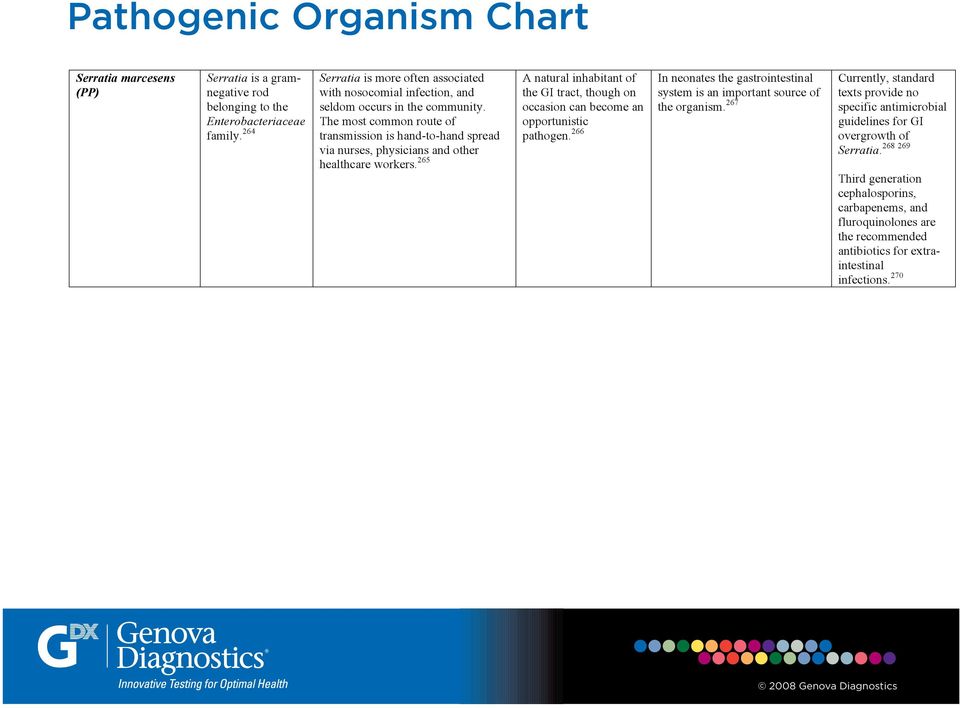
15 Serratia marcesens (PP) Serratia is a gramnegative rod belonging to the Enterobacteriaceae family. 264 Serratia is more often associated with nosocomial infection, and seldom occurs in the community. The most common route of transmission is hand-to-hand spread via nurses, physicians and other healthcare workers. 265 A natural inhabitant of the GI tract, though on occasion can become an opportunistic pathogen. 266 In neonates the gastrointestinal system is an important source of the organism. 267 Currently, standard texts provide no specific antimicrobial guidelines for GI overgrowth of Serratia. Third generation cephalosporins, carbapenems, and fluroquinolones are the recommended antibiotics for extraintestinal infections. 270
16 Genus/Organism Description Habitat/Sources of Isolation Pathogenicity Symptoms *Treatment Shigatoxin-producing E.coli (STEC )- See E.coli Shiga-like toxin. Shigella (P): *Shigella boydii *Shigella dysenteriae *Shigella flexneri *Shigella sonnei *Shigella species Shigella are members of the Enterobacteriaceae family. There are 4 serogroups that have historically been treated as species: -S. dysenteriae (Serogroup A) -S. flexneri (Serogroup B) -S. boydii (Serogroup C) -S. sonnei (Serogroup D). 271 Spread from person to person by the fecal-oral route, especially in overcrowded areas and areas with poor sanitary conditions. Ingestion is also a primary source of infection. 272 A predominant organism responsible for acute diarrheal disease in infants and children. 273 Shigella is only found in humans at times of infections and is NOT part of the normal bowel flora. All species are considered frank pathogens in humans. 274 Symptoms can range from mild to explosive diarrhea. It is somewhat acid-resistant, invades epithelial cells, and produces toxins. Less than 100 cells are required to initiate infection S. dysenteriae is rare in the US and causes classic dysentery, producing the Shiga toxin. S. sonnei is most common in the US, and usually produces only a watery diarrhea. 277 Shigella infections are often treated with antibiotics, and antimicrobial susceptibility testing is recommend owing to widespread resistance. 278 Resistant strains are usually susceptible to the fluroquinolones. 279

17 Genus/Organism Description Habitat/Sources of Isolation Pathogenicity Symptoms *Treatment Staphylococcus aureus (PP) Members of the genus Staphylococcus are gram-positive cocci. Currently, the genus is composed of 32 species and 15 subspecies. 280 Foods that require considerable handling during preparation or that are kept at slightly elevated temperatures after preparation are frequently involved in staphylococcal food poisoning. The key foods associated with staphylococcal food poisoning include meat and meat products; poultry and egg products; salads such as egg, tuna, chicken, potato, and macaroni; bakery products such as cream-filled pastries, cream pies, and chocolate éclairs; sandwich fillings; and milk and dairyproducts. Food poisoning is often attributed to the staphylococcal enterotoxin. 283 The toxin produced by the bacteria is very heat-stable and therefore not easily destroyed by heat at normal cooking temperatures. The toxin can remain, despite the organism being destroyed. 284 There is considerable variation in susceptibility to the enterotoxin in adults. Children and the elderly have the highest degree of susceptibility. 285 Symptoms of staphylococcal food poisoning usually appear within 1 to 6 hours after ingestion. The individual response to the toxin may vary and depends upon the amount of contaminated food eaten, the amount of toxin ingested, and general health status. 286 Nausea, vomiting, abdominal cramping, and diarrhea are the most common symptoms. In more severe cases, headache, muscle cramping, and changes in blood pressure and pulse rate may occur. 287 Recovery generally takes two days. It is not unusual for complete recovery to take three days and sometimes longer. In most cases, treatment for S. aureus infection is not necessary and complete recovery usually occurs after cessation of symptoms. 290

18 Genus/Organism Description Habitat/Sources of Isolation Pathogenicity Symptoms *Treatment Vibrio (PP): *Vibrio cholerae *Vibrio fluvialis *Vibrio furnissii *Vibrio hollisae *Vibrio metschnikovii *Vibrio mimicus *Vibrio parahaemolyticus *Vibrio species Yeast not candida (PP): Blastoschizomyces: *Blastoschizomyces capitatus Hansenula anomala Pichia ohmeri Rhodotorula *Rhodotorula glutinis *Rhodotorula rubra *Rhodotorula species Trichosporon *Trichosporon pullulans *Trichosporon species Vibrio are members of the Vibrionaceae family and as such are gram negative rods. 291 There over 35 species within the genus, of which only about one third are pathogenic for humans. 292 Yeast are unicellular, budding cells and are usually round to oval in shape, though some forms have demonstrated elongated and irregular shapes. 301 Pathogenic Vibrio are part of the autochthonous microbial flora in brackish and marine environments in temperate or tropical regions. V. cholerae and V. mimicus may be found in fresh water and in birds and herbivores. 293 Yeast are ubiquitous in the environment and can be found on fruits, vegetables and other plant materials. 302 They can also live as normal inhabitants both within and on the body. 303 Cholera is caused by V. cholerae Gastroenteritis is classically associated with V. cholerae non- 01, V. parahaemolyticus, V. hollisae, V. mimicus, V. fluvialis, V metschnikovii, and V. furnissii. 295 Less common yeast such as those outlined in this section should only be considered opportunistic pathogens in the immunocompromised host While classic cholera is rare in the US, the rice-water stool remains the characteristic symptom, among others and its infectious dose is quite large. 296 Gastroenteritis caused by other Vibrio sp. presents as diarrhea and may be accompanied by cramps, nausea, vomiting and fever. 297 Disseminated infections may include the intestinal tract and are usually associated with immunosuppressive diseases or conditions such as leukemia, organ transplant, multiple myeloma, aplastic anemia, diabetes mellitus with ketoacidosis, ICU patients, lymphoma, solid tumors and AIDS. Immunosuppressive therapy such as corticosteroids, chemotherapeutic agents and cyclosporine can also enhance fungal overgrowth. 315 Antimicrobial therapy reduces the frequency and duration of the diarrhea and shortens the post-infective period of shedding of V.cholerae. 298 Tetracycline or less commonly furazolidone are drugs of choice, though antibiotic resistance is increasing. Currently, standard texts provide no specific antifungal guidelines for GI overgrowth of the fungi mentioned Treatment is at the discretion of the practitioner, and should be based upon clinical symptoms and a positive reculture of the organism.

19 Genus/Organism Description Habitat/Sources of Isolation Pathogenicity Symptoms *Treatment Yersinia (PP): *Yersinia enterocolitica *Yersinia pseudotuberculosis *Yersinia species Yersinia are gramnegative enteropathogenic bacilli that belong to the Enterobacteriaceae family. 318 At present, there are at least 10 species within the Yersinia genus. 319 Y. pseudotuberculosis is found naturally in numerous wild and domestic mammals and birds. Y. enterocolitica can be found in all warm-blooded wild, domestic and pet animals and occasionally in some fish. Pigs are important reservoirs for the human strains of Y. enterocolitica. 320 Infections may be acquired by ingestion of contaminated food or water, or, rarely by direct person-toperson transmission in schools and hospitals. 321 * Susceptibility testing must guide treatment for all microbial and fungal organisms. Intestinal yersiniosis may present in three clinical forms: enteritis, terminal ileitis, or mesenteric lymphadenitis causing pseudoappendicitis and septicemia. 322 Y. entercolitica and Y. pseudotuberculosis are most commonly isolated from cases of gastroenteritis. Both would be considered significant isolates from stool. Both of these organisms show preference for lymphatic tissue and can spread via the bloodstream. 323 Yersinia infection has been shown to induce chronic inflammatory bowel disorders such as chronic diarrhea and IBD. Rheumatoid arthritis, reactive arthritis and unspecified arthralgias have also been noted after Yersinia infection. Watery and sometimes bloody stools, fever, vomiting, abdominal pain are common with Y. enterocolitica, particularly in adults and less frequently in children but rarely in Y. pesudotuberculosis infection which is more common in children exhibiting terminal ileitis, lymphadenitis, and pseudoappendicitis. 326 Animal and in-vitro studies have isolated an antigen designated Yersinia pseudotuberculosis mitogen (YPM) that is capable of increasing epithelial permeability. 327 Chronic GI disease (eg intermediate colitis, UC, CD may follow Y. enterocolitica infection, though the exact role this organism plays has not been fully elucidated. Intestinal infections with Y. enterocolitica and Y. pseudotuberculosis are usually selflimiting and do not require antibiotic therapy. In cases of complicated gastroenteritis, doxycycline or trimethoprimsulfmethoxazole are the antibiotics of choice Great Smokies Diagnostic Laboratory

20 1 Altweg M. Aeromonas and plesiomonas. In: Murray PR, Baron EJ, Pfaller MA, Tenover FC, Yolken RH, eds. Manual of Clinical Microbiology. 7th ed. Washington DC: ASM Press; 1999; Forbes BA, Sahm DF, Weissfeld AS. Bailly and Scotts Diagnostic Microbiology. 10 th ed. St Louis: Mosby; Varnum AH, Evans MG. Foodborne Pathogens: an Illustrated Text. St Louis: Mosby Year Book; 1991; Altweg M. Aeromonas and plesiomonas. In: Murray PR, Baron EJ, Pfaller MA, Tenover FC, Yolken RH, eds. Manual of Clinical Microbiology. 7th ed. Washington DC: ASM Press; 1999; Forbes BA, Sahm DF, Weissfeld AS. Bailly and Scotts Diagnostic Microbiology. 10 th ed. St Louis: Mosby; 1998; DuPont HL. Review article: infectious diarrhoea. Aliment Pharmacol Ther Feb;8(1): Altweg M. Aeromonas and plesiomonas. In: Murray PR, Baron EJ, Pfaller MA, Tenover FC, Yolken RH, eds. Manual of Clinical Microbiology. 7th ed. Washington DC: ASM Press; 1999; Forbes BA, Sahm DF, Weissfeld AS. Bailly and Scotts Diagnostic Microbiology. 10 th ed. St Louis: Mosby; 1998; Altweg M. Aeromonas and plesiomonas. In: Murray PR, Baron EJ, Pfaller MA, Tenover FC, Yolken RH, eds. Manual of Clinical Microbiology. 7th ed. Washington DC: ASM Press; 1999; Logan NA, Turnbull PCB. Bacillus and recently derived genera. In: Murray PR, Baron EJ, Pfaller MA, Tenover FC, Yolken RH, eds. Manual of Clinical Microbiology. 7th ed. Washington DC: ASM Press; 1999; Forbes BA, Sahm DF, Weissfeld AS. Bailly and Scotts Diagnostic Microbiology. 10 th ed. St Louis: Mosby; Logan NA, Turnbull PCB. Bacillus and recently derived genera. In: Murray PR, Baron EJ, Pfaller MA, Tenover FC, Yolken RH, eds. Manual of Clinical Microbiology. 7th ed. Washington DC: ASM Press; 1999; Logan NA, Turnbull PCB. Bacillus and recently derived genera. In: Murray PR, Baron EJ, Pfaller MA, Tenover FC, Yolken RH, eds. Manual of Clinical Microbiology. 7th ed. Washington DC: ASM Press; 1999; Logan NA, Turnbull PCB. Bacillus and recently derived genera. In: Murray PR, Baron EJ, Pfaller MA, Tenover FC, Yolken RH, eds. Manual of Clinical Microbiology. 7th ed. Washington DC: ASM Press; 1999; Turnbull PC, Kramer JM. Intestinal carriage of Bacillus cereus: faecal isolation studies in three population groups. J Hyg (Lond) Dec;95(3): Logan NA, Turnbull PCB. Bacillus and recently derived genera. In: Murray PR, Baron EJ, Pfaller MA, Tenover FC, Yolken RH, eds. Manual of Clinical Microbiology. 7th ed. Washington DC: ASM Press; 1999; Mitchell JE, Skelton MM. Diarrheal infections. Am Fam Physician May;37(5):

21 18 Logan NA, Turnbull PCB. Bacillus and recently derived genera. In: Murray PR, Baron EJ, Pfaller MA, Tenover FC, Yolken RH, eds. Manual of Clinical Microbiology. 7th ed. Washington DC: ASM Press; 1999; Logan NA, Turnbull PCB. Bacillus and recently derived genera. In: Murray PR, Baron EJ, Pfaller MA, Tenover FC, Yolken RH, eds. Manual of Clinical Microbiology. 7th ed. Washington DC: ASM Press; 1999; Logan NA, Turnbull PCB. Bacillus and recently derived genera. In: Murray PR, Baron EJ, Pfaller MA, Tenover FC, Yolken RH, eds. Manual of Clinical Microbiology. 7th ed. Washington DC: ASM Press; 1999; Kotiranta A, Lounatmaa K, Haapasalo M. Epidemiology and pathogenesis of Bacillus cereus infections. Microbes Infect Feb;2(2): Logan NA, Turnbull PCB. Bacillus and recently derived genera. In: Murray PR, Baron EJ, Pfaller MA, Tenover FC, Yolken RH, eds. Manual of Clinical Microbiology. 7th ed. Washington DC: ASM Press; 1999; Kotiranta A, Lounatmaa K, Haapasalo M. Epidemiology and pathogenesis of Bacillus cereus infections. Microbes Infect Feb;2(2): Logan NA, Turnbull PCB. Bacillus and recently derived genera. In: Murray PR, Baron EJ, Pfaller MA, Tenover FC, Yolken RH, eds. Manual of Clinical Microbiology. 7th ed. Washington DC: ASM Press; 1999; Logan NA, Turnbull PCB. Bacillus and recently derived genera. In: Murray PR, Baron EJ, Pfaller MA, Tenover FC, Yolken RH, eds. Manual of Clinical Microbiology. 7th ed. Washington DC: ASM Press; 1999; Logan NA, Turnbull PCB. Bacillus and recently derived genera. In: Murray PR, Baron EJ, Pfaller MA, Tenover FC, Yolken RH, eds. Manual of Clinical Microbiology. 7th ed. Washington DC: ASM Press; 1999; Logan NA, Turnbull PCB. Bacillus and recently derived genera. In: Murray PR, Baron EJ, Pfaller MA, Tenover FC, Yolken RH, eds. Manual of Clinical Microbiology. 7th ed. Washington DC: ASM Press; 1999; Nachamkin I. Campylobacter and Arcobacter In: Murray PR, Baron EJ, Pfaller MA, Tenover FC, Yolken RH, eds. Manual of Clinical Microbiology. 7th ed. Washington DC: ASM Press; 1999; Nachamkin I. Campylobacter and Arcobacter In: Murray PR, Baron EJ, Pfaller MA, Tenover FC, Yolken RH, eds. Manual of Clinical Microbiology. 7th ed. Washington DC: ASM Press; 1999; Varnum AH, Evans MG. Foodborne Pathogens: An Illustrated Text. St Louis: Mosby Year Book; 1991; Varnum AH, Evans MG. Foodborne Pathogens: An Illustrated Text. St Louis: Mosby Year Book;1991; Nachamkin I. Campylobacter and Arcobacter In: Murray PR, Baron EJ, Pfaller MA, Tenover FC, Yolken RH, eds. Manual of Clinical Microbiology. 7th ed. Washington DC: ASM Press; 1999; 716.
22 33 Nachamkin I. Campylobacter and Arcobacter In: Murray PR, Baron EJ, Pfaller MA, Tenover FC, Yolken RH, eds. Manual of Clinical Microbiology. 7th ed. Washington DC: ASM Press; 1999; Nachamkin I. Campylobacter and Arcobacter In: Murray PR, Baron EJ, Pfaller MA, Tenover FC, Yolken RH, eds. Manual of Clinical Microbiology. 7th ed. Washington DC: ASM Press; 1999; Nachamkin I. Campylobacter and Arcobacter In: Murray PR, Baron EJ, Pfaller MA, Tenover FC, Yolken RH, eds. Manual of Clinical Microbiology. 7th ed. Washington DC: ASM Press; 1999; Nachamkin I. Campylobacter and Arcobacter In: Murray PR, Baron EJ, Pfaller MA, Tenover FC, Yolken RH, eds. Manual of Clinical Microbiology. 7th ed. Washington DC: ASM Press; 1999; Warren, NG, Hazen KC. Candida, Cryptococcus, and other yeasts. In: Murray PR, Baron EJ, Pfaller MA, Tenover FC, Yolken RH, eds. Manual of Clinical Microbiology. 7th ed. Washington DC: ASM Press; 1999; Talwar P, Chakrabarti A, Chawla A, Mehta S, Walia BN, Kumar L, Chugh KS. Fungal diarrhoea: association of different fungi and seasonal variation in their incidence. Mycopathologia May;110(2): Matthews HL, Witek-Janusek L. Host fefense against oral, esophageal, and gastrointestinal Candidiasis. In: Calderone R, ed. Candida and Candidiasis. Washington, DC: ASM Press; 2002: Warren, NG, Hazen KC. Candida, Cryptococcus, and Other Yeasts. In: Murray PR, Baron EJ, Pfaller MA, Tenover FC, Yolken RH, eds. Manual of Clinical Microbiology. 7th ed. Washington DC: ASM Press; 1999; Matthews HL, Witek-Janusek L. Host defense against oral, esophageal, and gastrointestinal Candidiasis. In: Calderone R, ed. Candida and Candidiasis. Washington, DC: ASM Press; 2002: Cole GT, Halawa AA, Anaissie EJ. The role of the gastrointestinal tract in hematogenous candidiasis: from the laboratory to the bedside. Clin Infect Dis May;22 Suppl 2:S Crook WG. The yeast connection. Mothering. Fall Rodriguez-Galan MC, Correa SG, Cejas H, Sotomayor CE. Impaired activity of phagocytic cells in Candida albicans infection after exposure to chronic varied stress. Neuroimmunomodulation. 2001;9(4): Matthews HL, Witek-Janusek L. Host defense against oral, esophageal, and gastrointestinal Candidiasis. In: Calderone R, ed. Candida and Candidiasis. Washington, DC: ASM Press; 2002: Cole GT, Halawa AA, Anaissie EJ. The role of the gastrointestinal tract in hematogenous candidiasis: from the laboratory to the bedside. Clin Infect Dis May;22 Suppl 2:S Crook WG. The yeast connection. Mothering. Fall 1983.
23 48 Rodriguez-Galan MC, Correa SG, Cejas H, Sotomayor CE. Impaired activity of phagocytic cells in Candida albicans infection after exposure to chronic varied stress. Neuroimmunomodulation. 2001;9(4): Krone CA, Elmer GW, Ely JT, Fudenberg HH, Thoreson J. Does gastrointestinal Candida albicans prevent ubiquinone absorption? Med Hypotheses Nov;57(5): Talwar P, Chakrabarti A, Chawla A, Mehta S, Walia BN, Kumar L, Chugh KS. Fungal diarrhoea: association of different fungi and seasonal variation in their incidence. Mycopathologia May;110(2): Zwerling MH, Owens KN, Ruth NH. "Think yeast"--the expanding spectrum of candidiasis. JS C Med Assoc Sep;80(9): Enweani IB, Obi CL, Jokpeyibo M. Prevalence of Candida species in Nigerian children with diarrhoea. J Diarrhoeal Dis Res Jun;12(2): Espinel-Ingroff A, White T, Pfaller MA. Antifungal agents and susceptibility tests. In: Murray PR, Baron EJ, Pfaller MA, Tenover FC, Yolken RH, eds. Manual of Clinical Microbiology. 7th ed. Washington DC: ASM Press; 1999; Sanford JP. The Sanford Guide to Antimicrobial Therapy. 30th edition. Gilbert DN, Moellering Jr, RC, Sande MA, eds. Hyde Park (VT):Antimicrobial Therapy Inc; Abbott S. Klebsiella, Enterobacter, Citrobacter, and Serratia. In: Murray PR, Baron EJ, Pfaller MA, Tenover FC, Yolken RH, eds. Manual of Clinical Microbiology. 7th ed. Washington DC: ASM Press; 1999; Abbott S. Klebsiella, Enterobacter, Citrobacter, and Serratia. In: Murray PR, Baron EJ, Pfaller MA, Tenover FC, Yolken RH, eds. Manual of Clinical Microbiology. 7th ed. Washington DC: ASM Press; 1999; Abbott S. Klebsiella, Enterobacter, Citrobacter, and Serratia. In: Murray PR, Baron EJ, Pfaller MA, Tenover FC, Yolken RH, eds. Manual of Clinical Microbiology. 7th ed. Washington DC: ASM Press;1999; Rowe B, Gross RJ, Allen HA. Citrobacter koseri. II. Serological and biochemical examination of Citrobacter koseri strains from clinical specimens. J Hyg (Lond) Aug;75(1): Varnum AH, Evans MG. Foodborne Pathogens: An Illustrated Text. St Louis: Mosby Year Book; 1991; Rowe B, Gross RJ, Allen HA. Citrobacter koseri. II. Serological and biochemical examination of Citrobacter koseri strains from clinical specimens. J Hyg (Lond) Aug;75(1): Abbott S. Klebsiella, Enterobacter, Citrobacter, and Serratia. In: Murray PR, Baron EJ, Pfaller MA, Tenover FC, Yolken RH, eds. Manual of Clinical Microbiology. 7th ed. Washington DC: ASM Press; 1999; 476.
24 62 Abbott S. Klebsiella, Enterobacter, Citrobacter, and Serratia. In: Murray PR, Baron EJ, Pfaller MA, Tenover FC, Yolken RH, eds. Manual of Clinical Microbiology. 7th ed. Washington DC: ASM Press; 1999; Sanford JP. The Sanford Guide to Antimicrobial Therapy. 30th edition. Gilbert DN, Moellering Jr, RC, Sande MA, eds. Hyde Park (VT): Antimicrobial Therapy Inc; Abbott S. Klebsiella, Enterobacter, Citrobacter, and Serratia. In: Murray PR, Baron EJ, Pfaller MA, Tenover FC, Yolken RH, eds. Manual of Clinical Microbiology. 7th ed. Washington DC: ASM Press; 1999; Sanford JP. The Sanford Guide to Antimicrobial therapy. 30th edition. Gilbert DN, Moellering Jr, RC, Sande MA, eds. Hyde Park (VT):Antimicrobial Therapy Inc; Allen SD, Emery CL, Siders JA. Clostridium. In: Murray PR, Baron EJ, Pfaller MA, Tenover FC, Yolken RH, eds. Manual of Clinical Microbiology. 7th ed. Washington DC: ASM Press; 1999; Allen SD, Emery CL, Siders JA. Chapter 46 Clostridium. In: Murray PR, Baron EJ, Pfaller MA, Tenover FC, Yolken RH, eds. Manual of Clinical Microbiology. 7th ed. Washington DC: ASM Press; 1999; Allen SD, Emery CL, Siders JA. Chapter 46 Clostridium. In: Murray PR, Baron EJ, Pfaller MA, Tenover FC, Yolken RH, eds. Manual of Clinical Microbiology. 7th ed. Washington DC: ASM Press; 1999; Forbes BA, Sahm DF, Weissfeld AS. Bailey and Scotts Diagnostic Microbiology. 10 th ed. St Louis: Mosby; Allen SD, Emery CL, Siders JA. Clostridium. In: Murray PR, Baron EJ, Pfaller MA, Tenover FC, Yolken RH, eds. Manual of Clinical Microbiology. 7th ed. Washington DC: ASM Press; 1999; Allen SD, Emery CL, Siders JA. Chapter 46 Clostridium. In: Murray PR, Baron EJ, Pfaller MA, Tenover FC, Yolken RH, eds. Manual of Clinical Microbiology. 7th ed. Washington DC: ASM Press;1999; Forbes BA, Sahm DF, Weissfeld AS. Bailey and Scotts Diagnostic Microbiology. 10 th ed. St Louis: Mosby; 1998; Clostridium difficile. HealthLink newsletter; 5 Apr Wisconsin Department of Health and Family Services. Medical College of Wisconsin Web site. Available at: Accessed February 5, Allen SD, Emery CL, Siders JA. Clostridium. In: Murray PR, Baron EJ, Pfaller MA, Tenover FC, Yolken RH, eds. Manual of Clinical Microbiology. 7th ed. Washington DC: ASM Press; 1999; Allen SD, Emery CL, Siders JA. Clostridium. In: Murray PR, Baron EJ, Pfaller MA, Tenover FC, Yolken RH, eds. Manual of Clinical Microbiology. 7th ed. Washington DC: ASM Press; 1999; Warren NG, Hazen KC. Candida, Cryptococcus, and other yeasts of medical importance. In: Murray PR, Baron EJ, Pfaller MA, Tenover FC, Yolken RH, eds. Manual of Clinical Microbiology. 7th ed. Washington DC: ASM Press; 1999; 1194.
25 77 Warren NG, Hazen KC. Candida, Cryptococcus, and other yeasts of medical importance. In: Murray PR, Baron EJ, Pfaller MA, Tenover FC, Yolken RH, eds. Manual of Clinical Microbiology. 7th ed. Washington DC: ASM Press; 1999; Warren NG, Hazen KC. Candida, Cryptococcus, and other yeasts of medical importance. In: Murray PR, Baron EJ, Pfaller MA, Tenover FC, Yolken RH, eds. Manual of Clinical Microbiology. 7th ed. Washington DC: ASM Press; 1999; Warren NG, Hazen KC. Candida, Cryptococcus, and Other yeasts of medical importance. In: Murray PR, Baron EJ, Pfaller MA, Tenover FC, Yolken RH, eds. Manual of Clinical Microbiology. 7th ed. Washington DC: ASM Press; 1999; Warren NG, Hazen KC. Candida, Cryptococcus, and Other yeasts of medical importance. In: Murray PR, Baron EJ, Pfaller MA, Tenover FC, Yolken RH, eds. Manual of Clinical Microbiology. 7th ed. Washington DC: ASM Press; 1999; Warren NG, Hazen KC. Candida, Cryptococcus, and Other Yeasts of Medical importance. In: Murray PR, Baron EJ, Pfaller MA, Tenover FC, Yolken RH, eds. Manual of Clinical Microbiology. 7th ed. Washington DC: ASM Press; 1999; Warren NG, Hazen KC. Candida, Cryptococcus, and Other Yeasts of Medical importance. In: Murray PR, Baron EJ, Pfaller MA, Tenover FC, Yolken RH, eds. Manual of Clinical Microbiology. 7th ed. Washington DC: ASM Press;1999; Warren NG, Hazen KC. Candida, Cryptococcus, and other yeasts of medical importance. In: Murray PR, Baron EJ, Pfaller MA, Tenover FC, Yolken RH, eds. Manual of Clinical Microbiology. 7th ed. Washington DC: ASM Press; 1999; Sanford JP. The Sanford Guide to Antimicrobial Therapy. 30th edition. Gilbert DN, Moellering Jr, RC, Sande MA, eds. Hyde Park (VT):Antimicrobial Therapy Inc; Sanford JP. The Sanford Guide to Antimicrobial Therapy. 30th edition. Gilbert DN, Moellering Jr, RC, Sande MA, eds. Hyde Park (VT): Antimicrobial Therapy Inc; Abbott S. Klebsiella, Enterobacter, Citrobacter, and Serratia In: Murray PR, Baron EJ, Pfaller MA, Tenover FC, Yolken RH, eds. Manual of Clinical Microbiology. 7th ed. Washington DC: ASM Press; 1999; Abbott S. Klebsiella, Enterobacter, Citrobacter, and Serratia In: Murray PR, Baron EJ, Pfaller MA, Tenover FC, Yolken RH, eds. Manual of Clinical Microbiology. 7th ed. Washington DC: ASM Press;1999; Abbott S. Klebsiella, Enterobacter, Citrobacter, and Serratia In: Murray PR, Baron EJ, Pfaller MA, Tenover FC, Yolken RH, eds. Manual of Clinical Microbiology. 7th ed. Washington DC: ASM Press;1999; Abbott S. Klebsiella, Enterobacter, Citrobacter, and Serratia In: Murray PR, Baron EJ, Pfaller MA, Tenover FC, Yolken RH, eds. Manual of Clinical Microbiology. 7th ed. Washington DC: ASM Press; 1999; 492.
26 90 Varnum AH, Evans MG. Foodborne Pathogens: An Illustrated Text. St Louis: Mosby Year Book;1991; Abbott S. Klebsiella, Enterobacter, Citrobacter, and Serratia In: Murray PR, Baron EJ, Pfaller MA, Tenover FC, Yolken RH, eds. Manual of Clinical Microbiology. 7th ed. Washington DC: ASM Press; 1999; Abbott S. Klebsiella, Enterobacter, Citrobacter, and Serratia In: Murray PR, Baron EJ, Pfaller MA, Tenover FC, Yolken RH, eds. Manual of Clinical Microbiology. 7th ed. Washington DC: ASM Press; 1999; Abbott S. Klebsiella, Enterobacter, Citrobacter, and Serratia In: Murray PR, Baron EJ, Pfaller MA, Tenover FC, Yolken RH, eds. Manual of Clinical Microbiology. 7th ed. Washington DC: ASM Press; 1999; Abbott S. Klebsiella, Enterobacter, Citrobacter, and Serratia In: Murray PR, Baron EJ, Pfaller MA, Tenover FC, Yolken RH, eds. Manual of Clinical Microbiology. 7th ed. Washington DC: ASM Press; 1999; Bopp CA, Brenner FW, Wells JG. Escherichia, Shigella, and Salmonella. In: Murray PR, Baron EJ, Pfaller MA, Tenover FC, Yolken RH, eds. Manual of Clinical Microbiology. 7th ed. Washington DC: ASM Press; 1999; Bopp CA, Brenner FW, Wells JG. Escherichia, Shigella, and Salmonella. In: Murray PR, Baron EJ, Pfaller MA, Tenover FC, Yolken RH, eds. Manual of Clinical Microbiology. 7th ed. Washington DC:ASM Press;1999;p Bopp CA, Brenner FW, Wells JG. Escherichia, Shigella, and Salmonella. In: Murray PR, Baron EJ, Pfaller MA, Tenover FC, Yolken RH, eds. Manual of Clinical Microbiology. 7th ed. Washington DC:ASM Press;1999;p Bopp CA, Brenner FW, Wells JG. Escherichia, Shigella, and Salmonella. In: Murray PR, Baron EJ, Pfaller MA, Tenover FC, Yolken RH, eds. Manual of Clinical Microbiology. 7th ed. Washington DC: ASM Press; 1999; Bopp CA, Brenner FW, Wells JG. Escherichia, Shigella, and Salmonella. In: Murray PR, Baron EJ, Pfaller MA, Tenover FC, Yolken RH, eds. Manual of Clinical Microbiology. 7th ed. Washington DC: ASM Press; 1999; Bopp CA, Brenner FW, Wells JG. Escherichia, Shigella, and Salmonella. In: Murray PR, Baron EJ, Pfaller MA, Tenover FC, Yolken RH, eds. Manual of Clinical Microbiology. 7th ed. Washington DC: ASM Press; 1999; Bopp CA, Brenner FW, Wells JG. Escherichia, Shigella, and Salmonella. In: Murray PR, Baron EJ, Pfaller MA, Tenover FC, Yolken RH, eds. Manual of Clinical Microbiology. 7th ed. Washington DC: ASM Press; 1999; Bopp CA, Brenner FW, Wells JG. Escherichia, Shigella, and Salmonella. In: Murray PR, Baron EJ, Pfaller MA, Tenover FC, Yolken RH, eds. Manual of Clinical Microbiology. 7th ed. Washington DC: ASM Press; 1999; Bopp CA, Brenner FW, Wells JG. Escherichia, Shigella, and Salmonella. In: Murray PR, Baron EJ, Pfaller MA, Tenover FC, Yolken RH, eds. Manual of Clinical Microbiology. 7th ed. Washington DC: ASM Press; 1999; 465.
27 104 Abbott S. Klebsiella, Enterobacter, Citrobacter, and Serratia In: Murray PR, Baron EJ, Pfaller MA, Tenover FC, Yolken RH, eds. Manual of Clinical Microbiology. 7th ed. Washington DC: ASM Press; 1999; Abbott S. Klebsiella, Enterobacter, Citrobacter, and Serratia In: Murray PR, Baron EJ, Pfaller MA, Tenover FC, Yolken RH, eds. Manual of Clinical Microbiology. 7th ed. Washington DC: ASM Press; 1999; Varnum AH, Evans MG. Foodborne Pathogens: An Illustrated Text. St Louis: Mosby Year Book; 1991; Abbott S. Klebsiella, Enterobacter, Citrobacter, and Serratia In: Murray PR, Baron EJ, Pfaller MA, Tenover FC, Yolken RH, eds. Manual of Clinical Microbiology. 7th ed. Washington DC: ASM Press; 1999; Varnum AH, Evans MG. Foodborne Pathogens: An Illustrated Text. St Louis: Mosby Year Book; 1991; Varnum AH, Evans MG. Foodborne Pathogens: An Illustrated Text. St Louis: Mosby Year Book; 1991; Abbott S. Klebsiella, Enterobacter, Citrobacter, and Serratia In: Murray PR, Baron EJ, Pfaller MA, Tenover FC, Yolken RH, eds. Manual of Clinical Microbiology. 7th ed. Washington DC: ASM Press; 1999; Varnum AH, Evans MG. Foodborne Pathogens: An Illustrated Text. St Louis: Mosby Year Book; 1991; Abbott S. Klebsiella, Enterobacter, Citrobacter, and Serratia In: Murray PR, Baron EJ, Pfaller MA, Tenover FC, Yolken RH, eds. Manual of Clinical Microbiology. 7th ed. Washington DC: ASM Press; 1999; Sanford JP. The Sanford Guide to Antimicrobial Therapy. 30th edition. Gilbert DN, Moellering Jr, RC, Sande MA, eds. Hyde Park (VT):Antimicrobial Therapy Inc; Sanford JP. The Sanford Guide to Antimicrobial Therapy. 30th edition. Gilbert DN, Moellering Jr, RC, Sande MA, eds. Hyde Park (VT):Antimicrobial Therapy Inc; Geotrichum spp. The Fungi page. Dr. Fungus Web site. Available at: Accessed February 10, Amft N, Miadonna A, Viviani MA, Tedeschi A. Disseminated Geotrichum capitatum infection with predominant liver involvement in a patient with non Hodgkin's lymphoma. Haematologica Jul-Aug;81(4): Warren NG, Hazen KC. Candida, Cryptococcus, and other yeasts of medical importance. In: Murray PR, Baron EJ, Pfaller MA, Tenover FC, Yolken RH, eds. Manual of Clinical Microbiology. 7th ed. Washington DC: ASM Press; 1999; Amft N, Miadonna A, Viviani MA, Tedeschi A. Disseminated Geotrichum capitatum infection with predominant liver involvement in a patient with non Hodgkin's lymphoma. Haematologica Jul-Aug;81(4): Dolensek EP, Napolitano RL, Kazimiroff J. Gastrointestinal geotrichosis in six adult gorillas. J Am Vet Med Assoc Nov 1;171(9): Petitpierre M, Gumowski P, Girard JP. Irritable bowel syndrome and hypersensitivity to food. Ann Allergy Jun;54(6):
28 121 Birdsall TC. Gastrointestinal candidiasis: fact or fiction? Alt Med Rev. 1997;2(5): Dolensek EP, Napolitano RL, Kazimiroff J. Gastrointestinal geotrichosis in six adult gorillas. J Am Vet Med Assoc Nov 1;171(9): Dolensek EP, Napolitano RL, Kazimiroff J. Gastrointestinal geotrichosis in six adult gorillas. J Am Vet Med Assoc Nov 1;171(9): Dolensek EP, Napolitano RL, Kazimiroff J. Gastrointestinal geotrichosis in six adult gorillas. J Am Vet Med Assoc Nov 1;171(9): Sanford JP. The Sanford Guide to Antimicrobial Therapy. 30th edition. Gilbert DN, Moellering Jr, RC, Sande MA, eds. Hyde Park (VT):Antimicrobial Therapy Inc; Aleksic S, Bockemuhl J. Yersinia and other Enterobacteriaceae. In: Murray PR, Baron EJ, Pfaller MA, Tenover FC, Yolken RH, eds. Manual of Clinical Microbiology. 7th ed. Washington DC: ASM Press; 1999; Aleksic S, Bockemuhl J. Yersinia and other Enterobacteriaceae. In: Murray PR, Baron EJ, Pfaller MA, Tenover FC, Yolken RH, eds. Manual of Clinical Microbiology. 7th ed. Washington DC: ASM Press; 1999; Aleksic S, Bockemuhl J. Yersinia and other Enterobacteriaceae. In: Murray PR, Baron EJ, Pfaller MA, Tenover FC, Yolken RH, eds. Manual of Clinical Microbiology. 7th ed. Washington DC: ASM Press; 1999; Aleksic S, Bockemuhl J. Yersinia and other Enterobacteriaceae. In: Murray PR, Baron EJ, Pfaller MA, Tenover FC, Yolken RH, eds. Manual of Clinical Microbiology. 7th ed. Washington DC: ASM Press; 1999; Aleksic S, Bockemuhl J. Yersinia and other Enterobacteriaceae. In: Murray PR, Baron EJ, Pfaller MA, Tenover FC, Yolken RH, eds. Manual of Clinical Microbiology. 7th ed. Washington DC: ASM Press; 1999; Versalovic J and Fox JG. Helicobacter. In: Murray PR, Baron EJ, Pfaller MA, Tenover FC, Yolken RH, eds. Manual of Clinical Microbiology. 7th ed. Washington DC: ASM Press; 1999; Versalovic J and Fox JG. Helicobacter. In: Murray PR, Baron EJ, Pfaller MA, Tenover FC, Yolken RH, eds. Manual of Clinical Microbiology. 7th ed. Washington DC: ASM Press; 1999; Versalovic J and Fox JG. Helicobacter. In: Murray PR, Baron EJ, Pfaller MA, Tenover FC, Yolken RH, eds. Manual of Clinical Microbiology. 7th ed. Washington DC: ASM Press; 1999; Versalovic J and Fox JG. Helicobacter. In: Murray PR, Baron EJ, Pfaller MA, Tenover FC, Yolken RH, eds. Manual of Clinical Microbiology. 7th ed. Washington DC: ASM Press; 1999; Versalovic J and Fox JG. Helicobacter. In: Murray PR, Baron EJ, Pfaller MA, Tenover FC, Yolken RH, eds. Manual of Clinical Microbiology. 7th ed. Washington DC: ASM Press; 1999; 729.
29 136 Versalovic J and Fox JG. Helicobacter. In: Murray PR, Baron EJ, Pfaller MA, Tenover FC, Yolken RH, eds. Manual of Clinical Microbiology. 7th ed. Washington DC: ASM Press; 1999; Versalovic J and Fox JG. Helicobacter. In: Murray PR, Baron EJ, Pfaller MA, Tenover FC, Yolken RH, eds. Manual of Clinical Microbiology. 7th ed. Washington DC: ASM Press; 1999; Versalovic J and Fox JG. Helicobacter. In: Murray PR, Baron EJ, Pfaller MA, Tenover FC, Yolken RH, eds. Manual of Clinical Microbiology. 7th ed. Washington DC: ASM Press; 1999; Abbott S. Klebsiella, Enterobacter, Citrobacter, and Serratia In: Murray PR, Baron EJ, Pfaller MA, Tenover FC, Yolken RH, eds. Manual of Clinical Microbiology. 7th ed. Washington DC: ASM Press; 1999; Abbott S. Klebsiella, Enterobacter, Citrobacter, and Serratia In: Murray PR, Baron EJ, Pfaller MA, Tenover FC, Yolken RH, eds. Manual of Clinical Microbiology. 7th ed. Washington DC: ASM Press; 1999; Varnum AH, Evans MG. Foodborne Pathogens: An Illustrated Text. St Louis: Mosby Year Book;1991; Chaitow L. British research connects ankylosing spondylitis to bowel dysbiosis. Townsend Letter for Doctors. July Niyogi SK, Pal A, Mitra U, Dutta P. Enteroaggregative Klebsiella pneumoniae in association with childhood diarrhoea. Indian J Med Res Oct;112: Berg RD. Bacterial translocation from the gastrointestinal tract. Compr Ther. 1990;16(10): Minami J, Okabe A, Shiode J, Hayashi H. Production of a unique cytotoxin by Klebsiella oxytoca. Microb Pathog Sep;7(3): Guerin F, Le Bouguenec C, Gilquin J, Haddad F, Goldstein FW. Bloody diarrhea caused by Klebsiella pneumoniae: a new mechanism of bacterial virulence? Clin Infect Dis Sep;27(3): Albano F, Thompson MR, Orru S, Scaloni A, Musetta A, Pucci P, Guarino A. Structural and functional features of modified heat-stable toxins produced by enteropathogenic Klebsiella cells. Pediatr Res Nov;48(5): Minami J, Katayama S, Matsushita O, Sakamoto H, Okabe A. Enterotoxic activity of Klebsiella oxytoca cytotoxin in rabbit intestinal loops. Infect Immun Jan;62(1): Guarino A, Alessio M, Tarallo L, Guandalini S. Characterization and mechanism of action of ST-enterotoxin produced by Klebsiella pneumoniae. [German]. Mikrookol Ther. 1989;18: Sahly H, Podschun R, Sass R, Broker B, Kekow J, Gross WL, Ullmann U. Serum antibodies to Klebsiella capsular polysaccharides in ankylosing spondylitis. Arthritis Rheum May;37(5):754-9.
30 151 Sahly H, Kekow J, Podschun R, Schaff M, Gross WL, Ullmann U. Comparison of the antibody responses to the 77 Klebsiella capsular types in ankylosing spondylitis and various rheumatic diseases. Infect Immun Nov;62(11): Farmer III JJ. Enterobacteriaceae: Introduction and Identification. In: Murray PR, Baron EJ, Pfaller MA, Tenover FC, Yolken RH, eds. Manual of Clinical Microbiology. 7th ed. Washington DC: ASM Press; 1999; Varnum AH, Evans MG. Foodborne Pathogens: An Illustrated Text. St Louis: Mosby Year Book; 1991; Minami J, Okabe A, Shiode J, Hayashi H. Production of a unique cytotoxin by Klebsiella oxytoca. Microb Pathog Sep;7(3): el-sheikh SM, el-assouli SM. Prevalence of viral, bacterial and parasitic enteropathogens among young children with acute diarrhoea in Jeddah, Saudi Arabia. J Health Popul Nutr Mar;19(1): Guerin F, Le Bouguenec C, Gilquin J, Haddad F, Goldstein FW. Bloody diarrhea caused by Klebsiella pneumoniae: a new mechanism of bacterial virulence? Clin Infect Dis Sep;27(3): Niyogi SK, Pal A, Mitra U, Dutta P. Enteroaggregative Klebsiella pneumoniae in association with childhood diarrhoea. Indian J Med Res Oct;112: Minami J, Okabe A, Shiode J, Hayashi H. Production of a unique cytotoxin by Klebsiella oxytoca. Microb Pathog Sep;7(3): Guerin F, Le Bouguenec C, Gilquin J, Haddad F, Goldstein FW. Bloody diarrhea caused by Klebsiella pneumoniae: a new mechanism of bacterial virulence? Clin Infect Dis Sep;27(3): Albano F, Thompson MR, Orru S, Scaloni A, Musetta A, Pucci P, Guarino A. Structural and functional features of modified heat-stable toxins produced by enteropathogenic Klebsiella cells. Pediatr Res Nov;48(5): Minami J, Katayama S, Matsushita O, Sakamoto H, Okabe A. Enterotoxic activity of Klebsiella oxytoca cytotoxin in rabbit intestinal loops. Infect Immun Jan;62(1): Guarino A, Alessio M, Tarallo L, Guandalini S. Characterization and mechanism of action of ST-enterotoxin produced by Klebsiella pneumoniae. [German]. Mikrookol Ther. 1989;18: Sahly H, Podschun R, Sass R, Broker B, Kekow J, Gross WL, Ullmann U. Serum antibodies to Klebsiella capsular polysaccharides in ankylosing spondylitis. Arthritis Rheum May;37(5): Ebringer A. Ankylosing spondylitis and Klebsiella--the debate continues. J Rheumatol Mar;18(3): Farmer III JJ. Enterobacteriaceae: Introduction and Identification. In: Murray PR, Baron EJ, Pfaller MA, Tenover FC, Yolken RH, eds. Manual of Clinical Microbiology. 7th ed. Washington DC: ASM Press; 1999; Sanford JP. The Sanford guide to antimicrobial therapy. 30th edition. Gilbert DN, Moellering Jr, RC, Sande MA, eds. Hyde Park (VT): Antimicrobial Therapy Inc; 2000.
31 167 Sanford JP. The Sanford Guide to Antimicrobial Therapy. 30th edition. Gilbert DN, Moellering Jr, RC, Sande MA, eds. Hyde Park (VT): Antimicrobial Therapy Inc; Bille J, Rocourt J, Swaminathan B. Listeria, Erysipelothrix, and Kurthia. In: Murray PR, Baron EJ, Pfaller MA, Tenover FC, Yolken RH, eds. Manual of Clinical Microbiology. 7th ed. Washington DC: ASM Press; 1999; Bille J, Rocourt J, Swaminathan B. Listeria, Erysipelothrix, and Kurthia. In: Murray PR, Baron EJ, Pfaller MA, Tenover FC, Yolken RH, eds. Manual of Clinical Microbiology. 7th ed. Washington DC: ASM Press; 1999; Varnum AH, Evans MG. Foodborne Pathogens: An Illustrated Text. St Louis: Mosby Year Book;1991; Varnum AH, Evans MG. Foodborne Pathogens: An Illustrated Text. St Louis: Mosby Year Book;1991; Varnum AH, Evans MG. Foodborne Pathogens: An Illustrated Text. St Louis: Mosby Year Book;1991; Bille J, Rocourt J, Swaminathan B. Listeria, Erysipelothrix, and Kurthia. In: Murray PR, Baron EJ, Pfaller MA, Tenover FC, Yolken RH, eds. Manual of Clinical Microbiology. 7th ed. Washington DC: ASM Press; 1999; Bille J, Rocourt J, Swaminathan B. Listeria, Erysipelothrix, and Kurthia. In: Murray PR, Baron EJ, Pfaller MA, Tenover FC, Yolken RH, eds. Manual of Clinical Microbiology. 7th ed. Washington DC: ASM Press; 1999; Bille J, Rocourt J, Swaminathan B. Listeria, Erysipelothrix, and Kurthia. In: Murray PR, Baron EJ, Pfaller MA, Tenover FC, Yolken RH, eds. Manual of Clinical Microbiology. 7th ed. Washington DC: ASM Press; 1999; Bille J, Rocourt J, Swaminathan B. Listeria, Erysipelothrix, and Kurthia. In: Murray PR, Baron EJ, Pfaller MA, Tenover FC, Yolken RH, eds. Manual of Clinical Microbiology. 7th ed. Washington DC: ASM Press; 1999; Bille J, Rocourt J, Swaminathan B. Listeria, Erysipelothrix, and Kurthia. In: Murray PR, Baron EJ, Pfaller MA, Tenover FC, Yolken RH, eds. Manual of Clinical Microbiology. 7th ed. Washington DC: ASM Press; 1999; Aleksic S, Bockemuhl J. Chapter 30 Yersinia and Other Enterobacteriaceae. In: Murray PR, Baron EJ, Pfaller MA, Tenover FC, Yolken RH, eds. Manual of Clinical Microbiology. 7th ed. Washington DC: ASM Press; 1999; Marshall AR, Al-Jumaili IJ, Bint AJ. The isolation of Moellerella wisconsensis from stool samples in the U.K. J Infect Jan;12(1): Hickman-Brenner FW, Huntley-Carter GP, Saitoh Y, Steigerwalt AG, Farmer JJ 3rd, Brenner DJ. Moellerella wisconsensis, a new genus and species of Enterobacteriaceae found in human stool specimens. J Clin Microbiol Apr;19(4): Marshall AR, Al-Jumaili IJ, Bint AJ. The isolation of Moellerella wisconsensis from stool samples in the U.K. J Infect Jan;12(1):31-3.
32 182 Hickman-Brenner FW, Huntley-Carter GP, Saitoh Y, Steigerwalt AG, Farmer JJ 3rd, Brenner DJ. Moellerella wisconsensis, a new genus and species of Enterobacteriaceae found in human stool specimens. J Clin Microbiol Apr;19(4): Marshall AR, Al-Jumaili IJ, Bint AJ. The isolation of Moellerella wisconsensis from stool samples in the U.K. J Infect Jan;12(1): Aleksic S, Bockemuhl J. Yersinia and other Enterobacteriaceae. In: Murray PR, Baron EJ, Pfaller MA, Tenover FC, Yolken RH, eds. Manual of Clinical Microbiology. 7th ed. Washington DC: ASM Press; 1999; Sanford JP. The Sanford Guide to Antimicrobial Therapy. 30th edition. Gilbert DN, Moellering Jr, RC, Sande MA, eds. Hyde Park (VT): Antimicrobial Therapy Inc; Hickman-Brenner FW, Huntley-Carter GP, Saitoh Y, Steigerwalt AG, Farmer JJ 3rd, Brenner DJ. Moellerella wisconsensis, a new genus and species of Enterobacteriaceae found in human stool specimens. J Clin Microbiol Apr;19(4): Aleksic S, Bockemuhl J. Yersinia and other Enterobacteriaceae. In: Murray PR, Baron EJ, Pfaller MA, Tenover FC, Yolken RH, eds. Manual of Clinical Microbiology. 7th ed. Washington DC: ASM Press; 1999; Aleksic S, Bockemuhl J. Yersinia and Other Enterobacteriaceae. In: Murray PR, Baron EJ, Pfaller MA, Tenover FC, Yolken RH, eds. Manual of Clinical Microbiology. 7th ed. Washington DC: ASM Press; 1999; Kim SH, Morrisey MT, Price RJ, Wei CI, An H. PCR detection of Morganella morganii and its occurrence in fish and processing plant Institute of Food Technologists Annual Meeting and Food Expo. June 16-19; Anaheim (CA). Technical Program Listing: Session Available at: Accessed January 24, Muller HE. Occurrence and pathogenic role of Morganella-Proteus-Providencia group bacteria in human feces. J Clin Microbiol Feb;23(2): Ikeobi CC, Ogunsanya TO, Rotimi VO. Prevalence of pathogenic role of Morganella-proteus providencia-group of bacteria in human faeces. Afr J Med Med Sci Mar;25(1): Aleksic S, Bockemuhl J. Yersinia and other Enterobacteriaceae. In: Murray PR, Baron EJ, Pfaller MA, Tenover FC, Yolken RH, eds. Manual of Clinical Microbiology. 7th ed. Washington DC:ASM Press;1999;p Farmer III JJ. Enterobacteriaceae: Introduction and Identification. In: Murray PR, Baron EJ, Pfaller MA, Tenover FC, Yolken RH, eds. Manual of Clinical Microbiology. 7th ed. Washington DC: ASM Press; 1999; Muller HE. Occurrence and pathogenic role of Morganella-Proteus-Providencia group bacteria in human feces. J Clin Microbiol Feb;23(2): Farmer III JJ. Enterobacteriaceae: introduction and identification. In: Murray PR, Baron EJ, Pfaller MA, Tenover FC, Yolken RH, eds. Manual of Clinical Microbiology. 7th ed. Washington DC: ASM Press; 1999; 491.
33 196 Sanford JP. The Sanford Guide to Antimicrobial Therapy. 30th edition. Gilbert DN, Moellering Jr, RC, Sande MA, eds. Hyde Park (VT): Antimicrobial Therapy Inc; Sanford JP. The Sanford Guide to Antimicrobial Therapy. 30th edition. Gilbert DN, Moellering Jr, RC, Sande MA, eds. Hyde Park (VT): Antimicrobial Therapy Inc; Altweg M. Aeromonas and Plesiomonas. In: Murray PR, Baron EJ, Pfaller MA, Tenover FC, Yolken RH, eds. Manual of Clinical Microbiology. 7th ed. Washington DC: ASM Press; 1999; Varnum AH, Evans MG. Foodborne Pathogens: An Illustrated Text. St Louis: Mosby Year Book;1991;p Varnum AH, Evans MG. Foodborne Pathogens: An Illustrated Text. St Louis: Mosby Year Book; 1991; Altweg M. Aeromonas and Plesiomonas. In: Murray PR, Baron EJ, Pfaller MA, Tenover FC, Yolken RH, eds. Manual of Clinical Microbiology. 7th ed. Washington DC: ASM Press; 1999; Shigematsu M, Kaufmann ME, Charlett A, Niho Y, Pitt TL. An epidemiological study of Plesiomonas shigelloides diarrhoea among Japanese travellers. Epidemiol Infect Dec;125(3): Wong TY, Tsui HY, So MK, Lai JY, Lai ST, Tse CW, Ng TK. Plesiomonas shigelloides infection in Hong Kong: retrospective study of 167 laboratory-confirmed cases. Hong Kong Med J Dec;6(4): Varnum AH, Evans MG. Foodborne Pathogens: An Illustrated Ttext. St Louis: Mosby Year Book;1991; Altweg M. Aeromonas and Plesiomonas. In: Murray PR, Baron EJ, Pfaller MA, Tenover FC, Yolken RH, eds. Manual of Clinical Microbiology. 7th ed. Washington DC: ASM Press; 1999; Altweg M. Aeromonas and Plesiomonas. In: Murray PR, Baron EJ, Pfaller MA, Tenover FC, Yolken RH, eds. Manual of Clinical Microbiology. 7th ed. Washington DC: ASM Press; 1999; DuPont HL. Review article: infectious diarrhoea. Aliment Pharmacol Ther Feb;8(1): Varnum AH, Evans MG. Foodborne Pathogens: An Illustrated Text. St Louis: Mosby Year Book; 1991; Altweg M. Aeromonas and Plesiomonas. In: Murray PR, Baron EJ, Pfaller MA, Tenover FC, Yolken RH, eds. Manual of Clinical Microbiology. 7th ed. Washington DC: ASM Press;1999; Varnum AH, Evans MG. Foodborne Pathogens: An Illustrated Text. St Louis: Mosby Year Book; 1991; Altweg M. Aeromonas and Plesiomonas. In: Murray PR, Baron EJ, Pfaller MA, Tenover FC, Yolken RH, eds. Manual of Clinical Microbiology. 7th ed. Washington DC: ASM Press; 1999; 513.
34 212 Aleksic S, Bockemuhl J. Yersinia and Other Enterobacteriaceae. In: Murray PR, Baron EJ, Pfaller MA, Tenover FC, Yolken RH, eds. Manual of Clinical Microbiology. 7th ed. Washington DC: ASM Press; 1999; Aleksic S, Bockemuhl J. Yersinia and Other Enterobacteriaceae. In: Murray PR, Baron EJ, Pfaller MA, Tenover FC, Yolken RH, eds. Manual of Clinical Microbiology. 7th ed. Washington DC: ASM Press; 1999; Varnum AH, Evans MG. Foodborne Pathogens: An Illustrated Text. St Louis: Mosby Year Book; 1991; Muller HE. The role of Proteae in diarrhea. Zentralbl Bakteriol Nov;272(1): Muller HE. The role of Proteae in diarrhea. Zentralbl Bakteriol Nov;272(1): Fermer III JJ. Enterobacteriaceae: introduction and identification. In: Murray PR, Baron EJ, Pfaller MA, Tenover FC, Yolken RH, eds. Manual of Clinical Microbiology. 7th ed. Washington DC: ASM Press; 1999; Muller HE. The role of Proteae in diarrhea. Zentralbl Bakteriol Nov;272(1): Ebringer A, Khalafpour S, Wilson C. Rheumatoid arthritis and Proteus: a possible aetiological association. Rheumatol Int. 1989;9(3-5): Aleksic S, Bockemuhl J. Yersinia and other Enterobacteriaceae. In: Murray PR, Baron EJ, Pfaller MA, Tenover FC, Yolken RH, eds. Manual of Clinical Microbiology. 7th ed. Washington DC: ASM Press; 1999; Sanford JP. The Sanford Guide to Antimicrobial Therapy. 30th edition. Gilbert DN, Moellering Jr, RC, Sande MA, eds. Hyde Park (VT): Antimicrobial Therapy Inc; Sanford JP. The Sanford Guide to Antimicrobial Therapy. 30th edition. Gilbert DN, Moellering Jr, RC, Sande MA, eds. Hyde Park (VT): Antimicrobial Therapy Inc; Aleksic S, Bockemuhl J. Yersinia and other Enterobacteriaceae. In: Murray PR, Baron EJ, Pfaller MA, Tenover FC, Yolken RH, eds. Manual of Clinical Microbiology. 7th ed. Washington DC: ASM Press; 1999; Diskin A. Gastroenteritis. emedicine Journal [serial online] 2003 Jan 6 [cited 2003 Jan 30];4(4): [12 sections]. Available from: Lautenbach E. Providencia infections. emedicine Specialities; Infectious Diseases [emedicine Web site]; 2002 Mar 20. Available at: Accessed January 31, Varnum AH, Evans MG. Foodborne Pathogens: An Illustrated Text. St Louis: Mosby Year Book; 1991; Varnum AH, Evans MG. Foodborne Pathogens: An Illustrated Text. St Louis: Mosby Year Book; 1991; 358.
35 228 Varnum AH, Evans MG. Foodborne Pathogens: An Illustrated Text. St Louis: Mosby Year Book; 1991; Diskin A. Gastroenteritis. emedicine Journal [serial online] 2003 Jan 6 [cited 2003 Jan 30];4(4): [12 sections]. Available from: Lautenbach E. Providencia infections. emedicine Specialities; Infectious Diseases [emedicine Web site]; 2002 Mar 20. Available at: Accessed January 31, Aleksic S, Bockemuhl J. Yersinia and other Enterobacteriaceae. In: Murray PR, Baron EJ, Pfaller MA, Tenover FC, Yolken RH, eds. Manual of Clinical Microbiology. 7th ed. Washington DC: ASM Press; 1999; Sanford JP. The Sanford Guide to Antimicrobial Therapy. 30th edition. Gilbert DN, Moellering Jr, RC, Sande MA, eds. Hyde Park (VT): Antimicrobial Therapy Inc; Aleksic S, Bockemuhl J. Yersinia and other Enterobacteriaceae. In: Murray PR, Baron EJ, Pfaller MA, Tenover FC, Yolken RH, eds. Manual of Clinical Microbiology. 7th ed. Washington DC: ASM Press; 1999; Sanford JP. The Sanford Guide to Antimicrobial Therapy. 30th edition. Gilbert DN, Moellering Jr, RC, Sande MA, eds. Hyde Park (VT): Antimicrobial Therapy Inc; Kiska DL, Gilligan PH. Pseudomonas. In: Murray PR, Baron EJ, Pfaller MA, Tenover FC, Yolken RH, eds. Manual of Clinical Microbiology. 7th ed. Washington DC: ASM Press; 1999; Kiska DL, Gilligan PH. Pseudomonas. In: Murray PR, Baron EJ, Pfaller MA, Tenover FC, Yolken RH, eds. Manual of Clinical Microbiology. 7th ed. Washington DC: ASM Press; 1999; Kiska DL, Gilligan PH. Pseudomonas. In: Murray PR, Baron EJ, Pfaller MA, Tenover FC, Yolken RH, eds. Manual of Clinical Microbiology. 7th ed. Washington DC: ASM Press; 1999; Varnum AH, Evans MG. Foodborne Pathogens: An Illustrated Text. St Louis: Mosby Year Book; 1991; Kubota Y, Liu PV. An enterotoxin of Pseudomonas aeruginosa. J Infect Dis Jan;123(1): Kiska DL, Gilligan PH. Pseudomonas. In: Murray PR, Baron EJ, Pfaller MA, Tenover FC, Yolken RH, eds. Manual of Clinical Microbiology. 7th ed. Washington DC: ASM Press; 1999; Adlard PA, Kirov SM, Sanderson K, Cox GE. Pseudomonas aeruginosa as a cause of infectious diarrhoea. Epidemiol Infect Aug;121(1): Kim SW, Peck KR, Jung SI, Kim YS, Kim S, Lee NY, Song JH. Pseudomonas aeruginosa as a potential cause of antibiotic-associated diarrhea. J Korean Med Sci Dec;16(6):742-4.
36 243 Kim SW, Peck KR, Jung SI, Kim YS, Kim S, Lee NY, Song JH. Pseudomonas aeruginosa as a potential cause of antibiotic-associated diarrhea. J Korean Med Sci Dec;16(6): Kiska DL, Gilligan PH. Pseudomonas. In: Murray PR, Baron EJ, Pfaller MA, Tenover FC, Yolken RH, eds. Manual of Clinical Microbiology. 7th ed. Washington DC: ASM Press;1999;p Sanford JP. The Sanford Guide to Antimicrobial Therapy. 30th edition. Gilbert DN, Moellering Jr, RC, Sande MA, eds. Hyde Park (VT): Antimicrobial Therapy Inc; Warren NG, Hazen KC. Candida, Cryptococcus, and Other Yeasts of Medical importance. In: Murray PR, Baron EJ, Pfaller MA, Tenover FC, Yolken RH, eds. Manual of Clinical Microbiology. 7th ed. Washington DC: ASM Press;1999; Saccharomyces cerevisiae final risk assessment [Item 3163]. February Biotechnology Program Under Toxic Substances Control Act [Environmental Protection Agency Web site]. Available at: Accessed February 6, Saccharomyces cerevisiae final risk assessment [Item 3163]. February Biotechnology Program Under Toxic Substances Control Act [Environmental Protection Agency Web site]. Available at: Accessed February 6, Eng RH, Drehmel R, Smith SM, Goldstein EJ. Saccharomyces cerevisiae infections in man. Sabouraudia. 1984;22(5): Saccharomyces cerevisiae final risk assessment [Item 3163]. February Biotechnology Program Under Toxic Substances Control Act [Environmental Protection Agency Web site]. Available at: Accessed February 6, Goldstein AL, McCusker JH. Development of Saccharomyces cerevisiae as a model pathogen. A system for the genetic identification of gene products required for survival in the mammalian host environment. Genetics Oct;159(2): Eng RH, Drehmel R, Smith SM, Goldstein EJ. Saccharomyces cerevisiae infections in man. Sabouraudia. 1984;22(5): Aucott JN, Fayen J, Grossnicklas H, Morrissey A, Lederman MM, Salata RA. Invasive infection with Saccharomyces cerevisiae: report of three cases and review. Rev Infect Dis May-Jun;12(3): Saccharomyces cerevisiae final risk assessment [Item 3163]. February Biotechnology Program Under Toxic Substances Control Act [Environmental Protection Agency Web site]. Available at: Accessed February 6, Eng RH, Drehmel R, Smith SM, Goldstein EJ. Saccharomyces cerevisiae infections in man. Sabouraudia. 1984;22(5): Bopp CA, Brenner FW, Wells JG. Escherichia, Shigella, and Salmonella. In: Murray PR, Baron EJ, Pfaller MA, Tenover FC, Yolken RH, eds. Manual of Clinical Microbiology. 7th ed. Washington DC: ASM Press; 1999; Varnum AH, Evans MG. Foodborne Pathogens: An Illustrated Text. St Louis: Mosby Year Book; 1991; Agarwal KC, Panhotra BR, Walia BN, Ayyagari A, Joshi P. Acute diarrhea in infants and children: a bacteriological study. Indian Pediatr Jun;18(6):
37 259 Forbes BA, Sahm DF, Weissfeld AS. Bailey and Scotts Diagnostic Microbiology. 10 th ed. St Louis: Mosby; 1998; 383; 385; Bopp CA, Brenner FW, Wells JG. Escherichia, Shigella, and Salmonella. In: Murray PR, Baron EJ, Pfaller MA, Tenover FC, Yolken RH, eds. Manual of Clinical Microbiology. 7th ed. Washington DC: ASM Press; 1999; Forbes BA, Sahm DF, Weissfeld AS. Bailely and Scotts Diagnostic Microbiology, 10 th ed. St Louis: Mosby; Bopp CA, Brenner FW, Wells JG. Escherichia, Shigella, and Salmonella. In: Murray PR, Baron EJ, Pfaller MA, Tenover FC, Yolken RH, eds. Manual of Clinical Microbiology. 7th ed. Washington DC: ASM Press; 1999; Bopp CA, Brenner FW, Wells JG. Escherichia, Shigella, and Salmonella. In: Murray PR, Baron EJ, Pfaller MA, Tenover FC, Yolken RH, eds. Manual of Clinical Microbiology. 7th ed. Washington DC: ASM Press; 1999; Abbott S. Klebsiella, Enterobacter, Citrobacter, and Serratia. In: Murray PR, Baron EJ, Pfaller MA, Tenover FC, Yolken RH, eds. Manual of Clinical Microbiology. 7th ed. Washington DC: ASM Press; 1999; Serratia species [PDF download]. Available at Fermer III JJ. Enterobacteriaceae: Introduction and Identification. In: Murray PR, Baron EJ, Pfaller MA, Tenover FC, Yolken RH, eds. Manual of Clinical Microbiology. 7th ed. Washington DC: ASM Press; 1999; Serratia species [PDF download]. Available at Abbott S. Klebsiella, Enterobacter, Citrobacter, and Serratia. In: Murray PR, Baron EJ, Pfaller MA, Tenover FC, Yolken RH, eds. Manual of Clinical Microbiology. 7th ed. Washington DC: ASM Press;1999; Sanford JP. The Sanford Guide to Antimicrobial Therapy. 30th edition. Gilbert DN, Moellering Jr, RC, Sande MA, eds. Hyde Park (VT): Antimicrobial Therapy Inc; Sanford JP. The Sanford Guide to Antimicrobial Therapy. 30th edition. Gilbert DN, Moellering Jr, RC, Sande MA, eds. Hyde Park (VT): Antimicrobial Therapy Inc; Bopp CA, Brenner FW, Wells JG. Escherichia, Shigella, and Salmonella. In: Murray PR, Baron EJ, Pfaller MA, Tenover FC, Yolken RH, eds. Manual of Clinical Microbiology. 7th ed. Washington DC:ASM Press;1999;p Bopp CA, Brenner FW, Wells JG. Escherichia, Shigella, and Salmonella. In: Murray PR, Baron EJ, Pfaller MA, Tenover FC, Yolken RH, eds. Manual of Clinical Microbiology. 7th ed. Washington DC:ASM Press;1999;p DuPont HL. Review article: infectious diarrhoea. Aliment Pharmacol Ther Feb;8(1): Bopp CA, Brenner FW, Wells JG. Escherichia, Shigella, and Salmonella. In: Murray PR, Baron EJ, Pfaller MA, Tenover FC, Yolken RH, eds. Manual of Clinical Microbiology. 7th ed. Washington DC: ASM Press; 1999;465.
38 275 Bopp CA, Brenner FW, Wells JG. Escherichia, Shigella, and Salmonella. In: Murray PR, Baron EJ, Pfaller MA, Tenover FC, Yolken RH, eds. Manual of Clinical Microbiology. 7th ed. Washington DC: ASM Press; 1999; DuPont HL. Review article: infectious diarrhoea. Aliment Pharmacol Ther Feb;8(1): Bopp CA, Brenner FW, Wells JG. Escherichia, Shigella, and Salmonella. In: Murray PR, Baron EJ, Pfaller MA, Tenover FC, Yolken RH, eds. Manual of Clinical Microbiology. 7th ed. Washington DC: ASM Press; 1999; Bopp CA, Brenner FW, Wells JG. Escherichia, Shigella, and Salmonella. In: Murray PR, Baron EJ, Pfaller MA, Tenover FC, Yolken RH, eds. Manual of Clinical Microbiology. 7th ed. Washington DC: ASM Press;1999; Bopp CA, Brenner FW, Wells JG. Escherichia, Shigella, and Salmonella. In: Murray PR, Baron EJ, Pfaller MA, Tenover FC, Yolken RH, eds. Manual of Clinical Microbiology. 7th ed. Washington DC: ASM Press;1999; Kloos WE, Bannerman TL. Staphylococcus and Micrococcus. In: Murray PR, Baron EJ, Pfaller MA, Tenover FC, Yolken RH, eds. Manual of Clinical Microbiology. 7th ed. Washington DC: ASM Press; 1999; Stehulak N. Staphylococcus aureus: A most common cause. Ohio State University Extension Fact Sheet. Family and Consumer Sciences page. Ohio State University Web site. Available at: Accessed January 31, Kloos WE, Bannerman TL. Staphylococcus and Micrococcus. In: Murray PR, Baron EJ, Pfaller MA, Tenover FC, Yolken RH, editors. Manual of Clinical Microbiology. 7th ed. Washington DC: ASM Press; 1999; Stehulak N. Staphylococcus aureus: A most common cause. Ohio State University Extension Fact Sheet. Family and Consumer Sciences page. Ohio State University Web site. Available at: Accessed January 31, Stehulak N. Staphylococcus aureus: A most common cause. Ohio State University Extension Fact Sheet. Family and Consumer Sciences page. Ohio State University Web site. Available at: Accessed January 31, Varnum AH, Evans MG. Foodborne Pathogens: An Illustrated Text. St Louis: Mosby Year Book;1991;p Stehulak N. Staphylococcus aureus: A most common cause. Ohio State University Extension Fact Sheet. Family and Consumer Sciences page. Ohio State University Web site. Available at: Accessed January 31, Stehulak N. Staphylococcus aureus: A most common cause. Ohio State University Extension Fact Sheet. Family and Consumer Sciences page. Ohio State University Web site. Available at: Accessed January 31, Stehulak N. Staphylococcus aureus: A most common cause. Ohio State University Extension Fact Sheet. Family and Consumer Sciences page. Ohio State University Web site. Available at: Accessed January 31, 2003.
39 289 Food microbiology and foodborne diseases; chapter 18. Fundamentals of microbiology 101 page. Washington State University Web site. Available at: Accessed January 31, Varnum AH, Evans MG. Foodborne Pathogens: An Illustrated Text. St Louis: Mosby Year Book; 1991; Tison DL. Vibrio. In: Murray PR, Baron EJ, Pfaller MA, Tenover FC, Yolken RH, eds. Manual of Clinical Microbiology. 7th ed. Washington DC: ASM Press; 1999; Tison DL. Vibrio. In: Murray PR, Baron EJ, Pfaller MA, Tenover FC, Yolken RH, eds. Manual of Clinical Microbiology. 7th ed. Washington DC: ASM Press; 1999; Tison DL. Vibrio. In: Murray PR, Baron EJ, Pfaller MA, Tenover FC, Yolken RH, eds. Manual of Clinical Microbiology. 7th ed. Washington DC: ASM Press; 1999; Tison DL. Vibrio. In: Murray PR, Baron EJ, Pfaller MA, Tenover FC, Yolken RH, eds. Manual of Clinical Microbiology. 7th ed. Washington DC: ASM Press; 1999; Tison DL. Vibrio. In: Murray PR, Baron EJ, Pfaller MA, Tenover FC, Yolken RH, eds. Manual of Clinical Microbiology. 7th ed. Washington DC: ASM Press; 1999; Tison DL. Vibrio. In: Murray PR, Baron EJ, Pfaller MA, Tenover FC, Yolken RH, eds. Manual of Clinical Microbiology. 7th ed. Washington DC: ASM Press; 1999; Forbes BA, Sahm DF, Weissfeld AS. Bailey and Scotts Diagnostic Microbiology. 10 th ed. St Louis: Mosby; 1998; Varnum AH, Evans MG. Foodborne Pathogens: An Illustrated Text. St Louis: Mosby Year Book;1991; Tison DL. Vibrio. In: Murray PR, Baron EJ, Pfaller MA, Tenover FC, Yolken RH, eds. Manual of Clinical Microbiology. 7th ed. Washington DC: ASM Press; 1999; Varnum AH, Evans MG. Foodborne Pathogens: An Illustrated Text. St Louis: Mosby Year Book;1991; Warren NG, Hazen KC. Candida, Cryptococcus, and other teasts of medical importance. In: Murray PR, Baron EJ, Pfaller MA, Tenover FC, Yolken RH, eds. Manual of Clinical Microbiology. 7th ed. Washington DC: ASM Press;1999; Warren NG, Hazen KC. Candida, Cryptococcus, and other yeasts of medical importance. In: Murray PR, Baron EJ, Pfaller MA, Tenover FC, Yolken RH, eds. Manual of Clinical Microbiology. 7th ed. Washington DC: ASM Press;1999; Warren NG, Hazen KC. Chapter 95 --Candida, Cryptococcus, and other yeasts of medical importance. In: Murray PR, Baron EJ, Pfaller MA, Tenover FC, Yolken RH, eds. Manual of Clinical Microbiology. 7th ed. Washington DC: ASM Press;1999; 1184.
40 304 Trichosporon beigelii. Mycology Online Web site [Mycology Unit at the Adelaide Womens & Childrens Hospital; the Department of Microbiology & Immunology at the University of Adelaide; Adelaide Science Online at the University of Adelaide]. Available at: Accessed February 5, Deal KK, Ohori NP, Pasculle AW. Final diagnosis-disseminated Trichosporon beigelii. Online case database. University of Pittsburgh School of Medicine Department of Pathology Web site. Available at: Accessed February 5, Takamura S, Oono T, Kanzaki H, Arata J. Disseminated Trichosporonosis with Trichosporon asahii. Eur J Dermatol 1999;9(7): Kim JC, Kim YS, Park CS, Kang JM, Kim BN, Woo JH, et al. A case of disseminated Trichosporon beigelii infection in a patient with myelodysplastic syndrome after chemotherapy. J Korean Med Sci 2001;16: Kauffman CA. Fungal infections in immunocompromised hosts: focus on epidemiologic aspects of infection. Clin Updates Fungal Infect [serial online] 1998;1(4). National Foundation for Infectious Diseases Web site. Available at: Accessed February 5, Rhodotorula spp.the Fungi page. Dr. Fungus Web site. Available at: Accessed February 5, Pettoello-Mantovani M, Nocerino A, Polonelli L, Morace G, Conti S, Di Martino L, De Ritis G, Iafusco M, Guandalini S.Hansenula anomala killer toxin induces secretion and severe acute injury in the rat intestine. Gastroenterology Dec;109(6): Sekhon AS, Kowalewska-Grochowska K, Garg AK, Vaudry W. Hansenula anomala fungemia in an infant with gastric and cardiac complications with a review of the literature. Eur J Epidemiol Mar;8(2): Pichia spp. The Fungi page. Dr. Fungus Web site. Available at: Accessed February 10, Trichosporon beigelii. Mycology Online Web site [Mycology Unit at the Adelaide Womens & Childrens Hospital; the Department of Microbiology & Immunology at the University of Adelaide; Adelaide Science Online at the University of Adelaide]. Available at: Accessed February 5, Deal KK, Ohori NP, Pasculle AW. Final diagnosis-disseminated Trichosporon beigelii. Online case database. University of Pittsburgh School of Medicine Department of Pathology Web site. Available at: Accessed February 5, Kim JC, Kim YS, Park CS, Kang JM, Kim BN, Woo JH, et al. A case of disseminated Trichosporon beigelii infection in a patient with myelodysplastic syndrome after chemotherapy. J Korean Med Sci 2001;16: Espinel-Ingroff A, White T, Pfaller MA. Antifungal Agents and Susceptibility Testing. In: Murray PR, Baron EJ, Pfaller MA, Tenover FC, Yolken RH, eds. Manual of Clinical Microbiology. 7th ed. Washington DC: ASM Press;1999;
41 317 Sanford JP. The Sanford Guide to Antimicrobial Therapy. 30th edition. Gilbert DN, Moellering Jr, RC, Sande MA, eds. Hyde Park (VT):Antimicrobial Therapy Inc; Aleksic S, Bockemuhl J. Yersinia and other Enterobacteriaceae. In: Murray PR, Baron EJ, Pfaller MA, Tenover FC, Yolken RH, editors. Manual of Clinical Microbiology. 7th ed. Washington DC: ASM Press; 1999; Aleksic S, Bockemuhl J. Yersinia and other Enterobacteriaceae. In: Murray PR, Baron EJ, Pfaller MA, Tenover FC, Yolken RH, editors. Manual of Clinical Microbiology. 7th ed. Washington DC: ASM Press; 1999; Varnum AH, Evans MG. Foodborne Pathogens: An Illustrated Text. St Louis: Mosby Year Book;1991; Aleksic S, Bockemuhl J. Yersinia and other Enterobacteriaceae. In: Murray PR, Baron EJ, Pfaller MA, Tenover FC, Yolken RH, editors. Manual of Clinical Microbiology. 7th ed. Washington DC: ASM Press;1999; Aleksic S, Bockemuhl J. Yersinia and other Enterobacteriaceae. In: Murray PR, Baron EJ, Pfaller MA, Tenover FC, Yolken RH, editors. Manual of Clinical Microbiology. 7th ed. Washington DC: ASM Press;1999; Aleksic S, Bockemuhl J. Yersinia and other Enterobacteriaceae. In: Murray PR, Baron EJ, Pfaller MA, Tenover FC, Yolken RH, editors. Manual of Clinical Microbiology. 7th ed. Washington DC: ASM Press;1999; Bohr J, Nordfelth R, Jarnerot G, Tysk C Yersinia species in collagenous colitis: a serologic study. Scand J Gastroenterol Jun;37(6): van der Heijden IM, Res PC, Wilbrink B, Leow A, Breedveld FC, Heesemann J, Tak PP. Yersinia enterocolitica: a cause of chronic polyarthritis. Clin Infect Dis Oct;25(4): Aleksic S, Bockemuhl J. Yersinia and other Enterobacteriaceae. In: Murray PR, Baron EJ, Pfaller MA, Tenover FC, Yolken RH, eds. Manual of Clinical Microbiology. 7th ed. Washington DC: ASM Press; 1999; Donnelly GA, Lu J, Takeda T, McKay DM. Colonic epithelial physiology is altered in response to the bacterial superantigen Yersinia pseudotuberculosis mitogen. J Infect Dis Nov;180(5): Saebo A, Lassen J. Acute and chronic gastrointestinal manifestations associated with Yersinia enterocolitica infection. A Norwegian 10-year follow-up study on 458 hospitalized patients. Ann Surg Mar;215(3): van der Heijden IM, Res PC, Wilbrink B, Leow A, Breedveld FC, Heesemann J, Tak PP. Yersinia enterocolitica: a cause of chronic polyarthritis. Clin Infect Dis Oct;25(4): Tuohy AM, O'Gorman M, Byington C, Reid B, Jackson WD. Yersinia enterocolitis mimicking Crohn's disease in a toddler. Pediatrics Sep;104(3):e Sukegawa Y, Kamiya S, Yagita A, Sugamata M, Atomi Y. Induction of autoimmune colitis by Yersinia enterocolitica 60-kilodalton heat-shock protein. Scand J Gastroenterol Nov;35(11): Aleksic S, Bockemuhl J. Yersinia and Other Enterobacteriaceae. In: Murray PR, Baron EJ, Pfaller MA, Tenover FC, Yolken RH, eds. Manual of Clinical Microbiology. 7th ed. Washington DC: ASM Press; 1999; 490.
Antibiotic-Associated Diarrhea, Clostridium difficile- Associated Diarrhea and Colitis
 Antibiotic-Associated Diarrhea, Clostridium difficile- Associated Diarrhea and Colitis ANTIBIOTIC-ASSOCIATED DIARRHEA Disturbance of the normal colonic microflora Leading to alterations in bacterial degradation
Understanding Foodborne Illness (Food Poisoning)
 Understanding Foodborne Illness (Food Poisoning) 9 Costs of Foodborne Illness (Food Poisoning) possible law suits from customers who are ill There have been numerous cases where restaurants have been sued
Food Poisoning. Food poisoning, more properly referred to as a. Taking a Bite out of. Bug Day Special Feature
 Bug Day Special Feature Taking a Bite out of Food Poisoning Marcus Blouw, BSc and John M. Embil, MD, FRCPC Food poisoning, more properly referred to as a food-borne illness, is the result of ingestion
Probiotics for the Treatment of Adult Gastrointestinal Disorders
 Probiotics for the Treatment of Adult Gastrointestinal Disorders Darren M. Brenner, M.D. Division of Gastroenterology Northwestern University, Feinberg School of Medicine Chicago, Illinois What are Probiotics?
STAPHYLOCOCCUS AUREUS
 STAPHYLOCOCCUS AUREUS What is Staphylococcus aureus? Staphylococcus aureus is a Gram-positive, spherical or ovoid shaped bacterium that is able to grow both with, and without oxygen (a facultative anaerobe).
Personal Injury TYPES OF HOLIDAY ILLNESSES. www.simpsonmillar.co.uk Telephone 0844 858 3200
 TYPES OF HOLIDAY ILLNESSES Whilst on holiday many different contractable illnesses exist, the list below contains the most common. This list is by no means exhaustive and if you have suffered from an illness
MICROBIAL HAZARDS. Eating food contaminated with harmful microorganisms. These
 MICROBIAL HAZARDS Microorganisms are everywhere. They can be found in the air, in water, in soil, on animals, and even on humans. Some are beneficial, such as those used to make fermented dairy and meat
National Antimicrobial Resistance Monitoring System - Enteric Bacteria. A program to monitor antimicrobial resistance in humans and animals
 National Antimicrobial Resistance Monitoring System - Enteric Bacteria A program to monitor antimicrobial resistance in humans and animals Antimicrobial resistance in foodborne pathogens is an important
Management of Extended Spectrum Beta- Lactamase (ESBL) Producing Enterobacteriaceae in health care settings
 Management of Extended Spectrum Beta- Lactamase (ESBL) Producing Enterobacteriaceae in health care settings Dr. Mary Vearncombe PIDAC-IPC February 2012 Objectives: To provide an overview of the RP/AP Annex
PATHOGEN SAFETY DATA SHEET - INFECTIOUS SUBSTANCES
 KLEBSIELLA SPP. PATHOGEN SAFETY DATA SHEET - INFECTIOUS SUBSTANCES INFECTIOUS AGENT NAME: Klebsiella spp. SYNONYM OR CROSS REFERENCE: Human pathogens include K. pneumoniae subspecies pneumoniae, ozaenae,
Clostridium Difficile Colitis. Presented by Mark Skains August 2003
 Clostridium Difficile Colitis Presented by Mark Skains August 2003 What is Clostridium Difficile Gram positive rod Produces spores (hang out in diverticula) Forms Endotoxin A + B which cause diarrhea.
Develop an understanding of the differential diagnosis of pseudomembranous colitis
 Update on Clostridium difficile Colitis Clostridium difficile infection has recently emerged in populations without any known risk factors. This presentation will focus on the historical background, diagnosis,
C. difficile Infections
 C. difficile Infections Introduction C. difficile is a type of bacteria that can cause diarrhea and infection of the colon. This bacterium is more likely to infect patients at hospitals and other healthcare
Infectious Diarrhea. Michael Yin
 Infectious Diarrhea Michael Yin A. Introduction Acute gastrointestinal illnesses rank second only to acute respiratory illnesses as the most common disease worldwide. In children less than 5 years old,
Principles of Disease and Epidemiology. Copyright 2010 Pearson Education, Inc.
 Principles of Disease and Epidemiology Pathology, Infection, and Disease Disease: An abnormal state in which the body is not functioning normally Pathology: The study of disease Etiology: The study of
What Is Clostridium Difficile (C. Diff)? CLOSTRIDIUM DIFFICILE (C. DIFF)
 What Is Clostridium Difficile (C. Diff)? Clostridium difficile, or C. diff for short, is an infection from a bacterium, or bug, that can grow in your intestines and cause bad GI symptoms. The main risk
QUICK QUIZ ANSWERS. 3. Some foodborne pathogens can also be spread by water, from person-to-person, and from animal-to-person. A. True B.
 QUICK QUIZ ANSWERS MODULE 1 1. An outbreak is an increase in the number of cases of a particular disease greater than is expected for a given time and place. ANSWER:. An outbreak is two or more cases of
Appendix B: Provincial Case Definitions for Reportable Diseases
 Infectious Diseases Protocol Appendix B: Provincial Case Definitions for Reportable Diseases Disease: Verotoxin-producing E. coli infection indicator conditions, including Hemolytic Uremic Syndrome (HUS)
Equine Equine Diarrhea Diarrhea Diarrhea in the Horse: Salmonella and Other Infections Introduction Clinical Signs
 Equine Diarrhea Diarrhea in the Horse: Salmonella and Other Infections Amanda M. House, DVM, DACVIM Assistant Professor Large Animal Clinical Sciences UF College of Veterinary Medicine Introduction Clinical
Furthering Families. Milk pasteurization. Guarding against disease
 Guarding against disease Milk, a natural liquid food, is one of our most nutritionally complete foods, adding high-quality protein, fat, milk sugar, essential minerals, and vitamins to our diet. However,
ABU DHABI FOOD CONTROL AUTHORITY. Food Poisoning. www.facebook.com/adfca1. www.twitter.com/adfca. www.youtube.com/adfcamedia
 Food Poisoning جهاز أبوظبي للرقابة الغذائية ABU DHABI FOOD CONTROL AUTHORITY Food Poisoning www.facebook.com/adfca1 www.twitter.com/adfca www.youtube.com/adfcamedia Creating awareness among the consumers
Antimicrobial Stewardship for Hospital Acquired Infection Prevention: Focus on C. difficile infection
 Antimicrobial Stewardship for Hospital Acquired Infection Prevention: Focus on C. difficile infection Emi Minejima, PharmD Assistant Professor of Clinical Pharmacy USC School of Pharmacy [email protected]
Nursing college, Second stage Microbiology Dr.Nada Khazal K. Hendi L14: Hospital acquired infection, nosocomial infection
 L14: Hospital acquired infection, nosocomial infection Definition A hospital acquired infection, also called a nosocomial infection, is an infection that first appears between 48 hours and four days after
Mini-Medical School on Infectious Diseases. Session #1 - Basic Science
 Mini-Medical School on Infectious Diseases Session #1 - Basic Science The Microbial World Michael V. Norgard, Ph.D., Chairman Department of Microbiology U.T. Southwestern Medical Center The Microbial World
The Usual Suspects: Common microorganisms causing infections in the digestive tract"'
 The Usual Suspects: Common microorganisms causing infections in the digestive tract"' Bacteria Gram-positive Bacillus cereus Clostridium difficile Clostridium perfringens Listeria monocytogenes Stophylococcus
Gastrointestinal Tract Infections
 Gastrointestinal Tract Infections 20 Introduction Ingested pathogens may cause disease confined to the gut or involving other parts of the body Ingestion of pathogens can cause many different infections.
CALL FOR DATA ON VEROTOXIGENIC ESCHERICHIA COLI (VTEC) / SHIGATOXIGENIC E. COLI (STEC)
 Joint FAO/WHO Expert Meetings on Microbiological Risk Assessment (JEMRA) CALL FOR DATA ON VEROTOXIGENIC ESCHERICHIA COLI (VTEC) / SHIGATOXIGENIC E. COLI (STEC) Background Deadline: 17 June 2016 Verotoxigenic
Instruction in accordance with 43 Para. 1 of the German Infection Protection Act (IfSG)
 Instruction in accordance with 43 Para. 1 of the German Infection Protection Act (IfSG) Who requires instruction? Before starting work in the food industry, the following persons require instruction and
General Trends in Infectious Disease
 General Trends in Infectious Disease Four phenomena underline the increase in ID problems: Aging population Increasing numbers of immunocompromised patients Increased mobility of the population Newly emerging
BRUCELLOSIS. Other animals, including wildlife, may provide a reservoir for brucellae.
 Infectious Disease Epidemiology Section Office of Public Health, Louisiana Dept of Health & Hospitals 800-256-2748 (24 hr number) (504) 219-4563 www.infectiousdisease.dhh.louisiana.gov BRUCELLOSIS Revised
What is Helicobacter pylori? The Life Cycle (Pathogenesis) of Helicobacter pylori
 Helicobacter pylori Source: http://www.medicaltribune.net/put/default.htm Source: http://www.shef.ac.uk/mbb/academic/staff/djk010.gif What is Helicobacter pylori? Helicobacter pylori (H. pylori) are a
Food Safety Issues Arising at Food Production in a Global Market
 Journal of Agribusiness 18(1), Special Issue (March 2000):129S133 2000 Agricultural Economics Association of Georgia Food Safety Issues Arising at Food Production in a Global Market Michael P. Doyle Foodborne
CLOSTRIDIUM PERFRINGENS
 CLOSTRIDIUM PERFRINGENS PATHOGEN SAFETY DATA SHEET - INFECTIOUS SUBSTANCES INFECTIOUS AGENT NAME: Clostridium perfringens SYNONYM OR CROSS REFERENCE: Gas gangrene; pigbel disease CHARACTERISTICS: Clostridium
COMPOSITION: Each capsule contains clindamycin hydrochloride equivalent to 150 mg clindamycin base.
 APPROVED PACKAGE INSERT DALACIN C 150 mg CAPSULES SCHEDULING STATUS: S4 PROPRIETARY NAME (and dosage form): DALACIN C TM 150 mg (Capsules) COMPOSITION: Each capsule contains clindamycin hydrochloride equivalent
Microbiological Guidelines for Ready-to-eat Food
 Microbiological Guidelines for Ready-to-eat Food May 007 (revised) Centre for Food Safety This set of Guidelines is published by The Centre for Food Safety, Food and Environmental Hygiene Department. The
 Full version is >>> HERE
 C-Difficile Infection Control and Prevention Strategies
 C-Difficile Infection Control and Prevention Strategies Adrienne Mims, MD MPH VP, Chief Medical Officer [email protected] 1/18/2016 1 Disclosure This educational activity does not have commercial
Preventing Foodborne Illness: Bacillus cereus and Bacillus anthracis 1
 FSHN04-05 Preventing Foodborne Illness: and 1 Keith R. Schneider, Mickey E. Parish, Renée M. Goodrich and Taylor Cookingham 2 What causes a foodborne illness? Bacillus species are Gram positive, aerobic
Listeria spp. and Listeria monocytogenes in Foods. Kristi McCallum Rocky Mountain Food Safety Conference May 24 & 25, 2016
 Listeria spp. and Listeria monocytogenes in Foods Kristi McCallum Rocky Mountain Food Safety Conference May 24 & 25, 2016 Genus Listeria Gram-positive, non-spore forming bacilli Demonstrate a tumbling
Identifying the potential causes of food poisoning and how to prevent contamination of food is addressed by this resource.
 These resources provide a comprehensive learning module to understand the reasons of practical food safety procedures. They are ideally suited to a wide range of learners, as they more than fulfill the
Food contamination. Screen description
 screen 1 Food contamination This screen shows bacteria just about to move from raw meat to a ready-to-eat food (cream gateau). This is known as cross contamination. Use this screen to start a discussion
Food Processing: Understanding and Controlling E. Coli Contamination
 Loss Control Department Technical Information Paper Series Food Processing: Understanding and Controlling E. Coli Contamination Copyright 1998 The Hartford Loss Control Department TIPS Series S 190.007
A Practical Guide to Diagnosis and Treatment of Infection in the Outpatient Setting Diagnosis and Treatment of Urinary Tract Infections
 A Practical Guide to Diagnosis and Treatment of Infection in the Outpatient Setting Diagnosis and Treatment of Urinary Tract Infections By Gary R. Skankey, MD, FACP, Infectious Disease, Las Vegas, NV Sponsored
Predictive microbiological models
 Campden BRI food and drink innovation Predictive microbiological models What are they and how can they be used in the food industry? PREDICTIVE MICROBIOLOGICAL MODELS: WHAT ARE THEY AND HOW CAN THEY BE
Intra-abdominal abdominal Infections
 Intra-abdominal abdominal Infections Marnie Peterson, Pharm.D., BCPS Dept. of Pediatric Infectious Diseases Medical School University of Minnesota Intra-abdominal abdominal Infections Intra-abdominal abdominal
Diarrhea National Digestive Diseases Information Clearinghouse
 Diarrhea National Digestive Diseases Information Clearinghouse National Institute of Diabetes and Digestive and Kidney Diseases NATIONAL INSTITUTES OF HEALTH Diarrhea Diarrhea loose, watery stools occurring
Sampling of the surface contamination using sterile cotton swabs from toys obtained from
 RESULTS Sampling of the surface contamination using sterile cotton swabs from toys obtained from the Nursery at Queen Mary, University of London showed diverse microorganism growth. A variety of species
FSTC/DASC 606 Microbiology of Foods Spring, 2016
 FSTC/DASC 606 Microbiology of Foods Spring, 2016 Instructor: Dr. Alejandro Castillo, Associate Professor, Dept. of Animal Science, 314A Kleberg Center, 845-3565, [email protected]. No specific office
PATHOGENS: SYMPTOMS, TIMES OF ONSET, DURATION
 PATHOGENS: SYMPTOMS, TIMES OF ONSET, DURATION Pathogen Symptoms Time of onset / Incubation Duration Bacillus cereus (emetic) Nausea, vomiting, occasional diarrhea 1/2 to 5 hours Usually 6 to 24 hours Bacillus
ICD 9 Codes Version 28
 0010 Cholera due to vibrio cholerae 0011 Cholera due to vibrio cholerae el tor 0019 Cholera, unspecified 0020 Typhoid fever 0021 Paratyphoid fever A 0022 Paratyphoid fever B 0023 Paratyphoid fever C 0029
Salmonella Illness & Attribution
 The Poultry Federation SALMONELLA SUMMIT MARCH 26, 2013 9:15-10:00AM Salmonella Illness & Attribution Arthur P. Liang, M.D., M.P.H. Senior Advisor for Food Safety Division of Foodborne Waterborne & Environmental
Antimicrobial Resistance and Human Health
 Antimicrobial Resistance and Human Health Dearbháile Morris, Discipline of Bacteriology, School of Medicine, National University of Ireland, Galway The microbial world The is a gene Talk cloud in a The
Advisory Leaflet Food Sampling A Guide to Microbiological Quality of Food Samples
 Environmental Services Directorate Advisory Leaflet Food Sampling A Guide to Microbiological Quality of Food Samples Why do you take food samples? The Food Safety Act 1990 and Regulation (EC) Number 178/2002
Norovirus Outbreak Among Residents of an Assisted Living Facility, Houston County, Alabama 2010 (AL1003NRV 35a)
 Norovirus Outbreak Among Residents of an Assisted Living Facility, Houston County, Alabama 2010 (AL1003NRV 35a) Introduction On March 9, 2010, Public Health Area (PHA) 10 surveillance nurse contacted the
Ch 14: Principles of Disease and Epidemiology
 Ch 14: Principles of Disease and Epidemiology Learning Objectives Define pathology, etiology, infection, and disease Explain the difference between normal, transient, and opportunistic microbes Compare
APPENDIX B: UWHC SURGICAL ANTIMICROBIAL PROPHYLAXIS GUIDELINES
 APPENDIX B: UWHC SURGICAL ANTIMICROBIAL PROPHYLAXIS GUIDELINES Principles of prophylaxis 1) Use antimicrobials for surgical procedures where prophylactic antimicrobials have been found to be beneficial.
Appendix B: Provincial Case Definitions for Reportable Diseases
 Infectious Diseases Protocol Appendix B: Provincial Case Definitions for Reportable Diseases Disease: Gastroenteritis, Institutional Outbreaks Revised August 2015 Gastroenteritis, Institutional Outbreaks
7 Reasons You Can t Eat the Foods You Love!
 Dr. Susan Plank s Report: 7 Reasons You Can t Eat the Foods You Love! Betsy Coltrain sat feeling miserable on the couch. She had just finished eating dinner and began to feel the uncomfortable fullness,
Clinical description 2 Laboratory test for diagnosis 3. Incubation period 4 Mode of transmission 4 Period of communicability 4
 Tuberculosis Contents Epidemiology in New Zealand 2 Case definition 2 Clinical description 2 Laboratory test for diagnosis 3 Case classification 3 Spread of infection 4 Incubation period 4 Mode of transmission
PRIORITY RESEARCH TOPICS
 PRIORITY RESEARCH TOPICS Understanding all the issues associated with antimicrobial resistance is probably impossible, but it is clear that there are a number of key issues about which we need more information.
Managing Outbreaks of Gastroenteritis in. Residential Care Facilities
 Managing Outbreaks of Gastroenteritis in Residential Care Facilities Updated March 2009 Table of Contents 1. Introduction and Purpose... 1 2. Definitions... 2 3. Gastroenteritis Control Strategies... 4
Solid Organ Transplantation
 Solid Organ Transplantation Infection Prevention And Control Transplant Atlantic 2011 October 13/2011 Kathy Hart Introduction In the past several years, the drugs that we use, the surgeries themselves,
Risk Ranking and Risk Prioritization Tools
 Risk Ranking and Risk Prioritization Tools Workshop on Produce Safety in Schools Sherri B. Dennis, Ph.D. FDA/CFSAN/OFDCER/RACT October 28, 2009 Managing Food Safety Risk We have a full table Trying to
Why Do Some Antibiotics Fail?
 Why Do Some Antibiotics Fail? Patty W. Wright, M.D. April 2010 Objective To outline common reasons why antibiotic therapy is not successful and how this can be avoided. And to teach you a little bit about
CHAPTER 35 HUMAN IMMUNE SYSTEM STANDARDS:SC.912.L.14.52 & SC.912.L.14.6
 CHAPTER 35 HUMAN IMMUNE SYSTEM STANDARDS:SC.912.L.14.52 & SC.912.L.14.6 SECTION 1 - Infectious Disease 1.Identify the causes of infectious disease. 2.Explain how infectious diseases are spread. Causes
Urinary Tract Infections
 Urinary Tract Infections Leading cause of morbidity and health care expenditures in persons of all ages. An estimated 50 % of women report having had a UTI at some point in their lives. 8.3 million office
A review of the evidence for pathogenic contamination in the nonhospital. implications for infection transmission
 A review of the evidence for pathogenic contamination in the nonhospital environment and implications for infection transmission Elizabeth Scott Simmons College, Boston Simmons Center for Hygiene and Health
Leader's Resource. Note: Both men and women can have an STD without physical symptoms.
 Leader's Resource Information on Sexually Transmitted Diseases (STDs) Signs and Symptoms of STDs Note: Both men and women can have an STD without physical symptoms. Any of the following can indicate to
Parasitic Diseases. There are three main classes of parasites that cause disease in humans: Protozoa. Helminths. Ectoparasites.
 Parasitic Diseases Introduction Parasites are living things that use other living things, like your body, for food and a place to live. You can get them from contaminated food or water, a bug bite or sexual
DIETARY ADVICE FOR CONSTIPATION
 Leicestershire Nutrition and Dietetic Services DIETARY ADVICE FOR CONSTIPATION What is constipation? Constipation is one of the most common digestive complaints. Normal bowel habits vary between people.
Numerical Diagnostic Key for the Identification of Enterobacteriaceae
 APPLIED MICROBIOLOGY, Jan. 1972, p. 108-112 Copyright 0 1972 American Society for Microbiology Vol. 23, No. 1 Printed in U.SA. Numerical Diagnostic Key for the Identification of Enterobacteriaceae HERMAN
National Digestive Diseases Information Clearinghouse
 Diarrhea National Digestive Diseases Information Clearinghouse National Institute of Diabetes and Digestive and Kidney Diseases NATIONAL INSTITUTES OF HEALTH U.S. Department of Health and Human Services
PACKAGE LEAFLET. CLINDAMYCIN capsules Clidamycin. One capsule of 75 mg contains 75 mg Clindamycin (as hydrochloride).
 PACKAGE LEAFLET CLINDAMYCIN capsules Clidamycin COMPOSITION One capsule of 75 mg contains 75 mg Clindamycin (as hydrochloride). One capsule of 150 mg contains 150 mg Clindamycin (as hydrochloride). PROPERTIES
URINARY TRACT INFECTIONS IN YOUNG WOMEN
 URINARY TRACT INFECTIONS IN YOUNG WOMEN Reviewed by Finnish Centre for Health Promotion Publisher: Ylioppilaiden terveydenhoitosäätiö Töölönkatu 37 A 00260 Helsinki Orders: [email protected] Author:
UNITED STATES DISTRICT COURT DISTRICT OF MINNESOTA. Case No.: of record, asserting claims against the Defendant, Chipotle Mexican Grill, Inc.
 CASE 0:15-cv-03648 Document 1 Filed 09/11/15 Page 1 of 11 UNITED STATES DISTRICT COURT DISTRICT OF MINNESOTA April Beck, V S- Plaintiff, CHIPOTLE MEXICAN GRILL, INC., a Delaware Corporation, Case No.:
Approaches to Infection Control
 Approaches to Infection Control Considerations for PTAs in the Clinic Objectives Describe the basic characteristics of bacteria, viruses, fungi, and parasites. Discuss the locations, advantages, and disadvantages
Urinary Tract Infections
 Urinary Tract Infections Overview A urine culture must ALWAYS be interpreted in the context of the urinalysis and patient symptoms. If a patient has no signs of infection on urinalysis, no symptoms of
CEFA-DROPS AND CEFA-TABS
 Page 1 of 5 FORT DODGE ANIMAL HEALTH Division of Wyeth 800-5TH STREET N.W., P.O. BOX 518 FORT DODGE IA 50501 USA Telephone: 515-955-4600 Fax: 515-955-3730 Order Desk Telephone: 800-685-5656 Order Desk
URINE CULTURES GENERAL PROCEDURE
 University of Nebraska Medical Center Division of Laboratory Science Clinical Laboratory Science Program CLS 418/CLS 419 URINE CULTURES GENERAL PROCEDURE I. Principle Urine cultures are performed to detect
How To Plan Healthy People 2020
 Healthy California 2020 Initiative: Consensus Building on Top Priority Areas for CDPH Public Health Advisory Committee April 30, 2010 Introducing the CDPH Decision Framework Responding to public health
Urinary Tract Infections
 1 Infections in the urinary tract are relatively common. These infections are often referred to as bladder infections. They are also known as UTI s or urinary tract infections. When an infection is confined
Management of Norovirus Infection Outbreaks in Hospitals and Nursing Homes Noroviruses are a group of viruses that cause acute gastroenteritis in
 Management of Norovirus Infection Outbreaks in Hospitals and Nursing Homes Noroviruses are a group of viruses that cause acute gastroenteritis in humans. Norovirus was recently approved as the official
National Zoonoses Conference (NZC), O Reilly Hall, University College Dublin, Wednesday-8 th June, 2011.
 National Zoonoses Conference (NZC), O Reilly Hall, University College Dublin, Wednesday-8 th June, 2011. Séamus Fanning, UCD Centre for Food Safety School of Public Health, Physiotherapy & Population Science,
Testing Waste Water for Fecal Coliforms and/or E.coli using Colilert and Colilert -18 & Quanti-Tray
 Testing Waste Water for Fecal Coliforms and/or E.coli using Colilert and Colilert -18 & Quanti-Tray Gil Dichter World Wide Technical Support Manager, Water www.idexx.com/water 1 FOR ALL OF YOU WHO ARE
Course Outline and Syllabus for Students
 Course Outline and Syllabus for Students Name: Ian Crandall Course Number: PHM242H1 Course Title: Microbiology of Infectious Diseases Course Description: The course provides a brief introduction to the
It s A Gut Feeling: Abdominal Pain in Children. David Deutsch, MD Pediatric Gastroenterology Rockford Health Physicians
 It s A Gut Feeling: Abdominal Pain in Children David Deutsch, MD Pediatric Gastroenterology Rockford Health Physicians Introduction Common Symptom Affects 10-15% of school-aged children Definition (Dr.
Raw Milk Quality Tests Do They Predict Fluid Milk Shelf-life or Is it time for new tests?
 Raw Milk Quality Tests Do They Predict Fluid Milk Shelf-life or Is it time for new tests? Martin Wiedmann Milk Quality Improvement Program November 3, 2011 Fluid milk shelf life What defines shelf life
Standard 3.2.2. Food Safety Practices and General Requirements
 Standard 3.2.2 Food Safety Practices and General Requirements AUSTRALIA NEW ZEALAND FOOD STANDARDS CODE CHAPTER 3 (AUSTRALIA ONLY) A GUIDE TO THE FOOD SAFETY STANDARDS SECOND EDITION, JANUARY 2001 AUSTRALIA
State of Kuwait Ministry of Health Infection Control Directorate. Guidelines for Prevention of Surgical Site Infection (SSI)
 State of Kuwait Ministry of Health Infection Control Directorate Guidelines for Prevention of Surgical Site Infection (SSI) September 1999 Updated 2007 Surgical Wound: According to 1998 Kuwait National
HOW TO WRITE AN UNKNOWN LAB REPORT IN MICROBIOLOGY
 HOW TO WRITE AN UNKNOWN LAB REPORT IN MICROBIOLOGY GENERAL Unknown reports in microbiology are written in scientific format. Scientific writing is written differently from other types of writing. The results
TITLE: CLOSTRIDIUM DIFFICILE INFECTION (CDI): GUIDELINES FOR THE MANAGEMENT OF ADULT PATIENTS
 Page 1 of 6 TITLE: CLOSTRIDIUM DIFFICILE INFECTION (CDI): GUIDELINES FOR THE MANAGEMENT OF ADULT PATIENTS POLICY/GUIDELINES: Diagnosis of Clostridium difficile disease is based on clinical symptoms in
SLOVAKIA Population 1999: 5 395 324 Population 2000: 5 402 547 Area: 48 845 km 2
 WHO Surveillance Programme for Control of Foodborne Infections and Intoxications in Europe Country Reports: Slovakia BfR SLOVAKIA Population 1999: 5 395 324 Population 2: 5 42 547 Area: 48 845 km 2 1.
Lecture Outline. Quinolones
 Lecture Outline Quinolones Trimethoprim/Sulfamethoxazole Miscellaneous antimicrobials - Metronidazole Daptomycin Cases Quinolones Bactericidal broad spectrum antibiotics Increasingly used because of their