
Antibiotic-Associated Diarrhea, Clostridium difficile- Associated Diarrhea and Colitis
|
|
|
- Cori Arnold
- 9 years ago
- Views:
Transcription
1 Antibiotic-Associated Diarrhea, Clostridium difficile- Associated Diarrhea and Colitis

2 ANTIBIOTIC-ASSOCIATED DIARRHEA Disturbance of the normal colonic microflora Leading to alterations in bacterial degradation of nonabsorbed carbohydrates and bile salts Multiple mechanisms

3 Differences between Antibiotic-Associated Diarrhea from Clostridium difficile Infection and from Other Causes CHARACTERISTIC AAD FROM C. DIFFICILE Most commonly implicated antibiotics Clindamycin, cephalosporins, penicillins, fluoroquinolones INFECTION AAD FROM OTHER CAUSES Clindamycin, cephalosporins, ampicillin, or amoxicillin-clavulanate History Usually no history of antibiotic intolerance History of diarrhea with antibiotic therapy is common Clinical Features Diarrhea May be florid; evidence of colitis with cramps, fever, and fecal leukocytes is common Usually moderate in severity (nuisance diarrhea) without evidence of colitis
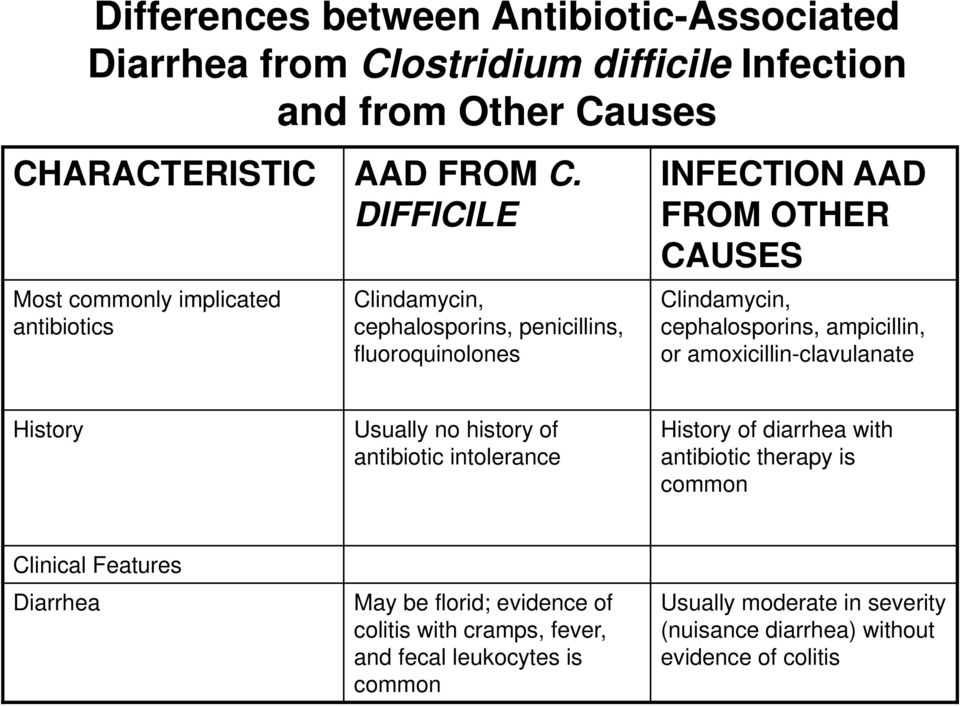
4 Findings on CT or colonoscopy Complications Evidence of colitis is common; pseudomembranes often are present Hypoalbuminemia, anasarca, toxic megacolon; relapse can occur after treatment with metronidazole or vancomycin Usually normal Usually none except occasional cases of volume depletion Results of assay for C. difficile toxin Epidemiologic pattern Treatment Withdrawal of implicated antibiotic Positive May be epidemic or endemic in hospitals or long-term care facilities Condition can resolve but often persists or progresses Negative Sporadic Antiperistaltic agents Contraindicated Often useful Condition usually resolves Oral metronidazole or vancomycin Prompt response Not indicated

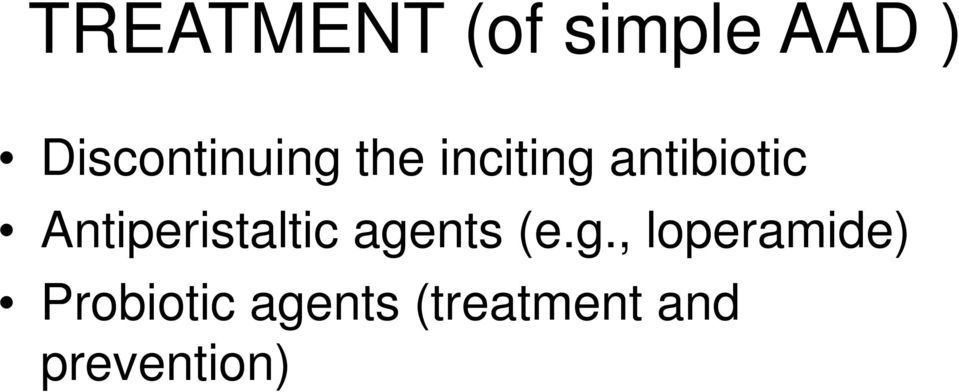
5 TREATMENT (of simple AAD ) Discontinuing the inciting antibiotic Antiperistaltic agents (e.g., loperamide) Probiotic agents (treatment and prevention)
6 CLOSTRIDIUM DIFFICILE-ASSOCIATED DIARRHEA AND COLITIS C. difficile, an anaerobic, Gram-positive, spore-forming, toxigenic bacillus

7 PATHOGENESIS Antibiotic therapy Altered colonic microflora C. Difficle exposure and colonisation Toxin production Asymptomaic carriage Diarrhea/colitis

8 Antimicrobial Agents That Predispose to Clostridium difficile-associated Diarrhea and Colitis Most Frequently Ampicillin and amoxicillin Cephalosporins Clindamycin Fluoroquinolones Less Frequently Macrolides (including erythromycin) Other penicillins Sulfonamides Trimethoprim/sulfamethoxazo le Rarely or Never Bacitracin Carbapenems Chloramphenicol Daptomycin Metronidazole Parenteral aminoglycosides Rifampin Rifaximin Tetracyclines Tigecycline Vancomycin

9 Hospital Epidemiology of Clostridium difficile Infection Chronic intestinal carriage rates of C. difficile in healthy adults are low (0% to 3% in American and European populations) In contrast, hospital inpatients treated with antibiotics have reported colonization rates of 10% to 21%

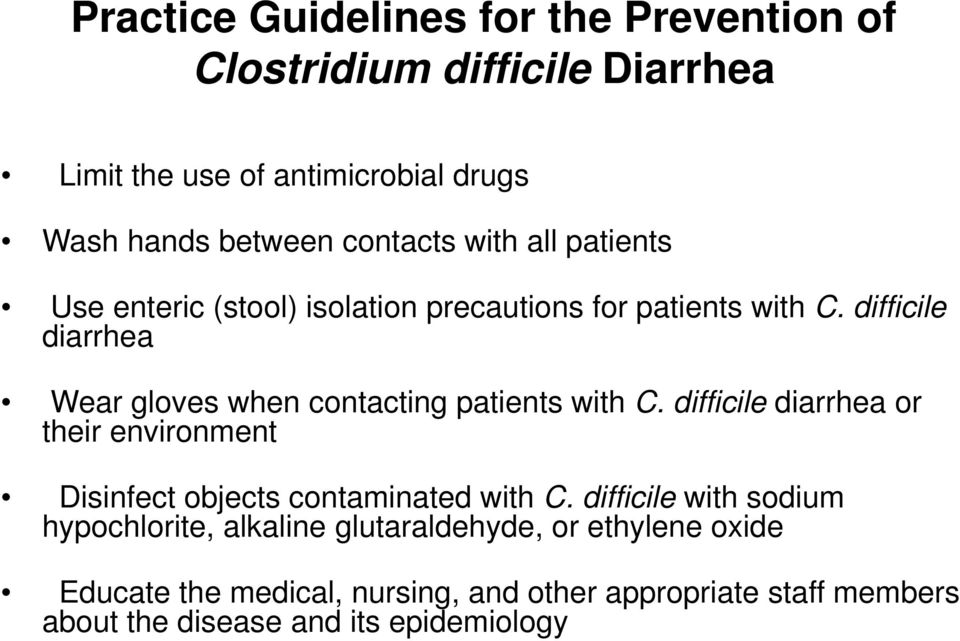
10 Practice Guidelines for the Prevention of Clostridium difficile Diarrhea Limit the use of antimicrobial drugs Wash hands between contacts with all patients Use enteric (stool) isolation precautions for patients with C. difficile diarrhea Wear gloves when contacting patients with C. difficile diarrhea or their environment Disinfect objects contaminated with C. difficile with sodium hypochlorite, alkaline glutaraldehyde, or ethylene oxide Educate the medical, nursing, and other appropriate staff members about the disease and its epidemiology
11 Toxins Toxin A Toxin B Toxin B is a major virulence factor in human disease. A minority (less than 10%) of C. difficile clinical isolates produce the third toxin binary toxin The NAP-1/BI or epidemic strain is binary toxin positive, however, thereby raising renewed suspicion that this toxin might enhance the effects of toxins A and B.

12 Other Risk Factors for Clostridium difficile Infection Increasing age and Use of a nasogastric tube Gastrointestinal procedures Intensive care unit stay Length of hospital stay HIV Patients with inflammatory bowel disease (IBD) The role of acid suppression in C. difficile infection is unclear

13 CLINICAL FEATURES Range - Asymptomatic carriage Mild or moderate diarrhea Life-threatening pseudomembranous colitis.

14 DIAGNOSIS History of recent or current antimicrobial therapy, development of diarrhea or other evidence of acute colitis Tests for Clostridium difficile Infection Testing of solid or formed stools for C. difficile toxin is not recommended because only patients with diarrhea require treatment

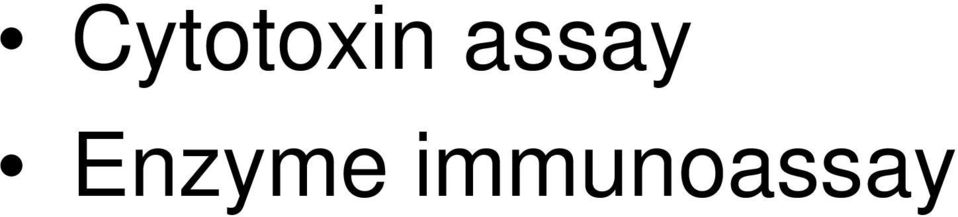
15 Cytotoxin assay Enzyme immunoassay
16 Sigmoidoscopy and Colonoscopy Neither sigmoidoscopy nor colonoscopy is required for diagnosis in most patients Endoscopy is helpful, however, when the diagnosis is in doubt or when disease severity demands rapid diagnosis The finding of colonic pseudomembranes in a patient with AAD is virtually pathognomonic for C. difficile colitis

17 Pseudomembranes appear as yellow, gray, or white plaques 2 to 5 mm in diameter, and in some areas they can coalesce to cover large portions of the mucosal surface

18 Histologic image of an endoscopic biopsy specimen from a patient with pseudomembranous colitis showing a summit or volcano lesion. Focal ulceration of the colonic mucosa is evident (lower arrow), with exudation of a pseudomembrane made up of inflammatory cells, fibrin, and necrotic debris (upper arrow

19 TREATMENT Discontinue the inciting antibiotic if possible Confirm the diagnosis Prescribe specific therapy if symptoms are moderately severe or persistent: Metronidazole orally for days (drug of choice for mild-tomoderate disease) Vancomycin orally for days if Diarrhea and colitis are severe Diarrhea does not improve during metronidazole treatment Patient cannot tolerate metronidazole Patient is pregnant or younger than 10 yr of age

20 Approach to Management of Recurrent Clostridium difficile Colitis First Relapse Confirm diagnosis Symptomatic treatment if symptoms are mild 10- to 14-day course of metronidazole if symptoms are moderate 10- to 14-day course of vancomycin if symptoms are severe Second Relapse Confirm diagnosis Vancomycin-taper regimen 125 mg every 6 hr for 10 to 14 days 125 mg every 12 hr for the next seven days 125 mg daily for the next seven days 125 mg every other day for the next eight days 125 mg every three days for the next 15 days Third Relapse 10- to 14-day course of vancomycin followed by a 14-day course of oral rifaximin 400 mg twice a day

21 Additional Options Therapy with microorganisms, e.g., bacteriotherapy, Saccharomyces boulardii, or Lactobacillus spp. in combination with and following metronidazole or vancomycin or Intravenous immunoglobulin 400 mg/kg two or three times with a three-week interval between doses or Vancomycin 125 mg every 6 hr plus cholestyramine 4 g twice daily* or Vancomycin 125 mg every 6 hr and rifampicin 600 mg twice daily
22 Bacteriotherapy Stool transplantation
Develop an understanding of the differential diagnosis of pseudomembranous colitis
 Update on Clostridium difficile Colitis Clostridium difficile infection has recently emerged in populations without any known risk factors. This presentation will focus on the historical background, diagnosis,
TITLE: CLOSTRIDIUM DIFFICILE INFECTION (CDI): GUIDELINES FOR THE MANAGEMENT OF ADULT PATIENTS
 Page 1 of 6 TITLE: CLOSTRIDIUM DIFFICILE INFECTION (CDI): GUIDELINES FOR THE MANAGEMENT OF ADULT PATIENTS POLICY/GUIDELINES: Diagnosis of Clostridium difficile disease is based on clinical symptoms in
Clostridium Difficile Colitis. Presented by Mark Skains August 2003
 Clostridium Difficile Colitis Presented by Mark Skains August 2003 What is Clostridium Difficile Gram positive rod Produces spores (hang out in diverticula) Forms Endotoxin A + B which cause diarrhea.
What Is Clostridium Difficile (C. Diff)? CLOSTRIDIUM DIFFICILE (C. DIFF)
 What Is Clostridium Difficile (C. Diff)? Clostridium difficile, or C. diff for short, is an infection from a bacterium, or bug, that can grow in your intestines and cause bad GI symptoms. The main risk
C. difficile Infections
 C. difficile Infections Introduction C. difficile is a type of bacteria that can cause diarrhea and infection of the colon. This bacterium is more likely to infect patients at hospitals and other healthcare
Treatments, Tapers, and Transplants: Guidelines and Options for Complicated C. diff Patients MIA A. TAORMINA, DO, FACOI
 Treatments, Tapers, and Transplants: Guidelines and Options for Complicated C. diff Patients MIA A. TAORMINA, DO, FACOI DUPAGE MEDICAL GROUP INFECTIOUS DISEASE Objectives To discuss the epidemiology and
Clostridium difficile Infection (CDI) Gail Bennett, RN, MSN, CIC
 Clostridium difficile Infection (CDI) Gail Bennett, RN, MSN, CIC 1 Clostridium difficile (C.difficile) Antibiotic induced diarrhea Can cause pseudomembranous colitis Most common cause of acute infectious
Probiotics for the Treatment of Adult Gastrointestinal Disorders
 Probiotics for the Treatment of Adult Gastrointestinal Disorders Darren M. Brenner, M.D. Division of Gastroenterology Northwestern University, Feinberg School of Medicine Chicago, Illinois What are Probiotics?
Clostridium difficile Not So Easy To Treat?
 Clostridium difficile Not So Easy To Treat? Manish Rungta, MD Bay Area Gastroenterology, PA Clinical Assistant Professor, UTMB Clinical Assistant Professor, Baylor College of Medicine Vice Chief of Staff,
COMPOSITION: Each capsule contains clindamycin hydrochloride equivalent to 150 mg clindamycin base.
 APPROVED PACKAGE INSERT DALACIN C 150 mg CAPSULES SCHEDULING STATUS: S4 PROPRIETARY NAME (and dosage form): DALACIN C TM 150 mg (Capsules) COMPOSITION: Each capsule contains clindamycin hydrochloride equivalent
Treatment and Prevention Options for Clostridium difficile Infection (CDI)
 Treatment and Prevention Options for Clostridium difficile Infection (CDI) Dale N. Gerding, MD Professor of Medicine Loyola University Chicago Stritch School of Medicine Research Physician Hines VA Hospital
Urinary Tract Infections
 Urinary Tract Infections Overview A urine culture must ALWAYS be interpreted in the context of the urinalysis and patient symptoms. If a patient has no signs of infection on urinalysis, no symptoms of
Antimicrobial Stewardship for Hospital Acquired Infection Prevention: Focus on C. difficile infection
 Antimicrobial Stewardship for Hospital Acquired Infection Prevention: Focus on C. difficile infection Emi Minejima, PharmD Assistant Professor of Clinical Pharmacy USC School of Pharmacy [email protected]
Clostridium difficile infection: How to deal with the problem
 Clostridium difficile infection: How to deal with the problem DH INFORMATION RE ADER B OX Policy HR / Workforce Management Planning / Clinical Estates Commissioning IM & T Finance Social Care / Partnership
Intra-abdominal abdominal Infections
 Intra-abdominal abdominal Infections Marnie Peterson, Pharm.D., BCPS Dept. of Pediatric Infectious Diseases Medical School University of Minnesota Intra-abdominal abdominal Infections Intra-abdominal abdominal
C. difficile. Answers to frequently asked questions about. at the Jewish General Hospital. www.jgh.ca SIR MORTIMER B. DAVIS JEWISH GENERAL HOSPITAL
 Answers to frequently asked questions about C. difficile at the Jewish General Hospital SIR MORTIMER B. DAVIS JEWISH GENERAL HOSPITAL A McGill University Teaching Hospital www.jgh.ca 1. CLOSTRIDIUM DIFFICILE
Clostridium Difficile colitismore virulent than ever ECHO- Sept 17, 2015
 Clostridium Difficile colitismore virulent than ever ECHO- Sept 17, 2015 Charles Krasner, M.D. UNR School of Medicine Sierra NV Veterans Affairs Hospital Growing problem of pseudomembranous colitis MMWR-
Clostridium difficile (C. difficile)
 Clostridium difficile (C. difficile) UHN Information for patients and families Read this resource to learn about: What is C. difficile How people get infected with C. difficile Treatment and medicine How
C-Difficile Infection Control and Prevention Strategies
 C-Difficile Infection Control and Prevention Strategies Adrienne Mims, MD MPH VP, Chief Medical Officer [email protected] 1/18/2016 1 Disclosure This educational activity does not have commercial
Norovirus Outbreak Among Residents of an Assisted Living Facility, Houston County, Alabama 2010 (AL1003NRV 35a)
 Norovirus Outbreak Among Residents of an Assisted Living Facility, Houston County, Alabama 2010 (AL1003NRV 35a) Introduction On March 9, 2010, Public Health Area (PHA) 10 surveillance nurse contacted the
California Guidelines for STD Screening and Treatment in Pregnancy
 California Guidelines for STD Screening and Treatment in Pregnancy These guidelines were developed by the California Department of Public Health (CDPH) Sexually Transmitted Diseases (STD) Control Branch
CADTH Technology Report
 Canadian Agency for Drugs and Technologies in Health Agence canadienne des médicaments et des technologies de la santé CADTH Technology Report Issue 136 January 2011 Vancomycin or Metronidazole for Treatment
Vancomycin. Beta-lactams. Beta-lactams. Vancomycin (Glycopeptide) Rifamycins (rifampin) MID 4
 Antibiotic Classes Introduction to Antimicrobials Rachel J. Gordon, MD, MPH Assistant Professor of Clinical Medicine and Epidemiology Beta-lactams Inhibit cell wall synthesis Penicillins Cephalosporins
Dechra Veterinary Products Limited (A business unit of Dechra Pharmaceuticals PLC) Sansaw Business Park Hadnall, Shrewsbury Shropshire SY4 4AS
 Dechra Veterinary Products Limited (A business unit of Dechra Pharmaceuticals PLC) Sansaw Business Park Hadnall, Shrewsbury Shropshire SY4 4AS Tel: 01939 211200 Fax: 01939 211201 Email: [email protected]
Antibiotic Guidelines: Ear Nose and Throat (ENT) Infections. Contents
 Antibiotic Guidelines: Ear Nose and Throat (ENT) Infections. Classification: Clinical Guideline Lead Author: Antibiotic Steering Committee Additional author(s): Authors Division: DCSS & Tertiary Medicine
Massachusetts Department of Developmental Services MRSA, VRE, and C. Diff Management Protocol
 Massachusetts Department of Developmental Services MRSA, VRE, and C. Diff Management Protocol PURPOSE: To provide guidance for personnel in order to prevent the spread of Antibiotic Resistant Microorganisms
Bile Duct Diseases and Problems
 Bile Duct Diseases and Problems Introduction A bile duct is a tube that carries bile between the liver and gallbladder and the intestine. Bile is a substance made by the liver that helps with digestion.
PACKAGE LEAFLET. CLINDAMYCIN capsules Clidamycin. One capsule of 75 mg contains 75 mg Clindamycin (as hydrochloride).
 PACKAGE LEAFLET CLINDAMYCIN capsules Clidamycin COMPOSITION One capsule of 75 mg contains 75 mg Clindamycin (as hydrochloride). One capsule of 150 mg contains 150 mg Clindamycin (as hydrochloride). PROPERTIES
Management of Extended Spectrum Beta- Lactamase (ESBL) Producing Enterobacteriaceae in health care settings
 Management of Extended Spectrum Beta- Lactamase (ESBL) Producing Enterobacteriaceae in health care settings Dr. Mary Vearncombe PIDAC-IPC February 2012 Objectives: To provide an overview of the RP/AP Annex
THIS IS AN OFFICIAL NH DHHS HEALTH ALERT
 THIS IS AN OFFICIAL NH DHHS HEALTH ALERT Distributed by the NH Health Alert Network [email protected] August 13, 2015 1400 EDT (2:00 PM EDT) NH-HAN 20150813 Updated Centers for Disease Control (CDC)
{ Rifaximin versus Nonabsorbable Disaccharides for the Treatment of Hepatic Encephalopathy: A Meta Analysis}
 { Rifaximin versus Nonabsorbable Disaccharides for the Treatment of Hepatic Encephalopathy: A Meta Analysis} {Dong Wu, Shu-Mei Wu, Jie Lu, Ying-Qun Zhou, Ling Xu, and Chuan-Yong Guo} Noor Al-Hakami, Pharm
Pathophysiology of Diarrhea
 1. Pathophysiology of Diarrhea 2. Case Presentation Page - 1 3. Diarrhea is the too rapid evacuation of too fluid sto... 4. The Amazing Intestines helsenet.info Page - 2 5. : Slide 5 6. Diarrhea helsenet.info
CLOSTRIDIUM PERFRINGENS
 CLOSTRIDIUM PERFRINGENS PATHOGEN SAFETY DATA SHEET - INFECTIOUS SUBSTANCES INFECTIOUS AGENT NAME: Clostridium perfringens SYNONYM OR CROSS REFERENCE: Gas gangrene; pigbel disease CHARACTERISTICS: Clostridium
2016 PQRS OPTIONS FOR INDIVIDUAL MEASURES: REGISTRY ONLY
 Measure #65 (NQF 0069): Appropriate Treatment for Children with Upper Respiratory Infection (URI) National Quality Strategy Domain: Efficiency and Cost Reduction 2016 PQRS OPTIONS FOR INDIVIDUAL MEASURES:
Practice Parameters for the Management of Clostridium difficile Infection
 PRACTICE PARAMETERS Practice Parameters for the Management of Clostridium difficile Infection Scott R. Steele, M.D. James McCormick, D.O. Genevieve B. Melton, M.D. Ian Paquette, M.D. David E. Rivadeneira,
HSE Health Protection Surveillance Centre. Sample Root Cause Analysis Tool of Hospital-acquired Clostridium difficile Infection
 Clostridium difficile Sub-Committee Health Protection Surveillance Centre Sample Root Cause Analysis Tool of Hospital-acquired Clostridium difficile Infection Version 3, January 2016 This document has
PRIORITY RESEARCH TOPICS
 PRIORITY RESEARCH TOPICS Understanding all the issues associated with antimicrobial resistance is probably impossible, but it is clear that there are a number of key issues about which we need more information.
Recurrent Clostridium difficile Colitis: Case Series Involving 18 Patients Treated with Donor Stool Administered via a Nasogastric Tube
 MAJOR ARTICLE Recurrent Clostridium difficile Colitis: Case Series Involving 18 Patients Treated with Donor Stool Administered via a Nasogastric Tube Johannes Aas, 1 Charles E. Gessert, 2 and Johan S.
PERTUSSIS SURVEILLANCE AND RESPONSE PROTOCOL
 PERTUSSIS SURVEILLANCE AND RESPONSE PROTOCOL Public Health Action 1. Educate the public, particularly parents of infants, about the dangers of whooping cough and the advantages of initiating immunization
Appropriate Treatment for Children with Upper Respiratory Infection
 BCBS ACO Measure Appropriate Treatment for Children with Upper Respiratory Infection HEDIS Measure CPT II coding required: YES Click here to go to Table of Contents BCBS Measure: Page 50 of 234 Dated:
Equine Equine Diarrhea Diarrhea Diarrhea in the Horse: Salmonella and Other Infections Introduction Clinical Signs
 Equine Diarrhea Diarrhea in the Horse: Salmonella and Other Infections Amanda M. House, DVM, DACVIM Assistant Professor Large Animal Clinical Sciences UF College of Veterinary Medicine Introduction Clinical
Frequently Asked Questions
 Guidelines for Testing and Treatment of Gonorrhea in Ontario, 2013 Frequently Asked Questions Table of Contents Background... 1 Treatment Recommendations... 2 Treatment of Contacts... 4 Administration
Title: Antibiotic Guideline for Acute Pelvic Inflammatory Disease
 Title: Antibiotic Guideline for Acute Pelvic Inflammatory Disease Version 3 Date ratified December 2007 Review date December 2009 Ratified by NUH Antimicrobial Guidelines Committee Gynaecology Directorate
Antimicrobial Prophylaxis for Transrectal Prostate Biopsy: Organizational Recommendations. J. Stuart Wolf, Jr., M.D.
 Antimicrobial Prophylaxis for Transrectal Prostate Biopsy: Organizational Recommendations J. Stuart Wolf, Jr., M.D. Department of Urology University of Michigan Ann Arbor, MI Official Recommendations for
Gastrointestinal Bleeding
 Gastrointestinal Bleeding Introduction Gastrointestinal bleeding is a symptom of many diseases rather than a disease itself. A number of different conditions can cause gastrointestinal bleeding. Some causes
Microscopic Colitis: Collagenous Colitis and Lymphocytic Colitis
 Microscopic Colitis: Collagenous Colitis and Lymphocytic Colitis National Digestive Diseases Information Clearinghouse U.S. Department of Health and Human Services NATIONAL INSTITUTES OF HEALTH What is
Ulcerative Colitis & Proctitis. About Ulcerative Colitis & Proctitis
 Ulcerative Colitis & Proctitis About Ulcerative Colitis & Proctitis When you first learn that you have ulcerative colitis, you will probably feel overwhelmed. You may not even have heard of ulcerative
Appendix M: Guidelines for the Prophylaxis and Management of Intraabdominal, Biliary, and Appendiceal Infections
 Appendix M: Guidelines for the Prophylaxis and Management of Intraabdominal, Biliary, and Appendiceal Infections University of Wisconsin Hospital and Clinics Intraabdominal Infections Prophylaxis and Management
C. difficile infection. Background and guidance for hospitals and clinical labs
 infection Background and guidance for hospitals and clinical labs infection is a serious public health concern First described in 1935 by Hall and O Toole, Clostridium difficile is the gram-positive, spore-forming
GLOBAL OVERVIEW OF ANTIMICROBIAL RESISTANCE STD AGENTS
 GLOBAL OVERVIEW OF ANTIMICROBIAL RESISTANCE STD AGENTS IN Dr.P.Bhalla Director Professor and Head Dept. of Microbiology Maulana Azad Medical College New Delhi, INDIA STDs & RTIs l HIV l Gonococcal infections/
BCCA Protocol Summary for Palliative Treatment of Advanced Pancreatic Neuroendocrine Tumours using SUNItinib (SUTENT )
 BCCA Protocol Summary for Palliative Treatment of Advanced Pancreatic Neuroendocrine Tumours using SUNItinib (SUTENT ) Protocol Code Tumour Group Contact Physician UGIPNSUNI Gastrointestinal Dr. Hagen
Nursing college, Second stage Microbiology Dr.Nada Khazal K. Hendi L14: Hospital acquired infection, nosocomial infection
 L14: Hospital acquired infection, nosocomial infection Definition A hospital acquired infection, also called a nosocomial infection, is an infection that first appears between 48 hours and four days after
Patients who fail to bring a driver/someone to stay with them for the night will have their procedure cancelled immediately.
 Preparing for your Colonoscopy You must have someone and/or a driver accompany you and stay with you for 24 hours after your procedure. Patients who fail to bring a driver/someone to stay with them for
Infection of neonatal swine with Clostridium difficile
 JGS, BHJ, RDG: Department of Veterinary Science and Microbiology, University of Arizona, Tucson, AZ 85721; email: [email protected]; KWP: Rollins Animal Disease Diagnostic Laboratory; DJL: Iowa Veterinary
Clostridium difficile infection in Europe A CDI Europe Report
 Clostridium difficile infection in Europe A CDI Europe Report CONTENTS FOREWORD 5 1. INTRODUCTION: CDI WHAT IS THE PROBLEM? 6 1.1 How does CDI occur? 6 1.2 How common is CDI? 8 1.3 Who is at risk of CDI?
European Society of Clinical Microbiology and Infectious Diseases (ESCMID): treatment guidance document for Clostridium difficile infection (CDI)
 GUIDELINES 10.1111/j.1469-0691.2009.03099.x European Society of Clinical Microbiology and Infectious Diseases (ESCMID): treatment guidance document for Clostridium difficile infection (CDI) M. P. Bauer
Dosing information in renal impairment
 No. Drug name Usual dose Adjustment for Renal failure estimated CrCl (ml/min) Aminoglycoside antibiotics 1 Amikacin 2 Gentamicin 7.5 mg /kg q 12 hr > 50-90 7.5 mg/kg q 12 hr 10-50 7.5 mg/kg q 24 hr < 10
A. Ketorolac*** B. Naproxen C. Ibuprofen D. Celecoxib
 1. A man, 66 years of age, with a history of knee osteoarthritis (OA) is experiencing increasing pain at rest and with physical activity. He also has a history of depression and coronary artery disease.
Diseases of the Colon. Jack Bragg, D.O., F.A.C.O.I.
 Diseases of the Colon Jack Bragg, D.O., F.A.C.O.I. Inflammatory Bowel Disease ULCERATIVE COLITIS CROHN S DISEASE Transmural Inflammation Mucosal Ulceration in Colon Ileitis Ileocolitis Colitis Inflammatory
Principles of Disease and Epidemiology. Copyright 2010 Pearson Education, Inc.
 Principles of Disease and Epidemiology Pathology, Infection, and Disease Disease: An abnormal state in which the body is not functioning normally Pathology: The study of disease Etiology: The study of
Colon Cancer. What Is Colon Cancer? What Are the Screening Methods?
 Cancer of the colon or rectum (colorectal cancer) is the second most common cancer in the U.S. In fact, of all people born, 1 in 40 will die of the disease. What Is Colon Cancer? Colon cancer begins with
NATIONAL INSTITUTE FOR HEALTH AND CARE EXCELLENCE. Multiple Technology Appraisal
 NATIONAL INSTITUTE FOR HEALTH AND CARE EXCELLENCE Multiple Technology Appraisal Infliximab, adalimumab and golimumab for treating moderately to severely active ulcerative colitis after the failure of conventional
A Practical Guide to Diagnosis and Treatment of Infection in the Outpatient Setting Diagnosis and Treatment of Urinary Tract Infections
 A Practical Guide to Diagnosis and Treatment of Infection in the Outpatient Setting Diagnosis and Treatment of Urinary Tract Infections By Gary R. Skankey, MD, FACP, Infectious Disease, Las Vegas, NV Sponsored
Crohn's disease and ulcerative colitis
 Crohn's disease and ulcerative colitis Summary Crohn s disease and ulcerative colitis are collectively known as inflammatory bowel disease (IBD). Crohn s disease can appear in any part of a person s digestive
Learning Objectives. Introduction to Medical Careers. Vocabulary: Chapter 16 FACTS. Functions. Organs. Digestive System Chapter 16
 Learning Objectives Introduction to Medical Careers Digestive System Chapter 16 Define at least 10 terms relating to the digestive Describe the four functions of the digestive Identify different structures
Rhode Island Department of Health Division of Infectious Diseases and Epidemiology
 Rhode Island Department of Health Division of Infectious Diseases and Epidemiology STD (Sexually Transmitted Disease) PROGRAM Expedited Partner Therapy (EPT) for STDs Guidance for Medical Providers in
COLORECTAL CANCER SCREENING
 COLORECTAL CANCER SCREENING By Douglas K. Rex, M.D., FACG & Suthat Liangpunsakul, M.D. Division of Gastroenterology and Hepatology, Department of Medicine Indiana University School of Medicine Indianapolis,
Lab ID Events MRSA Bloodstream Infection and C. difficile
 Lab ID Events MRSA Bloodstream Infection and C. difficile MDRO and CDI Module Methicillin-resistant Staphylococcus (MRSA), Vancomycinresistant Enterococcus(VRE), certain gram negative bacilli, Clostridium