
Chapter 6. Revaluations and impairment testing of non-current assets. Objectives of this lecture. Objectives (cont.)
|
|
|
- Samantha Garrison
- 9 years ago
- Views:
Transcription
1 Chapter 6 Revaluations and impairment testing of non-current assets PPTs to accompany Deegan, Australian Financial Accounting 7e 6-1 Objectives of this lecture Understand the meaning of fair value Understand how and when to revalue an item of property, plant and equipment in accordance with AASB 116 Understand how and when to revalue an intangible asset in accordance with AASB 138 Understand the difference in accounting treatments for upward revaluations to fair value, as opposed to write-downs to recoverable amount Understand what an impairment loss is and know how to account for one PPTs to accompany Deegan, Australian Financial Accounting 7e 6-2 Objectives (cont.) Understand how to account for revaluations that act to reverse previous revaluation increments and decrements Understand how to account for accumulated depreciation when a non-current depreciable asset is revalued Understand that, subsequent to revaluation, new depreciation charges will be based on the revalued amount of the non-current asset Know how the profit is determined on disposal of a revalued non-current asset PPTs to accompany Deegan, Australian Financial Accounting 7e 6-3 1

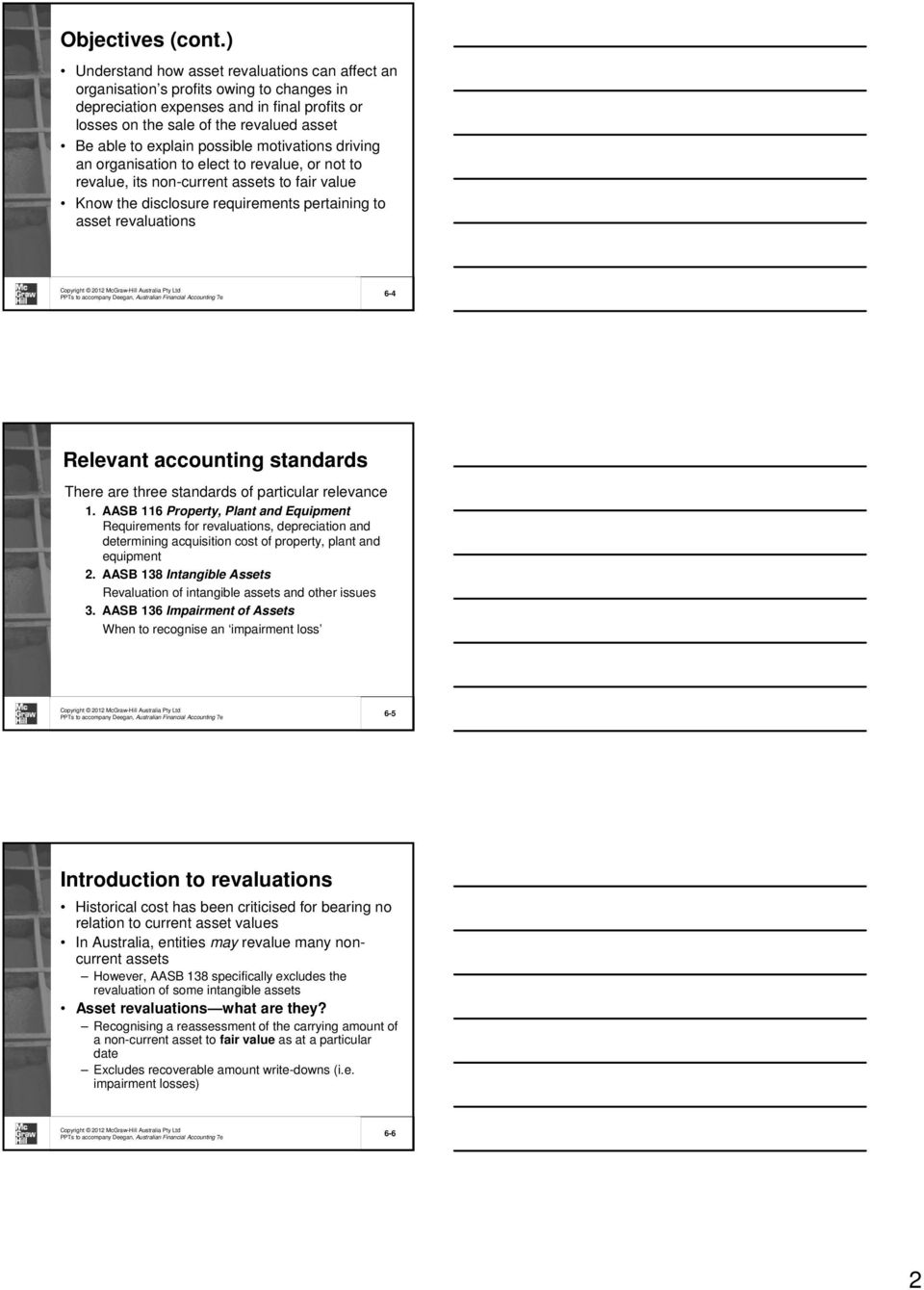
2 Objectives (cont.) Understand how asset revaluations can affect an organisation s profits owing to changes in depreciation expenses and in final profits or losses on the sale of the revalued asset Be able to explain possible motivations driving an organisation to elect to revalue, or not to revalue, its non-current assets to fair value Know the disclosure requirements pertaining to asset revaluations PPTs to accompany Deegan, Australian Financial Accounting 7e 6-4 Relevant accounting standards There are three standards of particular relevance 1. AASB 116 Property, Plant and Equipment Requirements for revaluations, depreciation and determining acquisition cost of property, plant and equipment 2. AASB 138 Intangible Assets Revaluation of intangible assets and other issues 3. AASB 136 Impairment of Assets When to recognise an impairment loss PPTs to accompany Deegan, Australian Financial Accounting 7e 6-5 Introduction to revaluations Historical cost has been criticised for bearing no relation to current asset values In Australia, entities may revalue many noncurrent assets However, AASB 138 specifically excludes the revaluation of some intangible assets Asset revaluations what are they? Recognising a reassessment of the carrying amount of a non-current asset to fair value as at a particular date Excludes recoverable amount write-downs (i.e. impairment losses) PPTs to accompany Deegan, Australian Financial Accounting 7e 6-6 2
3 Introduction to impairment losses If a non-current asset s carrying amount exceeds its recoverable amount it must be written down to its recoverable amount (AASB 136) The write-down is called an impairment loss (again, not to be confused with a revaluation) Carrying amount: cost of asset (or revalued amount) less accumulated depreciation and accumulated impairment losses Recoverable amount: higher of an asset s fair value less costs of disposal, and value in use PPTs to accompany Deegan, Australian Financial Accounting 7e 6-7 Introduction to impairment losses (cont.) Fair value, less costs of disposal (or net selling price): amount obtained from the sale of an asset in an arm s length transaction between knowledgeable, willing parties less the costs of disposal Value in use: present value of the future cash flows expected to be derived from an asset PPTs to accompany Deegan, Australian Financial Accounting 7e 6-8 Impairment losses Impairment losses can be reversed in subsequent periods (unless a particular accounting standard prohibits it as is the case with intangible assets) Worked Example 6.1 (p. 205) provides an example of a reversal of an impairment loss Impairment losses will at times be determined by reference to a cash-generating unit rather than to a specific asset. AASB 136 defines a cash-generating unit as the smallest identifiable group of assets that generates cash inflows that are largely independent of the cash inflows from other assets or groups of assets See Worked Example 6.4 (p. 208) Accounting for an impairment loss by reference to a cash-generating unit PPTs to accompany Deegan, Australian Financial Accounting 7e 6-9 3

4 Worked Example 6.4 Accounting for an impairment loss by reference to a cash-generating unit Ulladulla Ltd has a printing process comprising four separate but highly interdependent assets. The printing machinery has a combined carrying value of $ , made up as follows: Asset 1 $ Asset 2 $ Asset 3 $ Asset 4 $ $ It was determined that the value in use of the cashgenerating unit, which is calculated at its present value, amounted to $ PPTs to accompany Deegan, Australian Financial Accounting 7e 6-10 Worked Example 6.4 Accounting for an impairment loss by reference to a cash-generating unit (cont.) The current fair value less costs of disposal of the entire unit is $ The total impairment loss will therefore be equal to $ less the greater of the value in use and fair value less costs to sell This gives us a total impairment loss of $ The impairment loss would be apportioned across the four assets by using their respective carrying values as the basis for the allocation. For example, the allocation of the impairment loss to Asset 4 would be divided by multiplied by This would equal $ PPTs to accompany Deegan, Australian Financial Accounting 7e 6-11 Worked Example 6.4 Accounting for an impairment loss by reference to a cash-generating unit (cont.) Hence the accounting entry to record the impairment loss on the cash-generating unit would be: Dr Impairment loss Cr Accum. impairment losses Asset Cr Accum. impairment losses Asset Cr Accum. impairment losses Asset Cr Accum. impairment losses Asset PPTs to accompany Deegan, Australian Financial Accounting 7e

5 Measuring property, plant and equipment at cost or fair value the choice AASB 116 requires each class of property, plant and equipment to be measured at either cost or fair value Examples of classes are land and buildings, machinery and motor vehicles Some classes might be measured at cost and others at fair value With a mix of measurement methods, is the total balance of non-current assets meaningful? Entities may switch from fair value to cost for justifiable reasons and provided adequate disclosures are made (AASB 116) PPTs to accompany Deegan, Australian Financial Accounting 7e 6-13 Measuring property, plant and equipment at cost or fair value (cont.) Where an entity changes from cost (that is, they have been using the cost model ) to fair value (that is, they have decided to use the revaluation model ) for a class of non-current assets and there was a previous impairment loss (AASB 116): any increase in an asset s carrying amount is first recognised as income; and any excess above the amount if no impairment loss was recognised is transferred to a revaluation surplus account PPTs to accompany Deegan, Australian Financial Accounting 7e 6-14 Measuring property, plant and equipment at cost or fair value (cont.) If a class of non-current assets is measured at cost, AASB 136 is to be applied: if an asset s carrying amount is greater than its recoverable amount, an impairment loss must be recognised this would not constitute a revaluation PPTs to accompany Deegan, Australian Financial Accounting 7e

6 The use of fair values Any revaluation of non-current assets must be to fair value (AASB 116) Fair value is defined in the accounting standard and in accordance with AASB 13 Fair Value Measurement (issued in September 2011) as: the price that would be received to sell an asset or paid to transfer a liability in an orderly transaction between market participants at the measurement date. This definition of fair value is the same as that of fair value used in other accounting standards. Hence, under AASB 116 a specific valuation method has been stipulated, this being fair Fair value is determined on the assumption that the entity is a going concern PPTs to accompany Deegan, Australian Financial Accounting 7e 6-16 The use of fair values (cont.) The required disclosures regarding asset revaluations (AASB 116) are: effective date of revaluation whether an independent valuer was involved methods and significant assumptions applied extent to which fair values were determined, with reference to observable prices in active markets or recent market transactions for each revalued class, the carrying amount if the cost model was used the revaluation surplus, indicating the change for the period and any restrictions on distribution of the balance to shareholders PPTs to accompany Deegan, Australian Financial Accounting 7e 6-17 The use of fair values (cont.) Revaluations must be made with sufficient regularity so the carrying amount of each asset in the class does not differ materially from its fair value (AASB 116) If values change regularly and changes are material, revaluations might be necessary each reporting period Otherwise every three to five years is sufficient PPTs to accompany Deegan, Australian Financial Accounting 7e

7 Revaluation increments General procedure (AASB 116) Debit Credit Asset Revaluation surplus The revaluation surplus is part of shareholders funds (owners equity) PPTs to accompany Deegan, Australian Financial Accounting 7e 6-19 Treatment of balances of accumulated depreciation upon revaluation If a revalued asset is a depreciable asset, any balance of accumulated depreciation is credited to the asset account prior to revaluation (AASB 116) Journal entry (net-amount method) Dr Accumulated depreciation machine Cr Machine Dr Machine Cr Revaluation surplus Subsequent depreciation is to be based on the revalued amount of the asset PPTs to accompany Deegan, Australian Financial Accounting 7e 6-20 Worked Example 6.5 Revaluation of a depreciable asset using the net-amount method As at 1 July 2014, Farrelly Ltd has an item of machinery that originally cost $ and has accumulated depreciation of $ Its remaining life is assessed to be five years, after which time it will have no residual value. Farrelly decided on 1 July 2014 that the item should be revalued to its fair value, which was assessed as $ PPTs to accompany Deegan, Australian Financial Accounting 7e

8 Worked Example 6.5 Revaluation of a depreciable asset using the net-amount method (cont.) The total revaluation increment will represent the difference between the carrying amount and the fair value. In this case it would be: $ ($ $15 000) = $ The journal entries on 1 July 2014 would be: Dr Accumulated depreciation machinery Cr Machinery Dr Machinery Cr Revaluation surplus PPTs to accompany Deegan, Australian Financial Accounting 7e 6-22 Illustration 2 Revaluation increment A building with a cost of $ and accumulated depreciation of $ is revalued to its fair value of $ What are the journal entries? Dr Accumulated depreciation Cr Building Dr Building Cr Revaluation surplus PPTs to accompany Deegan, Australian Financial Accounting 7e 6-23 Treatment of balances of accumulated depreciation upon revaluation (cont.) Alternative method (AASB 116) Accumulated depreciation may be restated proportionately with the change in gross carrying amount of the asset, so the carrying amount after revaluation equals the revalued amount This is referred to as the gross method Journal entry Debit Asset Credit Accumulated depreciation Credit Revaluation surplus Refer to Worked Example 6.6 (p. 212) Revaluation of a depreciable asset the use of the gross method PPTs to accompany Deegan, Australian Financial Accounting 7e

9 Revaluation decrements In line with the concept of conservatism, revaluation decrements are recognised as an expense within profit or loss in the statement of comprehensive income Contrast this with a revaluation increment wherein the increase in the revaluation surplus is included in other comprehensive income Journal entry (AASB 116) Dr Cr Dr Cr Accumulated depreciation Asset Loss on revaluation of asset Asset Refer to Worked Example 6.7 (p. 213) A revaluation decrement PPTs to accompany Deegan, Australian Financial Accounting 7e 6-25 Illustration Revaluation decrement Refer to the previous example, except this time the fair value of the building (acquired for $ and having accumulated depreciation of $ ) is $ rather than $ What are the journal entries? Dr Accumulated depreciation Cr Building Dr Loss on revaluation of building Cr Building PPTs to accompany Deegan, Australian Financial Accounting 7e 6-26 Reversal of revaluation decrements and increments For an asset class, reversals of previous revaluations should be recorded by the reverse of the initial revaluation entries If a revaluation decrement reverses a previous increment for the same asset, then the entries are: Dr Accumulated depreciation Cr Asset Dr Dr Cr Revaluation surplus Loss on revaluation (the excess, if any) Asset PPTs to accompany Deegan, Australian Financial Accounting 7e

10 Example of a reversal of a previous revaluation increment (Worked Example 6.8, p. 214) PK Ltd acquires a block of land on 1 January 2013 for $ in cash Due to increased housing demand in the area, the land has a market value of $ on 1 January 2014 However, the market value falls to $ on 30 June January 2013 Dr Land Cr Cash January 2014 Dr Land Cr Revaluation surplus June 2016 Dr Revaluation surplus Dr Loss on revaluation of land Cr Land PPTs to accompany Deegan, Australian Financial Accounting 7e 6-28 Reversal of revaluation decrements and increments (cont.) If a revaluation increment reverses a previous decrement for the same asset then we recognise a gain, which is included within profit or loss, to the extent it reverses the previous revaluation decrement. The general form of the journal entry would be: Dr Cr Cr Asset Gain on revaluation Revaluation surplus (the excess if any) PPTs to accompany Deegan, Australian Financial Accounting 7e 6-29 Example of a reversal of a previous revaluation decrement Land was acquired for $ on 1 July On 30 June 2013 it has a fair value of $ On 30 June 2015, due to increased population, the land is considered to have a fair value of $ July 2012 Dr Land Cr Cash June 2013 Dr Loss on revaluation of land Cr Land (loss included within profit or loss) 30 June 2015 Dr Land Cr Gain on revaluation of land Cr Revaluation surplus (gain included in profit or loss and the increase in revaluation surplus is included within other comprehensive income ) PPTs to accompany Deegan, Australian Financial Accounting 7e

11 Accounting for the gain or loss on disposal of a revalued non-current asset Gain or loss from derecognition of an item of property, plant and equipment is to be calculated as the difference between (AASB 116): net disposal proceeds (if any), and the asset s carrying amount Derecognition is: the point in time when an asset is removed from the statement of financial position (balance sheet) when an asset is sold, or when no future economic benefits are expected from an asset s use or disposal PPTs to accompany Deegan, Australian Financial Accounting 7e 6-31 Accounting for profit on disposal of a revalued non-current asset When an asset is sold, any resulting balance in the revaluation surplus (AASB 116): may be transferred directly to retained earnings cannot be transferred to the profit or loss If a non-current asset is revalued upwards, any gain on sale will be less than the gain if the asset had not previously been revalued Refer to Worked Examples 6.9, 6.10 and 6.11 on pages PPTs to accompany Deegan, Australian Financial Accounting 7e 6-32 Consideration of present values Recoverable amount is the higher of an asset s fair value less costs of disposal, and value in use (AASB 136) Value in use (AASB 136) is: the present value of the future cash flows expected from an asset Estimating value in use (AASB 136) involves: estimating future cash inflows and outflows from the continued use and subsequent disposal of the asset; and applying the appropriate discount rate to future cash flows Discounting future cash flows will decrease the calculated recoverable amount PPTs to accompany Deegan, Australian Financial Accounting 7e

12 Can we offset revaluation increments and decrements within a class of assets? Increments and decrements may be offset only to the extent that they relate to a particular asset (AASB 116) - Therefore, if, say, one item of land increased in fair value by $10 million and another item of land decreased in fair value by $1 million (and assuming no prior revaluations), then a loss of $1 million would be recognised in profit or loss for the period (and the $10 million would be shown as part of other comprehensive income ) Do we think this is sensible? PPTs to accompany Deegan, Australian Financial Accounting 7e 6-34 Economic consequences of asset revaluations If contracts in place are tied to reported profits (debt or management compensation), management might have an incentive not to revalue However, if assets are increased, a revaluation might loosen constraints such as debt-to-assets restrictions Firms subject to political scrutiny might be more likely to undertake upwards revaluation resulting in a reduction in profits As the perceived competence of independent valuers increases, audit time might be reduced PPTs to accompany Deegan, Australian Financial Accounting 7e 6-35 Disclosure requirements AASB 116 includes various disclosure requirements relating to the revaluation of noncurrent assets These were previously discussed under the heading The use of fair values PPTs to accompany Deegan, Australian Financial Accounting 7e

13 Summary This lecture considered the revaluation of noncurrent assets, with the emphasis on property, plant and equipment If the recoverable amount is below the carrying amount, an impairment loss should be recorded For upwards revaluations: assets are to be revalued to fair value any increase is to be transferred to a revaluation surplus, unless it is a reversal For downwards revaluations: any decrease is to be treated as an expense, unless it is a reversal PPTs to accompany Deegan, Australian Financial Accounting 7e 6-37 Summary (cont.) When a revaluation is undertaken: any existing accumulated depreciation should be credited against the non-current asset (if the net method is used which is the common approach), and the non-current asset should be increased by the amount of the revaluation Where a revalued asset is sold, the gain or loss is the difference between the carrying amount and the net disposal proceeds of the asset The lecture also discusses how revaluations can loosen certain accounting-based debt covenants PPTs to accompany Deegan, Australian Financial Accounting 7e

Accounting Standard AASB 1041 July 2001. Revaluation of Non-Current Assets
 Accounting Standard AASB 1041 July 2001 Revaluation of Non-Current Assets Obtaining a Copy of this Accounting Standard Copies of this Standard are available for purchase from the Australian Accounting
ACCOUNTING POLICY 1.1 FINANCIAL REPORTING. Policy Statement. Definitions. Area covered. This Policy is University-wide.
 POLICY Area covered ACCOUNTING POLICY This Policy is University-wide Approval date 5 May 2016 Policy Statement Intent Scope Effective date 5 May 2016 Next review date 5 May 2019 To establish decisions,
How To Account For Revaluation In Australia
 Australian Accounting Standard AAS 38 December 1999 Revaluation of Non-Current Assets Prepared by the Public Sector Accounting Standards Board of the Australian Accounting Research Foundation and by the
Article by Martin Kelly, BSc (Econ) Hons, DIP. Acc, FCA, MBA, MCMI. Examiner in Professional 2 Advanced Corporate Reporting
 IMPAIRMENT - IAS 36 Article by Martin Kelly, BSc (Econ) Hons, DIP. Acc, FCA, MBA, MCMI. Examiner in Professional 2 Advanced Corporate Reporting Introduction Intangible assets, particularly goodwill, have
4.1 PROPERTY, PLANT AND EQUIPMENT
 4.1 PROPERTY, PLANT AND EQUIPMENT 4.1.1 Introduction 4.1.1.1 Authorities shall account for tangible fixed assets in accordance with IAS 16 Property, Plant and Equipment, except where interpretations or
CHAPTER 16. Non-current assets: Revaluation, disposal and other aspects CONTENTS
 CHAPTER 16 Non-current assets: Revaluation, disposal and other aspects CONTENTS 16.1 Non-current asset disposals 16.2 Revaluation and disposal 16.3 Intangibles and natural resources 16.4 Goodwill and discount
International Accounting Standard 36 Impairment of Assets
 International Accounting Standard 36 Impairment of Assets Objective 1 The objective of this Standard is to prescribe the procedures that an entity applies to ensure that its assets are carried at no more
Foreign Currency Translation
 Statement of Accounting Standards Foreign Currency Translation Prepared by the Accounting Standards Board and the Public Sector Accounting Standards Board of the Australian Accounting Research Foundation
Area Standard AIFRS impact Management action First time Adoption of Australian Equivalents to IFRS
 First time Adoption of Australian Equivalents to IFRS AASB 1 An entity s first Australian-equivalents-to-IFRS (AIFRS) financial report applies for reporting periods beginning on or after 1 January 2005
International Accounting Standard 16 (IAS 16), Property, Plant and Equipment
 International Accounting Standard 16 (IAS 16), Property, Plant and Equipment By BRIAN FRIEDRICH, MEd, CGA, FCCA(UK), CertIFR and LAURA FRIEDRICH, MSc, CGA, FCCA(UK), CertIFR Updated By STEPHEN SPECTOR,
POLICY MANUAL. Financial Management Significant Accounting Policies (July 2015)
 POLICY 1. Objective To adopt Full Accrual Accounting and all other applicable Accounting Standards. 2. Local Government Reference Local Government Act 1995 Local Government (Financial Management) Regulations
INTANGIBLE ASSETS IAS 38
 INTANGIBLE ASSETS IAS 38 Road Map on IAS 38 1. Definition of intangible asset 2. Recognition and measurement 3. Recognition of expense 4. Measurement after recognition 5. Useful life 6. Intangible assets
NEPAL ACCOUNTING STANDARDS ON BUSINESS COMBINATIONS
 NAS 21 NEPAL ACCOUNTING STANDARDS ON BUSINESS COMBINATIONS CONTENTS Paragraphs OBJECTIVE 1 SCOPE 2-14 Identifying a business combination 5-10 Business combinations involving entities under common control
UNCONTROLLED IF PRINTED ACCOUNTING POLICY
 UNCONTROLLED IF PRINTED NAVY CANTEENS ACCOUNTING POLICY Applicability: This procedure is applicable to all RANCCB directors and Navy Canteens, managers and staff in all Navy Canteens business units. Legislation:
Preliminary Final report
 Appendix 4E Rule 4.3A Preliminary Final report AMCOR LIMITED ABN 62 000 017 372 1. Details of the reporting period and the previous corresponding period Reporting Period: Year Ended Previous Corresponding
AASB 116 Property, Plant and Equipment and IFRS for SMEs Section 17 Property, Plant and Equipment
 AASB 116 and IFRS for SMEs Section 17 1. Executive Summary Main differences in recognition, measurement or presentation requirements Measurement after initial recognition Whilst AASB 116 permits the cost
International Financial Reporting Standard 5 Non-current Assets Held for Sale and Discontinued Operations
 EC staff consolidated version as of 21/06/2012, FOR INFORMATION PURPOSES ONLY EN IFRS 5 International Financial Reporting Standard 5 Non-current Assets Held for Sale and Discontinued Operations Objective
Accounting Standard AASB 1020 December 1999. Income Taxes. Issued by the Australian Accounting Standards Board
 Accounting Standard AASB 1020 December 1999 Income Taxes Issued by the Australian Accounting Standards Board Obtaining a Copy of this Accounting Standard Copies of this Standard are available for purchase
Impairment of Assets
 Compiled AASB Standard AASB 136 Impairment of Assets This compiled Standard applies to annual reporting periods beginning on or after 1 January 2010. Early application is permitted. It incorporates relevant
Not-for-profit entity requirements in Australian Accounting Standards (Updated December 2008)
 Not-for-profit entity requirements in Australian Accounting Standards This document identifies requirements in Australian Accounting Standards that relate specifically to not-for-profit (NFP) entities.
How To Write A Budget For The Council
 FP5 SIGNIFICANT ACCOUNTING POLICIES - BUDGET Adopted: Audit Committee 20 June 2013 Committee Decision No. 10 Audit Committee Minutes endorsed by Council OMC 18 July 2013 Council Decision No. 2753 AASB
Property, Plant and Equipment
 Indian Accounting Standard (Ind AS) 16 Property, Plant and Equipment Property, Plant and Equipment Contents Paragraphs OBJECTIVE 1 SCOPE 2-5 DEFINITIONS 6 RECOGNITION 7 14 Initial costs 11 Subsequent costs
POLICY ASSET MANAGEMENT - INVESTMENT PROPERTY FINANCE
 Document #:5968866 POLICY CP ID: OS Date adopted: 18/09/2012 File no: 416945-1 Minute number: 274/2012 Policy title: Stream: Branch: ASSET MANAGEMENT - INVESTMENT PROPERTY ORGANISATIONAL SERVICES FINANCE
KOREAN AIR LINES CO., LTD. AND SUBSIDIARIES. Consolidated Financial Statements
 Consolidated Financial Statements December 31, 2015 (With Independent Auditors Report Thereon) Contents Page Independent Auditors Report 1 Consolidated Statements of Financial Position 3 Consolidated Statements
Acal plc. Accounting policies March 2006
 Acal plc Accounting policies March 2006 Basis of preparation The consolidated financial statements of Acal plc and all its subsidiaries have been prepared in accordance with International Financial Reporting
Property, Plant and Equipment
 STATUTORY BOARD FINANCIAL REPORTING STANDARD SB-FRS 16 Property, Plant and Equipment SB-FRS 16 Property, Plant and Equipment applies to Statutory Boards for annual periods beginning on or after 1 January
IAS 16 Property, Plant and Equipment Prepared by: Paddingtonbear aka John Kevin Andrews For: Open Tuition Study Session February 2010
 IAS 16 Property, Plant and Equipment Prepared by: Paddingtonbear aka John Kevin Andrews For: Open Tuition Study Session February 2010 IT IS ESSENTIAL TO READ THESE ARTICLES!! FR F7 This is the official
EXPLANATORY NOTES. 1. Summary of accounting policies
 1. Summary of accounting policies Reporting Entity Taranaki Regional Council is a regional local authority governed by the Local Government Act 2002. The Taranaki Regional Council group (TRC) consists
Sri Lanka Accounting Standard LKAS 16. Property, Plant and Equipment
 Sri Lanka Accounting Standard LKAS 16 Property, Plant and Equipment CONTENTS paragraphs SRI LANKA ACCOUNTING STANDARD LKAS 16 PROPERTY, PLANT AND EQUIPMENT OBJECTIVE 1 SCOPE 2 DEFINITIONS 6 RECOGNITION
Impairment of Assets
 Compiled Accounting Standard AASB 136 Impairment of Assets This compiled Standard applies to annual reporting periods beginning on or after 1 July 2007. Early application is permitted. It incorporates
Business Combinations
 Compiled Accounting Standard AASB 3 Business Combinations This compilation was prepared on 6 March 2006 taking into account amendments made up to and including 22 June 2005. Prepared by the staff of the
Residual carrying amounts and expected useful lives are reviewed at each reporting date and adjusted if necessary.
 87 Accounting Policies Intangible assets a) Goodwill Goodwill represents the excess of the cost of an acquisition over the fair value of identifiable net assets and liabilities of the acquired company
Advanced Financial Accounting
 Advanced Financial Accounting Sample Paper 2 Questions & Suggested Solutions Page 1 of 27 INSTRUCTIONS TO CANDIDATES PLEASE READ CAREFULLY Candidates must indicate clearly whether they are answering the
CHAPTER 25 ACCOUNTING FOR INTRAGROUP TRANSACTIONS
 CHAPTER 25 ACCOUNTING FOR INTRAGROUP TRANSACTIONS LEARNING OBJECTIVES Upon completing this chapter readers should be able to: LO1 explain the nature of intragroup transactions; LO2 describe how and why
23 BUSINESS ACCOUNTING STANDARD IMPAIRMENT OF ASSETS I. GENERAL PROVISIONS II. KEY DEFINITIONS
 APPROVED by Resolution No. 12 of 8 December 2004 of the Standards Board of the Public Establishment the Institute of Accounting of the Republic of Lithuania 23 BUSINESS ACCOUNTING STANDARD IMPAIRMENT OF
ACCOUNTING STANDARDS BOARD JULY 1998 FRS 11 STANDARD FINANCIAL REPORTING I MPAIRMENT F IXED A SSETS G OODWILL AND ACCOUNTING STANDARDS BOARD
 ACCOUNTING STANDARDS BOARD JULY 1998 FRS 11 11 I MPAIRMENT OF FINANCIAL REPORTING STANDARD F IXED A SSETS AND G OODWILL ACCOUNTING STANDARDS BOARD Financial Reporting Standard 11 Impairment of Fixed Assets
Accumulated depreciation is eliminated against the gross carrying value of the asset and the net amount restated to the revalued amount of the asset.
 IAS 16 Property, Plant & Equipment Revaluations. By: Conor Foley, B. Comm., MAcc., ACA, Dip IFR. Lecturer in Accounting Limerick Institute of Technology. Examiner: Formation 2 Financial Accounting. This
Technical Accounting Alert
 TA ALERT 2010-25 JULY 2010 Technical Accounting Alert Equity accounting, fair value adjustments and impairment Introduction The purpose of this alert is to discuss the adjustments required on the initial
Notes to the Financial Statements
 Report 2005 Notes to the Financial Statements These notes form an integral part of the financial statements. The financial statements were authorised for issue by the directors on 28 February 2006. 1 Domicile
The statements are presented in pounds sterling and have been prepared under IFRS using the historical cost convention.
 Note 1 to the financial information Basis of accounting ITE Group Plc is a UK listed company and together with its subsidiary operations is hereafter referred to as the Company. The Company is required
Accounting and reporting by charities EXPOSURE DRAFT
 10. Balance sheet Introduction 10.1. All charities preparing accruals accounts must prepare a balance sheet at the end of each reporting period which gives a true and fair view of their financial position.
PART 5. External Reporting and Performance Evaluation. Statements of financial performance and position. Statement of cash flows 19
 PART 5 External Reporting and Performance Evaluation Statements of financial performance and position 18 Statement of cash flows 19 Analysis and interpretation of financial statements 20 CHAPTER 18 Statements
RELIANCE INDUSTRIES (MIDDLE EAST) DMCC 1. Reliance Industries (Middle East) DMCC Reports and Financial Statements for the year ended 31 December 2014
 RELIANCE INDUSTRIES (MIDDLE EAST) DMCC 1 Reliance Industries (Middle East) DMCC Reports and Financial Statements for the year ended 31 December 2014 2 RELIANCE INDUSTRIES (MIDDLE EAST) DMCC Independent
Acerinox, S.A. and Subsidiaries. Consolidated Annual Accounts 31 December 2013. Consolidated Directors' Report 2013. (With Auditors Report Thereon)
 Acerinox, S.A. and Subsidiaries Consolidated Annual Accounts 31 December 2013 Consolidated Directors' Report 2013 (With Auditors Report Thereon) (Free translation from the original in Spanish. In the event
How To Account For Property, Plant And Equipment
 International Accounting Standard 16 Property, Plant and Equipment Objective 1 The objective of this Standard is to prescribe the accounting treatment for property, plant and equipment so that users of
RDR School Example Limited ABN: 00 000 000 000
 Financial Report The purpose of this publication is to assist users in preparing annual financial reports in accordance with Australian Accounting Standards Reduced Disclosure Requirements. It illustrates
Volex Group plc. Transition to International Financial Reporting Standards Supporting document for 2 October 2005 Interim Statement. 1.
 Volex Group plc Transition to International Financial Reporting Standards Supporting document for 2 October 2005 Interim Statement 1. Introduction The consolidated financial statements of Volex Group plc
IAS 40 - Investment Property
 IAS 40 - Investment Property 1 Definition of investment property Investment property is property (land or a building or part of a building or both) held (by the owner or by the lessee under a finance lease)
Interim Financial Statements
 [Type text] Interim Financial Statements KCA Deutag Alpha Limited For the twelve months ended 31 December 2015 Page 1 of 11 Table of Contents Consolidated income statement... 3 Consolidated statement of
AASB Standard AASB 140. August 2015. Investment Property. Federal Register of Legislative Instruments F2015L01611
 AASB Standard AASB 140 August 2015 Investment Property Obtaining a copy of this Accounting Standard This Standard is available on the AASB website: www.aasb.gov.au. Australian Accounting Standards Board
Summary of Significant Accounting Policies FOR THE FINANCIAL YEAR ENDED 31 MARCH 2014
 46 Unless otherwise stated, the following accounting policies have been applied consistently in dealing with items which are considered material in relation to the financial statements. The Company and
ED 4 DISPOSAL OF NON-CURRENT ASSETS AND PRESENTATION OF DISCONTINUED OPERATIONS
 Exposure Draft ED 4 DISPOSAL OF NON-CURRENT ASSETS AND PRESENTATION OF DISCONTINUED OPERATIONS Comments to be received by 24 October 2003 ED 4 DISPOSAL OF NON-CURRENT ASSETS AND PRESENTATION OF DISCONTINUED
Chapter. Statement of Cash Flows For Single Company
 Chapter 4 Statement of Cash Flows For Single Company 4.1 Single company statement of cash flows Statement of cash flows are primary financial statements and are required along side the income statement
Large Company Limited. Report and Accounts. 31 December 2009
 Registered number 123456 Large Company Limited Report and Accounts 31 December 2009 Report and accounts Contents Page Company information 1 Directors' report 2 Statement of directors' responsibilities
SHIRE OF CARNARVON POLICY
 SHIRE OF CARNARVON POLICY POLICY NO C010 POLICY SIGNIFICANT ACCOUNTING POLICIES RESPONSIBLE DIRECTORATE CORPORATE COUNCIL ADOPTION Date: 27.5.14 Resolution No. FC 5/5/14 REVIEWED/MODIFIED Date: Resolution
Property, Plant and Equipment
 Compiled AASB Standard AASB 116 Property, Plant and Equipment This compiled Standard applies to annual reporting periods beginning on or after 1 July 2009. Early application is permitted. It incorporates
NAS 09 NEPAL ACCOUNTING STANDARDS ON INCOME TAXES
 NAS 09 NEPAL ACCOUNTING STANDARDS ON INCOME TAXES CONTENTS Paragraphs OBJECTIVE SCOPE 1-4 DEFINITIONS 5-11 Tax Base 7-11 RECOGNITION OF CURRENT TAX LIABILITIES AND CURRENT TAX ASSETS 12-14 RECOGNITION
Property, Plant and Equipment
 International Accounting Standard 16 Property, Plant and Equipment This version includes amendments resulting from IFRSs issued up to 31 December 2008. IAS 16 Property, Plant and Equipment was issued by
accounting for property, plant and equipment
 01 technical accounting for property, plant and equipment RELEVANT TO ACCA QUALIFICATION PAPER F7 The accounting for IAS 16, Property, Plant and Equipment is a particularly important area of the Paper
IAS 38 Intangible Assets
 2012 Technical Summary IAS 38 Intangible Assets as issued at 1 January 2012. Includes IFRSs with an effective date after 1 January 2012 but not the IFRSs they will replace. This extract has been prepared
ACCOUNTING POLICY INVESTMENTS AND OTHER FINANCIAL ASSETS
 Responsible Officer ACCOUNTING POLICY INVESTMENTS AND OTHER FINANCIAL ASSETS Director, Shared Services and Corporate Finance & Advisory Services Contact Officer Senior Group Statutory Reporting Manager,
INTERNATIONAL ACCOUNTING STANDARDS. CIE Guidance for teachers of. 7110 Principles of Accounts and. 0452 Accounting
 www.xtremepapers.com INTERNATIONAL ACCOUNTING STANDARDS CIE Guidance for teachers of 7110 Principles of Accounts and 0452 Accounting 1 CONTENTS Introduction...3 Use of this document... 3 Users of financial
HKAS 36 Revised June November 2014. Hong Kong Accounting Standard 36. Impairment of Assets
 HKAS 36 Revised June November 2014 Hong Kong Accounting Standard 36 Impairment of Assets HKAS 36 COPYRIGHT Copyright 2014 Hong Kong Institute of Certified Public Accountants This Hong Kong Financial Reporting
Sri Lanka Accounting Standard -LKAS 40. Investment Property
 Sri Lanka Accounting Standard -LKAS 40 Investment Property -1088- 85-1089- 4 This Standard does not apply to: biological assets related to agricultural activity (seelkas 41 Agriculture); and mineral rights
C O N T E N T S. Balances Sheets at 31 December 2008 and 2007 2. Income Statements for the years ended 31 December 2008 and 2007 4
 C O N T E N T S Page Balances Sheets at 31 December 2008 and 2007 2 Income Statements for the years ended 31 December 2008 and 2007 4 Statements of Changes in Equity for the years ended 31 December 2008
International Financial Reporting Standards (IFRS)
 FACT SHEET September 2011 IAS 12 Income Taxes (This fact sheet is based on the standard as at 1 January 2011.) Important note: This fact sheet is based on the requirements of the International Financial
NEW ZEALAND FINANCIAL ACCOUNTING
 J Q OOO####I i ' WWc #OOO####CI # «0O O0OQi###t i oi oo ###0 # i CRAIG DEEGAN / GRANT SAMKIN RMIT University University of Waikato NEW ZEALAND FINANCIAL ACCOUNTING The McGraw-Hill Companieii Sydney New
FINANCE POLICY POLICY NO F.6 SIGNIFICANT ACCOUNTING POLICIES. FILE NUMBER FIN 2 ADOPTION DATE 13 June 2002
 POLICY NO F.6 POLICY SUBJECT FILE NUMBER FIN 2 ADOPTION DATE 13 June 2002 Shire of Toodyay Policy Manual FINANCE POLICY SIGNIFICANT ACCOUNTING POLICIES LAST REVIEW 22 July 2014 (Council Resolution No 201/07/14)
IAS 16 Property Plant and Equipment Prepared by: Salman Saeed Opentuition Study Sessions for December 2010
 IAS 16 Property Plant and Equipment Prepared by: Salman Saeed Opentuition Study Sessions for December 2010 Syllabys Guide a) Define and compute the initial measurement of a non-current (including a self-constructed)
Transition to International Financial Reporting Standards
 Transition to International Financial Reporting Standards Topps Tiles Plc In accordance with IFRS 1, First-time adoption of International Financial Reporting Standards ( IFRS ), Topps Tiles Plc, ( Topps
Accounting for Fixed Assets
 96 Accounting Standard (AS) 10 Accounting for Fixed Assets Contents INTRODUCTION Paragraphs 1-6 Definitions 6 EXPLANATION 7-17 Identification of Fixed Assets 8 Components of Cost 9 Self-constructed Fixed
NAMA CHEMICALS COMPANY AND SUBSIDIARIES (SAUDI JOINT STOCK COMPANY)
 CONSOLIDATED INTERIM FINANCIAL STATEMENTS AND AUDITORS REPORT (LIMITED REVIEW) CONSOLIDATED INTERIM FINANCIAL STATEMENTS AND AUDITORS REPORT INDEX PAGE Auditors report (limited review) 1 Consolidated interim
ANADOLU ANONİM TÜRK SİGORTA ŞİRKETİ DETAILED BALANCE SHEET. ASSETS Unaudited Current Audited Previous Dipnot I- Current Assets
 ASSETS Unaudited Current Audited Previous Dipnot I- Current Assets A- Cash and Cash Equivalents 14 2.364.314.943 2.304.904.212 1- Cash 14 38.784 18.864 2- Cheques Received 3- Banks 14 1.961.058.269 1.937.834.876
Land Trust. Financial Statements For the Year Ended 30 June 2014. RFM Land Trust - ARSN 128 112 443
 Land Trust Financial Statements For the Year Ended 30 June 2014 RFM Land Trust - Contents For the Year Ended 30 June 2014 Page Financial Statements Corporate Directory 1 Directors of the Responsible Entity
1. Parent company accounting policies
 Financial Statements Notes to the parent company financial statements 1. Parent company accounting policies Basis of preparation The separate financial statements of the Company are presented as required
G8 Education Limited ABN: 95 123 828 553. Accounting Policies
 G8 Education Limited ABN: 95 123 828 553 Accounting Policies Table of Contents Note 1: Summary of significant accounting policies... 3 (a) Basis of preparation... 3 (b) Principles of consolidation... 3
ACER INCORPORATED AND SUBSIDIARIES. Consolidated Balance Sheets
 Consolidated Balance Sheets June 30, 2015, December 31, 2014, and (June 30, 2015 and 2014 are reviewed, not audited) Assets 2015.6.30 2014.12.31 2014.6.30 Current assets: Cash and cash equivalents $ 36,400,657
Ahold Annual Report 2012 73 Ahold at a glance Our strategy Our performance Governance Financials Investors
 Ahold Annual Report 73 Ahold at a glance Our strategy Our performance Governance Financials Investors Consolidated income statement Consolidated statement of comprehensive income Consolidated balance sheet
The consolidated financial statements of
 Our 2014 financial statements The consolidated financial statements of plc and its subsidiaries (the Group) for the year ended 31 December 2014 have been prepared in accordance with International Financial
ANADOLU ANONİM TÜRK SİGORTA ŞİRKETİ DETAILED BALANCE SHEET ASSETS
 ASSETS ANADOLU ANONİM TÜRK SİGORTA ŞİRKETİ I- Current Assets Audited Current Audited Previous Period Period Notes 31/12/2015 31/12/2014 A- Cash and Cash Equivalents 14 2.304.904.212 1.606.048.714 1- Cash
STATEMENT OF COMPLIANCE AND BASIS OF MEASUREMENT
 Accounting policies REPORTING ENTITY The Waikato Regional Council is a territorial local authority governed by the Local Government Act 2002, and is domiciled in New Zealand. The main purpose of prospective
ACCOUNTING FOR INVESTMENT PROPERTIES AND PROPERTIES INTENDED FOR SALE
 Issued 02/89 New Zealand Society of Accountants STATEMENT OF STANDARD ACCOUNTING PRACTICE NO. 17 1989 ACCOUNTING FOR INVESTMENT PROPERTIES AND PROPERTIES INTENDED FOR SALE Issued by the Council, New Zealand
Opening doors to new ideas. Interim Report 2007/08
 Opening doors to new ideas Interim Report 2007/08 SPG Media Group Plc Interim Report 2007/08 Contents 2 Chairman s Statement 4 Consolidated Interim Income Statement 5 Consolidated Interim Balance Sheet
Acerinox, S.A. and Subsidiaries. Consolidated Annual Accounts 31 December 2014. Consolidated Directors' Report 2014. (With Auditors Report Thereon)
 Acerinox, S.A. and Subsidiaries Consolidated Annual Accounts 31 December 2014 Consolidated Directors' Report 2014 (With Auditors Report Thereon) (Free translation from the original in Spanish. In the event
Cathay Life Insurance Co., Ltd. Financial Statements As of December 31, 2006 and 2007 With Independent Auditors Report
 Financial Statements With Independent Auditors Report The reader is advised that these financial statements have been prepared originally in Chinese. These financial statements do not include additional
Principal Accounting Policies
 1. Basis of Preparation The accounts have been prepared in accordance with Hong Kong Financial Reporting Standards ( HKFRS ). The accounts have been prepared under the historical cost convention as modified
Clarien Bank Limited. Consolidated Financial Statements (With Independent Auditors Report Thereon)
 Clarien Bank Limited Consolidated Financial Statements (With Independent Auditors Report Thereon) Year Ended Table of Contents Independent Auditors Report to the Shareholder 3 Consolidated Statement of
AS 10 : Accounting for Fixed Assets
 AS 10 : Accounting for Fixed Assets IPCC Paper 1: Accounting Chapter 1 Unit 2 Fixed Assets - AS 10 Related ASI is 2 CA. Yagnesh Desai 1 Applicability This standards was introduced in 1985 It is applicable
8/26/2008. Chapter 8 Business Combinations. What is a business combination and what forms do they have? The nature of a business combination
 Chapter 8 Business Combinations Prepared by Emma Holmes What is a business combination and what forms do they have? Kerry Clark Executive Director Technical Consulting Group Ernst & Young Melbourne The
A change of classification in presentation in financial statements is a change of accounting policy (CAP) under IAS 8.
 Answers Fundamentals Level Skills Module, Paper F7 Financial Reporting December 2014 Answers Section A 1 A A change of classification in presentation in financial statements is a change of accounting policy
Notes to the Consolidated Financial Statements
 1. General The Company is a public limited company incorporated in Hong Kong and its shares are listed on The Stock Exchange of Hong Kong Limited (the Stock Exchange ). The address of the registered office
Notes to the Financial Statements
 These notes form an integral part of the financial statements. The financial statements were authorised for issue by the Board of Directors on February 26, 2009. 1. DOMICILE AND ACTIVITIES Sembcorp Industries
Financial Statements RDNS ANNUAL REPORT 2011
 Financial Statements RDNS ANNUAL REPORT 2011 Royal District Nursing Service Limited (a company limited by guarantee) ABN 49 052 188 717 ERC 112006 Nov. 2011 RDNS FINANCIAL STATEMENTS 2011 CONTENTS 1 Company