
INDUSTRIAL APPLICATIONS OF BENTONITE
|
|
|
- Beverly Daniel
- 9 years ago
- Views:
Transcription
1 INDUSTRIAL APPLICATIONS OF BENTONITE by ARTHUR G. CLElYI ANn ROBERT W. DOEHLER American Colloid Company, Skokie, Illinois ABSTRACT Bentonite is employed by industry to perform a multitude of jobs. Certain industrial applications become apparent from an understanding of the composition and structure of bentonite, and the properties they create. These properties are utilized chiefly when the material is suspended in a liquid, usually water; or as a dried powder or granule. Most industrial applications involve the swelling property of bentonite to form viscous water suspensions. Depending upon the relative proportions of clay and water, these mixtures are used as bonding, plasticizing, and suspending agents. Bentonites disperse into colloidal particles and, accordingly, provide large surface areas per unit weight of clay. This large surface area is a major reason why bentonite functions so well in stabilizing emulsions, or as a medium to carry other chemicals. Bentonites react chemically with many organic materials to form compounds which are used chiefly as gelling agents in a variety of organic liquids. Bentonites are selected for each industrial need on the basis of type and quality. This selection is based principally on physical properties, and chemistry of the bentonite becomes involved only to the extent that it influences the physical properties. INTRODUCTION Although the bentonite industry is slight]y over 70 years old, the name bentonite was applied as e~rly as 1848 by Knight to a highly plastic clay material occurring near Fort Benton, Wyoming (Grim, 1953, p. 361). According to Chisholm (1960, p. 30) the first commercial bentonite was shipped in 1888 under the name "Taylorite". From this modest beginning, in which production amounted to only a few tons per year, bentonite production now exceeds a million tons per year (Table 1). In fact, average annual production over the past 10 years has exceeded 1~ million tons; 1956 was the highest production year with more than 189 million tons (U.S. Bureau of Mines Minerals Yearboo]~s, ). The bentonite industry began initially in Wyoming and South Dakota, but today Mississippi and Texas both contribute substantial tonnage to the yearly production figure. The origin of bentonite is ~ttributed to the alteration of volcanic ash, or glass, but common use of the term is often extended to include material of primarily a montmorillonite composition which may have formed in another manner. 272

2 INDUSTRIAL APPLICATIONS OF ]~ENTONITE O i ~ ~ ~ ~ ~ ~ Z ~ ~~ D~ o o q~ O o ~o~o o :S ~ o 18

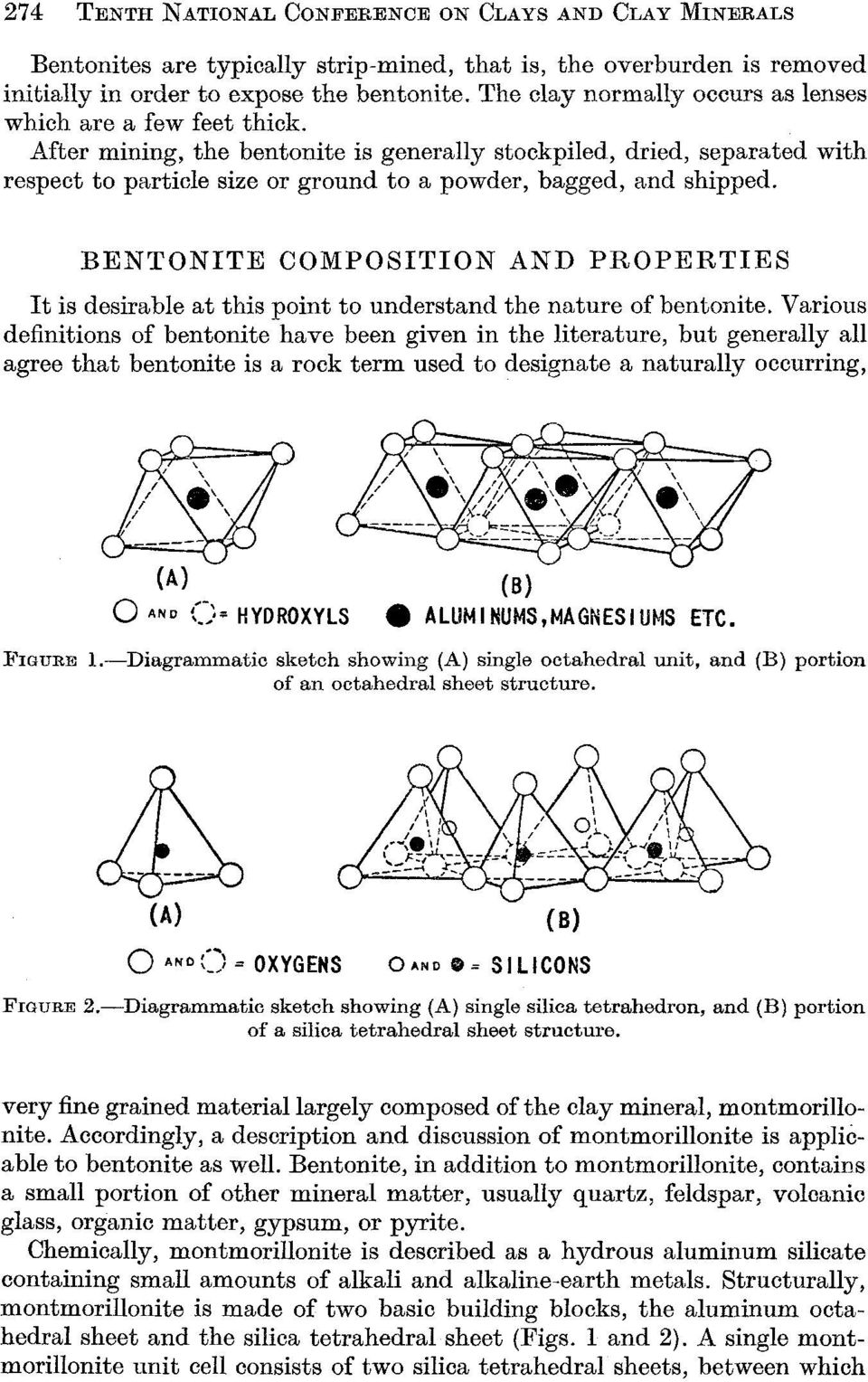
3 274 TENTH NATIONAL CONFEI~ENCE ON CLAYS AND CLAY MINERALS Bcntonites are typically strip-mined, that is, the overburden is removed initially in order to expose the bentonite. The clay normally occurs as lenses which are a few feet thick. After mining, the bentonite is generally stockpiled, dried, separated with respect to particle size or ground to a powder, bagged, and shipped. BENTONITE COMPOSITION AND PROPERTIES It is desirable at this point to understand the nature of bentonite. Various definitions of bentonite have been given in the literature, but generally all agree that bentonite is a rock term used to designate a naturally occurring, (A) C) A,~,~ (.-)= HYDROXYLS (B) ALUHI NUHS,HAGNESI UHS ETC. FlaVRE 1.--Diagrammatic sketch showing (A) single oetahedrm unit, and (B) portion of an octahedral sheet structure. (A) (a) (~ A,~O ~'~)= OXYGENS C) AND O: SILICONS Fmua~ 2.---Diagrammatlc sketch showing (A) single silica tetrahedron, and (B) portion of a silica tetrahedral sheet structure. very fine grained material largely composed of the clay mineral, montmorillonite. Accordingly, a description and discussion of montmorillonite is applicable to bentonite as well. Bentonite, in addition to montmorillonite, contains a small portion of other mineral matter, usually quartz, feldspar, volcanic glass, organic matter, gypsum, or pyrite. Chemically, montmorillonite is described as a hydrous aluminum silicate containing small amounts of alkali and alkaline+arth metals. Structurally, montmorillonite is made of two basic building blocks, the aluminum octahedral sheet and the silica tctrahedral sheet (Figs. 1 and 2). A single montmorillonitc unit cell consists of two silica tetrahedral sheets, between which
4 INDUSTRIAL APPLICATIONS OF BENTONITE 275 is an aluminum octahedral sheet (Fig. 3). Lengths and widths of montmorillonite flakes are from 10 to 100 times the thicknesses. The montmorillonite lattice is negative in charge, owing primarily to isomorphous replacements of ions within the structure. This negative character is balanced by cations which are held on the surface of the flakes. Cations held in this fashion by the clay can be readily exchanged; the cations most commonly found in nature are sodium and calcium. \\ I ~/ "~\ /0/ \,~ OCTAHEDRAL EXCHANGEABLE CATIONS nh20 O OXYGENS ~) HYDROXYLS 0 ALUMINUM, IRON, MAGNESIUM 0 silicon, OCCASIONALLY ALUMINUM FIGURE 3.--Diagrammatic skeygch of the structure of montmorillonite (after Grim, 1953). Montmorillonite has a cation-exchange capacity of about 70 to 110 meq/ 100 g of clay. Generally the laws of mass action dictate which will be present as exchangeable ions on the clay. The exchangeable cations, both by type and amount, that are associated with the montmorillonite are of great importance since they largely control its physical properties. Montmorillonite adsorbs water whenever it is available. Water adsorption occurs to the greatest extent on the basal surfaces of the clay and in this fashion pries adjacent flakes apart, resulting in an overall volume increase of the clay. Evidence of this swelling mechanism is seen as an increase in the c-axis dimension of the clay (Fig. 4). The water which is adsorbed primarily on the basal surfaces of the clay (frequently referred to as "bound" or

5 276 TENTH I~ATIONAL CONFERENCE ON CLAYS AND CLAY MINERALS "oriented" water) consists of a regular, rather than a random, arrangement of water molecules; the energy with which the water orients and is bonded to the clay flake is measured as heat of wetting. Many types of organic materials are adsorbed by montmorillonite, and this adsorption is somewhat similar in manner and orientation to that of water. Organic material adsorbed on basal surfaces also increases the c-axis MOISTURE FREE ~L o o o " LOW" MOISTURE ti ~ "HIGH" MOISTURE o H20 o o I -- I ~, o o ~ EXCHANGE CATIONS YI I FIGURE 4.--Diagrammatic sketch which shows swelling action of montmorillonite with increasing moisture content. dimension of the clay. Some of the parameters governing organic adsorption include type and composition of the organic material, the organic concentration, ptt, and the presence or absence of water in the system. INDUSTRIALLY ATTRACTIVE PROPERTIES OF BENTONITE The greatest use of bentonite in industry results from its swelling action in water. Combinations of water and bentonite can perform a multitude of jobs in industry because physical properties of the mixtures change as the waterto-clay ratio changes. The swelling capacity of the clay is of prime importance: this property is controlled in large part by the types of associated exchange ions. Let us consider only the two most common montmorillonite varieties. The sodium bentonites expand or swell in aqueous suspensions more than the calcium. At relatively low moisture contents, a stable hydrated form of sodium montmorillonite has one adsorbed molecular layer of water between adjacent layers. At this same moisture content, calcium montmorillonite is stable with two molecular layers of water. At higher moisture contents, or even in suspension, a comparison of the calcium and sodium montmorillonites shows that the calcium variety has fewer, more tightly bound water layers

6 ~NDUSTRIAL APPLICATIONS OF BENTONITE 277 associated with it, whereas the sodium variety has many water layers, but bound less tightly. When a relatively small amount of water is mixed with a large amount of bentonite, the mixture forms a sticky mass which has adhesive properties. This physical state results when the water content is inadequate to fulfill the oriented water requirement by the montmorillonite. The plastic properties of a clay-water system increase as the ratio of water to clay increases. When each montmorillonite flake has adsorbed its maximum amount of water, additional water in the system acts as a lubricant for the hydrated particles. It frequently takes a period of time or ageing for the clay to develop a completely hydrated state, even if the necessary water is available. Aggregates of clay flakes are disaggregated by agitation or stirring in suspension, and this substantially aids the clay swelling or hydration. Usually, however, swelling proceeds with additional time as water pries its way between neighboring clay flakes which agitation has been unable to separate. When bentonite disaggregates in water and swelling takes place, the average clay particle size decreases. As a function of decreasing particle size, the number of particles per unit weight of clay increases, and consequently also the available surface area. Grim (1953, p. 311) states that a theoretical value for the surface area of sodium montmorillonite, disaggregated to unit cell dimensions, is of the order of 800 m~/g of clay. Unlike many other materials that possess a large surface area, the surfaces of montmorillonite are essentially populated by oxygen atoms which promote a high degree of reactivity with other compounds. Accordingly, bentonite thoroughly dispersed in water has a high potential to carry on other reactions. Disaggregation or dispersion of bentonite in water is aided by the addition of a small amount of an electrolyte. Like other colloidal materials, however, a high ion concentration can flocculate bentonite. Furthermore, if initial hydration is attempted in a strong electrolyte, such as a concentrated sodium chloride solution, there is essentially no swelling. This phenomenon is explained by repulsion of like ions associated with the clay and also available in the suspending medium. INDUSTRIAL USES Clay-Water Mixtures Bentonite-water mixtures are used for bonding, plasticizing, and suspending. This versatility is made possible chiefly by adjusting the quantities of the two components. A bonding agent must have certain adhesive properties, and these are developed when bentonite is mixed with only a small amount of water. When oriented water is shared by adjacent clay flakes, and this mixture is added as a constituent to a combination of materials, rigidity rather than plasticity is developed in the final product. For a bonding agent, generally both water and clay are mixed into the finished product in amounts less than 5 percent by weight.

7 278 TENTH NATIONAL CONFERENCE ON CLAYS AND CLAY MINERALS In this fashion bentonite is used as a bonding agent in foundry molding sand, as a binder for rock wool and asbestos fiber in producing industrial insulation products, as an ingredient to create pellets of animal feed from coarse ground components, and in the pelleting of finely divided magnetite concentrates recovered from taconite ore. The ideal properties of foundry sands may vary considerably as the result of several factors. Some considerations include the casting of metals of different compositions, the desire for a particular surface characteristic of the castings, and the need for a formula which will accommodate a variety of casting sizes. The development of adequate strengths is of primary importance in foundry sands when these sands are in the green (moist), dry, and hot states. Sand characteristics are then matched to suit a particular foundry product. Calcium bentonite as the clay member develops relatively higher green compression strengths, and sodium bentonite higher dry and hot compression strengths in the sand mixture. Accordingly, both common natural forms of bentonite are used by foundries; the strengths of the sand mixtures, whether green, hot, or dry, can be adjusted by varying the mixtures of the clay types. The bonding prbperties that are ideal for use with insulation materials, feeds, and taeonite ore, are generally comparable to those in foundry sands. Each industry has strength requirements for its products at various stages of processing, and in each case the raw materials consist of a large number of particles which need to be bound together. The bentonite that binds these products well is one which disaggregates into extremely small particles, provides a large available surface area, and allows maximum contact with other product components. The taeonite industry provides an interesting example of the use of bentonite as a bonding agent. The processing of low-grade iron ore, taconite, is made into an economic operation by the following process. The ore is crushed into a fine powder, and the iron particles are separated from other rock particles by means of a magnetic separator. The up-graded iron ore is difficult to handle in powder form. Accordingly, the material is pelletized to aid further processing. Excellent results are obtained when bentonite is used to bond the pellets, and only lb of bentonite is needed to pelletize a ton of ore. A clay-water mixture becomes highly plastic when there is water in excess of that which is bound as "oriented" water by the bentonite. An ingredient capable of developing high plasticity is often added to formulae for ceramic and concrete products. In these cases, the requirement is for the development of a plastic state adequate to ailow the raw materials to be easily shaped or molded into the form of the finished product. Frequently a material is needed which will also act as a bonding agent or binder of other ingredients. Therefore, small bentonite additions, which constitute a small percentage of the entire product, function both as plasticizing and bonding agents. Applied in this fashion, the beneficial properties of bentonite are utilized; however, the addition is sufficiently small so that there is no adverse effect on the finished products.

8 INDUSTRIAL APPLICATIONS OF BENTONITE 279 Suspensions of bentonite in water are widely used in industry. The viscosity of an aqueous medium is increased substantially when bentonite is added and mixed in amounts generally less than 10 percent by weight. These suspensions contain bentonite particles which have disaggregated into the colloidal particle range. Therefore, they have similar properties, and respond like other colloidal suspensions. Some of the many uses of bentonite suspensions include application as drilling mud for rotary drills, as fire retardant gel, and as media for suspending materials which range from medicines that are taken internally, to lumps of coal as part of a float sink or separatory process. The consistencies or viscosities of suspensions best suited for any application are easily controlled by adjusting the amounts of bentonite in water. The largest and also the best known use of bentonite suspensions is as drilling mud. The functions of drilling mud include removal of cuttings from the bore hole, prevention of blow-outs, strengthening of the well bore and reduction of fluid loss from the mud, prevention of weighting agents and cuttings from settling down the well when circulation stops, and lubrication and cooling of the drilling bit and string. The development of these favorable properties in the mud depends on the viscosity and gel characteristics that are contributed by the bentonite. Impermeability of the filter cake is due in part to the fact that the adsorbed water on bentonite is very tightly bonded; also because the many small clay flakes act together to form a nearly perfect lining of the bore hole. A newer application of bentonite suspensions is as fire retardant material, particularly in combating forest fires. When a stream of water is directed at vegetation, such as a tree, much of the water ricochets off and is lost owing to its high fluidity. When the viscosity of the water stream is increased with bentonite, a greater proportion of liquid is retained on the vegetation. Because of the thicker consistency, suspensions can be dropped from planes to aid fire-fighting. The advantages obviously are greater coverage in a shorter period of time, and accessibility to virtually all locations. Because of its water-adsorption characteristics, bentonite is used as a material to impede or stop the flow of water. The clay can control flow of water by two methods. In the first case, when dry clay comes in contact with a source of water, the water becomes adsorbed by the clay so that it no longer is free to flow. By this method there is a limit to the amount of water which can be controlled by a given amount of clay. A second water-impedance mechanism is effected, however, after the bentonite adsorbs water. The hydrated or swollen clay becomes impermeable to the flow of additional water. In this fashion it is possible for small amount of clay to impede a large amount of water if the clay is applied advantageously. Surface Area Certain industrial problems can be solved best by use of materials that possess a large surface area, and therefore bentonite is frequently used. Carrier materials for chemicals, such as insecticides, are examples of this

9 280 TENTH I~ATIONAL CONFERENCE ON CLAYS AND CLAY i~/[inerals application. When the carrier m~terial provides an adequate surface area for the adsorption of the insecticide, the application of the insecticidecarrier mixture has several advantages which include a more even distribution of the insecticide when scattered over a large area, increased durability or life of the insecticide, and also increased effectiveness by keeping the insecticide in the most advantageous position; that is, on the vegetation rather than on the ground. Another example in which the surface area supplied by bentonite is applied in industry is as an emulsion stabilizer. Briefly, emulsions are formed by mixing and agitation of two immiscible liquids, such as oil and water. One liquid becomes a continuous phase, and the other liquid forms as droplets or globules within it. The ratio in which the two liquids are mixed determines the role of each in the emulsion. When the oil-water interface is strengthened, the stability of the emulsion is increased. Bentonite has a stabilizing effect on emulsions when it is added to the mixture prior to agitation. Apparently, the clay flakes form a thin film at the oil-water interface, and the large surface area of the clay aids in the entrapment of the oily globules as they are broken down by mechanical agitation. Reactivity There are applications of bentonite in industry which depend upon its ability to react with materials other than water. This is not to say, however, that reactions do not occur in the uses discussed thus far, because when bentonite is used as an insecticide carrier, for example, there probably are reactions which occur in addition to the "plating-out" of the insecticide on the clay mineral surfaces. The reactions discussed here unquestionably occur between organic materials and clay. These reactions are primary to the bentonite application, whereas reactions between clay and other materials may be considered as secondary in some of the applications discussed earlier. Reactions between bentonite, or montmorillonite, and amines were initially investigated by Hauser and Leggett (1940) and later by Jordan (1949). They showed that bentonite surfaces could be entirely coated with organic material by substitution of inorganic cations by the amine. When this was accomplished, the clay lost its ability to swell in water. The clay-organic product, however, does swell in a number of organic solvents, and because of this property, a market in industry was created. These products are used as gelling agents in paints, greases and lubricants, and other oil-base media. Bentonites are also used commercially as decolorizers of oils. The process is fairly simple. Certain oils are clarified by allowing percolation through beds of bentonite in which a selective adsorption of some organic types onto the clay mineral surfaces takes place. The portions of the oil which are darkest in color are removed preferentially by the clay. Bentonites are also used in industry for their beneficial properties as clarifying agents for products such as wines and beers. Many of the "impurities", or sediment, present in these liquids during their manufacture

10 INDUSTRIAL API'LICATIONS OF BENTONITE 281 are proteins or protein-related compounds. The sediment reacts with the bentonite, and thus can be removed from the liquid either by filtration or sedimentation. BENTONITE TYPES VS. APPLICATION Industry uses bentonite more for the physical properties it can develop than for its chemical composition. Accordingly, the greatest tonnage of bentonite is used annually for bonding, plasticizing, or suspending purposes. In these applications, the bentonite is usually in contact with water. Thus the clay-water characteristics are of primary importance to industry. The chemical composition of the bentonite is a consideration only because changes in physical properties accompany changes in chemical composition. There arc some exceptions, and generally these can be described as instances where the clay chemistry, as a component in a product, could be a complicating factor. Sodium bentonite swells or expands to a greater degree than its calcium equivalent. The greatest swelling, however, is not achieved by the pure sodium end-member. Apparently when a small percentage of cation exchange sites are occupied by another ion, such as calcium, a state is developed in the clay which promotes both optimum swelling and fastest hydration. Comparison of swelling characteristics of sodium and calcium bentonite introduces another factor in addition to that which deals directly with the exchange ion. That other factor is the environment in which the bentonite formed initially. If conditions favored formation of a sodium bentonite, certain structural features were included or excluded in that clay which are different from those that formed when conditions favored calcium bentonite. This is to say that the physical properties of a natural sodium bentonite cannot be developed in a natural calcium bentonite merely by exchanging the associated cation. Since sodium bentonite has higher swelling capacity, this property necessarily develops higher viscosity in suspensions, greater state of disaggregation, formation of smaller clay particles or greater colloidal properties, and finally larger available surface area when compared with calcium bentonite. The highest swelling sodium bentonites arc used in industry as drilling muds, fire retardant gels, and emulsion stabilizers, where the maximum in viscosity and gel characteristics are required. Many natural bentonites, however, which are primarily the sodium form, disaggregate almost as completely, but have a somewhat reduced swelling capacity. There is only partial correlation between swelling capacity and type and amount of exchange cations associated with the clay. This variety of sodium bentonite, lower swelling than drilling mud quality, but higher swelling than calcium bentonite, has applications such as bonding and plasticizing. Since the clay disaggregation is adequate, as a binder this clay gives excellent strengths to inert material mixtures and provides adequate plasticity by simple adjustment of the clay-to-water ratio.

11 282 T~NT~ NATIONAL CONFEt~ENeE ON CLA=gS AND CLAY MINEI~ALS Calcium bentonites have the greatest market as bonding agents in foundry molding sands. Their higher green strengths are unique among mineral binders considering the small amount of bentonite necessary to impart adequate strengths. By blending both calcium and sodium bentonite, foundrymen develop favorable strength characteristics throughout all phases of the casting procedure and keep a mixture which is compatible with other sand additives such as the cellulose products. Calcium bentonites have also been used for many years for their ability to decolorize oils. The exact reasons for calcium being better than sodium bentonite for this use are not fully understood. SUMMARY Industry uses bentonite for its inherent physical properties, or for the physical properties it can develop in another material or product. A thorough understanding of the chemistry and structure of bentonite, or more appropriately montmorillonite, is helpful when discussing bentonite applications because its physical properties are so closely related to these parameters. The greatest applications of bentonite are those that involve mixture with water. By adjusting the water content in combination with a given quantity of clay, properties of the mixture can be developed which are utilized by industry for bonding, plasticizing, and suspending applications. When the water-to-clay ratio is low, this combination is used as a bonding agent for a variety of materials because the consistency of the mixture is more rigid than plastic, and it possesses adhesive properties. Accordingly, bentonites are used to bond foundry molding sands, animal feeds, insulation materials, and taconite. When the water-to-clay ratio is increased, plasticity develops in the mixture as the water adsorption capacity of the bentonite is just exceeded. This clay-water combination is used as a plasticizing agent in certain ceramic wares and concrete. Very high water-to-clay ratios ultimately form suspensions which have a multitude of industrial applications, the largest of which is as drilling muds or fluids for the rotary drilling industry. That bentonite suspensions are versatile is shown by such varied applications as in medicines and as fire retardant material in combating forest fires. The large surface area of bentonite is utilized by application as a chemical, or in particular, insecticide carrier. Surface area is also of primary importance to bentonite application as an emulsifier and emulsion stabilizer. Bentonite enters into chemical reactions with many organic materials, and certain of these clay-organic products have favorable properties as gelling agents in organic solvents. Bentonite-organic material reactions, however, are also used where the clay acts to deeolorize oils and to coagulate sediment in such liquids as beers and wines. Certain industrial jobs are performed best by particular bentonites in regard to type and quality and attempts are made to match the bentonite

12 INDUSTRIAL APPLICATIONS OF BENTONITE 283 with a particular application. The two most common natural forms of bentonite are sodium saturated and calcium saturated. These two forms have different physical properties, and accordingly are applied differently. Generally, the sodium variety is more versatile and is used for essentially all of the applications discussed here. The calcium variety is directed largely toward the bonding of foundry sands and decolorization of oils. REFERENCES Chisholm, F. (1960) Bentonite in industry: Mines Magazine, July, pp Grim, R. E. (1953) Clay Mineralogy: McGraw-Hill, New York, 384 pp. Hauser, E. A. and Leggett, M. B. (1940) Color reactions between clays and amines: J. Amer. Chem. Soc., v. 62, pp Jordan, J. W. (1949) Organophilic bentonites, I, Swelling in organic liquids: J. Phys and Colloid Chem., v. 53, pp U.S. Dept. of Interior ( ) Bureau o.f Mines Minerals Yearbooks.

Objective: Preparation of Materials Lesson Instructions
 Smectite Clay Products Teaching Materials Audrey C. Rule Objective: Students will be able to match cards that tell smectite clay properties and uses with corresponding clay products to demonstrate their
SODIUM BENTONITE: ITS STRUCTURE AND PROPERTIES
 SODIUM BENTONITE: ITS STRUCTURE AND PROPERTIES GN-001 The properties of sodium bentonite can be appreciably enhanced through a specialized treatment process patented by CETCO s parent company, AMCOL International.
GRADATION OF AGGREGATE FOR CONCRETE BLOCK
 GRADATION OF AGGREGATE FOR CONCRETE BLOCK Although numerous papers have been written concerning the proper gradation for concrete mixes, they have generally dealt with plastic mixes, and very little published
The Characteristics of Clay. Table of Contents
 The Characteristics of Clay Table of Contents Preview...2 Objectives...2 Readings...2 Introduction...3 Structure of clay minerals...3 Physical features...3 Mineralogical features...4 A. Basic structure
Separation of Amino Acids by Paper Chromatography
 Separation of Amino Acids by Paper Chromatography Chromatography is a common technique for separating chemical substances. The prefix chroma, which suggests color, comes from the fact that some of the
2 MATTER. 2.1 Physical and Chemical Properties and Changes
 2 MATTER Matter is the material of which the universe is composed. It has two characteristics: It has mass; and It occupies space (i.e., it has a volume). Matter can be found in three generic states: Solid;
ACRYLICS. The properties of the resulting acrylics vary depending on the nature of the alkyl groups both on the alcohol and the acrylic acid.
 AYLIS Acrylics are polyesters based on acrylic acid (propenoic acid - H 2 =H 2 H) formed from the polymerisation of an alkyl acrylate ester. They are widely used in the surface coatings industry (e.g.
What is Cement? History Overview of the Cement Manufacturing Process Brief Overview of Kiln Operations Why Burn Wastes?
 What is Cement? History Overview of the Cement Manufacturing Process Brief Overview of Kiln Operations Why Burn Wastes? A hydraulic cement made by finely pulverizing the clinker produced by calcining to
Name: Class: Date: Multiple Choice Identify the letter of the choice that best completes the statement or answers the question.
 Class: Date: Minerals Study Guide Modified True/False Indicate whether the sentence or statement is true or false. If false, change the identified word or phrase to make the sentence or statement true.
Physical & Chemical Properties. Properties
 Physical & Chemical Properties Properties Carbon black can be broadly defined as very fine particulate aggregates of carbon possessing an amorphous quasi-graphitic molecular structure. The most significant
Iron Ore Processing for the Blast Furnace (Courtesy of the National Steel Pellet Company)
 Iron Ore Processing for the Blast Furnace (Courtesy of the National Steel Pellet Company) The following describes operations at the National Steel Pellet Company, an iron ore mining and processing facility
TiO 2. : Manufacture of Titanium Dioxide. www.rsc.org/learn-chemistry Registered charity number 207890
 TiO 2 : Manufacture of Titanium Dioxide www.rsc.org/learn-chemistry Registered charity number 207890 5: Manufacture of titanium dioxide Titanium dioxide has many uses. It is now the common white pigment
Water Softening for Hardness Removal. Hardness in Water. Methods of Removing Hardness 5/1/15. WTRG18 Water Softening and Hardness
 Water Softening for Removal 1 in Water High concentration of calcium (Ca2+) and magnesium (Mg2+) ions in water cause hardness Generally, water containing more than 100 mg/l of hardness expressed as calcium
Silica Over-Saturation, Precipitation, Prevention and Remediation In Hot Water Systems Edited By Dave Peairs, Cal Water, Technical Director
 Silica Over-Saturation, Precipitation, Prevention and Remediation In Hot Water Systems Edited By Dave Peairs, Cal Water, Technical Director Background Silica scaling becomes a problem when any hot water
Strength and Workability Characteristics of Concrete by Using Different Super Plasticizers
 International Journal of Materials Engineering 12, 2(1): 7-11 DOI: 1.923/j.ijme.11.2 Strength and Workability Characteristics of Concrete by Using Different Super Plasticizers Venu Malagavelli *, Neelakanteswara
TECHNICAL SPECIFICATIONS CEMENT-BENTONITE SLURRY TRENCH CUTOFF WALL
 TECHNICAL SPECIFICATIONS CEMENT-BENTONITE SLURRY TRENCH CUTOFF WALL SCOPE This section of the specifications includes requirements for the Slurry Trench Cutoff Wall and related work as indicated on the
Chapter Test A. Elements, Compounds, and Mixtures MULTIPLE CHOICE. chemically combined? MIXs2 a. element b. compound c. mixture d.
 Assessment Chapter Test A Elements, Compounds, and Mixtures MULTIPLE CHOICE Write the letter of the correct answer in the space provided. 1. What is a pure substance made of two or more elements that are
WHAT IS IN FERTILIZER OTHER THAN NUTRIENTS?
 WHAT IS IN FERTILIZER OTHER THAN NUTRIENTS? Raymond C. Ward Ward Laboratories Inc. Kearney, NE Commercial fertilizer is a source of plant nutrients that can be applied to soil to nourish crops when the
Organic Chemistry Lab Experiment 4 Preparation and Properties of Soap
 Organic Chemistry Lab Experiment 4 Preparation and Properties of Soap Introduction A soap is the sodium or potassium salt of a long-chain fatty acid. The fatty acid usually contains 12 to 18 carbon atoms.
Silane Coupling Agents
 Silane Coupling Agents Table of Contents Introduction 2-4 Characteristics 5 Amino Functional Silane Coupling Agents 6 Epoxy Functional Silane Coupling Agents 6 Vinyl Functional Silane Coupling Agents 7
Pure Substances, Mixtures, and Solutions
 Pure Substances, Mixtures, and Solutions Mixtures, elements, compounds Scientists like to classify things. One way that scientists classify matter is by its composition. Ultimately, all matter can be classified
Rocks & Minerals. 10. Which rock type is most likely to be monomineralic? 1) rock salt 3) basalt 2) rhyolite 4) conglomerate
 1. Of the Earth's more than 2,000 identified minerals, only a small number are commonly found in rocks. This fact indicates that most 1) minerals weather before they can be identified 2) minerals have
Stabilization of Soil with Self-Cementing Coal Ashes
 2005 World of Coal Ash (WOCA), April 11-15, 2005, Lexington, Kentucky, USA http://www.flyash.info Stabilization of Soil with Self-Cementing Coal Ashes Scott M. Mackiewicz, 1 E. Glen Ferguson, 2 1 & 2 Kleinfelder,
Wire Drawing Soap Lubrication: Principles And Factors Affecting Selection
 Wire Drawing Soap Lubrication: Principles And Factors Affecting Selection 1 Wire Products 2 Rod: The Starting Material 3 The tool: Wire Drawing machines Dry Draw Bench Courtesy of Lamnea Bruk, Ljusfallshammar,
Dairy Proteins. Table of Contents. Section Page. Cheese Milk Protein Review 2. Basic Flows and Definitions of Milk Products 4
 Dairy Proteins This document, prepared by the Wisconsin Center for Dairy Research and the Wisconsin Milk Marketing Board, is intended to help clarify the present dairy protein issue. It can also be used
PROPERTIES OF ZINC ALLOY CAST PRODUCT WITH DIFFERENT COMPOSITION OF SILICA SAND AND BENTONITE IN GREEN SAND MOULD
 PROPERTIES OF ZINC ALLOY CAST PRODUCT WITH DIFFERENT COMPOSITION OF SILICA SAND AND BENTONITE IN GREEN SAND MOULD Zatil Alyani Mohd Amin, Faizul Che Pa, P.M Ir. Mohd Ichwan Nasution School of Material
Chemistry B11 Chapter 6 Solutions and Colloids
 Chemistry B11 Chapter 6 Solutions and Colloids Solutions: solutions have some properties: 1. The distribution of particles in a solution is uniform. Every part of the solution has exactly the same composition
The Synthesis of trans-dichlorobis(ethylenediamine)cobalt(iii) Chloride
 CHEM 122L General Chemistry Laboratory Revision 2.0 The Synthesis of trans-dichlorobis(ethylenediamine)cobalt(iii) Chloride To learn about Coordination Compounds and Complex Ions. To learn about Isomerism.
ANSWER KEY. Energy Levels, Electrons and IONIC Bonding It s all about the Give and Take!
 ANSWER KEY Energy Levels, Electrons and IONIC Bonding It s all about the Give and Take! From American Chemical Society Middle School Chemistry Unit: Chapter 4 Content Statements: Distinguish the difference
still different technique of assessment.
 D E N S I T Y A N A L Y S I S Micromeritics gas pycnometers are being used worldwide to obtain material density measurements. These measurements are necessary in the manufacture of many of today s products.
PROPERTIES AND MIX DESIGNATIONS 5-694.200
 September 1, 2003 CONCRETE MANUAL 5-694.200 5-694.210 PROPERTIES OF CONCRETE PROPERTIES AND MIX DESIGNATIONS 5-694.200 Inspectors should familiarize themselves with the most important properties of concrete:
CHAPTER 7 THE DEHYDRATION AND SWEETENING OF NATURAL GAS
 CHAPTER 7 THE DEHYDRATION AND SWEETENING OF NATURAL GAS Natural gases either from natural production or storage reservoirs contain water, which condense and form solid gas hydrates to block pipeline flow
Name: Class: Date: ID: A
 Name: Class: Date: ID: A Chapter 2 Assessment Multiple Choice Identify the choice that best completes the statement or answers the question. Complete short answer questions on a separate sheet of paper.
Chapter 13 - Solutions
 Chapter 13 - Solutions 13-1 Types of Mixtures I. Solutions A. Soluble 1. Capable of being dissolved B. Solution 1. A homogeneous mixture of two or more substances in a single phase C. Solvent 1. The dissolving
Zeta Potential: A Complete Course in 5 Minutes
 : A Complete Course in 5 Minutes The Interaction of Colloids Electrokinetics and Colloid Behavior potential can help you understand and control colloidal suspensions. Examples include complex biological
PREPARATION AND PROPERTIES OF A SOAP
 (adapted from Blackburn et al., Laboratory Manual to Accompany World of Chemistry, 2 nd ed., (1996) Saunders College Publishing: Fort Worth) Purpose: To prepare a sample of soap and to examine its properties.
A. Types of Mixtures:
 I. MIXTURES: SOLUTIONS 1) mixture = a blend of two or more kinds of matter, each of which retains its own identity and properties a) homogeneous mixture = a mixture that is uniform in composition throughout
IUCLID 5 COMPOSITION AND ANALYSIS GUIDANCE DOCUMENT: IRON ORES, AGGLOMERATES [EINECS NUMBER 265 996 3, CAS NUMBER 65996 65 8] IRON ORE PELLETS
![IUCLID 5 COMPOSITION AND ANALYSIS GUIDANCE DOCUMENT: IRON ORES, AGGLOMERATES [EINECS NUMBER 265 996 3, CAS NUMBER 65996 65 8] IRON ORE PELLETS](/thumbs/40/20960122.jpg "IUCLID 5 COMPOSITION AND ANALYSIS GUIDANCE DOCUMENT: IRON ORES, AGGLOMERATES [EINECS NUMBER 265 996 3, CAS NUMBER 65996 65 8] IRON ORE PELLETS") IUCLID 5 COMPOSITION AND ANALYSIS GUIDANCE DOCUMENT: IRON ORES, AGGLOMERATES [EINECS NUMBER 265 996 3, CAS NUMBER 65996 65 8] IRON ORE PELLETS INTRODUCTION Each REACH registrant is required to file its
IUCLID 5 COMPOSITION AND ANALYSIS GUIDANCE DOCUMENT: IRON ORES, AGGLOMERATES [EINECS NUMBER 265 996 3, CAS NUMBER 65996 65 8] IRON ORE PELLETS INTRODUCTION Each REACH registrant is required to file its
Plastics and Polymer Business. Properties enhancement for Plastics
 News Letter Vol. 18, issue October-December, 2012 Hyperdispersants and Coupling Agents for Thermoplastics and Thermosets Solplus, Ircolplus and Solsperse hyperdispersants and coupling agents have been
The polarity of water molecules results in hydrogen bonding [3]
![The polarity of water molecules results in hydrogen bonding [3]](/thumbs/40/21376601.jpg "The polarity of water molecules results in hydrogen bonding [3]") GUIDED READING - Ch. 3 PROPERTIES OF WATER NAME: Please print out these pages and HANDWRITE the answers directly on the printouts. Typed work or answers on separate sheets of paper will not be accepted.
GUIDED READING - Ch. 3 PROPERTIES OF WATER NAME: Please print out these pages and HANDWRITE the answers directly on the printouts. Typed work or answers on separate sheets of paper will not be accepted.
Molecular Models in Biology
 Molecular Models in Biology Objectives: After this lab a student will be able to: 1) Understand the properties of atoms that give rise to bonds. 2) Understand how and why atoms form ions. 3) Model covalent,
Lab 1 Concrete Proportioning, Mixing, and Testing
 Lab 1 Concrete Proportioning, Mixing, and Testing Supplemental Lab manual Objectives Concepts Background Experimental Procedure Report Requirements Discussion Prepared By Mutlu Ozer Objectives Students
Coagulation and Flocculation
 Coagulation and Flocculation Groundwater and surface water contain both dissolved and suspended particles. Coagulation and flocculation are used to separate the suspended solids portion from the water.
The Properties of Water (Instruction Sheet)
 The Properties of Water (Instruction Sheet) Property : High Polarity Activity #1 Surface Tension: PILE IT ON. Materials: 1 DRY penny, 1 eye dropper, water. 1. Make sure the penny is dry. 2. Begin by estimating
KINETIC MOLECULAR THEORY OF MATTER
 KINETIC MOLECULAR THEORY OF MATTER The kinetic-molecular theory is based on the idea that particles of matter are always in motion. The theory can be used to explain the properties of solids, liquids,
Introduction. Emulsify with water. Asphalt Emulsions 101. Asphalt Binder Properties. Why Heat Asphalt? So It Can Be:
 Asphalt Emulsions 101 Introduction Chris Lubbers Technical Sales and Marketing Mgr Kraton Polymers, LLC 50 TH Annual Idaho Asphalt Conference Moscow, ID October 28, 2010 Semi Solid Liquid Asphalt Binder
Name Lab #3: Solubility of Organic Compounds Objectives: Introduction: soluble insoluble partially soluble miscible immiscible
 Lab #3: Solubility of rganic Compounds bjectives: - Understanding the relative solubility of organic compounds in various solvents. - Exploration of the effect of polar groups on a nonpolar hydrocarbon
105 Adopted: 27.07.95
 105 Adopted: 27.07.95 OECD GUIDELINE FOR THE TESTING OF CHEMICALS Adopted by the Council on 27 th July 1995 Water Solubility INTRODUCTION 1. This guideline is a revised version of the original Guideline
EXPERIMENT 7 Reaction Stoichiometry and Percent Yield
 EXPERIMENT 7 Reaction Stoichiometry and Percent Yield INTRODUCTION Stoichiometry calculations are about calculating the amounts of substances that react and form in a chemical reaction. The word stoichiometry
Coal Properties, Sampling & Ash Characteristics by Rod Hatt Coal Combustion, Inc. Versailles, KY 859-873-0188
 Coal Properties, Sampling & Ash Characteristics by Rod Hatt Coal Combustion, Inc. Versailles, KY 859-873-0188 Introduction The Powder River Coal is classified as sub-bituminous ranked coal. Coal rank is
Lesson 3. Portland Cement and Concrete
 Portland Cement and Concrete This lesson focuses on the most consumed construction material, Portland cement based concrete. It s consumed for pavement, dams, bridges, floors, walls, columns, and even
Technical Bulletin 1301. Talc in Plastics
 Technical Bulletin 131 Talc in Plastics Contents Introduction Benefits of Talc in Polypropylene Compounds 1. Stiffness (E-Modulus) 2. Thermal Conductivity 3. Nucleation 4. Impact Strength 5. Deflection
Untitled Document. 1. Which of the following best describes an atom? 4. Which statement best describes the density of an atom s nucleus?
 Name: Date: 1. Which of the following best describes an atom? A. protons and electrons grouped together in a random pattern B. protons and electrons grouped together in an alternating pattern C. a core
Manufacturing Quality Concrete Products
 CEMEX USA - Technical Bulletin 8.0 Manufacturing Quality Concrete Products Establishing or Upgrading a Quality Program Overview The following guidelines were developed for MCP (manufactured concrete products)
LAB 2: MINERAL PROPERTIES AND IDENTIFICATION
 OBJECTIVES: LAB 2: MINERAL PROPERTIES AND IDENTIFICATION 1) to become familiar with the properties important in identifying minerals; 2) to learn how to identify the common rock-forming minerals. Preparatory
BOWEN'S REACTION SERIES
 BOWEN'S REACTION SERIES Purpose John J. Thomas Frequently, people cannot visualize the mineral associations that form the sequences of igneous rocks that you find in the earth's crust and what happens
ACUSOL 820 Rheology Modifier and Stabilizer
 ACUSOL 820 Rheology Modifier and Stabilizer Description ACUSOL 820 is a Hydrophobically modified Alkali Soluble acrylic polymer Emulsion (HASE) with unusually high aqueous thickening and stabilising efficiency.
Mixtures. reflect. How is seawater different from pure water? How is it different from rocky soil?
 reflect Everything around us is made out of tiny bits of matter. These particles may combine in different ways to produce new materials. Sometimes we need to separate the parts of a material. If we know
Separation by Solvent Extraction
 Experiment 3 Separation by Solvent Extraction Objectives To separate a mixture consisting of a carboxylic acid and a neutral compound by using solvent extraction techniques. Introduction Frequently, organic
ENGINEERED QUARTZ STONE
 ENGINEERED 2 QUARTZ STONE 18 GOOD INDUSTRY PRACTICES 2 ENGINEERED QUARTZ STONE Natural stones, especially granite, have been used for flooring and countertop material in high-end homes for its beauty and
Engine Bearing Materials
 Engine Bearing Materials Dr. Dmitri Kopeliovich (Research & Development Manager) The durable operation of an engine bearing is achieved if its materials combine high strength (load capacity, wear resistance,
Alharith Hassan. Q 10 Method of Shelf-life estimation. Methods of Chemical stabilisation 11/20/2015
 Q 10 Method of Shelf-life estimation Q 10 approach is an old concept that could be useful for estimating the shelf-life at room temperature of products recommended for cold storage. Calculations are based
N-P-K FERTILIZERS. by M.L. Vitosh Extension Specialist, Crop and Soil Sciences
 Michigan State University Extension! Extension Bulletin E-896! Reprint July 1996 N-P-K FERTILIZERS by M.L. Vitosh Extension Specialist, Crop and Soil Sciences T here are many grades and analyses of nitrogen
Solid-Cast Versus Resin-Encapsulated Transformers
 Data Bulletin 7300DB0402 12/2004 Monroe, NC USA Replaces 7300PD9202, 02/1992 Solid-Cast Versus Resin-Encapsulated Transformers Class 7300 Retain for future use. OVERVIEW The continuing development of dry-type
Dispersion of Synthetic Fibers in Wet-Lay Nonwovens
 Dispersion of Synthetic Fibers in Wet-Lay Nonwovens This article was written by James M. Keith, retired Director of Technical Services for MiniFIBERS, and published in the Tappi Journal, Vol. 77, No. 6,
Name Class Date. What is ionic bonding? What happens to atoms that gain or lose electrons? What kinds of solids are formed from ionic bonds?
 CHAPTER 1 2 Ionic Bonds SECTION Chemical Bonding BEFORE YOU READ After you read this section, you should be able to answer these questions: What is ionic bonding? What happens to atoms that gain or lose
:: ARTIFICIAL SAND :: Zone One Sand : Zone Two Sand :
 :: ARTIFICIAL SAND :: Natural sand are weathered and worn out particles of rocks and are of various grades or size depending on the accounting of wearing. The main natural and cheapest resource of sand
Experiment #10: Liquids, Liquid Mixtures and Solutions
 Experiment #10: Liquids, Liquid Mixtures and Solutions Objectives: This experiment is a broad survey of the physical properties of liquids. We will investigate solvent/solute mixtures. We will study and
Atoms and Elements. Atoms: Learning Goals. Chapter 3. Atoms and Elements; Isotopes and Ions; Minerals and Rocks. Clicker 1. Chemistry Background?
 Chapter 3 Atoms Atoms and Elements; Isotopes and Ions; Minerals and Rocks A Review of Chemistry: What geochemistry tells us Clicker 1 Chemistry Background? A. No HS or College Chemistry B. High School
Prussian blue and cyanotype printing
 CHEM 101lab, fall 2008, J. Peters and cyanotype printing Ferric ferrocyanide, commonly known as, was first synthesized in 1704 in Berlin. has a very intense dark blue color and has been used extensively
Determination of a Chemical Formula
 1 Determination of a Chemical Formula Introduction Molar Ratios Elements combine in fixed ratios to form compounds. For example, consider the compound TiCl 4 (titanium chloride). Each molecule of TiCl
Name Date Class CHAPTER 1 REVIEW. Answer the following questions in the space provided.
 CHAPTER 1 REVIEW Matter and Change SECTION 1 SHORT ANSWER Answer the following questions in the space provided. 1. a Technological development of a chemical product often (a) lags behind basic research
Modern Sand Reclamation Technologies for Economy, Environment Friendliness and Energy Efficiency
 Modern Sand Reclamation Technologies for Economy, Environment Friendliness and Energy Efficiency Aniruddha Ghosh GM, The Wesman Engineering Co. Ltd, Kolkata ABSTRACT Unlike green sand, chemically-bonded
Land Application of Drilling Fluids: Landowner Considerations
 SCS-2009-08 Land Application of Drilling Fluids: Landowner Considerations Mark L. McFarland, Professor and Extension State Water Quality Specialist Sam E. Feagley, Professor and Extension State Environmental
Example Specification for Concrete using Current Building Code Requirements
 Example Specification for Concrete using Current Building Code Requirements DISCLAIMER: This specification is an example that accompanies a seminar titled The P2P Initiative: Performance-based Specs for
Preparation of an Alum
 Preparation of an Alum Pages 75 84 Pre-lab = pages 81 to 82, all questions No lab questions, a lab report is required by the start of the next lab What is an alum? They are white crystalline double sulfates
Chemical versus Physical Changes
 Chemical versus Physical Changes Permission to Copy - This document may be reproduced for non-commercial educational purposes Copyright 2009 General Electric Company What are physical and chemical changes?
dryon Processing Technology Drying / cooling in outstanding quality we process the future
 dryon Drying / cooling in outstanding quality we process the future Processing Technology task The basic process of drying is a necessary step in all sectors of industry. Drying has to be performed for
Bruce B. Weiner, Walther W. Tscharnuter, David Fairhurst Brookhaven Instruments Corporation Holtsville, NY 11742 US
 Zeta Potential: A New Approach by Bruce B. Weiner, Walther W. Tscharnuter, David Fairhurst Brookhaven Instruments Corporation Holtsville, NY 11742 US A paper presented at the Canadian Mineral Analysts
Chapter 5 Student Reading
 Chapter 5 Student Reading THE POLARITY OF THE WATER MOLECULE Wonderful water Water is an amazing substance. We drink it, cook and wash with it, swim and play in it, and use it for lots of other purposes.
Heterogeneous Homogenous. Mixtures; Solutions. Phases of matter: Solid. Phases of Matter: Liquid. Phases of Matter: Gas. Solid, Liquid, Gas
 Phases of matter: Solid Heterogeneous Homogenous Mixtures Solutions Phases of Matter: Liquid Atoms and molecules are more spaced out and now can move. The material can be slightly compressed into a smaller
THE ELEMENT C. Introduction graphite and carbon Lattice Classification of grain size. Properties of graphite and carbon
 THE ELEMENT C Introduction graphite and carbon Lattice Classification of grain size Fine-grained graphite Coarse-grained graphite Properties of graphite and carbon High temperature properties Introduction
1. Initial Precautions 2. Technical Precautions and Suggestions 3. General Information and Cure Stages 4. Understanding and Controlling Cure Time
 How to apply Arctic Alumina Premium Ceramic Thermal Adhesive 1. Initial Precautions 2. Technical Precautions and Suggestions 3. General Information and Cure Stages 4. Understanding and Controlling Cure
Choosing The Proper Short Cut Fiber for Your Nonwoven Web
 Choosing The Proper Short Cut Fiber for Your Nonwoven Web ABSTRACT You have decided that your web needs a synthetic fiber. There are three important factors that have to be considered: generic type, diameter,
SUPPLEMENTARY MATERIAL
 SUPPLEMENTARY MATERIAL (Student Instructions) Determination of the Formula of a Hydrate A Greener Approach Objectives To experimentally determine the formula of a hydrate salt. To learn to think in terms
Properties and Classifications of Matter
 PS-3.1 Distinguish chemical properties of matter (including reactivity) from physical properties of matter (including boiling point, freezing/melting point, density [with density calculations], solubility,
AGREGADOS RECICLADOS MITOS Y REALIDADES
 The Production and Use of Recycled Concrete in the USA Thomas Van Dam, Ph.D., P.E., FACI Principal Engineer CTL Group Introduction In the United States, concrete is the most commonly used recycled material
SECOND GRADE 1 WEEK LESSON PLANS AND ACTIVITIES
 SECOND GRADE 1 WEEK LESSON PLANS AND ACTIVITIES WATER CYCLE OVERVIEW OF SECOND GRADE WATER WEEK 1. PRE: Exploring the properties of water. LAB: Experimenting with different soap mixtures. POST: Analyzing
General Chemistry I (FC, 09-10) Lab #3: The Empirical Formula of a Compound. Introduction
 General Chemistry I (FC, 09-10) Introduction A look at the mass relationships in chemistry reveals little order or sense. The ratio of the masses of the elements in a compound, while constant, does not
CATALOGUE OF PRODUCTS
 Sklopísek Střeleč, joint stock company produces high quality glass, foundry, technical, filtration and sport sands, fine milled silica flour. The Střeleč area represents the largest deposit of prime quality
CGA Standard Practices Series. Article 600 Standard for Pozzolan Enhanced Grouts Used in Annular Seals & Well Destruction
 California Groundwater Association An NGWA Affiliate State PO Box 14369 Santa Rosa CA 95402 707-578-4408 fax: 707-546-4906 email: [email protected] website: www.groundh2o.org CGA Standard Practices Series
Hands-On Labs SM-1 Lab Manual
 EXPERIMENT 4: Separation of a Mixture of Solids Read the entire experiment and organize time, materials, and work space before beginning. Remember to review the safety sections and wear goggles when appropriate.
SECTION 623 CONCRETE BONDING COMPOUND, EPOXY MORTAR AND EPOXY POLYMER CONCRETE OVERLAY SECTION 623.10 CONCRETE BONDING COMPOUND.
 SECTION 623 CONCRETE BONDING COMPOUND, EPOXY MORTAR AND EPOXY POLYMER CONCRETE OVERLAY SECTION 623.10 CONCRETE BONDING COMPOUND. 623.10.1 Description. This work shall consist of preparing the surface,
SIEVE ANALYSIS OF FINE AND COARSE AGGREGATES
 Test Procedure for SIEVE ANALYSIS OF FINE AND COARSE AGGREGATES TxDOT Designation: Tex-200-F Effective Date: January 2016 1. SCOPE 1.1 Use this test method to determine the particle size distribution of
Effect of basalt aggregates and plasticizer on the compressive strength of concrete
 International Journal of Engineering & Technology, 4 (4) (2015) 520-525 www.sciencepubco.com/index.php/ijet Science Publishing Corporation doi: 10.14419/ijet.v4i4.4932 Research Paper Effect of basalt aggregates
Chapter 5, Lesson 3 Why Does Water Dissolve Salt?
 Chapter 5, Lesson 3 Why Does Water Dissolve Salt? Key Concepts The polarity of water molecules enables water to dissolve many ionically bonded substances. Salt (sodium chloride) is made from positive sodium
3 PURE SUBSTANCES AND MIXTURES
 3 PURE SUBSTANCES AND MIXTURES I. Tick ( ) the most appropriate answer. 1. The constituents of a mixture are present in : (a) a fixed ratio (b) any ratio (c) the ratio of 4 : 1 (d) none of the above 2.
Earth Materials: Minerals. Mineral Properties. Mineral Properties. Some optical properties. Three general categories:
 1 2 Earth Materials: Minerals What is a mineral? Properties/characteristics of different types of minerals Mineral structures and bonding Major categories of minerals Importance and uses of minerals What