
The State of the UK s Butterflies 2015
|
|
|
- Duane Hill
- 9 years ago
- Views:
Transcription
1 The State of the UK s Butterflies 215
2 2 Executive summary World-class citizen science projects provide a comprehensive and statistically robust evidence base to inform this assessment of the state of the UK s butterflies. Butterfly populations are monitored annually by volunteers at over 2, locations and tens of thousands of people have contributed almost 3 million butterfly distribution records over the past five years from all corners of the UK. New analyses confirm significant declines of UK butterflies since Multi-species indicators show that both habitat specialist butterflies and wider countryside species decreased significantly in abundance and occurrence. Indeed, a number of wider countryside species now rank among the most severely declining UK butterflies, which is a cause of grave concern. The UK Butterfly Monitoring Scheme results show that 57% of individual species had decreased in abundance since 1976, although not all of these trends are statistically significant. Among the 33 species with statistically significant long-term trends, 61% decreased over the period. Analysis of the Butterflies for the New Millennium recording scheme data reveals that 7% of species decreased in occurrence over the period Overall, 76% of the UK s resident and regular migrant butterfly species declined in either abundance or occurrence (or both) over the past four decades. By comparison, 47% of species increased in one or both measures. The destruction and deterioration of habitats as a result of land-use change (e.g. intensification of agriculture, changing woodland management) are still considered the prime causes of long-term decline among habitat specialist butterflies in the UK. However, the factors responsible for the decreases of wider countryside species are not well understood. Wider countryside butterflies are generally faring better in Scotland than in England, mirroring trends reported in other species groups. This may be because detrimental land-use change is more prevalent in southern Britain or because climate change may be having a more beneficial impact in the north than in the south. Further research is needed to tease out these factors. The minority of UK butterflies that have fared well since the 197s have increased their distributions, most likely as a response to climate change. However, we should no longer assume that southerly-distributed species will necessarily benefit from climate change. Species responses are much more variable than previously realised and the increasing frequency of extreme climatic events, predicted in many climate change scenarios, may have serious implications for butterfly populations. In contrast to the long-term picture, UK butterfly trends over the past decade (25-214) provide some grounds for optimism. The declines of several threatened species appear to have been halted, and a range of habitat specialist and wider countryside species have become more abundant and widespread. Landscape-scale conservation projects targeting threatened butterflies, often implemented by accessing higher level agri-environment scheme grants, have achieved notable successes, but their overall contribution to the improving national trends of some species has yet to be quantified. Ten-year trends show that 52% of species decreased in abundance and 47% decreased in occurrence. While this indicates a generally improving situation, the declines of some threatened species show little signs of abating and, worryingly, populations of some common species have dwindled in recent years. Even for those species where declines have recently been halted, population levels and distributions are much smaller than they once were. The conservation of the UK s butterflies remains an enormous challenge. Butterflies are the best-studied UK insects by far, providing vital insights into the changing state of wider biodiversity and the ecosystem services that depend upon it, as well as an important opportunity for the general public to engage with conservation, citizen science and the natural world. Nevertheless, more research is needed, especially to understand and develop effective conservation responses to the declines of many wider countryside butterflies. UK recording and monitoring schemes for butterflies must be maintained and adequately resourced so that we can understand future changes, evaluate conservation strategies and adapt them accordingly. Further conservation measures are needed urgently to stem the decline of butterflies. Everyone can play a part, but favourable Government policies are essential. The recommendations listed at the end of this report (p.25) should be implemented fully to help achieve the targets agreed under the international Convention on Biological Diversity. Cover photo: The Silver-studded Blue is one of several threatened UK butterflies that have shown signs of improvement in recent years. Neil Hulme

3 3 Introduction This report, the fourth on the state of the UK s butterflies, comes at a time of particularly dramatic change. Agricultural intensification and other land-use changes have caused extensive wildlife declines in the UK 1, which show few signs of recovery despite the best efforts of conservation organisations and substantial government expenditure. Now, in the age of austerity and with drastic cutbacks in government funding for the environment 2, the prospects of halting the decline of wildlife and achieving the Aichi Biodiversity Targets set by the global Convention on Biological Diversity for the year 22 look poor 3. In addition, new research findings suggest more significant negative impacts of climate change and pesticides on our wildlife than had previously been realised, threats to essential ecosystem services such as pollination as a result of biodiversity decline, and an increased awareness of the importance of nature for human health and well-being. Set against this bleak backdrop are some significant changes for the good. Participation in long-term recording and monitoring of the UK s butterflies has never been stronger. In addition, new schemes such as the Wider Countryside Butterfly Survey and Big Butterfly Count have been successfully established, enhancing knowledge of the changing fortunes of our butterflies and involving tens of thousands of new recorders. The UK Government and some devolved administrations have officially adopted biodiversity indicators based on butterfly population data. Modern technology has helped increase the quantity, quality and flow of butterfly data, new analysis techniques have produced more accurate and reliable trends, and the advent of social media has revolutionised the engagement of the general public in recording and conservation. The landscape-scale approach to the conservation of threatened butterflies, pioneered by Butterfly Conservation, has proved its effectiveness, while strong scientific and public support has been demonstrated for the UK s protected areas. Butterflies are known to respond rapidly to environmental change. They provide valuable insights into factors that will affect other wildlife and can be used to judge the effectiveness of conservation measures. This new assessment of the state of UK s butterflies is thus both timely and important. It presents new analyses of long-term and recent trends in butterfly abundance and distribution, identifying areas of concern and glimmers of hope. It also describes recent conservation initiatives to help save butterflies and gives recommendations for our future conservation strategy. These are relevant not just to the conservation of butterflies, but also to the whole of biodiversity and the future health of our environment. Thousands of volunteer recorders contribute over 8, days of effort each year, representing an equivalent value of over 5 million and providing world-class evidence on the state of the UK s butterflies. Tom Brereton 1 Burns et al Tittensor et al. 214

4 4 Evidence base and analysis This assessment of the changing state of UK butterflies has been made possible through the skill and dedication of thousands of volunteer recorders. Their contributions, channelled through long-term, citizen-science recording and monitoring schemes, ensure a statistically sound evidence base to underpin trends, conservation action and ecological research. Population monitoring The most accurate and sensitive means of assessing butterfly trends over time is through standardised counts of individual insects. Organised and analysed under the umbrella of the UK Butterfly Monitoring Scheme (UKBMS), weekly transect counts, Wider Countryside Butterfly Surveys, timed counts, and monitoring of egg numbers and larval nests all contribute to long-term trends in the relative abundance of butterflies. These annually updated trends have been widely adopted by governments at national, UK and European scales to measure the success of policy initiatives and progress towards the 22 Aichi Biodiversity Targets of the global Convention on Biological Diversity 4. Weekly fixed-transect monitoring of butterfly populations was devised by the Centre for Ecology & Hydrology and launched as a national scheme in Since then, volunteers have walked a total of 768,78km of butterfly transects in the UK, equivalent to a trip to the Moon and back, counting every butterfly spotted within a 5m strip along the fixed route. In all, more than 2,5 transect sites have contributed to the UKBMS. A record annual total of 1,223 butterfly transects were walked in 214. In addition, approximately 8 further locations are now monitored each year by the Wider Countryside Butterfly Survey (WCBS). Launched in 29, the WCBS comprises a network of 1km x 1km grid squares, selected at random to be representative of habitats across the UK 5. Given that traditional butterfly transects are biased towards semi-natural habitats rich in butterflies, the randomly chosen locations of the WCBS add value and rigour to the population trends derived from the UKBMS as a whole 6. The WCBS employs a reduced effort transect method 7. Within each square, recorders set up two 1km long survey lines and count butterflies using the same methodology and criteria applied to all UKBMS transects. Two visits, spaced at least 1 days apart, are made over July and August, with optional recording at other times. Approximately 4% of the squares are also part of the Breeding Bird Survey 8. This is the first time that WCBS data have been used in a State of the UK s Butterflies report. Some 2, volunteer recorders have participated in the WCBS, sampling over 1,5 squares, and the scheme provides good coverage for almost all wider countryside species 9. Counts from all UKBMS sampling schemes were combined and national and UK-wide indices estimated for wider countryside species using a new statistical model that accounts for differences in survey methods and patterns in sampling through the season and over years 1. This represents a major advance for the UKBMS. Not only does it incorporate WCBS data, but it also utilises every transect count to derive annual population indices. None of the efforts of UKBMS volunteers are wasted, even if insufficient weekly walks are carried out at a transect site to enable the calculation of an annual site index. The new analysis technique is still being developed and has not yet been used to report trends of habitat specialists or migrant species. For these species, the standard analysis method was used. In this, site index data from all sites were combined each year to derive collated indices using a statistical model that takes into account site and year effects 11. Map showing locations of UKBMS transects that produced a site index (red dots) and WCBS squares (blue dots) that were monitored in 214. Grey dots show locations monitored in previous years but not in 214. For this report, long-term (mostly dating back to 1976) and 1-year (25-214) UK trends in relative abundance were calculated using linear regression for 56 species 12. Improvements in both monitoring coverage and analysis have enabled population trends to be calculated for three species that were not covered in previous reports 13. In addition, UKBMS data were combined to generate multi-species indicators to investigate patterns of change among groups of species (see p.8-9). For example, we assess trends of habitat specialist butterflies and those of wider countryside species 14. Multispecies (composite) indices of butterfly abundance were calculated using a generalised linear model accounting for species and year. Patterns of change in the butterfly indicators were identified based on smoothed indices and structural time series analysis Brereton et al. 211a, Eaton et al Brereton et al. 211b 6 Roy et al Roy et al The Breeding Bird Survey is run by the British Trust for Ornithology, Joint Nature Conservation Committee and Royal Society for the Protection of Birds. 9 Brereton et al. 211b 1 Dennis et al Rothery & Roy All resident and regular migrant species apart from Chequered Skipper, Cryptic Wood White and Mountain Ringlet, for which there were insufficient data. 13 Swallowtail, Black Hairstreak and Glanville Fritillary. 14 Asher et al. 21, species in each category are listed in Brereton et al. 215 available at reportsandpublications.aspx 15 Soldaat et al. 27

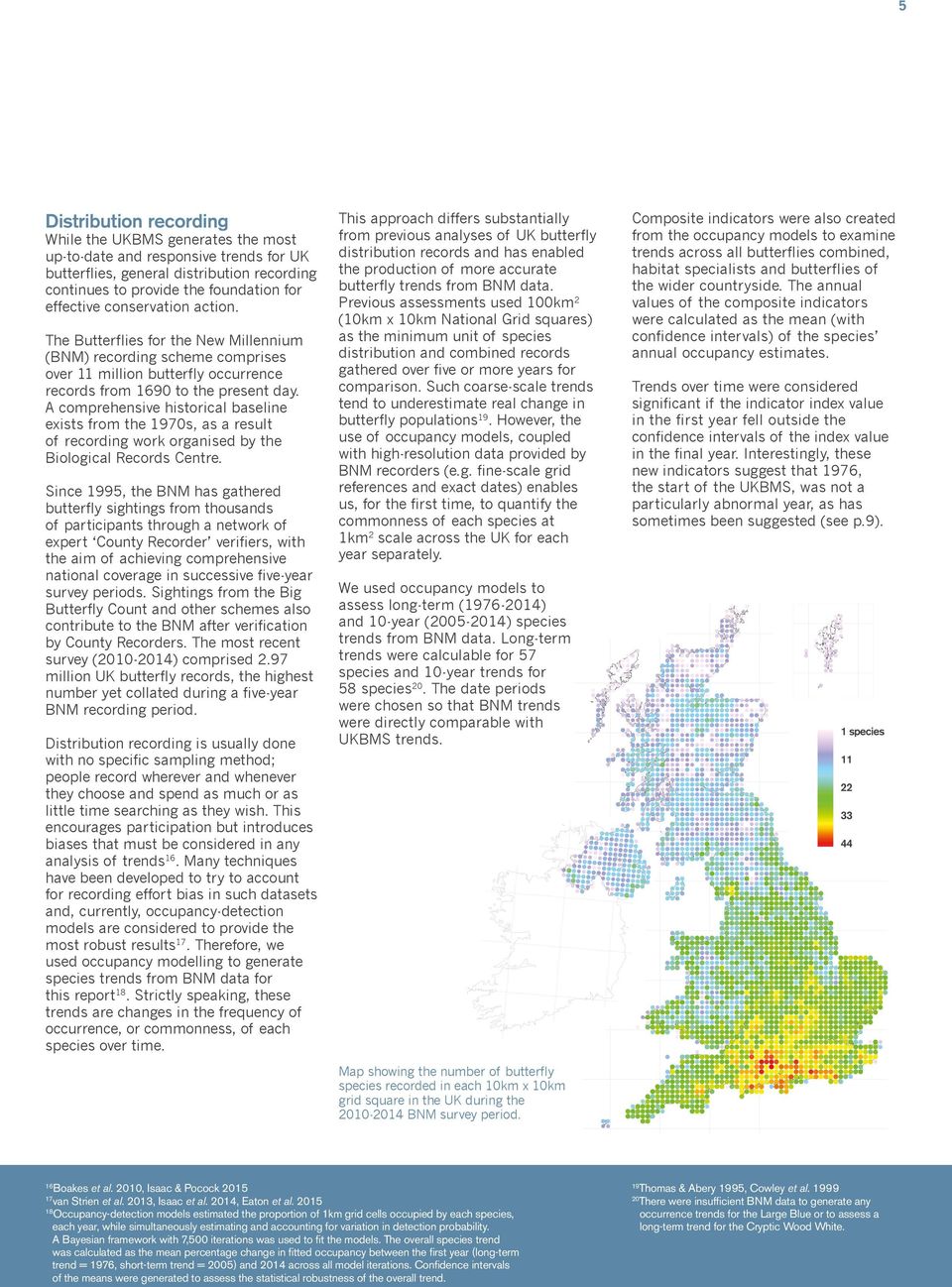
5 5 Distribution recording While the UKBMS generates the most up-to-date and responsive trends for UK butterflies, general distribution recording continues to provide the foundation for effective conservation action. The Butterflies for the New Millennium (BNM) recording scheme comprises over 11 million butterfly occurrence records from 169 to the present day. A comprehensive historical baseline exists from the 197s, as a result of recording work organised by the Biological Records Centre. Since 1995, the BNM has gathered butterfly sightings from thousands of participants through a network of expert County Recorder verifiers, with the aim of achieving comprehensive national coverage in successive five-year survey periods. Sightings from the Big Butterfly Count and other schemes also contribute to the BNM after verification by County Recorders. The most recent survey (21-214) comprised 2.97 million UK butterfly records, the highest number yet collated during a five-year BNM recording period. Distribution recording is usually done with no specific sampling method; people record wherever and whenever they choose and spend as much or as little time searching as they wish. This encourages participation but introduces biases that must be considered in any analysis of trends 16. Many techniques have been developed to try to account for recording effort bias in such datasets and, currently, occupancy-detection models are considered to provide the most robust results 17. Therefore, we used occupancy modelling to generate species trends from BNM data for this report 18. Strictly speaking, these trends are changes in the frequency of occurrence, or commonness, of each species over time. This approach differs substantially from previous analyses of UK butterfly distribution records and has enabled the production of more accurate butterfly trends from BNM data. Previous assessments used 1km 2 (1km x 1km National Grid squares) as the minimum unit of species distribution and combined records gathered over five or more years for comparison. Such coarse-scale trends tend to underestimate real change in butterfly populations 19. However, the use of occupancy models, coupled with high-resolution data provided by BNM recorders (e.g. fine-scale grid references and exact dates) enables us, for the first time, to quantify the commonness of each species at 1km 2 scale across the UK for each year separately. We used occupancy models to assess long-term ( ) and 1-year (25-214) species trends from BNM data. Long-term trends were calculable for 57 species and 1-year trends for 58 species 2. The date periods were chosen so that BNM trends were directly comparable with UKBMS trends. Map showing the number of butterfly species recorded in each 1km x 1km grid square in the UK during the BNM survey period. Composite indicators were also created from the occupancy models to examine trends across all butterflies combined, habitat specialists and butterflies of the wider countryside. The annual values of the composite indicators were calculated as the mean (with confidence intervals) of the species annual occupancy estimates. Trends over time were considered significant if the indicator index value in the first year fell outside the confidence intervals of the index value in the final year. Interestingly, these new indicators suggest that 1976, the start of the UKBMS, was not a particularly abnormal year, as has sometimes been suggested (see p.9). 1 species Boakes et al. 21, Isaac & Pocock van Strien et al. 213, Isaac et al. 214, Eaton et al Occupancy-detection models estimated the proportion of 1km grid cells occupied by each species, each year, while simultaneously estimating and accounting for variation in detection probability. A Bayesian framework with 7,5 iterations was used to fit the models. The overall species trend was calculated as the mean percentage change in fitted occupancy between the first year (long-term trend = 1976, short-term trend = 25) and 214 across all model iterations. Confidence intervals of the means were generated to assess the statistical robustness of the overall trend. 19 Thomas & Abery 1995, Cowley et al There were insufficient BNM data to generate any occurrence trends for the Large Blue or to assess a long-term trend for the Cryptic Wood White.
6 6 Trends of UK butterflies Species Scientific name 1km squares (BNM 21-14) 1km squares (BNM 21-14) UKBMS sites ( ) % Occurrence change (BNM) % Abundance change (UKBMS) % Occurrence change (BNM) % Abundance change (UKBMS) Swallowtail (resident) Swallowtail (migrant) Dingy Skipper Grizzled Skipper Chequered Skipper Essex Skipper Small Skipper Lulworth Skipper Silver-spotted Skipper Large Skipper Wood White Cryptic Wood White Orange-tip Large White Small White Green-veined White Clouded Yellow Brimstone Wall Speckled Wood Large Heath Small Heath Mountain Ringlet Scotch Argus Ringlet Meadow Brown Gatekeeper Marbled White Grayling Pearl-bordered Fritillary Small Pearl-bordered Fritillary Silver-washed Fritillary Dark Green Fritillary High Brown Fritillary White Admiral Purple Emperor Red Admiral Painted Lady Peacock Small Tortoiseshell Comma Marsh Fritillary Glanville Fritillary Heath Fritillary Duke of Burgundy Small Copper Brown Hairstreak Purple Hairstreak Green Hairstreak White-letter Hairstreak Black Hairstreak Small Blue Holly Blue Large Blue Silver-studded Blue Brown Argus Northern Brown Argus Common Blue Adonis Blue Chalk Hill Blue Papilio machaon britannicus Papilio machaon gorganus Erynnis tages Pyrgus malvae Carterocephalus palaemon Thymelicus lineola Thymelicus sylvestris Thymelicus acteon Hesperia comma Ochlodes sylvanus Leptidea sinapis Leptidea juvernica Anthocharis cardamines Pieris brassicae Pieris rapae Pieris napi Colias croceus Gonepteryx rhamni Lasiommata megera Pararge aegeria Coenonympha tullia Coenonympha pamphilus Erebia epiphron Erebia aethiops Aphantopus hyperantus Maniola jurtina Pyronia tithonus Melanargia galathea Hipparchia semele Boloria euphrosyne Boloria selene Argynnis paphia Argynnis aglaja Argynnis adippe Limenitis camilla Apatura iris Vanessa atalanta Vanessa cardui Aglais io Aglais urticae Polygonia c-album Euphydryas aurinia Melitaea cinxia Melitaea athalia Hamearis lucina Lycaena phlaeas Thecla betulae Favonius quercus Callophrys rubi Satyrium w-album Satyrium pruni Cupido minimus Celastrina argiolus Maculinea arion Plebejus argus Aricia agestis Aricia artaxerxes Polyommatus icarus Polyommatus bellargus Polyommatus coridon * * * -41 * * * * ** ** ** ** ** ** ** ** ** * * * ** ** Occurrence trends (derived from 1km square resolution occupancy modelling of BNM data) shown in bold are statistically robust. Statistical significance of UKBMS trends * p<.5, ** p <.1, p <.1.

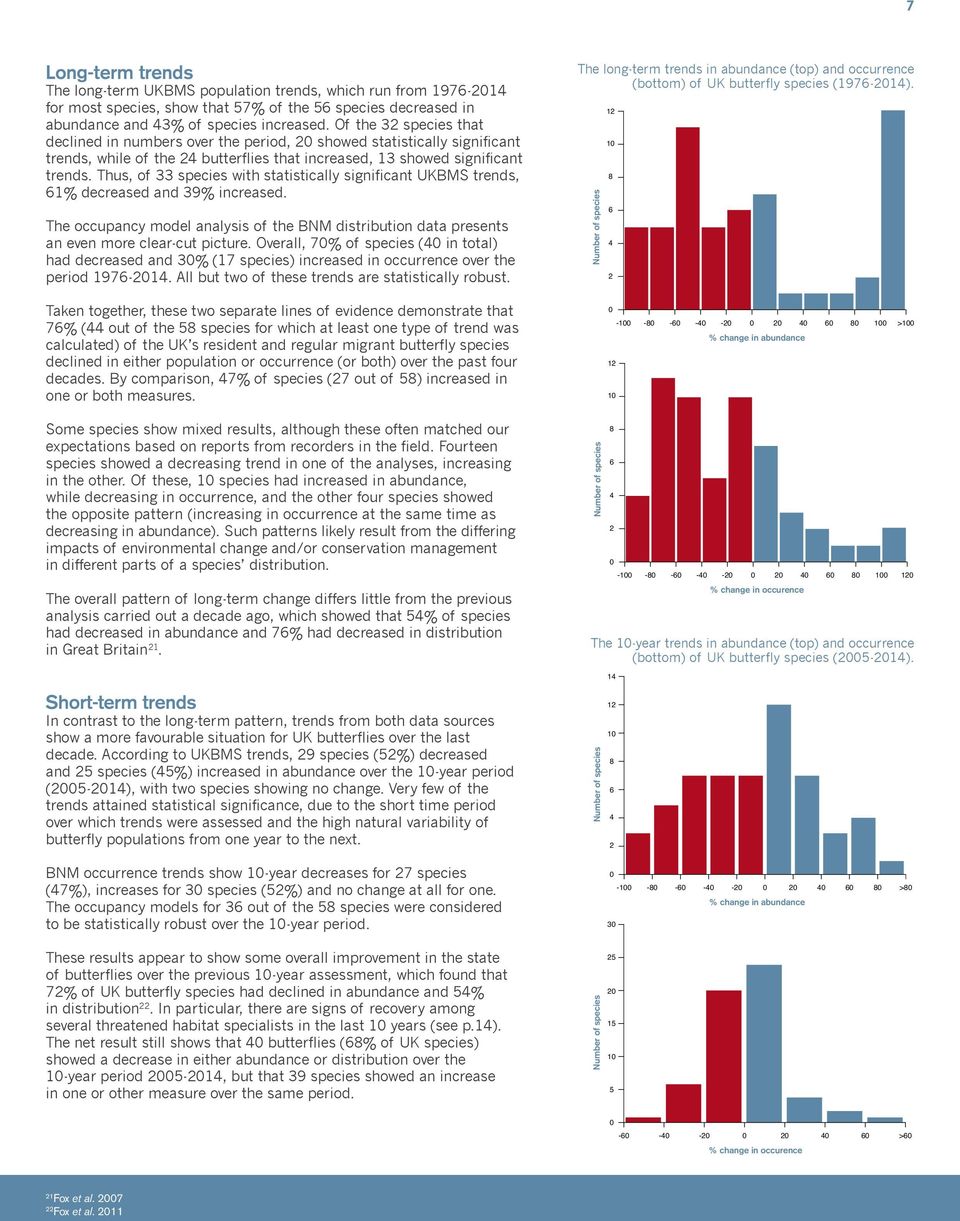
7 7 Long-term trends The long-term UKBMS population trends, which run from for most species, show that 57% of the 56 species decreased in abundance and 43% of species increased. Of the 32 species that declined in numbers over the period, 2 showed statistically significant trends, while of the 24 butterflies that increased, 13 showed significant trends. Thus, of 33 species with statistically significant UKBMS trends, 61% decreased and 39% increased. The occupancy model analysis of the BNM distribution data presents an even more clear-cut picture. Overall, 7% of species (4 in total) had decreased and 3% (17 species) increased in occurrence over the period All but two of these trends are statistically robust. Taken together, these two separate lines of evidence demonstrate that 76% (44 out of the 58 species for which at least one type of trend was calculated) of the UK s resident and regular migrant butterfly species declined in either population 12 or occurrence (or both) over the past four decades. By comparison, 47% of species (27 out of 58) increased in one or both measures. 1 Some species show mixed 8 results, although these often matched our expectations based on reports from recorders in the field. Fourteen 6 species showed a decreasing trend in one of the analyses, increasing in the other. Of these, 1 species had increased in abundance, 4 while decreasing in occurrence, and the other four species showed the opposite pattern (increasing in occurrence at the same time as 2 decreasing in abundance). Such patterns likely result from the differing impacts of environmental change and/or conservation management in different parts of a species distribution >1 % change in abundance The overall pattern of long-term change differs little from the previous analysis carried out a decade ago, which showed that 54% of species had decreased in abundance and 76% had decreased in distribution in Great Britain 21. Short-term trends In contrast to the long-term pattern, trends from both data sources show a more favourable situation for UK butterflies over the last decade. According to UKBMS trends, 29 species (52%) decreased and 25 species (45%) increased in abundance over the 1-year period (25-214), with two species showing no change. Very few of the trends attained statistical significance, due to the short time period over which trends were assessed and the high natural variability of butterfly populations from one year to the next. BNM occurrence trends show 1-year decreases for 27 species (47%), increases for 3 species (52%) and no change at all for one. The occupancy models for 36 out of the 58 species were considered to be statistically 14robust over the 1-year period. 12 These results appear to show some overall improvement in the state of butterflies over the previous 1-year assessment, which found that 1 72% of UK butterfly species had declined in abundance and 54% in distribution 22. 8In particular, there are signs of recovery among several threatened habitat specialists in the last 1 years (see p.14). 6 The net result still shows that 4 butterflies (68% of UK species) showed a decrease 4 in either abundance or distribution over the 1-year period , but that 39 species showed an increase in one or other measure 2 over the same period. Number of species Number of species >8 % change in abundance The long-term trends in abundance (top) and occurrence (bottom) of UK butterfly species ( ). Number of species Number of species Number of species >1 % change in abundance % change in occurence The 1-year trends in abundance (top) and occurrence (bottom) of UK butterfly species (25-214). Number of species >8 % change in abundance >6 % change in occurence 21 Fox et al Fox et al. 211
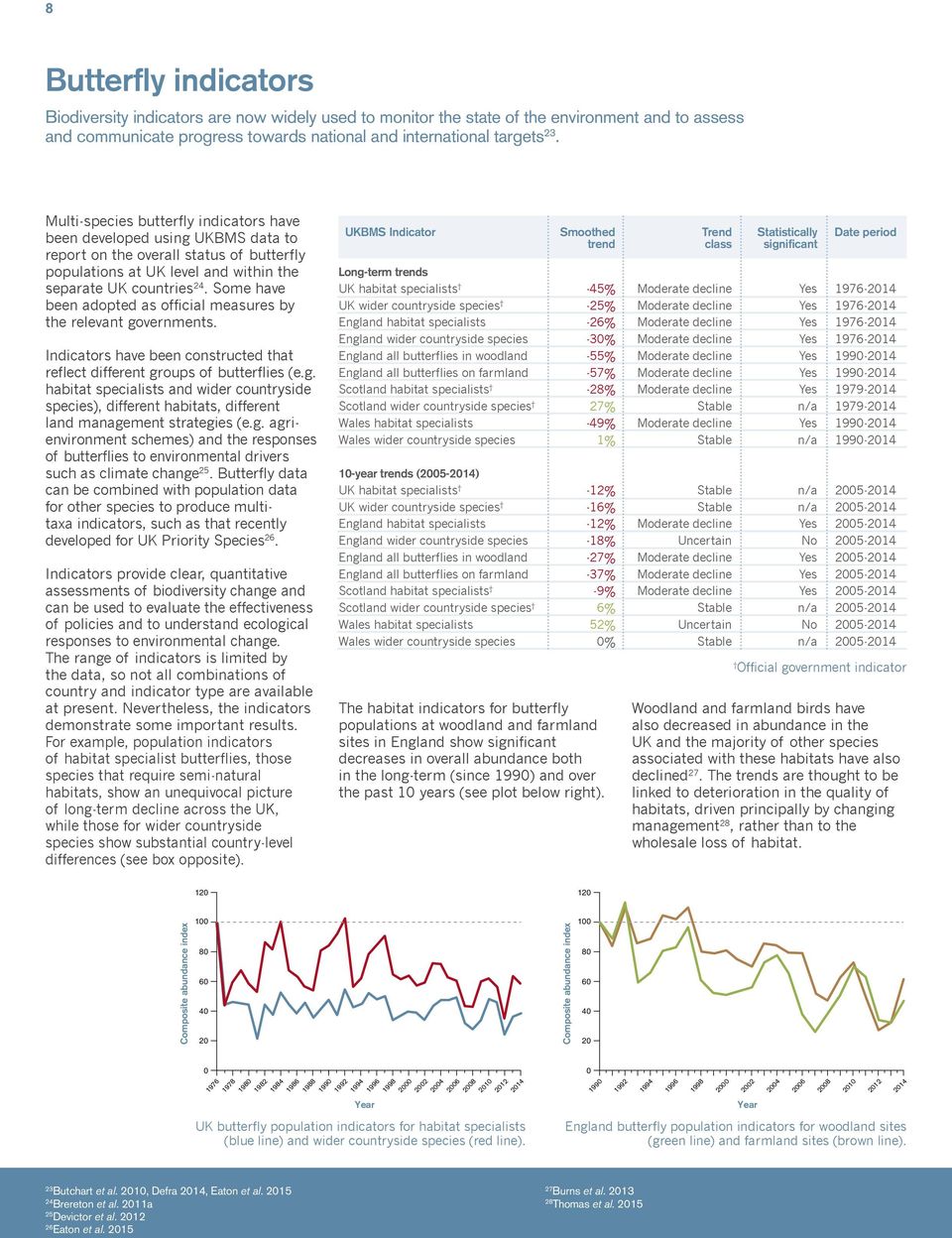
8 8 Butterfly indicators Biodiversity indicators are now widely used to monitor the state of the environment and to assess and communicate progress towards national and international targets 23. Multi-species butterfly indicators have been developed using UKBMS data to report on the overall status of butterfly populations at UK level and within the separate UK countries 24. Some have been adopted as official measures by the relevant governments. Indicators have been constructed that reflect different groups of butterflies (e.g. habitat specialists and wider countryside species), different habitats, different land management strategies (e.g. agrienvironment schemes) and the responses of butterflies to environmental drivers such as climate change 25. Butterfly data can be combined with population data for other species to produce multitaxa indicators, such as that recently developed for UK Priority Species 26. Indicators provide clear, quantitative assessments of biodiversity change and can be used to evaluate the effectiveness of policies and to understand ecological responses to environmental change. The range of indicators is limited by the data, so not all combinations of country and indicator type are available at present. Nevertheless, the indicators demonstrate some important results. For example, population indicators of habitat specialist butterflies, those species that require semi-natural habitats, show an unequivocal picture of long-term decline across the UK, while those for wider countryside species show substantial country-level differences (see box opposite). UKBMS Indicator Long-term trends UK habitat specialists UK wider countryside species England habitat specialists England wider countryside species England all butterflies in woodland England all butterflies on farmland Scotland habitat specialists Scotland wider countryside species Wales habitat specialists Wales wider countryside species 1-year trends (25-214) UK habitat specialists UK wider countryside species England habitat specialists England wider countryside species England all butterflies in woodland England all butterflies on farmland Scotland habitat specialists Scotland wider countryside species Wales habitat specialists Wales wider countryside species Smoothed trend -45% -25% -26% -3% -55% -57% -28% 27% -49% 1% -12% -16% -12% -18% -27% -37% -9% 6% 52% % The habitat indicators for butterfly populations at woodland and farmland sites in England show significant decreases in overall abundance both in the long-term (since 199) and over the past 1 years (see plot below right). Trend class Moderate decline Moderate decline Moderate decline Moderate decline Moderate decline Moderate decline Moderate decline Stable Moderate decline Stable Stable Stable Moderate decline Uncertain Moderate decline Moderate decline Moderate decline Stable Uncertain Stable Statistically significant n/a n/a n/a n/a No n/a No n/a Date period Official government indicator Woodland and farmland birds have also decreased in abundance in the UK and the majority of other species associated with these habitats have also declined 27. The trends are thought to be linked to deterioration in the quality of habitats, driven principally by changing management 28, rather than to the wholesale loss of habitat Composite abundance index Composite abundance index Year Year UK butterfly population indicators for habitat specialists (blue line) and wider countryside species (red line). Composite abundance index Composite abundance index Year Year England butterfly population indicators for woodland sites (green line) and farmland sites (brown line) Butchart et al. 21, Defra 214, Eaton et al Brereton et al. 211a 25 Devictor et al Eaton et al Burns et al Thomas et al. 215
9 9 North South divide Butterfly population indicators for the wider countryside species reveal strongly contrasting long-term trends for England (a statistically significant 3% decrease) and Scotland (a 27% increase categorised as a stable trend). Analogous results have been found in the abundance of common moth species (4% decrease over 4 years in southern Britain versus no significant change in northern Britain 29 ) and in occurrence trends for widespread moths 3, as well as in woodland bird communities 31 and a range of individual bird species 32, suggesting that this result may be widely applicable to British biodiversity. The wider countryside butterfly trends in England and Scotland diverge from 23 onwards suggesting either that environmental factors have deteriorated more rapidly in England since then or the impact of climate change is having different effects in the two countries (or both). Interestingly, the indicator trend for wider countryside butterflies in Wales also shows no decrease, possible evidence of an East-West divide too, although this is for a shorter time period and, therefore, not directly comparable. Composite abundance index Year UKBMS wider countryside butterfly population indicators for England (red line) and Scotland (blue line). New directions The development of butterfly indicators continues. For instance, butterfly population data from transect monitoring schemes in different countries can be combined to produce international indicators. The first example is a European Grassland Butterfly Indicator, based on 17 species (including Orange-tip, Marsh Fritillary, Meadow Brown and Small Blue) monitored in 19 countries 33. The indicator shows a decrease of almost 5% over the period , indicative of general biodiversity loss in grasslands across the continent due largely to agricultural intensification and abandonment. Advances in analysis methodology will facilitate increased use of butterfly population data at international scales in the future 34. BNM occurrence indicator Long-term trends ( ) UK all species UK habitat specialists UK wider countryside species 1-year trends (25-214) UK all species UK habitat specialists UK wider countryside species Trend -43% -62% -24% 13% 5% 18% Statistically significant No No No Another new area of indicator development has been in the use of occurrence data from distribution recording schemes. One such indicator, which measures change in the frequency of occurrence of 179 insect species (mostly moths, bees and wasps) of conservation priority, has been officially adopted by the UK Government 35. The new occupancy model analysis of UK butterfly distribution data carried out for this report can be used to develop similar indicators. Trends in BNM occurrence indicators for all species, habitat specialist butterflies and wider countryside species are shown in the table right (also see box below). Composite occurence index Year The combined indices of occurrence (with confidence intervals) for habitat specialists (blue line) and wider countryside species (red line) derived from BNM distribution records show two notable features. First, there has been a clear long-term decrease for both groups in the UK from 1976 onwards with little sign of recovery to earlier levels. Second, the occurrence values for the first five years ( ) show that overall butterfly occurrence was similar to that in This demonstrates that 1976 was not an atypical year for butterflies and, therefore, is an appropriate start point for trends from the UKBMS. 29 Fox et al Fox et al Massimino et al Fuller et al van Swaay et al Schmucki et al

10 1 The state of the UK s butterflies Change since the 197s In keeping with previous assessments, the new analyses undertaken for this report, together with the UK butterfly population indicators, present a clear picture of long-term decline in the abundance and distribution of the UK s butterflies. Many of the most substantial declines over the past four decades represent the continuation of trends that started much earlier. Thus, species such as the High Brown Fritillary, Pearl-bordered Fritillary (see plots and map below), Wood White, Duke of Burgundy, Marsh Fritillary and Heath Fritillary, which have some of the worst trends in the current analyses, had already suffered major (but unquantified) contractions of range when the first atlas of butterflies in Britain and Ireland was published in These species now occupy only a small fraction of their former distributions and, for the past 15 years or so, have been the focal points of conservation action to halt the declines and so prevent their extinction in the UK. The long-term UKBMS indicator trends for habitat specialist butterflies show significant decreases in abundance at the UK level and separately in England, Scotland and Wales (see p.8). This is supported by the BNM occurrence indicator for habitat specialists, which has decreased by 62% since 1976 (see p.9). The long-term trends remain a particular concern for those few UK species adapted to cooler climatic conditions and restricted to northern Britain. The new BNM 1km square occupancy analysis shows declines of more than a quarter for Northern Brown Argus and more than a half for Mountain Ringlet and Large Heath. The long-term UKBMS trend for Northern Brown Argus also shows a significant decrease in abundance, though conversely the trend for Large Heath is a large, statistically significant increase, albeit based on a small number of monitored sites. Scotch Argus, the only other northern species in the UK, is of less concern, with a modest decrease in occurrence and a significant increase in abundance. A new research project led by the University of York has just commenced, which will improve further our understanding of distribution and population changes in these northern species. Another group of species of increasing conservation concern includes relatively widespread butterflies that have undergone major declines since the 197s. Previous analyses of the BNM distribution data, carried out at a coarse 1km square resolution, almost certainly underestimated the true scale of decline among these species. Notable examples include the White-letter Hairstreak, Small Pearlbordered Fritillary, Wall and Small Heath, all of which have suffered very substantial decreases in both abundance and occurrence over the past four decades (see boxes opposite). Log abundance index Occurrence index Year Long-term BNM occurrence index (with confidence intervals) and UKBMS abundance index for the Pearl-bordered Fritillary. This species has had only one year (211) this century when its UKBMS abundance was above the average (shown by the grey line) for the whole series! Occurrence index Log abundance index Year Pearl-bordered Fritillary: sighting 2-9 max seen 1+ max seen Heath et al. 1984

11 11 The total abundance of wider countryside butterflies (species not restricted to special semi-natural habitats) has declined significantly since 1976, despite substantial increases by some species in response to climate warming (see p.12). UK and England indicators that combine populations of wider countryside butterflies show significant decreases of 25% and 3% respectively (although the equivalent indicators in Scotland and Wales have not declined). Half of the 1 butterflies that have suffered the most severe long-term UKBMS declines are wider countryside species (White-letter Hairstreak, Essex Skipper, Wall, Small Skipper and Small Tortoiseshell). The occurrence indicator for wider countryside species derived from the BNM distribution data decreased by 24% over the same period. Wall The precipitous decline of the Wall, once a common farmland butterfly, is well-known but little understood. The local extinction of colonies across a huge tract of southern Britain is reflected in a 77% decrease in occurrence and an 87% decrease in abundance since Only six other butterfly species show a greater long-term decrease in occurrence and only three have more severe population declines in the UK. The Wall is declining in other countries too and shows a significant decline in abundance in the European Grassland Butterfly Indicator 37. Recent evidence suggests that climate change may be driving the Wall s decline 38, perhaps through a shift towards a third generation in the autumn that produces few offspring 39, although there may also be other factors involved (e.g. nitrogen pollution 4 ). Neil Hulme Dan Lombard Small Heath The new fine-scale assessment of distribution data shows that the Small Heath has decreased by 57% since 1976, while its abundance on monitored sites has also more than halved over the same period. To put this into context, the Small Heath has fared worse than the Grizzled Skipper, Small Blue, Northern Brown Argus or White Admiral, despite being much more widespread than any of them (Small Heath is the 11 th most widespread UK species Year based on occupied 1km squares in the BNM survey). Research is urgently needed to investigate the causes of this dramatic and continued decline. Occurrence index Log abundance index Year Long-term BNM occurrence index (with confidence intervals) and UKBMS abundance index for the Small Heath van Swaay et al Palmer et al Van Dyck et al Klop et al. 215

12 12 While the overall picture is one of long-term decline, some UK butterflies have bucked the trend and done well since the 197s. These include a few species that had become scarce (e.g. Silver-spotted Skipper, Adonis Blue), the reintroduced Large Blue and the three regular migrants (Clouded Yellow, Red Admiral and Painted Lady) (see p.22). However, most of the species faring well over recent decades are wider countryside butterflies capable of breeding in modern agricultural and urban landscapes.these have expanded their distributions (see mapped examples right), most likely in response to climate change and, in many cases, their population levels have also increased significantly. Orange-tip: However, long-term change is not always so clear cut. Both Small and Essex Skipper, for example, have shown substantial increases in their British range since the 197s; through northern England and into southern Scotland in the case of the Small Skipper and across central southern England and the Midlands into South Wales and the West Country in the case of Essex Skipper. Despite these continuing range expansions, both species have undergone significant decreases in their UKBMS population trends (75% for Small Skipper and 88% for Essex Skipper) (see plot below). Thus their populations appear to be thinning in their core range while they expand at the margins. These population declines started in the mid-199s, although both species showed some encouraging signs of recovery in 213 and 214. The Small Skipper s UKBMS population index has been below the long-term average (shown by the grey line) in every year this century, while the Essex Skipper recorded its seven worst years from Comma: Log abundance index Year Essex Skipper Small Skipper UKBMS abundance index for Small Skipper and Essex Skipper.

13 13 Maps showing the expansions in UK distribution recorded for six wider countryside species; the original distributions recorded in are shown as well as additional 1km x 1km grid squares occupied in Speckled Wood: Ringlet: Holly Blue: Brown Argus:

14 14 Change over the past decade The overall assessment of the state of butterflies in the UK over the past 1 years (25-214) provides some grounds for optimism, even more so than in the previous report 41, although major challenges remain. The most welcome news relates to several threatened species that have undergone long-term declines. Population levels of the Duke of Burgundy increased by 67% over the decade and its occurrence trend (3%) suggests that the long-term distribution decline has been halted. Landscape-scale conservation projects focussed on the Duke of Burgundy in the North York Moors, Morecambe Bay Limestones and south-east England have contributed to this upturn in fortune 42, and the species may also have benefitted from climate change 43. The Pearl-bordered Fritillary shows a similar pattern, with abundance up by 45% and occurrence by 3%. Trends for the Dingy Skipper are even more positive, with a 69% increase in abundance and 21% increase in occurrence, while the Silver-studded Blue shows a 19% increase in occurrence. Other habitat specialist species showing some positive signs over the past decade include Chalk Hill Blue, Dark Green Fritillary, Silver-washed Fritillary (see box opposite), Chequered Skipper, Brown Hairstreak and Purple Emperor, although the increases in occurrence of the latter three species may be due, in part, to successful targeted recording. Even the High Brown Fritillary, the UK s most endangered butterfly, is showing some positive signs in response to intensive conservation efforts in south-west England (see p.17) and at the only remaining colony in South Wales. However, all of these species were once considerably more widespread than they are today and the recent upturns in their fortunes, while rightly celebrated, are very modest in the context of long-term trends. The past decade has been a tumultuous period for the Small Tortoiseshell, one of our most familiar garden butterflies. It suffered a run of eight consecutive poor years between 25 and 212, producing the eight lowest indices of abundance for the species in the UKBMS series since 1976, but then recovered spectacularly in 213 and 214. Thus, while the long-term abundance trend for Small Tortoiseshell remains a significant major decrease (-73%), the past decade shows a strong (but not statistically significant) increase of 146%. The composite indicators show stable 1-year abundance and occurrence trends for both habitat specialists and wider countryside species at the UK level (although ongoing declines in abundance are seen in some country-level indicators). These signs of stabilization and recovery are all the more impressive given that this period has not been particularly good for UK butterflies in general. In particular, a run of six consecutive summers (27-212) provided poor weather for butterflies. A ranking of all years since 1976, based on UKBMS counts for all species combined, shows that seven of the past 1 years were below average (including the two worst years in the whole series, 212 and 28) and only three were above average. Neil Hulme The endangered Duke of Burgundy butterfly has fared much better over the past decade. The loss of colonies seems to have been stemmed by concerted conservation effort and, in 211, the species reached its highest UKBMS population index since Fox et al Ellis et al Palmer et al. 215
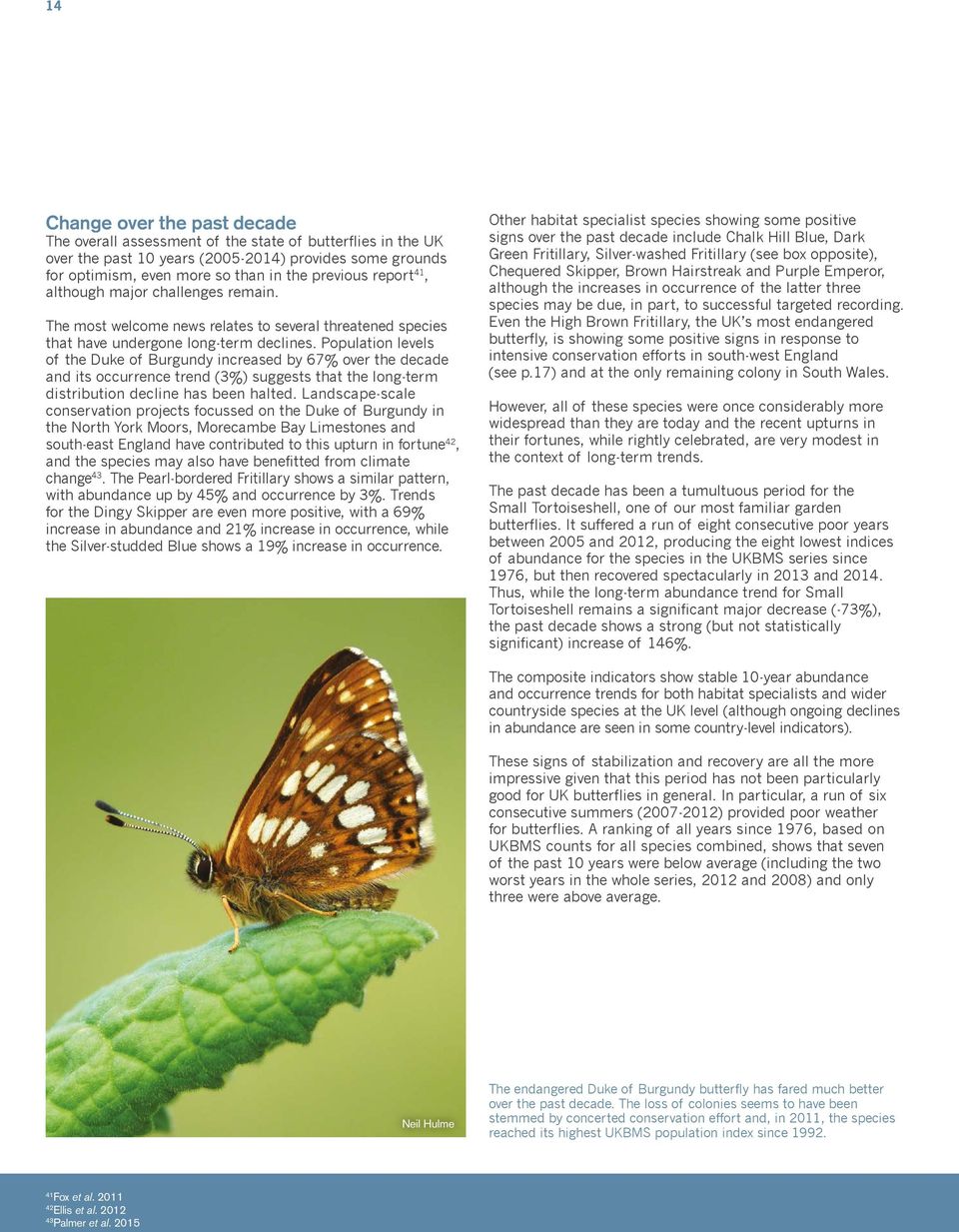
15 15 Silver-washed Fritillary The distribution of the Silver-washed Fritillary has waxed and waned over the past 2 years, but in the last decade it has expanded rapidly (55% increase in occurrence), colonising many woodlands across East Anglia and the Midlands Neil Hulme Occurrence index Year The 1-year trends do not, however, provide encouraging news across the board for UK butterflies. The long-term decreases of some of our rarest and most rapidly-declining species show little sign of abating. White-letter Hairstreak, Wood White, White Admiral, Marsh Fritillary, Glanville Fritillary, Heath Fritillary and Wall all show short-term declines in abundance and all except Glanville Fritillary and Heath Fritillary also show statistically robust decreases in occurrence. The population indicators for habitat specialist butterflies reveal significant decreases in the abundance of this group in both England (12% decrease) and Scotland (9% decrease) over the past decade. Among the wider countryside species, one that seems to be faring particularly badly at present is the Gatekeeper. The distribution of this butterfly expanded northwards rapidly during the 198s and 199s through the East Midlands, Cheshire, Lancashire and Yorkshire, but since the millennium this advance has petered out. Its abundance showed no overall change during the years of range expansion but, over the past decade, numbers have fallen dramatically, contributing to statistically significant 1-year and long-term declines of 44% and 41% respectively. The butterfly is also declining in many other European countries 45. Also of note is the 1-year occurrence trend for the Cryptic Wood White. This is the only butterfly species found in Northern Ireland but nowhere else in the UK and its true identity was only established in Although there are too few UKBMS data to calculate abundance trends for the Cryptic Wood White, the new analysis of BNM distribution records, indicates a 23% decrease in occurrence (25-214). The causes of this decline require further investigation. Gatekeeper Neil Hulme 44 Dinca ˇ et al van Swaay et al. 21
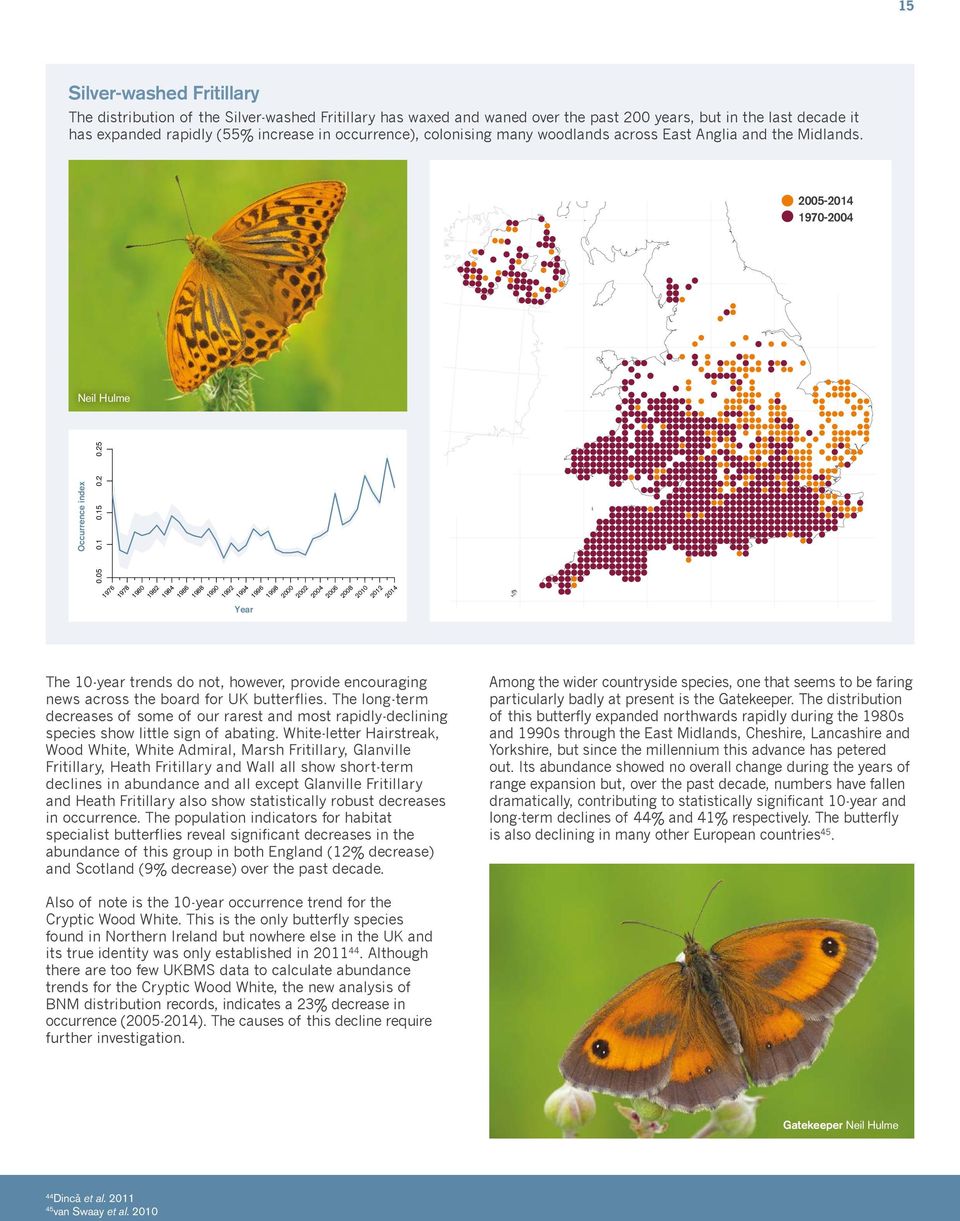
16 16 Reversing declines of threatened butterflies through landscape-scale conservation Since the start of the current century, Butterfly Conservation has shifted the majority of its conservation effort for threatened butterflies from a focus on single sites to targeting networks of sites across landscapes. This approach is required because many butterflies persist in the landscape as metapopulations, where local populations occupy islands of suitable semi-natural habitat (e.g. chalk grassland) amongst a sea of more intensively managed, and hence unsuitable, land. Such local populations are connected due to dispersal by individual butterflies, so that if extinction occurs there is potential for recolonisation from a nearby population 46. However, if the landscape becomes more fragmented, with butterflies occupying smaller, more isolated sites, then the likelihood of extinction increases and the chances of recolonisation are reduced 47. When local extinctions exceed colonisations, extinction across the whole landscape becomes increasingly likely 48. The objective of landscape-scale conservation is therefore to ensure the metapopulation remains at or is returned to equilibrium, balancing any local extinctions with an equal or greater number of colonisations. The approach is to maximise habitat quality within individual sites by targeted management, while also taking account of the spatial context of those sites 49. For example, sites at the centre of a network may be given higher priority than small, isolated sites at the network s periphery. Firstly, habitat management is targeted at sites that are currently occupied by the butterfly to maintain and increase populations, which will potentially provide a source of dispersing individuals. Secondly, the habitat of former and potential sites is improved, focussing on larger and less isolated sites that are most likely to be colonised. Thirdly, where possible, barriers to butterfly dispersal (such as patches of scrub or blocks of coniferous woodland) between sites are removed to increase chances of colonisation. Short-term direct funding is invaluable for restoration phases of landscape-scale projects, but well-designed agri-environment and woodland grant schemes are often vital both to delivery of the initial project aims and to sustaining these benefits in the long term. Maintaining existing high quality habitat is more cost effective in the long run than restoration management. Our case studies also demonstrate that extinctions on small, isolated sites are not inevitable if properly managed and that the principles of landscape-scale conservation of butterflies can be applied at relatively small spatial scales. Butterflies can respond very rapidly to landscape-scale conservation and projects targeting one species often benefit a suite of others, thus contributing to conserving biodiversity as a whole 51. In a rapidly changing climate, landscape-scale conservation must adapt to altered habitat associations of target butterflies 52, novel vegetation responses to traditional habitat management techniques 51 and, potentially, extensive geographical shifts in species range 53. Maintaining landscapes with large and diverse areas of habitat, with corresponding microclimatic variability, will be important both to buffer species against negative impacts of climate change 54 and to enable climate-driven range shifts 55. While Butterfly Conservation s landscape-scale projects continue to yield some notable successes for threatened species, the ongoing decline of many butterflies underlines the need for wider application and greater resourcing of such action to meet government policy commitments and to reverse decades of loss 56. Butterfly Conservation has applied this approach in over 7 landscape-scale projects across the UK, targeting important areas for threatened species. These provide some of the best evidence that landscape-scale conservation can be effective and identify some key elements of success 5 : Careful targeting of management both across the network and on individual sites is essential and needs to be co-ordinated by a skilled project officer, able to link up a partnership of landowners, land managers, volunteers, statutory and non-statutory organisations with a shared vision for the landscape. Landscape-scale projects must be evidence based and underpinned by an understanding of the species habitat requirements, high quality distribution data and a suitable monitoring system to assess their effectiveness. Volunteers improving Wood White habitat by widening a woodland ride. Sharon Hearle 46 Hanski Hanski 1999, Wilson et al Bulman et al Thomas et al. 21, Ellis et al. 212, Bourn et al Ellis et al Ellis et al Roy & Thomas 23, Davies et al Settele et al Oliver et al. 21, 213, Suggitt et al Bennie et al Lawton et al. 21
17 17 High Brown Fritillary on Exmoor Britain s most endangered butterfly, the High Brown Fritillary, has responded positively to landscape-scale targeted management in the Heddon Valley, Exmoor since In partnership with landowners and organisations, habitat management advice was provided for all 16 sites in this network. A total of nearly 16ha of invasive scrub and trees was removed across 14 sites, Bracken control undertaken on 12 sites and fencing erected to facilitate low-intensity grazing by cattle or ponies on three sites. Much of the management was funded through agrienvironment or woodland grant schemes, but volunteer work parties also played an important role. Abundance of the Heddon Valley populations increased significantly by 235% between 22 and 214, compared to a moderate but statistically significant 44% decline across the whole of the UK over the same period. Population increases on core Heddon Valley sites enabled the butterfly to disperse and colonise four peripheral sites in the network. There were no extinctions in the same period, suggesting this metapopulation is well on the way to being stabilised. Neil Hulme Map showing changes in site occupancy by High Brown Fritillary in the Heddon Valley, Exmoor Four colonisations at the network s periphery followed intensive targeted management intervention on both occupied and potential sites. Wood White in Northamptonshire The Yardley-Whittlewood Ridge landscape in Northamptonshire is a national stronghold for the Wood White. Here, the butterfly breeds in grassy vegetation at the edges of open, sunny woodland rides and glades, but numbers have declined over the last few decades as the habitat became more shaded. Between 212 and 215, 25 rides were widened (over 11km of ride in total) and five glades created in seven woods across the landscape (six with existing small colonies and one unoccupied), improving the condition of 23ha of habitat and increasing connectivity within the woodlands. The Wood White responded positively to this habitat management. Populations increased in eight of the 13 rides that were occupied at the outset, enabling the butterfly to colonise 1 newly widened rides and all of the new glades. Only two widened rides remained unoccupied and these were both in the wood that had no Wood White butterflies at the start of the project. Continuing follow-up work by the Forestry Commission should maintain this revival and enable the seventh wood to be recolonised in the future. Neil Hulme 57 Ellis et al. 215

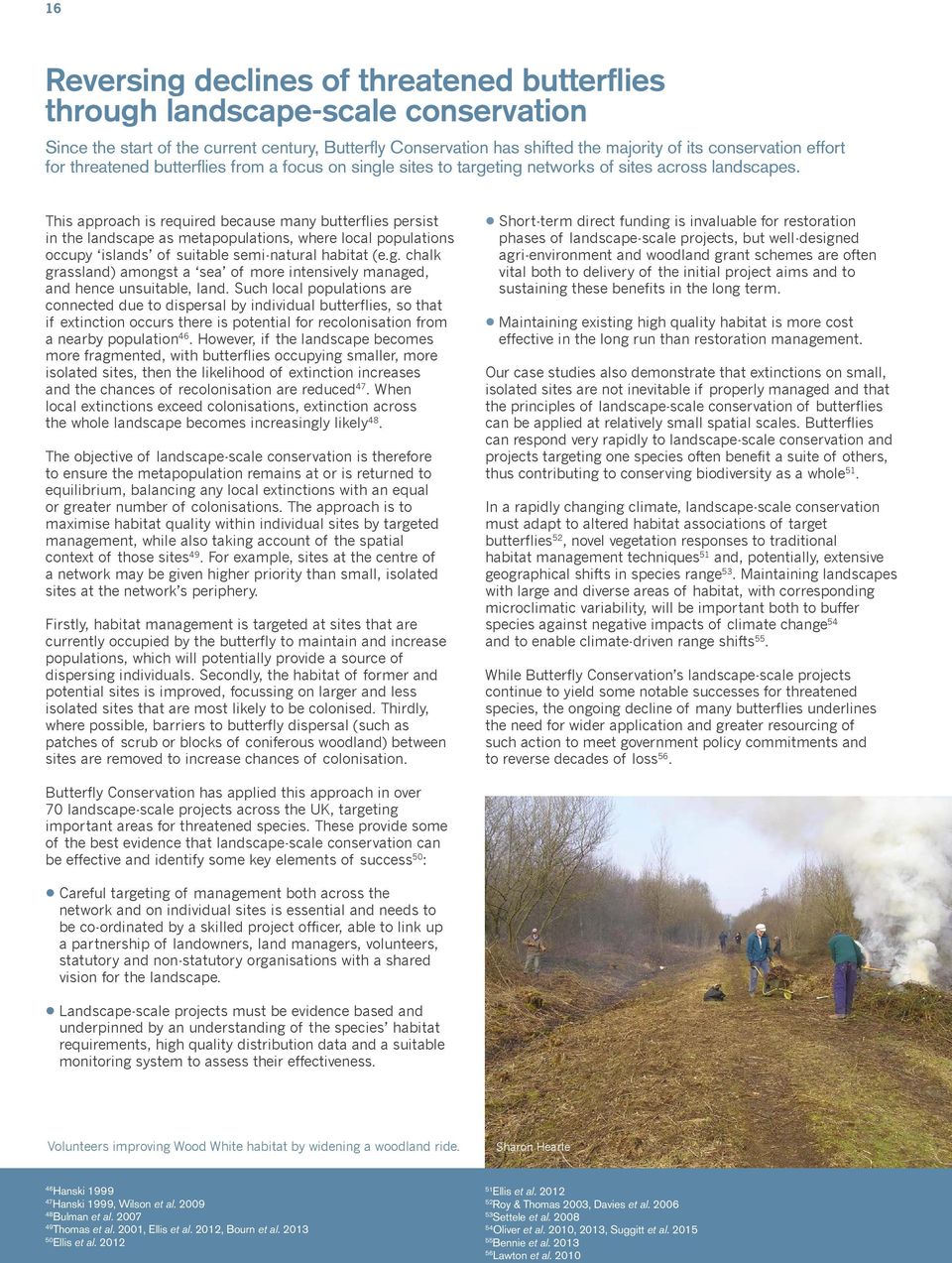
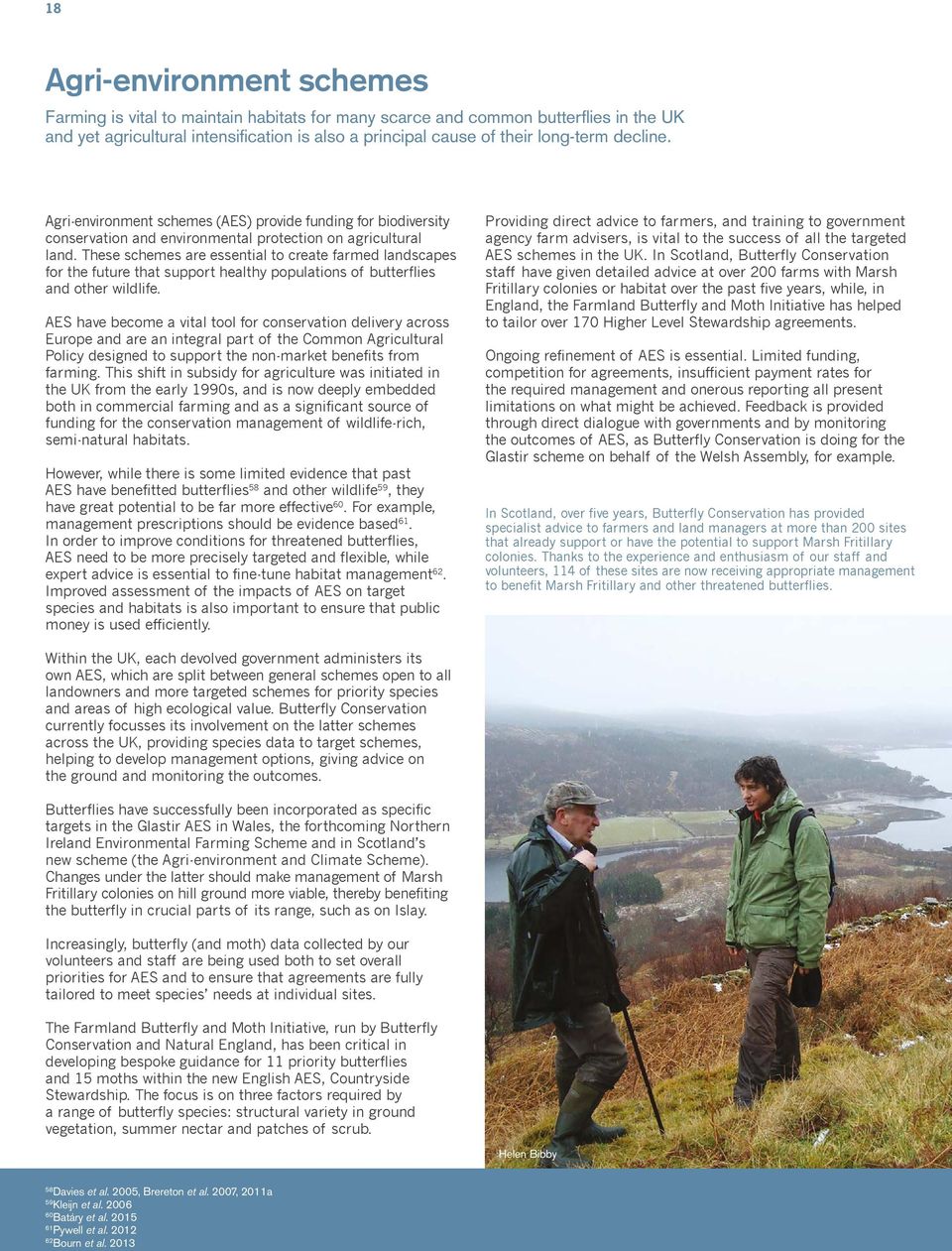
18 18 Agri-environment schemes Farming is vital to maintain habitats for many scarce and common butterflies in the UK and yet agricultural intensification is also a principal cause of their long-term decline. Agri-environment schemes (AES) provide funding for biodiversity conservation and environmental protection on agricultural land. These schemes are essential to create farmed landscapes for the future that support healthy populations of butterflies and other wildlife. AES have become a vital tool for conservation delivery across Europe and are an integral part of the Common Agricultural Policy designed to support the non-market benefits from farming. This shift in subsidy for agriculture was initiated in the UK from the early 199s, and is now deeply embedded both in commercial farming and as a significant source of funding for the conservation management of wildlife-rich, semi-natural habitats. However, while there is some limited evidence that past AES have benefitted butterflies 58 and other wildlife 59, they have great potential to be far more effective 6. For example, management prescriptions should be evidence based 61. In order to improve conditions for threatened butterflies, AES need to be more precisely targeted and flexible, while expert advice is essential to fine-tune habitat management 62. Improved assessment of the impacts of AES on target species and habitats is also important to ensure that public money is used efficiently. Providing direct advice to farmers, and training to government agency farm advisers, is vital to the success of all the targeted AES schemes in the UK. In Scotland, Butterfly Conservation staff have given detailed advice at over 2 farms with Marsh Fritillary colonies or habitat over the past five years, while, in England, the Farmland Butterfly and Moth Initiative has helped to tailor over 17 Higher Level Stewardship agreements. Ongoing refinement of AES is essential. Limited funding, competition for agreements, insufficient payment rates for the required management and onerous reporting all present limitations on what might be achieved. Feedback is provided through direct dialogue with governments and by monitoring the outcomes of AES, as Butterfly Conservation is doing for the Glastir scheme on behalf of the Welsh Assembly, for example. In Scotland, over five years, Butterfly Conservation has provided specialist advice to farmers and land managers at more than 2 sites that already support or have the potential to support Marsh Fritillary colonies. Thanks to the experience and enthusiasm of our staff and volunteers, 114 of these sites are now receiving appropriate management to benefit Marsh Fritillary and other threatened butterflies. Within the UK, each devolved government administers its own AES, which are split between general schemes open to all landowners and more targeted schemes for priority species and areas of high ecological value. Butterfly Conservation currently focusses its involvement on the latter schemes across the UK, providing species data to target schemes, helping to develop management options, giving advice on the ground and monitoring the outcomes. Butterflies have successfully been incorporated as specific targets in the Glastir AES in Wales, the forthcoming Northern Ireland Environmental Farming Scheme and in Scotland s new scheme (the Agri-environment and Climate Scheme). Changes under the latter should make management of Marsh Fritillary colonies on hill ground more viable, thereby benefiting the butterfly in crucial parts of its range, such as on Islay. Increasingly, butterfly (and moth) data collected by our volunteers and staff are being used both to set overall priorities for AES and to ensure that agreements are fully tailored to meet species needs at individual sites. The Farmland Butterfly and Moth Initiative, run by Butterfly Conservation and Natural England, has been critical in developing bespoke guidance for 11 priority butterflies and 15 moths within the new English AES, Countryside Stewardship. The focus is on three factors required by a range of butterfly species: structural variety in ground vegetation, summer nectar and patches of scrub. Helen Bibby 58 Davies et al. 25, Brereton et al. 27, 211a 59 Kleijn et al Batáry et al Pywell et al Bourn et al. 213
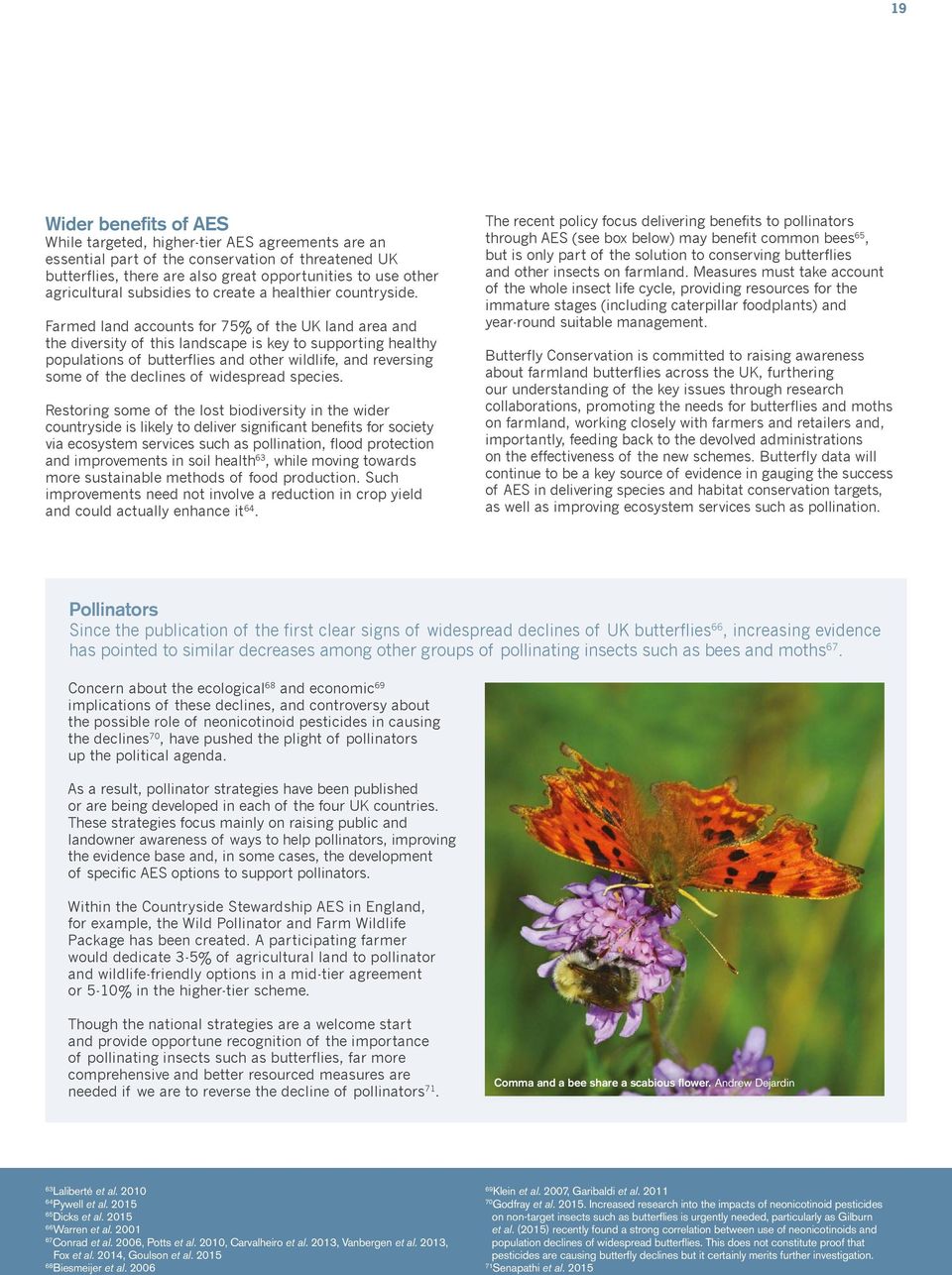
19 19 Wider benefits of AES While targeted, higher-tier AES agreements are an essential part of the conservation of threatened UK butterflies, there are also great opportunities to use other agricultural subsidies to create a healthier countryside. Farmed land accounts for 75% of the UK land area and the diversity of this landscape is key to supporting healthy populations of butterflies and other wildlife, and reversing some of the declines of widespread species. Restoring some of the lost biodiversity in the wider countryside is likely to deliver significant benefits for society via ecosystem services such as pollination, flood protection and improvements in soil health 63, while moving towards more sustainable methods of food production. Such improvements need not involve a reduction in crop yield and could actually enhance it 64. The recent policy focus delivering benefits to pollinators through AES (see box below) may benefit common bees 65, but is only part of the solution to conserving butterflies and other insects on farmland. Measures must take account of the whole insect life cycle, providing resources for the immature stages (including caterpillar foodplants) and year-round suitable management. Butterfly Conservation is committed to raising awareness about farmland butterflies across the UK, furthering our understanding of the key issues through research collaborations, promoting the needs for butterflies and moths on farmland, working closely with farmers and retailers and, importantly, feeding back to the devolved administrations on the effectiveness of the new schemes. Butterfly data will continue to be a key source of evidence in gauging the success of AES in delivering species and habitat conservation targets, as well as improving ecosystem services such as pollination. Pollinators Since the publication of the first clear signs of widespread declines of UK butterflies 66, increasing evidence has pointed to similar decreases among other groups of pollinating insects such as bees and moths 67. Concern about the ecological 68 and economic 69 implications of these declines, and controversy about the possible role of neonicotinoid pesticides in causing the declines 7, have pushed the plight of pollinators up the political agenda. As a result, pollinator strategies have been published or are being developed in each of the four UK countries. These strategies focus mainly on raising public and landowner awareness of ways to help pollinators, improving the evidence base and, in some cases, the development of specific AES options to support pollinators. Within the Countryside Stewardship AES in England, for example, the Wild Pollinator and Farm Wildlife Package has been created. A participating farmer would dedicate 3-5% of agricultural land to pollinator and wildlife-friendly options in a mid-tier agreement or 5-1% in the higher-tier scheme. Though the national strategies are a welcome start and provide opportune recognition of the importance of pollinating insects such as butterflies, far more comprehensive and better resourced measures are needed if we are to reverse the decline of pollinators 71. Comma and a bee share a scabious flower. Andrew Dejardin 63 Laliberté et al Pywell et al Dicks et al Warren et al Conrad et al. 26, Potts et al. 21, Carvalheiro et al. 213, Vanbergen et al. 213, Fox et al. 214, Goulson et al Biesmeijer et al Klein et al. 27, Garibaldi et al Godfray et al Increased research into the impacts of neonicotinoid pesticides on non-target insects such as butterflies is urgently needed, particularly as Gilburn et al. (215) recently found a strong correlation between use of neonicotinoids and population declines of widespread butterflies. This does not constitute proof that pesticides are causing butterfly declines but it certainly merits further investigation. 71 Senapathi et al. 215
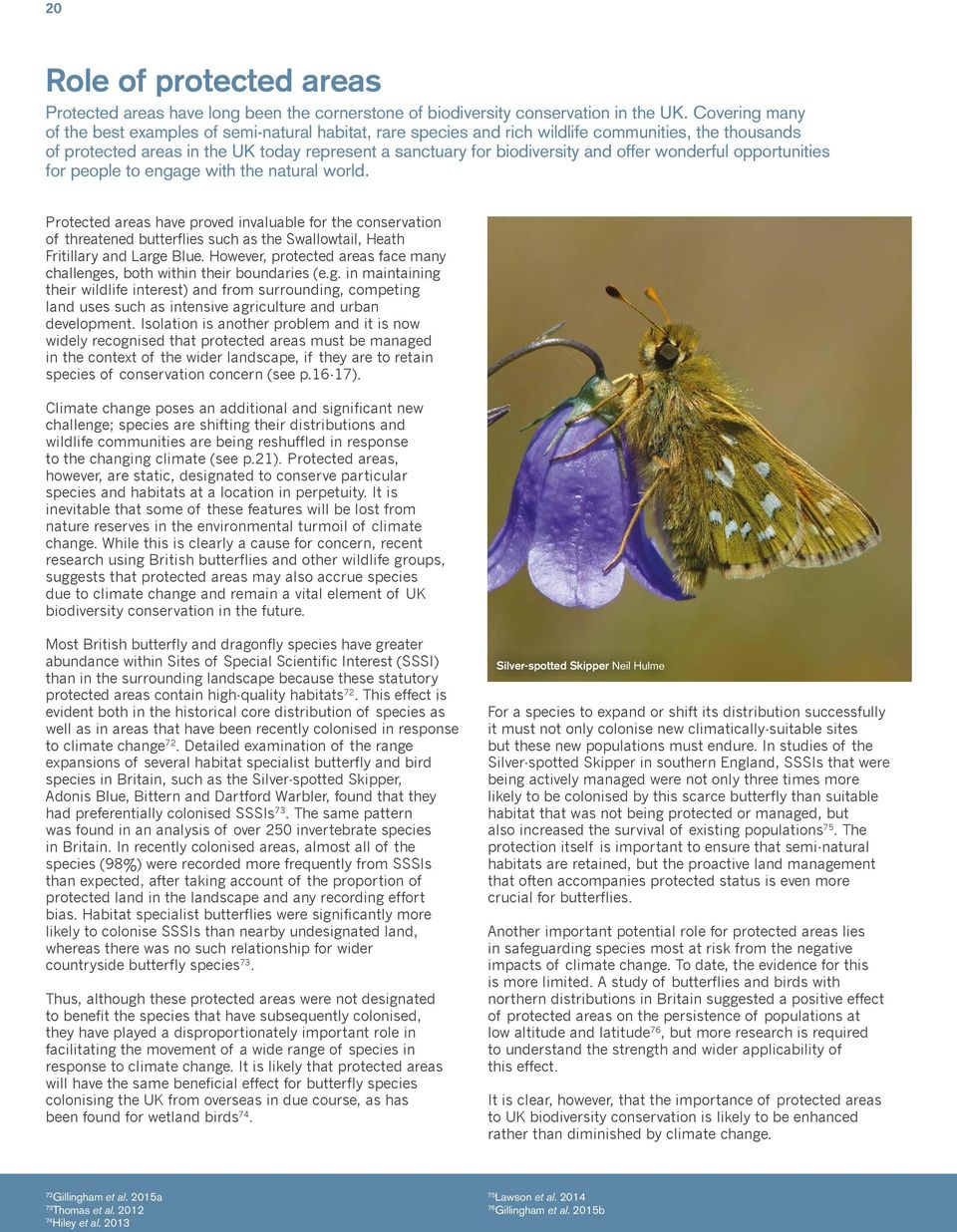
20 2 Role of protected areas Protected areas have long been the cornerstone of biodiversity conservation in the UK. Covering many of the best examples of semi-natural habitat, rare species and rich wildlife communities, the thousands of protected areas in the UK today represent a sanctuary for biodiversity and offer wonderful opportunities for people to engage with the natural world. Protected areas have proved invaluable for the conservation of threatened butterflies such as the Swallowtail, Heath Fritillary and Large Blue. However, protected areas face many challenges, both within their boundaries (e.g. in maintaining their wildlife interest) and from surrounding, competing land uses such as intensive agriculture and urban development. Isolation is another problem and it is now widely recognised that protected areas must be managed in the context of the wider landscape, if they are to retain species of conservation concern (see p.16-17). Climate change poses an additional and significant new challenge; species are shifting their distributions and wildlife communities are being reshuffled in response to the changing climate (see p.21). Protected areas, however, are static, designated to conserve particular species and habitats at a location in perpetuity. It is inevitable that some of these features will be lost from nature reserves in the environmental turmoil of climate change. While this is clearly a cause for concern, recent research using British butterflies and other wildlife groups, suggests that protected areas may also accrue species due to climate change and remain a vital element of UK biodiversity conservation in the future. Most British butterfly and dragonfly species have greater abundance within Sites of Special Scientific Interest (SSSI) than in the surrounding landscape because these statutory protected areas contain high-quality habitats 72. This effect is evident both in the historical core distribution of species as well as in areas that have been recently colonised in response to climate change 72. Detailed examination of the range expansions of several habitat specialist butterfly and bird species in Britain, such as the Silver-spotted Skipper, Adonis Blue, Bittern and Dartford Warbler, found that they had preferentially colonised SSSIs 73. The same pattern was found in an analysis of over 25 invertebrate species in Britain. In recently colonised areas, almost all of the species (98%) were recorded more frequently from SSSIs than expected, after taking account of the proportion of protected land in the landscape and any recording effort bias. Habitat specialist butterflies were significantly more likely to colonise SSSIs than nearby undesignated land, whereas there was no such relationship for wider countryside butterfly species 73. Thus, although these protected areas were not designated to benefit the species that have subsequently colonised, they have played a disproportionately important role in facilitating the movement of a wide range of species in response to climate change. It is likely that protected areas will have the same beneficial effect for butterfly species colonising the UK from overseas in due course, as has been found for wetland birds 74. Silver-spotted Skipper Neil Hulme For a species to expand or shift its distribution successfully it must not only colonise new climatically-suitable sites but these new populations must endure. In studies of the Silver-spotted Skipper in southern England, SSSIs that were being actively managed were not only three times more likely to be colonised by this scarce butterfly than suitable habitat that was not being protected or managed, but also increased the survival of existing populations 75. The protection itself is important to ensure that semi-natural habitats are retained, but the proactive land management that often accompanies protected status is even more crucial for butterflies. Another important potential role for protected areas lies in safeguarding species most at risk from the negative impacts of climate change. To date, the evidence for this is more limited. A study of butterflies and birds with northern distributions in Britain suggested a positive effect of protected areas on the persistence of populations at low altitude and latitude 76, but more research is required to understand the strength and wider applicability of this effect. It is clear, however, that the importance of protected areas to UK biodiversity conservation is likely to be enhanced rather than diminished by climate change. 72 Gillingham et al. 215a 73 Thomas et al Hiley et al Lawson et al Gillingham et al. 215b
21 21 Climate change The rich body of evidence accumulated from studies based on UK butterfly distribution and abundance data has had a major impact on international assessments of the biological impacts of climate change 77. The latest findings suggest much more varied, subtle and worrying impacts on butterflies than had previously been realised. Globally and in the UK, climate change appears to be causing the distributions of a wide range of animal and plant species to shift uphill and towards the poles 78. In Britain, the rate at which southern butterflies (and moths) have spread northwards has accelerated significantly over time 79. However, the responses of individual species are more complex and idiosyncratic 8, and appear to depend upon the population trend of the species, as well as habitat availability. Generally, if a butterfly species is declining in abundance, it is unlikely to be able to expand its distribution northwards in response to climate change 81. Previous research into the likely impacts of climate change on UK butterflies had suggested that southern and lowland species should generally benefit from warmer conditions and become more numerous and widespread 82. Concern about negative responses to climate change was limited, in the UK at least, to specialist northern species such as Mountain Ringlet and Scotch Argus, which are adapted to cooler, damper conditions 83. However, climate change is complex and the latest studies suggest that it may pose more of a threat to UK butterflies than had been realised. In one such study, researchers predicted butterfly (and moth) abundance trends over the past 4 years in Britain based solely on the climate, using correlations between weather variables and annual population growth of each species 84. One-third of the 24 butterflies studied (and half of the 131 moths) were predicted to have decreased in abundance in response to the climate, even though all were lowland species that reach a northern limit to their range within Britain. These included the White Admiral, High Brown Fritillary, Grizzled Skipper and Wall. Conversely, species such as Orange-tip, Ringlet, Comma and Speckled Wood were predicted to have increased strongly. The predicted abundance changes closely matched the real trends of the species measured by long-running monitoring schemes, suggesting that the climate has had a hitherto unrecognised negative impact on some butterflies, in addition to the well-known positive influence on others 84. Another area of concern is the effect of extreme climatic events. These are often predicted to become more frequent with climate change, but their impact on butterflies is poorly understood. A recent study examined the effect of an extreme drought in Britain in 1995 on butterfly abundance and identified six particularly drought-sensitive species, including Large White, Ringlet, Green-veined White and Large Skipper 85. Over the course of this century, climate change models suggest that extreme droughts will become more common, occurring every few years, such that UK populations of the sensitive species will not have sufficient time to recover in between and will decline substantially 85. Green-veined White Dan Lombard Brown Argus and climate change As species distributions shift, new communities are formed, ecological interactions between species change, and rapid evolution can take place 86. For example, the warming British climate has enabled the Brown Argus to breed successfully on widespread caterpillar foodplants (particularly Dove s-foot Crane s-bill) that it rarely used in the past under cooler conditions. As a result, the butterfly s distribution has expanded substantially 87. This change is not merely ecological; Brown Argus butterflies have evolved during this relatively short period of range expansion. Female butterflies in the newly colonised parts of Britain have become specialised on the new caterpillar foodplants and, in doing so, have lost their ability to use their ancestral foodplant, Common Rock-rose 88. Dan Lombard It is not only the butterfly s relationship with its foodplants that has changed. Its rapid range expansion has enabled the Brown Argus to escape partially (and probably only temporarily) from some of its natural enemies. Brown Argus caterpillars suffered significantly lower mortality from parasitoid wasps and flies in populations in newly colonised parts of Britain compared with long-established populations, even though parasitoid species were present throughout the range IPCC Chen et al. 211, Mason et al Mason et al Mair et al Mair et al Warren et al Franco et al Palmer et al Oliver et al Parmesan 26, Hill et al Pateman et al Buckley & Bridle Menéndez et al. 28
22 22 Migration Recent years have seen some dramatic events among the butterflies that visit the UK from overseas, either as regular, obligate migrants or as opportunistic vagrants. Traditionally, three butterfly species were considered to recolonise the UK each year from southern Europe or North Africa: the Clouded Yellow, Red Admiral and Painted Lady. However, nowadays the Red Admiral is commonly present here during winter, blurring the distinction between resident and visiting species 9. There are also continuing indications that Clouded Yellow larvae and pupae may be overwintering in warm, sheltered spots. Irrespective of such overwintering, all three species show substantial decreases in UK abundance over the past 1 years. The Clouded Yellow and Painted Lady also show decreases in distribution over the same period. Such is the magnitude of annual fluctuations in these species, driven by the number of immigrant individuals that arrive here, that these short-term declines are not a cause for conservation concern. Indeed, the long-term trends show (often substantial) increases in abundance and occurrence for all three species. While the factors that determine the number of migratory butterflies arriving in the UK each year remain unknown and constitute an area for future research, considerable advances have been made in understanding Painted Lady migration. During a peak Painted Lady year in 29, over 6, citizen science sightings from the UK, continental Europe and North Africa, as well as data from Rothamsted Research s entomological radar 91, were used to piece together its incredible migratory cycle. In a very good year, such as 29, the Painted Lady undertakes an annual round-trip of up to 9, miles between sub-saharan Africa and the Arctic Circle, almost double the distance of the famous Monarch butterfly migration in North America 92. The journey is a series of steps, each leg undertaken by one of up to six successive generations during the year. Much of the Painted Lady s migration takes place at high altitude, unobserved by human recorders. Extrapolations from the radar data suggested that some 11 million flew in over southern England in May-June 29 and some 26 million were on the move in August-October. Most were over 35m above ground level, with some over 1km high. Painted Ladies select favourable winds at particular altitudes to achieve average speeds of c.3mph, more than twice their capability under their own steam 92. In addition to regular migrant butterflies that come to the UK to breed each year, a larger number of species turn up here sporadically and are perhaps best thought of as opportunistic pioneers. In recent years, two such butterfly species in particular, the Long-tailed Blue and Scarce Tortoiseshell (see boxes right), have arrived in the UK in unprecedented numbers. There also appears to have been an increase in sightings of the continental gorganus race of the Swallowtail. It is not yet clear whether these rare events, together with the long-term increases of the regular migrant species, represent a fundamental shift in immigration patterns, associated with climate change. Long-tailed Blue Southern Britain appears to lie at the northern edge of the current European range of the Long-tailed Blue and there are usually a small number of sightings of this highly-mobile species here each year. In addition to genuine immigrants, small numbers arrive as caterpillar stowaways in vegetables imported from warmer climes. Neil Hulme In August 213, there was a substantial influx of this species, with around 3 individual butterflies recorded, predominantly from south and east coast counties of England 93. In several cases, eggs or larvae were discovered at the same locations and, subsequently, an autumn home-grown generation of Long-tailed Blues emerged across southern England, generating sightings of at least 8 individual butterflies spread across eight counties 93. Although the occurrence of Long-tailed Blue in the UK in 213 was unprecedented in abundance and distribution, the species is not able to survive our winters and so permanent colonisation is impossible at present. Amazingly, another almost identical influx of Long-tailed Blue occurred in the summer of 215, again with substantial local breeding and the emergence of a new generation. Scarce Tortoiseshell The 214 influx of Scarce Tortoiseshell (also known as Yellow-legged Tortoiseshell) into Britain was extraordinary. This eastern European species had occurred here only a few times previously. However, in July 214, a massive movement of Scarce Tortoiseshells spread south-westerly from Scandinavia across Denmark and the Netherlands, just reaching into eastern England 94. Identification of this species is not straightforward, but there were 19 confirmed sightings of Scarce Tortoiseshell across eight English counties in 214, and a further seven records (in five counties) in spring 215 of butterflies that had successfully overwintered in Britain 94. It seems that none of the latter was able to find a mate and breed in Britain as there were no further records during Fox & Dennis Chapman et al Stefanescu et al Fox Fox et al. 215
23 23 New recorders and new technology While observations made by amateur naturalists have been the mainstay of UK butterfly recording and monitoring for decades, a renewed research interest in citizen science and the opportunities afforded by modern technology have had a dramatic impact in recent years 95. The internet and smart mobile devices provide a relatively cheap and efficient means to engage far wider audiences with butterfly recording. Butterfly Conservation has developed a series of simple, online, citizen science projects aimed at the general public (although many existing butterfly recorders also take part). These projects aim to educate and raise awareness but also, crucially, to encourage people to do something to take that first step of making and submitting a butterfly sighting. For some that may be the limit of their involvement, but for others it will serve as a springboard into a greater engagement with butterflies, biological recording, nature conservation and the great outdoors. The high media profile of these easily accessible schemes generates high levels of participation. In the first six years of Butterfly Conservation s Big Butterfly Count (21-215) 158, people have undertaken 15-minute counts of widespread summer butterfly species, making the project comfortably the largest of its kind in the world. Engagement is maintained through a free monthly newsletter (sent to almost 1, subscribers) and massive coverage on social media such as Facebook and Twitter. Among this huge new audience will be some of the transect walkers and active conservation volunteers of the future. These citizen science projects generate useful data too. All Big Butterfly Count sightings are passed to the network of county experts who compile and verify the records for the BNM scheme. Sightings from another Butterfly Conservation project, Migrant Watch, a simple online survey of the Painted Lady and Humming-bird Hawk-moth, contributed substantially to an improved scientific understanding of the butterfly s annual migratory cycle in Europe and Africa 96. irecord Butterflies app New technology is being utilised as part of Butterfly Conservation s core suite of recording and monitoring schemes too. Online data entry for UKBMS transects has been introduced and, by 214, counts from 81% of transects were submitted in this way. The system improves efficiency, reduces errors and provides participants with real-time feedback. The WCBS has used online submission since the outset and 89% of visits in 214 were logged through the website. The BNM scheme is making use of smartphone technology to encourage and facilitate butterfly distribution recording. A free app, irecord Butterflies, was developed recently and 7, records were submitted by over 3, users in the 14 months since it was launched. With the app, recorders can log and submit sightings as a single process and also make use of the GPS device built into their smartphone to automatically generate high-resolution grid references for their records. The app also acts as a simple identification guide to help new recorders and steers them through the process of submitting a record. However, new technology can pose challenges too. There are the obvious additional costs of website and app development and ongoing maintenance, but it also heralds a more fundamental evolution of recording. The proliferation of local and national online submission systems and the related, almost exponential increase in the number of people recording butterflies represent a sea change for the BNM project. The local expert volunteers (such as County Recorders) who form the backbone of the BNM face a rapid increase in workload in order to maintain accurate verification of records and effective communication with recorders. Volunteer recorders are the lifeblood of butterfly recording and monitoring in the UK and without them we would know little about the current state of our butterflies. Whether submitting sightings online or via pen and paper, long-standing recorders and new recruits alike play a vital role and we are extremely grateful to each and every one. WWT Citizen science projects such as Big Butterfly Count are introducing new audiences to butterflies and butterfly recording. Over 158, people have taken part in Big Butterfly Count over the last six years, showing how popular butterflies are amongst the UK public. 95 Dickinson et al. 21, Pocock et al Stefanescu et al. 213
24 24 Valuable butterflies Why does the continued decline of UK butterflies matter? Butterflies have roles in ecosystems, as pollinators and as herbivores and prey in food chains. But they are also important to humans. Many people believe that butterflies have an intrinsic value, a right to exist that is not dependent on their value to other species (including humans), and that we have a moral or religious responsibility to prevent their extinction. But butterflies can also play important roles for humans. One particularly valuable role for butterflies is in providing a window into the largely hidden world of invertebrate biodiversity. There are over 25, insect species in the UK, most of which are unknown and unloved by the public and politicians, and we know little about how many of them are faring in our countryside. UK butterflies, by contrast, are charismatic, popular, relatively easy to identify and observe, and, as a result, are extremely well studied. Butterflies can be used as indicators, both of the wider state of insect species and as a sensitive gauge for the impacts of subtle habitat or climatic change on biodiversity and ecosystem services 97. The patterns of change initially revealed by studies of UK butterflies 98 have subsequently been echoed among other insect taxa 99, as well as being shown to be comparable with those of birds and flowering plants 1. This role, and the scientific reliability of butterfly data, has been officially recognised with the adoption of butterfly population trends as Government biodiversity indicators in the UK, England and Scotland (see p.8-9). Such indicators contribute towards the development and assessment of government policy responses to the deteriorating state of nature in the UK and to international obligations, e.g. under the Convention on Biological Diversity. But the value of butterflies as indicators goes well beyond that of providing policy-relevant evidence to civil servants. The scientific understanding gained from butterfly studies contributes substantially to wildlife conservation in the UK and around the world, both in practical terms on the ground and in raising public awareness and support for insect conservation. The impact of butterflies as indicators and flagships for conservation empowers people. Through the massparticipation citizen science schemes run to record and monitor UK butterflies, as well as practical conservation tasks to improve butterfly habitats, tens of thousands of members of the public, of all ages and walks of life, are able to respond positively to the seemingly overwhelming challenges of habitat destruction and climate change. These activities also provide an opportunity for exercise and recreation in the open air. Butterflies are culturally important too, as demonstrated by their frequent appearances in art and literature through the ages. Their beauty and graceful movement are pleasing to the human eye and their metamorphosis, from caterpillar to butterfly, is widely used as a cultural symbol of spiritual growth, progress and making a new start. Neil Hulme Butterflies, such as this Purple Emperor, have an amazing capacity to bring joy to people. These strong cultural associations may make butterflies particularly important in attempts to understand and tackle the increasing disconnect between UK citizens and the natural world (sometimes called nature deficit). A wealth of studies now positively link exposure to natural places with human health and well-being, although the mechanisms involved are unclear. Contact with nature can reduce stress and anger, improve mood and self-esteem, and increase concentration 11. Little is known about which characteristics of natural places convey these benefits to humans, but there is some evidence that when people think they are in an area rich in butterflies or other wildlife, their general well-being increases 12. Similarly, the well-being benefits derived from watching garden birds increase with species richness 13. Conversely, a loss of culturally-valued biodiversity might be detrimental to human health 14. Restoring butterfly populations across the UK, in gardens, urban green spaces and the countryside, is likely to bring substantial benefits to innumerable other species but also to the health and well-being of the human population. 97 Parmesan 23, Thomas Roy & Sparks 2, Warren et al Conrad et al. 26, Hickling et al. 26, Hassall et al. 27, Potts et al. 21, Burns et al. 213, Carvalheiro et al. 213, Vanbergen et al. 213, Fox et al Thomas et al Keniger et al Dallimer et al Cox & Gaston Clark et al. 214
25 25 Conclusions Recommendations The new results presented in this report provide further evidence of the serious, long-term and ongoing decline of UK butterflies, with 7% of species declining in occurrence and 57% declining in population since This is of great concern not just for butterflies but for other wildlife species and the overall state of the environment. Some threatened species seem to be responding to landscape scale conservation, with declines having been halted or turned around in some regions. However, many species remain vulnerable. More research and far greater effort on the ground are required to secure their recovery. The effectiveness of landscape-scale conservation partnership projects developed by Butterfly Conservation provides a template for future action: targeted effort, strong partnership working and payments for positive habitat management (e.g. through agri-environment schemes). This approach should be expanded to benefit more species. Perhaps the most worrying finding of the report is the decline of widespread butterflies, several of which are now amongst our most rapidly declining species. This suggests that environmental conditions are deteriorating for the majority of species and is likely to reflect a decline of other widespread insects, knock-on impacts for animals further up food chains and implications for the resilience of ecosystems. The causes of these declines are unclear and further investigation is urgently required. The impacts of climate change on UK butterflies are more complex and nuanced than previously realised. New research suggests that climate change is having a substantial negative influence on the populations of some butterflies and effects are predicted to intensify in the future. There is growing evidence that nature is an important factor in human health and well-being. Butterflies are an iconic part of wildlife and have a role to play in enhancing the human experience, but they are also key indicators of the health of the environment and efforts to conserve it. The importance of robust, long-running data gathered through the citizen science schemes presented here has, thus, never been more important. Despite the recent upturns of some threatened species, the recovery of butterflies in the UK is severely limited by a lack of resources. This situation is likely to get worse in an era of reduced Government funding for the environment 15. Unless more funds are made available, and more urgent action taken, it seems unlikely that the UK will meet the Aichi targets agreed in the international Convention on Biological Diversity, at least as far as butterflies are concerned. Concerted action by Government bodies working in partnership with the farming industry is desperately needed to halt biodiversity declines and create a healthier environment. This will require further improvements to agri-environment policy with more money going to management that directly benefits biodiversity and the wider environment. To stem the decline of butterflies, conservation measures are needed urgently at a variety of scales, from small patches of resources for butterflies in gardens and verges through to extensive landscapes of semi-natural habitat. Individual actions by members of the public can play an important part, but favourable Government policies are essential. Pressure on land use (e.g. for food production and house building) is likely to intensify so it is vital that Government policies continue to protect all important semi-natural habitats and designated sites, which provide breeding areas for specialist butterflies. But, with declines among wider countryside butterflies increasingly evident, better policies are needed to improve the rural and urban environment for biodiversity, through planning regulations, agri-environment schemes and other incentives. Climate change is likely to have a growing impact on butterfly populations and conservation and land-use policies need to adapt. Sites managed for butterflies and other wildlife need to be as large and diverse as possible, covering a range of aspects, microclimates and vegetation types. Climate change adaptation should be incorporated into plans for all threatened species. The data presented in this report highlight the enormous and increasing value of butterfly recording and monitoring schemes, not just to assess the state of butterflies, but also to help gauge the state of the environment as a whole. These schemes must be maintained and adequately resourced so that we can understand future changes, evaluate land-use policies and conservation strategies and adapt them accordingly. The recommendations made in our last State of Butterflies report remain valid and their implementation is now more urgent than ever: 1. Maintain and restore high quality, resilient habitats through landscape-scale projects. 2. Restore the species-focussed approach that has proved effective in reversing the decline of threatened species. While an integrated ecosystem services view of biodiversity is important, it alone will not save threatened butterflies. 3. Enhance funding for agri-environment and woodland management schemes targeted at species and habitats of conservation priority. 4. Restore the wider landscape for biodiversity in both rural and urban areas, to strengthen ecosystems and benefit the economy and human welfare. 5. Encourage public engagement through citizen science schemes such as the BNM, UKBMS and Big Butterfly Count. 6. Increase the use (and monitoring) of landscape-scale projects for threatened wildlife and ensure that funding mechanisms are in place to support them (e.g. landfill tax credits). 15
26 26 References Asher, J., et al. (21). The millennium atlas of butterflies in Britain and Ireland. Oxford University Press. Batáry, P., et al. (215). The role of agri-environment schemes in conservation and environmental management. Conservation Biology, 29, Bennie, J., et al. (213). Range expansion through fragmented landscapes under a variable climate. Ecology Letters, 16, Biesmeijer, J.C., et al. (26). Parallel declines in pollinators and insect-pollinated plants in Britain and the Netherlands. Science, 313, Boakes, E.H., et al. (21). Distorted views of biodiversity: spatial and temporal bias in species occurrence data. PLoS Biology, 8, e1385. Bourn, N., et al. (213). Conserving the Marsh Fritillary across the UK lessons for landscape-scale conservation. British Wildlife, 24, Brereton, T.M., et al. (27). The changing status of the Chalkhill Blue butterfly Polyommatus coridon in the UK: the impacts of conservation policies and environmental factors. Journal of Insect Conservation, 12, Brereton, T., et al. (211a). The development of butterfly indicators in the United Kingdom and assessments in 21. Journal of Insect Conservation, 15, Brereton, T.M., et al. (211b). Developing and launching a wider countryside butterfly survey across the United Kingdom. Journal of Insect Conservation, 15, Brereton, T.M., et al. (215). United Kingdom Butterfly Monitoring Scheme report for 214. Centre for Ecology & Hydrology & Butterfly Conservation. Buckley, J. & Bridle, J.R. (214). Loss of adaptive variation during evolutionary responses to climate change. Ecology Letters, 17, Bulman, C.R., et al. (27). Minimum viable metapopulation size, extinction debt, and the conservation of a declining species. Ecological Applications, 17, Burns, F., et al. (213). State of Nature report. The State of Nature partnership. Butchart, S.H.M., et al. (21). Global biodiversity: indicators of recent declines. Science, 328, Carvalheiro, L.G., et al. (213). Species richness declines and biotic homogenization have slowed down for NW-European pollinators and plants. Ecology Letters, 16, Chapman, J.W., et al. (211). Recent insights from radar studies of insect flight. Annual Review of Entomology, 56, Chen, I-C., et al. (211). Rapid range shifts of species associated with high levels of climate warming. Science, 333, Clark, N.E., et al. (214). Biodiversity, cultural pathways, and human health: a framework. Trends in Ecology & Evolution, 29, Conrad, K.F., et al. (26). Rapid declines of common, widespread British moths provide evidence of an insect biodiversity crisis. Biological Conservation, 132, Cowley, M.J.R., et al. (1999). Flight areas of British butterflies: assessing species status and decline. Proceedings of the Royal Society B, 266, Cox, D.T.C. & Gaston, K.J. (215). Likeability of garden birds: importance of species knowledge & richness in connecting people to nature. PLoS One, 1, e Dallimer, M., et al. (212). Biodiversity and the feel-good factor: understanding associations between self-reported human well-being and species richness. BioScience, 62, Davies, Z.G., et al. (25). The re-expansion and improving status of the silver-spotted skipper butterfly (Hesperia comma) in Britain: a metapopulation success story. Biological Conservation, 124, Davies, Z.G., et al. (26). Changing habitat associations of a thermally constrained species, the silver-spotted skipper butterfly, in response to climate warming. Journal of Animal Ecology, 75, Defra (214). UK biodiversity indicators 214. Defra. Dennis, E.B., et al. (213). Indexing butterfly abundance whilst accounting for missing counts and variability in seasonal pattern. Methods in Ecology and Evolution, 4, Devictor, V., et al. (212). Differences in the climatic debts of birds and butterflies at a continental scale. Nature Climate Change, 2, Dickinson, J.L., et al. (21). Citizen science as an ecological research tool: challenges and benefits. Annual Review of Ecology, Evolution, and Systematics, 41, Dicks, L.V., et al. (215). How much flower-rich habitat is enough for wild pollinators? Answering a key policy question with incomplete knowledge. Ecological Entomology, 4, Dinca, ˇ V., et al. (211). Unexpected layers of cryptic diversity in wood white Leptidea butterflies. Nature Communications, 2, 324. Eaton, M.A., et al. (215). The priority species indicator: measuring the trends in threatened species in the UK. Biodiversity, 16, Ellis, S., et al. (212). Landscape-scale conservation for butterflies and moths: lessons from the UK. Butterfly Conservation. Ellis, S., et al. (215). Conserving Britain s fastestdeclining butterfly. British Wildlife, 27, Fox, R. (214). The Long-tailed Blue Lampides boeticus (L.) in Britain 213. Atropos, 52, Fox, R. & Dennis, R.L.H. (21). Winter survival of Vanessa atalanta (Linnaeus, 1758) (Lepidoptera: Nymphalidae): a new resident butterfly for Britain and Ireland? Entomologist s Gazette, 61, Fox, R., et al. (27). The State of Britain s Butterflies 27. Butterfly Conservation and the Centre for Ecology & Hydrology. Fox, R., et al. (211). The State of the UK s Butterflies 211. Butterfly Conservation and the Centre for Ecology & Hydrology. Fox, R., et al. (213). The State of Britain s Larger Moths 213. Butterfly Conservation and Rothamsted Research. Fox, R., et al. (214). Long-term changes to the frequency of occurrence of British moths are consistent with opposing and synergistic effects of climate and land use changes. Journal of Applied Ecology, 51, Fox, R., et al. (215). Mass immigration and overwintering of Scarce Tortoiseshell Nymphalis xanthomelas (Esper, 1871) in 214/15. Atropos, 54, Franco, A.M.A., et al. (26). Impacts of climate warming and habitat loss on extinctions at species low-latitude range boundaries. Global Change Biology, 12, Fuller, R.J., et al. (213). Pattern and change in British and Irish avifaunas over a 4-year period. In Bird Atlas 27-11: the breeding and wintering birds of Britain and Ireland (ed. by D.E. Balmer, et al.), pp BTO Books. Garibaldi, L.A., et al. (211). Global growth and stability of agricultural yield decrease with pollinator dependence. Proceedings of the National Academy of Sciences, 18, Gilburn, A.S., et al. (215). Are neonicotinoid insecticides driving declines of widespread butterflies? PeerJ, 3, e142. Gillingham, P.K., et al. (215a). High abundances of species in protected areas in parts of their geographic distributions colonised during a recent period of climatic change. Conservation Letters, 8, Gillingham, P.K., et al. (215b). The effectiveness of protected areas to conserve species undertaking geographic range shifts. Biological Journal of the Linnean Society, 115, Godfray, H.C.J., et al. (215). A restatement of recent advances in the natural science evidence base concerning neonicotinoid insecticides and insect pollinators. Proceedings of the Royal Society B, 282, Goulson, D., et al. (215) Bee declines driven by combined stress from parasites, pesticides, and lack of flowers. Science, 347, Hanski, I. (1999). Metapopulation ecology. Oxford University Press. Hassall, C., et al. (27). Historical changes in the phenology of British Odonata are related to climate. Global Change Biology, 13, Heath, J., et al. (1984). Atlas of butterflies in Britain and Ireland. Viking. Hickling, R., et al. (26). The distributions of a wide range of taxonomic groups are expanding polewards. Global Change Biology, 12, Hiley, J.R., et al. (213). Protected areas act as establishment centres for species colonizing the UK. Proceedings of the Royal Society B, 28,
27 27 Hill, J.K., et al. (211). Climate change and evolutionary adaptations at species range margins. Annual Review of Entomology, 56, IPCC. (214). Climate Change 214: Impacts, Adaptation, and Vulnerability. Part A: Global and Sectoral Aspects. Contribution of Working Group II to the Fifth Assessment Report of the Intergovernmental Panel on Climate Change. Cambridge University Press. Isaac, N.J.B. & Pocock, M.J.O. (215). Bias and information in biological records. Biological Journal of the Linnean Society, 115, Isaac, N.J.B., et al. (214). Statistics for citizen science: extracting signals of change from noisy ecological data. Methods in Ecology in Evolution, 5, Keniger, L.E., et al. (213). What are the benefits of interacting with nature? International Journal of Environmental Research and Public Health, 1, Kleijn, D., et al. (26). Mixed biodiversity benefits of agri-environment schemes in five European countries. Ecology Letters, 9, Klein, A., et al. (27). Importance of pollinators in changing landscapes for world crops. Proceedings of the Royal Society B, 274, Klop, E., et al. (215). Impact of nitrogen deposition on larval habitats: the case of the Wall Brown butterfly Lasiommata megera. Journal of Insect Conservation, 19, Laliberté, et al. (21). Land-use intensification reduces functional redundancy and response diversity in plant communities. Ecology Letters, 13, Lawson, C.R., et al. (214). Active management of protected areas enhances metapopulation expansion under climate change. Conservation Letters, 7, Lawton, J.H., et al. (21). Making space for nature: a review of England s wildlife sites and ecological network. Report to Defra. Mair, L., et al. (212). Temporal variation in responses of species to four decades of climate warming. Global Change Biology, 18, Mair, L., et al. (214). Abundance changes and habitat availability drive species responses to climate change. Nature Climate Change, 4, Mason, S.C., et al. (215). Geographical range margins of a wide range of taxonomic groups continue to shift polewards. Biological Journal of the Linnean Society, 115, Massimino, D., et al. (215). Multi-species spatiallyexplicit indicators reveal spatially structured trends in bird communities. Ecological Indicators, 58, Menéndez, R., et al. (28). Escape from natural enemies during climate-driven range expansion: a case study. Ecological Entomology, 33, Oliver T.H., et al. (21). Heterogeneous landscapes promote population stability. Ecology Letters, 13, Oliver, T.H., et al. (213). Population resilience to an extreme drought is influenced by habitat area and fragmentation in the local landscape. Ecography, 36, Oliver, T.H., et al. (215). Interacting effects of climate change and habitat fragmentation on drought-sensitive butterflies. Nature Climate Change, 5, Palmer, G., et al. (215). Individualistic sensitivities and exposure to climate change explain variation in species distribution and abundance changes. Science Advances, 1, e1422. Parmesan, C. (23). Butterflies as bioindicators for climate change effects. In Butterflies ecology and evolution taking flight, (ed. C.L. Boggs, et al.), pp University of Chicago Press. Parmesan, C. (26). Ecological and evolutionary responses to recent climate change. Annual Review of Ecology, Evolution, and Systematics, 37, Pateman, R.M., et al. (212). Temperature-dependent alterations in host use drive rapid range expansion in a butterfly. Science, 336, Pocock, M.J.O., et al. (215). The Biological Records Centre: a pioneer of citizen science. Biological Journal of the Linnean Society, 115, Potts, S.G., et al. (21). Global pollinator declines: trends, impacts and drivers. Trends in Ecology and Evolution, 25, Pywell, R.F., et al. (212). Wildlife-friendly farming benefits rare birds, bees and plants. Biology Letters, 8, Pywell, R.F., et al. (215). Wildlife-friendly farming increases crop yield: evidence for ecological intensification. Proceedings of the Royal Society B, 282, Rothery, P. & Roy, D.B. (21). Application of generalized additive models to butterfly transect count data. Journal of Applied Statistics, 28, Roy, D.B. & Sparks, T.H. (2). Phenology of British butterflies and climate change. Global Change Biology, 6, Roy, D.B. & Thomas, J.A. (23). Seasonal variation in the niche, habitat availability and population fluctuations of a bivoltine thermophilous insect near its range margin. Oecologia, 134, Roy, D.B., et al. (27). Reduced-effort schemes for monitoring butterfly populations. Journal of Applied Ecology, 44, Roy, D.B., et al. (215). Comparison of trends in butterfly populations between monitoring schemes. Journal of Insect Conservation, 19, Schmucki, R., et al. (215). A regionally informed abundance index for supporting integrative analyses across butterfly monitoring schemes. Journal of Applied Ecology. DOI: / Senapathi, D., et al. (215). Pollinator conservation the difference between managing for pollination services and preserving pollinator diversity. Current Opinion in Insect Science, 12, Settele, J., et al. (28). Climatic risk atlas of European butterflies. BioRisk. Soldaat, L., et al. (27). Smoothing and trend detection in waterbird monitoring data using structural time-series analysis and the Kalman filter. Journal of Ornithology, 148, Stefanescu, C., et al. (213). Multi-generational long-distance migration of insects: studying the painted lady butterfly in the Western Palaearctic. Ecography, 36, Suggitt, A.J., et al. (215). Microclimate affects landscape level persistence in the British Lepidoptera. Journal of Insect Conservation, 19, Thomas, C.D. & Abery, J.C.G. (1995). Estimating rates of butterfly decline from distribution maps: the effect of scale. Biological Conservation, 73, Thomas, C.D., et al. (212). Protected areas facilitate species range expansions. Proceedings of the National Academy of Sciences, 19, Thomas, J.A. (25). Monitoring change in the abundance and distribution of insects using butterflies and other indicator groups. Philosophical Transactions of the Royal Society B, 36, Thomas, J.A., et al. (21). The quality and isolation of habitat patches both determine where butterflies persist in fragmented landscapes. Proceedings of the Royal Society B, 268, Thomas, J.A., et al. (24). Comparative losses of British butterflies, birds, and plants and the global extinction crisis. Science, 33, Thomas, J.A., et al. (215). Recent trends in UK insects that inhabit early successional stages of ecosystems. Biological Journal of the Linnean Society, 115, Tittensor, D.P., et al. (214). A mid-term analysis of progress toward international biodiversity targets. Science, 346, Van Dyck, H., et al. (215). The lost generation hypothesis: could climate change drive ectotherms into a developmental trap? Oikos, 124, van Strien, A.J., et al. (213). Opportunistic citizen science data of animal species produce reliable estimates of distribution trends if analysed with occupancy models. Journal of Applied Ecology, 5, van Swaay, C., et al. (21). Pyronia tithonus. The IUCN Red List of Threatened Species 21: e.t17427a van Swaay, C., et al. (213). The European Grassland Butterfly Indicator: Technical report No. 11/213, European Environment Agency. Vanbergen, A.J., et al. (213). Threats to an ecosystem service: pressures on pollinators. Frontiers in Ecology and the Environment, 11, Warren, M.S., et al. (21). Rapid responses of British butterflies to opposing forces of climate and habitat change. Nature, 414, Wilson, R.J., et al. (29). Modelling the effect of habitat fragmentation on range expansion in a butterfly. Proceedings of the Royal Society B, 276,
28 Butterfly Conservation is the UK charity dedicated to halting the rapid decline of butterflies and moths and protecting our environment. We run conservation programmes for more than 1 threatened species and have developed landscape-scale projects to conserve them in the long term. We run several world-leading recording and monitoring schemes for butterflies and moths and also manage over 3 nature reserves. We work closely with our volunteer Branches who help co-ordinate conservation action around the UK. The Centre for Ecology & Hydrology (CEH) is the UK s Centre of Excellence for integrated research in the land and freshwater ecosystems and their interaction with the atmosphere. CEH is part of the Natural Environment Research Council, employs more than 45 people at four major sites in England, Scotland and Wales, hosts over 15 PhD students, and has an overall budget of about 35m. CEH tackles complex environmental challenges to deliver practicable solutions so that future generations can benefit from a rich and healthy environment. Acknowledgements We are extremely grateful to all of the volunteers who take part in butterfly recording and monitoring schemes in the UK, gathering the fantastic data that underpin this report. We thank the British Trust for Ornithology which is a partner in the Wider Countryside Butterfly Survey and Defra, Forestry Commission, Joint Nature Conservation Committee, Natural England, Natural Resources Wales, Northern Ireland Environment Agency, the Royal Society for the Protection of Birds and Scottish Natural Heritage for their financial and other support. The Balmain Charitable Trust, Opticron and the Robert Kiln Charitable Trust generously contributed to the costs of producing this report. We would also like to thank all of the photographers who kindly allowed their images to be used in the report. Citation This report should be cited as: Fox, R., Brereton, T.M., Asher, J., August, T.A., Botham, M.S., Bourn, N.A.D., Cruickshanks, K.L., Bulman, C.R., Ellis, S., Harrower, C.A., Middlebrook, I., Noble, D.G., Powney, G.D., Randle, Z., Warren, M.S. & Roy, D.B. (215). The State of the UK s Butterflies 215. Butterfly Conservation and the Centre for Ecology & Hydrology, Wareham, Dorset. Butterfly Conservation Manor Yard, East Lulworth, Wareham, Dorset BH2 5QP Telephone: [email protected] Web: Dan Lombard Numbers of the Small Skipper have decreased by 75% since The decline of this species and other wider countryside butterflies is a cause of grave concern. Thanks to the following for supporting the recording and monitoring schemes on which this report is based: Butterfly Conservation. Company limited by guarantee, registered in England and Wales (226468). Registered office: Manor Yard, East Lulworth, Wareham, Dorset, BH2 5QP. Charity registered in England and Wales (254937) and in Scotland (SCO39268). Printed on recycled paper containing 1% post-consumer waste.
The State of the UK s Butterflies 2011
 The State of the UK s Butterflies 2011 The Duke of Burgundy is one of the most rapidly declining butterflies in the UK Photograph Neil Hulme 2 Small Tortoiseshell numbers fell to unprecedented lows in
Manual for Butterfly Monitoring
 Manual for Butterfly Monitoring Manual for Butterfly Monitoring Manual for Butterfly Monitoring Authors Chris van Swaay, Tom Brereton, Paul Kirkland, Martin Warren Production De Vlinderstichting, P.O.
Sites of Importance for Nature Conservation (SINCs). Guidelines for their Identification, Selection and Designation
 Sites of Importance for Nature Conservation (SINCs). Guidelines for their Identification, Selection and Designation Isle of Wight Biodiversity Partnership August 2010 1. Introduction 1.1 This document
UKBMS Annual Report 2014
 Annual Report 2014 UKBMS Annual Report 2014 The UKBMS The UK Butterfly Monitoring Scheme (UKBMS) is run by Butterfly Conservation (BC), the Centre for Ecology and Hydrology (CEH), and the British Trust
Tracking butterflies for effective conservation. Chris A.M. van Swaay
 Tracking butterflies for effective conservation Chris A.M. van Swaay Thesis committee Promoters Prof. Dr M.F. Wallis de Vries Special Professor of Insect Ecology and Conservation Wageningen University
2. Incidence, prevalence and duration of breastfeeding
 2. Incidence, prevalence and duration of breastfeeding Key Findings Mothers in the UK are breastfeeding their babies for longer with one in three mothers still breastfeeding at six months in 2010 compared
Biodiversity Concepts
 Biodiversity Concepts WHAT IS BIODIVERSITY? Biodiversity is the variety of life on Earth. For any kind of animal or plant each individual is not exactly the same as any other; nor are species or ecosystems.
observation: the future Professor Ian Boyd, Chief Scientific Adviser, Defra
 Biodiversity and earth observation: the future for big data in the UK Professor Ian Boyd, Chief Scientific Adviser, Defra Introduction: Structure of presentation 1. Defra-network priorities iti for biodiversity
Butterfly densities on line transects in The Netherlands from 1990-2001
 Butterfly densities on line transects in The Netherlands from 1990-2001 The Dutch Butterfly Monitoring Scheme started in 1990. Today more than 300 sites are recorded yearly, most of them by volunteers.
The Berkshire Wildlife Trust (BBOWT)
 Strategic Plan 2010-2015 Protecting Wildlife for the Future Introduction The Berks, Bucks and Oxon Wildlife Trust (BBOWT) is one of the largest of the UK s Wildlife Trusts, a locally based voluntary organisation
UK application rates by country, region, constituency, sex, age and background. (2015 cycle, January deadline)
 UK application rates by country, region, constituency, sex, age and background () UCAS Analysis and Research 30 January 2015 Key findings JANUARY DEADLINE APPLICATION RATES PROVIDE THE FIRST RELIABLE INDICATION
Explanatory Memorandum to the Conservation of Habitats and Species (Amendment) Regulations 2012
 Explanatory Memorandum to the Conservation of Habitats and Species (Amendment) Regulations 2012 This Explanatory Memorandum has been prepared by the Environment and Sustainable Development Department and
The Roaches Asset Management Review. Draft Objectives for External Consultation. Fundamental Principles
 The Roaches Asset Management Review Draft Objectives for External Consultation Fundamental Principles the area of land under review is the Roaches Estate and Gradbach Car Park as shown on the attached
19 Great Crested Newt species action plan
 Adult Great Crested Newts spend the majority of the year on land and immature newts remain on the land until they reach sexual maturity at between two and four years. They will then find a breeding pond,
Poverty among ethnic groups
 Poverty among ethnic groups how and why does it differ? Peter Kenway and Guy Palmer, New Policy Institute www.jrf.org.uk Contents Introduction and summary 3 1 Poverty rates by ethnic group 9 1 In low income
TRADE UNION MEMBERSHIP 2014. Statistical Bulletin JUNE 2015
 TRADE UNION MEMBERSHIP 2014 Statistical Bulletin JUNE 2015 Contents Contents... 2 Introduction... 3 Key findings... 5 1. Long Term Trends... 6 2.Private and Public Sectors. 12 3. Personal and job characteristics...
Ecology and Simpson s Diversity Index
 ACTIVITY BRIEF Ecology and Simpson s Diversity Index The science at work Ecologists, such as those working for the Environmental Agency, are interested in species diversity. This is because diversity is
Monitoring for Conservation Planning and Management. Environmental Evaluators Forum EPA Headquarters, USA June 14 15, 2007
 Monitoring for Conservation Planning and Management Environmental Evaluators Forum EPA Headquarters, USA June 14 15, 2007 Key Types of Decisions Prioritization (where Status to allocate scarce conservation
Camp. plan template. elements. This section that need to. identify the. vegetation. of flying-fox. also
 Camp management plan template Introduction The following templatee guides local government in compiling a Camp Management Plan that will facilitate licensing of camp management actions for a five-year
France - Butterflies in Normandy (BC)
 (BC) Naturetrek 9-13 July 2011 Mulberry Harbour at sunset Large Tortoiseshell Silver-studded Blue Alcon Blue Report and images compiled by Tom Brereton Naturetrek Cheriton Mill Cheriton Alresford Hampshire
Communications strategy refresh. January 2012. 1 c:\documents and settings\mhln.snh\objcache\objects\a654473.doc
 Communications strategy refresh January 2012 1 c:\documents and settings\mhln.snh\objcache\objects\a654473.doc Contents 1. Introduction p 3 a. SNH: corporate aims and objectives b. SNH and communications
Digital Inclusion Programme Started. BL2a
 PROJECT BRIEF Project Name Digital Inclusion Programme Status: Started Release 18.05.2011 Reference Number: BL2a Purpose This document provides a firm foundation for a project and defines all major aspects
CUSTOMER SERVICE SATISFACTION WAVE 4
 04/12/2012 GFK CUSTOMER SERVICE SATISFACTION WAVE 4 GfK NOP Amanda Peet 2 Customer Service Satisfaction Table of Contents: Executive Summary... 3 Objectives and Methodology... 5 Overview of all sectors...
Lesson Overview. Biodiversity. Lesson Overview. 6.3 Biodiversity
 Lesson Overview 6.3 6.3 Objectives Define biodiversity and explain its value. Identify current threats to biodiversity. Describe how biodiversity can be preserved. THINK ABOUT IT From multicolored coral
Why Count Birds? (cont.)
 AVIAN CENSUS TECHNIQUES: Why count birds? Descriptive Studies = asks what types of birds occur in a particular habitat? - Provides gross overview of bird occurrence and perhaps a crude estimate of abundance
Great Crested Newt Habitat Suitability Index
 Great Crested Newt Habitat Suitability Index Background The Habitat Suitability Index (H) for the great crested newt was developed by Oldham et al. (2000). H scoring systems were originally developed by
RESEARCH. Poor Prescriptions. Poverty and Access to Community Health Services. Richard Layte, Anne Nolan and Brian Nolan.
 RESEARCH Poor Prescriptions Poverty and Access to Community Health Services Richard Layte, Anne Nolan and Brian Nolan Executive Summary Poor Prescriptions Poor Prescriptions Poverty and Access to Community
climate science A SHORT GUIDE TO This is a short summary of a detailed discussion of climate change science.
 A SHORT GUIDE TO climate science This is a short summary of a detailed discussion of climate change science. For more information and to view the full report, visit royalsociety.org/policy/climate-change
MONITORING LONG TERM TRENDS OF BIRD POPULATIONS IN SWEDEN
 S. SVENSSON, 2004 - Monitoring long term trends of bird populations in Sweden.In : Anselin, A. (ed.) Bird Numbers 1995, Proceedings of the International Conference and 13 th Meeting of the European Bird
UK Commission s Employer Perspectives Survey 2012. Executive Summary 64 December 2012
 UK Commission s Employer Perspectives Survey 2012 Executive Summary 64 December 2012 UK Commission s Employer Perspectives Survey 2012 Jan Shury, David Vivian, Katie Gore, Camilla Huckle, IFF Research
Michigan Wetlands. Department of Environmental Quality
 Department of Environmental Quality Wetlands are a significant component of Michigan s landscape, covering roughly 5.5 million acres, or 15 percent of the land area of the state. This represents about
Global Ecology and Wildlife Conservation
 Vaughan Centre for Lifelong Learning Part-Time Certificate of Higher Education in Global Ecology and Wildlife Conservation Delivered via Distance Learning FAQs What are the aims of the course? This course
UK application rates by country, region, sex, age and background. (2014 cycle, January deadline)
 UK application rates by country, region, sex, age and background (2014 cycle, January deadline) UCAS Analysis and Research 31 January 2014 Key findings Application rates for 18 year olds in England, Wales
Basics of Sustainability. Environmental Impact Assessments (EIA)
 Basics of Sustainability 8 Environmental Impact Assessments (EIA) 1 Contents Page Aims... 2 Introduction... 3 The Objectives of EIAs... 3 Developments that Require an EIA... 4 Key Stages of an EIA... 6
Mallee emu-wren Stipiturus mallee
 COMPLETE CASE STUDY 4.3 - TRENDS IN SIGNIFICANT SPECIES AND COMMUNITIES - SOUTH AUSTRALIA Mallee emu-wren Stipiturus mallee Description The mallee emu-wren is one of Australia s smallest birds, weighing
Enhancing Biodiversity. Proactive management of biodiversity in intensive agriculture
 Enhancing Biodiversity Proactive management of biodiversity in intensive agriculture Contents Introduction Increasing food security in a sustainable way 3 The importance of biodiversity The vitality and
Living & Working Managing Natural Resources and Waste
 Living & Working Managing Natural Resources and Waste 5.13 Managing Natural Resources and Waste Background 5.13.1 This chapter focuses on how we manage resources within the AONB. It includes renewable
Recommended Land Use Guidelines for Protection of Selected Wildlife Species and Habitat within Grassland and Parkland Natural Regions of Alberta
 Fish and Wildlife Division Sustainable Resource Development Recommended Land Use Guidelines for Protection of Selected Wildlife Species and Habitat within Grassland and Parkland Natural Regions of Alberta
Consumer needs not being met by UK grocery market A British Brands Group research publication
 Consumer needs not being met by UK grocery market A British Brands Group research publication INTRODUCTION The British Brands Group provides the voice for brand manufacturers in the UK. It is a membership
RR887. Changes in shift work patterns over the last ten years (1999 to 2009)
 Health and Safety Executive Changes in shift work patterns over the last ten years (999 to 009) Prepared by Office for National Statistics for the Health and Safety Executive 0 RR887 Research Report Crown
Analysis of academy school performance in GCSEs 2014
 Analysis of academy school performance in GCSEs 2014 Final report Report Analysis of academy school performance in GCSEs 2013 1 Analysis of Academy School Performance in GCSEs 2014 Jack Worth Published
Therefore, this is a very important question, which encourages consideration of the current management of the resource.
 Aalisarnermut, Piniarnermut Nunalerinermullu Naalakkersuisoqarfik Department of Fisheries, Hunting and Agriculture Finn's speech to NAFMC Climate change in the North Atlantic has become a reality which
Sustainable agriculture in the UK
 Sustainable agriculture in the UK Summary UK farmers are struggling to adapt to their markets and to become economically sustainable but there will probably never be a state where sustainability is achieved
Cathkin Relief Road Planning Statement
 Cathkin Relief Road Planning Statement The Proposal This statement sets out the background to the Cathkin Relief Road project currently being progressed by South Lanarkshire Council. The project will provide
Digital Communications
 National Assembly for Wales Election Manifesto 2016 Digital Communications Digital growth is key to driving the Welsh economy forward, which is why innovative policies are needed to meet the increasing
The importance of Lebanon for the migratory soaring birds & the flyway. April 2012. Bassima Khatib SPNL Assistant Director General
 The importance of Lebanon for the migratory soaring birds & the flyway April 2012 Bassima Khatib SPNL Assistant Director General Outline Who is SPNL? IBA programme Importance of Lebanon for migratory soaring
Private Sector Employment Indicator, Quarter 1 2015 (February 2015 to April 2015)
 STATISTICAL RELEASE Date: 14 July 2015 Status: Experimental Official Statistics Coverage: England; Regions Private Sector Employment Indicator, Quarter 1 2015 (February 2015 to April 2015) 1. Introduction
Co-creation progress update and an invitation to respond. Overview of ideas from co-creation activities towards a Climate Ready UK...
 Department for Environment, Food and Rural Affairs Climate Ready Co-creation progress update and an invitation to respond July 2012 Contents Overview of ideas from co-creation activities towards a Climate
ECOLOGICAL RESTORATION A MEANS OF CONSERVING BIODIVERSITY AND SUSTAINING LIVELIHOODS
 ECOLOGICAL A MEANS OF CONSERVING BIODIVERSITY AND SUSTAINING LIVELIHOODS RESTORATION The Society for Ecological Restoration International (SER) is a non-profit organization infused with the energy of involved
STATEMENT ON ESTIMATING THE MORTALITY BURDEN OF PARTICULATE AIR POLLUTION AT THE LOCAL LEVEL
 COMMITTEE ON THE MEDICAL EFFECTS OF AIR POLLUTANTS STATEMENT ON ESTIMATING THE MORTALITY BURDEN OF PARTICULATE AIR POLLUTION AT THE LOCAL LEVEL SUMMARY 1. COMEAP's report 1 on the effects of long-term
I m Randy Swaty, ecologist on The Nature Conservancy s LANDFIRE team. In the next half hour, I ll introduce LANDFIRE to you, talk about how we
 Welcome to the LANDFIRE and the California Fire Science Consortium webinar Got Veggies. I m Jeannie Patton, Communications Lead for The Nature Conservancy s LANDFIRE Program. We re co-hosting this webinar
CQC s strategy 2016 to 2021. Shaping the future: consultation document
 CQC s strategy 2016 to 2021 Shaping the future: consultation document January 2016 The is the independent regulator of health and adult social care in England We make sure health and social care services
CONSERVATION MEASURES FOR ELEONORA S FALCON IN GREECE LAYMAN S REPORT
 CONSERVATION MEASURES FOR ELEONORA S FALCON IN GREECE LAYMAN S REPORT JANUARY 2008 2 Eleonora s Falcon Eleonora s Falcon is one of the most characteristic birds of the Aegean Sea. It is a migrating falcon
Ecosystem services in grasslands: evidence, trade-offs and restoration. James Bullock NERC Centre for Ecology and Hydrology [email protected].
 Ecosystem services in grasslands: evidence, trade-offs and restoration James Bullock NERC Centre for Ecology and Hydrology [email protected] Ecosystem services definitions and types Grasslands 13% of Earth
BUSINESS POPULATION ESTIMATES FOR THE UK AND REGIONS
 STATISTICAL RELEASE BUSINESS POPULATION ESTIMATES FOR THE UK AND REGIONS 2013 Summary There were an estimated 4.9 million private sector businesses in the UK at the start of 2013, an increase of 102,000
GREAT BARRIER REEF. Climate Change Action Plan
 GREAT BARRIER REEF Climate Change Action Plan 2007 2011 Climate change is now recognised as the greatest long-term threat to the Great Barrier Reef. The Great Barrier Reef is internationally renowned as
Global Food Security Programme A survey of public attitudes
 Global Food Security Programme A survey of public attitudes Contents 1. Executive Summary... 2 2. Introduction... 4 3. Results... 6 4. Appendix Demographics... 17 5. Appendix Sampling and weighting...
AIR TEMPERATURE IN THE CANADIAN ARCTIC IN THE MID NINETEENTH CENTURY BASED ON DATA FROM EXPEDITIONS
 PRACE GEOGRAFICZNE, zeszyt 107 Instytut Geografii UJ Kraków 2000 Rajmund Przybylak AIR TEMPERATURE IN THE CANADIAN ARCTIC IN THE MID NINETEENTH CENTURY BASED ON DATA FROM EXPEDITIONS Abstract: The paper
Principles and standards in Independent Advocacy organisations and groups
 advocacy 2 0 0 0 Principles and standards in Independent Advocacy organisations and groups Advocacy 2000 January 2002 We would like to acknowledge that the Scottish Executive partly funded the editing
A cool CAP post-2013: What measures could help adapt Cyprus farming and biodiversity to the consequences of climate change?
 A cool CAP post-2013: What measures could help adapt Cyprus farming and biodiversity to the consequences of climate change? 26 September 2012: IFOAM EU Conference Future farming in times of climate change
Black Tern Distribution Modeling
 Black Tern Distribution Modeling Scientific Name: Chlidonias niger Distribution Status: Migratory Summer Breeder State Rank: S3B Global Rank: G4 Inductive Modeling Model Created By: Joy Ritter Model Creation
York Aviation BRISTOL AIRPORT LIMITED THE IMPACT OF DEVOLVING AIR PASSENGER DUTY TO WALES
 York Aviation BRISTOL AIRPORT LIMITED THE IMPACT OF DEVOLVING AIR PASSENGER DUTY TO WALES BRISTOL AIRPORT LIMITED THE IMPACT OF DEVOLVING AIR PASSENGER DUTY TO WALES Contents Page 0 KEY POINTS... I 1
Retail Sector Labour Market Review September 2013
 Retail Sector Labour Market Review September 2013 Contents Introduction... 3 Economic contribution and performance... 6 What constitutes the retail sector?... 6 Size and number of businesses... 6 Table
The Royal College of Pathologists response to Lord Carter s report on operational productivity, February 2016
 The Royal College of Pathologists response to Lord Carter s report on operational productivity, February 2016 Executive summary Background Lord Carter s independent report, Operational productivity and
Facts on biodiversity
 Facts on biodiversity What is biodiversity? Biological diversity (biodiversity) comprises diversity of species and habitats as well as the genetic diversity within the individual species of fauna and flora.
Great Barrier Reef Marine Park sedimentology revealed
 issue 84 Dec 2006 Great Barrier Reef Marine Park sedimentology revealed New research into inter-reefal environments will assist reef managers Emma Mathews and Andrew Heap Geoscience Australia has completed
RESPONSE FROM GBIF TO QUESTIONS FOR FURTHER CONSIDERATION
 RESPONSE FROM GBIF TO QUESTIONS FOR FURTHER CONSIDERATION A. Policy support tools and methodologies developed or used under the Convention and their adequacy, impact and obstacles to their uptake, as well
France s biodiversity at risk
 France s biodiversity at risk A call for action France hosts a large proportion of the species that are threatened at the European level, and has the important responsibility for protecting these species
My presentation will be on rainfall forecast alarms for high priority rapid response catchments.
 Hello everyone My presentation will be on rainfall forecast alarms for high priority rapid response catchments. My name is Oliver Pollard. I have over 20 years hydrological experience with the Environment
Measuring mobile broadband performance in the UK 4G and 3G network performance
 Measuring mobile broadband performance in the UK 4G and 3G network performance Research Document Publication date: 2 April 2015 About this document This document outlines the results of Ofcom s research
THE NEW INTERNATIONALS. Updating perceptions of SMEs in an increasingly globalised world
 THE NEW INTERNATIONALS Updating perceptions of SMEs in an increasingly globalised world Contents Introduction 5 Born Global 6 International Futures 7 Supporting UK SMEs 8 UK Regions 9 Conclusion 10 About
North Merseyside. Local Wildlife Sites Selection Guidelines
 DRAFT North Merseyside Local Wildlife Sites Selection Guidelines January 008 Prepared by: Rachael Rhodes Assistant Ecologist Merseyside Environmental Advisory Service DRAFT Contents Page Number Introduction
TRENDS IN IRISH TOURISM. A report for Dublin Port Company Limited
 TRENDS IN IRISH TOURISM A report for Dublin Port Company Limited February 2011 SECTION 1 RECENT TRENDS IN IRISH TOURISM Economic Significance of Tourism Since 2007 the growth dynamic of the Irish economy
Ethnicity and Second Generation Immigrants
 Ethnicity and Second Generation Immigrants Christian Dustmann, Tommaso Frattini, Nikolaos Theodoropoulos Key findings: Ethnic minority individuals constitute a large and growing share of the UK population:
Economic inequality and educational attainment across a generation
 Economic inequality and educational attainment across a generation Mary Campbell, Robert Haveman, Gary Sandefur, and Barbara Wolfe Mary Campbell is an assistant professor of sociology at the University
Results of a survey of people engaging with self-build
 Results of a survey of people engaging with self-build Alison Wallace, Janet Ford and Deborah Quilgars Centre for Housing Policy Spring 2013 Acknowledgements This paper reports the findings of a small
2006 ANNUAL PERFORMANCE ASSESSMENT OF SERVICES FOR CHILDREN AND YOUNG PEOPLE IN THE EAST RIDING OF YORKSHIRE COUNCIL
 Alexandra House 33 Kingsway London WC2B 6SE T 08456 404045 [email protected] www.ofsted.gov.uk Mr Andrew Williams Director of Children, Family and Adult Services East Riding of Yorkshire Council
The chain. Unravelling the links between sales
 The chain Unravelling the links between sales Autumn 2015 The story so far Contents More homes have been sold without an onward chain in 2015 than in any of the previous years. The growth in the number
Getting funding and planning successful projects. Big Lottery Fund guide to outcomes
 Getting funding and planning successful projects Big Lottery Fund guide to outcomes Getting funding and planning successful projects: Big Lottery Fund s guide to outcomes Further copies available from:
Columbia River Project Water Use Plan. Monitoring Program Terms of Reference LOWER COLUMBIA RIVER FISH MANAGEMENT PLAN
 Columbia River Project Water Use Plan LOWER COLUMBIA RIVER FISH MANAGEMENT PLAN CLBMON-45 Lower Columbia River Fish Indexing Surveys 31 August 2007 1.0 OVERVIEW LOWER COLUMBIA RIVER FISH MANAGEMENT PLAN
Market Efficient Public Transport? An analysis of developments in Oslo, Bergen, Trondheim, Kristiansand, and Tromsø
 TØI report 428/1999 Authors: Bård Norheim and Erik Carlquist Oslo 1999, 63 pages Norwegian language Summary: Market Efficient Public Transport? An analysis of developments in Oslo, Bergen, Trondheim, Kristiansand,
Marine Stewardship Council
 Marine Stewardship Council MSC Fishery Standard Principles and Criteria for Sustainable Fishing Version 1.1 1 st May 2010 Committees responsible for this Standard This standard is intended to be used on
Public and Private Sector Earnings - March 2014
 Public and Private Sector Earnings - March 2014 Coverage: UK Date: 10 March 2014 Geographical Area: Region Theme: Labour Market Theme: Government Key Points Average pay levels vary between the public and
Climate Extremes Research: Recent Findings and New Direc8ons
 Climate Extremes Research: Recent Findings and New Direc8ons Kenneth Kunkel NOAA Cooperative Institute for Climate and Satellites North Carolina State University and National Climatic Data Center h#p://assessment.globalchange.gov
Monitoring the Critically Endangered Bird Species (White-shouldered Ibis) in Western Siem Pang Important Bird and Biodiversity Area (IBA)
 Monitoring the Critically Endangered Bird Species (White-shouldered Ibis) in Western Siem Pang Important Bird and Biodiversity Area (IBA) Transboundary Biodiversity Landscapes (TBLs) Knowledge Meeting
APPENDIX B: COMMON AND SCIENTIFIC NAMES OF IDAHO SPECIES OF GREATEST CONSERVATION NEED.
 APPENDIX B: COMMON AND SCIENTIFIC NAMES OF IDAHO SPECIES OF GREATEST CONSERVATION NEED. How to Read the Lists. Within these lists, species are listed phylogenetically by class. In cases where phylogeny
Monsoon Variability and Extreme Weather Events
 Monsoon Variability and Extreme Weather Events M Rajeevan National Climate Centre India Meteorological Department Pune 411 005 [email protected] Outline of the presentation Monsoon rainfall Variability
Coventry Development Plan 2016 Appendix 89. Glossary of Key Terms
 Coventry Development Plan 2016 Appendix 89 Glossary of Key Terms Area Action Plan A Development Plan Document which focuses upon a specific location or an area subject to significant change. Affordable
Aiding the Hydro-scheme development process. Web-links to useful information sources
 Aiding the Hydro-scheme development process. Web-links to useful information sources Web-pages are in bold. These pages aim at providing developers, land-owners, decision makers and advisors with a collation