
For further information, contact Penspen Integrity:
|
|
|
- Samantha May Cross
- 9 years ago
- Views:
Transcription
1 This document was downloaded from the Penspen Integrity Virtual Library For further information, contact Penspen Integrity: Penspen Integrity Units 7-8 St. Peter's Wharf Newcastle upon Tyne NE6 1TZ United Kingdom Telephone: +44 (0) Fax: +44 (0) Website:

2 IBP1033_11 THE FLEXIBLE GROUTED CLAMP - A NOVEL APPROACH TO EMERGENCY PIPELINE REPAIR Roland Palmer-Jones 1, Gordon Paterson 2, Glenn Aldo Nespeca 3 Copyright 2011, Brazilian Petroleum, Gas and Biofuels Institute - IBP This Technical Paper was prepared for presentation at the Rio Pipeline Conference & Exposition 2011, held between September, 20-22, 2011, in Rio de Janeiro. This Technical Paper was selected for presentation by the Technical Committee of the event. The material as it is presented, does not necessarily represent Brazilian Petroleum, Gas and Biofuels Institute opinion or that of its Members or Representatives. Authors consent to the publication of this Technical Paper in the Rio Pipeline Conference & Exposition Abstract The interaction of a ship s anchor with a large diameter subsea oil or gas pipeline can cause substantial damage. Failure may be instant, recent experience indicates that a combination of the thick pipe wall, protective concrete coating and flexibility of the pipelines means that a common outcome is a combination of denting, displacement, and possibly gouging. This combination of damage is severe and methods for reliably assessing the damage are limited. Consequently there is a need to repair this type of damage quickly and effectively. Pipeline operators keep emergency repair clamps in case of incidents. The available systems are adequate for the repair of a leaking defect, such as those that may be caused by corrosion; however, they are usually straight and cannot readily be fitted to pipelines that have been displaced and distorted. In addition, they do not necessarily incorporate structural grouts that will support damage and prevent failure of the defect under the clamp. Engineers at Qatargas identified the Flexible Grouted Clamp concept to address this issue, and ensure that they were in the best possible position to repair anchor damage to their large diameter gas pipelines. This concept has been developed by Penspen into a detailed design for a simple off-the-shelf modular repair system that can quickly be modified to suit a wide variety of credible damage geometries. This paper presents the development of this design, the key components, and the benefits of this novel approach to the emergency repair of offshore pipelines. 1 Introduction Qatargas Operating Company (Qatargas) operates a system of large (16inch to 42inch) diameter subsea gas and condensate pipelines in the Arabian Gulf, Figure 1. They are currently establishing an Emergency Pipeline Repair System (EPRS) for these pipelines. 1 Head of Pipeline Integrity - Penspen Limited 2 Senior Consultant - Penspen Limited 3 Subsea Engineering Advisor - QatarGas

3 Figure 1 General Layout of Key Qatargas Pipelines in the Arabian Gulf As prudent operators, Qatargas are aware of the need to appropriately identify and assess pipeline defects, and to take any remedial action required. Ship traffic presents a potential hazard to pipelines, as shown by the BP CATS incident reported by the MAIB and Espiner et. al.. Anchor interaction has been identified as a credible hazard for these pipelines. Engineers at Qatargas concluded that to be in a position to respond rapidly to credible damage incidents they required a procedure that would enable them to identify the requirement for repair, and select an appropriate repair. They also realised that the most likely repairs would be a mitred grouted clamp for dent and/or displacement damage similar to the repair to the CATS pipeline, or a cut out for a rupture, or severe buckle, similar to the repair to the Kvitebjorn pipeline as reported by Gjertveit. Qatargas asked Penspen to advise on repair criteria for anchor damage, and the applicability of the mitred grouted clamp repair for selected anchor damage scenarios. Penspen subsequently assisted Qatargas with the development of assessment criteria, designed to address the potential consequences of anchor interaction incidents, in terms of the damage caused to the pipelines, and allow rapid decisions to be made on the need for pipeline repair, the choice of repair, and the timing of repair. This work has been summarised by Palmer-Jones et. al., Penspen were also successful in winning a tender to design, manufacture and store contingency grouted repair clamps for the major Qatargas pipelines. This paper outlines the design and analysis of the flexible grouted clamp repair. 2 Initial Contingency Grouted Sleeve Concept The initial concept proposed by Qatargas was for two straight sleeve sections that could be cut to the appropriate mitre angle and welded together following an incident, resulting in a repair clamp very similar to that used for the CATS incident, but reducing the design and fabrication time required. This concept is illustrated in Figure 2. 2

4 Figure 2 Welded Mitered Clamp Concept This is a simple concept with the benefits of adjustability and having been already proven in service. To fully evaluate this concept and develop it further to maximise the potential application of any contingency clamp an appreciation of the damage that may be caused by anchor interation is required, toegther with an understanding of how a grouted clamp works. 3 Overview of Pipeline Anchor Interaction Damage There are a number of scenarios which could result in interaction between a ship s anchor and a subsea pipeline. These are outlined below, together with definitions of types of pipeline damage for which a grouted clamp would be applicable. 3

5 3.1 Dropped Anchor Anchors are normally deployed when the ship has been brought to a stop by the ship s engines. When the anchor is dropped from a ship it will probably penetrate vertically into the seabed. The depth of penetration depends on the weight and shape of the anchor, and the characteristics of the seabed soils. When a vessel requires to anchor routinely, the ship's captain will normally inspect his sea charts to avoid obstacles and preferably choose an area assigned for anchoring. But in the event of an emergency situation this may not be the case. There is therefore the potential for the anchor to be dropped directly on to the pipeline and to damage it, resulting in a dent and, or a gouge. 3.2 Dragged Anchor Impact Once the anchor is on the seabed, more anchor chain would normally be paid out so to that the chain will rest on the seabed. This should cause the anchor flukes to dig into the seabed when the anchor chain tightens as it begins to hold the vessel against the prevailing sea-states. The flukes gradually work down into the soil until the body of the anchor is either partly or wholly embedded in the seabed and the anchor attains its maximum holding power. If the anchor were to drag across the pipeline during this process the anchor could impact the pipeline resulting in a dent and/or gouge. 3.3 Anchor Snag and Pull Over If an interaction occurs, an additional more sustained load may be applied to the pipeline after the anchor impact in the form of a snagging load or a pullover load as outlined in DNV RP-F107. If the anchor should snag the pipeline then there is the potential for kinetic energy of the vessel to be transferred to the pipeline, unless the anchor chain breaks. Alternatively, the anchor may initially catch on the pipeline but may then come free again as the anchor chain tightens and the anchor rotates over the pipe. This is known as a pullover, and results in a smaller load being applied to the pipeline for a shorter time. During a pull over interaction therefore, some of the kinetic energy of the vessel and anchor may be transferred to cause denting or gouging of the pipeline, and some of the energy may be used in pulling the pipeline along the seabed, until the anchor chain breaks or the anchor pulls over the line. Depending on the loads and restraint applied to the pipeline, the interaction will cause bending of the pipeline which could lead to local buckling at the point at which the anchor pulls the line. This event could therefore result in a combination of denting, gouging, global pipeline displacement, and local buckling. 3.4 Grouted Clamp Repair Cases For the purposes of developing a repair clamp design the potential damage incidents outlined above were simplified to 3 cases. The potential for gouging damage was not specifically included, since damage assessment procedures require any gouging to be ground to a smooth profile. The three cases considered are outlined below. Type 1 Damage Pipeline dragged by a representative twin-pronged anchor, in contact with the pipeline at two points until the internal diameter of the pipeline ovalises at the points of contact and reduces the internal pipeline diameter by approximately 10%. This damage type combines pipeline global deformation and local pipeline deformation. A 10% reduction in pipeline internal diameter is considered the practical limit for successful pigging operations. Type 2 Damage Pipeline dragged by a representative anchor, in contact with the pipeline at one single point based on the above ovalisation criteria. This damage type combines pipeline global deformation and local pipeline deformation. Type 3 Damage Pipeline dented locally by a horizontal anchor impact or a dropped object impact with the dent causing an approximately 10% reduction in the pipeline ID. With this damage type no significant global pipeline deformation is considered. 4

6 4 Background to Pipeline Grouted Clamp Repair Close fitting welded sleeves are a popular repair method for onshore pipelines (Jaske et. al., 2006). Damaged areas such as dents or external corrosion are filled with a hard setting material such as an epoxy grout. Fitting a welded sleeve tightly to a damaged pipeline can be difficult. A loose fitting sleeve with the space between the damaged pipe and the welded sleeve filled with grout is easier to fit and gives the damaged pipe support. A schematic (from Corder and Hopkins, 1993) is shown in Figure 3. Figure 3 Grout Filled Sleeve An intensive programme of development work was carried out by British Gas Research and Technology in the 1980 s and early 1990 s (Corder and Hopkins, 1993). This research included: investigation by stress analysis of the behaviour of damaged pipe with and without repair; the development of an appropriate grout and grout injection system, and a large number of small scale and full scale tests covering a range of defects including metal loss, cracking, denting, combined dents and gouges, and girth weld damage. A range of loads were also considered including pressure loads, fatigue cycling, and bending loads. The principle of a grouted sleeve providing a high quality pipeline repair was proven by this programme. Grouted sleeve repairs have since been used on a number of occasions for the repair of subsea pipelines. Grouted clamps are also commonly used to strengthen offshore structures, and extensive research has been carried out on the performance of these repairs, as illustrated in the guidance document produced by Harwood and Shuttleworth for the UK Health and Safety Executive in It should be noted that the grouted repair clamps for offshore structures perform a different role to that of a grouted pipeline repair clamp. The repair of an offshore structure member involves the restoration of the bending and/or axial capacity of the member, whereas a pipeline repair clamp also has to restore the pressure containing capacity, which for a pipeline repair clamp is the predominant loading. 5

7 Grouted sleeve repairs prevent the types of damage described above leading to pipeline failure by the following means: Restricting the bulging and gross plastic deformation, local to any defect, that precedes failure in ductile pipeline material subject to internal pressure loading. Reducing the cyclic flexing of dent features due to pressure and temperature cycling, thus preventing the development of fatigue cracks. Reducing axial stresses local to the pipeline defect caused by pipeline axial forces and bending moments. Reducing hoop stresses in the deformed pipeline caused by pressure and temperature effects. Preventing local buckling and collapse at the defect by a combination of reducing local stresses and reinforcing the defect. Overall reducing stress levels at the damaged area (see Figure 4) and improving the defect fatigue life. Figure 4 Illustration of Stress Transfer To Sleeve From Dented Pipe 5 Design Challenges for Subsea Grouted Clamps The key design issues for a grouted clamp repair system for an offshore pipeline are: Length The clamp should extend beyond the locally damaged area by at least 50% of the pipe diameter on each side. For a contingency repair system this will require an estimate of the maximum credible length of damage. Issues to consider for a subsea pipeline are anchor dimensions, and length of pipe significantly deformed (ovalised) due to the bending associated with displacement due to an anchor snag. In addition the clamp length should be sufficient on either side of the defect to allow transfer of relevant axial loads between pipeline and clamp via the grout annulus. Shell thickness The clamp shell thickness should in general be similar to the pipeline wall thickness. Many pipelines have changes in wall thickness and these variations must be considered in design and an appropriate thickness selected. Material The clamp material should be similar to the line pipe grade. Annulus The overall clamp assembly geometry selected for a particular repair must ensure the optimum fit of the damaged pipeline within the clamp assembly. This optimum fit must ensure minimum annular gaps are maintained to ensure grout flows freely to all parts of the annulus. It must also ensure that allowable maximum gaps are not exceeded to ensure compliance with code requirements and historical test data. 6

8 Annulus end seals the ends of the annulus must be sealed to contain the grout during the grouting operations and grout curing period. A high pressure seal is not required, the seal only needs to be sufficient to prevent the grout from leaking out during annulus filling and curing. Grout selection - The grout must have good compressive strength to transfer radial load from the inner pipeline to the clamp shell. It should ideally also have some tensile strength to prevent cracking as the whole assembly expands as the pressure is increased. In addition the grout must not shrink on curing. Installation This involves sleeve lowering and alignment over the damaged pipe. It must be possible to safely handle the sleeve and position it correctly relative to the pipeline, without causing further damage to the line by for example impacting the sleeve on the pipe. Features such as light weight, and simple assembly will aid quick and safe installation. Bolting The bolts should be designed to accommodate all stresses and stress fluctuations predicted in the clamp shells during the design life of the repair. Following grouting of the repair clamp annulus any change in the pipeline operating conditions with respect to pressure and temperature will cause fluctuations in the pre-stressed bolt loads. Grouting The grout fill is critical to the successful performance of the repair clamp. In some instances local voids can be tolerated, but a complete fill of the annulus between clamp and pipe with a high strength grout will maximise the probability of a successful repair. A grouting system that ensures a complete fill of the annulus, without significant voids, is, therefore, required. Other issues to consider are: cathodic protection of the sleeve and pipe; and protection from future impact or snagging. 6 Design Code Guidance There is limited guidance in design codes for the design of grouted repair clamps for subsea pipelines. DNV-RP- F113 gives general guidance on repair design, some outline guidance for the design of leak clamps, but is focussed on mechanical connectors. BS EN ISO : 2007 gives guidance on the design of grouted structural connections. Other codes and standards are available that give guidance on issues such as lifting and cathodic protection. Given the limited specific code guidance it is necessary to carry out a rigorous stress analysis of the clamp assembly and individual components with reference to relevant existing related design methodologies and design codes where applicable. 7 Flexible Grouted Clamp Design Concept A number of different conceptual designs were evaluated by Penspen and Qatargas. These included the original simple cut and weld concept; a clamp with a spherical centre section and angled split (illustrated in Figure 5), an induction bent system, and a system using a set of central wedge shaped clamps and radial flanges to create a number of possible bend angles (illustrated in Figure 6). Following a screening exercise the system utilising some form of wedge sections was selected for further development. This was seen as offering the potential benefits of flexibility to suit a range of damaged pipelines situations whilst minimising bespoke fabrication work prior to deployment on a specific repair. Figure 5 Illustration of Spherical Centre Clamp Concept 7

9 Figure 6 Illustration of Wedged Clamp Concept 8 Concept Development To progress the design a number of 3D finite element analyses were completed using ABAQUS to investigate the deformed pipeline shapes that might result from an anchor drag. The aim of these analyses was to identify the worst case local deformation and associated pipeline global deformed shape that might need to be repaired using a grouted clamp assembly. Consequently, issues such as local buckling were not modelled, as it was considered that if local buckling did develop, the following rapid collapse of the pipe cross section, with continued loading, would lead to damage that would require a cut out. Loading of the pipe with the two prongs of a typical anchor, and a single point was considered, and possible deformed shapes generated, as shown in Figure 7. Figure 7 Illustration of Pipeline Deformed Shape The observed variation in deformed shape, and realisation that under real conditions differences in restraint and stiffness might lead to uneven deformed shapes led to the development of the repair clamp concept into a modular system of straight flanged sections with sets of angled wedges that can be fitted between each module, as illustrated in Figure 8. 8

10 Clamp Module Wedge Figure 8 Illustration of Final Design Concept This concept offers the advantage of significant flexibility due to the ability to fit wedges of different angles, and different orientations between each clamp module. With a pre-fabricated limited range of wedge blanks available in storage it is possible to machine the required number of angled wedges to specific required angles within a matter of days to suit a specific pipeline damage situation. In addition the profiling and machining of completely new wedges can be carried out relatively quickly, pending material availability, given the sophistication of modern computerised machine shop equipment. 9 Design Process and Results Experience and test data (Corder and Hopkins, 1993 and Harwood and Shuttleworth 1988) as well as recent repairs (BP CATS line) indicate that a grouted clamp can in principle provide a suitable repair for pipeline anchor damage. The outline design methodology for the repair clamps can be summarised as follows: Generate upper bound deflected pipeline shapes and local pipeline ovalities for the defined damage types using ABAQUS 3D FE models. Optimise individual clamp and assembly geometries to suit predicted pipeline global deflected shapes, local ovalities and grout annulus geometry operational and code restrictions. Optimise individual clamp details, including bolting requirements based on an assessment of pipeline/clamp load sharing. Run ABAQUS FE analyses of combined pipeline/grout/clamp models to confirm design process and highlight areas of stress concentration. A typical combined/grout/clamp ABAQUS model is presented in Fig 9 and typical stress plots under the effect of pipeline pressure and temperature presented in Figures 10 to 13. The stress plots illustrate the following: The normal hoop stresses in the pipeline are reduced by the restraining effects of the clamp Any local dents or similar defects are reinforced locally resulting in reductions in local stresses In combination these effects result in significant reductions in combined pipeline stresses at the defect location 9


11 The design work highlighted the significance of the pipeline pressure and temperature at the time of repair in relation to the future pipeline operating conditions. In general terms the lower the pipeline pressure and temperature at the time the repair is carried out the more efficient the clamp will be in sharing pipeline radial effects. This benefit has to be offset against the operator s understandable reluctance to reduce pipeline throughput any more than is considered safe and necessary. Figure 9 Repair Clamp/Grout/Pipeline FE Model and Elements Figure 10 Illustration of Stress Distribution in Clamp due to Pressure Load 10


12 Figure 11 Illustration of Stress Distribution in Pipe due to Pressure Figure 12 Illustration of Stress Distribution in Clamp due to Pressure and Thermal Expansion Load 11


13 Figure 13 Illustration of Stress Distribution in Pipe due to Pressure and Thermal Expansion Load The clamp design process demonstrated, for the various design cases considered, that the clamp and bolt stresses will remain within recognised limits for the design life of the repair clamps. To ensure continued repair clamp integrity, however, and in accordance with code guidance the clamp bolts should be periodically inspected during operations to ensure that they remain sound, protected from corrosion and properly tensioned. The inspection regime should recognise that no significant redundancy exists in the bolt design. 10 Project Key Dates Design work commenced September 2010 Fabrication of test clamp commenced January 2011 Grouting of test clamp February 2011 Fabrication of repair clamps commenced Febnruary 2011 Exploratory cross-sectional cutting of test clamp March 2011 Fabrication and FAT of repair clamps completed July 2011 All clamp components securely stored for future contingency use July 2011 Independant Design Verification Certificates for each clamp size issued by Bureau Veritas June 2011 Manufacturing Cerificate of Conformity for each clamp size issued by Bureau Veritas July Conclusions Shipping can present a significant hazard to offshore pipelines in certain locations. Anchors that impact or snag a pipeline can cause extensive damage. To ensure safety, and minimise disruption of service, a suitable repair system is required for damage that does not require cut out. Existing proprietary contingency repair clamps tend to be designed to seal leaks, such as those that may be casued by corrosion, and are predominately designed to suit a straight pipeline. This is of course a very important capability, which should be maintained where it is needed; however, the increased 12

14 use of internal inspection means that corrosion leaks which require emergency repair can be avoided. Accidental anchor damage cannot be totally avoided and the resulting potentially severe deformation damage to subsea pipelines has conventionally required the design and manufacture of bespoke repair clamps, since the available proprietary contingency leak repair clamps may not be suitable or may not fit. This inevitably results in a delay in the time to repair. The flexible grouted clamp is a novel new cost effective repair method which provides a useful addition to the systems available to offshore pipeline operators for emergency repair. The detailed design and analysis programme completed for the flexible grouted clamp has demonstrated the following advantages for the system: 1. It will provide a permanent repair for a wide range of typical deformation and displacement anchor damage. 2. It can be mobilised within days, cutting weeks, if not months, from the repair schedule for more traditional bespoke clamps 3. It can readily be set up to fit a wide variety of different deformation shapes. 4. No pre-installation fabrication hot work is required set of clamp modules can be designed to cover two pipeline diameters, reducing inventory requirements. 6. It can be installed using the equipment found on standard diving support vessels and widely available grouting spreads commonly used offshore. By investing in the development of the flexible grouted clamp for their offshore pipelines, combined with the extensive other equipment put in place to facilitate a cut out repair, Qatargas have ensured that they have a world class emergency pipeline repair system that will enable them to quickly and efficiently repair the widest possible range of credible damage, thus minimising time out of service, maximising system reliability, and ensuring reliable supplies of LNG to their customers around the world. 12 Acknowledgements The authors would like to thank Qatargas for supporting the project and allowing the publication of this paper. They would also like to thank friends and colleagues for their support and advice, in particular Professor Phil Hopkins. 13 References ABAQUS v6.8, ABAQUS Inc 2010 BS EN ISO 19902:2007, Petroleum and Natural Gas Industries Fixed Steel Offshore Structures. CORDER, I., HOPKINS, P., The Repair of Pipeline Defects Using Epoxy Filled Sleeve Repair, AGA 8 th Symposium on Linepipe, Houston USA, September Det Norsk Veritas, Pipeline Subsea Repairs, DNV Recommended Practice RP F113, October ESPINER, R., KAYE, D., HOPKINS, P., GOODFELLOW, G., Inspection & Assessment of Damaged Subsea Pipelines: A Case Study, 7 th Internaltional Pipeline Confernece, Calgary, Canada IPC October GJERTVEIT, E., Kvitebjorn Gas Pipeline Repair, UTC 2010, Bergen, Septenber HARWOOD, R.G., SHUTTLEWORTH, E.P., GROUTED AND MECHANICAL STRENGTHENING AND REPAIR OF TUBULAR STEEL OFFSHORE STRUCTURES, Health and Safety Executive Report OTH , London MAIB, Report on the investigation of Young Lady Dragging anchor 5 miles east of Teesport and snagging the CATS gas pipeline, resulting in material damage to the pipe, 25 June Marine Accident Investigation Board Report No. 3/2008, February JASKE C.E., HART B.O., BRUCE W.A., Pipeline Repair Manual, Pipeline Research Council International, August PAMLER-JONES, R., TURNER, T., JOHN, R., NESPECA, G., Rapid Desision Making in Emergency Subsea Pipeline Repair, IBP 1032_11, Rio Pipeline Conference, Rio de Janiero, September

For further information, contact Penspen Integrity:
 This document was downloaded from the Penspen Integrity Virtual Library For further information, contact Penspen Integrity: Penspen Integrity Units 7-8 St. Peter's Wharf Newcastle upon Tyne NE6 1TZ United
The Suitability of CRA Lined Pipes for Flowlines Susceptible to Lateral Buckling SUT Global Pipeline Buckling Symposium, 23 24 February 2011
 The Suitability of CRA Lined Pipes for Flowlines Susceptible to Lateral Buckling SUT Global Pipeline Buckling Symposium, 23 24 February 2011 Duncan Wilmot, Technical Manager, Cladtek International, Australia
Oil and Gas Pipeline Design, Maintenance and Repair
 Oil and Gas Pipeline Design, Maintenance and Repair Dr. Abdel-Alim Hashem Professor of Petroleum Engineering Mining, Petroleum & Metallurgical Eng. Dept. Faculty of Engineering Cairo University [email protected]
60.12. Depend-O-Lok FxE Expansion Coupling. System No. Submitted By Spec Sect Para Location Date Approved Date. DEPEND-O-LOK FxE EXPANSION COUPLING
 60.1 D-O-L FxE expansion couplings are a bolted, split-sleeve design that provides for expansion and contraction at the coupled joint. These couplings are furnished with restraint rings that, when affixed
THE COMPOSITE DISC - A NEW JOINT FOR HIGH POWER DRIVESHAFTS
 THE COMPOSITE DISC - A NEW JOINT FOR HIGH POWER DRIVESHAFTS Dr Andrew Pollard Principal Engineer GKN Technology UK INTRODUCTION There is a wide choice of flexible couplings for power transmission applications,
Technical Report Example (1) Chartered (CEng) Membership
 Technical Report Example (1) Chartered (CEng) Membership A TECHNICAL REPORT IN SUPPORT OF APPLICATION FOR CHARTERED MEMBERSHIP OF IGEM DESIGN OF 600 (103 BAR) 820MM SELF SEALING REPAIR CLAMP AND VERIFICATION
In-line inspection (intelligent pigging) of offshore pipeline. Birger Etterdal 2011-11-14
 In-line inspection (intelligent pigging) of offshore pipeline Birger Etterdal Content Type of defects Different inspection tools Objective of any inspection Focus on corrosion mapping for submarine pipelines
EVALUATION OF THE AQUA WRAP SYSTEM IN REPAIRING MECHANICALLY- DAMAGED PIPES
 EVALUATION OF THE AQUA WRAP SYSTEM IN REPAIRING MECHANICALLY- DAMAGED PIPES Prepared for AIR LOGISTICS, INC. Azusa, California September 2005 Revision 1 STRESS ENGINEERING SERVICES, INC. Houston, Texas
June 2007 CHAPTER 7 - CULVERTS 7.0 CHAPTER 7 - CULVERTS 7.1 GENERAL
 7.0 7.1 GENERAL For the purpose of this manual, culverts are defined as structures that are completely surrounded by soil and located below the surface of the roadway parallel to the general direction
Installation guide for the SafeLine type anchorage device. Tested in compliance with EN 795: 1996. No.: SE-...
 Installation guide for the SafeLine type anchorage device Tested in compliance with EN 795: 1996 No.: SE-... Version: 09.10.2008 SE 67 Subject to technical alterations! Contents 1. General information
SECTION 15076 CEMENT-MORTAR LINED AND COATED STEEL PIPE
 SECTION 15076 CEMENT-MORTAR LINED AND COATED (CML&C) STEEL PIPE PART 1 GENERAL 1.01 DESCRIPTION This section designates the requirements for steel pipe fabrication, test in shop, installation of steel
Steel construction. Solutions for the renewable energy and offshore sectors. published by energyengineering magazine
 Steel construction Solutions for the renewable energy and offshore sectors published by energyengineering magazine SCI-Energy-Supplement.indd 1 25/10/2010 13:00:22 Introduction SCI is a world leader in
Subsea Technology. Alain Marion, Senior VP Assets & Subsea Technology. Investor Day in Brazil, October 4, 2011
 Subsea Technology Alain Marion, Senior VP Assets & Subsea Technology Investor Day in Brazil, October 4, 2011 Subsea Technology Technip s Commitment to Subsea R&D Technip Leadership Position Emerging Technologies
Green Thread Product Data
 Green Thread Product Data Applications Dilute Acids Caustics Produced Water Industrial Waste Hot Water Condensate Return Materials and Construction All pipe manufactured by filament winding process using
Pipeline Replacement using Relining
 Pipeline Replacement using Relining Mark Heathcote, March 2006 Relining of old pipeline systems is becoming an increasingly attractive option to asset owners and operators as an effective alternative to
Structural Failures Cost Lives and Time
 Structural Failures Cost Lives and Time Recent failures of storage bins, silos and other structures highlight the need to increase awareness of hazards associated with these structures. Since 2010, one
Design of Steel Structures Prof. S.R.Satish Kumar and Prof. A.R.Santha Kumar. Fig. 7.21 some of the trusses that are used in steel bridges
 7.7 Truss bridges Fig. 7.21 some of the trusses that are used in steel bridges Truss Girders, lattice girders or open web girders are efficient and economical structural systems, since the members experience
Fabrication of Reinforcement
 Fabrication of Reinforcement 1.0 Introduction The fabrication of reinforcing steels, into shapes suitable for fixing into the concrete formwork, is normally performed 'off-site' in the UK, by specialist
PIPELINE INSPECTION UTILIZING ULTRASOUND TECHNOLOGY: ON THE ISSUE OF RESOLUTION By, M. Beller, NDT Systems & Services AG, Stutensee, Germany
 ABSTRACT: PIPELINE INSPECTION UTILIZING ULTRASOUND TECHNOLOGY: ON THE ISSUE OF RESOLUTION By, M. Beller, NDT Systems & Services AG, Stutensee, Germany Today, in-line inspection tools are used routinely
Whitepaper. Modular Substation Cable Termination Design. Author: Allan Bozek P.Eng, MBA, EngWorks Inc, Calgary, Canada
 Whitepaper Modular Substation Cable Termination Design Author: Allan Bozek P.Eng, MBA, EngWorks Inc, Calgary, Canada Abstract The methods for cable penetrations into modular industrial substations are
Section 02702 SEWER PIPE INSTALLATION AND TESTING
 PART 1 - GENERAL Section 02702 SEWER PIPE INSTALLATION AND TESTING 1-1. SCOPE. This section covers the installation and testing of all sewer pipe furnished under the following specification sections: Concrete
TECHNICAL SPECIFICATION SERIES 8000 PRECAST CONCRETE
 TECHNICAL SPECIFICATION SERIES 8000 PRECAST CONCRETE TECHNICAL SPECIFICATION PART 8000 - PRECAST CONCRETE TABLE OF CONTENTS Item Number Page 8100 PRECAST CONCRETE CONSTRUCTION - GENERAL 8-3 8101 General
FUTURE SLAB. PENETRATIONS and. DEMOLITION of POST-TENSIONED FLOORS
 FUTURE SLAB PENETRATIONS and DEMOLITION of POST-TENSIONED FLOORS 1.0 INTRODUCTION Post-tensioned floor slabs in Australia and South East Asia are now universally regarded as the most cost effective form
Wastewater Capital Projects Management Standard Construction Specification
 CITY AND COUNTY OF DENVER ENGINEERING DIVISION Wastewater Capital Projects Management Standard Construction Specification 10.1 Precast Concrete Pipe 10.1.1 General This section covers material requirements,
SECTION 02612 NONREINFORCED CONCRETE SEWER PIPE
 SECTION 02612 PART 1 GENERAL 1.1 SUMMARY A. Section Includes: Furnishing and installing nonreinforced concrete sewer pipe. Provide concrete sewer pipe less than 12 inches in diameter, and in other sizes
A Study of Durability Analysis Methodology for Engine Valve Considering Head Thermal Deformation and Dynamic Behavior
 A Study of Durability Analysis Methodology for Engine Valve Considering Head Thermal Deformation and Dynamic Behavior Kum-Chul, Oh 1, Sang-Woo Cha 1 and Ji-Ho Kim 1 1 R&D Center, Hyundai Motor Company
SERIES ASM NEOPRENE/EPMD FLANGED SINGLE SPHERE CONNECTOR CONNECTORS. Pressures to 225 PSIG (15.51 barg) Temperatures to 230ºF (110ºC)
 APPLICATIONS Process Industry Weak Acids Alkalies Compressed Air Pulp & Paper MODELS ASM - Flanged Connection OPTIONS Control Rods Oil & Gas Water & Waste Pump suction & discharge Sea water Chemical lines
Preliminary steel concrete composite bridge design charts for Eurocodes
 Preliminary steel concrete composite bridge 90 Rachel Jones Senior Engineer Highways & Transportation Atkins David A Smith Regional Head of Bridge Engineering Highways & Transportation Atkins Abstract
PART 1 GENERAL 1.1 SECTION INCLUDES
 J-1 Section 09110 Long Form Specification INTERIOR METAL STUD FRAMING This section includes lightweight, usually 0.036 inch (0.9 mm) thick or lighter, non-axial load bearing metal stud framing including
GMC 2013: Piping Misalignment and Vibration Related Fatigue Failures
 GMC 2013: Piping Misalignment and Vibration Related Fatigue Failures www.betamachinery.com Authors/Presenters: Gary Maxwell, General Manager, BETA Machinery Analysis Brian Howes, Chief Engineer, BETA Machinery
Welded Fabric. The CARES Guide to Reinforcing Steels Part 5. Installation of welded fabric on a major contract. 1.0 Introduction
 Welded Fabric 1.0 Introduction Welded fabric, often referred to as mesh, is a machine welded grid arrangement of reinforcing bars or wires. It is covered by British Standard BS4483. This was revised in
Mueller. Pipe Repair Products. A complete selection for all types of gas lines... all from a single source. GAS PRODUCTS DIVISION
 Mueller Pipe Repair Products A complete selection for all types of gas lines... all from a single source. GAS PRODUCTS DIVISION MUELLER STAINLESS STEEL REPAIR CLAMPS Mueller offers a full line of stainless
System. Stability. Security. Integrity. 150 Helical Anchor
 Model 150 HELICAL ANCHOR System PN #MBHAT Stability. Security. Integrity. 150 Helical Anchor System About Foundation Supportworks is a network of the most experienced and knowledgeable foundation repair
49 CFR 192 Transportation of Natural and Other Gas By Pipeline: Minimum Federal Safety Standards
 49 CFR 192 Transportation of Natural and Other Gas By Pipeline: Minimum Federal Safety Standards THIS DOCUMENT CONTAINS ONLY THE SECTIONS NEEDED FOR THE API 1169 ICP EXAMS Subpart G General Construction
PRESENTATION ON REPAIR AND REHABILITATION OF BUILDINGS DAMAGED IN EARTHQUAKE. By H P Gupta & D K Gupta
 PRESENTATION ON REPAIR AND REHABILITATION OF BUILDINGS DAMAGED IN EARTHQUAKE By H P Gupta & D K Gupta DIFFERENT TYPES OF DAMAGES 1.Minor cracks 0.5 to 5 mm wide in load or non-load bearing walls 2.Major
Implosive Connectors. for overhead transmission lines
 Implosive Connectors Implosive Connectors for overhead transmission lines VP metall is situated in Raufoss Industrial Park, where you find the leading know-how in metallurgy and machining technology in
The Engineering Science of Oil Pipelines
 The Engineering Science of Oil Pipelines From the Keystone XL pipeline project to spills and leaks in existing lines, pipelines are in the news. The SMCC has prepared this backgrounder on crude oil and
Meeting the Challenge of Pipeline Emergency Repair
 Meeting the Challenge of Pipeline Emergency Repair Michael R. McReynolds, PE, SE 1 Tao Peng, PE, SE 2 ABSTRACTS The Metropolitan Water District of Southern California (MWD) is the nation s largest provider
Comparison of Steel Tubes and Thermoplastic Hoses in Umbilical Service
 Comparison of Steel Tubes and Thermoplastic Hoses in Umbilical Service Users of this Guidance Note should ensure that they are referring to the latest issue which can be downloaded from www.umf.as. No
PIPE REHABILITATION. Industrial Wastewater Municipal Wastewater Drinking Water Pressure Pipes
 PIPE REHABILITATION Industrial Wastewater Municipal Wastewater Drinking Water Pressure Pipes About Us An HDPE after mechanical insertion into an egg-shaped brick work sewer sized 1400 x 2100 mm (or 56
Section 2100-Trenching and Tunneling
 SECTION 5200 - STORM SEWER PART 1 - GENERAL 1.01 SCOPE: This Section covers installation of storm sewer mains and culverts. Topics include permits and fees, trench widths, pipe laying, bedding, initial
San Antonio Water System Standard Specifications for Construction ITEM NO. 1100 SLIP-LINING SANITARY SEWERS
 ITEM NO. 1100 SLIP-LINING SANITARY SEWERS 1100.1 DESCRIPTION: This item shall consist of slip-lining sanitary sewer pipe, which is accomplished by pulling or pushing liner pipe into existing sewers by
DSM http://www.dsmmfg.com 1 (800) 886-6376
 DESIGN GUIDE FOR BENT SHEET METAL This guide discusses how the bends are made, what thicknesses of sheet metal are commonly used, recommended bend radius to use when modeling the part, some practical limits
Mechanical kiln inspection. Improves and ensures kiln availability by optimisation of: Kiln axis Kiln shell ovality Axial balance Kiln crank
 Mechanical OK.qxd 20/01/05 14:16 Side 1 Mechanical kiln inspection Improves and ensures kiln availability by optimisation of: Kiln axis Kiln shell ovality Axial balance Kiln crank Introduction MECHANICAL
Pipe Cutting and Beveling Clamshells
 Pipe Cutting and Beveling Clamshells Who We Are One Company, Total Support, Complete Solutions For more than a century, Hydratight has provided world-class bolted joint solutions and continues to set international
4B-2. 2. The stiffness of the floor and roof diaphragms. 3. The relative flexural and shear stiffness of the shear walls and of connections.
 Shear Walls Buildings that use shear walls as the lateral force-resisting system can be designed to provide a safe, serviceable, and economical solution for wind and earthquake resistance. Shear walls
Pro-Lift Steel Pile Foundation Repair
 Pro-Lift Steel Pile Foundation Repair Pro-Lift Steel Pile Foundation Repair System Pro-lift steel piles are designed for the stresses of Texas soils. They can have multiple steel walls, depending on the
Draft Table of Contents. Building Code Requirements for Structural Concrete and Commentary ACI 318-14
 Draft Table of Contents Building Code Requirements for Structural Concrete and Commentary ACI 318-14 BUILDING CODE REQUIREMENTS FOR STRUCTURAL CONCRETE (ACI 318 14) Chapter 1 General 1.1 Scope of ACI 318
PIPELINE INTEGRITY SOFTWARE By Valery V. Kotov, Weatherford P&SS, Lukhovitsy, Russia
 PIPELINE INTEGRITY SOFTWARE By Valery V. Kotov, Weatherford P&SS, Lukhovitsy, Russia ABSTRACT It is now commonly accepted that In-Line Inspection is one of the most reliable methods of ensuring pipeline
RISER SYSTEMS. Our world class innovation solving your riser challenges
 RISER SYSTEMS Our world class innovation solving your riser challenges OUR WORLD CLASS INNOVATION SOLVING YOUR RISER contents Riser Analysis 3 Subsea Riser Systems 4 Connectors (Subsea and Surface) Surface
High Density Polyethylene Liners for Rehabilitation of Corroded Pipelines
 High Density Polyethylene Liners for Rehabilitation of Corroded Pipelines Jeff Schell General Manager United Pipeline Middle East, Inc. Introduction HDPE Liners A cost effective and environmentally beneficial
Coal Handling Plant Alignment Standards For Shaft To Shaft Alignment. By Makarand Joshi M.Tech
 Coal Handling Plant Alignment Standards For Shaft To Shaft Alignment By Makarand Joshi M.Tech 1.0 Abstract: - Shaft alignment is a technical skill that is not common in the construction and maintenance
Stainless Steel Pipe Fabrication
 Stainless Steel Pipe Fabrication Dr M J Fletcher, Delta Consultants, Rutland UK We are now all too familiar with demands to reduce manufacturing costs. Fabrication of stainless steel poses particular problems.
SERIES NG 1800 STRUCTURAL STEELWORK
 MANUAL OF CONTRACT DOCUMENTS FOR HIGHWAY WORKS VOLUME 2 NOTES FOR GUIDANCE ON THE SPECIFICATION FOR HIGHWAY WORKS SERIES NG 1800 STRUCTURAL STEELWORK Contents Clause Title Page NG 1800 (08/14) General
Numerical Analysis of Independent Wire Strand Core (IWSC) Wire Rope
 Numerical Analysis of Independent Wire Strand Core (IWSC) Wire Rope Rakesh Sidharthan 1 Gnanavel B K 2 Assistant professor Mechanical, Department Professor, Mechanical Department, Gojan engineering college,
Flange Insulation Sets
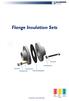 Insulation sets are used to limit corrosion in pipeline systems. Where dissimilar metals are present, the sets remove the possibility of the system acting as a galvanic cell and reduce the risk of galvanic
PTFE Slide Bearings 04/10 149
 04/10 149 1.0 GENERAL INFORMATION In a wide range of applications, PTFE Slide bearings are superior to conventional expansion plates, rollers and rocker arm type supports. They support petrochemical plant,
CONTRACT SPECIFICATIONS - SEISMIC ISOLATION BEARINGS
 CONTRACT SPECIFICATIONS - SEISMIC ISOLATION BEARINGS 1.0 DESIGN 1.1 Scope of Work 1.1.1 This work shall consist of furnishing Isolation Bearings and installing Isolation Bearing Assemblies at the locations
TRENCHLESS TECHNOLOGY GUIDELINES CLOSE FIT THERMOPLASTIC LINING
 TRENCHLESS TECHNOLOGIES RESOURCE CENTRE TRENCHLESS TECHNOLOGY GUIDELINES SECOND EDITION CLOSE FIT THERMOPLASTIC LINING NEW VERSION AUGUST 2005 1. OVERVIEW The use of liners that are deliberately deformed
Technical Data. 7. Bearing Fits. 7.1 Interference. 7.2 Calculation of interference F B LLLLLLLLL( A-54
 Technical Data 7. Bearing Fits 7.1 Interference For rolling s the rings are fixed on the or in the housing so that slip or movement does not occur between the mated surface during operation or under. This
Optimum proportions for the design of suspension bridge
 Journal of Civil Engineering (IEB), 34 (1) (26) 1-14 Optimum proportions for the design of suspension bridge Tanvir Manzur and Alamgir Habib Department of Civil Engineering Bangladesh University of Engineering
HIPPS Application in the Gulf of Mexico. Christopher Lindsey-Curran BP Senior Subsea Engineer
 HIPPS Application in the Gulf of Mexico Christopher Lindsey-Curran BP Senior Subsea Engineer Agenda Introduction and background HIPPS overview Codes and standards System design Regulatory issues Conclusions
Carlon Expansion Fittings for PVC Rigid Nonmetallic Conduit
 Carlon Expansion Fittings for PVC Rigid Nonmetallic Conduit All construction materials expand and contract with fluctuations in temperature. These temperature changes affect polyvinyl chloride (PVC) more
An Introduction to Oil and Gas Well Servicing
 An Introduction to Oil and Gas Well Servicing Educational Material from the IOM 3 Oil and Gas Division The global network for the materials cycle Introduction The Institute of Materials, Minerals & Mining
NEW SIX-SEALS CUTTING RING. INTERNATIONAL INDUSTRIAL PATENT Nr. 864061 of the 10/03/99 FLANKS AND DOES NOT REPLACE THE STANDARD RING CURRENTLY IN USE
 B4 NEW SIX-SEALS CUTTING RING. INTERNATIONAL INDUSTRIAL PATENT Nr. 864061 of the 10/03/99 FLANKS AND DOES NOT REPLACE THE STANDARD RING CURRENTLY IN USE AVAILABLE IN CARBON AND STAINLESS STEEL 23 THEORY
TECHNICAL SPECIFICATION
 THOMAS - G-FLEX GFLEX TECH SPEC CONNECTING INNOVATION JOHANNESBURG TEL: +27 11 794 7594 CAPE TOWN TEL: +27 21 556 5258 POLOKWANE TEL: 015 298 9142 DESIGNER, MANUFACTURER AND DISTRIBUTOR OF PIPE CONNECTION,
Two most common lock nut groups: 1-Prevailing Torque Type Lock Nuts:
 Two most common lock nut groups: 1. PREVAILING TORQUE a design feature of the lock nut produces friction between threads of mated components thereby increasing the force needed to tighten as well as loosen
13. FPSO Operational Problems Don Smith, OGP
 OGP Marine Risks Workshop Proceedings 13. FPSO Operational Problems Don Smith, OGP FPSO Operational Problems Don Smith OGP Analysis of Accident Statistics for Floating Monohull and Fixed Installations
LARGE DIAMETER PIPELINE INNOVATIVE FAST TRACKED REPAIR
 LARGE DIAMETER PIPELINE INNOVATIVE FAST TRACKED REPAIR ABSTRACT Phil Hubbard, P.E., HRSD Paul Wilson, P.E., Brown and Caldwell* Mark Harber, P.E., Brown and Caldwell *301 Bendix Road, Suite 400 Virginia
General Guidelines for Repairing Buried PE Potable Water Pressure Pipes
 515 General Guidelines for Repairing Buried PE Potable Water Pressure Pipes Introduction Traditional piping systems have gasket-sealed bell and spigot joints every 20 feet, which can be a potential maintenance
Geometry and dimensional tolerances of engine bearings
 Geometry and dimensional tolerances of engine bearings Dr. Dmitri Kopeliovich (Research & Development Manager.) 1. Hydrodynamic lubrication Engine bearings operate mostly in the hydrodynamic regime of
ALIGNMENT. Pump and Driver Alignment
 ALIGNMENT Pump and Driver Alignment Alignment Subject: Pump and Driver Alignment In the pump business alignment means that the centerline of the pump is aligned with the centerline of the driver. Although
A World Class Manufacturer of Induction Bends
 A World Class Manufacturer of Induction Bends COFELY FABRICOM BENDING A leading position in bending High Flexibility and Close Tolerances As a world leading manufacturer of pipe bends, produced by induction
1.3.2 Method of construction and restoration of existing water service connections. This shall include:
 1.0 GENERAL 1.1 DESCRIPTION: This specification shall cover the rehabilitation of existing water lines using the GRUNDOCRACK PIPE BURSTING SYSTEM. Pipe bursting is a system by which the pneumatic bursting
Objectives. Experimentally determine the yield strength, tensile strength, and modules of elasticity and ductility of given materials.
 Lab 3 Tension Test Objectives Concepts Background Experimental Procedure Report Requirements Discussion Objectives Experimentally determine the yield strength, tensile strength, and modules of elasticity
Mueller. Pipe Repair Products. Saddles Tapping Sleeves Pipe Repair Clamps A complete selection for all types of pipe... all from a single source.
 Mueller Pipe Repair Products Saddles Tapping Sleeves Pipe Repair Clamps A complete selection for all types of pipe... all from a single source. SERVICE SADDLES Mueller service saddles, available in bronze,
THERMOPLASTIC LINERS FOR REHABILITATION OF OIL FLOWLINE AND WATER INJECTION LINES, INTEGRITY AND SERVICE LIFE
 THERMOPLASTIC LINERS FOR REHABILITATION OF OIL FLOWLINE AND WATER INJECTION LINES, INTEGRITY AND SERVICE LIFE Vincenzo Savino [1] Mauyed S. Mehdi [1] Abdullah K. Al-Dossary [2] [1] Saudi Aramco, Consulting
\ srl High Technology Gear Reducers and Cardan Shafts CERTIFIED QUALITY SYSTEM: UNI ISO EN 9001:2008 ICIM 2779/2; IQNET N. IT-28236 UNIVERSAL SHAFT
 UNIVERSAL SHAFT CAT CERTIFICATION CARDAN SHAFTS - COUPLINGS Alongside with the production of special gearboxes, our company has developed the production of Universal shafts, with the same high quality
TUBE-TO-TUBESHEET JOINTS: THE MANY CHOICES ABSTRACT KEYWORDS. Seal welding, tube-to-tubesheet welds, heat exchanger, mock-up, tube expansion
 B. J. Sanders Consultant 307 Meyer Street Alvin, Texas 77511 TUBE-TO-TUBESHEET JOINTS: THE MANY CHOICES ABSTRACT After a decision has been made to use zirconium as the material of construction for a shell
Detailing of Reinforcment in Concrete Structures
 Chapter 8 Detailing of Reinforcment in Concrete Structures 8.1 Scope Provisions of Sec. 8.1 and 8.2 of Chapter 8 shall apply for detailing of reinforcement in reinforced concrete members, in general. For
Chesapeake Section AWWA Symposium
 PRESTRESSED CONCRETE CYLINDER PIPE (PCCP) Chesapeake Section AWWA Symposium HANSON PRESSURE PIPE Steve Smith January 16,2014 Interpace Projects with Problems INTERPACE 45 MILLION FEET 11,500 PROJECTS Slide
Overhang Bracket Loading. Deck Issues: Design Perspective
 Deck Issues: Design Perspective Overhang Bracket Loading Deck overhangs and screed rails are generally supported on cantilever brackets during the deck pour These brackets produce an overturning couple
Kodiak Deepwater Project Challenges and Solutions
 Kodiak Deepwater Project Challenges and Solutions Marine Technology Society September 24, 2015 Deep Gulf Energy II, LLC Overview of Deep Gulf Energy Companies Deep Gulf Energy Background Exploration and
Technical Notes 3B - Brick Masonry Section Properties May 1993
 Technical Notes 3B - Brick Masonry Section Properties May 1993 Abstract: This Technical Notes is a design aid for the Building Code Requirements for Masonry Structures (ACI 530/ASCE 5/TMS 402-92) and Specifications
Avoiding Burning Through: Control the Inside Surface Temperature, Not the Pressure
 Originally published in the Canadian Welding Association Journal, Spring 2013, pp 30 39 Welding on In service Pipelines: Dispelling Popular Myths and Misconceptions Bill Amend Sr. Principal Engineer, Welding
Heat Exchanger Thin Film Foul Release Applications Corrosion Resistant Protective Coatings Grit Blast Surface Prep of Tubular Equipment
 Heat Exchanger Thin Film Foul Release Applications Corrosion Resistant Protective Coatings Grit Blast Surface Prep of Tubular Equipment Non-Destructive Examination Heat Exchanger Mechanical Repair Services
The BASA Guide to the ISO 11600 Classification of Sealants for Building Construction
 The BASA Guide to the ISO 11600 Classification of Sealants for Building Construction SEALANTS IN BUILDING AND CONSTRUCTION Glazing Sealants (G) Construction Sealants (F) Class 25 Class 25LM Class 25 Class
The University of Birmingham (Live System)
 The University of Birmingham (Live System) Behaviour of Structural Insulated Panels (SIPs) under both short-term and long-term loadings Yang, Jian; Rungthonkit, Prathan Document Version Author final version
Design and Construction of Cantilevered Reinforced Concrete Structures
 Buildings Department Practice Note for Authorized Persons, Registered Structural Engineers and Registered Geotechnical Engineers APP-68 Design and Construction of Cantilevered Reinforced Concrete Structures
Session: HDPE Pipe Test Rafael Ortega, Vice President, Lockwood, Andrews & Newnam
 Session: HDPE Pipe Test Rafael Ortega, Vice President, Lockwood, Andrews & Newnam Education Master of Business Administration University of Houston, 1985 Bachelor of Science, Civil Engineering University
Section 02415. Installation of pipe and casing for sanitary sewer by methods of augering.
 ITY OF PRLN UGRING PIP OR SING FOR SWRS Section 02415 UGRING PIP OR SING FOR SWRS 1.0 G N R L 1.01 STION INLUS Installation of pipe and casing for sanitary sewer by methods of augering. References to Technical
SPECIAL INSPECTION AND TESTING AGREEMENT INTERNATIONAL BUILDING CODE
 Community Development Permit Services SPECIAL INSPECTION AND TESTING AGREEMENT INTERNATIONAL BUILDING CODE PROJECT NAME PROJECT ADDRESS PERMIT NUMBER CITY RECEIVED STAMP AND INITIALS Instructions: BEFORE
KINETICS RISER SUPPORT SYSTEMS
 RISER DESIGN INPUT GUIDE There are many factors that impact the design of a Riser support system. Because many of these factors are not items that the Engineers at KNC can guess at and because they have
Report on. Wind Resistance of Signs supported by. Glass Fiber Reinforced Concrete (GFRC) Pillars
 Report on Wind Resistance of Signs supported by Glass Fiber Reinforced Concrete (GFRC) Pillars Prepared for US Sign and Fabrication Corporation January, 2006 SUMMARY This study found the attachment of
Always. Reliable. Tight. Wall sleeves Versatile solutions for building entries. cablepipebuildingentry+
 Always. Reliable. Tight. Wall sleeves Versatile solutions for building entries. cablepipebuildingentry+ The wall sleeve The wall sleeve a largely unnoticed but very important sealing part. Wall sleeves
Concrete structures for nuclear facilities
 22 May 1992 Concrete structures for nuclear facilities 1 General 3 2 Safety analysis report, classification document and quality assurance programmes 3 3 Design documents for concrete structures 4 3.1
UX-30 PERFORMANCE TESTING SUMMARY REPORT Revision 0
 UX-30 PERFORMANCE TESTING SUMMARY REPORT Revision 0 Prepared By: Patrick L. Paquin, EnergySolutions Date Reviewed By: Mirza I. Baig, EnergySolutions Date Approved By: Thomas F. Dougherty, Columbiana Hi
Analysis and Repair of an Earthquake-Damaged High-rise Building in Santiago, Chile
 Analysis and Repair of an Earthquake-Damaged High-rise Building in Santiago, Chile J. Sherstobitoff Ausenco Sandwell, Vancouver, Canada P. Cajiao AMEC, Vancouver, Canada P. Adebar University of British