
LESSON PHYSICAL PROPERTIES AND DNA
|
|
|
- Britton Powell
- 9 years ago
- Views:
Transcription
1 PAGE 01 PHYSICAL PROPERTIES AND DNA TIP: This activity can be done with student-made green detergent instead of store-purchased detergent ( K12education/ msgc/10%20 Shampoozled. doc). DESCRIPTION: Students extract DNA from living plant tissues in order to measure, observe, and think about various properties of two objects. BACKGROUND INFORMATION: Deoxyribonucleic acid (DNA) is a molecule that encodes the genetic instructions used in the development and functioning of all known living organisms. Every living thing contains DNA. DNA isolation is one of the most basic and essential techniques in the study of DNA. The extraction of DNA from cells and its purification are of primary importance to the field of biotechnology and forensics. Extraction and purification of DNA are the first steps in the analysis and manipulation of DNA that allow scientists to detect genetic disorders, produce DNA fingerprints of individuals, and even create genetically engineered organisms that can produce beneficial products such as insulin, antibiotics, and hormones. DNA can be extracted from many types of cells. The first step is to lyse or break open the cell. This can be done by grinding a piece of tissue in a blender. After the cells have broken open, a salt solution such as NaCl and a detergent solution containing the compound SDS (sodiumdodecyl sulfate) is added. These solutions break down and emulsify the fat and proteins that make up a cell membrane. Finally, ethanol is added because DNA is soluble in water. The alcohol causes DNA to precipitate, or settle out of the solution, leaving behind all the cellular components that aren t soluble in alcohol. The DNA can be spooled (wound) on a stirring rod and pulled from the solution at this point. Strawberries, bacteria, humans all living things have genes, and all of these genes are made of DNA. That s why scientists can take a gene from one living thing and put it into another. For example, they can put human genes into bacteria to make new medicines. The procedure for DNA extraction is really a procedure for nucleic acid extraction, so there will be a mix of DNA and RNA (ribonucleic acid) in the white stringy stuff. However, much of the RNA is cut by ribonucleases (enzymes that cut RNA) that are released when the cells are broken open. Each cell contains 6 feet of DNA, only one-millionth of an inch wide. To fit all this DNA into a cell, it must be packed efficiently with histone proteins. This is what makes DNA clump together. The salt helps precipitate the DNA. (DNA is normally dissolved in water).

2 PAGE 02 OBJECTIVES: Students learn techniques for the extraction of nucleic acids and think about what future experiments could be designed based on what they have learned about measuring several properties of matter. Students are exposed to the difference between correlation and causation. COMMON CORE STANDARDS: CCSS: 10.RST 2: Follow precisely a multistep procedure when carrying out experiments. 10.RST 7: Integrate quantitative or technical information expressed in words in a text with a version of that information expressed visually (e.g. graph, model, table). 10.SL 1: Engage effectively in a range of collaborative discussions with diverse partners NGSCS: LS3.A: DNA = instructions for special characteristics LS3.A: Each cell has the same genetic content, but expressed differently PS1.B: Reactions are collisions of molecules, atom rearrangement, affinity binding PS3.B: Systems move toward stable states NGSCS Cross-Cutting Concepts: 1. Patterns: Empirical evidence is needed to identify patterns 2. Cause and Effect: Empirical evidence is required to differentiate between cause and correlation and make claims about specific causes and effects 3. Scale, Proportion, and Quantity: The significance of a phenomenon is dependent on the scale, proportion, and quantity at which it occurs. TIME: 55 MINUTES: THINK-PAIR-SHARE (5 MINUTES); STATION A (20 MINUTES); STA- TION B (20 MINUTES); DISCUSSION (10 MINUTES). MATERIALS: Access to sink and water STATION A: Observation, Conductivity, Density, Environmental Impact 4 energy balls to share among the class (can be purchased Mass weighing scales Graduated cylinder (at least 100 ml and can fit a strawberry inside it) (1 per group) Rolls of paper towels (1 per group) Rulers (1 per group) Strawberries (2 per group) Data Table 1 (one per student) Data Table 2 (one per student)

3 PAGE 03 STATION B: DNA Extraction Strawberries Zip-lock bags Funnels Coffee filters 270mL (at least) of detergent Salt Meat tenderizer original unseasoned OR pineapple juice (to cut histone proteins) Test tubes Test tube racks 1 L of rubbing alcohol (70-95% isopropyl) in an icebath or refrigerator Glass beakers (at least 150 ml) Wooden stirring rods PREP: Need to have a garden that will provide at least 2 strawberries per group. Ripeness may affect the experiment- the riper the better. If strawberries are not an option, consider using green peas, spinach, kiwi, or broccoli. Chill 1 L of rubbing alcohol in the fridge or in an ice bath. ACTIVITY: 1. Start with a Think-Pair-Share activity: Ask students to individually think about the following question: How many different metrics can you think of to measure something? (one minute). Possible answers: Mass, weight, how much light goes through, light absorption, sweetness, volume, surface area, boiling point the possibilities are endless here. Have students form groups of four to discuss (two minutes). Discuss as a class (two minutes). 2. Introduce students to the activity and start Station A. There will be one Station A per group. 3. Once students are done with Station A, have students read and follow the procedure for Station B (the Station B s should be set up already)

4 PAGE 04 DISCUSSION: 1. Discuss the cell compartments, organelles, histone proteins, nuclear envelope, cell wall, then talk about how can we get the DNA. What steps may have broken open certain parts? 2. If we see in an experiment that there is more DNA when size of the fruit increases, is this correlation or causation? 3. Do you think the number of seeds in any fruit correlates with the amount of DNA? 4. Does the amount of DNA organisms contain correlate to its complexity? 5. What do scientists do with DNA after they have isolated it? TEACHER TIPS: If you want to save the DNA, you can transfer it to a small container filled with alcohol. You can discuss simple DNA organisms that are used frequently for experiments like C. Elegans (we know its whole genome and entire fate map) If any students are done early, ask them to calculate the number of miles of DNA in a human body give them the following: the human body contains about 100 trillion cells, each of which contains six feet of DNA. (Answer: over a billion miles of DNA- farther than the distance from the earth to the sun). Why use detergent and meat tenderizer? See links below: Other types of foods that you can use besides strawberries are spinach, broccoli, green peas. (If you want to use these hardier food sources, replace the mashing in a ziplock baggie step with a blender using ½ cup [100mL] of food and 1 cup of cold water blended on high for 15 seconds.) REFERENCES: Borquez, Christopher. How to Extract DNA from Anything Living. Multimedia Educational Resource for Learning and Online Teaching, California State University. 30 Jun Web. 21 Oct < Do-It-Yourself Strawberry DNA. The Tech Museum of Innovation, Department of Genetics, Stanford University School of Medicine Web. 21 Oct < org/online-exhibits/do-it-yourself-strawberry-dna>. Massengale, Cheryl. Extract DNA from Anything Living. Biology Junction Web. 21 Oct < Packed Up Properties. Beyond Benign: Green Chemistry Education Web. 21 Oct <

5 PAGE 05 STATION WORKSHEETS/INSTRUCTIONS STATION A Exploring Physical Properties: Observation, Conductivity, Density, Environmental Impact 1. Observations: Color: Describe the natural color of the material Odor: Sniff the item (without touching it to your nose). Describe any smell the material has State of Matter: Is the material a liquid, a solid, or a gas? Mark your findings on Data Table Conductivity: the ability of a substance to allow the flow of energy or electricity Pick up the energy ball. Touch a finger to one metal tab. Pick up the strawberry and hold it to the other tab on the energy ball. If the light flashes and the ball makes a sound, the object carries an electrical current. If the ball doesn t light up or make sound, the object does not carry a current. Repeat the process with the paper towel roll to determine if it is conductive or not. Mark your findings on Data Table Environmental Impacts Read the information in the chart below. In your Data Table 1, give each material a ratio of to + or mark them with separate colors to indicated positive or negative qualities. MATERIAL AIR QUALITY WATER QUALITY LAND QUALITY BIODIVERSITY STRAWBERRY PAPER + Strawberry plant produces oxygen + no chemical pollutants to create them Typically shipped from thousands of miles away Chlorine released 4th largest emissions of greenhouse gas + Strawberries can be sustainably watered Requires lots of water to make it Sometimes releases water with chlorine in it + 100% Compostable + Degrades quickly + Renewable resource + Replant trees + Renewable resource + 45% recycled back into paper + Forests can be sustainably managed + Does not bioaccumulate in plants & animals + Attracts insects to the garden Could become infected by a plant pathogen like a fungus that can spread Removal of trees lessens animal habitat + Forests can be sustainably managed

6 PAGE 06 DATA TABLE 1 STRAWBERRY PAPER TOWEL ROLL CONDUCTIVITY (YES/NO) COLOR ODOR STATE OF MATTER IMPACT ON ENVIRONMENT DENSITY Strawberry 1. Using the balance, find the mass. Note the mass in Data Table Pour 40 ml of water in the graduated cylinder. 3. Carefully drop the strawberry piece into the cylinder of water. 4. Determine the amount the water level increased. For example, if the water is at 50 ml, it increased 10 ml. This is your volume. Note the volume in Data Table D=M/V (density = mass divided by volume). Calculate and note in Data Table Pour the water out of the graduated cylinder into the sink. 7. Dry off the materials. Paper Towel Roll 1. Use the balance to find the mass of the paper towel roll. Record in Data Table Use a ruler to calculate the volume of the paper towel roll (πr2h). 3. Calculate the density using the formula. STRAWBERRY PAPER TOWEL ROLL MASS VOLUME DENSITY

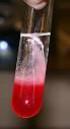
7 PAGE 07 STATION B Make a Prediction! Make a prediction! (e.g. If we used commercial detergent instead of our handmade green detergent, more DNA would have shown up). Get approval from your teacher after writing a prediction. Do you think any of your observations from Station A may influence how much DNA there is? 1. Put at least two strawberries in a plastic bag and push out all the extra air. Seal it tightly. 2. With your fingers, squeeze and smash the strawberry mixture for 2 minutes. 3. Pour the strawberry mixture from the bag into the funnel through the coffee filter. Let it drip into the test tube until there is no liquid left in the funnel. This separates the cells from each other, so you now have a really thin strawberry-cell soup. 4. Estimate how much strawberry soup you have and add about 1/6 of that amount of liquid detergent (about 30ml or 2 tablespoons). Swirl to mix. 5. Let the mixture sit for 5-10 minutes. 6. Add a pinch of enzymes (meat tenderizer/pineapple juice) to each test tube and stir gently. Be careful! If you stir too hard, you ll break up the DNA, making it harder to see. 7. Get the rubbing alcohol from the ice bath or refrigerator and pour 100mL into an easypouring beaker. 8. Tilt the test tube and very slowly pour the cold rubbing alcohol down the side. The alcohol should form a layer on top of the strawberry liquid. Pour until you have about the same amount of alcohol in the tube as strawberry mixture. (Don t let the alcohol and strawberry liquid mix. The DNA collects between the two layers!) 9. Alcohol is less dense than water, so it floats on top forming two separate layers. 10. All of the grease and the protein that we broke up in the first two steps move to the bottom, watery layer. 11. DNA will rise into the alcohol layer from the bottom layer. 12. Dip the stirring rod into the test tube where the alcohol and strawberry layers meet. Slowly turning the stirring rod will spool (wrap) the DNA around the rod so it can be removed from the liquid. Pull up the rod. The whitish, stringy stuff is DNA containing strawberry genes! (If you don t see DNA after the DNA extraction, you may have a solution that is too watery. If your soup after filtration is see-through, make sure to remove some water so that the cell soup is opaque.)

DNA SPOOLING 1 ISOLATION OF DNA FROM ONION
 DNA SPOOLING 1 ISOLATION OF DNA FROM ONION INTRODUCTION This laboratory protocol will demonstrate several basic steps required for isolation of chromosomal DNA from cells. To extract the chromosomal DNA,
Module 3: Strawberry DNA Extraction
 Module 3: Strawberry DNA Extraction Teacher/Leader Target Audience: 7-12 Life Science, Biology, Ag Science Overview: In this lab, students will extract DNA from a strawberry using everyday materials and
Today you will extract DNA from some of your cells and learn more about DNA. Extracting DNA from Your Cells
 DNA Based on and adapted from the Genetic Science Learning Center s How to Extract DNA from Any Living Thing (http://learn.genetics.utah.edu/units/activities/extraction/) and BioRad s Genes in a bottle
Catalytic Activity of Enzymes
 Catalytic Activity of Enzymes Introduction Enzymes are biological molecules that catalyze (speed up) chemical reactions. You could call enzymes the Builders and Do-ers in the cell; without them, life could
Hands-On Labs SM-1 Lab Manual
 EXPERIMENT 4: Separation of a Mixture of Solids Read the entire experiment and organize time, materials, and work space before beginning. Remember to review the safety sections and wear goggles when appropriate.
Chapter 3 Student Reading
 Chapter 3 Student Reading If you hold a solid piece of lead or iron in your hand, it feels heavy for its size. If you hold the same size piece of balsa wood or plastic, it feels light for its size. The
EXTRACTION OF DNA FROM CALF THYMUS CELLS Revised 2/1/96 Introduction
 Revised 2/1/96 Introduction Cells may be classified into two primary types depending on whether they have a discrete nucleus (eukaryotic) or do not (prokaryotic). Prokaryotes include bacteria, such as
Strawberry-DNA Extraction. Workshop 86 Bio. Get the number of Strawberry-DNA Extraction kits needed for class, the teacher
 Strawberry-DNA Extraction Workshop 86 Bio Preparation Before Class Get the number of Strawberry-DNA Extraction kits needed for class, the teacher demo box, and the teacher-prep box. Set up the teacher
SNEAK PEAK inside ACTIVITY
 DNA Extraction Learning Objectives: Students learn about DNA, cell structure, and basic chemical separations. GRADE LEVEL 4 8 SCIENCE TOPICS Solutions and Mixtures Techniques Organic and Biochemistry PROCESS
Test Bank - Chapter 3 Multiple Choice
 Test Bank - Chapter 3 The questions in the test bank cover the concepts from the lessons in Chapter 3. Select questions from any of the categories that match the content you covered with students. The
Chapter 5, Lesson 3 Why Does Water Dissolve Salt?
 Chapter 5, Lesson 3 Why Does Water Dissolve Salt? Key Concepts The polarity of water molecules enables water to dissolve many ionically bonded substances. Salt (sodium chloride) is made from positive sodium
Lab # 12: DNA and RNA
 115 116 Concepts to be explored: Structure of DNA Nucleotides Amino Acids Proteins Genetic Code Mutation RNA Transcription to RNA Translation to a Protein Figure 12. 1: DNA double helix Introduction Long
Recovery of Elemental Copper from Copper (II) Nitrate
 Recovery of Elemental Copper from Copper (II) Nitrate Objectives: Challenge: Students should be able to - recognize evidence(s) of a chemical change - convert word equations into formula equations - perform
Mixtures and Pure Substances
 Unit 2 Mixtures and Pure Substances Matter can be classified into two groups: mixtures and pure substances. Mixtures are the most common form of matter and consist of mixtures of pure substances. They
Freezing Point Depression: Why Don t Oceans Freeze? Teacher Advanced Version
 Freezing Point Depression: Why Don t Oceans Freeze? Teacher Advanced Version Freezing point depression describes the process where the temperature at which a liquid freezes is lowered by adding another
Experiment 8 Synthesis of Aspirin
 Experiment 8 Synthesis of Aspirin Aspirin is an effective analgesic (pain reliever), antipyretic (fever reducer) and anti-inflammatory agent and is one of the most widely used non-prescription drugs. The
The Digestive System: Where does food go? Teacher Version
 The Digestive System: Where does food go? Teacher Version In this lab you will learn about your digestive system. We will use everyday objects like yarn and a ziplock bag to understand how long our digestive
SEPARATION OF A MIXTURE OF SUBSTANCES LAB
 SEPARATION OF A MIXTURE OF SUBSTANCES LAB Purpose: Every chemical has a set of defined physical properties, and when combined they present a unique fingerprint for that chemical. When chemicals are present
Solubility Curve of Sugar in Water
 Solubility Curve of Sugar in Water INTRODUCTION Solutions are homogeneous mixtures of solvents (the larger volume of the mixture) and solutes (the smaller volume of the mixture). For example, a hot chocolate
PHYSICAL SEPARATION TECHNIQUES. Introduction
 PHYSICAL SEPARATION TECHNIQUES Lab #2 Introduction When two or more substances, that do not react chemically, are blended together, the result is a mixture in which each component retains its individual
The Structure of Water Introductory Lesson
 Dana V. Middlemiss Fall 2002 The Structure of Water Introductory Lesson Abstract: This is an introduction to the chemical nature of water and its interactions. In particular, this lesson will explore evaporation,
Experiment 12- Classification of Matter Experiment
 Experiment 12- Classification of Matter Experiment Matter can be classified into two groups: mixtures and pure substances. Mixtures are the most common form of matter and consist of mixtures of pure substances.
Determination of Specific Nutrients in Various Foods. Abstract. Humans need to consume food compounds such as carbohydrates, proteins, fats,
 Determination of Specific Nutrients in Various Foods Abstract Humans need to consume food compounds such as carbohydrates, proteins, fats, and vitamins to meet their energy requirements. In this lab, reagents
Catalase. ***You will be working with hot water, acids and bases in this laboratory*** ****Use Extreme Caution!!!****
 AP BIOLOGY BIOCHEMISTRY ACTIVITY #9 NAME DATE HOUR CATALASE LAB INTRODUCTION Hydrogen peroxide (H 2 O 2 ) is a poisonous byproduct of metabolism that can damage cells if it is not removed. Catalase is
Organic Chemistry Lab Experiment 4 Preparation and Properties of Soap
 Organic Chemistry Lab Experiment 4 Preparation and Properties of Soap Introduction A soap is the sodium or potassium salt of a long-chain fatty acid. The fatty acid usually contains 12 to 18 carbon atoms.
Physical and Chemical Properties and Changes
 Physical and Chemical Properties and Changes An understanding of material things requires an understanding of the physical and chemical characteristics of matter. A few planned experiments can help you
The Properties of Water (Instruction Sheet)
 The Properties of Water (Instruction Sheet) Property : High Polarity Activity #1 Surface Tension: PILE IT ON. Materials: 1 DRY penny, 1 eye dropper, water. 1. Make sure the penny is dry. 2. Begin by estimating
Enzyme Pre-Lab. Using the Enzyme worksheet and Enzyme lab handout answer the Pre-Lab questions the pre-lab must be complete before beginning the lab.
 Enzyme Pre-Lab Using the Enzyme worksheet and Enzyme lab handout answer the Pre-Lab questions the pre-lab must be complete before beginning the lab. Background: In this investigation, you will study several
The most common active ingredient used in deodorants is aluminium chlorohydrate. But not all deodorants contain aluminium chlorohydrate:
 Engineeringfragrance make a deodorant practical activity 2 student instructions page 1 of 5 chemical compounds The most common active ingredient used in deodorants is aluminium chlorohydrate. But not all
Separation by Solvent Extraction
 Experiment 3 Separation by Solvent Extraction Objectives To separate a mixture consisting of a carboxylic acid and a neutral compound by using solvent extraction techniques. Introduction Frequently, organic
Genomic DNA Purification Student Laboratory Manual
 Genomic DNA Purification Student Laboratory Manual I. Purpose...1 II. Introduction...1 III. DNA Purification from Bananas...2 IV. DNA Purification from Tissue Culture Cells...4 I. Purpose! This student
CHEM 2423 Recrystallization of Benzoic Acid EXPERIMENT 4 - Purification - Recrystallization of Benzoic acid
 EXPERIMENT 4 - Purification - Recrystallization of Benzoic acid Purpose: a) To purify samples of organic compounds that are solids at room temperature b) To dissociate the impure sample in the minimum
Biology for Science Majors
 Biology for Science Majors Lab 10 AP BIOLOGY Concepts covered Respirometers Metabolism Glycolysis Respiration Anaerobic vs. aerobic respiration Fermentation Lab 5: Cellular Respiration ATP is the energy
Unit 1 - Pure Substances and Mixtures Chapter 2: Solutions
 2.1 Solutes & Solvents Vocabulary: Unit 1 - Pure Substances and Mixtures Chapter 2: Solutions solvent the larger part of a solution - the part of a solution into which the solutes dissolve solute the smaller
How To Understand The Human Body
 Introduction to Biology and Chemistry Outline I. Introduction to biology A. Definition of biology - Biology is the study of life. B. Characteristics of Life 1. Form and size are characteristic. e.g. A
Separation of Amino Acids by Paper Chromatography
 Separation of Amino Acids by Paper Chromatography Chromatography is a common technique for separating chemical substances. The prefix chroma, which suggests color, comes from the fact that some of the
Chapter 2. The Chemistry of Life Worksheets
 Chapter 2 The Chemistry of Life Worksheets (Opening image courtesy of David Iberri, http://en.wikipedia.org/wiki/file:camkii.png, and under the Creative Commons license CC-BY-SA 3.0.) Lesson 2.1: Matter
Making Biodiesel from Virgin Vegetable Oil: Teacher Manual
 Making Biodiesel from Virgin Vegetable Oil: Teacher Manual Learning Goals: Students will understand how to produce biodiesel from virgin vegetable oil. Students will understand the effect of an exothermic
Chemistry 112 Laboratory Experiment 6: The Reaction of Aluminum and Zinc with Hydrochloric Acid
 Chemistry 112 Laboratory Experiment 6: The Reaction of Aluminum and Zinc with Hydrochloric Acid Introduction Many metals react with acids to form hydrogen gas. In this experiment, you will use the reactions
Physical and Chemical Changes
 Physical and Chemical Changes Jana Barrow West Point Jr. High 2775 W 550 N 801-402-8100 West Point, UT 84015 [email protected] Eighth Grade Integrated Science Standard I: Students will understand the
Amino Acids, Peptides, and Proteins
 1 Amino Acids, Peptides, and Proteins Introduction Amino Acids Amino acids are the building blocks of proteins. In class you learned the structures of the 20 common amino acids that make up proteins. All
The Huntington Library, Art Collections, and Botanical Gardens. How Sweet It Is: Enzyme Action in Seed Germination
 The Huntington Library, Art Collections, and Botanical Gardens How Sweet It Is: Enzyme Action in Seed Germination Overview This experiment is intended to familiarize students with the macromolecule starch,
Determination of a Chemical Formula
 1 Determination of a Chemical Formula Introduction Molar Ratios Elements combine in fixed ratios to form compounds. For example, consider the compound TiCl 4 (titanium chloride). Each molecule of TiCl
Fig. 1. Background. Name: Class: Date:
 Background Bubbles make a great stand in for cell membranes. They re fluid, flexible, and can self-repair. Bubbles and cell membranes are alike because their parts are so similar. If you could zoom down
Acids and Bases. AND a widemouth container of the following solids:
 Acids and Bases GOAL To introduce students to acids and bases. MATERIALS: 3 10oz clear plastic cups 1 4 oz. bottle white vinegar - labeled Acid 1 4 oz. bottle of water - labeled Water 1 4 oz. bottle of
Biopharmaceuticals and Biotechnology Unit 2 Student Handout. DNA Biotechnology and Enzymes
 DNA Biotechnology and Enzymes 35 Background Unit 2~ Lesson 1 The Biotechnology Industry Biotechnology is a process (or a technology) that is used to create products like medicines by using micro-organisms,
IDENTIFICATION OF POLYMERS 1998 by David A. Katz. All rights reserved
 IDENTIFICATION OF POLYMERS 1998 by David A. Katz. All rights reserved David A. Katz Chemist, Educator, Science Communicator, and Consultant 133 N. Desert Stream Dr., Tucson, AZ 85745 Voice/Fax: 520-624-2207
Oxygen Give and Take. Correlation to National Science Education Standards
 Chemistry and Environmental Sciences Oxygen Give and Take Summary This is a series of three activities followed by a worksheet. The concepts taught include gas production (O 2 and CO 2 ), chemical reactions,
SUPPLEMENTARY MATERIAL
 SUPPLEMENTARY MATERIAL (Student Instructions) Determination of the Formula of a Hydrate A Greener Approach Objectives To experimentally determine the formula of a hydrate salt. To learn to think in terms
Buoyant Force and Archimedes Principle
 Buoyant Force and Archimedes Principle Predict the behavior of fluids as a result of properties including viscosity and density Demonstrate why objects sink or float Apply Archimedes Principle by measuring
ATOMS AND BONDS. Bonds
 ATOMS AND BONDS Atoms of elements are the simplest units of organization in the natural world. Atoms consist of protons (positive charge), neutrons (neutral charge) and electrons (negative charge). The
Agarose Gel Electrophoresis with Food Color- Teacher Guide
 Page 1 of 7 Project Home Gateway to the Project Laboratory Activities What the Project can do in the classroom Biotechnology Resources Favorite resources online and in print Agarose Gel Electrophoresis
Ink Analysis 2005, 2004, 2002, 1993 by David A. Katz. All rights reserved.
 Ink Analysis 2005, 2004, 2002, 1993 by David A. Katz. All rights reserved. Ink from most ball-point pens and markers can be developed by paper chromatography using 70% isopropyl rubbing alcohol as the
Polarity and Properties Lab PURPOSE: To investigate polar and non-polar molecules and the affect of polarity on molecular properties.
 Name!!!! date Polarity and Properties Lab PURPOSE: To investigate polar and non-polar molecules and the affect of polarity on molecular properties. STATION 1: Oil and water do not mix. We all know that.
Chapter 1 Student Reading
 Chapter 1 Student Reading Chemistry is the study of matter You could say that chemistry is the science that studies all the stuff in the entire world. A more scientific term for stuff is matter. So chemistry
Experiment 8 Preparation of Cyclohexanone by Hypochlorite Oxidation
 Experiment 8 Preparation of Cyclohexanone by ypochlorite xidation In this experiment we will prepare cyclohexanone from cyclohexanol using hypochlorite oxidation. We will use common household bleach that
Metabolism: Cellular Respiration, Fermentation and Photosynthesis
 Metabolism: Cellular Respiration, Fermentation and Photosynthesis Introduction: All organisms require a supply of energy and matter to build themselves and to continue to function. To get that supply of
Meischer s Discovery A DNA Extraction Laboratory
 Meischer s Discovery A DNA Extraction Laboratory Maryland Loaner Lab Teacher Packet Written and developed by Towson University & TIGR. www.towson.edu/cse/beop/ Version 01-04-2012_dp T E A C H E R M A T
Solids, Liquids, and Gases
 Solids, Liquids, and Gases nd Intended for Grade: 2 Grade Subject: Science Description: Activities to help students understand solids, liquids, gases, and the changes between these states. Objective: The
Isolation of Caffeine from Tea
 Isolation of Caffeine from Tea Introduction A number of interesting, biologically active compounds have been isolated from plants. Isolating some of these natural products, as they are called, can require
OBJECTIVES: Visitors learn what an antioxidant is and how it behaves. They also learn how to test for the presence of vitamin C..
 Vitamin C Visitors use iodine to compare the reactivity of two starch solutions one with vitamin C added, one without vitamin C. OBJECTIVES: Visitors learn what an antioxidant is and how it behaves. They
Paper Chromatography: Separation and Identification of Five Metal Cations
 Paper Chromatography: Separation and Identification of Five Metal Cations Objectives Known and unknown solutions of the metal ions Ag +, Fe 3+, Co 2+, Cu 2+ and Hg 2+ will be analyzed using paper chromatography.
Osmosis. Evaluation copy
 Osmosis Computer 5 In order to survive, all organisms need to move molecules in and out of their cells. Molecules such as gases (e.g., O 2, CO 2 ), water, food, and wastes pass across the cell membrane.
Name. Lab 3: ENZYMES. In this lab, you ll investigate some of the properties of enzymes.
 Name Lab 3: ENZYMES In this lab, you ll investigate some of the properties of enzymes. So what are enzymes? Enzymes are large protein molecules (macromolecules) They catalyze or speed up chemical reactions
Acids and Bases: Cabbage Juice ph Indicator
 Acids and Bases: Cabbage Juice ph Indicator Student Advanced Version Acids and bases are found in a variety of everyday items, including food and drink, medicine, and cleaning products. In this lab, we
PREPARATION AND PROPERTIES OF A SOAP
 (adapted from Blackburn et al., Laboratory Manual to Accompany World of Chemistry, 2 nd ed., (1996) Saunders College Publishing: Fort Worth) Purpose: To prepare a sample of soap and to examine its properties.
ANSWER KEY. Acids, Bases, and Solutions. Chapter Project Worksheet 1 1. Answers will vary. Sample: cherries, blueberries,
 Chapter Project Worksheet 1 1. Answers will vary. Sample: cherries, blueberries, and grass 2. Answers will vary. Sample: Cut 5 g of cherries into small pieces and place in blender. Blend for two minutes,
[email protected] 1. Enzyme Function
 [email protected] 1 Enzyme Function National Science Standards Science as Inquiry: Content Standard A: As a result of activities in grades 9-12, all students should develop: Abilities
Enzyme Action: Testing Catalase Activity
 Enzyme Action: Testing Catalase Activity Experiment 6A Many organisms can decompose hydrogen peroxide (H 2 O 2 ) enzymatically. Enzymes are globular proteins, responsible for most of the chemical activities
Strawberry DNA Extraction
 21-1338 Strawberry DNA Extraction TEACHER S MANUAL Strawberry DNA Extraction Teacher s Manual Overview..................................................................... 3 Objectives....................................................................
10-ml Graduated cylinder 40 ml 3% Hydrogen peroxide solution (found in stores) Straight-edged razor blade Scissors and Forceps (tweezers)
 Name: Class: Date: Objectives * Measure the effects of changes in temperature, ph, and enzyme concentration on reaction rates of an enzyme catalyzed reaction in a controlled experiment. * Explain how environmental
Vitamin C Content of Fruit Juice
 1 Vitamin C Content of Fruit Juice Introduction Vitamin C Vitamins are organic compounds that have important biological functions. For instance, in humans they enable a variety of enzymes in the body to
Experiment #10: Liquids, Liquid Mixtures and Solutions
 Experiment #10: Liquids, Liquid Mixtures and Solutions Objectives: This experiment is a broad survey of the physical properties of liquids. We will investigate solvent/solute mixtures. We will study and
EXPERIMENT 2 EGG OBSERVATIONS. Contents: Pages 1-4: Teachers Guide Page 5: Student Worksheet. An Osmosis Eggsperiment ACKNOWLEDGEMENTS
 EXPERIMENT 2 EGG OBSERVATIONS An Osmosis Eggsperiment Contents: Pages 1-4: Teachers Guide Page 5: Student Worksheet ACKNOWLEDGEMENTS The creation of this experiment and its support materials would not
In this experiment, we will use three properties to identify a liquid substance: solubility, density and boiling point..
 Identification of a Substance by Physical Properties 2009 by David A. Katz. All rights reserved. Permission for academic use provided the original copyright is included Every substance has a unique set
Multiple Choice For questions 1-10, circle only one answer.
 Test Bank - Chapter 1 The questions in the test bank cover the concepts from the lessons in Chapter 1. Select questions from any of the categories that match the content you covered with students. The
1. The diagram below represents a biological process
 1. The diagram below represents a biological process 5. The chart below indicates the elements contained in four different molecules and the number of atoms of each element in those molecules. Which set
Bacterial Transformation with Green Fluorescent Protein. Table of Contents Fall 2012
 Bacterial Transformation with Green Fluorescent Protein pglo Version Table of Contents Bacterial Transformation Introduction..1 Laboratory Exercise...3 Important Laboratory Practices 3 Protocol...... 4
Class Copy! Class Copy! The process of photosynthesis can be expressed by the following word equation and chemical equation.
 Floating Leaf Disk Photosynthesis Lab Introduction: Photosynthesis is a process that converts carbon dioxide into sugars such as glucose using energy from the sun. When light is absorbed by pigments in
Partner: Jack 17 November 2011. Determination of the Molar Mass of Volatile Liquids
 Partner: Jack 17 November 2011 Determination of the Molar Mass of Volatile Liquids Purpose: The purpose of this experiment is to determine the molar mass of three volatile liquids. The liquid is vaporized
Using Spectrophotometers to Examine Photosynthetic Rates Under Various Qualities of Light
 Purdue GK-12 Lesson Plan 2006-07 Using Spectrophotometers to Examine Photosynthetic Rates Under Various Qualities of Light Purdue University GK-12 2006-2007 Lead developer and contact: Amanda Deering Purdue
Table 1. Common esters used for flavors and fragrances
 ESTERS An Introduction to rganic hemistry Reactions 2012, 2006, 1990, 1982 by David A. Katz. All rights reserved. Reproduction permitted for educationa use provided original copyright is included. In contrast
Taking Apart the Pieces
 Lab 4 Taking Apart the Pieces How does starting your morning out right relate to relief from a headache? I t is a lazy Saturday morning and you ve just awakened to your favorite cereal Morning Trails and
What is Energy? 1 45 minutes Energy and You: Energy Picnic Science, Physical Education Engage
 Unit Grades K-3 Awareness Teacher Overview What is energy? Energy makes change; it does things for us. It moves cars along the road and boats over the water. It bakes a cake in the oven and keeps ice frozen
First Grade Unit A: PHYSICAL SCIENCE Chapter 1: Observing Solids, Liquids and Gases Lessons 1 to 5
 First Grade Unit A: PHYSICAL SCIENCE Chapter 1: Observing Solids, Liquids and Gases Lessons 1 to 5 Physical Science Overview Materials (matter) come in different forms. Water can be rain falling (liquid)
Activity Sheets Enzymes and Their Functions
 Name: Date: Activity Sheets Enzymes and Their Functions amylase What are Enzymes? starch glucose Enzymes are compounds that assist chemical reactions by increasing the rate at which they occur. For example,
Oxidation States of Copper Two forms of copper oxide are found in nature, copper(i) oxide and copper(ii) oxide.
 The Empirical Formula of a Copper Oxide Reading assignment: Chang, Chemistry 10 th edition, pp. 55-58. Goals The reaction of hydrogen gas with a copper oxide compound will be studied quantitatively. By
BotanoTech: A Comparative Plant Genomics Module
 BotanoTech: A Comparative Plant Genomics Module Students imagine themselves as employees of a (fictitious) San Diego Biotech Company Botanotech. The company develops anti-cancer medications and has identified
Energetic Reactions: Ice Cream Experiment Teacher Guide
 Module Overview Heat transfer is an important part of many chemical reactions, but it is often not directly observed. In this module students conduct an experiment making homemade ice cream that requires
Chapter 3, Lesson 4: Density: Sink and Float for Solids
 Chapter 3, Lesson 4: Density: Sink and Float for Solids Key Concepts The density of an object determines whether it will float or sink in another substance. An object will float if it is less dense than
PREPARATION FOR CHEMISTRY LAB: COMBUSTION
 1 Name: Lab Instructor: PREPARATION FOR CHEMISTRY LAB: COMBUSTION 1. What is a hydrocarbon? 2. What products form in the complete combustion of a hydrocarbon? 3. Combustion is an exothermic reaction. What
The Empirical Formula of a Compound
 The Empirical Formula of a Compound Lab #5 Introduction A look at the mass relationships in chemistry reveals little order or sense. The ratio of the masses of the elements in a compound, while constant,
Chapter 3: Separating Mixtures (pg. 54 81)
 Chapter 3: Separating Mixtures (pg. 54 81) 3.2: Separating Mechanical Mixtures (PB Pg. 40 5 & TB Pg. 58 61): Name: Date: Check Your Understanding & Learning (PB pg. 40 & TB pg. 61): 1. What are four methods
SOLUBILITY OF A SALT IN WATER AT VARIOUS TEMPERATURES LAB
 SOLUBILITY OF A SALT IN WATER AT VARIOUS TEMPERATURES LAB Purpose: Most ionic compounds are considered by chemists to be salts and many of these are water soluble. In this lab, you will determine the solubility,
Bubbling Tablets. Objective: Investigate the effects of surface area on reaction rates.
 Bubbling Tablets Objective: Investigate the effects of surface area on reaction rates. Key concepts Increasing the surface area of a reactant results in a faster reaction. Things on the nanoscale have
Catalase Enzyme Lab. Background information
 Catalase Enzyme Lab Background information Liver and other living tissues contain the enzyme catalase. This enzyme breaks down hydrogen peroxide, which is a harmful by-product of the process of cellular
Table of Content. Enzymes and Their Functions Teacher Version 1
 Enzymes and Their Functions Jeisa Pelet, Cornell University Carolyn Wilczynski, Binghamton High School Cornell Learning Initiative in Medicine and Bioengineering (CLIMB) Table of Content Title Page Abstract..
Virginia Gardener http://www.hort.vt.edu/envirohort
 The Virginia Gardener http://www.hort.vt.edu/envirohort Name Help Sheets: Seeds What Is a Seed? A seed is a very young plant that is in the dormant, or resting stage. It is very much alive. There are three