
Address for Correspondence
|
|
|
- Silvester Washington
- 10 years ago
- Views:
Transcription
1 International Journal of Advanced Engineering Technology E-ISSN Research Paper DEVELOPMENT OF LOW COST SHAKE TABLES AND INSTRUMENTATION SETUP FOR EARTHQUAKE ENGINEERING LABORATORY C. S. Sanghvi 1, H S Patil 2 and B J Shah 3 Address for Correspondence 1 Applied Mechanics Department, L.D. College of Engineering, Ahmedabad, Gujarat, India 2 Department of Applied Mechanics, S V National Institute of Technology, Surat, Gujarat, India 3 Applied Mechanics Department, L.D. College of Engineering, Ahmedabad, Gujarat, India ABSTRACT For the development in the field of earthquake engineering, experimental study is required. To study the effects of earthquake, laboratory facilities are needed. The development has reached to a stage where earthquake simulation is achieved in laboratory. Shake table is used to provide earthquake simulation and to test the prototype and scaled model of the structure. In order to reproduce actual earthquake data, a six-degree of freedom electro-hydraulic shaking table is essential. They are very expensive and require high maintenance and operational costs. There exists a need to develop suitable teaching and learning aids to augment the classroom teaching. One of the most effective ways to achieve this is to develop simple experimental setup with suitable shake table. Development of shake table for the Earthquake Engineering laboratory to test models is a challenge. Single translation (horizontal) degree of freedom shaking tables is useful for laboratory testing to study behavior of structures. From this perspective, low cost uni-axial shaking tables were designed & fabricated at L.D College of Engineering. These low cost shake tables will be used to study behavior of structure through models under harmonic as well as random excitation. The cost of shake table is very high and it is difficult for the institutes to acquire such facilities. Based on this fact, an effort has been made to fabricate two low cost shake tables with required specifications to test models in Earthquake Engineering Laboratory along with a LVDT based instrumentation setup. The instrumentation setup comprises of LVDT and Data Acquisition System. Response of models studied through shake table testing. Shake table with servo motor control & shake table with 1.0 HP motor is costing around Rs 3, 50,000/- & 80,000/- respectively. The cost of instrumentation for such set up is only Rs 20,000/-. This effort will fulfill the basic need of the Earthquake Engineering laboratory in form of low cost shake table & required instrumentation, to study behavior of structure through models by shake table testing. KEYWORDS: Earthquake Engineering laboratory, shake tables, experimental study, simulation, Single degree of freedom, Accelerometer, Data acquisition, Uni-axial Shake table 1. INTRODUCTION The development in the field of earthquake engineering requires experimental study. Laboratory testing of components and structures as physical models is an effective way to study the complex phenomena. Correlation of results from laboratory experimentation and analytical modeling will increase the confidence of the researcher. A Shake table can be used to test the model of the structure which may be scaled or prototype to seismic shaking. 2. REQUIREMENT OF UNI-AXIAL SHAKE TABLE In order to reproduce actual earthquake data, a sixdegree of freedom shaking table is essential. Shake table is a very complex electro-hydraulic system, which is very expensive and requires high maintenance and operational costs. As per Clause: IS [3], the random earthquake ground motions, which cause the structure to vibrate, can be resolved in any three mutually perpendicular directions, i.e. two horizontal and one vertical direction. The predominant direction of shaking is usually horizontal. The vertical direction is ½ to 2/3 rd of the horizontal vibration. The self weight of structure, i.e. gravity loads, compensates the effect of vertical accelerations. Movement of shaking table means application of strong ground motions (accelerographs) to model of the structure to study their behavior. Simulation of earthquake ground motion in all six directions of consideration (i.e ±X, ±Y, ±Z) is complicated and costly. The effect of horizontal ground motion is significant on structure compared to the vertical motion which is almost 1/2 to 2/3 rd of the horizontal acceleration. Thus, ground motion consideration is left to major two orthogonal horizontal directions. Seismic analysis of structure means to provide equivalent distributed lateral force acting at various lumped level of structure above ground based on the ground motion at that site. Thus, instead of getting into complex nature of analysis, the behavior of structure is analyzed when horizontal ground shaking occurs. Horizontal shaking of shake table is representing the horizontal shaking of ground. By changing the orientation of test model on shake table will give behavior and reading for the other orthogonal direction too. Thus, uni-axial shake table serves the purpose. It is always a challenge to develop a low cost shake table with good instrument set up for Earthquake Engineering Laboratory. Uniaxial shaking tables were designed and fabricated at the institute laboratory. One shake table is of 8 ft x 4 ft in size with amplitude variation of 0 to 100 mm and frequency varying from 0 to 4 Hz. Second shake table is of 5 ft x 3 ft in size with amplitude variation of 0 to 50 mm and frequency varying from 0 to 25 Hz. This two shake tables will satisfy the basic requirement for testing models falling in this frequency range. The instrumentation setup of this Shake table comprises of LVDT and Data Acquisition System. A single degree of freedom model was tested on this shake table to evaluate the performance of Shake Table and instrumentation setup. 3. SHAKING TABLES AT EARTHQUAKE ENGINEERING LABORATORY Shake tables prepared by L.D College of Engineering (L.D.C.E) are Uni-axial Electro-mechanical Shaking tables. These shaking tables are assembly of various

2 steel sections that forms a table on which a plate is supported. The movement of this plate is considered as shaking of ground due to earthquake. The term Uniaxial means movement in one horizontal direction only. Specifications of low frequency shake table Uni-axial motorized electro-mechanical Shake table Size 8 ft x 4 ft table platform for fixing model Operated manually and with motor as well Motor: Single-phase D.C motor with Electronic panel board, frequency range 0 to 1500 rpm. Amplitude range of Shake table is from 0 to 100 mm Harmonic and periodic simulation Frequency of simulation - 0 to 4 Hz Payload capacity : 600 kg Figure 1 Electro-Mechanical low frequency Shaking Table Mechanism of low frequency shake table The Uni-axial shake table serves the purpose of Laboratory testing of models for earthquake simulation. The movement of L.D.C.E shake table is in one horizontal direction. The top plate is connected with a shaft (S). One end of the shaft (S) is assembled with IS MC block (B). This block (B) is welded with bottom of the plate. The other end of the shaft (S) in embedded into slider (L). The head of the slider (L) is grooved into the shafting (T). The distance of shaft end assembly from the zero mark of Shafting (T) groove decides the amplitude of shaking. The Shafting (T) is connected with an axle that has a pulley (P). The pulley (P) is rotated by motor attached with the belt. Thus, when the motor is operated, the belt rotates the pulley (P). This helps the axle to rotate and push the shaft forward and backward. The shaft is connected with top plate on the other end which moves the plate in horizontal direction. The movement is eased by provision of bearings block (R). Thus, the movement is smooth without any jerks, as the angles (A) connected to plate; slides on the bearing of bearing block (R). The plate clamp (M) also helps by providing vertical restraint to plate during higher frequency. The movement of plate i.e amplitude of shaking remains fixed during single instance of testing. The amount by which the shaft in the groove of Shafting (T) is shifted away from center, gives amplitude of shaking. Figure 2 shows the arrangement of the whole mechanism. The ratio of pulley (P) diameter to pulley diameter of motor is 3.0, i.e the frequency of 1500 rpm of motor is reduced to 500 rpm. The mechanism is such that at a particular instance of testing, the amplitude remains constant and the frequency can be regulated to provide variation in shaking. Figure 2 Line diagram of Mechanism of Shake Table Thus, the excitation is harmonic in nature. The response of structure to harmonic excitation provides insight how the system will respond to other types of forces mmdia circle mmc/c Fig. 3 Plan View of Top plate of Shake Table Showing arrangement for Model fixing. Specifications of high frequency shake table 87.5 ANGLE FRAME Uni-axial motorized electro-mechanical Shake table Size 5 ft x 3 ft table platform for fixing model Operated with motor as well Motor: Servo motor with Electronic control panel, frequency range 0 to 9000 rpm. Amplitude range of Shake table is from 0 to 50 mm Harmonic and random motion simulation Frequency of simulation - 0 to 25 Hz Payload capacity : 500 kg Figure 4 Electro-Mechanical high frequency Uni-axial Shaking Table Model is fixed on shaking table which represents structure fixed to the ground. For making this arrangement possible, the top plate is provided with number of holes of 12 mm diameter at 50mm c/c distance. This gives the flexibility of installing any size of model and also helps in changing the orientation of the model. This arrangement also helps in fixing two models at a time to study the comparative behavior of the same. Figure 3 shows the Plan view of Top plate of shake table.

3 4. INSTRUMENT SETUP Instrumentation setup is a data logging system which records measurements continuously, in a number of digital electrical devices. These data are required to be processed to give data in the required format. This data processing unit forms the data acquisition system. Based on availability of LVDT as a sensing unit, a 4 channel data acquisition system was developed. This includes a LVDT and a circuit that processes the data and provides in word format with data logging rate of average 15 samples per second. The hardware and software components used for this instrumentation setup are as follows: Hardware [6]: 1. Atmel AT89C52 Microcontroller [4], 2. ADC0808CCN, 3. Vibration Sensor (LVDT), 4. MAX 232, 5. TL084 Quad Op-Amp 6. MCT2E Optoisolator 7. Power Supply (-5V to +5 V): Power Supply (-15V to +15V) 8. Other circuit Components (resistors, capacitors etc...). Software: Keil Version 3, Visual Basic 6 Figure 5 Main circuit and hardware component for data processing 5. WORKING OF INSTRUMENTATION SETUP Three LVDT s are considered for circuit design as sensing component. Here vibration sensor is nothing but a Linearly Varying Displacement Transducers is having a stroke length of 100 mm. the LVDT gives signal in range of 0 to 5 volts. This range is used for providing displacement result of 0 to 100 mm range. The circuit is designed to log 3 LVDT data and a frequency counter data. 4 ADC (analog to digital convertor) channels, 3 for the vibration sensor and one for the frequency are used. This sensor will give 0 to 5 volts for 0 to 100 mm displacement. The output of the sensors is given to 3 different channels of ADC. These pulses are given to the 2 nd order low pass filter to convert it into DC (direct current). The output of the filter is given to the ADC. Now the channels of the ADC are rotated by the AT89C52 software. These channels are scanned by the software program. The scanning time depends on the Visual Basic (VB) software. Minimum scanning time is 1 ms. The output of the ADC is in hex. So it is converted into BCD (binary coded decimal) by the software. The appropriate range is set by the software itself. i.e. 0 to255 is converted into (-50 to +50 mm) for the sensors and (0 to 20Hz) for the frequency input. Data are transmitted serially to the computer s serial terminal port using RS232 communication. This data will be handled by VB program and log file will be created for testing. Figure 6 shows software screen of VB program showing screening of data for sensor A. Figure 6 Software screen of program developed in VB 6. TEST MODEL AND SETUP FOR PERFORMING EXPERIMENT: The single degree of freedom model, made from A304 stainless steel [1], was tested on uni-axial shaking table and response at top of model was measured using LVDT. To verify the results logged by LVDT, uniaxial accelerometer was also installed on model. Thus, the experimental setup consists of a SDoF model, LVDT and its circuit, uniaxial accelerometer and 16 channel vibration analyzer, supporting stand for LVDT and shake table. (See Figure 6). The model consists of a top plate 390 x 390 mm size supported by four 6mm square rods. The rods are fixed in bottom plate of 490 x 490 mm with check nuts. The model fabrication is done in such a way where check nuts are used instead of welding the model. This is done to avoid error during welding and to achieve better response of model. The natural frequency calculation for the model is given in Table I. Figure 7. Experimental setup including model and instrumentation setup. Table: I Natural frequency calculation for as build model 1 Vertical rods a) width(x) 6 Mm b) Depth(z) 6 Mm c) Ixx 108 mm^4 d) Izz 108 mm^4 2 Top Plate thickness 5 Mm 3 Density of steel A Kg/m:^3 4 Elasticity E = M pa 5 Height of structure 490 Mm 6 Lateral Stiffness K=4*(3EI/L^3) N/m N/m 7 Dimension in X-dir 390 Mm 8 Dimension in Z-dir 390 Mm 9 No of Columns 4 Nos 10 Mass of Structure Top plate : 5.63 Kg Vertical rods: 0.64 Kg Extra for nuts/bolts: 0.28 Kg 11 Total lumped mass m 6.55 Kg 12 Omega ω ω = (K/m)^ rad/s 13 Frequency f f = ω / 2*Pie 2.99 Hz 14 Natural period (T) Sec

4 7. RESULTS OF MODEL TEST LOGGED BY LVDT: LVDT based instrumentation setup is capable of logging data in terms of displacement only. The average sampling rate is 15 S/s (Samples per second). The testing was performed for 47 seconds. Figure 8 shows the data logged by LVDT in graphical format as Displacement v/s Time. Samples in terms of 1/15 th of second for 720 samples on X axis and values of displacement logged for each 1/15 th of second are plotted on Y. The maximum displacement is at 9 th second i.e at 115 th and 117 th sample. The value is mm and mm respectively. The shake table amplitude during testing was set to 15mm. Thus, maximum relative displacement will be 35.6 mm less 15 mm to give peak value of displacement at 9 th second as 20.6 mm. 8. RESULTS OF MODEL LOGGED BY ACCELEROMETER In experimental setup for model testing, 4 accelerometers were used. Acc-1 was mounted on top plate of shake table which provides an input motion value for experimental model. Acc-2 was mounted on top of experimental model to provide response of the model due to shaking. Acc-3 was mounted on top of LVDT stand to verify that the stand is stiff enough to provide correct results of LVDT. Acc-4 was mounted on base plate of model to verify that shake table shaking and base plate shaking are same. Figure 8 shows graphical representation of all four accelerometers [5]. As shown in figure 9, FFT curve [5] analyzed for Acc-2 i.e for accelerometer mounted on model to compare the results with LVDT results. The displacement values of peak displacement for Acc 1 to 4 obtained from FFT curve are as below: Peak displacement for Acc-1: mm Peak displacement for Acc-2: mm Peak displacement for Acc-3: mm Peak displacement for Acc-4: mm From the above values we can say that Acc-1, Acc-3 and Acc-4 are almost having same displacement values. Thus, shake table amplitude, base plate of model and top of LVDT wooden stand all have same displacement value. As shown in figure 10, the displacement value of model top is mm. Thus, relative displacement of model is less i.e 18.8 mm. TIME (s) Figure 8 Graphical representation of Displacement v/s Time logged by LVDT Figure 9 Graphical representation of as acceleration v/s Time logged by accelerometers

5 . Figure 10 FFT curve for Acc-2 i.e model response. Table:II Comparison of parameters of model testing on low frequency shake table Parameters LVDT Acc-2 % diff. w.r.t Acc-2 Displacement, mm Natural freq. Hz Table:III Comparison of parameters of model testing on high frequency shake table Parameters LVDT Acc-2 % diff. w.r.t Acc-2 Displacement, mm Natural freq. Hz Maximum displacement of model sensed by LVDT and Acc-2 accelerometer are 20.6 mm and 18.8 mm respectively. The natural frequency calculated from the physical properties of model was 2.99 Hz and that sensed by accelerometer was 3.15 Hz. (see table II). Thus, the values of displacement and natural frequency are comparable and the nature of curve is also matching (see figure 8 & 9). 9. CONCLUSION ON EXPERIMENTAL STUDY: 1. The data sampling rate of accelerometer is 640 Samples/sec and the sampling rate of LVDT is 15 Samples/sec. With this sampling rate we are able to achieve acceptable results with maximum variation of 9.57%. The cost of LVDT based instrumentation setup is around Rs =00 only while that of vibration analyzer with accelerometer is 22 lacs Rs. 2. The cost of developing 8 ft x 4 ft size low frequency uni-axial shake table is Rs =00 along with LVDT set up which is very simple, cost effective and yet provides acceptable results of displacement for the peak frequency of 3 Hz. 3. The cost of developing 5 ft x 3 ft size high frequency uni-axial shake table is Rs =00 along with LVDT set up which is very simple, cost effective and yet provides acceptable results of displacement for the peak frequency of 25 Hz. 4. This low cost shake table and instrumentation setup is the first step for the development of earthquake engineering laboratory which will provide the vision to experience the subject of dynamics practically. It will help: To develop understanding of dynamic response of structures to undergraduate students; To reinforce theoretical concepts through the use of hands-on laboratory experiments; To provide an opportunity to use modern engineering tools including sensors and data acquisition/analysis equipment. REFERENCES 1. ASTM Designation A , Standard Specification for Stainless and Heat Resisting Steel Bars and Shapes. 2. Harry G. Harris, Drexel University and Gajanan M. Sabnis, Howard University, Structural modeling and Experimental Techniques, second edition, CRC Press. 3. IS 1893 (Part 1): 2002 Criteria for Earthquake Resistant Design of Structures, Part-1 General Provisions and Buildings (Fifth Revision), Bureau of Indian Standards, New Delhi. 4. Mohammad Ali Mazdi, The 8051 Microcontroller and Embedded Systems. 5. OROS 3-Series/NVGate User s Manual - for V3.10 January

International Journal of Engineering Research-Online A Peer Reviewed International Journal Articles available online http://www.ijoer.
 RESEARCH ARTICLE ISSN: 2321-7758 DESIGN AND DEVELOPMENT OF A DYNAMOMETER FOR MEASURING THRUST AND TORQUE IN DRILLING APPLICATION SREEJITH C 1,MANU RAJ K R 2 1 PG Scholar, M.Tech Machine Design, Nehru College
Active Vibration Isolation of an Unbalanced Machine Spindle
 UCRL-CONF-206108 Active Vibration Isolation of an Unbalanced Machine Spindle D. J. Hopkins, P. Geraghty August 18, 2004 American Society of Precision Engineering Annual Conference Orlando, FL, United States
Harmonic oscillations of spiral springs Springs linked in parallel and in series
 .3.26 Related topics Spring constant, Hooke s Law, oscillations, limit of elasticity, parallel springs, serial springs, use of an interface. Principle and task The spring constant D is determined for different
Fluid structure interaction of a vibrating circular plate in a bounded fluid volume: simulation and experiment
 Fluid Structure Interaction VI 3 Fluid structure interaction of a vibrating circular plate in a bounded fluid volume: simulation and experiment J. Hengstler & J. Dual Department of Mechanical and Process
THE COMPOSITE DISC - A NEW JOINT FOR HIGH POWER DRIVESHAFTS
 THE COMPOSITE DISC - A NEW JOINT FOR HIGH POWER DRIVESHAFTS Dr Andrew Pollard Principal Engineer GKN Technology UK INTRODUCTION There is a wide choice of flexible couplings for power transmission applications,
Comparison of the Response of a Simple Structure to Single Axis and Multiple Axis Random Vibration Inputs
 Comparison of the Response of a Simple Structure to Single Axis and Multiple Axis Random Vibration Inputs Dan Gregory Sandia National Laboratories Albuquerque NM 87185 (505) 844-9743 Fernando Bitsie Sandia
State Newton's second law of motion for a particle, defining carefully each term used.
 5 Question 1. [Marks 28] An unmarked police car P is, travelling at the legal speed limit, v P, on a straight section of highway. At time t = 0, the police car is overtaken by a car C, which is speeding
DryLin ZLW Belt Drive
 Belt Drive +50º 0º DryLin toothed belt drives have been developed for the fast positioning of small loads. The linear units with toothed belt drive are corrosion resistant, light and compact, besides having
Application Information
 Moog Components Group manufactures a comprehensive line of brush-type and brushless motors, as well as brushless controllers. The purpose of this document is to provide a guide for the selection and application
Technical handbook Panel Anchoring System
 1 Basic principles of sandwich panels 3 Design conditions 4 Basic placement of anchors and pins 9 Large elements (muliple rows) 10 Small elements (two rows) 10 Turned elements 10 Slender elements 10 Cantilevering
SOLID MECHANICS TUTORIAL MECHANISMS KINEMATICS - VELOCITY AND ACCELERATION DIAGRAMS
 SOLID MECHANICS TUTORIAL MECHANISMS KINEMATICS - VELOCITY AND ACCELERATION DIAGRAMS This work covers elements of the syllabus for the Engineering Council exams C105 Mechanical and Structural Engineering
Time Domain and Frequency Domain Techniques For Multi Shaker Time Waveform Replication
 Time Domain and Frequency Domain Techniques For Multi Shaker Time Waveform Replication Thomas Reilly Data Physics Corporation 1741 Technology Drive, Suite 260 San Jose, CA 95110 (408) 216-8440 This paper
Lymon C. Reese & Associates LCR&A Consulting Services Tests of Piles Under Axial Load
 Lymon C. Reese & Associates LCR&A Consulting Services Tests of Piles Under Axial Load Nature of Services The company has a long history of performance of tests of piles and pile groups under a variety
ANALYTICAL METHODS FOR ENGINEERS
 UNIT 1: Unit code: QCF Level: 4 Credit value: 15 ANALYTICAL METHODS FOR ENGINEERS A/601/1401 OUTCOME - TRIGONOMETRIC METHODS TUTORIAL 1 SINUSOIDAL FUNCTION Be able to analyse and model engineering situations
Autodesk Fusion 360: Assemblies. Overview
 Overview In this module you will learn how different components can be put together to create an assembly. We will use several tools in Fusion 360 to make sure that these assemblies are constrained appropriately
Series 6000 Torque measured metal bellow coupling
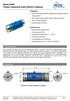 Properties Free of float metal bellow coupling with integrated torque measurement Non-contact measurement system, high robustness High torsional stiffness Limited torque of inertia Performance Measurement
THERMAL ANEMOMETRY ELECTRONICS, SOFTWARE AND ACCESSORIES
 TSI and TSI logo are registered trademarks of TSI Incorporated. SmartTune is a trademark of TSI Incorporated. THERMAL ANEMOMETRY ELECTRONICS, SOFTWARE AND ACCESSORIES IFA 300 Constant Temperature Anemometry
Email: [email protected]
 USE OF VIRTUAL INSTRUMENTS IN RADIO AND ATMOSPHERIC EXPERIMENTS P.N. VIJAYAKUMAR, THOMAS JOHN AND S.C. GARG RADIO AND ATMOSPHERIC SCIENCE DIVISION, NATIONAL PHYSICAL LABORATORY, NEW DELHI 110012, INDIA
CHAPTER 3 MODAL ANALYSIS OF A PRINTED CIRCUIT BOARD
 45 CHAPTER 3 MODAL ANALYSIS OF A PRINTED CIRCUIT BOARD 3.1 INTRODUCTION This chapter describes the methodology for performing the modal analysis of a printed circuit board used in a hand held electronic
AP1 Oscillations. 1. Which of the following statements about a spring-block oscillator in simple harmonic motion about its equilibrium point is false?
 1. Which of the following statements about a spring-block oscillator in simple harmonic motion about its equilibrium point is false? (A) The displacement is directly related to the acceleration. (B) The
Automation System TROVIS 6400 TROVIS 6493 Compact Controller
 Automation System TROVIS 6400 TROVIS 6493 Compact Controller For panel mounting (front frame 48 x 96 mm/1.89 x 3.78 inch) Application Digital controller to automate industrial and process plants for general
Motor Selection and Sizing
 Motor Selection and Sizing Motor Selection With each application, the drive system requirements greatly vary. In order to accommodate this variety of needs, Aerotech offers five types of motors. Motors
Simple Harmonic Motion
 Simple Harmonic Motion 1 Object To determine the period of motion of objects that are executing simple harmonic motion and to check the theoretical prediction of such periods. 2 Apparatus Assorted weights
Digital Single Axis Controller
 Digital Single Axis Controller The concept of intelligent hydraulic drive a vision? DSAC (Digital Single Axis Controller) Do you need hydraulic servo drive for your machine/system? What would it be like
Similar benefits are also derived through modal testing of other space structures.
 PAGE 1 OF 5 PREFERRED RELIABILITY PRACTICES MODAL TESTING: MEASURING DYNAMIC STRUCTURAL CHARACTERISTICS Practice: Modal testing is a structural testing practice that provides low levels of mechanical excitation
METHOD STATEMENT HIGH STRIAN DYNAMIC TESTING OF PILE. Prepared by
 METHOD STATEMENT HIGH STRIAN DYNAMIC TESTING OF PILE Prepared by Infratech ASTM CO., LTD. Contents Chapter Description Page Contents...... 1 List of Appendix. 1 1. Introduction.. 2 2. Test Method..2 3.
EVAL-UFDC-1/UFDC-1M-16
 Evaluation Board for Universal Frequency-to- Digital Converters UFDC-1 and UFDC-1M-16 EVAL-UFDC-1/UFDC-1M-16 FEATURES Full-Featured Evaluation Board for the Universal Frequency-to-Digital Converters UFDC-1
Manufacturing Equipment Modeling
 QUESTION 1 For a linear axis actuated by an electric motor complete the following: a. Derive a differential equation for the linear axis velocity assuming viscous friction acts on the DC motor shaft, leadscrew,
PERFORMANCE TEST REPORT. Rendered to: FORMTECH ENTERPRISES, INC. SERIES/MODEL: Truline PRODUCT TYPE: PVC Seawall
 PERFORMANCE TEST REPORT Rendered to: FORMTECH ENTERPRISES, INC. SERIES/MODEL: Truline PRODUCT TYPE: PVC Seawall Report No.: Test Dates: 04/17/12 Through: 04/18/12 Report Date: 06/13/12 130 Derry Court
Using angular speed measurement with Hall effect sensors to observe grinding operation with flexible robot.
 Using angular speed measurement with Hall effect sensors to observe grinding operation with flexible robot. François Girardin 1, Farzad Rafieian 1, Zhaoheng Liu 1, Marc Thomas 1 and Bruce Hazel 2 1 Laboratoire
Power Electronics. Prof. K. Gopakumar. Centre for Electronics Design and Technology. Indian Institute of Science, Bangalore.
 Power Electronics Prof. K. Gopakumar Centre for Electronics Design and Technology Indian Institute of Science, Bangalore Lecture - 1 Electric Drive Today, we will start with the topic on industrial drive
QR12 (1.22 ) Diameter Optical Encoder
 Improving the Quality of Life through the Power in Light QPhase QR12 (1.22 ) Diameter Optical Encoder Design Features: Low profile assembled height of Bearing design simplifies encoder attachment Resolutions
Rotation: Moment of Inertia and Torque
 Rotation: Moment of Inertia and Torque Every time we push a door open or tighten a bolt using a wrench, we apply a force that results in a rotational motion about a fixed axis. Through experience we learn
EDUMECH Mechatronic Instructional Systems. Ball on Beam System
 EDUMECH Mechatronic Instructional Systems Ball on Beam System Product of Shandor Motion Systems Written by Robert Hirsch Ph.D. 998-9 All Rights Reserved. 999 Shandor Motion Systems, Ball on Beam Instructional
4 SENSORS. Example. A force of 1 N is exerted on a PZT5A disc of diameter 10 mm and thickness 1 mm. The resulting mechanical stress is:
 4 SENSORS The modern technical world demands the availability of sensors to measure and convert a variety of physical quantities into electrical signals. These signals can then be fed into data processing
A 5 Degree Feedback Control Robotic Arm (Haptic Arm)
 A 5 Degree Feedback Control Robotic Arm (Haptic Arm) 1 Prof. Sheetal Nirve, 2 Mr.Abhilash Patil, 3 Mr.Shailesh Patil, 4 Mr.Vishal Raut Abstract: Haptics is the science of applying touch sensation and control
Calibration and Use of a Strain-Gage-Instrumented Beam: Density Determination and Weight-Flow-Rate Measurement
 Chapter 2 Calibration and Use of a Strain-Gage-Instrumented Beam: Density Determination and Weight-Flow-Rate Measurement 2.1 Introduction and Objectives This laboratory exercise involves the static calibration
SUPPLEMENTAL TECHNICAL SPECIFICATIONS BI-DIRECTIONAL STATIC LOAD TESTING OF DRILLED SHAFTS
 July 14, 2015 1.0 GENERAL BI-DIRECTIONAL STATIC LOAD TESTING OF DRILLED SHAFTS This work shall consist of furnishing all materials, equipment, labor, and incidentals necessary for conducting bi-directional
Frequecy Comparison and Optimization of Forged Steel and Ductile Cast Iron Crankshafts
 International Journal of Engineering Science Invention ISSN (Online): 2319 6734, ISSN (Print): 2319 6726 Volume 2 Issue 11ǁ November2013 ǁ PP.38-45 Frequecy Comparison and Optimization of Forged Steel
Vibrations can have an adverse effect on the accuracy of the end effector of a
 EGR 315 Design Project - 1 - Executive Summary Vibrations can have an adverse effect on the accuracy of the end effector of a multiple-link robot. The ability of the machine to move to precise points scattered
Access Control Using Smartcard And Passcode
 IOSR Journal of Electrical and Electronics Engineering (IOSR-JEEE) e-issn: 2278-1676 Volume 4, Issue 5 (Jan. - Feb. 2013), PP 29-34 Access Control Using Smartcard And Passcode Omorogiuwa Eseosa 1., Uhunmwangho
Selection Procedure B-24 ORIENTAL MOTOR GENERAL CATALOGUE
 STEPPING MOTORS to This section describes certain items that must be calculated to find the optimum stepping motor for a particular application. This section shows the selection procedure and gives examples.
Harmonic Drive acutator P r e c i s i o n G e a r i n g & M o t i o n C o n t r o l
 D C S e r v o S y s t e m s RH Mini Series Total Motion Control Harmonic Drive acutator P r e c i s i o n G e a r i n g & M o t i o n C o n t r o l Precision Gearing & Motion Control DC SERVO ACTUATORS
Hollow Cylinder Apparatus (GDS SS-HCA)
 HCA:1 Options available for SS-HCA Axial Load/Torque 1kN/1Nm 1kN/2Nm 12kN/2Nm 15kN/4Nm Dynamic upgrade frequencies Hollow Cylinder Apparatus (GDS SS-HCA).5Hz 2Hz 1Hz 5Hz Sample Height/Outer Ø/Inner Ø 2/1/6mm
INDUCTION MOTOR PERFORMANCE TESTING WITH AN INVERTER POWER SUPPLY, PART 2
 INDUCTION MOTOR PERFORMANCE TESTING WITH AN INVERTER POWER SUPPLY, PART 2 By: R.C. Zowarka T.J. Hotz J.R. Uglum H.E. Jordan 13th Electromagnetic Launch Technology Symposium, Potsdam (Berlin), Germany,
Mobile field balancing reduces vibrations in energy and power plants. Published in VGB PowerTech 07/2012
 Mobile field balancing reduces vibrations in energy and power plants Published in VGB PowerTech 07/2012 Dr. Edwin Becker PRÜFTECHNIK Condition Monitoring PRÜFTECHNIK Condition Monitoring GmbH 85737 Ismaning
MXD7202G/H/M/N. Low Cost, Low Noise ±2 g Dual Axis Accelerometer with Digital Outputs
 Low Cost, Low Noise ±2 g Dual Axis Accelerometer with Digital Outputs MXD7202G/H/M/N FEATURES Low cost Resolution better than 1 milli-g Dual axis accelerometer fabricated on a monolithic CMOS IC On chip
PHYS 101-4M, Fall 2005 Exam #3. MULTIPLE CHOICE. Choose the one alternative that best completes the statement or answers the question.
 PHYS 101-4M, Fall 2005 Exam #3 Name MULTIPLE CHOICE. Choose the one alternative that best completes the statement or answers the question. 1) A bicycle wheel rotates uniformly through 2.0 revolutions in
Centripetal Force. This result is independent of the size of r. A full circle has 2π rad, and 360 deg = 2π rad.
 Centripetal Force 1 Introduction In classical mechanics, the dynamics of a point particle are described by Newton s 2nd law, F = m a, where F is the net force, m is the mass, and a is the acceleration.
Autonomous Mobile Robot-I
 Autonomous Mobile Robot-I Sabastian, S.E and Ang, M. H. Jr. Department of Mechanical Engineering National University of Singapore 21 Lower Kent Ridge Road, Singapore 119077 ABSTRACT This report illustrates
SOLUTIONS TO CONCEPTS CHAPTER 15
 SOLUTIONS TO CONCEPTS CHAPTER 15 1. v = 40 cm/sec As velocity of a wave is constant location of maximum after 5 sec = 40 5 = 00 cm along negative x-axis. [(x / a) (t / T)]. Given y = Ae a) [A] = [M 0 L
Cell Phone Vibration Experiment
 Objective Cell Phone Vibration Experiment Most cell phones are designed to vibrate. But at what frequency do they vibrate? With an accelerometer, data acquisition and signal analysis the vibration frequency
E190Q Lecture 5 Autonomous Robot Navigation
 E190Q Lecture 5 Autonomous Robot Navigation Instructor: Chris Clark Semester: Spring 2014 1 Figures courtesy of Siegwart & Nourbakhsh Control Structures Planning Based Control Prior Knowledge Operator
Case Studies on Paper Machine Vibration Problems
 Case Studies on Paper Machine Vibration Problems Andrew K. Costain, B.Sc.Eng. Bretech Engineering Ltd., 70 Crown Street, Saint John, NB Canada E2L 3V6 email: [email protected] website: www.bretech.com
Computer Controlled Generating Stations Control and Regulation Simulator, with SCADA SCE
 Technical Teaching Equipment Computer Controlled Generating Stations Control and Regulation Simulator, with SCADA SCE EDIBON SCADA System Teaching Technique used 4 5 2 Data Acquisition Board Cables and
Lab 7: Rotational Motion
 Lab 7: Rotational Motion Equipment: DataStudio, rotary motion sensor mounted on 80 cm rod and heavy duty bench clamp (PASCO ME-9472), string with loop at one end and small white bead at the other end (125
Kinetic Energy (A) stays the same stays the same (B) increases increases (C) stays the same increases (D) increases stays the same.
 1. A cart full of water travels horizontally on a frictionless track with initial velocity v. As shown in the diagram, in the back wall of the cart there is a small opening near the bottom of the wall
Lab #9: AC Steady State Analysis
 Theory & Introduction Lab #9: AC Steady State Analysis Goals for Lab #9 The main goal for lab 9 is to make the students familar with AC steady state analysis, db scale and the NI ELVIS frequency analyzer.
Microcontroller-based experiments for a control systems course in electrical engineering technology
 Microcontroller-based experiments for a control systems course in electrical engineering technology Albert Lozano-Nieto Penn State University, Wilkes-Barre Campus, Lehman, PA, USA E-mail: [email protected]
AP Physics C. Oscillations/SHM Review Packet
 AP Physics C Oscillations/SHM Review Packet 1. A 0.5 kg mass on a spring has a displacement as a function of time given by the equation x(t) = 0.8Cos(πt). Find the following: a. The time for one complete
Force/position control of a robotic system for transcranial magnetic stimulation
 Force/position control of a robotic system for transcranial magnetic stimulation W.N. Wan Zakaria School of Mechanical and System Engineering Newcastle University Abstract To develop a force control scheme
Loudspeaker Parameters. D. G. Meyer School of Electrical & Computer Engineering
 Loudspeaker Parameters D. G. Meyer School of Electrical & Computer Engineering Outline Review of How Loudspeakers Work Small Signal Loudspeaker Parameters Effect of Loudspeaker Cable Sample Loudspeaker
State Newton's second law of motion for a particle, defining carefully each term used.
 5 Question 1. [Marks 20] An unmarked police car P is, travelling at the legal speed limit, v P, on a straight section of highway. At time t = 0, the police car is overtaken by a car C, which is speeding
Servo Info and Centering
 Info and Centering A servo is a mechanical motorized device that can be instructed to move the output shaft attached to a servo wheel or arm to a specified position. Inside the servo box is a DC motor
Electrical Resonance
 Electrical Resonance (R-L-C series circuit) APPARATUS 1. R-L-C Circuit board 2. Signal generator 3. Oscilloscope Tektronix TDS1002 with two sets of leads (see Introduction to the Oscilloscope ) INTRODUCTION
Mounting instructions. Acceleration Transducer B12. B 26.B12.10 en
 Mounting instructions Acceleration Transducer B12 B 26.B12.10 en B12 3 Contents Page Safety instructions.............................................. 4 1 Scope of supply..............................................
Design of a Universal Robot End-effector for Straight-line Pick-up Motion
 Session Design of a Universal Robot End-effector for Straight-line Pick-up Motion Gene Y. Liao Gregory J. Koshurba Wayne State University Abstract This paper describes a capstone design project in developing
HIGH VOLTAGE ELECTROSTATIC PENDULUM
 HIGH VOLTAGE ELECTROSTATIC PENDULUM Raju Baddi National Center for Radio Astrophysics, TIFR, Ganeshkhind P.O Bag 3, Pune University Campus, PUNE 411007, Maharashtra, INDIA; [email protected] ABSTRACT
ECE 495 Project 3: Shocker Actuator Subsystem and Website Design. Group 1: One Awesome Engineering
 ECE 495 Project 3: Shocker Actuator Subsystem and Website Design Group 1: One Awesome Engineering Luquita Edwards Evan Whetsell Sunny Verma Thomas Ryan Willis Long I. Executive Summary The main goal behind
Candidate Number. General Certificate of Education Advanced Level Examination June 2012
 entre Number andidate Number Surname Other Names andidate Signature General ertificate of Education dvanced Level Examination June 212 Physics PHY4/1 Unit 4 Fields and Further Mechanics Section Monday
Innovative Practices in Optimal Utilization of Solar Energy (Solar Tracking System)
 Innovative Practices in Optimal Utilization of Solar Energy (Solar Tracking System) Dr. G. Suresh Babu EEE Dept., C.B.I.T Abstract: As the demand is ahead of the supply there is a dire need for efficient
Self-Balancing Robot Project Proposal Abstract. Strategy. Physical Construction. Spencer Burdette March 9, 2007 [email protected]
 Spencer Burdette March 9, 2007 [email protected] Self-Balancing Robot Project Proposal Abstract This project will undertake the construction and implementation of a two-wheeled robot that is capable of balancing
Unit 24: Applications of Pneumatics and Hydraulics
 Unit 24: Applications of Pneumatics and Hydraulics Unit code: J/601/1496 QCF level: 4 Credit value: 15 OUTCOME 2 TUTORIAL 2 HYDRAULIC AND PNEUMATIC CYLINDERS The material needed for outcome 2 is very extensive
Precision Miniature Load Cell. Models 8431, 8432 with Overload Protection
 w Technical Product Information Precision Miniature Load Cell with Overload Protection 1. Introduction The load cells in the model 8431 and 8432 series are primarily designed for the measurement of force
EDEXCEL NATIONAL CERTIFICATE/DIPLOMA UNIT 5 - ELECTRICAL AND ELECTRONIC PRINCIPLES NQF LEVEL 3 OUTCOME 4 - ALTERNATING CURRENT
 EDEXCEL NATIONAL CERTIFICATE/DIPLOMA UNIT 5 - ELECTRICAL AND ELECTRONIC PRINCIPLES NQF LEVEL 3 OUTCOME 4 - ALTERNATING CURRENT 4 Understand single-phase alternating current (ac) theory Single phase AC
Intelligent Robotics Lab.
 1 Variable Stiffness Actuation based on Dual Actuators Connected in Series and Parallel Prof. Jae-Bok Song ([email protected] ). (http://robotics.korea.ac.kr) ti k Depart. of Mechanical Engineering, Korea
METHOD OF STATEMENT FOR STATIC LOADING TEST
 Compression Test, METHOD OF STATEMENT FOR STATIC LOADING TEST Tension Test and Lateral Test According to the American Standards ASTM D1143 07, ASTM D3689 07, ASTM D3966 07 and Euro Codes EC7 Table of Contents
INDUCTION REGULATOR. Objective:
 INDUCTION REGULATOR Objective: Using a wound rotor induction motor an Induction Regulator, study the effect of rotor position on the output voltage of the regulator. Also study its behaviour under load
[ means: Save time, money and space! MAXXMILL 500. Vertical milling center for 5-side machining
 [ E[M]CONOMY] means: Save time, money and space! MAXXMILL 500 Vertical milling center for 5-side machining MAXXMILL 500 MAXXMILL 500 is the ideal vertical milling center for the for the 5-axis operation
Frequency Response of Filters
 School of Engineering Department of Electrical and Computer Engineering 332:224 Principles of Electrical Engineering II Laboratory Experiment 2 Frequency Response of Filters 1 Introduction Objectives To
The entire document shall be read and understood before proceeding with a test. ISTA 3B 2013 - Page 1 of 35
 Packaged-Products for Less-Than-Truckload (LTL) Shipment ISTA 3 Series General Simulation Performance Test PROCEDURE VERSION DATE Last TECHNICAL Change: NOVEMBER 2012 Last EDITORIAL Change: JANUARY 2013
Physics 2A, Sec B00: Mechanics -- Winter 2011 Instructor: B. Grinstein Final Exam
 Physics 2A, Sec B00: Mechanics -- Winter 2011 Instructor: B. Grinstein Final Exam INSTRUCTIONS: Use a pencil #2 to fill your scantron. Write your code number and bubble it in under "EXAM NUMBER;" an entry
Accurate Measurement of the Mains Electricity Frequency
 Accurate Measurement of the Mains Electricity Frequency Dogan Ibrahim Near East University, Faculty of Engineering, Lefkosa, TRNC [email protected] Abstract The frequency of the mains electricity supply
Setting up the DeskCNC controller.
 1) Determine the steps to linear motion ratios for each axis. 2 2) Determine Maximum velocity (speed). 3 3) Setting up the software Machine Tab 4 4) Setting up the software DeskCNC Setup Tab 5 5) Setting
Manual for simulation of EB processing. Software ModeRTL
 1 Manual for simulation of EB processing Software ModeRTL How to get results. Software ModeRTL. Software ModeRTL consists of five thematic modules and service blocks. (See Fig.1). Analytic module is intended
Physics 9e/Cutnell. correlated to the. College Board AP Physics 1 Course Objectives
 Physics 9e/Cutnell correlated to the College Board AP Physics 1 Course Objectives Big Idea 1: Objects and systems have properties such as mass and charge. Systems may have internal structure. Enduring
Advantages of Auto-tuning for Servo-motors
 Advantages of for Servo-motors Executive summary The same way that 2 years ago computer science introduced plug and play, where devices would selfadjust to existing system hardware, industrial motion control
Electric Motors and Drives
 EML 2322L MAE Design and Manufacturing Laboratory Electric Motors and Drives To calculate the peak power and torque produced by an electric motor, you will need to know the following: Motor supply voltage,
Force measurement. Forces VECTORIAL ISSUES ACTION ET RÉACTION ISOSTATISM
 Force measurement Forces VECTORIAL ISSUES In classical mechanics, a force is defined as "an action capable of modifying the quantity of movement of a material point". Therefore, a force has the attributes
200350 and 200355 Accelerometers
 and Accelerometers Bently Nevada Asset Condition Monitoring Description The and Accelerometers are general purpose, casemounted seismic transducers designed for use with Trendmaster Pro Constant Current
Self-Mixing Laser Diode Vibrometer with Wide Dynamic Range
 Self-Mixing Laser Diode Vibrometer with Wide Dynamic Range G. Giuliani,, S. Donati, L. Monti -, Italy Outline Conventional Laser vibrometry (LDV) Self-mixing interferometry Self-mixing vibrometer Principle:
System Modeling and Control for Mechanical Engineers
 Session 1655 System Modeling and Control for Mechanical Engineers Hugh Jack, Associate Professor Padnos School of Engineering Grand Valley State University Grand Rapids, MI email: [email protected] Abstract
Use Of Hoeken s And Pantograph Mechanisms For Carpet Scrapping Operations
 Use Of Hoeken s And Pantograph Mechanisms For Carpet Scrapping Operations S.K. Saha, Rajendra Prasad 1 and Ananta K. Mandal 1 Department of Mechanical Engineering IIT Delhi, Hauz Khas, New Delhi 110016
AIR RESONANCE IN A PLASTIC BOTTLE Darrell Megli, Emeritus Professor of Physics, University of Evansville, Evansville, IN dm37@evansville.
 AIR RESONANCE IN A PLASTIC BOTTLE Darrell Megli, Emeritus Professor of Physics, University of Evansville, Evansville, IN [email protected] It is well known that if one blows across the neck of an empty
2016 IDEERS Rules for Graduate Teams. The List of Rule Revisions
 1 of 12 The List of Rule Revisions Version No. Date Remarks V1 None 2 of 12 The content presented below serves as primary rules for this contest. However, if there are disputes that are not covered or
INSTALLATION AND OPERATING INSTRUCTIONS For Model GL1 Gate Locks
 Securitron Magnalock Corp. www.securitron.com ASSA ABLOY, the global leader Tel 800.624.5625 [email protected] in door opening solutions INSTALLATION AND OPERATING INSTRUCTIONS For Model GL1 Gate
The quadrature signals and the index pulse are accessed through five 0.025 inch square pins located on 0.1 inch centers.
 Quick Assembly Two and Three Channel Optical Encoders Technical Data HEDM-550x/560x HEDS-550x/554x HEDS-560x/564x Features Two Channel Quadrature Output with Optional Index Pulse Quick and Easy Assembly
Electronics. Discrete assembly of an operational amplifier as a transistor circuit. LD Physics Leaflets P4.2.1.1
 Electronics Operational Amplifier Internal design of an operational amplifier LD Physics Leaflets Discrete assembly of an operational amplifier as a transistor circuit P4.2.1.1 Objects of the experiment
LEVEL GAUGES WITH MAGNETIC JOINT L 14 - L 22 - L 34
 LEVEL GAUGES WITH MAGNETIC JOINT L 14 - L 22 - L 34 2 LEVEL GAUGES WITH MAGNETIC JOINT SIZE Ø 140/220/340 58 58 TYPE LA TYPE LA 14 30 S 22 33 TYPE LA 22-34 NO. HOLES Ø D2 76 O-RING CENTRE OF THE CONSERVATOR
MONDOATHENS BASKETBALL SET (Reference PK110)
 MONDOATHENS BASKETBALL SET (Reference PK110) DESCRIPTION The MONDOATHENS backstop unit is mainly designed for multi-sports pavilions and installations where the highest-level basketball competitions are