
CyberLink. Power2Go. User's Guide
|
|
|
- Harold Montgomery
- 9 years ago
- Views:
Transcription
1 CyberLink Power2Go User's Guide
2 Copyright and Disclaimer All rights reserved. No part of this publication may be reproduced, stored in a retrieval system, or transmitted in any form or by any means electronic, mechanical, photocopying, recording, or otherwise without the prior written permission of CyberLink Corporation. To the extent allowed by law, Power2Go IS PROVIDED AS IS, WITHOUT WARRANTY OF ANY KIND, EITHER EXPRESS OR IMPLIED, INCLUDING WITHOUT LIMITATION ANY WARRANTY FOR INFORMATION, SERVICES, OR PRODUCTS PROVIDED THROUGH OR IN CONNECTION WITH Power2Go AND ANY IMPLIED WARRANTIES OF MERCHANTABILITY, FITNESS FOR A PARTICULAR PURPOSE, EXPECTATION OF PRIVACY, OR NON-INFRINGEMENT. BY USING THIS SOFTWARE, YOU AGREE THAT CYBERLINK WILL NOT BE LIABLE FOR ANY DIRECT, INDIRECT, OR CONSEQUENTIAL LOSS ARISING FROM THE USE OF THIS SOFTWARE OR MATERIALS CONTAINED EITHER IN THIS PACKAGE. The terms and conditions here under shall be governed and construed in accordance with the laws of Taiwan. Power2Go is a registered trademark along with other company and product names mentioned in this publication, used for identification purposes and remain the exclusive property of their respective owners. International Headquarters Mailing Address CyberLink Corporation 15F., No. 100, Minquan Rd., Xindian Dist. New Taipei City 231, Taiwan (R.O.C.) Web Site Telephone Fax Copyright 2013 CyberLink Corporation. All rights reserved.

3 Contents Introduction...1 Welcome...1 Latest Features...1 Power2Go...2 Versions Supported...2 Media Supported...3 File Types Supported...3 Disc Types System Requirements...3 Power2Go...5 Workspace Power2Go...5 Desktop Burning Gadget Mode Enabling the...6 Desktop Burning Gadget Burning with...7 the Desktop Burning Gadget Configuring...7 the Desktop Burning Gadget Power2Go...8 Full Program Mode New Task...10 Window Power2Go...11 Projects Power2Go...12 User Preferences Music Disc...15 Burning...15 an Audio CD or MP3/WMA Music Disc Audio CD...16 Preferences MP3/WMA...17 Disc Preferences Burning...17 a CUE Audio Disc Video Disc...19 i

4 CyberLink Po w er2go Burning...19 a Video Disc Creating...20 a Video Disc Selecting/Editing...20 Disc Menus Editing Disc...23 Preferences Burning Video...24 to Disc Burning...25 a DVD Folder Data Disc...27 Creating...27 and Burning Data Discs Burning...28 a Secured Data Disc Viewing...29 Content on a Secured Disc Photo Gallery...31 Disc Creating...31 and Burning Photo Gallery Discs Photo Gallery...32 Disc Preferences Viewing...34 Photo Gallery Discs Online Media...35 Backup Backing...35 Up Online Media to Discs Downloading...37 Online Media to Hard Drive System Recovery...39 Burning...39 a System Recovery Disc Restoring...40 Your Computer Copy Disc...43 Copying...43 Discs Saving a...44 Disc Image Burning...45 a Disc Image Disc Utilities...47 ii
5 Erasing...47 a Disc Ripping...47 Audio Converting...48 Audio Files Burning...48 Mixed Discs Burning a...49 CD Extra/Mixed Mode CD Power2Go...51 Virtual Drive Mounting...51 a Disc Image Disabling...51 a Mounted Disc Image Using the...52 Disc Manager Manually...53 Importing Discs to the Disc Library Launching...54 LabelPrint Additional Burning Notes and Features...55 Using the...55 CyberLink ISO Viewer Multisession...56 Discs Power2Go...57 Settings Configuring...57 the General Settings Configuring...58 the Burning Options Viewing...59 the Info Tab Configuring...59 Download Settings Configuring...60 Video Settings Technical...61 Support Before Contacting...61 Technical Support Web Support...62 iii
6 CyberLink Po w er2go iv

7 Intro ductio n Chapter 1: Introduction This chapter introduces the CyberLink Power2Go program and includes an overview of its newest features. It also outlines the available Power2Go versions, lists the supported media types, and reviews the recommended system requirements. Note: this document is for reference and informational use only. Its content and the corresponding program are subject to change without notice. Welcome Welcome to the CyberLink family of digital media tools. CyberLink Power2Go is the all-media burning software that supports all drives and discs, including CD, DVD, and Blu-ray Disc(TM). With CyberLink Power2Go you can create and burn data discs, music discs, photo gallery discs, video discs, and even system recovery discs. You can also back up your online media, view a library of your burned discs in the Disc Manager, or use the handy disc utilities to erase and copy discs, mount disc images as a virtual drive, and much more. CyberLink Power2Go is the all-in-one burning software for the PC. Latest Features This section outlines the latest features within the CyberLink Power2Go program. Disc Manager* Add newly burned discs to the Disc Manager library. Import discs you burned previously into the Disc Manager. Use the Disc Manager to easily find files and discs you burned previously. Online Media Backup* Browse the photos you have stored on Flickr and Facebook and download them to your hard drive. Access the videos you have stored on YouTube, Facebook, and Vimeo and 1

8 CyberLink Po w er2go download them to your hard drive. Back up your online media by burning it directly to a disc. New Format Support Import a CUE file to burn an audio disc complete with track listings and album information. Create audio discs with audio files in the APE* and FLAC* formats. Rip an audio CD and save the files in the APE* and FLAC* audio file format. Convert existing audio into the APE* or FLAC* file format. Note: * this feature is not available in some versions of CyberLink Power2Go. Power2Go Versions The features that are available to you in CyberLink Power2Go are completely dependent on the version you have installed on your computer. To determine your version of CyberLink Power2Go, press Ctrl+B on your keyboard or select Help > About Power2Go. Updating Power2Go Software upgrades and updates (patches) are periodically available from CyberLink. CyberLink Power2Go automatically prompts you when either is available. To update your software, do this: 1. Click the button to open the Upgrade window. 2. Click the feature you would like to upgrade to, or the patch you want to update CyberLink Power2Go with. 3. A web browser window opens, where you can purchase product upgrades or download the latest patch update. Supported Media The following is a list of the media that is supported in CyberLink Power2Go. Note that the specific media that is supported by your version of the program is dependent on the version installed on your computer. 2
9 Intro ductio n Supported File Types Except when creating data discs (which can accept any kind of file type), the following is a list of the file types that you can import when creating music, video, or photo disc in CyberLink Power2Go. Audio formats: APE, FLAC, MP3, M4A, WAV, WMA Video formats: ASF, AVI, DAT, DVR-MS, FLV, M2T, M2TS, MKV, MOV, MOD, MP4, MPE, MPEG, MPG, MTS, TS, TOD, VOB, VRO, WMV, WTV Image formats: BMP, GIF, JPE, JPEG, JPG, PNG, TIF, TIFF Supported Disc Types CyberLink Power2Go supports the burning of the following disc types: CD: CD-R/RW DVD: DVD-R/RW, DVD-R DL, DVD+R/RW, DVD+R DL, DVD-RAM Blu-ray Disc: BDXL, BD-R, BD-R DL, BD-RE, BD-RE DL System Requirements The system requirements listed below are recommended as minimums for burning. You may find that your system, while meeting these recommended minimums, requires expanded capacity during specific burning tasks. Minimum System Requirements OS Windows 8, 7, Vista, XP. Screen Resolution 1024 x 768 or higher. Memory 128 MB SDRAM for data and music burning. 256 MB DDR RAM for video burning (512 MB recommended). CPU CD/VCD (MPEG-1) production: Intel Pentium II 450. DVD (MPEG-2) production: Intel Pentium III 800 MHz, or AMD Athlon 700 MHz (Intel Pentium GHz, AMD Athlon or above recommended). 3

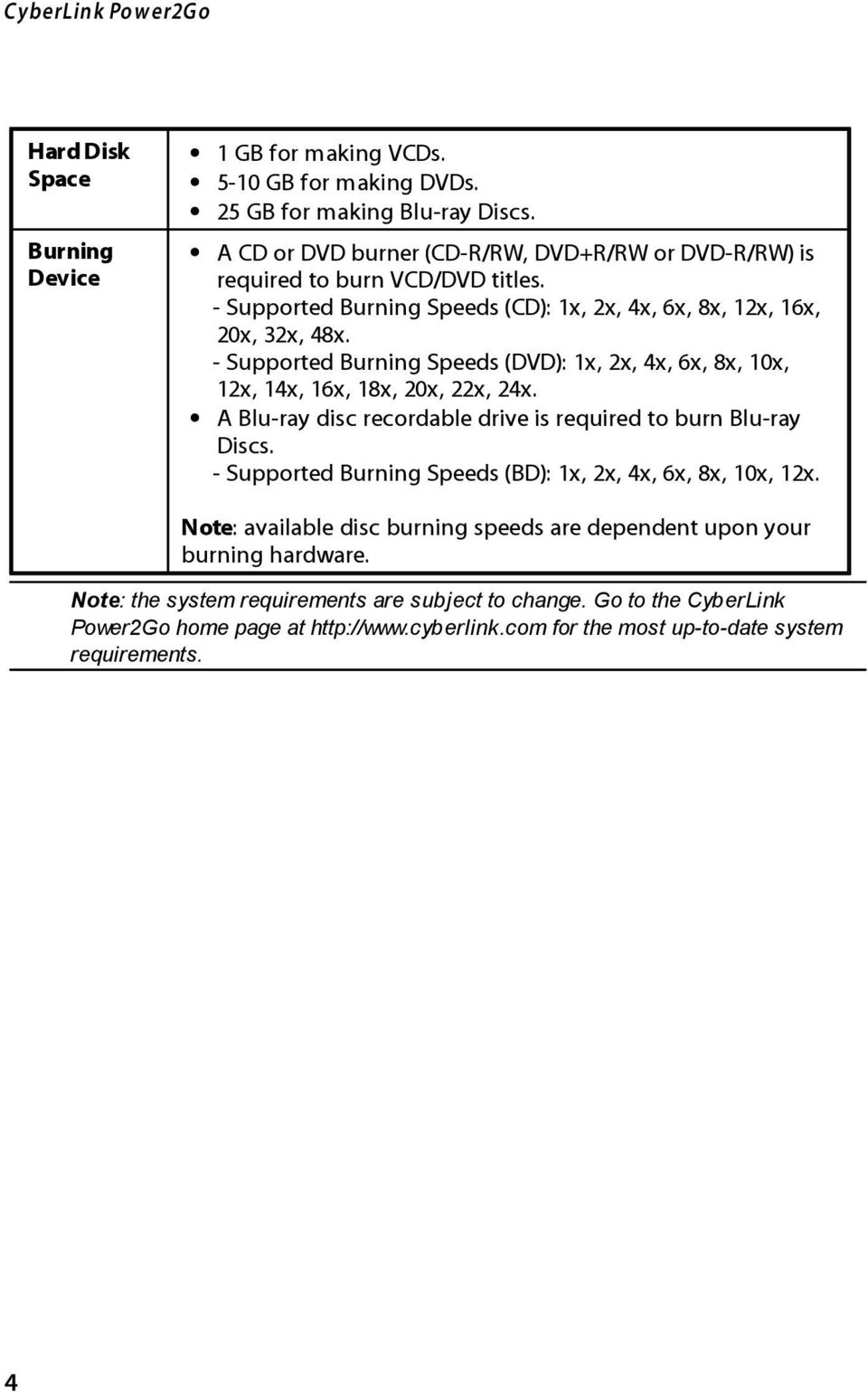
10 CyberLink Po w er2go Hard Disk Space 1 GB for making VCDs GB for making DVDs. 25 GB for making Blu-ray Discs. Burning Device A CD or DVD burner (CD-R/RW, DVD+R/RW or DVD-R/RW) is required to burn VCD/DVD titles. - Supported Burning Speeds (CD): 1x, 2x, 4x, 6x, 8x, 12x, 16x, 20x, 32x, 48x. - Supported Burning Speeds (DVD): 1x, 2x, 4x, 6x, 8x, 10x, 12x, 14x, 16x, 18x, 20x, 22x, 24x. A Blu-ray disc recordable drive is required to burn Blu-ray Discs. - Supported Burning Speeds (BD): 1x, 2x, 4x, 6x, 8x, 10x, 12x. Note: available disc burning speeds are dependent upon your burning hardware. Note: the system requirements are subject to change. Go to the CyberLink Power2Go home page at for the most up-to-date system requirements. 4
11 Po w er2go Wo rkspace Chapter 2: Power2Go Workspace This chapter provides an overview of the CyberLink Power2Go workspace and the available modes of the program. CyberLink Power2Go has several windows that vary slightly in appearance. However these windows have several consistent features that make your burning experience more convenient. The CyberLink Power2Go program can run in one of two modes: Power2Go Desktop Burning Gadget Mode Power2Go Full Program Mode The Power2Go Desktop Burning Gadget mode is the simpler of the two modes, allowing you to burn discs in just two steps. The Power2Go Full Program Mode provides access to all of the burning features and disc utilities available in the program. Power2Go Desktop Burning Gadget Mode The Power2Go Desktop Burning Gadget makes burning discs quick and easy. It sits on your desktop (if enabled) so you can conveniently drag and drop files on to it while you work. CyberLink Power2Go prepares the media for burning, and provides instant burning when you are ready. The Desktop Burning Gadget is available in all versions of Windows, and uses the following icons: Gadget Icon Power2Go Function The Data Disc gadget. Drag and drop data files on this icon to burn them to a disc. 5

12 CyberLink Po w er2go Gadget Icon Power2Go Function The Audio CD gadget. Drag and drop music files on this icon to burn an audio CD to disc that plays on a conventional CD player. The Video Disc* gadget. Drag and drop video files on this icon to burn them to a disc. The Copy Disc gadget. Click on in this gadget to copy the contents of one disc on to another. For detailed information on copying discs, see Copy Disc. Note: * this feature is not available in some versions of CyberLink Power2Go. Enabling the Desktop Burning Gadget When you first install CyberLink Power2Go, the Desktop Burning Gadget is automatically enabled. When it is running, the icon displays in the Windows notification area (system tray). Double-click on it to view the gadget, or right click on it for more options. If the Power2Go Desktop Burning Gadget is not running, you can enable it by selecting the CyberLink Power2Go 9 > Desktop Burning Gadget option from the Windows start menu. In Windows 8, just click the Windows key and then type " Desktop Burning Gadget". 6

13 Po w er2go Wo rkspace Burning with the Desktop Burning Gadget To burn a disc with the Desktop Burning Gadget, do this: 1. Locate the files on your computer that you want to burn. 2. Drag and drop all of the files you want on your disc to the appropriate Desktop Burning Gadget icon, i.e. music files to the Audio CD gadget, video files to the Video Disc gadget, etc. 3. Click on process. in the Power2Go Desktop Burning Gadget to begin the burning Desktop Burning Gadget Burning Tips The following are some tips you should be aware of when burning with the Desktop Burning Gadget: To switch between functions in the Desktop Burning Gadget, click on the arrows at the top of the icon. Click on the icon in the bottom left of the Desktop Burning Gadget to open a window and view a detailed list of the content to be burned. All music discs burned with the Desktop Burning Gadget are in the audio CD format. If you drag and drop video files onto the Audio Disc icon, CyberLink Power2Go extracts the audio from the video files for burning. Configuring the Desktop Burning Gadget Right-click on the icon in the Windows notification area (system tray) to view a list of options of configuring the Desktop Burning Gadget. The list of options include: Always on Top: select to keep the Desktop Burning Gadget on top of any other programs you are running. Start Program When System Starts: select to auto launch the Desktop Burning Gadget whenever you turn on your computer. 7

14 CyberLink Po w er2go CyberLink Virtual Drive: click to launch the CyberLink Virtual Drive window where you can mount image files and more. See Power2Go Virtual Drive for more information. Erase Disc: select to erase a re-writable disc that is currently in the disc drive. About: select to display CyberLink Power2Go version information. Help: select to open this help file. Exit: select to close the Desktop Burning Gadget. Power2Go Full Program Mode The Power2Go Full Program mode is the main mode of CyberLink Power2Go. In this mode you can access all of the program's features in the new task window, which displays automatically when you launch CyberLink Power2Go. To begin a project, just select a task on the left and then the task function you want to perform. The following is a list of the CyberLink Power2Go tasks you can access in the new task window: 8
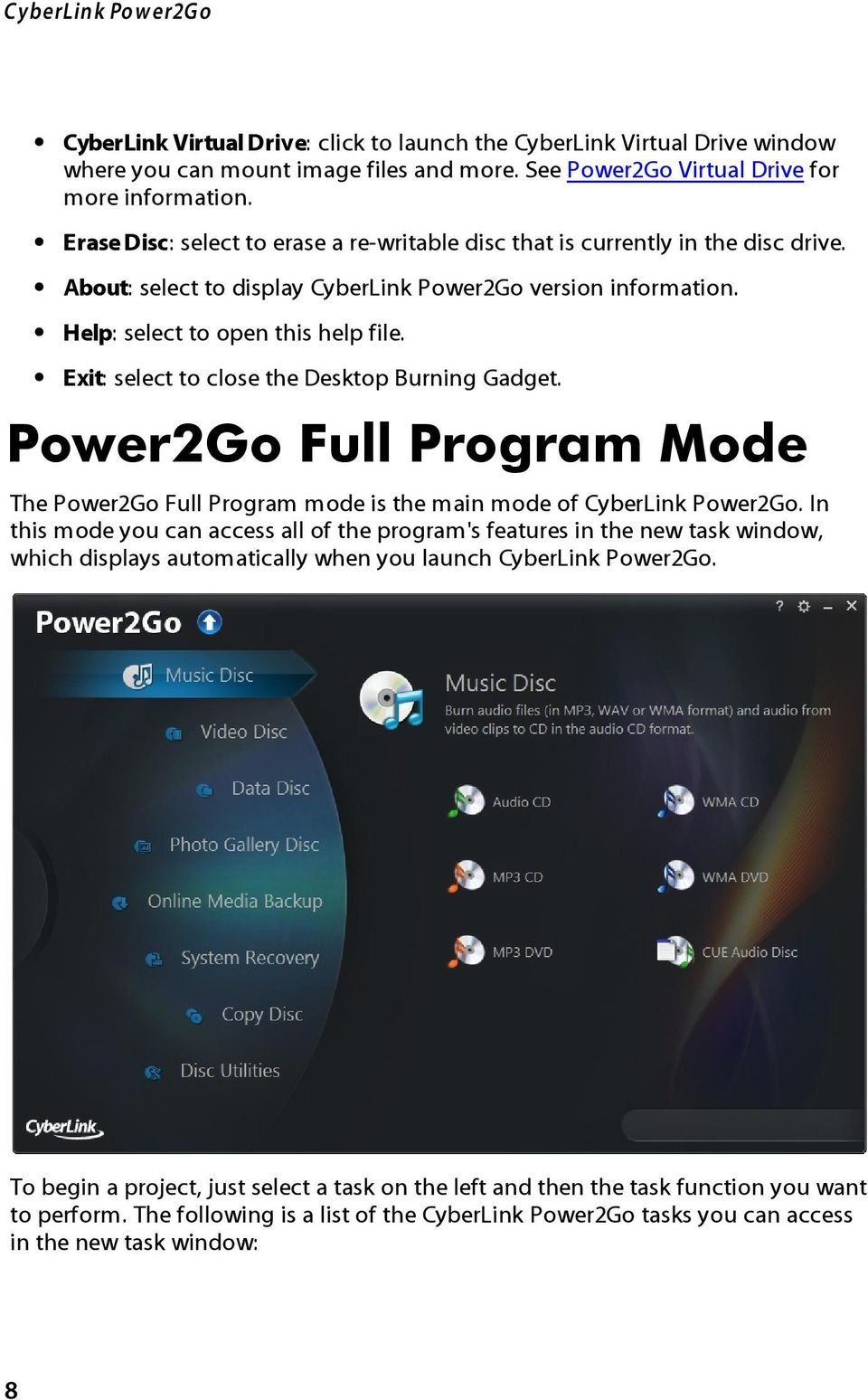
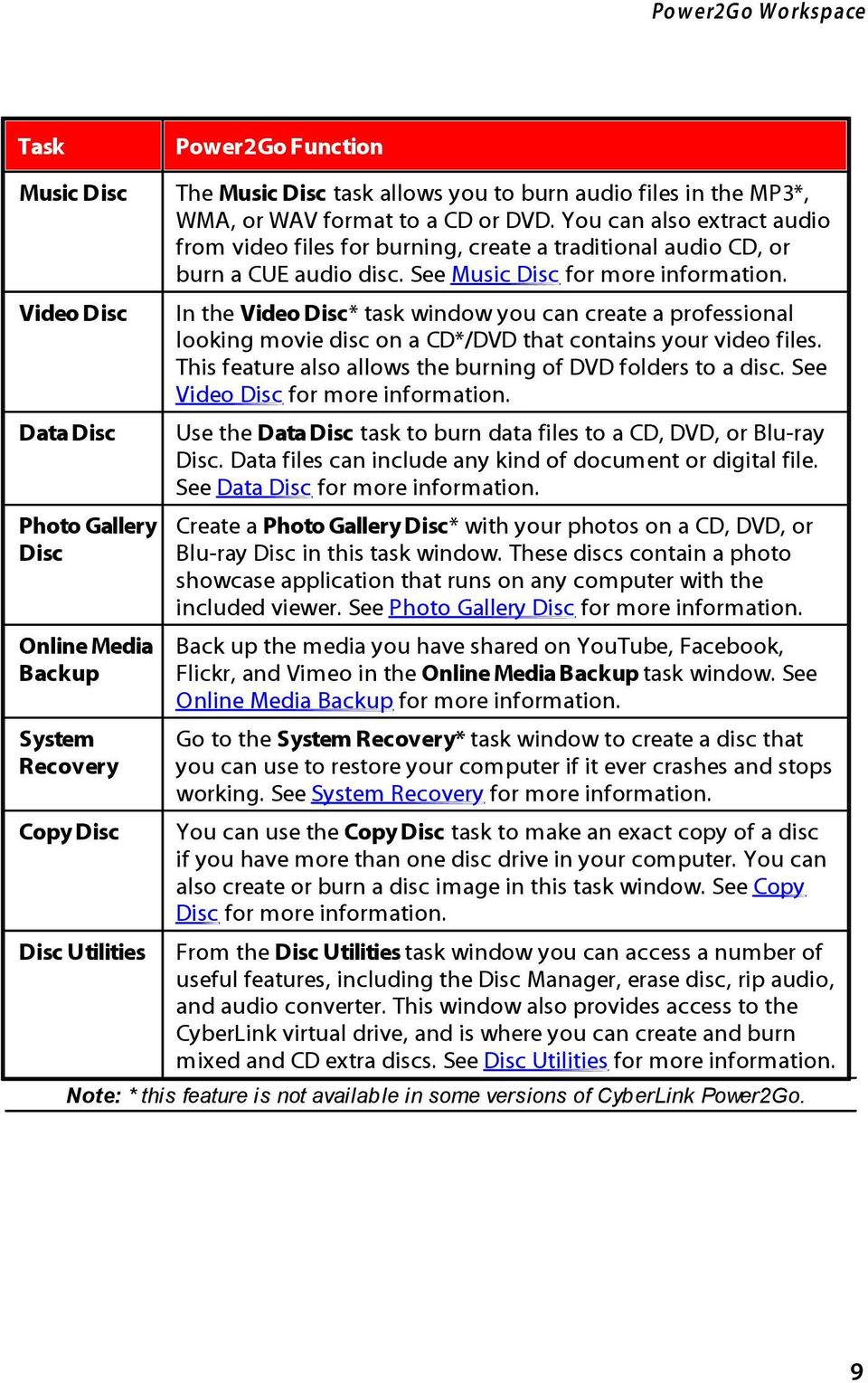
15 Po w er2go Wo rkspace Task Power2Go Function Music Disc The Music Disc task allows you to burn audio files in the MP3*, WMA, or WAV format to a CD or DVD. You can also extract audio from video files for burning, create a traditional audio CD, or burn a CUE audio disc. See Music Disc for more information. Video Disc In the Video Disc* task window you can create a professional looking movie disc on a CD*/DVD that contains your video files. This feature also allows the burning of DVD folders to a disc. See Video Disc for more information. Data Disc Use the Data Disc task to burn data files to a CD, DVD, or Blu-ray Disc. Data files can include any kind of document or digital file. See Data Disc for more information. Photo Gallery Create a Photo Gallery Disc* with your photos on a CD, DVD, or Disc Blu-ray Disc in this task window. These discs contain a photo showcase application that runs on any computer with the included viewer. See Photo Gallery Disc for more information. Online Media Back up the media you have shared on YouTube, Facebook, Backup Flickr, and Vimeo in the Online Media Backup task window. See Online Media Backup for more information. System Recovery Go to the System Recovery* task window to create a disc that you can use to restore your computer if it ever crashes and stops working. See System Recovery for more information. Copy Disc You can use the Copy Disc task to make an exact copy of a disc if you have more than one disc drive in your computer. You can also create or burn a disc image in this task window. See Copy Disc for more information. Disc Utilities From the Disc Utilities task window you can access a number of useful features, including the Disc Manager, erase disc, rip audio, and audio converter. This window also provides access to the CyberLink virtual drive, and is where you can create and burn mixed and CD extra discs. See Disc Utilities for more information. Note: * this feature is not available in some versions of CyberLink Power2Go. 9
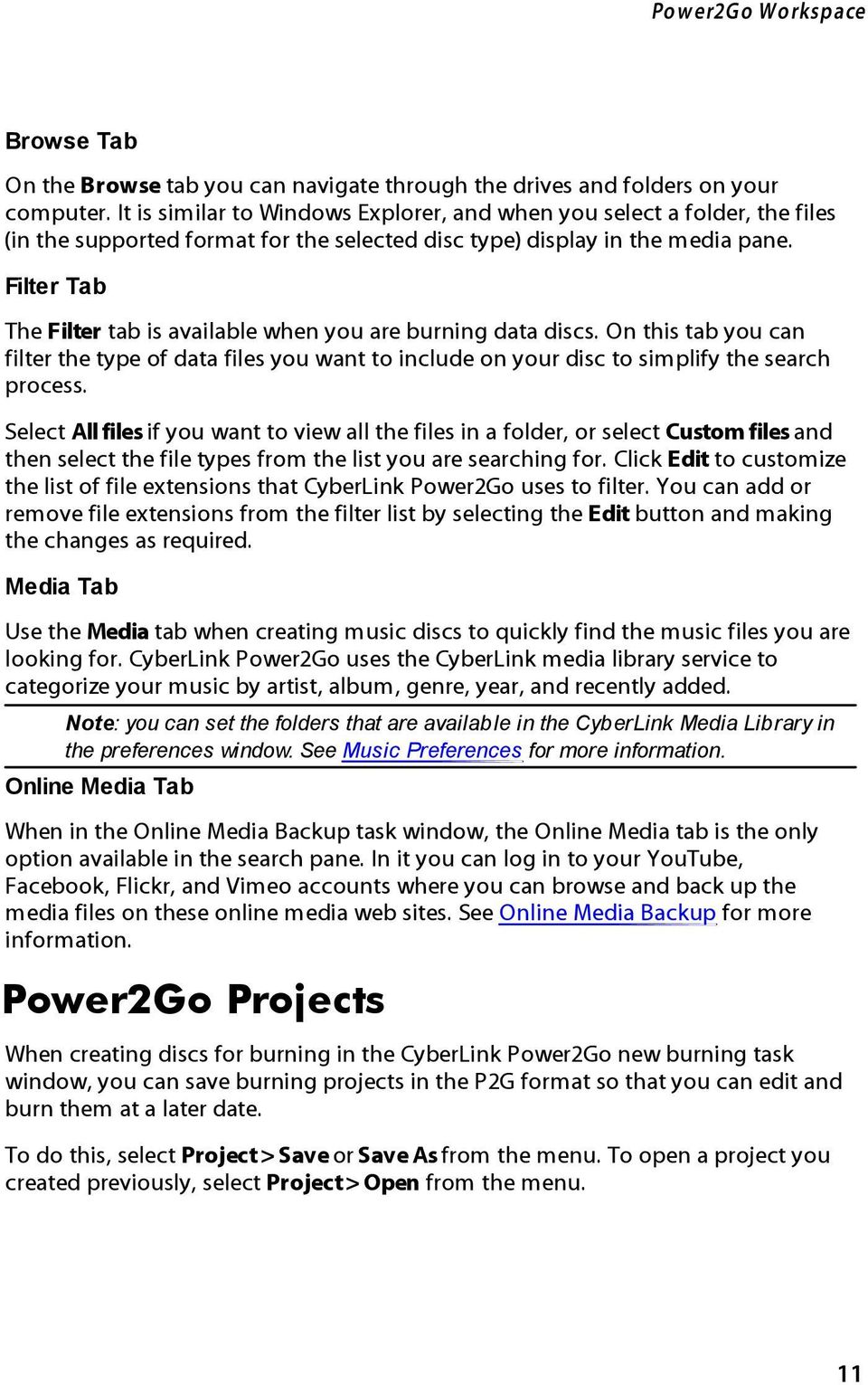
16 CyberLink Po w er2go New Task Window When you start a new task in Power2Go Full Program mode (except when creating a video disc or using the disc utilities), the program displays as follows: A - Sea rch Pa ne, B M edia Pa ne (M edia on Your Com puter), C - Sea rch Field, D - Upgra de, E - Select Disc Burner, F - Burn Now Button, G - Content Area (M edia to be Burned/Dow nloa ded), H - Disc Ca pa city Indica tor Using the Search Pane The search pane is available in most new burning task windows and is a useful tool that can help you find the media you want quickly. The search pane may have any of the following these tabs: Browse, Filter, Media, Online Media. Note: you can also enter in keywords in the search field to search for files in a specific folder on your computer. 10

17 Po w er2go Wo rkspace Browse Tab On the Browse tab you can navigate through the drives and folders on your computer. It is similar to Windows Explorer, and when you select a folder, the files (in the supported format for the selected disc type) display in the media pane. Filter Tab The Filter tab is available when you are burning data discs. On this tab you can filter the type of data files you want to include on your disc to simplify the search process. Select All files if you want to view all the files in a folder, or select Custom files and then select the file types from the list you are searching for. Click Edit to customize the list of file extensions that CyberLink Power2Go uses to filter. You can add or remove file extensions from the filter list by selecting the Edit button and making the changes as required. Media Tab Use the Media tab when creating music discs to quickly find the music files you are looking for. CyberLink Power2Go uses the CyberLink media library service to categorize your music by artist, album, genre, year, and recently added. Note: you can set the folders that are available in the CyberLink Media Library in the preferences window. See Music Preferences for more information. Online Media Tab When in the Online Media Backup task window, the Online Media tab is the only option available in the search pane. In it you can log in to your YouTube, Facebook, Flickr, and Vimeo accounts where you can browse and back up the media files on these online media web sites. See Online Media Backup for more information. Power2Go Projects When creating discs for burning in the CyberLink Power2Go new burning task window, you can save burning projects in the P2G format so that you can edit and burn them at a later date. To do this, select Project > Save or Save As from the menu. To open a project you created previously, select Project > Open from the menu. 11
18 CyberLink Po w er2go Power2Go User Preferences Use the CyberLink Power2Go preferences to set the program's temporary directory, UI language, capacity preferences, and more. To open the preferences window, select Edit > Preferences from the menu, or click on the button in the new task window. General Preferences On the General tab, set the general preferences as follows: Temporary directory: allows you to set a working directory that CyberLink Power2Go uses to save temp files during the burning process. Reset all never show again in dialogs: click the Reset button to reset the all the "Never show again" checkboxes in the program's message dialogs back to the default settings. All of the message dialogs that contain the "Never show again" checkbox will display again after this button is clicked. Print disc label after burning: select this option if you want CyberLink Power2Go to display the Print Label button on the burning confirmation window. If you have CyberLink LabelPrint installed, you can then click this button to create a disc label for your burned disc. Run desktop burning gadget at Windows startup: select if you want the Desktop Burning Gadget to auto launch whenever you turn on your computer. Automatically add disc info into the Disc Manager library when burning discs: select this option if you want CyberLink Power2Go to automatically add all of the discs you burn into the Disc Manager library. Capacity Preferences On the Capacity tab you can set a custom disc size when burning content to CD, if you are using discs that can hold more than 700 MB. The preferences are as follows: Auto detection: enables CyberLink Power2Go to automatically detect a disc s capacity. Customize CD-R/RW capacity: select this option and then enter the new size (in minutes) in the field provided to manually set a disc s capacity. 12

19 Po w er2go Wo rkspace Music Preferences On the Music tab, you can enable music information download when creating music disc and also add folders to the CyberLink media library as follows: Automatically retrieve album/disc information from the Internet: select this option to have CyberLink Power2Go automatically retrieve song and album information when ripping audio files. In the media library section of the Music preferences tab you can add a folder to the CyberLink media library. The CyberLink media library is available on the Media tab of the search pane when creating a music disc. To add a folder, click the Add button, browse to and then select the folder you want to add, and then click OK. CyberLink Power2Go will monitor this folder, and any new music added to it will be automatically added into the media library. Language Preferences On the Language tab, set your user interface language preferences as follows: Use system default language: select this option if you want the CyberLink Power2Go language display to be the same as the default language of your operating system. User defined: select this option and then select the language from the dropdown list that you want CyberLink Power2Go to use. 13

20 CyberLink Po w er2go 14

21 M usic Disc Chapter 3: Music Disc The Music Disc option allows you to create an MP3 or WMA CD/DVD with your music files, or create a traditional audio CD that plays back on a regular CD player. You can also import a CUE file (and its associated audio file) to create a CUE audio disc. Burning an Audio CD or MP3/WMA Music Disc To burn an audio music CD or MP3/WMA music disc, do this: 1. In the new task window, click the Music Disc option and then select the type of music disc you want to create (Audio CD, WMA CD, MP3 CD, WMA DVD, MP3 DVD). The Music Disc window displays. 2. Use the search pane (see Using the Search Pane for more information) to find to the music you want to include on your disc. Select the files you want to burn and then drag and drop them in the content area. Note: you can also click the button to add the music files or the other available buttons to reorder and preview the music on the disc. If you want to extract the audio from a video clip and include it on your music disc, simply add the video clip to the disc. 3. If you would like to edit or add effects to a music file, select it and then click the button to edit it in CyberLink WaveEditor*. Please consult the help file in CyberLink WaveEditor for detailed information on editing audio in that program. Once you finish editing an audio file, the updated file is placed back in the content area. 4. If required, click the Edit button to set the disc's audio quality, add CD-Text, and more. If creating an audio CD, see Audio CD Preferences. See MP3/WMA Disc Preferences if creating an MP3/WMA music disc. 5. Once you have added all of the content you want on your disc, click the Burn now button. 6. If required, adjust the settings on the General and Options tabs (see the 15
22 CyberLink Po w er2go related sections in Power2Go Settings for more information). 7. Click Burn when you are ready to burn your disc. Note: select the Auto shut down after burning option if you want CyberLink Power2Go to automatically shut down your computer once it has successfully burned your disc. 8. When the burning is complete, select one of the following options in the window that opens: Click the View Log link to view the burning log. The log opens in your default TXT editor, where you can view and save it. Click Print Label to create a disc label for the disc in CyberLink LabelPrint, if it is installed on your computer. Click Capture Label to take a photo snapshot that will be used to help identify the burned disc it in the Disc Manager*. Note: if you chose to print a disc label in CyberLink LabelPrint, you don't need to capture the label as CyberLink Power2Go automatically imports the created label into the Disc Manager. See Disc Label Snapshots for information on viewing and editing the label snapshot. Click OK to close the window. Note: * this feature is not available in some versions of CyberLink Power2Go. Audio CD Preferences When creating an audio CD, the following preferences are available: Enable CD-Text: select this option if you want to add information about the music disc you are creating. Enter the desired information in the fields provided. Normalize volume in all tracks of the CD: select this option to set the volume of all of the audio tracks on the CD to the same level. Insert audio gap between tracks: enter the duration, or silence, between each track in seconds in the field provided. When you are done modifying the preferences, click OK to save the changes for your audio CD. 16
23 M usic Disc MP3/WMA Disc Preferences When creating an audio CD, the following preferences are available: Quality: select the sound quality of the MP3/WMA files that are burned to the disc from the drop-down. Auto-generate playlist for Windows Media Player: select this option if you want CyberLink Power2Go to create a Windows Media Player playlist with the songs that will be on your disc. When you are done modifying the preferences, click OK to save the changes for your MP3/WMA disc. Burning a CUE Audio Disc In the Music Disc option you can import a CUE file (and its associated audio) to create and burn a CUE audio disc. A CUE file is a metadata file that lists the order of the tracks in an associated audio file and other information. When imported into the CUE Audio Disc window, all the audio information, including album and artist name, and track information, is auto loaded for you if available in the CUE file. To burn a CUE audio disc, do this: 1. In the new task window, click the Music Disc option and then select the CUE Audio Disc. The CUE Audio Disc window displays. 2. Click on to import a CUE file. Browse to the location of the CUE file, select it, and then click Open to import. Note: the CUE file's associated audio file must be in the same folder as the CUE file and have the same file name. The associated audio file can be in either the FLAC or APE audio file format. 3. Insert your disc and then select your drive in the drop-down list. 4. If required, select a Write speed for the burning disc. The speed you should select will depend on the burning drives you are using and the quality of the discs. 5. Enter the Number of copies you want to burn. 6. If available, you can use the following options to assist with the burning process: select Perform write simulation if you want CyberLink Power2Go to simulate 17
24 CyberLink Po w er2go the burning process first to ensure the burn will finish successfully. if available, select Verify recorded data if you want CyberLink Power2Go to verify that the content was successfully burned to the disc. if available, select Enable defect management to have CyberLink Power2Go try to fix any defects on a disc so that content burns correctly. 7. When you are ready to burn the disc, click the Burn button. Note: select the Auto shut down after burning option if you want CyberLink Power2Go to automatically shut down your computer once it has successfully burned your disc. 8. When the burning is complete, select one of the following options in the window that opens: Click the View Log link to view the burning log. The log opens in your default TXT editor, where you can view and save it. Click Print Label to create a disc label for the disc in CyberLink LabelPrint, if it is installed on your computer. Click Capture Label to take a photo snapshot that will be used to help identify the burned disc it in the Disc Manager*. Note: if you chose to print a disc label in CyberLink LabelPrint, you don't need to capture the label as CyberLink Power2Go automatically imports the created label into the Disc Manager. See Disc Label Snapshots for information on viewing and editing the label snapshot. Click OK to close the window. Note: * this feature is not available in some versions of CyberLink Power2Go. 18
25 Video Disc Chapter 4: Video Disc The Video Disc* option allows you to burn video files to CD or DVD, along with a stylish disc menu. You may also burn a DVD folder to a disc. Note: * this feature is not available in some versions of CyberLink Power2Go. Burning a Video Disc When you select the Video CD (VCD) Disc* or DVD-Video Disc* option in the new task window, the create disc window displays. A - Disc Content Ta b, B - M enu Preferences Ta b, C- Disc Preferences Ta b, D - Disc M enu Font Properties, E - Disc M enu Preview Window, F - Burn to Disc, G - Preview Disc M enu, H - Disc M enu Properties, I - M enu Na viga tion Controls, J - Toggle Ca pa city Displa y, K - Disc Content 19
26 CyberLink Po w er2go Note: * this feature is not available in some versions of CyberLink Power2Go. The steps to create and burn a video disc may vary depending on your requirements. The following sections outline all of the features you can perform in the create disc window, so consult the sections that apply to the disc you want to create. Creating a Video Disc To create a video disc, do this: 1. In the new task window, click the Video Disc option. Select either the Video CD (VCD) Disc or DVD-Video Disc option to open the create disc window. 2. Click the button and then browse to and select the video file that you want to include on the disc. 3. Click on 4. Click the button to import additional video files if required. Each video you import becomes another title or scene on your final disc. 5. Proceed to complete the disc creation process as required. See Selecting/ Editing Disc Menus for more information. to preview the imported video, if required. Selecting/Editing Disc Menus Once you have added all of the content that you want on your disc, click on the Menu Preferences tab to edit the existing disc menu or select another disc menu template. All the disc menu templates in CyberLink Power2Go are multi-layered, and consist of the following pages: a main menu home (root) page. a scenes page that lets you select the individual titles (videos) on your disc. Selecting Disc Menu Templates CyberLink Power2Go provides you with several stylish pre-designed menu templates that you can choose from. These menus are already customized for you and may include such features as motion and menu music. 20
27 Video Disc Note: if you do not want to include a menu on your final disc, select the No M enu template on the M enu Preferences tab. Select a menu template to preview it. Select Apply to apply the highlighted menu page style to the specified menu page. Select Apply to All Pages if you want to use the same style on every page (home and scenes page). Note: if required, you can click on to go to DirectorZone, where you can download and import additional disc menu templates. Editing Disc Menu Properties CyberLink Power2Go lets you edit some of the disc menu s properties. Use the menu navigation controls to preview the design and behavior of the current disc menu. If you want to view the scenes on your disc, use the button and the other menu navigation controls to navigate through the disc menu. Or click the Preview button at the bottom of the window to view what your disc will look like when played on a disc player after burning. Editing Disc Menu Text To edit the text that appears on the menu page, including clickable button text, double-click on it, and then enter the new text. You can modify menu text style, size, and alignment using the disc menu font properties options located at the top of the disc menu window. To change the position of any text on your menu, just click and drag it to the new position. Setting Disc Menu Background Music Some of the pre-designed disc menu templates contain menu music. In the disc menu properties are you can: click on click to edit or replace the menu s background music. to remove the current background music from the menu. Adding/Editing Disc Menu Music If you are using background music in your disc menu, click the button to 21
28 CyberLink Po w er2go perform the following functions: Note: the final duration of your disc menu s background music is dependent on the time entered in the Duration field in the Playback Mode Settings window, not the length of music file used. See Setting Disc Playback Mode for more information on setting your menu s duration. click the button to add/replace the menu background music. trim the audio file using the playback controls and then move the sliders on the trim bar to the desired start and end points. select to have the menu music gradually Fade-in or Fade-out. if the length of your menu music file is not as long as the specified duration, select the Auto repeat option to loop it. click Apply to All Pages to set the music for all of the disc menu pages, or click Apply to set it for the current disc menu page you are editing. Adding a First Play Video Use this option to add a video as a first play video to your created disc. The first play video plays automatically when the disc is inserted into a disc player, before the disc menu loads. No navigation buttons are available during the first play, and viewers cannot fast forward past this segment. In a professional production, this is usually a copyright notice or warning. However, you may prefer to use a personal introduction or other video clip instead. To set a clip as first play, do this: click and select the video that you want. click to remove the video set as the first play video. click to preview the first play video. Setting Disc Playback Mode Click the button to set how the disc plays back in a disc player. Select from one of the available playback modes in the list. In the Playback Mode Settings window you can set the following: 22
29 Video Disc choose from one of the three available playback modes based on the available descriptions. Your disc will follow the selected behavior when inserted or play is pressed on your disc player. if you want the disc content to play automatically, select the Auto menu time out option. When selected, your disc content plays automatically after displaying the disc menu for the specified duration. If you do not select this option, your menu loops endlessly until you press the play button on your disc player. in the Duration field, enter in the length in seconds for the disc menu. The minimum duration allowed is 10 seconds, while your disc menu can be up to 99 seconds long before it loops back to the beginning. Note: the duration you enter is also the length of your menu s background music, even if the selected music file s length is longer than the duration specified. Specifying Buttons Per Page When creating a disc with multiple titles /scenes, you can select the number of thumbnail buttons that display on the scenes menu page. Use the Buttons per page drop-down at the bottom of the Menu Preferences tab, to select the number you want on these pages. Note: the number of thumbnail buttons that can display on each menu page is dependent on the design of the menu template. Select Add thumbnail index to add numbering of your thumbnails to your menu page. Editing Disc Preferences Before you burn a disc you should configure your disc preferences, including disc and video file format, audio format, etc. Click on the Disc Preferences tab to configure your disc s preferences. The following preferences are available on the Disc Preferences tab: Disc Format the format of your disc was determined by the option you selected on the new task page (Video CD (VCD) Disc/DVD-Video Disc). Depending on the disc format that you selected, there may be a drop-down option to select the capacity of the disc. 23
30 CyberLink Po w er2go Video and Audio Settings Select the video recording format: if available for your selected disc format, select the recording format of the video on your disc and its aspect ratio. Select the video encoding format and quality: if available for your selected disc format, select an encoding format and video quality for your disc. The Smart Fit option automatically adjusts the bit rate to the best quality video file that fits exactly to the capacity of the disc you are using. Select the audio encoding format and channels: select an audio format for your disc, and the number of channels it is capable of outputting to. Note: the video quality and audio type options that are available depend on the disc format that you have selected. TV Format: select the TV format (NTSC or PAL) for your video. This format should correspond to the region in which you plan to play your video disc. Burning Video to Disc Burning the disc is the final stage of the create disc process. Once your disc is burned, you are able to play it on a disc player. Note: before burning your disc, select Burning > Settings from the menu (or Ctrl+I on your keyboard) to configure the video settings. See Configuring Video Settings for more information. Click on the Burn button and then on Start Burning to begin the burning process. Note: the burning process may take at least a few minutes, depending on the length and quality of your video, and your computer s processing power. Be prepared for a short wait while CyberLink Power2Go renders your video disc. Select the Auto shut down after burning option if you want CyberLink Power2Go to automatically shut down your computer once it has successfully burned your disc. Configuring Burn Settings Before you burn to a disc for the first time, it is advised that you click on to set your burning settings. After you configure these settings, CyberLink Power2Go uses the same settings each time you burn until you change them. 24
31 Video Disc Erasing Discs If you are using a rewritable disc, you can erase content that has data previously recorded on it. This allows you to reuse the same discs over and over without the need to continually buy new discs. Click on the disc. button to begin erasing a When erasing a disc, select: the Quick erase option to erase the disc index contained on the disc. the Full erase option to erase all of the content the disc contains. Burning a DVD Folder A DVD folder is a directory folder specifically created to store media content of a DVD, like a backup. Using the Burn DVD Folder* utility you can burn a DVD folder to a DVD disc. Note: * this feature is not available in some versions of CyberLink Power2Go. To burn a DVD folder, do this: 1. In the new task window, click the Video Disc option. Select the Burn DVD Folder option to open the Burn DVD Folder window. 2. Click and then select the DVD folder on your computer that you want to burn to a disc. 3. Enter a Disc name in the field provided. 4. Insert your disc and then select your drive in the drop-down list. 5. If required, set the Write speed and the Number of copies you want to burn. 6. Select Perform write simulation if you want CyberLink Power2Go to simulate the burning process first to ensure the burn will finish successfully. 7. Click Burn to start the burning process. Note: select the Auto shut down after burning option if you want CyberLink Power2Go to automatically shut down your computer once it has successfully burned your disc. 25
32 CyberLink Po w er2go 8. When burning is complete, select an option in the window that opens: Click the View Log link to view the burning log. The log opens in your default TXT editor, where you can view and save it. Click Print Label to create a disc label for the disc in CyberLink LabelPrint, if it is installed on your computer. Click Capture Label to take a photo snapshot that will be used to help identify the burned disc it in the Disc Manager*. Note: if you chose to print a disc label in CyberLink LabelPrint, you don't need to capture the label as CyberLink Power2Go automatically imports the created label into the Disc Manager. See Disc Label Snapshots for information on viewing and editing the label snapshot. Click OK to close the window. Note: * this feature is not available in some versions of CyberLink Power2Go. 26
33 Data Disc Chapter 5: Data Disc The Data Disc option allows you to burn data files to a CD, DVD, or Blu-ray Disc. Data files can include almost any kind of document or digital file. You can also create a secured data disc if you are burning sensitive content to a disc. Creating and Burning Data Discs To burn a data disc, do this: 1. In the new task window, click the Data Disc option and then select the type of disc (CD, DVD, Blu-ray Disc) you want to create. The Data Disc window opens. 2. Use the search pane (see Using the Search Pane for more information) to find to the files you want to include on your disc. Select the files or folders you want to burn and then drag and drop them in the content area. Note: you can also click the to create a folder on the disc. button to add the data files or click the button 3. After you have added all of the content that you want to burn, click the Burn now button. 4. If required, adjust the settings on the General and Options tabs (see the related sections in Power2Go Settings for more information). 5. Click Burn when you are ready to burn your disc. Note: select the Auto shut down after burning option if you want CyberLink Power2Go to automatically shut down your computer once it has successfully burned your disc. 6. When the burning is complete, select any of the following options in the window that opens: Click the View Log link to view the burning log. The log opens in your default TXT editor, where you can view and save it. Click Print Label to create a disc label for the disc in CyberLink LabelPrint, if it is installed on your computer. 27
34 CyberLink Po w er2go Click Capture Label to take a photo snapshot that will be used to help identify the burned disc it in the Disc Manager*. Note: if you chose to print a disc label in CyberLink LabelPrint, you don't need to capture the label as CyberLink Power2Go automatically imports the created label into the Disc Manager. See Disc Label Snapshots for information on viewing and editing the label snapshot. Click OK to close the window. Note: * this feature is not available in some versions of CyberLink Power2Go. Burning a Secured Data Disc The secured data disc option allows you to burn password-protected data files to a CD, DVD, or Blu-ray Disc. You can also burn secured data disc with encrypted file names. The encrypted file names are hidden from users, unless they enter the correct password. You can choose to secure all or only some of the files on a data disc. To burn a secured data disc, do this: 1. In the new task window, click the Data Disc option and then select the type of disc (CD, DVD, Blu-ray Disc) you want to create. The Data Disc window opens. 2. Click the 3. Select the level of security for the disc: Secured (128-bit) or Highly secured (256-bit). 4. Enter a Password for your secured data disc. Re-enter the password again in the Confirm password field and, if required, include a Password reminder, which can assist you if you ever forget it. 5. Select the Hide the file names on a secured disc checkbox if you want to encrypt the file names on the disc. 6. Click OK. Note that the content area is split into two sections. 7. Use the search pane (see Using the Search Pane for more information) to find to the files you want to include on your disc. Select the files or folders you want to burn and then drag and drop them to either the secured data area (indicated in pink) or the regular non-secured data area (indicated in blue). button. Note: you can also click the button to add the data files or click the to create a folder in the last disc area you selected. 28 button
35 Data Disc 8. Once you have added all of the content that you want to burn, click the Burn now button. 9. If required, adjust the settings on the General and Options tabs (see the related sections in Power2Go Settings for more information). 10. Click Burn when you are ready to burn your disc. Note: select the Auto shut down after burning option if you want CyberLink Power2Go to automatically shut down your computer once it has successfully burned your disc. 11. When the burning is complete, select one of the following options in the window box that opens: Click the View Log link to view the burning log. The log opens in your default TXT editor, where you can view and save it. Click Print Label to create a disc label for the disc in CyberLink LabelPrint, if it is installed on your computer. Click Capture Label to take a photo snapshot that will be used to help identify the burned disc it in the Disc Manager*. Note: if you chose to print a disc label in CyberLink LabelPrint, you don't need to capture the label as CyberLink Power2Go automatically imports the created label into the Disc Manager. See Disc Label Snapshots for information on viewing and editing the label snapshot. Click OK to close the window. Note: * this feature is not available in some versions of CyberLink Power2Go. Viewing Content on a Secured Disc When you burn data to a secured disc with CyberLink Power2Go, the CyberLink Secure Browser is included on the disc so that you can view the content on the disc. 1. When you insert a secured data disc into the disc drive, the CyberLink Secure Browser prompts you for a password. 29
36 CyberLink Po w er2go Note: if the CyberLink Secure Browser does not automatically launch when you insert a secured data disc, try navigating to the disc in Windows Explorer and then double-click on the disc in the drive to launch it manually. 2. Enter your password and then click OK to display the CyberLink Secure Browser window. Note: if you selected to Hide the file names on a secured disc when creating the disc, double-click on the secured folder in the list view to view the files. 3. In the CyberLink Secure Browser, you can perform the following functions: Click to view a file in its default program. To extract files from the disc and save them to a computer, select them and then click. Note: if your secured data disc has multiple sub folders, click level to the previous folder. to go up one Click to search for files. Type part or all of the file name or folder in the field provided. When searching you can click Size to look for files of a specific size, or Modified Date to look for files that were created or modified on or between specific dates. Note: to change the view of the items in the CyberLink Secure Browser, click 30.
37 Pho to Gallery Disc Chapter 6: Photo Gallery Disc With the Photo Gallery Disc* option you can use your photos to create a dynamic slideshow that is burned as a stand-alone photo showcase application on a CD, DVD, or Blu-ray Disc. The photo gallery runs on any computer with the included viewer, and can include photo descriptions and an external URL on the disc. Note: * this feature is not available in some versions of CyberLink Power2Go. Creating and Burning Photo Gallery Discs When you create a photo gallery disc, you are essentially creating a photo album on a disc. You can create more than one album on a single photo gallery disc. To create and burn a photo gallery disc, do this: 1. In the new task window, click the Photo Gallery Disc option and then select the type of disc (CD, DVD, Blu-ray Disc) you want to create. The Photo Gallery Disc window opens. 2. In the Disc Compilation pane, if required, enter a custom name for the photo album that will appear on the disc. 3. Use the search pane (see Using the Search Pane for more information) to find the photos you want to include on your disc. Select the photos you want to burn and then drag and drop them in the content area. Click the button to switch to the thumbnail view to make it easier to find the exact photos you are looking for. Note: you can also click the button to add the photos. Ensure that you have the album you want to add the photos to selected in the Disc Compilation pane before adding your photos. 4. Repeat the last two steps to add more photos to an album as required. You can also click the button to create a new album on the disc. 5. If required, click the Edit button to set the gallery title, background image, and more. See Photo Gallery Disc Preferences for more information. 6. After you have added all of the photos you want on your disc, click the Burn 31
38 CyberLink Po w er2go now button. 7. If required, adjust the settings on the General and Options tabs (see the related sections in Power2Go Settings for more information). 8. Click Burn when you are ready to burn your disc. Note: select the Auto shut down after burning option if you want CyberLink Power2Go to automatically shut down your computer once it has successfully burned your disc. 9. When the burning is complete, select one of the following options in the window box that opens: Click the View Log link to view the burning log. The log opens in your default TXT editor, where you can view and save it. Click Print Label to create a disc label for the disc in CyberLink LabelPrint, if it is installed on your computer. Click Capture Label to take a photo snapshot that will be used to help identify the burned disc it in the Disc Manager*. Note: if you chose to print a disc label in CyberLink LabelPrint, you don't need to capture the label as CyberLink Power2Go automatically imports the created label into the Disc Manager. See Disc Label Snapshots for information on viewing and editing the label snapshot. Click OK to close the window. Note: * this feature is not available in some versions of CyberLink Power2Go. Photo Gallery Disc Preferences When creating an photo gallery disc, the following preferences are available: Gallery title: enter in a title for your photo gallery. The title displays on your disc after it is burned. Custom Logo: click on the Custom Logo button to customize the logo used in your photo gallery, as follows: Don't include logo in photo gallery: select this option if you don t want to include a logo in your created photo gallery. Include logo in photo gallery: select this option if you want to include a logo in your created photo gallery. Click the button to select an image to use as the logo, replacing the default CyberLink logo. 32
39 Pho to Gallery Disc Include URL link on logo: select this option if you want to include a URL link on the logo. Once selected, enter the URL address in the field provided ( When users click on the logo in the created photo gallery, they are taken to the specified URL. Click OK to save your changes. Slideshow speed: enter the duration, in seconds, you want each photo or slide to display when your photo gallery is played as a slideshow. Background image: click the Change button to set the image that is used as the background in the photo gallery. If none of the default images suit your gallery disc, click the Browse button to use your own custom image. Display EXIF information: if the images were taken with a digital camera that supports EXIF, select this option if you want the image details displayed in your photo gallery disc. Add background music: if you want music to play in the background as users browse through your photo gallery disc, select this option and then click Browse to select the music file you want to use. Include editor s note: if you want to include a note or description about your photo gallery, select this option, click Edit, and then enter the Title and Content (note/description) in the fields provided. Include external URL: if you want to include a web site link on the photo gallery disc, select this option, click Edit, and then enter the web site Name and URL ( in the fields provided. Click the Preview button if you want to view what your photo gallery disc will look like once it is burned to a disc. Click Export to create the stand-alone photo gallery application in a folder on your hard drive. When you are done modifying the preferences, click OK to save the changes for your photo gallery disc. 33
40 CyberLink Po w er2go Viewing Photo Gallery Discs Once you create a photo gallery disc, to view it all you need to do is insert the disc into a computer s disc drive. The photo gallery viewer will play the disc automatically. If your disc does not play automatically or you exported the application to your drive, just browse to the CL_Gallery.exe on the disc/hard drive and double-click it to view the photo gallery. 34
41 Online M edia Backup Chapter 7: Online Media Backup Use the Online Media Backup* option to access the media you have on YouTube, Facebook, Flickr and Vimeo and download it to your computer's hard drive. You can also back this media up by burning it directly to a CD, DVD, or Blu-ray Disc. Note: * this feature is not available in some versions of CyberLink Power2Go. Backing Up Online Media to Discs To back up online media to a disc, do this: 1. In the new task window, click the Online Media Backup option and then select the type of disc (Back up to CD, Back up to DVD, Back up to Blu-ray Disc) you want to use. The Online Media Backup window opens. 2. In the search pane, select one of the available online media web sites to look for media to back up. The available options are as follows: Note: you can also search for specific videos on YouTube and Vimeo by entering in keywords in the search field in the top left of the window. YouTube: click on this option to browse and back up videos from YouTube. If you select the Favorites, Playlist, Subscriptions, or My Videos options, you must log in with your YouTube account and give CyberLink Power2Go permission to access your account before you proceed. You don't need to log in to access the Featured and Most Viewed options. Facebook: click on this option to browse and back up the photos and videos that are available through your Facebook account. You must log in to your Facebook account and give CyberLink Power2Go permission to access your account before you proceed. Click on the Photo tab in the media pane to view the available photos. Click on the Video tab to access the videos on Facebook. Flickr: click on this option to browse and back up the photos that are available through your Flickr account. You must log in to your Flickr account and give CyberLink Power2Go permission to access your account before you proceed. 35
42 CyberLink Po w er2go Vimeo: click on this option to browse and back up the videos that are on Vimeo. You must log in to your Vimeo account and give CyberLink Power2Go permission to access your account before you proceed. Note: you can double-click on a video or photo to view it in your default web browser. 3. Select the media you want to back up and then drag and drop it in the content area. Note: you can also click the button to add the media or click the button to create a folder on the disc. Photo albums on Facebook and Flickr cannot be added to the disc. You must double click on the album in the media pane to access the individual photos. 4. If you are backing up videos, right-click on each video thumbnail in the content area and then select Resolution. Next, select the video resolution and file format of the file that will be burned to the disc. Click the button to switch to the list view to make it easier to view the resolution, file format, and more in the content area. Note: the video resolutions that are available is dependent on the original quality of the video file you are backing up. 5. After you have added all of the content that you want to burn, click the Burn now button. 6. If required, adjust the settings on the General, Options, and Download tabs (see the related sections in Power2Go Settings for more information.) 7. Click Burn when you are ready to burn your disc. Note: select the Auto shut down after burning option if you want CyberLink Power2Go to automatically shut down your computer once it has successfully burned your disc. 8. When the burning is complete, select any of the following options in the window that opens: Click the View Log link to view the burning log. The log opens in your default TXT editor, where you can view and save it. Click Print Label to create a disc label for the disc in CyberLink LabelPrint, if it is installed on your computer. Click Capture Label to take a photo snapshot that will be used to help identify the burned disc it in the Disc Manager. 36
43 Online M edia Backup Note: if you chose to print a disc label in CyberLink LabelPrint, you don't need to capture the label as CyberLink Power2Go automatically imports the created label into the Disc Manager. See Disc Label Snapshots for information on viewing and editing the label snapshot. Click OK to close the window. Downloading Online Media to Hard Drive To download online media to your computer's hard drive, do this: 1. In the new task window, click the Online Media Backup option and then select the Download to HDD. The Online Media Backup window opens. 2. In the search pane, select one of the available online media web sites to look for media to download. The available options are as follows: Note: you can also search for specific videos on YouTube and Vimeo by entering in keywords in the search field in the top left of the window. YouTube: click on this option to browse and download videos from YouTube. If you select the Favorites, Playlist, Subscriptions, or My Videos options, you must log in with your YouTube account and give CyberLink Power2Go permission to access your account before you proceed. You don't need to log in to access the Featured and Most Viewed options. Facebook: click on this option to browse and download the photos and videos that are available through your Facebook account. You must log in to your Facebook account and give CyberLink Power2Go permission to access your account before you proceed. Click on Photo in the media pane to view the available photos. Click on Video to access the videos on Facebook. Flickr: click on this option to browse and download the photos that are available through your Flickr account. You must log in to your Flickr account and give CyberLink Power2Go permission to access your account before you proceed. Vimeo: click on this option to browse and download the videos that are on Vimeo. You must log in to your Vimeo account and give CyberLink Power2Go permission to access your account before you proceed. Note: you can double-click on a video or photo to view it in your default web browser. 37
44 CyberLink Po w er2go 3. Select the media you want to download and then drag and drop it in the content area. Note: you can also click the button to add the selected media, or click the button to create a new folder in the download folder on your computer's hard drive. Photo albums on Facebook and Flickr cannot be added to the content area. You must double click on the album in the media pane to access the individual photos. 4. If you are downloading videos, right-click on each video thumbnail in the content area and then select Resolution. Next, select the video resolution and file format of the file that will be downloaded. Click the button to switch to the list view to make it easier to view the resolution, file format, and more in the content area. Note: the video resolutions that are available is dependent on the original quality of the video file you are downloading. 5. After you have added all of the content that you want to burn, click the Download now button. 6. If required, adjust the settings on the Download tab (see the related sections in Power2Go Settings for more information). 7. Click Download when you are ready to download the media. 8. When the download is complete, select any of the following options in the window that opens: Click Done to close the window. Click Open Folder to open the folder on your computer's hard drive where the media files were downloaded to. 38
45 System Reco very Chapter 8: System Recovery The System Recovery* feature in CyberLink Power2Go is a computer system backup and recovery solution that helps protect your computer, and its data, against unforeseen events, such as virus attacks, system crashes, and hard disk failures. CyberLink Power2Go helps you create and burn a system recovery disc that includes the Windows operation system programs and a backup of all the data files that are currently on your computer. Note: * this feature is not available in some versions of CyberLink Power2Go. Burning a System Recovery Disc To back up your computer and burn a system recovery disc, do this: Install Windows Assessment and Deployment Kit (ADK) for Windows 8 Download and install Windows Assessment and Deployment Kit (ADK) for Windows 8 before burning the system recovery disc: 1. Download the Windows Assessment and Deployment Kit (ADK) for Windows 8: 2. Install Windows ADK. Note: if the Power2Go program cannot detect your installed ADK location properly, please select <Program Files>\Windows Kits\8.0\Assessment and Deployment Kits\Windows Preinstallation Environment\amd64\en-us\winpe.wim in the Burn Recovery Disc final step. Install Windows Automated Installation Kit (AIK) for Windows 7/Vista/XP Download and install Windows Automated Installation Kit (AIK) before burning the system recovery disc: 1. Download the Windows Automated Installation Kit (AIK) for Windows 7, it also workable for Vista and XP: aspx?familyid=696dd665-9f a811-39c26d3b3b34&displaylang=en. 2. Burn the downloaded.iso file to a DVD disc or use virtual drive to mount the downloaded.iso file. 39
46 CyberLink Po w er2go 3. Install Windows AIK. 4. The changes will take effect when Power2Go is restarted. Note: if the Power2Go program cannot detect your installed AIK location properly, please select <Program Files>\Windows AIK\Tools\PETools\amd64\winpe.wim in the Burn Recovery Disc final step. Burn System Recovery Disc 1. In the new task window, click the System Recovery option and then select Burn Recovery Disc. The first Burn Recovery Disc wizard window opens. 2. Click the Next button to proceed to the next wizard window. 3. If required, select your burning drive from the first drop down. 4. Select the Disc type you want to back up the Windows files and data on from the drop-down. Note: the disc type you select should be based on the burning drive you have installed in your computer and the type of optical discs you have on hand. 5. Enter any Backup notes that you may want to include on the recovery discs, such as the computer name or the date the backup was performed. 6. Click the Start Backup button to begin backing up your computer and burning the system recovery discs. If more than one disc is required to create the system recovery discs, you will be prompted to insert the next disc to proceed. 7. Continue to follow the steps in the wizard windows to finish the backup process. Click Done once finished. Restoring Your Computer To restore your computer from a system recovery disc, do this: 1. Insert the first system recovery disc created previously into your computer's disc drive. 2. Restart your computer. 3. The System Recovery Restore wizard will display once your computer has restarted. 4. Click the Next button to proceed, and then Start to begin the restoration process. 40
47 System Reco very 5. Follow all the steps in the wizard to restore your computer. 6. Once the restore is complete, click Shut Down to turn off your computer or Reboot to log back into Windows. Note: if you want to reboot your computer, make sure you remove the system recovery disc from the disc drive. 41
48 CyberLink Po w er2go 42
49 Co py Disc Chapter 9: Copy Disc The Copy Disc function allows you to make an exact copy of a disc. However, you must copy the disc contents onto a blank disc of the same disc type. You cannot, for example, copy content from a CD onto a DVD. The Copy Disc function also allows you to save or burn disc images. Note: some discs may not be copied if they are copy-protected or contain errors. Copying Discs With CyberLink Power2Go you can copy and burn the entire contents of a disc onto another disc. You can perform this function in both Power2Go Full Program mode and using the Desktop Burning Gadget. Only the first step for opening the Copy Disc window is slightly different. To copy a disc, do this: 1. Open the Copy Disc window by: selecting the Copy Disc option, and then Copy Disc in the new task window when in Power2Go Full Program mode. selecting the button on the Desktop Burning Gadget until the Copy Disc gadget displays, and then clicking on to open the Copy Disc window. 2. Select your source and target drives using the From and To drop-downs. 3. Select a Read speed and Write speed for each disc. The speeds you should select will depend on the burning drives you are using and the quality of the discs. 4. Select Ignore reading error if you want CyberLink Power2Go to copy the disc even if errors are encountered. 5. Select the Copy to hard disk option, if available, to also save a copy of the disc to your computer s hard drive. 6. Select Copy whole disc if you want to copy the entire contents of the disc onto the destination disc. 7. Enter the Number of copies you want to burn. 43
50 CyberLink Po w er2go 8. If available, you can use the following options to assist with the burning process: select Perform write simulation if you want CyberLink Power2Go to simulate the burning process first to ensure the burn will finish successfully. if available, select Verify recorded data if you want CyberLink Power2Go to verify that the content was successfully burned to the disc. if available, select Enable defect management to have CyberLink Power2Go try to fix any defects on a disc so that content burns correctly. 9. Click Copy to begin the copy and burn process. 10. When burning is complete, select an option in the window that opens: Click the View Log link to view the burning log. The log opens in your default TXT editor, where you can view and save it. Click Print Label to create a disc label for the disc in CyberLink LabelPrint, if it is installed on your computer. Click Capture Label to take a photo snapshot that will be used to help identify the burned disc it in the Disc Manager*. Note: if you chose to print a disc label in CyberLink LabelPrint, you don't need to capture the label as CyberLink Power2Go automatically imports the created label into the Disc Manager. See Disc Label Snapshots for information on viewing and editing the label snapshot. Click OK to close the window. Note: * this feature is not available in some versions of CyberLink Power2Go. Saving a Disc Image Saving a disc image is useful if you want to back up your discs on your computer s hard drive. To save a disc image, do this: 1. In the new task window, select the Copy Disc option and then Save Disc Image. 2. Insert a disc into the disc drive and then, if necessary, select your source drive in the From drop-down. 44
51 Co py Disc 3. Select Ignore reading error if you want CyberLink Power2Go to copy the disc even if errors are encountered. 4. Select Copy whole disc if you want to save the entire contents of the disc in the image file. 5. Click to set the folder where you want to save the image, and then enter in an image file name if required. 6. Choose the file format for the image file (P2I or ISO) from the Save as type drop-down. 7. Click Save to save the disc image. 8. When the save is complete, select an option in the window that opens: Click View Log to view the log. The log opens in your default TXT editor, where you can view and save it. Click OK to close the window. Burning a Disc Image A disc image is a file on your computer that is the duplicate of the contents and file structure of a disc. CyberLink Power2Go lets you burn a disc image (in the ISO, P2I, and RDF formats) to a disc. Note: you can view the contents of an image file using the CyberLink ISO Viewer. See Using the CyberLink ISO Viewer for more information on this feature. To burn a disc image, do this: 1. In the new task window, select the Copy Disc option and then Burn Disc Image. 2. Click 3. Insert your disc and select your drive in the drop-down in the To section. 4. Select a Write speed for burning the disc. The speed you should select will depend on the burning drive you are using and the quality of the disc. 5. Enter the Number of copies you want to burn. 6. If available, you can use the following options to assist with the burning to select the disc image you want to burn to a disc. 45
52 CyberLink Po w er2go process: select Perform write simulation if you want CyberLink Power2Go to simulate the burning process first to ensure the burn will finish successfully. select Verify recorded data if you want CyberLink Power2Go to verify that the content was successfully burned to the disc. select Enable defect management to have CyberLink Power2Go try to fix any defects on a disc so that content burns correctly. 7. Click Burn to start the burning process. Note: select the Auto shut down after burning option if you want CyberLink Power2Go to automatically shut down your computer once it has successfully burned your disc. 8. When burning is complete, select an option in the window that opens: Click the View Log link to view the burning log. The log opens in your default TXT editor, where you can view and save it. Click Print Label to create a disc label for the disc in CyberLink LabelPrint, if it is installed on your computer. Click Capture Label to take a photo snapshot that will be used to help identify the burned disc it in the Disc Manager*. Note: if you chose to print a disc label in CyberLink LabelPrint, you don't need to capture the label as CyberLink Power2Go automatically imports the created label into the Disc Manager. See Disc Label Snapshots for information on viewing and editing the label snapshot. Click OK to close the window. Note: * this feature is not available in some versions of CyberLink Power2Go. 46
53 Disc Utilities Chapter 10: Disc Utilities In addition to the wide range of disc burning functions, CyberLink Power2Go offers some handy utilities for managing your discs. This includes a library of your burned discs in the Disc Manager, an erase re-writable discs feature, the rip audio from music CDs function, and the ability to convert audio files to other formats. The Disc Utilities window also provides access to creating mixed discs, and the CyberLink Power2Go Virtual Drive. Erasing a Disc If you are using a re-writable disc, you can erase content that was previously recorded onto it. This allows you to reuse the same discs over and over without the need to continually buy new discs. To erase a disc, do this: 1. In the new task window, select the Disc Utilities option and then Erase Disc. 2. Insert your disc and select your Burner from the drop-down. 3. Select one of the following erase methods: Quick erase: erases the disc index contained on the disc. Full erase: erases all of the content the disc contains. 4. Click Erase to start the erase process. Ripping Audio The Rip Audio function copies audio tracks from an audio CD to your hard drive in APE, FLAC, MP3, WAV, or WMA format. To rip audio files to your hard drive, do this: 1. In the new task window, select the Disc Utilities option and then Rip Audio. 2. Insert your disc and then select your drive from the Source drop-down. 47
54 CyberLink Po w er2go Note: if you insert a new disc or select a different drive, click ensure the most updated information displays. to refresh and 3. Select the audio tracks that you want to copy to your hard drive. 4. Click the tracks to. 5. In the Settings section, set the Format and Quality of the outputted audio files. 6. Click Go to copy the files to your computer. button and locate the folder that you want to copy the audio Converting Audio Files Use the Audio Converter utility to convert audio files to different audio formats. You can also output audio files with a different quality or extract audio from video clips. To convert audio files, do this: 1. In the new task window, select Disc Utilities option and then Audio Converter. 2. Click and then select the files you want to convert. Click Open to add them into the Audio Converter window. 3. Click the button and then select the location where you want to save the converted audio files. 4. In the Settings section, set the Format and Quality of the converted files from the drop-downs. 5. Click Go to convert the audio files and save the files to your computer. Burning Mixed Discs In the Disc Utilities window you can also create and burn mixed discs (CD Extra and Mixed Mode CD). Mixed discs allow you to burn different types of media content (data files and audio CD) to the same disc. With the CD Extra feature you can create an audio CD that also contains your data files. The Mixed Mode CD allows you to create a data CD that also contains audio 48
55 Disc Utilities files the in audio CD format. These discs allow you to play the music on your computer with the proper playback software, and also view the data files like a normal data disc. Burning a CD Extra/Mixed Mode CD To burn a CD Extra or Mixed Mode CD disc, do this: 1. In the new task window, select the Disc Utilities option and then CD Extra or Mixed Mode CD. The CD Extra/Mixed Mode CD window opens. 2. If you re creating a CD Extra disc, do this: Drag and drop audio files to the middle pane. Dragging a folder to the pane adds the files it contains, but does not create a folder on the disc. Drag and drop data files and folders to the bottom pane. Dragging a folder to the pane creates a folder on the disc. Note: if you add music files to the data pane, you cannot play them on a CD player, as they are read as data files. 3. If you re creating a Mixed Mode CD, do this: Drag and drop data files and folders to the middle pane. Dragging a folder to the pane creates a folder on the disc. Drag and drop audio files to the bottom pane. Dragging a folder to the pane adds the files it contains, but does not create a folder on the disc. Note: you can also click the button to add the files or the other available buttons to reorder and preview the music on the disc. 4. If you would like to edit or add effects to an audio file, select it and then click the button to edit it in CyberLink WaveEditor*. Please consult the help file in CyberLink WaveEditor for detailed information on editing audio in that program. Once you finish editing an audio file, the updated file is placed back in the content area. 5. If required, click the Edit button to add CD-Text, normalize the audio, and more. See Audio CD Preferences for information on the available preferences. 6. Once you have added all of the content you want on your disc, click the Burn now button. 7. If required, adjust the settings on the General or Options tabs (see the related 49
56 CyberLink Po w er2go sections in Power2Go Settings for more information). 8. Click Burn when you are ready to burn your disc. Note: select the Auto shut down after burning option if you want CyberLink Power2Go to automatically shut down your computer once it has successfully burned your disc. 9. When burning is complete, select an option in the window that opens: Click the View Log link to view the burning log. The log opens in your default TXT editor, where you can view and save it. Click Print Label to create a disc label for the disc in CyberLink LabelPrint, if it is installed on your computer. Click Capture Label to take a photo snapshot that will be used to help identify the burned disc it in the Disc Manager*. Note: if you chose to print a disc label in CyberLink LabelPrint, you don't need to capture the label as CyberLink Power2Go automatically imports the created label into the Disc Manager. See Disc Label Snapshots for information on viewing and editing the label snapshot. Click OK to close the window. Note: * this feature is not available in some versions of CyberLink Power2Go. 50
57 Disc Utilities Power2Go Virtual Drive The Power2Go Virtual Drive lets you mount a disc image file and access it as if it is a real disc drive on your computer. Mounting a Disc Image To mount a disc image using the Power2Go Virtual Drive, do this: 1. In the new task window, select the Disc Utilities option and then Virtual Drive. The Power2Go Virtual Drive window displays. 2. Select the Enable virtual drive option. 3. In the Image location field, click and select the location of the image you want to mount. CyberLink Power2Go supports the mounting of images in the ISO, P2I (Power2Go image) or RDF formats. Assign a Drive letter for the mounted disc image, by selecting it from the drop-down. The drive letter you assign will be how you identify the mounted drive in Windows Explorer Click on OK to mount the drive. The disc image will be available like any other disc drive in Windows Explorer. Note: the disc image stays mounted as a drive until you disable it, even if you reboot your computer. Disabling a Mounted Disc Image To disabled a mounted disc image, do this: 1. In the new task window, select the Disc Utilities option and then Virtual Drive. The Power2Go Virtual Drive window displays. 2. Select the Disable virtual drive option. 3. Click on OK. 51
58 CyberLink Po w er2go Using the Disc Manager The Disc Manager* is a library of all the discs you have created and burned using CyberLink Power2Go 9. These discs are automatically imported for you after you finished the burning task. You can also import discs you burned previously into the Disc Manager library. Note: * this feature is not available in some versions of CyberLink Power2Go. In the new task window, select the Disc Utilities option and then Disc Manager to open the Disc Manager. Note that label snapshots in the Disc Manager window, as they are there to help you find your burned discs more quickly. To look for discs in the Disc Manager library, select tags on the left of the window to filter the discs. You can also enter a keyword in the search field in the top left of the window to search for a disc or files that were burned to them. Right-click on a disc and select Disc Info to view information about when the disc was created and more. To view the content that was burned to the disc in the library, just double-click on it to view the files. If you want to view a file on the disc, make sure the disc is in your disc drive and then double-click on the file. 52
59 Disc Utilities Manually Importing Discs to the Disc Library In the Disc Manager you can import discs you created with older versions of CyberLink Power2Go or burned in other programs. To import a disc into the Disc Manager library, do this: 1. In the Disc Manager window, click. The Import Disc window opens. 2. Insert the disc you want to import into your disc drive, and then click OK. CyberLink Power2Go will load the disc and then display the Disc Info window. 3. If required, click on to add a label snapshot to help you identify the disc in the Disc Manager library. See Editing the Disc Label Snapshot for more information. Note: you must have a webcam or other video device attached your computer to take the label snapshot. 4. If required, click on Edit Tags to add keyword search tags to the disc. See Adding Tags to Discs for more information. 5. Click OK to close the window and add the disc into the Disc Manager library. Disc Label Snapshots Disc label snapshots are photos that help you identify the disc in the Disc Manager library. If you created a disc label using CyberLink LabelPrint, it is automatically imported and used as the label snapshot in the Disc Manager. You can edit the captured label snapshot or add a new one by taking a photo of hand drawn text on the disc, drawings, or whatever you want and use it as the label snapshot. Editing the Disc Label Snapshot To edit the disc label snapshot, do this: 1. If in the Disc Info window, click the Snapshot window. button to open the Capture Label 2. If required, select the device you want to use to capture the snapshot from the drop-down. 53
60 CyberLink Po w er2go 3. Hold the disc or other item up to your webcam and then click. If you don't like the snapshot that was taken, you can recapture it by repeating this step. 4. Once you are satisfied with the label snapshot, click on Done. Adding Tags to Discs Keyword search tags are used to help you find discs in the Disc Manager library. You can easily filter or search for these tags to help you find the discs. To add tags to discs, do this: 1. If in the Disc Info window, click the Edit Tags button to open the Edit Tag window. 2. If required, add any of the existing tags by selecting the check box next to them. 3. To add a new tag, enter the new tag name in the field provided and then click on 4.. Once you are done selecting and adding all the tags, click on OK to save the changes. Launching LabelPrint The last step to creating your disc is making a label for it. You can do this in the CyberLink LabelPrint program, which you can open by clicking Launch LabelPrint in Disc Utilities. Note: CyberLink Power2Go sends the title and other information from your created disc to LabelPrint. This information is added to the title and track fields respectively, so you do not have to reenter this information when creating your disc label. Once the label is created, it is automatically imported into the Disc Manager to help you identify it later. See the help file in that program for detailed information about creating disc labels. 54
61 Additio nal Burning No tes and Features Chapter 11: Additional Burning Notes and Features The following are some additional burning notes and features for CyberLink Power2Go that you may find extremely useful when burning discs. Using the CyberLink ISO Viewer With CyberLink Power2Go you can use the CyberLink ISO Viewer to view disc images in the ISO, P2I (Power2Go image) or RDF format on your computer s hard drive. This convenient tool lets you view the contents of an image file, and quickly extract files or burn the image to a disc. You can launch the CyberLink ISO Viewer by selecting CyberLink Power2Go > ISO Viewer option from the Windows start menu, or right-clicking on an image file on your hard drive and then selecting ISO Viewer. When in the CyberLink ISO Viewer, you can perform the following functions: click the button to browse to and open an image file (in the ISO, P2I or RDF format) on your computer. When opened, you can see all the files contained within the image. 55
62 CyberLink Po w er2go Note: to change the view of the files in the CyberLink ISO Viewer, click click on a file in the CyberLink ISO Viewer and then click default program.. to view it in its to extract files from the image and save them to your computer, select them and then click. if you want to burn the image you are viewing to a disc, click the button. See Burning a Disc Image for more detailed information about burning disc images. if you want to mount the image as a drive on your computer, click the button. See Mounting a Disc Image for more detailed information about mounting disc images. Multisession Discs When you burn a data disc in CyberLink Power2Go, you can create a multisession disc that lets you burn additional content to a disc that is not full. CyberLink Power2Go creates a multisession disc whenever you burn a CD, DVD or Blu-ray Disc and choose not to close the disc. With multisession discs you can continue to add content it until the disc is full or closed, at which point you can no longer add any further data. 56
63 Po w er2go Settings Chapter 12: Power2Go Settings This chapter outlines the steps for configuring the settings used to burn discs in CyberLink Power2Go. The Settings/Information window displays automatically after you click the Burn now button during the burning process. To manually open the Settings/Information window, select Burning > Settings from the menu when creating a disc, or press Ctrl+I on your keyboard. Note: the options and tabs that display in the Settings/Information window is dependent on the burning task you selected. Configuring the General Settings The General settings tab displays before burning most disc types. On this tab, configure the settings as follows: Disc name: enter a name for the disc. The disc name appears on a disc player during playback and is used to help identify it in the Disc Manager. Burner: displays the burner that CyberLink Power2Go will use to burn the disc. Write speed: select a write speed from the drop-down list. The speeds that are available is dependent on the drive installed in your computer. Copies: enter the number of copies of the disc you want to burn. Disc Manager tags: if required, click the Edit Tags button to add and edit keyword search tags for the disc you are burning. Tags will help you find the burned disc in the Disc Manager* library more quickly when you are searching for it on a later date. See Adding Tags to Discs for more information. Note: * this feature is not available in some versions of CyberLink Power2Go. 57
64 CyberLink Po w er2go Configuring the Burning Options The Options tab in the Settings/Information window displays before burning most disc types. On this tab, configure the options as follows: Note: the options that are available on this tab is dependent on the burning task you selected. Make auto-run disc: select this option if you want the disc to automatically open a selected file when the disc is inserted into a drive. Click Browse to select the file you want opened when the disc is inserted. The file can be an EXE, HTML, or TXT file. Change disc icon: for some discs you can change the icon that appears when it is viewed in Windows Explorer. Click Browse and then select the image in the ICO file format that you want to use. Auto-split content by disc capacity: select this option to automatically divide the files you are burning into volumes (portions) according to the size of the destination disc. File system: if available, set the file system (ISO9660/Joliet, UDF 1.5, UDF 2.0, UDF 2.5, or UDF 2.6) you want the disc to have. Enable buffer underrun protection: select this option to ensure that data is written to disc without interruption. An interruption in data can result in an unusable disc. Write simulation before burning: select this option to perform a write simulation first to verify that your burner can burn to the disc at the selected speed without encountering any errors. Note: if you have enabled buffer underrun protection or have previously burned discs using the current settings, you do not need to run a simulation. Close disc: select this option to write-protect a disc. Once burned, no further data can be added to the disc. If you do not select this option, you can create a multisession disc. See Multisession Discs for more information. Verify recorded data: select this option if you want CyberLink Power2Go to verify that the content was successfully burned to the disc. Select Quick verification to have CyberLink Power2Go quickly verify the correctness of the data, or Complete verification to check all of the data individually. The latter requires more time to complete the verification. 58
65 Po w er2go Settings Enable defect management: select this option to have CyberLink Power2Go try to fix any defects on a disc so that content burns correctly. Burned File Dates Use the original date and time: select this option to use each file s original date and time for the date info used for the files burned on the disc. Use the current date and time: select this option to use the current date and time for the date info used for the files burned on the disc. Use this date and time: select this option to manually enter a specific date and time in the fields provided for the date info used for the files burned on the disc. Viewing the Info Tab The Info tab displays the details and specification of the selected disc drive, the disc in the drive, as well as the current project. Click the + next to an item to view more detailed information. If you insert a new disc or select a different drive, click that the most updated information is displayed. to refresh and ensure Configuring Download Settings The Download* settings tab displays when backing up your online media to a disc or downloading it to your computer's hard drive. On this tab, configure the settings as follows: Download retry count: select the number of times CyberLink Power2Go should try and download a file from an online media site before giving up. Download thread count: select the number of files CyberLink Power2Go can download at one time from an online media site. Delete temporary files after burning: when backing up online media to a disc, select this option if you want CyberLink Power2Go to delete all of the downloaded media files from the temporary folder after burning them to the disc. Temporary folder: when backing up online media to a disc, this is the folder where the online media files are downloaded to before they are burned to the 59
66 CyberLink Po w er2go disc. If required, click the Select Folder button to specify a different folder on your computer. Download folder: when downloading your online media to your computer's hard drive, this is the folder where the online media files are downloaded to and stored. If required, click the Select Folder button to specify a different folder on your computer. Note: * this feature is not available in some versions of CyberLink Power2Go. Configuring Video Settings The Video* settings tab displays if you select Burning > Settings, or Ctrl+I on your keyboard, when creating a video disc. On this tab, configure the settings as follows when burning a VCD or DVD to disc: GPU acceleration preferences Enable hardware video decoding* (if available): if your computer supports Intel Core i7, NVIDIA CUDA, or AMD Accelerated Parallel Processing, select this option to use hardware acceleration to decode video to speed up the creation of video discs. Enable hardware video encoding* (if available): if your computer supports Intel Core i7, NVIDIA CUDA, or AMD Accelerated Parallel Processing, select this option to use hardware acceleration to encode video to speed up the creation of video discs. Note: * this feature is not available in some versions of CyberLink Power2Go. 60
67 Technical Suppo rt Chapter 13: Technical Support This chapter contains technical support information. It includes all the information to find the answers you need to assist you. You may also find answers quickly by contacting your local distributor/dealer. Before Contacting Technical Support Please take advantage of one of CyberLink s free technical support options: consult the user s guide or the online help installed with your program. refer to the Knowledge Base in the Support section of the CyberLink web site. The FAQs may have information and helpful hints that are more current than the User Guide and online help. When contacting technical support by or phone, please have the following information ready: registered product key (your product key can be found on the software disc envelope, the box cover, or in the received after you purchased CyberLink products on the CyberLink store). the product name, version and build number, which generally can be found by clicking on the product name image on the user interface. the version of Windows installed on your system. hardware devices on your system (capture card, sound card, VGA card) and their specifications. the wording of any warning messages that were displayed (You may want to write this down or take a screen capture). a detailed description of the problem and under what circumstances it occurred. 61
68 CyberLink Po w er2go Web Support Solutions to your problems are available 24 hours a day at no cost on the CyberLink web sites: Note: you must first register as a member before using CyberLink web support. CyberLink provides a wide range of web support options, including FAQs, in the following languages: Language Web Support URL English Traditional Chinese Japanese Spanish Korean Simplified Chinese German French Italian Note: CyberLink s user community forum is only available in English and German. 62
69 Index Index A Always on top 7 Audio 16 CD preferences 16 CD, burning 15 CD, ripping 47 creating discs 15 inserting gaps 16 normalizing 16 preferences 17 supported formats 3 B Back up data 39 online media 35 Burn audio CD 15 data discs 27 discs images 45 DVD folder 25 mixed discs 48 multisession discs 56 music discs 15 online media 35 photo discs 31 secured data discs 28 video discs 19 C Capacity customizing 12 CD-Text 16 CUE 17 D Data backing up 39 Data discs burning 27 secured 28 DirectorZone 21 Disc Manager 52 importing discs 53 tags 54, 57 Disc menus adding music 21 buttons per page 23 customizing 21 duration 22 first play video 22 modifying text 21 music duration 22 previewing 21 Disc utilities 47 Discs 17 auto-run 58 auto-split 58 burning images 45 capacity 12 63
70 CyberLink Po w er2go Discs 17 closing 58 date and time 59 defect management 59 erasing 47 label snapshot 53 multisession 56 naming 57, 59 photo gallery 31 ripping audio 47 supported formats 3 supported types 3 tagging 54, 57 Download 37 music info 13 photos 37 settings 59 videos 37 Duration disc capacity 12 disc menus 22 Gadget burning tips 7 burning with 7 enabling 5, 6 preferences 7 Gallery discs 31 H Hardware acceleration 60 I Erase discs 25, 47 Extract file from image 56 Images burning 45 disabling mounted 51 mounting 51 saving 44 supported formats 3 viewing contents 55 ISO format 45 viewer 55 F L Facebook 35 First play video 22 Flickr 35 LabelPrint 54 Labels snapshot 53 Language E 64 G
71 Index Language UI 13 M Media searching for 10 Media library 13 Mixed disc 48 Mixed mode CD 49 Modes gadget 5 Power2Go 8 Mount image 51 Multisession discs 56 Music burning 15 discs 15 normalizing 16 preferences 13 retrieving song info 13 ripping audio 47 N New features 1 NTSC 24 P PAL 24 Photo gallery disc creating 31 viewing 34 Photos backing up 35 discs 31 downloading 37 Preferences audio CD 16 editing disc 23 gadget 7 MP3/WMA disc 17 photo gallery disc 32 user 12 Preview disc menus 21 Projects saving 11 R Restore 40 S Search pane 10 Secure browser 29 Settings 60 burning options 58 download 59 general 57 info 59 video disc 60 System recovery 39 System requirements 3 65
72 CyberLink Po w er2go T Y Tags 54, 57 Technical support 61 Temporary directory 12 TV format 24 YouTube 35 U UI language 13 User preferences 12 V Video discs burning 19 settings 60 Videos backing up 35 downloading 37 extracting audio 15 supported formats 3 Vimeo 35 Virtual drive 51 W WaveEditor 15, 49 Web support 62 Write simulation 58 speed 57 66
CyberLink. Power2Go. User's Guide
 CyberLink Power2Go User's Guide Copyright and Disclaimer All rights reserved. To the extent allowed by law, Power2Go IS PROVIDED AS IS, WITHOUT WARRANTY OF ANY KIND, EITHER EXPRESS OR IMPLIED, INCLUDING
CyberLink. Power2Go 5. User s Guide
 CyberLink Power2Go 5 User s Guide Copyright and Disclaimer All rights reserved. No part of this publication may be reproduced, stored in a retrieval system, or transmitted in any form or by any means electronic,
CyberLink. PowerDVD Copy. User s Guide
 CyberLink PowerDVD Copy User s Guide Copyright and Disclaimer All rights reserved. No part of this publication may be reproduced, stored in a retrieval system, or transmitted in any form or by any means
Rm avi to dvd vcd svcd mpeg video converter
 Rm avi to dvd vcd svcd mpeg video converter DVD Burning Xpress is an integrated tool used to convert home video DV tape to MPEG-2 and burn to DVD disc directly. It features simple user interface, with
hp pavilion home pc hp dvd writer
 hp pavilion home pc hp dvd writer The information in this document is subject to change without notice. Hewlett-Packard Company makes no warranty of any kind with regard to this material, including, but
CyberLink. YouCam 3. User s Guide
 CyberLink YouCam 3 User s Guide Copyright and Disclaimer All rights reserved. No part of this publication may be reproduced, stored in a retrieval system, or transmitted in any form or by any means electronic,
hp pavilion home pc hp dvd writer
 hp pavilion home pc hp dvd writer The information in this document is subject to change without notice. Hewlett-Packard Company makes no warranty of any kind with regard to this material, including, but
Working with Windows Movie Maker
 518 442-3608 Working with Windows Movie Maker Windows Movie Maker allows you to make movies and slide shows that can be saved to your computer, put on a CD, uploaded to a Web service (such as YouTube)
How to Make Super Video CD from Photos
 How to Make Super Video CD from Photos Introduction There are hundreds digital photos on your computer hard drive, However, storing photos on computer is not a good choice, the computer may crash, or you
Lens Profile Generator
 CyberLink PhotoDirector Lens Profile Generator User's Guide Copyright and Disclaimer All rights reserved. No part of this publication may be reproduced, stored in a retrieval system, or transmitted in
What is idvd? idvd is a software program used to create menus for DVD projects and to burn video to DVDs.
 RESEARCH AND INSTRUCTIONAL SUPPORT Revised: June 2007 What is idvd? idvd is a software program used to create menus for DVD projects and to burn video to DVDs. Starting a new idvd project You can open
HOW TO BURN A CD/DVD IN WINDOWS XP. Data Projects
 Page 1 HOW TO BURN A CD/DVD IN WINDOWS XP There are two ways to burn files to a CD or DVD using Windows XP: 1. Using Sonic RecordNow! Plus or 2. Using the Windows Explorer CD Burning with Sonic Recordnow!
itunes Basics Website: http://etc.usf.edu/te/
 Website: http://etc.usf.edu/te/ itunes is the digital media management program included in ilife. With itunes you can easily import songs from your favorite CDs or purchase them from the itunes Store.
ENLTV-FM3. PCI TV Tuner Adapter with FM Radio. User s Guide
 ENLTV-FM3 PCI TV Tuner Adapter with FM Radio User s Guide User s Notice No part of this manual, including the products and software described in it, may be reproduced, transmitted, transcribed, stored
TouchCopy is designed to help you get the most out of your ipod, ipod Touch, iphone or ipad.
 Introduction TouchCopy is designed to help you get the most out of your ipod, ipod Touch, iphone or ipad. With TouchCopy you can back up your music to itunes or your computer. But that's just the beginning,
Any Video Converter User Manual 1. Any Video Converter. User Manual
 Any Video Converter User Manual 1 Any Video Converter User Manual Any Video Converter User Manual 2 1. Welcome to Any Video Converter...3 1.1 Main Window of Any Video Converter...3 1.2 Setting Program
Welcome to myihome! This is a step-by-step guide that will teach you on how to use myihome in the simplest way.
 Welcome to myihome! This is a step-by-step guide that will teach you on how to use myihome in the simplest way. Syabas Technology Copyright (C) 2001-2006, All Right Reserved 1 Contents Introduction Introduction...
Exporting to DVD with EDIUS
 How To Guide Exporting to DVD with EDIUS desktop. grassvalley. com professional. grassvalley. com 2008 Thomson. All rights reserved. Grass Valley is a trademark of Thomson. All other trademarks are properties
C6 Easy Imaging Total Computer Backup. User Guide
 C6 Easy Imaging Total Computer Backup User Guide Clickfree and the Clickfree logo are trademarks or registered trademarks of Storage Appliance Corporation. Other product names used in this guide are recognized
CyberLink. LabelPrint. User s Guide
 CyberLink LabelPrint User s Guide Copyright and Disclaimer All rights reserved. No part of this publication may be reproduced, stored in a retrieval system, or transmitted in any form or by any means electronic,
Welcome to Corel VideoStudio Pro X5
 Contents Welcome to Corel VideoStudio Pro X5............................ 2 New Features and Enhancements................................ 4 Getting to Know the Workspace.................................
Easy VHS to DVD 3 & Easy VHS to DVD 3 Plus. Getting Started Guide
 Easy VHS to DVD 3 & Easy VHS to DVD 3 Plus Getting Started Guide ii Roxio Easy VHS to DVD Getting Started Guide www.roxio.com Get Started with Roxio Easy VHS to DVD 3 In this guide Welcome to Roxio Easy
Seagate Manager. User Guide. For Use With Your FreeAgent TM Drive. Seagate Manager User Guide for Use With Your FreeAgent Drive 1
 Seagate Manager User Guide For Use With Your FreeAgent TM Drive Seagate Manager User Guide for Use With Your FreeAgent Drive 1 Seagate Manager User Guide for Use With Your FreeAgent Drive Revision 1 2008
Verizon Cloud Desktop Application Help Guide Version 4.1 72
 Verizon Cloud Desktop Application Help Guide Version 4.1 72 CONTENTS I. Getting started... 4 A. Verizon Cloud... 4 B. Main navigation... 5 C. System requirements... 5 D. Installing the application... 6
Introduction to Final Cut Pro 7 - Editing Basics
 Workshop Objectives Become familiar with the Final Cut Pro workspace, basic editing, capturing footage, using tools, exporting to tape, or QuickTime. Learn effective workflow and file management strategies.
User Manual. LG EzSign TV Editor. Version 1.0 - Nov. 10, 2010. www.lge.co.kr
 User Manual LG EzSign TV Editor Version 1.0 - Nov. 10, 2010 www.lge.co.kr 2 Contents Contents 3 Before Using 3 What is LG EzSign TV Editor? 3 Installing LG EzSign TV Editor 3 System Requirements 4 Installing
Seagate Dashboard User Guide
 Seagate Dashboard User Guide Seagate Dashboard User Guide 2013 Seagate Technology LLC. All rights reserved. Seagate, Seagate Technology, the Wave logo, and FreeAgent are trademarks or registered trademarks
Desktop Messenger 4.9 USER GUIDE 2011-03-29
 Desktop Messenger 4.9 USER GUIDE 2011-03-29 TABLE OF CONTENTS 1. Introduction 4 2. Requirements 4 3. Install and register 4 4. Contacts 5 4.1. Add new contact 5 4.2. Add new group 5 4.3. Auto-complete
Creating a Digital Movie with Pinnacle Studio (v. 10) Overview... 2. Using Pinnacle Studio... 3
 Creating a Digital Movie with Pinnacle Studio (v. 10) Overview... 2 Understanding Movie Formats...2 Permissions and Copyright...2 Using Pinnacle Studio... 3 Step One: Capturing Video from a Digital Camera...3
VMware Horizon FLEX User Guide
 Horizon FLEX 1.5 This document supports the version of each product listed and supports all subsequent versions until the document is replaced by a new edition. To check for more recent editions of this
Simple Computer Backup
 Title: Simple Computer Backup (Win 7 and 8) Author: Nancy DeMarte Date Created: 11/10/13 Date(s) Revised: 1/20/15 Simple Computer Backup This tutorial includes these methods of backing up your PC files:
itunes 4.2 User Guide for Windows Apple Computer, Inc.
 itunes 4.2 User Guide for Windows Apple Computer, Inc. itunes 4.2 User Guide for Windows Apple Computer, Inc. itunes 4.2 User Guide 2000-2003 Apple Computer, Inc. All rights reserved. First printing September,
Central Management Software CV3-M1024
 Table of Contents Chapter 1. User Interface Overview...5 Chapter 2. Installation...6 2.1 Beginning Installation...6 2.2 Starting the CMS software...10 2.3 Starting it from the Start menu...10 2.4 Starting
How To Run Qqripper On A Cd Or Mp3 Player (For Pc)
 QQripper The Autoloader Software Automates Music Disc Ripping with Windows Media Player or itunes For automated ripping of a stack of music CD; Convert audio tracks from music discs to hard disk or MP3
CyberLink. PowerDVD. User's Guide
 CyberLink PowerDVD User's Guide Copyright and Disclaimer All rights reserved. No part of this publication may be reproduced, stored in a retrieval system, or transmitted in any form or by any means electronic,
ENGLISH. QuickStart Guide. www.nero.com
 ENGLISH QuickStart Guide www.nero.com Nero WELCOME! Thank you for your Nero 6 Ultra Edition Purchase! We hope that you enjoy using your new software as much as we have enjoyed creating it! This QuickStart
ACS CLIENT SOFTWARE USER MANUAL
 ACS CLIENT SOFTWARE USER MANUAL 1 ACS USER GUIDE 1.1 System Requirement Recommended System Requirement OS CPU VGA RAM HDD WindowXP, Vista Pentium 4, 2Ghz 1024*768, 64MB 24bit color graphic card 1GB 20MB
itunes 7.0 Fall 07 fall 2007
 itunes 7.0 Fall 07 fall 2007 Table of Contents Introduction 3 Layout of itunes 3 Playlists 4 Create a Playlist 4 Create a Smart Playlist 5 Burning to CD 5 Burning Preferences 5 Importing Files 6 Encoding
EasyCAP Video Capture with Audio Quick Installation Guide
 Overview EasyCAP Video Capture with Audio Quick Installation Guide The EasyCAP USB 2.0 Video Capture with Audio, it can capture High-quality video and audio file direct by USB 2.0 interface without sound
HP WEBCAM 3100 HP WEBCAM 3110 USER S GUIDE
 HP WEBCAM 3100 HP WEBCAM 3110 USER S GUIDE Version 1.0.EN Part number: 603528-001 Copyright 2010 Hewlett-Packard Development Company, L.P. The information contained herein is subject to change without
Digital Video Capture and Edit with imovie HD 6.0.2
 RESEARCH AND INSTRUCTIONAL SUPPORT REVISED: AUGUST 2006 Project Management Digital Video Capture and Edit with imovie HD 6.0.2 Plan out your time and process before beginning the capture and edit. A few
CompleteView Pop Up Monitor User s Manual. Version 3.8
 CompleteView Pop Up Monitor User s Manual Version 3.8 Table of Contents Introduction... 3 End User License Agreement... 4 System Requirements... 5 Installation... 6 Operating the Pop Up Monitor... 11 Normal
How to Create and Run a Missouri Arts Council
 Tips for Using Grants Online (GO) Missouri Arts Council This guide is divided into three sections: Getting Started Application Tips (pg. 4) Submission Tips (pg. 10) Getting Started Icons Link to FormSet
BillQuick Agent 2010 Getting Started Guide
 Time Billing and Project Management Software Built With Your Industry Knowledge BillQuick Agent 2010 Getting Started Guide BQE Software, Inc. 2601 Airport Drive Suite 380 Torrance CA 90505 Support: (310)
Local Playback Software User Manual (V2.0)
 User Manual (V2.0) Thank you for purchasing our product. This manual applies to Local Playback software, please read it carefully for the better use of this software. The contents in this manual are subject
Table of contents. Software Installation 2. User Software..2. 1 )AMV Convert Tool. 2. 2 ) AMV Player 12
 Table of contents Instructions of Software Software Installation 2 User Software..2 1 )AMV Convert Tool. 2 2 ) AMV Player 12 3 ) MP3 Player Disk Tool( Inner Scenes function ) 13 4 ) MP3 Player Upgrade
HP WEBCAM 2100 USER S GUIDE
 HP WEBCAM 2100 USER S GUIDE Version 1.0.EN Copyright 2010 Hewlett-Packard Development Company, L.P. The information contained herein is subject to change without notice. The only warranties for HP products
USING WINDOWS MOVIE MAKER TO CREATE THE MOMENT BEHIND THE PHOTO STORY PART 1
 PART 1 Windows Movie Maker lets you assemble a range of video, pictures, and sound elements to create a story. It is an application that comes with most PC computers. This tip sheet was created using Windows
USER GUIDE. ixpand Flash Drive. Western Digital Technologies, Inc. is the seller of record and licensee in the Americas of SanDisk products.
 USER GUIDE ixpand Flash Drive Western Digital Technologies, Inc. 951 SanDisk Drive, Milpitas, CA 95035 Western Digital Technologies, Inc. is the seller of record and licensee in the Americas of SanDisk
Appendix A. CMS(Client Management Software)
 Appendix A. CMS(Client Management Software) A-1. Install CMS for Windows PC CMS is a program for communication between DVR and PC to control signal and video. Insert the enclosed CD, and go to CD-ROM Drive
Microsoft PowerPoint 2010
 Microsoft PowerPoint 2010 Starting PowerPoint... 2 PowerPoint Window Properties... 2 The Ribbon... 3 Default Tabs... 3 Contextual Tabs... 3 Minimizing and Restoring the Ribbon... 4 The Backstage View...
Minimum System Requirements
 1/12 Minimum System Requirements The Fuzion Media Player needs the following hardware to run optimally: - CPU: Intel Core 2 Duo 2.2 GHz or higher - Graphics Card: nvidia 9500GT or better - Operating System:
MDMS Multiple Device Monitor System v1.0 User Manual
 MDMS Multiple Device Monitor System v1.0 User Manual Copyright 2014 All rights reserved. No part of this document may be reproduced, republished, or retransmitted in any form or by any means whatsoever,
MEDIA SHARE Set Up Guide for PCs with Windows XP
 MEDIA SHARE Set Up Guide for PCs with Windows XP AT&T Media Share allows you to view photos and listen to music files that are stored on your PC on your U-verse-connected TV. In order to share photo and
Windows Live Movie Maker
 Windows Live Movie Maker What is Windows Live Movie Maker? Windows Live Movie Maker is available on all computers that have Windows 7. Teachers and students use Windows Live Movie Maker to turn videos
Microsoft Windows Movie Maker
 Microsoft Windows Movie Maker Created by: Julia Zangl Colby, Technology Integration Specialist Plymouth Public Schools Summer 2008 Sources Available on my Wiki: http://juliazanglcolby.wikispaces.com/moviemaking
VHS2DVD Wizard User's Manual
 VHS2DVD Wizard User's Manual Table of Contents 1. Installation Instructions a. Installation Package Contents b. Installation Instructions c. Setting Up the Computer for Video Capturing i. Adjust the Screen
USER GUIDE ixpand Flash Drive
 USER GUIDE ixpand Flash Drive 951 SanDisk Drive, Milpitas, CA 95035 2013 SanDisk Corporation. All rights reserved Introduction Getting Started Connecting to iphone/ipad Charging Understanding the LED indicator
SMS (Server Management Software) Digital Video Recorder. User s Manual
 SMS (Server Management Software) Digital Video Recorder User s Manual 1 SMS User s Guide Table of Contents Chapter 1 Overview.....03 1.1 In This Manual..03 1.2 Overview 03 1.3 SMS Features...03 1.4 Product
Getting Started with Vision 6
 Getting Started with Vision 6 Version 6.9 Notice Copyright 1981-2009 Netop Business Solutions A/S. All Rights Reserved. Portions used under license from third parties. Please send any comments to: Netop
IT Quick Reference Guides Using Windows 7
 IT Quick Reference Guides Using Windows 7 Windows Guides This sheet covers many of the basic commands for using the Windows 7 operating system. WELCOME TO WINDOWS 7 After you log into your machine, the
MacX DVD Ripper Pro for Windows User Guide
 MacX DVD Ripper Pro for Windows User Guide MacX DVD Ripper Pro for Windows specially designed to make backup of both homemade DVD and commercial DVD movies, can rip DVD to FLV, MP4, MOV, AVI, MPEG, M4V,
Clickfree Software User Guide
 Clickfree Software User Guide Last Revised: Nov 2, 2011 Clickfree_backup_software_user_guide_v1.0 Clickfree and the Clickfree logo are trademarks or registered trademarks of Storage Appliance Corporation.
INSTALLATION GUIDE. AXIS Camera Station
 INSTALLATION GUIDE AXIS Camera Station About this Guide This guide is intended for administrators and users of the AXIS Camera Station, and is applicable for software release 3.50 and later. It covers
Dazzle. Digital Video Creator 100 User s Guide
 Dazzle Digital Video Creator 100 User s Guide Copyright SCM Microsystems. All rights reserved. Trademarks are used for informational purposes, and remain the property of their owners. Part number 401737
Roxio Easy CD and DVD Burning
 Roxio Easy CD and DVD Burning Getting Started Guide About Corel Corel is one of the world's top software companies providing some of the industry's best-known brands, including Roxio, Pinnacle and WinZip.
Movie Maker 2 Beginning
 Movie Maker 2 Beginning Quick Overview...3 Preparing a Folder...3 Collecting Resources...3 Pictures...4 Screen Resolution...4 Starting Windows Movie Maker...4 Which Version?...4 Windows Movie Maker 2 Window...4
CMS-DH CENTRAL MANAGEMENT SOFTWARE
 CMS-DH CENTRAL MANAGEMENT SOFTWARE CMS-DH is a central management software that allows you to view and manage up to 300 DH200 series DVRs. System Requirements Your system must meet the system requirements
Avigilon Control Center Server User Guide
 Avigilon Control Center Server User Guide Version 4.10 PDF-SERVER-D-Rev1 Copyright 2011 Avigilon. All rights reserved. The information presented is subject to change without notice. No copying, distribution,
If you are working with the H4D-60 or multi-shot cameras we recommend 8GB of RAM on a 64 bit Windows and 1GB of video RAM.
 Phocus 2.7.6 Windows read-me December 5 2013 Installation To install Phocus, run the installation bundle called Phocus 2.7.6 Setup.exe. This bundle contains Phocus, Hasselblad Device Drivers, Microsoft.NET
Nero MediaStreaming for MCE Manual
 Nero MediaStreaming for MCE Manual Nero AG Copyright and Trademark Information This manual and all its contents are protected by copyright and are the property of Nero AG. All rights reserved. This manual
PODCASTING ON WINDOWS PCs USING CAMTASIA
 PODCASTING ON WINDOWS PCs USING CAMTASIA INTRODUCTION Camtasia 3 is one of the most powerful applications currently on the market for creating podcast content on Windows PCs. Originally designed as a screen
How To Set Up Flir Cloud Client For Pc Or Mac Or Mac (For Pc Or Ipad) On A Pc Or Pc Or Mouse (For Mac) On An Iphone Or Ipa) On Pc Or Tv (For Ipa
 Instruction Manual FLIR Cloud Services Client Instruction Manual FLIR Cloud Services Client #LX400018; r. 2.0/14567/14568; en-us iii Table of contents 1 Setting up FLIR Cloud Client for PC or Mac...1
HP Personal Workstations Step-By- Step Instructions for Upgrading Windows Vista or Windows XP Systems to Windows 7
 HP Personal Workstations Step-By- Step Instructions for Upgrading Windows Vista or Windows XP Systems to Windows 7 September 15, 2009 Introduction HP is committed to supporting our customer s operating
The main imovie window is divided into six major parts.
 The main imovie window is divided into six major parts. 1. Project Drag clips to the project area to create a timeline 2. Preview Window Displays a preview of your video 3. Toolbar Contains a variety of
MOTOROLA MotoCast. Next. Back LIFE. POWERED.
 Tip: Select a link above or use Bookmarks in your Acrobat Reader to jump to a topic. here s what you can do MOTOROLA MotoCast Take your music, photos, videos, and documents with you wherever you go. MotoCast
ACTIVE@ UNDELETE 7.0 USER GUIDE
 ACTIVE@ UNDELETE 7.0 USER GUIDE COPYRIGHT Copyright 27, LSOFT TECHNOLOGIES INC. All rights reserved. No part of this documentation may be reproduced in any form or by any means or used to make any derivative
VMware Horizon FLEX User Guide
 Horizon FLEX 1.1 This document supports the version of each product listed and supports all subsequent versions until the document is replaced by a new edition. To check for more recent editions of this
C6 Easy Imaging Total Computer Backup. User Guide
 C6 Easy Imaging Total Computer Backup User Guide Clickfree and the Clickfree logo are trademarks or registered trademarks of Storage Appliance Corporation. Other product names used in this guide are recognized
Samsung Auto Backup User Manual
 Samsung Auto Backup User Manual [Rev. 06 06/05/2009 Samsung Auto Backup User Manual First edition October 2008 This revision - 05] Copyright 2008 Clarus, Inc. All Rights Reserved. No part of this document
USER S GUIDE FOR. Nokia PC Suite 6.84
 USER S GUIDE FOR Nokia PC Suite 6.84 Contents 1. Introduction...1 1.1 Nokia PC Suite applications...1 1.2 Must haves...2 1.3 More information...4 2. Installing Nokia PC Suite...5 2.1 Before installation...5
USB 2.0 Video Grabber TX 20
 USB 2.0 Video Grabber TX 20 User Manual The Declaration of Conformity for this device is under: www.technaxx.de/ (in bottom bar Konformitätserklärung ) Before using the device the first time, read the
formerly Help Desk Authority 9.1.3 Upgrade Guide
 formerly Help Desk Authority 9.1.3 Upgrade Guide 2 Contacting Quest Software Email: Mail: Web site: [email protected] Quest Software, Inc. World Headquarters 5 Polaris Way Aliso Viejo, CA 92656 USA www.quest.com
oit Manage Digital Images with Picasa March 2010
 Manage Digital Images with Picasa March 2010 1. Overview a. Navigate in Picasa... 2 b. Folders vs. Albums... 2 2. Add Images to Your Picasa Library a. Search Computer... 3 b. Moving Files... 3 c. Import
Getting Started. Version 3.1 Last updated 2014/3/10. Orbweb ME: Getting Started
 Information in this document is subject to change without notice. Companies, names, and data used in examples herein are fictitious unless otherwise noted. No part of this document may be reproduced or
Nero BackItUp Manual. Nero AG
 Nero BackItUp Manual Nero AG Copyright and trademark information The Nero BackItUp manual and all its contents are protected by copyright and are the property of Nero AG. All rights reserved. This manual
NetBak Replicator 4.0 User Manual Version 1.0
 NetBak Replicator 4.0 User Manual Version 1.0 Copyright 2012. QNAP Systems, Inc. All Rights Reserved. 1 NetBak Replicator 1. Notice... 3 2. Install NetBak Replicator Software... 4 2.1 System Requirements...
MEDIA SHARE Set Up Guide for PCs with Windows 7
 MEDIA SHARE Set Up Guide for PCs with Windows 7 AT&T Media Share allows you to view photos and listen to music files that are stored on your PC on your U-verse-connected TV. In order to share photo and
Manual Client Management Software HDR50-CMS
 Manual Client Management Software HDR50-CMS HDR50-CMS (Client Management Software) A-1. Install HDR50-CMS for Windows PC HDR50-CMS is a program for communication between DVR and PC to control signal and
Monitor Wall 4.0. Installation and Operating Manual
 Monitor Wall 4.0 en Installation and Operating Manual Monitor Wall 4.0 Table of Contents en 3 Table of Contents 1 Introduction 4 1.1 About this Manual 4 1.2 Conventions in this Manual 4 1.3 Minimum Installation
Remote Support. User Guide 7.23
 Remote Support User Guide 7.23 Copyright 1997 2011 Cisco and/or its affiliates. All rights reserved. WEBEX, CISCO, Cisco WebEx, the CISCO logo, and the Cisco WebEx logo are trademarks or registered trademarks
USER GUIDE. ixpand Flash Drive. Western Digital Technologies, Inc. is the seller of record and licensee in the Americas of SanDisk products.
 USER GUIDE ixpand Flash Drive Western Digital Technologies, Inc. 951 SanDisk Drive, Milpitas, CA 95035 Western Digital Technologies, Inc. is the seller of record and licensee in the Americas of SanDisk
E7495. Notebook PC. User Guide for Windows 8
 E7495 Notebook PC User Guide for Windows 8 e7495_win8_user_guide.indd 1 8/13/12 2:47:52 PM Copyright Information No part of this manual, including the products and software described in it, may be reproduced,