
Release Version 8/9/15 Notes on Roadtrek Electrical Simulator
|
|
|
- Erica Willis
- 9 years ago
- Views:
Transcription
1 Release Version 8/9/15 Notes on Roadtrek Electrical Simulator Disclaimer: Use at your own risk. The simulator and these notes are not a substitute for professional advice. Damage to your RV could occur if you do not follow the instructions provided by Roadtrek. As an independent owner, the author developed the simulator and this document to help answer questions posed by other owners. The information provided here is offered, "as is" with no implied warranty as to the accuracy or applicability to any of the Roadtrek vehicles and is intended for educational purposes only. Background: Working on the electrical system in a motor home entails risks even with the low voltage wiring. The risks include death, serious injury and property damage. The AC line voltages can kill by inducing cardiac ventricular fibrillation. Lead Acid batteries store tremendous energy and can cause thermal and acid burns. Batteries produce hydrogen gas which can explode. The risk of fire must also be considered with the presence of solid, liquid and gaseous combustible materials. The user must take full responsibility and assess if he or she is qualified to use this information. The electrical system in your mobile self contained living unit is surprisingly complex. There are multiple energy sources and both high and low voltage wiring. It s no wonder lots of folks are confused! It s my hope that this effort will enlighten both owners and professionals. I know that I ve been enlightened! Please let me know what you think and pass on your experiences. [email protected] When I first set out to build this simulator, I along with many others thought incorrectly that all of these machines worked about the same way with only minor differences. Oh how wrong I was! The simulator may be found here: 1

2 8/9/2015 Due to some confusing language in the original text, I have rewritten several parts of this document. The best way to understand the wiring is to actually look at the simulator and see how it behaves under various conditions and configurations. If you see something you don t understand or think is incorrect, send me an and I will do my best to answer your question. [email protected] I ve spent a lot of time on this and I m still not happy with it. Hopefully sometime in the future I will find time and help to completely rewrite the text. Suggestions are welcome. Identifying What You Have: Troubleshooting a complex system with an incorrect picture of what you have is a recipe for frustration. An accurate description of the system as built is critical to resolving any problem you might have. Someone may tell you that this is what you need to do and it may not apply at all to your situation. So be sure you know what you have before you start. I have not taken on the task of documenting the newer E-Trek electrical systems. I don t own one of these machines and have not had time to do the research. Perhaps at a later date I will take on this challenge. There are four major configurations excluding the E-Treks, which I believe cover most of the Roadtreks in use today. Because of the differences, these machines do not all behave in the same way and this can lead to confusion. Inverter/Charger or Converter All RV s have a device which converts 120 volts AC to 12 volts DC to operate the low voltage lights and appliances. In fact with the exception of the Air Conditioner and the Microwave oven, in most cases everything operates off of 12 volts DC. This is great since when operating off the grid, a simple 12 volt battery can supply the 12 volts needed to operate the lights, exhaust fan and the controls for the heater, refrigerator and water heater. It s important to distinguish between a converter, battery charger and inverter. Chargers Modern battery chargers are designed to quickly charge a battery without damaging it. This is accomplished by operating in several modes as the battery charges up. Typically they have microprocessors which monitor and control the process. Importantly a battery 2
3 charger is not a converter and should not be used alone. A battery charger must be connected to a healthy battery to operate properly. A charger in combination with a battery will provide the needed 12 volt power. It s quite possible to be connected to source of AC mains power with the charger attached and not charge the battery. If your load exceeds the output of the charger, the battery may discharge even though you are connected to AC mains power! Converters A converter on the other hand is a simple power supply and while it will charge the batteries at a slow rate, it s is not intended to rapidly charge the battery. It provides all of the 12 volt DC power needed to operate the 12 volt DC devices in the RV. Working properly, you can leave the converter connected to the battery indefinitely and it will maintain the charge on the RV batteries without damage. The converter will work properly without being connected to a battery. However if you connect a battery after it is powered up, it may overload. It you connect the battery before you power up the converter it will normally work properly. Charging and Using the Batteries In normal operation, when we drive to our destination, all of the batteries get charged in route by the engine alternator. If we then plug into AC power, we don t use the battery, so there is no need to rapidly charge the batteries. If AC mains power is not available, we can run off of the batteries. If the batteries become depleted, we can run the engine or the generator to recharge the batteries. In most cases, the engine alternator will charge faster than even the inverter/charger. The converter won t charge very fast and it s probably pointless to try and charge the batteries using the generator. If you have the inverter/charger and it is configured at a high charge rate, then the combination of the generator and the charger might compare well with running the vehicle engine. Solar panels are also an option, but it will take both sunlight and time. A 250 watt very large solar panel in full sun will charge at a fraction of the rate possible with the engine alternator. Replacing ½ the charge in two 100 amp-hour batteries would require more than 4 hours of full sun. Solar panels are great for keeping batteries charged while in storage, but might not keep up while boondocking. Inverters Sometimes we would like to operate 120 volt AC appliances when AC mains power is not available and don t need or want the power of the generator. This can be accomplished with a device called an inverter. The inverter uses the 12 volt DC battery voltage to produce 120 volts AC. In most cases, inverters are used to operate low power electronics like laptop computers and entertainment equipment. Operating a microwave or an air conditioner is well beyond the ability of the batteries and inverters found in most RVs. The E-Trek is a notable exception with a very large inverter and a 3 or 4 times the number of batteries normally found in an RV. Inverters require power even when not being used, so you should only have them on when you are actually using them. 3

4 Inverter/Chargers Around 2005, Roadtrek began using the Trip-Lite combination inverter/charger unit which combined the inverter and charger into one package. In operation, the device is either a charger or an inverter and not both. The charger function is designed as a multirate device and can charge the batteries at a high rate. The Trip-Lite is a sophisticated device. The manual covers the various options. Don t change the dip-switch settings unless you are sure you know what you are doing! Converters / Inverters / Chargers found on Roadtreks Older Roadtreks used a converter to convert 120 volt AC into 12 volt DC. Many of these older units had independent inverters which converted 12 volts DC into 120 volts AC to operate accessories like video and audio equipment. Important Operational Note Many Roadtreks have a warning sticker which instructs you to first turn on the battery switch before connecting to AC mains power. The reason for this is that both the inverter/charger and the converter may operate improperly if connected to a battery after AC mains power is applied. In the case of the inverter/charger, the output will always be unstable if a battery is not connected. The converter output may become unstable if connected to a discharged battery after power is applied. For purposes of the following discussion, the term inverter/charger can be substituted for converter. The simulator does not model a converter. Isolator or Separator Battery isolators and battery separators come into play when the batteries are being charged. When charging is taking place, the devices allow all the batteries to be charged from the alternator. When not beginning charged, the batteries are isolated or separated from each other. This isolation or separation protects the vehicle battery from discharge due to a load in the RV and protects the RV batteries from excessive current demanded by the starter. A battery isolator has the disadvantage that it will not allow the inverter/charger to charge the vehicle battery. A battery separator will allow the inverter/charger to charge both the vehicle battery and the RV batteries. This normally only a factor when the vehicle is in storage. A battery isolator requires no power when idle. A battery separator draws a small amount of power even when idle. 4

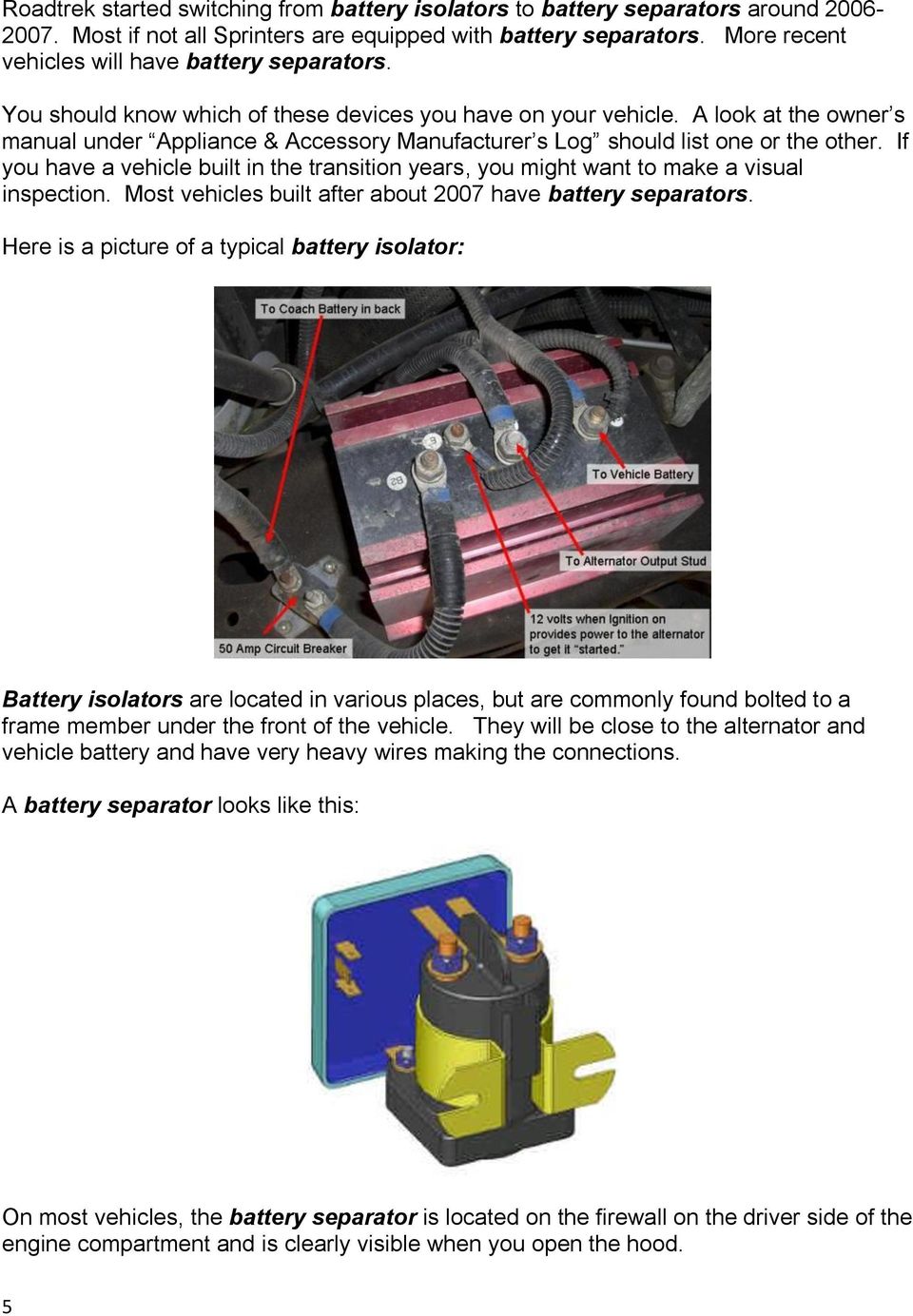
5 Roadtrek started switching from battery isolators to battery separators around Most if not all Sprinters are equipped with battery separators. More recent vehicles will have battery separators. You should know which of these devices you have on your vehicle. A look at the owner s manual under Appliance & Accessory Manufacturer s Log should list one or the other. If you have a vehicle built in the transition years, you might want to make a visual inspection. Most vehicles built after about 2007 have battery separators. Here is a picture of a typical battery isolator: Battery isolators are located in various places, but are commonly found bolted to a frame member under the front of the vehicle. They will be close to the alternator and vehicle battery and have very heavy wires making the connections. A battery separator looks like this: On most vehicles, the battery separator is located on the firewall on the driver side of the engine compartment and is clearly visible when you open the hood. 5
6 Wiring Differences In the older configurations, the inverter/charger is connected directly to the 12 volt fuse panel and loads. When the disconnect switch is open or off, the battery is not connected to the inverter/charger. This means that when the battery disconnect switch is in the off position, the battery will be completely disconnected from any loads and the vehicle could be stored for long periods of time without draining the RV battery. The obvious operational characteristic is that the 12 volt panel will be powered when plugged into AC mains power, regardless of whether the battery disconnect switch is on or off. Another not so obvious characteristic for units equipped with a Trip-Lite Inverter/Charger is that you may notice the flickering light symptom if the battery disconnect is off. Please note that other conditions can cause this symptom and they are described elsewhere in this document. On the simulator model/year drop down selector, this above configuration is labeled, direct. In the time period, Roadtrek began implementing a wiring change. Rather than connecting the inverter/charger directly to the 12 volt fuse panel and loads, it was connected to the battery bypassing the battery disconnect switch. The battery disconnect switch now disconnects the 12 volt panel and loads from the battery and the inverter/charger. The obvious operational characteristic is that the 12 volt panel will be powered only when the battery disconnect switch is on even if plugged into AC mains power. The not so obvious operational characteristic is that the inverter will operate even if the battery disconnect switch is off. Many owners have run down their RV battery because they left the inverter switch on. The wiring change was prompted by several factors. The transition to the Trip-Lite inverter created an unexpected problem because the old wiring was not compatible with the Trip-Lite. Unlike the converter / charger used in the past, the Trip-Lite will not operate correctly unless it is connected to a battery. Users would have the battery switch off and then plug in to AC mains power. The lights would flicker creating complaints. The second reason for the change was to make it possible to charge all of the batteries including the vehicle battery when the unit is plugged into AC mains power regardless of the state of the battery disconnect. This is possible because of the use of the battery separator rather than the battery isolator. The switch to the battery separator was driven in part by the problem of the vehicle batteries discharging while idle due to phantom loads. Vehicle computers and 6

7 accessories draw power even when the vehicle is off, causing the vehicle battery to run down. With a battery separator and the wiring change, a user could simply plug the unit into AC mains power and keep all of the batteries charged when not in use. On the simulator model/year drop down selector, this configuration is labeled bypass configuration. On all Roadtreks, when the vehicle engine is running, all of the batteries, both the vehicle and the RV deep cycle batteries charge. This is independent of the battery disconnect switch and the wiring configurations described above. If you are not sure which version of the wiring you have, perform the following test: With the vehicle disconnected from AC mains power and the generator not running, operate the battery disconnect. The interior lights should operate when the switch is in the on position. Turn the battery switch off and note that the interior lights not will operate. Plug vehicle into AC mains power and see if the interior lights will operate without touching the battery disconnect switch. If they will operate then you have the older direct configuration rather than the newer bypass configuration. Simulator Operation: To operate the simulator, use the drop down box labeled Model/Year to select your configuration. The first time you use the selector, you will get a warning message. The first four options allow you to select based on the above questions. The other options attempt to answer the questions for you based on the model and year. This is not completely reliable, particularly in the transition years. Some of the buttons are momentary which means that mechanically they don t stay in the same position when activated. The battery disconnect switch has two momentary positions ON and OFF. Note that if you hold either the ON or OFF button down too long, you will get a warning about overheating the coil. The inverter switch on the other hand is a bi-stable switch and remains in the position you last left it. More recent machines have a single pushbutton to control the disconnect switch and it toggles on or off when you push the button. I ve not included this behavior in the simulator, but the rest of the operation is the same. The best way to learn how to use the simulator is to push the buttons and see if it behaves as you expect. Be careful, some of this is not intuitive, so you might think there is an error, when it fact it s working correctly. It is possible that there is an error, but keep in mind that you must select the proper configuration. If you find a bug, please let me know and I will get it fixed. The simulator uses the JavaScript programming language. This is part of most browsers and it works on variety of computers. It has been tested on IE, Firefox and Safari. It is possible to run it standalone on your computer without being connected to the Internet. 7

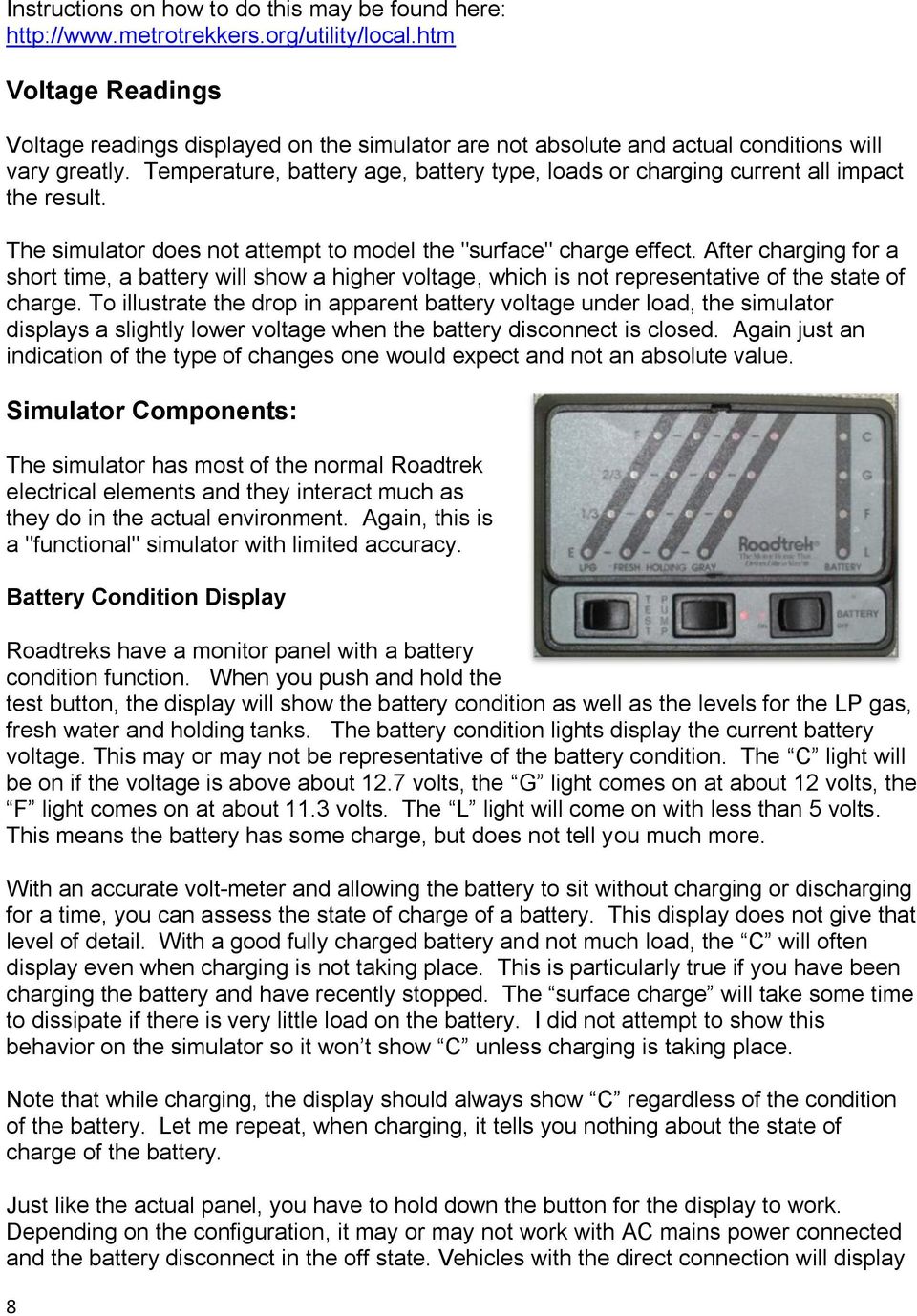
8 Instructions on how to do this may be found here: Voltage Readings Voltage readings displayed on the simulator are not absolute and actual conditions will vary greatly. Temperature, battery age, battery type, loads or charging current all impact the result. The simulator does not attempt to model the "surface" charge effect. After charging for a short time, a battery will show a higher voltage, which is not representative of the state of charge. To illustrate the drop in apparent battery voltage under load, the simulator displays a slightly lower voltage when the battery disconnect is closed. Again just an indication of the type of changes one would expect and not an absolute value. Simulator Components: The simulator has most of the normal Roadtrek electrical elements and they interact much as they do in the actual environment. Again, this is a "functional" simulator with limited accuracy. Battery Condition Display Roadtreks have a monitor panel with a battery condition function. When you push and hold the test button, the display will show the battery condition as well as the levels for the LP gas, fresh water and holding tanks. The battery condition lights display the current battery voltage. This may or may not be representative of the battery condition. The C light will be on if the voltage is above about 12.7 volts, the G light comes on at about 12 volts, the F light comes on at about 11.3 volts. The L light will come on with less than 5 volts. This means the battery has some charge, but does not tell you much more. With an accurate volt-meter and allowing the battery to sit without charging or discharging for a time, you can assess the state of charge of a battery. This display does not give that level of detail. With a good fully charged battery and not much load, the C will often display even when charging is not taking place. This is particularly true if you have been charging the battery and have recently stopped. The surface charge will take some time to dissipate if there is very little load on the battery. I did not attempt to show this behavior on the simulator so it won t show C unless charging is taking place. Note that while charging, the display should always show C regardless of the condition of the battery. Let me repeat, when charging, it tells you nothing about the state of charge of the battery. Just like the actual panel, you have to hold down the button for the display to work. Depending on the configuration, it may or may not work with AC mains power connected and the battery disconnect in the off state. Vehicles with the direct connection will display 8
9 the converter voltage instead of the battery voltage when connected to AC mains power with the battery disconnect turned off. Alternator The alternator, driven by the vehicle engine, produces power to charge, not only the normal vehicle battery, but also the RV battery. A moderate drive should be enough to charge the all of the batteries under normal conditions. Note that with isolator equipped vehicles, the alternator connections are NOT the same as a standard vehicle. The Roadtrek factory modified the production vehicle wiring to accommodate the isolator. These changes often confuse auto mechanics who work on automotive electrical systems. More than one battery and or alternator have been replaced, when in fact the problem was the isolator. The "output" terminal of the alternator will have voltage present and produce current when the engine is running. With the engine and ignition off, the "output" terminal should have no voltage present. The voltage present at the alternator terminal will be noticeably greater than the vehicle battery voltage. This is normal, but again may alarm the technician not familiar with isolator equipped vehicles. Use caution, because modern digital voltmeters do not load the circuit and it s easy to misinterpret readings. You may for example read an apparently low voltage on the alternator stud which is due to the tiny diode leakage current. This is perfectly normal behavior. Separator equipped vehicles will have changes, but will operate very similar to unmodified vehicles. Vehicle Battery The vehicle battery is a standard automotive type and is used to "start" the vehicle and operate accessories when the engine is not running. This type of battery is not designed to be "deep cycled," but rather is intended to deliver large amounts of current to the starter for short durations. In isolator equipped vehicles, the battery is connected to the alternator via the isolator, which allows both the RV battery and vehicle battery to charge whenever the alternator is active. In separator equipped vehicles, the vehicle battery is connected directly to the alternator and to the RV battery via the separator which connects the batteries together whenever the voltages present on ether battery indicates charging is taking place. 9

10 Both the separator and isolator protect the respective batteries from damage by separating or isolating the batteries from each other in operation, but allowing them to be charged when external power is available. RV battery The RV battery or batteries are special "deep cycle" types and are designed to be deeply discharged and charged repeatedly. They are not intended to deliver the high current required by the engine starter. The simulator has an RV Battery State dropdown box. You can set the battery state to FULL, POOR or DEAD. Note that if the simulator detects that the battery is "charging" the battery state will automatically change from DEAD to POOR. Deep cycle batteries always have bolt on connections with wing nuts, which distinguish them from common automotive batteries. What type of battery to use is can be a contentious discussion. The various types all have some advantages over another. The common flooded electrolyte batteries are the least expensive and if maintained properly will last a long time. Any battery if abused will have a shorter life than one properly maintained and operated. Isolator The isolator has one role and that is to allow the alternator to "charge" the RV battery, but at the same time not allow a light or some other load in the RV to drain the vehicle battery. It does this by allowing current to flow from the A terminal to either the B1 or B2 terminals, but not in reverse. This is accomplished, with some high current diodes. Current can flow from the alternator to both batteries, but current cannot flow from the vehicle battery to loads in the RV. The same is true in reverse, should you leave the vehicle headlights on, the RV battery will not get drained. There is another terminal on some isolators. This is required because many alternators need power to start working. When the ignition switch is "on," 12 volts is present on this terminal. Inside the isolator, a diode connected such that the A terminal will have power. In the normal automotive configuration, the alternator output is directly connected to the battery. Note that the alternator voltage is higher than either battery voltage when the engine is running. This is due to the natural voltage drop across the high current diode in the isolator. Since the vehicle voltage regulator senses the battery voltage, the regulator calls for slightly more than the normal voltage from the alternator to compensate. 10

11 The high current diodes will have some voltage drop when current is flowing though them. If the batteries were identical and at an identical state of charge then under charging conditions, the voltage at battery terminals B1 and B2 should be very similar. This condition would rarely be the case in practice. A more likely situation is one where one battery is at a much lower state of charge than the other. The voltage at the vehicle battery is used to control the output of the alternator and if the battery is low, then the voltage drop across the diode feeding the vehicle battery will be larger. The user then may see a higher than normal voltage on the RV battery since there will be less voltage drop across that diode due to the lower current. Again the actual readings may not seem to make sense, but in fact be quite normal. Battery Separator The Separator, like the isolator allows the alternator to "charge" the RV battery, but at the same time not allow a light or some other load in the RV to drain the vehicle battery. It will also allow the inverter/charger in the RV to charge the vehicle battery. It does this by monitoring the voltage on both batteries, if either battery voltage is 13.2 volts or higher for more than a few seconds, the separator, connects the batteries together. Should the voltage fall below 13.2 volts for more than a few seconds, it will disconnect the batteries. Unlike the isolator, the battery separator is a mechanical switch and there should be little if any apparent voltage-drop between the terminals when active. In separator equipped RVs, the alternator is connected directly to the battery and the alternator output stud will show voltage even if the vehicle is turned off. Interestingly, the battery separator consumes a significant amount of power when active. The case will become noticeably warm in operation. This is not a problem since when active; you have a source of power other than the batteries. Automatic Resetting Circuit Breakers In the diagram there are three components labeled "CB" with either 50A or 30A labels. These devices are circuit breakers which will open the circuit should there be more than the rated current flow in the circuit. They are thermally operated and after a period of cooling they automatically reset. More recent vehicles have higher current rated circuit breakers. You may wonder why there are two circuit breakers in a series connection. This is because there are power sources at both the front and back of the vehicle. A short circuit will draw current from both sources, so protection near each source provides protection. The batteries, alternator and converter/charger can deliver tremendous current and circuit protection devices are a necessity. 11

12 The third circuit breaker protects the converter/charger. There are three sources of power driving the same conductor. Again a protection device is needed to remove this source of power should a short circuit arise. Onan Generator The system has a 2.8KW generator which produces 120 volts AC. The generator is directly connected to the RV battery and has a remote control panel to start and stop the unit. If the RV battery has enough charge, it will start the generator regardless of any other conditions in the vehicle. In the simulator, the current to the generator starter is shown when the battery has some charge and the start button pushed, but the generator won t start if the battery condition is poor. When running, the simulator changes the color of the generator from blue to green and a message appears above the block indicating the status. The generator uses the RV battery for starting and control. The generator has a very low current charger and when running will produce a small amount of current to charge the battery. It produces 1 amp maximum. However when the generator produces 120 volts it will charge the battery at a high rate due to the operation of the converter/charger using AC mains power provided by the generator. Depending on the configuration, the battery may or may not change based on the battery disconnect state. Prior to the introduction of the Tripp-Lite converter/charger, the converter charger would not charge the battery very fast. The Tripp-Lite is a much more sophisticated variable rate charger and can charge at a much higher rate. Running the vehicle engine is the fastest way to charge a depleted RV battery. Running the engine for 30 minutes will make a significant difference in the condition of the RV battery. Note that if the RV battery is extremely low, you may demand more current than the circuit breakers will allow during the initial charging. For the best battery life, one should never discharge the batteries completely. Automatic Transfer Switch The generator AC output connects to the RV 120 volt electrical system via an electrically operated switch. When the generator voltage comes up, it will operate this switch after a short delay, connecting the generator output to the RV systems. This delay protects system components from the unstable generator output during startup. The voltage and frequency varies widely at startup. Note that when the generator is not running, the RV electrical panel connects to the AC mains power cord. The transfer switch prevents feeding power back into the AC mains power connector and utility grid. Cord for AC mains Power Connection The simulator has provision for the user to indicate if the RV is connected to a source of AC mains power. When connected, AC mains power is available to the system. Note that the generator output controls the automatic transfer switch, so even is AC mains power is available, if the generator is running, it carries the load. When connected to AC 12

13 mains power, the "connection" appears and the wires turn red indicating the presence of voltage. RV 120 Volt AC Fuse Panel and Loads This block represents the RV AC electrical system and changes green when AC mains power is available either from the generator or AC mains power. 120 volt to 12 volt Inverter/Charger Converter Roadtreks built before about 2005 have a converter which converts the 120AC to 12 volts to run the various 12 volt accessories. Some have a separate inverter to run a TV or VCR. Roadtreks built after about 2005 have the Tripp-Lite combination Inverter / Charger. The Inverter part of the block will produce a limited amount of 120volt power (750watts) using the battery as an energy source. This Inverter is connected to the 120 volt outlets in the galley and the entertainment closet. When external power is available, either from the generator or AC mains power, these outlets connect directly to that source. Depending on the settings on the Trip-Lite, the maximum load may be limited due to the charger demand. Consult the Trip-Lite manual for details. The inverter behavior under low voltage and the presence of AC mains power is modeled in the simulator. If the battery condition is POOR, the inverter will not operate. When external power is available, the inverter is inactive. With a FULL battery and no external power, the inverter will operate. Note that when it s on, it draws some current from the battery. The inverter has a "load" detection function which can automatically turn the inverter on should a load be present. I ve not modeled this feature. When connected to external power or a battery with some charge, the low voltage DC wires turn red indicating the presence of DC voltage. If AC mains power is connected with the battery disconnected, the inverter/charger will supply power and the low voltage loads will work if you have the direct connection configuration. Note that the inverter/charger may be unstable and the lights may flicker due to the no battery connected condition. You should not operate the system in this way. If you have the direct connection configuration and connect AC mains power without turning on the battery disconnect first, it may demand more current than the converter can provide when you turn on the battery disconnect. A warning message will appear under this condition. This condition can be avoided by switching the battery "on" before attaching AC mains power or turning on the generator. 13

14 Note that the battery disconnect is "powered" from the RV battery and if the battery is dead, you cannot operate the switch. Starting the vehicle will charge the battery a bit changing the RV battery state from "DEAD" to "POOR." Battery Disconnect This is a curious device. Unlike a typical relay, it only needs power to open or close. The relay "latches" in the on or off state. The simulator shows the four possible states. The coil is energized to close the switch, in this case, the coil pulls the armature in and a permanent magnet above is "attracted" to the coil, when the power is released the magnet prevents the armature from moving back. To "open" the relay, you reverse the connections to the coil and this deflects the magnet away from the armature. When the coil is de-energized, the armature can move and the circuit is broken. Note that if you "push" and "hold" the rocker switch in the "off" position, the battery disconnect is closed while you hold the switch down. Holding the on or off button on the monitor panel down for more than a brief period can overheat the battery disconnect and damage the device. As of this revision, Roadtrek has begun using a new type of disconnect which works a little differently. This device has one momentary, pushbutton switch and the disconnect cycles from on to off when depressed. Vehicle Battery Leakage Current In recent years, the GM vehicles have much higher battery demand when not in use. This has drastically shortened the time the vehicle can be stored before the vehicle battery runs down. A certain amount of current is required to retain the memory contents of the engine control computer in addition to the normal "self discharge" characteristic of Lead Acid batteries. Older vehicles drew about 12 milliamps when idle and can easily be started after 5 or more weeks of inactivity. Anecdotal reports from others who have measured the idle current demand for more recent GM vehicles is about 5 times that amount or about 60 milliamps. The idle time possible has been reduced to about a week. GM seems to think this does not matter since most of these vans are in commercial service and don t sit idle. Roadtrek addressed the problem of the vehicle battery going dead while parked by replacing the isolator with a battery separator. The isolator allowed the vehicle alternator to charge the RV battery whenever the vehicle was driven, but did not provide for charging the vehicle battery when connected to AC mains power or running the generator. The battery separator accomplishes this by connecting both batteries together 14

15 whenever the voltage on either the vehicle battery or the RV battery exceeds about 13 volts indicating that charging is taking place. Oddly enough all is not free, the battery separator typically draws about 10ma while idle increasing the load. It s not clear from the documentation which battery carries the load, but I suspect it s probably whichever one has the higher voltage. I m of the opinion that with the older vehicles the isolator is probably a better choice since it does not add to the leakage problem. Summary: So, in summary there are 4 configurations covered by the simulator: Isolator equipped with converter directly connected to 12 volt loads Separator equipped with converter directly connected to 12 volt loads Isolator equipped with converters which bypass the battery disconnect. Separator equipped with converters which bypass the battery disconnect. This is a "work-in-progress" and there are very likely a few bugs and it may not work correctly. Finally, it is a basic "functional" simulator and does not model real detail. Beyond the states of the various switches and a dead, poor and fully charged battery, it does not understand other conditions. Troubleshooting Tips and Common Questions Here are a number of situations and possible solutions. Remember a set of symptoms is just that a set of symptoms and the actual cause may not be the same as the one described. The generator dies as soon as I release the starter switch. The generator has an oil level interlock which will inhibit the ignition when the oil is low. So check the oil level first. While you hold the starter switch down, the generator fuel pump and ignition lockout are powered from the battery. When the switch is released, the controls are running off the generator output. There are several things which can create this problem including the control board, regulator board and dirty slip rings. The Onan service manual which can be found on the Onan website has a troubleshooting guide which is very helpful. I learned recently that Onan has stopped using the oil level sensor on more recent models due to the inability to get a reliable unit. You can tell if the engine fires when holding the start button down. If it fires then the oil level sensor is not at fault. 15

16 The generator won t start The fuel pickup in the gas tank is set high to keep you from running your vehicle tank completely empty. So if the fuel level is low, the generator won t run. It takes a fair amount of current to operate the generator starter, if the RV battery is weak it may not have enough reserve capacity to run the starter. Starting the vehicle will provide extra current via the isolator or separator. The generator runs rough and surges Unfortunately this is often indicative of a generator which has not been run and deposits have built up in the carburetor. There is lot of anecdotal discussion about various fuel additives to resolve the problem. In the end it may require replacement of the carburetor. Where can I find more information about the generator? At the time of this writing 12/16/2012 these documents were available on the internet. Owner s Manual Service Manual Troubleshooting Guide Be careful, there are several versions of the basic KV series of Microlite models and it s necessary to consult the nameplate to figure out exactly which version you have. My generator runs on propane, do I have to exercise it? Obviously varnish buildup will not be a problem, but the generator slip rings are copper and they will tarnish, running the generator will keep them clean. Also moisture can build up in the generator and running it under load will dry out the equipment. Finally you really want to know it it s going to work when you need it, so regular exercise is a great practice. How long should I exercise the generator? Onan recommends 2 hours at half the rated load every month. An electric heater makes a nice load. Most of the small heaters are between 1000 and 1500 watts. After stopping for a time with the refrigerator on DC, the vehicle battery has run down. The refrigerator when running on DC requires a lot of current. This mode of operation is really only intended when you are traveling and can t run it on propane. This is a very heavy load and will quickly drain the RV battery. The isolator or separator should protect the vehicle battery from discharge if the refrigerator is left on. If this happens, the system is not operating correctly. Someone 16

17 may have bypassed the device isolator effectively connecting both the RV battery and the vehicle battery together. This was probably a forgotten temporary repair. Isolators do fail and more often than not fail in the open condition, which prevents one or both batteries from charging. My machine is possessed; the RV lights will be on and suddenly go out only to come back on again. The devices in your machine can demand a lot of current. The wires connecting these devices to the battery have to carry the current. If you have corrosion on the battery terminals this can create a fuse or a poor connection which will open under high current turning off the lights. This broken connection will often heal and then the process may repeat erratically. If the battery is low and the vehicle is connected to AC mains power or the generator, it may behave also behave erratically when this happens. A bad battery can have intermittent internal connections, but this is less common. A poor connection can happen anywhere, but will most likely occur at the battery due to the corrosive conditions at the battery. The circuit breaker between the converter charger and the battery can fail or become intermittent and create the flickering light symptom. The lights vary from dim to very bright while running on AC mains power. The converter/charger may not operate properly unless connected to a battery. The Trip- Lite units will not operate properly unless connected to a battery. If you have the bypass configuration, the converter is always connected to the RV battery and by extension of the separator to the vehicle battery. Combinations of problems with poor connection or intermittent circuit breakers can be very daunting. The no battery connected condition can occur due to any number of problems and make inverter/charger unstable. The older converters can shut down due to over current if you plug in first and then switch on the battery in directly connected configurations. This usually happens if the RV battery is very low and demands a lot of current when you make the connection. If the battery is charged, it does not demand much current and you won t notice a problem. The Trip-Lite inverter/chargers are complex devices and you should read the manual carefully. If set for high charge rate, they can deliver as much as 50 amps. Some of the older rigs have 30 amp circuit breakers between the Trip-Lite and the battery, under this condition the circuit breaker can open creating the no battery conditions and the dreaded flickering lights. You should always turn on the battery switch before connecting to AC mains power or starting the generator. If the 12-volt lights don t work when you do this you have a problem which needs to be corrected. Everything is great until I stop and hook up. After awhile the lights go dim. The only way to get them back is to start the engine. When you are connected into AC mains power, you should be running off the inverter/charger and the battery should be charging. The monitor panel should show C. If the converter charger is not operating, you are running off the RV battery even 17

18 though you are plugged in. First, make sure you have AC mains power. Check the microwave display. If that s okay, then check the AC mains circuit breakers by cycling them on and off. If that does not solve the problem then the inverter charger is not working and needs to be checked out. The mechanic replaced both the alternator and the battery, but the battery still runs down. In an isolator equipped vehicle the charging current must travel through the isolator. If the isolator is bad, the battery won t charge. The output of the alternator will show a higher than normal voltage because of the voltage drop across the diode in the isolator. This is normal. In addition, there may be some additional circuitry unique to an isolator equipped vehicle needed to start the alternator. If this circuitry is not working correctly, the alternator won t work. The schematic in the Roadtrek owner s manual covers these connections. Show this to the mechanic. The vehicle battery runs down in only a week, Is this normal? GM thinks it s normal. The newer vehicles draw 5 times the previous idle current to keep the accessories alive which limits the standing time to about a week. With a separator equipped vehicle, you can just leave it plugged in and that will solve the problem. Be sure to have the battery switch in the on position if you have the direct connection. If you don t have a separator, then all you can do is start the vehicle once a week or add a battery charger. You could add a battery switch, but the vehicle will forget all the learned engine settings and it will run poorly until it relearns the proper settings. A real bummer! I was told not to leave the vehicle plugged in when not in use If the battery charger is working properly, the batteries will not be damaged by leaving the vehicle plugged in. In fact the batteries will be damaged if you allow the batteries to run down completely. Completely discharged batteries will freeze in cold weather and the case can crack. A malfunctioning charger can overcharge the battery and boil out the electrolyte, but this is abnormal and should be corrected immediately. The RV battery is new, but when I dry camp, the battery runs down too fast. Think green, if you turn on all the interior lights and run the exhaust fan on full tilt, you will not get as much run time as you will if you conserve. The Interstate battery website says that for a group 27M battery you can run for 17 hours at a 5 amp load. 5 amps at 12 volts is only 60 watts. That s not much when you consider the output of a typical 100 watt light bulb. This is of course the reason many rigs have two batteries, but that only doubles the low starting number. I can plug in and the lights work, but it won t work on battery, I think the battery disconnect is bad. 18

19 It could be a bad disconnect, but you need to check a few things first. When you operate the switch, you should hear a clunk sound from the disconnect switch. If it does not make any noise, then be sure it s getting power. There are two fuses on the disconnect switch, the one on the battery side provides power to the disconnect switch control circuit. The monitor panel has the battery on/off control switch and these do fail. With a known good test light or DVM, check for voltage across the disconnect coil while an assistant clicks the switch. If the disconnect has been overheated, the mechanism may be bound up due to the heat. Will a solar panel solve my dry camping run-time problem? A solar panel will help, but you will still have to conserve. It takes a big panel to produce a 100 watts and it only produces that level in full sun. If you get 4 hours of full sun, that about 0.4 kilowatt-hours. Running your vehicle for 30 minutes can easily produce that much energy. I d spend my money on LED lights before I added solar panels. It s interesting that the separator draws power and I suspect if one implemented a solar charger, you would want to keep the separator from activating and using up precious watts! The Battery Warning Light Came on suddenly, while driving Normally this means a bad alternator, broken or slipping fan belt. However, in an isolator equipped vehicle, this can also happen when the isolator fails. The alternator output must flow through the isolator and then to the batteries. If the path between the isolator and the vehicle battery no longer functions, you will get this light. Don t delay getting it fixed, because the alternator may be producing excessive voltage and overcharge the coach battery. This can quickly damage the batteries because the electrolyte can literally boil away. This happens because the alternator senses the low vehicle battery voltage and thinks it s not working hard enough and cranks up the output. An emergency workaround is to use a heavy jumper and bypass the isolator connecting the alternator output directly to the vehicle battery. This requires a hefty jumper, because the current can be more than 100 amps. You should promptly get the isolator replaced. How do I diagnose the Battery warning Light Problem? (Isolator equipped) As stated earlier, it s difficult to give precise voltage readings because what you get depends on a lot of factors including the temperature the condition of your batteries and even the engine RPM. Even your voltmeter accuracy comes into play. The surface charge effect can confuse as well. A battery which has just been taken off charge will read a higher than normal voltage until the electrolyte reaches equilibrium. The same is true for a battery, which has been discharging at a heavy rate, when your remove the heavy load, the voltage will be lower than normal and return to a value based on its state of charge after a period of time. 19

20 Don t jump to conclusions with limited information. The warning light usually indicates that the voltage at the battery is too low and the battery is not charging. The voltage needs to be least 13 volts to charge the battery. It can be low for a number of reasons: 1) Alternator is defective 2) Slipping belt 3) Alternator wiring problem, regulator connection and warning light circuit. 4) The special starting circuit for the alternator has failed. (Isolator equipped vehicle.) 5) The connection between the alternator output and the isolator is open. 6) Bad isolator; an open internal diode between the vehicle battery terminal and the alternator terminal or an open diode between the E terminal and the alternator output terminal. (Note that this diode connection is such that current can flow from the E terminal to the alternator terminal, but not in reverse.) 7) The connection between the isolator battery terminal and the battery is open. 8) Alternator is current limited due to excessive loads or because it s damaged. If the house batteries are discharged, all of the loads may be more than the alternator can deliver. If the dash battery warning light comes on, I would first measure the voltage at the vehicle battery with the engine running to verify that the voltage is in fact low. If it is low, I would then shut off the engine and then attach a meter wire lead to the alternator output. In an isolator equipped vehicle, this is connected to A terminal on the isolator. There is an annotated picture of an isolator on page 2 of this document. If you have a battery separator, then the alternator output connects directly to the battery just like a normal vehicle. There may be an open fusible link in the wiring harness between the alternator output and the battery. Connect the other meter wire lead to a bare metal part on the frame. This can be a challenge; you can probably find a wire attached to the chassis or connect it to the negative terminal of the battery. Use alligator clips so you don t have to hold them on. Crawling under a running vehicle to make a measurement is dangerous and not necessary. Start the engine and make the measurement. This alternator output and the battery should be connected by a diode in the isolator and if the alternator is working will be about 1 volt greater than the battery voltage when the engine is running. So if the battery is reading about 13.5 volts I would expect the alternator to read around 14.5 volts. Again the actual voltage can vary, but the difference should be about 1 volt. If the diode has failed open it will read much higher. In the case of an open diode between the A terminal and the vehicle battery the voltage may be 20 volts or more with the engine at idle. 20

21 Measure the house battery voltage at the isolator with the engine running, it should also be about 1 volt less than the alternator output. If it s much less, (Battery voltage more than 1 volt less than the alternator output) then that side of the isolator is bad and it s not charging the battery. Careful, because if the RV is plugged in and the converter charger is charging the battery it might be the same or more! So perform the test with the RV unplugged and the generator off. Note that the actual voltage drop is a function of how much current is being drawn by each side. With very little current, the voltage difference might be only.7 volts but as it goes up the voltage drop will increase, but should not be much more than about 1 volt. If the house battery is very low, you might see more drop than on the vehicle battery and the reverse would be turn if the vehicle battery is low. The reason the isolator is so large is that this voltage drop creates lots of heat when you have high charging currents. If the alternator output is much lower than the battery voltages, this does not indicate that the isolator is bad. If the alternator output voltage is very low or even 0 with the engine running, it may be that the special starting circuit has failed. There is a fourth terminal on the isolator which is connected to the wiring such that it has battery voltage when the ignition switch is in the Run position. This delivers battery voltage via a diode in the isolator to the alternator output. This is necessary for the alternator to start working. Connect your voltmeter to this fourth terminal and check for battery voltage with the ignition switch in the run position with the engine not running. If you don t have battery voltage here, then you need to trouble shoot this wiring. There may be a relay and a circuit breaker depending on the model. If the voltage is present and there is no voltage present at the alternator output connection on the isolator, then the diode in the isolator is open. Caveats; the wires and connections have resistance, with a lot of current you will see voltage drops between the source of the energy and the load. So if the batteries are really low and you are drawing lots of current, the voltage at the house battery will be less than at the isolator. There are circuit breakers between the isolator and the house battery. In my unit they are rated at 50 amps. Under heavy charging, they might open and then the battery voltage would read lower as if the isolator was bad. This is not an isolator problem and they should close after they cool off. If the house battery is really low, you should charge it by plugging into AC mains power. Don t condemn the isolator until you are sure you are interpreting the results correctly. With the isolator disconnected, you can use an ohmmeter to check the diodes, but the best way is under load on the vehicle. Your ohmmeter may have a diode check function depending on the model. If this is the case, the normal ohmmeter function may not have enough voltage to switch on the diode and you may think it s open. Switch the meter leads and you should see it conduct one way and not the other. A-B1 should conduct with A more positive and B1. A-B2 should behave the same way. E-A should 21
22 conduct when E is more positive than A. B1-B2 should not conduct either way. You can use a battery operated test light to check the diodes as well. Connecting a jumper between the alternator connection and the vehicle battery connection on the isolator essentially returns the vehicle to the typical vehicle configuration and bypasses the diodes in the isolator. Now the voltage at the battery and the alternator should be about the same. It s been reported that with a discharged house battery, the battery light may come on when running the engine. In this case, the alternator can t deliver the high current demanded by all of the loads including the vehicle loads and the batteries. As a result the voltage falls and the light comes on. This is abnormal and the alternator is likely delivering all the current it can. The current follows the voltage, the higher the voltage, the more current the alternator delivers. Effectively it s browning out because it can t produce the power demanded at the normal voltage. The maximum current is limited by the design of the alternator. Operating the alternator at maximum output is hard on the equipment and can lead to early failure. Under this condition, I would expect the alternator output to still be about 1 volt greater than the battery voltage indicating that it is producing power and delivering current to the loads. Not all alternators are created equal and some produce more output than others. You could have an alternator, which appears to work, but is damaged and cannot produce full output. Roadtreks are normally equipped with a high output alternators to handle the demands. When a battery discharged, it will demand a lot of charging current, but this usually falls off fairly quickly as the battery charges. Running batteries very low is a recipe for early failure of the batteries and perhaps other components as well. A DC clamp on ammeter which is very useful in troubleshooting such problems. Normally to measure current you have to break the circuit, but with this type of meter you clamp it around the wire to measure the current. Be sure and get one which measures DC current, since they are less common than AC only clamp on meters which won t help in DC circuits. Knowing the voltage is only half the story, the current and the voltage will help you understand the situation in much better detail. Isolators are solid state devices and can have variable life spans. They can easily last the life of the vehicle. If they are operated very near their capacity they will get hot and heat kills electronics. Momentary short circuits can instantly open the diode in an isolator and it becomes an expensive fuse. General Troubleshooting Tips 22
23 Systems operating in failure mode can behave in very strange ways! The situation is not normal and the goal is to figure out why. It s important to examine the conditions and think about the problem before blindly diving in. What combination or conditions could create the condition I am observing? Digital voltmeters DVM are wonderful tools, but they can mislead. A voltmeter draws a tiny amount of power from a circuit. You may in fact have a very poor connection or even a sneak circuit which may mislead you. A 12 volt test light can be very useful because it loads the circuit. The ohmmeter function of a DVM can only be used on dead circuits. At best, you won t get the correct results and at worst, you will ruin your meter. There may be residual energy or capacitors present which can really be confusing. Measuring a diode requires enough voltage to activate the diode, the ohmmeter function may not provide enough voltage to do this. Many DVMs have a diode check function just for this purpose. With all the plastic, paint, dirt, corrosion etc, it can be difficult to make a connection. Be sure you really have a connection! Most meters come with needle probes, which are fine, but you have to hold both of them in place to make a measurement. Don t limit yourself to the probes; accessories like alligator clips and jumper leads can make life much easier and safer! Yes 12 volts won t cause a shock, but the current can burn wires can destroy components in an instant. A temporary test connection might create other problems, so consider carefully what you are trying to do. Both voltage and current are required to do the work of lighting a lamp, running a motor or charging a battery. Knowing both the voltage and the current will speak volumes about what is really occurring. If voltage is present and current is flowing, work is being done and that work might be heat! Measuring current in DC system usually requires that the circuit be broken to insert a current meter. A clamp-on DC amp-meter makes this unnecessary. Make sure the meter you buy makes both DC and AC current measurements. Clamp on DC amp-meters can be fickle devices and are not terribly accurate. They are sensitive to stray magnetic fields and must be zeroed when you use them. They typically don t measure small currents very well. Make some measurements when things are operating correctly and verify that you get the results you expect. Replacing an expensive part only to have it fail immediately because of another problem is quite annoying! So think, check and verify. Walking away from the problem for a few minutes or hours can work wonders. 23
24 Closing Comments: I have spent more time on this than I should, but it s like working a puzzle, it s fun, but there are other chores I need to be addressing. I will be happy to add features as time permits and I will fix any bugs promptly if they are brought to my attention. Let me know what you think and if you have any suggestions for improvements. John Slaughter [email protected] V Chevy Revisions 8/9/15 Made extensive changes to clarify some of the wording and corrected some of the typos. Please report any errors and I will get them fixed. 6/12/13 Made changes to wording about the bypass mode and direct connections. Thanks to Cecil Hayes for the suggestion. Changed the battery type to Group 27M and adjusted the run time at 5 amps. Added some notes about clamp-on amp-meters. Expanded notes on the Onan oil level sensor. 12/15/12 Added notes about the Onan generator and corrected a comment about the generator battery charger. Added some reference links for the Onan generator. Removed an erroneous battery capacity value. Some minor cleanup of the text. Fixed a bug on the simulator so it now displays the converter instability message when the generator is started or the AC mains power connected with the battery disconnect off for direct configurations. 11/29/11 Cleanup of the document and some additional troubleshooting notes. 11/28/11 Modified the simulator to display a warning if the battery switch is held down too long. Changed the logic to always display a warning for direct connected configurations when connecting to AC mains power with the battery switch off. Added a warning in the text about holding the buttons down. Added a discussion about the Trip-Lite configuration. Some cleanup of the text. 5/30/10 Added a discussion about battery warning light and isolator diagnostics. 5/29/10 Updated the Notes 4/30/10 General release after user review. 4/19/10 Fixed a bug where inverter would not discharge RV battery with the switch on and low voltage on one of the configurations. I m not sure how much current it will draw under this condition, but leaving the inverter switch on will drain the battery on the bypass configuration. Added a note to the screen about voltages to avoid confusion about absolute values. 24
25 4/18/10 Major revisions to the notes and corrected the simulator to reflect the four configurations described. Added battery monitor panel display function. 4/5/10 Fixed a bug where the converter trace would show red with no voltage. 4/1/10 Changes added to provide for direct connection of converter/charger/inverter to the battery. 3/4/10 Added logic to model the behavior of the Battery Separator equipped vehicles. 3/16/09 Corrected a few minor errors in the notes. 3/15/09 Moved all of the buttons to the left side so users won't miss them if they are using a small screen size. Corrected a bug in the way the inverter switch works. The switch state did not reflect the state table because of the message. Now the state table can only change if the inverter can be turned on. 2/22/09 Fixed the style so the text can be made larger easily. Corrected a problem with the alignment so the simulator will work correctly with FireFox and Safari. 2/21/09 Added "voltage" readouts at various points in the diagram as an indication of possible readings under various conditions. 2/13/08 Clarified battery charging under generator operation. Modified the simulator to display alerts explaining why an action did not have the expected result. Fixed a bug which did not reflect the proper switch status if the user moved the mouse pointer off while holding the button down. 2/4/08 Removed sound effects so application will load faster. Changed the 12 volt on graphic to show the function of the red light on the monitor panel. Made a few changes to clarify the explanations. 25
Electrical System From The Top Down By Rick Denney, GMC Eastern States April 2006
 GMC Motorhome Electrical System From The Top Down By Rick Denney, GMC Eastern States April 2006 The electrical system of the GMC is fairly simple when considered as a system, but it s easy to get lost
12 Volt 30 Amp Digital Solar Charge Controller
 12 Volt 30 Amp Digital Solar Charge Controller User s Manual WARNING Read carefully and understand all INSTRUCTIONS before operating. Failure to follow the safety rules and other basic safety precautions
User Manual HomeGrid 3000 Solar Generator
 User Manual HomeGrid 3000 Solar Generator For more information and instruction videos visit: www.pointzeroenergy.com/learn/videos/ HomeGrid 3000 Solar Generator Congratulations on purchasing Point Zero
The Charging System. Section 5. Charging System. Charging System. The charging system has two essential functions:
 The Charging System Charging System The charging system has two essential functions: Generate electrical power to run the vehicle s electrical systems Generate current to recharge the vehicle s battery
Automatic taper of charge rate for superior battery life through good equalization of cells and low water use rate.
 *00151* FEATURES Automatic taper of charge rate for superior battery life through good equalization of cells and low water use rate. Silicon diodes with inherent surge protection operated at a conservative
6 & 12 Volt Battery and Systems Tester with 100 Amp Load
 6 & 12 Volt Battery and Systems Tester with 100 Amp Load Form No. 841-731 -000 DESCRIPTION This Load Tester tests 6 or 12 volt automotive-size lead-acid batteries under load. It will also test 6 or 12
If you accidentally get battery acid on your skin, flush it with lots of water
 RV Battery Savvy To properly maintain and extend the life of your RV batteries you need to have a basic understanding of what a battery is and how it works. Batteries used in RVs are lead acid batteries.
EVANS ELECTRONIC TEMPERATURE CONTROL TROUBLESHOOTING GUIDE for systems equipped with electric coolant valve and external PC board.
 EVANS ELECTRONIC TEMPERATURE CONTROL TROUBLESHOOTING GUIDE for systems equipped with electric coolant valve and external PC board. This Troubleshooting Guide covers the electric coolant valve and control
PUSH BUTTON START INSTALLATION MANUAL
 PUSH BUTTON START INSTALLATION MANUAL ALTHOUGH THIS PRODUCT HAS BEEN THOROUGHLY TESTED KPIERSON TECHNOLOGIES ASSUMES NO RESPONSIBILITY FOR ANY DAMAGE THAT MAY RESULT BY THE INSTALLATION OF THIS PRODUCT.
SERVICE MANUAL FOR 12 VDC WALL THERMOSTAT AIR CONDITIONING SYSTEMS ROOF TOP UNITS ONLY
 RV Products Division SERVICE MANUAL FOR 12 VDC WALL THERMOSTAT AIR CONDITIONING SYSTEMS ROOF TOP UNITS ONLY Airxcel, Inc. RV Products Division P.O. Box 4020 Wichita, KS 67204 1976A376 (1-11) TABLE OF CONTENTS
3000W Power Inverter
 3000W Power Inverter OWNER S MANUAL Model number-4573000 TO REDUCE THE RISK OF INJURY, USER MUST READ AND UNDERSTAND THIS INSTRUCTIONAL MANUAL. THIS MANUAL CONTAINS IMPORTANT INFORMATION REGARDING THE
INSTRUCTION MANUAL FOR RECREATIONAL REFRIGERATOR/FREEZER MODEL
 INSTRUCTION MANUAL FOR RECREATIONAL REFRIGERATOR/FREEZER MODEL 15-LITER, 20-LITER, 35-LITER, 45-LITER, 60-LITER & 100-LITER SECTION 1 Basic Operation SECTION 2 Cleaning and Storing SECTION 3 Basic Trouble
BATTERY CHARGER OWNER S MANUAL
 SAVE THESE INSTRUCTIONS This manual contains important safety and operating instructions for the automatic battery charger. Do not expose charger to rain or snow. Do not use and an attachment not recommended
Odyssey of the Mind Technology Fair. Simple Electronics
 Simple Electronics 1. Terms volts, amps, ohms, watts, positive, negative, AC, DC 2. Matching voltages a. Series vs. parallel 3. Battery capacity 4. Simple electronic circuit light bulb 5. Chose the right
400 Amp Rechargeable Jump Start System RAC-HP082
 400 Amp Rechargeable Jump Start System RAC-HP082 MAINTENANCE Always inspect the tool before use to ensure the cables are in good condition and the clamps are clean and free from corrosion. Keep clean by
GENERATOR START CONTROL MODULE - MINI (2 Wire to 3 Wire)
 FEATURES & APPLICATIONS Inexpensive 2 wire to 3 wire start controller for electric start high speed gas generators. Optimized for use with Outback Invertors. Supports three types of 3 wire generator control
Essential Electrical Concepts
 Essential Electrical Concepts Introduction Modern vehicles incorporate many electrical and electronic components and systems: Audio Lights Navigation Engine control Transmission control Braking and traction
Battery Power Inverters
 Battery Power Inverters Renogy 500W 1000W 2000W Pure Sine Wave Inverter Manual 2775 E. Philadelphia St., Ontario, CA 91761 1-800-330-8678 1 Version 1.1 Important Safety Instructions Please save these instructions.
INSTALLATION & SERVICE MANUAL. Display Panel
 INSTALLATION & SERVICE MANUAL Display Panel The PowerLine EMS TM is a specialized power distribution and energy management system intended to be used in recreational vehicles. The Control Module is housed
The Starting System. Section 4. Starting System Overview. Starter. The starting system:
 The Starting System Starter The starter motor drives the engine through a pinion gear that engages the ring gear on the flywheel. Fig. 4-01 TL623f401c Starting System Overview The starting system: Uses
Troubleshooting Guide, Freedom and Fleet Power Inverter/Chargers
 Technical Note Freedom/Fleet Power 512-0084-01-01 Rev 1 Troubleshooting Guide, Freedom and Fleet Power Inverter/Chargers Overview This document is a guide for troubleshooting inverters, battery chargers,
26 3213.13 Diesel Engine Driven Generators Page 1 of 6
 Last Update: December 8, 2014 A. Description of System Consultant s Handbook Page 1 of 6 1. Provide a diesel engine driven electric generating unit, factory assembled, tested and certified to operate at
OWNER S MANUAL. Model AE150/AE300/AE500 1.5AMP MULTI-USE SMART BATTERY CHARGER READ ENTIRE MANUAL BEFORE USING THIS PRODUCT
 Model AE150/AE300/AE500 MULTI-USE SMART BATTERY CHARGER Certified by Californiia BCS Regulations AE300E AE500E 5AMP MULTI-USE AUTOMOTIVE BATTERY CHARGER 3AMP MULTI-USE SMART BATTERY CHARGER AE500E 5AMP
TROUBLESHOOTING GUIDE
 TROUBLESHOOTING GUIDE LESTRONIC II BATTERY CHARGER FOR MOTIVE POWER BATTERIES PLEASE SAVE THESE IMPORTANT SAFETY AND OPERATING INSTRUCTIONS For correct operation of the equipment, it is important to read
POWER TO GET THE JOB DONE
 52720 1.5 AMP SLOW 12 VOLT BATTERY CHARGER OWNER S MANUAL KEEPS BATTERIES FULLY CHARGED IN STORAGE Automatic over-charging protection Short circuit protection Reverse hook-up protection Overheat protection
COOL-01, Cooling Fan Operation and Troubleshooting
 COOL-01, Cooling Fan Operation and Troubleshooting Table of Contents Introduction Early 944s With Air Conditioning Cooling Fan Operation On Early 944s With Air Conditioning Testing Fan Relay One Early
SERVICE MANUAL 12VDC WALL THERMOSTAT AIR CONDITIONING SYSTEMS ROOFTOP UNITS ONLY
 SERVICE MANUAL 12VDC WALL THERMOSTAT AIR CONDITIONING SYSTEMS ROOFTOP UNITS ONLY! WARNING - SHOCK HAZARD! TO PREVENT THE POSSIBILITY OF SEVERE PERSONAL INJURY, DEATH, OR EQUIPMENT DAMAGE DUE TO ELECTRICAL
The Child Reminder System Installation Manual
 The Child Reminder System Installation Manual Revised June, 2006 Detailed installation information can be found at www.childreminder.com. Get through your installation quickly and easily by calling 1-888-330-6786
Honda's Dual-Mode Charging System
 Southern Illinois University Carbondale OpenSIUC Presentations Department of Automotive Technology 10-1-2009 Honda's Dual-Mode Charging System Omar Trinidad Southern Illinois University Carbondale, [email protected]
PV (photovoltaic) Basics There are generally two types of PV systems. The first and easiest (though the least flexible) is a grid tie system where
 PV (photovoltaic) Basics There are generally two types of PV systems. The first and easiest (though the least flexible) is a grid tie system where the power generated by the solar panel (panels) runs an
PENNTEX FOUR-STEP CHARGING SYSTEM TEST AND GENERAL INFORMATION FOR ANY PENNTEX SYSTEM EXCEPT 2009-UP FORDS WITH A PX-7000 VOLTAGE REGULATOR
 PENNTEX FOUR-STEP CHARGING SYSTEM TEST AND GENERAL INFORMATION FOR ANY PENNTEX SYSTEM EXCEPT 2009-UP FORDS WITH A PX-7000 VOLTAGE REGULATOR PennTex Industries, Inc. is a manufacturer of Heavy Duty Charging
Dear Neuton Owner, This is a helpful hint to guide you in getting the most out of your NEUTON Battery and Charger.
 Battery-Powered Mower NEUTON 24-Volt Charger Instructions Booklet Dear Neuton Owner, In order for you to get the most out of your Neuton Mower, we recently reviewed and revised our battery-charging instructions.
3 WATT LED SPOTLIGHT Model No. SLM - 3801
 3 WATT LED SPOTLIGHT Model No. SLM - 3801 OWNER'S MANUAL Customer Service Tel: 1-800-268-3319 Superex Canada Ltd, Toronto,M2H 3B8 Made in China Table of Contents A). Important Safety Instructions B). Charging
Arc Fault Circuit Interrupters Frequently Asked Questions
 Contents My AFCI is tripping! What do I do? What is the difference between branch feeder and combination type Arc Fault Circuit Interrupters? What is new with the 2008 NEC versus the 2005 NEC with respect
GROUND DETECTION CIRCUITS FOR STATIONARY APPLICATIONS (IN PLAIN DOWN TO EARTH LANGUAGE)
 GROUND DETECTION CIRCUITS FOR STATIONARY APPLICATIONS (IN PLAIN DOWN TO EARTH LANGUAGE) Matthew Theriault Designer Hindle Power Inc. Easton, PA SCOPE AND PURPOSE OF THE PAPER Why do we bother to monitor
FAQs. Conserve package. Gateway... 2 Range Extender... 3 Smart Plug... 3 Thermostat... 4 Website... 7 App and Mobile Devices... 7
 FAQs Conserve package Gateway... 2 Range Extender... 3 Smart Plug... 3 Thermostat... 4 Website... 7 App and Mobile Devices... 7 FAQs Gateway Can I have someone install my system for me? If you are concerned
Table Of Contents 6 6 6 7 7 8 8 9-11 12 12-13 14 15 16 17 18 19 20-21 22 22 23 24 24 24
 USER S GUIDE Table Of Contents Package Contents Accessories: Sold Separately Product Specifications Intended Use Compatibility ResMed Device Warning Battery Pack Run Times Power Backup Usage Getting Started
RADIANT PLASMA 4700 Plasma Spark Generator
 RADIANT PLASMA 4700 Plasma Spark Generator Installation Guide / User Manual A S P A R K O F F R E S H A I R Aquapulser.com Contents 1 Introduction 2 1.1 About the Product....................................
www.ringautomotive.co.uk Instructions: Retain these instructions for future reference SmartChargePro35 RSCPR35-12v, 2 / 8 / 16 / 35A
 SmartChargePro7 RSCPR7-12v, 7A SmartChargePro10 RSCPR10-12v, 10A SmartChargePro15 RSCPR15-12v, 15A SmartChargePro25 RSCPR25-12v, 2 / 6 / 12 / 25A SmartChargePro35 RSCPR35-12v, 2 / 8 / 16 / 35A SmartChargePro50
70-Series CAN Power Management System
 Owner s Manual VANNBus 70Series Power Management System With CAN Capable Smart Monitor TM Table of Contents Introduction. 3 Specifications.. 4 Theory of Operation... 5 Typical Applications...... 8 Installation
TOYOTA STARTING SYSTEMS. General
 General Starting the engine is possibly the most important function of the vehicle's electrical system. The starting system performs this function by changing electrical energy from the battery to mechanical
Electronic Brake Controller Hayes Brake Controller Company ENERGIZE III P/N # 81741B or ENERGIZE XPC P/N #81745 OPERATION MANUAL
 Electronic Brake Controller Hayes Brake Controller Company ENERGIZE III P/N # 81741B or ENERGIZE XPC P/N #81745 OPERATION MANUAL ENERGIZE III is for trailers with 2 or 4 electric brakes and vehicles with
INSTRUCTION MANUAL PLEASE READ ALL THE INSTRUCTIONS COMPLETELY BEFORE USE AND SAVE THIS MANUAL FOR FUTURE REFERENCE
 INSTRUCTION MANUAL PLEASE READ ALL THE INSTRUCTIONS COMPLETELY BEFORE USE AND SAVE THIS MANUAL FOR FUTURE REFERENCE m Before Use Please read IMPORTANT SAFETY INSTRUCTIONS on page 10 before use. It is important
Windshield Wiper Motors
 Windshield Wiper Motors Originally posted by Dan Masters, [email protected] Also see http://www.advanceautowire.com/ WIPER OPERATION: There are three major components to a wiper motor: Motor Rotary to linear
Oil and Coolant Circulating Heating System. Model - OCSM
 Oil and Coolant Circulating Heating System Model - OCSM Installation & Operation Manual 216280-000 REV 2 Identifying Your System The HOTSTART heating system is designed to heat fluids for use in marine
LESTRONIC DV AUTOMATIC 12 OR 24 VOLT DUAL OUTPUT DUAL MODE BATTERY CHARGER MODEL 16350 TYPE 12/24EL40-10ET
 LESTRONIC DV AUTOMATIC 12 OR 2 VOLT DUAL OUTPUT DUAL MODE BATTERY CHARGER MODEL 16350 TYPE 12/2EL0-10ET PLEASE SAVE THESE IMPORTANT SAFETY AND OPERATING INSTRUCTIONS For correct operation of the equipment,
CDS TROUBLESHOOTING SECTION I. VACUUM. 1.0. Weak vacuum at wand. Gauge reads normal (10hg to 14hg)
 CDS TROUBLESHOOTING SECTION I. VACUUM 1.0. Weak vacuum at wand. Gauge reads normal (10hg to 14hg) 1.1. Clogged hoses or wand tube. Disconnect hoses and carefully check for an obstruction. 1.2. Excessive
Chapter 5. Components, Symbols, and Circuitry of Air-Conditioning Wiring Diagrams
 Chapter 5 Components, Symbols, and Circuitry of Air-Conditioning Wiring Diagrams Objectives Upon completion of this course, you will be able to: Explain what electrical loads are and their general purpose
SERVICE MANUAL FOR 6535 SERIES TWO TON HIGH EFFICIENCY PACKAGED HEAT PUMPS
 SERVICE MANUAL FOR 6535 SERIES TWO TON HIGH EFFICIENCY PACKAGED HEAT PUMPS TABLE OF CONTENTS 1. Warnings...2 2. Accessibility Of Appliance...3 3. Unit Dimensions And Specifications...3 4. Unit Specifications
IMPORTANT SAFETY INSTRUCTIONS WARNING READ AND SAVE THESE OPERATING AND SAFETY INSTRUCTIONS BEFORE USING THIS HEATER.
 THERMAWAVE CERAMIC HEATER Model HZ-850 Series Model HZ-860 Series IMPORTANT SAFETY INSTRUCTIONS WARNING READ AND SAVE THESE OPERATING AND SAFETY INSTRUCTIONS BEFORE USING THIS HEATER. Warning Failure to
http://waterheatertimer.org/how-to-troubleshoot-gas-water-heater.html
 http://waterheatertimer.org/how-to-troubleshoot-gas-water-heater.html TECHNICAL SERVICE DEPARTMENT Effective October 2007, we transitioned to the White Rodgers (Intelli-Vent TM )Thermostat Control for
Positive to Negative Ground Conversion Brought to you by SpriteSpot.com
 Introduction Many older British cars (Spridgets included) had positive ground electrical systems. While leaving the car as a positive ground isn t an issue (some believe that it can decrease rust and corrosion)
CHAPTER 4 UTILITY SYSTEMS ELECTRICAL. Utility Systems Electrical. Main Panel
 CHAPTER 4 UTILITY SYSTEMS ELECTRICAL Utility Systems Electrical The electrical supply to your home begins outside, where you will see either an overhead feed and piping down the side of your home or (if
Daker DK 1, 2, 3 kva. Manuel d installation Installation manual. Part. LE05334AC-07/13-01 GF
 Daker DK 1, 2, 3 kva Manuel d installation Installation manual Part. LE05334AC-07/13-01 GF Daker DK 1, 2, 3 kva Index 1 Introduction 24 2 Conditions of use 24 3 LCD Panel 25 4 Installation 28 5 UPS communicator
BC-5000 OPERATIONS MANUAL BATTERY CAPACITY TESTER COFKO LLC.
 BC-5000 BATTERY CAPACITY TESTER OPERATIONS MANUAL COFKO LLC. COPYRIGHT 2010 1 UNPACKING As you unpack your new BC-5000 battery capacity tester, inspect the tester for signs of shipping damage. If shipping
Battery Charger For Nickel Cadmium and Nickel-Metal Hydride Rechargeable Batteries Model PSN Series
 Battery Charger For Nickel Cadmium and Nickel-Metal Hydride Rechargeable Batteries Model PSN Series Operating Instructions WARNING CONCERNING THE REMOVAL OF COVER: CAUTION: TO PREVENT THE RISK OF ELECTRIC
WINDING RESISTANCE TESTING
 WINDING RESISTANCE TESTING WINDING RESISTANCE TEST SET, MODEL WRT-100 ADWEL INTERNATIONAL LTD. 60 Ironside Crescent, Unit 9 Scarborough, Ontario, Canada M1X 1G4 Telephone: (416) 321-1988 Fax: (416) 321-1991
Electrical Systems - IQAN Digital Control System. IQAN Control System Components... 5.1.3
 Section 5.1 Electrical Systems - IQAN Digital Control System IQAN Control System Components........................... 5.1.3 IQAN Operational Description: At Machine Startup.....................................
Air conditioning, electrical testing
 just a test. Air conditioning, electrical testing 01-253 Wire and component test using VAG1598 A test box Special tools and equipment VAG 1598 A test box and VAG 1598/11 adapter cable and VAG 1598/12 VAG1526
How To Use A Power Supply Unit (Upu)
 BRAVER UPS (Uninterruptible Power System) User s Manual Safety CAUTION! This UPS utilizes voltages that may be hazardous. Do not attempt to disassemble the unit. The unit contains no user replaceable parts.
STEALTH I DC MANUAL TECH SUPPORT 1-888-588-4506.WEB www.stealth1charging.com BLACK UNIT IS 24/36 ONLY
 STEALTH I DC MANUAL TECH SUPPORT 1-888-588-4506.WEB www.stealth1charging.com BLACK UNIT IS 24/36 ONLY PLEASE READ AND UNDERSTAND YOUR NEW PRODUCT IMPORTANT MESSAGE: Before installing your newly purchased
543-0032-00, 943-0032-00. User s Manual
 543-0032-00, 943-0032-00 User s Manual 1 Comfort Alert Diagnostics Faster Service And Improved Accuracy The Comfort Alert diagnostics module is a breakthrough innovation for troubleshooting heat pump and
User s Manual AURORA 1.2K/2.2K
 User s Manual AURORA 1.2K/2.2K Uninterruptible Power System Safety CAUTION This UPS utilizes voltages that may be hazardous. Do not attempt to disassemble the unit. The unit contains no user serviceable
H ello, I ll be demonstrating
 Magnetic Pulser MP6 How-to Video Transcription H ello, I ll be demonstrating the use of the SOTA Magnetic Pulser. The latest model is shown here, our Model MP6. Before we get started I just want to draw
Diagnosing and Understanding Starting Problems on the ZR-1 Marc Haibeck 28-Sep-13
 Diagnosing and Understanding Starting Problems on the ZR-1 Marc Haibeck 28-Sep-13 There are three basic failure conditions: - A VATS security system lockout - A click from the starter solenoid but no engine
BATTERY CHARGING GUIDELINES FOR 6-VOLT DEEP CYCLE BATTERIES
 BATTERY CHARGING GUIDELINES FOR 6-VOLT DEEP CYCLE BATTERIES Introduction Your 6-volt deep cycle battery set has been specially formulated for long cycle life and has particular voltage and specific gravity
OPERATION MANUAL. Total Heat Exchanger HRV (Heat Reclaim Ventilation) (Ceiling mounted duct type)
 OPERATION MANUAL (Ceiling mounted duct type) VAM50FB VAM500FB VAM650FB VAM800FB VAM000FB VAM500FB VAM000FB 8 7 6 9 5 7 5 0 6 8 6 9 0 5 5 7 7 6 7 A A B B 5 6 5 6 7 VAM50F VAM800F VAM500F VAM500F VAM000F
Table of Contents: DELTRAN BATTERY CHARGER GENERAL OPERATING INSTRUCTIONS & USER SAFETY INFORMATION
 GENERAL INTRODUCTORY NOTE: The wording of the instructions and warnings in the sections of this document pertaining to battery and electrical safety has been derived from that required by UL-1236, Underwriter's
FUEL-16, Troubleshooting Fuel Supply Problems
 FUEL-16, Troubleshooting Fuel Supply Problems Introduction This procedure is used to troubleshooting fuel supply problems including failure of the fuel pump to start during engine cranking. Fuel Pump Not
CARING FOR YOUR WATER HEATER
 http://waterheatertimer.org/troubleshoot-rheem-tankless-water-heater.html Water Heater Inspections CARING FOR YOUR WATER HEATER Venting System (Direct Vent Only) The venting system should be inspected
Manual. Solar Fountain Mobile Phone Charger
 EN Manual Solar Fountain Mobile Phone Charger Copyrights 2008 Victron Energy B.V. All Rights Reserved This publication or parts thereof may not be reproduced in any form, by any method, for any purpose.
User s Manual Before using the inverter, you need to read and save the safety instructions.
 User s Manual Before using the inverter, you need to read and save the safety instructions. STI SERIES (STI200, STI300, STI500, STI700, STI1000) Power Frequency Pure Sine Wave Inverter The information
LG Air Conditioning Multi F(DX) Fault Codes Sheet. Multi Split Units
 Multi Split Units If there is a fault on any LG Multi unit, an Error mark is indicated on the display window of the indoor unit, wired-remote controller, and LED s of outdoor unit control board. A two
Generator Transfer Switch Model # HTS15-AUTO
 Generator Transfer Switch Model # HTS15-AUTO Congratulations on your purchase of our Single Circuit Generator Transfer Switch, We hope this meets and exceeds your expectations. If at anytime you have any
WHOLESALE DIRECT INC. 5620 WEST 65TH STREET
 Auto Pump V 200 100 0 100 Max Rating Vehicle mount compressor ensures truck air brake system is properly pressurized for immediate dispatch from station Pressure switch regulated operation automatically
INSTRUCTIONS FOR THE INSTALLATION AND OPERATION OF ACTIVATOR II
 INSTRUCTIONS FOR THE INSTALLATION AND OPERATION OF ACTIVATOR II ELECTRONIC TRAILER BRAKE CONTROL 5500 FOR 2, 4, 6 & 8 BRAKE SYSTEMS IMPORTANT: READ AND FOLLOW THESE INSTRUCTIONS CAREFULLY. KEEP THESE INSTRUCTIONS
SOLAR PV SYSTEM MAINTENANCE GUIDE
 SOLAR PV SYSTEM MAINTENANCE GUIDE GUYANA HINTERLANDS STAND-ALONE SOLAR PV INSTALLATIONS IMPROVING HEALTH FACILITY INFRASTRUCTURE (IHFI) GUYANA CONTRACT NO. EPP-I-00-03-00008-00, TASK ORDER 07 APRIL 2013
Mini Timer Owner's Manual. Model MT13A
 Mini Timer Owner's Manual Model MT13A Contents Introduction...3 Quick Tour...5 How to program a timed event...6 Special programming buttons...6 Setting up the Mini Timer...7 Setting the clock...7 Controlling
LMU-5000. Hardware and Installation Guide
 LMU-5000 Hardware and Installation Guide Plan The Installation Verify Power, Ground and Ignition. Be sure to check each source (power, ground and ignition) to ensure that the proper signaling exists. This
BATTERY CHARGER OPERATOR'S MANUAL
 ASSOCIATED BATTERY CHARGER OPERATOR'S MANUAL IMPORTANT SAFETY INSTRUCTIONS 1. SAVE THESE INSTRUCTIONS. This manual contains important safety and operating instructions for models 9006, 9010, 9014, 9050,
AEROMOTIVE Part # 16302 INSTALLATION INSTRUCTIONS
 AEROMOTIVE Part # 16302 INSTALLATION INSTRUCTIONS CAUTION: Installation of this product requires detailed knowledge of automotive systems and repair procedures. We recommend that this installation be carried
Table of Contents TO OPERATE THE 12.0 VOLT POWER PACK: THIS OPERATES ONLY OFF THE UNIT S RECHARGEABLE BATTERY, NOT OFF YOUR VEHICLE S BATTERY.
 TO OPERATE THE 12.0 VOLT POWER PACK: THIS OPERATES ONLY OFF THE UNIT S RECHARGEABLE BATTERY, NOT OFF YOUR VEHICLE S BATTERY. Table of Contents Page No. 1. Turn the main power switch located on the back-side
REDI-LINE ELECTRIC GENERATORS USER'S GUIDE. Rugged, Reliable, DC to AC Power Conversion
 REDI-LINE ELECTRIC GENERATORS USER'S GUIDE Rugged, Reliable, DC to AC Power Conversion REDI-LINE ELECTRIC GENERATOR MODEL INPUT ACTUAL OUTPUT ACTUAL OUTPUT WATTS SERIAL NO. PACIFIC SCIENTIFIC MOTOR PRODUCTS
We reserve the right to make technical changes.
 User Guide External Hard Disk with USB 1.1/2.0 and IEEE 1394 connection Copyright 2003 All rights reserved. This manual is protected by Copyright. The Copyright is owned by Medion. Trademarks: MS-DOS and
I = V/r P = VI. I = P/V = 100 W / 6 V = 16.66 amps. What would happen if you use a 12-volt battery and a 12-volt light bulb to get 100 watts of power?
 Volts, Amps and Ohms Measuring Electricity The three most basic units in electricity are voltage (V), current (I) and resistance (r). Voltage is measured in volts, current is measured in amps and resistance
Manual Ranging MultiMeter
 Owner s Manual Manual Ranging MultiMeter Model 82345 CAUTION: Read, understand and follow Safety Rules and Operating Instructions in this manual before using this product.! Safety! Operation! Maintenance!
OUTPUT CABLE CONNECTIONS:
 Tender Plus: Models: 12V1.25A and 6V1.25A The Tender Plus 12 Volt, 1.25 Amp 6 Volt, 1.25 Amp GENERAL DESCRIPTION: The Tender Plus battery charger is a desktop, portable, linear power converter that has
Determining the Cause of AFCI Tripping Branch/Feeder and Combination Arc Fault Circuit Interrupters Class 760
 Data Bulletin Determining the Cause of AFCI Tripping Branch/Feeder and Combination Arc Fault Circuit Interrupters Class 760 Retain for future use. 0760DB0204 Replaces 0760DB0204 R09/07 Precautions DANGER
Stop Alert Flasher with G-Force sensor
 Stop Alert Flasher with G-Force sensor Stop Alert module creates brake light flashing effect to catch attention of the drivers behind to avoid dangerous rear end collision. The flasher module is a state
Solar Wind Microhydro Water Pumping Inverters Batteries Professional system design and installation
 Solar Wind Microhydro Water Pumping Inverters Batteries Professional system design and installation BATTERY CHARGING GUIDELINES FOR GLOBAL/DAVIDSON TUBULAR PLATE BATTERIES Introduction Your Global/Davidson
13 Watt PORTABLE SOLAR POWER KIT
 3 Watt PORTABLE SOLAR POWER KIT User s Manual Thank you for purchasing a Sunforce Portable Solar Power Kit. Please read these instructions carefully and thoroughly before using the product. Your new Portable
01-3 0000-00 6810-20 AIR CONDITIONING SYSTEM 1. FFH SPECIFICATION AIR CONDITIONING SYSTEM RODIUS 2004.09
 0000-00 01-3 6810-20 1. FFH SPECIFICATION 01-4 0000-00 2. SYSTEM LAYOUT AND COMPONENTS 0000-00 01-5 01-6 0000-00 3. FFH GENERAL INFORMATION The system is to increase the coolant temperature quickly by
ENGINE COOLING SYSTEM
 ENGINE COOLING SYSTEM 1988 Toyota Celica 1987-88 TOYOTA Engine Cooling Systems Celica DESCRIPTION The basic liquid cooling system consists of a radiator, water pump, thermostat, cooling fan, pressure cap,
Basic circuit troubleshooting
 Basic circuit troubleshooting This worksheet and all related files are licensed under the Creative Commons Attribution License, version 1.0. To view a copy of this license, visit http://creativecommons.org/licenses/by/1.0/,
Installation and Operation Guide for PD4000 Series Power Control Center
 Extended warranties are available for purchase at www.progressivedyn.com Installation and Operation Guide for PD4000 Series Power Control Center Member Thank you for selecting Progressive Dynamics as your
DC REFRIGERATORS 12/24 VOLTS INSTALLATION AND OWNER S MANUAL
 DC REFRIGERATORS 12/24 VOLTS INSTALLATION AND OWNER S MANUAL Service Information If service or parts are required, contact the nearest Norcold Service Center. To find an authorized Norcold Service Center
Be careful when designing robots with multiple motors under simultaneous or heavy loading. There are three main points to consider:
 One of the most frustrating things that can happen to a team is losing control of their robot during a match. Please consider the following things that have been seen to cause problems at competition:
Georgia Performance Standards Framework for Physical Science 8 th Grade. Powering Satellites
 The following instructional plan is part of a GaDOE collection of Unit Frameworks, Performance Tasks, examples of Student Work, and Teacher Commentary. Many more GaDOE approved instructional plans are
Electronically Controlled Air Suspension (ECAS) for Trucks
 $2.50 Electronically Controlled Air Suspension (ECAS) for Trucks Maintenance Manual No. 36 Issued 7-99 ECAS System for 6 x 2 and 6 x 4 Vehicles with Rear Air Suspensions Service Notes Service Notes This
INSTALLATION MANUAL 3RP / 5RP 4-BUTTON SERIES VEHICLE SECURITY SYSTEMS
 3RP / 5RP 4-BUTTON SERIES VEHICLE SECURITY SYSTEMS INSTALLATION MANUAL Before you begin the installation Read the INSTRUCTIONS! Always use a multi-meter when verifying vehicle wiring. Before mounting the