
Introduction to Materials Science, Chapter 13, Structure and Properties of Ceramics. Chapter Outline: Ceramics
|
|
|
- Matthew Daniels
- 9 years ago
- Views:
Transcription
1 Chapter Outline: Ceramics Chapter 13: Structure and Properties of Ceramics Crystal Structures Silicate Ceramics Carbon Imperfections in Ceramics Optional reading: Chapter 14: Applications and Processing of Ceramics Short review of glass/ceramics applications and processing ( ) Optional reading: University of Tennessee, Dept. of Materials Science and Engineering 1 Ceramics keramikos - burnt stuff in Greek - desirable properties of ceramics are normally achieved through a hightemperature heat treatment process (firing). Usually a compound between metallic and nonmetallic elements Always composed of more than one element (e.g., Al 2 O 3, NaCl, SiC, SiO 2 ) Bonds are partially or totally ionic, and can have combination of ionic and covalent bonding Generally hard and brittle Generally electrical and thermal insulators Can be optically opaque, semi-transparent, or transparent Traditional ceramics based on clay (china, bricks, tiles, porcelain), glasses. New ceramics for electronic, computer, aerospace industries. University of Tennessee, Dept. of Materials Science and Engineering 2

2 Bonding in Ceramics (Review of Chapter 2) Electronegativity - a measure of how willing atoms are to accept electrons (subshells with one electron - low electronegativity; subshells with one missing electron - high electronegativity). Electronegativity increases from left to right. The atomic bonding in ceramics is mixed, ionic and covalent, the degree of ionic character depends on the difference of electronegativity between the cations (+) and anions (-). University of Tennessee, Dept. of Materials Science and Engineering 3 Crystal Structures in Ceramics with predominantly ionic bonding Crystal structure is defined by Magnitude of the electrical charge on each ion. Charge balance dictates chemical formula (Ca 2+ and F - form CaF 2 ). Relative sizes of the cations and anions. Cations wants maximum possible number of anion nearest neighbors and vice-versa. Stable ceramic crystal structures: anions surrounding a cation are all in contact with that cation. For a specific coordination number there is a critical or minimum cationanion radius ratio r C /r A for which this contact can be maintained. University of Tennessee, Dept. of Materials Science and Engineering 4

3 Coordination Number The number of adjacent atoms (ions) surrounding a reference atom (ion) without overlap of electron orbitals. Also called ligancy Depends on ion size (close packed) Ideal: Like-sized atoms = 12 Calculated by considering the greatest number of larger ions (radius R) that can be in contact with the smaller one (radius r). R=1.0 r =0.2 CN = 1 possible CN = 2 possible 30 CN = 4 possible Cos 30 =0.866=R/(r+R) r/r = University of Tennessee, Dept. of Materials Science and Engineering 5 CN numbers for ionic bonding Coordination Number CN r/r 2 0<r/R< r/r< r/r< r/r< r/r< Example: KCl K + r=0.133nm, Cl - R=0.188nm, r/r = 0.71, CN = 6 Example: CsCl Cs + r=0.165nm, Cl - R=0.188nm, r/r = 0.91, CN = 8 Example: Al 2 O 3 Al +3 r=0.057nm, O -2 R=0.132 nm, r/r = 0.43, CN = 6 However for O -2 CN= (2/3) (6) = 4 [(2/3) = (cation/ion) ratio] University of Tennessee, Dept. of Materials Science and Engineering 6

4 University of Tennessee, Dept. of Materials Science and Engineering 7 C.N. r C /r A Geometry The critical ratio can be determined by simple geometrical analysis < Cos 30 = = R/(r+R) r/r = University of Tennessee, Dept. of Materials Science and Engineering 8

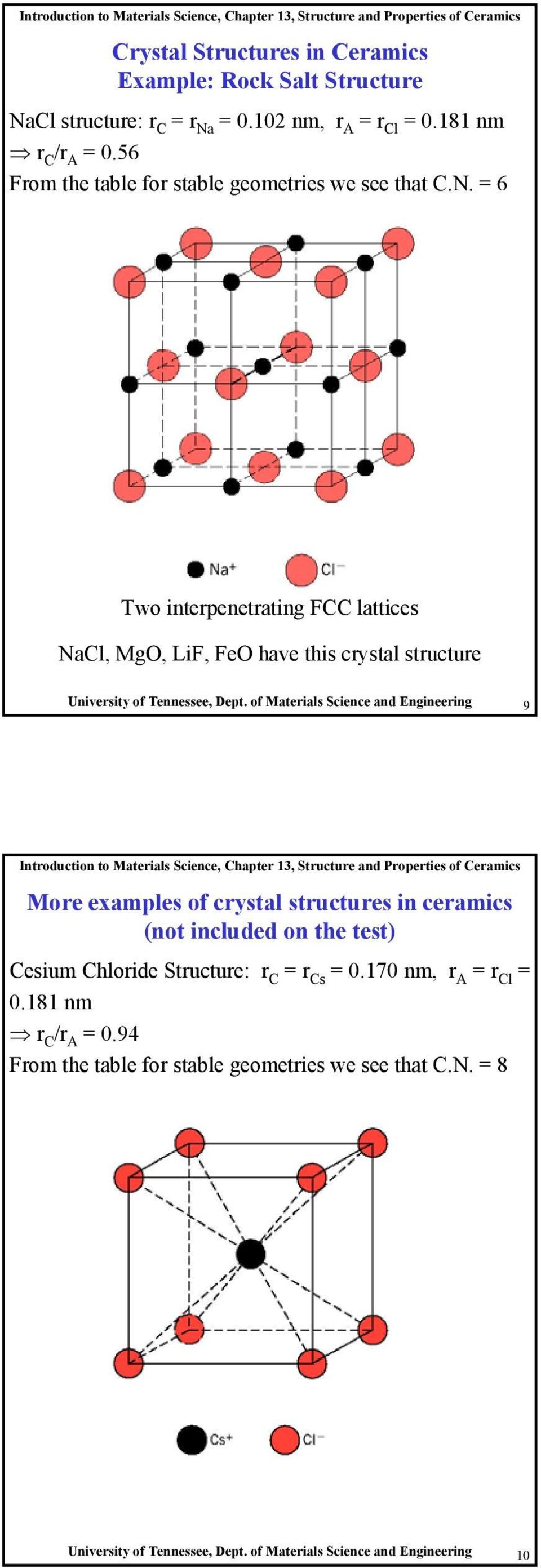
5 Crystal Structures in Ceramics Example: Rock Salt Structure NaCl structure: r C =r Na = nm, r A =r Cl = nm r C /r A = 0.56 From the table for stable geometries we see that C.N. = 6 Two interpenetrating FCC lattices NaCl, MgO, LiF, FeO have this crystal structure University of Tennessee, Dept. of Materials Science and Engineering 9 More examples of crystal structures in ceramics (not included on the test) Cesium Chloride Structure: r C = r Cs = nm, r A =r Cl = nm r C /r A = 0.94 From the table for stable geometries we see that C.N. = 8 University of Tennessee, Dept. of Materials Science and Engineering 10
6 Semiconductor Structures Diamond cubic Open Structure elemental semiconductors Interconnected tetrahedra Si, Ge, C Interior atoms located at positions ¼ of the distance along the body diagonal. 2 atoms per lattice point Structure: diamond cubic Bravais lattice: fcc Ions/unit cell: x ½ + 8 x ½ = 8 Typical ceramics: Si, Ge, and gray Sn University of Tennessee, Dept. of Materials Science and Engineering 11 More examples of crystal structures in ceramics (not included on the test) Zinc Blende Structure: typical for compounds where covalent bonding dominates. C.N. = 4 ZnS, ZnTe, SiC have this crystal structure University of Tennessee, Dept. of Materials Science and Engineering 12

7 More examples of crystal structures in ceramics (not included on the test) Fluorite (CaF 2 ): r C = r Ca = nm, r A = r F = nm r C /r A = 0.75 From the table for stable geometries we see that C.N. = 8 FCC structure with 3 atoms per lattice point University of Tennessee, Dept. of Materials Science and Engineering 13 Crystal structure depends upon: (1) stacking sequence (hcp or fcc) and (ii) interstitial sites occupied by cations E.g. NaCl: Cl anions packed in fcc symmetry (ABCABC ), Na cations on octahedral sites Spinel (MgAl 2 O 4 ): O anions form fcc lattice, Mg cations in tetrahedral sites, Al cations in octahedral sites How to Differentiate? Look at the formula perovskite= A B X 3 spinel = A B 2 X 4 fluorite = AX 2 calcite = AX University of Tennessee, Dept. of Materials Science and Engineering 14

8 Density computation (similar to Chapter 3.5 for metals) ρ = n (ΣA C + ΣA A ) / (V c N A ) n : number of formula units in unit cell (all ions that are included in the chemical formula of the compound = formula unit) ΣA C : sum of atomic weights of cations in the formula unit ΣA A : sum of atomic weights of anions in the formula unit V c : volume of the unit cell N A : Avogadro s number, (formula units)/mol Example: NaCl n = 4 in FCC lattice ΣA C = A Na = g/mol ΣA A = A Cl = g/mol V c = a 3 = (2r Na +2r Cl ) 3 = = ( ) 3 cm 3 University of Tennessee, Dept. of Materials Science and Engineering 15 Silicate Ceramics Composed mainly of silicon and oxygen, the two most abundant elements in earth s crust (rocks, soils, clays, sand) Basic building block: SiO 4 4- tetrahedron Si-O bonding is largely covalent, but overall SiO 4 block has charge of 4 Various silicate structures different ways to arrange SiO 4-4 blocks University of Tennessee, Dept. of Materials Science and Engineering 16

9 Silica = silicon dioxide = SiO 2 Every oxygen atom is shared by adjacent tetrahedra Silica can be crystalline (e.g., quartz) or amorphous, as in glass (fused or vitreous silica) 3D network of SiO 4 tetrahedra in cristobalite High melting temperature of 1710 C University of Tennessee, Dept. of Materials Science and Engineering 17 Window glasses Most common window glasses are produced by adding other oxides (e.g. CaO, Na 2 O) whose cations are incorporated within SiO 4 network. The cations break the tetrahedral network and glasses melt at lower temperature than pure amorphous SiO 2 because. A lower melting point makes it easy to form glass to make, for instance, bottles. Some other oxides (TiO2, Al2O3 substitute for silicon and become part of the network University of Tennessee, Dept. of Materials Science and Engineering 18

10 Carbon Carbon is not a ceramic Carbon exists in various polymorphic forms: sp 3 diamond and amorphous carbon, sp 2 graphite and fullerenes/nanotubes, one dimensional sp carbon University of Tennessee, Dept. of Materials Science and Engineering 19 Carbon: Diamond Has diamond-cubic structure (like Si, Ge) One of the strongest/hardest material known High thermal conductivity (unlike ceramics) Transparent in the visible and infrared, with high index of refraction, looks nice, costs $$$ Semiconductor (can be doped to make electronic devices) Metastable (transforms to carbon when heated) Figures from University of Tennessee, Dept. of Materials Science and Engineering 20

11 Diamond Thin Films ~ 100 microns Chemical vapor deposition (CVD) Thin films up to a few hundred microns Polycrystalline Applications: hard coatings (tool bits etc), machine components, heat sinks for high power semiconductor devices University of Tennessee, Dept. of Materials Science and Engineering 21 Carbon: Graphite Layered structure with strong bonding within the planar layers and weak, van der Waals bonding between layers Easy interplanar cleavage, applications as a lubricant and for writing (pencils) Good electrical conductor Chemically stable even at high temperatures Applications include furnaces, rocket nozzles, welding electrodes University of Tennessee, Dept. of Materials Science and Engineering 22

12 Carbon: buckyballs and nanotubes Buckminsterfullerenes (buckyballs) and carbon nanotubes are expected to play an important role in future nanotechnology applications (nanoscale materials, sensors, machines, and computers). Carbon nanotube T-junction Nanotubes as reinforcing fibers in nanocomposites Nano-gear Nanotube holepunching/etching Figures from University of Tennessee, Dept. of Materials Science and Engineering 23 Imperfections in Ceramics (I) Point defects in ionic crystals are charged. The Coulombic forces are very large and any charge imbalance has a strong tendency to balance itself. To maintain charge neutrality several point defects can be created: Frenkel defect is a pair of cation (positive ion) vacancy and a cation interstitial. (it may also be an anion (negative ion) vacancy and anion interstitial. However anions are larger than cations and it is not easy for an anion interstitial to form) Schottky defect is a pair of anion and cation vacancies Frenkel defect Schottky defect University of Tennessee, Dept. of Materials Science and Engineering 24

13 Imperfections in Ceramics (II) Frenkel and Schottky defects do not change ratio of cations to anions the compound is stoichiometric Non-stoichiometry (composition deviates from the one predicted by chemical formula) may occur when one ion type can exist in two valence states, e.g. Fe 2+, Fe 3+ For example, in FeO, usual Fe valence state is 2+. If two Fe ions are in 3+ state, then a Fe vacancy is required to maintain charge neutrality fewer Fe ions non-stoichiometry University of Tennessee, Dept. of Materials Science and Engineering 25 Impurities in Ceramics Impurity atoms can exist as either substitutional or interstitial solid solutions Substitutional ions substitute for ions of like type Interstitial ions are small compared to host structure - anion interstitials unlikely Solubilities higher if ion radii and charges match closely Incorporation of ion with different charge state requires compensation by point defects Interstitial impurity atom Substitutional impurity ions University of Tennessee, Dept. of Materials Science and Engineering 26

14 Mechanical Properties of Ceramics Ceramics are brittle. For brittle fracture stress concentrators are very important. (Chapter 8: measured fracture strengths are significantly smaller than theoretical predictions for perfect materials, ~ E/10 due to the stress risers) Fracture strength of ceramic may be greatly enhanced by creating compressive stresses at surface (similar to shot peening, case hardening in metals, chapter 8) The compressive strength is typically ten times the tensile strength. This makes ceramics good structural materials under compression (e.g., bricks in houses, stone blocks in the pyramids). University of Tennessee, Dept. of Materials Science and Engineering 27 University of Tennessee, Dept. of Materials Science and Engineering 28

15 Mechanical Properties of Ceramics Stress σ (MPa) Stress σ (MPa) (a) Tension (ε) (b) Compression (ε) The brittle nature if fracture is illustrated by these stress-strain curves, which show only linear, elastic behavior. The bending test that generates a modulus of rupture, this strength is similar to the tensile strength. University of Tennessee, Dept. of Materials Science and Engineering 29 Plastic Deformation in Ceramics Crystalline ceramics: Slip (dislocation motion) is very difficult. This is because ions of like charge has to be brought into close proximity of each other large barrier for dislocation motion. In ceramics with covalent bonding slip is not easy as well (covalent bonds are strong). ceramics are brittle. Non-crystalline ceramic: there is no regular crystalline structure no dislocations. Materials deform by viscous flow, i.e. by breaking and reforming of atomic bonds, allowing ions/atoms to slide past each other (like in a liquid). Viscosity is a measure of glassy material s resistance to deformation. τ F A η = = dv dy dv dy University of Tennessee, Dept. of Materials Science and Engineering 30

16 Summary Make sure you understand language and concepts: Anion Cation Defect structure Frenkel defect Electroneutrality Schottky defect Stoichiometry Viscosity University of Tennessee, Dept. of Materials Science and Engineering 31 Reading for next class: Chapter 14: Applications and Processing of Ceramics Short review of glass/ceramics applications and processing ( ) Optional reading: University of Tennessee, Dept. of Materials Science and Engineering 32

Matter, Materials, Crystal Structure and Bonding. Chris J. Pickard
 Matter, Materials, Crystal Structure and Bonding Chris J. Pickard Why should a theorist care? Where the atoms are determines what they do Where the atoms can be determines what we can do Overview of Structure
Chapter Outline. How do atoms arrange themselves to form solids?
 Chapter Outline How do atoms arrange themselves to form solids? Fundamental concepts and language Unit cells Crystal structures Simple cubic Face-centered cubic Body-centered cubic Hexagonal close-packed
Chapter Outline. Review of Atomic Structure Electrons, Protons, Neutrons, Quantum mechanics of atoms, Electron states, The Periodic Table
 Review of Atomic Structure Electrons, Protons, Neutrons, Quantum mechanics of atoms, Electron states, The Periodic Table Atomic Bonding in Solids Bonding Energies and Forces Periodic Table Chapter Outline
CHAPTER 10: INTERMOLECULAR FORCES: THE UNIQUENESS OF WATER Problems: 10.2, 10.6,10.15-10.33, 10.35-10.40, 10.56-10.60, 10.101-10.
 CHAPTER 10: INTERMOLECULAR FORCES: THE UNIQUENESS OF WATER Problems: 10.2, 10.6,10.15-10.33, 10.35-10.40, 10.56-10.60, 10.101-10.102 10.1 INTERACTIONS BETWEEN IONS Ion-ion Interactions and Lattice Energy
CHAPTER 6 Chemical Bonding
 CHAPTER 6 Chemical Bonding SECTION 1 Introduction to Chemical Bonding OBJECTIVES 1. Define Chemical bond. 2. Explain why most atoms form chemical bonds. 3. Describe ionic and covalent bonding.. 4. Explain
KINETIC MOLECULAR THEORY OF MATTER
 KINETIC MOLECULAR THEORY OF MATTER The kinetic-molecular theory is based on the idea that particles of matter are always in motion. The theory can be used to explain the properties of solids, liquids,
Mechanical Properties of Metals Mechanical Properties refers to the behavior of material when external forces are applied
 Mechanical Properties of Metals Mechanical Properties refers to the behavior of material when external forces are applied Stress and strain fracture or engineering point of view: allows to predict the
BOND TYPES: THE CLASSIFICATION OF SUBSTANCES
 BOND TYPES: THE CLASSIFICATION OF SUBSTANCES Every (pure) substance has a unique set of intrinsic properties which distinguishes it from all other substances. What inferences, if any can be made from a
Type of Chemical Bonds
 Type of Chemical Bonds Covalent bond Polar Covalent bond Ionic bond Hydrogen bond Metallic bond Van der Waals bonds. Covalent Bonds Covalent bond: bond in which one or more pairs of electrons are shared
Which substance contains positive ions immersed in a sea of mobile electrons? A) O2(s) B) Cu(s) C) CuO(s) D) SiO2(s)
 BONDING MIDTERM REVIEW 7546-1 - Page 1 1) Which substance contains positive ions immersed in a sea of mobile electrons? A) O2(s) B) Cu(s) C) CuO(s) D) SiO2(s) 2) The bond between hydrogen and oxygen in
Chapter Outline Dislocations and Strengthening Mechanisms
 Chapter Outline Dislocations and Strengthening Mechanisms What is happening in material during plastic deformation? Dislocations and Plastic Deformation Motion of dislocations in response to stress Slip
Wafer Manufacturing. Reading Assignments: Plummer, Chap 3.1~3.4
 Wafer Manufacturing Reading Assignments: Plummer, Chap 3.1~3.4 1 Periodic Table Roman letters give valence of the Elements 2 Why Silicon? First transistor, Shockley, Bardeen, Brattain1947 Made by Germanium
Sample Exercise 12.1 Calculating Packing Efficiency
 Sample Exercise 12.1 Calculating Packing Efficiency It is not possible to pack spheres together without leaving some void spaces between the spheres. Packing efficiency is the fraction of space in a crystal
Bonding in Elements and Compounds. Covalent
 Bonding in Elements and Compounds Structure of solids, liquids and gases Types of bonding between atoms and molecules Ionic Covalent Metallic Many compounds between metals & nonmetals (salts), e.g. Na,
Solution for Homework #1
 Solution for Homework #1 Chapter 2: Multiple Choice Questions (2.5, 2.6, 2.8, 2.11) 2.5 Which of the following bond types are classified as primary bonds (more than one)? (a) covalent bonding, (b) hydrogen
Unit 2 Periodic Behavior and Ionic Bonding
 Unit 2 Periodic Behavior and Ionic Bonding 6.1 Organizing the Elements I. The Periodic Law A. The physical and chemical properties of the elements are periodic functions of their atomic numbers B. Elements
Each grain is a single crystal with a specific orientation. Imperfections
 Crystal Structure / Imperfections Almost all materials crystallize when they solidify; i.e., the atoms are arranged in an ordered, repeating, 3-dimensional pattern. These structures are called crystals
Chapter 2. Atomic Structure and Interatomic Bonding
 Chapter 2. Atomic Structure and Interatomic Bonding Interatomic Bonding Bonding forces and energies Primary interatomic bonds Secondary bonding Molecules Bonding Forces and Energies Considering the interaction
Unit 3: Quantum Theory, Periodicity and Chemical Bonding. Chapter 10: Chemical Bonding II Molecular Geometry & Intermolecular Forces
 onour Chemistry Unit 3: Quantum Theory, Periodicity and Chemical Bonding Chapter 10: Chemical Bonding II Molecular Geometry & Intermolecular orces 10.1: Molecular Geometry Molecular Structure: - the three-dimensional
Crystalline solids. A solid crystal consists of different atoms arranged in a periodic structure.
 Crystalline solids A solid crystal consists of different atoms arranged in a periodic structure. Crystals can be formed via various bonding mechanisms: Ionic bonding Covalent bonding Metallic bonding Van
Atoms and Elements. Atoms: Learning Goals. Chapter 3. Atoms and Elements; Isotopes and Ions; Minerals and Rocks. Clicker 1. Chemistry Background?
 Chapter 3 Atoms Atoms and Elements; Isotopes and Ions; Minerals and Rocks A Review of Chemistry: What geochemistry tells us Clicker 1 Chemistry Background? A. No HS or College Chemistry B. High School
Unit 12 Practice Test
 Name: Class: Date: ID: A Unit 12 Practice Test Multiple Choice Identify the choice that best completes the statement or answers the question. 1) A solid has a very high melting point, great hardness, and
Modern Construction Materials Prof. Ravindra Gettu Department of Civil Engineering Indian Institute of Technology, Madras
 Modern Construction Materials Prof. Ravindra Gettu Department of Civil Engineering Indian Institute of Technology, Madras Module - 2 Lecture - 2 Part 2 of 2 Review of Atomic Bonding II We will continue
Ch. 4: Imperfections in Solids Part 1. Dr. Feras Fraige
 Ch. 4: Imperfections in Solids Part 1 Dr. Feras Fraige Outline Defects in Solids 0D, Point defects vacancies Interstitials impurities, weight and atomic composition 1D, Dislocations edge screw 2D, Grain
3. What would you predict for the intensity and binding energy for the 3p orbital for that of sulfur?
 PSI AP Chemistry Periodic Trends MC Review Name Periodic Law and the Quantum Model Use the PES spectrum of Phosphorus below to answer questions 1-3. 1. Which peak corresponds to the 1s orbital? (A) 1.06
CHAPTER 6 REVIEW. Chemical Bonding. Answer the following questions in the space provided.
 Name Date lass APTER 6 REVIEW hemical Bonding SETIN 1 SRT ANSWER Answer the following questions in the space provided. 1. a A chemical bond between atoms results from the attraction between the valence
Name: Class: Date: Multiple Choice Identify the letter of the choice that best completes the statement or answers the question.
 Class: Date: Minerals Study Guide Modified True/False Indicate whether the sentence or statement is true or false. If false, change the identified word or phrase to make the sentence or statement true.
Section 3: Crystal Binding
 Physics 97 Interatomic forces Section 3: rystal Binding Solids are stable structures, and therefore there exist interactions holding atoms in a crystal together. For example a crystal of sodium chloride
Materials Sciences. Dr.-Ing. Norbert Hort [email protected]. International Masters Programme in Biomedical Engineering
 Materials Sciences International Masters Programme in Biomedical Engineering Magnesium Innovations Center (MagIC) GKSS Forschungszentrum Geesthacht GmbH Dr.-Ing. Norbert Hort [email protected] Contents
Chapter 3. 1. 3 types of materials- amorphous, crystalline, and polycrystalline. 5. Same as #3 for the ceramic and diamond crystal structures.
 Chapter Highlights: Notes: 1. types of materials- amorphous, crystalline, and polycrystalline.. Understand the meaning of crystallinity, which refers to a regular lattice based on a repeating unit cell..
Earth Materials: Minerals. Mineral Properties. Mineral Properties. Some optical properties. Three general categories:
 1 2 Earth Materials: Minerals What is a mineral? Properties/characteristics of different types of minerals Mineral structures and bonding Major categories of minerals Importance and uses of minerals What
AP Chemistry A. Allan Chapter 8 Notes - Bonding: General Concepts
 AP Chemistry A. Allan Chapter 8 Notes - Bonding: General Concepts 8.1 Types of Chemical Bonds A. Ionic Bonding 1. Electrons are transferred 2. Metals react with nonmetals 3. Ions paired have lower energy
Chapter Outline Dislocations and Strengthening Mechanisms
 Chapter Outline Dislocations and Strengthening Mechanisms What is happening in material during plastic deformation? Dislocations and Plastic Deformation Motion of dislocations in response to stress Slip
Chapter 13 - LIQUIDS AND SOLIDS
 Chapter 13 - LIQUIDS AND SOLIDS Problems to try at end of chapter: Answers in Appendix I: 1,3,5,7b,9b,15,17,23,25,29,31,33,45,49,51,53,61 13.1 Properties of Liquids 1. Liquids take the shape of their container,
Silicate Structures. The building blocks of the common rock-forming minerals
 Silicate Structures The building blocks of the common rock-forming minerals Mineral classes and the silicates There are a total of 78 mineral classes 27 of these are the silicates which constitute ~92%
Question Bank Electrolysis
 Question Bank Electrolysis 1. (a) What do you understand by the terms (i) electrolytes (ii) non-electrolytes? (b) Arrange electrolytes and non-electrolytes from the following substances (i) sugar solution
ch9 and 10 practice test
 1. Which of the following covalent bonds is the most polar (highest percent ionic character)? A. Al I B. Si I C. Al Cl D. Si Cl E. Si P 2. What is the hybridization of the central atom in ClO 3? A. sp
B) atomic number C) both the solid and the liquid phase D) Au C) Sn, Si, C A) metal C) O, S, Se C) In D) tin D) methane D) bismuth B) Group 2 metal
 1. The elements on the Periodic Table are arranged in order of increasing A) atomic mass B) atomic number C) molar mass D) oxidation number 2. Which list of elements consists of a metal, a metalloid, and
Igneous Geochemistry. What is magma? What is polymerization? Average compositions (% by weight) and liquidus temperatures of different magmas
 1 Igneous Geochemistry What is magma phases, compositions, properties Major igneous processes Making magma how and where Major-element variations Classification using a whole-rock analysis Fractional crystallization
A pure covalent bond is an equal sharing of shared electron pair(s) in a bond. A polar covalent bond is an unequal sharing.
 CHAPTER EIGHT BNDING: GENERAL CNCEPT or Review 1. Electronegativity is the ability of an atom in a molecule to attract electrons to itself. Electronegativity is a bonding term. Electron affinity is the
Defects Introduction. Bonding + Structure + Defects. Properties
 Defects Introduction Bonding + Structure + Defects Properties The processing determines the defects Composition Bonding type Structure of Crystalline Processing factors Defects Microstructure Types of
AS Chemistry Revision Notes Unit 1 Atomic Structure, Bonding And Periodicity
 AS Chemistry Revision Notes Unit Atomic Structure, Bonding And Periodicity Atomic Structure. All atoms have a mass number, A (the number of nucleons), and a proton number, Z (the number of protons). 2.
GROUP II ELEMENTS. Beryllium to Barium
 1 GROUP II ELEMENTS Beryllium to Barium Introduction Elements in Group I (alkali metals) and Group II (alkaline earths) are known as s-block elements because their valence (bonding) electrons are in s
Chem 106 Thursday Feb. 3, 2011
 Chem 106 Thursday Feb. 3, 2011 Chapter 13: -The Chemistry of Solids -Phase Diagrams - (no Born-Haber cycle) 2/3/2011 1 Approx surface area (Å 2 ) 253 258 Which C 5 H 12 alkane do you think has the highest
Sample Exercise 8.1 Magnitudes of Lattice Energies
 Sample Exercise 8.1 Magnitudes of Lattice Energies Without consulting Table 8.2, arrange the ionic compounds NaF, CsI, and CaO in order of increasing lattice energy. Analyze From the formulas for three
Lewis Dot Notation Ionic Bonds Covalent Bonds Polar Covalent Bonds Lewis Dot Notation Revisited Resonance
 Lewis Dot Notation Ionic Bonds Covalent Bonds Polar Covalent Bonds Lewis Dot Notation Revisited Resonance Lewis Dot notation is a way of describing the outer shell (also called the valence shell) of an
Chapter 10 Liquids & Solids
 1 Chapter 10 Liquids & Solids * 10.1 Polar Covalent Bonds & Dipole Moments - van der Waals constant for water (a = 5.28 L 2 atm/mol 2 ) vs O 2 (a = 1.36 L 2 atm/mol 2 ) -- water is polar (draw diagram)
Sample Exercise 8.1 Magnitudes of Lattice Energies
 Sample Exercise 8.1 Magnitudes of Lattice Energies Without consulting Table 8.2, arrange the following ionic compounds in order of increasing lattice energy: NaF, CsI, and CaO. Analyze: From the formulas
Crystal Defects p. 2. Point Defects: Vacancies. Department of Materials Science and Engineering University of Virginia. Lecturer: Leonid V.
 Crystal Defects p. 1 A two-dimensional representation of a perfect single crystal with regular arrangement of atoms. But nothing is perfect, and structures of real materials can be better represented by
Periodic Table Questions
 Periodic Table Questions 1. The elements characterized as nonmetals are located in the periodic table at the (1) far left; (2) bottom; (3) center; (4) top right. 2. An element that is a liquid at STP is
Chapter 6 Assessment. Name: Class: Date: ID: A. Multiple Choice Identify the choice that best completes the statement or answers the question.
 Name: Class: Date: ID: A Chapter 6 Assessment Multiple Choice Identify the choice that best completes the statement or answers the question. 1. When an atom loses an electron, it forms a(n) a. anion. c.
PERIODIC TABLE OF GROUPS OF ELEMENTS Elements can be classified using two different schemes.
 1 PERIODIC TABLE OF GROUPS OF ELEMENTS Elements can be classified using two different schemes. Metal Nonmetal Scheme (based on physical properties) Metals - most elements are metals - elements on left
3/5/2014. iclicker Participation Question: A. MgS < AlP < NaCl B. MgS < NaCl < AlP C. NaCl < AlP < MgS D. NaCl < MgS < AlP
 Today: Ionic Bonding vs. Covalent Bonding Strengths of Covalent Bonds: Bond Energy Diagrams Bond Polarities: Nonpolar Covalent vs. Polar Covalent vs. Ionic Electronegativity Differences Dipole Moments
Graphene a material for the future
 Graphene a material for the future by Olav Thorsen What is graphene? What is graphene? Simply put, it is a thin layer of pure carbon What is graphene? Simply put, it is a thin layer of pure carbon It has
SOME TOUGH COLLEGE PROBLEMS! .. : 4. How many electrons should be shown in the Lewis dot structure for carbon monoxide? N O O
 SME TUGH CLLEGE PRBLEMS! LEWIS DT STRUCTURES 1. An acceptable Lewis dot structure for 2 is (A) (B) (C) 2. Which molecule contains one unshared pair of valence electrons? (A) H 2 (B) H 3 (C) CH 4 acl 3.
Ionic and Metallic Bonding
 Ionic and Metallic Bonding BNDING AND INTERACTINS 71 Ions For students using the Foundation edition, assign problems 1, 3 5, 7 12, 14, 15, 18 20 Essential Understanding Ions form when atoms gain or lose
Solid State Theory Physics 545
 Solid State Theory Physics 545 CRYSTAL STRUCTURES Describing periodic structures Terminology Basic Structures Symmetry Operations Ionic crystals often have a definite habit which gives rise to particular
A mutual electrical attraction between the nuclei and valence electrons of different atoms that binds the atoms together is called a(n)
 Chemistry I ATOMIC BONDING PRACTICE QUIZ Mr. Scott Select the best answer. 1) A mutual electrical attraction between the nuclei and valence electrons of different atoms that binds the atoms together is
Solidification, Crystallization & Glass Transition
 Solidification, Crystallization & Glass Transition Cooling the Melt solidification Crystallization versus Formation of Glass Parameters related to the formaton of glass Effect of cooling rate Glass transition
Electronegativity and Polarity MAIN Idea A chemical bond s character is related to each atom s
 Section 8.5 Objectives Describe how electronegativity is used to determine bond type. Compare and contrast polar and nonpolar covalent bonds and polar and nonpolar molecules. Generalize about the characteristics
Name Class Date. In the space provided, write the letter of the term or phrase that best completes each statement or best answers each question.
 Assessment Chapter Test A Chapter: States of Matter In the space provided, write the letter of the term or phrase that best completes each statement or best answers each question. 1. The kinetic-molecular
Ionic Bonding Pauling s Rules and the Bond Valence Method
 Ionic Bonding Pauling s Rules and the Bond Valence Method Chemistry 754 Solid State Chemistry Dr. Patrick Woodward Lecture #14 Pauling Rules for Ionic Structures Linus Pauling,, J. Amer. Chem. Soc. 51,,
Explain the ionic bonds, covalent bonds and metallic bonds and give one example for each type of bonds.
 Problem 1 Explain the ionic bonds, covalent bonds and metallic bonds and give one example for each type of bonds. Ionic Bonds Two neutral atoms close to each can undergo an ionization process in order
Covalent Bonding & Molecular Orbital Theory
 Covalent Bonding & Molecular Orbital Theory Chemistry 754 Solid State Chemistry Dr. Patrick Woodward Lecture #16 References - MO Theory Molecular orbital theory is covered in many places including most
Technical Bulletin 1301. Talc in Plastics
 Technical Bulletin 131 Talc in Plastics Contents Introduction Benefits of Talc in Polypropylene Compounds 1. Stiffness (E-Modulus) 2. Thermal Conductivity 3. Nucleation 4. Impact Strength 5. Deflection
Chapter Outline. Mechanical Properties of Metals How do metals respond to external loads?
 Mechanical Properties of Metals How do metals respond to external loads? Stress and Strain Tension Compression Shear Torsion Elastic deformation Plastic Deformation Yield Strength Tensile Strength Ductility
CHAPTER 7 DISLOCATIONS AND STRENGTHENING MECHANISMS PROBLEM SOLUTIONS
 7-1 CHAPTER 7 DISLOCATIONS AND STRENGTHENING MECHANISMS PROBLEM SOLUTIONS Basic Concepts of Dislocations Characteristics of Dislocations 7.1 The dislocation density is just the total dislocation length
States of Matter CHAPTER 10 REVIEW SECTION 1. Name Date Class. Answer the following questions in the space provided.
 CHAPTER 10 REVIEW States of Matter SECTION 1 SHORT ANSWER Answer the following questions in the space provided. 1. Identify whether the descriptions below describe an ideal gas or a real gas. ideal gas
Chapter 4: Structure and Properties of Ionic and Covalent Compounds
 Chapter 4: Structure and Properties of Ionic and Covalent Compounds 4.1 Chemical Bonding o Chemical Bond - the force of attraction between any two atoms in a compound. o Interactions involving valence
Formation of solids from solutions and melts
 Formation of solids from solutions and melts Solids from a liquid phase. 1. The liquid has the same composition as the solid. Formed from the melt without any chemical transformation. Crystallization and
WRITING CHEMICAL FORMULA
 WRITING CHEMICAL FORMULA For ionic compounds, the chemical formula must be worked out. You will no longer have the list of ions in the exam (like at GCSE). Instead you must learn some and work out others.
100% ionic compounds do not exist but predominantly ionic compounds are formed when metals combine with non-metals.
 2.21 Ionic Bonding 100% ionic compounds do not exist but predominantly ionic compounds are formed when metals combine with non-metals. Forming ions Metal atoms lose electrons to form +ve ions. Non-metal
In the box below, draw the Lewis electron-dot structure for the compound formed from magnesium and oxygen. [Include any charges or partial charges.
 Name: 1) Which molecule is nonpolar and has a symmetrical shape? A) NH3 B) H2O C) HCl D) CH4 7222-1 - Page 1 2) When ammonium chloride crystals are dissolved in water, the temperature of the water decreases.
Intermolecular Forces
 Intermolecular Forces: Introduction Intermolecular Forces Forces between separate molecules and dissolved ions (not bonds) Van der Waals Forces 15% as strong as covalent or ionic bonds Chapter 11 Intermolecular
Bonds. Bond Length. Forces that hold groups of atoms together and make them function as a unit. Bond Energy. Chapter 8. Bonding: General Concepts
 Bonds hapter 8 Bonding: General oncepts Forces that hold groups of atoms together and make them function as a unit. Bond Energy Bond Length It is the energy required to break a bond. The distance where
List the 3 main types of subatomic particles and indicate the mass and electrical charge of each.
 Basic Chemistry Why do we study chemistry in a biology course? All living organisms are composed of chemicals. To understand life, we must understand the structure, function, and properties of the chemicals
Lösungen Übung Verformung
 Lösungen Übung Verformung 1. (a) What is the meaning of T G? (b) To which materials does it apply? (c) What effect does it have on the toughness and on the stress- strain diagram? 2. Name the four main
5. Structure, Geometry, and Polarity of Molecules
 5. Structure, Geometry, and Polarity of Molecules What you will accomplish in this experiment This experiment will give you an opportunity to draw Lewis structures of covalent compounds, then use those
Chemistry Diagnostic Questions
 Chemistry Diagnostic Questions Answer these 40 multiple choice questions and then check your answers, located at the end of this document. If you correctly answered less than 25 questions, you need to
(b) Formation of calcium chloride:
 Chapter 2: Chemical Compounds and Bonding Section 2.1: Ionic Compounds, pages 22 23 1. An ionic compound combines a metal and a non-metal joined together by an ionic bond. 2. An electrostatic force holds
Moles. Balanced chemical equations Molar ratios Mass Composition Empirical and Molecular Mass Predicting Quantities Equations
 Moles Balanced chemical equations Molar ratios Mass Composition Empirical and Molecular Mass Predicting Quantities Equations Micro World atoms & molecules Macro World grams Atomic mass is the mass of an
Conductivity of silicon can be changed several orders of magnitude by introducing impurity atoms in silicon crystal lattice.
 CMOS Processing Technology Silicon: a semiconductor with resistance between that of conductor and an insulator. Conductivity of silicon can be changed several orders of magnitude by introducing impurity
DIRECTED-DISCOVERY OF CRYSTAL STRUCTURES USING BALL AND STICK MODELS
 DIRECTED-DISCOVERY OF CRYSTAL STRUCTURES USING BALL AND STICK MODELS David W. Mogk Dept. of Earth Sciences Montana State University Bozeman, MT 59717 [email protected] INTRODUCTION Understanding
Name period AP chemistry Unit 2 worksheet Practice problems
 Name period AP chemistry Unit 2 worksheet Practice problems 1. What are the SI units for a. Wavelength of light b. frequency of light c. speed of light Meter hertz (s -1 ) m s -1 (m/s) 2. T/F (correct
CHEMISTRY BONDING REVIEW
 Answer the following questions. CHEMISTRY BONDING REVIEW 1. What are the three kinds of bonds which can form between atoms? The three types of Bonds are Covalent, Ionic and Metallic. Name Date Block 2.
(1) e.g. H hydrogen that has lost 1 electron c. anion - negatively charged atoms that gain electrons 16-2. (1) e.g. HCO 3 bicarbonate anion
 GS106 Chemical Bonds and Chemistry of Water c:wou:gs106:sp2002:chem.wpd I. Introduction A. Hierarchy of chemical substances 1. atoms of elements - smallest particles of matter with unique physical and
CHEM 1301 SECOND TEST REVIEW. Covalent bonds are sharing of electrons (ALWAYS valence electrons). Use Lewis structures to show this sharing.
 CEM 1301 SECOND TEST REVIEW Lewis Structures Covalent bonds are sharing of electrons (ALWAYS valence electrons). Use Lewis structures to show this sharing. Rules OCTET RULE an atom would like to have 8
Electrons in Atoms & Periodic Table Chapter 13 & 14 Assignment & Problem Set
 Electrons in Atoms & Periodic Table Name Warm-Ups (Show your work for credit) Date 1. Date 2. Date 3. Date 4. Date 5. Date 6. Date 7. Date 8. Electrons in Atoms & Periodic Table 2 Study Guide: Things You
Theme 3: Bonding and Molecular Structure. (Chapter 8)
 Theme 3: Bonding and Molecular Structure. (Chapter 8) End of Chapter questions: 5, 7, 9, 12, 15, 18, 23, 27, 28, 32, 33, 39, 43, 46, 67, 77 Chemical reaction valence electrons of atoms rearranged (lost,
Chapter 7. Comparing Ionic and Covalent Bonds. Ionic Bonds. Types of Bonds. Quick Review of Bond Types. Covalent Bonds
 Comparing Ionic and Covalent Bonds Chapter 7 Covalent Bonds and Molecular Structure Intermolecular forces (much weaker than bonds) must be broken Ionic bonds must be broken 1 Ionic Bonds Covalent Bonds
CHEMISTRY 1710 - Practice Exam #5 - SPRING 2014 (KATZ)
 CHEMISTRY 1710 - Practice Exam #5 - SPRING 2014 (KATZ) Name: Score: This is a multiple choice exam. Choose the BEST answer from the choices which are given and write the letter for your choice in the space
Biomedical Engineering. Ceramic Materials. Dr-Ing. Ewald Pfaff. Materials and Processing. Laboratory visit
 Biomedical Engineering Material a Science ce Ceramic Materials Dr-Ing. Ewald Pfaff Lesson 1: Lesson 2: Lesson 3: Fundamentals Materials and Processing Exercise Hip Joint Laboratory visit Questions Preparation
Material Deformations. Academic Resource Center
 Material Deformations Academic Resource Center Agenda Origin of deformations Deformations & dislocations Dislocation motion Slip systems Stresses involved with deformation Deformation by twinning Origin
The Lewis structure is a model that gives a description of where the atoms, charges, bonds, and lone pairs of electrons, may be found.
 CEM110 Week 12 Notes (Chemical Bonding) Page 1 of 8 To help understand molecules (or radicals or ions), VSEPR shapes, and properties (such as polarity and bond length), we will draw the Lewis (or electron
Name Class Date. What is ionic bonding? What happens to atoms that gain or lose electrons? What kinds of solids are formed from ionic bonds?
 CHAPTER 1 2 Ionic Bonds SECTION Chemical Bonding BEFORE YOU READ After you read this section, you should be able to answer these questions: What is ionic bonding? What happens to atoms that gain or lose
Chapter 3: Structure of Metals and Ceramics. Chapter 3: Structure of Metals and Ceramics. Learning Objective
 Chapter 3: Structure of Metals and Ceramics Chapter 3: Structure of Metals and Ceramics Goals Define basic terms and give examples of each: Lattice Basis Atoms (Decorations or Motifs) Crystal Structure
We shall first regard the dense sphere packing model. 1.1. Draw a two dimensional pattern of dense packing spheres. Identify the twodimensional
 Set 3: Task 1 and 2 considers many of the examples that are given in the compendium. Crystal structures derived from sphere packing models may be used to describe metals (see task 2), ionical compounds
Chapter 2: The Chemical Context of Life
 Chapter 2: The Chemical Context of Life Name Period This chapter covers the basics that you may have learned in your chemistry class. Whether your teacher goes over this chapter, or assigns it for you
Why? Intermolecular Forces. Intermolecular Forces. Chapter 12 IM Forces and Liquids. Covalent Bonding Forces for Comparison of Magnitude
 1 Why? Chapter 1 Intermolecular Forces and Liquids Why is water usually a liquid and not a gas? Why does liquid water boil at such a high temperature for such a small molecule? Why does ice float on water?