
Measuring tax gaps 2015 edition Tax gap estimates for
|
|
|
- Cecily Robbins
- 9 years ago
- Views:
Transcription
1 edition Tax gap estimates for An Official Statistics release 22 October 2015

2 Contents 3 Introduction 4 At a glance 6 1. Summary VAT Alcohol Tobacco Oils Income tax, National Insurance Contributions and Capital Gains Tax Corporation Tax Other taxes 73 Glossary 75 Abbreviations 76 Index of tables and figures Contacts Heather Whicker [email protected] Andrea White [email protected] HMRC Press Office (Individuals) (Business) Out-of-hours: A full time series for tables is available on our website at 2 HM Revenue and Customs

3 Introduction 6.4% The tax gap is estimated to be 34 billion, which is 6.4 per cent of tax liabilities. What is the tax gap? The tax gap is the difference between the amount of tax that should, in theory, be collected by HMRC, against what is actually collected. Why do we measure it? The tax gap provides a useful tool for understanding the relative size and nature of non-compliance. This understanding can be applied in many different ways: Firstly, it provides a foundation for HMRC s strategy. Thinking about the tax gap helps the department to understand how non-compliance occurs and how the causes can be addressed. Secondly, drawing on information on how other countries manage their tax gaps, our tax gap analysis provides insight into which strategies are most effective at reducing the tax gap. Thirdly, although the tax gap isn t sufficiently timely or precise enough to set performance targets, it provides important information which helps us understand our long-term performance. Why is there a tax gap? The tax gap reflects tax lost for a variety of reasons, from taxpayers simply not taking enough care with their tax returns to criminal attacks on the tax system. How is it calculated? It has been produced by government analysts working within HMRC, in line with the values, principles and protocols set out in the Code of Practice for Official Statistics. We use a range of internal and external data and different analytical techniques to produce annual estimates, which we revise as more accurate data becomes available. These are our best estimates based on the information available, but there are many sources of uncertainty and potential error. 3 HM Revenue and Customs

4 The UK tax gap at a glance 6.4% The tax gap is estimated to be 34 billion, which is 6.4 per cent of tax liabilities. Tax gap and percentage of liabilities: to % % 7.5% 7.5% 7.3% 7.0% 6.6% 6.6% 6.4% bn 35 bn 37 bn 36 bn 33 bn 34 bn 33 bn 34 bn 34 bn 1.5 0bn %

5 ? What is the tax gap? The tax gap is the difference between the amount of tax that should, in theory, be collected by HMRC, against what is actually collected. Why measure it? Tax gap analysis helps us to understand the reasons for losses in the tax system. How is it calculated? It s an Official Statistic produced using many different approaches that have been endorsed by the International Monetary Fund. The tax gap is difficult to measure there are many sources of uncertainty and error. However, it gives an indication of our long-term performance we have seen that the tax gap has decreased since Value of the tax gap by customer group SMEs 16.5bn Large businesses 9.5bn Criminals 5.1bn Individuals 2.9bn Value of the tax gap by type of tax IT, NICs and CGT 14.0bn Value Added Tax 13.1bn Corporation Tax 3.0bn Excise duties 2.7bn Other taxes 1.1bn Value of the tax gap by behaviour Criminal attacks 5.1bn Evasion 4.4bn Avoidance 2.7bn Hidden economy 6.2bn Legal interpretation 4.9bn Non-payment 4.1bn Failure to take reasonable care 3.9bn Error 2.6bn

6 1. Summary Key findings The tax gap in (the latest year) is estimated to be 34 billion, which is 6.4 per cent of total theoretical tax liabilities. This indicates that more than 93 per cent of the tax due in was collected. The percentage tax gap has reduced steadily from 8.4 per cent in to 6.4 per cent in The tax gap estimate of 34 billion is 11 billion lower than it would have been if the percentage tax gap had remained at the level of 8.4 per cent. The Corporation Tax and Excise percentage gaps have seen the largest reductions from to , by just over half and just over a third respectively. Small and medium-sized enterprises account for the largest portion of the overall tax gap (just under half), followed by large businesses (just over a quarter). 6 HM Revenue and Customs

7 What the tax gap estimates show since 2005 tax gap time series: to Figure 1.1: Tax gap and percentage of liabilities 8.4% % 7.5% 7.5% 7.3% 7.0% 6.6% 6.6% 6.4% bn 35 bn 37 bn 36 bn 33 bn 34 bn 33 bn 34 bn 34 bn 1.5 0bn % There has been a steady reduction in the percentage tax gap between and The tax gap cash figure stayed fairly flat between and , at around 36 billion, falling to 33 billion in and it has stayed close to 34 billion between and Figure 1.1 shows the value of the tax gap alongside the percentage tax gap, which is calculated as a percentage of total theoretical liabilities, or the amount of tax that should, in theory, be paid. Theoretical liability is defined as the tax gap plus the amount of tax actually received. The percentage tax gap provides a better measure of compliance over time, because it takes account of some of the effects of inflation, economic growth and changes to tax rates, where the cash figure does not. For example, in a growing economy where the tax base, or the amount of taxable income and goods, is increasing, even if the percentage tax gap were to remain level, the corresponding cash figure would grow in line with the growing tax base. 7

8 Tax gap by type of tax Figure 1.2 represents the tax gap relative to amount of tax collected by type of tax. The tax gap plus tax collected together represents the total theoretical liability. Most of the tax collected is from IT, NICs and CGT (54 per cent of receipts) and VAT (22 per cent of tax receipts). It also shows that the tax gap for IT, NICs and CGT of 14.0 billion equates to just 5.0 per cent of the total theoretical liabilities. This can be compared to the VAT tax gap ( 13.1 billion) which equates to 11.1 per cent of VAT theoretical tax liabilities. Figure 1.2: Tax gaps relative to tax due, Receipts Tax gap % 11.1% 6.7% 5.2% 3.8% 0bn Income tax, National Insurance Contributions, Capital Gains Tax Value Added Tax (VAT) Corporation Tax Excise duties Other taxes Figure 1.3 shows how the tax gap is composed of different taxes. The largest component is IT, NICs and CGT, which makes up 41 per cent of the total tax gap. Figure 1.3: Tax gap by type of tax value and share of tax gap, Corporation Tax 3.0bn 9% Excise duties 2.7bn 8% Other taxes 1.1bn 3% IT, NICs and CGT 14.0bn 41% VAT 13.1bn 39% 8 HM Revenue and Customs

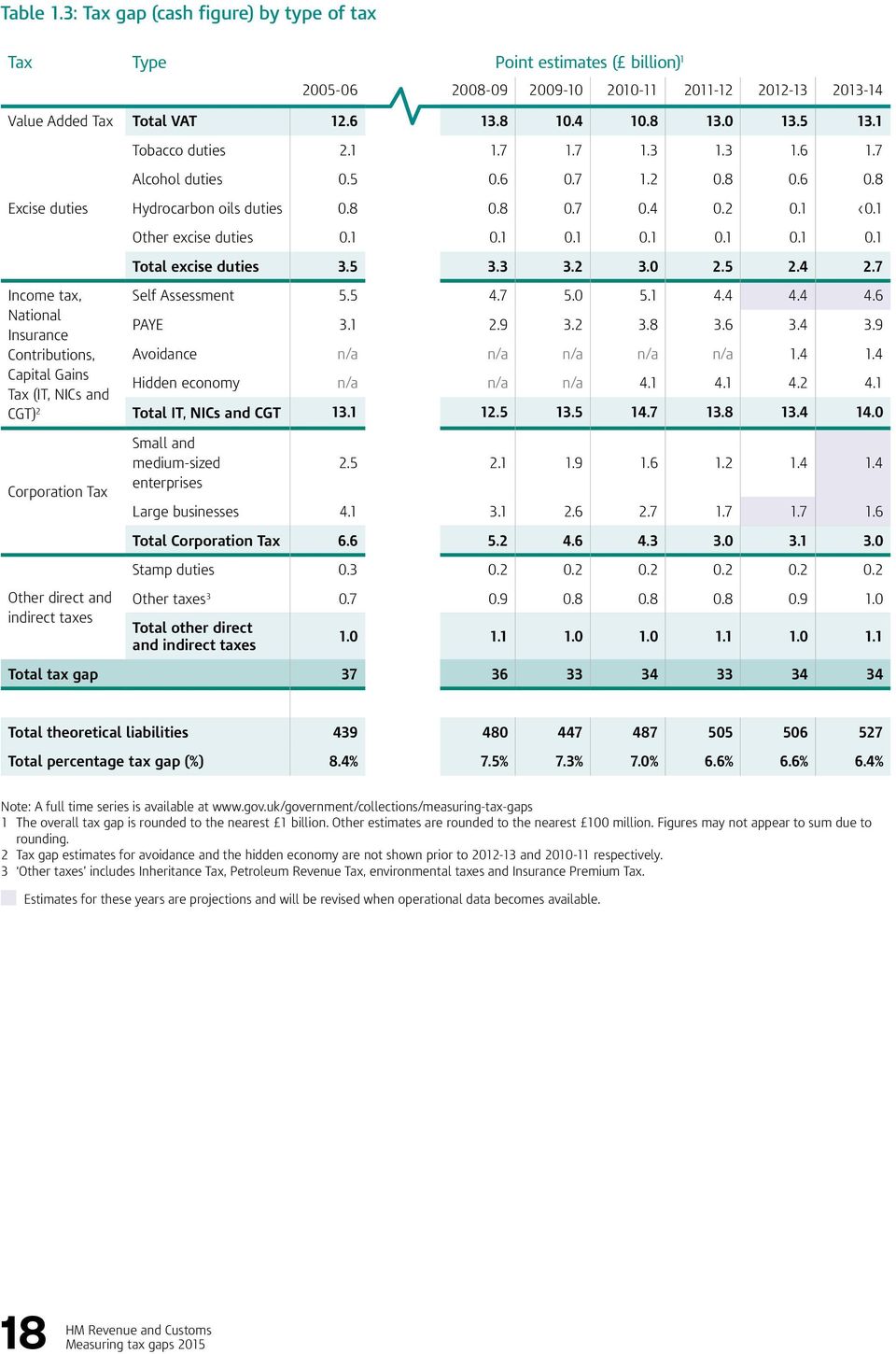
9 The largest fall between and has been in the Corporation Tax and Excise percentage gaps (see Figure 1.4), by just over half and just over a third respectively. Figure 1.4: Tax gap as percentage of liabilities by type of tax, to VAT 5 CT Excise duties IT, NICs and CGT Other taxes 0% Other taxes includes Stamp Duties, Inheritance Tax, Petroleum Revenue Tax, Environmental taxes and Insurance Premium Tax The percentage tax gap provides a better measure of compliance over time, because it takes account of some of the effects of inflation and changes to tax rates, where the cash figure does not. For example, the VAT standard rate reduced to 15 per cent from 1 December 2008 to 31 December 2009, then increased back to 17.5 per cent from 1 January 2010 to 3 January 2011, then increased to 20 per cent from 4 January The percentage tax gap will reflect these VAT rate changes in both the amount of tax not paid and the total theoretical tax liabilities. Table 1.1 (at the end of the chapter) shows the composition of tax gap estimates for We have used a colour coding system to show which of the estimates are based on developing or experimental methodology. Table 1.2 (at the end of the chapter) shows the percentage tax gap since by type of tax. A time series of the tax gap (cash figure) by type of tax from to is shown in Table 1.3 (at the end of the chapter). 9 HM Revenue and Customs

10 Tax gap by customer group Figure 1.5 shows estimates of the and tax gaps by customer group. Just under a half of the tax gap can be attributed to small and medium-sized enterprises, known as SMEs and just over a quarter from large businesses. The remainder is split between criminals and individuals. An element of management assumption is used in compiling these estimates. The customer group breakdown of the tax gap has been updated from the classification presented in Measuring tax gaps 2014 edition. The new breakdown reflects a reclassification of moonlighters from individuals to small and medium-sized enterprises. For more information on this revision, at the back of the chapter. Because of this change, these estimates should not be compared with those in previous publications. Figure 1.5: Tax gap by customer group value and share of tax gap, and Large businesses 9.6bn 29% Criminals 4.6bn 14% Individuals 2.7bn 8% SMEs 16.7bn 50% Large businesses 9.5bn 28% Criminals 5.1bn 15% Individuals 2.9bn 8% SMEs 16.5bn 49% Table 1.4 (at the end of the chapter) shows a time series of tax gap by customer group, as a percentage of total theoretical liabilities. This shows that the breakdown of the tax gap by customer group over the past five years has been broadly stable. 10

11 Tax gap by behaviour Figure 1.6 shows how taxpayer behaviours are reflected within the tax gaps for and These estimates give a broad indication of behaviours using management assumptions and judgement. Where there is a difference between the top-down and the bottom-up VAT gap estimate, the difference is apportioned across behaviours and customer groups. (For more information on top-down and bottom-up estimates, see the Methods and quality section later in this chapter.) The behaviours are defined in Table 1.7 (at the end of the chapter). Figure 1.6: Tax gap by behaviour value and share of tax gap, and Criminal attacks 4.6bn 14% Evasion 4.5bn 14% Hidden economy 6.3bn 19% Avoidance 2.8bn 8% Legal interpretation 4.8bn 14% Non-payment 4.0bn 12% Failure to take reasonable care 3.8bn 11% Error 2.6bn 8% Criminal attacks 5.1bn 15% Evasion 4.4bn 13% Hidden economy 6.2bn 18% Avoidance 2.7bn 8% Legal interpretation 4.9bn 14% Non-payment 4.1bn 12% Failure to take reasonable care 3.9bn 12% Error 2.6bn 8% Table 1.5 (at the end of the chapter) shows a time series of tax gap by behaviour, as a percentage of the total amount of tax that should, in theory, be paid. It shows that non-compliant customer behaviours over the past five years have been broadly consistent across the behaviours, with some downward movement in criminal attacks, avoidance and non-payment. We do not have a comparable series for all elements prior to However, reductions in criminal attacks on the tax system and avoidance look to be the main behavioural reasons for the reduction in the tax gap since More information about avoidance can be found in the Corporation Tax gap for our Large Business Service in Table

12 Avoidance Avoidance is bending the rules of the tax system to gain a tax advantage that Parliament never intended. It often involves contrived, artificial transactions that serve little or no purpose other than to produce a tax advantage. It involves operating within the letter but not the spirit of the law. The published avoidance tax gap is an annual estimate of the tax lost to the UK due to avoidance schemes. These estimates reflect the laws that were in place at the time and do not include any subsequent changes to the tax law to prevent further use of avoidance schemes. The estimated avoidance tax gap was 2.7 billion for Figure 1.7 shows how this is split by type of tax. Table 1.6 (at the end of the chapter) shows the breakdown of the avoidance tax gap by type of tax for and The estimate for published last year was 3.1 billion, but has been revised down to 2.8 billion as it is now projected from more recent data. Figure 1.7 Avoidance tax gap by type of tax, Value Added Tax 0.2bn Other direct taxes 1 0.1bn Corporation Tax 1.0bn IT, NICs and CGT 1.4bn 1 Other direct taxes includes stamp duties, Inheritance Tax and Petroleum Revenue Tax. The avoidance estimate is subject to revision as new risks emerge and as issues are resolved through litigation or settlement. The estimate is net of the additional tax that we expect to collect once any enquiries have been concluded. The definition of avoidance used to produce the tax gap estimates is described in Table 1.7 (at the end of the chapter). The methodologies used to produce the avoidance tax gap estimates differ according to the type of tax. They are summarised in the relevant chapters and in the Methodological annex published alongside this document. 12

13 Tax gap measurement Definition The tax gap is the difference between the amount of tax that should, in theory, be collected by HMRC, against what is actually collected. The theoretical liability represents the tax that would be paid if all individuals and companies complied with both the letter of the law and our interpretation of Parliament s intention in setting law (referred to as the spirit of the law). The tax gap estimate is net of the additional tax collected from enquiries. The total theoretical liability is calculated as the tax gap plus the amount of tax actually received, from HMRC receipts. The tax gap can also be described as the tax that is lost through non-payment, use of avoidance schemes, interpretation of the tax effects of complex transactions, error, failure to take reasonable care, evasion, the hidden economy and criminal attack on the tax system. The tax gap estimates only cover the taxes administered by HMRC, so exclude taxes and duties including council tax, business rates, congestion charge and vehicle excise duty. Our estimates also exclude the impact of tax credits. Methods and quality Tax gap estimates are subject to error; either from the assumptions used to calculate the estimates or from sampling errors. The way they are calculated are subject to regular review which could result in revisions to any of the published estimates. Some of the estimates for are provisional and are projected from an earlier year s actual data using the trend in liabilities. Top-down estimates Independent, external data on consumption is used to estimate tax base This tax base is used to calculate a theoretical value of tax that should be collected The actual amount of tax collected is subtracted from this theoretical value to estimate the tax gap Bottom-up estimates HMRC uses internal data and operational knowledge to identify areas of potential tax loss Different methods and data sources are used, depending on best available, to estimate how much tax is lost within each area These estimates are combined to estimate the tax gap VAT and Excise tax gaps are estimated using a top-down approach; by comparing consumption expenditure data with tax receipts. Most other components are estimated using a bottom-up approach; building up from our own operational data and management information. A top-down approach was explored for direct taxes, but was found not to be feasible. The way we estimate each tax gap component and the data we use is set out in the relevant chapters, with additional information in the Methodological annex. 13

14 Figure 1.8 shows that around two-thirds of the tax gap is estimated using established methods. Experimental methodologies are used where there is no direct measurement data on which to base estimates. For these tax gap components, we use the best available data to build an illustrative estimate of the tax gap. Table 1.1 is colour-coded to show the areas of the tax gap which use developing and experimental methodology. Figure 1.8: Tax gap by type of methodology, Developing 1.7bn Experimental 9.1bn Established 23.1bn Assurance The way in which the UK calculates its tax gap was assessed by the International Monetary Fund In August They concluded that: HMRC s tax gap analysis program is comprehensive in tax coverage, effectively addresses its multiple dimensions, and work is ongoing to enhance its support to HMRC management. Tax gaps are estimated for most parts of the taxes administered by HMRC. In this regard, HMRC produces one of the most comprehensive studies of tax gap estimates internationally. In general, the models and methodologies used by HMRC to estimate the tax gap across taxes are sound and consistent with the general approaches used by other countries. Our tax gap estimates are produced with the highest levels of quality assurance and adhere to the values, principles and protocols set out in the Code of Practice for Official Statistics. 14

15 Revisions to tax gap estimates Many tax gap component estimates have been revised since Measuring tax gaps 2014 edition. This is due to improvements in the way they are calculated, the availability of more up-to-date data and projections based on more recent years. The National Audit Office has endorsed HMRC s good practice in adjusting previous year figures where necessary and being transparent about the revisions. Table 1.8 (at the end of the chapter) summarises the amount of revisions for each component of the tax gap and Table 1.9 (at the end of the chapter) summarises the reasons. Further information is available within the relevant chapters. Figure 1.9 shows the revisions made to the overall tax gap estimates for editions published since Measuring tax gaps With each year of estimations, the revisions appear to affect the level of the overall tax gap estimate without affecting the long-term trend. This shows that the tax gap measure is best used as a long-term indicator and that overall trends are more reliable than year-on-year changes. Figure 1.9: Revisions to the tax gap as a percentage of liabilities compared to previous editions 1 10 MTG MTG 2011 MTG 2012 MTG 2013 MTG 2014 MTG % MTG stands for Measuring tax gaps 15

16 Table 1.1: Tax gap components Tax Type Component Percentage tax gap 1 Point estimate ( billion) 2 Value Added Tax Total VAT 11.1% 13.1 Cigarette duty 10% 0.9 Excise duties Tobacco duties Alcohol duties Hand-rolling tobacco duty 39% 0.8 Total tobacco duties 15.1% 1.7 Spirits duty 5% 0.2 Beer duty 13% 0.6 Wine duty 3% 0.1 Total alcohol duties 7.6% 0.8 Great Britain diesel duty <1% <0.1 Income tax, National Insurance Contributions, Capital Gains Tax (IT, NICs and CGT) Corporation Tax Other taxes Hydrocarbon oils duties Great Britain petrol duty n/a n/a Northern Ireland diesel duty 8% <0.1 Northern Ireland petrol duty <1% <0.1 Total hydrocarbon oils duties <1% <0.1 Other excise duties 3 4.0% 0.1 Total excise duties 3 5.2% 2.7 Self Assessment PAYE Non-business taxpayers 8% 0.5 Business taxpayers 19% 3.4 Large partnerships 9% 0.7 Total Self Assessment 15.4% 4.6 Small and medium employers 2% 1.3 Large employers 1% 2.5 Total PAYE 1.6% 3.9 Avoidance Total avoidance (IT, NICs and CGT) n/a 1.4 Hidden economy PAYE individuals not in Self Assessment n/a 1.0 Ghosts n/a 1.2 Moonlighters n/a 1.9 Total hidden economy (IT, NICs and CGT) n/a 4.1 Total IT, NICs and CGT 5.0% 14.0 Small and medium-sized enterprises 7% 1.4 Large businesses 4 7% 1.6 Total Corporation Tax 6.7% 3.0 Stamp duties Other direct taxes Stamp Duty Land Tax 2% 0.2 Stamp Duty Reserve Tax 1% <0.1 Total stamp duties 1.4% 0.2 Inheritance Tax 12% 0.5 Petroleum Revenue Tax 2% <0.1 Other indirect taxes Environmental taxes, Insurance Premium Tax 4% 0.5 Total other taxes 3.8% 1.1 Total tax gap 5 6.4% 34 1 Tax gap as a proportion of theoretical liability which is defined as the tax gap plus the amount of tax actually received. Total percentage tax gap estimates are rounded to the nearest 0.1 per cent with individual estimates rounded to the nearest one per cent. 2 The overall tax gap is rounded to the nearest 1 billion. Other estimates are rounded to the nearest 100 million. 3 The excise tax gap estimates are for excise duty only and show duty loss as a percentage of revenue due. So they differ from estimates in Chapters 3 to 5 that include tax loss due to VAT. 4 The Corporation Tax gap estimate for large businesses is derived from two methodologies. An established methodology exists for businesses managed by our Large Business Service and an experimental methodology is used for businesses managed by HMRC s Large and Complex unit. 5 HMRC is developing an evidence base of funds held by UK individuals internationally. The methodologies will be reviewed to ensure that they reflect this new data. Developing methodology. Experimental methodology, illustrative indicators for gaps with no direct measure. 16

17 Table 1.2: Percentage tax gap by type of tax Tax Type Percentage tax gap Value Added Tax Total VAT 14.7% 14.7% 12.6% 11.2% 11.7% 11.9% 11.1% Tobacco duties n/a 17.1% 16.2% 12.4% 12.0% 14.2% 15.1% Alcohol duties n/a 6.8% 7.6% 11.4% 7.9% 5.5% 7.6% Excise duties Hydrocarbon oils duties n/a 3.3% 2.6% 1.6% 0.9% 0.4% 0.1% Other excise duties n/a 6.0% 5.0% 5.0% 4.0% 4.0% 4.0% Total excise duties 7.8% 7.1% 6.6% 6.0% 4.9% 4.7% 5.2% Income tax, National Insurance Contributions, Capital Gains Tax (IT, NICs and CGT) 2 Corporation Tax Self Assessment 20.7% 13.3% 17.2% 16.5% 15.2% 15.0% 15.4% PAYE 1.5% 1.2% 1.5% 1.6% 1.5% 1.4% 1.6% Avoidance n/a n/a n/a n/a n/a n/a n/a Hidden economy n/a n/a n/a n/a n/a n/a n/a Total IT, NICs and CGT Small and medium-sized enterprises 5.6% 4.6% 5.3% 5.5% 5.1% 4.9% 5.0% 18.7% 12.7% 12.7% 9.5% 7.4% 7.9% 6.9% Large businesses 11.7% 9.7% 10.4% 9.2% 5.8% 6.5% 6.6% Total Corporation Tax 13.7% 10.8% 11.3% 9.3% 6.4% 7.1% 6.7% Stamp duties 2.5% 2.3% 2.4% 2.5% 2.6% 1.8% 1.4% Other direct and indirect taxes Other taxes 3 5.6% 5.7% 6.6% 5.6% 5.1% 5.4% 5.6% Total other direct and indirect taxes 4.2% 4.5% 5.0% 4.4% 4.2% 4.1% 3.8% Total tax gap 8.4% 7.5% 7.3% 7.0% 6.6% 6.6% 6.4% Note: A full time series is available at 1 Estimates are rounded to nearest 0.1 per cent. 2 Percentage tax gap estimates for avoidance and the hidden economy are not shown as tax receipts cannot be calculated. 3 Other taxes includes Inheritance Tax, Petroleum Revenue Tax, environmental taxes and Insurance Premium Tax. 17

18 Table 1.3: Tax gap (cash figure) by type of tax Tax Type Point estimates ( billion) Value Added Tax Total VAT Tobacco duties Alcohol duties Excise duties Hydrocarbon oils duties <0.1 Other excise duties Total excise duties Income tax, National Insurance Contributions, Capital Gains Tax (IT, NICs and CGT) 2 Corporation Tax Self Assessment PAYE Avoidance n/a n/a n/a n/a n/a Hidden economy n/a n/a n/a Total IT, NICs and CGT Small and medium-sized enterprises Large businesses Total Corporation Tax Stamp duties Other direct and indirect taxes Other taxes Total other direct and indirect taxes Total tax gap Total theoretical liabilities Total percentage tax gap (%) 8.4% 7.5% 7.3% 7.0% 6.6% 6.6% 6.4% Note: A full time series is available at 1 The overall tax gap is rounded to the nearest 1 billion. Other estimates are rounded to the nearest 100 million. Figures may not appear to sum due to rounding. 2 Tax gap estimates for avoidance and the hidden economy are not shown prior to and respectively. 3 Other taxes includes Inheritance Tax, Petroleum Revenue Tax, environmental taxes and Insurance Premium Tax. Estimates for these years are projections and will be revised when operational data becomes available. 18
19 Table 1.4: Tax gap time series by customer group, percentage of total theoretical liabilities Customer group Percentage tax gap SMEs 1 3.5% 3.4% 3.2% 3.3% 3.1% Individuals 1 0.6% 0.5% 0.6% 0.5% 0.5% Criminals 1.3% 1.2% 1.0% 0.9% 1.0% Large business 1.9% 1.8% 1.8% 1.9% 1.8% Total 7.3% 7.0% 6.6% 6.6% 6.4% 1 For edition, moonlighters have been reclassified in all years, from the customer group of individuals to small and mediuim-sized enterprises. This change better reflects the mechanism by which moonlighters would declare previously unreported income to HMRC to become complaint. Table 1.5: Tax gap time series by behaviour, percentage of total theoretical liabilities Behaviour Percentage tax gap Criminal attacks 1.3% 1.2% 1.0% 0.9% 1.0% Evasion 0.8% 0.9% 0.8% 0.9% 0.8% Hidden economy 1.1% 1.1% 1.2% 1.3% 1.2% Avoidance 0.7% 0.8% 0.6% 0.6% 0.5% Legal interpretation 1.0% 0.9% 0.9% 1.0% 0.9% Non-payment 1.0% 0.8% 0.9% 0.8% 0.8% Failure to take reasonable care 0.8% 0.8% 0.7% 0.7% 0.7% Error 0.5% 0.5% 0.5% 0.5% 0.5% Total 7.3% 7.0% 6.6% 6.6% 6.4% Table 1.6: Avoidance tax gap by type of tax ( billion) Type of tax IT, NICs and CGT Corporation Tax VAT Other direct taxes Total Other direct taxes includes stamp duties, Inheritance Tax and Petroleum Revenue Tax. 2 Figures may not appear to sum due to rounding. 19

20 Table 1.7: Description of behaviours Behaviour Criminal attacks Evasion Hidden economy Description Organised criminal gangs undertake co-ordinated and systematic attacks on the tax system. This includes smuggling goods such as alcohol or tobacco, VAT repayment fraud and VAT Missing Trader Intra-Community (MTIC) fraud. Tax evasion is illegal activity, where registered individuals or businesses deliberately omit, conceal or misrepresent information in order to reduce their tax liabilities. Undeclared economic activity that involves what we call ghosts whose entire income is unknown to HMRC, and moonlighters who are known to us in relation to part of their income, but have other sources of income that HMRC does not know about. There is a difference between the hidden economy and tax evasion: Hidden economy where an entire source of income is not declared. Tax evasion where a declared source of income is deliberately understated. Avoidance Avoidance is exploiting the tax rules to gain a tax advantage that Parliament never intended. It often involves contrived, artificial transactions that serve little or no commercial purpose other than to produce a tax advantage. It involves operating within the letter but not the spirit of the law. It does not include international tax arrangements like base erosion and profit shifting (BEPS), which will be tackled multilaterally through the Organisation for Economic Cooperation and Development (OECD). The OECD defines BEPS as tax planning strategies that exploit gaps and mismatches in tax rules to make profits disappear for tax purposes or to shift profits to locations where there is little or no real activity but the taxes are low resulting in little or no overall corporate tax being paid. Where we can challenge cross-border tax avoidance or aggressive tax planning under UK law, it is reflected in the tax gaps for avoidance and legal interpretation, but where the effect of such activity is the result not of frustrating UK law but of exploiting the international tax framework, we do not include it in the avoidance tax gap. Tax avoidance is not the same as tax planning. Tax planning involves using tax reliefs for the purpose for which they were intended. For example, claiming tax relief on capital investment, saving in a tax-exempt ISA or saving for retirement by making contributions to a pension scheme are all forms of tax planning. Legal interpretation Non-payment Legal interpretation relates to the potential tax loss from cases where HMRC and individuals or businesses have different views of how, or whether, the law applies to specific and often complex transactions. Examples include the correct categorisation of an asset for allowances, the allocation of profits within a group of companies, or VAT liability of a particular item. Customers have an alternative view of the law from us in these situations and how it applies to the facts in their case. For direct taxes, non-payment refers to tax debts that are written off by HMRC and result in a permanent loss of tax mainly as a result of insolvency. It does not include debts that are eventually paid. 20 VAT non-payment differs as it is based on the difference between new debts arising and debt payments (see Chapter 2).

21 Behaviour Failure to take reasonable care Error Description Failure to take reasonable care results from a customer s carelessness and/or negligence in adequately recording their transactions and/or in preparing their tax returns. Judgements of reasonable care should consider and reflect a customer s knowledge, abilities and circumstances. Errors result from mistakes made in preparing tax calculations, completing returns or in supplying other relevant information, despite the customer taking reasonable care. 21
22 Table 1.8: Revisions to estimates since 2014 edition of Measuring tax gaps Tax Type Component Point estimates ( billion) 1, Value Added Tax Total VAT Excise duties Income tax, National Insurance Contributions, Capital Gains Tax (IT, NICs and CGT) Corporation Tax Other taxes Tobacco duties Alcohol duties Hydrocarbon oils duties Cigarette duty Hand-rolling tobacco duty Total tobacco Spirits duty Beer duty Wine duty Total alcohol Great Britain diesel duty Great Britain petrol duty Northern Ireland diesel duty Northern Ireland petrol duty neg Total hydrocarbon oils Other excise duties Total excise duties Self Assessment PAYE Avoidance Hidden economy Non-business taxpayers Business taxpayers neg Large partnerships neg neg neg Total Self Assessment Small and medium employers neg -0.2 Large employers Total PAYE neg Total avoidance (IT, NICs and CGT) PAYE individuals not in Self Assessment n/a n/a n/a n/a n/a neg n/a n/a n/a neg neg -0.1 Ghosts n/a n/a n/a +0.1 neg +0.1 Moonlighters n/a n/a n/a Total hidden economy n/a n/a n/a Total IT, NICs and CGT neg Small and medium-sized enterprises Large and Complex businesses Businesses managed by our Large Business Service +0.3 neg neg Total Corporation Tax Stamp duties Other direct taxes Other indirect taxes Stamp Duty Land Tax Stamp Duty Reserve Tax neg neg Total stamp duties Inheritance Tax Petroleum Revenue Tax Environmental taxes and Insurance Premium Tax Total other taxes Total tax gap Note: A full time series is available at 1 neg denotes revisions less than 50 million. 2 n/a denotes that comparable estimates for earlier years are not available and - means there is no change.
23 Table 1.9: Description of revisions since last edition Tax gap component Value Added Tax Revisions Substantial revisions have been made to the VAT gap estimates since last year s publication Measuring tax gaps 2014 edition. This has resulted in an increase in the level of the VAT gap for all years except and , which had negligible changes (see Figure 2.5 in Chapter 2). These revisions are a result of incorporating new data from ONS and a number of changes to HMRC methodology all largely to ensure the correct treatment of the data in the model. For more detail, see the Revisions section in Chapter 2. Excise duties Alcohol New data for final quarter alcohol consumption in has become available. The alcohol tax gap figures for have been revised as a result. Final quarter consumption for are forecasted and estimates should be considered provisional. Due to changes in underlying data sources used to estimate commercial wine consumption the tax gap was not possible to estimate directly. An illustrative example has been provided for Oils Estimates for have been updated using newly available data and estimates for have been calculated for the first time, as these had previously been forecasted from Income tax, National Insurance Contributions, Capital Gains Tax Self Assessment (SA) has been revised due to the settlement of long running cases relating to this year has been revised due to using actual data rather than being projected from the estimate has been revised as it is now projected from the estimate rather than the estimate. PAYE small employers PAYE large employers Avoidance Hidden economy has been revised as it is now using actual data rather than being projected from the estimate and have been revised following a review of liability split between SMEs and large employers has been revised slightly to reflect more recent internal data. Hidden economy tax gap estimates for previous years are updated to reflect the latest available data, but remain experimental. Moonlighters have been re-classified from the customer group of individuals to small and medium-sized enterprises. This change better reflects the mechanisms by which moonlighters would declare their previously unreported income to HMRC to become compliant. 23
24 Tax gap component Revisions Corporation Tax Businesses managed by our Large Business Service (LBS) , and have been revised with data from the closure of more risks and better estimates of tax under consideration on our LBS s case management system has been revised as it is now estimated from case management system data rather than projected from has been revised as it is now projected from data instead of data. Projections are made using the year-on-year change in LBS Corporation Tax receipts. The tax gap estimates for all years have been revised to include an uplift of unidentified risks. Large and Complex businesses (L&C) Small and medium-sized enterprises has been revised as it is estimated from the updated tax under consideration estimate for for businesses managed by our Large Business Service to Corporation Tax SME estimates have been revised to take account of the latest information available, as well as the introduction of a new methodology. Due to small sample sizes and large natural variance in the levels of under-declared tax liabilities due to incorrect returns from year to year, a new methodology to estimate the tax gap in each year has been introduced (see Chapter 7 'Methodology and data issues' for 'Small and medium-sized enterprises' for more details). Other direct and indirect taxes Inheritance Tax Stamp Duty taxes The tax gap has been revised as the effect of the Liechtenstein Disclosure Facility has been re-distributed across several years, to align with HMRC compliance activity. Historic figures for stamp duties from to have been revised. These figures were previously based on a management assumption but have now been revised in the light of new data (see Chapter 8 for more details). 24
25 2. VAT Key findings Tax gap by type of tax, The VAT gap is estimated at 13.1 billion in This equates to 11.1 per cent of the estimated net VAT total theoretical liability (in other words, the net VAT total that should, in theory, be paid). This estimate includes: VAT debt of 1.2 billion Missing Trader Intra-Community fraud of between 0.5 billion and 1.0 billion VAT avoidance of 0.2 billion. Generally there is a downward trend in the VAT gap: from 14.7 per cent in to 11.1 per cent in Value Added Tax Excise duties 2.7bn IT, NICs and CGT Corporation Tax 3.0bn Other taxes 1.1bn 13.1bn 14.0bn The VAT gap estimates are volatile and are prone to change from both new data and the way they are calculated. In this publication, there have been major data revisions, following substantive changes to the Office for National Statistics National Accounts in Blue Book 2014 on a scale not seen for 15 years. The revisions produced higher VAT gap estimates across all years, apart from negligible changes in and (see Figure 2.5). The Missing Trader Intra-Community (MTIC) fraud estimate for has remained within the same range as ; see the Methodology and data issues section for the definition of MTIC. VAT debt fell slightly from 1.3 billion in to 1.2 billion in (see Figure 2.2). Around 70 per cent of the VAT total theoretical liability in was from household consumption, with the remaining proportion from consumption by businesses making exempt supplies, and from the government and housing sectors (see Figure 2.3). Around half of household s VAT-able expenditure is from restaurants and hotels, transport and recreation and culture (see Figure 2.4). This is consistent with estimates in previous years. 25
26 Results and tables Table 2.1 shows the estimated net VAT total theoretical liability (VTTL), net VAT receipts and the estimated VAT gap for years to The VAT gap per cent shows a generally declining trend from to , falling from 14.7 per cent in to 11.1 per cent in Over this period, the standard rate of VAT has fluctuated between 15 per cent and 20 per cent. For this reason, the VAT gap expressed as a percentage of VTTL provides a like-for-like comparison and excludes the impact of any rate change. The VAT gap decreased slightly between and from 11.9 per cent to 11.1 per cent, which equates to a decrease from 13.5 billion to 13.1 billion. Table 2.1: Estimated VAT gap ( billion) Net VTTL Net VAT receipts VAT gap (point estimate) of which MTIC fraud of which debt n/a VAT gap (per cent) % 14.7% 12.6% 11.2% 11.7% 11.9% 11.1% Note: A full time series is available at 1 The amounts are rounded to the nearest 0.1 billion. 2 Net VAT receipts are expressed net of payments and repayments. 3 The VAT gap as a percentage of VTTL has been rounded to the nearest 0.1 per cent. Figure 2.1 shows a time series of the VAT gap over the period to The VAT gap excluding debt remained broadly stable from onwards, at around ten per cent of VTTL. Due to data quality issues, the debt contribution can only be measured from Figure 2.1: Time series of the VAT gap, including and excluding debt Including debt 10 Excluding debt 0%
27 Missing Trader Intra-Community (MTIC) fraud MTIC fraud has declined from a peak in , where it was between 2.5 billion and 3.5 billion and has stayed broadly stable since. MTIC fraud is between 0.5 billion and 1.0 billion in VAT debt The contribution of debt to the VAT gap is defined as the amount of VAT declared by businesses but not yet paid to HMRC (see Methodology and data issues section for the definition of VAT debt). The VAT gap shows a peak at 14.7 per cent in , this is partly because the recession caused an increase in VAT debt from 0.9 billion in to 2.4 billion in The level of debt was 1.2 billion in Figure 2.2: Time series of VAT debt 10 8 Debt gap New debt 6 Paid and adjusted debt 4 New data source introduced (April 2011) 0bn Avoidance VAT avoidance is another component of the VAT gap. Avoidance is exploiting the rules of the tax system to gain a tax advantage that Parliament never intended (see Table 1.7). VAT avoidance is estimated to be 0.2 billion in Sector analysis Figure 2.3 shows each sector s contribution to the VTTL in percentage terms, with household consumption contributing about 70 per cent in This is consistent with VTTL estimates in previous years. 27
28 Figure 2.3: VTTL components in Businesses making exempt supplies 15% Government 12% Housing 5% Households 2 69% 1 Numbers may not sum due to rounding. 2 The household component also includes estimates of expenditure by non-profit institutions serving households. Each estimated household expenditure component for is contained in Figure 2.4. Restaurants and hotels, transport and recreation and culture are the largest contributors to the household sector. Again, this is consistent with the estimates of the VAT gap in previous years. Figure 2.4: Composition of VAT-able expenditure for the household sector in Restaurants and hotels Transport Recreation and culture Miscellaneous Clothing and footwear Household goods and services Alcohol and tobacco Housing Food and drink Communication Health Education Neg* 1.6% 4.5% 3.8% 3.6% 6.4% 8.1% 10.2% 9.5% 17.2% 16.9% 18.3% * Neg denotes negligible; an estimate of less than 0.05 per cent. 1 Numbers may not sum due to rounding. 28
29 Methodology and data issues The total level of VAT losses is measured by comparing the net VAT total theoretical liability (VTTL) with actual VAT receipts (this is comparing the amount of VAT HMRC expect to receive in the UK and the VAT HMRC actually receive). The difference between these amounts is known as the VAT gap. The VAT gap methodology uses a top-down approach which involves: 1 Assessing the total amount of expenditure in the UK economy Gathering data detailing the total amount of expenditure in the economy that is subject to VAT, primarily from the Office for National Statistics (ONS). This is built up from five expenditure components: household consumption, capital expenditure on housing, government expenditure, non-profit institutions serving households expenditure and expenditure of businesses making exempt supplies (see Figure 2.3). 2 Estimating the VAT liability on total expenditure Applying the rate of VAT (zero, reduced or standard rate) on that expenditure based on commodity breakdowns of the expenditure data to derive the gross VTTL. 3 Deducting any legitimate reductions Deducting any legitimate refunds occurring through schemes and reliefs to calculate the net VTTL. 4 Subtracting actual VAT receipts Subtracting actual VAT receipts from the net VTTL. Comparing the net VTTL for the calendar year to VAT receipts for the corresponding financial year. This assumes a three-month lag between the economic activity and payment of the associated VAT to HMRC. 5 Calculating the VAT gap Calculating the residual element the VAT gap which is assumed to be the total VAT gap including fraud, debt and other losses. The estimates are consistent with the ONS Consumer Trends data published on 30 June 2015 and the UK National Accounts The Blue Book, 2014 edition. They do not include the later ONS Consumer Trends update of 30 September 2015, which is consistent with the forthcoming UK National Accounts The Blue Book, 2015 edition, to be published on 30 October For all ONS release dates please refer to the UK National Statistics Publication Hub. The Blue Book 2015 publication will include data up to 2013 for the housing, government and businesses making exempt supplies in the VAT gap model. These sectors make up approximately 30 per cent of the VTTL as shown in Figure 2.3. Due to the timing of this publication, this 30 per cent of VTTL is forecast for using the Office for Budget Responsibility s determinants. These forecasts will be overwritten once the Blue Book 2015 is published and once HMRC incorporate the new data into their estimates. VAT gap estimates are included in the total tax gap as part of the Measuring tax gaps publication. These estimates will be subject to further revision as more data becomes available and methodological improvements are implemented. The VAT gap preliminary estimate for is expected to be published on the day of the Chancellor s Autumn Statement (25 November 2015) and a second estimate is expected to be published at next year s Budget. The exact release date will be available on the HMRC website (schedule of updates). 29
30 Missing Trader Intra-Community (MTIC) fraud MTIC fraud is an organised criminal attack on the European Union s VAT system involving fraudulent traders acquiring goods or services VAT free from EU member states. They charge VAT on their onward sale and go missing to avoid paying the VAT charged to the relevant tax authorities. One form of the fraud known as carousel fraud involves a series of contrived transactions within and beyond the EU, with the aim of creating large unpaid VAT liabilities and in some cases invalid VAT repayment claims. The method used to estimate MTIC fraud was reviewed and updated for estimates from with changes that better reflect the way MTIC fraud is carried out. It is not possible to calculate previous years using this updated methodology, as the data is not available before this point. This means a break in the time series occurs between and , with estimates up to and including calculated using the previous methodology. The estimates for the years before will not be revised. We do not reveal how we calculate MTIC fraud estimates, for operational reasons. VAT debt For VAT, debt is defined as new debts arising in the financial year deducting debt paid and debt adjustments. This differs to direct taxes, where non-payment is equated to debt written off. Debt adjustments refer to the difference between the amount initially declared by the trader and the finalised amount due. The debt contribution to the VAT gap is estimated using our own data, with debt adjustments made to exclude MTIC debt and to reflect the deferral of payments under the Time to Pay arrangements. Due to data quality issues, the debt contribution can only be measured from This methodology does not relate to the stock of debt or debt written off. This means that estimates shown will differ from the VAT debt balance contained in the HMRC Annual Report and Accounts Avoidance The VAT avoidance tax gap is estimated using HMRC s risk register data of avoidance schemes relating to VAT. The methodology remains unchanged from Measuring tax gaps 2014 edition. No change was made to the assumption on the length of time that VAT avoidance schemes operate. Revisions Substantial revisions have been made to the VAT gap estimates since last year s publication Measuring tax gaps 2014 edition. This has resulted in an increase in the level of the VAT gap for all years except and , which had negligible changes (see Figure 2.5). These revisions are a result of incorporating new data from the Office for National Statistics (ONS) and a number of changes to HMRC methodology all largely to ensure the correct treatment of the data in the model. The main reasons are summarised as follows. a) The ONS completed a work programme designed to meet their international requirements to introduce a new European System of Accounts (ESA10) in The release of the revised National Accounts on an ESA10 basis was published on 31 October 2014 in Blue Book Within this, ONS also included major methodological/classification changes. Details of the National Accounts changes are included in a series of articles published by the Office for National Statistics (ONS). 30
31 b) The ONS Consumer Trends data that calculates the household sector of the VTTL has been revised in line with the Blue Book 2014 changes. c) HMRC made a significant number of improvements to the VTTL model to incorporate both the ESA10 data changes, and for HMRC methodology changes. These were: methodology improvements to capital expenditure, betting and gaming, unregistered traders, charities, Retail Export Scheme, place of supply, tobacco, and household assumptions. d) The Office for Budget Responsibility revised their forecasts, which are used to forecast parts of the VAT gap where data is unavailable. Figure 2.5: Revisions to the VAT gap estimates compared to the previous edition bn % MTG 2014 VAT gap percentages MTG 2014 VAT gap estimates ( billion) MTG 2015 VAT gap percentages MTG 2015 VAT gap estimates ( billion) 1 MTG stands for Measuring tax gaps As part of the regular cycle of the VAT gap publications, HMRC continues to review the methodologies it uses to estimate the VAT gap to ensure these use best available data and assumptions, and are in line with current VAT policies. 31
32 Volatility of the VAT gap The VAT gap estimates are volatile and are prone to change from both new data and methodological changes. In this publication, there have been major data revisions by the ONS. These data revisions required a number of methodology changes to ensure the correct treatment of the revised data. This has resulted in increases in the VAT gap across all years, apart from negligible changes in and (see Figure 2.5). Essentially, the VAT gap is derived from two very large numbers (the VTTL and the VAT receipts) so any change to either of these numbers will have a large impact on the VAT gap estimates. It is for this reason that the trend in the time series is considered a better indicator of the VAT gap rather than its year-on-year changes. Figure 2.6 shows how the VAT gap time series has changed in each of the Measuring tax gaps (MTG) publications. Although the VAT gap per cent fluctuates, for example varies from 13.1 per cent to 15.4 per cent, the trend is unchanged. Figure 2.6 Revisions to the VAT gap as a percentage of liabilities compared to previous editions* MTG MTG MTG MTG 2012 MTG 2013 MTG % *MTG stands for Measuring tax gaps Revisions policy for VAT gap estimates Due to the volatility of the VAT gap estimates, HMRC has changed its policy to only publish a revised historical VAT gap series once a year, within the Measuring tax gaps publication, incorporating both data and methodological changes together. The preliminary and second estimate of the VAT gap will only include revisions for new data and required methodology changes to ensure the correct treatment of this new data. For example, the estimates will be updated with the latest Consumer Trends or Blue Book data as published by the ONS. 32
33 3. Alcohol Users of the alcohol tax gap estimates should note that the beer methodology differs from the spirits and wine methodology in two key areas: Estimating the upper and lower bounds Calculating the uplift factor for underreporting of consumption Information on the different methodologies can be found online in the Methodological annex. Key findings An estimated 0.8 billion was lost in alcohol duties and a further 0.4 billion VAT leading to a total alcohol tax gap of 1.2 billion in This equates to nearly eight per cent of liabilities. Tax gap by type of tax, Value Added Tax Excise duties 2.7bn IT, NICs and CGT Corporation Tax 3.0bn Other taxes 1.1bn 13.1bn 14.0bn Since , the estimated alcohol tax gap has typically been around seven per cent to eight per cent of liabilities. It peaked at 11.4 per cent in and dipped to 5.5 per cent in , but the trend appears broadly flat. Beer The beer illicit market share was estimated at 13 per cent in This resulted in estimated losses of 550 million in duty and a further 250 million in Value Added Tax (VAT). The illicit market share in beer shows a generally level trend over the years to Spirits The estimated illicit market share for spirits was five per cent in , with a total tax gap (duty + VAT) of 250 million. Wine It has not been possible to estimate the illicit market share for wine due to a change in one of the underlying commercial data sources previously used to estimate the wine tax gap. An illustrative estimate of three per cent is provided by taking the average illicit market share from the previous two years. This would indicate a total wine tax gap of around 200 million. 33
34 Results and tables Beer HMRC uses two different methods to estimate the beer tax gap. These methods provide an upper estimate and lower estimate. The true tax gap could be anywhere between these two estimates. The implied central estimate is intended to be an indicator of long-term trends. In the last four years, both measures of the beer tax gap have been relatively stable with the lower estimate fluctuating between seven and eight per cent and the upper estimate between 15 per cent and 18 per cent. The upper estimate has been revised downwards due to estimated consumption being lower than previously forecast. Table 3.1: Beer: Illicit market share and tax gap 1, Illicit market share 4 Upper estimate 8% 12% 13% 17% 18% 15% 18% Central estimate n/a 9% 10% 12% 12% 11% 13% Lower estimate n/a 7% 6% 7% 7% 8% 7% Tax gap ( million) 5,6 Upper estimate ,050 1, ,150 Implied central estimate n/a of which VAT n/a of which Duty n/a Lower estimate n/a Note: A full time series is available at 1 Lower and central estimates are not available for years before Figures for previous years have been revised. 3 Figures for are provisional. 4 Figures independently rounded to the nearest one per cent. 5 Includes both duty and VAT. 6 Figures independently rounded to the nearest 50 million. 34
35 Spirits The central estimate of the illicit market share for spirits was five per cent in , with a total tax gap of 250 million. The estimates of the spirits tax gap are quite volatile fluctuating around the four per cent mark with no discernible trend in recent years. The confidence intervals for the spirits tax gap are wide and year-on-year changes should be interpreted in the context of this statistical uncertainty. As with the beer upper estimate, the estimates for spirits have been revised downwards due to estimated consumption being lower than previously forecast. Table 3.2: Spirits: Illicit market share and tax gap Illicit market share 3 Upper estimate 12% 9% 11% 13% 11% 10% 14% Central estimate 6% 3% 4% 6% 4% 2% 5% Lower estimate 4 0% 0% 0% 0% 0% 0% 0% Tax gap ( million) 5,6 Upper estimate Central estimate of which VAT of which Duty Lower estimate Note: A full time series is available at 1 Figures for previous years have been revised. 2 Figures for are provisional. 3 Figures independently rounded to the nearest one per cent. 4 Negative numbers have been truncated at zero. 5 Includes both duty and VAT. 6 Figures independently rounded to the nearest 10 million. 35
36 Wine Table 3.3 shows that since , the illicit market share for wine has been between two and six per cent, with the exception of an increase to 12 per cent in This temporary increase is also consistent with spirits. The estimate of the illicit market and resultant tax gap have been revised downwards. This is due to availability of new data on consumption replacing previously forecast figures. Table 3.3: Wine: Illicit market share and tax gap 1, Illicit market share 4 Upper estimate 5 10% 11% 18% 9% 8% 9% Central estimate 6% 6% 12% 4% 2% 3% Lower estimate 5,6 2% 1% 6% 0% 0% 0% Tax gap ( million) 7,8 Upper estimate , Central estimate of which VAT of which Duty Lower estimate 5, Note: A full time series is available at 1 Figures for previous years have been revised. 2 The wine tax gap is not measured prior to Figures for are provisional. 4 Figures independently rounded to the nearest one per cent. 5 Confidence intervals are experimental and should be taken as illustrative. 6 Negative numbers have been truncated at zero. 7 Includes both duty and VAT. 8 Figures independently rounded to the nearest 10 million. Methodology and data issues Beer Upper estimate The beer tax gap upper estimate is produced using a top-down methodology; total consumption is estimated, and then the legitimate consumption is subtracted, with the remainder being the illicit market. Total consumption is estimated using the Office for National Statistics (ONS) Living Costs and Food (LCF) survey. Legitimate consumption is based on the returns HMRC receives from the volumes of alcohol on which duty have been paid. The details of the methodology are presented in the separate Methodological annex. Lower estimate The beer tax gap lower estimate is produced using a bottom-up methodology. This means estimates of illicit beer are made directly, using our own data. This type of methodology is less comprehensive than the top-down approach, as is does not cover all types of fraud. The lower estimate includes only estimates of the diversion of UK produced beer and drawback fraud. Difficulty in estimating a number of beer frauds means they are not included in this methodology and is one of the reasons it is described as a lower-bound estimate. The types of frauds not covered include smuggled beer, diversion of foreign-produced beer and counterfeit beer. 36
37 Implied central estimate The implied central estimate is calculated as the average of the upper and lower estimates. Taking the mid-point of both estimates is the best approach where we are unable to measure appropriate confidence intervals. The central estimate is only intended as an indicator of long-term trend the true tax gap could lie anywhere within these bounds. The upper and lower estimates should be interpreted as indicators of the long-term trend, rather than precise estimates of the level or year-on-year changes. They do not take account of any systematic tendency to over or under estimate the tax gap that might arise from the modelling assumptions. Spirits The spirits tax gap estimate is produced using a top-down methodology that involves estimating total consumption from which legitimate consumption is then subtracted with the remainder being the illicit market. Total consumption is estimated using the ONS Living Costs and Food (LCF) survey. Legitimate consumption is based on the returns HMRC receives from the volumes of alcohol on which duty have been paid. The methodology is contained in the separate Methodological annex. For spirits, the central estimate should be interpreted as an indicator of the long-term trends in the illicit market share, rather than a precise estimate of the level or year-on-year changes. The confidence intervals indicate the uncertainty surrounding the estimate due to sampling error. They do not account for additional types of error that may arise from the assumptions made in the calculations. Wine The wine tax gap was previously estimated using an experimental top-down methodology. As with spirits and the beer upper bound estimate, legitimate consumption is subtracted from estimated total consumption with the remainder being the illicit market. Wine presents a unique challenge for estimating total consumption. Whereas HMRC is able to use the Living Costs and Food (LCF) survey to estimate consumption of beer and spirits, the LCF is a survey of households and there is a sizeable non-household component of spending on wine. For example, businesses will spend money on wine entertaining clients and potential clients. This business expenditure is not captured by the LCF survey of households. Furthermore, although the LCF is a representative survey of households, it may not adequately capture infrequent but high volume expenditure on wine, for example the cost of providing wine at a wedding or other large function. HMRC previously used commercial data to estimate these additional components of wine expenditure. However, due to a change in the underlying data source used, we cannot use existing methodology to estimate the wine tax gap for and an illustrative estimate is provided instead. HMRC is exploring alternative data sources in order to develop a new method to estimate the wine tax gap. Revisions Beer, spirits and wine The LCF survey results are published 18 months after the survey takes place. For this reason, the tax gap estimates for beer, spirits and wine published last year in Measuring tax gaps 2014 edition have all been revised with new data on consumption for the final quarter replacing previously forecast information. The latest estimates for are provisional as forecasted data on consumption has been used for the final quarter of The figures for wine are likely to be revised once a new method has been developed to estimate the wine tax gap. ONS estimates of the UK adult population have been revised slightly. 37
38 4. Tobacco Key findings Tobacco The tax gap for tobacco, including both cigarettes and hand-rolling tobacco, is estimated to be 2.1 billion. The long-term trend in the tobacco tax gap has been downward. The increase seen in and is due to changes in tobacco consumption and in duty rates. Cigarettes The central estimate shows an illicit market share for cigarettes of ten per cent in , with a tax gap of 1.1 billion. Tax gap by type of tax, Value Added Tax Excise duties 2.7bn IT, NICs and CGT Corporation Tax 3.0bn Other taxes 1.1bn 13.1bn 14.0bn The tax gap has decreased by five percentage points between and Hand-rolling tobacco The central estimate shows an illicit market share of 39 per cent, which is around the same level as in The tax gap for hand-rolling tobacco is estimated to be around 1.0 billion. The long-term trend is a decreasing tax gap, though the proportion of the tax gap due to the hand-rolling illicit market is increasing. The tax gap has decreased by 20 percentage points between and Results and tables Tobacco The tobacco tax gap is made up of the illicit market in cigarettes and hand-rolling tobacco. Patterns of both legitimate and illicit tobacco consumption have changed over time in the UK. Though overall tobacco consumption is declining, hand-rolling tobacco has become more popular in recent years while cigarette consumption decreases. 38
39 Table 4.1: Tobacco tax gap ( million) 1,2 Cigarette illicit market Upper estimate 2,300 1,800 1,800 1,500 1,500 1,700 1,700 Central estimate 1,800 1,400 1,300 1, ,100 1,100 of which VAT of which Duty 1,500 1,100 1, Lower estimate 1, Hand-rolling tobacco illicit market 4 Upper estimate 1, ,100 1,200 Central estimate ,000 of which VAT of which Duty Lower estimate Combined tobacco illicit 2,600 2,200 2,000 1,700 1,600 2,000 2,100 market 5 Note: A full time series is available at 1 Figures are independently rounded to the nearest 100 million. 2 Includes both duty and VAT. 3 Based on the weighted average price (WAP) of all UK duty paid cigarettes. 4 Weighted average price (WAP) data for all UK duty paid hand rolling tobacco is not available prior to , so the losses are based on the price of a typical brand. 5 The upper (or lower) bounds for both cigarette and hand-rolling tobacco cannot be combined. Only the central-points estimates are simultaneously possible. The illicit market has declined in the long-term but the composition of the tax gap has changed. The share of the tax gap which can be associated with hand-rolling tobacco was approximately one third in , but is nearly half of the tax gap in This is because the long-term illicit market share of cigarettes is declining more rapidly than that of hand-rolling tobacco. More recent increases in the tobacco tax gap will be discussed in the following sections. The combined tobacco tax gap is the sum of the central estimates for cigarettes and hand-rolling tobacco. It is not possible to simultaneously combine both upper (or equivalently, lower) estimates for cigarettes and handrolling tobacco so there is no upper or lower bound estimate for the combined tobacco tax gap. More detail on upper and lower bounds can be found later in this chapter and in the Methodological Annex. Cigarettes The central estimate should be interpreted as an indicator of long-term trends rather than a precise estimate of year-on-year changes. These figures were first published alongside Measuring tax gaps 2014 edition. Following a long-term decline, the illicit market share for cigarettes has increased in recent years. This is because UK tax paid cigarette consumption continued to decline from 42 billion cigarettes in to 36 billion cigarettes in while the volume of illicit consumption remained static at an estimated four billion cigarettes over the same period. If UK tax paid cigarette consumption continues to decline and the illicit market volume remains steady or decreases more slowly than UK tax paid, then the illicit market share would continue to rise. Duty rises have resulted in a slightly higher revenue losses in and even as the illicit market volumes remain constant. 39
40 Figure 4.1: Cigarette central estimate for illicit market and UK tax paid consumption (billion cigarettes) UK tax paid consumption Illicit market 0bn* * Billion cigarettes Table 4.2: Cigarettes: Illicit market and breakdown of volumes (billion cigarettes) Illicit market share Upper estimate 18% 15% 15% 13% 12% 13% 14% Central estimate 15% 12% 11% 9% 7% 9% 10% Lower estimate 12% 9% 8% 5% 2% 4% 5% Total consumption 2 Upper estimate Central estimate Lower estimate UK tax paid consumption Illicit market Upper estimate Central estimate Lower estimate Cross-border shopping Note: A full time series is available at 1 Figures are independently rounded to the nearest one per cent or 0.5 billion cigarettes. 2 Includes duty-free as well as EU duty paid. 40
41 Hand-rolling tobacco The central estimate should be interpreted as an indicator of long-term trends rather than a precise estimate of year-on-year changes. The tax gap shows an increase compared with previous years, following a longterm decrease. From the increase in legitimate hand-rolling tobacco consumption combined with a fall in the illicit market volumes mean that the illicit market share fell sharply from 59 per cent in to a low point of 35 per cent in In more recent years the illicit market volume has grown more rapidly than the UK tax paid consumption volumes of hand-rolling tobacco. Since the illicit market share has since increased by three percentage points to 39 per cent in Figure 4.2: Hand-rolling tobacco central estimate for illicit market and UK tax paid consumption (thousand kg) 7,000 UK tax paid consumption 6,000 5,000 Illicit market 4,000 3,000 2,000 1,000 0kg* * Thousand kg 41
42 Table 4.3: Hand-rolling tobacco: Illicit market and breakdown of volumes (thousand kg) Illicit market share Upper estimate 64% 55% 48% 44% 41% 42% 43% Central estimate 59% 50% 42% 38% 35% 36% 39% Lower estimate 54% 46% 37% 32% 30% 31% 34% Total consumption 2 Upper estimate 11,000 11,400 11,200 11,100 11,200 11,800 12,100 Central estimate 10,000 10,600 10,300 10,200 10,300 10,900 11,300 Lower estimate 9,000 9,700 9,500 9,300 9,500 10,100 10,500 UK tax paid consumption 3,200 4,300 5,100 5,500 6,000 6,200 6,300 Illicit market Upper estimate 7,100 6,200 5,300 4,900 4,600 4,900 5,200 Central estimate 6,000 5,300 4,400 3,900 3,700 4,000 4,400 Lower estimate 4,900 4,400 3,600 3,000 2,800 3,100 3,600 Cross-border shopping Note: A full time series is available at 1 Figures are indepentdently rounded to the nearest one per cent or the nearest 100,000 kg. 2 Includes duty-free as well as EU duty paid. Methodology and data issues Tobacco The estimates are produced using a top-down methodology; that is, total consumption is estimated, from which legitimate consumption is subtracted, the remainder being the illicit market. The estimates are presented as lying within a range defined by the upper and lower estimates. The range provides an indication of the size of both the illicit markets in cigarettes and hand-rolling tobacco depending on how dual smoker survey respondents are treated. The upper bound for cigarettes corresponds to a scenario where the majority of dual smokers consume cigarettes. The lower bound for cigarettes is calculated when cigarettes consumption by dual smokers is at a minimum. The upper and lower bounds for hand-rolling tobacco are calculated in a similar way. This means that the upper (or lower) bounds for both cigarettes and hand-rolling tobacco cannot be possible at the same time. More detail can be found in the Methodological annex. 42
43 5. Oils Key findings Tax gap by type of tax, Great Britain (GB) diesel and petrol The central estimate of the GB diesel illicit market share is less than one per cent with an upper estimate of three per cent. The revenue loss is estimated to be up to 700 million with a central estimate of less than 50 million. The illicit market share has decreased from five per cent in and is in long-term decline. GB petrol is assumed to be negligible, due to low demand from commercial sectors and the flammable nature of the product. Northern Ireland diesel and petrol Value Added Tax Excise duties 2.7bn IT, NICs and CGT Corporation Tax 3.0bn Other taxes 1.1bn 13.1bn 14.0bn The central estimate market share for fraudulent diesel in Northern Ireland was eight per cent, with a tax gap of 50 million in The illicit market share in Northern Ireland diesel shows a long-term decreasing trend from 19 per cent in to eight per cent in HMRC estimates the market share for fraudulent petrol in Northern Ireland to be negligible in Results and tables GB diesel The reduction in the illicit market share of GB diesel continues a long-term trend from five per cent in to less than one per cent in It is difficult, however, to precisely determine the small illicit market using a top-down methodology, due to uncertainties in input data and random sampling errors. The associated upper and lower estimates correspond to confidence intervals which indicate the range that the illicit market share may take. Lower estimates in to have been truncated at zero. 43
44 Table 5.1: GB diesel: Illicit market share and tax gap 1 Illicit market share (per cent) Upper estimate 8% 9% 9% 6% 5% 3% 3% Central estimate 5% 5% 5% 2% 1% <1% <1% Lower estimate 3 2% 1% 1% 0% 0% 0% 0% Tax gap ( million) 4,5 Upper estimate 1,250 1,700 1,600 1,200 1, Central estimate <50 <50 of which VAT <50 <50 of which Duty <50 <50 Lower estimate Note: A full time series is available at 1 Figures for previous years have been revised. 2 Figures indepentently rounded to the nearest one per cent. 3 Negative numbers have been truncated at zero. 4 Includes both duty and VAT. 5 Figures rounded to the nearest 50 million. Northern Ireland diesel The Northern Ireland (NI) diesel tax gap has been declining in the long-term from 19 per cent in to eight per cent in The estimate for is unusually low and has been discussed in more detail in previous editions of Measuring tax gaps. As the price difference of diesel was small between NI and the Republic of Ireland there was a drop in cross-border shopping and an increase in diesel receipts in NI. Table 5.2: NI diesel: Illicit market share and tax gap Illicit market share 3 Upper estimate 21% 15% 9% 15% 16% 14% 11% Central estimate 19% 12% 6% 12% 13% 11% 8% Lower estimate 16% 9% 2% 9% 10% 7% 4% Tax gap ( million) 4,5 Upper estimate Central estimate of which VAT of which Duty Lower estimate Note: A full time series is available at 1 Figures for previous years have been revised. 2 The low level of the non-uk duty paid market in is believed to be due to a reduced level of cross-border shopping. 3 Figures indepentently rounded to the nearest one per cent. 4 Includes both duty and VAT. 5 Figures rounded to the nearest 10 million. 44
45 Northern Ireland petrol The non-uk duty paid petrol market includes both the illicit market and legitimate cross-border shopping consumed in NI. Petrol is considered to be less vulnerable to illicit activity than diesel. Additionally, analysis carried out for NI cross-border shopping in Measuring tax gaps 2014 edition suggested that at least 50 per cent and possibly all the NI petrol market was cross-border shopping, but the model is not sensitive enough to determine the split more accurately. Given this, HMRC considers the NI petrol market to be negligible. Methodology and data issues The central point estimate is best interpreted as an indicator of long-term trends in the illicit market share rather than a precise estimate of the level or year-on-year changes. The upper and lower estimates corresponding to confidence intervals indicate the range where the true value of the illicit market may lie and arises because of random sampling error and the uncertainties associated with model input data. For example, to estimate total fuel consumption we use estimates of how many kilometres are driven in total by different types of vehicle on different types of road and estimates of fuel efficiency corresponding to those journeys as we cannot directly observe how much fuel is used in a year. If our estimate of distance travelled is too high or too low, or our estimate of fuel efficiency are too generous or too conservative, this will have an impact on the tax gap. The confidence intervals reflect the uncertainty in model inputs such as these. GB diesel The GB diesel tax gap estimates are produced using a top-down methodology; total consumption is estimated, from which legitimate consumption is subtracted, with the remainder being the illicit market. Details of the methodology are given in the separate Methodological annex. Estimates of GB diesel and petrol consumption are taken from a number of data sources including sample surveys, vehicle testing and our own data. The illicit market share in GB petrol is assumed to be negligible and this assumption lies behind the calculation for GB diesel. It remains difficult to estimate a comparatively small illicit market using top-down methods. Northern Ireland diesel Estimates of Northern Ireland (NI) diesel and petrol consumption are based on the average consumption per vehicle in Great Britain. Details of the methodology are given in the separate Methodological annex. We estimate the non-uk duty paid market and then take off estimated cross-border shopping to determine the illicit market. The non-uk duty paid market includes both the illicit market and legitimate cross-border shopping consumed in NI. It is difficult to separate these two markets and HMRC did not have an estimate of cross-border shopping between NI and the Republic of Ireland. Exploratory modelling was carried out last year which has given an indication of the cross-border shopping element. This estimate clearly indicates that in most years about half of the non-uk duty paid figure is from completely legitimate cross-border shopping and has been carried forward for the estimate. 45
46 Northern Ireland petrol Estimates of NI consumption are based on the average consumption per vehicle in Great Britain. Details of the methodology are given in the separate Methodological annex. The estimates for NI relate to the non-uk duty paid market, rather than the illicit market. To produce a NI non-uk duty paid estimate, the cross-border shopping of Republic of Ireland residents must be removed from the clearances to be consistent with the estimate of total consumption of petrol for NI residents. Revisions The oils estimates for in Measuring tax gaps 2014 edition were provisional. New estimates have now been calculated based on updated data. The previously published tax gap for was forecasted from the provisional estimates. These tax gaps have also been directly calculated for the first time along with estimates. The estimates include several components which were forecast and could be updated in the future. 46
47 6. Income tax, National Insurance Contributions and Capital Gains Tax Key findings The total estimated tax gap for income tax, National Insurance Contributions and Capital Gains Tax was 14.0 billion in This equates to five per cent of the total amount of tax that should, in theory, be paid. It accounts for 41 per cent of the overall tax gap in Tax gap by type of tax, Value Added Tax Excise duties 2.7bn IT, NICs and CGT Corporation Tax 3.0bn Other taxes 1.1bn 13.1bn 14.0bn Components of income tax, National Insurance Contributions and Capital Gains Tax Avoidance 1.4bn Self Assessment 4.6bn Hidden economy 4.1bn Employers 3.9bn Individuals and partnerships in Self Assessment (SA) The SA tax gap of 4.6 billion in is equivalent to 15 per cent of Self Assessment tax liabilities. The tax gap from business taxpayers (sole traders and small partnerships excluding large partnerships) contributes the majority of the total Self Assessment tax gap ( 3.4 billion), with non-business taxpayers accounting for just 0.5 billion and large partnerships accounting for 0.7 billion. The proportion of registered Self Assessment taxpayers who under-declared their tax liabilities has fallen from 29 per cent in to 19 per cent in Business taxpayers are more likely to under-declare their tax liabilities than non-business taxpayers. (25 per cent for business compared to 14 per cent for non-business in the latest year). 47
48 Employers The employers tax gap of 3.9 billion is equivalent to 1.6 per cent of employer Pay As You Earn liabilities. The tax gap from small and medium-sized enterprise (SME) employers was 1.3 billion (1.9 per cent of SME employers Pay As You Earn tax liabilities). The tax gap from large employers was 2.5 billion (1.5 per cent of large employer Pay As You Earn liabilities). The proportion of SME employers failing to correctly operate their Pay As You Earn scheme has decreased from 41 per cent in to 22 per cent in Avoidance The avoidance tax gap for income tax, National Insurance Contributions and Capital Gains Tax for is estimated to be 1.4 billion. Hidden economy The direct tax hidden economy estimate is 4.1 billion in This consists of ghosts ( 1.2 billion), moonlighters ( 1.9 billion) and Pay As You Earn individuals not in Self Assessment ( 1.0 billion) Results and tables Self Assessment and employers The overall tax gap for income tax, National Insurance Contributions and Capital Gains Tax (IT, NICs and CGT) is estimated in a number of different ways. The estimates for individuals and small partnerships who complete Self Assessment returns, and small and medium-sized enterprise (SME) employers are both from the results of random enquiry programmes (REPs). The tax gaps for large partnerships and large employers are illustrative tax gaps produced by assuming that the tax at risk will represent a similar proportion of liabilities to all other Self Assessment (SA) or employer taxpayers. For more information, see the Methodology and data issues section. Figure 6.1 shows that the tax gap estimate as a proportion of total liabilities has slightly decreased since and in was five per cent. The proportion has stayed broadly stable at between five per cent and six per cent from to , with a slight dip to 4.6 per cent in The tax gap as a proportion of liabilities is larger for those in SA than for employers, and also shows more variation from year to year. The trends for both SME and large employers are more stable, with the percentage around one per cent to two per cent across all the years shown. As the total liabilities for SA represent less than 15 per cent of the total liabilities for IT, NICs and CGT, the trends in SME and large employers have greater influence on the total IT, NICs and CGT trend. 48
49 Figure 6.1: Self Assessment individuals and small partnerships, Self Assessment large partnerships, SME employers and large employers tax gaps as a proportion of liabilities 20 SA individuals and small partnerships SA large partnerships Total IT, NICs and CGT 5 SME employers Large employers 0% Actual Projected Self Assessment individuals and small partnerships Tax gap estimates from incorrect returns come from the Self Assessment random enquiry programme (SA REP) and data on compliance yield and non-payment. The latest programme data available is for the tax year, with estimates for subsequent years projected forward based on the year-on-year change in liabilities. Table 6.1 shows estimated tax gaps for SA taxpayers (excluding large partnerships) due to incorrect returns for the tax years to This could be as a result of error, failure to take reasonable care or evasion. The SA tax gap as a proportion of liabilities has fallen from 21 per cent in to a level of around 16 per cent to 18 per cent in subsequent years. Non-payment has remained broadly stable, staying between 0.2 billion and 0.4 billion. 49
50 Table 6.1: Self Assessment tax gap (excluding large partnerships) ( billion) Under-declared liabilities due to incorrect returns Upper estimate Central estimate Lower estimate Compliance yield Non-payment Total tax gap Upper estimate Central estimate Lower estimate Total theoretical tax liabilities Proportion of liabilities 19% 16% 16% 18% 16% 16% 16% Note: A full time series is available at 1 Figures rounded to the nearest 0.1 billion. As a result components may not appear to sum. 2 By period of settlement of enquiry. Table 6.2 shows estimated tax gaps for SA taxpayers (excluding large partnerships) split by business and non-business taxpayers for the tax years to Business taxpayers accounted for around 85 per cent to 90 per cent of the total SA tax gap between and , except for when the level decreased to 73 per cent due to a large spike in the tax gap from non-business taxpayers. Table 6.2: Self Assessment tax gap (excluding large partnerships) by type of taxpayer ( billion) Business taxpayers Non-business taxpayers Total tax gap Note: A full time series is available at 1 Figures rounded to the nearest 0.1 billion. As a result components may not appear to sum. Table 6.3 shows the estimated proportion of incorrect SA returns leading to under-declaration of liabilities. This has decreased from 29 per cent to 19 per cent between the tax years to The proportion of returns where the annualised under-declared liability was more than 1,000 has also decreased over this period from nine per cent to seven per cent. Table 6.3: Proportion of Self Assessment returns with under-declared tax liability Proportion of SA returns 29% 26% 25% 20% 19% of which, size of under-declaration 1 to % 13% 12% 9% 9% 501 to 1,000 5% 5% 5% 3% 3% over 1,000 9% 8% 9% 8% 7% Note: A full time series is available at 1 Figures rounded to the nearest one per cent. As a result components may not appear to sum. 50
51 The proportion of under-declarations shown in Table 6.3 can be further split by business and non-business taxpayers. Table 6.4 shows the estimated proportion of incorrect SA returns leading to under-declaration of liabilities for the tax years to for business taxpayers only. The proportion of incorrect SA returns from business taxpayers has fallen from 49 per cent to 25 per cent between the tax years to Table 6.4: Business taxpayers: Proportion of Self Assessment returns with under-declared tax liability Proportion of SA returns 49% 39% 38% 31% 25% of which, size of under-declaration 1 to % 16% 15% 13% 10% 501 to 1,000 10% 9% 8% 5% 5% over 1,000 18% 14% 15% 13% 10% Note: A full time series is available at 1 Figures rounded to the nearest one per cent. As a result components may not appear to sum. Table 6.5 shows a three per cent increase between and in the estimated proportion of incorrect SA returns leading to under-declaration of liabilities for non-business taxpayers. This proportion has stayed at around 13 per cent to 16 per cent between the tax years to , except for a drop to 11 per cent in The level of incorrect SA returns with under-declared tax liabilities is lower for non-business taxpayers than business taxpayers. This is because the majority of income tax paid by these non-business taxpayers is deducted at source under Pay As You Earn (PAYE), leading to lower levels of incorrect SA returns. Table 6.5: Non-business taxpayers: Proportion of Self Assessment returns with under-declared tax liability Proportion of SA returns 14% 15% 13% 11% 14% of which, size of under-declaration 1 to % 9% 8% 6% 9% 501 to 1,000 2% 2% 2% 1% 2% over 1,000 2% 4% 3% 4% 3% Note: A full time series is available at 1 Figures rounded to the nearest one per cent. As a result components may not appear to sum. Large partnerships in Self Assessment Large partnerships are not covered by the SA random enquiry programme (SA REP) and so an illustrative tax gap is produced by assuming the tax at risk will represent a similar proportion of liabilities to all other SA taxpayers, as shown by the results of the SA REP. Table 6.6 shows the tax gap for large partnerships in SA was 0.7 billion in This is broadly in line with previous years estimates following a peak of 1.2 billion in The higher figure was a result of increased liabilities of SA large partnerships in that year, combined with the spike in the percentage tax gap of SA individuals and small partnerships. 51
52 Table 6.6: Tax gap for large partnerships in Self Assessment ( billion) 1 Under-declared liabilities due to incorrect returns Upper estimate Central estimate Lower estimate Compliance yield Non-payment Total tax gap Upper estimate Central estimate Lower estimate Total theoretical tax liabilities Proportion of liabilities 11% 9% 9% 10% 9% 9% 9% Note: A full time series is available at 1 Figures rounded to the nearest 0.1 billion. As a result components may not appear to sum. 2 By period of settlement of enquiry. Employers Small and medium-sized enterprise (SME) Tax gap estimates come from the employer compliance random enquiry programme (EC REP) and data on compliance yield and non-payment. The latest EC REP data available is for the tax year. Table 6.7 shows estimated tax gaps for SME employers for the tax years to have remained at around one per cent to two per cent of liabilities, with a low of 0.9 per cent in The main cause of the rise since has been a 0.4 billion increase in non-payment over this period. Table 6.7: Tax gap for SME employers ( billion) 1 Under-declared liabilities due to incorrect returns Upper estimate Central estimate Lower estimate Compliance yield Non-payment Total tax gap 52 Upper estimate Central estimate Lower estimate Total theoretical tax liabilities Proportion of liabilities 1.7% 0.9% 1.4% 1.9% 1.7% 1.4% 1.9% Note: A full time series is available at 1 Figures rounded to the nearest 0.1 billion. As a result components may not appear to sum. 2 By period of settlement of enquiry.
53 Table 6.8 shows the estimated proportion of SME employers failing to fully meet their obligations in respect of operating Pay As You Earn (PAYE) has fallen from 41 per cent in to 22 per cent in This fall is a result of a drop in both small under-declarations (up to 1,000) and large under-declarations (more than 1,000). Table 6.8: Proportion of SME employers not meeting their PAYE scheme obligations Proportion of PAYE schemes 41% 34% 27% 26% 24% 18% 22% of which, size of under-declaration 1 to 1,000 23% 17% 12% 12% 10% 9% 9% over 1,000 18% 17% 14% 13% 13% 9% 13% Note: A full time series is available at 1 Figures rounded to the nearest one per cent. As a result components may not appear to sum. Employers Large Large employers are not covered by the employer compliance random enquiry programme (EC REP) so an illustrative tax gap is produced by assuming the tax at risk represents a given percentage of large employers liabilities where the percentage is set be a similar value to that resulting from the EC REP data for small and medium-sized enterprise (SME) employers. Table 6.9 shows the estimated tax gap for large employers has gradually increased in line with total liabilities between the tax years and Table 6.9: Estimated tax gap for large employers ( billion) 1 Under-declared liabilities due to incorrect returns Upper estimate Central estimate Lower estimate Compliance yield Non-payment Total tax gap Upper estimate Central estimate Lower estimate Total theoretical tax liabilities Proportion of liabilities 1.5% 1.5% 1.5% 1.5% 1.5% 1.5% 1.5% Note: A full time series is available at 1 Figures rounded to the nearest 0.1 billion. As a result components may not appear to sum. 2 By period of settlement of enquiry. 53
54 Avoidance The avoidance tax gap for IT, NICs and CGT for is estimated to be 1.4 billion. The overall estimate for the avoidance tax gap, which also includes Value Added Tax and Corporation Tax avoidance, is 2.7 billion (see Table 1.6). Hidden economy The direct tax hidden economy estimate of 4.1 billion in consists of three elements: ghosts, moonlighters and Pay As You Earn (PAYE) individuals not in Self Assessment (SA). Ghosts and moonlighters Ghosts are individuals who receive income from employment or self-employment but are not known to HMRC because they and/or their employers fail to declare their earnings. Ghosts are not accurately recorded by any government agency or survey, which means any estimate about their number or the potential loss of tax is approximate. Moonlighters are individuals who pay tax on their main job through PAYE, but who fail to declare earnings from a second job or additional income from self-employment. The illustrative estimates for ghosts was 1.2 billion and for moonlighters was 1.9 billion. PAYE individuals not in SA Estimates relating to the additional income and capital gains of individuals taxed through PAYE in and who do not receive SA returns was 1.0 billion. Estimates for to are projected from data in line with the trend in Gross Domestic Product. Methodology and data issues Overview Most of the IT, NICs and CGT components of the tax gap are estimated using our own sources, such as surveys, administrative and operational data. These methods are based on our compliance activity which can, in some cases, take years to complete. This means the resulting tax gap estimates typically apply to periods before This has two consequences: To produce a tax gap for years where we do not have random enquiry data, the latest available estimate is projected forward. The projections are made using the change in the tax liabilities for the relevant tax. Using tax liabilities ensures that our projections reflect changes to tax rates and taxable income, and projects a stable level of underlying compliance. Hidden economy components are projected forward using growth in Gross Domestic Product or wages and salaries rather than tax liabilities, as there is no directly relevant data series to base predictions on. Estimates for earlier years have been revised as they now include additional data from compliance checks that have been completed since last year s publication. The methods used differ between taxes, according to the type of non-compliance and the type of taxpayer involved. The main methods used to estimate tax gaps for direct taxes are random enquiries, data matching and risk registers. Where robust methodologies have not yet been developed, an illustrative tax gap estimate is given based on our operational experts opinion or calculated by selecting the nearest equivalent measured gap. 54
55 Table 6.10: Summary of methods by tax gap estimates Tax gap Population section Methods used EC (IT and NICs on employment income and tax on occupational pensions) SA (IT, NICs and CGT) Avoidance (IT, NICs and CGT) Hidden economy (IT, NICs and CGT) Employers with up to 250 employees (except where the employer is part of a complex group). Employers dealt with by our Large Business Service or are within the Local Compliance Large and Complex population. Business taxpayers consisting of self-employed taxpayers and partnerships with up to four partners who receive notices to file an SA return. Non-business taxpayers consisting of individuals without business income and trusts who receive a notice to file an SA return. Partnerships with five or more partners who receive a notice to file an SA return. Individuals, trusts, partnerships and employers. Employees and pensioners who are taxed through PAYE but are outside SA. Moonlighters Ghosts Random enquiries Illustrative estimate Random enquiries Random enquiries Illustrative estimate Risk register Data matching Illustrative estimate Illustrative estimate Random enquiries HMRC audits a random sample of taxpayers The under-declared tax identified is scaled up to the taxpayer population The results are used to estimate the tax gap Random enquiry programmes (REPs) involve samples of taxpayers being selected at random and their returns subjected to full enquiries by HMRC officers. The results of these programmes show the proportion of taxpayers under-reporting their tax liabilities and the corresponding amount of additional tax due. These results can be used to produce an estimate for the amount of under-declared tax liability for the whole population, as the enquiries are randomly selected and form a representative sample. A proportion of the under-declared liabilities will be recovered as a result of our compliance activity, which is then subtracted from the estimate of underdeclared liabilities. Losses through non-payment are also added to obtain final tax gap estimates. The REPs will not identify all incorrect returns or the full scale of tax gaps, especially where independent information from third parties is not available to verify the data supplied by the taxpayer. This means that tax gap estimates produced through random enquiries will under-estimate the full extent of the tax gap. The Internal Revenue Service (IRS) in the United States has tackled this problem by using a range of multipliers to make adjustments for non-detection. These multipliers are generated through supplementary studies on particular tax return entries, together with econometric analysis of non-detection rates across IRS examiners. Multipliers based on the IRS research with some adjustments for the UK tax system, have been applied to the REP results. 55
56 Individual estimates Non-payment The tax gap estimates include a measure of associated losses from non-payment of tax by the relevant type of taxpayer, if appropriate. Non-payment estimates for direct taxes come from our financial statements and represent amounts written off or remitted; that is, debts that are not collectable. Direct tax debts that are paid at a later date do not form part of the direct tax gap, although payment will be deferred. Due to timing effects the amounts written off during a tax year will not all relate to liabilities arising during that year. Large employers Larger employers with 250 or more employees, including those dealt with by our Large Business Service and employers which are part of a complex group, are not covered by the employer compliance random enquiry programme (EC REP). This means an alternative methodology is required to produce an indicator of the associated tax gap. An illustrative estimate is produced by assuming that the tax at risk will represent a similar proportion of liabilities to SME employers, as shown by the results of the EC REP. Large partnerships Partnerships with five or more partners are not covered by the Self Assessment random enquiry programme (SA REP) which means an alternative methodology is required to estimate the associated tax gap. An illustrative estimate can be produced by assuming that the tax at risk will represent a similar proportion of liabilities to all other SA taxpayers, as shown by the results of the SA REP. Avoidance HMRC maintains a risk register of identified avoidance schemes These risks are then allocated across years Compliance yield is then subtracted to calculate the tax gap The IT, NICs and CGT avoidance tax gap of 1.4 billion for is estimated using HMRC s risk register of information on identified avoidance schemes used by individuals, trusts, partnerships and employers. The tax gap is calculated by subtracting an annual estimate of the compliance yield from the annual estimated tax under consideration relating to avoidance. (See Methodological annex for more information on data sources, methodology and limitations). The methodology used to estimate the IT, NICs and CGT tax gap for is consistent with that used for There have been no changes to the methodology used for this year s estimate. How we estimate the avoidance tax gap continues to be developed as more information becomes available. Hidden economy The direct tax hidden economy estimate is composed of three elements: PAYE individuals not in SA Ghosts Moonlighters. 56
57 PAYE individuals not in SA A tax gap estimate is produced for employees and pensioners taxed under PAYE who do not receive SA returns and have not returned details of additional taxable income. In the absence of updated data and consistent with estimates for to , the estimate for is projected from the methodology that produced the estimate. By matching data supplied by third parties to a sample of our PAYE records, it has been possible to produce a tax gap estimate relating to some sources of income and capital gains of individuals taxed through PAYE, but who do not receive SA returns. Several sources of income were investigated, such as income from lettings, bank and building society interest and capital gains. Where a difference was found between income in the third-party data and the tax records, the tax that should have been paid on this income, if any, was then calculated and identified as the tax gap. The results from the sample were then grossed to produce an estimate of the overall tax gap for all employees and pensioners taxed through PAYE who are outside SA. The limitations associated with the results of this exercise relate to the coverage of the third-party data used to establish evidence of additional undeclared income. Not all potential sources of income could be investigated due to availability of data and the investigation of some sources was limited by the completeness of the information. As a result, the estimate should be interpreted as a lower limit for the true scale of the tax gap relating to this group of taxpayers. Ghosts and moonlighters Using a series of assumptions, it has been possible to produce illustrative estimates of the tax gap from moonlighters and ghosts. Due to the extent of the assumptions used to produce this estimate and the inherent uncertainties in the methodologies, this estimate has a large margin of error and should be treated with due caution. 57
58 Revisions Figures 6.2 and 6.3 show the impact of revisions to the Self Assessment (SA) and employer tax gaps since Measuring tax gaps 2014 edition. Revisions have been made because of updated data and methodological changes, as well as including an additional year of data from the random enquiry programme (REP). Figure 6.2 shows changes to both SA individuals and small and large partnerships. In last year s publication, estimates for and were projected forward from the estimates using the trend in estimated total small and medium-sized enterprise Self Assessment tax liabilities. Now that actual data from the SA REP for is available, these estimates have been revised and used as the base year to project estimates for and Figure 6.2: Revisions to Self Assessment individuals and small partnerships and Self Assessment large partnerships tax gap since Measuring tax gaps 2014 edition 1 8 SA individuals and small partnerships MTG 2014 MTG SA large partnerships MTG 2014 MTG bn MTG stands for Measuring tax gaps Actual Projected The SA individuals and small partnerships tax gap estimate has risen slightly by 0.1 billion from 4.3 billion in Measuring tax gaps 2014 edition to 4.4 billion, due to some long-running cases settling for slightly more than expected. The SA individuals and small partnerships tax gap estimate has fallen 0.5 billion from 4.3 billion in Measuring tax gaps 2014 edition to 3.8 billion. Last year s estimate was based on projections from , whereas the current estimate is based on actual random enquiry data. The SA individuals and small partnerships tax gap estimate has fallen by 0.6 billion from 4.4 billion in Measuring tax gaps 2014 edition to 3.8 billion. This reduction is because for Measuring tax gaps 2014 edition the figure was based on projections from the figure, whereas the current estimate is projected from actual random enquiry data for
59 The SA large partnerships estimate has seen only minor revisions since last year s publication due to small changes in the underlying random enquiry data the illustrative estimates are based on. Figure 6.3 shows the changes to the estimates since last year s publications for both small and medium-sized enterprise (SME) employers and large employers. Figure 6.3: Revisions to SME employers and large employers net tax gaps since Measuring tax gaps 2014 edition MTG Large employers MTG MTG 2014 MTG SME employers 0.5 0bn MTG stands for Measuring tax gaps Actual Projected The SME employers estimate has fallen by 0.2 billion from 1.2 billion in Measuring tax gaps 2014 edition to 1.0 billion. This reduction is because for Measuring tax gaps 2014 edition the figure was based on projections from the figure, whereas the current estimate is based on actual random enquiry data for The and large employers estimates have risen by 0.2 billion from the figures published in Measuring tax gaps 2014 edition, following a review of liability split between SME and large employers which from onwards allocates a larger proportion of liabilities to larger employers. Large employers are not covered by the employer compliance random enquiry programme (EC REP) so an illustrative tax gap is produced by assuming the tax at risk represents a given percentage of large employers liabilities where the percentage is set be a similar value to that resulting from the EC REP data for SME employers. 59
60 7. Corporation Tax Key findings The estimated total tax gap for Corporation Tax was 3.0 billion in ( 3.1 billion in ). This represents nine per cent of the overall tax gap. The overall Corporation Tax gap has declined from 14 per cent in to seven per cent in The Corporation Tax gap is estimated to be seven per cent of the estimated Corporation Tax liabilities in and in Tax gap by type of tax, Value Added Tax Excise duties 2.7bn IT, NICs and CGT Corporation Tax 3.0bn Other taxes 1.1bn 13.1bn 14.0bn Corporation Tax gap as a per cent of Corporation Tax liabilities, Large businesses In the Corporation Tax gap for large businesses was estimated to be seven per cent of their Corporation Tax liabilities. This relates to businesses managed by our Large Business Service and our Local Compliance Large and Complex directorates in this year. The Large Business Service Corporation Tax gap has declined from 2.9 billion in to 1.0 billion in As a proportion of estimated Corporation Tax liabilities, the Large Business Service Corporation Tax gap declined from nine per cent to five per cent over the same period. The illustrative Local Compliance Large and Complex Corporation Tax gap is eight per cent of theoretical liabilities in and ( 0.6 billion in both years). Corporate small and medium-sized enterprises The Corporation Tax gap for small and medium-sized enterprises is estimated to be 1.4 billion in , which is equivalent to seven per cent of small and medium-sized enterprises Corporation Tax liabilities. The percentage tax gap for small and medium-sized enterprises declined from 19 per cent in to seven per cent in Large Business Service 5% Small and medium-sized enterprises 7% Large and Complex 8%
61 The proportion of small and medium-sized enterprises submitting an incorrect return leading to a loss of tax declined from 41 per cent in to 16 per cent in Results and tables Large Business Service The tax gap for Corporation Tax (CT) is estimated separately for small and medium-sized enterprises and large businesses. For the period covered by this publication, the tax affairs of large businesses were managed by two directorates: the Large Business Service (LBS) and Local Compliance Large and Complex (L&C). The LBS handled the largest businesses, approximately 800 groups, and L&C oversaw a much larger number of comparatively smaller businesses, approximately 9,500. In Chapter 1, estimates for LBS and L&C are combined under the heading Large businesses. In April 2014 a Large Business Directorate was formed to manage the tax compliance of the UK s 2,100 largest businesses. Figure 7.1 shows that the CT gap estimate as a proportion of total CT liabilities has declined from 14 per cent in to seven per cent in The overall trend masks some differences in the estimate between businesses of different sizes. Businesses managed by LBS have a lower percentage tax gap compared with smaller businesses, perhaps due to the scrutiny of customer relationship managers who closely monitor the largest businesses. Given that the L&C CT gap estimate is derived from an illustrative methodology, care should be taken when interpreting the L&C CT gap estimate. Figure 7.1: Corporation Tax gap 20 Small and medium-sized enterprises 15 Large and Complex All businesses 10 Large Business Service 5 0% Actual Projected 61
62 The LBS CT gap estimates for are taken from our operational data relating to accounting periods (APs) ending in (the latest year of available information). The estimates are based on tax under consideration: this is not tax owed or unpaid it is a tool which helps managers to better direct resources in order to produce the best results. The estimate of the LBS CT gap is 1.1 billion, which is lower than the estimate for ( 1.8 billion). As in previous years, nearly all the LBS CT gap arises from avoidance risks (see Table 7.1). Table 7.1 shows estimates of the LBS CT gap for accounting periods ending in to as at June 2015 and projected estimates for and Projections for the latest two years are based on the change in the CT receipts of LBS groups. Using tax receipts ensures that the projections reflect changes to CT rates and taxable profits and assumes a stable level of underlying compliance. Overall there is a steady reduction in the LBS CT gap by value and as a percentage of liabilities. Table 7.1: Estimated Large Business Service Corporation Tax gap ( billion) Total tax under consideration 2,3, Technical risks not subject to litigation Avoidance risks or technical risks subject to litigation Uplift factor Compliance yield Tax gap Avoidance risks Technical risks subject to litigation Uplift factor Total theoretical tax liabilities Tax gap as a proportion of liabilities 9% 8% 7% 7% 5% 5% 5% Note: A full time series is available at 1 Tax gap estimates for and are projected based on the trend in CT receipts for LBS groups. 2 Estimates include both risks that are being worked (open) and risks that have been settled (closed) - see Table Tax under consideration is defined in the glossary. 4 Figures may not appear to sum due to rounding. 5 All risks may not be identified. An uplift factor has been estimated to correct for this under-estimation based on information from Large Business Task Force. 6 Compliance yield is the total yield from closed avoidance or litigated technical risks plus the estimated compliance yield from open avoidance risks and technical risks in litigation. Compliance yield in this table relates to a specific AP and therefore cannot be compared to reported compliance yield. 7 Tax gap is tax under consideration on avoidance risks and technical risks subject to litigation plus uplift factor minus compliance yield. This includes tax gap from risks identified or recorded in subsequent APs. 8 Total theoretical tax liabilities is the estimated CT liabilities from LBS groups plus the tax under consideration on avoidance risks and technical risks subject to litigation. The overall results suggest a general shift in the types of risks being dealt with by LBS; from avoidance risks and technical risks subject to litigation to technical risks not subject to litigation. Results for individual years are subject to an element of fluctuation and may be unduly influenced by individual cases. Table 7.2 shows the number and average value of risks from to Although the broad trends have not changed, the total number of risks from onwards are not comparable to the number of risks before due to a methodological change (see Methodology and data issues ). 62
63 Table 7.2: Corporation Tax risks for Large Business Service groups Total number of risks 1,2 1, Technical risks not subject to litigation 1, Avoidance risks or technical risks subject to litigation Average tax under consideration from all risks ( m) Technical risks not subject to litigation Avoidance risks or technical risks subject to litigation Percentage of risks closed (%) 96% 88% 84% 69% 58% Percentage of tax under consideration closed (%) 92% 76% 55% 66% 56% Note: A full time series is available at 1 Risks may span more than one accounting period (AP), but are capped at five APs from the estimates. 2 Numbers rounded to the nearest 5. As a result numbers may not appear to sum due to rounding. 3 The average value of each risk is calculated using the estimates before the adjustment for risks recorded in future APs. The adjustments increase the tax under consideration but not the number of risks. Large and complex businesses The estimate of the Corporation Tax (CT) gap among Large and Complex (L&C) businesses were 0.6 billion for and (see Table 7.3). Tax gap estimates for businesses dealt with by L&C remain illustrative as it is difficult to estimate the tax gap from existing data sources. Our operational data on L&C businesses relates to tax risks identified through risk assessment and are not representative of the risks in the wider population. This means that the operational data cannot be used to draw inferences about rates of non-compliance for all L&C businesses, unlike the SME CT gap estimates, that are based on data from the random enquiry programme, and LBS businesses, where close scrutiny of every business means that most risks are identified. Table 7.3: Estimated Large and Complex Corporation Tax gap ( billion) Estimated tax at risk Compliance yield Non-payment Tax gap Total theoretical tax liabilities Tax gap as a proportion of theoretical tax liabilities 14% 13% 15% 13% 9% 8% 8% 1 Figures may not appear to sum due to rounding. 2 Total theoretical tax liabilities is the estimated Corporation Tax liabilities from L&C businesses plus the estimated tax gap. Small and medium-sized enterprises Tax gap estimates from incorrect returns are taken from the CT random enquiry programme (REP) and data on compliance yield and non-payment. Incorrect tax returns are those found by our enquiries to have underdeclared tax liability. This could be as a result of error, failure to take reasonable care or evasion. The REP covers small and medium-sized enterprises, known as SMEs, which in this context means those businesses not managed by the LBS or L&C, and is broadly in line with the EU definition of SME. Table 7.4 shows estimated tax gaps for businesses with accounting periods ending in financial years to The projected CT gap for SMEs was 1.4 billion in The latest REP data used is for the financial year, with the estimate for based on a projection of the year-on-year change in estimated total SME CT liabilities. The percentage tax gap has declined from 19 per cent in to seven per cent in (see Table 7.4). 63
64 Table 7.4: Estimated small and medium-sized enterprises Corporation Tax gap ( billion) 1 Under-declared liabilities due to incorrect returns Upper estimate Central estimate Lower estimate Compliance yield Non-payment Total tax gap 5 Upper estimate Central estimate Lower estimate Total theoretical tax liabilities Proportion of theoretical tax liabilities 19% 13% 13% 9% 7% 8% 7% Note: A full time series is available at 1 Figures rounded to the nearest 0.1 billion. As a result components may not appear to sum. 2 Projection factor applied to gross tax gap estimate for to produce projected estimate for This is based on the trend in estimated total SME Corporation Tax liabilities. 3 Ranges for under-declared liabilities are 95 per cent confidence intervals. 4 By period of settlement of enquiry. 5 Includes avoidance estimates. Table 7.5 shows that between the years to , the proportion of SMEs submitting an incorrect CT return leading to a loss of tax declined from 41 per cent to 16 per cent. These figures may be revised in future due to a small number of cases which have not yet settled. The proportion of businesses which had annualised additional liability of more than 1,000 declined from 19 per cent in to five per cent in The proportion of businesses which had annualised additional liability up to 1,000 fell from 22 per cent in to between ten per cent and 12 per cent from onwards. The decline in annualised additional liability over 1,000 has been much greater than the decline in annualised additional liabilities up to 1,000 over the period. Table 7.5: Proportion of SMEs with incorrect Corporation Tax returns where additional liability established Proportion of SMEs 41% 25% 24% 23% 19% 16% of which, size of additional liability 1 to 1,000 22% 11% 10% 12% 12% 11% over 1,000 19% 14% 13% 10% 7% 5% Note: A full time series is available at 1 Figures rounded to the nearest one per cent. As a result components may not appear to sum. 64
65 Avoidance The CT avoidance tax gap of 1.0 billion for is estimated separately for LBS businesses ( 0.8 billion), L&C businesses ( 0.1 billion) and for SMEs ( 0.1 billion). Methodology and data issues Large Business Service Estimates of the LBS CT gap come from information on our case management system. Where our tax specialists identify risks for further consideration, an initial estimate of the tax associated with these risks is recorded on the system as the tax under consideration. The LBS case management system allows the classification of risks into two broad categories; avoidance and technical risks. The avoidance category relates to the use of disclosed avoidance schemes and other suspected avoidance identified by our tax specialists. Technical risks cover a wide range of risks: from cases where there is genuine uncertainty about the correct tax treatment, through mistakes to culpable errors in, or omissions from, the company tax return. The tax gap is calculated as tax under consideration minus the total actual and expected compliance yield for avoidance risks and for technical risks subject to litigation. The risks will be worked until resolution in line with our litigation and settlement strategy. There is no net tax gap on technical risks settled by agreement. The flowchart at Figure 7.2 shows the process for arriving at the tax gap estimate. Figure 7.2: The process for estimating the Corporation Tax gap for LBS groups by category Tax under consideration on technical risks not subject to litigation No tax gap from technical risks not subject to litigation Closed enquiries Open enquiries Tax under consideration Tax under consideration on technical avoidance risks Actual compliance yield 1 Expected compliance yield 2 Estimated tax gap Tax under consideration on technical risks subject to litigation Actual compliance yield 1 Expected compliance yield 2 Estimated tax gap Uplift Estimated tax gap Estimated tax gap = Tax under consideration (actual + expected yield) + uplift 1 Actual compliance yield refers to closed risks only. 2 Expected compliance yield refers to forecast yield from open risks. 65
66 Identified risks can take a number of years to resolve. For open enquiries, it is necessary to estimate the expected compliance yield to calculate the tax gap. Differences between the estimated and actual compliance yield will lead to revised tax gap estimates in subsequent publications. Table 7.2 shows the proportion of risks that have closed from accounting periods ending in to The tax gap for more recent years is likely to be subject to larger revisions as a higher proportion of the compliance yield is estimated. Risks may also take a number of years to identify, so new risks for the accounting periods presented may be identified in subsequent accounting periods. Analysis of past data is used to estimate an appropriate increase to the tax under consideration to reflect the additional risks that are expected to be identified at a later point. Additional tax under consideration may result in additional tax gap. Larger adjustments to tax under consideration are made to recent accounting periods than to older accounting periods. Risks can relate to a number of accounting periods. Tax under consideration is allocated to the appropriate year using data from the case management system. There was a small change to the approach used to allocate tax under consideration last year in order to simplify the process. Although this has a minimal impact on the overall tax gap estimates, the number of risks from are estimated on a different basis so should not be compared to earlier years (see Methodological annex, which includes an adjusted series of the total number of risks to enable comparisons over time). HMRC has always acknowledged that it may not identify every risk and this has previously led to an underestimation of the tax gap. This year for the first time we have evidence from the Large Business Risk Task Force created following the Chancellor s Autumn Statement in The additional risks identified by the Large Business Risk Task Force has allowed us to derive an uplift for unidentified risks. LBS reports compliance yield on a year of settlement basis, whereas the tax gap estimates are based on a financial year accounting period basis. For tax gap purposes only, compliance yield is calculated as the total yield from closed avoidance or litigated technical risks relating to that accounting period plus the estimated compliance yield from open avoidance risks and technical risks in litigation. As it can take many years to close every risk identified in a particular year, the yield expected from open cases must be forecast to be able to produce estimates of the overall tax gap. Differences between forecast yield and actual yield may lead to some degree of error, and as such, estimates are provisional until every risk is closed. The main rate of CT has fallen in recent years; it was 30 per cent in to , 28 per cent from to , 26 per cent in , 24 per cent in and 23 per cent in Although it is difficult to quantify changes in taxpayer behaviour and compliance due to the reduction in rate, it is estimated that the rate change would lead to a fall of approximately 0.1 billion year-on-year in the LBS CT gap estimate but would not affect the percentage tax gap. These estimates will be subject to further revision as more data becomes available and methodological improvements are implemented. Large and complex businesses The illustrative estimate of the L&C CT gap is produced by assuming that the tax at risk will represent a similar proportion of liabilities to LBS businesses. Applying this assumption to the L&C CT liabilities data produces an estimate of the tax at risk for L&C businesses for each year. The estimate is projected to and based on the trend in L&C CT liabilities. This produces estimates of tax at risk for and , from which compliance yield is subtracted and an estimate of losses from non-payment is added. Compliance yield is a smaller proportion of the tax at risk in L&C businesses, so the percentage tax gap is higher. 66
67 Small and medium-sized enterprises The Corporation Tax random enquiry programme (CT REP) allows HMRC to estimate the extent of underdeclaration of liabilities arising from the submission of incorrect CT returns. The random sample used for the programme is selected from SMEs issued with a notice to file a CT return. Enquiries are taken up into the sampled returns. The results are then applied to the general population to produce estimates of non-compliance. As enquiries can take a number of years to settle, it is necessary to make assumptions about any enquiries that are still open at the time of analysis. This means figures are subject to revision until all enquiries are settled. Estimates have been revised since the previous publication to include information on the outcomes of late settling enquiries. The latest year of CT REP data used relates to , with estimates for projected in line with the trend in estimated total SME CT liabilities. CT REP data relating to and is available and has been used. Last year, data (the latest available at that time) was not used due to concerns over data quality. Further investigations were undertaken since then, with the result that data for both and the more recently available are now deemed to be fit for use. Due to the small sample sizes and large natural variance in the levels of under-declared tax liabilities due to incorrect returns from year to year, a new methodology has been introduced for producing a time series of net tax gap estimates. This method is based on rolling three-year averages of the annualised under-declared tax liabilities for non-compliant cases (cases where additional tax liability has been established), combined with the overall actual proportion of non-compliance within the random enquiries for the year in question. Based on US research, a multiplier of 1.4 is applied to account for non-detected non-compliance. Compliance yield is then subtracted, and estimates for losses from non-payment and SME CT avoidance added. Avoidance The LBS avoidance estimate is derived from the LBS case management system that includes additional data on tax under consideration split into related tax years. The estimates for L&C and SMEs are produced by applying the methodology used to estimate the IT, NICs and CGT tax gap to HMRC s risk register data of avoidance schemes relating to CT. A small adjustment is applied to the LBS and L&C estimates to account for risks that are expected to be identified in subsequent years. 67
68 Revisions Large Business Service Tax gap estimates for accounting periods ending between and have been revised since Measuring tax gaps 2014 edition to account for the latest data available (see Table 7.1). The tax gap estimates for all years have been revised to include an uplift of unidentified risks for the Large Business Service (see Table 7.1). In addition minor changes result because a more recent snapshot of the data is used each year. For example, the estimate of the tax gap was 1.3 billion using the July 2014 snapshot and 1.8 billion using the June 2015 snapshot. Where time has elapsed between data snapshots, differences between the initial and latest tax gap estimates are expected for the following reasons: More risks may be found, leading to additional tax under consideration in any category. A larger proportion of the tax gap estimate will be based on actual yield numbers, replacing the values previously forecast. Our judgment on the tax under consideration of a risk or its classification as avoidance or technical may change where better information has emerged. Figure 7.3: Revisions to Large Business Service Corporation Tax gap since Measuring tax gaps 2014 edition MTG MTG bn MTG stands for Measuring tax gaps Actual Projected The estimates for and published in Measuring tax gaps 2014 edition were projected based on the trend in Corporation Tax receipts for LBS groups. The estimates for and published in edition is projected based on the trend in Corporation Tax receipts for Large Business Service groups. 68
69 Large and complex businesses The L&C CT gap, estimated to be 0.7 billion in Measuring tax gaps 2014 edition, has been revised to 0.6 billion this year. The reduction in the previous estimate is due to a lower estimate for which is used to project the estimate for and Small and medium-sized enterprises Tax gap estimates for historic years have been revised since the publication of Measuring tax gaps 2014 edition to take account of the latest information available, as well as the introduction of the new averaging method described in the Methodology and data issues section above (see Figure 7.5). Figure 7.4: Revisions to small and medium-sized enterprises Corporation Tax gap since Measuring tax gaps 2014 edition MTG MTG bn MTG stands for Measuring tax gaps Actual Projected The estimate of 1.6 billion for has been revised down by 0.4 billion from what was published in Measuring tax gaps 2014 edition. This change is primarily due to having more data on settled random enquiries, which have broadly settled for lower than was forecast last year. The extent of the downward change has been partially reduced by the new averaging method. The estimates for and published in Measuring tax gaps 2014 edition were projections from last year s published estimate for The latest estimates for these two years are based on actual Corporation Tax random enquiry programme data, and are lower than those based on the projections, with downward revisions of 0.8 billion and 0.7 billion respectively. Some long-running random enquiries which had not settled at the time of last year s publication have since settled for broadly what was forecast last year. Coupled with the introduction of the new averaging method, this has resulted in relatively similar (if not slightly higher) tax gap estimates for almost the whole period from to The exception is , where the combination of random enquiries settling for less than was forecast last year and the new method results in a tax gap estimate that is 0.4 billion lower than what was published last year. 69
70 8. Other taxes Key findings The illustrative tax gap for Stamp Duty Land Tax was 200 million. The illustrative tax gap for Stamp Duty Reserve Tax was 30 million. The illustrative tax gap for Inheritance Tax was 450 million. The illustrative tax gap for Petroleum Revenue Tax in was 20 million. The illustrative tax gap for the other indirect taxes was 500 million. Tax gap by type of tax, Value Added Tax Excise duties 2.7bn IT, NICs and CGT Corporation Tax 3.0bn Other taxes 1.1bn 13.1bn 14.0bn This chapter describes how the tax gap has been estimated for components not covered elsewhere. A direct tax is imposed on a person or a business, as opposed to an indirect tax which is imposed on a transaction. All estimates are illustrative. Table 8.1: Other direct and indirect tax gaps ( billion) 1 Direct Stamp duties Other direct taxes Stamp Duty Land Tax Stamp Duty Reserve Tax Total Inheritance Tax Petroleum Revenue Tax Total Indirect Other excise duties Other indirect taxes Betting and gaming Biofuels Cider and perry Spirits based ready-to-drinks Custom duties and levies Aggregates Levy Air Passenger Duty Climate Change Levy Custom duties and levies Insurance Premium Tax Landfill Tax Total other direct and indirect Note: A full time series is available at 1 Figures rounded to the nearest 100 million, or the nearest 10 million if they are less than 50 million. Inheritance Tax estimates are rounded to the nearest 25m. As a result components may not appear to sum. 70
71 Methodology and data issues Stamp taxes The Stamp Duty Land Tax (SDLT) gap is normally estimated using a combination of top-down and bottom-up methodologies. The estimate includes both commercial and residential transactions. However, the estimate for is an illustrative estimate based on management information. Stamp Duty Reserve Tax (SDRT) is a tax largely collected at source through the CREST computer system (the London Stock Exchange s electronic share settlement system) making the risk of non-compliance very low. An illustrative estimate of the tax gap for SDRT has been produced using the assumption that the tax under consideration is approximately one per cent of receipts. Compliance yield is subtracted and losses from nonpayment of SDRT are added. This results in an estimate of the tax gap for Stamp Duty Reserve Tax of 30 million for Historic figures for stamp duties from to have been revised. These figures were previously based on a management assumption but have now been revised in the light of new data. In the SDLT tax gap was estimated at 3.3 per cent of receipts and the SDRT tax gap was one per cent of receipts. These figures are almost the same for the two subsequent years. The SDLT ratio of tax gap to receipts then reduced in due to closures of certain loopholes and legislative changes. Prior to , the previously published estimates of the stamps gap were based on a management assumption of ten per cent of receipts. There is no data or other information to corroborate a fall in the stamps gap from ten per cent to three per cent between and It is most likely that the previous management assumption was too high. We have therefore applied the ratio of tax gap to receipts from (3.3 per cent) to previous years and revised the estimates accordingly. Inheritance Tax This is an illustrative estimate based on management assumptions. Petroleum Revenue Tax An illustrative indicator of the tax gap from Petroleum Revenue Tax (PRT) has been produced using the expert opinion of PRT specialists. Given the narrowly-defined extent of the tax (limited to oil-producing fields developed before April 1993), the small number of businesses involved and HMRC s compliance approach of sixmonthly reviews, a range of between one per cent and three per cent of receipts has been used to calculate an illustrative tax gap. This produces an estimate of 20 million in Other excise and indirect taxes A proxy indicator for the scale of revenue losses across other excise taxes has been produced based on the estimated percentage tax gaps for GB oils, spirits duty, beer duty and cigarettes duty. Hand-rolling tobacco and the Northern Ireland oils gaps have not been used to produce the proxy indicator. This is because: Northern Ireland estimates include losses from legitimate cross-border shopping and so overestimate the true tax gap. It is clear from operational evidence that none of the unmeasured indirect taxes are subject to the high levels of fraud found in hand-rolling tobacco. 71
72 For other indirect taxes, the indicator has been calculated by treating the unknown tax gaps as if they had the same simple average percentage loss as the selected measured excise gaps. By calculating the alcohol component separately, using known alcohol tax gaps, the calculation should be more representative. The average percentage revenue losses should not be considered estimates of the true percentage loss across the taxes listed in Table 8.1 under Other excise duties and Other indirect taxes as this is unknown. Many of the indirect taxes listed are very different from one another in their nature, each being subject to different rules. The true percentage tax gaps are therefore likely to vary widely across the various taxes listed. 72
73 Glossary Accounting period Central estimate Compliance activity Compliance yield Confidence interval Cross-border shopping Estimate Fraud Gross domestic product Illicit market Legitimate consumption Liechtenstein Disclosure Facility Litigation Lower estimate Mid-point Non-payment Non-UK duty paid Official Statistics PAYE scheme Risk register The period for which a business prepares its accounts and in respect of which a Corporation Tax assessment is raised. It cannot be more than 12 months in length, although it can be shorter. The most likely estimate of the true value. An intervention by HMRC, such as a direct tax enquiry, employer compliance review or VAT assurance visit, designed to ensure that the correct amount of tax is being accounted for and paid. Additional tax charged, resulting from compliance activity. A range of values that has a specified probability of containing the true value of interest. Legal importation of goods for personal use. Approximate result calculated from approximate or incomplete data. Deliberate, dishonest evasion of tax. The market value of all final goods and services made within a country in a year. The part of the market on which due taxes and duties have not been paid. Consumption of goods for which the correct duty has been paid. This allows people with unpaid tax linked to investments or assets in Liechtenstein to settle their tax liability under this special arrangement. It runs until 5 April A lawsuit seeking a legal remedy to a question or dispute. The value below which the true value will not lie. Average of the upper and lower estimates. Tax debts that are identified but never paid off. Eventually this debt will be written off by HMRC as uncollectable. Any product that has not had UK duty paid on it. All statistics produced by the Office for National Statistics, government departments, the Devolved Administrations and other Crown bodies are automatically deemed to be Official Statistics. Each employer operating Pay As You Earn registers a PAYE scheme with HMRC, which allows for the issue and monitoring of returns. A list of identified tax risks, together with information such as estimated value, nature and status. Registers are used to track and monitor the risks they cover. 73
74 Self Assessment Settlement Small and medium-sized enterprises Smuggling Stamp Duty Reserve Tax Tax under consideration Upper estimate Write-offs A system where an individual declares their income and can calculate their own income tax due after the end of the tax year. Closure of a direct tax enquiry, resulting in the agreement of any additional tax liability. HMRC uses the EU definition of SME for consistency with previous editions of Measuring tax gaps and for international comparisons. This covers businesses with up to 250 employees and either a balance sheet total of up to 43m or turnover of up to 50m. In this document this covers all activity that results in goods entering the UK market without the correct duty being paid. Stamp Duty Reserve Tax is a tax on shares and securities when you buy through the stock market or a stock broker. The value of an issue is the amount of tax under consideration. It is an estimate initially made before any consideration of the specific facts has taken place. It does not represent the tax owed or unpaid. The tax under consideration for a given risk is updated when the Department s view on the possible outcome of the enquiry changes, for example, because new facts are established or legal advice is obtained. The value above which the true value will not lie. Debts that are considered to be irrecoverable. 74
75 Abbreviations AP Accounting period NI Northern Ireland BEPS Base erosion and profit shifting NICs National Insurance Contributions CGT CT EC Capital Gains Tax Corporation Tax Employer compliance OECD ONS Organisation for Economic Cooperation and Development Office for National Statistics ESA10 European System of Accounts PAYE Pay As You Earn GB Great Britain PRT Petroleum Revenue Tax HMRC Her Majesty s Revenue and Customs REP Random enquiry programme ISA Individual Savings Account SA Self Assessment IRS Internal Revenue Service (United States) SDLT Stamp Duty Land Tax IT Income tax SDRT Stamp Duty Reserve Tax L&C Large and Complex SME Small and medium-sized enterprises LBS Large Business Service VAT Value Added Tax LCF Living Costs and Food survey VTTL VAT total theoretical liability MTG Measuring tax gaps MTIC Missing Trader Intra-Community fraud 75
76 Index of tables and figures 7 Figure 1.1: Tax gap and percentage of liabilities 8 Figure 1.2: Tax gaps relative to tax due, Figure 1.3: Tax gap by type of tax value and share of tax gap, Figure 1.4: Tax gap as percentage of liabilities by type of tax, to Figure 1.5: Tax gap by customer group value and share of tax gap, and Figure 1.6: Tax gap by behaviour value and share of tax gap, and Figure 1.7: Avoidance tax gap by type of tax, Figure 1.8: Tax gap by type of methodology, Figure 1.9: Revisions to the tax gap as a percentage of liabilities compared to previous editions 16 Table 1.1: Tax gap components 17 Table 1.2: Percentage tax gap by type of tax 18 Table 1.3: Tax gap (cash figure) by type of tax 19 Table 1.4: Tax gap time series by customer group, percentage of total theoretical liabilities 19 Table 1.5: Tax gap time series by behaviour, percentage of total theoretical liabilities 19 Table 1.6: Avoidance tax gap by type of tax ( billion) 20 Table 1.7: Description of behaviours 22 Table 1.8: Revisions to estimates since 2014 edition of Measuring tax gaps 23 Table 1.9: Description of revisions since last edition 26 Table 2.1: Estimated VAT gap ( billion) 26 Figure 2.1: Time series of the VAT gap, including and excluding debt 27 Figure 2.2: Time series of VAT debt 28 Figure 2.3: VTTL components in Figure 2.4: Composition of VAT-able expenditure for the household sector in Figure 2.5: Revisions to the VAT gap estimates compared to the previous edition 32 Figure 2.6: Revisions to the VAT gap as a percentage of liabilities compared to previous editions 34 Table 3.1: Beer: Illicit market share and tax gap 35 Table 3.2: Spirits: Illicit market share and tax gap 36 Table 3.3: Wine: Illicit market share and tax gap 39 Table 4.1: Tobacco tax gap ( million) 76
77 40 Figure 4.1: Cigarette central estimate for illicit market and UK duty paid consumption (billion cigarettes) 40 Table 4.2: Cigarettes: Illicit market and breakdown of volumes (billion cigarettes) 41 Figure 4.2: Hand-rolling tobacco central estimate for illicit market and UK duty paid consumption (thousand kg) 42 Table 4.3: Hand-rolling tobacco: Illicit market and breakdown of volumes (thousand kg) 44 Table 5.1: GB diesel: Illicit market share and tax gap 44 Table 5.2: NI diesel: Illicit market share and tax gap 49 Figure 6.1: Self Assessment individuals and small partnerships, Self Assessment large partnerships, SME employers and large employers tax gaps as a proportion of liabilities 50 Table 6.1: Self Assessment tax gap (excluding large partnerships) ( billion) 50 Table 6.2: Self Assessment tax gap (excluding large partnerships) by type of taxpayer ( billion) 50 Table 6.3: Proportion of Self Assessment returns with under-declared tax liability 51 Table 6.4: Business taxpayers: Proportion of Self Assessment returns with under-declared tax liability 51 Table 6.5: Non-business taxpayers: Proportion of Self Assessment returns with under-declared tax liability 52 Table 6.6: Tax gap for large partnerships in Self Assessment ( billion) 52 Table 6.7: Tax gap for SME employers ( billion) 53 Table 6.8: Proportion of SME employers not meeting their PAYE scheme obligations 53 Table 6.9: Estimated tax gap for large employers ( billion) 55 Table 6.10: Summary of methods by tax gap estimates 58 Figure 6.2: Revisions to Self Assessment individuals and small partnerships and Self Assessment large partnerships tax gaps since Measuring tax gaps 2014 edition 59 Figure 6.3: Revisions to SME employers and large employers net tax gaps since Measuring tax gaps 2014 edition 61 Figure 7.1: Corporation Tax gap 62 Table 7.1: Estimated Large Business Service Corporation Tax gap ( billion) 63 Table 7.2: Corporation Tax risks for Large Business Service groups 63 Table 7.3: Estimated Large and Complex Corporation Tax gap ( billion) 64 Table 7.4: Estimated Small and medium-sized enterprises Corporation Tax gap ( billion) 64 Table 7.5: Proportion of Small and medium-sized enterprises with incorrect Corporation Tax returns where additional liability established 65 Figure 7.2: The process for estimating the Corporation Tax gap for LBS groups by category 68 Figure 7.3: Revisions to Large Business Service Corporation Tax gap since Measuring tax gaps 2014 edition 69 Figure 7.4: Revisions to Small and medium-sized enterprises Corporation Tax gap since Measuring tax gaps 2014 edition 70 Table 8.1: Other direct and indirect tax gaps ( billion) 77
78 Issued by HM Revenue & Customs Corporate Communications October 2015 Crown Copyright 2015
A disaggregation of HMRC tax receipts between England, Wales, Scotland & Northern Ireland
 Coverage: United Kingdom Theme: The Economy Released: 1 st October 2015 Next Release: The next release will be in October 2016. Frequency of release: This is an annual publication. Media contact: HMRC
Measuring indirect tax losses. November 2002
 Measuring indirect tax losses November 2002 Measuring indirect tax losses November 2002 Crown copyright 2002. Published with the permission of HM Treasury on behalf of the Controller of Her Majesty s
HMRC TAX & NIC RECEIPTS
 Coverage: United Kingdom HM Revenue and Customs KAI Data Policy and Coordination Theme: The Economy Released: 22 nd January 2014 Next Release: 21 st February 2014 Frequency of release: Monthly (15 th working
Income Tax Receipts Statistics
 Coverage: United Kingdom Theme: The Economy Income Tax Receipts Statistics Released: 24 July 2015 Next release: Summer 2016 Frequency of release: Annual Media contact: HMRC press office 03000 585024 Statistical
GOVERNMENT EXPENDITURE & REVENUE SCOTLAND 2013-14 MARCH 2015
 GOVERNMENT EXPENDITURE & REVENUE SCOTLAND 2013-14 MARCH 2015 GOVERNMENT EXPENDITURE & REVENUE SCOTLAND 2013-14 MARCH 2015 The Scottish Government, Edinburgh 2015 Crown copyright 2015 This publication is
Income Tax Liabilities Statistics 2012-13 to 2014-15
 Coverage: United Kingdom Theme: The Economy Released: 13 February 2015 Next Release: May 2015 Frequency of release: Twice yearly (Jan/Feb and Apr/May) Income Tax Liabilities Statistics 2012-13 to 2014-15
Scotland s Balance Sheet. April 2013
 Scotland s Balance Sheet April 2013 Contents Executive Summary... 1 Introduction and Overview... 2 Public Spending... 5 Scottish Tax Revenue... 12 Overall Fiscal Position and Public Sector Debt... 18 Conclusion...
Research and Development Tax Credits Statistics
 Coverage: United Kingdom Theme: The Economy Released: 11 September 2015 Next Release: August 2016 Research and Development Tax Credits Statistics September 2015 Frequency of release: Annual Media contact:
Financial Scrutiny Unit Briefing Tax revenue estimates: a comparison of GERS and HMRC
 The Scottish Parliament and Scottish Parliament Infor mation C entre l ogos. Financial Scrutiny Unit Briefing Tax revenue estimates: a comparison of GERS and HMRC Richard Marsh and Scherie Nicol This briefing
UK Income Tax Liabilities Statistics
 Coverage: United Kingdom Theme: The Economy Released: 22 May 2015 Next Release: Jan/Feb 2016 Frequency of release: Twice yearly (Jan/Feb and Apr/May) Media contact: HMRC Press Office (Individuals) Tel:
HMRC TAX & NIC RECEIPTS
 KAI Data Policy and Coordination Coverage: United Kingdom Theme: The Economy Released: 21 st August 2015 Next Release: 22 nd September 2015 HMRC TAX & NIC RECEIPTS Monthly and annual historical record
A disaggregation of HMRC tax receipts between England, Wales, Scotland & Northern Ireland. Methodology Note
 A disaggregation of HMRC tax receipts between England, Wales, Scotland & Northern Ireland Note October 2013 A disaggregation of HMRC tax receipts between England, Wales, Scotland & Northern Ireland Note
HM REVENUE & CUSTOMS. Child and Working Tax Credits. Error and fraud statistics 2008-09
 HM REVENUE & CUSTOMS Child and Working Tax Credits Error and fraud statistics 2008-09 Crown Copyright 2010 Estimates of error and fraud in Tax Credits 2008-09 Introduction 1. Child Tax Credit (CTC) and
Tackling tax fraud: how HMRC responds to tax evasion, the hidden economy and criminal attacks
 Report by the Comptroller and Auditor General HM Revenue & Customs Tackling tax fraud: how HMRC responds to tax evasion, the hidden economy and criminal attacks HC 610 SESSION 2015-16 17 DECEMBER 2015
Research and Development (R&D) Relief for Corporation Tax
 Page 1 of 9 Research and Development (R&D) Relief for Corporation Tax Research and Development (R&D) Relief is a Corporation Tax relief that may reduce your company or organisation's tax bill by more than
Budget 2014 26 February 2014
 1 Budget 2014 Budget 2014 26 February 2014 The Minister of Finance, Mr Pravin Gordhan, today announced a revised consolidated net tax revenue estimate for 2014/2015 of R997,7 billion and a slightly reduced
Recording of taxes and social contributions according to ESA95 Shifting to time-adjusted cash method
 Recording of taxes and social contributions according to ESA95 Shifting to time-adjusted cash method According to ESA 95, taxes and social contributions should be recorded on an accrual basis. In order
11 VAT on Intra-Community Trade
 11 VAT on Intra-Community Trade 11.1 Over the period 2007 to 2011, Value Added Tax (VAT) has accounted for just over 30% of total tax receipts in Ireland. Approximately 90% of Irish VAT receipts relate
BUSINESS POPULATION ESTIMATES FOR THE UK AND REGIONS
 STATISTICAL RELEASE BUSINESS POPULATION ESTIMATES FOR THE UK AND REGIONS 2013 Summary There were an estimated 4.9 million private sector businesses in the UK at the start of 2013, an increase of 102,000
Implementing a Diverted Profits Tax
 Implementing a Diverted Profits Tax May 2016 Commonwealth of Australia 2016 ISBN 978-1-925220-92-6 This publication is available for your use under a Creative Commons Attribution 3.0 Australia licence,
Alcohol Wholesaler Registration Scheme (AWRS) Briefing Pack
 Alcohol Wholesaler Registration Scheme (AWRS) Briefing Pack Contents Introduction of the Alcohol Wholesaler Registration Scheme 1 Decision making do you need to register? 5 Timeline 7 Questions and answers
Alcohol Wholesaler Registration Scheme (AWRS) Briefing Pack. If your business buys or sells alcohol this is for you.
 Alcohol Wholesaler Registration Scheme (AWRS) Briefing Pack If your business buys or sells alcohol this is for you. Contents Introduction of the Alcohol Wholesaler Registration Scheme (AWRS) 5 Decision
UK Trade Statistics and the Impact of Missing Trader Intra- Community Fraud
 UK Trade Statistics and the Impact of Missing Trader Intra- Community Fraud Caroline Lakin Trade in Goods Branch Balance Of Payments Division Drummond Gate London UK [email protected] Sandra
Impact of VAT reduction on the consumer price indices
 ARTICLE Rob Pike, Mark Lewis and Daniel Turner Impact of VAT reduction on the consumer price indices SUMMARY This article explains how ONS successfully measured prices for the consumer price indices following
Changes to National Accounts Blue Book 2014: Improvements to Household Expenditure Estimates
 Changes to National Accounts Blue Book 2014: Improvements to Household Expenditure Estimates Author: Hugh Skipper, Office for National Statistics Contributions from: David Matthewson, Caroline Walker,
VAT CHANGE OF THE STANDARD RATE TO 20 PER CENT: A DETAILED GUIDE FOR VAT-REGISTERED BUSINESSES
 VAT CHANGE OF THE STANDARD RATE TO 20 PER CENT: A DETAILED GUIDE FOR VAT-REGISTERED BUSINESSES Version 2: December 2010 Contents Page 1 INTRODUCTION... 4 2 SALES... 7 2.1 WHEN DO I HAVE TO START CHARGING
Business in Ireland. Published by the Stationery Office, Dublin, Ireland. Available from:
 An Phríomh-Oifig Staidrimh Central Statistics Office Business in Ireland 2012 Published by the Stationery Office, Dublin, Ireland. Available from: Central Statistics Office, Information Section, Skehard
Statistics of Government revenues from UK oil and gas production
 Coverage: United Kingdom Theme: The Economy Released: January 2016 Next proposed release: May 2016 Frequency of release: Tri-annually in January, May and June Statistics of Government revenues from UK
Tax Credit expenditure in Great Britain
 Tax Credit expenditure in Great Britain January 2013 Introduction This note presents the methodology and sources behind the tax credit figures quoted in the article by the Secretary of State for Work and
Student loan repayments
 Report by the Comptroller and Auditor General Department for Business, Innovation & Skills Student loan repayments HC 818 SESSION 2013-14 28 NOVEMBER 2013 4 Key facts Student loan repayments Key facts
Ready Reckoner - Post Budget 2016
 - Post Budget 2016 Prepared by Statistics & Economic Research Branch, Revenue Commissioners October 2015 Ready Reckoners are provided for the following taxes: Income Tax & Universal Social Charge Pages
Building a real-time database for GDP(E)
 By Jennifer Castle of Oxford University and Colin Ellis of the Bank s Structural Economic Analysis Division. (1) The Bank s Monetary Policy Committee analyses a wide variety of data to inform its monetary
ANALYSIS OF SCOTLAND S PAST AND FUTURE FISCAL POSITION
 CPPR Briefing Note ANALYSIS OF SCOTLAND S PAST AND FUTURE FISCAL POSITION Incorporating: GERS 2014 and the 2014 UK Budget Main authors: John McLaren & Jo Armstrong Editorial role: Ken Gibb March 2014 Executive
Results of User Survey of Income Tax and. Expenses and Benefits: Statistics. 30 September 2011. Statistical contacts: 1-22
 Results of User Survey of Income Tax and Expenses and Benefits Statistics Statistical contacts: Income tax liabilities: David Roe Tel: 020 7147 3026 [email protected] Income tax Receipts: Eleanor
Estimated costs of the principal tax expenditure and structural reliefs
 Estimated costs of the principal tax expenditure and structural reliefs Tax Expenditures 2012-13 2013-14 2014-15 2015-16 Table Note Income tax 1 Forecast Relief for: Registered pension schemes* 22250 21000
Total Tax Contribution of the UK banking sector
 www.pwc.co.uk Total Tax Contribution of the UK banking sector A publication prepared by PwC for the British Bankers Association September 2015 Table of Contents Foreword... 4 Executive summary... 5 Purpose
Coherence of UK Research & Development Statistics
 Information note Coherence of UK Research & Development Statistics Christopher Steer Abstract This information note examines the coherence between Office for National Statistics (ONS) estimates of research
A Guide to VAT. 02392 883337 [email protected] www.boox.co.uk
 A Guide to VAT In this guide, we walk you through the different VAT schemes and explain how to comply with the relevant laws. 02392 883337 [email protected] www.boox.co.uk When you go self-employed, one
Before beginning your journey there are a number of things you will need to consider, with the most important being finance.
 Whether you have just started your own small businesses, or you are a budding entrepreneur with big aspirations, there has never been a better time to work for yourself. With the economy going from strength
USES OF CONSUMER PRICE INDICES
 USES OF CONSUMER PRICE INDICES 2 2.1 The consumer price index (CPI) is treated as a key indicator of economic performance in most countries. The purpose of this chapter is to explain why CPIs are compiled
VAT guide should I register for VAT?
 VAT guide should I register for VAT? associates ltd Should I register for VAT? This guide will give you an understanding as to whether you should register, what the various schemes are for small businesses
HMRC TAX & NIC RECEIPTS
 KAI Data Policy and Coordination l Coverage: United Kingdom Theme: The Economy Released: 21 st July 2016 HMRC TAX & NIC RECEIPTS Monthly and annual historical record Next Release: 19 th August 2016 Frequency
Potential saving ( 286,000 221,040) 64,960
 Answers Professional Level Options Module, Paper P6 (UK) Advanced Taxation (United Kingdom) June 2012 Answers 1 Una (a) To The files From Tax senior Date 15 June 2012 Subject Una Gifts to son and granddaughter
Working paper No. 2 The long-run difference between RPI and CPI inflation
 Working paper No. 2 The long-run difference between RPI and CPI inflation Ruth Miller November 2011 Crown copyright 2011 You may re-use this information (not including logos) free of charge in any format
Tax investigations helping you to help your clients. 18 October 2013
 Tax investigations helping you to help your clients 18 October 2013 Agenda Introduction Eric Hindson, Partner, PKF Littlejohn International overview Ross Welland, Tax partner, PKF Littlejohn Investigations
Higher Education Student Support in Scotland 2014-15
 Higher Education Student Support in Scotland 2014-15 Statistical summary of financial support provided to students by the Student Awards Agency for Scotland in academic session 2014-15 October 2015 A National
Budget 2013 Summary Guide
 Budget 2013 Summary Guide Contents Section 1: Introduction Section 2: Company/Business Tax IR35 Corporation Tax rate Capital allowances Company cars VAT measures Employment allowance Section 3: Personal
Employee shareholder status: capital gains tax exemption
 Employee shareholder status: capital gains tax exemption Who is likely to be affected? Individuals who have taken up the 'employee shareholder employment status and have capital gains. General description
Statistical Bulletin. The Effects of Taxes and Benefits on Household Income, 2011/12. Key points
 Statistical Bulletin The Effects of Taxes and Benefits on Household Income, 2011/12 Coverage: UK Date: 10 July 2013 Geographical Area: UK and GB Theme: Economy Theme: People and Places Key points There
Integrating the operation of income tax and National Insurance contributions. A call for evidence
 Integrating the operation of income tax and National Insurance contributions A call for evidence July 2011 Integrating the operation of income tax and National Insurance contributions A call for evidence
Private Sector Employment Indicator, Quarter 1 2015 (February 2015 to April 2015)
 STATISTICAL RELEASE Date: 14 July 2015 Status: Experimental Official Statistics Coverage: England; Regions Private Sector Employment Indicator, Quarter 1 2015 (February 2015 to April 2015) 1. Introduction
Social Security for Scotland: Benefits being devolved to the Scottish Parliament. March 2014
 Social Security for Scotland: Benefits being devolved to the Scottish Parliament March 2014 Ministerial Foreword I welcome the new social security powers coming to Scotland and this publication helps us
Article: Main results from the Wealth and Assets Survey: July 2012 to June 2014
 Article: Main results from the Wealth and Assets Survey: July 2012 to June 2014 Coverage: GB Date: 18 December 2015 Geographical Area: Region Theme: Economy Main points In July 2012 to June 2014: aggregate
Research and Development funding for science and technology in the UK
 MEMORANDUM FOR THE HOUSE OF COMMONS SCIENCE AND TECHNOLOGY COMMITTEE JUNE 2013 Cross-government Research and Development funding for science and technology in the UK Our vision is to help the nation spend
Important information. Key Features of the Prudential International Investment Portfolio (Capital Redemption Option)
 Important information Key Features of the Prudential International Investment Portfolio (Capital Redemption Option) > Contents About this booklet 4 About the Prudential International Investment Portfolio
Harmonised Index of Consumer Prices: update on methodological developments
 Harmonised Index of Consumer Prices: update on methodological developments Jim O Donoghue Office for National Statistics e-mail: [email protected] National Statistics customer enquiry line: +44 (0)845 601
STAKEHOLDER PENSION. KEY FEATURES. This is an important document that you should read and keep in a safe place. You may need to read it in future.
 STAKEHOLDER PENSION KEY FEATURES. This is an important document that you should read and keep in a safe place. You may need to read it in future. 2 STAKEHOLDER PENSION KEY FEATURES USING THIS DOCUMENT.
Code of Practice 9 (July 2011)
 Code of Practice 9 (July 2011) Introduction HM Revenue & Customs (HMRC) will investigate any situation where they suspect serious tax fraud. The investigation will be undertaken with or without your voluntary
CODE OF PRACTICE 9. HMRC investigations where we suspect tax fraud
 CODE OF PRACTICE 9 HMRC investigations where we suspect tax fraud The HMRC Investigation of Fraud Statement (i) The Commissioners of HMRC reserve complete discretion to pursue a Criminal investigation
Consultation on salary sacrifice for the provision of benefits in kind
 Consultation on salary sacrifice for the provision of benefits in kind Consultation document Publication date: 10 August 2016 Closing date for comments: 19 October 2016 Subject of this consultation: Scope
UK outsourcing across the private and public sectors. An updated national, regional and constituency picture
 UK outsourcing across the private and public sectors An updated national, regional and constituency picture Report prepared by Oxford Economics for the Business Services Association November 2012 Contents
Total Factor Productivity of the United Kingdom Food Chain 2013 final estimate
 30 th July 2015 Total Factor Productivity of the United Kingdom Food Chain 2013 final estimate 1. Key messages Total factor productivity of the UK food chain beyond the farmgate has increased by 0.5 per
Statistical release P0141
 Statistical release Consumer Price Index August 2015 Embargoed until: 23 September 2015 10:00 Enquiries: Forthcoming issue: Expected release date Marietjie Bennett / Anita Voges September 2015 21 October
5 Taxes on consumption
 5 Taxes on consumption The federal government applies a number of different indirect taxes, primarily targeted at consumers, including sales taxes, excise duties and import tariffs. 35 Taxes on consumption
Monetary and Financial Trends First Quarter 2011. Table of Contents
 Financial Stability Directorate Monetary and Financial Trends First Quarter 2011 Table of Contents Highlights... 1 1. Monetary Aggregates... 3 2. Credit Developments... 4 3. Interest Rates... 7 4. Domestic
The Total Tax Contribution of the UK Oil & Gas industry
 www.pwc.co.uk The Total Tax Contribution of the UK Oil & Gas industry Report prepared for Oil & Gas UK February 2012 Contents Foreword 1 Purpose and outline of the study 2 The contribution of the oil and
How To Calculate The Number Of Private Sector Businesses In The Uk
 STATISTICAL RELEASE STATISTICAL RELEASE BUSINESS POPULATION ESTIMATES FOR THE UK AND REGIONS 2011 12 October 2011 Issued by: BIS Level 2, 2 St Paul s Place, Sheffield, S1 2FJ For more detail: http://stats.bis.gov.
HB11b - Housing Benefit and Council Tax Support Self Employed Earnings Information
 Benefit Service PO Box 2, Forde House Newton Abbot, TQ12 4YR Phone: 01626 215078 Fax: 01626 215538 Email: [email protected] HB11b - Housing Benefit and Council Tax Support Self Employed Earnings
occasional paper on economic statistics SINGAPORE HOUSEHOLD BALANCE SHEET: 2005 UPDATE AND RECENT TRENDS
 occasional paper on economic statistics SINGAPORE HOUSEHOLD BALANCE SHEET: 2005 UPDATE AND RECENT TRENDS Singapore Department of Statistics June 2006 Papers in this Occasional Paper Series provide an informal
Financial Scrutiny Unit Briefing What is GDP?
 The Scottish Parliament and Scottish Parliament Infor mation C entre l ogos. Financial Scrutiny Unit Briefing What is GDP? Richard Marsh 27 August 2013 13/48 This factsheet provides a short guide to Gross
HM CUSTOMS AND EXCISE. Gambling Duties
 HM CUSTOMS AND EXCISE Gambling Duties REPORT BY THE COMPTROLLER AND AUDITOR GENERAL HC 188 Session 2004-2005 14 January 2005 EXECUTIVE SUMMARY 1 There are six types of gambling duties: lottery, general
English Housing Survey Headline Report 2014-15
 English Housing Survey Headline Report 214-15 Contents Introduction and main findings Section 1: Households Section 2: Housing stock Technical notes and glossary Introduction and main findings 1. English
Effects on pensioners from leaving the EU
 Effects on pensioners from leaving the EU Summary 1.1 HM Treasury s short-term document presented two scenarios for the immediate impact of leaving the EU on the UK economy: the shock scenario and severe
Penalty regime Trade with EU VAT Advice helpline: Adrian Houstoun Gail Pitchley Geraint Lewis Luke Webster www.kingstonsmith.co.
 VAT Facts 2014/15 Registration Standard rate = 20% from 4 January 2011 Registration threshold from 1 April 2014: 81,000 Deregistration threshold from 1 April 2014: 79,000 VAT rates and types of supply
Individual Savings Account (ISA) Statistics
 Coverage: United Kingdom Theme: The Economy Latest Release: April 2016 Tables 9.7 to 9.12 Next Release: August 2016 Tables 9.4 to 9.6 Reporting Periods: Personal Tax Years Media contact: HMRC Press Office
Greece. 1. Economic situation
 2. COUNTRY NOTES: GREECE 119 1. Economic situation The Greek economy is in a recession in the wake of the economic and sovereign debt crisis, exacerbated by the impact that austerity measures are having
CONGRESS OF THE UNITED STATES CONGRESSIONAL BUDGET OFFICE CBO. The Distribution of Household Income and Federal Taxes, 2008 and 2009
 CONGRESS OF THE UNITED STATES CONGRESSIONAL BUDGET OFFICE Percent 70 The Distribution of Household Income and Federal Taxes, 2008 and 2009 60 50 Before-Tax Income Federal Taxes Top 1 Percent 40 30 20 81st
Subject: Prudential Indicators 2016/17 to 2020/21
 CLACKMANNANSHIRE COUNCIL THIS PAPER RELATES TO ITEM 04 ON THE AGENDA Report to: Special Council Date: 23 February 2016 Subject: Prudential Indicators 2016/17 to 2020/21 Report by: Depute Chief Executive