
Working paper No. 2 The long-run difference between RPI and CPI inflation
|
|
|
- Ursula McKenzie
- 10 years ago
- Views:
Transcription
1 Working paper No. 2 The long-run difference between RPI and CPI inflation Ruth Miller November 2011

2 Crown copyright 2011 You may re-use this information (not including logos) free of charge in any format or medium, under the terms of the Open Government Licence. To view this licence, visit or write to the Information Policy Team, The National Archives, Kew, London TW9 4DU, or Any queries regarding this publication should be sent to us at: ISBN PU1242

3 The long-run difference between RPI and CPI inflation Ruth Miller Office for Budget Responsibility Abstract Between 1989 and 2011 Retail Prices Index (RPI) inflation tended to be around 0.7 percentage points higher than Consumer Prices Index (CPI) inflation on average. Recent developments suggest that the long-run difference between these measures may be significantly higher in the future. This paper decomposes the differences in RPI and CPI inflation and looks at the prospects for the evolution of the wedge between the two measures over the long term. Possible methodological developments to the CPI and RPI could have a substantial impact on the, and constitute one of the main uncertainties surrounding the long-term difference between the two measures. JEL references: E30, E31 Keywords: Inflation, Consumer Prices Index, Retail Prices Index I am grateful for comments from Philip Gooding, Richard Campbell and Darren Morgan at the ONS and colleagues at the Office for Budget Responsibility.

4

5 Contents Chapter 1 Introduction... 1 Chapter 2 Decomposing the differences in the RPI and CPI... 5 Chapter 3 Prospects for the long-term wedge between RPI/RPIX and CPI inflation.. 29 Annex A Coverage of inflation indices Annex B ONS methodology for measuring the RPI-CPI wedge Working paper No. 2: The long-run

6

7 I 1 Introduction 1.1 In assessing the outlook for the economy and the public finances, we are interested in a number of measures of inflation. The Consumer Prices Index (CPI) and the Retail Prices Index (RPI) are both average measures of the prices of goods and services, based on the cost of a basket of goods and services. However, although the basic approach to the measurement of inflation (the rate of change of the index) using these indices is the same, there are differences which arise due to their coverage, the way in which they are constructed and the representative population covered by the indices. 1 Other measures of inflation include RPIX, which excludes mortgage interest payments and was the Bank of England s policy target until it was switched to CPI in The RPI and CPI measures of inflation are important because they have different effects on the OBR s fiscal forecast. The Government s stated policy is to use CPI for the indexation of benefits, tax credits and public service pensions. The RPI is used for the uprating of index-linked gilts and the revalorisation of excise duties. The differences are also important because if the Bank of England s policy target for CPI inflation is set at 2 per cent, a permanent increase in the wedge between the RPI and CPI measures of inflation would suggest that this is equivalent to a higher corresponding rate of RPI and RPIX inflation than would otherwise have been the case. 1.3 Chart 1.1 shows the wedge between the different measures of inflation since On average in 2011, the differential between RPIX and CPI inflation has been around 0.9 percentage points and 0.8 percentage points between RPI and CPI inflation. In October 2011, the wedge between RPIX and CPI inflation is currently around 0.6 percentage points and around 0.4 percentage points between RPI and CPI inflation. 1.4 One objective of this paper is to help distinguish between short-term factors affecting the wedge and longer-term factors. The short-run differences in the wedge can be quite variable. Part of the difference between RPI and CPI relates to the fact that the RPI includes some components that are not included in the CPI, such as housing components and mortgage interest payments (MIPs) (Table 2.2). 1 For more details see Office for National Statistics (ONS), July 2011, History of and differences between the Consumer Prices Index and Retail Prices Index. 1 Working paper No. 2: The long-run

8 Introduction As these components fluctuate over the short term so do the differences between RPI and CPI inflation. One example is the large downward effect that the housing component and MIPs had on the wedge between RPI/RPIX and CPI inflation in Chart 1.1: The wedge between RPI/RPIX and CPI inflation since Percentage points Source: ONS RPI-CPI RPIX-CPI 1.5 For a number of years a widely held view was that the long-run difference between RPIX and CPI inflation rates was around ¾ percentage points. 2 Indeed, since around 1989, RPI and RPIX inflation have tended to be around 0.7 percentage points higher than CPI inflation, on average. 1.6 However more recent developments suggest that the long-run difference is likely to be significantly wider in the future. The March 2011 Economic and fiscal outlook (EFO) stated that the long-run difference is expected to be around 1.2 percentage points between RPI and CPI inflation. This was based on the assumption that recent rises in the formula effect, one of the components of the wedge between the RPI and CPI, will begin to stabilise and the larger contribution from the formula effect in 2010 will persist. 1.7 Chapter 2 of this paper looks at the decomposition of the differences between these measures of inflation and looks at each component of the wedge in turn. 2 Nickell, S. Winter 2003, Two current monetary policy issues, Bank of England Quarterly bulletin. Working paper No. 2: The long-run 2

9 Introduction Chapter 3 focuses on the long-term prospects for the difference between RPI and CPI inflation. The paper firstly considers the differences between the RPIX and CPI measures of inflation and then looks in more detail at MIPs (excluded from the RPIX inflation measure) to gauge the prospects for the long-run differences between RPI and CPI inflation. 1.8 Based on the decomposition of the differences between these measures, further analysis in this paper suggests that a plausible range for the long-run difference between RPI and CPI inflation is around 1.3 to 1.5 percentage points (Table 3.1). For the basis of our November 2011 EFO, we assume that the difference between RPI and CPI inflation is around 1.4 percentage points in the long run. This represents the mid-point of the plausible range of estimates set out in Chapter 3. 3 Working paper No. 2: The long-run

10 Working paper No. 2: The long-run 4

11 2 Decomposing the differences in the RPI and CPI 2.1 There are four main components that account for the difference between RPI and CPI inflation. The formula effect, which occurs as a result of the combination of the use of the geometric mean (GM) and arithmetic mean (AM) to aggregate price changes at a basic level in the CPI, whereas the RPI uses the AM only. The RPI and RPIX include housing components such as owner-occupiers housing depreciation and council tax and rates, which are currently excluded from the CPI. In addition the RPI further includes mortgage interest payments (MIPs). Other differences in coverage arise as the CPI includes a number of components which are not included in the RPI/RPIX such as brokerage fees, student accommodation fees and overseas student s tuition fees. The RPI and RPIX also proxy new car prices and include vehicle excise duty (VED), trade union subscriptions and TV licence fees, which are not currently included in the CPI. 1 Other differences include the weights given to the components of each index. These arise due to the use of different data sources and population bases to calculate the weights in the CPI and RPI. 1 As part of the ONS s annual review of the basket of goods included in the CPI and the RPI in 2012, the ONS propose to include TV licence fees, VED and trade union subscriptions in the CPI. These items are already included in the RPI. Subject to the approval of the UK Statistics Authority, these items will be included in the CPI in 2012, reducing the coverage differences between the RPI and CPI. 5 Working paper No. 2: The long-run

12 Decomposing the differences in the RPI and CPI Table 2.1: Contributions to the difference in RPIX, RPI and CPI inflation rates Current 1 Average 2 ( ) Minimum ( ) Maximum ( ) Standard deviation ( ) Formula effect Housing (ex. MIPs) Other differences in coverage Other differences inc weights Total RPIX-CPI wedge MIPs Total RPI-CPI wedge October The average, minimum, maximum and standard deviation are calculated from Jan 2005 to October The ONS changed the methodology which it uses to calculate the contributions to the wedge, designed to provide a more accurate breakdown. Data using the revised methodology (presented here) begins in The components may not sum to the total wedge between RPI/RPIX and CPI inflation, as the total wedge is calculated using published RPI, RPIX and CPI inflation rates rounded to 1 decimal place. Chart 2.1: Decomposition of the difference between RPIX and CPI inflation 2.0 Percentage points Housing Coverage Formula Weights RPIX-CPI Rounded *The ONS methodology used to calculate contributions to the wedge between the RPI and CPI inflation changed in The chart shows the data using the previous methodology up to 2005 and the revised methodology which is only available from 2005 onwards. Source: ONS 2.2 Table 2.1 shows the contributions to the difference between the RPIX/RPI and CPI inflation rates from each of the components. The historical decomposition of the difference in RPIX and CPI inflation is also shown in Chart 2.1. This shows that there are large fluctuations in the wedge due to the movements in housing components, such as the downward effect that the housing component had on the wedge in The contribution from the formula effect on the other hand Working paper No. 2: The long-run 6

13 Decomposing the differences in the RPI and CPI has been relatively stable over the past but has increased significantly since The data in Table 2.1 are based on the Office for National Statistics (ONS) s revised methodology for calculating contributions to the wedge, which begins in The revised methodology is a contributions approach which gives an estimate of the effect of a particular component on the annual rate of CPI or RPI inflation. By comparison, the previous methodology ran from 1997 to 2005 and was calculated by using annual changes and adding/subtracting them from the headline rates to calculate each component. 2 Therefore contributions before and after 2005 are based on two different methodologies and so cannot be easily compared. Annex B looks at the comparison between the two methodologies in more detail and the decomposition since The formula effect 2.4 The formula effect occurs as a result of the use of a combination of the geometric mean (GM) and arithmetic mean (AM) to aggregate prices at the basic level in the CPI, whereas the RPI uses the AM only. The former is better-suited to accounting for the effective of substitution between goods and services when relative prices change. The GM of a given set of non-identical positive numbers is lower than the AM of the same set of numbers. Before 2010, the formula effect generally accounted for approximately 0.5 percentage points of the long-run difference between RPI/RPIX and CPI inflation. 2.5 However the difference between the RPI and CPI inflation rates as a result of using different formulae has risen from around 0.5 percentage points over 2009 to an average of around 0.8 percentage points over The ONS has indicated that changes in the way in which prices of clothing are collected, first implemented from January 2010, have the potential to increase the formula effect 3 (Chart 2.2, Chart 2.3). The extent that the results using a GM or AM differ depends on the dispersion of the ratios of the prices that are collected in the current period with the matching prices collected in the base period. The changes to the collection practices for clothing prices have the potential to increase the dispersion of these price ratios. 2.6 At the beginning of 2011, the formula effect has increased yet further, remaining at around 1 percentage point from February to October The largest 2 See ONS Information Note, Consumer Prices Index and Retail Prices Index analysing differences. 3 More information can be found in the ONS information note, January 2011, CPI and RPI: the increased impact of the formula effect in Working paper No. 2: The long-run

14 Decomposing the differences in the RPI and CPI contribution from the formula effect to the wedge since 1997 occurred in March this year. Chart 2.2: Contribution of each division to the formula effect Percentage points Miscellaneous goods & services Restaurants & hotels Education Recreation & culture Communication Transport Health Furniture, household equipment & maintenance Housing,water,electricity,gas & other fuels Clothing & footwear Alcoholic beverages Jan-09 Source: ONS Mar-09 May-09 Jul-09 Sep-09 Nov-09 Jan-10 Mar-10 May-10 Jul-10 Sep-10 Nov-10 Jan-11 Mar-11 May-11 Jul-11 Sep-11 Food & non-alcoholic beverages All Chart 2.3: Clothing and footwear prices in RPI and CPI Per cent change Source: ONS Difference RPI clothing and footwear annual rate CPI clothing and footwear annual rate Working paper No. 2: The long-run 8

15 Decomposing the differences in the RPI and CPI 2.7 The OBR previously assumed that the formula effect would contribute around 0.5 percentage points to the long run wedge between RPI and CPI inflation, consistent with the average contribution from the formula effect over the past. The OBR s March 2011 forecast was based on the assumption that the recent rises in the formula effect since 2010 will begin to stabilise and that the larger contribution from the formula effect in 2010 will persist. In the March 2011 Economic and fiscal outlook (EFO), we assumed that there would be a permanent increase in the of around 0.3 percentage points (i.e. the formula effect is expected to contribute around 0.8 percentage points to the long-term wedge between RPI and CPI inflation). 2.8 However, the average contribution from the formula effect from the beginning of 2010 to October 2011 is currently slightly higher at around 0.9 percentage points. By April 2011, the improvements to the collection practices for clothes prices had been in place for a year, so the annual price rates were no longer affected by methodological changes. Since April, we have not seen any significant falls in the contribution from clothing and footwear to the formula effect. One possibility is the formula effect could continue to contribute a larger amount to the wedge between RPI and CPI inflation in the long run. Chart 2.2 shows that there has also been a small increase in the contribution from the recreation and culture component to the formula effect. This has also been contributing to the recent increases in the contribution from the formula effect to the wedge between RPI and CPI inflation over Future inflation data will continue to be important in indicating the persistence of the recent increases in the formula effect. 2.9 A further uncertainty is that the ONS are currently undertaking a review of the methods used to measure clothing prices in the CPI and RPI. This will look at why current methods might be contributing to the difference that currently exists between CPI and RPI measures of clothing inflation and aims to develop alternative compilation methods. More broadly, the ONS is currently looking at the degree to which consumers substitute between goods when their relative prices change i.e. the elasticity of substitution for each product in the CPI and RPI. 4 Where a product has a larger elasticity of substitution a GM is more suitable than an AM given that it captures the effects of the substitution between goods. By July 2012, the ONS aims to use elasticity of substitution estimates to inform the choice of formula that is used to aggregate prices. 4 For more details see National Statistician s Consumer Prices Advisory Committee, September 2011, Estimating Price Elasticities and National Statistician s Consumer Prices Advisory Committee, July 2011, Measurement of Clothing Prices. 9 Working paper No. 2: The long-run

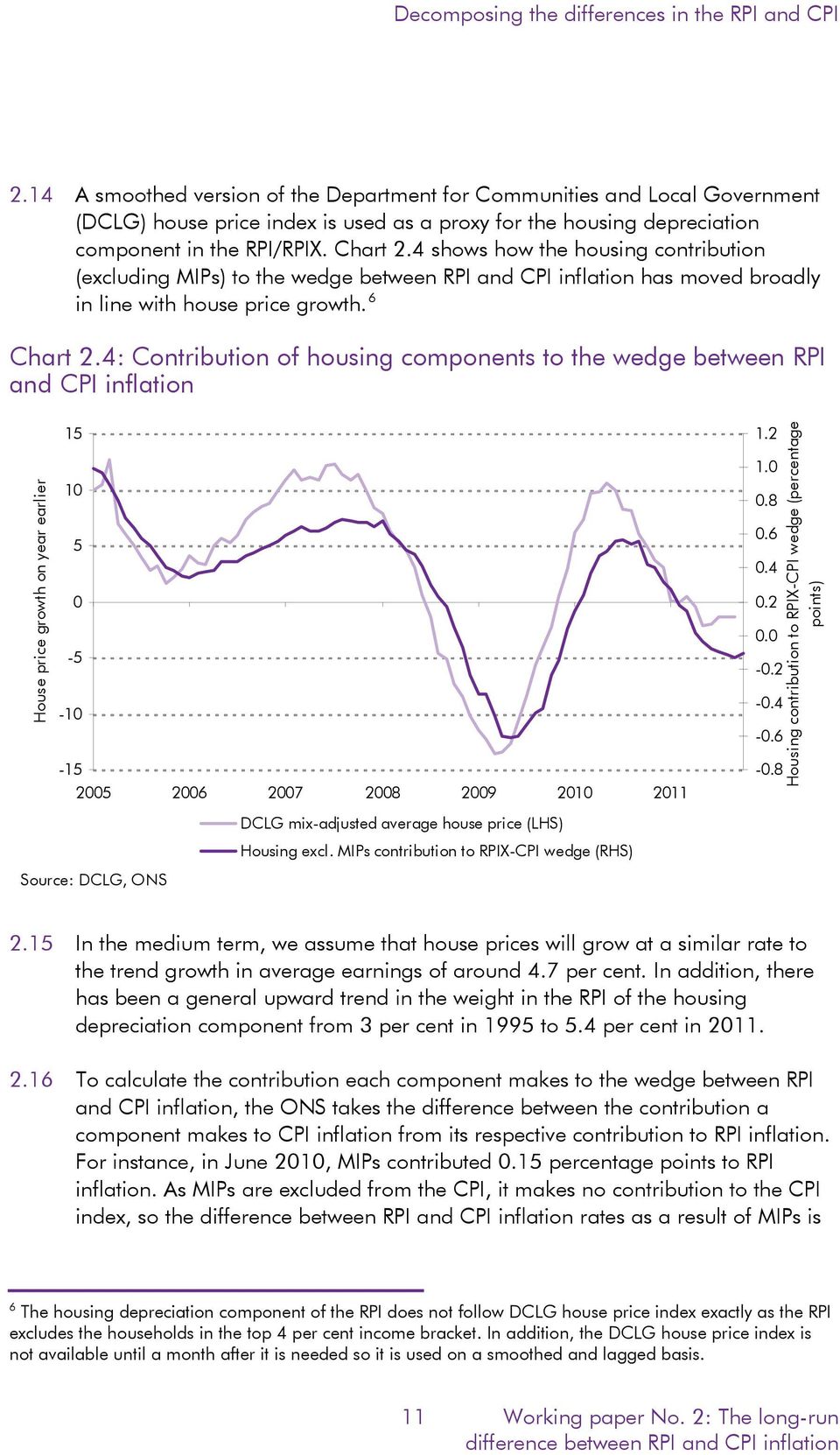
16 Decomposing the differences in the RPI and CPI 2.10 In the event that this work leads to changes in current practices for the collection of clothes prices, this may have some impact on the recent increase in the wedge that we have seen. It will therefore be important to keep up to date with any further developments from the ONS Based on the data that are currently available (i.e. notwithstanding the outcome of the ONS review of methods used to measure clothing inflation), the contribution from the long-term formula effect could be higher than 0.8 percentage points and fall somewhere in the region of 0.8 percentage points to 1 percentage point. Housing components 2.12 The RPI includes housing components comprised of: owner-occupiers housing depreciation, council tax and rates, rent, water and other charges, repairs and maintenance charges, do-it-yourself materials, dwelling insurance and ground rent and mortgage interest payments (MIPs). In contrast the RPIX excludes MIPs. The CPI excludes MIPs, owner-occupied housing costs and council tax, but includes rent, minor repairs and maintenance costs, water and other charges (Table 2.2). Table 2.2: Housing coverage of RPI, RPIX and CPI RPI RPIX CPI Mortgage interest payments (MIPs) House depreciation Council tax Rents Building insurance and ground rent House transaction costs e.g. estate agents fees, surveyors costs and conveyancing fees a) Housing coverage in the RPIX 2.13 The most significant differences in housing components between the RPIX and CPI come from housing depreciation and council tax. 5 The contribution from housing depends on developments in the housing market, which has exhibited considerable volatility in the past, for instance in 2009, and can have a large impact on the wedge between RPI and CPI inflation (Chart 2.4). 5 These components have a total weight of 9.4 per cent in the RPI in Working paper No. 2: The long-run 10

17 Decomposing the differences in the RPI and CPI 2.14 A smoothed version of the Department for Communities and Local Government (DCLG) house price index is used as a proxy for the housing depreciation component in the RPI/RPIX. Chart 2.4 shows how the housing contribution (excluding MIPs) to the wedge between RPI and CPI inflation has moved broadly in line with house price growth. 6 Chart 2.4: Contribution of housing components to the wedge between RPI and CPI inflation House price growth on year earlier DCLG mix-adjusted average house price (LHS) Housing excl. MIPs contribution to RPIX-CPI wedge (RHS) Housing contribution to RPIX-CPI wedge (percentage points) Source: DCLG, ONS 2.15 In the medium term, we assume that house prices will grow at a similar rate to the trend growth in average earnings of around 4.7 per cent. In addition, there has been a general upward trend in the weight in the RPI of the housing depreciation component from 3 per cent in 1995 to 5.4 per cent in To calculate the contribution each component makes to the wedge between RPI and CPI inflation, the ONS takes the difference between the contribution a component makes to CPI inflation from its respective contribution to RPI inflation. For instance, in June 2010, MIPs contributed 0.15 percentage points to RPI inflation. As MIPs are excluded from the CPI, it makes no contribution to the CPI index, so the rates as a result of MIPs is 6 The housing depreciation component of the RPI does not follow DCLG house price index exactly as the RPI excludes the households in the top 4 per cent income bracket. In addition, the DCLG house price index is not available until a month after it is needed so it is used on a smoothed and lagged basis. 11 Working paper No. 2: The long-run
18 Decomposing the differences in the RPI and CPI 0.15 percentage points. 7 Based on the weight of 5.4 per cent in 2011 for the housing depreciation component, this suggests that the long-term contribution to the wedge would be around 0.25 percentage points 8 (i.e. assuming house prices will grow at a similar rate to growth in average earnings of around 4.7 per cent multiplied by 5.4 per cent) The CPI also excludes council tax as it is treated as a direct tax in the National Accounts. It has therefore not been considered as household consumption and is excluded from the CPI, which is based on Household Final Monetary Consumption in the National Accounts. 10 However, the decision as to whether to include council tax in the CPI is currently being considered further by the Consumer Prices Advisory Committee (CPAC) alongside the work by the ONS on the inclusion of owner occupiers housing costs Over the long run we might assume that a plausible assumption for the growth of council tax is around 3 per cent based on average growth rates over recent years. Based on the weight of 4 per cent in 2011 for the council tax component, this suggests that the long-term contribution to the wedge would be around 0.1 percentage points A plausible assumption for the combined contribution to the wedge from housing components in the RPIX, such as housing depreciation and council tax is around 0.35 percentage points. b) Mortgage interest payments (MIPs) 2.20 The RPI includes MIPs, which are excluded from the CPI and RPIX. Although the contribution to the wedge from MIPs averages at zero over time (see Table 2.1), 7 For more details on the ONS methodology for explaining the differences between the CPI and RPI see ONS Information note, Consumer Prices Index and Retail Prices Index analysing differences. 8 The ONS are currently developing owner occupiers housing costs (OOH) indices for the potential inclusion in the CPI. This calculation assumes that there are no adjustments to the CPI to include owneroccupied housing costs. For more details on OOH see the section on Risks and uncertainties. 9 It is also possible to calculate the contribution that the housing depreciation component makes to the wedge between RPI and CPI inflation by taking the difference between the assumed long-run rate for housing depreciation (i.e. around 4.7 per cent) and annual CPI inflation in the long run, of 2 per cent. Taking this average annual rate and the weight of housing depreciation in the RPI also gives a contribution to the wedge. We do not use this approach as we try to be as consistent with the ONS methodology as possible. 10 For more details see ONS, July 2011, History of and differences between the Consumer Prices Index and Retail Prices Index. 11 For more details see National Statistician s Consumer Prices Advisory Committee, September 2011, Item Coverage in the Consumer Prices Index. Working paper No. 2: The long-run 12

19 Decomposing the differences in the RPI and CPI this is the main source of volatility in the wedge between RPI and CPI inflation. Chart 2.5 shows the contribution to the from the MIPs component. Chart 2.5: Contribution of MIPs to the difference between RPI and CPI inflation Percentage points Source: ONS MIPs contribution to RPI-CPI wedge RPI-CPI 2.21 To model the MIPs component, the ONS calculates the average debt outstanding on 276 different vintages of mortgages and this is revalued based on movements in house prices. 12 This average debt tends to rise over time, given that the average mortgage payment in the latest month is generally much higher than the one dropping out. Thus, there will be an upward drift in the MIPs index, even with no changes in mortgage rates Over the long term we might expect mortgage interest payments to grow in line with the average earnings growth assumption and we assume interest rates are unchanged. 13 As MIPs have a weight of 3.2 per cent in the RPI in 2011, this would imply the long-term contribution of MIPs to the wedge between RPI and CPI inflation is around 0.15 percentage points. 12 So, each month the average debt will change, as the value of the latest vintage will tend to reflect latest house prices, while the oldest vintage drops out; hence the average debt tends to change with changes in house prices. 13 As MIPs are not necessarily rising in line with the average earnings growth assumption by the end of our forecast, RPI does not always return to the long-term rate in 5 years time in our forecast. 13 Working paper No. 2: The long-run

20 Decomposing the differences in the RPI and CPI Other differences in coverage and differences in weights Other differences in coverage 2.23 Other differences in coverage arise as the CPI includes brokerage fees, student accommodation fees and overseas student s tuition fees. The RPIX includes VED, trade union subscriptions, TV licence fees and proxies new car prices (Table 2.3). Table 2.3: Other differences in coverage of RPI, RPIX and CPI RPI RPIX CPI Trade union subscriptions Vehicle excise duty (VED) TV licence fees Unit trust and stockbroker fees University accommodation fees Foreign students university tuition fees New car prices 2.24 Other differences in coverage are currently contributing around -0.2 percentage points compared to their average contribution to the wedge over the past 6 years 14 of around -0.1 percentage points (Table 2.1). Over the longer run, since 1997, the average contribution from other differences in coverage has also been around -0.1 percentage points. However the average since 1997 uses a mixture of the ONS s previous and revised methodologies to calculate the breakdown in the wedge between RPI and CPI inflation (Table B.3 in Annex B) Previously, a large contribution to the coverage component has come from the measurement of car prices. Aside from car prices, we do not have the relevant historical time series for the item level data available from the ONS for the other coverage differences shown in Table 2.3. However, these generally tend to have smaller weights in the RPI/CPI than those for car prices. Unless the average price changes for these components are significantly stronger or weaker than the other components, we might therefore assume that they do not contribute as much to the wedge as the effect from car prices As part of the ONS s annual review of the basket of goods included in the CPI and the RPI in 2012, the ONS propose to include TV licence fees, VED and trade union subscriptions in the CPI. These items are already included in the RPI. 14 The average is calculated over the last 6 years as this is the time period over which the revised method is used to construct these series by the ONS. Working paper No. 2: The long-run 14

21 Decomposing the differences in the RPI and CPI Subject to the approval of the UK Statistics Authority, these items will be included in the CPI in 2012, reducing the coverage differences between the RPI and CPI The differences in the measurement of car prices arise as the RPI uses movements in the prices of used cars as a proxy for new cars. However, as the regulations for CPI do not permit the use of imputed prices, the CPI uses a specific index for new cars (based on their list prices). 16 One disadvantage associated with including list prices is that it is not necessarily the price paid by consumers as discounts are not taken into account From around 2002, prices of motor vehicle purchases in the CPI have tended to rise faster than prices of vehicle purchases in the RPI (Chart 2.6). Chart 2.7 shows that there has been a divergence between the annual rate for new cars, based on list prices and second hand cars in the CPI. The category of purchase of vehicles has therefore tended to make less of a contribution to RPIX inflation than CPI inflation, all else equal, reducing the wedge between the two measures of inflation. Based on the difference in contributions in each month of the purchase of motor vehicles category to RPI and CPI inflation, the average difference in the contributions made is around 0.1 percentage points higher in the CPI since In contrast to this, vehicle prices in the RPI increased sharply during late 2009 and early 2010, rising at almost double the annual rate of their equivalent in the CPI at the beginning of 2010 (Chart 2.6). At its peak in 2010, this added 0.4 percentage points to the wedge between RPI and CPI inflation and around 0.1 percentage points on average in It is possible that these recent effects in 2009 and 2010 will be temporary. However if the divergence between purchases of vehicle prices from 2002 were to continue, this could contribute around -0.1 percentage points to the long-run wedge between RPI and CPI inflation. The average difference in contributions from this component to RPI and CPI inflation since 1997, as well as from 1997 to 2008, is around -0.1 percentage points. However it seems likely that the inflation rates for the two series will re-converge to something approaching their previous degree of correlation, as used car prices cannot fall indefinitely and we might therefore expect the two series to move together over time. 15 For more details see National Statistician s Consumer Prices Advisory Committee, September 2011, Item Coverage in the Consumer Prices Index. 16 This is based on the list prices of a sample of cars covering a range of manufacturers, quality adjusted for changes in specification. A trade guide is used to obtain the list price, the specification of the model and the cost of any changes in specification. 17 This is also the case for the average difference in contributions up to Working paper No. 2: The long-run
22 Decomposing the differences in the RPI and CPI Chart 2.6: Purchase of vehicles in the RPI and CPI Annual rate Source: ONS RPI: Purchase of motor vehicles CPI: Purchase of vehicles Chart 2.7: Annual rate of new and second hand cars in the CPI Annual rate Source: ONS New cars Second hand cars Working paper No. 2: The long-run 16
23 Decomposing the differences in the RPI and CPI 2.31 As part of the development of CPI, the CPAC has recommended to the UK Statistics Authority that a single measure of new car prices for both the CPI and RPI should be used. 18 The updated methodology for collecting car prices in the RPI will reflect new cars rather than using a proxy based on used cars. In addition, there are planned changes for the measurement of new cars in both the RPI and CPI to make them more representative of actual transaction prices paid rather than basing it on list prices (i.e. using prices on manufacturer s websites that take into account price discounts) These changes are subject to the usual procedure for introducing changes into the RPI, so the Bank of England will be consulted. A public consultation is also taking place on these proposals. If agreed the changes are currently scheduled to be introduced in February 2012 and would eliminate any differences in coverage as a result of the treatment of new car prices in the RPI and CPI. Differences in weights 2.33 There are differences in the weights of items in the CPI and the weights of the same items in the RPI. This is because item weights are derived from different data sources and population bases (Table 2.4). The CPI weights are largely calculated from Household Final Monetary Consumption (HFMCE) data taken from the National Accounts. By contrast, the RPI relies on data from the Living Costs and Food survey and relates to the expenditure of households only, excluding the highest income households and pensioner households which are mainly dependant on state benefits. 19 Table 2.4: Population coverage of RPI, RPIX and CPI RPI RPIX CPI Highest earning households (top 4 per cent of households by income) Institutional households Pensioner households with ¾ of their income coming from state pensions and benefits Spending by foreign visitors to the UK Spending by UK households abroad 18 For more details see National Statistician s Consumer Prices Advisory Committee, September 2011, Improving the Measurement of Car Prices in the CPI and RPI. 19 For more details see ONS, July 2011, History of and differences between the Consumer Prices Index and Retail Prices Index. 17 Working paper No. 2: The long-run
24 Decomposing the differences in the RPI and CPI 2.34 Differences in weights contributed around -0.3 in October 2011 to the wedge between RPI and CPI inflation. The average contribution to the wedge over the past 6 years 20 is also around -0.3 percentage points (Table 2.1). There are limitations associated with observing the long term trend from ONS data for contributions to the wedge as the data is only available for the past 6 years based on consistent methodology. The data since 2005 are not necessarily comparable with the data from 1997 which were based on the previous methodology for calculating contributions to the wedge (Annex B). In addition, it is difficult to replicate the calculations by the ONS to measure this component as it has tended to be calculated as the residual of the other components of the wedge between RPI and CPI inflation, acting to balance the total difference A bottom-up approach discussed here, which approximately decomposes the differences in weights by component, although not exact and subject to uncertainties, acts as a check on our long-term assumptions. Chart 2.8 shows an approximate calculation of the contributions to the wedge, by component, due to differences in weights. It uses the CPI weights in 2011 for the CPI divisions comparing them with weights of RPI items which have been grouped into these divisions. The differences in weights are then used to calculate the contributions to the wedge between RPI and CPI inflation. 21 For simplicity, long-term contributions to the wedge are calculated using average annual rates for each individual component in the CPI. With the exception of clothing (which is discussed in more detail below), the average annual rate since 1997 is used for each component in the CPI. 22 The components which are the main drivers of the contribution to the wedge as a result of differences in weights are discussed below. 20 The average is calculated over the last 6 years as this is the time period over which the most recent method is used to construct these series by the ONS. 21 Although there are uncertainties over the evolution of the weights in the RPI and CPI over the long run, for these purposes the weights of RPI and CPI items in 2011 are used. 22 This is consistent to the way in which we calculate contributions from the housing components i.e. using an average annual rate for each component since 1997 rather than taking the difference between the average annual rate since 1997 and the average annual rate for the CPI of 2 per cent in the long run. We use this method so that we follow as closely as possible the way in which the ONS calculates contributions to the differences in RPI and CPI inflation. Working paper No. 2: The long-run 18
25 Decomposing the differences in the RPI and CPI Chart 2.8: Approximate contributions to differences in weights by component Percentage points Food & nonalcoholic beverages Alcoholic beverages & tobacco Clothing & footwear Housing, water, electricity, gas & other Fuels Furniture, household equipment & Health Transport Communication Recreation & culture Education Restaurants & hotels Miscellaneous goods & services Total Contribution Source: OBR calculations i) Recreation and culture 2.36 Based on the average annual rates of each series included in the recreation and culture category since 1997 and the differences in weights in the RPI and CPI in 2011, this division tends to be the most significant positive contributor to the wedge, adding 0.16 percentage points to the difference between RPI and CPI inflation. The main drivers in this category are: games, toys and hobbies; photographic, cinematographic and optical equipment; and data processing and equipment In particular, the weights for each of these items tend to be higher in the CPI than in the RPI, which is particularly the case for games, toys and hobbies. On average since 1997, the prices of these items have tended to fall by around 3, 13 and 20 per cent respectively (Chart 2.9). This has tended to increase the wedge between RPI and CPI inflation by around 0.05 to 0.06 percentage points for each of these three components. 19 Working paper No. 2: The long-run
26 Decomposing the differences in the RPI and CPI Chart 2.9: Annual rates for items in the recreation and culture division of CPI Annual rate Source: ONS Games, toys and hobbies Photographic, cinematographic and optical equipment Data processing and equipment ii) Transport 2.38 On the basis of the approach set out above, the transport division of the price indices negatively contributes to the wedge between RPI and CPI inflation due to differences in weights, by around percentage points (Chart 2.8). The category for transport includes purchase of vehicles (such as second hand car and new car prices), operation of personal transport equipment (such as fuels and lubricant prices) and transport services (such as road, railway, sea and air fares). These are discussed in more detail below Chart 2.10 shows that the airfares index has exhibited a great deal of volatility and there is often a high level of inflation. Given there are differences in the weights in the RPI and CPI for this category, the level of inflation means that it can make a non-negligible contribution to the wedge between RPI and CPI inflation. It is likely that this component will continue to add volatility to the size of the wedge Given the volatility in the series there is uncertainty in which direction this component is likely to contribute to the wedge going forwards. Over the period since 1997, airfares have been growing at an annual rate of around 3.5 per cent on average. Due to the differences in weights, this would contribute a reduction of 0.02 percentage points to the wedge between RPI and CPI inflation. Working paper No. 2: The long-run 20
27 Decomposing the differences in the RPI and CPI 2.41 There is a similar story for sea and inland waterway transport, where the annual rate has exhibited a good deal of volatility (Chart 2.10). The higher weight in the CPI compared to the RPI implies a reduction in the wedge by around 0.01 percentage points based on the average annual rate since Chart 2.10: Annual inflation rate of transport by air and sea Annual rate Source: ONS Transport by air Transport by sea 2.42 There are also higher weights in the CPI for the other components of transport services, such as for road transport. Chart 2.11 shows that the annual rates are less volatile for railway and road transport than for air and sea fares. The average annual rate is around 4 per cent since 1997 for both series. On the basis of the approach set out above, this contributes around and percentage points to the wedge from railway and road transport respectively. 21 Working paper No. 2: The long-run
28 Decomposing the differences in the RPI and CPI Chart 2.11: Annual inflation rate of transport by railway and road Annual rate Source: ONS Transport by railway Transport by road 2.43 Another component of the transport division in the CPI is fuels and lubricants (including petrol, diesel and oil). The weight of fuels and lubricants in the CPI in 2011 (4.3 per cent) is smaller than in the RPI (4.6 per cent). Although the weights have converged slightly since 2010 (4.9 per cent in the RPI, 4.1 per cent in the CPI) there still remains a slight difference. Any large increases in the crude oil price have generated differences in the contribution of fuels and lubricants to the two indices. For example, annual fuels and lubricants prices in 2010 compared to 2009 contributed around 0.14 percentage points more to RPI inflation than CPI inflation. On average since 1997, annual fuels and lubricants prices in the CPI have grown by around 6 per cent (Chart 2.12). This does not have a large impact on the wedge (around 0.02 percentage points) as a result of the difference in weights. In the absence of shocks to the oil price, we would expect the contribution to the wedge to be small Other items within the transport category also have significant differences in weights, such as maintenance and repairs and new cars/proxy for new cars where the weight in the CPI is higher than that in the RPI. As the average annual rates for these series since 1997 have been positive, this tends to have a negative impact on the wedge between RPI and CPI inflation. Used cars on the other hand have a higher weight in the RPI compared to the CPI. However the average annual rate since 1997 is -2.3 per cent, contributing percentage points to the wedge. Working paper No. 2: The long-run 22
29 Decomposing the differences in the RPI and CPI Chart 2.12: Annual inflation rate of fuels and lubricants index Annual rate Source: ONS Fuels and lubricants iii) Miscellaneous goods and services 2.45 Miscellaneous goods and services have also contributed around 0.11 percentage points to the as a result of differences in weights In the case of financial services, included in the division of miscellaneous goods and services, the differences in weights are large. The weight on financial services in the CPI increased significantly in 2002 from 0.1 per cent in the previous year to 2.2 per cent and new items were added to the basket, which also suggests this is an area of coverage differences between the RPI and CPI. 23 Any volatility in the series therefore has implications for the wedge Given that financial service prices in the CPI fell by 1.6 per cent in October 2011 compared to a year earlier, the differences in weights implies that there will be a larger downward effect on the CPI than on the RPI, which all else equal, would increase the wedge between RPI and CPI inflation. Since 1997, the average annual rate of financial services inflation is around -1.8 per cent. Taken together with the differences in weights in the RPI and CPI, this would add around 0.04 percentage points to the wedge between RPI and CPI inflation. However there were substantial falls in financial service prices in the early 2000s. Since 2003, 23 For instance, unit trust fees and stockbrokers fees are not included in the RPI. 23 Working paper No. 2: The long-run
30 Decomposing the differences in the RPI and CPI the annual rate has averaged around 0.8 per cent, which would instead imply a negative contribution to the wedge of around 0.02 percentage points. Chart 2.13: Annual inflation rate of financial services index Annual rate Source: ONS Financial services Average since 1997 Average since By contrast, the insurance component of the miscellaneous goods and services category has a lower weight in the CPI compared to the RPI. 24 Transport insurance, in particular has a higher weight in the RPI than in the CPI and has been growing at an annual rate of around 8.6 per cent on average since This implies an average contribution to the wedge of around 0.14 percentage points solely from this component. However the average since 1997 may be pushed upwards slightly as the annual rate has risen sharply since 2009, compared to the period between 2002 and 2009 where the annual rate was more stable. The average annual rate between 1997 and 2009 was around 5.5 per cent which would add around 0.09 percentage points to the wedge between RPI and CPI inflation (Chart 2.14). 24 This is because the CPI only includes the service element whereas the RPI counts the full premium paid. Working paper No. 2: The long-run 24
31 Decomposing the differences in the RPI and CPI Chart 2.14: Annual inflation rate of transport insurance index Annual rate Source: ONS iv) Clothing and footwear Transport insurance Average since 1997 Average up to The weight of clothing is higher in the CPI than in the RPI. Given that the annual rate of clothes price inflation is negative on average since 1997, this would suggest a positive contribution to the wedge between RPI and CPI inflation based on the differences in weights alone. For example, the average annual rate from 1997 to the end of 2009 was around -6 per cent which would contribute around 0.08 percentage points to the wedge on the basis of the approach described above Since the changes to the ONS collection practices for clothing in 2010, the annual rates have tended to rise, averaging around 0.8 per cent from 2010 to October 2011 (Chart 2.15). Chart 2.16 shows the index for clothing and footwear in the CPI, which has generally been on a downward trend before flattening out in 2010 following the changes in methodology. This is one reason why using the average annual rate since 1997 for the calculation of the contribution to the wedge as a result of differences in weights may not always apply To calculate the approximate contribution to the wedge shown in Chart 2.8, the average annual rate of 0.8 per cent is used for clothes prices, to reflect the time period over which the new methodology has been in place. On this basis, it might be plausible to assume that clothing reduces the wedge between RPI and 25 Working paper No. 2: The long-run
32 Decomposing the differences in the RPI and CPI CPI inflation by around 0.01 percentage points as a result of difference in weights The ONS is currently undertaking a review of the methods used to measure clothing inflation in the CPI and RPI. This will analyse why current methods might be contributing to the disparity that currently exists between CPI and RPI measures of clothing inflation and aims to develop alternative compilation methods. In the event that this leads to changes in current practices, this could have an impact on the contribution to the wedge as a result of differences in weights. Chart 2.15: Annual inflation rate of clothing index Annual rate Source: ONS Clothing annual rate Average since 1997 Average since 2010 Working paper No. 2: The long-run 26
33 Decomposing the differences in the RPI and CPI Chart 2.16: Clothing and footwear in the CPI (Index=2005) Index (2005=100) Source: ONS v) Summary 2.53 This method suggests an approximate total long-term contribution of around 0.08 percentage points to the wedge between RPI and CPI inflation. However using the average annual rate since 1997 may not always be a sensible approach. This is the case for the clothing and footwear component, given the recent changes in the way clothes prices are measured. To calculate the approximate contribution to the wedge shown in chart 2.8, the average annual rate of 0.8 per cent over 2010 and 2011 is used for clothes prices, to reflect the time period over which the new methodology has been in place. We assume that clothing reduces the wedge between RPI and CPI inflation by around 0.01 percentage points as a result of difference in weights, rather than adding around 0.08 percentage points to the wedge, as would have been the case using the average annual rate from 1997 onwards On this basis, this would suggest that a total long-run contribution of around zero to the wedge between RPI and CPI inflation might be plausible as a result of differences in the weights (Chart 2.8) If we were to also take into account alternative average annual rates for financial services and transport insurance (based on an average since 2003 for financial services and an average excluding the period from 2009 onwards for transport insurance) this would, for example, imply a total contribution of around Working paper No. 2: The long-run
34 Decomposing the differences in the RPI and CPI percentage points to the wedge between RPI and CPI inflation due to differences in weights However these adjustments are judgemental and any number of these could be applied to each component. For the basis of the long-run assumption we think that it is sensible to take a general approach using the average annual rate since 1997 for all series, with the exception of clothing. On this basis, this would suggest that a plausible total long-run contribution would be around zero to the wedge between RPI and CPI inflation, as a result of differences in the weights. Working paper No. 2: The long-run 28
35 3 Prospects for the long-term wedge between RPI/RPIX and CPI inflation 3.1 One way to assess the prospects for the long-term wedge between RPI and CPI inflation is to look at the average contributions from each of the four main components of the wedge over the past (the formula effect, housing components, other differences in coverage and differences in weights). However there are a number of limitations associated with using the long-term trend for contributions to the wedge from each of the main components. The data since 2005 are not necessarily comparable with the data from 1997 which were based on a previous methodology for calculating contributions to the wedge. A bottom-up approach has been used wherever possible here, looking at individual components which are the key drivers of particular effects. These approximate calculations can then be used as a check on our long-term assumptions for the wedge between RPI and CPI inflation. 3.2 The OBR previously assumed that the formula effect would contribute around 0.5 percentage points to the long-run wedge between RPI and CPI inflation, consistent with the average contribution from the formula effect over the past. The OBR s March 2011 forecast was based on the assumption that the recent rises in the formula effect will begin to stabilise and that the larger contribution from the formula effect in 2010 will persist. We assumed in March that the formula effect will account for around 0.8 percentage points of the difference between RPI and CPI inflation rates in the long run. 3.3 At the beginning of 2011, the formula effect has increased yet further, remaining at around 1 percentage point from February to October One possibility is the formula effect could continue to contribute a larger amount to the wedge between RPI and CPI inflation in the long run. Future inflation data will continue to be important in indicating the persistence of the recent increases in the formula effect. 3.4 Based on the data that is currently available (i.e. notwithstanding the outcome of the ONS review of methods used to measure clothing inflation), the contribution from the long-term formula effect could be higher than 0.8 percentage points and fall somewhere in the region of 0.8 to 1 percentage points. In the long run, we think that it is plausible to assume that the formula effect contributes around 29 Working paper No. 2: The long-run
36 Prospects for the long-term wedge between RPI/RPIX and CPI inflation 0.9 percentage points in our November EFO, which is the mid-point of this range. 3.5 The contribution from housing depends on developments in the housing market, which has tended to drive a good deal of the volatility in the size of the wedge in the past. In the long run we expect the housing market to grow broadly in line with average earnings growth. A plausible assumption for the combined long-run contribution to the wedge from housing components in the RPIX, such as housing depreciation and council tax is around 0.35 percentage points. 3.6 In the long run, we expect mortgage interest payments (MIPs) to grow in line with average earnings growth of 4.7 per cent. This suggests that a plausible long-term contribution of MIPs to the wedge between RPI and CPI inflation is around 0.15 percentage points. 3.7 Previously, a large contribution to the coverage component has come from the measurement of car prices. If the divergence between purchases of vehicles price inflation in the RPI and CPI since 2002 were to continue, this could contribute around -0.1 percentage points to the long-run wedge between RPI and CPI inflation. The average difference in contributions from this component to RPI and CPI inflation since 1997, as well as from 1997 to 2008, is around -0.1 percentage points. However it seems likely that the inflation rates for the two series will re-converge to something approaching their previous degree of correlation, as used car prices cannot fall indefinitely and we might therefore expect the two series to move together over time. 3.8 The Consumer Prices Advisory Committee (CPAC) has recommended to the UK Statistics Authority that a single measure of new car prices should be used for both the CPI and RPI. These changes are subject to the usual procedure for introducing changes into the RPI, so the Bank of England will be consulted. A public consultation is also taking place on these proposals. If agreed, the changes are currently scheduled to be implemented in February 2012 and would eliminate any differences in coverage as a result of the treatment of new car prices in the RPI and CPI. 3.9 A bottom-up approach discussed here, which roughly decomposes the differences in weights by component acts as a good check on our long-term assumptions. The approximations presented, as well as an additional assumption for the clothing and footwear component suggests a contribution of around zero would be plausible due to differences in weights Table 3.1 summarises a range of plausible assumptions for each component. For the basis of our November EFO, we assume that the long-run difference between Working paper No. 2: The long-run 30
37 Prospects for the long-term wedge between RPI/RPIX and CPI inflation RPI and CPI inflation is around 1.4 percentage points. This represents the midpoint of the plausible range of estimates. Table 3.1: Plausible range of assumptions for the wedge between RPI and CPI inflation Plausible range of assumptions for the wedge between RPI and CPI inflation (percentage points) Low High Formula effect Housing (ex. MIPs) Coverage Differences in weights Total RPIX-CPI wedge MIPs Total RPI-CPI wedge Risks and uncertainties 3.11 The work of the Consumer Prices Advisory Committee (CPAC) to adjust the CPI to include owner-occupied housing costs and the method used may have a substantial impact on the CPI and remains a risk to the prospects for the wedge in the long run. The ONS is currently developing owner occupiers housing costs (OOH) indices using the net acquisitions (NA) and rental equivalence (RE) approaches for the potential inclusion in the CPI The NA approach treats a house as the purchase of a good which is partly an asset (the land) and partly consumable (the house). The cost associated with buying and maintaining a house is considered as well as changes to the price of the house. However it is not currently possible to separate the cost of the house from the cost of the land. The RE approach assumes that there is a flow of services such as shelter and security of tenure which are consumed. The value of the services is assumed to be the same as the rent the house might attract in the rental market. Owner occupiers housing costs are therefore imputed using the rents paid for equivalent rented properties The choice of approach could have a material impact on the wedge between RPI and CPI inflation. The NA approach, for example, would reduce the wedge bringing a measure of CPI which includes OOH more in line with a measure such as RPIX excluding council tax. The use of a RE methodology would, on the 1 Consumer Prices Advisory Committee, September 2011, Annual Report to UK Statistics Authority. 31 Working paper No. 2: The long-run
38 Prospects for the long-term wedge between RPI/RPIX and CPI inflation other hand, not have a substantial effect on CPI inflation and would therefore mean that there would not be large changes to the wedge going forwards. Working paper No. 2: The long-run 32
39 A Coverage of inflation indices Table A.1: Coverage of RPI, RPIX and CPI inflation indices RPI RPIX CPI Housing coverage Mortgage interest payments (MIPs) House depreciation Council tax Rents Building insurance and ground rent House transaction costs e.g. estate agents fees, surveyors costs and conveyancing fees Other coverage Trade union subscriptions Vehicle excise duty (VED) TV licence fees Unit trust and stockbroker fees University accommodation fees Foreign students university tuition fees New car prices Population coverage Highest earning households (top 4 per cent of households by income) Institutional households Pensioner households with ¾ of their income coming from state pensions and benefits Spending by foreign visitors to the UK Spending by UK households abroad 33 Working paper No. 2: The long-run
40 C Working paper No. 2: The long-run 34
41 B ONS methodology for measuring the RPI-CPI wedge B.1 The ONS has produced a revised methodology for the breakdown of the from January 2005 onwards. The revised methodology is a contributions approach which gives an estimate of the effect of a particular component on the annual rate of CPI or RPI inflation. By comparison, the previous methodology ran from 1997 to May 2010 and was calculated by using annual changes and adding/subtracting them from the headline rates to calculate each component. 1 B.2 Based on a comparison of the two methodologies in the period that they overlap from January 2005 to May 2010 (Table B.1), housing (in particular other housing excluding MIPs) contributes a larger amount to the wedge using the revised methodology. Similarly, other differences in coverage contribute slightly more using the new method. Revisions to both of these components are offset by a lower contribution from differences in weights resulting in an unchanged wedge between RPI and CPI inflation (see Charts B.1 to B.7). B.3 Table B.2 shows a comparison of the averages for each of the components using a combined series (the previous methodology up to 2005 and the revised methodology up to the latest data in October 2011) compared to the average of the series based on the new and previous methodologies separately. In general, it is possible that if the ONS was to extend the new methodology back so that the series began in 1997, then compared to the combined series, the average contribution from housing could be larger, whereas there could be lower contributions from differences in weights. 1 See ONS Information Note: Consumer Prices Index and Retail Prices Index analysing differences. 35 Working paper No. 2: The long-run
42 ONS methodology for measuring the RPI-CPI wedge Table B.1: Comparison of previous and revised methodologies over the period they overlap Previous method Revised method Difference 2005-May May 2010 RPI-CPI Housing, of which: MIPS Other housing Formula effect Other difference in coverage Differences in weights Table B.2: Comparison of averages over the series using the previous and revised methodologies Previous method 1997-May 2010 Previous method Revised method 2005-October 2011 Combined October 2011 RPI-CPI Housing, of which MIPS Other housing Formula effect Other difference in coverage Differences in weights The previous methodology is used from 1997 to 2005 which is combined with the revised methodology from 2005 to October 2011to form a longer time series. Working paper No. 2: The long-run 36
43 ONS methodology for measuring the RPI-CPI wedge Chart B.1: Contribution from formula effect Percentage points Source: ONS Previous methodology Formula effect Chart B.2: Contribution from housing components Percentage points Source: ONS Previous methodology Total housing 37 Working paper No. 2: The long-run
44 ONS methodology for measuring the RPI-CPI wedge Chart B.3: Contribution from housing components excluding MIPs Percentage points Previous methodology Other housing Source: ONS Chart B.4: Contribution from MIPs Percentage points Source: ONS Previous methodology MIPs Working paper No. 2: The long-run 38
45 ONS methodology for measuring the RPI-CPI wedge Chart B.5: Contribution from other differences in coverage Percentage points Previous methodology Differences in coverage Source: ONS Chart B.6: Contribution from differences in weights Percentage points Previous methodology Differences in weights Source: ONS 39 Working paper No. 2: The long-run
46 ONS methodology for measuring the RPI-CPI wedge Chart B.7: Differences between RPI and CPI inflation based on the two methodologies Percentage points Source: ONS Previous methodology RPI-CPI Table B.3: Contributions to the difference in RPIX/RPI and CPI inflation rates Current 1 Average Minimum Maximum Standard deviation Formula effect Since Housing (ex. MIPs) Since Other differences in coverage Since Other differences inc. weights Since Total RPIX-CPI wedge Total RPIX-CPI wedge since MIPs Since Total RPI-CPI wedge Total RPI-CPI wedge since October The average, minimum, maximum and standard deviation are calculated from Jan 2005 to October The ONS changed the methodology which it uses to calculate the contributions to the wedge, designed to provide a more accurate breakdown. Data using the revised methodology begins in The average, minimum, maximum and standard deviation are based on a combined series which uses data from 1997 to 2005 based on the old methodology used by the ONS and the data from 2005 onwards using the new methodology. 4 The components may not sum to the total wedge between RPI/RPIX and CPI, as the total wedge is calculated using published RPI, RPIX and CPI inflation rates rounded to 1 decimal place. Working paper No. 2: The long-run 40
47 ONS methodology for measuring the RPI-CPI wedge 41 Working paper No. 2: The long-run
48
Harmonised Index of Consumer Prices: update on methodological developments
 Harmonised Index of Consumer Prices: update on methodological developments Jim O Donoghue Office for National Statistics e-mail: [email protected] National Statistics customer enquiry line: +44 (0)845 601
Changes to National Accounts Blue Book 2014: Improvements to Household Expenditure Estimates
 Changes to National Accounts Blue Book 2014: Improvements to Household Expenditure Estimates Author: Hugh Skipper, Office for National Statistics Contributions from: David Matthewson, Caroline Walker,
CONSUMER PRICE INDEX
 CONSUMER PRICE INDEX 1 st quarter 2008 1. Introduction This issue of Economic and Social Indicators presents the Consumer Price Index (CPI) during the first quarter of 2008. A new CPI series, based on
Public attitudes to inflation and interest rates
 8 Quarterly Bulletin 8 Q Public attitudes to inflation and interest rates By James Benford of the Bank s Monetary Assessment and Strategy Division and Ronnie Driver of the Bank s Inflation Report and Bulletin
Consumer Price Developments in December 2015
 sdzkl1;yah Consumer Price Developments in December 2015 CPI-All Items inflation came in at -0.6% year-on-year (y-o-y) in December CPI-All Items inflation came in at -0.6% in December, compared to -0.8%
The UK Tourism Satellite Account (UK- TSA) for 2012. Tourism Direct Gross Value Added (GVA) was 57.3 billion in 2012.
 Statistical Bulletin The UK Tourism Satellite Account (UK- TSA) for 2012 Coverage: UK Date: 26 June 2015 Geographical Area: UK Theme: People and Places Theme: Economy Main Figures Tourism Direct Gross
WHAT IS THE CONSUMER PRICE INDEX?
 INTRODUCTION The Consumer Price Index, commonly referred to as the CPI, is one of the most used of the statistical series produced by the Statistical Institute of Jamaica (STATIN). In its many applications,
Economic Review, April 2012
 Economic Review, April 2012 Author Name(s): Malindi Myers, Office for National Statistics Abstract This note provides some wider economic analysis to support the Statistical Bulletin relating to the latest
Consumer Price Developments in January 2016
 sdzkl1;yah Consumer Price Developments in January 2016 CPI-All Items inflation came in at -0.6% year-on-year (y-o-y) in January CPI-All Items inflation was -0.6% in January, unchanged from that in December.
Consumer Price Indices in the UK. Main Findings
 Consumer Price Indices in the UK Main Findings The report Consumer Price Indices in the UK, written by Mark Courtney, assesses the array of official inflation indices in terms of their suitability as an
Consumer Price Developments in July 2015
 sdzkl1;yah Consumer Price Developments in July 2015 CPI-All Items inflation eased to -0.4% y-o-y in July CPI-All Items inflation came in at -0.4% in July compared to -0.3% in June, mainly due to the lower
Explanation beyond exchange rates: trends in UK trade since 2007
 Explanation beyond exchange rates: trends in UK trade since 2007 Author Name(s): Michael Hardie, Andrew Jowett, Tim Marshall & Philip Wales, Office for National Statistics Abstract The UK s trade performance
5. Price and Wage Developments
 . Price and Wage Developments Recent Developments in Inflation Inflation rose in the December quarter, following a low September quarter outcome (Table.; Graph.). Indicators of underlying inflation increased
Business and Finance
 Methodology of the Monthly Index of Services Business and Finance The published Index of Services component for Business and Finance estimates short-term changes in gross value added in the service sector
Impact of VAT reduction on the consumer price indices
 ARTICLE Rob Pike, Mark Lewis and Daniel Turner Impact of VAT reduction on the consumer price indices SUMMARY This article explains how ONS successfully measured prices for the consumer price indices following
Spotlight Quiz on Inflation, Index-Linking and Compounding
 Spotlight Quiz on Inflation, Index-Linking and Compounding Frequency of payment A major UK bank has recently written to its customers along the following lines: Through talking to customers we have found
GOVERNMENT EXPENDITURE & REVENUE SCOTLAND 2013-14 MARCH 2015
 GOVERNMENT EXPENDITURE & REVENUE SCOTLAND 2013-14 MARCH 2015 GOVERNMENT EXPENDITURE & REVENUE SCOTLAND 2013-14 MARCH 2015 The Scottish Government, Edinburgh 2015 Crown copyright 2015 This publication is
Monetary and Financial Trends First Quarter 2011. Table of Contents
 Financial Stability Directorate Monetary and Financial Trends First Quarter 2011 Table of Contents Highlights... 1 1. Monetary Aggregates... 3 2. Credit Developments... 4 3. Interest Rates... 7 4. Domestic
Article: Main results from the Wealth and Assets Survey: July 2012 to June 2014
 Article: Main results from the Wealth and Assets Survey: July 2012 to June 2014 Coverage: GB Date: 18 December 2015 Geographical Area: Region Theme: Economy Main points In July 2012 to June 2014: aggregate
Statistical Bulletin. The Effects of Taxes and Benefits on Household Income, 2011/12. Key points
 Statistical Bulletin The Effects of Taxes and Benefits on Household Income, 2011/12 Coverage: UK Date: 10 July 2013 Geographical Area: UK and GB Theme: Economy Theme: People and Places Key points There
Cost of Living Survey Report
 Date: 1 November 2010 Ref: ICSC 60-1-1 SRL Cost of Living Survey Report City/Country: Colombo, Sri Lanka Type of Survey: Place-to-place Date of Survey: June 2010 I. INTRODUCTION 1. A place-to-place cost-of-living
Why Has Inflation Been So Low Since 1999? Stephen Nickell. Bank of England Monetary Policy Committee and London School of Economics
 Why Has Inflation Been So Low Since 1999? Stephen Nickell Bank of England Monetary Policy Committee and London School of Economics January For public release on 7 January A shortened version of this paper
Consumer Price Index
 An Phríomh-Oifig Staidrimh Central Statistics Office 19 January 2012 CPI/HICP - all items Annual Percentage Change CPI HICP % 4.0 2.0 0.0-2.0-4.0 Consumer Price Index December 2011 Aug 2011 Sep 2011 Oct
Statistical release P0141
 Statistical release Consumer Price Index August 2015 Embargoed until: 23 September 2015 10:00 Enquiries: Forthcoming issue: Expected release date Marietjie Bennett / Anita Voges September 2015 21 October
PROJECTION OF THE FISCAL BALANCE AND PUBLIC DEBT (2012 2027) - SUMMARY
 PROJECTION OF THE FISCAL BALANCE AND PUBLIC DEBT (2012 2027) - SUMMARY PUBLIC FINANCE REVIEW February 2013 SUMMARY Key messages The purpose of our analysis is to highlight the risks that fiscal policy
Local Authority Council Tax base England 2015
 Local Authority Council Tax base England 2015 Local Government Finance Statistical Release 20 November 2015 In England there were a total of 23.7 million dwellings in England as at 14 September 2015, an
Statistical release P0141
 Statistical release Consumer Price Index May 2015 Embargoed until: 17 June 2015 10:00 Enquiries: Forthcoming issue: Expected release date Marietjie Bennett / Anita Voges June 2015 22 July 2015 (012) 310
percentage points to the overall CPI outcome. Goods price inflation increased to 4,6
 South African Reserve Bank Press Statement Embargo on Delivery 28 January 2016 Statement of the Monetary Policy Committee Issued by Lesetja Kganyago, Governor of the South African Reserve Bank Since the
Statistical release P0141
 Statistical release Consumer Price Index November 2015 Embargoed until: 9 December 2015 10:00 Enquiries: Forthcoming issue: Expected release date Marietjie Bennett / Anita Voges December 2015 20 January
Statistical release P0141
 Statistical release Consumer Price Index January 2009 Embargoed until: 25 February 2009 11:30 Enquiries: Forthcoming issue: Expected release date User information services February 2009 25 March 2009 Tel:
The Burden of Financial and Property Debt, Great Britain, 2010 to 2012
 The Burden of Financial and Property Debt, Great Britain, 2010 to 2012 Coverage: GB Date: 27 July 2015 Geographical Area: Region Theme: Economy Theme: People and Places Foreword Using the Wealth and Assets
Statistical release P0141
 Statistical release Consumer Price Index January 2014 Embargoed until: 19 February 2014 10:00 Enquiries: Forthcoming issue: Expected release date Marietjie Bennett / Anita Voges February 2014 19 March
Volume of capital services: new annual and quarterly estimates for 1950 to 2009
 Volume of capital services: new annual and quarterly estimates for 1950 to 2009 John Appleton Office for National Statistics Gavin Wallis HM Treasury Summary Capital services are the measure of capital
Statistical release P0141
 Statistical release Consumer Price Index September 2009 Embargoed until: 28 October 2009 11:30 Enquiries: Forthcoming issue: Expected release date User information services October 2009 25 November 2009
Charter for Budget Responsibility: Autumn Statement 2014 update
 Charter for Budget Responsibility: Autumn Statement 2014 update December 2014 Charter for Budget Responsibility: Autumn Statement 2014 update Presented to Parliament pursuant to Section 1 of the Budget
UK Property Transaction Statistics
 Coverage: United Kingdom Released: 21 October 2015 Next release: 24 November 2015 UK Property Transaction Statistics Frequency of release: Monthly Media contact: HMRC Press Office 03000 585 024 Statistical
CHAPTER 11. AN OVEVIEW OF THE BANK OF ENGLAND QUARTERLY MODEL OF THE (BEQM)
 1 CHAPTER 11. AN OVEVIEW OF THE BANK OF ENGLAND QUARTERLY MODEL OF THE (BEQM) This model is the main tool in the suite of models employed by the staff and the Monetary Policy Committee (MPC) in the construction
CONSUMER PRICE INDEX: METHODOLOGICAL GUIDELINES. 3 rd Floor, National Insurance Building, Fairchild Street, Bridgetown, Barbados, W I.
 CONSUMER PRICE INDEX: METHODOLOGICAL GUIDELINES SECTION I: GENERAL INFORMATION COUNTRY: Barbados AGENCY & ADDRESS: Barbados Statistical Service, 3 rd Floor, National Insurance Building, Fairchild Street,
Compiling the Gross Domestic Product: The Myanmar Experience
 Compiling the Gross Domestic Product: The Myanmar Experience by Ministry of National Planning and Economic Development The views expressed in this document are of the author(s) and do not necessarily reflect
Forecasting Business Investment Using the Capital Expenditure Survey
 Forecasting Business Investment Using the Capital Expenditure Survey Natasha Cassidy, Emma Doherty and Troy Gill* Business investment is a key driver of economic growth and is currently around record highs
Statistical Bulletin. Business Demography, 2010. Headlines figures. Summary
 Statistical Bulletin Business Demography, 2010 Coverage: UK Date: 06 December 2011 Geographical Area: Local Authority and County Theme: Business and Energy Headlines figures Number of business deaths rose
Help to Buy (Equity Loan scheme) and Help to Buy: NewBuy statistics: Data to 30 September 2015,
 Help to Buy (Equity Loan scheme) and Help to Buy: NewBuy statistics: Data to 30 September 2015, England In the first 30 months of the Help to Buy: Equity Loan scheme (to 30 September 2015), 62,569 properties
Statistical Bulletin. Annual Survey of Hours and Earnings, 2014 Provisional Results. Key points
 Statistical Bulletin Annual Survey of Hours and Earnings, 2014 Provisional Results Coverage: UK Date: 19 November 2014 Geographical Areas: Country, European (NUTS), Local Authority and County, Parliamentary
Chapter 3: Property Wealth, Wealth in Great Britain 2010-12
 Chapter 3: Property Wealth, Wealth in Great Britain 2010-12 Coverage: GB Date: 15 May 2014 Geographical Area: GB Theme: Economy Key Points Aggregate net property wealth for all private households in Great
Basis for setting the discount rate for calculating cash equivalent transfer values payable by public service pension schemes
 Basis for setting the discount rate for calculating cash equivalent transfer values payable by public service pension schemes updated guidance issued by HM Treasury March 2011 Official versions of this
YOUR PERSONAL FINANCIAL PLAN AND FACT FIND
 Document name: YOUR PERSONAL FINANCIAL PLAN AND FACT FIND Document date: 2014 Copyright information: Content is made available under a Creative Commons Attribution-NonCommercial-ShareAlike 4.0 Licence
How to calculate cash flows on index-linked gilts
 How to calculate cash flows on index-linked gilts Index-linked gilts pay semi-annual cash flows indexed to the Retail Prices Index (RPI). In practical terms this means that both the coupons and the principal
Explaining private rental growth
 Explaining private rental growth Rhys Lewis 1. Summary This article focuses on the difference between ONS private rental price indices 1 and Valuation Office Agency (VOA) private rental market (PRM) statistics,
The Business Credit Index
 The Business Credit Index April 8 Published by the Credit Management Research Centre, Leeds University Business School April 8 1 April 8 THE BUSINESS CREDIT INDEX During the last ten years the Credit Management
Inflation in the East African Community
 Annual headline inflation (%) Headline inflation (%) Inflation in the East African Community January 211 1. Introduction After seven consecutive quarters of declining inflation, prices in the EAC region
CONSUMER PRICE INDEX: METHODOLOGICAL GUIDELINES ST KITTS & NEVIS
 CONSUMER PRICE INDEX: METHODOLOGICAL GUIDELINES ST KITTS & NEVIS SECTION I: GENERAL INFORMATION Country: St Kitts & Nevis Agency & Address: Statistical Office, Church St, Basseterre Tel/Fax/Email: 1-869-465-2521;
Small Business Lending *
 Reserve Small Business Bank of Lending Australia Bulletin Small Business Lending * These notes were prepared in response to a request from the House of Representatives Standing Committee on Financial Institutions
Costs and Margins in the Retail Supply Chain
 Patrick D Arcy, David Norman and Shalini Shan* Retail goods are an important component of the consumption basket and changes in their prices have had a significant influence on CPI inflation over the past
Low Carbon and Renewable Energy Economy 2014, First Estimates
 Low Carbon and Renewable Energy Economy 2014, First Estimates Coverage: UK Date: 09 December 2015 Geographical Area: UK Theme: Agriculture and Environment Main points This bulletin presents first estimates
Private Sector Employment Indicator, Quarter 1 2015 (February 2015 to April 2015)
 STATISTICAL RELEASE Date: 14 July 2015 Status: Experimental Official Statistics Coverage: England; Regions Private Sector Employment Indicator, Quarter 1 2015 (February 2015 to April 2015) 1. Introduction
Meeting with Analysts
 CNB s New Forecast (Inflation Report II/2015) Meeting with Analysts Petr Král Prague, 11 May, 2015 1 Outline Assumptions of the forecast The new macroeconomic forecast Comparison with the previous forecast
Analysis of Employee Contracts that do not Guarantee a Minimum Number of Hours
 Analysis of Employee Contracts that do not Guarantee a Minimum Number of Hours Coverage: GB Date: 30 April 2014 Geographical Area: GB Theme: Labour Market 1. Summary There is no legal definition of zero-hours
Spring 2014 State Revenue Forecast
 Revenue Sources Book 2014 Spring Department of Revenue COMMISSIONER S OFFICE Angela M. Rodell, Commissioner April 7, 2014 The Honorable Sean Parnell, Governor of Alaska P.O. Box 110001 Juneau, Alaska 99811-0001
5 Taxes on consumption
 5 Taxes on consumption The federal government applies a number of different indirect taxes, primarily targeted at consumers, including sales taxes, excise duties and import tariffs. 35 Taxes on consumption
6. Economic Outlook. The International Economy. Graph 6.2 Terms of Trade Log scale, 2012/13 average = 100
 6. Economic Outlook The International Economy Growth of Australia s major trading partners is expected to be around its long-run average in 015 and 016 (Graph 6.1). Forecasts for 015 have been revised
Impact on households: distributional analysis to accompany Spending Review and Autumn Statement 2015
 Impact on households: distributional analysis to accompany Spending Review and Autumn Statement 2015 November 2015 Impact on households: distributional analysis to accompany Spending Review and Autumn
Box 3.1: Business Costs of Singapore s Manufacturing and Services Sectors
 Economic Survey of Singapore 213 Box 3.1: Business Costs of Singapore s Manufacturing and Services Sectors Business costs in the manufacturing and services sectors have increased after a period of decline
Meeting with Analysts
 CNB s New Forecast (Inflation Report IV/) Meeting with Analysts Tibor Hlédik Prague, 7 November, Outline Assumptions of the forecast The new macroeconomic forecast Comparison with the previous forecast
South African Reserve Bank. Statement of the Monetary Policy Committee. Issued by Lesetja Kganyago, Governor of the South African Reserve Bank
 South African Reserve Bank Press Statement Embargo Delivery 21 July 2016 Statement of the Monetary Policy Committee Issued by Lesetja Kganyago, Governor of the South African Reserve Bank The UK vote to
Agents summary of business conditions
 Agents summary of business conditions April Consumer demand had continued to grow moderately. Housing market transactions had picked up modestly since the start of the year, but were lower than a year
Revised Methodology for Unit Wage Costs and Unit Labour Costs - Explanation and Impact
 Revised Methodology for Unit Wage Costs and Unit Labour Costs - Explanation and Impact Author Name(s): John Appleton, ONS Abstract A revised methodology for whole economy unit labour costs and unit wage
Valuation Office Agency s high level estimates of non-domestic rental and rating assessment movements for England
 Valuation Office Agency s high level estimates of non-domestic rental and rating assessment movements for England On 18 October the Government introduced a new Growth and Infrastructure Bill into the House
The Development of Electronic Card Transaction Statistics
 The Development of Electronic Card Transaction Statistics Henry Minish Business Indicators Statistics New Zealand June 2007 Abstract Debit and credit cards are now commonly used to pay for many goods and
Strategy Document 1/03
 Strategy Document / Monetary policy in the period 5 March to 5 June Discussed by the Executive Board at its meeting of 5 February. Approved by the Executive Board at its meeting of 5 March Background Norges
A guide to the local government finance settlement in England
 A guide to the local government finance settlement in England December 2013 Department for Communities and Local Government Crown copyright, 2013 Copyright in the typographical arrangement rests with the
Transmission Price Control Review: Updated Proposals and Smithers & Co. Ltd.: Report on the Cost of Capital. Response to consultation
 Transmission Price Control Review: Updated Proposals and Smithers & Co. Ltd.: Report on the Cost of Capital Response to consultation Prepared by Ian Rowson, IMR Solutions On behalf of: BG Gas Services
[03.03] Guidelines for the User Cost Method to calculate rents for owner occupied housing. International Comparison Program
![[03.03] Guidelines for the User Cost Method to calculate rents for owner occupied housing. International Comparison Program](/thumbs/40/21493679.jpg "[03.03] Guidelines for the User Cost Method to calculate rents for owner occupied housing. International Comparison Program") International Comparison Program [03.03] Guidelines for the User Cost Method to calculate rents for owner occupied housing Global Office 3 rd Technical Advisory Group Meeting June 10-11, 2010 Paris, France
International Comparison Program [03.03] Guidelines for the User Cost Method to calculate rents for owner occupied housing Global Office 3 rd Technical Advisory Group Meeting June 10-11, 2010 Paris, France
UK Economic Forecast Q3 2014
 UK Economic Forecast Q3 2014 David Kern, Chief Economist at the BCC The main purpose of the BCC Economic Forecast is to articulate a BCC view on economic topics that are relevant to our members, and to