
How to Prepare a Science Fair Project
|
|
|
- Sylvia Bridges
- 9 years ago
- Views:
Transcription
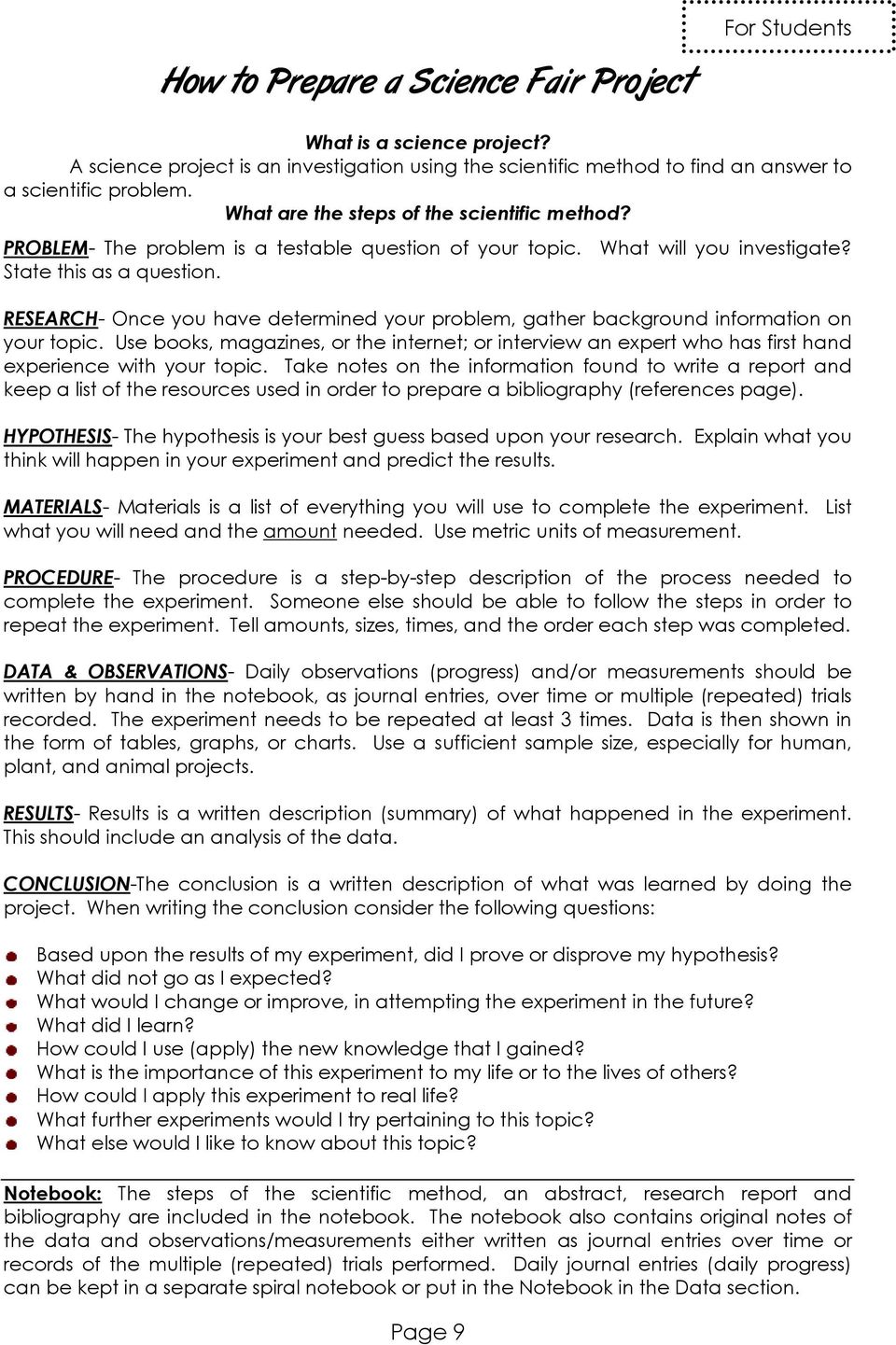
1 How to Prepare a Science Fair Project For Students What is a science project? A science project is an investigation using the scientific method to find an answer to a scientific problem. What are the steps of the scientific method? PROBLEM- The problem is a testable question of your topic. What will you investigate? State this as a question. RESEARCH- Once you have determined your problem, gather background information on your topic. Use books, magazines, or the internet; or interview an expert who has first hand experience with your topic. Take notes on the information found to write a report and keep a list of the resources used in order to prepare a bibliography (references page). HYPOTHESIS- The hypothesis is your best guess based upon your research. Explain what you think will happen in your experiment and predict the results. MATERIALS- Materials is a list of everything you will use to complete the experiment. List what you will need and the amount needed. Use metric units of measurement. PROCEDURE- The procedure is a step-by-step description of the process needed to complete the experiment. Someone else should be able to follow the steps in order to repeat the experiment. Tell amounts, sizes, times, and the order each step was completed. DATA & OBSERVATIONS- Daily observations (progress) and/or measurements should be written by hand in the notebook, as journal entries, over time or multiple (repeated) trials recorded. The experiment needs to be repeated at least 3 times. Data is then shown in the form of tables, graphs, or charts. Use a sufficient sample size, especially for human, plant, and animal projects. RESULTS- Results is a written description (summary) of what happened in the experiment. This should include an analysis of the data. CONCLUSION-The conclusion is a written description of what was learned by doing the project. When writing the conclusion consider the following questions: Based upon the results of my experiment, did I prove or disprove my hypothesis? What did not go as I expected? What would I change or improve, in attempting the experiment in the future? What did I learn? How could I use (apply) the new knowledge that I gained? What is the importance of this experiment to my life or to the lives of others? How could I apply this experiment to real life? What further experiments would I try pertaining to this topic? What else would I like to know about this topic? Notebook: The steps of the scientific method, an abstract, research report and bibliography are included in the notebook. The notebook also contains original notes of the data and observations/measurements either written as journal entries over time or records of the multiple (repeated) trials performed. Daily journal entries (daily progress) can be kept in a separate spiral notebook or put in the Notebook in the Data section. Page 9
2 Now that I know the steps of the scientific method, how do I begin my project? Step 1: Select a topic. (Example: plant growth in different types of soil) Look for something of interest, for which you don't already know the answer. Ask yourself, I wonder how that works? I wonder what would happen if? Write your first daily progress journal entry about why you selected your topic. **Certification forms must be completed if using live vertebrate (backbone) animals, or human subjects. See a science fair coordinator or RIMS Regulation Packet for these forms before beginning the project, to get it approved.** Step 2: Design a problem to investigate. State the problem as a question. (Example: Will the stems of bean plants grow taller in potting soil, backyard dirt, gravel or sand?) Step 3: Begin your notebook by recording entries over time as journal daily progress entries. Be sure to explain why you chose your topic and problem. Don't forget to include what you expect to discover by investigating the chosen topic. Every time you work on your project, write in your daily progress journal. (Example: Nov. 3, 2003-Today I chose my topic. I chose to research about plants because I enjoy working in the garden with my mother every weekend. I would like to see what is the best type of soil to help our garden grow. I will look for information on sprouting seeds, soil types, soil content, and the best conditions for plants to grow.) Step 4: Research the topic. Once you have chosen your problem to investigate, it is important to research the written materials available on your subject. Read books and articles on your topic. Go to the library. Use the internet. Check for current events in the newspaper. Take notes on the information you find to prepare a research report (2 page minimum). Keep a record of the resources (books, articles, internet) used to prepare a bibliography. You could even talk to experts that know about your topic or visit places about your topic. (Example: Check out books from the library, search the internet, talk to professional landscapers or people at your local nursery. Interview university professors.) Step 5: Form your hypothesis. Before you begin your experiment you need to state what you think will happen in the experiment. This is an answer to your problem (question) based upon information found in your research. The hypothesis can be written as an If Then Statement. (Example: I think that the bean plants will grow taller in potting soil because it has special nutrients to help plants grow. Or If I use potting soil to grow my bean plants then their stems will grow taller because of the special nutrients in the soil.) Page 10

3 Step 6: Planning the experiment. Design an experiment to test your hypothesis. (Is there anything you haven't considered that could affect your experiment?) Gather all of the materials you will need. Plan enough materials to use various samples in each group that you are testing. Write a materials list. Use metric measurements. Write the procedure (method), the step by step process for doing your experiment. Be specific by including exact measurements and list the steps in order. Control your variables. A variable is anything that can change or vary during an experiment. In an experiment everything should be the same each time you test, except the one variable you are testing. Repeat the experiment at least three times. (Example: Materials- one package of bean seeds, 20 small 10 cm. clay pots without holes in the bottom, 150 ml. tap water for each pot every day, sunlight, 250 g. of each type of soil for each pot, trowel, centimeter ruler, and 500 ml. liquid measuring cup. To control my variables I need to put the same amount of soil in each pot, water them the same amount, use the same number of seeds and keep them in the same place in my backyard. The variable I am testing is the different types of soil.) (Example: Procedure-Step 1- Gather all of the materials. Step 2- Take five pots and place 250 grams of potting soil in each. Label them "potting soil 1," "potting soil 2," potting soil 3, potting soil 4. potting soil 5, Step 3- Repeat the above step with five more pots of sand., 5 pots of gravel, and 5 pots of backyard dirt... Step 10-Record data for 6 weeks.) **Don't forget to keep writing your daily progress journal entries.** Step 7: Test your hypothesis. Use the materials to follow your procedures to complete the experiment. Make observations/measurements and collect data during the experiment. (Measurements must be made using the metric system.) Record this information in your journal. Repeat the experiment through multiple trials or over time. Use a sufficient sample size. (For example, five plants in each group of the different kinds of potting soil.) (Example: November 20, 2003-Experimental Day 1- The plants did not sprout today. I watered each plant with 150 ml of water. November 27, 2003-Day 7- I measured each group. The sand group plants are all 4 centimeter tall.) Step 8: Organize data. Make tables or charts as you collect the data. Then use the data to make graphs such as bar, line, or circle graphs. You can average the data from the trials, use percentages, or another form of mathematics to analyze the data. Show your calculations (raw data) in your journal daily progress section of your Notebook. Example: Plant Growth Soil Types Day 1 Day 7 Day 1 Day 7 Potting soil #1 no 6 cm Backyard #1 no 3 cm Gravel #1 no 1 cm Potting Soil #2 Sand #1 no 4 cm Gravel #2 Etc. Page 11

4 Step 9: Write a summary/narrative, describing the results of the experiment, and analyze the data gathered through your observations and measurements. (Example: After six weeks, the five plants in the potting soil were 15 centimeters tall on average. etc.) Step 10: State your conclusions. Look at your data and decide what it tells you about your hypothesis. (See the scientific method steps for further explanation of what to include in your conclusion.) (Example: Based upon the results of my experiment, I proved my hypothesis was correct. I learned that if the soil has enough nutrients the plants grow taller. Next time, I would see how the root systems reacted to different soil types. etc ) Step 11: Organize your notebook. It should include the following sections in sequential order: Title Page- This page states the title of your project, name, grade, school, and teacher. Table of Contents- This page provides the reader with a list of the different parts of the project and the page number on which each section can be found. Abstract-The abstract is just a summary of your whole project. Write it after you finish your project but put it in the front of your Notebook. It also goes on the board on the top left corner of the left side panel. Include the following subtitles: Objectives/Goals: Methods/Materials: Results: Conclusions/Discussion: It should not be longer than one page. Problem- This page states the testable question that you are investigating. Research & Bibliography- This is the report of all of the background information you collected about the chosen topic, written in your own words. Bibliography- This page lists the resources used to research the project. Books, magazines, and/or internet resources need to be listed in alphabetical order. Experts interviewed needed to be cited here. Use a minimum of three to five resources other than encyclopedias and textbooks. No wikipedia. Hypothesis- This page states the hypothesis as previously defined. educated guess about the answer to your testable question. You make an Materials- This page states the materials used in the experiment and their amounts. Procedure- This page lists and describes the steps to complete the experiment. Page 12


5 Data & Observations- These pages include the entries of observations/measurements made over time, data from the multiple (repeated) trials of the experiment and the graphs, charts, or tables. All data needs to be in original form and not copied. Your daily progress journal entries may also be put in this section or they can stay in a separate spiral notebook. Results- This page describes what happened in the experiment by analyzing the data. Conclusion- This page describes what was learned from the project. Acknowledgements- This page is where you thank all of the individuals who assisted in the research or development of the project. A description of what each person did also needs to be included. (For example, I would like to thank my mom for helping me put my board in order.) Appendix-This section can include any internet articles or other notes used to write your research report. All sections of the Notebook may be typed with the exception of the journal daily progress entries which should be handwritten. **Please note: You must include handwritten notes of any sections that you choose to type. Sample Bibliography: -Citing Books: Author's last name, Author's first name. Title of Book. City of Publication: Publisher, of Publication. Smith, James. Potting Soil. Los Angeles: Scholastic Inc., Year -Citing Articles: Author s last name, Author s first name. Title of Article. Title of Magazine. Volume Number (Year of Publication): Page Numbers. Jones, Wilma. Growing Plants. Home & Garden. 44 (2000): Citing Websites: Author s last name, Author s first name. (Year of Publication). Title of Article. Retrieved date from the World Wide Web: website Missene, Beto. (2001). Growing the Best Plants. Retrieved November 22, 2003 from the World Wide Web: Page 13

6 Step 12: Designing the display board for your project. Include a title. This should be something catchy or interesting that has to do with your topic. It is not your problem (question). (Example: Plant Preferences) All the steps of the scientific method are included on the board, except the research which only goes in the Notebook. The order of the board needs to follow a logical progression. The display needs to be neat, clean and organized. It can be typed or hand written neatly with the steps of the scientific method written separately as subheadings. (See drawing below. Construction paper can be used to border each step of the project. Pictures of the experiment should also be used on the display board. No faces of test subjects or experimenter. Be creative and consider good use of color and design. The Notebook needs to be set in front of the project. It may be attached to the board. Living or non-living plants, mold, viral or bacterial materials may not be displayed. You can use pictures, plastic, or plaster. The display board must be able to stand up by itself. It consists of three sides, and the physical dimensions of the display should be such that it occupies a space no longer than 30 inches deep, 48 inches wide, and the top stands (including table) not more than 90 inches from the floor. You may assume that the tables used in the science fair are about inches in height. SAMPLE DISPLAY ABSTRACT PROBLEM HYPOTHESIS MATERIALS TITLE (Photos of experiment) PROCEDURE (May use drawings, photos, & outlines to explain steps) DATA (Use diagrams, charts, tables) RESULTS CONCLUSION Notebook Page 14

7 Science Project Websites Don't just use these ideas. Take these ideas and try to add something of your own. California State Science Fair -Ideas to get you started on a science project. Gives you links to other science project websites. Science Buddies -Topic selection wizard to help you get ideas for your science project, an Ask an Expert online bulletin board, and topics arranged in science project categories. NCES Kids Zone -Create a graph by clicking on the graph icon or take a graphing tutorial. The Kids' Guide to Science Projects or -Find project ideas, sample projects, and how to do research. Includes links to project ideas, research sites and links to "ask an expect," for more research information. All Science Fair Projects Science Fair Central -Everything you need to know about creating a science fair project. Thinking Fountain -Index of ideas in order from A to Z. Rocks for Kids -erosion, soil Environmental Protection Agency -environmental ideas, research CMS Science Fair -Project ideas within their scientific categories. Page 15

8 Sample Abstracts Project Abstract Examples The Frequency of Antibiotic Resistant E. coli in Alimentary Tracts Objective: The objective is to determine if the average American has ampicillin- and tetracycline-resistant strains of E. coli in their alimentary tract. Materials and Methods: Informed consent was obtained from 100 randomly selected people, 50 men and 50 women ranging in age from 10 to 92 years. An isolate of E. coli was obtained from the stool of each subject and grown in the presence of tetracycline and ampicillin. The area of inhibition was measured and compared to that of a non-resistant strain of E. coli. The percentage of sensitive and resistant organisms was determined by age and sex. Results: Thirty percent of the men and 24% of the women were found to have ampicillinresistant E. coli. The majority of the sample population was found to be under the age of 50. Slightly more people age 50 and over were found to be resistant than those under 50. Only 12% of both men and women were found to have tetracycline-resistant E. coli, with the older population again having a somewhat higher incidence of resistance. Discussion: Penicillin and its derivatives such as ampicillin, were the first commercially available antibiotics. Tetracycline was introduced later. The length of exposure to the antibiotics is reflected in the greater percentage of subjects with ampicillin-resistant E. coli (24% to 30%), compared to those with tetracycline-resistant organisms (12%). In addition, subjects age 50 and over who would have a longer life-time exposure to both antibiotics were more likely to harbor antibiotic resistant E. coli. These data suggest that antibiotics should be carefully dispensed and monitored by health care professionals. The Effect of Surface Finish on Rocket Drag Objective: My project was to determine if surface finish has an effect on the drag of a model rocket. I believe that a model with a smooth surface will have lower drag and will reach higher altitudes. Materials and Methods: Five model rockets with identical size and shape, but different surface preparations, were constructed. One rocket was left with an unfinished surface, three had surfaces finished to various degrees of smoothness, and the fifth rocket had its surface sealed, primed, sanded to 600 grit, painted, and covered with clear gloss. The rockets were ballasted to weigh the same and flown 10 times each with B5-4 motors. Results: The rocket with the clear gloss finish consistently reached the highest altitudes of all 5 rockets, while the unfinished rocket consistently reached the lowest altitude. Conclusions: My conclusion is that surface finish has an important role in model rocket drag and rockets with carefully prepared surfaces will reach higher altitudes. Page 16

9 Data & Observations Vocabulary Control Group-Part of a science experiment that has no variables added. Information from the Control Group is used to compare results. Experimental Group: the group in which the independent variable is changed. Variables-Anything in an experiment that is changed from the Control Group in order to solved the problem statement. Independent variable-the one you change Dependent variable-the one that you observe or measure (the one that may be affected by the independent variable Constant variables: other variables which could affect the dependent variable but which you keep constant For example: Time is an independent variable. You control the amount of time that it takes to conduct your experiment. Changes that occur over time are the dependent variable. When you change the independent variable, a corresponding change occurs in the dependent variable. The dependent variable is plotted on the y-axis. This is the vertical axis. Scale each axis appropriately. Each interval (square on the graph paper) must represent the same amount. Data-Display your data in the form of graphs, charts, or pictures to show the reader what you observed during the experiment. When constructing a graph, be sure that you give it a title. Label the x and y-axes and indicate the unit of the quantity being graphed. The independent variable is plotted on the x-axis. This is the horizontal axis. The independent variable is usually the variable controlled by the experimenter. Line graph-demonstrates change over time. Bar/picture graph-demonstrates a comparison between two or more things. Circle/pie graph compares parts to the whole. Page 17

10 Acceptance Criteria Checklist: Start journal (daily progress) entries Problem Research & Bibliography Hypothesis Materials Procedure Data & Observations Results Conclusion Abstract Prepare the Notebook Prepare the display board Page 18

Big6 Science Fair Project Organizer
 Big6 Science Fair Project Organizer Name: Big6 #1 Task Definition 1. Choose a topic for study. Here is a way to start: Observe the world around you. What interests you about it? What hobbies do you like
CONDUCT YOUR EXPERIMENT/COLLECT YOUR DATA AND RECORD YOUR RESULTS WRITE YOUR CONCLUSION
 CONDUCT YOUR EXPERIMENT/COLLECT YOUR DATA AND RECORD YOUR RESULTS WRITE YOUR CONCLUSION Due Date: February 9, 2010 Conducting Your Experiment Adapted with permission from www.sciencebuddies.org 1) Before
Materials Activity 1: Group Discussion Series Poster Board for Driving Question Board KWL worksheet Scientific Method Chart
 Dry Forest Concepts Scientific data collect ion and presention. HCPS III Benchmarks SC6.1.1, SC6.1.2, SC6.2.1 MA6.9.1, MA6.11.1, MA6.12.1, MA6.13.1 LA6.1.1, LA6.4.1, LA6.4.2, LA6.5.2, LA6.6.1, LA6.6.2,
Imagine Schools Florida Science Fair Guidelines
 DISPLAY BOARD: CLASSROOM CHECK Components Total Points Points Display Board: Neatness/ 20 Appearance Scientific Method: 40 Complete and ordered correctly Thoroughness 25 Earned Comments Conventions: Grammar;
Science Fair Project: A Handbook for Teachers & Parents
 Science Fair Project: A Handbook for Teachers & Parents Aventura Waterways K-8 Center Miami-Dade County Public Schools 21101 NE 26 th Avenue Miami, Fl 33180 Principal: Mr. Luis Bello Assistant Principal:
SCIENCE PROJECT PAGE 1
 SCIENCE PROJECT PAGE 1 Introduction YES!!! It s that Science Fair time of year. No amount of groaning is going to make it go away. Just imagine the inquiry and organizational skills you ll learn and practice.
HOW TO DO A SCIENCE PROJECT Step-by-Step Suggestions and Help for Elementary Students, Teachers, and Parents Brevard Public Schools
 HOW TO DO A SCIENCE PROJECT Step-by-Step Suggestions and Help for Elementary Students, Teachers, and Parents Brevard Public Schools 1. Get an Idea for Your Project Find an area that interests you. You
Science Fair Report and Display Guidelines
 Middle School Science Fair Report and Display Guidelines Modified July 2014 Student Name: Period Experimentally Based Research Paper Rubric Your final paper should be put together in the order presented
Science Fair Information and Application
 Science Fair Information and Application Science Fair Important Dates Friday, January 29th-Applications due Tuesday, February 9th-Stokes will be open from 4:00-5:00 p.m. to set up projects. Wednesday,
STUDENT S PACKET FOR THE SCIENCE FAIR PROJECT
 STUDENT S PACKET FOR THE SCIENCE FAIR PROJECT SCIENCE PROJECT STEPS 1. Choose a topic. Be sure it interests you. Don t pick one because you think it will be easy. Talk it over with your parents and when
Your logbook. Choosing a topic
 This booklet contains information that will be used to complete a science fair project for the César Chávez science fair. It is designed to help participants to successfully complete a project. This booklet
EXPERIMENTAL DESIGN REFERENCE
 EXPERIMENTAL DESIGN REFERENCE Scenario: A group of students is assigned a Populations Project in their Ninth Grade Earth Science class. They decide to determine the effect of sunlight on radish plants.
Ann Arbor Open School @ Mack. Student. Ann Arbor Open Science, Technology & Invention Fair
 Ann Arbor Open School @ Mack Student Handbook Ann Arbor Open Science, Technology & Invention Fair 1 Frequently Asked Questions What is the Open School Science, Technology and Invention Fair? It is a chance
Parents Guide to Science Projects
 Time Management Parents Guide to Science Projects Break up your child s project into smaller pieces to make the project more manageable. You are given months to do this project so can take it in parts
Sept. 22, 2014. Dear Parents/Guardians,
 Sept. 22, 2014 Dear Parents/Guardians, Hurshel Antwine students in grades 2-5 will be participating in an Elementary Science Fair. This is an exciting event that encourages students to think like young
For Experimental Design
 Scientific Method Process and Terminology Grade Level: 2-12 The Scientific Method For Experimental Design Research Question: The research question is the single most important part of the scientific method.
Navy Elementary Science Fair March 14th, 2016. Student Information Packet. Student Name: Teacher:
 Navy Elementary Science Fair March 14th, 2016 Student Information Packet Student Name: Teacher: IMPORTANT DATES TO REMEMBER: February 9, 2016: Information/Q&A Session during school March 7, 2016: Official
Elementary Science Research Manual Pinellas County Schools. Table of Contents
 Elementary Science Research Manual Pinellas County Schools Table of Contents Table of Contents...1 Rationale..1 Ways to Support Your Child.....2 Some Things to Think About... 2 District Science Showcase......2
Valor Christian High School Mrs. Bogar Biology Graphing Fun with a Paper Towel Lab
 1 Valor Christian High School Mrs. Bogar Biology Graphing Fun with a Paper Towel Lab I m sure you ve wondered about the absorbency of paper towel brands as you ve quickly tried to mop up spilled soda from
HOW TO WRITE A SCIENCE FAIR RESEARCH PAPER
 HOW TO WRITE A SCIENCE FAIR RESEARCH PAPER The outline given below is suitable only for a report on a single experiment or related set of experiments. The form of a review paper or a report on a group
Science Fair Paper Format Due: Friday, February 15 th, 2013
 Science Fair Paper Format Due: Friday, February 15 th, 2013 This packet will show your what your final Science Fair written report should look like. Include page numbers on each page of your paper. Each
Wetland or Marsh Water Filter
 Wetland or Marsh Water Filter Objectives: Students will plan and conduct a simple investigation Students will communicate their investigations and explanations Students will learn how a wetland works to
Experimental Analysis
 Experimental Analysis Instructors: If your institution does not have the Fish Farm computer simulation, contact the project directors for information on obtaining it free of charge. The ESA21 project team
Analyzing Experimental Data
 Analyzing Experimental Data The information in this chapter is a short summary of some topics that are covered in depth in the book Students and Research written by Cothron, Giese, and Rezba. See the end
Project. 3 rd -8 th Grade Science Fair. What is the Scientific Method?
 3 rd -8 th Grade Science Fair Project 3 rd -8 th Grade Science Fair What is the Scientific Method? The Scientific Method is a step by step process that scientists use to answer questions! 1. Ask a question
TEACHING Parts of Plants
 TEACHING GUIDE TEACHING Parts of Plants Kindergarten Reading Level ISBN-13: 978-0-8225-1798-6 2 TEACHING PARTS OF PLANTS Standards Language Arts Reading Language Arts Writing Language Arts Listening and
Liquids are all around us. Every day we drink and eat items that contain liquids, we use liquids to
 Excellent Evaporation Science Fair Research Paper By: Suzie Science Class December 16, 2008 Background Information Liquids are all around us. Every day we drink and eat items that contain liquids, we use
Excel Tutorial. Bio 150B Excel Tutorial 1
 Bio 15B Excel Tutorial 1 Excel Tutorial As part of your laboratory write-ups and reports during this semester you will be required to collect and present data in an appropriate format. To organize and
Plant Growth 1. Running Head: PLANTS AND HOW LIQUIDS AFFECT THEIR GROWTH. Plants and How Liquids Affect Their Growth
 Plant Growth 1 Running Head: PLANTS AND HOW LIQUIDS AFFECT THEIR GROWTH Plants and How Liquids Affect Their Growth Table of Contents Title page 1 Table of Contents 2 Abstract 3 Acknowledgements 4 Introductions
Science Fair Handbook
 Science Fair Handbook Due Date: October 29, 2012 Page 1 of 7 Project Components and Descriptions The components and descriptions below are all of the required parts of the science fair project. 1. TITLE:
Social Studies Fair: February 23, 2012 @ 6:30 P.M.
 Student Name: Teacher: Project #: Harbins Elementary School Social Studies FAIR Project Directions 1 4 th & 5 th Grade Project Begins: January 6, 2012 Project Due: February 16, 2012 Social Studies Fair:
One basic need of living things is energy. Living things use food and water to get energy. The bird is living. It eats fish for energy.
 reflect If you are cold, what can you do to get warm? You could put on a coat and hat. You can jump in place. These are ways you might react to the cold. Now think about a rock. What if a rock is somewhere
CLASSWORK: Scientific Method Practice Variables, Hypothesis Construction & Experimental Design
 Name: Block: Date: CLASSWORK: Scientific Method Practice Variables, Hypothesis Construction & Experimental Design IDENTIFYING VARIABLES Background information: Scientists use an experiment to search for
Subject: Math Grade Level: 5 Topic: The Metric System Time Allotment: 45 minutes Teaching Date: Day 1
 Subject: Math Grade Level: 5 Topic: The Metric System Time Allotment: 45 minutes Teaching Date: Day 1 I. (A) Goal(s): For student to gain conceptual understanding of the metric system and how to convert
Plotting Data with Microsoft Excel
 Plotting Data with Microsoft Excel Here is an example of an attempt to plot parametric data in a scientifically meaningful way, using Microsoft Excel. This example describes an experience using the Office
Students will have an opportunity to examine a variety of fruit to discover that each has
 Botanical Garden Programs: Discovering Plants I. Introduction Students will have an opportunity to examine a variety of fruit to discover that each has seeds. Even cotton and some vegetables are considered
HOW TO SELECT A SCIENCE FAIR TOPIC
 HOW TO SELECT A SCIENCE FAIR TOPIC STEP #1 List five things you are interested in. Examples: Music, Football, Rock-Climbing, Computers, Horses, or Shopping STEP #2 Pick one of the items you listed and
Problem:(Example) Page 3 Can a Monkey be taught to ask for a banana using sign language?
 Abstract: See form www.lasciencefair.org (not in booklet to be turned in before project is due) I. Purpose or Question II. Hypothesis III. Procedure (shortened version) IV Data V. Conclusion *You can put
Paper Airplanes & Scientific Methods
 Paper Airplanes 1 Name Paper Airplanes & Scientific Methods Scientific Inquiry refers to the many different ways in which scientists investigate the world. Scientific investigations are done to answer
SCIENCE PROJECT STUDENT HANDBOOK COLMS 2010-2011
 SCIENCE PROJECT STUDENT HANDBOOK COLMS 2010-2011 SCIENCE PROJECT DATES TO REMEMBER December 3, 2010 Science Fair: Top Two Choices (Form 1) December 10, 2010 Research your topic. You will need 3 resources
Effect of Light Colors on Bean Plant Growth
 Effect of Light Colors on Bean Plant Growth Teacher Edition Grade: Grades 6-8 Delaware State Science Standard: Science Standard 6 - Life Processes Strand: Structure/Function Relationship Strand: Matter
P r e p a r e a Science Fair
 How To P r e p a r e a Science Fair Project This booklet belongs to: 2 Stay Organized With a Schedule This may be the first time you have attempted a long range project, so it is very important to prepare
California Mission Research Project Guidelines
 ! California Mission Research Project Guidelines Dear Students and Parents, The following packet contains all the information you will need to complete your California Mission Research Project. Use this
How To Do A Science Fair Project
 How To Do A Science Fair Project Prepared by The Science & Technology Division Akron-Summit County Public Library (330) 643-9075 1 A good science fair project involves the student in a journey discovery,
Fourth Grade Science Fair
 Dear Parents and Students, Fourth Grade Science Fair The fourth grade teachers are proud to announce our annual Science Fair! ALL fourth graders will take part in this very special project and event. Students
Plant In a Cup. When considering what to do for our curriculum project, our main goal was
 Sammi Meril and Grace Slone Final Paper Kindergarten Education 200 May/6/2013 Plant In a Cup When considering what to do for our curriculum project, our main goal was to create stimulating lesson that
Dinosaurs and Fossils
 Dinosaurs and Fossils T ABLE OF CONTENTS ABOUT DELTA SCIENCE MODULES Program Introduction................... iii Teacher s Guide..................... iv Delta Science Readers............... vi Equipment
What is Energy? 1 45 minutes Energy and You: Energy Picnic Science, Physical Education Engage
 Unit Grades K-3 Awareness Teacher Overview What is energy? Energy makes change; it does things for us. It moves cars along the road and boats over the water. It bakes a cake in the oven and keeps ice frozen
Dates count as one word. For example, December 2, 1935 would all count as one word.
 What is an exhibit? An exhibit is a visual representation of your research and interpretation of your topic's significance in history. Your exhibit will look a lot like a small version of an exhibit you
Plant Growth - Light and Shade
 Science Unit: Lesson 5: Plants Plant Growth - Light and Shade School year: 2004/2005 Developed for: Developed by: Grade level: Duration of lesson: Notes: Queen Alexandra Elementary School, Vancouver School
Dr. Lisa White [email protected]
 Dr. Lisa White [email protected] edu Associate Dean College of Science and Engineering San Francisco State University Purpose of a Poster To communicate/publicize to others your research/experiment results
Science Fair Report. Make sure that the title that appears here is copied directly from the approved proposal form. Student Name Date being turned in
 Science Fair Report Make sure that the title that appears here is copied directly from the approved proposal form. Student Name Date being turned in Table of Contents Abstract... 1 Introduction... 2 Reason
Minnesota Comprehensive Assessments-Series III
 Not for student use. Minnesota Comprehensive Assessments-Series III Science Item Sampler Script Grade 8 S ARE NOT SECURE TEST MATERIALS. THIS ITEM SAMPLER SCRIPT MAY BE COPIED OR DUPLICATED. MINNESOTA
GRADE SHEETS HIGH SCHOOL GRADE SHEET 1: BINDER (25 PTS) FRONT COVER SHEET (NAME, SCIENCE PROJECT, SUBJECT, PERIOD, AND TEACHER S NAME ) (25 PTS) DIVID
 YOUR SCIENCE PROJECT ORGANIZATION IS IMPORTANT FOR ANY SCIENTIFIC RESEARCH. YOU WILL KEEP ALL OF YOUR RESEARCH, DATA, AND CONCLUSIONS IN A BINDER WITH DIVIDERS SEPARATING 17 MAIN AREAS. YOUR BINDER SHOULD
Scientific Graphing in Excel 2010
 Scientific Graphing in Excel 2010 When you start Excel, you will see the screen below. Various parts of the display are labelled in red, with arrows, to define the terms used in the remainder of this overview.
Discovering Math: Using and Collecting Data Teacher s Guide
 Teacher s Guide Grade Level: 3-5 Curriculum Focus: Mathematics Lesson Duration: Four class periods Program Description Discovering Math: Using and Collecting Data From data points and determining spread
Refining Informational Writing: Grade 5 Writing Unit 3
 Unit Title: Refining Informational Writing Concepts: 1. Writers read mentor texts to study informational writing. 2. Writers generate ideas and experiment with notebook entries. 3. Writers learn strategies
Powerful Classroom Assessment: Super Grow Fertilizer Student Responses for Planning an Investigation SR1
 SR1 Hypothesis: The plants will be taller and have more leaves if they have more room to grow because there will be more nutrients available to each plant. : 8 containers all the same size pea seeds, all
* Readily available from supermarkets and health food stores. 80-145 minutes (total over 3 to 7 days) SOSE: Investigate Australia s salinity crisis
 Lesson Plan 12 Salt and germination Brief description This fascinating, cheap and very reliable experiment clearly demonstrates the damaging effects of salinity (salt) on seed germination. Mung beans are
Plants, like all living organisms have basic needs: a source of nutrition (food), water,
 WHAT PLANTS NEED IN ORDER TO SURVIVE AND GROW: LIGHT Grades 3 6 I. Introduction Plants, like all living organisms have basic needs: a source of nutrition (food), water, space in which to live, air, and
Big Ideas, Goals & Content for 4 th grade Data Collection & Analysis Unit
 Big Ideas, Goals & Content for 4 th grade Data Collection & Analysis Unit Big Ideas Graphs are a way of organizing data and they appear in newspapers, magazines, on the Internet and other places in everyday
The Randall Museum. Illustrations by Curtis G. Leonardo
 The Randall Museum The Randall Museum is a facility of the San Francisco Recreation and Park Department, which prohibits discrimination on the basis of race, religion, color, national origin, age, sex,
Writing a Formal Lab Report
 Writing a Formal Lab Report Note: This handout provides guidelines for writing a formal, typed laboratory report for a Biology, Chemistry, Natural Science, or Physics class. Routine lab write-ups such
Writing the MLA Research Paper
 Writing the MLA Research Paper Philosophy 1. Name Research = re-search, i.e., search and search again for information 2. Purpose a. To inform b. To persuade c. To persuade and to inform 3. Benefits a.
Middle School Science Fair Information, Requirements, Grading Rubrics
 Middle School Science Fair Information, Requirements, Grading Rubrics Dear Parents/Guardians: We are excited about the interest in this year s Science Fair, which will take place on Thursday, January 23
Graph it! Grade Six. Estimated Duration: Three hours
 Ohio Standards Connection Data Analysis and Probability Benchmark A Read, Create and use line graphs, histograms, circle graphs, box-and whisker plots, stem-and-leaf plots, and other representations when
Please see the Seasonal Changes module description.
 Overview Children will measure and graph the precipitation on the playground throughout the year using a rain gauge. Children will also observe satellite images of clouds and begin to investigate how clouds
Science Fair Report,
 Science Fair Report, Oral Presentation and Science Fair Board Table of Contents General Instructions for the Science Fair Report. 3 Typing the Title Page 4 Table of Contents.. 6 Introduction Page.......
Scientific Method for Kids Scientific Method Steps Made Simple
 Scientific Method for Kids Scientific Method Steps Made Simple Scientific language is often needed to explain natural phenomena as accurately as possible. Unfortunately, this can also complicate the process
Parent Acknowledgment Form Science Fair Project Complete and return Science Project form by September 19, 2011
 Parent Acknowledgment Form Science Fair Project Complete and return Science Project form by September 19, 2011 This project due dates depend on the last name of the student. October 17 th for letters A-F,
Heat and Temperature: Teacher s Guide
 Heat and Temperature: Teacher s Guide Grade Level: 6-8 Curriculum Focus: Physical Science Lesson Duration: Two class periods Program Description Humans have always been feverish about temperature. But
Unit: Understanding Science and Engineering Through Solar Power Lesson 5 Making Observations and Recording Data for Solar Powered Water Pumping
 Unit: Understanding Science and Engineering Through Solar Power Lesson 5 Making Observations and Recording Data for Solar Powered Water Pumping AUTHOR: Mike Hellis DESCRIPTION: Students use a solar module
Science Fair. Information, Requirements, Grading Rubrics
 Science Fair Information, Requirements, Grading Rubrics Dear Parents/Guardians: We are excited about the interest in this year s Science Fair, which will take place on Thursday, January 23, 2014. With
Science and teaching students about
 Teaching The Science Process Skills What Are the Science Process Skills? Science and teaching students about science means more than scientific knowledge. There are three dimensions of science that are
PURPOSE OF GRAPHS YOU ARE ABOUT TO BUILD. To explore for a relationship between the categories of two discrete variables
 3 Stacked Bar Graph PURPOSE OF GRAPHS YOU ARE ABOUT TO BUILD To explore for a relationship between the categories of two discrete variables 3.1 Introduction to the Stacked Bar Graph «As with the simple
DIFFUSION (HYPERTONIC, HYPOTONIC, & ISOTONIC SOLUTIONS) THE GUMMY BEAR LAB PASS
 DIFFUSION (HYPERTONIC, HYPOTONIC, & ISOTONIC SOLUTIONS) THE GUMMY BEAR LAB PASS Have you ever wondered why your fingers have wrinkles after soaking in a bath tub? Your students have probably wondered the
SCIENCE FAIR HANDBOOK Preschool through 3 rd grade
 BLUE MOUNTAIN ELEMENTARY SCIENCE FAIR HANDBOOK Preschool through 3 rd grade 2015-2016 Project Set-Up-February 23 by 12 noon Judging-February 24, 9:00 am Science Fair Open House- PUBLIC WELCOMEI February
Exploring Animal Environments
 Third Grade Science Design Brief Exploring Animal Environments forest - desert - grassland rainforest - marshland - swamp - pond - river - ocean - stream Background: In our studies of science, we have
MD5-26 Stacking Blocks Pages 115 116
 MD5-26 Stacking Blocks Pages 115 116 STANDARDS 5.MD.C.4 Goals Students will find the number of cubes in a rectangular stack and develop the formula length width height for the number of cubes in a stack.
Making a Terrarium. fairchild tropical botanic garden 1
 Making a Terrarium What is a Terrarium? A terrarium is a collection of small plants growing in a transparent, sealed container. A terrarium is a closed environment, and can actually be used to illustrate
Virginia Gardener http://www.hort.vt.edu/envirohort
 The Virginia Gardener http://www.hort.vt.edu/envirohort Name Help Sheets: Seeds What Is a Seed? A seed is a very young plant that is in the dormant, or resting stage. It is very much alive. There are three
Beech Maple Forest Classroom Unit
 Beech Maple Forest Classroom Unit Theme: Forest Overview What makes up a Michigan forest? Unit Connection: Introductory lesson to Beech Maple Forest Unit (lesson #1) Subject: Science Recommended Grade
Section 7 - The Scientific Method & Experimental Design! of! 1 5
 Section 7 - The Scientific Method & Experimental Design of 1 5 Read the information below. You will be asked to identify parts of an experiment and errors in experimental design on your first test. Understanding
Fourth Grade Science Fair
 Dear Parents and Students, Fourth Grade Science Fair The fourth grade teachers are proud to announce our annual Science Fair! ALL fourth graders will take part in this very special project and event. Students
Chapter 1: Looking at Data Section 1.1: Displaying Distributions with Graphs
 Types of Variables Chapter 1: Looking at Data Section 1.1: Displaying Distributions with Graphs Quantitative (numerical)variables: take numerical values for which arithmetic operations make sense (addition/averaging)
Overview. Essential Questions. Grade 8 Mathematics, Quarter 4, Unit 4.3 Finding Volume of Cones, Cylinders, and Spheres
 Cylinders, and Spheres Number of instruction days: 6 8 Overview Content to Be Learned Evaluate the cube root of small perfect cubes. Simplify problems using the formulas for the volumes of cones, cylinders,
AP * Statistics Review. Descriptive Statistics
 AP * Statistics Review Descriptive Statistics Teacher Packet Advanced Placement and AP are registered trademark of the College Entrance Examination Board. The College Board was not involved in the production
Effect of moisture on lentil seed germination and growth
 Effect of moisture on lentil seed germination and growth By Francisco Javier Hidalgo Zamora, 7º A (This experiment was carried out in collaboration with Robert Henshaw Amado) Objective/Hypothesis The objective
Common Tools for Displaying and Communicating Data for Process Improvement
 Common Tools for Displaying and Communicating Data for Process Improvement Packet includes: Tool Use Page # Box and Whisker Plot Check Sheet Control Chart Histogram Pareto Diagram Run Chart Scatter Plot
Science Notebooks in the Classroom. Notebook Criteria
 presentapresents Presents Science Notebooks in the Classroom kdkrifr Notebook Criteria This document was developed by Bay Area Schools for Excellence in Education (BASEE) a local systemic change project
GRAPHS/TABLES. (line plots, bar graphs pictographs, line graphs)
 GRAPHS/TABLES (line plots, bar graphs pictographs, line graphs) Standard: 3.D.1.2 Represent data using tables and graphs (e.g., line plots, bar graphs, pictographs, and line graphs). Concept Skill: Graphs
Force and Motion: Ramp It Up
 Force and Motion: Grade Level: 4-5 Time: 3 class periods By: Carrie D. Perry (Bedford County Public Schools) Overview After watching an engaging video on Olympic alpine skiers, students then participate
Sixth Grade Country Report
 Name : Sixth Grade Country Report 4 th term you will be starting the process of researching and writing for our 6 th grade country report. As you research and write your report, please pay close attention
Name Date Class. As you read about the properties of air, fill in the detail boxes that explain the main idea in the graphic organizer below.
 Name Date Class The Atmosphere Guided Reading and Study Air Pressure This section describes several properties of air, including density and air pressure. The section also explains how air pressure is