
Chapter 3. Porting and Cylinder Scavenging. Two Stroke Performance Tuning
|
|
|
- Austen Rodgers
- 9 years ago
- Views:
Transcription
1 Two Stroke Performance Tuning Chapter 3 Porting and Cylinder Scavenging TODAY, when we take a look down the cylinder of a two-stroke engine, we find its walls literally filled with ports to handle the induction, transfer and exhaust phases of gas flow through the engine. Those of us who have grown up in the Japanese two-stroke era take it for granted that every cylinder has a huge exhaust port flanked by anything from four to six transfer ports' However, it hasn't always been this way. As far back as 1904 Alfred Scott patented his original two-stroke vertical twin. Then in 1906 the French Garard motor appeared with a rotary disc inlet valve. Scott also developed a rotary valve engine in 1912, winning the Senior TT in that year and the following year. However in spite of some very innovative designs being incorporated in two-stroke engines they continued to be embarrassingly unreliable and this single factor stifled development right up until the time of World War II. In the mid-1930s, the DKW company set out to make two-strokes respectable. They were in the business of manufacturing economical two-stroke motorcycles and stood to profit from changing the two-stroke's image. They engaged the services of an engineer named Zoller to build a 250 racer, which ultimately won the Isle of Man TT in This led to the development of a 125 single employing a porting arrangement originally invented for two-stroke diesels by German engineer Dr.E.Schneurle. It was this concept which ultimately brought success to the two-stroke, both as an economical power source for transport and as a powerful, light-weight power source for competition. Schneurle's loop-scavenging method, patented in 1925, employed a single exhaust port flanked by two small scavenge or transfer ports, whose air streams were aimed to converge on the cylinder wall opposite the exhaust (FIGURE 3.1). Being aimed away from the exhaust, the transfer streams had a natural resistance to short-circuiting straight out the exhaust. Earlier designs had used deflector-dome pistons to keep the fuel/air charge away from the exhaust port. This increased the piston's heat gathering area and meant that only low power outputs could be aimed for without continually risking piston seizure. After the war DKW moved to Ingolstadt in West Germany, while their old plant at Zschopau in East Germany was rebuilt as Motorradwerke Zschopau, or MZ. In 1952 Walter Kaaden joined MZ to take over development. His early work concentrated on exhaust development and alternate scavenge methods. After much experimentation he proved that the Schneurle loop-scavenge system yielded the best power and reliability. Then in 1957 he added a third transfer port, opposite the exhaust. Its air stream joined with the two main transfer ports, directing flow up toward the head (FIGURE 3.2). 1

2 Port and Cylinder Scavenging Fig. 3.1: The Schneurle loop scavenge system. 2

3 Two Stroke Performance Tuning Fig. 3.2: Komet K78 TT porting. Contemporary two-stroke technology was introduced initially to Suzuki, and later to Yamaha in Japan when Ernst Degner defected from East Germany to join Suzuki. By combining designs which Degner brought from MZ with Japanese technology in the field of metallurgy two-stroke power outputs and reliability took a leap forward. During the '60s Suzuki and Yamaha both won world championships using exotic porting and rotary valve induction systems originally developed by DKW and MZ. The Yamaha engineers, however, went one step further. They added a pair of auxiliary transfer ports alongside the main transfers, which also directed mixture flow toward the rear of the cylinder and up (FIGURE 3.3). The Japanese engineers then realized, as did Walter Kaaden back in 1957, that there was a section of cylinder wall at the rear which could also be filled with another one or two ports. Transfer flow improved and, as the velocity of the fuel/air charge entering the cylinder was reduced, mixture loss out of the exhaust was decreased (FIGURE 3.4). 3

4 Port and Cylinder Scavenging Fig. 3.3: Yamaha TZ25O D/E/F porting. Fig. 3.4: Suzuki PE175 C porting. 4

5 Two Stroke Performance Tuning Back in Europe two-stroke engineers were battling excessive ring and cylinder wear, due to the exhaust port width being too great. A narrow port reduced power but improved reliability. A taller port restored lost power but made the power band unacceptably narrow. To get around the problem Rotax engineer Dr. Hans Lippitsch added a pair of small auxiliary exhaust ports alongside the large oval exhaust port and above the main transfers. The two auxiliary ports connect with the main exhaust port before the exhaust flange (FIGURE 3.5). Fig. 3.5: Rotax 124 LC porting. Yamaha engineers tackled the problem with their power valve system, which is basically a mechanism to vary the exhaust port height without narrowing the power band (FIGURE 3.6). As you can see, there is a drum-like valve up against the cylinder wall. At high rpm the port is raised, increasing hp while permitting a relatively narrow port width for good ring life. At lower speeds the port is lowered, which improves midrange power and widens the power band. The YZR500 works racer's power valve is controlled electronically by a battery-powered motor, but the TZ500 production machine utilizes a much simpler system. Cables run from the tachometer to a centrifugal governor that raises and lowers the port in harmony with engine rpm. Exhaust duration at higher speeds (i.e., above 10,500 rpm) is 202, which is about average for a road racer. Low rpm duration is about 180, or similar to that of a 400 motocross engine. When it comes to modifying a cylinder, the most logical place to start is the exhaust port. A little grinding (or filing) at the sides and top of the port will yield large power increases if approached correctly. Exhaust ports come in all shapes and sizes; each type has its advantages and disadvantages. The port in FIGURE 3.7 is really rectangular but it is usually referred to as a square port. This is the type that you will find in many low performance engines. The size of it has to be small so that the rings won't catch on the top of the port and break. There are two ways this port can be modified: either it can be widened at the top or it can be ovalized. We have to be careful that the exhaust port 5

6 Port and Cylinder Scavenging doesn't get too close to the transfers, otherwise there will be excessive loss of fuel/air mixture out of the exhaust. I like to see 8mm separation between these ports, but at times it is possible to go down to as little as 5mm without ill effect. Fig. 3.6: Yamaha powervalve. Fig. 3.7: Square exhaust port modifications. If port spacing is a problem, you will have no alternative other than to widen the exhaust port at the top. This type of port will give the engine good power from the upper mid-range to maximum hp. When you grind this type of port, the centre of the port should be 4 to 5 higher than the ends. The reason for this is that when the engine is on the compression stroke the ring bulges out into the port to its greatest extent just as the port is being closed. However, by raising the centre of the port, the ring has less chance of hanging up on the edge of the port and breaking because the ends of the port actually begin pushing the ring back into the piston groove before the port closes. The elliptical or oval port is the one which I prefer if the port spacing is suitable. It is the type which you will find in most competition two-strokes. The shape of the port is fairly gentle on rings providing it isn't made excessively wide. What is an excessive width? Well, I'm not sure; but I have found that a port 0.71 of the bore diameter is a good compromise for most road race and motocross engines using ductile iron rings (the maximum safe port size is about 0.65 with brittle cast iron rings). Some tuners take the port size up to 0.75 but ring, piston and port damage is unacceptable. I have been able to take some ports out to 0.73 of the bore size, but this is the exception rather than the rule. 6

7 Two Stroke Performance Tuning The square bridged port is fairly common in large displacement motocross and enduro engines (FIGURE 3.8). It has a very large port area, but then it has to have a large area as it flows only about 85% as well as an unbridged port of equivalent area. In past years this type of port gave a lot of trouble as the bridge would overheat and bulge, pressing hard against the piston and causing a seize-up. However, the bridge gives little trouble now, providing it is not narrowed down. If heavy bridge-to-piston contact does occur, the piston should be relieved where it scuffs against the bridge. As bridged ports are usually quite close to the transfers, there is only one way to increase the port area, and that is by making the top of the port wider. Modify the port as shown, don't copy the 'eyebrows' type exhaust port discussed next. Fig. 3.8 Bridged exhaust port modification. The 'T' or eyebrows port is seldom seen these days although it was used by Suzuki, Kawasaki and Honda in the past (FIGURE 3.9). This type of port has very little going for it as the sudden change in shape above the main transfers is very harsh on both piston and rings. Usually there is very little that can be done to improve this type of port. Bridged exhaust ports can be made very wide, but there is a limit to how far you can go. With the Suzuki RM125 engines (all models A to T), the maximum width is 23mm for the left port window (viewed from the front of the bike) and 25.5mm for the right half of the port. If you go any wider than this, the piston will not be able to seal the crankcase from the exhaust port because the skirt is relieved around the pin bosses. There should always be sufficient cylinder wall on the sides of both exhaust and inlet ports for a 2mm width of piston skirt to bear against and affect a seal. To ensure that you don't go too far in widening the exhaust port, you will have to carefully scribe the outline of the port windows on the piston skirt with the crankshaft rotated to TDC. Then remove the barrel and measure the distance from the scribed lines to the relieved area around the piston pin bosses. Subtract 2mm from the measurement and this is the amount the port can be increased in width. The amount which can be removed from bridged inlet ports can be ascertained in a similar way, but with the piston at BDC. Thus far we have talked about changing the shape and width of the exhaust port but not the height. Increasing the width of an exhaust port will always result in a power increase from the upper mid-range to peak rpm. Usually there will be little or no loss in mid-range power. Raising the port, on the other hand, will always knock bottom end 7

8 Port and Cylinder Scavenging power. Increasing the duration, the port open period, by just a couple of degrees can make a bike unrideable in some instances. Just how far you can raise the exhaust port is the million dollar question everyone would like to know. Some tuners work to a timearea/angle-area formula devised some time back. Frankly, I have found this method of calculating port timing completely useless. The geometry and mathematics involved is very tedious and, when you have finished the entire routine, you find that the answer bears little relationship with present-day two-stroke technology. Fig. 3.9: Honda MT125 RIII porting. Thus far we have talked about changing the shape and width of the exhaust port but not the height. Increasing the width of an exhaust port will always result in a power increase from the upper mid-range to peak rpm. Usually there will be little or no loss in mid-range power. Raising the port, on the other hand, will always knock bottom end power. Increasing the duration, the port open period, by just a couple of degrees can make a bike unrideable in some instances. Just how far you can raise the exhaust port is the million dollar question everyone would like to know. Some tuners work to a timearea/angle-area formula devised some time back. Frankly, I have found this method of calculating port timing completely useless. The geometry and mathematics involved is very tedious and, when you have finished the entire routine, you find that the answer bears little relationship with present-day two-stroke technology. I have certain ideas on exhaust port timing, but blindly following my suggestions could get you into a lot of trouble. My theory is that an engine requires a certain exhaust duration to attain a specific engine speed. Therefore, if an engine is required to make maximum hp at, say, 12,000rpm, the exhaust duration required will be the same (±1 ) 8

9 Two Stroke Performance Tuning regardless of whether the engine is an 80cc motocross engine or a twin cylinder 250 road racer. From experience I have a fair idea of just how much duration specific engines need (see TABLE 3.1). However, if the cylinder has a shorter transfer open period than I like, the exhaust duration will have to be reduced, otherwise the bike will be too 'pipey' to ride. On the other hand, I may choose to raise the transfer ports and use the suggested exhaust timing. TABLE 3.1: Exhaust port duration Engine size (cc) Application Engine speed (rpm) Exhaust duration ( ) 2x62 Road race 13, x80 MotoX 11, x80 Moto X 12, x80 Road race 13, x100 MotoX 11, xl00 Go-kart 10, x125 MotoX 10, x125 Moto X 11, x125 Road race 12, x125 Road race 12, x125 Road race 12, x125 Road race 11, x175 Enduro 9, x175 Enduro 9, x175 Road race 11, x250 Enduro 8, x250 Moto X 8, x250 Road race 10, x400 Enduro 7, x400 Moto X 7, NOTE: 1 x 100 go-kart refers to a motor with fixed gearing, hence the short exhaust open period. You can easily tie yourself in knots when you tackle cylinder porting. I've known tuners who have moved exhaust ports up and down and all over the place, searching for more power or a better spread of power. After months of hard work they have achieved nothing, basically because the transfer duration was too short and/or the expansion chamber was all wrong. While it may appear rather arbitrary to select an exhaust timing figure and stick to that, I feel that this is currently the best way to go about two-stroke tuning. Then, if the engine does exhibit some undesirable trait, like a narrow power range, I change the expansion chamber design to produce the required power characteristics. What I'm saying is that expansion chamber design is far more critical than exhaust port duration. The exhaust open period determines to some extent what the maximum hp will be and at what engine speed it will be produced. The expansion chamber, on the other hand, adjusts the power characteristics of the engine at speeds above and below maximum hp revs. 9

10 Port and Cylinder Scavenging The formula which I use to calculate exhaust open duration (and transfer duration) is fairly straight forward, but if you do much work on two-strokes it would be money well spent if you purchased an electronic calculator with a full scientific function to speed up your calculations. The formula is as follows: where T= R+L+C-E R = stroke divided by 2 in mm L = con rod length in mm centre to centre (usually the stroke multiplied by 2) C = deck clearance in mm (i.e. the distance the piston is below the top of the barrel at TDC) E = distance from the top of exhaust port to top of barrel For example, the exhaust duration of the Morbidelli 125 twin production racer (FIGURE 3.10) is as follows:- 10

11 Two Stroke Performance Tuning Fig. 3. 1O Morbidelli 125 racer porting. Looking at TABLE 3.1 you can see that the exhaust duration is right where we want it for peak hp at 13,500-13,700rpm. However, if we were going to modify this engine extensively by boring the Mikunis 1mm to 29mm and fabricating a new set of expansion chambers, we would want the power peak at a little over 14,000rpm, which would mean that the duration would have to be increased to 208 to take advantage of the engine's improved breathing. Therefore we would raise the exhaust port 0.35mm. E will now equal 17.85mm and T will equal = On some engines fitted with Dykes rings, the top piston ring and not the piston crown controls the opening and closing of the exhaust and transfer ports. With these engines, the exhaust duration is calculated using the same formula, however dimension C (the deck clearance in mm) must be very carefully measured using a depth gauge otherwise your calculations will be several degrees out. In engines where the Dykes ring actually determines the port opening and closing, dimension C is the distance the ring is below the top of the barrel at TDC. Referring back to FIGURE 3.5 you will note that the Rotax kart engine appears to have mild porting for a road racer. This engine, in fact, has a single Dykes ring located very close to the top of the piston. Dimension C is 1.8mm, so what looks like motocross porting is truly road race porting. In this case the exhaust duration is

12 Port and Cylinder Scavenging If you have not had any previous experience tuning two-strokes it is a lot safer to modify the piston crown to increase exhaust duration rather than raise the port. Once you have taken the metal away you can't put it back, but fortunately pistons are a good deal less expensive than barrels so all you have to do is keep accurate notes and then retrogress one step when you have gone too far (FIGURE 3.11). The idea is to progressively file 0.5mm off the exhaust side of the piston crown until you reach a point where you are happy with the power output. If you accidentally go one step too far, it is easy to back-track. All you need is a new piston and then, when you modify the 'exhaust port proper, raise it 0.5mm less than the amount you filed off the piston. This type of tuning is back to front to the way in which I prefer to do things, but if you don't want to get involved in expensive and time-consuming expansion chamber fabrication, it is the safest way out. You will never get the best possible power out of the motor by shifting the exhaust port around to work within the limitations imposed by the expansion chamber fitted to your bike. However, this is one of the safer places to begin modifying twostrokes, and even within the boundary set by the stock expansion chamber you should end up with an engine which works better than the stock item. Fig. 3.11: Piston modification to increase exhaust open period. When working on the exhaust port, there are two checks which should be made. Firstly, with the piston at BDC, the bottom of the port window should be level with, or lower than, the piston crown, otherwise high speed gas flow will be disrupted (FIGURE 3.12). Secondly, in the case of bridged ports, ensure that both halves of the port open simultaneously. If one side opens a little before the other, gas flow is disrupted to some extent, but worse the pressure waves transmitted to the expansion chamber are of a lower amplitude. This reduces the effectiveness of the exhaust pulses in evacuating and recharging the cylinder with fresh mixture (FIGURE 3.13). 12

13 Two Stroke Performance Tuning Fig. 3.12: Exhaust port must be lower than piston at B.D.C. Fig. 3.13: Both halves of bridged exhaust ports must open simultaneously. If you own a Power Valve type Yamaha there is an additional inspection which must be made. Regardless of whether the exhaust port is standard or has been raised check that the power valve opens fully to align with the exhaust port roof. Manually push the actuator arm as far as it will go to see if the valve and port align. Usually some adjustment is required. After loosening the adjusting nut and moving the valve to the correct position be sure to Loctite the nut so that it does not vibrate loose. Finally verify 13

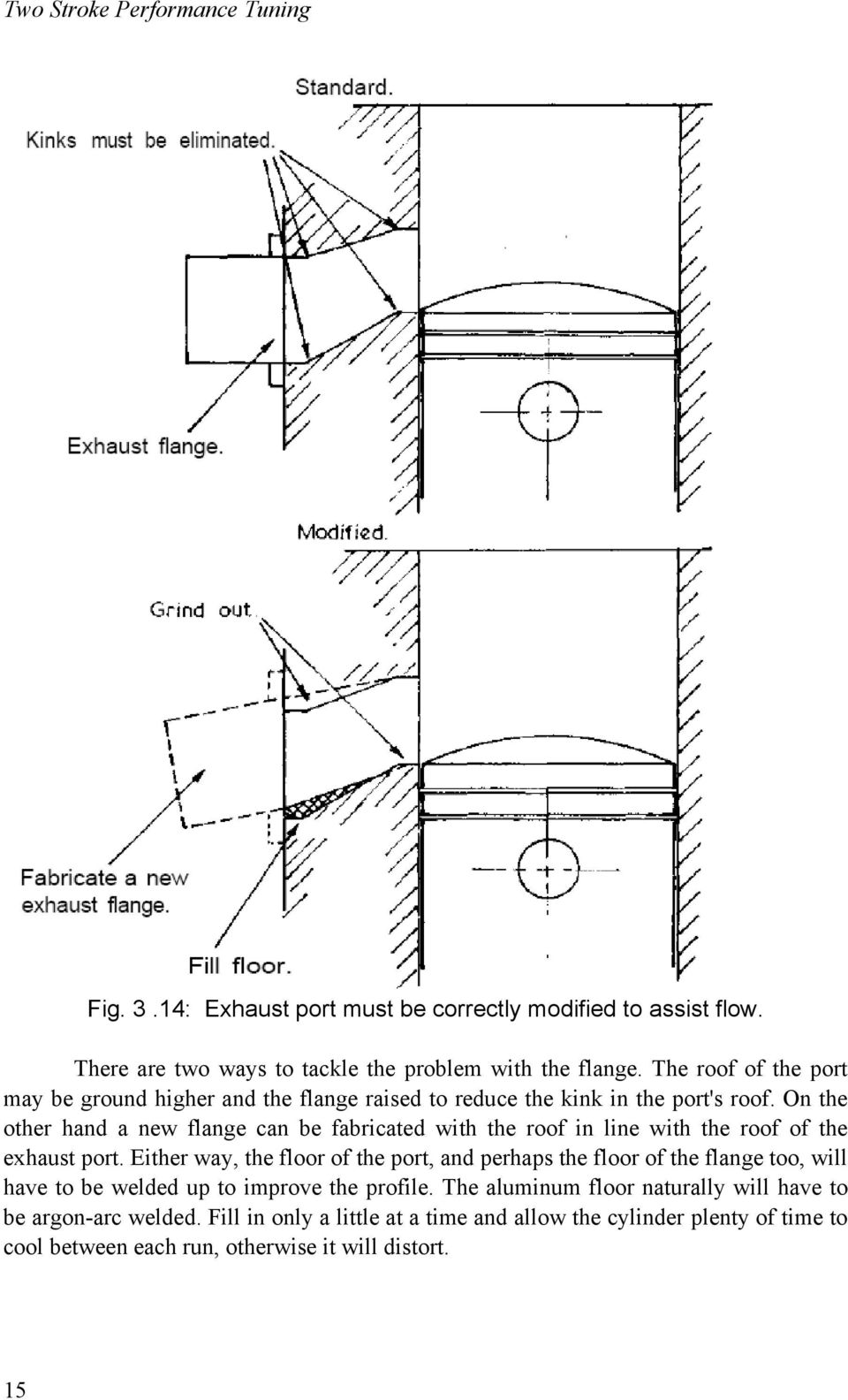
14 Port and Cylinder Scavenging that the valve timing is correct with the engine running. This is accomplished by marking the full extent of the actuator arm travel on the cylinder and revving the engine in short bursts to see if the valve actually opens that far. If it does not you will have to adjust the valve to a position slightly higher than the exhaust port roof with the actuator arm pushed to the full open position. Then recheck for full open with the engine running. The only other Power Valve adjustment which is permissible alters the governor spring preload and changes the mid-range rpm valve timing. When spring preload is increased, lower rpm exhaust duration is increased. As this has the effect of raising top end power and narrowing the power range, it is a modification recommended only for expert riders on fast circuits. Begin testing with an additional 0.020in. shim fitted behind the governor spring. If the power comes on too quickly or the power range is too narrow, try a 0.012in. shim. In recent years, the physical size and shape of the exhaust port between the port window and the flange where the expansion chamber connects, is under close scrutiny. Attempts are now being made to keep the diameter of the port as small as possible, without impeding the flow of gas out of the cylinder. Whereas the port diameter of a typical 125cc cylinder was 40 to 42mm a few years ago, most exhaust ports for a 125 are now about 37 or 38mm diameter. This is being done to keep the exhaust pulse wave at a high amplitude so that the cylinder is scavenged and recharged more completely. It has been found that allowing the exhaust gases to expand and cool too quickly, as occurs when the exhaust port is large, actually diminishes the strength of the exhaust pulse. Naturally the tuner's desire to keep the exhaust gas confined so that a strong pulse wave is transmitted through the expansion chamber, has to be balanced against the need for a free-flowing exhaust passage, which allows the burnt gases to stream unimpeded out of the cylinder. To this end, the exhaust port must be relatively straight, without abrupt directional changes, to eliminate eddying, and the exhaust flange must match the port perfectly and not change the direction of exhaust flow. When an exhaust port meets these requirements, gas flow out of the cylinder will be good, even though the port diameter is relatively small to keep pulse intensity at a high value. A quick look through the exhaust flange and port will indicate how straight the exhaust passage is. However, unless you are very experienced in the science of gas flow, you will not know if the exhaust gases are eddying or not. If you are using castor oil or some other oil which produced a fair buildup of carbon, you will be able to see where the exhaust port is 'dead'. Any place where there is a layer of carbon in a port which is basically carbon-free is a place of little flow activity. In such an area you can be fairly certain that the gases are eddying and disrupting flow out of the cylinder. At times, the low pressure area can be eliminated by grinding metal out of the port, but more often than not the port will require welding up. The exhaust port illustrated in FIGURE 3.14 is a particularly nasty one. The flange changes the direction of flow very abruptly, which produces an eddy current in the top of the flange. Also the floor of the port drops away too quickly, causing eddying in this area. 14

15 Two Stroke Performance Tuning Fig. 3.14: Exhaust port must be correctly modified to assist flow. There are two ways to tackle the problem with the flange. The roof of the port may be ground higher and the flange raised to reduce the kink in the port's roof. On the other hand a new flange can be fabricated with the roof in line with the roof of the exhaust port. Either way, the floor of the port, and perhaps the floor of the flange too, will have to be welded up to improve the profile. The aluminum floor naturally will have to be argon-arc welded. Fill in only a little at a time and allow the cylinder plenty of time to cool between each run, otherwise it will distort. 15
16 Port and Cylinder Scavenging As shown in FIGURE 3.15 the exhaust flange may be out of line when viewed from above. Again this must be corrected by fabricating a new flange which aligns with the exhaust port. From the aspect of two-stroke engine design, I feel that the transfer ports are the most important. Unfortunately, from the average tuner's viewpoint, the transfers are the most difficult to modify and the least understood. By definition, the transfer ports have the job of transferring the fuel/air mixture from the crankcase into the cylinder. That sounds simple enough but, after we consider all of the factors involved, you will better appreciate what a mammoth task this really is. In an average racing engine the induction cycle will take place during around 190 of crankshaft rotation. The exhaust cycle will occur over a period of 200. The transfer phase, however, has to be completed through 130 of crankshaft movement. Not only do the transfers have an extremely short time in which to recharge the cylinder with fuel/air mixture, they must also control the flow pattern of the charge to prevent mixture loss out of the exhaust, and drive exhaust gases from the rear of the cylinder towards the exhaust port. Fig. 3.15: Flange must be in line with exhaust port to stop eddying. 16

17 Two Stroke Performance Tuning During the '60s, when Suzuki and Yamaha dominated Grand Prix racing, their engineers revived a myth which surfaced from the development of BSA Bantam and Villiers engines for racing just after the war. These engines had massive spaces in the crankcase and tuners reasoned, rightly enough, that filling the crankcase with a variety of 'staffers' would reduce crankcase volume and hence increase crankcase compression when the piston descended to BDC. Increasing crankcase compression naturally enough results in higher crankcase pressure which, all else being equal, raises transfer flow and improves maximum hp output. Tuners cited the reason for this as being due to the transfer streams erupting under considerable pressure into the cylinder. Because of this the fuel/air charge tended to behave like a wedge on entering the cylinder. It didn't break up and mingle with the exhaust gases, but pushed them out of the cylinder with considerable force. So effective was this method of cylinder scavenging that the fuel/air 'wedge' was actually being partly lost out of the exhaust before the port closed. Two-stroke tuners overcame this problem by opening the transfer ports later and closing them earlier, reducing traditional transfer duration from 130 down to 120. Because of more fuel charge being contained within the cylinder, power increased. This encouraged engineers to further increase crankcase compression and reduce the transfer open period to less than 110. Horsepower again rose, instilling in Japanese engineers the idea that dominance in Grand Prix racing would depend on them reducing transfer duration to contain charge loss out of the exhaust and increasing crankcase compression to ensure efficient pumping of the fuel/air mixture from the crankcase into the cylinder. The theory sounds good, but in practice there were problems. True, power outputs rose to levels previously unknown from two-strokes, but the power bands became razor thin and engine speeds rose to incredible levels. Not to be deterred, the Japanese engineers embarked on a scheme of cylinder size reduction to enable very high rpm to be attained reliably. Again power levels increased, providing a further stimulus to reduce cylinder displacement. This led to the development of such machines as the three cylinder 50cc Suzuki and the four cylinder Yamaha 125 which produced 40hp at 18,000rpm. At this time road racers had from ten to eighteen gears, such were the power characteristics of these engines. The problem was that in spite of the very limited transfer open periods employed, at lower engine speeds too much charge was being lost out of the exhaust. This occurred because the transfer charge entered the cylinder under so much pressure that it had time to spurt right out of the exhaust at low rpm. Hence little power was produced at speeds below maximum hp revs. At higher rpm, power was again restricted, due to the transfer ports being too small to flow a larger volume of fuel/air mixture in the available time. Today, the very same problem occurs when very short transfer periods are employed. Generally, you will find that bikes which are 'pipey', coming onto the power too quickly or exhibiting a narrow power range, are that way because the transfer ports are too low (i.e., short duration) or because the ports are incorrectly aimed. 17

18 Port and Cylinder Scavenging Fortunately, manufacturers have mostly got away from the idea of using high crankcase compression to push the fuel charge through the transfers into the cylinder, so we can forget about crankcase compression and concentrate on the transfer ports. However, for those who are interested, primary compression or crankcase compression is calculated using this formula:- To measure the crankcase volume (CCV), first turn the engine onto its side, with the inlet port facing up, and rotate the crank to bring the piston up to TDC. Then, using a burette filled with liquid paraffin (kerosene) and engine oil, mixed 50/50, fill the crankcase up to the cylinder wall face of the inlet port. If this equals, say, 425cc, and the engine has a 125cc cylinder, the primary compression ratio will be 1.42:1. At this time, instead of relying solely on crankcase pressure to push the fuel/air mix into the cylinder, we also use the suction wave produced in the expansion chamber to pull the intake charge up through the transfers. If we use an expansion chamber with shallow tapers, maximum power will be suppressed, but the suction wave will be active in drawing mixture into the cylinder over a wide rpm range. On the other hand a chamber with steeper cones will produce a stronger suction wave, raising peak hp, but it will be effective over a much narrower rev range. Obviously the longer we leave the transfer ports open, the larger the rpm range will be over which the exhaust pulses effectively pull up fresh mixture from the crankcase. Conversely, if transfer duration is kept short, we have to rely more on crankcase compression to shift the fuel/air charge, as the suction pulse in the exhaust will only arrive at the right time to draw up fuel over a limited rpm range. It stands to reason, if the transfer port is closed when the pulse wave arrives, it will not do any good. On the other hand, if we keep the port open for as long as possible we have a better chance of having pulse waves arrive at the right time, over a wider range of engine speeds. With this idea in mind, we should realize that the transfer duration will vary for high and low speed engines. A high speed engine (i.e. 13,500rpm) will want the transfer ports open for 140 to 142 while an engine running at 6,500rpm will be happy with a duration of 120 to 124 when exhaust port open periods are close to those in TABLE 3.1. At higher engine speeds there is less time for cylinder filling so we need a longer transfer period, but at lower speeds a long transfer period will allow too much charge to escape out of the exhaust so a shorter duration is in order for low speed engines. 18

19 Two Stroke Performance Tuning TABLE 3.2 sets out the transfer durations which I have found to allow good engine breathing at the speeds indicated. To pick up mid-range power the shorter duration should be chosen. The engine won't rev far past maximum hp revs but the power output below maximum will be superior. For good power past maximum rpm the longer transfer period is desirable. If exhaust port durations longer than those indicated in TABLE 3.1 are used, then more transfer timing may be necessary otherwise the engine could become too 'pipey'. TABLE 3.2 Transfer Port duration RPM Transfer duration ( ) 6, , , , , , , , Note: The transfer duration refers to the open period of the main transfer ports in particular. The secondary transfers and the boost port may beneficially use durations longer than shown. One ploy which is very effective in giving the engine good power over a wide range is to use staggered transfer durations. The old MZ 125 racer had the two main transfer ports open for 136, while the third transfer port in the rear of the cylinder had a much shorter duration of 128. Many of the Italian go-kart engines also used this type of porting in past years. When Honda introduced the MT-125RII production racer in 1977, they took this principle one step further. The main transfers opened 39.2mm from the top of the cylinder (126 duration), the secondary transfers opened a little earlier at 38.5mm (130 duration) and the boost port in the back of the cylinder opened the last, 39.7mm down (123 duration). Tuners reasoned that as the back port aimed its flow towards the exhaust port there would be some loss of charge, unless steps were taken to prevent this occurring. Therefore the back port was opened around 1mm after the main transfers, so that flow from the main transfer ports, being aimed towards the rear of the cylinder, would actually form a wall of mixture in front of the boost port and thus prevent a loss of charge out of the exhaust. Furthermore, it was felt that delaying the opening of the rear port would allow crankcase pressure to 'blow down' through the main transfers. Hence a high pressure stream would not erupt from the back port and head right out of the exhaust. 19

20 Port and Cylinder Scavenging Today those theories have been forgotten. The majority of engines come from the manufacturers with all the transfer ports at the same height. However, this does not mean that staggered porting does not work. Most tuners recognize that it does; but the transfers are staggered in reverse to the old school of thought. At this time, when a cylinder is modified, the back port is often opened 1.0 to 1.5mm earlier than the other transfers. Also I have found that opening the secondary transfers 0.8mm before the main transfers benefits the power curve as well. There are several reasons why staggered-type porting works so well at this time. For one thing the manufacturers have forgotten their preoccupation with high crankcase pressure. Therefore, the transfer charge enters the cylinder in a more orderly and controlled manner. Additionally, the transfer ports have been re-aimed. Whereas the ports were tilted upwards so that the mixture streams from opposite sides of the cylinder gently met at a point in the cylinder just slightly higher than mid-stroke, today's ports are tilted very little or not at all (FIGURE 3.16). This means that the flow streams hug the piston crown, rather than shooting up towards the head to mingle with exhaust gases. Instead, the streams crash into each other, dissipating much of their energy. The mixture then rises relatively slowly in the cylinder, where it is trapped as the exhaust port closes. For these reasons, we can open the boost port and the secondary transfer ports a little earlier, as there is less risk of mixture escaping out of the exhaust, even at lower speeds when there is more time for this to occur. If the main transfers were opened earlier, exhaust flow would tend to turn the transfer flow around and direct it out of the exhaust port, but flow through ports further away from the exhaust port are not influenced to such an extent by the direction of exhaust flow. When staggered porting is employed, it is usual for midrange and maximum power to increase, due to the longer transfer periods improving cylinder filling, particularly at high rpm. Much of the mid-range power gain, I feel, is due to the cylinder being scavenged better. With the new type of transfer porting, a pocket of exhaust gas can be left unscavenged high up in the cylinder at lower engine speeds. Opening the boost port early would tend to get this pocket of stagnant gas moving, because its flow stream is still directed upwards at 45 to 60. Some fuel charge is possibly lost out of the exhaust but, because this pocket of exhaust gas is purged out of the cylinder, there is less dilution of the remaining fuel/air mixture. Consequently combustion will be faster and more complete, raising the hp output. Because the direction of transfer flow is so very important in obtaining a high power output and a good power range, only very experienced tuners should attempt to modify the top section of transfer ports. If you don't know what you are doing, you could easily render the cylinder useless. When the transfer duration is too short, raise the barrel using an aluminum spacer of the required thickness, and fit a base gasket on each side to ensure a good seal. Naturally the compression will have to be restored by turning an amount equal to the thickness of the spacer, plus the thickness of one base gasket, from the barrel or cylinder head. Keep in mind, when the cylinder is raised, that the piston rings may become exposed in the inlet port. This is of no consequence providing the top of the port is correctly shaped and providing the ring ends are not exposed. If just the bottom ring is opening into the inlet port, it can be removed if the engine is usually operated at 8000rpm plus. In piston-ported engines, raising the barrel will shorten the inlet open period so the inlet port will have to be lowered to compensate. 20

21 Two Stroke Performance Tuning Fig. 3.16: Old & new transfer port designs. Cylinders employing the type of boost port usually found in reed valve engines (eg. Yamaha) are quite easy to modify. This type of back port can be raised or increased in width, using hand files. Take care that you don't nick the bore wall with the file and do not make the port so wide that it opens out to the piston ring pegs. A width equal to that of the main transfer port is close to what is required, but always check to be sure. The secondary transfers should be raised by a professional tuner with good knowledge of the subject and good equipment to do the job. The alternative, which works very well, is to file metal off the piston crown (see FIGURE 3.11) in the manner described for increasing exhaust port duration. If the piston is fitted with a Dykes ring high up (eg. Bultaco) this method will not work, as the piston ring and not the piston crown actually controls the exhaust and transfer opening. The safest part of the transfer port for you to modify is the bottom of the port where it joins the crankcase. Cut the base gasket to match the crankcase cut-outs and then match the transfers to the base gasket. This will ensure that there is no step in the port to disrupt flow. Then carefully smooth the transfers, removing all casting imperfections. The piston cut-out below the gudgeon pin is also a part of the transfer port, so dress it up too. Thus far we have only discussed working with the ports provided by the manufacturer, but extra transfer ports can often be added. Here there are two approaches which we can take, depending on whether we want a small increase in performance and good piston cooling, or a larger power rise without the benefit of improved piston cooling. We will deal with the cool piston approach first, which can be applied to many engines regardless of the type of induction system employed. I first saw porting like that illustrated in FIGURE 3.17 on the old 250 Bultaco Pursang and Matador. As you can see, 21
22 Port and Cylinder Scavenging two boost ports are machined the depth of the cylinder liner about 7 to 9mm wide, on either side of the inlet port. These ports are fed through two holes in the piston. The flow of mixture past the little end and under the piston crown does much to reduce their temperatures. Desert racing engines in particular benefit from this type of porting. There isn't a huge increase in power, but usually a couple of horsepower will be picked up at the top end of the power band. The next type of boost porting also improves little end lubrication and piston cooling (FIGURE 3.18). It is intended for piston-ported engines which have a lot of cylinder wall height between the top of the inlet port and the piston crown at BDC. Two boost ports are machined into the cylinder, generally with a 13mm cutter tilted at 25. Ensure that the boost ports are at least 1.5mm above the inlet port, to ensure an effective seal. Fig. 3.17: A common type of boost porting. 22
23 Two Stroke Performance Tuning The third type of boost porting shouldn't really be called boost porting (FIGURE 3.19). It doesn't do anything to increase hp output, but it will extend piston and little end life in desert bikes. I call it last resort porting. Two 9mm wide slots are machined the depth of the cylinder liner to join with the main transfers. Holes in the piston feed these ports as in the first example. Fig. 3 18: Some engines may utilize boost ports above the inlet port. The final type of boost porting can only be used with reed valve induction. (FIGURE 3.20). When the inlet port is bridged, two ports are milled with a 13mm cutter tilted at 25 to 35. If the cylinder had a single inlet port, overlapping cuts would be made to form a single port of about 18 to 20mm width. When there is sufficient cylinder wall space available, two types of boost porting may be employed together. The porting shown in FIGURE 3.17 can often be combined with the arrangements shown in either FIGURE 3.18 or FIGURE The resulting increase in transfer area improves transfer flow and it reduces the velocity at which the fuel charge enters the cylinder. This minimizes charge loss out of the exhaust and improves cylinder scavenging. 23
24 Port and Cylinder Scavenging Except in road racing, piston controlled induction systems have fallen from favor; but, as it is the most basic two-stroke inlet arrangement, we will consider it before reed valve and rotary disc valve systems. In this way you will better appreciate why these other designs have been developed and what their respective advantages and disadvantages are. Fig. 3.19: Boost porting for desert bikes. Piston controlled inlet ports have the advantage of simplicity, but they are handicapped to some extent due to the port opening and closing points being symmetrically disposed before and after TDC. As the piston rises in the cylinder, the inlet port opens, usually at around 70 before TDC in low speed engines, and 100 before TDC in high speed engines. The rising piston creates a depression in the crankcase, thus air rushes down the inlet tract to fill the crankcase. However, at TDC the port is still open so, as the piston descends, fuel/air mixture will be pushed out of the crankcase through the open inlet port. Fortunately, reverse flow occurs only after the piston has traveled about 50 past TDC at engine speeds around 4,000rpm. Therefore, if the inlet port closes at 70 after TDC, only a small amount of fuel charge will be lost. At higher engine speeds there won't be any loss of mixture, as the combined force of pulse waves and the inertia of the high velocity mixture is stronger than the pressure created in the crankcase by the descending piston. For this reason we can employ longer inlet durations in high speed engines, but at lower rpm they suffer from such a bad dose of the blubbers that they will hardly run. 24
25 Two Stroke Performance Tuning Fig. 3.2O: Boost porting for reed valve engines. The poor low speed running is partly due to not enough fuel/air mixture being available in the crankcase to adequately fill the cylinder, but there is another reason. The low rpm blubbers and stumbles are basically due to flooding. When the mixture is pushed out of the crankcase and up the inlet tract, it eventually passes through the carburetor. On its way through it picks up another load of fuel, then when the inlet port again opens the fuel/air mixture reverses and travels back through the carburetor, collecting yet another load of fuel. The rich mixture which results burns slowly and wets the spark plug. The inlet durations set out in TABLE 3.3 will give good power at the speeds indicated. The shorter duration will improve mid-range pulling power and the longer duration for each speed will enable the engine to produce more power at rpm in excess of maximum hp revs. Motocross and enduro engines such as the RM and PE series Suzukis, with crankcase type reed valves, would normally want inlet durations 15 and 25 shorter respectively. When RM Suzuki engines are used for flat track and road racing, the inlet open period is as indicated in TABLE 3.3, as mid-range power is not so important. TABLE 3.3: Inlet port duration RPM Inlet duration ( ) 7, , , , ,
26 Port and Cylinder Scavenging For example, the inlet open period of the Yamaha KT-100S kart engine (FIGURE 3.21) is as follows:- R = 23mm L = 100mm C = 0.2mm H = 56mm F = 77mm P = R+L+H+C-F = Because of the bad effect long inlet periods have on mid-range power, it is always preferable to first enlarge the inlet port and see if that change gives the required improvement in high rpm power. It is impossible to say how wide an inlet port can be, as cylinder designs vary so much. However, I will say that if the port has a nice concave floor like that shown in FIGURE 3.21, even cylinders with very weak lower cylinder walls (eg., YZ80 Yamaha) will be reliable with a port 0.65 the bore size, whilst cylinders with the lower wall well supported will accept port widths up to 0.75 the bore diameter. If the inlet port is bridged, the port width can be up to 0.85 the bore size. The piston bears quite heavily against the inlet side of the cylinder, so always increase the width by no more than 2mm initially and progress slowly from there. Before you widen the port, check to see that the piston skirt is wide enough to cover and seal the port window. There must be 2mm down each side of the inlet port against which the 26
27 Two Stroke Performance Tuning piston will affect a seal. If the rings run into the port at BDC, you will have to ensure that you do not increase the width so much that the ends of the ring become exposed. However, if you decide to run just the top ring, and it is the second ring which is running into the inlet tract, you won't have to worry about this. Besides reducing frictional losses and bore wear, discarding the second ring can also have another benefit. With the second ring out of the way it is possible, in many instances, to increase the inlet port height. At times this won't work without also increasing the port timing, as the piston skirt will block the top of the port at TDC, unless it is shortened. Actually, the first check that you should make before lowering the inlet port to increase the port open period is to see that the lower edge of the piston skirt does not protrude into the top of the port with the crank rotated to TDC. When the skirt is shortened, cut off just the inlet side and be sure to put a good chamfer on the skirt so that it encourages lubricant to stay on the cylinder wall. Fig. 3.21: Yamaha KT-1OOS porting & piston dimensions. 27
28 Port and Cylinder Scavenging A lot of tuners lengthen the inlet timing just by shortening the piston. Sometimes there is no alternative, as the cylinder may be too weak to stand having metal removed, but, generally, skirt cutting is the easy way out. Even though cutting 3mm off the skirt will increase the inlet duration to the same figure as lowering the inlet floor by 3mm, you will find that maximum hp will not be as high and the engine will not rev as far past maximum hp revs. The simple truth is that the port area, as well as the duration, must be increased to flow the amount of air necessary to improve the power output. I have found, as a general rule, that the piston skirt will have to be shortened by 4mm to give the same high speed power characteristics as obtained by lowering the port 3mm. However, mid-range power is not as good, due to increased blow-back caused by the longer duration. For maximum power, the inlet port area should be about 10 to 15% larger than the area of the carburettor bore. When the inlet floor is lowered, the full length of the port floor right back to the to 10 before the transfer port closes (i.e., 120 to 130 before TDC) and to close the inlet port at about 55 to 60 after TDC. This results in an inlet duration of around 180 to 190. For more power at the top end of the power curve, the duration is increased to something like 200 to 210. There will, however, be some loss of low speed power and the engine won't take a fistfull of throttle at low revs without stumbling. The increase in duration can be obtained in two ways. Either we can have the rotary valve open a little earlier at 135 to 140 before TDC and close a little later at 65 to 70 after TDC, or we can leave the valve opening point alone and pick up the extra duration by closing the port at 70 to 80 after TDC. The effect on the power curve will be Fig. 3.25: Effect on power curve of changing rotary valve closing angle. 28
29 Two Stroke Performance Tuning quite different, even though the inlet open period is the same. Opening the valve at, say, 140 before TDC and closing it at 65 after TDC (205 duration) will tend to lift maximum power a little, but the main effect will be to considerably increase power in the upper mid-range. Leaving the opening point at 125 before TDC and shifting the moment of closing to 80 after TDC (205 duration) will reduce mid-range power due to increased blow back, but there will be a good power rise right at the top end of the power curve (FIGURE 3.25). In high rpm road racing engines, where mid-range power is of only minor concern, the inlet duration is increased to about 220 to 235. The rotary valve will open at 135 to 150 before TDC and close at 80 to 90 after TDC. The main concern here is that the inlet duration is of sufficient length to ensure complete crankcase filling at the rpm where maximum horsepower is desired. If we want peak power at 14,000rpm then the duration will be around 235, but if we want peak power at 11,500rpm the duration will be close to 220. TABLE 3.4 sets out the rotary valve timing for a number of go-kart and bike engines. All of the l00cc kart engines have fixed gearing. TABLE 3.4: Rotary valve timing Engine type Capacity (cc) Valve timing Transfer closing Arisco C-75 kart / BM K96-3 kart / BM FC-52 kart / Can-Am MX-6 bike / Can-Am MX-3 bike / Can-Am MX-6 bike / Can-Am Qualifier bike / Can-Am Qualifier bike / Can-Am Qualifier bike / DAP T81 kart / DAP-JM T71 kart / Komet K78 kart / Komet K78 TT kart / Morbidelli 125 bike 2x62 150/ MZ 125 bike / Rotax 124 LC kart / Sirio ST50 kart / Sirio ST504 kart / Sirio ST52 kart / Zip ZED1 kart / Note: The first valve timing figure refers to the opening point in degrees before TDC and the second figure is the closing point after TDC. The transfer closing figure refers to the closing point in degrees before TDC. 29
30 Port and Cylinder Scavenging Before you set about altering the valve timing, check to see that the inlet port is of the correct shape and that the valve cover perfectly matches the inlet port in the crankcase. Any obstruction here will disrupt air flow. You will find in many engines that the port in the valve cover does not align with the crankcase port. Grinding the port in the valve cover or the crankcase will affect the inlet timing. In some engines the inlet port opens and closes slowly because the sides of the port are the wrong shape. The port illustrated in FIGURE 3.26 should be reshaped as shown. The port area is increased and it will open and close more abruptly, generating beneficial pulse waves in the inlet tract. Fig. 3.26: Modifying inlet port shape without affecting rotary valve timing. The actual side profile of the inlet port is very poor in many rotary valve engines. In FIGURE 3.24 you can see a common mistake made by manufacturers which is very disruptive to air flow. The mixture rushes straight down the inlet port and proceeds to bang right into the crankwheel, losing a good deal of inertia. Some of the mixture will slowly rise up and around the crankwheel into the crankcase and a little of the air will form into a turbulent eddy current. When this kind of situation exists, air flow into the engine is severely restricted at high rpm. To increase air flow, and consequently high speed hp, there are two options open. Either the inlet port open period can be increased, which will reduce mid-range power, or we can re-profile the inlet port and increase air flow in this way. Top end power will improve and often mid-range power rises too. 30
31 Two Stroke Performance Tuning What we must do is change the shape of the inlet port, so as to encourage the mixture to turn up and over the crankwheel. In effect, the edge of the crankwheel has to become a part of the inlet tract floor, instead of a barrier at the end of a hole. In FIGURE 3.27 you can see the shape we have to aim for. The floor of the port is built up to blend into the crankwheel, and the lip formed by the port roof and the transfer cutout is radiused. The port can be built up using Devcon F aluminum epoxy. It contains 80% aluminum, is heat resistant to 250 F and is not attacked by petrol, methanol, oil or toluol. Fig Modify inlet port to increase flow. Ideally, manufacturers should turn to the use of larger disc valves so that the inlet port floor could be in line with the top of the crankwheel. In this situation the fuel/air charge would flow straight into the crankcase unimpeded. In addition to this, there is another advantage in the use of large diameter discs, which is the primary reason for their existence on the works Minarelli and Morbidelli Grand Prix racers. When the rotary disc diameter is increased, there is a corresponding decrease in the duration angle actually taken up by the inlet port itself, assuming the inlet port width is not altered. This allows for a longer duration angle with the large disc without increasing the actual inlet port open period. The power output then goes up, because the inlet port is fully open for a greater number of degrees, without being partially closed by the disc, or as the engine sees it for more time, so more air flows into the crankcase. Conversely, if the engine is already producing ample power at the top end of the rpm range, then the inlet open period 31
32 Port and Cylinder Scavenging can be reduced with the large diameter disc. In this way peak power will remain the same, but the mid-range to upper mid-range will rise appreciably. Trying to get the sense of this is quite hard just using words, so I will help you to reason it out with an example and an illustration (FIGURE 3.28). As you can see, both engines have an inlet port 34mm wide and an inlet duration of 200. The engine with the small 100mm diameter disc (engine A) has an inlet port and rotary disc which takes up 40 and 160 respectively of the 200 inlet cycle. On the other hand the inlet port and disc occupy 27 and 173 respectively when a 150mm disc (engine B) is used. This means that the inlet port is not obstructed in any way by the rotary valve for 120 (200 - [2 x 40] = 120 ) in the case of engine A and for 146 (200 - [2 x 27] = 146 ) for engine B. In other words the inlet port will be fully open for 26 or 22% longer. As regards time this represents sec. for engine A and sec. for engine B at 12,000 rpm. Fig. 3.28: Comparison of small & large rotary valves. 32
33 Two Stroke Performance Tuning Before you modify the rotary valve to change either the inlet opening or closing points, it is a good idea to find out exactly what the standard timing is for your engine and then compare that with the manufacturer's specifications. At times there can be variations, because a keyway or master spline is cut slightly out or, in some engines, it is possible that the disc valve has been fitted one tooth out on the drive gear either during manufacture or when the engine has been repaired. To check the valve timing you will require a 360 timing disc or, if you can't obtain one of these in your area, buy a large 200mm diameter protractor and drill a suitable size hole exactly in the centre so that it fits the end of the crankshaft. You will also need a good solid pointer which can be fixed under a stud in the crankcase. If you don't have a dial timing gauge to find TDC, then you will have to make a positive stop to prevent the piston rising to the top of its stroke. The best positive stop is one made out of an old Bosch spark plug and a length of 6mm mild steel rod. A Bosch plug is preferred as its insulator is very easy to remove. Under the hexagon shaped part of the plug shell you will see a groove running right the way around. Cut through this groove with a hacksaw and the insulator can be pulled out. Then weld a piece of rod into the plug shell, just long enough to stop the piston reaching TDC. Using a dial gauge find TDC and rotate the timing disc to align the zero mark with the pointer. Lock the disc in place on the crank and again check that the pointer points to zero when the dial gauge indicates TDC. Then simply rotate the crankshaft in the normal direction of rotation, noting at what angle the inlet port opens and closes. When making this check it is necessary to shine a light down the inlet port so it can be clearly seen when the valve opens and closes. Using a positive stop, the procedure is a little different. Rotate the engine in one direction until the piston contacts the stop. Note the angle and then rotate the crank in the opposite direction until the piston contacts the stop. Again note the angle. Midway between these two angles TDC is located. Let's say that there is 36 difference between the two angles. In this case TDC will be 18 (36 2 = 18 ) around from where the crankshaft is now stopped. Therefore loosen the timing disc and move it around until the pointer indicates 18 or 342 depending on which way the crankshaft is being rotated. Having done that, lock the timing disc in position and again rotate the crank one way and then the other until the piston contacts the stop. If in one direction the pointer indicates 342 and in the other direction it indicates 18, you can be sure that the timing disc is locked onto the crank in the correct position. After this, remove the positive stop and make a note of the rotary valve's opening and closing angles. 33
34 Port and Cylinder Scavenging Instead of using a degree wheel to physically determine the valve timing, it may be calculated mathematically using this formula if the engine has a Dykes ring fitted right at the top of the piston:- 34
35 Two Stroke Performance Tuning When you have the timing figures for your engine, check them against the manufacturer's figures. If the makers state that the valve opens 130 before TDC and closes 65 after TDC and yours opens 132 before TDC and closes 63 after TDC, then you know that the timing has been advanced 2 due to manufacturing errors. This will have the effect of slightly increasing mid-range power at the expense of a reduction at the top end. Obviously, if you are after more top end power, the first move should be to machine the disc to move the closing angle to 65 after TDC. If, after this, you want still more power at high engine speeds, move the closing point 2 at a time, but stop once you reach about 76. Then go back and add 4 to the opening angle to bring it up to 136 and see how the engine responds. If the engine reacts favorably, but you are after still more power, move the opening angle another 4 to 140. After this, you can go back to delaying the angle of closing in increments of 2 at a time. Normally, the only time that the valve characteristics would be altered to this extent would be when a motocross engine was modified for use in a road race go-kart. If, after checking your timing against the maker's figures, you find that the disc valve has been retarded by, say, 6 and the bike is very 'pipey', coming onto the power with a sudden rush, then it is probable that the power curve can be improved by getting the inlet timing back to what the manufacturer originally intended. (A disc retarded by 6 would be indicated by manufacturer's figures of, say, 130 /65 and your figures being 124 /71 ). The only way to cure a problem such as this, which fortunately occurs infrequently, is to relocate the rotary valve cover, moving it around 6 in the opposite direction to crankshaft rotation. To calculate how far the cover has to be rotated, first measure across the valve cover from the centre of one retaining screw to the screw opposite it. Say this dimension is 145mm. In this instance the cover will have to be rotated by 7.6mm which is calculated using this formula:- The idea is to then drill a new set of fixing holes in the valve cover 7.6mm from the original hole centers. Having done this, refit the cover and check when the rotary valve opens and closes the port in the valve cover. Actually, the port timing figures should always be taken off the valve cover, never the crankcase port. If the timing is correct, it is advantageous to take the machine for a test run before you spend a lot of time matching the ports. Naturally, the engine will be down on top end power, but it is its 'pipeyness' which you are checking, not top end power. If the results are satisfactory then match the ports, filling one side with Devcon F as shown in FIGURE 3.29 and grinding the other side out. 35
36 Port and Cylinder Scavenging It is not always necessary to relocate the rotary valve cover to correct valve timing errors. Some engines, for example those made by Rotax, have the rotary valve driven by a hub which is located on the crankshaft by a key. In the case of Rotax motors the hub is cut with 22 external gear teeth so moving the rotary valve one tooth on the hub will alter the timing by 16.4 ( = 16.4 ) which isn't of much use to us. However, by machining a new keyway in the hub and by moving the valve around the appropriate number of teeth timing errors can be corrected. Fig. 3.29: Match inlet port after relocating rotary valve cover. For example, machining a new keyway 90 around from the original and moving the valve around by 5 or 6 teeth (depending on whether the timing is advanced or retarded) will correct an 8 timing error. That is quite an easy one to work out, but what if the timing is retarded by 6? To calculate how many degrees around the new keyway has to be cut, add the angle of error to 90 and subtract 8, which equals 88 ( = 88.) The new keyway will therefore have to be cut 88 around from the original, but will it be to the left (counter-clockwise) or right (clockwise) of the original? Since the valve is presently retarded it will have to be advanced to correct the timing error. The engine turns counter-clockwise so the new keyway will have to be machined 88 to the left of the original keyway, which will advance the hub by 88. Retarding the rotary valve (i.e., moving it in the same direction as crank rotation) by 5 teeth will retard the timing by 82 (16.36 x 5 = 82 ), consequently the timing will finish up being advanced by 6 (88-82 = 6 ) from what the original timing figure was, which should be the figure specified by the manufacturer. You must be very careful that this type of work is carried out by only a top class machinist as it is exceedingly difficult to work to such fine tolerances in a bore as small as that found in the hub of a rotary valve. 36
37 Two Stroke Performance Tuning To change the opening and closing points of the rotary valve disc proper is a little difficult, unless you make a special setting-up template of white cardboard or cartridge paper. In the centre of the template draw a cross ( + ) with lines about 150mm long intersecting at exactly 90. Using the cross as the centre, draw a circle exactly the same diameter as the rotary valve disc. Carefully lay the rotary valve on the template within the confines of the circle which you just drew and using a sharp pencil draw the disc cut-out. (Be sure that the outside face of the disc is facing up.). Now draw another circle, using the cross as the centre, about 50mm larger in diameter than the rotary valve. After this, set a large (100mm or larger) protractor exactly on centre and note the angle of the disc's opening and closing points. Now carefully mark in the new opening or closing angle which you want. Draw a line from the centre through this point right out to the edge of the large circle. Lay the disc back onto the template, the correct way up, being careful to line it up within the boundary formed by the small circle and the original opening and closing lines. Now scribe a line across the disc exactly in line with the line you drew to show the new opening or closing angle. With that done, the disc can be modified to change the inlet timing. The clearance between the valve cover and the rotary disc is very important. If the clearance is too tight, power is lost due to friction and, if the clearance is excessive, low speed and mid-range power is lost due to fuel/air charge leakage out past the valve. Unless otherwise specified, the clearance should normally be between 0.25mm and 0.35mm. If it is less than 0.25mm the face of the valve cover will have to be machined the appropriate amount. On the other hand, if the clearance is greater than 0.35mm the mating surface of the cover will require machining. Reed valve induction was first introduced to the motorcycle world in 1972 when Yamaha released their range of Torque Induction bikes (FIGURE 3.20). The reed valve functions as a simple check valve and prevents blow-back in the inlet tract. Therefore, a reed engine can be lugged down to very low rpm (depending on the exhaust timing), as the air flowing down the inlet tract is trapped once it passes the reed valve. Low speed cylinder filling improves and, because the air passes through the carburetor just once, the fuel/air ratio remains correct. This results in good low speed combustion. Reed valve induction, however, is not entirely free of problems. Until very recently, the stiffness of the reed petals was severely compromised. To ensure good low speed crankcase filling, the reed petals must be thin and flexible so that they open easily and do not unduly restrict air flow. On the other hand the petals must be thick and stiff, otherwise crankcase filling at high speeds is not good. At high speeds thin, flexible petals flutter, allowing reverse flow out of the crankcase. They tend to close and then rebound from their seats due to inertia and/or resonance in the induction tract. A dual reed assembly patented by Eyvind Boyesen reduces this compromise a considerable amount. The presence of a reed cage and petals in the induction tract still reduces high speed air flow below that possible with rotary valve or piston ported induction, but the difference is not so great as before. The Boyesen assembly comprises a thin 0.25mm reed, riding on top of a thicker 0.7mm reed. The thin reed opens easily under a low pressure drop and the thicker one takes over at higher rpm. This gives the benefits of good low speed air flow, as well as an absence of high speed petal flutter. As an added benefit, the ribs in the reed cage can be cut out when the Boyensen assembly is fitted, such is the design of the thick petal. This alone improves air flow and crankcase filling at higher speeds. 37
38 Port and Cylinder Scavenging Over the years a lot has been said about the benefits of reed valve induction, but it seems that very few people realize the very high power outputs now being produced by motocross and enduro engines are not a direct result of reed valve induction. A lot seem to think that, because the piston is cut away, or has windows in it, allowing in some engines up to 360 inlet open period, this automatically results in a high power output. I can assure you that this is not so. In itself a reed valve improves low speed and mid-range power only, by preventing blow-back. To give you some proof of why I say this, we will have a look at the effect of adding a reed valve to an old 250 Bultaco Matador. In standard tune the engine had exhaust, transfer and inlet open periods of 170, 126 and 150 respectively. As shown in TABLE 3.5, the engine has a gentle power curve. It pulls very well at low speed and produces a maximum of 25.8 hp at 7000rpm. In Test 2 a reed valve was added and four 16mm holes were drilled in the piston skirt, increasing the inlet timing to 360. As you can see, there has been very little increase in power at the top end in spite of the fact that a 34mm Bing carburetor was fitted to replace the stock 32mm Amal. Note, too, that there has been only a marginal decrease in low speed power, due to the reed valve offsetting to some extent the bad effect the larger carburetor would have had at low rpm. In test 3, however, you can see that power right through the range has risen by an average of 1.5 hp below 5,500rpm, and by up to 3.1 hp between 6,000 and 7,000rpm. What brought about such a sudden power increase? In this test, two boost ports were added in the rear of the cylinder. The ports were cut with a 13mm cutter tilted at 30. So it was the increase in transfer port area which picked up power significantly, not the addition of a reed valve. In test 4, there was an increase in power above 6,500rpm, but a decrease at lower speeds. For this test, a new piston was fitted which had 13mm removed from the bottom of the inlet skirt to give an inlet open period of 200. This means that the piston exercises control over which direction transfer flow will take. In test 3, the boost ports are always connected with the crankcase (i.e., for 360 ) but in test 4 the boost ports are isolated from the crankcase (see FIGURE 3.20) once the piston skirt drops below the level of the inlet port floor. Thus, any flow through the reed valve will be diverted up through the boost ports once the piston closes the inlet tract off from the crankcase. With this arrangement, low speed power falls away, because the boost ports flow only if the exhaust pulses create a depression low enough to open the reed valve and pull fuel/air mixture up through the boost ports. However, at higher speeds, peak power is increased with this system, because the piston closes off the crankcase from the inlet tract, preventing back flow out of the crankcase as the piston descends to BDC. Without the effects of reverse flow to fight against, mixture will continue on flowing through the reed valve and up through the boost ports until cylinder pressure equals pressure in the inlet tract, causing the reed valve to close. 38
39 Two Stroke Performance Tuning TABLE 3.5 Effect of reed valve induction RPM Test 1 (hp) Test 2 (hp) Test 3 (hp) Test 4 (hp) 3, , , , , , , , , , , , Test 1 Test 2 Test 3 Test 4 standard Bultaco Matador 250cc reed valve assembly and 34mm Bing carburetor added; piston modified to give 360 inlet open period. as above, with the addition of two boost ports in rear of cylinder. as above but with piston modified to give 200 inlet open period, i.e., 'power ported'. When this latter type of 'power porting' (i.e., test 4) is applied to more modern two-stroke engines, there is often little or no loss of low speed power because of larger transfer port areas being employed today. However, on some bikes the power curve can become very peaky, making the bike difficult to ride. This is why you will seldom see this arrangement employed on anything but small displacement motocross bikes and reed valve road race engines. Of course, with many engines there isn't much you can do to convert from the conventional type of boost porting to power porting, unless you can find a suitable piston from another engine which doesn't have windows in the skirt. However, with some engines, such as the Honda CR125R, it is possible to convert easily to power porting. These engines have two small passages, instead of piston skirt windows, which connect the inlet tract with the crankcase. If these boost passages are filled with an epoxy such as Devcon F, the inlet tract will be isolated from the crankcase when the piston skirt closes the inlet port allowing the engine to operate as a power ported engine. In TABLE 3.6 you can see the effect which such a modification had on a Honda CR125R equipped with a Mugen air cooled hot-up kit. As you can see, low speed power has not been affected by blocking up the two small crankcase feed passages. From 7,500rpm up to maximum rpm, there is a steady power increase. Peak power is up 0.9 hp, but at higher speeds the power rise is more dramatic. It is up by 2.2 hp and 5.1 hp at 10,500rpm and 11,000rpm respectively, and at 11,500rpm the engine is still making 15.8 hp. I must point out that some of this high speed power increase also comes about due to changes in the transfer open period. When the cylinder was converted to power porting the auxiliary transfers were raised 0.8mm and the boost port was raised 1.2mm. These 39
40 Port and Cylinder Scavenging modifications probably accounted for about 50% of the power increase from 10,500rpm up. In both tests the engine was equipped with a 34mm Mikuni carburetor bored out to 35.3mm and a special expansion chamber was used. Without these additions, power above 10,500rpm would have been suppressed in both tests. TABLE 3.6: Effect of power porting Standard boost porting Power porting RPM HP Torque(lb/ft) HP Torque(lb/ft) 3, , , , , , , , , , , , , , , , , , , In 1976, Suzuki introduced us to a new type of reed valve system with the release of their 'A' series RM motocross bikes. The 'Power Reed Intake System', as it is called by Suzuki, or more commonly a case reed, is an attempt to combine good features of both reed induction and piston-ported induction (FIGURE 3.30). With the case reed system, both the reed valve and the action of the piston opening and closing the inlet port controls mixture flow into the crankcase. Even a very potent engine like the little RM125 has an inlet open period of only about 150, which is very short when compared with the average 125 piston port engine employing 170 inlet duration. When a short inlet duration is used, there is very little blow back at low speeds, so throttle response and low speed running is good. As shown in FIGURE 3.31, the reed valve operates even at low rpm, ensuring good crankcase filling. Then at higher speeds the reed valve stays open until after the piston timed inlet tract has closed, ensuring good high speed hp. 40
41 Two Stroke Performance Tuning FIG. 3.3O: Crankcase reed valve assembly. What is the difference in performance between case reed induction and conventional reed induction? When I first saw the Suzuki system, I was convinced that it would enable much higher power outputs than a conventional reed engine, but since then I have been proved wrong. Even in road race go-kart applications, where the unobstructed inlet tract of the Suzuki should assist air flow, an engine like the YZ Yamaha with conventional reed induction will pick up one or two lengths on a Suzuki down the longer straights, or up hills. However, out of corners, the Suzuki will run all over a Yamaha, showing superior mid-range power. Of course the Suzuki case reed system was originally designed for motocross and later enduro bikes. It is in these applications where this type of induction is in its element. With fairly conservative porting, the case reed engine will make the same power as a conventional reed engine, but in the mid-range it is much stronger and it delivers the power to the rear wheel more smoothly. 41
42 Port and Cylinder Scavenging Fig. 3.31: Crankcase reed valve opening/closing angles When you make a more careful examination of a case reed engine like the Suzuki, KTM and Rotax also use a case reed on some of their engines), you can see why it will not make as much power as a Yamaha or Honda in all-out applications like flat track racing or go-kart road racing. It highlights, once again, the importance of the transfer ports. With conventional reed engines the back transfer port, or boost port, can be made very large and, as it enters right into the inlet port and is free of obstruction, it flows well. Case reed engines have two tiny boost ports and, because the transfer passages which feed these ports enter at such a strange angle, directional control of the transfer streams is not good. 42
43 Two Stroke Performance Tuning Regardless of the type of reed employed, the same basic principles apply for the modification of reed valve systems. Naturally, the entrance of the reed cage must be perfectly matched to the inlet manifold to ensure minimal air flow disruption. If the reed fixing screws protrude into the air stream, grind them off flush with the reed cage. However, if the screws are well below the surface, fill the holes with Devcon F. Be sure to put a drop of Loctite (blue grade) on the fixing screws each time that they are refitted. Within the reed cage you will often find little steps and ridges which can be filed out. When you do this, be sure to leave a 1mm wide seat for the reed to seal against and, when you refit the reed petals, carefully line them up with the cage openings. Unfortunately, some manufacturers make the petal fixing holes so much larger than the diameter of the fixing screws that the petals can be fitted seating over an area 2mm wide on one side and barely covering the cage opening on the other side. If you are not after a huge increase in high speed air flow, then I would recommend that you retain the standard reed cage and fit phenolic reed petals or, better still, a set of dual Boyesen petals. Phenolic petals wear out fairly quickly, which is why most bike manufacturers prefer stainless steel petals. However, phenolic petals respond to the air requirement of the engine more quickly and they do not flutter and rebound off the cage to the same extent as stainless steel petals. To increase the life of phenolic petals they should be carefully sanded around the edges, using 600 grit wet and dry carborundum paper, before being fitted. Some petals are smooth on one side only, so be sure to fit these with the smooth side sealing against the reed cage. When a large increase in high rpm air flow is required, a larger reed valve assembly will be necessary. There are special assemblies available for some engines but often it will be necessary to adapt a reed valve from a larger, or more potent, engine. This can be quite frustrating, as you won't find many dealers with reed valves in their parts bins for you to inspect for size. The best way is to go to a motorcycle wrecker, cylinder in hand, and look through his range of reed valves. Don't look for a reed valve which will drop straight into the inlet tract of your cylinder, as it probably won't be much bigger than the standard assembly. Instead, look for a valve which is a little wider and perhaps a little higher than standard. The fixing holes probably will not line up with the holes in your cylinder, but that is not a great problem providing the wrecker has the inlet manifold which matches the reed valve. Check that the inlet manifold has a hole of the correct size to suit your carburetor; if it does, you are in business. The next problem is enlarging the inlet cavity to suit the bigger reed cage. To accomplish this, you will have to use your judgment. Start by measuring the reed assembly and comparing its size with the reed cavity in the inlet port. If it's 4mm wider, then grind 2mm off each side of the cavity and so on. When the reed valve fits the cavity, you can then decide what has to be done to fix the reed valve and manifold to the cylinder. If the fixing holes are close, then it may be possible to elongate the holes in the reed cage and manifold to align with the cylinder. In some cases, it will be a matter of filling the stud holes in the cylinder and then drilling and tapping new fixing holes. Probably the most extreme case is when the Yamaha RD350 or 400 is fitted with TZ 750 reeds. In this instance, an aluminum plate with fixing holes to suit the TZ reeds is welded to the RD cylinder face. 43
44 Port and Cylinder Scavenging Before some special replacement reed assemblies are fitted, they have to be modified in ways different to that outlined on preceding pages. One such reed which comes to mind is the R & R Hi-Volume reed for RM and PE model Suzukis. This reed flows very well but it falls short in two areas, which could easily catch the unsuspecting tuner out. The first problem is that the screw heads on the lower side of the reed prevent the cage from seating properly against the base of the cylinder. Thus an air leak can develop and spoil engine performance. What must be done is file the edges of the screw heads flush with the cage mounting face, so that the cage can seal against the cylinder base. The other problem involves the reed stop for the main (i.e., bigger) reed petal. The stop is too flexible and actually rebounds the reed petal when it comes against the stop. This sends the petal into flutter and reduces high speed power. To cure this, the R & R stop should be removed and the standard Suzuki reed stop fitted. You will note that the Suzuki stop is much thicker, so longer fixing screws are required. If these are unobtainable, the holes in the stop can be countersunk to give the screws more bite. Before we close the subject of reed valve induction, there are a couple of don'ts which you should keep in mind. Don't ever bend the reed stops to increase reed lift and don't ever fit a spacer under the stop to increase reed lift. Either practice will cause petal flutter at higher rpm, because the reed becomes unstable (i.e., out of control). On the average 125 motocrosser, increasing reed lift by just 0.7mm will knock 2 hp off the top end between 9000 and 10,500rpm. The other don't is this: don't waste your time cutting the back out of the piston or enlarging the skirt windows. This weakens the piston and there is little or no gain in hp anywhere in the power range. The only exceptions to this rule would be in the case of desert racers, or bikes which are very pipey, if they don't have any holes high up on the piston skirt. Drilling a pair of round holes just below the ring land will help cool the piston crown and little end, or if the bike is very peaky and nothing else has tamed the push of power, maybe a pair of holes will help. The holes shouldn't be too large: 10 to 13mm is plenty big enough for a 125 or 175 and larger engines could use holes about 14 to 16mm in diameter. After the holes are drilled, carefully chamfer them on the inside and outside of the piston, then dress the holes with 180 grit wet and dry. These precautions will help prevent premature cracking of the piston skirt. 44
Contents. Page. Preface ' 7. Chapter 1 Introduction 9. Chapter 2 The cylinder head 13. Chapter 3 Porting and cylinder scavenging 27
 Contents Page Preface ' 7 Chapter 1 Introduction 9 Chapter 2 The cylinder head 13 Chapter 3 Porting and cylinder scavenging 27 Chapter 4 The exhaust 76 Chapter 5 Carburation 93 Chapter 6 Ignition 125 Chapter
54mm X 54mm BORE AND STROKE
 SECTION III TUNING 54mm X 54mm BORE AND STROKE WRITTEN BY MICHAEL SCUTT Short Stroke 54 x 54 Tuning information The following deals with building and tuning of a 54mm x 54mm Bantam motor and in particular,
EXPERIMENT NO. 3. Aim: To study the construction and working of 4- stroke petrol / diesel engine.
 EXPERIMENT NO. 3 Aim: To study the construction and working of 4- stroke petrol / diesel engine. Theory: A machine or device which derives heat from the combustion of fuel and converts part of this energy
TWO STROKE ENGINEERING SOLUTIONS
 Niklas XP Tip Tuning manual for SAAB 2-strokes Version 1.6.E-67, 2004-08 www.classicsaabracing.com Niklas Enander 2004 2 Introduction You have now in your hand my tuning manual for SAAB s two stroke engines
Piston Diagnosis A rough Guide
 Piston Diagnosis A rough Guide The process of examining used pistons can tell us a lot of helpful information on the condition of an engine. When engine failure does occur the piston is likely to take
- Service Bulletin - Pistons.
 Normal combustion: is smooth and even from the spark plug through the top of the chamber. 1 2 3 Spark occurs Combustion moves smoothly across chamber Combustion and power completed Pre-Ignition: occurs
REDESIGN OF THE INTAKE CAMS OF A FORMULA STUDENT RACING CAR
 FISITA2010-SC-P-24 REDESIGN OF THE INTAKE CAMS OF A FORMULA STUDENT RACING CAR Sándor, Vass Budapest University of Technology and Economics, Hungary KEYWORDS valvetrain, camshaft, cam, Formula Student,
Table of Contents. Overview 1. Pump Disassembly 2. Control Disassembly / Reassembly 7. Pump Reassembly 13. Adjustment Procedures DR Control 19
 Table of Contents Overview 1 Pump Disassembly 2 Control Disassembly / Reassembly 7 Pump Reassembly 13 Adjustment Procedures DR Control 19 Adjustment Procedures DRG Control 20 Adjustment Procedures DFR
INTERNAL COMBUSTION (IC) ENGINES
 INTERNAL COMBUSTION (IC) ENGINES An IC engine is one in which the heat transfer to the working fluid occurs within the engine itself, usually by the combustion of fuel with the oxygen of air. In external
B Dinesh Prabhu, Asst. Professor, P E S College Engg., Mandya, KARNATAKA 1
 Firing Order Every engine cylinder must fire once in every cycle. This requires that for a four-stroke fourcylinder engine the ignition system must fire for every 180 degrees of crank rotation. For a sixcylinder
P = n M 9550 [kw] Variable Intake Manifold in VR Engines. Self-study programme 212. Principles and Description of Operation. Service.
![P = n M 9550 [kw] Variable Intake Manifold in VR Engines. Self-study programme 212. Principles and Description of Operation. Service.](/thumbs/40/21744251.jpg "P = n M 9550 [kw] Variable Intake Manifold in VR Engines. Self-study programme 212. Principles and Description of Operation. Service.") Service. Self-study programme 212 Variable Intake Manifold in VR Engines Principles and Description of Operation P = n M 9550 [kw] M [Nm] P [kw] n [min -1 ] 212_020 The output and torque of an engine have
Service. Self-study programme 212 Variable Intake Manifold in VR Engines Principles and Description of Operation P = n M 9550 [kw] M [Nm] P [kw] n [min -1 ] 212_020 The output and torque of an engine have
Geometry and dimensional tolerances of engine bearings
 Geometry and dimensional tolerances of engine bearings Dr. Dmitri Kopeliovich (Research & Development Manager.) 1. Hydrodynamic lubrication Engine bearings operate mostly in the hydrodynamic regime of
Evolution of the Flathead Compiled by Fred Mills
 Evolution of the Flathead Compiled by Fred Mills Here is the 221-239-255 cube U.S.A. flathead block story with pictures, to the best of my knowledge and ability to collect pictures so far. In the beginning
Cane Creek Double Barrel Instructions
 Cane Creek Double Barrel Instructions Congratulations on your purchase of the Cane Creek Double Barrel (CCDB) rear shock. Developed in partnership with Öhlins Racing, the Double Barrel brings revolutionary
*Specify Oversize When Ordering
 Cylinder Block Deck Cracks On Caterpillar 3208 Engines and Caterpillar explain how to inspect the Caterpillar 3208 engines for block cracks. Part No. Location Insert OD Size Depth Tapered ID 3906854 Intake
Mercedes 722.3 722.4
 96 Mercedes 7. 7. 5 6 7 8 - Clutch K - Brake Band B - Disc Brake B - Wide Planet Pinion 5 - One-Way Clutch F 6 - Clutch K 7 - Brake Band B 8 - Narrow Planet Pinion Int. Band Fwd. Band Rev. Clutch Direct
Oregon Fuel Injection
 Corporate Office: P.O. Box 21121, VE Pump Removal and Installation Cummins Lock Timed Applications Removal Clean the exterior of the injection pump and mounting surfaces. 1. Disconnect the fuel return
Unit 24: Applications of Pneumatics and Hydraulics
 Unit 24: Applications of Pneumatics and Hydraulics Unit code: J/601/1496 QCF level: 4 Credit value: 15 OUTCOME 2 TUTORIAL 4 DIRECTIONAL CONTROL VALVES The material needed for outcome 2 is very extensive
WHAT YOU DON T KNOW ABOUT ACCUMULATORS CAN KILL YOU!
 WHAT YOU DON T KNOW ABOUT ACCUMULATORS CAN KILL YOU! Atlanta (Monroe) GA 770-267-3787 [email protected] www.gpmhydraulic.com What You Don t Know About Hydraulic Accumulators Can Kill You TABLE OF CONTENTS
NISSAN FIGARO - STARTING PROBLEMS
 NISSAN FIGARO - STARTING PROBLEMS Just to clarify starting problems in this context assumes that the engine turns over on the starter it simply won t fire-up. If the issue is failure of the engine to turn-over
TUTORIAL. REbUILdING. front CALIpER O-RING CONVERSION CORVETTE 1965-82. Part #: HT-1
 Part #: HT-1 1965-82 CORVETTE O-RING CONVERSION front CALIpER REbUILdING TUTORIAL Choosing a Brake Caliper Rebuild Kit Standard Lip Seals vs. O-Ring Seals Lip seal design seals are used on 1965-1982 Corvette
COUNTERBALANCE VALVES
 COUNTERBALANCE VALVES Introduction They are modulating valves which allow free flow into the actuator and then block the reverse flow until they feel a pilot pressure inversely proportional to the load
Pump ED 101. Positive Displacement Pumps. Part I Reciprocating Pumps
 Pump ED 101 Positive Displacement Pumps Part I Reciprocating Pumps Joe Evans, Ph.D http://www.pumped101.com There are many pump designs that fall into the positive displacement category but, for the most
CYLINDER LEAKAGE CHECK (Compression)
 TELEDYNE CONTINENTAL AIRCRAFT ENGINE service bulletin M84-15 SUPERSEDES M76-18 Rev.1 Technical Portions are FAA Approved 21 December 1984 TO: SUBJECT: MODELS AFFECTED: Aircraft Manufacturers, Distributors,
Automatic Transmission Basics
 Automatic Transmission Basics Lesson Objectives 1. Describe the function of the torque converter. 2. Identify the three major components of the torque converter that contribute to the multiplication of
TUTORIAL. REbUILdING. REAR CALIpER O-RING CONVERSION CORVETTE 1965-82. Part #: HT-2
 Part #: HT-2 1965-82 CORVETTE O-RING CONVERSION REAR CALIpER REbUILdING TUTORIAL Choosing a Brake Caliper Rebuild Kit Standard Lip Seals vs. O-Ring Seals Lip seal design seals are used on 1965-1982 Corvette
Unit 24: Applications of Pneumatics and Hydraulics
 Unit 24: Applications of Pneumatics and Hydraulics Unit code: J/601/1496 QCF level: 4 Credit value: 15 OUTCOME 2 TUTORIAL 2 HYDRAULIC AND PNEUMATIC CYLINDERS The material needed for outcome 2 is very extensive
MCI 35.80a AUTOMOTIVE ENGINE MAINTENANCE AND REPAIR MARINE BARRACKS WASHINGTON, D.C.
 MCI 35.80a MARINE CORPS INSTITUTE AUTOMOTIVE ENGINE MAINTENANCE AND REPAIR MARINE BARRACKS WASHINGTON, D.C. UNITED STATES MARINE CORPS MARINE CORPS INSTITUTE 912 POOR STREET SE WASHINGTON, DC 20391-5680
CENTRIFUGAL PUMP OVERVIEW Presented by Matt Prosoli Of Pumps Plus Inc.
 CENTRIFUGAL PUMP OVERVIEW Presented by Matt Prosoli Of Pumps Plus Inc. 1 Centrifugal Pump- Definition Centrifugal Pump can be defined as a mechanical device used to transfer liquid of various types. As
PERFORMER ALUMINUM CYLINDER HEADS FE Ford V8s 390-427-428 #6005, #6006, #6007, & #6008 INSTALLATION INSTRUCTIONS
 PERFORMER ALUMINUM CYLINDER HEADS FE Ford V8s 390-427-428 #6005, #6006, #6007, & #6008 INSTALLATION INSTRUCTIONS Please study these instructions carefully before installing your new cylinder heads. If
P7100 PUMP INSTALLATION INSTRUCTIONS Diesel Care & Performance Inc
 P7100 PUMP INSTALLATION INSTRUCTIONS Diesel Care & Performance Inc Installation Timing Pin Location CAUTION: Before installing the injection pump, be sure that number 1 cylinder is at the Top Dead Center
Fuel System Description. Stromberg 175 CD-2 SE And SU-HS 6 Carburettors
 Fuel System Description Stromberg 175 CD-2 SE And SU-HS 6 Carburettors The B 20 A engine is fitted with a horizontal carburettor of typo Stromberg 175 CD-2 SE, see Fig. 60. The B 20 B engine In the l20
Pole Lathe and Shave Horse Design
 Pole Lathe and Shave Horse Design These pictures and accompanying words are Copyright Michael Hughes February 2002. They are not to be re-produced, in part or whole, without permission from the author.
Marine Piston Damage By Tom Benton, Marine Surveyor
 Marine Piston Damage By Tom Benton, Marine Surveyor In the last several years I have noticed an increase in the number of outboard motors which have sustained piston damage, and several cases in V-8 inboard
PISTON SELECTION GUIDELINES Federal-Mogul Document #1104
 PISTON SELECTION GUIDELINES Federal-Mogul Document #1104 There are several factors to consider when selecting pistons for a high performance application. Choices are made by comparing cost, design, material,
1 DESCRIPTION OF THE APPLIANCE
 1 DESCRIPTION OF THE APPLIANCE 1.1 INTRODUCTION The cast iron SF boilers are a valid solution for the present energetic problems, since they can run with solid fuels: wood and coal. These series of boilers
BUT PRECAUTIONS MUST BE TAKEN OR SERIOUS BURNS CAN RESULT.
 Cooling System Operation Below is an explanation of this system's operation Radiator The radiator is a device designed to dissipate the heat which the coolant has absorbed from the engine. It is constructed
Softail Oil Change. Tools
 From time to time I see question on the forum regarding doing an oil change on a Harley and more specifically about doing a scavenging oil change on a Softail. Since there didn't seem to be a good thread
TECHNICAL BULLETIN. Meritor WABCO Cab Leveling Valves and Chassis Leveling Valves. How the Cab Leveling and Chassis Leveling Valves Work
 Revised 02-00 TECHNICAL BULLETIN Meritor WABCO Cab Leveling Valves and Chassis Leveling Valves This technical bulletin covers both cab and chassis leveling valves manufactured by Meritor WABCO. While the
Fuel Injection Pump, Rotary (005-014)
 Fuel Injection Pump, Rotary View Related Topic Page 1 of 30 Fuel Injection Pump, Rotary (005-014) Table of Contents Summary General Information Preparatory Steps Remove Front Gear Train Rear Gear Train
Fig 1 Power Transmission system of Tractor
 POWER TRANSMISSION SYSTEM Transmission is a speed reducing mechanism, equipped with several gears (Fig. 1). It may be called a sequence of gears and shafts, through which the engine power is transmitted
SITEMA PowerStroke. Technical Information TI-P11. 1 Function. 2 Applications. Mould Closing Devices series FSK. Contents
 English translation of German original Technical Information TI-P11 SITEMA PowerStroke Mould Closing Devices series FS drive system for powerful forces on a short stroke hydraulic actuation closing force
A Note on Rim Width, Tire Sensitivity, and Rim Depth in High Performance Bicycle Wheels.
 A Note on Rim Width, Tire Sensitivity, and Rim Depth in High Performance Bicycle Wheels. History: In the late 1980 s aerodynamic bicycle wheels were beginning to evolve past the revolutionary disc wheels
The Bonelle Tool and Cutter Grinder
 The Bonelle Tool and Cutter Grinder The grinder was constructed about 1987 and exhibited at the 89th Model Engineering exhibition where it was awarded a bronze medal (see ME Vol164 No 3868 page 273). Subsequently
Solid shape molding is not desired in injection molding due to following reasons.
 PLASTICS PART DESIGN and MOULDABILITY Injection molding is popular manufacturing method because of its high-speed production capability. Performance of plastics part is limited by its properties which
Model No: VS4815 1. SAFETY INSTRUCTIONS VS4800 2. INTRODUCTION & APPLICATIONS VS4815 3. CONTENTS. 2.1 Introduction. 2.
 Instructions for: Petrol Engine Twin Camshaft Setting / Locking Tool Kit - (incorporating Vanos Alignment) - BMW N42 & N46 Engines Model No: VS4800 Associated kit: Camshaft/Carrier Bracket Remover & Installer
Principles of Engine Operation
 Internal Combustion Engines ME 422 Yeditepe Üniversitesi Principles of Engine Operation Prof.Dr. Cem Soruşbay Information Prof.Dr. Cem Soruşbay İstanbul Teknik Üniversitesi Makina Fakültesi Otomotiv Laboratuvarı
TABLE OF CONTENTS. Section 1 - Assembling your new pit bike.
 Orion Pit Bike Sales Owners Manual (All information and content is the property of Orion Pit Bike Sales. Any attempt to copy or resell is a direct violation of our copyright. All violators will be prosecuted)
LECTURE 28 to 29 ACCUMULATORS FREQUENTLY ASKED QUESTIONS
 LECTURE 28 to 29 ACCUMULATORS FREQUENTLY ASKED QUESTIONS 1. Define an accumulator and explain its function A hydraulic accumulator is a device that stores the potential energy of an incompressible fluid
Example. Fluid Power. Circuits
 Example Fluid Power Circuits To Enhance Symbol Reading Skills To Work On Circuit Reading Skills With Answers HI LO Pump Circuit 18 A1 B1 17 16 15 13 Set 14 2,000 PSI PG2 Set 500 PSI 12 11 7 8 10 PG1 9
Cylinder head, removing and replacing
 15-1 Cylinder head, removing and replacing WARNING! Do not re-use any fasteners that are worn or deformed in normal use. Some fasteners are designed to be used only once, and are unreliable and may fail
OD1619 PRINCIPLES OF INTERNAL COMBUSTION ENGINES
 SUBCOURSE OD1619 EDITION 8 PRINCIPLES OF INTERNAL COMBUSTION ENGINES US ARMY BRADLEY FIGHTING VEHICLE SYSTEMS MECHANIC CORRESPONDENCE COURSE MOS/SKILL LEVEL: 63T30 PRINCIPLES OF INTERNAL COMBUSTION ENGINES
OD 1401 9 PRECISION MEASURING INSTRUMENTS
 SUBCOURSE EDITION OD 1401 9 PRECISION MEASURING INSTRUMENTS PRECISION MEASURING INSTRUMENTS SUBCOURSE OD1401 EDITION 9 Unites States Army Combined Arms Support Command Fort Lee, VA 23801-1809 5 CREDIT
SELF-STEERING AXLE TABLE OF CONTENTS
 SELF-STEERING AXLE TABLE OF CONTENTS Section 1 - Introduction Section 2 - Pre-Installation Check List Section 3 - Ride Height Adjustments Section 4 - Suspension Mount Section 5 - Axle Mount Section 6 -
Ford F-Series Column Shift Repairs
 Ford F-Series Column Shift Repairs I ve had it on my list to tighten up the linkage on my 52 s column shift setup for a long time. I tried to get it apart when I had all the front end sheet metal off,
SECTION G2: CABLE PROCESSOR MODULE MAINTENANCE
 SECTION G2: CABLE PROCESSOR MODULE MAINTENANCE Cable Processor Module overview WARNING! When tipping the Cable Processor Module back, (after removing the toggle arm pin), use extreme caution not to drop
1.2 Investigations and Experiments
 Science is about figuring out cause and effect relationships. If we do something, what happens? If we make a ramp steeper, how much faster will a car roll down? This is an easy question. However, the process
APPLIED PNEUMATICS AND HYDRAULICS H TUTORIAL HYDRAULIC AND PNEUMATIC CYLINDERS. This work covers part of outcome 2 of the standard Edexcel module.
 APPLIED PNEUMATICS AND HYDRAULICS H TUTORIAL HYDRAULIC AND PNEUMATIC CYLINDERS This work covers part of outcome 2 of the standard Edexcel module. The material needed for outcome 2 is very extensive so
Technical Specifications
 Mfg: Honda Make: XR50R Year: All Product: 81.2cc E-Stage Bore Up Kit (part # 010-1-05-522) 88cc S-Stage Bore Up Kit (part # 010-1-05-502) IMPORTANT - PLEASE READ CAREFULLY We recommend that this performance
POSEIDON 2-29, 2-25 & 2-22 POSEIDON 2-29, 2-25 & 2-22 XT
 POSEION 2-29, 2-25 & 2-22 POSEION 2-29, 2-25 & 2-22 XT Repair Manual Index A. Safety precautions 3 B. Technical data 4 C. Structure 5-6. Service / Repair 7-23 E. Tools 24 F. Function 25-26 G. Electric
NEW SIX-SEALS CUTTING RING. INTERNATIONAL INDUSTRIAL PATENT Nr. 864061 of the 10/03/99 FLANKS AND DOES NOT REPLACE THE STANDARD RING CURRENTLY IN USE
 B4 NEW SIX-SEALS CUTTING RING. INTERNATIONAL INDUSTRIAL PATENT Nr. 864061 of the 10/03/99 FLANKS AND DOES NOT REPLACE THE STANDARD RING CURRENTLY IN USE AVAILABLE IN CARBON AND STAINLESS STEEL 23 THEORY
System Saver 318 Air Compressor for Mack E-Tech and ASET Engines
 Maintenance Manual 31 System Saver 318 Air Compressor for Mack E-Tech and ASET Engines Revised 08-05 NON-THROUGH DRIVE THROUGH DRIVE Service Notes About This Manual This manual provides service and repair
Gear PEPSI CAN STOVE INSTRUCTIONS
 Gear PEPSI CAN STOVE INSTRUCTIONS [NOTE: Updated Instructions are now available. The new stove is less likely to develop flame leaks and the fuel/air mixture is improved. Instructions for a simmer ring
CHAPTER 65 TAIL ROTOR DRIVE SYSTEM. Section Title Page
 CHAPTER 65 TAIL ROTOR DRIVE SYSTEM Section Title Page 65-00 Description........................................ 65.1 65-10 Tail Rotor Drive Fan Shaft.............................. 65.1 65-20 Tail Rotor
Magneto Timing. The selected wire(s) from the magneto(s) distributor must be connected to this cylinder. And the crankshaft/magneto must be spinning.
 Magneto Timing The two areas of timing a magneto are internal, and external. A number of things must occur at the same time, or in a well orchestrated sequence for the engine to function. Magneto Timing
UNIT 3 AUTOMOBILE ELECTRICAL SYSTEMS
 UNIT 3 AUTOMOBILE ELECTRICAL SYSTEMS Automobile Electrical Structure 3.1 Introduction Objectives 3.2 Ignition System 3.3 Requirement of an Ignition System 3.4 Types of Ignition 3.4.1 Battery or Coil Ignition
Step by step guide to installing your own Ku Band satellite dish
 Step by step guide to installing your own Ku Band satellite dish If you don't feel comfortable installing your own system, your local TV Aerial or Handyman can easily follow these helpful guidelines for
EME 35 Gasoline Engine User Manual
 EME 35 Gasoline Engine User Manual Eagle Master Engine EME 35 User Manual 1 SAFETY INSTRUCTIONS Thank you for purchasing EME 35 gasoline Engine. We at EME always strive to product reliable engines that
Research question: How does the velocity of the balloon depend on how much air is pumped into the balloon?
 Katie Chang 3A For this balloon rocket experiment, we learned how to plan a controlled experiment that also deepened our understanding of the concepts of acceleration and force on an object. My partner
GOING FOR A SPIN: Making a Model Steam Turbine
 GOING FOR A SPIN: Making a Model Steam Turbine PLANNING OVERVIEW SUBJECT AREAS: Physical Science, Math, Language Arts TIMING: Preparation: 30-60 minutes Activity: 1-2 45-minute class periods Note: Going
Tonykart Chassis Setup Manual
 Tonykart Chassis Setup Manual Sprint Setup Chapter 1: Weight Distribution 1.1 Introduction 1.2 Seat Placement/Adjustment 1.3 Factors to check during weight distribution analysis 1.4 Adjusting Kart Weight
Slide the new steering column shaft through the steering column from the driver compartment.
 Slide the new steering column shaft through the steering column from the driver compartment. Push the column shaft through the steering column until the machined end is out past the column lower bushing.
Ceriani Replica GP35R forks. Technical description
 Ceriani Replica GP35R forks Technical description This is an advanced racing replica of the GP35 forks. The legs are made from 6061 aluminium, mounted with CNC machined fittings, the stanchions are from
This is the civilian transfer case with the cooling loop only found in the driven gear half of the front case.
 INTRODUCTION The Transfer case used in the AMG Hummer is a New Venture Gear, model 242. This case has been in use for the H-1/Hummer since the early 1990 s. There have been modifications to the internal
Unit 24: Applications of Pneumatics and Hydraulics
 Unit 24: Applications of Pneumatics and Hydraulics Unit code: J/601/1496 QCF level: 4 Credit value: 15 OUTCOME 2 TUTORIAL 3 HYDRAULIC AND PNEUMATIC MOTORS The material needed for outcome 2 is very extensive
Dive Rite 200 & 300 Bar Isolator Manifold Service Manual
 Dive Rite 200 & 300 Bar Isolator Manifold Service Manual Principal Photography and Text by Pete Nawrocky Copyright 2003 Lamartek Inc. D/B/A Dive Rite 0 Warning This manual is only to be used as a guide
Rockets: Taking Off! Racing Balloon
 Rockets: Taking Off! For every action there is an equal and opposite reaction. Rockets and Balloons What happens when you blow up a balloon then let it go? Does the balloon move through the air? Did you
30 minutes in class, 2 hours to make the first time
 Asking questions and defining problems Developing and using models Planning and carrying out investigations 30 minutes in class, 2 hours to make the first time 3 12 x 24 x ¾ inch plywood boards 1 x 12
Throttle Body Fuel Injection
 Throttle Body Fuel Injection Initial Calibration of the TBI Disclaimer The author of this presentation assumes NO responsibility for information provided causing the owner to modify or alter their motorhome
Service Kits For Compressors
 Product Catalogue Service Kits For Compressors Note: This Catalogue covers the Rationalised Service Kits designed to be used on the range of Knorr-Bremse compressors manufactured in its Lisieux, France
ALIGNMENT. Pump and Driver Alignment
 ALIGNMENT Pump and Driver Alignment Alignment Subject: Pump and Driver Alignment In the pump business alignment means that the centerline of the pump is aligned with the centerline of the driver. Although
Manual piston sampler...m 11
 SAMPLING Manual piston sampler...m 11 Screw sampler...prec 22...PREC 100 Slide sampler...pr 55 Rotative screw sampler...prv Piston sampler...p 11 Sampler on belt conveyor...pba Rotating cup sampler...pgr
Setting Up Synthetic Drone Reeds The Kinnaird Way By Rob Kinnaird
 www.kinnairdbagpipes.com 923 Emmeline Terrace Saskatoon, SK. Canada S7J 5G7 Phone: 306-249-2939 Fax: 306-249-2933 [email protected] Setting Up Synthetic Drone Reeds The Kinnaird Way By Rob Kinnaird
Rexroth Hydraulic Pump A10VO Series User Manual
 Rexroth Hydraulic Pump A10VO Series User Manual Rexroth Hydraulic pump A10VO Series User Manual Revised 5/1/2009 Page 1 of 12 Functional Purpose This pump is preferred over a fixed displacement (gear)
Twist Drill Grinding Attachment By Steven Skiprat Jackson June 2009
 Twist Drill Grinding Attachment By Steven Skiprat Jackson June 2009 Part 1. About the tool Part 2. Mounting the tool Part 3. Using the tool Part 1. About the tool This little gadget while not a precision
Engine Heat Transfer. Engine Heat Transfer
 Engine Heat Transfer 1. Impact of heat transfer on engine operation 2. Heat transfer environment 3. Energy flow in an engine 4. Engine heat transfer Fundamentals Spark-ignition engine heat transfer Diesel
Installation Instructions 4508 4508S
 SYMPHONY Spread Lavatory Faucet with Speed Connect Drain Congratulations on purchasing your American Standard faucet with Speed Connect drain, a feature found only on American Standard faucets. Speed Connect
PISTON AND CYLINDER WALLS SCORING
 PISTON AND CYLINDER WALLS SCORING Most instances of piston & cylinder scoring can be traced to lack of oil, use of improper oil fuel mixture, foreign particles in cylinder, heating caused by plugged cooling
Performance Analysis of a. for a Diesel Engine
 12 th GT-Suite User s Conference Performance Analysis of a Decompression Brake System for a Diesel Engine Ivan Miguel Trindade Vinicius J. M. Peixoto MWM International Motores November, 10th 2008 Presentation
I BEAM TRACK INSTALLATION
 PDQ 0/700 FESTOON SYSTEM INSTALLATION AND MAINTENANCE INSTRUCTIONS INTRODUCTION The PDQ Festoon System was designed to run on one of three sizes of I-beams: S x., S8 x 8. and S x.. System trolleys must
Radius Compensation G40, G41, & G42 (cutter radius compensation for machining centers, tool nose radius compensation for turning centers)
 Radius Compensation G40, G41, & G42 (cutter radius compensation for machining centers, tool nose radius compensation for turning centers) These features are commonly well covered in most basic CNC courses.
PART 2 FORKLIFT HYDRAULIC SYSTEM
 PART 2 FORKLIFT HYDRAULIC SYSTEM Chapter 1 Description and Operation Component Locations & Circuit Layouts 1 Hydraulic Pump 11 Control Valve 14 Valve Section Oil Flows 15 Anti-Cavitation Valve 22 Velocity
Math-in-CTE Sample Automotive Lesson
 Math-in-CTE Sample Automotive Lesson Piston Displacement Lesson Title: Piston Displacement Lesson #: AT07 Occupational Area: Automotive Technology CTE Concept(s): Piston Displacement Math Concept(s): Formula
Trunnion-Design Ball Valves
 Trunnion-Design Ball Valves 12" 20" (DN 300 500) Series 7150 12" (DN 300) Series 730S 12" 20" (DN 300 500) Series 7300 14" 24" (DN 350 600) Series 9150 14" 24" (DN 350 600) Series 9300 Installation, Maintenance
Marine Diesel Engine VF4 VF5 VF4.140E VF4.170E VF5.220E VF5.250E. Service Manual
 Marine Diesel Engine VF4 VF5 Service Manual VF4.140E VF4.170E VF5.220E VF5.250E Copyright 2009 Vetus N.V. Schiedam Holland Reproduction of text and illustrations, in whole or in part, is strictly prohibited.
SLP 1.85 Ratio Offset Rocker Arms with Valve Springs, LS3
 PART #50190 SLP 1.85 Ratio Offset Rocker Arms with Valve Springs, LS3 PACKING LIST Before installation, use this check list to make sure all necessary parts have been included. ITEM QTY CHECK PART NUMBER
The word teamster today means a truck driver,
 Page 47 Heron of Alexandria The word teamster today means a truck driver, but originally it meant a wagon driver, someone who drives a team of horses, mules or oxen. Over 2000 years ago teamsters in the
6 Design of Gates. 6.1 The Sprue Gate
 6 Design of Gates 6.1 The Sprue Gate The sprue gate is the simplest and oldest kind of gate. It has a circular cross-section, is slightly tapered, and merges with its largest cross-section into the part.