
02 Wire Rope & Strand.qxd 15/2/12 5:13 PM Page 1 ope and Wire R & Str
|
|
|
- Marshall Chapman
- 9 years ago
- Views:
Transcription
1

2 GENERAL INFORMATION A. Noble & Son Ltd. has been stocking and distributing wire rope almost since the inception of the company in Apart from the distribution of wire rope Nobles personnel can supply guidance on correct usage and selection of wire rope. Nobles branches throughout Australia have swaging presses for terminating wire rope and NATA accredited tensile testing laboratories. The testing laboratories can be used for destruction testing and proof loading of wire ropes and wire rope assemblies. A. Noble & Son Ltd. represents a range of wire rope manufacturers from all over the world who each have their own specialities in mine winding, crane and general purpose ropes. Construction The main components of a wire rope are shown below. Description, Size & Construction A wire rope is made up of the basic components illustrated. The terms used to describe these component parts should be strictly adhered to, particularly when reporting on the conditions of ropes. Describing wires as strands and strands as wire can be grossly misleading. For example, a report that a rope has a broken strand in most applications calls for immediate discarding of the rope, and subsequent cessation of operation, while a report that a rope has a broken wire in it should call for early inspection but seldom for discarding the rope. In the above example, each individual wire is arranged around a central wire to form a 7-wire strand. Six of these strands are formed around a central core to make a wire rope. The rope is specified as 6x7 (6/1) i.e. six strands each of seven wires. The size and number of wires in each strand, as well as the size and number of strands in the rope greatly affect the characteristics of the rope. In general, a large number of smallsize wires and strands produce a flexible rope with good resistance to bending fatigue. The rope construction is also important for tensile loading (static, live or shock), abrasive wear, crushing, corrosion and rotation. Core Strand Equal Laid Rope Cross Laid Rope Wire Composition of Description The properties of a wire rope are derived from its size, construction, quality, lay and type of core. Size Ropes are referred to by a diameter size. The correct way to measure wire rope is shown below. Correct Method Incorrect Method 24

3 GENERAL INFORMATION Rotation Resistant: The conventional rotation resistant wire rope is composed of a number of strands that are laid up in opposite directions to produce a non-rotating effect. The 4 strand Mono Track is a complete departure from this convention and is created through theoretical analyses of the working torques. Multiple Operation Single Operation Triangular Strand: The wires are specially formed to produce a strand with a triangular section this type of rope is only produced in Lang s lay. This construction has improved wear and crush resistance and has wide application in winding and haulage systems. Galvanised Strand: These are single strands of concentric layers of wires, some of which are cross laid to produce a non-rotating result. Half Locked Coil: A strand with the outer layer composed of alternate shaped and round wires covering one or two layers of round wires laid in the opposite direction. Rotation Resistant Triangular Strand Galvanised Strand Full Locked Coil Half Locked Coil Non-Rotating Mining Multiple Operation: Individual strands are composed of successive layers of wire laid up at different lay lengths. This results in a cross laid rope. This type of construction is now confined to a limited range of products such as ropes below 8mm diameter, and large sling and static ropes. Single Operation: All wires in the strand are laid up in the one manufacturing operation. This type of rope is standard production, providing an equal laid rope that eliminates internal cross-mating and forms a compact strand of high metallic content. There are three main types: 6x9/9/1, 6x25 FW and 6x36 SW. Full Locked Coil: A strand used as a rope and composed of one or two layers of Z-shaped wires laid over layers of half lock coil and/or layers of round wires. Rotation Resistant Mining Ropes: A rope composed of flattened strands of six or eight wires contra laid over a triangular strand rope to produce a rotation resistant result. Cores & Wire Tensile A number of core types are available and each gives specific properties to the rope: 1. Fibre Core (FC) sisal or polypropylene. 2. Wire Strand Core (WSC) strand usually of the same construction as the outer strands. 3. Independent Core (IWRC) a wire rope usually of 6x7 (6/1)/1x7(6/1) construction. Fibre Core (FC) in 6 x 7 rope A fibre core, generally sisal, provides a resilient foundation for the strands in the rope structure. Fibre cores are used for ropes that are not subjected to heavy loading and where flexibility in handling is required. Fibre cores are inadequate where wire rope is subjected to heavy loading, prolonged to outdoor exposure and crushing on small drums and sheaves. Wire Strand Core (WSC) in 6 x 7 Rope These cores are used chiefly for standing ropes (guys or rigging), and offer higher tensile strength and, owing to the larger wires in the core, greater resistance to corrosion failure. Independent Core (IWRC) in 6 x 25 FW Rope In many instances it is recommended to use a wire rope with an independent wire rope core (I.W.R.C). Such a core is usually made up of 6 strands of 7 wires each plus centre strand. 25

4 GENERAL INFORMATION The independent wire rope core provides: 1. Permanent support and uniform spacing of the strands laid around it; it is not compressible and has greater wear resistance than fibre core. 2. Permanent elastic stretch of the wire rope over a longer period of time. 3. Increased resistance to deterioration and deformation. 4. Delay of internal corrosion; the lubricant is not squeezed out of the core. 5. It increases the actual breaking load of the rope by at least 8% in the case of 6-strand ropes and about 25% in the case of 8-strand ropes. 6. Better performance for operating in very high temperatures. An independent wire rope core increases the weight of a 6-strand rope by about 10%, and that of an 8-strand rope by approx. 20%. Although a new rope with I.W.R.C. may be somewhat less flexible than a new rope with fibre core, it retains its relative flexibility whereas a rope with fibre core gradually loses its flexibility during use. Having better resistance to deterioration and deformation, a rope with I.W.R.C. is less susceptible to damage when used on small sheaves and drums than a rope with fibre core, it will also last longer before deterioration and deformation set in when wound on a drum in multiple layers. Tensile Strength Grades Wire ropes are usually supplied in the following tensile ranges: Rope Grade Range of wire tensile strength grades N/mm to to to to 2160 Rope Grade Equivalents Rope Grade Designation Equivalent Rope Grade IPS 1770 EIPS 1960 EEIPS 2160 With the increasing use of heavy-duty and more compact equipment (e.g. power winches on mobile cranes and mine winding) there is a gradual upward trend in the required rope wire tensile range. However, as factors other than strength influence the life of wire rope, the specific application must be kept in mind when tensile strength of wire is selected. Surface Finish The most common are: Galvanised wire rope - Zinc coated Class B is denoted with B (formerly G). Galvanised wire rope - Zinc coated Class A is denoted with A (formerly G Class A). Uncoated or Bright wire rope (Black) - is denoted with U (formerly B). Preforming, Postforming & Lay Preforming A preformed rope is one in which the component strands are shaped to their final helical form before being laid into the rope. Preforming can be applied to both Ordinary lay and Lang s lay ropes and, unless specifically ordered otherwise, all standard ropes are supplied preformed. The advantages of preforming are mainly: 1. Reduction of internal stresses in the rope. This makes the rope easier to handle, install, reduces its tendency to kink and gives better spooling onto drums. 2. Greatly improved resistance to bending fatigue particularly in operation over small drums and sheaves. 3. Greater stability and better resistance to shock loading and abrasion. 4. Improved rope life due to the better equalisation of loading between strands in the rope and reduction of internal stresses in the rope. 5. Greater safety in handling of ropes as broken wire ends do not protrude. This factor also reduces wear on equipment in contact with the rope. Postforming Postforming is a manufacturing process applied to ropes to minimise stretch in service. It reduces the stretch caused by "bedding-in" the wires and strands onto their respective cores. In addition to controlling stretch, postforming produces results closely related to those achieved by preforming. Postforming is particularly useful in overcoming stretch in long lengths of rope and where take-up adjustment is restricted. It is commonly applied to ropes used in aerial ropeways, guying, chairlifts and control cables. Lay This refers to the way the wires in the strands, and the strands in the rope are formed into the completed rope. The wire strands are essentially laid up in a planetary motion with controlled twist being imparted to produce a tightly formed rope. The term "lay" is used in three ways: 1. To describe the direction in which the strands are laid in the rope, right or left. In a Right Hand lay strands are laid around the rope core in a clockwise direction see illustration. In a Left Hand lay, the strands are laid anti-clockwise see illustration. Steel s are conventionally produced Right Hand lay unless special circumstances require Left Hand lay. 2. To describe the direction in which the wires are stranded in relation to the direction of the strands in the completed rope, e.g. Ordinary lay or Lang s lay. Ordinary lay means the wires in a strand are laid in a direction opposite to the direction in which the strands are laid in the final rope. Lang s lay is the reverse of Ordinary lay. That is, the wires are laid in the same direction as the strands in the rope. Lang s lay ropes have superior properties in resistance to wear, abrasion, fatigue and scuffing. This is illustrated on the following page, where it can be seen that wear on an outer wire is distributed over a far greater area than in Ordinary lay. 3. "Lay" is also a measure of the pitch of a strand in a rope. 26

5 GENERAL INFORMATION Lay Directions & Types Lay direction of strands for stranded ropes are right (z) or left (s) and correspond to the direction of lay of the outer wires in relation to the longitudinal axis of the strand. Lay direction of ropes are right (Z) or left (S) and correspond to the direction of lay of the outer wires in a spiral rope, the outer strands in a stranded rope or the unit ropes in a cable-laid rope in relation to the longitudinal axis of the rope. z (right lay) s (left lay) Characteristics of Lay: The direction of rope lay does not affect the Breaking Force of a rope. However, the combination of strand lay and rope lay will greatly affect the rope characteristics and this factor must be taken into consideration when choosing a rope. Although the lay length can slightly affect rope behaviour the dominant aspect that influences performance is the direction of lay and whether it is Lang s lay or Ordinary lay. For example, the importance of rope lay is evident in a four-part highlift grab where rotation of the grab is prevented by the use of alternate right-hand and left-hand ropes. Lubrication, Specifications, Testing & Plastic Coating Lubrication When a rope is operated over a drum or sheave, the strands and wires move relative to one another. To reduce the resultant friction within the rope as well as the friction between the rope and drum or sheave, ropes are lubricated in manufacture. In addition this lubrication also retards corrosion and inhibits possible rotting of the fibre core. In special applications a combination of lubricants may be called for, e.g., the core and inner wires of the strands may be heavily lubricated while the lighter lubrication may be applied to outer wires and strands. Wire rope cores are normally heavily lubricated irrespective of the outer strand lubrication. Specifications All standard ropes are produced to generally comply with the requirements of Australian Standards. However some of our more technically advanced wire ropes have special characteristics required to provide superior performance. Ordinary lay Lang s lay RHOL / RHRL (sz) LHOL / LHRL (zs) RHLL (zz) LHLL (ss) Note: The first letter of the symbol denotes strand direction and the second letter denotes rope direction. Right hand ordinary lay (sz) Right hand lang s lay (zz) Left hand ordinary lay (zs) Left hand lang s lay (ss) Right hand alternate lay (az) Testing & Inspection of s Nobles can offer special services for rope users to assist in their inspection of used ropes. Our personnel have in many cases had a lifetime in the industry during which considerable experience has been gained. The NATA accredited tensile laboratories in the various Nobles branches throughout Australia can provide tensile destruction testing services, while the company is also accredited by NATA to carry out non-destructive testing on wire ropes in situ. Plastic Coated s Plastic coatings are extruded onto a range of rope and stranded products for applications requiring a high resistance to corrosion. Plastic coated ropes are available in the following rope size and construction range: 6x7 and 7x7 up to 8mm galvanised 6x19 and 7x19 up to 12mm galvanised 6x24 up to 12mm galvanised Typical applications are rigging lines, handrails, steering lines and holding lines in the shipping, pearling and fishing industries. Plastic coated strands are also available in PVC and black polyethylene. One rope lay Standard Blue PVC Coating on 6 x 19 FC B

6 GENERAL INFORMATION Ordering The size, grade and construction of a rope must match the specific application and design factors. Rope Length Wire rope is manufactured to length tolerances as follows; Up to 400m = +5% - 0% 400 to 1000m = +20m Over 1000m = +2% - 0% When a closer length is required, this should be specified in the order. In calculating rope length requirements, it is advisable to consider the following practical points for economy in operation: 1. In most cases, mining regulations require a test length be cut at specified periods. Sufficient extra length to cater for such tests over the expected service life of the rope should be added to the necessary operating rope length, plus a minimum of 2 1/2 drum turns for anchorage. 2. It is also advisable to make allowance for "cropping" in service as a consequence of wear or accidental damage at the capel end. 3. In many rope applications, wear and other deterioration are concentrated in spots along the length of the rope. It is often possible to gain economies in the overall life of the rope by providing additional length to enable feeding through of the new rope from the drum to spread the area of wear. This practice is regularly used to advantage on cable-operated earthmoving equipment and oil-well drilling rigs. 4. Short lengths of special rope constructions, if ordered in single units, can be costly to produce. Consideration of the number of such ropes in use and their probable service life can often make it more economical to order several such ropes at one time. As a rule, this helps to expedite production and lessens the possibility of delays in supply. On existing equipment the rope size is generally fixed by the grooving of the sheaves and drums. Larger ropes should never be used without modification of drum and sheave grooving to suit the new rope. It should be remembered that ropes 8mm and above are made to a diameter tolerance of minus 0% to plus 5% with the exception of 6x24 construction, which has a tolerance of plus 7%. Construction The construction of a rope for any given application should be suited to the equipment and to the conditions under which it will operate. It is important to nominate the construction when ordering. For example, the rope illustrated is ordered as 6x25 Filler Wire. Rope Grade The minimum tensile strength of the wire is expressed in megapascals. Lay of Rope Lay affects behaviour and operating life of a wire rope. It is important therefore to quote (a) the direction of lay, and (b) the type of lay and details of the rope application and operating conditions. The illustration shows a right hand lang s lay (zz) or RHLL rope. Ropes are normally supplied right-hand lay. Rope Core The type of rope core must be specified because of the significant differences in properties of a wire rope core and fibre core. 6 x 25 FW Fibre Core Ordering for Special Applications To obtain the best rope recommended for particular equipment and operating conditions, information should be supplied on loading, sheave and drum diameters, speed of operation, corrosive conditions and fleet angles etc. A simple sketch of the rope rigging is a convenient means of showing this type of information. All orders should contain information on the above factors. When purchasers are not sure of the exact requirements the following particulars should be submitted:- (a) Length and size. (b) Load exclusive of mass of the rope. (c) Dimensions of drums and sheave. (d) Corrosive conditions. (e) Sketch of the application. Special aspects of rope supply may be necessary The following check list is suggested:- (a) Special length considerations such as minimum length, exact length. (b) Special diameter tolerance. (c) Rope end preparation. (d) End attachments to inside or outside end. (e) Stretch considerations. (f) Special lubricant type and amount. (g) Special reel dimensions, strength, shaft sizes, anchorage details and lagging. (h) Despatch instructions. EXAMPLE A typical order for wire rope would read: "500m 16mm 6x9/9/1 A, B or U 1770 Grade RHLL (zz) IWRC." Abbreviations, Prestretching & Seizing Abbreviations The following abbreviations have been standardised for ordering and identification purposes. Wire Qualities 1570 MPa 1770 MPa 1960 MPa I.P.S. Improved Plough Steel E.I.P.S. Extra Improved Plough Steel Right Hand Lang s Lay 28

7 GENERAL INFORMATION Constructions & Lays RHOL LHOL RHLL LHLL RHAL Pref Post IWRC WSC FC FW TS W S SW SF D or d FS HLC FLC Right Hand Ordinary Lay (sz) Left Hand Ordinary Lay (zs) Right Hand Lang s Lay (zz) Left Hand Lang s Lay (ss) Right Hand Alternate Lay (az) Preformed Postformed Independent Core Wire Strand Core Fibre Core Filler Wire Strand Construction Triangular Strand Construction Warrington Strand Construction Seale Strand Construction Seale Warrington Construction Seale Filler Construction Diameter (in millimetres) Flattened Strand Half Locked Coil Full Locked Coil Prestretching Is the loading of a rope or strand from 33.3% to 50% of its breaking load to remove constructional stretch, and this allows for the more accurate setting of lengths for guying and suspension cables. The initial stretch cannot be accurately determined by theoretical means and will continue to take place until it has been completely removed. After this initial stretch (or constructional stretch) has been removed the strand will have a truly elastic measure where elongation is proportional to applied load. Seizing Either of the following methods of seizing will ensure that the rope will later perform its job satisfactorily. Long Seizing (for ropes over 26mm diameter) 1. Place one end of seizing wire in the valley between strands. 2. Take the long end of the wire and turn at right angles to itself and wind back over itself and the rope in a close tight seizing of the required length. 3. The amount of seizing should not be less than 6 to 8 times the rope diameter. 4. Twist the two ends of the wire together. Alternate tightening and twisting of the ends will draw the seizing up tight. 5. Cut the end of the twisted wires and knock down into a valley between two strands. Long Seizing Seizing Mallet or Bat The above method is best applied using a seizing mallet or bat. Short Seizing (for ropes below 26mm diameter) 1. Wrap the seizing wire around the rope eight or ten turns. 2. Twist the two ends of the seizing wire together approximately at the centre position of the seizing. Alternate tightening and twisting of the ends will draw the seizing up tight. 3. Cut the end of the twisted wires and knock down into a valley between strands. Short Seizing The number of seizings required depends on the type and diameter of the rope. The following minimum number of seizings are recommended:- Preformed or Postformed ordinary lay 1 seizing. Lang s lay rope with wire rope core and rotation resistant ropes 2 seizings. Seizing Wire Both soft annealed single wire and stranded seizing wires are used in the seizing of steel wire ropes. Suitable sizes are listed below:- List of Seizings Recommended For Standard Ropes Rope Diameter (mm) 7 wire seizing strand Single seizing wire Up to / Over 38 7/ Transport, Storage & Handling Transporting Ropes are supplied on reels or in coil form. When transporting, care must be taken not to damage rope by contact with other goods. Reels and coils should be lifted rather than dropped, tipped or rolled, to avoid damage. Ropes should be uncovered as soon as they are received and checked for possible transit damage. Storage Ropes, whether on reel or in coils, should be stored on blocks off the floor to prevent sweating and corrosion and under cover in dry conditions free from possible attack by corrosive agents, such as milldust, sulphur or acid fumes. 29

8 GENERAL INFORMATION If ropes are to be stored for any length of time in warm or hot conditions likely to cause the lubricant to drain to the lower side of the reel, the reels should be mounted on a horizontal shaft and turned over periodically to maintain uniform lubrication of the rope. Additional lubrication may be necessary. Removed ropes awaiting further use, should be thoroughly cleaned, inspected, lubricated and stored under the same conditions as new ropes. Handling Incorrect handling of rope from reels and coils can result in springing of wires and strands and kinking of the rope. This type of damage can seldom be entirely corrected and can greatly reduce the effective life of the rope. The drawings show correct and incorrect methods of reeling a rope from the transport reel onto a drum or another reel. The transport reel should be firmly mounted and braked to prevent overrunning and give tight rewinding. A suitable stand for the reel is also shown. Correct method Incorrect method Methods of removing rope from reels & coils Turntables, preferably mounted on the floor, may be used for unwinding ropes from reels stored on their sides. Care must be taken to brake such turntables, as over-running could cause the rope to slacken, fall off and foul under the turntable. If a coil is too large to be handled manually it should be mounted on a turntable or suspended by a spindle from a swivel crane hook. When coiling ropes down by hand on the floor, an occasional coil wound underhand relieves torque and provides a more easily handled coil. Right Hand lay ropes should be coiled down clockwise, Left Hand lay ropes anti-clockwise. Installation WARNING When releasing rope from coils or reels, care must be taken to retard the violent release of the rope end which could cause damage, serious injury or death. Rope Equipment Checking Improved rope performance can be obtained by paying attention to the following areas: Sheaves should be grooved to the nominal rope diameter plus an allowance of 7% to allow for rope manufacturing tolerances and should be re-machined when worn to nominal diameter plus 3%. Sheaves must also be free from score marks, run freely and be true. Guides and rollers must be free from undersized grooving and broken flanges, and should run free and true. Drum grooves should be checked for size and riser plates checked for effectiveness. Displaced or damaged cheek plates in rope blocks or safety guards should be repaired. Grabbing clutches and brakes should be repaired and adjusted to obviate impact loads on the rope. End fittings, such as wedges, sockets and drums anchorages, should be inspected for excessive wear. The fleet angle has an important bearing on the winding of a rope from sheave to drum, particularly at high operation speeds. If winding is to take place smoothly, the fleet angles on both sides of the drum will have to be kept within acceptable limits. Excessive fleet angles can result in considerable abrasive damage to both sheave flanges and rope and considerably reduce the life of the rope and the equipment. Fleet angles normally range to a maximum of 1.5 for plain drums and to a maximum of 2.5 for grooved drums. Smaller angles are required for high speed haulage such as mine windings. Unless the head or guide sheave is centred with respect to the drum, there will be different values for the left and the right fleet angles. Left Fleet Angle Sheave Correct methods of taking ropes from coils: Roll the coil along the ground or use a turntable. Incorrect method: Don t pull the rope from a stationary coil. Correct methods of taking ropes from reels: When a large reel is used, it is recommended that a plank is used as a brake against the reel flange or on the shaft or side plate. 30 Drum Right Fleet Angle Rope End Preparation Normally wire ropes are delivered with seized ends. As a rule, no further preparation is necessary, but in some cases where ropes must be reeved through restricted openings, such as drum anchorages and blocks systems, the rope can be supplied with welded tapered ends or with links welded on the ends. The latter enables the new rope to be installed by attaching it either to the old rope or a tow rope and drawing onto the equipment. Tensioning Rope Wire rope for multi-layer drums must be installed under tension. It is imperative that the bottom layer is tight with the exact number of turns on the drum.

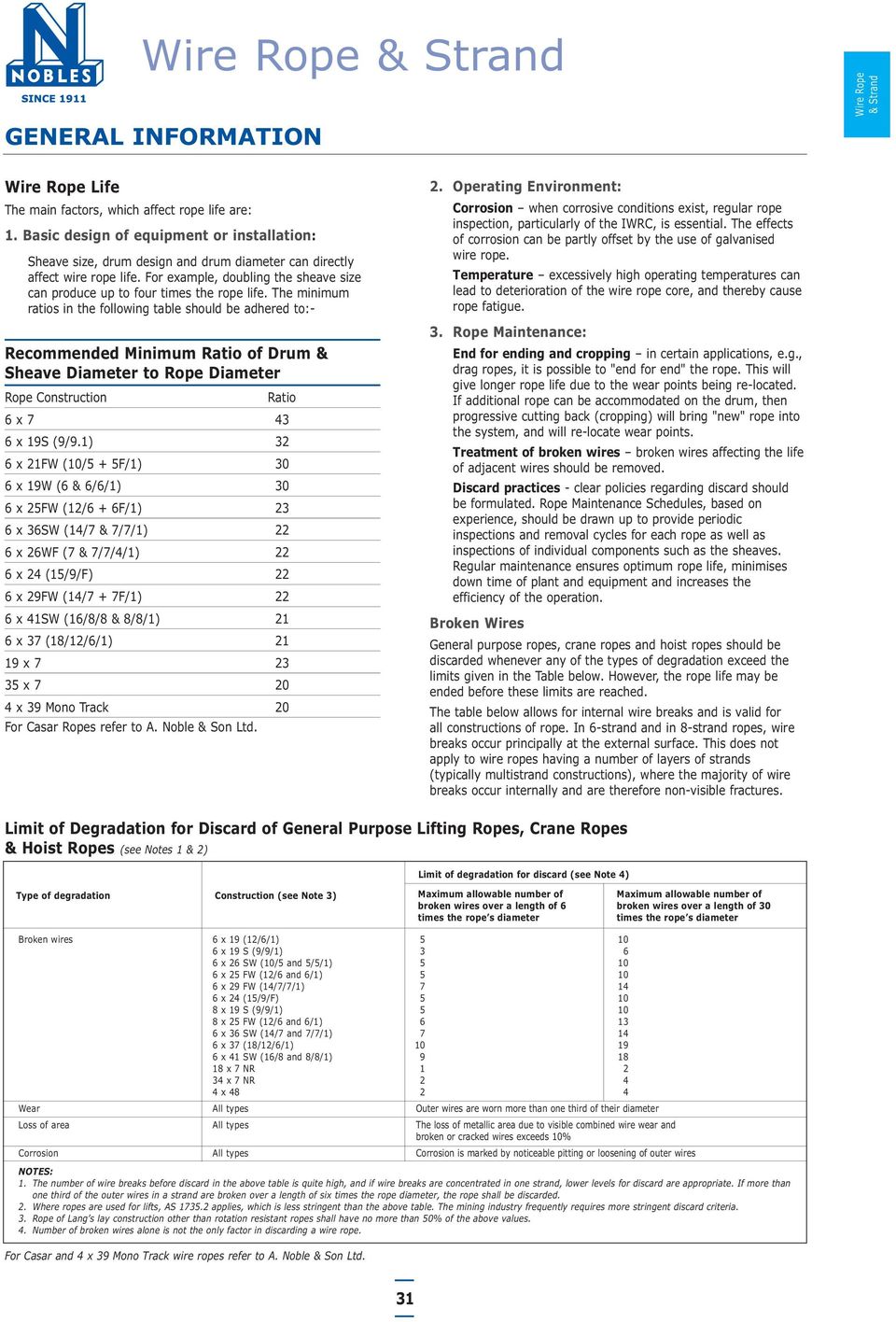
9 GENERAL INFORMATION Life The main factors, which affect rope life are: 1. Basic design of equipment or installation: Sheave size, drum design and drum diameter can directly affect wire rope life. For example, doubling the sheave size can produce up to four times the rope life. The minimum ratios in the following table should be adhered to:- Recommended Minimum Ratio of Drum & Sheave Diameter to Rope Diameter Rope Construction Ratio 6 x x 19S (9/9.1) 32 6 x 21FW (10/5 + 5F/1) 30 6 x 19W (6 & 6/6/1) 30 6 x 25FW (12/6 + 6F/1) 23 6 x 36SW (14/7 & 7/7/1) 22 6 x 26WF (7 & 7/7/4/1) 22 6 x 24 (15/9/F) 22 6 x 29FW (14/7 + 7F/1) 22 6 x 41SW (16/8/8 & 8/8/1) 21 6 x 37 (18/12/6/1) x x x 39 Mono Track 20 For Casar Ropes refer to A. Noble & Son Ltd. 2. Operating Environment: Corrosion when corrosive conditions exist, regular rope inspection, particularly of the IWRC, is essential. The effects of corrosion can be partly offset by the use of galvanised wire rope. Temperature excessively high operating temperatures can lead to deterioration of the wire rope core, and thereby cause rope fatigue. 3. Rope Maintenance: End for ending and cropping in certain applications, e.g., drag ropes, it is possible to "end for end" the rope. This will give longer rope life due to the wear points being re-located. If additional rope can be accommodated on the drum, then progressive cutting back (cropping) will bring "new" rope into the system, and will re-locate wear points. Treatment of broken wires broken wires affecting the life of adjacent wires should be removed. Discard practices - clear policies regarding discard should be formulated. Rope Maintenance Schedules, based on experience, should be drawn up to provide periodic inspections and removal cycles for each rope as well as inspections of individual components such as the sheaves. Regular maintenance ensures optimum rope life, minimises down time of plant and equipment and increases the efficiency of the operation. Broken Wires General purpose ropes, crane ropes and hoist ropes should be discarded whenever any of the types of degradation exceed the limits given in the Table below. However, the rope life may be ended before these limits are reached. The table below allows for internal wire breaks and is valid for all constructions of rope. In 6-strand and in 8-strand ropes, wire breaks occur principally at the external surface. This does not apply to wire ropes having a number of layers of strands (typically multistrand constructions), where the majority of wire breaks occur internally and are therefore non-visible fractures. Limit of Degradation for Discard of General Purpose Lifting Ropes, Crane Ropes & Hoist Ropes (see Notes 1 & 2) Limit of degradation for discard (see Note 4) Type of degradation Construction (see Note 3) Maximum allowable number of broken wires over a length of 6 times the rope s diameter Maximum allowable number of broken wires over a length of 30 times the rope s diameter Broken wires 6 x 19 (12/6/1) x 19 S (9/9/1) x 26 SW (10/5 and 5/5/1) x 25 FW (12/6 and 6/1) x 29 FW (14/7/7/1) x 24 (15/9/F) x 19 S (9/9/1) x 25 FW (12/6 and 6/1) x 36 SW (14/7 and 7/7/1) x 37 (18/12/6/1) x 41 SW (16/8 and 8/8/1) x 7 NR x 7 NR x Wear All types Outer wires are worn more than one third of their diameter Loss of area All types The loss of metallic area due to visible combined wire wear and broken or cracked wires exceeds 10% Corrosion All types Corrosion is marked by noticeable pitting or loosening of outer wires NOTES: 1. The number of wire breaks before discard in the above table is quite high, and if wire breaks are concentrated in one strand, lower levels for discard are appropriate. If more than one third of the outer wires in a strand are broken over a length of six times the rope diameter, the rope shall be discarded. 2. Where ropes are used for lifts, AS applies, which is less stringent than the above table. The mining industry frequently requires more stringent discard criteria. 3. Rope of Lang s lay construction other than rotation resistant ropes shall have no more than 50% of the above values. 4. Number of broken wires alone is not the only factor in discarding a wire rope. For Casar and 4 x 39 Mono Track wire ropes refer to A. Noble & Son Ltd. 31
10 GENERAL INFORMATION Care & Maintenance Breaking in A wire rope may be looked upon as a machine composed of a large number of moving parts. As such it should be broken in as soon as it is installed, by loading it very lightly for a few cycles and then gradually stepping up the load, to enable both wires and strands to bed down into the working positions, with the load distributed as uniformly as possible. With strand 6 and 8 stranded ropes, the torque can greatly diminish after breaking in by releasing the connection and allowing the torque to run out. This procedure may have to be repeated until the constructional stretch has been worked out of the rope and it has become neutral. The use of spinners or swivels should be avoided whenever possible. All ropes should be reeled onto winch drums as tightly and uniformly as possible during the initial installation. Inspection Wire rope is tough and durable, but nonetheless expendable and eventually reaches the end of its safe service life. Rope deterioration becomes noticeable through the presence of broken wires, surface wear, corrosion, wire or strand distortion due to mechanical abuse, or drastic reduction in diameter and lengthening of the lay. Also deterioration can be detected by the use of non-destructive testing techniques. Wire ropes should periodically be inspected for signs of deterioration. While Statutory Regulations govern the inspection and discarding of certain wire ropes, the same rules cannot be applied to all ropes. The proper frequency and degree of inspection depends largely on the possible risk to personnel and machinery in the event of rope failure. The determination of the point at which a rope should be discarded for reasons of safety requires judgment and experience in rope inspection in addition to knowledge of the performance of previous ropes used in the same application. Where the Statutory Regulations are laid down for the inspection and discarding of wire ropes and their attachments, wire rope users should become fully acquainted with the regulations and see that they are carried out. Sufficient records should be kept to provide a reliable history of the ropes under their control. Inspection of both operated and discarded ropes frequently indicates equipment faults that have a large bearing on the service life and safety of the rope. It is therefore essential to inspect the equipment on which the rope is used as well as the rope itself. Non Destructive Testing This method of inspection of wire ropes has become part of the mining industries standard requirements for over 20 years. An electromagnetic instrument is used to non-destructively examine the rope. It incorporates a sensor head that is able to induce a magnetic field in a section of rope that is located within the instrument. Changes in the metallic field enable a chart to be produced showing changes in metallic cross-sectional area and any wire breaks or other anomalies. Life of costly wire ropes may be extended by this sophisticated method. Deterioration Typical examples of wire rope deterioration 1. Mechanical damage due to rope movement over sharp edges whilst under load 2. Localised wear due to abrasion on supporting structure. 3. Narrow path of wire breaks caused by working in a grossly oversized groove or over small support rollers. 4. Severe wear in Lang s Lay, caused by abrasion at crossover points on multi-layer coiling application. 5. Corrosion of severe degree caused by immersion of rope in water. 6. Typical wire fractures as a result of bend fatigue. 7. Wire fractures at the strand, or core interface, as distinct from crown fractures caused by failure of core support. 8. Typical example of localised wear and deformation created at a previously kinked portion of rope. 9. Multi-strand rope bird caged due to torsional unbalance. Typical of build-up seen at anchorage end of multi-fall crane application. 10. Protrusion of IWRC resulting from shock loading. - METALLIC AREA LOSS CHART - % REDUCTION - LOCAL FAULT CHART - 32

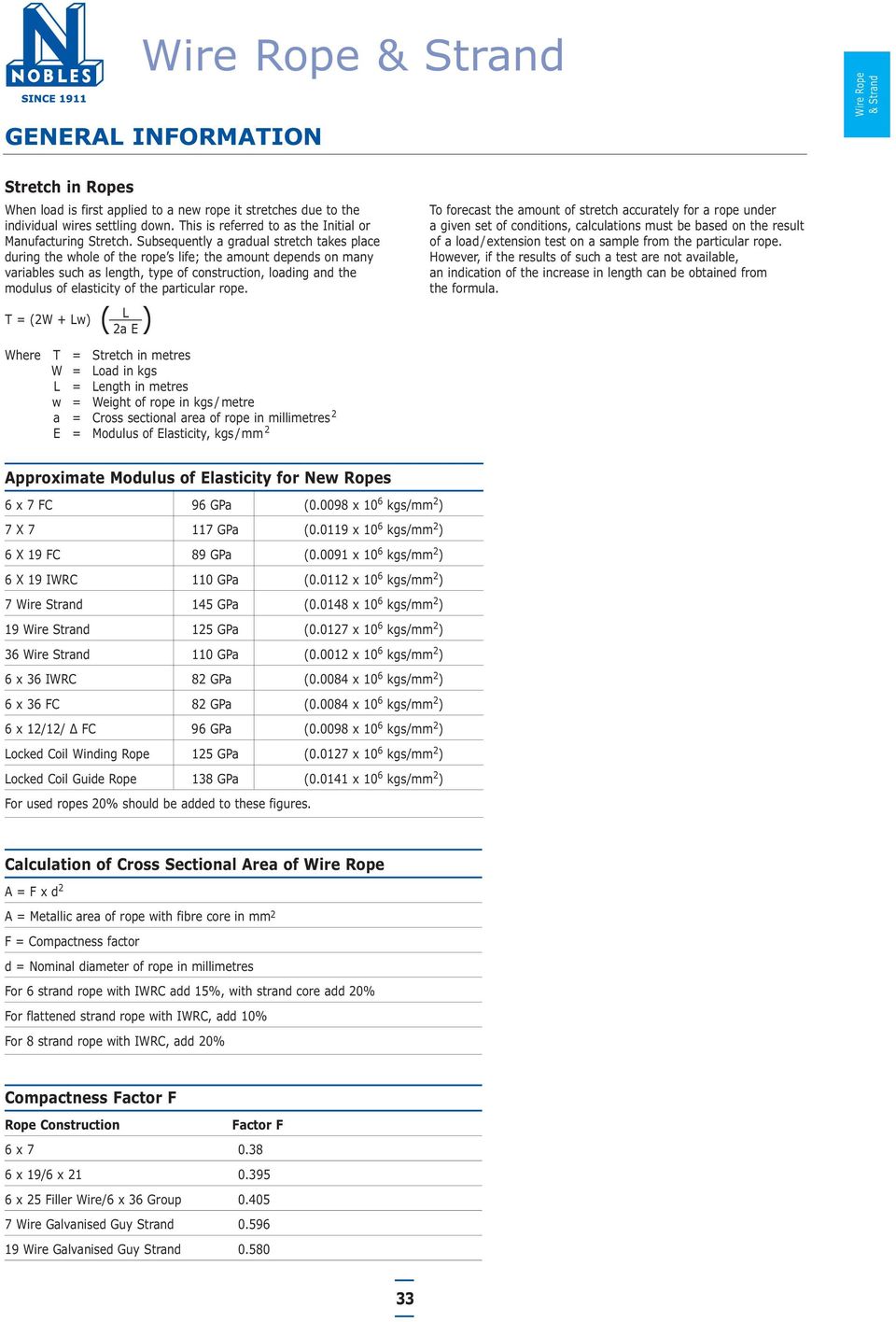
11 GENERAL INFORMATION Stretch in Ropes When load is first applied to a new rope it stretches due to the individual wires settling down. This is referred to as the Initial or Manufacturing Stretch. Subsequently a gradual stretch takes place during the whole of the rope s life; the amount depends on many variables such as length, type of construction, loading and the modulus of elasticity of the particular rope. T = (2W + Lw) ( L 2a E ) Where T = Stretch in metres W = Load in kgs L = Length in metres w = Weight of rope in kgs / metre a = Cross sectional area of rope in millimetres 2 E = Modulus of Elasticity, kgs / mm 2 To forecast the amount of stretch accurately for a rope under a given set of conditions, calculations must be based on the result of a load / extension test on a sample from the particular rope. However, if the results of such a test are not available, an indication of the increase in length can be obtained from the formula. Approximate Modulus of Elasticity for New Ropes 6 x 7 FC 96 GPa ( x 10 6 kgs/mm 2 ) 7 X GPa ( x 10 6 kgs/mm 2 ) 6 X 19 FC 89 GPa ( x 10 6 kgs/mm 2 ) 6 X 19 IWRC 110 GPa ( x 10 6 kgs/mm 2 ) 7 Wire Strand 145 GPa ( x 10 6 kgs/mm 2 ) 19 Wire Strand 125 GPa ( x 10 6 kgs/mm 2 ) 36 Wire Strand 110 GPa ( x 10 6 kgs/mm 2 ) 6 x 36 IWRC 82 GPa ( x 10 6 kgs/mm 2 ) 6 x 36 FC 82 GPa ( x 10 6 kgs/mm 2 ) 6 x 12/12/ Δ FC 96 GPa ( x 10 6 kgs/mm 2 ) Locked Coil Winding Rope 125 GPa ( x 10 6 kgs/mm 2 ) Locked Coil Guide Rope 138 GPa ( x 10 6 kgs/mm 2 ) For used ropes 20% should be added to these figures. Calculation of Cross Sectional Area of A = F x d 2 A = Metallic area of rope with fibre core in mm 2 F = Compactness factor d = Nominal diameter of rope in millimetres For 6 strand rope with IWRC add 15%, with strand core add 20% For flattened strand rope with IWRC, add 10% For 8 strand rope with IWRC, add 20% Compactness Factor F Rope Construction Factor F 6 x x 19/6 x x 25 Filler Wire/6 x 36 Group Wire Galvanised Guy Strand Wire Galvanised Guy Strand
12 GENERAL INFORMATION Tolerances on rope diameter Nominal Rope Diameter Tolerance as percentage of nominal diameter d Ropes with strands that are exclusively of Ropes with strands that incorporate mm wire or incorporate solid polymer centres fibre centres* * For example 6 x 24FC 2 d < d < d < Permissible differences between any two diameter measurements Nominal Rope Diameter Tolerance as percentage of nominal diameter d Ropes with strands that are exclusively of Ropes with strands that incorporate mm wire or incorporate solid polymer centres fibre centres* * For example 6 x 24FC 2 d < d < d <

13 BREAKING FORCE TABLES The following tables show rope mass in "kg per 100 metres" and breaking force in "kilonewtons" for the various rope groups. It will be noted that the value varies from group to group since the various constructions contain different steel areas and variable losses are incurred as the result of the stranding of the wires. Wire quality has been nominated in 1570, 1770 and 1960 grade for the majority of wire ropes, the value 1570, 1770 etc. corresponds to the minimum tensile strength of the wire expressed in megapascals. Marine and General Purpose galvanised ropes have been nominated in 1570 grade and are confined to certain rope constructions. Other 6 strand constructions in galvanised rope should be ordered in 1770 grade. The breaking forces of rope of tensile grades other than 1770 can be calculated by multiplying the value of 1770 grade by the ratio of the grade number. The grade of 2070 is the preferred high tensile grade for 6 strand ropes but 1960 is preferred for 19x7, 35x7 and most Casar ropes. TYPICAL ROPE RECOMENDATIONS All ropes are in millimeter diameter. Only preferred sizes have been included in the tables. Non preferred sizes should be the subject of special inquiry. Special non preferred sizes to suit existing deep mining and large excavator equipment are available although new equipment should use only preferred diameters. The breaking force unit is the kilonewton, this being the force which, applied to a mass of one kilogram, produces an acceleration of one metre per second. The minimum rope breaking force required will depend on the factor of safety covered by the application and in the case of a single supporting rope where the rope mass is ignored will be equal to the gravitational force multiplied by the factor of safety. Minimum rope breaking force (kn) = Mass (tonnes) per rope part x factor of safety required x To calculate approximate mass equivalent, at sea level, divide kilonewtons by 9.81 Example: 12mm 6 x 7 Fibre Core G1570 grade = 75 kn = 75 = 7.65 tonnes 9.81 For most practical purposes, divide by 10 in lieu of 9.81 Applications Size Range Rope Recommendations Lay Preformed Core Factors of Safety Dia. (mm) LOGGING Log Winch S RHOL IWRC Logging Skylines FW RHOL IWRC Log Skidder S, 25FW RHOL IWRC Yard Rope FW, 29FW RHOL FC PILING Pile Driving Hammer RHOL IWRC Drop Hammer FW, 36SW, 4x39 RHOL FC Pile Handling FW RHOL IWRC, FC SLINGS Slings - Standard , 36SW RHOL FC, IWRC AS Slings - High Tensile FW, 36SW RHOL IWRC SW, 41SW RHOL IWRC CRANES Tower - Hoist Eurolift, 35x7, Powerlift, Starlift RHOL or RHLL For safety factors on cranes refer to AS :2002 Tower - Luffing x39, Stratoplast, Turboplast RHLL Trolley Line FW, 36SW RHOL IWRC Overhead x7, Starlift 1-3 Falls x7, Eurolift, 4x39 RHOL Overhead Stratoplast, Turboplast RHOL or RHLL IWRC 4 Falls or more 25FW, 36SW, Betalift, Alphalift RHOL or RHLL IWRC Mobile - Hoist Eurolift, Starlift, 19x7, 35x7,4x39 RHOL or RHLL Eurolift, Starlift, 19x7, 35x7,4x39 RHOL or RHLL Mobile - Luffing W, Stratoplast, Turboplast RHLL IWRC GRABS Grab - Holding FW, 36SW, 4x39 RHOL or RHLL IWRC, FC Closing Stratoplast, Turboplast LHOL or LHLL WATER DRILLING , 4x39 LHOL, RHOL FC DRILLING Diamond x7, 4x39 RHOL FC x7, 4x39 RHOL* FC SHIPPING Mooring , 36SW RHOL FC SW, 41SW RHOL FC Towing SW, 41SW RHOL FC, IWRC Loading Gear - Lashing RHOL FC Rigging x7, 7x19 RHOL IWRC SLIPWAY , 36SW RHOL FC SW, 41SW RHOL FC, IWRC WINCHES Trailer - Boat , 7x19 RHOL IWRC, FC General Purpose S, 25FW, 36SW RHOL IWRC FW, 36SW, 41SW RHOL IWRC Note: 6 Strand ropes except where otherwise stated. 35

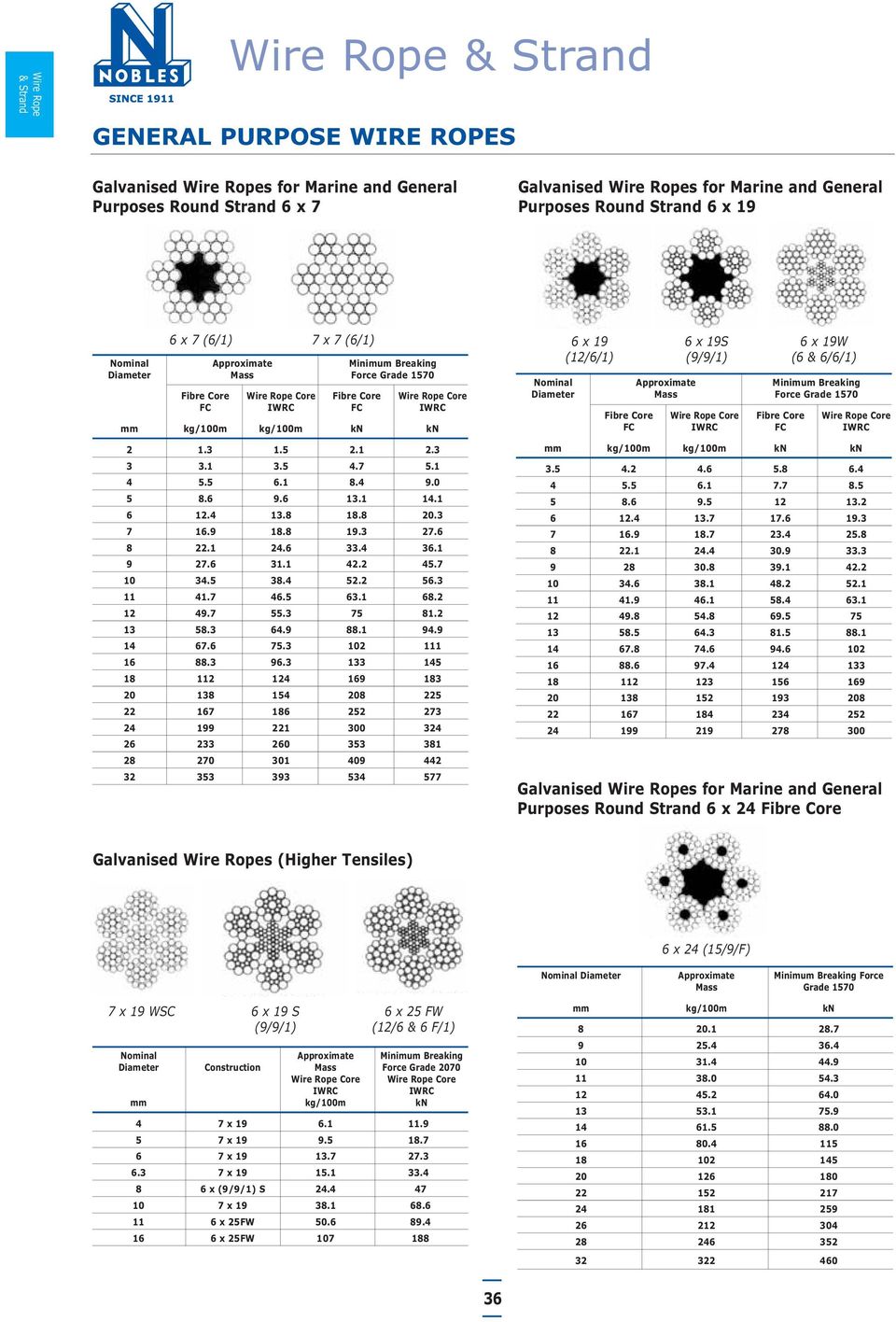
14 GENERAL PURPOSE WIRE ROPES Galvanised s for Marine and General Purposes Round Strand 6 x 7 Galvanised s for Marine and General Purposes Round Strand 6 x 19 6 x 7 (6/1) 7 x 7 (6/1) 6 x 19 (12/6/1) Nominal Approximate Minimum Breaking Diameter Mass Force Grade 1570 Fibre Core Core Fibre Core Core FC IWRC FC IWRC mm kg/100m kg/100m kn kn x 19S (9/9/1) 6 x 19W (6 & 6/6/1) Nominal Approximate Minimum Breaking Diameter Mass Force Grade 1570 Fibre Core Core Fibre Core Core FC IWRC FC IWRC mm kg/100m kg/100m kn kn Galvanised s for Marine and General Purposes Round Strand 6 x 24 Fibre Core Galvanised s (Higher Tensiles) 6 x 24 (15/9/F) Nominal Diameter Approximate Minimum Breaking Force Mass Grade x 19 WSC 6 x 19 S (9/9/1) 6 x 25 FW (12/6 & 6 F/1) Nominal Approximate Minimum Breaking Diameter Construction Mass Force Grade 2070 Core Core IWRC IWRC mm kg/100m kn 4 7 x x x x x (9/9/1) S x x 25FW x 25FW mm kg/100m kn
15 GENERAL PURPOSE WIRE ROPES TO AS General Purpose s 6 x 19 S (9/9/1) 6 x 21 FW (10/5 + 5 F/1) 6 x 25 FW (12/6 & 6 F/1) 6 x 26 WF (7 & 7/7/4/1) 6 x 29 FW (14/7 + 7 F/1) 6 x 36 SW (14/7 & 7/7/1) 6 x 41 SW (16/8 & 8/8/1) 6 x 49 SFW (16/16/8 + 8 F/1) 8-44mm 8-60mm 8-60mm 9-16mm 10-44mm 9-60mm 22-52mm 52-60mm Nominal Diameter Approximate Mass Minimum Breaking Force IWRC 6 x 19 to 6 x 25 6 x 26 to 6 x 49 Grade 1770 Grade 1960 IWRC IWRC mm kg/100m kg/100m kn kn Travelling Irrigator Galvanised s 6 x 7 (6/1) FC 7 x 7 WSC Nominal Approximate Minimum Breaking Force Diameter Mass Grade 1770 Grade 2070 Polypropylene Wire Strand Polypropylene Wire Strand Polypropylene Wire Strand Core Core Core Core Core Core mm kg/100m kg/100m kn kn kn kn

16 ROTATION RESISTANT WIRE ROPES 19 x 7 Construction s are not recommended in diameters above 18mm. 35 x 7 ropes should be used above 12mm diameter. Rotation Resistant 19 x 7 L Nominal Approximate Minimum Diameter Mass Breaking Force Grade 1960 mm kg/100m kn L = Langs Lay Rotation Resistant 35 x 7 L Nominal Approximate Minimum Minimum Diameter Mass Breaking Force Breaking Force Grade 1960 Grade 2160 mm kg/100m kn kn L = Langs Lay. Rotation Resistant 35 x 7 L Compacted Nominal Approximate Minimum Minimum Diameter Mass Breaking Force Breaking Force Grade 1960 Grade 2160 mm kg/100m kn kn L = Langs Lay. 38

17 ROTATION RESISTANT WIRE ROPES Rotation Resistant 4 x 39 (SES) Mono Track It is well known that wire ropes tend to spin or rotate under load. This can cause damage to the wire rope or load, work delays and a hazardous environment. To overcome this problem a 4-strand rope with a unique construction has been designed. These rotation resistant wire ropes are commonly used in the construction industry to minimise rotation in single and multi-part hoisting systems. 4 x 39 (SES) Nominal Minimum Breaking Force Diameter Approximate Mass H Grade SH Grade mm kg/100m kn kn

18 OLIVEIRA ROTATION RESISTANT WIRE ROPES NR Maxipact Nominal Metallic Approximate Diameter Area Mass Minimum Breaking Force Grade 1960 Grade 2160 mm mm 2 kg/100m kn kn x x Full size range available from 13mm to 52mm NR Maxipact (34 x 7) NR Maxipact with optional PPI (34 x 7) Non rotating construction with fully compacted strands. Available in Lang's Lay only Can be used with a swivel Can be used with a single fall Also available with a Plastic Protected Impregnated core (PPI) NR Maxilift Nominal Metallic Approximate Diameter Area Mass Minimum Breaking Force Grade 1960 Grade 2160 mm mm 2 kg/100m kn kn x x Full size range available from 10mm to 42mm NR Maxilift (27 x 7) NR Maxilift with optional PPI (27 x 7) Non rotating construction with fully compacted strands. Available in Lang's Lay only Can be used with a swivel Can be used with a single fall Also available with a Plastic Protected Impregnated core (PPI) 40

19 OLIVEIRA ROTATION RESISTANT WIRE ROPES LT 24 K (24 x 7) Minimum Nominal Metallic Approximate Breaking Force Diameter Area Mass Grade 1960 mm mm 2 kg/100m kn x LT 24 K (24 x 7) LT 24 K (24 x 7) with optional PPI Rotation Resistant (Low Torque) construction with fully compacted strands Available in Lang's Lay only Can be used with a swivel with a minimum of 2 falls Cannot be used with a single fall Also available with a Plastic Protected Impregnated core (PPI) LT 24 K (24 x 17) Minimum Nominal Metallic Approximate Breaking Force Diameter Area Mass Grade 1960 mm mm 2 kg/100m kn x LT 24 K (24 x 17) LT 24 K (24 x 17) with optional PPI Rotation Resistant (Low Torque) construction with fully compacted strands Available in Lang's Lay only Can be used with a swivel with a minimum of 2 falls Cannot be used with a single fall Also available with a Plastic Protected Impregnated core (PPI) 41

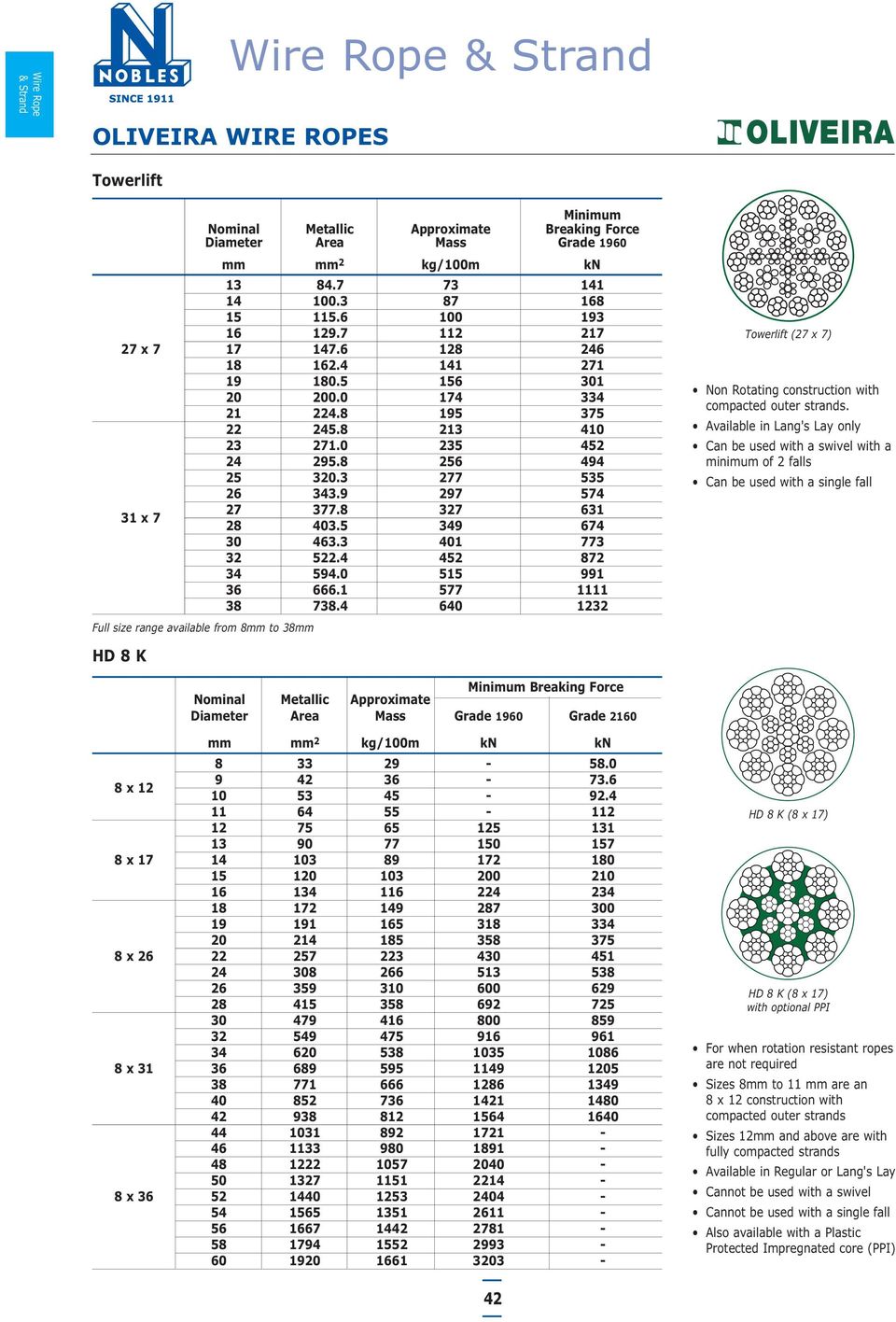
20 OLIVEIRA WIRE ROPES Towerlift Minimum Nominal Metallic Approximate Breaking Force Diameter Area Mass Grade 1960 mm mm 2 kg/100m kn x x Full size range available from 8mm to 38mm Towerlift (27 x 7) Non Rotating construction with compacted outer strands. Available in Lang's Lay only Can be used with a swivel with a minimum of 2 falls Can be used with a single fall HD 8 K Nominal Metallic Approximate Diameter Area Mass Minimum Breaking Force Grade 1960 Grade 2160 mm mm 2 kg/100m kn kn x x x x x HD 8 K (8 x 17) HD 8 K (8 x 17) with optional PPI For when rotation resistant ropes are not required Sizes 8mm to 11 mm are an 8 x 12 construction with compacted outer strands Sizes 12mm and above are with fully compacted strands Available in Regular or Lang's Lay Cannot be used with a swivel Cannot be used with a single fall Also available with a Plastic Protected Impregnated core (PPI) 42
21 CASAR SPECIAL WIRE ROPES Hoist rope for tower cranes, mobile cranes, electrical hoists and other applications where rotation resistant ropes are required. Nominal Metallic Approximate Minimum Diameter Area Mass Breaking Force mm mm 2 kg/100m kn Is a rotation resistant, flexible hoist rope with a compacted steel core. Is fully lubricated. Has best-in-class breaking loads. Has a core of unique design and very high density, providing excellent resistance to external wear and crushing on drums. Langs Lay only. Hoist rope for mobile cranes, electrical hoists and other applications where rotation resistant ropes are required. Especially suitable for multiple layer spooling. Nominal Metallic Approximate Diameter Area Mass Minimum Breaking Force Grade 1770 Grade 1960 Grade 2160 mm mm 2 kg/100m kn kn kn Is a rotation resistant, flexible hoist rope made out of compacted outer strands and a compacted steel core. Is fully lubricated. Has an extremely high breaking load and a very good resistance against drum crushing. Has a core of special design avoiding crossovers between the strands of the core which reduces the danger of internal rope destruction. Regular Lay or Langs Lay. Other diameters are available on request 43
22 CASAR SPECIAL WIRE ROPES Hoist rope for electrical hoists and lifting devices with multiple part reeving, twin hoist systems with left and right hand ropes, where rotation resistant ropes are not required. Nominal Metallic Approximate Minimum Breaking Force Diameter Area Mass Grade 1770 Grade 1960 Grade 2160 mm mm 2 kg/100m kn kn kn Is an 8 strand rope in parallel lay construction made out of conventional strands. Is fully lubricated. Is very flexible. Has a high breaking load. Alphalift should NOT be used with a swivel. Regular Lay only. Hoist rope for electrical hoists and lifting devices with multiple part reeving and twin hoist systems with left and right hand ropes, where rotation resistant ropes are not required. Nominal Metallic Approximate Minimum Breaking Force Diameter Area Mass Grade 1770 Grade 1960 Grade 2160 mm mm 2 kg/100m kn kn kn Is a 10 strand rope in parallel lay construction made out of compacted strands. Is fully lubricated. Is very flexible. Has an extremely high breaking load. Betalift should NOT be used with a swivel. Betalift is NOT suitable for use on overhead travelling cranes. Other diameters are available on request 44
23 CASAR SPECIAL WIRE ROPES Pendant rope for tower cranes, mobile cranes, grabs, suspended structures etc, when high breaking load is required. Nominal Metallic Approximate Minimum Breaking Force Diameter Area Mass Grade 1770 Grade 1960 Grade 2160 mm mm 2 kg/100m kn kn kn Is an 8 strand rope in parallel lay construction made out of compacted strands. Is fully lubricated. Is very flexible. Has an extremely high breaking load. Turbolift should NOT be used with a swivel. Regular Lay or Langs Lay. Boom hoist rope for mobile cranes and grabs, hoist rope for container cranes, floating cranes etc. In multiple part reeving for smaller lifting height. Nominal Metallic Approximate Diameter Area Mass Minimum Breaking Force Grade 1960 Grade 2160 mm mm 2 kg/100m kn kn Is an 8 strand rope made out of compacted outer strands. Is fully lubricated. Has a plastic layer between the steel core and the outer strands giving the rope a high structural stability. The plastic layer also assists in avoiding internal rope destruction and protecting the core against corrosive environments. Has a very high breaking load and good resistance against drum crushing. Turboplast should NOT be used with a swivel. Regular Lay or Langs Lay. Other diameters are available on request 45
24 CASAR SPECIAL WIRE ROPES Hoist rope for container cranes, floating cranes, harbour cranes, portal cranes etc. In multiple reeving for smaller lifting heights. Holding rope and closing rope for grabs. Nominal Metallic Approximate Diameter Area Mass Minimum Breaking Force Grade 1770 Grade 1960 mm mm 2 kg/100m kn kn Is an 8 strand rope made out of conventional strands. Is fully lubricated. Has a plastic layer between the steel core and the outer strands giving the rope a high structural stability. The plastic layer also assists in avoiding internal rope destruction and protecting the core against corrosive environments. Stratoplast should NOT be used with a swivel. Regular Lay or Langs Lay. Hoist rope for electrical hoists and lifting devices with multiple part reeving, where a rotation resistant rope is not needed due to great lifting heights, low number of falls or non guided loads. High breaking load. Nominal Metallic Approximate Minimum Breaking Force Diameter Area Mass Grade 1770 Grade 1960 Grade 2160 mm mm 2 kg/100m kn kn kn Is an 8 strand rope in parallel lay construction made out of compacted outer strands. Is fully lubricated. Has a plastic layer between the steel core and the outer strands. Has a very high breaking load. Paraplast should NOT be used with a swivel. Regular Lay or Langs Lay. Other diameters are available on request 46
25 CASAR SPECIAL WIRE ROPES Hoist rope for deck cranes, offshore cranes and other applications in the marine environment, where rotation resistant ropes are required. Minimum Breaking Force Nominal Metallic Approximate Diameter Area Mass Grade 1770 Grade 1960 mm mm 2 kg/100m kn kn Is a rotation resistant hoist rope made out of compacted strands. Is fully lubricated. Has a plastic layer between the steel core and the outer strands giving the rope a high structural stability. The plastic layer also assists in avoiding internal rope destruction and protecting the core against corrosive environments. Has a high breaking load and good resistance against drum crushing. Regular Lay or Langs Lay. Boom hoist rope for mobile cranes and grabs, hoist rope for container cranes, floating cranes, portal cranes etc. In multiple part reeving for smaller lifting heights. Nominal Metallic Approximate Minimum Breaking Force Diameter Area Mass Grade 1770 Grade 1960 Grade 2160 mm mm 2 kg/100m kn kn kn Is a 10 strand rope made out of compacted outer strands. Is fully lubricated. Has a plastic layer between the steel core and the outer strands giving the rope a high structural stability. The plastic layer also assists in avoiding internal rope destruction and protecting the core against corrosive environments. Has a very high breaking load and good resistance against drum crushing. Superplast 8 should NOT be used with a swivel. Regular Lay or Langs Lay. Other diameters are available on request
26 CASAR SPECIAL MINING WIRE ROPES Hoisting ropes in underground mining operations play a vital role in the production cycle, not only to hoist minerals but also to transport men and materials safely and efficiently. Winding ropes are therefore clearly safety critical throughout their operating life. Casar specialises in this technology and is a world leader in the manufacture of sophisticated wire rope products for a broad range of lifting applications. In Australia Casar has established a strong position in the mining industry. Quality and high tech design Every effort is made to maintain and improve the quality of Casar wire rope products for the mining industry. Careful attention to quality and engineering design details ensures that a Casar rope will routinely outperform conventional six strand and rotation resistant ropes. Special features of Casar mining ropes include galvanising, compacted strands and a plastic layer between steel core and the outer strands. The internal plastic layer stabilises the construction and experience has shown that Casar winding ropes are less prone to torsional distortions like waviness and slack outer strands. Reliability and value for money Casar Special Mining Ropes offer benefits such as increased reliability of the hoisting system and reduced downtime due to less servicing and fewer rope changes. The higher breaking strengths of Casar Special Mining Ropes allow for an increase of payload for the same Casar Mining Rope Factors diameter. The increased capacity of the shaft will lead to increased profitability of the mine. How to select the most suitable design This catalogue sets out a range of different mine hoisting applications that Casar ropes can be used for and identifies which rope construction should be used in particular circumstances. In order to assist you in rope selection, tables that follow give factors that can be used to calculate for example the rope minimum breaking loads (MBL) and masses for a given rope diameter. This allows for automated rope diameter selection given basic winding system parameters. The detailed specifications of various Casar mining ropes are given in 1mm diameter increments, but with rope factors it is also possible to calculate the rope specifications for intermediate diameters, e.g. 42.5mm or 53.5mm, which Casar can manufacture on request. Tailor made rope construction Within a particular rope construction family Casar are able to deliver a wide range of fill factors and strength to mass ratios. An example of this is the comparison between Starplast M (with no compacted strands) and Starplast VM (with fully compacted strands). By varying the degree of strand compaction, Casar can manufacture ropes with every metallic cross sectional area, any breaking strength or any specific weight between the figures of Starplast M and Starplast VM. We are therefore able to adapt the rope specifications to the exact requirements of your shaft. This is the core competence of Casar. Fill Spin Weight Wir Dia. Cross MBL MBL Mass Factor Factor Factor Factor Section Factor Factor Factor Factor FF SF WF DF CF BLF 1770 BLF 1960 MF [-] [-] [-] [-] [-] [-] [-] [-] Caculating the MBL in kn for a given rope diameter and a given tensile strength MBL 1770 [kn] = 1.77 FF SF II (d[mm]) 2 / 4 or MBL 1770 [kn] = BLF 1770 (d[mm]) 2 MBL 1960 [kn] = 1.96 FF SF II (d[mm]) 2 / 4 or MBL 1960 [kn] = BLF 1960 (d[mm]) 2 Caculating a minimum rope diameter in mm for a given MBL and a given tensile strength dmin 1770 [mm] = 4 MBL 1770 [kn] / (FF SF II 1.77) or dmin 1770 [mm] = MBL 1770 [kn] / BLF 1770 dmin 1960 [mm] = 4 MBL 1960 [kn] / (FF SF II 1.96) or dmin 1960 [mm] = MBL 1960 [kn] / BLF 1960 Caculating the outer wire diameter of the rope for a given rope diameter = DF d Caculating the rope mass for a given rope diameter Rope mass [kg/m] = MF d 2 48
27 TYPICAL MINE WINDERS Ground mounted Koepe friction winder single rope Ground mounted Koepe friction winder multi-rope Tower mounted Koepe friction winder single-rope no deflection sheave Tower mounted Koepe friction winder multi-rope no deflection sheaves Koepe friction winders are either installed in a ground or tower mounted configuration. The number of head and tail rope pairs can vary between 1 and 10 depending on the hoisting duty of the winder. In general the combined unit mass of the head and tail ropes are equal to ensure balanced winding. Single layer rope constructions are widely used for shallower shaft Koepe winders, but for depths exceeding 900 m it is critical that non-spin or rotation resistance constructions are used. For free looping tail ropes, non-spin ropes with swivels under both conveyances are recommended. For multi-rope winders, rope load balancing and equal driving sheave/drum circumferences are critical to ensure good rope life. Tower mounted Koepe friction winder singlerope with deflection sheave Tower mounted Koepe friction winder multi-rope with deflection sheaves Double drum winder Blair mult-rope (BMR) winder Double drum and BMR winders are almost always ground mounted. For these winders, single layer rope constructions can be used even in very deep shafts in even in excess of 3000 m. However, in such cases the lay length changes from the manufactured state would be significant. Rope load balancing and accurate drum spooling between rope pairs are critical on BMR winders. Ropes which offer high drum crushing resistance are preferred for these applications as the ropes normally deteriorate first at the _ turn and layer crossovers on parrellel grooved drums. In cases where the ropes are free to rotate during the winding cycle (e.g. kibble winders) or where the shaft uses rope guides, non-spin or rotation resistant constructions are used. 49
28 MINING WIRE ROPES Is an 8 strand rope made out of compacted outer strands. Is fully lubricated. Has a plastic layer between the steel core and the outer strands giving the rope a high structural stability. The plastic layer also assists in avoiding internal rope destruction and protecting the core against corrosive environments. Has a very high breaking load and good resistance against drum crushing. Turboplast should NOT be used with a swivel. Regular Lay or Langs Lay. Minimum Breaking Force Nominal Diameter Metallic Area Approximate Mass Grade 1770 Grade 1960 mm mm 2 kg/100m kn kn Is an 8-strand rope made out of compacted outer strands. Is fully lubricated. Has a plastic layer between the steel core and the outer strands, giving the rope a high structural stability, avoiding internal rope destruction and protecting the core against corrosive environments. Has a very high breaking load and a good resistance against drum crushing. Duroplast should NOT be used with a swivel. Regular Lay or Langs Lay. Minimum Breaking Force Nominal Diameter Metallic Area Approximate Mass Grade 1770 Grade 1960 mm mm 2 kg/100m kn kn Other diameters are available on request
29 MINING WIRE ROPES Is a rotation resistant hoist rope made out of compacted outer strands. Is fully lubricated. Has a plastic layer between the steel core and the outer strands, giving the rope a high structural stability, avoiding internal rope destruction and protecting the core against corrosive environments. Has a high breaking load and good resistance against drum crushing. Regular Lay or Langs Lay. Minimum Breaking Force Nominal Diameter Metallic Area Approximate Mass Grade 1770 Grade 1960 mm mm 2 kg/100m kn kn Is a rotation resistant hoist rope made out of compacted strands. Is fully lubricated. Has a plastic layer between the steel core and the outer strands, giving the rope a high structural stability, avoiding internal rope destruction and protecting the core against corrosive environments. Has a high breaking load and good resistance against drum crushing. Regular Lay or Langs Lay. Minimum Breaking Force Nominal Diameter Metallic Area Approximate Mass Grade 1770 Grade 1960 mm mm 2 kg/100m kn kn Other diameters are available on request
30 MINING WIRE ROPES Is a rotation resistant hoist rope made out of compacted strands. Is fully lubricated. Has a plastic layer between the steel core and the outer strands giving the rope a high structural stability. The plastic layer also assists in avoiding internal rope destruction and protecting the core against corrosive environments. Has a high breaking load and good resistance against drum crushing. Regular Lay or Langs Lay. Minimum Breaking Force Nominal Diameter Metallic Area Approximate Mass Grade 1770 Grade 1960 mm mm 2 kg/100m kn kn Is a 12 strand rope made out of compacted strands. Is fully lubricated. Has a plastic layer between the steel core and the outer strands, giving the rope a high structural stability, avoiding internal rope destruction and protecting the core against corrosive environments. Has a high breaking load and good resistance against drum crushing. Langs Lay only. Minimum Breaking Force Nominal Diameter Metallic Area Approximate Mass Grade 1770 Grade 1960 mm mm 2 kg/100m kn kn Other diameters are available on request
31 MINING WIRE ROPES Full Locked Coil Winding Ropes Nominal Approximate Nominal Diameter Mass Breaking Load mm kgs/m kgs , , , , , , , , , , , , , , , , , , , , ,000 Half Locked Coil Guide Ropes Nominal Approximate Nominal Diameter Mass Breaking Load mm kgs/m kgs , , , , , , , ,000 Nominal Breaking Load x = Aggregate Breaking Load These ropes conform to N.C.B. Spec 388 Full Locked Coil Half Locked Coil Up to 57mm Nominal B.L. x = Aggregate B.L. Over 57mm Nominal B.L. x = Aggregate B.L. These ropes conform to N.C.B. Spec. 186 Triangular Strand 6x8 to 17 Outer Wires - Fibre Core 6 x 19 (8/10/Δ) 6 x 22 (9/12/Δ) 6 x 23 (10/12/Δ) 6 x 25 (12/12/Δ) 6 x 27 or 28 (14 OR 15/Δ) Nominal Approximate Mass Minimum Diameter Breaking Force 6 x 19 to 6 x 25 6 x 27 to 6 x 28 Grade 1770 mm kg/100m kg/100m kn x 12/12/3TS 6 x 10/12/3TS 6 x 15/12/9TS 53
32 AMERICAN WIRE ROPES Hoist and Luffing Ropes for Lattice Boom Cranes (American Manufacture) Alternate Lay for Luffing Ropes Right Hand Ordinary Lay for Hoist Ropes 6 x 25 FW or 6 x 31 WS IWRC Nominal Diameter Approximate Mass Nominal Strength in kn Inches mm kg/100m Extra Extra Improved Extra Improved Plough Steel Plough Steel 5/ / / / / Nominal Strength is an American term. Minimum Breaking Force is 2 1/2 % lower than the Nominal Strength. OIL INDUSTRY WIRE ROPES Drilling Lines 6 x 19 SEALE Right Hand Ordinary Lay, Ungalvanised IWRC to API Spec 9A Nominal Diameter Approximate Mass Minimum Breaking Force IPS Grade EIPS Grade Inches mm kg/100m lb/ft kn 1000 lb kn 1000 lb 7/ / / / / / /
33 ONESTEEL FISHING WIRE ROPES The OneSteel range of fishing ropes are characterised by the very high levels of galvanising achieved in the high strength 1770 MPa grade wire. Galvanising levels at 25% above Class A (now Class W10Z to AS/NZS 4534) are targeted in manufacture. OneSteel refer to these as marine grade galvanised wire products. This along with the special treatment that ropes receive in manufacture to prevent nicking and marking the zinc ensures a product that is highly resistant to corrosion. The product is popular for warps and bridles in trawling. Rope cores are lubricated laid polypropylene for best results. Also the rope strands are lubricated in manufacture using a wax base lubricant with extreme pressure additives and corrosion inhibitors. In accord with occupational health and environmental principles the use of bitumastic based lubricants has been discontinued. Note: Information on other rope sizes, constructions and compak fishing ropes are available on request. There is a limit to the wire size available with the marine grade levels of galvanising in high strength 1770 MPa grade. In larger sizes these may need to be of 1570 grade tensile wire to obtain the same high levels of galvanising. Galvanised - 6x9/9/1 Fibrillated Poly Core RHOL Nominal Approximate Minimum Breaking Diameter Mass Load 1770 mm kgs/100m kn Galvanised - 6x9/9/1 Core RHOL Nominal Approximate Minimum Breaking Diameter Mass Load 1770 mm kgs/100m kn Grade Wire is standard, 1570 may be available upon request. KISWIRE FISHING WIRE ROPES Kiswire fishing ropes are available in both A & B galvanising and ALUMAR. ALUMAR fishing ropes have 5% aluminium in the zinc galvanising mix with the inclusion of the aluminium ensuring superior resistance to corrosion and a longer working life. ALUMAR ropes have performed extremely well in laboratory Salt Spray (NaCI) and SO2 Atmosphere humidity tests. These test indicate that ALUMAR technology improves corrosion resistance by approximately 3 times. ALUMAR fishing ropes are the end product of many years of testing in regard to the correct level of aluminium to be included in the zinc mix. The level of 5% provides the optimum balance of corrosion resistance, durability and working life. Galvanised - 6x9/9/1 Poly Core RHOL Nominal Approximate Minimum Breaking Diameter Mass Load 1770 mm kgs/100m kn Galvanised - 6x9/9/1 Core RHOL Nominal Approximate Minimum Breaking Diameter Mass Load 1770 mm kgs/100m kn Grade Wire is standard, 1570 may be available upon request. AB Galvanised fishing ropes also available upon requests. 55
34 STAINLESS STEEL WIRE ROPE There are three common constructions of stainless steel wire rope used in fixed rigging applications. Nobles stock stainless steel wire rope mainly in 316 grade but some 304 grade product is available. 7 x 19 7 x 19 is the most common and versatile construction of stainless steel wire rope. It consists of 7 strands each with 19 wires and is the most flexible and the easiest construction to work with particularly where the rope needs to turn corners, change directions or where ferrule secured thimble eyes and wire rope grips are used. 7 x 19 can be used in either fixed rigging or for limited working rope applications such as on a boat winch. 7 x 7 7 x 7 consists of 7 strands each with 7 wires and is not as flexible as 7 x x 7 is an excellent choice for fixed rigging applications such as balustrading and safety barrier rails. Although 7x7 is stiffer than 7 x 19 it is still capable of limited angles and can be used with thimble eyes or swage fittings. 7 x 7 has very limited applications as a running or working rope. 1 x 19 1 x 19 consists of a single strand with 19 wires. 1 x 19 is very stiff and is suitable for fixed "straight line" rigging only such as mast stays, guy ropes and structural applications. It cannot be used with thimble eyes and is best utilised and looks very effective with machine swaged end fittings. 56
35 STAINLESS STEEL WIRE ROPE Stock Code Grade & Construction Approximate Minimum Nominal Diameter Mass Breaking Load mm kg/100m kg AS AS AS ,340 AS ,000 AS ,880 AS Grade 1x ,810 AS Grade 1x ,400 AS ,092 AS ,991 AS ,189 AS ,386 AS AS AS ,000 AS ,620 AS ,060 AS Grade 7x ,670 AS ,750 AS ,594 AS ,492 AS ,690 AS ,587 AS AS AS ,089 AS ,820 AS ,480 AS Grade 7x ,082 AS ,980 AS ,591 AS ,089 AS ,386 AS ,883 AS AS AS AS ,490 AS ,910 AS Grade 7x ,450 AS ,310 AS ,093 AS ,692 AS ,461 AS , Grade ropes are preferred but 304 Grade is also usually available. Please nominate grade required at time of order. White is the standard colour for PVC covered ropes but other colours may be available. Reels are available in 305m, 500m or 1000m lengths. Other constructions and sizes available on request. 57
36 GALVANISED STRAND Galvanised Strand is commonly used for guys on communication towers, broadcasting towers, power poles and as load carrying members in building structures. 1 x 37 Galvanised Strand Characteristics Galvanised Strand is less flexible than wire rope, it is stronger and has a higher modulus of elasticity. It is furnished with Class A galvanised finish. Galvanised Strand for General Purpose Applications 1 x 7 1 x 19 Nominal Construction Minimum Breaking Force, kn Nominal Nominal Diameter (abbreviated Mass Area mm form) Grade Grade Grade kg/100m mm x x x x x x x x x x x x x x x x x x
37 GALVANISED STRAND TO AS 2841 Galvanised Strand for Guying Purposes 1 x 19 1 x 37 1 x 61 Nominal Construction* Minimum Breaking Nominal Nominal Young diameter (abbreviated form) Force Grade 1570 Mass Area Modulus** mm kn kg/100m mm2 GPa 10 1 x x x x x x x x x x x x x x x x x x x x x x x x x x x * For strand 70mm diameter and greater, the number of wires may vary from that shown in the table provided that the other physical properties are in accordance with those shown in the table. ** The values shown are indicative of values obtained after removal of constructional stretch. If a precise value is required, it should be determined by experiment. 59
38 02.qxd 15/2/12 5:14 PM Page 38 WIRE ROPE LUBRICANTS Nobles Lubricant Suitable For: Running and standing wire ropes in Mining, Marine, Oil & Gas, Construction and Industrial environments Benefits: An exceptional wire rope lubricant formulated with anti-drip wax polymers to reduce drip and fling off. Fortified with penetrating anti-rust and lubricating additives to provide complete internal and external protection. Easy to apply by brush, drip or spray can. Available in 400g spray can, 4L and 20L pails, or economical 205L drums. Stock Codes: DRTSWR004N DRTSWR040N DRTSWR020N DRTSWR205N - 400g Spray Can 4L Pail 20L Pail 205L Drum Nobles HD Grease Suitable For: Suspension ropes, running and standing ropes in extreme environments, and also suitable for sheaves. Benefits: Contains no bitumen or wax Exceptional corrosion resistance Formulated with extreme anti-wear and pressure additives, combined with unique penetrating oils to retard internal fretting Available in 20kg pails or 180kg drums (supplied in 205L drum) Stock Codes: DRTHDNB020N - 20kg Pail DRTHDNB205N - 205L Drum Nobles EF Lubricant Suitable For: All wire ropes, sheaves and drums where environmentally friendly lubricants are required. Available in 220 Grade for cool conditions or smaller diameter ropes, and 460 Grade for hot conditions or large diameter ropes. Benefits: Contains all the performance of Nobles standard Lubricant, while minimising the impact on the environment. Specially formulated from ultra pure mineral oils of pristine quality High resistance to oxidation Can be used in food processing environments Available in 20L pails or 205L drums Stock Codes: DRTEF220020N - 20L Pail 220 Grade DRTEF220205N - 205L Drum 220 Grade DRTEF460020N - 20L Pail 460 Grade DRTEF460205N - 205L Drum 460 Grade 60
39 WIRE ROPE LUBRICANTS Lanotec Where environmental considerations are paramount Nobles recommends the use of Lanotec sealants and lubricants. Nobles are a leading stockist and distributor of Lanotec products and like Nobles, Lanotec is a 100% Australian-owned and operated company. By using Lanotec s naturally based products Nobles can provide lubrication, corrosion protection and degreasing solutions that are friendly for the environment and safe to use. Lanotec Heavy Duty Liquid Lanolin Lubrication and corrosion protection of wire ropes where spraying is necessary Penetrates to the core of the rope, providing long lasting protection Perfect for mobile cranes where lubrication needs to be applied while rope is still on the spool Non-fling and non-webbing Suitable for all environments, including mining and marine Stock Codes: DRLHD g Spray Can DRLHD ml Spray Bottle DRLHD2105-5L Container DRLHD L Container Lanotec Lube Can be sprayed or manually applied to ropes Penetrates to the core of the rope, providing long lasting protection Semi fluid grease containing natural lubricant and corrosion inhibitors Ideal for marine cranes and ropes working in the splash zone Lubrication of ropes in environmentally sensitive areas where salt water is an issue Suitable for all environments, including mining and marine Stock Codes: DRLHDWRL20-20L Container DRLHDWRL L Pail Lanotec Citra-Force Biodegradable, water soluble degreaser concentrate Easily removes tar-based wire rope coatings (blackjack) Easily removes thread dope Cleans stainless steel, metal surfaces, wire rope, safety harnesses & webbing Perfect for environmentally sensitive areas Stock Codes: DRLCF g Spray Can DRLCF ml Spray Bottle DRLCF05-5L Container DRLCF20-20L Container 61
4. Handling and Installation
 4. Handling and Installation 4.1 Handling and installation of the rope should be carried out in accordance with a detailed plan and should be supervised by a competent person. Incorrectly supervised handling
Wire Damage on Ships Cranes
 13.12.2005 Wire Damage on Ships Cranes (Capt. Dipl.-Ing. U. Kreitz,) On board sea-going vessels, rotation-resistant wire ropes with compacted strands are preferable for use in respect to ships cranes with
New wire rope designs for multi layer drums
 New wire rope designs for multi layer drums New wire rope designs for multi layer drums by Dipl.- Ing. Roland Verreet 2 3 3 4 6 7 8 9 10 12 14 15 17 17 17 17 17 17 21 22 24 26 28 The bending fatigue mechanism
verope AG St. Antons-Gasse 4a CH-6300 Zug / Switzerland Tel: +41 (0) 41 72 80 880 Fax: +41 (0) 41 72 80 888 Your requirements are our focus.
 verope AG is a Joint Venture company between Pierre Verreet, head and founder of verope, and Kiswire Ltd. from South Korea. The concept of verope is to design and to manufacture high quality crane ropes
LiftAlloy Chain Slings
 CHAIN SLING BASICS Slings Lift-All chain slings meet or exceed all OSHA, ASME B30.9 and NACM standards and regulations. chain slings, available in 80 for 7/32" and 7/8"- /4" and 00 for 9/32"-3/4", are
Savard Labor & Marine Staffing, Inc. Rigging Safety Rev3/14 Rigging Safety
 Rigging Safety The ability to handle materials to move them from one location to another, whether during transit or at the worksite is vital to all segments of industry. Materials must be moved, for example,
Steel Wire Ropes for Cranes
 Steel Wire Ropes for Cranes Problems and Solutions 1 2 Steel Wire Ropes for Cranes Problems and Solutions by Dipl.-Ing. Roland Verreet 1 The steel wire rope a multiply-redundant machine element 2 Problem:
Service life of synthetic fibre ropes in deepwater lifting operations. The 15 th North Sea Offshore Cranes & Lifting Conference Ashley Nuttall
 Service life of synthetic fibre ropes in deepwater lifting operations The 15 th North Sea Offshore Cranes & Lifting Conference Ashley Nuttall Fibre ropes for deepwater lifting Fibre ropes offer the following
Total Service Solutions
 Total Service Solutions Bridon On-Site Services BRIDON On-Site Services provide expert operational support to help you get the optimum performance from your ropes. Our highly competent rope technicians
Wire rope slings, the hazards surrounding
 Recommended loads for wire rope slings Wire rope slings, the hazards surrounding their use, and safety measures or alternatives to avoid injury will be covered in this data sheet. 2. Wire rope made from
Technical Information
 1. Hoist Ropes Various constructions of ropes may be used for hoisting, the final choice usually being decided upon economic grounds. What may be a satisfactory life on a shallow high frequency hoist,
E-Line and Braided Line. E-Line Open Hole wireline
 E-Line and Braided Line E-Line Open Hole wireline Braided Line More strength Less feel Harder to seal Much harder to fish Braided line stronger (2800 to 3500 lb working strength, but less feel when fishing
Most ropes are shipped with the ends seized as they
 Wire rope end treatments. Preparation for installation. Most ropes are shipped with the ends seized as they are prepared for cutting. You can usually install seized ropes without further preparation. In
DOUBLE DRUM TRACTION WINCH SYSTEMS FOR OCEANOGRAPHIC RESEARCH 1.0 TRACTION WINCH SYSTEM ADVANTAGES 11-2
 Chapter 11 DOUBLE DRUM TRACTION WINCH SYSTEMS FOR OCEANOGRAPHIC RESEARCH James Stasny 1.0 TRACTION WINCH SYSTEM ADVANTAGES 11-2 2.0 THEORY OF OPERATION 11-3 3.0 ADVANTAGES IN TRACTION WINCH SYSTEM DESIGN/
Highly flexible couplings
 Construction and operation 8.03.00 Instructions for installation 8.03.00 Types of stress 8.04.00 Diagrams for static deformation of the coupling ring 8.05.00 Coupling size 8.07.00 Examples of combinations
Design of a Rope Brake Dynamometer
 Middle-East Journal of Scientific Research 0 (5): 650-655, 014 ISSN 1990-933 IDOSI Publications, 014 DOI: 10.589/idosi.mejsr.014.0.05.11356 Design of a Rope Brake Dynamometer R. Gopinath Department of
SAFE HANDLING OF PRECAST CONCRETE PRODUCTS
 SAFE HANDLING OF PRECAST CONCRETE PRODUCTS Safety Handling of Precast Concrete Products The lifting of any precast product requires the use of special equipment and substantial planning and knowledge.
Guidelines for the Survey of Offshore Mooring Chain Cable in Use
 (1995) (Rev.1 Oct 2010) Guidelines for the Survey of Offshore Mooring Chain Cable in Use 1. Application and Purpose The information herein is intended to provide guidance to Surveyors for inspection of
Wire Rope Replacement Criteria
 Wire Rope Replacement Criteria Tech tip 2 For more details, see ASME code/standard excerpts below (the applicable code/standard differs by jurisdiction and therefore we have listed both ASME A17.1b-2009/B44b-09
Calculating the service life of running steel wire ropes
 Calculating the service life of running steel wire ropes Calculating the service life of running steel wire ropes by Dipl.-Ing. Roland Verreet 1. Introduction... Page 2 2. Calculating the number of sustainable
Slings, Rigging and Lifting Equipment
 A printed or saved copy is an UNCONTROLLED copy. Check that it is the latest available version before use. Title: Number: SLINGS, RIGGING AND LIFTING EQUIPMENT GM-11-038-02 Version Number: 13.0 Date Revised:
Technical Information
 Technical Information properties of Extension of Steel Wire Ropes Any assembly of steel wires spun into a helical formation, either as a strand or wire rope, when subjected to a tensile load, can extend
Contents. 1. Foreword 1. 2. Common accidents in lifting operations 2. 3. Legislative requirements and code of practice of lifting operations 2
 Contents 1. Foreword 1 2. Common accidents in lifting operations 2 3. Legislative requirements and code of practice of lifting operations 2 4. People 3 5. Machinery 5 5.1 Cranes 6 5.1.1 Mobile crane 7
MECHANICS OF SOLIDS - BEAMS TUTORIAL 2 SHEAR FORCE AND BENDING MOMENTS IN BEAMS
 MECHANICS OF SOLIDS - BEAMS TUTORIAL 2 SHEAR FORCE AND BENDING MOMENTS IN BEAMS This is the second tutorial on bending of beams. You should judge your progress by completing the self assessment exercises.
Wire Rope 1-A SECTION INDEX WWW.HANESSUPPLY.COM
 SECTION 1 SECTION INDEX 1 AIRCRAFT Cable...1-18 BRIDGE...1-16 CABLE Aircraft...1-18 Alloy...1-20 Coated...1-20 Stainless Steel...1-19 DRAG Rope...1-13 DRILLING AND WELL WIRE ROPE...1-15 ELEVATOR...1-14
ENGINEERING SCIENCE H1 OUTCOME 1 - TUTORIAL 3 BENDING MOMENTS EDEXCEL HNC/D ENGINEERING SCIENCE LEVEL 4 H1 FORMERLY UNIT 21718P
 ENGINEERING SCIENCE H1 OUTCOME 1 - TUTORIAL 3 BENDING MOMENTS EDEXCEL HNC/D ENGINEERING SCIENCE LEVEL 4 H1 FORMERLY UNIT 21718P This material is duplicated in the Mechanical Principles module H2 and those
Two most common lock nut groups: 1-Prevailing Torque Type Lock Nuts:
 Two most common lock nut groups: 1. PREVAILING TORQUE a design feature of the lock nut produces friction between threads of mated components thereby increasing the force needed to tighten as well as loosen
Belt Drives and Chain Drives. Power Train. Power Train
 Belt Drives and Chain Drives Material comes for Mott, 2002 and Kurtz, 1999 Power Train A power train transmits power from an engine or motor to the load. Some of the most common power trains include: Flexible
1000-LB. TRAILER JACK OWNER S MANUAL
 1000-LB. TRAILER JACK OWNER S MANUAL WARNING: Read carefully and understand all INSTRUCTIONS before operating. Failure to follow the safety rules and other basic safety precautions may result in serious
ELEVATOR TRAVELING CABLE - DESIGN EVOLUTION
 ELEVATOR TRAVELING CABLE - DESIGN EVOLUTION by Richard Laney Introduction Elevator traveling cable is a vital link between the elevator car and controller. In conventional elevators, all power and signal
What should you check for when inspecting a crane before maintenance?
 Crane Maintenance What should you check for when inspecting a crane before maintenance? Lower hoist to unload rope sheaves. Unwind all wire rope from the hoist drum to expose all parts of a rope, making
Belt Tensioning Methods for Small Package Conveyors What s the best solution?
 Belt Tensioning Methods for Small Package Conveyors What s the best solution? Industrial White Paper By: Michael A. Hosch, P.E. Dorner Mfg. Corp. 975 Cottonwood Avenue Hartland, WI 53029 USA Phone: 800
Drive shaft, servicing
 Volkswagen Passat B6 - Drive shaft, servicing Стр. 1 из 41 40-7 Drive shaft, servicing Drive shafts, overview I - Assembly overview: Drive axle with CV joint VL100 40-7, Drive axle with CV joint VL100,
Rear wheel brakes, servicing. Стр. 1 из 45. Note:
 Volkswagen Touareg - Rear wheel brakes, servicing Стр. 1 из 45 46-2 Rear wheel brakes, servicing Rear brakes, FN 44 brake caliper, servicing Note: After replacing brake pads, depress brake pedal firmly
Boom and fly capacities for this machine are listed by the following sections:
 Lifting Capacities Telescopic Hydraulic Truck Crane HTC 8650 50 ton (45.36 metric ton) and fly capacities for this machine are listed by the following sections: Fully Extended Outriggers Working Range
The Blocks and Drilling Line
 rotary drilling series Unit I, Lesson 5 The Blocks and Drilling Line Third Edition, Revised By L. D. Davis Published by PETROLEUM EXTENSION SERVICE The University of Texas at Austin Division of Continuing
Importance of rope NDT for safe lifting of loading cranes
 OIPEEC Technical Meeting - Lenzburg - September 3 V.V. Sukhorukov*, V.S. Kotelnikov**, V.G. Zhukov** & A.A. Khudoshin*** ODN 75 *Intron Plus Ltd., **Gosgortekhnadzor, ***Tekhkranenergo Ltd. Importance
BOBBIN WINDER - TYPES & FUNCTION
 BOBBIN WINDER - TYPES & FUNCTION 13.1.006 The bobbin winder is a separate unit screwed on to the machine, adjacent to the balance wheel. Its function is to wind a reserve of cotton evenly onto an empty
Owner s Manual Gantry Cranes
 Owner s Manual Gantry Cranes Fixed Height Gantry Crane MODEL NUMBER: SERIAL NUMBER: CAPACITY IN TONS: Telescoping Gantry Crane Bushman AvonTec 262-790-4200, 800338-7810, Fax 262-790-4200 www.bushmanavontec.com
Numerical Analysis of Independent Wire Strand Core (IWSC) Wire Rope
 Numerical Analysis of Independent Wire Strand Core (IWSC) Wire Rope Rakesh Sidharthan 1 Gnanavel B K 2 Assistant professor Mechanical, Department Professor, Mechanical Department, Gojan engineering college,
RIGGING HARDWARE ASME B30.26. Addresses detachable lifting hardware for lifting purposes
 RIGGING HARDWARE ASME B30.26 Addresses detachable lifting hardware for lifting purposes Adjustable Hardware (Turnbuckles, Eye nuts, Swivel Hoist Rings and Eyebolts Compression Hardware (Wire Rope Clips
WARNING! Failure to follow these inspection procedures can cause personal injury and property damage.
 GARDNER-DENVER TECHNICAL MANUAL CPTEN-136 07/03 Hoist Inspection and Maintenance Guide Inspection Record For: Hoist Model.: Hoist Serial.: WARNING! Failure to follow these inspection procedures can cause
OTC OTC-21588-PP. Copyright 2011, Offshore Technology Conference
 OTC OTC-21588-PP SS: Deployment of Subsea Equipment: Qualification of Large Diameter Fibre Rope for Deepwater Construction Applications R. Törnqvist; and M. Strande, DNV; D. Cannell, Technip; P. Gledhill,
The Inspection of Steel Wire Ropes
 1 R.Verreet: The Inspection of Steel Wire Ropes The Inspection of Steel Wire Ropes 1 R.Verreet: The Inspection of Steel Wire Ropes The Inspection of Steel Wire Ropes by Dipl.- Ing. Roland Verreet Why must
EDEXCEL NATIONAL CERTIFICATE/DIPLOMA MECHANICAL PRINCIPLES OUTCOME 2 ENGINEERING COMPONENTS TUTORIAL 1 STRUCTURAL MEMBERS
 ENGINEERING COMPONENTS EDEXCEL NATIONAL CERTIFICATE/DIPLOMA MECHANICAL PRINCIPLES OUTCOME ENGINEERING COMPONENTS TUTORIAL 1 STRUCTURAL MEMBERS Structural members: struts and ties; direct stress and strain,
Wire Rope Slings SLING LEG OPTIONS WIRE ROPE SLINGS
 SLING LEG OPTIONS Standard End Fitting Combinations To order sling legs, choose the correct size from the tables on the following pages. Determine the length needed and specify the end fittings required
tirfor lifting and pulling machines operating and maintenance instructions
 tirfor lifting and pulling machines operating and maintenance instructions models equipment in accordance with CE directives Tirfor Limited Old Lane, Halfway, Sheffield S9 5GZ. Tel: (0) 28 2266 Fax: (0)
STANDARD PRACTICE INSTRUCTION
 STANDARD PRACTICE INSTRUCTION DATE: SUBJECT: Crane Safety Program REGULATORY STANDARD: OSHA 29 CFR 1910.179 Overhead and Gantry Cranes OSHA 29 CFR 1926.550 Cranes and Derricks OSHA 29 CFR 1903.1 (The General
Crimp Tooling Where Form Meets Function
 Crimp Tooling Where Form Meets Function Quality, cost, and throughput are key attributes for any production process. The crimp termination process is no exception. Many variables contribute to the results.
Section 6 Brake Drum Failure Analysis. Brake Drum Wear Conditions. What is Normal Wear? What is Deep or Excessive Wear? WARNING. Deep, Uniform Wear
 Section Brake Drum 6 Failure Analysis WARNING To prevent serious eye injury, always wear safe eye protection when you perform vehicle maintenance or service. Figure 6.1 ASBESTOS AND NON-ASBESTOS FIBERS
Rules for Construction of Overhead and Gantry Cranes (Top Running Bridge, Multiple Girder)
 ASME NOG-1 2015 (Revision of ASME NOG-1 2010) Rules for Construction of Overhead and Gantry Cranes (Top Running Bridge, Multiple Girder) AN AMERICAN NATIONAL STANDARD ASME NOG-1 2015 (Revision of ASME
Series 90 Portable Capstan Hoist. Owners Manual ! CAUTION
 Series 90 Portable Capstan Hoist Owners Manual! CAUTION The equipment covered in this document should be installed, used, and serviced only by competent personnel familiar with and following good work
Installation guide for the SafeLine type anchorage device. Tested in compliance with EN 795: 1996. No.: SE-...
 Installation guide for the SafeLine type anchorage device Tested in compliance with EN 795: 1996 No.: SE-... Version: 09.10.2008 SE 67 Subject to technical alterations! Contents 1. General information
TELESCOPE Motorized Lighting Suspension
 TELESCOPE Motorized Lighting Suspension Mod. 8400 FEATURES The De Sisti TELESCOPE is a single point suspension specifically designed to provide rigidity and stabilization of all moving parts. It can extend
Detailing of Reinforcment in Concrete Structures
 Chapter 8 Detailing of Reinforcment in Concrete Structures 8.1 Scope Provisions of Sec. 8.1 and 8.2 of Chapter 8 shall apply for detailing of reinforcement in reinforced concrete members, in general. For
SCAFFOLDING RUNWAY SYSTEM
 SCAFFOLDING RUNWAY SYSTEM HANDBOOK 10/2009.2 i) Further information and detailed component information can be found in the C1 Conveyor Systems Brochure: http://www.nikoltd.co.uk/downloads/brochures/c1_overhead_conveyors_monorails.pdf
Technical Data. 7. Bearing Fits. 7.1 Interference. 7.2 Calculation of interference F B LLLLLLLLL( A-54
 Technical Data 7. Bearing Fits 7.1 Interference For rolling s the rings are fixed on the or in the housing so that slip or movement does not occur between the mated surface during operation or under. This
Cranes. High quality performance wire ropes for the crane industry and other specialist applications. www.bridon.com
 High quality performance wire ropes for the crane industry and other specialist applications Cranes Carr Hill, Doncaster, South Yorkshire DN DG United Kingdom Phone: +(0) 02 Fax: +(0) 02 000 Email: [email protected]
Application, Care, and Use of Wire Rope for Oil Field Service API RECOMMENDED PRACTICE 9B FOURTEENTH EDITION, XXXXX 201X
 Application, Care, and Use of Wire Rope for Oil Field Service API RECOMMENDED PRACTICE 9B FOURTEENTH EDITION, XXXXX 20X Foreword Nothing contained in any API publication is to be construed as granting
WIRE TIES FOR OVERHEAD LIFTING
 Phone: (720) 554-0900 Fax: (720) 554-0909 [email protected] WIRE TIES FOR OVERHEAD LIFTING 1. Scope 1.1 The wire tie guideline covers common practices and procedures in the galvanizing industry
How To Ensure Safety Of Lifting Equipment
 1 of 12 2 of 12 CONTENTS 1.0 OBJECTIVES... 3 2.0 SCOPE... 3 3.0 DEFINITION OF TERMS... 3 3.2.1 Loose Lifting Tackle... 3 3.2.2 Examination... 4 3.2.3 Inspection... 4 4.0 RESPONSIBILITIES & AUTHORITIES...
Rollers. from the UK s largest roller manufacturer. Quality Performance Reliability
 Rollers from the UK s largest roller manufacturer Quality Performance Reliability 42 Index Gravity Rollers Light to Medium Duty 4 Heavy Duty 5 Plastic Rollers 6 Stainless Steel Rollers 7 Grooved Rollers
Objectives. Experimentally determine the yield strength, tensile strength, and modules of elasticity and ductility of given materials.
 Lab 3 Tension Test Objectives Concepts Background Experimental Procedure Report Requirements Discussion Objectives Experimentally determine the yield strength, tensile strength, and modules of elasticity
THE COMPOSITE DISC - A NEW JOINT FOR HIGH POWER DRIVESHAFTS
 THE COMPOSITE DISC - A NEW JOINT FOR HIGH POWER DRIVESHAFTS Dr Andrew Pollard Principal Engineer GKN Technology UK INTRODUCTION There is a wide choice of flexible couplings for power transmission applications,
Technical Investigation Report on Lift Incident. at 478-480 King s Road, North Point, Hong Kong
 Technical Investigation Report on Lift Incident at 478-480 King s Road, North Point, Hong Kong Electrical and Mechanical Services Department July 2013 CONTENTS Page Executive Summary 3 1. Objectives 4
STEADYfast Stabilizer Installation Notes Fifth Wheel and Travel Trailers 11/23/13
 STEADYfast Stabilizer Installation Notes Fifth Wheel and Travel Trailers 11/23/13 (See Supplemental Instructions for trailers with heavy duty round footplates and/or Power Leveling Systems) PHONE SUPPORT
B.TECH. (AEROSPACE ENGINEERING) PROGRAMME (BTAE) Term-End Examination December, 2011 BAS-010 : MACHINE DESIGN
 No. of Printed Pages : 7 BAS-01.0 B.TECH. (AEROSPACE ENGINEERING) PROGRAMME (BTAE) CV CA CV C:) O Term-End Examination December, 2011 BAS-010 : MACHINE DESIGN Time : 3 hours Maximum Marks : 70 Note : (1)
A PRODUCT OF NEMAG HOLLAND
 USER MANUAL ROPE PEAR SOCKETS SIZE: 1-17 A PRODUCT OF NEMAG HOLLAND 1. INTRODUCTION 1.1 Field of application 1.2 Technical specifications of NEMAG Rope Pear Sockets 1.3 Technical specifications of the
Cable Hoist. Operating, Maintenance & Parts Manual. Follow all instructions and warnings for LMCA680. Americrane & Hoist Corp.
 Americrane & Hoist Corp. -800-5-93 Cable Hoist LMCA80 Operating, Maintenance & Parts Manual Cable Hoist Follow all instructions and warnings for inspecting, maintaining and operating this hoist. The use
EDEXCEL NATIONAL CERTIFICATE/DIPLOMA MECHANICAL PRINCIPLES AND APPLICATIONS NQF LEVEL 3 OUTCOME 1 - LOADING SYSTEMS TUTORIAL 3 LOADED COMPONENTS
 EDEXCEL NATIONAL CERTIICATE/DIPLOMA MECHANICAL PRINCIPLES AND APPLICATIONS NQ LEVEL 3 OUTCOME 1 - LOADING SYSTEMS TUTORIAL 3 LOADED COMPONENTS 1. Be able to determine the effects of loading in static engineering
Rebuild Instructions for 70001 and 70010 Transmission
 Rebuild Instructions for 70001 and 70010 Transmission Brinn, Incorporated 1615 Tech Drive Bay City, MI 48706 Telephone 989.686.8920 Fax 989.686.6520 www.brinninc.com Notice Read all instructions before
02805 Printed in China
 LEVER OPERATED CHAIN HOISTS Operating, Maintenance & Parts Manual SERIES 602/603 Manually Lever Operated Chain Hoist Maximum Capacity: Series 602: 550 Pounds (250 Kg.) Series 603: 1100 Pounds (500 Kg.)
I BEAM TRACK INSTALLATION
 PDQ 0/700 FESTOON SYSTEM INSTALLATION AND MAINTENANCE INSTRUCTIONS INTRODUCTION The PDQ Festoon System was designed to run on one of three sizes of I-beams: S x., S8 x 8. and S x.. System trolleys must
Sling Safety. Importance of the Operator
 Sling Safety The ability to handle materials-to move them from one location to another, whether during transit or at the worksite-is vital to all segments of industry. Materials must be moved, for example,
2.0 External and Internal Forces act on structures
 2.0 External and Internal Forces act on structures 2.1 Measuring Forces A force is a push or pull that tends to cause an object to change its movement or shape. Magnitude, Direction, and Location The actual
WIRE ROPE CHAPTER 5. and the proper handling procedures for wire rope are also discussed.
 CHAPTER 5 WIRE ROPE Wire rope is stronger, lasts longer, and is much more resistant to abrasion than fiber line. Because of these factors, wire rope is used for hoisting tasks that are too heavy for fiber
Bearing Failure: Causes and Cures
 Bearing Failure: Causes and Cures bearing.ppt Page 1 Excessive loads usually cause premature fatigue. Tight fits, brinelling and improper preloading can also bring about early fatigue failure. The solution
UGVCL/SP/591/11KV HT AB CABLE
 TECHNICAL SPECIFICATION FOR 11KV AERIAL BUNCHED CABLES FOR OVERHEAD LINES (CROSSED LINKED POLYTHENE DRY GAS CURED) 1. SCOPE This specification covers requirements of XLPE insulated, 11 KV Aerial Bunched
NEW SIX-SEALS CUTTING RING. INTERNATIONAL INDUSTRIAL PATENT Nr. 864061 of the 10/03/99 FLANKS AND DOES NOT REPLACE THE STANDARD RING CURRENTLY IN USE
 B4 NEW SIX-SEALS CUTTING RING. INTERNATIONAL INDUSTRIAL PATENT Nr. 864061 of the 10/03/99 FLANKS AND DOES NOT REPLACE THE STANDARD RING CURRENTLY IN USE AVAILABLE IN CARBON AND STAINLESS STEEL 23 THEORY
STORAGE, INSTALLATION AND MAINTENANCE PROCEDURES
 GATE VALVE O.S. & Y 1.0 Periodic Inspections 1.1 The valve stem packing should be inspected at least monthly. If the stem packing shows signs of leakage, simply tighten the adjusting nuts to compress the
Formula. = base of natural logarithms. = friction factor of the ropes in the grooves. = angle of wrap of the ropes on the traction sheave (radians).
 Formula It is generally accepted that the maximum available traction is dependent upon three major factors: i) angle of wrap of the ropes around the traction sheave; ii) shape of groove profile; and iii)
Screw Thread Design. Rev. 3-4-09
 Screw Thread Design Screw Thread Fundamentals A screw thread is defined as a ridge of uniform section in the form of a helix on either the external or internal surface of a cylinder. Internal threads refer
OPERATOR S MANUAL SUPPORTED TORQUE CALIBRATION BEAM. Part Number 34320 Issue 4 Original Instructions (English)
 OPERATOR S MANUAL SUPPORTED TORQUE CALIBRATION BEAM Part Number 34320 Issue 4 Original Instructions (English) CONTENTS Part Numbers Covered by This Manual 2 Safety 2 Introduction 2 Parts Included 2 Accessories
BRAKE DRUM AND ROTOR SERVICE INFORMATION
 SERVICE INFORMATION To achieve maximum drum life and optimum performance, proper brake maintenance and brake balance are essential. Consult your truck or trailer manufacturer s maintenance manual for proper
Installation, Operating and Maintenance Instructions for AEON Metal Seated Gate Valve (MSGV) Water
 1 Foreword 1.1 Thank you for choosing one of the range of AEON's BS standard valves. For safety purposes, the user shall read this instruction to fully understand the operation of the product. 2 AEON Design
Lecture slides on rolling By: Dr H N Dhakal Lecturer in Mechanical and Marine Engineering, School of Engineering, University of Plymouth
 Lecture slides on rolling By: Dr H N Dhakal Lecturer in Mechanical and Marine Engineering, School of Engineering, University of Plymouth Bulk deformation forming (rolling) Rolling is the process of reducing
758 Heavy-duty Ratchet Guy Wire Cutter
 INSTRUCTION MANUAL 758 Heavy-duty Ratchet Guy Wire Cutter Read and understand all of the instructions and safety information in this manual before operating or servicing this tool. Register this product
7.3 Fit selection. Inner ring: Rotating. Outer ring: Stationary. Inner ring: Stationary. Outer ring: Rotating. Inner ring: Stationary
 7. Bearing Fits 7. Fitting For rolling s, inner and outer rings are fixed on the or in the housing so that relative movement does not occur between fitting surfaces during operation or under. This relative
WOLFFKRAN. 1 Schedule drawing. 1.1 Schedule drawing, WOLFF 6023.6clear. max. hook height above ground. Data WOLFF 6023.6clear
 1 Schedule drawing 1.1 Schedule drawing, WOLFF 6023.6clear [X] max. hook height above ground Data WOLFF 6023.6clear Item Crane type Design Type of setup Basis of calculation Payload torque Hoist winch
Structural Failures Cost Lives and Time
 Structural Failures Cost Lives and Time Recent failures of storage bins, silos and other structures highlight the need to increase awareness of hazards associated with these structures. Since 2010, one
ENGLISH FORK GUIDE 2013
 FORK GUIDE 2013 ENGLISH 1 With a brand which is synonymous with specialists in forest products handling attachments, BOLZONI AURAMO offers its expertise and market leading attachments for all requirements,
LOAD TEST PROCEDURE. Bridge, Gantry and Jib Cranes & Monorail Systems B001-R05/07
 LOAD TEST PROCEDURE Bridge, Gantry and Jib Cranes & Monorail Systems B001-R05/07 Introduction: Load testing and inspection of overhead cranes is required by many safety regulations, national consensus
Reeling. Heavy Duty. Contents
 Heavy Duty Reeling Systems Contents Introduction to Systems... 2-3 Level Winding Reels... 4-5 Monospiral Reels... 6-7 Cable Selection... 8-9 Cable Data... 9 Cable Use... 10-11 Cable Installation... 12-13
Check for deteriorated, shifting or missing tie-down pads. Replace if needed.
 C C 0 5 C H A S S I S F R A M E Chassis Frame Overview The Blue Bird Vision s chassis frame consists of two main C-channel rails which run the entire length of the bus, and several different kinds of cross
Tensioning, Winding and Unwinding
 General Winding is the process of taking up a web or a strand of a long length of material onto a beam, a cone, a core, a drum or a spool; primarily for handling convenience for end use or reprocessing.
27th session 20 December 2011. Resolution A.1045(27) Adopted on 30 November 2011 (Agenda item 9) PILOT TRANSFER ARRANGEMENTS
 E ASSEMBLY A 27/Res.1045 27th session 20 December 2011 Agenda item 9 Original: ENGLISH Resolution A.1045(27) Adopted on 30 November 2011 (Agenda item 9) PILOT TRANSFER ARRANGEMENTS THE ASSEMBLY, RECALLING
Welded Fabric. The CARES Guide to Reinforcing Steels Part 5. Installation of welded fabric on a major contract. 1.0 Introduction
 Welded Fabric 1.0 Introduction Welded fabric, often referred to as mesh, is a machine welded grid arrangement of reinforcing bars or wires. It is covered by British Standard BS4483. This was revised in
VERTICAL / FIXED BEAM CLAMP I-BEAM ANCHOR ADJUSTABLE FROM 4-14 Model # HD26249
 VERTICAL / FIXED BEAM CLAMP I-BEAM ANCHOR ADJUSTABLE FROM 4-14 Model # HD26249 IMPORTANT!!! ALL PERSONS USING THIS EQUIPMENT MUST READ AND UNDERSTAND ALL INSTRUCTIONS. FAILURE TO DO SO MAY RESULT IN SERIOUS
Structural Integrity Analysis
 Structural Integrity Analysis 1. STRESS CONCENTRATION Igor Kokcharov 1.1 STRESSES AND CONCENTRATORS 1.1.1 Stress An applied external force F causes inner forces in the carrying structure. Inner forces