
Stone crusher dust as a fine aggregate in Concrete for paving blocks
|
|
|
- Dulcie Jackson
- 9 years ago
- Views:
Transcription
1 Stone crusher dust as a fine aggregate in Concrete for paving blocks Radhikesh P. Nanda 1, Amiya K. Das 2, Moharana.N.C 3 1 Associate Professor, Department of Civil Engineering, NIT Durgapur, Durgapur 2 PG student, Department of Civil Engineering, KIIT University, Bhubaneswar 3 Assistant Professor, Department of Civil Engineering, KIIT University, Bhubaneswar [email protected] ABSTRACT Concrete paving blocks are ideal materials on the footpaths for easy laying, better look and finish. In this paper, a parametric experimental study for producing paving blocks using crusher dust is presented. Some of the physical and mechanical properties of paving blocks with fine aggregate (sand) replaced by various percentages of crusher dust are investigated. The test results shows that the replacement fine aggregate by crusher dust up to 50% by weight has a negligible effect on the reduction of any physical and mechanical properties while there is a saving of 56% of money. The percentage of saving was less but highly beneficial for mass production of paving blocks. The shaving would be more if the sand availability is at a greater distance. This also reduces the burden of dumping crusher dust on earth which reduces environmental pollution. Keywords: Paving block, Stone crusher dust. 1 Introduction A lot of face lift is being is given to roads, footpaths along with roadside. Concrete paving blocks are ideal materials on the footpaths for easy laying, better look and finish. Cement concrete paving blocks are precast solid products made out of cement concrete. The product is made in various sizes and shapes viz. rectangular, square, and round blocks of different dimensions with designs for interlocking of adjacent paving blocks. The raw materials require for manufactures of the product are Portland cement and aggregates which are available locally in every part of the country. Market potential cement concretes paving blocks find applications in pavements, footpaths, gardens, passengers waiting sheds, busstops, industry and other public places. The product is commonly used in urban areas for the above applications. Hence, the unit may be set up in urban and semi urban areas, near the market. A concrete mix of 1:2:4 (cement: sand: stone chips) by volume may be used for cement concrete paving blocks with water to cement ratio of The concrete mix should not be richer than 1:6 by volume of cement to combined aggregates before mixing. Fineness modules of combined aggregates should be in the range of 3.6 to 4.0. All the raw materials are placed in a concrete mixer is rotated for 15 minutes. Till now Indian standard has not given any specification on cement concrete paving blocks. However, the specification laid down in IS 2185 (Part 1) specification for concrete masonry units: Part 1 for Hollow and solid concrete blocks, may be used as general guidelines for meeting the quality parameters. Quality parameters like actual proportion of the individual raw materials, ratio of coarse aggregates to fine aggregates, water to cement ratio, good finish, accuracy in size and shape, 613

2 and compression strength after curing are the some of the important parameters that should be checked periodically to ensure good quality of the product. Raman et al., 2005 studied the effect of quarry dust and found that the partial replacement of river sand with quarry dust without the inclusion of fly ash resulted in a reduction in the compressive strength of concrete specimen. It has also been reported that the reduction in the compressive strength of quarry dust concrete was compensated by the inclusion of fly as into the concrete mix. Reddy and Reddy, 2007 reported an increasing compressive strength by use of rock flour as fine aggregate instead of river sand. Ilangovana et al., 2008 reported strength of quarry rock dust concrete was comparably % more than that of similar mix of conventional concrete. Hameed and Sekar, 2009 studied effect of crushed stone dust as fine sand and found the flexural strength increases than the concrete with natural sand but the values decreases as percentage of crusher dust increases. It has been reported by Reddy and Reddy, 2007 from their experimental study on use of rock flow and insulator ceramic scrap in concrete that the rock flow when used as fine aggregate increases the modulus of rapture thus the flexural strength. From the study of green concrete posses containing quarry dust and marble sludge powder it has been reported that the split tensile strength of green concrete was 14.62% higher at 7days and 8.66 %higher at 28 days. But split tensile strength was found to be lesser by 10.41% at 3 days than controlled concrete. Hameed and Sekar, 2009 also reported the resistance of Green concrete containing crusher dust against sulfate attack (Mg SO 4 and Na 2 SO 4 ) is higher than the conventional concrete. Also they have reported acid resistance ( H 2 SO 4 ) is higher than the conventional concrete. The durability of quarry rock dust concrete under sulphate and acid action is higher than the conventional concret. Similarly water Absorption found to be more in the concrete containing crusher dust 2. The overall workability value of quarry rock dust concrete in terms of slump as well as compaction factor was less in comparison to conventional concrete(ilangovana et al., 2008). As reported by (Hameed and Sekar, 2009) the slump value increases (Workability increases), if concrete is mixed with quarry dust as well as marble sludge due to presence of marble sludge powder 2 Experimental Programme Paving block specimens (figure 1) of sizes 0.25mx0.20mx0.05m, made of concrete with cement, fine aggregate (sand/coarser dust) and coarse aggregate in the ratio (1:2:4) by weight are casted with following replacements of sand. Concrete Paving bock Sand 100% and crusher dust 0% (FC 0 ) Concrete Paving bock Sand 75% and crusher dust 25% (FC 25 ) Concrete Paving bock Sand 50% and crusher dust 50% (FC 50 ) Concrete Paving bock Sand 25% and crusher dust 75% (FC 75 ) Concrete Paving bock Sand 0% and crusher dust 100% (FC 100 ) 614
3 3. Test Results and Discussion Figure 1: Concrete paving block specimens Samples are prepared for calculating the different mechanical and physical properties of cement as well as fine aggregate in the laboratory and are mentioned below. 3.1 Test results for cement and sand: Standard Consistency 33% Initial Setting time 2Hrs 20 Minutes Final Setting Time 5 Hrs 10 Minutes. Specific gravity 2.85 Strength of cement N/mm 2 ( for 28Days) Sand: Fineness Modulus: 2.01, Specific Gravity = 2.62 Crusher dust: Fineness Modulus: 3.13, Specific Gravity = Test results for paving blocks: 6 sets of samples from each category are prepared for calculating the average vales of different mechanical and physical properties of paving and mentioned in Table

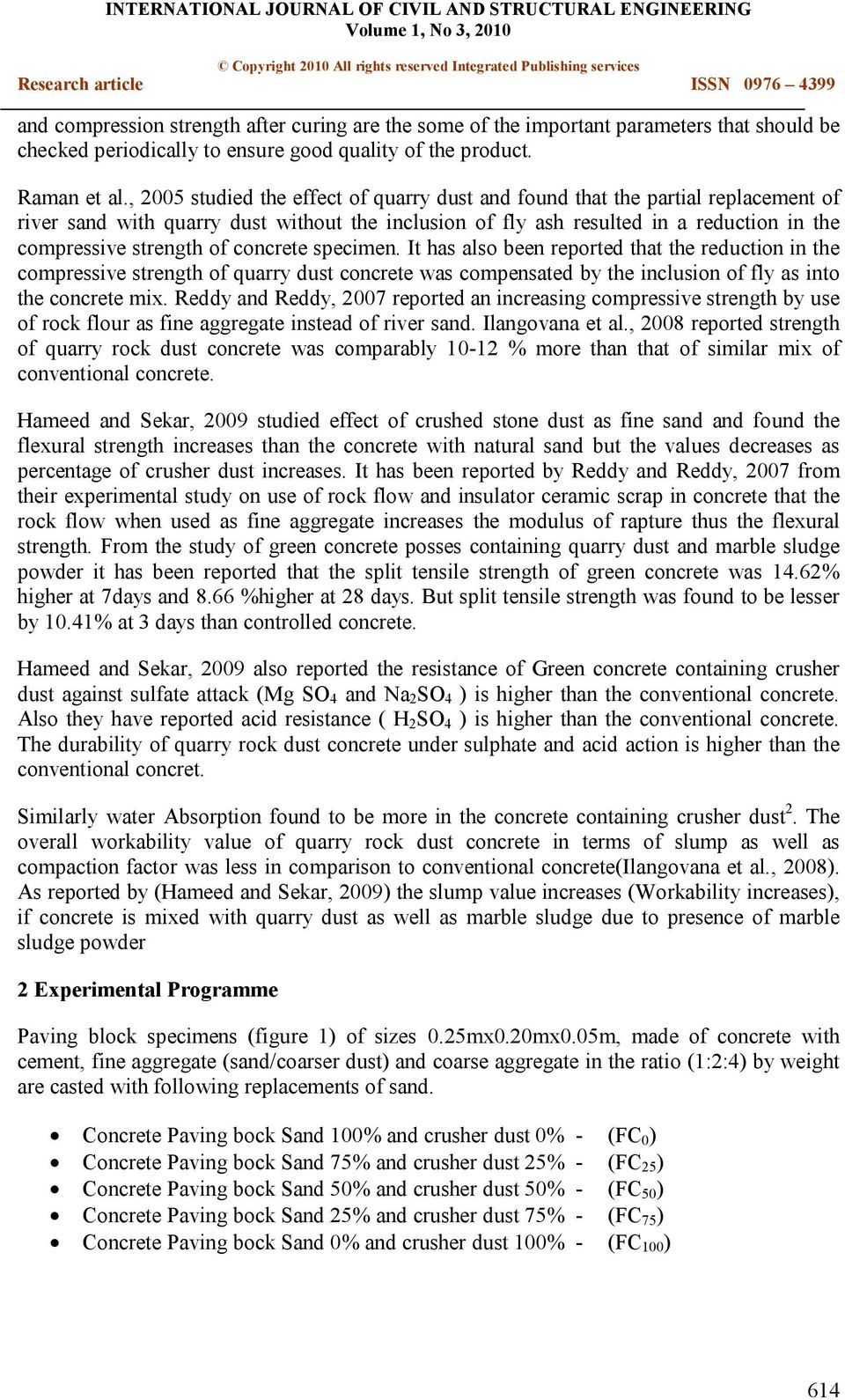
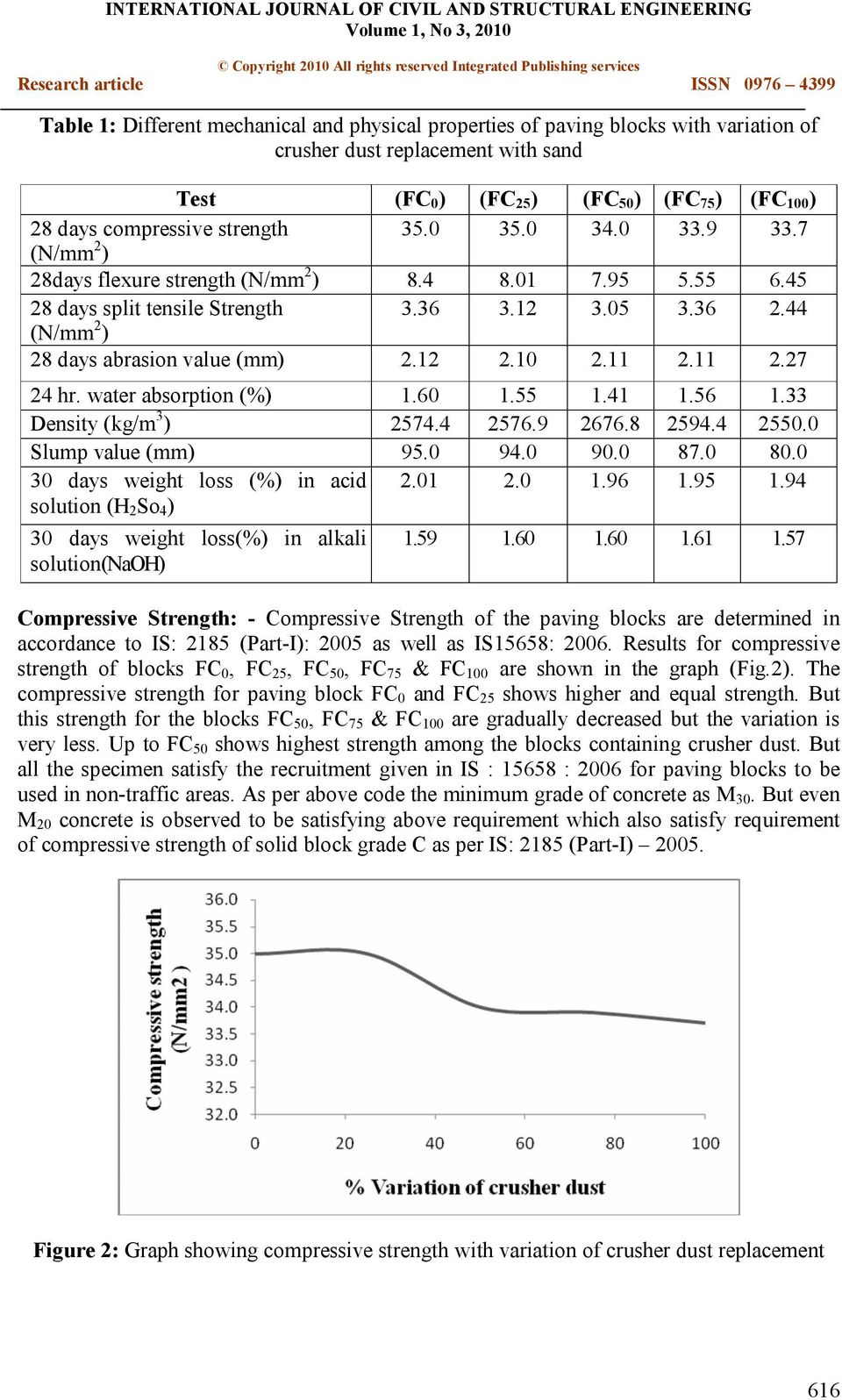
4 Table 1: Different mechanical and physical properties of paving blocks with variation of crusher dust replacement with sand Test (FC 0 ) (FC 25 ) (FC 50 ) (FC 75 ) (FC 100 ) 28 days compressive strength (N/mm 2 ) 28days flexure strength (N/mm 2 ) days split tensile Strength (N/mm 2 ) 28 days abrasion value (mm) hr. water absorption (%) Density (kg/m 3 ) Slump value (mm) days weight loss (%) in acid solution (H 2 So 4 ) days weight loss(%) in alkali solution(naoh) Compressive Strength: Compressive Strength of the paving blocks are determined in accordance to IS: 2185 (Part I): 2005 as well as IS15658: Results for compressive strength of blocks FC 0, FC 25, FC 50, FC 75 & FC 100 are shown in the graph (Fig.2). The compressive strength for paving block FC 0 and FC 25 shows higher and equal strength. But this strength for the blocks FC 50, FC 75 & FC 100 are gradually decreased but the variation is very less. Up to FC 50 shows highest strength among the blocks containing crusher dust. But all the specimen satisfy the recruitment given in IS : : 2006 for paving blocks to be used in non traffic areas. As per above code the minimum grade of concrete as M 30. But even M 20 concrete is observed to be satisfying above requirement which also satisfy requirement of compressive strength of solid block grade C as per IS: 2185 (Part I) Figure 2: Graph showing compressive strength with variation of crusher dust replacement 616
5 Flexure Strength: The flexural strength of paving blocks can be expressed in term of flexural stress or in from of breaking load. The flexural strength(fig.3) decreases as percentage of crusher dust increases but all the samples, FC 75 as well as FC 100 satisfying breaking load specified by IS : : 2006 even if in heavy traffic condition. Figure 3: Graph showing flexural strength with variation of crusher dust replacement Split Tensile Strength: Split tensile stress has been done according to IS 15658:2006. The split tensile stress in the normal concrete was found to be higher. Variation of split tensile stress in concrete courting crusher dust between FC 50 and FC 75 is less. But the sample FC 100 shows much lower split tensile stress between normal concrete and concrete containing crusher dust is found to be 9%. As per IS 15658:2006 there is no acceptance limit mentioned but acceptance limited to the specification of the manufacture. Figure 4: Graph showing abrasion value with variation of crusher dust replacement Abrasion: Abrasion test of paving blocks were done in accordance to IS: 15658: It was found that wearing depth increases with the increase of percentage of crusher dust. Hence 617

6 wearing depth is found to be 2.27mm for FC 100 samples. As per IS 1237: 1980 the wearing depth should not exceed 3.5mm of concrete block used for general purpose and should not exceed 2mm. for heavy traffic. As the work contained to the non traffic condition wearing resistance are seems to be satisfactory. The variation up to FC 50 is almost constant (Fig.4). Water Absorption: As per IS: 15658:2006 water absorption of concrete paving block should be less than 7%. But maximum water absorption among all groups was found to be 1.56% in FC 75 which is much less than the requirement also it comply maximum water absorption requirement less than 10% as per IS: 2185 (Part I) Weight loss in Acid Solution: From the Weight loss of samples immersed in acid solution (H 2 So 4 ) with 1% of water after 30 days it was found the loss in weight in the normal concrete was slightly higher that the concrete containing crusher dust and also weight loss decreases as percentage of crusher dust increases. Difference in weight loss of normal concrete in the concrete containing 100% crusher dust (FC. 100 ) is found to be 3.5 % approximately. The loss in weight up to FC 50 is insignificant. Weight Loss in Alkali Solution: Weight loss of samples in alkali solution (NaOH) with 4% of water after 30 days in the normal concrete was found to be smaller than the concrete containing crusher dust but differences are very small about 0.6%. It may be due to the crusher dust have greater tendency of reacting with alkali solution than the normal sand i.e. resistance of crusher dust against alkali resistance is less than the normal sand. Density: Density of the normal concrete was found to be less than the density of the concrete containing crusher dust but specific gravity of the sand used for the preparation of concrete was found to be higher than the specific gravity of crusher dust. Density of the specimen FC 100 is found to be less than the normal concrete. The specimen FC 50 &FC 75 shows higher density and it may be due to difference in compaction during casting or may be due to slight variation in homogeneous in the mix. The code IS 2185 (part 1) : 2005 specified for solid concrete block grade C density should not be less than 1800 Kg/m 3. Flow /Slump (water requirement): The slump value had been measured during the casting of specimen. The slump value decreases as the percentage of crusher dust increases. This reflects as percentage of crusher dust increases the water requirement increases and thus slum value decreases which may due texture of crusher dust. Generally crusher dust has rough texture than sand. The aggregate having rough texture requires more water for surface weighting. Thus some water is consumed for surface weighting of crusher dust and the net water available get decreases for workability. As per the IS 15658:2006 concrete paving block may be prepared with concrete having zero slumps. If the water requirement increases and slump decreases, addition of crusher dust may solve the problem which will not affect the physical properties. 3.3 Cost effectiveness: It has been seen that a replacement of up to 50% shows negligible variation in mechanical and physical properties. Base upon this cost shaving is calculated. Cost of stone crusher dust including transportation = Rs. 100 per Cum. Cost of Sand (river 20km away) including transportation = Rs. 216 per cum. Variation in transportation cost depending upon location of site and source of sand & crusher dust. It has been seen that there is a shaving of 56% of 618

7 money if sand is replaced by crusher dust. The percentage of saving was less but highly beneficial for mass production of paving blocks. The shaving would be more if the sand availability is at greater distance. This also reduces the burden of dumping crusher dust on earth which is eco friendly. 4. Conclusion Replacement fine aggregate by crusher dust up to 50% by weight has a negligible effect on the reduction of any physical and mechanical properties like compressive strength, flexural strength, split tensile strength etc. Water absorption is well below the limit as per Indian codes. Durability test shows no variation for different replacements of crusher dust. There is a shaving of 56% of money if sand is replaced by crusher dust. The percentage of saving was less but highly beneficial for mass production of paving blocks. The shaving would be more if the sand availability is at greater distance like hilly area. This also reduces the burden of dumping crusher dust on earth and hence environmental pollution. 5. References 1. Ahmed A. E. K., 1989, Properties of concrete incorporating natural and crushed sand very fine sand, ACE Material Journal, Vol. 86(4), pp Hameed, M. S. and Sekar A. S. S., 2009, Properties of green concrete containing quarry rock dust and Marble sludge powder as fine aggregates, ARPN journal of Engineering and applied Science, Vol.4(4), pp Ilangovana, R. Mahendrana, N. and Nagamanib, K., 2008, Strength and durability properties of concrete containing quarry rock dust as fine aggregates, ARPN Journal of Engineering and Applied Science, Vol.3(5), pp IS 15658:2006, Precast concrete blocks for paving page, Bureau of Indian Standard, New Delhi 5. IS 2185(part 1): 2005, Concrete masonry units specification: Part 1 hollow and solid concrete blocks, Bureau of Indian Standard, New Delhi 6. IS: 15658:2006, Pre cast concrete block for paving, Bureau of Indian Standard, New Delhi 7. Jayawardhane, U. De s and Dissanayake, D. M. S., 2006, Use of quarry dust instead of river sand for future construction in Sri Lanka, The Geological Society of London, AEG 200E, paper no 38, pp Raman, S. N. M., Zain, F. M., Mahmud H. B. & Tan, K. S., Influence of quarry dust & fly ash on the concrete compressive strength development. Proc. AEESEAP Int. Conf Kuala Lumpur, Malaysia, 7 8 Jun

8 9. Reddy, M.V. and Reddy, C.N.V.S., 2007, An experimental study of rock flour and insulator ceramic scrap in concrete, Journal of Institute of Engineer (India), Vol 88, August, pp

Analysis of M35 and M40 grades of concrete by ACI and USBR methods of mix design on replacing fine aggregates with stone dust
 Analysis of M35 and M40 s of concrete by and methods of mix design on replacing fine aggregates with stone dust Satwinder Singh 1, Dr. Hemant Sood 2 1 M. E. Scholar, Civil Engineering, NITTTR, Chandigarh,
STRENGTH OF CONCRETE INCORPORATING AGGREGATES RECYCLED FROM DEMOLITION WASTE
 STRENGTH OF CONCRETE INCORPORATING AGGREGATES RECYCLED FROM DEMOLITION WASTE R. Kumutha and K. Vijai Department of Civil Engineering, Sethu Institute of Technology, Pulloor, Kariapatti, India E-Mail: [email protected],
Chapter 8 Design of Concrete Mixes
 Chapter 8 Design of Concrete Mixes 1 The basic procedure for mix design is applicable to concrete for most purposes including pavements. Concrete mixes should meet; Workability (slump/vebe) Compressive
GRADATION OF AGGREGATE FOR CONCRETE BLOCK
 GRADATION OF AGGREGATE FOR CONCRETE BLOCK Although numerous papers have been written concerning the proper gradation for concrete mixes, they have generally dealt with plastic mixes, and very little published
Strength and Workability Characteristics of Concrete by Using Different Super Plasticizers
 International Journal of Materials Engineering 12, 2(1): 7-11 DOI: 1.923/j.ijme.11.2 Strength and Workability Characteristics of Concrete by Using Different Super Plasticizers Venu Malagavelli *, Neelakanteswara
1.5 Concrete (Part I)
 1.5 Concrete (Part I) This section covers the following topics. Constituents of Concrete Properties of Hardened Concrete (Part I) 1.5.1 Constituents of Concrete Introduction Concrete is a composite material
Effect of basalt aggregates and plasticizer on the compressive strength of concrete
 International Journal of Engineering & Technology, 4 (4) (2015) 520-525 www.sciencepubco.com/index.php/ijet Science Publishing Corporation doi: 10.14419/ijet.v4i4.4932 Research Paper Effect of basalt aggregates
Evaluation of M35 and M40 grades of concrete by ACI, DOE, USBR and BIS methods of mix design
 Evaluation of M35 and M40 grades of concrete by ACI, DOE, USBR and BIS methods of mix design Sharandeep Singh 1, Dr.Hemant Sood 2 1 M. E. Scholar, CIVIL Engineering, NITTTR, Chandigarh, India 2Professor
FLEXURAL AND TENSILE STRENGTH PROPERTIES OF CONCRETE USING LATERITIC SAND AND QUARRY DUST AS FINE AGGREGATE
 FLEXURAL AND TENSILE STRENGTH PROPERTIES OF CONCRETE USING LATERITIC SAND AND QUARRY DUST AS FINE AGGREGATE Joseph. O. Ukpata 1 and Maurice. E. Ephraim 2 1 Department of Civil Engineering, Cross River
PROJECT PROFILE ON CEMENT CONCRETE HOLLOW BLOCKS
 PROJECT PROFILE ON CEMENT CONCRETE HOLLOW BLOCKS PRODUCT : Cement Concrete Hollow Blocks NIC CODE : 26959 (based on NIC 2004) PRODUCT CODE : 94459 (based on ASICC 2000) PRODUCTION CAPACITY : Quantity :
STATE OF THE ART OF CONCRETE PAVING BLOCKS IN SRI LANKA (CPBs)
 STATE OF THE ART OF CONCRETE PAVING BLOCKS IN SRI LANKA (CPBs) Dr K Baskaran, Senior Lecturer (Email: [email protected]) K Gopinath, M.Sc. Research Student (Email: [email protected]) Department
Lab 1 Concrete Proportioning, Mixing, and Testing
 Lab 1 Concrete Proportioning, Mixing, and Testing Supplemental Lab manual Objectives Concepts Background Experimental Procedure Report Requirements Discussion Prepared By Mutlu Ozer Objectives Students
AGREGADOS RECICLADOS MITOS Y REALIDADES
 The Production and Use of Recycled Concrete in the USA Thomas Van Dam, Ph.D., P.E., FACI Principal Engineer CTL Group Introduction In the United States, concrete is the most commonly used recycled material
EXPERIMENTAL INVESTIGATION ON STRENGTH AND DURABILITY PROPERTIES OF HYBRID FIBER REINFORCED CONCRETE
 EXPERIMENTAL INVESTIGATION ON STRENGTH AND DURABILITY PROPERTIES OF HYBRID FIBER REINFORCED CONCRETE SUDHEER JIROBE 1, BRIJBHUSHAN.S 2, MANEETH P D 3 1 M.Tech. Student, Department of Construction technology,
PROPERTIES AND MIX DESIGNATIONS 5-694.200
 September 1, 2003 CONCRETE MANUAL 5-694.200 5-694.210 PROPERTIES OF CONCRETE PROPERTIES AND MIX DESIGNATIONS 5-694.200 Inspectors should familiarize themselves with the most important properties of concrete:
INTERNATIONAL JOURNAL OF ENVIRONMENTAL SCIENCES Volume 1, No 3,2010. Copyright 2010 All rights reserved Integrated Publishing services
 ABSTRACT Studies on Concrete containing E plastic waste Lakshmi.R 1 Nagan.S 2 1 Research Scholar is with K.L.N.College of Information Technology, Sivagangai 2 Assistant Professor is with Thiagarajar College
NOTE: FOR PROJECTS REQUIRING CONTRACTOR MIX DESIGN, THE DESIGN PROCEDURES ARE SPECIFIED IN THE SPECIAL PROVISIONS OF THE CONTRACT.
 September 1, 2003 CONCRETE MANUAL 5-694.300 MIX DESIGN 5-694.300 NOTE: FOR PROJECTS REQUIRING CONTRACTOR MIX DESIGN, THE DESIGN PROCEDURES ARE SPECIFIED IN THE SPECIAL PROVISIONS OF THE CONTRACT. 5-694.301
Vikrant S. Vairagade, Kavita S. Kene, Dr. N. V. Deshpande / International Journal of Engineering Research and Applications (IJERA)
 Investigation on Compressive and Tensile Behavior of Fibrillated Fibers Reinforced Concrete Vikrant S. Vairagade*, Kavita S. Kene*, Dr. N. V. Deshpande** * (Research Scholar, Department of Civil Engineering,
Saint Gobain Gyproc India Ltd. (Formerly India Gypsum Ltd.)
 Saint Gobain Gyproc India Ltd. (Formerly India Gypsum Ltd.) Gyproc Plasters The cracks in cement sand plaster are an inherent feature which cannot be completely prevented but can only be controlled and
Manufacturing Quality Concrete Products
 CEMEX USA - Technical Bulletin 8.0 Manufacturing Quality Concrete Products Establishing or Upgrading a Quality Program Overview The following guidelines were developed for MCP (manufactured concrete products)
A Comparative Analysis of Modulus of Rupture and Splitting Tensile Strength of Recycled Aggregate Concrete
 American Journal of Engineering Research (AJER) e-issn : 2320-0847 p-issn : 2320-0936 Volume-03, Issue-02, pp-141-147 www.ajer.org Research Paper Open Access A Comparative Analysis of Modulus of Rupture
Elevated Roads for Sri Lanka
 Elevated Roads for Sri Lanka M.T.R. Jayasinghe (Senior Professor, Structural Engineering, University of Moratuwa) Senior Professor M.T.R. Jayasinghe is a Professor of Structural Engineering, University
GRC Porticos. Lightweight entrance porticos ABBEY ARTSTONE
 GRC Porticos Lightweight entrance porticos ABBEY ARTSTONE GRC Porticos Lightweight entrance porticos Abbey Artstone's range of lightweight products designed for the construction industry is the only range
Optimum Curing Cycles for Precast Concrete
 Optimum Curing Cycles for Precast Concrete Dr Norwood Harrison, Technical Support Manager, Humes Mr Tom Howie, Manager Engineered Structures, Humes Prepared for the Concrete Pipe Association of Australasia,
Properties of Concrete with Blast-Furnace Slag Cement Made from Clinker with Adjusted Mineral Composition
 Properties of Concrete with Blast-Furnace Slag Cement Made from Clinker with Adjusted Mineral Composition Atsushi YATAGAI 1, Nobukazu NITO 1, Kiyoshi KOIBUCHI 1, Shingo MIYAZAWA 2,Takashi YOKOMURO 3 and
APPENDIX 2 MIX DESIGNS. Chapter 4: mix design calculation sheet for 40 N/mm 2 strength)
 APPENDIX 2 MIX DESIG All mixes in this study were designed in accordance with the Building Research Establishment (BRE 1992) method, recommended by the UK Department of the Environment. Reference should
ENGINEERED QUARTZ STONE
 ENGINEERED 2 QUARTZ STONE 18 GOOD INDUSTRY PRACTICES 2 ENGINEERED QUARTZ STONE Natural stones, especially granite, have been used for flooring and countertop material in high-end homes for its beauty and
EXPERIMENT NO.1. : Vicat s apparatus, plunger
 EXPERIMENT NO.1 Name of experiment:to determine the percentage of water for normal consistency for a given sample of cement Apparatus : Vicat s apparatus with plunger of 10mm dia, measuring cylinder, weighing
:: ARTIFICIAL SAND :: Zone One Sand : Zone Two Sand :
 :: ARTIFICIAL SAND :: Natural sand are weathered and worn out particles of rocks and are of various grades or size depending on the accounting of wearing. The main natural and cheapest resource of sand
Shotcrete Quality Control and Testing for an Underground Mine in Canada
 Shotcrete Quality Control and Testing for an Underground Mine in Canada By Dudley R. (Rusty) Morgan and Mazin Ezzet AMEC Earth & Environmental, a division of AMEC Americas Limited SHOTCRETE FOR AFRICA
A Study on the Flexural and Split Tensile Strengths of Steel Fibre Reinforced Concrete at High Temperatures
 A Study on the Flexural and Split Tensile Strengths of Steel Fibre Reinforced Concrete at High Temperatures 1 P. Jyotsna Devi, 2 Dr. K. Srinivasa Rao 1,2 Dept. of Civil Engg, Andhra University, Visakhapatnam,
Fire-Damage or Freeze-Thaw of Strengthening Concrete Using Ultra High Performance Concrete
 Fire-Damage or Freeze-Thaw of Strengthening Concrete Using Ultra High Performance Concrete Ming-Gin Lee 1,a, Yi-Shuo Huang 1,b 1 Department of Construction Engineering, Chaoyang University of Technology,Taichung
Pavement Thickness. esign and RCC-Pave Software. Roller-Compacted Concrete Pavement: Design and Construction. October 24, 2006 Atlanta, Georgia
 Roller-Compacted Concrete Pavement: Design and Construction Pavement Thickness esign and RCC-Pave Software Gregory E. Halsted, P.E. Pavements Engineer Portland Cement Association October 24, 2006 Atlanta,
STUDY REPORT. No. 101 (2001) Effect of Recycled Concrete Aggregate on New Concrete. S. G. Park
 Date: July 2001 STUDY REPORT No. 101 (2001) Effect of Recycled Concrete Aggregate on New Concrete S. G. Park The work reported here was jointly funded by Building Research Levy and the Foundation for Research,
Use of Marginal Materials & Fly ash in Road Works
 Use of Marginal Materials & Fly ash in Road Works U.K.Guru Vittal Sr. Principal Scientist Central Road Research Institute New Delhi 110 025 [email protected] Introduction Issue Development Vs. Environment
STUDY OF THE BEHAVIOUR OF BITUMINOUS MIXTURES RESISTANT TO FUEL
 STUDY OF THE BEHAVIOUR OF BITUMINOUS MIXTURES RESISTANT TO FUEL INTRODUCTION Evaluation of the performance of asphalt mixtures applied on wearing courses of road and airport pavements when subjected to
Determination of appropriate mix ratios for concrete grades using Nigerian Portland-limestone grades 32.5 and 42.5
 Leonardo Electronic Journal of Practices and Technologies ISSN 1583-1078 Issue 26, January-June 2015 p. 79-88 Determination of appropriate mix ratios for concrete grades using Nigerian Portland-limestone
Commonwealth of Pennsylvania PA Test Method No. 632 Department of Transportation October 2013 5 Pages LABORATORY TESTING SECTION. Method of Test for
 Commonwealth of Pennsylvania PA Test Method No. 632 Department of Transportation 5 Pages LABORATORY TESTING SECTION Method of Test for TIME OF SETTING OF CONCRETE MIXTURES BY PENETRATION RESISTANCE 1.
 Client ICS/Penetron International Ltd., 45 Research Way, Suite 203, East Setauket, NY 11733 Project Information of Client Subject Laboratory Testing of Penetron Waterproofing System Report No.: 95-387
NorthEast Transportation Training and Certification Program (NETTCP) Course Registration Form
 (NETTCP) Course Registration Form Interim Certification (Cost $300 members / $425 non-members) HMA Plant Technician* HMA Paving Inspector* Soils & Aggregate Inspector* Soils & Aggregate Lab Technician*
A NEW APPROACH FOR MEASUREMENT OF TENSILE STRENGTH OF CONCRETE
 Journal of Research (Science), Bahauddin Zakariya University, Multan, Pakistan. Vol.16, No.1, June 2005, pp. 01-09 ISSN 1021-1012 A NEW APPROACH FOR MEASUREMENT OF TENSILE STRENGTH OF CONCRETE A. Ghaffar,
Dubai Municipality Standard DMS 1: Part 5: 2004
 Specification for precast concrete blocks Part 5: Normal-weight concrete-polystyrene sandwich masonry blocks Issue Date Revision Revision Description Prepared by Approved by Authorized by 19/12/2004 Issue
 SETSCO SERVICES PTE LTD TEST REPORT MICROSCOPIC ANALYSIS ON THE CONCRETE CORES FROM RETAINING WALL AT CHANGI AIRPORT TERMINAL 3 REVERTON ENGINEERING(S) PTE LTD 1. INTRODUCTION 2. MICROSCOPIC ANALYSIS 3.
PVC PIPE PERFORMANCE FACTORS
 PVC PIPE PERFORMANCE FACTORS PVC pipe, like all flexible pipe products, is very dependent on the surrounding soil for its structural capacity, in addition, the pipe material must have sufficient inherent
Numerical Analysis of Independent Wire Strand Core (IWSC) Wire Rope
 Numerical Analysis of Independent Wire Strand Core (IWSC) Wire Rope Rakesh Sidharthan 1 Gnanavel B K 2 Assistant professor Mechanical, Department Professor, Mechanical Department, Gojan engineering college,
DURABILITY OF MORTAR LININGS IN DUCTILE IRON PIPES Durability of mortar linings
 DURABILITY OF MORTAR LININGS IN DUCTILE IRON PIPES Durability of mortar linings I. S. MELAND SINTEF Civil and Environmental Engineering, Cement and Concrete, Trondheim, Norway Durability of Building Materials
Recycling and Utilization of Mine Tailings as Construction Material through Geopolymerization
 Recycling and Utilization of Mine Tailings as Construction Material through Geopolymerization Lianyang Zhang, Ph.D., P.E. Department of Civil Engineering and Engineering Mechanics University of Arizona,
Construction Materials Testing. Classes of Test
 Construction Materials Testing Classes of Test February 2014 Copyright National Association of Testing Authorities, Australia 2014 This publication is protected by copyright under the Commonwealth of Australia
SECTION 311 PLACEMENT AND CONSTRUCTION OF CEMENT TREATED SUBGRADESOIL CEMENT BASE COURSE
 PLACEMENT AND CONSTRUCTION OF CEMENT TREATED SUBGRADESOIL CEMENT BASE COURSE 311.1 DESCRIPTION: This item shall consist of a cement treated subgrade base course composed of a mixture of local soil, portland
Hardened Concrete. Lecture No. 14
 Hardened Concrete Lecture No. 14 Strength of Concrete Strength of concrete is commonly considered its most valuable property, although in many practical cases, other characteristics, such as durability
Example Specification for Concrete using Current Building Code Requirements
 Example Specification for Concrete using Current Building Code Requirements DISCLAIMER: This specification is an example that accompanies a seminar titled The P2P Initiative: Performance-based Specs for
STRENGTH AND DURABILITY STUDIES ON CONCRETE WITH FLYASH AND ARTIFICIAL SAND
 STRENGTH AND DURABILITY STUDIES ON CONCRETE WITH FLYASH AND ARTIFICIAL SAND M.Uma 1, S. Shameem banu 2 1 P.G Student in JNTU Kakinada, Civil Engineering, [email protected] 2 Asst. Professor in JNTU Kakinada,
The following sketches show the plans of the two cases of one-way slabs. The spanning direction in each case is shown by the double headed arrow.
 9.2 One-way Slabs This section covers the following topics. Introduction Analysis and Design 9.2.1 Introduction Slabs are an important structural component where prestressing is applied. With increase
Aggregates for Path Construction
 Aggregates for Path Construction Technical Information Note No. 7 October 2011 About Sustrans Sustrans makes smarter travel choices possible, desirable and inevitable. We re a leading UK charity enabling
DESIGN OF SLABS. 3) Based on support or boundary condition: Simply supported, Cantilever slab,
 DESIGN OF SLABS Dr. G. P. Chandradhara Professor of Civil Engineering S. J. College of Engineering Mysore 1. GENERAL A slab is a flat two dimensional planar structural element having thickness small compared
SITE INVESTIGATION FACILITIES
 SITE INVESTIGATION FACILITIES Drilling Hydraulic rotary & calax drilling rigs100/150mm Diameter boreholes having drilling capacity up to 200m depth. Auger drilling 100/150mm diameter boreholes up to maximum
Evaluation of Initial Setting Time of Fresh Concrete
 Evaluation of Initial Setting Time of Fresh Concrete R R C Piyasena, P A T S Premerathne, B T D Perera, S M A Nanayakkara Abstract According to ASTM 403C, initial setting time of concrete is measured based
Choosing the Right Mortar for the Job
 Choosing the Right Mortar for the Job by Michael Schuller, P.E. President, Atkinson-Noland & Associates 2619 Spruce St. Boulder, CO 80302 www.ana-usa.com Modern material technology has given us strong
A study on the Effect of Distorted Sampler Shoe on Standard Penetration Test Result in Cohesionless soil
 ISSN: 319-53 (An ISO 39: 00 Certified Organization) A study on the Effect of Distorted Sampler Shoe on Standard Penetration Test Result in Cohesionless soil Utpal Kumar Das Associate Professor, Department
Strengthening of Brick Masonry Walls against Earthquake Loading
 International Journal of Advanced Structures and Geotechnical Engineering ISSN 2319-5347, Vol. 01, No. 01, July 2012 Strengthening of Brick Masonry Walls against Earthquake ing KHAN SHAHZADA, MUHAMMAD
TABLE OF CONTENTS CHAPTER NO. TITLE PAGE NO. ABSTRACT
 vii TABLE OF CONTENTS CHAPTER NO. TITLE PAGE NO. ABSTRACT LIST OF TABLES LIST OF FIGURES LIST OF SYMBOLS AND ABBREVIATIONS iii xvii xix xxvii 1 INTRODUCTION 1 1.1 GENERAL 1 1.2 OBJECTIVES AND SCOPE OF
LAYING BLOCK AND BRICK
 LAYING BLOCK AND BRICK Products highlighted in this section: SAKRETE Type N Mortar Mix SAKRETE Type S Mortar Mix Brick And Block Laying Basics The first step in building a brick or block wall is to construct
Study of durability of sprayed concrete
 Study of durability of sprayed concrete ADAM HUBÁČEK, RUDOLF HELA Department of Technology of Building Materials and Components Brno University of Technology, Faculty of Civil Engineering Veveří 95, 602
1.054/1.541 Mechanics and Design of Concrete Structures (3-0-9) Outline 1 Introduction / Design Criteria for Reinforced Concrete Structures
 Prof. Oral Buyukozturk Massachusetts Institute of Technology Outline 1 1.054/1.541 Mechanics and Design of Concrete Structures (3-0-9) Outline 1 Introduction / Design Criteria for Reinforced Concrete Structures
Assistant Professor of Civil Engineering, University of Texas at Arlington
 FRC Performance Comparison: Direct Tensile Test, Beam Type Bending Test, and Round Panel Test Shih Ho Chao (Presenting Author) Assistant Professor of Civil Engineering, University of Texas at Arlington
The AASHO Road Test site (which eventually became part of I-80) at Ottawa, Illinois, was typical of northern climates (see Table 1).
 Página 1 de 12 AASHO Road Test The AASHO Road Test, a $27 million (1960 dollars) investment and the largest road experiment of its time, was conceived and sponsored by the American Association of State
Formwork Direct International Ltd Phone No +44 (0151) 532 0179 Fax no +44 (0151) 523 8330 E-Mail: [email protected].
 Joint Fillers Formwork Direct are proud to be The UK and Ireland distributor for LJA Miers & Co. who have been responsible for many of the developments in Joint Fillers that are today accepted as common
Cement Plaster. www.qatarplaster.com
 Cement Plaster www.qatarplaster.com COMPANY PROFILE Qatar Plaster (QP) is a leading manufacturer of dry mix products based in Mesaieed Industrial City Doha, Qatar. Qatar Plaster (QP) has come up with a
Lesson 3. Portland Cement and Concrete
 Portland Cement and Concrete This lesson focuses on the most consumed construction material, Portland cement based concrete. It s consumed for pavement, dams, bridges, floors, walls, columns, and even
Permeable Pavement Construction Guide
 Permeable Pavement Construction Guide Permeable pavement at Olympic Park, Waitakere Final Construction result What are permeable pavements? Permeable pavements are hard surface paving systems that reduce
SPECIFICATIONS. INTERLOCKING CONCRETE POROUS PAVING UNITS or Permeable Interlocking Concrete Pavers (PICP)
 SPECIFICATIONS INTERLOCKING CONCRETE POROUS PAVING UNITS or Permeable Interlocking Concrete Pavers (PICP) Part 1 General 1.1 CONFORMITY Conforms to the requirements of the general conditions of the contract.
Module 7: Hydraulic Design of Sewers and Storm Water Drains. Lecture 7 : Hydraulic Design of Sewers and Storm Water Drains
 1 P age Module 7: Hydraulic Design of Sewers and Storm Water Drains Lecture 7 : Hydraulic Design of Sewers and Storm Water Drains 2 P age 7.1 General Consideration Generally, sewers are laid at steeper
Recycled Concrete Pavement and Other Recycled Materials in Concrete Pavements
 Recycled Concrete Pavement and Other Recycled Materials in Concrete Pavements Infrastructure Applications Utilizing Recycled Materials in South Carolina What/Who is NRMCA? National Ready-Mixed Concrete
SECTION 4Aggegate Subbase
 The contractor shall moist-cure the completed Lime Treated Subbase for a minimum of days before allowing any traffic on the compacted surface. The contractor shall be responsible for repairing any damages
cement Masonry Cement Engineered for quality and reliability, Lafarge cements for masonry deliver consistent performance. page 2 Lafarge Cement
 cement Masonry Cement Engineered for quality and reliability, Lafarge cements for masonry deliver consistent performance. page 2 Lafarge Cement Lafarge in North America The Lafarge Group is the world leader
The Influence of Porosity & Aspect Ratio on the Compressive Behavior of Pervious Concrete. Alexander Hango
 The Influence of Porosity & Aspect Ratio on the Compressive Behavior of Pervious Concrete by Alexander Hango 1 Clarkson University The Influence of Porosity & Aspect Ratio on the Compressive Behavior of
CW 3110 SUB-GRADE, SUB-BASE AND BASE COURSE CONSTRUCTION TABLE OF CONTENTS
 December 2014 CW 3110 SUB-GRADE, SUB-BASE AND BASE COURSE CONSTRUCTION TABLE OF CONTENTS 1. DESCRIPTION... 1 1.1 General... 1 1.2 Definitions... 1 1.3 Referenced Standard Construction Specifications...
Influence of Nano-SiO 2 and Microsilica on Concrete Performance
 Influence of Nano-SiO 2 and Microsilica on Concrete Performance M. Nili *a, A. Ehsani a, and K. Shabani b a Civil Eng., Dept., Bu-Ali Sina University, Hamedan, I.R. Iran b Eng., Research Institute of Jahad-Agriculture
What you measure is what you get? a novel approach for specifying and controlling acoustic quality of road surfaces
 What you measure is what you get? a novel approach for specifying and controlling acoustic quality of road surfaces Ard Kuijpers & Wout Schwanen M+P consulting engineers, Vught, the Netherlands. Jan van
Mathematical Regression Model for the Prediction of Concrete Strength
 Mathematical Regression Model for the Prediction of Concrete Strength M. F. M. Zain 1, Suhad M. Abd 1, K. Sopian 2, M. Jamil 1, Che-Ani A.I 1 1 Faculty of Engineering and Built Environment, 2 Solar Energy
SECTION 3.3 - PAVEMENT DESIGN
 SECTION 3.3-3.3.1 GENERAL 3.3.2 SUBSURFACE DRAINAGE 3.3.3 DETERMINATION OF DESIGN TRAFFIC 3.3.4 SUBGRADE EVALUATION 3.3.5 PAVEMENT THICKNESS 3.3.5.1 GRANULAR PAVEMENTS WITH THIN BITUMINOUS SURFACING 3.3.5.2
EFFECT OF STONE DUST ON THE STRENGTH CHARACTERISTICS OF BLACK COTTON SOIL STABILIZED WITH RICE HUSK ASH
 EFFECT OF STONE DUST ON THE STRENGTH CHARACTERISTICS OF BLACK COTTON SOIL STABILIZED WITH RICE HUSK ASH Manjunath K R 1, Rohith L 2 1 Assistant professor, Department of Construction Technology And Management,
International journal of Engineering Research-Online A Peer Reviewed International Journal Articles available online http://www.ijoer.
 RESEARCH ARTICLE ISSN: 2321-7758 AN INVESTIGATION ON THE SHRINKAGE CHARACTERISTICS OF GGBFS BASED SLURRY INFILTRATED HYBRID FIBRE REINFORCED CONCRETE PRUTHVIRAJ B S 1, SHREEPAD DESAI 2, Dr. PRAKASH K B
Acceptance Criteria for Durability Tests
 Acceptance Criteria for Durability Tests Minimizing the risks of accepting defective concrete or rejecting acceptable concrete By Karthik H. Obla and Colin L. Lobo For the industry to shift toward performance-based
MASONRY INFORMATION. Selecting and Specifying Mortar and Grout for Unit Masonry. Introduction. Desirable Mortar Properties. Selection of Mortar
 Portland Cement Association MASONRY INFORMATION Selecting and Specifying Mortar and Grout for Unit Masonry Introduction Masonry mortar and masonry grout are key materials in unit masonry construction.