
The Knowledge Base of Self. I. Paths to Effective Teaching: Exploring Bias and Privilege
|
|
|
- Abel Cummings
- 9 years ago
- Views:
Transcription
1 The Knowledge Base of Self: Uncovering Hidden Biases and Unpacking Privilege Chapter Five I. Paths to Effective Teaching: Exploring Bias and Privilege II. Exploring Your Own Bias III. Unpacking Privilege IV. How Exploring Your Biases and Privileges Makes You a Better Teacher V. Addressing Your Biases and Privileges in the Classroom VI. Conclusion: Getting Started Exploring Your Biases and Unpacking Your Privilege In your quest to harness the instructional power of diversity-related dynamics in your classroom, one of the most important knowledge bases is self-knowledge. Not only must you be keenly aware of your own identities and background (and how they will create dynamics of difference and sameness in the classroom), but you also must be cognizant of your own beliefs and perspectives and how those may be influencing your classroom leadership. The challenge here is that our beliefs and perspectives are not always obvious, even to ourselves. Indeed, it is the hidden or subconscious presumptions, biases, and prejudices that can sometimes undermine our overt declarations of high expectations for our students. As we will discuss below, the process of knowing thyself serves as a key foundation for becoming an effective teacher in your classroom in at least two ways. First, this process helps a teacher develop empathy and understanding about his or her students backgrounds and perspective. Second, looking at your own biases and privileges helps you interact more effectively with people in the school community because you develop a better understanding of your perspectives, their perspectives, and how any differences between them might affect your interactions. Additional Readings Along with this chapter, please read the following selection found on the Institute Info Center within TFANet, and visit the web page below: Unpacking Straight Privilege by Earlham College Students In addition, please spend some time completing Teaching Tolerance s hidden bias tests online, located at: ndex.html For these reasons, excellent teachers of all backgrounds reflect on their own perspectives, seeking out patterns of thought and hidden assumptions that might be hampering or supporting their role as the instructional leader of their classroom. They also think critically about their own identity characteristics, searching for ways in which those characteristics affect their day-to-day interactions with students and colleagues. Especially for those teachers who happen to share some identity characteristics with the dominant culture, taking time to consider what unearned privileges one enjoys because of those identities is an important and revealing process. In this chapter, you will be asked to think carefully about your own background. Whether or not you share characteristics such as race, socioeconomic status, and background with your students, you can benefit from reflecting on what overt or hidden biases you bring to the classroom, and what you can do to overcome them. 59

2 The Knowledge Base of Self I. Paths to Effective Teaching: Exploring Bias and Privilege The Distinction Between Bias and Privilege Two general parameters shape these potentially personal conversations. First, we separately define and address issues of bias and issues of privilege. By bias, we mean an individual s internalized but often unrealized preferences for or assumptions about some group. A teacher s tendency to call on boys more often than girls, or to punish African- American students differently, or to predominantly choose short stories that reflect her own cultural background are all examples of possible manifestations of bias in the classroom. By privilege we mean the ways in which an individual enjoys unearned advantages because of some societal preference for some aspect of his or her identity. Examples include a White teacher s (perhaps unrecognized) assurance that there will be short stories to choose from that reflect his or her identity characteristics, or a male teacher s assumed appointment to a budgetary committee. Both of these concepts bias and privilege require careful self-reflection. While in both cases that self-reflection leads us to revelations about how we can be more effective in the classroom, the ways that you can most effectively unearth bias and privilege are different. Thus, we address them separately. Exploring Bias and Privilege as a Means to Academic Achievement, Not an End Unto Itself The second basic parameter for this conversation is that exploring one s own beliefs, perspectives, and privilege is a means to effective teaching, not an end unto itself. We are embarking on self-analysis not out of any desire to make ourselves feel guilty, or proud, or blamed, or pleased, or angry; rather, we are working to discover internal influences that threaten to lower our expectations of our students. I remember it was really hard to prevent making assumptions of why occasionally parents would be late or not show up to parent teacher conferences. It scared me to realize that I would be more generous and "understanding" of those parents from higher income communities. To combat this, I actually used an envisioning exercise where each of my parents were huge company CEOs who were extremely busy with multiple meetings, and thought of how I would react in that same situation in a more affluent environment and what assumptions I would make about those parents in a suburban community. That allowed me to maintain very high expectations of my parents, but at the same time understand that they had multiple things they were juggling and it didn't matter if the job was president of Xerox or cleaning the riverboat casinos or working for a local real estate company but still had the best interests of their students in mind. And it worked--with the right amount of persistance I had extremely high parent turnout for my conferences. And it didn't matter if we had to reschedule or if I had to make a home visit or arrive at school early. It's what any good teacher would do. Maia Heyck-Merlin, S. Louisiana 99 Maintaining high expectations is the key reason that Chief Operating Officer, Achievement First we ask you to build the knowledge base regarding your own biases about your students and communities and the privileges you have enjoyed because of some aspect of your identity. [A] teacher s culture, language, social interests, goals, cognitions, and values especially if different from the students could conceivably create a barrier to understanding what is best for children from culturally and linguistically diverse backgrounds. Teachers can break through this barrier by reflecting on their self-knowledge and by learning to acknowledge and respect their students language, literacy, literature, and cultural ways of knowing Critical Issue: Addressing Literacy Needs in Culturally and Linguistically Diverse Classrooms. North Central Regional Educational Laboratory, p

3 In order to most effectively lead our students to dramatic academic achievement and thereby give them vastly expanded opportunities in life, we must acknowledge and overcome the often hidden lowered expectations that undermine our students self-confidence and academic success. We must recognize that it is not only society, but also we that hold those damaging lowered expectations. When teachers become aware of their own cultural backgrounds and values, they have an opportunity to recognize and address any bias or preconceived notions they may have that would make it difficult for them to accept, understand, and effectively teach their students. 51 So, we discuss bias and privilege because we must insist on, maintain, and prove valid the highest expectations we hold for our students no matter what our students race or class or gender or religion or orientation or disability. Is This Discussion Meant for Everyone? Yes. All of us whether we identify as a person of color or as White, as affluent or as poor can benefit from thinking about the hidden assumptions and prejudices we may have regarding our students, our schools, and our communities. Social psychologists will assure us that no matter what our color of skin and no matter what our background, we are not immune from the many influences in society that lead us to internalize subtle preferences, fears, and stereotypes about various groups of people with whom we are not familiar (and even those with whom we are). A corps member of color or a person of low socioeconomic status may bring a different perspective to this conversation than a White corps member or an affluent corps member. We do believe, however, that all new teachers need to consider these issues. As discussed in the Unpacking Privilege section of this chapter, the process of considering one s unearned privilege is arguably more applicable to White, male, straight, and affluent persons than to African-American or Latino, female, homosexual, or poor persons, simply because the former groups are more likely to have experienced the type of societal preference that we are talking about. On the other hand, an argument might be made that to greater and lesser degrees, all of us, no matter what our primary or many identities, experience identity-based privileges in various contexts that is, being Black, or Jewish, or female, or gay can and does confer elements of privilege in certain, specific contexts. For example, a Spanish-only speaker who must struggle to work within the dominant language and culture in an English-speaking community, might find that he or she enjoys the privilege of language dominance while in a different, Spanish-speaking community where an English-only speaker might lose his or her privilege. Also, the mere fact that all of us have at least a bachelor s degree puts us in relatively exclusive company that undoubtedly affords us all certain privileges. 52 II. Exploring Your Own Bias All of us would like to believe that we are free of biases that we will enter our new communities and classrooms void of assumptions, misconceptions, and prejudices about those we interact with. And yet most of us, upon careful reflection, come to realize that we do in fact harbor hidden biases about various groups of people. Most pertinent to our discussion here, given our focus on the race- and classcorrelated achievement gap, are the hidden biases each of us may have about African-American students, Latino students, and Native American students, and about poor students in low-income communities. Of course, also critically important to our self-reflections about prejudice and privilege are subtle and notso-subtle ways that we, as teachers, may treat boys and girls differently in the classroom. 51 Ibid. p Only 24.3% of Americans aged 18 or over hold a Bachelor's Degree or higher, according to the 2002 Current Population Survey on Educational Attainment (found at 61

4 The Knowledge Base of Self Consider the following experiment: teachers listened to students taped responses to questions about television programs. Teachers were shown a picture of either a White or Black student and told that that student had made the statement (even though the pictures were not actually of the speaker). The teachers were asked to rate the responses for personality, quality of the response, current academic abilities, and future academic potential. The results showed a highly significant relationship between the race of the student shown in the picture and teachers estimation of the students response and academic abilities, 53 laying bare the teachers deeply-rooted assumptions about the potential of African American students. Initially, I was under the impression that community members, parents, and teachers were not concerned with the academic progress of the community s children. I quickly learned that despite the conditions they live in, their hopes, dreams, and aspirations were far-reaching, and not limited to the poverty conditions that surrounded them. After inviting parents to a report card dinner, I quickly realized that we as a community were all in this together. I thought I was in this all by myself. Little did I know that I had a whole town behind me. Christopher Arnold, Greater New Orleans 04 Instructor, Purdue University As explained by Professor Ron Ferguson, who reported on this research, these results do not necessarily indicate that these teachers had a conscious or subconscious dislike of Black students. Rather, the explanation might be that these teachers have been conditioned by previous experience with Black students who underachieve in the classroom (as we know, Black students, statistically speaking, are disproportionately likely to have done). Of course, both possible motivations still result in racially biased behavior that could have very real impacts on a teacher s Going on the assumption that every student can be high-achieving if we show them how to be, I've had to consciously unpack and override my own bias about the background, resources, or personality traits that I've traditionally associated with high-achievers. Julia Guez, Houston 03 Graduate Student, Columbia University instruction and management in the classroom. How would you perform on a similar test? Why do you think so? How can you know? To help begin to answer those questions we strongly encourage you to put yourself through a similar test. Tolerance.org, a web project of the Southern Poverty Law Center, has made available on the Internet a series of bias-tests that were created by psychologists at Harvard and the University of Washington. These implicit association tests ask you to quickly respond to a series of rapidly changing images and ideas. Log on to to take some of these tests. (The results are kept entirely private.) After taking one or several of these five minute tests, read the attached tutorial to learn more about the tests themselves, about stereotypes and prejudice, and about the societal effects of bias. If you are interested in trying an additional or different bias test, please see the Diversity, Community, & Achievement Toolkit (p. 2: Computer-Based Implicit Association Tests ); this Toolkit can be found online at the Resource Exchange on TFANet If you are like most participants in the online exercise, these tests will confirm the idea that even though we may believe we see and treat people as valued equals, hidden biases may still influence our perceptions and actions. The fact is that stereotypes and prejudice linger in most of us, and those biases can and do have impacts on our classrooms. Perhaps we make assumptions about students that look a certain way, or we make assumptions about why certain students do not do their homework. Maybe we have stopped making copies of the classroom assignments for Mary in detention because we know she 53 Ferguson, R.F. Teachers perceptions and expectations and the Black-White test score gap. Printed in C. Jencks and M. Phillips (Eds.). The Black-White Test Score Gap. Washington, DC: Brookings Institution, 1998, p

5 is not going to do the work anyway even though what Mary actually needs is to know that we do believe she can and will do the work. After we discuss the related notion of privilege, we will review some concrete suggestions for diminishing the effects of those hidden biases in our classrooms. III. Unpacking Privilege Another angle from which we must build the knowledge base about ourselves is to consider the ways in which we benefit from societal preference for some aspect of our identity. Unpacking privilege is a metaphor used to describe the process of becoming aware of the ways in which our identity-based status in society confers on us invisible advantages in life, thereby shaping our experiences, viewpoints and actions. Such privileges may be conferred on us because we are White, male, affluent, educated, straight, able-bodied, Christian, or speakers of English. The process of unpacking privilege involves careful consideration of the societal realities that subtly and not so subtly create the privilege of additional opportunity, freedom, or comfort for us because of some aspect of our identity. In your classroom, these privileges could manifest in any number of ways. Do we even contemplate the fact that letters from the school are written in English only? Do we plan a Mother s Day project on the assumption that everyone has a parent who is a woman? Do we take for granted that religious symbols in a school celebrate Christianity? These questions often do not occur to those of us who are enjoying that so-obvious-as-to-be-invisible privilege. As mentioned above, unpacking one s privilege is not exclusively but is probably predominantly a responsibility of persons with identity characteristics most often associated with the dominant or mainstream majority in our society. It is precisely those individuals who are part of that dominant group that may be blind to the privilege that they themselves have experienced. [D]ominant groups, whether by race or class, often are unaware of their identity because it is in sync with the internal and external images they hold of themselves and reality. 54 (Nonetheless, we encourage all corps members to take part in this process because it is highly likely that all of us, in some way or another, enjoy some privileges beyond those enjoyed by our students, if for no other reason than by virtue of our level of academic achievement.) McIntosh s Original, Invisible Knapsack The phrase unpacking privilege was popularized in large part by Peggy McIntosh at Wellesley College Center for Research on Women. An excerpt from Professor McIntosh s work commonly called White Privilege: Unpacking the Invisible Knapsack has become a model for the kind of self-evaluation and awareness that is necessary for one to begin to recognize the many ways that social dynamics of power influence our lives. To further help define the phrase unpacking privilege, consider an excerpt of that influential 1988 essay: Through work to bring materials from women's studies into the rest of the curriculum, I have often noticed men's unwillingness to grant that they are over privileged, even though they may grant that women are disadvantaged. They may say they will work to improve women's status, in the society, the university, or the curriculum, but they can't or won't support the idea of lessening men's. Denials that amount to taboos surround the subject of advantages that men gain from 54 Critical Issue: Addressing Literacy Needs in Culturally and Linguistically Diverse Classrooms. North Central Regional Educational Laboratory, p

6 The Knowledge Base of Self women's disadvantages. These denials protect male privilege from being fully acknowledged, lessened, or ended. Thinking through unacknowledged male privilege as a phenomenon, I realized that, since hierarchies in our society are interlocking, there is most likely a phenomenon of White privilege that was similarly denied and protected. As a White person, I realized I had been taught about racism as something that puts others at a disadvantage, but had been taught not to see one of its corollary aspects, White privilege, which puts me at an advantage. I think Whites are carefully taught not to recognize White privilege, as males are taught not to recognize male privilege. So I have begun in an untutored way to ask what it is like to have White privilege. I have come to see White privilege as an invisible package of unearned assets that I can count on cashing in each day, but about which I was "meant" to remain oblivious. White privilege is like an invisible weightless knapsack of special provisions, maps, passports, codebooks, visas, clothes, tools, and blank checks I can if I wish arrange to be in the company of people of my race most of the time. 2. If I should need to move, I can be pretty sure of renting or purchasing housing in an area which I can afford and in which I would want to live. 3. I can be pretty sure that my neighbors in such a location will be neutral or pleasant to me. 4. I can go shopping alone most of the time, pretty well assured that I will not be followed or harassed. 5. I can turn on the television or open to the front page of the paper and see people of my race widely represented. 6. When I am told about our national heritage or about "civilization," I am shown that people of my color made it what it is. 7. I can be sure that my children will be given curricular materials that testify to the existence of their race. 8. If I want to, I can be pretty sure of finding a publisher for this piece on White privilege. 9. I can go into a music shop and count on finding the music of my race represented, into a supermarket and find the staple foods which fit with my cultural traditions, into a hairdresser's shop and find someone who can cut my hair. 10. Whether I use checks, credit cards, or cash, I can count on my skin color not to work against the appearance of financial reliability. 11. I can arrange to protect my children most of the time from people who might not like them. 12. I can swear, or dress in second hand clothes, or not answer letters, without having people attribute these choices to the bad morals, the poverty, or the illiteracy of my race. 13. I can speak in public to a powerful male group without putting my race on trial. 14. I can do well in a challenging situation without being called a credit to my race. 15. I am never asked to speak for all the people of my racial group. 16. I can remain oblivious of the language and customs of persons of color who constitute the world's majority without feeling in my culture any penalty for such oblivion. 17. I can criticize our government and talk about how much I fear its policies and behavior without being seen as a cultural outsider. 18. I can be pretty sure that if I ask to talk to "the person in charge," I will be facing a person of my race. 19. If a traffic cop pulls me over or if the IRS audits my tax return, I can be sure I haven't been singled out because of my race. 20. I can easily buy posters, postcards, picture books, greeting cards, dolls, toys, and children's magazines featuring people of my race. 64

7 21. I can go home from most meetings of organizations I belong to feeling somewhat tied in, rather than isolated, out-of-place, out numbered, unheard, held at a distance, or feared. 22. I can take a job with an affirmative action employer without having coworkers on the job suspect that I got it because of race. 23. I can choose public accommodation without fearing that people of my race cannot get in or will be mistreated in the places I have chosen. 24. I can be sure that if I need legal or medical help, my race will not work against me. 25. If my day, week, or year is going badly, I need not ask of each negative episode or situation whether it has racial overtones. 26. I can choose blemish cover or bandages in flesh color and have them more or less match my skin. I repeatedly forgot each of the realizations on this list until I wrote it down. For me White privilege has turned out to be an elusive and fugitive subject. The pressure to avoid it is great, for in facing it I must give up the myth of meritocracy. If these things are true, this is not such a free country; one's life is not what one makes it; many doors open for certain people through no virtues of their own Thus, as McIntosh s essay makes clear, unpacking privilege refers to our attempts to pull back the veil of complex dynamics of difference and sameness that impact our lives especially those dynamics that make us more appreciated, safe, influential, or comfortable in a given situation than we might be if we presented some alternative identity. Several variations of McIntosh s original piece have been written to help people unpack their privilege related to their gender, religion, socioeconomic status, etc. We ask that along with this chapter, you read the Unpacking Straight Privilege piece written by students at Earlham College about heterosexual privilege in society. Teaching forced me to a new level of questioning and re-evaluating my racial identity. As a white woman, one of the privileges that I had experienced is that I had not often found myself in situations where I was the minority. In my classroom, I was the only white person in a classroom filled with students of color. I had a hard time coming to grips with the fact that even though I was the minority in numbers, I was still in power. My "power" did not come from being a part of a majority; it came from my white privilege. Some people have described the process of unpacking privilege to be like a fish discovering water. Coming to grips with the ways in which you may have enjoyed unearned benefits because of your identity can be a surprising, disturbing and even painful process. It is a critically important process for teachers to go through, as difficult as it may be. As some of you have no doubt already experienced, recognizing the unspoken privileges that one s White-ness, or male-ness, or straight-ness, or affluence offer can obviously be an unsettling process. But keep in mind that the difficulty of this process is not, in and of itself, its Stephanie Crement, Bay Area 99 purpose. The point of this process is not to make anyone Special Education English/Language Arts Teacher feel guilty or ashamed, but is instead to identify those Boston Public Schools power dynamics that shape our beliefs and perspectives so that we can be more aware of them in the context of our classroom. Only by recognizing your own biases, and the assumptions you may have developed because of privilege, can you effectively fight the temptation to act on lowered expectations of our students achievement. 55 McIntosh, Peggy. "White Privilege and Male Privilege: A Personal Account of Coming To See Correspondences through Work in Women's Studies." A working paper at Wellesley College Center for Research on Women,

8 The Knowledge Base of Self IV. How Exploring Your Biases and Privileges Makes You a Better Teacher Thus, in the teacher-training context, reflecting on your own prejudices and privileges is not an end unto itself, but rather is a means to becoming a better teacher. But what is the connection between this potentially personal and painful process and teaching well? The answer to that question begins with a recognition of the close relationship between bias and privilege. In a manner of speaking, these two concepts are corollaries of one another. If one carries a bias, he or she has some unfounded assumptions that shape expectations of the targeted group s behavior or abilities. On the other hand, if one enjoys a privilege (in the sense we are using here), one likely has some unfounded assumptions about one s own contribution to his or her success in the world. That is, privilege is closely related to bias in that privilege involves unquestioned assumptions about one s self. In both cases, the process of uncovering or unpacking that bias or privilege is a process of replacing those assumptions with a more nuanced and real vision of one s interactions with others. In the context of teaching, this quest for a more nuanced and realistic view of the world is particularly important and has direct implications for a teacher s interactions with and leadership of students. First, this heightened awareness and vision is key to understanding who your students are and how their backgrounds and cultures and experiences shape their view of and approach to your classroom. That is, as a teacher who is trying to assess students needs and motivations, you must have an unfiltered view of the students abilities and past performance. Exploring your biases and privileges is a way to check yourself for those filters that would otherwise inhibit your ability to truly read and help your students. Have you made assumptions about the process and pace of your students learning of some concept based on your own experience with that concept, even though you were a native English speaker and your student is not? Or, maybe you find yourself making assumptions about the reasons behind your students acting out assumptions that are entirely based on your experience as a student of that age and that ignore critical differences in the challenges that you faced and those facing your students. Perhaps you are not thinking about the impact that others high expectations for you had on your own performance and behavior? The better knowledge of our students perspectives and challenges (that arises from exploring one s bias and privilege) leads to insights that inform instructional and Before I went into the classroom, I automatically thought that I would have a pretty simple time as a teacher in the classroom. After all, not only was I of the same background as the students I taught, but I had also grown up with similar socio-economic and educational inequities. This fact alone built my confidence; I would be able to assimilate into the school and community culture with pure ease. After my first week of school, I was perplexed by how my assumption was completely inaccurate. I had students and colleagues questioning why I was teaching in their neighborhood. I tried to explain my similar circumstance to what they were experiencing; yet, they were hesitant to believe me. They mentioned how the language I spoke was proper, my style of dress was different, and how each and every day I drove home in my car to another neighborhood that I called home. This was very disappointing to me, but it made me realize how important it was for me to recognize the privilege I was bringing to the classroom. Although I was a minority, I had gone to college and had amassed certain experiences that were not common to my students or their families. My perspective had completely changed. I was the same as my students in terms of skin color but our experiences were different based on the academic freedom I had the opportunity to explore. I had to approach the situation differently. I had to approach my school community more humbly, acknowledging my privilege while expressing (through my actions) my purpose for teaching giving my students the same opportunities I was lucky enough to receive so that they too have choices and a voice for their own life experiences. Susan Asiyanbi, New Jersey 01 Senior Vice President Teacher Preparation, Support, and Development Teach For America 66

9 managerial decisions in the classroom. As we are able to truly trust our own assessments of students needs and challenges, we are better able to address them. Second, looking at your own biases and privileges helps you interact more effectively with people in the school community because you develop a better understanding of your perspectives, their perspectives, and how any differences between them might affect your interactions. A teacher s exploration of his or her bias and privilege may offer insights into how that teacher is perceived by and how that teacher perceives others. What do my colleagues see as the privileges that I have enjoyed? How can I know? What of my deep-seated biases have my students picked up on and how does that affect our relationships? What are my biases and default assumptions about the administrators in my school, and how have those assumptions colored my interactions with them? These types of questions all fruits of the unpacking process discussed above are keys to maintaining the respect and humility necessary to have a meaningful impact on your classroom, school, and community. In our experience, corps members who look within themselves to consider the ways in which their various identities have advantaged and disadvantaged them are more effective as classroom and community leaders, and are more often successful in their quest to close the achievement gap for their students. In a nutshell, they are better able to maintain the high expectations that they have set for their students. V. Addressing Your Biases and Privileges in the Classroom What is a teacher to do upon realizing that he harbors some potentially damaging prejudices about his students? Or upon realizing that her previous assumptions about what should be easy for her students is shaped, in part, by privileges afforded her by her own identity? There is no easy or blanket answer to this question as every situation most certainly has unique characteristics that call for unique solutions. We have, however, mapped out a few strategies in other texts that offer guidance here. For example: I think I had always associated rural poverty with white folks and urban poverty with people of color. I also believed that urban settings were more dangerous and rural settings were more impoverished. As a white man from a lower SES town in the northeast, in my experience this was an accurate assumption. Working in Garyville, Louisiana, as part of the GNO corps, I realized just how subjective that experience was, and my notions about what poverty looks like were completely challenged. Bill Murphy, Greater New Orleans 00 Principal, Baltimore City Public Schools Collect Data. In a case where you suspect you are preferencing one group of students over another in your interactions in class, you should (a) create a system that monitors your interactions (perhaps a clipboard with students names on it and put a check by the student s name as he or she shares a response or gets to participate in a demonstration), and (b) create a system that ensures variety in your calling on students (such as the tried-and-true popsicle sticks approach). For more information, see the section on Engaging, Involving, and Valuing All Students on page 69 of the Classroom Management & Culture book. Bring In Fresh Eyes. Ask your Program Director or co-worker to observe your classroom and bring a fresh perspective, looking for any manifestations of the bias that you are concerned about exhibiting. Sometimes an observer will see things that you do not. Or, your observer might be able to reassure you that your suspected bias is not actually manifesting in the classroom. 67

10 The Knowledge Base of Self Grab Opportunities to Challenge Your Assumptions. There is no antidote for prejudices like counter-evidence from your own students. If, for example, you are worried that you do not have as much faith in your girls as your boys during math class, pay particular attention to some girls math products and, in all likelihood, you will find your assumptions shaken by the very real evidence before you. Watch Yourself. Using video tape to examine your own practices is an excellent way to watch for bias- and privilege-driven behaviors. Does the privilege you have enjoyed as a White person, or as a Christian, or as a college graduate impact your classroom teaching and interactions with students? By watch your own teaching with those questions in mind, you may discover ways that you can mitigate the impact of bias and privilege. While these various strategies are all helpful in particular contexts, the bottom line is that there is no solution for your hidden prejudices like openly acknowledging them. Once you identify your propensity to think or feel a certain way about a certain group of students, your awareness of that pattern will be heightened and you will automatically begin to adjust your behavior in response. VI. Conclusion: Getting Started Exploring Your Biases and Unpacking Your Privilege In this chapter, you have been asked to look within. Knowledge of self is one of the first and arguably most important diversity-related knowledge bases that you need to develop in order to maximize the learning in your classroom. While many of you have already begun this process (and you will be encouraged to explore your hidden biases and privileges this summer), we also encourage you to think now as you read this text about what basic assumptions, perspectives, biases, prejudices, and privileges you will be bringing to your summer and regional classrooms. When you imagine the students you will be teaching, what and whom do you see? What are There were several times that my students told me that I couldn t understand because I was white. Sometimes they were right there were things I couldn t understand initially because of my background- but when I asked them to explain the situation to me, the conversations we had were really powerful for all of us. The fact that I was willing to learn from them made a huge difference in the relationship I had with my students. Jessica Murphy, Greater New Orleans 99 Behavior Specialist, Indianapolis Public Schools your honest, base assumptions about those students and how can you mitigate the effects of those assumptions? Which of your many personal experiences in life will shape for better and for worse your perspective of your students, of your classroom, of your school, and of the hard work that will be required of you and your students to succeed? At this point, please read Unpacking Straight Privilege by Earlham College Students, which can be accessed by visiting the Pre-Institute Work page on the Institute Info Center within TFANet. 68

White Privilege: Unpacking the Invisible Backpack. by Peggy McIntosh
 White Privilege: Unpacking the Invisible Backpack by Peggy McIntosh Through the work to bring materials from Women s Studies into the rest of the curriculum, I have often noticed men s unwillingness to
White Privilege: Unpacking the Invisible Knapsack Peggy McIntosh
 White Privilege: Unpacking the Invisible Knapsack Peggy McIntosh "I was taught to see racism only in individual acts of meanness, not in invisible systems conferring dominance on my group" Through work
Race, Gender, Sexuality, Ethnicity, Age, Socioeconomic background
 DIVERSITY UNIT MIKE BERGOLD MEYERS HIGH SCHOOL MISSION STATEMENT: To enlighten students and teachers of Meyers High School about diversity and to help understand and appreciate the differences among all
Guide 7 Iceberg beliefs underlying beliefs that can undermine our resilience
 Guide 7 Iceberg beliefs underlying beliefs that can undermine our resilience Some of our beliefs are difficult to identify because they are deeper and more complex. These beliefs operate at an unconscious
VI TRAINING AND RETAINING VOLUNTEERS
 Page 26 VI TRAINING AND RETAINING VOLUNTEERS Considering the Needs of Volunteers CASA programs must consider several important conditions and requirements that may help facilitate volunteers participation
Johari Window. Lesson Plan
 xxx Lesson 12 Johari Window Overview: This optional lesson provides a look into how we view ourselves and how others view us. It is also a model for opening up the lines of communication with others. It
Set personal, academic, and career goals. Keep your expectations high.
 Chapter SIX Set personal, academic, and career goals. Keep your expectations high. It is today that we create the world of the future. Eleanor Roosevelt When seventy-one adults with specific learning disabilities
Janet E. Helms, Ph.D. Augustus Long Professor, Department of Counseling, Boston College
 Janet E. Helms, Ph.D. Augustus Long Professor, Department of Counseling, Boston College Interviewed by Carlos P. Zalaquett, Ph.D., L.M.H.C Department of Psychological & Social Foundations University of
Beyond the Bake Sale: The Essential Guide to Family-School Partnerships. Book Study Guide
 Beyond the Bake Sale: The Essential Guide to Family-School Partnerships Book Study Guide Are you interesting in stimulating some creative discussions among teachers about how to work more effectively with
Examining Stereotypes Through Self-Awareness:
 Examining Stereotypes Through Self-Awareness: Materials: Ground Rules Ice Breakers TV Characters handout National Social Studies Standards: Culture and cultural diversity: 1. Guide learners as they predict
The Price of Being Middle Class The Challenges and Cost of Achieving the American Dream
 The Price of Being Middle Class The Challenges and Cost of Achieving the American Dream Historian Andrew Wiese argued that in postwar United States, the perception of the American Dream was different for
Module: Culturally Competent Care
 Module: Culturally Competent Care Objectives: After completion of the module, students will be able to: Define and/or describe culture, diversity, cultural competence, and cultural diversity Identify steps
Acts 11 : 1-18 Sermon
 Acts 11 : 1-18 Sermon Imagine a church being riven apart by different personalities leading different groups each trying to pull it in different directions. Imagine a church whose future is threatened
Real Estate Sales Associate Aptitude Test
 Real Estate Sales Associate Aptitude Test What s your potential for success in real estate? There is no one true path to success in the real estate business. There are as many approaches to the business
Cultural Awareness. Learning Module One
 Cultural Awareness Learning Module One Table of Contents Table of contents... i Pretest...1 Definition of Terms...2 Subtopic 1 An Introduction to Cultural...5 Timeline...5 Section 1 Learning Objectives...5
High Schools That Work: How Improving High Schools Can Use Data to Guide Their Progress
 High Schools That Work: How Improving High Schools Can Use Data to Guide Their Progress In our book, The Power of Focus, we encourage all governmental, nonprofit, and for-profit groups that are working
EDUCATION AQA GCSE SOCIOLOGY UNIT 1 MAY 2013
 EDUCATION AQA GCSE SOCIOLOGY UNIT 1 MAY 2013 THE ROLE OF EDUCATION Education involves building up knowledge and learning new skills. It can take place formally or informally. Formal education: takes place
EMPOWERING YOURSELF AS A COMMITTEE MEMBER
 1 EMPOWERING YOURSELF AS A COMMITTEE MEMBER Bernice R. Sandler Senior Scholar Women s Research and Education Institute www.bernicesandler.com 202 833-3331 On virtually all campuses, committees are the
Socialization From Infancy to Old Age A. Socialization and the Self self a. Self-identity Socialization
 I. Socialization From Infancy to Old Age A. Socialization and the Self 1. Over our lives, we develop a sense of self: a perception of being a distinct personality with a distinct identity. a. Self-identity:
Lesson Plan Identifying the Components of a Commentary. Objectives
 Lesson Plan Identifying the Components of a Commentary Objectives Students will be able to define the standard parts of a commentary Students will be able to identify the standard parts of a commentary
Professional Culture: Difference in the Workplace
 Module 9: difference in the workplace 1 Your Passport to Professionalism: Module 9 Professional Culture: Difference in the Workplace Steps in this module: 1. Learn: Respond and comment in Whom Do You See?
Preparing to Serve: Online Training Modules
 Preparing to Serve: Online Training Modules M A S S E N, A. A N D K O W A L E W S K I, B. ( E D S. ) C O P Y R I G H T 2 0 1 0. W E B E R S T A T E U N I V E R S I T Y P R E P A R I N G T O S E R V E :
HOW TO BE CULTURALLY RESPONSIVE
 Department of Developmental Services SERVICES & SUPPORTS SECTION 1600 NINTH STREET, ROOM 340 SACRAMENTO, CA 95814 (916) 654-1956 FAX: (916) 654-3020 APRIL 1997 A QUICK LOOK Introduction By the year 2000,
1. The most dominant detail (after you found it) 2. The feelings in your body
 Introduction to the PMA Self- help technique How do you do an effective PMA session on yourself? What do you have to do and what do you have to avoid? Progressive Mental Alignment (PMA) makes use of the
School Bullying Survey
 School Bullying Survey This survey is not required for your class. If you choose not to complete this survey, your grade in the class will not be affected in any way. If this is your decision, just leave
Three Theories of Individual Behavioral Decision-Making
 Three Theories of Individual Decision-Making Be precise and explicit about what you want to understand. It is critical to successful research that you are very explicit and precise about the general class
Cultural Top Tips for uk Businesses working with Poland
 Cultural Top Tips for uk Businesses working with Poland These Top tips have been produced by our intercultural practitioners at British Council Poland, the majority of whom are Polish citizens Reality
Communication Process
 Welcome and Introductions Lesson 7 Communication Process Overview: This lesson teaches learners to define the elements of effective communication and its process. It will focus on communication as the
MICROAGGRESSIONS IN OUR LIVES
 THE CURRENT EVENTS CLASSROOM MICROAGGRESSIONS IN OUR LIVES Microaggression is a term that was coined in the 1970s and more recently used by Derald Wing Sue, a Columbia University professor, to describe
Women s Rights: Issues for the Coming Decades
 September 24, 2010 Suzanne B. Goldberg Columbia Law School Remarks for the International Conference on the Protection of Women s Rights Women s Rights: Issues for the Coming Decades I am delighted to be
Page-by-Page/Chapter Discussion Questions. The Other Wes Moore: One Name, Two Fates (Wes Moore) New York, Spiegel & Grau (2010)
 Page-by-Page/Chapter Discussion Questions The Other Wes Moore: One Name, Two Fates (Wes Moore) New York, Spiegel & Grau (2010) Discussion Questions Page-by-Page Page xi: The author explains that the other
IQ Testing: A critique for parents of children with developmental disabilities
 IQ Testing: A critique for parents of children with developmental disabilities by Bruce Uditsky Part one of a three-part critique One of the most common assessments parents are told they need in order
Ten Tips for Facilitating Classroom Discussions on Sensitive Topics
 Ten Tips for Facilitating Classroom Discussions on Sensitive Topics By Alicia L. Moore and Molly Deshaies All teachers will inevitably teach about sensitive topics. These topics may range from racism,
Planning a Class Session
 Planning a Class Session A Guide for New Teachers by Diane M. Enerson Kathryn M. Plank R. Neill Johnson The Pennsylvania State University 301 Rider Building II University Park, PA 16802 www.schreyerinstitute.psu.edu
Five Key Questions of Media Literacy. Five Core Concepts
 PMS 187 U Five Key Questions of Media Literacy 2005 / Center for Media Literacy PMS 187 C 1. 2. Who created this message? What creative techniques are used to attract my attention? 3. How might different
MAKING MARTIN LUTHER KING JR S DREAM A REALITY
 MAKING MARTIN LUTHER KING JR S DREAM A REALITY Martin Luther King Jr. Essay Contest 12.1.15 By: Camilla Smith As 1963 was not the ending but the beginning of Martin Luther King Jr s legacy, 1992 was the
1. Find a partner or a small team of three or four classmates to work on this lesson.
 Culture Inspiration for this lesson came from ESL Special Collection found at: http://www.literacynet.org/esl/tta5.html. Within that website, there is Building Bridges: A Peace Corps Guide to Cross-Cultural
DOING YOUR BEST ON YOUR JOB INTERVIEW
 CHECKLIST FOR PREPARING FOR THE INTERVIEW Read this pamphlet carefully. Make a list of your good points and think of concrete examples that demonstrate them. Practice answering the questions on page 6.
Analyzing Videos to Learn to Think Like an Expert Teacher...
 Analyzing Videos to Learn to Think Like an Expert Teacher... Early Childhood Mathematics Education Graduate Courses Joon Sun Lee, Herbert P. Ginsburg, and Michael D. Preston Joon Sun Lee, PhD, is an assistant
Teach your child The Underwear Rule.
 1. Teach your child The Underwear Rule. About one in five children falls victim to sexual violence, including sexual abuse. You can help prevent this happening to your child. Teach your child The Underwear
Respect Through Understanding. Culture Awareness and Cultural Competence at UWMC
 Respect Through Understanding Culture Awareness and Cultural Competence at UWMC What is Cultural Competence? To be culturally competent doesn t mean you are an authority in the values and beliefs of every
Business @ the Speed of Thought
 Bill Gates About the author Bill Gates wrote his first software program when he was thirteen years old. Two points about the experience seem clear. First, the ability to control something huge at a time
Section 4: Key Informant Interviews
 UCLA CENTER FOR HEALTH POLICY RESEARCH Section 4: Key Informant Interviews Purpose Key informant interviews are qualitative in-depth interviews with people who know what is going on in the community. The
ENCOURAGING STUDENTS IN A RACIALLY DIVERSE CLASSROOM
 Derek Bok Center for Teaching and Learning, Harvard University ONLINE DOCUMENT TIPS FOR TEACHERS: ENCOURAGING STUDENTS IN A RACIALLY DIVERSE CLASSROOM Topics: The Cardinal Rule Questions a teacher might
SAMPLE INTERVIEW QUESTIONS
 SAMPLE INTERVIEW QUESTIONS Interviews and interview styles vary greatly, so the best way to prepare is to practice answering a broad range of questions. For other great interview strategies, see our Successful
Discussion Questions
 Discussion Questions Spring Quarter 2013 Whistling Vivaldi: How Stereotypes Affect Us and What We Can Do 1. Claude Steele says that Whistling Vivaldi is about identity contingencies, or the things you
Dr. Bill E. Lawson, Scholar/Philosopher. My general sense of Booker T. Washington is that he was committed to the
 Reflections on Booker T. Washington in Uncle Tom or New Negro?_African Americans Reflect on Booker T. Washington and UP FROM SLAVERY 100 Years Later, editor Rebecca Carroll, Harlem Moon, 2006 Dr. Bill
Sales Training Programme. Module 7. Objection handling workbook
 Sales Training Programme. Module 7. Objection handling workbook Workbook 7. Objection handling Introduction This workbook is designed to be used along with the podcast on objection handling. It is a self
You ve heard about workplace diversity, but how much do
 INTRODUCTION You ve heard about workplace diversity, but how much do you really know about it? First of all, diversity is important to your employer. Your employer doesn t want to place the future of the
Lesson Plan: Citizenship
 Key Concepts: Rights Responsibilities Bystander Patriotism Democracy Materials: White board, chalkboard, overhead projector, or easel with chart paper Downloadable testimony clips: Testimony - TV and DVD
The Story of Ruby Bridges
 The Story of Ruby Bridges Our Ruby taught us all a lot. She became someone who helped change our country. She was part of history, just like generals and presidents are part of history. They re leaders,
Student Essays on NASA Project
 Student Essays on NASA Project The trip to Washington D.C. for the Quarterbacks of Life program was enlightening for various reasons; it goes without saying that being able to visit the nation's capital,
Field Experience 1 Reflection Paper. Timothy D. Koerner. Research I (EDU 757) Professor Vicki Good
 FE 1 Reflection: -1- Field Experience 1 Reflection Paper Timothy D. Koerner Research I (EDU 757) Professor Vicki Good FE 1 Reflection: -2- Part: 1 Demographic Analysis of the Class Ms. Case s third grade
As strange as it may sound, but: 50% of the interview is preparation, 50% of the interview is attitude.
 Job Interview 8. Job Interview General Information Some Guidelines As strange as it may sound, but: 50% of the interview is preparation, 50% of the interview is attitude. In general Interviewing is between
Chapter Five Socialization. Human Development: Biology and Society. Social Isolation
 Chapter Five Socialization Socialization is the lifelong process of social interaction through which individuals acquire a self-identify and the physical, mental, and social skills needed for survival
Workbook 4 Noticing unhelpful thinking. Dr. Chris Williams. Overcoming Depression A Five Areas Approach
 Workbook 4 Noticing unhelpful thinking Dr. Chris Williams Overcoming Depression A Five Areas Approach 2 Section 1: Introduction This is the first of two workbooks that will help you find out about and
Teaching about race and prejudice: key issues
 Teaching about race and prejudice: key issues Teacher skill Expertise and appropriate teaching approaches can be built up within a team over time. Teaching about race and prejudice takes courage and practice!
When being a good lawyer is not enough: Understanding how In-house lawyers really create value
 When being a good lawyer is not enough: Understanding how In-house lawyers really create value Contents Foreword... 3 Do you really understand how In-house lawyers create value?... 4 Why creating value
A Family Guide to Talking About Race
 A Family Guide to Talking About Race Prepared By Felicia Gomez, Mary Margaret Overbey, Joseph Jones and Amy Beckrich A Project of American Anthropological Association Funded by Ford Foundation and National
Does coaching work? Can mathematics coaches make a difference?
 1 Defining Mathematics Coaching Does coaching work? Can mathematics coaches make a difference? These are real questions in an ongoing debate about the value of content coaching. According to the National
OVERCOMING THE FEAR OF REJECTION Series: Freedom From Your Fears - Part 7 of 10
 Series: Freedom From Your Fears - Part 7 of 10 Proverbs 29:25 Fear of man is a dangerous trap, but to trust in God means safety. (Living Bible) INTRODUCTION Today we're looking at the Fear of Rejection.
SECTION 1. Why Coaching?
 SECTION 1 Why Coaching? CHAPTER 1 What Is Literacy Coaching? What exactly is a literacy coach? How are literacy coaches different from reading specialists and mentors? What is the value of literacy coaching?
Valuing Diversity for Young Children. Three Diversity Principles for the Early Childhood Educator
 Valuing Diversity for Young Children A POSITION STATEMENT OF THE Southern Early Childhood Association P.O. Box 55930 - Little Rock, AR 72215-5930 1-800-305-7322 [email protected] Three Diversity
Equal marriage What the government says
 Equal marriage What the government says Easy Read Document Important This is a big booklet, but you may not want to read all of it. Look at the list of contents on pages 3, 4 and 5. It shows what is in
A Time to Tell Troop Meeting Guide
 A Time to Tell Troop Meeting Guide Using This Guide The video A Time to Tell shows several strategies child molesters use to attempt sexual molestation. In addition, one scenario introduces bullying as
Explaining the difference your project makes A BIG guide to using an outcomes approach. Sara Burns and Joy MacKeith Triangle Consulting October 2006
 Explaining the difference your project makes A BIG guide to using an outcomes approach Sara Burns and Joy MacKeith Triangle Consulting October 2006 Explaining the difference your project makes Stock code
Section 2: Ten Tools for Applying Sociology
 Section 2: Ten Tools for Applying Sociology CHAPTER 2.3: APPLYING THEORIES QUICK START: In this chapter, you will learn Why theory is an important, practical tool. The theories of functionalism, conflict
Why are there so few women in the tech industry in Oslo, Norway?
 Why are there so few women in the tech industry in Oslo, Norway? I believe that these kinds of networks, such as Oda- Nettverk and others, give a united strength and community feeling, and there is obviously
Key #1 - Walk into twenty businesses per day.
 James Shepherd, CEO You can be successful in merchant services. You can build a residual income stream that you own. You can create lasting relationships with local business owners that will generate referrals
University of Alberta Business Alumni Association Alumni Mentorship Program 2015-2016
 University of Alberta Business Alumni Association Alumni Mentorship Program 2015-2016 Program Guidelines This document is designed to be a reference guide, containing information that you will need throughout
Valuing Diversity & Inclusion with ACPE
 Valuing Diversity & Inclusion with ACPE Audrey D. Hines & Marita Harrell, Facilitators May 6, 2015 Today We Will Application: External Relations & Engagement Self - Awareness Application: Organizational
What is Organizational Communication?
 What is Organizational Communication? By Matt Koschmann Department of Communication University of Colorado Boulder 2012 So what is organizational communication? And what are we doing when we study organizational
SECTION 5 SAMPLE TEST QUESTIONS FOR CTEL 3: CULTURE AND INCLUSION
 SECTION 5 SAMPLE TEST QUESTIONS FOR CTEL 3: CULTURE AND INCLUSION The CTEL Examination consists of three separate subtests, each composed of both multiple-choice and constructed-response questions. Each
Picture games. 1. What do you see? A picture says a thousand words and the camera does not lie - or does it? Instructions
 A picture says a thousand words and the camera does not lie - or does it? THEMES GEN. HUMAN RIGHTS MEDIA DISCRIMINATION COMPLEXITY Themes Complexity Level 1 Group size Time Overview Related rights Objectives
Being Legal in the Czech Republic: One American s Bureaucratic Odyssey
 February 2008 Being Legal in the Czech Republic: One American s Bureaucratic Odyssey Abstract: This article is the first-person testimony of an American citizen living in the Czech Republic for over ten
From Unleashing Your Inner Leader. Full book available for purchase here.
 From Unleashing Your Inner Leader. Full book available for purchase here. Contents Preface xiii About Me xv About the Book xvii Acknowledgments xix Chapter 1 You and Your Inner Leader 1 Part One of the
Preparing for the IELTS test with Holmesglen Institute of TAFE
 Preparing for the IELTS test with Holmesglen Institute of TAFE The speaking component The IELTS speaking test takes around 15 minutes and is in the form of an interview. The interview will most probably
FILMS AND BOOKS ADAPTATIONS
 FILMS AND BOOKS Reading a book is very different to watching a film. The way that we understand both is also different. We firstly need to think of the ways in which films and books tell their stories.
Lesson Element. Culture, Norms and Values Instructions and answers for teachers
 Lesson Element Culture, Norms and Values Instructions and answers for teachers These instructions should accompany the OCR resource Culture, Norms and Values activity which supports OCR A Level Sociology.
CHECK IT OUT CHECK IT OUT! Spring 2001. Contents. Age 9 11 Key Stage 2. Series Producer: Henry Laverty. Spring 2001
 Age 9 11 Key Stage 2! BULLYING Series Producer: Henry Laverty Spring 2001 Friday 12.10-12.30 p.m. from 19 January to 2 March Transmission: Friday 16 & 23 January Summer Term: Tuesday 22 May Summer 2001
Contents. Introduction About the Activities 2. Introduction Activity Descriptions 3. Introduction Where does equality & diversity fit in?
 Equality and Diversity UK Ltd Activities, Quizzes, Games and Case studies for embedding Gender Equality into teaching and learning. Equality Activity pack 2 EDUK 2008 Contents Introduction About the Activities
How do the principles of adult learning apply to English language learners?
 Beginning to Work with Adult English Language Learners: Some Considerations MaryAnn Cunningham Florez and Miriam Burt National Center for ESL Literacy Education (NCLE) October 2001 This article discusses
Asian Indian Students: Moving Beyond Myths and. Adopting Effective Practices. Sejal B. Parikh. University of North Florida
 1 Asian Indian Students: Moving Beyond Myths and Adopting Effective Practices Sejal B. Parikh University of North Florida Asian Indian Students 2 Abstract This article describes the Asian Indian population
The Ideal Classroom Community Member: Establishing Expectations for Classroom Behavior
 The Ideal Classroom Community Member: Establishing Expectations for Classroom Behavior Collaborative rule making promotes mutual respect, cooperation, self discipline and personal responsibility while
Contact: Barbara McIntosh Telephone: 07801290575 Email: [email protected].
 Personal Planning Book The Personal Planning Book was originally written by Barbara McIntosh and Andrea Whittaker. Several revisions and additions to this book have been made since the original version
Egon Zehnder International. The Leading Edge of Diversity and Inclusion. 11th International Executive Panel October 2012
 Egon Zehnder International The Leading Edge of Diversity and Inclusion 11th International Executive Panel October 2012 Contents 1 2 3 4 Foreword 3 Executive Summary 4 Survey Design 8 Results The Findings
WELCOME TO GOD S FAMILY
 WELCOME TO GOD S FAMILY To all who received him, to those who believed in his name, he gave the right to become children of God children born not of natural descent, nor of human decision or a husband
SELF ESTEEM. A Self Help Guide. Dept. of Psychological Services & Research
 SELF ESTEEM A Self Help Guide Dept. of Psychological Services & Research WHAT IS SELF ESTEEM? Self-esteem is our ability to value ourselves. It is slightly different than self-confidence, which refers
Equality & Diversity. Positive Use of Language. Guidelines for Staff and Students
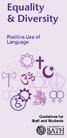 Equality & Diversity Positive Use of Language Guidelines for Staff and Students University of Bath Equality and Diversity This leaflet is produced to assist in the pursuit of corporate aims of supporting
Course Description Course Textbook Course Learning Outcomes Credits Course Structure Unit Learning Outcomes: Unit Lesson: Reading Assignments:
 BSL 4000, Managing Diversity in Organizations Course Syllabus Course Description Presentation of the personal and organizational implications of increasing workforce diversity. Exploration of the complex
dealing with a depression diagnosis
 tips for dealing with a depression diagnosis 2011 www.heretohelp.bc.ca No one wants to feel unwell. Talking to your doctor or other health professional about problems with your mood is an important first
Difficult Tutoring Situations
 Difficult Tutoring Situations At some time or other, all tutors will find themselves faced with difficult situations in a tutoring session. The following information will provide you with some common categories
Gender: Participants define gender and discuss ways it influences their lives.
 Gender: Participants define gender and discuss ways it influences their lives. Lesson Plans: 1. Just Because --Stereotypes 2. Gender Lesson: Just Because Stereotypes (adapted from TKF) ESSENTIAL QUESTIONS:
How to Simplify Your Life
 Life Reference: Matthew 6:24-34 Focus Verse: But seek ye first the kingdom of God, and his righteousness: and all these things shall be added unto you (Matthew 6:33). Stuff! Wonderful stuff everywhere!
Presented by: Deborah Bourne C/O Hope Enterprises Ltd. 25 Burlington Ave., KGN 10, Jamaica W.I
 Findings and methodological and ethical challenges involved in conducting the FHI study Early Sexual Debut, Sexual Violence, and Sexual Risk-taking among Pregnant Adolescents and Their Peers in Jamaica
Income and wealth inequality
 Income and wealth inequality Income and wealth inequality The end of industrialization and Reaganomics Income inequality Wealth inequality Poverty Income and wealth inequality The end of industrialization
What qualities are employers looking for in teen workers? How can you prove your own skills?
 Sell Yourself 4 Finding a job The BIG Idea What qualities are employers looking for in teen workers? How can you prove your own skills? AGENDA Approx. 45 minutes I. Warm Up: Employer Survey Review (15
Customer Service Training 101, Second Edition By Renee Evenson
 Excerpt from: Customer Service Training 101, Second Edition By Renee Evenson Chapter One Taking Your First Steps: The Basics Always remember, the customer is the reason you have a job. What has happened