
800VA Pure Sine Wave Inverter s Reference Design
|
|
|
- Amos Bryan
- 9 years ago
- Views:
Transcription
1 Application Report SLAA602 June VA Pure Sine Wave Inverter s Reference Design Sanjay Dixit, Ambreesh Tripathi, Vikas Chola High Performance Isolated Power ABSTRACT This application note describes the design principles and the circuit operation of the 800VA pure Sine Wave Inverter. The pure Sine Wave inverter has various applications because of its key advantages such as operation with very low harmonic distortion and clean power like utility-supplied electricity, reduction in audible and electrical noise in Fans, fluorescent lights and so on, faster, quieter and cooler running of Inductive loads like microwaves and motors. Contents 1 Introduction Pure Sine Wave Inverter's Design... 4 Figures Figure 1. Types of Inverter Outputs... 3 Figure 2. Block Diagram of 600VA to 3 KVA Residential Pure Sine Wave inverters... 4 Figure 3. Inverter Mode Gate Drives... 6 Figure 4. H Bridge Configuration of MOSFETs... 7 Figure 5. Modulation of Sine Wave with Higher frequency PWM signals... 8 Figure 6. Waveform Generation in Inverter Mode... 8 Figure 7. Trilevel PWM signal during the Inverter Mode for Pure Sine Wave Generation... 9 Figure 8. Charging Mode PWM Switching Explanation Figure 9. DC/DC Converter s Design Figure 10. Gate Driver and Current Sensing Figure 11. ODC and OCC Protection Figure 12. AC Mains Sensing through Isolated Amplifier Figure 13. Relay Operation Figure 14. Output Sense, DC Fan and Buzzer operations Figure 15. Daughter Card s Schematic Figure 16. Waveforms at the Gates of the MOSFETs in Inverter Mode (High Side A MOSFETs and B Side Low MOSFETs are conducting) Figure 17. FIG 17: Waveforms at the Gates of the MOSFETs in Inverter Mode (High Side B MOSFETs and A Side Low MOSFETs are conducting) Figure 18. Trilevel Switching across the High Side A MOSFETS Source (HSA) and High Side B Figure 19. MOSFETs Source (HSB) Trilevel Switching across the High Side A MOSFETS Source (HSA) and High Side B MOSFETs Source (HSB) Figure 20. Inverted Waveform (HOA-LOA and HOB-LOB) at the Gates of MOSFETS Figure 21. Dead Band between Complementary HOB and LOB Pair

2 Figure 22. Maximum duty cycle of the PWM Switching at No Load (at the Inverter s Output) is 88 percent Figure 23. Maximum duty cycle of the PWM switching at 400W (at the Inverter s Output) is increased to 98 percent to maintain Voltage regulation at the Inverter s output by sensing the Auxiliary Winding. This results in slight clipping of Sinusoidal waveform at the output Figure 24. Inverter s Output at No Load with 12V battery Input: Figure 25. Inverter s Output at 400W Load with 12V battery Input: Figure 26. Waveform during the Charging mode. The high side FET is switched off and both Lower Side FETs to ground in the H Bridge are switched at the same time with the duty Cycle proportional to the Battery Charge current VA Pure Sine Wave Inverter s Reference Design

3 1 Introduction Power inverter is a device that converts electrical power from DC form to AC form using electronic circuits. It is typical application is to convert battery voltage into conventional household AC voltage allowing you to use electronic devices when an AC power is not available. There are basically three kinds of Inverter out of which, the first set of inverters made, which are now obsolete, produced a Square Wave signal at the output. The Modified Square Wave also known as the Modified Sine Wave Inverter produces square waves with some dead spots between positive and negative half-cycles at the output. The cleanest Utility supply like Power source is provided by Pure Sine Wave inverters. The present Inverter market is going through a shift from traditional Modified Sine Wave Inverter to Pure Sine Wave inverters because of the benefits that these inverters offer. Figure 1. Types of Inverter Outputs 800VA Pure Sine Wave Inverter s Reference Design 3

4 2 Pure Sine Wave Inverter s Design. a) Building Block Figure 2. Block Diagram of 600VA to 3 KVA Residential Pure Sine Wave inverters 4 800VA Pure Sine Wave Inverter s Reference Design

5 There is a dual mode of operation in a residential Inverter, ie Mains mode and Inverter modes shown in Figure 2. An Inverter not only converts the DC Voltage of battery to 220V/120 V AC Signals but also charge the Battery when the AC mains is present. The block diagram shown above is a simple depiction of the way an Inverter Works. Inverter Mode: The method, in which the low voltage DC power is inverted, is completed in two steps. The first step is the conversion of the low voltage DC power to a high voltage DC source, and the second step is the conversion of the high DC source to an AC waveform using pulse width modulation. Another method to complete the desired outcome would be to first convert the low voltage DC power to AC, and then use a transformer to boost the voltage to 120/220 volts. The widely used method in the current residential inverter is the second one and hence this reference design is based on this method. The AC input is sensed through isolated amplifier (AMC1100) and the isolated replica of the AC input is given to the TI s Picolo Lite Microcontroller ADC. When the AC input is not present in Valid range (Inverter mode) or AC fails, the relay between Mains AC Input and the Inverter Output remain open, the microcontroller generates PWMs and send four drives output to Gate Driver (SM72295). Now the Gate Driver accepts low-power inputs from the controller and produces the appropriate high-current gate drive for the power MOSFETs placed in Full Bridge Topology. Here H-bridge circuit converts battery DC voltage into AC using high frequency PWM (6 khz to 20 KHz) thus feeding the 50 Hz transformer which Boost it to 120V/220V AC. The output of transformer contains a capacitor which filters it to make clean 50Hz AC.(Details of Switching can be found in the sections to come). 800VA Pure Sine Wave Inverter s Reference Design 5

6 Figure 3. Inverter Mode Gate Drives As seen from the Block Diagram (Fig 2), the Output Voltage is Sensed through the Auxiliary Secondary Winding and feeds to the Controller. The Controller takes this feedback and then Work on the PWM to generate the regulated AC output. Furthermore the current that is flowing through the battery in Inverter mode and the Charging current during the Mains mode is measured using Integrated Amplifiers of SM72295 and given to the ADCs of the Microcontroller. Also this reference design has additional protection for Over current Discharge (OCD) and Over Current Charge (OCC) using LM339 Comparators where the amplified Voltage output across Current sense is compared with a pre determined Value and the PWM is immediately shut down by the controller if either the OCD or OCC limit is crossed. Main Mode: In the mains mode, when the input AC is present and is within valid range, the relay between Input AC and the Inverter Output is closed and the input AC directly goes to the output load. The same AC is fed to transformer, and the H-bridge consisting of MOSFETs or IGBTs are driven through microcontroller to charge the battery. A bridge less rectification principle is used to charge the battery where basically both the high side FET is switched off and both Lower Side FETs to ground in the H Bridge are switched at the same time with the duty Cycle proportional to the Battery Charge current VA Pure Sine Wave Inverter s Reference Design

7 Whenever the Lower FETs are Turned ON at the same time, ie there is a Generation of Boosted Voltage across the Leakage inductance of the Primary inductance connected to H Bridge by the Ldi/dt effect and this energy stored in the Leakage Inductance flow through the body diode of the high Side MOSFETs (Each high side MOSFETs body diode conducts on AC half cycle) and charge the Battery. Hence the charging current is proportional to the duty cycle of the PWM switching on Lower Side FETs. (Details of switching follow in the section to come). b) Switching Waveform Details: In order to understand the functioning of an Inverter, One has to understand the Switching requirement of the four drives of the MOSFETs in H Bridge both in Inverter as well as Mains mode. 1) Inverter Mode The Switching Wave Form in an Inverter is very simple to understand and generate. Figure 4. H Bridge Configuration of MOSFETs On the A Side MOSFET of the H Bridge, the PWM is generated by modulating the Sine Wave with High Frequency (6 KHz to 20 KHz) Square wave in such a way that the Positive Peak of the Sine Wave is represented by Maximum duty cycle and the Negative Peak by the Minimum duty Cycle as Shown Below. 800VA Pure Sine Wave Inverter s Reference Design 7

8 Figure 5. Modulation of Sine Wave with Higher frequency PWM signals Now on the B Side, Just Phase Shift this Sine Wave by 180 degree and generate the PWM in a similar Way as mentioned above. The Following Simple Hardware Implementation of the PWM generation will make the design more clear. + - AP AM + - BP BM Figure 6. Waveform Generation in Inverter Mode 8 800VA Pure Sine Wave Inverter s Reference Design

9 A Side Complementary or the AM signal is obtained by just Inverting the A side or AP Waveform and the same goes for B Side Complementary or BM Waveform The Differential Signal seen across the OUTP and OUTN will be a Trilevel PWM Signal as mentioned Below: Figure 7. Trilevel PWM signal during the Inverter Mode for Pure Sine Wave Generation 800VA Pure Sine Wave Inverter s Reference Design 9

10 2) Mains Mode: In the Mains Mode both the High Side MOSFETs ie A side as well B side is Switched off and both the Low Side MOSFETs are Switched with the Similar PWM Waveform where the Duty Cycle of Lower Side PWM signals determine the Charging Current. Figure 8. Charging Mode PWM Switching Explanation. When the Lower Switches are Turned on at the same time, there is a Boosted Voltage, that appear across the Primary Leakage Inductance of Transformer connected to the H Bridge, by the Ldi/dt effect and this energy is use to charge the Battery through the Body diodes of the High Side MOSFETs. Also each of the High Side MOSFET s Body diode will conduct in the each half of the Sine Wave. When the mains mode is sensed, firstly all the MOSFETs are switched off and the Relay between the Ac input and the Inverter output is connected. After this, the Lower FETs are tuned on with PWM of small duty Cycle (5 to 10 percent) and the High Side MOSFETS are switched off.now the Voltage across the current sense is measured by controller and if the corresponding current is less or more than required by Charging algorithm than the duty cycle is altered correspondingly ie duty cycle is increased if more Charging current is required and decreased if the charging current reduction is desired. C) Schematic of the Design The Schematic is divided into two boards: 1) Main Power s Board 2) Microcontroller s Daughter Card Main Board s Schematic VA Pure Sine Wave Inverter s Reference Design

11 800VA Pure Sine Wave Inverter s Reference Design 11
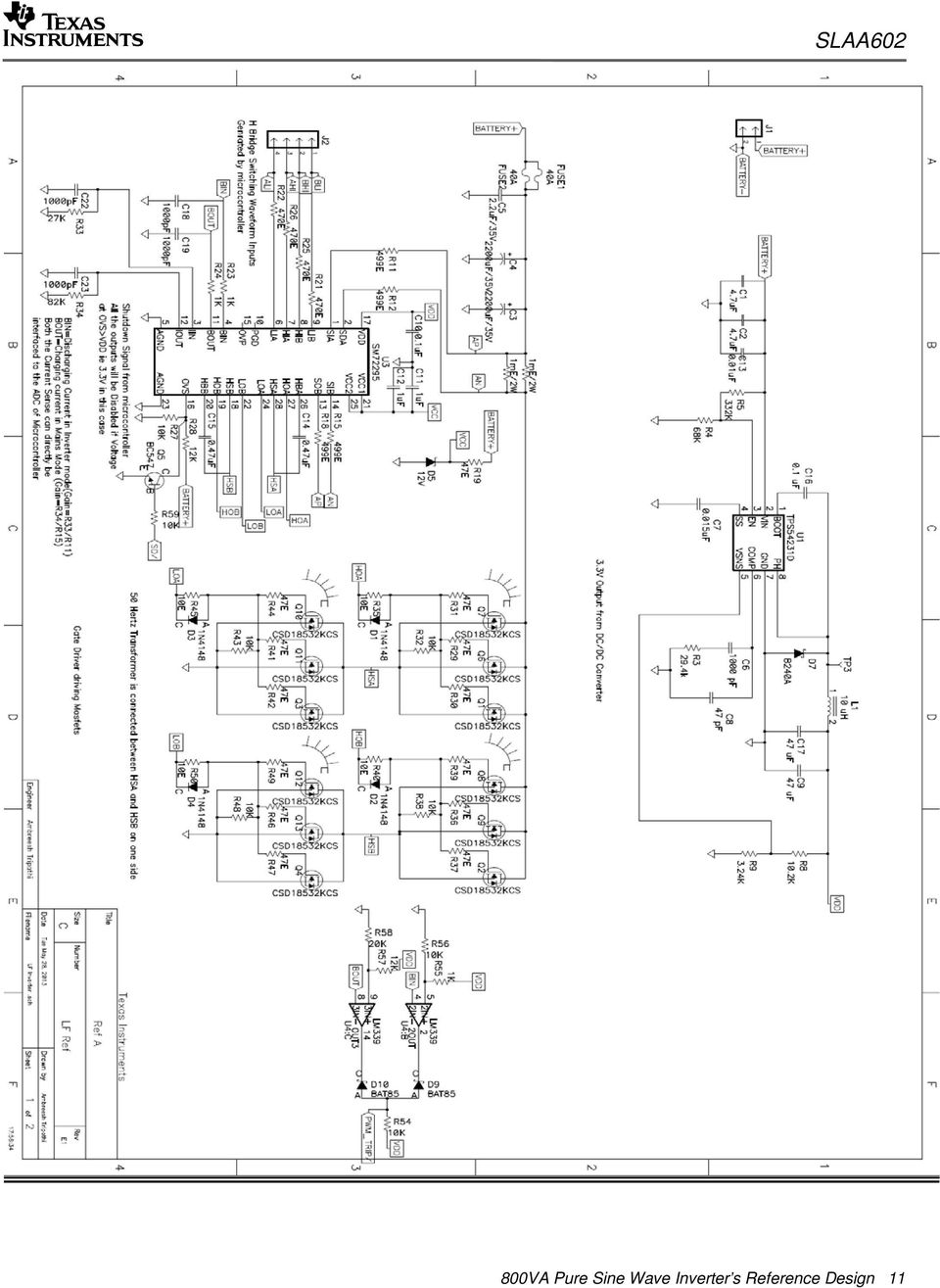
12 12 800VA Pure Sine Wave Inverter s Reference Design

13 Microcontroller s Daughter Card 800VA Pure Sine Wave Inverter s Reference Design 13

14 D) Sections of the Design: 1) 12V Battery Input to 3.3V Conversion: TPS54231 Buck Converter is used to convert Battery Voltage (Nominal 12V) to 3.3V output which in turn is mainly used to power the Controller daughter card and AMC1100 Isolated amplifier Secondary side. The TPS54231 dc/dc converter is designed to provide up to a 2 A (our requirement is of maximum 200mA) output from an input voltage source of 3.5 V to 28Vand this integrates a low RDSon high Side MOSFET. Further details to the IC can be found from the below links : TPS54231: 3.5 to 28V Input, 2A, 570kHz Step-Down Converter with Eco-mode Product Folder: Datasheet (PDF): Below is the design of DC/DC Section: Figure 9. DC/DC Converter s Design 2) Highly Integrated Gate Driver Design : Gate Driver is a power amplifier that accepts a low-power input from a controller IC and produces the appropriate high-current gate drive for a power MOSFET. The gate driver must source and sink current to establish required Vgs. Here SM72295 is used as a full bridge MOSFET driver which has 3A (higher no. of FETs in parallel for high power) peak current drive capability and have following advantages: VA Pure Sine Wave Inverter s Reference Design

15 1. Integrated ultra fast 100V boot strap diodes (can easily support up to 5KVA rated inverters) 2. Two high side current sense amplifiers with externally programmable gain and buffered outputs which can be used for measuring the Battery charge and discharge current Additional current sense amplifiers and buffers are not required 3. Programmable over voltage protection which can be used for Charge complete detection or for driver shutdown feature in case of a fault condition 4. Can be directly interfaced with a microcontroller The Complete design principles and circuit details of SM72295 in the Inverter application can be found in below application notes (This also includes the current Sensing Sections of the Design) AN-2296 SM72295: Highly Integrated Gate Driver for 800VA to 3KVA Inverter 800VA Pure Sine Wave Inverter s Reference Design 15

16 Figure 10. Gate Driver and Current Sensing VA Pure Sine Wave Inverter s Reference Design

17 3) Over Discharge Current and Over Charge Current Protection Implementation: Figure 11. ODC and OCC Protection Here BIN is the voltage Across the Current Sense resistance during the Inverter Mode and BOUT is the voltage across the Current Sense during the Mains mode. Now both of these is compared to the different reference voltages and the PWM is tripped once either BIN or BOUT exceed their given reference voltage. Setting the reference point during the charging and discharging mode is very simple. Now with the integrated amplifiers on the SM72295, the gain on the voltage across the current sense during the discharging mode is 27K/499E (Ratio of resistance on IIN and SIA pin of SM72295) and during the charging mode is 82K/499E. To put the Over Discharge Current Protection (ODC) at current = 110A. The drop across the current sense will be current Sense resistance x ODC=0.055V.Now the gain of 27K/499 is given and hence the BIN = 3V approx. and hence the reference of 3V is given as ODC protection reference and similarly Over Charge Current Protection reference (of 25A) has been put as 2V. 4) Input AC Mains Sensing using Isolated Amplifier: In the traditional design of Commercial 600 VA - 5 KVA inverters, the AC mains voltage is sensed by stepping down through a bulky 50 Hz transformer by the microcontroller which is powered up by battery through linear regulators. To ensure the operator safety (personal handling battery, and so on) and signal integrity, galvanic isolation is needed in the design. The input AC Voltage Sensing is required in Inverters for changing to Mains mode through relay operation when A/C mains fall in the designated voltage level. Further comparators are also used in addition with transformer for location of zero crossing point of sinusoidal A/C signal. 800VA Pure Sine Wave Inverter s Reference Design 17

18 Figure 12. AC Mains Sensing through Isolated Amplifier The Complete design principles and circuit details of Isolated Amplifier AMC1100 in the Inverter application can be found in below application notes: AMC1100: Replacement of Input Main Sensing Transformer in Inverters with Isolated Amplifier 5) Relay Operation : In the mains mode, when the input AC is present and is within valid range, the relay between Input AC and the Inverter Output is closed and the input AC directly goes to the output load. Basically one terminal of the Output (OUTL in this design) is shorted to the Line Input of the Mains and when the relay is turned on Neutral get connected to the OUTN and hence the AC input becomes the Inverters Output. Figure 13. Relay Operation VA Pure Sine Wave Inverter s Reference Design

19 6) Inverter s Output Voltage Sense in Inverter Mode, DC FAN operation for Cooling MOSFETs and Error Buzzer operation: SLAA602 Figure 14. Output Sense, DC Fan and Buzzer operations The Output Voltage in Inverter mode is sensed through the Auxiliary winding, which is filtered and rectified and given to the ADC of the microcontroller. When fall in the output voltage is sensed with the increase in the output Load, the duty cycle of the H Bridge drive (from microcontroller) is multiplied by a constant greater than 1 so that the final Inverter s output voltage is closer to the No Load Output Voltage (120V/220 VAC) and vice versa on moving from higher load to the lower load. For example in this reference design, at no load condition, the duty cycle of the PWM drives given to the H Bridge are varied from 10 percent to 88 percent and when the load is constantly increased at the Inverter s output, the duty cycle of the PWM is multiplied by a factor greater than 1 so that we can regulate the output voltage within allowable range.while decreasing the load, vice versa followed. If the duty cycle is increased beyond a point, the output voltage will start clipping and hence results in higher distortion.hence care should be taken while regulating the output voltage through a feedback. 7) Microcontroller s Daughter Card : This card has TMS320F MCU, JTAG connector for programming & connector for interfacing all signals with main board. This is a digital power application & Most of the MCUs available in the market that finds use in digital power are 16 bit MCUs. TI offers C bit MCU which can offer good performance which is most wanted in such applications. TMS320F280270PT is C2000 piccolo family MCU series which has unique peripherals like 3 epwm channels with 6 outputs, 8 channel of 12 bit high speed SAR ADC, 22 digital GPIO shared with digital peripherals with a high performance 50MHz CPU for this application. In this design All analog and digital pins are being used; however, can be mapped in different way according to application change if required. 800VA Pure Sine Wave Inverter s Reference Design 19

20 epwm has Counter compare, Action qualifier, Dead Band, Trip Zone sub modules with internal connections of channel. Using these central aligned complementary PWM outputs is generated through epwm output pins with phase shifting of 180 between epwm1 and epwm2 channel outputs. TI provides a very efficient IQ match library using which sine wave is generated very easily within fast loop of 50uS. This MCU has 12 bit SAR ADC which can be configured from 7 cycle to 64 cycles long sampling. Using same, one can get very fast feedback signal for adjusting output voltage during inverter mode and charging current in charging mode. ADC is being triggered by 20 KHz PWM, so every 50 µs all samples are ready for feedback correction. ADC ISR is being used as control loop function and due to IQ math total time taken for sine wave generation, Output correction/charging current correction is around 7 µs. TMS320F2802x0 I/Os are supported by programmable digital filter for each one of them, making the MCU glitch protected and application development easy with ruggedness. The Daughter Card is connected to the main board through 24 Pin Connector. The controller card performs following main functions: 1. The AC Mains voltage is sensed and based on this, the relay is operated. (ACMAINSENSE and RELAY) 2. Than the four drives are generated by controller and given to the Gate Driver Inputs. (ALI,BLI,BHI and AHI) 3. The charging current (BOUT) in the Mains Mode and the Discharging current (BIN) in the Inverter mode is continuously tracked and in the error state, PWMs are tripped. 4. Also in the Inverter mode, the Output voltage of the Inverter is sensed (INV_OUTSENSE) and the duty cycle of the switching PWMs are modified to achieve the regulation in the output voltage. 5. Battery Voltage and the temperature of the Heat sink is also continuously monitored. 6. Based on the Load in the Inverter mode or Temperature rise of the Heat Sink, the DC fan is operated. 7. Various LEDs indications are given for User Interface. 8. Buzzer is operated if there is any detection of error state in the Main Board VA Pure Sine Wave Inverter s Reference Design

21 Figure 15. Daughter Card s Schematic 800VA Pure Sine Wave Inverter s Reference Design 21
22 E) Steps to be followed while debugging/working on the hardware: 1. The Main power board needs to be checked first and hence daughter card should not be placed initially. Also all the initial testing should be done on current limited Lab Power Supply 2. The DC/DC output on the main board is checked for 3.3V output. Than both (the logic voltage VDD and VCC) the Power supply of the SM72295 is checked. The Voltage at VCC1 and VCC2 of SM72295 should be 10.5V with the 12V input Battery. 3. The daughter card should be programmed with the basic Inversion Software to generate required 4 drives to operate the H Bridge. Before Inserting the Daughter card, Fuse F1 should be removed so that the PWM switching can be seen at the gates of each of the MOSFETs. 4. Now the Input drives to the Microcontroller be compared with the Gates waveform and it is needed to be insured that A Side waveform is complementary to the A Side Complementary waveform and similar for the B Side waveform. 5. Now the Fuse should be placed on the main board so the H Bridge gets connected to the Power Supply. Again all the Gates of the MOSFETs has to be monitored. The Low Side FETs will be switching at 12V rail while the High Side FETs will switched at higher rail (Gate voltage must be 6 to 12V higher than the source voltage(12v) which is achieved through Boot Strap circuits of the gate Driver). 6. The Differential Signal seen across the High Side MOSFETs Sources(OUTP and OUTN) will be a Trilevel PWM Signal as mentioned Below: VA Pure Sine Wave Inverter s Reference Design
23 7. Now the 50 Hz boost transformer is placed across OUTP and OUTN and the output is filtered through 1 µf/400vac Capacitors at the Inverter Output. The Inverter Output Should give 220V AC signal. Auxillary Winding output at INV_OUTSENSE be noted and used to program the feedback loop to have regulated output. 8. The Current Sense amplification is checked in the Inverter mode and the Over Discharge current protection is tested by increasing load at the output. (Till the No load condition at the output, the lab power Supply can be used and while increasing the load 12V/150AH battery can be used) 9. All the above stated steps are for the Basic inverter testing of the design. Below steps needed to be followed for the Main mode testing. 10. Initially the output of the Inverter is not connected to Pin 1 and 2 of Connector J4.The priority is to first check the relay operation.now when AC input is given to connector J3, it is sensed through AMC1100, the output of which is connected to the ADC of the microcontroller. Once it is in Valid range, firstly all the Inverter mode PWM switching is stopped and the relay is switched. 800VA Pure Sine Wave Inverter s Reference Design 23
24 11. The output of the Inverter ie OUTL and OUTN is connected to Pin 1 and PIN2 of the Connector J4 hence the Mains Input becomes the Inverter Output through the Switched relay. 12. After this, the Lower FETs are tuned on with a small duty (5 to 10 percent) and the High Side\ MOSFETS are switched off. Now the Voltage across the current sense is measured by controller and if the corresponding current is less or more required by Charging algorithm than the duty cycle is altered correspondingly that is, duty cycle is increased if more Charging current is required and decreases if the charging current reduction is desired. 13. Finally the switching between the Inverter mode and Mains mode is checked by inserting or removing the Input AC mains Signals. F) Waveforms and test results of 800VA Sine Wave Inverter s Reference Design 1. Inverter Mode Waveform : VA Pure Sine Wave Inverter s Reference Design
25 CH1- HOA CH2-LOB CH3-HOB CH4-LOA Figure 16. Waveforms at the Gates of the MOSFETs in Inverter Mode (High Side A MOSFETs and B Side Low MOSFETs are conducting). 800VA Pure Sine Wave Inverter s Reference Design 25
26 CH1- HOA CH2-LOB CH3-HOB CH4-LOA Figure 17. FIG 17: Waveforms at the Gates of the MOSFETs in Inverter Mode (High Side B MOSFETs and A Side Low MOSFETs are conducting) VA Pure Sine Wave Inverter s Reference Design
27 Figure 18. Trilevel Switching across the High Side A MOSFETS Source (HSA) and High Side B MOSFETs Source (HSB). 800VA Pure Sine Wave Inverter s Reference Design 27
28 Trilevel Switching Zoomed in: Figure 19. Trilevel Switching across the High Side A MOSFETS Source (HSA) and High Side B MOSFETs Source (HSB) VA Pure Sine Wave Inverter s Reference Design
29 Insuring the Dead band between Complementary waveform to avoid the Short Circuit condition: Figure 20. CH1- HOA CH2-LOB CH3-HOB CH4-LOA Inverted Waveform (HOA-LOA and HOB-LOB) at the Gates of MOSFETS. CH2-LOB CH3-HOB Figure 21. Dead Band between Complementary HOB and LOB Pair. 800VA Pure Sine Wave Inverter s Reference Design 29
30 PWM Switching at the Gates of the MOSFETs at No load (Inverter mode) with 12V Battery Input CH1- HOA CH2-LOB Figure 22. Maximum duty cycle of the PWM Switching at No Load (at the Inverter s Output) is 88 percent PWM Switching at the Gates of the MOSFETs at 400W (Inverter mode) with 12V Battery Input CH1- HOA CH2-LOB Figure 23. Maximum duty cycle of the PWM switching at 400W (at the Inverter s Output) is increased to 98 percent to maintain Voltage regulation at the Inverter s output by sensing the Auxiliary Winding. This results in slight clipping of Sinusoidal waveform at the output VA Pure Sine Wave Inverter s Reference Design
31 Figure 24. Inverter s Output at No Load with 12V battery Input: Figure 25. Inverter s Output at 400W Load with 12V battery Input: 800VA Pure Sine Wave Inverter s Reference Design 31
32 2. Mains/Charging Mode Waveform : CH1- HOA CH2-LOB CH3-LOB CH4-HOA Figure 26. Waveform during the Charging mode. The high side FET is switched off and both Lower Side FETs to ground in the H Bridge are switched at the same time with the duty Cycle proportional to the Battery Charge current VA Pure Sine Wave Inverter s Reference Design
33 IMPORTANT NOTICE Texas Instruments Incorporated and its subsidiaries (TI) reserve the right to make corrections, enhancements, improvements and other changes to its semiconductor products and services per JESD46, latest issue, and to discontinue any product or service per JESD48, latest issue. Buyers should obtain the latest relevant information before placing orders and should verify that such information is current and complete. All semiconductor products (also referred to herein as components ) are sold subject to TI s terms and conditions of sale supplied at the time of order acknowledgment. TI warrants performance of its components to the specifications applicable at the time of sale, in accordance with the warranty in TI s terms and conditions of sale of semiconductor products. Testing and other quality control techniques are used to the extent TI deems necessary to support this warranty. Except where mandated by applicable law, testing of all parameters of each component is not necessarily performed. TI assumes no liability for applications assistance or the design of Buyers products. Buyers are responsible for their products and applications using TI components. To minimize the risks associated with Buyers products and applications, Buyers should provide adequate design and operating safeguards. TI does not warrant or represent that any license, either express or implied, is granted under any patent right, copyright, mask work right, or other intellectual property right relating to any combination, machine, or process in which TI components or services are used. Information published by TI regarding third-party products or services does not constitute a license to use such products or services or a warranty or endorsement thereof. Use of such information may require a license from a third party under the patents or other intellectual property of the third party, or a license from TI under the patents or other intellectual property of TI. Reproduction of significant portions of TI information in TI data books or data sheets is permissible only if reproduction is without alteration and is accompanied by all associated warranties, conditions, limitations, and notices. TI is not responsible or liable for such altered documentation. Information of third parties may be subject to additional restrictions. Resale of TI components or services with statements different from or beyond the parameters stated by TI for that component or service voids all express and any implied warranties for the associated TI component or service and is an unfair and deceptive business practice. TI is not responsible or liable for any such statements. Buyer acknowledges and agrees that it is solely responsible for compliance with all legal, regulatory and safety-related requirements concerning its products, and any use of TI components in its applications, notwithstanding any applications-related information or support that may be provided by TI. Buyer represents and agrees that it has all the necessary expertise to create and implement safeguards which anticipate dangerous consequences of failures, monitor failures and their consequences, lessen the likelihood of failures that might cause harm and take appropriate remedial actions. Buyer will fully indemnify TI and its representatives against any damages arising out of the use of any TI components in safety-critical applications. In some cases, TI components may be promoted specifically to facilitate safety-related applications. With such components, TI s goal is to help enable customers to design and create their own end-product solutions that meet applicable functional safety standards and requirements. Nonetheless, such components are subject to these terms. No TI components are authorized for use in FDA Class III (or similar life-critical medical equipment) unless authorized officers of the parties have executed a special agreement specifically governing such use. Only those TI components which TI has specifically designated as military grade or enhanced plastic are designed and intended for use in military/aerospace applications or environments. Buyer acknowledges and agrees that any military or aerospace use of TI components which have not been so designated is solely at the Buyer's risk, and that Buyer is solely responsible for compliance with all legal and regulatory requirements in connection with such use. TI has specifically designated certain components as meeting ISO/TS16949 requirements, mainly for automotive use. In any case of use of non-designated products, TI will not be responsible for any failure to meet ISO/TS Products Applications Audio Automotive and Transportation Amplifiers amplifier.ti.com Communications and Telecom Data Converters dataconverter.ti.com Computers and Peripherals DLP Products Consumer Electronics DSP dsp.ti.com Energy and Lighting Clocks and Timers Industrial Interface interface.ti.com Medical Logic logic.ti.com Security Power Mgmt power.ti.com Space, Avionics and Defense Microcontrollers microcontroller.ti.com Video and Imaging RFID OMAP Applications Processors TI E2E Community e2e.ti.com Wireless Connectivity Mailing Address: Texas Instruments, Post Office Box , Dallas, Texas Copyright 2013, Texas Instruments Incorporated
AMC1100: Replacement of Input Main Sensing Transformer in Inverters with Isolated Amplifier
 Application Report SLAA552 August 2012 AMC1100: Replacement of Input Main Sensing Transformer in Inverters with Isolated Amplifier Ambreesh Tripathi and Harmeet Singh Analog/Digital Converters ABSTRACT
LM5030 LM5030 Application: DC - DC Converter Utilizing the Push-Pull Topology
 LM5030 LM5030 Application: DC - DC Converter Utilizing the Push-Pull Topology Literature Number: SNVA553 LM5030 Application DC DC Converter Utilizing the Push-Pull Topology 1 Push-Pull Topology D1 L +
Analysis of Power Supply Topologies for IGBT Gate Drivers in Industrial
 Application Report SLAA672 July 2015 Analysis of Power Supply Topologies for IGBT Gate Drivers in Industrial Sanjay Pithadia, N. Navaneeth Kumar ABSTRACT This application report explains different parameters
Application Note AN107
 Murata Balun for CC253x and CC254x LFB182G45BG2D280 By Fredrik Kervel Keywords Balun LFB182G45BG2D280 CC253x CC254x CC257x CC85xx 1 Introduction Murata s LFB182G45BG2D280 integrated balun is specially
LM556 LM556 Dual Timer
 LM556 LM556 Dual Timer Literature Number: SNAS549 LM556 Dual Timer General Description The LM556 Dual timing circuit is a highly stable controller capable of producing accurate time delays or oscillation.
Providing Continuous Gate Drive Using a Charge Pump
 Application Report Philip Meyer and John Tucker... Power Management Products ABSTRACT Certain applications require that output voltage regulation be maintained when the input voltage is only slightly higher
Data sheet acquired from Harris Semiconductor SCHS078C -- Revised October 2003
 Data sheet acquired from Harris Semiconductor SCHS078C -- Revised October 2003 The CD4521B types are supplied in 16-lead dual-in-line plastic packages (E suffix), 16-lead small-outline packages (M, M96,
AN-1733 Load Transient Testing Simplified
 Application Report... ABSTRACT The load transient test may be the simplest diagnostic tool available to instantly analyze the loop stability of a system: the visual appearance of the output voltage as
DC/DC LED Lighting Developer s Kit Hardware
 Reference Guide The DC/DC LED lighting developer s kit provides a great way to learn and experiment by using a single MCU to accurately control a series of LED strings and efficiently control the power
LM709 LM709 Operational Amplifier
 LM709 LM709 Operational Amplifier Literature Number: SNOS659A LM709 Operational Amplifier General Description The LM709 series is a monolithic operational amplifier intended for general-purpose applications
Texas Instruments. FB PS LLC Test Report HVPS SYSTEM AND APPLICATION TEAM REVA
 Texas Instruments FB PS LLC Test Report HVPS SYSTEM AND APPLICATION TEAM REVA 12/05/2014 1 General 1.1 PURPOSE Provide the detailed data for evaluating and verifying the FB-PS-LLC. The FB-PS-LLC is a Full
Wireless Subwoofer TI Design Tests
 Wireless Subwoofer TI Design Tests This system design was tested for THD+N vs. frequency at 5 watts and 30 watts and THD+N vs. power at 00. Both the direct analog input and the wireless systems were tested.
Design Note DN304. Cebal CCxxxx Development Tools USB Driver Installation Guide By Åsmund B. Bø. Keywords. 1 Introduction
 Cebal CCxxxx Development Tools USB Driver Installation Guide By Åsmund B. Bø Keywords Cebal Driver Windows x86 Windows x64 SmartRF Studio SmartRF Packet Sniffer SmartRF Flash Programmer SmartRF05EB SmartRF04EB
Ultrasonic Sensing Basics for Liquid Level Sensing, Flow Sensing, and Fluid
 Application Report SNAA0A March 015 Revised June 015 Ultrasonic Sensing Basics for Liquid Level Sensing, Flow Sensing, and Fluid AmyLe ABSTRACT The need for accurate and reliable sensors is growing in
54LS174,54LS175,DM54LS174,DM54LS175, DM74LS174,DM74LS175
 54LS174,54LS175,DM54LS174,DM54LS175, DM74LS174,DM74LS175 54LS174 DM54LS174 DM74LS174 54LS175 DM54LS175 DM74LS175 Hex/Quad D Flip-Flops with Clear Literature Number: SNOS290A 54LS174 DM54LS174 DM74LS174
Multi-Transformer LED TV Power User Guide. Anderson Hsiao
 Multi-Transformer LED TV Power User Guide Anderson Hsiao Operation Range Input Range: 90Vac~264Vac 47Hz~63Hz Dimming Range: Reverse Signal 0V ~ 5V 100Hz ~200Hz 1%~100% Output Range :STBY-5V 20mA~1A 5V
LM388 LM388 1.5W Audio Power Amplifier
 LM388 LM388 1.5W Audio Power Amplifier Literature Number: SNOSBT8A LM388 1 5W Audio Power Amplifier General Description The LM388 is an audio amplifier designed for use in medium power consumer applications
APPLICATION NOTE BUILDING A QAM MODULATOR USING A GC2011 DIGITAL FILTER CHIP
 SLWA022 APPLICATION NOTE BUILDING A QAM MODULATOR USING A GC2011 DIGITAL CHIP October 6, 1994 1.0 INTRODUCTION This report describes how one can use the GC2011 Digital Filter chip to build digital modulators
Importing a SPICE NetList Into TINA9-TI
 Application Report Importing a SPICE NetList into TINA9-TI John Miller... Analog elab ABSTRACT This application note describes the procedure for importing an unencrypted SPICE netlist into TINA9-TI (available
AN-311 Theory and Applications of Logarithmic Amplifiers
 Application Report... ABSTRACT A number of instrumentation applications can benefit from the use of logarithmic or exponential signal processing techniques. The design and use of logarithmic/exponential
LM1851 LM1851 Ground Fault Interrupter
 LM1851 LM1851 Ground Fault Interrupter Literature Number: SNIS158 LM1851 Ground Fault Interrupter General Description The LM1851 is designed to provide ground fault protection for AC power outlets in consumer
DS8907 DS8907 AM/FM Digital Phase-Locked Loop Frequency Synthesizer
 DS8907 DS8907 AM/FM Digital Phase-Locked Loop Frequency Synthesizer Literature Number: SNOSBR1A DS8907 AM FM Digital Phase-Locked Loop Frequency Synthesizer General Description The DS8907 is a PLL synthesizer
Application Report. 1 Introduction. 2 Resolution of an A-D Converter. 2.1 Signal-to-Noise Ratio (SNR) Harman Grewal... ABSTRACT
 Application Report SLAA323 JULY 2006 Oversampling the ADC12 for Higher Resolution Harman Grewal... ABSTRACT This application report describes the theory of oversampling to achieve resolutions greater than
Application Report. 1 Description of the Problem. Jeff Falin... PMP Portable Power Applications ABSTRACT
 Application Report SLVA255 September 2006 Minimizing Ringing at the Switch Node of a Boost Converter Jeff Falin... PMP Portable Power Applications ABSTRACT This application report explains how to use proper
Design Note DN041. Using CC253X or CC254X with Dipole PCB Antennas. Keywords. 1 Introduction. By Espen Wium CC2530 CC2531 CC2533 CC2540 CC2541
 Using CC253X or CC254X with Dipole PCB Antennas By Espen Wium Keywords Half wave dipole RF Antenna Efficiency Gain TRP (Total Radiated Power) CC2530 CC2531 CC2533 CC2540 CC2541 1 Introduction Many RFICs
SDLS940A MARCH 1974 REVISED MARCH 1988. Copyright 1988, Texas Instruments Incorporated
 SN5490A, SN5492A, SN5493A, SN54LS90, SN54LS92, SN54LS93 SN7490A, SN7492A, SN7493A, SN74LS90, SN74LS92, SN74LS93 DECADE, DIVIDE-BY-TWELVE AND BINARY COUNTERS SDLS940A MARCH 1974 REVISED MARCH 1988 PRODUCTION
with Ultra-Fast Transient Response and High Light-Load Efficiency
 1 Adaptor 6-24V Optional N-FET Driver Ultra-Fast DPM Simplified Application Diagram Iin Ultra-Low Quiescent Current Enhanced Safety Features OCP, OVP, FET Short Support CPU Turbo Mode To System bq24715
LM138,LM338. LM138/LM338 5-Amp Adjustable Regulators. Literature Number: SNVS771A
 LM138,LM338 LM138/LM338 5-Amp Adjustable Regulators Literature Number: SNVS771A LM138/LM338 5-Amp Adjustable Regulators General Description The LM138 series of adjustable 3-terminal positive voltage regulators
Calculating Gain for Audio Amplifiers
 Application eport SLOA105A October 003 evised September 005 Calculating Gain for Audio Amplifiers Audio Power Amplifiers ABSTACT This application report explains the different types of audio power amplifier
TL081 TL081 Wide Bandwidth JFET Input Operational Amplifier
 TL081 TL081 Wide Bandwidth JFET Input Operational Amplifier Literature Number: SNOSBW6A TL081 Wide Bandwidth JFET Input Operational Amplifier General Description The TL081 is a low cost high speed JFET
AN-1963 IEEE 1588 Synchronization Over Standard Networks Using the
 Application Report AN-963 IEEE 588 Synchronization Over Standard Networks Using the... ABSTRACT This application report describes a method of synchronization that provides much more accurate synchronization
Design Note DN004. Folded Dipole Antenna for CC25xx By Audun Andersen. Keywords. 1 Introduction CC2500 CC2550 CC2510 CC2511
 Folded Dipole Antenna for CC25xx By Audun Andersen Keywords CC2500 CC2550 CC2510 CC2511 Folded Dipole PCB Antenna 2.4 GHz 1 Introduction This document describes a folded dipole PCB antenna design that
AN-225 IC Temperature Sensor Provides Thermocouple Cold-Junction
 Application Report AN-225 IC Temperature Sensor Provides Thermocouple Cold-Junction... ABSTRACT Two circuits using the LM335 for thermocouple cold-junction compensation have been described. With a single
AN-1900 LM3150 Evaluation Boards
 User's Guide 1 Introduction The LM3150 evaluation boards are designed to provide the design engineer with a fully functional power converter based on Constant On-Time with Emulated Ripple mode control
LM5025,LM5026,LM5034 Operation and Benefits of Active-Clamp Forward Power Converters
 LM5025,LM5026,LM5034 Operation and Benefits of Active-Clamp Forward Power Converters Literature Number: SNVA591 POWER designer Expert tips, tricks, and techniques for powerful designs No. 108 Feature Article...1-7
How To Close The Loop On A Fully Differential Op Amp
 Application Report SLOA099 - May 2002 Fully Differential Op Amps Made Easy Bruce Carter High Performance Linear ABSTRACT Fully differential op amps may be unfamiliar to some designers. This application
TI and ibiquity Introduce Industry s Lowest Cost Single-Chip AM/FM and HD Radio Baseband John Gardner Digital Radio Marketing Manager
 TI and ibiquity Introduce Industry s Lowest Cost Single-Chip AM/FM and HD Radio Baseband John Gardner Digital Radio Marketing Manager SPRT328 HD Radio Products Planned Trunk mounted HD Radio receiver at
SDLS068A DECEMBER 1972 REVISED OCTOBER 2001. Copyright 2001, Texas Instruments Incorporated
 SN54174, SN54175, SN54LS174, SN54LS175, SN54S174, SN54S175, SN74174, SN74175, SN74LS174, SN74LS175, SN74S174, SN74S175 PRODUCTION DATA information is current as of publication date. Products conform to
Evaluating the complex configuration options of the Texas Instruments advanced fuel gauges can be
 User's Guide SLUU307A March 2008 Revised April 2008 bqeasy for Single Cell Impedance Track Devices Texas Instruments advanced fuel gauges, that employ the Impedance Track algorithm, offer an unmatched
ZigBee Sensor Monitor SWRU157D 2008 Low-Power RF
 s e r ' s G u i d e User's Guide ZigBee Sensor Monitor SWRU157D 2008 Low-Power RF Contents ZIGBEE SENSOR MONITOR... 1 1. INTRODUCTION... 2 1.1. CC2530ZDK... 2 1.2. EZ430-RF2480... 2 2. INSTALLATION...
AN-1405 DP83848 Single 10/100 Mb/s Ethernet Transceiver Reduced Media Independent Interface (RMII ) Mode
 Application Report SNLA076A October 2005 Revised April 2013 AN-1405 DP83848 Single 10/100 Mb/s Ethernet Transceiver Reduced Media... ABSTRACT This application report summarizes how a designer can take
µa7800 SERIES POSITIVE-VOLTAGE REGULATORS
 SLS056J MAY 976 REISED MAY 2003 3-Terminal Regulators Output Current up to.5 A Internal Thermal-Overload Protection High Power-Dissipation Capability Internal Short-Circuit Current Limiting Output Transistor
TrxEB RF PER Test Software Example. User s Guide SWRU296
 TrxEB RF PER Test Software Example User s Guide SWRU296 Table of Contents TABLE OF CONTENTS... 2 LIST OF FIGURES... 2 LIST OF TABLES... 3 1 INTRODUCTION... 4 2 ABOUT THIS MANUAL... 4 3 ACRONYMS AND ABBREVIATIONS...
6 Output With 1 kω in Series Between the Output and Analyzer... 7 7 Output With RC Low-Pass Filter (1 kω and 4.7 nf) in Series Between the Output
 Application Report SLAA313 December 26 Out-of-Band Noise Measurement Issues for Audio Codecs Greg Hupp... Data Acquisition Products ABSTRACT This report discusses the phenomenon of out-of-band noise, and
AN-1862 Reducing Radiated Emissions in Ethernet 10/100 LAN Applications
 Application Report AN-1862 Reducing Radiated Emissions in Ethernet 10/100 LAN Applications... ABSTRACT This application report explains how Texas Instruments' PHYTER products help system designers to reduce
LMS8117A LMS8117A 1A Low-Dropout Linear Regulator
 LMS8117A LMS8117A 1A Low-Dropout Linear Regulator Literature Number: SNOS487E LMS8117A 1A Low-Dropout Linear Regulator General Description The LMS8117A is a series of low dropout voltage regulators with
LM2747,LM3100,LM5035 Synchronous Rectification in High-Performance Power Converter Design
 LM2747,LM3100,LM5035 Synchronous Rectification in High-Performance Power Converter Design Literature Number: SNVA595 POWER designer Expert tips, tricks, and techniques for powerful designs No. 112 Feature
Choosing Inductors and Capacitors for DC/DC Converters
 Application Report SLVA157 February 2004 Choosing Inductors and Capacitors for DC/DC Converters Christophe Vaucourt ABSTRACT Wireless handsets, PDAs, and other portable electronic devices continue to shrink
Designing Gain and Offset in Thirty Seconds
 Application Report SLOA097 February 2002 Designing Gain and Offset in Thirty Seconds Bruce Carter High Performance Linear ABSTRACT This document discusses how to design an operational amplifier (op amp)
LM3444 MR16 Boost Reference Design for Non-Dimming & Dimming LED Applications
 Reference Design Lighting Power Products Longmont Design Center LM3444 MR16 Boost Reference Design for Non-Dimming & Dimming LED Applications Feb 13, 2012 Revision 3.0 NATIONAL SEMICONDUCTOR Page 1 of
August 2001 PMP Low Power SLVU051
 User s Guide August 2001 PMP Low Power SLVU051 IMPORTANT NOTICE Texas Instruments and its subsidiaries (TI) reserve the right to make changes to their products or to discontinue any product or service
Data sheet acquired from Harris Semiconductor SCHS067B Revised July 2003
 Data sheet acquired from Harris Semiconductor SCHS067B Revised July 2003 The CD4502B types are supplied in 16-lead hermetic dual-in-line ceramic packages (F3A suffix), 16-lead dual-in-line plastic packages
Using C to Access Data Stored in Program Memory on the TMS320C54x DSP
 Application Report SPRA177A August 2005 Using C to Access Data Stored in Program Memory on the TMS320C54x DSP David M. Alter DSP Applications - Semiconductor Group ABSTRACT Efficient utilization of available
ORDERING INFORMATION. TOP-SIDE MARKING PDIP N Tube SN74LS07N SN74LS07N PACKAGE. SOIC D Tape and reel SN74LS07DR
 The SN54LS07 and SN74LS17 are obsolete and are no longer supplied. Convert TTL Voltage Levels to MOS Levels High Sink-Current Capability Input Clamping Diodes Simplify System Design Open-Collector Driver
Data sheet acquired from Harris Semiconductor SCHS087D Revised October 2003
 Data sheet acquired from Harris Semiconductor SCHS087D Revised October 2003 The CD4555B and CD4556B types are supplied in 16-lead hermetic dual-in-line ceramic packages (F3A suffix), 16-lead dual-in-line
Thumbus2300. User's Guide. 1 Introduction. 1.1 Features. 1.2 Kit Contents
 User's Guide SLUU399A April 2010 Revised March 2011 Thumbus2300 This users guide describes the function and operation of the Thumbus2300 evaluation module. A complete description, as well as schematic
Transformerless UPS systems and the 9900 By: John Steele, EIT Engineering Manager
 Transformerless UPS systems and the 9900 By: John Steele, EIT Engineering Manager Introduction There is a growing trend in the UPS industry to create a highly efficient, more lightweight and smaller UPS
CD4071B Quad 2-Input OR Gate CD4072B Dual 4-Input OR Gate CD4075B Triple 3-Input OR Gate
 Data sheet acquired from Harris Semiconductor SCHS056D Revised August 2003 CD4071B Quad 2-Input OR Gate CD4072B Dual 4-Input OR Gate CD4075B Triple 3-Input OR Gate CD4071B, CD4072B, and CD4075B OR gates
RF37S114 Tag-it HF-I Type 5 NFC, ISO/IEC 15693 Transponder, 4 mm 4 mm
 1 1 Product Folder Sample & Buy Technical Documents Tools & Software Support & Community RF37S114 SCBS907 NOVEMBER 2015 RF37S114 Tag-it HF-I Type 5 NFC, ISO/IEC 15693 Transponder, 4 mm 4 mm 1 Device Overview
Data sheet acquired from Harris Semiconductor SCHS049C Revised October 2003
 Data sheet acquired from Harris Semiconductor SCHS049C Revised October 2003 CD4060B consists of an oscillator section and 14 ripple-carry binary counter stages. The oscillator configuration allows design
Optical Implementation Using IEEE-1394.b
 Application Report SGZA001A - March 2004 Optical Implementation Using IEEE-1394.b David Rekieta IEEE-1394 Products ABSTRACT IEEE Std 1394b-2002 specification allows the use of optical media for longer
Filter Design in Thirty Seconds
 Application Report SLOA093 December 2001 Filter Design in Thirty Seconds Bruce Carter High Performance Analog ABSTRACT Need a filter fast? No theory, very little math just working filter designs, and in
Theory of Operation. Figure 1 illustrates a fan motor circuit used in an automobile application. The TPIC2101. 27.4 kω AREF.
 In many applications, a key design goal is to minimize variations in power delivered to a load as the supply voltage varies. This application brief describes a simple DC brush motor control circuit using
7-41 POWER FACTOR CORRECTION
 POWER FTOR CORRECTION INTRODUCTION Modern electronic equipment can create noise that will cause problems with other equipment on the same supply system. To reduce system disturbances it is therefore essential
High-voltage reinforced isolation:
 High-voltage reinforced isolation: Definitions and test methodologies Anant S Kamath Systems Engineer, Isolation, Interface Group Texas Instruments Kannan Soundarapandian Product Line Manager, Isolation,
AN-1826 Extending the Reach of a FPD-Link II Interface With Cable Drivers and Equalizers
 Application Report SNLA103A March 2008 Revised April 2013 AN-1826 Extending the Reach of a FPD-Link II Interface With Cable Drivers... ABSTRACT TI's family of embedded clock LVDS SER/DES (FPD-link II)
MM58274C MM58274C Microprocessor Compatible Real Time Clock
 MM58274C MM58274C Microprocessor Compatible Real Time Clock Literature Number: SNOS618A MM58274C Microprocessor Compatible Real Time Clock General Description The MM58274C is fabricated using low threshold
HF Antenna Cookbook. Technical Application Report. 11-08-26-001 March 2001. Radio Frequency Identification Systems
 HF Antenna Cookbook Technical Application Report 11-08-26-001 March 2001 Radio Frequency Identification Systems Contents Edition One March 2001... i About this Manual... ii Conventions... ii If You Need
AC/DC Power Supply Reference Design. Advanced SMPS Applications using the dspic DSC SMPS Family
 AC/DC Power Supply Reference Design Advanced SMPS Applications using the dspic DSC SMPS Family dspic30f SMPS Family Excellent for Digital Power Conversion Internal hi-res PWM Internal high speed ADC Internal
Data sheet acquired from Harris Semiconductor SCHS020C Revised October 2003
 Data sheet acquired from Harris Semiconductor SCHS020C Revised October 2003 The CD4009UB and CD4010B types are supplied in 16-lead hermetic dual-in-line ceramic packages (F3A suffix), 16-lead dual-in-line
Using Code Coverage and Multi-event Profiler in Code Composer Studio v2.3 for Robustness and Efficiency Analyses
 Application Report SPRA868A April 2004 Using Code Coverage and Multi-event Profiler in Code Composer Studio v2.3 for Robustness and Efficiency Analyses Amit Rangari, N.Pradeep Software Development Systems
LM2900,LM3301,LM3900. LM2900/LM3900/LM3301 Quad Amplifiers. Literature Number: SNOSBV6
 LM2900,LM3301,LM3900 LM2900/LM3900/LM3301 Quad Amplifiers Literature Number: SNOSBV6 LM2900/LM3900/LM3301 Quad Amplifiers General Description The LM2900 series consists of four independent, dual input,
V OUT. I o+ & I o- (typical) 2.3A & 3.3A. Package Type
 July 25 th, 2012 Automotive Grade AUIRS4427S DUAL LOW SIDE DRIVER Features Gate drive supply range from 6 V to 20 V CMOS Schmitt-triggered inputs 3.3V and 5V logic compatible Two independent gate drivers
SINGLE-SUPPLY OPERATION OF OPERATIONAL AMPLIFIERS
 SINGLE-SUPPLY OPERATION OF OPERATIONAL AMPLIFIERS One of the most common applications questions on operational amplifiers concerns operation from a single supply voltage. Can the model OPAxyz be operated
Demystifying digital signal processing (DSP) programming: The ease in realizing implementations with TI DSPs
 Demystifying digital signal processing (DSP) programming: The ease in realizing implementations with TI DSPs Todd Hahn Software Development Manager Jonathan Humphreys Software Senior Member Technical Staff
AN2680 Application note
 Application note Fan speed controller based on STDS75 or STLM75 digital temperature sensor and ST72651AR6 MCU Introduction This application note describes the method of defining the system for regulating
Pressure Transducer to ADC Application
 Application Report SLOA05 October 2000 Pressure Transducer to ADC Application John Bishop ABSTRACT Advanced Analog Products/OpAmp Applications A range of bridgetype transducers can measure numerous process
 PACKAGE OPTION ADDENDUM www.ti.com 12-Jan-2006 PACKAGING INFORMATION Orderable Device Status (1) Package Type Package Drawing Pins Package Qty Eco Plan (2) Lead/Ball Finish MSL Peak Temp (3) 76005012A
CS4525 Power Calculator
 1. OVERVIEW CS4525 Power Calculator The CS4525 Power Calculator provides many important application-specific performance numbers for the CS4525 based on user-supplied design parameters. The Power Calculator
TI Designs Precision: Verified Design Comparator with Hysteresis Reference Design
 TI Designs Precision: Verified Design Comparator with Hysteresis Reference Design Art Kay, Timothy Claycomb TI Designs Precision TI Designs Precision are analog solutions created by TI s analog experts.
Design Considerations for LM5113 Advanced GaN FET Driver During High-
 Application Report Design Considerations for LM5113 Advanced GaN FET Driver During High- Narendra Mehta ABSTRACT The LM5113 device is designed to drive the high-side and low-side enhancement mode Gallium
Latch-Up. White Paper SCAA124 April 2015. Marty Johnson, Roger Cline, Scott Ward, Joe Schichl
 White Paper Marty Johnson, Roger Cline, Scott Ward, Joe Schichl ABSTRACT This document describes and discusses the topic of CMOS ranging from theory to testing of products. The recently proposed modifications
LM3203,LM3204,LM3205 Optimizing RF Power Amplifier System Efficiency Using DC-DC Converters
 LM3203,LM3204,LM3205 Optimizing RF Power Amplifier System Efficiency Using DC-DC Converters Literature Number: SNVA593 POWER designer Expert tips, tricks, and techniques for powerful designs No. 110 Feature
Current-Transformer Phase-Shift Compensation and Calibration
 Application Report SLAA122 February 2001 Current-Transformer Phase-Shift Compensation and Calibration Kes Tam Mixed Signal Products ABSTRACT This application report demonstrates a digital technique to
Flexible Active Shutter Control Interface using the MC1323x
 Freescale Semiconductor Document Number: AN4353 Application Note Rev. 0, 9/2011 Flexible Active Shutter Control Interface using the MC1323x by: Dennis Lui Freescale Hong Kong 1 Introduction This application
Buffer Op Amp to ADC Circuit Collection
 Application Report SLOA098 March 2002 Buffer Op Amp to ADC Circuit Collection Bruce Carter High Performance Linear Products ABSTRACT This document describes various techniques that interface buffer op
Design Note DN002. Practical Sensitivity Testing By Morten Engjom. Keywords. 1 Introduction. Receiver Testing Sensitivity
 Practical Sensitivity Testing By Morten Engjom Keywords Receiver Testing Sensitivity PER (Packet Error Rate) BER (Bit Error Rate) 1 Introduction To properly evaluate the receiver part of a transceiver,
THE RIGHT-HALF-PLANE ZERO --A SIMPLIFIED EXPLANATION
 THE RGHT-HALF-PLANE ZERO --A SMPLFED EXPLANATON n small signal loop analysis, poles and zeros are normally located in the left half of the complex s-plane. The Bode plot of a conventional or lefthalf-plane
SN54165, SN54LS165A, SN74165, SN74LS165A PARALLEL-LOAD 8-BIT SHIFT REGISTERS
 The SN54165 and SN74165 devices SN54165, SN54LS165A, SN74165, SN74LS165A PRODUCTION DATA information is current as of publication date. Products conform to specifications per the terms of Texas Instruments
Controlling TAS5026 Volume After Error Recovery
 Application Report SLEA009 March 2003 Controlling TAS5026 Volume After Error Recovery Jorge S. Melson Hwang Soo, Son HPA Digital Audio Applications ABSTRACT The TAS5026 monitors the relationship between
Audio Tone Control Using The TLC074 Operational Amplifier
 Application Report SLOA42 - JANUARY Audio Tone Control Using The TLC74 Operational Amplifier Dee Harris Mixed-Signal Products ABSTRACT This application report describes the design and function of a stereo
RETRIEVING DATA FROM THE DDC112
 RETRIEVING DATA FROM THE by Jim Todsen This application bulletin explains how to retrieve data from the. It elaborates on the discussion given in the data sheet and provides additional information to allow
UNDERSTANDING POWER FACTOR AND INPUT CURRENT HARMONICS IN SWITCHED MODE POWER SUPPLIES
 UNDERSTANDING POWER FACTOR AND INPUT CURRENT HARMONICS IN SWITCHED MODE POWER SUPPLIES WHITE PAPER: TW0062 36 Newburgh Road Hackettstown, NJ 07840 Feb 2009 Alan Gobbi About the Author Alan Gobbi Alan Gobbi
98% Efficient Single-Stage AC/DC Converter Topologies
 16 POWER CONVERTERS www.teslaco.com 98% Efficient Single-Stage AC/DC Converter Topologies A new Hybrid Switching Method is introduced in this article which for the first time makes possible AC/DC power
PACKAGE OPTION ADDENDUM
 PACKAGE OPTION ADDENDUM www.ti.com 10-Jun-2014 PACKAGING INFORMATION Orderable Device Status (1) Package Type Package Drawing Pins Package Qty Eco Plan (2) Lead/Ball Finish (6) MSL Peak Temp (3) Op Temp
LEDs offer a more energy efficient and no radiated heat, no Ultra Violet light solution to replace some halogen lamp applications.
 A Product Line of Diodes Incorporated DN96 MR11 LED Lighting application with AL8805 Introduction MR11 lamps are one variety of Multifaceted Reflector (MR) lamps that usually employ a halogen filament
An introduction to MSP430 microcontroller-based temperature-sensing solutions
 WHITE PAPER Dave Smith, MSP430 product marketing engineer Texas Instruments An introduction to MSP430 microcontroller-based temperature-sensing solutions Introduction As the world grows ever smarter, the
Smart Codec Features in TMS320DM365
 Application Report Naveen Srinivasamurthy, Mahant Siddaramanna and Ritesh Rajore... MMCodecs ABSTRACT You will significantly enhance video encoder quality by incorporating external input/feedback from