
The Strategic Environmental Assessment Directive: Guidance for Planning Authorities
|
|
|
- Egbert Jenkins
- 10 years ago
- Views:
Transcription
1 The Strategic Environmental Assessment Directive: Guidance for Planning Authorities Practical guidance on applying European Directive 2001/42/EC on the assessment of the effects of certain plans and programmes on the environment to land use and spatial plans in England October 2003 Office of the Deputy Prime Minister: London

2 Office of the Deputy Prime Minister Eland House Bressenden Place London SW1E 5DU Telephone Internet service Crown copyright Copyright in the typographical arrangement and design rests with the Crown. This publication (excluding the Royal Arms and logos) may be reproduced free of charge in any format or medium provided that it is reproduced accurately and not used in a misleading context. The material must be acknowledged as Crown copyright with the title and source of the publication specified. Further copies of this report are available from: ODPM Free Literature PO Box 236 Wetherby West Yorkshire LS23 7NB Tel: Fax: Textphone: [email protected] This document is also available on the ODPM website Published by the Office of the Deputy Prime Minister. Printed in the UK, October 2003 on material containing 75% post-consumer waste and 25% ECF pulp. Product code 03PD01560

3 CONTENTS CHAPTER 1 Introduction 5 CHAPTER 2 Background and Context 7 Objectives and requirements of the Directive 7 SEA and the planning process 9 SEA and Sustainability Appraisal 9 Plans for which SEA is not always required 11 Consultation 11 Who should undertake the SEA? 12 CHAPTER 3 Stages of SEA 13 Stage A: Setting the context and establishing the baseline 16 Stage B: Deciding the scope of SEA and developing alternatives 20 Stage C: Assessing the effects of the plan 22 Stage D: Consultation on the draft plan and Environmental Report 25 Stage E: Monitoring implementation of the plan 27 Glossary 29 Appendices 31 Appendix 1. Application of the SEA Directive to plans and programmes 31 Appendix 2. Other relevant plans, programmes and objectives 32 Appendix 3. Devising SEA and sustainability appraisal objectives and indicators 34 Appendix 4. Sources of baseline data 39 Appendix 5. Presenting baseline information 42 Appendix 6. Assessing secondary, cumulative and synergistic effects 43 Appendix 7. Identifying and comparing alternatives 46 Appendix 8. Prediction and evaluation 51 Quality Assurance Checklist 54 References and further information 56 The SEA Directive 59 iii

4 The Strategic Environmental Assessment Directive: Guidance for Planning Authorities iv

5 CHAPTER 1 Introduction 1.1 This publication presents guidance on how to carry out environmental assessment of English land use and spatial plans in accordance with European Directive 2001/42/EC on the assessment of the effects of certain plans and programmes on the environment, known as the strategic environmental assessment or SEA Directive. 1.2 The SEA Directive applies to a wide range of plans and programmes, including among others those for town and country planning and land use. It will apply to both the present system of local authority development plans and Regional Planning Guidance and the proposed Local Development Documents and Regional Spatial Strategies, details of which are set out in the Government s Planning Policy Statement Sustainable Communities Delivering through Planning. 1.3 This guidance is focused on the application of the Directive to these plans in England. It is designed to be relevant to all types of plan, under both the existing and proposed planning systems, from local to regional levels. It is intended to help authorities responsible for the following plans in particular: Local Plans Unitary Development Plans Structure Plans Minerals Local Plans Waste Local Plans Regional Planning Guidance The Spatial Development Strategy for London Local Development Documents Regional Spatial Strategies 1.4 The Directive applies to plans and programmes, and modifications to them, whose formal preparation begins after 21 July However, it will also apply to plans and programmes whose formal preparation began before that date, if they have not been adopted (or submitted to a legislative procedure leading to adoption) by 21 July This retroactive provision is likely to affect many plans which are already in preparation. The Government has therefore decided to publish guidance in advance of the transposing legislation, to help authorities to become familiar with its requirements and to prepare for them. 1.5 This guidance is not intended as an interpretation of the law, but should be read in conjunction with the Directive and transposing legislation. 5
6 The Strategic Environmental Assessment Directive: Guidance for Planning Authorities 1.6 The full text of the Directive can be found at the end of this guidance and online at: A diagram illustrating how the criteria of the Directive apply to a plan or programme is at Appendix 1. Terminology 1.8 Though Directive 2001/42/EC is usually referred to as the SEA Directive, it does not use the term strategic environmental assessment or SEA; rather, it requires an environmental assessment of certain plans and programmes. For convenience, however, we use the term SEA in this guidance to mean an environmental assessment which complies with the Directive. 1.9 The Directive applies to plans and programmes. This guidance refers only to plans, but this should be taken to include all relevant plans or programmes such as those listed in paragraph 1.3 above, regardless of their formal titles. Structure of the guidance 1.10 Chapter 2 explains the procedural requirements of the Directive and how they relate to plan-making processes. Chapter 3 explains the stages of SEA and the main decisions and outputs needed at each stage. A series of appendices give more detailed information on aspects of SEA, including examples. A glossary of terms is also provided. Acknowledgements 1.11 This guidance was prepared for the Office of the Deputy Prime Minister by Levett-Therivel Sustainability Consultants. ODPM carried out a public consultation exercise on a draft of the guidance between October 2002 and January ODPM and Levett-Therivel would like to express their gratitude to the many people and organisations whose comments and suggestions have contributed to its development. 6
7 CHAPTER 2 The SEA Directive and the Planning System Objectives and requirements of the Directive 2.1 The objective of the SEA Directive is to provide for a high level of protection of the environment and to contribute to the integration of environmental considerations into the preparation and adoption of plans with a view to promoting sustainable development (Article 1). These aims are broadly consistent with a range of Government policies and have been reflected for some years in guidance for planning authorities. The Directive s main new areas of emphasis are on: collecting and presenting baseline environmental information; predicting the significant environmental effects of the plan and addressing them during its preparation; identifying strategic alternatives and their effects; consulting the public and authorities with environmental responsibilities as part of the assessment process; monitoring the actual environmental effects of the plan during its implementation. 2.2 The Directive defines environmental assessment as a procedure comprising: preparing an environmental report on the likely significant effects of the draft plan, carrying out consultation on the draft plan and the accompanying environmental report, taking into account the environmental report and the results of consultation in decision-making, and providing information when the plan is adopted and showing how the results of the SEA have been taken into account. 2.3 Figure 1 sets out these requirements in detail, referring to the relevant provisions of the Directive. The shaded parts of Figure 1 show elements of SEA which are already established in Government guidance as good practice in plan-making or sustainability appraisal. 7
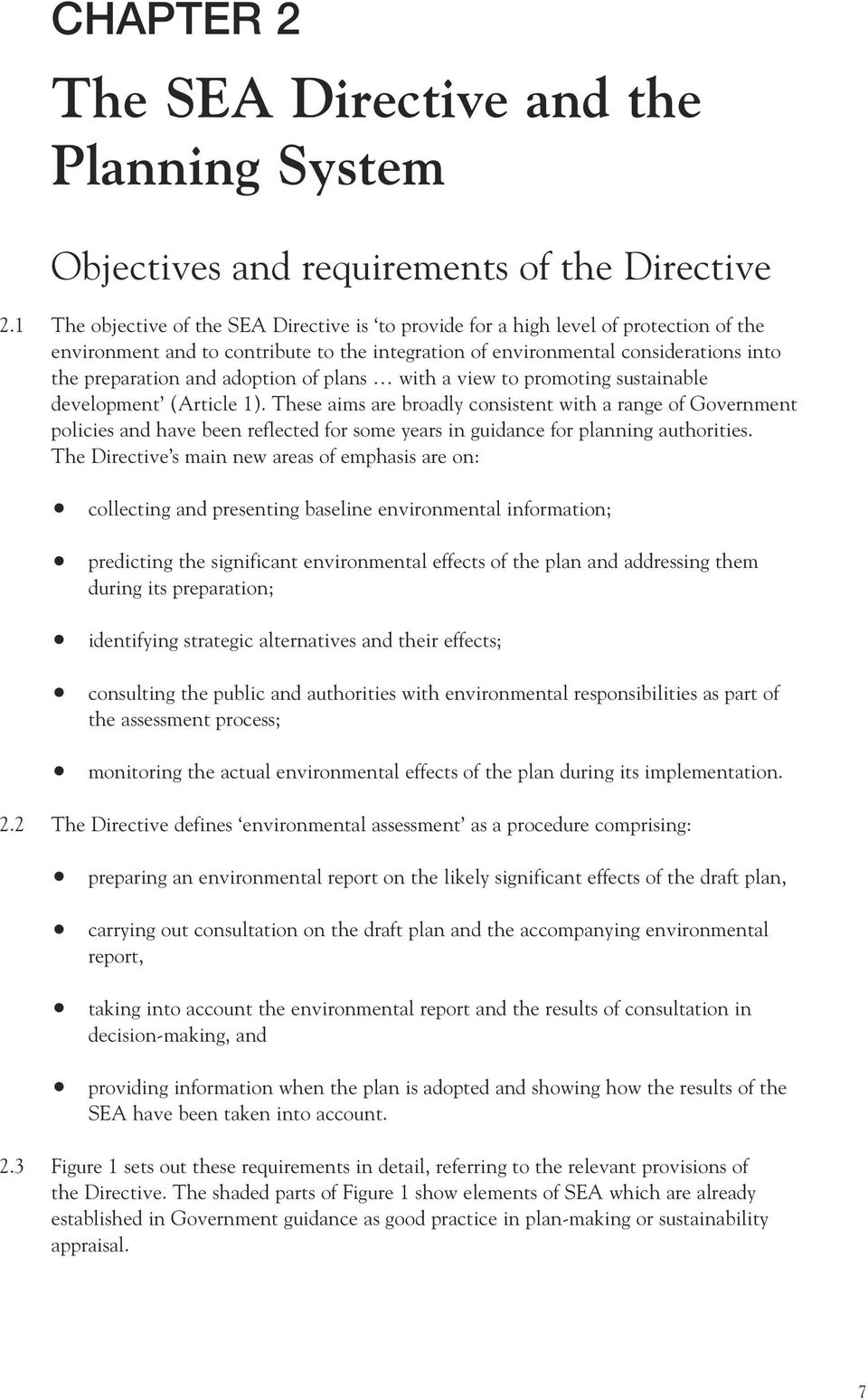
8 The Strategic Environmental Assessment Directive: Guidance for Planning Authorities Figure 1: Requirements of Directive 2001/42/EC 8 Requirements Where = already generally carried out as part of good practice in covered in plan-making and/or sustainability appraisal Chapter 3 Preparing an environmental report in which the likely significant effects on the environment of implementing the plan, and reasonable alternatives taking into account the objectives and geographical scope of the plan, are identified, described and evaluated. The information to be given is (Article 5 and Annex I): a) An outline of the contents, main objectives of the plan, and relationship A, B with other relevant plans and programmes; b) The relevant aspects of the current state of the environment and the likely evolution thereof without implementation of the plan; c) The environmental characteristics of areas likely to be significantly affected; d) Any existing environmental problems which are relevant to the plan including, in particular, those relating to any areas of a particular environmental importance, such as areas designated pursuant to Directives 79/409/EEC and 92/43/EEC; e) The environmental protection objectives, established at international, Community or national level, which are relevant to the plan and the way those objectives and any C environmental considerations have been taken into account during its preparation; f) The likely significant effects on the environment, including on issues such as biodiversity, population, human health, fauna, flora, soil, water, air, climatic factors, material assets, cultural heritage including architectural and archaeological heritage, landscape and the interrelationship between the above factors. (These effects should include secondary, cumulative, synergistic, short, medium and long-term permanent and temporary, positive and negative effects); g) The measures envisaged to prevent, reduce and as fully as possible offset any D significant adverse effects on the environment of implementing the plan; h) An outline of the reasons for selecting the alternatives dealt with, and a description of how the assessment was undertaken including any difficulties (such as technical D, E deficiencies or lack of know-how) encountered in compiling the required information; i) a description of measures envisaged concerning monitoring in accordance with Article 10; j) a non-technical summary of the information provided under the above headings The report must include the information that may reasonably be required taking into account current knowledge and methods of assessment, the contents and level of detail in the plan, its stage in the decision-making process and the extent to which certain matters are more appropriately assessed at different levels in that process to avoid duplication of the assessment (Article 5.2) Consulting: authorities with environmental responsibilities, when deciding on the scope and level of detail of the information which must be included in the environmental report (Article 5.4) authorities with environmental responsibilities and the public, to give them an early and effective opportunity within appropriate time frames to express their opinion on the draft plan and the accompanying environmental report before the adoption of the plan (Article 6.1, 6.2) other EU Member States, where the implementation of the plan is likely to have significant effects on the environment in these countries (Article 7). Taking the environmental report and the results of the consultations into account in decision-making (Article 8) B B, D B, C, D Providing information on the decision: When the plan is adopted, the public and any countries consulted under Article 7 must be informed and the following made available to those so informed: the plan as adopted D a statement summarising how environmental considerations have been integrated into the plan and how the environmental report of Article 5, the opinions expressed pursuant to Article 6 and the results of consultations entered into pursuant to Article 7 have been taken into account in accordance with Article 8, and the reasons for choosing the plan as adopted, in the light of the other reasonable alternatives dealt with; and the measures decided concerning monitoring (Article 9) Monitoring the significant environmental effects of the plan s implementation (Article 10) E
9 The SEA Directive and the Planning System SEA and the planning process 2.4 To be effective, SEA should be fully integrated into the plan-making process. It should be started as soon as a new or revised plan is first considered, and should make inputs at each stage where decisions are taken. It should also be used in developing the arrangements for monitoring the implementation of the plan, in order to identify problems and inform the next revision or replacement. 2.5 Figure 2 shows the links between the planning process and SEA under the Directive. SEA and Sustainability Appraisal 2.6 The integrated treatment of economic, environmental and social issues is a key principle of the Government s Sustainable Development Strategy, set out in A Better Quality of Life: A strategy for sustainable development for the UK. Planning authorities are already required to have regard to economic, environmental and social considerations when preparing development plans, and Policy Planning Guidance notes and other ODPM publications reflect this approach. 2.7 Subject to approval by Parliament, Sustainability Appraisal will be mandatory for Local Development Documents (LDDs) and Regional Spatial Strategies (RSSs) under the Planning and Compulsory Purchase Bill. It is intended to define the future requirements for Sustainability Appraisals so as to make clear to authorities that in carrying them out, they must fully meet the requirements of the SEA Directive. ODPM will produce guidance for authorities on sustainability appraisal when the new planning system is brought into effect. This will give further details on social and economic issues to be addressed and on the relationships between SEA and Sustainability Appraisal. 2.8 Meanwhile, the present guidance gives some indications of how an SEA can form part of a Sustainability Appraisal which also examines the social and economic effects of a plan. These parts of the guidance do not aim to be comprehensive, but only to suggest what types of effect could be considered beyond the scope of SEA and how they might be measured and presented. References to sustainability are given in italics throughout this guidance to highlight the distinction between sustainability appraisal and SEA. 9
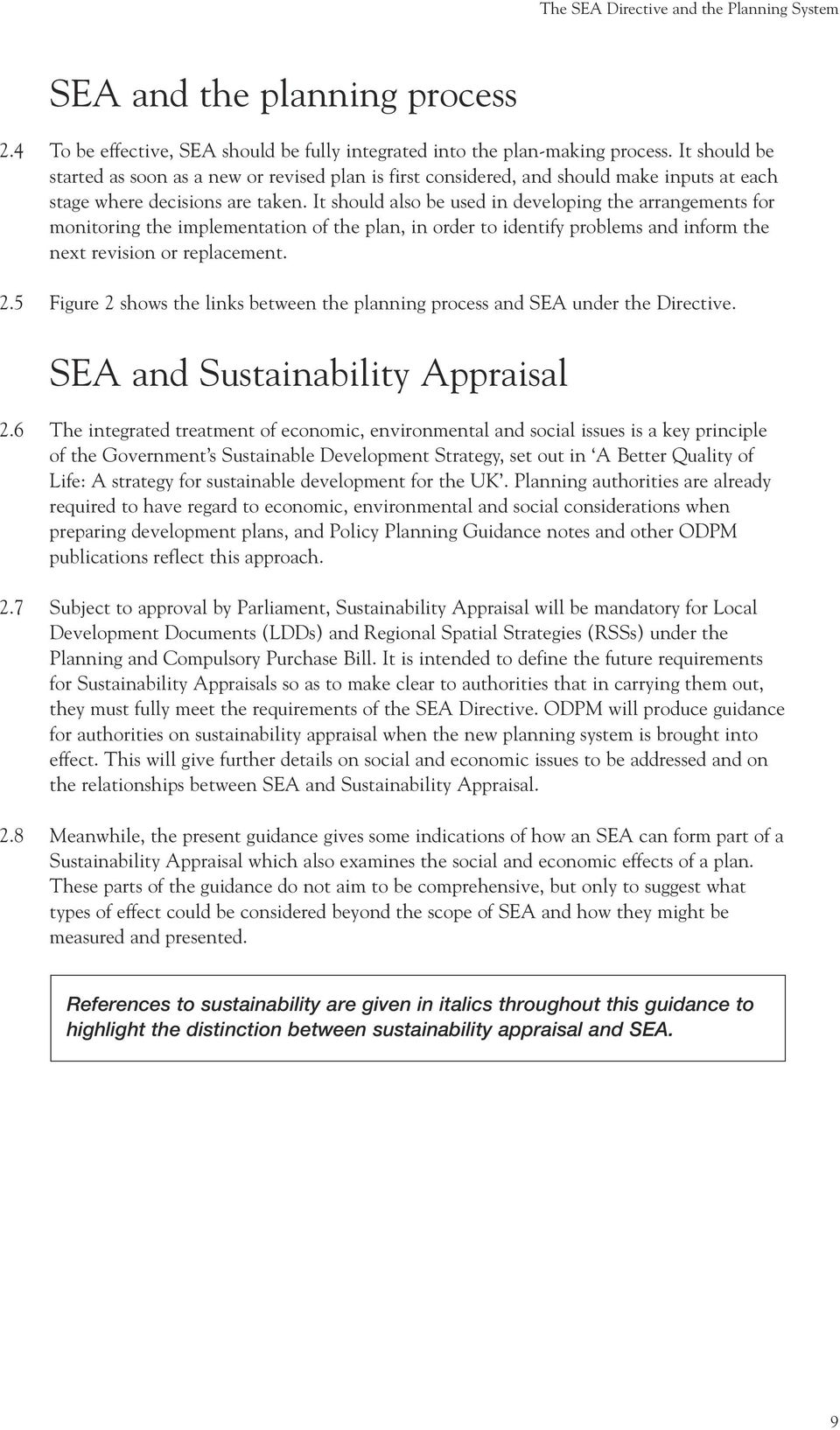
10 The Strategic Environmental Assessment Directive: Guidance for Planning Authorities Figure 2: Stages of plan-making and SEA Stages of plan-making Key stages are shown in bold. Detailed activities are in light type. Stages of SEA (and Sustainability Appraisal where relevant) Requirements of the Directive are in bold. Guidance on methods is in light type. Identify issues and options and Prepare Environmental Report on the likely prepare for consultation significant environmental effects of the plan The ODPM guidance publication Making Plans or programme and reasonable alternatives suggests the following activities among others (Article 5 and Annex I) at this stage: The initial stages of SEA/sustainability appraisal Undertaking a policy context review can be carried out in parallel with the issues Carrying out assessment of adopted plan and options stage of plan-making. This will Carrying out research and studies usually be the best time for: Developing strategic options Identifying plans, programmes and Developing a participation strategy environmental protection objectives Preparing the issues and options report relevant to the SEA Developing SEA and sustainability appraisal objectives, if these are to be used Collecting data to establish environmental and sustainability baselines and identify problems Identifying alternatives to be assessed Consult public on issues and options Consult authorities with environmental Prepare the plan for formal consultation stage responsibilities on the scope of the Assess responses to consultation on Environmental Report (Article 5.4) issues and options The Directive does not require public Develop preferred strategy consultation until the Environmental Report on Identify proposals to be taken forward the draft plan is finalised, but authorities may Develop policies find it useful to publish environmental and Draft the plan sustainability information in support of the issues and options report. Public feedback at this stage may also provide more information for the Environmental Report or sustainability appraisal. Full public consultation/participation on Make the Environmental Report on the draft proposed plan (the deposit stage under plan available to the public and the existing system) environmental authorities and give them the Publication of plan (corresponding to what opportunity to express opinions (Article 6) the Directive terms the draft plan ) At this stage the Environmental Report should Public consideration and participation comply fully with Directive Annex I. It should Analysis of representations therefore cover: Negotiations with objectors the effects of the plan, including alternatives Consultation may take place in several stages, still under consideration, on the environment including examination. This table does not make proposals for mitigating adverse effects any assumption about the number of stages or proposals for monitoring how the public is involved at any given point Depending on the extent of changes to the plan during consultation. during this stage, revisions may be needed to the Environmental Report/sustainability appraisal Finalise and adopt plan Take account of the Environmental Report Amendments to the plan (including changes and opinions from consultees (Article 8) stemming from SEA or sustainability appraisal) Integrate environmental and sustainability Inspector s modifications considerations to amendments and modifications to plan. Publish adopted plan Monitor plan implementation Publish information on how the Environmental Report and consultees opinions were taken into account, reasons for choice of alternatives, and proposals for monitoring (Article 9). During implementation, monitor significant environmental effects (Article 10) 10
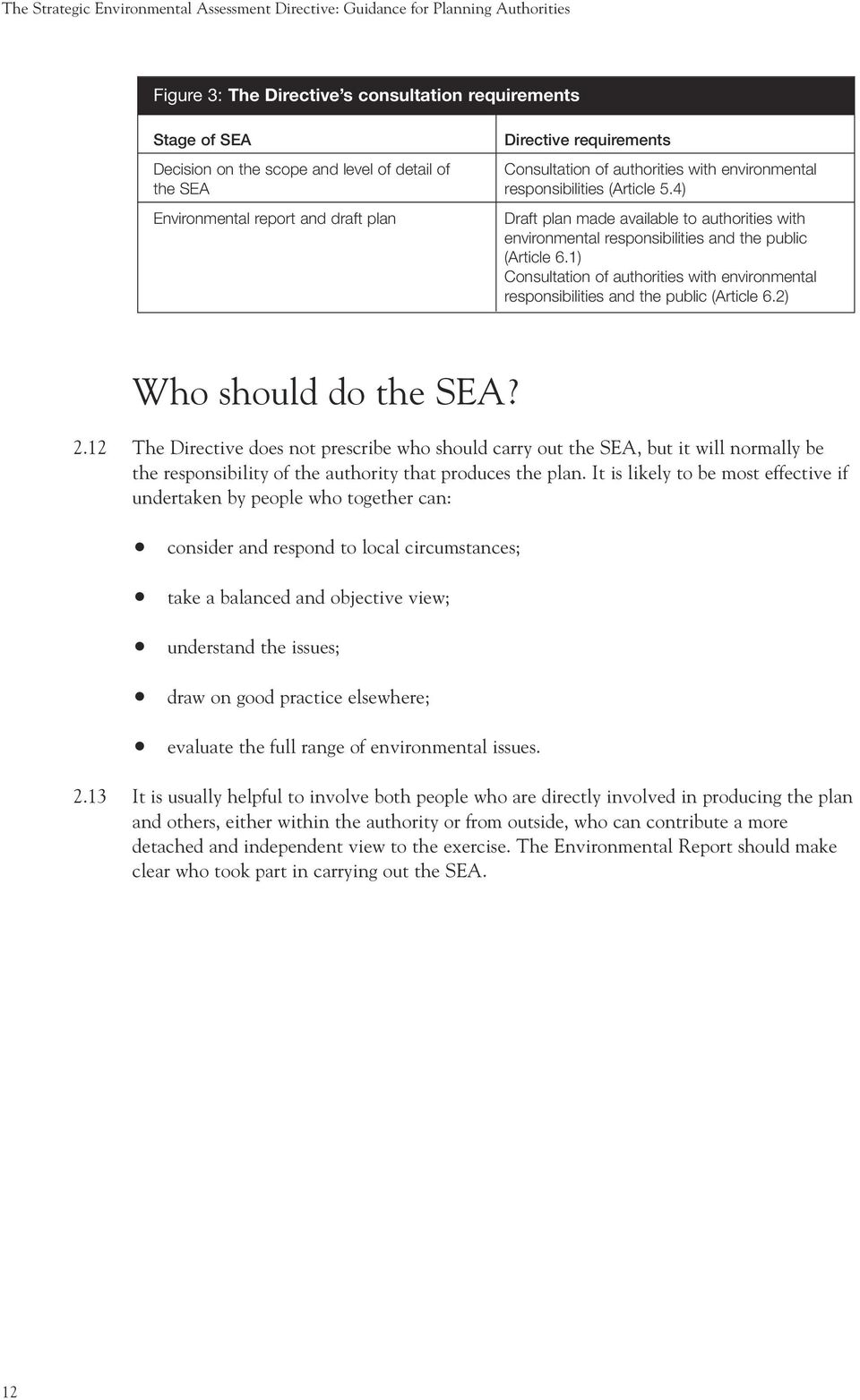
11 The SEA Directive and the Planning System Plans for which SEA is not always required 2.9 For plans which determine the use of small areas at local level or are minor modifications to existing plans, the Directive only requires SEA where they are likely to have significant environmental effects. The expressions small area, local level and minor modification are not defined in the Directive, and must be interpreted in relation to the nature and scope of a particular plan. Screening is needed to determine whether such plans are likely to have significant environmental effects. Annex II of the Directive lists criteria for determining the likely significance of the environmental effects of plans In the planning field, under the Planning and Compulsory Purchase Bill, planning documents will be either RSSs or LDDs. For all of these, authorities will be required to carry out a Sustainability Appraisal. The predicted environmental effects of the policies and proposals in the document will need to be assessed to the extent necessary to meet the Directive s requirements, either for a full SEA or to establish clearly that this is not needed, while satisfying the requirements of Sustainability Appraisal. Consultation 2.11 The Directive requires consultation at two stages, summarised in Figure 3: When preparing the Environmental Report, the plan-making authority must consult other authorities which, by reason of their environmental responsibilities, are likely to be concerned by the environmental effects [of the plan]. For England, these are the Environment Agency, Countryside Agency, English Nature and English Heritage. Authorities already consult these and a wide range of other bodies under the existing arrangements when preparing plans. Chapter 3 below suggests how to integrate this part of the Directive s requirements into wider consultation at this stage of plan-making. The plan-making authority must consult the public affected or likely to be affected or having an interest, and the authorities with environmental responsibilities, on the draft plan and the Environmental Report. Existing UK provisions on consultation on the proposed plan are sufficient to comply with the Directive, and the main new requirement is to make the Environmental Report available. Other EU Member States should also be consulted if their environment is likely to be significantly affected by the plan, but this is likely to be relatively rare for plans covered by this guidance. 11

12 The Strategic Environmental Assessment Directive: Guidance for Planning Authorities Figure 3: The Directive s consultation requirements Stage of SEA Directive requirements Decision on the scope and level of detail of Consultation of authorities with environmental the SEA responsibilities (Article 5.4) Environmental report and draft plan Draft plan made available to authorities with environmental responsibilities and the public (Article 6.1) Consultation of authorities with environmental responsibilities and the public (Article 6.2) Who should do the SEA? 2.12 The Directive does not prescribe who should carry out the SEA, but it will normally be the responsibility of the authority that produces the plan. It is likely to be most effective if undertaken by people who together can: consider and respond to local circumstances; take a balanced and objective view; understand the issues; draw on good practice elsewhere; evaluate the full range of environmental issues It is usually helpful to involve both people who are directly involved in producing the plan and others, either within the authority or from outside, who can contribute a more detached and independent view to the exercise. The Environmental Report should make clear who took part in carrying out the SEA. 12
13 CHAPTER 3 Stages of SEA Introduction 3.1 This Chapter gives stage-by-stage advice on the Directive s requirements, the decisions to be taken and the documentation to be provided. More detailed information on specific aspects of SEA is given in a series of Appendices. 3.2 This guidance is intended to be valid for all plans from regional to local level. In practice an SEA or sustainability appraisal should always be adapted to the scale and nature of the plan in question. 3.3 Figure 4 summarises the main decisions required at each plan-making stage for both SEA and sustainability appraisal, and how these are recorded. SEA and sustainability appraisal are tools for improving the plan, not post-hoc snapshots. Start them early, integrate the SEA/sustainability appraisal processes wherever possible, and make them interact with the plan-making process. Always aim to involve your decision-makers in the process. 13

14 The Strategic Environmental Assessment Directive: Guidance for Planning Authorities Figure 4: Stages, decisions and outputs of SEA and sustainability appraisal Planning stage SEA or Sustainability Appraisal stage The purpose of this stage What to decide What to record Identify the issues and options and prepare for consultation Consultation on issues and options A. Setting the context and establishing the baseline Identify other relevant plans and programmes Identify environmental protection objectives, and state their relation to the plan Propose SEA and sustainability appraisal objectives. Propose indicators. Collect baseline data, including data on likely future trends Identify environmental and sustainability problems B. Deciding the scope of SEA and developing alternatives Identify alternatives Choose preferred alternatives Consult authorities with environmental responsibilities and other bodies concerned with aspects of sustainability Document how the plan is affected by outside factors; suggest ideas for how any inappropriate constraints can be addressed Focus on key environmental and sustainability issues; help to identify SEA and sustainability problems, objectives and alternatives Streamline the subsequent baseline description, prediction and monitoring stages Provide a base for effects prediction and monitoring Clarify baseline, identify problems and alternatives Ensure that the SEA and sustainability appraisal covers key issues Help to ensure that the plan is sustainable What other plans, programmes and environmental protection objectives influence the plan What environmental/ sustainability objectives and indicators to test the plan options and policies against What data to collect and how to structure it so it can be easily used What environmental/ sustainability problems to consider during plan-making What alternatives to consider, possibly linked to each problem identified in Stage A What to include in the draft report List of relevant plans, programmes and environmental protection objectives List of SEA/ sustainability appraisal objectives and indicators Data on environmental/ sustainability baseline List of relevant environmental/ sustainability problems List of alternatives Results of Stages A-B 14

15 Stages of SEA Figure 4: Stages, decisions and outputs of SEA and sustainability appraisal (cont d) Planning stage SEA or Sustainability Appraisal stage The purpose of this stage What to decide What to record Prepare proposed plan Full public consultation on proposed plan Monitor plan implementation C. Assessing the effects of the plan Predict the effects of the plan Evaluate the plan's effects Propose measures to prevent, reduce or offset adverse environmental effects D. Consulting on the draft plan and the Environmental Report Present the results of the SEA up to this point Seek inputs from the public and authorities with environmental responsibilities Take consultation results into account Show how the results of the Environmental Report were taken into account in finalising the plan E. Monitor the significant effects of implementing the plan on the environment Consider all likely effects Ensure that all relevant effects are identified and proposed mitigation measures are considered Gather more information on the baseline and problems Discover the opinions and concerns of the public on environmental/ sustainability issues Show that information and opinions on environmental/ sustainability issues have been appropriately considered Ensure that plan is well implemented and feeds into future plans or reviews Ensure that adverse effects can be identified Provide information for future SEAs/ sustainability appraisals What the effects of specific options, policies and proposals will be How any adverse effects of implementing plan policies can be avoided, reduced or offset (mitigated) The preferred alternatives How to present the information Who to consult (in addition to statutory consultees) and how How to analyse to consultation results How to measure the actual effects of plan on the environment and sustainability Effects of the plan options, policies and proposals List of preferred alternatives and explanation of why these are preferred Proposed mitigation measures and how they will be implemented What methods have been used to analyse data and limitations Draft Environmental Report Consultation process Proposed monitoring programme 15

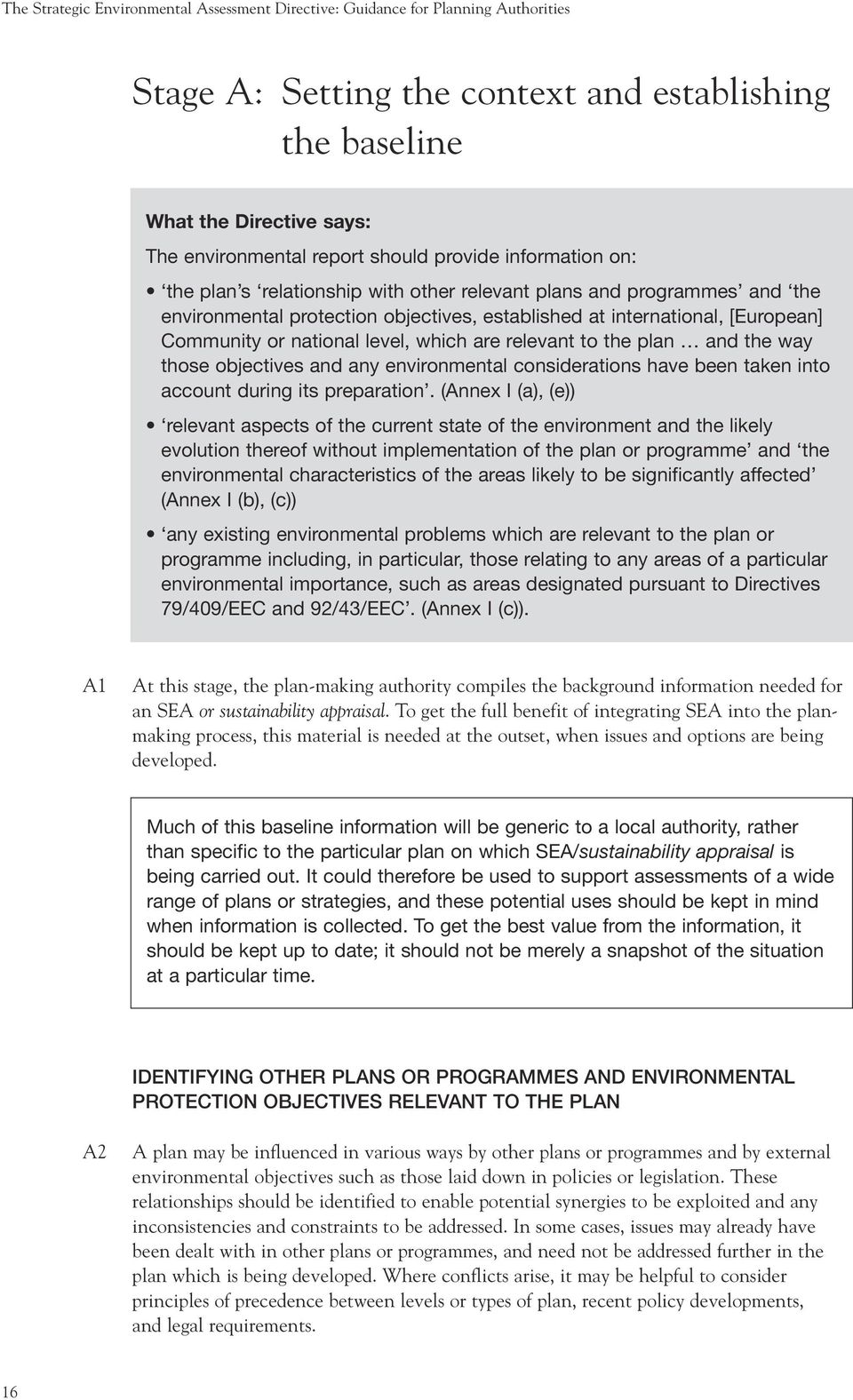
16 The Strategic Environmental Assessment Directive: Guidance for Planning Authorities Stage A: Setting the context and establishing the baseline What the Directive says: The environmental report should provide information on: the plan s relationship with other relevant plans and programmes and the environmental protection objectives, established at international, [European] Community or national level, which are relevant to the plan and the way those objectives and any environmental considerations have been taken into account during its preparation. (Annex I (a), (e)) relevant aspects of the current state of the environment and the likely evolution thereof without implementation of the plan or programme and the environmental characteristics of the areas likely to be significantly affected (Annex I (b), (c)) any existing environmental problems which are relevant to the plan or programme including, in particular, those relating to any areas of a particular environmental importance, such as areas designated pursuant to Directives 79/409/EEC and 92/43/EEC. (Annex I (c)). A1 At this stage, the plan-making authority compiles the background information needed for an SEA or sustainability appraisal. To get the full benefit of integrating SEA into the planmaking process, this material is needed at the outset, when issues and options are being developed. Much of this baseline information will be generic to a local authority, rather than specific to the particular plan on which SEA/sustainability appraisal is being carried out. It could therefore be used to support assessments of a wide range of plans or strategies, and these potential uses should be kept in mind when information is collected. To get the best value from the information, it should be kept up to date; it should not be merely a snapshot of the situation at a particular time. IDENTIFYING OTHER PLANS OR PROGRAMMES AND ENVIRONMENTAL PROTECTION OBJECTIVES RELEVANT TO THE PLAN A2 A plan may be influenced in various ways by other plans or programmes and by external environmental objectives such as those laid down in policies or legislation. These relationships should be identified to enable potential synergies to be exploited and any inconsistencies and constraints to be addressed. In some cases, issues may already have been dealt with in other plans or programmes, and need not be addressed further in the plan which is being developed. Where conflicts arise, it may be helpful to consider principles of precedence between levels or types of plan, recent policy developments, and legal requirements. 16
17 Stages of SEA A3 The results of this exercise can be documented as a table which shows the requirements of the other plans, programmes or objectives concerned, the constraints or challenges they pose, and how the plan might take account of them. Appendix 2 gives indicative lists of plans and programmes which may be relevant and of environmental protection and sustainability objectives. DEVELOPING OBJECTIVES AND INDICATORS A4 The Directive does not specifically require the use of objectives or indicators for the SEA, but they are a recognised way in which environmental and sustainability effects can be described, analysed and compared. They can be revised as baseline data is collected and environmental or sustainability problems are identified, and can be used in monitoring the implementation of the plan. Targets associated with the objectives or indicators can be identified as part of the analysis of relevant plans, programmes and objectives, or they can be devised specifically for the SEA or sustainability appraisal. Objectives and indicators should be developed in consultation with authorities with environmental responsibilities if possible, and revisited in the light of the baseline data and any problems identified. Poorly designed objectives or indicators will give misleading SEA results. A5 The setting of achievement-orientated sustainability objectives is an important step in carrying out a sustainability appraisal. They can be developed by the same processes as those for SEA. Sustainability indicators such as those published by the former Department of the Environment, Transport and the Regions (DETR) for the UK Sustainable Development Strategy ( Quality of Life Counts ) or in the Good Practice Guide for Sustainability Appraisal of Regional Planning Guidance may provide a useful basis (details of these publications are given in References and further information below). Appendix 3 explains how SEA and sustainability appraisal objectives and indicators can be devised, ideally in consultation with stakeholders. COLLECTING BASELINE DATA A6 Baseline data provides the basis for prediction and monitoring of environmental or other sustainability effects, and helps to identify problems and alternative ways of dealing with them. Sufficient data about the current and likely future state of the environment should be collected to allow the plan s effects to be adequately predicted. 17

18 The Strategic Environmental Assessment Directive: Guidance for Planning Authorities A7 For each indicator selected, enough data should be collected to answer the following questions: How good or bad is the current situation? Do trends show that it is getting better or worse? How far is the current situation from any established thresholds or targets? Are particularly sensitive or important elements of the receiving environment affected: people, resources, species, habitats? Are the problems reversible or irreversible, permanent or temporary? How difficult would it be to offset or remedy any damage? Have there been significant cumulative or synergistic effects over time? Are there expected to be such effects in the future? Appendix 4 lists some key sources for baseline data. Appendix 5 suggests how baseline information can be presented. In theory, collection of baseline data could go on indefinitely. A practical approach is essential. Set a time limit for data collection. Do not expect to be able to obtain all relevant data in the first SEA of a plan, but make arrangements to fill any major gaps for future plans or reviews. A8 Where baseline information is unavailable or unsatisfactory, authorities should consider how they could improve it for use in assessments of future plans. The need for better data will be an important consideration when deciding how to monitor the implementation of the plan see Stages C, D and E below. IDENTIFYING ENVIRONMENTAL AND SUSTAINABILITY PROBLEMS A9 Authorities will be well aware of many environmental and sustainability problems which they currently face. It may however also be useful to look for potential problems, e.g. where there are conflicts between current or future baseline conditions and objectives, targets or obligations. 18
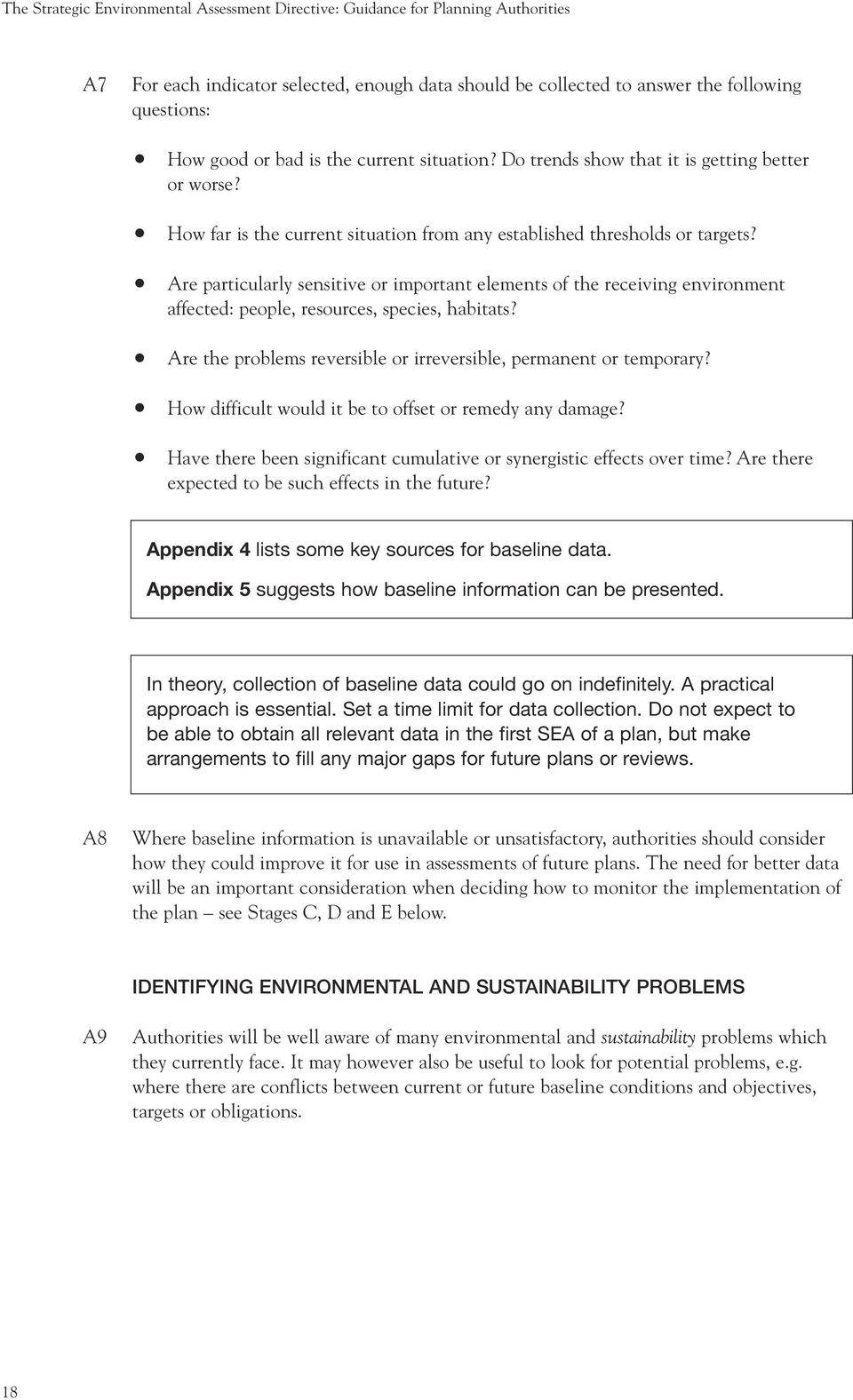
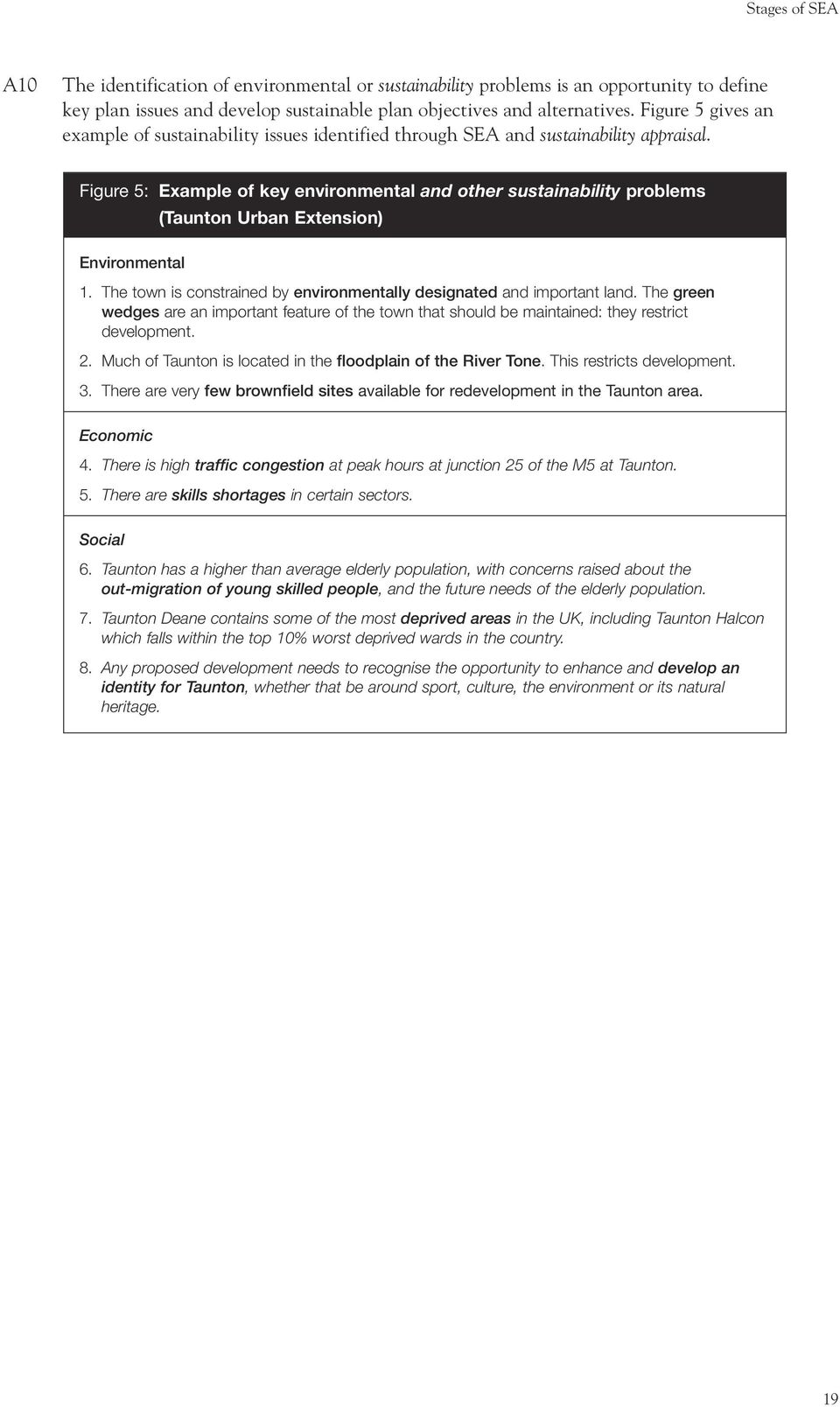
19 Stages of SEA A10 The identification of environmental or sustainability problems is an opportunity to define key plan issues and develop sustainable plan objectives and alternatives. Figure 5 gives an example of sustainability issues identified through SEA and sustainability appraisal. Figure 5: Example of key environmental and other sustainability problems Environmental (Taunton Urban Extension) 1. The town is constrained by environmentally designated and important land. The green wedges are an important feature of the town that should be maintained: they restrict development. 2. Much of Taunton is located in the floodplain of the River Tone. This restricts development. 3. There are very few brownfield sites available for redevelopment in the Taunton area. Economic 4. There is high traffic congestion at peak hours at junction 25 of the M5 at Taunton. 5. There are skills shortages in certain sectors. Social 6. Taunton has a higher than average elderly population, with concerns raised about the out-migration of young skilled people, and the future needs of the elderly population. 7. Taunton Deane contains some of the most deprived areas in the UK, including Taunton Halcon which falls within the top 10% worst deprived wards in the country. 8. Any proposed development needs to recognise the opportunity to enhance and develop an identity for Taunton, whether that be around sport, culture, the environment or its natural heritage. 19
20 The Strategic Environmental Assessment Directive: Guidance for Planning Authorities Stage B: Deciding the scope of SEA and developing alternatives What the Directive says: The environmental report should consider reasonable alternatives (to the plan) taking into account the objectives and the geographical scope of the plan and give an outline of the reasons for selecting the alternatives dealt with (Article 5.1 and Annex I (h)) Authorities which, by reason of their specific environmental responsibilities, are likely to be concerned by the environmental effects of implementing plans and programmes shall be consulted when deciding on the scope and level of detail of the information which must be included in the environmental report (Article 5.4). B1 At this stage, the plan-making authority decides the scope of the Environmental Report, what alternatives and types of effect to assess, and what level of detail to present. Stage B activities will often take place in parallel with the development of, and public consultation on, plan issues and options. Further details on the final form and publication of the Environmental Report are given at Stage D. While the activities at Stage A can be carried out before work begins on the plan, those at Stage B are integral to the plan-making process and cannot be done effectively in isolation from it. IDENTIFYING ALTERNATIVES AND CHOOSING PREFERRED ALTERNATIVES B2 B3 B4 The SEA Directive refers to alternatives, while the term option is more commonly used in the UK planning context. This guidance assumes that the two terms normally mean the same thing. Plan-making has always involved choices between different options for handling issues such as housing, transport, employment and the environment. SEA and sustainability appraisal are tools for helping authorities to identify sustainable approaches for dealing with key planning issues and the environmental problems identified in Stage A, and to consider the benefits and drawbacks of each. The alternatives considered at this stage of plan-making will usually be strategic. More detailed alternatives can be considered during the formulation of policies and proposals. Appendix 7 gives more detail on identifying and comparing alternatives. 20
21 Stages of SEA B5 At this stage it may be possible to drop some alternatives from further consideration. Reasons for eliminating alternatives should always be documented. Where necessary, authorities should also document why they have not considered alternatives which might appear attractive or practicable. Justifications for these choices should be robust, as they can affect decisions on major developments and may have to be defended in court. CONSULTING AUTHORITIES WITH ENVIRONMENTAL RESPONSIBILITIES B6 B7 The Government proposes to designate the Environment Agency, the Countryside Agency, English Nature and English Heritage as authorities [with] environmental responsibilities which must be consulted by plan-making authorities in England on the content of the Environmental Report. Consultation at this stage helps to ensure that the SEA will be comprehensive and robust enough to support the plan during the later stages of full public consultation and examination. Plan-making authorities should discuss the practicalities of consultation with these organisations in order to maximise the value of their input. If possible, it is recommended that the plan-making authority should aim at this stage to produce a draft or outline of the Environmental Report covering: The draft plan objectives (these may be included in the issues and options report) The other plans, programmes and objectives relevant to the plan, with information on potential synergies or conflicts Baseline data, either already collected or still needed, with notes on sources and any problems encountered Environmental problems and constraints, and how these were identified Suggested SEA objectives, indicators and targets, where these are proposed, and how they were chosen The options which it is proposed to consider in more detail Suggestions on methodology for the rest of the SEA Proposals for the structure and level of detail of the Environmental Report. B8 The Directive does not require full consultation with the public until the Environmental Report on the draft plan is finalised (see Stage D). But in practice authorities may find it useful to publish environmental and sustainability information in parallel with Stage B, in support of the issues and options report. This will help to inform discussion at this stage, and feedback from the public may also provide more information or highlight new issues for the Environmental Report or sustainability appraisal. 21
22 The Strategic Environmental Assessment Directive: Guidance for Planning Authorities Stage C: Assessing the effects of the plan What the Directive says: In the Environmental Report, the likely significant effects on the environment of implementing the plan and reasonable alternatives are [to be] identified, described and evaluated (Article 5.1). The Environmental Report should include information that may reasonably be required taking into account current knowledge and methods of assessment, the contents and level of detail in the plan [and] its stage in the decisionmaking process (Article 5.2). Information to be provided in the Environmental Report includes: the likely significant effects on the environment, including on issues such as biodiversity, population, human health, fauna, flora, soil, water, air, climatic factors, material assets, cultural heritage including architectural and archaeological heritage, landscape and the interrelationship between the above factors. These effects should include secondary, cumulative, synergistic, short, medium and long-term, permanent and temporary, positive and negative effects (Annex I (f) and footnote) an outline of the reasons for selecting the alternatives dealt with (Annex I (h)) the measures envisaged to prevent, reduce and as fully as possible offset any significant adverse effects on the environment of implementing the plan (Annex I (g)) C1 Authorities should seek to predict and evaluate the effects of elements of the evolving plan options, policies, proposals and revisions while they are working on them. Where adverse effects are seen to be likely, possibilities for mitigation should be considered. Aspects of Stage C may need to be carried out more than once in the course of a plan s development. PREDICTING THE EFFECTS OF THE PLAN C2 Prediction of effects involves: Identifying the changes to the environmental or sustainability baseline which are predicted to arise from the plan and options. These can be compared both with each other and with no plan or business as usual scenarios. Note that no plan and business as usual scenarios can still involve changes to the baseline. Describing these changes in terms of their magnitude, their geographical scale, the time period over which they will occur, whether they are permanent or temporary, positive or negative, probable or improbable, frequent or rare, and whether or not there are cumulative and/or synergistic effects. 22
23 Stages of SEA C3 C4 Predictions do not have to be expressed in quantitative terms. Hard data may enable planmaking authorities or expert advisers to make detailed quantitative predictions, and this can be particularly useful where a plan s effects are uncertain, close to a threshold, or cumulative. But quantification is not always practicable, and broad-based and qualitative predictions can be equally valid and appropriate. As in current practice, these may be expressed in easily understood terms such as getting better or worse or a scale from ++ (very positive) to (very negative). It can be useful to link predictions to specific objectives, e.g. will the plan or proposal promote change in a desired direction?. However, qualitative should not mean guessed. Predictions should be supported by evidence, such as references to any research, discussions or consultation which helped the SEA or sustainability appraisal team to reach its conclusions. The Environmental Report should document any uncertainties or limitations in the information underlying the prediction. Assumptions, for instance about underlying trends (e.g. growth in housing numbers) or details of development design (e.g. amount of parking), should also be clearly stated. EVALUATION OF EFFECTS C5 C6 C7 Evaluation involves forming a judgement on whether or not a predicted effect will be environmentally significant. The criteria of significance in Annex II of the Directive are relevant when considering specific effects, e.g. its scale and permanence and the nature and sensitivity of the receiving environment. It will may also be helpful to refer to the baseline data and indicators defined at Stage A. Figure 6 suggests a format for integrating the prediction and evaluation of effects and summarising the findings of this stage. This is very similar to the tables used for environmental and sustainability appraisal, but puts more emphasis on mitigation and enhancement measures. Appendix 8 gives more explanation of how to fill out this table. When filling in Figure 6, the SEA team should consider, for each option, policy or proposal concerned: Is it clear exactly what is proposed? Is the option, policy or proposal likely to have a significant adverse effect in relation to each of the environmental objectives or targets from Stage A? If so, can the effect be avoided or its severity reduced? If the effect cannot be avoided, e.g. by conditions or changes to the way it is implemented, can the option be changed or eliminated? If its effect is uncertain, or depends on how the plan is implemented, how can this uncertainty be reduced? The point of the assessment is not to fill in the table, but to ensure that the option, policy or proposal is as environmentally beneficial or as sustainable as possible. The table is only a tool for doing this. 23
24 The Strategic Environmental Assessment Directive: Guidance for Planning Authorities Figure 6: Illustration of documentation of effects SEA/ Sustainability Appraisal objective from Stage A Target from Stage A (where available) Can the effect be quantified? (if yes, insert data) Effects on the environment over time + positive negative o neutral Comments/ explanation (e.g. significance, reversibility etc.) short medium long term term term protect biodiversity at ecosystem, species and genetic levels 10% increase per 10 year period in sites with land managed to wildlife o + ++ promote positive health related behaviour 10% increase in children walking or cycling to school by 2007 o + + Additional information on changes to the option, proposals for mitigation, etc: C8 The Directive requires the analysis of effects to include short, medium and long-term, permanent and temporary effects (Annex I(f)). Effects may vary over different timescales; for example, public transport infrastructure construction may have serious adverse effects in the short term but positive ones in the long term. The timescales themselves will also vary depending on the type of plan and the alternatives being considered. For air pollution, for instance, the short, medium and long terms could be 3, 10 and 25 years, while for climate change they could be 5, 20 and 100 years. Figure 6 allows short, medium and long timescales to be differentiated and specified as appropriate for particular types of effect. Appendix 8 gives further guidance on prediction and evaluation of effects. MITIGATION OF ADVERSE EFFECTS C9 C10 The Environmental Report should include information on the measures proposed to prevent, reduce or offset any significant adverse effects that implementing the plan is expected to have on the environment. For convenience, these are referred to in this guidance as mitigation measures, but this should be understood to include proactive avoidance of adverse effects as well as actions taken after effects are noticed. Mitigation can take a wide range of forms. Some adverse effects might be avoided through changes to the plan, such as adding, deleting or refining policies and proposals or bringing forward new alternatives. Where environmental impacts cannot be avoided, it may be possible to limit damage. Mitigation could also be put into effect through provisions in later plans such as Supplementary Planning Documents, or planning conditions for particular types of development. 24
25 Stages of SEA Stage D: Consultation on the Draft Plan and Environmental Report What the Directive says: The authorities [with relevant environmental responsibilities] and the public shall be given an early and effective opportunity within appropriate time frames to express their opinion on the draft plan and the accompanying environmental report before the adoption of the plan (Article 6(2)). The environmental report, the opinions expressed [by consultees] and the results of any transboundary consultations shall be taken into account during the preparation of the plan and before its adoption (Article 8). When a plan is adopted, the [environmental] authorities [and] the public are informed and the following items [shall be] made available to those so informed: (a) the plan as adopted, (b) a statement summarising how environmental considerations have been integrated into the plan and (c) the measures decided concerning monitoring (Article 9(1)). THE ENVIRONMENTAL REPORT D1 D2 The Environmental Report is a key output of SEA. It is intended to reflect and support the draft plan, the Directive s term for the proposed plan on which formal public consultation is carried out. The Environmental Report must be made available at the same time as the draft plan, as an integral part of the consultation process, and the relationship between the two documents should be clearly indicated. Annex I of the Directive lists the information to be provided in the Environmental Report (see also Figure 1 above). In essence the report should document: The baseline situation, including any problems The predicted effects of the draft plan and how they were evaluated How the preferred options were chosen How environmental considerations were taken into account in the plan How mitigation measures have been incorporated into the plan The proposed monitoring arrangements D3 Where plans go thorough several successive consultation exercises, the implications for the Environmental Report should be kept under review. If alterations to the plan are likely to change the effects which have been predicted and evaluated, new information should be made available as appropriate. 25
26 The Strategic Environmental Assessment Directive: Guidance for Planning Authorities D4 Figure 7 proposes a structure for the Environmental Report. This structure is also suitable for a sustainability appraisal, but if an authority uses it in this way, it must show clearly the elements which meet the requirements of the Directive. Figure 7: Possible structure for the environmental report or sustainability appraisal Structure of report Summary and outcomes Methodology used Background Plan issues and alternatives Plan policies and proposals Implementation Information to include Non-technical summary What difference has the process made? Who carried out the SEA or sustainability appraisal, when, who was consulted, etc. Purpose of the SEA or sustainability appraisal Plan objectives Links to other plans, programmes and environmental protection and sustainability objectives Baseline environmental and sustainability data Environmental and sustainability problems Difficulties in collecting data, limitations of the data etc. Significant environmental and sustainability effects of the preferred alternatives How environmental and sustainability problems were considered in choosing the preferred alternatives Other alternatives considered, and why these were rejected Significant environmental and sustainability effects of the policies and proposals How environmental and sustainability problems were considered in developing the policies and proposals Proposed mitigation measures Links to project environmental impact assessment, design guidance etc. Proposals for monitoring DECISION MAKING AND PROVISION OF INFORMATION ON THE PLAN D5 D6 After consultation responses have been received from the public, authorities with environment responsibilities, and other countries where these have been consulted, the Directive requires them to be taken into account during the preparation of the evolving plan. Publication of adopted plans is a long-established principle of UK planning law, but to satisfy the Directive, authorities should make clear how they have taken the findings of the SEA into account. The statement on this should cover: Any changes to or deletions from the plan in response to the information in the Environmental Report or sustainability appraisal. Ways in which responses to consultation have been taken into account. The summary should be sufficiently detailed to show how the plan was changed to take account of issues raised, or why no changes were made. Monitoring measures. The environmental report will already have documented proposed measures concerning monitoring; these can now be confirmed or modified in the light of consultation responses. 26
27 Stages of SEA Stage E: Monitoring implementation of the plan What the Directive says: Member States shall monitor the significant environmental effects of the implementation of plans in order, inter alia, to identify at an early stage unforeseen adverse effects, and to be able to undertake appropriate remedial action (Article 10.1). The Environmental Report should provide information on a description of the measures envisaged concerning monitoring (Annex I (i)). E1 Monitoring allows the actual effects of the plan to be tested against those predicted in the SEA. It helps to ensure that problems which arise during implementation, whether or not they were foreseen, can be identified and future predictions made more accurately. It can also be used to provide baseline information for future plans. DEVELOPING AIMS AND METHODS FOR MONITORING E2 E3 E4 The Directive s provisions on monitoring apply when the plan is being put into effect, rather than during its preparation and adoption. But preparations for monitoring should not be treated as a separate exercise from the rest of the SEA/sustainability appraisal; decisions on what to monitor and how to do it should always be considered in the course of preparing the plan. Authorities should aim to use monitoring to fill any important gaps in baseline information, reduce uncertainties and test the accuracy of their predictions. Wherever possible, monitoring should be based on the indicators which have been used to describe the baseline environment and on the objectives of the plan and the SEA. By focusing on outcomes, monitoring can take account of cumulative and indirect as well as direct impacts. The Directive specifically requires monitoring to enable unforeseen adverse effects to be identified, but in many cases these will reflect incorrect predictions rather than completely unexpected outcomes. In many cases information used in monitoring will be provided by outside bodies, including those which provide baseline data (see Appendix 4). Plan-making authorities should take care to ensure that monitoring information is appropriate to their needs and is up to date and reliable. Proposals for and outputs from monitoring should state the sources of the information. RESPONDING TO ADVERSE EFFECTS E5 Authorities should consider how they could react if monitoring reveals adverse effects. While the Directive itself does not create new obligations on environmental protection, other legislation or policies may require action on the part of either the plan-making authority or another body. Details of any contingency arrangements could be included in the mitigation measures set out in the Environmental Report. 27
28 The Strategic Environmental Assessment Directive: Guidance for Planning Authorities E6 Figure 8 shows a possible format for documenting a proposed monitoring programme. This includes actions which could be taken if adverse effects were found. Figure 8: Possible format for a monitoring system Examples are illustrative only. SEA or Sustainability Appraisal objective What to monitor (indicator) Where do monitoring data come from? How often When should action be considered? What could be done if a problem is identified? protect biodiversity at ecosystem, species and genetic levels condition of designated sites and other sites of nature conservation importance English Nature, National Biodiversity Network, Wildlife Trusts.. every 2 years When condition gets worse consider ways of improving biodiversity protection, e.g. provision of wildlife corridors protect human health and amenity number of accidents per person-km travelled by car, foot, bike DfT, police annual When any of these gets 10% worse improvements to pedestrian and cycling facilities, traffic calming, new road layout to reduce accidents 28
29 Glossary Environmental appraisal: A form of environmental assessment used in the UK (primarily for development plans) since the early 1990s, supported by Environmental Appraisal of Development Plans: A Good Practice Guide (DoE, 1993); more recently superseded by sustainability appraisal. Some aspects of environmental appraisal foreshadow the requirements of the SEA Directive (see Figure 1). Environmental assessment: A tool for integrating environmental considerations into decision-making by ensuring that significant environmental effects of the decision are taken into account. In the SEA Directive, an environmental assessment means the preparation of an environmental report, the carrying out of consultations, the taking into account of the environmental report and the results of the consultations in decisionmaking and the provision of information on the decision, in accordance with the Directive s requirements. Environmental Report: Document required by the SEA Directive as part of an environmental assessment, which identifies, describes and evaluates the likely significant effects on the environment of implementing a plan or programme. Indicator: A measure of variables over time, often used to measure achievement of objectives. Input (or response) indicator: indicator that focuses on actions to be undertaken to achieve an outcome (e.g. installing catalytic converters in new cars to reduce air pollution), i.e. the means rather than the ends. Outcome indicator: indicator that focuses on the outcome sought (e.g. clean air) rather than how it should be achieved (e.g. installing catalytic converters), i.e. the ends rather than the means. Mitigation: Used in this guidance to refer to measures to avoid, reduce or offset significant adverse effects on the environment. Objective: A statement of what is intended, specifying the desired direction of change in trends. Plan: For the purposes of this guidance, the term plan covers any land use or spatial plans to which the Directive applies. These include local authority development plans, regional planning guidance, and any plans introduced under the reforms proposed in the Government s Planning Policy Statement Sustainable Communities Delivering through Planning. Scoping: The process of deciding the scope and level of detail of an SEA, including the environmental effects and alternatives which need to be considered, the assessment methods to be used, and the structure and contents of the Environmental Report. Screening: The process of deciding whether a plan or programme requires SEA. (Appendix 1 shows how the Directive s criteria apply to plans and programmes.) 29
30 The Strategic Environmental Assessment Directive: Guidance for Planning Authorities Strategic environmental assessment (SEA): Generic term used internationally to describe environmental assessment as applied to policies, plans and programmes. In this guidance, SEA is used to refer to the type of environmental assessment required under the SEA Directive. SEA Directive: Directive 2001/42/EC on the assessment of the effects of certain plans and programmes on the environment. Sustainability appraisal: A form of assessment used in the UK (primarily for RPGs and development plans) since the late 1990s, supported by the Good Practice Guide on Sustainability Appraisal of Regional Planning Guidance (DETR, 2000) and the requirements of Policy Planning Guidance (PPG) Note 12. Considers social and economic effects as well as environmental ones. Sustainability appraisal has tended to be less detailed and more qualitative than many forms of environmental assessment. 30
31 Appendices Appendix 1: Application of the SEA Directive to plans and programmes This diagram is intended as a guide to the criteria for application of the Directive to plans and programmes (PPs). It has no legal status. Is the PP subject to preparation and/or adoption by a national, regional or local authority OR prepared by an authority for adoption through a legislative procedure by Parliament or Government? (Art. 2(a)) Yes to either criterion No to both criteria Is the PP required by legislative, regulatory or administrative provisions? (Art. 2(a)) Yes No Is the PP prepared for agriculture, forestry, fisheries, energy, industry, transport, waste management, water management, telecommunications, tourism, town and country planning or land use, AND does it set a framework for future development consent of projects in Annexes I and II to the EIA Directive? (Art. 3.2(a)) Yes to both criteria Yes No to either criterion Will the PP, in view of its likely effect on sites, require an assessment under Article 6 or 7 of the Habitats Directive? (Art. 3.2(b)) No Does the PP determine the use of small areas at local level, or is it a minor modification of a PP subject to Art. 3.2? (Art. 3.3) No to both criteria Is the PP's sole purpose to serve national defence or civil emergency, or is it a financial or budget PP, or is it co-financed by structural funds or EAGGF programmes 2000 to 2006/7? (Art. 3.8, 3.9) Yes to either criterion Yes Does the PP set the framework for future development consent of projects (not just projects in Annexes to the EIA Directive)? (Art. 3.4) Yes Is it likely to have a significant effect on the environment? (Art. 3.5)* No No No to all criteria Yes to any criterion DIRECTIVE REQUIRES SEA DIRECTIVE DOES NOT REQUIRE SEA *The Directive requires Member States to determine whether plans or programmes in this category are likely to have significant environmental effects. These determinations may be made on a case by case basis and/or by specifying types of plan or programme. 31
32 The Strategic Environmental Assessment Directive: Guidance for Planning Authorities Appendix 2: Other relevant plans, programmes and environmental protection objectives The Environmental Report should provide information on the plan s relationship with other relevant plans and programmes and the environmental protection objectives, established at international, [European] Community or national level, which are relevant to the plan and the way those objectives and any environmental considerations have been taken into account during its preparation (Directive Annex I a, d). No list of such plans, programmes or objectives can be definitive, but relevant plans and programmes may include: Plans at other geographical levels, e.g. regional/local Other types of local authority plan, e.g. Local Transport Plans, Community Strategies (see note below) Neighbouring authorities plans Plans and programmes of agencies, e.g. Regional Development Agency strategies, Environment Agency River Basin Management Plans and Water Resources Plans Environmental protection objectives may be set by legislation or policies or by other plans or programmes, such as: Planning Policy Guidance Notes or other Government policy initiatives National and local strategies on air quality, energy, climate change etc Biodiversity Action Plans, species action plans, habitat action plans European Directives, including the Habitats, Birds, Nitrates, Air Quality, Water Framework and Waste Framework Directives International undertakings such as those on greenhouse gases in the Kyoto Protocol Additional objectives to be taken into account in sustainability appraisal may stem from: Regional Sustainable Development Frameworks Community Strategies Local Agenda 21 action plans The Government s Strategy for Sustainable Development for the UK the Johannesburg Declaration on Sustainable Development 32
33 Appendices THE SEA DIRECTIVE AND COMMUNITY STRATEGIES Local planning authorities will need to consider whether the SEA Directive applies to their Community Strategies. The Government would expect all Community Strategies to address environmental issues, and therefore to have the potential to have significant environmental effects. However, whether the Directive applies will depend primarily on the degree to which the Community Strategy can be considered in itself to set the framework for future development consents, either directly or via relevant policies in the development plan. In determining this, authorities will need to consider both the content of the Strategy, which is very much at the discretion of each authority, and the context of other relevant plans and programmes that are in place or are being put in place. Government guidance on preparing Community Strategies identifies the close links that should exist between Community Strategies, existing Development Plans and proposed Local Development Documents. The key relationship between Community Strategies and LDDs will be that the latter should give spatial expression to those elements of the former that relate to the use and development of land. Relevant factors in determining whether SEA is required include the relationship between the two, the degree of detail included in each, and which is the most recent. In broad terms, additional assessment of Community Strategies is unlikely to be needed where existing Development Plans have regard to (or future LDDs reflect in spatial terms) those elements of the Community Strategy with a land-use dimension. In addition, it is unlikely that a Community Strategy will provide more detail than the Development Plan or LDD for the purpose of setting the framework for future consents. It is thus unlikely that it could give rise to additional obligations under the Directive. However, authorities need to reach a view in each case. Authorities may also wish to consider, regardless of the legal position on the application of SEA, the benefits of applying some of the approaches included in the Directive as part of securing more effective linkages between the Community Strategy and LDDs. 33
34 The Strategic Environmental Assessment Directive: Guidance for Planning Authorities Appendix 3: Devising SEA and sustainability appraisal objectives and indicators The SEA Directive does not require objectives to be developed for the SEA itself, but they are widely used in SEA and sustainability appraisal to ensure that the right level of consideration is achieved. An objective is a statement of what is intended, specifying a desired direction of change. For this guidance, a distinction needs to be made between three types of objectives: Plan objectives are the objectives adopted for the plan in question, usually through a process of expert consideration, public consultation and political approval. Government guidance increasingly requires plan objectives to be based on sustainability considerations, and the development of SEA or sustainability appraisal objectives may help to promote ideas for making them more environmentally friendly and sustainable. External objectives are other objectives to which planners must have regard independently from the SEA/sustainability appraisal process. They include environmental protection objectives (which, if binding, must be covered in the Environmental Report), but they can also be economic or social, for instance a policy requirement to build a given number of houses. SEA / sustainability appraisal objectives provide a methodological yardstick against which the environmental effects of the plan can be tested. These objectives are distinct from plan and external objectives, though they will often overlap with them. They may be inherited from the environmental protection objectives of Stage A, but may also include additional (often more locally focused) objectives. Objectives can be expressed specifically so that they are measurable (e.g. an objective to reduce greenhouse gas emissions, could be expressed as reduce CO 2 emissions by 12.5% by 2010 ). The achievement of objectives is normally measured by using indicators. Figure 9 suggests some SEA or sustainability appraisal objectives and indicators. They should be adapted to take account of local circumstances and concerns. For instance, local environmental or sustainability objectives should be added to reflect local-level circumstances; objectives that are irrelevant to the area deleted; and more detailed objectives added. A plan concerned with minerals, for example, could include more objectives for soil and water quality, maintenance of the hydrological regime, and mineral reserves, and could express them in more detailed terms. 34
35 Appendices Figure 9: Examples of SEA/sustainability appraisal objectives and indicators SEA/ sustainability appraisal topics Biodiversity, fauna and flora Population and human health Water and soil possible SEA/sustainability appraisal objectives (to be adapted to regional/local circumstances by deletions, additions and refinements) avoid damage to designated wildlife sites and protected species maintain biodiversity, avoiding irreversible losses restore the full range of characteristic habitats and species to viable levels ensure the sustainable management of key wildlife sites and the ecological processes on which they depend provide opportunities for people to come into contact with and appreciate wildlife and wild places protect and enhance human health reduce and prevent crime, reduce fear of crime decrease noise and vibration limit water pollution to levels that do not damage natural systems maintain water abstraction, run-off and recharge within carrying capacity (including future capacity) reduce contamination, and safeguard soil quality and quantity minimize waste, then re-use or recover it through recycling, composting or energy recovery maintain and restore key ecological processes (e.g. hydrology, water quality, coastal processes) possible SEA/sustainability appraisal indicators: ways of quantifying the baseline, prediction, monitoring (to be adapted to regional/local circumstances by deletions, additions and refinements) Reported levels of damage to designated sites Achievement of Biodiversity Action Plan targets Reverse the long term decline in farmland birds Reported condition of nationally important wildlife sites Achievement of Accessible Natural Greenspace Standards Number/area of Local Nature Reserves size of population changes in demography years of healthy life expectancy mortality by cause recorded crimes per 1,000 population fear of crime surveys number of transport accidents number of people affected by ambient noise levels proportion of tranquil areas quality (biology and chemistry) of rivers, canals and freshwater bodies quality and quantity of groundwater water use (by sector, including leakage) and availability water availability for water-dependent habitats, especially designated wetlands amount/loss of greenfield/brownfield land number of houses affected by subsidence, instability, etc. housing density waste disposed of in landfill contaminated land 35
36 The Strategic Environmental Assessment Directive: Guidance for Planning Authorities Figure 9: Examples of SEA/sustainability appraisal objectives and indicators (continued) SEA/ sustainability appraisal topics Air Climatic factors Cultural heritage and landscape Social inclusiveness Economic development possible SEA/sustainability appraisal objectives limit air pollution to levels that do not damage natural systems reduce the need to travel reduce greenhouse gas emissions reduce vulnerability to the effects of climate change e.g. flooding, disruption to travel by extreme weather, etc. preserve historic buildings, archaeological sites and other culturally important features create places, spaces and buildings that work well, wear well and look well enhance countryside and townscape character value and protect diversity and local distinctiveness improve the quantity and quality of publicly accessible open space improve access to skills and knowledge make opportunities for culture, leisure and recreation readily accessible redress inequalities related to age, gender, disability, race, faith give access to satisfying and rewarding work, reduce unemployment increase investment in people, equipment, infrastructure, other assets increase the efficiency of transport and economic activities possible SEA/sustainability appraisal indicators: ways of quantifying the baseline, prediction, monitoring number of days of air pollution achievement of Emission Limit Values population living in Air Quality Management Area access to key services distances travelled per person per year by mode of transport modal split traffic volumes electricity and gas use electricity generated from renewable energy sources and CHP located in the area energy consumption per building and per occupant CO 2 emissions flood risk percentage of Listed Buildings and archaeological sites at risk number and proportion of vacant dwellings building functionality: use, access, space building impact: form and materials, internal environment, urban and social integration, character and innovation percentage of land designated for particular quality or amenity value, including publicly accessible land and greenways proportion of population within 200m of parks and open spaces access to services for disabled people social participation % of development within x minutes walk of a frequent bus route/rail service analyse specific indicators (e.g. health, access to services, unemployment) in terms of social group (e.g. quintiles of income, age groupings) unemployment, and the level of deprivation/exclusion it brings business start-ups net of closures inward investment social and community enterprises 36
37 Appendices Authorities should bear the following considerations in mind at this stage: SEA or sustainability appraisal objectives should focus on outcomes (or ends), not how the outcomes will be achieved ( inputs or means). For example, they should focus on improved biodiversity, rather than protection of specific wildlife sites. This provides a cross-check on whether plan objectives, which are often framed in input terms, are the best possible ones for the environment and sustainability. The development of SEA or sustainability appraisal objectives and indicators and the collection of baseline data should inform each other. As the objectives become clearer, they should help to focus and restrict the collection of baseline information, whilst the baseline information should help to identify which SEA or sustainability appraisal objectives are of most concern for a particular plan. Where sustainability appraisal objectives are used, care should be taken to ensure that a good balance is found between social, economic and environmental considerations and that the requirements of the Directive are fully met. Each objective should be genuinely needed and should not duplicate or overlap with other objectives. Experience suggests that between 12 and 25 objectives are normally enough to cover the range of topics needed for SEA or sustainability appraisal and to keep the process efficient and manageable. Existing objectives and indicators may be inherited from other plans. In such cases the SEA or sustainability appraisal team should ensure that these objectives reflect the aims of the SEA Directive (see Chapter 2), and that they are sustainable, i.e. they should be environmental and sustainability objectives, not plan objectives. It may be useful to test the internal compatibility of the SEA or sustainability appraisal objectives, for instance using a framework such as Figure 10. There may be tensions between objectives that cannot be resolved: the compatibility assessment should clarify these so that subsequent decisions are well based, and mitigation or alternatives can be considered. Where appropriate, conflicting objectives can be modified to make them compatible. Figure 10: Testing compatibility of SEA objectives SEA/sustainability appraisal objective Objective 1 Objective 2 : compatible Objective 3 x x: incompatible Objective 4 x blank: no links Objective 5 Objective 1 Objective 2 Objective 3... Notes on changes where objectives are found to be incompatible: 37
38 The Strategic Environmental Assessment Directive: Guidance for Planning Authorities Some objectives may be considered more important than others. It may be worthwhile to give a rough ranking of objectives, or to highlight those which are particularly important for instance because current conditions are problematic or because they are of particular concern to local residents to help focus the later stages of the SEA or sustainability appraisal. 38
39 Appendices Appendix 4: Sources of baseline data There are many sources of environmental data, but authorities should always assess the value of any data in relation to its needs. A data set may not be appropriate for an authority s purpose; it may be unavailable at the right scale, out of date, unreliable, partial or biased. Where data is problematic, choices will need to be made on whether to avoid using it, make use of it with an explanation of its limitations, or collect further data to remove uncertainty. Data collection should focus on issues and scales relevant to the plan in question, to avoid the preparation of a generalised State of the Environment report. The following tables list a selection of sources of data for describing the baseline environment in an SEA, together with illustrative examples of social and economic data for a sustainability appraisal. The first table lists data sources that cover multiple topics. The second table lists sources that focus on specific SEA or sustainability appraisal topics. The tables do not claim to be comprehensive. In particular, regional and county level monitoring sites are very useful sources of additional data. The websites are correct as of September Data Sources General Quality of Life Counts, (wide range of quality of life data) Regional Quality of Life Counts, (at the regional level) Office of National Statistics, (population trends, social and economic data, public attitudes, etc.), particularly (ward-level social/economic data) Defra, (quality of air, water, soil, etc.), particularly (public attitudes to environment) (regional statistics) Environment Agency, ODPM, (local authority actions/activities; mostly response indicators) British Geological Survey (minerals, unstable land, contaminated land, groundwater) Countryside Agency, (countryside character, landscape) Multi-Agency Geographic Information for the Countryside, (ward-level GIS data) Regional Observatories and Information Partnerships, Intelligence Units ( East Midlands, East of England, London, North East, North West, South East (not yet available) South West, West Midlands (not yet available) Yorkshire and the Humber, County council and other local monitoring sites Level* Nat Reg Loc Reg Loc Loc Loc Reg Loc Loc Loc *Smallest scale of data available: National, Regional, Local 39
40 The Strategic Environmental Assessment Directive: Guidance for Planning Authorities Data sources for specific SEA/sustainability appraisal topics Topic Data Sources Biodiversity, National Biodiversity Network, Loc fauna, flora (biodiversity action plans) Centre for Ecology and Hydrology, Local Wildlife Trusts and Local Biological Record Centres Joint Nature Conservation Committee, (site specific Nat information e.g. Ramsar sites, wildlife and nature conservation, marine and coastal information) British Trust for Ornithology, (birds) Nat British Society for Botanical Information, (flora) Plantlife, (flora) British Butterfly Conservation Society, (butterflies) English Nature, (designations) Loc Population and Home Office, Reg human health (crime, fear of crime) Health and Safety Executive, (health in employment Nat related statistics) Department of Health, (statistics and surveys of health levels and health care provision) Department for Transport, (traffic levels, Reg accidents, modal split, etc.) DEFRA, (noise) Reg Water and soil Environment Agency, Reg waste/ (water quality, floodplains, waste management, etc.) Centre for Ecology and Hydrology, Soil Resources Institute, Loc Air Department for Transport, (traffic levels, modal Reg split, environmental impacts) DEFRA, (Local Air Quality Loc Management Plans) Commission for Integrated Transport, Nat Climatic factors ODPM, (land use changes, flood risk) Reg UK Climate Impacts Programme, Reg (CO2 emissions; climate change impacts) Renewable Energy Statistics Database, Reg (renewable energy) OFGEM, (CHP, energy providers) Reg Material assets ODPM, (housing Reg completions, tenant satisfaction, etc.) Empty Homes Agency, (vacant properties) Reg Loc 40
41 Appendices Data sources for specific SEA/sustainability appraisal topics (cont d) Topic Data Sources Cultural English Heritage, (State of the Historic Nat heritage and Environment report, designations) landscape ODPM, Nat Local Authority Historic Environment Record Centres (designated Loc and non-designated sites) Countryside Agency, (landscape character) ODPM, DisplayPN.cgi?pn_id=2000_0260 Loc (Green Belt) Social DfES, (education) Reg inclusiveness Countryside Agency, (rural services) Loc Economic Department of Trade and Industry, Reg development regionalstats.htm 41
42 The Strategic Environmental Assessment Directive: Guidance for Planning Authorities Appendix 5: Presenting baseline information The baseline should consider not only the current state of the environment but also its likely future state under a do minimum or business as usual scenario. There should be agreement about what these scenarios are. Do minimum might mean no further development in the area, while business as usual often means a continuation of current plan policies; but different assumptions may be valid for different authorities. Figure 11 gives an example of how baseline data can be organised and presented. Figure 11: Possible way of organising and presenting baseline data SEA Topic Indicator Quantified data (for plan-making authority unless otherwise noted) [figures in brackets refer to data sources] Comparators and targets Trend Problems/ constraints POPULATION AND HUMAN HEALTH % of people in authority s area describing their health as not good Proportion of population not getting minimum level of healthy exercise No. people affected by ambient noise 5.8% [25] % of people exercise 3 or more times a week. [3] 1999/2000 England and Wales 9.2% [25] 2001 This is the lowest rate for any district in the region. [3] 1999/ % in 1999: getting better No trend available No trend available Favourable situation. Lower than national average and getting better. Unfavourable situation low level of exercise. Unable to identify situation Public concern over noise Noise is not perceived to be a problem. [5] 2003 No trend available Favourable situation The SEA or sustainability appraisal team should consider whether improvements are needed to data collection, e.g. to fill any gaps. Ways of improving the availability of data can be included in proposals for monitoring the implementation of the plan. 42
43 Appendices Appendix 6: Assessing secondary, cumulative and synergistic effects Many environmental problems result from the accumulation of multiple small and often indirect effects, rather than a few large and obvious ones. Examples include loss of tranquillity, changes in the landscape, loss of heathland and wetland, and climate change. These effects are very hard to deal with on a project-by-project basis through Environmental Impact Assessment. It is at the SEA or sustainability appraisal level that they are most effectively identified and addressed. Annex I of the SEA Directive requires that the assessment of effects should include secondary, cumulative and synergistic effects. Secondary or indirect effects are effects that are not a direct result of the plan, but occur away from the original effect or as a result of a complex pathway. Examples of secondary effects are a development that changes a water table and thus affects the ecology of a nearby wetland; and construction of one project that facilitates or attracts other developments. Cumulative effects arise, for instance, where several developments each have insignificant effects but together have a significant effect; or where several individual effects of the plan (e.g. noise, dust and visual) have a combined effect. Synergistic effects interact to produce a total effect greater than the sum of the individual effects. Synergistic effects often happen as habitats, resources or human communities get close to capacity. For instance a wildlife habitat can become progressively fragmented with limited effects on a particular species until the last fragmentation makes the areas too small to support the species at all. Secondary, cumulative and synergistic effects should be assessed as part of the overall SEA/ sustainability appraisal process, not as a separate stage. A simple way to identify cumulative effects is to use the effects prediction table from Stage C to identify which SEA or sustainability appraisal objectives are cumulatively affected by the preferred alternatives or draft policies. In Figure 12, no one alternative or policy has a strongly negative effect, but cumulatively they negatively affect human health. 43
44 The Strategic Environmental Assessment Directive: Guidance for Planning Authorities Figure 12: Identifying cumulative effects using a table Scale: + positive, negative Effects on SEA/sustainability 0 no effect appraisal objectives: Preferred alternatives or draft plan policies maintain biodiversity protect human health reduce need to travel etc... Alternative or policy 1. + Alternative or policy Alternative or policy Alternative or policy 4. Cumulative effects of A more thorough assessment of secondary, cumulative and synergistic effects would involve additions to the main SEA or sustainability appraisal process. The following example is used as an illustration in Figures 13 and 14: In its draft local plan, an authority proposes to redevelop a series of derelict industrial sites along a canal for housing. The sites are currently accessed by two listed single-lane bridges that cross the canal. The sites surround a wetland. Figure 13: Identifying secondary, cumulative and synergistic effects using a network diagram new housing traffic new bridges remove listed bridges more new housing recreation wetland toad population dies expanded school traffic school activities indirect cumulative synergistic The use of outcome objectives and indicators for SEA or sustainability appraisal is especially important for assessment of cumulative effects because they allow such effects to be evaluated. Further information is given in the European Commission s Guidelines for the Assessment of Indirect and Cumulative Impacts as well as Impact Interactions and the Canadian Environmental Assessment Agency s Addressing Cumulative Environmental Effects see References and further information for details and links. 44
45 Appendices Figure 14: Assessing secondary, cumulative and indirect effects Activities Identify how close components of the current environmental/ sustainability baseline are to targets or capacity, and their ability to withstand stress. Focus on those that are particularly important or that are close to their threshold (Stage A). Identify types of cumulative effects likely to affect the area. Identify activities resulting from the strategic action (indirect effects). Identify past trends in development (cumulative effects). Identify likely future strategic actions and activities (cumulative effects). Identify pathways between the plan/activities and the sensitive components identified at Stage A; predict the effects of the proposed plan, plus activities resulting from it, plus past and likely future activities on the environmental/sustainability components. Example (from Figure 13 above) The wetland hosts a rare toad species. The bridges are virtually unused and cannot cope with much traffic. Traffic; effects on wildlife from housing, traffic and recreation. New housing (multiple sites); new road links to the housing, two new bridges over the canal; traffic; recreational pressures on the wetland. Progressive urbanisation along the canal, increasing traffic on nearby roads. Due to school reorganisation, the Local Education Authority plans to double the size of the school located next to one of the sites. The larger school will have a larger catchment area, with more children driven to school. Traffic from the housing sites plus school (indirect, cumulative) cannot be accommodated by the existing bridges. The only feasible locations for the new bridges are the sites of the old ones. The old bridges are demolished (synergistic). Recreational use of the wetland by existing residents plus new ones plus the school, plus disturbance by traffic reduces the wetland s tranquillity (cumulative). If the toads or their eggs are disturbed by residents or pupils, the toad population may die (synergistic). How it can be done Expert judgement; surveys; comparison with other similar areas. Planners in discussion with environmental authorities and the public. Expert judgement, network diagrams. Analysis of past plans and EIAs; insurance, tax and other records; old maps and photos; discussions with long-time residents. Analysis of policies/plans and the activities they are likely to generate; extrapolation of past trends; expert judgement. Network analysis; deductions based on monitoring data; mathematical models; GIS and other mapping techniques; matrices; expert judgement. 45
46 The Strategic Environmental Assessment Directive: Guidance for Planning Authorities Appendix 7: Identifying and comparing alternatives This guidance assumes that the SEA Directive s term alternatives is normally synonymous with options in plan-making. Assessment always involves comparison. The effects of a plan or policy can only be understood by comparing it with a state, an option or an objective. Alternatives can be compared with each other and with business as usual and/or do nothing options. For example, a new plan which must accommodate a given number of new houses can compare the impacts of different spatial alternatives for locating the new housing with each other. These alternatives could then be compared with the predicted implementation of the current or existing plan, to show what would happen without the new plan. A comparison of this could then be made with current environmental and sustainability conditions to show which alternatives would improve or worsen current conditions. There is no one correct comparison: different comparisons will reveal different points, and more than one may be significant. Some alternatives are discrete. These involve a choice between one option and another, as in Figure 15. These are often the broad options considered early in plan-making. Other alternatives can be combined in various ways. Plan policies are often alternatives of this type. Alternatives may be grouped into scenarios, for instance rapid economic growth, most sustainable option, etc. For key plan issues, a hierarchy of options should be considered, as shown at Figure 16. Obviation of demand is often environmentally and socially better than providing for demand or rationing consumption through price or limited capacity. For example, better local amenities or services might make some journeys unnecessary; and insulation and design standards can reduce the need for domestic heating. Obviation is not the same thing as restricting or thwarting demands: it should be seen as looking for different, more sustainable, means to achieve human quality of life ends. To keep the big issues clear, the alternatives considered at this early stage should not be elaborated in too much detail. Only the main differences between the alternatives need to be considered and documented. 46
47 Appendices Figure 15: Example of discrete alternatives An analysis of higher-level strategies identified three dimensions related to the provision of new housing as part of a wider exercise to stem population loss: The number of new houses needed to create sustainable neighbourhoods and attract households back The density of housing, which has a bearing on house type and design and is a key determinant of what prospective occupiers might find attractive The location of housing: in simplistic terms, greenfield v. brownfield. Eight alternatives representing various combinations of these dimensions were identified: 1. Do the minimum: Little or no net new development new build as replacement for demolition, only modest increases in dwellings through conversion of existing buildings, reduction in vacant properties and land, and more intensive use of buildings. De-allocate all existing greenfield allocations and no windfall developments beyond those already with permission. 2. No change: Maintain existing densities and greenfield allocations and allow development on windfall sites. Modest net increase in housing stock. 3. Meet the RPG target of 200 net new dwellings per year through option 1, plus density increase on cleared sites and development on previously developed land not used as open space. De-allocate all existing greenfield allocations. 4. Meet the RPG target through option 1, plus lower density increase than option 2, by retaining existing greenfield allocations. 5. Meet the RPG target through option 1, plus lower density increase than option 3, and increasing density on existing greenfield allocations, seeking up to a maximum 25% of development on greenfield sites. 6. Meet the regeneration strategy target (about 500 net new dwellings per year) through option 3, but with much higher densities. 7. Meet the regeneration strategy target through option 4, but with higher densities. 8. Meet the regeneration strategy target through option 5, with new greenfield allocations. Clearly there could be many other targets between 200 and 500 net new dwellings per year. 47
48 The Strategic Environmental Assessment Directive: Guidance for Planning Authorities Figure 16: Hierarchy of options need or demand: is it necessary? Can the need or demand be met without new development / infrastructure at all? Can development be obviated? mode or process: how should it be done? Are there technologies or methods that can meet the need with less environmental/sustainability damage than obvious or traditional methods? location: where should it go? timing and detailed Implementation: When, and in what sequence, should developments be carried out? What details matter, and what requirements should be made about them? Figure 17 gives examples of alternatives which could fall under each of these headings. Figure 17: Examples of alternatives Many of these are alternatives to more conventional forms of development. Not all are within the direct remit of land use plans, but they can be supported, or made more difficult to achieve, by planning. Topic Obviation Mode/type Location Implementation/ timing Transport/ accessibility Reduce the need to travel by locating amenities/ services nearer their users, or housing users nearer the amenities they need; helping people meet more needs at home (e.g. homeworking, information technology) Support community-scale infrastructure and services to reduce need to transport goods, e.g. small-scale incinerators, reservoirs, wind turbines Encourage walking and cycling Support good public transport, matched to journey desires (e.g. provide sites for modal interchange, protect rail corridors) Locate amenities and services together, so people can accomplish several errands in one trip, e.g. multi-functional town centres Locate bike stands and bus stops more conveniently than parking Have walking/cycling infrastructure and public transport services in place before development comes into use If extra traffic capacity is unavoidable, design at minimum necessary capacity, avoid discouraging other modes (e.g. design in traffic calming, safe routes for pedestrians and cyclists), minimise noise, land take and visual intrusion 48
49 Appendices Figure 17: Examples of alternatives (cont d) Topic Obviation Mode/type Location Implementation/ timing Housing Match supply to needs: encourage adaptation of buildings to maximise the potential for comfortable occupation (e.g. loft and garage conversions, subdivision of large houses) high standard sheltered accommodation for older people as an alternative to staying in unnecessarily large houses Make best use of existing building stock: encourage living above shops conversion of redundant non-domestic buildings, loft conversions, flexible subletting of surplus space Make best use of land: encourage infill, development of small sites, rebuilding at higher densities promote dense and landefficient built forms, e.g. terraces, low rise flats, communal open spaces maximise density use existing infrastructure in new construction Minimise new infrastructure demands (e.g. by avoiding locations remote from amenities) Focus new housing on brownfield sites and away from floodplains Match timing of housing development to needs and to public service provision Waste Encourage developers to prepare waste management plans Ensure that waste can be used as a resource by providing facilities for storing recyclable products (e.g. architectural salvage yards, sites for storage of recycled aggregates) Locate waste management sites near source of waste and/or users of waste as resource Provide recycling facilities at housing and employment sites Use materials efficiently in construction. Use recycled materials in construction Energy Reduce demand for energy in housing by promoting low energy lighting and appliances, very efficient boilers, high insulation standards, conservatories and lobbies, large southfacing and small northfacing windows etc Promote renewable energy, energy from waste, Combined Heat and Power Small-scale, communityowned renewable energy installations to minimise transmission loss Use best available energy efficiency technologies in building construction and operation; site housing to optimise solar gain; use materials with low embodied energy Water Promote rainwater collection systems, effluent recycling Consider several smaller facilities rather than one large one Promote use of water-saving devices, e.g. low-flow showers, low-flush toilets Promote landscaping using plants that do not require much watering 49
50 The Strategic Environmental Assessment Directive: Guidance for Planning Authorities Clearly not all of these options are applicable in all cases. For instance, demand reduction measures are often outside the control of a planning authority. Some development may be more sustainable than no development (e.g. attracting people back to inner cities by building houses and local facilities could be more sustainable than not developing). Some alternatives may not be practical, or within an authority s powers, while others may not be appropriate to a particular stage or level of plan-making. A wider range of alternatives will be available at a regional level than at a local level, and decisions made at the higher level will close off some alternatives. Nevertheless, up the hierarchy thinking could suggest a wider, and more sustainable, range of alternatives than hitherto considered. As an input to a decision about preferred alternatives, it may be useful to summarise the assessment results for the different alternatives in one table (e.g. Figure 18). This can help to identify the most sustainable option overall, or different alternatives that promote different aspects of sustainability. It can also suggest new, more sustainable, alternatives composed of different aspects of the initial alternatives. Figure 18: Example of comparison of alternatives Scale: + positive, negative, +/- range of positive and negative effects Option 1: multi-function waste treatment facilities (management, storage and processing) in each population centre with >25,000 inhabitants Option 2: limited function waste treatment facilities (management, recycling, and some treatment) dotted around the county provided on a basis of one facility per 10,000 inhabitants SEA/SA objective Short term Med term Long term Comments/ explanation Short term Med term Long term Comments/ explanation Limit air pollution to levels that do not damage natural systems +/ +/ +/ Operating conditions may reduce amount of pollution from waste treatment, but more vehicle trips needed to bring waste to the limited number of sites Easier access to treatment facilities should reduce the number and length of trips to assemble waste at the site. Effect is cumulative Reduce the need to travel +/ Limited number of treatment sites results in more and longer trips. Effect slowly accumulates as the volume of waste produced per capita rises As above Preserve historic buildings, archaeological sites, and other culturally important features Has no obvious impact Potential impact if new treatment sites affect valued or protected localities or sites. Unquantifiable at present 50
51 Appendices Appendix 8: Prediction and evaluation The most familiar form of SEA or sustainability appraisal prediction and evaluation technique is a table such as that at Figure 6. Effects predictions are generally broad-brush and qualitative, e.g. getting worse over the next 15 years; or mildly negative, on a scale from strongly positive (++) to strongly negative ( ); or worse under Scenario A than under Scenario B But the predictions could also be more detailed and quantitative, e.g. a measurable effect would increase from 10 to 12 parts per million between 2005 and 2020; or increase by 20% between 2005 and 2020; or increase by 20% by 2020 under Scenario A and by 16% under Scenario B; or exceed national standards by 6% by Figure 19 gives a fuller explanation of issues to consider when filling in Figure 6. Following this flowchart helps to ensure that prediction, evaluation and mitigation are linked and that a full range of mitigation measures are considered. Figure 20 suggests possible prediction and evaluation techniques and sources of further information. 51
52 The Strategic Environmental Assessment Directive: Guidance for Planning Authorities Figure 19: How to fill out Figure 6 What kind of effect will the option, policy or proposal have on this objective over the short, medium and long term? Consider secondary, cumulative and synergistic effects as well as direct effects. In case of doubt, assume a worst case or get more information to reduce the uncertainty. negative positive or neutral unclear depends on how the plan is implemented Can the effect be mitigated? Particularly if the SEA/sustainability appraisal objective is important, the environment is sensitive, or the effect is irreversible or cumulatively significant? Can the effect be enhanced? What further data are needed to clarify the effect? What would need to be done to ensure that the right effect is achieved? no yes yes no Consider deleting or modifying the option/ policy/ proposal Mitigate the option/ policy/proposal accordingly and document this change at the bottom of Figure 6 Mitigation measures could include: changes to the wording of the option, policy or proposal; the removal of options, policies or proposals that are unsustainable or do not promote the SEA/sustainability appraisal objectives; the addition of new policies, for instance on design or energy efficiency; devising new alternatives, possibly a combination of the best aspects of existing alternatives; identifying issues to be considered in environmental impact assessment of specific developments. No change Gather more baseline data as appropriate before reconsidering this question The SEA Directive requires the SEA/sustainability appraisal report to discuss any difficulties (such as technical deficiencies or lack of know-how) encountered in compiling the required information. Examples of uncertainty could be where it is unclear what a development might look like on the ground, what public transport services might run in the future, or what future pollution control technologies might be available. One way of dealing with uncertainty is to note, in the comments/ explanation column of Figure 6, the degree of certainty of the effect prediction. Implement to achieve the right effect The effect of the option/policy/proposal will often depend on how the plan is implemented, so it will not be possible to predict the effects with certainty. For instance an option on traffic management or parking provision will reduce traffic only if adequate alternative means of access are available. To reduce this type of uncertainty and as a mitigation measure the SEA/sustainability appraisal team should aim to put in place measures to ensure that the issue is handled appropriately during implementation. 52
53 Appendices Figure 20: Preduction and evaluation techniques for SEA/sustainability appraisal Technique SEA stage Examples or sources of further information (see References for details of publications) Expert judgement Public participation Audit Commission (2000) Quality of Life Capital Countryside Agency et al (2001) Geographical information systems European Environment Agency (1998) Network analysis Figure A7.2 Modelling European Commission (1999) Scenario/sensitivity analysis describe baseline Multi-criteria analysis DETR (2001) Carrying capacity, ecological footprints Chambers et al. (2000) European Commission (1999) Compatibility assessment Figure 10 identify impacts predict impacts evaluate impacts ensure coherence 53
54 The Strategic Environmental Assessment Directive: Guidance for Planning Authorities Quality Assurance Checklist The quality of the SEA/SA process should be assured through the choice of a good SEA/SA team, the collection of appropriate data, the use of effective prediction techniques, consultation, and integration of the SEA/SA findings into the plan. This section suggests a quality assurance checklist based on the guidance in this publication. It is intended to help test whether the requirements of the SEA Directive are met, identify any problems in the Environmental Report, and show how effectively the SEA has integrated environmental considerations into the plan-making process. The checklist is designed to be used by anyone involved in an SEA in any capacity: authorities which carry out SEAs, the organisations which they consult, inspectors, auditors, independent experts, and members of the public. It covers both the the technical elements of the SEA and the procedural steps of the SEA process under the Directive. It can be applied at any stage of the SEA to check the quality of work carried out up to that point. Quality assurance checklist Objectives and context The plan s purpose and objectives are made clear. Environmental/sustainability issues and constraints, including international and EC environmental protection objectives, are considered in developing objectives and targets. SEA/SA objectives, where used, are clearly set out and linked to indicators and targets where appropriate. Links with other related plans, programmes and policies are identified and explained. Scoping Authorities with environmental responsibilities are consulted in appropriate ways and at appropriate times on the content and scope of the Environmental Report. The assessment focuses on significant issues. Technical, procedural and other difficulties encountered are discussed; assumptions and uncertainties are made explicit. Reasons are given for eliminating issues from further consideration. Alternatives Realistic alternatives are considered for key issues, and the reasons for choosing them are documented. Alternatives include do minimum and/or business as usual scenarios wherever relevant. The environmental/sustainability effects (both adverse and beneficial) of each alternative are identified and compared. Inconsistencies between the alternatives and other relevant plans, programmes or policies are identified and explained. Reasons are given for selection or elimination of alternatives. Baseline information Relevant aspects of the current state of the environment and their likely evolution without the plan are described. Environmental characteristics of areas likely to be significantly affected are described. Difficulties such as deficiencies in data or methods are explained. 54
55 Quality assurance checklist (cont d) Prediction and evaluation of likely significant effects Effects identified include the types listed in the Directive (biodiversity, population, human health, fauna, flora, soil, water, air, climate factors, material assets, cultural heritage and landscape), as relevant; other likely effects are also covered. Both positive and negative effects are considered, and the duration of effects (short, medium or long-term) is addressed. Likely secondary, cumulative and synergistic effects are identified where practicable. Inter-relationships between effects are considered where practicable. Where relevant, the prediction and evaluation of effects makes use of accepted standards, regulations, and thresholds. Methods used to evaluate the effects are described. Wider sustainability issues are also considered. Mitigation measures Measures envisaged to prevent, reduce and offset any significant adverse effects of implementing the plan are indicated. Issues to be taken into account in project consents are identified. The environmental report Is clear and concise in its layout and presentation. Uses simple, clear language and avoids or explains technical terms. Uses maps and other illustrations where appropriate. Explains the methodology used. Explains who was consulted and what methods of consultation were used. Identifies sources of information, including expert judgement and matters of opinion. Contains a non-technical summary covering the overall approach to the SEA, the objectives of the plan, the main options considered, and any changes to the plan resulting from the SEA. Relates the SEA to a wider sustainability appraisal. Consultation The SEA is consulted on as an integral part of the plan-making process. Authorities with environmental responsibilities and the public likely to be affected by, or having an interest in, the plan are consulted in ways and at times which give them an early and effective opportunity within appropriate time frames to express their opinions on the draft plan and Environmental Report. Decision-making and information on the decision The environmental report and the opinions of those consulted are taken into account in finalising and adopting the plan. An explanation is given of how they have been taken into account. Reasons are given for choosing the plan as adopted, in the light of other reasonable alternatives considered. Monitoring measures Measures proposed for monitoring are clear, practicable and linked to the indicators and objectives used in the SEA. During implementation of the plan, monitoring is used where appropriate to make good deficiencies in baseline information in the SEA. Monitoring enables unforeseen adverse effects to be identified at an early stage. (These effects should include predictions which prove to be incorrect.) Proposals are made for action in response to significant adverse effects. 55
56 The Strategic Environmental Assessment Directive: Guidance for Planning Authorities References and Further Information Audit Commission (2000). Listen up! Effective Community Consultation. Audit Commission, London Canadian Environmental Assessment Agency (1999). Addressing Cumulative Environmental Effects. CEAA, Gatineau, Quebec Chambers, N., Simmons, C. and Wackernagel, M. (2000). Sharing Nature s Interest. Earthscan, London. Countryside Agency et al (2001). Quality of Life Capital: overview report. Countryside Agency, Cheltenham Department of the Environment (1993). Environmental Appraisal of Development Plans: A Good Practice Guide. HMSO, London. Department of the Environment, Transport and the Regions (1999). A Better Quality of Life: A strategy for sustainable development for the UK. TSO, London Department of the Environment, Transport and the Regions (1999). Quality of Life Counts: Indicators for a strategy for sustainable development for the UK a baseline assessment. DETR, London Department of the Environment, Transport and the Regions (2000). Local Quality of Life Counts: a handbook for a menu of local indicators of sustainable development. DETR, London Department of the Environment, Transport and the Regions (2000). Good Practice Guide on Sustainability Appraisal of Regional Planning Guidance. TSO, London odpm_plan_ hcsp Department of the Environment, Transport and the Regions (2000). Multi Criteria Analysis: A Manual. DETR, London 56
57 Department of the Environment, Food and Rural Affairs (Sustainable Development Unit) (2002). Regional Quality of Life Counts. Department of Transport, Local Government and the Regions (2001). Planning Green Paper: Planning: Delivering a fundamental change. HMSO, London. dpm_index.hcst?n=2163&l=2 European Commission (2003). Implementation of Directive 2001/42 on the assessment of the effects of certain plans and programmes on the environment. Commission of the European Communities, Brussels European Commission, (2001). SEA and Integration of the Environment into Strategic Decision-Making. ICON, London European Commission (1999). Guidelines for the Assessment of Indirect and Cumulative Impacts as well as Impact Interactions. Commission of the European Communities, Brussels European Environment Agency (1998). Spatial and Ecological Assessment of the TEN: Demonstration of Indicators and GIS Methods. Environmental Issues Series No. 11 EAA, Copenhagen European Parliament and Council of the European Union (2001). Directive 2001/42/EC on the assessment of the effects of certain plans and programmes on the environment. Commission of the European Communities, Brussels Institute of Environmental Management and Assessment (IEMA) (2002). Perspectives: Guidelines on participation in environmental decision-making. IEMA, Lincoln. Levett-Therivel (2002). Implementing the SEA Directive: Analysis of Existing Practice. Report to the South-West Regional Assembly. Levett-Therivel (2003). Implementing the SEA Directive: Five Pilot Studies. Report to the South-West Regional Assembly. Office of the Deputy Prime Minister (2002). Making Plans: A Practical Guide. Good practice in plan preparation and management of the development plan process. ODPM, London pdf Scott, P., Wood, C. Jones C. and Billing L. (2001). Environmental Appraisal of Development Plans: Training Guide. Occasional Paper 59, University of Manchester. 57
58 The Strategic Environmental Assessment Directive: Guidance for Planning Authorities Smith, S.P. and W.R. Sheate (2001a). Sustainability appraisal of English regional plans: incorporating the requirements of the EU Strategic Environmental Assessment Directive. Impact Assessment and Project Appraisal, 19(4), December 2001, pp Smith, S.P. and W.R. Sheate (2001b). Sustainability appraisal of Regional Planning Guidance and Regional Economic Strategies in England: An Assessment. Journal of Environmental Planning and Management 44(5), September 2001, pp Sustainable Development Plans Group (2001). Development Plans and Sustainable Development: Making the Links and Measuring the Impacts. Local Government Association website: Therivel, R. and P. Minas (2002). Ensuring effective sustainability appraisal of development plans. Impact Assessment and Project Appraisal, 20(2), June 2002, pp TRL Ltd and Collingwood Environmental Planning (2002). Analysis of Baseline Data Requirements for the SEA Directive Final Report. 58
59 The SEA Directive L 197/30 EN Official Journal of the European Communities DIRECTIVE 2001/42/EC OF THE EUROPEAN PARLIAMENT AND OF THE COUNCIL of 27 June 2001 on the assessment of the effects of certain plans and programmes on the environment THE EUROPEAN PARLIAMENT AND THE COUNCIL OF THE EUROPEAN UNION, Having regard to the Treaty establishing the European Community, and in particular Article 175(1) thereof, Having regard to the proposal from the Commission ( 1 ), (4) Environmental assessment is an important tool for integrating environmental considerations into the preparation and adoption of certain plans and programmes which are likely to have significant effects on the environment in the Member States, because it ensures that such effects of implementing plans and programmes are taken into account during their preparation and before their adoption. Having regard to the opinion of the Economic and Social Committee ( 2 ), Having regard to the opinion of the Committee of the Regions ( 3 ), Acting in accordance with the procedure laid down in Article 251 of the Treaty ( 4 ), in the light of the joint text approved by the Conciliation Committee on 21 March 2001, (5) The adoption of environmental assessment procedures at the planning and programming level should benefit undertakings by providing a more consistent framework in which to operate by the inclusion of the relevant environmental information into decision making. The inclusion of a wider set of factors in decision making should contribute to more sustainable and effective solutions. Whereas: (1) Article 174 of the Treaty provides that Community policy on the environment is to contribute to, inter alia, the preservation, protection and improvement of the quality of the environment, the protection of human health and the prudent and rational utilisation of natural resources and that it is to be based on the precautionary principle. Article 6 of the Treaty provides that environmental protection requirements are to be integrated into the definition of Community policies and activities, in particular with a view to promoting sustainable development. (6) The different environmental assessment systems operating within Member States should contain a set of common procedural requirements necessary to contribute to a high level of protection of the environment. (2) The Fifth Environment Action Programme: Towards sustainability A European Community programme of policy and action in relation to the environment and sustainable development ( 5 ), supplemented by Council Decision No 2179/98/EC ( 6 )onits review, affirms the importance of assessing the likely environmental effects of plans and programmes. (3) The Convention on Biological Diversity requires Parties to integrate as far as possible and as appropriate the conservation and sustainable use of biological diversity into relevant sectoral or cross-sectoral plans and programmes. ( 1 )OJC129, , p. 14 and OJ C 83, , p. 13. ( 2 )OJC287, , p ( 3 )OJC64, , p. 63 and OJ C 374, , p. 9. ( 4 ) Opinion of the European Parliament of 20 October 1998 (OJ C 341, , p. 18), confirmed on 16 September 1999 (OJ C 54, , p. 76), Council Common Position of 30 March 2000 (OJ C 137, , p. 11) and Decision of the European Parliament of 6 September 2000 (OJ C 135, , p. 155). Decision of the European Parliament of 31 May 2001 and Decision of the Council of 5 June ( 5 )OJC138, , p. 5. ( 6 )OJL275, , p. 1. (7) The United Nations/Economic Commission for Europe Convention on Environmental Impact Assessment in a Transboundary Context of 25 February 1991, which applies to both Member States and other States, encourages the parties to the Convention to apply its principles to plans and programmes as well; at the second meeting of the Parties to the Convention in Sofia on 26 and 27 February 2001, it was decided to prepare a legally binding protocol on strategic environmental assessment which would supplement the existing provisions on environmental impact assessment in a transboundary context, with a view to its possible adoption on the occasion of the 5th Ministerial Conference Environment for Europe at an extraordinary meeting of the Parties to the Convention, scheduled for May 2003 in Kiev, Ukraine. The systems operating within the Community for environmental assessment of plans and programmes should ensure that there are adequate transboundary consultations where the implementation of a plan or programme being prepared in one Member State is likely to have significant effects on the environment of another Member State. The information on plans and programmes having significant effects on the environment of other States should be forwarded on a reciprocal and equivalent basis within an appropriate legal framework between Member States and these other States. 59
60 The Strategic Environmental Assessment Directive: Guidance for Planning Authorities EN Official Journal of the European Communities L 197/31 (8) Action is therefore required at Community level to lay down a minimum environmental assessment framework, which would set out the broad principles of the environmental assessment system and leave the details to the Member States, having regard to the principle of subsidiarity. Action by the Community should not go beyond what is necessary to achieve the objectives set out in the Treaty. (9) This Directive is of a procedural nature, and its requirements should either be integrated into existing procedures in Member States or incorporated in specifically established procedures. With a view to avoiding duplication of the assessment, Member States should take account, where appropriate, of the fact that assessments will be carried out at different levels of a hierarchy of plans and programmes. (10) All plans and programmes which are prepared for a number of sectors and which set a framework for future development consent of projects listed in Annexes I and II to Council Directive 85/337/EEC of 27 June 1985 on the assessment of the effects of certain public and private projects on the environment ( 1 ), and all plans and programmes which have been determined to require assessment pursuant to Council Directive 92/43/EEC of 21 May 1992 on the conservation of natural habitats and of wild flora and fauna ( 2 ), are likely to have significant effects on the environment, and should as a rule be made subject to systematic environmental assessment. When they determine the use of small areas at local level or are minor modifications to the above plans or programmes, they should be assessed only where Member States determine that they are likely to have significant effects on the environment. (14) Where an assessment is required by this Directive, an environmental report should be prepared containing relevant information as set out in this Directive, identifying, describing and evaluating the likely significant environmental effects of implementing the plan or programme, and reasonable alternatives taking into account the objectives and the geographical scope of the plan or programme; Member States should communicate to the Commission any measures they take concerning the quality of environmental reports. (15) In order to contribute to more transparent decision making and with the aim of ensuring that the information supplied for the assessment is comprehensive and reliable, it is necessary to provide that authorities with relevant environmental responsibilities and the public are to be consulted during the assessment of plans and programmes, and that appropriate time frames are set, allowing sufficient time for consultations, including the expression of opinion. (16) Where the implementation of a plan or programme prepared in one Member State is likely to have a significant effect on the environment of other Member States, provision should be made for the Member States concerned to enter into consultations and for the relevant authorities and the public to be informed and enabled to express their opinion. (17) The environmental report and the opinions expressed by the relevant authorities and the public, as well as the results of any transboundary consultation, should be taken into account during the preparation of the plan or programme and before its adoption or submission to the legislative procedure. (18) Member States should ensure that, when a plan or programme is adopted, the relevant authorities and the public are informed and relevant information is made available to them. (11) Other plans and programmes which set the framework for future development consent of projects may not have significant effects on the environment in all cases and should be assessed only where Member States determine that they are likely to have such effects. (12) When Member States make such determinations, they should take into account the relevant criteria set out in this Directive. (13) Some plans or programmes are not subject to this Directive because of their particular characteristics. (19) Where the obligation to carry out assessments of the effects on the environment arises simultaneously from this Directive and other Community legislation, such as Council Directive 79/409/EEC of 2 April 1979 on the conservation of wild birds ( 3 ), Directive 92/43/EEC, or Directive 2000/60/EC of the European Parliament and the Council of 23 October 2000 establishing a framework for Community action in the field of water policy ( 4 ), in order to avoid duplication of the assessment, Member States may provide for coordinated or joint procedures fulfilling the requirements of the relevant Community legislation. (20) A first report on the application and effectiveness of this Directive should be carried out by the Commission five years after its entry into force, and at seven-year intervals thereafter. With a view to further integrating environmental protection requirements, and taking into account the experience acquired, the first report should, if appropriate, be accompanied by proposals for amendment of this Directive, in particular as regards the possibility of extending its scope to other areas/sectors and other types of plans and programmes, ( 1 )OJL175, , p. 40. Directive as amended by Directive 97/ 11/EC (OJ L 73, , p. 5). ( 3 )OJL103, , p. 1. Directive as last amended by Directive ( 2 )OJL206, , p. 7. Directive as last amended by Directive 97/49/EC (OJ L 223, , p. 9). 97/62/EC (OJ L 305, , p. 42). ( 4 )OJL327, , p
61 L 197/32 EN Official Journal of the European Communities HAVE ADOPTED THIS DIRECTIVE: Article 1 Objectives The objective of this Directive is to provide for a high level of protection of the environment and to contribute to the integration of environmental considerations into the preparation and adoption of plans and programmes with a view to promoting sustainable development, by ensuring that, in accordance with this Directive, an environmental assessment is carried out of certain plans and programmes which are likely to have significant effects on the environment. Article 2 Definitions For the purposes of this Directive: (a) plans and programmes shall mean plans and programmes, including those co-financed by the European Community, as well as any modifications to them: which are subject to preparation and/or adoption by an authority at national, regional or local level or which are prepared by an authority for adoption, through a legislative procedure by Parliament or Government, and which are required by legislative, regulatory or administrative provisions; (b) environmental assessment shall mean the preparation of an environmental report, the carrying out of consultations, the taking into account of the environmental report and the results of the consultations in decision-making and the provision of information on the decision in accordance with Articles 4 to 9; (c) environmental report shall mean the part of the plan or programme documentation containing the information required in Article 5 and Annex I; (d) The public shall mean one or more natural or legal persons and, in accordance with national legislation or practice, their associations, organisations or groups. Article 3 Scope 1. An environmental assessment, in accordance with Articles 4 to 9, shall be carried out for plans and programmes referred to in paragraphs 2 to 4 which are likely to have significant environmental effects. 2. Subject to paragraph 3, an environmental assessment shall be carried out for all plans and programmes, (a) which are prepared for agriculture, forestry, fisheries, energy, industry, transport, waste management, water management, telecommunications, tourism, town and country planning or land use and which set the framework for future development consent of projects listed in Annexes I and II to Directive 85/337/EEC, or (b) which, in view of the likely effect on sites, have been determined to require an assessment pursuant to Article 6 or 7 of Directive 92/43/EEC. 3. Plans and programmes referred to in paragraph 2 which determine the use of small areas at local level and minor modifications to plans and programmes referred to in paragraph 2 shall require an environmental assessment only where the Member States determine that they are likely to have significant environmental effects. 4. Member States shall determine whether plans and programmes, other than those referred to in paragraph 2, which set the framework for future development consent of projects, are likely to have significant environmental effects. 5. Member States shall determine whether plans or programmes referred to in paragraphs 3 and 4 are likely to have significant environmental effects either through case-bycase examination or by specifying types of plans and programmes or by combining both approaches. For this purpose Member States shall in all cases take into account relevant criteria set out in Annex II, in order to ensure that plans and programmes with likely significant effects on the environment are covered by this Directive. 6. In the case-by-case examination and in specifying types of plans and programmes in accordance with paragraph 5, the authorities referred to in Article 6(3) shall be consulted. 7. Member States shall ensure that their conclusions pursuant to paragraph 5, including the reasons for not requiring an environmental assessment pursuant to Articles 4 to 9, are made available to the public. 8. The following plans and programmes are not subject to this Directive: plans and programmes the sole purpose of which is to serve national defence or civil emergency, financial or budget plans and programmes. 9. This Directive does not apply to plans and programmes co-financed under the current respective programming periods ( 1 ) for Council Regulations (EC) No 1260/1999 ( 2 ) and (EC) No 1257/1999 ( 3 ). ( 1 ) The programming period for Council Regulation (EC) No 1260/1999 and the and programming periods for Council Regulation (EC) No 1257/1999. ( 2 ) Council Regulation (EC) No 1260/1999 of 21 June 1999 laying down general provisions on the Structural Funds (OJ L 161, , p. 1). ( 3 ) Council Regulation (EC) No 1257/1999 of 17 May 1999 on support for rural development from the European Agricultural Guidance and Guarantee Fund (EAGGF) and amending and repealing certain regulations (OJ L 160, , p. 80). 61
62 The Strategic Environmental Assessment Directive: Guidance for Planning Authorities EN Official Journal of the European Communities L 197/33 Article 4 General obligations 1. The environmental assessment referred to in Article 3 shall be carried out during the preparation of a plan or programme and before its adoption or submission to the legislative procedure. 2. The requirements of this Directive shall either be integrated into existing procedures in Member States for the adoption of plans and programmes or incorporated in procedures established to comply with this Directive. 3. Where plans and programmes form part of a hierarchy, Member States shall, with a view to avoiding duplication of the assessment, take into account the fact that the assessment will be carried out, in accordance with this Directive, at different levels of the hierarchy. For the purpose of, inter alia, avoiding duplication of assessment, Member States shall apply Article 5(2) and (3). Article 5 Environmental report 1. Where an environmental assessment is required under Article 3(1), an environmental report shall be prepared in which the likely significant effects on the environment of implementing the plan or programme, and reasonable alternatives taking into account the objectives and the geographical scope of the plan or programme, are identified, described and evaluated. The information to be given for this purpose is referred to in Annex I. 2. The environmental report prepared pursuant to paragraph 1 shall include the information that may reasonably be required taking into account current knowledge and methods of assessment, the contents and level of detail in the plan or programme, its stage in the decision-making process and the extent to which certain matters are more appropriately assessed at different levels in that process in order to avoid duplication of the assessment. 3. Relevant information available on environmental effects of the plans and programmes and obtained at other levels of decision-making or through other Community legislation may be used for providing the information referred to in Annex I. 4. The authorities referred to in Article 6(3) shall be consulted when deciding on the scope and level of detail of the information which must be included in the environmental report. Article 6 Consultations 1. The draft plan or programme and the environmental report prepared in accordance with Article 5 shall be made available to the authorities referred to in paragraph 3 of this Article and the public. 2. The authorities referred to in paragraph 3 and the public referred to in paragraph 4 shall be given an early and effective opportunity within appropriate time frames to express their opinion on the draft plan or programme and the accompanying environmental report before the adoption of the plan or programme or its submission to the legislative procedure. 3. Member States shall designate the authorities to be consulted which, by reason of their specific environmental responsibilities, are likely to be concerned by the environmental effects of implementing plans and programmes. 4. Member States shall identify the public for the purposes of paragraph 2, including the public affected or likely to be affected by, or having an interest in, the decision-making subject to this Directive, including relevant non-governmental organisations, such as those promoting environmental protection and other organisations concerned. 5. The detailed arrangements for the information and consultation of the authorities and the public shall be determined by the Member States. Article 7 Transboundary consultations 1. Where a Member State considers that the implementation of a plan or programme being prepared in relation to its territory is likely to have significant effects on the environment in another Member State, or where a Member State likely to be significantly affected so requests, the Member State in whose territory the plan or programme is being prepared shall, before its adoption or submission to the legislative procedure, forward a copy of the draft plan or programme and the relevant environmental report to the other Member State. 2. Where a Member State is sent a copy of a draft plan or programme and an environmental report under paragraph 1, it shall indicate to the other Member State whether it wishes to enter into consultations before the adoption of the plan or programme or its submission to the legislative procedure and, if it so indicates, the Member States concerned shall enter into consultations concerning the likely transboundary environmental effects of implementing the plan or programme and the measures envisaged to reduce or eliminate such effects. Where such consultations take place, the Member States concerned shall agree on detailed arrangements to ensure that the authorities referred to in Article 6(3) and the public referred to in Article 6(4) in the Member State likely to be significantly affected are informed and given an opportunity to forward their opinion within a reasonable time-frame. 3. Where Member States are required under this Article to enter into consultations, they shall agree, at the beginning of such consultations, on a reasonable timeframe for the duration of the consultations. 62
63 L 197/34 EN Official Journal of the European Communities Article 8 Decision making The environmental report prepared pursuant to Article 5, the opinions expressed pursuant to Article 6 and the results of any transboundary consultations entered into pursuant to Article 7 shall be taken into account during the preparation of the plan or programme and before its adoption or submission to the legislative procedure. Article 9 Information on the decision 1. Member States shall ensure that, when a plan or programme is adopted, the authorities referred to in Article 6(3), the public and any Member State consulted under Article 7 are informed and the following items are made available to those so informed: (a) the plan or programme as adopted; (b) a statement summarising how environmental considerations have been integrated into the plan or programme and how the environmental report prepared pursuant to Article 5, the opinions expressed pursuant to Article 6 and the results of consultations entered into pursuant to Article 7 have been taken into account in accordance with Article 8 and the reasons for choosing the plan or programme as adopted, in the light of the other reasonable alternatives dealt with, and (c) the measures decided concerning monitoring in accordance with Article The detailed arrangements concerning the information referred to in paragraph 1 shall be determined by the Member States. Article 10 Monitoring 1. Member States shall monitor the significant environmental effects of the implementation of plans and programmes in order, inter alia, to identify at an early stage unforeseen adverse effects, and to be able to undertake appropriate remedial action. 2. In order to comply with paragraph 1, existing monitoring arrangements may be used if appropriate, with a view to avoiding duplication of monitoring. Article 11 Relationship with other Community legislation 1. An environmental assessment carried out under this Directive shall be without prejudice to any requirements under Directive 85/337/EEC and to any other Community law requirements. 2. For plans and programmes for which the obligation to carry out assessments of the effects on the environment arises simultaneously from this Directive and other Community legislation, Member States may provide for coordinated or joint procedures fulfilling the requirements of the relevant Community legislation in order, inter alia, to avoid duplication of assessment. 3. For plans and programmes co-financed by the European Community, the environmental assessment in accordance with this Directive shall be carried out in conformity with the specific provisions in relevant Community legislation. Article 12 Information, reporting and review 1. Member States and the Commission shall exchange information on the experience gained in applying this Directive. 2. Member States shall ensure that environmental reports are of a sufficient quality to meet the requirements of this Directive and shall communicate to the Commission any measures they take concerning the quality of these reports. 3. Before 21 July 2006 the Commission shall send a first report on the application and effectiveness of this Directive to the European Parliament and to the Council. With a view further to integrating environmental protection requirements, in accordance with Article 6 of the Treaty, and taking into account the experience acquired in the application of this Directive in the Member States, such a report will be accompanied by proposals for amendment of this Directive, if appropriate. In particular, the Commission will consider the possibility of extending the scope of this Directive to other areas/sectors and other types of plans and programmes. A new evaluation report shall follow at seven-year intervals. 4. The Commission shall report on the relationship between this Directive and Regulations (EC) No 1260/1999 and (EC) No 1257/1999 well ahead of the expiry of the programming periods provided for in those Regulations, with a view to ensuring a coherent approach with regard to this Directive and subsequent Community Regulations. Article 13 Implementation of the Directive 1. Member States shall bring into force the laws, regulations and administrative provisions necessary to comply with this Directive before 21 July They shall forthwith inform the Commission thereof. 63
64 The Strategic Environmental Assessment Directive: Guidance for Planning Authorities EN Official Journal of the European Communities L 197/35 2. When Member States adopt the measures, they shall contain a reference to this Directive or shall be accompanied by such reference on the occasion of their official publication. The methods of making such reference shall be laid down by Member States. 3. The obligation referred to in Article 4(1) shall apply to the plans and programmes of which the first formal preparatory act is subsequent to the date referred to in paragraph 1. Plans and programmes of which the first formal preparatory act is before that date and which are adopted or submitted to the legislative procedure more than 24 months thereafter, shall be made subject to the obligation referred to in Article 4(1) unless Member States decide on a case by case basis that this is not feasible and inform the public of their decision. 4. Before 21 July 2004, Member States shall communicate to the Commission, in addition to the measures referred to in paragraph 1, separate information on the types of plans and programmes which, in accordance with Article 3, would be subject to an environmental assessment pursuant to this Directive. The Commission shall make this information available to the Member States. The information will be updated on a regular basis. Article 14 Entry into force This Directive shall enter into force on the day of its publication in the Official Journal of the European Communities. Article 15 Addressees This Directive is addressed to the Member States. Done at Luxembourg, 27 June For the European Parliament The President N. FONTAINE For the Council The President B. ROSENGREN 64
65 L 197/36 EN Official Journal of the European Communities ANNEX I Information referred to in Article 5(1) The information to be provided under Article 5(1), subject to Article 5(2) and (3), is the following: (a) an outline of the contents, main objectives of the plan or programme and relationship with other relevant plans and programmes; (b) the relevant aspects of the current state of the environment and the likely evolution thereof without implementation of the plan or programme; (c) the environmental characteristics of areas likely to be significantly affected; (d) any existing environmental problems which are relevant to the plan or programme including, in particular, those relating to any areas of a particular environmental importance, such as areas designated pursuant to Directives 79/409/EEC and 92/43/EEC; (e) the environmental protection objectives, established at international, Community or Member State level, which are relevant to the plan or programme and the way those objectives and any environmental considerations have been taken into account during its preparation; (f) the likely significant effects ( 1 )onthe environment, including on issues such as biodiversity, population, human health, fauna, flora, soil, water, air, climatic factors, material assets, cultural heritage including architectural and archaeological heritage, landscape and the interrelationship between the above factors; (g) the measures envisaged to prevent, reduce and as fully as possible offset any significant adverse effects on the environment of implementing the plan or programme; (h) an outline of the reasons for selecting the alternatives dealt with, and a description of how the assessment was undertaken including any difficulties (such as technical deficiencies or lack of know-how) encountered in compiling the required information; (i) a description of the measures envisaged concerning monitoring in accordance with Article 10; (j) a non-technical summary of the information provided under the above headings. ( 1 ) These effects should include secondary, cumulative, synergistic, short, medium and long-term permanent and temporary, positive and negative effects. 65
66 The Strategic Environmental Assessment Directive: Guidance for Planning Authorities EN Official Journal of the European Communities L 197/37 ANNEX II Criteria for determining the likely significance of effects referred to in Article 3(5) 1. The characteristics of plans and programmes, having regard, in particular, to the degree to which the plan or programme sets a framework for projects and other activities, either with regard to the location, nature, size and operating conditions or by allocating resources, the degree to which the plan or programme influences other plans and programmes including those in a hierarchy, the relevance of the plan or programme for the integration of environmental considerations in particular with a view to promoting sustainable development, environmental problems relevant to the plan or programme, the relevance of the plan or programme for the implementation of Community legislation on the environment (e.g. plans and programmes linked to waste-management or water protection). 2. Characteristics of the effects and of the area likely to be affected, having regard, in particular, to the probability, duration, frequency and reversibility of the effects, the cumulative nature of the effects, the transboundary nature of the effects, the risks to human health or the environment (e.g. due to accidents), the magnitude and spatial extent of the effects (geographical area and size of the population likely to be affected), the value and vulnerability of the area likely to be affected due to: special natural characteristics or cultural heritage, exceeded environmental quality standards or limit values, intensive land-use, the effects on areas or landscapes which have a recognised national, Community or international protection status. 66
A Practical Guide to the Strategic Environmental Assessment Directive
 A Practical Guide to the Strategic Environmental Assessment Directive A Practical Guide to the Strategic Environmental Assessment Directive Practical guidance on applying European Directive 2001/42/EC
Strategic Environmental Assessment of Local Implementation Plans: Scoping Report Template
 Strategic Environmental Assessment of Local Implementation Plans: Scoping Report Template by C Treleven 4 UNPUBLISHED PROJECT REPORT Centre for Sustainability at UNPUBLISHED PROJECT REPORT STRATEGIC ENVIRONMENTAL
The Planning System: General Principles
 The Planning System: General Principles The Plan-Led System: Structure 1. In England there is a hierarchical structure of guidance and plans covering national, regional and local planning which includes:
Environmental Impact Assessment of Forestry Projects
 Environmental Impact Assessment of Forestry Projects Flow chart of EIA process Developer submits grant application FC screens when sufficient info received, normally at "Proposal Submit stage Developer
Draft New Museums Site Development Framework Supplementary Planning Document SUSTAINABILITY APPRAISAL SCREENING REPORT
 Draft New Museums Site Development Framework Supplementary Planning Document SUSTAINABILITY APPRAISAL SCREENING REPORT MAY 2015 1 Contents 1 INTRODUCTION 3 2 DRAFT NEW MUSEUMS SITE SPD 4 3 STRATEGIC ENVIRONMENTAL
Development Management Policy Annex:
 Development Management Policy Annex: Information requirements and validation for planning applications www.communities.gov.uk community, opportunity, prosperity Development Management Policy Annex: Information
Welsh Government. Practice Guide. Realising the potential of pre-application discussions
 Welsh Government Practice Guide Realising the potential of pre-application discussions May 2012 Digital ISBN 978 0 7504 7623 2 Crown Copyright 2012 WG 15424 (2) Table of contents 1 Introduction...3 Background...3
Lawful Development Certificates
 Lawful Development Certificates A User s Guide www.communities.gov.uk community, opportunity, prosperity Lawful Development Certificates A User s Guide December 2007 Communities and Local Government:
Basics of Sustainability. Environmental Impact Assessments (EIA)
 Basics of Sustainability 8 Environmental Impact Assessments (EIA) 1 Contents Page Aims... 2 Introduction... 3 The Objectives of EIAs... 3 Developments that Require an EIA... 4 Key Stages of an EIA... 6
City Plan Part 1 Sustainability Appraisal Summary February 2012
 City Plan Part 1 Sustainability Appraisal Summary February 2012 1.0 Introduction The Council is in the process of preparing its new Local Plan in consultation with the public, developers, landowners and
ENVIRONMENTAL IMPACT ASSESSMENTS AND ENVIRONMENTAL IMPACT STATEMENTS
 GOVERNMENT OF BERMUDA Department of Planning ENVIRONMENTAL IMPACT ASSESSMENTS AND Section 1: Introduction... 2 Section 2: What are Environmental Impact Assessments and Environmental Impact Statements and
Personal searches of the local land charges register and other records held by local authorities
 Personal searches of the local land charges register and other records held by local authorities Good practice guidance for local authorities and personal searchers Personal searches of the local land
Code of Audit Practice
 Code of Audit Practice APRIL 2015 Code of Audit Practice Published pursuant to Schedule 6 Para 2 of the Local Audit and Accountability This document is available on our website at: www.nao.org.uk/ consultation-code-audit-practice
Guildford borough Local Plan Local Development Scheme 2015
 Guildford borough Local Plan Local Development Scheme 2015 Summary The Local Development Scheme (LDS) is the timetable and project plan for the new Guildford borough Local Plan. The LDS explains what documents
Pre-application service for Nationally Significant Infrastructure Projects
 Pre-application service for Nationally Significant Infrastructure Projects Prospectus for Applicants Version 1 (May 2014) In this prospectus... This is a clickable PDF Executive summary 3 1 2 3 Purpose
2011 No. 1824 TOWN AND COUNTRY PLANNING. The Town and Country Planning (Environmental Impact Assessment) Regulations 2011
 STATUTORY INSTRUMENTS 2011 No. 1824 TOWN AND COUNTRY PLANNING The Town and Country Planning (Environmental Impact Assessment) Regulations 2011 Made - - - - 19th July 2011 Laid before Parliament 26th July
Intra-governmental Group on Geographic Information. The Principles of Good Data Management
 Intra-governmental Group on Geographic Information The Principles of Good Data Management The Principles of Good Data Management 2nd Edition July 2005 Office of the Deputy Prime Minister: London The Office
Strategic Environmental Assessment for the Luton Local Flood Risk Management Strategy
 Strategic Environmental Assessment for the Luton Local Flood Risk Management Strategy Environmental Report Client: Luton Borough Council Report No.: UE-0161 SEA- Luton LFRMS ER_3_150805 Version: 3 Status:
Sustainability & Environmental Appraisal Tools Handbook. Section 4: Environmental Impact Assessment
 Sustainability & Environmental Appraisal Tools Handbook Section 4: Environmental Impact Assessment Contents How to use this Guidance 3 Introduction 4 What is Environmental Impact Assessment? 4 Why is Environmental
Compliance Audit Handbook
 Compliance Audit Handbook This Compliance Audit Handbook has been produced by the Compliance and Assurance Section of the Department of Environment and Conservation NSW (DEC). For technical information
Guidance on Risk Management, Internal Control and Related Financial and Business Reporting
 Guidance Corporate Governance Financial Reporting Council September 2014 Guidance on Risk Management, Internal Control and Related Financial and Business Reporting The FRC is responsible for promoting
St Albans Local Development Framework. Core Strategy: Spatial Strategy Options
 Centre for Sustainability St Albans Local Development Framework Core Strategy: Spatial Strategy Options Sustainability Appraisal (incorporating Strategic Environmental Assessment) Working Note September
Quality Assurance of Medical Appraisers
 Quality Assurance of Medical Appraisers Recruitment, training, support and review of medical appraisers in England www.revalidationsupport.nhs.uk Contents 1. Introduction 3 2. Purpose and overview 4 3.
Section 106 affordable housing requirements
 Section 106 affordable housing requirements Review and appeal April 2013 Department for Communities and Local Government Crown copyright, 2013 Copyright in the typographical arrangement rests with the
AUDITOR-GENERAL S AUDITING STANDARD 4 (REVISED) THE AUDIT OF SERVICE PERFORMANCE REPORTS. Contents
 AUDITOR-GENERAL S AUDITING STANDARD 4 (REVISED) THE AUDIT OF SERVICE PERFORMANCE REPORTS Contents Page Introduction 3-8301 Scope of this Statement 3-8301 Application 3-8303 Objectives 3-8304 Definitions
Compulsory Purchase and Compensation. Compulsory Purchase Procedure
 Compulsory Purchase and Compensation Compulsory Purchase Procedure 1 Compulsory Purchase and Compensation Compulsory Purchase Procedure October 2004 Office of the Deputy Prime Minister: London Department
Local Area Plans. Planning Guidelines. Guidelines for Planning Authorities. Department of the Environment, Community and Local Government June 2013
 23 Local Area Plans Planning Guidelines Guidelines for Planning Authorities Department of the Environment, Community and Local Government June 2013 Government of Ireland 2013 Table of Contents Page 1.
Request for feedback on the revised Code of Governance for NHS Foundation Trusts
 Request for feedback on the revised Code of Governance for NHS Foundation Trusts Introduction 8 November 2013 One of Monitor s key objectives is to make sure that public providers are well led. To this
How To Write A New Bill On Flood Management In Scotland
 Scottish Environment LINK is the forum for Scotland's voluntary environment organisations representing a broad spectrum of environmental interests with the common goal of contributing to a more environmentally
National Planning Policy for Waste
 National Planning Policy for Waste October 2014 Department for Communities and Local Government Crown copyright, 2014 Copyright in the typographical arrangement rests with the Crown. You may re-use this
NOS. Supply Chain Management Occupational Standards
 NOS National Supply Chain Management Occupational Standards Contents Unit Supply Chain Management National Occupational Standards - Technical T1 Maintain operational relationships within the supply chain
Planning Act 2008: Guidance on Changes to Development Consent Orders. December 2015 Department for Communities and Local Government
 Planning Act 2008: Guidance on Changes to Development Consent Orders December 2015 Department for Communities and Local Government Crown copyright, 2015 Copyright in the typographical arrangement rests
Coventry Development Plan 2016 Appendix 89. Glossary of Key Terms
 Coventry Development Plan 2016 Appendix 89 Glossary of Key Terms Area Action Plan A Development Plan Document which focuses upon a specific location or an area subject to significant change. Affordable
How To Write A Listing Policy For A Species At Risk Act
 Fisheries and Oceans Canada Species at Risk Act Listing Policy and Directive for Do Not List Advice DFO SARA Listing Policy Preamble The Fisheries and Oceans Canada (DFO) Species at Risk Act (SARA) Listing
Good Practice Guidelines for Appraisal
 Good Practice Guidelines for Appraisal Dr Laurence Mynors Wallis Dr David Fearnley February 2010 1 Contents Page Introduction 3 Link between appraisal and revalidation 4 Preparation for the appraisal meeting
Data Communications Company (DCC) price control guidance: process and procedures
 Guidance document Contact: Tricia Quinn, Senior Economist Publication date: 27 July 2015 Team: Smarter Metering Email: [email protected] Overview: The Data and Communications Company (DCC) is required
7 Directorate Performance Managers. 7 Performance Reporting and Data Quality Officer. 8 Responsible Officers
 Contents Page 1 Introduction 2 2 Objectives of the Strategy 2 3 Data Quality Standards 3 4 The National Indicator Set 3 5 Structure of this Strategy 3 5.1 Awareness 4 5.2 Definitions 4 5.3 Recording 4
www.monitor.gov.uk The NHS Foundation Trust Code of Governance
 www.monitor.gov.uk The NHS Foundation Trust Code of Governance About Monitor Monitor is the sector regulator for health services in England. Our job is to protect and promote the interests of patients
Explanatory Memorandum to the Conservation of Habitats and Species (Amendment) Regulations 2012
 Explanatory Memorandum to the Conservation of Habitats and Species (Amendment) Regulations 2012 This Explanatory Memorandum has been prepared by the Environment and Sustainable Development Department and
Green Infrastructure Case Study Template
 Green Infrastructure Case Study Template The aim of the exercise is to provide information on how the elements of the Green Infrastructure Strategy are implemented at national level and to provide case
2014 No. 1532 TOWN AND COUNTRY PLANNING, ENGLAND
 S T A T U T O R Y I N S T R U M E N T S 2014 No. 1532 TOWN AND COUNTRY PLANNING, ENGLAND The Town and Country Planning (Development Management Procedure and Section 62A Applications) (England) (Amendment)
The Netherlands response to the public consultation on the revision of the European Commission s Impact Assessment guidelines
 The Netherlands response to the public consultation on the revision of the European Commission s Impact Assessment guidelines Introduction Robust impact assessment is a vital element of both the Dutch
Relaxation of planning rules for change of use from commercial to residential
 Relaxation of planning rules for change of use from commercial to residential Summary of consultation responses and the Government s response to the consultation Relaxation of planning rules for change
CABINET. 8 June 2010 REPORT OF THE CORPORATE DIRECTOR OF FINANCE AND COMMERCIAL SERVICES
 CABINET APPENDIX A 8 June 2010 REPORT OF THE CORPORATE DIRECTOR OF FINANCE AND COMMERCIAL SERVICES Title: Local Development Framework Adoption of Core Strategy Development Plan Document For Decision Summary
1.1 Objective 4. 1.2 Competencies and resources required 4. 1.3 Scope 4. 1.4 Related documents 5. 3.1 Defining the objectives and scope of projects 7
 Contents 1.0 Introduction 3 1.1 Objective 4 1.2 Competencies and resources required 4 1.3 Scope 4 1.4 Related documents 5 2.0 Project evaluation 5 3.0 Project feasibility 7 3.1 Defining the objectives
Statement of Community Involvement
 Hull Local Plan Statement of Community Involvement Adopted 23 September 2013 1. Introduction 1.1 This is Hull City Council s Statement of Community Involvement (SCI) it describes how we will carry out
1.3. This report now recommends to the Planning Decisions Committee that the list be updated as attached at Appendix A.
 Subject: Validation List of Planning Application Requirements Meeting date: 24 November 2015 Report to: Report of: Planning Decisions Committee Josh Hackner, Planning Development Executive FOR DECISION
Communications strategy refresh. January 2012. 1 c:\documents and settings\mhln.snh\objcache\objects\a654473.doc
 Communications strategy refresh January 2012 1 c:\documents and settings\mhln.snh\objcache\objects\a654473.doc Contents 1. Introduction p 3 a. SNH: corporate aims and objectives b. SNH and communications
INTEGRATED PLANNING AND REPORTING
 Government of Western Australia Department of Local Government INTEGRATED PLANNING AND REPORTING Framework and Guidelines Integrated Planning and Reporting Framework and Guidelines p1. Contents Foreword
EUROPEAN CENTRAL BANK
 19.2.2013 Official Journal of the European Union C 47/1 III (Preparatory acts) EUROPEAN CENTRAL BANK OPINION OF THE EUROPEAN CENTRAL BANK of 24 May 2012 on a draft Commission delegated regulation supplementing
Planning application process improvements
 Planning application process improvements Government response to consultation January 2015 Department for Communities and Local Government Crown copyright, 2015 Copyright in the typographical arrangement
CCBE POSITION ON THE PROPOSAL FOR A DIRECTIVE OF THE EUROPEAN PARLIAMENT AND THE COUNCIL
 CCBE POSITION ON THE PROPOSAL FOR A DIRECTIVE OF THE EUROPEAN PARLIAMENT AND THE COUNCIL ON CONSUMER RIGHTS DIRECTIVE COM(2008) 614/3 CCBE position on The Proposal for a Directive of the European Parliament
Aiding the Hydro-scheme development process. Web-links to useful information sources
 Aiding the Hydro-scheme development process. Web-links to useful information sources Web-pages are in bold. These pages aim at providing developers, land-owners, decision makers and advisors with a collation
Practice Note. 10 (Revised) October 2010 AUDIT OF FINANCIAL STATEMENTS OF PUBLIC SECTOR BODIES IN THE UNITED KINGDOM
 October 2010 Practice Note 10 (Revised) AUDIT OF FINANCIAL STATEMENTS OF PUBLIC SECTOR BODIES IN THE UNITED KINGDOM The Auditing Practices Board (APB) is one of the operating bodies of the Financial Reporting
EXPLANATORY MEMORANDUM TO THE DATA RETENTION (EC DIRECTIVE) REGULATIONS 2007. 2007 No. 2199
 EXPLANATORY MEMORANDUM TO THE DATA RETENTION (EC DIRECTIVE) REGULATIONS 2007 2007 No. 2199 1. This explanatory memorandum has been prepared by the Home Office and is laid before Parliament by Command of
University of New England Compliance Management Framework and Procedures
 University of New England Compliance Management Framework and Procedures Document data: Document type: Administering entity: Framework and Procedures Audit and Risk Directorate Records management system
A Decent Home. The definition and guidance for implementation. February 2004. housing
 A Decent Home The definition and guidance for implementation February 2004 housing A Decent Home The definition and guidance for implementation (Updates following the PSA Plus Review and extension of the
Assessment of compliance with the Code of Practice for Official Statistics
 Assessment of compliance with the Code of Practice for Official Statistics Statistics from the National Travel Survey (produced by the Department for Transport) Assessment Report 58 October 2010 Crown
Good Practice Guide: the internal audit role in information assurance
 Good Practice Guide: the internal audit role in information assurance Janaury 2010 Good Practice Guide: the internal audit role in information assurance January 2010 Official versions of this document
BACKWELL FUTURE BACKWELL NEIGHBOURHOOD PLAN 2014-2026
 BACKWELL FUTURE BACKWELL NEIGHBOURHOOD PLAN 2014-2026 A Report to North Somerset Council of the Examination into the Backwell Neighbourhood Plan by Independent Examiner, Nigel McGurk BSc(Hons) MCD MBA
Environmental Impact Assessment of National Road Schemes A Practical Guide
 Environmental Impact Assessment of National Road Schemes A Practical Guide Revision 1, 20 November, 2008 CONTENTS LIST OF BOXES...iii LIST OF TABLES...iv LIST OF FIGURES...iv 1.0 INTRODUCTION 1.1 Introduction...2
Benefits of a Strategic Environmental Assessment
 Benefits of a Strategic Environmental Assessment UNDP, REC 1 This briefing paper introduces the role of a Strategic Environmental Assessment (SEA) in development of policies, plans and programmes. It describes
Environmental damage: extending the Environmental Liability Directive into marine waters
 www.gov.uk/defra Environmental damage: extending the Environmental Liability Directive into marine waters Consultation on amending the Environmental Damage (Prevention and Remediation) Regulations 2009
National Occupational Standards. Compliance
 National Occupational Standards Compliance NOTES ABOUT NATIONAL OCCUPATIONAL STANDARDS What are National Occupational Standards, and why should you use them? National Occupational Standards (NOS) are statements
Office for Nuclear Regulation
 ONR GUIDE LC17 Management Systems Document Type: ONR Nuclear Safety Technical Inspection Guide Unique Document ID and Revision No: NS-INSP-GD-017 Revision 2 Date Issued: November 2012 Review Date: November
Hertsmere Borough Council. Data Quality Strategy. December 2009 1
 Hertsmere Borough Council Data Quality Strategy December 2009 1 INTRODUCTION Public services need reliable, accurate and timely information with which to manage services, inform users and account for performance.
Access Fund for Sustainable Travel Guidance on Bidding. Moving Britain Ahead
 Access Fund for Sustainable Travel Guidance on Bidding Moving Britain Ahead July 2016 The Department for Transport has actively considered the needs of blind and partially sighted people in accessing this
Development Brief for New Lodge, Bank Mill Lane Berkhamsted. Adopted November 2007
 Development Brief for New Lodge, Bank Mill Lane Berkhamsted Adopted November 2007 This publication seeks your opinions about the design, layout and requirements for new housing development at New Lodge,
Guide 1 What is records management?
 Guide 1 What is records management? This guidance has been produced in support of the good practice recommendations in the Code of Practice on Records Management issued by the Lord Chancellor under section
Senate. SEN15-P17 11 March 2015. Paper Title: Enhancing Information Governance at Loughborough University
 SEN15-P17 11 March 2015 Senate Paper Title: Enhancing Information Governance at Loughborough University Author: Information Technology & Governance Committee 1. Specific Decision Required by Committee
ENVIRONMENTAL AND SOCIAL RISK ASSESSMENT IN LENDING
 ENVIRONMENTAL AND SOCIAL RISK ASSESSMENT IN LENDING Barclays has a strong and longstanding commitment to managing the environmental and social risks associated with commercial lending. We recognise that
Consultation: Auditing and ethical standards
 Consultation Financial Reporting Council December 2014 Consultation: Auditing and ethical standards Implementation of the EU Audit Directive and Audit Regulation The FRC is responsible for promoting high
The Draft Consumer Credit (Total Charge For Credit) (Amendment) Regulations 2012
 NOTES ON : The Draft Consumer Credit (Total Charge For Credit) (Amendment) Regulations 2012 MAY 2012 Department for Business, Innovation and Skills Notes on: THE DRAFT CONSUMER CREDIT (TOTAL CHARGE FOR
COMPANY NAME. Environmental Management System Manual
 Revision No. : 1 Date : DD MM YYYY Prepared by : Approved by : (EMR) (Top Management) Revision History Revision Date Description Sections Affected Revised By Approved By Table of Content 0.0 Terms and
Draft Guidance: Non-economic Regulators: Duty to Have Regard to Growth
 Draft Guidance: Non-economic Regulators: Duty to Have Regard to Growth January 2014 Purpose of this document The duty to have regard to the desirability of promoting economic growth (the growth duty )
The Transport Business Cases
 Do not remove this if sending to pagerunnerr Page Title The Transport Business Cases January 2013 1 Contents Introduction... 3 1. The Transport Business Case... 4 Phase One preparing the Strategic Business
Guidelines on operational functioning of colleges
 EIOPA-BoS-14/146 EN Guidelines on operational functioning of colleges EIOPA Westhafen Tower, Westhafenplatz 1-60327 Frankfurt Germany - Tel. + 49 69-951119-20; Fax. + 49 69-951119-19; email: [email protected]
Environment Agency 2014 All rights reserved. This document may be reproduced with prior permission of the Environment Agency.
 Flood and coastal erosion risk management Long-term investment scenarios (LTIS) 2014 We are the Environment Agency. We protect and improve the environment and make it a better place for people and wildlife.
Scotland s public sector workforce. Good practice guide
 Scotland s public sector workforce Good practice guide Prepared by Audit Scotland March 2014 Contents Introduction... 4 Purpose of the guide... 4 What s in the guide?... 4 Part 1. Good practice in workforce
Sustainability Appraisal of the Lichfield Local Plan: Strategy
 Lichfield District Council Sustainability Appraisal of the Lichfield Local Plan: Strategy Post Adoption Statement February 2015 U R S U S C O N S U L T I N G L T D Quality Management URSUS Consulting Ltd
Right to challenge parking policies
 Right to challenge parking policies Traffic Management Act 2004: Network Management Duty Guidance March 2015 Department for Communities and Local Government Crown copyright, 2015 Copyright in the typographical
Strategic Environmental Assessment (SEA): scoping for urban planning
 Strategic Environmental Assessment (SEA): scoping for urban planning The example of the Skopje general urban plan November 2011 1 General introduction The City of Skopje General Urban plan is subject to
Implementation of Regional Planning Guidelines Best Practice Guidance
 Implementation of Regional Planning Guidelines Best Practice Guidance December 2010 Contents Section Page No Minister s Foreword Chapter 1: Purpose of Regional Planning Guidelines 3 1.1 Background 1.2
EMR: Consultation on industry code and licence modifications
 EMR: Consultation on industry code and licence modifications January 2014 Department of Energy and Climate Change 3 Whitehall Place London SW1A 2AW Telephone: 0300 068 4000 Website: https://www.gov.uk/government/organisations/department-of-energy-climate-change
Logan City Council. Strategic Planning and Performance Management Framework
 Logan City Council Strategic Planning and Performance Management Framework 1 Table of contents 1. Overview 3 a) Purpose 3 b) Key Features 3 2. Context 4 a) National Framework for Sustainability 4 b) Elements