
2000 Advanced Placement Program Free-Response Questions
|
|
|
- Brice Pope
- 9 years ago
- Views:
Transcription
1 2000 Advanced Placement Program Free-Response Questions The materials included in these files are intended for use by AP teachers for course and exam preparation in the classroom; permission for any other use must be sought from the Advanced Placement Program. Teachers may reproduce them, in whole or in part, in limited quantities, for face-to-face teaching purposes but may not mass distribute the materials, electronically or otherwise. These materials and any copies made of them may not be resold, and the copyright notices must be retained as they appear here. This permission does not apply to any third-party copyrights contained herein. These materials were produced by Educational Testing Service (ETS), which develops and administers the examinations of the Advanced Placement Program for the College Board. The College Board and Educational Testing Service (ETS) are dedicated to the principle of equal opportunity, and their programs, services, and employment policies are guided by that principle. The College Board is a national nonprofit membership association dedicated to preparing, inspiring, and connecting students to college and opportunity. Founded in 1900, the association is composed of more than 3,800 schools, colleges, universities, and other educational organizations. Each year, the College Board serves over three million students and their parents, 22,000 high schools, and 5,000 colleges, through major programs and services in college admission, guidance, assessment, financial aid, enrollment, and teaching and learning. Among its best-known programs are the SAT, the PSAT/NMSQT, the Advanced Placement Program (AP ), and Pacesetter. The College Board is committed to the principles of equity and excellence, and that commitment is embodied in all of its programs, services, activities, and concerns. Copyright 2000 by College Entrance Examination Board and Educational Testing Service. All rights reserved. College Board, Advanced Placement Program, AP, and the acorn logo are registered trademarks of the College Entrance Examination Board.

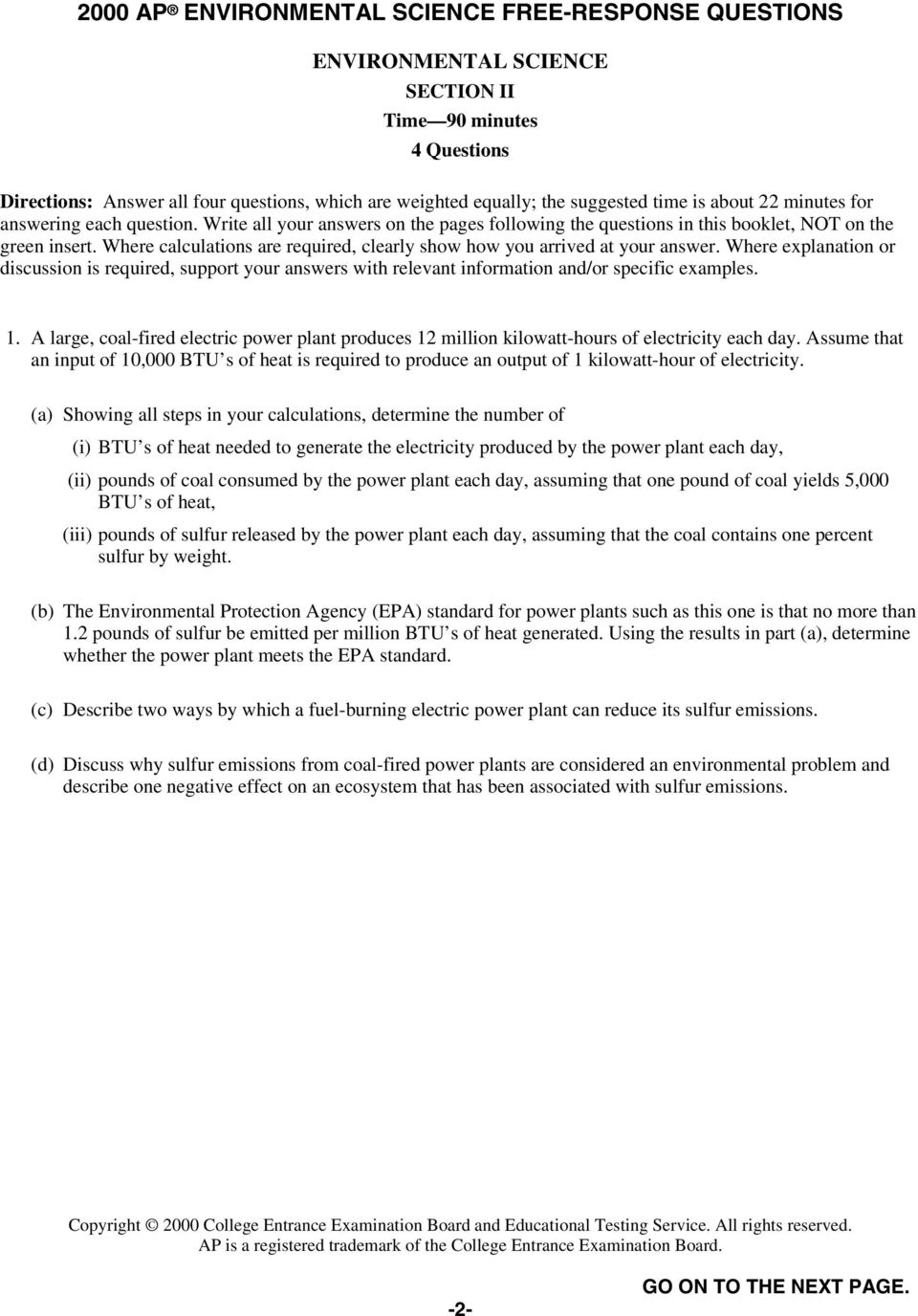
2 ENVIRONMENTAL SCIENCE SECTION II Time 90 minutes 4 Questions Directions: Answer all four questions, which are weighted equally; the suggested time is about 22 minutes for answering each question. Write all your answers on the pages following the questions in this booklet, NOT on the green insert. Where calculations are required, clearly show how you arrived at your answer. Where explanation or discussion is required, support your answers with relevant information and/or specific examples. 1. A large, coal-fired electric power plant produces 12 million kilowatt-hours of electricity each day. Assume that an input of 10,000 BTU s of heat is required to produce an output of 1 kilowatt-hour of electricity. (a) Showing all steps in your calculations, determine the number of (i) BTU s of heat needed to generate the electricity produced by the power plant each day, (ii) pounds of coal consumed by the power plant each day, assuming that one pound of coal yields 5,000 BTU s of heat, (iii) pounds of sulfur released by the power plant each day, assuming that the coal contains one percent sulfur by weight. (b) The Environmental Protection Agency (EPA) standard for power plants such as this one is that no more than 1.2 pounds of sulfur be emitted per million BTU s of heat generated. Using the results in part (a), determine whether the power plant meets the EPA standard. (c) Describe two ways by which a fuel-burning electric power plant can reduce its sulfur emissions. (d) Discuss why sulfur emissions from coal-fired power plants are considered an environmental problem and describe one negative effect on an ecosystem that has been associated with sulfur emissions. -2-
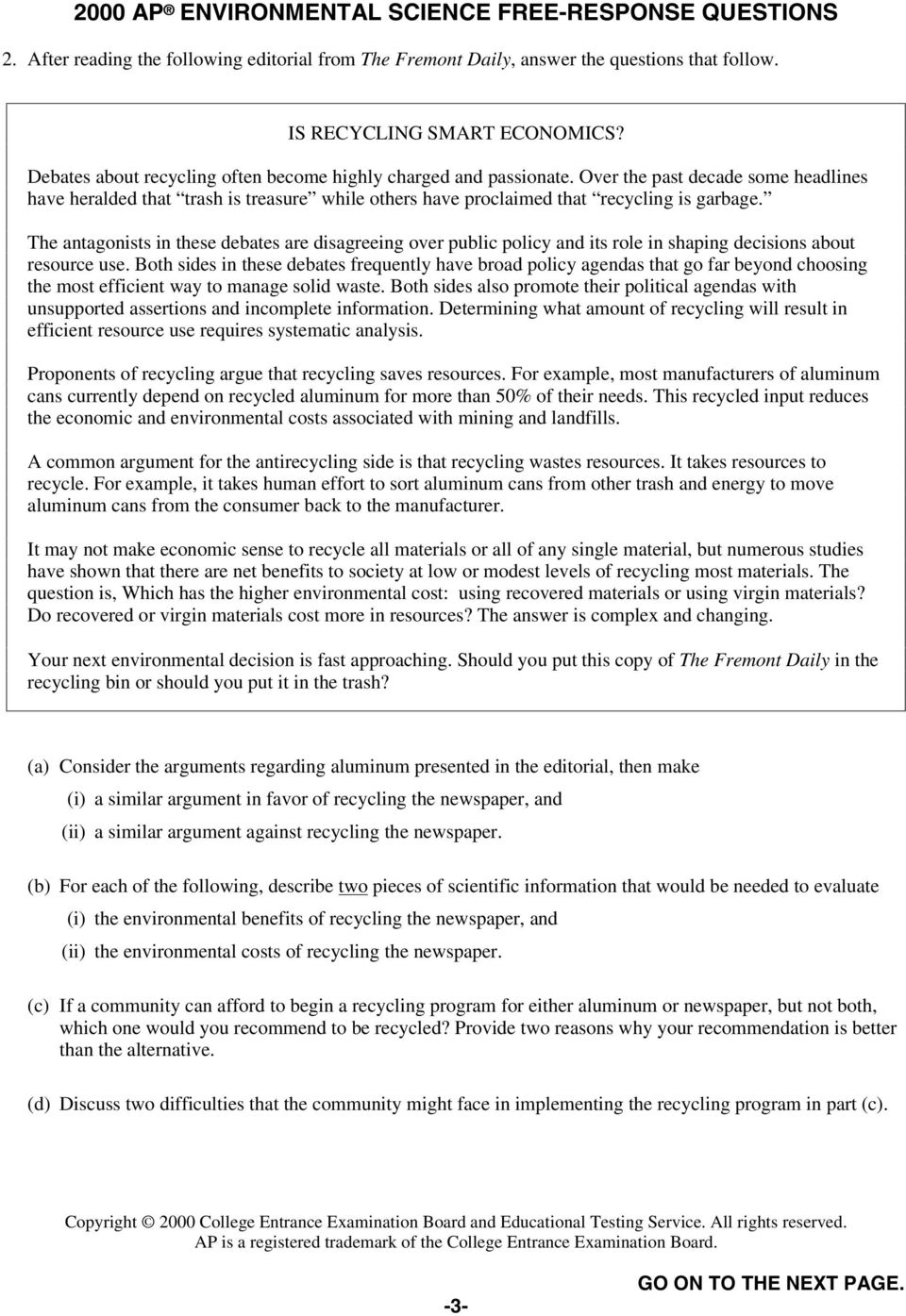
3 2. After reading the following editorial from The Fremont Daily, answer the questions that follow. IS RECYCLING SMART ECONOMICS? Debates about recycling often become highly charged and passionate. Over the past decade some headlines have heralded that trash is treasure while others have proclaimed that recycling is garbage. The antagonists in these debates are disagreeing over public policy and its role in shaping decisions about resource use. Both sides in these debates frequently have broad policy agendas that go far beyond choosing the most efficient way to manage solid waste. Both sides also promote their political agendas with unsupported assertions and incomplete information. Determining what amount of recycling will result in efficient resource use requires systematic analysis. Proponents of recycling argue that recycling saves resources. For example, most manufacturers of aluminum cans currently depend on recycled aluminum for more than 50% of their needs. This recycled input reduces the economic and environmental costs associated with mining and landfills. A common argument for the antirecycling side is that recycling wastes resources. It takes resources to recycle. For example, it takes human effort to sort aluminum cans from other trash and energy to move aluminum cans from the consumer back to the manufacturer. It may not make economic sense to recycle all materials or all of any single material, but numerous studies have shown that there are net benefits to society at low or modest levels of recycling most materials. The question is, Which has the higher environmental cost: using recovered materials or using virgin materials? Do recovered or virgin materials cost more in resources? The answer is complex and changing. Your next environmental decision is fast approaching. Should you put this copy of The Fremont Daily in the recycling bin or should you put it in the trash? (a) Consider the arguments regarding aluminum presented in the editorial, then make (i) a similar argument in favor of recycling the newspaper, and (ii) a similar argument against recycling the newspaper. (b) For each of the following, describe two pieces of scientific information that would be needed to evaluate (i) the environmental benefits of recycling the newspaper, and (ii) the environmental costs of recycling the newspaper. (c) If a community can afford to begin a recycling program for either aluminum or newspaper, but not both, which one would you recommend to be recycled? Provide two reasons why your recommendation is better than the alternative. (d) Discuss two difficulties that the community might face in implementing the recycling program in part (c). -3-
4 3. Species such as the dusky seaside sparrow, the passenger pigeon, and the woolly mammoth are extinct. Populations of other species have declined to the point where they are designated as threatened or endangered. (a) Identify one threatened or endangered species and explain why its population has declined. (b) Describe three characteristics of organisms that would make them particularly vulnerable to extinction. (c) Present three arguments in favor of the maintenance of biodiversity. (d) Name and describe one United States federal law or one international treaty that is intended to prevent the extinction of species. -4-

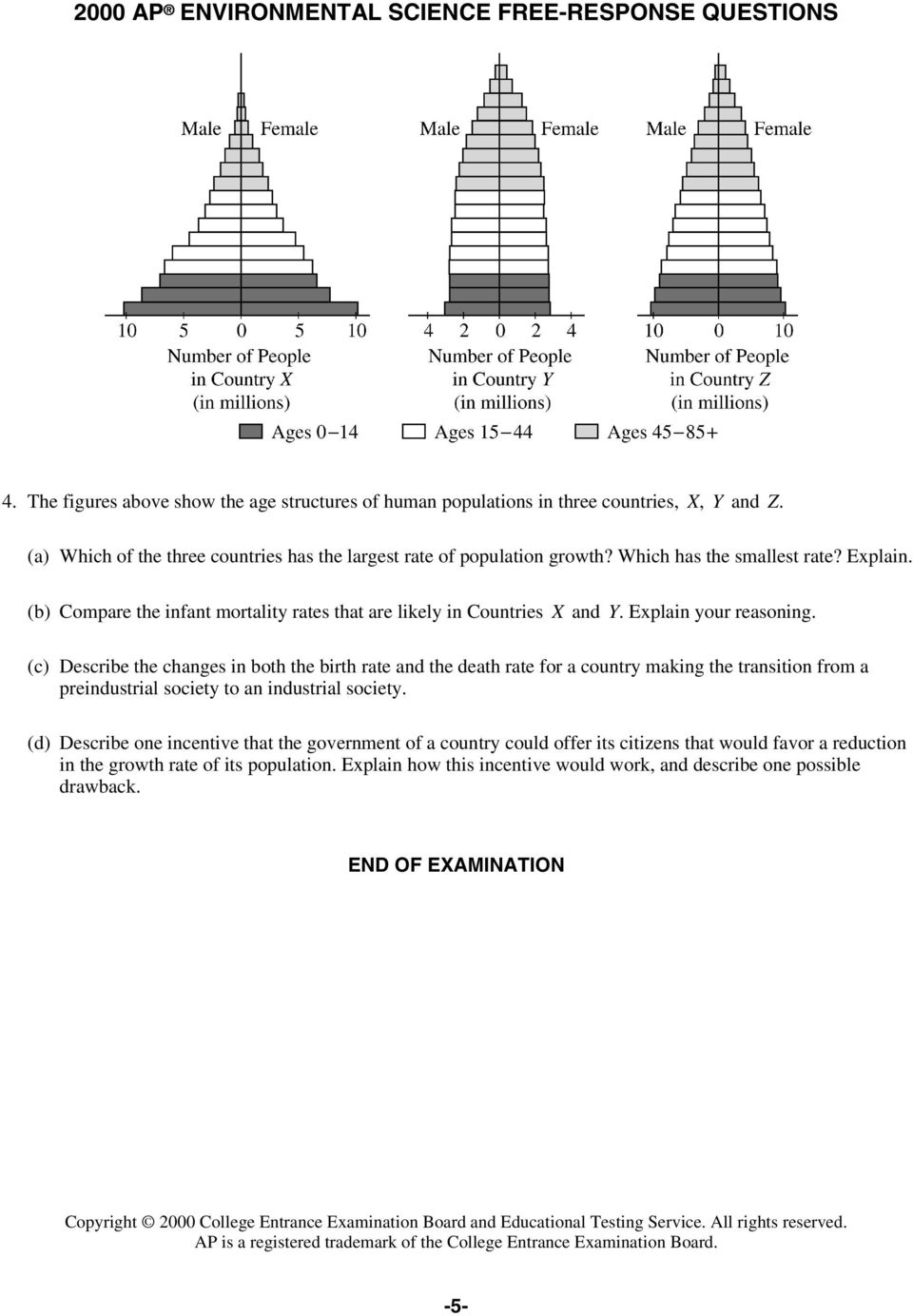
5 4. The figures above show the age structures of human populations in three countries, X, Y and Z. (a) Which of the three countries has the largest rate of population growth? Which has the smallest rate? Explain. (b) Compare the infant mortality rates that are likely in Countries X and Y. Explain your reasoning. (c) Describe the changes in both the birth rate and the death rate for a country making the transition from a preindustrial society to an industrial society. (d) Describe one incentive that the government of a country could offer its citizens that would favor a reduction in the growth rate of its population. Explain how this incentive would work, and describe one possible drawback. END OF EXAMINATION -5-
AP Calculus BC 2001 Free-Response Questions
 AP Calculus BC 001 Free-Response Questions The materials included in these files are intended for use by AP teachers for course and exam preparation in the classroom; permission for any other use must
AP Macroeconomics 2003 Scoring Guidelines Form B
 AP Macroeconomics 2003 Scoring Guidelines Form B The materials included in these files are intended for use by AP teachers for course and exam preparation; permission for any other use must be sought from
AP Calculus AB 2004 Free-Response Questions
 AP Calculus AB 2004 Free-Response Questions The materials included in these files are intended for noncommercial use by AP teachers for course and exam preparation; permission for any other use must be
AP Calculus AB 2003 Scoring Guidelines Form B
 AP Calculus AB Scoring Guidelines Form B The materials included in these files are intended for use by AP teachers for course and exam preparation; permission for any other use must be sought from the
AP Environmental Science 2010 Free-Response Questions
 AP Environmental Science 2010 Free-Response Questions The College Board The College Board is a not-for-profit membership association whose mission is to connect students to college success and opportunity.
AP Microeconomics 2003 Scoring Guidelines
 AP Microeconomics 2003 Scoring Guidelines The materials included in these files are intended for use by AP teachers for course and exam preparation; permission for any other use must be sought from the
AP Microeconomics 2002 Scoring Guidelines
 AP Microeconomics 2002 Scoring Guidelines The materials included in these files are intended for use by AP teachers for course and exam preparation in the classroom; permission for any other use must be
AP Calculus AB 2004 Scoring Guidelines
 AP Calculus AB 4 Scoring Guidelines The materials included in these files are intended for noncommercial use by AP teachers for course and eam preparation; permission for any other use must be sought from
AP Calculus BC 2004 Scoring Guidelines
 AP Calculus BC Scoring Guidelines The materials included in these files are intended for noncommercial use by AP teachers for course and exam preparation; permission for any other use must be sought from
Sample Activity: The Least Expensive Cable
 Sample Activity: The Least Expensive Cable from the Pre-AP workshop Pre-AP : Topics for AP Vertical Teams in Mathematics For more information, see apcentral.collegeboard.com/preapworkshops. Copyright 2004
AP English Literature & Composition 2002 Scoring Guidelines
 AP English Literature & Composition 2002 Scoring Guidelines The materials included in these files are intended for use by AP teachers for course and exam preparation in the classroom; permission for any
AP Calculus AB 2003 Scoring Guidelines
 AP Calculus AB Scoring Guidelines The materials included in these files are intended for use y AP teachers for course and exam preparation; permission for any other use must e sought from the Advanced
AP Human Geography 2004 Scoring Guidelines
 AP Human Geography 2004 Scoring Guidelines The materials included in these files are intended for noncommercial use by AP teachers for course and exam preparation; permission for any other use must be
AP Calculus AB 2001 Scoring Guidelines
 P Calculus Scing Guidelines The materials included in these files are intended f non-commercial use by P teachers f course and eam preparation; permission f any other use must be sought from the dvanced
AP Calculus AB 2005 Free-Response Questions
 AP Calculus AB 25 Free-Response Questions The College Board: Connecting Students to College Success The College Board is a not-for-profit membership association whose mission is to connect students to
AP Macroeconomics 2008 Scoring Guidelines Form B
 AP Macroeconomics 2008 Scoring Guidelines Form B The College Board: Connecting Students to College Success The College Board is a not-for-profit membership association whose mission is to connect students
AP Computer Science A 2004 Free-Response Questions
 AP Computer Science A 2004 Free-Response Questions The materials included in these files are intended for noncommercial use by AP teachers for course and exam preparation; permission for any other use
Scoring and Practice Sections
 Taking the SAT I: Reasoning Test Scoring and Practice Sections The materials in these files are intended for individual use by students getting ready to take an SAT Program test; permission for any other
AP Macroeconomics 2008 Scoring Guidelines
 AP Macroeconomics 2008 Scoring Guidelines The College Board: Connecting Students to College Success The College Board is a not-for-profit membership association whose mission is to connect students to
AP Macroeconomics 2009 Scoring Guidelines
 AP Macroeconomics 2009 Scoring Guidelines The College Board The College Board is a not-for-profit membership association whose mission is to connect students to college success and opportunity. Founded
AP Calculus AB 2010 Free-Response Questions Form B
 AP Calculus AB 2010 Free-Response Questions Form B The College Board The College Board is a not-for-profit membership association whose mission is to connect students to college success and opportunity.
AP Microeconomics 2011 Scoring Guidelines
 AP Microeconomics 2011 Scoring Guidelines The College Board The College Board is a not-for-profit membership association whose mission is to connect students to college success and opportunity. Founded
AP Calculus AB 2011 Scoring Guidelines
 AP Calculus AB Scoring Guidelines The College Board The College Board is a not-for-profit membership association whose mission is to connect students to college success and opportunity. Founded in 9, the
AP Calculus AB 2009 Free-Response Questions
 AP Calculus AB 2009 Free-Response Questions The College Board The College Board is a not-for-profit membership association whose mission is to connect students to college success and opportunity. Founded
AP Macroeconomics 2010 Scoring Guidelines
 AP Macroeconomics 2010 Scoring Guidelines The College Board The College Board is a not-for-profit membership association whose mission is to connect students to college success and opportunity. Founded
AP Calculus AB 2010 Free-Response Questions
 AP Calculus AB 2010 Free-Response Questions The College Board The College Board is a not-for-profit membership association whose mission is to connect students to college success and opportunity. Founded
AP Calculus AB 2012 Free-Response Questions
 AP Calculus AB 1 Free-Response Questions About the College Board The College Board is a mission-driven not-for-profit organization that connects students to college success and opportunity. Founded in
AP Calculus BC 2006 Free-Response Questions
 AP Calculus BC 2006 Free-Response Questions The College Board: Connecting Students to College Success The College Board is a not-for-profit membership association whose mission is to connect students to
AP Macroeconomics 2011 Scoring Guidelines
 AP Macroeconomics 2011 Scoring Guidelines The College Board The College Board is a not-for-profit membership association whose mission is to connect students to college success and opportunity. Founded
AP Calculus AB 2006 Scoring Guidelines
 AP Calculus AB 006 Scoring Guidelines The College Board: Connecting Students to College Success The College Board is a not-for-profit membership association whose mission is to connect students to college
AP Calculus AB 2013 Free-Response Questions
 AP Calculus AB 2013 Free-Response Questions About the College Board The College Board is a mission-driven not-for-profit organization that connects students to college success and opportunity. Founded
AP Calculus AB 2011 Free-Response Questions
 AP Calculus AB 11 Free-Response Questions About the College Board The College Board is a mission-driven not-for-profit organization that connects students to college success and opportunity. Founded in
AP Calculus AB 2007 Scoring Guidelines Form B
 AP Calculus AB 7 Scoring Guidelines Form B The College Board: Connecting Students to College Success The College Board is a not-for-profit membership association whose mission is to connect students to
AP Physics B 2009 Scoring Guidelines
 AP Physics B 009 Scoring Guidelines The College Board The College Board is a not-for-profit membership association whose mission is to connect students to college success and opportunity. Founded in 1900,
AP Calculus BC 2008 Scoring Guidelines
 AP Calculus BC 8 Scoring Guidelines The College Board: Connecting Students to College Success The College Board is a not-for-profit membership association whose mission is to connect students to college
In the past decade, U.S. secondary schools have
 Office of Research and Development RN-03, May 1998 Block Schedules and Student Performance on AP Examinations BACKGROUND In the past decade, U.S. secondary schools have introduced a variety of alternative
AP Macroeconomics 2012 Scoring Guidelines
 AP Macroeconomics 2012 Scoring Guidelines The College Board The College Board is a mission-driven not-for-profit organization that connects students to college success and opportunity. Founded in 1900,
AP Human Geography 2011 Scoring Guidelines
 AP Human Geography 2011 Scoring Guidelines The College Board The College Board is a not-for-profit membership association whose mission is to connect students to college success and opportunity. Founded
AP Biology 2013 Free-Response Questions
 AP Biology 2013 Free-Response Questions About the College Board The College Board is a mission-driven not-for-profit organization that connects students to college success and opportunity. Founded in 1900,
AP Calculus BC 2010 Free-Response Questions
 AP Calculus BC 2010 Free-Response Questions The College Board The College Board is a not-for-profit membership association whose mission is to connect students to college success and opportunity. Founded
AP Human Geography 2010 Scoring Guidelines
 AP Human Geography 2010 Scoring Guidelines The College Board The College Board is a not-for-profit membership association whose mission is to connect students to college success and opportunity. Founded
AP Calculus BC 2013 Free-Response Questions
 AP Calculus BC 013 Free-Response Questions About the College Board The College Board is a mission-driven not-for-profit organization that connects students to college success and opportunity. Founded in
Eight Components of College and Career Readiness Counseling
 The College Board National Office for School Counselor Advocacy Eight Components of College and Career Readiness Counseling Equity Leadership Transformation The Need for College Readiness Counseling In
A Closer Look at the
 A Closer Look at the Principal-Counselor Relationship A Survey of Principals and Counselors May 2009 Acknowledgments We would like to thank Crux Research for their contributions to the analyses and interpretation
Endangered Species: What and Where?
 Endangered Species: What and Where? Summary: Students learn about North American endangered species through creation of a species book. Older students will locate endangered species on a map and explore
ADVANTAGES AND DISADVANTAGES OF ENERGY SOURCES. Prepared by Sandra Vasa-Sideris, PhD, Southern Polytechnic State University, for use by students
 ADVANTAGES AND DISADVANTAGES OF ENERGY SOURCES Prepared by Sandra Vasa-Sideris, PhD, Southern Polytechnic State University, for use by students Questions to consider Where are the nonrenewable sources
A Correlation of Environmental Science Your World, Your Turn 2011
 A Correlation of Your World, Your Turn 2011 To Ohio s New Learning Standards for Science, 2011, High School Science Inquiry and Application Course Content INTRODUCTION This document demonstrates how Pearson,
AP Environmental Science 2000 Scoring Guidelines
 AP Environmental Science 2000 Scoring Guidelines The materials included in these files are intended for non-commercial use by AP teachers for course and exam preparation; permission for any other use must
Renewable Choice Energy
 Catawba College Table of Contents About Renewable Choice The Problem: Electricity Production Today The Solutions: Renewable Energy Sources Renewable Energy Credits (RECs) Who can participate in Renewable
AP Macroeconomics 2013 Scoring Guidelines
 AP Macroeconomics 2013 Scoring Guidelines The College Board The College Board is a mission-driven not-for-profit organization that connects students to college success and opportunity. Founded in 1900,
AP Human Geography 2007 Scoring Guidelines
 AP Human Geography 2007 Scoring Guidelines The College Board: Connecting Students to College Success The College Board is a not-for-profit membership association whose mission is to connect students to
STIR Education Micro-Innovations that raise results STUDENT ATTENDANCE SCANNER
 STIR Education Micro-Innovations that raise results STUDENT ATTENDANCE SCANNER FOCUS: DISCILINE STUDENT ATTENDANCE SCANNER STIR EDUCATION At STIR Education, our belief is that the best way to improve the
Don't Forget the Differential Equations: Finishing 2005 BC4
 connect to college success Don't Forget the Differential Equations: Finishing 005 BC4 Steve Greenfield available on apcentral.collegeboard.com connect to college success www.collegeboard.com The College
AP Comparative Government and Politics 2014 Free-Response Questions
 AP Comparative Government and Politics 2014 Free-Response Questions College Board, Advanced Placement Program, AP, AP Central, and the acorn logo are registered trademarks of the College Board. AP Central
Writing a Persuasive Essay
 INTRODUCTION Attention-getter Background information Do Something Good for the Earth Garbage! It smells bad and looks disgusting. Most people think about trash only when they take it out. People in the