
Josef Albers & Birgir Andrésson: Influences of Environment on Color Perception
|
|
|
- Dennis Bruce
- 9 years ago
- Views:
Transcription
1 Listaháskóli Íslands Hönnunar og arkitektúrdeild Grafísk hönnun Josef Albers & Birgir Andrésson: Influences of Environment on Color Perception Aline Grippi Leiðbeinandi: Þröstur Helgason Vorönn 2011

2 Abstract The color perception is influenced by many physical and psychological factors. This essay investigates how the social and natural environment influences color perception, based on Josef Albers's theories in his book Interaction of Color. In the light of Albers ideas, the works and concepts of the artist Birgir Andrésson on Icelandic colors are analyzed. Josef Albers ( ) was a pioneer artist of twentieth-century modernism and best known for his innovative publication Interaction of Color. His book was first published in 1963 and, according to Albers, the book works around the fact that color is the most relative medium of art. The same color evokes innumerable readings depending on its surroundings, due to the constant interaction between colors, the interdependence of color with form and placement, the importance of quantity and qualities of color and its pronouncement. Supported by Albers's theories on colors, the works by the Icelandic artist Birgir Andrésson ( ) on Icelandic Colors are analyzed focusing on the influences of environment in color perception. In the last decade of his life or longer, Andrésson explored elements of national identity which is reflected in his art, such as the archetypical Icelander, icelandic birds, horses, excentric people, nature and original culture. In many of his works, he used the Icelandic Colors, that derive from Andrésson's ideas on the national colors. These colors represent the leftovers of the Icelandic culture, elements that have disappeared or are about to, due to the translation of foreign models or prototypes. The perception of color is influenced by light, distance, volume, movement and interaction with the environment. This essay is a result of a personal need to investigate colors and how the social and natural environment influences my use of colors. The study has opened my spectrum of color comprehension, in which the surroundings and mind have the main role. 2

3 Contents Introduction Josef Albers on Interaction of Colors Alber's Interaction of Color Influences of Environment in Color Perception Natural and Physical Environment Influences Social Environment Influences Birgir Andrésson and 'Icelandic Colors' Conclusion Bibliography

4 Introduction Colors are everywhere: in our surroundings, body and memory. Colors carry emotions and psychological meanings. Color is the most relative medium of art. We live in a world of colors and, yet, I feel, as a graphic design student, that this subject has not been given its importance in the graphic design education at the Academy. This essay resulted from my personal need to learn more about color thoughts and theories. I was born in Brazil and I lived there most of my life. Colors are fundamental part of our culture and it can't be taken apart from it. Colors, in different intensities and combinations, are present in our folklore, carnival, paintings, literature and musical heritage - from popular traditions to contemporary and conceptual art. We breath and sing the beautiful colors of the nation and natural environment. The use of colors has never been problematic for me. It always came naturally in my paintings and drawings, maybe by the fact that I just needed to look out of my window to find in nature and the city the sources of my inspiration. Until I moved to Iceland, I never thought I could loose this ability of using colors, but I believe I did. I first noticed this difficulty when I went to Edinburgh College of Arts as exchange student in Drawing and Painting Department, where the demand for use of colors was more noticeable. After three years living in Iceland, I asked myself: have I lost my sensibility for colors? All these cultural changes and difficulties, compounded with the lack of formal education on colors for graphic design students at the Academy, influenced my decision to investigate how the environment can influence our color perception and use of colors. In this search, I found some colors theories, but most of them focused only on psychological or physicals and mathematical aspects of colors, such as Newton and Goethe. It was in Josef Albers theories that I found the inspiration to develop the subject of this essay. Alber's approach to colors is unique and different from most of the writings on colors. In 1963, he published Interaction of Colors, in which he compiled the results of years teaching colors in Bauhaus, Black Mountain College and Yale University. Albers ignores, on purpose, the use of color wheels and all the physical explanations. His aim was to teach the students and readers to have an 'eye for color', to learn from experiencing and feeling colors. Although he doesn't formally describe how the environment influences our color perception, the answers to my questions can be found in the ideas underlying his theory. As Iceland was the starting point of my observation on the changes in my perception and use of colors, I decided to analyze the use of colors by an Icelandic artist. The name of Birgir 4

5 Andrésson came across as one of the most prominent artist exploring the use of colors. He developed his concepts of Icelandic Colors, which is the subject of our analysis in the light of Josef Albers ideas. Andrésson's Icelandic Colors are influenced by social and natural environment. This essay consists basically of a search for answers and explanations for the influence of environment on our use and perception of color, but this search leads to a wider perspective, in which colors also live in our minds. As Albers said: 'Our experience of color is essentially perceptual, and it's the perceptual results that count.' 1 1 Frederick Horowitz, Josef Albers : to open eyes : the Bauhaus, Black Mountain College, and Yale. Phaidon, 2006, pp

6 1. Josef Albers on Interaction of Colors My first contact with Josef Alber's work was through a video The Full Spectrum for Dwell 2 in which Nicholas Fox Weber, executive director of The Albers Foundation, talks about his works and theories on colors. I had seen his works in books before, but this video had a great impact on me. That was the moment I met Albers and I decided to investigate Albers life and theories. Josef Albers ( ) is considered one of the pioneers of twentieth-century modernism. He was an influential teacher, writer, painter, and color theorist best known for the Homage to the Squares he painted between 1950 and 1976 and for his innovative 1963 publication The Interaction of Color, the subject in this essay. Before enrolling as a student at Bauhaus in 1920, Josef had been a school teacher in his hometown of Bottrop, in the northwestern industrial Ruhr region of Germany. Initially he taught a general elementary school course; then, following studies in Berlin, he taught art. In the course of his teaching years, he developed as a figurative artist and printmaker. While he was at Bauhaus as a student, he worked primarily in stained and sandblasted glass, but he also designed furniture, household objects and a typeface, and developed a keen eye as a photographer. Josef Albers met his wife Annie in 1922 in Bauhaus, where she was also a young student. In 1925 he was the first Bauhaus student to be asked to join the faculty and become a "master" there. In 1925 Bauhaus moved to the city of Dessau to a streamlined and revolutionary building designed by Walter Gropius, architect and founder of the school. In Dessau, the Alberses lived alongside the families of artist teachers Lyonel Feininger, Paul Klee, Wassily Kandinsky, Oscar Sclemmer, and others in one of the masters' houses designed by Gropius. By 1933, when the pressure from the Nazis forced the school to close, Josef Albers had become one of its best-known artists and teachers. In November 1933, the Alberses emigrated to the United States of America, where Albers had been asked to make the visual arts the center of the curriculum at the newly established Black Mountain College near Asheville in North Carolina. They remained at Black Mountain until Josef continued his exploration of a range of printmaking techniques and took off as an abstract painter, while continuing as a captivating teacher and writer. About Albers as a teacher, Frederick Horowitz, author of Josef Albers: to open eyes, wrote: 2 Gary Nadeau, The Full Spectrum for Dwell: Josef Albers. Last entry: 10. January

7 'When Albers first headed up the path to Lee Hall at Black Mountain College, a student asked him what he was going to teach. Mustering what little english he knew, Albers replied, To make open the eyes. Albers would repeat some version of this phrase again and again over the years, never deviating from his conviction that teaching art was not a matter of imparting rules, styles or techniques, but leading students to a greater awareness of what they are seeing or doing.' 3 During this time Josef and Annie Albers traveled widely both in the United States and Mexico, a country that captivated their imagination and had a strong effect on both of their art. In 1950, Josef and Annie moved to Connecticut. From 1950 to 1958 Josef Albers was chairman of the Department of Design at the Yale University School of Art. Albers's color course was a method intended to sharpen the eyes and provide some understanding of how color behaves, not a theory course. What mattered for Albers was that his students experienced color. There, and as guest teacher at art schools throughout the United States and in Europe, he trained a whole new generation of art teachers. Meanwhile he wrote, painted, and made prints. He retired in 1958 and was named emeritus professor of art, a position he held until his death. In 1971, he was the first living artist ever to be honored with a solo retrospective at the Metropolitan Museum of Art in New York. He was still working on his Homages to the Square at the time of his death in New Haven, Connecticut in Alber's Interaction of Color Albers' passion for color prompted his decision to launch what was possibly the first color course based exclusively on direct observation of color's behavior. His color course, which he launched at Black Mountain College reached its fullest development at Yale University, where the publication of Albers's landmark Interaction of Color, crowned thirty years of effort. His book, first published in 1963, is a record of his "experimental way of studying and teaching color". 4 According to Nicholas Fox Weber, in the last edition Foreword of Interaction of Color, 'For over forty years, it has been a best-selling book, demonstrably altering lives of its readers over the world.' 5 Later he writes that the book expands the way that colors are used and perceived in art, architecture, textiles, interior design and graphic media. The book caught attention in the art and education scene because it does not follow an 3 Frederick Horowitz, Josef Albers : to open eyes : the Bauhaus, Black Mountain College, and Yale, pp Josef Albers, Interaction of Color, Yale University Press, London, 2006, pp.1. 5 Josef Albers, Interaction of Color, Foreword. 7

8 academic conception of theory and practice. It places the practice before theory to lead the reader to realize from a visual realization the interaction between colors, the interdependence of color with form and placement, the importance of quantity and qualities of color and its pronouncement. When it was initially published, Interaction of Color was the subject of controversy, as everything Albers did. Among many critics, Alan Lee wrote in Leonardo magazine in 1981, 'However, the part of his account of color that I believe to be most in need of revision is the central part: the fundamental claim that one is always being deceived in the perception of color....his concepts on color might be characterized as a pathology of color perception, and, viewed in this way, it seems an unfortunate base upon which to try to build artistic practice.' 6 But in general, Albers work was highly praised. Howard Sayre wrote an review that appeared in the following publication of the first edition, Interaction of Color was 'a grand passport to perception... essentially a process: a unique means of learning and teaching and experiencing' Influences of Environment in Color Perception Our everyday experiences of color are tenuous and imprecise. In visual perception a color is almost never seen as it really is - as it physically is. Our perception results from influences of light, distance, volume, movement and interaction with the environment. In the light of Josef Albers's book Interaction of Colors, I intend to investigate how the environment can influence our perception of colors. By environment I mean external conditions or surroundings, such as natural or physical environment (landscape and nature) and social environment (culture and traditions). Although Josef Albers never mentioned this subject directly in his book, the answer to our research questions can be found in many chapters of his work, underlying his ideas of color as the most relative medium of art that continually deceive us. Colors influence and change each other forth and back. They continuously interact - in our perception. 8 To better organize this investigation, the subject will be divided in two parts: the physical environment influences and the social environment influences in color perception Natural and Physical Environment Influences The natural and physical environment can influence the way we perceive color for the simple 6 Allan Lee, 'A Critical Account of Some of Josef Albers 'Concepts of Color', Leonardo, Vol.14/1970, pp Josef Albers, Interaction of Color, Foreword. 8 Josef Albers, Interaction of Color, pp.72. 8

9 reason that color is susceptible to change based on the influence of its neighbor. This susceptibility can result from the value of color, physical changes in the environment or conditions, changes of adjacent colors and interaction between neighboring colors. 'Colors present themselves in continuous flux, constantly related to changing neighbors and changing conditions.' 9 According to Frederick Horowitz, author of Josef Albers: To Open Eyes, the central theme of Albers color courses was the fact that there is no positive and absolute color. Each color changes, that is, appears changed to our eye as a result of its surroundings. Each color establishes a lively and reciprocal relationship with its surroundings. It is continuous dynamic. 10 Horowitz also claims that in addition to many lessons in color interaction, Albers book projected a sense of color's endless possibilities. It demonstrated that color could be more than an adjunct to form and shape. That colors are not absolute, that they change in varying circumstances; that they can be made to appear lighter, darker or transparent; that they can appear to advance or to recede relative to other colors. 11 In our daily experiences, colors are always deceiving us through their quantity, quality, pronouncement (by separating or connecting boundaries), interdependence and interaction. To illustrate these continuous changes, Albers mentions the Impressionists works in which they never presented, for example, a green by itself. Instead of using green paint mixed mechanically from yellow and blue, they applied yellow and blue dots unmixed in small dots, so they became mixed only in our perception - as an impression. That the dots mentioned were small indicates that this effect depends on size and on distance. 12 A similar effect takes place in many of our daily experiences, for example when we view objects from a distance the colors as a whole appear different from the individual colors of the objects and mixed elements of nature, such as the colors of mountain and sea as whole. It is understood that different basic conditions of media such as light, size, distance, volume and movement, result in different behavior of color, therefore, different color perception. Albers goes even further making analogy to constellations: 'Color appear connected predominantly in space. Therefore, as constellations they can be seen in any direction and at any speed. And, as they remain, we can return to them repeatedly and in many ways.' 13 In order to experiment how the physical changes in the environment can influence our color perception in a short period of time, Albers proposed to observe the reactions of color perception 9 Josef Albers, Interaction of Color, pp Frederick Horowitz, Josef Albers : to open eyes : the Bauhaus, Black Mountain College, and Yale, pp Frederick Horowitz, Josef Albers : to open eyes : the Bauhaus, Black Mountain College, and Yale, pp Josef Albers, Interaction of Color, pp Josef Albers, Interaction of Color, pp.39. 9

10 to changes of quantity, form and recurrence of a color. Further changes can derive from reflection of light and of colors; changed and changing light (even worse); several simultaneous lights; direction and sequence of reading; presentation in varying materials; constant or altering juxtaposition of related and unrelated objects. 14 The conditions mentioned in Albers work, if permanent or for longer period of time, could affect not only our color perception, but the way we express or use colors. The light - value of a color - how light or dark the color is - is also affected by its surrounding. A color of medium value will look darker on a light color and lighter on a dark color. A color's intensity is also affected by its neighbor. A bright color placed on a dull color will look brighter. Placed on a brighter color, it will appear dull. Therefore, it is understood that in searching for new color design we have come to think about the influences of the natural environment. The quantity, value, intensity, or weight, as principles of study, can lead similarly to illusions, to new relationships, to different measurements of color and perceptions Social Environment Influences We live in a world of colors and no one reads colors the same way. Color deceives continually and one and the same color evokes innumerable readings, depending on our surroundings and personal experiences. These personal experiences are related to the cultural and traditional influences, that is the influences of the social environment. Albers mention the importance of study the Masters works, because it provides to the student an opportunity to learn about tradition, cultural heritage and society. It opens the possibility of developing a sensitive and critical eye for color relatedness, that certainly will influence the way we use and perceive colors. In his color courses, Albers often began by discussing the elusive nature of color telling his students: '"We constantly see color in relation to color... Seeing is not only a visual affair, it is a psychological affair... It is impossible to remember a color precisely... Color is a psychic effect. "'. 15 As a psychological effect the deep influences of culture in color perception can not be ignored. In addition to the psychological relation of color seeing, Albers also demonstrated in his classes that the phenomenon of color change is also physiological, it happens in our brain, and, therefore, automatically. Horowitz describes this experiment in his book: 14 Josef Albers, Interaction of Color, pp Frederick Horowitz, Josef Albers : to open eyes : the Bauhaus, Black Mountain College, and Yale, pp

11 'Albers asked the students to stare fixedly at a red circle, then look a nearby white circle of the same size. Inevitably, predictably, and to a general delight, the white circle appeared to be filled with luminous pool of green- the after image of red. Content to have shown that color existed in the eye, not on the paper, Albers didn't explain the physiological causes of this demonstration. Those curious enough to investigate this phenomenon learned that afterimages appear because the photoreceptors in the eye- the cones- having become fatigued by predominant color, manufacture its complement as reaction. The small patch of color changes appearance because the large surrounding color, having saturated the eye, causes its complement to mix the color of the patch.' 16 Whether psychological or physical, Albers's color studies focused on experiencing colors and from these experiences, he claims that the perceptual results are what count after all, 'A sensitive eye for color became our first concern.' Frederick Horowitz, Josef Albers : to open eyes : the Bauhaus, Black Mountain College, and Yale, pp Josef Albers, Interaction of Color, pp

12 2. Birgir Andrésson and 'Icelandic Colors' In order to observe the influence of environment on color use and perception, I intend to examine the concepts of 'Icelandic Colors' in the work of the Icelandic artist Birgir Andrésson, from the perspective of Josef Albers theory. Birgir Andrésson ( ) is considered to be among the most productive Icelandic artist of his time. Although he died young, he had a retrospective exhibition at the National Gallery in Iceland the year before his death and also represented Iceland in Venice Bienale in Born in Westman Islands in 1955, Birgir left the small island in south of Iceland to live on the main island, at age of three after his father got blind from accidentally drinking toxic alcohol. He was brought up by his father and his stepmother who was also blind. These unusual circumstances definitely influenced his approach to art and his ways of seeing. Andrésson studied at the Icelandic College of Arts in and subsequently at the Jan van Eyck Academy in Maastrich The most common themes in Andrésson's works are Iceland, the Icelandic cultural condition and national identity- deconstructed in form and structure. In his works, it is noticeable that the 'Icelandic Colors' concepts appear repeatedly and in different contexts In his book Nearness:Colors, Andrésson briefly explains the 'Icelandic Colors': 'In this book you find twelve samples of the colors of Icelandic culture. They are not prepared of natural material such as herbs or minerals. They are, however, derived from the color spectrum that seems to me the most striking in the creation of this nation through the ages.' 18 According to the curator Eva Heisler, Andrésson's method in Nearness:Colors was an innocent attempt to recreate the 'past' mechanically and it evolves into a critical process which undermines the idea of national identity. 19 The attempt of Birgir Andrésson to collect the predominant colors of Icelandic cultural heritage leads directly to the subject of our study and to some aspects of Albers' theories on color interaction. The colors observed in the Icelandic culture are results from the perception of the Icelandic artists and craftsmen. Their perceptions certainly were deeply influenced by their natural and cultural environment. In his book, Albers also emphasizes the importance of studying 18 Birgir Andrésson, Nearness: Colors, Birgir Andrésson, Reykjavik, Þröstur Helgason, Birgir Andrésson: Í Islenskum Litum, Crymogea, Reykjavik, 2010, pp

13 the Masters and our cultural heritage in order to observe the influence of cultural environment in our color perception: 'As we begin principally with the material, color itself, and its action and interaction as registered in our minds, we practice first and mainly a study of ourselves. Thus, we replace looking backward by looking first at ourselves and our surroundings, and replace retrospection with introspection. Though our own development and our own work are closest to us, we see and appreciate encouragement from achievements of the past, and gratefully pay practical respect to their originators, as often as the opportunity arises. To honor the masters creatively is to compete with their attitude rather than with their results, to follow an artistic understanding of tradition- that is, to create, not to revive.' 20 On the subject, the philosopher and art critic Jón Proppé wrote that 'The 'Icelandic Colors' are one of the strangest and most contradictory subjects in Birgir's art and, like so many of his themes, turn up again and again in different contexts.' 21 The appearance and development of Andrésson's concepts of Icelandic Colors can be found throughout his art, such as in his text works or character-descriptions of the archetypical Icelander. His descriptions were made up out of the old Icelandic parliament publications, where they occasionally had wanted notices. In these notices, the character descriptions of people who had law problems were often hearty, in concise language that reminds character descriptions in the Sagas. Each description made by Andrésson is a composite of many notices and the results is the typical Icelander.In this series of work, the text and the background are in solid colors identified in color code at the bottom of each picture (example: Colors: Icelandic Pantone 173, Icelandic Pantone 533). 'But these are numbers, not original, natural Icelandic colors. Icelandic colors do not exist, anymore than the typical Icelander. At least not any more.' 22, mentioned Þröstur Helgason, author of the book Birgir Andrésson: Í íslenskum litum n the notes for a lecture on Jean Braudrillard's theory of disappearance. On Birgir Andrésson's use of the Icelandic Colors, Proppé also wrote: 'To begin with, this was perhaps just characteristic irony, making fun of pseudo-national trends in interior decoration. Later, however, these colors became a sort of signature that Birgir could 20 Josef Albers, Interaction of Color, pp Jón Proppé, 'Listamaður í íslenskum litum:eftirmæli: Birgir Andrésson', Herðubreið, Nýtt land, Reykjavik 2007, pp Art News Last entry 23. January Þröstur Helgason, Lecture held in The University of Swansea at a conference on Jean Baudrillard, September

14 use to put his mark on almost any subject he chose. They came to function much like the premade stamps the Fluxus artists created and used to connect their eclectic assemblages and notes.' But Birgir's Icelandic Colors also reflected his genuine interest and thorough research into colors and their significance in every context.' 23 Andrésson's genuine interest in colors resulted in a color study compiled in his book Grænt = Green, published in Although he did not write any text about his studies nor his concerns on colors, Andrésson added to his publication a text by Gunnar J. Árnason, art critic and philosopher, called Light- Matter-Eye-Mind. Árnason's ideas on color meet Albers theory on the aspect that 'the part played by the mind in the perception of color can not be overlooked' 24 Árnason's ideas on color perception stand on the search for the balance between physical world and the mental, focusing on processing of signals received from the eye. 'The question arises whether the indeterminacy of our understanding of color could be resolved by a rigorous science of color. Optics and physiology are established scientific disciplines, but the study of light and the eye do not give a comprehensive account of color. The possibility of a color science depends on aphilosophical theory of mind. ' 25 Although Árnason's ideas meet Josef Albers's theory, Albers states that the way we use and perceive colors also depends on our relationship to colors and past experiences. These experiences are kept in our mind and reflected in our use of colors. The fact that Andrésson had blind parents and was raised in an institute for the blind, makes his relationship with vision and color unique and original, as an artist. It can be understood that, for Andrésson, color is not only what we see, it also reflects the past, nature, tradition and national identity. So, when Andrésson talks about colors, he is talking about colors in your mind. 26 The nature and its color observation is also a common theme in Andrésson's works and Albers theory. As Albers claims: 'Though sometimes it may appear hopeless to find equal light intensities in paint and painting, in color paper, or in our surroundings, we have found that nature occasionally provides an opportunity to see them on cumulus clouds against blue sky. When these clouds, often lined up in horizontal groups, appear gleaming white in their upper part in full sunlight, separated from and rising against a distant deep blue, then underneath they show grey tones as shaded white. These shades merge, or even hinge, with the same but 23 Jón Proppé, 'Listamaður í íslenskum litum:eftirmæli: Birgir Andrésson', pp Gunnar J. Árnason, 'Light-Matter-Eye-Mind', Green, Birgir Andrésson, Reykjavik, Gunnar J. Árnason. 'Light-Matter-Eye-Mind', Green. 26 Þröstur Helgason, Birgir Andrésson: Í Íslenskum Litum, pp

15 here very close blue. Why very close? This grey is of the same light intensity as the neighboring blue bellow. Thus the boundaries between grey and blue vanish, and we do not see where the clouds end and where the sky begins. With such clouds, this is best observed with the sun in our back.' 27 Instead of observing the nature in order to look for color changes, Andrésson's observation of colors leads to a different path. He was inspired by colors of nature, specially sheep's colors, to knit the National flags of the United States of America, Britain and Iceland. This work was first exhibited in Venice Biennale in 1995, in which he knitted those flags in the most common colors of the Icelandic sheep to criticize the adoption of foreign culture. When Andrésson presented the Icelandic flag with sheep colors he was defending, in my opinion, that these colors should be considered the true Icelandic colors, because Icelandic people have lived for centuries relying on sheep farming to keep themselves warm and fed. The sheep colors represent the tradition, the culture and the relationship between the Icelandic people and nature - a relationship that has been changing throughout the years. It is also noticeable that these works also open a political dialogue on Icelandic foreign policy. When Andrésson knitted the American flag in Icelandic sheep color, he opened the interpretation of his works to some radical ideas on the Icelandic foreign policy, that has from the very beginning of Independence been in line with the American one (for example, the support of Iceland to the North Atlantic Treat Organization- NATO, American Army Base in Keflavik, support of the Invasion into Iraq and other policies). For many years, Andrésson worked on the idea of Icelandic translations of foreign models, such as a series of pictures he calls Black and White Classics in Icelandic colors. These works compiled the title of novels and film classics, all in his Icelandic colors on a solid background. About these works, Helgason wrote: 'Like the character descriptions but in a certain sense unlike the knitted flags this Icelandic make is not genuine, not original; the classics are off the mark in its reference to the fabricated Icelandic colours; the pictures are not a part of Icelandic culture, they are imported, they are immigrants.' 28 According to Helgason, Andrésson's colors are fictional results, fabricated by the artist. Another aspect of Birgir Andrésson's ideas on Icelandic Colors is the artificial creation of color systems. Helgason mentions in his book that Ólafur Gíslason, art critic, wrote an article correlating Birgir Andréson's ideas of color to the ideas of the Austrian philosopher Ludwig 27 Josef Albers, Interaction of Color, pp Þröstur Helgason, Lecture held in The University of Swansea at a conference on Jean Baudrillard, September

16 Wittgenstein. The Austrian argued that people do not sense color with their eyes, they create them. The concepts used to describe colors (purple, blue...) have in other words nothing to do with the vision, but belong to a certain organizational system, which society, culture and nation create together. Wittgenstein called this system Mathematics of Colors. When children learn to use the concepts of this system, they are being introduced to a social custom which you could call a language game. The children learn the four primary colors and that black and white are not one of them. These are rules says Wittgenstein that have been created to adapt language to visual perception. These are made up rules, just like the traffic rules, but not a natural phenomenon. 29 This is the system Josef Albers tried to avoid in his courses pointing out to students and readers that colors constantly interact with each other and with the environment and these interactions influence our perception. But when Andrésson recreated this system in his artistic works repeatedly using code numbers in his colors descriptions over, he gives the audience a chance to reflect on the cultural influence on people's idea of colors, such as imposed rules on color names and codes. Andrésson's works on Icelandic colors results from his search for the national colors. In his search, Andrésson actually went to the National Museum to select and collect them. But do the results of his works reflect the national colors or does it reflect Andrésson's ideas of the national colors? Concerning Andrésson's attempt to find the national colors, there is a passage in Albers's book in which he makes an analogy between color and music to support his argument that a person can not see and isolate a color. For Albers, color and hues are defined, as are tones in music, by wave and length. Albers points out that we are able to hear a single tone in music, but almost never (that is, without special devices) see a single color unconnected and unrelated to other colors and its surroundings. 30 He also states that a person 'who claims to see colors independent of their illusionary changes fools only himself, and no one else'. 31 According to Albers, the color registered in our mind is a result of our perception. 32 So Andrésson's attempts to isolate and catalogue the Icelandic colors throughout his works demonstrate that these colors are the results of ideas registered in his mind about the national colors, which are fictional. Despite the fact that the Icelandic colors do not exist, Andrésson's concept of Icelandic color exists. They represent the values, tradition, cultural heritage, nature, people, literature and society, that are under rapid changes, disappearing or about to. With his works he attempts to 29 Þröstur Helgason, Birgir Andrésson: Í Íslenskum Litum, pp Josef Albers, Interaction of Color, pp Josef Albers, Interaction of Color, pp Josef Albers, Interaction of Color, pp

17 document the changes in society and make the audience aware of the disappearance of many aspects of Icelandic culture. The elements behind Andrésson's concept are the same that Albers states as sources of influences on color perception: the nature, cultural heritage and society. Andrésson's concept brings to colors a power to generate a reflection on rapid changes and on the disappearing of our ideas on being Icelandic. Therefore, Andrésson's works on Icelandic Colors are all about color awareness and its meaning, as well as the central idea of Albers's theory: 'In an age in which increased human sensibility has become such an obvious need in all areas of human involvement, color sensitivity and awareness can constitute a major weapon against forces of insensitivity and brutalization' 33 Although Albers and Andrésson had different approaches to colors, they both shared a passion and respect for its importance in art and in life. While Josef Albers systematically developed his studies and theories on color interaction with a great respect for the discipline and the mechanics of arts, Birgir Andrésson's approach is more reflexive on the national identity, relating to Baudrillard s idea that behind every image something has disappeared Josef Albers, Interaction of Color, Foreword. According to Nicholas Fox Weber this is the main point of the Interaction of Color. 34 Jean Baudrillard, 'On Disappearance.' Fatal theories, Edited by David B. Clarke, Marcus A. Doel, William Merrin and Richard G. Smith, Routledge, New York, 2009, pp

18 Conclusion We live surrounded by colors, that constantly change according to the physical changes in the environment, such as light, movement, distance and size. These changes affects our perception of colors. Another aspect that also interferes in our perception is the constant interaction between colors and the surroundings. It is difficult to prove how the environment influences our color perception. According to my study and experience, it is a fact that the surroundings and past experience influence the way we use and perceive color. But many factors are involved in the way we read and use colors, such as physical and psychological aspects. According to my observation, perception belongs to the psychology of our minds, as Albers and Andrésson proved by theory and practice. Albers was very interested in the idea of how one educates and he was always encouraging people to experiment with colors to develop their sense for them. In this way, I feel that Andrésson did it successfully, bringing to colors a meaning and awareness of changes in the Icelandic culture. Colors are always deceiving us. Colors are relative and our perception subjective. Each interpretation of colors is unique, different from anyone else. The colors we see and perceive are not the same as others do. It might be similar, but not the same. Each person reads colors differently. So the color translation of traditional art works in Andrésson's Icelandic Colors are results of many relative interactions: color interactions in his original sources of inspiration, influences of natural and social environment on the originals and the perception of Andrésson in assimilating these colors and translating them to his catalogue of Icelandic Colors. These are all mind actions - subjective and relative, therefore difficult to prove. It is also a fact that a color cannot be isolated, it always interacts and changes according to its surroundings. 'Life happens with couples.' 35, Albers told one class, reiterating his theme that all things are in a state of perpetual interaction. According to Albers there is no positive and absolute color. Each color continuously changes, that is, appears changed to our eye as a result of its surroundings. Therefore, Andrésson's attempts to isolate and catalogue the Icelandic Colors reflects just his perceptions and ideas on the subject. I understand that Andrésson was not too worried about being scientific or precise on his use of colors. In his works, he played with national signs and political affairs, such as when he knitted the Icelandic, British and American flags in Icelandic sheep colors. He also painted Black and White Classics film titles and the descriptions of the Icelandic archetypical, horses, birds and bird noises, all in his fictional Icelandic Colors to raise an awareness on the 35 Frederick Horowitz, Josef Albers : to open eyes : the Bauhaus, Black Mountain College, and Yale, pp

19 disappearance of national identity elements. Once I read in an Icelandic magazine a passage in which the owner of a photography store said that Icelandic people go to his shop looking for black and white landscape pictures, while tourists look for colored images of Icelandic landscape. Although I do not agree with national stereotypes, this made me think if there is a connection between nationality and the way people senses the color of natural environment. After this study, I understand that one of the possible reasons for these different choices results from the cultural environment influence on color perception. In my experience, the natural and cultural environment influences, directly and/or indirectly, my use and perception of colors in a positive and also in a negative way. Positively, when new combinations are found and colors that I used to avoid take part in my design by influences of culture and environment. Negatively, when the natural environment (especially weather and winter landscape) influences my perception so that my use of color does not satisfy me. It is a constant and continuous process that starts outside, goes through our minds and in the end influences the way we sense and use colors. The mind has the most essential role in the perception and it is up to us to decide in which direction we want to go. These daily challenges of color perception are well described by Horowitz: 'To look out the window or scan a room was to experience an on going drama of color interaction, perhaps the more marvelous for its being staged in the theater of everyday life.' 36 If there are ways to avoid the influences of the environment in our color perception, I did not succeed in finding them. The use of colors in my design work will remain a challenge, but certainly the way I face these challenges has changed. After all, in color use, what matters to me is remembering my past experiences, feeling the colors and being aware that they are all in my mind. According to Árnason, 'What makes the color enigma fascinating is that it touches on and overlaps such divergent fields as science, philosophy and art.' 37 With Albers and Andrésson I came closer to the magic of colors, its very soul. 36 Frederick Horowitz, Josef Albers : to open eyes : the Bauhaus, Black Mountain College, and Yale, pp Gunnar J. Árnason. 'Light-Matter-Eye-Mind', Green. 19

20 Bibliography Albers Foundation. Last entry 18. december Albers, Josef, Interaction of Color. Yale University Press, London, Arnkil, Harald and Hamalainen, Esa, Aspects of Color University of Art and Design Helsinki, Helsinki, Baudrillard, Jean, 'On Disappearance.' Fatal theories, Edited by David B. Clarke, Marcus A. Doel, William Merrin and Richard G. Smith, Routledge, New York, Berger, John and Christie, John, I Send You This Cadmium Red... A correspondence between John Berger and John Christie, Actar, Barcelona, Birgir Andrésson, Green, Birgir Andrésson, Reykjavik, Birgir Andrésson, Nearness: Colors, Birgir Andrésson, Reykjavik, Goethe, Johann Wolfang von, Theory of Colors, Dover Publications, Mineola, Grandis, Luigina, Theory and Use of Color Blandford Press, Dorset, Holloway, John, 'A Conversation With Josef Albers', Leonardo, Vol. 3, The MIT Press, Cambridge, Horowitz, Frederick, Josef Albers : to open eyes : the Bauhaus, Black Mountain College, and Yale. Phaidon, London, Jón Proppé, 'Listamaður í íslenskum litum:eftirmæli: Birgir Andrésson', Herðubreið, pp Nýtt land, Reykjavik Art News Last entry 23. January Lee, Allan, 'A Critical Account of Some of Josef Albers' Concepts of Color'. Leonardo, Vol.14, The MIT Press, Cambridge, Lindwell, William, Universal principles of design: a cross-disciplinary reference. Rockport Publishers Inc., Berverly, Nadeau, Gary, The Full Spectrum for Dwell. Josef Albers Last entry: 10. January Virtual Color Museum. Last entry 18. December Weber, Nicholas, Josef + Anni Albers: Design for Living, Merrell, London, Wittgenstein, Ludwig, Remarks On Color, University of California Press, Berkeley, Þröstur Helgason, Birgir Andrésson: Í Íslenskum Litum, Crymogea, Reykjavik, Þröstur Helgason, Notes for lecture held in The University of Swansea at a conference on Jean Baudrillard, September

The diagram below is an example of one Albers' color experiments to show the illusion of revered afterimaging, often called contrast reversal.
 Interaction of Color The Relativity of Color Josef Albers Josef Albers (1888-1976) was a German artist and educator. He was one of the original teachers in the Bauhaus who immigrated to the US. Albers
Non-Stop Optical Illusions A Teacher s Guide to the Empire State Plaza Art Collection
 Non-Stop Optical Illusions A Teacher s Guide to the Empire State Plaza Art Collection New York State Office of General Services Curatorial/Tour Services 29 th Floor, Corning Tower Albany, NY 12242 518.473.7521
PUSD High Frequency Word List
 PUSD High Frequency Word List For Reading and Spelling Grades K-5 High Frequency or instant words are important because: 1. You can t read a sentence or a paragraph without knowing at least the most common.
WRITING A CRITICAL ARTICLE REVIEW
 WRITING A CRITICAL ARTICLE REVIEW A critical article review briefly describes the content of an article and, more importantly, provides an in-depth analysis and evaluation of its ideas and purpose. The
Research. Investigation of Optical Illusions on the Aspects of Gender and Age. Dr. Ivo Dinov Department of Statistics/ Neuroscience
 RESEARCH Research Ka Chai Lo Dr. Ivo Dinov Department of Statistics/ Neuroscience Investigation of Optical Illusions on the Aspects of Gender and Age Optical illusions can reveal the remarkable vulnerabilities
FILMS AND BOOKS ADAPTATIONS
 FILMS AND BOOKS Reading a book is very different to watching a film. The way that we understand both is also different. We firstly need to think of the ways in which films and books tell their stories.
Primary and Secondary Qualities Charles Kaijo
 Primary and Secondary Qualities Charles Kaijo From examining John Locke s distinction between primary and secondary qualities in an object and Bishop George Berkeley s refutation to Locke s argument, it
Haroon Hussain Case Study
 Haroon Hussain Case Study Early upbringing: I was born in Azad Kashmir but was brought up in the inner city of Leeds, where I attended the local primary school. I won a scholarship for Leeds Grammar School
How To Write a Feature Story
 How To Write a Feature Story Popular content of print, electronic and Internet media What Are Feature Stories? Feature stories are human-interest articles that focus on particular people, places and events.
Filters for Black & White Photography
 Filters for Black & White Photography Panchromatic Film How it works. Panchromatic film records all colors of light in the same tones of grey. Light Intensity (the number of photons per square inch) is
God, the Great Creator
 Pre-Session Warm Up God, the Great Creator (Genesis 1: 2:3) Today we re going to start a new series of lessons all about God s attributes. An attribute is a character trait or quality about someone. For
Design Elements & Principles
 Design Elements & Principles I. Introduction Certain web sites seize users sights more easily, while others don t. Why? Sometimes we have to remark our opinion about likes or dislikes of web sites, and
#11816 OPTICAL ILLUSIONS: HOW TO CREATE THEM
 C a p t i o n e d M e d i a P r o g r a m VOICE (800) 237-6213 TTY (800) 237-6819 FAX (800) 538-5636 E-MAIL [email protected] WEB www.captionedmedia.org #11816 OPTICAL ILLUSIONS: HOW TO CREATE THEM
Writing Thesis Defense Papers
 Writing Thesis Defense Papers The point of these papers is for you to explain and defend a thesis of your own critically analyzing the reasoning offered in support of a claim made by one of the philosophers
Paint it Black? A Look at David Fincher's Color Palette. by Juan Hernandez
 Paint it Black? A Look at David Fincher's Color Palette by Juan Hernandez A Look at David Fincher's Color Palette by Juan Hernandez 2 David Fincher has been labelled all variations of a 'prince of darkness'.
Color Theory for Floral Design
 Color Theory for Floral Design Essential Questions: Why would a floral designer need to have an understanding of color theory? How is color used to create floral designs? How can color be used for store
Schools Online Project
 Schools Online Project In association with the Cornwall Museums Group and Cornwall Council Background to the collection Learning resources and content for the Cornwall Council Schools Art Collection Online
Op Art: Working With Optical Illusions Review Questions
 Op Art: Working With Optical Illusions Review Questions Name Period Date Answer the following questions in complete sentences. PAGES 2-3 1. How did Op art reflect 1960s culture? a. The 1960s were a time
California Treasures High-Frequency Words Scope and Sequence K-3
 California Treasures High-Frequency Words Scope and Sequence K-3 Words were selected using the following established frequency lists: (1) Dolch 220 (2) Fry 100 (3) American Heritage Top 150 Words in English
UNDERSTANDING DIFFERENT COLOUR SCHEMES MONOCHROMATIC COLOUR
 UNDERSTANDING DIFFERENT COLOUR SCHEMES MONOCHROMATIC COLOUR Monochromatic Colours are all the Colours (tints, tones and shades) of a single hue. Monochromatic colour schemes are derived from a single base
HOW TO CHANGE NEGATIVE THINKING
 HOW TO CHANGE NEGATIVE THINKING For there is nothing either good or bad, but thinking makes it so. William Shakespeare, Hamlet, Act 2, Scene 2, 239 251. Although you may not be fully aware of it, our minds
Study Sheet: Painting Principles
 Study Sheet: Painting Principles Study Sheet: Painting Principles 1.1.2 Study: Getting Perspective Study Sheet Art Appreciation (S1685684) Name: Date: 1 of 4 10/15/12 9:13 AM Study Sheet: Painting Principles
VISUAL ARTS VOCABULARY
 VISUAL ARTS VOCABULARY Abstract Artwork in which the subject matter is stated in a brief, simplified manner; little or no attempt is made to represent images realistically, and objects are often simplified
Using sentence fragments
 Lesson 8 Descriptive Essays Description is not a distinct mode of writing, like expository, narrative, and persuasive, but the ability to write descriptively is essential to a host of writing genres. Many
Composition and Layout Techniques
 Composition and Layout Techniques Composition Techniques Composition Composition is the placement or arrangement of visual elements or ingredients in a work of art, as distinct from the subject of a work.
Dates count as one word. For example, December 2, 1935 would all count as one word.
 What is an exhibit? An exhibit is a visual representation of your research and interpretation of your topic's significance in history. Your exhibit will look a lot like a small version of an exhibit you
Fry Phrases Set 1. TeacherHelpForParents.com help for all areas of your child s education
 Set 1 The people Write it down By the water Who will make it? You and I What will they do? He called me. We had their dog. What did they say? When would you go? No way A number of people One or two How
ART A. PROGRAM RATIONALE AND PHILOSOPHY
 ART A. PROGRAM RATIONALE AND PHILOSOPHY Art education is concerned with the organization of visual material. A primary reliance upon visual experience gives an emphasis that sets it apart from the performing
Model answer: Timeline
 Teaching package: answer sheet Vincent van Gogh. An artist s struggle This graphic novel about the life of Vincent van Gogh can be used in lessons in a variety of ways and is an ideal introduction to a
Seurat & the influence of Impressionism
 Seurat & the influence of Impressionism The painting of A Sunday at la Grande Jatte. ARTH103: Andrew Wilkinson, student #66715187 Georges Seurat was an influential Neo-Impressionist painter in the late
Contrast ratio what does it really mean? Introduction...1 High contrast vs. low contrast...2 Dynamic contrast ratio...4 Conclusion...
 Contrast ratio what does it really mean? Introduction...1 High contrast vs. low contrast...2 Dynamic contrast ratio...4 Conclusion...5 Introduction Contrast, along with brightness, size, and "resolution"
Reality in the Eyes of Descartes and Berkeley. By: Nada Shokry 5/21/2013 AUC - Philosophy
 Reality in the Eyes of Descartes and Berkeley By: Nada Shokry 5/21/2013 AUC - Philosophy Shokry, 2 One person's craziness is another person's reality. Tim Burton This quote best describes what one finds
Introduction to Comparative Study
 Introduction to Comparative Study The comparative study question asks you to compare and contrast two texts under one of the three modes of comparison. The comparative modes for the exam in June 2014 are:
Lesson Plan. Set: Notecard K of KWL. What do you know about color? Students will write information about everything they know about color.
 Annie Clarke Windsor High School Interior Design Topic: Elements of Design Basic color introduction Lesson Plan Concept: Students will have a basic introduction to color, which will allow them have the
Georgia O'Keeffe, 1887-1986: Her Paintings Showed Her Love for the American Southwest
 27 November 2011 voaspecialenglish.com Georgia O'Keeffe, 1887-1986: Her Paintings Showed Her Love for the American Southwest Detail from "Blue and Green Music," 1921 (You can download an MP3 of this story
Lesson 3: Behind the Scenes with Production
 Lesson 3: Behind the Scenes with Production Overview: Being in production is the second phase of the production process and involves everything that happens from the first shot to the final wrap. In this
Guide to Letters of Recommendation, Thank You and First Choice Letters
 Guide to Letters of Recommendation, Thank You and First Choice Letters Letters of Recommendation You should only provide a letter of recommendation to a school if you re asked for one. Some schools may
Stop Being Lost In Translation
 ESSAI Volume 2 Article 24 Spring 2004 Stop Being Lost In Translation Aaron Olson College of DuPage Follow this and additional works at: http://dc.cod.edu/essai Recommended Citation Olson, Aaron (2004)
THE BETTER WORLD REPORT PART ONE
 1 6 13 1 21 2 Chapter Photo courtesy of Ron Becijos Gary Oakland, a seventh grade teacher in Chula Vista, Calif., uses ALEKS to teach math to his students. ALEKS Tutors Students in Learning to Succeed
Digital Photography Composition. Kent Messamore 9/8/2013
 Digital Photography Composition Kent Messamore 9/8/2013 Photography Equipment versus Art Last week we focused on our Cameras Hopefully we have mastered the buttons and dials by now If not, it will come
Three Key Paper Properties
 Three Key Paper Properties Whiteness, Brightness and Shade Demystifying Three Key Paper Properties Whiteness, Brightness and Shade Xerox Supplies, See the Difference Quality Makes Prepared by: Xerox Corporation
A simpler version of this lesson is covered in the basic version of these teacher notes.
 Lesson Element Colour Theory Lesson 2 Advanced Colour Theory A simpler version of this lesson is covered in the basic version of these teacher notes. Task instructions The objective of the lesson is to
Devotion NT267 CHILDREN S DEVOTIONS FOR THE WEEK OF: LESSON TITLE: The Second Coming. THEME: Jesus is coming again. SCRIPTURE: Matthew 24:27-31
 Devotion NT267 CHILDREN S DEVOTIONS FOR THE WEEK OF: LESSON TITLE: The Second Coming THEME: Jesus is coming again. SCRIPTURE: Matthew 24:27-31 Dear Parents Welcome to Bible Time for Kids. Bible Time for
artist credit: Melba Cooper
 What s Write About Art? Art Criticism is a field of study within the arts that is based in various philosophy of how we can gain insight and meaning from art works and arts experiences. The process leads
Case Study 2 Learning though blogging: a case study with business Spanish students at Reykjavik University
 Case Study 2 Learning though blogging: a case study with business Spanish students at Reykjavik University Pilar Concheiro 1. Introduction In a knowledge society where competence domains are widened and
Concept & skills development in each level: Line, Shape, Form, Colour & Tone, Texture, Pattern & Rhythm, Space
 Paul Signac (1863 1935) Lady on the Terrace 1898 Linkage & Integration in the Primary Curriculum: Visual Art Strands: All Concept & skills development in each level: Line, Shape, Form, Colour & Tone, Texture,
[i carry your heart with me(i carry it in] i carry your heart with me(i carry it in. my heart)i am never without it(anywhere
![[i carry your heart with me(i carry it in] i carry your heart with me(i carry it in. my heart)i am never without it(anywhere](/thumbs/40/21579009.jpg "[i carry your heart with me(i carry it in] i carry your heart with me(i carry it in. my heart)i am never without it(anywhere") 1 2 3 4 5 6 7 8 9 10 Edward Estlin Cummings (E.E. Cummings) was born in Cambridge, Massachusetts on October 14, 1894, to a well-known family. His father was a professor at Harvard University. His mother,
1 2 3 4 5 6 7 8 9 10 Edward Estlin Cummings (E.E. Cummings) was born in Cambridge, Massachusetts on October 14, 1894, to a well-known family. His father was a professor at Harvard University. His mother,
Graphic Design Basics. Shannon B. Neely. Pacific Northwest National Laboratory Graphics and Multimedia Design Group
 Graphic Design Basics Shannon B. Neely Pacific Northwest National Laboratory Graphics and Multimedia Design Group The Design Grid What is a Design Grid? A series of horizontal and vertical lines that evenly
Traditional Academic Writing Developing Your Own Writing Style: Comments on Essay Extract
 Traditional Academic Writing Developing Your Own Writing Style: Comments on Essay Extract The following extract is taken from the introduction to an essay: The Benefits of Good Writing: Or Why Does It
Beacon s Education Program:
 Beacon s Education Program: Why it works 2101 Livingston Street Oakland, CA 94606 510.436.4466 beaconday.org Part One: Curriculum Spirals Beacon s Education Program is based upon a system which we call
Reflective Essay in Education, APA Style (Gibson)
 Reflective Essay in Education, APA Style (Gibson) Running head: SERVICE LEARNING: ERIC 1 The header consists of a shortened title in all capital letters at the left margin and the page number at the right
Table of Contents. 10 Drawing Portraits: Fundamentals. Introduction and how this book is organized 13
 10 Drawing Portraits: Fundamentals Table of Contents Introduction and how this book is organized 13 Section One: 15 Drawing fundamentals for the new artist. 15 Some introductory words for the newbie artist
Symmetrical Pentomino Pairs
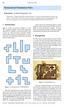 44 Geometry at Play Symmetrical Pentomino Pairs Kate Jones, Kadon Enterprises, Inc. Pentominoes shapes made of five congruent squares provide a natural platform for games and puzzles. In this article,
SPENDING TIME IN GOD S PRESENCE
 SPENDING TIME IN GOD S PRESENCE Helps for a Meaningful Time with God Preparing ahead... 4 During your time... 5 Devotional Guides Lectio Divina... 6 Meditation... 8 How to Have a Quiet Time You Won t Want
Common Mistakes in Data Presentation Stephen Few September 4, 2004
 Common Mistakes in Data Presentation Stephen Few September 4, 2004 I'm going to take you on a short stream-of-consciousness tour through a few of the most common and sometimes downright amusing problems
Old Testament. Part One. Created for use with young, unchurched learners Adaptable for all ages including adults
 Old Testament Part One Created for use with young, unchurched learners Adaptable for all ages including adults Mission Arlington Mission Metroplex Curriculum Lesson 9 Page 1 M ISSION ARLINGTON MISSION
Today, my view has changed completely. I can no longer imagine teaching math without making writing an integral aspect of students' learning.
 October 2004 Volume 62 Number 2 Writing! Pages 30-33 Writing in Math Marilyn Burns Innovative teachers can make writing an invaluable part of math instruction. One reason I chose mathematics for my undergraduate
HOW TO WRITE A FILM ESSAY
 HOW TO WRITE A FILM ESSAY Introduction Paragraph State the title and director of the film. Use words from the question to outline the topic of the essay. State the three points you will make in the main
Colour Science Typography Frontend Dev
 Colour Science Typography Frontend Dev Name Kevin Eger Who am I? Why should you listen to anything I say? Summary What the next hour of your life looks like Colour Science Typography Frontend Dev 1. 2.
What are you. worried about? Looking Deeper
 What are you worried about? Looking Deeper Looking Deeper What are you worried about? Some of us lie awake at night worrying about family members, health, finances or a thousand other things. Worry can
Composition as Explanation Gertrude Stein
 Composition as Explanation Gertrude Stein First delivered by the author as a lecture at Cambridge and Oxford, this essay was first published by the Hogarth Press in London in 1926 and revived in the volume
Women s Rights: Issues for the Coming Decades
 September 24, 2010 Suzanne B. Goldberg Columbia Law School Remarks for the International Conference on the Protection of Women s Rights Women s Rights: Issues for the Coming Decades I am delighted to be
Important Notes Color
 Important Notes Color Introduction A definition for color (MPI Glossary) The selective reflection of light waves in the visible spectrum. Materials that show specific absorption of light will appear the
ART/VCDMA PORTFOLIO TIPS
 ART/VCDMA PORTFOLIO TIPS What is a portfolio? A portfolio represents your skills as an artist, including craftsmanship, technique, creativity, and the ability to communicate visual ideas. High school seniors
Studio Art. Introduction and Course Outline
 Studio Art Introduction and Course Outline PACE High School An Independent Ohio Community School Welcome to the Studio Art course. During this semester you will learn to use the basic materials and techniques
What was the application process like?
 King s Student Perspectives Architecture Why did you want to study Architecture and what attracted you to Cambridge? Josh, 2 nd year June 2012 drawing space and making architectural decisions. I have not
Color Balancing Techniques
 Written by Jonathan Sachs Copyright 1996-1999 Digital Light & Color Introduction Color balancing refers to the process of removing an overall color bias from an image. For example, if an image appears
Social Return on Investment
 Social Return on Investment Valuing what you do Guidance on understanding and completing the Social Return on Investment toolkit for your organisation 60838 SROI v2.indd 1 07/03/2013 16:50 60838 SROI v2.indd
LESSON 7: LEARNING MODELS
 LESSON 7: LEARNING MODELS INTRODUCTION mobility motivation persistence sociological Think about your favorite class. Does the teacher lecture? Do you do experiments or go on field trips? Does the teacher
3 hours One paper 70 Marks. Areas of Learning Theory
 GRAPHIC DESIGN CODE NO. 071 Class XII DESIGN OF THE QUESTION PAPER 3 hours One paper 70 Marks Section-wise Weightage of the Theory Areas of Learning Theory Section A (Reader) Section B Application of Design
contents Introduction page 2 Documentary page 3 Types of documentary page 4 Narrative page 5 Expectations page 6 Observational documentary page 7
 contents page 2 page 3 page 4 page 5 page 6 page 7 page 9 Introduction Documentary Types of documentary Narrative Expectations Observational documentary Box office 1 introduction 'There are still, almost
A Whirl of Colors: Seurat s Woman with a Monkey and the Color Wheel
 Elementary A Whirl of Colors: Seurat s Woman with a Monkey and the Color Wheel Overview Students will learn the definition and relations of primary, secondary and complementary colors using Georges Seurat
What is a Picture Book?
 What is a Picture Book? A picture book is text, illustrations, total design; an item of manufacture and a commercial product; a social, cultural, historical document; and foremost, an experience for a
Processing the Image or Can you Believe what you see? Light and Color for Nonscientists PHYS 1230
 Processing the Image or Can you Believe what you see? Light and Color for Nonscientists PHYS 1230 Optical Illusions http://www.michaelbach.de/ot/mot_mib/index.html Vision We construct images unconsciously
Art Masterpiece: Fallingwater, 1937 by Frank Lloyd Wright
 Art Masterpiece: Fallingwater, 1937 by Frank Lloyd Wright Pronounced: Frank Loyd Right Keywords: Line, Repetition, Organic Architecture, Two point perspective Line - An element of art; a continuous path
Basic Theory of Intermedia Composing with Sounds and Images
 (This article was written originally in 1997 as part of a larger text to accompany a Ph.D. thesis at the Music Department of the University of California, San Diego. It was published in "Monochord. De
How to prepare an optical illusionthemed
 ARVO Outreach Tools How to prepare an optical illusionthemed exhibit at a science exhibition 1801 Rockville Pike, Suite 400 Rockville, MD 20852 +1.240.221.2900 arvo.org Questions? @arvo.org How to prepare
In Defense of Kantian Moral Theory Nader Shoaibi University of California, Berkeley
 In Defense of Kantian Moral Theory University of California, Berkeley In this paper, I will argue that Kant provides us with a plausible account of morality. To show that, I will first offer a major criticism
Writing Topics WRITING TOPICS
 Writing Topics Topics in the following list may appear in your actual test. You should become familiar with this list before you take the computer-based TOEFL test. Remember that when you take the test
Coach Tool. Lesson Planning/Lesson Observation/Lesson Debriefing
 Purpose Coach Tool Lesson Planning/Lesson Observation/Lesson Debriefing By Krista Jiampetti, Reading Specialist, South Colonie Central Schools, Albany, NY For Literacy or Instructional Coaches, K-12 This
Claude Monet S. house and gardens. activity booklet. 5/8 years. This booklet belongs to: ... I am... years old I visited Giverny on: ...
 Claude Monet S house and gardens activity booklet 5/8 years This booklet belongs to:.............................................................. I am.................... years old I visited Giverny on:...........................................................
The Roche Court Educational Trust Upcoming Events and Opportunities for Schools and Teachers
 The Roche Court Educational Trust Upcoming Events and Opportunities for Schools and Teachers Nathan Coley We Must Cultivate Our Garden the artist Please note that booking is essential for all our events,
Graphic Design: Introduction to Typography
 Lesson 6 Graphic Design: Introduction to Typography What is Design? What is Graphic Design? How is Graphic Design different from Fine Art? LESSON OVERVIEW/OBJECTIVES Students will learn about design and
Painting as a Pastime 1 By Winston S. Churchill (An Excerpt) AP English Language Lesson by Eileen Bach
 Painting as a Pastime 1 By Winston S. Churchill (An Excerpt) AP English Language Lesson by Eileen Bach British statesman Winston Churchill first achieved fame as a soldier in the Boer War, later serving
Exploring the Use of Slow Motion Animation (Slowmation) as a Teaching Strategy to Develop Year 4 Students' Understandings of Equivalent Fractions.
 Kervin, K. (2007). Exploring the use of slow motion animation (slowmation) as a teaching strategy to develop year 4 students' understandings of equivalent fractions. Contemporary Issues in Technology and
COLOR THEORY WORKSHEET
 COLOR THEORY WORKSHEET Use color pencils to complete the following exercises Name: Period Date PRIMARY COLORS cannot be made from any combination of colors. Fade intensity from top left to bottom right
AN INTRODUCTION TO SOCIOLOGICAL THEORIES
 An Introduction to Sociological Theories 1 1 AN INTRODUCTION TO SOCIOLOGICAL THEORIES Introduction Humans are social beings. Whether we like it or not, nearly everything we do in our lives takes place
Lesson 3. The Novel ASSIGNMENT 8. Introduction to the Novel. Plot. Character
 The Novel ASSIGNMENT 8 Read the following Introduction to the Novel and the background to The Call of the Wild by Jack London. Then read pages 1 24 in the novel. When you finish your reading, study the
Daniel Mlynář, Sales and Marketing Director, WDF Web Design Factory written for the Marketing & Media magazine
 Case studies Case study Online advertising: New types of traditional online advertising Daniel Mlynář, Sales and Marketing Director, WDF Web Design Factory written for the Marketing & Media magazine The
Cleveland Institute of Art Creativity Matters
 Cleveland Institute of Art Creativity Matters Our Cores + Connections matter What sets the Cleveland Institute of Art apart from other colleges of art and design? In a nutshell, our Cores + Connections
News Writing: Lead Paragraphs
 HFCC Learning Lab Lead Paragraphs, 5:17 News Writing: Lead Paragraphs The most important paragraphs in a news story are the paragraphs that make up what is known as the lead group or the introduction to
Comparing Firefly Books ELA Common Core Connections Fireflies! by Julie Brinckloe Aladdin Paperbacks, 1985 Before Reading: During Reading:
 Comparing Firefly Books By comparing two texts on the same topic, children can become aware that every author has a purpose. Whether it is to share a story, convey a message, or teach a concept, there
Creating a History Day Exhibit Adapted from materials at the National History Day website
 Creating a History Day Exhibit Adapted from materials at the National History Day website Exhibits are designed to display visual and written information on topics in an attractive and understandable manner.
Sunflowers. Name. Level and grade. PrimaryTools.co.uk
 Sunflowers Name Score Level and grade 2012 Contents Billy s Sunflower... 3 A story by Nicola Moon So Many Sunflowers!... 14 Vincent Van Gogh... 15 Information about the artist Making a Paper Sunflower...
Computers, art and creativity Author(s) Duthie, Birnie Source Teaching and Learning, 11(1),23-27 Published by Institute of Education (Singapore)
 Title Computers, art and creativity Author(s) Duthie, Birnie Source Teaching and Learning, 11(1),23-27 Published by Institute of Education (Singapore) This document may be used for private study or research
The Museum of Everything Exhibition #4. Conversation with Dr Johann Feilacher
 The Museum of Everything Exhibition #4 Conversation with Dr Johann Feilacher Dr Johann Feilacher b 1954 (Villach, Austria) Originally trained as a psychiatrist, Dr Johann Feilacher is an artist, curator
INSEEC BACHELOR EPREUVE D ANGLAIS. durée : 30 min - coef. 3
 INSEEC BACHELOR EPREUVE D ANGLAIS durée : 30 min - coef. 3 READING COMPREHENSION AND VOCABULARY Read the following passage and answer questions 1 10 below. Edward Hopper s painting Nighthawks of an American
Fringe Schools Poster Competition Lesson Plan Stage 3, age 11-13
 Fringe Schools Poster Competition Lesson Plan Stage 3, age 11-13 The search for the official poster for the 2015 Edinburgh Festival Fringe has begun! Each year we ask schoolchildren from across Scotland