
Self assessment tool. Using this tool
|
|
|
- Anthony Wilkins
- 9 years ago
- Views:
Transcription
1 Self assessment tool How well does your organisation comply with the 12 guiding principles of the surveillance camera code of practice? Complete this easy to use self assessment tool to find out if you do. Using this tool This self assessment tool will help you and your organisation identify if you re complying with the principles in the code. It should be completed in conjunction with the surveillance camera code of practice. The tool will help you show how well you comply with each principle. It is possible to be largely compliant with some principles and to fall short against others. As a result you will note that at the end of the questions against each principle there is a space to include an action plan. This is to enable you to put actions in place over the next year to improve your compliance to that principle. These boxes can also be used to make a note of what evidence you could produce if required to show your compliance to that principle. The document contains a combination of open and closed questions. For the open questions there is a limit on how much you can write, so please feel free to include any additional notes as an annex to the document there are additional blank pages at the end of the tool. We do not want you to send the self assessment response to us. However, in the interest of transparency we encourage you to publish the self assessment on your website. The self assessment is for you to satisfy yourself and those that you surveille that you meet the principles and identify any additional work to show compliance. We would like you to let us know that you have completed this document as this will enable us to understand the level of uptake. Also please let us know if you will be interested in working towards certification against the surveillance camera code of practice in the near future or just be added to our mailing list. This is the first edition of the self assessment tool which will evolve over time. Please forward any feedback to [email protected]
2 Principle 1 Use of a surveillance camera system must always be for a specified purpose which is in pursuit of a legitimate aim and necessary to meet an identified pressing need. 1. Have you translated principle 1 into clear objectives? If so what are they? 2. Do you regularly review the system and assess against the objectives? 3. Have you considered the requirement of the end user? 4. Is the system being used for any other purpose other than those specified? If so please explain 5. Have you identified any areas where further action is required more fully conform with the requirements of Principle 1?

3 Principle 2 The use of a surveillance camera system must take into account its effect on individuals and their privacy, with regular reviews to ensure its use remains justified. 1. Do you review your system annually? 2. Have you conducted a privacy impact assessment? (The ICO has produced a PIA code of practice and the SCC has a template you can use if required) 3. Do you publish your privacy impact assessment and annual review? 4. Have you identified any areas where further action is required to more fully conform with the requirements of Principle 2? Principle 3 There must be as much transparency in the use of a surveillance camera system as possible, including a published contact point for access to information and complaints. 1. Does signage exist highlighting the use of surveillance cameras? 2. Does the signage highlight the point of contact? 3. Has there been proportionate consultation and engagement with the public and partners to establish that there is a legitimate aim and a pressing need for the surveillance camera system? 4. Is the surveillance system a proportionate response?

4 5. Does your publication of information include the procedures and safeguards that are in place, impact assessments undertaken, performance statistics and other management information? 6. Do you have a complaints procedure in place? 7. Do you make the public aware of how to escalate complaints? 8. Is there a defined time scale for acknowledging and responding to complaints and is this conveyed to the complainant at the outset? 9. Do you publish the number and nature of complains received? 10. Have you identified any areas where further action is required to more fully conform with the requirements of Principle 3? Principle 4 There must be clear responsibility and accountability for all surveillance camera system activities including images and information collected, held and used. 1. What arrangements are in place to provide clear responsibility and accountability?

5 2. Are all staff aware of their responsibilities? 3. Please explain how you ensure the lines of responsibility are adhered to. 4. If jointly owned, is it clear what each partner organisation is responsible for and what the individual obligations are? 5. Have you identified any areas where further action is required to more fully conform with the requirements of Principle 4? Principle 5 Clear rules, policies and procedures must be in place before a surveillance camera system is used, and these must be communicated to all who need to comply with them. 1. Do you have clear policies and procedures which help ensure that any legal obligations affecting the use of such a system are addressed? If so please specify.

6 2. Do you follow a quality management system? If so please specify. 3. Are the rules, policies and procedures part of an induction process for all staff? 4. How do you ensure that all system users remain up to date and efficient with relevant operational, technical, privacy considerations, policies and procedures? 5. Have you considered qualifications relevant to the role of the system users, such as the National Occupational Standard for CCTV operations or other similar? 6. If so, have any of your system users undertaken any occupational standards to date? 7. Do your system users require SIA licenses? (Please see SIA website: 8. If staff do not need a license, how do you ensure they have the necessary skills and knowledge to use or manage the surveillance system? 9. Have you identified any areas where further action is required to more fully conform with the requirements of Principle 5?

7 Principle 6 more images and information should be stored than that which is strictly required for the stated purpose of a surveillance camera system, and such images and information should be deleted once their purposes have been discharged. 1. On what basis are images retained and for how long? 2. Do you have an auditable process for reviewing images and managing their retention? 3. Are there any time constraints in the event of the enforcement agency not taking advantage of the opportunity to view the retained images? 4. Are there any time constraints which might affect external parties from viewing the images? 5. Do you quarantine all relevant information and images relating to a reported incident until such time as the incident is resolved and/or all the information and images have been passed on to official third parties? 6. Have you identified any areas where further action is required to more fully conform with the requirements of Principle 6?

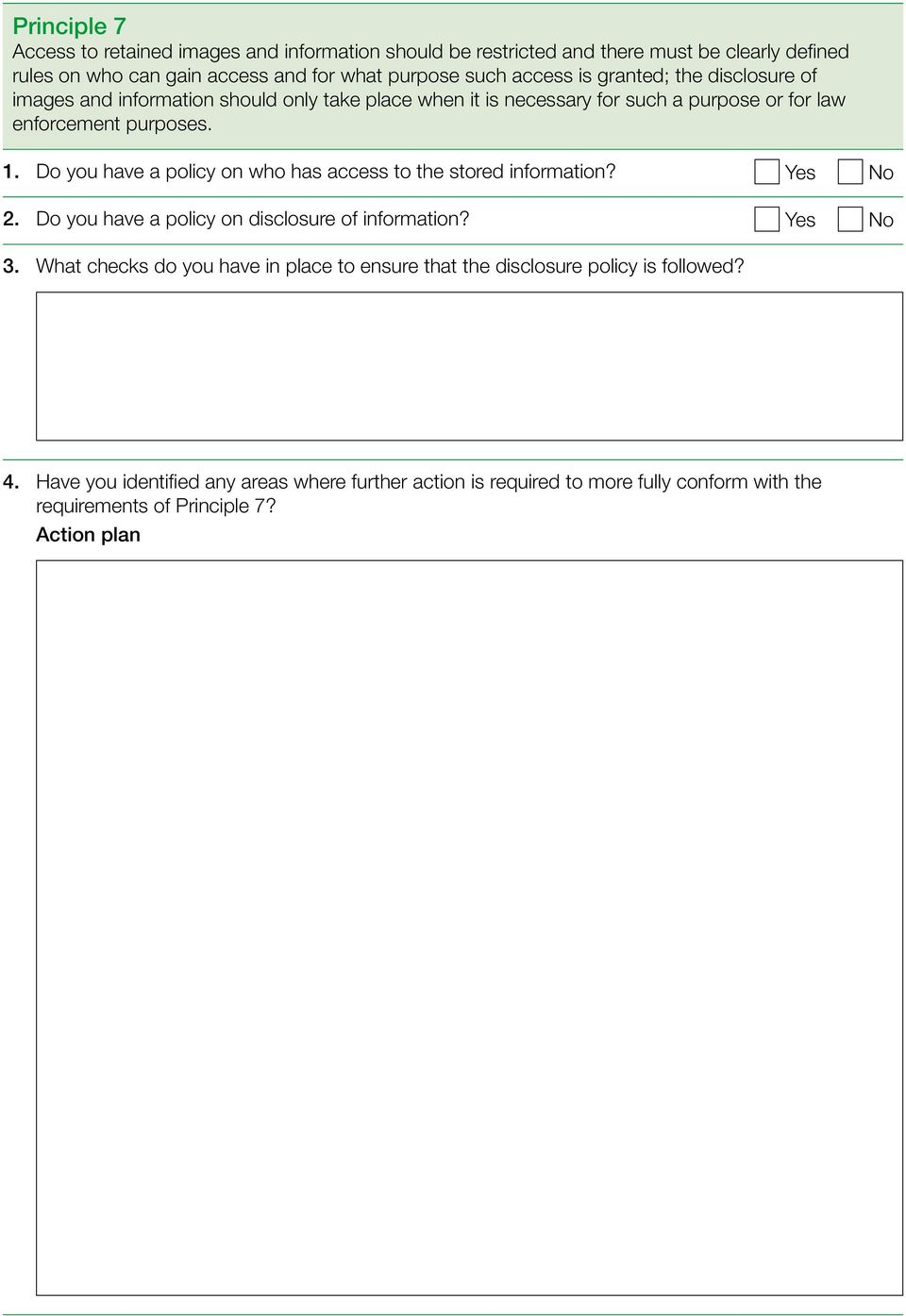
8 Principle 7 Access to retained images and information should be restricted and there must be clearly defined rules on who can gain access and for what purpose such access is granted; the disclosure of images and information should only take place when it is necessary for such a purpose or for law enforcement purposes. 1. Do you have a policy on who has access to the stored information? 2. Do you have a policy on disclosure of information? 3. What checks do you have in place to ensure that the disclosure policy is followed? 4. Have you identified any areas where further action is required to more fully conform with the requirements of Principle 7?
9 Principle 8 Surveillance camera system operators should consider any approved operational, technical and competency standards relevant to a system and its purpose and work to meet and maintain those standards. 1. What approved operational, technical and competency standards relevant to a surveillance system and its purpose does your system meet? 2. How do you ensure that these standards are followed appropriately? 3. What steps are in place to secure certification against the approved standards? 4. Have you identified any areas where further action is required to more fully conform with the requirements of Principle 8?

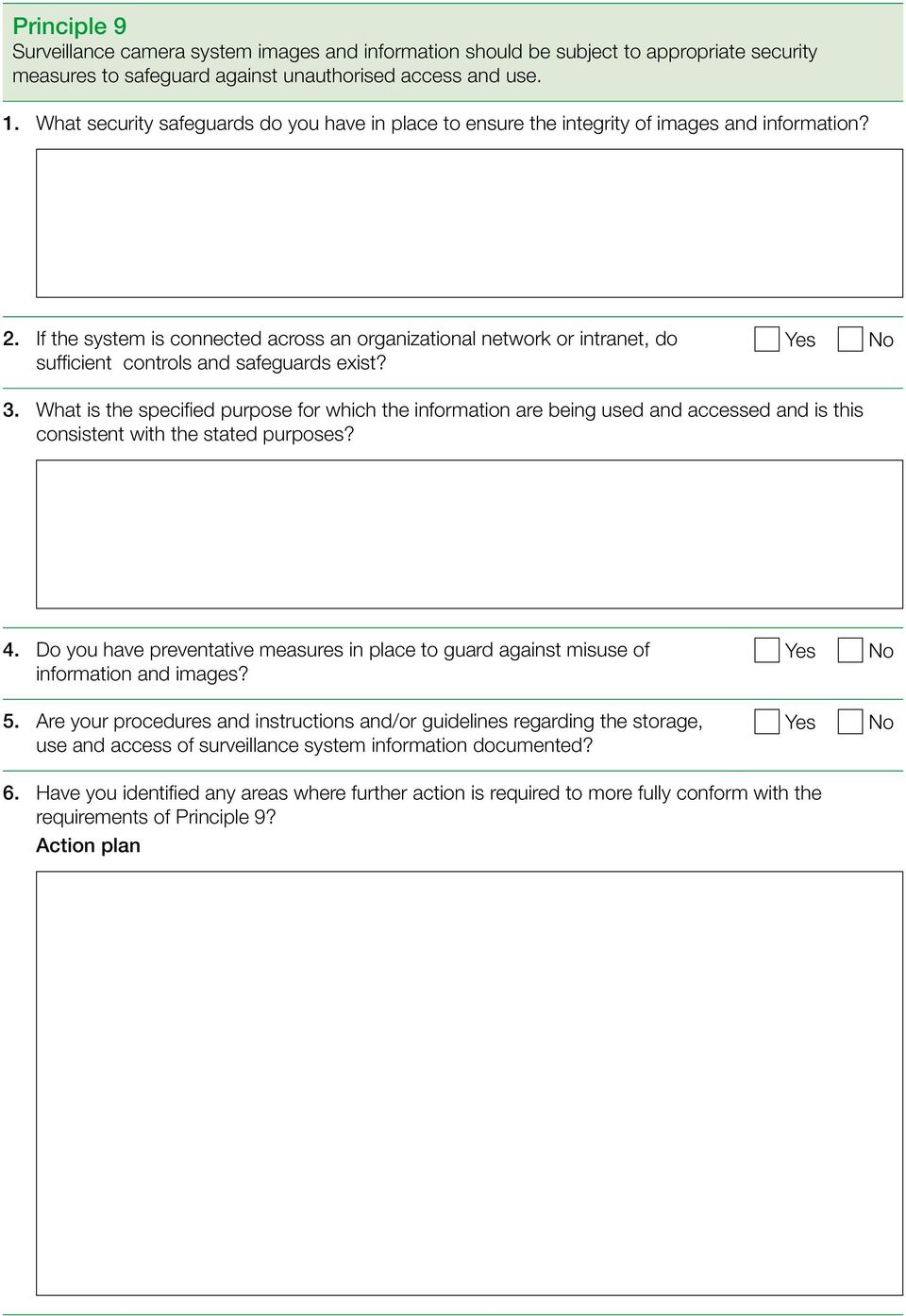
10 Principle 9 Surveillance camera system images and information should be subject to appropriate security measures to safeguard against unauthorised access and use. 1. What security safeguards do you have in place to ensure the integrity of images and information? 2. If the system is connected across an organizational network or intranet, do sufficient controls and safeguards exist? 3. What is the specified purpose for which the information are being used and accessed and is this consistent with the stated purposes? 4. Do you have preventative measures in place to guard against misuse of information and images? 5. Are your procedures and instructions and/or guidelines regarding the storage, use and access of surveillance system information documented? 6. Have you identified any areas where further action is required to more fully conform with the requirements of Principle 9?
11 Principle 10 There should be effective review and audit mechanisms to ensure legal requirements, policies and standards are complied with in practice, and regular reports should be published. 1. Does your system have a review process that shows it still addresses the needs and delivers the benefits that justify its use? 2. Have you identified any cameras that do not remain justified in meeting the stated purpose(s)? 3. Have you conducted an evaluation in order to compare alternative interventions to surveillance cameras? If so please provide brief details. 4. Is it cost effective to continue running your surveillance camera system? 5. Have you identified any areas where further action is required to more fully conform with the requirements of Principle 10?

12 Principle 11 When the use of a surveillance camera system is in pursuit of a legitimate aim, and there is a pressing need for its use, it should then be used in the most effective way to support public safety and law enforcement with the aim of processing images and information of evidential value. 1. Are the images and information produced by your system of a suitable quality for the criminal justice system to use without enhancement? 2. During the production of the operational requirement for your system, what stakeholder engagement was carried out or guidance followed to ensure exported data would meet the quality required for it to be used for evidential purposes? 3. Do you have safeguards in place to ensure the forensic integrity of the images and information including a complete audit trail? 4. Do you have a policy on data storage, security and deletion? 5. Is the information stored in a format that is easily exportable? 6. Does the storage ensure the integrity and quality of original recording and the meta data? 7. Have you identified any areas where further action is required to more fully conform with the requirements of Principle 11?

13 Principle 12 Any information used to support a surveillance camera system which compares against a reference database for matching purposes should be accurate and kept up to date. 1. Do you use any specialist technology such as ANPR, facial recognition, Body Worn Video (BWV) or remotely operated vehicles (Drones)? If so, please specify. 2. Do you have a policy in place to ensure that the information contained on your database is accurate and up to date? 3. Do you have a procedure for deciding when and whether an individual or vehicle should be included in a reference database? 4. What policies are in place to determine how long information remains in the reference database? 5. Are all staff aware of when surveillance becomes covert surveillance under the Regulation of Investigatory Powers Act (RIPA) 2000? 6. Have you identified any areas where further action is required to more fully conform with the requirements of Principle 12?

14 Additional Information

15 Additional Information

16 Additional Information

Template for Automatic Number Plate Recognition (ANPR) Infrastructure Development Privacy Impact Assessment
 Template for Automatic Number Plate Recognition (ANPR) Infrastructure Development Privacy Impact Assessment This template is provided to support the police service and other law enforcement agencies (LEA)
Surveillance Camera Code of Practice. June 2013
 Surveillance Camera Code of Practice June 2013 Surveillance Camera Code of Practice Presented to Parliament Pursuant to Section 30 (1) (a) of the Protection of Freedoms Act 2012 June 2013 London: The Stationery
Parliamentary Security Camera Policy
 Parliamentary Security Camera Policy Introduction 1) Security cameras are employed in various parts of the Palace of Westminster and its surrounding estate. They are a vital part of the security system
Automatic Number Plate Recognition (ANPR) Systems
 Automatic Number Plate Recognition (ANPR) Systems Code of Practice Date: August 2014 Economy, Enterprise and Environment Directorate Document History Date Author Change 07/01/2014 Business & Enterprise
University of Birmingham. Closed Circuit Television (CCTV) Code of Practice
 University of Birmingham Closed Circuit Television (CCTV) Code of Practice University of Birmingham uses closed circuit television (CCTV) images to provide a safe and secure environment for students, staff
Buckinghamshire County Council Transport for Buckinghamshire ANPR Code of Practice
 Buckinghamshire County Council Transport for Buckinghamshire ANPR Code of Practice 1 Introduction 1.1 Buckinghamshire County Council (BCC) Transportation Service has Automatic Number Plate Recognition
Data Protection Policy
 Data Protection Policy Owner : Head of Information Management Document ID : ICT-PL-0099 Version : 2.0 Date : May 2015 We will on request produce this Policy, or particular parts of it, in other languages
maintenance of CCTV surveillance systems code of practice
 maintenance of CCTV surveillance systems code of practice Issue 3 January 2015 For other information please contact: British Security Industry Association t: 0845 389 3889 f: 0845 389 0761 e: [email protected]
Closed Circuit Television (CCTV) code of practice. Based on the publication A Code of Practice for CCTV www.ico.gov.uk
 Closed Circuit Television (CCTV) code of practice Based on the publication A Code of Practice for CCTV www.ico.gov.uk Owner: Ian Heywood Last reviewed: July 2011 Contents 1.0 Introduction... 4 2.0 CCTV
How To Use A Surveillance Camera Safely
 Data protection In the picture: A data protection code of practice for surveillance cameras and personal information Contents Introduction... 3 About this code... 4 What this code covers... 6 Deciding
UNIVERSITY COLLEGE LONDON CCTV POLICY. Endorsed by the Security Working Group - 17 October 2012
 UNIVERSITY COLLEGE LONDON CCTV POLICY Endorsed by the Security Working Group - 17 October 2012 Endorsed by the Infrastructure IT Services Strategy Group - 18 October 2012 Reviewed and endorsed (with one
SURVEILLANCE AND PRIVACY
 info sheet 03.12 SURVEILLANCE AND PRIVACY Info Sheet 03.12 March 2012 This Information Sheet applies to Victorian state and local government organisations that are bound by the Information Privacy Act
Contra Costa Community College District Business Procedure 10.57 SECURITY CAMERA OPERATING PROCEDURE
 Contra Costa Community College District Business Procedure 10.57 SECURITY CAMERA OPERATING PROCEDURE The District and its colleges are committed to enhancing the quality of life of the community by integrating
Health and Safety Policy Part 1 Policy and organisation
 Health and Safety Policy Part 1 Policy and organisation ICO H&S Policy Policy and organisation, June 2014 Page 1 of 6 1. Scope 1.1 The Health and Safety policy applies to all employees of the Information
GLASGOW SCHOOL OF ART OCCUPATIONAL HEALTH AND SAFETY POLICY. 1. Occupational Health and Safety Policy Statement 1
 GLASGOW SCHOOL OF ART OCCUPATIONAL HEALTH AND SAFETY POLICY CONTENTS PAGE 1. Occupational Health and Safety Policy Statement 1 2. Occupational Health and Safety Management System 2 3. Organisational Management
European Investment Bank Group. Video-surveillance policy
 Group TABLE OF CONTENTS 1. Purpose and scope of the video-surveillance policy... 2 2. Respect for privacy, data protection and compliance with the relevant rules... 2 2.1. Compliance status... 2 2.2.
SECURITY ENCRYPTION DATA PROTECTION. The Complete Guide to Body Worn Camera Data Protection BODY WORN CAMERA STORAGE
 SECURITY DATA PROTECTION ENCRYPTION BODY WORN CAMERA STORAGE The Complete Guide to Body Worn Camera Data Protection Overview Edesix has been providing technology solutions to organisations for over ten
Records Retention and Disposal Schedule. Information Management
 Records Retention and Disposal Schedule Information Management Version control Version Author Policy Approved By Approval Date Publication Date Review Due V 1.0 Information Governance Unit Philip Jones,
DATA PROTECTION POLICY
 DATA PROTECTION POLICY DATA PROTECTION POLICY Document Control Information Title Data Protection Policy Version V1.0 Author Diana Watt Date Approved 21 February 2013 Review Date Annually, on the anniversary
Data Protection Act. Conducting privacy impact assessments code of practice
 Data Protection Act Conducting privacy impact assessments code of practice 1 Conducting privacy impact assessments code of practice Data Protection Act Contents Information Commissioner s foreword... 3
Video surveillance at EFSA Implementing rules and technical specifications
 Video surveillance at EFSA Implementing rules and technical specifications PUBLIC version 1 Introduction EFSA operates a video surveillance system (hereafter VSS) for the safety and security of its buildings,
Issue 1.0. UoG/ILS/IS 001. Information Security and Assurance Policy. Information Security and Compliance Manager
 Document Reference Number Date Title Author Owning Department Version Approval Date Review Date Approving Body UoG/ILS/IS 001 January 2016 Information Security and Assurance Policy Information Security
DATA PROTECTION POLICY
 Reference number Approved by Information Management and Technology Board Date approved 14 th May 2012 Version 1.1 Last revised N/A Review date May 2015 Category Information Assurance Owner Data Protection
Data Protection Policy June 2014
 Data Protection Policy June 2014 Approving authority: Consultation via: Court Audit and Risk Committee, University Executive, Secretary's Board, Information Governance and Security Group Approval date:
BRITISH COUNCIL DATA PROTECTION CODE FOR PARTNERS AND SUPPLIERS
 BRITISH COUNCIL DATA PROTECTION CODE FOR PARTNERS AND SUPPLIERS Mat Wright www.britishcouncil.org CONTENTS Purpose of the code 1 Scope of the code 1 The British Council s data protection commitment and
POLICY FOR USE OF CCTV SYSTEM AT BOW SCHOOL OF MATHS AND COMPUTING SCHOOL
 POLICY FOR USE OF CCTV SYSTEM AT BOW SCHOOL OF MATHS AND COMPUTING SCHOOL CCTV cameras are now a familiar sight throughout the country. They are one of the many measures being introduced to help prevent
Online Research and Investigation
 Online Research and Investigation This document is intended to provide guidance to police officers or staff engaged in research and investigation across the internet. This guidance is not a source of law
Policy on Public and School Bus Closed Circuit Television Systems (CCTV)
 DEPARTMENT OF TRANSPORT Policy on Public and School Bus Closed Circuit Television Systems (CCTV) Responsibility of: Public Transport Division TRIM File: DDPI2010/3680 Effective Date: July 2010 Version
Video surveillance policy (PUBLIC)
 29 July 2015 EMA/133708/2015 Administration Division POLICY/0046 POLICY/0046 Effective Date: 01/01/2015 Review Date: 01/01/2018 Supersedes: Version 1 1. Introduction and purpose For the safety and security
Records Management Plan. April 2015
 Records Management Plan April 2015 Prepared in accordance with the Public Records (Scotland) Act 2011 and submitted to the Keeper of the Records of Scotland for their agreement on 28 April 2015 (Revised
Scotland s Commissioner for Children and Young People Records Management Policy
 Scotland s Commissioner for Children and Young People Records Management Policy 1 RECORDS MANAGEMENT POLICY OVERVIEW 2 Policy Statement 2 Scope 2 Relevant Legislation and Regulations 2 Policy Objectives
LONDON DOWNTOWN CLOSED CIRCUIT TELEVISION (CCTV) PROGRAM CODE OF PRACTICE CITY OF LONDON, ONTARIO
 LONDON DOWNTOWN CLOSED CIRCUIT TELEVISION (CCTV) PROGRAM CODE OF PRACTICE CITY OF LONDON, ONTARIO Contents Page Number 1. Introduction Page 2 2. Defining the Responsible Persons Page 2 3. Purpose and Principles
Queensland Taxi Security Camera Program Changes
 Queensland Taxi Security Camera Program Changes Frequently Asked Questions GENERAL INFORMATION 1. What is the taxi security camera program? It is a program administered by the Department of Transport and
Title of the Policy: Surveillance Policy
 Title of the Policy: Surveillance Policy Functional Area: University Police Applies To: All Faculty and Staff Policy Reference(s): Number: Version 1.0 Date First Issued: March 15, 2016 Date Last Reviewed:
Data Protection Policy
 Data Protection Policy Document Ref: DPA20100608-001 Version: 1.3 Classification: UNCLASSIFIED (IL 0) Status: ISSUED Prepared By: Ian Mason Effective From: 4 th January 2011 Contact: Governance Team ICT
Auditing data protection a guide to ICO data protection audits
 Auditing data protection a guide to ICO data protection audits Contents Executive summary 3 1. Audit programme development 5 Audit planning and risk assessment 2. Audit approach 6 Gathering evidence Audit
Data Protection Policy
 Data Protection Policy CONTENTS Introduction...2 1. Statement of Intent...2 2. Fair Processing or Privacy Statement...3 3. Data Uses and Processes...4 4. Data Quality and Integrity...4 5. Technical and
How To Protect Your Privacy In The Workplace
 Review of the Workplace Surveillance Act 2005 (NSW) Submission to the NSW Attorney- General s Department January 2011 e m a i l: m a i l @ p r i v a c y. o r g. a u w e bsite : w w w. p r i v a c y. o
The CPS incorporates RCPO. CPS Data Protection Policy
 The CPS incorporates RCPO CPS Data Protection Policy Contents Introduction 3 Scope 4 Roles and Responsibilities 4 Processing Criminal Cases 4 Information Asset Owners 5 Information Asset Register 5 Information
MODESTO CITY SCHOOLS Administrative Regulation
 MODESTO CITY SCHOOLS Administrative Regulation AR 3515 The intent of the camera surveillance systems deployed by Modesto City Schools is to protect the safety and security of students, employees and authorized
Delivering Excellence in Insurance Claims Handling
 Delivering Excellence in Insurance Claims Handling Guide to Best Practice Delivering Excellence in Insurance Claims Handling Contents Page 1. Introduction 1 2. Executive Summary 2 3. Components of Best
PS 172 Protective Monitoring Policy
 PS 172 Protective Monitoring Policy January 2014 Version 2.0 Statement of legislative compliance This document has been drafted to comply with the general and specific duties in the Equality Act 2010;
OIPC GUIDELINES FOR THE USE OF VIDEO SURVEILLANCE SYSTEMS IN SCHOOLS
 OIPC GUIDELINES FOR THE USE OF VIDEO SURVEILLANCE SYSTEMS IN SCHOOLS February 13, 2013 TABLE OF CONTENTS Page Introduction... 1 Applicability of Guidelines... 2 ATIPPA... 3 Definitions... 5 Collection
Information Governance Framework. June 2015
 Information Governance Framework June 2015 Information Security Framework Janice McNay June 2015 1 Company Thirteen Group Lead Manager Janice McNay Date of Final Draft and Version Number June 2015 Review
Health, Security, Safety and Environment (HSE)
 Health, Security, Safety and Environment (HSE) Content: 1 Objective 2 Application and Scope 21 Application of HSE Directive with underlying documents 22 Scope of HSE Management system 3 Framework for our
Corporate ICT & Data Management. Data Protection Policy
 90 Corporate ICT & Data Management Data Protection Policy Classification: Unclassified Date Created: January 2012 Date Reviewed January Version: 2.0 Author: Owner: Data Protection Policy V2 1 Version Control
Do you have a private life at your workplace?
 Do you have a private life at your workplace? Privacy in the workplace in EC institutions and bodies Giovanni Buttarelli In the course of his supervisory activities, the EDPS has published positions on
CCTV Strategy for the London Borough of Merton
 1.0 Overview Closed Circuit Television is one tool, which may be used by Merton Council to prevent and detect and reduce the fear of crime; it will also be used for Traffic Regulation and Enforcement.
Data Protection Policy
 Data Protection Policy Version: V1 Ratified by: Operational Management Executive Committee Date ratified: 26 September 2013 Name and Title of originator/author(s): Chris Brady, FOI, Data Protection and
PRIVACY POLICY. comply with the Australian Privacy Principles ("APPs"); ensure that we manage your personal information openly and transparently;
 PRIVACY POLICY Our Privacy Commitment Glo Light Pty Ltd A.C.N. 099 730 177 trading as "Lighting Partners Australia of 16 Palmer Parade, Cremorne, Victoria 3121, ( LPA ) is committed to managing your personal
Policy for Management of CCTV on Waste Operation Vehicles
 Policy for Management of CCTV on Waste Operation Vehicles 1.0 POLICY 1.1 CCTV cameras are fitted to refuse vehicles for the purposes of Health and Safety of employees and members of the public, and for
DATA PROTECTION POLICY
 DATA PROTECTION POLICY Version 1.3 April 2014 Contents 1 POLICY STATEMENT...2 2 PURPOSE....2 3 LEGAL CONTEXT AND DEFINITIONS...2 3.1 Data Protection Act 1998...2 3.2 Other related legislation.....4 3.3
Regulation of Investigatory Powers Act 2000
 Regulation of Investigatory Powers Act 2000 Consultation: Equipment Interference and Interception of Communications Codes of Practice 6 February 2015 Ministerial Foreword The abilities to read or listen
Information Governance and Assurance Framework Version 1.0
 Information Governance and Assurance Framework Version 1.0 Page 1 of 19 Document Control Title: Original Author(s): Owner: Reviewed by: Quality Assured by: Meridio Location: Approval Body: Policy and Guidance
Somerset County Council - Data Protection Policy - Final
 Organisation Title Author Owner Protective Marking Somerset County Council Data Protection Policy - Final Peter Grogan Information Governance Manager Unclassified POLICY ON A PAGE Somerset County Council
Copyright 2014 Nymity Inc. All Rights Reserved.
 This sample Benchmarks Report represents a real-world example of Your Privacy Management Status Report based on a mature privacy program in a non-north American organization within the public sector. Copyright
Data Protection Act 1998 The Data Protection Policy for the Borough Council of King's Lynn & West Norfolk
 Data Protection Act 1998 The for the Borough Council of King's Lynn & West Norfolk 1 Contents Introduction 3 1. Statement of Intent 4 2. Fair Obtaining I Processing 5 3. Data Uses and Processes 6 4. Data
Complaints Policy. Complaints Policy. Page 1
 Complaints Policy Page 1 Complaints Policy Policy ref no: CCG 006/14 Author (inc job Kat Tucker Complaints & FOI Manager title) Date Approved 25 November 2014 Approved by CCG Governing Body Date of next
EPA Victoria Engagement Policy ENVIRONMENT PROTECTION AUTHORITY
 EPA Victoria Engagement Policy ENVIRONMENT PROTECTION AUTHORITY The aspirations of the people of Victoria for environmental quality shall drive environmental improvement Environment Protection Act 1970
Information Governance Strategy & Policy
 Information Governance Strategy & Policy March 2014 CONTENT Page 1 Introduction 1 2 Strategic Aims 1 3 Policy 2 4 Responsibilities 3 5 Information Governance Reporting Structure 4 6 Managing Information
Security. Deployment Protocol for BWC s (Appendix H)
 (Appendix H) Ref: 1012 Rev: Author: Approver: Date: 24/08/12 Introduction North East Lincolnshire Partnership Car Parks Department owns 18 Body Worn cameras, hereinafter referred to as BWCs. This document
SAFE HARBOR PRIVACY NOTICE EFFECTIVE: July 1, 2005 AMENDED: July 15, 2014
 SAFE HARBOR PRIVACY NOTICE EFFECTIVE: July 1, 2005 AMENDED: July 15, 2014 This Notice sets forth the principles followed by United Technologies Corporation and its operating companies, subsidiaries, divisions
Service Quality Standards (SQSs) and Criteria
 Service Quality Standards (SQSs) and Criteria Principle 1 : Provision of Information The purpose and objectives of the service should be clearly defined and its mode of operations transparent for the benefit
AlixPartners, LLP. General Data Protection Statement
 AlixPartners, LLP General Data Protection Statement GENERAL DATA PROTECTION STATEMENT 1. INTRODUCTION 1.1 AlixPartners, LLP ( AlixPartners ) is committed to fulfilling its obligations under the data protection
Principles for High Quality Interpreting and Translation Services REGIONAL EVENT WORKSHOPS. 13th May Leeds Thackray Medical Museum
 Four regional events took place in May 2015 REGIONAL EVENT WORKSHOPS 13th May Leeds Thackray Medical Museum 14th May Manchester Kings House Conference Centre 19th May Birmingham Signing Tree Conference
Corporate Policy and Strategy Committee
 Corporate Policy and Strategy Committee 10am, Tuesday, 30 September 2014 Information Governance Policies Item number Report number Executive/routine Wards All Executive summary Information is a key asset
OFFICE FOR HARMONIZATION IN THE INTERNAL MARKET (TRADEMARKS AND DESIGNS) Quality Management Department. The Quality Management System Manual
 The Quality Management System Manual TABLE OF CONTENTS 1. MESSAGE FROM THE PRESIDENT OF THE OFFICE (THE OHIM QUALITY POLICY)... 3 2. INTRODUCTION... 4 2.1 MISSION OF THE OFFICE FOR HARMONIZATION IN THE
SAS TRUSTEE CORPORATION ( STC )
 SAS TRUSTEE CORPORATION ( STC ) POLICY ON USE OF EMPLOYER COMMUNICATION DEVICES AND WORKPLACE SURVEILLANCE under the Workplace Surveillance Act 2005 File: B915 May 2011 Version 3 INDEX Policy Statement...
Review of compliance. Redcar and Cleveland PCT Redcar Primary Care Hospital. North East. Region: West Dyke Road Redcar TS10 4NW.
 Review of compliance Redcar and Cleveland PCT Redcar Primary Care Hospital Region: Location address: Type of service: Regulated activities provided: Type of review: Date of site visit (where applicable):
BAILIWICK OF GUERNSEY DATA PROTECTION
 BAILIWICK OF GUERNSEY DATA PROTECTION CODE OF PRACTICE: CRIMINAL RECORDS CHECK PREFACE Section 56 of the Data Protection (Bailiwick of Guernsey) Law, 2001 ( the DP Law ), as amended by Ordinance in 2010
INFORMATION SECURITY POLICY
 INFORMATION SECURITY POLICY Policy approved by: Audit and Governance Committee Date: 4 th December 2014 Next Review Date: December 2016 Version: 1 Information Security Policy Page 1 of 17 Review and Amendment
Developing Health and Independence. Pt 22-27, 19,621-22,958 (depending on experience)
 Developing Health and Independence JOB DESCRIPTION Job Title: NJC Point: Hours: Scale Annual Leave: Location: Pension: Accountable to: Responsible for: Criminal Justice Worker Pt 22-27, 19,621-22,958 (depending
The Professional Standards Team is also available to discuss any aspect of the Code with you, so please do contact us if you have any queries.
 The guide to complying with the REC Code of Professional Practice provides you with a page by page checklist on what you can do to ensure your agency is working to best practice. The Professional Standards
DATA PROTECTION AND DATA STORAGE POLICY
 DATA PROTECTION AND DATA STORAGE POLICY 1. Purpose and Scope 1.1 This Data Protection and Data Storage Policy (the Policy ) applies to all personal data collected and dealt with by Centre 404, whether
Specification for Learning and Qualifications for Physical Intervention Skills
 Specification for Learning and Qualifications for Physical Intervention Skills December 2014 Security Industry Authority PO Box 49768 London WC1V 6WY www.sia.homeoffice.gov.uk Foreword The Security Industry
INFORMATION GOVERNANCE POLICY
 INFORMATION GOVERNANCE POLICY Version: 3.2 Authorisation Committee: Date of Authorisation: May 2014 Ratification Committee Level 1 documents): Date of Ratification Level 1 documents): Signature of ratifying
CCTV CODE OF PRACTICE
 CCTV CODE OF PRACTICE Policy area: Operation of CCTV on University Premises Definitions CCTV means Closed Circuit Television. Control Room(s) means those Control Rooms manned by Security staff at the City,
Information Security Incident Management Policy
 Information Security Incident Management Policy Version: 1.1 Date: September 2012 Unclassified Version Control Date Version Comments November 2011 1.0 First draft for comments to IT Policy & Regulation
Third Party Security Requirements Policy
 Overview This policy sets out the requirements expected of third parties to effectively protect BBC information. Audience Owner Contacts This policy applies to all third parties and staff, including contractors,
University of Essex Automatic Number Plate Recognition (ANPR) Policy
 & Standards for ANPR Operation at The University of Essex (Colchester Campus) Index 1. Introduction 1.1 System Description 1.2 Purpose of the System 1.3 Operating Principles 1.4 To Whom this Document Applies
NHS HDL (2006)41 abcdefghijklm. = eé~äíü=aéé~êíãéåí= = aáêéåíçê~íé=çñ=mêáã~êó=`~êé=~åç=`çããìåáíó=`~êé
 NHS HDL (2006)41 abcdefghijklm = eé~äíü=aéé~êíãéåí= = aáêéåíçê~íé=çñ=mêáã~êó=`~êé=~åç=`çããìåáíó=`~êé Dear Colleague NHSSCOTLAND INFORMATION SECURITY POLICY Summary 1. NHSScotland IT Security Policy was
Derbyshire Constabulary GUIDANCE ON THE ISSUE OF TRAFFIC OFFENCE REPORTS AND VEHICLE DEFECT RECTIFICATION SCHEME POLICY REFERENCE 05/035
 Derbyshire Constabulary GUIDANCE ON THE ISSUE OF TRAFFIC OFFENCE REPORTS AND VEHICLE DEFECT RECTIFICATION SCHEME POLICY REFERENCE 05/035 This guidance is suitable for Public Disclosure Owner of Doc: Head
Automatic Number Plate Recognition (ANPR) Strategy 2016-2020
 Automatic Number Plate Recognition (ANPR) Strategy 2016-2020 Version 1.0 April 2016 Document Control Change Control Version Date Change Author 0.1 2 March 2016 Initial draft version Bill Mandeville 0.2
Achieve. Performance objectives
 Achieve Performance objectives Performance objectives are benchmarks of effective performance that describe the types of work activities students and affiliates will be involved in as trainee accountants.
REQUIREMENTS FOR CERTIFICATION BODIES TO DETERMINE COMPLIANCE OF APPLICANT ORGANIZATIONS TO THE MAGEN TZEDEK SERVICE MARK STANDARD
 REQUIREMENTS FOR CERTIFICATION BODIES TO DETERMINE COMPLIANCE OF APPLICANT ORGANIZATIONS TO THE MAGEN TZEDEK SERVICE MARK STANDARD Foreword The Magen Tzedek Commission has established a standards and certification
Data protection. Wi-Fi location analytics
 Data protection Wi-Fi location analytics ICO lo Wi-Fi location analytics Data Protection Act Contents Introduction... 2 Overview... 2 What the DPA says... 2 What is Wi-Fi analytics?... 3 Conduct a privacy