
Production Functions
|
|
|
- Curtis Quentin Potter
- 9 years ago
- Views:
Transcription
1 Short Run Production Function. Principles of Microeconomics, Fall Chia-Hui Chen October, ecture Production Functions Outline. Chap : Short Run Production Function. Chap : ong Run Production Function. Chap : Returns to Scale Short Run Production Function In the short run, the capital input is fixed, so we only need to consider the change of labor. Therefore, the production function has only one variable (see Figure ). Average Product of abor. Slope from the origin to (,q). Marginal Product of abor. q = F (K, ) Output q AP = =. abor Input Output q MP = =. abor Input Additional output produced by an additional unit of labor. Some properties about AP and MP (see Figure ). Output is maximized. AP is increasing. MP =, MP > AP, Cite as: Chia-Hui Chen, course materials for. Principles of Microeconomics, Fall. MIT
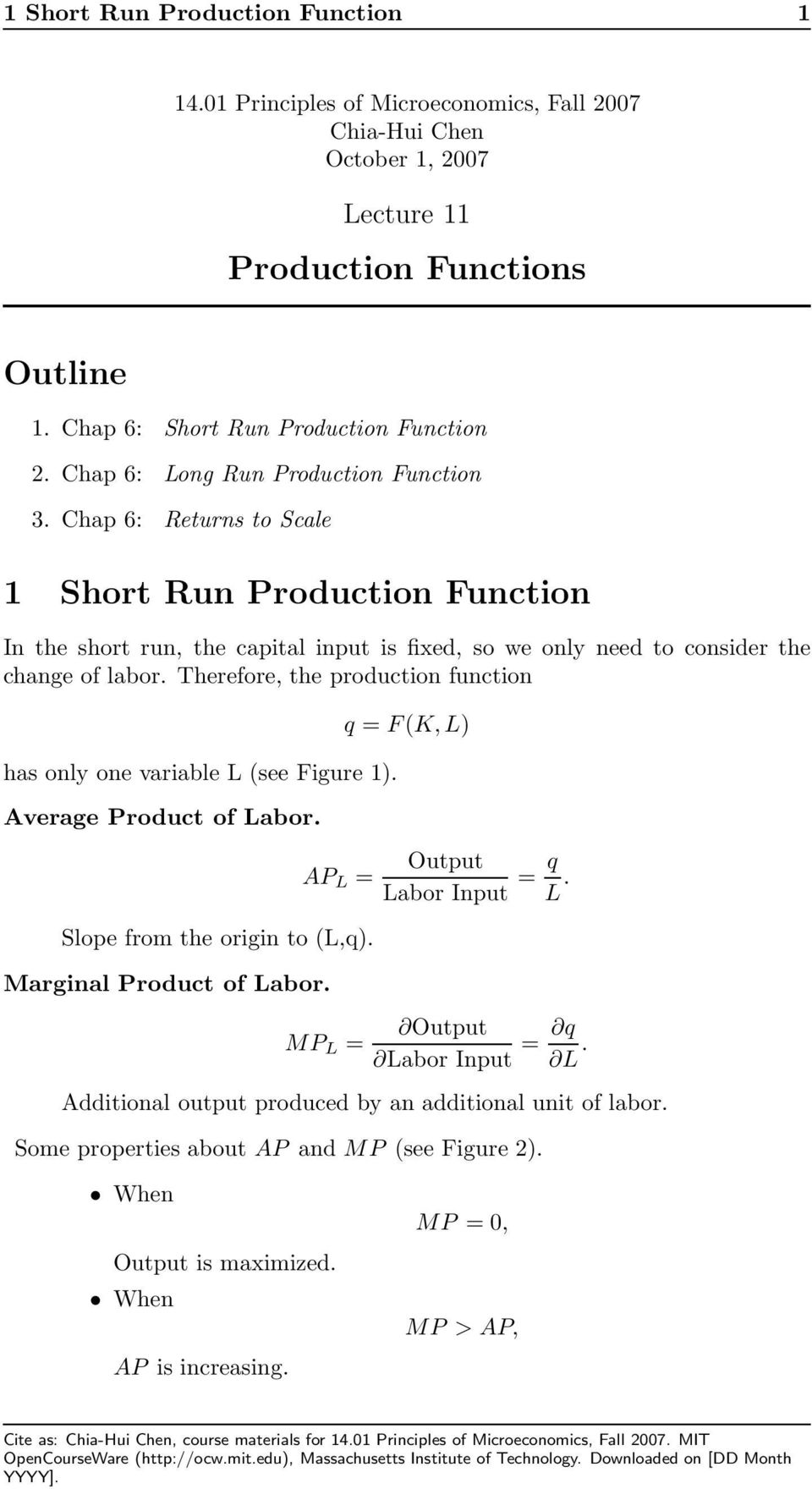
2 Short Run Production Function Q Figure : Short Run Production Function. AP MP Figure : Average Product of abor and Marginal Product of abor. Cite as: Chia-Hui Chen, course materials for. Principles of Microeconomics, Fall. MIT
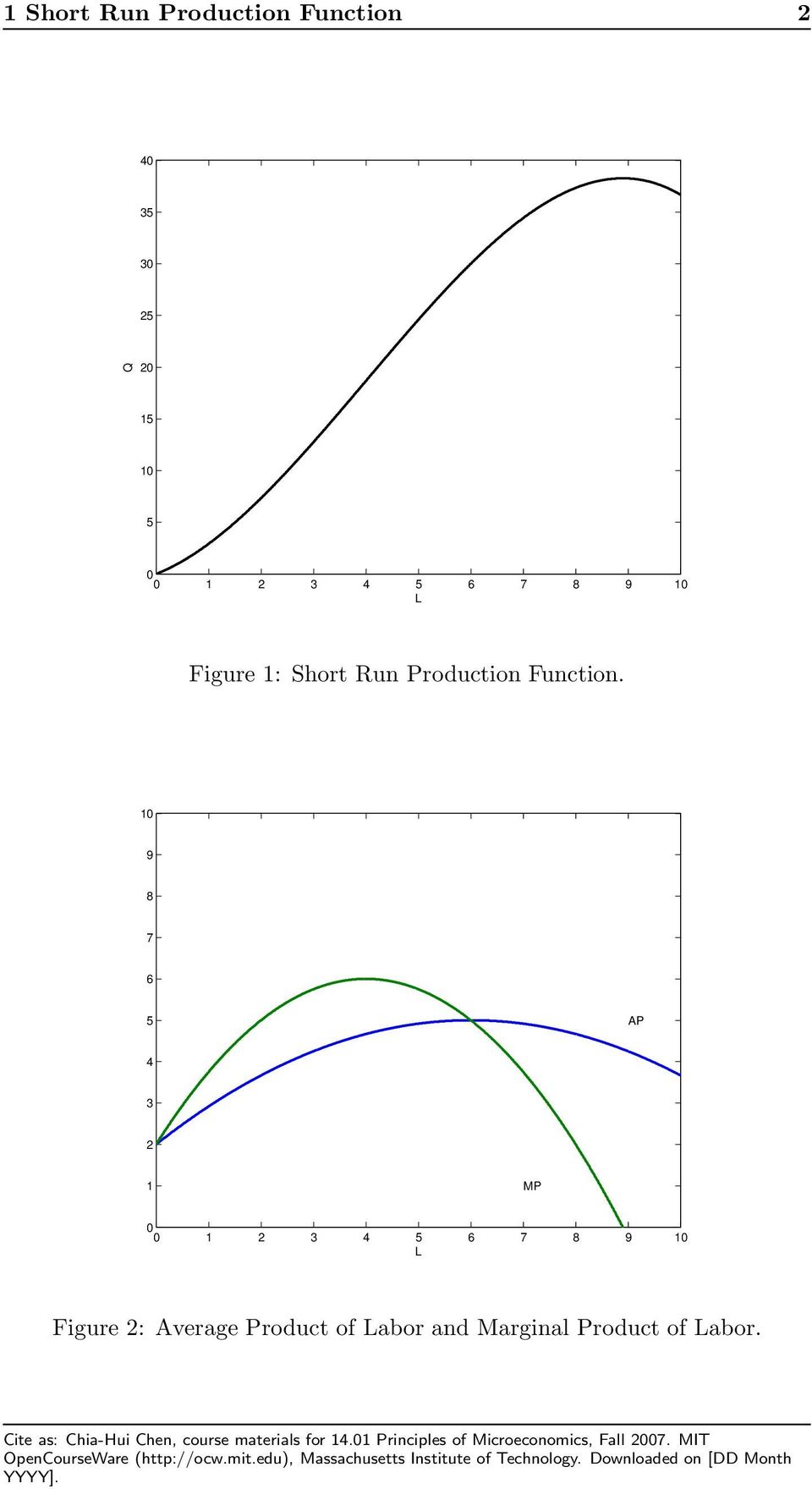
3 ong Run Production Function AP is decreasing. AP is maximized. MP < AP, MP = AP, To prove this, maximize AP by first order condition: q() = q q = q q = MP = AP. Example (Chair Production.). Note that here AP and MP are not continuous, so the condition for maximizing AP we derived above does not apply. Number of Workers Number of Chairs Produced AP MP N/A N/A Table : Relation between Chair Production and abor. ong Run Production Function Two variable inputs in long run (see Figure ). Isoquants. Curves showing all possible combinations of inputs that yield the same output (see Figure ). Marginal Rate of Technical Substitution (MRTS). Slope of Isoquants. dk MRTS = d How many units of K can be reduced to keep Q constant when we increase by one unit. ike MRS, we also have MP MRTS =. MP k Cite as: Chia-Hui Chen, course materials for. Principles of Microeconomics, Fall. MIT
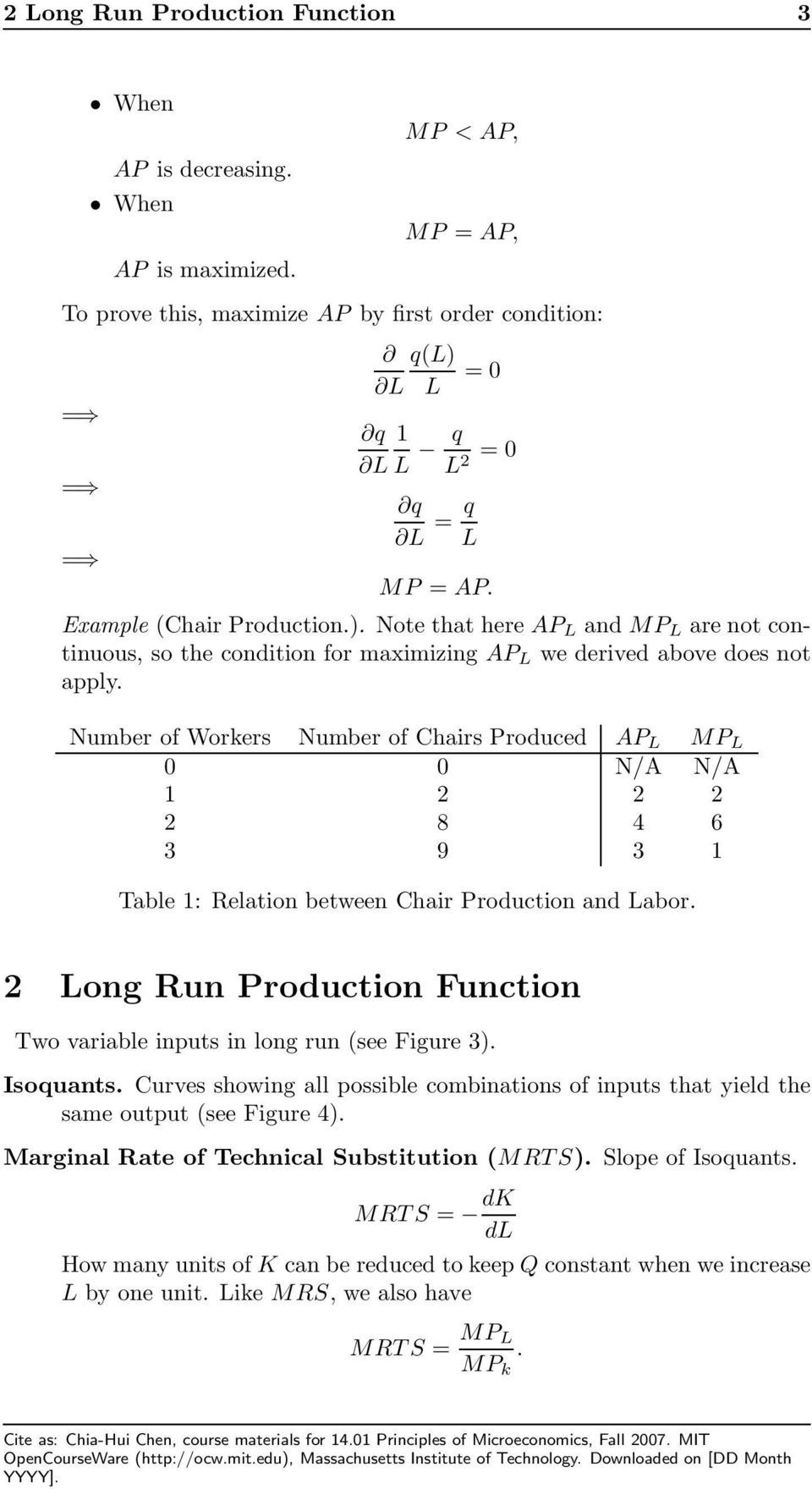
4 ong Run Production Function k= Q k= k= Figure : ong Run Production Function... k Figure : K vs, Isoquant Curve. Cite as: Chia-Hui Chen, course materials for. Principles of Microeconomics, Fall. MIT
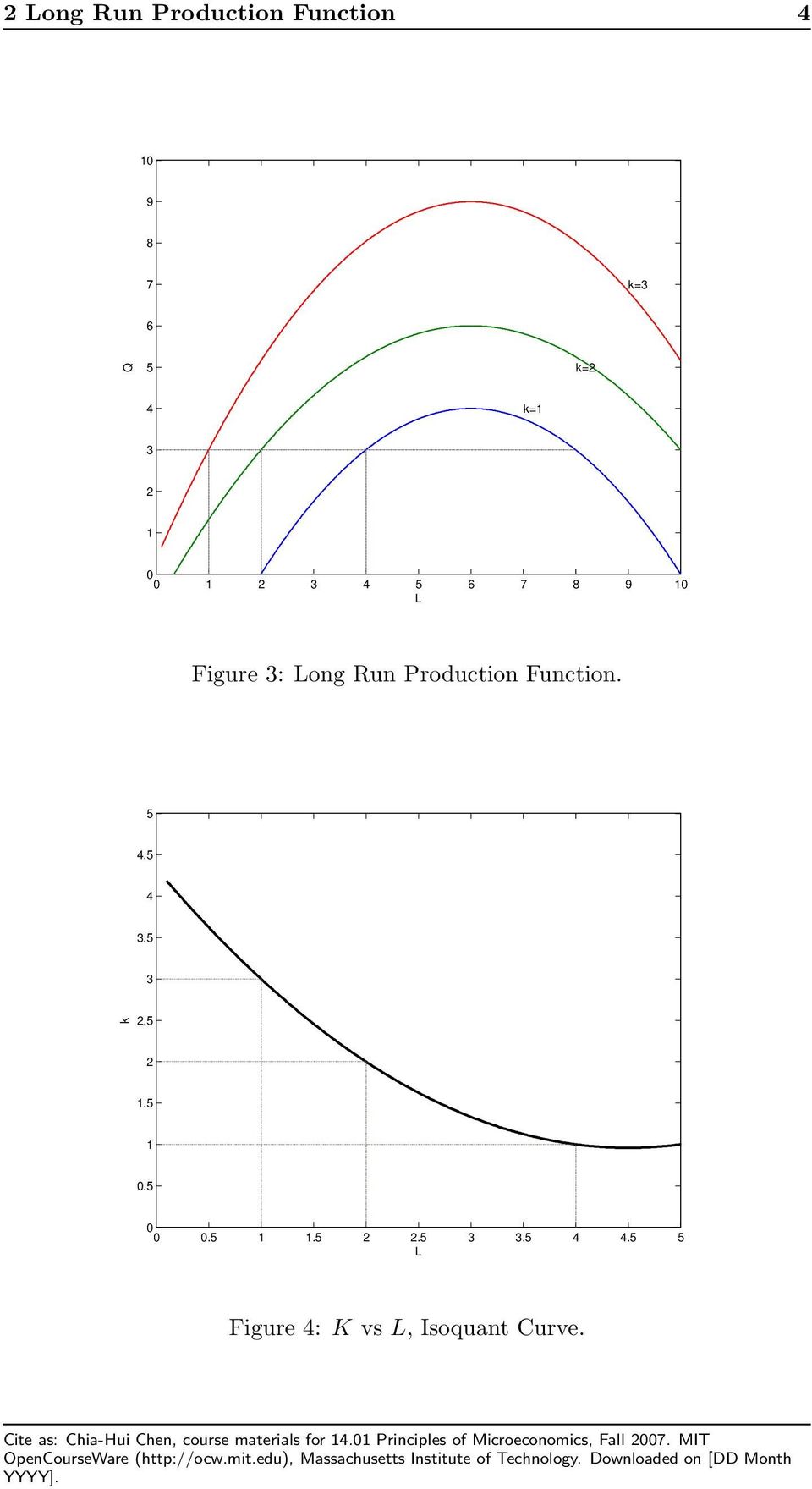
5 k Returns to Scale Proof. Since K is a function of on the isoquant curve, q(k(), ) = q dk q + = d dk MP =. d MP K Perfect Substitutes (Inputs). (see Figure ) Figure : Isoquant Curve, Perfect Substitutes. Perfect Complements (Inputs). (see Figure ) Returns to Scale Marginal Product of Capital. q(k, ) MP K = K Marginal Product of abor K constant, q? Cite as: Chia-Hui Chen, course materials for. Principles of Microeconomics, Fall. MIT
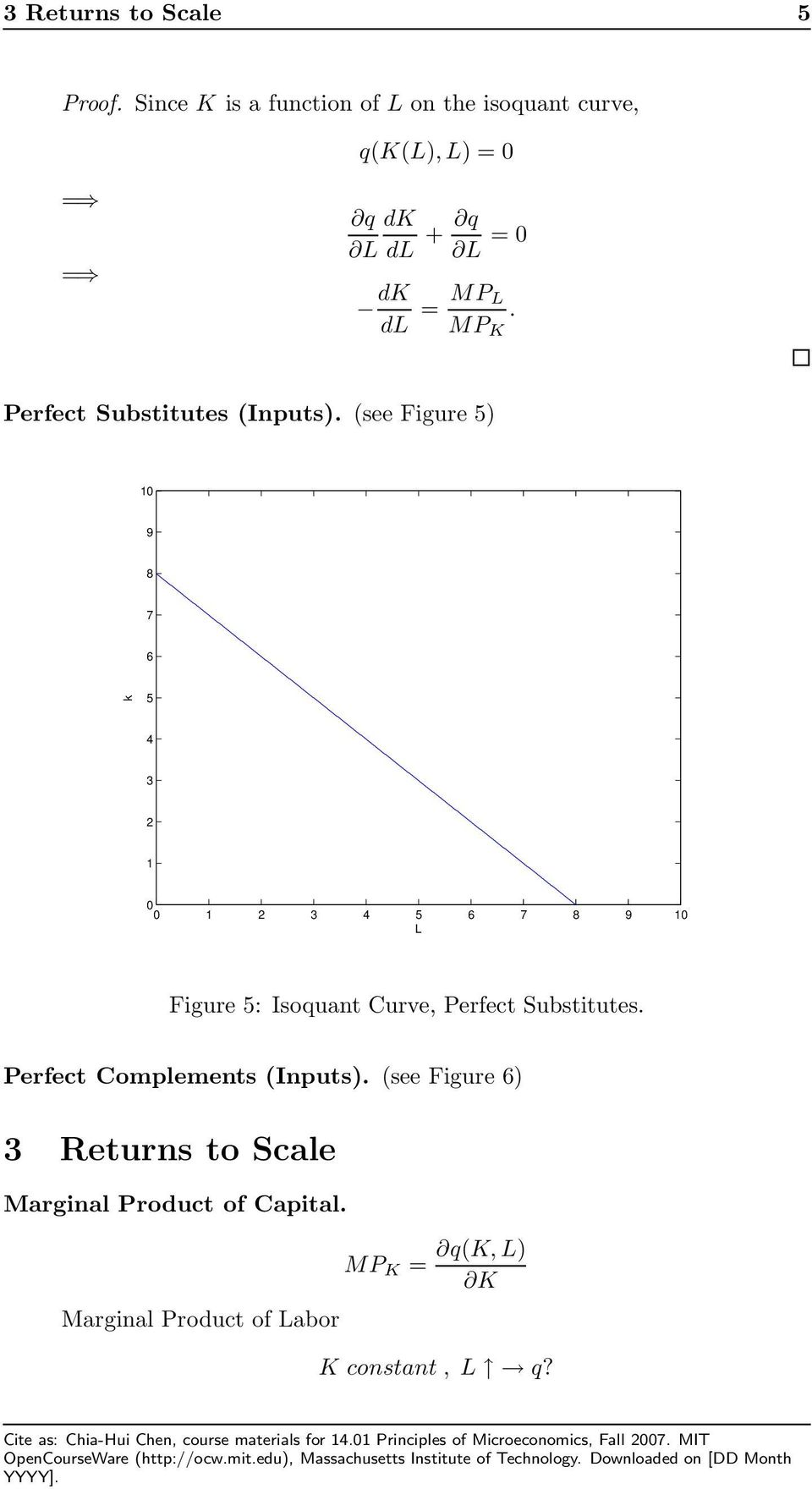
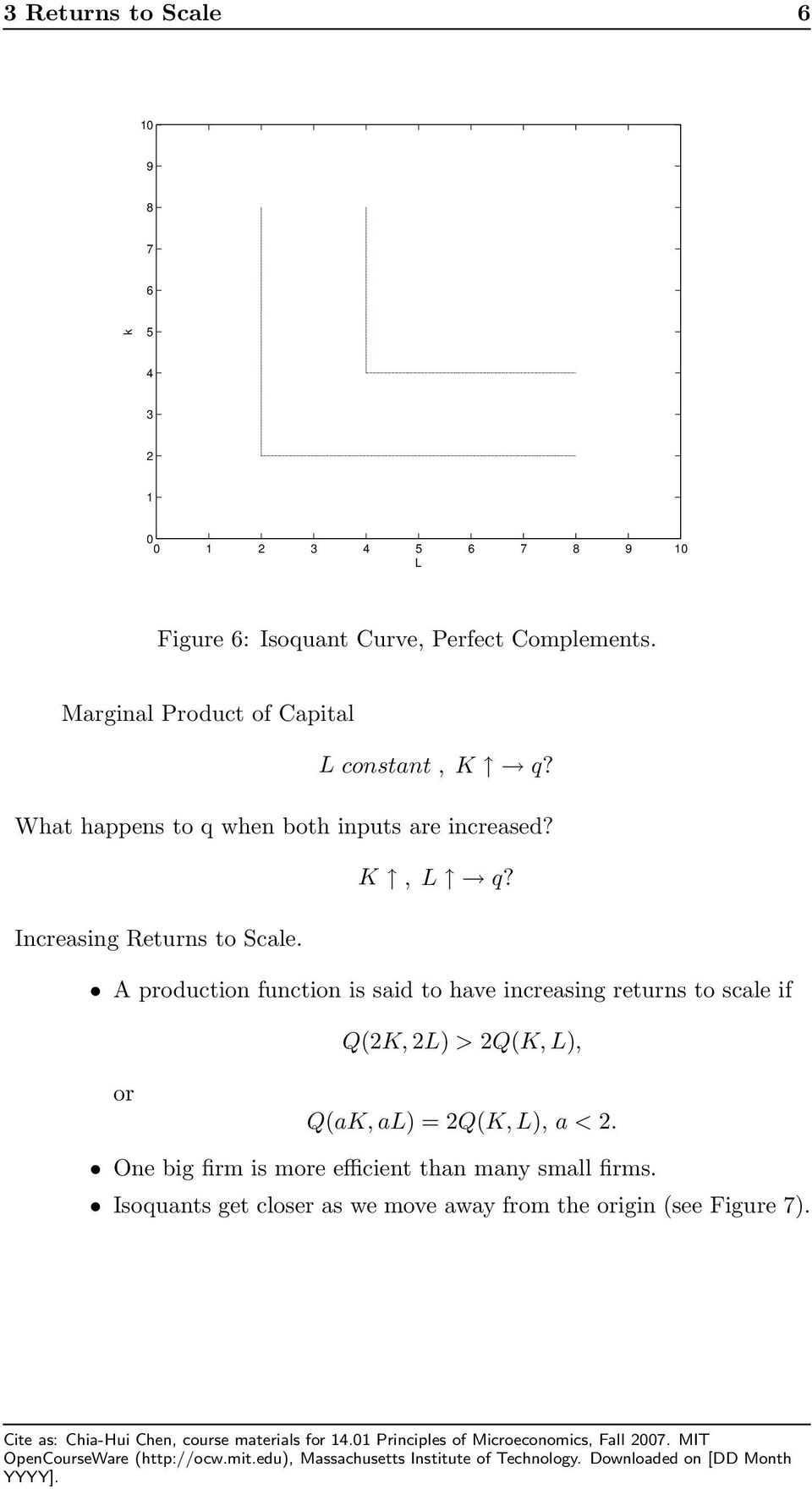
6 Returns to Scale k Figure : Isoquant Curve, Perfect Complements. Marginal Product of Capital constant, K q? What happens to q when both inputs are increased? K, q? Increasing Returns to Scale. A production function is said to have increasing returns to scale if Q(K, ) > Q(K, ), or Q(aK, a) = Q(K, ), a <. One big firm is more efficient than many small firms. Isoquants get closer as we move away from the origin (see Figure ). Cite as: Chia-Hui Chen, course materials for. Principles of Microeconomics, Fall. MIT
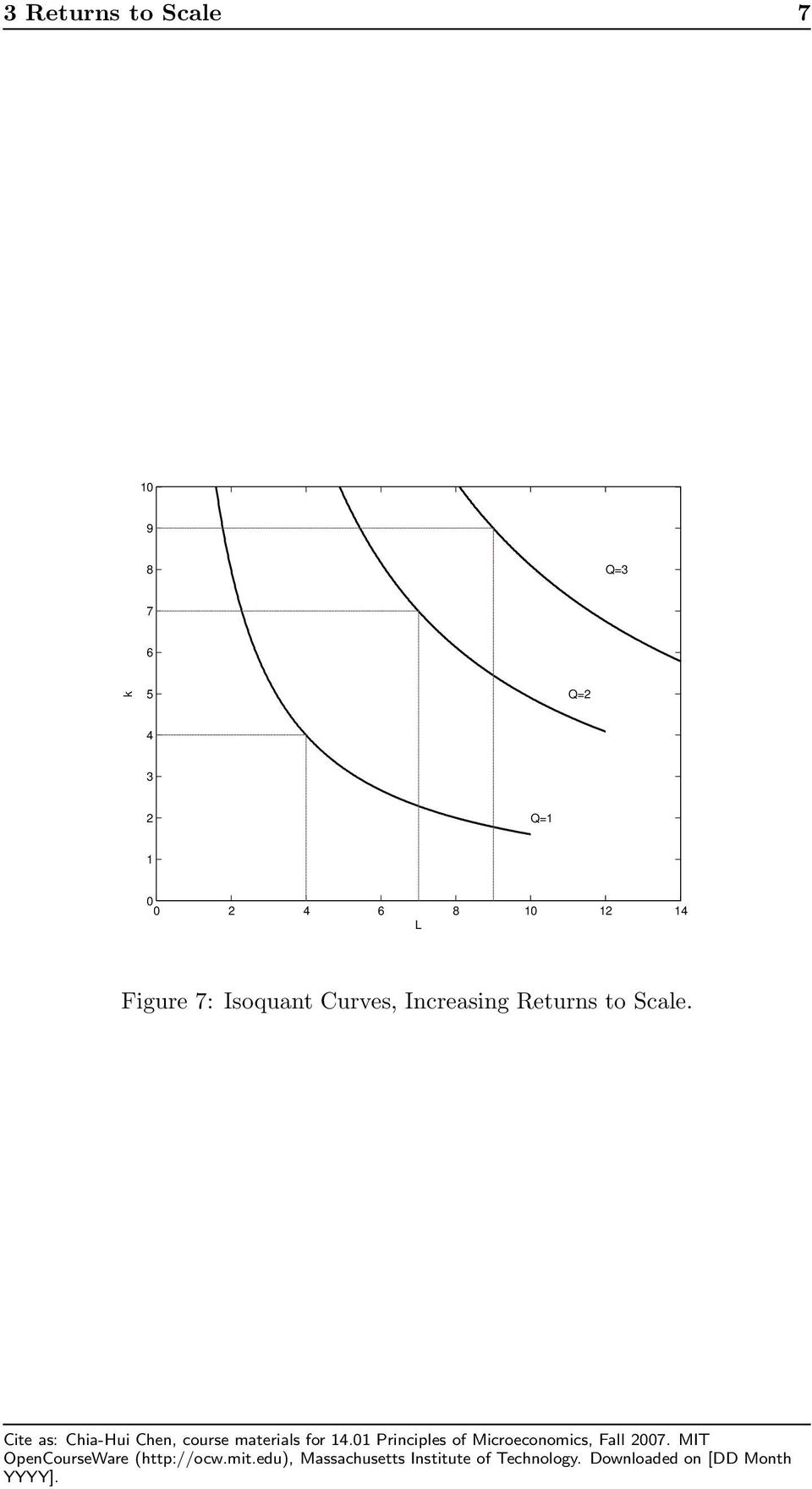
7 Returns to Scale Q= k Q= Q= Figure : Isoquant Curves, Increasing Returns to Scale. Cite as: Chia-Hui Chen, course materials for. Principles of Microeconomics, Fall. MIT
14.01 Principles of Microeconomics, Fall 2007 Chia-Hui Chen October 15, 2007. Lecture 13. Cost Function
 Short-Run Cost Function. Principles of Microeconomics, Fall Chia-Hui Chen October, ecture Cost Functions Outline. Chap : Short-Run Cost Function. Chap : ong-run Cost Function Cost Function et w be the
Production Functions and Cost of Production
 1 Returns to Scale 1 14.01 Principles of Microeconomics, Fall 2007 Chia-Hui Chen October, 2007 Lecture 12 Production Functions and Cost of Production Outline 1. Chap 6: Returns to Scale 2. Chap 6: Production
Deriving MRS from Utility Function, Budget Constraints, and Interior Solution of Optimization
 Utilit Function, Deriving MRS. Principles of Microeconomics, Fall Chia-Hui Chen September, Lecture Deriving MRS from Utilit Function, Budget Constraints, and Interior Solution of Optimization Outline.
Long Run Supply and the Analysis of Competitive Markets. 1 Long Run Competitive Equilibrium
 Long Run Competitive Equilibrium. rinciples of Microeconomics, Fall 7 Chia-Hui Chen October 9, 7 Lecture 6 Long Run Supply and the Analysis of Competitive Markets Outline. Chap 8: Long Run Equilibrium.
Chapter 5 The Production Process and Costs
 Managerial Economics & Business Strategy Chapter 5 The Production Process and Costs McGraw-Hill/Irwin Copyright 2010 by the McGraw-Hill Companies, Inc. All rights reserved. Overview I. Production Analysis
MICROECONOMICS AND POLICY ANALYSIS - U8213 Professor Rajeev H. Dehejia Class Notes - Spring 2001
 MICROECONOMICS AND POLICY ANALYSIS - U8213 Professor Rajeev H. Dehejia Class Notes - Spring 2001 General Equilibrium and welfare with production Wednesday, January 24 th and Monday, January 29 th Reading:
Monopoly and Monopsony
 Multi-lant Firm. rinciples of Microeconomics, Fall Chia-Hui Chen November, Lecture Monopoly and Monopsony Outline. Chap : Multi-lant Firm. Chap : Social Cost of Monopoly ower. Chap : rice Regulation. Chap
8. Average product reaches a maximum when labor equals A) 100 B) 200 C) 300 D) 400
 Ch. 6 1. The production function represents A) the quantity of inputs necessary to produce a given level of output. B) the various recipes for producing a given level of output. C) the minimum amounts
Monopoly and Monopsony Labor Market Behavior
 Monopoly and Monopsony abor Market Behavior 1 Introduction For the purposes of this handout, let s assume that firms operate in just two markets: the market for their product where they are a seller) and
Productioin OVERVIEW. WSG5 7/7/03 4:35 PM Page 63. Copyright 2003 by Academic Press. All rights of reproduction in any form reserved.
 WSG5 7/7/03 4:35 PM Page 63 5 Productioin OVERVIEW This chapter reviews the general problem of transforming productive resources in goods and services for sale in the market. A production function is the
Price Elasticity of Supply; Consumer Preferences
 1 Price Elasticity of Supply 1 14.01 Principles of Microeconomics, Fall 2007 Chia-Hui Chen September 12, 2007 Lecture 4 Price Elasticity of Supply; Consumer Preferences Outline 1. Chap 2: Elasticity -
Elasticities of Demand
 rice Elasticity of Demand 4.0 rinciples of Microeconomics, Fall 007 Chia-Hui Chen September 0, 007 Lecture 3 Elasticities of Demand Elasticity. Elasticity measures how one variable responds to a change
Production Possibilities Frontier and Output Market Efficiency. 1 Production Possibilities Frontier
 Production Possibilities rontier. Principles of Microeconomics, all hia-hui hen October, Lecture Production Possibilities rontier and Output Market Efficiency Outline. hap : Production Possibilities rontier.
Sample Midterm Solutions
 Sample Midterm Solutions Instructions: Please answer both questions. You should show your working and calculations for each applicable problem. Correct answers without working will get you relatively few
AP Microeconomics Chapter 12 Outline
 I. Learning Objectives In this chapter students will learn: A. The significance of resource pricing. B. How the marginal revenue productivity of a resource relates to a firm s demand for that resource.
NAME: INTERMEDIATE MICROECONOMIC THEORY SPRING 2008 ECONOMICS 300/010 & 011 Midterm II April 30, 2008
 NAME: INTERMEDIATE MICROECONOMIC THEORY SPRING 2008 ECONOMICS 300/010 & 011 Section I: Multiple Choice (4 points each) Identify the choice that best completes the statement or answers the question. 1.
Production Function in the Long-Run. Business Economics Theory of the Firm II Production and Cost in the Long Run. Description of Technology
 Business Economics Theory of the Firm II Production and Cost in the ong Run Two or more variable input factors Thomas & Maurice, Chapter 9 Herbert Stocker [email protected] Institute of International
Table of Contents MICRO ECONOMICS
 economicsentrance.weebly.com Basic Exercises Micro Economics AKG 09 Table of Contents MICRO ECONOMICS Budget Constraint... 4 Practice problems... 4 Answers... 4 Supply and Demand... 7 Practice Problems...
AP Microeconomics Unit V: The Factor (Resource) Market Problem Set #5
 1. /15 2. /20 3. /15 4. /25 Total: /75 Name: Team: AP Microeconomics Unit V: The Factor (Resource) Market Problem Set #5 1. ( /15) Define the term and explain a situation that demonstrates the real world
REVIEW OF MICROECONOMICS
 ECO 352 Spring 2010 Precepts Weeks 1, 2 Feb. 1, 8 REVIEW OF MICROECONOMICS Concepts to be reviewed Budget constraint: graphical and algebraic representation Preferences, indifference curves. Utility function
MERSİN UNIVERSITY FACULTY OF ECONOMICS AND ADMINISTRATIVE SCİENCES DEPARTMENT OF ECONOMICS MICROECONOMICS MIDTERM EXAM DATE 18.11.
 MERSİN UNIVERSITY FACULTY OF ECONOMICS AND ADMINISTRATIVE SCİENCES DEPARTMENT OF ECONOMICS MICROECONOMICS MIDTERM EXAM DATE 18.11.2011 TİIE 12:30 STUDENT NAME AND NUMBER MULTIPLE CHOICE. Choose the one
Overview. Managerial Economics & Business Strategy Baye Chapters 4-5 Edited by DF 10/12. Consumer Behavior
 Managerial Economics & usiness Strategy aye hapters 4-5 Edited by DF 1/12 Overview onsumer ehavior ndifference urve nalysis onsumer Preference Ordering onstraints The udget onstraint hanges in ncome hanges
Profit and Revenue Maximization
 WSG7 7/7/03 4:36 PM Page 95 7 Profit and Revenue Maximization OVERVIEW The purpose of this chapter is to develop a general framework for finding optimal solutions to managerial decision-making problems.
Agenda. Productivity, Output, and Employment, Part 1. The Production Function. The Production Function. The Production Function. The Demand for Labor
 Agenda Productivity, Output, and Employment, Part 1 3-1 3-2 A production function shows how businesses transform factors of production into output of goods and services through the applications of technology.
19 : Theory of Production
 19 : Theory of Production 1 Recap from last session Long Run Production Analysis Return to Scale Isoquants, Isocost Choice of input combination Expansion path Economic Region of Production Session Outline
AP Microeconomics Review
 AP Microeconomics Review 1. Firm in Perfect Competition (Long-Run Equilibrium) 2. Monopoly Industry with comparison of price & output of a Perfectly Competitive Industry 3. Natural Monopoly with Fair-Return
Massachusetts Institute of Technology Department of Economics. 14.01 Principles of Microeconomics Exam 2 Tuesday, November 6th, 2007
 Page 1 of 8 Massachusetts Institute of Technology Department of Economics 14.01 Principles of Microeconomics Exam Tuesday, November 6th, 007 Last Name (Please print): First Name: MIT ID Number: Instructions.
MULTIPLE CHOICE. Choose the one alternative that best completes the statement or answers the question.
 MBA 640 Survey of Microeconomics Fall 2006, Quiz 6 Name MULTIPLE CHOICE. Choose the one alternative that best completes the statement or answers the question. 1) A monopoly is best defined as a firm that
MULTIPLE CHOICE. Choose the one alternative that best completes the statement or answers the question on the accompanying scantron.
 Principles of Microeconomics, Quiz #5 Fall 2007 Name MULTIPLE CHOICE. Choose the one alternative that best completes the statement or answers the question on the accompanying scantron. 1) Perfect competition
SHORT-RUN PRODUCTION
 TRUE OR FALSE STATEMENTS SHORT-RUN PRODUCTION 1. According to the law of diminishing returns, additional units of the labour input increase the total output at a constantly slower rate. 2. In the short-run
An increase in the number of students attending college. shifts to the left. An increase in the wage rate of refinery workers.
 1. Which of the following would shift the demand curve for new textbooks to the right? a. A fall in the price of paper used in publishing texts. b. A fall in the price of equivalent used text books. c.
Cost of Production : An Example
 University of California, Berkeley Spring 008 ECON 00A Section 0, Cost of Production : An Example What you should get out of this example: Understand the technical derivation of optimal inputs in Cost
Costs. Accounting Cost{stresses \out of pocket" expenses. Depreciation costs are based on tax laws.
 Costs Accounting Cost{stresses \out of pocket" expenses. Depreciation costs are based on tax laws. Economic Cost{based on opportunity cost (the next best use of resources). 1. A self-employed entrepreneur's
Problems: Table 1: Quilt Dress Quilts Dresses Helen 50 10 1.8 9 Carolyn 90 45 1 2
 Problems: Table 1: Labor Hours needed to make one Amount produced in 90 hours: Quilt Dress Quilts Dresses Helen 50 10 1.8 9 Carolyn 90 45 1 2 1. Refer to Table 1. For Carolyn, the opportunity cost of 1
Profit Maximization. PowerPoint Slides prepared by: Andreea CHIRITESCU Eastern Illinois University
 Profit Maximization PowerPoint Slides prepared by: Andreea CHIRITESCU Eastern Illinois University 1 The Nature and Behavior of Firms A firm An association of individuals Firms Who have organized themselves
Cost Constraint/Isocost Line
 Cost Constraint/Isocost ine COST CONSTRAINT C= w + rk (m = p 1 x 1 +p 2 x 2 ) w: wage rate (including fringe benefits, holidays, PRSI, etc) r: rental rate of capital Rearranging: K=C/r-(w/r) COST CONSTRAINT
Chapter 6 MULTIPLE-CHOICE QUESTIONS
 Chapter 6 MULTIPLE-CHOICE QUETION 1. Which one of the following is generally considered a characteristic of a perfectly competitive labor market? a. A few workers of varying skills and capabilities b.
Lecture 2. Marginal Functions, Average Functions, Elasticity, the Marginal Principle, and Constrained Optimization
 Lecture 2. Marginal Functions, Average Functions, Elasticity, the Marginal Principle, and Constrained Optimization 2.1. Introduction Suppose that an economic relationship can be described by a real-valued
Chapter 4 The Theory of Individual Behavior
 Managerial Economics & Business Strategy Chapter 4 The Theory of Individual Behavior McGraw-Hill/Irwin Copyright 2010 by the McGraw-Hill Companies, Inc. All rights reserved. Overview I. Consumer Behavior
Consumption, Saving, and Investment, Part 1
 Agenda Consumption, Saving, and, Part 1 Determinants of National Saving 5-1 5-2 Consumption and saving decisions : Desired consumption is the consumption amount desired by households Desired national saving
Review of Production and Cost Concepts
 Sloan School of Management 15.010/15.011 Massachusetts Institute of Technology RECITATION NOTES #3 Review of Production and Cost Concepts Thursday - September 23, 2004 OUTLINE OF TODAY S RECITATION 1.
Chapter 6. Elasticity: The Responsiveness of Demand and Supply
 Chapter 6. Elasticity: The Responsiveness of Demand and Supply Instructor: JINKOOK LEE Department of Economics / Texas A&M University ECON 202 504 Principles of Microeconomics Elasticity Demand curve:
Microeconomics Instructor Miller Practice Problems Labor Market
 Microeconomics Instructor Miller Practice Problems Labor Market 1. What is a factor market? A) It is a market where financial instruments are traded. B) It is a market where stocks and bonds are traded.
COMMERCE MENTORSHIP PROGRAM COMM295: MANAGERIAL ECONOMICS FINAL EXAM REVIEW SOLUTION KEY
 COMMERCE MENTORSHIP PROGRAM COMM295: MANAGERIAL ECONOMICS FINAL EXAM REVIEW SOLUTION KEY WR1 Sam-I-Am is a local restaurant chain located in Vancouver. It is considering different pricing strategies for
or, put slightly differently, the profit maximizing condition is for marginal revenue to equal marginal cost:
 Chapter 9 Lecture Notes 1 Economics 35: Intermediate Microeconomics Notes and Sample Questions Chapter 9: Profit Maximization Profit Maximization The basic assumption here is that firms are profit maximizing.
Economics 201 Fall 2010 Introduction to Economic Analysis Problem Set #6 Due: Wednesday, November 3
 Economics 201 Fall 2010 Introduction to Economic Analysis Jeffrey Parker Problem Set #6 Due: Wednesday, November 3 1. Cournot Duopoly. Bartels and Jaymes are two individuals who one day discover a stream
Practice Multiple Choice Questions Answers are bolded. Explanations to come soon!!
 Practice Multiple Choice Questions Answers are bolded. Explanations to come soon!! For more, please visit: http://courses.missouristate.edu/reedolsen/courses/eco165/qeq.htm Market Equilibrium and Applications
Problem Set #5-Key. Economics 305-Intermediate Microeconomic Theory
 Problem Set #5-Key Sonoma State University Economics 305-Intermediate Microeconomic Theory Dr Cuellar (1) Suppose that you are paying your for your own education and that your college tuition is $200 per
Massachusetts Institute of Technology Department of Economics. 14.01 Principles of Microeconomics Exam 2 Tuesday, November 6th, 2007
 Page 1 of 18 Massachusetts Institute of Technology Department of Economics 14.01 Principles of Microeconomics Exam 2 Tuesday, November 6th, 2007 Last Name (Please print): First Name: MIT ID Number: Instructions.
Professor H.J. Schuetze Economics 370
 Topic 3.1c - Trade Professor H.J. Schuetze Economics 370 Opening Up to Trade Unlike what the simple labour demand model assumes, labour markets do not operate in a global vacuum To be certain, the Canadian
The Envelope Theorem 1
 John Nachbar Washington University April 2, 2015 1 Introduction. The Envelope Theorem 1 The Envelope theorem is a corollary of the Karush-Kuhn-Tucker theorem (KKT) that characterizes changes in the value
ANSWER KEY 3 UTILITY FUNCTIONS, THE CONSUMER S PROBLEM, DEMAND CURVES
 ANSWER KEY 3 UTILITY FUNCTIONS, THE CONSUMER S PROBLEM, DEMAND CURVES ECON 210 (1) Perfect Substitutes. Suppose that Jack s utility is entirely based on number of hours spent camping (c) and skiing (s).
The Cost of Production
 The Cost of Production 1. Opportunity Costs 2. Economic Costs versus Accounting Costs 3. All Sorts of Different Kinds of Costs 4. Cost in the Short Run 5. Cost in the Long Run 6. Cost Minimization 7. The
Consumer Theory. The consumer s problem
 Consumer Theory The consumer s problem 1 The Marginal Rate of Substitution (MRS) We define the MRS(x,y) as the absolute value of the slope of the line tangent to the indifference curve at point point (x,y).
Theoretical Tools of Public Economics. Part-2
 Theoretical Tools of Public Economics Part-2 Previous Lecture Definitions and Properties Utility functions Marginal utility: positive (negative) if x is a good ( bad ) Diminishing marginal utility Indifferences
Market Supply in the Short Run
 Equilibrium in Perfectly Competitive Markets (Assume for simplicity that all firms have access to the same technology and input markets, so they all have the same cost curves.) Market Supply in the Short
PART A: For each worker, determine that worker's marginal product of labor.
 ECON 3310 Homework #4 - Solutions 1: Suppose the following indicates how many units of output y you can produce per hour with different levels of labor input (given your current factory capacity): PART
MULTIPLE CHOICE. Choose the one alternative that best completes the statement or answers the question on the accompanying scantron.
 Principles of Microeconomics Fall 2007, Quiz #6 Name MULTIPLE CHOICE. Choose the one alternative that best completes the statement or answers the question on the accompanying scantron. 1) A monopoly is
AP Microeconomics 2002 Scoring Guidelines
 AP Microeconomics 2002 Scoring Guidelines The materials included in these files are intended for use by AP teachers for course and exam preparation in the classroom; permission for any other use must be
Pure Competition urely competitive markets are used as the benchmark to evaluate market
 R. Larry Reynolds Pure Competition urely competitive markets are used as the benchmark to evaluate market P performance. It is generally believed that market structure influences the behavior and performance
Where are we? To do today: finish the derivation of the demand curve using indifference curves. Go on then to chapter Production and Cost
 Where are we? To do today: finish the derivation of the demand curve using indifference curves Go on then to chapter Production and Cost Utility and indifference curves The point is to find where on the
Chapter 4. Specific Factors and Income Distribution
 Chapter 4 Specific Factors and Income Distribution Introduction So far we learned that countries are overall better off under free trade. If trade is so good for the economy, why is there such opposition?
Figure 6: Effect of ITC on Skilled and Unskilled Labor Markets
 Economics 0401 Homework Problems #2 1. Using the material from lecture on the demand curve, do the following: *a. Assuming unskilled labor and capital are gross substitutes and skilled labor and capital

POTENTIAL OUTPUT and LONG RUN AGGREGATE SUPPLY
 POTENTIAL OUTPUT and LONG RUN AGGREGATE SUPPLY Aggregate Supply represents the ability of an economy to produce goods and services. In the Long-run this ability to produce is based on the level of production

A Detailed Price Discrimination Example
 A Detailed Price Discrimination Example Suppose that there are two different types of customers for a monopolist s product. Customers of type 1 have demand curves as follows. These demand curves include
Definition and Properties of the Production Function: Lecture
 Definition and Properties of the Production Function: Lecture II August 25, 2011 Definition and : Lecture A Brief Brush with Duality Cobb-Douglas Cost Minimization Lagrangian for the Cobb-Douglas Solution
INTRODUCTORY MICROECONOMICS
 INTRODUCTORY MICROECONOMICS UNIT-I PRODUCTION POSSIBILITIES CURVE The production possibilities (PP) curve is a graphical medium of highlighting the central problem of 'what to produce'. To decide what
Problem Set #3 Answer Key
 Problem Set #3 Answer Key Economics 305: Macroeconomic Theory Spring 2007 1 Chapter 4, Problem #2 a) To specify an indifference curve, we hold utility constant at ū. Next, rearrange in the form: C = ū
Prot Maximization and Cost Minimization
 Simon Fraser University Prof. Karaivanov Department of Economics Econ 0 COST MINIMIZATION Prot Maximization and Cost Minimization Remember that the rm's problem is maximizing prots by choosing the optimal
SOLUTIONS TO HOMEWORK SET #4
 Sloan School of Management 15.010/15.011 Massachusetts Institute of Technology SOLUTIONS TO HOMEWORK SET #4 1. a. If the markets are open to free trade, the monopolist cannot keep the markets separated.
Principles of Economics
 Principles of Economics (8 th Edition) Dr. H. S. Agarwal Professor of Economics (Retd.) Agra College, AGRA professional publishing Contents JSASIC CONCEPTS^ 1. The Scope and Nature of Economics 1-31 Introduction;
Pre-Test Chapter 25 ed17
 Pre-Test Chapter 25 ed17 Multiple Choice Questions 1. Refer to the above graph. An increase in the quantity of labor demanded (as distinct from an increase in demand) is shown by the: A. shift from labor
11 PERFECT COMPETITION. Chapter. Competition
 Chapter 11 PERFECT COMPETITION Competition Topic: Perfect Competition 1) Perfect competition is an industry with A) a few firms producing identical goods B) a few firms producing goods that differ somewhat
Preferences. M. Utku Ünver Micro Theory. Boston College. M. Utku Ünver Micro Theory (BC) Preferences 1 / 20
 Preferences M. Utku Ünver Micro Theory Boston College M. Utku Ünver Micro Theory (BC) Preferences 1 / 20 Preference Relations Given any two consumption bundles x = (x 1, x 2 ) and y = (y 1, y 2 ), the
Managerial Economics & Business Strategy Chapter 8. Managing in Competitive, Monopolistic, and Monopolistically Competitive Markets
 Managerial Economics & Business Strategy Chapter 8 Managing in Competitive, Monopolistic, and Monopolistically Competitive Markets I. Perfect Competition Overview Characteristics and profit outlook. Effect
Constrained Optimisation
 CHAPTER 9 Constrained Optimisation Rational economic agents are assumed to make choices that maximise their utility or profit But their choices are usually constrained for example the consumer s choice
Cost Minimization and the Cost Function
 Cost Minimization and the Cost Function Juan Manuel Puerta October 5, 2009 So far we focused on profit maximization, we could look at a different problem, that is the cost minimization problem. This is
Pre-Test Chapter 8 ed17
 Pre-Test Chapter 8 ed17 Multiple Choice Questions 1. The APC can be defined as the fraction of a: A. change in income that is not spent. B. change in income that is spent. C. specific level of total income
Econ 101: Principles of Microeconomics
 Econ 101: Principles of Microeconomics Chapter 12 - Behind the Supply Curve - Inputs and Costs Fall 2010 Herriges (ISU) Ch. 12 Behind the Supply Curve Fall 2010 1 / 30 Outline 1 The Production Function
Market for cream: P 1 P 2 D 1 D 2 Q 2 Q 1. Individual firm: W Market for labor: W, S MRP w 1 w 2 D 1 D 1 D 2 D 2
 Factor Markets Problem 1 (APT 93, P2) Two goods, coffee and cream, are complements. Due to a natural disaster in Brazil that drastically reduces the supply of coffee in the world market the price of coffee
4.1 Ordinal versus cardinal utility
 Microeconomics I. Antonio Zabalza. Universit of Valencia 1 Micro I. Lesson 4. Utilit In the previous lesson we have developed a method to rank consistentl all bundles in the (,) space and we have introduced
Economics 2020a / HBS 4010 / HKS API-111 FALL 2010 Solutions to Practice Problems for Lectures 1 to 4
 Economics 00a / HBS 4010 / HKS API-111 FALL 010 Solutions to Practice Problems for Lectures 1 to 4 1.1. Quantity Discounts and the Budget Constraint (a) The only distinction between the budget line with
MULTIPLE CHOICE. Choose the one alternative that best completes the statement or answers the question.
 Chapter 11 Perfect Competition - Sample Questions MULTIPLE CHOICE. Choose the one alternative that best completes the statement or answers the question. 1) Perfect competition is an industry with A) a
Profit Maximization. 2. product homogeneity
 Perfectly Competitive Markets It is essentially a market in which there is enough competition that it doesn t make sense to identify your rivals. There are so many competitors that you cannot single out
14.02 Principles of Macroeconomics Problem Set 1 Fall 2005 ***Solution***
 Part I. True/False/Uncertain Justify your answer with a short argument. 14.02 Principles of Macroeconomics Problem Set 1 Fall 2005 ***Solution*** Posted: Monday, September 12, 2005 Due: Wednesday, September
MULTIPLE CHOICE. Choose the one alternative that best completes the statement or answers the question.
 Chapter 11 Monopoly practice Davidson spring2007 MULTIPLE CHOICE. Choose the one alternative that best completes the statement or answers the question. 1) A monopoly industry is characterized by 1) A)
MULTIPLE CHOICE. Choose the one alternative that best completes the statement or answers the question.
 Chap 13 Monopolistic Competition and Oligopoly These questions may include topics that were not covered in class and may not be on the exam. MULTIPLE CHOICE. Choose the one alternative that best completes
Elasticity. Definition of the Price Elasticity of Demand: Formula for Elasticity: Types of Elasticity:
 Elasticity efinition of the Elasticity of emand: The law of demand states that the quantity demanded of a good will vary inversely with the price of the good during a given time period, but it does not
CHAPTER 10 MARKET POWER: MONOPOLY AND MONOPSONY
 CHAPTER 10 MARKET POWER: MONOPOLY AND MONOPSONY EXERCISES 3. A monopolist firm faces a demand with constant elasticity of -.0. It has a constant marginal cost of $0 per unit and sets a price to maximize
Chapter 15: Monopoly WHY MONOPOLIES ARISE HOW MONOPOLIES MAKE PRODUCTION AND PRICING DECISIONS
 Chapter 15: While a competitive firm is a taker, a monopoly firm is a maker. A firm is considered a monopoly if... it is the sole seller of its product. its product does not have close substitutes. The
Examples on Monopoly and Third Degree Price Discrimination
 1 Examples on Monopoly and Third Degree Price Discrimination This hand out contains two different parts. In the first, there are examples concerning the profit maximizing strategy for a firm with market
Economics II: Micro Fall 2009 Exercise session 5. Market with a sole supplier is Monopolistic.
 Economics II: Micro Fall 009 Exercise session 5 VŠE 1 Review Optimal production: Independent of the level of market concentration, optimal level of production is where MR = MC. Monopoly: Market with a
AP Microeconomics 2011 Scoring Guidelines
 AP Microeconomics 2011 Scoring Guidelines The College Board The College Board is a not-for-profit membership association whose mission is to connect students to college success and opportunity. Founded
N. Gregory Mankiw Principles of Economics. Chapter 15. MONOPOLY
 N. Gregory Mankiw Principles of Economics Chapter 15. MONOPOLY Solutions to Problems and Applications 1. The following table shows revenue, costs, and profits, where quantities are in thousands, and total
Chapter 6 Competitive Markets
 Chapter 6 Competitive Markets After reading Chapter 6, COMPETITIVE MARKETS, you should be able to: List and explain the characteristics of Perfect Competition and Monopolistic Competition Explain why a
QE1: Economics Notes 1
 QE1: Economics Notes 1 Box 1: The Household and Consumer Welfare The final basket of goods that is chosen are determined by three factors: a. Income b. Price c. Preferences Substitution Effect: change