
CEA Statistics N 27 The European Motor Insurance Market
|
|
|
- Irma Lynch
- 9 years ago
- Views:
Transcription
1 CEA Statistics N 27 The European Motor Insurance Market December 2006

2 CEA member associations which took part in this study ISO CODE Country AT Austria Verband der Versicherungsunternehmen Österreichs (VVO) BE Belgium Assuralia - Union Professionnelle des Entreprises d Assurances Assuralia - Beroepsvereniging der Verzekeringsondernemingen CH Switzerland Schweizerischer Versicherungsverband Association Suisse d Assurances CY Cyprus Insurance Association of Cyprus CZ Czech Republic Česká asociace pojišt oven (ČAP) DE Germany Gesamtverband der Deutschen Versicherungswirtschaft (GDV) DK Denmark Forsikring & Pension (F&P) EE Estonia Eesti Kindlustusseltside Liit ES Spain Unión Española de Entidades Aseguradoras y Reaseguradoras (UNESPA) FI Finland Suomen Vakuutusyhtiöiden Keskusliitto FR France Fédération Française des Sociétés d Assurances (FFSA) GB United Kingdom The British Insurers European Committee (BIEC) GR Greece Association of Insurance Companies-Greece Association des Compagnies d Assurances- Grèce HR Croatia Croatian Insurance Bureau HU Hungary Magyar Biztositók Szövetsége (MABISZ) IE Ireland The Irish Insurance Federation (IIF) IS Iceland Samband Íslenskra Tryggingafélaga IT Italy Associazione Nazionale fra le Imprese Assicuratrici (ANIA) LU Luxembourg Association des Compagnies d Assurances du Grand-Duché de Luxembourg (ACA) LV Latvia Latvijas Apdrošinataju Asociacija MT Malta Malta Insurance Association NL The Netherlands Verbond van Verzekeraars (VVN) NO Norway Finansnæringens Hovedorganisasjon (FNH) PL Poland Polska Izba Ubezpieczen (PIU) PT Portugal Associaçao Portuguesa de Seguradores (APS) RO Romania National Association of Insurance and Reinsurance Companies from Romania (UNSAR) SE Sweden Sveriges Försäkringsförbund SI Slovenia Slovensko Zvarovalno Zdruzenje (SZZ) SK Slovakia Slovenská asociácia poistovni TR Turkey Türkiye Sigorta ve Reasürans Sirketleri Birligi Association of the Insurance and Reinsurance Companies of Türkiye

3 CEA Statistics w w w. c e a. a s s u r. o r g About CEA CEA is the European insurance and reinsurance federation. CEA s 33 national member associations represent more than 5,000 insurance and reinsurance companies. Insurance makes a major contribution to Europe s economic growth and development. European insurers generate premium income of 970bn, employ over one million people and invest more than 6,300bn in the economy.

4

5 Contents Methodological note 6 Foreword 7 Thanks 7 Part 1 The European Motor Insurance Market 9 I. The size of the market 11 I.1 Number of vehicles 11 I.2 Vehicles per inhabitant 12 I.3 Vehicle categories 12 I.4 New registrations 13 II. Premiums 15 II.1 Evolution and growth rate 15 II.2 Motor premiums: Liability 16 II.3 Motor Premiums: Damage 17 II.4 Share of liability and damage in motor premiums 18 III Price of motor insurance 20 III.1 Evolution 20 III.2 Level of prices 21 IV. Claims expenditure 22 IV.1 Claims expenditure in motor (liability and damage) 22 IV.2 Claims ratio 24 IV.3 Number of claims 25 IV.4 Average expenditure per claim 26 V. Operating expenses 28 VI. Combined ratio 29 VII. Market operators 31 VII.1 Number of companies 31 VII.2 Concentration ratio 31 Glossary 33 Part 2 Country guide 35

6 European Motor Insurance Market Methodological note CEA collects, analyses and compiles annually a substantial amount of general, financial and technical data relating to insurance and obtained from its members. This financial information is collected in millions in each market s national currency. It is then converted into euros at the exchange rate on 31 December of each year for non-euro zone countries as published by the European Commission. (For 1992 to 1997 inclusive, the Ecu was the reference currency). The inflation-adjusted value is calculated on the basis of data in national currency converted by the price inflation rate published by the Eurostat. (Base 100 in 2005). Conversion into inflation-adjusted euros is done at the rate for the last year in order to cancel out variations in exchange rates. Variations on each market are then calculated for data in national currency for non-inflation adjusted variations and for data in national currency corrected for inflation for variations exclusive of inflation. Total variations per zone are calculated for euro and non-inflation adjusted euro totals. Year on year variations have been calculated by subtracting from the total data countries for which there was no information for the previous or following year. The average growth over time represents the average of the past year on year variations The market share of the figures presented is 100% for most market and slightly under this level for some others. Only Romania shows figures that represent between 70 and 80% of the market according to the year take into consideration and to the liability or damage insurance product. Figures have been rounded-up to the nearest thousand and are in million of euros, unless otherwise stated. Growth rate presented in the text are all inflation-adjusted unless otherwise stated. Thanks This publication would not have been possible without the active participation of the CEA Working Groups on Motor Statistics. We would like to thank the delegates on these groups for their active participation and their comments. Particular thanks are due to Mr F. Gudin du Pavillon, Chairman of the Working Groups on Motor Statistics for his efforts in the design of the publication. The work of CEA correspondents within the national associations in collecting and providing data relating to their market is the basis for the success of this undertaking. Thanks go to them for their participation. CEA Statistics N 27

7 Overview of the European Market Executive Summary Motor insurance is one of the most familiar and widespread products of the insurance industry. Being compulsory everywhere in Europe, it covers approximately 300 million vehicles, protecting European families from the consequence of motor accidents. With a total premium income of 127bn in 2005, the motor insurance market is the largest class of non-life insurance in Europe, representing 33.5% of the non-life business. Nevertheless, for the first time in a decade the motor premium income has recorded a negative growth rate (inflation-adjusted), demonstrating the high level of competition between insurers in this market. This development conceals two different results in motor liability and damage. Motor liability, which is compulsory and therefore predominant in the total premium income of motor insurance (60.4%), recorded a decrease of 1.1%, whereas motor damage insurance recorded a weak increase of 0.4% in High competition between insurers is confirmed by the evolution of the transport insurance price index which decreased by 0.8% in The stabilisation of premium income over the past few years and its reduction in 2005 have been made possible by the stable level of claim expenditure which reflects among other things the reduction in the number of road accidents. This general downward trend in the number of accidents is closely related to the commitment made by European countries to reduce by 50% the number of deaths on the roads between 2001 and 2010 and which has shown positive effects in many European countries. The diminution in claims expenditure and in premiums income has seen a reduction of the combined ratio. Indeed the underwriting result recorded in 2004 was positive, although the 10 year cumulative result shows a negative result of 44 billion borne by insurers. If the reduction in the number of accidents has enabled a reduction in premium, it has to be noted that the total claims expenditure are negatively affected by the increase in price of some products such as spare parts, motor repairs and medical intervention and by the trend of increased court compensations on some markets. A fact reflected in a recorded increase in the average cost of liability claims of 4.5% in CEA Statistics N 27 7

8

9 Part I Overview of the European Market

10 European Motor Insurance Market 10 CEA Statistics N 27

11 Overview of the European Market I. The size of the market I.1 Number of vehicles With approximately 300 million vehicles on the road, the European market is the largest motor market in the world just ahead of the North American (US and Canada) market, which numbers approximately 250 million vehicles (including all types). The European market has experienced a regular growth rate of 1.5% to 3% between 2000 and 2004, to reach a total of 299 million vehicles. On average over the last five years, the market has grown by 2.4%. The total number of vehicles has grown by 2.9% in 2004 to reach approximately 300 million vehicles Millions Number of vehicles in Europe (Source CEA/Eurostat) 2.6% 2.4% 2.9% % Number of vehicles Growth rate 3.0% 2.5% 2.0% 1.5% 1.0% 0.5% 0.0% With more than 50 million vehicles, Germany and Italy are by far the largest markets in Europe, just ahead of France and the United Kingdom which have 38 and 30 million vehicles respectively on the road. Altogether, these four leading markets, which are also among the most populous, represent 58% of the vehicle stock. Repartition of the number of vehicles in European countries RO SE HU Others CH AT PT CZ DE BE GR TR NL PL IT ES GB FR CEA Statistics N 27 11

12 European Motor Insurance Market I.2 Vehicles per inhabitant The number of vehicles per 1000 inhabitants rose from 496 in 2000 to 535 in This level is still below that recorded in the US If, fairly logically, the most heavily populated countries are also the largest markets for motor vehicles, the ratio relating these figures to the population allows a comparison of the density of vehicles per inhabitant, and this shows great heterogeneity across Europe. The indicator ranges from 114 in Turkey to 867 vehicles per 1000 inhabitants in Italy. The CEA average stands at 535 against 496 in 2000, representing a growth of 8%. The level is nevertheless below the rate of 768 vehicles per 1000 inhabitants (source: OECD) observed in the United States, which is above most of the European countries.1 Though major differences between countries may be related to their economic development, some other differences seem to be more closely related to the characteristics of the country. The high level observed in Italy, for instance, is among other things due to the high proportion of motorcycles, while in Luxembourg the high number of company cars which are used by non-residents can in part explain the high ratio. Vehicles per 1000 inhabitants in IT LU AT MT CH IS DE CY FR ES NO CZ BE SE GR FI PT GB CEA NL SI EE IE DK PL HR SK LV HU LT RO TR I.3 Vehicle categories 80% of vehicles are personal and commercial 4-wheeled vehicles Private vehicles predominate on every market. The proportion ranges from 93% in Denmark to only 65% in Greece. The CEA average reveals proportions of 80% of personal and commercial four-wheeled vehicles, 10% of utility vehicles and 10% of motorcycles. The highest proportion of motorcycles is recorded in southern countries such as Italy (21%) and Greece (17%). 1 The indicator used in this study may be higher than similar indicators provided by other international institutions due tot the fact that it takes into account not only passenger vehicles but also utility vehicles and motorcycles. This is not always the case in other studies. 12 CEA Statistics N 27

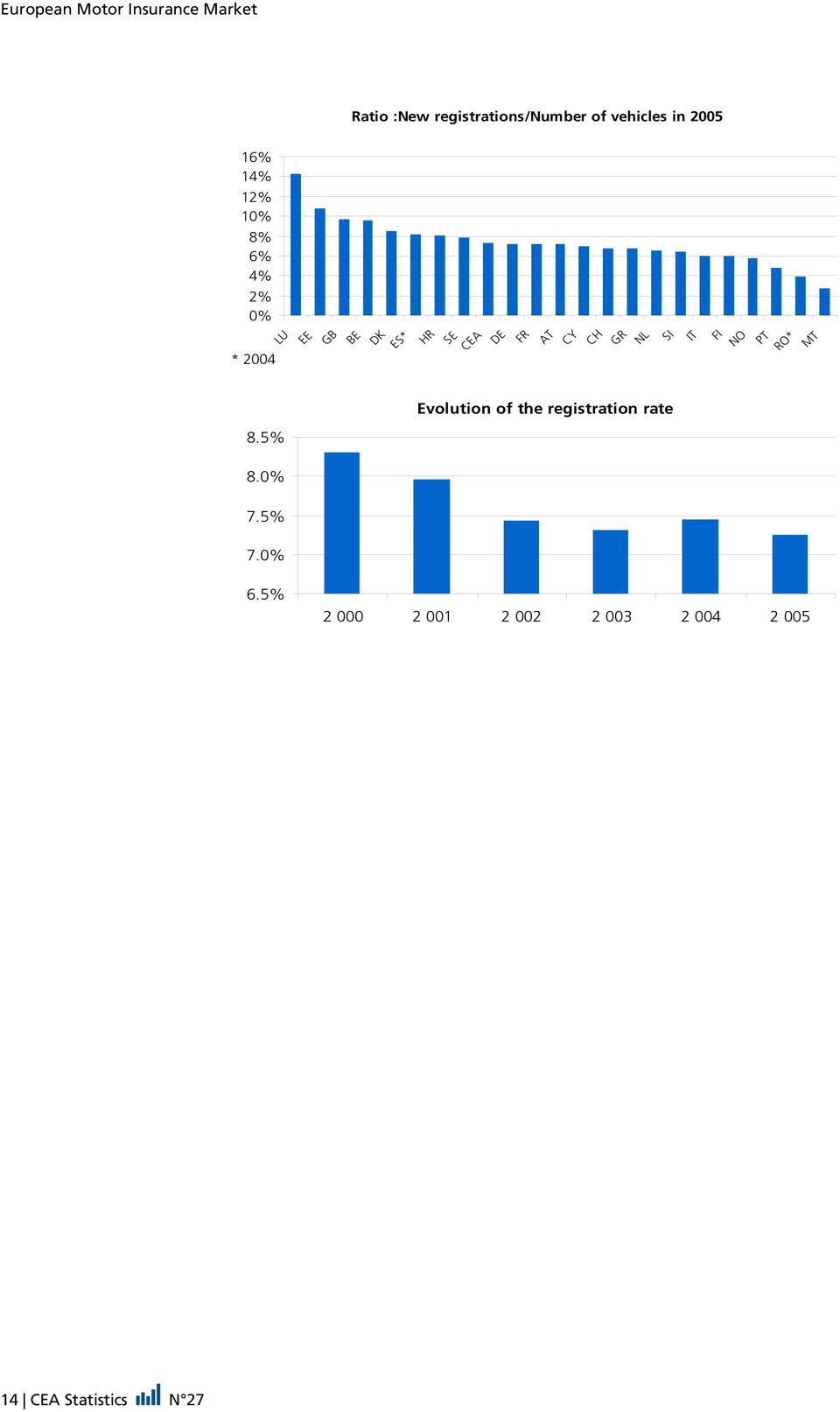
13 Overview of the European Market Vehicle categories in 2005 GR IT NO EE ES* CH LV FR MT SE PL* CEA NL LU RO* HR BE DE PT GB SI FI DK 0% 20% 40% 60% 80% 100% Personal and commercial 4-wheeled vehicles Utility vehicles 2 or 3-wheeled motor vehicles *2004 I.4 New registrations New registrations indicate the dynamism of the motor market. As with the total number of vehicles, the highest levels of new registrations are found in the largest European countries such as Germany, Italy and the United Kingdom, all of which registered more than three million new vehicles. The ratio of new registrations/ number of vehicles provides a better comparison of the dynamism of the market. According to this indicator, Luxembourg and Estonia are by far the most dynamic markets, having a ratio above 10%. The lowest registration rate is recorded in Malta where it falls to 2.7%. The registration rate reached a level of 8.4% in 2005 and has been increasing over the last two years For the European market as a whole, the registration rate reached a level of 7.3% in 2005 and is close to the same level since 2002 but lower than in 2000 and This evolution, observed during this six year period, seems closely correlated to the growth rate of economic activity CEA Statistics N 27 13

14 European Motor Insurance Market Ratio :New registrations/number of vehicles in % 14% 12% 10% 8% 6% 4% 2% 0% LU * 2004 EE GB BE DK ES* HR SE CEA DE FR AT CY CH GR NL SI IT FI NO PT RO* MT Evolution of the registration rate 8.5% 8.0% 7.5% 7.0% 6.5% CEA Statistics N 27
15 Overview of the European Market II. Premiums II.1 Evolution and growth rate With a total premium income of 127bn in 2005, the motor insurance market is the largest class of non-life insurance in Europe. It represents 33.5% of total non-life premium income and 1.1% of the GDP2. For the first time since 1997, the motor insurance market experienced a negative growth rate of -0.3% in its premium income in A very low level had already been observed in 2004, when motor premium income showed a growth rate of only 0.5%. This development differs sharply from the increase in the number of vehicles observed over the same period. The reduction in motor premium income reflects the intense competition between insurers to attract drivers into their portfolio by reducing their prices, and also the reduction in claims which was also observed in 2005 (see section IV on claims). Finally, the higher level of return on investments observed on the financial markets in 2004 and 2005 has increased insurers investment revenues and allowed them to offer lower prices or better conditions to consumers. Premium income for motor insurance decreases by 0.3% in 2005 reflecting the high competition between insurers Taking the long term point of view, the 1990s were characterised by low increases in premium income due to higher returns on investment and strong competition between insurers. From 1999 to 2001, two different effects have contributed to a rise in premium income: on the one hand, the rise in claims expenditure and in accidents obliged insurers to adjust their premium levels and, on the other hand, the financial crisis of 2001 diminished the insurers financial revenues (particularly in motor liability where provisions are important). These losses of revenue have then been partially offset by price increases. Since this period, the growth rate has continually decreased through to the negative level recorded in Evolution of motor premium income (Euro million) Motor premium income 6.8% Growth rate (infl.adj.) 4.3% 3.6% 4.7% 0.5% 0.1% -0.4% -1.0% 1.3% 3.4% -0.3% % 6% 4% 2% 0% -2% The negative growth rate recorded in 2005 conceals a wide variety of growth rates across the different countries. The majority of the markets experienced a positive growth, nevertheless the negative development recorded in 2005 is 2 This last ratio does not represent the contribution of motor insurance to the GDP, but constitutes an indication of the development of motor insurance and allows comparisons between countries. CEA Statistics N 27 15

16 European Motor Insurance Market mainly due to leading players such as Germany, the Netherlands, Italy and France which all experienced negative growth. The highest growth rates are observed in several Eastern countries which are experiencing an economic upturn and which have the highest potential for growth. Growth rate in motor insurance per country in ,0% 15,0% 10,0% 5,0% 0,0% -5,0% -10,0% TR RO EE LV FI SI SK LT CY HU HR PL DK CH CZ GR SE AT GB ES NO BE CEA PT IS FR IT MT NL LU DE IE II.2 Motor premiums: Liability Motor liability premium income has decreased by 1.1% The premium income in motor liability represents a total of 64bn which has fallen by 1.1% compared to This growth rate is the lowest recorded for the last ten years. This reflects the intense competition between insurers to increase their market shares. This competition has given place to a wide range of premium reductions or advantages offered to insureds in order to attract more insureds without increasing too greatly the moral hazard and the risk of antiselection. These reductions have taken the form of lower prices for good drivers, lower prices for insureds who drive few kilometres, pay-as you-drive solutions, no change in bonus-malus for drivers who have few accidents, participation in profits for good drivers, All these advantages offered to insureds have substantially reduced the prices for motor third party liability, but have been made possible thanks to technical factors. On the one hand, the decrease in claims expenditure which is related to better road safety measures (see section IV.a on Claims expenditure) has enhanced competition between insurers and more specifically in terms of price reduction, on the other hand, the good financial results obtained by insurers since the end of the financial crisis at the beginning of this century have also improved the financial strength of the companies and therefore their ability to offer price reductions to insureds. In future, any further changes in market conditions on the technical or financial side will have to be carefully taken into account by insurers in their pricing levels in order to avoid any deficit in the motor liability class as was the case at the end of the 1990s in several countries. In the long run, the hard competition between insurers had already given place to a negative growth rate for motor liability premium income in the second half of the 1990s. This period has been followed by regular increases in premium income which reached its maximum in 2002 with a 4.6% growth rate (inflationadjusted). This process was made necessary by the rise in claims expenditure and the financial crisis of which reduced the revenue from investments, 16 CEA Statistics N 27

17 Overview of the European Market which constitute an important source of income in motor liability due to its longterm nature. Motor liability premium (Euro million) % 4.6% 3.7% 3.6% -0.3% -1.1% -0.6% 3.0% -0.5% 1.5% 1.5% % 4% 3% 2% 1% 0% -1% -2% Motor liability premium Growth rate (Infl. Adj.) As with the total motor premium income, the growth rates recorded in the different European countries appear contrasting. The lowest growth rates are recorded in the Western countries while the highest ones are encountered in the new member states which are in a catch-up phase. With a growth rate above 10%, Finland seems to be an exception. Growth rate in motor liability premium income in % 15% 10% 5% 0% -5% -10% -15% RO EE TR CY FI SI HU PL CH DK SE II.3 Motor Premiums: Damage HR SK NO CZ GR AT ES CEA BE FR IT MT DE LT NL LV LU The motor damage market, on which policies are not mandatory, represents a lower share of total motor premium income but shows a pattern of evolution which is similar to the one observed in motor liability. The premium income has grown by 0.4% in 2005, which is the lowest since 1998 but is still positive and higher than in liability. As with motor liability, the price of the damage insurance product is related to claims expenditure, which has decreased in recent years. In other respects, motor damage insurance is less dependent on financial income, which is lower due to the short-term characteristics of this product and consequently the proportion of provision is lower than in motor liability. Motor damage premium income increased by only 0.4% in 2005 whilst prices of repairs and maintenance of motor vehicles increased much more The prices of vehicles and of repairs are also important factors influencing the claims expenditure in this class. If the evolution of the price of spare parts and of vehicles has remained moderate in recent years, the prices of maintenance and repairs to cars has literally exploded, growing by 36% on a ten-year basis which represents an average growth of 3.5%. CEA Statistics N 27 17

18 European Motor Insurance Market Motor damage premium (Euro million) % -1.5% -0.8% -0.7% 3.6% 6.3% 4.4% 3.5% 2.5% 2.3% 0.4% % 6% 5% 4% 3% 2% 1% 0% -1% -2% Motor damage premium Growth rate (Infl. Adj.) Evolution in Price of Vehicles, Spare parts and Reparation Purchase of vehicles Spare parts and accessories Maintenance and repairs * 1997* 1998* II.4 Share of liability and damage in motor premiums The competition between insurers decreases the share of liability in the total motor premium income The share of the motor liability premium income has varied in the last ten years between 60% and 61.6%. Since 2002, the share has regularly decreased, reflecting the competition between insurers and also the high maturity level of the motor liability market. The motor liability product being mandatory everywhere in Europe, the potential for growth of this market is then logically more limited than other non-life markets and constrained by the growth in the number of cars on the market and the development of the technical and financial conditions applicable to the market. Share of motor liability in motor premiums 62,0% 61,5% 61,0% 60,5% 60,0% 59,5% 61,6% 60,4% 60,6% 59,9% 61,1% 61,2% 60,4% 60,8% 61,0% 60,8% 60,6% 60,4% 59,0% 58,5% CEA Statistics N 27

19 Overview of the European Market Along with economic development which is almost automatically accompanied by increases in the value of vehicles, we may expect a decrease in the share of liability premium income and consequently an increase in the share of damage premium income. The same hypothesis can be adopted when comparing the different European countries: the more a country is developed, the lower the expected share of liability in motor premiums. Amazingly, this is not exactly what was observed in the figures for The share of liability in motor insurance ranges from 35% in Turkey to 85% in Italy. The more developed countries do not show a uniform pattern with some like Italy, Greece and Portugal presenting a high ratio while others like France, Denmark, Luxembourg, Sweden and Switzerland show a lower ratio. The disparities between new member states are also significant. 90,0% Share of liability in motor premiums ,0% 70,0% 60,0% 50,0% 40,0% 30,0% 20,0% 10,0% 0,0% IT GR HR SI CY PT BE AT DE CEA CZ SK ES FI MT HU NL PL LT CH SE LU EE RO DK FR NO NO LV TR The mandatory and long-term nature of motor third-party liability makes this market more difficult to manage for insurance companies. Countries where the share of liability in the total motor premium income is high then offer less scope for reacting to changes in the market environment than markets in which the division between the two products is more balanced. This problematic issue is made worse by the growing intervention of the State in the management of motor liability due to its high political sensitivity for the public and to its mandatory nature. This sensitivity is well illustrated on the Belgian market, where the price for motor liability policies was still regulated by the State until the end of The intervention of the State to reduce the price for some categories of driver is also an illustration of the difficult compromises that companies have to make between social pressures and the need for appropriate financial and technical conditions. CEA Statistics N 27 19

20 European Motor Insurance Market III Price of motor insurance III.1 Evolution According to Eurostat data, the price of transport insurance has decreased by 0.8% in 2005 The price index of transport insurance, provided by Eurostat, offers a perfect illustration of the recent competition between insurers on the motor insurance market. The index, which has slowly risen since 2002, has for the first time fallen in This fall is limited to -0.8% but follows several years of weak and constantly slowing growth. Price index of transport insurance (Source Eurostat) % 7.7% % 0.4% 5.6% 1.9% 1.4% 4.0% -0.8% % 8% 7% 6% 5% 4% 3% 2% 1% 0% -1% -2% Price index Growth rate The growth rate between 2004 and 2005 of the transport insurance price index shows contrasting situations across the different countries. The highest rates are encountered in the new member states and in Turkey, while at the other end of the ranking large markets such as Germany, France and the United Kingdom recorded a negative growth rate. Ireland and Germany show the largest price decreases, -7.7% and -5% respectively. As previously stated, the lowest growth rates are found on the more mature and saturated markets which have a long experience of motor insurance and where economic growth is lower than in new member states. Increase in the transport insurance price index between 2004 and 2005 (Source Eurostat) 20.0% 15.0% 10.0% 5.0% 0.0% -5.0% -10.0% RO LV SK CY TR EE HU SE SI MT LT FI GR AT DK ES NO IT PL BE NL LU EU25 IS GB FR CZ DE 20 CEA Statistics N 27

21 Overview of the European Market III.2 Level of prices If the price index gives a fair indication of the premiums paid by policyholders, the level of these premiums in the different countries can be estimated by the ratio between the premiums and number of insureds. This indicator also shows a large variation between different countries. In Luxembourg, the level of premiums is double that of the sample average, while in Romania it is one third of the sample average. More generally, the highest levels of premium are encountered in Western countries and the lowest level in the Eastern countries. The average premium shows a range of levels across Europe reflecting the development of each market Premium per insured in motor vehicle liability LU BE AT ES SI DE MT NO GR Two main conclusions may be drawn from this analysis of the evolution and level of motor insurance prices. On the one hand, the competition in mature markets has led to a decrease in prices on several markets, or at least a very low growth rate in premiums. On the other hand, the new member states which have the lowest price levels also have the highest increases in prices, demonstrating a catching-up effect in these markets which is closely linked to the expanding economic environment and to improvements in living standards. SE FR SK CEA HR FI HU EE LV PL LT TR RO CEA Statistics N 27 21
22 European Motor Insurance Market IV. Claims expenditure 3 IV.1 Claims expenditure in motor (liability and damage) Claims expenditures increased by 0.3% in 2004 Claims expenditure has evolved in a similar way to premium income. Its level has rapidly grown in at the end of the nineties and has then become stable or even decreased in the first half the current decade. In 2004, with a growth of 0.3%, claims expenditure recorded the largest increase in the last five years and showed the premises of upward trends which differs strongly from the decrease in the premium income Claims expenditure 6.2% 5.0% 4.8% -0.1% -0.3% 0.1% 0.3% -0.2% -0.9% -0.4% % 6% 5% 4% 3% 2% 1% 0% -1% -2% Claims expenditure Growth rate (infl. adj.) A decrease in claims expenditure in 2004 is observed in the majority of the European countries and more generally in Western Europe. High growth rates are still encountered in Turkey and several Eastern countries but also in Switzerland, Greece and Italy. Evolution in claims expenditure in Europe between 2003 and % 35% 30% 25% 20% 15% 10% 5% 0% -5% -10% TR SI LV RO HU CH CY GR IT MT GB CEA NO FR NL BE SK AT PL SE ES DE DK PT FI LU HR The decrease in claims expenditure is amongst other things related to reduction in the number of accidents The decrease in claims expenditure recorded since the beginning of the 21st century is among other things related to the reduction in the number of accidents and naturally the number of claims observed over the same period. The figures recently published by the European Transport Safety Council show the reduction in the number of road deaths in Europe between 2001 and If this indicator does not reflect precisely the development of the claims paid by 3 As only limited 2005 data was available for the analysis of claims expenditure, most of the conclusions presented in this section relate to CEA Statistics N 27
23 Overview of the European Market insurers, it nevertheless gives an indication on the trends for the weighting of road accidents in motor claims expenditure. These figures show a noticeable reduction in the number of deaths on European roads in most European countries. The largest decrease is observed in France and Luxembourg, which both have a reduction in excess of 30%. The reductions are unfortunately not yet as significant in every country. Countries such as Poland, Ireland, Slovenia, the United Kingdom or Slovakia recorded a reduction in the number of road deaths with a rate inferior to 10%. On the other hand, some other states such as Lithuania, Malta, Cyprus, the Czech Republic and Hungary have recorded an opposite trend, with an increase in the number of road deaths. The general downward trends observed in Europe, are closely related to the commitment made by European countries to reduce by 50% the number of deaths on the roads between 2001 and These initial figures show that this objective has been taken seriously by many governments with some immediate effect, that this topic is a sensitive issue for the population and finally that the objective of a 50% reduction by 2010 seems achievable. National governments and have taken action to reduce by 50% the number of deaths on the roads between 2001 and 2010 To achieve such results, national governments have taken several types of action, such as increasing the number of radar and alcohol controls, better law enforcement, the implementation of prevention and awareness-raising campaigns, the upgrading of infrastructure, better information for the citizen on the consequences of road accidents, In line with this, in order to reach the objective of halving the number of road fatalities by 2010, the European Commission adopted two new proposals for directives on 5 October The first directive aims at improving safety on major roads, i.e. the trans-european transport network (TEN-T) through infrastructure measures and better engineering. The second directive provides for existing heavy vehicles to be equipped with blind spot mirrors in order to reduce the number of accidents involving cyclists and motorcyclists in particular.4 If all the measures taken so far have allowed a reduction in the human costs on the 10.00% Reduction in road deaths (in %) Source ETSC (+CARE and national data) 5.00% 0.00% -5.00% % % % % % % % FR LU BE PT CH SE NL DK DE LV AT ES NO IT EE GR FI SK GB SI CZ IE PL HU CY MT LT 4 European Commission, Press release on New directives for safer roads in the EU. 5 October CEA Statistics N 27 23
24 European Motor Insurance Market Price of medical care and costs of other factors influencing the price of motor insurance are increasing roads, it has to be emphasised that claims expenditure is not related solely to the number of accidents. Other variables play an important role, including the price of medical care which generally tends to grow faster than other price indexes, the price of vehicle repairs, prices of spare parts. These are all key variables that influence the cost of insurance, along with the return on investments, etc. In the same vein, the cost of compensation for cases dealt with by courts is also playing an increasing role in claims expenditure. Consequently, national governments should not expect to record decreases in premiums similar to those in the number of accidents. Nevertheless as shown previously the competition between insurers and the reduction in claims expenditure has rapidly given effect to a slowing of price increases and even ito reducing prices on the European markets in Evolution of medical prices in Europe Medical price index 130 All item price index * 1997* 1998* * estimate IV.2 Claims ratio The claims ratio settled at 74.5% in 2004 The claims ratio embodies the evolution of both claims and premiums. The ratio settled in 2004 at 74.5%, compared with 74.8% in A regular reduction in the ratio has been observed since 1999 when it reached the peak level of 91.2%. This reduction has been made necessary due to the need for insurers to recover some room for manoeuvre and to incorporate the reduction in investment income that occurred during the financial crisis of Claim ratio (Claim /premiums) in Motor 95% 90% 85% 80% 75% 70% 81.4% 80.8% 91.2% 89.3% 85.0% 86.2% 80.3% 81.8% 77.6% 74.8% 74.5% 65% 60% CEA Statistics N 27
25 Overview of the European Market The claims ratio varies greatly between countries. It ranges from 85.3% in Germany and Greece to 30.8% in Malta. Except for some new member states or non-eu states which show very low rates of claims ratio, most of the other countries showed a claims ratio above 65% in Claim ratio in % 80% 70% 60% 50% 40% 30% 20% 10% 0% DE GR CH IT SE CEA AT FI NL PT HU BE SI ES FR GB DK PL LU HR NO TR CY RO LV SK MT According to the partial figures available for both motor liability and damage, the decrease in the claims expenditure, observed in 2004 and presented above, conceals two different patterns in the two classes of business. The figures calculated for a sample of approximately 75% of the market show an increase of the claims expenditure in motor liability and a decrease in damage. IV.3 Number of claims The number of claims gives a more appropriate view of the frequency of accidents in Europe. According to the figures available for a sample of countries representing approximately 61% of the European motor insurance market, the number of accidents has not greatly reduced during recent years. It has increased by around 2% a year between 2000 and 2003 and decreased for the first time in The number of claims decreases for the first time in 2004 This development conceals two different developments in the liability and damage markets. The number of accidents has regularly been reducing in motor liability in recent years while the number of claims in damage, which is higher than in liability, increased strongly up to 2003 and decreased only slightly in Number of claims in motor insurance Number of claims Growth rate 5.0% 4.0% 3.0% 2.0% 1.0% 0.0% -1.0% -2.0% -3.0% -4.0% CEA Statistics N 27 25
26 European Motor Insurance Market The claims frequency constitutes the ratio between the number of claims and number of vehicles insured. This ratio, which has only been calculated for a sample which represents approximately 58% of the European market and for motor liability contracts, confirms the preceding evaluation. It shows a slight decrease in the claims frequency from 8.4% in 2000 to 6.9% in Nevertheless, if the claims frequency decreases slightly, it must also be compared with the average claims expenditure. Evolution of the claims frequency in motor liability (calculated for a sample of European countries) 10.0% 8.0% 6.0% 4.0% 2.0% 0.0% IV.4 Average expenditure per claim The average cost of claim in motor liability has increased by approximately 4.5% in 2004 The average cost of a claim in motor liability, estimated on the basis of a sample which represents approximately 70% of the European market, has increased by approximately 4.5% in 2004 to reach an average cost of The average cost had already risen by 2.3% in It is then clearly the decrease in the number of claims that has allowed insurers to experience a decrease in the total cost of claims expenditure. The average cost of a claim is approximately 3000 in Europe, but this figure varies strongly across countries. It is above 4000 in Italy while it is less than 1000 in Latvia and Turkey. More generally, it can be stated that the level is lower in Eastern Europe than in Western Europe but, as can be seen on the second graph, the highest growth rates, observed between 2002 and 2004 are met with in the Eastern countries. It reflects a catching-up effect in these last countries that will certainly continue in the future along with economic development and the increase in car values Expenses per liability claim CEA Statistics N IT FI DE FR SI CEA SE NO GR AT ES HU PT HR SK MT PL EE LV TR
27 Overview of the European Market Difference in cost per claim between 2002 and % 60.0% 40.0% 20.0% 0.0% -20.0% -40.0% TR MT HU SI FI FR LV IT ES CEA AT PT EE SE DE NO HR GR PL SK CEA Statistics N 27 27
28 European Motor Insurance Market V. Operating expenses The growth rate of operating expenses increases again The operating expenses represent technical costs borne by insurers to manage the motor insurance class. They include administrative expenses and acquisition costs. After a regular rise between 1998 and 2001, followed by a steep decrease in 2002, the growth rate of operating expenses again began to increase but at a slower speed than in The 2002 decrease is closely linked to the financially difficult year experienced by insurers and by the cost reduction measures taken at that time in order to restore profitability to the companies. Operating expenses % 0.9% 1.0% 2.2% 2.7% -0.7% -1.2% 0.7% 1.7% 0.0% % 5% 4% 3% 2% 1% 0% -1% -2% Operating expenses Growth rate (infl. Adj.) 28 CEA Statistics N 27
29 Overview of the European Market VI. Combined ratio Relating claims and operating expenses to the premium income, the combined ratio offers a synthesis of the evolution described above into a unique indicator. This ratio, which is essentially influenced by claims expenditure (operating expenses being relatively stable) increased strongly up to 1999 reflecting the increase in claims and the large technical deficit incurred by motor insurers during these years. The following years have been marked by a better environment which has been related to the decrease in the number of accidents. The prices of motor insurance have not decreased immediately, due to the need for insurers to retrieve some room for manoeuvre. In 2002, for the first time, the ratio has fallen below 100%, allowing insurers to reduce their financial dependence on investment revenues. The combined ratio decreases to 91.9% in 2004 Combined ratio 1994 to % 110.0% 100.0% 90.0% 103.9% 105.0% 103.4% 113.3% 110.2% 114.5% 107.1% 102.1% 97.0% 93.8% 91.9% 80.0% 70.0% 60.0% The decrease in the combined ratio, since 2000 can be observed on almost every market. On average the combined ratio has fallen by 17%. The strongest falls are recorded in Sweden and the United Kingdom. Italy, Belgium, Spain and Finland all recorded a decline of between -10% and -15%. The other countries showed a lesser decrease while Greece experienced an increase of 5.6% in its combined ratio. Evolution in combined ratio (in %) 10% 5% 0% -5% -10% -15% -20% -25% -30% -35% SE CEA IT BE ES FI PT NL FR GB PL LV CY LU GR CEA Statistics N 27 29
30 European Motor Insurance Market Despite improvement in recent years, the cumulative underwriting results since 1994 show a loss of 44 bn If the underwriting result has been improving since 1999, it has to be emphasised that this result has been positive only since The cumulative underwriting results reflect the sum of the negative and positive underwriting results that have been recorded by the European motor insurers since Despite the improvement in recent years, the figure is still strongly negative with a cumulative result of 44 billion which has been borne by insurers. This means that the recent positive results have not yet compensated for the negative ones recorded in previous years. This critical situation explains the weaker decrease in premiums compared to the decrease in claims expenditure and therefore the current level of the combined ratio being below 100%. The high level of competition between insurers means we should expect that the price of motor insurance will certainly not increase and perhaps may even continue to decrease as was the case in The situation will lead to deterioration in the underwriting results and will certainly not help insurers to recover from the negative underwriting results recorded between 1995 and Cumulative underwriting result since 1994 (Euro million) CEA Statistics N 27
31 Overview of the European Market VII. Market operators VII.1 Number of companies The number of companies authorised on the European market in motor insurance has been falling regularly during the last decade from 1634 in 1994 to 1327 in This represents an average decrease of 2% over the full period. This concentration has been an ongoing process for several years and is a reflection of insurers increasing their critical size in order to operate on a large market such as the EU25 and the pursuit of economies of scale. The more that risks are pooled and diversified, the less capital is needed to cover the risks. The number of companies operating in motor insurance has decreased by 2% on average during the last decade The number of companies in each country varies considerably from country to country. The case of the United Kingdom is distinctive due to the fact that 350 companies are authorised to operate on the motor insurance market but only 67 companies and 13 Lloyd s syndicates are effectively active on this market. For most countries, it can be said that the number of companies is mainly related to the size of the market. The Netherlands constitutes an important exception to this rule: with only 16 million inhabitants, it is the leading market in terms of the number of companies. On the other hand, Poland and Turkey, which are both highly populated markets have only 29 and 31 companies operating on their markets. Nevertheless, these two countries have not yet reached the same development as other European markets. 400 Companies operating on the market in GB NL FR DE IT ES BE DK GR SE CH TR PL LU PT AT CY HR HU MT SK LV EE VII.2 Concentration ratio The market share of the 5, 10 and 15 largest insurers in each country constitutes another indicator of the concentration of activities on the motor insurance market. As a preliminary remark, it has to be emphasised that data are missing for Germany for all years. The market share calculated at the European level can then be only roughly estimated on the basis of other countries. Concentration on the motor insurance market appears rather stable The market share of the largest players on each market has been fairly stable over the last 3 years and shows that although the merger and acquisition process has continued over the past few years, it has not generated a sharp rise in the concentration ratio and even a very small decrease in the market share of the five, ten and fifteen leading players. CEA Statistics N 27 31
32 European Motor Insurance Market On average the 5 leading companies control approximately 57% of the motor business and the 10 leading companies 76%. The 15 leading companies attain a level of 83%. 90.0% 80.0% 70.0% 60.0% 50.0% 40.0% 30.0% leading operators 10 leading operators 15 leading operators Large countries have lower concentration ratio These figures have to be analysed with some reservations due to the large differences in market structures and characteristics. The large countries have many players and much room for risk diversification. Consequently, they generally present a lower concentration ratio as is the case in Italy, France or Turkey. Smaller and less populated or less developed countries do not have markets large enough for many players and then have a higher concentration ratio. This is particularly the case in Scandinavian and Eastern countries. 100% Market share of the 5 largest companies on each market in % 60% 40% 20% 0% SI SE NO EE SK LU FI RO HR PL LV IE CH DK AT GB PT CEA BE CY FR TR ES NL IT GR The evolution of the market share of the five leading players varies widely across European countries. It has increased by 13 points in United-Kingdom, by 7 points in the Netherlands, Romania and Austria, while it has decreased by 4 points in Poland and Portugal and by more than 10 points in Greece. Evolution of market share of the top 5 between 2002 and % 8.0% 4.0% 0.0% -4.0% -8.0% -12.0% RO AT NL BE ES IT HR CY IE EE LU NO TR SI SE FI FR SK LV PL PT GR 32 CEA Statistics N 27
33 Overview of the European Market Glossary Personal and commercial 4-wheeled vehicles: registered vehicles whose laden weight is less than 3.5 t (including ambulances, taxis, vans, etc.) Utility vehicles: registered vehicles whose laden weight is over 3.5 t. 2 or 3-wheeled motor vehicles: registered 2 or 3-wheeled vehicles with an engine of at least 50 cm³ Combined ratio: (claims expenditure + operating expenses)/gross premiums Premiums: refers to gross premiums written on home territory Claims expenditure: includes claims paid and changes in provisions for claims Operating expenses: include administrative expenses and acquisition costs Concentration ratio: refers to the market share of the 5, 10 or 15 largest companies Underwriting result: refers to premiums/claims expenditure operating expenses Claims ratio: claims expenditure/premiums Registration rate: number of new registrations/total vehicles on the road Claims frequency: number of claims/number of vehicles insured. CEA Statistics N 27 33
34
35 Part II Country guide
36
37 Country guide Austria I. Market developments There are currently 24 companies operating on the Austrian motor market, including one insurer that only offers vehicle damage insurance. The five largest insurers have a market share of just under 67% while ten providers have a market share of less than 1% each. In 2005 the motor fleet was 5.6 million registered vehicles, including approximately 4.15 million private vehicles. The number of registered vehicles continues to rise slightly. Premium income in motor liability insurance increased by 3.2 % to 1.79bn in 2005 and, in contrast to 2004, benefits fell by 1.2% from 1.31bn to 1.29bn. There was a continuing trend towards a slight decrease in the frequency of claims at 104 per 1,000 contracts. Premium income in vehicle damage insurance increased by 4.2% to 994 million euros in The number of risks insured was 1.67 million and benefits fell by 3.5% to 674bn. The claims frequency of 383 per 1,000 contracts may have fallen slightly as against 2004, but it is still worryingly high. II. Developments in 2005 In Austria, motor insurance continues to be marketed mainly through salaried intermediaries. Only a small part is distributed by insurance brokers and independent agents. The share of distribution via the Internet or telephone is negligible. It is particularly noticeable among the new motor liability insurance products that the bonus/malus systems used by the individual insurers are becoming more and more different and are moving away from the structure of the previously uniform system. The reduction of repair costs also remained a major concern of Austrian motor insurers in The increase in repair costs was 4.47% in 2005 compared with an inflation rate of 2.3%. The average hourly labour price increased by 3.8% and is now on average 96 euro. The use of alternative, cost-saving repair methods, such as plastic or spot repairs (in the paint sector) is to be increased as a result of organised events and training. In addition, the insurance industry is seeking to a large extent to handle communications with the workshops electronically (requirement for inspection, sending the expert s report and the invoice). The current minimum sum insured in motor liability insurance is a flat rate of 3m for material damage and bodily injured combined. Levels of cover of 10m or 15m are, however, generally sold. Unlimited cover is still not an issue in Austria. CEA Statistics N 27 37
38 European Motor Insurance Market III. Future developments The development in many markets of marketing own-brand insurance together with new vehicles has not yet reached Austria. One insurance company has tried out mileage-based rating, under which the distance travelled was determined by modern vehicle telematics. It remains to be seen whether telematics, apart from use in the field of assistance insurance or the recovery of vehicles, will also find its way into the field of rating in motor liability or vehicle damage insurance. The transposition of the 5th Motor Liability Directive will not cause any problems in Austria. As far as the new minimum sums insured are concerned, the legislator will opt for the flat rate sum insured per claim in the case of bodily injury. We are assuming that the minimum amounts specified in the Directive will be laid down in law, i.e. 5m for bodily injury and 1m for material damage, per claim in each case. The higher sums will enter into force in June Austria will not make use of the option for transitional periods. As far as the compensation of material damage by unidentified vehicles within the scope of the guarantee fund is concerned, Austrian legislators will align themselves with the concept of serious bodily injury in criminal law in the definition of considerable bodily injury. This is an injury which involves an impairment of health or incapacity for work of more than 24 days. 38 CEA Statistics N 27
39 Country guide Belgium I.Economic market developments in 2005 I.1 Growth in premium income Premium Income(in m) Nominal growth (in %) BELGIUM (*) 2003 / / (*) / 2004 Motor 2,736 2,835 2,931 2, Motor liability 1,806 1,881 1,940 1, Motor vehicle own damage , (*) Extrapolation I.2 Share of the top 15 groups in the liability market in 2004 in % Ranking Financial groups AXA Ethias Fortis KBC Winterthur Mercator/Bâloise Dexia AGF/Allianz P & V Assurances ING Generali Federale Swiss Life Argenta Avéro Market share of the top 15 (%) CEA Statistics N 27 39
40 European Motor Insurance Market I.3 Technical account for 2005 in the motor class 1 Motor vehicle own damage 2005 data: estimates Premiums and ancillaries ( m) % 25% 20% Operating ratios as a function of premiums earned 22.9% 23.1% 21.3% 20.1% 20.5% % 10% 5% 14.4% 14.1% 13.8% 13.9% Commission Overheads % Cost of claims as a function of premiums and combined ratio 120% 110.9% 110% 99.6% 100% 90% 80% 72.5% 70% 60% 50% 40% 62.1% 86.7% 82.4% Cost of claims Combined ratio 51.8% 48.2% % 49.9% Balances as a function of premiums earned 30% 19.9% 20% 17.9% 16.0% 17.6% 15.2% 13.3% 10% 2.1% 0% -7.0% 0.4% -10% Underwriting balance -10.9% Gross underwriting balance -20% Motor liability Premiums and ancillaries ( m) 1, , , , , % 26% 22% 18% Operating ratios as a function of premiums earned 26.8% 27.0% 23.5% Commission Overheads 22.7% 22.8% % 13,5% 13.7% 13.6% 13.6% 13.5% % % 125% 115% 105% 95% 85% 75% 65% Cost of claims as a function of premiums earned and combined ratio 130.3% 88.4% 118.0% 78.3% 109.2% Cost of claims Combined ratio 106.3% 71.2% 69.3% % 67.7% Balance as a function of premiums earned 20% 12.0% 10% 7.3% 5.3% 0% -8.1% -8.9% -5.3% -10% -6.3% -9.2% -20% -18.0% -30% Underwriting balance -30.3% Gross underwriting balance -40% data: estimates 1 This analysis refers only to direct business in Belgium and to the companies which are under the control of the national supervisor 40 CEA Statistics N 27
41 Country guide Trends for 2005 Motor insurance: prevention, appeal, establishing loyalty Motor class premium income came close to 3bn and therefore grew by 2.2% in 2005, compared with 3.3% in The slowdown in growth is particularly marked for liability operations, where growth was limited to 1.3% in 2005, compared with 4.5% one year earlier. Growth was greater for material damage operations. These increased by 3.9% in 2005, compared with 6.1% in In liability, the keen competition between insurers explains the development of new forms of cover favourable to insureds. Sometimes the premium is maintained at the most favourable level despite the occurrence of one (or more) claim(s), sometimes rates are adjusted according to the mileage covered. Insurers are also offering novice drivers rates with upper limits, in return for commitments in terms of prevention, such as defensive driving courses. The abolition of price controls has not therefore resulted in inflationary pressure, as shown by the growth in the price index. The motor liability element of this index reached at the end of 2005, compared with a year earlier and at the end of Set up on the basis of 100 in 1996, these values prove that the motor liability index has increased by less than 5% in a decade. The underwriting balance for motor liability operations would have improved slightly compared with 2004, mainly because of the growth of returns on investments. On the other hand, the profitability of motor vehicle own damage operations would have declined in 2005 compared with 2004, resulting from a claims level which is again on an upward trend. II.Important events II.1 Legislation Abolition of price control in motor liability insurance 2005 will go down in the annals of insurance as the year in which the price controls on motor liability insurance were - finally - abolished. The administrative difficulties involved in increasing a rate now finally belong to a bygone age. As a general rule, no insurer carries out increases above the inflation rate any more. II.2 Market practices Creative motor insurers Now that they have got back to profitability again, a number of companies are offering new advantages to their loyal customers and to good drivers: for example, the supplementary levels at the bottom of the bonus-malus scale or cards one can call on in the event of an accident for which one is to blame. Creativity seems to be dominant on this very competitive market. Some insurers are also conducting commercial offensives to attract policyholders with a low risk profile, such as those who do not drive great distances. These different initiatives will no doubt bring down the average premium in our country. CEA Statistics N 27 41
42 European Motor Insurance Market Detection of non-insurance The Joint Motor Guarantee Fund has continued the battle against non-insurance in Any holder of a licence plate who does not seem to have insurance cover will receive a letter inviting them to provide proof of valid insurance cover. Last year, the Fund sent this letter to almost 35,000 owners of uninsured vehicles. If the persons concerned ignore the invitation to provide proof of insurance, they will be visited by the police who can carry out the seizure of their vehicles. This action, in conjunction with the Rating Office and the policy adopted by the forces of law and order and the courts, is bearing fruit. In 2005, the number of accident cases which were referred to the Fund due to a lack of insurance cover fell by approximately 11%. Liability cover for aggravated risks The Motor Rating Office, launched at the end of 2003, continued to fulfil its mission of accommodating the car-bending specialists. In 2005, approximately 12,000 people contacted this office. Their average age is 41 years. Generally, the applicant is a man having several claims or an accident with aggravating circumstances to his account. Those concerned are on average at level 15 on the bonus-malus scale and the financial deficit of the Rating Office is almost 2,500,000. This sum as well as the other costs of the Joint Motor Guarantee Fund, which houses the Rating Office, are split between and borne by all motor insurers. The Rating Bureau guarantees access to compulsory insurance for drivers who have been rejected by three insurers. In this connection, the Insurance Ombudsman receives only very few complaints, which shows that calm has returned to this sector. It is striking to note that young drivers are certainly not over-represented at the Rating Office. This is the proof that there are far fewer problems on the market than before for the insurance of novice drivers, even if some of the media and representatives of the political arena sometimes give the impression that the opposite is the case. Reinsurance Towards limited liability cover Belgium is one of the last European countries to provide insurance cover for unlimited sums in motor liability (material damage and bodily injury). Faced with this situation, the main international reinsurers have announced their intention to limit their commitment from This decision, which places Belgian insurers in an untenable position, justifies the actions taken by Assuralia vis-à-vis the authorities to limit compulsory motor liability cover. Draft legislation authorising insurers to limit motor liability cover for material damage to 100m will be submitted to Parliament by the Belgian government before the end of the year. With regard to cover for bodily injury, this remains unlimited for the time being. Road safety Insurers lend their support to the fight against drinking and driving Assuralia has become a full partner in the Bob campaign. In 2004 and 2005, motor insurers gradually converted their traditional financial support for the Belgian Road Safety Institute (IBSR) into targeted sponsoring in order to support specific campaigns. The Bob campaign has been in existence for ten years and is organised in 17 countries. The Czech Republic, Poland and Hungary have also adopted the Belgian concept, which is a strong concept, with the support of the European Commission. The impact of the Bob campaigns in Belgium is particularly important during the period at the end of the year. Televised spots, posters along roads or stuck to windows, 42 CEA Statistics N 27
43 Country guide leaflets, key cases, beer mats, not forgetting anti-alcohol checks, serve as supports for the slogan Choose your Bob when you have a party. Since the start of this collaboration with IBSR, the Minister of Transport and Arnoldus (Belgian Brewers Association), Assuralia has stressed the importance of raising awareness throughout the year. Insurers are therefore very pleased about the new actions carried out around Bob during the summer via radio spots and competitions allowing people to win CDs. Analyses of accidents indicate that alcohol does still remain an important cause, particularly for accidents occurring at the weekend ( Registration of vehicles via the Internet The insurance sector is actively collaborating in the WebDIV project which is aimed at promoting the registration of vehicles via the Internet. This service represents a good example of administrative simplification and partnership between the State and the private sector. More and more brokers and businesses are turning to on-line registration. At the end of 2005, almost a third of all registrations had been carried out via the Internet. III. Predicted future developments Assuralia is working on several issues which will enable insurance companies to speed up and simplify claims handling: Examples: drawing up an agreement with the social security bodies, revision of the direct settlement agreement, revision of the standard general conditions for motor liability cover, certification procedure for anti-theft systems, CEA Statistics N 27 43
44 European Motor Insurance Market 44 CEA Statistics N 27
45 Country guide Switzerland I.Market development I.1 Business trends in 2005 Natural disasters resulted in record claims levels for Swiss private insurers. Nevertheless, the class can look back over a year 2005 that was on the whole good. There were further improvements in the operational side of the business and own funds were strengthened. Premium growth of just under 3% in non-life business is set against a decline in premiums of around 6% in life business. According to an initial survey of the major motor insurers in Switzerland, premium income from motor insurance increased by a total of 4.5 %. The motor liability class recorded an increase of 5.2% and the vehicle damage class an increase of 3.9 %. Claims experience and loss ratios can be described as stable on the whole. I.2 Economic trends In 2005 there have once again been positive developments in the economic sphere in Switzerland. The encouraging development of the financial markets and the partial improvement of technical results in the insurance industry have contributed to the good business results. Various companies have again had better results than in the previous year. The national consumer price index rose by 1.0% within the annual period. The number of new private vehicles put into circulation, which is important for trends in motor insurance, has constantly fallen over the past years. In the year under review, after an already weak previous year once again around 3.6% fewer new cars were sold, i.e. just 260,000. Experts are expecting that the useful life of vehicles will continue to increase: about 1.1 million registered private cars are now older than ten years. The Swiss private vehicle fleet totalled 3.86 million on There were 519 private vehicles per 1000 inhabitants. I.3 Outlook for 2005 Higher premium rates were implemented again for 2006 by individual companies. The rate increases were generally carried out selectively once again. In some cases this only affected individual risk groups or new business, but in others the entire portfolio. Premium income should therefore increase slightly again in The stable development of claims experience is expected. CEA Statistics N 27 45
46 European Motor Insurance Market II. Particular developments in 2005 II.1 Electronic insurance certificate Anyone wishing to register a vehicle in Switzerland must provide proof that the legally required liability insurance has been taken out. This evidence is currently provided in paper form. The Electronic insurance certificate project has set itself the target of transmitting this evidence to the registration authority in electronic form in future. This is an extremely complex project involving numerous bodies, i.e. the insurance companies, cantonal registration authorities, various federal offices and IT companies. In the course of spring 2005 an electronic certificate was transmitted to a registration authority for the first time. The timetable envisages that all insurance companies and registration authorities will be connected to the electronic system by the end of II.2 Prevention There is a project under the title Via sicura which is aimed at massively reducing the number of fatalities and serious injuries in road accidents. The implementation of these measures is estimated at several hundred million CHF. In the opinion of the government authorities, costs which are not covered should be financed by a surcharge on motor liability insurance premiums. Insurers do indeed welcome all sensible measures which aid accident prevention, but rigorously reject any funding of this via a surcharge on insurance premiums. Insurers expect other forms of financing to be employed. Discussions with the relevant bodies are still under way. II.3 Rating characteristics Motor vehicle insurers have come under fire from the mass media on several occasions in recent years. The reason for this was the fact that the companies also take into account the origin of the owner of the vehicle when rating motor insurance. After checking the rating calculation models of the individual companies the supervisory authority established that there was no discrimination against foreign nationalities. The actuarially-based differentiation in premiums was permissible and even desirable. Political attempts to prohibit insurers from also taking nationality into account have now also been rejected by the Swiss Parliament. II.4 Three-country meeting The traditional three-country meeting was held in April 2005 in Berlin with representatives of the German and Austrian associations. The meeting is an opportunity to exchange information and discuss market developments in the different countries. 46 CEA Statistics N 27
47 Country guide III. Projects for 2006 III.1 5th Motor Liability Directive The Federal Highways Office will submit proposals for the transposition of the directive in Switzerland to consultation in April III.2 Leasing The exchange of data between leasing companies and insurers is to be simplified and standardised via electronic means. III.3 Prevention of wildlife damage Pilot trials are currently under way on various sections of road at the edges of woods and in woods in order to reduce collisions between wild animals and vehicles. The results of these trials are to be analysed and the appropriate measures taken. III.4 Collective statistics Collective statistics are to be compiled on driver and claims data. This is with the aim of publishing data of general interest in future. CEA Statistics N 27 47
48 European Motor Insurance Market 48 CEA Statistics N 27
49 Country guide Cyprus I. General comments on economic market developments in 2005 (premium income, rates, underwriting results, economic and social environment) Gross written premium for motor insurance reached CY 85 mn in 2005 exhibiting a remarkable growth of 9%. Motor remains by far the largest non-life class of business in Cyprus, accounting for 47% of the total non-life premium income. The proportion of motor third party liability premiums of the total motor premium income written in 2005 is estimated at 71%. Premium rate increases and disciplined underwriting led to a further improvement in the underwriting results of the sector. Gross claims ratio was reduced to 60,7% in 2005 compared to 66,4% in According to the Cyprus Department of Statistics, the GDP at current market prices reached CY mn in 2005, compared to CY mn in The rate of inflation reached 2,6%, compared to 2,3% in 2004 while the unemployment rate reached 3,7% of the labour force, marking a slight increase from 3,6% the year before. Preliminary trends noted during the first few months of 2006 Prospects are encouraging given improvements in underwriting results of It is anticipated that this will be maintained for II. Important events during the year, in the following fields Developments in Motor Liability reinsurance Particularly concerning illimited cover Current limits in the Motor Third Party Liability Insurance Law are specified as CY 2 mn per claimant for bodily injuries. Reinsurers are unwilling to continue providing cover on such terms and in several treaties a per event limit has already been enforced. III. Foreseeable future developments III.1 Legislative and statutory the transposition of the 5th Motor Directive, and difficulties and particularly could you precise concerning minimum amounts if your authorities are planning to ask for a transitional period of implementation to choose, concerning bodily injury minimum amounts, the option by victim or by accident. CEA Statistics N 27 49
50 European Motor Insurance Market Currently talks are being held between the Regulator and the industry regarding the transposition of the 5th Directive and in particular, the limits of Motor Third Party Liability. The Insurance Association of Cyprus is in favour of applying a per event limit. No agreement has been reached on the issue yet. III.2 Follow up of the concéquences of the entry of 10 New Member States into the European Union (particularly for the countries concerned) In anticipation of the admission of Cyprus to the EU, the Cypriot insurance market has made a series of adjustments in order to maintain its role in the economy under the new environment of free competition that would inevitably be created. The mergers and acquisitions of insurance companies which have taken place, and which have resulted in the formation of sizeable economic entities, are a good indication of the first signs of the efforts of insurance undertakings to cope with the competitive pressures and the market forces that will emerge as a result of the Single Market. IV. Specific comments On 29 April 2005, the decision of accepting the Cyprus pound in the Exchange Rate Mechanism II (ERM II) with effect from 2 May 2005, was made by the competent EU bodies. The acceptance of the Cyprus pound in ERM II signified the formal recognition of the currency s long-term stability, which has been largely a result of the prudent monetary and exchange rate policies implemented by the Central Bank. Furthermore, this acceptance has reinforced Cyprus s stable course towards the eurozone as soon as the required two year participation in ERM II is completed. The target date for euro adoption is set to 1 January CEA Statistics N 27
51 Country guide Czech Republic I. Economic market development The national economy recorded the best results in the past 10 years: the gross domestic product went up in constant prices by 6,1%, whereas nine tenths of its growth was influenced by foreign trade. Economic development was accompanied by a low inflation rate 1,9%, average wage increase 3,4% and fall down of unemployment rate to 9%. The Czech crown strengthened against both the euro and US dollar. Even though the economic environment in the Czech Republic is relatively favourable for the development of the insurance sector, the insurance market has recorded a year-on-year slowdown in its growth. The total premium written in 2005 increased by 4,1% to CZK 117,2 bn (= 4,04 bn) in comparison with Higher growth registered the non-life insurance (5,6%), whereas the life insurance growth was just 1,7%. There is no remarkable change in the development dynamism in the first half of Total insurance penetration defined as ratio of premiums written to GDP achieved 3,9%, that means slight reduction in comparison with The reason for it is faster growth of GDP on one side, as well as lower dynamics of the life insurance and overall higher competition on the insurance market which controls the premiums on the other. Total Insurance Penetration in the Czech Republic (%) Ratio of Premium written to GDP 3,8 4,1 4,1 3,9 Life insurance 1,4 1,6 1,6 1,5 Non-life insurance 2,4 2,5 2,5 2,4 Sources: Czech Statistical Office, Czech National Bank Development of premium written (in CZK billion) MTPL 17,6 19,8 20,9 21,6 Growth nominal 11,3% 12,2% 6,9% 3,2% Growth real 9,3% 12,1% 4,0% 1,3% Motor Hull 11,7 13,3 14,2 15,0 Growth nominal 13% 13,5% 6,4% 5,9% Growth real 11% 13,4% 3,5% 3,9% Total Motor 29,3 33,1 35,1 36,6 Inflation 1,8% 0,1% 2,8% 1,9% Source: ČAP CEA Statistics N 27 51
52 European Motor Insurance Market II. Important events during the year II.1 Legislature On 1 January 2005 the Act on Insurance Contract and the Act on Insurance Intermediaries and Independent Loss Adjusters entered into effect. Both of them have had a significant influence on the activities of insurance companies, which had to provide technical and organization changes in order to raise the service quality and consumer protection. The legislative process especially in the final quarter of 2005 and first four months of 2006 progressed along relatively unconventional lines, where despite the fundamental opposition of the Association and the professional business public the Act on Accident was adopted, which will require the transformation of existing workmen s compensation insurance. Since July 2006 a new amendment of the Act on Road Traffic is in force. Due to new traffic rules and drivers obligations especially due to hard sanctions against the drivers for breaking the rules, generally the decline of accident figures is anticipated. Any way, first figures seem to report lower number of fatalities and injuries. II.2 Market practices There are no significant news in the product menu. The offer/sale via Internet and Telephon continue to remain marginal. III. Foreseeable future developments III.1 Effect of the single market As at December insurers and branches from the EU has expressed an interest in operating insurance activities in the Czech Republic in accordance with the principle of the freedom to provide services on a temporary basis. III.2 The transposition of the 5th Motor directive An Amendment to the Act on MTPL is being prepared. Concerning the minimum amounts between the option by victim or by accident was not definitely decided yet. 52 CEA Statistics N 27
53 Country guide Germany I. Market development I.1 Premium income, underwriting result In 2005 gross premium income for motor insurance totalled approximately 22bn. This equates to a decline in premium income of 2.2% compared with the previous year. In motor liability insurance, premiums fell to 13.6bn, which corresponds to a fall of 2.4% compared with Motor vehicle fully comprehensive insurance recorded premiums of 6.6bn. This was therefore 1.9% below the level for the previous year. In motor vehicle semi-comprehensive cover, premiums totalled 1.7bn and the rate of change compared with 2004 was -2.0%. The negative development of premium income is mainly attributable to much more intense price competition. The extent of this development becomes even clearer, if one takes into account the increase in portfolio risks of 0.9% in the year under review. In 2005 the underwriting result fell by 13% to just under 1.1bn compared with the previous year. I.2 Premium level The development of the premium level which was already negative in the previous year became more noticeable in Thus the average annual premium fell again in motor liability insurance compared with the previous year (-3.4%). A decline of a similar level was recorded in motor vehicle fully comprehensive insurance. A decrease was also registered in motor vehicle semi-comprehensive cover in the year under review of -1.1%. I.3 Claims experience Expenditure for claims within the current business year fell by 1.4% in 2005 in motor insurance as a whole and totalled approximately 19bn. The development in motor liability insurance is attributable, as in previous years, to the somewhat stagnating economic situation and the correspondingly restrained development in mileage levels as well as the fall in the average claim level, and in vehicle damage insurance to the absence of major, serious damage caused by natural forces. In motor liability insurance, expenditure for claims within the current business year fell by 1.6% to 12.6bn compared with the previous year. In motor vehicle fully comprehensive insurance a decline of 0.3% was noted and expenditure for claims within the current business year was approximately 5.3bn. As in 2004, the decline in expenditure on claims within the current business year was even more evident in motor vehicle semi-comprehensive cover. These fell by 4.5% to approximately 1bn. In motor liability insurance the number of claims fell by 1.5%. It is therefore now at a level of 3.5 million. CEA Statistics N 27 53
54 European Motor Insurance Market I.4 Economic and social environment In motor insurance, the economic environment was also characterised in 2005 the fifth year in succession - by economic stagnation. The price consciousness of consumers has further increased. They are prepared to change insurers even for relatively small differences in premium. However, the weakness in the economy also led to a reduction in the mileage vehicles cover and therefore to a decreasing level of claims expenditure. I.5 Provisional trends for 2006 The trends for the current year 2006 indicate a further intensification of price competition and a perceptible decline in the premium level despite the start of an upturn in the economic situation. According to the accident statistics, some reduction in the occurrence of claims can, however, be expected in the first half of the year. Although the accidents with bodywork damage recorded a slight increase of 0.3%, the number of fatalities and injuries fell relatively significantly by over 8% compared with the previous year. The initial statistical data on the development of premium income, which is signalling a decline of 4.4% compared with the previous year, indicates that in 2006 a clear decline in premium income cannot be avoided. The role frequently attributed to motor insurance of providing access to customers plays an important role here as it did in the previous year. II. Important events in 2005 / 1st half of 2006 II.1 Activities of legislators, the government and jurisprudence Reform of the German Insurance Contract Act The plans for a reform of the German Insurance Contract Act which have been supported for some time by the federal government reached a decisive stage on with the submission of the draft bill for a new German Insurance Contract Act (VVG) by the Ministry of Justice. The amendments envisaged in the draft will also confront motor insurance with significant changes: The abolition of the policy model will lead to a far-reaching reorganisation of the marketing process in motor insurance. In future, it will no longer be sufficient to forward the insurance conditions and consumer information only when the policy document is sent out. Instead, this must take place during the sales discussion at the latest. The delivery of the information documents must be adequately documented, since the expiry of the insured s right of withdrawal is to be linked to the proof in respect of the information obligations. The contract providing provisional cover which is so important in practice in motor insurance will also be affected by the revision. Thus in future, unlike the situation with the main contract, it will no longer be possible for the provisional cover to cease retrospectively if the first premium has not been paid. Such a regulation would favour the dishonest customer, who could gain from repeated non-payment of the first premium to the detriment of the community of insureds. New advisory obligations could also be in store for insurers when concluding motor insurance, if the customer does not clearly and unequivocally set out his wish to just take out motor liability cover and, if applicable, fully comprehensive damage cover. The obligation to provide advice ceases to apply where such 54 CEA Statistics N 27
55 Country guide wishes are clearly expressed. If the customer s wishes are not evident, the obligation to provide advice must be complied with and this must also be adequately documented. In addition, the advisory documentation must be forwarded to the customer before the policy document is sent out. The planned revision of the duty of disclosure before contract will also lead to changes in marketing. Except in the case of fraud by the customer, the insurer can no longer rely on freedom of performance because of misrepresentation in the application after 5 years have elapsed. In addition, it will only be possible to take into account such details from the insured, if the insurer has asked the customer for them in text form. The insurer only has a right of withdrawal in the event of wilful or negligent misrepresentation on the part of the insured. The planned abolition of the all-or-nothing principle means that an insured loss caused by gross negligence, a breach of obligations or of the duties to minimise the risk or an increase in the risk in vehicle damage insurance can no longer lead to a complete release from the obligation to perform, but only to a calculated quota applied to the benefit provided according to the individual case. This complication in claims settlement could encourage the existing trend to include gross negligence in vehicle damage insurance without limitation. It is the intention of the Federal Government that the new German Insurance Contract Act (VVG) should enter into force on It is expected that old contracts will have to be brought under the new law by Since the legislative procedure is still under way, the circumstances as described are provisional. Equal treatment directives and the German General Equal Treatment Act The German General Equal Treatment Act (AGG), presented in the middle of 2006, transposes the EU Directives 2000/43/EC, 2000/78/EC, 2002/73/EC and 2004/113/EG into German law. In addition to the three characteristics specified in the directives of race, ethnic origin and gender, the German legislator has, however, also included the four criteria of religion/philosophy of life, disability, age and sexual identity into the German regulation. The German General Equal Treatment Act (AGG), which entered into force on , lays down the following rules for private insurance: Any consideration of the characteristics of race and ethnic origin is prohibited without exception. Differential treatment based on gender is only permitted, if the consideration of the characteristic is a determining factor in a risk assessment based on relevant and precise actuarial and statistical data. The specified data must, according to the intention of the legislator, be reliable, regularly updated and available to the general public. Differential treatment based on the religion/philosophy of life, disability, age or sexual identity is only permitted if this is based on the recognised principles of risk-related calculation, in particular on an actuarially determined risk assessment which takes into account statistical surveys. The legislator does not envisage any obligation to publish such calculations. The AGG allows a transitional period for private insurance: the regulation will only apply to contracts concluded or amended on the qualifying date of or thereafter. CEA Statistics N 27 55
56 European Motor Insurance Market Transposition of the 5th Motor Liability Directive The 5th Motor Liability Directive published in the European Journal of the European Union on must be transposed into national law by The federal government essentially intends to implement a 1:1 transposition of the directive, with the following conditions: The German Guarantee Fund for accidental damage will assume liability for cross-border cases in which a vehicle coming from abroad is exempt from compulsory insurance in accordance with the provisions applicable there. It has not yet been determined who will be responsible for domestic accidents involving vehicles not subject to compulsory insurance in Germany. The vehicles concerned are motor vehicles with a maximum speed of 6 km/h, self-propelled driven machines which are not subject to the licensing procedure with a maximum speed of 20 km/h as well as trailers which are not subject to the licensing procedure. A requirement for the guarantee fund to assume liability could not be reconciled with the German constitution. It is possible that the vehicle-related exceptions envisaged in the Compulsory Insurance Act may have to be excluded from the requirement for insurance. With regard to the minimum sums insured, a limit of 7.5m per claim is sought for personal injuries. The differentiation according to the number of people affected ceases to apply. For material damage a limit of 1m per claim (previously 500,000) is envisaged. The maximum liability sums in the German Road Traffic Act are to be increased to 5m (previously 600,000) for personal injury and the corresponding annuity amount to 300,000 p.a.(previously 36,000) per claim. With regard to material damage, the maximum sum is to be 1m in future (previously ). The directive should simplify the importation of vehicles from EU countries. The Compulsory Insurance Act should thus include a provision in future, under which in such cases the Member State of destination is regarded as the place of the risk location and licensing for the first 30 days. The Guarantee Fund of the country of destination will assume liability for accidents involving these vehicles during vehicle transfer trips in this period. Vehicle registration ordinance and electronic insurance certificate The new vehicle registration ordinance (FZV) published in the law gazette ended the discussion described in the 2004 national report about a simplification of the motor vehicle licensing procedure from a legal perspective. The licensing of motor vehicles is compulsorily linked in Germany with the evidence that the legally specified insurance cover for the vehicle is in force. The new FZV, which will simplify the licensing procedure by the authorities in the länder, takes this into account with the introduction of an electronic insurance certificate (evb). The technical procedure for the necessary electronic dialogue is currently being prepared in insurance companies, at the GDV, in the licensing authorities and in the federal motor vehicle office. The FZV regulations applicable in this respect should enter into force on , but will not, however, be binding until It has also been possible to find a technical solution for the option applicable from for the länder authorities to dispense with a new license plate for the relevant administrative district when people move or purchase vehicles within their territory. This leaves the insurers system of regional rating classes unaffected. Accompanied driving from the age of 17 On a new paragraph was added to the German Road Traffic Act, which allows 17 year olds to drive when accompanied by a named vehicle license holder, who is at least 30 years old, after they have obtained a driver s license. An ordinance from the relevant federal land is required to implement the 56 CEA Statistics N 27
57 Country guide regulation, and the land may arrange a trial which is valid until the end of So far 12 of the 16 länder have passed or announced such an ordinance. The legislator wishes to use the regulation to reduce the clearly increased accident risk among young drivers. As a result of the driving experience gained with the accompanying person, the driving behaviour should improve, especially when the driver sits at the wheel without an accompanying person from the age of 18. The Federal Highway Research Institute is responsible for the scientific appraisal of the trial. The GDV and the German insurers have promised to support the accompanying scientific assessment of the project. Prices of car hirers for accident replacement cars Some unjustified abuse has occurred in the rates charged by some hirers of replacement vehicles after a road traffic accident. In some cases the insurer of the person causing the accident was charged three times the normal rate to hire the car. The Federal High Court made clear in 2006 in two judgments of principle, that the victim and thus also the car hirer had to prove the economic appropriateness of a charge which exceeded the normal rate. A charge made at the higher price must be prompted by the special circumstances of the accident and consequently be necessary to redress the loss. In addition, the car hirer has an obligation to inform the customer injured in the accident whether the charges made will be refundable by the insurer. Thus some clear limits were set to the escalating and improper demands of some black sheep among the car hirers. The implementation of these principles is now a matter for the courts. In addition, the new rules must also be reflected in care hire price comparisons and similar overviews. II.2 Market activities New risk characteristics in motor liability and vehicle damage insurance Each year the GDV produces non-binding risk premium rates for motor liability, motor vehicle fully comprehensive and semi-comprehensive damage cover. In this connection, it was examined whether the insured risks could be assessed more precisely on the basis of the new risk characteristics of age of vehicle on purchase, home ownership, user group and age of the user group. In the studies by the statistics committee, it has been shown that the specified characteristics, especially the age of vehicle on purchase characteristic has a clear effect on the existing type classes. The committees concerned have therefore given the green light to continue with the studies with regard to the practical impacts of the new characteristics on motor liability and vehicle damage insurance has been set as a target for the application of the new characteristics in the risk premium rates. Reclassifications in the type classes is to be expected, particularly in motor liability insurance. CEA Statistics N 27 57
58 European Motor Insurance Market III. Anticipated future developments III.1 Industrialisation of the insurance industry Economic researchers are also predicting that motor insurers will experience an increase in industrialisation of their class and their products. In this connection, insurance models were discussed, which could as a result lead to the disappearance of the motor insurance product, in connection with a brand name and a business image. Specifically, this relates to the approach of breaking down the insured risk into components for cost reasons and of purchasing such limited risk coverage from individual providers. The purchaser who wished to insure a total risk could therefore save the costly risk calculation. Motor manufacturers, in particular, could be considered as purchasers of such no-name insurance cover as they could offer such policies with the vehicle under their own brand and as a complete package. In such a marketing system, car purchasers would no longer be involved in a customer purchase of the motor insurance product. III.2 Foreign vehicles in mass accidents German motor liability insurers are mutually committed to the principles for joint settlement actions in the case of mass accidents. The agreement always applies if there is an accident in Germany in which 50 or more vehicles are involved. If the circumstances of an accident involving more than 20 vehicles can only be reconstructed with difficulty, the agreement also applies. The joint settlement action is in the interests of the road traffic victim. The settlement offer to the victim is, for example, 100% where the damage is only to the rear, two-thirds in the case of rear and frontal damage and a quarter of the damage in the case of frontal damage. If the person concerned does not wish to accept the offer, he has the option of providing proof that the circumstances that occurred were different. The settlement is generally carried out by two to three member companies and charged to the account of the other insurers involved. The principles for joint settlement actions do not, however, so far apply to foreign vehicles. In this respect the settlement is made in accordance with the circumstances and the legal position. The GDV, after a corresponding committee decision, has approached the insurance associations of the neighbouring countries of Belgium, the Netherlands, Austria and Switzerland with the question as to whether their motor liability insurers would be interested in taking part in the German procedure. The Austrian VVO has indicated in an initial response that its committees will investigate this issue. 58 CEA Statistics N 27
59 Country guide Denmark I. Motor Insurance market in Denmark I.1 Claims and Premiums In Denmark third party liability insurance for motor vehicles is directly linked to the vehicle registration, the issuing of license plates and the taxation of new cars. Thus all cars are covered by the compulsory third party liability insurance for motor vehicles. Due to the very high car taxes, new cars are very expensive in Denmark and approximately 85 per cent of all passenger cars are therefore covered by the supplementary comprehensive motor insurance. Motor insurance total premiums have increased steadily up to more than 12 billion DKK in Claims have not (yet) increased as much as anticipated due to the higher levels of compensation for personal damages. The premium income for motor insurance in Denmark accounts for approximately 30 per cent of the total premium income for non-life insurance. Claims and Premiums 1995 to Mill. DKK Premiums Claims (Claims and premiums for 2005 are not yet available). I.2 Number of passenger cars The number of sold new passenger cars increased in new passenger cars were sold in 2005, an increase of 21 per cent compared to the previous year. The development of the number of sold new passenger cars from 1995 to 2005 is shown below. The total number of passenger cars has increased slightly in 2005 and was by the end of Adding trucks, lorries and busses, the total number of four (or more) wheeled motor vehicles in 2005 was 2.4 mill. The development of the total amount of Danish passenger cars from 1995 to 2005 is shown below. CEA Statistics N 27 59
60 European Motor Insurance Market New passenger cars 1995 to 2004 Sale of new cars The number of passenger cars 1995 to II. End of life vehicles regulation In Denmark the EU directive on End of Life Vehicles was implemented in July A payment of DKK to owners of end of life vehicles, when having the vehicle scrapped, is funded by a yearly environmental fee of DKK 60 paid by all car owners and a small fee paid by car importers per sold new vehicle. As from 2007 the responsibility of the environmental correct scrapping of end of life vehicles will be transferred to the Danish car importers. In practise the car importers and a very large scrap company have made an agreement saying that the scrap company will receive and scrap all Danish end of life vehicles without charging the last owner of the vehicle. In 2005, end of life vehicles were scrapped according to the regulations. 60 CEA Statistics N 27
61 Country guide III. Liability for Damages Act The Danish Liability for Damages Act has been revised with effect from 1 July The act regulates the levels of compensation for personal injuries including, of course, injuries related to motor accidents. By the revision of the Liability for Damages Act most compensation schemes and rates were raised in order to equal the average European level. Thus, it is expected that the higher levels of compensation for personal damages will result in higher costs of claims for the motor insurance companies in the years to come. In order to meet these higher costs the premium level for third party motor liability insurance has increased. IV. The Exemption Regulation on Motor Distribution Some of the anticipated effects of the EU exemption regulation on motor distribution have occurred on the Danish market. In the repair field nearly all car importers have, due to more competition from the open market, reduced the spare part prices. The price reductions are seen both in relation to maintenance spare parts and in relation to the most frequently used spare parts for damage repair. The price adjustments differ very much from one importer to the other. Furthermore, today it is more common for the insurance companies to achieve individual discounts on spare parts at the repair shops. The relative use of non-original spare parts for repair purposes seems to be unchanged. Car manufactures have started the process of harmonising the factory prices among the different European countries. The EU regulation and the increased cross-border purchase of cars have resulted in the fact, that most manufactures have raised the factory prices for cars imported to Denmark. Due to the heavy taxation on new cars (approximately 180 %) any increase of the import price has a dramatic effect on the consumer prices. Thus, it is intended to regulate the taxation in order to make sure that the consumer prices will increase only according to the inflation rate. CEA Statistics N 27 61
62 European Motor Insurance Market 62 CEA Statistics N 27
63 Country guide Spain I. General comments on economic market developments in 2005 The total volume of premiums in 2005 stood at 48,775 millions euros, thereby recording a year-on-year increase of 7.6% in the insurance sector. The growth of premiums in the Non-Life segment amounted to 7.1%, whereas the increase in Life was 8.3% Motor insurance in 2005 recorded a volume of premiums amounting to 11,659 million euros. Year-on-year growth in the sector stood at 3.8%. Claims in the motor insurance segment stood at 72.7%. In August, the Spanish Institute of Statistics (INE) made an upward adjustment of 0.1% for the true growth in the Spanish economy in 2001, 2004 and 2005 due to a lower contribution by domestic demand and a reduced negative effect by the export sector. The INE placed the domestic GDP for 2005 at 3.5%. Preliminary trends noted during the first few months of The first quarter GDP in 2006 recorded growth of 0.9% for the quarter and 3.7% for the year, registering the highest quarterly growth since the fourth quarter of This is a very positive result, as the Spanish economy is continuing to accelerate, and the significant improvement in the export sector, with a negative contribution of 1.1 percentage points, suggests that more balanced growth may on the way in the medium term and that Spanish firms may recover their competitive position. II. Important events during the year II.1 Legislative and statutory Numerous domestic legislative projects have been submitted in 2005, with their direct cause being the transposition of major EU directives, with highlights in the motor sector being Directive 2005/14/EC which amends Council Directives 72/166/EEC, 84/5/EEC, 90/232/EEC and Directive 2000/26/EC relating to insurance against civil liability in respect of the use of motor vehicles (Fifth Motor Insurance Directive), with the deadline for enforcement being 11 June Pursuant to the above, we are currently working on the Draft Bill that amends the Consolidated Text of the Act on Civil Liability and Insurance in Motor Vehicle Traffic, approved by Royal Legislative Decree 8/2004, of 29 October, whose purpose is to transpose Directive 2005/14/EC, of 11 May, (Fifth Motor Insurance Directive), introducing new measures in order to reinforce compulsory insurance and guarantee suitable protection for the victims of road accidents. In addition, Act 17/2005 of 9 July, governing the points-based driving licence and amending the articled text on traffic, the use of motor vehicles and road safety, set out to establish a system that has been referred to as permiso y licencia de conducción por puntos (points-based driving licence). CEA Statistics N 27 63
64 European Motor Insurance Market This Act provides for a driving licence arrangement that combines the effect of social punishment, involving the loss of an initial points tally awarded to drivers, with a component of re-education. The Act has an eminently re-educational approach in that it provides the appropriate channels for correcting improper conduct by means of awareness courses and highway refreshment programmes for frequent reoffenders. II.2 Market practices Sales methods - Mediators continue to be the main channel for the distribution of motor insurance with 71% of premiums, with 41% corresponding to agents and 30% to brokers. - Telephone sales and e-commerce play an important role in the marketing of motor insurance, with 13.04% of business turnover and 14.7 of new production. - Sales in the insurance company s offices amount to 13.3% and the banking insurance channel accounts for a share of 2.7%. Management methods - MOTOR VEHICLE STATISTIC. The Motor Insurance Committee has consolidated the statistics it implemented in 2001, recording an 88% quota of participation last year. The underlying purpose of the Motor Vehicle Statistic is to provide insurance companies with basic information that will enable them to be fully updated on the market in which they operate. - QUARTERLY MOTOR VEHICLE STATISTIC. Last year saw the introduction of quarterly statistics catering for the need for regular information on motor insurance that fulfils certain technical requirements, whilst also being easy for participating companies to submit. This new Statistic gathers information by type of vehicle, as structured in the general Statistic, in other words: Saloons, Vans, Lorries, Industrial Vehicles, Coaches, Farming Machinery, Motorcycles, Mopeds, Scooters and Trailers. The following guarantees are covered: Material C.L., Bodily Injury C.L., Damage to the Vehicle, Damage to Windscreens, Robbery of the Vehicle, Legal Defence, Claims for Damages, Occupants, Fire and Licence Withdrawal. - The Log File for Motor Insurance is constituted in pursuance of article 24.3 of Act 33/1995 on the Arrangement and Supervision of Private Insurance, as an actuarial statistical pooling file for the selection and costing of risks. The main purpose of the SINCO file is to provide the insured with information on their claims history over the preceding five years. At 31 December 2005, with the File having been available for four years, the insurance companies adhered to SINCO accounted for 93% of the share of motor insurance. The File contained a total of 37,747,885 policies, of which 58% were in force, and a total of 9,326,145 losses, of which 87% were closed. 64 CEA Statistics N 27
65 Country guide III. Foreseeable future developments: III.1 Effect of the single market? Deregulation? As noted earlier, we await the final outcome of the Draft Bill that amends the Consolidated Text of the Act on Civil Liability and Insurance in the Use of Motor Vehicles, approved by Royal Legislative Decree 8/2004, of 29 October, whose purpose is to transpose Directive 2005/14/EC, of 11 May, (Fifth Motor Insurance Directive). III.2 Market structures and practices Those insurance companies aware of the problem, as well as of the difficulty, not only in recovering vehicles but also in identifying those recovered (changed number plates, removal of chassis and engine numbers), implemented a system for cooperating with the nation s police and security forces, under the auspices of a partnership agreement between the Interior Ministry and UNESPA in 1997, and with CENTRO ZARAGOZA involving a File of vehicles stolen and compensated (FVSI) by the insurance companies, and therefore their property, which has been in operation since The aim now is to create a file of stolen vehicles (regardless of whether or not they have been compensated) that will extend to vehicles with or without coverage for theft, as a reference tool for the operational groups of CENTRO ZARAGOZA that will lead to an increase in, and streamlining of, efficiency in the location, identification and recovery of stolen vehicles. The Stolen Vehicles File (FVS, in Spanish) does not contain information on private individuals, consisting solely of data on the vehicle (registration number, make, etc.). Nonetheless, Spain s Data Protection Agency understands a registration number to be data of a personal nature, and therefore governed by Organic Act 15/1999, on the Protection of Personal Data. This new Stolen Vehicles File (FVS) was submitted to the Data Protection Agency in April 2005, with said body sending us a report, which is not binding, and to which UNESPA is drafting its reply at the time of writing. III.3 Legislative and statutory The transposition of the 5th Motor Directive The transposition of the 5th directive into our country s legislation focuses mainly on the following points: - Establishment of a joint limit per claim regardless of the number of victims. - Abolition of the Car Enforcement Order. - Reduction of default interest in the event of offer and reasoned reply. - Legal empowerment of agreements on material damages and bodily injury. - Upholding of the right to rehearing against the Policyholder or Insured for reasons provided for in the insurance contract. CEA Statistics N 27 65
66 European Motor Insurance Market 66 CEA Statistics N 27
67 Country guide Finland I. Economic market developments in 2005 In 2005, GDP increased by 3,3 %. Economic growth conformed to domestic consumer demands. Consumer prices rose 0,9 % and the unemployment rate was 8,4 %. According to forecasts, the 2006 GDP is expected to increase by 3,9 % and the average unemployment rate is expected to decrease to 7,7 %. The 2005 premium income in respect of Motor Vehicle Liability Insurance was about 637 million euro, which increased 11,6 % compared to the previous year. The number of registrations of person cars increased about 3,9 %. As to Motor Vehicle Insurance the premium income was 441 million euro showing an increase of 7,6 %. In Finland, the number of traffic accidents increased by 1,8 %. The number of fatalities was 266 (370 in 2004) and there were ( ) reported Motor Liability claims, respectively the number of Motor Vehicle claims increased by 2,6 % and was ( ). The total sum of claims paid in respect of Motor Liability Insurance was approximately 387,3 million euro, which was increased 7,7 % compared to The corresponding sum of Motor Vehicle Insurance increased about 3,1 %. Claims adjustment costs are included in these numbers. There were no changes worth mentioning in distribution methods. Internet has become a very popular marketing channel but so far it has not been used for selling motor insurance policies. II. Important events during 2005 In Motor Vehicle Insurance, the companies have had product development in some extent. Insurance companies have developed their call centre-services in order to manage the biggest part of their customer service through it. However, the majority, approx. 50 %, of motor insurance policies are sold by car dealers or inspection stations and 30% by insurance companies. On-line vehicle registration done by insurance companies was nearly 16 % of all motor vehicle registrations in Temporary insurance cover for the transit licence of a motor vehicle is granted by the Finnish Motor Insurers Centre. About insurance policies were issued and 55 claims reported in II.1 Claims representatives The Finnish Information Centre, Compensation Body as well as Claims Representatives have been acting as required by the 4th Motor Insurance Directive. There have been richly 150 incoming as well as outgoing inquiries between Information Centres. Claims representatives in Finland settled 414 claims, which amount is doubled compared to the previous year. CEA Statistics N 27 67
68 European Motor Insurance Market II.2 Modernization of the Finnish Motor Liability Insurance Act The Ministry of Health and Social Affairs has launched to revise the current Finnish Motor Liability Insurance Act. The whole structure of the law should to be modernised i.e. to take into consideration the other legislations and new operators in the business as well as the transposition of the Fifth Motor Insurance Directive. II.3 Traffic Safety Work Traffic safety work of the Finnish Motor Insurers Centre was carried out by the Traffic Safety Committee of Insurance Companies (VALT). Traffic accidents were investigated statutorily together with the authorities in the whole country. 20 investigation teams investigated all fatal traffic accidents and some other accidents according to the standardized investigation method improved in Themes for the on-going studies and reports included among other things special features of single vehicle accidents, tractor accidents, motorized two-wheeler accidents, cross-country vehicle accidents, heavy-vehicle accidents and safety of different car-models. International cooperation concentrated on the ongoing SARAC2-, Pendant -and SafetyNet -projects. VALT also took part in the European Transport Safety Council s (ETSC) work. II.4 Car thefts In 2005, the number vehicle thefts reported to insurers was ( in 2004), whereof about were stolen. The rest concerned motor vehicle burglaries or thefts done by breaking in to the vehicle. III. Foreseeable future developments Motor insurance premium rating and product development will strongly continue increasing competition between insurers. On the other hand the claims ratio is still at the unsatisfactory level as it has been for several years. Despite annual premium increases in the range of 3 8 % there still remains a need for further premium increase. Use of web-sites will be intensified and improved. Cooperation between insurance industry and automobile market as well as the other interest groups will continue to an increasing extent. The Vehicle Administration Centre carries on reorganizing their services including the registration system. Reformation of the registration system will influence also on the on-line registration made in the insurance company s office. In cooperation with insurance companies and the Vehicle Administration Centre, the work will continue to create a functional and versatile electric communication system. If you need any further information, please let us know. 68 CEA Statistics N 27
69 Country guide France Motor insurance turnover totalled 17.9bn. After outlining the latest claims and market trends in 2005, we will refer to the main developments in 2005 on the motor insurance market: the draft reform of the law of obligations, the discussions under way on compensation for bodily injuries, the urban unrest, the veto applied by CNIL on the use of a geopositioning system when taking out cover, the transposition of the mediation directive and the introduction of a requirement for the insurer to inform the insured in respect of his option to cancel a contract that has been automatically renewed (Châtel law). I. Market I.1 Number of vehicles on the road The number of vehicles on the road in France still comprises 36.3 million 4-wheeled vehicles and 2.5 million motorcycles and mopeds as at 1 January In terms of structure, the age of the vehicles on the road has remained stable compared with 2004 (8 years) with almost 33% of vehicles more than 10 years old (including 9.6%, more than 15 years old) compared with 22% in The importance of diesel vehicles in private and commercial cars continues to increase (47.7% in 2005 compared with 45.5% in 2004). It should, however, be noted that after three quite modest years, new vehicle registrations picked up again in 2005 (+ 2.7% for private and commercial cars/vans and + 4.3% for commercial vehicles). This represents more than 2 million vehicles for private and commercial cars/vans. After a fall in 2003, the rate at which private and commercial cars/vans are coming onto the market (as % of total vehicles on the road) has increased again since 2004 and represented 6.2% of total vehicles on the road in Hence 90% of new registrations of vehicles corresponds to private and commercial cars/vans. I.2 Premiums, cover and guarantees There was continued growth in motor insurance premiums but at a lower rate than in previous years (2001 = 5%; 2002 = 5.9%; 2003 = 5%; 2004 = 2 %) since they only increased by around 3 %. The slowdown in the increase in premiums observed in 2005 in motor insurance comes from the private market as much as from the business market. It can be explained by the fall in claims, and follows on from the commitment made by insurers to reduce motor rates. Motor insurance premiums therefore increased to almost 17.9bn in 2005 with the following breakdown: 14.6bn for individual/personal premiums and 3.3bn for business premiums. Insurance companies are seeking to expand the level of take-up of optional cover. It remains at around 82% for theft and has increased slightly to reach almost 59% for vehicle damage cover. In addition, almost half of drivers have taken out optional cover which indemnifies them under common law when they are the victims of an accident which they caused. The increase in the price of cover other than liability is the reason for the increase in value of motor insurance contracts with optional cover. CEA Statistics N 27 69
70 European Motor Insurance Market I.3 Benefits The amount of benefits paid out in 2005 (not including management costs) has increased by 2% compared with the previous year ( 14.7bn in 2005 compared with 14.5 in 2004). A quarter of these sums relate to payments for bodily injuries and three-quarters are devoted to compensation for material damage. Accident injuries The reduction in accident injuries recorded by the police, which had already commenced in 2002, 2003 and 2004, continued in 2005 (- 3.1%, i.e. 82,736 accident injuries). The number of fatalities fell by 4.6% (5,318) but the number of injuries fell by only 3.4% (105,006). These figures can be accounted for by the repressive and preventive measures introduced by the public authorities since July 2002 (installation of automatic radars, increased penalties, etc) as well as the role played by the media in making the public more aware of risks on the road. The frequency of bodily injuries indemnified under the liability cover has improved by 4.5%. It should be pointed out that the latter covers a much wider range of claims, in particular minor accident injuries for which the police are not automatically present at the scene of the accident and cannot therefore draw up a police report. Hence the number of victims of bodily injuries can be estimated at about 180,000 in 2005 from insurance company records. The average cost has continued to increase at the same rate as in previous years, i.e. about 8%, which does not allow any reduction in the global cost. Material damage As in the case of bodily injuries, the measures taken by the authorities have had repercussions on material damage. A reduction in frequency of 6% had already been experienced in 2002, with a peak in 2003 of - 9%. Confirming the slowdown which began in 2004 (- 4%) the frequency of material damage claims fell again by 3% in At the same time, we have continued to record a minimal increase in the average cost of 1%, despite a significant increase in the cost of paint ingredients (+ 7.0%), in hourly labour rates for bodywork (+ 6%) and spare parts (+ 3.4%). Consideration of these elements added to the fact that the percentage of vehicles declared to be a total loss has fallen leads one to think that French drivers are driving more slowly. This acceleration of the reduction in claims has had several repercussions. Public Authorities: in view of the reduction in motor claims, the public authorities have strongly encouraged insurers to take account of this state of affairs in their motor premiums. Since the end of 2004, the market players have been engaged in a rate reduction policy. Repairers: the reduction in the number of vehicles to be repaired has caused some problems for certain repair businesses. Stresses have arisen in relations with the bodyshops which have approached the authorities to ask them to readjust the relationships which they consider to be too favourable to insurers. The bodyshops that think that they are compelled to work at a loss, so that insurers can direct their customers to them, denounce this practice. Working groups have been set up within the Ministry of Economic and Financial Affairs, the initial conclusions of which indicate that repairers must above all face up to a structural problem. 70 CEA Statistics N 27
71 Country guide Theft The frequency of thefts continued to improve significantly in 2005 with a further fall of 12% in Although the number of vehicles stolen fell by 3.7 % in 2005 according to the Ministry of the Interior, on the other hand the proportion of the vehicles not recovered has deteriorated significantly and is at its highest level for ten years, at 36.2% of the vehicles stolen. The proportion of indemnification for total losses has therefore increased in proportion. This is the main reason for the significant rise in the average cost of theft claims in 2005 (+ 4%). II. Developments II.1 The Catala report or the draft reform of the law of obligations On the Bicentenary of the Civil Code, the President of the Republic Jacques Chirac entrusted to the Chancellery the task of revising civil law in order to modernise the texts and adapt them to developments in society. The section relating to the law of obligations resulted in the setting up of a working group under the aegis of Professor Catala and composed of prestigious university professors. The draft reform of the law of obligations and the law relating to prescription periods, known as the Catala report, was submitted to the Ministry of Justice on 22 September Two items in this report have a direct effect on motor insurance activity: compensation for the losses arising as a result of a personal injury on the one hand, and compensation for the victims of road traffic accidents on the other. This text which mainly codifies current judicial solutions does, however, make some proposed changes to the law of 5 July 1985 on road traffic accidents. II.2 Discussions on bodily injuries 2005 was laden with discussions on compensation for bodily injuries. In the first place, a law on equal rights and opportunities for the disabled was adopted in February 2005, setting out the rights of the disabled to compensation. With the aim of ensuring fair compensation for victims of bodily injuries, the former Secretary of State for the rights of victims entrusted to the first President of the Court of Cassation, in November 2004, the task of drawing up a specification of bodily injuries. Thus a working group was set up to this end, under the chairmanship of Jean-Pierre Dintilhac, President of the Second Civil Chamber of the Court of Cassation. The latter, after a hearing with all the players involved in bodily injuries including insurers, submitted his report in July Listing the loss elements in a non-restrictive manner, this specification which is based on a three-way division (pecuniary and non-pecuniary losses of direct victims and losses of knock-on victims) is primarily intended to be indicative and flexible so that it does not constitute an obstacle to the creation of loss elements not envisaged by the list. Fair and pragmatic for victims, it has, however, been devised without losing from sight the issue of general interest with regard to public expenditure or the benefits paid by the social security bodies. Moreover, it is closely linked to the methods of recourse used by the direct payment institutions, the working group recommending dissociating the nature of the loss from whether it is included or not in the recourse of direct payment institutions in order to allow all payments paid to victims to be recovered. This list is an integral part of the concept of item by item recourse. CEA Statistics N 27 71
72 European Motor Insurance Market Finally, to meet the needs of victims, insurers continue to consider the possibilities of offering services to the most severely handicapped victims rather than sums of money. II.2 Urban unrest The urban unrest which occurred in France between 27 October and 16 November 2005, with more than 9,000 vehicles burnt at an overall cost of 39M had a major impact on fire claims in motor insurance which recorded a rise in frequency of more than 10% and reached a level equal to 1.4 for The French State refused to acknowledge its responsibility for all the damage caused within the context of these events. Proceedings are under way. II.3 The veto applied by CNIL on the use of geopositioning when taking out insurance By a resolution of 17 November 2005, the National Data Protection Commission (CNIL) vetoed the installation in the vehicles of young drivers of GPS type geopositioning devices with the aim of allowing them to benefit from reduced premiums. The infringement of individual freedom of this motor insurance offering intended for young drivers who would have voluntarily taken out the cover is regarded as disproportionate in relation to its objective. The action of collecting information on the driver s speed is similar to the treatment of offences, an activity which is not within the scope of private bodies. Moreover, the consent of the driver concerned is not sufficient to legitimise the processing of personal data. This decision put a stop in France to the pay as you drive system adopted by British insurers, even though hirers and transport businesses already have recourse to this type of geopositioning device. II.4 Transposition of the Mediation Directive The law of 15 December 2005 transposed the Directive of 9 December 2002 on Insurance Mediation. It has therefore created in France a legal requirement for the insurance or reinsurance intermediary to provide pre-contractual information. The latter will be obliged to issue a formal statement of the customer s needs and requirements and the basis of his advice (requirement for a written statement drawn up by the intermediary in several copies, etc...)., the presentation of special conditions not being sufficient to meet the requirement to provide information and advice imposed by the law of 15 December Therefore, the special conditions will not have to be amended; on the other hand, a new document will have to be issued by the intermediary to the insured when cover is taken out. Without this record, the intermediary may be held liable for failing to provide the necessary information and advice. In addition, the law of 15 December 2005, by laying down the powers of the supervisory authority, allows the latter to impose sanctions on the intermediary in the event of a violation of the Insurance Code. In any case, the entry into force of this law is dependent on the setting up of the register of insurance intermediaries. 72 CEA Statistics N 27
73 Country guide II.5. Option to cancel the contract In the course of 2004, the public authorities entered into discussion with all the institutions offering contracts with a wide circulation with automatic renewal, such as telephone subscriptions. The aim is to remind consumers, before each annual expiry date, that they have an option to cancel. The non-life insurance sector is of course affected, motor insurance in particular. It is within this context that the Châtel law of 28 January 2005 was passed and came into force on 28 July 2005 which has extended the options for cancelling insurance contracts covering natural persons (outside their business activities) by the insured. Under the terms of the new Article L of the Insurance Code, the insurer is required to inform via a notification of the expiry date, the deadline up to which the insured has the option of cancelling the automatic renewal of an insurance contract. When this information is sent within 15 days of this date, the insured has a period of 20 days from the date of despatch of the notification to cancel the contract. In the absence of any information, the insured can terminate his renewed contract at any time, without prior notice or penalty. Under this scenario, a pro-rata premium will be due for the period of cover, from the last expiry date until the date that the cancellation takes effect. CEA Statistics N 27 73
74 European Motor Insurance Market 74 CEA Statistics N 27
75 Country guide United Kingdom I.Economic market developments 2005 I.1 Market statistics 1.1 In 2005, the latest year for which market figures are available, total net written premiums for motor increased by 2.4% to 10,421million. Total outgoings for the motor sector (claims, commission, expenses and changes in reserves) increased by 3.4% to 10,610 million. In 2005 the underwriting loss increased to 189 million, compared with a loss of 74 million in According to the widely quoted AA British Premium Index, there has been a fall of 3.6% in average motor premiums in 2005 as against an increase of 2.8% in Private car claims frequency amounted to 17.5% in 2005 (18.4% in 2004). The claims frequency in respect of commercial motor business has fallen again, to 30.8% in 2005 (32.6% in 2004). There was a further increase in the cost of motor theft claims, rising by just over 4% to 600 million in The number of settled theft claims was up 6.7% to 412,000 in 2005 compared to 386,000 in Profitability of the motor sector improved as investment income more than covered the minor underwriting loss in Current claims data shows a positive outlook for 2005 results with claims ratios continuing to fall against an increase in exposure over Future trends will depend on the degree to which claims and premium inflation changes. I.2 Trends in market structure 1.5 RBS group remains the largest private car insurer in Five insurance groups account for 67.4% of the private car insurance market. The market share of the top five commercial motor insurers also remains high, at over 69.3%. Independent intermediaries wrote 36% of motor insurance and direct sales accounted for 45%, the remainder being sold via company agents, banks, building societies and others. 1.6 There are over 600 insurance companies authorised to transact general insurance business in the UK. In practice, there are around 67 companies and 13 Lloyd s syndicates actively transacting motor business. II.Important events and issues II.1 Uninsured driving 2.1 There has been good progress in implementing the recommendations in the report of Professor David Greenaway of Nottingham University on tackling uninsured driving including: -legislation to allow the Motor Insurance Database (MID) to be used to target insurance evaders by means of roadside cameras, and -legislation to enable the police to confiscate the vehicles of insurance offenders. CEA Statistics N 27 75
76 European Motor Insurance Market 2.2 The new powers to confiscate uninsured vehicles have been warmly welcomed by the police; thousands of uninsured vehicles have been seized and destroyed. The initiative has attracted good publicity, which should act as a further deterrent to uninsured drivers. 2.3 Legislation is currently before Parliament to introduce a new offence of being the keeper of an uninsured vehicle (i.e. additional to the offence of being the user of an uninsured vehicle). The keeper of a vehicle is the person listed on the Government s vehicle database. The new offence will enable keepers of uninsured vehicles to be prosecuted automatically from the record. Again, this will serve as a deterrent to uninsured drivers. 2.4 Both the new offence of being the keeper of an uninsured vehicle and the use of roadside cameras to detect uninsured vehicles will rely on the MID being up to date. Professor Greenaway initially called for the MID to be updated in real time by Research commissioned by the ABI suggested that real time updating was unnecessary to achieve a database that was fit for the purpose intended and that a seven-day updating period would be sufficient in most cases. The UK Government has formally accepted this update period, which the insurance industry has committed to meet by the end of Actions to help to make insurance more affordable for young drivers - an issue highlighted in Professor Greenaway s report - are explained in more detail in paragraph below. II.2 Claims environment 2.6 In May 2004 an influential non-governmental task force, published a report Better Routes to Redress - about the so-called compensation culture in the UK. This report found that the perception of a compensation culture was detrimental to the UK economy and recommended action on several fronts, notably: regulation of claims handling companies increase in the small claims court limit more systematic use of rehabilitation in injury claims more use of mediation and arbitration in injury claims, and a more informed attitude to risk among schools and hospitals. 2.7 In November 2004 the Government accepted most of these recommendations and indicated it would work on a wide-ranging programme of reform in 2005 designed to meet these aims. The insurance industry welcomed this approach and will be a key player in these reforms. 2.8The industry s objectives are to see reform aimed at: restoring public confidence in the process because it provides access to justice for genuine claims resolving genuine claims quickly and fairly without unnecessary dispute promoting effective rehabilitation keeping transactional costs to an efficient level effectively and proportionately regulating claims advertising and claims handling, and encouraging sensible management of risks in the economy at large. 76 CEA Statistics N 27
77 Country guide 2.9 The ABI launched its campaign for reform of the personal injury compensation system in December 2005 with its Care and Compensation proposals. The current claims process is inefficient, lengthy and encourages adversarial behaviour. This process also creates disproportionate costs. The proposals call for radical reform of the system, which would ensure that the process is quicker, more efficient and puts the claimant at the heart of the system. The ABI is currently working with the British Government and other stakeholders to design a streamlined process The proposals also focus on reforming rehabilitation to improve the quality and quantity of rehabilitation and occupational health care in the UK. The ABI is currently working on a stakeholder best practice guide for health in the workplace, proposals to provide accreditation of services, and proposals to remove the fiscal disincentives that deter employers from providing care for their employees. The ABI s attention has been mainly focused on the British Government, although in April, we participated in a CEA lunch for Members of the European Parliament to discuss how to improve workplace health. In October, the ABI will host its second health conference, themed on improving the health of the working population The possible harmonisation of civil liability of drivers for injury to vulnerable road users (e.g. pedestrians and cyclists) is an ongoing issue within various EU fora. To help inform its own policy development, the ABI is commissioning research into the potential impact that such a change may have in the UK. The research will analyse the potential impacts on road safety, compensation claims, risk pricing and fraud. The researchers will be seeking to gather information from those countries that may have experienced a similar change to their own legal liability regimes. II.3 Regulatory environment 2.12 The ABI is pressing the UK Government to publish its proposals to implement the Fifth EU Motor Insurance Directive, which has to be implemented by June It is envisaged that the Government will propose a new minimum third party property damage amount of 1,000,000 (currently 250,000) The UK Government has made a commitment to exercise the Member State option under the Equal Treatment Directive to permit gender-based differences in motor insurance premiums and benefits. Draft Regulations to implement the Directive will be published in the autumn, along with a Government Green Paper on discrimination in general. The ABI is seeking to ensure that any additional regulatory burden on insurers is minimised and that the obligation on Member States to publish data in support of the opt-out can be met from existing sources The Department for Transport has agreed to the ABI s request to allow insurers to deliver certificates of motor insurance to customers electronically. The Department will issue a consultation document on the changes that will need to be made to the Road Traffic Act. As well benefiting customers, the facility will result in cost savings to insurers The ABI worked closely with the CEA on a response to the Commission s study into insurance problems associated with accidents involving trailers. The issue is likely to be addressed during the discussions on a Sixth EU Motor Insurance Directive. The ABI hopes that solutions can be found that that will address the concerns of victims of accidents involving trailers, while taking account of the different liability, insurance and trailer registration systems that exist in Member States. Meanwhile, the EU Commission has noted that trailers do not have to be insured when they are not attached to a towing vehicle when in the UK. The ABI has argued that there is no public policy rationale for change. CEA Statistics N 27 77
78 European Motor Insurance Market II.4 Risk pricing 2.16 Work has continued on the review of the car group rating system, the process that seeks to evaluate the relative risk characteristics of different car models for the benefit of insurance underwriters. The review has been prompted largely by the need to ensure that the group rating system keeps pace with changes in vehicle design and construction, and recognises the welcome overall reduction in the incidence of theft claims in the UK over the past 10 years. The new system is due to come into force at the end of 2006, but will run in parallel with the existing system for at least a further year. One of the main changes will be an increase in the number of car rating groups - from 20 to 50. II.5 Tackling fraud and crime 2.17 The Code of Practice for the disposal of motor vehicle salvage is supported by the ABI and a number of other organisations, including salvage professionals, the police and Government agencies. The Code gives guidance on steps to be taken to prevent the illegal use of vehicle salvage and the return of badly repaired vehicles to the road, thereby presenting hazards to public safety. The Code is currently being revised to take account of new regulatory requirements and to ensure that it continues to meet the needs of interested parties. The new Code is due to be issued before the end of July 2006 saw the launch of the UK general insurance market s Insurance Fraud Bureau (IFB). The organisation uses existing shared insurance data proactively to detect and investigate organised insurance fraud. The IFB, which covers 97% of the motor insurance market, also analyses data from household and personal liability policies to investigate organised fraud. II.6 Road safety 2.19 New road safety legislation is still going through Parliament. The proposed new law seeks to address a number of issues, including drink-driving, speeding, driver training and increased penalties for using a hand held mobile phone whilst driving. It also introduces the new offence of keeping a vehicle without insurance, referred to in paragraph Work has continued on examining the problems faced by young and older drivers in gaining access to the motor insurance market. Young drivers face high premiums principally as a result of their high accident rates, while older drivers have traditionally been restricted in their choice of insurance companies The ABI conducted research into the effect of the Pass Plus training course on driving standards and road safety. Pass Plus teaches new drivers about a wide range of hazards, and can be taken any time within twelve months of obtaining a full driving licence. The research suggests that Pass Plus drivers do have a marginally lower accident rate than drivers who do not participate in the scheme, although the difference is small. As such, additional measures are needed if a significant reduction in the levels of death and injury among young drivers is to be achieved Research has been carried out by the ABI to identify measures to reduce the crash rate of young drivers and, therefore, to facilitate access to lower insurance premiums. Together with a range of motoring and road safety organisations, the ABI has devised a four-point plan to tackle the underlying reasons that make many young drivers dangerous: a minimum learning period, a structured learning programme, actions to encourage young drivers to carry fewer passengers, and to travel less at night. We are calling on the Government to adopt our proposals. 78 CEA Statistics N 27
79 Country guide 2.23 Older drivers access to the insurance market has also been the subject of an ABI research project. The research found that age limits for new customers have increased significantly in the last 20 years; insurers continue to offer cover to existing customers, without applying age limits; the insurance market is small but growing (we predict 150% growth in the next 50 years); some specialist insurers target the older drivers market; and premiums can become more expensive for older drivers in order to reflect higher risks. As a result of the research, the ABI produced an information sheet to help older motorists reduce their risks and find insurance cover. We also recommended that the licensing authority should complete a review of the driver licensing process, to ensure that the revised system permits safe drivers to continue driving, and promptly identifies unfit drivers. This review has been completed and the ABI is broadly supportive of its findings. The Government has agreed to consult on implementing the findings, although has not provided a timeframe for doing it. Our research also urged local authorities to devote more resources to mobility schemes, an issue we will be taking forward in the coming months. CEA Statistics N 27 79
80 European Motor Insurance Market 80 CEA Statistics N 27
81 Country guide Greece I.Economic market developments in 2005 I.1 The economic environment The growth rate of the Greek economy remained satisfactory in 2005, in spite of the absence of the investments associated with the 2004 Athens Olympic Games, the negative effects of the sharp rises in oil prices and the substantial cutback in public investment in the context of fiscal consolidation. According to the latest provisions of the National Statistical Service, the 2005 G.D.P. average growth rate was 3,7%, compared to 4,7% in The average rate of inflation, on the basis of the Harmonized Index of Consumers Prices (H.I.C.P.) came to 3,5% in 2005, compared to 3% average rate for Finally in the Athens Stock Exchange Market (A.S.E.), the general price index showed a big increase during the year 2005 and reached the level of 3.663,9 units at the end of December, which was 31,5% higher than the level of the index at the end of December I.2 The insurance market developments During 2005, although 99 insurance enterprises were present in the Greek insurance market (70 of them were established in Greece and 29 were branches of foreign insurance companies), only 85 of them were acting insurance underwriting (69 of them established in Greece and 16 were branches of foreign insurance companies). In the non-life insurance sector 67 insurance enterprises were active. Total direct written premium reached 3,92 billion euro during 2005 instead of 3,62 billion euro in 2004, showing an annual growth rate of 8,27 % (the previous year growth rate was 11,89%). Life insurance premium reached 1,93 billion euro instead of 1,73 billion euro in 2004, showing an increase of 11,94% (the previous year growth rate was 20,4%). Non-life insurance premium reached 1,99 billion euro instead of 1,89 billion euro in 2004, showing an increase of 4,91% (the previous year growth rate was 5,1%). As a result the share of life premium to total direct written premium for 2005 reached 49,32% (instead of 47,8% during 2004), while the share of non-life premium reached 50,68% (52,2% in 2004). I.3 Motor insurance branch in 2005 In motor insurance branch 49 insurance enterprises were active during 2005 (45 of them were enterprises established in Greece and 4 were branches of foreign insurance enterprises). Two more European insurance enterprises (one from Germany and one from U.K.) were operating in Greece under the status of freedom of services, during Motor insurance branch is the most significant non-life insurance class, representing 61,25% of direct written non-life premiums. CEA Statistics N 27 81
82 European Motor Insurance Market The motor third party liability premiums reached 946,2 million euro during 2005, showing an increase of 4,15% over the previous year, while total vehicles in circulation in Greece increased by 5,4% according to the latest estimations. This implies that probably the average m.t.p.l. premium per vehicle decreased during On the other hand the premiums for supplementary covers reached 271,6 million euro, showing an increase of 13,76% over the previous year. The top five Insurance Enterprises active in motor third party liability insurance during 2005 accounted for 38,5% of the year s m.t.p.l. premiums, while the top ten accounted for 61,05%. As a general conclusion we should mention that according to annual published balance sheets, M.T.P.L operating account was still in deficit during 2004, taking into consideration the operational expenses as well. I.4 Basic figures for motor insurance in Greece The following figures are based on a statistical analysis of the 89,5% of the total motor premium volume. (Figures in euro) % Change Total motor premiums ,15% of which - motor T.P.L ,73% - supplementary covers ,21% Paid claims ,51% of which - motor T.P.L ,24% - supplementary covers ,10% Outstanding claims at the end of ,32% the year of which - motor T.P.L ,78% - supplementary covers ,31% Total number of claims reported ,55% within the year Average number of vehicles insured ,12% per year New vehicles put into circulation ,10% Total vehicles in circulation ,60% 82 CEA Statistics N 27
83 Country guide Main ratios for motor insurance (Figures in euro) % Change Average cost of claim for those ,89% claims reported within the year Average net written premium ,11% Frequency of claims per ,56 95,46 insured vehicles Loss Ratio for - motor T.P.L. 91,86% 96,63% - supplementary covers (except theft) 54,89% 59,43% Loss Ratio for Theft 18,29% 21,74% (total and / or partial theft) II.Important events during the year II.1 Legislative and statutory Reform of the law regarding Motor liability A proposal of reform of Codified Law 489/76 regarding the compulsory insurance of civil liability arising from motor accidents has been completed by a law-preparatory committee established by the Ministry of Development. It is expected for passing by the Greek Parliament. The scope of this reform is as follows: - Updating of the obligatory terms of the insurance policy covering motor vehicle liability. - Reform of the process of notice of cancellation, expiry or suspension of the insurance policy in the context of insurance undertakings capability of pleading the cancellation, expiry or suspension of the insurance policy against injured third party. - Reform of the succession in the insurance relationship in case a policyholder or the insured is succeeded by another party. In such a case the rule is that the insurance contract continues to be valid. However, if there is a new insurance contract for the same vehicle following a succession, the only liable for compensating the injured third party is the last insurer given that the pre-existing policies are ipso iure invalid. - Reform of the regulation regarding liability if an accident is caused by a motor vehicle with a trailer. According to the suggested reform both insurers will be liable. It will be therefore upon the victim s decision to choose whether he is going to be compensated upon the insurance cover of the tractor or its trailer. Reform of the legislation regarding liquidation of insurance undertakings The above-mentioned law-preparatory committee elaborates also a reform of the existing legislation regarding liquidation of insurance undertakings. According to its proposals the organisation acting as liquidator of life and non-life insurance undertakings being in liquidation due to breach of law or due to the winding up of the legal entity of the insurance company will be the existing Motor Guarantee Fund. The Guarantee Fund will be the liquidator, without although being liable in case of deficient assets of the insurance company. So far the Motor Guarantee Fund has been liable, among others, for covering Motor third parties liability claims for motor insurers in liquidation. CEA Statistics N 27 83
84 European Motor Insurance Market II.2 Market practices Management methods-claims Settlement-Agreements Addition of various services to classical claims settlement System of Direct Settlement Since 1 September 2005 the Direct Settlement Agreement (D.S.A.) provides for the settlement of small bodily injuries, apart from that of material damages. Following this amendment bodily injuries up to euro 2,000 per person and without exceeding euro 6,000 per accident are settled by D.S.A. The system of Direct Settlement is considered to be successful as a considerable increase of accidents with material damages settled by the D.S.A. was marked last year. Insured are considered to be satisfied as they are compensated swiftly and without facing any difficulties by their own company. Conferences A conference specialised on legal issues regarding motor accidents was organised by the Association under the following title: Legal treatment of Motor Accidents in Central Europe-Comparative Law of Bodily Injuries Compensation (Athens, 18 November 2005). The objective of the conference, in which four lawyers from England, Germany, France and the Netherlands participated, was a deep legal analysis of a concrete car accident scenario. It focused on the compensations to be granted and in particular on the payments for pain and suffering on the basis of the legislation of the above four Member States. III. Foreseeable future developments The 5th Directive It is well known that the 5th Motor Directive has to be transposed into the Greek legislation until 11 June One of the main regulations of the 5th Motor Directive which brought scepticism on insurers of various European states provides for the establishment of minimum amounts of cover of euro 1,000,000 per victim or euro 5,000,000 per accident in case of personal injuries. Our Association is in favour of the first option, which provides a limit per victim. However, the state empowered to decide between the above two limits has not yet expressed its intention. 84 CEA Statistics N 27
85 Country guide Croatia I. General Comments on economic market developments in 2005 In 2005 the total gross premium written of the Croatian Insurance Market amounted to 7,350 million HRK (approx. 993 mil ), a 10.9% increase compared to The life insurance business experienced a higher growth (20.8%) than the non-life business (7.8%). There are 23 insurance companies operating on the Croatian market, of which 14 are transacting motor insurance business. Motor Insurance is the most important line in Croatia, the MTPL premium accounting for 30.56% of the total Gross premium written in 2005 and Motor Casco for 11.81%. Compared to 2004 the motor TPL premium rose by 6.37% to mil. HRK (1,725,230 motor TPL insurance contracts) and the motor Casco premium rose by 9.2%, to mil. HRK. II. Important events during the year II.1 Legislative and statutory: by the end of the year three new Acts have been passed which entered into force on 1st January 2006 Act on the Croatian Financial Services Supervisory Agency (Official Gazette 140/05) By this Act supervision upon the financial non-banking institutions in the Republic of Croatia has been centralized. Croatian Insurance Act (Official Gazette 151/05) This Act comprises the former Law on Insurance Intermediaries, while the compulsory traffic insurance classes have been separated and are regulated by the Compulsory Traffic Insurance Law. Compulsory Traffic Insurance Law (Official Gazette 151/05) This Law regulates the following compulsory classes: Motor Third Party Liability Aviation Third Party Liability Third Party Liability in respect of Motor Boats Personal Accident for Passengers travelling on Public Transport. CEA Statistics N 27 85
86 European Motor Insurance Market With the new Compulsory Traffic Insurance Law the minimum values of sums insured per accident with respect to compulsory traffic insurances increased and it is expected that the amounts of compensation shall increase, too. This Law foresees a liberalization of the Conditions and the Tariffs in these compulsory classes as well as in the Provisions that shall enter into force with the admission of the Republic of Croatia to the European Union. II.2 Market practices Motor TPL insurance is sold mainly directly through the insurance companies at the Vehicle Registration Offices. Other distribution channels are less important and direct writing over the phone and the internet is negligible. III. Foreseeable future developments The Information Centre set up at the Croatian Insurance Bureau is prepared to meet the requirements of the 4th EU Motor Insurance Directive. The Information Centre contains a MTPL Insurance Register for all vehicles registered in Croatia and is available at our website It also maintains a database of shortened versions of police reports to facilitate and speed up the claims handling procedure of our Members transacting motor insurance. The Croatian Insurance Bureau also operates a claims database aimed at combating fraud by giving our Members access to claims data in order to enable the detection of multiple and fraudulent motor insurance claims. 86 CEA Statistics N 27
87 Country guide Hungary I.Economic market developments in 2005 I.1 Hungarian economy in 2005 Contradictory trends could be observed in the Hungarian economy in As elsewhere in Europe, an economic slowdown took place at the beginning of the year, but the growth rate increased from mid-year. The employment rate was unchanged, but there was a perceptible increase in registered unemployment. Despite high global energy prices, the inflation rate fell, leading to a substantial decrease in interest rates. The Hungarian forint remained buoyant (with the exception of several short periods). The budget deficit increased to an even higher level than in 2004, provoking criticism from the European Union and a lower rating from the credit rating agencies. The annual GDP grew by 7.8% at HUF 21,785 billion (at current prices) in The structure of growth remained favourable. Exports rose by more than 10 percent, following an improvement in European economic growth in the second half-year. Capital investment increased by 6.6 percent (due to publicly funded infrastructure developments and private sector investment in the construction and logistics sectors, etc.). Domestic consumption exhibited only a slight increase (approximately 2.1 percent). I.2 The insurance market Since Hungary joined the EU, in addition to XL Insurance Co. mentioned above, five further EU member state companies have established branches in Hungary: GERLING is a new insurance company in the domestic market, while AIG Europe S.A. began its insurance operations in Hungary by taking on the non-life portfolio of AHICO Rt. Following Hungary s accession to the European Union, more than 200 member state insurance companies notified the Hungarian Financial Supervisory Authority that they intended to undertake insurance activities in Hungary by means of cross-border services. The market has already felt the presence of branch offices and insurance companies providing cross-border services. In 2005, insurance companies earned HUF 686,516 million premium, which was 14.6 percent higher than in the previous year. This growth rate was significantly 11 percentage points higher than Hungary s rate of inflation in 2005 (3.6 percent). It exceeded GDP growth (6.6 percent) by 8 percentage points and total household income growth (6.2 percent) by 8.4 percentage points. In 2005, the insurance companies once again increased their assets significantly, by almost 20 percent. Compared with the previous year, the value of assets rose by more than HUF 230 billion. Thus, the significance of insurance companies as institutional investors in the capital markets continued to grow. I.3 Motor insurance Premium revenues from compulsory motor liability insurance were approximately HUF 12.5 billion higher than in the previous year. In addition to higher premiums, the growth in revenue may be explained by an CEA Statistics N 27 87
88 European Motor Insurance Market increase in the overall number of vehicles and a further decline in the number of uninsured vehicles. In combination, these two factors resulted in an almost 6 percent increase in the number of policies. Of all the insurance sectors, competition was most fierce in the compulsory motor liability insurance market. The share of the market leader, Allianz Hungaria Insurance Co. was unchanged in 2005 (43.2 percent), while the share of second-placed Generali-Providencia Ltd. Fell from 15.5 percent to 13.7 percent. In third place, the share of K&H General Insurance Co. (formerly Argosz) declined from 8.8 percent in 2004 to 8.1 percent in Fourth place was taken, in 2005, by Aegon Hungary Composite Insurance Co. with a market share of 5.6 percent. It was followed closely by UNION Insurance Co. in fifth place (5.5 percent). Having previously been in fourth place, Groupama Insurance Co. saw its market share decline from 7.5 percent in 2004 to 3.7 percent in In the compulsory motor liability insurance business, claim expenses increased by just 2.9 percent. Consequently, the claim ratio decreased from 86.0 percent in the previous year to 79.4 percent, thus improving profitability in this business line. The claim ratio was highest at UNIQA Insurance Co. (94.0 percent), but it was also above average at the market leader, Allianz Hungaria Insurance Co. (85.3 percent). In the casco business line, premium revenue growth was considerable but at a lower rate than in the previous year. The favourable trend of earlier years was sustained, and the premium revenues of the business line were HUF 5.1 billion higher than in the previous year. The market share of the market leader, Allianz Hungaria Insurance Co. increased from 50.4 percent in 2004 to 51.5 percent. In second place, Generali Providencia Ltd. saw its share rise from 21.2 percent to 21.8 percent. Meanwhile the market share of third-placed Uniqa Insurance Co. fell from 14.0 percent to 12.6 percent. In the casco business line, claim expenses increased by 6.8 percent, a more moderate increase than in the previous year. As a result, the claim ratio increased from 51.7 percent to 52.4 percent in II. Important events during the year I.1 Legislative and statutory The most important legislative development of the past year was preparation for a reform of the Hungarian Civil Code, affecting both the laws on insurance contracts and the laws on compensation. The new Civil Code will determine the legal aspects of insurance products for many decades to come. No significant amendments were made to Act LX of 2003 on Insurance Institutions and the Insurance Business (hereinafter: Insurance Act), but there were several minor additions (e.g. the authorisation procedure for bond lending activities, the exemption of finance guards disseminating cross-border insurance policies from registration as brokers, a list of professional qualifications required for registration as brokers). For several months, experts debated the standardisation of the means of verification of compulsory motor liability insurance (payment of premium thereof). In the course of consultations, a solution that was practical for all parties could not be found, and so no amendment was made. 88 CEA Statistics N 27
89 Country guide I.2 Market practices There were no significant changes in the product structure. In Hungary the two motor products are separated basically but some motor insurers try to sell casco elements together with MTPL policies. The problem with such combined product is to be seen in the process and distribution of the premium collection. The system needs a highly developed IT administration system. The sales sources are mostly the same as in the previous years. The new sales methods, like direct line are not very popular here. Mostly brokers are using more and more effectively the Internet as a sales channel. As regards claim settlement, the big market leaders are using even today their own claim expert stuff but the smaller insurers are outsourcing more and more the claim survey or give authority to the bigger services to settle the claim in the service. II.3 Developments of Motor Liability reinsurance The Hungarian motor insurance companies doesn t intend to buy reinsurance for the Motor Insurance Bureau ( Green Card and Guarantee Fund ) but every motor insurer has its own reinsurance policy which covers the high claims of the Bureau, too. III. Foreseeable future developments We see that there are more than 200 foreign companies interested to extend their activities to Hungary on the frame of the single market or cross-border services but non of them started the business in the motor market. Legislative and statutory The transposition of the 5th Motor Directive is leaded by the Ministry of Finance actively involved the insurance market. We don t see major difficulties and even the limits were raised high enough by the previous Government Degrees. The biggest problem will be the creation of the electronic accident and claim database on the central database of the Ministry of Internal Affairs. We see some problems with the personal data protection too. As described previously, Hungary is on the way to implement and use all the Directives and Motor Insurance rules and regulations which were and are accepted and launched in the European Union. CEA Statistics N 27 89
90 European Motor Insurance Market 90 CEA Statistics N 27
91 Country guide Italy I. Economic market development in 2005 The technical results of the motor insurance business remained positive also in 2005, thanks in particular to the maintenance of reserves for claims occurred in the years before The incurred claims cost for the current accident year slightly increased and worsened its incidence on premiums (passing from 80.9% in 2004 to 81.5% in 2005). The overall technical results for land vehicles remained positive, with an incidence on premiums slightly decreased compared to I.1 Motor liability management The data indicated below includes also data relating to compulsory third party liability insurance for watercraft. Premiums for direct domestic business, collected from the 70 companies operating in this class totalled Euro 18,198 million in 2005 reflecting the lowest growth rate (+0.6%) never observed in this class; they were equal to 50.1% of the overall premiums for Non-Life classes (51.1% in 2004). The stable growth in premiums was due above all to a good trend of technical results, which brought the companies to maintain premium rates substantially stable and to apply flexibility on prices in competitive key. The incurred claims cost for the current accident year, defined as the sum of the total paid cost and the total reserved cost for all claims occurred in the current accident year, amounted to Euro 14,755 million (14,561 in 2004), with a 1.3% increase compared to 2004 since the decrease of claims frequency, that it is continued in 2005, has been more than compensated by the increase of the average cost of the claims. On the whole the ratio to earned premiums reflected an increase (from 80.9% in 2004 to 81.5% in 2005). The incurred claims cost for the financial year, which includes if compared to the incurred cost of the current year also the redundancy/deficiency of reserves for those claims incurred in previous accident years, was equal to Euro 14,284 million (14,375 in 2004) with a 0.6% decrease compared to The financial year registered, for the second consecutive year, a redundancy (Euro 471 million) for the reserves for claims incurred in previous years. All this explains the improvement of the ratio of incurred claims cost for the financial year to earned premiums equal to 78.8%, decreasing compared to 79.9% in Operating expenses amounted to Euro 3,235 million (3,169 in 2004) and include, in addition to acquisition costs, costs arising from premium collection, costs relating to the organisation and management of the distribution network, also the administration expenses relating to technical management of insurance business. The ratio on premiums was 17.8% substantially stable compared to 2004 (17.5%). The technical balance for direct business was positive at Euro 388 million (224 in 2004). Considering the investment income, the technical account result for direct business was positive at Euro 1,492 million (1,301 in 2004). Taking the balance for reinsurance into due account, the overall technical account result was positive at Euro 1,478 million (1,240 in 2004), representing a 8.2% ratio to premiums (6.9% in 2004). CEA Statistics N 27 91
92 European Motor Insurance Market MOTOR LIABILITY Euro million Gross written premiums 13,249 14,221 15,344 16,653 17,646 18,087 18,198 Changes in premiums reserves (-) Incurred claims (-): 13,248 13,886 13,734 13,735 14,177 14,375 14,284 - incurred claims cost for the current accident year (-) 12,322 12,775 13,043 13,438 13,982 14,561 14,755 - redundancy/deficiency of reserves for those claims incurred in previous accident years , Balance of other technical items Operating expenses (-) 2,422 2,559 2,741 2,921 3,047 3,169 3,235 Direct technical balance -3,074-2,581-1, Investment income 936 1, ,077 1,104 Direct technical account result -2,138-1, ,301 1,492 Reinsurance results and other items Overall technical account result -1,936-1, ,240 1,478 Annual % changes in premiums 12.6% 7.3% 7.9% 8.5% 6.0% 2.5% 0.6% Combined ratio 121.9% 116.8% 109.3% 101.7% 98.9% 97.4% 96.6% - Expense ratio 18.3% 18.0% 17.9% 17.5% 17.3% 17.5% 17.8% - Loss ratio: 103.6% 98.8% 91.5% 84.2% 81.6% 79.9% 78.8% - Loss ratio for the current accident year 96.4% 90.9% 86.9% 82.4% 80.5% 80.9% 81.5% - Redun./Defic. of reserves for previous years claims/ Earned premiums -7.2% -7.9% -4.6% -1.8% -1.1% 1.0% 2.6% Technical balance/earned premiums -24.0% -18.4% -10.4% -3.1% -0.2% 1.2% 2.1% Technical account result/earned premiums -16.7% -10.9% -4.4% 0.8% 4.9% 7.2% 8.2% Overall technical account result/earned premiums -15.1% -9.4% -3.2% 1.1% 4.8% 6.9% 8.2% Premiums to total Non-Life premiums ratio (%) 50.5% 51.0% 51.3% 51.4% 51.6% 51.1% 50.1% Indexes and changes (%) are calculated on data in Euro thousand I.2 Land vehicles insurance management This class, defined by law as land vehicle hulls, includes insurance against all forms of damage to or loss of land motor vehicles. Premiums for direct domestic business for the 76 insurance companies operating in this class amounted to Euro 3,155 million in 2005 (+0.3% compared to 2004), representing 8.7% of the overall Non-Life insurance premiums. The incurred claims cost for the current accident year, defined as the sum of the total paid cost and the total reserved cost for all claims occurred in the current accident year, amounted to Euro 1,512 million (1,388 in 2004) with a 8.9% increase; the ratio to earned premiums was equal to 48.9% reflecting a 4 points percentages increase compared to 2004; this result cold be due also to the 3% increase of the car thefts registered in The incurred claims cost for the financial year, which includes if compared to the incurred cost of the current year also the redundancy/deficiency of reserves for those claims incurred in previous accident years, was equal to Euro 1,417 million (1,260 in 2004). The ratio to earned premiums was equal to 45.8%, increasing compared to 40.7% of Operating expenses amounted to Euro 748 million (759 in 2004) and include administration expenses relating to the technical management of insurance business and acquisition costs, costs arising from premium collection and costs relating to the organisation and management of the distribution network. The ratio of the operating expenses to premiums was 23.7% (24.1% in 2004). The technical balance for direct business was positive at Euro 892 million (1,035 in 2004). 92 CEA Statistics N 27
93 Country guide Considering the investment income, the technical account result for direct business was positive at Euro 948 million (1,092 in 2004). Taking the balance for reinsurance into due account, the overall technical account result was positive at Euro 932 million (1,046 in 2004), representing a 30.1% ratio to premiums (33.7% in 2004). I.3 Motor liability insurance prices on the internet ANIA began conducting a quarterly survey of motor liability insurance premiums in April 2004, using the information posted on the websites of the leading insurance companies the companies in the sample account for some 90% of total premiums and tracking the premiums applied in all 20 regional capitals. The present analysis specifically examines the three typical insurance profiles for private automobiles that represent around 70% of all vehicles. The price level measured refers to a potential customer requesting an estimate on-line. Obviously, it does not reflect the discounts with respect to published rates that companies are offering more and more frequently at policy renewal time in the context of a widely-practiced price flexibility. The average premium for each of the three profiles (Table 1), weighted by the companies market shares and differing geographical distribution, were as follows in April 2006: Profile 1: Euro for a housewife, aged 36, best bonus-malus class, owner of an 1100-cc. economy car, the profile considered the best insurance risk among those analyzed. The premium for this profile was 1.4% more than in April 2005; Profile 2: Euro for a 40-year-old clerical worker in the best bonus-malus class with a 1900-cc. sedan. The premium for this profile was 0.37% lower than a year earlier; Profile 3: Euro 1, for a clerical worker aged 45 assigned to the entry-level bonus-malus class with an 1100-cc. economy car. The premium was 4.8% higher than in April TABLE 1 National summary of premiums reported on the internet web sites in april 2004, 2005 and 2006 Amounts in Euro Profiles Average Average Average Annual % Change Annual % Change Premium Premium Premium April 2006 on April 2005 on April 2006 April 2005 April 2004 April 2005 April years old housewife in the maximum discount bonus-malus insurance catergory cc small car % -0.19% 2-40 years old office worker in the maximum discount bonus-malus insurance catergory cc saloon car % -1.34% 3-45 years old office worker in the entry-level bonus-malus insurance catergory cc small car % 0.46% These changes in premiums are consistent with the ISTAT index, which for the same period (April April 2006) shows a twelve-month increase of 2.2% for the entire population of insured (Figure 1). From the signing of the memorandum of understanding between ANIA and some consumer associations in June 2003 up to April 2006, the prices of automobile liability insurance rose by 4.3%, while the general index of consumer prices increased by 6.2%. CEA Statistics N 27 93
94 European Motor Insurance Market FIGURE 1 Performance of price index motor liability - istat Grow th over 12 months (right axis) Number index Annual average Serie2 annual average growth 0.9% annual average growth 1.7% January February March April May June July August September October November December January February March April May June July August September October November December January February March April May June July August September October November December January February March April In the ANIA survey, as in that conducted by ISTAT, the changes in prices are calculated on fixed profiles and do not take account of the fact that each year more than 90% of insured do not cause accidents and accordingly enjoy the bonus, which on average brings a reduction of 1-2% in the premium. In addition, both surveys monitor the nominal rates offered to the public and do not measure the change in the prices effectively paid by customers purchasing motor liability insurance. In 2005 premium income rose by 0.6%; considering that the number of vehicles in circulation grew by abut 2%, the actual average premium fell by nearly 1.5%. To evaluate the dispersion of the premiums charged in the market, two indicators were calculated for the same categories of motorist and for selected provinces: 1. the ratio of the maximum premium to the minimum premium; 2. the variation coefficient, defined as the ratio of the standard deviation to the arithmetic mean of all the premiums recorded. 94 CEA Statistics N 27
95 Country guide TABLE 2 Summary of insurance premiums identified in april 2005 in a number of regional capitals Amounts in Euro The two indicators gauge the potential opportunities for insurance customers to benefit from the effects of Milano Bologna Perugia Roma Napoli Potenza Bari ITALIA Average premium 358,97 489,51 357,65 443,98 556,18 251,72 371,35 418,05 Minimum premium 252,04 346,91 222,32 307,41 362,00 185,12 263,27 Maximum premium 511,00 746,00 562,00 651, ,00 369,00 772,00 Max. premium/min. premium 2,0 2,2 2,5 2,1 3,2 2,0 2,9 Variation coefficient (%) 15,3 15,6 18,8 15,6 22,7 15,5 22,0 Average premium change (%) (April 06 on April 05) -0,1% -0,9% 1,9% 0,8% 3,8% 5,2% 3,9% 1,4% PROFILE 1-36 years old housewife in the maximum discount bonus-malus insurance catergory cc small car Milano Bologna Perugia Roma Napoli Potenza Bari ITALIA Average premium 588,74 787,81 583,64 726,38 934,58 418,66 612,32 678,96 Minimum premium 352,72 448,92 354,21 404,47 623,78 272,83 441,86 Maximum premium 763, ,00 785,00 913, ,00 509, ,00 Max. premium/min. premium 2,2 2,3 2,2 2,3 2,7 1,9 2,5 Variation coefficient (%) 15,6 16,1 16,5 15,2 18,8 13,1 17,3 Average premium change (%) (April 06 on April 05) -1,3% -3,5% 0,1% -1,2% 1,2% 3,5% 2,1% -0,4% PROFILE 2-40 years old office worker in the maximum discount bonus-malus insurance catergory cc saloon car competition. In particular, it was found that: for all the cities studied and all the profiles, the maximum premium was between 2 and 3 times the minimum premium. This indicates the existence of a margin of saving of 50-66% for those paying the highest amounts within the profiles studied; Milano Bologna Perugia Roma Napoli Potenza Bari ITALIA Average premium 995, ,21 973, , ,75 684, , ,89 Minimum premium 657,53 836,33 725,66 844, ,11 521,30 818,27 Maximum premium 1.408, , , , ,00 978, ,00 Max. premium/min. premium 2,1 2,4 2,2 1,9 2,6 1,9 2,4 Variation coefficient (%) 13,8 15,4 17,6 14,0 21,2 15,6 19,7 Average premium change (%) (April 06 on April 05) 3,1% 3,5% 4,9% 4,2% 8,6% 7,4% 7,0% 4,8% Source: Data processed by ANIA based on data provided by the internet web sites of insurance companies the cities where increases were above the mean were also those showing a higher variation coefficient. The correlation coefficient calculated on these two indicators (for all the regional capitals and profiles) was positive at This means that the cities where the increases were greatest are also those where the largest percentage saving can be obtained by comparing the different offers. Figure 2 plots the mean, lowest and highest premiums recorded in all 20 regional capitals in April Considering Profile 1 (36-year-old housewife in the best bonus-malus class), i.e. the profile with the lowest average premium and thus the one representing the best risk, the premiums charged are rather close to the mean. Taking the median city of the distribution, the difference between the mean and the minimum is Euro 53 (the mean for this profile is Euro 418). The deviation increases to Euro 60 for Profile 2 (mean of Euro 679) and to Euro 132 for Profile 3 (mean of Euro 1,138). In short, an average customer looking for the best offer for his or her category can find a reduction of 10-12%. PROFILE 3-45 years old office worker in the entry-level bonusmalus insurance catergory cc small car CEA Statistics N 27 95
96 European Motor Insurance Market FIGURE 2 - PREMIUMS SUMMARY FOR PASSENGER CARS REPORTED IN APRIL 2006 IN THE REGIONAL CAPITALS 2,500 2,000 1,500 1, Campobasso Aosta Potenza L'Aquila Trento Perugia Milano Bari Torino Palermo Trieste Venezia Cagliari Ancona Genova Reggio Calabria Roma Firenze Bologna Napoli Profile 1-36 years old housewife in the maximum discount bonus-malus insurance catergory cc small car Campobasso Aosta Potenza L'Aquila Trento Perugia Milano Bari Torino Palermo Trieste Venezia Cagliari Ancona Genova Reggio Calabria Roma Firenze Bologna Napoli Profile 2-40 years old office worker in the maximum discount bonus-malus insurance catergory cc saloon car Campobasso Aosta Potenza L'Aquila Trento Perugia Milano Bari Torino Palermo Trieste Venezia Cagliari Ancona Genova Reggio Calabria Roma Firenze Bologna Napoli Profile 3-45 years old office worker in the entrylevel bonus-malus insurance catergory 1100 cc small car II. Changes to the insurance code provisions on indemnity and claims settlement procedures for motor liability insurance: direct compensation The Insurance Code s provisions on motor liability insurance largely replicate those now in effect, collating the legislation enacted since the original Law 990/1969. While the changes made are not numerous, they are quite substantial, especially in the Chapter on compensation and claims settlement procedures. II.1 Article 138 Serious bodily injury The article lays down the criteria for a delegation of legislative power to define the single national table of economic and medical values for indemnity for more than minor biological damage. The provision replaces Law 273/2002, Article 23.4, which failed to specify any principle to which the delegated legislation had to conform in preparing the table. The definition of biological damage is more precise than that given in Law 57/2001, Article 5, and corresponds better to established legal scholarship and jurisprudence. II.2 Article 145 Possibility of legal action The article governs the possibility of legal action, distinguishing cases in which the court judgment follows 96 CEA Statistics N 27
97 Country guide from the standard procedure from those in which it is originated by the direct settlement procedure (in the latter, the person damaged takes legal action against his own insurance company). Apart from this change, the new law introduces another extremely important innovation, with respect to the original Article 22 of Law 990/1969, for purposes of orderly transition from the pre-trial to the in-court phase. That is, the new article specifies that the deadline for taking legal action against the company (60 or 90 days) runs not from the company s mere receipt of the claim but from the receipt of a claim filed by the procedures and with the contents laid down by the law, which is to say a claim for damages accompanied by all the elements that are legally required. As a consequence, it would appear that any suit brought in the absence of a regular pre-trial phase owing to lack of the necessary elements of fact required by the law is open to objection. (The new wording should entail a revisitation of established jurisprudence, which has generally held that the deadline for legal action runs from the mere filing of the claim, regardless of whether or not its content is as required by law.) II.3 Article 148 Compensation procedure This rule replicates Article 3 of Law 39/1977. The sanction procedure is given in Title XVIII. Essentially, there are two changes in the new article. First, it eliminates the requirement that the insured, after settlement, must transmit to the insurance company the invoice for the repair work and the insurance company s right to request reimbursement of the amount paid if the insured fails to do so. Second, in the case of a claim lacking some of the elements prescribed by law, the insurance company s obligation to request the missing elements, specifying them, within 30 days of receipt of the claim is now a non-sanctioned obligation. It follows that unless it does request the supplementary information needed, the insurance company may be held answerable for non-compliance with the deadline for communication of an adjustment offer or a refusal to make an offer and accordingly sanctioned. The change eliminates the provision whereby the request for supplementary information was possible only where the insurer, owing to the incompleteness of the claim, was unable to formulate an offer. This provision, apart from being incongruous given a procedure requiring that the damage claim contain all the elements of information established by law, produced a sort of arbitrariness in determining what conduct should be sanctioned. Hence, given an incomplete claim, an insurer that has asked for the necessary supplementary information will not be found in violation of the time limits established in Article 148 until the missing elements are provided. Starting 1 January 2006 the procedure also applies to accidents contemplated in Article 149, obviously up until the date of entry into effect of the direct claims settlement system, to be set by the implementing decree. II.4 Article 141 Compensation for passenger A special procedure is introduced for compensation of damage to passengers aboard vehicles. The procedure assigns payment of the claim to the insurer of the vehicle the passenger was in at the time of the accident, regardless of prior ascertainment of liability and without prejudice to subsequent settlement between insurance companies. Paragraph 1: Limits the special procedure to the lowest policy maximums set by law (taking account of the possibility of there being more than one injured party), safeguarding the right to compensation for greater CEA Statistics N 27 97
98 European Motor Insurance Market damages from the liable party s insurer where the maximum is greater than the lowest amount allowed by law. Paragraph 2: Determines that compensation for damages be paid by the out-of-court procedure referred to in Article 148. Paragraph 3: Provides that any legal action must be taken against the same insurer responsible for handling the pre-trial settlement phase, without prejudice to the right of the insurer of the liable party to intervene in court, relieving the other insurer by admitting the liability of its own insured. Paragraph 4: Governs the right of recourse of the insurer that advances the compensation on account of the insurer of the liable party, essentially leaving the matter to rules on economic relations between insurers to be instituted as part of the system of direct settlement. II.5 Direct settlement Articles 149 and 150 of the Insurance Code introduce direct claims settlement by the injured party s own insurer, establishing a minimum framework of rules and leaving the main implementing provisions to be issued by Presidential Decree. Article 149 governs: the operational scope of the procedure, which is obligatory for accidents involving two vehicles with physical damage to vehicles and at most minor injury to drivers; the obligation of the direct insurer to pay compensation for damages to its own non-liable insured on account of the other insurer, with subsequent settlement between insurers; payment of indemnity within 15 days of acceptance or non-acceptance by the injured party; in case of agreement, the release issued by the injured party to his insurer is valid also for the person liable for the accident and for his insurer; initiation of legal action against the direct insurer in the event that the procedure fails, but with possibility for the insurer of the liable party to replace the direct insurer in the case. Article 150 leaves to a Presidential Decree, to be issued on a proposal from the Minister for Productive Activities, the institution of detailed rules regarding: the criteria for determining the degree of liability of the parties (with a table for the division of liability analogous to that now in effect for the agreed report of accident procedure, specifying the most common cases of accidents involving two vehicles); the contents and procedure for filing the accident report and the obligations to fulfil in order to receive compensation; procedures, conditions and obligations incumbent upon the insurance company; limits to accessory damages and conditions for indemnification; this is the delicate, still unresolved, problem of excluding the expenses of the injured party for professional assistance when the prereconciliation, direct settlement procedure is successful; the standards for cooperation between insurance companies, including the benefits to the insured of the system of direct settlement; the wording of this provision suggests the establishment of standards for insurance companies organization of the system governing reciprocal credits/debts in connection with direct settlement (as by contemplating inter-company settlement mechanisms based on competition between operators for efficiency in the settlement of claims). 98 CEA Statistics N 27
99 Country guide The implementing rules will be instituted by a Presidential Decree that will also specify the date of entry into effect. The position of the insurance industry on the generalized institution, by legislation, of the direct settlement procedure has always been consistent with the technical necessities of insurance operations and with the purpose of the new procedure. Insurance companies have noted that the benefits of the system depend strictly on the way in which it is applied, and in particular: a) its degree of practical application, consistent with the types of damage eligible for direct settlement; b) the mechanism for ascertaining liability, through automatic prior conciliation (an accident report form signed by both parties to the accident) or ex-post arbitration; c) the systems chosen for settlement of economic obligations between participating insurers. On the first point, the broadest possible application, covering the great majority of accidents with thirdparty liability, is an essential condition for the system to produce the benefits expected, i.e. limitation of disputes, less litigation costs, and better service quality. The second point is strictly related to the basic rules on liability, onto which the direct settlement system is built. Ascertainment of liability depends on the standards established in each legal order: objective or aggravated liability (with a presumption of negligence) or liability due to negligence that the injured party must prove. Especially in civil law systems in which liability depends on ascertainment of negligence, the direct settlement procedure can smoothly resolve the frequent disputes over liability: either by prior conciliation (the parties agree on how the accident happened and so testify in the accident report) or by subsequent arbitration that is binding on the parties (or at least on their insurers). The third point is the most important with a view to curbing costs through efficiency and competition between insurance companies. All systems of direct compensation must provide for mechanisms of settlement of economic obligations between insurers that take account of the fiduciary nature of indemnification. Each insurer compensates its own insured in the name and on the account of the insurer that will ultimately have to settle the claim, as determined by the rules for civil liability. Obviously if the procedure were to mandate the unqualified reimbursement of any amount paid, there would be perverse effects on cost control. Every insurer would tend towards largesse with its own insured, charging the consequences to the liable party s insurer. Apart from the presumable larger indemnity for the injured parties, such a method would sever the connection between estimated premium requirements and cost control. Paradoxically, every insurance company would set the price of its liability coverage based on the relative efficiency or inefficiency of the other companies. To avoid this perverse effect, direct settlement schemes must have mechanisms of compensation between insurance companies that reflect as faithfully as possible the level of efficiency of each. Now, assuming that efficiency is gauged essentially by the ability to control costs, all such mechanisms tend but with variants to be designed to work to the advantage of the companies that settle claims at lower costs and to penalize those whose costs are higher. This gives every company an incentive to keep down the cost of accident claims, to the benefit of the entire system. Another factor fundamental to system efficiency concerns the exclusion of improper costs. Direct settlement should institute a phase of conciliation to prevent possible litigation. From this standpoint, where the full assistance of the insurance company in advocating the case of the injured party has been provided, then when there is a mutually accepted settlement, the settlement of the claim should not cover any additional costs for professional services; such services are superfluous in the most common, ordinary CEA Statistics N 27 99
100 European Motor Insurance Market accidents but would be necessary in the case of conflicting positions between the parties and naturally also in more serious and complicated cases. It is therefore easy to see the crucial importance of a clear, simple legal framework that does not give rise to ambiguity of interpretation, which would be harmful to the market and to consumers. The implementing rules have not yet been issued. A first draft implementing decree had been submitted to the State Council for an opinion. The Competition Authority issued an opinion on the matters relating to regulation of relations between the insurance companies participating in the scheme. The first detailed draft prepared by the Ministry for Productive Activities is appreciable for the level of detail and for its clarity in describing the procedure to obtain compensation via the special direct procedures. Some particular provisions, however, do not appear to be wholly consistent with the rationale for the procedure contemplated by Articles 149 and 150 of the Code; others raised serious doubts owing to the problems in application that they could cause. Two aspects in particular need to be noted. First is the wording used to exclude from the offer procedure the cost of professional assistance except for medical consultation. It could generate misunderstanding, because it does not clearly bring out the nature and function of the provision. To avoid these doubts, the provision needs to be reformulated to make the most of the true nature of the direct settlement procedure it is a pre-trial phase whose purpose is conciliation, involving only the injured parties and insurers and to provide expressly that in case of acceptance of the claim adjustment offer (and in this case only) and in compliance with the time limits (30, 60, or 90 days, depending on the circumstances), the amount of the compensation shall not include fees for professionals that the injured party may have consulted. This provision would be perfectly consistent with the initiation of legal action, which the new Insurance Code makes conditional upon the expiry of the term for the claim adjustment offer, providing that the claim includes all the information necessary to the insurer to reach a judgment of his own on the damage in the framework of the necessary spatium deliberandi. Obviously if the offer procedure has a negative outcome, i.e. in the case of disagreement between insurer and insured over attribution of liability or over the amount of damages, the road is opened to legal action, which may be concluded with an out-of-court settlement or by a court ruling. In the logic of the direct settlement system, then, a lawsuit is the last resort, consistently with the aim of reducing litigation and its costs. Second, Article 13 of the draft decree provides that insurers may form one or more consortiums, with optional membership, in order to regulate organizational and economic relations for direct settlement. This clause was severely criticized by the Competition Authority, which specified the principles to which conventions governing compensation between companies must conform. From this point of view the insurance industry is working to design a system that is competitive and applicable in practice. 100 CEA Statistics N 27
101 Country guide Malta I. Introduction The last twelve months have once again been a very busy period for the Malta Insurance Association (MIA) during which it has continued to monitor local and European proceedings, formulate policy and present solutions in relation to the many concerns, regulatory developments and other challenges that are continuously impacting our members. The major priority areas for MIA have included: Consultation with the Malta Financial Services Authority (MFSA) in relation to a considerable number of new regulatory instruments; Dialogue with various Ministries and Government Agencies on a wide range of issues particularly motor, taxation, competition and data protection; Promotion of legal reforms particularly in the areas of injury compensation and motor insurance legislation; Improvement of motor repair standards through the implementation of garage approvals and improved surveying; and Representing the Maltese market s interests internationally through our involvement in the CEA and the Council of Bureaux as well as in our direct contacts with MEPs, Government and other European bodies. The foregoing issues have not necessarily been listed in order of importance since some are inter-related. For instance data protection and competition law influence many current issues. Similarly, the proliferation of European legislation cuts across all classes of insurance. II. Motor Insurance This initial segment of the National Report will focus on a very important and financially substantial sector of the Maltese Insurance industry the coverage of motor vehicles as well as a number of ancillary issues that, directly or indirectly, have left their mark on this sector during these preceding twelve months. The continued improvement in the nation s standard of living has translated itself into a steady increase in the number of vehicles on the road. New models are constantly being introduced and marketed. There has also been a marked influx of second-hand vehicles from Japan. It is against this scenario that the Motor Sector within the MIA has striven to promote its members interests under the coordinating eye of the MIA Council. II.1 Online Road Licence Renewal and the Information Centre MIA was very actively involved in the setting up of the Vehicle Road Licence Online Renewal System termed the evera System. Several intensive meetings were held at four / six-weekly intervals with the Malta Transport Authority (ADT), the Licensing and Testing Directorate (LTD) as well as Malta Information Technology and Training Services Ltd (MITTS) in a joint effort to set up a client-friendly system that would facilitate the accessibility of this service to motorists, be they private or commercial ones. CEA Statistics N
102 European Motor Insurance Market The overall project is a complex one and was fraught with technical and administrative problems at every stage of its development. Launched last summer, the System is today functioning smoothly to the benefit of motorists. It is available in the offices of Motor Insurers as well as their licensed Sub-Agents. Insurance Brokers, holding a Binding Authority, should be joining the fold shortly. Motorists are equally able to renew their vehicle s Road Licence on-line from the comfort of their home, once they have renewed their Policy with the Insurer of their choice, settled any outstanding traffic fines and (if applicable) successfully carried out their vehicle s VRT test. This Vehicle Road Licence On-Line Renewal System is not a stand-alone system but forms part of a larger project that encompasses the role of the Information Centre. The transposition of the Fourth Motor Insurance Directive into local legislation required the setting up of an insurance data office specifically intended to facilitate the compensation of traffic accident victims through the easy identification of the Insurer covering the vehicle causing the accident. All insurance transactions carried out by Motor Insurers new policies, renewals, mid-term amendments and/or cancellations are electronically relayed to the Information Centre in order to create a central database from which the information required by road accident victims can be sourced. Only Motor Insurers and Insurance Brokers (holding a Binding Authority) are able to access and update the Information Centre data. Regrettably, this part of the overall System is still problematic. The Information Centre is not being properly updated since the System is presently accepting data relating solely to policy renewals; new policies unless input singly by hand as well as mid-term amendments and/or cancellations cannot be inputted. Both ADT and MITTS have been made fully aware of these shortcomings and MIA is maintaining pressure so as to ensure that this issue is resolved as soon as reasonably possible. II.2 Vehicles Involved in the Carriage / Distribution of LPG Cylinders During the preceding months, this issue captured Motor Insurers attention and precipitated their increasing concern at its potentially catastrophic implications. In the absence of a national underground piping system, the widespread use of LPG in households as well as in commercial establishments for cooking and heating purposes is supported through a distribution network operated by a fleet of around fifty trucks that deliver the LPG cylinders to the users doorstep. The practically constant presence of these vehicles on the local traffic-congested roads entails an unusual Third Party risk in the event of an accident, given the nature of their payload. The issue appears to be further complicated by the fact that the actual operational use of these vehicles may not have been properly disclosed to the respective Insurers, in whose records they appear as standard commercial vehicles. Such intentional camouflaging of these vehicles may have been prompted by the fear of being charged higher premiums or of being refused Insurance cover altogether. An Italian expert Ing. Umberto Maffezzoli was therefore identified and commissioned to compile a risk study Report on the carriage of LPG cylinders by the current fleet of distribution vehicles in Malta as well as 102 CEA Statistics N 27
103 Country guide on the risks related to its subsequent storage. This Report will cover such aspects as: 1. An overview of the current legal regime, specifying all the requirements governing such carriage and storage while the cylinders are still in the possession of the distributor. 2. The level of compliance with these requirements, including any enforcement procedures that are potentially available. 3. A factual description of the entire distribution process including the type of vehicles used and their material condition; the quantities of cylinders carried; the capacity of each cylinder; its internal pressure; the technical standards of cylinders (including their fire resistance ; that is, for how long would a cylinder survive in a fire before the integrity of its shell would be compromised, resulting in a rupture); the quality control carried out on cylinders; testing of vehicles; assessment of the vehicle operators skills. 4. The assessment of the overall hazard inherent in such transportation and storage through a meaningful measurable scale and recommendations on how best it can be managed. This Report will provide valuable feedback to all the parties involved by establishing the extent of inherent operational risk as well as by providing a number of risk-control recommendations specifically tailored to improving the local scenario. Ing. Maffezzoli was in Malta in September to carry out his research and investigation; his Report is expected by the end of October. II.3 Insurance of Quad Bikes The increasing popularity of these bikes, a recently emerged phenomenon on Maltese roads, could not fail to attract the Motor Insurers attention while raising their collective concern. Legal Notice 129 of 2004 distinguishes between two types of Quad Bikes: those that are capable of travelling up to 45 kph and those that exceed this speed. The former are not issued with registration plates by ADT since they are not considered as vehicles ; the latter carry registration plates and therefore have a compulsory Third Party Insurance requirement. The said Legal Notice does not include any requirements as regards the carriage of passengers or the wearing of crash helmets. These are matters of considerable concern to local motor insurers. MIA and its member insurers are tackling the coverage of these vehicles on two fronts: through (a) the introduction of specific underwriting measures; and (b) lobbying ADT to amend the existing regulations. II.4 Transposition of the Fifth Motor Insurance Directive Discussions were in regular progress with the Ministry of Urban Development and Roads on the transposition of this Directive into the local legislative framework. One of the main tenets of this Directive focuses on the minimum compensation limits payable in respect of road accidents which, despite CEA s objections at the time, were set at 1 million per victim or 5 million per event in respect of personal injury; each member state is to decide individually which option to adopt. For damage to property the limit has been set at 1 million per claim, whatever the number of victims. CEA Statistics N
104 European Motor Insurance Market MIA has actively lobbied through the Inter-Ministerial Committee set up for this purpose in favour of the adoption of a 5 million liability limit per claim in respect of personal injury. In its members view, this capping would have the inherent advantage of delineating their potential maximum exposure within a finite and unequivocal amount vis-à-vis an alternative ( 1 million per victim) unlimited exposure, since it is obviously not possible to establish in advance the number of victims in an accident. MIA s position is soundly supported by statistical evidence. An internal survey of multiple-victim accidents amongst its members established that, in the last ten years, the two largest clams registered did not top 1.4 million; hence the proposed 5 million aggregate limit amply satisfies local requirements. MIA s lobbying efforts in this regard were successful in that the Inter-Ministerial Committee agreed to the adoption of the 5 million capping per claim, whatever the number of victims. Another provision of the Fifth Motor Insurance Directive places the ultimate onus on the Protection and Compensation Fund to guarantee compensation to victims of insurance-exempt vehicles. Since in Malta such vehicles belong solely to the Government, the Fund (which is itself funded by all Motor Insurers) would end up in the undesirable situation of funding the Government. MIA therefore submitted two separate proposals for Government s consideration, namely: (a) The removal of the Insurance exemption on its vehicles; or (b) The refund of payments made by the Fund to victims of accidents caused by Government vehicles. Discussions within the Inter-Ministerial Committee led to the adoption of the second option. An Agreement between the Protection and Compensation Fund and Government is now being drafted whereby the Government undertakes to refund compensation made by the Fund to third party victims of accidents caused by insurance-exempt Government vehicles. It is relevant to point out that the agreements reached within the Inter-Ministerial Committee are actually understandings that will form the basis of the recommendations to be made by the Committee to Government, upon which the final decision depends. The deadline for the transposition of the Fifth Motor Directive is looming; it has to be transposed into national legislation by not later than 11th June MIA has therefore been maintaining pressure on the Government to ensure the swift implementation of the terms accepted by the Inter-Ministerial Committee. II.5 etars Road Accident Reporting by Wardens The presence of Local Wardens has now become a familiar feature at road accident sites. Two Warden Firms have been providing this service since March 2004, taking over the role formerly performed by the Police. Comparatively speaking, one can say that there are tangible improvements in Road Accident Reporting by Wardens vis-à-vis the former product. The standard of the Warden Firms service has also improved during this period, both in terms of efficiency as well as quality. Nevertheless, some problems still persist and are still dogging the system though, it must be also said, the relative frequency and severity is on the decrease. 104 CEA Statistics N 27
105 Country guide Regular meetings were held with the Warden Firms in an effort to streamline the service provided and smoothen these operational problems as much as reasonably possible. At MIA s instigation, Motor Claims Managers attended such meetings and put to good use their first-hand experience of the system s operational features. The last twelve months were characterised by the following: 1) The Warden Firms access to the evera System; MIA s efforts in this regard and its maintaining constant pressure on the relevant authorities finally paid off, enabling the Warden Firms to avail themselves of this essential tool. 2) The rerouting of Warden Reports in respect of accidented motorists found to be uninsured, unlicensed or under the influence of alcohol to a different Police internal department in order to ensure the effective prosecution of such contraventions. Discussions are currently in progress with the Warden Firms on the rationalisation of Accident Data Storage. II.6 MIRE Motor Insurance Repair Efficiency Project Introduction During these last twelve months, MIA has not desisted in its efforts to promote efficient repairs and repair appraisals, based on the Thatcham timings concept. A Consultative Committee monitors the overall project; the following are its principal features. Motor Repair Standard During these last twelve months, MIA collaborated actively with the Malta Standards Authority (MSA) in the drafting of a national Motor Vehicle Repair Standard. This standard establishes the necessary minimum requirements for Garages to carry out repair works reliably, safely and in a professional manner. MSA s Technical Committee has since completed its task and formulated a draft proposal which, consolidated with public comment, is presently before the Malta Standards Board for approval. It is envisaged that such approval will be accorded before the end of MSA has a certification arm that will enable repairers to apply and obtain (against payment) compliance certification, which is normally subject to regular monitoring. The Standard is an entirely voluntary one. Repairers are not obliged to obtain MSA certification; it will therefore be up to Motor Insurers to condition repairers to obtain it. Approved Repairers The continued steady decline in the rate of applications for approval status confirms that MIA s market penetration has reached near saturation point. There are today 230+ approved repairers on the MIA s books. In order to achieve a seamless transition to MSA certification, MIA has retained its own industry-driven garage audits. It has also reviewed and updated its approval practices. CEA Statistics N
106 European Motor Insurance Market MIA availed itself of collaboration provided by the Surveyors Association whose members, by the very nature of their occupation, are constantly in touch with garages and their repair standards. The impetus of garage audits has been increased, in an effort to inspect all the Approved Garages by the end of this year. Unannounced inspections were regularly carried out in order to confirm each Garage s continued adherence to the required repair standards. An Appeals Panel has also been set up in order to give repairers the chance to appeal their removal from the Approved Garage List. Depending on the number of breaches and their respective severity, re-integration in the Approved List would not be allowed before a predetermined number of months have passed. Motor Vehicle Surveyors MIA has continued in its quest to improve the technical standard of surveyors. It considers this a fundamental aspect of the overall MIRE Project. Regular meetings were held with the Surveyors Association. These focussed on such aspects as selection criteria for new surveyors as well as the establishment of a code of conduct. Surveyor training was equally accorded its due importance. A training course was organised by MIA in June 2005 with the collaboration of Thatcham. Another one is in the pipeline for November The Surveyors Association has taken ownership of this course and will be organising it with Thatcham s assistance. MIA and the Surveyors Association concur that this course is to be considered as forming part of an established surveyor s Continued Professional Development; therefore, attendance is to be made compulsory. Electronic Estimation System A core group of leading insurers share a common enthusiasm for the advantages of integrating an electronic estimation system in their surveying operations. Together with their respective surveyors, these insurers embarked on a detailed evaluation and comparative exercise of two leading British surveying products, at the end of which a supplier was chosen with whom an initial three-year agreement was negotiated and concluded. The core group is now implementing this agreement and availing itself of the inherent advantages that it provides from the surveying, estimating and statistical aspects. Other local insurers are expected to follow in their footsteps during 2006 / 07. It is relevant to point out that a marked interest has since started being shown by the better garages, which have submitted enquiries regarding their possible adoption in the system. 106 CEA Statistics N 27
107 Country guide III. Conclusion The continued development of the aforementioned issues present significant challenges to MIA and will require its continued efforts and unwavering commitment over the next twelve months. In order to be better prepared to take on these challenges, MIA is planning to further enhance and develop its ongoing dialogue with policy-makers at national level while continuing to cooperate with CEA at international level. MIA has made positive headway in dealing with the several issues with which it has been confronted in the past twelve months. Its unrelenting commitment to its members interests will ensure that the ongoing momentum is equally maintained in the coming year. CEA Statistics N
108 European Motor Insurance Market 108 CEA Statistics N 27
109 Country guide Netherlands I. Economic market developments in 2005 The premium volume for motor insurance in the Netherlands fell in 2005 by 1% in relation to 2004 to 4.5 billion euro. The fall in the premium volume for motor insurance is attributable to lower claims frequency and the fact that, under pressure from fierce competition, premiums have not been raised, and have occasionally even been cut, in combination with a step up on the no claim discount system. The ready comparability of prices for different kinds of vehicle insurance on the Internet also plays a role. In addition there has been a minor decline in the number of vehicles in the heavy vehicle category like buses and goods vehicles. The results of the motor insurance branch in 2005 improved in relation to 2004, both for third party and all risk. The result after interest and after reinsurance has risen from 6% to in excess of 8% thanks to a sharp drop in the burden of claims. First of all the number of fatal accidents fell by more than 7%, from 881 in 2004 to 817 in 2005, while the number of registered hospital injuries caused by road traffic accidents fell by almost 1% to 9,407. Secondly, the number of reported claims has fallen. Moreover it emerges that motor vehicle theft has fallen in the past year by 14%. There has been a sharp fall in particular in the theft of private vehicles and company cars. By comparison with 1995 there were 40% fewer vehicles stolen in 2005, a decline which occurred almost completely among private vehicles. II. Important events during the year II.1 Legislative and statutory Strict liability insurance for faulty vehicles Since 1 October 2005 legislation has come into force through the ministers of Transport, Public Works and Water Management, and Justice, which has abolished a limited liability in existing legislation and included strict liability for damage arising from faulty vehicles in the new legislation. The aim of this legislation is to facilitate recovery of compensation for damage as a result of an accident caused with a defect vehicle or by a fault in the vehicle. Road managers in particular will be able to take advantage of the new legislation in the case of damage to road surfaces caused by vehicles catching fire and leaking oil. Payment of compensation to next of kin and those immediately involved For some time now draft legislation has been passing through parliament which would allow compensation to be awarded to next of kin of those who have died or have been left with a serious permanent injury for which a third party is liable. The Association of Insurers in the Netherlands has strongly advocated that this legislation should narrowly define the circle of those who are eligible as well as setting a fixed amount for compensation ( 10,000) to prevent discussion arising as to those who are entitled or to the amount of the compensation. CEA Statistics N
110 European Motor Insurance Market Preliminary draft legislation on compensation for income for next of kin The Ministry of Justice put forward the idea in 2005 for a draft bill with an arrangement for next of kin to recover costs and loss of income caused by the injury of a next of kin to a much greater extent than is possible at the moment. The proposal came in response to a motion passed in Lower House of Parliament in which the government was asked to prepare legislation, which would enable immediate family and employers to more easily recover the loss of income and other loss that they had suffered, from the perpetrator. A draft bill has been sent to the Association of Insurers with a request for comments to be given. 5th EU Motor Insurance directive At the end of 2005 and early 2006 talks were conducted with the ministries of Justice and Finance about the implementation of the 5th EU Motor Insurance Directive in the Dutch Motor Third Party Insurance Act (Wam). The minimum insured amounts in particular were the subject of the talks with the ministries. After ample discussion the gold plating in relation to the EU directive has been abandoned. For material damage a minimum insured amount of 1 million per event will be included in the legislation and for personal injury a minimum amount of 5 million per event. In the case of vehicles carrying more than eight persons the minimum insured amount will be 10 million for personal injury per event. For the transport of hazardous substances the minimum insured amount will be raised to 10 million. The excess of the Guarantee Fund (Waarborgfonds) will be raised from 137 to 250, if an excess applies. The draft will be submitted to the Council of Ministers in the summer of 2006 and will then be sent on to the Council of State for its recommendation. After this the usual parliamentary readings will take place and an endeavour is being made for the new provisions to come into force as of 1 June The Association of Insurers in the Netherlands does not expect that the higher minimum insured amounts will have major repercussions on premiums. Compulsory insurance for trailers and caravans As mentioned earlier the Association of Insurers would have liked to have seen compulsory insurance for separately registered trailers and caravans included in the 5th EU Motor Vehicle Insurance Directive. Although many are of the opinion that in the 1st Directive this obligation had been included, it proves in practice that in the various EU member states this is not the case. In the Netherlands, too, the repercussions of the lack of compulsory insurance are being felt since caravans and trailers now have separate number plates. There are regular reports that the lack of separate compulsory insurance for caravans and trailers is leading to problems, all the more so since trailers in the international transport world frequently switch from vehicle to vehicle and it is not simple to trace the owner or the insurer of the trailer. The Association of Insurers very much hopes that the inquiry launched by the European Commission into compulsory insurance for trailers and caravans will produce positive results. II.2 Market practices: The Recourse Clearinghouse (Clearinghuis Regres), an automated system for settling recourse claims between the all-risk and third party insurers went on being developed in Some new insurers joined the system and a pilot project was carried out with a motor insurer and a legal assistance insurer, which went off well. An endeavour is now being made to have legal assistance insurers join the system. It is a non-competitive market instrument which aims at achieving an efficient handling of claims and further cost control. In 2006 an estimated 70,000 claims will be dealt with on an annual basis. 110 CEA Statistics N 27
111 Country guide Databank bonus-malus registrations In 2005 a start was made on setting up an electronic databank for certificates of cancellation in the framework of the bonus-malus system. Depending on the ruling of the Association of Insurers, insurers supply their insurees with a statement giving the number of claim-free years upon termination of the policy. It has been decided to reduce the amount of paperwork so that there is less chance of these being lost. The system will be more customer-friendly and the procedure will be handled much more quickly. An additional advantage is that the separate record kept of malus registration is no longer needed. The intention is to have the databank operational by mid Personal injury and protection of victims Victims of road traffic and other accidents have to wait a long time for compensation especially in the case of serious injury claims. The process in which they become involved is not sufficiently transparent and is complicated. The Association of Insurers wants to simplify the process for one thing by introducing standard amounts for compensation and fixed procedures and protocols. Since 2003, insurers, as well as other parties involved, have been working closely, under the auspices of the University of Tilburg, to draft a code of conduct for dealing with injury claims. In mid 2006 the code of conduct was officially presented. The Association of Insurers in the Netherlands has called upon its members to ratify their adherence to the code of conduct for dealing with personal injury claims. The application of the code of conduct requires changes to the processes of dealing with injury claims and a different way of handling injury cases by claim settlers. Organisations of victims have said that they fully endorse the code but we will have to see in practice whether those representing the interests of victims will also use the code. Road Safety In April 2005 in the north of the Netherlands a pilot was launched Trials 2006, the ultimate driving test. This road safety project, run by the Association of Insurers in conjunction with the Road Safety Organisation, focuses specifically on young people who have had their driving licence for a year or eighteen months. The idea is to give them an appealing refresher course to show them the finer points of safe driving. Sadly, a relatively high number of accidents, often fatal ones, occur among the 18 to 25 year old age category. This is also one of the reasons for the high number of claims. Since the pilot project in 2005 can be regarded as having been successful, the project will be extended to a number of other regions in The target is for 1200 participants to take part. Vehicle crime The number of stolen motor vehicles has fallen spectacularly since From approximately 30,000 to around 19,500 in If the increasingly higher percentage of vehicles recovered is included the figures are respectively 12,500 and 9,000. No simple explanation can be found for the fall in the number of vehicle thefts but it would seem that the multi-track policy adopted by the insurers is beginning to bear fruit. These include checks on the processing of technical and economic total loss vehicles and the testing of vehicles after severe damage so that vehicle crime can be kept under control. CEA Statistics N
112 European Motor Insurance Market 112 CEA Statistics N 27
113 Country guide Norway I. Market Development I.1 Vehicle parc trends The total number of insured motor vehicles increased by 2.8% in The increase was greatest for motor cycles at 4.4%. The high sales levels for new cars in 2004 were maintained in In all 152,587 new motor vehicles were sold, the great majority of them private cars. I.2 Claims trends The total number of claims was reduced by 3.6% in 2005, compared with The trend in claims has been relatively stable in recent years, with a reduction last year, in spite of a growth in the number of insured vehicles. The reduction in claims in 2005 held true to a greater or lesser extent for all types of claim, with the exception of glass. Glass claims increased by 15.4% over the last two years. The trend towards fewer thefts continued in 2005 and is now over 25% down in the last two years. Total claims settlements in 2005 are estimated to be 1.06 billion, which is at the same level as The proportion of personal injury claims is increasing, by 7.9% in Personal injury claims now represent about 20.0% of all motor vehicle claims settlements. I.3 Premium and price trends The growth in premium volume has been lessening in recent years after reaching its peak in The reduced growth in premium volume combined with the growth in the number of vehicles resulted in the average premium for 2005 being reduced by 0.7%. Combined premium income for the companies increased by 2.1% to 1.73 billion. The average premium at the end of 2005 was 531. I.4 Competition The market is dominated by four large companies: IF, Gjensidige, Sparebank 1 and Vesta. These companies have a market share, measured in premiums, of about 92%. This is a slight reduction in market share from 2004, but this does not significantly change the position of these companies. Of the other companies it is first and foremost Terra Skadeforsikring which has once again shown positive growth in The company has grown from a market share of 0.7% in 2000 to 4.1% at the close of Increasing premiums during the period , combined with a moderate development in claims costs, have meant that most companies have been able to show very good profits in both 2004 and This has led to increased competition between the established companies and also to the entry into the market of new players. CEA Statistics N
114 European Motor Insurance Market II. Important events during the year II.1 Use of payment information After lengthy consideration and consequent complaints from the insurance industry, the Data Inspectorate has now forbidden the use of credit information in risk assessment and in fixing insurance premiums. This was a common practice among several companies and these have now had to change their procedures. Several companies have been critical of this prohibition because it could lead to differences in conditions of competition between traditional companies and companies which make use of banking and financial institutions for distribution. II.2 Road traffic deaths In 2005, 224 people were killed in road traffic accidents in Norway, compared with 257 the year before. The total number of road traffic deaths in Norway has not been so low since The highest number of deaths was 560 in For comparison, the total car parc in 1970 was 836,000 cars, whilst in 2005 it was 2,523,000. II.3 Driving tuition and driving tests New rules for driving tuition were introduced in Tuition now consists of four stages, each of which is based on the one before. That is to say one must master the standards of one stage before being able to benefit from the next stage of tuition. The four stages of tuition are: Step 1: Basic course in road traffic Step 2: Basic vehicle and driving competence Step 3: Road traffic Step 4: Final tuition Between steps 2 and 3 and between steps 3 and 4, the candidate must have a mandatory guidance lesson at a driving school. These two lessons are intended to help the candidate receive an effective sequence of tuition. Part of the tuition is mandatory and must be carried out at a driving school. This covers themes which are difficult to learn on one s own, or which are vital for everyone to receive good tuition in. The objectives of tuition and what the different courses should contain are laid down in the Regulation on driving tuition and driving tests. Tuition offered by the driving schools should be conducted according to a curriculum fixed by the Norwegian Directorate of Public Roads. 114 CEA Statistics N 27
115 Country guide II.4 Damage to road construction All insurance companies which offer vehicle insurance in Norway are required to be members of the Norwegian guarantee fund Trafikkforsikringsforeningen (TFF). TFF covers damage and injury caused by unknown vehicles to persons, property and animals. Most cases cover claims from the road authorities for damage to road construction such as crash barriers, traffic lights and signs. Until recently the road authorities sent in details of each individual event to TFF, which then manually recorded each case into a claims system. As a trial scheme to cut costs, TFF has entered an agreement that claims from the road authorities may be collected and reported as one claim each quarter. This is conditional on each individual occurrence being documented with photographs and attachments showing cost of repair. The experience so far has been mixed. The claims volume for such cases has greatly increased and it has been shown that some individual claims have been unjustified. The scheme is under evaluation. II.5 Safer transport of dried fish Robberies of consignments of dried fish bound for Italy have been a problem for Norwegian transporters and insurance for a number of years. In 2003 the Italian police began a collaboration with Eurowatch and Norwegian insurance to improve the security of these consignments in Italy. This led to the introduction of stricter routines for consignment, follow up and surveillance of the consignments by the Italian police. These measures have had a positive effect and to date over 1,000 consignments of dried fish have been driven to Italy without one single theft. III.Changes to come III.1 Reduced premiums Most companies in Norway have shown very good profits in 2004 and Several new players have become established and the consumer authorities have focused on price levels in the industry. All these elements will lead to increased competition and a stronger focus on price. There are therefore reasons to believe that 2006 is the turning point of a business cycle and that the market will be entering a period of falling prices. III.2 Free movement between companies Changes in the legislation covering insurance contracts from 1st January 2006 give the right to terminate a contract during its period of validity when changing insurance companies. In previous legislation, contracts were entered for a period of one year and changing companies could only be done on expiration of the contract period. Naturally these changes do not apply only to motor vehicle insurance, but will greatly affect this area because of the frequency of changing companies. To date this change in legislation has not had any great effect on the competitive situation, but it is anticipated that this will take time. CEA Statistics N
116 European Motor Insurance Market III.3 Vehicle recovery In the Norwegian market there are 3 dominant players in the field of vehicle recovery and roadside assistance - Falck, Viking and the Norwegian Automobile Association. The Danish company Falck has now bought out Viking, thus reducing the number of major players. Over time this may have consequences for price levels and quality of service. The Norwegian Competition Authority has however raised objections to the take over and this case has not yet been decided. IV. Special comments IV.1 Mandatory control of vehicles As in other EU and EEA countries, Norway has a mandatory control of all light vehicles every other year once they reach four years old. The significance of this control for road traffic safety has been evaluated by the Institute of Transport Economics in partnership with a big insurance company. The conclusion was that no direct significance of this control on road safety could be demonstrated. This confirms earlier, well controlled surveys in Norway on the significance of such controls for safety. IV.2 National plan for road safety The Norwegian Public Roads Administration, the Police, the Norwegian Council for Road Safety and the Directorate for Health have developed a national plan for the next three years. This is based on the National Transport Plan which has the vision of zero road deaths as the basis for road safety in Norway. The plan emphasises the importance of measures aimed at road users, including road traffic tuition, driving tuition and controls, but increased work on the road network has also been signalled, including stepping up the construction of four lane motorways and the building of facilities for pedestrians and cyclists. IV.3 Theft car keys In spite of fewer thefts overall, the number of thefts of newer, more expensive cars is increasing. The insurance industry is therefore continuing to focus on securing car keys. During the last year the industry has tightened up conditions covering loss of keys. Now customers are strongly requested to contact dealers to have the use of lost keys cancelled. Since newer car models are fitted with immobilisers, there has been a tendency towards increasing theft of car keys from homes, in order to steal cars. This is an unfortunate development because it also involves a risk for the car owner and other residents. IV.4 Marketplace for vehicles Norwegian insurance has established a common Internet based marketplace for selling written off vehicles. Experience has been good, with increased unit values and better structured procedures. Primarily it is the market presentation which is done jointly, whilst the individual companies look after their own sales and processing. 116 CEA Statistics N 27
117 Country guide The marketplace is open to professional users who have a business relationship with one or more of the companies. The marketplace uses the sealed bid system, so that nobody sees anybody else s bid until bidding is over. Bids are made on the basis of photographs of the vehicle, repair calculation and information about location. Experience so far indicates cost efficient distribution, improved documentation and a 15% increase in sales value. All written off vehicles are sold through this channel. Turnover after barely a year is 16.2 million. IV.5 New training opportunities for the motor trade and insurance Through the training facilities of Bilskadeinstituttet AS, Norwegian insurance has established a comprehensive training programme for the motor trade and insurance industry, to speed the implementation of new repair methods and accident damage repair technology. The initiative has been very well received in the market and by the companies. Bilskadeinstituttet AS is owned by the four biggest companies and the Norwegian Financial Services Association (FNH). The administration is organised through FNH and communication with the motor trade is mainly carried out through a newly developed Internet portal. As well as training activities for the owning companies, the centre offers courses for the motor trade which will help to make new repair methods and the desired attitude to repair work available in the market. The initiative has been particularly welcomed by the repair market, since training in this area is otherwise very limited. The companies can benefit greatly from the initiative since it promotes more efficient repair procedures, better methods and improved quality. CEA Statistics N
118 European Motor Insurance Market 118 CEA Statistics N 27
119 Country guide Poland I.General comments on economic market developments in 2005 I.1 Main figures Life and non-life insurance in PLN thousand Gross premium Gross indemnities and benefits paid out Life insurance Personal and property insurance Total Growth 12,20% 11,10% Motor insurance in PLN thousand Gross premium Gross claims paid out Gross loss ratio Casco of land vehicles % Motor third party liability % Total % I.2 Market environement As to some comments to the insurance market environment, it can be stated that in Branch II,as far as written premium breakdown structure is concerned, communication insurances prevail in overall with ca 62,7% market share and it has been so more or less since 1996( 63% in 2005(. There is one relevant change though during period inside the communication insurances: In 1996 it was autocasco that prevailed in the stake whilst in 2005 the proportions turned back and were in favour to MTPL share. This can be explained the way that in 90-ties more brand new vehicles were bought (with relatively higher value) and it was in favour to AC insurance kind, while recently we can observe the second hand vehicles domination on the market resulting in compulsory requirement to conclude MTPL policy what benefited that sort of insurance. Another observation can be made that after the stage of dynamic growth the polish insurance market has entered the period of a moderate growth since 2003, what led in inconsequence to the drop of the number of insurance companies in From the time of Poland s EU accession (2003) insurance activities can be run, according to a uniform license, by the insurers licensed within the countries of European Economic Area. CEA Statistics N
120 European Motor Insurance Market Up to the end of 2005 KNUiFE notified above 260 foreign insurance companies (whereby 40 in the Branch of Life insurance). The scale of their operation is not known as for the end of The net profit of insurance companies acting on the market rose to 108% in There was further development in the field of ownership processes during The greatest activities on that ground showed the entities originated in Austria. There was increased number of individuals who had undertaken agency activities. Further big import scale of used vehicles (ca 1,6mln) from western countries. Preliminary trends noted during the first few months of 2006 During the first three-month period of 2006 the insurance market had been going through a difficult time. The insurers collected 2,44 billion PLN of premiums in total (comprehensive motor insurance) compared to 2,5 billion in 2005, thus showing a drop of 3%. The income of auto Casco premium decreased by 6% ( from 1,09 billion to 1,02) and constitutes the biggest decrease. Nevertheless, this is not auto Casco decrease that worries the most more dangerous issue to the insurers seems to be a decline in MTPL area the premium income dropped by 1% (from 1,43 billion to 1,42 billion). And yet during the whole 2005 year the insurers managed to make a rise in premium collection from 4,92 billon to 5,552 billion. It can be assumed here that the overall boom connected with the import to Poland of second hand vehicles from the Western countries has passed. At the same time the motor communication experts point at the rise of a greater competition among insurers companies, what led to a situation that an average price of a MTPL policy went down by 6,4% in first few 2006 months. II. Important events during the year, in the following fields: II.1 legislative and statutory There was made amendment during 2005 to the Law dated 22nd February 2003 Concerning Insurance Intermediation. The law was amended three times in The deepest changes were introduced by the Law dated February 18th 2005 concerning the modification of insurance intermediation act and some other bills. Changes in 33 articles have been made and 4 new articles added with one article cancelled. Polish Chamber of Insurance presented some proposals of shaping the contents of regulations. Art 3 of the Act dated July 8th 2005 concerning the amendment to the Act concerning compulsory insurance, Insurance Warranty Funds and Polish Bureau of Motor Insurers, to insurance business Act and Insurance Intermediation Act (Journal of Law No. 167, item 1396(. It introduced some changes in art. 3 of Intermediation Act first of all item 1 has been cancelled. Art. 208 of the Act dated July 29th 2005 concerning turnover of financial instruments. 120 CEA Statistics N 27
121 Country guide II.2 Market practices There could be seen a dynamic growth in the «direct line» area as well as great diversification of assistance insurance offers. Motor Dealers were still the main distribution chanel for package insurance policies with regard to the brand new vehicles. Insurance companies were performing lobbing activities on rights to using generic spare parts. Practices were adopted aiming at consolidating all insurers regarding the subject. There could be seen a tendency among the insurers on restructuring motor claims procedures towards setting up Call Centers, on-line procedures, outsourcing practices a general trend to make majority of claims to be centralised as much as possible. III.Foreseeable future developments Undoubtedly, the most rapidly growing sector of new products has been connected with bancassurance line and this is going to be that way in foreseeable future. Bancassurance line plays more and more significant part in selling insurance policies. It can be also expected on the Polish market further preliminary administrative activities to renounce by insurers the way of settling the claims by proposing to a customer a calculation of the vehicles damage repair costs. Presently this is one of the forms of settling the claim. The Health Ministry is keeping on pressing on insurers more vigorously with the idea of having a MTPL bodily injury recourse claim to the Insured, the cause of the accident. The idea is generally discussed at that stage by the insurers society and precious figures are required. If the Ministry idea wins it is going to result in greater financial burden to the insurers. There could be seen a certain tendency in legal court practices towards the verdicts leaning to judge more amount compensations with regard to the risks as, e.g. prospective loss of ability to earn greater money, satisfaction concept - concerning MTPL bodily injures cases. The VAT refund issue further considerations of the nature of it: is it an integral build-up factor of the whole compensation and as such should be refunded in every case no matter the vehicles owner is or not a VAT payer. The Guarantee sum which constitutes the upper threshold of the insurance liability to the owner or driving person can not be of less amount than the equivalent to PLN of 1.5 mln EUR with regard to a single event and regardless the participants of such an event This is in force as of 01 January CEA Statistics N
122 European Motor Insurance Market 122 CEA Statistics N 27
123 Country guide Portugal I. Economic evolution of the market I.1 The insurance market The volume of direct insurance Premium written in Portugal, increased 28,4% in This rise, which can be viewed as historically high, contributed to an increase of the insurance sectors weight in GDP, with the insurance penetration ratio having been pushed upward to levels higher than that of the EU average. Such behaviour was also the result of the stagnation of Portugal s GDP ( nominal GDP registered an increase of 2,8%) approximately 13,4 billion euro, of written premium represent 9.1% of national GDP, a clearly higher ratio than that registered for the whole of the EU (8,6%). Just as it has been in the previous two years, this evolution in production is a result of the different behaviour of the Life and non-life segment, with the life branch registering a substantial increase (46,2%), and the non life branch practically stagnated in real terms, having increased only 2% in nominal terms. The direct insurance premium volume, issued in Portugal, of the Non Life branch only registered an increase of 2,0% ( 4,3 billion euro), the slowest growth rate recorded since the 1980 s. If the data in question is deflated, it can be said that the evolution of this indicator was actually negative (-0,3%), which has not occurred for over 20 years, even though the past 10 years have shown a trend a towards a moderate growth rate. Nevertheless, and to balance out the slow growth rate of premiums, the claim costs of the Non Life branches also stagnated in The explanation for this behaviour can be found in the unfavourable macroeconomic conditions that affected negatively production, which in turn, led to a decrease in the risk exposure by both the entrepreneurial sector and families. As a result, the claims ratio of the whole of the non life branch, registered new progresses in 2005, though with a very suave containment in comparison to The motor insurance branch was no exception and suffered, similarly to the other branches a deceleration, with a premium increase of only 1.6% in 2005, which was surely influenced by tariff adjustments that led to a decrease of the average premium, at least when measured in real terms. The adverse economic environment conditioned the increase in motor vehicle sales which in turn also influenced the evolution of this branch, by hindering the subscription of own damage insurance policies and promoting the circulation of uninsured vehicles. Claim costs in the non-life segment continued practically stagnated in The claims ratio of the motor insurance branch improved in 2005 when compared to 2004 (70,4% in comparison to 72.4% in 2004), is still above 70%. The containment of claim costs in the motor insurance branch (which actually decreased, but only marginally in absolute value) is but a reflection of the reduction in claim frequency, which can be explained by a decrease in the number of kilometres travelled, improvement in weather conditions and also, though of a more structural nature, due to an improvement of the road safety conditions. This improvement is not, however, exclusively due to external factors, but also the result of the gains in efficiency in what concerns the settlement of claims, which can be proven by the registered decrease of almost 5% in the respective costs. CEA Statistics N
124 European Motor Insurance Market I.2 Motor insurance data Direct Insurance Premiums Premium volume amounted to million Euro, an increase of approximately 1,6% compared to the million Euro recorded in The motor insurance branch represents 46,5% of the total of non-life insurance market and 14,9% of the total market. Distribution per cover 56% Third Party Motor Liability; 2% Transported Persons and Goods; 42,4% Own Damages. Claims Ratio: According to the information based on a sample of 97,3% of the market, the direct claims ratio of this branch decreased in 2005, from 72,4%, in the previous year, to 70,4%. Number of Claims Settled within the framework of the Direct Claim Settlement (IDS) Agreement The number of claims settled within the framework of this Agreement decreased from in 2004 to in 2005, a decrease of approximately 5.5% (Graph below). Despite this decrease, in absolute and relative value it should be referred that the percentage of claims settled within the framework of this agreement, taking into consideration, all claims in which only material damages result, has been increasing over the past years: ,98%; ,55% and % Nº of Claims Settled II. IMPORTANT EVENTS II.1 Legislative and statutory The year of 2005 was characterised by the publication of a considerable number of legislative diplomas. In view of the importance and impact on the motor insurance branch special relevance is given to the following 2 diplomas: 124 CEA Statistics N 27
125 Country guide II.2 New legal regime for the payment of Premiums In the terms of this diploma, insurance contracts only become effective after the payment of the respective premium. Such dispositions lead to the fact that the policyholders may only benefit from the covers of their insurance policy once the premium has been effectively paid. To this effect, insurance companies send policyholders a notice, informing them of the premium amount due within the subsequent 60 days. If Policyholders come to fault, the insurance contract becomes null. II.3 Settlement of Motor insurance claims The government published in 2006, legislation that establishes the rules and procedures for the settlement of motor insurance claims to be adopted by insurance companies in their relationship with policyholders, insured and third parties. III. Foreseeable future developments 5th Motor Directive Under public discussion is a draft of the diploma that is to transpose in Portuguese legislation the 5th Motor insurance Directive (Directive nº 2005/14/CE of the European Parliament of May 11). The draft in question includes the adoption of a transitional period, and in what concerns bodily injury the adoption of a limit per accident. As referred, it is only a first draft and cannot be considered as a final proposal. CEA Statistics N
126 European Motor Insurance Market 126 CEA Statistics N 27
127 Country guide Sweden I. Economic market developments in 2005 I.1 Motor insurance market in 2005 The number of passenger cars in Sweden rose by 1.0% in 2005 and the number of goods vehicles, both heavy and light, by 4.8%. The total number of four-wheeled vehicles in use amounted to 4,628,312, corresponding to 0.51 vehicles per capita. Third-party liability Premium income for third-party liability decreased by 0.8% in 2005 to SEK 10,878m (EUR 1,172m) and the number of third-party liability claims reported decreased by 4.0%. Since 1990 the total number of claims has decreased by 8.4% (408,631 claims were reported in 1990 and 374,392 in 2005). Total claims costs in 2005 went down 10.2% in the previous year, to SEK 5,235m (EUR 564m). Road-accidents Road-accident deaths in 2005 amounted to 381, down 4.5% compared with 2004 figures. The number of injuries decreased by 1.7% to Compared with 1991 figures, deaths have dropped by 47.1% (720 in 1991), while injuries have risen by 30.6% (33,788 injuries in 1991). Around 60-70% of the injuries are whiplash injuries. Motor insurance damage The premium income for motor insurance increased by 3.0% in 2005 to SEK 11,850 (EUR 1,276m). During the year, claims costs for motor insurance increased by 0.3% to SEK 7,360m (EUR 793m). Theft-claims The total number of theft claims in 2005 (for all vehicles) dropped by 11.6% to 102,210. Figures for theftclaims costs for 2004 will be available during the autumn of No. of theft claims, Year Number of claims Year Number of claims , , , , , , , , , , , , , , , ,210 CEA Statistics N
128 European Motor Insurance Market I.2 Trends during the first quarter of 2006 The number of third-party liability claims reported in the first quarter of 2006 amounted to approx. 118,357 which is 18 per cent higher compared with the corresponding period last year. The number of deaths decreased to 69 in the first quarter of 2006 (from 77 in 2005). The number of theft claims has increased the first quarter. Figures for the first quarter of 2006 are 10,1% higher than for the same period last year (24,362 to 26,813). II. Important events during the year II.1 Legislative and statutory The implementation of the fifth Motor Insurance directive is coming along quite well. The Ministry of Justice issued a draft proposal of the implementation of the directive during this summer and there are no large problems to adjust the Swedish law to the directive. It will probably be implemented in time. Along with the draft proposal of the implementation of the fifth directive, the Ministry of Justice has suggested changes in legislation regarding adjustment of compensation to drunk drivers. I will be easier to mitigate the benefit of the compensation. Further thy suggest changes regarding compensation to drivers participating in rally competitions and drivers who are practicing before a competition. The question of reimbursement regarding non-paid third part liability insurances is also dealt with I the suggestion. The Alco lock investigation by the governments representative suggest that the insurance companies should have the possibility to receive information regarding crimes committed in traffic, i e drunk driving, speeding etc. This information could be used when to offer new insurance premiums. II.2 Market practices The market status is very much unchanged. Four big players are still dominant in the private lines and in the business fields there exists a still bigger concentration, three players hold a market share of 95 %. The shift in market shares is small. The prevailing good profitability was supposed to bring about changes due to an increasing Market Warfare but it has not yet started on a bigger scale. The number of companies in the market are very limited. Four players form a virtual oligopoly. There are sixty firms licensed to write MTPL including companies acting under FoS. Most of them are minor players very specialized in running particular fleets of vehicles. The profitability situation has grown a little bit better compared to last year. And the results for 2004 was very good, hence the companies make money at the moment. The profitability in casco is slightly better than for MTPL. The technical results are substantially better in casco but included the return on assets MTPL average about the same. In 2005 return on assets was still very good due to increasing prices on equities. The combined ratio on average is about 85 %. The claims ratio in casco is around 70 % and in MTPL approximately 85%. As mentioned above there has not yet been a Market Warfare situation. There are tendencies to lower prices for newcomers in the market and an increased frequency for discounts, especially for affinity groups and at a higher rate and more frequent. The regional mutuals within the LF-Group the market leader - pay bonus to their members/customers. 128 CEA Statistics N 27
129 Country guide The distribution network is since many years dominated by selling points at the car dealers shops who act as agents for the companies. This procedure is a very effective one as it also takes care of the registration of the vehicle with databases at the National Road Administration. These procedures takes place real time on-line. Since long ago there is a common habit to tie vehicle registration and compulsory insurance cover together in the Swedish legislation. The exchange of data between the databases at the National Road Administration and the insurance companies works well since the 1970:ies and is cost efficient. The existing network between the Insurance Industry and the National Road Administration is also used for offering prices over the internet. There is an assumption that there are approximately 6 million requests for offers over the internet by customers per year. The rate of growth during the last few years is about 20 % per year. The pricing models used relies on both own statistics contained in in-house data-bases and on records obtainable at public data-bases, mostly with the National Road Administration. This gives an advantage regarding stability since over time the reliability is higher within the public data-bases compared to data collected directly from the customer. The new product feature introduced last year by the Folksam Group, Körklar (Ready to drive) as a kind of teaser seems to have been a success. It aims at newcomers to the market with new cars, less than three years of age, and is a comprehensive cover product that after a trial period can be transformed into an ordinary car owners comprehensive. II.3 Claims settlement and loss prevention As mentioned above the claims ratios are slightly decreasing and very favourable compared to historic data. The increased prices on gasoline mean fewer miles driven. Although the last winter was a hard one with a lot of snow and a long cold period with icy roads, the rate of claims has fallen. Activities for loss prevention is mostly prevalent in the business portfolio. Two main things have been focused, to avoid drunk driving and the peril of driving when tired and exhausted. The logistics of just in time with sharp time limits to deliver and driving during the long and cold winter imply a lot of potential accidents. The co-operation between the long distance haulers and the insurers has developed rapidly over the last few years and works smoothly. There are now a lot of alco-loc devices installed in lorries. The manufacturers of heavy lorries also co-operate substantially in this field of loss prevention. The focus on safety on buses and coaches is still high and there is a rapid renewal of the fleets, especially in transportation of pupils to schools where a public tender procedure is used. A prerequisite is often that the vehicles are fitted with safety-belts. In the field of private lines one of the four big players, the Folksam group, runs a substantial program for road safety. They produce hit-lists on safe cars based on real accidents from their own claims experience. They have also published a study on the benefit of cars having ESP systems (anti-skid) that has attracted much attention. They also pioneer research concerning safety features for children. The shortage of repair shop capacity has turned into an excess of capacity. Since the number of claims have decreased and the introduction of fewer intervals for maintenance service with new cars, there has grown a fear with the repair-shop industry to have too much capacity. They are trying to introduce a new standard for co-operation with the Insurance industry on how to repair the new more complicated frames and structures in modern cars. Discussions and will start in the autumn of The close tie between the car dealer and the repair shop, to a large extent part of the same firm, still exists. The de-regulation, bloc-exemption, has CEA Statistics N
130 European Motor Insurance Market only meant a few new car-dealers selling and repairing several brands, mainly in the big cities. To avoid problems with directly imported cars, where the risk for fraud is evident as the imported cars mostly are odd vehicles not normally marketed in the country, the Swedish Vehicle Inspection Company has decided to reorganise the compulsory inspection of imported cars and concentrate them to some hubs over the country. The single market, meaning an opportunity to import a car on your own - mainly from Germany - has lowered prices in the second hand market to comparable prices abroad and that has meant a decreasing number of imports the last two years. The number of uninsured cars are historically at its lowest numbers ever. The percentage of uninsured vehicles compared to the total number was 0,90 % in August III. Foreseeable future developments In the Swedish election in September 2006 the people have voted for a new government; the first change in power for 12 years. The new government have suggested before the election to lower taxes. One of the ways to make this be possible is to withdraw the compensation from the social welfare account regarding costs of traffic injuries. Today the social welfare stand for 80 % of the income loss. The rest of the losses are paid by the Third part liability insurance. Many of the insurance companies are in favour of this suggestion, but not all. It has been estimated that the third part liability premium have to be doubled, which of course is not very popular among the drivers. In the area of traffic safety is alcolock a very popular item. Many bus-, taxi and haulier companies install alcolock as part of their quality work. Many governmental organisations and local authorities have demands that the vehicles they shall use are equipped with alcolock. The Swedish Insurance Federation has done a study on the effect of installing alcolock in all drunk driving offenders cars. Such legislation will have a large impact on traffic safety. 130 CEA Statistics N 27
131 Country guide Slovenia I. General comments on economic market developments in 2005 I.1 Motor Third Party Liability insurance In 2005, motor third party liability insurance generated gross premium written of SIT 71.2 billion (EUR million). This amount increased by 5.9% from the year 2004, and the amount MTPL insurance claims paid out decreased by the percentage of 5.1 (SIT 40.8 billion/eur million), so that the claims ratio for the year 2005 was 57.4%, which was quite an improvement from some previous years. I.2 Motor vehicles casco Insurance companies collected SIT bn in premiums, 13.4% more than the previous year. About 10% of all personal automobiles are renewed nearly every year. The prices of cars and spare parts are on the rise, which is why it is no wonder that the amount of claims paid out increased in respect of casco insurance for motor vehicles. In 2005, insurance companies paid out SIT 25.7 billion (EUR million) in motor vehicles casco insurance claims, which was slightly more than in The claims ratio was 73 %. II. Important events during the year, in the following fields: II.1 Legislative and statutory During the year 2005 no major legislative changes were taken place in Slovenia in respect of motor insurance. The legal minimum limits in MTPL increased slightly due to different tolar-euro ratio from the time of last legislative change in the year II.2 Market practices In Slovenia, motor insurance is distributed mainly by tied (and wage-earning) agents, while free agents and insurance brokers are not so important and even less are other distribution channels e. g. Internet and telephone. Some bigger car dealers also distribute motor insurance, especially casco on the basis of different arrangements with insurance companies. After Slovenia s membership in the EU no foreign insurer has decided to distribute motor insurance by way of FOS. The prices of spare parts and vehicle repair costs are increasing rapidly therefore insurance companies regularly closely monitor the situation and co-operate with repairers in order to reduce the costs. Insurance Companies supported together with governmental institutions the ECAR s efforts for a Repairs Clause. CEA Statistics N
132 European Motor Insurance Market II.3 Developments in Motor Liability reinsurance Some problems regarding the unlimited cover, terrorism risk and risk for transportation of dangerous substances were reported but at the end insurance companies managed to get reinsurance cover they wanted. III. Foreseeable future developments: III.1 Effect of the single market? deregulation? Single market has not yet influenced any major changes in motor insurance and there are no new market players in Slovenia. III.2 Market structures and practices? Internet developement According to MTPL legislation, insurance companies transacting MTPL insurance in Slovenia will be obliged as from the beginning of the year 2007 to offer a possibility to conclude MTPL insurance via Internet. This is a result of Slovene s Government e-administration strategy, which among others resulted in introducing e-service of extension of certificate of registration for motor vehicles. Insurance companies are already intensively preparing for Internet distribution of MTPL insurance. Development of crime and fraud prevention policies? Crime prevention policies are run mainly within the member companies but in the near future it is planned that the Slovenian Insurance Association will take more active role and the co-operation of its member companies will strengthen in this respect especially once the car insurance register (CIR) project within the Slovenian Insurance Association is completed by the end of III.3 Legislative and statutory As regards the transposition of the 5th Motor Directive in Slovenia, it is planned the Ministry of Finance will present the draft of Act amending the compulsory insurance in traffic act (covers MTPL insurance, too) in autumn Slovene authorities already confirmed that Slovenia will ask for transitional period for implementation of new minimum limits and concerning the minimum limit for bodily injury, the option per accident will be introduced. Insurance Companies and the Slovenian Insurance Association do not expect major difficulties with regard to new provisions in Slovene legislation because of the transposition of the 5th Motor Directive. Follow up of the consequences of the entry of 10 new Member States into the European Union As Slovene motor insurers were well prepared for legal changes enforced with the Slovenia EU membership and no new market players entered Slovene motor insurance market we can not report about any significant consequences or changes. The handling procedures of 4th Motor Insurance Directive claims are running normally and insurance companies carry out their tasks of claims representatives quite successfully and so does the Slovenian Insurance Association in its role of Slovene information centre and compensation body. 132 CEA Statistics N 27
133
134
135 CEA-Statistics n 27 is available on the CEA s website : Data compilation, processing and comments Luc Stevens, CEA [email protected] Graphic design Morris-Chapman Corentin Pollet (Assuralia) Comité Européen des Assurances (CEA) Brussels All right reserved The entire content of the CEA-Statistics publication is subject to copyright with all rights reserved. This information may be used for private or internal purposes, provided that any copyright or proprietary notices are quoted. Reproduction in part or use for any public purpose is permitted if the source reference CEA Statistics is indicated. Reproduction in whole is prohibited without prior authorization of CEA. Courtesy copies are appreciated. Although all the information used in this study was take carefully from reliable sources, the Comité Européen des Assurances (CEA) does not accept any responsibility for the accuracy or the comprehensiveness of the information given. The information provided is for informational purposes only and in non way constitutes CEA s position. In no event shall CEA be liable for any loss or damage arising in connection with the use of this information.
136 BRUSSELS OFFICE Square de Meeûs, 29 B-1000 BRUSSELS Tel.: Fax :
CEA Statistics N 25 The European Life Insurance Market. Initial results for 2005
 CEA Statistics N 25 The European Life Insurance Market Initial results for 2005 October 2006 CEA member associations which took part in this study ISO CODE Country AT Austria Verband der Versicherungsunternehmen
European Insurance Key Facts. August 2013
 European Insurance Key Facts August 2013 Insurance Europe is the European insurance and reinsurance federation. Through its 34 member bodies the national insurance associations Insurance Europe represents
European Insurance Key Facts. August 2015
 European Insurance Key Facts August 2015 Insurance Europe is the European insurance and reinsurance federation. Through its 34 member bodies the national insurance associations Insurance Europe represents
CEA Statistics N 44 European Insurance in Figures
 CEA Statistics N 44 European Insurance in Figures December 2011 CEA Statistics European Insurance in Figures www.cea.eu About the CEA The CEA is the European insurance and reinsurance federation. Through
CEA Statistics N 38 The European Motor Insurance Market
 CEA Statistics N 38 The European Motor Insurance Market February 2010 About the CEA The CEA is the European insurance and reinsurance federation. Through its 33 member bodies the national insurance associations
The Legal Protection Insurance Market in Europe. October 2013
 The Legal Protection Insurance Market in Europe October 2013 The Legal Protection Insurance Market in Europe October 2013 In its latest publication RIAD, the International Association of Legal Protection
Comparison of annuity markets (OECD National Annuity Markets: Features and Implications, Rusconi 2008) Mercer
 May 2009 Retirement Income/Annuities Around the World What US Policy Makers Might Learn Barbara Marder, Baltimore Global Defined Contribution Consulting Leader www.mercer.com 1 Comparison of annuity markets
European Motor Insurance Markets
 European Motor Insurance Markets November 2015 Insurance Europe is the European insurance and reinsurance federation. Through its 34 member bodies the national insurance associations Insurance Europe
CEA Statistics N 39 Insurance Distribution Channels in Europe
 CEA Statistics N 39 Insurance Distribution Channels in Europe March 21 CEA Statistics Insurance Distribution Channels in Europe www.cea.eu About the CEA The CEA is the European insurance and reinsurance
INNOVATION IN THE PUBLIC SECTOR: ITS PERCEPTION IN AND IMPACT ON BUSINESS
 Flash Eurobarometer INNOVATION IN THE PUBLIC SECTOR: ITS PERCEPTION IN AND IMPACT ON BUSINESS REPORT Fieldwork: February-March 22 Publication: June 22 This survey has been requested by the European Commission,
GDP per capita, consumption per capita and comparative price levels in Europe
 Economy and finance Author: Lars SVENNEBYE Statistics in focus 2008 GDP per capita, consumption per capita and comparative price levels in Europe Final results for 2005 and preliminary results for 2006
INNOBAROMETER 2015 - THE INNOVATION TRENDS AT EU ENTERPRISES
 Eurobarometer INNOBAROMETER 2015 - THE INNOVATION TRENDS AT EU ENTERPRISES REPORT Fieldwork: February 2015 Publication: September 2015 This survey has been requested by the European Commission, Directorate-General
Finnish foreign trade 2014 Figures and diagrams. 27.2.2015 FINNISH CUSTOMS Statistics 1
 Finnish foreign trade 214 Figures and diagrams 27.2.215 FINNISH CUSTOMS Statistics 1 IMPORTS, EXPORTS AND TRADE BALANCE 199-214 7 billion e 6 5 4 3 2 1-1 9 91 92 93 94 95 96 97 98 99 1 2 3 4 5 6 7 8 9
CO2 BASED MOTOR VEHICLE TAXES IN THE EU IN 2015
 CO2 BASED MOTOR VEHICLE TAXES IN THE EU IN 2015 COUNTRY AT (AUSTRIA) BE (BELGIUM) BG (BULGARIA) CO2/FUEL CONSUMPTION TAXES A fuel consumption tax (Normverbrauchsabgabe or NoVA) is levied upon the first
SURVEY ON THE TRAINING OF GENERAL CARE NURSES IN THE EUROPEAN UNION. The current minimum training requirements for general care nurses
 SURVEY ON THE TRAINING OF GENERAL CARE NURSES IN THE EUROPEAN UNION This survey serves as a background document for the discussion of the Commission's legislative proposal to modernize the minimum requirements
Public Debt and Contingent Liabilities: A Cross-Country Comparison
 Public Debt and Contingent Liabilities: A Cross-Country Comparison Melchior Vella and Gevit Duca * 1. Contingent Liabilities 1.1 What are contingent liabilities? Contingent liabilities are obligations
OVERVIEW OF PURCHASE AND TAX INCENTIVES FOR ELECTRIC VEHICLES IN THE EU
 01.04.2014 OVERVIEW OF PURCHASE AND TAX INCENTIVES FOR ELECTRIC VEHICLES IN THE EU This table provides an overview of the incentives that are granted in the Member States of the European Union for the
Study on comparison tools and third-party verification schemes
 Justice and Consumers Study on comparison tools and third-party verification schemes ECCG 25/03/2015 Julien Brugerolle JUST E6 Introduction Study objectives Explore consumer behavioural patterns in the
European Research Council
 ERC Advanced Grants 2011 Outcome: Indicative Statistics Reproduction is authorised provided that the source ERC is acknowledged NB: In these graphs grantee refers to a candidate selected for ERC funding
ERMInE Database. Presentation by Nils Flatabø SINTEF Energy Research. ERMInE Workshop 2 - Northern Europe Oslo, 1. November 2006
 ERMInE Database Presentation by Nils Flatabø SINTEF Energy Research ERMInE Workshop 2 - Northern Europe Oslo, 1. November 26 Overview Content of the Ermine Database Electronic Questionnaire RTD&D Data
72/2015-21 April 2015
 72/2015-21 April 2015 Provision of deficit and debt data for 2014 - first notification Euro area and EU28 government deficit at 2.4% and 2.9% of GDP respectively Government debt at 91.9% and 86.8% In 2014,
THE ROLE OF PUBLIC SUPPORT IN THE COMMERCIALISATION OF INNOVATIONS
 Flash Eurobarometer THE ROLE OF PUBLIC SUPPORT IN THE COMMERCIALISATION OF INNOVATIONS REPORT Fieldwork: January February 2014 Publication: May 2014 This survey has been requested by the European Commission,
ENTERING THE EU BORDERS & VISAS THE SCHENGEN AREA OF FREE MOVEMENT. EU Schengen States. Non-Schengen EU States. Non-EU Schengen States.
 ENTERING THE EU BORDERS & VISAS THE SCHENGEN AREA OF FREE MOVEMENT An area without internal borders where EU citizens and non-eu nationals may move freely EU Schengen States Non-Schengen EU States IS Azores
Household saving rate higher in the EU than in the USA despite lower income Household income, saving and investment, 1995-2007
 Economy and finance Authors: Peeter LEETMAA, Hervé RENNIE, Béatrice THIRY Statistics in Focus 29/2009 Household saving rate higher in the EU than in the A despite lower income Household income, saving
Alcohol interlocks: towards a European approach for the fight against drinkdriving
 Ilyas Daoud Project Manager European Transport Safety Council Alcohol interlocks: towards a European approach for the fight against drinkdriving European Commission Representation in Poland Warsaw, 26
INVESTING IN INTANGIBLES: ECONOMIC ASSETS AND INNOVATION DRIVERS FOR GROWTH
 Flash Eurobarometer INVESTING IN INTANGIBLES: ECONOMIC ASSETS AND INNOVATION DRIVERS FOR GROWTH REPORT Fieldwork: January February 213 Publication: May 213 This survey has been requested by the European
Unmarried births turn UK into the family breakdown capital of Western Europe
 Unmarried births turn UK into the family breakdown capital of Western Europe Harry Benson, The Marriage Foundation, October 2014 Family breakdown affecting children can only come from one of two sources:
The coverage rate of social benefits. Research note 9/2013
 Research note 9/2013 SOCIAL SITUATION OBSERVATORY INCOME DISTRIBUTION AND LIVING CONDITIONS APPLICA (BE), EUROPEAN CENTRE FOR THE EUROPEAN CENTRE FOR SOCIAL WELFARE POLICY AND RESEARCH (AT), ISER UNIVERSITY
How To Study The Small Ruminant Population In The European Land Animals
 1 Joint Research Centre (JRC) Economic Analysis of Electronic Identification (EID) of Small Ruminants in Member States IPSC - Institute for the Protection and Security of the Citizen Ispra - Italy http://ipsc.jrc.ec.europa.eu/
The energy industry and energy price issues in Slovakia during recent years 1
 The energy industry and energy price issues in Slovakia during recent years 1 Ing. Mikulá Cár, PhD. National Bank of Slovakia The energy industry and energy prices are becoming a subject of political decisions
Poverty and Social Exclusion in Central, Eastern and South-Eastern European Member States. Michael Knogler
 Department of Economics Policy Issues No. May 1 Institut für Ost- und Südosteuropaforschung Landshuter Straße, D-937 Regensburg Telefon: ++9 (9 1) 93 5-1 E-Mail: [email protected] Internet: www.ios-regensburg.de
BUSINESS-TO-BUSINESS ALTERNATIVE DISPUTE RESOLUTION IN THE EU
 Flash Eurobarometer BUSINESS-TO-BUSINESS ALTERNATIVE DISPUTE RESOLUTION IN THE EU REPORT Fieldwork: March-April 22 Publication: November 22 This survey has been requested by Directorate-General for Justice
Our patent and trade mark attorneys are here to help you protect and profit from your ideas, making sure they re working every bit as hard as you do.
 Our patent and trade mark attorneys are here to help you protect and profit from your ideas, making sure they re working every bit as hard as you do. Our people work with everyone from multi-nationals
Digital Agenda Targets Progress report. Digital Agenda Scoreboard 2014
 Digital Agenda Targets Progress report Digital Agenda Scoreboard 2014 1 NGA coverage: Fast broadband technologies capable of providing at least 30 Mbps are available to 64%, up from 54% a year ago Among
EUROPEAN YOUTH: PARTICIPATION IN DEMOCRATIC LIFE
 Flash Eurobarometer EUROPEAN YOUTH: PARTICIPATION IN DEMOCRATIC LIFE REPORT Fieldwork: April 2013 Publication: May 2013 This survey has been requested by the European Commission, Directorate-General for
Broadband Coverage in Europe Final Report 2009 Survey Data as of 31 December 2008. DG INFSO 80106 December 2009 IDATE 1
 Broadband Coverage in Europe Final Report 2009 Survey Data as of 31 December 2008 DG INFSO 80106 December 2009 IDATE 1 Table of contents 1. Methodological notes...5 2. Executive summary...7 3. European
EUROPEAN AREA OF SKILLS AND QUALIFICATIONS
 EUROPEAN AREA OF SKILLS AND QUALIFICATIONS REPORT Fieldwork: April - May 2014 Publication: June 2014 This survey has been requested by the European Commission, Directorate-General for Education and Culture
Broadband markets Digital Agenda Scoreboard 1 2014
 Broadband markets Digital Agenda Scoreboard 2014 1 Broadband coverage: Basic broadband is available to everyone in the EU, while fixed technologies cover 97% leaving 6 million homes unconnected. Next Generation
Taxation trends in the European Union EU27 tax ratio fell to 39.3% of GDP in 2008 Steady decline in top corporate income tax rate since 2000
 DG TAXUD 95/2010-28 June 2010 Taxation trends in the European Union EU27 tax ratio fell to 39.3% of GDP in 2008 Steady decline in top corporate income tax rate since 2000 The overall tax-to-gdp ratio 1
DOCTORAL (Ph.D) THESIS
 DOCTORAL (Ph.D) THESIS UNIVERSITY OF KAPOSVÁR FACULTY OF ECONOMIC SCIENCE Department of Finance and Economics Head of Doctors School: DR. GÁBOR UDOVECZ Doctor of the Hungarian Academy of Sciences Supervisor:
Monitoring the social impact of the crisis: public perceptions in the European Union (wave 6) REPORT
 Eurobarometer Monitoring the social impact of the crisis: public perceptions in the European Union (wave 6) REPORT Fieldwork: December 2011 Publication: April 2012 This survey has been requested by Directorate-General
Reported Road Accident Statistics
 Reported Road Accident Statistics Standard Note: SN/SG/2198 Last updated: 24 October 2013 Author: Matthew Keep & Tom Rutherford Social and General Statistics Section This Note provides a range of data
Implementing the cooperation mechanisms of the RES directive current status and open questions
 Implementing the cooperation mechanisms of the RES directive current status and open questions Corinna Klessmann, Ecofys Germany RE-SHAPING Workshop, Vilnius, 16.05.2011 Supported by Intelligent Energy
Special Eurobarometer 431 DATA PROTECTION REPORT
 Special Eurobarometer 431 DATA PROTECTION REPORT Fieldwork: March 2015 Publication: June 2015 This survey has been requested by the European Commission, Directorate-General for Justice and Consumers and
SMALL AND MEDIUM-SIZED ENTERPRISES' ACCESS TO FINANCE
 EUROPEAN SEMESTER THEMATIC FICHE SMALL AND MEDIUM-SIZED ENTERPRISES' ACCESS TO FINANCE Thematic fiches are supporting background documents prepared by the services of the Commission in the context of the
EUROPE 2020 TARGET: EARLY LEAVERS FROM EDUCATION AND TRAINING
 EUROPE 2020 TARGET: EARLY LEAVERS FROM EDUCATION AND TRAINING By 2020, the share of early leavers from education and training (aged 18-24) should be less than 10% Early school leaving 1 is an obstacle
Dublin, March 2013. EPSO Network of Experts in the field of Personnel Selection 14th March 2013
 Dublin, March 2013 EPSO Network of Experts in the field of Personnel Selection 14th March 2013 On-going and upcoming competitions AD2012 by Citizenship AD2012 Citizenship %EU Population validated application
Tourism trends in Europe and in Mediterranean Partner Countries, 2000-2006
 Industry, trade and services Author: Ulrich SPÖREL, Volker TÄUBE Statistics in focus 95/28 Tourism trends in Europe and in Mediterranean Partner Countries, 2-26 Tourism is a growth industry in Europe and
European Research Council
 ERC Starting Grant Outcome: Indicative statistics Reproduction is authorised provided the source ERC is acknowledged ERCEA/JH. ERC Starting Grant: call Submitted and selected proposals by domain Submitted
Factsheet Swiss European Mobility Programme (SEMP/ex-Erasmus)
 Factsheet Swiss European Mobility Programme (SEMP/ex-Erasmus) Academic year 2016-2017 1. Institutional Information 1.1. Institutional details Name of the institution Code Institution website Online course
Social dumping and free movement: Overview of current issues from an economic point of view
 Social dumping and free movement: Overview of current issues from an economic point of view Prof. dr. Jozef Pacolet & Frederic De Wispelaere Design Charles & Ray Eames - Hang it all Vitra Statistics on
1a. Total Leaseurope Leasing Market 2011
 Annual Survey 2011 1a. Total Leaseurope Leasing Market 2011 New Production (Mio ) Outstandings (Mio ) 2011 2010 not adjusted 1 adjusted 2 2011 2010 not adjusted 1 adjusted 2 AT Verband Österreichischer
ERGP (12) 33 ERGP report on data collection ERGP REPORT WITH DATA ON INDICATORS ON THE POSTAL MARKET
 ERGP REPORT WITH DATA ON INDICATORS ON THE POSTAL MARKET April 2013 Contents List of Tables... 3 List of Figures... 3 Country codes... 5 Executive Summary... 6 Part 1 Background and objectives... 8 Part
Report on the Possibility for Insurance Companies to Use Hedge Funds 1
 CEIOPS-DOC-06/05 Rev.1 Report on the Possibility for Insurance Companies to Use Hedge Funds 1 December 2005 1. Introduction The purpose of this survey is to gather information at Community level on the
User language preferences online. Analytical report
 Flash Eurobarometer 313 The Gallup Organization Flash Eurobarometer European Commission User language preferences online Analytical report Fieldwork: January 2011 Publication: May 2011 This survey was
Finnish foreign trade 2013 Figures and diagrams. 7.2.2014 TULLI Tilastointi 1
 Finnish foreign trade 213 Figures and diagrams 7.2.214 TULLI Tilastointi 1 IMPORTS, EXPORTS AND BALANCE OF TRADE 199-213 billion e 7 6 5 4 3 2 1-1 9 91 92 93 94 95 96 97 98 99 1 2 3 4 5 6 7 8 9 1 11 12
Towards a safer use of the Internet for children in the EU a parents perspective. Analytical report
 Flash Eurobarometer 248 The Gallup Organisation Analytical Report Flash EB N o 251 Public attitudes and perceptions in the euro area Flash Eurobarometer European Commission Towards a safer use of the Internet
EUROPEAN CITIZENS DIGITAL HEALTH LITERACY
 Flash Eurobarometer EUROPEAN CITIZENS DIGITAL HEALTH LITERACY REPORT Fieldwork: September 2014 Publication: November 2014 This survey has been requested by the European Commission, Directorate-General
Briefing note. Survey of environmental liability insurance developments
 Briefing note Survey of environmental liability insurance developments June 2014 Introduction This paper responds to the consideration by the European Commission (EC) of a possible EU-wide compulsory insurance
EUROPEAN SEMESTER THEMATIC FICHE ACCESS TO FINANCE
 EUROPEAN SEMESTER THEMATIC FICHE ACCESS TO FINANCE Access to finance is key to business development. Investment and innovation are not possible without adequate financing. A difficulty in getting finance
I have asked for asylum in the EU which country will handle my claim?
 EN I have asked for asylum in the EU which country will handle my claim? A Information about the Dublin Regulation for applicants for international protection pursuant to article 4 of Regulation (EU) No
HOW COMPANIES INFLUENCE OUR SOCIETY: CITIZENS VIEW
 Flash Eurobarometer HOW COMPANIES INFLUENCE OUR SOCIETY: CITIZENS VIEW REPORT Fieldwork: October-November 2012 Publication: April 2013 This survey has been requested by the European Commission, Directorate-General
European judicial training 2014. Justice
 European judicial training 2014 Justice Europe Direct is a service to help you find answers to your questions about the European Union. Freephone number (*): 00 800 6 7 8 9 10 11 (*) Certain mobile telephone
ANALYSIS OF THE STAKEHOLDER CONSULTATION ON
 ANALYSIS OF THE STAKEHOLDER CONSULTATION ON Science and Technology, the key to Europe s future: guidelines for future European policy to support research COM(353)2004 DG Research, European Commission,
SURVEY OF SCHOOLS: ICT IN EDUCATION COUNTRY PROFILE: CZECH REPUBLIC
 SURVEY OF SCHOOLS: ICT IN EDUCATION COUNTRY PROFILE: CZECH REPUBLIC November 2012 This report was prepared by the Contractor: European Schoolnet and University of Liège under contract SMART 2010/0039.
Taxation of tobacco products in the European Union. Frank Van Driessche DG Taxation and Customs Union May 2006
 1 Taxation of tobacco products in the European Union Frank Van Driessche DG Taxation and Customs Union May 2006 2 Legislation on taxation Directive 92/79/EEC (Approximation of taxes on cigarettes) Directive
Special Eurobarometer 379 FUTURE OF EUROPE REPORT. This survey has been requested by the European Commission, Directorate-General for Communication.
 Special Eurobarometer 379 FUTURE OF EUROPE REPORT Fieldwork: December 2011 Publication: April 2012 This survey has been requested by the European Commission, Directorate-General for Communication. http://ec.europa.eu/public_opinion/index_en.htm
Statistics N 50. European Insurance in Figures
 Statistics N 50 European Insurance in Figures December 2014 Insurance Europe is the European insurance and reinsurance federation. Through its 34 member bodies the national insurance associations Insurance
CONSUMERS ATTITUDES TOWARDS CROSS- BORDER TRADE AND CONSUMER PROTECTION
 Eurobarometer CONSUMERS ATTITUDES TOWARDS CROSS- BORDER TRADE AND CONSUMER PROTECTION REPORT Fieldwork: September 2011 Publication: May 2012 This survey has been requested by the European Commission, Directorate-General
THEORETICAL INVESTIGATION OF CHANGES IN ROAD TRANSPORT ACCIDENT STATISTICS DUE TO LEGAL AND REGULATORY ASPECTS OF ROAD TRAFFIC SAFETY
 THEORETICAL INVESTIGATION OF CHANGES IN ROAD TRANSPORT ACCIDENT STATISTICS DUE TO LEGAL AND REGULATORY ASPECTS OF ROAD TRAFFIC SAFETY BOKOR, Zoltan, associate professor, head of department, [email protected]
RETAILERS ATTITUDES TOWARDS CROSS- BORDER TRADE AND CONSUMER PROTECTION
 Eurobarometer RETAILERS ATTITUDES TOWARDS CROSS- BORDER TRADE AND CONSUMER PROTECTION REPORT Fieldwork: September - October 2012 Publication: June 2013 This survey has been requested by the European Commission,
Private Sector Debt Dívida do Sector Privado. dossiers. Economic Outlook Conjuntura Económica. Conjuntura Económica.
 dossiers Economic Outlook Private Sector Debt Dívida do Sector Privado Last Update Última Actualização:12/08/2015 Portugal Economy Probe (PE Probe) Prepared by PE Probe Preparado por PE Probe Copyright
Voluntary health insurance and health care reforms
 Voluntary health insurance and health care reforms Sarah Thomson Senior Research Fellow, European Observatory Deputy Director, LSE Health IMF conference, Paris, 21 st June 2011 Health financing policy
Family Law. Analytical Report
 Flash Eurobarometer European Commission Family Law Analytical Report Fieldwork: June 2006 Report: October 2006 Flash Eurobarometer 188 The Gallup Organization This survey was requested by Directorate-General
Family Law. Fieldwork: June 2006 Report: October 2006
 The Gallup Organization Flash EB N o 188 Consular Protection and Family Law Flash Eurobarometer European Commission Family Law Summary Fieldwork: June 06 Report: October 06 Flash Eurobarometer 188 The
SMES, RESOURCE EFFICIENCY AND GREEN MARKETS
 Eurobarometer SMES, RESOURCE EFFICIENCY AND GREEN MARKETS REPORT Fieldwork: September 2013 Publication: December 2013 This survey has been requested by the European Commission, Directorate-General for
Minimum Wage Protection Current German and European Debates
 Årskonferanse i Fafo Østforum Fire år etter EU-utvidelsen: Status og framtidsperspektiver Oslo, 3 June 2008 Minimum Wage Protection Current German and European Debates Thorsten Schulten Wirtschafts- und
E-COMMUNICATIONS AND TELECOM SINGLE MARKET HOUSEHOLD SURVEY
 Special Eurobarometer 414 E-COMMUNICATIONS AND TELECOM SINGLE MARKET HOUSEHOLD SURVEY REPORT Fieldwork: January 2014 Publication: March 2014 This survey has been requested by the European Commission, Directorate-General
168/2014-4 November 2014. At risk of poverty or social exclusion 2 rate in the EU28, 2008-2013 (% of total population)
 168/2014-4 November 2014 At risk of poverty or social exclusion in the EU28 More than 120 million persons at risk of poverty or social exclusion in 2013 Almost 1 out of every 4 persons in the EU in this
2013 SMEs Access to Finance survey. Analytical Report
 2013 SMEs Access to Finance survey Analytical Report Date: 14/11/2013 2013 SMEs Access to Finance survey Analytical Report 14 November 2013 Contents Introduction... 2 Summary... 6 1. SMEs most pressing
1a. Total Leaseurope Leasing Market 2014
 Annual Survey 2014 1a. Total Leaseurope Leasing Market 2014 2014 2013 not adjusted 1 adjusted 2 2014 2013 not adjusted 1 adjusted 2 AT Verband Österreichischer Leasing-Gesellschaften - VÖL 5,522.83 5,804.09-4.85%
CEA Insurers of Europe. Private medical insurance in the European Union
 CEA Insurers of Europe Private medical insurance in the European Union January 2011 About the CEA The CEA is the European insurance and reinsurance federation. Through its 33 member bodies the national
Broadband Coverage in Europe Final Report 2011 Survey Data as of 31 December 2010. DG INFSO 80106 C December 2011 IDATE 1
 Broadband Coverage in Europe Final Report 2011 Survey Data as of 31 December 2010 DG INFSO 80106 C December 2011 IDATE 1 Table of contents 1. Methodological notes...6 2. Executive summary...8 3. European
Special Eurobarometer 423 CYBER SECURITY SUMMARY
 Special Eurobarometer 423 CYBER SECURITY SUMMARY Fieldwork: October 2014 Publication: February 2015 This survey has been requested by the European Commission, Directorate-General for Home Affairs and co-ordinated
Special Eurobarometer 423 CYBER SECURITY REPORT
 Special Eurobarometer 423 CYBER SECURITY REPORT Fieldwork: October 2014 Publication: February 2015 This survey has been requested by the European Commission, Directorate-General for Home Affairs and co-ordinated
I have asked for asylum in the EU which country will handle my claim?
 EN I have asked for asylum in the EU which country will handle my claim? A Information about the Dublin Regulation for applicants for international protection pursuant to article 4 of Regulation (EU) No
Responsible Research and Innovation (RRI), Science and Technology
 Special Eurobarometer 401 Responsible Research and Innovation (RRI), Science and Technology REPORT Fieldwork: April - May 2013 Publication: November 2013 This survey has been requested by the European
EUROPEANS SATISFACTION WITH RAIL SERVICES
 Flash Eurobarometer 382a EUROPEANS SATISFACTION WITH RAIL SERVICES SUMMARY Fieldwork: September 2013 Publication: December 2013 This survey has been requested by the European Commission, Directorate-General
NEW PASSENGER CAR REGISTRATIONS BY ALTERNATIVE FUEL TYPE IN THE EUROPEAN UNION 1 Quarter 4 2015
 NEW PASSENGER CAR REGISTRATIONS BY ALTERNATIVE FUEL TYPE IN THE Quarter 4 2015 Alternative fuel vehicle (AFV) registrations: +20.0% in 2015; +21.1% in Q4 In the fourth quarter of 2015, total alternative
SURVEY OF SCHOOLS: ICT IN EDUCATION COUNTRY PROFILE: SPAIN
 SURVEY OF SCHOOLS: ICT IN EDUCATION COUNTRY PROFILE: SPAIN November 2012 This report was prepared by the Contractor: European Schoolnet and University of Liège under contract SMART 2010/0039. The views
EUROPE 2020 TARGETS: RESEARCH AND DEVELOPMENT
 EUROPE 2020 TARGETS: RESEARCH AND DEVELOPMENT Research, development and innovation are key policy components of the EU strategy for economic growth: Europe 2020. By fostering market take-up of new, innovative
COMPANIES ENGAGED IN ONLINE ACTIVITIES
 Flash Eurobarometer 413 COMPANIES ENGAGED IN ONLINE ACTIVITIES SUMMARY Fieldwork: January-February 2015 Publication: May 2015 This survey has been requested by the European Commission, Directorate-General
OVERVIEW OF RESEARCH PROJECTS IN THE ICT DOMAIN 2012. ICT statistical report for annual monitoring (StReAM)
 OVERVIEW OF RESEARCH PROJECTS IN THE ICT DOMAIN 2012 ICT statistical report for annual monitoring (StReAM) 12 June 2013 ACRONYMS AAL: ACC: ARTEMIS: ASS: BPN: CA: CIP: CP: CSA: EEA: EPO: FP: FET: GBAORD:
COMMUNICATION FROM THE COMMISSION
 EUROPEAN COMMISSION Brussels, 17.9.2014 C(2014) 6767 final COMMUNICATION FROM THE COMMISSION Updating of data used to calculate lump sum and penalty payments to be proposed by the Commission to the Court