
Gas Chromatography-Mass Spectrometry (GCMS) of Amino Acids
|
|
|
- Piers Hamilton
- 9 years ago
- Views:
Transcription
1 Chem 201 DE Matthews page 1 Gas Chromatography-Mass Spectrometry (GCMS) of Amino Acids Introduction In this experiment you will learn about separation science using gas chromatography (GC) and mass spectrometry by measuring amino acids by GCMS. Separation of amino acids has always been a challenge because of the heterogeneous nature of this series of compounds due to the wide range of functional groups they possess. Mass spectrometry aids identification of which GC peak that elutes is which amino acid. Using mass spectrometry to positively identify the various amino acids, you should be able to make some generalizations as to how compounds separate by GC: which compounds elute first, which elute last, which functional groups cause retardation of elution, which pairs of compounds do not separate well, and which functional groups do not derivatize and chromatograph well. This lab is devoted to biological molecules. The keys to biologically active molecules are the functional groups in the molecules. Functional groups define the class of molecules. For example, every amino acid has both a carboxyl and an amino group. However, functional groups also add polarity to the molecules and, often times, charge. The polar nature of these molecules aids their solubility in water, but greatly reduces their vapor pressure for analysis by GC. We must chemically modify amino acids to reduce polarity and increase volatility for measurement by GC. The types of modification chemistry you will do follow what you learned in organic chemistry, only with some twists. You will complete organic reactions of biological molecules using nothing more than screw cap vials. In addition all reactions and manipulations will be done on a micro scale, using nanomole amounts of sample. You will use mass spectrometry to identify the individual amino acids and to confirm the chemical modifications you have imposed with your derivatization chemistry. We will review some of the fragmentation rules used in mass spectrometry for organic compound analysis, and you will apply these rules to identify individual amino acids. Knowing what amino acids you have injected into the GCMS and knowing something about expected elution order will simplify the identification of the individual amino acids. You will also prepare and measure samples of perdeuterated amino acids to see the effect of adding deuterium on the various ions in the mass spectra of the various amino acids you are measuring. What you will accomplish: Lab period #1: Prepare derivatives of a mixture of amino acids and deuterated amino acids. You will also need to set up tables of information concerning what you expect the amino acid derivatives will yield in terms of modified amino acid structures and deuterated amino acids. You will need to make some predictions about what ions you will see in the different amino acid spectra. Lab period #2: Perform EI-GCMS of the amino acid derivatives. You will optimize GC separation conditions for measuring the amino acids during this lab. You will collect all the spectra and GC-chromatogram information needed to identify the amino acids. Equipment Varian Saturn 2100T ion trap gas chromatograph-mass spectrometer with a Varian 3900 GC and CP-8400 autosampler Micro-derivatization equipment

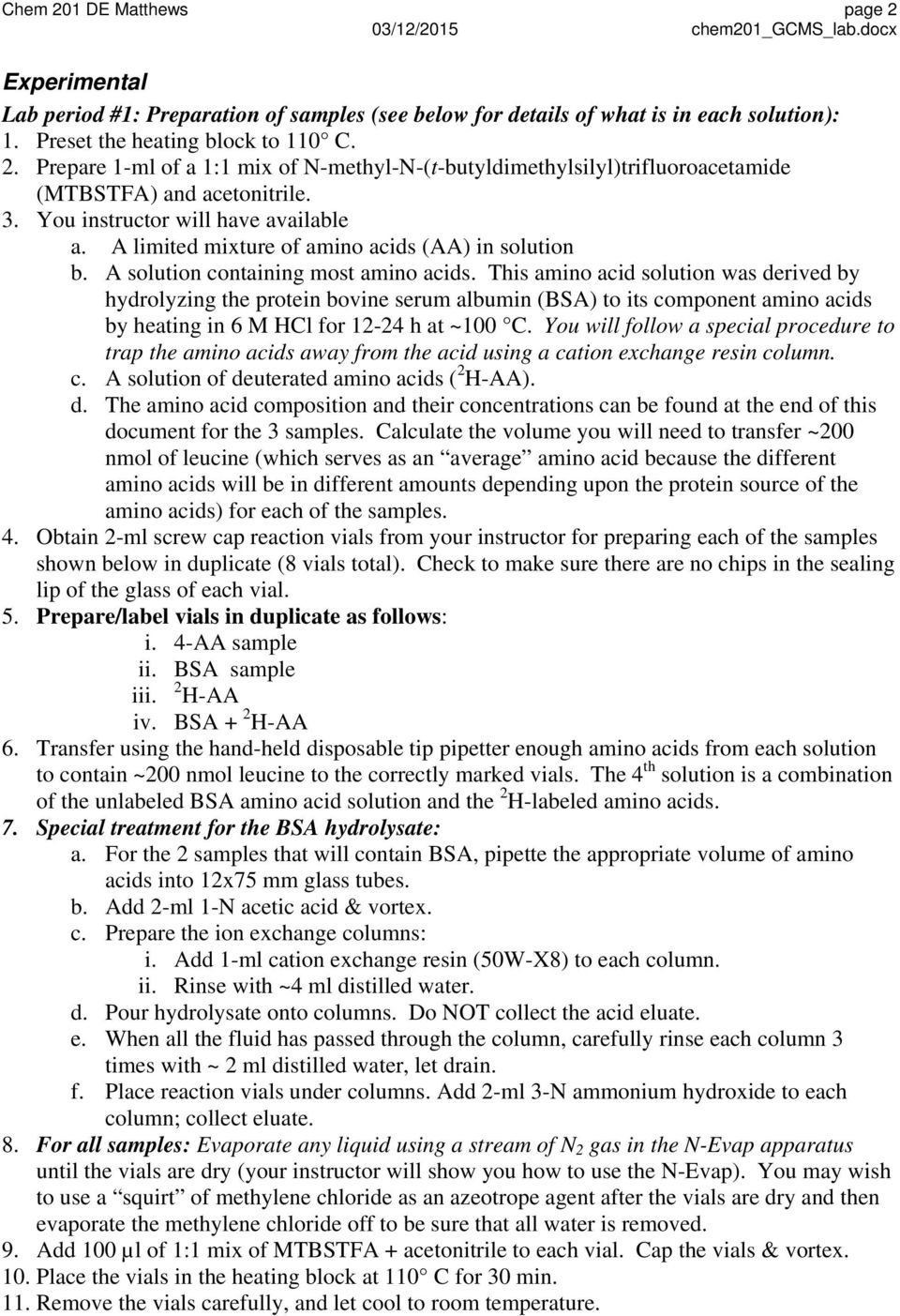
2 Chem 201 DE Matthews page 2 Experimental Lab period #1: Preparation of samples (see below for details of what is in each solution): 1. Preset the heating block to 110 C. 2. Prepare 1-ml of a 1:1 mix of N-methyl-N-(t-butyldimethylsilyl)trifluoroacetamide (MTBSTFA) and acetonitrile. 3. You instructor will have available a. A limited mixture of amino acids (AA) in solution b. A solution containing most amino acids. This amino acid solution was derived by hydrolyzing the protein bovine serum albumin (BSA) to its component amino acids by heating in 6 M HCl for h at ~100 C. You will follow a special procedure to trap the amino acids away from the acid using a cation exchange resin column. c. A solution of deuterated amino acids ( 2 H-AA). d. The amino acid composition and their concentrations can be found at the end of this document for the 3 samples. Calculate the volume you will need to transfer ~200 nmol of leucine (which serves as an average amino acid because the different amino acids will be in different amounts depending upon the protein source of the amino acids) for each of the samples. 4. Obtain 2-ml screw cap reaction vials from your instructor for preparing each of the samples shown below in duplicate (8 vials total). Check to make sure there are no chips in the sealing lip of the glass of each vial. 5. Prepare/label vials in duplicate as follows: i. 4-AA sample ii. BSA sample iii. 2 H-AA iv. BSA + 2 H-AA 6. Transfer using the hand-held disposable tip pipetter enough amino acids from each solution to contain ~200 nmol leucine to the correctly marked vials. The 4 th solution is a combination of the unlabeled BSA amino acid solution and the 2 H-labeled amino acids. 7. Special treatment for the BSA hydrolysate: a. For the 2 samples that will contain BSA, pipette the appropriate volume of amino acids into 12x75 mm glass tubes. b. Add 2-ml 1-N acetic acid & vortex. c. Prepare the ion exchange columns: i. Add 1-ml cation exchange resin (50W-X8) to each column. ii. Rinse with ~4 ml distilled water. d. Pour hydrolysate onto columns. Do NOT collect the acid eluate. e. When all the fluid has passed through the column, carefully rinse each column 3 times with ~ 2 ml distilled water, let drain. f. Place reaction vials under columns. Add 2-ml 3-N ammonium hydroxide to each column; collect eluate. 8. For all samples: Evaporate any liquid using a stream of N 2 gas in the N-Evap apparatus until the vials are dry (your instructor will show you how to use the N-Evap). You may wish to use a squirt of methylene chloride as an azeotrope agent after the vials are dry and then evaporate the methylene chloride off to be sure that all water is removed. 9. Add 100 µl of 1:1 mix of MTBSTFA + acetonitrile to each vial. Cap the vials & vortex. 10. Place the vials in the heating block at 110 C for 30 min. 11. Remove the vials carefully, and let cool to room temperature.
3 Chem 201 DE Matthews page Store the samples in a ZIP-lock bag in the freezer. 13. When ready to analyze the samples, make sure samples come to room temperature while still in the bag to prevent condensation inside the vials. Lab period 2: EI-GCMS 1. With the mass spec TA or with the Chem 201 TA, orient yourself to the Varian Saturn GCMS: a. Note the major components b. Note operation of the GC c. Note the vacuum of the system d. Note the GC column installed 2. With your TA, set the mass spec in parameters for EI mode and a scan range from Da. 3. Start with a general temperature program for the GC: a. 1 ml/min He, b. Injector: 250 C, c. GC temperature program: initial: 80 C, hold for 2 min, then program the GC: 8 C/min to 250 C; hold for 15 min. 4. Inject 1 µl of one of the 4-AA samples. a. Did you get all the peaks you expected and were they resolved? b. Check the spectrum of each peak and confirm each peak s identity. c. Were the earliest and last eluting amino acids the ones you expected? 5. If needed, increase the initial temperature for quicker elution of the 1 st AA to reduce the time. Repeat the injection of the 4-AA sample. If needed, readjust the initial temperature and repeat the injection again. 6. Reduce the temperature ramp from 8 C/min to 4 C/min. Repeat injection of the AA sample. a. Print a good mass chromatogram of the total ion current (TIC) trace versus time. b. Integrate, process, and plot the spectrum of each of various peaks. Identify the peaks. 7. With this GC program inject each of the samples: i. The BSA sample ii. The 2 H-AA sample. iii. The BSA + 2 H-AA sample. iv. If any of these injections fail to produce a good set of peaks, then repeat the injection using your duplicate derivative. b. Prepare mass chromatograms of each of the samples. c. Integrate each peak and plot each peak s spectrum. d. Identify the amino acids in the run.

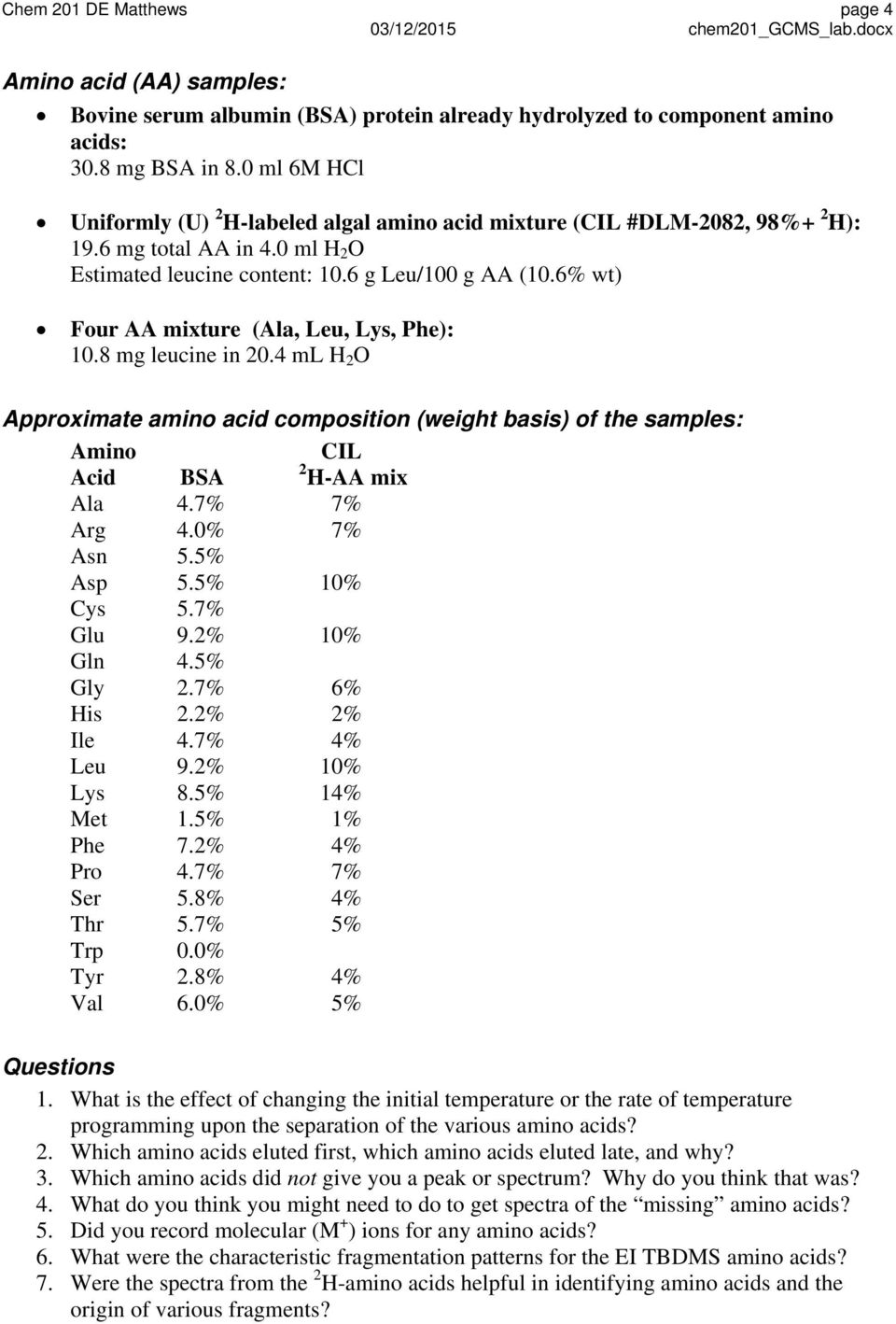
4 Chem 201 DE Matthews page 4 Amino acid (AA) samples: Bovine serum albumin (BSA) protein already hydrolyzed to component amino acids: 30.8 mg BSA in 8.0 ml 6M HCl Uniformly (U) 2 H-labeled algal amino acid mixture (CIL #DLM-2082, 98%+ 2 H): 19.6 mg total AA in 4.0 ml H 2 O Estimated leucine content: 10.6 g Leu/100 g AA (10.6% wt) Four AA mixture (Ala, Leu, Lys, Phe): 10.8 mg leucine in 20.4 ml H 2 O Approximate amino acid composition (weight basis) of the samples: Amino CIL Acid BSA 2 H-AA mix Ala 4.7% 7% Arg 4.0% 7% Asn 5.5% Asp 5.5% 10% Cys 5.7% Glu 9.2% 10% Gln 4.5% Gly 2.7% 6% His 2.2% 2% Ile 4.7% 4% Leu 9.2% 10% Lys 8.5% 14% Met 1.5% 1% Phe 7.2% 4% Pro 4.7% 7% Ser 5.8% 4% Thr 5.7% 5% Trp 0.0% Tyr 2.8% 4% Val 6.0% 5% Questions 1. What is the effect of changing the initial temperature or the rate of temperature programming upon the separation of the various amino acids? 2. Which amino acids eluted first, which amino acids eluted late, and why? 3. Which amino acids did not give you a peak or spectrum? Why do you think that was? 4. What do you think you might need to do to get spectra of the missing amino acids? 5. Did you record molecular (M + ) ions for any amino acids? 6. What were the characteristic fragmentation patterns for the EI TBDMS amino acids? 7. Were the spectra from the 2 H-amino acids helpful in identifying amino acids and the origin of various fragments?
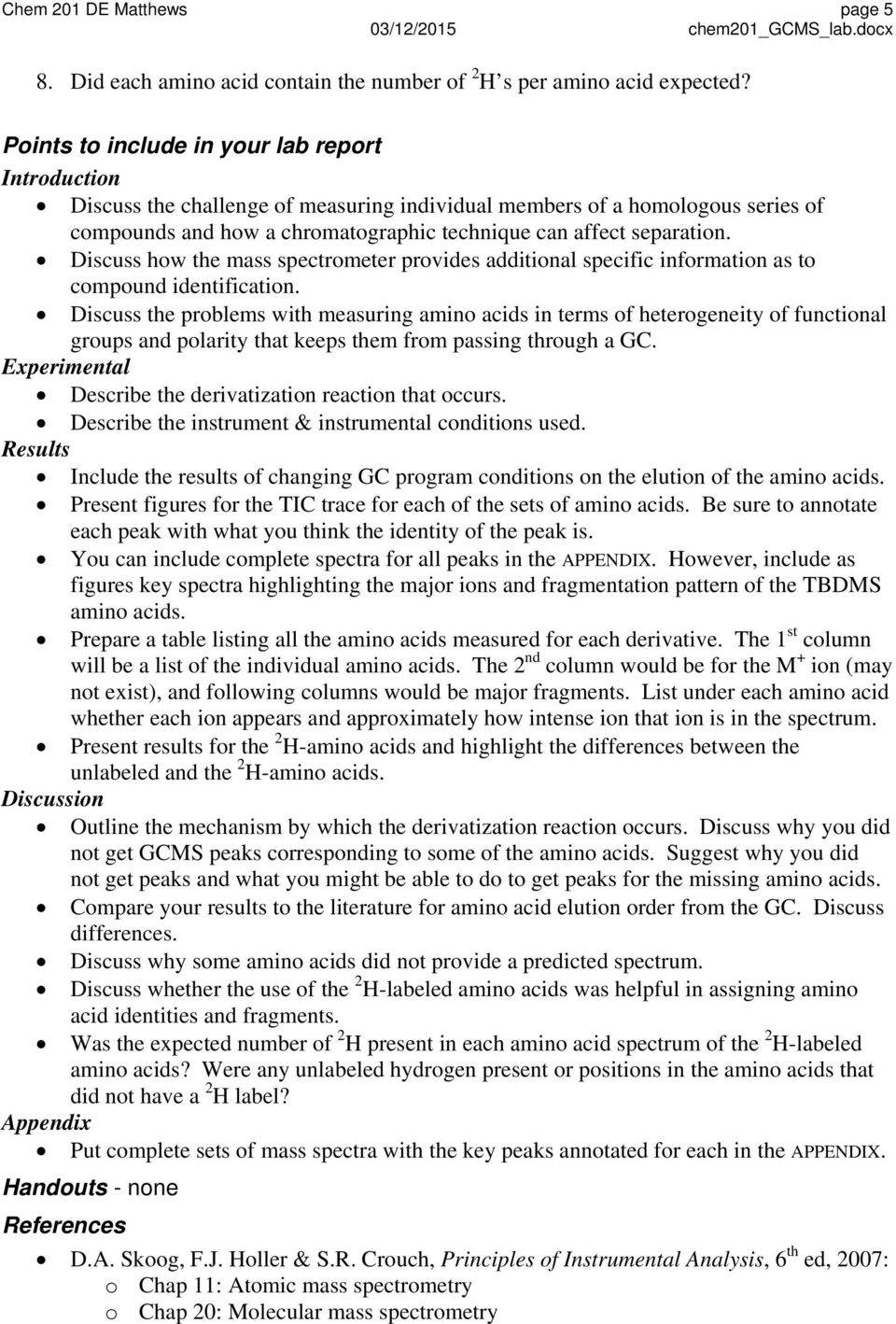
5 Chem 201 DE Matthews page 5 8. Did each amino acid contain the number of 2 H s per amino acid expected? Points to include in your lab report Introduction Discuss the challenge of measuring individual members of a homologous series of compounds and how a chromatographic technique can affect separation. Discuss how the mass spectrometer provides additional specific information as to compound identification. Discuss the problems with measuring amino acids in terms of heterogeneity of functional groups and polarity that keeps them from passing through a GC. Experimental Describe the derivatization reaction that occurs. Describe the instrument & instrumental conditions used. Results Include the results of changing GC program conditions on the elution of the amino acids. Present figures for the TIC trace for each of the sets of amino acids. Be sure to annotate each peak with what you think the identity of the peak is. You can include complete spectra for all peaks in the APPENDIX. However, include as figures key spectra highlighting the major ions and fragmentation pattern of the TBDMS amino acids. Prepare a table listing all the amino acids measured for each derivative. The 1 st column will be a list of the individual amino acids. The 2 nd column would be for the M + ion (may not exist), and following columns would be major fragments. List under each amino acid whether each ion appears and approximately how intense ion that ion is in the spectrum. Present results for the 2 H-amino acids and highlight the differences between the unlabeled and the 2 H-amino acids. Discussion Outline the mechanism by which the derivatization reaction occurs. Discuss why you did not get GCMS peaks corresponding to some of the amino acids. Suggest why you did not get peaks and what you might be able to do to get peaks for the missing amino acids. Compare your results to the literature for amino acid elution order from the GC. Discuss differences. Discuss why some amino acids did not provide a predicted spectrum. Discuss whether the use of the 2 H-labeled amino acids was helpful in assigning amino acid identities and fragments. Was the expected number of 2 H present in each amino acid spectrum of the 2 H-labeled amino acids? Were any unlabeled hydrogen present or positions in the amino acids that did not have a 2 H label? Appendix Put complete sets of mass spectra with the key peaks annotated for each in the APPENDIX. Handouts - none References D.A. Skoog, F.J. Holler & S.R. Crouch, Principles of Instrumental Analysis, 6 th ed, 2007: o Chap 11: Atomic mass spectrometry o Chap 20: Molecular mass spectrometry
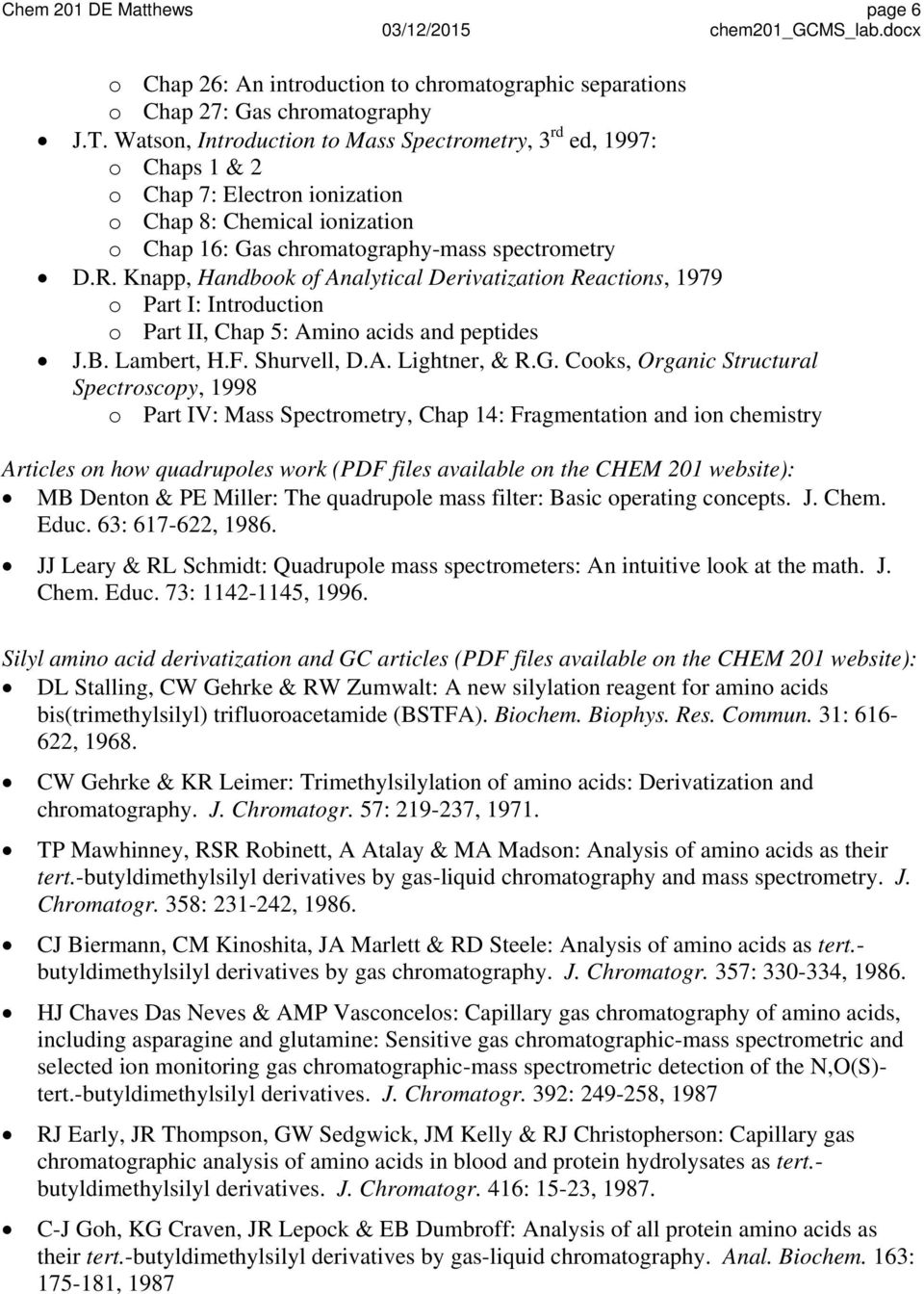
6 Chem 201 DE Matthews page 6 o Chap 26: An introduction to chromatographic separations o Chap 27: Gas chromatography J.T. Watson, Introduction to Mass Spectrometry, 3 rd ed, 1997: o Chaps 1 & 2 o Chap 7: Electron ionization o Chap 8: Chemical ionization o Chap 16: Gas chromatography-mass spectrometry D.R. Knapp, Handbook of Analytical Derivatization Reactions, 1979 o Part I: Introduction o Part II, Chap 5: Amino acids and peptides J.B. Lambert, H.F. Shurvell, D.A. Lightner, & R.G. Cooks, Organic Structural Spectroscopy, 1998 o Part IV: Mass Spectrometry, Chap 14: Fragmentation and ion chemistry Articles on how quadrupoles work (PDF files available on the CHEM 201 website): MB Denton & PE Miller: The quadrupole mass filter: Basic operating concepts. J. Chem. Educ. 63: , JJ Leary & RL Schmidt: Quadrupole mass spectrometers: An intuitive look at the math. J. Chem. Educ. 73: , Silyl amino acid derivatization and GC articles (PDF files available on the CHEM 201 website): DL Stalling, CW Gehrke & RW Zumwalt: A new silylation reagent for amino acids bis(trimethylsilyl) trifluoroacetamide (BSTFA). Biochem. Biophys. Res. Commun. 31: , CW Gehrke & KR Leimer: Trimethylsilylation of amino acids: Derivatization and chromatography. J. Chromatogr. 57: , TP Mawhinney, RSR Robinett, A Atalay & MA Madson: Analysis of amino acids as their tert.-butyldimethylsilyl derivatives by gas-liquid chromatography and mass spectrometry. J. Chromatogr. 358: , CJ Biermann, CM Kinoshita, JA Marlett & RD Steele: Analysis of amino acids as tert.- butyldimethylsilyl derivatives by gas chromatography. J. Chromatogr. 357: , HJ Chaves Das Neves & AMP Vasconcelos: Capillary gas chromatography of amino acids, including asparagine and glutamine: Sensitive gas chromatographic-mass spectrometric and selected ion monitoring gas chromatographic-mass spectrometric detection of the N,O(S)- tert.-butyldimethylsilyl derivatives. J. Chromatogr. 392: , 1987 RJ Early, JR Thompson, GW Sedgwick, JM Kelly & RJ Christopherson: Capillary gas chromatographic analysis of amino acids in blood and protein hydrolysates as tert.- butyldimethylsilyl derivatives. J. Chromatogr. 416: 15-23, C-J Goh, KG Craven, JR Lepock & EB Dumbroff: Analysis of all protein amino acids as their tert.-butyldimethylsilyl derivatives by gas-liquid chromatography. Anal. Biochem. 163: , 1987
Pesticide Analysis by Mass Spectrometry
 Pesticide Analysis by Mass Spectrometry Purpose: The purpose of this assignment is to introduce concepts of mass spectrometry (MS) as they pertain to the qualitative and quantitative analysis of organochlorine
Background Information
 1 Gas Chromatography/Mass Spectroscopy (GC/MS/MS) Background Information Instructions for the Operation of the Varian CP-3800 Gas Chromatograph/ Varian Saturn 2200 GC/MS/MS See the Cary Eclipse Software
Chemistry 321, Experiment 8: Quantitation of caffeine from a beverage using gas chromatography
 Chemistry 321, Experiment 8: Quantitation of caffeine from a beverage using gas chromatography INTRODUCTION The analysis of soft drinks for caffeine was able to be performed using UV-Vis. The complex sample
CONFIRMATION OF ZOLPIDEM BY LIQUID CHROMATOGRAPHY MASS SPECTROMETRY
 CONFIRMATION OF ZOLPIDEM BY LIQUID CHROMATOGRAPHY MASS SPECTROMETRY 9.1 POLICY This test method may be used to confirm the presence of zolpidem (ZOL), with diazepam-d 5 (DZP-d 5 ) internal standard, in
Expectations for GC-MS Lab
 Expectations for GC-MS Lab Since this is the first year for GC-MS to be used in Dr. Lamp s CHEM 322, the lab experiment is somewhat unstructured. As you move through the two weeks, I expect that you will
Separation of Amino Acids by Paper Chromatography
 Separation of Amino Acids by Paper Chromatography Chromatography is a common technique for separating chemical substances. The prefix chroma, which suggests color, comes from the fact that some of the
Rapid and Reproducible Amino Acid Analysis of Physiological Fluids for Clinical Research Using LC/MS/MS with the atraq Kit
 Rapid and Reproducible Amino Acid Analysis of Physiological Fluids for Clinical Research Using LC/MS/MS with the atraq Kit Fast, simple and cost effective analysis Many areas of biochemical research and
Application Note. Determination of Amino acids by UHPLC with automated OPA- Derivatization by the Autosampler. Summary. Fig. 1.
 Application Note Determination of Amino acids by UHPLC with automated PA- Derivatization by the Autosampler Category Bio Analysis Matrix - Method UHPLC Keywords Proteinogenic Amino acids, Canonical Amino
Project 5: Scoville Heat Value of Foods HPLC Analysis of Capsaicinoids
 Willamette University Chemistry Department 2013 Project 5: HPLC Analysis of Capsaicinoids LABORATORY REPORT: Formal Writing Exercises PRE-LAB ASSIGNMENT Read the entire laboratory project and section 28C
AMD Analysis & Technology AG
 AMD Analysis & Technology AG Application Note 120419 Author: Karl-Heinz Maurer APCI-MS Trace Analysis of volatile organic compounds in ambient air A) Introduction Trace analysis of volatile organic compounds
Gas Chromatography. Let s begin with an example problem: SPME head space analysis of pesticides in tea and follow-up analysis by high speed GC.
 Gas Chromatography Let s begin with an example problem: SPME head space analysis of pesticides in tea and follow-up analysis by high speed GC. Samples in 10mL sealed glass vials were placed in the MPS-2
Opiates in Urine by SAMHSA GC/MS
 application Note Gas Chromatography/ Mass Spectrometry Author Timothy D. Ruppel PerkinElmer, Inc. Shelton, CT 06484 USA Opiates in Urine by SAMHSA GC/MS Introduction The United States Department of Health
SPE, LC-MS/MS Method for the Determination of Ethinyl Estradiol from Human Plasma
 SPE, LC-MS/MS Method for the Determination of Ethinyl Estradiol from uman Plasma Krishna Rao Dara, Dr. Tushar N. Mehta, Asia Pacific Center of Excellence, Thermo Fisher Scientific, Ahmedabad, India Application
In this experiment, we will use three properties to identify a liquid substance: solubility, density and boiling point..
 Identification of a Substance by Physical Properties 2009 by David A. Katz. All rights reserved. Permission for academic use provided the original copyright is included Every substance has a unique set
Technical Procedure for the Solid Phase Extraction of Acidic, Neutral and Basic Drugs for GC-MS Analysis
 Technical Procedure for the Solid Phase Extraction of Acidic, Neutral and Basic Drugs for GC-MS Analysis 1.0 Purpose - This procedure specifies the required elements for the solid phase extraction of acidic,
The Characterization of Perfume Fragrances Using GC/MS, Headspace Trap and Olfactory Port
 APPLICATION NOTE Gas Chromatography/ Mass Spectrometry Authors: Andrew Tipler Sheila Eletto PerkinElmer, Inc. Shelton, CT The Characterization of Perfume Fragrances Using GC/MS, Headspace Trap and Olfactory
Guide to Reverse Phase SpinColumns Chromatography for Sample Prep
 Guide to Reverse Phase SpinColumns Chromatography for Sample Prep www.harvardapparatus.com Contents Introduction...2-3 Modes of Separation...4-6 Spin Column Efficiency...7-8 Fast Protein Analysis...9 Specifications...10
An In-Gel Digestion Protocol
 An In-Gel Digestion Protocol This protocol describes the digestion of a protein present in an SDS-PAGE gel band with trypsin. The band can be taken from either a 1D or 2D electrophoresis gel. Reagents
Amino Acids. Amino acids are the building blocks of proteins. All AA s have the same basic structure: Side Chain. Alpha Carbon. Carboxyl. Group.
 Protein Structure Amino Acids Amino acids are the building blocks of proteins. All AA s have the same basic structure: Side Chain Alpha Carbon Amino Group Carboxyl Group Amino Acid Properties There are
Electrospray Ion Trap Mass Spectrometry. Introduction
 Electrospray Ion Source Electrospray Ion Trap Mass Spectrometry Introduction The key to using MS for solutions is the ability to transfer your analytes into the vacuum of the mass spectrometer as ionic
Distillation Experiment
 Distillation Experiment CHM226 Background The distillation process is a very important technique used to separate compounds based on their boiling points. A substance will boil only when the vapor pressure
Application Note. Determination of 17 AQC derivatized Amino acids in baby food samples. Summary. Introduction. Category Bio science, food Matrix
 Application Note Determination of 17 AQC derivatized Amino acids in baby food samples Category Bio science, food Matrix Baby food Method UHPLC Keywords Proteinogenic amino acids, canonical amino acids,
Lecture Chromo-3: Gas Chromatography. CHEM 5181 Fall 2004 Mass Spectrometry & Chromatography. Jessica Gilman and Prof. Jose-Luis Jimenez CU-Boulder
 Lecture Chromo-3: Gas Chromatography CHEM 5181 Fall 2004 Mass Spectrometry & Chromatography Jessica Gilman and Prof. Jose-Luis Jimenez CU-Boulder Outline Introduction Instrument overview Carrier gas Sample
Determination of Caffeine in Beverages HPLC-1
 Determination of in s HPLC-1 Introduction This experiment provides an introduction to the application of High Performance Liquid Chromatography (HPLC) to the solution of complex analytical problems. Cola
High-Throughput 3-D Chromatography Through Ion Exchange SPE
 High-Throughput 3-D Chromatography Through Ion Exchange SPE Application Note 205 Luke Roenneburg and Alan Hamstra (Gilson, Inc.) Introduction 2-dimensional (2-D) separation is the separation of a sample
ISOLATION OF CAFFEINE FROM TEA
 ISLATIN F CAFFEINE FRM TEA Introduction In this experiment, caffeine is isolated from tealeaves. The chief problem with the isolation is that caffeine does not exist alone in the tealeaves, but other natural
Analyzing Small Molecules by EI and GC-MS. July 2014
 Analyzing Small Molecules by EI and GC-MS July 2014 Samples Appropriate for GC-MS Volatile and semi-volatile organic compounds Rule of thumb,
ACETALDEHYDE and ISOVALERALDEHYDE (Gas Chromatography)
 ACETA.02-1 ACETALDEHYDE and ISOVALERALDEHYDE (Gas Chromatography) PRINCIPLE Isovaleraldehyde (IVA) and acetaldehyde are released from the syrup with the aid of dilute phosphoric acid and heat. The liberated
Novel Method for Solid Phase Peptide Synthesis Using Microwave Energy
 Novel Method for Solid Phase Peptide Synthesis Using Microwave Energy Jonathan M. Collins, Michael J. Collins, Rebecca C. Steorts CEM Corporation, Matthews, NC 28106-0200, U.S.A. Presented at American
LC-MS/MS Method for the Determination of Docetaxel in Human Serum for Clinical Research
 LC-MS/MS Method for the Determination of Docetaxel in Human Serum for Clinical Research J. Jones, J. Denbigh, Thermo Fisher Scientific, Runcorn, Cheshire, UK Application Note 20581 Key Words SPE, SOLA,
Chapter 21 Principles of Chromatography and Mass Spectrometry Problems 1,2,3,4,8,9,11,13
 Chapter 21 Principles of Chromatography and Mass Spectrometry Problems 1,2,3,4,8,9,11,13 21-1 What is Chromatography Process to separate and purify compounds in a mixture by passing them trough a material
Pipe Cleaner Proteins. Essential question: How does the structure of proteins relate to their function in the cell?
 Pipe Cleaner Proteins GPS: SB1 Students will analyze the nature of the relationships between structures and functions in living cells. Essential question: How does the structure of proteins relate to their
Using Natural Products Application Solution with UNIFI for the Identification of Chemical Ingredients of Green Tea Extract
 Using Natural Products Application Solution with UNIFI for the Identification of Chemical Ingredients of Green Tea Extract Lirui Qiao, 1 Rob Lewis, 2 Alex Hooper, 2 James Morphet, 2 Xiaojie Tan, 1 Kate
PROTEIN SEQUENCING. First Sequence
 PROTEIN SEQUENCING First Sequence The first protein sequencing was achieved by Frederic Sanger in 1953. He determined the amino acid sequence of bovine insulin Sanger was awarded the Nobel Prize in 1958
Determination of a Chemical Formula
 1 Determination of a Chemical Formula Introduction Molar Ratios Elements combine in fixed ratios to form compounds. For example, consider the compound TiCl 4 (titanium chloride). Each molecule of TiCl
Name Lab #3: Solubility of Organic Compounds Objectives: Introduction: soluble insoluble partially soluble miscible immiscible
 Lab #3: Solubility of rganic Compounds bjectives: - Understanding the relative solubility of organic compounds in various solvents. - Exploration of the effect of polar groups on a nonpolar hydrocarbon
PROTEINS (LOWRY) PROTOCOL
 1 PROTEINS (LOWRY) PROTOCOL 1. INTRODUCTION The Lowry Assay: Protein by Folin Reaction (Lowry et al., 1951) has been the most widely used method to estimate the amount of proteins (already in solution
Paper Chromatography: Separation and Identification of Five Metal Cations
 Paper Chromatography: Separation and Identification of Five Metal Cations Objectives Known and unknown solutions of the metal ions Ag +, Fe 3+, Co 2+, Cu 2+ and Hg 2+ will be analyzed using paper chromatography.
1.1 This test method covers the qualitative and quantitative determination of the content of benzene and toluene in hydrocarbon wax.
 Standard Method for Analysis of Benzene and Toluene Content in Hydrocarbon Waxes by Headspace Gas Chromatography EWF METHOD 002/03 (Version 1 Reviewed 2015) 1 Scope 1.1 This test method covers the qualitative
Determination of polyols derived from sugars and residual sugars found in dry wines by means of gas chromatography (Resolution Oeno 9/2006)
 Method OIV-MA-AS311-06 Type IV method Determination of polyols derived from sugars and residual sugars found in dry wines by means of gas chromatography (Resolution Oeno 9/2006) 1. Scope Simultaneous determination
LC-MS/MS for Chromatographers
 LC-MS/MS for Chromatographers An introduction to the use of LC-MS/MS, with an emphasis on the analysis of drugs in biological matrices LC-MS/MS for Chromatographers An introduction to the use of LC-MS/MS,
VCE CHEMISTRY 2008 2011: UNIT 3 SAMPLE COURSE OUTLINE
 VCE CHEMISTRY 2008 2011: UNIT 3 SAMPLE COURSE OUTLINE This sample course outline represents one possible teaching and learning sequence for Unit 3. 1 2 calculations including amount of solids, liquids
Extraction, Derivatization and Ultra-Sensitive GC/Triple Quadrupole Analysis of Estrone and Estradiol in Human Serum
 Extraction, Derivatization and Ultra-Sensitive GC/Triple Quadrupole Analysis of Estrone and Estradiol in uman Serum Technical verview Clinical Research Authors Anthony Macherone, Ph.D. Agilent Technologies,
(c) How would your answers to problem (a) change if the molecular weight of the protein was 100,000 Dalton?
 Problem 1. (12 points total, 4 points each) The molecular weight of an unspecified protein, at physiological conditions, is 70,000 Dalton, as determined by sedimentation equilibrium measurements and by
APPLICATIONS MANUAL. Ifosfamide in blood serum... 2. Ingredients in blood serum... 3. Organophosphorus pesticides in tea leaf... 5
 1 APPLICATIONS MANUAL CONTENTS Ifosfamide in blood serum... 2 Ingredients in blood serum... 3 Organophosphorus pesticides in tea leaf... 5 Sudan i ii iii iv in chilli sauce... 6 Pah in water... 7 Phenols
EXPERIMENT 5. Molecular Absorption Spectroscopy: Determination of Iron With 1,10-Phenanthroline
 EXPERIMENT 5 Molecular Absorption Spectroscopy: Determination of Iron With 1,10-Phenanthroline UNKNOWN Submit a clean, labeled 100-mL volumetric flask to the instructor so that your unknown iron solution
PHYSICAL SEPARATION TECHNIQUES. Introduction
 PHYSICAL SEPARATION TECHNIQUES Lab #2 Introduction When two or more substances, that do not react chemically, are blended together, the result is a mixture in which each component retains its individual
Amino Acids, Peptides, Proteins
 Amino Acids, Peptides, Proteins Functions of proteins: Enzymes Transport and Storage Motion, muscle contraction Hormones Mechanical support Immune protection (Antibodies) Generate and transmit nerve impulses
New drugs of abuse? A case study on Phenazepam & Methoxetamine
 New drugs of abuse? A case study on Phenazepam & Methoxetamine Presenter: Nadia Wong Co authors: Dr Yao Yi Ju & Alex Low Xuan Kai Analytical Toxicology Laboratory Clinical & Forensic Toxicology Unit Applied
Quantitation of Drugs in Dried Bloodstains. Thomas Meyer Anna Gomenyuk Nadiah Lester
 Quantitation of Drugs in Dried Bloodstains Thomas Meyer Anna Gomenyuk Nadiah Lester Objective To find the quantitative value of drugs in dried bloodstains Currently Cloth With Dried Bloodstain Containing
A VISION to On-Line SPE PTV GC MS Determination of Organic Micro Pollutants in Surface Water
 A VISION to On-Line SPE PTV GC MS Determination of Organic Micro Pollutants in Surface Water Sjaak de Koning 1, Mark van Lieshout 2, Hans-Gerd Janssen 2 and Wil van Egmond 1 1 ATAS, De Run 4334, PO Box
Chem 405 Biochemistry Lab I Experiment 2 Quantitation of an unknown protein solution.
 Chem 405 Biochemistry Lab I Experiment 2 Quantitation of an unknown protein solution. Introduction: The determination of protein concentration is frequently required in biochemical work. Several methods
UHPLC/MS: An Efficient Tool for Determination of Illicit Drugs
 Application Note: 439 UHPLC/MS: An Efficient Tool for Determination of Illicit Drugs Guifeng Jiang, Thermo Fisher Scientific, San Jose, CA, USA Key Words Accela UHPLC System MSQ Plus MS Detector Drugs
Thermo Scientific GC-MS Data Acquisition Instructions for Cerno Bioscience MassWorks Software
 Thermo Scientific GC-MS Data Acquisition Instructions for Cerno Bioscience MassWorks Software Mark Belmont and Alexander N. Semyonov, Thermo Fisher Scientific, Austin, TX, USA Ming Gu, Cerno Bioscience,
Separation by Solvent Extraction
 Experiment 3 Separation by Solvent Extraction Objectives To separate a mixture consisting of a carboxylic acid and a neutral compound by using solvent extraction techniques. Introduction Frequently, organic
Reaction of Magnesium with Hydrochloric Acid (Gas Laws) Chemicals Needed:
 Reaction of Magnesium with Hydrochloric Acid (Gas Laws) Your Name: Date: Partner(s) Names: Objectives: React magnesium metal with hydrochloric acid, collecting the hydrogen over water. Calculate the grams
Gas Chromatography Liner Selection Guide
 Gas Chromatography Liner Selection Guide Peter Morgan, Thermo Fisher Scientific, Runcorn, Cheshire, UK Technical Note 20551 Key Words Liner, focus Abstract The liner serves an important function in allowing
MASS SPECTROMETRIC IDENTIFICATION OF SOME SULPHUR CONTAINING PHENALKYLAMINE DESIGNER DRUGS *
 MASS SPECTROMETRIC IDENTIFICATION OF SOME SULPHUR CONTAINING PHENALKYLAMINE DESIGNER DRUGS * Ingrid J. BOSMAN 1, Douwe DE BOER 2, Edwin B. SIDERIUS 1, Lesseps J. A. L. DOS REYS 2, Robert A. A. MAES 1 1
Quantitative Evaluation of Perfume Fleuressence Samples using the znose
 Quantitative Evaluation of Perfume Fleuressence Samples using the znose Edward J. Staples, Electronic Sensor Technology Electronic Noses Conventional electronic noses (enoses) produce a recognizable response
SUCRALOSE. White to off-white, practically odourless crystalline powder
 SUCRALOSE Prepared at the 41st JECFA (1993), published in FNP 52 Add 2 (1993). Metals and arsenic specifications revised at the 63rd JECFA (2004). An ADI of 0-15 mg/kg bw was established at the 37th JECFA
NWTPH-HCID. Hydrocarbon Identification Method for Soil and Water
 NWTPH-HCID Hydrocarbon Identification Method for Soil and Water Summary This method is a qualitative and semi-quantitative procedure. It is used for groundwater or surface water, and soil/sediment from
Experiment 3 Limiting Reactants
 3-1 Experiment 3 Limiting Reactants Introduction: Most chemical reactions require two or more reactants. Typically, one of the reactants is used up before the other, at which time the reaction stops. The
Chemistry 112 Laboratory Experiment 6: The Reaction of Aluminum and Zinc with Hydrochloric Acid
 Chemistry 112 Laboratory Experiment 6: The Reaction of Aluminum and Zinc with Hydrochloric Acid Introduction Many metals react with acids to form hydrogen gas. In this experiment, you will use the reactions
Analytical Test Report
 Analytical Test Report Customer: Address (City, State): Purchase Order: Report Number: Project Number: Date Received: Date of Report: Test Location: Boulder, CO. Assay: Part Number: Amino Acids by HPLC
PAPER CHROMATOGRAPHY
 PAPER CHROMATOGRAPHY INTRODUCTION Chromatography is a technique that is used to separate and to identify components of a mixture. This analytical technique has a wide range of applications in the real
Experiment 5: Column Chromatography
 Experiment 5: Column Chromatography Separation of Ferrocene & Acetylferrocene by Column Chromatography Reading: Mohrig, Hammond & Schatz Ch. 18 pgs 235-253 watch the technique video on the course website!
Analysis of Vegetable Oils by High Performance Liquid Chromatography
 Analysis of Vegetable Oils by High Performance Liquid Chromatography Using Evaporative Light Scattering Detection and Normal Phase Eluents Andrew J. Aubin, Cecilia B. Mazza, Donald A. Trinite, and Patricia
High sensitivity assays using online SPE-LC-MS/MS -How low can you go? Mohammed Abrar Unilabs York Bioanalytical solutions, York, UK
 High sensitivity assays using online SPE-LC-MS/MS -How low can you go? Mohammed Abrar Unilabs York Bioanalytical solutions, York, UK Background Unilabs YBS are a bioanalytical CRO based in York (Uk) Copenhagen
PrepTip. Reverse Phase PrepTip User Guide
 PrepTip Reverse Phase PrepTip User Guide All text, photographs and illustrations are copyrighted by Harvard Apparatus, Inc. 2004. PrepTip is a trademark of Harvard Apparatus, Inc. Harvard Apparatus 84
A High Throughput Automated Sample Preparation and Analysis Workflow for Comprehensive Forensic Toxicology Screening using LC/MS/MS
 A High Throughput Automated Sample Preparation and Analysis Workflow for Comprehensive Forensic Toxicology Screening using LC/MS/MS AB SCIEX QTRAP 4500 LC/MS/MS System and Gerstel, Inc. MultiPurpose Sampler
Increasing the Multiplexing of High Resolution Targeted Peptide Quantification Assays
 Increasing the Multiplexing of High Resolution Targeted Peptide Quantification Assays Scheduled MRM HR Workflow on the TripleTOF Systems Jenny Albanese, Christie Hunter AB SCIEX, USA Targeted quantitative
Determination of N-cyclohexyl-diazeniumdioxide (HDO) containing compounds in treated wood using GC-MS
 Application Note No. 051 Determination of N-cyclohexyl-diazeniumdioxide (HDO) containing compounds in treated wood using GC-MS by P Jüngel ¹), J Wittenzellner ²) and E Melcher ¹) ¹) Federal Research Centre
How To Use Gc-Ms
 The CHROMacademy Essential Guide Understanding GC-MS Analysis Part 1 Speakers John Hinshaw GC Dept. Dean CHROMacademy Tony Taylor Technical Director Crawford Scientific Moderator M ( g ) e M ( g ) 2e Peter
Electrospray Mass Spectrometry of Tris-acetylacetonatochromium(III)
 Electrospray Mass Spectrometry of Tris-acetylacetonatochromium(III) Purpose: Verify the synthesis of the synthesis product, Cr(acac) 3. The presence of any urea containing byproducts will also be determined.
Introduction to the ACQUITY UPLC H-Class Amino Acid Analysis System
 Introduction to the ACQUITY UPLC H-Class Amino Acid Analysis System 0.22 0.20 0.18 0.16 0.14 0.12 Cys 0.10 0.08 0.06 0.04 0.02 1.5 0 2.00 2.50 3.00 3.50 4.00 4.50 5.00 5.50 6.00 6.50 7.00 7.50 8.00 2012
HiPer Ion Exchange Chromatography Teaching Kit
 HiPer Ion Exchange Chromatography Teaching Kit Product Code: HTC001 Number of experiments that can be performed: 5 Duration of Experiment: Protocol: 5-6 hours Storage Instructions: The kit is stable for
Anion chromatography using on-line recycled eluents
 Journal of Chromatography A, 1089 (2005) 82 86 Anion chromatography using on-line recycled eluents Takashi Yokoyama, Hitoe Maekubo, Asami Sakai, Michio Zenki Department of Chemistry, Faculty of Science,
Identification of Arson Accelerants by Gas Chromatography
 Identification of Arson Accelerants by Gas Chromatography Purpose Arson is an insidious crime that annually claims the lives of hundreds of Americans and costs billions of dollars. 1 Scientists and criminal
Extraction of Cannabinoids in Marijuana and Edibles by QuEChERS
 Extraction of Cannabinoids in Marijuana and Edibles by QuEChERS UCT Part Numbers: ECQUEU750CT-MP - QuEChERS, Mylar packs containing 4 g magnesium sulfate, 1 g sodium chloride, 0.5 g sodium citrate dibasic
GENERAL UNKNOWN SCREENING FOR DRUGS IN BIOLOGICAL SAMPLES BY LC/MS Luc Humbert1, Michel Lhermitte 1, Frederic Grisel 2 1
 GENERAL UNKNOWN SCREENING FOR DRUGS IN BIOLOGICAL SAMPLES BY LC/MS Luc Humbert, Michel Lhermitte, Frederic Grisel Laboratoire de Toxicologie & Génopathologie, CHRU Lille, France Waters Corporation, Guyancourt,
Making the Leap to LC/MS/MS: Enhancing and Accelerating Clinical Research and Forensic Toxicology Applications
 Making the Leap to LC/MS/MS: Enhancing and Accelerating Clinical Research and Forensic Toxicology Applications Introduction The resolving power of chromatography combined with the sensitivity and selectivity
Validation of an HPLC method for the determination of amino acids in feed
 J. Serb. Chem. Soc. 78 (6) 839 850 (2013) UDC 547.466+543.544.5.068.7:641.3.002.2 JSCS 4462 Original scientific paper Validation of an HPLC method for the determination of amino acids in feed IGOR JAJIĆ
Journal of Chemical and Pharmaceutical Research
 Available on line www.jocpr.com Journal of Chemical and Pharmaceutical Research J. Chem. Pharm. Res., 2010, 2(2): 372-380 ISSN No: 0975-7384 Determination of amino acid without derivatization by using
Syllabus CHM 2202 Organic Chemistry Laboratory II Spring 2011
 Villanova University Department of Chemistry Syllabus CHM 2202 Organic Chemistry Laboratory II Spring 2011 Text: C.E. Bell, D.F. Taber and A.K. Clark, Organic Chemistry Laboratory with Qualitative Analysis,
Advantages of Polar, Reversed- Phase HPLC Columns for the Analysis of Drug Metabolites
 Advantages of Polar, Reversed- Phase HPLC Columns for the Analysis of Drug Metabolites Carmen T. Santasania and David S. Bell SUPELCO, 595 North Harrison Road, Bellefonte, PA 16823 T404045 GUS Abstract
Analysis of the Vitamin B Complex in Infant Formula Samples by LC-MS/MS
 Analysis of the Vitamin B Complex in Infant Formula Samples by LC-MS/MS Stephen Lock 1 and Matthew Noestheden 2 1 AB SCIEX Warrington, Cheshire (UK), 2 AB SCIEX Concord, Ontario (Canada) Overview A rapid,
Determination of Haloacetic Acids and Dalapon in Drinking Water by SPE and GC/ECD*
 Method 552.1 Revision 1.0 Determination of Haloacetic Acids and Dalapon in Drinking Water by SPE and GC/ECD* UCT Products: EUQAX156 (quaternary amine with Cl - counter ion, 6 ml cartridge)** CLTTP050 (CLEAN-THRU
TANNIC ACID. SYNONYMS Tannins (food grade), gallotannic acid, INS No. 181 DEFINITION DESCRIPTION
 TANNIC ACID Prepared at the 39th JECFA (1992), published in FNP Add 1 (1992) superseding specifications prepared at the 35th JECFA (1989), published in FNP 49 (1990) and in FNP 52 (1992). Metals and arsenic
Fractional Distillation and Gas Chromatography
 Fractional Distillation and Gas Chromatography Background Distillation The previous lab used distillation to separate a mixture of hexane and toluene based on a difference in boiling points. Hexane boils
Tamsulosin Hydrochloride Capsules
 . nal Revision Bulletin Official October 1, 2011 Tamsulosin 1 standard solution, and shake well. Centrifuge at 1500 rpm for 10 min, and use the supernatant, passing it if Tamsulosin Hydrochloride Capsules
methods Electrospray mass spectrometry of human hair wax esters Mark Fitzgerald and Robert C. Murphy 1
 Electrospray mass spectrometry of human hair wax esters methods Mark Fitzgerald and Robert C. Murphy 1 Department of Pharmacology, University of Colorado at Denver and Health Sciences Center, Aurora, CO
METHOD 3510C SEPARATORY FUNNEL LIQUID-LIQUID EXTRACTION
 METHOD 3510C SEPARATORY FUNNEL LIQUID-LIQUID EXTRACTION 1.0 SCOPE AND APPLICATION 1.1 This method describes a procedure for isolating organic compounds from aqueous samples. The method also describes concentration
QUANTITATIVE AMINO ACID ANALYSIS. Aurélie Lolia Applications Manager, Biochrom Ltd
 QUANTITATIVE AMINO ACID ANALYSIS Aurélie Lolia Applications Manager, Biochrom Ltd QUANTITATIVE AMINO ACID ANALYSIS Principles of amino acid analysis Ion exchange chromatography The Biochrom 30 physiological
Application Note # LCMS-62 Walk-Up Ion Trap Mass Spectrometer System in a Multi-User Environment Using Compass OpenAccess Software
 Application Note # LCMS-62 Walk-Up Ion Trap Mass Spectrometer System in a Multi-User Environment Using Compass OpenAccess Software Abstract Presented here is a case study of a walk-up liquid chromatography
5. Which temperature is equal to +20 K? 1) 253ºC 2) 293ºC 3) 253 C 4) 293 C
 1. The average kinetic energy of water molecules increases when 1) H 2 O(s) changes to H 2 O( ) at 0ºC 3) H 2 O( ) at 10ºC changes to H 2 O( ) at 20ºC 2) H 2 O( ) changes to H 2 O(s) at 0ºC 4) H 2 O( )
Determination of the Amino Acid Content of Peptides by AAA-Direct
 Technical Note 50 Determination of the Amino Acid Content of Peptides by AAA-Direct INTRODUCTION The AAA-Direct system separates amino acids on a high performance anion-exchange column and directly detects