
Geometry Notes RIGHT TRIANGLE TRIGONOMETRY
|
|
|
- George May
- 9 years ago
- Views:
Transcription
1 Right Triangle Trigonometry Page 1 of 15 RIGHT TRIANGLE TRIGONOMETRY Objectives: After completing this section, you should be able to do the following: Calculate the lengths of sides and angles of a right triangle using trigonometric ratios. Solve word problems involving right triangles and trigonometric ratios. Vocabulary: As you read, you should be looking for the following vocabulary words and their definitions: hypotenuse side side Formulas: You should be looking for the following formulas as you read: ratio for sin(a) where A is a non-right angle in right triangle ratio for cos(a) where A is a non-right angle in right triangle ratio for tan(a) where A is a non-right angle in right triangle We will complete our study with a further study of right triangles. We will look at trigonometric value as defined by ratios of the sides of a right triangle. hypotenuse In the figure above, you can see the sides of a right triangle labeled. The side labeled hypotenuse is always the right angle of the right triangle. The names of the other two sides of the right triangle are determined by the angle that is being discusses. In our case, we will be discusing the sides in terms of the angle labeled A. The angle A is form by the hypotenuse of the right triangle and the side of the right triangle that A hypotenuse

2 Right Triangle Trigonometry Page 2 of 15 is called. The side will always make up part of the angle that is being discussed and not be the hypotenuse. The side of the right triangle that does not form part of angle A is called the side. The side will never form part of the angle being discussed. The trigonometric function values of a particular value can be as the ratio of a particular pair of sides of a right triangle containing an angle of that measure. We will look at three particular trigonometric rations. Trigonometric Ratios sin( A ) cos( A ) tan( A ) hypotenuse hypotenuse sin shortened form of sine function cos shortened form of cosine function tan shortened form of tangent function A the angle value We will use these ratios to answer questions about triangles below and then we will go through a couple of application problems. Eample 1: Use Trigonometric ratios to find the unknown sides and angles in the right triangles below: B y

3 Right Triangle Trigonometry Page 3 of 15 Solution: We are being asked to find values for, y, and B. We will do the angle B first. Angle B: We can find the measure of angle B without using any trigonometric ratios. What we need to remember to find this value is that the sum of the three angles of a triangle will always add up to 180 degrees. It does not matter the size or shape of the triangle. The sum of the three angles will always be 180 degrees. We know that one angle is a right angle. Its measure is 90 degrees. The measure of the other angle is given to be 60 degrees. Thus we just need to calculate B B 180 B 30 Thus the measure of angle B is 30 degrees. Side : We will now work to find the length of side. We need to start by determining which angle we are going to use for our problem. As in the past, it is best to use an angle that is given. Thus we will be using the angle labeled 60 degrees. Our net step is to determine which side is relative to the angle labeled 60 degrees. Since the side labeled is the right angle, it is the hypotenuse. There are two trigonometric ratios that include the hypotenuse. Thus, we need to determine which one to use. This will be determined by the other side of the triangle whose measure we know. This is the side labeled 10. Since this side is not one of the sides of the triangle that makes up the angle labeled 60 degrees, it is the side. This means that we need to use the trigonometric ratio that has both the hypotenuse and the side. That ratio is the sine ratio. We will plug into that equation and solve for.

4 Right Triangle Trigonometry Page 4 of 15 sin( A) hypotenuse 10 sin(60) sin(60) 10 1 sin(60) 1(10) 10 sin(60) Through out this solution, we have left sin(60) in this form. This saves us from needing to round until the end of the problem. sin(60) is just a number that at the end of the problem can be calculated by our calculator. Our answer is approimately Side y: We will finish by finding the length of side y. As in the previous par of the problem, it is best to use the angle labeled 60 degrees. Our net step is to determine which side y is relative to the angle labeled 60 degrees. Since the side labeled y is forms part of the angle labeled 60 degrees, it is the side. There are two trigonometric ratios that include the side. Since the other side that is given is the side labeled 10 and this side is the side (see eplanation above), we will need to use the trigonometric ratio that has both the side and the side. That ratio is the tangent ratio. We will plug into that equation and solve for y. 10 tan(60) y tan(60) 1 10 y y tan(60) 1(10) y 10 tan(60)

5 Right Triangle Trigonometry Page 5 of 15 Through out this solution, we have left tan(60) in this form. This saves us from needing to round until the end of the problem. tan(60) is just a number that at the end of the problem can be calculated by our calculator. Our answer is approimately y Eample 2: Use Trigonometric ratios to find the unknown sides and angles in the right triangles below: y 45 A 3 Solution: As we solve this problem, we will leave out the eplanations of how we determine the names of the sides of the triangle. Angle A: As with the previous problem, the sum of the angles of a triangle is 180 degrees. Thus we calculate A A 180 A 45 Thus the measure of angle A is 45 degrees. Side : Side forms part of the angle that is labeled to be 45 degrees, thus this is the side. We are also given the measure of the side the angle to be 3. Thus we will want to use the tangent ratio.

6 Right Triangle Trigonometry Page 6 of 15 Our answer is 3. 3 tan(45) tan(45) 3 1 tan(45) 1(3) 3 tan(45) We did not need to use trigonometric ratios to find. We could have used the fact that our triangle has two angles that are equal. Such a triangle is an isosceles triangle. We should recall that the sides of an isosceles triangle the equal angles are equal in length. Thus since one of the side was length 3, the side labeled is also of length 3. Side y: Side y is the right angle of the triangle and thus is the hypotenuse. We also have given side to be 3. Thus to find y, we will need to use the sine ratio. 3 sin(45) y sin(45) 1 3 y y sin(45) 1(3) y 3 sin(45) Our answer is approimately y Eample 3: Use Trigonometric ratios to find the unknown sides and angles in the right triangles below: a B c

7 Right Triangle Trigonometry Page 7 of 15 Solution: Angle B: As with the previous problem, the sum of the angles of a triangle is 180 degrees. Thus we calculate B B 180 B 36.6 Thus the measure of angle B is 36.6 degrees. Side c: We will use the given angle labeled 53.4 degrees as our angle for solving this problem. Side c forms part of the triangle that is the right angle. Thus it is the hypotenuse. We are also given the measure of the side to the angle we are using to be 5.6. Thus we will want to use the cosine ratio. 5.6 cos(53.4) c cos(53.4) c c cos(53.4) 1(5.6) c 5.6 cos(53.4) Our answer is approimately c Side a: We will use the given angle labeled 53.4 degrees as our angle for solving this problem. Side a does not form the angle we are using. Thus it is the side. We are also given the measure of the side to the angle we are using to be 5.6. Thus we will want to use the tangent ratio. a tan(53.4) 5.6 tan(53.4) a tan(53.4) 1( a) 5.6 tan(53.4) a Our answer is approimately a

8 Right Triangle Trigonometry Page 8 of 15 Eample 4: Use Trigonometric ratios to find the unknown sides and angles in the right triangles below: 7.0 B c 8.0 A Solution: In this problem, we are not given any angle to use. Instead we will need to change the labels of our sides as we solve each of the angles in turn. We will start by finding side c. Since this is a right triangle, we can use the Pythagorean theorem to find the length of c. Side c: The legs (a and b) are given to be 7.0 and 8.0. It does not matter which we label a and which we label b a + b c c c 2 c 113 c The approimate length of side c is Angle A: As we solve for angle A, we need to label the sides whose measures are given relative to angle A. The side labeled 8.0 forms part of the angle A. Thus it is the side. The side labeled 7.0 does not form any part of the angle A. Thus it is the side. The trigonometric ratio that includes both the and sides is the tangent ratio. We will fill in the information to that equation and solve for A. 2

9 Right Triangle Trigonometry Page 9 of We need to know how to solve for A in this equation. As in our section on eponential functions and their inverses, there is an inverse function (a functions that undoes) for the tangent function. On the calculator it is labeled tan -1. Thus we can finally solve for A by calculating A tan 1 (0.875) Thus the measure of angle A is approimately A degrees. Angle B: As we solve for angle B, we need to relabel the sides whose measures are given relative to angle B. The side labeled 7.0 forms part of the angle B. Thus it is the side. The side labeled 8.0 does not form any part of the angle B. Thus it is the side. The trigonometric ratio that includes both the and sides is the tangent ratio. We will fill in the information to that equation and solve for A We will once again use the inverse function of the tangent function. On the calculator it is labeled tan -1. Thus we can finally solve for B by calculating 8.0 tan( B) B tan 7.0 Thus the measure of angle B is approimately B degrees.

10 Right Triangle Trigonometry Page 10 of 15 Eample 5: Use Trigonometric ratios to find the unknown sides and angles in the right triangles below: a b A Solution: Angle A: As with the previous problem, the sum of the angles of a triangle is 180 degrees. Thus we calculate A A 180 A 46.1 Thus the measure of angle A is 46.1 degrees. Side a: We will use the given angle labeled 43.9 degrees as our angle for solving this problem. Side a forms part of the angle labeled 43.9 degrees. Thus it is the side. We are also given the measure of the hypotenuse to be.86. Thus we will want to use the cosine ratio. a cos(43.9).86 cos(43.9) a cos(43.9) 1( a).86cos(43.9) a Our answer is approimately a Side b: We will use the given angle labeled 43.9 degrees as our angle for solving this problem. Side b does not form the angle we are using. Thus it is the side. We are also given the measure of the hypotenuse to be.86. Thus we will want to use the sine ratio.

11 Right Triangle Trigonometry Page 11 of 15 b sin(43.9).86 sin(43.9) b sin(43.9) 1( b).86 sin(43.9) b Our answer is approimately b We will finish by looking at some application problems for our right triangle trigonometric ratios. Eample 6: A support cable runs from the top of the telephone pole to a point on the ground 47.2 feet from its base. If the cable makes an angle of 28.7 with the ground, find (rounding to the nearest tenth of a foot) a. the height of the pole b. the length of the cable ft pole Solution: The picture above shows that we have a right triangle situation. Part a: The pole is the angle of 28.7 degrees that is given. The other side of the triangle that we know to be 47.2 feet forms part of the angle of 28.7 degrees. Thus it is the side. We will be able to use the tangent ratio to solve this problem since it includes both the and sides.
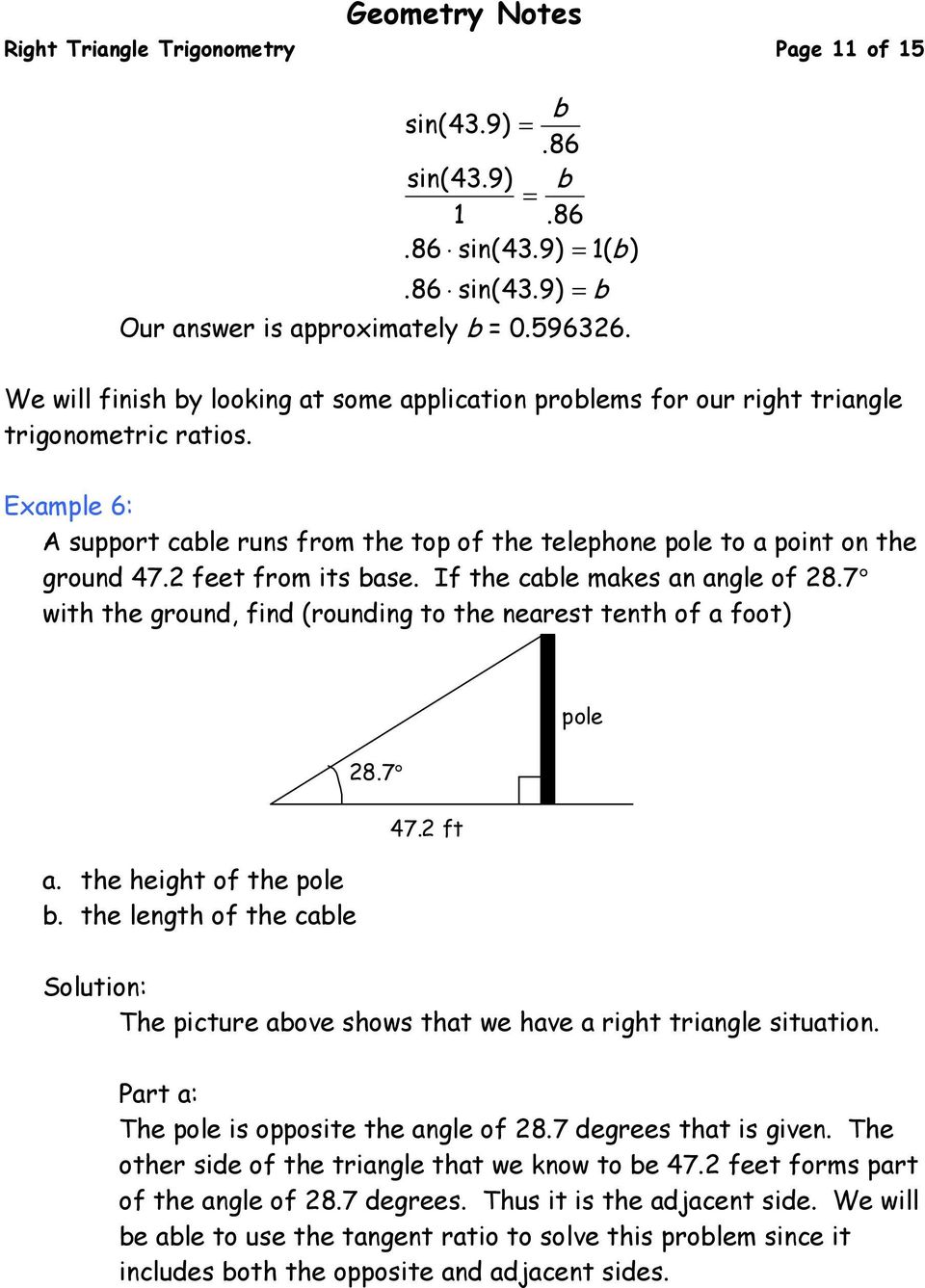
12 Right Triangle Trigonometry Page 12 of 15 pole tan(28.7) 47.2 tan(28.7) pole tan(28.7) 1(pole) 47.2tan(28.7) pole Thus the pole is approimately 25.8 feet tall. Part b: The cable is the right angle of triangle and thus is the hypotenuse. We still know that the side is 47.2 feet. We will be able to use the cosine ratio to solve this problem since it includes both the hypotenuse and sides. cos( A) hypotenuse 47.2 cos(28.7) cable cos(28.7) cable cable cos(28.7) 1(47.2) cable 47.2 cos(28.7) Thus the cable is approimately 53.8 feet tall. Eample 7: You are hiking along a river and see a tall on the bank. You measure the angle of elevation of the top of the and find it to be You then walk 45 feet directly away from the and measure the angle of elevation. If the second measurement is 48.5, how tall is the? Round your answer to the nearest foot.

13 Right Triangle Trigonometry Page 13 of ft Solution: This problem will require a little more algebra than the previous problems. We will start by looking at the two different triangles that we have and writing trigonometric ratios that include the for each of our triangles. We will start by looking at the bigger triangles (shown in red below) ft ft In this red triangle, the is the angle that is given to be 48.5 degrees. We are also given the length of 45 feet as part of the side that is to the angle given to be 48.5 degrees. Since we have part of this side, we are going to label the other part of the side to be feet. Thus the whole side is 45 + feet long. Since we have the and the sides, we can use the tangent ratio. For the red triangle, we have tan( ) tan(48.5) 45 + We will continue by looking at the smaller rectangle (shown in blue below)

14 Right Triangle Trigonometry Page 14 of ft ft In this blue triangle, the is the angle that is given to be 62 degrees. Based on what we did for the red triangle, we know that the length of the side to the angle given to be 62 degrees is feet long. Since we have the and the sides, we can use the tangent ratio. For the red triangle, we have tan( ) tan(62) Now we are ready for the algebra. We have two equations tan( 48.5) and tan( 62) with two unknowns 45 + (variable). We can use the substitution method (solve one of the equations for one of the variable and then plug that in to the other equation) to determine the height of the. One way to go here is to solve the equation tan( 62) for. This will give us tan(62) tan(62) 1 tan(62) 1() tan(62) We can now plug this epression for into the equation tan( 48.5) and solve for the height of the. 45 +

15 Right Triangle Trigonometry Page 15 of 15 tan(48.5) 45 + tan(48.5) (45 + )tan(48.5) 45 tan(48.5) + tan(48.5) 45 tan(48.5) + 45 tan(48.5) - 45 tan(48.5) 1-45 tan(48.5) 1-1 tan(62) tan(62) tan(48.5) tan(48.5) tan(62) 1 tan(62) tan(48.5) tan(48.5) Write both sides as fractions. Cross multiply. Apply distributive property. Substitute in epression for. Collect variable on the same side Factor out the variable Divide both sides by value in parentheses. We now just need to plug this epression into our calculator to find out the height of the. The is approimately 127 feet tall.

Geometry Notes PERIMETER AND AREA
 Perimeter and Area Page 1 of 57 PERIMETER AND AREA Objectives: After completing this section, you should be able to do the following: Calculate the area of given geometric figures. Calculate the perimeter
RIGHT TRIANGLE TRIGONOMETRY
 RIGHT TRIANGLE TRIGONOMETRY The word Trigonometry can be broken into the parts Tri, gon, and metry, which means Three angle measurement, or equivalently Triangle measurement. Throughout this unit, we will
Applications of the Pythagorean Theorem
 9.5 Applications of the Pythagorean Theorem 9.5 OBJECTIVE 1. Apply the Pythagorean theorem in solving problems Perhaps the most famous theorem in all of mathematics is the Pythagorean theorem. The theorem
Right Triangles A right triangle, as the one shown in Figure 5, is a triangle that has one angle measuring
 Page 1 9 Trigonometry of Right Triangles Right Triangles A right triangle, as the one shown in Figure 5, is a triangle that has one angle measuring 90. The side opposite to the right angle is the longest
Pythagorean Theorem: 9. x 2 2
 Geometry Chapter 8 - Right Triangles.7 Notes on Right s Given: any 3 sides of a Prove: the is acute, obtuse, or right (hint: use the converse of Pythagorean Theorem) If the (longest side) 2 > (side) 2
Parallel and Perpendicular. We show a small box in one of the angles to show that the lines are perpendicular.
 CONDENSED L E S S O N. Parallel and Perpendicular In this lesson you will learn the meaning of parallel and perpendicular discover how the slopes of parallel and perpendicular lines are related use slopes
9 Right Triangle Trigonometry
 www.ck12.org CHAPTER 9 Right Triangle Trigonometry Chapter Outline 9.1 THE PYTHAGOREAN THEOREM 9.2 CONVERSE OF THE PYTHAGOREAN THEOREM 9.3 USING SIMILAR RIGHT TRIANGLES 9.4 SPECIAL RIGHT TRIANGLES 9.5
4.3 & 4.8 Right Triangle Trigonometry. Anatomy of Right Triangles
 4.3 & 4.8 Right Triangle Trigonometry Anatomy of Right Triangles The right triangle shown at the right uses lower case a, b and c for its sides with c being the hypotenuse. The sides a and b are referred
MEMORANDUM. All students taking the CLC Math Placement Exam PLACEMENT INTO CALCULUS AND ANALYTIC GEOMETRY I, MTH 145:
 MEMORANDUM To: All students taking the CLC Math Placement Eam From: CLC Mathematics Department Subject: What to epect on the Placement Eam Date: April 0 Placement into MTH 45 Solutions This memo is an
Extra Credit Assignment Lesson plan. The following assignment is optional and can be completed to receive up to 5 points on a previously taken exam.
 Extra Credit Assignment Lesson plan The following assignment is optional and can be completed to receive up to 5 points on a previously taken exam. The extra credit assignment is to create a typed up lesson
Trigonometry. An easy way to remember trigonometric properties is:
 Trigonometry It is possible to solve many force and velocity problems by drawing vector diagrams. However, the degree of accuracy is dependent upon the exactness of the person doing the drawing and measuring.
Section 6-3 Double-Angle and Half-Angle Identities
 6-3 Double-Angle and Half-Angle Identities 47 Section 6-3 Double-Angle and Half-Angle Identities Double-Angle Identities Half-Angle Identities This section develops another important set of identities
Right Triangles 4 A = 144 A = 16 12 5 A = 64
 Right Triangles If I looked at enough right triangles and experimented a little, I might eventually begin to notice a relationship developing if I were to construct squares formed by the legs of a right
HS Mathematics Item Specification C1 TO
 Task Model 1 Multiple Choice, single correct response G-SRT.C.6 Understand that by similarity, side ratios in right triangles are properties of the angles in the triangle, leading to definitions of acute
Law of Cosines. If the included angle is a right angle then the Law of Cosines is the same as the Pythagorean Theorem.
 Law of Cosines In the previous section, we learned how the Law of Sines could be used to solve oblique triangles in three different situations () where a side and two angles (SAA) were known, () where
How To Solve The Pythagorean Triangle
 Name Period CHAPTER 9 Right Triangles and Trigonometry Section 9.1 Similar right Triangles Objectives: Solve problems involving similar right triangles. Use a geometric mean to solve problems. Ex. 1 Use
Give an expression that generates all angles coterminal with the given angle. Let n represent any integer. 9) 179
 Trigonometry Chapters 1 & 2 Test 1 Name Provide an appropriate response. 1) Find the supplement of an angle whose measure is 7. Find the measure of each angle in the problem. 2) Perform the calculation.
Biggar High School Mathematics Department. National 5 Learning Intentions & Success Criteria: Assessing My Progress
 Biggar High School Mathematics Department National 5 Learning Intentions & Success Criteria: Assessing My Progress Expressions & Formulae Topic Learning Intention Success Criteria I understand this Approximation
10.2 45-45 -90 Triangles
 Page of 6 0. --0 Triangles Goal Find the side lengths of --0 triangles. Key Words --0 triangle isosceles triangle p. 7 leg of a right triangle p. hypotenuse p. Geo-Activity Eploring an Isosceles Right
Introduction Assignment
 PRE-CALCULUS 11 Introduction Assignment Welcome to PREC 11! This assignment will help you review some topics from a previous math course and introduce you to some of the topics that you ll be studying
Unit 6 Trigonometric Identities, Equations, and Applications
 Accelerated Mathematics III Frameworks Student Edition Unit 6 Trigonometric Identities, Equations, and Applications nd Edition Unit 6: Page of 3 Table of Contents Introduction:... 3 Discovering the Pythagorean
Square Roots and the Pythagorean Theorem
 4.8 Square Roots and the Pythagorean Theorem 4.8 OBJECTIVES 1. Find the square root of a perfect square 2. Use the Pythagorean theorem to find the length of a missing side of a right triangle 3. Approximate
Trigonometry for AC circuits
 Trigonometry for AC circuits This worksheet and all related files are licensed under the Creative Commons Attribution License, version 1.0. To view a copy of this license, visit http://creativecommons.org/licenses/by/1.0/,
5.3 SOLVING TRIGONOMETRIC EQUATIONS. Copyright Cengage Learning. All rights reserved.
 5.3 SOLVING TRIGONOMETRIC EQUATIONS Copyright Cengage Learning. All rights reserved. What You Should Learn Use standard algebraic techniques to solve trigonometric equations. Solve trigonometric equations
Solving Quadratic Equations
 9.3 Solving Quadratic Equations by Using the Quadratic Formula 9.3 OBJECTIVES 1. Solve a quadratic equation by using the quadratic formula 2. Determine the nature of the solutions of a quadratic equation
Algebra. Exponents. Absolute Value. Simplify each of the following as much as possible. 2x y x + y y. xxx 3. x x x xx x. 1. Evaluate 5 and 123
 Algebra Eponents Simplify each of the following as much as possible. 1 4 9 4 y + y y. 1 5. 1 5 4. y + y 4 5 6 5. + 1 4 9 10 1 7 9 0 Absolute Value Evaluate 5 and 1. Eliminate the absolute value bars from
1. Introduction circular definition Remark 1 inverse trigonometric functions
 1. Introduction In Lesson 2 the six trigonometric functions were defined using angles determined by points on the unit circle. This is frequently referred to as the circular definition of the trigonometric
The Primary Trigonometric Ratios Word Problems
 The Primary Trigonometric Ratios Word Problems. etermining the measures of the sides and angles of right triangles using the primary ratios When we want to measure the height of an inaccessible object
Right Triangle Trigonometry
 Section 6.4 OBJECTIVE : Right Triangle Trigonometry Understanding the Right Triangle Definitions of the Trigonometric Functions otenuse osite side otenuse acent side acent side osite side We will be concerned
Section 7.1 Solving Right Triangles
 Section 7.1 Solving Right Triangles Note that a calculator will be needed for most of the problems we will do in class. Test problems will involve angles for which no calculator is needed (e.g., 30, 45,
9.3 OPERATIONS WITH RADICALS
 9. Operations with Radicals (9 1) 87 9. OPERATIONS WITH RADICALS In this section Adding and Subtracting Radicals Multiplying Radicals Conjugates In this section we will use the ideas of Section 9.1 in
ALGEBRA 2/TRIGONOMETRY
 ALGEBRA /TRIGONOMETRY The University of the State of New York REGENTS HIGH SCHOOL EXAMINATION ALGEBRA /TRIGONOMETRY Thursday, January 9, 015 9:15 a.m to 1:15 p.m., only Student Name: School Name: The possession
Mathematics (Project Maths Phase 1)
 2011. S133S Coimisiún na Scrúduithe Stáit State Examinations Commission Junior Certificate Examination Sample Paper Mathematics (Project Maths Phase 1) Paper 2 Ordinary Level Time: 2 hours 300 marks Running
Trigonometry Hard Problems
 Solve the problem. This problem is very difficult to understand. Let s see if we can make sense of it. Note that there are multiple interpretations of the problem and that they are all unsatisfactory.
12) 13) 14) (5x)2/3. 16) x5/8 x3/8. 19) (r1/7 s1/7) 2
 DMA 080 WORKSHEET # (8.-8.2) Name Find the square root. Assume that all variables represent positive real numbers. ) 6 2) 8 / 2) 9x8 ) -00 ) 8 27 2/ Use a calculator to approximate the square root to decimal
Page. Trigonometry Sine Law and Cosine Law. push
 Trigonometry Sine Law and Cosine Law Page Trigonometry can be used to calculate the side lengths and angle measures of triangles. Triangular shapes are used in construction to create rigid structures.
6. Vectors. 1 2009-2016 Scott Surgent ([email protected])
 6. Vectors For purposes of applications in calculus and physics, a vector has both a direction and a magnitude (length), and is usually represented as an arrow. The start of the arrow is the vector s foot,
SAT Subject Math Level 2 Facts & Formulas
 Numbers, Sequences, Factors Integers:..., -3, -2, -1, 0, 1, 2, 3,... Reals: integers plus fractions, decimals, and irrationals ( 2, 3, π, etc.) Order Of Operations: Arithmetic Sequences: PEMDAS (Parentheses
Trigonometric Functions and Triangles
 Trigonometric Functions and Triangles Dr. Philippe B. Laval Kennesaw STate University August 27, 2010 Abstract This handout defines the trigonometric function of angles and discusses the relationship between
Semester 2, Unit 4: Activity 21
 Resources: SpringBoard- PreCalculus Online Resources: PreCalculus Springboard Text Unit 4 Vocabulary: Identity Pythagorean Identity Trigonometric Identity Cofunction Identity Sum and Difference Identities
Core Maths C2. Revision Notes
 Core Maths C Revision Notes November 0 Core Maths C Algebra... Polnomials: +,,,.... Factorising... Long division... Remainder theorem... Factor theorem... 4 Choosing a suitable factor... 5 Cubic equations...
SOLVING TRIGONOMETRIC EQUATIONS
 Mathematics Revision Guides Solving Trigonometric Equations Page 1 of 17 M.K. HOME TUITION Mathematics Revision Guides Level: AS / A Level AQA : C2 Edexcel: C2 OCR: C2 OCR MEI: C2 SOLVING TRIGONOMETRIC
TRIGONOMETRY OF THE RIGHT TRIANGLE
 HPTER 8 HPTER TLE OF ONTENTS 8-1 The Pythagorean Theorem 8-2 The Tangent Ratio 8-3 pplications of the Tangent Ratio 8-4 The Sine and osine Ratios 8-5 pplications of the Sine and osine Ratios 8-6 Solving
Trigonometric Ratios TEACHER NOTES. About the Lesson. Vocabulary. Teacher Preparation and Notes. Activity Materials
 About the Lesson In this activity, students discover the trigonometric ratios through measuring the side lengths of similar triangles and calculating their ratios. The formal definitions of the sine, cosine,
6.1 Basic Right Triangle Trigonometry
 6.1 Basic Right Triangle Trigonometry MEASURING ANGLES IN RADIANS First, let s introduce the units you will be using to measure angles, radians. A radian is a unit of measurement defined as the angle at
TRIGONOMETRY Compound & Double angle formulae
 TRIGONOMETRY Compound & Double angle formulae In order to master this section you must first learn the formulae, even though they will be given to you on the matric formula sheet. We call these formulae
ASSESSSMENT TASK OVERVIEW & PURPOSE:
 Developing a Trigonometry Phone App I. ASSESSSMENT TASK OVERVIEW & PURPOSE: In this activity, students will be asked to develop a program for a smartphone application that could be used to calculate the
1 Introduction to Basic Geometry
 1 Introduction to Basic Geometry 1.1 Euclidean Geometry and Axiomatic Systems 1.1.1 Points, Lines, and Line Segments Geometry is one of the oldest branches of mathematics. The word geometry in the Greek
Solutions to Exercises, Section 5.1
 Instructor s Solutions Manual, Section 5.1 Exercise 1 Solutions to Exercises, Section 5.1 1. Find all numbers t such that ( 1 3,t) is a point on the unit circle. For ( 1 3,t)to be a point on the unit circle
Expression. Variable Equation Polynomial Monomial Add. Area. Volume Surface Space Length Width. Probability. Chance Random Likely Possibility Odds
 Isosceles Triangle Congruent Leg Side Expression Equation Polynomial Monomial Radical Square Root Check Times Itself Function Relation One Domain Range Area Volume Surface Space Length Width Quantitative
Geometry: Classifying, Identifying, and Constructing Triangles
 Geometry: Classifying, Identifying, and Constructing Triangles Lesson Objectives Teacher's Notes Lesson Notes 1) Identify acute, right, and obtuse triangles. 2) Identify scalene, isosceles, equilateral
Exact Values of the Sine and Cosine Functions in Increments of 3 degrees
 Exact Values of the Sine and Cosine Functions in Increments of 3 degrees The sine and cosine values for all angle measurements in multiples of 3 degrees can be determined exactly, represented in terms
PowerScore Test Preparation (800) 545-1750
 Question 1 Test 1, Second QR Section (version 1) List A: 0, 5,, 15, 20... QA: Standard deviation of list A QB: Standard deviation of list B Statistics: Standard Deviation Answer: The two quantities are
Trigonometric Functions: The Unit Circle
 Trigonometric Functions: The Unit Circle This chapter deals with the subject of trigonometry, which likely had its origins in the study of distances and angles by the ancient Greeks. The word trigonometry
Dear Accelerated Pre-Calculus Student:
 Dear Accelerated Pre-Calculus Student: I am very excited that you have decided to take this course in the upcoming school year! This is a fastpaced, college-preparatory mathematics course that will also
CSU Fresno Problem Solving Session. Geometry, 17 March 2012
 CSU Fresno Problem Solving Session Problem Solving Sessions website: http://zimmer.csufresno.edu/ mnogin/mfd-prep.html Math Field Day date: Saturday, April 21, 2012 Math Field Day website: http://www.csufresno.edu/math/news
Indirect Measurement Technique: Using Trigonometric Ratios Grade Nine
 Ohio Standards Connections Measurement Benchmark D Use proportional reasoning and apply indirect measurement techniques, including right triangle trigonometry and properties of similar triangles, to solve
8-5 Angles of Elevation and Depression. The length of the base of the ramp is about 27.5 ft.
 1.BIKING Lenora wants to build the bike ramp shown. Find the length of the base of the ramp. The length of the base of the ramp is about 27.5 ft. ANSWER: 27.5 ft 2.BASEBALL A fan is seated in the upper
Week 13 Trigonometric Form of Complex Numbers
 Week Trigonometric Form of Complex Numbers Overview In this week of the course, which is the last week if you are not going to take calculus, we will look at how Trigonometry can sometimes help in working
D.3. Angles and Degree Measure. Review of Trigonometric Functions
 APPENDIX D Precalculus Review D7 SECTION D. Review of Trigonometric Functions Angles and Degree Measure Radian Measure The Trigonometric Functions Evaluating Trigonometric Functions Solving Trigonometric
Angles and Quadrants. Angle Relationships and Degree Measurement. Chapter 7: Trigonometry
 Chapter 7: Trigonometry Trigonometry is the study of angles and how they can be used as a means of indirect measurement, that is, the measurement of a distance where it is not practical or even possible
Free Pre-Algebra Lesson 55! page 1
 Free Pre-Algebra Lesson 55! page 1 Lesson 55 Perimeter Problems with Related Variables Take your skill at word problems to a new level in this section. All the problems are the same type, so that you can
opp (the cotangent function) cot θ = adj opp Using this definition, the six trigonometric functions are well-defined for all angles
 Definition of Trigonometric Functions using Right Triangle: C hp A θ B Given an right triangle ABC, suppose angle θ is an angle inside ABC, label the leg osite θ the osite side, label the leg acent to
Graphing Trigonometric Skills
 Name Period Date Show all work neatly on separate paper. (You may use both sides of your paper.) Problems should be labeled clearly. If I can t find a problem, I ll assume it s not there, so USE THE TEMPLATE
Friday, January 29, 2016 9:15 a.m. to 12:15 p.m., only
 ALGEBRA /TRIGONOMETRY The University of the State of New York REGENTS HIGH SCHOOL EXAMINATION ALGEBRA /TRIGONOMETRY Friday, January 9, 016 9:15 a.m. to 1:15 p.m., only Student Name: School Name: The possession
Geometry and Measurement
 The student will be able to: Geometry and Measurement 1. Demonstrate an understanding of the principles of geometry and measurement and operations using measurements Use the US system of measurement for
Additional Topics in Math
 Chapter Additional Topics in Math In addition to the questions in Heart of Algebra, Problem Solving and Data Analysis, and Passport to Advanced Math, the SAT Math Test includes several questions that are
2312 test 2 Fall 2010 Form B
 2312 test 2 Fall 2010 Form B 1. Write the slope-intercept form of the equation of the line through the given point perpendicular to the given lin point: ( 7, 8) line: 9x 45y = 9 2. Evaluate the function
Lesson 1: Exploring Trigonometric Ratios
 Lesson 1: Exploring Trigonometric Ratios Common Core Georgia Performance Standards MCC9 12.G.SRT.6 MCC9 12.G.SRT.7 Essential Questions 1. How are the properties of similar triangles used to create trigonometric
Teacher Page Key. Geometry / Day # 13 Composite Figures 45 Min.
 Teacher Page Key Geometry / Day # 13 Composite Figures 45 Min. 9-1.G.1. Find the area and perimeter of a geometric figure composed of a combination of two or more rectangles, triangles, and/or semicircles
Lesson 18 Pythagorean Triples & Special Right Triangles
 Student Name: Date: Contact Person Name: Phone Number: Teas Assessment of Knowledge and Skills Eit Level Math Review Lesson 18 Pythagorean Triples & Special Right Triangles TAKS Objective 6 Demonstrate
PERIMETER AND AREA. In this unit, we will develop and apply the formulas for the perimeter and area of various two-dimensional figures.
 PERIMETER AND AREA In this unit, we will develop and apply the formulas for the perimeter and area of various two-dimensional figures. Perimeter Perimeter The perimeter of a polygon, denoted by P, is the
Trigonometry LESSON ONE - Degrees and Radians Lesson Notes
 210 180 = 7 6 Trigonometry Example 1 Define each term or phrase and draw a sample angle. Angle Definitions a) angle in standard position: Draw a standard position angle,. b) positive and negative angles:
Sample Test Questions
 mathematics College Algebra Geometry Trigonometry Sample Test Questions A Guide for Students and Parents act.org/compass Note to Students Welcome to the ACT Compass Sample Mathematics Test! You are about
Chapter 8 Geometry We will discuss following concepts in this chapter.
 Mat College Mathematics Updated on Nov 5, 009 Chapter 8 Geometry We will discuss following concepts in this chapter. Two Dimensional Geometry: Straight lines (parallel and perpendicular), Rays, Angles
Name: Class: Date: Multiple Choice Identify the choice that best completes the statement or answers the question.
 Name: Class: Date: ID: A Q3 Geometry Review Multiple Choice Identify the choice that best completes the statement or answers the question. Graph the image of each figure under a translation by the given
Higher Education Math Placement
 Higher Education Math Placement Placement Assessment Problem Types 1. Whole Numbers, Fractions, and Decimals 1.1 Operations with Whole Numbers Addition with carry Subtraction with borrowing Multiplication
G. GRAPHING FUNCTIONS
 G. GRAPHING FUNCTIONS To get a quick insight int o how the graph of a function looks, it is very helpful to know how certain simple operations on the graph are related to the way the function epression
INVERSE TRIGONOMETRIC FUNCTIONS. Colin Cox
 INVERSE TRIGONOMETRIC FUNCTIONS Colin Cox WHAT IS AN INVERSE TRIG FUNCTION? Used to solve for the angle when you know two sides of a right triangle. For example if a ramp is resting against a trailer,
Core Maths C3. Revision Notes
 Core Maths C Revision Notes October 0 Core Maths C Algebraic fractions... Cancelling common factors... Multipling and dividing fractions... Adding and subtracting fractions... Equations... 4 Functions...
Factoring and Applications
 Factoring and Applications What is a factor? The Greatest Common Factor (GCF) To factor a number means to write it as a product (multiplication). Therefore, in the problem 48 3, 4 and 8 are called the
Curriculum Map by Block Geometry Mapping for Math Block Testing 2007-2008. August 20 to August 24 Review concepts from previous grades.
 Curriculum Map by Geometry Mapping for Math Testing 2007-2008 Pre- s 1 August 20 to August 24 Review concepts from previous grades. August 27 to September 28 (Assessment to be completed by September 28)
Introduction and Mathematical Concepts
 CHAPTER 1 Introduction and Mathematical Concepts PREVIEW In this chapter you will be introduced to the physical units most frequently encountered in physics. After completion of the chapter you will be
Sample Problems. Practice Problems
 Lecture Notes Quadratic Word Problems page 1 Sample Problems 1. The sum of two numbers is 31, their di erence is 41. Find these numbers.. The product of two numbers is 640. Their di erence is 1. Find these
Ira Fine and Thomas J. Osler Department of Mathematics Rowan University Glassboro, NJ 08028. [email protected]. 1. Introduction
 1 08/0/00 THE REMARKABLE INCIRCLE OF A TRIANGLE Ira Fine and Thomas J. Osler Department of Mathematics Rowan University Glassboro, NJ 0808 [email protected] 1. Introduction The incircle of a triangle is
Lesson 33: Example 1 (5 minutes)
 Student Outcomes Students understand that the Law of Sines can be used to find missing side lengths in a triangle when you know the measures of the angles and one side length. Students understand that
Find the length of the arc on a circle of radius r intercepted by a central angle θ. Round to two decimal places.
 SECTION.1 Simplify. 1. 7π π. 5π 6 + π Find the measure of the angle in degrees between the hour hand and the minute hand of a clock at the time shown. Measure the angle in the clockwise direction.. 1:0.
The Dot and Cross Products
 The Dot and Cross Products Two common operations involving vectors are the dot product and the cross product. Let two vectors =,, and =,, be given. The Dot Product The dot product of and is written and
Review of Intermediate Algebra Content
 Review of Intermediate Algebra Content Table of Contents Page Factoring GCF and Trinomials of the Form + b + c... Factoring Trinomials of the Form a + b + c... Factoring Perfect Square Trinomials... 6
1 TRIGONOMETRY. 1.0 Introduction. 1.1 Sum and product formulae. Objectives
 TRIGONOMETRY Chapter Trigonometry Objectives After studying this chapter you should be able to handle with confidence a wide range of trigonometric identities; be able to express linear combinations of
PYTHAGOREAN TRIPLES KEITH CONRAD
 PYTHAGOREAN TRIPLES KEITH CONRAD 1. Introduction A Pythagorean triple is a triple of positive integers (a, b, c) where a + b = c. Examples include (3, 4, 5), (5, 1, 13), and (8, 15, 17). Below is an ancient
PRE-CALCULUS GRADE 12
 PRE-CALCULUS GRADE 12 [C] Communication Trigonometry General Outcome: Develop trigonometric reasoning. A1. Demonstrate an understanding of angles in standard position, expressed in degrees and radians.
Section 5-9 Inverse Trigonometric Functions
 46 5 TRIGONOMETRIC FUNCTIONS Section 5-9 Inverse Trigonometric Functions Inverse Sine Function Inverse Cosine Function Inverse Tangent Function Summar Inverse Cotangent, Secant, and Cosecant Functions
With the Tan function, you can calculate the angle of a triangle with one corner of 90 degrees, when the smallest sides of the triangle are given:
 Page 1 In game development, there are a lot of situations where you need to use the trigonometric functions. The functions are used to calculate an angle of a triangle with one corner of 90 degrees. By
Ratio and Proportion Study Guide 12
 Ratio and Proportion Study Guide 12 Ratio: A ratio is a comparison of the relationship between two quantities or categories of things. For example, a ratio might be used to compare the number of girls
Characteristics of the Four Main Geometrical Figures
 Math 40 9.7 & 9.8: The Big Four Square, Rectangle, Triangle, Circle Pre Algebra We will be focusing our attention on the formulas for the area and perimeter of a square, rectangle, triangle, and a circle.
1. Introduction sine, cosine, tangent, cotangent, secant, and cosecant periodic
 1. Introduction There are six trigonometric functions: sine, cosine, tangent, cotangent, secant, and cosecant; abbreviated as sin, cos, tan, cot, sec, and csc respectively. These are functions of a single
High School Geometry Test Sampler Math Common Core Sampler Test
 High School Geometry Test Sampler Math Common Core Sampler Test Our High School Geometry sampler covers the twenty most common questions that we see targeted for this level. For complete tests and break