
EMERGENCIES. Emergencies
|
|
|
- Anna Augusta Lang
- 9 years ago
- Views:
Transcription
1 Emergencies A good safety program, training, and use of precautions reduce the number and seriousness of accidents. Laboratory accidents can range from fires to chemical spills to spills and falls. Your laboratory should prepare plans for major and/or minor emergencies. These plans should match the nature of your laboratory and the specific hazards likely to be involved with any emergency. These plans and other safety policies should be described in your laboratory's Injury Illness Prevention Program (IIPP) and Chemical Hygiene Plan (CHP). All lab personnel should become familiar with these procedures and follow them. Emergency plans are described in the departments Emergency Action Plan. Ask your departmental administration for details. I. Fire Incidents A. Operating Portable Fire Extinguishers - Download and review the latest Fire Net: B. "Should You Fight the Fire?" If alone, DO NOT attempt to fight a fire. C. Before you begin to fight a SMALL FIRE: 1. Activate fire alarm and call UC Davis Fire Davis Sacramento-UCDHS 2. Make sure everyone has left, or is leaving, the building. 3. Be sure that your extinguisher is the proper size and type for the fire at hand and that you know how to use it. 4. It is reckless to fight a fire with an extinguisher in any other circumstances. Instead, leave immediately, close off the area, and leave the fire for the fire department. D. Fire Evacuation Procedures 1. When a Fire Alarm is Activated: a. Walk - do not run to the nearest exit (Remove high heels to avoid tripping). Alarm may not sound continuously. If alarm stops, continue to evacuate. b. Follow emergency personnel directions. c. Use stairways for exits, do not use elevators. Do not push or crowd, use handrails in stairwells - stay to the right. d. Give assistance to disabled persons. e. Feel doors (top and bottom) for heat - use back of your hand. If hot, do not open. If not hot, open door slowly. f. Notify emergency personnel if you suspect someone may be trapped inside the building.

2 g. Proceed to assigned evacuation area (at least 300 feet from building). Refer to your department Emergency Evacuation Plan. h. Do not interfere in anyway with actions of emergency personnel. 2. If Trapped in a Room: a. Place cloth material around or under door to prevent smoke from entering. b. Retreat and close as many doors as possible between you and the fire. c. Be prepared to signal from a window but do not break glass unless absolutely necessary (Outside smoke may be drawn in). 3. If Caught in Smoke: a. Drop to hands and knees and crawl. b. Hold breath as much as possible. c. Breathe slowly through nose and use blouse, shirt or jacket as filter. 4. If Forced to Advance Through Flames: a. Hold your breath as much as possible. b. Move QUICKLY and cover head and hair. c. Keep head down and eyes closed as much as possible. 5. If Clothing Catches on Fire: II. CHEMICAL SPILLS STOP... DROP... ROLL A. Respond to Chemical Spills: Safety Net #13; It is difficult to make general statements about the best way to handle a chemical spill since there are many factors to consider in clean up, including: 1. The size of the spill. 2. The toxicity or other hazardous properties of the material. 3. Clean-up materials available in the department. 4. The level of knowledge and training of the person doing the clean up. 5. The availability of assistance. Clean-up procedures for one situation may be ineffective or even harmful in another. The only really accurate clean-up guidelines are those specific to the chemical involved in the spill. Therefore, employees can best prepare themselves by reviewing with their instructor, any spill procedures or SOPs to be followed for the chemicals they use in the lab, before they actually use them. If you are unfamiliar with the chemical properties and are not equipped to handle spills, call EH&S at

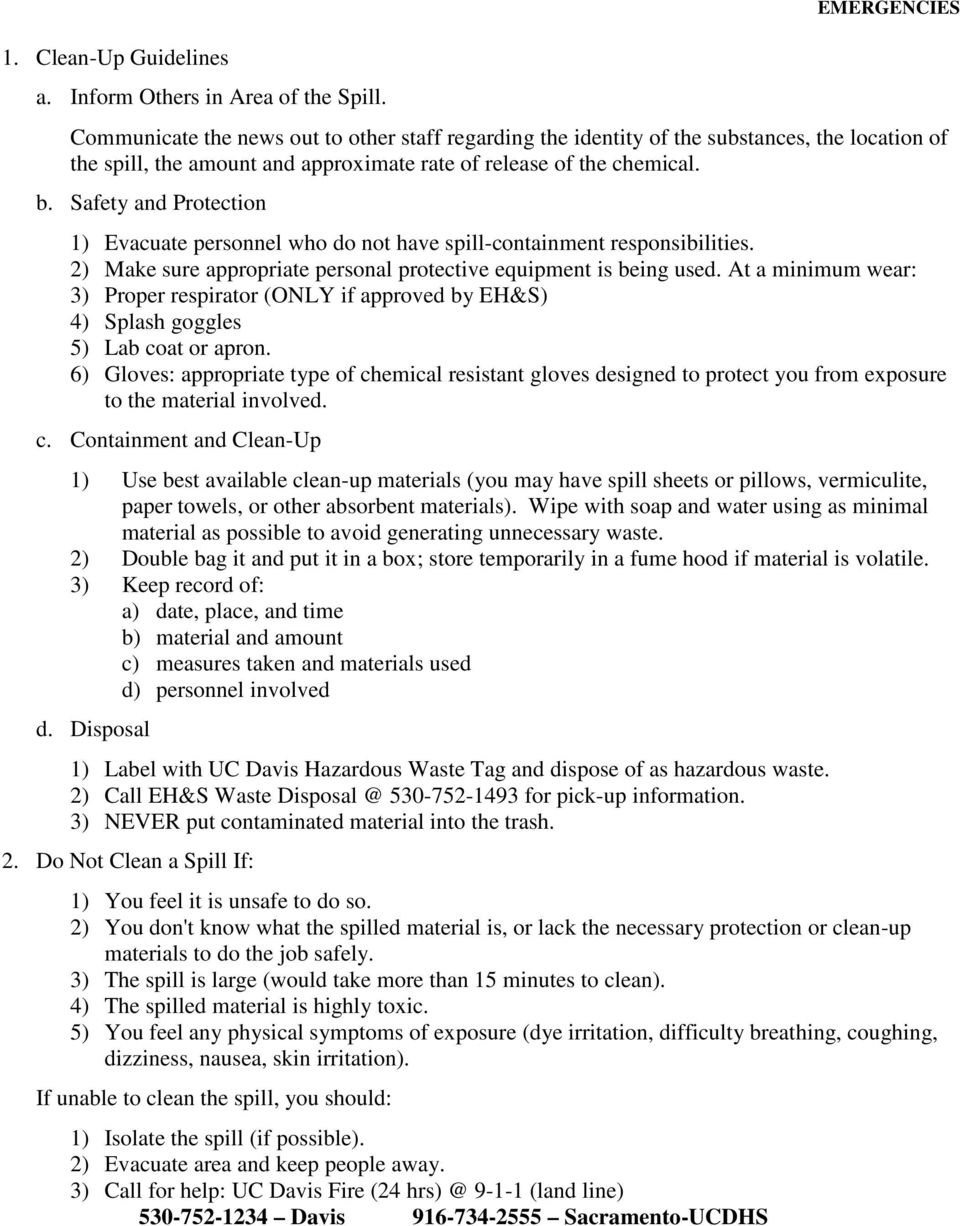
3 1. Clean-Up Guidelines a. Inform Others in Area of the Spill. EMERGENCIES Communicate the news out to other staff regarding the identity of the substances, the location of the spill, the amount and approximate rate of release of the chemical. b. Safety and Protection 1) Evacuate personnel who do not have spill-containment responsibilities. 2) Make sure appropriate personal protective equipment is being used. At a minimum wear: 3) Proper respirator (ONLY if approved by EH&S) 4) Splash goggles 5) Lab coat or apron. 6) Gloves: appropriate type of chemical resistant gloves designed to protect you from exposure to the material involved. c. Containment and Clean-Up 1) Use best available clean-up materials (you may have spill sheets or pillows, vermiculite, paper towels, or other absorbent materials). Wipe with soap and water using as minimal material as possible to avoid generating unnecessary waste. 2) Double bag it and put it in a box; store temporarily in a fume hood if material is volatile. 3) Keep record of: a) date, place, and time b) material and amount c) measures taken and materials used d) personnel involved d. Disposal 1) Label with UC Davis Hazardous Waste Tag and dispose of as hazardous waste. 2) Call EH&S Waste for pick-up information. 3) NEVER put contaminated material into the trash. 2. Do Not Clean a Spill If: 1) You feel it is unsafe to do so. 2) You don't know what the spilled material is, or lack the necessary protection or clean-up materials to do the job safely. 3) The spill is large (would take more than 15 minutes to clean). 4) The spilled material is highly toxic. 5) You feel any physical symptoms of exposure (dye irritation, difficulty breathing, coughing, dizziness, nausea, skin irritation). If unable to clean the spill, you should: 1) Isolate the spill (if possible). 2) Evacuate area and keep people away. 3) Call for help: UC Davis Fire ( (land line) Davis Sacramento-UCDHS
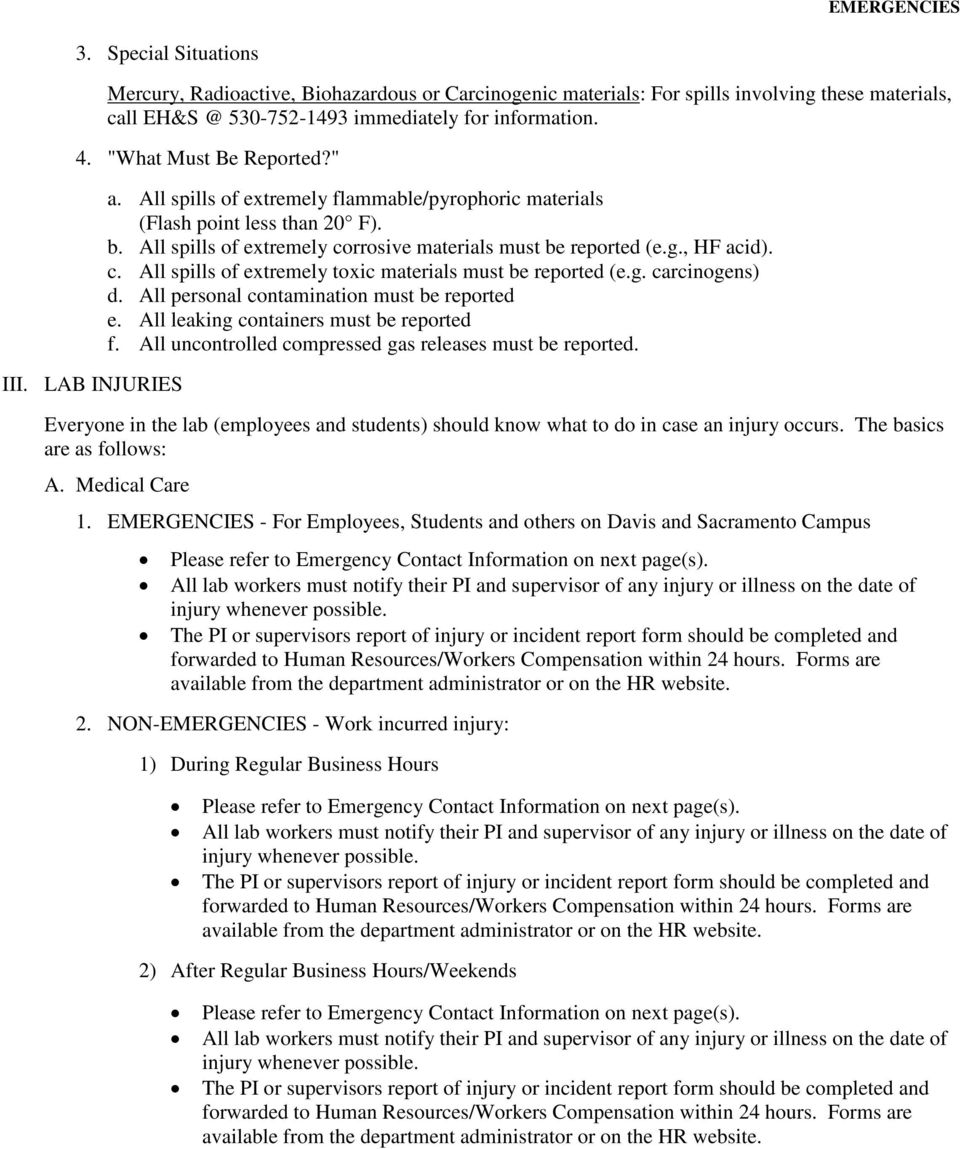
4 3. Special Situations Mercury, Radioactive, Biohazardous or Carcinogenic materials: For spills involving these materials, call immediately for information. 4. "What Must Be Reported?" III. LAB INJURIES a. All spills of extremely flammable/pyrophoric materials (Flash point less than 20 F). b. All spills of extremely corrosive materials must be reported (e.g., HF acid). c. All spills of extremely toxic materials must be reported (e.g. carcinogens) d. All personal contamination must be reported e. All leaking containers must be reported f. All uncontrolled compressed gas releases must be reported. Everyone in the lab (employees and students) should know what to do in case an injury occurs. The basics are as follows: A. Medical Care 1. EMERGENCIES - For Employees, Students and others on Davis and Sacramento Campus Please refer to Emergency Contact Information on next page(s). All lab workers must notify their PI and supervisor of any injury or illness on the date of injury whenever possible. The PI or supervisors report of injury or incident report form should be completed and forwarded to Human Resources/Workers Compensation within 24 hours. Forms are available from the department administrator or on the HR website. 2. NON-EMERGENCIES - Work incurred injury: 1) During Regular Business Hours Please refer to Emergency Contact Information on next page(s). All lab workers must notify their PI and supervisor of any injury or illness on the date of injury whenever possible. The PI or supervisors report of injury or incident report form should be completed and forwarded to Human Resources/Workers Compensation within 24 hours. Forms are available from the department administrator or on the HR website. 2) After Regular Business Hours/Weekends Please refer to Emergency Contact Information on next page(s). All lab workers must notify their PI and supervisor of any injury or illness on the date of injury whenever possible. The PI or supervisors report of injury or incident report form should be completed and forwarded to Human Resources/Workers Compensation within 24 hours. Forms are available from the department administrator or on the HR website.
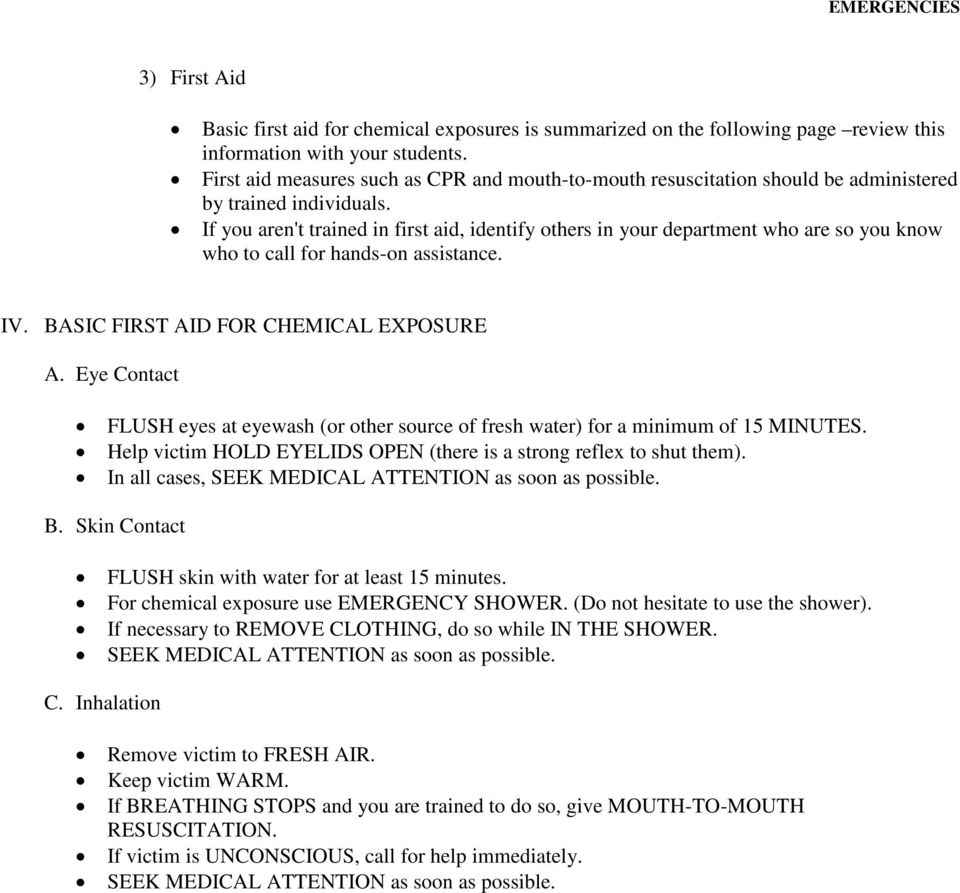
5 3) First Aid Basic first aid for chemical exposures is summarized on the following page review this information with your students. First aid measures such as CPR and mouth-to-mouth resuscitation should be administered by trained individuals. If you aren't trained in first aid, identify others in your department who are so you know who to call for hands-on assistance. IV. BASIC FIRST AID FOR CHEMICAL EXPOSURE A. Eye Contact FLUSH eyes at eyewash (or other source of fresh water) for a minimum of 15 MINUTES. Help victim HOLD EYELIDS OPEN (there is a strong reflex to shut them). In all cases, SEEK MEDICAL ATTENTION as soon as possible. B. Skin Contact FLUSH skin with water for at least 15 minutes. For chemical exposure use EMERGENCY SHOWER. (Do not hesitate to use the shower). If necessary to REMOVE CLOTHING, do so while IN THE SHOWER. SEEK MEDICAL ATTENTION as soon as possible. C. Inhalation Remove victim to FRESH AIR. Keep victim WARM. If BREATHING STOPS and you are trained to do so, give MOUTH-TO-MOUTH RESUSCITATION. If victim is UNCONSCIOUS, call for help immediately. SEEK MEDICAL ATTENTION as soon as possible.
6 EMERGENCY- UCD Campus AMBULANCE: 911 FIRE Hazardous Spills: 911 From a Cellphone POLICE: 911 From a Cellphone FACILITIES: HEALTH CARE: EMPLOYEE HEALTH SERVICES: California Ave/Regan Hall Circle STUDENT HEALTH SERVICES: La Rue Ave across from the ARC AFTER HOURS URGENT CARE: Sutter Davis Hospital 2000 Sutter Place, Davis (5PM 8AM M-F) (24 hours on Weekends) SAFETY: Environmental Health & Safety: Workers Compensation: PI/Lab Supervisor: Name Phone# Cal/OSHA (916)

7 EMERGENCY- UCDHS AMBULANCE 911 FIRE Hazardous Spills 911 From a Cell phone POLICE 911 From a Cell phone HEALTH CARE: EMPLOYEE HEALTH Cypress Building (7AM 3PM M-F) AFTER HOURS URGENT CARE Mercy Medical Group Q Street, Sacramento (4PM 10PM M-F) (10AM 6PM Weekends) EMERGENCY ROOM Emergencies Only (10PM 7AM M-F) (6PM 10AM Weekends) SAFETY: Occupational Safety Worker Compensation hour Claim Line Risk Management PI/Lab Supervisor: Name Phone# Cal/OSHA (916)

IX. EMERGENCY PLANNING
 IX. EMERGENCY PLANNING EMERGENCY PLANNING, SPILL RESPONSE & REPORTING Any unexpected event or accident situation that occurs during the transport, storage or use of hazardous materials constitutes a potential
Standard Operating Procedure for a Chemical Spill
 Standard Operating Procedure for a Chemical Spill Facility: Lab Director: Scope: ERC Clean Room C17 Engineering Research Complex Electrical and Computer Engineering Brian Wright 3234 Engineering 355-5233
CHEMICAL SPILL RESPONSE GUIDE
 HEMIAL SPILL RESPONSE GUIDE Revised 2000 TABLE OF ONTENTS Emergency Phone Numbers Introduction - hemical Spill Response Spill Response Procedures - Major Spill Spill Response Procedures - Minor Spill Spills
Particularly Hazardous Substances (PHS) Standard Operating Procedure (SOP)
 Particularly Hazardous Substances (PHS) Standard Operating Procedure (SOP) Formaldehyde, formalin, paraformaldehyde solutions, and paraformaldehyde solids Principal Investigator: Room & Building #: Department:
OESO Ergonomics Division...919-668-ERGO(3746) Duke Police...919-684-2444 Corporate Risk Management... 919-684-6226
 Musculoskeletal Disorders (MSDs) Develop over time and can take a long time to heal Can be quite painful and reduce overall effectiveness and efficiency Occur in any part of the body A variety of risk
EOSMS 204C Effective Date: 12/8/2014 Page 1 of 8
 EOSMS 204C Effective Date: 12/8/2014 Page 1 of 8 1. Purpose This Standard Operating Procedure (SOP) establishes procedures for the safe handling, transportation and storage of (MC), which is also known
Chemical Spill Response Guideline
 ChemicalSpillResponseGuideline Despite the best efforts of researchers to practice safe science in the laboratory, accidents resulting in the release of chemicals will occur. For this reason, it is essential
CHEMICAL SPILL MANAGEMENT GUIDELINES
 WHS Unit CHEMICAL SPILL MANAGEMENT GUIDELINES Contents 1 Purpose... 2 2 Scope... 2 3 Definitions... 2 4 Roles and Responsibilities... 2 5 General... 2 6 Defining Major or Minor Spill... 3 7 Major Spill
Union College Campus Safety Emergency Action Guide
 Union College Campus Safety Emergency Action Guide Emergency Telephone Numbers At Union College, for all campus emergencies dial Campus Safety at ext. 911. (If the line is busy on a second try, dial "6911".)
SPILL RESPONSE PROCEDURE
 SPILL RESPONSE PROCEDURE Queen's University Spill Response Procedure May 2000 1 SOP-HAZMAT-01 1.0 Preamble This document outlines emergency spill response procedures as part of the overall Queen's University
TEMPLE UNIVERSITY ENVIRONMENTAL HEALTH AND RADIATION SAFETY
 Page 1 of 7 ISSUED: 5/00 REVISED: 08/06 1. Potential Releases of Radioactive Materials to Unrestricted Areas The Environmental Health and Safety Department (EHRS) must be notified immediately if an emergency
College of Biological Science - Standard Operating Procedure Chemical Spills Date: 8-Feb-2008 Prepared by: A Doane Revision: New Supersedes: n/a
 College of Biological Science - Standard Operating Procedure Chemical Spills Date: 8-Feb-2008 Prepared by: A Doane Revision: New Supersedes: n/a Purpose: To provide direction on the proper response to
Spill Clean-up. Flammable Liquids Liquids with flash points below 100 degrees Fahrenheit.
 SUNY Cortland-Environmental Health and Safety Office Spill Clean-up Inception Date : June 16, 2010 Latest Revision/Review Date: July 15, 2015 Last Review/Revision Date: April 30, 2014 Contents I. Introduction
HAZARDOUS CHEMICAL SPILL CLEANUP GUIDELINES
 WHO CLEANS UP THE SPILL? You Clean Up the Spill For chemical spills, fuel spills which do not involve injury do not represent a fire or life hazard, are less than one gallon and for which you have the
GEORGIA INSTITUTE OF TECHNOLOGY ENVIRONMENTAL HEALTH AND SAFETY PERSONAL PROTECTIVE EQUIPMENT
 PURPOSE To protect the health and welfare of GEORGIA TECH employees in areas where there may be a risk of injury or exposure to hazardous substances or conditions employees who work in areas where physical
Standard Operating Procedure
 Standard Operating Procedure FLAMMABLE LIQUIDS This standard operating procedure (SOP) is intended to provide general guidance on how to safely work with flammable liquids. This SOP is generic in nature
Safety introduction. In the event of fire and accidents, you have a responsibility to know the location of:
 Safety introduction 2011-12-01 1 (7) Safety introduction General safety at the department A laboratory is a place with a lot of potential risks such as dangerous substances, sharp objects and electrical
Responding to Accidents and Emergencies
 P:NAU:CHM:15 Date: 6/3/2008 Supersedes: none Responding to Accidents and Emergencies 1. General Preparation for Emergencies a. All laboratory personnel should know what to do in case of an emergency. Laboratory
Any other time call the SFASU Police at Emergencies 911 Non-emergencies 468-2608
 Emergency Response to Waste Spills There are numerous different chemical, biological, and radioactive hazardous materials used throughout Stephen F. Austin State University on a daily basis. These chemicals
According to the criteria of NOHSC, this material is classified as; Hazardous Substance, Dangerous Goods
 MATERIAL SAFETY DATA SHEET Page 1 of 6 SECTION: 1.1 PRODUCT IDENTIFICATION Product Name: Tea Tree Essential Oil (Australia) Botanical Name: Melaleuca alternifolia Recommended Use: Raw material INCI Name:
Chippewa County Courthouse Security Emergency Procedures. Dial 9 9 1 1 FIRE POLICE AMBULANCE
 Chippewa County Courthouse Security Emergency Procedures Dial 9 9 1 1 FIRE POLICE AMBULANCE Table of Contents Introduction... 2 Explosion... 3 Civil Disorder/Threat to Personal Safety... 4 Chemical Spill...
Pesticide Spills. Chapter 26. In This Chapter. Keywords. Accidents. Pesticides Act and Environmental Protection Act
 Chapter 26 Pesticide Spills In This Chapter Keywords Accidents After learning the information in this chapter, you will be able to: 1. Define a spill. 2. Describe when a spill must be reported to the Spills
Occupational Health and Safety in the Laboratory (Undergraduate Students)
 Occupational Health and Safety in the Laboratory (Undergraduate Students) Introduction and scope of the Guidelines These guidelines have been written for all laboratory practical classes at the University
LABORATORY & CHEMICAL SAFETY GUIDELINES. Dr. Mobin Shaikh Convener SAFETY COMMITTEE DISCIP INE OF CHEMISTRY SCHOOL OF BASIC SCIENCE
 LABORATORY & CHEMICAL SAFETY GUIDELINES Presented by Dr. Mobin Shaikh Convener SAFETY COMMITTEE DISCIP INE OF CHEMISTRY DISCIPLINE SCHOOL OF BASIC SCIENCE INDIAN INSTITUTE OF TECHNOLOGY (IIT) INDORE SAFETY
Safety at Kaiser Permanente Los Angeles Medical Center Environmental Health & Safety Department
 Safety at Kaiser Permanente Los Angeles Medical Center Environmental Health & Safety Department Environmental Health and Safety (EHS) The Los Angeles Medical Center (LAMC) is committed to providing a safe
EMERGENCY PROCEDURES FOR RADIOACTIVE MATERIAL. 2. Prevent the spread of contamination by covering the spill with absorbent paper.
 EMERGENCY PROCEDURES FOR RADIOACTIVE MATERIAL MINOR SPILLS: 1. Notify persons in the area that a spill has occurred. 2. Prevent the spread of contamination by covering the spill with absorbent paper. 3.
Chemical Reducing Solution CRS
 Chemical Reducing Solution CRS Material Safety Data Sheet (MSDS) Revised: August 21, 2012 Supplier: Section 1 Supplier Information and Material Identification 1011 Calle Sombra San Clemente, CA 92673 Telephone:
Material Safety Data Sheet
 Material Safety Data Sheet Collagen MSDS 1 1 0 Section 1: Chemical Product and Company Identification He a lt h Fire Re a c t iv it y Pe rs o n a l Pro t e c t io n 2 1 0 E Product Name: Collagen Catalog
EMERGENCY RESPONSE AND WASTE DISPOSAL GUIDE
 EMERGENCY RESPONSE AND WASTE DISPOSAL GUIDE DIAL 777 FROM ANY PACE PHONE IN THE EVENT OF AN EMERGENCY OR PRESS THE SECURITY BUTTON ON YOUR PACE PHONE. Important Telephone New York City: B-Level, East Wing
SPILLS & SPILL KITS. Spills -General Guidelines:
 Spills -General Guidelines: If handled properly, a spill may be nothing more than a nuisance. If handled improperly, a spill can seriously disrupt your activities and the work of your colleagues. At worst,
Biosafety Spill Response Guide
 Yale University Office of Environmental Health & Safety Biosafety Spill Response Guide Office of Environmental Health & Safety 135 College Street, 1 st Floor, New Haven, CT 06510 Telephone: 203-785-3550
THE UNIVERSITY OF NEWCASTLE- SCHOOL of BIOMEDICAL SCIENCES
 Page: 1 of 7 1. Purpose: 1.1. To describe the procedures to be used when dealing with chemical or microbiological spills. 2. Equipment: 2.1. Spill Kit 2.2. Miscellaneous items as listed 3. Materials: 3.1.
Material Safety Data Sheet
 1 1 0 Material Safety Data Sheet Magnesium Amino Acid Chelate MSDS He a lt h Fire Re a c t iv it y Pe rs o n a l Pro t e c t io n 1 1 0 E Section 1: Chemical Product and Company Identification Product
STANDARD OPERATING PROCEDURES SPILL RESPONSE AND CLEAN-UP OUTSIDE BIOSAFETY CABINET
 BIOLOGICAL SPILL KIT IN A 5 GALLON BUCKET WITH LID Spill response and cleanup procedures (SOP) 1 Notepad 1 Pen 6 Business cards 1 Permanent marker 1 trash bag 6 Biohazard stickers 1 roll duct tape 1 roll
Decontamination of the victim. Protection of medical personnel. Disposing of contaminated protective equipment and wash solutions.
 Decontamination: Standard Operating Procedure This procedure should be followed in the event of an emergency where a victim or equipment should need to be decontaminated due to a chemical, biological,
Material Safety Data Sheet
 Material Safety Data Sheet Agar-agar MSDS 0 He a lt h Fire Re a c t iv it y Pe rs o n a l Pro t e c t io n 0 A Section : Chemical Product and Company Identification Product Name: Agar-agar Catalog Codes:
Biological Safety Program
 Risk Management & Safety Main Office, Wyoming Hall Phone: (307) 766-3277 Fax: (307)766-6116 Regulated Materials Management Center Phone: (307)766-3696 Fax: (307)766-3699 Web: www.uwyo.edu/ehs Email: [email protected]
Issue Date: 04-Oct-2013 Revision Date: 19-Nov-2014 Version Number: 1. 1. Identification. 2. Hazards Identification
 Safety Data Sheet Issue Date: 04-Oct-2013 Version Number: 1 Product Identifiers Product Name: Bright Dyes FLT Yellow/Green Liquid Product Number: 106001 Recommended Use & Restrictions on Use Water tracing
SAFETY DATA SHEET Revised edition no : 0 SDS/MSDS Date : 12 / 7 / 2012
 Page : 1 1. Identification of the substance/mixture and of the company/undertaking 1.1. Product identifier Trade name : Product code : Identification of the product : NILE BLUE CHLORIDE CAS No :2381-85-3
Material Safety Data Sheet
 Material Safety Data Sheet Regulation (EC) No 1907/2006 Version 3.0 Revision Date 01/09/2014 Date 13.03.2015 1. IDENTIFICATION OF THE MIXTURE AND COMPANY IDENTIFICATION 1.1 Product Tags Product Name: MetZyme
Magnesium Carbonate, Lite, Powder USP
 Safety Data Sheet Magnesium Carbonate, Lite, Powder USP 1. PRODUCT AND COMPANY IDENTIFICATION Product Name: Magnesium Carbonate, Lite, Powder USP Synonyms/Generic Names: None Product Number: 3170 Product
Material Safety Data Sheet
 Material Safety Data Sheet Conforms to ISO 11014:2009 DRAIN CLEANER 1. IDENTIFICATION OF THE SUBSTANCE/PREPARATION AND OF THE COMPANY Product name : DRAIN CLEANER Product code : KC7 Use/description of
SAFETY DATA SHEET PRIVATE LABEL SULPHURIC ACID DRAIN CLEANER SPD1047/SPD1046
 SAFETY DATA SHEET SECTION 1: Identification of the substance/mixture and of the company/undertaking 1.1. Product identifier Product name 1.2. Relevant identified uses of the substance or mixture and uses
Material Safety Data Sheet
 Material Safety Data Sheet Green Tea Powder MSDS 0 He a lt h Fire Re a c t iv it y Pe rs o n a l Pro t e c t io n 0 E Section : Chemical Product and Company Identification Product Name: Green Tea Powder
PENNY IN A CUP: DEMONSTRATING THE LAW OF INERTIA
 PENNY IN A CUP: DEMONSTRATING THE LAW OF INERTIA Introduction Newton s (Sir Isaac Newton, English physicist, 1642 1727) First Law of Motion states that: An object at rest tends to stay at rest, and an
MATERIAL SAFETY DATA SHEET
 MATERIAL SAFETY DATA SHEET 1. IDENTIFICATION: Commercial name: Natural Vitamin E Oil Botanical Nomenclature: INCI name: a-tocopherol CAS number: 8006-95-9 EINECS CAS number: 273-313-5 Supplier Details:
Palm Beach State College Florida s First Public Community College CHEMICAL SPILL RESPONSE PLAN
 Palm Beach State College Florida s First Public Community College CHEMICAL SPILL RESPONSE PLAN PALM BEACH STATE COLLEGE CHEMICAL SPILL RESPONSE PLAN 1. Introduction Despite the best efforts of faculty
K-State Entomology Department GOOD LABORATORY SAFETY PRACTICES
 K-State Entomology Department GOOD LABORATORY SAFETY PRACTICES (Approved by the Entomology Faculty on December 13, 2000) The Department of Entomology at Kansas State University (KSU) is committed to providing
Material Safety Data Sheet
 Material Safety Data Sheet Phytonadione MSDS 1 2 0 Section 1: Chemical Product and Company Identification He a lt h Fire Re a c t iv it y Pe rs o n a l Pro t e c t io n 2 1 0 J Product Name: Phytonadione
SECTION 1 - PRODUCT IDENTIFICATION
 Product Identification Physical Data Hazardous Components Fire and Explosion Hazard Data Reactivity Data Health Hazard Information Spill or Leak Procedures Handling Information Special Protection Information
Material Safety Data Sheet
 2 2 0 He a lt h Fire Re a c t iv it y 2 2 0 Material Safety Data Sheet Tea Tree Oil (Melaleuca Alternifolia) Australian MSDS Pe rs o n a l Pro t e c t io n J Section 1: Chemical Product and Company Identification
SOFTSOAP LIQUID HAND SOAP LAVENDER & CHAMOMILE
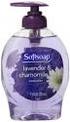 SECTION 1. PRODUCT AND COMPANY IDENTIFICATION Product name : SOFTSOAP LIQUID HAND SOAP LAVENDER & CHAMOMILE MSDS Number 100000029097 CAS-No. : Not applicable - product is a mixture General Use : Personal
Material Safety Data Sheet
 Material Safety Data Sheet (D)(+)-galactose MSDS 1 2 0 He a lt h Fire Re a c t iv it y Pe rs o n a l Pro t e c t io n 2 1 0 E Section 1: Chemical Product and Company Identification Product Name: (D)(+)-galactose
Material Safety Data Sheet
 Material Safety Data Sheet DL-Mandelic acid MSDS 0 Section : Chemical Product and Company Identification He a lt h Fire Re a c t iv it y Pe rs o n a l Pro t e c t io n 0 E Product Name: DL-Mandelic acid
MATERIAL SAFETY DATA SHEET
 MATERIAL SAFETY DATA SHEET 1. PRODUCT IDENTIFICATION 1.1 Product Name: Cyanogen Bromide Fibrinogen Fragments 1.2 Product REF: 459 1.3 Configuration: One (1) vial, 5.0 mg, lyophilized 1.4 Use of Product:
Safety Meeting Topic: Chemical Spills and Emergency Action Plans for General Industry
 Company Name: Safety Meeting ID: 16 Date: Grainger Safety Services Inc. 2012 Safety Meeting Topic: Chemical Spills and Emergency Action Plans for General Industry UPDATED: This safety meeting has been
Please contact your local Poison Control Centre: Australia 13 11 26 United States 1800 222 1222
 MATERIAL SAFETY DATA SHEET SECTION 1: IDENTIFICATION OF MATERIAL AND SUPPLIER SD169 SYN-1079 1H-indole-5-carboxamide CAS Registry No.: 1670-87-7 Supplier: SYNkinase Level 4, Building 21A, 528 Ruiqing Rd.
EMERGENCY RESPONSE PLAN
 EMERGENCY RESPONSE PLAN ILLINOIS VALLEY COMMUNITY COLLEGE District No. 513 815 North Orlando Smith Road Oglesby, Illinois 61348 November 2012 Table of Contents Mission Statement... 1 Purpose... 1 Plan
Material Safety Data Sheet
 Material Safety Data Sheet Cesium chloride MSDS 2 He a lt h Fire Re a c t iv it y Pe rs o n a l Pro t e c t io n 2 E Section 1: Chemical Product and Company Identification Product Name: Cesium chloride
Material Safety Data Sheet
 Material Safety Data Sheet Jojoba Oil MSDS 1 2 0 He a lt h Fire Re a c t iv it y Pe rs o n a l Pro t e c t io n 2 1 0 G Section 1: Chemical Product and Company Identification Product Name: Jojoba Oil Catalog
Job Hazard/Safety Analysis For the Housekeeper
 Job Hazard/Safety Analysis For the Housekeeper 1 INTRODUCTION Job Hazard/Safety Analysis for the Housekeeper is a partial list of known task performed by the professional housekeeper. We have placed task
Material Safety Data Sheet
 Material Safety Data Sheet Petroleum ether MSDS 4 1 0 Section 1: Chemical Product and Company Identification He a lt h Fire Re a c t iv it y Pe rs o n a l Pro t e c t io n 2 3 0 J Product Name: Petroleum
Material Safety Data Sheet
 Material Safety Data Sheet Aloe Vera MSDS 0 Section : Chemical Product and Company Identification He a lt h Fire Re a c t iv it y Pe rs o n a l Pro t e c t io n 0 A Product Name: Aloe Vera Catalog Codes:
Material Safety Data Sheet
 Material Safety Data Sheet Food Color, Red Powder MSDS 0 He a lt h Fire Re a c t iv it y Pe rs o n a l Pro t e c t io n 0 E Section : Chemical Product and Company Identification Product Name: Food Color,
Trade Name of this Product Isopropyl Rubbing Alcohol 91% USP. Corporate Compliance Team 1666 East Touhy Avenue
 Page 1 of 5 MSDS Document Product 1. Chemical Product and Company Identification Trade Name of this Product Manufacturer Contact Name Lawson Products, Inc. Corporate Compliance Team 1666 East Touhy Avenue
Material Safety Data Sheet
 Material Safety Data Sheet Potassium alginate MSDS 1 2 0 He a lt h Fire Re a c t iv it y Pe rs o n a l Pro t e c t io n 2 1 0 E Section 1: Chemical Product and Company Identification Product Name: Potassium
SAFETY DATA SHEET Revised edition no : 0 SDS/MSDS Date : 12 / 7 / 2012
 Page : 1 1. Identification of the substance/mixture and of the company/undertaking 1.1. Product identifier Trade name : ODIUM Product code : Identification of the product : NICOTINAMIDE ADENINE DINUCLEOTIDE
Appendix J IBC Biohazard Spill Management Plan
 OVERVIEW Prevention is the most important part of any spill management plan. Be sure to read and understand standard operating procedures (SOP s) and protocols for safe manipulation of biohazards before
Version: 1.0 Revision Date: 06/25/2013 Print Date: 06/25/2013 POOL TIME D.E. FILTER POWDER
 SECTION 1. PRODUCT AND COMPANY IDENTIFICATION Product name: Product Use Description: Recreational Water Product Chemical nature: Silica Company: Recreational Water Products Pool Time PO Box 1449 Buford,
Revised: June 6, 2007
 Isotropic Silicon Etching using HF/Nitric/Acetic Acid (HNA) Standard Operating Procedure Faculty Supervisor: Prof. Robert White, Mechanical Engineering (x72210) Safety Office: Peter Nowak x73246 (Just
UTSC Hazardous Spill Control Procedures Last Revision: May 2011
 Contact UTSC Hazardous Spill Control Procedures Last Revision: May 2011 Number Department Head/Chair Area Manager/Principle Investigator Fire/Police/Ambulance 911 UTSC Campus Police EHS Environmental Protection
Training on Standard Operating Procedures for Health Care Waste Management Swaziland 12 May, 2011
 Training on Standard Operating Procedures for Health Care Waste Management Swaziland 12 May, 2011 Safe Infectious Waste Handling and Transport Objective Waste Overview Roles and Responsibilities of Waste
Material Safety Data Sheet
 Material Safety Data Sheet Strontium bromide MSDS 2 He a lt h Fire Re a c t iv it y Pe rs o n a l Pro t e c t io n 2 J Section 1: Chemical Product and Company Identification Product Name: Strontium bromide
Safety Data Sheet. Product #: 300178. Aspira Scientific 521 Cottonwood Dr. Milpitas, CA 95035 408.571.1100 [email protected] www.aspirasci.
 Safety Data Sheet Aspira Scientific 521 Cottonwood Dr. Milpitas, CA 95035 408.571.1100 [email protected] www.aspirasci.com Section 1: Product Identification Product Identifiers Product Name: L-
Material Safety Data Sheet
 Material Safety Data Sheet D-Glucosamine sulfate MSDS 1 2 0 He a lt h Fire Re a c t iv it y Pe rs o n a l Pro t e c t io n 2 1 0 E Section 1: Chemical Product and Company Identification Product Name: D-Glucosamine
Material Safety Data Sheet
 Material Safety Data Sheet Sorbitol Solution, 7% MSDS Section 1: Chemical Product and Company Identification He a lt h Fire Re a c t iv it y Pe rs o n a l Pro t e c t io n A Product Name: Sorbitol Solution,
Carnegie Mellon University s Policy and Procedures for Recombinant and Synthetic Nucleic Acid Materials Spills
 Carnegie Mellon University s Policy and Procedures for Recombinant and Synthetic Nucleic Acid Materials Spills Background In accordance with Section IV-B-2-b-(6) of the NIH Guidelines for Research Involving
Spartan Chemical Company, Inc. Material Safety Data Sheet
 Spartan Chemical Company, Inc. Material Safety Data Sheet SECTION I: PRODUCT INFORMATION SECTION I: PRODUCT INFORMATION Product Name or Number (as it appears on label): SPARCLING Product Number: 7118 Product
MATERIAL SAFETY DATA SHEET In accordance with CE Regulation n 1907/2006. Annex II.
 Ref.: BA/909 ELSACYFRA Page: 1 of 5 RRR1. Identification of preparation and of the company/undertaking 1.1 Product name: ELSACYFRA 1.2 Use With the exception of products specifically labeled for In Vitro
EMERGENCY PROCEDURES
 EMERGENCY PROCEDURES Introduction Being prepared is the first step towards preventing and/or handling emergency situations. Because your safety is of utmost importance, SOLEX College has created this document
Material Safety Data Sheet
 Material Safety Data Sheet Pentadecane MSDS 0 Section : Chemical Product and Company Identification He a lt h Fire Re a c t iv it y Pe rs o n a l Pro t e c t io n 0 G Product Name: Pentadecane Catalog
Loss Control TIPS Technical Information Paper Series
 Loss Control TIPS Technical Information Paper Series Innovative Safety and Health Solutions SM An Overview of OSHA s Laboratory Standard: 29 CFR 1910.1450 Introduction The Occupational Safety and Health
OSHA Compliance Checklist ASC
 OSHA Compliance Checklist ASC Date Inspectors Facility OSHA is the agency responsible for establishing and enforcing standards that will make the workplace safe and healthful for the employees. The way
Material Safety Data Sheet
 Material Safety Data Sheet Folic acid MSDS 1 2 0 He a lt h Fire Re a c t iv it y Pe rs o n a l Pro t e c t io n 2 2 0 E Section 1: Chemical Product and Company Identification Product Name: Folic acid Catalog
Material Safety Data Sheet
 Material Safety Data Sheet trans-cinnamaldehyde MSDS 0 He a lt h Fire Re a c t iv it y Pe rs o n a l Pro t e c t io n 0 H Section 1: Chemical Product and Company Identification Product Name: trans-cinnamaldehyde
Material Safety Data Sheet
 0 1 0 Material Safety Data Sheet Magnesium sulfate anhydrous MSDS Section 1: Chemical Product and Company Identification He a lt h Fire Re a c t iv it y Pe rs o n a l Pro t e c t io n 1 0 0 E Product Name:
Material Safety Data Sheet
 Material Safety Data Sheet Sodium iodide MSDS 2 Section 1: Chemical Product and Company Identification He a lt h Fire Re a c t iv it y Pe rs o n a l Pro t e c t io n 2 E Product Name: Sodium iodide Catalog
Response to Biological Spills in the Laboratory (Intentional or Accidental)
 Response to Biological Spills in the Laboratory (Intentional or Accidental) Exposure Management For splash to eyes, mucous membranes, or broken area of the skin Irrigate eyes with clean water, saline or
SECTION 3: COMPOSITION/INFORMATION ON INGREDIENTS 3.1. Substances Not applicable 3.2. Mixture
 Revision Date: 05/19/2015 Date of issue: 05/19/2015 Version: 1.0 SECTION 1: IDENTIFICATION 1.1. Product Identifier Product Form: Mixture Product Name: 10X Spheroid Formation ECM Product Code: 3500-096-01
MATERIAL SAFETY DATA SHEET
 Page 1 of 6 1. IDENTIFICATION OF THE SUBSTANCE/PREPARATION AND THE COMPANY/UNDERTAKING Pfizer Inc Pfizer Pharmaceuticals Group 235 East 42nd Street New York, New York 10017 1-212-573-2222 Emergency telephone
SAFETY DATA SHEET WINTERHALTER A81 BLUE ENZYME DRAIN CLEANER
 SAFETY DATA SHEET SECTION 1: Identification of the substance/mixture and of the company/undertaking 1.1. Product identifier Product name 1.2. Relevant identified uses of the substance or mixture and uses
Sample New Employee Safety Checklist
 Sample New Employee Safety Checklist Supervisors must review the appropriate items from this list with each new employee. The Washington State Industrial Health and Safety Act (WAC 296-24-040) requires
Material Safety Data Sheet Gabapentin MSDS
 Material Safety Data Sheet Gabapentin MSDS Section 1: Chemical Product and Company Identification Product Name: Gabapentin Catalog Codes: SLA3310 CAS#: 60142-96-3 RTECS: GU6496000 TSCA: TSCA 8(b) inventory:
MATERIAL SAFETY DATA SHEET TOILET BOWL SANITIZER
 MATERIAL SAFETY DATA SHEET TOILET BOWL SANITIZER No. 1 Date Issued: 07/03/2011 COMPANY DETAILS NAME: Hygiene Systems (Pty) Ltd EMERGENCY TEL: 0860 494 4363 ADDRESS: 7 Hargan Road, TEL: 011 552 8403 SECTION
HAZARD COMMUNICATION & THE GLOBAL HARMONIZING SYSTEM EMPLOYEE TRAINING
 HAZARD COMMUNICATION & THE GLOBAL HARMONIZING SYSTEM EMPLOYEE TRAINING This easy-to-use Leader s Guide is provided to assist in conducting a successful presentation. Featured are: INTRODUCTION: A brief
Material Safety Data Sheet
 Material Safety Data Sheet Brilliant blue R-250 MSDS 0 Section : Chemical Product and Company Identification He a lt h Fire Re a c t iv it y Pe rs o n a l Pro t e c t io n 0 E Product Name: Brilliant blue