
Introduction to the Finite Element Method
|
|
|
- Dwayne Robertson
- 9 years ago
- Views:
Transcription
1 Introduction to the Finite Element Method

2 Outline Motivation Partial Differential Equations (PDEs) Finite Difference Method (FDM) Finite Element Method (FEM) References

3 Motivation Figure: cross section of the room (cf. A. Jüngel, Das kleine Finite-Elemente-Skript) Situation: R 2 - room D 1 - window D 2 - heating N 1 - isolated walls, ceiling N 2 - totally isolated floor θ - temperature
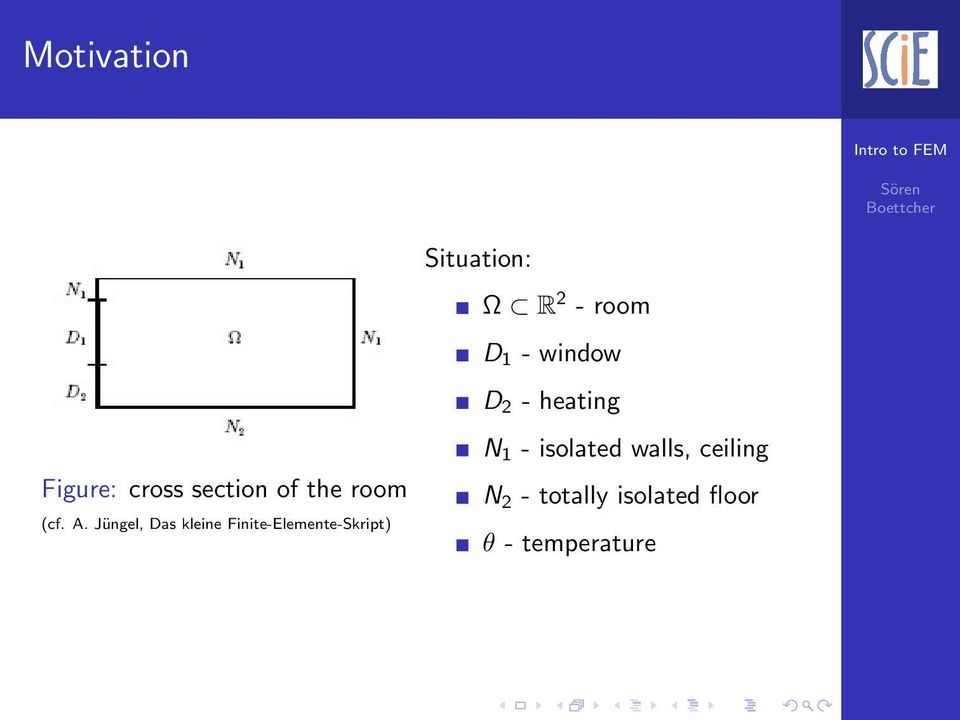
4 Motivation Conservation of energy: T 0 θ T ρ 0 c e dx dt = κ θ T t 0 ν dσ x dt + f dx dt 0 Heat equation: Assumptions: θ ρ 0 c e div(κ θ) = f in for t > 0 t no time rate of change of the temperature, i.e. θ t = 0 no interior heat source/sink, i.e. f = 0 κ = 1

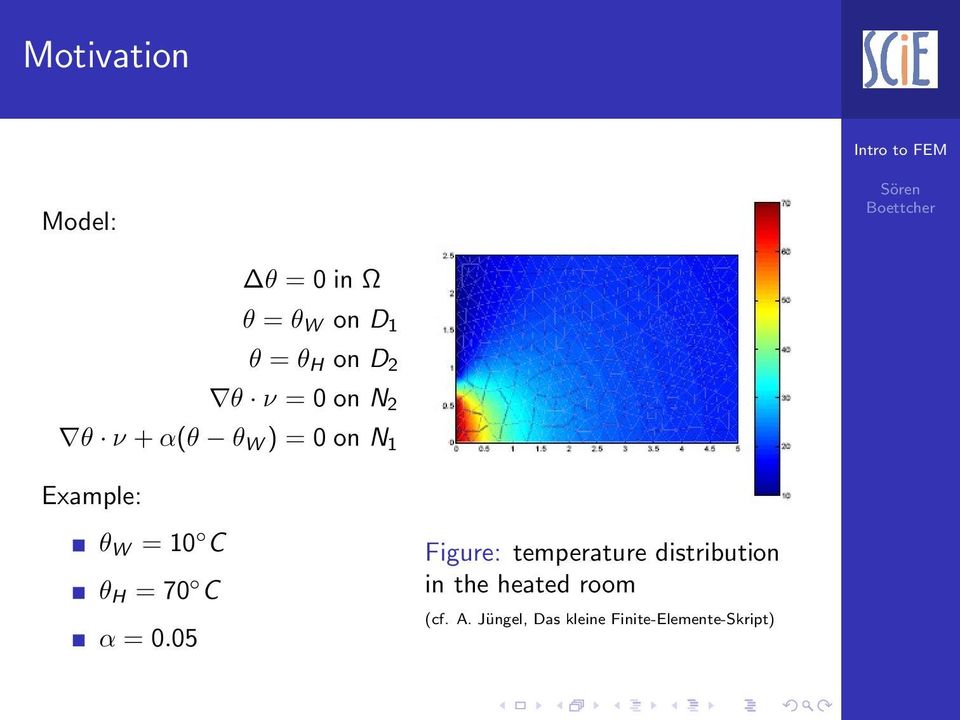
5 Motivation Model: θ = 0 in θ = θ W on D 1 θ = θ H on D 2 θ ν = 0 on N 2 θ ν + α(θ θ W ) = 0 on N 1 Example: θ W = 10 C θ H = 70 C α = 0.05 Figure: temperature distribution in the heated room (cf. A. Jüngel, Das kleine Finite-Elemente-Skript)
6 Partial Differential Equations (PDEs) Second-order PDEs Elliptic PDE (stationary) e.g. Poisson Equation (scalar) u = f in or stationary elasticity (vector-valued) div(σ) = f in Parabolic PDE e.g. heat equation θ div(κ θ) = f in (0, T ) Hyperbolic PDE e.g. instationary elasticity u div(σ) = f in (0, T )

7 Classification of PDEs Linear PDE θ θ = f in (0, T ) Semilinear PDE θ θ = f (θ) in (0, T ) Quasilinear PDE θ div(α( θ)) = f in (0, T ) Fully nonlinear PDE θ g( θ) = f in (0, T )

8 Boundary Conditions (BCs) Dirichlet BC (first kind, essential BC) u = g on Neumann BC (second kind, natural BC) u ν = u ν Robin BC (Cauchy BC, third kind) = g on u + σu = g on ν

9 Methods for solving PDEs Analytical Methods for PDEs / Existence and Uniqueness Method of Separation of Variables Method of Eigenfunction Expansion Method of Diagonalisation (Fourier Transformation) Method of Laplace Transformation Method of Green s Functions Method of Characteristics Method of Semigroups Variational Methods (e.g. Galerkin Approximation)

10 Methods for solving PDEs Numerical Methods for PDEs Finite Difference Method (FDM) pointwise approximation of the differential equation geometry is divided into an orthogonal grid Finite Element Method (FEM) powerful computational technique for the solution of differential and integral equations that arise in various fields of engineering and applied sciences differential equations will be solved with an equivalent variation problem geometry must be divided into small elements problem is solved by choosing basis functions which are supposed to approximate the problem
11 FDM Consider u = f in, u = 0 on Idea: approximate differential quotients by difference quotients reduce differential equation to algebraic system Assumptions: = (0, 1) 2 equidistant nodes (x i, y j ) (i, j = 0,..., N) with h = x i+1 x i = y i+1 y i Taylor Expansion u(x i+1, y j ) = u(x i, y j ) + u x (x i, y j )h u 2 x 2 (x i, y j )h 2 + O(h 3 ) u(x i 1, y j ) = u(x i, y j ) u x (x i, y j )h u 2 x 2 (x i, y j )h 2 + O(h 3 )

12 FDM Second-order centered difference 2 u x 2 = 1 h 2 ( u(xi+1, y j ) 2u(x i, y j ) + u(x i 1, y j ) ) + O(h) 2 u y 2 = 1 h 2 ( u(xi, y j+1 ) 2u(x i, y j ) + u(x i, y j 1 ) ) + O(h) Approximation of u u(x i, y j ) 1 h 2 ( ui+1,j + u i 1,j + u i,j+1 + u i,j 1 4u ij ) Find u ij = u(x i, y j ) s.t. u i+1,j u i 1,j u i,j+1 u i,j 1 + 4u ij = h 2 f ij, (x i, y j ) u ij = 0, (x i, y j ) whereas f ij = f (x i, y j )

13 FDM Linear system of equations: U k := u ij, F k := f ij with k = in + j leads to AU = F A = 1 h 2 A 0 I 0 I A 0 I I A 0 I 0 I A 0, A 0 = 1 h Disadvantages of FDM complex (or changing) geometries and BCs existence of third derivatives f not continuous

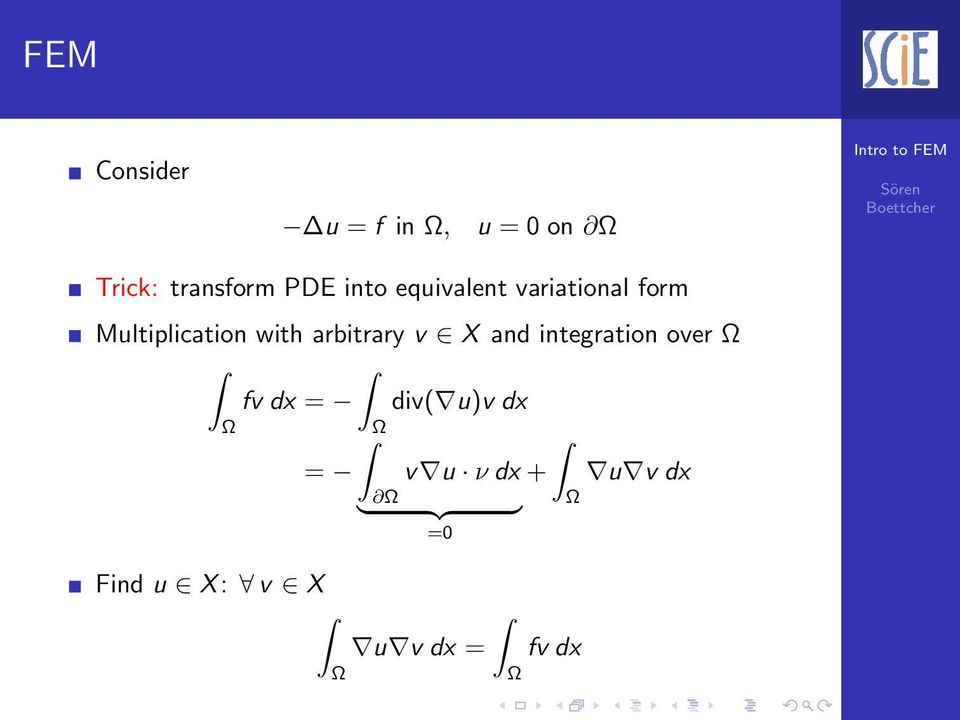
14 FEM Consider u = f in, u = 0 on Trick: transform PDE into equivalent variational form Multiplication with arbitrary v X and integration over fv dx = div( u)v dx = v u ν dx + u v dx } {{ } =0 Find u X : v X u v dx = fv dx
15 FEM Approximation: Find solution of a finite dimensional problem Let (X h ) h 0 a sequence of finite dimensional spaces with X h X (h 0) and elements of X h vanish on Find u h X h s.t. v X h u h v dx = fv dx Let {ϕ i } i=1,...,n a basis of X h. The ansatz u h (x) = N i=1 y iϕ i (x) and the choice v = ϕ j lead to N y i i=1 ϕ i ϕ j dx = } {{ } =:A ij f ϕ j dx, j = 1,..., N } {{ } =:F j

16 FEM Linear system of equations: Notation: N A ij y i = F j, j = 1,..., N i=1 A - stiffness matrix F - force vector y i = u h (x i ) - solution vector Questions: What about X, X h, {ϕ i } i=1,...,n? Hint: choose basis s.t. as much as possible A ij = 0! (A less costly to form, Ay = F can be solved more efficiently)

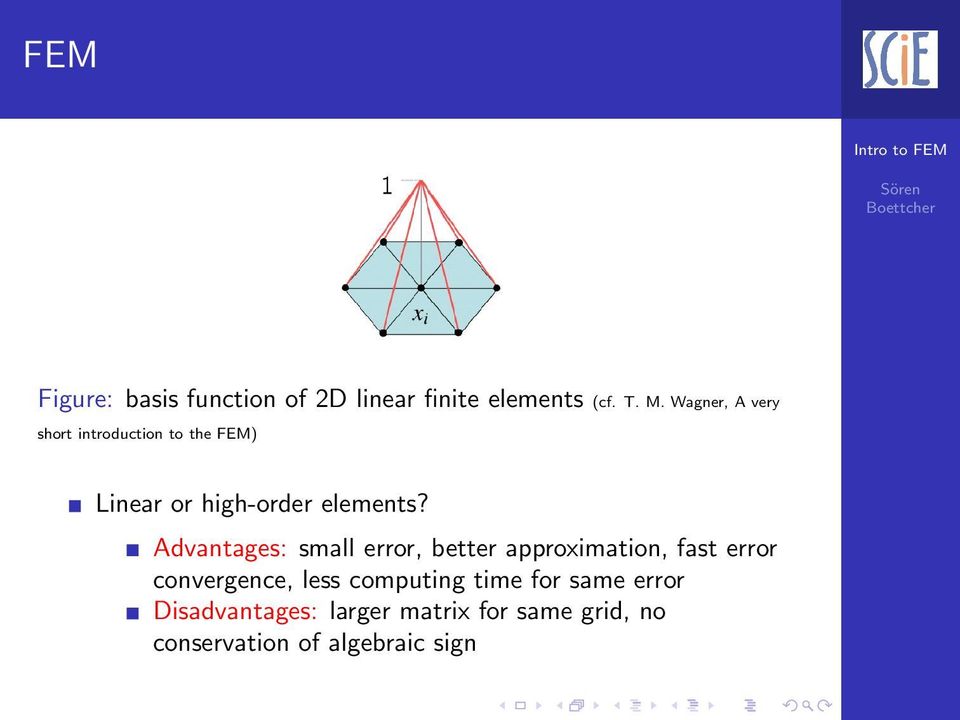
17 FEM Idea: discretise the domain into finite elements and define basis functions which vansih on most of these elements 1D: interval 2D: triangular/quadrilateral shape 3D: tetrahedral, hexahedral forms Ansatz functions: support of basis functions as small as possible and number of basis functions whose supports intersect as small as possible use of piecewise (images of) polynomials

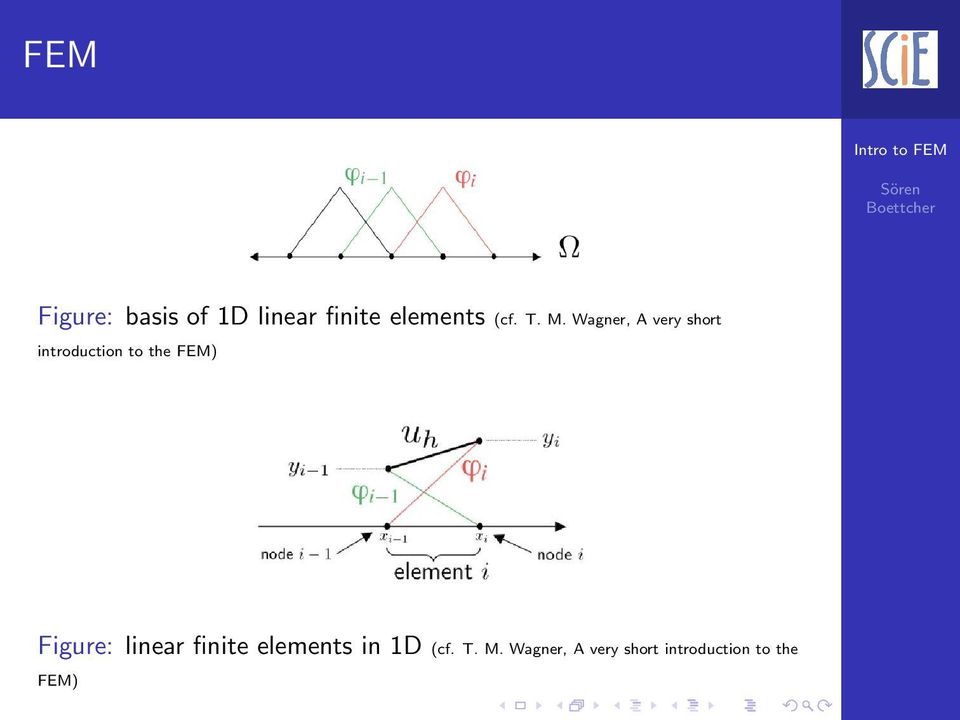
18 FEM Example: R 2 bounded Lipschitz domain, f L 2 () X = H0 1() Triangulation of by subdividing into a set T h = {K 1,..., K n } of non-overlapping triangles K i s.t. no vertex of a triangle lies on the edge of another triangle = K Th K Mesh parameter h = max K Th diam(k) X h := {u h C(, R): u h piecewise linear, u h = 0 on } Linear elements in 1D: ϕ i (x) = x x i 1 x i x i 1, x i 1 x x i x i+1 x x i+1 x i, x i 1 x x i 0, otherwise, i = 1,..., N 1

19 FEM Figure: basis of 1D linear finite elements (cf. T. M. Wagner, A very short introduction to the FEM) Figure: linear finite elements in 1D (cf. T. M. Wagner, A very short introduction to the FEM)
20 FEM Figure: basis function of 2D linear finite elements (cf. T. M. Wagner, A very short introduction to the FEM) Linear or high-order elements? Advantages: small error, better approximation, fast error convergence, less computing time for same error Disadvantages: larger matrix for same grid, no conservation of algebraic sign
21 FEM Matrix A is large, but sparse: only a few matrix elements are not equal to zero (intersection of the support of basis function is mostly empty) A symmetric, positive definit unique solution Linear system of equations: many methods in numerical linear algebra exist to solve linear systems of equations direct solvers (Gaussian elemination, LU decomposition, Cholesky decomposition): for N N matrix N 3 operations iterative solvers (CG, GMRES,... ): N operations for each iteration Runge-Kutta methods (ODEs for unsteady problems)
22 FEM Standard Error Estimation (P k -elements, u sufficiently smooth): ( ( u u h 2 dx u u h 2 dx ) 1 2 c h k+1 ( ) 1 2 c h k ( ) 1 D k+1 u 2 2 dx D k+1 u 2 dx ) 1 2 Consistency: exact solution solves approximate problem but for error that vanishes as h 0 Stability: errors remain bounded as h 0 Convergence: approximate solution must converge to a solution of the original problem for h 0 suitable for adaptive method
23 Model Algorithm of the FEM 1 Transformation of the given PDE via the variational principle 2 Selection of a finite element type 3 Discretization of the domain of interest into elements 4 Derivation of the basis from the discretisation and the chosen ansatz function 5 Calculation of the stiffness matrix and the right-hand side 6 Solution of the linear system of equations 7 Obtainment (and visualisation) of the approximation Software: ALBERTA, COMSOL, MATLAB, SYSWELD
24 References K. Atkinson, W. Han; Theoretical Numerical Analysis. D. Braess; Finite Elements. R. Dautray, J.-L. Lions; Mathematical Analysis and Numerical Methods for Science and Technology, Vol. 6: Evolution Problems II. C. Grossmann, H.-G. Roos; Numerical Treatment of PDEs. K. Knothe, H. Wessels; Finite elements. G. R. Liu, S. S. Quek; The FEM. M. Renardy, R. C. Rogers; An Introduction to PDEs. E. G. Thompson; Introduction to the FEM.
25 Thank you for your attention.
SIXTY STUDY QUESTIONS TO THE COURSE NUMERISK BEHANDLING AV DIFFERENTIALEKVATIONER I
 Lennart Edsberg, Nada, KTH Autumn 2008 SIXTY STUDY QUESTIONS TO THE COURSE NUMERISK BEHANDLING AV DIFFERENTIALEKVATIONER I Parameter values and functions occurring in the questions belowwill be exchanged
Numerical Methods for Differential Equations
 Numerical Methods for Differential Equations Course objectives and preliminaries Gustaf Söderlind and Carmen Arévalo Numerical Analysis, Lund University Textbooks: A First Course in the Numerical Analysis
Lecture Notes to Accompany. Scientific Computing An Introductory Survey. by Michael T. Heath. Chapter 10
 Lecture Notes to Accompany Scientific Computing An Introductory Survey Second Edition by Michael T. Heath Chapter 10 Boundary Value Problems for Ordinary Differential Equations Copyright c 2001. Reproduction
Mean value theorem, Taylors Theorem, Maxima and Minima.
 MA 001 Preparatory Mathematics I. Complex numbers as ordered pairs. Argand s diagram. Triangle inequality. De Moivre s Theorem. Algebra: Quadratic equations and express-ions. Permutations and Combinations.
Scientic Computing 2013 Computer Classes: Worksheet 11: 1D FEM and boundary conditions
 Scientic Computing 213 Computer Classes: Worksheet 11: 1D FEM and boundary conditions Oleg Batrashev November 14, 213 This material partially reiterates the material given on the lecture (see the slides)
Numerical Methods for Differential Equations
 Numerical Methods for Differential Equations Chapter 1: Initial value problems in ODEs Gustaf Söderlind and Carmen Arévalo Numerical Analysis, Lund University Textbooks: A First Course in the Numerical
Chapter 9 Partial Differential Equations
 363 One must learn by doing the thing; though you think you know it, you have no certainty until you try. Sophocles (495-406)BCE Chapter 9 Partial Differential Equations A linear second order partial differential
AN INTRODUCTION TO NUMERICAL METHODS AND ANALYSIS
 AN INTRODUCTION TO NUMERICAL METHODS AND ANALYSIS Revised Edition James Epperson Mathematical Reviews BICENTENNIAL 0, 1 8 0 7 z ewiley wu 2007 r71 BICENTENNIAL WILEY-INTERSCIENCE A John Wiley & Sons, Inc.,
An Additive Neumann-Neumann Method for Mortar Finite Element for 4th Order Problems
 An Additive eumann-eumann Method for Mortar Finite Element for 4th Order Problems Leszek Marcinkowski Department of Mathematics, University of Warsaw, Banacha 2, 02-097 Warszawa, Poland, [email protected]
Iterative Solvers for Linear Systems
 9th SimLab Course on Parallel Numerical Simulation, 4.10 8.10.2010 Iterative Solvers for Linear Systems Bernhard Gatzhammer Chair of Scientific Computing in Computer Science Technische Universität München
Høgskolen i Narvik Sivilingeniørutdanningen STE6237 ELEMENTMETODER. Oppgaver
 Høgskolen i Narvik Sivilingeniørutdanningen STE637 ELEMENTMETODER Oppgaver Klasse: 4.ID, 4.IT Ekstern Professor: Gregory A. Chechkin e-mail: [email protected] Narvik 6 PART I Task. Consider two-point
On computer algebra-aided stability analysis of dierence schemes generated by means of Gr obner bases
 On computer algebra-aided stability analysis of dierence schemes generated by means of Gr obner bases Vladimir Gerdt 1 Yuri Blinkov 2 1 Laboratory of Information Technologies Joint Institute for Nuclear
How High a Degree is High Enough for High Order Finite Elements?
 This space is reserved for the Procedia header, do not use it How High a Degree is High Enough for High Order Finite Elements? William F. National Institute of Standards and Technology, Gaithersburg, Maryland,
FINITE DIFFERENCE METHODS
 FINITE DIFFERENCE METHODS LONG CHEN Te best known metods, finite difference, consists of replacing eac derivative by a difference quotient in te classic formulation. It is simple to code and economic to
An Introduction to Partial Differential Equations
 An Introduction to Partial Differential Equations Andrew J. Bernoff LECTURE 2 Cooling of a Hot Bar: The Diffusion Equation 2.1. Outline of Lecture An Introduction to Heat Flow Derivation of the Diffusion
Domain Decomposition Methods. Partial Differential Equations
 Domain Decomposition Methods for Partial Differential Equations ALFIO QUARTERONI Professor ofnumericalanalysis, Politecnico di Milano, Italy, and Ecole Polytechnique Federale de Lausanne, Switzerland ALBERTO
1 Finite difference example: 1D implicit heat equation
 1 Finite difference example: 1D implicit heat equation 1.1 Boundary conditions Neumann and Dirichlet We solve the transient heat equation ρc p t = ( k ) (1) on the domain L/2 x L/2 subject to the following
FEM Software Automation, with a case study on the Stokes Equations
 FEM Automation, with a case study on the Stokes Equations FEM Andy R Terrel Advisors: L R Scott and R C Kirby Numerical from Department of Computer Science University of Chicago March 1, 2006 Masters Presentation
Inner Product Spaces
 Math 571 Inner Product Spaces 1. Preliminaries An inner product space is a vector space V along with a function, called an inner product which associates each pair of vectors u, v with a scalar u, v, and
TWO-DIMENSIONAL FINITE ELEMENT ANALYSIS OF FORCED CONVECTION FLOW AND HEAT TRANSFER IN A LAMINAR CHANNEL FLOW
 TWO-DIMENSIONAL FINITE ELEMENT ANALYSIS OF FORCED CONVECTION FLOW AND HEAT TRANSFER IN A LAMINAR CHANNEL FLOW Rajesh Khatri 1, 1 M.Tech Scholar, Department of Mechanical Engineering, S.A.T.I., vidisha
Numerical Analysis An Introduction
 Walter Gautschi Numerical Analysis An Introduction 1997 Birkhauser Boston Basel Berlin CONTENTS PREFACE xi CHAPTER 0. PROLOGUE 1 0.1. Overview 1 0.2. Numerical analysis software 3 0.3. Textbooks and monographs
Parabolic Equations. Chapter 5. Contents. 5.1.2 Well-Posed Initial-Boundary Value Problem. 5.1.3 Time Irreversibility of the Heat Equation
 7 5.1 Definitions Properties Chapter 5 Parabolic Equations Note that we require the solution u(, t bounded in R n for all t. In particular we assume that the boundedness of the smooth function u at infinity
Solved with COMSOL Multiphysics 4.3
 Vibrating String Introduction In the following example you compute the natural frequencies of a pre-tensioned string using the 2D Truss interface. This is an example of stress stiffening ; in fact the
Multigrid preconditioning for nonlinear (degenerate) parabolic equations with application to monument degradation
 Multigrid preconditioning for nonlinear (degenerate) parabolic equations with application to monument degradation M. Donatelli 1 M. Semplice S. Serra-Capizzano 1 1 Department of Science and High Technology
NUMERICAL METHODS TOPICS FOR RESEARCH PAPERS
 Faculty of Civil Engineering Belgrade Master Study COMPUTATIONAL ENGINEERING Fall semester 2004/2005 NUMERICAL METHODS TOPICS FOR RESEARCH PAPERS 1. NUMERICAL METHODS IN FINITE ELEMENT ANALYSIS - Matrices
Geometric evolution equations with triple junctions. junctions in higher dimensions
 Geometric evolution equations with triple junctions in higher dimensions University of Regensburg joint work with and Daniel Depner (University of Regensburg) Yoshihito Kohsaka (Muroran IT) February 2014
A gentle introduction to the Finite Element Method. Francisco Javier Sayas
 A gentle introduction to the Finite Element Method Francisco Javier Sayas 2008 An introduction If you haven t been hiding under a stone during your studies of engineering, mathematics or physics, it is
The Heat Equation. Lectures INF2320 p. 1/88
 The Heat Equation Lectures INF232 p. 1/88 Lectures INF232 p. 2/88 The Heat Equation We study the heat equation: u t = u xx for x (,1), t >, (1) u(,t) = u(1,t) = for t >, (2) u(x,) = f(x) for x (,1), (3)
FINITE ELEMENT : MATRIX FORMULATION. Georges Cailletaud Ecole des Mines de Paris, Centre des Matériaux UMR CNRS 7633
 FINITE ELEMENT : MATRIX FORMULATION Georges Cailletaud Ecole des Mines de Paris, Centre des Matériaux UMR CNRS 76 FINITE ELEMENT : MATRIX FORMULATION Discrete vs continuous Element type Polynomial approximation
Feature Commercial codes In-house codes
 A simple finite element solver for thermo-mechanical problems Keywords: Scilab, Open source software, thermo-elasticity Introduction In this paper we would like to show how it is possible to develop a
Optimization of Supply Chain Networks
 Optimization of Supply Chain Networks M. Herty TU Kaiserslautern September 2006 (2006) 1 / 41 Contents 1 Supply Chain Modeling 2 Networks 3 Optimization Continuous optimal control problem Discrete optimal
Dimensionless form of equations
 Dimensionless form of equations Motivation: sometimes equations are normalized in order to facilitate the scale-up of obtained results to real flow conditions avoid round-off due to manipulations with
College of the Holy Cross, Spring 2009 Math 373, Partial Differential Equations Midterm 1 Practice Questions
 College of the Holy Cross, Spring 29 Math 373, Partial Differential Equations Midterm 1 Practice Questions 1. (a) Find a solution of u x + u y + u = xy. Hint: Try a polynomial of degree 2. Solution. Use
7 Gaussian Elimination and LU Factorization
 7 Gaussian Elimination and LU Factorization In this final section on matrix factorization methods for solving Ax = b we want to take a closer look at Gaussian elimination (probably the best known method
UNIVERSITETET I OSLO
 NIVERSITETET I OSLO Det matematisk-naturvitenskapelige fakultet Examination in: Trial exam Partial differential equations and Sobolev spaces I. Day of examination: November 18. 2009. Examination hours:
Does Black-Scholes framework for Option Pricing use Constant Volatilities and Interest Rates? New Solution for a New Problem
 Does Black-Scholes framework for Option Pricing use Constant Volatilities and Interest Rates? New Solution for a New Problem Gagan Deep Singh Assistant Vice President Genpact Smart Decision Services Financial
INTRODUCTION TO THE FINITE ELEMENT METHOD
 INTRODUCTION TO THE FINITE ELEMENT METHOD G. P. Nikishkov 2004 Lecture Notes. University of Aizu, Aizu-Wakamatsu 965-8580, Japan [email protected] 2 Updated 2004-01-19 Contents 1 Introduction 5 1.1 What
Computational Geometry Lab: FEM BASIS FUNCTIONS FOR A TETRAHEDRON
 Computational Geometry Lab: FEM BASIS FUNCTIONS FOR A TETRAHEDRON John Burkardt Information Technology Department Virginia Tech http://people.sc.fsu.edu/ jburkardt/presentations/cg lab fem basis tetrahedron.pdf
A QUICK GUIDE TO THE FORMULAS OF MULTIVARIABLE CALCULUS
 A QUIK GUIDE TO THE FOMULAS OF MULTIVAIABLE ALULUS ontents 1. Analytic Geometry 2 1.1. Definition of a Vector 2 1.2. Scalar Product 2 1.3. Properties of the Scalar Product 2 1.4. Length and Unit Vectors
Fourth-Order Compact Schemes of a Heat Conduction Problem with Neumann Boundary Conditions
 Fourth-Order Compact Schemes of a Heat Conduction Problem with Neumann Boundary Conditions Jennifer Zhao, 1 Weizhong Dai, Tianchan Niu 1 Department of Mathematics and Statistics, University of Michigan-Dearborn,
Numerical Analysis Lecture Notes
 Numerical Analysis Lecture Notes Peter J. Olver. Finite Difference Methods for Partial Differential Equations As you are well aware, most differential equations are much too complicated to be solved by
2.3 Convex Constrained Optimization Problems
 42 CHAPTER 2. FUNDAMENTAL CONCEPTS IN CONVEX OPTIMIZATION Theorem 15 Let f : R n R and h : R R. Consider g(x) = h(f(x)) for all x R n. The function g is convex if either of the following two conditions
Largest Fixed-Aspect, Axis-Aligned Rectangle
 Largest Fixed-Aspect, Axis-Aligned Rectangle David Eberly Geometric Tools, LLC http://www.geometrictools.com/ Copyright c 1998-2016. All Rights Reserved. Created: February 21, 2004 Last Modified: February
1 Completeness of a Set of Eigenfunctions. Lecturer: Naoki Saito Scribe: Alexander Sheynis/Allen Xue. May 3, 2007. 1.1 The Neumann Boundary Condition
 MAT 280: Laplacian Eigenfunctions: Theory, Applications, and Computations Lecture 11: Laplacian Eigenvalue Problems for General Domains III. Completeness of a Set of Eigenfunctions and the Justification
Variational approach to restore point-like and curve-like singularities in imaging
 Variational approach to restore point-like and curve-like singularities in imaging Daniele Graziani joint work with Gilles Aubert and Laure Blanc-Féraud Roma 12/06/2012 Daniele Graziani (Roma) 12/06/2012
Method of Green s Functions
 Method of Green s Functions 8.303 Linear Partial ifferential Equations Matthew J. Hancock Fall 006 We introduce another powerful method of solving PEs. First, we need to consider some preliminary definitions
POLYNOMIAL HISTOPOLATION, SUPERCONVERGENT DEGREES OF FREEDOM, AND PSEUDOSPECTRAL DISCRETE HODGE OPERATORS
 POLYNOMIAL HISTOPOLATION, SUPERCONVERGENT DEGREES OF FREEDOM, AND PSEUDOSPECTRAL DISCRETE HODGE OPERATORS N. ROBIDOUX Abstract. We show that, given a histogram with n bins possibly non-contiguous or consisting
Numerical Analysis Introduction. Student Audience. Prerequisites. Technology.
 Numerical Analysis Douglas Faires, Youngstown State University, (Chair, 2012-2013) Elizabeth Yanik, Emporia State University, (Chair, 2013-2015) Graeme Fairweather, Executive Editor, Mathematical Reviews,
Finite cloud method: a true meshless technique based on a xed reproducing kernel approximation
 INTERNATIONAL JOURNAL FOR NUMERICAL METHODS IN ENGINEERING Int. J. Numer. Meth. Engng 2001; 50:2373 2410 Finite cloud method: a true meshless technique based on a xed reproducing kernel approximation N.
Finite Element Formulation for Plates - Handout 3 -
 Finite Element Formulation for Plates - Handout 3 - Dr Fehmi Cirak (fc286@) Completed Version Definitions A plate is a three dimensional solid body with one of the plate dimensions much smaller than the
Second Order Linear Partial Differential Equations. Part I
 Second Order Linear Partial Differential Equations Part I Second linear partial differential equations; Separation of Variables; - point boundary value problems; Eigenvalues and Eigenfunctions Introduction
SOLVING LINEAR SYSTEMS
 SOLVING LINEAR SYSTEMS Linear systems Ax = b occur widely in applied mathematics They occur as direct formulations of real world problems; but more often, they occur as a part of the numerical analysis
ME6130 An introduction to CFD 1-1
 ME6130 An introduction to CFD 1-1 What is CFD? Computational fluid dynamics (CFD) is the science of predicting fluid flow, heat and mass transfer, chemical reactions, and related phenomena by solving numerically
A CODE VERIFICATION EXERCISE FOR THE UNSTRUCTURED FINITE-VOLUME CFD SOLVER ISIS-CFD
 European Conference on Computational Fluid Dynamics ECCOMAS CFD 2006 P. Wesseling, E. Oñate and J. Périaux (Eds) c TU Delft, The Netherlands, 2006 A CODE VERIFICATION EXERCISE FOR THE UNSTRUCTURED FINITE-VOLUME
Introduction to CFD Analysis
 Introduction to CFD Analysis 2-1 What is CFD? Computational Fluid Dynamics (CFD) is the science of predicting fluid flow, heat and mass transfer, chemical reactions, and related phenomena by solving numerically
HIGH ORDER WENO SCHEMES ON UNSTRUCTURED TETRAHEDRAL MESHES
 European Conference on Computational Fluid Dynamics ECCOMAS CFD 26 P. Wesseling, E. Oñate and J. Périaux (Eds) c TU Delft, The Netherlands, 26 HIGH ORDER WENO SCHEMES ON UNSTRUCTURED TETRAHEDRAL MESHES
Introduction to the Finite Element Method (FEM)
 Introduction to the Finite Element Method (FEM) ecture First and Second Order One Dimensional Shape Functions Dr. J. Dean Discretisation Consider the temperature distribution along the one-dimensional
5 Numerical Differentiation
 D. Levy 5 Numerical Differentiation 5. Basic Concepts This chapter deals with numerical approximations of derivatives. The first questions that comes up to mind is: why do we need to approximate derivatives
POISSON AND LAPLACE EQUATIONS. Charles R. O Neill. School of Mechanical and Aerospace Engineering. Oklahoma State University. Stillwater, OK 74078
 21 ELLIPTICAL PARTIAL DIFFERENTIAL EQUATIONS: POISSON AND LAPLACE EQUATIONS Charles R. O Neill School of Mechanical and Aerospace Engineering Oklahoma State University Stillwater, OK 74078 2nd Computer
CONSERVATION LAWS. See Figures 2 and 1.
 CONSERVATION LAWS 1. Multivariable calculus 1.1. Divergence theorem (of Gauss). This states that the volume integral in of the divergence of the vector-valued function F is equal to the total flux of F
Metric Spaces. Chapter 7. 7.1. Metrics
 Chapter 7 Metric Spaces A metric space is a set X that has a notion of the distance d(x, y) between every pair of points x, y X. The purpose of this chapter is to introduce metric spaces and give some
General Framework for an Iterative Solution of Ax b. Jacobi s Method
 2.6 Iterative Solutions of Linear Systems 143 2.6 Iterative Solutions of Linear Systems Consistent linear systems in real life are solved in one of two ways: by direct calculation (using a matrix factorization,
Volumetric Meshes for Real Time Medical Simulations
 Volumetric Meshes for Real Time Medical Simulations Matthias Mueller and Matthias Teschner Computer Graphics Laboratory ETH Zurich, Switzerland [email protected], http://graphics.ethz.ch/ Abstract.
INTEGRAL METHODS IN LOW-FREQUENCY ELECTROMAGNETICS
 INTEGRAL METHODS IN LOW-FREQUENCY ELECTROMAGNETICS I. Dolezel Czech Technical University, Praha, Czech Republic P. Karban University of West Bohemia, Plzeft, Czech Republic P. Solin University of Nevada,
Bindel, Spring 2012 Intro to Scientific Computing (CS 3220) Week 3: Wednesday, Feb 8
 Spaces and bases Week 3: Wednesday, Feb 8 I have two favorite vector spaces 1 : R n and the space P d of polynomials of degree at most d. For R n, we have a canonical basis: R n = span{e 1, e 2,..., e
Introduction to PDE with Comsol
 Nada/MatFys Intro: PDE and FE with COMSOL MPH p. 1 (9) 06101, 081111 JOp Introduction to PDE with Comsol School-science project: Ion movement A blotting paper is wetted by brine, and heavy electrodes are
Domain Decomposition Methods for Elastic Materials with Compressible and Almost Incompressible Components
 Domain Decomposition Methods for Elastic Materials with Compressible and Almost Incompressible Components Sabrina Gippert geboren in Neuss Fakultät für Mathematik Universität Duisburg-Essen November 01
Class Meeting # 1: Introduction to PDEs
 MATH 18.152 COURSE NOTES - CLASS MEETING # 1 18.152 Introduction to PDEs, Fall 2011 Professor: Jared Speck Class Meeting # 1: Introduction to PDEs 1. What is a PDE? We will be studying functions u = u(x
Part II: Finite Difference/Volume Discretisation for CFD
 Part II: Finite Difference/Volume Discretisation for CFD Finite Volume Metod of te Advection-Diffusion Equation A Finite Difference/Volume Metod for te Incompressible Navier-Stokes Equations Marker-and-Cell
Numerical Methods for Ordinary Differential Equations 30.06.2013.
 Numerical Methods for Ordinary Differential Equations István Faragó 30.06.2013. Contents Introduction, motivation 1 I Numerical methods for initial value problems 5 1 Basics of the theory of initial value
Chapter 5. Methods for ordinary differential equations. 5.1 Initial-value problems
 Chapter 5 Methods for ordinary differential equations 5.1 Initial-value problems Initial-value problems (IVP) are those for which the solution is entirely known at some time, say t = 0, and the question
Finite Element Formulation for Beams - Handout 2 -
 Finite Element Formulation for Beams - Handout 2 - Dr Fehmi Cirak (fc286@) Completed Version Review of Euler-Bernoulli Beam Physical beam model midline Beam domain in three-dimensions Midline, also called
Nonlinear Algebraic Equations. Lectures INF2320 p. 1/88
 Nonlinear Algebraic Equations Lectures INF2320 p. 1/88 Lectures INF2320 p. 2/88 Nonlinear algebraic equations When solving the system u (t) = g(u), u(0) = u 0, (1) with an implicit Euler scheme we have
Recall that two vectors in are perpendicular or orthogonal provided that their dot
 Orthogonal Complements and Projections Recall that two vectors in are perpendicular or orthogonal provided that their dot product vanishes That is, if and only if Example 1 The vectors in are orthogonal
1 Introduction to Matrices
 1 Introduction to Matrices In this section, important definitions and results from matrix algebra that are useful in regression analysis are introduced. While all statements below regarding the columns
Nonlinear Algebraic Equations Example
 Nonlinear Algebraic Equations Example Continuous Stirred Tank Reactor (CSTR). Look for steady state concentrations & temperature. s r (in) p,i (in) i In: N spieces with concentrations c, heat capacities
STA 4273H: Statistical Machine Learning
 STA 4273H: Statistical Machine Learning Russ Salakhutdinov Department of Statistics! [email protected]! http://www.cs.toronto.edu/~rsalakhu/ Lecture 6 Three Approaches to Classification Construct
Numerical methods for American options
 Lecture 9 Numerical methods for American options Lecture Notes by Andrzej Palczewski Computational Finance p. 1 American options The holder of an American option has the right to exercise it at any moment
Introduction to CFD Analysis
 Introduction to CFD Analysis Introductory FLUENT Training 2006 ANSYS, Inc. All rights reserved. 2006 ANSYS, Inc. All rights reserved. 2-2 What is CFD? Computational fluid dynamics (CFD) is the science
A Semi-Lagrangian Approach for Natural Gas Storage Valuation and Optimal Operation
 A Semi-Lagrangian Approach for Natural Gas Storage Valuation and Optimal Operation Zhuliang Chen Peter A. Forsyth October 2, 2006 Abstract The valuation of a gas storage facility is characterized as a
OPTION PRICING WITH PADÉ APPROXIMATIONS
 C om m unfacsciu niva nkseries A 1 Volum e 61, N um b er, Pages 45 50 (01) ISSN 1303 5991 OPTION PRICING WITH PADÉ APPROXIMATIONS CANAN KÖROĞLU A In this paper, Padé approximations are applied Black-Scholes
Unified Lecture # 4 Vectors
 Fall 2005 Unified Lecture # 4 Vectors These notes were written by J. Peraire as a review of vectors for Dynamics 16.07. They have been adapted for Unified Engineering by R. Radovitzky. References [1] Feynmann,
Finite Element Methods (in Solid and Structural Mechanics)
 CEE570 / CSE 551 Class #1 Finite Element Methods (in Solid and Structural Mechanics) Spring 2014 Prof. Glaucio H. Paulino Donald Biggar Willett Professor of Engineering Department of Civil and Environmental
An Introduction to Partial Differential Equations in the Undergraduate Curriculum
 An Introduction to Partial Differential Equations in the Undergraduate Curriculum J. Tolosa & M. Vajiac LECTURE 11 Laplace s Equation in a Disk 11.1. Outline of Lecture The Laplacian in Polar Coordinates
CITY UNIVERSITY LONDON. BEng Degree in Computer Systems Engineering Part II BSc Degree in Computer Systems Engineering Part III PART 2 EXAMINATION
 No: CITY UNIVERSITY LONDON BEng Degree in Computer Systems Engineering Part II BSc Degree in Computer Systems Engineering Part III PART 2 EXAMINATION ENGINEERING MATHEMATICS 2 (resit) EX2005 Date: August
EXISTENCE AND NON-EXISTENCE RESULTS FOR A NONLINEAR HEAT EQUATION
 Sixth Mississippi State Conference on Differential Equations and Computational Simulations, Electronic Journal of Differential Equations, Conference 5 (7), pp. 5 65. ISSN: 7-669. UL: http://ejde.math.txstate.edu
State of Stress at Point
 State of Stress at Point Einstein Notation The basic idea of Einstein notation is that a covector and a vector can form a scalar: This is typically written as an explicit sum: According to this convention,
CAE -Finite Element Method
 16.810 Engineering Design and Rapid Prototyping Lecture 3b CAE -Finite Element Method Instructor(s) Prof. Olivier de Weck January 16, 2007 Numerical Methods Finite Element Method Boundary Element Method
Customer Training Material. Lecture 2. Introduction to. Methodology ANSYS FLUENT. ANSYS, Inc. Proprietary 2010 ANSYS, Inc. All rights reserved.
 Lecture 2 Introduction to CFD Methodology Introduction to ANSYS FLUENT L2-1 What is CFD? Computational Fluid Dynamics (CFD) is the science of predicting fluid flow, heat and mass transfer, chemical reactions,
Finite Difference Approach to Option Pricing
 Finite Difference Approach to Option Pricing February 998 CS5 Lab Note. Ordinary differential equation An ordinary differential equation, or ODE, is an equation of the form du = fut ( (), t) (.) dt where