
Caterpillar Machine Fluids Recommendations
|
|
|
- Amy Wilcox
- 9 years ago
- Views:
Transcription
1 SEBU July 2014 Caterpillar Machine Fluids Recommendations Special Publication SAFETY.CAT.COM

2 Important Safety Information Most accidents that involve product operation, maintenance and repair are caused by failure to observe basic safety rules or precautions. An accident can often be avoided by recognizing potentially hazardous situations before an accident occurs. A person must be alert to potential hazards, including human factors that can affect safety. This person should also have the necessary training, skills and tools to perform these functions properly. Improper operation, lubrication, maintenance or repair of this product can be dangerous and could result in injury or death. Do not operate or perform any lubrication, maintenance or repair on this product, until you verify that you are authorized to perform this work, and have read and understood the operation, lubrication, maintenance and repair information. Safety precautions and warnings are provided in this manual and on the product. If these hazard warnings are not heeded, bodily injury or death could occur to you or to other persons. The hazards are identified by the Safety Alert Symbol and followed by a Signal Word such as DANGER, WARNING or CAUTION. The Safety Alert WARNING label is shown below. i The meaning of this safety alert symbol is as follows: Attention! Become Alert! Your Safety is Involved. The message that appears under the warning explains the hazard and can be either written or pictorially presented. A non-exhaustive list of operations that may cause product damage are identified by labels on the product and in this publication. Caterpillar cannot anticipate every possible circumstance that might involve a potential hazard. The warnings in this publication and on the product are, therefore, not all inclusive. You must not use this product in any manner different from that considered by this manual without first satisfying yourself that you have considered all safety rules and precautions applicable to the operation of the product in the location of use, including site-specific rules and precautions applicable to the worksite. If a tool, procedure, work method or operating technique that is not specifically recommended by Caterpillar is used, you must satisfy yourself that it is safe for you and for others. You should also ensure that you are authorized to perform this work, and that the product will not be damaged or become unsafe by the operation, lubrication, maintenance or repair procedures that you intend to use. The information, specifications, and illustrations in this publication are on the basis of information that was available at the time that the publication was written. The specifications, torques, pressures, measurements, adjustments, illustrations, and other items can change at any time. These changes can affect the service that is given to the product. Obtain the complete and most current information before you start any job. Cat dealers have the most current information available. When replacement parts are required for this product Caterpillar recommends using Cat replacement parts. Failure to follow this warning may lead to premature failures, product damage, personal injury or death. In the United States, the maintenance, replacement, or repair of the emission control devices and systems may be performed by any repair establishment or individual of the owner's choosing.

3 SEBU Table of Contents Table of Contents Foreword Maintenance Section Lubricant Specifications Fuel Specifications Cooling System Specifications Exhaust Aftertreatment Fluids Specifications 135 Contamination Control Reference Information Section Reference Materials Index Section Index

4 4 SEBU6250 Foreword Foreword Fluids/Filters Recommendation Literature Information This manual should be stored in the literature holder or in the literature storage area on the machine. Immediately replace this manual if lost, damaged, or unreadable. The information contained in this document is the most current information available for fluid maintenance and service products. Special maintenance and service products may be required for some machine compartments. Refer to the Operation and Maintenance Manual for your machine for the maintenance and service requirements. Read, study, and keep this manual with the product. This manual should be read carefully before using this product for the first time and before performing maintenance. Whenever a question arises regarding your product, or this publication, consult your dealer for the latest available information. Safety Refer to the Operation and Maintenance Manual for your machine for all safety information. Read and understand the basic safety precautions listed in the Safety Section. In addition to safety precautions, this section identifies the text and locations of warning signs used on the machine. Under extremely severe, dusty, or wet operating conditions, more frequent lubrication and/or filter changes than is specified in the maintenance intervals chart might be necessary. Following the recommended maintenance intervals reduces the risk of excessive wear and potential failures of components. Aftermarket Products and Warranty When auxiliary devices, accessories or consumables (filters, oil, additives, catalysts, fuel, etc.) made by other manufacturers are used on Cat products, the Caterpillar warranty is not affected simply because of such use. Failures that result from the installation or usage of other manufacturers auxiliary devices, accessories or consumables, however, are not Caterpillar factory defects and therefore are NOT covered by Caterpillar's warranty. Caterpillar is not in a position to evaluate the many auxiliary devices, accessories or consumables promoted by other manufacturers and their effect on Cat products. Installation or use of such items is at the discretion of the customer who assumes ALL risks for the effects that result from this usage. Furthermore, Caterpillar does not authorize the use of its trade name, trademark, or logo in a manner which implies our endorsement of these aftermarket products. Read and understand the applicable precautions listed in the Maintenance and Operation Sections before operating or performing lubrication, maintenance, and repair on this machine. Maintenance Refer to the Operation and Maintenance Manual for your machine to determine all maintenance requirements. Proper maintenance and repair are essential to keep the equipment and systems operating correctly. As the owner, you are responsible for the performance of the required maintenance listed in the Owner Manual, Operation and Maintenance Manual, and Service Manual. Maintenance Interval Schedule Use the Maintenance Interval Schedule in the Operation and Maintenance Manual for your machine to determine servicing intervals. Use the service hour meter to determine servicing intervals. Calendar intervals shown (daily, weekly, monthly, etc.) can be used instead of service hour meter intervals if calendar intervals provide more convenient servicing schedules and approximate the indicated service hour meter reading. Recommended service should always be performed at the interval that occurs first.

5 SEBU Maintenance Section Lubricant Information Maintenance Section Lubricant Specifications Many of the guidelines, recommendations, and requirements that are provided in this Special Publication are interrelated. Before using the provided information, The user is responsible to read this Special Publication and understand the information provided. Lubricant Information SMCS Code: 1000; 1300; 7581 i The user is responsible to follow all safety guidelines found in this Special Publication and in the engine Operation and Maintenance Manual when performing all recommended and/or required engine, engine systems, and/or machine maintenance. Every attempt is made to provide accurate, up-to-date information. By the use of this document, you agree that Caterpillar Inc. is not responsible for errors or omissions. The information that is provided is the latest recommendations for Cat diesel engines that are covered by this Special Publication. This information supersedes all previous recommendations which have been published for Cat diesel engines that are covered by this Special Publication. Special fluids are required for some engines. These fluids will still be necessary in those engines. Refer to the applicable Operation and Maintenance Manual. This publication is a supplement to the Operation and Maintenance Manual. This publication does not replace the engine-specific Operation and Maintenance Manuals. These recommendations are subject to change without notice. Consult your local Cat dealer for the most up to date recommendations. Failure to follow the recommendations found in this Special Publication can cause engine failures, shortened engine service life, and reduced engine performance. In order to avoid potential damage to your CatCat engine, only purchase Cat fluids and Cat filters through your Cat dealer or Cat authorized outlets. For a list of authorized Cat parts outlets in your area, consult your Cat dealer. If you purchase what appear to be Cat fluids and/ or Cat filters through other outlets/sources, you are at a very high risk of purchasing counterfeit ( look-alike ) products. Counterfeit or look-alike products may visually appear the same as the original Cat product. The product performance and internal quality will typically be very low. Counterfeit or look-alike products have a very high likelihood of causing and/or allowing engine and/or machine compartment damage. For questions concerning the information presented in this Special Publication and/or in your product Operation and Maintenance Manual, and/or for additional guidelines and recommendations (including maintenance interval recommendations/ requirements) consult your Cat dealer. Commercial products that make generic claims of meeting Cat and/or Cat requirements without listing the specific Cat recommendations and/or requirements that are met may not provide acceptable performance. Reduced engine and/or machine fluid compartment life may result. Refer to this Special Publication and refer to the product Operation and Maintenance Manual for Cat fluids recommendations and/or requirements. Use of fluids that do not meet at least the minimum performance recommendations and/or requirements may lead to lower compartment performance and/or compartment failure. Problems/failures that are caused by using fluids that do not meet the minimum recommended and/or required performance level for the compartment are not warrantable by Caterpillar Inc.. The fluid manufacturer and customer are responsible. When fluids made by other manufacturers are used on Cat products, the Cat warranty is not affected simply because of such use. Failures that result from the installation or usage of other manufacturer fluids, however, are not Cat factory defects and therefore are NOT covered by the Cat warranty. Cat is not in a position to evaluate the many fluids promoted by other manufacturers and the effect on Cat products. Installation or use of such items is at the discretion of the customer who assumes ALL risks for the effects that result from this usage. Different brand oils may use different additive packages to meet the various engine performance category/specification requirements. For the best results, do not mix oil brands. The overall performance of engine and machine compartments is dependent on the choice of the lubricants and on the maintenance and cleanliness practices. The choices include filtration products, contamination control, tank management, and general handling practices. Cat designed and produced filtration products offer optimal performance and system protection.

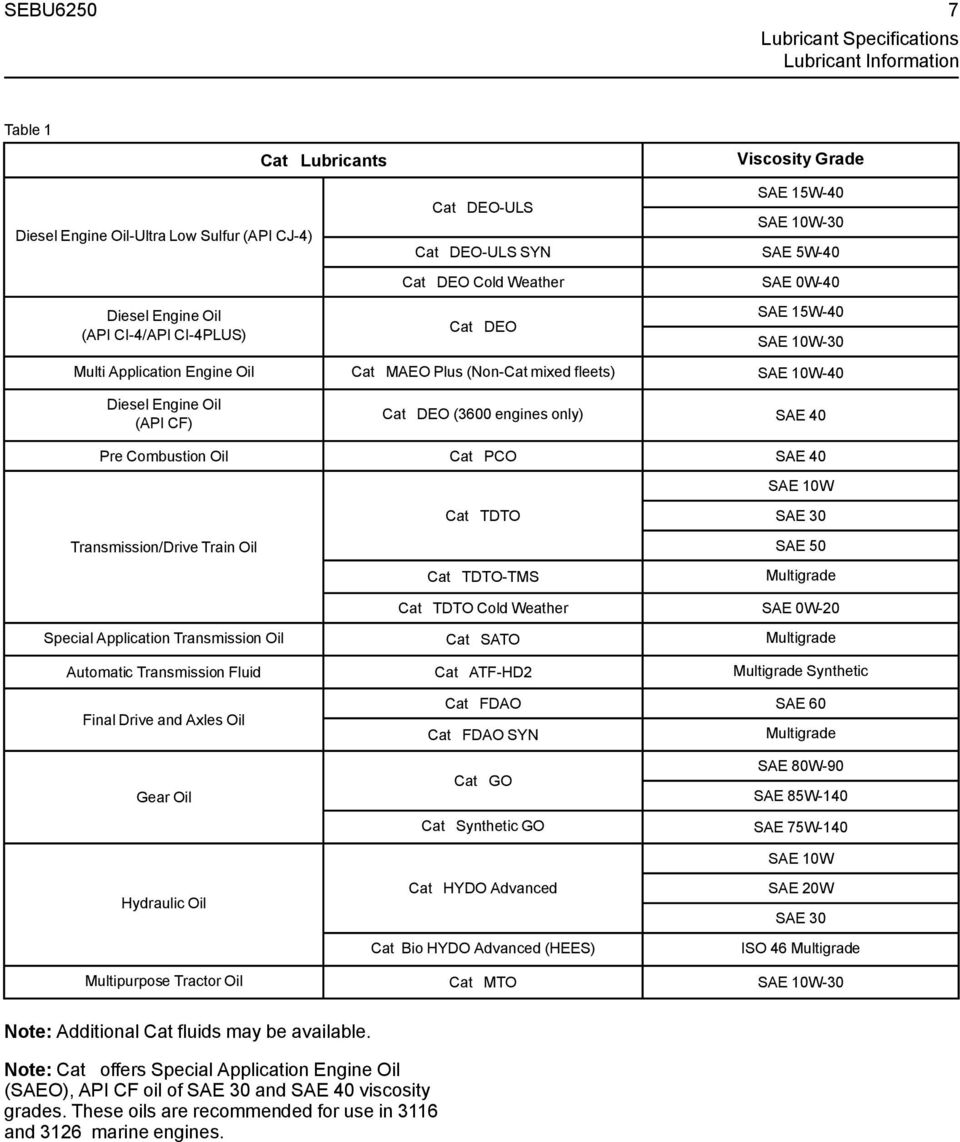
6 6 SEBU6250 Lubricant Specifications Lubricant Information In order to obtain additional information on Cat designed and produced filtration products, refer to Special Publication, SEBU9208, Caterpillar Filters Recommendations. Also refer to the Reference Material article, Filters and Miscellaneous topics in this Special Publication or consult your Cat dealer for assistance with filtration recommendations for your Cat machine. Note: In order to help ensure the maximum expected compartment performance and life, use a fluid that meets Cat highest level of fluid performance as described in this Special Publication for the compartment. Using a fluid that is considered an acceptable, but lower performing option for typical applications, will provide lower performance. (ex: Where fluids meeting either Cat ECF-1-a, Cat ECF-2 or Cat ECF-3 are offered as an option in typical applications, in order to help ensure the maximum expected engine compartment performance and life, oil meeting the Cat ECF-3 specification must be used.) Faulty engine coolant temperature regulators, or operating with light loads, short operation cycles, excessive idling, or operating in applications where normal operating temperature is seldom reached can contribute to excessive water in the crankcase oil. Corrosive damage, piston deposits, increased oil consumption, and other damage can result. If a complete oil analysis program is not followed or if the results are ignored, the potential for damage increases. Follow engine warmup recommendations provided in this Special Publication and/or given in your engine Operation and Maintenance Manual. Cat Fluids Cat fluids have been developed and tested by Cat in order to increase the performance and the life of Cat components. The quality of finished oil is dependent on the quality of the base stock, the quality of the additives and the compatibility of the base stock and additives. Cat fluids are formulated of high quality refined oil base stocks and additives of optimal chemistry and quantity in order to provide high performance in engines and machine components. Cat fluids are used for factory fill of Cat engines and components and are offered by Cat dealers for service fills and as aftermarket products. Consult with your Cat dealer for more information on these Cat fluids. Cat recommends the use of the following Cat fluids:

7 SEBU Lubricant Specifications Lubricant Information Table 1 Diesel Engine Oil-Ultra Low Sulfur (API CJ-4) Cat Lubricants Viscosity Grade SAE 15W-40 Cat DEO-ULS SAE 10W-30 Cat DEO-ULS SYN SAE 5W-40 Cat DEO Cold Weather SAE 0W-40 Diesel Engine Oil (API CI-4/API CI-4PLUS) Cat DEO SAE 15W-40 SAE 10W-30 Multi Application Engine Oil Cat MAEO Plus (Non-Cat mixed fleets) SAE 10W-40 Diesel Engine Oil (API CF) Cat DEO (3600 engines only) SAE 40 Pre Combustion Oil Cat PCO SAE 40 SAE 10W Cat TDTO SAE 30 Transmission/Drive Train Oil SAE 50 Cat TDTO-TMS Multigrade Cat TDTO Cold Weather SAE 0W-20 Special Application Transmission Oil Cat SATO Multigrade Automatic Transmission Fluid Cat ATF-HD2 Multigrade Synthetic Final Drive and Axles Oil Cat FDAO SAE 60 Cat FDAO SYN Multigrade Gear Oil Cat GO SAE 80W-90 SAE 85W-140 Cat Synthetic GO SAE 75W-140 SAE 10W Hydraulic Oil Cat HYDO Advanced Cat Bio HYDO Advanced (HEES) SAE 20W SAE 30 ISO 46 Multigrade Multipurpose Tractor Oil Cat MTO SAE 10W-30 Note: Additional Cat fluids may be available. Note: Cat offers Special Application Engine Oil (SAEO), API CF oil of SAE 30 and SAE 40 viscosity grades. These oils are recommended for use in 3116 and 3126 marine engines.
8 8 SEBU6250 Lubricant Specifications Engine Oil Table 2 Cat Grease products Cat Utility Grease Cat Prime Application Grease Cat Extreme Application Grease Grease Cat Extreme Application Grease - Desert Cat Extreme Application Grease - Arctic (Semi-Synthetic) Cat Ball Bearing Grease Cat White Assembly Grease Cat Hammer Paste Note: Cat fluids availability will vary by region. This information applies to Cat machines. For more lubricant recommendations see the following Special Publications: Special Publication, SEBU6251, Caterpillar Commercial Diesel Engine Fluid Recommendations Special Publication, SEBU6385, Caterpillar On- Highway Diesel Engine Fluids Recommendations Special Publication, SEBU6400, Caterpillar Gas Engine Fluids Recommendations Special Publication, SEBU7003, Caterpillar 3600 Series and C280 Series Diesel Engine Fluids Recommendations Always consult your Cat dealer in order to ensure that you have the current revision level of the publication. Note: The optimal application of the lubricants is dependent on the oil quality and the maintenance practices such as contamination control, tank management, and general handling practices. Engine Oil (Cat Machine Diesel Engines) SMCS Code: 1348; 7581 Engine lubricants play multiple roles in engines. Appropriate lubricants offer the following: i Provide lubrication to the moving components of the engine under a wide range of temperatures Keep the engine components clean and remove wear debris Remove heat from the lubricated components Neutralize acidic products due to combustion process Protect the engine from cavitation and foaming Protect the engine from corrosion and rust Control Oil Consumption Disperse/Solubilize Contaminants (Soot) Support the regulated engine emissions limits Current lubricant formulations are more advanced and complex than previous formulations. Current lubricants are developed to support advanced engine technologies that have lower emissions while supporting the performance and durability of these engines. High performance oils are produced and validated using industry standard tests, proprietary tests, field tests, and often prior experience with similar formulation. Cat high quality and high performance lubricants are validated based on these factors. In order to provide optimal engine performance and life and comply with regulated emission reduction, use the recommended engine oil as provided in this special publication. Due to the significant variations in the quality and performance of commercially available oils, Cat recommends the use of Cat oils as detailed in this article.

9 SEBU Lubricant Specifications Engine Oil Cat Diesel Engine Oils Cat fluids have been developed and tested by Cat in order to provide the full performance and service life that has been designed and built into Cat engines. The quality of finished oil is dependent on the quality of the base stock, the quality of the additives, and the compatibility of the base stock and additives. Cat fluids are formulated of high quality refined oil base stocks and additives of optimal chemistry and quantity in order to provide high performance in engines and machine components. Cat fluids are used for factory fill of Cat engines and components and are offered by Cat dealers for service fills and as aftermarket products. Consult your Cat dealer for more information on these Cat fluids. Cat recommends the use of the following lubricants in commercial engines covered by this Special Publication: Table 3 Diesel Engine Oil-Ultra Low Sulfur (API CJ-4) Cat Lubricants Viscosity Grade SAE 15W-40 Cat DEO-ULS SAE 10W-30 Cat DEO-ULS SYN SAE 5W-40 Cat DEO Cold Weather SAE 0W-40 Diesel Engine Oil (API CI-4/CI-4 PLUS and API CH-4) Cat DEO SAE 15W-40 SAE 10W-30 Multi Application Engine Oil Cat MAEO Plus (Non-Cat mixed fleets) SAE 10W-40 Diesel Engine Oil Cat DEO (3600 engines only) SAE 40 Precombustion Chamber Oil Cat PCO (Specific applications only) SAE 40 Note: Cat offers Special Application Engine Oil (SAEO), API CF oil of SAE 30 and SAE 40 viscosity grades. These oils are recommended for use in 3116 and 3126 marine engines. Note: Additional Cat fluids may be available. Note: Cat engine oils exceed the performance requirements of the respective API categories. This information applies to Cat commercial engines. For more lubricant recommendations see the following Special Publications: Special Publication, SEBU6250, Caterpillar Machine Fluids Recommendations Special Publication, SEBU6385, Caterpillar On- Highway Diesel Engine Fluids Recommendations Always consult your Cat dealer in order to ensure that you have the current revision level of the publication. Note: The optimal application of the lubricants is dependent on the oil quality and the maintenance practices. Such practices include contamination control, tank management, and general handling practices. Cat Diesel Engine Oils Recommendations Cat DEO-ULS and Cat DEO multigrade oils are the preferred oils for use in ALL Cat diesel engines that are covered by this Special Publication. Commercial alternative diesel engine oils are, as a group, second choice oils. Special Publication, SEBU6400, Caterpillar Gas Engine Fluids Recommendations Special Publication, SEBU7003, Caterpillar 3600 Series and C280 Series Diesel Engine Fluids Recommendations

10 10 SEBU6250 Lubricant Specifications Engine Oil Table 4 Cat Engine Lubricants Recommendations/Requirements Preferred Non-Road Tier 4 Certified Cat DEO-ULS (API CJ-4) Non-Road Pre Tier 4 Certified Cat DEO-ULS (API CJ-4) Cat DEO (API CI-4/API CI-4 PLUS) Commercial Lubricants Cat ECF-3/API CJ-4 Cat ECF-3/API CJ-4, Cat ECF-2, Cat ECF-1-a Note: API engine oil categories are backwards compatible. Cat DEO-ULS (API CJ-4) oil can be used in all engines with some restrictions related to fuel sulfur level, refer to Table 6 for more details. Cat DEO (API CI-4/API CI-4 PLUS) can be used in engines that are Tier 3 emissions certified and prior, and in engines that do not use aftertreatment devices. Note: Each of the Cat ECF specifications provides increased performance over lower Cat ECF specifications. For example, Cat ECF-3 provides higher performance than Cat ECF-2 and Cat ECF-3 provides much higher performance than Cat ECF-1- a. Refer to table 5 for details. For nonroad Tier 4 United States Environmental Protection Agency (U.S. EPA) certified engines that are equipped with aftertreatment devices refer to the specific section of this chapter. Table 5 Cat Engine Crankcase Fluids (ECF) Definitions Cat Minimum Performance Requirements for Commercial Oils Cat ECF-3 Cat ECF-2 Cat ECF-1-a Cat ECF Specifications Requirements API CJ-4 Oil Category performance requirements API CI-4 / CI-4 PLUS Oil Category performance requirements and Passing standard Cat C13 engine test per API requirements and Oils of sulfated ash > 1.50 percent are not allowed API CH-4 Oil Category performance requirements and For oils that are between 1.30 percent and 1.50 percent sulfated ash, passing one additional Cat 1P SCOTE test ( ASTM D6681 ) is required and Oils of sulfated ash > 1.50 percent are not allowed Cat DEO-ULS exceeds the limits of API CJ-4 standard tests and Cat ECF specifications. Cat DEO exceeds the limits of API CI-4/CI-4PLUS and API CH- 4. Cat DEO-ULS and Cat DEO are rigorously tested with full-scale proprietary Cat engine tests to ensure optimal protection of Cat diesel engines. The tests include the following: sticking of the piston rings, piston deposits, oil control tests, wear tests and soot tests. Proprietary tests help ensure that Cat oils provide superior performance in Cat diesel engines. There are significant variations in the quality and performance of commercially available oils. For this reason, Cat recommends the Cat oils listed in Table 4 and the guidelines in Table 5. Do not use single grade API CF oils or multigrade API CF oils in Cat Series 3500, Series C175 and smaller Direct Injection (DI) diesel engines. Single grade API CF oils (or oils that meet all the performance requirements of API CF category) may only be used in Cat Series 3600 and Series C280 diesel engines, and older Cat engines that have precombustion chamber (PC) fuel systems. Oils that are used in Cat Series 3600 and Series C280 diesel engines must also pass a 7000 field performance evaluation. Consult your Cat dealer for details.

11 SEBU Lubricant Specifications Engine Oil Cat DEO-ULS multigrade and Cat DEO multigrade oils are formulated with the correct amounts and chemistry of various additives including detergents, dispersants, antioxidants, alkalinity, antifoam, viscosity modifiers, and others in order to provide superior performance in Cat diesel engines where recommended for use. Use appropriate lubricating oils that are compatible with the engine certification and aftertreatment system and with the fuel sulfur levels. Refer to the oil recommendations for Tier 4 engines in this chapter and to Diesel Fuel Sulfur Impacts article of this Fuels Specifications section and to the Lubricants Specifications section of this Special Publication. Cat DEO-ULS (API CJ-4) is compatible for use in engines with aftertreatment devices. Refer to the appropriate section in this article for details. Cat DEO-ULS and Cat DEO are multigrade oils. Refer to table 3 in this article for details. Multigrade oils provide the correct viscosity for a broad range of operating temperatures. Multigrade oils provide the appropriate oil film thickness for moving engine components. Cat diesel engine oils exceed many of the performance requirements of other manufacturers of diesel engines. Therefore these oils are excellent choices for many mixed fleets. Refer to the engine manufacturer literature for the recommended categories/specifications. Compare the categories/ specifications to the specifications of Cat diesel engine oils. The current industry standards for Cat diesel engine oils are listed on the product labels. Also refer to the datasheets for the product. Consult your Cat dealer for part numbers and for available sizes of containers. Note: API oil category CG-4 is obsolete. The API (American Petroleum Institute) does not license this category effective August Oils that claim API CG-4 are not recommended for Cat engines. Note: API oil category CF is obsolete. The API (American Petroleum Institute) does not license this category effective end of API does not validate the quality of API CF oils and does not allow the display of API symbol (also called API doughnut) with CF as highest claim on the oil container. Oils that claim the requirements of API CF can be used ONLY in Cat 3112 and Cat3126 Marine Engines. Refer to the details given in the Marine engine section in this Special Publication. Recommendation for Tier 4 Engines Cat DEO-ULS or oils that meet the Cat ECF-3 specification and the API CJ-4 oil category are required for use in nonroad Tier 4 United States Environmental Protection Agency (U.S. EPA) certified engines that are equipped with aftertreatment devices. Cat DEO-ULS or oils that meet the Cat ECF-3 specification and the API CJ-4 are required for use in the applications listed below. If oils meeting the Cat ECF-3 specification and the API CJ-4 specifications are not available, oils meeting ACEA E9 may be used. ACEA E9 oils meet the chemical limits designed to maintain aftertreatment device life. ACEA E9 oils are validated using some but not all ECF-3 and API CJ-4 standard engine performance tests. Consult your oil supplier when considering use of an oil that is not Cat ECF-3 or API CJ-4 qualified. Nonroad EU Stage IIIB and IV type-approved engines that are equipped with aftertreatment devices Nonroad Japan Step 4 approved engines that are equipped with aftertreatment devices Refer to Table 4 for the order of preference of engine oils. Cat DEO-ULS and oils meeting the Cat ECF-3 specification and the API CJ-4 and ACEA E9 oil categories have the following chemical limits: 1 percent maximum sulfated ash 0.12 percent maximum phosphorous 0.4 percent maximum sulfur The chemical limits were developed in order to maintain the expected aftertreatment devices life, performance, and service intervals. Use of oils other than Cat DEO-ULS or oils that do not meet the Cat ECF-3 specification and the API CJ-4 oil category (and/or ACEA E9 category for EU and Japan-specific applications listed above) in aftertreatment-equipped engines can negatively impact performance of the aftertreatment devices, can contribute to Diesel Particulate Filter (DPF) plugging and/or can cause the need for more frequent DPF ash service intervals. Refer to your engine-specific Operation and Maintenance Manual, and refer to your aftertreatment device documentation, if available, for additional guidance. Typical aftertreatment systems include the following: Diesel Particulate Filters (DPF) Diesel Oxidation Catalysts (DOC) Selective Catalytic Reduction (SCR) Lean NOx Traps (LNT)

12 12 SEBU6250 Lubricant Specifications Engine Oil Other systems may apply. Cat DEO-ULS and Cat DEO are recommended for all pre-tier 4 engines that use Ultra Low Sulfur Diesel (ULSD) or Low Sulfur Diesel (LSD) fuels. Cat DEO is recommended for engines using fuels of sulfur levels that exceed 0.2 percent (2000 ppm). Cat DEO-ULS may be used in these applications if an oil analysis program is followed. The oil change interval may be affected by the fuel sulfur level. Refer to Table 6 in this section of this Special Publication. Note: For on-highway engines fluids recommendations, refer to the Operation and Maintenance Manual of your engine and also refer to the most current revision level of Special Publication, SEBU6385, Caterpillar On-Highway Diesel Engine Fluids Recommendations or consult your Cat dealer. Ultra Low Sulfur Diesel (ULSD) fuel percent ( 15 ppm (mg/kg)) sulfur is required by regulation for use in engines certified to nonroad Tier 4 standards (U.S. EPA Tier 4 certified). ULSD must also be used in engines equipped with exhaust aftertreatment systems. European ULSD percent ( 10ppm (mg/kg)) sulfur fuel is required by regulation for use in engines certified to European nonroad Stage IIIB and newer standards. European ULSD must also be used in engines equipped with exhaust aftertreatment systems. Certain governments/localities and/or applications MAY require the use of ULSD fuel. Consult federal, state, and local authorities for guidance on fuel requirements for your area. ULSD fuel or sulfur-free diesel fuel are applicable for use in all engines regardless of the engine Tier or Stage. Do not add new engine oil, waste engine oil or any oil product to the fuel unless the engine is designed and certified to burn diesel engine oil (for example Caterpillar ORS designed for large engines). Caterpillar experience has shown that adding oil products to Tier 4 engine fuels (U. S. EPA Tier 4 certified), to Euro IV/ Stage IV certified engine fuels, or to the fuels of engines equipped with exhaust aftertreatment devices, will generally cause the need for more frequent ash service intervals and/or cause loss of performance. Adding oil products to the fuel may raise the sulfur level of the fuel and may cause fouling of the fuel system and loss of performance. Commercial Oils Commercial Crankcase Fluid Recommendations for all Current and Noncurrent Cat Diesel Engines that are covered by this Special Publication Note: Non-Cat commercial oils are, as a group, second choice oils. Within this grouping of second choice oils there are tiered levels of performance. Cat does not warrant the quality or performance of non-cat fluids. Cat developed the Engine Crankcase Fluid (ECF) specifications to ensure the availability of high performance commercial diesel engine oils. There are three current Cat ECF specifications: Cat ECF-1-a, Cat ECF-2 and Cat ECF-3. Each higher Cat ECF specification provides increased performance over lower Cat ECF specifications. For example, Cat ECF-3 provides higher performance than Cat ECF-2 and Cat ECF-3 provides much higher performance than Cat ECF-1-a. Refer to table 5 for details. API category oils that have not met the requirements of at least one Cat ECF specification may cause reduced engine life. Note: The Cat ECF-3 specification was released in October Oils that meet the API CJ-4 oil category requirements are Cat ECF-3 specification compliant. Note: The Cat ECF-1-a and Cat ECF-2 specifications replaced the Cat ECF-1 specification as of March 1, Note: Cat diesel engine oils are required to pass proprietary full-scale diesel engine testing. The testing is above and beyond the testing required by the various Cat ECF specifications and by the various API oil categories that are also met. This additional proprietary testing helps ensure that Cat multigrade diesel engine oils, when used as recommended, provide superior performance in Cat diesel engines. If Cat diesel engine oils are not used, use only commercial oils that meet the recommendations and requirements stated below: When the recommended Cat diesel engine oils are not used, commercial oils that meet the requirements of the Cat ECF-1-a, Cat ECF-2, and/or the Cat ECF-3 specification are acceptable, but second choice, for use in Cat diesel engines that are covered by this Special Publication.

13 SEBU Lubricant Specifications Engine Oil Cat DEO-ULS or oils that meet the Cat ECF-3 specification and the API CJ-4 oil category are required for use in nonroad Tier 4 United States Environmental Protection Agency (U.S. EPA) certified engines that are equipped with aftertreatment devices. Note: For engines that are Tier 4 EPA certified, refer to the Recommendations for Tier 4 Engines article in this Engine Oil section. For engines using fuels of sulfur levels that exceed 0.2 percent (2000 ppm), Cat recommends Cat DEO. However, commercial oils that meet Cat ECF- 2 or Cat ECF-1-a specifications are acceptable but second choice. Commercial oils that meet Cat ECF- 3 specifications may be used in these applications if an oil analysis program is followed. The oil change interval is affected by the fuel sulfur level. Refer to Table 6 in this section of this Special Publication. Note: For on-highway engines fluids recommendations, refer to the Operation and Maintenance Manual of your engine and also refer to the most current revision level of Special Publication, SEBU6385, Caterpillar On-Highway Diesel Engine Fluids Recommendations or consult your Cat dealer. Note: In selecting oil for any engine application, both the oil viscosity and oil performance category/ specification as specified by the engine manufacturer must be defined and satisfied. Using only one of these parameters will not sufficiently define oil for an engine application. Do not add new engine oil, waste engine oil or any oil product to the fuel unless the engine is designed and certified to burn diesel engine oil (for example Caterpillar ORS designed for large engines). Caterpillar experience has shown that adding oil products to Tier 4 engine fuels (U. S. EPA Tier 4 certified), to Euro IV/ Stage IV certified engine fuels, or to the fuels of engines equipped with exhaust aftertreatment devices, will generally cause the need for more frequent ash service intervals and/or cause loss of performance. Adding oil products to the fuel may raise the sulfur level of the fuel and may cause fouling of the fuel system and loss of performance. Total Base Number (TBN) and Fuel Sulfur Levels for Direct Injection (DI) Diesel Engines The use of Cat S O S Services oil analysis is recommended for determining oil life. TBN is also commonly referred to as Base Number (BN). The minimum required Total Base Number (TBN) for oil depends on the fuel sulfur level. For direct injection engines that use distillate fuel, the following guidelines apply: In order to make the proper diesel engine oil viscosity grade choice, refer to the Lubricant Viscosities for Ambient Temperatures table in this Special Publication. Failure to follow these oil recommendations can cause shortened engine service life due to deposits and/or excessive wear. Do not use single grade API CF oils or multigrade API CF oils in Cat Series 3500, Series C175 and smaller Direct Injection (DI) diesel engines. Single grade API CF oils (or oils that meet all the performance requirements of API CF category) may only be used in Cat Series 3600 and Series C280 diesel engines, and older Cat engines that have precombustion chamber (PC) fuel systems. Oils that are used in Cat Series 3600 and Series C280 diesel engines must also pass a 7000 field performance evaluation. Consult your Cat dealer for details.

14 14 SEBU6250 Lubricant Specifications Engine Oil Table 6 TBN recommendations for applications in Cat engines Fuel Sulfur Level percent (ppm) Cat Engine Oils (1) TBN of Commercial Engine Oils 0.05 percent (500ppm) Cat DEO-ULS Cat DEO Min 7 > percent (> ppm) (2) Cat DEO Cat DEO-ULS Min 10 Above 0.2 percent (above 2000ppm) (3) (4) Cat DEO (5) Min 10 (1) Cat DEO-ULS applies to Cat DEO-ULS SAE 15W-40, SAE10W-30, Cat DEO-ULS SYN SAE 5W-40 and Cat DEO Cold Weather SAE 0W-40. Cat DEO applies to Cat DEO SAE 15W-40 and SAE 10W-30. (2) Use of an oil analysis program to determine oil drain intervals is recommended if fuel sulfur is between 0.05% (500 ppm) and 0.5% (5000 ppm). (3) Use of an oil analysis program to determine oil drain intervals is required if fuel sulfur is above 0.5% (5000 ppm). (4) For fuels of sulfur levels that exceed 1.0 percent (10,000 ppm), refer to TBN and engine oil guidelines given in this section. (5) Cat DEO-ULS may be used if an oil analysis program is followed. High fuel sulfur levels may reduce the oil drain intervals. Note: For regions in the world where fuels of high sulfur that exceed 1.0 percent (10,000 ppm (mg/kg)) are available and allowed for use by law, use the following guidelines: Choose multigrade oil with the highest TBN that meets one of these specifications: Cat ECF-1-a, Cat ECF-2, or Cat ECF-3. Commercial oils are second choice oils. Reduce the oil change interval. Base the oil change interval on the oil analysis. Ensure that the oil analysis includes the condition of the oil and a wear metal analysis. Cat S O S Services oil analysis is required. TBN testing is an optional part of the S O S Services oil analysis program. TBN testing may be done in addition to the standard S O S Services tests for oil deterioration. In most applications, the S O S Services tests for oxidation, sulfation, viscosity, and wear will identify oil deterioration. TBN of the oil is typically measured using ASTM D2896 and/or ASTM D4739 test methods. Both methods can be used to measure the TBN of used oils. However, ASTM D4739 is the preferred method for used oils. Consider changing the oil if the ASTM D2896 test result reaches 4 TBN. Look for other signs of oil deterioration, or abnormal wear to verify the need to change oil. Consider changing the oil if the ASTM D4739 test result reaches 3 TBN. Look for other signs of oil deterioration, or abnormal wear to verify the need to change oil. Note: The use of Cat S O S Services oil analysis helps environmental sustainability as the best way to optimize oil life, and help engines reach expected life. Consult your Cat dealer regarding the testing required to establish a safe, optimized oil drain interval. In order to help protect your engine, and in order to help optimize oil drain intervals for engine applications and duty cycles, use Cat S O S Services oil analysis as follows: Recommended normally Very strongly recommended in order to determine oil drain intervals when operating on fuel with sulfur levels between 0.05% (500 ppm) and 0.5% (5000 ppm) Required in order to determine oil drain intervals when operating on fuel with sulfur levels that are above 0.5% (5000 ppm) Note: Engine operating conditions play a key role in determining the effect that fuel sulfur will have on engine deposits and on engine wear. Consult your Cat dealer for guidance when fuel sulfur levels are above 0.1% (1000 ppm). Excessive piston deposits can be produced by oil with a high TBN and/or high ash. These deposits can lead to a loss of control of the oil consumption and to the polishing of the cylinder bore. There are many factors that contribute to rapid TBN depletion, a not all inclusive list follows: Be aware that both of these test methods have variability of approximately ±1 TBN. Care should be taken when analyzing the results of the TBN test. Consult a trained S O S Services analyst when making oil drain decisions based on oil sample results.

15 SEBU Lubricant Specifications Hydraulic Oil High sulfur fuel (The more fuel sulfur, the more rapid the TBN depletion.) Faulty engine coolant regulators Light loads Short operation cycles Excessive idling Operating in applications where normal operating temperature is seldom reached High humidity (allowing excessive condensation) Note bullets 2 through 7 directly above can contribute to excessive water in the crankcase oil. The water combines with available sulfur to form sulfuric acid, neutralizing this and other acids that are formed contribute to rapid TBN depletion. Depending on application severity and localized environmental conditions, and also depending on maintenance practices, operating Direct Injection (DI) diesel engines and operating PC (Precombustion Chamber) diesel engines on fuel with sulfur levels over 0.1 percent (1000 ppm) may require significantly shortened oil change intervals in order to help maintain adequate wear protection. Refer to this Special Publication, Fuel Specifications section, Diesel Fuel Sulfur topic for additional information. Note: For PC (Precombustion Chamber) diesel engines, which are mainly 1990 and older engines, the minimum new oil TBN must be 20 times the fuel sulfur level. The diesel engine oil types, specifications, and viscosity grades recommendations provided for DI diesel engines in this Special Publication are also applicable to PC diesel engines. For additional fluids information related to PC diesel engines, refer to the most current revision level of Caterpillar Commercial Diesel Engine Fluids Recommendations, SEBU6251. Note: DO NOT USE ONLY THIS SPECIAL PUBLICATION AS A BASIS FOR DETERMINING OIL DRAIN INTERVALS. This Special Publication does not address recommended oil drain intervals, but rather provides guidance that should be used with your specific engine/machine Operation and Maintenance Manuals in determining acceptable oil drain intervals. Consult your engine/machine Operation and Maintenance Manuals, and consult your Cat dealer for additional guidance, including but not limited to guidance on establishing optimized and/or acceptable oil drain intervals. Hydraulic Oil SMCS Code: 5095; 7581 Applications Hydraulic Systems Hydrostatic Transmissions i Caterpillar has developed a new class of hydraulic oils, the HYDO Advanced fluids. These new advanced fluids are designed for optimal performance in new advanced hydraulic systems that are designed with close tolerances for precise operation and that operate under demanding conditions of temperatures and pressures. These fluids ensure optimal performance in current and previous hydraulic systems. Four new products have been introduced: HYDO Advanced 10, SAE 10W HYDO Advanced 20, SAE 20W HYDO Advanced 30, SAE 30 Bio HYDO Advanced, Multigrade Cat HYDO Advanced Hydraulic Oils, SAE 10W, SAE 20W, and SAE 30 Cat HYDO Advanced hydraulic oils are designed to provide extended oil drain intervals and to provide extra protection to Cat hydraulic system components and hydrostatic transmissions. Cat HYDO Advanced hydraulic oils are formulated of premium additives and premium base stocks that pass severe qualification testing requirements, in the field and in the laboratory, in order to provide superior protection for Cat hydraulic systems. Cat HYDO Advanced hydraulic oils are preferred in most hydraulic systems and in most hydrostatic systems. Refer to this Special Publication, Lubricant Viscosities, Table Hydraulic Systems Lubricant Viscosities for Ambient Temperatures for the ambient operating temperatures for Cat HYDO Advanced hydraulic oils. Cat HYDO Advanced oils have a 50% increase in the standard oil drain interval for machine hydraulic systems (3000 hours versus 2000 hours) over second and third choice oils - when following the maintenance interval schedule for oil filter changes and for oil sampling that is stated in the Operation and Maintenance Manual for your particular machine hour oil drain intervals are possible with Cat HYDO Advanced oils when using S O S Services oil analysis. Consult your Caterpillar dealer for details.

16 16 SEBU6250 Lubricant Specifications Hydraulic Oil Cat HYDO Advanced hydraulic oils offer the following benefits: Enhanced anti wear protection: protect wear surfaces and reduce component wear in various hydraulic pumps. Protection against rusting and corrosive wear. Dispersion of water prevents pump damage due to water ingestion and prevents system damage due to freezing of water. 250% increase in oxidation stability per ASTM D943. Rapid air release protects against cavitation. Improved filtration properties helps support component cleanliness. Cat HYDO Advanced hydraulic oils should be used to achieve maximum life and maximum performance from hydraulic system components and from hydrostatic transmissions. In order to gain the most benefit from the improved performance designed into Cat HYDO Advanced oils, when switching to Cat HYDO Advanced oils, cross contamination with the previous hydraulic oil should be kept to less than 10%. If a different viscosity is required due to ambient temperatures, the following Caterpillar oils can be used: Cat DEO-ULS and Cat DEO Cat DEO-ULS SYN and Cat DEO SYN Cat DEO Cold Weather Cat TDTO Cat TDTO Cold Weather Cat TDTO-TMS Cat MTO Note: Caterpillar oil availability will vary by region. For applications requiring the use of fire resistant hydraulic fluids, Caterpillar recommends the use of EcoSafe FR-46. This product is a fully synthetic, nonaqueous hydraulic fluid. Water based and glycol based hydraulic products are not recommended for use in Cat machine hydraulic systems. EcoSafe FR- 46 is an ISO 46 multi-grade product. For more information refer to the product information provided by the manufacturer of EcoSafe hydraulic oil. Refer to your Cat dealer for availability. Cat Bio HYDO Advanced (Hydraulic Oil) Cat Bio HYDO Advanced is biodegradable non-toxic hydraulic oil that is recommended for use in hydraulic systems when environmental compliance is required or desired. Cat Bio HYDO Advanced has a renewable content that exceeds 90% and complies with the European Eco-Label. Consult Federal, state, or local authorities for guidance on hydraulic oils environmental requirements in your area. Cat Bio HYDO Advanced is formulated with premium additives and synthetic biodegradable base oil that pass severe qualification testing requirements in order to provide superior protection for Cat hydraulic systems and hydrostatic transmissions. Cat Bio HYDO Advanced increases the standard oil drain interval for machine hydraulic systems (3000 hours versus 2000 hours) over second and third choice oils. Follow the maintenance interval schedule for oil filter changes and for oil sampling that is stated in the Operation and Maintenance Manual for your particular machine. Cat Bio HYDO Advanced performs similar to Cat HYDO Advanced 10 and offers the following benefits: superior protection against mechanical wear, foaming and corrosion in hydraulic systems and in hydrostatic transmissions. This oil should be used to achieve maximum life and maximum performance from hydraulic system components and from hydrostatic transmissions. Cat Bio HYDO Advanced is preferred in most hydraulic systems and in most hydrostatic systems when ambient temperature is between 30 C ( 22 F) and 45 C (113 F). Consult your Caterpillar dealer for details. In order to gain the most benefit from the improved performance designed into Cat Bio HYDO Advanced oils, when switching to Cat Bio HYDO Advanced oils, cross contamination with the previous hydraulic oil should be kept to less than 3%. Flushing of the hydraulic system is recommended in order to reduce the cross contamination. Cat Bio HYDO Advanced can be used in hydraulic systems of other Original Equipment Manufacturers (OEM). Refer to your manufacturer requirements for application details.

17 SEBU Lubricant Specifications Transmission/Drive Train Oil Commercial Biodegradable Hydraulic Oil Note: Non-Cat commercial oils that are acceptable for use in most Cat hydraulic and hydrostatic transmission systems are as a group third choice oils. Within this grouping of third choice oils there are tiered levels of performance. Commercial oils that meet the Cat BF-2 specification should be used. Note: Oil meeting the Cat BF-2 specification should only be used in hydraulic systems where specifically recommended. Illustration 1 g Machines with this symbol are filled with biodegradable hydraulic oil. This symbol is located on the hydraulic tank. Commercial Oils Note: Non-Caterpillar commercial oils that are acceptable for use in most Cat hydraulic and hydrostatic transmission systems are as a group third choice oils. Within this grouping of third choice oils there are tiered levels of performance. Cat does not warrant the quality or performance of non-cat fluids. The minimum viscosity for commercial alternative oils used in most Caterpillar machine hydraulic systems and in most Cat hydrostatic transmission systems is 6.6 cst at 100 C (212 F) ASTM D445. If Caterpillar oils cannot be used, oils meeting the following commercial specifications can be used in most Cat hydraulic systems and in most Cat hydrostatic transmission systems: Engine oils that meet the Cat ECF-1-a, Cat ECF- 2, or Cat ECF-3 specifications and have a minimum zinc additive of 0.09 percent (900 ppm) Biodegradable oils that meet the Cat BF-2 specification TO-4 specification oils that have a minimum zinc additive of 0.09 percent (900 ppm) Note: Industrial hydraulic oils are not recommended for service fill in Caterpillar hydraulic systems. Cat does not warrant the quality or performance of non-cat fluids. If Cat oils cannot be used, commercial biodegradable hydraulic oils that meet the Cat BF-2 Performance Requirements should be used. Cat BF- 2 replaces Cat BF-1 Performance Requirements. Cat BF-1 Performance Requirements is obsolete. Do not use commercial oils that meet the BF-2 specification in compartments containing friction material except Hydraulic Excavators. Refer to the machine Operation and Maintenance Manual or consult your local Cat dealer for guidance before using commercial oils that meet the BF-2 specification in Hydraulic Excavators. Biodegradable hydraulic oils are formulated with the following components: a saturated HEES (Hydraulic Environmental Ester Synthetic), synthetic base stock and selected additives. Consult Federal, state, or local authorities for guidance on hydraulic oil environmental requirements in your area. Transmission/Drive Train Oil SMCS Code: 3080; 4000-OC; 4070; 7581 i Transmission/drive train oils are classified by the Cat TO-4 and the Cat TO-4M Performance Requirements. These Performance Requirements were developed by Caterpillar for use in Cat Powershift transmissions and in most Cat final drives. Refer to the Maintenance Section, Caterpillar Fluids article for more information on Caterpillar fluids and to the Tables in the Lubricants Viscosity section for the application of these fluids in various Cat machines.

18 18 SEBU6250 Lubricant Specifications Transmission/Drive Train Oil The Cat CD/TO-2 transmission/drive train oil specification has been obsolete since The obsolete CD/TO-2 specification is tied ONLY to the also obsolete API CD oil category. The TO-2 oil specification existed only as CD/TO-2. Specification claims of CF/ TO-2, ATF/TO-2, Cat TO-2 and other similar TO-2 claims are not accurate. Caterpillar does not monitor or support the obsolete Cat CD/TO-2 specification. Use of CD/TO-2 oils, or the use of oils claiming to meet TO-2 in machine compartments where Cat TO-4 specification oils are required is NOT recommended and their use is at the user's risk. Applications Transmission/Drive Train oils are recommended for use in Powershift Transmissions, certain Direct Drive Transmissions, certain Final Drives, Differentials and Final Drives, Drive Axles, Transfer Drives, and hydrostatic drive/hydraulic systems of various machines. The details of the applications of Transmission/Drive Train oils are given in the Lubricant Viscosity section of this Special Publication. Cat TDTO (Transmission/Drive Train Oil) Cat TDTO exceeds the requirements of the Cat TO- 4 transmission/drive train oil specification by passing five additional Cat tests. Cat TDTO is balanced in order to give maximum frictional material life in powershift transmissions. Cat TDTO also helps eliminate brake chatter in wet brake applications in Cat machines. This oil passes the requirements for the TO-4 oil specification which includes the frictional requirements and gear wear requirements. This oil is offered in several lubricant viscosity grades. Cat TDTO-TMS (Transmission/ Drive Train Oil-Transmission Multi Season) Cat TDTO-TMS exceeds the requirements of the Cat TO-4M transmission/drive train oil Performance Requirements by passing additional Cat tests. Cat TDTO-TMS is synthetic multigrade oil that is developed to provide optimal performance in transmissions, wet brakes, final drives and hydraulic compartments that must operate in wide range of temperatures. Cat TDTO-TMS can be used in Cat machine compartments where Cat TO-4 and TO-4M oils are recommended. This oil can be used in other manufacturer machines that recommend TO-4 or TO- 4M Performance Requirements oils. TDTO-TMS is specifically formulated of reduce transmission gears wear, improve the performance and efficiency of transmissions in cold weather, especially for machines with electronic controls, and to ensure long life and excellent performance for gears, bearings, and friction disc materials. Cat Transmission oils are formulated for transmissions and drive trains only, and should not be used in engines. Shortened engine life will result. Do not use the Cat GO (Gear Oil) or commercial gear oil in the machine compartments unless specifically recommended by Caterpillar. The gear oil can cause seals to fail. The seals can also leak. The gear oil may not be compatible with friction materials. The oil can reduce the efficiency of the transmission and the brake performance. Commercial Transmission/Drive Train Oils Note: Non-Caterpillar commercial oils are as a group typically second or third choice oils. Within this grouping of second and/or third choice oils there are typically tiered levels of performance. Cat does not warrant the quality or performance of non-cat fluids. Commercial oils that are substituted for the Cat TDTO must comply with the requirements of the Cat TO-4 or the Cat TO-4M transmission/drive train oil Performance Requirements. Note: Commercial multigrade oils must meet the requirements of the Cat TO-4M specification in order to be used in transmissions. Multigrade oils that use high molecular weight polymers as viscosity index improvers may lose the viscosity effectiveness. This effectiveness may be lost by the temporary shear of the polymer viscosity index improver. Permanent shear of the polymer viscosity index improver may also occur. These types of multigrade oils are not recommended for Caterpillar drive train compartments. The Cat TO-4M Performance Requirements includes a test for the shear stability of multigrade oil.

19 SEBU Lubricant Specifications Transmission/Drive Train Oil Cat SATO (Special Application Transmission Oil) Cat Special Application Transmission Oil (SATO) is multi-grade, semi-synthetic oil. This new Cat oil is introduced for use in all medium wheel loaders for factory fill and service fill. Cat SATO is applicable in all Medium Wheel Loader, including but not limited to the following models: 966K XE, 966M XE, 972M XE (Advanced Power Train Transmission) 950M, 962M, 966M, 972M, 980M, 982M (Powershift Transmission) Note: Cat SATO should not be used in lower powertrain components including final drives, axles, and differentials. Cat SATO offers the following benefits: Excellent cold start performance. Improved oxidation stability compared to the semisynthetic base stocks. Extended oil drain interval for powershift transmissions. The oil drain interval is 2000 hrs for SATO compared to 1000 hrs for TDTO 10 or 30. For the wheel loaders filled with SATO, topping off with other products from the Cat TDTO family should be limited to less than 10% maximum of sump capacity. The use of higher viscosity fluids for top-off can adversely affect cold start performance. When switching from Cat SATO to Cat TDTO or from Cat TDTO to Cat SATO no special compartment flushing or alternative procedures are required. Follow standard oil change procedures as outlined in the machine Operation and Maintenance Manual. Final Drive and Axle Oil Final Drive and Axle Oils are classified by the Cat FD-1 (Final Drive - 1) oil Performance Requirements. The Cat FD-1 Performance Requirements was developed by Caterpillar for use in certain highly loaded Cat final drives and axles that do not contain friction material. Cat FDAO (Final Drive and Axle Oil), Cat FDAO SYN, or commercial FD-1 are the preferred oil types to maximize gear and bearing life in machine compartments where recommended for use. Applications Final Drive and Axle oils are recommended for use in certain Final Drives, Axles and Differentials. The details of the applications of these oils are given in the Lubricant Viscosity section of this Special Publication. Cat FDAO (Final Drive and Axle Oil) Cat FDAO is blended specifically for applications with high load and high temperature conditions. In these conditions,the protection of gears and bearings is a primary concern. This is the preferred lubricant for Cat final drives and axles that formerly specified Cat TO-4 oils and that do not contain friction materials. This oil should not be used in compartments that contain friction material unless Cat FDAO or oil meeting Cat FD-1 (Final Drive oil Performance Requirements - 1) has been specified because these oils do not develop a sufficient friction coefficient in order to satisfy the requirements of most clutches and brakes. The performance of the Cat FDAO equaled or exceeded the performance of Cat TDTO in 18 of 18 tests for the following characteristics. Gear and bearing protection Physical properties and chemical properties Cat FDAO also has the following qualities: Compatible with the Cat TDTO oils and the seals for the related compartments Excellent protection against rust Excellent protection against copper corrosion Minimizes foaming Extended life of the oil due to low rate of oxidation Reduced downtime due to extended oil change intervals Cat FDAO SYN Cat FDAO SYN is a full synthetic, natural multigrade (non-viscosity improved) final drive and axle oil that is designed for operation in a wide temperature range. Cat FDAO SYN exceeds the requirements of Cat FD-1 specification. Cat FDAO SYN is the preferred lubricant for Cat Off-Highway Truck differentials, front wheels, and final drives that operate under high load factors and/ or that are operated continuously (multiple shifts per day). Commercial Final Drive and Axle Oil Commercial oils that are substituted for Cat FDAO must comply with the Cat FD-1 final drive oil Performance Requirements. Note: Non-Caterpillar commercial oils that meet the Cat FD-1 Performance Requirements are second choice oils.

20 20 SEBU6250 Lubricant Specifications Gear Oil Gear Oil SMCS Code: 7000; 7551; 7581 i Commercial Gear Oils Caterpillar does not warrant the quality or performance of non-caterpillar fluids. Do not use the Cat GO (Gear Oil) or commercial gear oil in the machine compartments unless specifically recommended by Caterpillar. The gear oil can cause seals to fail. The seals can also leak. The gear oil may not be compatible with friction materials. The oil can reduce the efficiency of the transmission and the brake performance. Applications Gear oils are recommended for use in certain Direct Drive Transmissions, Differentials, Final Drives, Transfer drives, Circle Drives (excavators), and other applications. The details of the applications of these oils are given in the Lubricant Viscosity section of this Special Publication. Cat GO (Gear Oil) Cat GO offers maximum protection against the following damage: scoring of the gear teeth, pitting of the gear teeth and pitting of the parts in roller bearings. Cat GO provides excellent stability under high temperature conditions. Cat GO also has superior low temperature performance. This oil also gives protection against rust and corrosion. Some applications require additives for the extreme pressures that can occur at the surfaces/edges of the components. For these applications, Cat GO provides the extra protection. When the use of gear oil is specified, use Cat GO or Cat Synthetic GO in order to maximize the component life. Cat GO is not the same as Cat TDTO, and does not meet Cat TO-4 or TO-4M oil Performance Requirements. Cat GO or commercial gear oils should not be used in compartments that specify Cat TO-4 or TO-4M oil. Cat GO is not the same as Cat FDAO, and does not meet the Cat FD-1 oil Performance Requirements. Cat GO or commercial gear oil should not be used in compartments that specify Cat FD-1 oil. Gear lubricants are classified by the API service category and by the SAE viscosity grade that is defined in SAE J306. If the Cat GO or Cat Synthetic GO cannot be used, select a commercial oil that meets the API GL- 5 specification. Note: Non-Caterpillar commercial API GL-5 gear oils are as a group second choice oils. Multipurpose Tractor Oil SMCS Code: 7000; 7581 Application i Multipurpose Tractor Oils are recommended for use in certain Axles, Final Drives, Implement Steering, Rear Drive Axles, and other applications. The details of the applications of these oils are given in the Lubricant Viscosity section of this Special Publication. Cat MTO is multigrade oil that can be used in cold weather operations. Refer to the Viscosity Tables in the Lubricant Viscosities section of this Special Publication for details. Cat MTO (Multipurpose Tractor Oil) Cat MTO is not the same as Cat TDTO, and does not meet Cat TO-4 or TO-4M transmission/drive train oil specifications. Cat MTO should not be used in compartments that specify Cat TO-4 or TO-4M oil. Cat MTO is not the same as Cat FDAO, and does not meet the Cat FD-1 oil specification. Cat MTO should not be used in compartments that specify Cat FD-1 oil. Cat MTO is multigrade oil that is developed, tested and approved by Caterpillar to provide optimal protection for components where approved for use. Cat MTO offers the following service qualties: improved braking and clutching, enhanced control and extended life in clutches and wet brakes, superior anti-wear properties, thermal stability, and oxidation resistance for long service life in severe applications.

21 SEBU Lubricant Specifications Lubricant Viscosities Commercial Multipurpose Tractor Oils Note: Non-Caterpillar commercial multipurpose tractor oils are as a group second choice oils. Cat does not warrant the quality or performance of non-cat fluids. If Cat MTO is not available, use an oil that meets the Ford/New Holland M2C134-D specification. The oil must also satisfy the requirements of the following commercial machine systems: Multipurpose tractor transmission Hydraulic drives on agricultural tractors and on industrial tractors Final drives on agricultural tractors and on industrial tractors Automatic Transmission Oil Automatic Transmission Oils are classified by the Cat AT-1 (Automatic Transmission - 1) oil Performance Requirements. Caterpillar developed AT-1 for use in automatic transmissions of on-highway trucks and in Caterpillar CX Series on-highway transmissions. Cat ATF-HD2 automatic transmission fluid is the preferred oil to maximize the life and performance of automatic transmissions where recommended for use. Application Automatic Transmission oils are recommended for use in automatic transmissions of on-highway trucks and in Caterpillar CX Series on-highway transmissions. Refer to the Operation and Maintenance Manual for information for details. Do not use Cat TDTO fluids in CX Series on-highway automatic transmissions. Cat ATF-HD2 Cat ATF-HD2 fluid is synthetic automatic transmission fluid developed to provide optimal performance in Caterpillar CX Series on-highway transmissions. Cat ATF fluid can be used in automatic transmissions that are designed to operate with fluids meeting Cat AT-1 or Dexron-III(H) Performance Requirements. Consult your Caterpillar dealer for Cat ATF-HD2 availability. Cat ATF-HD2 increases the standard oil drain interval for CX Series on-highway automatic transmission (4 to 6 times) over second choice oils when following the maintenance interval schedule for oil filter changes and for oil sampling that is stated in the Operation and Maintenance Manual for your particular transmission. Note: Proper warm up procedures should be followed when the temperature is less than 23 C ( 10 F). In order to maintain optimum operating conditions of the bearing components, allow the engine to warm up for about 20 minutes. As an alternative, properly sized transmission heater can be installed. Follow all instructions and consult your Caterpillar dealer for cold weather operation of Cat CX Series on-highway automatic transmissions. Commercial Fluids For use in Cat CX Series on-highway automatic transmissions, commercial fluids must comply with the requirements of Cat AT-1 specification or the requirements of Dexron-III(H). Note: Non-Caterpillar commercial oils that meet the Cat AT-1 Performance Requirements are second choice oils. Lubricant Viscosities SMCS Code: 1000; 7000; 7581 Selecting the Viscosity i Ambient temperature is the temperature of the air in the immediate vicinity of the machine. The temperature may differ due to the machine application from the generic ambient temperature for a geographic region. When selecting the proper oil viscosity for use, review both the regional ambient temperature and the potential ambient temperature for a given machine application. Generally, use the higher temperature as the criterion for the selection of the oil viscosity. Generally, use the highest oil viscosity that is allowed for the ambient temperature when you start the machine. Refer to the Lubricant Viscosities for Ambient Temperatures tables for guidance. In cold-weather applications, the preferred method is to use properly sized machine compartment heaters and a higher viscosity grade oil. Thermostatically controlled heaters that circulate the oil are preferred.
22 22 SEBU6250 Lubricant Specifications Lubricant Viscosities The proper oil viscosity grade is determined by the minimum ambient temperature (the air in the immediate vicinity of the machine). Ambient temperature is the temperature when the machine is started and while the machine is operated. In order to determine the proper oil viscosity grade, refer to the Min column in the table. This information reflects the coldest ambient temperature condition for starting a cold machine and for operating a cold machine. Refer to the Max column in the table in order to select the oil viscosity grade for operating the machine at the highest temperature that is anticipated. Unless specified otherwise in the Lubricant Viscosities for Ambient Temperatures tables, use the highest oil viscosity that is allowed for the ambient temperature when you start the machine. Machines that are operated continuously should use oils that have the higher oil viscosity in the final drives and in the differentials. The oils that have the higher oil viscosity will maintain the highest possible oil film thickness. Refer to this Special Publication, General Information for Lubricants article, Lubricant Viscosities tables, and any associated footnotes. Consult your Cat dealer if additional information is needed. Note: SAE 0W and SAE 5W oils, where allowed for use in non-hydraulic system compartments, are not recommended for use in machines that are operated continuously and/or are heavily loaded. Refer to the Lubricant Viscosities for Ambient Temperatures tables for guidance. The oils that have the higher oil viscosity will maintain the highest possible oil film thickness. Consult your Cat dealer if additional information is needed. Note: Oil viscosity grade selection is also machine compartment specific. Some machine models and/or machine compartments do not allow the use of all available viscosity grades. For guidance on selecting oil viscosity, refer to the Lubricant Viscosities for Ambient Temperatures tables. Note: Generally, use the highest oil viscosity that is available to meet the requirement for the temperature at start-up. Proper oil viscosity AND oil type/specification are required to maximize machine compartment performance and life. Do NOT use only oil viscosity, or only oil type to determine the machine compartment oil selection. Using only the oil viscosity or only the oil type to determine a machine compartment oil selection can lead to reduced performance and compartment failure. Refer to the Lubricant Viscosities for Ambient Temperatures tables and to ALL of the associated footnotes. Not following the recommendations found in the Lubricant Viscosities for Ambient Temperatures tables and associated footnotes can lead to reduced performance and compartment failure. In colder ambient conditions a machine warm-up procedure and/or supplemental machine fluid compartment heat may be required. Machine specific warmup procedures can typically be found in the Operation and Maintenance Manual for the machine. In addition, generic machine warm-up procedures can be found in this Special Publication, Procedures for Machines that are Used in Cold Weather - (Generic) topic. General Information for Lubricants The information provided in this Lubricant Viscosities for Ambient Temperatures article and Tables should be used with the information provided in the Lubricant Specifications section (Maintenance Section) of this Special Publication. Cat does not warrant the quality or performance of non-cat fluids and greases. Not following the recommendations found in this Special Publication can lead to reduced performance and compartment failure. Do NOT use only the oil viscosities when determining the recommended oil for an engine compartment. The oil type (performance requirements) MUST also be used. Note: Some machine models and/or machine compartments do NOT allow the use of all available oil viscosity grades. Note: Only use the oil type and the specification that is recommended for the various machine compartments. Note: Some machine compartments allow the use of more than one oil type. For the best results, do not mix oil types. Note: Different brand oils may use different additive packages to meet the various machine compartment performance specification recommendations. For the best results, do not mix oil brands.
23 SEBU Lubricant Specifications Lubricant Viscosities Note: The availability of the various Cat oils will vary by region. Note: Cat oils are the preferred oils. All other oil types and specifications that are listed in the applicable section are acceptable oils. The minimum requirements for commercial oils for machine components are provided in Table 7 of this Special Publication. These requirements apply to all the fluids recommendations given in this Special Publication. Commercial oils are, as a group, second choice oils. The factory fill oils for standard configuration machines are indicated in the lubricant recommendations tables, where pertinent. Factory fill information is general and exceptions may exist. For example, machines that are shipped to cold climates may have other factory fill oils. When you are operating the machine in temperatures below 20 C ( 4 F), refer to Special Publication, SEBU5898, Cold Weather Recommendations. This publication is available from your Cat dealer. For cold-weather applications where transmission oil SAE 0W-20 is recommended, Cat TDTO Cold Weather is the first choice oil. Second choice oils for cold-weather transmission applications are commercial oils of full synthetic basestock that do not have viscosity index improvers. These oils do meet the Cat TO-4 performance requirements. Typical lubricant viscosity grades are SAE 0W-20, SAE 0W- 30, and SAE 5W-30. Oils of lubricant viscosity grade SAE 0W-20, SAE 0W-30, or SAE 5W-30 that contain a Cat TO-4 additive package are a last choice. The footnotes are a key part of the tables. Read ALL footnotes that pertain to the machine compartment in question. Table 7 Recommendations for power train, transmissions, and hydraulics Fluids and Cat Performance Requirements Preferred Cat HYDO Advanced Cat Bio HYDO Advanced Minimum Acceptable Performance Requirements for Commercial Oils Per Product Data Sheet requirements Cat BF-2 Application Hydraulic systems and Hydrostatic Transmissions Hydraulic systems and Hydrostatic transmissions requiring biodegradable fluids Cat TDTO Cat TO-4 Power shift transmissions, some direct drive transmissions, final drives, differentials, and Cat TDTO-TMS Cat TO-4M transfer drives of many machines Cat ATF Cat AT-1 On-Highway truck Automatic transmissions Cat FDAO, Cat FDAO SYN Cat GO Cat FD-1 API GL-5 Highly loaded final drives and axles that do not have friction materials Gears and roller bearings where extreme pressure additives are required.
24 24 SEBU6250 Lubricant Specifications Lubricant Viscosities Organization of the Tables Table 8 is for all Cat machine and Expanded Mining products engines. This table applies to all oils that are recommended for the engine crankcase. Table 9 is for all Cat machine hydraulic systems and machine hydrostatic transmissions. This table applies to all oils that are recommended for the machine hydraulic systems, pumps, and valves. This table applies to all oils that are recommended for the machine hydrostatic transmissions. All other tables are listed in the product line categories. These tables contain information about other machine and Expanded Mining products compartments and the lubrication recommendations for each compartment. Some machine compartments allow the use of more than one oil type. Some machine and Expanded Mining products compartments restrict the use of some oil types. These tables contain any exceptions to tables 8 and 9. Consult your Cat dealer if additional information is needed about any of the exceptions. Special applications are included at the end of this section. Special applications include starting engine and variable pitch fan. If you do not find a compartment in the product category, check this table. Consult your Cat dealer if additional information is needed about special applications. Note: Exceptions to any information in the common tables are listed in the tables in the product line sections. All Cat Machine and Expanded Mining Products Engines Cat ECF refers to Engine Crankcase Fluid specifications. Refer to the Maintenance section of this Special Publication, Lubricant Information, and to the Cat Engine Crankcase Fluids (ECF) Definitions table in this Special Publication, Engine Oil for details. Commercial alternative diesel engine oils must meet one or more of these Cat ECF specifications. Refer to the Cat Engine Lubricants Recommendations/Requirements table in Special Publication, SEBU6250, Engine Oil. The minimum requirements for commercial diesel engine oils are provided in Special Publication, SEBU6250, Engine Oil (Cat Machine Diesel Engines). These requirements apply to all the fluids recommendations given in this Special Publication. Commercial alternative diesel engine oils are, as a group, second choice oils. Note: Cat Special Application Engine Oil (SAEO), API CF oil of SAE 30 and SAE 40 viscosity grades is recommended for use in 3116 and 3126 marines engines. Note: SAE 10W-30 is the preferred viscosity grade for the 3116, 3126, C7, C-9, and C9 diesel engines when the ambient temperature is between -18 C (0 F) and 40 C (104 F). Note: C175 Series diesel engines require the use of multigrade SAE 40 oil. For example: SAE 0W-40, SAE 5W-40, SAE 10W-40, or SAE 15W-40. In ambient temperatures of 9.5 C (15 F) or above, SAE 15W-40 is the preferred oil viscosity grade If ambient temperature conditions at engine start-up require the use of multigrade SAE 0W oil, SAE 0W-40 viscosity grade is preferred over SAE 0W-30. Refer to the General Information for Lubricants article for important lubricant information. Supplemental heat is recommended for cold-soaked starts below the minimum ambient temperature. The parasitic load and other factors will determine if supplemental heat is required for cold-soaked starts that are above the minimum temperature that is stated. Cold-soaked starts occur when the engine has not been operated for a time. The oil becomes more viscous due to cooler ambient temperatures. For oil recommendations for Tier 4 EPA certified engines, EU stage IIIB and IV type approved engines, and Japan Step IV approved engines refer to the Recommendation for Tier 4 Engines section, the Cat Engine Lubricants Recommendations/ Requirements table, and the TBN recommendations for applications in Cat engines table in Special Publication, SEBU6250, Engine Oil. Refer to the Lubricant Information section in this Special Publication for a list of all Cat engine oils.
25 SEBU Lubricant Specifications Lubricant Viscosities Table 8 Cat Diesel Engines Lubricant Viscosities for Ambient Temperatures (1) (2) Compartment or System Oil Type and Performance Requirements Oil Viscosities C F Min Max Min Max Engine Crankcase for all Direct Injection (DI) Engines Cat DEO Cold Weather (API CJ-4) SAE 0W Cat DEO-ULS SYN (API CJ-4) SAE 5W Cat DEO-ULS (API CJ-4) Cat DEO (API CI-4/CI-4 PLUS) SAE 10W SAE 15W (1) Refer to Special Publication, SEBU6250, Engine Oil for information on the recommended and required engine oils for Tier 4 emissions certified engines. (2) Commercial oils of viscosity grades that are not included in this table may be used if they are per Cat ECF specifications. Refer to the Cat Engine Crankcase Fluids (ECF) Definitions table in this Special Publication, Engine Oil for more information. Commercial oils are second choice. All Cat Machine Hydraulic Systems and Machine Hydrostatic Transmissions Refer to the General Information for Lubricants article for important lubricant information. Cat HYDO Advanced 10 SAE 10W, Cat HYDO Advanced 20 SAE 20W, Cat HYDO Advanced 30 SAE 30W, or Cat BIO HYDO Advanced are the preferred oils for use in most Cat machine hydraulic and hydrostatic transmission systems. Cat HYDO Advanced fluids have at least a 50% increase in the standard oil drain interval for machine hydraulic systems (3000 hours versus 2000 hours) over second and third choice oils - when following the maintenance interval schedule for oil filter changes and for oil sampling that is stated in the Operation and Maintenance Manual for your particular machine hour oil drain intervals are possible when using S O S Services oil analysis. Consult your Cat dealer for details. In order to gain the most benefit from the improved performance designed into Cat HYDO Advanced fluids, when switching to Cat HYDO Advanced fluids, cross contamination with the previous oil should be kept to less than 10%. Second choice oils are Cat MTO, Cat DEO, Cat DEO-ULS, Cat TDTO, Cat Cold Weather TDTO, Cat TDTO-TMS, Cat Cold Weather DEO-ULS. Third choice oils are commercial oils that meet Cat ECF-1-a, Cat ECF-2, Cat ECF-3 (which can include viscosity grades not given in Table 9 ), Cat TO-4, or the Cat TO-4M performance requirements, and that have a minimum zinc additive level of 0.09 percent (900 ppm). Commercial biodegradable hydraulic oil must meet the Cat BF-2 specification. Refer to the machine Operation and Maintenance Manual and/or consult your local Cat dealer before using commercial oils that meet Cat BF-2 in Cat Hydraulic Excavators. The minimum viscosity for commercial alternative oils used in most Cat machine hydraulic and hydrostatic transmission systems is 6.6 cst at 100 C (212 F) ( ASTM D445 ). Note: For machines equipped with hydraulic hammers, do not use viscosity grades SAE 0W or SAE 5W oils. Refer to the Special Applications section in this article. If noise is a problem in the hydraulic system, 1U-9891 oil additive may be used in the hydraulic system. This additive is a friction modifier that helps reduce the noise level. For applications requiring the use of fire resistant hydraulic fluids, Caterpillar recommends the use of EcoSafe FR-46. This product is a fully synthetic, nonaqueous hydraulic fluid. Water based and glycol based hydraulic products are not recommended for use in Cat machine hydraulic systems. EcoSafe FR- 46 is an ISO 46 multi-grade product. For more information refer to the product information provided by the manufacturer of EcoSafe hydraulic oil. Refer to your Cat dealer for availability. Table 9 describes the hydraulic system recommendations for all Cat machines. Some machines require different temperature ranges or specific hydraulic fluids. The recommendations for those machines are given in the respective machine Lubricant Viscosity Table.
26 26 SEBU6250 Lubricant Specifications Lubricant Viscosities Table 9 Hydraulic Systems Lubricant Viscosities for Ambient Temperatures (1) (2) Compartment or System Oil Type and Performance Requirements Oil Viscosities C F Min Max Min Max Cat HYDO Advanced 10 (3) Cat TDTO Cat HYDO Advanced 20 Cat TDTO Cat HYDO Advanced 30 Cat TDTO SAE 10W SAE 20W SAE Cat BIO HYDO Advanced (4) ISO 46 Multi-Grade Hydraulic System and Hydrostatic Transmissions Cat MTO Cat DEO-ULS Cat DEO Cat DEO-ULS Cat DEO SAE 10W SAE 15W Cat TDTO-TMS Multi-Grade Cat DEO-ULS SYN SAE 5W Cat DEO Cold Weather SAE 0W Cat TDTO Cold Weather SAE 0W (1) For fire resistant hydraulic oil recommendations, refer to Special Publication, SEBU6250, Hydraulic Oil. (2) Commercial oils of viscosity grades that are not included in this table may be used if they are per Cat ECF specifications. Refer to the Cat Engine Crankcase Fluids (ECF) Definitions table in this Special Publication, Engine Oil for more information. Commercial oils are second choice. (3) Typical factory fill oil for standard configuration machines. (4) Factory fill oil for applications that require biodegradable oils. Articulated Trucks Refer to the General Information for Lubricants article for important lubricant information. This section includes, but not limited to the following models: 725 through 740 For the Underground Mining articulated trucks, refer to the Underground Mining section is this article. For differentials and final drives of Series E II and Series 700, Cat TDTO SAE 50 is preferred in most applications, particularly in continuos operation. If the ambient temperature is below 15 C (5 F), warm up the oil prior to operation by performing the procedures in the Operation and Maintenance Manual, Engine and Machine Warm-up. Failure to warm up the oil prior to operation can damage the machine. For Differentials and Final Drives of Series E II and Series 700, do NOT use SAE 0W-20 oils when the typical daily maximum ambient temperature is above 10 C (14 F). For hydraulic systems that are not given in Table 10, refer to the hydraulic system recommendations given in Table 9.
27 SEBU Lubricant Specifications Lubricant Viscosities Table 10 Articulated Trucks Lubricant Viscosities for Ambient Temperatures Compartment or System Oil Type and Performance Requirements Oil Viscosities C F Min Max Min Max Cat TDTO Cold Weather SAE 0W Power shift transmissions Cat TDTO SAE 10W SAE 30 (1) Cat TDTO-TMS Multi-Grade Hoist (Ejector), Steering and Brake System, Brake Control Valve Damper, and Suspension Hydraulic System for E Series II and 700 Series Cat TDTO Cold Weather SAE 0W Cat TDTO SAE 10W (1) (2) Cat Synthetic GO SAE 75W Differentials and Final Drives (except for E Series II Articulated Trucks, and 700 Series Articulated Trucks) Cat GO (Gear Oil) API GL-5 gear oil SAE 80W-90 (1) SAE 85W SAE 75W SAE Differentials and Final Drives for E Series II Articulated Trucks and 700 Series Articulated Trucks Cat TDTO Cold Weather SAE 0W SAE Cat TDTO SAE 50 (1) Cat TDTO-TMS Multi-Grade Output Transfer Gear for E Series II Articulated Trucks 700 Series Articulated Trucks Cat TDTO Cold Weather SAE 0W (1) Factory fill oil for standard configuration machines. (2) The maximum allowable oil viscosity at 100 C (212 F)100C is 6.6 cst ( ASTM D445 ). Backhoe Loaders Refer to the General Information for Lubricants article for important lubricant information. This section includes, but not limited to the following models: 414 through 450 For hydraulic systems that are not given in Table 11, refer to the hydraulic system recommendations given in Table 9. Table 11 Cat TDTO SAE 30 (1) Backhoe Loaders Lubricant Viscosities for Ambient Temperatures Compartment or System Oil Type and Specification Oil Viscosity Grade C F Min Max Min Max Direct drive transmissions Power shift transmissions Cat TDTO Cold Weather SAE 0W SAE 10W (1) Cat TDTO SAE (continued)
28 28 SEBU6250 Lubricant Specifications Lubricant Viscosities (Table 11, contd) Backhoe Loaders Lubricant Viscosities for Ambient Temperatures Cat TDTO-TMS Multi-Grade Front Axle Differentials Final Drives for A, B, C, D (Only D with ZF Front axle Series) Front All Wheel Drive Axle Final Drives for D Series (with Cat front axle) E Series F Series Cat GO (Gear Oil) (2) SAE 80W-90 (1) Cat Synthetic GO (2) API GL-5 gear oil SAE 85W SAE 75W SAE 75W Cat TDTO Cold Weather SAE 0W Cat TDTO SAE 10W SAE 30 (1) SAE Cat TDTO-TMS Cat TDTO-TMS Hydraulic Systems for Side Shift Backhoe Loaders Cat HYDO Advanced 10 SAE 10W (1) Cat HYDO Advanced 20 (3) SAE Cat HYDO Advanced 30 Cat TDTO SAE Cat Bio HYDO Advanced ISO 46 Multi-Grade Cat DEO-ULS Cat DEO SAE 15W Cat TDTO Cold Weather SAE 0W Cat ECF-1a, Cat ECF-2, Cat ECF-3 SAE 0W Brake Reservoir Cat HYDO Advanced 10 SAE 10W (1) Factory fill oil for standard configuration machines. (2) Cat FDAO Syn can be used at a 15 C (5 F) and 50 C (122 F) temperature range (3) Factory fill for 428B Backhoe Loader. Backhoe Loader Rear Axles Do not use Cat MTO or commercial M2C134-D specification oil with the brake disks. Do not use Cat MTO or commercial M2C134-D specification oil in any E Series Backhoe Loader rear axle. Table 12 Backhoe Loader Rear Axles Lubricant Viscosities for Ambient Temperatures Backhoe Loaders Brake Disk Part Number Additive Volume Oil Type and Performance Requirements for Rear Axle Oil Viscosity Grade C F Min Max Min Max B, C, D Series E and F Series except 450E and 450F (1) 1L (1.1qt) (2) Cat TDTO mL (5.1oz) (3) Cat TDTO ml (17.0 oz) (4) Cat TDTO 30 SAE E 450F mL (6.8oz) (5) Cat TDTO 30 (1) Cat MTO or M2C134-D can be used with brake disks. (continued)
29 SEBU Lubricant Specifications Lubricant Viscosities (Table 12, contd) (2) The maximum amount of for this brake is 2 L (2.1 qt). (3) The maximum amount of for this brake is 300 ml (10.2 oz). (4) The maximum amount of for this brake is 550 ml (18.7 oz). (5) The maximum amount of for this brake is 250 ml (8.5 oz). Excavators, Front Shovels, Mass Excavators, Demolition Excavators, and Track Material Handlers Refer to the General Information for Lubricants article for important lubricant information. This section includes, but not limited to the following model Excavators: 301 through 390 This section includes, but not limited to the following model Front Shovels: 5090 through 5230 and 385 This section includes, but not limited to the following model Mass Excavators: 365 through 385, and 5110 through 5230 This section includes, but not limited to the following model Demolition Excavators: 330 through 385 This section includes, but not limited to the following model Track Material Handlers: 320 through 385 For hydraulic systems that are not given in Table 13, refer to the hydraulic system recommendations given in Table 9. Table 13 Excavators, Front Shovels, Mass Excavators, Demolition Excavators, and Track Material Handlers Lubricant Viscosities for Ambient Temperatures Compartment or System Final Drives and Swing Drives for small, medium, and large models Final Drives for 307 and 308 mini excavators Track Roller Frame Recoil Spring and Pivot Shaft Bearings Oil Type and Performance Requirements Oil Viscosity Grade C F Min Max Min Max Cat TDTO Cold Weather SAE 0W Cat TDTO SAE 10W SAE 30 (1) SAE Cat TDTO-TMS Multi-Grade Cat TDTO Cold Weather SAE 0W Cat TDTO SAE 10W SAE 30 (1) SAE (continued)
30 30 SEBU6250 Lubricant Specifications Lubricant Viscosities (Table 13, contd) Excavators, Front Shovels, Mass Excavators, Demolition Excavators, and Track Material Handlers Lubricant Viscosities for Ambient Temperatures Compartment or System Oil Type and Performance Requirements Oil Viscosity Grade C F Min Max Min Max Cat TDTO-TMS Multi-Grade Cat DEO-ULS Cat DEO SAE 15W-40 (1) Track Idlers and Track Rollers Cat DEO Cold Weather SAE 0W Cat DEO-ULS SYN SAE 5W (1) Factory fill oil for standard configuration machines. Cat FDAO SYN Multi-Grade Forestry Refer to the General Information for Lubricants article for important lubricant information. This section includes, but not limited to the following model Log Loaders: 320 through 345, and 568 This section includes, but not limited to the following model Wheel Feller Bunchers: Commercial biodegradable hydraulic oil (HEES) must meet the Cat BF-2 specification. CatMTO SAE 15W-40 is the preferred viscosity grade for the hydraulic hood tilt system when the ambient temperature is below 15 C (+5 F) and does not go above 40 C (104 F). For hydraulic systems that are not given in Table 14, refer to the hydraulic system recommendations given in Table through 573 This section includes, but not limited to the following model Track Feller Bunchers: TK711 through TK722 TK1051 through TK through 552 This section includes, but not limited to the following model Track Harvester: 320 and 501 This section includes, but not limited to the following model Track Skidders: 517 through 527 This section includes, but not limited to the following model Wheel Skidders: 515 through 545 This section includes, but not limited to the following model Knuckleboom Loaders: 519 and 579 This section includes, but not limited to the following model Forwarders: 534 through 584
31 SEBU Lubricant Specifications Lubricant Viscosities Table 14 Forestry Lubricant Viscosities for Ambient Temperatures Compartment or System Oil Type and Performance Requirements Oil Viscosities C F Min Max Min Max Cat TDTO Cold Weather SAE 0W SAE 10W Power shift transmissions Cat TDTO SAE 30 (1) SAE 50W Cat TDTO-TMS Multi-Grade Cat TDTO Cold Weather SAE 0W SAE 10W Final Drive and Swing Drive Cat TDTO SAE 30 (1) (2) SAE 50 (3) Cat TDTO-TMS Multi-Grade Final Drive, Swing Drive and Pump Drive for Knuckelboom Loaders Final Drive and Swing Drive for Model 501 Track Harvester Two Speed Transmission and Drive Axles for Model 584 Forwarders Cat Synthetic GO SAE 75W Cat GO (Gear Oil) SAE 80W-90 (1) SAE 85W API GL-5 gear oil SAE 75W SAE Cat DEO-ULS Cat DEO SAE 15W-40 (1) Track Idlers and Track Rollers Cat DEO Cold Weather SAE 0W Cat DEO-ULS SYN SAE 5W Cat FDAO SYN Multi-Grade Variable Pitch Fan Drive Axles for Wheel Log Skidders ( ) and Wheel Feller Bunchers (533, 573) Cat DEO Cold Weather SAE 0W Cat DEO-ULS SYN SAE 5W Cat TDTO Cold Weather SAE 0W SAE 10W Cat TDTO SAE 30 (1) SAE Cat TDTO-TMS Multi-Grade Cat FDAO SAE 60 (1) Final Drives for Large Track Skidders (Steel Tracked Machines with Elevated Final Drives except the 561M and 561N) SAE Cat TDTO SAE Cat FDAO SYN Multi-Grade Cat TDTO-TMS Multi-Grade (1) Factory fill oil for standard configuration machines. (2) Factory fill oils for swing drives of standard configuration Log Loaders, Model 320 Track Harvester, and Track Feller Bunchers (3) Factory fill oils for final drives of standard configuration Log Loaders, Model 320 Track Harvester, and Track Feller Bunchers Motor Graders Refer to the General Information for Lubricants article for important lubricant information. This section includes, but not limited to the following models:
32 32 SEBU6250 Lubricant Specifications Lubricant Viscosities 12 through through 163 For the Tandem Drive on the Series M, add L (0.015 qt) of 1U-9891 oil additive per 1 L (1 qt) of oil. Do not add oil additive to the 24M Motor Grader or Motor Graders prior to the M series. For hydraulic systems that are not given in Table 15, refer to the hydraulic system recommendations given in Table 9. Table 15 Motor Graders Lubricant Viscosities for Ambient Temperatures Compartment or System Oil Type and Performance Requirements Oil Viscosity Grade C F Min Max Min Max Cat TDTO Cold Weather SAE 0W Transmission, Differential, and Final Drive Cat TDTO SAE 10W SAE 30 (1) SAE Cat TDTO-TMS Multi-Grade Cat TDTO Cold Weather SAE 0W Tandem Drive and Wheel Spindle Bearings Cat TDTO SAE 10W SAE 30 (1) SAE Cat TDTO-TMS Multi-Grade All Wheel Drive Gearbox Cat TDTO SAE Cat Synthetic GO SAE 75W Circle Drive except 16H, 24H, 16M, and 24M Series Cat GO (Gear Oil) API GL-5 gear oil SAE 80W-90 (1) SAE 85W SAE 75W SAE Circle Drive for 16H, 24H, 16M, and 24M Series CatFDAO Syn Multi-Grade Cat HYDO Advanced 10 SAE 10W (1) Cat HYDO Advanced 30 SAE Hydraulic Systems for M Series Motor Graders Cat BIO HYDO Advanced ISO 46 Multi-Grade Cat TDTO Cold Weather SAE 0W Cat DEO Cold Weather SAE 0W Cat ECF-1a Cat ECF-2 Cat ECF-3 (1) Factory fill oil for standard configuration machines. Off Highway Trucks Refer to the General Information for Lubricants article for important lubricant information. SAE 0W through 797 MT4400D AC and MT5300D AC This section includes, but not limited to the following models:
33 SEBU Lubricant Specifications Lubricant Viscosities Some Off-Highway Truck torque converters have a common sump with the transmission. These torque converters will use the same fluid recommendations as the transmission. The affected Off-Highway Truck models include 769D, 770, 771D, 772, 773D, 773E, 773F, 775D, 775E, 775F, 793C-F, and all 797 models. Cat FDAO SYN and Cat FDAO SAE 60 are preferred in most Differential, Front Wheels, and Final Drives applications, particularly continuous operation. If the ambient temperature is below 10 C (14 F) for FDAO SAE 60 or below 35 C ( 31 F) for FDAO SYN, warm up the oil prior to operation by performing the procedures in the Operation and Maintenance Manual, Differential Warm-up and Break-in prior to operation. Failure to warm up the oil prior to operation can damage the machine. Note: The minimum acceptable viscosity for commercial alternative oils in most Cat machine hydraulic and hydrostatic transmission systems is 6.6 cst at 100 C (212 F) ( ASTM D445 ). For hydraulic systems that are not given in Table 16, refer to the hydraulic system recommendations given in Table 9. Table 16 Off Highway Trucks Lubricant Viscosities for Ambient Temperatures Compartment or System Oil Type and Performance Requirements Oil Viscosities C F Min Max Min Max Cat TDTO Cold Weather SAE 0W Power shift transmissions Except for models listed below Cat TDTO SAE 10W SAE 30 (1) Cat TDTO-TMS Multi-Grade Power shift transmission in 797 (all models) Power shift transmission for 768C, 768D, 769C, 769D, 770, 771C, 771D, and 772 Cat TDTO SAE 30 (1) Cat TDTO Cold Weather SAE 0W SAE 10W (1) Cat TDTO SAE Cat TDTO-TMS Multi-Grade Cat HYDO Advanced 10 Cat TDTO Cat HYDO Advanced 20 Cat TDTO SAE 10W (1) SAE Steering Systems except for 785D, 793D, 793F, 795F, 797(all models) Cat HYDO Advanced 30 Cat TDTO SAE CatBIO HYDO Advanced ISO 46 Multi-Grade Cat DEO-ULS SYN SAE 5W Cat TDTO Cold Weather SAE 0W Cat DEO Cold Weather SAE 0W Cat ECF-1-a, Cat ECF-2, Cat ECF-3, SAE 0W (continued)
34 34 SEBU6250 Lubricant Specifications Lubricant Viscosities (Table 16, contd) Off Highway Trucks Lubricant Viscosities for Ambient Temperatures Compartment or System Oil Type and Performance Requirements Oil Viscosities C F Min Max Min Max SAE 5W Cat DEO-ULS Cat DEO SAE 10W SAE 15W Cat MTO Cat MTO Cat TDTO-TMS Multi-Grade Cat HYDO Advanced 30 Cat TDTO SAE 30 (1) BIO HYDO Advanced ISO 46 Multi-Grade Steering system for 785D, 793D, 793F, 795F, 797B, and 797F Cat DEO-ULS SYN SAE 5W Cat DEO-ULS Cat DEO SAE 15W Cat TDTO-TMS Multi-Grade Cat ECF-1-a, Cat ECF-2, Cat ECF-3 SAE 0W Hoist, Torque Converter, and Brake System Cat TDTO Cold Weather SAE 0W Cat TDTO SAE 10W (1) Cat FD-1 SAE Differential, Front Wheels, and Final Drives (2) Cat FDAO SAE 60 (1) Cat FDAO SYN Multi-Grade (1) Factory fill oil for standard configuration machines. (2) Cat TDTO or a commercial TO-4 oil may be used as a third choice in place of the recommended Cat FDAO, Cat FDAO Syn, and commercial Cat FD-1 oil.
35 SEBU Lubricant Specifications Lubricant Viscosities Special Applications for Off Highway Trucks Table F AC Off-Highway Truck Lubricant Viscosities for Ambient Temperatures Compartment or System Oil Type and Performance Requirements Oil Viscosities C F Min Max Min Max Cat TDTO SAE 10W (1) Powered Stairway Cat TDTO Cold Weather SAE 0W (1) Factory fill oil for standard configuration machines. MIL-H-5606A MIL-H-5606A Paving This section includes, but not limited to the following models: For hydraulic systems that are not given in Table 18, refer to the hydraulic system recommendations given in Table 9. CS-323 through CS-683 CP-323 through CP-663 CB-14 through CB-34 CB-114 through CB-634 CC-24 through CC-34 CD44 through CD54 CS-44 through CS-76 CP-44 through CP-76 AS-2251 through AS-4251 PS-150 through PS-360 PF-300 PM-102 through PM-565 RM-250 through RM-500 AP-500 through AP-1055 BG-225 through BG-2455 For drive axles, Cat TDTO SAE 50 is preferred in most applications, particularly continuos operation. If the ambient temperature is below 15 C (5 F), warm up the oil prior to operation by performing the procedures in the OOperation and Maintenance Manual, Engine and Machine Warm-Up. Failure to warm up the oil prior to operation can damage the machine. Do not use API GL-5 or API GL-4 Gear Oils for the Vibratory Compactor Eccentric Weight Housing, Final Drive Planetary Drum, or Vibratory Support. Cat Synthetic Compactor Oil is a premium PAO (Polyalpaolefin) gear and bearing lubricant with no viscosity improvers.
36 36 SEBU6250 Lubricant Specifications Lubricant Viscosities Table 18 Paving Lubricant Viscosities for Ambient Temperatures Compartment or System Oil Type and Performance Requirements Oil Viscosities C F Min Max Min Max Cat TDTO Cold Weather SAE 0W SAE 10W (1) Powershift, Manual Transmissions Cat TDTO SAE SAE Cat TDTO-TMS Multi-Grade Cat HYDO Advanced 10 Cat TDTO Cat HYDO Advanced 20 Cat TDTO SAE 10W (1) SAE Hydraulic Systems and Hydrostatic Transmissions for Asphalt Compactors Except for Pneumatic Compactors PS-150B s/ n:3xr00621-up, PS-200B s/ n:5jr00393-up, PS-360B s/ n:9ls00259-up, PS-150C, and PS360C Cat HYDO Advanced 30 Cat TDTO SAE Cat BIO HYDO Advanced ISO 46 Multi-Grade Cat TDTO Cold Weather SAE 0W Cat DEO Cold Weather SAE 0W Cat DEO-ULS SYN SAE 5W Cat ECF-1-a, Cat ECF-2, Cat ECF- 3, SAE 0W Cat DEO Cat DEO-ULS SAE 10W SAE 15W Cat MTO SAE 10W Cat TDTO-TMS Multi-Grade Hydraulic Systems and Hydrostatic Transmissions for Pneumatic Compactors PS-150B s/ n:3xr00621-up, PS-200B s/ n:5jr00393-up, PS-360B s/ n:9ls00259-up, PS-150C, and PS360C Cat TDTO-TMS Multi-Grade Cat TDTO Cold Weather SAE 0W Drive Axles for Medium Compactors ( ), Vibratory Soil Compactor model numbers with the E or higher suffix Cat TDTO SAE 10W SAE SAE 50 (1) Cat TDTO-TMS Multi-Grade Cat TDTO Cold Weather SAE 0W SAE 10W Drive Axles for Large Compactors Cat TDTO SAE SAE 50 (1) Cat TDTO-TMS Multi-Grade (continued)
37 SEBU Lubricant Specifications Lubricant Viscosities (Table 18, contd) Paving Lubricant Viscosities for Ambient Temperatures Compartment or System Oil Type and Performance Requirements Oil Viscosities C F Min Max Min Max Axle for the Series 500 Vibratory Soil Compactor models with the D suffix or lower Vibratory Compactor Eccentric Weight Housing, Final Drive Planetary Drum, and Vibratory Support Cat MTO commercial M2C 134-D Cat Synthetic Compactor Oil Commercial Synthetic Oil SAE 10W Synthetic ISO 220 (2) Synthetic ISO 68 (3) (1) Factory fill oil for standard configuration machines. (2) This Cat lubricant is a premium PAO (polyalphaolefin) synthetic gear oil with no viscosity improver. This lubricant has an ISO viscosity grade to 220, and a minimum viscosity index of 152. Commercial oil for this application should have a full synthetic base stock with no viscosity improvers and an ISO viscosity grade to 220, and a minimum viscosity index of 150. (3) Select a synthetic lubricant with no viscosity improvers and ISO 68 viscosity grade. This lubricant should have a minimum viscosity index of 145 and a minimum pour point of 47 C ( 53 F). Table 19 Special Paving Lubricant Viscosities for Ambient Temperatures Compartment or System Oil Type and Performance Requirements Oil Viscosities C F Min Max Min Max Propel Final Drive Auger, Conveyor, and Pump Drive Reducers Cat TDTO SAE Cat TDTO-TMS Multi-Grade Cat GO (Gear Oil) SAE 80W-90 (1) SAE 85W Cat Synthetic GO SAE 75W API GL-5 gear oil SAE 75W SAE Cat DEO-ULS Cat DEO SAE 15W-40 (1) Track Idlers and Track Rollers Cat DEO Cold Weather SAE 0W Cat DEO-ULS SYN SAE 5W (1) Factory fill oil for standard configuration machines. Cat FDAO SYN Multi-grade Pipe Layers Refer to the General Information for Lubricants article for important lubricant information. This section includes, but not limited to the following models: 561 through 589 PL61 through PL87 When you operate the machine at temperatures below 18 C (0 F), refer to Special Publication, SEBU5898, Cold Weather Recommendations For All Caterpillar Equipment. This publication is available from your Cat dealer. Where recommended for use, Cat FDAO or commercial oil that meets Cat FD-1 are the preferred oil types in order to maximize gear life and bearing life. Do not use Cat FDAO or Cat FD-1 in compartments that contain clutches and/or brakes. Cat TDTO, Cat TDTO-TMS, or commercial oil that meets Cat TO-4 must be used in any compartment that contains friction material unless you are otherwise specified by Cat. For the Final Drives in severe usage or in continuous operations, WARM-UP is required. Exercise the final drives for several minutes with the engine at a partial throttle in order to warm up the oil prior to production operation. For hydraulic systems that are not given in Table 20, refer to the hydraulic system recommendations given in Table 9.
38 38 SEBU6250 Lubricant Specifications Lubricant Viscosities Table 20 Pipe Layers Lubricant Viscosities for Ambient Temperatures Compartment or System Oil Type and Performance Requirements Oil Viscosities C F Min Max Min Max Cat TDTO Cold Weather SAE 0W Power Shift Transmission and Winch Cat TDTO SAE 10W SAE 30 (1) SAE Cat TDTO-TMS Multi-Grade PACCAR Winches Cat TDTO Cold Weather SAE 0W Cat Synthetic GO SAE 75W Track Pins Cat GO (Gear Oil) API GL-5 gear oil SAE 80W-90 (1) SAE 85W SAE 75W SAE Cat TDTO Cold Weather SAE 0W The Recoil Spring for the Track Roller Frame and the Pivot Shaft Bearings Cat TDTO SAE 10W SAE 30 (1) SAE Cat TDTO-TMS Multi-Grade Cat DEO-ULS Cat DEO SAE 15W-40 (1) Track Idlers and Track Rollers Cat DEO Cold Weather SAE 0W Cat DEO-ULS SYN SAE 5W Cat FDAO SYN Multi-Grade Cat FDAO SAE 60 (1) Final Drive (2) Cat TDTO SAE 50 (3) SAE Cat TDTO-TMS Multi-Grade Cat FDAO SYN Multi-Grade (1) Factory fill oil for standard configuration machines. (2) These recommendations apply to moderate use or intermittent operation. For severe usage or continuos operation (multiple shifts), follow the severe application recommendations for Track Type Tractors final drives located in Table 24. (3) Factory fill for PL61 standard configuration machine. Skid Steer Loaders Refer to the General Information for Lubricants article for important lubricant information. This section includes, but not limited to the following models: 216 through 299 For hydraulic systems that are not given in Table 21, refer to the hydraulic system recommendations given in Table 9.
39 SEBU Lubricant Specifications Lubricant Viscosities Table 21 Skid Steer Lubricant Viscosities for Ambient Temperatures Compartment or System Track Idlers and Track Rollers for Compact Track Loaders Oil Type and Performance Requirements Cat DEO-ULS Cat DEO Oil Viscosities C F Min Max Min Max SAE 15W-40 (1) Cat DEO Cold Weather SAE 0W Cat DEO-ULS SYN SAE 5W Cat FDAO SYN Multi-Grade Final Drive for Multi Terrain Loaders and Compact Track Loaders (1) Factory fill oil for standard configuration machines. Telehandler Refer to the General Information for Lubricants article for important lubricant information. This section includes, but not limited to the following models of Telehandlers: TH255 through TH514 TL642 through TL1255 Table 22 Cat Synthetic GO SAE 75W Telehandlers Lubricant Viscosities for Ambient Temperatures Compartment or System Oil Type and Performance Requirements Oil Viscosities C F Min Max Min Max Cat TDTO Cold Weather SAE 0W Hydraulic System, Service Brake System, Transmission, Differentials, and Front Drives for TH220, TH225, TH330, TH360. and Hydraulic systems for TH336, TH337, TH406, TH407, TH414, TH417, TH514, TL642, TL943, TL1055, and TL1255. Axles differentials and Wheel Ends for TH336 through TH514, TL642C, and TL943C. Axles differentials and Wheel Ends for TL642, TL943, TL1055, and TL1255. (Except for the C Series) Cat TDTO SAE 10W (1) SAE Cat TDTO-TMS Multi-Grade Cat DEO-ULS Cat DEO SAE 15W SAE 10W Cat DEO-ULS SYN SAE 5W Cat ECF-1-a Cat ECF-2 Cat ECF-3 SAE 5W Cat TDTO SAE Cat Synthetic GO SAE 75W Cat GO (Gear Oil) SAE 80W-90 (1) SAE 85W Cat TDTO-TMS Multi-Grade (continued)
40 40 SEBU6250 Lubricant Specifications Lubricant Viscosities (Table 22, contd) Telehandlers Lubricant Viscosities for Ambient Temperatures Compartment or System Oil Type and Performance Requirements Oil Viscosities C F Min Max Min Max Cat MTO SAE 10W-30 (2) Cat TDTO Cold Weather SAE 0W Transmission and Transfer Case for TL642, TL943, TL1055, and TL1255 Cat TDTO SAE 10W (3) SAE SAE Cat TDTO-TMS Multi-Grade Cat ATF Dexron or Mercon ATF Multi-Grade Synthetic Cat TDTO Cold Weather SAE 0W Transmission and Transfer Case for TH406, TH407, TH514/417, TH336, and TH337 Cat TDTO SAE 10W (1) SAE SAE (1) Factory fill oil for standard configuration machines and dealer service. (2) Factory fill oil for standard configuration machines. (3) Dealer service fill. Track Loaders Refer to the General Information for Lubricants article for important lubricant information. This section includes, but not limited to the following models: 933 through 973 For hydraulic systems that are not given in Table 23, refer to the hydraulic system recommendations given in Table 9. Table 23 Cat TDTO-TMS Multi-Grade Track Loaders Lubricant Viscosities for Ambient Temperatures Compartment or System Oil Type and Performance Requirements Oil Viscosities C F Min Max Min Max Cat TDTO Cold Weather SAE 0W SAE 10W Final Drive Cat TDTO SAE 30 (1) SAE Cat TDTO-TMS Multi-Grade Cat Synthetic GO SAE 75W Equalizer Bar End and Pin Joint Cat GO (Gear Oil) SAE 80W-90 (1) SAE 85W (continued)
41 SEBU Lubricant Specifications Lubricant Viscosities (Table 23, contd) Track Loaders Lubricant Viscosities for Ambient Temperatures Compartment or System Oil Type and Performance Requirements Oil Viscosities C F Min Max Min Max API GL-5 gear oil SAE 75W SAE Cat TDTO Cold Weather SAE 0W Track Roller Frame Recoil Spring and the Pivot Shaft Bearings Cat TDTO SAE 10W SAE 30 (1) SAE Cat TDTO-TMS Multi-Grade Cat DEO-ULS Cat DEO SAE 15W-40 (1) Track Idlers and Track Rollers Cat DEO Cold Weather SAE 0W Cat DEO-ULS SYN SAE 5W (1) Factory fill oil for standard configuration machines. Track Type Tractors Refer to the General Information for Lubricants article for important lubricant information. This section includes, but not limited to the following models: D3 through D11 Where recommended for use, Cat FDAO SYN Cat FDAO or commercial oil that meets Cat FD-1 are the preferred oil types to maximize gear life and bearing life. Do not use Cat FDAO, Cat FDAO SYN, or Cat FD-1 in compartments containing clutches and/or brakes. Cat TDTO, Cat TDTO-TMS, or commercial oil that meets Cat TO-4 oil types must be used in any compartment containing friction material unless specified otherwise by Cat. For the Final Drives in severe usage or in continuous operations, WARM-UP is required. Exercise the final drives for several minutes with the engine at a partial throttle in order to warm up the oil prior to production operation. For hydraulic systems that are not given in Table 24, refer to the hydraulic system recommendations given in Table 9. Cat FDAO SYN Multi-Grade
42 42 SEBU6250 Lubricant Specifications Lubricant Viscosities Table 24 Track Type Tractors Lubricant Viscosities for Ambient Temperatures Compartment or System Application Oil Type and Performance Requirements Oil Viscosities C F Min Max Min Max Cat TDTO Cold Weather SAE 0W Power Shift Transmissions Normal Cat TDTO SAE 10W SAE 30 (1) SAE Final Drive for D7E and Elevated Track Type Tractors (Except the D5M, D5N, D6M, and D6N) Moderate Usage or Intermittent Operation Severe Usage or Continuous Operation (Multiple Shifts) Cat TDTO-TMS Multi-grade Cat FDAO SAE 60 (1) SAE Cat TDTO SAE Cat TDTO-TMS Multi-grade Cat FDAO SYN Multi-grade Cat FDAO SAE 60 (1) SAE Cat TDTO SAE Cat FDAO SYN Multi-Grade Final Drive (Differential Gear Boxes) Oval Track Type Tractors (Including the D5M, D5N, D6M, and D6N)(Except the D7E) Normal (1) Factory fill oil for standard configuration machines. Cat TDTO Cold Weather Cat TDTO SAE 0W SAE 10W SAE SAE 50 (1)
43 SEBU Lubricant Specifications Lubricant Viscosities Track Type Tractors Special Applications Table 25 Special Track Type Tractors Lubricant Viscosities for Ambient Temperatures Compartment or System Application Oil Type and Performance Requirements Oil Viscosities C F Min Max Min Max End Pin Joints for the Equalizer Bar, Bogie Cartridge Pins, and Track Pins Normal Cat Synthetic GO SAE 75W SAE 80W-90 (1) Cat GO SAE 85W API GL-5 Gear Oil SAE 75W Cat TDTO Cold Weather SAE 0W Winches (hydraulic drive) Normal Cat TDTO SAE 10W SAE 30 (1) Cat TDTO-TMS Multi-Grade Cat TDTO Cold Weather SAE 0W Track Roller Frame Recoil Spring Pivot Shaft Bearings Normal Cat TDTO SAE 10W SAE 30 (1) SAE Track Idlers and Track Rollers Normal Cat TDTO-TMS Multi-Grade Cat DEO-ULS Cat DEO SAE 15W-40 (1) Cat DEO Cold Weather SAE 0W Cat DEO-ULS SYN SAE 5W Cat FDAO SYN (2) Multi-Grade Variable Pitch Fan Normal (1) Factory fill oil for standard configuration machines. (2) Cat FDAO SYN is required for D11 track idlers. Underground Mining Equipment Refer to the General Information for Lubricants article for important lubricant information. This section includes, but not limited to the following models: AD30 through AD60 AE40 R1300 through R3000 For hydraulic systems that are not given in Table 26, refer to the hydraulic system recommendations given in Table 9. Cat DEO Cold Weather SAE 0W Cat DEO-ULS SYN SAE 5W
44 44 SEBU6250 Lubricant Specifications Lubricant Viscosities Table 26 Underground Mining Equipment Lubricant Viscosities for Ambient Temperatures Compartment or System Oil Type and Performance Requirements Oil Viscosities C F Min Max Min Max Cat TDTO Cold Weather SAE 0W SAE 10W Power Shift Transmission Cat TDTO SAE 30 (1) SAE Cat TDTO-TMS Multi-Grade Hoist, Torque Converter and Brake System AD45 and AE40 Drive Axles AD30 - AD60, and AE40 Cat TDTO Cold Weather SAE 0W SAE 10W Cat TDTO SAE 30 (1) Cat FD-1 SAE Cat FDAO SAE 60 (1) Cat FDAO SYN Multi-Grade Drive Axles Load Haul Dumps R R3000 (2) Cat TDTO (1) Factory fill oil for standard configuration machines. (2) R2900 uses SAE 50 fluid if equipped with axle oil cooling. Wheel Excavators and Wheel Material Handlers Refer to the General Information for Lubricants article for important lubricant information. This section includes, but not limited to the following models of Wheel Excavators and Wheel Material Handlers: M312 through M325 For hydraulic systems that are not given in Table 27, refer to the hydraulic system recommendations given in Table 9. Table 27 SAE SAE 50 (1) Cat TDTO-TMS Multi-Grade Wheel Excavators and Wheel Material Handler Lubricant Viscosities for Ambient Temperatures Compartment or System Oil Type and Performance Requirements Oil Viscosities C F Min Max Min Max Cat TDTO Cold Weather SAE 0W Swing Drives for M325C MH, M325C L MH, M325D MH and M325D L MH Cat TDTO SAE 10W SAE 30 (1) SAE Cat TDTO-TMS Multi-Grade (continued)
45 SEBU Lubricant Specifications Lubricant Viscosities (Table 27, contd) Final Drive and Axle for M300A Series, M300C Series with Serial numbers 1 through 2000, M325C MH, M325C L MH, M325D MH and M325D L MH (2) Cat Synthetic GO SAE 75W Cat GO (Gear Oil) SAE 80W-90 (1) SAE 85W API GL-5 gear oil SAE 75W SAE Final Drive and Axle for M300A Series, M300C Series, M300D Series, M325C MH, M325C L MH, M325D MH, and M325D L MH Cat MTO commercial M2C 134-D SAE 10W Cat TDTO Cold Weather SAE 0W SAE 10W Transmission Cat TDTO SAE SAE Cat TDTO-TMS Multi-Grade (1) Factory fill oil for standard configuration machines. (2) All models require the use of limited slip additive, Cat , Refer to the machine Operation and Maintenance Manual. Wheel Loaders, Integrated Toolcarriers, Wheeled Dozers, and Compactors Refer to the General Information for Lubricants article for important lubricant information. This section includes Wheel Loaders and Integrated Toolcarriers, but not limited to the following models: 902 through 994 IT14 through IT62 This section includes Wheeled Dozers and Compactors, but not limited to the following models: 814 through through through 825 When you are operating the machine in temperatures below 20 C ( 4 F), refer to Special Publication, SEBU5898, Cold Weather Recommendations. This publication is available from your Cat dealer. Wheel Loaders, Integrated Toolcarriers, Wheeled Dozers, and Compactors require the use of oil additives 1U-9891 and for axles that have a wet disc and axle shaft speed brakes. Refer to Special Lubricants for more information. For hydraulic systems that are not given in Table 28, refer to the hydraulic system recommendations given in Table 9.
46 46 SEBU6250 Lubricant Specifications Lubricant Viscosities Table 28 Wheel Loaders, Integrated Toolcarriers, Wheeled Dozers, and Compactors Lubricant Viscosities for Ambient Temperatures Compartment or System Oil Type and Performance Requirements Oil Viscosities C F Min Max Min Max Cat TDTO Cold Weather SAE 0W SAE 10W Power Shift Transmission Cat TDTO SAE 30 (1) (2) SAE Cat TDTO-TMS Multi-Grade Cat SATO Multigrade (1) (2) Advance Powertrain Transmission (APT) Final Drive, Differential, and Transfer Drive for 902, 906 and 908 Compact Wheel Loaders Cat SATO Multigrade (1) Cat TDTO Cold Weather SAE 0W Cat TDTO-TMS Multi-Grade Cat TDTO SAE 30 (1) Cat Synthetic GO SAE 75W Final Drive, Differential, and Transfer Drive for 904 Compact Wheel Loaders Cat GO (Gear Oil) Commercial API GL-5 SAE 80W-90 (1) SAE 85W SAE 75W SAE Cat TDTO Cold Weather SAE 0W Final Drive, Differential, and Transfer Drive for Compact Wheel loaders, (Except for 914G2) Cat TDTO SAE 10W SAE 30 (1) SAE Cat TDTO-TMS Multi-Grade Drive Axles for 914 G2 Compact Wheel Loaders Cat MTO API GL-4 SAE 10W Drive Axles for Small Wheel Loaders ( , except for 938K) Medium Wheel Loaders ( ) IT12-IT62 Machines Small and Medium Wheel Dozers (814, 824) Medium Compactors ( ) Drive Axles for 938K Drive Axles for Large Wheel Loaders ( ), Large Wheel Dozers ( ), and Large Compactors (836) Cat TDTO Cold Weather SAE 0W SAE 10W Cat TDTO SAE 30 (1) (3) SAE 50 (1) (4) Cat TDTO-TMS Multi-Grade Cat MTO SAE 10W Cat TDTO Cold Weather SAE 0W SAE 10W Cat TDTO SAE SAE 50 (1) Cat TDTO-TMS Multi-Grade (continued)
47 SEBU Lubricant Specifications Lubricant Viscosities (Table 28, contd) Wheel Loaders, Integrated Toolcarriers, Wheeled Dozers, and Compactors Lubricant Viscosities for Ambient Temperatures Compartment or System Oil Type and Performance Requirements Oil Viscosities C F Min Max Min Max Drive Axles for 994 Wheel Loader Cat TDTO SAE 10W SAE SAE 50 (5) Cat TDTO-TMS Multi-Grade (1) Factory fill oil for standard configuration machines. (2) Cat SATO is factory fill for APT and for Power Shift Transmission of M-Series medium wheel loaders. (3) Cat TDTO SAE 30 is factory fill for standard configuration Medium Wheel Loaders ( ) and Medium Wheel Dozer (824). (4) Cat TDTO SAE 50 is factory fill for standard configuration Small Wheel Dozer (814) and Medium Compactors ( ). (5) Dealer service fill for standard configuration machines.
48 48 SEBU6250 Lubricant Specifications Lubricant Viscosities Special Applications for 906, 907, 908 Table 29 Compact Wheel Loaders Lubricant Viscosities for Ambient Temperatures Compartment or System Oil Type and Performance Requirements Oil Viscosities C F Min Max Min Max Brakes on Standard Drive Cat HYDO Advanced 10 SAE 10W Table 30 Special Additive Requirement for Axles on Wheel Loaders, IT machines, Wheel Dozers, and Compactors Required Volume of 1U-9891 Oil Additive or Oil Additive for axles that have Wet Disc, Axle Shaft Speed Brakes (1) 611 through 657 TS180 through TS225 For hydraulic systems that are not given in Table 31, refer to the hydraulic system recommendations given in Table 9. Machine Model All Compact and Small ( ) Wheel Loaders IT28-IT62 Integrated Tool Carriers Wheel Loaders 966F, 970F, 966G, and 972G Wheel Loaders 815 and 816 Compactors 814 Wheel Dozers 980F, 980G, and 980H Wheel Loaders 824G and 824H Wheel Dozers 825G, 825H, 826G, and 826H Compactors 988FII, 988G, and 988H Wheel Loaders 834B, 834G, and 834H Wheel Dozers 836, 836G, and 836H Compactors Number of bottles per axle Series II Wheel Loaders 844 Wheel Dozers 992G Wheel Loaders 854G Wheel Dozers 854K Wheel Dozers K Wheel Loaders 7 (1) Do not use 1U-9891Oil Additive in brake compartments when the service brake is also used as the parking brake unless specifically recommended by Caterpillar. Wheel Tractor-Scrapers Refer to the General Information for Lubricants article for important lubricant information. This section includes, but not limited to the following models:
49 SEBU Lubricant Specifications Lubricant Viscosities Table 31 Wheel Tractor-Scrapers Lubricant Viscosities for Ambient Temperatures Compartment or System Oil Type and Performance Requirements Oil Viscosities C F Min Max Min Max Cat TDTO Cold Weather SAE 0W Transmission Cat TDTO SAE 10W SAE 30 (1) Cat TDTO-TMS Multi-Grade Cat FDAO SAE 60 (1) Nondriven Scraper Wheels except for 613G (2) Cat TDTO SAE Cat FDAO SYN Multi-Grade Cat TDTO-TMS Multi-Grade Nondriven Scraper Wheels for 613G Cat Utility Grease NLGI Cat Synthetic GO SAE 75W Nondriven Scraper Wheels (Towed Scrapers) Cat GO (Gear Oil) API GL-5 gear oil SAE 80W-90 (1) SAE 85W SAE 75W SAE Cat Synthetic GO SAE 75W Differentials and Final Drives, Auger Lower Bearings, Auger, and Elevator Speed Reducers Cat GO (Gear Oil) API GL-5 gear oil SAE 80W-90 (1) SAE 85W SAE 75W SAE Brake Circulation for 620H Series Cat TDTO Cold Weather SAE 0W Cat TDTO SAE 10W (1) Elevator Lower Rollers Cat DEO Cold Weather SAE 0W Cat DEO-ULS Cat DEO SAE 15W (1) Factory fill oil for standard configuration machines. (2) Non Driven scraper wheels (except for 613G) can also use the gear oils listed under Differentials and Final Drives in this table. Petroleum Transmissions Refer to the General Information for Lubricants article for important lubricant information. This section includes, but not limited to the following models: TH31-E61 through TH55-E90 CX31-P600 CX35-P800 For hydraulic systems that are not given in Table 32, refer to the hydraulic system recommendations given in Table 9.
50 50 SEBU6250 Lubricant Specifications Lubricant Viscosities Table 32 Petroleum Transmissions Lubricant Viscosities for Ambient Temperatures Compartment or System Oil Type and Performance Requirements Oil Viscosities C F Min Max Min Max Cat TDTO Cold Weather SAE 0W Petroleum Transmissions TH48- E70, TH48-E80, TH55-E70, and TH55-E90 Cat TDTO SAE 10W SAE 30 (1) Cat TDTO-TMS Multi-Grade Cat TDTO Cold Weather SAE 0W Petroleum Transmissions TH31- E61and TH35-E81 Cat TDTO SAE 10W SAE 30 (1) (1) Factory fill oil for standard configuration machines. On-Highway Transmissions Refer to the General Information for Lubricants article for important lubricant information. This section includes the following models: CX28, CX31 and CX35 Cat CX Series transmissions are used in both on and off-highway. Typical on-highway applications include: line haul, pickup and delivery, beverage delivery, public service dump, emergency vehicles, and recreational vehicles with living accommodations. Typical off-highway applications include: dump trucks, transit mixers, refuse trucks, all wheel drive public utility trucks, yard spotters, concrete pumpers, heavy equipment transport, and specialty PTO applications. Fluid change intervals for Standard Cat CX Series transmissions and Standard and Retarder Cat CX Series transmissions are different. Refer to the Operation and Maintenance Manual for your transmission or consult your Cat dealer for details. Fluid change intervals for severe applications are shorter than fluid change intervals for general applications. Refer to the Operation and Maintenance Manual for your transmission or consult your Cat dealer for details. Table 33 Cat TDTO-TMS Multi-Grade On-Highway Transmissions Lubricant Viscosities for Ambient Temperatures Compartment or System Oil Type and Performance Requirements Oil Viscosities C F Min Max Min Max On-Highway Transmissions CX28, CX31 and CX35 Cat ATF-HD2 (1) (2) Multi-Grade Synthetic (1) For temperatures lower than 23 C ( 10 F), warm up the engine for 20 minutes or use an appropriate transmission oil heater. (2) Cat AT-1, Dexron III, Dexron IV, and Dexron VI specifications define the minimum requirements for alternative commercial oils for use in Cat CX series transmissions.
51 SEBU Lubricant Specifications Expanded Mining Fluids Special Applications Refer to the General Information for Lubricants article for important lubricant information. This section includes, but not limited to the special applications as they apply to Cat equipment. Table 34 Special Applications Lubricant Viscosities for Ambient Temperatures Compartment or System Oil Type and Performance Requirements Oil Viscosities C F Min Max Min Max Starting Engine SH SJ SL SAE 0W SAE 0W SAE 5W SAE10W Cat TDTO Cold Weather SAE 0W Cat DEO Cold Weather SAE 0W Starting Engine Transmission Cat DEO-ULS SYN SAE 5W Cat TO-4 SAE 5W Cat TDTO SAE 10W SAE Variable Pitch Fan Cat DEO Cold Weather SAE 0W Cat DEO-ULS SYN SAE 5W Cat HYDO Advanced 10 SAE 10W Cat HYDO Advanced 20 SAE Cat HYDO Advanced 30 SAE Cat BIO HYDO Advanced ISO 46 Multi-Grade Hydraulic Hammer Cat ECF-1-a, Cat ECF-2, Cat ECF-3, Cat TO-4 Cat DEO-ULS Cat DEO SAE 0W SAE 15W Cat MTO SAE10W Cat TDTO-TMS Multi-grade Cat DEO Cold Weather SAE 0W Bar and Chain Oil Cat DEO-ULS Cat DEO SAE 10W SAE 15W Expanded Mining Fluids SMCS Code: 1000; 7000; 7581 Expanded Mining Fluids Recommendations Refer to this Special Publication, General Information for Lubricants for important lubricant information. i For the engine oil recommendations of all Expanded Mining Products, refer to the Cat Diesel Engines Lubricant Viscosities for Ambient Temperatures table in this Special Publication, Lubricant Viscosities. The fluids recommended for Expanded Mining Products follow the same guidelines, recommendations, and information given for Cat machines in this Special Publication. Refer to the machine Owning and Operating Manual, and to your Cat dealer for fluids information and availability.
52 52 SEBU6250 Lubricant Specifications Expanded Mining Fluids When the oil type (or brand) is changed in a machine component or an engine, ensure that the system is flushed properly before changing the oil. This process reduces risk of mixing oil types that can be incompatible and that can reduce the effectiveness or cause other negative impacts. Caterpillar offers multiple publications to guide system flushing. Refer to Cat Media Information Center, your machine Operation and Maintenance Manual, or your dealer for information. Surface Mining Products Draglines Refer to this Special Publication, General Information for Lubricants for important lubricant information. This section includes, but is not limited to the following models: 8200 and 8750 Table 35 Dragline Fluid Recommendations for Ambient Temperatures Compartment or System Open Gear Lube Reservoir Multi-Purpose Grease Reservoir (Rolling Element Bearings) Oil Type and Performance Requirements Cat Open Gear Lubricant Cat Extreme Application Grease Cat Extreme Application Grease-Desert Oil Viscosities C F Min Max Min Max OGL Cold Weather OGL Warm Weather NLGI 0 No Min -12 No Min 10 NLGI NLGI NLGI Parallel Shaft Swing Gearcases, Hoist/Drag Gearcase and Propel Gearcases Planetary Hoist Helper Drive Gearcase, Swing Planetary Gearcase Refer to the machine Owning and Operating Manual and/or consult your Cat dealer. Refer to the machine Owning and Operating Manual and/or consult your Cat dealer. Walking Cam Mechanism for models 7850, 8200 and 8750 Monigham Style Walking Mechanism for Bucyrus models 1370W and 1570W Cam & Slide Walking Mechanism for Bucyrus model 2570W Cat Open Gear Lubricant OGL Cold Weather OGL Warm Weather Refer to OEM Recommendations Refer to OEM Recommendations Couplings Air Compressors - All Brands Refer to the machine Owning and Operating Manual and/or consult your Cat dealer. Refer to OEM Recommendations Rotary and Track Drills Refer to this Special Publication, General Information for Lubricants for important lubricant information.
53 SEBU Lubricant Specifications Expanded Mining Fluids This section includes, but is not limited to the following models: Rotary Drills MD6240 through MD6750 Track Drills MD5050 through MD5150 Table 36 Rotary Drills Fluid Recommendations for Ambient Temperatures Compartment or System Oil Type and Performance Requirements Oil Viscosities C F Min Max Min Max Cat TDTO Cold Weather SAE 0W Hydraulic System Cat Hydo Advanced SAE 10W (1) SAE 20 (2) SAE Rotary Head, Propel Left, Propel Right, Pump Drive, Pull Down, Cable Reel and Winch DC Motors: MD Series Electric Motors: Rotary Pull Down, Main Drive Cat Synthetic GO SAE 75W Cat GO (Gear Oil) SAE 80W SAE 85W Refer to OEM Recommendations Refer to OEM Recommendations Cable Reel Rollers Cat Utility Grease Low Loads, NLGI 2 MPG Cable Reel Drive Chain Refer to OEM Recommendations Guide Rollers Cat Utility Grease NLGI 2 MPG Central Grease System, Sheaves, Bearings Cold Weather, NLGI Cat Extreme Application Grease High Loads, NLGI Cat Prime Application Grease Medium Loads, NLGI Cat Utility Grease Low Loads, NLGI 2 MPG Undercarriage - Bearings, Idlers Air Compressors Sullair branded Air Compressors Leroi branded Cat Prime Application Grease Cat Extreme Application Grease Low Loads, NLGI 2 MPG Medium Loads, NLGI Cold Weather, NLGI High Loads, NLGI Refer to OEM Recommendations Refer to OEM Recommendations (1) Factory fill for hydraulic track. (2) Factory fill for rotary drill and rotary blasthole.
54 54 SEBU6250 Lubricant Specifications Expanded Mining Fluids Table 37 Track Drills Fluid Recommendations for Ambient Temperatures Compartment or System Oil Type and Performance Requirements Oil Viscosities C F Min Max Min Max Hydraulic System (Percussion Drills) Propel Left planetary final drive, Propel Right planetary final drive, Pump Drive gear box, Rock Drill Feed Planetary, Swing Drive Planetary (swing drive available only on MD5050T) Central Grease System, Bearings Refer to the machine Owning and Operating Manual and/or consult your Cat dealer. Cat Synthetic GO SAE 75W SAE 80W Cat GO (Gear Oil) SAE 85W Cold Weather, NLGI Cat Extreme Application Grease High Loads, NLGI Cat Prime Application Grease Medium Loads, NLGI Cat Utility Grease Low Loads, NLGI 2 MPG Undercarriage - Bearings, Idlers Cat Prime Application Grease Cat Extreme Application Grease Low Loads, NLGI 2 MPG Medium Loads, NLGI Cold Weather, NLGI High Loads, NLGI Percussion Drill Grease (1) Air Compressors Gardner Denver branded Refer to machine Owning and Operating Manual Refer to OEM Recommendations Air Compressors Tamrotor Branded Refer to OEM Recommendations (1) The recommended product is IsipolyPG55. Refer to your Cat dealer for availability and information. Electric Rope Shovels Refer to this Special Publication, General Information for Lubricants for important lubricant information. This section includes, but is not limited to the following models: 7295, 7395, 7495, 7495HD and 7495HF Table 38 Electric Rope Shovels Fluid Recommendations for Ambient Temperatures Compartment or System Oil Type and Performance Requirements Oil Viscosities C F Min Max Min Max Open Gear Lube Reservoir (Open Gears, Roller Paths, Bushings, Dipper Handle, Crowd Take-Up) A1, A2, B1, B2 Systems Cat Open Gear Lubricant OGL Cold Weather OGL Warm Weather (continued)
55 SEBU Lubricant Specifications Expanded Mining Fluids (Table 38, contd) Electric Rope Shovels Fluid Recommendations for Ambient Temperatures Compartment or System Oil Type and Performance Requirements Oil Viscosities C F Min Max Min Max Multi-Purpose Grease Reservoir (Rolling Element Bearings) C1, C2 Systems Cat Extreme Application Grease Cat Extreme Application Grease- Desert NLGI 0 No Min -12 No Min 10 NLGI NLGI NLGI Electric Motor, Hoist Motor, Propel Motor, Crowd Motor and Swing Motor Air Compressors All Brands Couplings Refer to the machine Owning and Operating Manual and/or consult your Cat dealer. Refer to OEM Recommendations Refer to the machine Owning and Operating Manual and/or consult your Cat dealer. HydraCrowd (1) HYDO Advanced 10 10W Cat TDTO Cold Weather 0W Crowd Take-up Power Unit and Boarding Stairs Hydraulic Units Hoist Gearcases, Swing Gearcases, Crowd Gearcases, Auxiliary Winch and HydraCrowd Pump Drive Transmission Gearcase except 7295 Shovels Hoist Gearcases, Swing Gearcases, Crowd Gearcases for 7295 Shovels Cat TDTO Cold Weather 0W Refer to the machine Owning and Operating Manual and/or consult your Cat dealer. Refer to the machine Owning and Operating Manual and/or consult your Cat dealer. Propel Gearcases for all models Refer to the machine Owning and Operating Manual and/or consult your Cat dealer. (1) For compatibility with contamination monitors, this oil must be clear to very light amber, with no dyes or dark color additives. Hydraulic Shovels Refer to this Special Publication, General Information for Lubricants for important lubricant information. This section includes, but is not limited to the following models: 6015 through 6090 Table 39 Hydraulic Shovels Fluid Recommendations for Ambient Temperatures (1) Compartment or System Oil Type and Performance Requirements Oil Viscosities C F Min Max Min Max Hydraulic System Cat HYDO Advanced SAE 10W SAE 20W SAE (continued)
56 56 SEBU6250 Lubricant Specifications Expanded Mining Fluids (Table 39, contd) Hydraulic Shovels Fluid Recommendations for Ambient Temperatures (1) Compartment or System Oil Type and Performance Requirements Oil Viscosities C F Min Max Min Max Pump Distribution Gearbox Travel Gearbox and Swing Gearbox Central Lubrication System (Bearings, Slew Rings, Track System) Idlers Track Rollers Support Rollers Cat Compactor Oil Synthetic, ISO Refer to OEM Recommendations (2) Electric Drive Motor Bearings Cat Utility Grease NLGI (1) Refer to publication Fluid Specifications HMS for more details, to request contact [email protected]. (2) Components are pre-lubricated at the factory with a lifetime lubricant. For inquires on recommended fluid in the event of a component rebuild, please contact HMS product support or your local DPSC. Unit Rig Mining Trucks Refer to this Special Publication, General Information for Lubricants for important lubricant information. This section includes, but is not limited to the following models: MT3300 through MT6300 Table 40 Unit Rig Mining Trucks Fluid Recommendations for Ambient Temperatures (1) Compartment or System Oil Type and Performance Requirements Oil Viscosities C F Min Max Min Max Front Wheel Bearings (Grease Lubricated) Front Wheel Bearings (Oil Lubricated) Hydraulic Systems for MT4400D and MT5300D Models Cat Extreme Application Grease NLGI Cat Prime Application Grease NLGI Refer to the machine Owning and Operating Manual and/or consult your Cat dealer. Cat Compactor Oil Synthetic, ISO Cat TDTO SAE 10W Cat TDTO Cold Weather SAE 0W Hydraulic Systems for all models except D Series Cat HYDO Advanced SAE 10W SAE 20W SAE Final Drive / Wheel Motors for MT4400D and MT5300D Models Final Drive / Wheel Motors for all models except D Series Cat FDAO SAE Cat FDAO SYN FDAO SYN Refer to the machine Owning and Operating Manual and/or consult your Cat dealer. (continued)
57 SEBU Lubricant Specifications Expanded Mining Fluids (Table 40, contd) Unit Rig Mining Trucks Fluid Recommendations for Ambient Temperatures (1) Compartment or System Oil Type and Performance Requirements Oil Viscosities C F Min Max Min Max Automatic Grease System Cat Extreme Application Grease- Arctic Cat Extreme Application Grease NLGI NLGI NLGI Cat Prime Application Grease NLGI Suspension, Front and Rear Cat ATF-HD2 For all temperature ranges (1) Refer to publication Fluid Specifications HMS for more details, to request contact [email protected]. Underground Products Refer to this Special Publication, General Information for Lubricants for important lubricant information. Continuous Miner Refer to this Special Publication, General Information for Lubricants for important lubricant information. This section includes, but is not limited to the following models: CM210 through CM445 Table 41 Continuous Miner Fluid Recommendations for Ambient Temperatures (1) Compartment or System Oil Type and Performance Requirements Oil Viscosities C F Min Max Min Max Hydraulics Cat HYDO Advanced SAE Gearbox Cat Compactor Oil ISO 220 For all temperature ranges Grease points for Pins and Bushings Cat Prime Application Grease NLGI Cat Extreme Application Grease-Arctic (Semi-Synthetic) NLGI 0, Arctic Platinum Electrical Motors Cat Ball Bearing Grease NLGI 2 For all temperature ranges (1) Refer to publication Fluid Specifications HMS for more details, to request contact [email protected]. Roof Support Carrier, Load Haul Dump, and Face Haulage Refer to this Special Publication, General Information for Lubricants for important lubricant information. This section includes, but is not limited to the following models: Load Haul Dump CL106 through CL215 and SU488 LHD Face Haulage FH110, FH120, FH125D Roof Support Carrier SH150, SH620 through SH680
58 58 SEBU6250 Lubricant Specifications Expanded Mining Fluids Table 42 Roof Support Carrier, Load Haul Dump, and Face Haulage Fluid Recommendations for Ambient Temperatures (1) Compartment or System Oil Type and Performance Requirements Oil Viscosities C F Min Max Min Max Cat TDTO Cold Weather SAE 0W Transmission Cat TDTO SAE 10W SAE SAE No Max 90 No Max Hydraulic with Integral Wet Brakes Refer to the Operation and Maintenance Manual for Recommendations Hydraulic System Cat HYDO Advanced SAE Gear Box and Wet Brake Refer to the Operation and Maintenance Manual for Recommendations Axle, Wheel Ends Cat Gear Oil SAE 80W-90 For all temperature ranges Winch Gearbox, Winch Planetary (2) Cat Compactor Oil ISO 220 For all temperature ranges Cat TDTO Cold Weather SAE 0W Drop Box (3) Cat TDTO SAE 10W SAE SAE No Max 90 No Max Brake Flushing (4) Cat TDTO SAE 10W For all temperature ranges Grease points for Drive Line, Pins, Bushings, Door Hinges, Tow Pin, Differential Pinion Oil Seal Cat Extreme Application Grease- Arctic (Semi-Synthetic) NLGI Cat Prime Application Grease NLGI Engine Drive Coupling (5) Cat Ball Bearing Grease NLGI 2 For all temperature ranges (1) Refer to publication Fluid Specifications HMS for more details, to request contact [email protected]. (2) Applicable to Roof Support Carriers only (3) Applicable to Machines Fitted with the C7 engine package only (4) Applicable to Face Haulage only (5) Applicable to Machines fitted with the 3126 engine package only Winterizing Lubricants The information provided in this Special Publication, Cold Weather Lubricants is applicable in general to Expanded Mining Products. In addition to this Information, Table 43 provides recommendations specific to Expanded Mining Products. Table 43 Winterizing Recommendations for Diesel Vehicles Compartment or System Recommended Fluids (1) Viscosity Grade Engine Crankcase Cat DEO Cold Weather SAE 0W-40 Engine Coolant Cat ELC Cat DEAC 50% Glycol minimum Transmission Cat TDTO Cold Weather SAE 0W-20 Cat TDTO 10W SAE 10W Hydraulic Cat HYDO Advanced SAE 10W (continued)
59 SEBU Lubricant Specifications Synthetic Basestock Oils (Table 43, contd) Dropbox(where applicable) Cat TDTO Cold Weather Cat TDTO 10W SAE 0W-20 SAE 10W Axle/Wheel Ends Cat TDTO Cold Weather SAE 0W-20 Engine Drive Coupling Winch No change from standard recommendation No change from standard recommendation (1) For compartments with multiple fluids listed, any of the recommended fluids are acceptable. Synthetic Basestock Oils SMCS Code: 1300; 1348; 7581 i Re-refined Basestock Oils SMCS Code: 1300; 1348; 7581 i Synthetic base oils are acceptable for use in Caterpillar engines and in Caterpillar machines IF these oils meet the performance requirements that are specified by Caterpillar for a particular compartment. Each compartment has specific lubrication specifications in order to ensure proper lubrication and life of the system. Synthetic base oils generally perform better than conventional oils in the following two areas: Synthetic base oils have improved flow at low temperatures especially in arctic conditions. Synthetic base oils have improved oxidation stability especially at high operating temperatures. Some synthetic base oils have performance characteristics that enhance the service life of the oil. However, Caterpillar does not recommend automatically extending the oil drain interval for any machine compartment for any type of oil, whether synthetic or non-synthetic. Oil drain intervals for Caterpillar diesel engines can only be adjusted after an oil analysis program that contains the following data: Oil condition, oil contamination, and wear metal analysis (Caterpillar S O S Services Oil Analysis) Trend analysis Fuel consumption Oil consumption Refer to the Extended Engine Oil Drains and Warranty article in the forward of this special publication. Rerefined basestock oils are acceptable for use in Cat engines IF these oils meet the performance requirements that are specified by Cat. Rerefined basestock oils can be used exclusively in finished oil or in a combination with new basestock oils. The US military specifications and the specifications of other heavy equipment manufacturers also allow the use of rerefined basestock oils that meet the same criteria. The process that is used to make rerefined basestock oil should adequately remove all wear metals and all additives that are in the used oil. Vacuum distillation and the hydrotreating of the used oil are acceptable processes that are used for producing rerefined base oil. Note: Filtering is inadequate for the production of high quality rerefined basestock oils from used oil. Aftermarket Oil Additives SMCS Code: 1300; 1348; 7581 i Caterpillar does not recommend the use of aftermarket additives in oil. It is not necessary to use aftermarket additives in order to achieve the machine's maximum service life or rated performance. Fully formulated, finished oils consist of base oils and of commercial additive packages. These additive packages are blended into the base oils at precise percentages in order to help provide finished oils with performance characteristics that meet industry standards. There are no industry standard tests that evaluate the performance or the compatibility of aftermarket additives in finished oil. Aftermarket additives may not be compatible with the finished oil's additive package, which could lower the performance of the finished oil. The aftermarket additive could fail to mix with the finished oil. This could produce sludge. Caterpillar discourages the use of aftermarket additives in finished oils.
60 60 SEBU6250 Lubricant Specifications Specialty Lubricants To achieve the best performance from Caterpillar machines, conform to the following guidelines: Select the proper Caterpillar oil or select commercial oil that meets the specifications designated by Caterpillar for the compartment. See the appropriate Lubricant Viscosities for Ambient Temperatures table in this publication in order to find the correct oil viscosity grade for the machine compartment. At the specified interval, service the engine or service the other machine compartments. Use appropriate new oil and install an appropriate new oil filter. Perform maintenance at the intervals that are specified in the Operation and Maintenance Manual, Maintenance Interval Schedule. Specialty Lubricants SMCS Code: 7000; 7581 i Table 44 Special-Purpose Caterpillar Lubricants Item Size 6V-4876 Lubricant (1) 500 g (17.6 oz) 5P-3931 Thread Compound (2) 150 g (5.3 oz) (1) Recommended for use on typical components such as head bolt threads and washers. (2) Recommended for mating connectors such as exhaust manifold studs and exhaust manifold nuts. Table 45 UV Visible Dyes for Leak Detection (1) Part Number Description Size Dosage To detect oil leaks in engines, transmissions, hydraulic systems, etc. 1U-5572 Oil Glo 22 Additive 28.4 gram (1 ounce) bottle 1U-5573 Oil Glo 22 Additive 0.47 L (1 pint) bottle 28.4 gram (1 ounce) per 7.58 L (2 US gal) of oil 28.4 gram (1 ounce) per 7.58 L (2 US gal) of oil To detect fuel leaks or suspected fuel dilution 1U-5574 Gas Glo 32 Additive 28.4 gram (1 ounce) bottle 1U-5575 Gas Glo 32 Additive 0.47 L (1 pint) bottle 28.4 gram (1 ounce) per 37.9 L (10 US gal) of gasoline or diesel fuel 28.4 gram (1 ounce) per 37.9 L (10 US gal) of gasoline or diesel fuel To detect cooling system leaks (continued)
61 SEBU Lubricant Specifications Dry Brake Shoe Applications (Table 45, contd) UV Visible Dyes for Leak Detection (1) 1U-5576 Water Glo 23 Additive 28.4 gram (1 ounce) bottle 1U-5577 Water Glo 23 Additive 0.47 L (1 pint) bottle 28.4 gram (1 ounce) per L (40 US gal) of water 28.4 gram (1 ounce) per L (40 US gal) of water (1) UV visible dyes must be used with a special glo gun in order to detect leaks. Consult your Cat dealer for availability. Dry Brake Shoe Applications SMCS Code: 4250-OC; 7579; 7581 This publication is a supplement to the machine Operation and Maintenance Manuals. This publication does not replace the Operation and Maintenance Manuals that are specific to the machine. i Note: In machine applications where U.S. Department Of Transportation (DOT) specification brake circuit actuation fluids are required, refer to the machine specific Operation and Maintenance Manual for fluid type and usage recommendations. Note: DOT-3, DOT-4, and DOT-5.1 fluids are glycol based. DOT-5 fluids are silicone based. DOT-3, DOT-4, DOT-5.1, or DOT-5 fluids are not compatible with petroleum based products. Do not mix DOT-3, DOT-4, and DOT-5.1 with DOT-5 fluids. Do not use DOT-3, DOT-4, DOT-5.1, or DOT-5 brake circuit actuation fluids in compartments that contain friction material or wet brake systems. Do not use DOT-3, DOT-4, DOT-5.1, or DOT-5 brake circuit actuation fluids in compartments where hydraulic oil or TO-4 fluids are recommended. Dry Film Lubricant SMCS Code: 7581 i Dry Film Lubricant has the following characteristics: superior lubricity, excellent adhesion to most surfaces, fast dry times and easy application. The dry lubricant can be used for the following applications: backhoe extendable stick, blade circles for motor graders, shift mechanisms, masts for lift trucks, slides that require frequent lubrication, locks that have tumblers and applications that require a press fit. This lubricant is recommended for use on the Compact Wheel Loaders. Use the dry film lubricant for the following applications: all moving door latches, hinges, door locks, lock for the hood, hinges for the hood and throttle pedal linkage. Use this lubricant in a well ventilated area. Cold Weather Lubricants SMCS Code: 1300; 1348; 7581 Engine i Recommended compartment warm-up procedure must be followed. Refer to the machine Operation and Maintenance Manual. Also refer to the relevant Lubricant Viscosities for Ambient Temperatures tables footnotes in this Special Publication and to the Warm-up Procedures for Machines that are used in Cold Weather - (Generic) topic in this Special Publication. Excessive engine idling time can contribute to excessive water in the crankcase oil, causing corrosion, sludge, and other problems. Excessive engine idling time can also lead to injector fouling, piston and combustion chamber deposits, corrosive damage, and increased oil consumption. For proper selection of oil type and/or specification, refer to this Special Publication, Engine Oil section. Also, refer to the relevant Lubricant Viscosities for Ambient Temperatures tables in this Special Publication. For the proper selection of oil viscosity grade, refer to the relevant Lubricant Viscosities for Ambient Temperatures table in this Special Publication. Also, refer to this Special Publication, Lubricant Viscosities article.
62 62 SEBU6250 Lubricant Specifications Cold Weather Lubricants Not following the recommendations found in the Lubricant Viscosities for Ambient Temperatures tables and associated footnotes can lead to reduced performance and engine failure. Do NOT use only the oil viscosities when determining the recommended oil for an engine compartment. The oil type (performance requirements) MUST also be used. For easier cold weather starting, make sure that all of the components of the engine electrical system are properly maintained. All electrical wiring and connections should be free of the following: fraying, damaged insulation and corrosion. Batteries should be kept fully charged and warm. The batteries and the battery cables need to be the proper size for the application. Various starting aids are available in order to assist with cold engine starts in low temperature conditions. Follow the recommendations that are provided by the manufacturer of the starting aid. Refer to the foreword section of this Special Publication, Aftermarket Products and Warranty. Additional information on cold-weather operation is available in Special Publication, SEBU5898, Cold Weather Recommendations For All Caterpillar Equipment. This publication is available from your Cat dealer. Additionally, for more information on cold-weather operation, refer to this Special Publication, Fuel Specifications section. Also refer to this Special Publication, Cooling System Specifications (Maintenance Section). Before attempting to start the engine, make sure that the oil in the engine is fluid enough to flow. Check the oil by removing the dipstick. If the oil will drip from the dipstick, then the oil should be fluid enough to allow the engine to start. Do not use oil that has been diluted with kerosene. Kerosene will evaporate in the engine. Evaporation will cause the oil to thicken. Kerosene will cause swelling and softening of the silicone seals. Kerosene will dilute the oil additives. Dilution of the oil additives will reduce the oil performance, and reduce the engine protection that the additives provide. If your machine is equipped with a gasoline starting engine (earlier machine), make sure that the oil is fluid enough to flow. If the viscosity of the oil is changed for colder weather, also change the filter element. If the filter is not changed, the filter element and the filter housing can become a solid mass. After you change the oil, operate the engine in order to circulate the thinner oil. When you start a cold-soaked engine or when you operate an engine in ambient temperatures that are below 18 C (0 F), use base oils that can flow in low temperatures. These multigrade oils have lubricant viscosity grade of SAE 0W or of SAE 5W. An example of viscosity grade is SAE 5W-40. When you start a cold-soaked engine or when you operate an engine in ambient temperatures that are below 30 C ( 22 F), use a synthetic basestock multigrade oil. The oil should have a lubricant viscosity grade of SAE 0W or SAE 5W. Use an oil with a pour point that is lower than 40 C ( 40 F). Note: Use the highest oil viscosity grade that is allowed for the ambient temperature when you start the engine. If a different oil viscosity grade is specified in Lubricant Viscosities for Ambient Temperatures, use the viscosity grade that is specified in the table. In arctic applications, a properly sized engine compartment heater is recommended and use a higher viscosity grade oil. Refer to the Lubricant Viscosities article in this Special Publication for further details. Note: Cold-soaked starts occur when the engine has not been operated for a time. The oil becomes more viscous due to cooler ambient temperatures. Supplemental heat is recommended for cold-soaked starts that are below the minimum ambient temperatures listed in the Lubricant Viscosities for Ambient Temperatures tables. Supplemental heat may be required for cold-soaked starts that are above the minimum temperature that is stated, depending on the parasitic load and other factors. Engines that use fluid or pan heaters, or heated enclosures, or are kept running under load, etc. can, and generally should use higher viscosity oil. The Lubricant Viscosities for Ambient Temperatures tables (Maintenance Section) Minimum viscosity for ambient temperature recommendations are for cold-soaked conditions. Use the highest viscosity oil that is allowed for the ambient temperature at startup. BUT, under continuous usage (multiple shifts per day), and/or when using fluid or pan heaters, use a higher viscosity oil than the minumum recommended viscosity for cold-soaked starting conditions. The higher viscosity oil will maintain the highest possible oil film thickness. Refer to the Lubricant Viscosities for Ambient Temperatures tables and the table footnotes for exceptions. Example: The oil viscosity recommended for use in Cat diesel engines for cold-soaked starts at 40 C ( 40 F) is multigrade oil of the SAE 0W viscosity grade (SAE 0W-30). If the diesel engine is run continuously, SAE 15W-40 viscosity grade diesel engine oil can be used and is generally the preferred oil viscosity in this situation.
63 SEBU Lubricant Specifications Cold Weather Lubricants If ambient conditions warrant, a higher viscosity oil of the recommended specification for a given compartment may need to be installed in order to provide adequate film thickness. Non-Engine Machine Compartments Recommended compartment warm-up procedure must be followed. Refer to the machine Operation and Maintenance Manual. Also refer to the relevant Lubricant Viscosities for Ambient Temperatures tables footnotes in this Special Publication and to the Warm-up Procedures for Machines that are used in Cold Weather - (Generic) topic in this Special Publication. For the proper selection of oil type and/or specification, refer to this Special Publication, Lubricant Specifications section. Also, refer to the relevant Lubricant Viscosities for Ambient Temperatures tables (Oil Type and Specification column) and table footnotes in this Special Publication. For the proper selection of oil viscosity grade, refer to this Special Publication, Lubricant Viscosities for Ambient Temperatures tables. Also, refer to this Special Publication, Lubricant Viscosities article. Not following the recommendations found in the Lubricant Viscosities for Ambient Temperatures tables and associated footnotes can lead to reduced performance and compartment failure. If the viscosity of the oil is changed for colder weather, also change the filter element. If the filter is not changed, the filter element and the filter housing can become a solid mass. After you change the oil, operate the engine in order to circulate the thinner oil. Note: Use the highest oil viscosity grade that is allowed for the ambient temperature when you start the machine. If a different oil viscosity grade is specified in the Lubricant Viscosities for Ambient Temperatures table, use the viscosity grade that is specified in the table. In arctic applications, a properly sized engine compartment heater is recommended and use a higher viscosity grade oil. Refer to the Lubricant Viscosities article in this Special Publication for further details. Machines that use fluid or pan heaters, or heated enclosures, or are kept running under load, etc. can, and generally should use higher viscosity oil. The Lubricant Viscosities for Ambient Temperatures tables (Maintenance Section) Minimum viscosity for ambient temperature recommendations are for cold-soaked conditions. Use the highest viscosity oil that is allowed for the ambient temperature when you start the machine BUT, under Continuous Usage (Multiple Shifts/Day), and/or when using fluid or pan heaters, etc., use a higher viscosity oil, NOT the oil with the minumum recommended viscosity for cold-soaked starting conditions. The higher viscosity oil will maintain the highest possible oil film thickness. Refer to the Lubricant Viscosities for Ambient Temperatures tables and the table footnotes for exceptions. Some machine compartments do not allow the use of SAE 0W, SAE 5W or certain other viscosity grade oils. Refer to the tables for Lubricant Viscosities for Ambient Temperatures that are in this Special Publication. If ambient conditions warrant, a higher viscosity oil of the recommended specification/category for a given compartment may need to be installed in order to provide adequate film thickness. Recommended compartment warm-up procedure must be followed. Refer to the machine Operation and Maintenance Manual. Also refer to the relevant Lubricant Viscosities for Ambient Temperatures tables footnotes in this Special Publication and to the Warm-up Procedures for Machines that are used in Cold Weather - (Generic) topic in this Special Publication. Warm-Up Procedures for Machines that are used in Cold Weather (Generic) Note: For recommendations that are specific to your machine, refer to the Operation and Maintenance Manual for your machine. Note: Cold-soaked starts occur when the machine has not been operated for a time. The oil becomes more viscous due to cooler ambient temperatures.
64 64 SEBU6250 Lubricant Specifications S O S Services Oil Analysis After the engine is warm, warm up the other systems. Start with the hydraulic system. Run the engine at less than one-third throttle and slowly move the control lever in order to lift the attachment. Initially, lift the control lever for a few centimeters (inches). Lower the attachment slowly. Continue the following sequence: raising, lowering, extending and retracting. Extend the travel during each cycle. Perform this operation for all hydraulic circuits. Alternate between all of the attachments. Exercise the transmission and the power train. If you cannot move the control for the transmission, perform the following steps: Engage the parking brake or apply the parking brake. Run the engine slightly above LOW IDLE. Shift the transmission several times from FIRST GEAR FORWARD to FIRST REVERSE. Release the brake. Move the equipment forward and backward for several meters (yards). Exercise the machine for several minutes. In order to reduce the total warm-up time, start exercising the entire machine before you complete the hydraulic warm-up time. Operate under a light load until the systems reach normal operating temperatures. If the engine temperature is not high enough, enclose the engine and block the radiator. A thermostat that opens at a higher temperature will not increase the engine temperature if the engine is not under load. In order to prevent seal damage and gasket damage, keep the pipe for the engine crankcase breather clear of blockage. In extreme conditions, use a canvas over the engine compartment. Heat the engine area with a space heater. Heating will aid in starting the engine. Extending the canvas over the hydraulic components will provide initial warming of the components. Follow all applicable safety guidelines. Running the engine at low idle will not keep the hydraulic systems warm. cold-weather operations require more time for completion than other operations. The extra time that is spent in properly caring for the equipment can prolong the life of the equipment. Extra care is especially helpful in extreme conditions. Longer equipment life will decrease overall cost. S O S Services Oil Analysis i SMCS Code: 1000; 1348; 3080; 4070; 4250; 4300; 5095; 7000; 7542; 7581 These recommendations are subject to change without notice. Consult your local Cat dealer for the most up to date recommendations. Caterpillar has developed a maintenance management tool that evaluates oil degradation and detects the early signs of wear on internal components. The Cat tool for oil analysis is called S O S Oil Analysis and the tool is part of the S O S Services program. S O S Oil Analysis divides oil analysis into four categories: Component wear rate Oil condition Oil contamination Oil identification Component wear rate analysis evaluates the wear that is taking place inside the lubricated compartment. The S O S analyst uses the results of elemental analysis and particle count tests to evaluate the wear. Trend analysis and proprietary wear tables are then used to determine if wear rates are normal or abnormal. Oil Condition analysis is used to determine if the oil has degraded. Tests are done to look at the oxidation, sulfation, and viscosity of the oil. The S O S analyst uses established guidelines or trend analysis to determine if the oil is no longer useable. Oil Contamination tests are performed to determine if anything harmful has entered the oil. This analysis relies on the results from the following tests: elemental analysis, soot, particle count, fuel dilution, water, and glycol. The S O S Services program has guidelines for the level of contamination that is allowed in the various compartments of a Cat machine. Oil Identification is another important part of the S O S Oil Analysis program. The wrong oil in a compartment can severely damage major components. The S O S analyst uses elemental analysis and viscosity results to identify key characteristics of the oils. These four types of analysis are used to monitor the condition of your equipment, and to help you identify potential problems. A properly administered S O S Services Oil Analysis program will reduce repair costs and the program will lessen the impact of downtime.
65 SEBU Lubricant Specifications S O S Services Oil Analysis The S O S Oil Analysis program uses a wide range of tests to determine the condition of the oil and the condition of the lubricated compartment. Guidelines that are based on experience and a correlation to failures have been established for these tests. See the following chart for the guidelines. Exceeding one or more of these guidelines could indicate serious fluid degradation or a pending component failure. A trained person at your Cat dealership should make the final analysis. Oil analysis is one of the diagnostic tools to determine engine health. Oils that are within the limits given by the guidelines may not indicate all engine health issues. Under certain conditions, including, but not limited to severe operating conditions, oils that are within the limits given by the guidelines may require changing early. Note: Cooling system problems will also reduce the life of engines, transmissions, and hydraulic systems. S O S Coolant Analysis together with S O S Oil Analysis provide a complete and accurate method for monitoring the health of all machine systems. Refer to the S O S Coolant Analysis information in this publication. A properly administered S O S Services program will reduce repair costs and lessen the impact of downtime. Refer to the Conamination Control article in this Special Publication for recommended fluid cleanliness targets. Table 46 Test Parameter S O S Oil Analysis Guidelines Oxidation (1) Soot (1) Sulfation (1) Wear Metals Water Glycol 0% Guideline Trend Analysis and Cat Wear Table norms (1) 0.5% maximum Fuel Dilution based on viscosity (1) and GC (2) fuel dilution in excess of 4% Viscosity - engines: ASTM D445 measured at 100 C (212 F) Viscosity - hydraulics & power train: ASTM D445 measured at 100 C (212 F) Particle Count/ ISO Code +/-3 centistoke (cst) change from new oil viscosity. +/-2 cst change from new oil viscosity Trend Analysis (1) Acceptable values for this guideline parameter are proprietary to the S O S Oil Analysis program. (2) Gas Chromatograph Note: Most oil analysis programs do not detect larger particles in the oil sample. Some failure modes only produce larger particles. Oil analysis alone will not always detect an impending failure. Oil filters should be sectioned and inspected for the presence of visible particles. The engine oil consumption must be measured and recorded. A significant increase in oil consumption can indicate a problem with cylinder pack deposits or components. Additionally, oil additions dilute wear metals and other contaminants. Oil analysis results may become inaccurate. Consult your Cat dealer for complete information and assistance about the S O S Oil Analysis program. Obtaining S O S Oil Samples Before you obtain an S O S oil sample, operate the machine until the oil is warm and the oil is well circulated. Then obtain the S O S oil sample. In order to obtain a good oil sample, do not take the oil sample from the drain stream. The drain stream method can allow a stream of dirty oil from the bottom of the compartment to contaminate the sample. Likewise, never dip an oil sample from an oil container or pour a sample from a used filter. Always use a designated pump for oil sampling, and use a separate designated pump for coolant sampling. Using the same pump for both types of samples may contaminate the samples that are being drawn. This contaminate may cause a false analysis and an incorrect interpretation that could lead to concerns by both dealers and customers. There are two ways to obtain S O S oil samples. The following methods are listed in the order that is preferred: Use an in-line sampling valve for pressurized oil systems. Use a sampling gun that is inserted into the sump. Use of the in-line sampling valve is the preferred method. This method provides samples that are less likely to be contaminated. Whenever you obtain the samples, obtain the samples from the same point. The samples will be more representative of the oil that is in the system. Normally, the oil sample is taken at low idle. If the flow rate is too low, increase engine speed to obtain the oil sample. In-line sampling valves cannot be used on nonpressurized oil systems such as differentials and final drives. Use of the sampling gun is the preferred method for nonpressurized oil systems.
66 66 SEBU6250 Lubricant Specifications Oil Sampling Interval Refer to the Operation and Maintenance Manual, Maintenance Interval Schedule for the proper interval. Oil Sampling Interval i SMCS Code: 1000; 3000; 4000; 4050; 4250; 4300; 5050; 7000; 7542 Take the oil samples as close as possible to the standard intervals. In order to receive the full value from S O S Oil Analysis, establish a consistent trend of data. In order to establish a pertinent history of data, perform consistent oil samplings that are evenly spaced. Refer to the Operation and Maintenance Manual that came with your machine for the recommended oil sampling intervals for each compartment. Severe applications may require a more frequent oil sampling interval. For other acceptable oil types and specifications, refer to the Lubricant Viscosities for Ambient Temperatures Tables in this Special Publication. For best results, engine oil samples should be taken at 250 hour intervals. A 250 hour sampling interval can provide a timely indication of oil contamination and oil degradation. Under certain conditions, the Caterpillar dealer or the Operation and Maintenance Manual may allow a longer interval between oil samplings. Refer to the Operation and Maintenance Manual that came with your machine for the recommended oil change intervals for each compartment. Table 47 Compartment Recommended Sampling Interval Sampling Valve Oil Type Engine 250 Hours Yes Cat DEO Cat DEO-ULS Transmission 500 Hours Yes Cat TDTO Cat TDTO-TMS Hydraulics 500 Hours Yes Cat HYDO Advanced Differential and Final Drive 500 Hours No Cat TDTO Cat FDAO Consult your Caterpillar dealer for complete information and assistance in establishing an S O S Services program for your equipment.
67 SEBU Lubricant Specifications Lubricating Grease More Frequent S O S Sampling Improves Life Cycle Management Traditionally, S O S sampling intervals have been at 250 hours for engines and at 500 hours for all other compartments. However in severe service applications, more frequent oil sampling is recommended. Severe service for lubricated compartments occurs at high loads, in high temperatures, and in dusty conditions. If any of these conditions exist, sample the engine oil at 125 hour intervals and sample the other compartments at 250 hour intervals. These additional samples will increase the chance of detecting a potential failure. Determining Optimum Oil Change Intervals Sampling the oils per the recommendations given in Table 47 provides information for oil condition and for oil performance. This information is used to determine the optimum usable life of a particular oil. Also, more points of data will allow closer monitoring of component wear rates. Close monitoring by a trained analyst also allows you to obtain the maximum use of the oil. For detailed information on optimizing oil change intervals, consult your Cat dealer. This Special Publication does not address recommended oil drain intervals, but rather provides guidance that should be used with your specific engine/machine Operation and Maintenance Manuals in determining acceptable oil drain intervals. Consult your engine/machine Operation and Maintenance Manuals, and consult your Caterpillar dealer for additional guidance, including but not limited to guidance on establishing optimized and/or acceptable oil drain intervals. Note: The use of Cat S O S Services oil analysis helps environmental sustainability as the best way to optimize oil life, and will help engines reach the expected life. Consult your Cat dealer regarding the testing required to establish a safe, optimized oil drain interval. Standard oil drain intervals as published in the engine Operation and Maintenance Manuals are for typical applications: Using recommended oils Using good fuel Using recommended filters More severe applications may require shortened oil drain intervals, while less severe applications may allow for longer than standard oil drain intervals. High load factors (above 75%), particularly with high sulfur fuels, can contribute significantly to reducing oil drain intervals below standard oil drain intervals. Consult your Caterpillar dealer regarding the testing that is required in establishing oil drain intervals that are optimized for your application. In order to help protect your engine, and in order to help optimize oil drain intervals for engine applications and duty cycles, use Cat S O S Services oil analysis as follows: Recommended normally Very strongly recommended in order to determine oil drain intervals when operating on fuel with sulfur levels between 0.05% (500 ppm) and 0.5% (5000 ppm) Required in order to determine oil drain intervals when operating on fuel with sulfur levels that are above 0.5% (5000 ppm) Note: Engine operating conditions play a key role in determining the effect that fuel sulfur will have on engine deposits and on engine wear. Consult your Caterpillar dealer for guidance when fuel sulfur levels are above 0.1% (1000 ppm). Lubricating Grease SMCS Code: 0645; 1000; 7000; 7581 i These recommendations are subject to change without notice. Consult your local Cat dealer for the most up to date recommendations. Note: Non-Cat commercial greases are as a group second choice greases. Within this grouping of second choice greases there are tiered levels of performance. Cat does not warrant the quality or performance of non-cat fluids and greases. Using industry standard good maintenance practices Following maintenance intervals as published in the engine Operation and Maintenance Manuals
68 68 SEBU6250 Lubricant Specifications Lubricating Grease Caterpillar provides a family of grease products that vary in performance from moderate to high performance. These greases service the entire line of Cat products in the wide variety of climates throughout the world. From this variety of Cat grease products, you can find a Cat grease that will meet or exceed the performance requirements for almost every machine that is produced by any Original Equipment Manufacturer (OEM), and for almost every machine application or equipment application. Before selecting a grease product, the performance requirements must be determined. Consult the grease recommendations in your Operation and Maintenance Manual. Also, consult your Cat dealer for a list of greases that have the performance specifications and the available container sizes. This grease chapter refers to NLGI of the grease products offered by Caterpillar. The National Lubricating Grease Institute (NLGI) classifies the greases per their consistency or hardness according to ASTM D4950 and SAE J310. The higher the NLGI value the more firm the grease. NLGI is an important classification for greases and it should be used along with other properties such as stability, corrosion resistance, viscosity, etc. Note: Always choose grease that meets or exceeds the recommendations that are specified by the equipment manufacturer for the application. Some work sites require the use of a single grease to fulfill the needs of all the equipment. Always choose a grease that meets or exceeds the requirements of the most demanding application. Remember that commercial products which barely meet the minimum performance requirements can be expected to produce the minimum life for the parts. It is not recommended to purchase grease products based on the lowest cost as the only consideration. Instead, use the grease that yields the lowest total operating cost. This cost should be based on an analysis that includes the improved product life, costs of parts, labor, downtime, and the cost of the amount of grease that is required. Note: Certain Cat grease products are formulated with Molybdenum disulfide (MoS 2 or Moly ). The Moly used in Cat greases is of a technical fine grade. This size meets the special requirements of some rolling element bearings, joints, and other moving components of tight clearances. Note: When the grease in a joint is changed from one type of grease to another or a grease from a different supplier is to be used, the general recommendation is to purge all of the old grease from the joint. Some greases are not chemically compatible. Consult your supplier in order to determine if the greases are compatible. If in doubt, Purge! Note: All Cat greases are chemically compatible with each other. Mixing of Cat greases will not result in an adverse chemical reaction. However, mixing of Cat greases might result in reduced performance. Moderate Applications The Caterpillar family of greases includes several which are formulated for moderate applications of medium loads and speeds. These greases are formulated to provide optimal performance for these applications. Cat Utility Grease Cat Utility Grease is formulated for use in applications that have a low severity to a medium severity and moderate temperatures. Cat Utility Grease is a National Lubricating Grease Institute (NLGI) grade 2 grease. This grease is made with petroleum base oil and a lithium complex thickener. Note: If the application calls for a utility grease and Cat Utility Grease is not available, consult the grease data sheets. Use a substitute that meets or exceeds the performance characteristics of Cat Utility Grease. Cat White Assembly Grease Cat White Assembly Grease is formulated for use in applications that have low to medium severity and moderate temperatures. This grease has been made extra tacky in order to hold gaskets, O-rings, and needle bearings to aid in the assembly of engines, transmissions, and other components. Cat White Assembly Grease is an NLGI grade 2 grease. This grease is made with a petroleum base oil and a lithium complex thickener. Cat Prime Application Grease Cat Prime Application Grease is formulated for use in applications with low severity to high severity at moderate temperatures. Cat Prime Application Grease is recommended for heavily loaded pin joints and high impact applications in machines such as track-type tractors, backhoe loaders and skid steer loaders. Cat Prime Application Grease is an NLGI grade 2 grease. This grease is made with petroleum base oil and a lithium complex thickener. This grease has 3% Molybdenum disulfide (MoS 2 or Moly ). Note: If the application calls for a multipurpose grease with molybdenum and Cat Prime Application Grease is not available, consult the data sheets for the greases. Use a substitute that meets or exceeds the performance characteristics of Cat Prime Application Grease.
69 SEBU Lubricant Specifications Lubricating Grease Severe Applications The Caterpillar family of greases includes several which are made with a Calcium Sulfonate Complex thickener. This type of grease is ideal for severe applications. These greases provide more load carrying (galling resistance), lower wear, longer working life, exceptional water washout, and resistance to corrosion. Hammer Grease Note: Refer to the Operation and Maintenance Manual for a particular hammer for recommendations that relate to greases for Cat Hammers. Cat Extreme Application Grease Cat Extreme Application Greases are specially formulated in order to protect all of the most heavily loaded joints in any Cat machine against galling, wear, and corrosion. This protection is sustained while operating in moderate temperatures and with wet or dry working conditions. Cat Extreme Application Greases are available in NLGI grades, 1, and 2. Cat Extreme Application Greases are made with special blends of petroleum base oils and Calcium Sulfonate Complex thickener. These greases also have 5% Molybdenum disulfide (MoS 2 or Moly ) and performance enhancing additives. A significant challenge exists in order to get grease to pump into the joints at low temperatures. Once the grease gets to the joint, the grease must have extremely high resistance to galling, wear, fretting, water washout, and corrosion in order to protect highly loaded joints adequately. Cat Extreme Application Greases are formulated with special blends of naphthenic petroleum base oils that have low pour points and will pump at lower temperatures. The ability to pump Cat Extreme Application Greases at lower temperatures means added insurance that all of the grease joints in the machine will be adequately lubricated even if the ambient temperature drops unexpectedly. Even under severely loaded conditions, the grease should have a long working life. In order to make greases that meet these greater demands, a Calcium Sulfonate Complex thickener with a properly blended naphthenic oil and/or a synthetic base oil is preferred. Caterpillar uses these ingredients in Cat Extreme Application Greases. Cat Extreme Application Greases also have 5% Moly, instead of the 0% to 3% that is found in most other greases. This additional Moly greatly improves the ability of the grease to protect parts from damage in applications with severe impact (slamming). Cat Extreme Application Greases are also made to be extra tacky. In some applications, the film of grease must adhere to vertical surfaces. An example of this application is swing gears for excavators. Many conventional greases do not have enough of the tacky characteristic to keep the grease in place resulting in incomplete lubrication and premature wear or failure of components. Note: If the application calls for Cat Extreme Application Grease and Cat Extreme Application Grease is not available, consult the data sheets for the grease. From these data sheets, use a substitute that meets the performance characteristics of Cat Extreme Application Grease. Cat Extreme Application Grease- Desert Cat Extreme Application Grease-Desert is formulated to protect the most severely loaded joints in Cat machines against galling, wear, and corrosion. This protection is sustained while working in moderate to hot temperatures with wet or dry conditions. Cat Extreme Application Grease-Desert is an NLGI grade 2 grease. This grease is made with a petroleum that has a high viscosity and a Calcium Sulfonate Complex thickener. This grease also has 5% Molybdenum disulfide (MoS 2 or Moly ) and tackifier. As the temperature changes, Cat Extreme Application Grease-Desert experiences minimal change in viscosity and will maintain a thick lubricant film even at hot temperatures. Cat Extreme Application Grease-Desert is made with a Calcium Sulfonate Complex thickener. Cat Extreme Application Grease-Desert provides the necessary protection against galling, wear, fretting, water washout, and corrosion. Cat Extreme Application Grease-Desert also has a long life. This grease will resist breakdown even when the application is under extremely heavy loads and with frequent oscillations. This protection is sustained while work is being done at moderate to hot temperatures under wet or dry conditions. Cat Extreme Application Grease-Desert has 5% molybdenum instead of the 0% to 3% that is found in most other greases. This additional molybdenum greatly improves the ability of the grease to protect parts from damage in applications with severe impact (slamming).
70 70 SEBU6250 Lubricant Specifications Lubricating Grease Cat Extreme Application Grease-Desert is made to be extra tacky. In some applications, the film of grease must adhere to vertical surfaces. An example of this application is swing gears for excavators. Many conventional greases do not have enough of the tackifier to allow the grease to stay in place resulting in incomplete lubrication and premature wear or failure of components. In addition, many of these conventional greases do not have the performance, particularly at high ambient temperatures, to adequately protect the gear teeth in these applications. Cat Extreme Application Grease-Desert prevents galling and wear in hot temperatures under extremely severe loads and conditions. In moderate temperatures, Cat Extreme Application Grease- Desert can be used in extremely severe applications if an improvement over Cat Extreme Application Grease is desired. Cat Extreme Application Grease- Desert can be used in applications that require the lubricant to last for long periods of time because this grease has an extremely high performance and long life. Note: If the application calls for Cat Extreme Application Grease-Desert and Cat Extreme Application Grease-Desert is not available, consult the data sheets for the grease. From these data sheets, use a substitute that meets the performance characteristics of Cat Extreme Application Grease- Desert. Cat Extreme Application Grease- Arctic (Semi-Synthetic) Cat Extreme Application Grease-Arctic is formulated to protect the most heavily loaded joints in Caterpillar machines against galling, wear, and corrosion. This grease resists breakdown even under extremely heavy loads and/or in applications with frequent oscillations. This grease provides protection that will be sustained for long periods of time and in wet or dry conditions. This protection is sustained, while work is being done in moderate temperatures and in low temperatures that may reach 50 C ( 58 F). In moderate temperatures, Cat Extreme Application Grease-Arctic can be used in the application if the compartment is sealed tightly to contain the grease Cat Extreme Application Grease-Arctic is available in NLGI grade 0.5. This grease is made with a semisynthetic base oil that has a low viscosity for optimal cold-weather performance. The performance is enhanced with 5% Molybdenum disulfide (MoS 2 or Moly ) and tackifier. Because the base oil is semi-synthetic, Cat Extreme Application Grease has a minimal change in viscosity as the temperatures drop. Because the synthetic base oil has a low viscosity, the Cat Extreme Application Grease-Arctic has a minimal change in viscosity and continues to flow easily as the temperature drops. Cat Extreme Application Grease-Arctic pumps easily at extremely low temperatures. In fact, Cat Extreme Application Grease-Arctic NLGI grade 0.5 can be pumped through standard automatic lubrication systems that are machine mounted and at temperatures down to 50 C ( 58 F). This means that the grease can be pumped through long unheated lines and into the required joints. Cat Extreme Application Grease-Arctic has 5% of molybdenum instead of 0% or 3% that is found in most of the other greases. This additional molybdenum greatly improves the ability of the grease in order to protect parts from damage in applications with severe impact (slamming). Cat Extreme Application Grease-Arctic is made to be extra tacky. In some applications, the film of grease must adhere to the vertical surfaces. An example of this application is swing gears for excavators. Many conventional greases do not have enough tackifier to adhere well to the vertical surfaces. This ability is necessary in order to protect the gear teeth in these applications adequately. Cat Extreme Application Grease-Arctic may be used in applications that require the lubricant to last for long periods of time. This grease has an extremely high performance and also has a long life. If the application calls for Cat Extreme Application Grease-Arctic and no Cat Extreme Application Grease-Arctic is available, consult the data sheets for the grease. Use a substitute that most closely meets the performance characteristics. Cat Ball Bearing Grease This grease is recommended for applications that utilize roller bearings and ball bearings at low loads to moderate loads at high speed. Typical applications for this grease are electric motors, alternators, and constant velocity (CV) joints for automotive products. Cat Ball Bearing Grease is an NLGI grade 2 grease. This grease is made with petroleum base oil and polyurea thickener. Grease Application Charts Types of Grease Severe Applications are heavy loads, frequent oscillations, and heavy shock loads. Extreme pressure (EP) refers to 4-Ball Weld point in the technical data sheet ( ASTM D 2596 ). N/R = Not Recommended
71 SEBU Lubricant Specifications Lubricating Grease Table 48 Cat Grease Recommendations by Application Cat Grease Name NLGI Grade Severe Applications Severe Applications Severe Applications Severe Applications with Extremely Heavy Loads Severe Applications Operating Conditions Extremely Low to Low Temps Low to Moderate Temps Moderate to High Temps Moderate to High Temps High to Extremely High Temps Optimum Temperature Range 50 C ( 58 F) to 18 C (0 F) 23 C ( 10 F) to 29 C (85 F) 18 C (65 F) to 60 C (140 F) 18 C (65 F) to 41 C (105 F) 38 C (100 F) to 232 C (450 F) Cat Extreme Application Grease-Desert Cat Extreme Application Grease Cat Extreme Application Grease Cat Extreme Application Grease-Arctic Cat Prime Application Grease 2 N/R Excellent Excellent Excellent Very Good 2 N/R Excellent Excellent Very Good Good 1 Good Excellent Good Good Fair 0 Excellent Very Good N/R N/R N/R 2 N/R Fair Good Good N/R Cat Utility Grease 2 N/R N/R N/R N/R N/R Cat Ball Bearing Grease 2 N/R N/R N/R N/R N/R Hammer Paste 2 N/R Good Excellent Excellent Excellent Pumpability is based on USS Mobility and Lincoln Ventmeter Tests. Performance may vary depending on lubrication equipment and the length of the lines. Service Life refers to the percent of change after 100,000 strokes in technical data sheet ( ASTM D 217 ). Corrosion protection was measured per ASTM D1743 Rust preventative Properties and ASTM D4048 Copper Corrosion Test. Water washout resistance refers to roll stability with water and the percent of change ( ASTM D 1264 ). For additional performance data on these greases refer to this Special Publication, Reference Material article. Table 49 Type of Cat Grease Cat Grease Name NLGI Grade Low Temp. Pumpability Service Life Corrosion Protection Water Washout Resistance Extreme Pressure (EP) Cat Extreme Application Grease- Desert Cat Extreme Application Grease 2 above 2 C (35 F) Excellent Excellent Excellent Excellent 2 above 7 C (20 F) Excellent Excellent Excellent Excellent (continued)
72 72 SEBU6250 Lubricant Specifications Lubricating Grease (Table 49, contd) Type of Cat Grease Cat Grease Name NLGI Grade Low Temp. Pumpability Service Life Corrosion Protection Water Washout Resistance Extreme Pressure (EP) Cat Extreme Application Grease 1 above 18 C (0 F) Excellent Excellent Excellent Excellent Cat Extreme Application Grease- Arctic 0 above 43 C ( 45 F) Excellent Excellent Excellent Excellent Cat Prime Application Grease 2 above 18 C (0 F) Good Fair Fair Very Good Cat Utility Grease 2 above 23 C ( 10 F) Good Fair Fair Fair Cat Ball Bearing Grease 2 above 18 C (0 F) Very Good Good Good N/R Hammer Paste 2 N/R Good Fair Fair Excellent Type of Cat Grease by Machine Category Drive shaft universal joints should NOT be serviced with any lubricant that contains Molybdenum disulfide (Extreme Application or Prime Application). Table 50 Type of Cat Grease by Machine Category Vehicle Application Point Typical Load and Speed Load Factor Ambient Temperature Range C F Min Max Min Max NLGI Grade Grease Type High Agricultural drawbar work at full throttle, engine lugged to max. power most of the time, little or no idling or travel in reverse Extreme Application Grease Agricultural Products Front Axle, Drive Shaft Slip Spline Medium Agricultural drawbar work at full throttle but not always lugging engine. Some idling and some travel with no load Prime Application Grease Low Considerable idling or travel with no load Utility Grease Asphalt Pavers Track Takeup Linkage, Takeup Idler Bearings High Medium Wide width, deep lift paving. 3-4 m (10'-12') width, mm (2-3) lift Extreme Application Grease Prime Application Grease Low Narrow width paving - low production Utility Grease (continued)
73 SEBU Lubricant Specifications Lubricating Grease (Table 50, contd) Type of Cat Grease by Machine Category Vehicle Application Point Typical Load and Speed Load Factor Ambient Temperature Range C F Min Max Min Max NLGI Grade Grease Type High Production work with long cycles and/or constant flow implements Extreme Application Grease Backhoe Loaders Drive Shaft Slip Spline, Kingpin Bearing, Wheel Bearing Medium General work with regular cycles in medium applications Prime Application Grease Low Utility work with intermittent cycles in light to medium applications Utility Grease Vibratory Soil and Asphalt Compactors Articulation Bearing, Control Cables, Drum Bearings, Leveling Blade, Operator Platform, Oscillating Bearings, Oscillating Pins, Steering Cylinder Ends, Steering Pins, Weight Bearings High Medium Low Vibration %, heavy cohesive soil, 350 mm (12) lifts or more. Vibration 50-80%, granular soil, 100mm- 305 mm (4-12) lifts. Vibration 30-50%, asphalt mix, 51mm mm (2-4) lifts Extreme Application Grease Prime Application Grease Utility Grease Wheeled and Track-type Excavators Axle Bearings, Belt Tensioner, Blade Linkage, Boom, and Stick Linkage, Boom Cylinder Bearing, Boom Cylinder Head, Cab Riser, Drive Shaft Slip Spline, Drive Shaft Support Bearing, Fan Drive Bearing, Steering Linkage, Stick Linkage, Swing Bearings, Swing Drive Gear, Swing Frame High Medium Low Most pipeline applications in hard rocky material. Digging 90-95% of the daily work schedule. Most residential sewer applications in natural bed clay. Digging 60-85% of the daily work schedule. Most log loading applications. Most utility, urban applications in sandy loam. Digging less than 50% of the daily work schedule. Scrap handling applications Extreme Application Grease Prime Application Grease Utility Grease (continued)
74 74 SEBU6250 Lubricant Specifications Lubricating Grease (Table 50, contd) Type of Cat Grease by Machine Category Vehicle Application Point Typical Load and Speed Load Factor Ambient Temperature Range C F Min Max Min Max NLGI Grade Grease Type High 517- Skidding over 4536 kg (10,000 lb) in steep terrain (over 30%) with high resistance. 525B - Skidding over 6800 kg (15,000 lb) in steep terrain (over 10%) with high resistance Skidding over 6360 kg (14,000 lb) in steep terrain (over 30%) with high resistance Extreme Application Grease Forest Products Articulation Bearings, Bogie Bearings, Drive Shaft Support Bearing, Drive Shaft Slip Spline, Gate Cylinder, Grapple Head Rotator, Swing Drive Bearing, Swing Drive Gear, Winch Drive Shaft Bearing, Winch Drive Shaft Support Bearing, Winch Drum Bearing Medium 517- Skidding up to 4536 kg (10,000 lb) in moderate terrain (8-30%) with medium resistance. 525B - Skidding up to 6800 kg (15,000 lb) in moderate terrain (5-10%) with average resistance Skidding up to 6360 kg (14,000 lb) in moderate terrain (8-30%) with medium resistance Prime Application Grease Low Skidding less than 4536 kg (10,000 lb) in flat terrain (0-8%) with low resistance. 525B - Skidding less than 4500 kg (10,000 lb) in flat terrain (0-5%) with low resistance Skidding less than 6360 kg (14,000 lb) in flat terrain (0-8%) with low resistance Utility Grease Fan Drive Bearings Ball Bearing Grease Motor Graders Articulation Bearings, Articulation Pins, Blade Lift Cylinder Socket, Centershift Cylinder Socket, Fan Drive Belt Tightener, Pump Drive Shaft Slip Spline High Medium Ditching, fill spreading, spreading base material, ripping, heavy road maintenance, snow plowing. Average road maintenance, road mix work, scarifying, snow plowing Extreme Application Grease Prime Application Grease (continued)
75 SEBU Lubricant Specifications Lubricating Grease (Table 50, contd) Type of Cat Grease by Machine Category Vehicle Application Point Typical Load and Speed Load Factor Ambient Temperature Range C F Min Max Min Max NLGI Grade Grease Type Low Finish grading, light maintenance, road travel Utility Grease Fan Drive Bearings Ball Bearing Grease Off-Highway Trucks and Tractors Belt Tightener, Drive Shaft Slip Spline, Fan Drive Pulley, Hoist Control Bellcrank, Hoist Cylinder Bearing, Front and Rear Axle A-Frame Bearing, Steering Cylinder End, Steering Linkage, Steering Tie Rod and Pin Bearings, Swaybar, Tachometer Drive Autolube System Fan Drive Bearings Traction Motor Bearings High 40-50% load factor Extreme Application Grease Medium 30-40% load factor Prime Application Grease Low 20-30% load factor Utility Grease Extreme Application Grease Ball Bearing Grease Articulated Trucks Belt Tightener, Drive Shaft Slip Spline, Fan Drive Pulley, Hoist Control Bellcrank, Hoist Cylinder Bearing, Rear Axle A- Frame Bearing, Steering Cylinder End, Steering Linkage, Steering Tie Rod and Pin Bearings, Tachometer Drive, Tailgate Bearings High Medium Low Long haul time with frequent adverse grades. Continuous use on poorly maintained haul roads with high rolling resistance. Normal load and haul time. Varying load and haul road conditions. Some adverse grades. Some high rolling resistance Large amount of idling. Short to medium hauls on well maintained level haul roads. Minimum total resistance Extreme Application Grease Prime Application Grease Utility Grease Fan Drive Bearings Ball Bearing Grease (continued)
76 76 SEBU6250 Lubricant Specifications Lubricating Grease (Table 50, contd) Type of Cat Grease by Machine Category Vehicle Application Point Typical Load and Speed Load Factor Ambient Temperature Range C F Min Max Min Max NLGI Grade Grease Type Pavement Profilers/Road Reclaimers Chain Tensioner, Fan Drive Bearings, Propel Transmission Control Cable, Pump Drive Shaft Slip Spline, Rotor Transmission Shift Linkage, Wheel Hub Bearings High Medium Low 457 mm (18) soil/305 mm (12) asphalt. 305 mm (12) soil/150 mm (6) asphalt. 150 mm (6) soil/100 mm (4) asphalt Extreme Application Grease Prime Application Grease Utility Grease Telehandlers Boom Chain, Boom Cylinder Pin, Boom Extension and Retraction Chain Pulley, Boom Head Section, Boom Pivot Shaft, Compensating Cylinder Bearing, Drive Shaft Slip Spline, Fork Leveling Cylinder Pin, Frame Leveling Cylinder Pin, Stabilizer, and Cylinder Bearings High Medium Low Heavy loading, continuous loading with steady cycling. Normal load and work conditions. Considerable idling or travel with no load Extreme Application Grease Prime Application Grease Utility Grease High Continuous excavating and loading from bank. Land clearing Extreme Application Grease Track Loaders Equalizer Bar Pin, Recoil Piston, Track Adjustment Medium Bank or stockpile loading with idling periods. Load and carry Prime Application Grease Low Large amounts of idling in any application Utility Grease Track-Type Tractors Adjust Track, Angle Blade Tilt Brace, Equalizer Bar Pins, Fan Drive Belt Tightener, Lift Cylinder Yoke Bearing, Winch Drum Bearing, Winch Fairlead Rollers High Medium Low Ditching, fill spreading, spreading base material, ripping, heavy road maintenance, snow plowing. Average road maintenance, road mix work, scarifying, snow plowing. Finish grading, light maintenance, road travel Extreme Application Grease Prime Application Grease Utility Grease Fan Drive Bearings Ball Bearing Grease (continued)
77 SEBU Lubricant Specifications Lubricating Grease (Table 50, contd) Type of Cat Grease by Machine Category Vehicle Application Point Typical Load and Speed Load Factor Ambient Temperature Range C F Min Max Min Max NLGI Grade Grease Type Wheel Dozers and Compactors Articulation Bearings, Drive Shaft Support Bearing, Drive Shaft Slip Spline, Lift Cylinder Yoke Bearing, Steering Shaft, Tilt Cylinder Bearing High Medium Low Heavy dozing, compacting heavy material. Heavy landfill work. Production dozing, most push-loading, shovel cleanup, normal compaction. Considerable idling or travel with no load Extreme Application Grease Prime Application Grease Utility Grease Fan Drive Bearings Ball Bearing Grease High Continuous and aggressive tight truck loading, hard bank excavation, and shot rock loading from a face Extreme Application Grease Wheel Loaders Articulation Bearings, Axle Oscillation Bearings, Bucket Pivot Bearings, Drive Shaft Support Bearing, Drive Shaft Slip Spline, Frame Pivot Bearings, Steering Cylinder Bearings, Steering Shaft, Wheel Brake Camshafts Medium Low Maximum productivity in aggregate truck loading and hopper charging. Assumes the normal slamming and load and carry associated with the high productivity stockpile load-out and batch plant applications. Light utility, construction, low production aggregate truck loading, and most logging applications where there is considerable idling, empty traveling, and load and carry Prime Application Grease Utility Grease Fan Drive Bearings Ball Bearing Grease Integrated Toolcarriers Articulation Bearings, Axle Oscillation Bearings, Bucket Pivot Bearings, Drive Shaft Support Bearing, Drive Shaft Slip Spline, Frame Pivot Bearings, Steering Cylinder Bearings, Steering Shaft, Wheel Brake Camshafts High Continuous and aggressive tight truck loading, hard bank excavation, and shot rock loading from a face Extreme Application Grease (continued)
78 78 SEBU6250 Lubricant Specifications Lubricating Grease (Table 50, contd) Type of Cat Grease by Machine Category Vehicle Application Point Typical Load and Speed Load Factor Ambient Temperature Range C F Min Max Min Max NLGI Grade Grease Type Medium Maximum productivity in aggregate truck loading and hopper charging. Assumes the normal slamming and load and carry associated with the high productivity stockpile load-out and batch plant applications Prime Application Grease Low Light utility, construction, low production aggregate truck loading, and most logging applications where there is considerable idling, empty traveling, and load and carry Utility Grease Fan Drive Bearings Ball Bearing Grease Wheel Tractor- Scrapers Brake Camshaft Bearings, Drive Shaft Slip Spline, Ejector Carrier, and Support Rollers, Sprocket Shaft Support Bearings High Medium Low Continuous high total resistance conditions with steady cycling. Typical road building use. Average use but with considerable idling, favorable grades, low rolling resistance, and easy loading material Extreme Application Grease Prime Application Grease Utility Grease Fan Drive Bearings Ball Bearing Grease Hammers Hammer Lubrication 2 Hammer Paste Extreme Temperature Conditions - All Applications Except Hammers All except Autolubrication Systems, Fan Drive Bearings, and Universal Joints High, Medium, and Low Extreme Application Grease-Arctic Extreme Application Grease-Desert Hydro-Mechanical Work Tools High Extreme Application Grease
79 SEBU Fuel Specifications General Fuel Information Fuel Specifications General Fuel Information SMCS Code: 1250; 1280 i Many of the guidelines, recommendations, and requirements that are provided in this Special Publication are interrelated. Before using the provided information, it is the responsibility of the user of this Special Publication to read and understand the information provided in its entirety. Every attempt is made to provide accurate, up-to-date information. By the use of this document, you agree that Caterpillar Inc. is not responsible for errors or omissions. The information provided are the latest recommendations for the Caterpillar diesel engines that are covered by this Special Publication. This information supersedes all previous recommendations which have been published for the Caterpillar diesel engines that are covered by this Special Publication. Special fluids are required for some engines and it will be necessary to continue to use these special products. Refer to the applicable Operation and Maintenance Manual. This publication is a supplement to the Operation and Maintenance Manual. This publication does not replace the engine specific Operation and Maintenance Manuals. These recommendations are subject to change without notice. Consult your local Cat dealer for the most up to date recommendations. In order to avoid potential damage to your Cat machine and/or Cat engine, only purchase Cat fluids and Cat filters through your Cat dealer or Cat authorized outlets. For a list of authorized Cat parts outlets in your area, consult your Cat dealer. If you purchase what appear to be Cat fluids and/ or Cat filters through other outlets/sources, you are at a very high risk of purchasing counterfeit ( look-alike ) products. It is the responsibility of the user of this Special Publication to follow all safety guidelines found in this Special Publication and in engine and/or machine specific Operation and Maintenance Manual when performing all recommended and/or required engine, engine systems, and/or machine maintenance. For questions concerning the information presented in this Special Publication and/or in your product Operation and Maintenance Manual, and/or for additional guidelines and recommendations (including maintenance interval recommendations/requirements) consult your Cat dealer. Follow all industry standard safety practices when operating engines and/or machines and when performing all recommended and/or required maintenance. Commercial products that make generic claims of meeting Cat requirements without listing the specific Cat recommendations and requirements that are met may not provide acceptable performance. Commercial products may cause reduced engine and/or machine fluid compartment life. Refer to this Special Publication and refer to product specific Operation and Maintenance Manual for Cat fluids recommendations and requirements. Note: Instructions for the installation of the filter are printed on the side of each Caterpillar spin-on filter. For non Caterpillar filters, refer to the installation instructions that are provided by the supplier of the filter. Counterfeit or look-alike products may visually appear the same as the original Cat product, but the product performance and internal quality will typically be very low. Counterfeit or look-alike products have a very high likelihood of causing and/or allowing engine and/or machine compartment damage.
80 80 SEBU6250 Fuel Specifications General Fuel Information In order to meet expected fuel system component life, 4 micron(c) absolute or less secondary fuel filtration is required for all Cat diesel engines that are equipped with common-rail fuel systems. Also, 4 micron(c) absolute or less secondary fuel filtration is required for all Cat diesel engines that are equipped with unit injected fuel systems. For all other Cat diesel engines (mostly older engines with pump, line and nozzle type fuel systems), the use of 4 micron(c) absolute or less secondary fuel filtration is strongly recommended. Note that all current Cat diesel engines are factory equipped with Cat Advanced Efficiency 4 micron(c) absolute fuel filters. In order to obtain additional information on Cat designed and produced filtration products, refer to the Reference Material article, Filters and Miscellaneous topics in this Special Publication. Consult your Cat dealer for assistance with filtration recommendations for your Cat machine. Caterpillar does not warrant the quality or performance of non-caterpillar fluids and filters. General Recommendations and Guidelines Follow all applicable industry standards and all applicable governmental, environmental, and safety guidelines, practices, regulations, and mandates. Note: These general recommendations and guidelines concerning maintenance and care of fuel and fuel storage systems are not intended to be all inclusive. Discuss proper fuel safety and health, handling, and maintenance practices with your fuel supplier. Use of these general recommendations and guidelines does not lessen the engine owners and/or fuel supplier's responsibility to follow all industry standard practices for fuel storage and for fuel handling. Note: Where recommendations for draining water and/or sediment and/or debris are stated, dispose of this waste according to all applicable regulations and mandates. Note: Caterpillar filters are designed and built to provide optimal performance and protection of the fuel system components. Discuss application specific fuel concerns, needs, and requirements with a reputable fuel supplier. Purchase fuel from a reputable supplier. Use fuel that meets or exceeds Caterpillar requirements for distillate diesel fuel. Refer to the Caterpillar Specification for Distillate Diesel Fuel for Off-Highway Diesel Engines table in this Special Publication, Distillate Diesel Fuel article. Use a properly designed and maintained bulk storage fuel tank. Confirm with the filter manufacturer that the fuel filter/filters to be used are compatible with the fuel type that will be filtered. Filter the fuel coming into the bulk storage fuel tank and at every subsequent transfer into and out of any container and prior to adding to the engine fuel tank preferably through filters with a rating of 20 microns (c) absolute or less. Filter the fuel at the last dispensing stage into the engine fuel tank through a filter with a rating of four microns (c) absolute or less. This filtration should be located at the device that dispenses the fuel to the engine fuel tank downstream from any equipment such as transfer pumps that could potentially shed debris into the fluid stream. Series filtration is recommended. The use of wire mesh media (strainer-type filters) are NOT recommended except for when filters with standard media (cellulose or synthetic) are downstream of the wire mesh media filters. Wire mesh filters typically have poor filtration efficiency and can corrode with time, allowing the passing of large particles. The use of water separators or water coalesces is also recommended at points of fuel filtration. Install and maintain a properly designed and grounded filtration system on bulk storage fuel tanks for continuous filtration of stored fuel. The filter element/elements should be rated at a maximum of 5 microns(c) absolute. Change fuel filters based on manufacturers recommendations. Caterpillar offers multiple sizes of bulk fuel filtration and water coalescing units that are recommended for ensuring the availability of clean dry fuel. Refer to Special Publication, PEHJ0156, Cat Bulk Fuel Filtration Systems and consult your Caterpillar dealer for more information. Test for microbial contamination on a regular basis and take proper corrective action if contamination is present. Properly dispose of cleanup waste according to all applicable regulations and mandates. Every 3 months, or sooner if problems are suspected, have a complete analysis of the bulk
81 SEBU Fuel Specifications General Fuel Information storage fuel per the Caterpillar Specification for Distillate Diesel Fuel for Off-Highway Diesel Engines table in this Special Publication, Distillate Diesel Fuel article. Take corrective action if necessary. Corrective actions may include, but are not limited to, treating the fuel, cleaning of the fuel storage tank/system, and replacing the problematic fuel with fresh fuel. Keep the fuel storage tank clean of water, debris and sediment. Drain water and sediment from the fuel storage tank weekly. Drain water and sediment before the tank is refilled. Keep the area around the fuel tank filler neck clean of debris in order to prevent contamination of the fuel tank. As required, clean the inside of the engine fuel tank and the inside of the bulk storage fuel tank. Drain water and sediment from the engine fuel tank daily. Drain water and sediment from the tank at the start of each shift. After the fuel tank has been filled, allow the fuel to settle for ten minutes. This will allow the water and sediment to separate from the fuel. Then, drain the water and sediment from the tank. Install fuel/water separators at the bulk storage fuel tank dispensing point and install fuel/water separators on the engine. Wire mesh media is NOT recommended. Drain the water from the fuel/water separators daily. Caterpillar Advanced Efficiency fuel filters are required for distillate fueled diesel engines in order to provide maximum life to the fuel system. Change fuel filters at the scheduled interval. Never fill the new secondary fuel filter with fuel before installation. Use the fuel priming pump to remove air from the system. Install and properly maintain four micron(c) absolute breather filters on the engine fuel tank vent, and install and properly maintain four micron (c) absolute breather filters on the bulk storage fuel tank vent. Desiccant type breather vent filters are also recommended in order to remove moisture from air entering the fuel tank. Breather filters are typically changed every six months, and desiccant type breather filters are typically changed on saturation. Refer to the literature that was included with the filter. Discuss the availability of desiccant breather vent filters for your application with your filter supplier. Top off fixed roof fuel tanks as often as practical in order to reduce tank breathing and in order to reduce the amount of condensation generated water. Protect fuel tanks from dirt and water entry. Do not add new engine oil, waste engine oil or any oil product to the fuel unless the engine is designed and certified to burn diesel engine oil (for example CaterpillarORS designed for large engines). Caterpillar experience has shown that adding oil products to Tier 4 engine fuels (U. S. EPA Tier 4 certified), to EURO Stage IIB and IV certified engine fuels, or to the fuels of engines equipped with exhaust aftertreatment devices, will generally cause the need for more frequent ash service intervals and/or cause loss of performance. Adding oil products to the fuel may raise the sulfur level of the fuel and may cause fouling of the fuel system and loss of performance. Note: Caterpillar has four different size coalescer type fuel filters available for bulk storage fuel tank applications that filter both dirt and water. The filter elements are rated at four microns(c) absolute. Consult your Caterpillar dealer for information on the coalescer filters available through Cat. Note: It is strongly recommended that fuel storage tanks be thoroughly cleaned before converting to Ultra Low Sulfur Diesel (ULSD) (15 ppm or less sulfur) and/or biodiesel/biodiesel blends. Conversion to ULSD and/or biodiesel/biodiesel blends can loosen fuel system and fuel storage tank deposits. Bulk tank continuous filtration unit and dispensing point filters, and onboard engine filters change intervals may need to be shortened for an extended period of time in order to allow for this cleaning effect. Note: Caterpillar strongly recommends the filtration of distillate diesel fuel and/or biodiesel/biodiesel blends through a filter with a rating of four microns(c) absolute or less. This filtration should be located on the device that dispenses the fuel to the fuel tank for the engine, and also on the device that dispenses fuel from the bulk storage tank. Series filtration is recommended. Note: Even when all fuel storage maintenance practices that are relevant to your application are followed, Caterpillar recommends a maximum of one year from production for distillate fuel storage, and a maximum of six months from production for biodiesel and blended biodiesel storage. Storage life for biodiesel and biodiesel blends that are greater than B20 may be much shorter than six months.
82 82 SEBU6250 Fuel Specifications Fuel Information for Diesel Engines Fuel Information for Diesel Engines SMCS Code: 1250; 1280 i U.S. EPA regulations require the use of Ultra Low Sulfur Diesel fuel (ULSD), percent ( 15 ppm (mg/kg)) sulfur, for nonroad and stationary Tier 4 EPA certified engines using fuel sensitive technologies such as SCR systems and particulate filters. Fuels other than ULSD can cause damage in those engines and should not be used. Consult the U.S. EPA for fuel sulfur regulations and for the ULSD point of sales required dates for various nonroad applications. European sulfur free fuel percent ( 10ppm (mg/kg) sulfur) fuel is required by regulation for use in engines certified to EU nonroad Stage IIIB and newer standards and that are equipped with exhaust aftertreatment systems. Certain governments/localities and/or applications MAY require the use of ULSD fuel. Consult federal, state, and local authorities for guidance on fuel requirements for your area. Typical aftertreatment systems include Diesel Particulate Filters (DPF), Diesel Oxidation Catalysts (DOC), Selective Catalytic Reduction (SCR) and/or Lean NOx Traps (LNT). Other systems may apply. Low sulfur diesel (LSD) fuel ( 500 ppm (mg/kg) sulfur) is strongly recommended for use in engines that are pre-tier 4 models while diesel fuel with >500 ppm sulfur is acceptable for use in areas of the world where allowed by law. Pre-Tier 4 engines that are equipped with a Diesel Oxidation Catalyst (DOC) require the use of LSD fuel or ULSD fuel. ULSD fuel or sulfur-free diesel fuel are acceptable in all engines regardless of the engine U.S. EPA Tier or EU Stage requirements. Use appropriate lubricating oils that are compatible with the engine certification and aftertreatment system and with the fuel sulfur levels. Refer to the Diesel Fuel Sulfur Impacts article of this Fuels Specifications section and to the Lubricants Specifications section of this Special Publication. Ultra Low Sulfur Diesel (ULSD) poses a greater static ignition hazard than earlier diesel formulations, with a higher sulfur content, which may result in a fire or explosion. Consult with your fuel or fuel system supplier for details on proper grounding and bonding practices. Note: The removal of sulfur and other compounds in Ultra Low Sulfur Diesel (ULSD) fuel decreases the conductivity of ULSD and increases the ability of the fuel to store static charge. Refineries may have treated the fuel with a static dissipating additive. However, there are many factors that can reduce the effectiveness of the additive over time. Static charges can build up in ULSD fuel while the fuel is flowing through fuel delivery systems. Static electricity discharge when combustible vapors are present could result in a fire or explosion. Therefore, ensuring that the entire system used to refuel your machine (fuel supply tank, transfer pump, transfer hose, nozzle, and others) is properly grounded and bonded is important. Consult with your fuel or fuel system supplier to ensure that the delivery system is in compliance with fueling standards for proper grounding and bonding practices. The two basic types of distillate diesel fuel are No. 2 diesel fuel and No. 1 diesel fuel. No. 2 diesel fuel is the most commonly available summer grade diesel fuel. No. 1 diesel fuel is a winter grade diesel fuel. During the winter months fuel suppliers will typically blend No. 1 and No. 2 diesel fuel in various percentages in order to meet the historical low ambient temperature cold-flow needs for a given area or region. No. 2 diesel fuel is a heavier diesel fuel than No. 1 diesel fuel. In cold weather, heavier fuels can cause problems with fuel filters, fuel lines, fuel tanks, and fuel storage. Heavier diesel fuels such as No. 2 diesel fuel can be used in diesel engines that operate in cold temperatures with an appropriate amount of a well proven pour point depressant additive. For more information on fuels which include blends of No. 1 and No. 2 diesel fuel, consult your fuel supplier. When you use No. 2 diesel fuel or other heavier fuels, some of the fuel characteristics may interfere with successful cold-weather operation. Additional information about the characteristics of diesel fuel is available. This information contains a discussion on the modification to the characteristics of diesel fuel. There are several possible methods that can be used to compensate for the fuel qualities that may interfere with cold-weather operation. These methods include the use of starting aids, engine coolant heaters, fuel heaters, and de-icers. In addition, the manufacturer of the fuel can add cold flow improvers and/or blend No. 1 and No. 2 diesel in various percentages.
83 SEBU Fuel Specifications Fuel Information for Diesel Engines Not all areas of the world classify diesel fuel using the No. 1 and No. 2 nomenclature described above. But, the basic principles of using additives and/or blending fuels of different densities in order to help compensate for the fuel qualities that may interfere with cold-weather operation are the same. Starting Aids The use of a starting aid is a conventional method of assistance for cold starts in low temperature conditions. A variety of starting aids are available for Caterpillar engines. Follow the recommendations that are provided by the manufacturer of the starting aid. Refer to the foreword section in this Special Publication, Aftermarket Products and Warranty article. Engine Coolant Heaters These heaters heat the engine coolant. The heated coolant flows through the cylinder block. The flow of heated coolant keeps the engine warm. A warm engine is easier to start in cold weather. Most coolant heaters use electrical power. A source of electricity is necessary for this type of heater. Other heaters that burn fuel are available as a source of heat. These heaters may be used in place of the electrical heaters. With either type of heater, starting aids and/or fuels with higher cetane numbers are less important because the engine is warm. Problems with fuel cloud point can cause the plugging of fuel filters. Problems with fuel cloud point cannot be corrected by engine coolant heaters. This is especially true for fuel filters that are cooled by air flow during operation. Fuel Heaters The fuel cloud point is related to problems with fuel filters. The fuel heater heats the fuel above the cloud point before the fuel enters the fuel filter. This prevents wax from blocking the filter. Fuel can flow through pumps and lines at temperatures below the cloud point. The cloud point is often above the pour point of a fuel. While the fuel can flow through these lines, the wax in the fuel can still plug the fuel filter. In some engine installations, small modifications can prevent problems that are caused by the cloud point. One of the following changes can prevent problems in many conditions: a change in the location of fuel filters and/or supply lines and the addition of insulation. In extreme temperatures, heating of the fuel may be required to prevent the filters from plugging. There are several types of fuel heaters that are available. The heaters typically use either engine coolant or exhaust gas as a heat source. These systems may prevent filter waxing problems without the use of de-icers or cold flow improvers. These systems may be ineffective when the fuel contains a large amount of dirt or of water. Use of a fuel heater can help eliminate some cold-weather problems. A fuel heater should be installed so that the fuel is heated before flowing into the fuel filter. Note: A fuel heater is not effective for cold-soaked starts unless the fuel heater can be powered from an external power source. External fuel lines may require the use of heaters that circulate the fuel. Note: Only use properly sized fuel heaters that are controlled by thermostats or use fuel heaters that are self-regulated. Thermostatically controlled fuel heaters generally heat fuel to 15.5 C (60 F). Do not use fuel heaters in warm temperatures. For distillate fuel configured engines, Caterpillar recommends a fuel viscosity as delivered to rotary fuel injection pumps of between 1.4 cst and 4.5 cst, and between 1.4 cst and 20 cst for all other fuel injection pumps. Note: If a fuel with a low viscosity is used, cooling of the fuel may be required in order to maintain 1.4 cst or greater viscosity at the fuel injection pump. Fuels with a high viscosity might require fuel heaters in order to lower the viscosity to either 4.5 cst or less for rotary fuel injection pumps or 20 cst viscosity or less for all other fuel injection pumps. When you use fuel heaters, do not allow the fuel temperature to reach above 52 C (125 F). Never exceed 75 C (165 F) with straight distillate fuel. The high fuel temperatures affect the fuel viscosity. When the fuel viscosity falls below 1.4 cst, pump damage may occur. Overheating the fuel or the fuel filter can result in personal injury and/or damage to the engine. Use extreme care and caution for heating of the fuel and/or the fuel filter.
84 84 SEBU6250 Fuel Specifications Characteristics of Diesel Fuel Select a fuel heater that is mechanically simple, yet adequate for the application. The fuel heater should also prevent overheating of the fuel. Disconnect the fuel heater or deactivate the fuel heater in warm weather. An unacceptable loss of fuel viscosity and engine power will occur if the fuel supply temperature is allowed to become too hot. For additional information on fuel heaters, consult your Caterpillar dealer. De-icers De-icers lower the freezing point of the moisture in the fuel. De-icers are not generally needed when fuel heaters are used. If you experience trouble, consult your fuel supplier for recommendations of a compatible commercial de-icer. i Characteristics of Diesel Fuel SMCS Code: 1250; 1280 Viscosity The viscosity of the fuel is significant because the fuel serves as a lubricant for fuel system components. Fuels need to have sufficient viscosity. The fuel must lubricate the fuel system in both extremely cold and in extremely hot temperatures. If the kinematic viscosity of the fuel is lower than 1.4 cst as supplied to the fuel injection pump or to the unit injectors, excessive scuffing and seizure can occur. For distillate fuel configured engines, Caterpillar recommends a fuel viscosity as delivered to rotary fuel injection pumps of between 1.4 cst and 4.5 cst, and between 1.4 cst and 20 cst for all other fuel injection pumps. If a fuel with a low viscosity is used, cooling of the fuel may be required in order to maintain 1.4 cst or greater viscosity at the fuel injection pump. Fuels with a high viscosity might require heaters in order to lower the viscosity to either 4.5 cst or less for rotary fuel injection pumps or 20 cst or less for all other fuel injection pumps. Cetane Number The cetane number of the fuel has an effect on the ability of the engine to start. Also, the cetane number has an effect on the interval of time before the engine runs smoothly. Generally, an increase of ten in the cetane number will allow the engine to be started at a lower temperature. The starting temperature can be improved approximately 7 to 8 C (12 to 15 F) for every increase of ten in the cetane number. After the engine reaches the normal operating temperature, a change in the cetane from 40 to 50 will have a minimal effect on engine performance. Most fuels that have a cetane number above 40 will permit acceptable engine starts in warmer outside temperatures. The engine will start satisfactorily with this fuel when the engine is kept warm. The engine can be kept warm by using either a heated enclosure or a properly sized coolant heater. During average starting conditions, direct injection diesel engines require a minimum cetane number of 40. A higher cetane value may be required for operation in high altitudes or for cold weather operation. The minimum fuel cetane number that is required for the precombustion chamber (PC) diesel engine is 35. Modifying the Cetane Number The cetane number of a fuel can be changed if the fuel is mixed with a fuel that has a different cetane number. Generally, the cetane number of the mixture will be in direct relation to the ratio of the fuels that were mixed. Your fuel supplier can provide the information about the cetane number of a particular fuel. Additives can also be used to improve the cetane number of a fuel. Additives are evaluated through testing in special test engines. However, the fuel characteristics of additives used to improved fuel cetane number are different than those of the naturally occurring proper cetane fuel. While both fuels may be rated as having the same cetane number, starting may be different. Cloud Point It is important to understand that the cloud point of a fuel is different from the pour point. There is no relationship between cloud point and the pour point. The cloud point is the temperature that allows some of the heavier components in the wax to solidify in the fuel. This wax is not a contaminant in the fuel. The wax is an important element of No. 2 diesel fuel. The wax has a high fuel energy content and the wax has a very high cetane value. Removal of the heavier wax lowers the cloud point of the fuel. Removal of the wax also increases the cost because less fuel can be made from the same amount of crude oil. Basically, a No. 1 diesel fuel is formulated by removing the wax from a No. 2 diesel fuel. The cloud point of the fuel is important because the cloud point can limit the performance of the fuel filter. The wax can alter the fuel characteristics in cold weather. Solid wax can fill the fuel filters. The solidified wax will stop the flow of fuel. Fuel filters are necessary in order to remove dirt from the fuel. The filters block foreign material, and the filters protect the parts for the fuel injection system. Since fuel must flow through the filters, installing a fuel heater is the most practical way to prevent the problem. A fuel heater will keep the fuel above the cloud point as the fuel flows through the fuel system. The fuel heater will permit the wax to flow through the filters with the fuel.
85 SEBU Fuel Specifications Characteristics of Diesel Fuel Modifying the Cloud Point You can lower the cloud point of a diesel fuel by mixing the diesel fuel with a different fuel that has a lower cloud point. No. 1 diesel fuel or kerosene may be used to lower the cloud point of a diesel fuel. The efficiency of this method is not good, because the ratio of the mixture does not have a direct relation to the improvement in cloud point. The amount of fuel with low cloud point that is required makes the process less preferable to use. The following illustration contains a table that can be used to find the necessary mixture for two fuels with different cloud points. In order to use the table, you must know the exact fuel cloud point of each fuel. This specification can change from one purchase of fuel to the next purchase of fuel. This specification is normally available from personnel at the source of the fuel supply. When fuels that have a lower cloud point are not available, this method cannot be used. The manufacturer of the fuel can add cold flow improvers to the fuel. Cold flow improvers modify the wax crystals in the fuels. The cold flow improvers do not change the fuel's cloud point. However, the cold flow improvers keep the wax crystals small enough to pass through standard fuel filters. For mixing precautions, see the section Pour Point. Illustration 2 g Cloud point of fuel mixtures Generally, the most practical method that is used to prevent problems that are caused by fuel cloud point at low temperatures is the use of fuel heaters. In most applications, fuel heaters can be used at a lower cost than fuel mixtures. Pour Point The fuel's pour point is a temperature below the fuel's cloud point. Fuel stops flowing below the pour point. The pour point is the temperature which limits movement of the fuel inside of the pumps. To measure the pour point, the fuel temperature is lowered below the cloud point in steps of 3 C (5 F) at a time. The temperature is lowered until the fuel does not flow. The pour point is the last temperature that is shown before the flow stops. At the pour point, the wax has solidified out of the fuel. This makes the fuel more solid than liquid. The pour point of the fuel can be improved. This does not require the removal of important elements. This process is the same process that is used to improve the cloud point of a fuel. A fuel's pour point should be at least 6 C (10 F) below the lowest ambient temperature that is required for engine start-up and for engine operation. To operate the engine in extremely cold weather, No. 1 fuel or No. 1-D fuel may be necessary because of these fuels' lower pour points.
86 86 SEBU6250 Fuel Specifications Characteristics of Diesel Fuel Modifying the Pour Point You can lower the fuel's pour point by using additives. You can also lower the pour point of a diesel fuel by mixing the diesel fuel with a different fuel that has a lower pour point. No. 1 diesel fuel or kerosene may be used to lower the pour point of a diesel fuel. The amount of fuel with low pour point that is required makes the process less preferable to use. The following illustration contains a table that can be used to find the necessary mixture for two fuels with different pour points. This is true only if the fuels do not have additives which change the pour point. In order to use the table, you must know the exact pour point of each fuel. This specification can change from one purchase of fuel to the next purchase of fuel. This specification is normally available from personnel at the source of the fuel supply. When fuels that have a lower pour point are not available, this method cannot be used. Illustration 3 Pour point of fuel mixtures g In order to calculate the amount of lighter fuel that is required to be blended with the heavier fuel, perform the following steps: 3. Locate the cloud point or the pour point of the lighter fuel on the right side of the table. Mark the point on the table. 4. Draw a line between the two points that were established. Label this line A. 5. Determine the lowest outside temperature for machine operation. Find this point on the left side of the table. Mark this point. Draw a horizontal line from this point. Stop the line at the intersection of line A. Label this new line C. 6. Line C and line A intersect. Mark this point. Draw a vertical line from this point. Stop the line at the bottom of the table. Label this line B. The point at the bottom of line B reveals the percentage of lighter fuel that is required to modify the cloud point or the pour point. The above example shows that the blending will require a thirty percent mixture of lighter fuel. Additives are a good method to use in order to lower the pour point of a fuel. These additives are known by the following names: pour point depressants, cold flow improvers and wax modifiers. When the additives are used in the proper concentration, the fuel will flow through pumps, lines, and hoses. Note: These additives must be thoroughly mixed into the fuel at temperatures that are above the cloud point. The fuel supplier should be contacted in order to blend the fuel with the additives. The blended fuel can be delivered to your fuel tanks. Lubricity and Low Sulfur Diesel (LSD) and Ultra Low Sulfur Diesel (ULSD) Fuel In the United States (U.S.), LSD will have 0.05 percent (500 ppm) maximum sulfur. ULSD will have percent (15 ppm) maximum sulfur. Refer to this Special Publication, Distillate Diesel Fuel article for additional information. Also, refer to the most current revision level of ASTM D975 (Standard Specification for Diesel Fuel Oils) for additional information. Note: ASTM D975 currently allows up to 5 percent biodiesel blends. Refer to the Fuel Specifications section and this Special Publication, Biodiesel topic for guidance when biodiesel will be used. 1. Obtain the specification for the cloud point or the pour point of both fuels from your fuel supplier. 2. Locate the cloud point or the pour point of the heavier fuel on the left side of the table. Mark the point on the table.
87 SEBU Fuel Specifications Characteristics of Diesel Fuel In Europe, the commonly available diesel fuel will have percent (50 ppm) maximum sulfur. In Europe, ULSD fuel will have percent (10 ppm) maximum sulfur, and is typically referred to as sulfurfree. Refer to the most current revision level of European Standard EN 590 (Automotive Fuels - Diesel - Requirements and Test Methods) for additional information. Note: EN 590 currently allows up to 5 percent biodiesel blends. Up to B7 may be allowed in certain regions. Refer to the Fuel Specifications section and this Special Publication, Biodiesel topic for guidance when biodiesel will be used. Note: The fuel lubricity is important. You should consider the fuel's lubricity whenever you operate the equipment in temperature extremes, whether extremely hot or extremely cold. Also, you should consider the fuel lubricity whenever you use fuels that are lower in viscosity or that have been hydro-treated. There are many aftermarket additives that are available to treat fuel. If the fuel's lubricity is an issue, consult your fuel supplier for proper recommendations regarding fuel additives. Also, refer to this Special Publication, Distillate Diesel Fuel article, Aftermarket Fuel Additives and Cat Diesel Fuel Conditioner topics. The fluid's lubricity describes the ability of the fluid to reduce the friction between surfaces that are under load. This ability reduces the damage that is caused by friction. Fuel injection systems rely on the lubricating properties of the fuel. Until fuel sulfur limits were mandated, the fuel's lubricity was generally believed to be a function of fuel viscosity. In order to determine the lubricity of the fuel, use the ASTM D6079 High Frequency Reciprocating Rig (HFRR) test. The maximum allowable wear scar is 0.52 mm ( inch) at 60 C (140 F). If the lubricity of a fuel does not meet the minimum requirements, consult your fuel supplier. Do not treat the fuel without consulting the fuel supplier. Some additives are not compatible. These additives can cause problems in the fuel system. The process that is most commonly used to remove sulfur from fuel is called hydro-treatment. This process is also the most economical process. Each source of crude oil contains different amounts of sulfur. Crude oils typically require hydro-treatment to obtain the percent maximum sulfur limit. Crude oils with high sulfur require a more severe treatment. The hydro-treatment removes the fuel's sulfur as well as other components. The treatment removes nitrogen compounds, polar materials, bicyclic aromatics, polycyclic aromatics, and oxygen compounds. While the removal of sulfur has shown no detrimental effects to the engine, the removal of other compounds have lowered the lubricity of the fuel. As a result of the lowered lubricity, the fuel is less tolerant of contamination by water and dirt. The lower fuel lubricity can be seen as abrasive wear of fuel system components. Fuels that have a low lubricity may not provide adequate lubrication to plungers, to barrels, and to injectors. This problem may be compounded in areas that require winter blends of fuel. The lighter winter fuel blend has the following characteristics: lower viscosity, lower cloud point and lower pour point. When required, the fuel's lubricity may be enhanced with additives. Many fuel suppliers treat the fuel with these additives. Do not use a fuel lubricity additive before you consult the fuel's supplier. Some aftermarket additives may not be compatible with the additives that are already in the fuel, and some may damage emission control systems. Some additive packages that are supplied by the aftermarket manufacturer may not be compatible with the seals that are used in fuel systems of some diesel engines. Other additive packages that are supplied by aftermarket manufacturers cannot provide proper performance in high temperature conditions. These additives may leave deposits because of the high temperatures that exist in the fuel systems of diesel engines. Maximum life of the fuel system can be achieved by performing the following tasks: using a preferred distillate diesel fuel (refer to the Fuel Recommendations article in this Special Publication), using a reliable fuel supplier and performing proper maintenance of the fuel system. Caterpillar Advanced Efficiency fuel filters are required for diesel engines that run on diesel fuel in order to provide maximum life to the fuel system. Note: Lighter fuels are frequently used in arctic temperatures. Lighter fuels may include the following fuels: Jet A, Jet A-1, JP-8, JP-5 and kerosene. The specifications that apply to these fuels do not include a minimum lubricity requirement. Do not assume that a fuel meets the minimum Caterpillar specification. Contact the fuel supplier for proper recommendations on fuel lubricity additives. Note: The sulfur levels for Jet A, Jet A-1, JP-8, JP-5 and kerosene fuels typically far exceed 15 ppm, the U.S. ULSD fuel and the sulfur levels for these fuels typically far exceed 50 ppm, the EU low sulfur fuel. Note: For best results, your fuel supplier should treat the fuel when additives are required.
88 88 SEBU6250 Fuel Specifications Characteristics of Diesel Fuel Refer to this Special Publication, Distillate Diesel Fuel article, Aftermarket Fuel Additives, Cat Diesel Fuel Conditioner, and Alternative Fuels - Arctic Applications topics for guidance. Diesel Fuel Sulfur Sulfur is a natural component of diesel fuels. High sulfur in the fuel can be reduced through refining technologies. Sulfur levels in the fuel affect the durability of engine components and also affect engine exhaust emissions. Modern Cat diesel engines are designed to meet mandated gaseous emissions requirements. To meet these emissions requirements, the engines are tested and developed with specific sulfur levels in the diesel fuel. The maximum allowable fuel sulfur level is controlled by various emissions laws, regulations, and mandates. Consult federal, state, and local authorities for guidance on fuel requirements for your area. The list below provides a quick reference for acceptable sulfur levels for diesel fuel that will be used in Cat machine diesel engines but the controlling documents are the engine Operation and Maintenance Manuals, the specific aftertreatment device documentation, and the applicable emissions laws, regulations, and mandates. U.S. EPA regulations require the use of Ultra Low Sulfur Diesel fuel (ULSD), percent ( 15 ppm (mg/kg)) sulfur, for nonroad and stationary Tier 4 EPA certified engines using fuel sensitive technologies such as SCR systems and particulate filters. Fuels other than ULSD can cause damage in those engines and should not be used. Consult the U.S. EPA for fuel sulfur regulations and for the ULSD point of sales required dates for various nonroad applications. European sulfur free fuel, percent (= 10 mg/kg) sulfur, fuel is required by regulation for use in engines certified to EU nonroad Stage IIIB and newer standards and that are equipped with exhaust aftertreatment systems. Certain governments/localities and/or applications MAY require the use of ULSD fuel. Consult federal, state, and local authorities for guidance on fuel requirements for your area. The maximum allowable fuel sulfur level for most pre-tier 4 engines that are equipped with DOC (Diesel Oxidation Catalyst) is 0.05 percent (500 ppm (mg/kg)). Some DOC equipped engines require the use of fuel with a maximum of 0.005% (50 ppm (mg/kg)) fuel sulfur. Refer to the engine/ machine Operation and Maintenance Manual and refer to the aftertreatment device specific documentation for guidance. For machine diesel engines that are retrofitted with an aftertreatment device, refer to the aftertreatment device specific documentation. Typical aftertreatment systems include Diesel Particulate Filters (DPF), Diesel Oxidation Catalysts (DOC), Selective Catalytic Reduction (SCR) and/or Lean NOx Traps (LNT). Other systems may apply. In addition to the emission regulations, factors that affect maximum allowed and/or acceptable fuel sulfur level include:
89 SEBU Fuel Specifications Characteristics of Diesel Fuel Engine model/design Engine application Overall fuel quality Using recommended fluids, including but not limited to engine oil quality Exhaust aftertreatment device type Environmental factors and other site specific operating conditions Fuel costs versus risk of shortened engine/engine component life Fuel costs versus shortened oil drain intervals Maintenance intervals and other maintenance practices Ultra-Low Sulfur Diesel (ULSD) The United States (U.S.) Environmental Protection Agency (EPA) defines Ultra-Low Sulfur Diesel (ULSD - S15) as a U.S. diesel fuel with a sulfur content not to exceed 15 parts per million (ppm(mg/kg)) or percent by weight. ULSD was introduced for the U.S. on-highway diesel engine market in October ULSD is available sincedecember 2010 for nonroad diesel engines and machines. Refer to the U.S. EPA for the required ULSD point of sales dates for various nonroad applications. Engines certified to nonroad Tier 4 standards (Stage IV in Europe) and are equipped with fuel sulfur sensitive exhaust aftertreatment systems are designed to run on ULSD only. Use of LSD or fuels higher than 15 ppm (mg/kg) sulfur in these engines will reduce engine efficiency and engine durability and will damage emissions control systems and/or shorten their service interval. Failures that result form the use of fuels are not Cat factory defects. Therefore the cost of repairs would not be covered by a Cat warranty. ULSD fuel can be used in any engine designed to run on diesel fuel. Cat does not require the use of ULSD in nonroad and machine applications that are not Tier 4/Stage IIIB/Stage IV certified engines and are not equipped with aftertreatment devices. For Tier 4/ Stage IIIB/Stage IV certified engines, always follow operating instructions and fuel tank inlet labels, if available, to insure the correct fuels are used. Note: The removal of sulfur and other compounds in Ultra Low Sulfur Diesel (ULSD) fuel decreases the conductivity of ULSD and increases the ability of the fuel to store static charge. Refineries may have treated the fuel with a static dissipating additive. However, there are many factors that can reduce the effectiveness of the additive over time. Static charges can build up in ULSD fuel while the fuel is flowing through fuel delivery systems. Static electricity discharge when combustible vapors are present could result in a fire or explosion. Therefore, ensuring that the entire system used to refuel your machine (fuel supply tank, transfer pump, transfer hose, nozzle, and others) is properly grounded and bonded is important. Consult with your fuel or fuel system supplier to ensure that the delivery system is in compliance with fueling standards for proper grounding and bonding practices. Sulfur-free Diesel Fuel In Europe, ultra low sulfur diesel fuel will have a maximum of percent (10 ppm(mg/kg)) sulfur and is typically referred to as sulfur-free. This sulfur level is defined in European Standard EN 590:2004. Low Sulfur Diesel (LSD) Low Sulfur Diesel (LSD - S500) is defined by the U.S. EPA as a U.S. diesel fuel with sulfur content not to exceed 500 ppm or 0.05 percent by weight. Note: Both ULSD and LSD must meet the fuel requirements outlined in the most current revision level of ASTM D975. Diesel Fuel Sulfur Impacts Sulfur in the fuel results in the formation of sulfur dioxide (SO2) and sulfur trioxide (SO3) gases during the combustion process. When combined with water in the exhaust gas SO2 and SO3 can form acids. The acids can impact engine components and engine lubricants. Sulfur in the exhaust gas can interfere with the operation of aftertreatment devices causing loss of passive regeneration performance, reduced gaseous emission conversion efficiency, and increased particulate matter emissions. Typical aftertreatment systems include Diesel rticulate Filters (DPF), Diesel Oxidation Catalysts (DOC), Selective Catalytic Reduction (SCR) and/or Lean NOx Traps (LNT). Other systems may apply. Use of fuels with higher than recommended and/or maximum allowed fuel sulfur levels can and/or will:
90 90 SEBU6250 Fuel Specifications Characteristics of Diesel Fuel Increase wear of engine components Increase corrosion of engine components Increase deposits Increase soot formation Shorten the time period between oil drain intervals (cause the need for more frequent oil drain intervals) Shorten the time interval between aftertreatment device service intervals (cause the need for more frequent service intervals) Negatively impact the performance and life of aftertreatment devices (cause loss of performance) Reduce regeneration intervals of aftertreatment devices Lower fuel economy Increase overall operating costs Depending on operating conditions, and depending on maintenance practices, the potential issues stated above may and/or will take place with fuel sulfur levels that are at or below the recommended fuel sulfur levels, and/or that are at or below the maximum allowable fuel sulfur levels. Fuel sulfur levels above 0.1% (1000 ppm (mg/kg)) may significantly shorten the oil change interval. When other factors do no preclude, and understanding that there may be trade-offs such as shortened oil drain intervals, certain commercial and machine diesel engines that are covered by this Special Publication MAY be able to operate satisfactorily on fuels with up to 1 percent (10, 000 ppm(mg/kg)) sulfur if the following conditions are met: All emissions laws, regulations and mandates are followed The engine/engines are not equipped with aftertreatment device/devices All appropriate guidelines and maintenance practices as stated in the engine Operation and Maintenance Manual are followed All appropriate guidelines and maintenance practices as stated in this Special Publication are followed Operating in otherwise low to moderate severity applications Your Cat dealer is consulted and approves You refer to this Special Publication, and you refer to your specific Cat commercial engine and/or refer to your specific Cat machine Operation and Maintenance Manual for additional guidance and exceptions Oil Drain Intervals Note: DO NOT USE ONLY THIS SPECIAL PUBLICATION AS A BASIS FOR DETERMINING OIL DRAIN INTERVALS. Fuel sulfur level impacts the oil drain interval. For detailed information, refer to the S O S Services Oil Analysis section in the Lubricants Specification article in this Special Publication. Cat S O S Services oil analysis is recommended. Cat S O S Services oil analysis is very strongly recommended to determine oil drain intervals when using fuel with sulfur levels between 0.05% (500 ppm) and 0.5% (5000 ppm). Cat S O S Services oil analysis is required to determine oil drain intervals when using fuel with sulfur levels above 0.5% (5000 ppm). Consult your Cat dealer for guidance when fuel sulfur levels are above 0.1% (1000 ppm). Moisture Content Problems with fuel filters can occur at any time. The cause of the problem can be water in the fuel or moisture in the fuel. At low temperatures, moisture causes special problems. There are three types of moisture in fuel: dissolved moisture (moisture in solution), free and dispersed moisture in the fuel and free and settled at the bottom of the tank.
91 SEBU Fuel Specifications Characteristics of Diesel Fuel Most diesel fuels have some dissolved moisture. Just as the moisture in air, the fuel can only contain a specific maximum amount of moisture at any one temperature. The amount of moisture decreases as the temperature is lowered. For example, a fuel could contain 100 ppm(100 mg/kg or percent) of water in solution at 18 C (65 F). This same fuel can possibly hold only 30 ppm(30 ppm or percent) at 4 C (40 F). After the fuel has absorbed the maximum possible amount of water, the additional water will be free and dispersed. Free and dispersed moisture is fine droplets of water that is suspended in the fuel. Since the water is heavier than the fuel, the water will slowly become free and settled at the bottom of the tank. In the above example, when the fuel temperature was lowered from 18 C (65 F) to 4 C (40 F), 70 ppm(mg/ kg) of water became free and dispersed in the fuel. The small drops of water cause a cloudy appearance in the fuel. If the change in temperature is slow, the small drops of water can settle to the bottom of the tank. When the fuel temperature is lowered rapidly to freezing temperature, the moisture that comes out-ofsolution changes to very fine particles of ice instead of small drops of water. The particles of ice are lighter than the fuel, and the particles of ice will not settle to the bottom of the tank. When this type of moisture is mixed in the fuel, this moisture will fill the fuel filters. The ice crystals will plug the fuel filters in the same way as wax plugs the fuel filters. If a filter is plugged and fuel flow is stopped, perform the following procedure to determine the cause: 1. Remove the fuel filters. 2. Cut the fuel filters open. 3. Inspect the fuel filter before the filter warms. This inspection will show that the filter is filled with particles of either ice or wax. The moisture which is free and settled at the bottom of the tank can become mixed with the fuel. The force of any pumping action will mix the moisture with the fuel whenever fuel is transferred. This moisture then becomes free and dispersed water. This moisture can cause ice in the filters. This moisture can cause other problems with filters at any temperature. Generally, the same force that mixes the water into the fuel will also mix dirt and rust from the bottom of the tank with the water. The result is a dirty mixture of fuel and water which can also fill the filters and stop fuel flow. Specific Gravity / API Gravity The specific gravity of diesel fuel is the weight of a fixed volume of fuel in comparison to the weight of the same volume of water at the same temperature. A higher specific gravity correlates into a heavier fuel. Heavier fuels have more energy or power per volume for the engine to use. Note: The settings for the fuel mixture should not be adjusted in order to compensate for a loss of power with fuels that are lighter. The life of fuel system components can be decreased with fuels that are very light because lubrication will be less effective as a result of the lower viscosity. This is compounded if the fuel does not have sufficient lubricity. Refer to the Lubricity and Low Sulfur Fuel Diesel (LSD) and Ultra Low Sulfur Diesel (ULSD) Fuel topic in this Special Publication, Characteristics of Diesel Fuel article. The API gravity of a fuel is also a measure of the density of the fuel or the relationship of the weight to the volume. The scale for API gravity is inverse to the scale for specific gravity. The API gravity will become higher as the fuel becomes lighter. Lighter fuels will not produce the rated power. Lighter fuels may also be a blend of ethanol or methanol with diesel fuel. Blending alcohol or gasoline with diesel fuel will create an explosive atmosphere in the fuel tank. In addition, water condensation in the tank can cause the alcohol to separate in the tank. Mixing alcohol or gasoline with diesel fuel can produce an explosive mixture in the engine crankcase or fuel tank. Personal injury and damage to the engine may result. Caterpillar recommends against this practice. Mixing alcohol or gasoline with diesel fuel may cause damage to the engine. Caterpillar recommends against this practice. Water condensation in the fuel tank can cause the alcohol to separate which could cause damage to the engine. Heavier fuels tend to create more deposits from combustion. Deposits from combustion can cause abnormal cylinder liner and ring wear. This is most noticeable in smaller diesel engines that operate at higher speeds. Gums and Resins The gums and resins that occur in diesel fuel are the result of dissolved oxidation products in the fuel that do not evaporate easily. The products that are dissolved in the fuel also do not burn cleanly. Excessive gum in the fuel will coat the inside of fuel lines, pumps, and injectors. Excessive gum will also interfere with the close tolerances of the moving parts of the fuel systems. Gum and resin in the fuel will also cause the filter to plug rapidly. Oxidation of the fuel will occur and the formation of additional gums and resins will occur during fuel storage. The storage time for fuel needs to be minimized in order to help reduce the formation of gums and resins.
92 92 SEBU6250 Fuel Specifications Characteristics of Diesel Fuel Note: Even when all fuel storage maintenance practices that are relevant to your application are followed, Caterpillar recommends a maximum of one year from production for distillate diesel fuel storage, and a maximum of six months from production for biodiesel and blended biodiesel storage. Storage life for biodiesel and biodiesel blends that are greater than B20 may be much shorter than six months. The Thermal Stability and Oxidation Stability of Fuel Diesel fuels can deteriorate rapidly for a variety of reasons. When the fuel is stressed and stored for long intervals, degradation and oxidation can occur. Degradation and oxidation are complex chemical changes. These changes lead to deposits or sediment from certain hydrocarbons and traces of naturally occurring nitrogen and sulfur containing compounds in the fuel. Fuel composition and environmental factors influence the process. Diesel fuel is being used as a coolant for high pressure fuel injection systems with high temperature fuel wetted walls. This can stress the fuel in the fuel system. The thermal stress and an increase in recirculation fuel temperature is often responsible for fuel degradation and the formation of gums, resins, sediment, and deposits, which can cause fuel flow restriction through fuel filters and fuel injection systems. Certain products are often left with the fuel in the fuel system for long periods. This exposes the fuel to oxygen. Complex reactions between the oxygen and the fuel components can generate fuel particulates. The particulates in the fuel system can turn into the sludge that is found in fuel tanks, fuel lines and the fuel filters. This will deteriorate the performance of the fuel system. Degradation also leads to a plugged fuel filter, a restriction to the fuel line and deposit formation in the fuel injection nozzle. Biodiesel and blends of biodiesel have poor thermal stability and oxidation stability compared to petroleum distillate diesel fuels. The use of these biodiesels and blends of biodiesel can accelerate the problems that are addressed in this Special Publication. Using biodiesel blends above the maximum level approved for the engine is not recommended. Thermal and oxidative degradation of diesel fuel can result in a darkening of fuel color. Fuel color is not necessarily an indication of excessive degradation that will lead to the problems outlined in this Special Publication. But darkened fuel color can be an indicator of degradation leading to concerns about the stability of darkened fuel. Thermal oxidation and oxidative stability tests should be run to confirm actual fuel degradation. Thermal Stability Caterpillar recommends the use of the Accelerated Fuel Oil Stability Test (ASTM D6468). This is a test method that determines the instability of a fuel subjected to a thermal degradation process. This test exposes the fuel to conditions that are similar to actual operating conditions when the fuel cools the injectors during the engine operation. The test is performed by using a spectrophotometer. The percentage reflectance of fuel should not be less than eighty percent after aging for three hours at a temperature of 150 C (302 F). Oxidative Stability Test Caterpillar recommends the use of the Oxidative Stability Test. This is a test method that determines long term storage of distillate fuels such as home heating oils, kerosene and diesel oils. The test method is not suitable for highly volatile fuels with flash points under 38 C (100 F). This test method is used for storage stability, with the use of stabilizing additives and without the use of stabilizing additives. As per the specification EN590:2004 Automotive Fuels - Diesel, a test for a direct measurement of oxidation stability is the test method ISO Petroleum products - Determination of the oxidation stability of middle distillate diesel fuels. The fuel sample is heated at 95 C (203 F) for 16 hours while bubbles of oxygen travel through the sample. The resulting amount of solid oxidation by products are then measured. This test simulates the oxidation of fuel during long-term storage. For diesel fuel the maximum amount of insolubles that are formed should not exceed 25 g per cubic meter. Caterpillar recommends that for diesel, biodiesel, or biodiesel blends that are going to be used several months after purchase, artificially aging the fuel to predict the storage stability, followed by an analysis of the fuel. For most distillate fuels that age the fuel for 7 days at 80 C (176 F) can simulate storage for 4 to 8 months at typical ambient storage temperatures. Analysis of this matured fuel per the methods discussed in this document can then be used to aid in predicting the stability of the fuel after numerous months of storage. Analysis of Diesel fuel should include Thermal Stability - ASTM D6468, Fuel Gums - ASTM D381 and Fuel Sediments - ASTM D473. Analysis of biodiesel fuel and biodiesel fuel blends should include Oxidation - EN14112, Acid Value - ASTM D664, Viscosity - ASTM D445 and Sediments - ASTM D2709.
93 SEBU Fuel Specifications Fuel Recommendations A test that can be used to help determine the degradation of biodiesel fuel and biodiesel fuel blends is the measurement of the Acid Value - ASTM D664 or EN This value represents the amount of acid present in the biodiesel fuel or biodiesel blend fuel as a result of degradation. The required limit for B100 biodiesel is given in Caterpillar Biodiesel specification in this Special Publication or in B100 specification - ASTM D6751. The required limit for B6-B20 biodiesel fuel blend is given in ASTM D7467 specification. Fuel Recommendations SMCS Code: 1250; 1280 i These recommendations are subject to change without notice. Consult your local Cat dealer for the most up to date recommendations. Diesel engines may burn a wide variety of fuels. These fuels are divided into two general groups. The two groups are called the preferred fuels and the permissible fuels. The preferred fuels provide maximum engine service life and performance. The preferred fuels are distillate fuels. These fuels are commonly called diesel fuel, furnace oil, gas oil, or kerosene. These fuels must meet the Cat Specification for Distillate Diesel Fuel for Off-Highway Diesel Engines found in this Special Publication, Distillate Diesel Fuel article. The permissible fuels are some crude oils, some blends of crude oil with distillate fuel, and some marine diesel fuel. These fuels are not suitable for use in all engine applications. The acceptability of these fuels for use is determined on a case by case basis. A complete fuel analysis is required. Consult your Cat dealer for further information. Biodiesel fuel is permissible for use in Cat engines. Follow all the recommendations and guidelines given in this Special Publication, Biodiesel article. Note: Except for some biodiesel, permissible fuels are not acceptable for use in on-highway applications. Use of permissible fuels can result in higher maintenance costs and reduced engine service life. Note: Use of fuels that do not meet at least the minimum performance recommendations and/or requirements may lead to lower compartment performance and/or compartment failure. Problems/ failures that are caused by using fuels that do not meet the minimum recommended and/or required performance level are not Cat factory defects and therefore are NOT covered by the Cat warranty. The fuel supplier and customer are responsible. Distillate Diesel Fuel SMCS Code: 1280 i Note: For on-highway diesel engine fluids requirements, refer to specific engine Operation and Maintenance Manuals, and also refer to the most current revision level of Special Publication, SEBU6385, Caterpillar On-Highway Diesel Engine Fluids Recommendations. Also consult your Cat dealer. Caterpillar is not in the position to continuously evaluate and monitor all of the many worldwide distillate diesel fuel specifications and their on-going revisions that are published by governments and technological societies. The Caterpillar Specification for Distillate Fuel for Off-Highway Diesel Engines provides a known, reliable baseline to judge the expected performance of distillate diesel fuels that are derived from conventional sources (crude oil, shale oil, oil sands, etc.) when used in Cat diesel engines. Using the Cat distillate diesel fuel specification as the baseline, it is much easier to determine any potential economic and/or performance trade-offs, and overall acceptability when using fuels of varying characteristics and quality levels. When required, have the diesel fuel that either is being used or is planned to be used, tested per the Cat distillate diesel fuel specification. Use the Cat distillate diesel fuel specification as a fuel quality baseline for comparison of distillate diesel fuel analysis results, and/or a baseline for comparison of other distillate diesel fuel specifications. Typical fuel characteristics can be obtained from the fuel supplier. Fuel parameters outside of the Cat fuel specification limits have explainable consequences.
94 94 SEBU6250 Fuel Specifications Distillate Diesel Fuel Some fuel parameters that are outside of the specification limits can be compensated for (e.g. fuel can be cooled to address low viscosity; etc.). Some fuel parameters that are outside of specification limits may be able to be improved with the use of appropriate amounts of well proven fuel additives. Refer to this Special Publication, Distillate Diesel Fuel article, Aftermarket Fuel Additives and Cat Diesel Fuel Conditioner topics for guidance. To help ensure optimum engine performance, a complete fuel analysis should be obtained before engine operation. The fuel analysis should include all of the properties that are listed in the Caterpillar Specification for Distillate Fuel for Nonroad Diesel Engines, Table 51. Note: The diesel fuel cannot have any visually apparent sediment, suspended matter, or undissolved water. Diesel Fuels that meet the specifications in table 51 will help provide maximum engine service life and performance. In North America, diesel fuels that are identified as meeting the latest version of ASTM D975 Grades No. 1-D or No. 2-D (all listed sulfur levels) generally meet the table 51 requirements. In Europe, diesel fuels that are identified as meeting the latest version of European Standard EN590 generally meet the table 51 requirements. Table 51 is for diesel fuels that are distilled from conventional sources (crude oil, shale oil, oil sands, etc.). Diesel fuels from other sources could exhibit detrimental properties that are not defined or controlled by this specification. Ultra Low Sulfur Diesel (ULSD) fuel percent ( 15 ppm (mg/kg)) sulfur is required by regulation for use in engines certified to nonroad Tier 4 standards (U.S. EPA Tier 4 certified) and that are equipped with exhaust aftertreatment systems. European ULSD percent ( 10ppm (mg/kg)) sulfur fuel is required by regulation for use in engines certified to European nonroad Stage IIIB and newer standards and are equipped with exhaust aftertreatment systems. Certain governments/localities and/or applications MAY require the use of ULSD fuel. Consult federal, state, and local authorities for guidance on fuel requirements for your area. Typical aftertreatment systems include Diesel Particulate Filters (DPF), Diesel Oxidation Catalysts (DOC), Selective Catalytic Reduction (SCR) and/or Lean NOx Traps (LNT). Other systems may apply. Low sulfur diesel (LSD) fuel 0.05 percent ( 500 ppm (mg/kg) sulfur) is strongly recommended for use in engines that are pre-tier 4 models, while diesel fuel with > 0.05 percent (500 ppm (mg/kg)) sulfur is acceptable for use in areas of the world where allowed by law. Pre-Tier 4 engines that are equipped with a Diesel Oxidation Catalyst (DOC) require the use of LSD fuel or ULSD fuel. ULSD fuel or sulfur-free diesel fuel are applicable for use in all engines regardless of the engine Tier or Stage. Use appropriate lubricating oils that are compatible with the engine certification and aftertreatment system and with the fuel sulfur levels. Refer to the Diesel Fuel Sulfur Impacts article of this Fuels Specifications section and to the Lubricants Specifications section of this Special Publication. Engine operating conditions play a key role in determining the effect that fuel sulfur will have on engine deposits and on engine wear.
95 SEBU Fuel Specifications Distillate Diesel Fuel Note: The removal of sulfur and other compounds in Ultra Low Sulfur Diesel (ULSD) fuel decreases the conductivity of ULSD and increases the ability of the fuel to store static charge. Refineries may have treated the fuel with a static dissipating additive. However, there are many factors that can reduce the effectiveness of the additive over time. Static charges can build up in ULSD fuel while the fuel is flowing through fuel delivery systems. Static electricity discharge when combustible vapors are present could result in a fire or explosion. Therefore, ensuring that the entire system used to refuel your machine (fuel supply tank, transfer pump, transfer hose, nozzle, and others) is properly grounded and bonded is important. Consult with your fuel or fuel system supplier to ensure that the delivery system is in compliance with fueling standards for proper grounding and bonding practices. Using fuels with higher than recommended fuel sulfur levels can or will: Reduce engine efficiency and durability Increase wear Increase corrosion Increase deposits Shorten the time interval between aftertreatment device service intervals (cause the need for more frequent service intervals) Negatively impact the performance and life of aftertreatment devices (cause loss of performance) Reduce regeneration intervals of aftertreatment devices Lower fuel economy Shorten the time period between oil drain intervals (cause the need for more frequent oil drain intervals) Increase overall operating costs Do not add new engine oil, waste engine oil or any oil product to the fuel unless the engine is designed and certified to burn diesel engine oil (for example CaterpillarORS designed for large engines). Caterpillar experience has shown that adding oil products to Tier 4 engine fuels (U. S. EPA Tier 4 certified), to EURO Stage IIB and IV certified engine fuels, or to the fuels of engines equipped with exhaust aftertreatment devices, will generally cause the need for more frequent ash service intervals and/or cause loss of performance. Adding oil products to the fuel may raise the sulfur level of the fuel and may cause fouling of the fuel system and loss of performance. Caterpillar does not require the use of ULSD in nonroad and machine applications that are not Tier 4/ Stage IIIB/ Stage IV certified engines and are not equipped with aftertreatment devices. For Tier 4/ Stage IIIB/Stage IV certified engines, always follow operating instructions and fuel tank inlet labels to insure the correct fuels are used. ULSD and any other fuel used in Cat engines have to be properly formulated and addetized by the fuel supplier and have to meet Special Publication, Caterpillar Specification for Distillate Diesel Fuel for Off-Highway Diesel Engines. Fuels that are defined as ASTM D975 Grade No. 1-D S15 or ASTM D975 Grade No. 2-D S15 generally meet Cat requirements for ULSD. Refer to this Special Publication, Characteristics of Diesel Fuel article for additional pertinent information concerning fuel lubricity, fuel oxidative stability, fuel sulfur, and aftertreatment devices. Also refer to ASTM D975-08a, to the specific engine Operation and Maintenance Manual, and to aftertreatment device documentation for guidance. Note: Caterpillar strongly recommends the filtration of distillate fuel and/or biodiesel/biodiesel blends through a fuel filter with a rating of four microns(c) absolute or less. This filtration should be located on the device that dispenses the fuel to the fuel tank for the engine, and also on the device that dispenses fuel from the bulk storage tank. Series filtration is recommended. Caterpillar recommends that the fuel dispensed into the machine tank meets ISO 18/16/ 13 cleanliness level. Note: The owner and the operator of the engine has the responsibility of using the correct fuel that is recommended by the manufacturer and allowed by the U.S. EPA and, as appropriate, other regulatory agencies.
96 96 SEBU6250 Fuel Specifications Distillate Diesel Fuel Operating with fuels that do not meet Cat recommendations can cause the following effects: starting difficulty, reduced fuel filter service life, poor combustion, deposits in the fuel injectors, reduced service life of the fuel system, deposits in the combustion chamber and reduced service life of the engine. The footnotes are a key part of the Caterpillar Specification for Distillate Diesel Fuel Table. Read ALL of the footnotes. For additional guidance related to many of the fuel characteristics that are listed, refer to Cat Specification for Distillate Fuel for Off-Highway Diesel Engines, table 51. The values of the fuel viscosity given in table 51 are the values as the fuel is delivered to the fuel injection pumps. For ease of comparison, fuels should also meet the minimum and maximum viscosity requirements at 40 C (104 F) that are stated by the use of either the ASTM D445 test method or the ISO 3104 test method. If a fuel with a low viscosity is used, cooling of the fuel may be required to maintain 1.4 cst or greater viscosity at the fuel injection pump. Fuels with a high viscosity might require fuel heaters in order to lower the viscosity to either 4.5 cst or less for rotary fuel injection pumps or 20 cst viscosity or less for all other fuel injection pumps. The lubricity of a fuel is a concern with low sulfur and ultra low sulfur fuel. To determine the lubricity of the fuel, use the ASTM D6079 High Frequency Reciprocating Rig (HFRR) test. There are many aftermarket additives that are available to treat fuel. If the lubricity of a fuel does not meet the minimum requirements, consult your fuel supplier for proper recommendations regarding fuel additives. Also, refer to this Special Publication, Characteristics of Diesel Fuel article, Aftermarket Fuel Additives and Cat Diesel Fuel Conditioner topics. Do not treat the fuel without consulting the fuel supplier. Some additives are not compatible. These additives can cause problems in the fuel system. Table 51 Cat Specification for Distillate Fuel for Nonroad Diesel Engines Specifications Requirements ASTM Test ISO Test Aromatics 35% maximum D1319 ISO 3837 Ash 0.01% maximum (weight) D482 ISO 6245 Carbon Residue on 10% Bottoms 0.35% maximum (weight) D524 ISO 4262 Cetane Number (1) or 40 minimum (DI engines) D minimum (PC engines) D6890 ISO 5165 (continued)
97 SEBU Fuel Specifications Distillate Diesel Fuel (Table 51, contd) Cat Specification for Distillate Fuel for Nonroad Diesel Engines Specifications Requirements ASTM Test ISO Test Cloud Point The cloud point must not exceed the lowest expected ambient temperature. D2500 ISO 3015 Copper Strip Corrosion No. 3 maximum D130 ISO % at 282 C (540 F) maximum Distillation 90% at 360 C (680 F) maximum (2) 90% at 350 C (662 F) maximum (2) D86 ISO 3405 Flash Point legal limit D93 ISO 2719 Thermal Stability Minimum of 80% reflectance after aging for 180 minutes at 150 C (302 F) D6468 No equivalent test Density at 15 C (59 F) (3) 800 kg/m 3 minimum 860 kg/m 3 maximum D287 No equivalent test Pour Point 6 C (10 F) minimum below ambient temperature D97 ISO 3016 Sulfur (4) D5453 or D2622 ISO Kinematic Viscosity 1.4 cst minimum and 20.0 cst maximum as delivered to the fuel injection pumps 1.4 cst minimum and 4.5 cst maximum as delivered to the rotary fuel injection pumps Water and Sediment 0.05% maximum D1796 ISO 3734 Water 0.05% maximum D1744 No equivalent test Sediment 0.05% maximum (weight) D473 ISO 3735 Gums and Resins (5) 10 mg per 100mL maximum D381 ISO 6246 Lubricity 0.52 mm ( inch) maximum at 60 C (140 F) D6079 No equivalent test Cleanliness (6) D7619 ISO 4406 (1) Alternatively, to ensure a minimum cetane number of 35 (PC engines), and 40 (DI engines), distillate diesel fuel should have a minimum cetane index of 37.5 (PC engines), and 44.2 (DI engines) when the ASTM D a test method is used. A fuel with a higher cetane number may be required for operation at a higher altitude or in cold weather. (2) Distillation of 90% at 350 C (662 F) maximum is recommended for Tier 4 engines and preferred for all engines. Distillation of 90% at 350 C (662 F) is equivalent to 95% at 360 C (680 F). Distillation of 90% at 360 C (680 F) maximum is 360 C (680 F). Distillation of 90% at 360 C (680 F) maximum is acceptable for Pre-Tier 4 engines. (3) The density range allowed includes #1 and #2 diesel fuel grades. Fuel density varies depending on the sulfur level, where high sulfur fuels have higher densities. Some unblended (neat) alternative fuels have lower densities, which are acceptable if the other properties fall within this spec. (continued)
98 98 SEBU6250 Fuel Specifications Distillate Diesel Fuel (Table 51, contd) (4) Follow the federal, state, local, and other governing authorities for guidance concerning the fuel requirements in your area. Follow the engine Operation and Maintenance Manual and the details provided in this Fuel section. ULSD % (<15 ppm S) is required by law for Tier 4 engines and engines with aftertreatment devices. ULSD and LSD 0.05% ( 500 ppm S) are strongly recommended for pre-tier 4 engines. Diesel fuel with >0.05% (>500 ppm) sulfur is acceptable for use where allowed by law. Consult your Cat dealer for guidance when sulfur levels are above 0.1% (1000 ppm). Certain Cat fuel systems and engine components can operate on fuel with a maximum sulfur content of 3%. Refer to the specific engine Operation and Maintenance Manual and consult your Cat dealer (5) Follow the test conditions and procedures for gasoline (motor). (6) Recommended cleanliness level for fuel as dispensed into machine or engine fuel tank is ISO 18/16/13 or cleaner per ISO 4406 or ASTM D7619. Refer to the Recommendations for Cleanliness of Fuels in this chapter There are many other diesel fuel specifications that are published by governments and by technological societies. Usually, those specifications do not review all the requirements that are addressed in the Caterpillar Specification for Distillate Fuel for Off- Highway Diesel Engines, Table 51. To help ensure optimum engine performance, a complete fuel analysis should be obtained before engine operation. The fuel analysis should include all of the properties that are listed in the Cat Specification for Distillate Fuel for Off-Highway Diesel Engines, Table 51. In order to meet expected fuel system component life, 4 micron(c) absolute or less secondary fuel filtration is required for all Cat diesel engines that are equipped with common-rail fuel systems. Also, 4 micron(c) absolute or less secondary fuel filtration is required for all Cat diesel engines that are equipped with unit injected fuel systems. For all other Cat diesel engines (mostly older engines with pump, line and nozzle type fuel systems), the use of 4 micron(c) absolute or less secondary fuel filtration is strongly recommended. Note that all current Cat diesel engines are factory equipped with Cat Advanced Efficiency 4 micron(c) absolute fuel filters. In order to obtain additional information on Cat designed and produced filtration products, refer to this Special Publication, Reference Material article, Filters and Miscellaneous topics, and then contact your Cat dealer for assistance with filtration recommendations for your Cat machine. Mixing alcohol or gasoline with diesel fuel can produce an explosive mixture in the engine crankcase or fuel tank. Personal injury and damage to the engine may result. Caterpillar recommends against this practice. Contamination Control Recommendations for Fuels Fuels of ISO 18/16/13 cleanliness level or cleaner as dispensed into the engine or machine fuel tank should be used in order to reduce power loss, failures and related down time of engines. This cleanliness level is particularly important for new fuel system designs such as Common Rail injection systems and unit injection systems. These new injection system designs utilize higher fuel pressures and are designed with tight clearances between moving parts in order to meet required stringent emissions regulations. Peak injection pressures in current fuel injection systems may exceed 30,000 psi. Clearances in these systems are less than 5 µm. As a result, particle contaminants as small as 4 µm can cause scoring and scratching of internal pump and injector surfaces and of injector nozzles. Water in the fuel causes cavitation, corrosion of fuel system parts, and provides an environment where microbial growth in the fuel can flourish. Other sources of fuel contamination are soaps, gels or other compounds that may result from undesirable chemical interactions in the fuels, particularly in Ultra Low Sulfur Diesel (ULSD). Gels and other compounds can also form in biodiesel fuel at low temperatures or if biodiesel is stored for extended periods. The best indication of microbial contamination, fuel additives or cold temperature gel is very rapid filter plugging of bulk fuel filters or machine fuel filters. In order to reduce downtime due to contamination, follow these fuel maintenance guidelines in addition to the General Contamination Control Recommendations or Practices given above in this Chapter:
99 SEBU Fuel Specifications Distillate Diesel Fuel Use high quality fuels per recommended and required specifications (refer to the Fuel chapter in this Special Publication). Fill machine fuel tanks with fuels of ISO 18/16/13 cleanliness level or cleaner, in particular for engines with common rail and unit injection systems. When you refuel the machine, filter the fuel through a 4 µm absolute filter (Beta 4 = 75 up to 200) in order to reach the recommended cleanliness level. This filtration should be located at the device that dispenses the fuel to the engine or machine fuel tank. In addition, filtration at the dispensing point should have the ability to remove water to ensure fuel is dispensed at 500 ppm water or less. Caterpillar recommends the use of bulk fuel filter / coalescer units which remove both particulate contamination and water in a single pass. These units have the ability to clean fuel to ISO 16/13/ 11 or cleaner and remove free water to 500 ppm (mg/kg) or less. Cat offers heavy duty filter / coalescer units to accommodate fueling rates from 50 to 300 gpm (gallons per minute). Cat custom designs filter / coalescer units specifically for the conditions of fuel at the worksite if needed. Ensure that you use CatAdvanced Efficiency Fuel Filters. Change your fuel filters per recommended service requirements or as needed. Drain your water separators daily per the Operation and Maintenance Manual of your machine. Drain your fuel tanks of sediment every 500 hours or 3 months per the Operation and Maintenance Manual of your machine. Install and maintain a properly designed bulk filter / coalescer filtration system. Continuous bulk filtration systems may be required to ensure dispensed fuel meets the cleanliness target. Refer to your Cat dealer for availability of bulk filtration products. Centrifugal filters may need to be used as a prefilter with fuel that is severely contaminated with gross amounts of water or large particulate contaminants. Centrifugal filters can effectively remove large contaminants, but may not be able to remove the very small abrasive particles required to achieve the recommended ISO cleanliness level. Bulk filter / coalescers are necessary as a final filter in order to achieve the recommended cleanliness level. Install desiccant type breathers of 4 µm or less absolute efficiency with the ability to remove water on bulk storage tanks. Follow proper practices of fuel transport and filtration from storage tank to the machine in order to allow the delivery of clean fuel to machine tank. Fuel filtration can be installed at each transport stage in order to keep the fuel clean. Cover, protect and ensure cleanliness of all connection hoses, fittings and dispensing nozzles. In order to meet expected fuel system component life, 4 micron(c) absolute or less secondary fuel filtration is required for all Cat diesel engines that are equipped with common-rail fuel systems. Also, 4 micron(c) absolute or less secondary fuel filtration is required for all Cat diesel engines that are equipped with unit injected fuel systems. For all other Cat diesel engines (mostly older engines with pump, line and nozzle type fuel systems), the use of 4 micron(c) absolute or less secondary fuel filtration is strongly recommended. Note that all current Cat diesel engines are factory equipped with Cat Advanced Efficiency 4 micron(c) absolute fuel filters. Consult your local Cat dealer for additional information on Cat designed and produced filtration products. Refer to the Contamination Control chapter in this Special Publication for more details. Heavy Fuel Oil, Residual Fuel, Blended Fuel Heavy Fuel Oil (HFO), Residual fuel, or Blended fuel must NOT be used in Caterpillar diesel engines (except in 3600 Series HFO engines). Blended fuel is residual fuel that has been diluted with a lighter fuel (cutter stock) so that they will flow. Blended fuels are also referred to as heavy fuel oils. Severe component wear and component failures will result if HFO type fuels are used in engines that are configured to use distillate fuel. Alternative Fuels - Cold Weather Applications In extreme cold ambient conditions, you may choose to use the distillate fuels that are specified in table 52. However, the fuel that is selected must meet the requirements that are specified in the Cat Specification for Distillate Diesel Fuel for Off-Highway Diesel Engines, Table 51. These fuels are intended to be used in operating temperatures that are down to 54 C ( 65 F).
100 100 SEBU6250 Fuel Specifications Distillate Diesel Fuel Note: The fuels that are listed in table 52 typically have much higher sulfur levels than the 15 ppm maximum sulfur allowed for ULSD. The sulfur levels for these fuels typically far exceed 15 ppm. These fuels typically will not be acceptable for use in areas that restrict maximum fuel sulfur levels to 15 ppm of less. Note: The fuels that are listed in table 52 typically have much higher sulfur levels than the 50 ppm maximum sulfur allowed in the European Standard EN 590:2004. The sulfur content of these fuels typically far exceeds 50 ppm. These fuels typically will not be acceptable for use in areas that restrict maximum fuel sulfur levels to 50 ppm or less. The fuel that is selected must meet the requirements that are specified in Cat Specification for Distillate Diesel Fuel for Off-Highway Diesel Engines, table 51. Cooling of the fuel may be required to maintain 1.4 cst or greater viscosity at the fuel injection pump. Consult the supplier for the recommended additives in order to maintain the proper fuel lubricity. The fuel specifications listed in this table allow and/or recommend the use of fuel additives that have not been tested by Cat for use in Cat fuel systems. The use of these specifications allowed and/or recommended fuel additives are at the risk of the user. Jet A is the standard fuel used by U.S. commercial airlines when operating within the U.S. Jet A-1 is the standard fuel used by commercial airlines worldwide. Per ASTM D a, Table 1 (Detailed Requirements of Aviation Turbine Fuels), Jet A and Jet A-1 have identical requirements except for freezing point. Jet A has a freeze point requirement of 40 C ( 40 F) versus the Jet A-1 has a freeze point requirement of 47 C ( 52.6 F), but the fuel purchaser and the fuel supplier may agree on other freezing points. Table 52 Alternative Distillate Fuels - Cold Weather Applications Specification MIL-DTL-5624U MIL-DTL-83133F Grade JP-5 JP-8 ASTM D a Jet A, Jet A-1 These fuels are lighter than the No. 2 grades of fuel. The cetane number of the fuels in table 52 must be at least 40. If the viscosity is below 1.4 cst at 40 C (104 F), use the fuel only in temperatures below 0 C (32 F). Do not use any fuels with a viscosity of less than 1.2 cst at 40 C (104 F). Note: These fuels may not prove acceptable for all applications. Renewable and Alternative Fuels Renewable fuels are derived from renewable resources such as planted crops and crop residues (referred to as biomass), waste, algae, cellulosic material, yard and food waste, etc. Renewable fuels reduce the carbon footprint of the fuels compared to fossil fuels on a Life Cycle Analysis basis. Caterpillar, through its sustainability initiatives, supports the development and use of renewable fuels. Renewable fuels (other than biodiesel) and alternative fuels (such as but not limited to Gas-to- Liquid fuel) are typically hydrocarbons (composed of carbon and hydrogen). An exception is biodiesel, which is an oxygenated renewable fuel. Biodiesel is discussed in a separate article in this Fuel section. Significant research is on going to develop renewable fuels and produce them economically. Caterpillar is not in a position to test all varieties of renewable and alternative fuels that are advertised in the market place. If a renewable or alternative fuel fulfills the performance requirements described in Cat Fuel Specification, the latest version of ASTM D975, the latest version of EN 590, or the latest version of the paraffinic fuel specification CEN TS (which defines quality requirements for Gas to Liquids (GTL), Biomass to Liquids (BTL) and hydrotreated vegetable oil (HVO)), then this fuel or a blend of this fuel (blended with appropriate diesel fuel) can be used as a direct replacement of petroleum diesel in Cat engines. Consult with the fuel supplier and with your Cat dealer to ensure that the cold-weather performance of the fuel is appropriate to the expected ambient temperatures at the operation sites and to ensure elastomer compatibility. Certain elastomers used in older engines (such as engines manufactured up to the early 1990s) may not be compatible with the new alternative fuels. Caterpillar is following the development of renewable and alternative fuels and the respective fuel specifications in order to ensure successful application of these fuels in the engines. Information and guidelines will be published as the production of these fuels becomes established. Aftermarket Fuel Additives There are many different types of fuel additives that are available to use. Caterpillar does not generally recommend the use of fuel additives. Note: Fuel cooling may be required in order to maintain the minimum viscosity of 1.4 cst at the fuel injection pump.
101 SEBU Fuel Specifications Distillate Diesel Fuel In special circumstances, Caterpillar recognizes the need for fuel additives. Fuel additives need to be used with caution. The additive may not be compatible with the fuel. Some additives may precipitate. This action causes deposits in the fuel system. The deposits may cause seizure. Some additives may plug fuel filters. Some additives may be corrosive, and some additives may be harmful to the elastomers in the fuel system. Some additives may damage emission control systems. Some additives may raise fuel sulfur levels above the maximum allowed by the United States (U.S.) Environmental Protection Agency (EPA) and/or, as appropriate, other regulatory agencies. Consult your fuel supplier for those circumstances when fuel additives are required. Your fuel supplier can make recommendations for additives to use and for the proper level of treatment. Note: Metallic fuel additives can cause fuel system/ injector fouling and after treatment device fouling. Caterpillar discourages the use of metallic fuel additives in most applications. Metallic fuel additives should only be used in applications where their use is specifically recommended by Caterpillar. Note: Diesel fuel additives/conditioners may not improve markedly poor diesel fuel properties enough to make them acceptable for use. Note: For best results, your fuel supplier should treat the fuel when additives are needed. Cat Diesel Fuel Conditioner Note: Cat Diesel Fuel Conditioner, part number , is the only fuel conditioner/additive available to the end user that is tested and approved by Caterpillar for use in Cat diesel engines. Cat Diesel Fuel Conditioner is a proprietary metal and ash free formulation that has been extensively tested for use with distillate diesel fuels for use in Cat diesel engines. Cat Diesel Fuel Conditioner helps address many of the challenges that various fuels worldwide present in regards to fuel life/stability, engine startability, injector deposits, fuel system life, and long term engine performance. Note: Diesel fuel additives/conditioners may not improve markedly poor diesel fuel properties enough to make them acceptable for use. Note: For maximum overall benefits, ask your fuel supplier to add Cat Diesel Fuel Conditioner at the recommended treat rate before fuel delivery, or you may add Cat Diesel Fuel Conditioner at the recommended treat rate during the early weeks of fuel storage. Follow all applicable national, regional, and local laws, mandates, and regulations concerning the use of diesel fuel conditioners/additives. Cat Diesel Fuel Conditioner is a proven high performance, multipurpose diesel fuel conditioner that is designed to improve: Fuel economy (through fuel system cleanup) Lubricity Oxidative stability Detergency/dispersancy Moisture dispersancy Corrosion protection Cetane (typically 2-3 cetane numbers) Cat Diesel Fuel Conditioner has been validated through lab and field tests to improve/reduce diesel fuel consumption and emissions for typical fleets through fuel system/injector cleanup, and to help maintain new engine performance by keeping fuel systems clean. Note that while fuel system/injector cleanup takes place over time, maintaining fuel system/injector cleanliness is an ongoing process. Data indicates that average fuel economy improvements across typical fleets may be in the percentage range. Note that improvements may vary based on factors such as engine model, age and condition of the engine, and application. Cat Diesel Fuel Conditioner also reduces the formation of gums, resins, and sludge, and disperses insoluble gums. This can dramatically improve fuel storage life, reduce fuel related engine deposits and corrosion, and extend fuel filter life. Use of Cat Diesel Fuel System Cleaner or Cat Diesel Fuel System Conditioner does not lessen the responsibility of the engine owner and/or responsibility of the fuel supplier to follow all industry standard maintenance practices for fuel storage and for fuel handling. Refer to the General Fuel Information article in this Special Publication for additional information. Additionally, use of Cat Diesel Fuel System Cleaner or Cat Diesel Fuel System Conditioner does NOT lessen the responsibility of the owner of the engine to use appropriate diesel fuel. Refer to the Fuel Specifications section in this Special Publication (Maintenance Section) for guidance. Caterpillar strongly recommends that Cat Diesel Fuel Conditioner be used with biodiesel and biodiesel blends. Cat Diesel Fuel Conditioner is suitable for use with biodiesel/biodiesel blends that meet Cat biodiesel recommendations and requirements. Note that not all fuel additives are suitable for use with biodiesel/biodiesel blends. Read and follow all applicable label usage instructions. Also, refer to this Special Publication, Distillate Diesel Fuel article and also refer to the Biodiesel article, which includes Cat biodiesel recommendations and requirements.
102 102 SEBU6250 Fuel Specifications Distillate Diesel Fuel When used as directed, Cat Diesel Fuel Conditioner has proven to be compatible with non-road Tier 4 U. S. EPA certified engines that are equipped with aftertreatment devices. Note: When used as directed, Cat Diesel Fuel Conditioner will not raise fuel sulfur levels measurably in the final fuel/additive blend. In the U.S. the current formulation of Cat Diesel Fuel Conditioner must be blended in at the recommended treat-rate at the fuel supplier/distributor level for use in on-highway or other applications where use of ULSD fuel is mandated (15 ppm or less fuel sulfur). Follow all applicable national, regional, and local laws, mandates, and regulations concerning the use of diesel fuel conditioners/additives. When used as directed Cat Diesel Fuel Conditioner will not raise fuel sulfur levels measurably in the final fuel/additive blend. Follow all applicable national, regional, and local laws, mandates, and regulations concerning the use of diesel fuel conditioners/ additives. Cat Diesel Fuel System Cleaner Note: Cat Diesel Fuel System Cleaner, part number , is the only fuel system cleaner available to the end user that is tested and approved by Caterpillar for use in Cat diesel engines. Cat Diesel Fuel System Cleaner is a proven high performance detergent product specifically designed for cleaning deposits that form in the fuel system. Deposits in the fuel system reduce system performance and can increase fuel consumption. Cat Diesel Fuel System Cleaner addresses the deposits formed due to the use of degraded diesel fuel, poor quality diesel fuel, and diesel fuel containing high quantities of high molecular weight compounds. Cat Diesel Fuel System Cleaner addresses deposits formed due to the use of biodiesel, biodiesel blends, and biodiesel that does not meet the appropriate quality specifications. Continued use of Cat Diesel Fuel System Cleaner is proven to inhibit the growth of new deposits. Cat Diesel Fuel System Cleaner can be added directly to diesel fuel, biodiesel, or biodiesel blends. Cat Diesel Fuel System Cleaner is a United States Environmental Protection Agency registered fuel additive that can be used with Ultra Low Sulfur Diesel Fuel. In addition this cleaner is appropriate for use with other ultra low, low, and higher sulfur diesel fuels around the world. Cat Diesel Fuel System Cleaner is a proven high performance cleaner that is designed to perform the following: Clean performance-robbing fuel system deposits Restore fuel economy losses resulting from injector deposits Restore power losses resulting from injector deposits Eliminate visible black exhaust smoke resulting from injector deposits Prevent the formation of new fuel-related deposits For engines experiencing problems such as power loss, increased fuel consumption, or black smoke due to the presence of fuel-related deposits in fuel injectors, a high-strength cleaning cycle is recommended. Add one 0.946L (32 oz.) bottle of Cat Diesel Fuel System Cleaner per 250 L (65 gal) of fuel, which corresponds to a treat rate of 0.4% by volume. Prior to re-fueling, pour Cat Diesel Fuel System Cleaner directly into the fuel tank, then refill with fuel. The refilling process should give satisfactory mixing of the cleaner. The cleaner will begin to be effective immediately. Testing has shown most deposits are cleaned and related issues are resolved after 30 hours of operating the engine on fuel with the cleaner. For maximum results, continue to use at this treat rate for up to 80 hours. To prevent the return of fuel-related deposits, Cat Diesel Fuel System Cleaner, add the cleaner to the fuel as previously described, but at a 0.2% treat rate. In this case, one 0.946L (32 oz.) bottle will treat 500 L (130 gallons) of fuel. Cat Diesel Fuel System Cleaner can be used on an on-going basis with no adverse impact on engine or fuel system durability. Use of Cat Diesel Fuel System Cleaner or Cat Diesel Fuel System Conditioner does not lessen the responsibility of the engine owner and/or responsibility of the fuel supplier to follow all industry standard maintenance practices for fuel storage and for fuel handling. Refer to the General Fuel Information article in this Special Publication for additional information. Additionally, use of Cat Diesel Fuel System Cleaner or Cat Diesel Fuel System Conditioner does NOT lessen the responsibility of the owner of the engine to use appropriate diesel fuel. Refer to the Fuel Specifications section in this Special Publication (Maintenance Section) for guidance.
103 SEBU Fuel Specifications Biodiesel Caterpillar strongly recommends that Cat Diesel Fuel System Cleaner be used with biodiesel and biodiesel blends. Cat Diesel Fuel System Cleaner is suitable for use with biodiesel/biodiesel blends that meet Cat biodiesel recommendations and requirements. Note that not all fuel cleaners are suitable for use with biodiesel/biodiesel blends. Read and follow all applicable label usage instructions. Also, refer to this Special Publication, Distillate Diesel Fuel, article and also refer to the Biodiesel article, which includes Cat biodiesel recommendations and requirements. When used as directed, Cat Diesel Fuel System Cleaner has proven to be compatible with non-road Tier 4 U.S. EPA certified engines that are equipped with aftertreatment devices. Note: When used as directed, Cat Diesel Fuel System Cleaner will not raise fuel sulfur levels measurably in the final fuel/additive blend. Follow all applicable national, regional, and local laws, mandates, and regulations concerning the use of diesel fuel conditioners/additives. When used as directed Cat Diesel Fuel System Cleaner will not raise fuel sulfur levels measurably in the final fuel/additive blend. But, in the U.S., aftermarket fuel additives (retail consumer level versus bulk fuel additives used at the fuel supplier/distributor level) with more than 15 ppm sulfur are NOT allowed to be used in applications where ULSD usage is mandated (15 ppm or less fuel sulfur). Note that Cat Diesel Fuel System Cleaner contains less than 15 ppm of sulfur and is acceptable for use with ULSD fuel. Biodiesel SMCS Code: 1280 i These recommendations are subject to change without notice. Consult your local Cat dealer for the most up to date recommendations. Biodiesel is a fuel that can be made from various renewable resources that include vegetable oils, animal fat, and waste cooking oil. Soybean oil and rapeseed oil are the primary vegetable oil sources. The raw oils or animal fats are chemically processed (esterified) to form a fatty acid methyl ester (referred to as FAME). The esterified product (FAME) is biodiesel fuel that can be used in compression ignition engines. Without the chemical processing referred to as esterification, the oils or fats are not suitable for use as fuel in compression ignition engines. The oil or fat must be esterified and the water and contaminants removed. Fuel made of 100 percent FAME is referred to as B100 biodiesel or neat biodiesel. Biodiesel can be blended with distillate diesel fuel. The blends can be used as fuel. The most commonly available biodiesel blends are B5, which is 5 percent biodiesel and 95 percent distillate diesel fuel, and B20, which is 20 percent biodiesel and 80 percent distillate diesel fuel. The percentages are volumebased. U.S. distillate diesel fuel specification ASTM D975-09a includes up to B5 (5 percent) biodiesel. Currently, any diesel fuel in the U.S. may contain up to B5 biodiesel fuel. European distillate diesel fuel specification EN 590 includes up to B5 (5 percent) and in some regions up to B7 (7 percent) biodiesel. Any diesel fuel in Europe may contain up to B5 or in some regions up to B7 biodiesel fuel. Note: The user of the engine has the responsibility of using the correct fuel that is recommended by the manufacturer. The fuel must be allowed by the U.S. EPA and other appropriate regulatory agencies. Caterpillar is not in a position to evaluate the many variations of biodiesel and the long-term effects on performance, durability, or compliance to emissions standards for Cat products. Note: Cat follows the latest revision of ASTM D7467 specification for B6-B20 blends. Biodiesel fuel must meet defined quality standards. Cat recommendations for acceptable biodiesel blend for most engines have been changed to B20. Details on the use of higher blends are given in this Biodiesel section of this Special Publication. In North America, the use of biodiesel from BQ accredited producers and BQ-9000 certified marketers is required. Refer to the Recommendations section for details. Failures that result from the use of any fuel are not Caterpillar factory defects. Therefore, the cost of repair would NOT be covered by the Caterpillar warranty for materials and/or the warranty for workmanship. Recommendations for the Use of Biodiesel in Caterpillar Off-Highway Engines Refer to table 53 and 54 to the details provided in this section for biodiesel fuel requirements.
104 104 SEBU6250 Fuel Specifications Biodiesel In order to be acceptable for blending, the biodiesel constituent must meet the requirements that are listed in Caterpillar Specification for Biodiesel Fuel in this Special Publication, the latest edition of ASTM D6751, and/or the latest edition of EN Biodiesel blends of up to B5 must meet the requirements for the distillate diesel fuel that are listed in the Caterpillar Specification for Distillate Diesel Fuel for On-Highway Engines in this Special Publication, the latest edition of ASTM D975, and/ or the latest edition of EN 590. Biodiesel blends of B6 to B20 must meet the requirements listed in the latest edition of ASTM D7467 (B6 to B20) and must be of an API gravity of Distillate diesel fuels that meet the requirements of Caterpillar Specification for Distillate Diesel Fuel for On-Highway Engines in this Special Publication, the National Conference on Weights and Measures (NCWM) Premium Diesel definition, the latest edition of ASTM D975 S15 designation, and/ or the latest edition of EN 590, sulfur free designation. No. 1-D and No. 2-D are examples of fuels that are acceptable for creating biodiesel blends. For Tier 4 applications in the U.S., the diesel fuel portion of the final blend must meet the requirements of S15 fuels (15 ppm sulfur) designations in the latest edition of ASTM D975 specification. For Stage IIIB and later applications in EU, the diesel fuel portion of the final blend must meet the requirements for sulfur free (10 ppm sulfur) designation in the latest edition of EN 590. The final blend must have 15 ppm sulfur. Table 53 Recommendations for biodiesel fuel application in Cat Off-Highway engines Production year/tier/stage Engine model Biodiesel acceptable blend levels Tier 2 / Stage II or earlier Emissions Regulations Tier 4 Interim / Stage IIIa (without aftertreatment) Tier 4 Interim / Stage IIIb (with aftertreatment devices) , 3044, 3046, 3054, 3056, 3064, and 3066, 3054C (mechanical), 3054E (electronic) and 3056E (electronic). C0.5, C0.7, C1.1, C1.5, C1.6, C2.2, C3.4, C2.6, C3.3B. Certain C4.4 (S/N ), Certain C6.6 (S/N CE (Machines) and S/N (Industrial)) Up to B5 (1) C1.8, C2.4, C3.3B, C3.4 C3.8 Tier 4 Interim / Stage IIIb and beyond (with aftertreatment devices) ACERT engines: C3.4B, C4.4, C6.6, C7.1, C9.3, C13, C15, C18, C27, and C32 Up to B20 All years, except for the engine models listed above C0.5 through C2.2 (2) Certain C4.4 ACERT (S/N C4E05524-Up (Machines) and Up (Industrial)), C4.4 (Mechanical), C6.4, and certain C6.6 ACERT (S/N CE Up (Machines) and Up (Industrial)) Up to B20 (For use of higher blend levels up to B100, consult your Cat dealer) (continued)
105 SEBU Fuel Specifications Biodiesel (Table 53, contd) Recommendations for biodiesel fuel application in Cat Off-Highway engines Production year/tier/stage Engine model Biodiesel acceptable blend levels All years 3114, 3116, 3126, 3176, 3196, 3208, , 3408, 3412, 3456, 3406E, 3408E, 3412E, 3500 Series, and 3600 Series C-9, C10, C-12, C-15, C-16, C-18, C280 Series, CM20, CM25, and CM32 ACERT engines (2) C7, C9, C9.3, C11, C13, C15, C18, C27, C32, and C175 (1) Up to B7 can be used in these engines. B7 has to be per Cat distillate diesel fuel specification, ASTM D975 or EN590. (2) Models without aftertreatment only Table 54 Fuel Recommendations for Cat Nonroad Engines Biodiesel Blend Stock Final Blend Distillate Diesel Fuel used for blending Cat biodiesel specification, (1) ASTM D6751 or EN14214 B5: Cat distillate diesel fuel specification, (2) ASTM D975 or EN590 B20: ASTM D7467 and API gravity Cat distillate diesel fuel specification, ASTM D975 or EN590 (1) Refer to Table 56 in the Biodiesel section of this Special Publication. (2) Refer to Cat Specification for Distillate Diesel Fuel for On-Highway Engines in the Fuel section of this Special Publication. Note: For Tier 4 certified/ Stage IIIB and newer engine models that are equipped with aftertreatment devices, use only the biodiesel blend levels that are recommended in Recommendations for biodiesel fuel application in Caterpillar Off-Highway Engines in this Special Publication, table 53. Use of biodiesel blend levels higher than the recommendations provided in table 53 can adversely affect engine and aftertreatment components. There may be contaminants present in biodiesel. The repair of any engine or aftertreatment components due to such contamination or due to other biodiesel impacts would not be covered under the Cat warranty for materials and/or the warranty for workmanship. Refer to Additional Maintenance Requirements topic in this Special Publication, Biodiesel article. Note: For 2006 and older engine models, for use of blends of biodiesel above B20 (20 percent), refer to Guidelines and potential impacts associated with the use of biodiesel and biodiesel blends table 55 in this Special Publication for the guidelines and impacts of using high biodiesel blends. Consult your Caterpillar dealer for guidance. Cat S O S Services oil analysis program is required when biodiesel or blends that are B20 (20 percent) or above are used. Two methods can be used for determining the volume percent biodiesel in a biodiesel blend: ASTM D Test Method for Determination of Biodiesel (Fatty Acid Methyl Esters) Content in Diesel Fuel Oil Using Mid Infrared Spectroscopy (FTIR-ATR-PLS Method) EN Liquid Petroleum Products - Determination of fatty acid methyl esters (FAME) in middle distillates -Infrared spectroscopy method For applications running biodiesel or biodiesel blends, Cat recommends either of the following treatments: Cat Diesel Fuel System Cleaner (Part number ) Cat Diesel Fuel Conditioner (Part number ) Cat Diesel Fuel System Cleaner, used as needed or on an on-going basis, is most effective at cleaning and preventing the formation of fuel-related deposits. Cat Diesel Fuel Conditioner can be used to improve fuel stability and can help prevent the formation of fuel-related deposits. Additional maintenance requirements When biodiesel fuel is used, crank case oil and aftertreatment systems may be influenced. Chemical composition and characteristics of biodiesel fuel, such as density and volatility. Chemical contaminants can be present in this fuel, such as phosphorous, alkali, and alkaline metals (sodium, potassium, calcium, and magnesium).
106 106 SEBU6250 Fuel Specifications Biodiesel Crankcase oil fuel dilution can be higher when biodiesel and/or biodiesel blends are used. This increased level of fuel dilution when using biodiesel and/or biodiesel blends is related to the typically lower volatility of biodiesel. In-cylinder emissions control strategies utilized in many of the latest engine designs may lead to a higher level of biodiesel concentration in the sump. The long-term effect of biodiesel concentration in crankcase oil is currently unknown. The use of Cat S O S Services oil analysis is strongly recommended when up to B20 (20 percent) and lower biodiesel blends are used, and required when using biodiesel/biodiesel blends that are B20 or above(when requesting oil analysis, be sure to note the level of biodiesel being used (B5, B20, and so on)). Biodiesel fuel contains metal contaminants (phosphorous, sodium, potassium, calcium, and/or magnesium) that form ash products upon combustion in the diesel engine. The ash can affect the life and performance of aftertreatment emissions control devices and can accumulate in Diesel Particulate Filters (DPF). The ash accumulation may cause the need for more frequent ash service intervals and/or cause loss of performance. Fuel System Deposits Biodiesel and biodiesel blends are known to cause an increase in fuel system deposits, most significant of which are deposits within the fuel injector. These deposits can cause a loss in power due to restricted or modified fuel injection or cause other functional issues associated with these deposits. Cat Diesel Fuel System Cleaner (part number ), used as needed or on an on-going basis, is most effective in cleaning and preventing the formation of deposits. Cat Diesel Fuel Conditioner (part number ) helps to limit deposit issues by improving the stability of biodiesel while also hindering the production of new deposits. Therefore, the use of Cat Diesel Fuel System Cleaner and/or Cat Diesel Fuel Conditioner is strongly recommended when running biodiesel and biodiesel blends, especially when using B20 or higher blend levels.refer to this Special Publication, Distillate Diesel Fuel, article, Cat Diesel Fuel Conditioner and Cat Diesel Fuel System Cleaner topics in this Special Publication, Distillate Diesel Fuel for additional information. Consult your Caterpillar dealer for availability of Cat Diesel Fuel System Cleaner and Cat Diesel Fuel Conditioner. Guidelines Biodiesel that meets the requirements that are listed in the Caterpillar Specification for Biodiesel Fuel, the latest edition of ASTM D6751, or the latest edition of EN is not expected to pose major problems when blended with an acceptable distillate diesel fuel at the maximum stated percentages. However, the following recommendations should be followed: Note: For these recommendations, the cautions, guidelines, and recommendations applicable to biodiesel (B100) are also applicable to biodiesel blends (B2, B5, B20, and so on). The impacts of biodiesel blends higher than B20 are, in general, more severe than the impacts of biodiesel blends of B20 or lower. Refer to Table 55 of this Biodiesel section for more details. Note: Fuel storage tanks need to be cleaned thoroughly before converting to biodiesel/biodiesel blends. Conversion to biodiesel/biodiesel blends can loosen fuel system and fuel storage tank deposits. Bulk tank continuous filtration unit and dispensing point filters, and onboard engine filters change intervals should be shortened for an extended period in order to allow for this cleaning effect. In North America, obtain biodiesel from BQ-9000 accredited producers and BQ-9000 certified marketers. Look for the BQ-9000 biodiesel quality accreditation program certification logo that is available to distributors that meet the requirements of BQ For more information on the BQ-9000 program, go to In other areas of the world, the use of biodiesel that is BQ-9000 accredited and certified, or that is accredited and certified by a comparable biodiesel quality body to meet similar biodiesel quality control standards, is required. Information provided in this table refers to biodiesel and biodiesel blends that fully comply with the appropriate specifications as described in the Biodiesel section of this Special Publication and to handling and maintenance procedures that follow recommended guidelines.
107 SEBU Fuel Specifications Biodiesel Table 55 Risks and Guidelines associated with the use of biodiesel and biodiesel blends (1) Paragraph reference Risk/Recommendation B5 B6-B20 B21-B100 1 Risk of reduction of oil change interval Negligible Low Medium 2 Risk of fuel filters compatibility Negligible Low Medium 3 Risk of reduction of fuel filter change interval Negligible Medium High 4 Bulk filtration of biodiesel 4 microns absolute 4 microns absolute 4 microns absolute 5 Energy content of biodiesel Similar to Diesel Minor loss of 1-2 percent Detectable loss of 5-8 percent 6 Compatibility with elastomers Low Low-Medium High 7 Risk of low ambient temperature problems for both storage and operation. Medium Medium-High High 8 Feedstock impact Medium Medium High 9 Risk of oxidation stability and Injector deposits Low Medium High 10 Oxidation stability-duration of storage Similar to Diesel fuel 8 months (2) 4 months (3) Use in engines with limited operational time Risk of microbial contamination and growth Maximum allowed Unacceptable Unacceptable Medium High High 13 Need for water removal Medium High High 14 Water Removal Capability Medium High High 15 Oil-side seal incompatibility Negligible Medium High 16 Metal incompatibility Negligible Low High (1) Refer to the paragraph reference number for details of each listed Risk/Recommendation. (2) Testing of B20 blends is recommended at 4 months of storage and on a monthly basis thereafter. Tests should include oxidation, acid number, viscosity, and sediments. (3) B100 stored for over 2 months should be tested every 2 weeks to ensure that the fuel is not degraded. Tests should include oxidation, acid number, viscosity, and sediments. The use of appropriate additives is required if B100 is stored more than 4 months. Consult your fuel supplier for more information. B100 should be stored at temperatures of 3 degrees C to 6 degrees C (5 degrees F to 10 degrees F) above the cloud point. The following are the paragraph reference numbers: 1. The oil change interval can be negatively affected by the use of biodiesel. Use S O S Services oil analysis in order to monitor the condition of the engine oil. S O S Services oil analysis will also help determine the oil change interval that is optimum. 2. Confirm with the filter manufacturer that the fuel filter/filters to be used are compatible with biodiesel. Fuel water separators are preferred when biodiesel is used. Note: Cat fuel filters and Cat fuel water separators are compatible with biodiesel fuel. 3. Conversion to biodiesel can loosen fuel system deposits. Fuel filter change intervals should be shortened for an extended period in order to allow for this cleaning effect when converting used engines to biodiesel. Filter change interval of 50 hours or less is recommended following the initial conversion to B20 biodiesel blend. 4. Filter biodiesel and biodiesel blends through a fuel filter with a rating of four microns(c) absolute or less. Filters should be located on the device that dispenses the fuel to the fuel tank for the engine. Filters should be located on the device that dispenses fuel from the bulk storage tank. Series filtration is recommended.
108 108 SEBU6250 Fuel Specifications Biodiesel 5. In a comparison of distillate fuels to biodiesel, neat biodiesel (B100) typically provides less energy per gallon by 5 percent to 8 percent. Do NOT attempt to change the engine rating in order to compensate for the power loss. Engine problems may occur when the engine is converted back to 100 percent distillate diesel fuel. Any adjustments to the engine in service may result in violation of emissions regulations such as the U.S. EPA anti-tampering provisions. 6. Compatibility of the elastomers with biodiesel is currently being monitored. The condition of seals and hoses should be monitored regularly. Biodiesel may soften, degrade, or leak from some types of elastomers used in seals and hoses. The higher biodiesel blend has a greater the risk of elastomer-related issues. a. In general, Cat engines built early to mid 90s use Viton seals and Viton O-rings in the fuel system. Viton is compatible with biodiesel. b. Nitrile hoses typically used in some fuel transfer lines are not compatible with biodiesel. Monitor the condition of the hoses and confirm with the hose manufacturer that the hoses are compatible with the biodiesel blend used. If necessary, replace with hoses of compatible materials. 7. Biodiesel may pose low ambient temperature problems for both storage and operation. At low ambient temperatures, biodiesel fuel may need to be stored in a heated building or a heated storage tank. The fuel system may require heated fuel lines, filters, and tanks. Filters may plug and fuel in the tank may solidify at low ambient temperatures if precautions are not taken. Consult your biodiesel supplier for assistance in the blending and attaining of the proper cloud point for the fuel. Note: The performance of cold flow improvers can be reduced in the presence of biodiesel fuel. Consult the fuel supplier for appropriate cold flow improvers if needed. 8. Biodiesel can be produced using various renewable sources. The source used can affect product performance. Two of the fuel characteristics affected are cold flow and oxidation stability. Cold flow affects filter plugging and oxidation stability affects deposit formation and biodiesel fuel storage duration and life. Consult your fuel supplier for guidance. 9. Biodiesel has poor oxidation stability, which may accelerate fuel oxidation in the fuel system. Engines with an electronic fuel system operate at higher temperatures, which may accelerate fuel oxidation. Oxidized fuel can form deposits in fuel injection systems and in fuel systems in general. Refer to this Special Publication, Distillate Diesel Fuel article, Aftermarket Fuel Additives, Cat Diesel Fuel Conditioner, and Cat Diesel Fuel System Cleaner topics for information concerning oxidation stability and other fuel additives. 10. Poor oxidation stability of biodiesel can result in long-term storage problems. Biodiesel should be used within a limited time from production. In order to ensure appropriate storage duration, testing of the stored biodiesel is recommended. Tests should include oxidation, acid number, viscosity, and sediments. Tests should be conducted periodically to ensure that biodiesel is per specification. Antioxidants are recommended to improve stability of biodiesel. Cat Diesel Fuel Conditioner, part number , or appropriate commercial additives are recommended. Consult your fuel supplier for more information. a. B20 biodiesel blend can generally be stored up to 8 months. Testing of B20 blends is recommended at 4 months of storage and on a monthly basis thereafter to ensure that the fuel has not degraded. b. B100 biodiesel can generally be stored up to 4 months. Testing of B100 is recommended at 2 months of storage and every two weeks thereafter to ensure that the fuel has not degraded. The use of appropriate additives is required if B100 is stored more than 4 months. Consult your fuel supplier for more information. c. B100 should be stored at temperatures of 3 degrees C to 6 degrees C (5 degrees F to 10 degrees F) above the cloud point. 11. Due to poor oxidation stability and other potential issues, engines with limited operational time (such as seasonal use or standby power generation) either not use biodiesel/biodiesel blends or, while accepting some risk, limit biodiesel to a maximum of B5. Examples of applications that should limit the use of biodiesel are the following: Standby Generator sets and certain emergency vehicles. For more information, refer to the Seaconal Operation section.
109 SEBU Fuel Specifications Biodiesel a. Addition of Cat Diesel Fuel Conditioner, part number , is recommended for standby generator sets and emergency vehicles using biodiesel/biodiesel blends. The conditioner should be added when the engine is fueled or as early as possible when the fuel is delivered and stored. Preferably, the conditioner or additive should be added as soon as possible after the fuel is produced. b. For standby generator sets and emergency vehicles that use biodiesel, sample the fuel in the engine tank monthly. Test the fuel for acid number and oxidation stability. If the test results show that the fuel is degraded and not in specification (provided in Table 56 in this Biodiesel section), drain the tank, flush the engine by running with high-quality fuel. Repeat the process until the system is clean. Refill with high-quality fuel following the recommendations provided in this Fuel section c. For standby generator sets and emergency vehicles that use biodiesel, use fuel with oxidation stability 10 hours or more per EN test method. 12. Biodiesel is an excellent medium for microbial contamination and growth. Microbial contamination and growth can cause corrosion in the fuel system and premature plugging of the fuel filter. Consult your supplier of fuel and additive for assistance in selecting appropriate anti-microbial additives. 13. Care must be taken in order to remove water from fuel tanks. Water accelerates microbial contamination and growth. When biodiesel is compared to distillate fuels, water is naturally more likely to exist in the biodiesel. 14. Biodiesel dilution of engine oil may result in oil side leaks due to incompatibility of the seals that are typically used on the oil side. Liner seals and oil cooler seals may be affected by biodiesel dilution. Monitor the condition of the oil side seals and consult your Caterpillar dealer for appropriate replacement if needed. 15. Biodiesel is not compatible with some metals. Biodiesel higher than B20, will oxidize and form sediments upon long-term contact with lead, zinc, tin, copper, and copper alloys such as brass and bronze. Consult your dealer for more information. Note: The use of biodiesel at a B2 level improves the lubricity of the final blend by an estimated 66 percent. Increasing the blend level higher than B2 does not improve the lubricity any further. Seasonal Operation Seasonally operated engines should have the fuel systems, including fuel tanks, flushed with conventional diesel fuel before prolonged shutdown periods. Applications that should seasonally flush the fuel system include school buses (U.S.) and farm machinery. Perform the following process before shutting down the engine for prolonged periods: 1. Operate the engine until the fuel level in the tank is low. 2. Refill the fuel tank with high quality conventional distillate diesel fuel. 3. Repeat steps 1 and 2 a minimum of two times before the engine is shut down for prolonged periods. If distillate fuel is not available to operate the engine as described above, while accepting some risk, limit biodiesel to a maximum of B5. Follow the recommendations provided in this section and the guidelines given below to reduce the risk: Addition of Caterpillar Diesel Fuel Conditioner, part number , is recommended prior to engine shutdown for prolonged periods. The conditioner should be added when the engine is fueled. Preferably, the conditioner is added to the fuel as soon as possible after the fuel production. Addition of Caterpillar Diesel Fuel System Cleaner, part number , is recommended when the engine is first operated after the prolonged shutdown period and preferably for a total of two tanks of fuel. Follow the recommendations provided in the Caterpillar Diesel Fuel System Cleaner section in the Fuel article in this Special Publication. Consult your Caterpillar dealer for the availability of Caterpillar Diesel Fuel Conditioner and Caterpillar Diesel Fuel System Cleaner. Biodiesel Specification Biodiesel fuel used that is used for blending must meet the requirements in the following table. The final blend of biodiesel as used in the engine must meet the requirements that are stated in table 56 this Biodiesel article.
110 110 SEBU6250 Fuel Specifications Biodiesel B100 intended for blending into diesel fuel that is expected to give satisfactory vehicle performance at fuel temperatures at or below 12 C (10.4 F) shall comply with a cold soak filterability limit of 200 seconds maximum. Passing ASTM D seconds Cold Soak Filterability test limit does not guarantee cold performance for all biodiesel blends at all possible fuel temperatures, but biodiesel that fails this Cold Soak Filterability test requirement will produce biodiesel blends that will likely plug fuel filters when fuel temperatures are below 12 C (10.4 F). Table 56 Cat Specification for Biodiesel Fuel Property Test Method Test Method Units Limits United States International Specific Properties of Fuel Density at 15 C ASTM D1298 ISO 3675 g/cm Viscosity at 40 C ASTM D445 ISO 3104 mm 2 /s (cst) Flash Point ASTM D93 ISO 3679 C 93 minimum Pour Point - Summer - Winter ASTM D97 ISO 3016 C 6 C (10 F) minimum below ambient temperature Cloud Point ASTM D2500 C Report Sulfur Content ASTM D5453 ISO ISO percent weight maximum Distillation - 10 percent Evaporation - 90 percent Evaporation ASTM D1160 C To Be Determined 360 Carbon Residue, Conradson (CCR) ASTM D4530 ISO percent weight 0.05 maximum Cetane Number ASTM D613 ISO minimum Sulfated Ash ASTM D874 ISO 3987 percent weight 0.02 maximum Water/Sediment Content ASTM D2709 ISO percent volume 0.05 maximum Copper Corrosion ASTM D130 ISO 2160 No. 1 Oxidation Stability EN EN hours 3 minimum Esterification EN EN percent volume 97.5 minimum Acid Value ASTM D664 EN mg KOH/g 0.5 maximum Methanol Content EN EN percent weight 0.2 maximum Monoglycerides ASTM D6584 EN percent weight 0.8 maximum Diglycerides ASTM D6584 EN percent weight 0.2 maximum Triglycerides ASTM D6584 EN percent weight 0.2 maximum Free Glycerin ASTM D6584 EN percent weight 0.02 maximum Total Glycerin ASTM D6584 EN percent weight maximum Phosphorus Content ASTM D4951 EN percent weight (continued)
111 SEBU Fuel Specifications Biodiesel (Table 56, contd) Cat Specification for Biodiesel Fuel Property Test Method Test Method Units Limits United States International Specific Properties of Fuel Calcium and Magnesium combined EN EN ppm 5 maximum Sodium and Potassium combined EN EN ppm 5 maximum Cold Soak Filterability ASTM D7501 seconds 360 maximum Cleanliness ASTM D7619 ISO 4406 (1) (1) Recommended cleanliness level for fuel as dispensed into machine or engine fuel tank is ISO 18/16/13 or cleaner per ISO 4406 or ASTM D7619. Refer to the Contamination Control section in this Special Publication. Note: Fuels that meet the most current revision level of ASTM D6751 or EN may be used for blending with an acceptable distillate fuel. The conditions, recommendations, and limits that are noted in this Biodiesel section apply. Referenced Documents Refer to the Reference Material - Fuel section of this Special Publication for the reference material for the information in this section.
112 112 SEBU6250 Cooling System Specifications General Coolant Information Cooling System Specifications General Coolant Information SMCS Code: 1350; 1395 i The cooling system operates under pressure which is controlled by the radiator pressure cap. Removing the cap while the system is hot may allow the escape of hot coolant and steam, causing serious burns. Before you remove the radiator cap, allow the system to cool. Use a thick cloth and turn the radiator cap slowly to the first stop to allow pressure to escape before fully removing the cap. Avoid contact with coolant. Every attempt is made to provide accurate, up-to-date information. By the use of this document, you agree that Caterpillar Inc. is not responsible for errors or omissions. The information that is provided is the latest recommendations for the Cat diesel engines that are covered by this Special Publication. This information supersedes all previous recommendations which have been published for the Cat diesel engines that are covered by this Special Publication. Special fluids may be required for some engines. Continue to use these special products. Refer to the applicable Operation and Maintenance Manual. This publication is a supplement to the Operation and Maintenance Manual. This publication does not replace the engine Operation and Maintenance Manual. These recommendations are subject to change without notice. Consult your local Cat dealer for the most up to date recommendations. In order to avoid potential damage to your Cat machine and/or Cat engine, only purchase Cat fluids and Cat filters through your Cat dealer or Cat authorized outlets. For a list of authorized Cat parts outlets in your area, consult your Cat dealer. If you purchase what appear to be Cat fluids and/ or Cat filters through other outlets/sources, you are at a very high risk of purchasing counterfeit ( look-alike ) products. Counterfeit or look-alike products may visually appear the same as the original Cat product, but the product performance and internal quality will typically be very low. Counterfeit or look-alike products have a very high likelihood of causing and/or allowing engine and/or machine compartment damage. Commercial products that make generic claims of meeting Cat requirements without listing the specific Cat recommendations and requirements that are met may not provide acceptable performance. Commercial products may cause reduced engine and/or machine fluid compartment life. Refer to this Special Publication and refer to product specific Operation and Maintenance Manual for Cat fluids recommendations and requirements. Never add coolant to an overheated engine. Engine damage could result. Allow the engine to cool first. If the engine is to be stored in, or shipped to an area with below freezing temperatures, the cooling system must be either protected to the lowest outside temperature or drained completely in order to prevent damage caused by freezing coolant. Never operate an engine without water temperature regulators in the cooling system. Water temperature regulators help to maintain the engine coolant at the proper operating temperature. Cooling system problems can develop without water temperature regulators. If you operate the engine without the regulator, some coolant bypasses the radiator. This may cause overheating.
113 SEBU Cooling System Specifications General Coolant Information Note: Refer to the specific engine Operation and Maintenance Manual, Maintenance Interval Schedule for the correct interval for the replacement of the thermostat. Refer to Special Instruction, SEBD0518, Know Your Cooling System for more detailed information. Many engine failures are related to the cooling system. The following problems are related to cooling system failures: Overheating Leakage of the water pump Plugged radiators or heat exchangers Pitting of the cylinder liners These failures can be avoided with proper cooling system maintenance. Cooling system maintenance is as important as maintenance of the fuel system and the lubrication system. Quality of the coolant is as important as the quality of the fuel and the lubricating oil. A coolant that is ready to use in the engine can also be referred to as finished coolant. A finished coolant is a coolant that has been diluted with appropriate amount of acceptable quality water. Note: In glycol-based coolants, Cat strongly recommends a minimum of 30 percent glycol in diesel engine cooling systems, with a minimum of 50 percent glycol recommended. Use only glycol-based coolants that meet one or more of the coolant specifications that are defined as preferred or acceptable in this Special Publication and that also comply with any additional requirements that are stated in this Special Publication (that is, chemical composition, the use of SCA, the use of Extender). Refer to the Operation and Maintenance Manual for your engine for any exceptions. All Cat engines that are equipped with a Cat NOx Reduction System require a minimum of 50 percent glycol to help prevent cavitation damage and boiling of the engine coolant. These engines include Tier 4 engines. Coolant is normally composed of the following elements: water additives glycol Embitterment: in coolants containing ethylene glycol to make the coolant taste bad. Technical information for each of the coolant elements is provided in this Special Publication. Water Never use water alone as a coolant. Water alone is corrosive at engine operating temperatures. In addition, water alone does not provide adequate protection against boiling or freezing.
114 114 SEBU6250 Cooling System Specifications General Coolant Information Table 57 Special Requirements (1) Cat diesel engines equipped with air-to-air aftercooling (ATAAC) Cat3618 engine model Cat3500C engine model Minimum of 30% glycol is required. 50% Glycol is recommended. Water alone or water with SCA or with ELI is NOTallowed. Water-ELI is recommended. Water-SCA is acceptable. Glycol-based coolants are NOTallowed. Maximum of 20% glycol is allowed in the aftercooler circuit. (2) (not applicable to the jacket water circuit, which is capable of 50% glycol) (1) Recommendations for commercial engines, including marine engines, are provided in Special Publication, SEBU6251, Cat Commercial Diesel Engine Fluids Recommendations. (2) For freezing protection of 5 C (23 F) temperatures and lower, consult your Cat dealer for guidance. Water in the water/glycol coolants is more effective than glycol alone in transferring heat. Distilled water or deionized water is recommended to add to glycol or to water based coolants in engine cooling systems. DO NOT use the following types of water in cooling systems: hard water, softened water that has been conditioned with salt and sea water. If distilled water or deionized water is not available, use water that meets or exceeds the minimum acceptable water requirements that are listed in Table 58. Table 58 Cat Minimum Acceptable Water Requirements Property Maximum Limit ASTM Test Periodic analysis of water that is used to add to the coolant is recommended. Water quality can be affected by various factors including malfunctioning purification equipment, earthquakes, and droughts. Additives Additives help to protect the metal surfaces of the cooling system and can improve coolant performance. A lack of coolant additives, insufficient amounts of additives, or improper additives for the application can cause the following conditions to occur: Corrosion Formation of mineral deposits Rust Chloride (Cl) Sulfate (SO4) 40 mg/l (2.4 grains/us gal) 100 mg/l (5.9 grains/us gal) D512, D4327 D516 D4327 Scale Pitting and erosion from cavitation of the cylinder liner Total Hardness Total Solids 170 mg/l (10 grains/us gal) 340 mg/l (20 grains/us gal) D1126 D1888 Federal Method 2504B (1) Acidity ph of 5.5 to 9.0 D1293 (1) Total dissolved solids dried at 103 C (217 F) C (221 F), Standard Method for the Examination of Water and Wastewater, American Public Health Association, www. apha.org, (888) 320-APHA. For a water analysis, consult one of the following sources: Cat dealer Local water utility company Agricultural agent Foaming of the coolant Many additives are depleted during engine operation. These additives must be replaced periodically. Additives that can be added: ELC Extender to Cat ELC (Extended Life Coolant) ELC Extender to Cat ELI (Extended Life Inhibitor) Cat SCA (Supplemental Coolant Additive) to Cat DEAC (Diesel Engine Antifreeze/Coolant) Cat SCA to Cat SCA in water finished coolant Additives must be added at the proper concentration. Overconcentration of additives can cause the inhibitors to drop out-of-solution. The deposits can enable the following problems to occur: Independent laboratory
115 SEBU Cooling System Specifications General Coolant Information Formation of gel compounds Reduction of heat transfer Leakage of the water pump seal Plugging of radiators, coolers, and small passages Glycol Glycol in the coolant helps to provide protection against the following conditions: Boiling Freezing Water pump cavitation (ATAAC equipped engines) For optimum performance, Cat recommends a 50 percent by volume of glycol in the finished coolant (also referred to as 1:1 mixture). Propylene glycol coolant that is used in the cooling systems for Cat diesel engines must meet ASTM D , Fully-Formulated Glycol-Based Engine Coolant for Heavy-Duty Engines. When propylene glycol coolant is used in heavy-duty diesel engines, a regular addition of SCA is required for protection against liner cavitation. Consult your Cat dealer for additional information. Ethylene or propylene glycols used in cooling systems for Cat diesel engines must meet ASTM E , Standard Specification for Engine Coolant Grade Glycol. Testing the Concentration of Glycol To check the concentration of glycol, use the Coolant/Battery Tester/Refractometer or refractometer. The tester can be used with ethylene or propylene glycol. Note: Use a mixture that will provide protection against the lowest ambient temperature. Most conventional heavy-duty coolant/antifreezes use ethylene glycol. Propylene glycol may also be used. In a 50 percent by volume of glycol in the finished coolant, ethylene and propylene glycol provide similar protection against freezing and boiling. Refer to tables 59 and 60. Table 59 Ethylene Glycol Concentration Concentration Freeze Protection Boil Protection (1) 50 Percent 37 C ( 34 F) 106 C (223 F) 60 Percent 52 C ( 62 F) 111 C (232 F) (1) Boiling protection is increased with the use of a pressurized radiator. Do not use propylene glycol in concentrations that exceed 50 percent glycol because of the reduced heat transfer capability. Use ethylene glycol in conditions that require additional protection against boiling or freezing. Do not use ethylene glycol in concentrations that exceed 60 percent glycol. Table 60 Concentration Propylene Glycol Concentration Freeze Protection Boil Protection (1) 50 Percent 32 C ( 26 F) 106 C (223 F) (1) Boiling protection is increased with the use of a pressurized radiator. Illustration 4 g Approximate curve of the freezing point for a typical ethylene glycol solution. Table 61 Freeze Protection for Antifreeze Concentrations (1) Protection to: 15 C (5 F) Concentration 30% glycol 70% water (continued)
116 116 SEBU6250 Cooling System Specifications Coolant Recommendations (Table 61, contd) 24 C ( 12 F) 37 C ( 34 F) 52 C ( 62 F) (1) Ethylene glycol-based antifreeze. 40% glycol 60% water 50% glycol 50% water 60% glycol 40% water Alternative products that are used to protect from boiling or freezing of the engine coolant include: 1,3 propandiol (PDO) glycerin mixtures of these alternative products with glycol At the time of publication of this document, there currently exists no ASTM, specifications for coolants using these chemicals. Until specifications are published and then evaluated by Cat, use of PDO and glycerin or glycerin/glycol coolants are not recommended in Cat cooling systems. Embitterment Ethylene glycol is a toxic chemical with a naturally sweet taste. In order to avoid accidental excessive ingestion by humans or animals, coolants may contain embittering agents that make the coolant taste bad. All Cat glycol containing coolants (Cat ELC, Cat DEAC, and Cat NGEC) are embittered. Embittering agents have no beneficial or detrimental effect on coolant performance or characteristics. Coolant Terminology Extended Life Coolant (ELC) A coolant that relies largely on organic inhibitors for corrosion and cavitation protection. Carboxylate is an example of organic corrosion and cavitation inhibitors. Cat ELC and Cat ELI in water are extended life coolants that also include nitrites and molybdates for increased cavitation protection. Conventional coolant A coolant that relies largely on inorganic inhibitors for corrosion and cavitation protection. Silicates and nitrites are examples of inorganic inhibitors. Conventional coolants are also referred to as heavy-duty coolants, heavy-duty fully formulated coolants, or traditional coolants. In order to be used in most Cat cooling systems, conventional coolants must meet ASTM D or ASTM D Cat DEAC and Cat SCA in water (also referred to as SCA/Water coolant) are conventional coolants Supplemental Coolant Additive (SCA) SCA is a general term for a concentrated inorganic inhibitor package. SCA is used for three different purposes: to precharge a new conventional coolant that is not fully Formulated. Cat DEAC is fully formulated and does not require SCA to provide corrosion protection in water/sca cooling systems to recharge an in service conventional coolant on a maintenance basis to maintain proper inhibitor levels Extender An inhibitor package that is added to extended life coolants, to recharge an in-service coolant. Extenders, typically, only should be added at one half the service life of the coolant. Coolant Recommendations SMCS Code: 1350; 1352; 1395 i The finished coolants that are recommended or acceptable for use in Cat diesel engines are given in Table 62 below: Commercial extended life coolants containing silicate do not meet the additional requirements set in this Special Publication for coolants claiming to meet Cat EC-1 specification. Do not use commercial extended life coolants with more than 125 ppm silicon (present in the coolant in the form of silicate) Extended life coolants that meet ASTM D or ASTM D may be used at the recommended maximum coolant service life intervals stated in this Special Publication for coolants that meet the ASTM specifications.
117 SEBU Cooling System Specifications Coolant Recommendations Table 62 Recommendations for Finished Coolants for use in Cat engines Coolant Type Recommendations Product Service hours (1) (2) Required Maintenance (3) Preferred Cat ELC Cat ELI (water based) (4) hours or 6 years hours or 6 years Add Cat ELC Extender at 6000 service hours or one half of service life Add Cat ELC Extender at 6000 service hours or one half of service life Cat ELC, Cat ELI, or commercial coolant that meets Cat EC-1 Min requirements Cat EC-1 specification and ASTM D6210 and Organic Additive Technology (OAT) based on a combination of a monocarboxylic acid and a dicarboxylic acid Phosphate, borate, and silicate free Tolyltriazole: minimum typical concentration of 900 ppm Nitrite: minimum typical concentration of 500 ppm in new coolants 6000 hours or 6 years Add Extender at 3000 service hours or one half of service life Acceptable Cat DEAC Cat SCA (water based) (4) 3000 hours or 3 years 3000 hours or 2 years SCA at maintenance intervals SCA at maintenance intervals Min requirements for fully formulated Heavy Duty Commercial coolants ASTM D6210 and Nitrite (as NO2) concentration: Minimum of 1200 ppm (70 grains/us gal) and maximum of 2400 ppm (140 grains/us gal) Silicon concentration: minimum of 100 ppm and maximum of 275 ppm 3000 hours or 2 years SCA at maintenance intervals Cat DEAC, Cat SCA, conventional coolants and commercial extended life coolants that do not meet EC-1 Min requirements for Commercial coolants requiring SCA precharge ASTM D4985 and (4) Nitrite (as NO2) concentration: Minimum of 1200 ppm (70 grains/us gal) and maximum of 2400 ppm (140 grains/us gal) Silicon concentration: minimum of 100 ppm and maximum of 275 ppm 3000 hours or 1 year SCA at initial fill and SCA at maintenance intervals Min requirements for SCA and water (5) Commercial supplemental coolant additive and water having Nitrite (as NO2) concentration: Minimum of 1200 ppm (70 grains/us gal) and maximum of 2400 ppm (140 grains/us gal) Silicon concentration: minimum of 100 ppm and maximum of 275 ppm 3000 hours or 1 year Per manufacturer recommendations (continued)
118 118 SEBU6250 Cooling System Specifications Coolant Recommendations (Table 62, contd) (1) New Coolants at 50 volume percent diluted. Coolants that are prediluted at the coolant manufacturer must be diluted with water that meets Reagent 4 ASTM D1193 requirements. (2) Maintain the in-service coolant at the given limits. (3) For appropriate maintenance procedures, refer to the details given in this Chapter. For applications that allow the use of Cat ELI in water, a minimum of 7.5 percent of Cat ELI is recommended. For applications that allow the use of SCA and water, a minimum of 6 percent to a maximum of 8 percent concentration of Cat SCA are recommended. (4) Water-based coolants are not allowed for use in machines that has NOx reduction aftertreatment devices, in engines that has AATAC and in Marine engines that have SWAC (5) There are currently no industry standards to define the quality of water-based conventional coolants. In order to control the quality of SCA and water coolants, the commercial SCA additive package should pass ASTM D6210 and/or ASTM D4985 when this package is used in a glycol based coolant. Do not use a commercial SCA additive package that only meets the ASTM D3306 or equivalent specification when used in a glycol based coolant. Table 63 Cat diesel engines equipped with air-to-air aftercooling (ATAAC) Cat3618 engine model Cat C7-C32 SCAC and Cat 3500C engine model Marine EPA Tier 3 capable engines (heat exchanger cooled and keel cooled configurations) Special Requirements (1) Minimum of 30% glycol is required. 50% Glycol is recommended. Water alone or water with SCA or with ELI is NOTallowed. Water-ELI is recommended. Water-SCA is acceptable. Glycol-based coolants are NOTallowed. Maximum of 20% glycol is allowed in the aftercooler circuit. (2) (not applicable to the jacket water circuit, which is capable of 50% glycol) (1) Recommendations for commercial engines, including marine engines, are provided in Special Publication, SEBU6251, Cat Commercial Diesel Engine Fluids Recommendations. (2) For freezing protection of 5 C (23 F) temperatures and lower, consult your Cat dealer for guidance. When referring to the Service Life in table 62, use the interval that occurs first. These coolant change intervals are only achievable with annual S O S Services Level 2 coolant sampling analysis. Refer to the engine Operation and Maintenance Manual for the correct interval for replacement of the cooling system water temperature regulator. Extended life coolants require the one time maintenance addition of an extender at coolant service mid-life. For commercial coolants, do NOT use an extender with a coolant unless the extender has been approved by the coolant manufacturer for use with the coolant. The coolant manufacturer is responsible to ensure compatibility and acceptable performance. Failure to follow these recommendations can result in shortened cooling system component life. Conventional coolants require the maintenance addition of SCA throughout the expected life. For commercial coolants, do NOT use an SCA unless approved by the coolant supplier for use with the coolant. The coolant manufacturer is responsible to ensure compatibility and acceptable performance. ASTM D4985 and ASTM D6210 require coolants that are properly dosed with SCA and that are in a properly maintained cooling system in normal service to be suitable for use for a maximum of 1 year ( ASTM D4985 ) and 2 years ( ASTM D6210 ). The suitability for use requirement is the direct responsibility of the coolant manufacturer and SCA manufacturer. Consult with the coolant and/or SCA manufacturer concerning the suitability of the products for use in a given application. Cat DEAC does not require a treatment with an SCA at the initial fill. A commercial heavy-duty coolant/antifreeze that meets the ASTM D6210 specification does not require a treatment with an SCA at the initial fill. A commercial heavy-duty coolant/antifreeze that only meets ASTM D4985, WILL require a treatment with an SCA at the initial fill and has to fulfill all the requirements listed in the Technical Requirements for Commercial Extended Life Coolants table. The user and the coolant manufacturer are responsible to ensure the SCA is compatible. Compatibility is based on the recommendations provided by the coolant manufacturer and SCA manufacturer. For example, an extended life coolant that meets the ASTM D4985 specification may not be compatible with an SCA designed for use with conventional coolants. The coolant manufacturer is responsible to provide sources of compatible SCAs. The coolant manufacturer and SCA manufacturer are responsible to demonstrate a positive influence on reducing cavitation corrosion in an operating diesel engine. Read the label or the instructions that are provided by the manufacturer of the commercial heavy-duty coolant/antifreeze.
119 SEBU Cooling System Specifications Coolant Recommendations When adding SCA at initial fill to a coolant/antifreeze that only meets ASTM D4985, the user and the coolant manufacturer must ensure the SCA is compatible with the antifreeze/coolant. The addition must be based on the recommendations provided by the coolant manufacturer and SCA manufacturer. One of the test methods required to be used to help ensure SCA compatibility with the antifreeze/coolant concentrate is ASTM D Follow the test procedure using the antifreeze/coolant of interest to compare the SCA of interest with the reference SCA. The ratio of insoluble for SCA to reference SCA must be < 1. Total insoluble should not exceed 4.0 ml for a 6% SCA mixture. The SCA manufacturer is responsible for ensuring the SCA is compatible with water meeting the Caterpillar Minimum Acceptable Water Quality Requirements as found in this Special Publication, and is found in ASTM D6210, Table X1.1. The coolant manufacturer and the SCA manufacturer are responsible to ensure that the products will not cause cooling system harm. Cat ELC can be recycled into conventional coolants. Cat ELC, Cat ELI, Cat DEAC, Cat Extender, and Cat SCA are available in several container sizes. The availability of part numbers will vary by the region. Consult your Cat dealer. In stationary and marine engine applications that do not require protection from boiling or freezing, except as noted in Table 63, Cat ELI in water or SCA and water are acceptable. Caterpillar recommends a minimum of 7.5 percent concentration of Cat ELI in those cooling systems using Cat ELI. Caterpillar recommends a minimum of 6 percent to a maximum of 8 percent concentration of Cat SCA in those cooling systems using Cat SCA. Distilled water or deionized water is preferred in those systems. If distilled or deionized water is not available, use water that meets or exceeds the minimum acceptable water requirements that are listed in this Special Publication, General Coolant Information article. After the addition of water and proper mixing, the concentration of Cat ELI can be determined using the digital Brix refractometer. Refer to the tool operating manual for that refractometer for more information. The concentration of a sample of in-use Cat ELI taken from the cooling system can also be determined using this refractometer All Cat engines that are equipped with a Cat NOx Reduction System require a minimum of 50 percent glycol to help prevent cavitation damage and boiling of the engine coolant. These engines include Tier 4 engines. Do not use a commercial coolant/antifreeze that only meets the ASTM D3306 or equivalent specification. This type of coolant/antifreeze is made for light duty automotive applications. Use only the coolant/antifreeze that is recommended. Caterpillar recommends a 50 volume percent glycol and water of proper quality. This mixture will provide optimum heavy-duty performance as a coolant/ antifreeze. Maintain a concentration level of nitrites in the cooling system that is between 1200 ppm (70grains/US gal) and 2400 ppm (140 grains/us gal). S O S coolant analysis is the preferred method to check SCA concentration. Alternatively, nitrite levels can be tested with the following tools: 4C-9301 nitrite level test strips, English instructions only, use with glycol-based coolants such as Cat DEAC nitrite level test strips, English, French, and Spanish instructions, use with glycol-based coolants such as Cat DEAC nitrite level titration kit, subject to regional availability, use only with mixtures of water and SCA. Not for use with glycol-based coolants. Frequently check the concentration of glycol in glycolbased coolant. Use a coolant/battery tester. Two products are available from Cat dealers is an analogue refractometer that shows the freeze protection level of the coolant in both degrees Celsius and degrees Fahrenheit is a digital Brix refractometer. Maintain the proper concentrations of glycol and additives in the coolant. Lowering the concentration of glycol or additives will lower the ability of the coolant to protect the system from pitting, from cavitation, from erosion, and from deposits. Do not top off the cooling system with water unless there is a specific need to adjust the water/glycol ratio. Compatible 50/50 (water/glycol) coolant is typically used and recommended when cooling system top off is required. Clean the cooling system for the following reasons: Contamination of the cooling system Overheating of the engine Foaming of the coolant Changing from conventional heavy-duty coolant/ antifreeze to Cat ELC or ELC-1 coolant
120 120 SEBU6250 Cooling System Specifications Extended Life Coolant Note: Air pockets can form in the cooling system if the cooling system is filled at a rate that is greater than 20 L (5 US gal) per minute. The maximum recommended cooling system fill rate for some smaller engine models will be less. Refer to the engine Operation and Maintenance Manual for exceptions. After you drain the cooling system and after you refill the cooling system, operate the engine. Operate the engine without the filler cap until the coolant level stabilizes. Ensure that the coolant is maintained to the proper level. Commercial Extended Life Coolant Cat does not warrant the quality or performance of non-cat fluids. In order to be used in Cat diesel engine cooling systems at the published service intervals, select a commercial extended life coolant that meets all the requirements given in Table 64 in this Special Publication. Extended Life Coolant SMCS Code: 1350; 1352; 1395 i Cat ELC Caterpillar provides Cat ELC (Extended Life Coolant) for use in the following applications: Heavy-duty diesel engines Automotive applications When Cat ELC is compared to conventional coolants, the Cat ELC anti-corrosion package is based on a different additive system. Cat ELC has been formulated with the correct amounts of additives. Superior corrosion protection is provided for all metals that are in engine cooling systems. Cat ELC extends the service life of the coolant to service hours or 6 years. Cat ELC does not require the frequent addition of the Cat ELC Extender additive. An Extender is the only additional maintenance that is needed at 6000 service hours or one half of the Cat ELC service life. Cat ELC is available in a 1:1 premixed cooling solution with distilled water. The premixed Cat ELC provides freeze protection to 37 C ( 34 F). The premixed Cat ELC is recommended for the initial fill of the cooling system. The premixed Cat ELC is also recommended for topping off the cooling system. Cat ELC Concentrate is also available. Cat ELC Concentrate can be used to lower the freezing point to 52 C ( 62 F) for arctic conditions. Containers of several sizes are available. Refer to this Special Publication, Coolant Recommendations article for available quantities and part numbers. Note: Cat ELC can be used in most diesel and gasoline OEM engines. Cat ELC meets the performance requirements of ASTM D4985 and ASTM D6210 for heavy-duty low silicate antifreeze/ coolants. Cat ELC also meets the performance requirements of ASTM D3306 for automotive applications.
121 SEBU Cooling System Specifications Extended Life Coolant Cooling System Maintenance Table 64 Technical Requirements for Commercial Extended Life Coolants Specifications Cat EC-1 and ASTM D6210 Organic Additive Technology (OAT) based on a combination of a monocarboxylic acid and a dicarboxylic acid Additional Requirements Phosphate, borate, and silicate free Minimum typical tolyltriazole level of 900 ppm for new coolants Minimum typical nitrite level of 500 ppm in new coolants" Maintenance One time addition of an extender at the mid-life of the coolant in order to maintain the coolant nitrite level between ppm Note: The Cat EC-1 specification describes the minimum requirements for extended life coolants. Use an extender that is recommended by the EC-1 coolant supplier at mid-life of the coolant. Commercial coolants that do not meet the minimum requirements defined in this Special Publication are not allowed for use in Cat engines. Commercial extended life coolant used in Cat engines must meet all requirements given in Table 64. If the ELC does meet the requirements, the service interval listed in this Special Publication may not be used. Follow the maintenance guidelines for the coolant from the supplier of the commercial extended life coolant. Follow the Cat guidelines for the quality of water and the specified coolant change interval. Note: Coolants must be tested against the Cat EC-1 specification requirements. Coolants that only claim to meet the performance requirements of the Cat EC-1 specification may not meet all the minimum requirements. In order to be marketed as a product that meets Cat EC-1, all Cat EC-1 specification requirements must be met. Requirements include, but are not limited to the following: Physical and Chemical Properties Compatibility Characteristics Bench Testing Field Testing The field test includes the use of the following requirements: Radiator types i Extended Life Coolant Cooling System Maintenance SMCS Code: 1350; 1352; 1395 Proper Additions to the Cat ELC (Extended Life Coolant) Use only Cat products or commercial products that have passed Cat EC-1 specification for pre-mixed or concentrated coolants. Use only Cat ELC Extender with Cat ELC. Do NOT use conventional SCA with Cat ELC. Mixing Cat ELC with conventional coolants and/or conventional SCA reduces the Cat ELC service life. Do NOT mix brands or types of coolant. Do NOT mix brands or types of SCA and/or brands or types of extenders. Different brands or types may use different additive packages to meet the cooling system requirements. Different brands or types may not be compatible. Failure to follow the recommendations can reduce cooling system component life unless appropriate corrective action is performed. In order to maintain the correct balance between the antifreeze and the additives, maintain the recommended concentration of Cat ELC. Lowering the proportion of antifreeze lowers the proportion of additive. The coolant will not be able to protect the system from pitting, cavitation, erosion, and deposits. Minimum field test duration Minimum number of diesel engines Cat diesel engine models of the required minimum power rating
122 122 SEBU6250 Cooling System Specifications Extended Life Coolant Cooling System Maintenance During daily maintenance, use the premixed Cat ELC as a cooling system top-off. Check the specific gravity of the coolant system with the Coolant/ Battery Tester/Refractometer. This tester gives readings that are immediate and accurate in both degrees Celsius and degrees Fahrenheit. Use Cat ELC Concentrate to restore the proper glycol concentration in the coolant system. Add the concentrate before the engine is exposed to freezing temperatures. Do not use a conventional coolant to top-off a cooling system that is filled with Cat ELC. Do not use conventional SCA. Only use Cat ELC Extender in cooling systems that are filled with Cat ELC. Cat ELC Extender Cat ELC Extender is added to the cooling system halfway through the Cat ELC service life. Treat the cooling system with Cat ELC Extender at 6000 hours or one half of the coolant service life. Refer to your machine Operation and Maintenance Manual for exceptions. Refer to the Part Number of Coolant table in this Special Publication, Coolant Recommendations article for available quantities and part numbers. Use the formula in Table 66 to determine the proper amount of Cat ELC Extender for your cooling system. Refer to Operation and Maintenance Manual, Refill Capacities and Recommendations in order to determine the capacity of the cooling system. Table 65 Formula For Adding Cat ELC Extender To Cat ELC V 0.02 = X V is the total capacity of the cooling system. X is the amount of Cat ELC Extender that is required. Table 66 is an example for using the formula that is in Table 65. This example is based on the typical capacity of a D8R Track-Type Tractor. Table 66 Example Of The Equation For Adding Cat ELC Extender To Cat ELC Total Volume of the Cooling System (V) Multiplication Factor Amount of Cat ELC Extender that is Required (X) 94.6 L (25.0 US gal) L (0.5 US gal) When using Cat ELC, do not use conventional SCAs, or, if equipped, SCA maintenance elements. In order to avoid SCA contamination of an ELC system, remove the SCA element base and plug off or bypass the coolant lines. Cat ELC Cooling System Cleaning Note: If the cooling system is already using Cat ELC, cleaning agents are not required at the specified coolant change interval. Cleaning agents are only required if the system has been contaminated by the addition of some other type of coolant or by cooling system damage. Clean water is the only cleaning agent that is required when Cat ELC is drained from a properly maintained cooling system. After the cooling system is drained and after the cooling system is refilled, operate the engine while the cooling system filler cap is removed. Operate the engine until the coolant level reaches the normal operating temperature and until the coolant level stabilizes. As needed, add the coolant mixture in order to fill the system to the proper level. Recycling Cat ELC Cat ELC can be recycled into conventional coolants. The drained coolant mixture can be distilled in order to remove the ethylene glycol and the water. The ethylene glycol and the water can be reused. The distilled material does not contain the additives that are classified as either Cat ELC or Cat DEAC. Consult your Cat dealer for more information. Recycled coolants should meet the most current revision level of ASTM D6210. Changing to Cat ELC To change from heavy-duty coolant/antifreeze to the Cat ELC, perform the following steps: Care must be taken to ensure that fluids are contained during performance of inspection, maintenance, testing, adjusting and repair of the product. Be prepared to collect the fluid with suitable containers before opening any compartment or disassembling any component containing fluids. Refer to Special Publication, NENG2500, Caterpillar Dealer Service Tool Catalog and to Special Publication, PECJ0003, Cat Shop Supplies and Tools for tools and supplies suitable to collect and contain fluids on Cat products. Dispose of all fluids according to applicable regulations and mandates.
123 SEBU Cooling System Specifications Extended Life Coolant Cooling System Maintenance 1. Drain the coolant into a suitable container. 2. Dispose of the coolant according to local regulations. 3. If equipped, remove the empty SCA maintenance element and remove the element base. Plug the coolant lines or bypass the coolant lines. Do not leave an empty SCA maintenance element on a system that is filled with Cat ELC. The element housing may corrode and leak causing an engine failure. Remove the SCA element base and plug off or bypass the coolant lines. 4. Flush the system with clean water in order to remove any debris. 5. Use Cat Quick Flush Cooling System Cleaner for cooling systems in order to clean the system. Cat Quick Flush Cooling System Cleaner is available in various sizes. Part numbers are 4C-4609 (0.5 L (0.125 US gal)) through 4C-4613 (208.2 L (55 US gal)). Follow the instructions on the label using a 6-10% concentration of cleaner in water. 6. Drain the cleaner into a suitable container. Flush the cooling system with clean water. Note: Deposits that remain in the system may be loosened and removed by the Cat ELC. 7. In systems with heavy deposits, disconnect the hoses. Clean the deposits and debris from the hoses and the fittings. Install the hoses and tighten the hose fittings. Refer to Specifications, SENR3130, Torque Specifications for the proper torques. Pipe threads may also need to be cleaned and sealed. Seal the threads with 5P-3413 Pipe Sealant. Note: Replace hoses that are cracked, soft, or that have other signs of damage. Tighten all hose clamps and fittings. 8. Fill the cooling system with clean water and operate the engine until the engine is warmed to 49 C to 66 C (120 F to 151 F). Improper or incomplete rinsing of the cooling system can result in damage to copper and other metal components. To avoid damage to the cooling system, make sure to completely flush the cooling system with clear water. Continue to flush the system until all signs of the cleaning agent are gone. 9. Drain the cooling system into a suitable container and flush the cooling system with clean water. The cooling system cleaner must be thoroughly flushed from the cooling system. Cooling system cleaner that is left in the system will contaminate the coolant. The cleaner may also corrode the cooling system. 10. Repeat Steps 8 and 9 until the system is clean. 11. Fill the cooling system with the Cat ELC. 12. Operate the engine until the engine is warmed. While the engine is running, inspect the engine for leaks. Tighten hose clamps and connections in order to stop any leaks. 13. Attach the Special Publication, PMEP5027, Label to the cooling system filler for the engine in order to indicate the use of Cat ELC. Note: Clean water is the only flushing agent that is required when Cat ELC is drained from a properly maintained cooling system. Cat ELC Cooling System Contamination Mixing Cat ELC with other products reduces the effectiveness of the Cat ELC and shortens the Cat ELC service life. Use only Cat products or commercial products that have passed the Cat EC-1 specification for premixed or concentrate coolants. Use only Cat ELC Extender with Cat ELC. Do NOT mix brands or types of coolants. Failure to follow these recommendations can result in shortened cooling system component life. Cat ELC cooling systems can withstand contamination to a maximum of 10 percent of conventional heavy-duty coolant/antifreeze and/or SCA. The advantages of Cat ELC are reduced above 10 percent. If the contamination exceeds 10 percent of the total system capacity, perform ONE of the following procedures:
124 124 SEBU6250 Cooling System Specifications Extended Life Inhibitor (ELI) If the cooling system contamination is caused by cooling system damage, follow the procedures under the Changing to Cat ELC heading. Also, follow the procedures under the Changing to Cat ELC heading if the engine has been operated since being contaminated with more than 10 percent conventional heavy-duty coolant/ antifreeze and/or SCA. Certain types of cooling system contamination may require disassembly of the cooling system and manual cleaning of system components. If the cooling system is contaminated with more than 10 percent conventional heavy-duty coolant/ antifreeze and/or SCA, but the engine has not been operated, drain the cooling system into a suitable container. Dispose of the coolant according to local regulations. Thoroughly flush the system with clean water. Fill the system with the Cat ELC. Cat ELI can replace SCA/Water coolant in engine applications that do not require freeze protection. Exceptions for use of water-based ELI or SCA coolants are listed in this Special Publication, Coolant Recommendations - Special Requirements Table. Additional information is available from your Cat Dealer. Refer to Information Release Memo, PELJ1212, Cat ELI PERFORMANCE LIKE Cat ELC FOR APPLICATIONS NOT REQUIRING FREEZE PROTECTION. Refer to Table 67 for information about Cat ELI. Maintain the system as a conventional DEAC (Diesel Engine Antifreeze/Coolant) or other conventional coolant. Submit a coolant sample for Level 2 S O S Coolant Analysis to determine the coolant condition. Maintain a 3 to 6 percent SCA concentration in the coolant. Change the coolant at the interval that is recommended for Cat DEAC or at the interval that is recommended for the conventional commercial coolants. Extended Life Inhibitor (ELI) SMCS Code: 1350; 1352; 1395 i Cat Extended Life Inhibitor (ELI) is water-based coolant that does not contain glycol. Cat ELI is for applications that do not require freeze protection. Exceptions are listed in this. Failure to follow these recommendations can or will result in failures. Cat ELI is a corrosion inhibitor concentrate that is mixed to approximately 7.5 % by volume with water. Cat ELI has the following characteristics: Based on the same organic additive technology that is used in Cat Extended Life Coolant (ELC) Does not contain glycol. Designed for use in applications that do not require freeze protection. Provides superior corrosion and cavitation protection compared to SCA mixed with water. Provides an extended drain interval of up to 6 years or 12,000 hours. The drain interval may be longer as determined by using Cat S O S coolant analysis. Requires little maintenance compared to conventional SCA mixed with water.
125 SEBU Cooling System Specifications Diesel Engine Antifreeze/Coolant Table 67 Part Number Container Size Volume of Finished Coolant Produced L (1 US gal) 50.5 L (13.3 US gal) L (5.3 US gal) 267 L (70.5 US gal) L (55 US gal) 2773 L (733 US gal) (1) 1000 L (264 US gal) L (3523 US gal) (1) NACD and LACD only Mixing Cat ELI The recommended water for mixing with Cat ELI concentrate is distilled or deionized water. Water must meet requirements of ASTM 1193, Type IV Reagent Water Specification. If distilled or deionized water is not available, water should meet the Caterpillar Minimum Acceptable Water Requirements provided in this Special Publication. To ensure a proper concentration, the preferred method is to mix Cat ELI concentrate with water. Then, add the mixed coolant to the engine cooling system. Add the proper amounts of water and Cat ELI into a clean container and mix thoroughly by manual stirring or mechanical agitation. If the preferred method cannot be performed, a Cat ELI mixture can be made by adding Cat ELI concentrate directly into engine cooling system. Add good quality water until the dilution level is approximately 7.5%. Adequate mixing is attained by operating the engine for at least 30 minutes. Appropriate mixing rates for available ELI container sizes are provided in Table 67. After the addition of water and proper mixing, the concentration of Cat ELI can be determined using the digital Brix refractometer. Changing to Cat ELI For cooling systems previously running Cat ELC or an extended life coolant that meets Cat EC-1 requirements, drain the cooling system and flush with water. Then refill the cooling system with a mixture of 7.5% Cat ELI in water that meets the Caterpillar Minimum Acceptable Water Requirements. For cooling systems previously running a conventional heavy-duty coolant or a water/sca mixture, follow the steps listed in this Special Publication, Changing to Cat ELC. Then refill the cooling system with a mixture of 7.5% Cat ELI in water that meets the Caterpillar Minimum Acceptable Water Requirements. Cat ELI Maintenance Maintenance of Cat ELI is similar to Cat ELC. A coolant sample should be submitted for S O S Level 2 Coolant Analysis after the first 500 hours of operation and then annually thereafter. Cat ELC Extender should be added at the midpoint of service life (typically 6,000 hours), or as recommended by S O S Coolant Analysis results. Analysis and interpretation of Cat ELI S O S results is similar to the analysis and interpretation of Cat ELC. There will be no glycol and glycol oxidation products, which do not apply to Cat ELI. The concentration of a sample of in-use Cat ELI taken from the cooling system can also be determined using the digital Brix Refractometer. The concentration of Cat ELI can be determined using a refractometer such as Cat part number Note: Clean water is the only flushing agent that is required when Cat ELI is drained from a properly maintained cooling system. Mixing Cat ELI and Cat ELC Since Cat ELI and Cat ELC are based on the same corrosion inhibitor technology, Cat ELI can be mixed with Cat ELC. Mixing may be desired when only low level of freeze protection is required. Consult your local Cat dealer to ensure proper mixing of the products to provide adequate freeze protection and corrosion protection. Diesel Engine Antifreeze/ Coolant (DEAC) SMCS Code: 1350; 1352; 1395 i Follow the maintenance information provided in this Special Publication, Coolant and General Maintenance Recommendations section. Cat recommends using Cat DEAC (Diesel Engine Antifreeze/Coolant) for cooling systems that require a high performance conventional heavy-duty coolant/ antifreeze. Cat DEAC is alkaline single-phase ethylene glycol type antifreeze that contains corrosion inhibitors and antifoam agents.
126 126 SEBU6250 Cooling System Specifications Supplemental Coolant Additive Cat DEAC is formulated with the correct amount of Cat SCA (Supplemental Coolant Additive). Do not use Cat SCA at the initial fill when Cat DEAC is used at the recommended 50 percent by volume glycol or higher concentration with recommended water. Containers of several sizes are available. Consult your Cat dealer for the part numbers. If concentrated Cat DEAC is used, Caterpillar recommends mixing the concentrate with distilled water or with deionized water. If distilled water or deionized water is not available, use water which has the required properties. For the water properties, see this publication, General Coolant Information. Note: Mix the concentrated Cat DEAC and water thoroughly prior to filling the cooling system. SCA is added to cooling systems that use conventional coolants for one of three reasons: to precharge a new conventional coolant that is not fully Formulated. Cat DEAC is fully formulated and does not require SCA to provide corrosion protection in water/sca cooling systems to recharge an in service conventional coolant on a maintenance basis to maintain proper inhibitor levels Conventional coolants typically require SCA additions at approximately service hours. The use of SCA helps to prevent the following conditions from occurring: Corrosion Formation of mineral deposits Cavitation erosion of the cylinder liners Foaming of the coolant Cat DEAC (Diesel Engine Antifreeze/Coolant) is formulated with the correct level of Cat SCA. When the cooling system is initially filled with Cat DEAC, adding more Cat SCA is not necessary. Cat DEAC (Diesel Engine Antifreeze/Coolant) is formulated with the correct level of Cat SCA. When the cooling system is initially filled with Cat DEAC, adding more Cat SCA is not necessary. To ensure that the correct amount of Cat SCA is in the cooling system, the test the concentration on a scheduled basis. Refer to the Operation and Maintenance Manual, Maintenance Interval Schedule, of the engine. Note: Do not exceed a 6 percent maximum concentration of SCA. Maintain a 3 to 6 percent SCA concentration in the coolant. i Supplemental Coolant Additive SMCS Code: 1350; 1352; 1395 Supplemental Coolant Additive (SCA ) SCA is a general term for an inhibitor package that is added to a cooling system. SCA is added for one of three reasons: to precharge a new coolant that is not fully formulated to provide corrosion protection in water/sca cooling systems to recharge an in service conventional coolant on a maintenance basis to maintain proper inhibitor levels Conventional coolants typically require SCA additions at approximately service hours. The use of SCA (supplemental coolant additive) helps to prevent the following conditions from occurring: Corrosion Formation of mineral deposits Cavitation erosion of the cylinder liners Foaming of the coolant Cat DEAC (Diesel Engine Antifreeze/Coolant) is formulated with the correct level of Cat SCA. When the cooling system is initially filled with Cat DEAC, adding more Cat SCA is not necessary. To ensure that the correct amount of Cat SCA is in the cooling system, test the concentration on a scheduled basis. Testing the concentration of nitrites and silicates through the S O S analysis is the best indicator of the amount of SCA in the coolant. Maintain a concentration level of nitrites in the cooling system that is between 1200 ppm (70grains/US gal) and 2400 ppm (140 grains/us gal). S O S coolant analysis is the preferred method to check SCA concentration. Alternatively, nitrite levels can be tested with the following tools: Containers of Cat SCA are available in several sizes. Refer to this Special Publication, Conventional Coolant/Antifreeze Cooling System Maintenance article for available quantities and part numbers.
127 SEBU Cooling System Specifications Conventional Coolant/Antifreeze Cooling System Maintenance 4C-9301 nitrite level test strips, English instructions only, use with glycol-based coolants such as Cat DEAC nitrite level test strips, English, French, and Spanish instructions, use with glycol-based coolants such as Cat DEAC nitrite level titration kit, subject to regional availability, use only with mixtures of water and SCA. Not for use with glycol-based coolants For the maintenance schedule, refer to the Operation and Maintenance Manual, Maintenance Interval Schedule (Maintenance Section) of the specific engine. Containers of Cat SCA are available in several sizes. Refer to this Special Publication, Conventional Coolant/Antifreeze Cooling System Maintenance article for available quantities and part numbers. Conventional Coolant/ Antifreeze Cooling System Maintenance SMCS Code: 1350; 1352; 1395 i Cat does not warrant the quality or performance of non-cat fluids. Use Only Approved SCAs. Conventional coolants require the maintenance addition of SCA throughout their expected life. Do NOT use an SCA with a coolant unless specifically approved by the coolant supplier for use with their coolant. It is the responsibility of the coolant manufacturer to ensure compatibility and acceptable performance. Failure to follow the recommendations can result in shortened cooling system component life. Do NOT mix brands or types of coolant. Do NOT mix brands or types of SCA and/or brands or types of extenders. Different brands or types may use different additive packages to meet the cooling system requirements. Different brands or types may not be compatible. Failure to follow the recommendations can reduce cooling system component life unless appropriate corrective action is performed. If non-cat conventional coolants that meet Cat minimum published requirements are used, confirm with the coolant manufacturer before using Cat SCA that Cat SCA is acceptable for use with the coolant. Do not exceed the 6 percent maximum concentration. Check the concentration of SCA with a SCA test kit, or check the concentration of SCA with Cat S O S coolant analysis. Cat engine cooling systems should be tested at 250 hour intervals or at the PM Level 1 intervals for the concentration of SCA (Supplemental Coolant Additive). Note: Acceptable conventional heavy-duty coolant/ antifreeze of all types REQUIRE periodic additions of SCA. Follow the maintenance information provided in this Special Publication, Coolant and General Maintenance Recommendations section. Note: Specific engine applications may require maintenance practices to be periodically evaluated in order to maintain the engine cooling system properly. The availability of part numbers will vary from one region to another region. Do not exceed the 6 percent maximum concentration. Check the concentration of SCA with a SCA test kit, or check the concentration of SCA with Cat S O S coolant analysis. Do not use the maintenance spin-on element for the SCA and the liquid for the SCA at the same time. Spin-on elements may not be available for all applications. Cat SCA is compatible with Cat DEAC. If you use non-cat brand conventional coolants, consult with the coolant manufacturer for information on a compatible SCA.
128 128 SEBU6250 Cooling System Specifications Conventional Coolant/Antifreeze Cooling System Maintenance Table 68 Cat SCA Requirements for Heavy-Duty Coolant/Antifreeze Cooling System Capacity Initial Fill 250 hours or Intervals for PM Level 1 Spin-on Element at 250 hours or at Intervals for PM Level 1 Quantity of Elements 22 to 30 L (6 to 8 US gal) 0.95 L (32 fl oz) 0.24 L (8 fl oz) to 38 L (9 to 10 US gal) 1.18 L (40 fl oz) 0.36 L (12 fl oz) to 49 L (11 to 13 US gal) 1.42 L (48 fl oz) 0.36 L (12 fl oz) to 64 L (14 to 17 US gal) 1.90 L (64 fl oz) 0.47 L (16 fl oz) 9N to 83 L (18 to 22 US gal) 2.37 L (80 fl oz) 0.60 L (20 fl oz) to 114 L (23 to 30 US gal) 3.32 L (112 fl oz) 0.95 L (32 fl oz) 9N to 163 L (31 to 43 US gal) 4.75 L (160 fl oz) 1.18 L (40 fl oz) to 242 L (44 to 64 US gal) 7.60 L (256 fl oz) 1.90 L (64 fl oz) 9N Cooling systems of larger capacities than provided in Table 68 should follow the equation given in Table 69 for appropriate amount of SCA required at initial fill. The equation given in Table 71 is the appropriate amount of SCA and water at maintenance intervals. Adding the SCA to Pure Water or a Pure Water/Glycol Mixture at Initial Fill For initial fill, Cat SCA added to pure water provides corrosion protection of the system. Ensure that the water meets quality requirements detailed in the Table Cat Minimum Acceptable Water Requirements, found in this Special Publication, General Coolant Information. Also, ensure that the water or water/glycol mixture have not had additives previously added. Use the equation in Table 69 to determine the volume of the Cat SCA that is needed. The initial concentration of the SCA is recommended to be 7 percent. Once the coolant has been in service, maintain the SCA to a 3 to 6 percent range. Refer to the maintenance section for details. Table 69 Equation For Adding The Cat SCA To Water At The Initial Fill (1) V 0.07 = X V is the total volume of the cooling system. X is the amount of Cat SCA that is required. (1) For fluids that only meet the ASTM D4985 specification Table 70 is an example for using the equation that is in Table 69. Table 70 Example Of The Equation For Adding The Cat SCA To Water At The Initial Fill Total Volume of the Cooling System (V) 946 L (250 US gal) Multiplication Factor Amount of Cat SCA that is Required (X) L (18 US gal) Adding the SCA to Conventional Coolant/Antifreeze For Maintenance Conventional heavy-duty coolant/antifreeze of all types REQUIRE periodic additions of a supplemental coolant additive. Test the coolant/antifreeze periodically for the concentration of SCA. For the interval, see the Operation and Maintenance Manual, Maintenance Interval Schedule, for your engine. SCA test kits are available from your Cat dealer. Test the concentration of SCA or submit a coolant sample to your Cat dealer. Refer to this Special Publication, S O S Services Coolant Analysis, article. Additions of SCA are based on the results of the test or based on the results of the coolant analysis. The size of the cooling system determines the amount of SCA that is needed. Table 71 Equation for the Addition of Cat SCA To Water For Maintenance V = X V is the total volume of the cooling system. X is the amount of Cat SCA that is required.
129 SEBU Cooling System Specifications Conventional Coolant/Antifreeze Cooling System Maintenance Table 72 is an example for using the equation that is in Table 71. Table 72 Example of the Equation for the Addition of Cat SCA To Water For Maintenance Total Volume of the Cooling System (V) 946 L (250 US gal) Multiplication Factor Amount of Cat SCA that is Required (X) L (6 US gal) Note: Specific engine applications may require maintenance practices to be periodically evaluated in order to maintain the engine cooling system properly. Cleaning the System of Heavy-Duty Coolant/Antifreeze Before Cat SCA can be effective, the cooling system must be free from rust, scale, and other deposits. Preventive cleaning helps avoid downtime caused by expensive out-of-service cleaning required for extremely dirty and neglected cooling systems. Cat Cooling System Cleaners Dissolves or depresses mineral scales, corrosion products, light oil contaminations, and sludges Cleans the cooling system after used coolant is drained or before the cooling system is filled with new coolant Cleans the cooling system whenever the coolant is contaminated or whenever the coolant is foaming The Standard version of the Cat Cooling System Cleaners clean the cooling system while still in service. Reduces downtime and cleaning costs Helps avoid costly repairs from pitting and other internal problems caused by improper cooling system maintenance Can be used with glycol-based antifreeze For the recommended service interval, refer to the Operation and Maintenance Manual, Maintenance Interval Schedule for your engine. Cat Standard Cooling System Cleaners are designed to clean the cooling system of harmful scale and corrosion without removing the engine from service. The cleaners, both Standard and Quick Flush can be used in all Cat engine cooling systems. Consult your Cat dealer for part numbers. Note: These cleaners must not be used in systems that have been neglected or that have heavy scale buildup. These systems require a stronger commercial solvent that is available from local distributors. Prior to performing a cleaning of the cooling system, take a 1-liter (1-quart) sample of coolant from the engine while in operation into a clear container. Take the sample shortly after start-up while the coolant is not yet hot. The coolant should be adequately mixed by the water pump. Allow the sample to sit for 2 hours. If a visible oil layer is present, neither the Standard cleaners nor Quick Flush cleaner will be fully effective. First, drain the coolant and then perform the procedure given below (using nonfoaming dish detergent), followed by the procedure for the Quick Flush cleaner. Procedure for Cleaning an Oil Contaminated Cooling System 1. Drain the cooling system. 2. Fill the cooling system with acceptable quality water. Note: Refer to the Caterpillar Minimum Acceptable Water Quality Requirements in this Special Publication. 3. Start the engine and run the engine until the thermostat opens. 4. Add L (0.5 qt) of non-foaming detergent. If the cooling system capacity exceeds L (30 US gal), add enough detergent to equal approximately 2-3% cooling system capacity. Note: Pre-dissolve the detergent in approximately 19 L (5 US gallons) of acceptable quality water. Add this mixture directly to the cooling system and top off the cooling system with water. 5. Run the engine for at least 30 minutes. Drain the cooling system. 6. Remove a small sample of the detergent solution from the cooling system. Allow the solution to sit for at least 30 minutes and check for signs of a visible oil layer on top. If oil is still present, repeat the procedure. Note: Corrosion of the metal can occur if the detergent solution is left in the cooling system for longer than 1 hour.
130 130 SEBU6250 Cooling System Specifications Conventional Coolant/Antifreeze Cooling System Maintenance 7. Flush the cooling system, if there is no visible oil layer in the solution. Fill the cooling system with acceptable quality water. Run the engine for 20 minutes and then drain the water. 8. Perform the cleaning procedure found in this Special Publication for Cat Cooling System Cleaner - Quick Flush, if additional removal of scale, rust, and inhibitor deposits from the previous coolant is needed. 9. If additional cleaning is not needed, refill the cooling system with new coolant. Table 73 Cat Cooling System Cleaner for use with Quick Flush Method Cleaner part number Size of Container 4C L (0.125 US gal) 4C L (0.25 US gal) 4C L (1 US gal) 4C L (5 US gal) 4C L (55 US gal) Procedure for using Cat Cooling System Cleaner - Quick Flush 1. Drain the cooling system. 2. Refill the cooling system to 90-94% capacity with acceptable quality water. Note: Refer to the Caterpillar Minimum Acceptable Water Quality Requirements as found in this Special Publication. 3. Top off the cooling system with Cat Cooling System Cleaner - Quick Flush cleaner so that the solution is 6-10% cleaner. 4. Run the engine for 1.5 hours. 5. After allowing adequate time for the system to cool, drain the cooling system. Note: Corrosion of the metals can occur if the Quick Flush cleaning solution is in the cooling system for longer than 2 hours. 6. Flush the cooling system. 7. Refill the cooling system with new coolant. Table 74 Cat Cooling System Cleaner - Standard Part Number Volume Availability 6V L (0.5 US gal) L (0.5 US gal) North and South America Europe, Africa, Middle East Procedure for using Cat Cooling System Cleaner - Standard 1. If necessary, drain off coolant from the cooling system for the amount of the cleaner. 2. Add 1 bottle (1.89 L (0.5 US gal)) of Cat Cooling System Cleaner - Standard for each 30 L of cooling system capacity. Add the cleaner directly to the coolant. 3. Run the engine as usual. 4. After 30 days, drain the cooling system. 5. Flush the cooling system. a. Fill the cooling system with acceptable quality water. b. Run the engine for 20 minutes. c. Drain the water. 6. Refill the cooling system with new coolant. Recycling Cat DEAC Cat DEAC can be recycled. The drained coolant mixture can be distilled in order to separate the ethylene glycol and water. The ethylene glycol and the water can be reused. The distilled material does not contain the additives that are classified as either Cat ELC or Cat DEAC. Consult your Cat dealer for more information. When recycled coolants are used, use only coolants that have been recycled from extended life, heavyduty, or automotive coolants. Use coolants that were originally manufactured from virgin ethylene or propylene glycol. Recycled coolants should meet the latest revision of ASTM D6210. a. Fill the cooling system with acceptable quality water. b. Run the engine for 20 minutes. c. Drain the water.
131 SEBU Cooling System Specifications Commercial Heavy-Duty Coolant/Antifreeze and SCA (Supplemental Coolant Additive) Commercial Heavy-Duty Coolant/Antifreeze and SCA (Supplemental Coolant Additive) SMCS Code: 1350; 1352; 1395 i Cat does not warrant the quality or performance of non-cat fluids. Do NOT mix brands or types of SCA. Do NOT mix SCAs and extenders. Failure to follow the recommendations can result in shortened cooling system component life. The SCA manufacturer is responsible for ensuring the SCA is compatible with water meeting the Caterpillar Minimum Acceptable Water Quality Requirements as found in this Special Publication, and ASTM D , Table X1.1. The coolant manufacturer and the SCA manufacturer are responsible to ensure that the products will not cause cooling system harm. Do not mix brands or types of coolants with different brands or types of SCA or extender. If using non Cat coolants, refer to the coolant manufacturer for information on a compatible SCA. Treat the compatible commercial coolant with 3 to 6 percent Cat SCA by volume. Maintain a 3 to 6 percent concentration level of SCA in the cooling system. For more information, refer to this Special Publication, Conventional Coolant/Antifreeze Cooling System Maintenance article. Use Only Approved SCAs. Conventional coolants require the maintenance addition of SCA throughout their expected life. Do NOT use an SCA with a coolant unless specifically approved by the coolant supplier for use with their coolant. It is the responsibility of the coolant manufacturer to ensure compatibility and acceptable performance. Failure to follow the recommendations can result in shortened cooling system component life. Follow the maintenance information provided in the Coolant and General Maintenance Recommendations section in this Special Publication. Select a commercial diesel engine antifreeze coolant that meets all the requirements given in Table 75. The table contains the requirements for coolant to meet the published service intervals. The provided requirements are applicable to finished coolants and not for the concentrates. When concentrated coolant/antifreeze is mixed, Cat recommends mixing the concentrate with distilled water or with deionized water. If distilled water or deionized water is not available, water which has the required properties may be used. For the water properties, refer to this Special Publication, General Coolant Information article. Coolant/antifreezes for heavy-duty applications that meet ASTM D6210 do not require treatment with SCA at the initial fill. Use the recommended 1:1 or higher concentration with recommended water. Treatment with SCA is required on a maintenance basis.
132 132 SEBU6250 Cooling System Specifications Water/SCA (Supplemental Coolant Additive) Table 75 Technical Requirements for Commercial Diesel Engine Antifreeze Coolants Specifications ASTM D or ASTM D Additional Requirements Maintenance Silicon: 100 ppm minimum to 275 ppm maximum Nitrites: maintained at 1200ppm (70 grains/us gal) minimum to 2400 ppm (140 grains/us gal) maximum Cat SCA at 3 to 6 percent (if Cat SCA is added) ASTM D : Add compatible SCA at initial fill ASTM D and ASTM D : Add compatible SCA at maintenance intervals Clean and flush the cooling system at drain intervals Water/SCA (Supplemental Coolant Additive) SMCS Code: 1350; 1352; 1395 i Cat SCA can be added to water of the recommended quality to form a Water/SCA finished coolant. SCA/ Water finished coolant is glycol free. SCA/Water finished coolant is for engine applications that do not require freeze protection. Exceptions are listed in this Special Publication, Coolant Recommendations - Special Requirements. Failure to follow these recommendations can or will result in failures. Never use water alone without Supplemental Coolant Additives (SCA) or without inhibited coolant. Water alone is corrosive at engine operating temperatures. In addition, water alone does not provide adequate protection against boiling or freezing. In engine cooling systems that use water alone, Caterpillar recommends the use of Cat SCA. Cat SCA helps to prevent the following conditions from occurring: Corrosion Formation of mineral deposits Cavitation erosion of the cylinder liner Foaming of the coolant If Cat SCA is not used, select a fully formulated commercial SCA. The commercial SCA must provide a minimum of 2400 mg/l or 2400 ppm (140 grains/us gal) of nitrites in the final coolant mixture. The quality of the water is an important factor in this type of cooling system. Distilled water or deionized water is recommended for use in cooling systems. If distilled water or deionized water is not available, use water that meets or exceeds the minimum requirements that are listed in the table for recommended water properties in this Special Publication, General Coolant Information topic. A cooling system that uses a mixture of SCA and water only needs more SCA. The SCA concentration in a cooling system that uses SCA and water should be 6 to 8 percent by volume. Note: Do not exceed the 8 percent maximum concentration. Check the concentration of Cat SCA with a Coolant Nitrite Test Kit for SCA or perform an S O S coolant analysis. The test kit includes: testing tool, 30 nitrite test ampoules, instruction and hardcase contains refill ampoules for the Coolant Nitrite Test Kit. Note: The Coolant Nitrite Test Kit is NOT calibrated to test the nitrite levels of conventional coolants or extended life coolants. Maintain the Cat SCA in the same way as you would maintain a cooling system that uses heavy-duty coolant/antifreeze. Adjust the maintenance for the amount of Cat SCA additions. Adding the Cat SCA to Water at the Initial Fill Use the equation that is in this Special Publication, Conventional Coolant/Antifreeze Cooling System Maintenance to determine the amount of Cat SCA that is required at the initial fill. This equation is for a mixture of only Cat SCA and water. Adding the Cat SCA to Water for Maintenance For the recommended service interval, refer to the Operation and Maintenance Manual, Maintenance Interval Schedule for your engine. Submit a coolant sample to your Cat dealer. See this Special Publication, S O S Services Coolant Analysis topic.
133 SEBU Cooling System Specifications S O S Services Coolant Analysis Additions of Cat SCA are based on the results of the coolant analysis. The size of the cooling system determines the amount of Cat SCA that is required. Use the equation that is in this Special Publication, Conventional Coolant/Antifreeze Cooling System Maintenance to determine the amount of Cat SCA that is required for maintenance, if necessary: Note: Specific engine applications may require maintenance practices to be periodically evaluated in order to maintain properly the engine cooling system. SCA and part numbers are available from your Cat dealer. S O S Services Coolant Analysis SMCS Code: 1350; 1395; 7542 i Testing the engine coolant is important to ensure that the engine is protected from internal cavitation and corrosion. The analysis also tests the ability of the coolant to protect the engine from boiling and freezing. S O S coolant analysis can be done at your Caterpillar dealer. Caterpillar S O S coolant analysis is the best way to monitor the condition of your coolant and your cooling system. S O S coolant analysis is a program that is based on periodic samples. Do not use the same vacuum sampling pump for extracting oil samples that is used for extracting coolant samples. A small residue of either type sample may remain in the pump and may cause a false positive analysis for the sample being taken. Always use a separate pump for oil sampling and a separate pump for coolant sampling. Failure to do so may cause a false analysis which could lead to customer and dealer concerns. New Systems, Refilled Systems, and Converted Systems Perform an S O S coolant analysis (Level 2) at the following maintenance intervals. Every Year Initial 500 service hours Perform this analysis at the interval that occurs first for new systems, for refilled systems, or for converted systems that use Cat ELC (Extended Life Coolant) or use Cat DEAC (Diesel Engine Antifreeze/Coolant). This 500 hour check will also check for any residual cleaner that may have contaminated the system. Recommended Interval for S O S Services Coolant Sample The following table contains the recommended sampling interval for all coolants that meet Cat EC-1 (Engine Coolant specification - 1). This is also the recommended sampling interval for all conventional heavy-duty coolant/antifreeze. The Level 2 Coolant Analysis should be performed if a problem is suspected or identified. Table 76 Recommended Interval Type of Coolant Level 1 Level 2 Cat DEAC and Conventional Heavy-Duty Coolants Cat ELC and Commercial EC- 1 coolants Every 250 hours Optional Yearly Yearly Note: Check the SCA (Supplemental Coolant Additive) of the conventional coolant at every oil change or at every 250 hours. Perform this check at the interval that occurs first. S O S Services Coolant Analysis (Level 1) A coolant analysis (Level 1) is a test of the properties of the coolant. The following properties of the coolant are tested: Glycol concentration for freeze protection and boil protection Ability to protect from erosion and corrosion ph Conductivity Visual analysis Odor analysis The results are reported, and appropriate recommendations are made.
134 134 SEBU6250 Cooling System Specifications S O S Services Coolant Analysis S O S Services Coolant Analysis (Level 2) A coolant analysis ( Level 2) is a comprehensive chemical evaluation of the coolant. This analysis is also a check of the overall condition of the cooling system. The S O S coolant analysis ( Level 2) has the following features: Full coolant analysis (Level 1) Identification of metal corrosion and of contaminants Identification of buildup of the impurities that cause corrosion Identification of buildup of the impurities that cause scaling Determination of the possibility of electrolysis within the cooling system of the engine The results are reported, and appropriate recommendations are made. For more information on S O S coolant analysis, consult your Caterpillar dealer.
135 SEBU Exhaust Aftertreatment Fluids Specifications Diesel Exhaust Fluid (DEF) Exhaust Aftertreatment Fluids Specifications Diesel Exhaust Fluid (DEF) (For Use in SCR-equipped engines) SMCS Code: 108K General Information i Diesel Exhaust Fluid (DEF) is a liquid that is injected into the exhaust system of engines equipped with Selective Catalytic Reduction (SCR) systems. SCR reduces emissions of nitrogen oxides (NOx) in diesel engine exhaust. Diesel Exhaust Fluid (DEF) is available in many brands, including those brands that carry the AdBlue or API certification. DEF is also generically referred to as urea. In engines equipped with SCR emissions reduction system, DEF is injected in controlled amounts into the engine exhaust stream. At the elevated exhaust temperature, urea in DEF is converted to ammonia. The ammonia chemically reacts with NOx in diesel exhaust in the presence of the SCR catalyst. The reaction converts NOx into harmless nitrogen (N2) and water (H2O). Note: Follow all applicable industry standards and all applicable governmental, environmental, safety guidelines, practices, regulations, and mandates. Note: These general recommendations and guidelines concerning maintenance and care of DEF and DEF storage systems are not intended to be all inclusive. Discuss proper DEF safety, health, handling, and maintenance practices with your DEF supplier. Use of these general recommendations and guidelines does not lessen the responsibility of the engine owner and/or DEF supplier to follow all industry standard practices for DEF storage and for DEF handling. DEF Recommendations for Diesel Engines For use in Cat engines, DEF must meet all the requirements defined by the ISO standard. Caterpillar recommends the use of DEF available through the Cat parts ordering system for use in Cat engines equipped with SCR systems. Refer to Table 77 for part number information: Table 77 Cat Part Number (32.5% Urea) Container Size gal bottle L tote In North America, commercial DEF that is API approved and meets all the requirements defined in ISO may be used in Cat engines that are equipped with SCR systems. Outside of North America, commercial DEF that meets all requirements defined in ISO may be used in Cat engines that are equipped with SCR systems. The supplier should provide documentation to prove the DEF is compliant with the requirements of ISO Cat does not warrant the quality or performance of non-cat fluids. Do not use agriculture grade urea solutions. Do not use any fluids that do not meet ISO Requirements in SCR emissions reduction systems. Use of these fluids can result in numerous problems including damage to SCR equipment and a reduction in NOx conversion efficiency. DEF is a solution of solid urea that is dissolved in demineralized water to produce a final concentration of 32.5% urea. Most SCR systems are designed to operate only on DEF concentration of 32.5 percent. DEF solution of 32.5% urea has the lowest attainable freeze point of 11.5 C (11.3 F). DEF concentrations that are higher or lower than 32.5% have higher freeze points. DEF dosing systems and ISO specifications are designed for a solution that is approximately 32.5%. Cat offers refractometers that can be used to measure DEF concentration. Refer to Table 78 for the part numbers. Follow the instructions provided with the instruments. The caps of DEF tanks are blue, as required by emissions regulations. Fill DEF only in clearly marked DEF tanks that have the blue cap.
136 136 SEBU6250 Exhaust Aftertreatment Fluids Specifications Diesel Exhaust Fluid (DEF) Table 78 Refractometer Part Numbers Cat DEF Refractometers Digital display, easy to use, and multifunctional (DEF, coolant, battery fluid, and more) Analog, specific to DEF, and requires a multi-step test procedure Polyethylene Polypropylene Polyisobutylene Teflon (PFA) Polyfluoroethylene (PFE) Polyvinylidene fluoride (PVDF) DEF Guidelines DEF solution is typically colorless and clear. Changes to color or clarity are indicators of quality issues. Quality of DEF can degrade when stored and handled inappropriately or if DEF is not protected from contamination. Details are provided below. If quality issues are suspected, testing of DEF should focus on urea percentage, alkalinity as NH3 and biuret content. DEF that does not pass all these tests or that is no longer clear should not be used. Note: Caterpillar strongly recommends that customers purchase the pre-mixed DEF urea solution from a reputable supplier. The DEF must satisfy all the specifications of quality given in this chapter of this Special Publication. Urea solutions that are not made of urea and water of the appropriate quality and cleanliness may damage the SCR system. Poor or questionable quality DEF can lead to additional repair and maintenance costs to the customer. Cat warranties do not cover failures caused by or related to use of out of specification urea solutions in Tier 4 Stage IIIB MLIT Step 4 products equipped with SCR systems. Materials compatibility DEF is corrosive. Due to the corrosion caused, DEF must be stored in tanks constructed of approved materials. Recommended storage materials: Stainless Steels: 304 (S30400) 304L (S30403) 316 (S31600) 316L (S31603) Alloys and metals: Chromium Nickel (CrNi) Chromium Nickel Molybdenum (CrNiMo) Titanium Non-metallic materials: Polytetrafluoroethylene (PTFE) Materials NOT compatible with DEF solutions include aluminum, copper, copper alloys, magnesium, zinc, nickel coatings, silver and carbon steel and solders containing any of the above. Unexpected reactions may occur if DEF solutions come in contact with any non-compatible material or unknown materials. Bulk storage Follow all local regulations covering bulk storage tanks. Follow proper tank construction guidelines. Tank volume typically should be 110% of planned capacity. Appropriately vent indoor tanks. Plan for control of overflow of the tank. Heat tanks that dispense DEF in cold climates. Bulk tank breathers should be fitted with filtration to keep airborne debris from entering the tank. Desiccant breathers should not be used because water will be absorbed, which potentially can alter DEF concentration. Handling Follow all local regulations covering transport and handling. DEF transport temperature is recommended to be 5 C (23 F) to 25 C (77 F). All transfer equipment and intermediate containers should be used exclusively for DEF. Containers should not be reused for any other fluids. Ensure that transfer equipment is made from DEF-compatible materials. Recommended material for hoses and other non-metallic transfer equipment include: Nitrile Rubber (NBR) Fluoroelastomer (FKM) Ethylene Propylene Diane Ionomer (EPDM) The condition of hoses and other nonmetallic items that are used with DEF should be monitored for signs of degradation. DEF leaks are easily recognizable by white urea crystals that accumulate at the site of the leak. Solid urea can be corrosive to galvanized or unalloyed steel, aluminum, copper, and brass. Leaks should be repaired immediately to avoid damage to surrounding hardware.
137 SEBU Exhaust Aftertreatment Fluids Specifications Diesel Exhaust Fluid (DEF) Cleanliness Contaminants can degrade the quality and life of DEF. Filtering DEF is recommended when dispensed into the DEF tank. Filters should be compatible with DEF and should be used exclusively with DEF. Check with the filter supplier to confirm compatibility with DEF before using. Mesh-type filters using compatible metals, such as stainless steel, are recommended. Paper (cellulose) media and some synthetic filter media are not recommended because of degradation during use. Care should be taken when dispensing DEF. Spills should be cleaned immediately. Machine or engine surfaces should be wiped clean and rinsed with water. Caution should be used when dispensing DEF near an engine that has recently been running. Note: Spilling DEF onto hot components may cause the release of ammonia vapors. Do not breathe ammonia vapors. Do not clean up any spills with bleach. Stability DEF fluid is stable when stored and handled properly. The quality of DEF rapidly degrades when stored at high temperatures. The ideal storage temperature for DEF is between 9 C (15.8 F) and 25 C (77 F). DEF that is stored above 35 C (95 F) for longer than 1 month must be tested before use. Testing should evaluate Urea Percentage, Alkalinity as NH3 and Biuret content. The length of storage of DEF is listed in the following table: Table 79 Storage Temperature Below 25 C (77 F) Expected DEF Life 18 months 25 C (77 F) to 30 C (86 F) 12 months 30 C (86 F) to 35 C (95 F) 6 months Above 35 C (95 F) test quality before use Refer to ISO document series for more information about DEF quality control. Note: Dispose of all fluids according to applicable regulations and mandates. General Characteristics of DEF For detailed information on the requirements and characteristics of DEF, refer ISO For a quick reference, typical characteristics of DEF are given in Table 80.
138 138 SEBU6250 Exhaust Aftertreatment Fluids Specifications Diesel Exhaust Fluid (DEF) Table 80 Characteristics for Urea Solutions Property Unit DEF 32.5 percent Urea content 32.5 percent (1) Alkalinity as NH3 Percent 0.2 Density at 20 C (68 F) g/l (2) Refractive Index at 25 C (77 F) (3) Biuret Percent 0.3 max Aldehydes mg/kg 5 max Insoluble Matter mg/kg 20 max Aluminum mg/kg 0.5 max Calcium mg/kg 0.5 max Chromium mg/kg 0.2 max Copper mg/kg 0.2 max Iron mg/kg 0.5 max Magnesium mg/kg 0.5 max Nickel mg/kg 0.2 max Phosphate (PO4) mg/kg 0.5 max Potassium mg/kg 0.5 max Sodium mg/kg 0.5 max (1) Acceptable range is percent (2) Target value is g/l (3) Target value is Zinc mg/kg 0.2 max
139 SEBU Contamination Control Contamination Control Contamination Control Contamination Control SMCS Code: 1280; 1348; 3080; 5095; 7581 Defining Contamination i Contamination is defined as the presence of unwanted foreign substances in fluid systems or fluid wetted parts. Contamination alters the properties of fluids, causes damage of fluid systems, and prevents systems and components from attaining the desired reliability and durability. Contamination is the primary cause of fluid system failures. Contaminants include a wide variety of unwanted substances including but not limited to the following: Foreign and abrasive substances such as wear particles, fibers, dirt, and dust Chemical substances such as products of combustion that are suspended in the fluids Cross contamination of water, coolant, oil, and fuel Biological micro-organisms such as algae or fungi Physical/chemical contaminants such as products of oxidation and heat Some contaminants are generated within the fluid system due to the normal operation of the system. Contaminants may be drawn into the system from the outside environment or contaminated fill fluids or improper maintenance and repair practices. Particle contaminants are visible to the naked eye if the particles are approximately 40 µm (microns) and larger while smaller particles are not visible. Particle contaminants can cause damage even if the particles are not visible to the naked eye. The critical particle size for wear particles in a modern diesel engine fuel system is 4 µm. Contaminants of all types can be controlled by following contamination control practices and using appropriate filtration. Refer to your Operation and Maintenance Manual and to your local Cat dealer for recommendations. Controlling contamination is especially important for current machine systems. Current machine systems such as hydraulic systems and fuel injection systems are designed with close tolerances and operate at high pressures for enhanced performance. These design improvements emphasize the importance of higher performing fluids, enhanced fluid filtration, and greatly improved fluid cleanliness levels. Measuring Cleanliness Fluid cleanliness can be measured by taking fluid samples from various machine compartments. Your Cat dealer can analyze the samples. Particle contaminants are typically measured by particle counters. Chemical contaminants can be measured by specific analysis techniques such as oxidation, water, or soot tests. Some chemical contaminants, such as water in fuel, can interfere with the particle counters and can be counted as particles. Refer to your Cat S O S lab or to your Cat dealer for more information. The number of particles in fluids is expressed in ISO (International Organization for Standardization) ratings. ISO 4406 Standard classifies fluid cleanliness by the number and size of particles in 1 milliliter of fluid. ISO 4406 Standard measures particle size in µm (microns) and reports the resulting count in three code ranges X, Y & Z. The three code range defines the size and distribution of particles in 1 milliliter of fluid: The first code range, X represents the number of particles equal to or larger than 4 µm per milliliter of fluid. The second code range, Y represents the number of particles equal to or larger than 6 µm per milliliter of fluid. The third code range, Z represents the number of particles equal to or larger than 14 µm per milliliter of fluid. An example of an ISO 4406 particle count is 18/16/ 13. Cat ISO cleanliness recommendations are expressed as two or three codes, depending on the machine system. The three code range follows ISO 4406 definitions and is used for liquid fuels such as diesel and gasoline. The two code system, example ISO -/16/13, is used for certain lubricant systems. In the two code system, the first number is the number of particles equal to or larger than 4 µm per milliliter of fluid. This number is not required and may be represented by a dash (-). The second number (Y) and the third number (Z) follow ISO 4406 definitions. Cat reports the Y and Z codes for lubricating oils to keep consistency with older data and reports. An example of the particle size and distribution of the ISO 4406 codes is given in Table 81.
140 140 SEBU6250 Contamination Control Contamination Control Table 81 ISO 4406 Code Number of particles in 1 milliliter of fluid 4µm and up 6µm and up 14µm and up ISO 18/16/ ISO 21/19/ Note: Several factors affect the results of particle counts. The factors include the cleanliness of the equipment used to obtain the sample, sample techniques, the cleanliness, and type of sample container, particle counter accuracy (calibration, maintenance, and process), and the environment where the sample is procured. Samples should be taken at representative locations in the fluid circulation system or the fluid distribution system when possible. The sample should be protected adequately from contamination during transport to the lab for analysis. In addition, particle counters may count water droplets and air bubbles as particulate contamination. Note: American Society for Testing and Measurement has developed ASTM D7619 Standard Test Method for Sizing and Counting Particles in Light and Middle Distillate Fuels, by Automatic Particle Counter. This test procedure was developed in 2010 to count and measure the size of dispersed dirt particles, water droplets, and other particles in 1-D and 2-D diesel fuels when the specified particle counter is used. ASTM D7619 is also applicable to biodiesel fuels. Cleanliness Standards for Machine Systems Cat recommends that machine systems be maintained at the factory defined fluid cleanliness targets. Cat has established minimum fluid cleanliness targets for fuels and fill oils and for machine roll-off. Fluids filled into the machine or engine fill tanks are recommended to be at the target levels provided in Table 82 or cleaner. Cleanliness targets for applicable machine component systems are referred to as Roll-off. Roll-off is defined as the cleanliness specification of the fluid that is to be obtained before the machine returns to work after maintenance and or system invasion repair. When system fill fluids and Roll-off are maintained at or cleaner than the ISO cleanliness targets, contamination-related effects will be reduced. Table 82 Cat Recommended Fluid Cleanliness Targets (1) Cat Recommended Cleanliness Targets for Fluids Dispensed into Machine or Engine Fill tanks Cat Recommended Machine Roll-off Cleanliness Targets Fill oils (2) (3) ISO -/16/13 Dispensed fuels ISO 18/16/13 Dispensed DEF ISO 18/16/13 Hydraulic systems (Implement & Steering) Electronic Transmissions Mechanical Transmissions ISO -/18/15 ISO -/18/15 ISO -/21/17 Differentials, Wheels, and Axles (4) ISO -/18/15 (1) The fluids should meet or exceed the cleanliness requirements of the listed ISO levels. (2) For engine oils, when filtering the oil prior to dispensing into the engine tank, use engine oil filters of 12 micron absolute efficiency and ensure that the oil temperature is 20 C (68 F) or higher. Refer to the details given in this article. (3) For transmission, gear, differential and axle oils, additives and the viscosity of the oil may interfere with particle counting. An alternative is to use adequate filtration to ensure clean oils prior to filling in the machine compartment. (4) This cleanliness standard applies only to the Series 700 family of rigid frame trucks, 777 size and larger. The fill fluids cleanliness target is not a fluid delivery target. The level of cleanliness for delivered fluids is not specified by Cat. Customers can work with the distributors or carriers to determine the cleanliness level of delivered fluids. However, a more effective and economic means to achieve the fill cleanliness targets is to filter the fluids prior to filling into machine tanks as compared with specifying delivery fluid cleanliness level. Follow the guidelines provided in this Contamination Control article. Although older technology machines may not be able to maintain the recommended cleanliness targets of advanced models, the same contamination control intervention measures such as filtration and subsequent service procedures should be used on all Cat products. The viscosity and additives of powertrain oils including transmission, gear, differential, and axle oils can interfere with particle counting. An alternative option is to filter the oils using adequate filtration to ensure clean oils prior to filling in the machine compartments.
141 SEBU Contamination Control Contamination Control Note: When particle counting new multi-viscosity engine oils, there may be difficulties achieving cleanliness targets. Optical particle counters cannot distinguish between particulate contaminants and additives. Do not use optical particle count for the evaluation of used engine oils because soot levels render oil too dark for optical particle counters. Soot levels in used engine oils should be evaluated by using S O S Services Oil Analysis. When filtering engine oil before dispensing into the engine tank or when engine oil kidney looping filtration is done, follow these recommendations: Use engine oil filters of 12 microns absolute efficiency. Cat Ultra High Efficiency Lube filter is recommended. Consult your Cat dealer for the most current part number. Ensure that the temperature of engine oil is 20 C (68 F) or higher. Consult your Cat dealer for information and solutions to your oil and fuel analysis needs. General Contamination Control Recommendations or Practices Maintaining a low contamination level can reduce down time and can control the maintenance cost of the machine. The productive life as well as the reliability of components and fluid systems is often increased as a result of proper contamination control practices. The following are general guidelines for controlling contaminants. Refer to the Recommendations for Fuel Systems in this chapter for recommended fuel cleanliness levels and guidelines. Refer to the machine Operation and Maintenance Manual for the required maintenance for all machine compartments. When you add oil to a machine, use adequate filtration in order to clean the oil to meet the targets provided in Table 82. Perform scheduled S O S Services Oil Analysis for contamination in order to maintain the recommended ISO cleanliness level of fill and machine fluids. Refer to the S O S Oil Analysis section in this Special Publication. The particle count analysis can be performed by your Cat dealer. Particle count can be conducted during the scheduled S O S Services Oil Analysis for the compartment. Extra oil samples are not required for the particle count sampling. Use only coolants that are recommended by Cat for your machine. Follow the recommended maintenance procedure for the cooling system in the Operation and Maintenance Manual for your machine. Maintain the engine air filters and air intake system to avoid unwanted contaminant ingression. Follow contamination control practices for the shop area, component/machine disassembly areas, parts, shop tools, test setups, test areas, storage areas and waste collection areas, Keep components clean during inspection, assembly, testing, and filling machines with clean fluids. Good practices will enhance component life and reduce downtime associated with contaminants. Your Cat dealer can provide details on proper contamination processes and practices. Follow contamination control practices for the workplace and for the worksite. Maintaining clean oil fill fluids saves time and effort and ensures that fill fluids are at the proper cleanliness levels. Use properly designed and maintained bulk storage fluids tanks. Protect the fluids storage tanks from dirt and water entry by using 4 µm or less absolute efficiency breathers with the ability to remove water. Keep the areas around the tanks filler necks clean of debris and water. Drain the storage tanks from water and sediments frequently. The draining schedule depends on use of proper inlet and outlet filters, the use of 4 µm breathers with the ability to remove water, and following recommended contamination control
142 142 SEBU6250 Contamination Control Contamination Control practices. Based on the contamination control program followed, and/or on the fuel supplier recommendations, the storage tank draining schedule may be as frequent as daily until no water is present, and then can be extended to longer periods. Install and maintain a properly designed and grounded filtration system. Filtration should include at the entry and at the dispensing point. Continuous bulk filtration may be required to ensure that dispensed oils meet the cleanliness target. Cover, protect, and ensure cleanliness of all connection hoses, fittings, and dispensing nozzles. Note: Bulk fuel filtration units are available through your Cat dealer. Proper maintenance practices of the bulk filtration systems are available through your Cat dealer. Contamination Control Recommendations for Fuels Fuels of ISO 18/16/13 cleanliness level or cleaner as dispensed into the engine or machine fuel tank should be used. Reduce power loss, failures, and related down time of engines will result. This cleanliness level is important for new fuel system designs such as Common Rail injection systems and unit injection systems. Injection system designs utilize higher fuel pressures and tight clearances between moving parts in order to meet required stringent emissions regulations. Peak injection pressures in current fuel injection systems may exceed 30,000 psi. Clearances in these systems are less than 5 µm. As a result, particle contaminants as small as 4 µm can cause scoring and scratching of internal pump and injector surfaces and of injector nozzles. Water in the fuel causes cavitation, corrosion of fuel system parts, and provides an environment where microbial growth in the fuel can flourish. Other sources of fuel contamination are soaps, gels, or other compounds that may result from undesirable chemical interactions in the fuels, particularly in Ultra Low Sulfur Diesel (ULSD). Gels and other compounds can also form in biodiesel fuel at low temperatures or if biodiesel is stored for extended periods. The best indication of microbial contamination, fuel additives, or cold temperature gel is rapid filter plugging of bulk fuel filters or machine fuel filters. In order to reduce downtime due to contamination, follow these fuel maintenance guidelines. Also, follow the General Contamination Control Recommendations or Practices given above in this Chapter: Use high-quality fuels per recommended and required specifications (refer to the Fuel Chapter in this Special Publication) Fill machine fuel tanks with fuels of ISO 18/16/13 cleanliness level or cleaner, in particular for engines with common rail and unit injection systems. When you refuel the machine, filter the fuel through a 4 µm absolute filter (Beta 4 = 75 up to 200) in order to reach the recommended cleanliness level. This filtration should be located at the device that dispenses the fuel to the engine or machine fuel tank. In addition, filtration at the dispensing point should remove water to ensure that fuel is dispensed at 500 ppm water or less. Cat recommends the use of bulk fuel filter / coalescer units which clean the fuel of both particulate contamination and water in a single pass. Cat offers heavy-duty filter / coalescer units to accommodate fueling rates from 50 to 300 gpm (gallons per minute). Ensure that you use CatAdvanced Efficiency Fuel Filters. Change your fuel filters per recommended service requirements or as needed. Drain your water separators daily per the Operation and Maintenance Manual of your machine. Drain your fuel tanks of sediment and water per the Operation and Maintenance Manual of your machine or sooner as fuel condition indicates. Install and maintain a properly designed bulk filter / coalescer filtration system. Continuous bulk filtration systems may be required to ensure that dispensed fuel meets the cleanliness target. Consult your Cat dealer for availability of bulk filtration products. Centrifugal filters may need to be used as a prefilter with fuel that is severely contaminated with gross amounts of water and/or large particulate contaminants. Centrifugal filters can effectively remove large contaminants, but may not be able to remove the small abrasive particles required to achieve the recommended ISO cleanliness level. Bulk filter / coalescers are necessary as a final filter in order to achieve the recommended cleanliness level. Install desiccant type breathers of 4 µm or less absolute efficiency with the ability to remove water on bulk storage tanks. Follow proper practices of fuel transportation. Filtration from the storage tank to the machine promotes the delivery of clean fuel to machine tank. Fuel filtration can be installed at each transport stage in order to keep the fuel clean.
143 SEBU Contamination Control Contamination Control Cover, protect, and ensure cleanliness of all connection hoses, fittings, and dispensing nozzles. In order to meet expected fuel system component life, 4 micron(c) absolute or less secondary fuel filtration is required for all Cat diesel engines that are equipped with common-rail fuel systems. Also, 4 micron(c) absolute or less secondary fuel filtration is required for all Cat diesel engines that are equipped with unit injected fuel systems. For all other Cat diesel engines (mostly older engines with pump, line and nozzle type fuel systems), the use of 4 micron(c) absolute or less secondary fuel filtration is strongly recommended. Note that all current Cat diesel engines are factory equipped with Cat Advanced Efficiency 4 micron(c) absolute fuel filters. Consult your local Cat dealer for additional information on Cat designed and produced filtration products.
144 144 SEBU6250 Reference Information Section Reference Material Reference Information Section Reference Materials Reference Material SMCS Code: 1000; 7000 The following publications are available for order through your Caterpillar dealer. i Note: The information that is contained in the listed publications is subject to change without notice. Consult your local Caterpillar dealer for the most current recommendations. Note: Refer to this Special Publication, the respective product data sheet, and to the appropriate Operation and Maintenance Manual for product application recommendations. Lubricants, Coolants, and Greases Data sheets, specifications, and recommendations for Cat lubricants, coolants, and greases are available through your Cat dealer and at the following website: Special Publication, PEWJ0074, Filters and Fluids Application Guide Special Publication, PEHJ0149, Cat Filters and Fluids Toolbox Update - Datasheet Set Special Publication, REHS1063, Know Your Track-Type Tractor Cooling System Special Publication, SEBD0518, Know Your Cooling System Special Publication, SEBD0970, Coolant and Your Engine Special Publication, PEGJ0035, Grease Selection Guide Fuel Special Publication, PEHP7046, Fuel Contamination Control Data Sheet Special Publication, SENR9620, Improving Fuel System Durability Special Publication, SEBD0717, Diesel Fuels and Your Engine ASTM D6751 Standard Specification for Biodiesel Fuel Blend Stock (B100) for Middle Distillate Fuels EN Automotive fuels - Fatty acid methyl esters (FAME) for diesel engines - Requirements and test methods ASTM D7467 Standard Specification for Diesel Fuel Oil, Biodiesel Blend (B6 to B20) ASTM D975 Standard Specification for Diesel Fuel Oils (includes requirements for B5 and lower biodiesel blends) EN 590 Automotive fuels - Diesel - Requirements and test methods (includes requirements for B5 and lower biodiesel blends) EN Liquid petroleum products - Determination of fatty acid methyl esters (FAME) in middle distillates - Infrared spectroscopy method EN Fat and oil derivatives - Fatty Acid Methyl Esters (FAME) - Determination of Acid Value ASTM D664 Standard Test Method for Acid Number of Petroleum Products by Potentiometric Titration ASTM D6469 Standard Guide for Microbial Contamination in Fuels and Fuel Systems Facts You Should Know About Renewable Fuels, EMA (Engine Manufacturer Association) EMA Technical Position on Use of Biodiesel Position Statement, EMA (Engine Manufacturer Association) articles Filters For general Cat filtration products, refer to the following website:
145 SEBU Reference Materials Reference Material Special Publication, PEWJ0074, Filters and Fluids Application Guide Special Publication, PEHP7046, Fuel Contamination Control S O S Services Special Publication, PEHJ0191, S O S Services Data Sheet Special Publication, PEHP7052, Making the Most of S O S Services Special Publication, PEGJ0046, Understanding S O S Reports Special Publication, PEGJ0047, How to Take a Good S O S Sample Special Publication, PEGJ0045, Reporting Particle Count by ISO Code Special Publication, PEDJ0129, Fuel Sampling Guide Special Publication, PEDP7036, S O S Fluids Analysis Cornerstone Special Publication, PEHP7076, Understanding S O S Service Tests Miscellaneous Special Publication, PEBJ0002, Caterpillar Dealer Contamination Control Compliance Guide Special Publication, PEBJ0007, Caterpillar Customer Contamination Control Compliance Guide Special Publication, SEBU5898, Cold Weather Recommendations Special Publication, PEDP9131, Fluid Contamination - The Silent Thief Special Publication, AECQ1043, Caterpillar Product Line Brochure Special Publication, PEWJ0074, Cat Filter and Fluid Application Guide Special Publication, PECP9067, One Safe Source Special Publication, NENG2500, Caterpillar Dealer Service Tool Catalog Special Publication, PECJ0003, Cat Shop Supplies and Tools catalog Special Publication, SENR3130, Torque Specifications Special Publication, SENR9620, Improving Component Durability - Fuel Systems (Package of 10) Special Publication, SEBF1018, Improving Component Durability - Engines (Package of 10) Special Publication, SEBF1020, Improving Component Durability - Managing Fluid Cleanliness (Package of 10) Special Publication, SEBF1015, Improving Component Durability - Final Drives and Differentials (Package of 10) Special Publication, SEBF1016, Improving Component Durability - Powershift Transmissions (Package of 10) Special Publication, SEBF1017, Improving Component Durability - Component Removal and Installation (Package of 10) Special Publication, SEBF1019, Improving Component Durability - Hydraulics (Package of 10) Special Publication, SEBF1021, Improving Component Durability Boxed set (Includes one each of the 7 Improving Component Durability series.)
146 146 SEBU6250 Reference Materials Reference Material Special Publication, SEBD0348, Caterpillar Performance Handbook ASTM D6469, Standard Guide for Microbial Contamination in Fuels and Fuel Systems Additional Reference Material SAE J183, Classification This document can normally be found in the SAE handbook. SAE J313, Diesel Fuels This document can be found in the SAE handbook. Also, this publication can be obtained from your local technological society, from your local library, or from your local college. SAE J754, Nomenclature This document can normally be found in the SAE handbook. Engine Manufacturers Association, Engine Fluids Data Book Engine Manufacturers Association Two North LaSalle Street, Suite 2200 Chicago, Illinois USA articles For information on the American Petroleum Institute (API) engine oil categories, contact the API at: 1220 L Street, NW Washington, DC USA
147 SEBU Index Section Index A Aftermarket Oil Additives B Biodiesel Additional maintenance requirements Biodiesel Specification Fuel System Deposits Recommendations for the Use of Biodiesel in Caterpillar Off-Highway Engines Referenced Documents C Characteristics of Diesel Fuel Cetane Number Cloud Point Gums and Resins Lubricity and Low Sulfur Diesel (LSD) and Ultra Low Sulfur Diesel (ULSD) Fuel Moisture Content Oxidative Stability Test Pour Point Specific Gravity / API Gravity The Thermal Stability and Oxidation Stability of Fuel Thermal Stability Viscosity Cold Weather Lubricants Engine Non-Engine Machine Compartments Warm-Up Procedures for Machines that are used in Cold Weather (Generic) Commercial Heavy-Duty Coolant/Antifreeze and SCA (Supplemental Coolant Additive) Contamination Control Cleanliness Standards for Machine Systems Contamination Control Recommendations for Fuels Defining Contamination General Contamination Control Recommendations or Practices Measuring Cleanliness Conventional Coolant/Antifreeze Cooling System Maintenance Adding the SCA to Conventional Coolant/ Antifreeze For Maintenance Adding the SCA to Pure Water or a Pure Water/Glycol Mixture at Initial Fill Cleaning the System of Heavy-Duty Coolant/ Antifreeze Recycling Cat DEAC Coolant Recommendations Cooling System Specifications D Diesel Engine Antifreeze/Coolant (DEAC) Diesel Exhaust Fluid (DEF) (For Use in SCR-equipped engines) DEF Guidelines DEF Recommendations for Diesel Engines General Information Distillate Diesel Fuel Aftermarket Fuel Additives Alternative Fuels - Cold Weather Applications Cat Diesel Fuel System Cleaner Cat Diesel Fuel Conditioner Contamination Control Recommendations for Fuels Heavy Fuel Oil, Residual Fuel, Blended Fuel Renewable and Alternative Fuels Dry Brake Shoe Applications Dry Film Lubricant E Engine Oil (Cat Machine Diesel Engines)... 8 Cat Diesel Engine Oils... 9 Commercial Oils Recommendation for Tier 4 Engines...11 Total Base Number (TBN) and Fuel Sulfur Levels for Direct Injection (DI) Diesel Engines Exhaust Aftertreatment Fluids Specifications Expanded Mining Fluids Expanded Mining Fluids Recommendations Surface Mining Products... 52
148 148 SEBU6250 Index Section Underground Products Extended Life Coolant Cat ELC Commercial Extended Life Coolant Extended Life Coolant Cooling System Maintenance Cat ELC Cooling System Cleaning Cat ELC Cooling System Contamination Cat ELC Extender Changing to Cat ELC Proper Additions to the Cat ELC (Extended Life Coolant) Recycling Cat ELC Extended Life Inhibitor (ELI) Cat ELI Maintenance Changing to Cat ELI Mixing Cat ELI Mixing Cat ELI and Cat ELC F Foreword... 4 Fluids/Filters Recommendation... 4 Fuel Information for Diesel Engines Starting Aids Fuel Recommendations Fuel Specifications G Gear Oil Applications Cat GO (Gear Oil) Commercial Gear Oils General Coolant Information Additives Coolant Terminology Glycol Water General Fuel Information General Recommendations and Guidelines H Hydraulic Oil Applications Cat Bio HYDO Advanced (Hydraulic Oil) I Cat HYDO Advanced Hydraulic Oils, SAE 10W, SAE 20W, and SAE Commercial Oils Important Safety Information... 2 L Lubricant Information... 5 Cat Fluids... 6 Lubricant Specifications... 5 Lubricant Viscosities All Cat Machine and Expanded Mining Products Engines All Cat Machine Hydraulic Systems and Machine Hydrostatic Transmissions Articulated Trucks Backhoe Loaders Excavators, Front Shovels, Mass Excavators, Demolition Excavators, and Track Material Handlers Forestry General Information for Lubricants Motor Graders Off Highway Trucks On-Highway Transmissions Organization of the Tables Paving Petroleum Transmissions Pipe Layers Selecting the Viscosity Skid Steer Loaders Special Applications Telehandler Track Loaders Track Type Tractors Underground Mining Equipment Wheel Excavators and Wheel Material Handlers Wheel Loaders, Integrated Toolcarriers, Wheeled Dozers, and Compactors Wheel Tractor-Scrapers Lubricating Grease Cat Ball Bearing Grease Cat Extreme Application Grease Cat Extreme Application Grease-Arctic (Semi- Synthetic) Cat Extreme Application Grease-Desert... 69
149 SEBU Index Section M Cat Prime Application Grease Cat Utility Grease Cat White Assembly Grease Grease Application Charts Hammer Grease Moderate Applications Severe Applications Maintenance Section... 5 Multipurpose Tractor Oil Application Automatic Transmission Oil Cat MTO (Multipurpose Tractor Oil) Commercial Multipurpose Tractor Oils O Oil Sampling Interval More Frequent S O S Sampling Improves Life Cycle Management R Re-refined Basestock Oils Reference Information Section Reference Material Additional Reference Material Filters Fuel Lubricants, Coolants, and Greases Miscellaneous S O S Services Reference Materials Supplemental Coolant Additive Synthetic Basestock Oils T Table of Contents... 3 Transmission/Drive Train Oil Applications Cat FDAO (Final Drive and Axle Oil) Cat FDAO SYN Cat SATO (Special Application Transmission Oil) Cat TDTO (Transmission/Drive Train Oil) Cat TDTO-TMS (Transmission/Drive Train Oil-Transmission Multi Season) Commercial Final Drive and Axle Oil Commercial Transmission/Drive Train Oils.. 18 Final Drive and Axle Oil W Water/SCA (Supplemental Coolant Additive) Adding the Cat SCA to Water at the Initial Fill Adding the Cat SCA to Water for Maintenance S S O S Services Coolant Analysis New Systems, Refilled Systems, and Converted Systems Recommended Interval for S O S Services Coolant Sample S O S Services Coolant Analysis (Level 1) S O S Services Coolant Analysis (Level 2) S O S Services Oil Analysis Obtaining S O S Oil Samples Specialty Lubricants... 60
150 150 SEBU6250 Index Section
151 Product and Dealer Information Note: For product identification plate locations, see the section Product Identification Information in the Operation and Maintenance Manual. Delivery Date: Product Information Model: Product Identification Number: Engine Serial Number: Transmission Serial Number: Generator Serial Number: Attachment Serial Numbers: Attachment Information: Customer Equipment Number: Dealer Equipment Number: Dealer Information Name: Branch: Address: Dealer Contact Phone Number Hours Sales: Parts: Service:
152 2014 Caterpillar All Rights Reserved CAT, CATERPILLAR, their respective logos, Caterpillar Yellow, and the POWER EDGE trade dress as well as corporate and product identity used herein, are trademarks of Caterpillar and may not be used without permission.
Caterpillar Machine Fluids Recommendations
 SEBU6250-19 February 2013 Caterpillar Machine Fluids Recommendations Special Publication SAFETY.CAT.COM Important Safety Information Most accidents that involve product operation, maintenance and repair
Cat Commercial Diesel Engine Fluids Recommendations
 SEBU6251-16 February 2013 Cat Commercial Diesel Engine Fluids Recommendations Special Publication For All 3500 Series, C175 Series and Smaller Commercial Diesel Engines SAFETY.CAT.COM Important Safety
Caterpillar On-Highway Diesel Engine Fluids Recommendations
 SEBU6385-08 November 2009 Caterpillar On-Highway Diesel Engine Fluids Recommendations Special Publication SAFETY.CAT.COM Important Safety Information i03684547 Most accidents that involve product operation,
Cat Gas Engine Lubricant, Fuel, and Coolant Recommendations
 SEBU6400-05 November 2010 Cat Gas Engine Lubricant, Fuel, and Coolant Recommendations Special Publication SAFETY.CAT.COM Important Safety Information i03991620 Most accidents that involve product operation,
Caterpillar Machine Fluids Recommendations. SEBU6250-13 October 2004
 Caterpillar Machine Fluids Recommendations SEBU6250-13 October 2004 Important Safety Information i01658146 Most accidents that involve product operation, maintenance and repair are caused by failure to
#700 SUPREME 7000 SYNTHETIC PLUS SAE 15W-40 API CJ-4/CI-4/CI-4 Plus/SM
 #700 SUPREME 7000 SYNTHETIC PLUS SAE 15W-40 API CJ-4/CI-4/CI-4 Plus/SM Supreme 7000 Synthetic Plus SAE 15W-40 is a premium quality para-synthetic, heavy-duty diesel engine oil formulated to provide improved
Cat S O SSM. Services. Understanding Your Results. Understanding Your: S O S Oil Reports S O S Oil Results S O S Coolant Reports S O S Coolant Results
 Cat S O SSM Services Understanding Your Results Understanding Your: S O S Oil Reports S O S Oil Results S O S Coolant Reports S O S Coolant Results Contents Overview of S O S Oil Reports...4-5 Overview
Convoy Application For Motor Oil Limited Warranty
 Convoy Application For Motor Oil Limited Warranty PLEASE PRINT OR TYPE Vehicle owner last first middle initial Street address _ City/State/Zip Phone # ( ) Fax # ( _ ) _ Representative last first middle
MAINTENANCE PRODUCTS AND SERVICES S O S SM. Services
 MAINTENANCE PRODUCTS AND SERVICES S O S SM Services Know More. Do More. Maintaining your Cat engines and machines is one of your top priorities. A good place to start is with S O S Services oil analysis
What Boat Captains and Marine Surveyors Should Know about Oils and Oil Analysis
 What Boat Captains and Marine Surveyors Should Know about Oils and Oil Analysis Tom Johnson, President/Co-Founder JG LUBRICANT SERVICES, LLC Affiliate Member, Society of Accredited Marine Surveyors (SAMS)
enjoy technology the complete line of lubricants for your truck efficiency and reliability in all working conditions
 enjoy technology the complete line of lubricants for your truck efficiency and reliability in all working conditions From eni s research laboratories comes a complete line of lubricants for heavy-duty
S O SSM. Fluid Analysis Program. your equipment? The S O S Program was introduced by Caterpillar in 1971
 S O SSM Fluid Analysis Program The S O S Program was introduced by Caterpillar in 1971 and soon became recognized as the leader in oil analysis. Its concept was simple reduce unnecessary downtime and the
David O. Ahrens, Commercial Marine Manager Caterpillar Engine Products Division
 Caterpillar Inc. Cat Marine Power Diesel fuel feature story 187-P-2-004-98 Special to Seaway Review HEADLINE: BYLINE: Fuel for Thought David O. Ahrens, Commercial Marine Manager Caterpillar Engine Products
239S SUPER LUBE SUPREME SAE 10, 30, 50 AND 60
 239S SUPER LUBE SUPREME SAE 10, 30, 50 AND 60.Super Lube Supreme is a premium high performance para- synthetic, fluid that is specially formulated to provide superior protection and performance in powershift
Fuel Changes Ultra Low Sulfur Diesel and Biodiesel
 Fuel Changes Ultra Low Sulfur Diesel and Biodiesel The U.S. Environmental Protection Agency s (EPA) emissions standards for diesel engines manufactured after January 1, 2007 require significant emissions
FS Lubricants. Oil Analysis Program
 FS Lubricants Oil Analysis Program What can an oil analysis do for you? 1. Establish safe and proper drain intervals. 2. Provide a reduction in unforeseen breakdowns. 3. Reduce down time. 4. Minimize the
Mercedes-Benz Biodiesel Brochure
 Mercedes-Benz Biodiesel Brochure Contents Definitions of Bio-Based Diesel Fuel Main Quality Characteristics of Straight Biodiesel Risks from the use of Diesel Fuel Containing Biodiesel Impacts of Biodiesel
Selective Catalytic Reduction (SCR) and Diesel Exhaust Fluid (DEF) Training Module
 Selective Catalytic Reduction (SCR) and Diesel Exhaust Fluid (DEF) Training Module DEF SCR Training Module Welcome to the Cummins Filtration DEF SCR training module. DEF & SCR systems are key to Cummins
Automotive Base Oil Presentation
 Automotive Base Oil Presentation What is a Base Oil? The refined petroleum mineral or synthetic material that is produced by a refinery to a required set of specifications. A lubricant s quality can depend
Tips for a Successful Diesel Retrofit Project
 Tips for a Successful Diesel Retrofit Project Tips for a Successful Diesel Retrofit Project Transportation and Climate Division Office of Transportation and Air Quality U.S. Environmental Protection Agency
Implications. removing sulphur in. Diesel & Gasoline. Under. Euro IV fuel regime
 Implications Of removing sulphur in Diesel & Gasoline Under Euro IV fuel regime Role of fuels Diesel & Gasoline Fuel serves three major functions in a diesel engine. 1. Energy source to drive the engine
TBN Retention of Engine Oil - Improvements through Diesel Fuel Stabilization
 MARYNINTERNATIONAL RESEARCH LABS 201-1MIP-1012 TBN Retention of Engine Oil - Improvements through Diesel Fuel Stabilization Revised: October 2011 ABSTRACT Mass Transit Bus Fleets in Curitiba Brazil examines
Service Bulletin. Cummins Engine Oil and Oil Analysis Recommendations
 Service Bulletin Number Date 3810340-06 11-MAY-2007 Design Application Market Application All All Service Bulletin Cummins Engine Oil and Oil Analysis Recommendations Section 1: Diesel Engine Oil Recommendations
OIL CONDITION MONITORING: AUTOMOTIVE ANALYSIS
 OIL CONDITION MONITORING: AUTOMOTIVE ANALYSIS Why Analyse Lubricants? With increasing costs and tighter deadlines, the need for effective maintenance strategies is greater than ever before. So why not
Making the Most of SáOá SM Services
 MAINTENANCE PRODUCTS AND SERVICES Making the Most of SáOá SM Services With S O S Services, you don t just get test results, you get accurate analysis from the people who know your Cat equipment best. Your
DRIVING CLASSICS INTO THE FUTURE
 DRIVING CLASSICS INTO THE FUTURE ENGINE OILS GEAR OILS FUEL ADDITIVES DRIVING CLASSICS INTO THE FUTURE Millers Oils is one of the few companies to offer a range of engine oils, transmission oils and fuel
OIL CONSIDERATION TO LENGTHEN ENGINE LIFE
 OIL CONSIDERATION TO LENGTHEN ENGINE LIFE Farm Machinery Fact Sheet FM-19 By Dr. Von H. Jarrett, Extension Agricultural Perhaps nothing will add to the life of an automobile, truck, tractor or other fuel-powered
3/5/2015. Oil Analysis Tests. Lubricating Oils. Six Functions of Lubricating Oil
 Oil Analysis Tests Oil analysis is a series of laboratory tests used to evaluate the condition of used lubricants and equipment components. By studying the results of the used oil analysis tests, a determination
By-Pass Filters: Taking Your Fleet the Extra Mile
 T By-Pass Filters: Taking Your Fleet the Extra Mile Donald S. Culpepper Gulf Coast Filters, Inc. here has been an industry-wide push over the last few years to extend oil drain intervals on fleet equipment.
INDUSTRIAL ENGINE RATINGS GUIDE
 INDUSTRIAL ENGINE RATINGS GUIDE Table of Contents Highly Regulated/Lesser Regulated For purposes of this Guide, Highly Regulated refers to engines that meet stringent emission standards in effect in the
Fuel Recommendations and Specifications for Cummins ISB07 (018-002)
 Fuel Recommendations and Specifications for Cummins ISB07 (018-002) Table of Contents Fuel Recommendations Fuel Recommendations TOC WARNING Do not mix gasoline, alcohol, or gasohol with diesel fuel. This
Shell Fleet Management working with you to keep your fleet moving.
 I m in the business of moving freight. Want to move me? Help me keep my trucks on the road. Shell Fleet Management working with you to keep your fleet moving. www.shell.ca/fleet At Shell, we understand
6.7L Diesel Fuel System Contamination Diagnosis and Service Procedure Job Aid (Revised March, 2012)
 6.7L Diesel Fuel System Contamination Diagnosis and Service Procedure Job Aid (Revised March, 2012) Fuel contamination on 6.7L diesel engines can damage fuel system components including the High Pressure
REFINED ENGINE COMPONENTS
 MBE 900 FIRE & EMERGENCY The Obvious Choice for commercial fire and emergency apparatus Since diesel engines were first installed in fire apparatus, Detroit Diesel has been the leader. Combining our long
S O SSM. Services. Cat. Management Guide. Accurate Analysis Improved Cost Control Optimized Performance
 S O SSM Services Cat Management Guide Accurate Analysis Improved Cost Control Optimized Performance Contents S O S SM Services introduction... 3 Making the most of S O S Services...4-5 Good equipment health
Differential Maintenance
 Differential Maintenance Management Guide The differential plays a critical role within a machine s drive train by changing the direction of the power coming from the transmission 90 degrees to allow the
Variable conditions Constant evolution
 TELLUS OILS DO The next generation Variable conditions Constant evolution Shell Lubricants Under variable conditions there is just one thing you can Your equipment depends on reliable performance from
Editorial change(s) Oil qualities for the emission stages EU COM IV and US EPA Tier 4
 01999901217/2 EN This Circular supersedes: 0199991217/1 Date: Author: Phone: Fax: 10.10.13 M. Winkler, VEPS1 / R. Fischer, VEFI +49 (0) 221 8224590 +49 (0) 221 822 4590 DEUTZ AG Ottostraße 1 51149 Köln
Series 53, 71, 92 and 149 Engines
 3.5 million two-cycle engines built since 1940 Nearly 500,000 still in operation around the world $100 million in parts inventory to cover your needs Series 53, 71, 92 and 149 Engines Over 2,500 factory
Lubricating Oil, Fuel, and Filters
 DDC-SVC-BRO-0001 Lubricating Oil, Fuel, and Filters Specifications are subject to change without notice. Detroit Diesel Corporation is registered to ISO 9001:2001. Copyright Detroit Diesel Corporation.
Ultra Coolant. The Best Performance. The Best Cost. The Best Coolant.
 Ultra Coolant The Best Performance. The Best Cost. The Best Coolant. Ultra Coolant is not an oil. Ultra Coolant is an engineered synthetic coolant specifically designed to help rotary screw compressors
Adoption of PC-11 into API 1509. Dec. 10, 2015
 Adoption of PC-11 into API 1509 Dec. 10, 2015 Motion Robert Stockwell, Oronite Second Jim Linden, Total Set the first licensing date for API CK-4 and FA-4 Standards as Dec. 1, 2016 Passed by Lubricants
Cummins Engine Oil and Oil Analysis Recommendations
 Service Bulletin Number Date 3810340 04-DEC-2009 Service Bulletin Cummins Engine Oil and Oil Analysis Recommendations Introduction This document outlines the proper application and maintenance of engine
FJ2. 2 Ton Trolley Floor Jack Assembly & Operating Instructions
 FJ2 2 Ton Trolley Floor Jack Assembly & Operating Instructions READ ALL INSTRUCTIONS AND WARNINGS BEFORE USING THIS PRODUCT. This manual provides important information on proper operation & maintenance.
#158 PURE SYNTHETIC COMPRESSOR OIL ISO 32 THROUGH ISO 220
 #8 PURE SYNTHETIC COMPRESSOR OIL ISO 2 THROUGH ISO 2 Pure Synthetic Compressor Oil is a full synthetic, non-detergent, ashless, non-zinc containing anti-wear, rust and oxidation inhibited premium quality
FOOD GRADE INDUSTRIAL OILS & GREASES
 FOOD GRADE INDUSTRIAL OILS & GREASES COMPRESSOR OILS Food Grade Synthetic Compressor Oils Fully synthetic compressor oils formulated from the highest quality polyalphaolefin (PAO) base oils with a superior
Policy Measures for Improving Air Quality in the U.S.
 Policy Measures for Improving Air Quality in the U.S. The 4 th SINO-US Workshop on Motor Vehicle Pollution Prevention and Control Office of Transportation and Air Quality Mission and Focus EPA The mission
ALS TRIBOLOGY Engine Coolant Reference Guide
 ALS TRIBOLOGY Engine Coolant Reference Guide Engine coolants are a mixture of, inhibitors, and water. Each formula is designed for specific protection and engine requirements. Mixing different coolants
Trademark Information
 ENGINE REQUIREMENTS LUBRICATING OIL, FUEL AND FILTERS Trademark Information Detroit Diesel, DDC, and the spinning arrows design are registered trademarks of Detroit Diesel Corporation. Series 50, Series
Lubricant Solutions for the Rail Industry
 FUCHS Industrial Lubricants Innovative solutions need experienced application engineers Every lubricant change should be preceded by expert consultation on the application in question. Only then can the
Basic Hydraulics and Pneumatics
 Basic Hydraulics and Pneumatics Module 1: Introduction to Pneumatics PREPARED BY IAT Curriculum Unit March 2011 Institute of Applied Technology, 2011 ATM 1122 Basic Hydraulics and Pneumatics Module 1:
Diesel Fuel Additive Heavy Duty Applications. December 2011
 Diesel Fuel Additive Heavy Duty Applications December 2011 Diesel Fuel Additives Long term performance Long term benefits have been measured in both light duty and heavy duty vehicles with respect to;
petroleum technologies
 petroleum technologies TABLE OF CONTENTS BASICS OF OIL ANALYSIS p. 4-5 Introduction p. 4 Trend Oil Analysis p. 4 Engine, Transmission & Hydraulic Systems p. 5 Oil Analysis Measure p. 5 Why Oil Analysis?
Customer Support Agreements
 Cleveland Brothers Product Support Customer Support Agreements Maximize Uptime Minimize Risk Insulate Prices Increase Profitability Let a CSA go to WORK for your company CUSTOMER SUPPORT AGREEMENTS A CSA
What Can the OIL ANALYZERS Fluid Analysis Program Do For You?
 What Can the OIL ANALYZERS Fluid Analysis Program Do For You? Imagine being able to see exactly what s happening inside an engine, a gearbox or hydraulic system. OIL ANALYZERS Fluid Analysis is a preventive
CAT POWER for On-Highway Performance and Fuel Economy
 CAT POWER for On-Highway Performance and Fuel Economy ACERT Technology for 2007 The Fuel Economy You Want. The C9 now sports expanded horsepower ratings, increased torque rating options and a Cat Compression
Engine Lube and Hydraulic Oil Analysis Program OIL ANALYSIS
 TM Engine Lube and Hydraulic Oil Analysis Program OIL ANALYSIS The Donaldson oil analysis service provides the quality testing necessary for effective preventive maintenance. Operated by an independent
EFFECTS &BENEFITS LOW SULPHUR DIESEL
 EFFECTS &BENEFITS LOW SULPHUR DIESEL HEALTH BENEFITS Populations Some populations are more sensitive than others as follows: Children Elderly People with Heart and Lung Disease Diabetics High levels of
Cat S O SSM. Services. Reporting Particle Count by ISO Code. Management Guide. Two methods of reading particles
 Cat S O SSM Services Management Guide Two methods of reading particles Measuring contamination ISO Codes ISO 11171:1999 Reporting Particle Count by ISO Code Introduction... 3 What ISO Means... 3 Two Methods
BLUE BIRD BODY COMPANY P.O. Box 937 402 Blue Bird Blvd Fort Valley, Georgia (478) 825-2021
 March 13, 2014 SERVICE MEMORANDUM NO. SM1403 SUBJECT: Cummins Diesel Fuel Requirement MODEL YEAR(S): All MODEL(S) AFFECTED: All with Cummins diesel engine Proper fuel selection, specific to your local
POSSIBLE TRANSITION TO ULTRA LOW SULPHUR DIESEL AS IT RELATES TO LUBRICITY
 POSSIBLE TRANSITION TO ULTRA LOW SULPHUR DIESEL AS IT RELATES TO LUBRICITY DIESEL ENGINE COMBUSTION PERFORMANCE AND RELATED DAMAGES, INFLUENCED BY FUEL OIL SULPHUR AND LUBRICATING OIL Shipping Projects
CAT ENGINES WITH ACERT TECHNOLOGY AN INTRODUCTION THE POWER TO LEAD
 CAT ENGINES WITH ACERT TECHNOLOGY AN INTRODUCTION THE POWER TO LEAD OUR DIRECTION IS CLEAR ACERT TECHNOLOGY IS THE RIGHT SOLUTION TODAY...WITH THE POWER TO LEAD THE INDUSTRY INTO THE FUTURE. Cat engines
4000 Series 4008TAG2A Diesel Engine ElectropaK 947 kwm @ 1500 rpm
 The Perkins 4000 Series family of 6, 8, 12 and 16 cylinder diesel engines was designed in advance of today s uncompromising demands within the power generation industry and includes superior performance
HEAVY-DUTY, REDEFINED. REDEFINED.
 HEAVY-DUTY, REDEFINED. TO GET YOUR TOUGHEST JOBS DONE, you need an engine that works even harder than you do. That s why Caterpillar offers the CT13 engine for our vocational trucks. It delivers every
3516 Industrial Engine
 CAT ENGINE SPECIFICATIONS V-16, 4-Stroke-Cycle Diesel Bore...170.0 mm (6.69 in) Stroke...190.0 mm (7.48 in) Displacement... 69.06 L (4,214.3 in 3 ) Aspiration...Turbocharged / Aftercooled Compression Ratio...13.0:1
Trend Health Check & Monitoring Program - in-depth fluid condition analysis at laboratory
 Trend Health Check & Monitoring Program - in-depth fluid condition analysis at laboratory A thorough monitoring program is essential for an efficient preventive maintenance of your system. Our program
Advantages and Disadvantages of Low VOC Vegetable Based Metalworking Fluids
 Advantages and Disadvantages of Low VOC Vegetable Based Metalworking Fluids John Burke, CMFS STLE Fellow Global Director of Engineering Services Alan Cross, Senior Project Engineer Houghton International
Engine Friction and Lubrication
 Engine Friction and Lubrication Engine friction terminology Pumping loss Rubbing friction loss Engine Friction: terminology Pumping work: W p Work per cycle to move the working fluid through the engine
How To Test Motor Oil
 lubricants Local Service, Worldwide Table of contents Passenger Car Motor Oils 5 Heavy Duty Diesel Engine Oils 15 Small Engine Oils 22 Automotive Gear Oils 25 Automatic Transmission Fluids 29 Agricultural
February 2015 ON-HIGHWAY HEAVY DUTY ENGINE MANUFACTURER S RECOMMENDED OIL DRAIN INTERVALS
 February 2015 ON-HIGHWAY HEAVY DUTY ENGINE MANUFACTURER S RECOMMENDED OIL DRAIN INTERVALS Let s go further with Delo Chevron has the heavy duty motor oil needed to help you and your business go further.
Transmission Maintenance
 Transmission Maintenance Management Guide Caterpillar. The difference counts. The transmission is a critical part of a machine s power train. Its function is to take the output from the engine and manipulate
LEAP SM Oil Analysis Program Saves Money with Consistent, Accurate Monitoring
 LEAP SM Oil Analysis Program Saves Money with Consistent, Accurate Monitoring Safely extends oil drain intervals Partnering the Lubrication Engineers Oil Analysis Program with extended service interval
Fuel Additives Special Supplement
 JUNE 2011 EDITION Fuel Additives Special Supplement Challenges & Solutions with Petroleum Fuel Additives Sponsored By: A SPECIAL SUPPLEMENT BY: Diesel Deposit Control Additives You re Never Too Clean By
Perfectly Adapted. ISL Euro 6 Gas Engine 250-320PS
 Perfectly Adapted ISL Euro 6 Gas Engine 250-320PS Cummins ISL-G The ISL G is the natural choice in alternative-fuel engine technology. With industry leading performance, it combines all the advantages
BQ-9000 Quality Management System. Marketer Requirements
 BQ-9000 Quality Management System Marketer Requirements Revision 5 Effective Date: February 1, 2009 2009 National Biodiesel Board This requirements document has been prepared by the National Biodiesel
Engine, Drive Train, and Hydraulic Repair Indicator Quick Reference Guide
 Engine, Drive Train, and Hydraulic Repair Indicator Quick Reference Guide Planned Indicators Planned Indicators SM provide the best insight Service Meter Hours CAT Engine Repair Indicators Description
EPA emission regulations: What they mean for diesel powered generating systems
 Power topic #9001 Technical information from Cummins Power Generation EPA emission regulations: What they mean for diesel powered generating systems > White paper By Aniruddha Natekar, Sales Application
Volkswagen Jetta, Golf, GTI 1999, 2000 2.8 Liter VR6 2V Engine Mechanical, Engine Code(s): AFP 17 Engine-Lubrication (Page GR-17)
 17 Engine-Lubrication (Page GR-17) Lubrication system components, removing and installing Oil filter housing, disassembling and assembling Oil pan, removing and installing Oil pressure and oil pressure
15GAL STEEL OIL DRAIN WITH 110V PUMP
 15GAL STEEL OIL DRAIN WITH 110V PUMP OWNER S MANUAL WARNING: Read carefully and understand all ASSEMBLY AND OPERATION INSTRUCTIONS before operating. Failure to follow the safety rules and other basic safety
A Truck Driver s Guide to Care and Maintenance of Diesel Particulate Filters (DPFs)
 A Truck Driver s Guide to Care and Maintenance of Diesel Particulate Filters (DPFs) Disclaimer: This handbook is not a substitute for the detailed instructions/warranty limitations supplied by the manufacturer
Final Drive Maintenance
 Final Drive Maintenance Management Guide Caterpillar. The difference counts. Final drives play a crucial role within a machine s drive train by transferring power to the tires or tracks while providing
Hydraulic Transmission Jacks Operating Instructions & Parts Manual
 Blackhawk Automotive is a Licensed Trade Mark Made by SFA Companies, Kansas City, MO Hydraulic Transmission Jacks Operating Instructions & Parts Manual Model BH7011 BH7210 Capacity 1/2 Ton 1 Ton SFA Companies
SE-100-1, SE-200-1, SE-500-1, and SE-1000-1 AIR CHAMP PRODUCTS. User Manual SE BRAKE MODELS: (i) MTY (81) 83 54 10 18 ventas@industrialmagza.
 AIR CHAMP PRODUCTS User Manual SE BRAKE MODELS: SE-00-, SE-200-, SE-500-, and SE-000- (i) FORM NO. L-20084-E-040 In accordance with Nexen s established policy of constant product improvement, the specifications
Shell Morlina S4 B. Advanced Bearing & Circulating Oils. Interim Technical Data Sheet. Previous Name: Shell Omala RL
 Previous Name: Shell Omala RL Shell Morlina S4 B Advanced Bearing & Circulating Oils EXTRA LIFE & PROTECTION SEVERE APPLICATIONS Shell Morlina S4 B oils are high performance synthetic bearing and circulation
System Saver 318 Air Compressor for Mack E-Tech and ASET Engines
 Maintenance Manual 31 System Saver 318 Air Compressor for Mack E-Tech and ASET Engines Revised 08-05 NON-THROUGH DRIVE THROUGH DRIVE Service Notes About This Manual This manual provides service and repair
MAINTENANCE OF WHEELMOVE IRRIGATION SYSTEMS
 MAINTENANCE OF WHEELMOVE IRRIGATION SYSTEMS F. Richard Beard, Agricultural Equipment, Structures and Electricity Robert W. Hill, Biological & Irrigation Engineering Boyd Kitchen, Uintah County Extension
TECHNICAL INFO CAR MANUFACTURER APPROVALS AND SPECIFICATIONS
 TECHNICAL INFO CAR MANUFACTURER APPROVALS AND SPECIFICATIONS BMW: BMW LL98: Longlife-98 Special long-life engine oil, approved by BMW. Also meets ACEA A3/B3, API SJ/CD, EC SAE 5W-40. Usually required for
MAINTENANCE INTERVALS
 MAINTENANCE INTERVALS Operation and Maintenance Manual Excerpt 2010 Caterpillar All Rights Reserved SEBU7546-03 March 2007 Operation and Maintenance Manual 816F Landfill Compactor, 815F Soil Compactor
DEF Q&A. A. SCR is a technology that uses a urea based diesel exhaust fluid (DEF) and a
 Selective Catalytic Reduction (SCR) Q. What is Selective Catalytic Reduction (SCR)? A. SCR is a technology that uses a urea based diesel exhaust fluid (DEF) and a catalytic converter to significantly reduce
Viscosity: A lubricant s most important characteristic
 Viscosity: A lubricant s most important characteristic Introduction For any oil lubrication system, oil viscosity is considered as the most important parameter. One should always ensure that the viscosity
Cummins. Remanufacturing. Genuine Performance. Every Time.
 Cummins Remanufacturing. Genuine Performance. Every Time. Genuine Cummins ReCon Engines And Parts. Cummins engines have a reputation for being virtually indestructible, delivering exceptional value over
Perfectly Adapted. ISB Euro 6 Diesel Engines 150-310PS. Cummins Ltd. Address Line One Address Line Two Address Line Three
 Perfectly Adapted ISB Euro 6 Diesel Engines 150-310PS Cummins Ltd. Address Line One Address Line Two Address Line Three Tel: +00 0000 000000 Fax: +00 0000 000000 Internet: cummins.com Bulletin 0000000
Polyalphaolefin Synthetic Basestocks. Group IV Basestocks. Polyalphaolefins
 Polyalphaolefin Synthetic Basestocks Group IV Basestocks Polyalphaolefins What are Poly Alpha Olefins (PAO)? Synthetic high performance basestocks Hydrogenated (saturated) olefin polymers Manufactured
2017 Audi Maintenance Schedule - All Models
 2017 Audi Maintenance Schedule - All Models MY 2017 Maintenance Intervals - USA Service Intervals If you are not sure when you should bring your Audi in for service or which services are to be performed
Diesel Exhaust Fluid (DEF) Q & A
 Diesel Exhaust Fluid (DEF) Q & A BULLETIN SCR: The Leading Technology to Meet 2010 Emission Regulations Q. What is Selective Catalytic Reduction (SCR)? A. SCR is a technology that uses a urea based diesel
Background Cloud Point Cold Filter Plugging Point
 Background Diesel fuel is typically produced through refining and distillation of crude oil. Crude oil components range from methane and propane to gasoline to diesel fuel, to asphalt and other heavier
INSTRUCTION MANUAL. Boil-Out TABLE OF CONTENTS SAFETY WARNINGS 2-3 RESPONSIBILITY 3 INTRODUCTION 3 PRE-BOIL OUT PROCEDURES 3-5 BOIL OUT PROCESS 5-9
 TABLE OF CONTENTS Description Page Number SAFETY WARNINGS 2-3 RESPONSIBILITY 3 INTRODUCTION 3 PRE-BOIL OUT PROCEDURES 3-5 BOIL OUT PROCESS 5-9 Indeck Keystone Energy, LLC. 5451 Merwin Lane, Suite 100 Erie,
Kobelco Extended Warranty Program. www.kobelco-europe.com
 Kobelco Extended Warranty Program www.kobelco-europe.com Kobelco Extended Warranty is a convenient, value added way to give your Kobelco customers added security and peace of mind. Benefits of the Kobelco
Cummins Westport, Inc. Engine Overview. March 2015
 Cummins Westport, Inc. Engine Overview March 2015 Cummins Westport Inc. (CWI) A Cummins JV Company CWI was established in 2001 as a 50/50 joint venture company between Cummins Inc and Westport Innovations.
Aircraft Engine Lubrication
 Aircraft Engine Lubrication What You Should Know Edward B. Kollin Technical Director ASL Background Technical Director - Aircraft Specialties Lubricants Creator of CamGuard Exxon Research and Engineering