
Guidelines for the Insertion, Ongoing Care and Removal of Indwelling Urethral Catheters
|
|
|
- Arlene Shields
- 9 years ago
- Views:
Transcription
1 Derby Hospitals NHS Foundation Trust Guidelines for the Insertion, Ongoing Care and Removal of Indwelling Urethral Catheters Aim Reference No: CG-T/2011/140 These evidence based guidelines seek to provide guidance on safe insertion and ongoing care for indwelling urethral catheters. Three clear sections are identified: Insertion, ongoing care and removal. Purpose and Scope These guidelines apply to all staff involved in insertion, ongoing care or removal of urine catheters. Suprapubic and intermittent catheters are not covered by these guidelines. If needed, further advice should be sought from the Trust Continence Advisory Team on ext Insertion 1.1 Indications for Catheterisation - Retention of urine (use bladder scanner to confirm first) - To empty contents of bladder prior to surgery - To allow irrigation of the bladder - To determine a residual urine - To introduce cytotoxic drugs into the bladder for the treatment of bladder cancer - To enable urodynamic tests to be carried out - To measure urine output accurately e.g. if a patient is in shock or critically ill - To relieve incontinence only in exceptional circumstances and after all other approaches have failed. Unnecessary catheterisation should be avoided as indwelling catheters can cause complications. If a catheter is deemed to be clinically necessary, then it should be left in-situ for the shortest amount of time possible in order to prevent some of these potential complications. 1.2 Patient Involvement The patient must be involved in the decision to catheterise where appropriate. CG-T/2011/ 140 Page 1 of 22 Review Date; April 2014

2 1.3 Antibiotic Prophylaxis Some patients may need prophylactic antibiotic cover on insertion of catheter. Refer to the surgical prophylaxis antibiotic guidelines on the Trust intranet for advice. 1.4 Who can Catheterise? Male Patients: Trained nursing staff who have successfully completed the Trust Male Catheterisation Self Directed Learning Pack and assessment of competence and other clinical staff within the Trust who undertake the procedure within their own Scope of Practice and professional accountability. Female Patients: Trained nursing staff who have successfully completed the Trust Female Catheterisation Self Directed Learning Pack and assessment of competence and other clinical staff within the Trust who undertake the procedure within their own Scope of Practice and professional accountability. Any further advice should be sought from the Continence Advisory Team on extension (7) Catheter Selection: This table outlines the range of catheter types available. For the most up to date range, refer to the online formulary on the intranet Continence Prescribing Guidelines. Type Length of use Disadvantages Advantages Plastic or PVC Latex silicone treated Prelubricated intermittent catheter Latex (Do NOT use, if? latex allergy) Teflon coated latex Silicone coated latex Intermittently or post-op up to 48 hours. Single use only. Up to 2 weeks Develops cracks and encrustation. Uncomfortable, high incidence of pain and bladder spasm. Single use only. Increases cost. Needs good dexterity as it is slippery. Can be irritant. Develops cracks and encrustations. Absorbs water so the inside of the catheter narrows. Cheap. Thin walled, so provides a wider lumen. Less discomfort. Less urethral trauma Flexible, cheap Up to 3-4 weeks Prone to encrustation Minimise irritation and trauma. Prevents water absorption, smooth surface. Up to 6 weeks Silicone coating can come off. Smaller internal diameter due to coating. Resistant to encrustation. Minimise irritation. CG-T/2011/ 140 Page 2 of 22 Review Date; April 2014

3 Hydrogel Up to 3 months coated 100% Silicone catheters Catheter terms: Up to 3 months Coating makes the internal diameter smaller Permits gas diffusion so the balloon can deflate Hydrogel resembles living tissue. Lower incidence of infection Lower incidence of encrustation Decreased friction to the urethra Lower incidence of urethritis. Lower incidence of crustation Flexible, comfortable Foley Catheter : The design of the catheter with a balloon. Nelaton Catheter: A straight catheter for intermittent use with no balloon. 3 way Catheter : A catheter for continuous irrigation made from PVC or latex. Supra Pubic Catheter: Catheter inserted through an abdominal incision into the bladder When selecting an appropriate catheter consideration must be given to: The material type. Short term catheters are usually latex based and designed to remain in situ from 2-6 weeks. Long term catheters may be made from silicone or a coated latex material and are designed to remain in situ for up to 12 weeks. Whether the patient has a known latex sensitivity or allergy The catheter size. This should be as small as possible to maintain adequate drainage (McGill 1982). A larger size catheter could cause pain, pressure ulcers, stricture formation or abscess formation. If using a Foley (self retaining) catheter, a 5-10ml balloon capacity is recommended for routine use in adult patients and a 3-5ml balloon capacity is recommended for use in children. Large balloons can cause pressure on the bladder neck and pelvic floor and are associated with bladder spasm and leakage. (Robinson 2001) 30ml balloons are usually used post prostatectomy to aid haemostasis. The length of the catheter. A longer length catheter must always be used when catheterising a male as a shorter length catheter will not be of sufficient length to reach the bladder. A shorter length catheter is usually used in females as it is more discreet and will have less potential problems caused by exposed catheter material (getting caught in clothing, trapped etc). CG-T/2011/ 140 Page 3 of 22 Review Date; April 2014

4 1.6 Catheterisation Procedure: This must be performed by an appropriately trained individual, following the procedures outlined in Appendix 1 or 2. An Aseptic technique must be followed. Sterile single use lubricating anaesthetic gel must be used to reduce trauma to the urethral mucosa. If the catheterisation attempt is unsuccessful, refer to a more experienced practitioner or Urology specialist. See: Male Catheterisation: Appendix 1 Page 9 Female Catheterisation: Appendix 2 Page Potential Complications of Indwelling Urethral Catheters Infections 60 % of healthcare associated urinary tract infections are related to urine catheter insertion (Smyth 2007). Micro organisms capable of causing infection enter the body either during insertion, intra luminally through the catheter, or extra luminally down the side of the catheter between the catheter tube and urethral mucosa. Trauma Urethral mucosal trauma may occur with an incorrect size of catheter, incorrect catheterisation procedure and movement of the catheter post procedure. Damage to the urethral mucosa will increase the risk of infection. In males fistula formation may occur on the penoscrotal angle because of this movement. Paraphimosis In males, a fixed retracted foreskin may occur if the foreskin (if present) is not replaced following a catheterisation procedure. Bladder Spasm and Leakage This could occur if too large a catheter or balloon has been inserted, or if the catheter is blocked or blocking. The condition can cause pain and distress to the catheterised patient. 1.7 Documentation The following must be clearly documented following catheter insertion: Indication for catheterisation Name and designation of person catheterising Technique used Amount of residual urine Use of lubricants / anaesthetic gel (e.g. Instillagel) Size / type / lot number of catheter used CG-T/2011/ 140 Page 4 of 22 Review Date; April 2014

5 Maximum duration of use for the catheter inserted Size of balloon / amount of sterile water used to inflate Any problems undertaking the procedure Review date / plan of action (include when to change or remove) 2. Ongoing Care. 2.1 Documentation: The ongoing need for the catheter must be reviewed daily (this can be extended on clinical instruction on established long term catheters) and the review documented in the patient's health record. There must be an appropriate care plan There must be at least daily review of the type of urine drainage in relation to amount, colour, consistency, odour and clarity. More frequent review may be necessary depending on the individual patient. Any issue or problems must be reported and actioned appropriately. When fluid balance is monitored, this must be recorded on an appropriate chart. 2.2 Patient involvement Where possible, patients should be taught to be self caring with catheters, patient information is available and must be given as appropriate (see appendix 3). 2.3 Routine Catheter Care Maintaining a sterile closed system is central to the prevention of infection. Every time the system is broken e.g. emptying the bag, taking a sample, provides an increased risk for infection. For certain patients, use of a catheter valve may be appropriate for further information please refer to the Guideline for use of Catheter Valve in Adult patients available on the intranet. 2.4 Drainage Bags Drainage bags may be body worn i.e. leg bags, or free standing. Where appropriate, leg bags should be promoted for patients. They are more discreet and allow for increased mobility. Promoting mobility helps to reduce the risk of other complications such as chest infections and pressure sores. A closed system must be maintained as much as possible. If frequent monitoring of urine output is required, an appropriate catheter bag with a measuring chamber must be used. There must be effective fixation of the catheter / support of the bag to prevent trauma. CG-T/2011/ 140 Page 5 of 22 Review Date; April 2014

6 Drainage bags must be kept below the level of the bladder, and tubing must be kink free to allow free drainage. If leg bags are being used, a larger bag must be attached to the leg bag for the night time, an over night bag. This must be connected and removed using an aseptic technique. The overnight bag must be single use and disposed of according to the Trust Waste Policy. Catheter taps must not be allowed to touch the floor. Appropriate stands must be used where needed. Bags must not be allowed to overfill as this will not allow free drainage and will result in reflux of old urine back into the bladder. As general guidance, bags must be emptied when 2/3rds full. Unnecessary emptying breaks the closed system and increases the risk of infection. As a compromise, patients monitored for fluid balance should have their bags emptied on each shift (sooner if reached 2/3 rds full). This can be extended to daily on those with a urometer, or where accurate fluid balance monitoring is not necessary. Emptying the catheter drainage bag must be undertaken by staff wearing appropriate protective clothing (non sterile gloves and disposable apron). Hands must be washed before and after. The tap of the bag must not touch the drainage receptacle and should be dried after emptying with a clean tissue. If soiled this may be cleaned with soap and water. If not emptying directly into the toilet, a separate clean container must be used for each patient. Ideally, these should be maceratable single use containers. Reusable jugs may be used according to the Cleaning and Disinfection Policy in the Infection Control Manual. These must be labelled to patient, dated and disposed of after 1 week. They must be cleaned properly after each use and stored dry. The need to change the catheter bag should be based on the manufacturer's guidelines. It is not recommended to wipe or clean the catheter connections routinely during this process and a no touch aseptic technique must be used. If the connections have been compromised they may be cleaned with a 70% alcohol wipe. A twist and pull technique should be used to disconnect the bag and catheter. When attaching night bags to leg bags, a no touch aseptic technique must be used. There are no recommendations to routinely clean the connections prior to attachment, however, if the leg bag tap is visibly soiled this should be cleaned with soap and water Hygiene Routine personal hygiene with soap and water is all that is usually needed to maintain meatal cleanliness i.e. during daily bath or shower. It is important to wash around the catheter tubing from the urethral meatus then away from the CG-T/2011/ 140 Page 6 of 22 Review Date; April 2014

7 body thus preventing pushing any accumulation of bacteria into the urethra. In hospital, disposable wipes should be used for this purpose. Certain patients may have additional hygiene requirements e.g. due to incontinence. Fluids Unless advised to have a restricted fluid intake, patients with catheters should be encouraged to drink plenty of fluids. 2-3 litres daily is advised as this helps to reduce the risk of infection. Cranberry juice may be useful to some patients in further reducing the risk of infection, but should not be used routinely in diabetic patients. Sugar free versions are available. Cranberry juice should be avoided if the patient is taking warfarin due to the potential interaction. Catheter Specimens of Urine Catheter specimens of urine should be taken on suspicion of urinary tract infection, based on clinical symptoms, (e.g., pyrexia, pain, sudden onset of confusion) and also as part of MRSA screening for those who have an indwelling catheter. Needle and needle free sampling ports are currently in use, needle free are the preferred option. In either case, the procedure must be done following a strict aseptic technique, and the access port cleaned with 70% isopropyl alcohol before and after sampling. The sample must be collected from the designated port, never from the drainage bag. Complications See Appendix 4 for the treatment and management of potential complications 3. Removal Catheters must be reviewed regularly and removed promptly when no longer required. The longer an invasive device is in situ the greater the risk of infection. Documentation; This must include: The removal date / time / person The volume of fluid removed from balloon Any problems encountered Procedure The removal of a catheter must be undertaken as an aseptic technique by an appropriately trained person wearing appropriate personal protective equipment (apron, non sterile gloves and face protection if there is a risk of splashes to face. The patient must be monitored following removal in order to identify any complications. CG-T/2011/ 140 Page 7 of 22 Review Date; April 2014

8 Advice to Patient Providing there are no clinical reasons not to, the patient should be advised to continue to drink plenty of fluids and to inform staff if they develop problems post removal such as dysuria, frequency, haematuria, pelvic discomfort, flank pain or fever. The risk of developing a urinary tract infection following catheter removal is greater than the risk for patients who have not had a catheter. References: IDSA Guidelines: Diagnosis, prevention, and treatment of Catheter associated urinary tract infection in adults: 2009 International Clinical Practice guidelines from the Infectious Diseases Society of America. Clinical Infectious Dieases 2010 vol 50, p Department of Health (revised Oct 2007) Saving lives: reducing infection, delivering clean safe care. High impact Intervention No 6. Pratt et al (2007) Epic 2: National Evidence based guidelines for preventing healthcare associated infections in NHS hospitals in England. Journal of Hospital Infection (2007) 655, s1-s64. Smyth ETM, (2007) The third prevalence survey of healthcare associated infections in acute hospitals presented at 6 th international Hospital Infection society conference, Amsterdam. In Department of Health (revised Oct 2007) Saving lives: reducing infection, delivering clean safe care. High impact Intervention No 6. Doherty, L. and Lister,S. (Eds) The Royal Marsden Hospital Manual of Clinical Nursing Procedures, 6th Edition, Blackwell publishing online edition. Accessed February Documentation Controls: Development of Guidelines: Consultation with: Approved By: Signature: Infection Control team, continence Care Team Clinical Guidelines Group Name and Position: Dr. Nick Reynolds, Chair of Clinical Guidelines Group Approval Date: March 2011 Review Date: April 2014 Key Contact: Specialist Nurse, Infection Control CG-T/2011/ 140 Page 8 of 22 Review Date; April 2014

9 Male Catheterisation Appendix 1 Procedure Equipment 1. Procedure trolley 2. Sterile catheterisation pack containing gallipot, receiver, low linting swabs, disposable towel pairs of sterile gloves 4. 2 appropriate catheters 5. Sterile anaesthetic lubricating gel 6. Sachet sterile normal saline 7. Alcohol hand sanitiser 8. Sterile water, syringe and needle (if not packaged together with catheter) 9. Disposable plastic apron 10. Sterile drainage bag, leg straps or floor stand 11. Small clinical waste bag (if not in catheterisation pack) Action 1. Explain and discuss the procedure with the patient. 2. Take the patient to a procedure room or screen the bed. 3. Assist the patient to get into the supine position with the legs extended. Do not expose the patient at this stage of the procedure Rationale To ensure that the patient understands the procedure and gives his valid consent. To ensure patient s privacy. To allow dust and airborne organisms to settle before the sterile field is exposed To maintain patient dignity and comfort. 4. Wash hands using soap and water. To reduce the risk of infection 5. Put on disposable plastic apron. To reduce the risk of cross infection from micro-organisms on the uniform. 6. Clean and prepare the trolley, placing all equipment required on the bottom shelf. 7. Take the trolley to the patient s side. Disturbing any curtains as little as possible. 8. Use alcohol hand sanitiser. Open the outer cover of the catheterisation pack and slide the pack onto the top shelf of the trolley. The top shelf acts as a clean working surface. To minimise airborne contamination. To prepare equipment. To reduce risk of introducing infection into the bladder. CG-T/2011/ 140 Page 9 of 22 Review Date; April 2014

10 Using aseptic non touch technique (ANTT) open the pack and gain access to gallipot without compromising the sterile field or contents. Open any supplementary packs onto the opened sterile field.(n.b only open one catheter at this point the other is a spare should it be needed) 9. Pour sterile saline onto the cotton wool swabs within the galley pot 10. Remove cover that is maintaining the patient s privacy. 11. Clean hands with an alcohol rub. Hands may have become contaminated by handling the outer packs. 12. Put on a pair of sterile gloves. To reduce risk of cross infection. 13. Place sterile towel across the To create a sterile field. patient s thighs, ensuring the scrotal area is covered. 14. Wrap a sterile topical gauze swab To reduce the risk of introducing around the penis. With the same infection into the urinary tract during gauze and non touch technique, catheterisation. retract the foreskin if present and clean the urethral meatus with sterile saline (one wipe per swab and discard), ensure finger tips do not touch the glans penis. 15. Position the penis at a 90 degree angle to the patient s thigh, extending the penis forward. 16. Insert the tip of the syringe of the lubricating gel into the urethra. Insert all 11mls of the gel into the urethra, remove the syringe and discard it along with the gauze. Leave the gel for 4-5 minutes before continuing with the procedure. If appropriate manually occlude the urethra to ensure the gel remains in the urethra 17. Discard topical gauze swab. Remove used gloves, use alcohol hand rub and don second pair of sterile gloves. Remove catheter from inner sleeve and place directly into To ensure that the penis is in the correct position to allow adequate lubrication, helping to prevent urethral trauma. Adequate lubrication helps to prevent urethral trauma. Use of the local anaesthetic minimises the discomfort experienced by the patient. 0.25% chlorhexidine component of Instillagel reduces the risk of introducing infection. To reduce the risk of introducing infection into the urinary tract during catheterisation. the sterile receiver. 18. Ensure the syringe containing the water for inflating the catheter balloon is prepared. 19. Place the receiver containing the This straightens the penile urethra CG-T/2011/ 140 Page 10 of 22 Review Date; April 2014

11 catheter between the patient s legs. Wrap a new topical gauze swab around the penis and with a non touch technique, position the penis at a 90 degree angle to the patient s thigh, extending the penis forward. 20. Insert the catheter for cm, ensuring finger tips do not touch the glans penis. 21. If resistance is felt at the external sphincter, increase the traction on the penis slightly and apply steady gentle pressure on the catheter. Ask the patient to cough or strain gently as if passing urine. 22. When urine begins to flow, advance the catheter to its bifurcation. 23. Slowly inflate the balloon according to manufacturer s guidelines, having ensured that the catheter is draining properly beforehand. If patient displays discomfort during inflation, stop and deflate the balloon. 24. Withdraw the catheter until resistance is felt and attach it to the drainage system, ensuring that the exposed connector on the bag is not touched. 25. Secure the catheter and leg bag in position allowing room for movement should spontaneous erection of the penis occurs. Night drainage bags should be supported on an appropriate floor standing catheter bag holder. 26. Ensure the glans penis is clean and then replace the foreskin (if present). 27. Make the patient comfortable. Ensure the urethral meatus and skin are dry. 28. Measure and record in clinical and nursing note, the amount of urine drained. Note the appearance of the urine. 29. Take a urine specimen for laboratory examination if required. and facilitates catheterisation. The male urethra is approximately 18cm long. To prevent contamination of the catheter. To facilitate relaxation of the levator ani muscle and sphincter. Advancing the catheter ensures that it is correctly positioned in the bladder. Inadvertent inflation of the balloon in the urethra causes pain and urethral trauma. This smoothes out the urethral curve and ensures the catheter is in an optimum drainage position. Securing the catheter will minimise the piston effect of movement. Securing the drainage bag will ensure an optimum drainage position. Retraction and constriction of the foreskin behind the glans penis (paraphimosis) may occur if this is not done. If the skin is left wet or moist, secondary infection and skin irritation may occur. CG-T/2011/ 140 Page 11 of 22 Review Date; April 2014

12 30. Dispose of equipment in a clinical waste bag and seal the bag before moving the trolley. 31. Draw back the curtains. 32. Document: Indication for catheterisation Name and designation of person catheterising Technique used Amount of residual urine Use of lubricants / anaesthetic gel (eg instillagel) Size / type / lot number of catheter used, include maximum duration of use for the catheter Size of balloon / amount of sterile water used to inflate Any problems undertaking the procedure Review date / plan of action To prevent environmental contamination. Essential information. Legal requirement to accurately record interventions undertaken. Important for ongoing care References IDSA Guidelines: Diagnosis, prevention, and treatment of Catheter associated urinary tract infection in adults: 2009 International Clinical Practice guidelines from the Infectious Diseases Society of America. Clinical Infectious Dieases 2010 vol 50, p Department of Health (revised Oct 2007) Saving lives: reducing infection, delivering clean safe care. High impact Intervention No 6. Pratt et al (2007) Epic 2: National Evidence based guidelines for preventing healthcare associated infections in NHS hospitals in England. Journal of Hospital Infection (2007) 655, s1-s64. Smyth ETM, (2007) The third prevalence survey of healthcare associated infections in acute hospitals presented at 6 th international Hospital Infection society conference, Amsterdam. In Department of Health (revised Oct 2007) Saving lives: reducing infection, delivering clean safe care. High impact Intervention No 6. Doherty, L. and Lister,S. (Eds) The Royal Marsden Hospital Manual of Clinical Nursing Procedures, 6th Edition, Blackwell publishing online edition. Accessed February CG-T/2011/ 140 Page 12 of 22 Review Date; April 2014

13 CG-T/2011/ 140 Page 13 of 22 Review Date; April 2014

14 Appendix 2 Female Catheterisation Procedure Equipment 1. Procedure trolley 2. Sterile catheterisation pack containing gallipot, receiver, low linting swabs, disposable towel pairs of sterile gloves 4. 2 appropriate catheters 5. Sterile anaesthetic lubricating gel 6. Sachet sterile normal saline 7. Alcohol hand sanitiser 8. Sterile water, syringe and needle (if not packaged together with catheter) 9. Disposable plastic apron 10. Sterile drainage bag, leg straps or floor stand 11. Small clinical waste bag (if not in catheterisation pack) Action 1. Explain and discuss the procedure with the patient. 2. Take patient to procedure room or screen the bed. 3. Assist the patient to get into the supine position with the legs extended. Do not expose the patient at this stage of the procedure. Rationale To ensure that the patient understands the procedure and gives her valid consent. To ensure patient s privacy. To allow dust and airborne organisms to settle before the sterile field is exposed. To maintain patient s dignity and comfort. 4. Wash hands using soap and water. To reduce the risk of infection. 5. Put on disposable plastic apron. To reduce the risk of cross infection from micro-organisms on the uniform. 6. Clean and prepare the trolley, placing all equipment required on the bottom shelf. 7. Take the trolley to the patient s side. Disturbing any curtains as little as possible. 8. Use alcohol hand sanitiser. Open the outer cover of the catheterisation pack and slide the pack onto the top shelf of the trolley. Using aseptic non touch technique (ANTT) open the pack and gain access to gallipot pot without The top shelf acts as a clean working surface. To minimise airborne contamination. To prepare equipment. To reduce risk of introducing infection into the bladder. CG-T/2011/ 140 Page 14 of 22 Review Date; April 2014

15 compromising the sterile field or contents. Open any supplementary packs onto the opened sterile field.(n.b only open one catheter at this point the other is a spare should it be needed) 9. Remove cover that is maintaining the patient s privacy and ask the patient to bend her legs at the knee and relax her knees outwards. 10. Clean hands with alcohol hand Hands may have become rub. contaminated by handling the outer packs. 11. Put on a pair of sterile gloves. To reduce risk of cross infection. 12. Place sterile towel across the To create a sterile field. patient s thighs. 13. Using sterile gauze in the pack, use one hand to separate the labia so that the urethral meatus can be seen. Clean urethral meatus with sterile normal saline (one wipe per swab and discard) 14. Insert the tip of the syringe of the lubricating gel into the urethra. Insert all 6mls of the gel into the urethra, remove the syringe and discard it along with the gauze. Leave the gel for 4-5 minutes before continuing with the procedure. 15. Discard topical gauze swab. Remove used gloves, use alcohol hand rub and don second pair of sterile gloves. Remove catheter from inner sleeve and place directly into the sterile receiver. 16. Ensure the syringe containing the water for inflating the catheter balloon is prepared. 17. Place the receiver containing the catheter between the patient s legs. Using a new sterile gauze swab, with one hand, separate the labia to expose the urethral meatus. 18. Introduce the tip of the catheter into the urethral orifice in an upward and backward direction. Advance the catheter until 5-6cm has been inserted. 19. When urine begins to flow, advance the catheter to its bifurcation. To reduce the risk of introducing infection into the urinary tract during catheterisation. Adequate lubrication helps to prevent urethral trauma. Use of the local anaesthetic minimises the discomfort experienced by the patient. 0.25% chlorhexidine component of Instillagel reduces the risk of introducing infection. To reduce the risk of introducing infection into the urinary tract during catheterisation. To facilitate catheterisation The direction of insertion and the length of the catheter inserted should bear relation to the anatomical structure of the area. Advancing the catheter ensures that it is correctly positioned in the bladder. CG-T/2011/ 140 Page 15 of 22 Review Date; April 2014

16 20. Slowly inflate the balloon according to manufacturer s guidelines, having ensured that the catheter is draining properly beforehand. If patient displays discomfort during inflation, stop and deflate the balloon. 21. Withdraw the catheter until resistance is felt and attach it to the drainage system, ensuring that the exposed connector on the bag is not touched. 22. Secure the catheter and leg bag in position allowing room for movement. Night drainage bags should be supported on an appropriate floor standing catheter bag holder. 23. Make the patient comfortable. Ensure the urethral meatus and skin are dry. 24. Measure and record in clinical and nursing note, the amount of urine drained. Note the appearance of the urine. 25. Take a urine specimen for laboratory examination if required. 26. Dispose of equipment in a clinical waste bag and seal the bag before moving the trolley. 27. Draw back the curtains. 28. Document: Indication for catheterisation Name and designation of person catheterising Technique used Amount of residual urine Use of lubricants / anaesthetic gel (eg instillagel) Size / type / lot number of catheter used. Include maximum duration of use for the catheter Size of balloon / amount of sterile water used to inflate Any problems undertaking the procedure Review date / plan of action Inadvertent inflation of the balloon in the urethra causes pain and urethral trauma. This ensures the catheter is in an optimum drainage position. Securing the catheter will minimise the piston effect of movement. Securing the drainage bag will ensure an optimum drainage position. If the skin is left wet or moist, secondary infection and skin irritation may occur. To prevent environmental contamination. Essential information. Legal requirement to accurately record interventions undertaken. Important for ongoing care. CG-T/2011/ 140 Page 16 of 22 Review Date; April 2014

17 References IDSA Guidelines: Diagnosis, prevention, and treatment of Catheter associated urinary tract infection in adults: 2009 International Clinical Practice guidelines from the Infectious Diseases Society of America. Clinical Infectious Dieases 2010 vol 50, p Department of Health (revised Oct 2007) Saving lives: reducing infection, delivering clean safe care. High impact Intervention No 6. Pratt et al (2007) Epic 2: National Evidence based guidelines for preventing healthcare associated infections in NHS hospitals in England. Journal of Hospital Infection (2007) 655, s1-s64. Smyth ETM, (2007) The third prevalence survey of healthcare associated infections in acute hospitals presented at 6 th international Hospital Infection society conference, Amsterdam. In Department of Health (revised Oct 2007) Saving lives: reducing infection, delivering clean safe care. High impact Intervention No 6. Doherty, L. and Lister,S. (Eds) The Royal Marsden Hospital Manual of Clinical Nursing Procedures, 6th Edition, Blackwell publishing online edition. Accessed February CG-T/2011/ 140 Page 17 of 22 Review Date; April 2014

18 Patient Information Catheter Care In Hospital What is a catheter? A catheter is a small hollow tube which is inserted into the bladder. It is held in place by a small balloon which is inflated with water after it is inserted. How long will I need a catheter? A catheter is normally needed before or after an operation on the bladder or prostate. Sometimes a catheter is inserted due to a medical condition, injury, or after major surgery. Your doctor will tell you how long you will need the catheter for. Urine drainage bags There are 2 types of bags: Appendix 3 1. Small bag (leg bag) Where possible your catheter will be connected to this bag. It holds up to 500 mls of urine and is held in place by straps either on your thigh or calf. This bag has a tap at the base to allow the urine to be emptied into the toilet. If this is not possible the bag may be emptied into a disposable container kept for this purpose only. This bag can remain connected for up to 1 week. If more urine is passed at night than during the day, the leg bag can be connected to a large/night bag. It is connected directly into the outlet tap of the small leg bag, then the tap is put into the open position so that urine can freely pass from the leg bag to the large/night bag. In the morning, close the tap on the small leg bag and disconnect the large/night bag. This can then be emptied down the toilet and discarded. 2. Large/night bag It may not be medically possible or practical to have a small/leg bag - in which case your catheter will be connected directly to a large/night bag. This bag has a 2 litre capacity with a long tube connected to your catheter. The bag remains connected for up to 1 week when a new bag is connected, emptying the bag as necessary by the tap at the base. This bag must be kept off the floor by placing it on a hanger or floor stand. If the bag becomes disconnected it must be changed for a new one. Disposal of bags Bags may be disposed of in a clinical waste (yellow bag) bin after they have been emptied. Hygiene It is advisable to bathe or shower every day and to ensure that the skin around the catheter is washed once a day. This will help to reduce infection. Here are a few simple steps to follow: a. Wash your hands before handling your catheter or bag. CG-T/2011/ 140 Page 18 of 22 Review Date; April 2014

19 b. Always use a clean disposable wipe to clean any discharge from around the catheter. c. Males must pull back the foreskin, clean behind it and then return it to its normal position. d. Females must wash from the front to the back to ensure that no germs from the anus (back passage) touches the catheter. e. Wash the catheter tubing from where it is inserted and away from the body. f. Yet again - wash your hands! Pain Sometimes you might feel pain in your lower abdomen (stomach), it may be the muscles of your bladder tightening around the balloon of the catheter. If you experience any pain, please discuss this with a member of the nursing staff. Diet and Fluids A well balanced diet and a good fluid intake is important, it will help to minimise the risk of infection and therefore prevent blockage of the catheter. Try to drink 8-10 cups of fluid each day, if the urine looks dark in colour then try to drink a little more. Cranberry juice is helpful to some people with a catheter, as it may prevent urine infections. You should drink 1 glassful in the morning and 1 in the evening. Cranberry juice is not suitable for people with diabetes as it contains a high level of sugar. Sugar free versions are available. You should not have cranberry juice if you taking warfarin as this may interact with this medicine. Constipation must be avoided as this can cause extra pressure on your bladder. It may cause urine to leak around the catheter, and therefore please ensure that you eat plenty of fresh fruit and vegetables. IMPORTANT It is important that you inform a member of staff if:- The pain does not go away NO urine has drained after 4 hours After drinking plenty of fluids there is blood in the urine The urine smells, is cloudy or feels like it is burning, even after drinking extra fluids The urine leaks around the catheter REFERENCE CODE: AC V1 JUNE 2010 Copyright 2010 All rights reserved. No part of this publication may be reproduced in any form or by any means without prior permission in writing from Urology Outpatients, Derby Hospitals NHS Foundation Trust. CG-T/2011/ 140 Page 19 of 22 Review Date; April 2014

20 Appendix 4 Potential Complications of an Indwelling Urethral Catheter Treatment and Management Problem Leaking / bypassing catheter caused by catheter blockage Leaking / bypassing catheter caused by bladder spasm Pain and inability to tolerate the catheter Suggested Action Assess urinary output. If no urine output or less than normal consider Checking the position of the catheter to alleviate kinks and pressure on the catheter or drainage bag tubing Checking for and treating constipation Using a bladder washout or appropriate bladder instillation. An assessment as to the likely cause of the blockage would need to take place. If the blockage is caused by debris or blood clots, it may be appropriate for a competent practitioner to use a sterile solution and a bladder tip syringe to manage this. Alternatively, commercial sachet solutions are available usually normal saline. If encrustation is thought to be the cause of the blockage, it may be appropriate to use a citric acid based bladder instillation. Using continuous irrigation Re-catheterisation Assess urinary output. If the catheter is draining normally but the patient is experiencing sporadic pain and cramps associated with leakage of urine around the catheter consider If possible using a smaller size catheter and / or smaller capacity balloon Assessing the patient for latex sensitivity / allergy and if using a latex based catheter, recatheterising with a latex free alternative Using simple prescribed analgesia If appropriate using prescribed anticholinergic or smooth muscle relaxant medication CG-T/2011/ 140 Page 20 of 22 Review Date; April 2014

21 Catheter expulsion with an intact balloon Unexpected or prolonged haematuria. Unable to deflate the balloon prior to removal Review the need for the catheter and if possible remove it If possible, leave the patient without a catheter for at least 48 hours post expulsion to allow for an assessment of any trauma caused by the expulsion. If there is a suggestion of trauma (prolonged haematuria, undue pain) a urological opinion should be sought prior to recatheterisation Consider the cause of the expulsion. Check that the catheter and drainage bag are correctly and securely fixed at all times. If the likely cause of the expulsion is bladder spasm, follow the suggested action for management of this If the catheter has been self removed by the patient, explain the need for and the functioning of the catheter. Consider that an indwelling catheter may not be appropriate for patients with confusion or cognitive problems. Catheterisation and certain surgical procedures can cause haematuria. However if this bleeding is unusual or unexpected consider Assessing and treating the patient for a urinary tract infection Checking that the bleeding has not been caused by trauma caused by a poorly secured catheter or drainage system Seeking a urological opinion if the bleeding is unexpectedly prolonged or unexplained. This can be caused by valve failure in the inflation arm of the catheter, valve expansion or inflation channel obstruction. The use of guidewires and puncturing of the balloon may be necessary to alleviate this and should ONLY be attempted by or under the directions of a urologist. CG-T/2011/ 140 Page 21 of 22 Review Date; April 2014
22 CG-T/2011/ 140 Page 22 of 22 Review Date; April 2014
Male Urethral Catheterisation Education Package
 Male Urethral Catheterisation Education Package TABLE OF CONTENTS 1. Accountability 2. Introduction 3. Types of Catheters 4. Guidelines for catheter selection 5. Patient Preparation 6. Equipment 7. Procedure
CATHETERISATION. East Lancashire Hospitals NHS Trust Eileen Whitehead 2010
 CATHETERISATION East Lancashire Hospitals NHS Trust Eileen Whitehead 2010 1 Indications for catheterisation: A person is unable to void naturally due to injury or a disease process Diagnostic or therapeutic
Indwelling urinary catheter. Information for patients and carers. RDaSH. Doncaster Community Integrated Services
 Indwelling urinary catheter Information for patients and carers RDaSH Doncaster Community Integrated Services What is a catheter? A catheter is a hollow flexible tube designed to drain urine from the bladder.
online version Understanding Indwelling Urinary Catheters and Drainage Systems Useful information When to call for help
 When to call for help This will depend on the individual situation, but usually help should be sought if any of the following occurs: 1. The catheter does not start to drain, despite trying the problem
Patient Information:
 Patient Information: Care of an indwelling Urinary Catheter What is a Urinary Catheter? A catheter is a hollow, flexible tube designed to drain urine from the bladder. Following insertion into the bladder,
PATIENT URINARY CATHETER PASSPORT
 n PATIENT URINARY CATHETER PASSPORT A guide on how to look after your Catheter NHS Hertfordshire Patient Experience Team Charter House Parkway Welwyn Garden City Hertfordshire AL8 6JL Telephone: 01707
Location: Clinical Practice Manual
 Subject: Area: Classification: Relevant to: Bladder Management Clinical Practice All Clinical Staff Implementation Date: March 2001 Review Date: March 2004 Responsible for Review: Approved by: Distribution:
Infection Prevention & Control Team. Your urinary catheter & how to care for it 0151 430 2452 / 0151 430 1384. Patient Information Leaflet
 Contact details Infection prevention team - 0151 430 2452 This leaflet can be made available in alternative languages/formats on request. Infection Prevention & Control Team 0151 430 2452 / 0151 430 1384
Male Urinary Catheterisation & Catheter Care
 Male Urinary Catheterisation & Catheter Care Mark Jones, Martin Steggall & Marsh Gelbart City University, London. Good practice Consent gain informed consent. Who can catheterise any Registered Nurse who
Male Catheterisation
 1 Prepare your equipment, put what you need on to the trolley, choose catheter appropriate for urethral size and check the volume of water needed to inflate the balloon. All this information is written
Fact Sheet. Caring for and Changing your Supra-Pubic Catheter (SPC) Queensland Spinal Cord Injuries Service
 and Caring for and Changing your Supra-Pubic Catheter (SPC) What is a Suprapubic Catheter? A supra-pubic catheter is a tube that goes into your bladder through your abdominal wall which continuously drains
Managing your bladder with a suprapubic catheter at home
 Managing your bladder with a suprapubic catheter at home Gateshead Primary Care Trust South Tyneside Primary Care Trust Sunderland Teaching Primary Care Trust What is a suprapubic catheter? A suprapubic
A Guide to Help You Manage Your Catheter and Drainage Bags
 A Guide to Help You Manage Your Catheter and Drainage Bags A catheter can make a difference to your health and quality of life. We understand that it can be a big adjustment for you. This information will
Living life to the full with an indwelling catheter
 Living life to the full with an indwelling catheter www.fittleworth.com Opening hours: 8am 8pm Monday to Friday 9am 1pm on Saturday Freephone National 0800 378 846 Scotland 0800 783 7148 Living with and
Status: Standard Procedure: specifies the procedures to be followed, only in exceptional circumstances should these not be followed
 Page 1 of 6 Status: Standard Procedure: specifies the procedures to be followed, only in exceptional circumstances should these not be followed Title: Standard Procedure for the Irrigating (flushing) of
Having a urinary catheter information for men
 Having a urinary catheter information for men This leaflet explains what a catheter is, why you need it and how you should look after it. If you have any further questions, please contact your district
SELF-CATHETERISATION A Guide for Male Patients PATIENT EDUCATION
 SELF-CATHETERISATION A Guide for Male Patients PATIENT EDUCATION ADHB Urology Department; Reviewed JULY 2005 Ubix code NPEB2 1 This booklet has been designed to help you learn how to perform self-catheterisation.
SECTION 12.1 URINARY CATHETERS
 SECTION 12.1 URINARY CATHETERS Introduction Summary of Recommendations taken from Guidelines for the Prevention of Catheter-associated Urinary Tract Infection, Published on behalf of SARI by HSE Health
X-Plain Foley Catheter Male Reference Summary
 X-Plain Foley Catheter Male Reference Summary Introduction A Foley catheter is a tube that is put through the urinary opening and into your bladder to drain urine. Your doctor may have placed or may ask
Catheter Care. What you need to know. Jacinta Stewart Continence Nurse
 Catheter Care What you need to know Jacinta Stewart Continence Nurse Indications for Long Term Catheter Use Long term urinary catheters should only be used with clients who cannot satisfactorily be managed
URINARY CATHETER INSERTION - STRAIGHT OR INDWELLING CATHETER
 URINARY CATHETER INSERTION - STRAIGHT OR INDWELLING CATHETER PURPOSE To obtain a sterile urine specimen. To facilitate emptying bladder. To relieve bladder distention. To irrigate bladder. To measure residual
PROCEDURE FOR CATHETER AFTERCARE
 PROCEDURE FOR CATHETER AFTERCARE First Issued May 2010 Issue Version Two Purpose of Issue/Description of Change To promote safe and effective emptying of urinary drainage bags, closed drainage systems
Looking after your urinary catheter at home. An information guide
 TO PROVIDE THE VERY BEST CARE FOR EACH PATIENT ON EVERY OCCASION Looking after your urinary catheter at home An information guide Looking after your urinary catheter at home This leaflet is provided for
2. Does the patient have one of the following appropriate indications for placing indwelling urinary catheters?
 A. Decision to Insert a Urinary Catheter: 1. Before placing an indwelling catheter, please consider if these alternatives would be more appropriate: Bladder scanner: to assess and confirm urinary retention,
Looking after your urinary catheter at home
 Looking after your urinary catheter at home Information for patients and carers Useful contacts to keep: Name and title of community nurse Single point of access (SPA) for community nursing 24 hour service
Care of the Catheterised Patient and Urinalysis
 Care of the Catheterised Patient and Urinalysis Male Pelvic Anatomy Female Pelvic Anatomy What does a urinary catheter do? Urinary Catheters Urinary Catheters Urinary Catheters Why do patients have catheters?
PROCEDURE FOR URINARY CATHETERISATION
 PROCEDURE FOR URINARY CATHETERISATION First Issued Issue Version One Purpose of Issue/Description of Change Planned Review Date To promote safe and effective urinary catheterisation for patients in a community
Going home with a urinary cathether
 Going home with a urinary cathether A patient s guide 1 Your doctor has advised that you require a urinary catheter so that urine can be drained from your bladder. This leaflet provides advice to help
Clinical Guideline for: Aseptic Technique
 Clinical Guideline for: Technique Summary This guideline provides the principles of, Non Touch, and Clean Techniques to be implemented in the hospital environment. Key Points The essential elements of
Having a supra pubic urinary catheter
 Having a supra pubic urinary catheter Delivering the best in care UHB is a no smoking Trust To see all of our current patient information leaflets please visit www.uhb.nhs.uk/patient-information-leaflets.htm
ATI Skills Modules Checklist for Urinary Catheter Care
 For faculty use only Educator s name Score Date ATI Skills Modules Checklist for Urinary Catheter Care Student s name Date Verify order Patient record Assess for procedure need Identify, gather, and prepare
Management of urinary catheters
 Information for patients and relatives This leaflet is available in other formats including large print, audio tape, CD and braille, and in languages other than English, upon request. Corp/326.2 (2012)
URINARY CATHETER CARE
 URINARY CATHETER CARE INTRODUCTION Urinary catheter care is a very important skill, and it is a skill that many certified nursing assistants (CNAs) must know. Competence at providing urinary catheter care
Foley Catheter Placement
 Foley Catheter Placement Indications for a Foley Catheter Retention of urine leading to urinary hesitancy, straining to urinate, decrease in size and force of the urinary stream, interruption of urinary
Achieving Independence
 Bard: Intermittent Self-Catheterization A Guide to Self-Catheterization Achieving Independence Introduction This brochure is provided by Bard, a leading provider of urology products since 1907. The best
Going Home with a Urinary Catheter
 Going Home with a Urinary Catheter Doctor: Phone Number: About Your Catheter A urinary catheter is a small tube that goes through your urethra and into your bladder. This tube then drains the urine made
Spinal Cord and Bladder Management Male: Intermittent Catheter
 Spinal Cord and Bladder Management Male: Intermittent Catheter The 5 parts of the urinary system work together to get rid of waste and make urine. Urine is made in your kidneys and travels down 2 thin
Long-term urinary catheters: prevention and control of healthcare-associated infections in primary and community care
 Long-term urinary catheters: prevention and control of healthcare-associated infections in primary and community care A NICE pathway brings together all NICE guidance, quality standards and materials to
INTERDISCIPLINARY CLINICAL MANUAL Practice Guideline
 INTERDISCIPLINARY CLINICAL MANUAL Practice Guideline TITLE: Insertion of a curved tip Urinary Catheter (Coude/Tiemann) NUMBER: CC 50-013 Effective Date: August 2015 Page 1 of 5 Applies To: All Preamble:
PREVENTION OF CATHETER ASSOCIATED URINARY TRACT INFECTIONS. (CAUTIs)
 PREVENTION OF CATHETER ASSOCIATED URINARY TRACT INFECTIONS (CAUTIs) CAUTIs A UTI where an indwelling urinary catheter was in place for >2 calendar days on the date of event. OR If an indwelling urinary
Percutaneous Nephrostomy. Care of your Nephrostomy. Department of Urology
 Percutaneous Nephrostomy Care of your Nephrostomy Department of Urology You may encounter some problems at home but these are usually easily overcome. Listed below are some questions patients commonly
PATIENT CARE MANUAL PROCEDURE
 PATIENT CARE MANUAL PROCEDURE NUMBER VII-E-5 PAGE 1 OF 7 APPROVED BY: CATEGORY: Tri-site Nursing Policy and Procedures Review Committee Body Systems; Genitourinary 1.0 GOALS To influence patient care providers
HOW TO CARE FOR YOUR CATHETER (FEMALE)
 HOW TO CARE FOR YOUR CATHETER (FEMALE) Information Leaflet Your Health. Our Priority. Page 2 of 6 What is a catheter? A catheter is a narrow flexible soft tube inserted into the bladder for the purpose
Intermittent Self Catheterisation for Women
 ISCW Intermittent Self Catheterisation for Women National Service, Locally Based www.fittleworth.com Opening hours: 8am - 8pm Monday to Friday 9am - 1pm on Saturday Freephone National 0800 378 846 Scotland
PROCEDURE FOR ADMINISTERING CATHETER MAINTENANCE SOLUTION AND RESOLVING CATHETER PROBLEMS
 PROCEDURE FOR ADMINISTERING CATHETER MAINTENANCE SOLUTION AND RESOLVING CATHETER First Issued Issue Version Purpose of Issue/Description of Change Planned Review Date One Outlines the process for staff
Self Catheterization Guide
 Self Catheterization Guide An introduction to intermittent self-catheterization Medical professionals have recommended that you selfcatheterize in order to completely empty your bladder. This prevents
III-701 Urinary Catheterization/Bladder Irrigation Original Date: 3/1/1977 Last Review Date: 10/28/2004
 III-701 Urinary Catheterization/Bladder Irrigation Original Date: 3/1/1977 Last Review Date: 10/28/2004 Purpose A. Allow for precise measurement of urine output. B. Collect a sterile urine specimen. C.
A PRINTED copy of this guideline may not be the most recent version. The OFFICIAL version is located on IHNET at the Policies & Procedures Home Page
 A PRINTED copy of this guideline may not be the most recent version. The OFFICIAL version is located on IHNET at the Policies & Procedures Home Page IX0200: Prevention & Control of Catheter Associated
CARING FOR YOUR URINARY CATHETER GRAMPIANS REGIONAL CONTINENCE SERVICE. Author: GRCS Date: 20/06/09 Catalogue No: 712438
 CARING FOR YOUR URINARY CATHETER GRAMPIANS REGIONAL CONTINENCE SERVICE Author: GRCS Date: 20/06/09 Catalogue No: 712438 What is a urinary catheter? A urinary catheter is a hollow tube which drains urine
BARD MEDICAL DIVISION UROLOGICAL DRAINAGE. Foley Catheter Care & Maintenance. Patient Education Guide
 BARD MEDICAL DIVISION Foley Catheter Care & Maintenance Patient Education Guide WHAT IS A FOLEY CATHETER? Because of your medical problem, your body is having trouble completely emptying your bladder of
Bladder Catheterization
 Approved by: Bladder Catheterization Gail Cameron Senior Director, Operations, Maternal, Neonatal & Child Health Programs Dr. Ensenat Medical Director, Neonatology Neonatal Nursery Policy & Procedures
After care following insertion of a suprapubic catheter
 Other formats After care following insertion of a suprapubic catheter If you need this information in another format such as audio tape or computer disk, Braille, large print, high contrast, British Sign
Kaiser Oakland Urology
 Kaiser Oakland Urology The Main Purpose of Bladder Catheterization Complete Bladder Emptying! Help maintain a healthy bladder Help maintain healthy kidneys Reduce the chances of significant urinary tract
Intermittent Self Dilatation (ISD) for Men
 Welcome to Fittleworth Intermittent Self Dilatation (ISD) for Men Simply... a secure home delivery service Freephone Freephone National: National: 0800 378 0800 846 378 846 Freephone Freephone Scotland:
Catheter Care How to Care for a Urinary Catheter
 Catheter Care How to Care for a Urinary Catheter Ensure patient/client is provided with any available product specific instructions along with this booklet. About Your Catheter Your urinary catheter allows
PROCEDURE FOR CLEAN INTERMITTENT CATHETERIZATION MALE
 PROCEDURE FOR CLEAN INTERMITTENT CATHETERIZATION MALE 1. Wash hands. PROCEDURE POINTS TO REMEMBER 2. Assemble equipment. Water-soluble lubricant, such as K-Y Jelly, Lubrifax, Surgel Catheter, plastic or
Biliary Drain. What is a biliary drain?
 Biliary Drain What is a biliary drain? A biliary drain is a tube to drain bile from your liver. It is put in by a doctor called an Interventional Radiologist. The tube or catheter is placed through your
ACI UROLOGY NETWORK - NURSING BLADDER IRRIGATION GUIDELINES
 ACI UROLOGY NETWORK - NURSING BLADDER IRRIGATION GUIDELINES The following pages provide examples of clinical guidelines to enable clinicians to develop their own resource material relevant to their hospital
Looking after your bladder
 Looking after your bladder A guide for women after spinal cord injury Spinal Cord Injury Rehabilitation Program This booklet has been written by the health care providers who provide care to people who
Catheterisation Insertion and Management Protocol (Whole Healthcare Economy)
 Catheterisation Insertion and Management Protocol (Whole Healthcare Economy) NHFT policy ICP 013 Version: June11 v2 Ratified by: Trust Policy Board Date ratified: 21 st June 2011 Implementation date: 1
Discussions about having a Supra pubic catheter
 Discussions about having a Supra pubic catheter What is a supra pubic catheter? A supra pubic catheter is used to drain urine from the bladder by inserting a catheter (narrow hollow drainage tube) directly
How to Change a Foley Catheter Step-by-step instructions for the caregiver
 Patient Education How to Change a Foley Catheter Step-by-step instructions for the caregiver This handout gives stepby-step instructions for changing a Foley catheter, a tube in the bladder to drain urine.
Intermittent Self Catheterization for Males
 Intermittent Self Catheterization for Males CEAC 0371 January 2016 Intermittent Self Catheterization This involves inserting a catheter (small tube) into your bladder at regular intervals to help empty
University College Hospital
 University College Hospital Caring for your urinary catheter Urology Directorate for men 2 3 If you require a large print, audio or translated version of this leaflet, please contact us on 0845 155 5000
Clean Intermittent Catheterization (CIC) For Males
 The Emily Center Clean Intermittent Catheterization (CIC) For Males Procedure/Treatment/Home Care Si usted desea esta información en español, por favor pídasela a su enfermero o doctor. #200 male patient
You have been sent home with. Suprapubic Catheter
 You have been sent home with Suprapubic Catheter 1 SUPRAPUBIC CATHETER 1.- What is a suprapubic catheter? 2.- What do you need on discharge. 3.- Basic care 4.- Choosing your bag and bag care 5.- Possible
Bard. Guide for Patients. Comprehensive Care Managing Urinary Catheters and Drainage Systems. Useful information. Useful organisations
 Useful information Your catheter and bags may be obtained on prescription from your doctor To register to Prescription Xpress Free Home Delivery service simply contact the Prescription Xpress Support Team
Intermittent Self-Catheterization. A Step by Step Guide for Men and Women
 Inside this book Intermittent Self-Catheterization A Step by Step Guide for Men and Women 1986 2005 St. Joseph s Healthcare Hamilton Hamilton, Ontario Contributors: Jennifer Skelly Paula Eyles Linda Hilts
A Child s guide to Clean Intermittent Catheterization. Boys
 A Child s guide to Clean Intermittent Catheterization Boys Introduction Probably you have just heard that you have to learn to catheterize your bladder. Most children are worried, frightened or scared
Vesico-Vaginal Fistula
 Saint Mary s Hospital The Warrell Unit Vesico-Vaginal Fistula Information For Patients Contents Page What is a vesico-vaginal fistula? 3 How does a fistula develop? 3 What tests will I need? 3 How can
Instruction Guide to Sterile Self-Catheterization for Women Using the Cure Catheter Closed System
 Cure Medical donates 10% of net income to medical research in pursuit of a cure for spinal cord injuries and central nervous system disorders. For information on scientific advancements, visit www.curemedical.com.
High Impact Intervention Urinary catheter care bundle
 High Impact Intervention Urinary catheter care bundle Aim To reduce the incidence of urinary tract infections related to short term and long term indwelling urethral catheters. Introduction The aim of
trust clinical guideline
 CG25 VERSION 1.0 1/20 Guideline ID CG25 Version 1.0 Title Approved by Urinary Catheterisation Clinical Effectiveness Group Date Issued 01/10/2014 Review Date 31/09/2017 Directorate Authorised Staff Medical
Introduction 2 3. Catheterisation.. 4 9. Leg Bags... 9 13. Night Bags. 13 15. Catheter Valves 15 17. Useful Contacts... 17 18
 A Patient Guide for Urethral Catheterisation and Drainage Systems Acknowledgements to Coloplast Ltd. This Guide has been adapted from the Coloplast Guide Contents Introduction 2 3 Catheterisation.. 4 9
Urinary Catheter Care and Prostate Cancer Treatment
 Urinary Catheter Care and Prostate Cancer Treatment The following information is based on the general experiences of many prostate cancer patients. Your experience may be different. If you have any questions
VUMC Guidelines for Management of Indwelling Urinary Catheters. UC Access/ Maintenance
 VUMC Guidelines for Management of Indwelling Urinary Catheters UC Insertion Preparation & Procedure Indications for insertion and continued use of indwelling urinary catheters include: Urinary retention
PICU Urinary Catheter Insertion & Care Guideline & Bundles Dr Vinayak Rai & Dr Simon Robinson March 2014
 PICU Urinary Catheter & Care Guideline September 2014 Introduction PICU Urinary Catheter Insertion & Care Guideline & Bundles Dr Vinayak Rai & Dr Simon Robinson March 2014 Background: Urinary catheterisation
Safety FIRST: Infection Prevention Tips
 Reading Hospital Safety FIRST: Infection Prevention Tips Reading Hospital is committed to providing high quality care to our patients. Your healthcare team does many things to help prevent infections.
Bladder Health Promotion
 Bladder Health Promotion Community Awareness Presentation Content contributions provided by the Society of Urologic Nurses (SUNA) National Association for Continence (NAFC) Simon Foundation for Continence
Urinary Indwelling Catheter. The Urinary System
 Patient Education CARE AND TREATMENT Urinary Indwelling Catheter This information will help you care for a urinary indwelling catheter at home. It will answer many of your questions. Please ask your doctor
Clean Intermittent Catheterization (CIC) For Females What it is:
 The Emily Center Clean Intermittent Catherterization (CIC) for Females Procedure/Treatment/Home Care Si usted desea esta información en español, por favor pídasela a su enfermero o doctor. #200 female
RATIFIED BY NNPDG SEPTEMBER 2006 FOR REVIEW 2009
 NOTTINGHAM UNIVERSITY HOSPTIALS/RUSHCLIFFE PCT NURSING PRACTICE GUIDELINES GUIDELINES FOR CARE OF A PATIENT WITH A WOUND DRAINAGE SYSTEM CONTENTS PAGE Introduction and Types of Drains 1 Procedure for Applying
Caring for a Tenckhoff Catheter
 Caring for a Tenckhoff Catheter UHN A Patient s Guide What is a Pleural Effusion? There is a small space between the outside of your lung and the chest wall (ribs). This space is called the pleural space.
Transobturator tape sling Female sling system
 Transobturator tape sling Female sling system Delivering the best in care UHB is a no smoking Trust To see all of our current patient information leaflets please visit www.uhb.nhs.uk/patient-information-leaflets.htm
All About Your Peripherally Inserted Central Catheter (PICC)
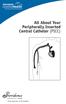 All About Your Peripherally Inserted Central Catheter (PICC) General Information Intravenous (IV) therapy is the delivery of fluid directly into a vein. An intravenous catheter is a hollow tube that is
Guy s, King s and St Thomas Cancer Centre The Cancer Outpatient Clinic Central venous catheter: Peripherally inserted central catheter
 Guy s, King s and St Thomas Cancer Centre The Cancer Outpatient Clinic Central venous catheter: Peripherally inserted central catheter This information leaflet aims to help answer some of the questions
PICCs and Midline Catheters
 Patient Education PICCs and Midline Catheters Patient s guide to PICC (peripherally inserted central catheter) and midline catheters What are PICCs and midline catheters used for? Any medicine given over
Intermittent Self Catheterisation
 Urology Intermittent Self Catheterisation (ISC) patientinformation Rotherham Hospital Your health, your choice, our passion What is Intermittent Self Catheterisation (ISC)? Intermittent Self Catheterisation
Having a tension-free vaginal tape (TVT) operation for stress urinary incontinence
 Having a tension-free vaginal tape (TVT) operation for stress urinary incontinence This leaflet explains more about tension-free vaginal tape (TVT) including the benefits, risks and any alternatives, and
Intermittent Clean Catheterization for Women
 2014 Intermittent Clean Catheterization for Women Intermittent Clean Catheterization for Women What is intermittent catheterization? Intermittent catheterization is a way to drain urine (pee) from your
NHS Professionals. CG8 Guidelines for Continence and Catheter Care. Introduction
 NHS Professionals CG8 Guidelines for Continence and Catheter Care Introduction Continence has been defined as control of bladder and bowel function and continence care is the name given to the total care
Trans Urethral Resection of the Prostate (TURP) Trans Urethral Incision of the Prostate (TUIP) Department of Urology
 Trans Urethral Resection of the Prostate (TURP) Trans Urethral Incision of the Prostate (TUIP) Department of Urology Where is the Prostate Gland? The prostate gland sits below the bladder which lies behind
CLINICAL GUIDELINES Urinary Catheterisation Guidelines
 Reference Date approved Approving Body CLINICAL GUIDELINES Urinary Catheterisation Guidelines Matron s Forum Supporting Policy/ Working in Male Urethral Catheterisation New Ways (WINW) Package Implementation
Policies & Procedures. Care of
 Policies & Procedures Title: SUPRAPUBIC CATHETER Care of Changing Removal Authorization: [x] SHR Nursing Practice Committee I.D. Number: 1021 Source: Nursing Date Revised: November 2014 Date Effective:
Have a shower, rather than a bath to avoid exposing your genitals to the chemicals in your cleaning products for too long. Always empty your bladder
 Cystitis, Avenue Medical Practice Neat Guideline Introduction Cystitis means 'inflammation of the bladder'. It causes: an urgent and frequent need to urinate, and Pain, or stinging, when passing urine.
Bladder Health Promotion
 Bladder Health Promotion Community Awareness Presentation endorsed by the Society of Urologic Nurses (SUNA) National Association for Continence( NAFC) Simon Foundation for Continence This presentation
4. Infection control measures
 4. Infection control measures Apart from general hygienic practices and vaccination, staff of institutions should also adopt specific infection control measures against communicable diseases. The measures
Urinary Catheter Policy for Community Health Services, Inpatient Facilities and Primary Care
 1 Urinary Catheter Policy for Community Health Services, Inpatient Facilities and Primary Care The document describes the processes and procedures for insertion and management of urinary catheters for
SAMPLE Policy and Procedure Insertion, Removal and Care of an Indwelling Foley Catheter
 SAMPLE Policy and Procedure Insertion, Removal and Care of an Indwelling Foley Catheter Approved by: Policy and Procedure Committee Effective: x/xx Revised: x/xx Description: This policy provides the procedure
Care of a Foley Catheter
 Care of a Foley Catheter A Foley catheter is a tube that is put into the bladder to drain urine out of the body. A Foley catheter can stay in the bladder for hours or weeks. Having the catheter put in