
The Wage Return to Education: What Hides Behind the Least Squares Bias?
|
|
|
- Alberta Harvey
- 9 years ago
- Views:
Transcription
1 DISCUSSION PAPER SERIES IZA DP No The Wage Return to Education: What Hides Behind the Least Squares Bias? Corrado Andini February 2015 Forschungsinstitut zur Zukunft der Arbeit Institute for the Study of Labor
2 The Wage Return to Education: What Hides Behind the Least Squares Bias? Corrado Andini Universidade da Madeira, CEEAplA and IZA Discussion Paper No February 2015 IZA P.O. Box Bonn Germany Phone: Fax: Any opinions expressed here are those of the author(s) and not those of IZA. Research published in this series may include views on policy, but the institute itself takes no institutional policy positions. The IZA research network is committed to the IZA Guiding Principles of Research Integrity. The Institute for the Study of Labor (IZA) in Bonn is a local and virtual international research center and a place of communication between science, politics and business. IZA is an independent nonprofit organization supported by Deutsche Post Foundation. The center is associated with the University of Bonn and offers a stimulating research environment through its international network, workshops and conferences, data service, project support, research visits and doctoral program. IZA engages in (i) original and internationally competitive research in all fields of labor economics, (ii) development of policy concepts, and (iii) dissemination of research results and concepts to the interested public. IZA Discussion Papers often represent preliminary work and are circulated to encourage discussion. Citation of such a paper should account for its provisional character. A revised version may be available directly from the author.

3 IZA Discussion Paper No February 2015 ABSTRACT The Wage Return to Education: What Hides Behind the Least Squares Bias? * This paper combines the approach by Guimarães and Portugal (2010) with the methodology of Gelbach (2015) to investigate the determinants of the least squares bias of the wage return to education. We find that disregarding individual fixed effects is highly problematic, accounting for 95% of the bias. In contrast, disregarding firm fixed effects has marginal consequences. JEL Classification: I21, J31 Keywords: wages, education, least squares Corresponding author: Corrado Andini Universidade da Madeira Campus da Penteada Funchal Portugal [email protected] * The views expressed in this paper are those of the author and do not necessarily reflect those of the institutions he is affiliated with. Part of this paper has been written while the author was visiting the Banco de Portugal.

4 1. Introduction Individuals invest a lot of resources in education. The latter is seen to have positive effects on human development. However, the estimation of the magnitude of these effects is surrounded by technical difficulties. Though economists started to be interested in the link between individual wages and schooling a long time ago, the first agent-based models only appeared in the 1960s and 1970s. After the seminal contributions by Becker (1964), Ben-Porath (1967) and Mincer (1974), a lot of progress has been made. Nevertheless, a number of questions remain open. One of these, perhaps not the most important but for sure the most studied, is about the magnitude of the wage return to schooling. The vast literature on schooling returns has stressed that the least squares estimation of the wage return to education is, in general, biased. This point was originally made by Griliches (1977) who discussed the existence of two types of biases. The first, known as the "ability bias", is due to the correlation between individual unobserved ability and schooling. The second, known as the "attenuation bias", is due to measurement errors in the schooling variable. In general, the least squares estimator of the schooling coefficient is biased if an omitted variable in the wage-schooling model is correlated with schooling. Besides the case of individual unobserved heterogeneity, which is often discussed by researchers, other factors may play a role. An example is firm unobserved heterogeneity: employers with higher unobserved managerial skills may provide incentives for their high-school workers to complete college education. The most straightforward way to solve the omitted-variable problem is to estimate a wage-schooling model without omitted variables. In many cases, this approach is not feasible due to data constraints. In this paper, we take advantage of a rich matched employer-employee dataset, known as Quadros de Pessoal (QP). We work with over 24 million observations ( ), tracking the whole private-sector population of Portuguese wage earners and related employers from 2002 to Thus, inference is unlikely to be an issue here. In particular, using the QP dataset and the approach proposed by Guimarães and Portugal (2010), we are able to estimate two high-dimensional vectors of fixed effects, one for employees and one for employers, in a wage-schooling model which also controls for observed individual and firm characteristics as well as year fixed effects. Then, using the methodology proposed by Gelbach (2015), we look at the difference between the schooling coefficient in a restricted model - where wages are explained by education attainment only - and the schooling coefficient in an unrestricted model. We decompose the difference into four groups of determinants: observed covariates, year fixed effects, individual fixed effects, and firm fixed effects. 1

5 The paper focuses on the wage return to graduate education in Portugal, but our methodology can be applied to other levels of education attainment and other countries. 2. Data QP data are gathered annually by the Portuguese Ministry of Employment. All firms with wage earners are required to complete the survey. The mandatory nature of the survey implies extremely high rates of response. Public-sector employees and household workers are excluded from coverage. The data refer to the firm situation during a reference week in October. Workers on short-term leave (sickness, vacation, strikes, and maternity leave) and those on leave for compulsory military service are also reported. The data include both firm characteristics (such as location, industry, employment, sales, ownership, capital) and worker characteristics (such as gender, age, occupation, schooling, date of hire, hours of work, and earnings). Schooling data report the highest completed level of education, which we have divided in five broad categories: first cycle (4 years) or less; second cycle (6 years); third cycle (9 years); high school (12 years); graduate (bachelor degree or more). Descriptive statistics are provided in Table Empirical strategy To apply the Gelbach (2015) methodology, we define two models: the restricted model and an unrestricted one. The restricted model is as follows: (1) =+ + where is the logarithm of the gross hourly wage and is a variable equal to one if the individual employed in firm at time holds at least a bachelor degree (zero otherwise). If is uncorrelated with, then the least squares estimate of is unbiased. The unrestricted model is as follows: (2) = where is a matrix of observed covariates including both individual and firm characteristics (individual age, individual age squared, individual tenure, firm size, firm age, and firm capital), is a vector of year fixed effects accounting for the business 2

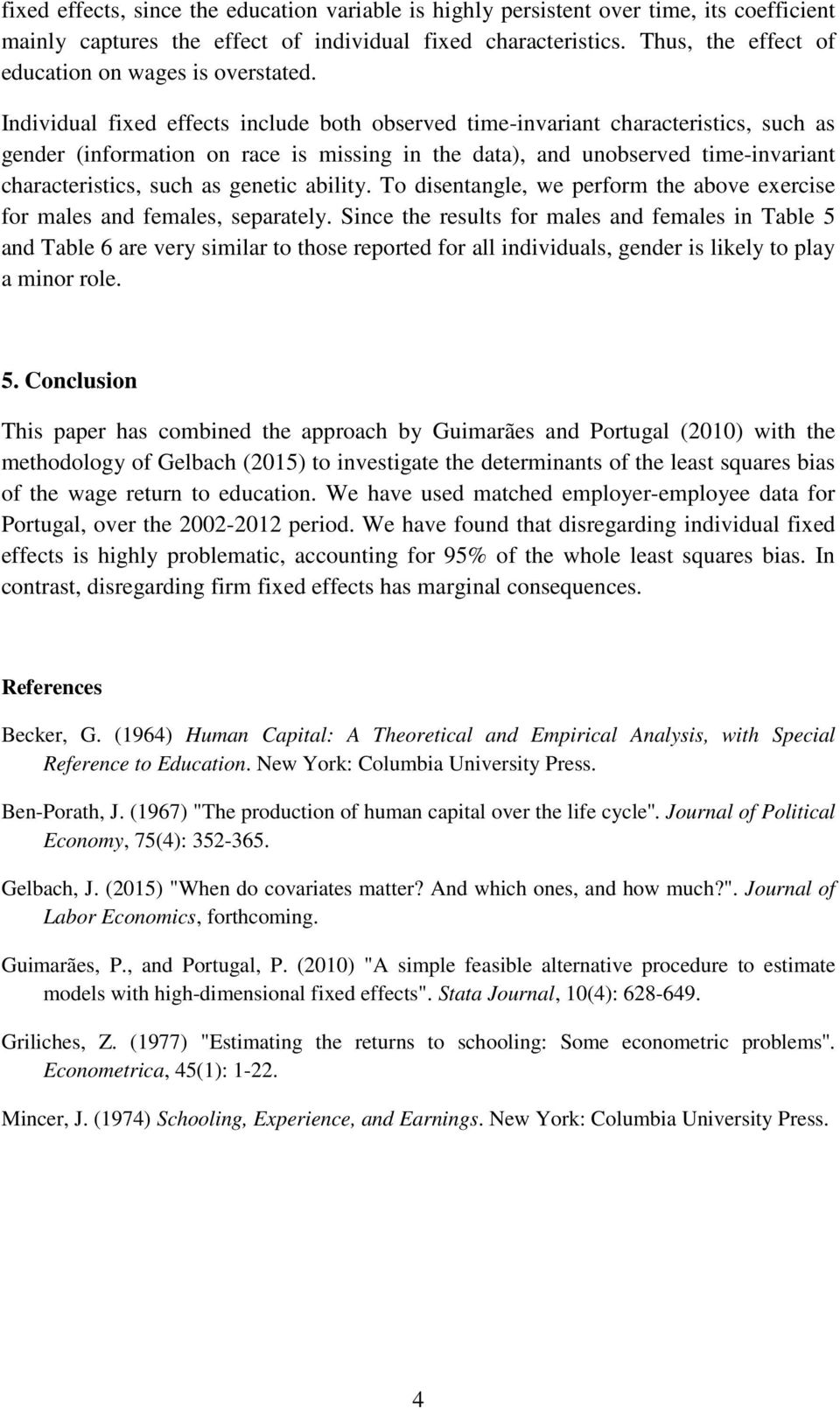
6 cycle, is a vector of estimated individual fixed effects, and is a vector of estimated firm fixed effects. The coefficients and are expected to be close to one. Both and are obtained by applying the estimation approach proposed by Guimarães and Portugal (2010) to a slightly modified version of model (2) where individual and firm fixed effects are vectors to be estimated rather than explanatory variables. The education variable is time-varying, allowing us to estimate both the coefficient and the individual fixed-effect vector, even when the latter is correlated with education. If model (2) holds, then is correlated with, and the least squares estimate of in model (1) is biased. To the best of our knowledge, we are the first to estimate to what extent this bias is due to missing observed covariates, missing year effects, missing individual effects, and missing firm effects. This is the key contribution of this paper. 4. Results The least squares estimates for model (1) and model (2) are provided in Table 2 and Table 3. The unrestricted model (2) explains 99.82% of the wage variability. The baseline group ( =0) is formed by individuals with secondary, primary and no education at all. Thus, the estimate of in the restricted model tends to be larger than in the case where only high-school workers are used as baseline 1. Obviously, the choice of the baseline group is not the key point of this paper. The same holds for the choice of the group of interest (the chosen group is quite heterogeneous, including even individuals with a doctoral degree). The coefficient of graduate education in the restricted model is The coefficient of graduate education in the unrestricted model is This means that, controlling for all the covariates in (2), the causal effect of graduate education on hourly wages is 10.5%. The difference between the two estimates is equal to The Gelbach decomposition in Table 4 suggests that the difference The value is due to the observed covariates. The value is due to the year fixed effects. The value is due to individual fixed effects and the value is due to firm fixed effects. The difference (0.709) is the sum of a large upward bias ( ) and a small downward bias ( 0.030). The whole bias in absolute value is Disregarding our observed covariates implies a small downward bias. Disregarding individual fixed effects explains 95% of the whole bias in absolute value and 99% of the upward bias. Intuitively, when a wage-schooling model does not control for individual 1 See the online appendix at 3

7 fixed effects, since the education variable is highly persistent over time, its coefficient mainly captures the effect of individual fixed characteristics. Thus, the effect of education on wages is overstated. Individual fixed effects include both observed time-invariant characteristics, such as gender (information on race is missing in the data), and unobserved time-invariant characteristics, such as genetic ability. To disentangle, we perform the above exercise for males and females, separately. Since the results for males and females in Table 5 and Table 6 are very similar to those reported for all individuals, gender is likely to play a minor role. 5. Conclusion This paper has combined the approach by Guimarães and Portugal (2010) with the methodology of Gelbach (2015) to investigate the determinants of the least squares bias of the wage return to education. We have used matched employer-employee data for Portugal, over the period. We have found that disregarding individual fixed effects is highly problematic, accounting for 95% of the whole least squares bias. In contrast, disregarding firm fixed effects has marginal consequences. References Becker, G. (1964) Human Capital: A Theoretical and Empirical Analysis, with Special Reference to Education. New York: Columbia University Press. Ben-Porath, J. (1967) "The production of human capital over the life cycle''. Journal of Political Economy, 75(4): Gelbach, J. (2015) "When do covariates matter? And which ones, and how much?". Journal of Labor Economics, forthcoming. Guimarães, P., and Portugal, P. (2010) "A simple feasible alternative procedure to estimate models with high-dimensional fixed effects". Stata Journal, 10(4): Griliches, Z. (1977) "Estimating the returns to schooling: Some econometric problems''. Econometrica, 45(1): Mincer, J. (1974) Schooling, Experience, and Earnings. New York: Columbia University Press. 4
8 Table 1. Descriptive statistics mean sd min max lnw age st cycle or less nd cycle rd cycle high school graduate female lntenure lnsize lnfage lncap Table 2. Restricted model, all individuals lnw Coef. Std. Err. z P>z [95% Conf. Interval] graduate cons Table 3. Unrestricted model, all individuals lnw Coef. Std. Err. z P>z [95% Conf. Interval] graduate age age e lntenure lnsize lnfage lncap indiv effects firm effects cons
![Restricted model, all individuals lnw Coef. Std. Err. z P>z [95% Conf. Interval] graduate.8145058.0030897 263.62 0.000.8084501.8205614 cons 1.267337.0010912 1161.40 0.000 1.265198 1.269475 Table 3.](/docs-images/47/20557993/images/page_8.jpg "Unrestricted model, all individuals lnw Coef. Std. Err. z P>z [95% Conf. Interval] graduate.1052288.0001581 665.48 0.000.1049189.1055387 age.044351.0000295 1503.82 0.000.0442932.0444088 age2 -.")
9 Table 4. Gelbach decomposition, all individuals Coef. Std. Err. z P>z [95% Conf. Interval] covariates year effects indiv effects firm effects difference Table 5. Gelbach decomposition, males Coef. Std. Err. z P>z [95% Conf. Interval] covariates year effects indiv effects firm effects difference Table 6. Gelbach decomposition, females Coef. Std. Err. z P>z [95% Conf. Interval] covariates year effects indiv effects firm effects difference
![Gelbach decomposition, males Coef. Std. Err. z P>z [95% Conf. Interval] covariates -.0002639.0026167-0.10 0.920 -.0053926.0048648 year effects.004272.0002456 17.40 0.000.0037907.0047532 indiv effects.](/docs-images/47/20557993/images/page_9.jpg "7664909.0041445 184.94 0.000.7583678.774614 firm effects.0020843.0004616 4.52 0.000.0011796.0029891 difference.7725833.0044141 175.03 0.000.7639319.7812347 Table 6.")
Revisiting Inter-Industry Wage Differentials and the Gender Wage Gap: An Identification Problem
 DISCUSSION PAPER SERIES IZA DP No. 2427 Revisiting Inter-Industry Wage Differentials and the Gender Wage Gap: An Identification Problem Myeong-Su Yun November 2006 Forschungsinstitut zur Zukunft der Arbeit
Is Temporary Agency Employment a Stepping Stone for Immigrants?
 D I S C U S S I O N P A P E R S E R I E S IZA DP No. 6405 Is Temporary Agency Employment a Stepping Stone for Immigrants? Elke Jahn Michael Rosholm March 2012 Forschungsinstitut zur Zukunft der Arbeit
Revealing Taste-Based Discrimination in Hiring: A Correspondence Testing Experiment with Geographic Variation
 D I S C U S S I O N P A P E R S E R I E S IZA DP No. 6153 Revealing Taste-Based Discrimination in Hiring: A Correspondence Testing Experiment with Geographic Variation Magnus Carlsson Dan-Olof Rooth November
Fixed Effects Bias in Panel Data Estimators
 DISCUSSION PAPER SERIES IZA DP No. 3487 Fixed Effects Bias in Panel Data Estimators Hielke Buddelmeyer Paul H. Jensen Umut Oguzoglu Elizabeth Webster May 2008 Forschungsinstitut zur Zukunft der Arbeit
Human Capital and Ethnic Self-Identification of Migrants
 DISCUSSION PAPER SERIES IZA DP No. 2300 Human Capital and Ethnic Self-Identification of Migrants Laura Zimmermann Liliya Gataullina Amelie Constant Klaus F. Zimmermann September 2006 Forschungsinstitut
Temporary Work as an Active Labor Market Policy: Evaluating an Innovative Program for Disadvantaged Youths
 D I S C U S S I O N P A P E R S E R I E S IZA DP No. 6670 Temporary Work as an Active Labor Market Policy: Evaluating an Innovative Program for Disadvantaged Youths Christoph Ehlert Jochen Kluve Sandra
Risk Aversion and Sorting into Public Sector Employment
 DISCUSSION PAPER SERIES IZA DP No. 3503 Risk Aversion and Sorting into Public Sector Employment Christian Pfeifer May 2008 Forschungsinstitut zur Zukunft der Arbeit Institute for the Study of Labor Risk
A Dynamic Mincer Equation with an Application to Portuguese Data
 DISCUSSION PAPER SERIES IZA DP No. 897 A Dynamic Mincer Equation with an Application to Portuguese Data Corrado Andini July 007 Forschungsinstitut zur Zukunft der Arbeit Institute for the Study of Labor
Working Paper Immigration and outsourcing: a general equilibrium analysis
 econstor www.econstor.eu Der Open-Access-Publikationsserver der ZBW Leibniz-Informationszentrum Wirtschaft The Open Access Publication Server of the ZBW Leibniz Information Centre for Economics Bandyopadhyay,
Leadership at School: Does the Gender of Siblings Matter?
 DISCUSSION PAPER SERIES IZA DP No. 6976 Leadership at School: Does the Gender of Siblings Matter? Giorgio Brunello Maria De Paola October 2012 Forschungsinstitut zur Zukunft der Arbeit Institute for the
Disability and Job Mismatches in the Australian Labour Market
 D I S C U S S I O N P A P E R S E R I E S IZA DP No. 6152 Disability and Job Mismatches in the Australian Labour Market Melanie Jones Kostas Mavromaras Peter Sloane Zhang Wei November 2011 Forschungsinstitut
Copayments in the German Health System: Does It Work?
 DISCUSSION PAPER SERIES IZA DP No. 2290 Copayments in the German Health System: Does It Work? Boris Augurzky Thomas K. Bauer Sandra Schaffner September 2006 Forschungsinstitut zur Zukunft der Arbeit Institute
Performance Related Pay and Labor Productivity
 DISCUSSION PAPER SERIES IZA DP No. 2211 Performance Related Pay and Labor Productivity Anne C. Gielen Marcel J.M. Kerkhofs Jan C. van Ours July 2006 Forschungsinstitut zur Zukunft der Arbeit Institute
ECON 142 SKETCH OF SOLUTIONS FOR APPLIED EXERCISE #2
 University of California, Berkeley Prof. Ken Chay Department of Economics Fall Semester, 005 ECON 14 SKETCH OF SOLUTIONS FOR APPLIED EXERCISE # Question 1: a. Below are the scatter plots of hourly wages
Better Sexy than Flexy? A Lab Experiment Assessing the Impact of Perceived Attractiveness and Personality Traits on Hiring Decisions
 DISCUSSION PAPER SERIES IZA DP No. 7847 Better Sexy than Flexy? A Lab Experiment Assessing the Impact of Perceived Attractiveness and Personality Traits on Hiring Decisions Stijn Baert Lynn Decuypere December
A Simple Feasible Alternative Procedure to Estimate Models with High-Dimensional Fixed Effects
 DISCUSSION PAPER SERIES IZA DP No. 3935 A Simple Feasible Alternative Procedure to Estimate Models with High-Dimensional Fixed Effects Paulo Guimarães Pedro Portugal January 2009 Forschungsinstitut zur
Australia: The Miracle Economy
 DISCUSSION PAPER SERIES IZA DP No. 7505 : The Miracle Economy P.N. (Raja) Junankar July 2013 Forschungsinstitut zur Zukunft der Arbeit Institute for the Study of Labor : The Miracle Economy P.N. (Raja)
The Life-Cycle Motive and Money Demand: Further Evidence. Abstract
 The Life-Cycle Motive and Money Demand: Further Evidence Jan Tin Commerce Department Abstract This study takes a closer look at the relationship between money demand and the life-cycle motive using panel
Life Satisfaction and Relative Income: Perceptions and Evidence
 DISCUSSION PAPER SERIES IZA DP No. 4390 Life Satisfaction and Relative Income: Perceptions and Evidence Guy Mayraz Gert G. Wagner Jürgen Schupp September 2009 Forschungsinstitut zur Zukunft der Arbeit
Lecture 15. Endogeneity & Instrumental Variable Estimation
 Lecture 15. Endogeneity & Instrumental Variable Estimation Saw that measurement error (on right hand side) means that OLS will be biased (biased toward zero) Potential solution to endogeneity instrumental
Paid and Unpaid Labor in Developing Countries: an inequalities in time use approach
 Paid and Unpaid Work inequalities 1 Paid and Unpaid Labor in Developing Countries: an inequalities in time use approach Paid and Unpaid Labor in Developing Countries: an inequalities in time use approach
Michigan Department of Community Health
 Michigan Department of Community Health January 2007 INTRODUCTION The Michigan Department of Community Health (MDCH) asked Public Sector Consultants Inc. (PSC) to conduct a survey of licensed dental hygienists
The Determinants of Performance Appraisal Systems: A Note (Do Brown and Heywood s Results for Australia Hold Up for Britain?)
 DISCUSSION PAPER SERIES IZA DP No. 3065 The Determinants of Performance Appraisal Systems: A Note (Do Brown and Heywood s Results for Australia Hold Up for Britain?) John T. Addison Clive R. Belfield September
The Elasticity of Labor Demand and the Optimal Minimum Wage
 DISCUSSION PAPER SERIES IZA DP No. 2360 The Elasticity of Labor Demand and the Optimal Minimum Wage Leif Danziger October 2006 Forschungsinstitut zur Zukunft der Arbeit Institute for the Study of Labor
Financial Risk Management Exam Sample Questions/Answers
 Financial Risk Management Exam Sample Questions/Answers Prepared by Daniel HERLEMONT 1 2 3 4 5 6 Chapter 3 Fundamentals of Statistics FRM-99, Question 4 Random walk assumes that returns from one time period
The Problem of Overskilling in Australia and Britain
 DISCUSSION PAPER SERIES IZA DP No. 3136 The Problem of Overskilling in Australia and Britain Kostas Mavromaras Seamus McGuinness Nigel O Leary Peter Sloane Yi King Fok November 2007 Forschungsinstitut
ORU Analyses of Immigrant Earnings in Australia, with International Comparisons
 DISCUSSION PAPER SERIES IZA DP No. 4422 ORU Analyses of Immigrant Earnings in Australia, with International Comparisons Barry R. Chiswick Paul W. Miller September 2009 Forschungsinstitut zur Zukunft der
Standard errors of marginal effects in the heteroskedastic probit model
 Standard errors of marginal effects in the heteroskedastic probit model Thomas Cornelißen Discussion Paper No. 320 August 2005 ISSN: 0949 9962 Abstract In non-linear regression models, such as the heteroskedastic
Social Work. Occupation Report CIP 44.0701
 Social Work Social Work Occupation Report CIP 44.0701 Pima, CIP 2010: A program that prepares individuals for the professional practice of social welfare administration and counseling, and that focus on
Why Do Self-Employed Immigrants in Denmark and Sweden Have Such Low Incomes?
 DISCUSSION PAPER SERIES IZA DP No. 1280 Why Do Self-Employed Immigrants in Denmark and Sweden Have Such Low Incomes? Pernilla Andersson Eskil Wadensjö August 2004 Forschungsinstitut zur Zukunft der Arbeit
Online Appendix. for. Female Leadership and Gender Equity: Evidence from Plant Closure
 Online Appendix for Female Leadership and Gender Equity: Evidence from Plant Closure Geoffrey Tate and Liu Yang In this appendix, we provide additional robustness checks to supplement the evidence in the
The Effect of Choice Options in Training Curricula on the Supply of and Demand for Apprenticeships
 DISCUSSION PAPER SERIES IZA DP No. 9697 The Effect of Choice Options in Training Curricula on the Supply of and Demand for Apprenticeships Anika Jansen Andries de Grip Ben Kriechel January 2016 Forschungsinstitut
Item Nonresponse in Wages: Testing for Biased Estimates in Wage Equations
 RUHR ECONOMIC PAPERS Michael Fertig Katja Görlitz Item Nonresponse in Wages: Testing for Biased Estimates in Wage Equations #333 Imprint Ruhr Economic Papers Published by Ruhr-Universität Bochum (RUB),
Wage Compensation for Risk: The Case of Turkey
 27 November, 2013 Motivation 1 Data According to recent estimates by the International Labor Organization, 6,300 people die each day from occupational accidents or work-related diseases, and the yearly
Self-Esteem and Earnings
 DISCUSSION PAPER SERIES IZA DP No. 3577 Self-Esteem and Earnings Francesco Drago June 2008 Forschungsinstitut zur Zukunft der Arbeit Institute for the Study of Labor Self-Esteem and Earnings Francesco
The performance of immigrants in the Norwegian labor market
 J Popul Econ (1998) 11:293 303 Springer-Verlag 1998 The performance of immigrants in the Norwegian labor market John E. Hayfron Department of Economics, University of Bergen, Fosswinckelsgt. 6, N-5007
Module 5: Multiple Regression Analysis
 Using Statistical Data Using to Make Statistical Decisions: Data Multiple to Make Regression Decisions Analysis Page 1 Module 5: Multiple Regression Analysis Tom Ilvento, University of Delaware, College
The existence of credential effects in Canadian nursing education; Quebec versus the rest of Canada
 タイトル 著 者 The existence of credential effec nursing education : Quebec versus Canada Lee, Heyung-Jik 引 用 北 海 商 科 大 学 論 集, 2(1): 1-9 発 行 日 2013-02 The existence of credential effects in Canadian nursing
PRELIMINARY DRAFT: PLEASE DO NOT QUOTE
 PRELIMINARY DRAFT: PLEASE DO NOT QUOTE An Analysis of the Differential Impacts of Overskilling by Educational Pathway: Is Vocational Education a Safer Route? Kostas Mavromaras 1,3 Seamus McGuinness 2 and
IMPACT EVALUATION: INSTRUMENTAL VARIABLE METHOD
 REPUBLIC OF SOUTH AFRICA GOVERNMENT-WIDE MONITORING & IMPACT EVALUATION SEMINAR IMPACT EVALUATION: INSTRUMENTAL VARIABLE METHOD SHAHID KHANDKER World Bank June 2006 ORGANIZED BY THE WORLD BANK AFRICA IMPACT
DETERMINANTS OF CAPITAL ADEQUACY RATIO IN SELECTED BOSNIAN BANKS
 DETERMINANTS OF CAPITAL ADEQUACY RATIO IN SELECTED BOSNIAN BANKS Nađa DRECA International University of Sarajevo [email protected] Abstract The analysis of a data set of observation for 10
Public Health Insurance Expansions for Parents and Enhancement Effects for Child Coverage
 Public Health Insurance Expansions for Parents and Enhancement Effects for Child Coverage Jason R. Davis, University of Wisconsin Stevens Point ABSTRACT In 1997, the federal government provided states
Do Migrants Get Good Jobs in Australia? The Role of Ethnic Networks in Job Search
 DISCUSSION PAPER SERIES IZA DP No. 3489 Do Migrants Get Good Jobs in Australia? The Role of Ethnic Networks in Job Search Stéphane Mahuteau P.N. (Raja) Junankar May 2008 Forschungsinstitut zur Zukunft
The Adoption and Diffusion of Organizational Innovation: Evidence for the U.S. Economy
 DISCUSSION PAPER SERIES IZA DP No. 2819 The Adoption and Diffusion of Organizational Innovation: Evidence for the U.S. Economy Lisa M. Lynch May 2007 Forschungsinstitut zur Zukunft der Arbeit Institute
The Production of PhDs in the United States and Canada
 DISCUSSION PAPER SERIES IZA DP No. 5367 The Production of PhDs in the United States and Canada Barry R. Chiswick Nicholas Larsen Paul Pieper December 2010 Forschungsinstitut zur Zukunft der Arbeit Institute
The Effects of Credit Status on College Attainment and College Completion
 DISCUSSION PAPER SERIES IZA DP No. 6719 The Effects of Credit Status on College Attainment and College Completion Dora Gicheva Felicia Ionescu Nicole Simpson July 2012 Forschungsinstitut zur Zukunft der
DOES MORE SCHOOLING CAUSE BETTER HEALTH?
 DOES MORE SCHOOLING CAUSE BETTER HEALTH? MEMORIAL LECTURE IN HONOR OF TADASHI YAMADA 2011 MEETING OF JAPAN HEALTH ECONOMICS ASSOCIATION MICHAEL GROSSMAN CITY UNIVERSITY OF NEW YORK GRADUATE CENTER AND
IAPRI Quantitative Analysis Capacity Building Series. Multiple regression analysis & interpreting results
 IAPRI Quantitative Analysis Capacity Building Series Multiple regression analysis & interpreting results How important is R-squared? R-squared Published in Agricultural Economics 0.45 Best article of the
Department of Economics Session 2012/2013. EC352 Econometric Methods. Solutions to Exercises from Week 10 + 0.0077 (0.052)
 Department of Economics Session 2012/2013 University of Essex Spring Term Dr Gordon Kemp EC352 Econometric Methods Solutions to Exercises from Week 10 1 Problem 13.7 This exercise refers back to Equation
Does Science Discriminate against Women? Evidence from Academia, 1973 97. Donna K. Ginther. Working Paper 2001-02 February 2001. Working Paper Series
 Does Science Discriminate against Women? Evidence from Academia, 1973 97 Donna K. Ginther Working Paper 2001-02 February 2001 Working Paper Series Does Science Discriminate against Women? Evidence from
Regression Analysis of the Relationship between Income and Work Hours
 Regression Analysis of the Relationship between Income and Work Hours Sina Mehdikarimi Samuel Norris Charles Stalzer Georgia Institute of Technology Econometric Analysis (ECON 3161) Dr. Shatakshee Dhongde
From the help desk: Swamy s random-coefficients model
 The Stata Journal (2003) 3, Number 3, pp. 302 308 From the help desk: Swamy s random-coefficients model Brian P. Poi Stata Corporation Abstract. This article discusses the Swamy (1970) random-coefficients
Correlated Random Effects Panel Data Models
 INTRODUCTION AND LINEAR MODELS Correlated Random Effects Panel Data Models IZA Summer School in Labor Economics May 13-19, 2013 Jeffrey M. Wooldridge Michigan State University 1. Introduction 2. The Linear
Working Paper Identifying regional labor demand shocks using sign restrictions
 econstor www.econstor.eu Der Open-Access-Publikationsserver der ZBW Leibniz-Informationszentrum Wirtschaft The Open Access Publication Server of the ZBW Leibniz Information Centre for Economics Juessen,
FAIR TRADE IN INSURANCE INDUSTRY: PREMIUM DETERMINATION OF TAIWAN AUTOMOBILE INSURANCE. Emilio Venezian Venezian Associate, Taiwan
 FAIR TRADE IN INSURANCE INDUSTRY: PREMIUM DETERMINATION OF TAIWAN AUTOMOBILE INSURANCE Emilio Venezian Venezian Associate, Taiwan Chu-Shiu Li Department of Economics, Feng Chia University, Taiwan 100 Wen
MISSING DATA TECHNIQUES WITH SAS. IDRE Statistical Consulting Group
 MISSING DATA TECHNIQUES WITH SAS IDRE Statistical Consulting Group ROAD MAP FOR TODAY To discuss: 1. Commonly used techniques for handling missing data, focusing on multiple imputation 2. Issues that could
How To Calculate Export Earnings
 Do Jobs In Export Industries Still Pay More? And Why? by David Riker Office of Competition and Economic Analysis July 2010 Manufacturing and Services Economics Briefs are produced by the Office of Competition
How To Study Health Insurance Coverage By Race And Ethnicity
 DISCUSSION PAPER SERIES IZA DP No. 3708 Race, Ethnicity and the Dynamics of Health Insurance Coverage Robert W. Fairlie Rebecca A. London September 2008 Forschungsinstitut zur Zukunft der Arbeit Institute