
Human Capital and Ethnic Self-Identification of Migrants
|
|
|
- Gyles Stafford
- 10 years ago
- Views:
Transcription
1 DISCUSSION PAPER SERIES IZA DP No Human Capital and Ethnic Self-Identification of Migrants Laura Zimmermann Liliya Gataullina Amelie Constant Klaus F. Zimmermann September 2006 Forschungsinstitut zur Zukunft der Arbeit Institute for the Study of Labor

2 Human Capital and Ethnic Self-Identification of Migrants Laura Zimmermann University of Oxford and IZA Bonn Liliya Gataullina IZA Bonn Amelie Constant IZA Bonn, Georgetown University and DIW Berlin Klaus F. Zimmermann IZA Bonn, University of Bonn, DIW Berlin and Free University of Berlin Discussion Paper No September 2006 IZA P.O. Box Bonn Germany Phone: Fax: Any opinions expressed here are those of the author(s) and not those of the institute. Research disseminated by IZA may include views on policy, but the institute itself takes no institutional policy positions. The Institute for the Study of Labor (IZA) in Bonn is a local and virtual international research center and a place of communication between science, politics and business. IZA is an independent nonprofit company supported by Deutsche Post World Net. The center is associated with the University of Bonn and offers a stimulating research environment through its research networks, research support, and visitors and doctoral programs. IZA engages in (i) original and internationally competitive research in all fields of labor economics, (ii) development of policy concepts, and (iii) dissemination of research results and concepts to the interested public. IZA Discussion Papers often represent preliminary work and are circulated to encourage discussion. Citation of such a paper should account for its provisional character. A revised version may be available directly from the author.

3 IZA Discussion Paper No September 2006 ABSTRACT Human Capital and Ethnic Self-Identification of Migrants * The paper investigates the role of human capital for migrants' ethnic ties towards their home and host countries. Pre-migration characteristics dominate ethnic self-identification. Human capital acquired in the host country does not affect the attachment to the receiving country. JEL Classification: F22, J15, J16, J24, Z10 Keywords: ethnic self-identification, first-generation migrants, gender, ethnicity, human capital Corresponding author: Klaus F. Zimmermann IZA P.O. Box 7240 D Bonn Germany [email protected] * Financial support from Volkswagen Foundation for the IZA project on The Economics and Persistence of Migrant Ethnicity is gratefully acknowledged.

4 1. Introduction Globalisation today has brought an important challenge: ethnic identification. The rising size of migration and international terrorism has caused concerns about integration and safety. How and why do individuals identify with their own or new ethnic groups? The issue of ethnic self-identification, that is the question of how to label oneself as a member of a certain ethnic community, is especially difficult for international migrants who have to decide whether and how strongly to identify with their country of origin and their host country. Ethnic identity appears to be potentially endogenous, and its determinants are not properly understood. Economists have only recently begun to model and to empirically validate this important issue (Bodenhorn and Ruebeck, 2003; Chiswick, 2006; Constant et al., 2006; Duncan and Trejo, 2005). The economic framework suggests to model ethnicity in the context of home production (Becker, 1981), using human capital acquired in the home and host country as the key driving forces. This paper analyzes survey-based measures of ethnic self-identification with their countries of origin and their host country using German panel survey data. A range of explanatory variables including pre- and post-migration characteristics are examined. The analysis is conducted for males and females separately in order to shed light on possible gender differences of ethnic self-identification. Section 2 explains the data and statistical models. Section 3 presents the empirical results. Section 4 summarizes. 2. Data and models The annually conducted, nationally representative German Socio-economic Panel (GSOEP, SOEP group, 2003) is used. We follow Constant et al. (2006) and choose a 1
5 sample that contains only first-generation permanent migrants and takes 2001 as the base year of observation. The data set contains 606 female and 640 male long-term migrants and can be divided into the most important groups of Turks, ex- Yugoslavians, Italians, Greeks, Spaniards, and other ethnicities. Ethnic self-identification is measured by two direct survey questions: The first question asked the respondents to specify how German they feel. The answers were grouped into three categories, ranging between deep attachments to Germany (category 1), moderate attachment (category 2) and hardly any attachment at all (category 3). The second question in the survey asked for the respondents connections to their country of origin. The answers were again grouped into three categories, ranging between strong (category 1), moderate (category 2) and weak connections (category 3). In the spirit of the home production framework, we assume that these ethnic identities are formed using ethnic and human capital, religion and exposure to the home and receiving countries. To analyze these two variables econometrically, we apply ordered probit models for both dependent variables separated for men and women respectively and include a larger set of pre- and post-migration characteristics of individuals. Table 1 contains the list of explanatory variables: Pre-migration characteristics include age at entry, age at entry squared, and dummies for religion (with reference status: nonreligious), human capital from home (with reference category: no education at home), and ethnic origin (with reference group: Turkish). The post-migration characteristics are dummies capturing human capital acquired in Germany (with reference: some degree in Germany), large city, married, and children under 16 years, and the continuous variables years since migration and years since migration squared. 2
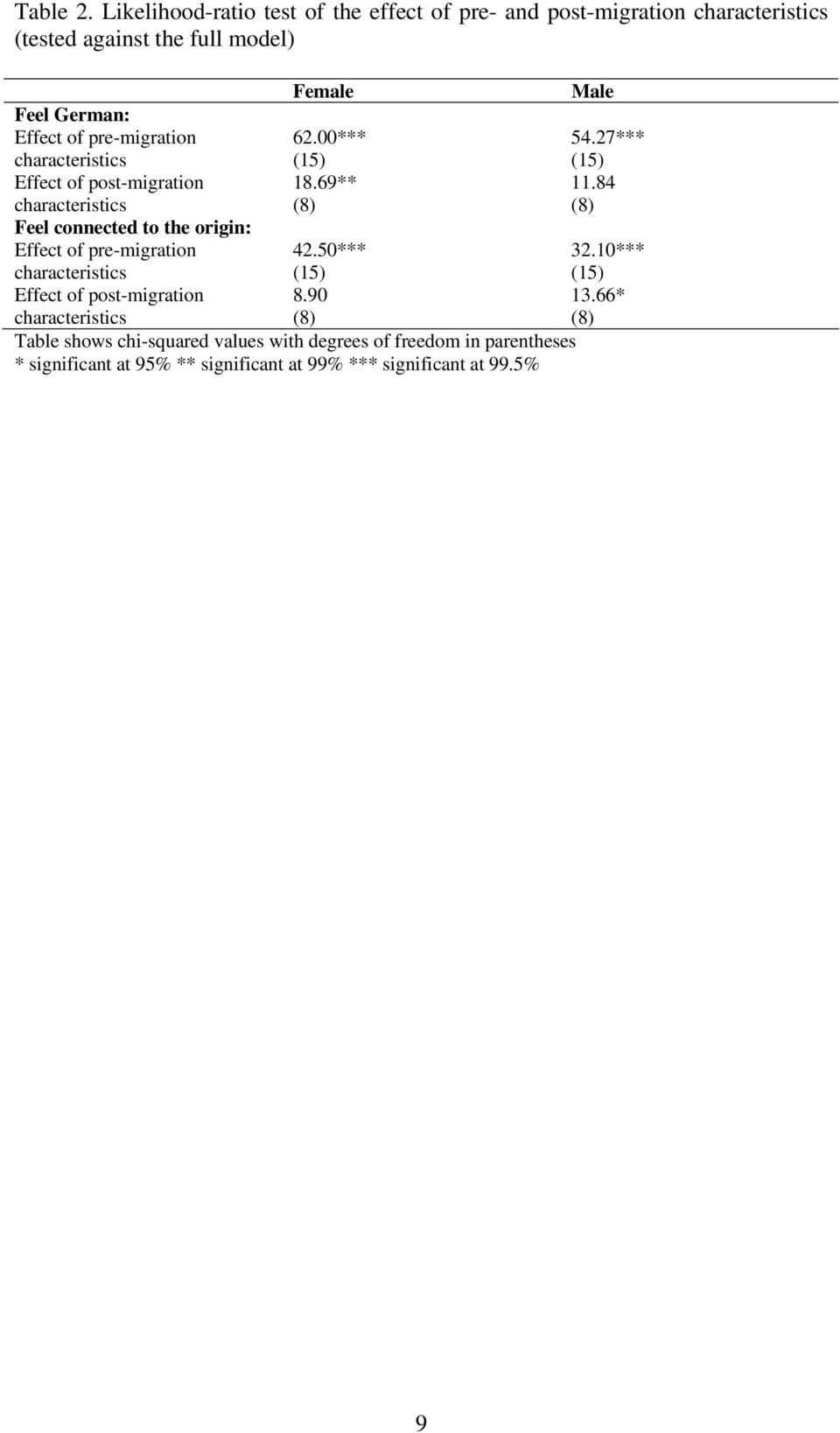
6 3. Empirical Results Most migrants had substantial educational exposure at home and in Germany: For instance, 37.3% of the males and 44.8% of the females had some schooling in the country of origin, and only 17.0% of the males and 22.1% of the females got no educational degree in Germany. This substantial variation in the measured human capital from the host and home countries allows us to examine well their effects on ethnic self-identification together with the other pre- and post-migration characteristics. The first two columns of Table 1 show the results for the determinants of how German migrant men and women feel. For males, the categories religion, education in the home country, and ethnicity are significant, which means that only pre-migration characteristics play a role in determining the migrants feelings for Germany. For females, the categories religion, education in the home country, ethnicity, years since migration, years since migration squared, and married, and therefore both pre- and post-migration characteristics are important. These findings are supported by the results of the corresponding likelihood-ratio tests as presented in Table 2: For both men and women, pre-migration characteristics are highly significant, whereas the impact of post-migration characteristics is insignificant for men but significant for women. Columns three and four of Table 1 contain the results for the determinants of how connected to their origin migrant men and women feel. For males, the categories education in the home country, ethnicity, large city, and married, and therefore both pre- and post-migration characteristics are important. For females, the categories age at entry, religion, ethnicity, and education in Germany, although only the variable no degree in Germany, play a role. Therefore, again pre- and post-migration 3

7 characteristics are important. In the corresponding likelihood-ratio tests in Table 2, the effect of pre-migration characteristics for both men and women is again highly significant, whereas the effect of post-migration characteristics is significant for men and insignificant for women. A positive value of an estimated effect parameter implies a reduced attachment to the underlying latent variable feeling German or connected to the origin. It is noteworthy that none of the educational categories in Germany has any effect on the attachment to Germany, and only no degree in Germany is associated with an increased attachment towards home among females. Education at home reduces the affiliation towards Germany, and strengthens male feelings for home. As a consequence, human capital acquired at home is neither a good predictor of integration nor, if acquired in the host country, a convincing instrument to foster it. That pre-migration characteristics play such an important role in determining how connected you feel to your country of origin seems rather surprising; one would expect a dominating effect of post-migration characteristics, that is of experiences made in the host country. Yet, post-migration characteristics hardly play a role in shaping people s attitudes. Males do not seem to adjust their feelings for the host country Germany after arrival, but change their feelings for their country of origin; females adjust their feelings for Germany but freeze their image of their country of origin after migration. 4. Summary and conclusions This paper provides an alternative empirical approach to the concept of ethnic selfidentification with acknowledging that the respective feelings for the host country and the country of origin need not be mutually exclusive but can be fluid and situational. 4
8 In testing a comprehensive range of explanatory variables, we find that pre-migration characteristics dominate the feelings of first-generation migrants towards ethnic selfidentification for both males and females, whereas post-migration characteristics have a very differing impact on men and women and the different parts of ethnic selfidentification. In general, however, post-migration characteristics never reach the importance of pre-migration characteristics. In particular, human capital acquired at home lead to lower identification with the host country for males and females, while males only have a higher affiliation with the original ethnicity. Education in the host country does not increase the likelihood of feeling closer to the natives. These surprising results have important repercussions on how host countries like Germany should conduct their integration policies: That living in the host country does not systematically change the ethnic self-identification of migrants can be either due to the relative unimportance of post-migration characteristics for the integration process, i.e. be due to the unwillingness of migrants to attach themselves to the host country; or it can be due to failing incentives and efforts of the host country, i.e. the unwillingness of the host country to integrate the migrants. The former would imply that successful integration is totally unrelated to any efforts made by the host country, and that host countries can only ensure integration by selecting those people willing to integrate based on their pre-migration characteristics. Measures to both better preselect migrants as well as to facilitate integration seem profitable. 5

9 References Becker, G. S., 1981, A Treatise on the Family, Harvard University Press: Cambridge, Mass. Bodenhorn, H. and C.S. Ruebeck, 2003, The Economics of Identity and the Endogeneity of Race, NBER Working Paper No Chiswick, C. U., 2006, The Economic Determinants of Ethnic Assimilation, IZA Discussion Paper No Constant, A., Gataullina, L., and K.F. Zimmermann, 2006, Ethnosizing Immigrants, IZA Discussion Paper No Duncan, B. and S. Trejo, 2005, Ethnic Identification, Intermarriage, and Unmeasured Progress by Mexican Americans, IZA Discussion Paper No SOEP Group, 2001, The German Socio-Economic Panel (GSOEP) After More Than 15 Years - Overview," in Holst, E., D.R. Lillard and T.A. DiPrete, eds., Proceedings of the 2000 Fourth International Conference of German Socio- Economic Panel Study Users (GSOEP2000), Vierteljahrshefte zur Wirtschaftsforschung (Quarterly Journal of Economic Research), 70, Veall, M.R. and K.F. Zimmermann, 1996, Pseudo-R 2 Measures for Some Common Limited Dependent Variable Models, Journal of Economic Surveys, 10,

10 Table 1. The effect of pre- and post-migration characteristics on ethnic selfidentification (ordered probit models) Feel German Feel connected to the origin Female Male Female Male Pre-migration characteristics Age at entry (1.14) Age at entry squared (-0.03) Muslim (0.66) Catholic * (-1.89) Other Christian (-0.94) Other religions (0.52) College in home 0.638* country Vocational training in home country Complete schooling in home country Incomplete schooling in home country (1.94) (0.93) (1.45) 0.637* (2.29) Ex-Yugoslavian (-1.22) Greek (-0.15) Italian 0.416* (2.18) Spanish (0.90) Other ethnicities (-1.11) (1.50) (-0.75) 0.386* (1.81) (-0.57) (0.29) 0.567* (1.85) 0.530* (1.81) (1.56) 0.500*** (2.78) (0.43) (-0.36) 0.495** (2.44) (1.14) 0.627** (2.36) * (-2.14) * (-1.69) (1.53) (-0.54) (0.35) (0.00) ** (-2.45) (-0.90) (-0.44) (-1.15) (-0.43) 0.303* (2.05) *** (-2.58) ** (2.56) (-1.03) (-0.78) (-0.81) (0.00) (1.35) (1.45) (1.59) (-0.07) (0.48) (-1.14) ** (-2.35) (0.06) (-0.81) * (-1.94) * (-2.18) * (-2.32) (1.04) Post-migration characteristics No degree in Germany (-1.03) Higher degree in Germany (-0.85) University degree in Germany (-1.50) Large city (1.55) Years since * migration (-1.88) Years since 0.001* migration squared (1.67) Married 0.330** (2.44) Children under (1.05) (1.37) (-0.31) (-0.36) (0.30) (0.14) (-0.81) (0.51) (0.33) * (-1.81) (-1.21) (0.00) (-1.24) (0.83) (-0.68) (-1.18) (-0.23) (-1.43) (0.85) (-0.88) * (-1.78) (-0.99) (0.92) * (-1.99) (0.35) 7

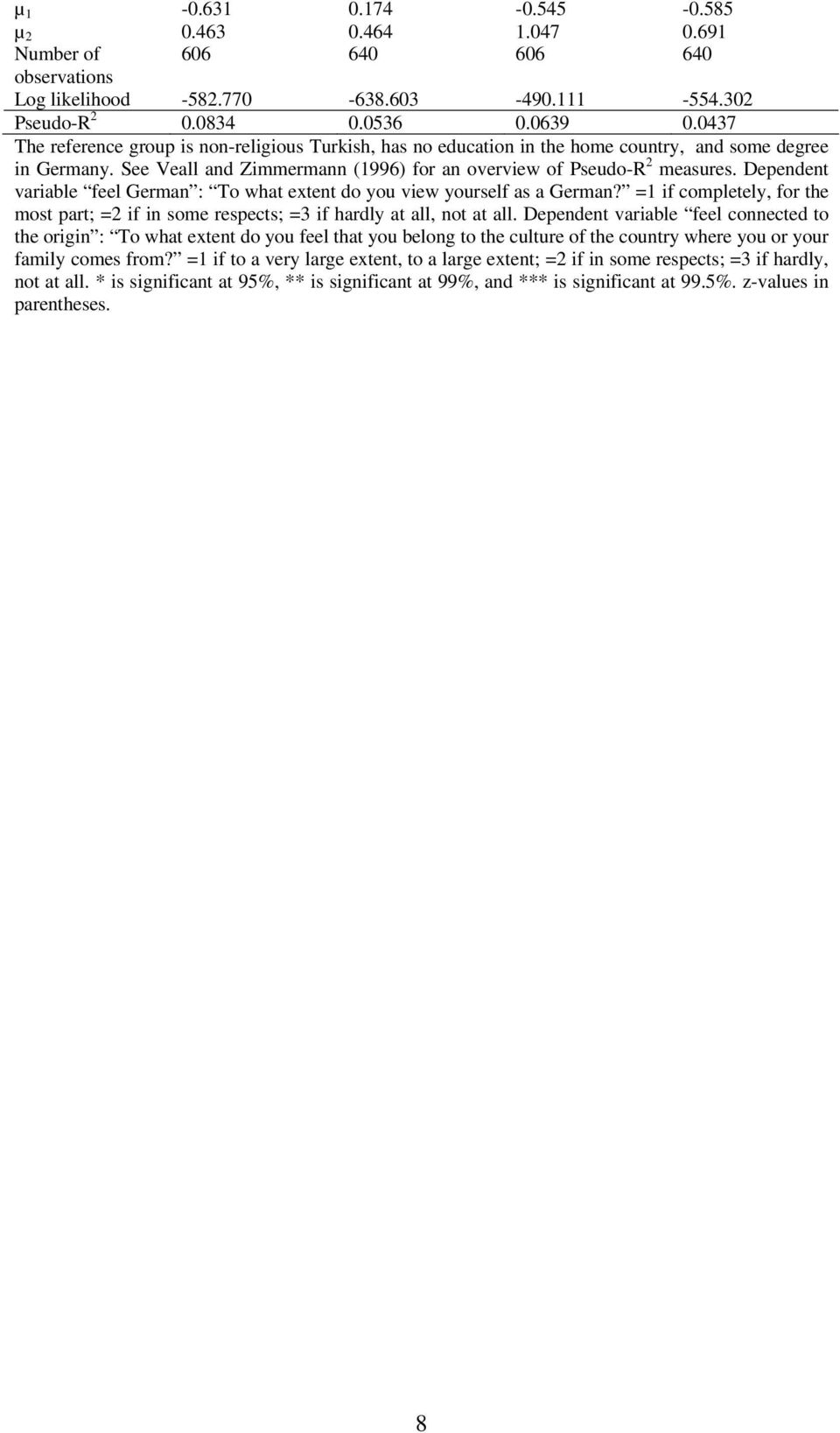
11 µ µ Number of observations Log likelihood Pseudo-R The reference group is non-religious Turkish, has no education in the home country, and some degree in Germany. See Veall and Zimmermann (1996) for an overview of Pseudo-R 2 measures. Dependent variable feel German : To what extent do you view yourself as a German? =1 if completely, for the most part; =2 if in some respects; =3 if hardly at all, not at all. Dependent variable feel connected to the origin : To what extent do you feel that you belong to the culture of the country where you or your family comes from? =1 if to a very large extent, to a large extent; =2 if in some respects; =3 if hardly, not at all. * is significant at 95%, ** is significant at 99%, and *** is significant at 99.5%. z-values in parentheses. 8
12 Table 2. Likelihood-ratio test of the effect of pre- and post-migration characteristics (tested against the full model) Feel German: Effect of pre-migration characteristics Effect of post-migration characteristics Feel connected to the origin: Effect of pre-migration characteristics Effect of post-migration Female 62.00*** (15) 18.69** (8) 42.50*** (15) 8.90 characteristics (8) Table shows chi-squared values with degrees of freedom in parentheses * significant at 95% ** significant at 99% *** significant at 99.5% Male 54.27*** (15) (8) 32.10*** (15) 13.66* (8) 9
Is Temporary Agency Employment a Stepping Stone for Immigrants?
 D I S C U S S I O N P A P E R S E R I E S IZA DP No. 6405 Is Temporary Agency Employment a Stepping Stone for Immigrants? Elke Jahn Michael Rosholm March 2012 Forschungsinstitut zur Zukunft der Arbeit
Revealing Taste-Based Discrimination in Hiring: A Correspondence Testing Experiment with Geographic Variation
 D I S C U S S I O N P A P E R S E R I E S IZA DP No. 6153 Revealing Taste-Based Discrimination in Hiring: A Correspondence Testing Experiment with Geographic Variation Magnus Carlsson Dan-Olof Rooth November
Revisiting Inter-Industry Wage Differentials and the Gender Wage Gap: An Identification Problem
 DISCUSSION PAPER SERIES IZA DP No. 2427 Revisiting Inter-Industry Wage Differentials and the Gender Wage Gap: An Identification Problem Myeong-Su Yun November 2006 Forschungsinstitut zur Zukunft der Arbeit
Temporary Work as an Active Labor Market Policy: Evaluating an Innovative Program for Disadvantaged Youths
 D I S C U S S I O N P A P E R S E R I E S IZA DP No. 6670 Temporary Work as an Active Labor Market Policy: Evaluating an Innovative Program for Disadvantaged Youths Christoph Ehlert Jochen Kluve Sandra
The Wage Return to Education: What Hides Behind the Least Squares Bias?
 DISCUSSION PAPER SERIES IZA DP No. 8855 The Wage Return to Education: What Hides Behind the Least Squares Bias? Corrado Andini February 2015 Forschungsinstitut zur Zukunft der Arbeit Institute for the
Risk Aversion and Sorting into Public Sector Employment
 DISCUSSION PAPER SERIES IZA DP No. 3503 Risk Aversion and Sorting into Public Sector Employment Christian Pfeifer May 2008 Forschungsinstitut zur Zukunft der Arbeit Institute for the Study of Labor Risk
Working Paper Immigration and outsourcing: a general equilibrium analysis
 econstor www.econstor.eu Der Open-Access-Publikationsserver der ZBW Leibniz-Informationszentrum Wirtschaft The Open Access Publication Server of the ZBW Leibniz Information Centre for Economics Bandyopadhyay,
Copayments in the German Health System: Does It Work?
 DISCUSSION PAPER SERIES IZA DP No. 2290 Copayments in the German Health System: Does It Work? Boris Augurzky Thomas K. Bauer Sandra Schaffner September 2006 Forschungsinstitut zur Zukunft der Arbeit Institute
Leadership at School: Does the Gender of Siblings Matter?
 DISCUSSION PAPER SERIES IZA DP No. 6976 Leadership at School: Does the Gender of Siblings Matter? Giorgio Brunello Maria De Paola October 2012 Forschungsinstitut zur Zukunft der Arbeit Institute for the
Immigrant fertility in West Germany: Socialization effect in transitions to second and third births?
 Immigrant fertility in West Germany: Socialization effect in transitions to second and third births? Nadja Milewski Institut national d études démographiques (INED), Paris Conference on Effects of Migration
Life Satisfaction and Relative Income: Perceptions and Evidence
 DISCUSSION PAPER SERIES IZA DP No. 4390 Life Satisfaction and Relative Income: Perceptions and Evidence Guy Mayraz Gert G. Wagner Jürgen Schupp September 2009 Forschungsinstitut zur Zukunft der Arbeit
Why Do Self-Employed Immigrants in Denmark and Sweden Have Such Low Incomes?
 DISCUSSION PAPER SERIES IZA DP No. 1280 Why Do Self-Employed Immigrants in Denmark and Sweden Have Such Low Incomes? Pernilla Andersson Eskil Wadensjö August 2004 Forschungsinstitut zur Zukunft der Arbeit
The performance of immigrants in the Norwegian labor market
 J Popul Econ (1998) 11:293 303 Springer-Verlag 1998 The performance of immigrants in the Norwegian labor market John E. Hayfron Department of Economics, University of Bergen, Fosswinckelsgt. 6, N-5007
Australia: The Miracle Economy
 DISCUSSION PAPER SERIES IZA DP No. 7505 : The Miracle Economy P.N. (Raja) Junankar July 2013 Forschungsinstitut zur Zukunft der Arbeit Institute for the Study of Labor : The Miracle Economy P.N. (Raja)
CULTURAL INTEGRATION IN EUROPE: THE ITALIAN CONTEXT. Alberto Bisin* and Eleonora Patacchini**
 CULTURAL INTEGRATION IN EUROPE: THE ITALIAN CONTEXT Alberto Bisin* and Eleonora Patacchini** Abstract We explore economic and cultural integration patterns for different immigrant groups in Italy, from
Performance Related Pay and Labor Productivity
 DISCUSSION PAPER SERIES IZA DP No. 2211 Performance Related Pay and Labor Productivity Anne C. Gielen Marcel J.M. Kerkhofs Jan C. van Ours July 2006 Forschungsinstitut zur Zukunft der Arbeit Institute
ALPASLAN AKAY June, 2015
 ALPASLAN AKAY June, 2015 Department of Economics, University of Gothenburg, Sweden Associate Professor PO Box 100, SE-405 30, Vasagatan 1, Gothenburg, Sweden Tell: +46 (0) 31 786 4022 and IZA (Germany)
Trust in Public Institutions over the Business Cycle
 DISCUSSION PAPER SERIES IZA DP No. 5570 Trust in Public Institutions over the Business Cycle Betsey Stevenson Justin Wolfers March 2011 Forschungsinstitut zur Zukunft der Arbeit Institute for the Study
Fixed Effects Bias in Panel Data Estimators
 DISCUSSION PAPER SERIES IZA DP No. 3487 Fixed Effects Bias in Panel Data Estimators Hielke Buddelmeyer Paul H. Jensen Umut Oguzoglu Elizabeth Webster May 2008 Forschungsinstitut zur Zukunft der Arbeit
The Problem of Overskilling in Australia and Britain
 DISCUSSION PAPER SERIES IZA DP No. 3136 The Problem of Overskilling in Australia and Britain Kostas Mavromaras Seamus McGuinness Nigel O Leary Peter Sloane Yi King Fok November 2007 Forschungsinstitut
Better Sexy than Flexy? A Lab Experiment Assessing the Impact of Perceived Attractiveness and Personality Traits on Hiring Decisions
 DISCUSSION PAPER SERIES IZA DP No. 7847 Better Sexy than Flexy? A Lab Experiment Assessing the Impact of Perceived Attractiveness and Personality Traits on Hiring Decisions Stijn Baert Lynn Decuypere December
Do Migrants Get Good Jobs in Australia? The Role of Ethnic Networks in Job Search
 DISCUSSION PAPER SERIES IZA DP No. 3489 Do Migrants Get Good Jobs in Australia? The Role of Ethnic Networks in Job Search Stéphane Mahuteau P.N. (Raja) Junankar May 2008 Forschungsinstitut zur Zukunft
Student Aid, Repayment Obligations and Enrolment into Higher Education in Germany Evidence from a Natural Experiment
 Student Aid, Repayment Obligations and Enrolment into Higher Education in Germany Evidence from a Natural Experiment Hans J. Baumgartner *) Viktor Steiner **) *) DIW Berlin **) Free University of Berlin,
The Determinants of Performance Appraisal Systems: A Note (Do Brown and Heywood s Results for Australia Hold Up for Britain?)
 DISCUSSION PAPER SERIES IZA DP No. 3065 The Determinants of Performance Appraisal Systems: A Note (Do Brown and Heywood s Results for Australia Hold Up for Britain?) John T. Addison Clive R. Belfield September
The Elasticity of Labor Demand and the Optimal Minimum Wage
 DISCUSSION PAPER SERIES IZA DP No. 2360 The Elasticity of Labor Demand and the Optimal Minimum Wage Leif Danziger October 2006 Forschungsinstitut zur Zukunft der Arbeit Institute for the Study of Labor
Disability and Job Mismatches in the Australian Labour Market
 D I S C U S S I O N P A P E R S E R I E S IZA DP No. 6152 Disability and Job Mismatches in the Australian Labour Market Melanie Jones Kostas Mavromaras Peter Sloane Zhang Wei November 2011 Forschungsinstitut
SOEPpapers on Multidisciplinary Panel Data Research
 Deutsches Institut für Wirtschaftsforschung www.diw.de SOEPpapers on Multidisciplinary Panel Data Research 111 Elke Holst Andrea Schäfer Mechthild Schrooten Gender, Migration, Remittances: Evidence from
Health Insurance Participation: The Role of Cognitive Ability and Risk Aversion
 Theoretical and Applied Economics Volume XVII (2010), No. 11(552), pp. 103-112 Health Insurance Participation: The Role of Cognitive Ability and Risk Aversion Swarn CHATTERJEE University of Georgia, Athens,
The Effect of Choice Options in Training Curricula on the Supply of and Demand for Apprenticeships
 DISCUSSION PAPER SERIES IZA DP No. 9697 The Effect of Choice Options in Training Curricula on the Supply of and Demand for Apprenticeships Anika Jansen Andries de Grip Ben Kriechel January 2016 Forschungsinstitut
The Production of PhDs in the United States and Canada
 DISCUSSION PAPER SERIES IZA DP No. 5367 The Production of PhDs in the United States and Canada Barry R. Chiswick Nicholas Larsen Paul Pieper December 2010 Forschungsinstitut zur Zukunft der Arbeit Institute
ORU Analyses of Immigrant Earnings in Australia, with International Comparisons
 DISCUSSION PAPER SERIES IZA DP No. 4422 ORU Analyses of Immigrant Earnings in Australia, with International Comparisons Barry R. Chiswick Paul W. Miller September 2009 Forschungsinstitut zur Zukunft der
Working Paper Identifying regional labor demand shocks using sign restrictions
 econstor www.econstor.eu Der Open-Access-Publikationsserver der ZBW Leibniz-Informationszentrum Wirtschaft The Open Access Publication Server of the ZBW Leibniz Information Centre for Economics Juessen,
Social Security Eligibility and the Labor Supply of Elderly Immigrants. George J. Borjas Harvard University and National Bureau of Economic Research
 Social Security Eligibility and the Labor Supply of Elderly Immigrants George J. Borjas Harvard University and National Bureau of Economic Research Updated for the 9th Annual Joint Conference of the Retirement
NBER WORKING PAPER SERIES WHY DO WOMEN LEAVE SCIENCE AND ENGINEERING? Jennifer Hunt. Working Paper 15853 http://www.nber.
 NBER WORKING PAPER SERIES WHY DO WOMEN LEAVE SCIENCE AND ENGINEERING? Jennifer Hunt Working Paper 15853 http://www.nber.org/papers/w15853 NATIONAL BUREAU OF ECONOMIC RESEARCH 1050 Massachusetts Avenue
Working Paper The income gap between natives and second generation immigrants in Sweden: is skill the explanation?
 econstor www.econstor.eu Der Open-Access-Publikationsserver der ZBW Leibniz-Informationszentrum Wirtschaft The Open Access Publication Server of the ZBW Leibniz Information Centre for Economics Nordin,
Health Impaired Employees Job Satisfaction: New Evidence from Athens, Greece
 D I S C U S S I O N P A P E R S E R I E S IZA DP No. 5849 Health Impaired Employees Job Satisfaction: New Evidence from Athens, Greece Nick Drydakis July 2011 Forschungsinstitut zur Zukunft der Arbeit
Gender Differences in Charitable Giving
 DISCUSSION PAPER SERIES IZA DP No. 3242 Gender Differences in Charitable Giving Greg Piper Sylke V. Schnepf December 2007 Forschungsinstitut zur Zukunft der Arbeit Institute for the Study of Labor Gender
Curriculum Vitae. PD Dr. Boris Hirsch
 Curriculum Vitae PD Dr. Boris Hirsch Address Home: Paniersplatz 35 D-90403 Nuremberg Phone: +49(0)911 / 99 44 079 Mobile: +49(0)179 / 100 22 63 E-Mail: [email protected] Office: Friedrich Alexander University
Policy Forum. Racial and Ethnic Health Disparities in Illinois: Are There Any Solutions?
 Policy Forum I N S T I T U T E O F G O V E R N M E N T&P U B L I C A F F A I R S I N S T I T U T E O F G O V E R N M E N T&P U B L I C A F F A I R S Racial and Ethnic Health Disparities in Illinois: Are
Item Nonresponse in Wages: Testing for Biased Estimates in Wage Equations
 RUHR ECONOMIC PAPERS Michael Fertig Katja Görlitz Item Nonresponse in Wages: Testing for Biased Estimates in Wage Equations #333 Imprint Ruhr Economic Papers Published by Ruhr-Universität Bochum (RUB),
STATISTICAL ANALYSIS OF UBC FACULTY SALARIES: INVESTIGATION OF
 STATISTICAL ANALYSIS OF UBC FACULTY SALARIES: INVESTIGATION OF DIFFERENCES DUE TO SEX OR VISIBLE MINORITY STATUS. Oxana Marmer and Walter Sudmant, UBC Planning and Institutional Research SUMMARY This paper
How To Choose Between A Married Immigrant And Non Immigrant Spouse
 European Sociological Review VOLUME 22 NUMBER 2 APRIL 2006 171 185 171 DOI:10.1093/esr/jci050, available online at www.esr.oxfordjournals.org Online publication 20 January 2006 Who Do Immigrants Marry?
How To Find Out How Different Groups Of People Are Different
 Determinants of Alcohol Abuse in a Psychiatric Population: A Two-Dimensionl Model John E. Overall The University of Texas Medical School at Houston A method for multidimensional scaling of group differences
Chapter II. Coverage and Type of Health Insurance
 Chapter II. Coverage and Type of Health Insurance Although various factors condition regular health service use, health service coverage is undoubtedly the main means of periodically accessing medical
Linguistic Distance: A Quantitative Measure of the Distance Between English and Other Languages
 DISCUSSION PAPER SERIES IZA DP No. 1246 Linguistic Distance: A Quantitative Measure of the Distance Between English and Other Languages Barry R. Chiswick Paul W. Miller August 2004 Forschungsinstitut zur
Russian migrants to Russia: assimilation and local labor market effects
 Lazareva IZA Journal of Migration (2015) 4:20 DOI 10.1186/s40176-015-0044-9 ORIGINAL ARTICLE Open Access Russian migrants to Russia: assimilation and local labor market effects Olga Lazareva Correspondence:
Firm-specific Training: Consequences for Job Mobility
 Firm-specific Training: Consequences for Job Mobility Josef Zweimüller University of Zürich, CEPR, London and IZA, Bonn and Rudolf Winter-Ebmer University of Linz, WIFO, Vienna, CEPR, London and IZA, Bonn
Performance Pay and Productivity: The Moderating Role of a High Wage Policy. Uwe Jirjahn. Research Papers in Economics No. 4/15
 Performance Pay and Productivity: The Moderating Role of a High Wage Policy Uwe Jirjahn Research Papers in Economics No. 4/15 Performance Pay and Productivity: The Moderating Role of a High-Wage Policy
The Effects of Social Security Taxes and Minimum Wages on Employment: Evidence from Turkey
 D I S C U S S I O N P A P E R S E R I E S IZA DP No. 6214 The Effects of Social Security Taxes and Minimum Wages on Employment: Evidence from Turkey Kerry L. Papps December 2011 Forschungsinstitut zur
Welfare and Social Insurance Participation by 1 Korean Immigrants to the United States *
 Volume 22, Number 2, December 1997 Welfare and Social Insurance Participation by 1 Korean Immigrants to the United States * Paul S. Davies **2 II This paper examines welfare and social insurance participation