
FHA Office of Single Family Housing. Energy Efficient Mortgage (EEM)
|
|
|
- Angela Hudson
- 9 years ago
- Views:
Transcription

1 Energy Efficient Mortgage (EEM) 1
2 Energy Efficient Mortgage (EEM) Program Allows the Mortgagee to offer financing for cost-effective, energy efficient improvements to an existing property at the time of purchase or refinancing, or for upgrades above the established residential building code for new construction. 2
3 EEM: Eligible Property Types EEM may be used with: New Construction properties (one- to four-units); Existing Construction properties (one- to four-units); Condominiums (one unit); or Manufactured Housing. 3
4 EEM: Eligible Programs and Transactions Types The EEM program can be used in conjunction with any mortgage insurance under Title II, including: 203(b); Purchase; or No cash-out refinance. 203(h) Mortgage Insurance for Disaster Victims; 203(k) (Standard and Limited [former Streamline]); and Weatherization Policy (Existing Construction only). 4
5 EEM: Energy Package The energy package is the set of improvements agreed to by the Borrower based on recommendations and analysis performed by the qualified home energy rater. The improvements can include: Materials, labor, inspections, and the home energy assessment by a qualified energy rater; If the Borrower desires, labor may include the cost of an EEM Facilitator (general contractor); and Borrower labor (Sweat Equity) is not permitted to be included in the loan amount. 5
6 EEM: EEM Facilitator (General Contractor) Who is a EEM Facilitator? They are project managers. What is an EEM Facilitator s responsibility? They: Arrange the inspections, obtain the required documents for Mortgagee, and on behalf of the Mortgagee; and Ensure that the improvements comply with recommendations Home Energy Report. 6
7 EEM: Cost-Effective Test Cost-Effective refers to the costs of the energy efficiency improvements including maintenance and repair, and is one where the cost of the improvements is less than the value of the energy saved over the estimated useful life of those improvements. 7
8 EEM: Cost-Effective Test Example Annual Savings: $164 Useful Life: 7 Years Total Savings Over Useful Life: $164 x 7 = $1,148 Water Heater Cost: $1,000 Maintenance and/or Repairs (within 7 Years): $100 Is it okay to finance this item? YES Savings over 7 years is greater than the cost of the item plus the cost of maintenance and/or repairs. $1,148 - $1,100 = $48 8
9 EEM: Cost Effective Test for New Construction For new construction any upgrades greater than existing code may not bare out any additional savings. A property classified as a energy efficient home must meet the requirements of the 2000 IECC standards. More information on this energy code can be obtained from the Department of Energy or the International Code Council. 9
10 EEM: Cost Effective Test for New Construction (cont.) The financed portion of an energy package includes only those cost-effective energy improvements over and above the greater of the following: The requirements of the 2006 International Energy Conservation Code (IECC); A successor energy code standard that has been adopted by HUD for its Minimum Property Standards (MPS), pursuant to 42 U.S.C ; or The applicable IECC year used by the state or local building code for New Construction. 10
11 EEM: Home Energy Report/Assessment The Borrower must obtain a home energy assessment. The purpose of the energy assessment under the EEM program is to identify opportunities for improving the energy efficiency of the home and their cost-effectiveness. The assessment must be conducted by a qualified energy rater, assessor, or auditor using whole-home assessment standards, protocols, and procedure. 11
12 EEM: Qualifications of Energy Raters/Assessors Qualified home energy rater/assessors must be trained and certified as one of the following and meet local and state jurisdictional requirements: Building Performance Institute Building Analyst Professional; Building Performance Institute Home Energy Professional Energy Auditor; or Residential Energy Services Network Home Energy Rater. 12
13 EEM: Home Energy Report The home energy report reflects recommendations of energysaving improvements for the Borrower s consideration. The estimates consider energy costs in today s dollars present value. The Mortgagee must use the energy-savings information from the home energy report to determine that the cost-effective test is met for the financed energy package. 13
14 EEM: Home Energy Report (cont.) The home energy report must reflect one of the professional credentials by the rater/assessor. The home energy report is submitted with the insuring file. Where applicable, qualified energy raters, assessors, or auditors must also meet local or state jurisdictional requirements for conducting residential energy audits or assessments, including training, certification, licensure, and insurance requirements. 14
15 EEM: Home Energy Report for New Construction On newly constructed housing, the home energy report must identify improvements that are over and above the greater of the following in order to apply the cost-effective test for new construction: The requirements of the 2006 IECC, or a successor energy code standard, that has been adopted by HUD for its MPS, pursuant to 42 U.S.C ; or The applicable IECC year used by the state or local building code for new construction. 15
16 EEM: Required Documentation The Mortgagee must obtain a copy of the home energy report: Must not be more than 120 days old. The Mortgagee must submit two forms HUD LT: FHA Loan Underwriting; and Transmittal Summary. 16
17 EEM: Maximum Financeable Energy Package The maximum amount of the energy package that can be added to the Base Loan Amount is the lesser of: The dollar amount of a cost-effective energy package as determined by the home energy audit; or The lesser of 5 percent of: The Adjusted Value; 115 percent of the median area price of a Single Family dwelling; or 150 percent of the national conforming mortgage limit. 17
18 EEM: Calculation of Cost-Effect Energy Package The Mortgagee must calculate the dollar amount of a cost-effective energy package as determined by the home energy audit, as shown in Energy Package. A tool was developed to provide assistance in the calculation of the Maximum Financeable Energy Package: EEM calculator. 18
19 EEM: Energy Efficient Mortgage Calculator Tool The EEM Calculator is located in FHA Connection (FHAC) will perform the calculation of Maximum Financeable Energy Package: Case processing screen. 19
20 EEM: Energy Efficient Mortgage Calculator Tool (cont.) For standard transactions: The EEM Calculator uses data entered for the mortgage to calculate the maximum energy package. For streamlined refinance: The EEM Calculator uses the appraised value from the initial transaction, contained within FHA Connection records, as the Adjusted Value. 20

21 EEM: Energy Efficient Mortgage Calculator Tool (cont.) 21
22 EEM: Energy Efficient Mortgage Calculator Tool (cont.) 22
23 EEM: Maximum Mortgage Amount for Existing Construction The maximum final Base Loan Amount is determined by adding: The maximum financeable energy package amount to the initial maximum Base Loan Amount. 23
24 EEM: Maximum Mortgage Amount for Existing Construction (cont.) Base Loan Amount + Energy Efficient Package = Subtotal + UFMIP = Total FHA Loan Amount May exceed the statutory mortgage limits for the area by the financed amount of Energy Package 24
25 EEM: Maximum Mortgage Amount For New Construction Determine Adjusted Value to calculate the Base Loan Amount: The cost of the financeable energy package included in the purchase contract must be subtracted from the sales price when computing the Adjusted Value. 25
26 EEM: Maximum Mortgage Amount for New Construction (cont.) The steps for calculating the maximum mortgage amount for new construction are: Determine the Adjusted value; Determine maximum financeable energy package using the EEM calculator in FHAC; and Determine the maximum FHA mortgage. 26
27 EEM: Maximum Mortgage Amount for New Construction (cont.) Step 1: Sales Price - Energy Package = Adjusted value for calculating the base loan amount 27
28 EEM: Maximum Mortgage Amount for New Construction (cont.) Step 2: Base Loan Amount + Maximum Financeable Energy Package Calculation Subtotal + UFMIP = Total FHA Loan Amount May exceed the statutory mortgage limits for the area by the financed amount of Energy Package 28
29 EEM: Maximum Mortgage Amount with 203(k) or Weatherization When utilizing an EEM in conjunction with a 203(k) or Weatherization: The items included in the maximum financeable energy package must be excluded from the items included when calculating the initial maximum Base Loan Amount under these programs. 29
30 EEM with 203(k) or Weatherization Calculation Step 1: + Maximum mortgage based on 203(k) or Weatherization Calculation - Energy Package = Base loan amount 30
31 EEM with 203(k) or Weatherization Calculation (cont.) Step 2: Base loan amount + Maximum Financeable Energy Package + UFMIP = Total FHA loan amount 31
32 EEM: Underwriting The Mortgagee must calculate the Borrower s debt ratios using the initial Base Loan Amount plus the portion of the Upfront Mortgage Insurance Premium (UFMIP) attributable to the initial Base Loan Amount. 32
33 EEM: TOTAL Mortgage Scorecard For purposes of submission to the Technology Open To Approved Lenders (TOTAL) Mortgage Scorecard: The Mortgagee must utilize the initial Base Loan Amount prior to the addition of the financeable energy package. 33
34 EEM: TOTAL Mortgage Scorecard (cont.) If the Mortgagee obtains an Accept or Approve on a mortgage application that does not include the financeable energy package: FHA will recognize the risk rating from TOTAL Mortgage Scorecard; and Permit the increase to the Mortgage Payment without re-underwriting or rescoring. 34
35 EEM: Underwriting Documentation For all EEM transactions, the Mortgagee must provide two HUD LT s regardless of how the mortgage was underwritten: Two for Total Mortgage Scorecard; or Two for Manual underwrite. Both must be provided in the case binder 35
36 EEM: TOTAL Mortgage Scorecard HUD LT #1 Without the financeable Energy Package Reflecting the Borrower s qualifying ratio s 36
37 EEM: TOTAL Mortgage Scorecard (cont.) HUD LT #2 Mortgage Amount with the financeable energy package as reflected in FHAC Certification from underwriter attesting that they have reviewed the calculations with the energy efficient improvements and the mortgage and property to be in compliance with FHA s underwriting instructions 37
38 EEM: Manual Underwriting HUD LT #1 Without the financeable Energy Package Reflecting the Borrower s qualifying ratios 38
39 EEM: Manual Underwriting (cont.) HUD LT #2 Mortgage Amount with the financeable energy package as reflected in FHAC Certification from underwriter attesting that they have reviewed the calculations with the energy efficient improvements and the mortgage and property to be in compliance with FHA s underwriting instructions 39
40 EEM: Appraisals For Existing and New Construction, the appraisal does not need to reflect the value of the energy package that will be added to the property. If the appraisal does include the value of the energy package, the value must be subtracted from the Property Value when computing the Adjusted Value. On the 203(k) program, the after-improved value is to be used for the EEM process. 40
41 EEM: Cash-Out The Borrower may not receive cash back from the mortgage transaction. If an excess exists, funds must be applied to the principal mortgage balance. 41
42 Energy Efficient Mortgage Escrows The Mortgagee must establish an escrow account for all energy package items not complete by the time of closing: For the remaining cost of the energy improvements in accordance with the Repair Completion Escrow Requirements; and If energy package is part of 203(k) escrowed funds must be included in the Rehabilitation Escrow Account. Repair Completion Escrow Requirements are located in HUD Handbook , Section 6. 42
43 Form HUD Mortgagee s Assurance of Completion When funds to complete the energy package are escrowed: The Mortgagee must execute Form HUD-92300, Mortgagee s Assurance of Completion; and Indicate that the escrow for the energy package improvements has been established. 43
44 Completion Requirements for Energy Efficient Mortgages (EEMs) With the exception of 203(k), the energy package is to be installed within 90 Days of the mortgage closing. If the work is not completed within 90 Days, the Mortgagee must apply the EEM funds to a prepayment of the mortgage principal. 44
45 Energy Efficient Homes (EEH): Stretch Ratios An energy efficient mortgage (EEM) is not the same as an energy efficient home (EEH). EEH is allowable for all loan products. All properties meeting the 2000 International Energy Conservation Code (IECC) are Energy Efficient Homes (EEH) and eligible for the two percentage point increase in the EEH qualifying ratios (stretch ratios). Stretch ratios are a stand alone policy for compensating factors. 45
46 Completion Inspection The Mortgagee, the rater, or an FHA fee inspector may inspect the installation of the improvements. An FHA fee inspector must be currently approved and currently on the roster. The Borrower may be charged an inspection fee 46
47 203(k) and Limited 203(k) Rehabilitation Loan Programs 47
48 Introduction The Section 203(k) program is the Department's primary program for the rehabilitation and repair of Single Family properties
49 Overview The Section 203(k) Rehabilitation Mortgage Insurance Program is used to: Rehabilitate an existing one- to four-unit Structure that will be used primarily for residential purposes; Rehabilitate such a Structure and refinance outstanding indebtedness on the Structure and the real property on which the Structure is located; or Purchase and rehabilitate a Structure and purchase the real property on which the Structure is located. Reference II A 8 a Qtr. 2 FY
50 Structure Structure refers to a building that has a roof and walls, stands permanently in one place, and contains single or multiple housing units that are used for human habitation. Reference II A 8 a Qtr. 2 FY
51 How is the 203(k) Program Different? Reference II A 8 a Qtr. 2 FY
52 How the Program Can Be Used? To purchase a dwelling and the land and rehabilitate it; To purchase a stick built home on one site, move it onto a new foundation, and rehabilitate it; To refinance existing liens secured against the subject property and rehabilitate; or To prepare a property to be placed on the market. Reference II A 8 a Qtr. 2 FY
53 Benefits of the 203(k) Buyers can purchase and make approved improvements after closing. Current owners can refinance, stay in their homes, and make approved changes after closing. Increases property value and builds equity. Combines the cost of the home and the renovation into one mortgage. Reference II A 8 a Qtr. 2 FY
54 Basic Eligibility Must meet standard FHA 203(b) credit qualifications. Must meet standard FHA 203(b) down payment requirements. Must pay Up-front and annual mortgage insurance premiums
55 203(k) Programs for Two Different Renovation Project Needs There are two types of 203(k) rehabilitation mortgages as described below: Standard 203(k); and Limited 203(k). The guidance per the Program and Product section is applicable to both the Standard 203(k) and Limited 203(k) mortgages, unless noted otherwise. Reference II A 8 a Qtr. 2 FY
56 203(k) Programs: Standard The Standard 203(k) mortgage is used for major renovation and repairs. There is a minimum repair cost of $5,000 and the use of a 203(k) Consultant is required. Reference II A 8 a Qtr. 2 FY
57 203(k) Programs: Limited The Limited 203(k) (formally known as the Streamlined (k)), may only be used for minor remodeling and non-structural repairs. The Limited 203(k) does not require the use of a 203(k) Consultant, but a Consultant may be used. The total rehabilitation cost must not exceed $35,000. There is no minimum rehabilitation cost. Reference II A 8 a Qtr. 2 FY
58 Borrower Eligibility 58 58
59 Borrower Eligibility The Borrower must meet the eligibility requirements found in the Borrower Eligibility section of HUD Handbook Non-occupant, co-borrowers are permitted. Reference II A 8 a Qtr. 2 FY
60 Nonprofit Borrower Eligibility For Nonprofit Borrowers, the Mortgagee must obtain a copy of the FHA approval letter from the Nonprofit. The Mortgagee must also verify that the Nonprofit is eligible to be a Borrower, as indicated on the U.S. Department of Housing and Urban Development (HUD) Nonprofit Agency Roster. Reference II A 8 a Qtr. 2 FY
61 Nonprofit Borrower Eligibility: Incomplete Projects A Nonprofit Borrower is prohibited from further borrowing under its FHA Mortgagor approval, if the Nonprofit Borrower has 10 or more incomplete 203(k) projects at any given time. Reference II A 8 a Qtr. 2 FY
62 Seven Unit Limitation A Nonprofit Borrower may not have an interest in more than seven dwelling units (FHA, VA, FmHA, conventional, or free and clear) in the same subdivision or contiguous area. HUD defines a contiguous area as "within a two block radius." A Nonprofit should not be allowed to accumulate FHA-insured properties that clearly and collectively constitute a multifamily project. Reference II A 8 a Qtr. 2 FY
63 Seven Unit Limitation (cont.) A Mortgagee may determine that units in a neighborhood are not subject to the dwelling unit limitation: The neighborhood has been targeted by a State or local government for redevelopment or revitalization; The State or local government has approved and submitted a plan to HUD describing the program of neighborhood redevelopment and revitalization; including the geographic area targeted for redevelopment, and the nature and proportion of public or private commitments that have been made in support of the redevelopment; Reference II A 8 a Qtr. 2 FY
64 Seven Unit Limitation (cont.) A Mortgagee may determine that units in a neighborhood are not subject to the dwelling unit limitation because: The Nonprofit agency Borrower will own no more than percent of the dwelling units (regardless of financing type) in the designated redevelopment area; and The Nonprofit agency Borrower will have no more than eight dwelling units on adjacent lots. Reference II A 8 a Qtr. 2 FY
65 Property Eligibility 65 65
66 Property Eligibility The property must be an existing property that has been completed for at least one year prior to the case number assignment date. Reference II A 8 a Qtr. 2 FY
67 Acceptable Property Types One- to four-unit Single Family Structures Condominiums Individual Condominium Unit Site Condominium Unit Manufactured Housing Mixed Use HUD Real Estate Owned (REO) Reference II A 8 a Qtr. 2 FY
68 Acceptable Property Types: One- to Four-Unit Single Family Structures One- to Four-Unit Single Family Dwelling Unit There are no differences between the 203(b) and 203(k). Reference II A 8 a Qtr. 2 FY
69 Acceptable Property Types: Condominium A Condominium Unit is a property contained in a multi-unit project that has individually-owned dwelling units that may be either attached to one or more Structures or detached from each other, and is primarily residential in use. Reference II A 8 a Qtr. 2 FY
70 Condominium Project Policy: Status As stated in the Origination/Underwriting Section: A Condominium Project must be FHA approved before a mortgage on an individual condominium unit can be insured. Currently, FHA s Condominium Project Approval requirements are in the formal rulemaking phase. This process must be completed before the guidance is published. Our existing Condominium Project Approval requirements, located in Mortgagee Letter , and the Condominium Project Approval and Processing Guide attached to Mortgagee Letter continue to be applicable
71 Condominium 203(k) Specific Policies An individual condominium Dwelling Unit, must meet the following requirements specific for the 203(k): The Dwelling Unit must be located in an FHA-approved Condominium Project and must comply with all other requirements for condominiums; Rehabilitation or improvements are limited to the interior of the Dwelling Unit, except for the installation of firewalls in the attic of the Dwelling Unit; Reference II A 8 a Qtr. 2 FY
72 Condominium 203(k) Specific Policies (cont.) An individual condominium Dwelling Unit, meeting the following requirements specific for the 203(k): No more than five Dwelling Units per condominium association, or 25 percent of the total number of units, whichever is less, can undergo rehabilitation at any time; After rehabilitation is complete, the Dwelling Unit is located in a Structure containing no more than four Dwelling Units; and LTV is limited to 100%. Reference II A 8 a Qtr. 2 FY
73 Acceptable Property Types: Townhouse Condominiums Townhouse Condominium Dwelling Unit: For townhouse-style condominiums, each townhouse is considered as one Structure, provided each unit is separated by a one and one-half hour firewall from foundation to roof. Reference II A 8 a Qtr. 2 FY
74 Acceptable Property Types: Site Condominiums Site Condominium Dwelling Unit: Refer to a project of Single Family, totally detached, dwellings encumbered by a declaration of condominium covenants or a condominium form of ownership. They have no shared garages or any other attached buildings. Reference II A 8 a Qtr. 2 FY
75 Acceptable Property Types: Manufactured Housing Manufactured Housing is a Structure that is transportable in one or more sections. Reference II A 8 a Qtr. 2 FY
76 Manufactured Housing 203(k) Specific Policies Manufactured Housing: The rehabilitation does not affect the structural components of the Structure that were designed and constructed in conformance with the Federal Manufactured Home Construction and Safety Standards and must comply with all other requirements for Manufactured Housing; FYI: Modular Homes are not manufactured homes. Reference II A 8 a Qtr. 2 FY
77 Acceptable Property Types: Mixed Use Mixed Use refers to a property suitable for a combination of uses including any of the following: commercial, residential, retail, office or parking space. Reference II A 8 a Qtr. 2 FY
78 Mixed Use 203(k) Specific Policies: Mixed Use property with one- to four-residential dwelling units, is acceptable provided: Fifty-one percent of gross building area is for residential use; and The commercial use will not affect the health and safety of the occupants of the residential property. Reference II A 8 a Qtr. 2 FY
79 Gross Building Area: Clarified Fifty-one percent of gross building area is for residential use. Gross Building Area (GBA) is the entire floor space of the building, as opposed to Gross Living Area. This includes unfinished and finished non-living areas, such as unfinished mechanical areas, laundry areas, entryways, stairs, unfinished storage, etc. This also includes any commercial space within the building. Reference II A 8 a Qtr. 2 FY
80 Acceptable Property Types: HUD Real Estate Owned (REO) The property is identified as eligible for 203(k) financing as evidenced in the sales contract or addendum. HUD REOs that are listed as uninsurable can only be an FHA loan as a 203(k). Good Neighbor Next Door and $100 Down Programs can be used with 203(k). Investor purchases of HUD REO properties are not eligible for 203(k) financing
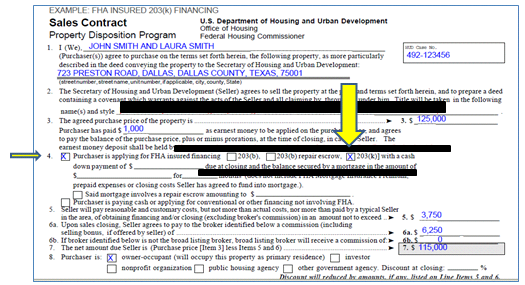
81 Sample HUD REO Sales Contract 81 81
82 Application Requirements 82 82
83 Purchase Contract and 203(k): Amendatory Clause FHA does not require the amendatory clause for any 203(k) transactions, regardless of the type of seller or purchaser. The Mortgagee must ensure that the sales contract includes a provision that the Borrower has applied for Section 203(k) financing, the contract is contingent upon mortgage approval, and the Borrower s acceptance of additional required improvements as determined by the Mortgagee
84 Form HUD A, 203(k) Borrower s Acknowledgement The Mortgagee must provide the Borrower with the Form HUD A, 203(k) Borrower s Acknowledgment at time of application
85 Identity of Interest Transactions: Family Members Sales transactions between Family Members are permitted. The Mortgagee must ensure there are not other instances of Identity of Interest or conflict of interest between parties in the 203(k) transaction. Reference II A 8 a Qtr. 2 FY
86 Identity of Interest Transactions: Family Members (cont.) II. TITLE II INSURED HOUSING PROGRAMS FORWARD MORTGAGES 2. Allowable Mortgage Parameters (3) Exceptions to the Maximum LTV The 85 percent maximum LTV restriction does not apply for Identity-of-Interest transactions under the following circumstances. (a) Family Member Transactions The 85 percent LTV restriction may be exceeded if a Borrower purchases as their Principal Residence: the Principal Residence of another Family Member; or a property owned by another Family Member in which the Borrower has been a tenant for at least six months immediately predating the sales contract. A lease or other written evidence to verify occupancy is required
87 Refinancing an Existing 203(k) A property with an existing 203(k) mortgage is not eligible to be refinanced until all repairs are completed and the case has been electronically closed out. Reference II A 8 a Qtr. 2 FY
88 Case Number Assignment Data Entry Requirements 88 88

89 Case Number Assignment Reference II A 8 a Qtr. 2 FY
90 ADP Codes for 203(k) Reference II A 8 a Qtr. 2 FY
91 Case Number Assignment Refinance Type for 203(k) For a refinance transaction, the Mortgagee must select Not Streamlined in the drop-down menu labeled All Refinances. Reference II A 8 a Qtr. 2 FY
92 Standard 203(k) Transactions 92 92
93 Standard 203(k) A Standard 203(k) has the following general requirements: A minimum of $5,000 in eligible improvements are required to qualify for the product. Fees and costs related to the renovation can be rolled into the loan amount. Standard FHA credit and cash investment requirements apply. Standard FHA property guidelines apply, unless otherwise stated in 203(k) policies. A 203(k) HUD approved Consultant is required. Reference II A 8 a Qtr. 2 FY
94 The Origination Process of a Standard 203(K) Borrower selects a property; Borrower selects a FHA approved lender; Mortgagee takes loan application; Mortgagee selects 203(K) Consultant; Consultant visits property with Borrower; Consultant prepares Work Write-up ; Borrower hires Contractor; Work write-up and bids are provided to the Mortgagee; Mortgagee processes, underwrites, closes, and funds the transaction; FHA insures the loan; and Improvement process to the property begins. Reference II A 8 a Qtr. 2 FY
95 Repair/Improvements Begin Contractor completes first phase of the project. Borrower contacts the 203(k) Consultant who inspects work completed at this point by the contractor for a draw request to be completed for release of funds. The Consultant and Borrower sign the draw request. Draw Request is submitted to the Mortgagee. Mortgagee disburses a check made payable to Borrower and Contractor. This process continues until the work is completed. Reference II A 8 a Qtr. 2 FY
96 Project Completion Final draw is requested. Borrower provides release letter indicating work is completed. Consultant verifies completion. Remaining Rehabilitation Escrow Account funds are released. Note: The project should be completed within 6 months Reference II A 8 a Qtr. 2 FY
97 Eligible Improvements Types of eligible improvements include, but are not limited to: Reconstructing a Structure that has been, or will be demolished, provided the complete existing foundation system is not affected and will still be used; Reference II A 8 a Qtr. 2 FY
98 Eligible Improvements (cont.) Types of eligible improvements include, but are not limited to: Repairing, reconstructing, or elevating an existing foundation where the Structure will not be demolished; Reference II A 8 a Qtr. 2 FY
99 Eligible Improvements (cont.) Types of eligible improvements include, but are not limited to: Installing or repairing wells and/or septic systems; Reference II A 8 a Qtr. 2 FY
100 Eligible Improvements (cont.) Types of eligible improvements include, but are not limited to: Repairing or removing an in-ground swimming pool; 100 Reference II A 8 a Qtr. 2 FY15 100
101 Eligible Improvements (cont.) Types of eligible improvements include, but are not limited to: Constructing a windstorm shelter. 101 Reference II A 8 a Qtr. 2 FY15 101
102 Improvement Standards All improvements to existing Structures must comply with HUD s MPR. All new construction must comply with HUD s MPS. For a newly constructed addition to the existing Structure, the energy improvements must meet or exceed local codes and the requirements of the 2006 International Energy Conservation Code (IECC) or a successor energy code standard that has been adopted by HUD for its MPS. 102 Reference II A 8 a Qtr. 2 FY15 102
103 Specific Improvement Standards Any addition of a Structure unit must be attached to the existing Structure. Site improvements, landscaping, patios, decks, and terraces must increase the Property Value equal to the dollar amount spent on the improvements or be necessary to preserve the property from erosion. 103 Reference II A 8 a Qtr. 2 FY15 103
104 Ineligible Improvements/Repairs The 203(k) mortgage proceeds may not be used to finance costs associated with the purchase or repair of any luxury item, any improvement that does not become a permanent part of the subject property, or improvements that solely benefit commercial functions within the property. 104 Reference II A 8 a Qtr. 2 FY15 104
105 Ineligible Improvements/Repairs Examples Examples of ineligible improvements are: Recreational or luxury improvements such as: Installing a swimming pool, hot tub, sauna Satellite dishes Additions or alterations to support commercial use or to equip or refurbish space for commercial use. 105 Reference II A 8 a Qtr. 2 FY15 105
106 Standard 203(k) Establishing Repairs and Improvements 106
107 Mortgagee Responsibility in Consultant Selection The Mortgagee must select an FHA-approved 203(k) Consultant from the FHA 203(k) Consultant Roster in FHAC. The Mortgagee must not use the services of a Consultant that has demonstrated previous poor performance based on reviews performed by the Mortgagee. 107 Reference II A 8 a Qtr. 2 FY15 107
108 Locations of 203(k) Consultant Information Origination through Post-Closing Endorsement 8. Programs and Products Section 203(k) Rehabilitation Mortgage Insurance Program 9. Section 203(k) Consultant Doing Business With FHA Other Participants in FHA Transactions (TBD) 108 Reference II A 8 a Qtr. 2 FY15 108
109 Consultant/Borrower Agreement The Consultant and Borrower must sign a written agreement that fully explains the services to be performed and the fees to be charged for each service. The written agreement must disclose to the Borrower that any inspection performed by the Consultant is not a Home Inspection as detailed in the disclosure Form HUD CN, For Your Protection: Get a Home Inspection. 109 Reference II A 8 a Qtr. 2 FY15 109
110 203(k) Consultant Fee Schedule: Work Write-Up Consultant may charge the fees listed for the preparation of the Work Write-Up and review of architectural exhibits. Mileage Fee at the current IRS mileage rate when the Consultant s place of business is more than 15 miles from the property. $25 per additional Dwelling Unit 110
111 203(k) Consultant Qualifications Must have a minimum of three years experience as a: Remodeling contractor; General contractor; or Home inspector. A state license as a state certified engineer or architect may be submitted in lieu of three years experience. 111 Reference II A 8 a Qtr. 2 FY15 111
112 203(k) Consultant Qualifications (cont.) In states where a Home Inspector is required to be licensed, the Department requires the Consultant to be licensed and provide proof of that licensing. Must have the proven ability to perform home inspections, prepare architectural drawings, use proper methods of cost estimating, and complete draw inspections. Must have a thorough knowledge on the 203(k) program, FHA s minimum property standards, and the state and local requirements for home improvements, additions, etc. 112 Reference II A 8 a Qtr. 2 FY15 112
113 Feasibility Study A 203(k) Consultant may be requested by the Borrower or the Mortgagee to determine if a project is financially feasible. The Consultant must perform a Feasibility Study that consists of a preliminary inspection of the property and an estimate of the materials and cost for the work that will be necessary to comply with HUD requirements. 113 Reference II A 8 a Qtr. 2 FY15 113
114 The Consultant Inspection The Consultant must inspect the property to ensure: There are no rodents, dry rot, termites, or other infestation on the property; There are no defects that will affect the health and safety of the occupants; There are adequate structural, heating, plumbing, electrical, and roofing systems; and There are upgrades to the Structure s thermal protection (as required). Note: A Consultant s Inspection is not a Home Inspection as detailed in the disclosure For Your Protection Get a Home Inspection. 114 Reference II A 8 a Qtr. 2 FY15 114
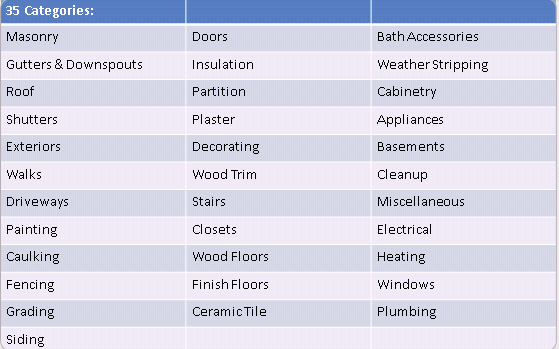
115 Consultant 35 Points Checklist 115 Reference II A 8 a Qtr. 2 FY15 115
116 Architectural Exhibits The Consultant is responsible for identifying all required architectural exhibits. The Consultant must prepare the exhibits, or, if not qualified to prepare all of the necessary exhibits, must obtain the exhibits from a qualified subcontractor. The Mortgagee must review all applicable architectural exhibits provided by the Consultant. 116 Reference II A 8 a Qtr. 2 FY15 116
117 Architectural Exhibits: Prepare, Obtain, and Review Architectural exhibits may include, but are not limited to, the following: Well certification and septic certifications; Termite report (including all outbuildings); Proposed plot plans for new additions; Foundation certification by a licensed structural engineer if: The existing Structure will be moved to a new foundation; The Structure is being reconstructed on the existing foundation; or The existing Structure will be elevated. Cabinetry plans and elevations; and New Construction exhibits to obtain a building permit for an addition. 117 Reference II A 8 a Qtr. 2 FY15 117
118 The Work Write-Up and Cost Estimate The Consultant must prepare an unbiased Work Write-Up and Cost Estimate without the use of the contractor s estimate. The Work Write-Up refers to the report prepared by a 203(k) Consultant that identifies each Work Item to be performed and the specifications for completion of the repair or improvement. Work Item refers to a specific repair or improvement that will be performed. 118 Reference II A 8 a Qtr. 2 FY15 118
119 The Work Write-Up The Work Write-Up must: Be prepared in a categorical manner that addresses each of the 35 point checklist items; Detail the work being performed per the project proposal, including architectural exhibits and certifications; Identify each Work Item; Identify each Work item to be performed by the Borrower; Indicate which Work Items require permits; Indicate if the Work Item is required to meet a MPS or MPR or is a Borrower elective Work Item; and Address all health and safety concerns and any appraiser requirements first before the addition of any Borrower elective Work Items. 119 Reference II A 8 a Qtr. 2 FY15 119
120 The Cost Estimate Cost Estimate refers to a breakdown of the cost for each proposed Work Item, prepared by a 203(k) Consultant. The Cost Estimate must separately identify labor costs and itemize the cost of materials per Work Item. Lump sum costs are permitted only in line items where a lump sum estimate is reasonable and customary. The Consultant must use Cost Estimates that are reasonable for the area in which the property is located. 120 Reference II A 8 a Qtr. 2 FY15 120
121 Borrowers Doing Own Work (Self-Help) The Mortgagee must approve any Borrower who wishes to act as the general contractor or to complete their own work. The Mortgagee must verify and document that the Borrower is a licensed general contractor or has experience in completing rehabilitation projects. 121 Reference II A 8 a Qtr. 2 FY15 121
122 Borrowers Doing Own Work (Self-Help) (cont.) The Mortgagee must: Ensure the Borrower demonstrates the necessary expertise and experience to perform the specific repair competently and timely; Instruct the Borrower of the requirement to maintain complete records showing the actual cost of rehabilitation, including paid receipts for materials, and obtain Lien Waivers from any subcontractors; Ensure all permits are obtained prior to commencement of work; 122 Reference II A 8 a Qtr. 2 FY15 122
123 Borrowers Doing Own Work (Self-Help) (cont.) The Mortgagee must: Obtain Cost Estimates from the Consultant that clearly state the cost for completion of each Work Item, including the cost of labor and materials; however, only materials cost will be reimbursed; and Obtain a signed Rehabilitation (Self-Help) Loan Agreement from the Borrower. The Borrower must not be reimbursed for labor costs. 123 Reference II A 8 a Qtr. 2 FY15 123
124 Reference II A 8 a Qtr. 2 FY15 124
125 Borrowers Doing Own Work (Self-Help) Cost Estimates The Mortgagee must: Include the costs for labor and materials for each Work Item to be completed by the Borrower under a Rehabilitation (Self-Help) Loan Agreement. 125 Reference II A 8 a Qtr. 2 FY15 125
126 Standard 203(k) Financeable Repair and Improvement Costs and Fees The following repair and improvement costs and fees may be financed: Costs of construction, repairs, and rehabilitation; Architectural/engineering professional fees; The 203(k) Consultant fee (limited to the 203(k) Consultant Fee Schedule - 9. Section 203(k) Consultant); Inspection fees performed during the construction period, provided the fees are reasonable and customary for the area; Title update fees; and Permits. 126 Reference II A 8 a Qtr. 2 FY15 126
127 Standard 203(k) Financeable Repair and Improvement Costs and Fees (cont.) The following repair and improvement costs and fees may not be in the Financeable Repair and Improvement Costs and Fees: Any costs for Energy Efficient Mortgages (EEMs) and Solar Energy Systems. 127 Reference II A 8 a Qtr. 2 FY15 127
128 Standard 203(k) Financeable Contingency Reserve Contingency Reserve refers to funds that are set aside to cover unforeseen project costs. The minimum and maximum Contingency Reserve is established as a percentage of the Financeable Repair and Improvement Costs. 128 Reference II A 8 a Qtr. 2 FY15 128
129 Contingency Reserve Requirements Structures with actual age of less than 30 years: Evidence of termite damage Discretion ary Minimum Maximum 10% 20% No Minimum 20% Structures with actual age of 30 years or more: Minimum Maximum Required 10% 20% Utilities are not operable as referenced in the Work Write-Up 15% 20% 129 Reference II A 8 a Qtr. 2 FY15 129
130 Contingency Reserve with Borrower Funds The Borrower may provide their own funds to establish the Contingency Reserves. Where the Borrower has provided their own funds for Contingency Reserves, they must be noted under a separate category in the Rehabilitation Escrow Account. 130 Reference II A 8 a Qtr. 2 FY15 130
131 Standard 203(k) Financeable Mortgage Payment Reserves A Mortgage Payment Reserve refers to an amount set aside to make Mortgage Payments when the property cannot be occupied during rehabilitation. 131 Reference II A 8 a Qtr. 2 FY15 131
132 Standard 203(k) Financeable Mortgage Payment Reserves (cont.) A Mortgagee may establish a financeable Mortgage Payment Reserve, not to exceed six months of Mortgage Payments. The Mortgage Payment Reserve may include Mortgage Payments only for the period during which the property cannot be occupied. The number of Mortgage Payments cannot exceed the completion time frame required in the Rehabilitation Loan Agreement. 132 Reference II A 8 a Qtr. 2 FY15 132
133 Rehabilitation Period per the Rehabilitation Loan Agreement Rehabilitation Loan Agreement: Borrower shall cause work to begin within 30 days following the date of this Agreement. Borrower shall have the work completed within months following the date of this Agreement. 133 Reference II A 8 a Qtr. 2 FY15 133
134 Standard 203(k) Financeable Mortgage Payment Reserves for Multi-Unit Properties For multi-unit properties, if one or more units is occupied, the Mortgage Payment Reserve may only include the portion of the Mortgage Payment attributable to the units that cannot be occupied. To calculate the amount that can be included in the Mortgage Payment Reserve: Divide the monthly Mortgage Payment by the number of units in the property; and Multiply that figure by the number of units that cannot be occupied. The resulting figure is the amount of the Mortgage Payment that will be paid through the Mortgage Payment Reserve. The Borrower is responsible for paying the servicing Mortgagee the portion of the mortgage not covered by the Mortgage Payment Reserve. 134 Reference II A 8 a Qtr. 2 FY15 134
135 Standard 203(k) Financeable Mortgage Fees: Origination Fee The Mortgagee may finance a portion of the Borrower-paid origination fee not to exceed the greater of $350; or 1.5 % of the total of the: Financeable Repair and Improvement Costs and Fees; Financeable Contingency Reserves; and Financeable Mortgage Payment Reserves. 135 Reference II A 8 a Qtr. 2 FY15 135
136 Standard 203(k) Financeable Mortgage Fees: Discount Points The Mortgagee may finance a portion of the Borrower-paid discount points not to exceed an amount equal to the discount point percentage multiplied by the total of: Financeable Repair and Improvement Costs and Fees; Financeable Contingency Reserves; and Financeable Mortgage Payment Reserves. 136 Reference II A 8 a Qtr. 2 FY15 136
137 Standard 203(k) Additional Mortgagee Responsibilities During Processing 137
138 Review of Contractor Qualifications Prior to closing, the Mortgagee must ensure that a qualified general or specialized contractor has been hired and by contract has: Agreed to complete the work described in the Work Write- Up for the amount of the Cost Estimate; and Within the allotted time frame. 138 Reference II A 8 a Qtr. 2 FY15 138
139 Review of Contractor Qualifications and Contract (cont.) To determine that the contractor is qualified, the Mortgagee must : Review the contractor s: Credentials; Work experience; Client references; and Ensure that the contractor meets all jurisdictional licensing and bonding requirements. 139 Reference II A 8 a Qtr. 2 FY15 139
140 Receipt and Review of Consultant s Work Write-Up Package The Mortgagee must obtain from the 203(k) Consultant an acceptable: Work Write-Up; Cost Estimate; 203(k) Consultant s Certification; and Consultant/Borrower Agreement. 140 Reference II A 8 a Qtr. 2 FY15 140
141 203(k) Consultant s Certification 203(k) Consultant s Certification previously known as the Consultant s Identity-of-Interest. Located in: Section (k) Consultant 141 Reference II A 8 a Qtr. 2 FY15 141
142 Appraisals Standard 203(k) and Limited 203(k) 142
143 Establishing Value The Mortgagee must establish both an Adjusted As-Is Value and an after-improved value of the property. 143 Reference II A 8 a Qtr. 2 FY15 143
144 Documents to be Provided to the Appraiser at Assignment The Mortgagee must provide the appraiser: Standard 203(k): A copy of the Consultant s Work Write-Up and Cost Estimate Limited 203(k): The work plan, Contractor s proposal and Cost Estimate 144 Reference II A 8 a Qtr. 2 FY15 144
145 Appraisal Reports An appraisal by an FHA-approved roster appraiser is always required to establish the after-improved value of the property. Except in cases of Property Flipping and refinance transactions, the Mortgagee is not required to obtain an as-is appraisal and may use alternate methods per the 203(k) policies to establish the Adjusted As-Is Value. If an as-is appraisal is obtained, the Mortgagee must use it in establishing the Adjusted As-Is Value. 145 Reference II A 8 a Qtr. 2 FY15 145
146 Adjusted Value: Purchase For purchase transactions, the Adjusted Value is the lesser of: Purchase price, less any inducements to purchase; or the Property Value. 146
147 Refinance Transactions: Acquired Greater Than or Equal to 12 Months Prior to Case Assignment 147 Reference II A 8 a Qtr. 2 FY15 147
148 Refinance Transactions: Acquired Less Than 12 Months Prior to Case Assignment 148 Reference II A 8 a Qtr. 2 FY15 148
149 Refinance Transactions: Acquired Less Than 12 Months Prior to Case Assignment Exception For properties acquired by the Borrower within 12 months of the case assignment date; By inheritance; or Through a gift from a Family Member. The Mortgagee may utilize the calculation of Adjusted As-Is Value for properties acquired greater than or equal to 12 months prior to the case assignment date. Reference II A 8 a Qtr. 2 FY15 149
150 After-Improved Value To establish the after-improved value, the Mortgagee must obtain an appraisal of the property subject to the repairs and improvements. 150 Reference II A 8 a Qtr. 2 FY15 150

151 Completion of the form HUD To properly complete the Conditional Commitment, Form HUD for all 203(k) transactions: Enter the After-Improved Value in the Est. Value of Prop field. 151 Reference II A 8 a Qtr. 2 FY15 151
152 Maximum Mortgage Amount for 203(k) 152 Reference II A 8 a Qtr. 2 FY15 152
153 Retirement of Form HUD (k) Maximum Mortgage Worksheet Upon the effective date of the HUD Handbook (June 15, 2015), the Form HUD Maximum Mortgage Worksheet will be retired. 153 Reference II A 8 a Qtr. 2 FY15 153

154 Standard Maximum Mortgage Amount for Purchase 154 Reference II A 8 a Qtr. 2 FY15 154

155 Standard Maximum Mortgage Amount for Refinance 155 Reference II A 8 a Qtr. 2 FY15 155
156 Loan-to-Value Ratios for Refinance 156 Reference II A 8 a Qtr. 2 FY15 156
157 Required Documentation for acquired less than 12 Months prior to Case Assignment Date For properties acquired less than 12 months prior to the case assignment date, the Mortgagee must: Document the lowest Acquisition Cost in the past 12 months by obtaining a copy of the Settlement Statement or other legal documentation evidencing Acquisition Cost. Reference II A 8 a Qtr. 2 FY15 157
158 Required Documentation for acquired less than 12 Months prior to Case Assignment Date (cont.) If improvements were made to the property subsequent to the acquisition, the Mortgagee must document the associated cost of the improvements by obtaining the following: A contract for completion of work; Cost of materials and paid receipts; and Permit costs. Reference II A 8 a Qtr. 2 FY15 158
159 Combined Loan-to-Value 159
160 Secondary Financing Provided by Governmental Entities, Homeownership (A), and Opportunity for People Everywhere Grantees, and HUD-Approved Nonprofits There is no maximum Combined Loan-to-Value (CLTV) for secondary financing meeting the requirements found in Governmental Entities, Homeownership, and Opportunity for People Everywhere (HOPE) Grantees, and HUD-Approved Nonprofits. Reference II A 8 a Qtr. 2 FY15 160
161 Secondary Financing Provided by Family Members There is no maximum CLTV for secondary financing provided by family members. Reference II A 8 a Qtr. 2 FY15 161
162 Secondary Financing Provided by Private Individuals and Other Organizations The maximum CLTV for secondary financing provided by private individuals and other organizations is 110 percent of the after-improved value. Reference II A 8 a Qtr. 2 FY15 162
163 Mortgage Insurance Premium 163
164 Mortgage Insurance Premium Requirements The Mortgagee must comply with the Mortgage Insurance Premium (MIP) requirements found in the Mortgage Insurance Premiums Chart. Reference II A 8 a Qtr. 2 FY15 164
165 Calculation of the Mortgage Insurance Premium For the purpose of calculating the LTV for application of the MIP, the Mortgagee must: Divide the Base Loan Amount by the after-improved value. Reference II A 8 a Qtr. 2 FY15 165
166 Underwriting the 203(k) Transaction 166
167 Repairs Noted by The Appraiser When an appraisal report identifies the need for health and safety repairs that were not included in the Consultant s Work Write-Up, Borrower s work plan, or contractor s proposal, the Mortgagee must ensure the repairs are included in the Consultant s Final Work Write-Up or the Borrower s final work plan. Reference II A 8 a Qtr. 2 FY15 167
168 Final Work Write-Up and Cost Estimate for Standard 203(k) The Mortgagee must obtain the Final Work Write-Up and Cost Estimate from the Consultant. The Final Work Write-Up must include all required repairs and improvements to meet HUD s MPS and MPR (as applicable) and the Borrower s electives. Reference II A 8 a Qtr. 2 FY15 168
169 Final Work Write-Up for Standard 203(k) to Determine Rehabilitation Period The Mortgagee must review the 203(k) Consultant s Work Write-Up to determine the time frame to complete the improvements/repairs. The Mortgagee must confirm that the project completion will not exceed a six month period. Reference II A 8 a Qtr. 2 FY15 169
170 Initial Draw at Closing The Mortgagee must: Document the amount and purpose of an initial draw at closing on the Form HUD LT, FHA Loan Underwriting and Transmittal Summary. Reference II A 8 a Qtr. 2 FY15 170
171 Limited 203(k) 171
172 Limited 203(k) The Limited 203(k), as stated earlier, may only be used for minor remodeling and non-structural repairs. The Limited 203(k) does not require the use of a 203(k) Consultant. However, the Borrower can elect to hire a Consultant but the fee cannot be financed. The total rehabilitation cost must not exceed $35,000. Reference II A 8 a Qtr. 2 FY15 172
173 Limited 203(k): Types of Improvements Eligible improvement types include, but are not limited to: Eliminating health and safety hazards that would violate HUD's MPR; Repairing or replacing wells and/or septic systems; Connecting to public water and sewage systems; Repairing/replacing plumbing, heating, AC, and electrical systems; Making changes for improved functions and modernization; Eliminating obsolescence; and Repairing or installing new roofing, siding, gutters, and downspouts. Reference II A 8 a Qtr. 2 FY15 173
174 Limited 203(k): Ineligible Improvements/Repairs The Limited 203(k) mortgage proceeds may not be used to finance major rehabilitation or major remodeling. FHA considers a repair to be major when any of the following are applicable: The repair or improvements are expected to require more than six months to complete. The rehabilitation activities require more than two payments per specialized contractor. The required repairs arising from the appraisal necessitate a Consultant to develop a Work Write-Up; or require plans or architectural exhibits. The repair prevents the Borrower from occupying the property for more than 15 days during the rehabilitation period. Reference II A 8 a Qtr. 2 FY15 174
175 Limited 203(k): Ineligible Improvements/ Repairs (cont.) Additionally, the Limited 203(k) mortgage proceeds may not be used to finance the following specific repairs (this just a partial list): Converting a one-family Structure to a two-, three-, or four-family Structure; Reconstructing a Structure that has been or will be demolished; Repairing, reconstructing, or elevating an existing foundation; Purchasing an existing Structure on another site and moving it onto a new foundation; and Making structural alterations. Reference II A 8 a Qtr. 2 FY15 175
176 Limited 203(k): Lead-Based Paint Stabilization Costs The Limited 203(k) may be used to pay for lead-based paint stabilization costs (above and beyond what is paid for by HUD when it sells REO properties). Reference II A 8 a Qtr. 2 FY15 176
177 Limited 203(k): General & Specific Improvement Standards All improvements to existing Structures must comply with HUD s MPR. Patios and decks must increase the Property Value equal to the dollar amount spent on the improvements. Reference II A 8 a Qtr. 2 FY15 177
178 Limited 203(k): Establishing Repair and Improvement Costs The Borrower must submit a work plan to the Mortgagee and use one or more contractors to provide the Cost Estimate and complete the required improvements and repairs. The contractors must be licensed and bonded, if required by the local jurisdiction. The Borrower must provide the contractors credentials and contractors bids to the Mortgagee. Reference II A 8 a Qtr. 2 FY15 178
179 Limited 203(k): Establishing Repair and Improvement Costs (cont.) The Mortgagee must review the contractors credentials, work experience, and client references and ensure that the contractors meet all jurisdictional licensing and bonding requirements. The Mortgagee must examine the work plan and the contractors bids and determine if they fall within the usual and customary range for similar work. Reference II A 8 a Qtr. 2 FY15 179
180 Limited 203(k): Exception for Borrowers Doing Own Work (Self-Help) Borrower must submit a work plan detailing the Work Items to be performed by the Borrower. Borrower must submit a Cost Estimate from a contractor, other than the Borrower, that provides a breakdown of the cost for labor and materials for each Work Item. The contractor must be licensed and bonded, if required by the local jurisdiction. The Borrower must not be reimbursed for labor costs. Reference II A 8 a Qtr. 2 FY15 180
181 Limited 203(k): Rehabilitation Period The Mortgagee must consult the Borrower Contractor Agreement to determine the time frame for completion of repairs. The Mortgagee must confirm that the completion of repairs will not exceed a six month period. Reference II A 8 a Qtr. 2 FY15 181
182 Limited 203(k): Contingency Reserves Contingency Reserves are not mandated; however, at the Mortgagee s discretion, a Contingency Reserve account may be established and may be financed. The Contingency Reserve account may not exceed 20% of the Financeable Repair and Improvement Costs. Reference II A 8 a Qtr. 2 FY15 182

183 Maximum Mortgage Calculation: Limited 203(k) Purchase 183

184 Maximum Mortgage Calculation: Limited 203(k) Refinance 184
185 Limited 203(k) Compared to Standard 203(k) Resource 185
186 Closing 186
187 Closing There is only one closing for the 203(k) transaction. This includes the rehabilitation funds. The rehabilitation funds are escrowed and disbursed as the work is satisfactorily completed. Reference II A 8 a Qtr. 2 FY15 187
188 Initial Draw at Closing: Standard 203(k) For Standard 203(k) transactions, Mortgagees may disburse the following at closing: Permit fees (the permit must be obtained before work commences); Prepaid architectural or engineering fees; Prepaid Consultant fees; and Materials costs for items, prepaid by the Borrower in cash or by the contractor, where a contract is established with the supplier and an order is placed with the manufacturer for delivery at a later date; and Reference II A 8 a Qtr. 2 FY15 188
189 Initial Draw at Closing: Standard 203(k) (cont.) For Standard 203(k) transactions, Mortgagees may disburse the following at closing: Up to 50 percent of materials costs for items, not yet paid for by the Borrower or contractor, where a contract is established with the supplier and an order is placed with the manufacturer for delivery at a later date. Reference II A 8 a Qtr. 2 FY15 189
190 Initial Draw at Closing: Limited 203(k) For Limited 203(k) transactions, Mortgagees may disburse the following at closing: Permit fees (the permit must be obtained before work commences); and Up to 50 percent of the estimated materials and labor costs before beginning construction only when the contractor is not willing or able to defer receipt of payment until completion of the work, or the payment represents the cost of materials incurred prior to construction. A statement from the contractor is sufficient to document. Reference II A 8 a Qtr. 2 FY15 190
191 Hold Back Requirements on Disbursements For any Disbursements paid to the contractor, the Mortgagee must hold back 10 percent of the draw request in the Contingency Reserve. Reference II A 8 a Qtr. 2 FY15 191
192 Rehabilitation Escrow Account When the mortgage closes, the Mortgagee must place all proceeds designated for the rehabilitation, including the Contingency Reserve, inspection fees, and any Mortgage Payments in an interest bearing escrow account. Reference II A 8 a Qtr. 2 FY15 192
193 Rehabilitation Loan Agreement The Mortgagee and Borrower must execute the Rehabilitation Loan Agreement, which establishes the conditions under which the Mortgagee will disburse the Rehabilitation Escrow Account funds. The Rehabilitation Loan Agreement is incorporated by reference and made a part of the security instrument. Reference II A 8 a Qtr. 2 FY15 193
194 Security Instrument and Rehabilitation Loan Rider The following language must be placed in the security instrument: Provisions pertaining to releases are contained in the Rehabilitation Loan Rider, which is attached to this mortgage and made a part hereof. The Rehabilitation Loan Rider is a required modification to a security instrument. Reference II A 8 a Qtr. 2 FY15 194
195 Endorsement 195
196 203(k) Endorsement Eligibility 203(k) mortgages are eligible for endorsement after the initial mortgage proceeds are disbursed and a Rehabilitation Escrow Account is established. Reference II A 8 a Qtr. 2 FY15 196
197 Completion of Insurance Application Screen Appraised Value: Enter the After-Improved Value for all 203(k) transactions. Reference II A 8 a Qtr. 2 FY15 197
198 Rehabilitation Period 198
199 Rehabilitation Period The rehabilitation period starts when the mortgage is disbursed. The rehabilitation period is specified in the Rehabilitation Loan Agreement. 199 Reference II A 8 a Qtr. 2 FY15 199
200 Work Commencement Requirement As stated in the Rehabilitation Loan Agreement, the Mortgagee may consider the mortgage to be in default if work: Is not started within 30 Days of the Disbursement Date; Ceases for more than 30 consecutive Days; or Is not completed within the established time frame or an extended time frame approved by the Mortgagee. If the Mortgagee considers the mortgage to be in default for failure to start or complete work, and the mortgage is not in payment default, the Mortgagee must apply any unused rehabilitation funds towards the principal amount. 200 Reference II A 8 a Qtr. 2 FY15 200
201 Standard: Consultant Responsibility Stoppages or Deviations from the Work Write-Up The Consultant must inform the Mortgagee of the progress of the rehabilitation and of any problems that arise, including: Work stoppages of more than 30 consecutive Days or work not progressing reasonably during the rehabilitation period; Significant deviations from the Work Write-Up without the Consultant s approval; Any issues that could affect adherence to the program requirements or property eligibility; or Any issues that could affect the health and safety of the occupants or the security of the Structure. 201 Reference II A 8 a Qtr. 2 FY15 201
202 Project Management Mortgagees must ensure work is completed on schedule and workmanship is acceptable. When notified of an issue, Mortgagees must intercede in disagreements among Borrowers, contractors, or Consultants. 202 Reference II A 8 a Qtr. 2 FY15 202
203 Extension Requests If the work is not completed within the rehabilitation period specified in the Rehabilitation Loan Agreement, the Borrower may request an extension of time and must submit adequate documentation to justify the extension. The Mortgagee may grant an extension at its discretion only if the Mortgage Payments are current. 203 Reference II A 8 a Qtr. 2 FY15 203
204 Extension Requests: Required Documentation To consider an extension request, the Mortgagee must obtain: Evidence that the mortgage is current; An explanation for the delay from the Borrower, contractor, or Consultant; and A new estimated completion date. 204 Reference II A 8 a Qtr. 2 FY15 204
205 Administration of the 203(k) Rehabilitation Escrow Funds 205
206 203(k) Rehabilitation Escrow Administration The Mortgagee is fully responsible for authorizing draw inspections, managing the Rehabilitation Escrow Account, and approving the associated draws from the account. It is the Mortgagee s responsibility to ensure that all inspections are completed in a quality and timely manner, regardless of who performs the inspections. 206 Reference II A 8 a Qtr. 2 FY15 206
207 Accounting of 203(k) Rehabilitation Escrow Account The Mortgagee must utilize an accounting system that records all transactions from the Rehabilitation Escrow Account and which documents the amount escrowed for each of these categories: Repairs; Contingency Reserve; Inspection fees; Title update fees; Mortgage payments; and Other fees ( Consultant fees, permits, etc.). 207 Reference II A 8 a Qtr. 2 FY15 207
208 Accounting of 203(k) Rehabilitation Escrow Account: Draws The Mortgagee must utilize an accounting system that records all draws from the Rehabilitation Escrow Account and records the: List of Disbursements; Number of Days in escrow; Amount of money in the account; Interest earned for the applicable time period; and Balance of interest remaining in the account. 208 Reference II A 8 a Qtr. 2 FY15 208
209 Rehabilitation Escrow Account with Mortgage Payment Reserves: Standard 203(k) When the Rehabilitation Escrow Account includes Mortgage Payment Reserves, the Mortgagee must make monthly Mortgage Payments directly from the Account. Once the property is able to be occupied, application of the Mortgage Payment Reserves will cease. Mortgage Payment Reserves remaining in the Account after occupancy of the property must be used to reduce the mortgage principal. 209 Reference II A 8 a Qtr. 2 FY15 209
210 Draw Request The Mortgagee must obtain an executed Form HUD-9746-A, Draw Request Section 203(k), from the 203(k) Consultant, or from the Borrower, when there is no 203(k) Consultant requesting the release of escrow funds for completed Work Items. 210 Reference II A 8 a Qtr. 2 FY15 210
211 Draw Request Mortgagee Review The Mortgagee must review and approve each draw request to ensure that the work for which funds are being requested has been completed satisfactorily and that the form has been properly executed by the Borrower, contractor, and Consultant, if any. The Mortgagee may not approve a draw request for work that is not yet complete. 211 Reference II A 8 a Qtr. 2 FY15 211
212 Draw Request for Materials The Mortgagee may not approve draw requests for materials for work that is not completed, except for: Materials costs for items prepaid by the Borrower in cash or by the contractor, where a contract is established with the supplier and an order is placed with the manufacturer for delivery at a later date; and Up to 50 percent of materials costs for items, not yet paid for by the Borrower or contractor, where a contract is established with the supplier and an order is placed with the manufacturer for delivery at a later date. 212 Reference II A 8 a Qtr. 2 FY15 212
213 Release of Funds from 203(k) Escrow Account The Mortgagee may release funds only when repairs and improvements, per the draw request, meet all local codes and ordinances, including any required permits and inspections. For Standard 203(k) transactions the Consultant must inspect the work for completion and quality of workmanship for each draw request. 213 Reference II A 8 a Qtr. 2 FY15 213
214 Consultant Draw Request Inspection for Standard 203(k) The Consultant must perform draw request inspections when requested by the Mortgagee. The Consultant must ensure that: The work has been completed satisfactorily; All building permits are onsite for the work that was performed; and The work conforms to all local codes and ordinances. Consultant may charge $100 per draw request. 214 Reference II A 8 a Qtr. 2 FY15 214
215 Draw Requests for Total Repair Costs Less Than or Equal to $15,000: Limited 203(k) The Mortgagee must ensure that the repairs and/or improvements have been completed by obtaining contractor s receipts or a signed Mortgagor s Letter of Completion. The Mortgagee is not required to perform or have others perform inspections of the completed work. 215 Reference II A 8 a Qtr. 2 FY15 215
216 Draw Requests for Total Repair Costs Less than or Equal to $15,000: Limited 203(k) (cont.) The Mortgagee may choose to obtain or perform inspections if they believe such actions are necessary for program compliance or risk mitigation. If the Mortgagee determines that an inspection by a third party is necessary to ensure proper completion of the proposed repair or improvement item, the Mortgagee may charge the Borrower for the costs of no more than two inspections per contractor. 216 Reference II A 8 a Qtr. 2 FY15 216
217 Draw Requests for Total Repair Costs Greater than $15,000: Limited 203(k) The Mortgagee must ensure that the repairs and/or improvements have been completed by: Performing an inspection; or Obtaining an inspection by a third party to determine that the repairs have been completed; and Obtaining a signed Mortgagor s Letter of Completion. 217 Reference II A 8 a Qtr. 2 FY15 217
218 Release of Funds for Storm Shelters: Standard 203(k) When a storm shelter is part of the rehabilitation, the consultant must ensure that its construction is consistent with guidelines issued by the Federal Emergency Management Agency (FEMA). 218 Reference II A 8 a Qtr. 2 FY15 218
219 Release of Funds for Lead-Based Paint Stabilization The Mortgagee may release funds for lead-based paint stabilization only when a clearance examination is performed by: State or Environmental Protection Agency (EPA) certified lead-based paint inspector; Certified risk assessor; or Sampling technician. 219 Reference II A 8 a Qtr. 2 FY15 219
220 Release of Funds for Structure being Elevated or Moved: Standard 203(k) For an existing Structure moved to a new foundation or a Structure that will be elevated, the Mortgagee must not release loan proceeds for the existing Structure on the non-mortgaged property until: The new foundation has been properly inspected and the Structure has been properly placed and secured to the new foundation. 220 Reference II A 8 a Qtr. 2 FY15 220
221 Borrowers Doing Own Work(Self-Help) For repairs made by the Borrower under a Self-Help Agreement, the Mortgagee is permitted to release funds for materials only. 221 Reference II A 8 a Qtr. 2 FY15 221
222 Validity of First Lien Position The Mortgagee must obtain Lien Waivers, or equivalent, at the time of any Disbursement of funds to ensure the validity of the first lien on the property. If all Work Items performed by a contractor have not been completed at the time of draw request, the Mortgagee must obtain a partial conditional Lien Waiver for the Work Items that have been completed for each draw request. 222 Reference II A 8 a Qtr. 2 FY15 222
223 Holdbacks The Mortgagee must hold back 10 percent of each draw request prior to release of funds from the Rehabilitation Escrow Account. 223 Reference II A 8 a Qtr. 2 FY15 223
224 Holdbacks Exception When a subcontractor is 100 percent complete with a Work Item, the work completed is acceptable to the inspector, and the contractor and subcontractor provide the necessary Lien Waivers, or equivalent, the Mortgagee is not required to hold back funds; the Mortgagee has discretion to hold back funds if not required. 224 Reference II A 8 a Qtr. 2 FY15 224
225 Timeliness of Release of Funds The Mortgagee must release funds within five business days after receipt of a properly executed draw request and title update when necessary. 225 Reference II A 8 a Qtr. 2 FY15 225
226 Maximum Number of Draws Program Maximum Number of Draws Permitted Standard 203(k) Limited 203(k) 5 draw requests ( 4 intermediate and a final) 2 draw requests per contractor or the Borrower (if acting as the contractor). The Mortgagee may arrange a payment schedule, not to exceed 2 draws, per specialized contractor (an initial release plus a final release). 226
227 Method of Payment of the Escrow Funds The Mortgagee must issue checks to both the Borrower and contractors as co-payees. The Mortgagee may issue the check directly to the Borrower alone if the release is for: Materials for work performed under a Self-Help Agreement; or Materials for items prepaid by the Borrower under contract with the supplier. 227 Reference II A 8 a Qtr. 2 FY15 227
228 Method of Payment of the Escrow Funds: Standard 203(k) The Borrower may provide the Mortgagee written authorization at each draw to issue the check directly to the contractor under the Standard 203(k) program. 228 Reference II A 8 a Qtr. 2 FY15 228
229 Discoveries During Rehabilitation 229
230 Health and Safety Items The Mortgagee must ensure that all health and safety items not in the original Work Write-Up or work plan that are discovered during the rehabilitation period are addressed by completion of a change order. 230 Reference II A 8 a Qtr. 2 FY15 230
231 Change Order Request: Standard 203(k) When requested by the Mortgagee or the Borrower, the Consultant must: Review the proposed changes or additions to the Work Write-Up; and Evaluate any costs and adjust other Work Items. The Consultant must provide all costs for labor and materials as a result of the change order on Form HUD-92577, Request for Acceptance of Changes in Approved Drawings and Specifications. The proposed work per the change order is not permissible to proceed until approved by the Mortgagee. 231 Reference II A 8 a Qtr. 2 FY15 231
232 Change Order Request: Standard 203(k) (cont.) The Consultant must complete a change order request on Form HUD-92577, Request for Acceptance of Changes in Approved Drawings and Specifications, for contingency items and other changes that may increase or decrease the cost of rehabilitation or the value of the property. Work must be 100 percent complete on each change order item before the Consultant may authorize release of funds for the work noted on the change order. The Consultant must ensure that all repairs meet all local codes and ordinances, including any required permits and inspections. 232 Reference II A 8 a Qtr. 2 FY15 232
233 Change Order Request: Limited 203(k) The Mortgagee must obtain HUD form 92577, Request for Acceptance of Changes in Approved Drawings and Specifications, from the Borrower if there are any deviations from the Work Plan on the Limited 203(k) program. The Borrower is required to supply the Mortgagee the required documentation to evidence the costs of the repairs. The Mortgagee must approve the change order before any work can be done. 233 Reference II A 8 a Qtr. 2 FY15 233
234 Contingency Reserve Funds When Rehabilitation is Not Complete When rehabilitation is not complete, to allow use of contingency funds for improvements other than for health and safety, the Mortgagee must determine that: It is unlikely that any health or safety deficiency will be discovered, and The mortgage will not exceed 95 percent of the afterimproved value. 234 Reference II A 8 a Qtr. 2 FY15 234
235 Rehabilitation Completion Final Escrow Closeout 235
236 Final Escrow Closeout The Mortgagee must include the interest earned in the final payment on the Rehabilitation Escrow Account and may include the total of all holdbacks. However, if it is required to protect the priority of the security instrument, the Mortgagee may retain the holdback for a period not to exceed 35 Days (or the time period required by law to file a lien, whichever is longer), to ensure compliance with state Lien Waiver laws or other state requirements. 236 Reference II A 8 a Qtr. 2 FY15 236
237 Final Release of Escrow Funds: Standard Before final release of funds from the Rehabilitation Escrow Account, the Mortgagee must approve the final inspection and draw request signed by the Consultant, contractor, and Borrower. 237 Reference II A 8 a Qtr. 2 FY15 237
238 Final Release of Escrow Funds: Limited 203(k) Before a final release is made to any contractor, the Mortgagee must determine that: All work by the contractor has been completed and is acceptable to the Borrower; and All necessary inspections have been made with acceptable documentation. 238 Reference II A 8 a Qtr. 2 FY15 238
239 Required Documentation: Final Release of Escrow Funds The Mortgagee must: Obtain the Mortgagor s Letter of Completion signed by the Borrower indicating satisfaction with the completed work, requesting a final inspection and final release of funds; Obtain all inspections and a Certificate of Occupancy (if applicable) required by the local jurisdiction; Complete the Final Release Notice authorizing the final payment; 239 Reference II A 8 a Qtr. 2 FY15 239
240 Required Documentation: Final Release of Escrow Funds (cont.) The Mortgagee must: Provide the Mortgagee s extension approval if applicable; and Obtain a release of any and all liens arising out of the contract; or Obtain receipts, or other evidence of payment covering all subcontractors or suppliers who could file a legal claim. 240 Reference II A 8 a Qtr. 2 FY15 240
241 Contingency Release: Standard 203(k) The Mortgagee must either make funds available for additional improvements or apply the funds towards the principal balance if the Contingency Reserve was financed. 241 Reference II A 8 a Qtr. 2 FY15 241
242 Contingency Release: Limited 203(k) The Mortgagee must apply the funds towards the principal balance if the Contingency Reserve was financed. Reference II A 8 a Qtr. 2 FY15 242
243 Contingency Release: Borrower Established with Own Funds A Borrower, who established the Contingency Funds with their own funds, may receive a refund of their funds, or may request the remaining funds be applied towards the principal balance. 243 Reference II A 8 a Qtr. 2 FY15 243
244 Mortgage Payment Reserve Mortgage Payment Reserves remaining in the Rehabilitation Escrow Account after the Final Release Notice is issued must be applied to reduce the mortgage principal. 244 Reference II A 8 a Qtr. 2 FY15 244
245 Escrow Closeout Certification: FHAC After the Rehabilitation Escrow Account is closed, the Mortgagee must complete the Escrow Closeout Certification screen in FHAC within 30 days after the escrow account is closed. 245 Reference II A 8 a Qtr. 2 FY15 245
246 Escrow Closeout Certification: FHAC Documentation Review The Mortgagee must certify that the following documents were verified for accuracy: Final Release Notice; Borrower s Letter of Completion; Title update/lien Waivers; Draw request forms and inspection reports; Change orders; Mortgagee accounting of the Rehabilitation Escrow Account with payment ledgers; and Contingency release letters. 246 Reference II A 8 a Qtr. 2 FY15 246
247 Accountability of Mortgagees and 203(k) Consultants HUD will hold Mortgagees and 203(k) Consultants fully accountable for the loan proceeds. 247 Reference II A 8 a Qtr. 2 FY15 247
248 Mortgagees Quality Control Plan Mortgagees must exercise due diligence with regard to the full scope of the 203(k) Consultant's services. Standards for the 203(k) Consultant's performance must be clearly defined in the Mortgagee's Quality Control Plan and should be provided to each Consultant that the Mortgagee relies on in the 203(k) program. Mortgagees must evaluate and document the performance of these Consultants on at least an annual basis, to include a review of the Consultant's actual work product. 248 Reference II A 8 a Qtr. 2 FY15 248
249 Servicing 249
250 Mortgage Payment Delinquencies During the Rehabilitation Period If the loan is delinquent, the Mortgagee may refuse to make further releases from the Rehabilitation Escrow Account. 250 Reference II A 8 a Qtr. 2 FY15 250
251 Mortgage Payment Default During the Rehabilitation Period The project must stop if the loan is in payment default. The Mortgagee must obtain an inspection of all repairs that have been completed up until this point by the 203(k) Consultant for a Standard 203(k), or for a Limited 203(k) by a third party. The Mortgagee may approve a release of funds for Work Items that have already been completed as of the date the work was stopped. The Mortgagee has the option to call the mortgage due and payable. If the default is cured, the project may resume. 251 Reference II A 8 a Qtr. 2 FY15 251
252 Mortgage Payment Default During the Rehabilitation Period: Inspection The inspection obtained by the Mortgagee must also note: Any items that are required to be completed to protect the interest of the collateral from deteriorating, such as a roof; and Health and safety items for a property that is occupied. The Mortgagee must ensure the completion of any Work Item that the inspection determines is necessary to protect the occupants and/or the collateral. The Mortgagee may use the services of the mortgagor s contractor, or may engage the services of another qualified contractor to complete the Work Item. The Mortgagee may approve a subsequent release of funds for that Work Item. 252 Reference II A 8 a Qtr. 2 FY15 252
253 Borrower Bankruptcy During the Rehabilitation Period The Mortgagee may not approve further advances if the Borrower declares Bankruptcy unless otherwise required by law or as needed to protect FHA s first lien position. The Mortgagee must obtain an inspection of all repairs that have been completed up until this point by the 203(k) Consultant for a Standard 203(k), or for a Limited 203(k) by a third party. The Mortgagee may approve a release of funds for Work Items that have already been completed as of the date the work was stopped. 253 Reference II A 8 a Qtr. 2 FY15 253
254 Foreclosure During the Rehabilitation Period In the event of a foreclosure during rehabilitation, the Mortgagee must obtain a final inspection to determine the amount of work that has been completed since the start of construction and the cost for the work. Using a format similar to the Final Release Notice, the Mortgagee will: Authorize release of rehabilitation escrow funds for the completed work and holdbacks on any previous Disbursements. If funds remain in the Rehabilitation Escrow Account, the Mortgagee will reduce the amount of claim (unpaid mortgage principal balance) by the unexpended funds in the Rehabilitation Escrow Account. The Mortgagee must submit a copy of the Final Release Notice with any insurance claim. 254 Reference II A 8 a Qtr. 2 FY15 254
203K Loan Parameters
 Full documentation only. 203K Loan Parameters AUS approval required, no manual underwriting permitted. Maximum DTI ratios of 31%/43% regardless of AUS findings. Both purchase or rate and term refinance
FHA 203(k) Rehabilitation Mortgage Insurance Program
 FHA 203(k) Rehabilitation Mortgage Insurance Program This document is a reflection of current policy related to this topic. Its content is approved for use in FHA-related lender training. FHA 203(k) Rehabilitation
Enhancements to Streamlined (k) Limited Repair Program
 U.S. DEPARTMENT OF HOUSING AND URBAN DEVELOPMENT WASHINGTON, DC 20410-8000 ASSISTANT SECRETARY FOR HOUSING- FEDERAL HOUSING COMMISSIONER December 29, 2005 MORTGAGEE LETTER 2005-50 TO: ALL APPROVED MORTGAGEES
FHA Office of Single Family Housing. Training: Origination Through Post-Closing/ Endorsement
 Training: Origination Through Post-Closing/ Endorsement 1 Module 8A Programs and Products: Refinance Single Family Housing Policy Handbook 4000.1 Title II Insured Housing Program Forward Mortgages Origination
SECTION 4 REHABILITATION MORTGAGES 203(k) Standard & 203(k) Limited
 SECTION 4 REHABILITATION MORTGAGES 203(k) Standard & 203(k) Limited 4.1 Program Descriptions 4.2 Borrower Eligibility 4.3 Property Eligibility 4.4 Principal Residence Requirement 4.5 Rehabilitation Loan
http://www.allregs.com/tpl/documentprint.aspx?did3=fbac4aa6751c4ea0b8e44256c659d9f...
 Page 1 of 5 Lending Library / Correspondent Seller Guide / 500. Products / 508. HIP Full FHA 203(k) 508. HIP Full FHA 203(k) HIP Full FHA 203(k) Product Matrix/Guidelines The FHA 203(k) program (i.e. Full
HUD Real Estate Owned (REO) Loan Program Guide
 Table of Contents HUD Real Estate Owned (REO) Loan Program Guide Wholesale Lending January 9, 2014 Program Guide... 2 Pacific Union Financial Credit Philosophy... 2 Ability to Repay and Qualified Mortgages...
FHA Streamline (K) Limited Repair Program
 Training Mortgage Professionals FHA Streamline (K) Limited Repair Program Facilitator: XXXXXXXXX The Streamline (K) Overview General Characteristics Eligible/Ineligible Improvements Documentation Requirements
SLIDE 1 OUT OF 42. THE BASICS: 203(k) FHA Standard 203(k) Andrew Allen COPYRIGHT 2013 AMERICAN FINANCIAL RESOURCES, INC. ALL RIGHTS RESERVED
 SLIDE 1 OUT OF 42 R THE BASICS: 203(k) FHA Standard 203(k) Andrew Allen SLIDE 2 OUT OF 42 FHA 203K Questions 203k Explained What is the FHA 203(k) Loan Program? What are the program guidelines? What types
FHA Streamlined 203(k) Loan Program
 FHA Streamlined 203(k) Loan Program 8/7/14 Overview FHA Streamlined 203(k) Program Through the Federal Housing Administration s (FHA) Streamlined 203(k) program, Borrowers can purchase or refinance their
FHA 30, 15 Year Fixed Refinance Products 203b, 234c F30; F15; F30HPML Loan Amount and LTV Limitations
 Units Length of Ownership 1 1-4 Units FHA 30, 15 Year Fixed Refinance Products 203b, 234c F30; F15; F30HPML Loan Amount and LTV Limitations < 1 year prior to application and the loan is not an existing
SONYMA FHA Plus Correspondent Term Sheet
 Product Type 30 Year Fixed Rate Mortgages Sales Focus This program provides the flexibility offered by FHA s 203(b) or 234(c) mortgages along with SONYMA s Down Payment Assistance Loan (DPAL). HUD Mortgagee
All contents copyright 2009 2011 by 203KMortgageLender.com. All rights reserved. No part of this document or the related files may be republished to
 All contents copyright 2009 2011 by 203KMortgageLender.com. All rights reserved. No part of this document or the related files may be republished to any website, blog, ebook etc. without prior wri en permission.
ditech BUSINESS LENDING FHA STANDARD REFINANCE PRODUCT FOR CASE NUMBERS ASSIGNED ON OR AFTER 9/14/15
 1. PRODUCT FHA Fixed Rate and ARM Mortgages for Rate and Term Refinance, Cash-Out Refinance and Simple Refinance Transactions DESCRIPTION Fixed Rate 5 to 30 year term in annual increments Fully amortizing
Renovation. Your Guide Through the Process
 Renovation Your Guide Through the Process Renovation Financing: An Investment in the Future TABLE OF CONTENTS An Investment in the Future.......... 1 An Opportunity for Everyone......... 2 Who can benefit
MAGNOLIA BANK FHA STANDARD REFINANCE OPTIONS MATRIX
 RATE REDUCTION REFINANCES EQUITY (CASH OUT) REFINANCES 5. CACULATING THE MORTGAGE AMOUNT WITH A NEW APPRAISAL If the junior lien is a home equity line of credit, the maximum CLTV is based on the full credit
Section B. Maximum Mortgage Amounts on No Cash Out/Cash Out Refinance Transactions Overview
 Section B. Maximum Mortgage Amounts on No Cash Out/Cash Out Refinance Transactions Overview In This Section This section contains the topics listed in the table below. Topic Topic Name See Page 1 No Cash
Renovation. Your Guide Through the Process
 Renovation Your Guide Through the Process Renovation Financing: An Investment in the Future TABLE OF CONTENTS An Investment in the Future.......... 1 An Opportunity for Everyone......... 2 Who can benefit
SECTION 184 INDIAN HOUSING LOAN GUARANTEE PROGRAM Processing Guidelines 2014
 SECTION 184 INDIAN HOUSING LOAN GUARANTEE PROGRAM Processing Guidelines 2014 Chapter 11: Refinances 11.1 Overview 11.2 Tribal Trust Land Documentation 11.3 No Cash-Out Refinance 11.4 Cash-Out Refinance
Chapter 3. Maximum Mortgage Amounts on Refinance Transactions Table of Contents
 Chapter 3, Table of Contents Chapter 3. Maximum Mortgage Amounts on Refinance Transactions Table of Contents Section A. Refinance Transaction Overview Overview... 3-A-1 1. General Information on Refinance
Construction Conversion and Renovation Mortgages
 Conversion and Renovation Mortgages Use this summary of requirements to help you process, underwrite and deliver Conversion and Renovation Mortgages. For complete information on Conversion and Renovation
PRMI 203K Streamline Loan. FHA Renovation Loan
 PRMI 203K Streamline Loan FHA Renovation Loan Put the finishing touches on your borrowers Dream home. Purchase or Refinances Help you to sell more homes, and represent more buyers. Work with contractors
FHA Standard Refinance Cash Out
 This matrix is intended as an aid to help determine whether a property/loan qualifies for certain financing. It is not intended as a replacement for FHA guidelines. Users are expected to know and comply
FHA Streamline 203(k)
 Financing Provided by: Family Finance FHA Streamline 203(k) The Answer How many times have your customers said the following: 1. Needs carpet 2. Needs paint 3. Needs a new kitchen 4. Bathroom is ugly 5.
HUD Marketing Approaches Each HUD REO property will be offered for sale using one of the approaches listed below.
 HUD REOs Overview Through the Property Disposition Insured Sales Program, HUD offers its Real Estate Owned (REO) properties for sale with FHA-insured financing available. Properties must meet the intent
Financing Options to support Energy Efficiency & Contractors
 Financing Options to support Energy Efficiency & Contractors Renovation Loan Overview Renovation Loans offer a buyer the opportunity to buy a property and close as-is, financing both the purchase and repair
FHA STREAMLINE GUIDELINES
 Table of Contents LTV MATRIX... 4 PROGRAM OVERVIEW... 4 APPRAISALS & AVM... 4 AVM or 2055 Exterior... 4 Streamline with an Appraisal (1004 full FHA Appraisal)... 5 ASSETS... 5 Sourcing of Deposits... 5
ditech BUSINESS LENDING FHA STREAMLINE REFINANCE PRODUCT FOR CASE NUMBERS ASSIGNED ON OR AFTER 9/14/15
 NON- 1. PRODUCT DESCRIPTION 2. ELIGIBLE PROGRAMS 3. CURRENT FIRST MORTGAGE ELIGIBILITY FHA Fixed Rate and ARM Mortgages for Streamline Refinance Transactions Fixed Rate 5 to 30 year term in annual increments
Quick Reference Program Summary. The following is an outline of the underwriting and closing requirements of New Hampshire Housing.
 Quick Reference Program Summary The following is an outline of the underwriting and closing requirements of New Hampshire Housing. Specific Program Rules are attached to this reference. A reservation cannot
203K Streamline. Help qualified borrowers purchase or refinance AND renovate..with a single loan!
 203K Streamline Help qualified borrowers purchase or refinance AND renovate..with a single loan! Why FHA 203K Streamline Offers a solution that helps borrowers obtain financing that covers both the acquisition
THE BASICS: Andrew Allen Updated 3/24/2015 COPYRIGHT 2013 AMERICAN FINANCIAL RESOURCES, INC. ALL RIGHTS RESERVED
 R THE BASICS: Andrew Allen Updated 3/24/2015 The Formula for Success = AFR s Wholesale division is the #1 203(k) lender in the country for sponsored originations. HomeStyle Questions HomeStyle Explained
FNMA HomeStyle Renovation
 Product Types 10-30 year fixed Sales Focus HomeStyle enables homebuyers and homeowners to finance either the purchase or a refinance of a house and the cost of its rehabilitation through a single mortgage.
Chapter 6. Special Underwriting
 HUD 4155.1 Chapter 6, Table of Contents Table of Contents Chapter 6. Special Underwriting Section A. Special Underwriting Instructions Overview... 6-A-1 1. FHA s TOTAL Mortgage Scorecard... 6-A-2 2. Temporary
THE BASICS: 203(k) Limited. FHA Limited 203(k) ssss. Andrew Allen Updated 10/20/15
 SLIDE 1 R THE BASICS: Limited 203(k) ssss FHA Limited 203(k) Andrew Allen Updated 10/20/15 SLIDE 2 FHA Limited 203(k) Questions Limited 203(k) Explained What is the FHA Limited 203(k)s Loan Program? What
Introduction to the Fannie Mae HomeStyle Renovation Mortgage. Presented by Damon Richardson, Program Specialist - American Financial Resources, Inc.
 Introduction to the Fannie Mae HomeStyle Renovation Mortgage Presented by Damon Richardson, Program Specialist - American Financial Resources, Inc. About the Presenter With 12 years of mortgage industry
`2 TERMS AND CONDITIONS
 `2 TERMS AND CONDITIONS Each House Key Program Mortgage Loan must satisfy the following terms and conditions: LOAN TYPES Fixed rate FHA 203(b), 234 (c), HUD 184, VA, USDA Rural Development, and Conventional
NOTE: This matrix includes overlays, which may be more restrictive than FHA requirements. A thorough reading of this matrix is recommended.
 This matrix is intended as an aid to help determine whether a property/loan qualifies for certain financing. It is not intended as a replacement for FHA guidelines. Users are expected to know and comply
Buy a home, plus make improvements, with just one loan
 Homebuyer guide to a mortgage with built-in renovation financing Buy a home, plus make improvements, with just one loan Learn how Are you thinking of buying a home that needs work? Well Fargo is here to
April 2010. FHA FAQs/HOT TOPICS. www.hud.gov 1-800-CALL FHA. Servicing the American Homebuyer Since 1934
 April 2010 FHA FAQs/HOT TOPICS 1 Presenters CONNIE SCHOENWALD LAURA ARUNDEL LINDA THOMPSON PAVLINA KUSNIERZ 2 AGENDA Occupancy Income/employment Credit Miscellaneous Property FHA Connection Refinances
Fannie Mae HomeStyle: LifeStyle Home Improvement Loan 8/29/14
 Fannie Mae HomeStyle: LifeStyle Home Improvement Loan 8/29/14 What is a Fannie Mae LifeStyle Home Improvement Loan? Offers a solution to help Borrowers obtain financing that covers both the acquisition
Energy Efficient Mortgages & HERS Ratings. Peter V. Vargo Nu-Tech Energy Solutions, Co LLC
 Energy Efficient Mortgages & HERS Ratings Peter V. Vargo Nu-Tech Energy Solutions, Co LLC PA Housing & Land Development Conference February 20, 2013 Energy Efficient Mortgages & HERS Ratings Peter V. Vargo
THE BASICS: FHA STANDARD 203(k) COPYRIGHT 2015 AMERICAN FINANCIAL RESOURCES, INC. ALL RIGHTS RESERVED
 THE BASICS: FHA STANDARD 203(k) Last Revised 12/8/2015 DISCLAIMER These materials are intended for informational use only. This is neither legal advice nor a substitute for Agency Guidelines. Please do
Review of FHA s Policies
 Review of FHA s Policies January 16, 2014 Presented by Arlene Nunes 1 Agenda HUD s Qualified Mortgage Rule 2014 FHA Loan Limits (ML 2013 43) Manual Underwriting Final Notice Single Family Housing Policy
FHA STREAMLINE REFINANCE GUIDELINES
 Table of Contents FHA STREAMLINE REFINANCE GUIDELINES Maximum Mortgage Amount Calculations... 1 Streamline With Appraisal... 1 Streamline Without Appraisal... 2 Underwriting and Eligibility Criteria...
FHA Section 542(c) Risk-Sharing Program for Multifamily Housing Program Rules
 FHA Section 542(c) Risk-Sharing Program for Multifamily Housing Program Rules Purpose Kentucky Housing Corporation (KHC) has partnered with HOPE of Kentucky, LLC, and the Community Reinvestment Fund, USA
VA Refinance Cash Out
 VA Refinance Cash Out This matrix is intended as an aid to help determine whether a property/loan qualifies for certain financing. It is not intended as a replacement for VA guidelines. Users are expected
6176 VA IRRRL. DW0114 Page 1 of 8
 6176 VA IRRRL Interest Rate The loan must be to reduce the interest rate. If refinancing an adjustable rate mortgage (ARM) loan to a fixed rate loan, an exception is made allowing the new interest rate
EFFECTIVE FOR FHA CASE NUMBER ASSIGNMENTS ON AND AFTER SEPTEMBER 14, 2015 OVERLAY MATRIX: GOVERNMENT
 Appraisals Attached PUDs Automated Findings Condominiums Credit History VA: Form 2055 Appraisal dated prior to the Note Date required on IRRRLs if current VA loan is not serviced by BB&T. FHA: Property
FHA STREAMLINE REFINANCE GUIDELINES
 Table of Contents FHA STREAMLINE REFINANCE GUIDELINES Maximum Mortgage Amount Calculations... 1 Underwriting and Eligibility Criteria... 2 Documentation Requirements... 4 Appraisal Requirements... 5 Maximum
SECTION 7003 REFINANCE PROGRAM
 SECTION 7003 REFINANCE PROGRAM.01 INTRODUCTION The Refinance Program allows applicants to obtain new financing to improve the terms on their existing loan and/or finance renovations or home improvements.
Lending Guide. Section 604.02 Underwriwting Eligiblity Transactions
 Continuity of Obligation A continuity of obligation is required for all refinance transactions. A continuity of obligation exists when one or more of the following occur: At least one borrower on the existing
FHA: Standard and Jumbo/High Balance Eligibility Matrix
 FHA: Standard and Jumbo/High Balance Loan Purpose FICO Maximum LTV 1 Maximum CLTV Maximum DTI 3 >620 100.00% 2 45%/55% Purchase Rate and Term Refinance Cash-out Refinance 4 580-619 31%/43% 500-579 90.00%
HOMESTYLE RENOVATION. Look at the possibilities
 HOMESTYLE RENOVATION Look at the possibilities HOMESTREET: WHO ARE WE? Based in the Northwest, HomeStreet Bank if one of the largest community banks in the Northwest and Hawaii. HomeStreet began in 1921
Endorsing a Single Family FHA Case
 Endorsing a Single Family FHA Case The Direct Endorsement (DE) process allows FHA-approved lenders to submit a mortgage insurance application for a loan to a single family, low-to-moderate-income homebuyer.
Section C. Maximum Mortgage Amounts on Streamline Refinances Overview
 Section C. Maximum Mortgage Amounts on Overview In This Section This section contains the topics listed in the table below. Topic Topic Name See Page 1 General Information on 3-C-2 2 Without an Appraisal
Appraisal Standards and Guidelines chapter
 Appraisal Standards and Guidelines chapter Union Capital requires appraisers and appraisal reports to meet USPAP and applicable Union Capital, FNMA, FHLMC, FHA and VA policies and requirements, as applicable.
CHAPTER 4. COMPLETING FORM HUD-92330, MORTGAGOR'S CERTIFICATE OF ACTUAL COST
 CHAPTER 4. COMPLETING FORM HUD-92330, MORTGAGOR'S CERTIFICATE OF ACTUAL COST 4-1. GENERAL INFORMATION AND DESIRED FORMAT. A. Heading of Form. Self-explanatory. B. Columns A, B, and C in the body of the
Energy Efficient Mortgage Program DOYLE Loan #: 3001716496 Case #: 045-8129173-703
 Date: MAY 28, 2014 U.S. Department of Housing and Urban Development Energy Efficient Mortgage Program Case #: 045-8129173-703 FHA's Energy Efficient Mortgage program (EEM) helps homebuyers or homeowners
Presents. FHA Streamlined(K) & 203(k) Training. July 20, 2011 7/18/2011. FHA Streamlined(k) Rehab Program
 Presents FHA Streamlined(K) & 203(k) Training July 20, 2011 FHA Streamlined(k) Rehab Program Enables borrowers to finance both the purchase or refinance of a home and the cost of its rehabilitation through
Section 1: Loan Characteristics
 Home Flex Quick Reference: Program Summary The following is an outline of the underwriting and closing requirements of New Hampshire Housing Home Flex program, which is available to lenders who have signed
Chapter 6: Refinancing Loans
 VA Pamphlet 26-7, Revised Chapter 6: Refinancing Loans Chapter 6 Refinancing Loans Overview In this Chapter This chapter contains the following topics. Topic See Page 6.01 Interest Rate Reduction Refinancing
FHA Connection System Updates
 Office of Single Family Housing Single Family Housing Policy Handbook (HUD Handbook 4000.1) FHA Connection System Updates Computerized Home Underwriting Management System (CHUMS) and FHA Connection Last
FHA Sections 220, 221 (d)(4) & 221 (d)(3)
 FHA Sections 220, 221 (d)(4) & 221 (d)(3) FHA-Insured Financing for the New Construction or Substantial Rehabilitation Of Multifamily Rental Housing FHA Section 220 provides mortgage insurance for housing
Understanding 203k Loans 2 Hour Continuing Education Course Outline
 1. Course overview and requirements. a. Course length of 2 hours with a 10 minute break each hour on the hour. b. Making sure all attendees have a course outline. c. There will be a 10 question test at
U.S. Department of Housing and Urban Development H O U S I N G
 U.S. Department of Housing and Urban Development H O U S I N G Special Attention of: Transmittal Handbook No.: DIRECTORS, HOUSING DEVELOPMENT DIVISION AND HOUSING MANAGEMENT DIVISION; FIELD OFFICE MANAGERS
FHA Home Loans 101 An Easy Reference Guide
 FHA Home Loans 101 An Easy Reference Guide Updated for loans on or after June 3, 2013 Congratulations on Starting Your Journey to Home Ownership This guide offers a quick look at vital information you
Turn the equity in your home into an income you can t outlive
 Turn the equity in your home into an income you can t outlive What Is a Reverse Mortgage? A reverse mortgage is a loan designed for senior homeowners age 62 or older, that allows them to convert some of
The Chase Guaranteed Rural Housing Refinance Program Features
 PROGRAM ELIGIBILITY Borrower Eligibility In order to be eligible for a Rural Development guaranteed loan, the Borrowers adjusted household income cannot exceed the maximum allowable income limit set forth
Welcome to the world of Renovation loans
 Welcome to the world of Renovation loans What is a 203K loan? How can a 203K loan be used? Advantages of 203K loans The process of obtaining a 203K loan Why we are the experts A 203K is FHA s Rehabilitation
Magnolia Bank VA Refinance Options
 Interest Rate Reduction Refinance Loans (IRRRLS) Eligibility Cash Out Refinance 1. ELIGIBLE PRODUCTS VA Fixed Rate Product VA Hybrid ARMs VA High Balance Products VA Fixed Rate Product VA Hybrid ARMs VA
FHA Streamline (Full Credit and Non-Credit Qualifying)
 . This matrix is intended as an aid to help determine whether a property/loan qualifies for certain financing. It is not intended as a replacement for FHA guidelines. Users are expected to know and comply
Guide to FHA Streamline Refinances. By J.J. Sawicki, CMP AVP Third Party Lending/Merrimack Mortgage
 Guide to FHA Streamline Refinances By J.J. Sawicki, CMP AVP Third Party Lending/Merrimack Mortgage What is a streamline refinance? The FHA streamline refinance has become an increasingly attractive option
WHOLESALE FHA 580 619 PRODUCT PROFILE
 Maximum LTV/CLTV & Minimum Credit Score Requirements LTV CLTV MIN CREDIT 2 INVESTOR CODES PURCHASE 96.50% 96.50% 580 I-12, I-15 1 NO CASH-OUT REFINANCE 97.75% 97.75% 580 I-12, I-15 1 CASH-OUT REFINANCE
E MORTGAGE MANAGEMENT, LLC 504 FHA STREAMLINES
 E MORTGAGE MANAGEMENT, LLC 504 FHA STREAMLINES PRODUCT GUIDELINES 2/10/2015 504 FHA Streamlines Mortgage Eligibility Product Code Short Description Long Description Description FF15SL FHA 15 YR SL FF15SL
FHA Streamline Refinance Guidelines
 The following guidelines apply to all DIRECTORS MORTGAGE s FHA Streamline Refinance loan program. All loans must adhere to the criteria of these guidelines or the individual loan programs. While DIRECTORS
FHA HIGH BALANCE FIXED PROGRAM HIGHLIGHTS
 Product Summary These guidelines represent underwriting requirements for FHA fixed rate and ARM mortgages with increased loan size limits with a minimum floor of greater than $417,000. These guidelines
Lending Guide Investor Rehab Loan Program
 Program Description The Rehab loan program is an asset-based financing option designed for borrowers who wish to acquire, rehabilitate, and sell residential real estate. This program is well suited for
FHA INSURED LOANS ~ Multifamily Accelerated Processing (MAP)
 FHA INSURED LOANS ~ Multifamily Accelerated Processing (MAP) STREAMLINED REFINANCE Of EXISTING OCCUPIED RENTAL APARTMENTS with EXISTING FHA INSURED LOAN Section 223(a)(7) Family & Elderly Family Apartments
GMAC BANK JUMBO FIXED RATE PRODUCT
 GMAC BANK PRODUCT 1. PRODUCT DESCRIPTION Conventional Jumbo Fixed Rate 10 to 30 years in five-year increments Fully amortizing 2. PRODUCT CODES 002 15 Yr Jumbo Fixed 004 30 Yr Jumbo Fixed 3. INDEX N/A
HOUSING ASSISTANCE REHABILITATION PROGRAM (HARP)
 HOUSING ASSISTANCE REHABILITATION PROGRAM (HARP) PURPOSE The Housing Assistance Rehabilitation Program (HARP) provides loans and assistance for the rehabilitation and reconstruction of substandard and
FHA 203k Inspections Changing climate in home buying markets: FHA 203k Inspections. FHA 203k Inspections. FHA 203k Inspections. FHA 203k Inspections
 Changing climate in home buying markets: Mortgage qualifying still a challenge More people buying foreclosed/distressed properties Appraisals stricter Lower valuations of properties Increase in appraisal
STATE OF NEW YORK MORTGAGE AGENCY MORTGAGE INSURANCE FUND NEW YORK STATE HOUSING FINANCE AGENCY NYHOMES CONSTRUCTION LOAN FINANCING PROGRAM
 STATE OF NEW YORK MORTGAGE AGENCY MORTGAGE INSURANCE FUND NEW YORK STATE HOUSING FINANCE AGENCY NYHOMES CONSTRUCTION LOAN FINANCING PROGRAM NYHOMES CONSTRUCTION LOAN FINANCING PROGRAM The State of New
Appraiser: a qualified individual who uses his or her experience and knowledge to prepare the appraisal estimate.
 Mortgage Glossary 203(b): FHA program which provides mortgage insurance to protect lenders from default; used to finance the purchase of new or existing one- to four family housing; characterized by low
Chapter 2. DE Lender Application and Approval/Lender Insurance Program (LI) Eligibility & Approval Table of Contents
 Chapter 2, Table of Contents Chapter 2. DE Lender Application and Approval/Lender Insurance Program (LI) Eligibility & Approval Table of Contents Section A. Direct Endorsement (DE) Program Lender Application
Numbers. on Case. Case numbers can MIP): Premium. April 18, 20111 REFINANCES. LTV Ratio >95 95 1.15% 1.10% 1.0. LTV Ratio >90 90 .50%.
 ANNOUNCEMEN NT... #11-07, March 11, 2011 To: All Michigan Mutual, Inc. Brokers Topics Included in this Announcement: HUD Mortgage Letter 2011-10: Annual Mortgage Insurance Premium Changes and Guidance
Product Product Code Loan Term 30-Year FRM FHA FHA30 30-years 15-Year FRM FHA FHA15 15-Years. Property Type Lowest Maximum (Floor)
 FHA Guidelines Product Description FHA Fixed Rate 15 and 30 Year Terms Fully Amortizing Product Codes Maximum s Product Product Code Loan Term 30-Year FRM FHA FHA30 30-years 15-Year FRM FHA FHA15 15-Years
2 TERMS AND CONDITIONS
 2 TERMS AND CONDITIONS Each Loan must satisfy the following terms and conditions: LOAN TYPES Fixed rate FHA 203(b), 234 (c), HUD 184, VA, USDA Rural Development, and Conventional loans listed below may