
Chapter 6. Special Underwriting
|
|
|
- William Reeves
- 10 years ago
- Views:
Transcription
1 HUD Chapter 6, Table of Contents Table of Contents Chapter 6. Special Underwriting Section A. Special Underwriting Instructions Overview... 6-A-1 1. FHA s TOTAL Mortgage Scorecard... 6-A-2 2. Temporary Interest Rate Buydowns... 6-A-6 3. Construction-Permanent Mortgage Program Eligibility Criteria... 6-A-9 4. Construction-Permanent Mortgage Program Requirements... 6-A Construction-Permanent Mortgage Documentation Requirements for Closing and Endorsement... 6-A Mortgage Insurance for Disaster Victims... 6-A Energy Efficient Homes... 6-A Restriction on Advanced Mortgage Payments... 6-A Condominium Units Utility Expenses... 6-A HUD Real Estate Owned (REO) Acquisitions... 6-A-31 Section B. ARMs Overview... 6-B-1 1. Terms and Definitions... 6-B-2 2. General Information on ARMs... 6-B-3 3. ARM Underwriting Requirements... 6-B-5 4. Interest Rate Index... 6-B-9 5. Calculating Interest Rate Adjustments... 6-B Computing Monthly Installment Payments... 6-B Annual Adjustment Notice Requirement... 6-B Failure to Provide a Timely/Accurate Annual Adjustment Notice... 6-B ARM Assumptions and Transfers of Servicing... 6-B Tracking ARMs... 6-B-27 Section C. Streamline Refinances Overview... 6-C-1 1. Requirements for Streamline Refinances... 6-C-2 2. Credit Qualifying Streamline Refinances... 6-C-6 3. Streamline Refinance Borrower and Property Related Requirements... 6-C-8 4. Types of Permissible Streamline Refinances... 6-C Establishing Net Tangible Benefit of Streamline Refiance... 6-C-16 6-i

2 Chapter 6, Table of Contents Table of Contents, Continued Section D. Energy Efficient Mortgage Program Overview... 6-D-1 1. General Information on the EEM Program... 6-D-2 2. Basic EEM Program Requirements and Criteria... 6-D-6 3. Home Energy Rating System (HERS) Report Requirements... 6-D Processing and Underwriting Requirements... 6-D-15 Section E. HOPE for Homeowners (H4H) Program Overview... 6-E-1 1. General Information on the HOPE for Homeowners (H4H) Program... 6-E-2 6-ii

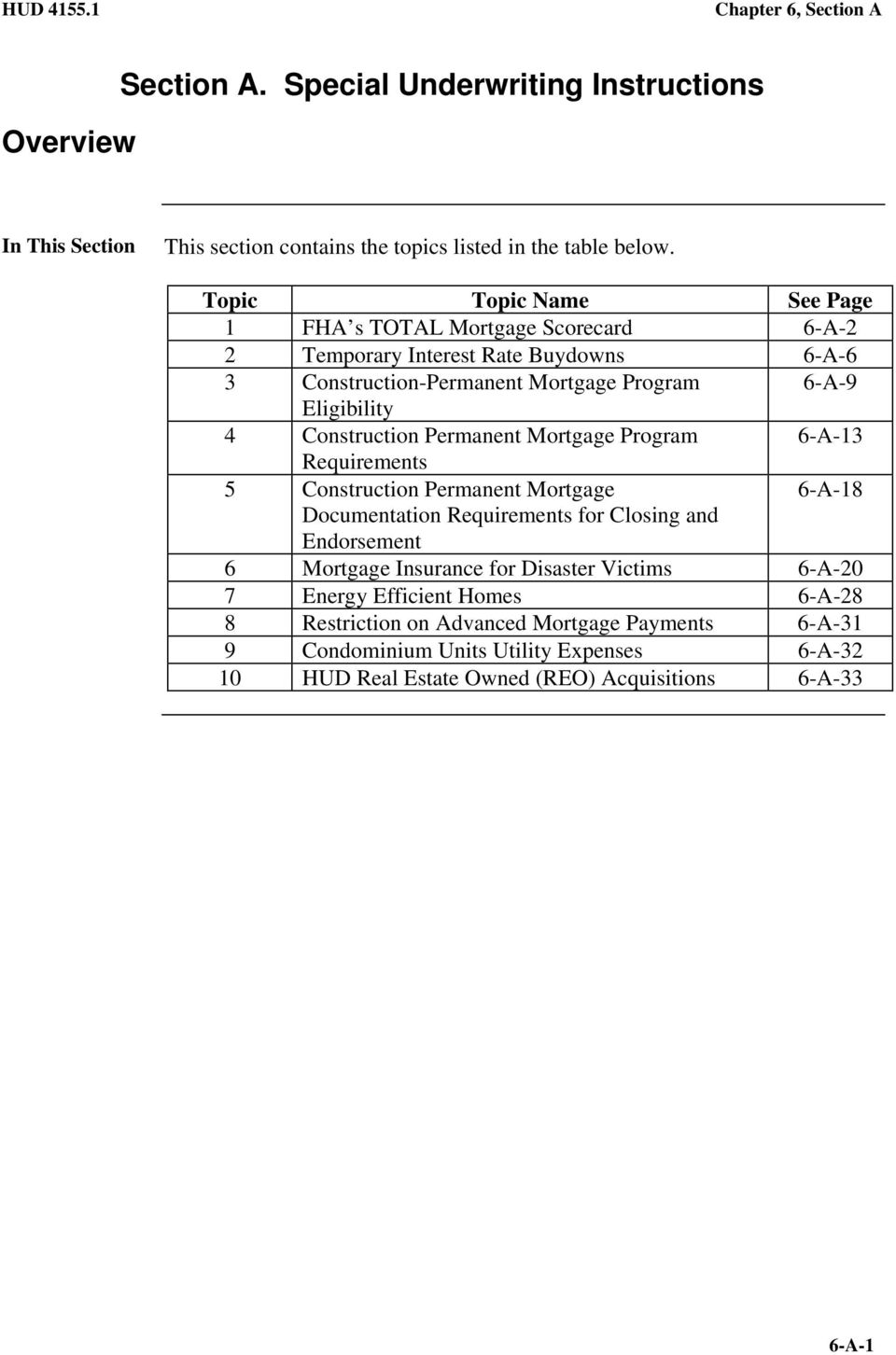
3 HUD Chapter 6, Section A Overview Section A. Special Underwriting Instructions In This Section This section contains the topics listed in the table below. Topic Topic Name See Page 1 FHA s TOTAL Mortgage Scorecard 6-A-2 2 Temporary Interest Rate Buydowns 6-A-6 3 Construction-Permanent Mortgage Program 6-A-9 Eligibility 4 Construction Permanent Mortgage Program 6-A-13 Requirements 5 Construction Permanent Mortgage 6-A-18 Documentation Requirements for Closing and Endorsement 6 Mortgage Insurance for Disaster Victims 6-A-20 7 Energy Efficient Homes 6-A-28 8 Restriction on Advanced Mortgage Payments 6-A-31 9 Condominium Units Utility Expenses 6-A HUD Real Estate Owned (REO) Acquisitions 6-A-33 6-A-1
4 Chapter 6, Section A HUD FHA s TOTAL Mortgage Scorecard Introduction This topic contains information on how underwriting uses the TOTAL Mortgage Scorecard, including a description of TOTAL and the TOTAL Scorecard a comparison of TOTAL to an Automated Underwriting System (AUS) TOTAL scoring recommendations rescoring and tolerance levels, and information on the TOTAL User Guide. Change Date May 10, A.1.a Description of TOTAL The acronym TOTAL stands for Technology Open To Approved Lenders. TOTAL Scorecard evaluates the overall creditworthiness of the applicants based on a number of credit variables and, when combined with the functionalities of the AUS, indicates a recommended level of underwriting and documentation to determine a loan s eligibility for insurance by the Federal Housing Administration (FHA). 6-A-2

5 HUD Chapter 6, Section A 1. FHA s TOTAL Mortgage Scorecard, Continued A.1.b Comparison of TOTAL to AUS TOTAL is not an AUS. It is a scorecard that is used within an AUS. To underwrite a loan electronically, a lender must process the request through an AUS that can communicate with TOTAL. TOTAL operates as a systemto-system connection to an AUS. Together, TOTAL and the AUS either conclude that the borrowers credit and capacity for repayment of the mortgage are acceptable or will refer the loan application to a Direct Endorsement (DE) underwriter for further consideration and review. Regardless of the risk assessment provided by TOTAL, the lender remains accountable for compliance with FHA s eligibility requirements, as well as for any credit, capacity, and documentation requirements not covered in the FHA TOTAL Mortgage Scorecard User Guide. Example: FHA will not be responsible for checking, through TOTAL, lender compliance with maximum mortgage amounts, computing debt-to-income ratios or other functions typically performed by an AUS. TOTAL provides only an assessment of the borrower s credit and capacity to repay. 6-A-3
6 Chapter 6, Section A HUD FHA s TOTAL Mortgage Scorecard, Continued A.1.c TOTAL Scoring Recommendati ons TOTAL will return recommendations of either Accept or Approve (different AUSs use different wording), or Refer. The table below describes the TOTAL scoring recommendations. TOTAL Recommendation Accept/Approve Refer Description This recommendation means that, based on the analysis of the credit and capacity to repay, the loan is eligible for FHA insurance provided that data entered into the AUS is true, complete, properly documented and accurate; and the documentation and other eligibility requirements are met. This recommendation means that the lender must conduct a manual underwriting review, according to FHA requirements. The lender s DE underwriter must determine if the borrower is creditworthy in accordance with FHA standard credit policies and requirements. Note: Per FHA policy, a borrower will not be denied an FHA mortgage solely on the basis of a risk assessment generated by TOTAL. 6-A-4

7 HUD Chapter 6, Section A 1. FHA s TOTAL Mortgage Scorecard, Continued A.1.d Rescoring and Tolerance Levels TOTAL provides a risk assessment based on the specific data entered by lenders, such as terms and conditions of the loan, income and assets. Changes in those variables can result in a different risk assessment, and FHA requires that the loan be rescored using the new information. However, where the differences are minor, rescoring is unlikely to trigger a different risk assessment. FHA therefore, provides a degree of tolerance before triggering a requirement for rescoring. The table below describes the tolerance level for rescoring requirements when assessing income and assets. When assessing... There is no need to rescore if... cash reserves the cash reserves verified are not more than 10 percent less than what the borrower reported on the loan application. income the verified income is not more than 5 percent less than what the borrower reported on the loan application. tax and insurance escrows the tax and insurance escrows used at scoring do not result in more than a 2 percentage point increase in the payment and debt-to-income ratios A.1.e TOTAL User Guide FHA has developed the TOTAL User Guide, which is a compilation of the specific credit policies and documentation requirements lenders must follow when using TOTAL. The instructions in the Guide pertain only to those mortgage applications that had a TOTAL risk assessment, including those scored mortgages referred to an underwriter for manual underwriting. Reference: For a copy of the TOTAL User Guide, see 6-A-5

8 Chapter 6, Section A HUD Temporary Interest Rate Buydowns Introduction This topic contains information on temporary interest buydowns, including purpose of a temporary interest rate buydown eligible transactions/mortgages source of buydown funds underwriting requirements at buydown interest rate additional interest rate buydown instructions underwriter instructions for additional interest rate buydowns lender escrow agreement responsibilities, and escrow agreement requirements. Change Date May 10, A.2.a Purpose of a Temporary Interest Rate Buydown Interest rate buydowns are designed to reduce the borrower s monthly payment during the early years of the mortgage. At settlement, an escrow account is established. Each month, the servicing lender draws down an amount equal to the difference in the principal and interest payment (P&I) at the Note rate, and the P&I at the buydown rate A.2.b Eligible Transactions/ Mortgages Temporary interest rate buydowns are permitted only on purchase transactions, and fixed-rate mortgages A.2.c Source of Buydown Funds Buydown funds may come from the seller the lender the borrower, or any other interested party. Funds from the seller or any other interested third party are considered seller contributions, and must be included in the 6 percent limit on seller contributions as described in HUD A.3. 6-A-6
9 HUD Chapter 6, Section A 2. Temporary Interest Rate Buydowns, Continued A.2.d Underwriting Requirements for Qualifying the Borrower While interest rate buydowns are permitted, the loan must be underwritten at the Note rate. Lenders may not underwrite at the buydown rate. Buydowns may be treated only as a compensating factor A.2.e Additional Interest Rate Buydown Instructions Lender-funded buydowns on fixed-rate money mortgages through premium pricing are acceptable, provided that the funds do not result in a reduction greater than 2 percentage points below the Note rate A.2.f Lender Responsibilities Lenders are responsible for ensuring that the buydown must not result in a reduction of more than two percentage points below the interest rate on the Note the buydown must not result in more than a one percentage point increase in the buydown rate. the borrower s payment may change only once a year the funds described in the escrow agreement are placed in escrow before or at closing a copy of the fully executed escrow agreement, signed by the borrower and provider of funds is provided in the mortgage case binder, and the escrow agreement meets the requirements described in HUD A.1.d. Note: The underwriter may condition the loan approval for an executed buydown agreement at closing. 6-A-7
10 Chapter 6, Section A HUD Temporary Interest Rate Buydowns, Continued A.2.g Escrow Agreement Requirements The escrow agreement requirements with which all buydowns must comply are listed below. Any remaining escrow funds not distributed at the time the mortgage loan is prepaid must be applied to the outstanding balance due on the mortgage. In the event of foreclosure, the claim for mortgage insurance benefits must be reduced by the amount remaining in the buydown escrow account. The escrow agreement may provide that assistance payments continue to buyers who assume the mortgage must not permit reversion of undistributed escrow funds to the provider if the property is sold or the mortgage is prepaid in full, and must not allow unexpended escrow funds to be provided to the borrower in cash, unless the borrower established the escrow account. Escrow funds must be held in an escrow account by a financial institution supervised by a Federal or state agency. Payments must be made by the escrow agent to the lender or servicing agent. If escrow payments are not received for any reason, the borrower is responsible for making the total payment as described in the mortgage note. FHA does not object to having the lender hold and administer the escrow funds, for up to 60 days, when there is an outstanding forward commitment to sell the mortgage. Note: The escrow agreement text can also apply to repair escrows. Reference: For additional information on repair escrows, see HUD d. 6-A-8

11 HUD Chapter 6, Section A 3. Construction Permanent Mortgage Program Eligibility Introduction This topic contains information on the eligibility criteria for a loan to be considered a construction-permanent (CP) mortgage loan, including construction-permanent mortgage features timing of loan closing and insurance, and criteria for consideration as a construction-permanent mortgage loan. Change Date October 26, A.3.a Construction Permanent Mortgage Features A construction permanent mortgage loan combines the features of a construction loan, which is a short-term interim loan for financing the cost of construction, and the traditional long-term permanent residential mortgage involves only one closing is considered a purchase transaction, for mortgage insurance and LTV purposes, and is made directly to an approved borrower by a lender A.3.b Timing of Loan Closing and Insurance On a construction permanent mortgage loan, there is only one closing, which is prior to the start of construction. At the closing, funds are disbursed to cover the purchase of the land and/or the manufactured housing unit. The balance of the mortgage proceeds are placed in an escrow account to be disbursed through draw requests until construction is completed. Note: For CP on a manufactured home, there is a mandatory holdback of not less than ten percent for all cost components, excluding land. Important: The loan is not insured until after construction is completed. Reference: For more information on CP loans for manufactured homes, see B.8. 6-A-9

12 Chapter 6, Section A HUD Construction Permanent Mortgage Program Eligibility, Continued A.3.c Criteria for Consideration as a Construction Permanent Mortgage The table below describes the criteria for a loan to be considered a construction-permanent loan and eligible for FHA mortgage insurance. Criteria Contract with the Builder Lot Ownership Lot Acquisition Description The borrower has contracted with a builder to construct the improvements. Note: This program is not available to a borrower acting as his/her own general contractor, unless the borrower is a licensed builder by profession. In this case, the acquisition cost must be determined by the actual documented cost to construct the improvements. The borrower must own or be purchasing the lot at the closing of the CP loan. Note: If the contractor owns the lot, the lot must be included in the total contract price. If the borrower purchased the lot within the past six months, he/she must provide a copy of the HUD-1 Settlement Statement, or other settlement statement showing the acquisition cost. If the borrower owns the lot free-and-clear, the lender must document the date of ownership and omission or any liens from title work and settlement statements. 6-A-10

13 HUD Chapter 6, Section A 3. Construction Permanent Mortgage Program Eligibility, Continued A.3.c Criteria for Consideration as a Construction Permanent Mortgage (continued) Criteria Verification of Loan Balance/Escrow Account Description The balance on the CP loan, when it is fully drawn, must be verified. Draw on Loan to Pay Off Lot Sales Agreement The construction escrow account, if established, must be fully extinguished. Any remaining funds must be applied to the outstanding balance of the permanent loan. If the initial draw on the loan is for the purpose of paying off the lot, the borrower must provide a statement verifying the amount. The borrower must provide a copy of the fully executed contract agreement, which includes the contractor s price to build. Extras/Out-of-Pocket Costs If the borrower is including extras over and above the contract specification and/or is paying out-of-pocket expense over and above the interim loan, then for all out-of-pocket construction costs the borrower must provide a breakdown of the extras the cost of each canceled checks, and/or paid receipts. 6-A-11
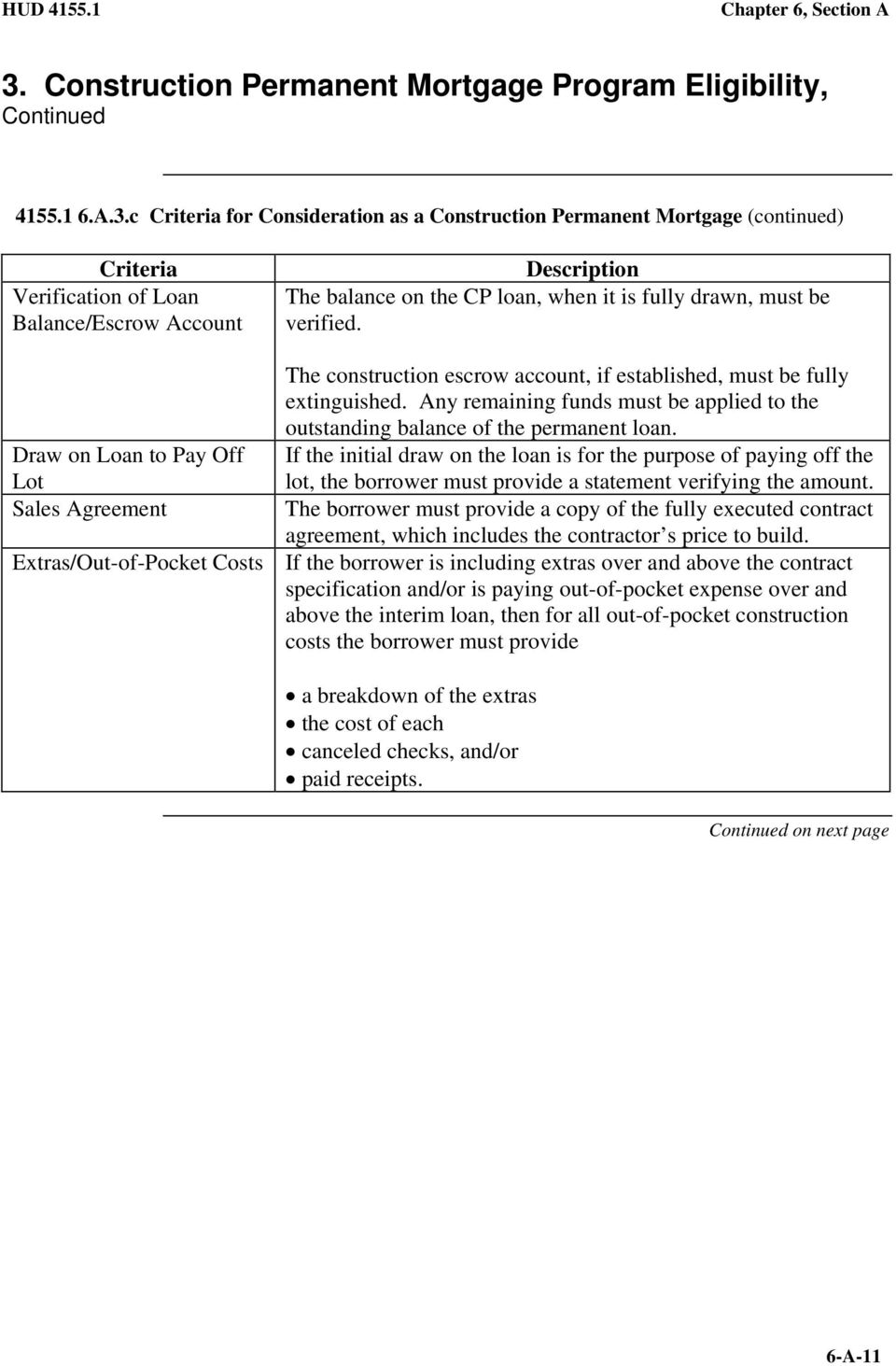
14 Chapter 6, Section A HUD Construction Permanent Mortgage Program Eligibility, Continued A.3.c Criteria for Consideration as a Construction Permanent Mortgage (continued) Criteria Cash Back to Borrower Description Replenishment of a borrower s own cash invested during construction is not considered cash back, provided the borrower can substantiate all out-of-pocket expenses used for construction with cancelled checks and/or paid receipts. Lenders must apply any excess funds from the construction proceeds to reduce the principal of the permanent loan. In general, the borrower is not to receive funds after closing. The borrower may receive up to $500 from any funds remaining after closing from unused prepaid expenses, which may include (but not limited to) per diem interest to the end of the month on the new loan hazard insurance premium deposits monthly mortgage insurance premiums, and any real estate tax deposits needed to establish the escrow accounts. Note: For manufactured homes that have been permanently erected on a site for less than one year prior to the date of the application for mortgage insurance, the borrower may not receive cash back at closing, even if the loan-to-value (LTV) is less than 85 percent. 6-A-12
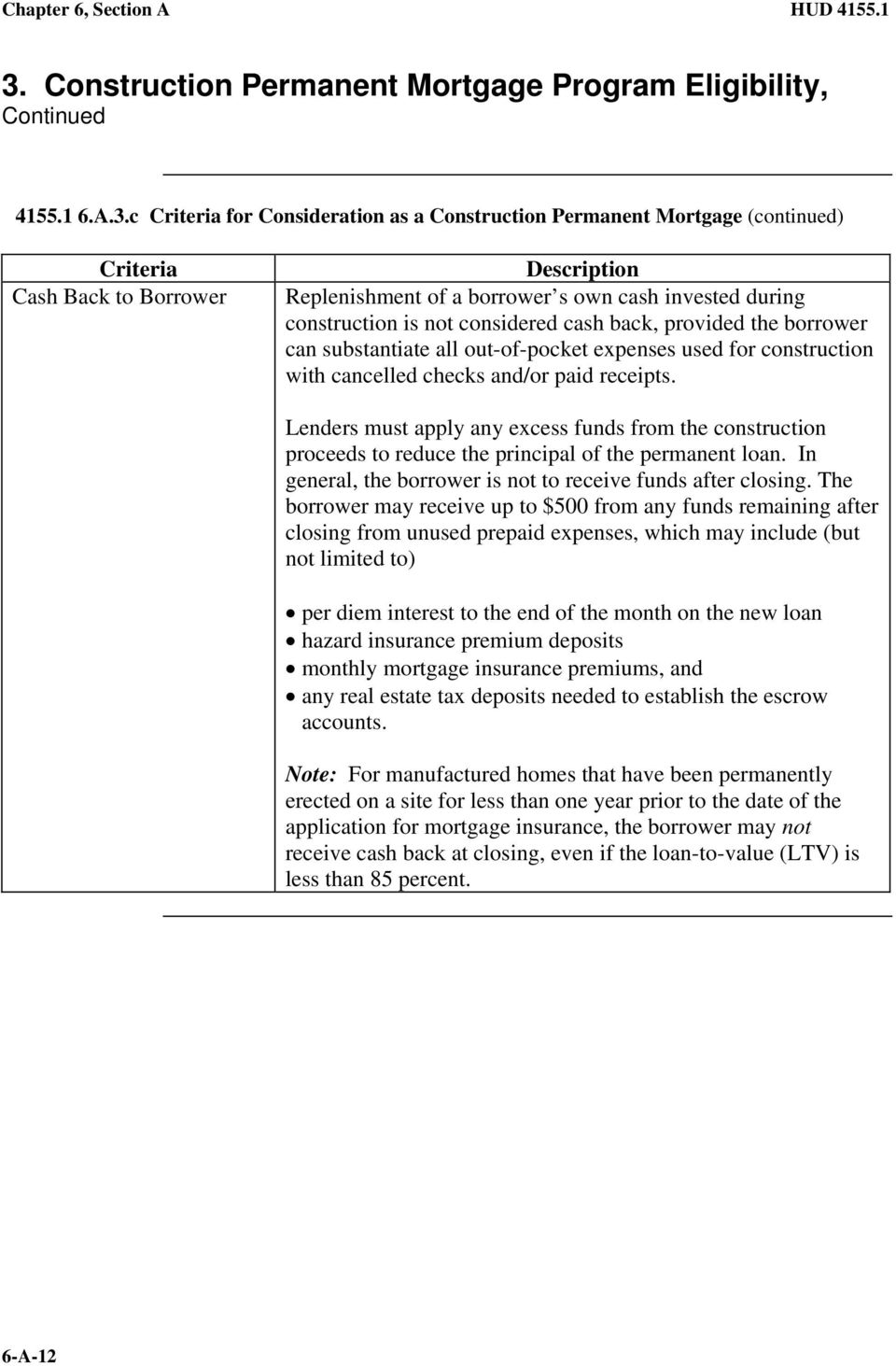
15 HUD Chapter 6, Section A 4. Construction Permanent Mortgage Program Requirements Introduction This topic contains closing and post-closing information on the constructionpermanent mortgage program, including maximum mortgage amount equity in land as a borrower s cash investment permanent loan interest rate timeframe for start of amortization disclosure to the borrower on eligibility for insurance draw on loan to pay off lot remitting UFMIP construction period fees disbursing funds request for endorsement, and warehouse lines-of-credit for construction-permanent loans on manufactured homes. Change Date October 26, A-13
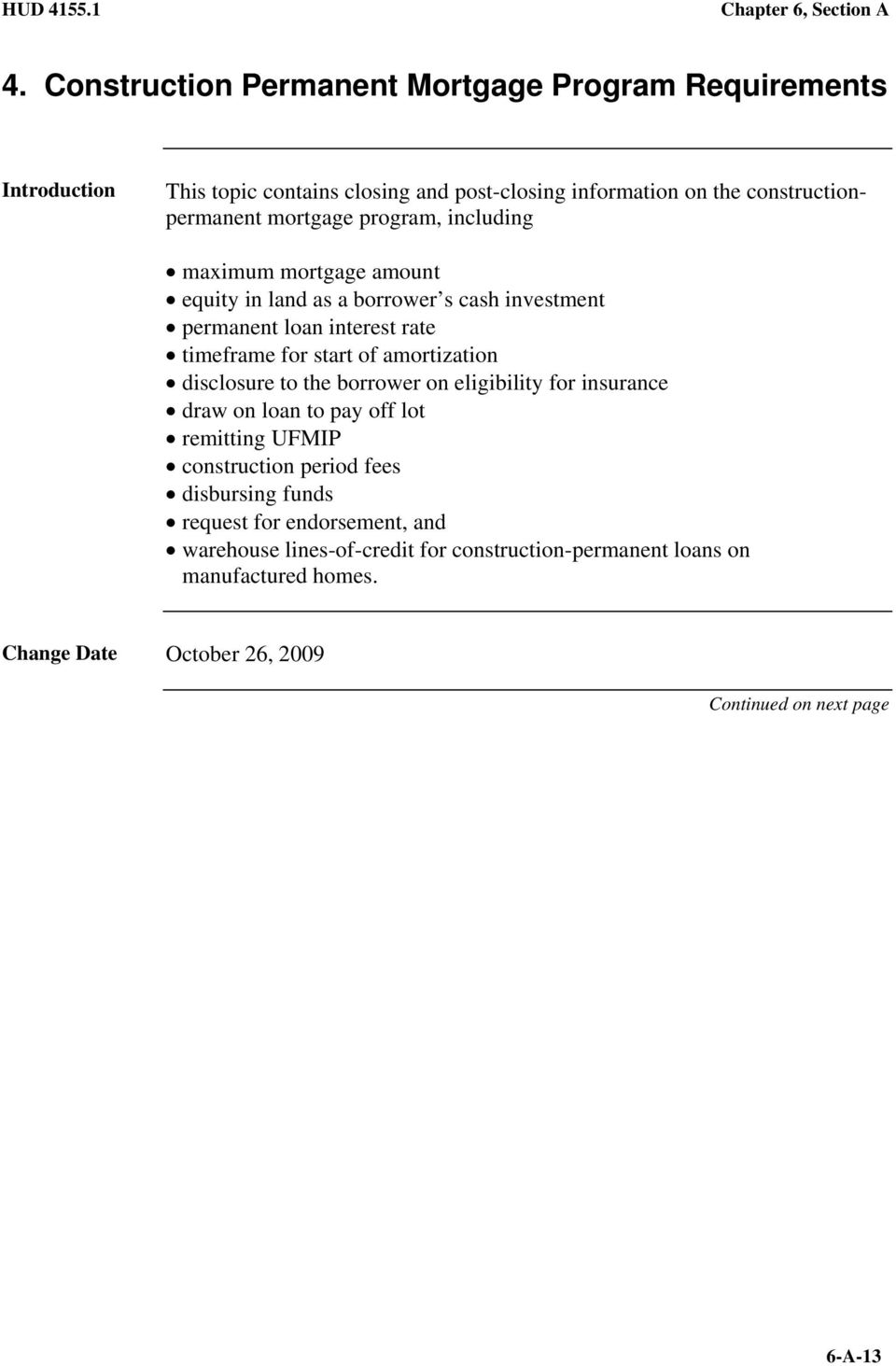
16 Chapter 6, Section A HUD Construction Permanent Mortgage Program Requirements, Continued A.4.a Maximum Mortgage Amount The maximum mortgage amount is determined by applying the LTV limits to the lesser of the appraised value or the acquisition cost. The acquisition cost includes the builder s price to build borrower-paid extras over and above the contract specification and/or outof-pocket expenses over and above the interim loan cost of the land, and closing costs. For extras over the contract specifications and out-of-pocket expenses, the borrower must provide a breakdown of the extras the cost of each canceled checks, and/or paid receipts. If the land has been owned more than six months, or was received as an acceptable gift, the value of the land may be used instead of its cost. Note: If the value of the land is lower than acquisition cost, the value must be used in calculating the maximum mortgage amount. Important: If the contractor for the improvements is also the seller of the land, the total acquisition cost for maximum mortgage purposes is the borrower s purchase price. 6-A-14
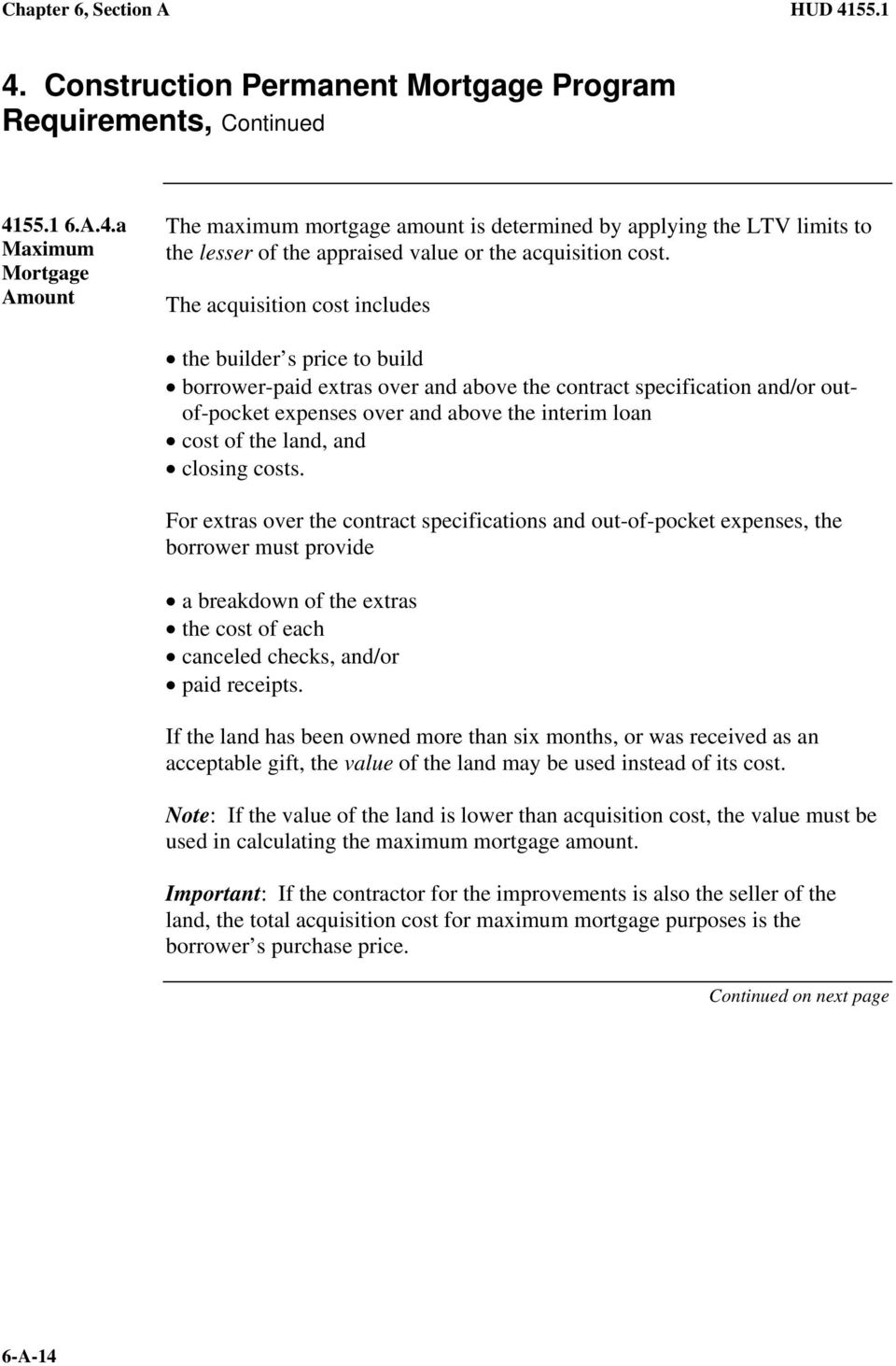
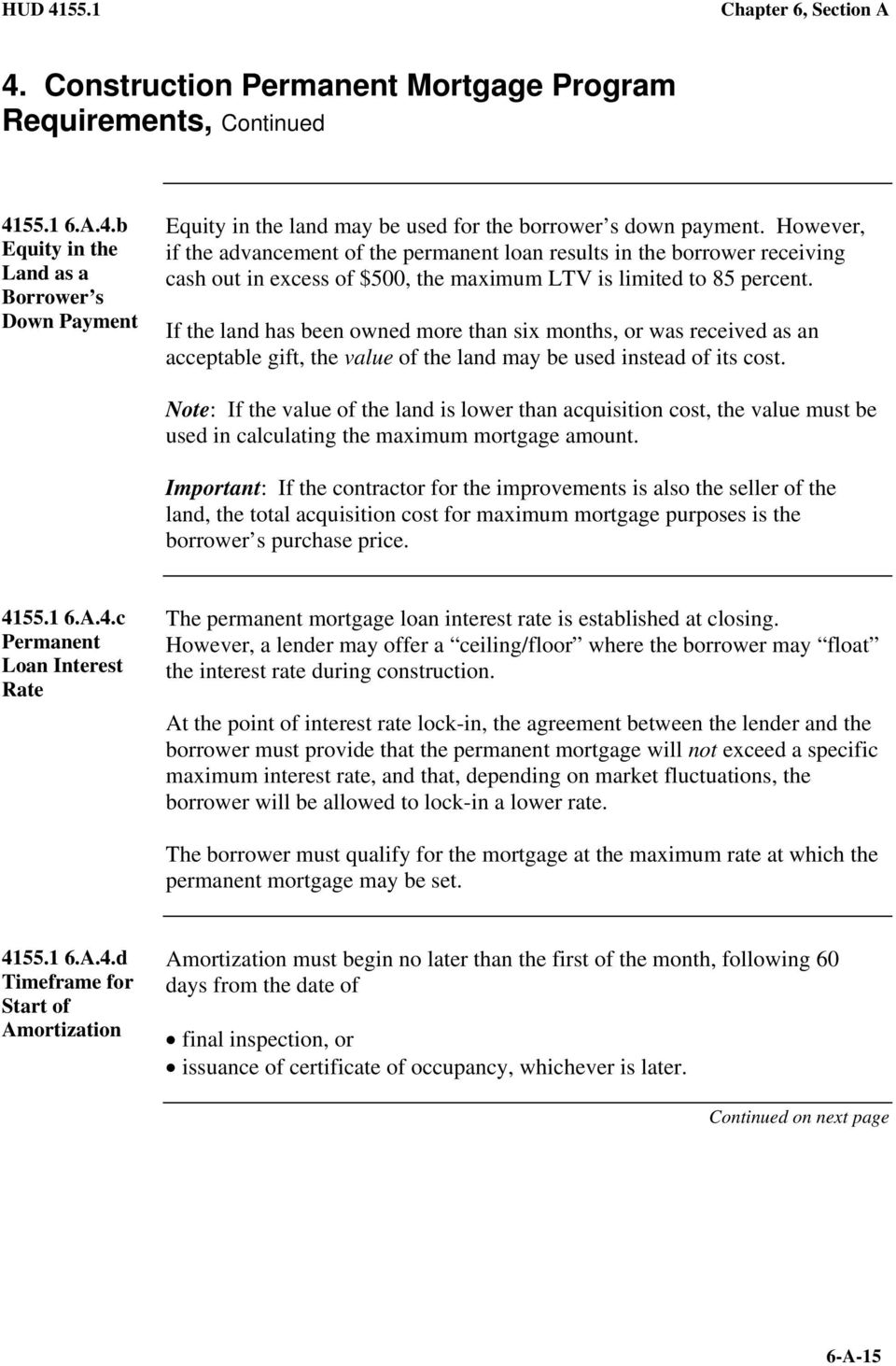
17 HUD Chapter 6, Section A 4. Construction Permanent Mortgage Program Requirements, Continued A.4.b Equity in the Land as a Borrower s Down Payment Equity in the land may be used for the borrower s down payment. However, if the advancement of the permanent loan results in the borrower receiving cash out in excess of $500, the maximum LTV is limited to 85 percent. If the land has been owned more than six months, or was received as an acceptable gift, the value of the land may be used instead of its cost. Note: If the value of the land is lower than acquisition cost, the value must be used in calculating the maximum mortgage amount. Important: If the contractor for the improvements is also the seller of the land, the total acquisition cost for maximum mortgage purposes is the borrower s purchase price A.4.c Permanent Loan Interest Rate The permanent mortgage loan interest rate is established at closing. However, a lender may offer a ceiling/floor where the borrower may float the interest rate during construction. At the point of interest rate lock-in, the agreement between the lender and the borrower must provide that the permanent mortgage will not exceed a specific maximum interest rate, and that, depending on market fluctuations, the borrower will be allowed to lock-in a lower rate. The borrower must qualify for the mortgage at the maximum rate at which the permanent mortgage may be set A.4.d Timeframe for Start of Amortization Amortization must begin no later than the first of the month, following 60 days from the date of final inspection, or issuance of certificate of occupancy, whichever is later. 6-A-15
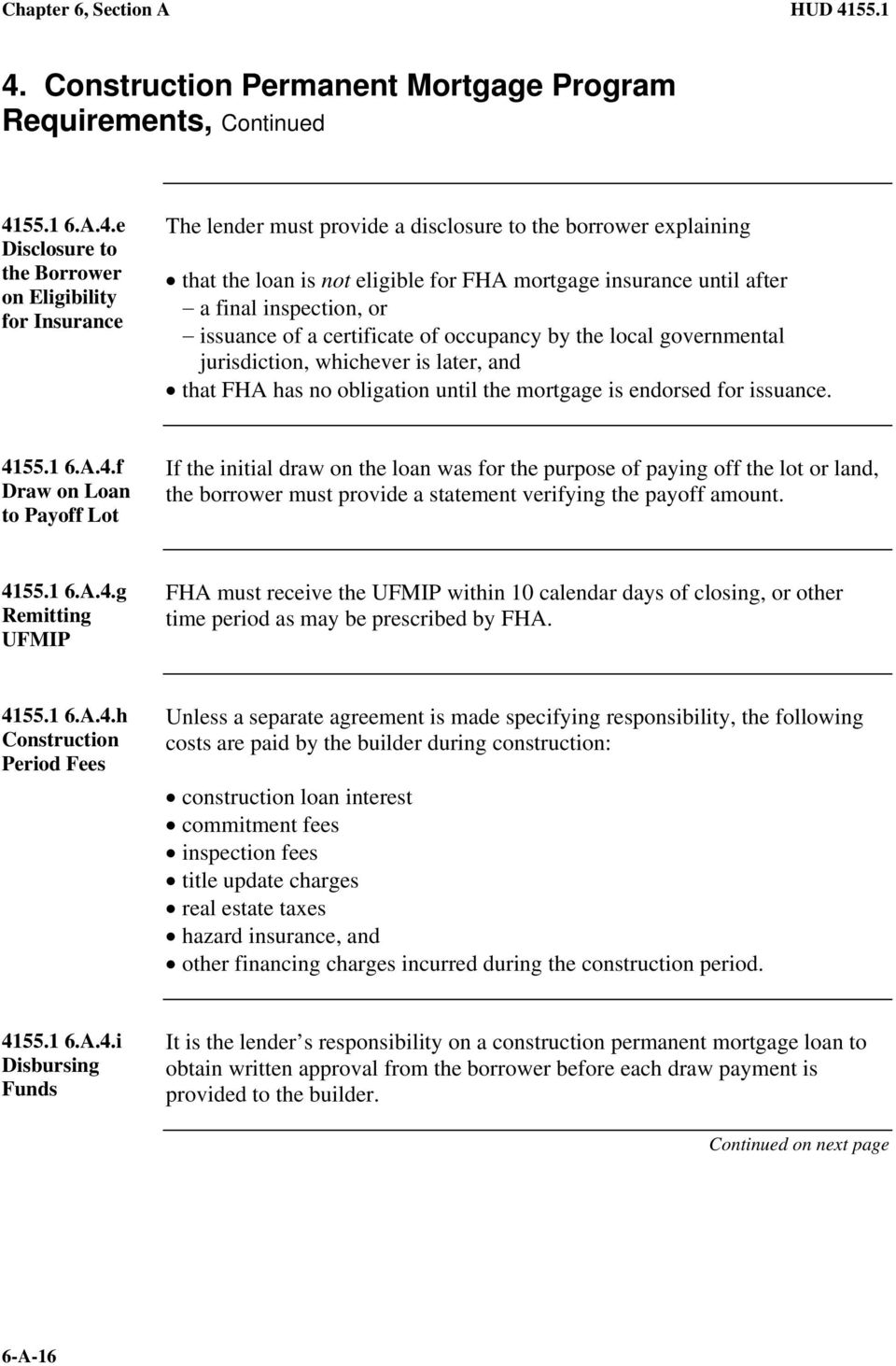
18 Chapter 6, Section A HUD Construction Permanent Mortgage Program Requirements, Continued A.4.e Disclosure to the Borrower on Eligibility for Insurance The lender must provide a disclosure to the borrower explaining that the loan is not eligible for FHA mortgage insurance until after a final inspection, or issuance of a certificate of occupancy by the local governmental jurisdiction, whichever is later, and that FHA has no obligation until the mortgage is endorsed for issuance A.4.f Draw on Loan to Payoff Lot If the initial draw on the loan was for the purpose of paying off the lot or land, the borrower must provide a statement verifying the payoff amount A.4.g Remitting UFMIP FHA must receive the UFMIP within 10 calendar days of closing, or other time period as may be prescribed by FHA A.4.h Construction Period Fees Unless a separate agreement is made specifying responsibility, the following costs are paid by the builder during construction: construction loan interest commitment fees inspection fees title update charges real estate taxes hazard insurance, and other financing charges incurred during the construction period A.4.i Disbursing Funds It is the lender s responsibility on a construction permanent mortgage loan to obtain written approval from the borrower before each draw payment is provided to the builder. 6-A-16
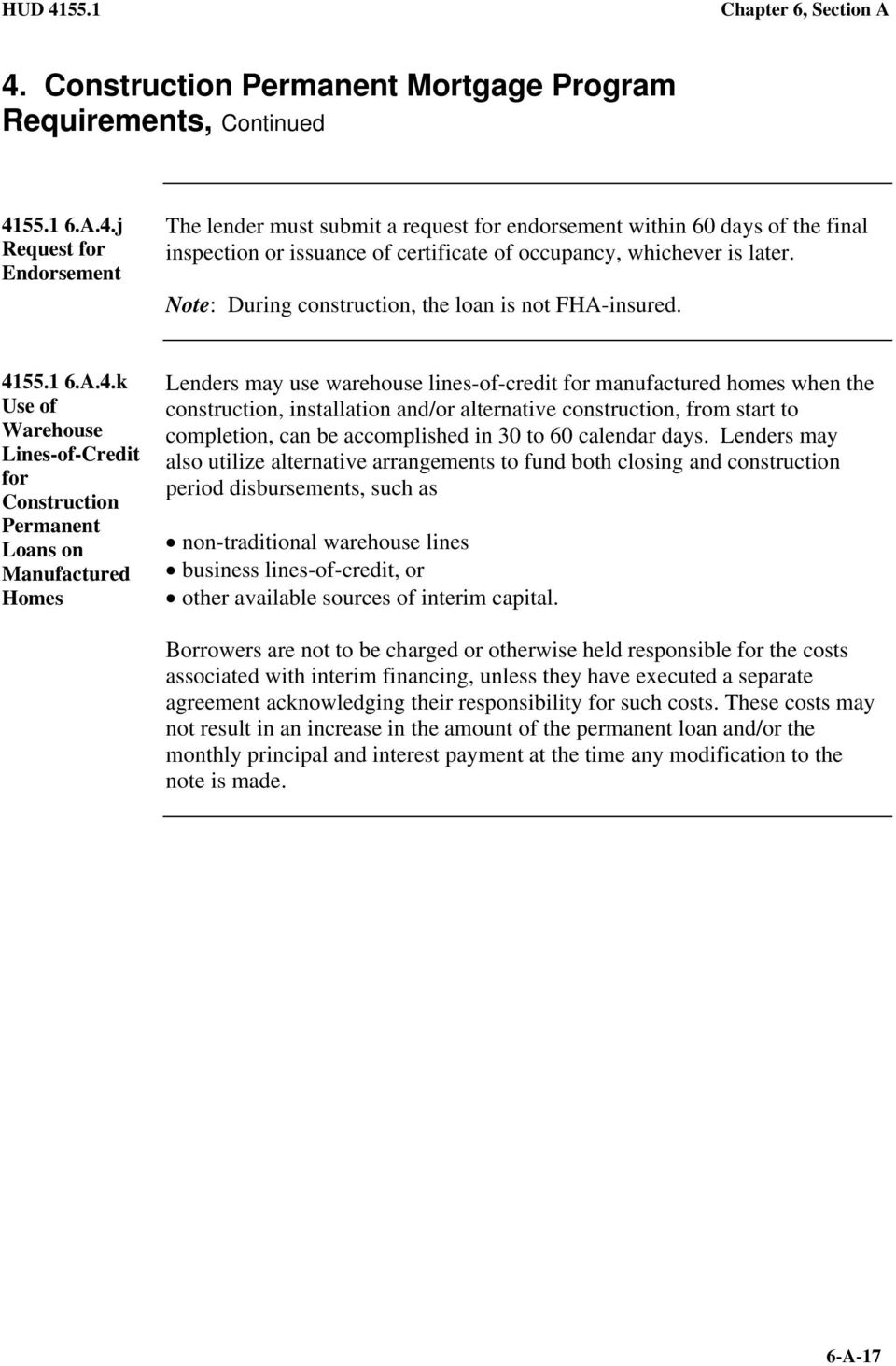
19 HUD Chapter 6, Section A 4. Construction Permanent Mortgage Program Requirements, Continued A.4.j Request for Endorsement The lender must submit a request for endorsement within 60 days of the final inspection or issuance of certificate of occupancy, whichever is later. Note: During construction, the loan is not FHA-insured A.4.k Use of Warehouse Lines-of-Credit for Construction Permanent Loans on Manufactured Homes Lenders may use warehouse lines-of-credit for manufactured homes when the construction, installation and/or alternative construction, from start to completion, can be accomplished in 30 to 60 calendar days. Lenders may also utilize alternative arrangements to fund both closing and construction period disbursements, such as non-traditional warehouse lines business lines-of-credit, or other available sources of interim capital. Borrowers are not to be charged or otherwise held responsible for the costs associated with interim financing, unless they have executed a separate agreement acknowledging their responsibility for such costs. These costs may not result in an increase in the amount of the permanent loan and/or the monthly principal and interest payment at the time any modification to the note is made. 6-A-17
20 Chapter 6, Section A HUD Construction Permanent Mortgage Documentation Requirements for Closing and Endorsement Introduction This topic contains information on the documentation requirements for closing and endorsing a construction permanent mortgage loan, including documentation requirements for closing documentation required prior to endorsement making changes to the Note for the permanent loan, and application of gift funds when closing a construction permanent loan. Change Date October 26, A.5.a Documentation Requirements for Closing Standard FHA documents are used when closing a construction-permanent mortgage loan, with the addition of a Construction Rider or Allonge to the Note, and Construction Loan Agreement. These construction documents may be in any form acceptable to the lender, but they must provide that all special construction terms end when the construction loan converts to a permanent loan. The Construction Loan Agreement must outline the terms and conditions of the construction loan, and its conversion to a permanent loan. After conversion, only the permanent loan terms continue to be effective, making the permanent loan eligible for FHA mortgage insurance. Lenders must also provide an executed Loan Modification Agreement to confirm the existence of a permanent loan and that the corresponding amortizing interest rate on the mortgage loan shall commence or commenced within 60 days of the property being 100% complete. 6-A-18

21 HUD Chapter 6, Section A 5. Construction Permanent Mortgage Documentation Requirements for Closing and Endorsement, Continued A.5.b Documentation Required for Endorsement Prior to endorsement, the lender must obtain a certification, signed by the borrower after conversion to the permanent loan, that the mortgaged property is free and clear of all liens other than the mortgage verification that the construction loan has been fully drawn down copies of canceled checks and paid receipts for all the borrower s out-ofpocket construction costs, and all property-related requirements for new construction A.5.c Making Changes to the Note for the Permanent Loan The lender must provide acceptable modification instruments that modify the note and security instrument (as applicable), if there are changes made to the Note, such as a reduction in the monthly payment amount, interest rate, or principal balance resulting from the application of excess funds, or change in first payment date A.5.d Application of Gift Funds when Closing a Construction Permanent Loan Gifts from eligible sources for down payment shall be applied to the permanent financing on the HUD-1 Settlement Statement at the time of closing, and not to interim financing for the borrower, in order to receive full benefit of the credit for the CP transaction. For a refinance transaction, the gift funds can only be applied once, to either the construction loan or the permanent loan. Reference: For additional information on gift funds, see B.4. 6-A-19
22 Chapter 6, Section A HUD Mortgage Insurance for Disaster Victims Introduction This topic contains information on mortgage insurance for disaster victims, including description of the Section 203(h) program required borrower evidence of residence and destruction eligible properties amount of financing for eligible borrowers Section 203(h) maximum mortgage amounts timeframe for submission of loan application using Section 203(k) with 203(h) for rehabilitation mortgages Section 203(k) financing percentages Section 203(h) underwriting guidance, and Section 203(h) example scenarios and general underwriting guidance. Change Date May 10, A.6.a Description of the Section 203(h) Program Under the Section 203(h), Mortgage Insurance for Disaster Victims program, FHA provides mortgage insurance to assist victims of Presidentially-declared disasters. This program goes into effect when the President declares the disaster, and remains in effect for one year from the date of declaration. The Federal Emergency Management Agency (FEMA) provides listings of the specific affected counties and cities, and corresponding disaster declaration dates. Note: The FEMA information can be found at Reference: For more information on the Section 203(h) program, see HUD C.3. 6-A-20
23 HUD Chapter 6, Section A 6. Mortgage Insurance for Disaster Victims, Continued A.6.b Required Borrower Evidence of Residence and Destruction Under Section 203(h), the borrower s previous residence must have been in the disaster area and must have been destroyed or damaged to such an extent that reconstruction or replacement is necessary. Borrowers must provide conclusive evidence of this fact, as outlined in the table below. Note: The borrower may have been the owner of the property or a renter of the property affected. Conclusive evidence of a permanent residence in the affected area destruction of the residence Includes a valid driver s license a voter registration card, or utility bills. an insurance report an inspection report by an independent fee inspector or government agency, or conclusive photographic evidence showing the destruction or damage A.6.c Eligible Properties The following properties are eligible under the Section 203(h) program: one unit detached homes units in an approved condominium project, or spot loan in condominiums. Two, three, and four unit properties may not be purchased under the program. Reference: For more information on eligibility for the Section 203(h) program, see HUD C.3. 6-A-21
24 Chapter 6, Section A HUD Mortgage Insurance for Disaster Victims, Continued A.6.d Amount of Financing for Eligible Borrowers An eligible borrower may receive 100 percent financing of the sales price and no down payment is required. However, closing costs and prepaid expenses not paid by the seller must be paid by the borrower in cash, or paid through premium pricing. Note: Adjustable Rate Mortgages (ARMs) may be used with the Section 203(h) program A.6.e Section 203(h) Maximum Mortgage Amounts Maximum mortgage amounts for the Section 203(h) program are the same as for the Section 203(b) program. The list can be accessed from the lender s Web page on HUD s Web site at or on the FHA Connection at Reference: For information on the Section 203(b) program and maximum mortgage amounts, see HUD C A.6.f Timeframe for Submission of Loan Application The borrower s mortgage loan application must be submitted to the lender within one year of the President s declaration of the disaster. 6-A-22
25 HUD Chapter 6, Section A 6. Mortgage Insurance for Disaster Victims, Continued A.6.g Using Section 203(k) With 203(h) for Rehabilitation Mortgages The requirement to complete a dwelling more than one year preceding the date of the mortgage insurance application under the Section 203(k), Rehabilitation Home Mortgage Insurance program, does not apply to properties in a disaster area. Damaged residences are eligible for Section 203(k) mortgage insurance, regardless of the age of the property. The residence needs only to have been completed and ready for occupancy for eligibility under Section 203(k). Homes that have been demolished, or will be razed as part of the rehabilitation work, are eligible, provided the existing foundation system is not affected, and will remain in place and be used. The complete foundation system must remain in place. Reference: For more information on the Section 203(k) program, see HUD C A.6.h Section 203(k) Financing Percentages The type of mortgage being made determines the percentage of financing when using Section 203(k) with 203(h) for rehabilitation mortgages. In other words, normal LTV ratios apply to Section 203(k) mortgages made in disaster areas. 6-A-23
26 Chapter 6, Section A HUD Mortgage Insurance for Disaster Victims, Continued A.6.i Section 203(h) Underwriting Guidance Since many borrowers affected by a major disaster will experience difficulty in providing traditional documentation regarding employment and funds for closing due to the disaster, lenders should be as flexible as prudent decision making permits, when applying FHA s underwriting criteria and documentation requirements. To the extent possible, lenders should be accommodating towards borrowers eligible for Section 203(h) mortgages, whether or not they opt for another FHA program, such as 203(k), regarding gaps in employment documentation for employment available funds, and qualifying ratios, and when evaluating the following that were the direct result of a disaster, as reported into HUD s Credit Alert Interactive Voice Response System (CAIVRS): recent derogatory credit bankruptcy foreclosure deed-in-lieu of foreclosure, and delinquent federal obligations. The guiding principle is to provide FHA financing to disaster victims who can make mortgage payments, but may not have all the traditional documentation as proof of ability to pay. 6-A-24
27 HUD Chapter 6, Section A 6. Mortgage Insurance for Disaster Victims, Continued A.6.j Section 203(h) Example Scenarios and General Underwriting Guidance The table below contains example scenarios involving disaster victims, and guidelines for using alternative documentation when traditional documentation is unavailable. Note: The guidelines below are meant to provide general guidance only and do not address all of the circumstances in which alternative documentation can be used. Each case is different, and ultimately needs to be evaluated on its own merits. Underwriting Category Credit CAIVRS Guideline Lenders should be able to determine if derogatory credit occurred subsequent to a disaster. If the credit report indicates satisfactory credit prior to a disaster, and any derogatory credit subsequent to the date of the disaster can be related to the effects of the disaster, FHA will consider that the borrower is a satisfactory credit risk, for the underwriting standards. FHA determines that a borrower is not eligible for FHA insurance if CAIVRS indicates the borrower is presently delinquent, or has had a claim paid within the previous three years on a loan made or insured by HUD on his/her behalf. FHA is adding, to the list of exceptions to this rule, situations involving Presidentially-declared disasters. If the borrower is reported in CAIVRS, but the credit report indicates the loan was current prior to the disaster, and any delinquency or claim paid can be related to the effects of the disaster, the borrower may be considered eligible. As with any CAIVRS authorization, lenders may contact the appropriate HOC for additional Section 203(h) underwriting information and guidance. References: For more information on eligibility for Federally related credit, see HUD A.6, and the requirement to screen borrowers using CAIVRS, see HUD A.8. 6-A-25
28 Chapter 6, Section A HUD Mortgage Insurance for Disaster Victims, Continued A.6 Section 203(h) Example Scenarios and General Underwriting Guidance (continued) Underwriting Category Income Guideline Borrower s affected by a disaster may not be able to document past or present employment. If prior employment cannot be verified because records are destroyed, and he/she has a current position in the same or similar field, it may still be possible to consider the income. W-2s and tax returns may be obtained from the IRS to confirm prior employment and income. If this information cannot be obtained on a timely basis, the credit report may indicate the borrower s prior employment. Lenders can consider short-term employment, due to the disaster. It is anticipated that lenders will make every effort to obtain documentation about prior employment, and FHA will be flexible on the documentation requirements. Qualifying Ratios Assets Note: Lenders should document the efforts taken to obtain traditional documentation. When a borrower is purchasing a new home, yet still has an outstanding mortgage on a property located in a FEMA Disaster Area, the lender may exclude the mortgage payment on the previous residence from the qualifying ratio calculation, if the borrower provides the lender with information indicating that he/she is working with the servicing lender to appropriately address his/her mortgage obligation, and any property insurance proceeds will be applied to the mortgage on the damaged home. Lenders should encourage a borrower to access his/her financial institution s Web sites to attempt to download statements confirming assets needed to close the loan, if hard copy bank records are unavailable. Lenders should document the efforts to verify assets, and make every effort to ensure that the borrower will have funds to complete the transaction. 6-A-26
29 HUD Chapter 6, Section A 6. Mortgage Insurance for Disaster Victims, Continued A.6 Section 203(h) Example Scenarios and General Underwriting Guidance (continued) Underwriting Category Liabilities Guideline When a borrower has a continued mortgage obligation on a prior loan securing a property that has been destroyed or damaged, FHA understands that the record may show late payments as a result of a disaster. Lenders should not consider the outstanding mortgage obligation on destroyed, or seriously damaged properties when determining a borrower s ability to make payments on a new loan, provided the requirements under Qualifying Ratios in this table have been met. FHA takes the position that insurance settlements are likely to pay-off remaining obligations. However, if a borrower was three or more months delinquent on his/her loan prior to the disaster, and the property is destroyed, it would not be prudent for a lender to make a new loan unless he/she can show and document extenuating circumstances. 6-A-27
30 Chapter 6, Section A HUD Energy Efficient Homes Introduction This topic contains information on energy efficient homes (EEH), including EEH qualifying ratios EEH eligible properties EEH general underwriting policy EEH general underwriting procedures EEH underwriting procedures for new construction mortgages, and EEH policy guidance for streamline refinances. Change Date May 10, A.7.a EEH Qualifying Ratios For a mortgage loan involving an energy efficient home (EEH), the two benchmark qualifying ratios may be exceeded by up to 2 percentage points when the borrower is purchasing or refinancing an EEH. These higher housing expense- and obligations-to-income ratios are justified due to the anticipated energy costs savings, and become 33 percent and 45 percent, respectively. Reference: For more information on borrower qualifying ratios, see HUD F A.7.b Eligible EEH Properties All properties meeting the 2000 International Energy Conservation Code (IECC), formerly known as the Model Energy code (MEC) are considered energy efficient, and eligible for the 2 percentage points increase in the EEH qualifying ratios. Note: Both new and existing one- to four-unit properties are eligible, including one-unit condominiums and manufactured housing. 6-A-28
31 HUD Chapter 6, Section A 7. Energy Efficient Homes, Continued A.7.c EEH General Underwriting Policy An EEH mortgage is initially underwritten as if the energy package did not exist, that is, by using standard FHA underwriting standards, qualifying income ratios, and maximum mortgage/minimum down payment requirements without regard to the energy package. For an EEH mortgage on new construction, as well as those homes that were built to the 2000 IECC, or are being retrofitted to that standard, the borrower can obtain stretch ratios of 33 percent and 45 percent, in addition to the cost of the improvements A.7.d EEH General Underwriting Procedures Once it is determined that both the borrower and the property qualify for an FHA-insured mortgage, the lender must determine the dollar amount of the cost-effective energy package that may be added to the loan amount, using the energy rating report and EEM worksheet. This dollar amount cannot exceed 5 percent (not to exceed $8,000) of the property s value, or $4,000, whichever is greater. Regardless of the property s value, every borrower who otherwise qualifies can finance at least $4,000 of the costs of the Energy Package, if the cost exceeds $4,000. The calculated amount must be added to the approved base loan amount to total the final FHA-insured loan amount, before adding any upfront mortgage insurance premium (UFMIP). The FHA maximum loan limit for the area may be exceeded by the cost of the energy efficient improvements A.7.e EEH Underwriting Procedures for New Construction Mortgages When qualifying the borrower, the cost of the energy package must be subtracted from the sales price, since the builder has included the improvements in the sales price. Calculate the qualifying ratios on the lower amount. 6-A-29
32 Chapter 6, Section A HUD Energy Efficient Homes, Continued A.7.f EEH Policy Guidance for Streamline Refinances The borrower s principal and interest (P&I) payment on the new loan including the energy package, may be greater than the P&I payment on the current loan, provided that the estimated monthly energy savings as shown on the Home Energy Rating Systems (HERS) report exceeds the increase in the P&I. 6-A-30
33 HUD Chapter 6, Section A 8. Restriction on Advanced Mortgage Payments Change Date May 10, A.8.a Advanced Mortgage Payment Requirements FHA does not permit a lender to collect from the borrower advance payment(s) of the mortgage, as a condition for making a FHA-insured mortgage. Lenders are not permitted to require a borrower to make mortgage payments to the lender in advance of the borrower s mortgage payment requirements under the security instruments, either through the use of post-dated checks cash, or any other form of payment. 6-A-31
34 Chapter 6, Section A HUD Condominium Units Utility Expenses Change Date May 10, A.9.a Condominium Utility Expenses The portion of a condominium fee that is clearly attributable to utilities may be subtracted from the Homeowners Association (HOA) dues, before computing ratios, provided the borrower provides proper documentation, such as documentation from the utility company. 6-A-32
35 HUD Chapter 6, Section A 10. HUD Real Estate Owned (REO) Acquisitions Change Date July 6, A.10.a Calculating Loans on HUD REO Sales With Repair Escrow On a HUD Real Estate Owned (REO) property that requires no more than $5,000 for repairs to meet FHA s property requirements, 110 percent of the estimated cost of the repairs may be included in the mortgage amount. Reference: For more information on adding required repair costs on HUD REO properties, see ML A-33
36 HUD Chapter 6, Section B Section B. ARMS Overview In This Section This section contains the topics listed in the table below. Topic Topic Name See Page 1 Terms and Definitions 6-B-2 2 General Information on ARMs 6-B-3 3 ARM Underwriting Requirements 6-B-5 4 Interest Rate Index 6-B-9 5 Calculating Interest Rate Adjustments 6-B-13 6 Computing Monthly Installment Payments 6-B-18 7 Annual Adjustment Notice Requirement 6-B-20 8 Failure to Provide a Timely/Accurate Annual 6-B-23 Adjustment Notice 9 ARM Assumptions and Transfers of Servicing 6-B Tracking ARMs 6-B-27 6-B-1
37 Chapter 6, Section B HUD Terms and Definitions Change Date May 10, B.1.a Locating Terms and Definitions Related to ARMs See HUD for definitions of the following ARM-related terms: adjusted interest rate calculated interest rate change date current index existing interest rate initial interest rate index, and margin. 6-B-2
38 HUD Chapter 6, Section B 2. General Information on ARMs Introduction This topic contains general information on ARMs, including ARM interest rate adjustments and caps hybrid ARM eligibility, and the maximum number of ARM units insured by FHA. Change Date May 10, B.2.a ARM Interest Rate Adjustments and Caps The table below describes the annual interest rate adjustment and interest rate cap over the life of the five types of ARM loans. Reference: For information on the frequency of interest rate changes, see HUD B.4.e. When the ARM is for... one-year three years, or five years five years seven years, or ten years Then the annual interest rate adjustment, after the initial fixed interest rate period, is... one percentage point two percentage point And the interest rate cap over the life of the loan is... five percentage points. six percentage points. Note: FHA added the two options for the five year ARM in order to meet the needs of homebuyers, lenders and the secondary mortgage market. 6-B-3
39 Chapter 6, Section B HUD General Information on ARMs, Continued B.2.b Hybrid ARM Eligibility Owner-occupied principal residences being insured under the following programs are eligible for hybrid ARMs: Section 203(b), Home Mortgage Insurance Program Section 203(h), Home Mortgage Insurance for Disaster Victims Program 203(k), Rehabilitation Home Mortgage Insurance Program, and 234(c), Mortgage Insurance for Condominium Units. Nonprofits, including organizations normally eligible as borrowers, and government agencies are not permitted to apply for the hybrid ARM products. References: For information on Section 203 mortgage insurance programs, see HUD A.6, and HUD C B.2.c Maximum Number of ARM Units The aggregate number of all ARMs insured by FHA in any fiscal year may not exceed 30 percent of the aggregate number of mortgages insured during the preceding fiscal year. FHA will notify lenders when the maximum percentage is close to being reached during any fiscal year. 6-B-4
40 HUD Chapter 6, Section B 3. ARM Underwriting Requirements Introduction This topic contains information on underwriting ARMs, including ARM processing and underwriting requirements ARM pre-loan disclosure basis for annual MIP interest rate information borrower qualifying on the 1-year ARM borrower qualifying on the 3, 5, 7, or 10 year ARM temporary interest rate buydown ARM maturity ARMs not applicable to HECMs model ARM and note, and amortization provisions. Change Date May 10, B.3.a ARM Processing and Underwriting Requirement ARM loans must be processed and underwritten using the initial interest rate negotiated between the lender and borrower as stated on Form HUD A, Addendum to Uniform Residential Loan Application. Mortgage credit processing must be in accordance with existing FHA instructions, except as modified subsequently in this topic. 6-B-5
41 Chapter 6, Section B HUD ARM Underwriting Requirements, Continued B.3.b ARM Pre Loan Disclosure At the time of the loan application, the lender must provide the borrower with a written explanation of the nature of the proposed obligation, and features of an ARM, consistent with the disclosure requirements applicable to variable-rate mortgages secured by a principal dwelling under the Truthin-Lending Act (TILA), Regulation Z at 15 United States Code (USC) 1601, and 12 Code of Federal Regulations (CFR) Additionally, the lender must provide the borrower with a hypothetical monthly payment schedule that displays the maximum potential increases in monthly payments for the term of the ARM. The hypothetical payment schedule should illustrate the maximum increases over the shortest possible time frame. Example: A seven year ARM payment schedule would show the maximum potential increases over the three years following the initial fixed interest rate period of seven years. Notes: FHA relies on lenders to comply with TILA, and does not provide disclosures for the ARM products. The ARM disclosure statement, signed by all borrowers, must accompany the loan application, and applicable FHA addenda B.3.c Basis for Annual MIP The mortgage insurance premium (MIP) amount and any termination provisions must be based on the initial interest rate throughout the term of the loan, regardless of the annual interest rate adjustments to the loan. 6-B-6
42 HUD Chapter 6, Section B 3. ARM Underwriting Requirements, Continued B.3.d Interest Rate Information The following rate information must be specified on the mortgage documents: initial interest rate margin date of the first adjustment to the interest rate, and frequency of adjustments B.3.e Borrower Qualifying on the 1 Year ARM Borrowers choosing the 1 year ARM must qualify for payments based on the contract or initial rate plus one percentage point. This only applies to the 1 year ARM where the loan-to-value (LTV) is 95 percent or greater. For this purpose, the LTV is defined as the lesser of the base loan amount divided by the appraiser s estimate of value, or the percentage shown on the LTV line under the Qualifying Ratios section on the HUD LT B.3.f Borrower Qualifying on the 3, 5, 7, or 10 Year ARM Borrower s choosing the three, five, seven, or ten year ARMs should be qualified at the entry level or Note rate. These ARMs do not require underwriting at the one percentage point above the Note B.3.g Temporary Interest Rate Buydowns Any form of temporary interest rate buydown is prohibited for all ARMs, regardless of LTV. If there is a permanent buydown, underwriting must be based on the rate in the application. 6-B-7
43 Chapter 6, Section B HUD ARM Underwriting Requirements, Continued B.3.h ARM Loan Maturity ARM loan maturities shall not exceed 30 years B.3.i Model ARM and Note Mortgage lenders must modify the model ARM Note form found in HUD A.3 to accommodate the type of ARM being offered, including the Change Date limits on the interest rate changes associated with the initial fixed rate period of the ARM, and lifetime caps. Reference: For information on the model ARM and note, see HUD B B.3.j Amortization Provisions The ARM must be fully-amortizing, and contain amortization provisions that allow for periodic adjustments in the rate of interest charged. 6-B-8
44 HUD Chapter 6, Section B 4. Interest Rate Index Introduction This topic contains information on the ARM interest rate index, including the two acceptable index types interest rate changes establishing the adjusted interest rate regulation on setting interest rates, and frequency of interest rate changes. Change Date May 10, B.4.a Two Acceptable Index Types FHA will insure forward adjustable rate mortgage loan products using either the 1 Year London Interbank Offered Rate (LIBOR), or the 1 Year Constant Maturity Treasury (CMT) index. Note: The two index types cannot be commingled. Eligible Index Types Forward ARMs LIBOR CMT 1, 3, 5, 7, 10 Year 1 Year LIBOR 1 Year CMT 6-B-9
45 Chapter 6, Section B HUD Interest Rate Index, Continued B.4.b Interest Rate Changes Changes in the interest rate charged on an ARM must correspond to changes in either the weekly average yield on United States (U.S.) Treasury securities adjusted to a constant maturity of one year, or equivalent, as provided by the Department of the Treasury, and found on the Federal Reserve Statistical Release H.15, Selected Interest Rates Web site at or LIBOR index as published in the Wall Street Journal. Each change in the mortgage interest rate, except as otherwise provided in this handbook, must correspond to the upward/downward changes in one of these indices. Notes: The Federal Reserve Statistical Release is published weekly on Monday or on Tuesday if Monday is a Federal holiday. The Wall Street Journal is published on the first business day of each week, which is typically a Monday, (or Tuesday if Monday is a non-publishing day). Should the Federal Reserve begin publishing the LIBOR indices in H.15, then lenders must use the H.15 as the source for these LIBOR rates. The LIBOR indices are effective the day they are published, until the day they are published the following week. The published LIBOR index must be rounded to three digits to the right of the decimal point. 6-B-10
46 HUD Chapter 6, Section B 4. Interest Rate Index, Continued B.4.b Establishing the Adjusted Interest Rate When establishing the adjusted interest rate, the lender must compare the initial contract interest rate to the sum of the current index figure and the mortgage margin (calculated interest rate). The adjusted interest rate will be the interest rate charged to the borrower, subject to the limitations of the annual and lifetime caps for the respective ARM type. The current index figure must be the most recent index figure available 30 calendar days before the Change Date (effective date of an adjustment to the interest rate as shown in Paragraph 5(a) of the model adjusted rate note form.) Note: Existing model notes and security instruments currently reflect only the 1 Year CMT Index. Therefore, when LIBOR rates are chosen, the adjustable rate notes and other related documents must reflect the applicable LIBOR index B.4.c Section (c) Regulation on Setting Interest Rates Section (c) of the regulations provides a method for setting the new interest rate as an alternative to using the margin to set the new rate. Section (c) states that to set the new interest rate, the lender will determine the change between the initial or base index figure, and the current index figure, or add a specified margin to the current index figure. Ginnie Mae will only purchase ARMs that use the margin method for establishing the new interest rate. HUD requests that the lender contact the FHA Single Family Program Development Office for guidance, if he/she wishes to use the other method for establishing the new interest rate. 6-B-11
47 Chapter 6, Section B HUD Interest Rate Index, Continued B.4.d Frequency of Interest Rate Changes Interest rate adjustments must occur on an annual basis. The table below describes exceptions for the first adjustment rate changes. If the ARM is for... Then the first adjustment rate change may occur no sooner than... And no later than... one year 12 months 18 months. three years 36 months 42 months. five years 60 months 66 months. seven years 84 months 90 months. 10 years 120 months 126 months. 6-B-12
48 HUD Chapter 6, Section B 5. Calculating Interest Rate Adjustments Introduction This topic contains information on how to calculate interest rate adjustments, including calculating annual adjustments current basis for the index determining the current index figures determining the calculated interest rate determining the new adjusted interest rate interest rate adjustments over the term of the mortgage, and effective date for the adjusted interest rate. Change Date May 10, B.5.a Calculating Annual Adjustments The lender and borrower negotiate the initial interest rate and margin. The margin must be constant for the entire term of the mortgage. The interest rate remains constant for the initial period (either a 1, 3, 5, 7, or 10 year period, depending on the ARM) and then may change annually for the remainder of the loan term. To calculate the annual adjustments to the initial interest rate determine the current index (CMT or LIBOR) determine the calculated interest rate, and compare the calculated interest rate to the existing interest rate to determine the new adjusted interest rate subject to the annual and lifetime caps. Note: Once the new adjusted interest rate is calculated, notice of the change must be provided to the borrower. References: For information on determining the current index, see HUD B.5.c determining the calculated interest rate, see HUD B.5.d comparing the calculated interest rate to the existing interest rate to determine the new adjusted interest rate, see HUD B.5.e, and providing notice to the borrower of the interest rate change, see HUD B.7. 6-B-13
49 Chapter 6, Section B HUD Calculating Interest Rate Adjustments, Continued B.5.b Basis for the Index The index used is based on either the weekly LIBOR rate, or weekly average yield on U.S. Treasury securities, adjusted to a constant maturity of one year. The index used must be the one effective on the date 30 calendar days before the Change Date, and either the CMT, shown on the Federal Reserve Board Statistical Release H.15 (effective the day it is issued, until a new H.15 index is published), or LIBOR, shown in the Wall Street Journal (effective the day it is issued, until a new weekly Wall Street Journal is published) B.5.c Determining the Current Index Figures The table below describes the current index figure to use based upon the particular day of the week on which the 30 th calendar day falls. When the 30 th calendar day falls on a... Monday that is a business day Monday that is a Federal holiday Then use the index figure in the H.15 release (or Wall Street Journal if using the LIBOR) issued... that Monday the prior week If the 30 th calendar day prior to a Change Date and the issue date of an H.15 release both occur on the same day (that is, they both occur on a Monday). The 30 th calendar day before the Change Date falls on a Monday that is a Federal holiday. 6-B-14
50 HUD Chapter 6, Section B 5. Calculating Interest Rate Adjustments, Continued B.5.c Determining the Current Index Figures (continued) When the 30 th calendar day falls on a... day of the week other than Monday Then use the index figure in the H.15 release (or Wall Street Journal if using the LIBOR) issued... on the Monday of that week (or issued on Tuesday if that Monday is a Federal holiday.) If --- Example: Assuming a December 1, 2005 Change Date, the 30 calendar days before December 1 is Tuesday November 1. Use the correct index figure issued on Monday October B.5.d Determining the Calculated Interest Rate The calculated interest rate is the current index, plus the margin (the number of basis points identified as margin in Paragraph 5(C) of the model adjustable rate note), rounded to the nearest 1/8 th of one percentage point (0.125 percent). This complies with Ginnie Mae s requirement that mortgages placed into Ginnie Mae pools must be rounded to the nearest 1/8 th of one percentage point at each Change Date. 6-B-15
51 Chapter 6, Section B HUD Calculating Interest Rate Adjustments, Continued B.5.e Determining the New Adjusted Interest Rate Compare the calculated interest rate to the existing interest rate in effect for the preceding 12 months, to determine the new adjusted interest rate. The table below provides instructions on determining the new adjusted interest rate, based upon the results of the comparison between the calculated interest rate, and the existing interest rate. If the calculated interest rate is... equal to the existing interest rate less than the existing interest rate more than the existing interest rate Then the new adjusted rate will be... the same as the existing interest rate. the calculated interest rate, for one-three- and five-year ARMs if the calculated interest rate is less than one percentage point higher or lower than the existing interest rate, and the calculated interest rate for five, seven- and ten-year ARMs if the calculated interest rate is less than two percentage points higher or lower than the existing interest rate. limited to one percentage point higher or lower than the existing interest rate for one, three, and five year ARMs, if the new calculated interest rate is more than one percentage point (100 basis points) higher or lower than the existing interest rate. (Note: Index changes in excess of one percentage point may not be carried over for inclusion in an adjustment in a subsequent year.), and the calculated interest rate for five, seven and ten year ARMs, if the calculated interest rate is more than two percentage points (200 basis points) higher or lower than the existing interest rate. (Note: Index changes in excess of two percentage points may not be carried over for inclusion in an adjustment in a subsequent year.) 6-B-16
52 HUD Chapter 6, Section B 5. Calculating Interest Rate Adjustments, Continued B.5.f Interest Rate Adjustments Over the Term of the Mortgage Adjustments to the interest rate over the entire term of the mortgage may not result in a change in either direction of more than five percentage points (500 basis points) from the initial contract interest rate for one, three, and five year ARMS, or six percentage points (600 basis points) for five, seven and ten year ARMs B.5.g Effective Date for the Adjusted Interest Rate An adjusted interest rate is effective on the Change Date, and thereafter is deemed to be the existing interest rate. The new rate remains in effect until the next Change Date. During the term of the mortgage, each adjustment is effective on the same date of each succeeding year. 6-B-17
53 Chapter 6, Section B HUD Computing the Monthly Installment Payment Introduction This topic contains information on how to compute the monthly installment payment, including determining the new monthly payments, and the timing of the new monthly payment. Change Date May 10, B.6.a Determining New Monthly Payments Interest rate changes may only be implemented through adjustments to the borrower s monthly payments. Lenders must determine a new monthly payment each time there is a new interest rate on the mortgage due to the interest rate adjustment calculation described in HUD B.5. The portion of the monthly payment, attributable to principal and interest, is calculated by determining the amount necessary to fully amortize the unpaid principal balance for the remaining term of the mortgage crediting all eligible prepayments, but not debiting any delinquency, and adding escrow requirements to the principal and interest. Notes: Unpaid principal balance for computing the monthly installment is the balance that would be due on the Change Date if there had been no default in any payment, but reduced by the amount of any prepayments to the principal. All ARM adjustments affect interest percentages only. Negative amortization is not permitted. 6-B-18
54 HUD Chapter 6, Section B 6. Computing the Monthly Installment Payment, Continued B.6.b Timing of the New Monthly Payment Since interest is payable on the first day of the month following the month in which the interest accrued, the borrower will begin to pay the new monthly payment 30 days after the Change Date, provided the lender gives the borrower proper notice. Reference: For information on the requirement for an Annual Adjustment Notice to the borrower, see HUD B.7. 6-B-19
55 Chapter 6, Section B HUD Annual Adjustment Notice Requirement Introduction This topic contains information on the Annual Adjustment Notice, including Annual Adjustment Notice policy required Notice content sending the Adjustment Notice effect of foreclosures and delinquencies on lender notification obligation Annual Adjustment Notice record retention, and lender responsibility for follow-up after sending the Notice Change Date May 10, B.6.a Annual Adjustment Notice Policy At least 25 days before any adjustment to a borrower s monthly payment may occur, the lender must provide written notification to the borrower regarding the new mortgage interest rate the amount of the new monthly payment the current index, and how the payment adjustment was calculated. Prior to issuance of the notice, the lender must calculate the new adjusted interest rate, as instructed in HUD B.5. The first adjustment to the interest rate becomes effective on the date specified in Paragraph 5A (Change Date) of the ARM Note and thereafter, each adjustment becomes effective on the same date of each succeeding year during the term of the mortgage. Note: Lenders must notify borrowers 30 days before any adjustments, if this provision is stated in the mortgage agreement, and annually, even if the existing interest rate does not change. 6-B-20
56 HUD Chapter 6, Section B 7. Annual Adjustment Notice Requirement, Continued B.6.b Required Notice Content The content of the Adjustment Notice must meet the criteria of 24 CFR (h), Eligibility of Adjustable Rate Mortgages, and include date the Adjustment Notice is mailed change date existing interest rate adjusted interest rate current Index and publishing date method of calculating the adjustment to monthly payments amount of the adjusted monthly payments, and any other information that may be required by law, such as an explanation of why the adjusted interest rate is less than the calculated interest rate when the cap is reached B.6.c Sending the Adjustment Notice Send the Adjustment Notice to the borrower by Certified Mail, Return Receipt Requested. The lender can also send the Notice by first class mail to all property owners identified on his/her records, unless the borrower s whereabouts are known to be elsewhere B.6.d Effect of Foreclosures and Delinquencies on Lender Notification Obligation The lender s obligation to compute and adjust the interest rate, and provide notice to the borrower, is not affected by delinquencies or foreclosures, so long as the mortgage debt exists. It is the lender s responsibility to see that its collection actions continually update the mortgage debt. 6-B-21
57 Chapter 6, Section B HUD Annual Adjustment Notice Requirement, Continued B.6.e Annual Adjustment Notice Record Retention The HUD review purposes, lenders must keep evidence that timely notice was sent to the borrower, and retain annual adjustment computations for the mortgage term. A file copy of the suggested HUD Annual Adjustment Notice is sufficient to satisfy this requirement. Should disputes arise, the HUD suggested method for evidence may not be sufficient. Lenders should instead be guided by the advice of counsel about the type and duration of record retention B.6.f Lender Responsibility for Follow Up After Sending the Notice The Lender should notify his/her collections personnel of the possibility that the Annual Adjustment Notice was not received by a borrower, and of the need to take remedial action, when necessary. Collection personnel should make a follow up call to determine if the notice was received, if the borrower s payments do not reflect the increase/decrease described in the Notice, and immediately mail a duplicate Notice if not received. 6-B-22
58 HUD Chapter 6, Section B 8. Failure to Provide a Timely/Accurate Annual Adjustment Notice Introduction This topic contains information on failure to provide a timely or accurate Annual Adjustment Notice, including Notice failure for more than one year restriction on collecting payment increases decline of new interest rate, and inaccurate Annual Adjustment Notice. Change Date May 10, B.8.a Notice Failure for More Than One Year If the lender fails to provide notice to the borrower for more than one year, then he/she must determine an adjusted interest rate for each omitted year, because the calculations for each year affect the rate for subsequent years. The one and two percentage point limitations and five and six percentage point caps apply to each year, and must be considered when determining the new interest rate. Penalties will be imposed on the lender if he/she fails to provide borrower notification in advance of each Change Date B.8.b Restriction on Collecting Payment Increases Although the new interest rate may increase, the lender is prevented from collecting any increase in payments until the Notice has met the required 25- day advance notice requirement. If timely notice is not provided, the lender forfeits his/her right to collect the increased amount, and borrower is relieved from the obligation to pay the increased payment amount. 6-B-23
59 Chapter 6, Section B HUD Failure to Provide a Timely/Accurate Annual Adjustment Notice, Continued B.8.c Decline of New Interest Rate If the new interest rate declines, the failure of the lender to provide proper Notice would result in overpayments, until the mortgage rate is properly adjusted. In this case, the lender must refund the excess, with interest, at a rate equal to the sum of the Margin and Index in effect on the Change Date, from the date of the excess payment to the date of repayment. After the lender applies the refund to any existing delinquency, the borrower has the option of a cash refund, or applying the excess to the unpaid principal balance or the mortgage B.8.d Inaccurate Annual Adjustment Notice HUD requires that errors be corrected if the lender miscalculates the interest rate and/or the monthly payment, and the errors are reflected in the Notice. HUD does not take a position on whether an erroneous Notice constitutes a failure to provide notice under the terms of the mortgage contract. This is a legal matter that is subject to local law and court interpretation. 6-B-24
60 HUD Chapter 6, Section B 9. ARM Assumptions and Transfers of Servicing Introduction This topic contains information on ARM assumptions and transfers of servicing, including transfers of servicing among lenders disclosing sales transaction terms, and creditworthiness review. Change Date May 10, B.9.a Transfers of Servicing Among Lenders The seller is responsible for providing the transferee with complete servicing records reflecting total compliance with ARM disclosure and reporting requirements. HUD regulations require that the transferee/assignee assume all servicing obligations. However, negligent ARM lenders/transferors are not permitted to avoid his/her disclosure obligations. If a failure of Notice or other error is discovered, the lender/transferor holding the loan when the failure occurred, is responsible for reimbursing the lender currently holding the loan, if any burden or refund to the borrower is required. 6-B-25
61 Chapter 6, Section B HUD ARM Assumptions and Transfers of Servicing, Continued B.9.b Disclosing Sales Transaction Terms Lenders should encourage sellers to disclose the terms of an existing ARM in any sales transaction. However, when an assumption takes place, both the seller and lender should assume responsibility for notifying the assumptor about the terms and conditions of the ARM. When the lender becomes aware of an assumption, and has the name of the assumptor, he/she should provide the assumptor with a copy of the original Disclosure Statement, and an explanatory letter addressing the ARM obligations. The lender should document an acknowledgement of the assumptor s receipt of the disclosure information B.9.c Creditworthy Review The lender must prepare a new Disclosure Statement to ensure that the assumptor is aware of the ARM obligation, when the assumption transaction requires a creditworthiness review, or release from personal liability is requested and approved. Processing of the following HUD forms must be based on the interest rate in effect at the time that the complete credit review package is submitted to the DE Underwriter: Form HUD 92210, Request for Credit Approval of Substitute Mortgagor, and/or Form HUD , Approval of Purchaser and Release of Seller. 6-B-26
62 HUD Chapter 6, Section B 10. Tracking ARMs Introduction This topic contains information on tracking ARMs, including ARM suffix codes DE suffix codes, and ARM-type indicators. Change Date May 10, B.10.a ARM Suffix Codes In order to track ARM activity, case number suffix codes (Section of the Act Automatic Data Processing (ADP) Codes) are indicated on all Form HUD application addendums, and printed on Form HUD , Mortgage Insurance Certificate B.10.b DE Suffix Codes The table below lists the suffix codes for DE cases. Eligible Program Section of the Act Suffix Code 203(b) (e) (k) first lien (c) Hawaiian Homelands Indian Lands (k) Condominium B-27
63 Chapter 6, Section B HUD Tracking ARMs, Continued B.10.c ARM Type Indicators In addition to the ADP suffix codes assigned to ARMs, a hybrid ARM-type indicator has been added to the FHA s Computerized Home Underwriting Management System (CHUMS). When submitting loan data to FHA via the FHA Connection, or its functional equivalent, the lender must identify the type of ARM, if the ARM is indicated by an ADP code, by selecting the one, three, five, seven, or ten year ARMtype indicator. 6-B-28
64 HUD Chapter 6, Section C Section C. Streamline Refinances Overview In This Section This section contains the topics listed in the table below. Topic Topic Name See Page 1 Requirements for Streamline Refinances 6-C-2 2 Credit Qualifying Streamline Refinances 6-C-6 3 Streamline Refinance Borrower and Property 6-C-8 Related Requirements 4 Types of Permissible Streamline Refinances 6-C-11 5 Establishing Net Tangible Benefit of Streamline Refinance 6-C-16 6-C-1
65 HUD Chapter 6, Section C 1. Requirements for Streamline Refinances Introduction This topic contains information on requirements for streamline refinances, including a description of a streamline refinance permissible geographic areas use of appraisals ignoring or setting aside an appraisal reviewing HUD LDP and GSA exclusion lists credit report requirements and availability of credit score underwriting requirements, use of TOTAL Scorecard and loan application documentation, and certification requirement for streamline refinance and required case binder documentation. Change Date December 8, C.1.a Description of a Streamline Refinance Streamline refinances are designed to lower the monthly principal and interest payments on a current FHA-insured mortgage, and must involve no cash back to the borrower, except for minor adjustments at closing that are not to exceed $ C.1.b Permissible Geographic Areas for Streamline Refinances Lenders may solicit and process streamline refinance applications from any area of the country, provided the lender is approved for Direct Endorsement (DE) by at least one Homeownership Center (HOC). References: For information on DE Lender Program application and approval, see HUD A, and HUD B, and HOC jurisdictions, see HUD C-2
66 HUD Chapter 6, Section C 1. Requirements for Streamline Refinances, Continued C.1.c Use of Appraisals on Streamline Refinances FHA does not require an appraisal on a streamline refinance. These transactions can be made with or without an appraisal. FHA does not require repairs to be completed on streamline refinances with appraisals, with the exception of lead-based paint repairs. However, the lender may require completion of repairs as a condition of the loan. References: For information on streamline refinances with an appraisal (no credit qualifying), see HUD C.3, and without an appraisal, see HUD C C.1.d Ignoring or Setting Aside an Appraisal on Streamline Refinances If an appraisal has been performed on a property, and the appraised value is such that the borrower would be better advised to proceed as if no appraisal had been made, then the appraisal may be ignored and not used, and a notation of this decision must be made on the HUD LT, FHA Loan Underwriting and Transmittal Summary C.1.e Reviewing HUD LDP and GSA Exclusion Lists HUD s CAIVRS does not need to be checked for streamline refinances, but the following must still be reviewed for all borrowers: HUD Limited Denial of Participation (LDP) List, and General Services Administration (GSA) List of Parties Excluded from Federal Procurement or Non-procurement Programs. References: For more information on HUD s LDP List, GSA exclusion lists, and using CAIVRS to check borrower eligibility for Federally-related credit, see HUD A.6, and HUD A.7. 6-C-3
67 HUD Chapter 6, Section C 1. Requirements for Streamline Refinances, Continued C.1.f Credit Report Requirements and Availability of Credit Score for Streamline Refinances FHA does not require a credit report, except for credit qualifying streamline refinances. However, the lender may require this as part of their credit policy. If a credit score is available, the lender must enter the credit score into FHA Connection (FHAC). If more than one credit score is available, the lender must enter all available credit scores into FHAC C.1.g Underwriting Requirements, Use of TOTAL Scorecard and Loan Application Documentation Lenders may not use the TOTAL Scorecard on streamline refinance transactions. If a lender uses TOTAL to underwrite a loan, that loan must be underwritten and closed as a rate and term (no cash-out) refinance transaction. Lenders may no longer use an abbreviated version of the Uniform Residential Loan Application (URLA). Due to various disclosure requirements, the application for mortgage insurance must be signed and dated by the borrower(s) before the loan is underwritten. Lenders are permitted to process and underwrite the loan after the borrower(s) and interviewer complete the initial URLA and initial form HUD 92900A, HUD/VA Addendum to Uniform Residential Loan Application. The lender must continue to ensure compliance with the Equal Credit Opportunity Act (ECOA) and all other regulatory requirements. Reference: For information on ECOA and other regulations, see HUD B.5. 6-C-4
68 HUD Chapter 6, Section C 1. Requirements for Streamline Refinances, Continued C.1.h Certification of Borrower s Employment and Income for a Streamline Refinance and Required Case Binder Documentation The lender must certify that the borrower was employed and had income at the time of loan application. The lender certification must be in writing on company letterhead, and signed and dated. When submitting the loan for insurance endorsement, the lender must include the signed certification and a copy of the payoff statement in the case binder. Note: Certification requirements are set forth in Title 18 U.S.C 1014, which provides in part that whoever knowingly and willfully makes or uses a document containing any false, fictitious, or fraudulent statement or entry, in any matter in the jurisdiction of any department or agency of the United States, shall be fined not more than $1,000,000 or imprisoned for not more than 30 years or both, and violation of this or others may result in debarment and civil liability for damages suffered by HUD. References: For information on payoff calculations see C.2.c. 6-C-5
69 HUD Chapter 6, Section C 2. Credit Qualifying Streamline Refinances Introduction This topic contains information on credit qualifying streamline refinancing, including features of a credit qualifying streamline refinance the maximum mortgage amount lender responsibility for credit documentation and borrower qualifying, and required usage of a credit qualifying streamline refinance. Change Date May 10, C.2.a Features of a Credit Qualifying Streamline Refinance Credit qualifying streamline refinances contain all the normal features of a streamline refinance, but provide a level of assurance for continued performance on the mortgage. The lender must provide evidence that the remaining borrowers have an acceptable credit history and ability to make payments C.2.b Maximum Mortgage Amount Guidelines for calculating the maximum mortgage amount on credit qualifying streamline refinances may be found as follows: If the credit qualifying streamline refinance is made with an appraisal without an appraisal Then the maximum mortgage amount is calculated as described in HUD C.3. HUD C.2. 6-C-6
70 HUD Chapter 6, Section C 2. Credit Qualifying Streamline Refinances, Continued C.2.c Lender Responsibility for Credit Documentation and Borrower Qualifying For credit qualifying streamline refinancing, the lender must verify the borrower s income and credit report compute the debt-to-income ratios, and determine that the borrower will continue to make mortgage payments C.2.d Required Usage of a Credit Qualifying Streamline Refinance Credit qualifying streamline refinances must be considered when a change in the mortgage term will result in an increase in the mortgage payment more than 20 percent when deletion of a borrower or borrowers will trigger the due-on-sale clause following the assumption of a mortgage that occurred less than six months previously, and does not contain restrictions (that is, the due-on-sale clause) limiting assumptions only to creditworthy borrowers, and following an assumption of a mortgage that occurred less than six months previously, and did not trigger the transferability restriction (that is, the due-on-sale clause), such as in a property transfer resulting from a divorce decree or by devise or descent. Note: The use of a credit qualifying streamline refinance in situations in which the change in mortgage term will result in an increase in the mortgage payment is only permissible for owner-occupied principal residences secondary residences meeting the requirements of HUD B.3, and those investment properties purchased by governmental agencies and eligible nonprofit organizations as described in HUD A.6. 6-C-7
71 HUD Chapter 6, Section C 3. Streamline Refinance Borrower and Property Related Requirements Introduction This topic contains information on borrower and property related requirements for streamline refinances, including borrower cash to close holding period prior to borrower eligibility borrower additions or deletions to title withdrawn condominium approvals seven unit exemptions, and seasoning and payment requirement for borrower eligibility. Change Date December 8, C.3.a Borrower Cash to Close on a Streamline Refinance If assets are needed to close, the lender must verify, document, and determine the acceptability of the assets to be utilized. Reference: For more information on acceptable source of funds for closing, see B C.3.b Holding Period Prior to Borrower Eligibility on a Streamline Refinance A borrower is eligible for a streamline refinance without credit qualifying if he/she has owned the property for at least six months, and the previous borrowers received a release of liability at the time of the assumption. This rule applies to mortgages that do not contain restrictions limiting the assumption only to credit worthy assumptors. Note: Typically these types of mortgages were made prior to December C-8
72 HUD Chapter 6, Section C 3. Streamline Refinance Borrower and Property Related Requirements, Continued C.3.c Borrower Additions or Deletions to the Title Individuals may be added to the title on a streamline refinance without a credit worthiness review, and triggering the due-on-sale clause. Individuals may be deleted from the title on a streamline refinance, only under the circumstances described in HUD C.2.d when an assumption of a mortgage not containing a due-on-sale clause occurred more than six months previously, and the assumptor can document that he/she has made the mortgage payments during this interim period, or following an assumption of a mortgage in which the transferability restriction (due-on-sale clause) was not triggered, such as in a property transfer resulting from a divorce decree or by devise or descent the assumption or quit-claim of interest occurred more than six months previously, and the remaining owner-occupant can demonstrate that he/she has made the mortgage payments during this time C.3.d Withdrawn Condominium Approvals If approval of a condominium project has been withdrawn, FHA will insure only streamline refinances without appraisals for that condominium project. Reference: For more information on FHA requirements on condominiums, see HUD B C.3.e Seven Unit Exemptions An eligible investor that has a financial interest in more than seven rental units, as described in 24 CFR , may only refinance without appraisals. Reference: For more information on the seven-unit limitation, see HUD B.4.d. 6-C-9
73 HUD Chapter 6, Section C 3. Streamline Refinance Borrower and Property Related Requirements, Continued C.3.f Seasoning and Mortgage Payment History Requirement for Borrower Eligibility on a Streamline Refinance At the time of loan application, the borrower must have made at least six payments on the FHA-insured mortgage being refinanced, and exhibit an acceptable payment history as described in the table below. If the mortgage has Then the borrower less than 12 months payment history must have made all mortgage payments within the month due 12 months payment history or must have greater experienced no more than one 30 day late payment in the preceding 12 months, and made all mortgage payments within the month due for the three months prior to the date of the loan application. 6-C-10
74 HUD Chapter 6, Section C 4. Types of Permissible Streamline Refinances Introduction This topic contains information on the types of permissible streamline refinances, including no cost refinances transactions ineligible for streamline refinance term reduction ineligibility of delinquent mortgages ARM to ARM refinancing ARM to fixed rate refinancing fixed rate to ARM refinancing GPM to fixed rate refinancing GPM to ARM refinancing Section 203(k) to Section 203(b) refinancing Section 235 to Section 203(b) refinancing, and ineligibility of investment properties or secondary residences. Change Date December 8, C.4.a No Cost Refinances No cost refinances, in which the lender charges a premium interest rate to defray the borrower s closing costs and/or prepaid items, are permitted. The lender may also offer an interest free advance of amounts equal to the present escrow balances on the existing mortgage to establish a new escrow account. 6-C-11
75 HUD Chapter 6, Section C 4. Types of Permissible Streamline Refinances, Continued C.4.b Transactions Ineligible for Streamline Refinance Term Reduction A transaction for the purpose of reducing the mortgage term, must be underwritten and closed as a rate and term (no cash-out) refinance transaction. Reference: For more information on the types of refinances, see A.1.c C.4.c Ineligibility of Delinquent Mortgages Delinquent mortgages are not eligible for streamline refinancing until the loan is brought current. Reference: For more information on streamline refinancing mortgages, see C.3.f C.4.d ARM to ARM Refinancing An ARM may be refinanced to another ARM, provided that there is a net tangible benefit to the borrower. ARM to ARM refinances may be transacted with or without an appraisal. Important: An ARM may be used only for refinancing principal residences. References: For more information on the net tangible benefit of refinance, see C.5.a, and C.5.b C.4.e ARM to Fixed Rate Refinancing The interest rate on the new fixed rate mortgage will be no greater than 2 percentage points above the current rate of the one-year ARM. For hybrid ARMs, the total mortgage payment on the new fixed rate mortgage may not increase by more than 20 percent. Example: Total mortgage payment on the hybrid ARM is $895; the total mortgage payment for the new fixed rate mortgage must be $1,074 or less. Reference: For more information on acceptable payment history, see C.3.f. 6-C-12
76 HUD Chapter 6, Section C 4. Types of Permissible Streamline Refinances, Continued C.4.f Fixed Rate to ARM Refinancing A fixed rate mortgage may be refinanced to a one year ARM, with or without an appraisal, provided that the interest rate of the new mortgage is at least two percentage points below the interest rate of the current mortgage C.4.g GPM to Fixed Rate Refinancing A section 245 Graduated Payment Mortgage (GPM) may be refinanced to a fixed rate mortgage, with or without an appraisal, provided that there is a net tangible benefit to the borrower. If the streamline refinance is completed without an appraisal, the new mortgage amount may exceed the statutory limit by the accrued negative amortization, and the new UFMIP. References: For more information on net tangible benefit requirements, see C.5.a, and C.5.b, or seasoning requirements for streamline refinances, see C.3.f C.4.h GPM to ARM Refinancing A GPM may be refinanced to an ARM, provided that the note rate results in a reduction to the current principal and interest payments. If the streamline refinance is completed without an appraisal, the new mortgage amount may exceed the statutory limit by the accrued negative amortization, and the new UFMIP. 6-C-13
77 HUD Chapter 6, Section C 4. Types of Permissible Streamline Refinances, Continued C.4.i Section 203(k) to Section 203(b) Refinancing A section 203(k) rehabilitation mortgage may be refinanced into a Section 203(b) mortgage after all work is complete. The rehabilitation work is considered complete by a fully executed certificate of completion closing the rehabilitation escrow account with a final release, and the lender entering the required close out information into the FHA Connection, or its functional equivalent. Note: Before lenders can order a case number for a refinance of a Section 203(k) mortgage, the previous lender must have completed the Section 203(k) closeout process in FHA Connection. See for further information. Reference: For more information on the Section 203(b) Home Mortgage Insurance Program, see HUD C C.4.j Section 235 to Section 203(b) Refinancing Lenders may refinance Section 235 mortgages to Section 203(b) mortgages using the streamline underwriting procedures described in HUD C and HUD C. Any overpaid subsidy that has been paid by the lender to HUD, and is part of the borrower s mortgage account, can be included in the Section 203(b) mortgage amount, provided that the mortgage amount does not exceed the maximum mortgage permitted under the streamline refinancing requirements described in either HUD C.2 or HUD C.3, as appropriate. If HUD has a junior lien that was part of the original Section 235 financing, HUD will subordinate the junior lien to the Section 203(b) mortgage that refinances the Section 235 mortgage. 6-C-14
78 HUD Chapter 6, Section C 4. Types of Permissible Streamline Refinances, Continued C.4.k Investment Properties or Secondary Residences Ineligible for Streamline Refinance In addition to meeting the requirement for a reduction in the total mortgage payment, investment properties or secondary residences are not eligible for streamline refinancing to ARMs. References: For more information on investment properties, see B.4, and secondary residences, see B.3. 6-C-15
79 HUD Chapter 6, Section C 5. Establishing Net Tangible Benefit of Streamline Refinance Introduction This topic contains information on establishing the net tangible benefit of a streamline refinance, including definition of net tangible benefit net tangible benefit of reduction in total mortgage payment net tangible benefit of refinance from adjustable rate mortgage (ARM) to fixed rate mortgage, and net tangible of fixed rate to ARM refinance. Change Date December 8, C.5.a Definition of Net Tangible Benefit of Streamline Refinance The lender must determine that there is a net tangible benefit as a result of the streamline refinance transaction, with or without an appraisal. Net tangible benefit is defined as a reduction in the total mortgage payment, which includes principal interest taxes and insurances homeowners association fees ground rents special assessments, and all subordinate liens, or refinance from an ARM to a fixed rate mortgage. References: For more information on the net tangible benefit of reduction in total mortgage payment, see C.5.b ARM to fixed rate refinances, see C.5.c, and fixed rate to ARM refinances, see C.4.e. 6-C-16
80 HUD Chapter 6, Section C 5. Establishing Net Tangible Benefit of Streamline Refinance, Continued C.5.b Net Tangible Benefit of Reduction in Total Mortgage Payment from Streamline Refinance To qualify as a net tangible benefit, the new total mortgage payment must be at least five percent lower than the total mortgage payment for the mortgage being refinanced. Example: Total mortgage payment on the existing FHA-insured mortgage is $895; the total mortgage payment for the new FHA-insured mortgage must be $850 or less. Note: This requirement applies when refinancing from fixed rate to fixed rate ARM to ARM Graduated Payment Mortgage (GPM) to ARM GPM to fixed rate GPM to ARM 203(k) to 203(b), and 235 to 203(b). References: For additional information on ARM to ARM refinancing, see C.4.d fixed rate to ARM refinancing, see C.5.d GPM to ARM refinancing, see C.4.h GPM to fixed rate refinancing, see C.4.g 203(k) to 203(b) refinancing, see C.4.i, and 235 to 203(b) refinancing, see C.4.j. 6-C-17
81 HUD Chapter 6, Section C 5. Establishing Net Tangible Benefit of Streamline Refinance, Continued C.5.c Net Tangible Benefit of ARM to Fixed Rate Refinance The interest rate on the new fixed rate mortgage will be no greater than two percentage points above the current rate of a one-year ARM. Important: For hybrid ARMs, the total mortgage payment on the new fixed rate mortgage may not increase by more than 20 percent. Example: Total mortgage payment on the hybrid ARM is $895; the total mortgage payment for the new fixed rate mortgage must be $1,074 or less. Reference: For additional information on ARM to fixed rate refinancing see C.4.e C.5.d Net Tangible Benefit of Fixed Rate to ARM Refinance Fixed rate mortgages may be refinanced to one-year ARMs provided that the interest rate in the new mortgage is at least two percentage points below the interest rate of the current mortgage. Reference: For additional information on fixed rate to ARM refinancing see C.4.f. 6-C-18
82 Chapter 6, Section D HUD Overview Section D. Energy Efficient Mortgage Program In This Section This section contains the topics listed in the table below. Topic Topic Name See Page 1 General Information on the EEM Program 6-D-2 2 Basic EEM Program Requirements and Criteria 6-D-6 3 Home Energy Rating System (HERS) Report 6-D-12 Requirements 4 Processing and Underwriting Requirements 6-D-15 6-D-1
83 Chapter 6, Section D HUD General Information on the EEM Program Introduction This topic contains general information on the Energy Efficient Mortgage (EEM) Program, including the purpose of the EEM EEM maximum allowable financing FHA endorsement prior to EEM improvement installation, and escrow account responsibilities and requirements. Change Date May 10, D.1.a Purpose of the EEM Program The FHA EEM Program allows a borrower to finance 100 percent of the expense of a cost effective energy package, that is, the property improvements to make the house more energy efficient. The EEM Program recognizes that the improved energy efficiency of a house can increase its affordability by reducing the operating costs. Because the home is energy efficient, the occupant(s) will save on utility costs, and therefore, be able to devote more income to the monthly mortgage payment. A cost effective energy package is one where the cost of improvements, including maintenance, is less than the present value of the energy saved over the useful life of those improvements. Energy efficiency improvements can include energy saving equipment, and active and passive solar technologies. 6-D-2
84 Chapter 6, Section D HUD General Information on the EEM Program, Continued D.1.b EEM Maximum Allowable Financing Under the FHA EEM Program, a borrower can finance into the mortgage 100 percent of the cost of eligible energy efficient improvements, subject to certain dollar limitations, without an appraisal of the energy efficient improvements. For the EEM Program the mortgage amount includes the cost of the energy efficient improvement, in addition to the usual mortgage amount normally permitted the FHA maximum loan limit for the area may be exceeded by the cost of the energy efficient improvements for existing properties, energy related weatherization items may be combined with the EEM, where the maximum dollar amount allowed under the EEM does not cover the cost of the entire energy package, and the energy efficient improvements must be cost effective in order to be included into the mortgage. The amount of the cost effective energy package is added to the approved base loan amount before adding any upfront mortgage insurance premium. The FHA maximum loan limit for the area may be exceeded by the cost of the energy efficient improvements. For existing properties, energy-related weatherization items may be combined with the EEM, where the maximum dollar amount allowed under an EEM does not cover the cost of the entire energy package. The weatherization amount would be the cost of the improvements not covered by the EEM amount. With a 203(k), the excess improvements would be included in the rehabilitation work. Note: While the energy package may be financed into the loan, the borrower does not need to qualify with the additional financing or provide additional down payment. References: For more information on cost-effectiveness of the improvements, see HUD D.2.d the calculation worksheet, see HUD D.4.b, and maximum mortgage additions, see HUD A.5.g. 6-D-3
85 Chapter 6, Section D HUD General Information on the EEM Program, Continued D.1.c Escrow Account Required for FHA Endorsement Prior to Improvement Installation FHA will endorse a mortgage for an existing property, before the energyefficient improvements are installed, provided that the lender establishes an escrow account and deposits funds into the account to pay for the energyefficient improvements. The escrow account must be established for no more than 90 days (or 180 days for Section 203(k) rehabilitation mortgages), and, if the improvements are not completed within 90 days (or 180 days for Section 203(k) rehabilitation mortgages), the lender must apply the funds held in escrow to a prepayment of the principal balance of the mortgage. Note: For new construction, there is no escrow account since the energy package is installed as part of the total construction, which must be completed prior to closing. The energy package must be completed before the mortgage is eligible for insurance, if using FHA s Construction-Permanent mortgage. Reference: For more information on lender responsibilities for the escrow account, see HUD D.1.d. 6-D-4
86 Chapter 6, Section D HUD General Information on the EEM Program, Continued D.1.d Lender Responsibilities for the EEM Escrow Account In order for FHA to insure a mortgage prior to installation of energy-efficient improvements, the lender must ensure that an escrow account is established and insured at a financial institution supervised by a Federal agency, and that the appropriate funds are deposited into the account administer the account, or arrange for administration by a utility company nonprofit organization, or government agency execute Form HUD-92300, Mortgage Assurance of Completion, to indicate that the escrow for the improvements has been established, and upon completion of the improvements inspect the improvements, or arrange for inspection by the rater or an FHA fee inspector, and notify FHA, through the FHA Connection, that the improvements have been made and that the escrow has been cleared. Notes: The borrower cannot be paid for labor (sweat equity) on work he/she performed, or receive cash back from the mortgage transaction. If the improvements are not completed within 90 days, or 180 days for a 203(k) rehabilitation mortgage, the lender must apply the funds held in escrow to a prepayment of the mortgage principal. 6-D-5
87 Chapter 6, Section D HUD Basic EEM Program Requirements and Criteria Introduction This topic contains information on basic EEM program requirements and criteria, including eligible EEM properties and programs underwriting the EEM appraisal requirements the cost of energy efficient improvements determining the energy package when work differs form the approved energy package the required inspection by a HERS representative requirements for the HERS representative, and the requirement for streamline refinance transactions. Change Date October 26, D.2.a Eligible EEM Properties and Programs New and existing one to four unit properties, including one unit condominiums and manufactured housing properties, are eligible for the EEM Program. EEMs may be used for both purchases and refinances, including streamline refinances, with Section 203(b) Section 203(k) rehabilitating loans Section 234(c) units in condominium projects, and 203(h) mortgages for disaster victims Note: The allowable EEM dollar amount is for the entire property, and not based on a per unit base for multiple unit properties. 6-D-6
88 Chapter 6, Section D HUD Basic EEM Program Requirements and Criteria, Continued D.2.b Underwriting the EEM The mortgage is initially underwritten as if the energy package did not exist, by using standard FHA underwriting standards, qualifying income ratios, and maximum mortgage/minimum down payment requirements without regard to the energy package. For an EEM on new construction, as well as those homes that were built to the 2000 International Energy Conservation Code, formerly known as the Model Energy Code, or are being retrofitted to that standard, the borrower in addition to the cost of improvements, can get stretch ratios of 33% and 45%. Also for new construction, when qualifying the borrower, the cost of the energy package should be subtracted from the sales price (since the builder has included those improvements in the sales price) and the qualifying ratios calculated on this lower amount. FHA does not set the fees for the Home Energy Rating, including the physical inspection, the HERS Report, and any post-installation test. The fees charged to the borrower for the Home Energy Rating must be customary and reasonable for the area. These fees may be included and financed as part of the energy package if the entire package, including those fees, is costeffective. If not, such fees are considered closing costs. With a Section 203(k), the rating fee and inspections would be in addition to the consultant s fee. Note: FHA s TOTAL mortgage scorecard may also be used for underwriting EEMs. If the lender obtains an accept or approve on a mortgage loan application, FHA will recognize the risk rating from TOTAL and permit the increase to the mortgage payment without re-underwriting or rescoring provided that the lender s DE underwriter attests that he or she has reviewed the calculations associated with the energy efficient improvements, and found the mortgage and the property to be in compliance with FHA s underwriting instructions. 6-D-7
89 Chapter 6, Section D HUD Basic EEM Program Requirements and Criteria, Continued D.2.c Appraisal Requirements There is no need for a second appraisal that reflects the expense of the energy package and the improvements. The appraisal does not need to reflect the value of the energy package that will be added to the property for either new or existing construction. On a Section 203(k), the after-improved value is to be used for the EEM process D.2.d Cost of Energy Efficient Improvements Once the borrower and the property are determined eligible for FHA-insured financing, the lender determines the dollar amount of the cost-effective energy package that may be added to the mortgage amount, using the energy rating report and an EEM worksheet. The cost of any improvement to the property is eligible for financing into the mortgage, providing it will increase the property s energy efficiency and is determined to be cost effective. In addition to the base FHA maximum mortgage amount, which is calculated on the value of the home, the loan amount for an EEM can be increased by the cost of effective energy improvements. The maximum amount of the cost of the energy efficient improvements that may be added to the base mortgage amount is up to the least of 5% of the value of the property 115% of the median area price of a single family dwelling, or 150% of the conforming Freddie Mac limit. 6-D-8
90 Chapter 6, Section D HUD Basic EEM Program Requirements and Criteria, Continued D.2.e Determining the Energy Package The energy package is the set of improvements agreed to by the borrower, based on recommendations and analysis performed by a qualified home energy rater using the HERS tool. The HERS must meet the minimum requirements of the Department of Energy (DOE) approved ratings guidelines, and achieve passing results for DOE s Building Energy Simulation Test (BESTTEST), or subsequent testing requirements. For new construction, the energy package includes those cost-effective energy improvements over and above the requirements of the 2000 IECC D.2.f When Work Differs From the Approved Energy Package The table below describes the actions required if the improvement work differs from that of the approved energy package. When the... Then... work that is done differs from submit a change order, along with a the approved energy package revised HERS report to the DE underwriter for approval. changes still meet the cost- further analysis is not required. effectiveness test changes do not meet the costeffectiveness text the funds for the work not included in the approved energy package must be used to pay down the loan principal. 6-D-9
91 Chapter 6, Section D HUD Basic EEM Program Requirements and Criteria, Continued D.2.g Required Inspection by HERS Representative The cost of the energy improvements, including maintenance costs, and the estimate of the energy savings must be determined based upon a physical inspection of the property by a home energy rater using HERS. The rater must be trained to perform the physical inspection and/or diagnostic tests that provide the data on the property. The home energy rater, using the HERS, prepares a written home energy rating report, and provides copies to both the homebuyer/homeowner, and the lender. The HERS report provides estimates of the costs of improvements and the expected energy savings. The report is developed either from a physical inspection of the existing property, or the plans and specifications of the house being built. The lender must include a copy of the HERS report and Energy Efficient Mortgage Worksheet in the closing package, placed behind Form HUD LT, FHA Loan Underwriting and Transmittal Summary, when requesting insurance endorsement. References: For more information on requirements for the HERS representative, see HUD D.2.h, and information for the home energy rating report, see HUD D D.2.h Requirements for the HERS Representative The HERS representative or energy consultant, must be an independent entity. He/she cannot be related directly or indirectly to the seller of the property, the prospective borrower, or the contractor selected by the borrower to install the energy efficient improvements. The HERS representative or energy consultant may be a utility company a local, state, or Federal government agent an entity approved by a local, state, or Federal government agency specifically for the purpose of providing home energy ratings on residential properties, or a nonprofit organization experienced in conducting home energy ratings of residential properties. 6-D-10
92 Chapter 6, Section D HUD Basic EEM Program Requirements and Criteria, Continued D.2.i Requirement for Streamline Refinance Transactions For a streamline refinance, the borrower s P&I payment on the new loan, including the energy package, may be greater than the P&I payment on the current loan, provided the estimated monthly energy savings as shown on the HERS report exceeds the increase in the P&I. On a streamline refinance without an appraisal, the original principal balance substitutes for an appraised value. 6-D-11
93 Chapter 6, Section D HUD Home Energy Rating System (HERS) Report Requirements Introduction This topic contains information on the requirements for the home energy rating report, including HERS report requirements required information for the HERS report, and the HERS representative certification statement. Change Date May 10, D.3.a HERS Report Requirements The HERS representative or energy consultant is responsible for preparing the home energy rating report. He/she must prepare the report in writing, and provide a copy to the prospective borrower, and lender. Note: The lender must include a copy of the home energy rating report in the closing package, when requesting insurance endorsement. 6-D-12
94 Chapter 6, Section D HUD Home Energy Rating System (HERS) Report Requirements, Continued D.3.b Required Information for the HERS Report The energy package report prepared by the HERS representative must include the information described in the table below. Type of Information General Information Include What to Include Energy Features Description Energy Package Description the address of the property the name of the homebuyer(s)/homeowner(s) the FHA case number (if applicable) the name of lender (if applicable) the type of property identify new or existing property, and the date of the physical inspection of the existing property, or plan review for new construction. Include a description of the energy features currently at the property (or proposed features if new construction), including, at a minimum a description of the insulation R values in ceilings, walls, and floors infiltration levels and barriers (caulking, weatherstripping, and sealing) a description of the windows (storm, double pane, triple pane) and doors, and a description of the heating (including water heating) and cooling systems. Include a description of the energy package, which for existing properties, includes those cost-effective improvements recommended to improve the energy efficiency of the property, or new construction, includes those cost-effective improvements to be included in the home that exceeded the requirements of 2000 IECC. 6-D-13
95 Chapter 6, Section D HUD Home Energy Rating System (HERS) Report Requirements, Continued D.3.b Required Information for the HERS Report (continued) Type of Information Energy Package Estimate Annual Estimates What to Include Include estimated costs of the energy package, the useful life, and the costs of any maintenance over the useful life of the improvements. The estimated present annual utility costs, before installation of the energy package, for existing property and for new construction (i.e., a referenced house built to 2000 IECC standards) Include the estimated annual costs after installation of the energy package, and savings in utility costs after installation of the energy package, including the present value of the savings. Inspection Report Names Note: The present value test is a statutory requirement. Actual energy savings cannot be used to determine cost effectiveness in lieu of the present value calculation of the energy savings. Include printed name(s) and signature(s) of the person(s) performing the inspection and preparing the report, as well as the date of the report D.3.c HERS Representative Certification Statement The following certification statement must be signed by the person(s) who inspected the property, and prepared the HERS report. I certify, that to the best of my knowledge and belief, the information contained in this report is true and accurate and I understand that the information in this report may be used in connection with an application for an energy efficient mortgage to be insured by the Federal Housing Administration of the United States Department of Housing and Urban Development. 6-D-14
96 Chapter 6, Section D HUD Processing and Underwriting Requirements Introduction This topic contains information on the processing and underwriting requirements, including processing an EEM, and the Energy Efficient Mortgage Worksheet. Change Date May 10, D.4.a Processing an EEM When a borrower submits a loan application, the lender processes the loan application and qualifies the borrower using the standard underwriting requirements and qualifying ratios. If the borrower elects to have an EEM and add the cost of the energy efficient improvements to the mortgage, the lender must complete the additional processing steps found in the table below. Step Action 1 Obtain the home energy rating report prepared by a HERS representative or energy consultant showing the estimated costs of installing the energy efficient improvements, including any maintenance costs, and the estimated annuals savings in utility costs that will result from the installation of the energy efficient improvements. 2 Using the HERS report, determine whether the energy efficient improvements are cost effective by calculating the present cost of the energy improvements, including maintenance costs (if any) over the useful life of the improvements, and present value of the energy savings over the useful life of the energy improvements. 6-D-15
97 Chapter 6, Section D HUD Processing and Underwriting Requirements, Continued Processing an EEM (continued) Step Action 3 Are the energy-efficient improvements cost effective (meaning that the present cost of improvements is less than the present value of the energy savings)? If yes add 100 percent of the cost of the energy-efficient improvements, subject to the dollar limits described in HUD D.2.d, to the otherwise allowable maximum mortgage amount, and go to Step 4. If no, do not include the additional expense of the energy package in the maximum mortgage amount. Note: If the improvements are determined to be cost effective, no appraisal is necessary and the borrower is not required to meet any further credit standards. 4 Calculate the UFMIP on the full mortgage amount, which includes the cost of the energy improvements. 6-D-16
98 Chapter 6, Section D HUD Processing and Underwriting Requirements, Continued D.4.b Energy Efficient Mortgage Worksheet The following is a copy of the Energy Efficient Mortgage Worksheet. Energy Efficient Worksheet Borrower s Name: FHA Case No.: Property Address: A. Qualifying 1. Mortgage (w/o MIP) A. $ Mortgage Amount B. EEM Amount The Home Energy Rating Report will provide the information on the Recommended Energy Package cost, and present value of the energy saved. Compare Cost and PV of energy savings: Cost of the Energy Package $ PV of Energy Saved $ Is PV more than Cost? Y / N If Yes, Continue: 1. If the Cost is less than $4,000, enter B. $ the Cost in B. 2. If the Cost is more than $4,000, but 5% of the value is less than $4,000, enter $4,000 in B. 3. If the Cost is less than 5% of the value, but 5%of the value is more than $4,000, enter the lesser of the cost, or $8,000 in B. 4. If the Cost is greater than 5% of the value, enter the lesser of 5% of the value, or $8,000 in B. C. Final EEM Mortgage Amount (without MIP) Add A and B. C. $ REMARKS: 6-D-17
99 Chapter 6, Section E HUD Overview Section E. Hope for Homeowners (H4H) Program In This Section This section contains the topic General Information on the Hope for Homeowners (H4H) program. 6-E-1
100 Chapter 6, Section E HUD General Information on the HOPE for Homeowners (H4H) Program Introduction This topic contains general information on the HOPE for Homeowners (H4H) program, including a description of the H4H program the effective dates for the program, and a reference for additional information on the H4H program. Change Date July 6, E.1.a Description of the H4H Program The Housing and Economic Recovery Act of 2008 amended the National Housing Act to authorize a new temporary FHA program called the HOPE for Homeowners (H4H) program. Under the H4H program, certain borrowers who are having difficulty in paying their mortgages are eligible to refinance into affordable FHA-insured mortgages E.1.b Effective Dates for the H4H Program The H4H program is effective for endorsements on or after October 1, 2008 through September 30, E.1.c Additional Information on the H4H Program Reference For additional information on the H4H program, see ML , and ML E-2
Chapter 3. Maximum Mortgage Amounts on Refinance Transactions Table of Contents
 Chapter 3, Table of Contents Chapter 3. Maximum Mortgage Amounts on Refinance Transactions Table of Contents Section A. Refinance Transaction Overview Overview... 3-A-1 1. General Information on Refinance
Section B. Maximum Mortgage Amounts on No Cash Out/Cash Out Refinance Transactions Overview
 Section B. Maximum Mortgage Amounts on No Cash Out/Cash Out Refinance Transactions Overview In This Section This section contains the topics listed in the table below. Topic Topic Name See Page 1 No Cash
FHA Office of Single Family Housing. Training: Origination Through Post-Closing/ Endorsement
 Training: Origination Through Post-Closing/ Endorsement 1 Module 8A Programs and Products: Refinance Single Family Housing Policy Handbook 4000.1 Title II Insured Housing Program Forward Mortgages Origination
Section A. Borrower Eligibility Requirements
 Overview Section A. Borrower Eligibility Requirements In This Section This section contains the topics listed in the table below. Local Topic Topic Name See Page 1 Borrower, Coborrower, and Cosigner Eligibility
Chapter 2. DE Lender Application and Approval/Lender Insurance Program (LI) Eligibility & Approval Table of Contents
 Chapter 2, Table of Contents Chapter 2. DE Lender Application and Approval/Lender Insurance Program (LI) Eligibility & Approval Table of Contents Section A. Direct Endorsement (DE) Program Lender Application
NOTE: This matrix includes overlays, which may be more restrictive than FHA requirements. A thorough reading of this matrix is recommended.
 This matrix is intended as an aid to help determine whether a property/loan qualifies for certain financing. It is not intended as a replacement for FHA guidelines. Users are expected to know and comply
WHOLESALE FHA 580 619 PRODUCT PROFILE
 Maximum LTV/CLTV & Minimum Credit Score Requirements LTV CLTV MIN CREDIT 2 INVESTOR CODES PURCHASE 96.50% 96.50% 580 I-12, I-15 1 NO CASH-OUT REFINANCE 97.75% 97.75% 580 I-12, I-15 1 CASH-OUT REFINANCE
FHA Guideline Changes Effective for Case Numbers Assigned On or After Sept 14, 2015
 Topic Current FHA Guideline New FHA Guideline Assets Gift Funds as Reserves Manual Underwriting: Not allowed as reserves Manual underwriting: Not allowed as reserves TOTAL Scorecard: Not allowed as reserves
FHA STREAMLINE REFINANCE GUIDELINES
 Table of Contents FHA STREAMLINE REFINANCE GUIDELINES Maximum Mortgage Amount Calculations... 1 Streamline With Appraisal... 1 Streamline Without Appraisal... 2 Underwriting and Eligibility Criteria...
Section C. Maximum Mortgage Amounts on Streamline Refinances Overview
 Section C. Maximum Mortgage Amounts on Overview In This Section This section contains the topics listed in the table below. Topic Topic Name See Page 1 General Information on 3-C-2 2 Without an Appraisal
FHA STREAMLINE REFINANCE GUIDELINES
 Table of Contents FHA STREAMLINE REFINANCE GUIDELINES Maximum Mortgage Amount Calculations... 1 Underwriting and Eligibility Criteria... 2 Documentation Requirements... 4 Appraisal Requirements... 5 Maximum
MAGNOLIA BANK FHA STANDARD REFINANCE OPTIONS MATRIX
 RATE REDUCTION REFINANCES EQUITY (CASH OUT) REFINANCES 5. CACULATING THE MORTGAGE AMOUNT WITH A NEW APPRAISAL If the junior lien is a home equity line of credit, the maximum CLTV is based on the full credit
Mortgage Terms Glossary
 Mortgage Terms Glossary Adjustable-Rate Mortgage (ARM) A mortgage where the interest rate is not fixed, but changes during the life of the loan in line with movements in an index rate. You may also see
Chapter 7. Mortgage Insurance Premiums (MIPs) Table of Contents
 HUD 4155.2 Chapter 7, Table of Contents Chapter 7. Mortgage Insurance Premiums (MIPs) Table of Contents Chapter 7. Mortgage Insurance Premiums (MIPs) 1. Types of MIPs... 7-1 2. Up Front Mortgage Insurance
Section B. Acceptable Sources of Borrower Funds
 Overview Section B. Acceptable Sources of Borrower Funds In This Section This section contains the topics listed in the table below. Topic Topic Name See Page 1 General Information on Acceptable Sources
Chapter 7. Mortgage Insurance Premiums (MIP) 1. Types of Mortgage Insurance Premiums (MIP)
 HUD 4155.2 Chapter 7 Chapter 7. Mortgage Insurance Premiums (MIP) 1. Types of Mortgage Insurance Premiums (MIP) Introduction This topic contains information on the types of mortgage insurance premiums
FHA STREAMLINE REFINANCE PRODUCT PROFILE
 Terms 30 Year Terms 15 Year Terms Maximum LTV/CLTV LTV/CLTV Score LTV/CLTV Score Non-Credit Qualifying N/A N/A Credit Qualifying 97.75% 97.75% Applies to Case Numbers assigned on or after January 26, 2015
Guide to FHA Streamline Refinances. By J.J. Sawicki, CMP AVP Third Party Lending/Merrimack Mortgage
 Guide to FHA Streamline Refinances By J.J. Sawicki, CMP AVP Third Party Lending/Merrimack Mortgage What is a streamline refinance? The FHA streamline refinance has become an increasingly attractive option
NON CREDIT QUALIFYING WITHOUT APPRAISAL, STANDARD & HIGH BALANCE, FIXED & ARM
 NON CREDIT QUALIFYING WITHOUT APPRAISAL, STANDARD & HIGH BALANCE, FIXED & ARM Occupancy Maximum LTV/CLTV # of Units MAX Base Loan* High MIN Base* Min FICO Max Ratios Mortgage History** Primary 125% Non
MORTGAGE TERMS. Assignment of Mortgage A document used to transfer ownership of a mortgage from one party to another.
 MORTGAGE TERMS Acceleration Clause This is a clause used in a mortgage that can be enforced to make the entire amount of the loan and any interest due immediately. This is usually stipulated if you default
ditech BUSINESS LENDING FHA STANDARD REFINANCE PRODUCT FOR CASE NUMBERS ASSIGNED ON OR AFTER 9/14/15
 1. PRODUCT FHA Fixed Rate and ARM Mortgages for Rate and Term Refinance, Cash-Out Refinance and Simple Refinance Transactions DESCRIPTION Fixed Rate 5 to 30 year term in annual increments Fully amortizing
What s s New With FHA?
 What s s New With FHA? Presented By: Bill Ladewig 866.204.9733 http://www.mortgage- FHA Calculator Calculates everything needed to quote or qualify FHA loans Click to Open: http://www.themtgmentor.com/fha_mortgage_calculator.html
FHA Streamline (Full Credit and Non-Credit Qualifying)
 . This matrix is intended as an aid to help determine whether a property/loan qualifies for certain financing. It is not intended as a replacement for FHA guidelines. Users are expected to know and comply
Endorsing a Single Family FHA Case
 Endorsing a Single Family FHA Case The Direct Endorsement (DE) process allows FHA-approved lenders to submit a mortgage insurance application for a loan to a single family, low-to-moderate-income homebuyer.
Section 2.08 - Jumbo Solution Second Mortgage
 - In This Product Description This product description contains the following topics: Overview... 2 Related Bulletins... 3 Loan Terms... 4 Assumptions... 4 Eligible First and Second Mortgage Products...
Construction-to-Perm FHA One Time Close. Construction Financing for Today's Market
 Construction-to-Perm FHA One Time Close Construction Financing for Today's Market AGENDA Overview Construction-to-Perm Guidelines Eligibility Requirements Documentation Requirements (Closing and Endorsement)
CREDIT QUALIFYING NO CASH OUT WITH AN APPRAISAL REFINANCE MORTGAGE CREDIT ANALYSIS WORKSHEET #1
 APPENDIX 5 CREDIT QUALIFYING NO CASH OUT WITH AN APPRAISAL REFINANCE MORTGAGE CREDIT ANALYSIS WORKSHEET #1 Use the Mortgage Credit Analysis Worksheet, HUD-53036 Fully Credit Qualifying with Appraisal The
ditech BUSINESS LENDING FHA STREAMLINE REFINANCE PRODUCT FOR CASE NUMBERS ASSIGNED ON OR AFTER 9/14/15
 NON- 1. PRODUCT DESCRIPTION 2. ELIGIBLE PROGRAMS 3. CURRENT FIRST MORTGAGE ELIGIBILITY FHA Fixed Rate and ARM Mortgages for Streamline Refinance Transactions Fixed Rate 5 to 30 year term in annual increments
FHA Streamline Refinance Guidelines
 The following guidelines apply to all DIRECTORS MORTGAGE s FHA Streamline Refinance loan program. All loans must adhere to the criteria of these guidelines or the individual loan programs. While DIRECTORS
How To Understand The Veteran Loan Policy
 Chapter 8. Borrower Fees and Charges and the VA Funding Fee Overview In this Chapter This chapter contains the following topics. Topic Topic Name See Page 1 VA Policy on Fees and Charges Paid by the Veteran-Borrower
HUD 4155.1, Mortgage Credit Analysis for Mortgage Insurance
 HUD 4155.1 Table of Contents HUD 4155.1, Mortgage Credit Analysis for Mortgage Insurance Chapter 1. Underwriting Overview 1. General Information on the Underwriting Process... 1-1 2. General Documentation
How To Know What Is Needed To Close A Mortgage On A Home Loan
 Section A. Settlement Requirements Overview In This Section This section contains the topics listed in the table below. Topic Topic Name See Page 1 General Information on Settlement 5-A-2 Requirements
Numbers. on Case. Case numbers can MIP): Premium. April 18, 20111 REFINANCES. LTV Ratio >95 95 1.15% 1.10% 1.0. LTV Ratio >90 90 .50%.
 ANNOUNCEMEN NT... #11-07, March 11, 2011 To: All Michigan Mutual, Inc. Brokers Topics Included in this Announcement: HUD Mortgage Letter 2011-10: Annual Mortgage Insurance Premium Changes and Guidance
Section D. Reverse Mortgage Loan Features and Costs Overview
 Section D. Reverse Mortgage Loan Features and Costs Overview Contents This section contains the following topics: Topic See Page 1. Types of Reverse Mortgage Products 5-D-2 2. Reverse Mortgage Loan Limits
Chapter 11: Refinances
 Chapter 11: Refinances 11.1 Overview 11.2 Trust Land Documentation 11.3 Type of Refinances 11.1 Overview The Section 184 loan can be used to refinance a single family one- to- four unit dwellings located
VA Borrower Fees and Charges
 VA Borrower Fees and OVERVIEW Purpose The VA home loan program involves a veteran s benefit. VA policy has evolved around the objective of helping the veteran to use his/her home loan benefit. Therefore,
A Simplified Overview of FHA Loan Origination
 Introduction to FHA Origination A Simplified Overview of FHA Loan Origination Topics of Discussion Introduction to FHA Fundamentals of Loan Origination FHA Loan Limits Borrower Eligibility Property Eligibility
Variable Names & Descriptions
 Variable Names & Descriptions Freddie Mac provides loan-level information at PC issuance and on a monthly basis for all newly issued fixed-rate and adjustable-rate mortgage (ARM) PC securities issued after
Section C. Borrower Credit Analysis Overview
 Section C. Borrower Credit Analysis Overview In This Section This section contains the topics listed in the table below. Topic Topic Name See Page 1 General Guidelines for Analyzing Borrower 4-C-2 Credit
SECTION 184 INDIAN HOUSING LOAN GUARANTEE PROGRAM Processing Guidelines 2014
 SECTION 184 INDIAN HOUSING LOAN GUARANTEE PROGRAM Processing Guidelines 2014 Chapter 11: Refinances 11.1 Overview 11.2 Tribal Trust Land Documentation 11.3 No Cash-Out Refinance 11.4 Cash-Out Refinance
Borrower Fees and Charges and the VA Funding Fee
 VA Pamphlet 26-7, Revised Chapter 8: Borrower Fees and Charges and the VA Funding Fee Chapter 8 Borrower Fees and Charges and the VA Funding Fee Overview Introduction This chapter contains information
FHA STREAMLINE GUIDELINES
 Table of Contents LTV MATRIX... 4 PROGRAM OVERVIEW... 4 APPRAISALS & AVM... 4 AVM or 2055 Exterior... 4 Streamline with an Appraisal (1004 full FHA Appraisal)... 5 ASSETS... 5 Sourcing of Deposits... 5
Your Reverse Mortgage Guide. Reaping The Rewards Of A Lifetime Investment In Homeownership
 Your Reverse Mortgage Guide Reaping The Rewards Of A Lifetime Investment In Homeownership Contents Make The Most Of Retirement!...3 Program Overview...3 4 What Is A Reverse Mortgage? Why Get A Reverse
Magnolia Bank VA Refinance Options
 Interest Rate Reduction Refinance Loans (IRRRLS) Eligibility Cash Out Refinance 1. ELIGIBLE PRODUCTS VA Fixed Rate Product VA Hybrid ARMs VA High Balance Products VA Fixed Rate Product VA Hybrid ARMs VA
Reverse Mortgage Information Guide
 Reverse Mortgage Information Guide Table of Contents FHA Reverse Mortgages 3 Common Misconceptions about Reverse Mortgages 4 How the Program Works 4 Benefits of a HECM loan 4 HECM vs. Traditional Mortgage
Conventional Jumbo seven year/one year adjustable rate mortgage 30 year term Fully amortizing
 1. PRODUCT DESCRIPTION Conventional Jumbo fixed rate mortgage 15 and 30 year terms Fully amortizing Conventional Jumbo five year/one year adjustable rate mortgage 30 year term Fully amortizing Conventional
QUICK MORTGAGE GUIDE
 QUICK MORTGAGE GUIDE TABLE OF CONTENTS FNMA CONVENTIONAL LOANS - Page 3 FHA LOANS - Page 7 VA LOANS - Page 11 ADJUSTABLE RATE MORTGAGES - Page 15 CONTACT INFORMATION - Page 16 FNMA CONVENTIONAL LOANS The
VA IRRL 2. CURRENT FIRST MORTGAGE ELIGIBILITY
 1. PRODUCT DESCRIPTION VA Fixed Rate and ARM Mortgages for Refinance Transactions Fixed Rate Mortgage 10 to 30 years in 5 year increments Fully amortizing Qualified Mortgage (QM) Safe Harbor loans are
ditech BUSINESS LENDING VA PURCHASE PRODUCTS DELEGATED CLIENTS ONLY
 1. PRODUCT DESCRIPTION VA Fixed Rate Mortgage 10 to 30 years in 5 year increments Fully amortizing Servicing retained All transactions are considered Qualified Mortgage (QM) Safe Harbor loans ditech BUSINESS
FHA Streamline Non-Credit Qualifying
 This matrix is intended as an aid to help determine whether a property/loan qualifies for certain financing. It is not intended as a replacement for FHA guidelines. Users are expected to know and comply
FHA 30, 15 Year Fixed Refinance Products 203b, 234c F30; F15; F30HPML Loan Amount and LTV Limitations
 Units Length of Ownership 1 1-4 Units FHA 30, 15 Year Fixed Refinance Products 203b, 234c F30; F15; F30HPML Loan Amount and LTV Limitations < 1 year prior to application and the loan is not an existing
FHA Streamline Refi. LTV w/o Sec Fin. CLTV w/ Sec Fin. Varies by County (a) None (b) 125 (b,d) 31/43 (c)
 SERIES 3 Primary Residence Units Minimum Credit Score Max Loan Amount Continental US 1-4 680 (f) Varies by County (a) 1-4 680 (f) Varies by County (a) Max Loan Amount Hawaii LTV w/o Sec Fin STREAMLINE
Assumable mortgage: A mortgage that can be transferred from a seller to a buyer. The buyer then takes over payment of an existing loan.
 MORTGAGE GLOSSARY Adjustable Rate Mortgage (ARM): A mortgage loan with payments usually lower than a fixed rate initially, but is subject to changes in interest rates. There are a variety of ARMs that
Nontraditional Mortgages Fixed Rate Products
 Nontraditional Mortgages Fixed Rate Products Overview MortgageEducation.com All Rights Reserved - 1 - I. Introduction II. Buydown Mortgage A. Buydown Mortgage Features 1. Temporary Buydown 2. Permanent
Page 1 of 9 Table of Contents
 Page 1 of 9 Table of Contents LTV MATRIX... 2 PROGRAM SUMMARY... 3 LOAN AMOUNTS... 3 Conforming... 3 High Balance... 3 LOAN PROGRAM CODES... 3 LOAN TERMS... 3 ADJUSTMENT RATE DETAILS... 4 ELIGIBLE PROPERTY
E MORTGAGE MANAGEMENT, LLC 504 FHA STREAMLINES
 E MORTGAGE MANAGEMENT, LLC 504 FHA STREAMLINES PRODUCT GUIDELINES 2/10/2015 504 FHA Streamlines Mortgage Eligibility Product Code Short Description Long Description Description FF15SL FHA 15 YR SL FF15SL
April 2010. FHA FAQs/HOT TOPICS. www.hud.gov 1-800-CALL FHA. Servicing the American Homebuyer Since 1934
 April 2010 FHA FAQs/HOT TOPICS 1 Presenters CONNIE SCHOENWALD LAURA ARUNDEL LINDA THOMPSON PAVLINA KUSNIERZ 2 AGENDA Occupancy Income/employment Credit Miscellaneous Property FHA Connection Refinances
The Chase Guaranteed Rural Housing Refinance Program Features
 PROGRAM ELIGIBILITY Borrower Eligibility In order to be eligible for a Rural Development guaranteed loan, the Borrowers adjusted household income cannot exceed the maximum allowable income limit set forth
DU User s Guide for FHA Loans
 DU User s Guide for FHA Loans 2003, 2005 Fannie Mae. All rights reserved. Desktop Originator, DO, Desktop Underwriter, and DU are registered trademarks of Fannie Mae. FICO is a registered trademark of
FHA Streamline Non-Credit Qualifying
 This matrix is intended as an aid to help determine whether a property/loan qualifies for certain financing. It is not intended as a replacement for FHA guidelines. Users are expected to know and comply
GMAC BANK JUMBO FIXED RATE PRODUCT
 GMAC BANK PRODUCT 1. PRODUCT DESCRIPTION Conventional Jumbo Fixed Rate 10 to 30 years in five-year increments Fully amortizing 2. PRODUCT CODES 002 15 Yr Jumbo Fixed 004 30 Yr Jumbo Fixed 3. INDEX N/A
VA FIXED RATE PROGRAM HIGHLIGHTS
 Program Summary Loan Term & Program Category Entitlement These guidelines represent underwriting requirements for VA fixed rate mortgages. Also review the VA Lender s Handbook for any guidelines not specifically
October 20, 2008 MORTGAGEE LETTER 2008-33. Home Equity Conversion Mortgage (HECM) for Purchase Program
 U.S. DEPARTMENT OF HOUSING AND URBAN DEVELOPMENT WASHINGTON, DC 20410-8000 ASSISTANT SECRETARY FOR HOUSING- FEDERAL HOUSING COMMISSIONER October 20, 2008 MORTGAGEE LETTER 2008-33 TO: ALL APPROVED MORTGAGEES
Conventional DU Refi Plus
 Endeavor America Loan Services Conventional DU Refi Plus Guidelines Conventional Guidelines... 3 Matrix... 3 Overview... 3 Program Expiration... 3 Loan Purpose... 4 Maximum LTV, CLTV, and HCLTV Ratios
SONYMA FHA Plus Correspondent Term Sheet
 Product Type 30 Year Fixed Rate Mortgages Sales Focus This program provides the flexibility offered by FHA s 203(b) or 234(c) mortgages along with SONYMA s Down Payment Assistance Loan (DPAL). HUD Mortgagee
Appraisal Standards and Guidelines chapter
 Appraisal Standards and Guidelines chapter Union Capital requires appraisers and appraisal reports to meet USPAP and applicable Union Capital, FNMA, FHLMC, FHA and VA policies and requirements, as applicable.
`2 TERMS AND CONDITIONS
 `2 TERMS AND CONDITIONS Each House Key Program Mortgage Loan must satisfy the following terms and conditions: LOAN TYPES Fixed rate FHA 203(b), 234 (c), HUD 184, VA, USDA Rural Development, and Conventional
Review of FHA s Policies
 Review of FHA s Policies January 16, 2014 Presented by Arlene Nunes 1 Agenda HUD s Qualified Mortgage Rule 2014 FHA Loan Limits (ML 2013 43) Manual Underwriting Final Notice Single Family Housing Policy
ditech BUSINESS LENDING FREDDIE MAC ELIGIBLE ARM PRODUCT CORRESPONDENT ONLY
 1. PRODUCT DESCRIPTION Conventional Conforming five year/one year adjustable rate mortgage Servicing retained 30-year term Fully amortizing Non-convertible ARM Plan ID 2725 Manufactured homes not eligible
Section 1: Loan Characteristics
 Home Flex Quick Reference: Program Summary The following is an outline of the underwriting and closing requirements of New Hampshire Housing Home Flex program, which is available to lenders who have signed
RESIDENTIAL MORTGAGE PRODUCT INFORMATION DISCLOSURE
 RESIDENTIAL MORTGAGE PRODUCT INFORMATION DISCLOSURE Whether you are buying a house or refinancing an existing mortgage, this information can help you decide what type of mortgage is right for you. You
HUD Marketing Approaches Each HUD REO property will be offered for sale using one of the approaches listed below.
 HUD REOs Overview Through the Property Disposition Insured Sales Program, HUD offers its Real Estate Owned (REO) properties for sale with FHA-insured financing available. Properties must meet the intent
Appraiser: a qualified individual who uses his or her experience and knowledge to prepare the appraisal estimate.
 Mortgage Glossary 203(b): FHA program which provides mortgage insurance to protect lenders from default; used to finance the purchase of new or existing one- to four family housing; characterized by low
Mortgage Glossary. Mortgage loans under which the interest rate is periodically adjusted based upon terms agreed to at the inception of the loan.
 Adjustable Rate Mortgage (ARM): Alternative Documentation: Amortization: Annual Percentage Rate (APR): Appraisal: Appraisal Amount or Appraised Value: Appreciation: Balloon Mortgage: Bankruptcy: Cap: Cash-out
CHAPTER 6: LOAN PURPOSES 7 CFR 3555.101
 CHAPTER 6: LOAN PURPOSES 7 CFR 3555.101 6.1 INTRODUCTION SFHGLP loan funds can be used to acquire new or existing housing that will be the applicant s principal residence, and to pay costs associated with
Energy Efficient Mortgages & HERS Ratings. Peter V. Vargo Nu-Tech Energy Solutions, Co LLC
 Energy Efficient Mortgages & HERS Ratings Peter V. Vargo Nu-Tech Energy Solutions, Co LLC PA Housing & Land Development Conference February 20, 2013 Energy Efficient Mortgages & HERS Ratings Peter V. Vargo
February 2015 Guidance for the mortgage professional
 FHA Streamline Refi Guidance for the mortgage professional FHA 50 bp Annual MIP reduction! January 2015 2 FHA 50 bp Annual (MIP) Reduction! January 2015 3 FHA Prepayment Penalty-Some Confusion About Prepayment
Lending Guide. Section 604.02 Underwriwting Eligiblity Transactions
 Continuity of Obligation A continuity of obligation is required for all refinance transactions. A continuity of obligation exists when one or more of the following occur: At least one borrower on the existing
VA Refinance Cash Out
 VA Refinance Cash Out This matrix is intended as an aid to help determine whether a property/loan qualifies for certain financing. It is not intended as a replacement for VA guidelines. Users are expected
FHA LOAN PROGRAM Conforming and High Balance Loan Amounts
 FHA PRODUCT MATRIX Purchase Rate and Term Cash Out Units LTV/CLTV Fico* Units LTV/CLTV Fico Units LTV/CLTV Fico 1 4 96.5/105 620 1 4 97.75/97.75 620 1 4 85/85 620 FYIs: Complete HUD guidelines can be referenced
HUD Real Estate Owned (REO) Loan Program Guide
 Table of Contents HUD Real Estate Owned (REO) Loan Program Guide Wholesale Lending January 9, 2014 Program Guide... 2 Pacific Union Financial Credit Philosophy... 2 Ability to Repay and Qualified Mortgages...
FHA HIGH BALANCE FIXED PROGRAM HIGHLIGHTS
 Product Summary These guidelines represent underwriting requirements for FHA fixed rate and ARM mortgages with increased loan size limits with a minimum floor of greater than $417,000. These guidelines
Quick Reference Program Summary. The following is an outline of the underwriting and closing requirements of New Hampshire Housing.
 Quick Reference Program Summary The following is an outline of the underwriting and closing requirements of New Hampshire Housing. Specific Program Rules are attached to this reference. A reservation cannot
Section B: Direct Endorsement (DE) Program Lender Approval Overview
 HUD 4155.2 Chapter 2, Section B Section B: Direct Endorsement (DE) Program Lender Approval Overview In This Section This section contains the topics listed in the table below. Topic Topic Name See Page
APPENDIX A TO PART 3500 INSTRUCTIONS FOR COMPLETING HUD-1 AND HUD-1A SETTLEMENT STATEMENTS; SAMPLE HUD-1 AND HUD-1A STATEMENTS
 APPENDIX A TO PART 3500 INSTRUCTIONS FOR COMPLETING HUD-1 AND HUD-1A SETTLEMENT STATEMENTS; SAMPLE HUD-1 AND HUD-1A STATEMENTS The following are instructions for completing the HUD-1 settlement statement,
Contents. VA Credit Overlays
 Contents... 1 Introduction... 3 Links... 3 Transaction Types... 3 Purchase Transactions... 3 Refinance Transaction Regular Refinance... 3 Refinance Transaction Interest Rate Reduction Refinance Loan/IRRRL...
U.S. DEPARTMENT OF HOUSING AND URBAN DEVELOPMENT
 U.S. DEPARTMENT OF HOUSING AND URBAN DEVELOPMENT WASHINGTON, DC 20410-8000 ASSISTANT SECRETARY FOR HOUSING- FEDERAL HOUSING COMMISSIONER DATE: September 3, 2013 TO: ALL FHA-APPROVED MORTGAGEES MORTGAGEE
13 DOWNPAYMENT PROGRAMS
 13 DOWNPAYMENT PROGRAMS DOWNPAYMENT ASSISTANCE PROGRAMS These guidelines apply to all downpayment assistance loans offered at the Commission Details for Home Advantage Downpayment Assistance Program can
The following information is provided to you by U.S. Department of Housing and Urban Development.
 The following information is provided to you by U.S. Department of Housing and Urban Development. Attachment C: Resources for Clients C.1 Important Information about Reverse Mortgage Counselors C.2 Reverse
VA Refinance IRRRL. VA Refinance IRRRL
 This matrix is intended as an aid to help determine whether a property/loan qualifies for certain financing. It is not intended as a replacement for VA guidelines. Users are expected to know and comply