
CPS221 Lecture - ACID Transactions
|
|
|
- Brendan Atkins
- 9 years ago
- Views:
Transcription
1 Objectives: CPS221 Lecture - ACID Transactions Last Revised 7/20/11 1.To introduce the notion of a transaction and the ACID properties of a transaction 2.To introduce the notion of the state of a transaction Materials: 1.Projectable of transaction states I.Introduction A.One vital property of many systems is preserving the integrity of data by dealing with issues that could otherwise lead to its corruption. Two such issues are 1.CONCURRENCY CONTROL: ensuring that the integrity of the data is preserved when it is being simultaneously accessed by more than one user - something we have discussed in some detail in the Operating Systems portion of the course 2.CRASH CONTROL: ensuring that the integrity of the data is preserved even if a system crash (perhaps arising from factors outside the control of the system - e.g. hardware, power, or network failure) should occur while changes are being made. B.Though these seem like two rather diverse issues, it turns out that a key concept is at the heart of measures for dealing with both of them - the concept of a TRANSACTION. We will develop this concept in the context of database systems - which is where it first emerged - but as the Hailperin reading pointed out it is also critical in other contexts as well. 1
2 C.A preliminary definition: We say that a system is in a CONSISTENT state if there are no contradictions between data stored in it. 1.However, during the course of routine processing, it is sometimes necessary for a system to momentarily enter an inconsistent state Example: In a banking database, a customer requests a transfer of funds from a checking account to his savings account. Note that this operation results in a change to the balances in both accounts; however, the SUM of the two balances is not changed. Thus, the database is consistent if the sum of the two balances is correct. However, in processing the transfer, it will necessarily be the case that one of the two new balances is written to disk before the other (they can't both be written at exactly the same time if they are stored in two different locations on the same disk.) Thus, during the brief interval between the two write operations the database on disk is actually in an inconsistent state. 2.The system must take measures to ensure that this momentary inconsistency does not become permanent or even visible to other users. a)a failure or a crash at this instant could "freeze" that inconsistency. b)if another operation were to access the data at this point, that operation would see inconsistent data; and if the operation were performing an operation that updated the database, the inconsistent data might be incorporated into that update. Example: suppose the transfer of funds occurs at the exact same moment another process is posting interest to savings accounts. The following might occur: 2

3 Transfer Transaction Reads savings balance Adds transfer amount Writes updated balance What happens in this case? ASK Interest Posting Reads savings balance Computes and adds interest Writes updated balance 3.Actually, it is also possible for a pair concurrent transactions to be executed in two different ways that are both consistent, yet produce different results. Example: Suppose we do the transfer transaction completely, then the interest posting. In this case, the balance on which the interest is computed includes the transferred amount. On the other hand, if the order is interest posting first, then transfer, the interest balance does not include the transferred amount. Thought these two results differ, we would regard both as consistent, since the difference depends on the relative order of external events. II.The Transaction Concept A.At the heart of strategies for preventing problems like these is that we conceive of the system's work as basically involving the processing of a series of TRANSACTIONS. Each transaction begins with the system in a consistent state, and ends with the database in a consistent state - but may momentarily place the system into an inconsistent state due to the necessity of performing updates one after another. 3

4 B.To preserve system consistency, we must guarantee that each transaction satisfies four requirements. These are called the ACID properties, after the first letters of their names. 1.ATOMICITY: We must guarantee that each transaction is processed ATOMICALLY - i.e. either none of it is done, or all of it is done. It must NOT be possible for only part of a transaction to be carried out. a)this means that if a transaction is aborted for any reason (due to a logical error in the data or a request by the user, then all effects of the transaction must be removed from the data in the system and the data must be restored to the state it was in before the transaction was begun. b)this also means that if a system crash occurs in the middle of processing a transaction, then either: (1)Upon system restart, the system must be restored to its state before the transaction was started (in which case the transaction can be restarted from scratch.) or (2)Upon system restart, the work that was not done because of the crash is completed before any new work is begun. 2.CONSISTENCY: If a transaction is executed in isolation (with no other transactions executing concurrently), and the datab is in a consistent state when the transaction starts, then it will still be in a consistent state when it is finished. 3.ISOLATION: Even if transactions are executing concurrently, the overall result is the same as if they executed serially - i.e. as if each transaction executed in isolation, with one transaction completing before the next begins. 4
5 a)this was the problem with our earlier example about transferring money from a checking account to a savings account at the same time interest was being posted to savings accounts. Each transaction was consistent in isolation, but they interacted in such a way as to produce inconsistency. b)note that we consider the isolation property to be satisfied if the result is equivalent to ANY serial ordering of the transactions being processed - e.g. as we already noted execution of both a transfer and interest posting would give two different final balances in the savings account if the transfer was done before interest was posted or after it was posted - but either result is acceptable (as long as it applies consistently to all the accounts involved.) 4.DURABILITY: Once a transaction is completed, its effects on the data must persist, even if there is a subsequent system crash. This may mean restoring some data that was destroyed by a crash upon restart.) C.As a transaction is being processed, it passes through a series of STATES. Partially Committed Committed Active Failed Aborted 5
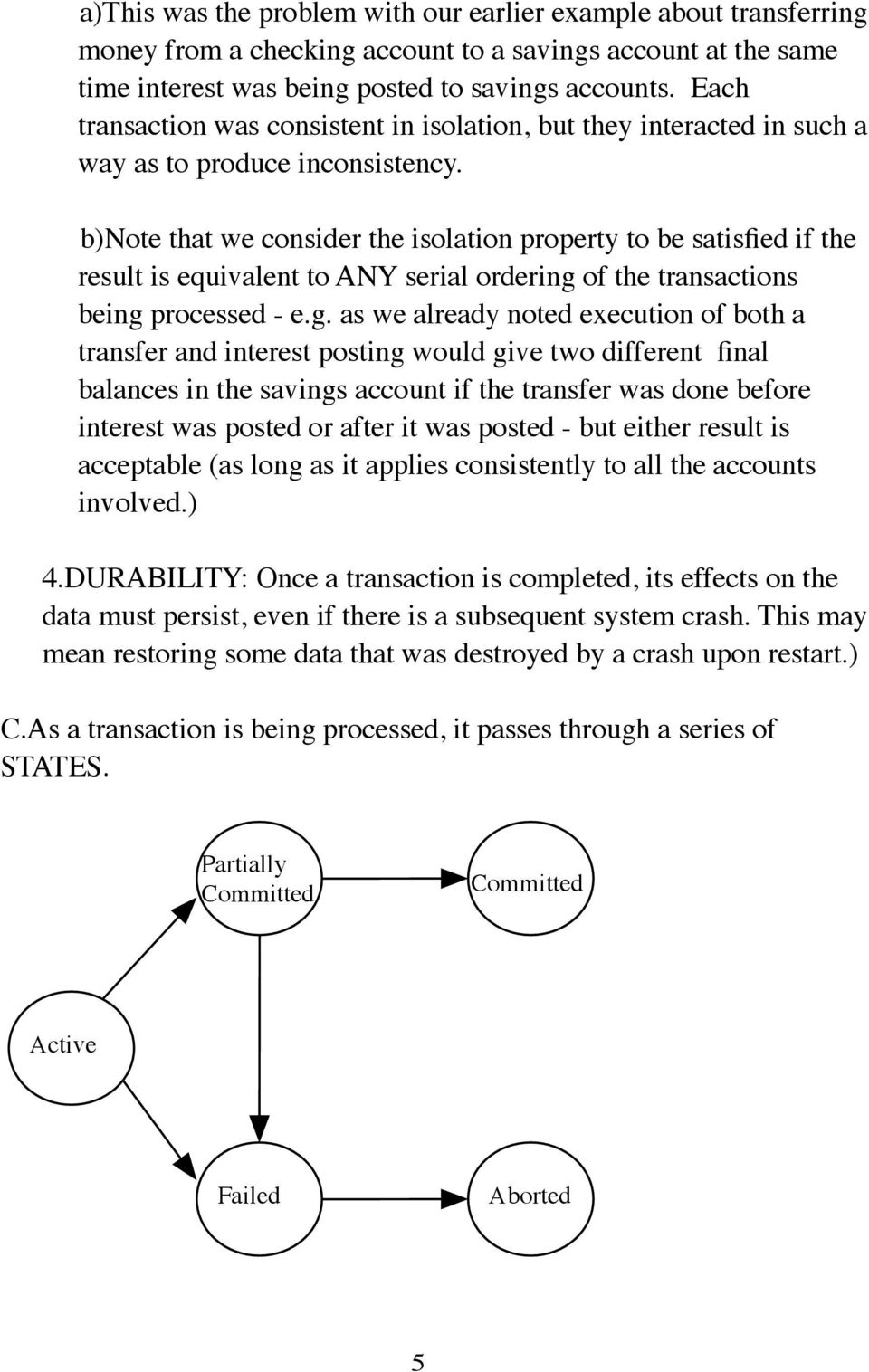
6 PROJECT 1.Active: from the time it starts, until it either fails or reaches its last statement. 2.Partially committed: its last statement has executed, but its changes to system data have not yet been made permanent. 3.Committed: its changes to the database have been made permanent. A soon as a transaction has partially committed, the system attempts to move it to the committed state - though there is no guarantee it will be able to successfully do so. Once a transaction has reached the committed state, the system is obligated preserve its results, even if there is a crash 4.Failed: a logical error or user abort has precluded completion, so any changes it has made to the database must be undone. 5.Aborted: all effects of the transaction have been removed from the system. 6.Some further points to note a)there is a one-way connection from partially committed to failed - a partially committed transaction can still fail; but a failed transaction must end up aborted b)externally visible effects of the transaction (those seen by a user) should be deferred until after the transaction is fully committed. These include: (1)The writing of messages to the user terminal such as Transaction complete. 6
7 (2)Changes to data seen by other users concurrently accessing the database. D.The implementation of the ACID properties in database managment systems is a subject considered in detail in the DBMS - we will not pursue it here beyond three notes: 1.Mechanisms for dealing with concurrency - such as we dealt with earlier in the course - are, of course, vital to guaranteeing isolation. 2.A typical approach to achieving durability is to make use of a LOG - a record of data write operations and the decision to commit a transaction that the system maintains in some form of write-only stable storage. This log can be used to restore data values for a committed transaction in the event of a system crash. 3.Guaranteeing these properties becomes especially complex in a distributed system. We will deal with one aspect of this problem when we talk about distributed algorithms. 7
Transactions and Recovery. Database Systems Lecture 15 Natasha Alechina
 Database Systems Lecture 15 Natasha Alechina In This Lecture Transactions Recovery System and Media Failures Concurrency Concurrency problems For more information Connolly and Begg chapter 20 Ullmanand
Textbook and References
 Transactions Qin Xu 4-323A Life Science Building, Shanghai Jiao Tong University Email: [email protected] Tel: 34204573(O) Webpage: http://cbb.sjtu.edu.cn/~qinxu/ Webpage for DBMS Textbook and References
INTRODUCTION TO DATABASE SYSTEMS
 1 INTRODUCTION TO DATABASE SYSTEMS Exercise 1.1 Why would you choose a database system instead of simply storing data in operating system files? When would it make sense not to use a database system? Answer
Information Systems. Computer Science Department ETH Zurich Spring 2012
 Information Systems Computer Science Department ETH Zurich Spring 2012 Lecture VI: Transaction Management (Recovery Manager) Recovery Manager ETH Zurich, Spring 2012 Information Systems 3 Failure Recovery
Recovery and the ACID properties CMPUT 391: Implementing Durability Recovery Manager Atomicity Durability
 Database Management Systems Winter 2004 CMPUT 391: Implementing Durability Dr. Osmar R. Zaïane University of Alberta Lecture 9 Chapter 25 of Textbook Based on slides by Lewis, Bernstein and Kifer. University
Chapter 10. Backup and Recovery
 Chapter 10. Backup and Recovery Table of Contents Objectives... 1 Relationship to Other Units... 2 Introduction... 2 Context... 2 A Typical Recovery Problem... 3 Transaction Loggoing... 4 System Log...
Course Content. Transactions and Concurrency Control. Objectives of Lecture 4 Transactions and Concurrency Control
 Database Management Systems Fall 2001 CMPUT 391: Transactions & Concurrency Control Dr. Osmar R. Zaïane University of Alberta Chapters 18 and 19 of Textbook Course Content Introduction Database Design
Chapter 14: Recovery System
 Chapter 14: Recovery System Chapter 14: Recovery System Failure Classification Storage Structure Recovery and Atomicity Log-Based Recovery Remote Backup Systems Failure Classification Transaction failure
Review: The ACID properties
 Recovery Review: The ACID properties A tomicity: All actions in the Xaction happen, or none happen. C onsistency: If each Xaction is consistent, and the DB starts consistent, it ends up consistent. I solation:
Database Concurrency Control and Recovery. Simple database model
 Database Concurrency Control and Recovery Pessimistic concurrency control Two-phase locking (2PL) and Strict 2PL Timestamp ordering (TSO) and Strict TSO Optimistic concurrency control (OCC) definition
Transaction Management Overview
 Transaction Management Overview Chapter 16 Database Management Systems 3ed, R. Ramakrishnan and J. Gehrke 1 Transactions Concurrent execution of user programs is essential for good DBMS performance. Because
Outline. Failure Types
 Outline Database Management and Tuning Johann Gamper Free University of Bozen-Bolzano Faculty of Computer Science IDSE Unit 11 1 2 Conclusion Acknowledgements: The slides are provided by Nikolaus Augsten
Recovery Theory. Storage Types. Failure Types. Theory of Recovery. Volatile storage main memory, which does not survive crashes.
 Storage Types Recovery Theory Volatile storage main memory, which does not survive crashes. Non-volatile storage tape, disk, which survive crashes. Stable storage information in stable storage is "never"
Transaction Management in Distributed Database Systems: the Case of Oracle s Two-Phase Commit
 Transaction Management in Distributed Database Systems: the Case of Oracle s Two-Phase Commit Ghazi Alkhatib Senior Lecturer of MIS Qatar College of Technology Doha, Qatar [email protected] and Ronny
Transactions and ACID in MongoDB
 Transactions and ACID in MongoDB Kevin Swingler Contents Recap of ACID transactions in RDBMSs Transactions and ACID in MongoDB 1 Concurrency Databases are almost always accessed by multiple users concurrently
Chapter 15: Recovery System
 Chapter 15: Recovery System Failure Classification Storage Structure Recovery and Atomicity Log-Based Recovery Shadow Paging Recovery With Concurrent Transactions Buffer Management Failure with Loss of
Agenda. Transaction Manager Concepts ACID. DO-UNDO-REDO Protocol DB101
 Concepts Agenda Database Concepts Overview ging, REDO and UNDO Two Phase Distributed Processing Dr. Nick Bowen, VP UNIX and xseries SW Development October 17, 2003 Yale Oct 2003 Database System ACID index
Concurrency Control. Module 6, Lectures 1 and 2
 Concurrency Control Module 6, Lectures 1 and 2 The controlling intelligence understands its own nature, and what it does, and whereon it works. -- Marcus Aurelius Antoninus, 121-180 A. D. Database Management
Brewer s Conjecture and the Feasibility of Consistent, Available, Partition-Tolerant Web Services
 Brewer s Conjecture and the Feasibility of Consistent, Available, Partition-Tolerant Web Services Seth Gilbert Nancy Lynch Abstract When designing distributed web services, there are three properties that
Introduction to Database Systems. Module 1, Lecture 1. Instructor: Raghu Ramakrishnan [email protected] UW-Madison
 Introduction to Database Systems Module 1, Lecture 1 Instructor: Raghu Ramakrishnan [email protected] UW-Madison Database Management Systems, R. Ramakrishnan 1 What Is a DBMS? A very large, integrated
UVA. Failure and Recovery. Failure and inconsistency. - transaction failures - system failures - media failures. Principle of recovery
 Failure and Recovery Failure and inconsistency - transaction failures - system failures - media failures Principle of recovery - redundancy - DB can be protected by ensuring that its correct state can
Introduction to Database Management Systems
 Database Administration Transaction Processing Why Concurrency Control? Locking Database Recovery Query Optimization DB Administration 1 Transactions Transaction -- A sequence of operations that is regarded
Transactions. SET08104 Database Systems. Copyright @ Napier University
 Transactions SET08104 Database Systems Copyright @ Napier University Concurrency using Transactions The goal in a concurrent DBMS is to allow multiple users to access the database simultaneously without
Chapter 10: Distributed DBMS Reliability
 Chapter 10: Distributed DBMS Reliability Definitions and Basic Concepts Local Recovery Management In-place update, out-of-place update Distributed Reliability Protocols Two phase commit protocol Three
Recovery System C H A P T E R16. Practice Exercises
 C H A P T E R16 Recovery System Practice Exercises 16.1 Explain why log records for transactions on the undo-list must be processed in reverse order, whereas redo is performed in a forward direction. Answer:
Database Management. Chapter Objectives
 3 Database Management Chapter Objectives When actually using a database, administrative processes maintaining data integrity and security, recovery from failures, etc. are required. A database management
Unit 12 Database Recovery
 Unit 12 Database Recovery 12-1 Contents 12.1 Introduction 12.2 Transactions 12.3 Transaction Failures and Recovery 12.4 System Failures and Recovery 12.5 Media Failures and Recovery Wei-Pang Yang, Information
WRITING PROOFS. Christopher Heil Georgia Institute of Technology
 WRITING PROOFS Christopher Heil Georgia Institute of Technology A theorem is just a statement of fact A proof of the theorem is a logical explanation of why the theorem is true Many theorems have this
Transactions and the Internet
 Transactions and the Internet Week 12-13 Week 12-13 MIE253-Consens 1 Schedule Week Date Lecture Topic 1 Jan 9 Introduction to Data Management 2 Jan 16 The Relational Model 3 Jan. 23 Constraints and SQL
Recover EDB and Export Exchange Database to PST 2010
 Recover EDB and Export Exchange Database to PST 2010 Overview: The Exchange Store (store.exe) is the main repository of Exchange Server 2010 edition. In this article, the infrastructure of store.exe along
Crash Recovery. Chapter 18. Database Management Systems, 3ed, R. Ramakrishnan and J. Gehrke
 Crash Recovery Chapter 18 Database Management Systems, 3ed, R. Ramakrishnan and J. Gehrke Review: The ACID properties A tomicity: All actions in the Xact happen, or none happen. C onsistency: If each Xact
The Prime Numbers. Definition. A prime number is a positive integer with exactly two positive divisors.
 The Prime Numbers Before starting our study of primes, we record the following important lemma. Recall that integers a, b are said to be relatively prime if gcd(a, b) = 1. Lemma (Euclid s Lemma). If gcd(a,
Recovery algorithms are techniques to ensure transaction atomicity and durability despite failures. Two main approaches in recovery process
 Database recovery techniques Instructor: Mr Mourad Benchikh Text Books: Database fundamental -Elmesri & Navathe Chap. 21 Database systems the complete book Garcia, Ullman & Widow Chap. 17 Oracle9i Documentation
Chapter 6 The database Language SQL as a tutorial
 Chapter 6 The database Language SQL as a tutorial About SQL SQL is a standard database language, adopted by many commercial systems. ANSI SQL, SQL-92 or SQL2, SQL99 or SQL3 extends SQL2 with objectrelational
Subversion Integration for Visual Studio
 Subversion Integration for Visual Studio VisualSVN Team VisualSVN: Subversion Integration for Visual Studio VisualSVN Team Copyright 2005-2008 VisualSVN Team Windows is a registered trademark of Microsoft
Failure Recovery Himanshu Gupta CSE 532-Recovery-1
 Failure Recovery CSE 532-Recovery-1 Data Integrity Protect data from system failures Key Idea: Logs recording change history. Today. Chapter 17. Maintain data integrity, when several queries/modifications
Chapter 16: Recovery System
 Chapter 16: Recovery System Failure Classification Failure Classification Transaction failure : Logical errors: transaction cannot complete due to some internal error condition System errors: the database
1.264 Lecture 15. SQL transactions, security, indexes
 1.264 Lecture 15 SQL transactions, security, indexes Download BeefData.csv and Lecture15Download.sql Next class: Read Beginning ASP.NET chapter 1. Exercise due after class (5:00) 1 SQL Server diagrams
Database Tuning and Physical Design: Execution of Transactions
 Database Tuning and Physical Design: Execution of Transactions David Toman School of Computer Science University of Waterloo Introduction to Databases CS348 David Toman (University of Waterloo) Transaction
! Volatile storage: ! Nonvolatile storage:
 Chapter 17: Recovery System Failure Classification! Failure Classification! Storage Structure! Recovery and Atomicity! Log-Based Recovery! Shadow Paging! Recovery With Concurrent Transactions! Buffer Management!
Updates Click to check for a newer version of the CD Press next and confirm the disc burner selection before pressing finish.
 Backup. If your computer refuses to boot or load Windows or if you are trying to restore an image to a partition the Reflect cannot lock (See here), and then you will have to start your PC using a rescue
Introduction to Database Systems CS4320. Instructor: Christoph Koch [email protected] CS 4320 1
 Introduction to Database Systems CS4320 Instructor: Christoph Koch [email protected] CS 4320 1 CS4320/1: Introduction to Database Systems Underlying theme: How do I build a data management system? CS4320
Overview. File Management. File System Properties. File Management
 File Management Lecture 15b 1 2 File Management File management system consists of system utility programs that run as privileged applications Input to applications is by means of a file Output is saved
Requirements document for an automated teller machine. network
 Requirements document for an automated teller machine network August 5, 1996 Contents 1 Introduction 2 1.1 Purpose : : : : : : : : : : : : : : : : : : : : : : : : : : : : : : : : : : : : : : : 2 1.2 Scope
Understanding Windows File System Transactions
 Understanding Windows File System Transactions Christian Allred Senior Software Development Engineer Microsoft Agenda Filesystems Today Transactional NTFS (TxF) TxF Scenarios Distributed TxF Transactions
How To Recover From Failure In A Relational Database System
 Chapter 17: Recovery System Database System Concepts See www.db-book.com for conditions on re-use Chapter 17: Recovery System Failure Classification Storage Structure Recovery and Atomicity Log-Based Recovery
Big Data Storage, Management and challenges. Ahmed Ali-Eldin
 Big Data Storage, Management and challenges Ahmed Ali-Eldin (Ambitious) Plan What is Big Data? And Why talk about Big Data? How to store Big Data? BigTables (Google) Dynamo (Amazon) How to process Big
TRANSACÇÕES. PARTE I (Extraído de SQL Server Books Online )
 Transactions Architecture TRANSACÇÕES PARTE I (Extraído de SQL Server Books Online ) Microsoft SQL Server 2000 maintains the consistency and integrity of each database despite errors that occur in the
1.4 Compound Inequalities
 Section 1.4 Compound Inequalities 53 1.4 Compound Inequalities This section discusses a technique that is used to solve compound inequalities, which is a phrase that usually refers to a pair of inequalities
Redundancy Options. Presented By: Chris Williams
 Redundancy Options Presented By: Chris Williams Table of Contents Redundancy Overview... 3 Redundancy Benefits... 3 Introduction to Backup and Restore Strategies... 3 Recovery Models... 4 Cold Backup...
1 File Processing Systems
 COMP 378 Database Systems Notes for Chapter 1 of Database System Concepts Introduction A database management system (DBMS) is a collection of data and an integrated set of programs that access that data.
Transaction Processing Monitors
 Chapter 24: Advanced Transaction Processing! Transaction-Processing Monitors! Transactional Workflows! High-Performance Transaction Systems! Main memory databases! Real-Time Transaction Systems! Long-Duration
20-30 minutes, can be used within a longer activity
 Locked-in 1 Age group successfully used with: Abilities assumed: Time: Size of group: 11 adult None 20-30 minutes, can be used within a longer activity anything from 2 to hundreds Focus What is an algorithm?
The first time through running an Ad Hoc query or Stored Procedure, SQL Server will go through each of the following steps.
 SQL Query Processing The first time through running an Ad Hoc query or Stored Procedure, SQL Server will go through each of the following steps. 1. The first step is to Parse the statement into keywords,
THE WINDOWS AZURE PROGRAMMING MODEL
 THE WINDOWS AZURE PROGRAMMING MODEL DAVID CHAPPELL OCTOBER 2010 SPONSORED BY MICROSOFT CORPORATION CONTENTS Why Create a New Programming Model?... 3 The Three Rules of the Windows Azure Programming Model...
Big Data Management and NoSQL Databases
 NDBI040 Big Data Management and NoSQL Databases Lecture 4. Basic Principles Doc. RNDr. Irena Holubova, Ph.D. [email protected] http://www.ksi.mff.cuni.cz/~holubova/ndbi040/ NoSQL Overview Main objective:
SQLBase 8.0 and COM+ Transactions
 SQLBase 8.0 and COM+ Transactions By Suren Behari Product Manager Gupta Technologies, LLC 975 Island Drive Redwood Shores, CA 94065 USA Phone +1-650-596-3400 Fax: +1-650-596-4690 TABLE OF CONTENTS Abstract...3
Transactions, Views, Indexes. Controlling Concurrent Behavior Virtual and Materialized Views Speeding Accesses to Data
 Transactions, Views, Indexes Controlling Concurrent Behavior Virtual and Materialized Views Speeding Accesses to Data 1 Why Transactions? Database systems are normally being accessed by many users or processes
Last Class Carnegie Mellon Univ. Dept. of Computer Science 15-415/615 - DB Applications
 Last Class Carnegie Mellon Univ. Dept. of Computer Science 15-415/615 - DB Applications C. Faloutsos A. Pavlo Lecture#23: Crash Recovery Part 2 (R&G ch. 18) Write-Ahead Log Checkpoints Logging Schemes
(Pessimistic) Timestamp Ordering. Rules for read and write Operations. Pessimistic Timestamp Ordering. Write Operations and Timestamps
 (Pessimistic) stamp Ordering Another approach to concurrency control: Assign a timestamp ts(t) to transaction T at the moment it starts Using Lamport's timestamps: total order is given. In distributed
Database Management System Prof. D. Janakiram Department of Computer Science & Engineering Indian Institute of Technology, Madras Lecture No.
 Database Management System Prof. D. Janakiram Department of Computer Science & Engineering Indian Institute of Technology, Madras Lecture No. 23 Concurrency Control Part -4 In the last lecture, we have
Transactions and Concurrency Control. Goals. Database Administration. (Manga Guide to DB, Chapter 5, pg 125-137, 153-160) Database Administration
 Transactions and Concurrency Control (Manga Guide to DB, Chapter 5, pg 125-137, 153-160) 1 Goals Database Administration Concurrency Control 2 Database Administration All large and small databases need
In-memory databases and innovations in Business Intelligence
 Database Systems Journal vol. VI, no. 1/2015 59 In-memory databases and innovations in Business Intelligence Ruxandra BĂBEANU, Marian CIOBANU University of Economic Studies, Bucharest, Romania [email protected],
Principles of Database. Management: Summary
 Principles of Database Management: Summary Pieter-Jan Smets September 22, 2015 Contents 1 Fundamental Concepts 5 1.1 Applications of Database Technology.............................. 5 1.2 Definitions.............................................
Exception and Interrupt Handling in ARM
 Exception and Interrupt Handling in ARM Architectures and Design Methods for Embedded Systems Summer Semester 2006 Author: Ahmed Fathy Mohammed Abdelrazek Advisor: Dominik Lücke Abstract We discuss exceptions
Ch. 11.2: Installment Buying
 Ch. 11.2: Installment Buying When people take out a loan to make a big purchase, they don t often pay it back all at once in one lump-sum. Instead, they usually pay it back back gradually over time, in
Network Virtualization Platform (NVP) Incident Reports
 Network Virtualization Platform (NVP) s ORD Service Interruption During Scheduled Maintenance June 20th, 2013 Time of Incident: 03:45 CDT While performing a scheduled upgrade on the Software Defined Networking
Recovery: Write-Ahead Logging
 Recovery: Write-Ahead Logging EN 600.316/416 Instructor: Randal Burns 4 March 2009 Department of Computer Science, Johns Hopkins University Overview Log-based recovery Undo logging Redo logging Restart
INCIDENCE-BETWEENNESS GEOMETRY
 INCIDENCE-BETWEENNESS GEOMETRY MATH 410, CSUSM. SPRING 2008. PROFESSOR AITKEN This document covers the geometry that can be developed with just the axioms related to incidence and betweenness. The full
Name: 1. CS372H: Spring 2009 Final Exam
 Name: 1 Instructions CS372H: Spring 2009 Final Exam This exam is closed book and notes with one exception: you may bring and refer to a 1-sided 8.5x11- inch piece of paper printed with a 10-point or larger
E-Series. NetApp E-Series Storage Systems Mirroring Feature Guide. NetApp, Inc. 495 East Java Drive Sunnyvale, CA 94089 U.S.
 E-Series NetApp E-Series Storage Systems Mirroring Feature Guide NetApp, Inc. 495 East Java Drive Sunnyvale, CA 94089 U.S. Telephone: +1 (408) 822-6000 Fax: +1 (408) 822-4501 Support telephone: +1 (888)
Simnet Registry Repair 2011. User Guide. Edition 1.3
 Simnet Registry Repair 2011 User Guide Edition 1.3 1 Content Getting Started...3 System requirements...3 Minimum system requirements...3 Recomended system specifications...3 Program Overview...4 About
Special Relativity and the Problem of Database Scalability
 Special Relativity and the Problem of Database Scalability James Starkey NimbusDB, Inc. The problem, some jargon, some physics, a little theory, and then NimbusDB. Problem: Database systems scale badly
Distributed Databases
 C H A P T E R19 Distributed Databases Practice Exercises 19.1 How might a distributed database designed for a local-area network differ from one designed for a wide-area network? Data transfer on a local-area
2x + y = 3. Since the second equation is precisely the same as the first equation, it is enough to find x and y satisfying the system
 1. Systems of linear equations We are interested in the solutions to systems of linear equations. A linear equation is of the form 3x 5y + 2z + w = 3. The key thing is that we don t multiply the variables
Redo Recovery after System Crashes
 Redo Recovery after System Crashes David Lomet Microsoft Corporation One Microsoft Way Redmond, WA 98052 [email protected] Mark R. Tuttle Digital Equipment Corporation One Kendall Square Cambridge, MA
Recovery: An Intro to ARIES Based on SKS 17. Instructor: Randal Burns Lecture for April 1, 2002 Computer Science 600.416 Johns Hopkins University
 Recovery: An Intro to ARIES Based on SKS 17 Instructor: Randal Burns Lecture for April 1, 2002 Computer Science 600.416 Johns Hopkins University Log-based recovery Undo logging Redo logging Restart recovery
Week 1 Part 1: An Introduction to Database Systems. Databases and DBMSs. Why Use a DBMS? Why Study Databases??
 Week 1 Part 1: An Introduction to Database Systems Databases and DBMSs Data Models and Data Independence Concurrency Control and Database Transactions Structure of a DBMS DBMS Languages Databases and DBMSs
CPS122 - OBJECT-ORIENTED SOFTWARE DEVELOPMENT. Team Project
 CPS122 - OBJECT-ORIENTED SOFTWARE DEVELOPMENT Team Project Due Dates: See syllabus for due dates for each milestone This project spans much of the semester, to be completed as a series of milestones, each
Traditional IBM Mainframe Operating Principles
 C H A P T E R 1 7 Traditional IBM Mainframe Operating Principles WHEN YOU FINISH READING THIS CHAPTER YOU SHOULD BE ABLE TO: Distinguish between an absolute address and a relative address. Briefly explain
EMC MID-RANGE STORAGE AND THE MICROSOFT SQL SERVER I/O RELIABILITY PROGRAM
 White Paper EMC MID-RANGE STORAGE AND THE MICROSOFT SQL SERVER I/O RELIABILITY PROGRAM Abstract This white paper explains the integration of EMC Mid-range Storage arrays with the Microsoft SQL Server I/O
B.Com(Computers) II Year RELATIONAL DATABASE MANAGEMENT SYSTEM Unit- I
 B.Com(Computers) II Year RELATIONAL DATABASE MANAGEMENT SYSTEM Unit- I 1 1. What is Data? A. Data is a collection of raw information. 2. What is Information? A. Information is a collection of processed
Comp 5311 Database Management Systems. 16. Review 2 (Physical Level)
 Comp 5311 Database Management Systems 16. Review 2 (Physical Level) 1 Main Topics Indexing Join Algorithms Query Processing and Optimization Transactions and Concurrency Control 2 Indexing Used for faster
Module 12. Software Project Monitoring and Control. Version 2 CSE IIT, Kharagpur
 Module 12 Software Project Monitoring and Control Lesson 31 Risk Management and Software Configuration Management Specific Instructional Objectives At the end of this lesson the student would be able to:
The Benefits of USB Flash Drives
 The Benefits of USB Flash Drives A USB flash drive also known as USB drive, pen drive, thumb drive, key drive or jump drive is an excellent way to transfer photos from one computer to another. USB Flash
COS 318: Operating Systems
 COS 318: Operating Systems File Performance and Reliability Andy Bavier Computer Science Department Princeton University http://www.cs.princeton.edu/courses/archive/fall10/cos318/ Topics File buffer cache
DATABASDESIGN FÖR INGENJÖRER - 1DL124
 1 DATABASDESIGN FÖR INGENJÖRER - 1DL124 Sommar 2005 En introduktionskurs i databassystem http://user.it.uu.se/~udbl/dbt-sommar05/ alt. http://www.it.uu.se/edu/course/homepage/dbdesign/st05/ Kjell Orsborn
Lab 11. Simulations. The Concept
 Lab 11 Simulations In this lab you ll learn how to create simulations to provide approximate answers to probability questions. We ll make use of a particular kind of structure, called a box model, that
MATH10040 Chapter 2: Prime and relatively prime numbers
 MATH10040 Chapter 2: Prime and relatively prime numbers Recall the basic definition: 1. Prime numbers Definition 1.1. Recall that a positive integer is said to be prime if it has precisely two positive
RecoverIt Frequently Asked Questions
 RecoverIt Frequently Asked Questions Windows Recovery FAQs When can I use Windows Recovery application? This application is used to recover the deleted files from internal or external storage devices with
Introduction to Database Systems
 Introduction to Database Systems A database is a collection of related data. It is a collection of information that exists over a long period of time, often many years. The common use of the term database
Topics. Introduction to Database Management System. What Is a DBMS? DBMS Types
 Introduction to Database Management System Linda Wu (CMPT 354 2004-2) Topics What is DBMS DBMS types Files system vs. DBMS Advantages of DBMS Data model Levels of abstraction Transaction management DBMS