
Truth or Consequences, Best Medication List Practices to Deliver Best Care. Leaning & Action Network Session
|
|
|
- Reynard Holland
- 9 years ago
- Views:
Transcription
1 Truth or Consequences, Best Medication List Practices to Deliver Best Care Leaning & Action Network Session

2 Introduction David Cook (5 minutes) Housekeeping: - In event of a fire? - Restrooms? David R. Cook (direct) [email protected]

3 Introduction David Cook (5 minutes) Agenda: Introduction 5 minutes (Dave Cook) Frame the Problem 20 minutes (Karen Gunning, PharmD, BCPS, FCCP and Emily Hays, PharmD) Workflow Analysis 15 minutes (Dave Cook) World Café 45 minutes (Everyone) Action Plan 20 minutes (Dave Cook) Upcoming Events & Follow-up 15 minutes (Dave Cook)

4 Objectives Objective of Session: Learn and showcase effective patient engagement techniques and barriers to med reconciliation (electronic and paper) Identify areas to find data (chie, patient, family, pharmacy, hospital) Identify communications and workflow best practices

5

6 TRUTH OR CONSEQUENCES: BEST MEDICATION LIST PRACTICES TO DELIVER BEST CARE IMPORTANCE OF MEDICATION RECONCILIATION
7 Medication reconciliation What is it: Identifying the patient s complete medication regimen - Prescription, OTC, herbals, vitamins, supplements - Dose, frequency, route Documenting medications and doses the patient is actually taking Documenting new medications, discontinued medications, and dose adjustments Verification, Clarification and Reconciliation When is it performed: Upon admission, transfer to a different unit, and at discharge At every outpatient clinic visit

8 Medication reconciliation Why bother? Avoid medication errors Reduce readmissions Reduce costs Provide patient education Assess barriers to medication adherence Facilitate communication between providers Improve quality of care

9 Specific Goals for Decreasing Adverse Events & Errors Avoiding Potential Drug-Drug Interactions Potentially Inappropriate Dosing Potential Drug-Disease Interactions Potentially Inappropriate Therapy and Duplications Monitoring and Preventing Potential Adverse Drug Events

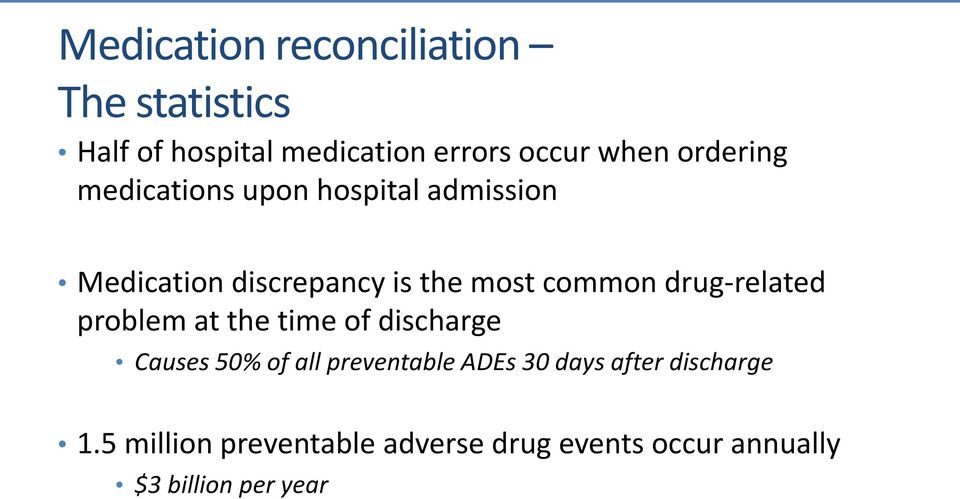
10 Medication reconciliation The statistics Half of hospital medication errors occur when ordering medications upon hospital admission Medication discrepancy is the most common drug-related problem at the time of discharge Causes 50% of all preventable ADEs 30 days after discharge 1.5 million preventable adverse drug events occur annually $3 billion per year
11 Reconciliation Pitfalls in the Medical Office Missing information 72% in one study Dose Dosage form Route Frequency Erroneous information can have serious consequences Owen MC et al. Evaluation of Medication List Safety, Completeness and Annotation.

12 Process Change for Office Medication Reconciliation: Medical Office Staff Assure the accuracy of each patient s medication list What is accurate? Can patient medication list review improve accuracy? Ask about nonprescription therapy, herbal and supplements What other things are you doing to improve (maintain) your health? Poly-provider medications from outside providers CALL THE PHARMACY Distribute printed medication list at the end of each visit this should be THE LIST

13 Process Change for Office Medication Reconciliation: Clinical Staff Review alerts and adjust prescribing as necessary Critical assessment for drug related problems Drug-Drug Interactions Dosing Drug-Disease Interactions***** Duplications Monitoring for Potential Adverse Drug Events Implement a practice refill protocol Helps to improve reconciliation for patients who don t come in! EHR system helps.

14 Transitions of care A case for medication reconciliation

15 Med rec during transitions of care RH is a 79 year old Russian-speaking male PMH Anxiety Atrial fibrillation CAD Depression HTN Insomnia HLD Recently admitted for AAA rupture and repair

16 Med rec during transitions of care Medications per PCP record at time of admit Escitalopram 10mg daily Zolpidem 5mg daily Flovent HFA inhaler twice daily Albuterol inhaler as needed Atorvastatin 40mg daily Nitroglycerin sublingual tablet as needed Rivaroxaban 20mg daily Atenolol 12.5mg daily Per the last 2 clinic notes patient taking medications as directed

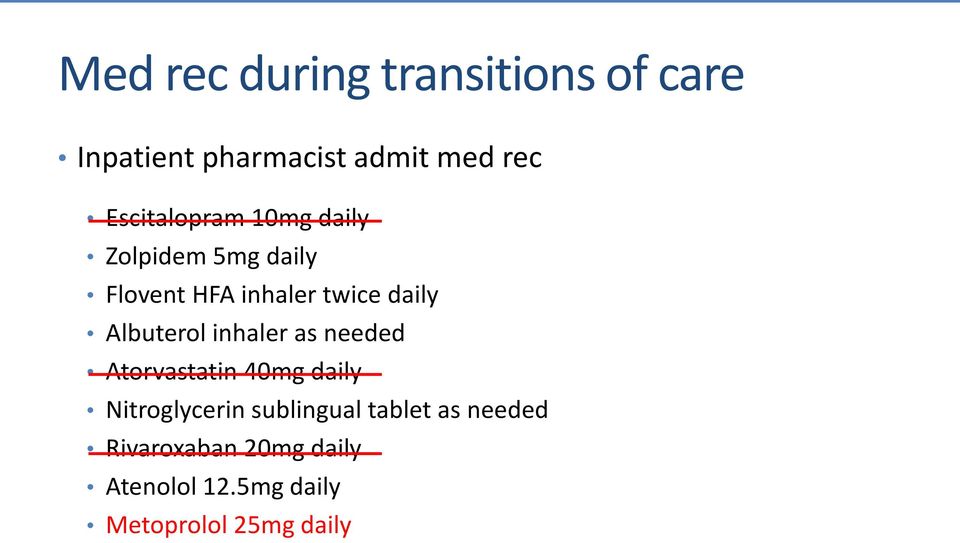
17 Med rec during transitions of care Inpatient pharmacist admit med rec Escitalopram 10mg daily Zolpidem 5mg daily Flovent HFA inhaler twice daily Albuterol inhaler as needed Atorvastatin 40mg daily Nitroglycerin sublingual tablet as needed Rivaroxaban 20mg daily Atenolol 12.5mg daily Metoprolol 25mg daily
18 Med rec during transitions of care Discharge medication list Escitalopram 10mg daily; mirtazapine 15mg started Zolpidem 5mg daily Flovent HFA inhaler twice daily Albuterol inhaler as needed Atorvastatin 40mg daily; simvastatin 80mg started Nitroglycerin sublingual tablet as needed Rivaroxaban 20mg daily; aspirin 81mg started Atenolol 12.5mg daily Metoprolol 25mg daily

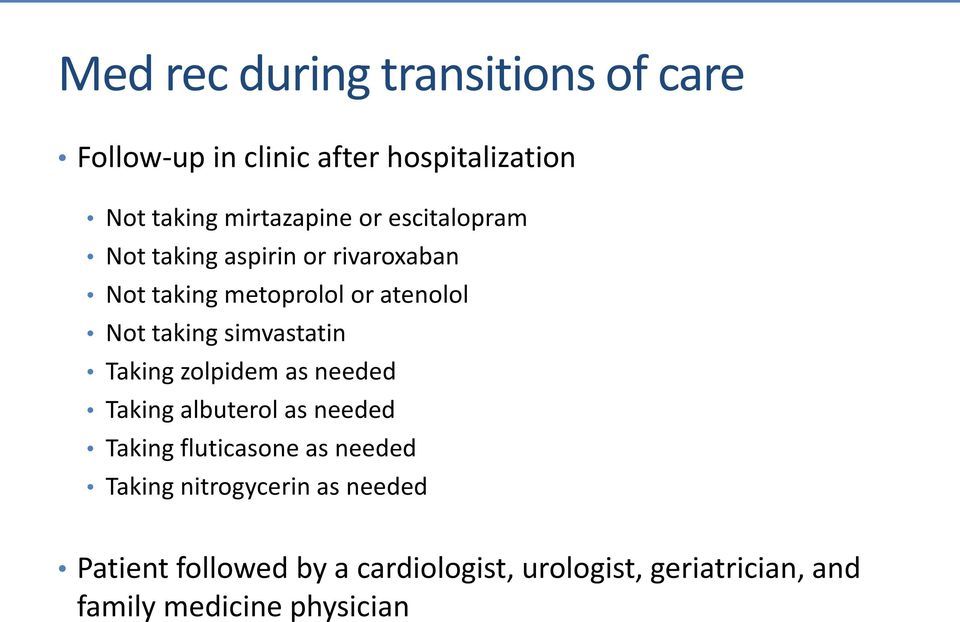
19 Med rec during transitions of care Follow-up in clinic after hospitalization Not taking mirtazapine or escitalopram Not taking aspirin or rivaroxaban Not taking metoprolol or atenolol Not taking simvastatin Taking zolpidem as needed Taking albuterol as needed Taking fluticasone as needed Taking nitrogycerin as needed Patient followed by a cardiologist, urologist, geriatrician, and family medicine physician
20 A comparison of the medication lists PCP List Escitalopram 10mg daily Zolpidem 5mg daily Flovent HFA inhaler twice daily Albuterol inhaler PRN Atorvastatin 40mg daily Nitroglycerin PRN Rivaroxaban 20mg daily Atenolol 12.5mg daily DC List Mirtazapine 15mg Zolpidem 5mg daily Flovent HFA inhaler twice daily Albuterol inhaler PRN Simvastatin 80mg daily Nitroglycerin PRN Aspirin 81mg Metoprolol 25mg daily Patient List Zolpidem 5mg PRN Albuterol inhaler PRN Flovent HFA PRN Nitrogycerin PRN

21 Med rec during transitions of care Med rec helped to identify barriers to patient care Poor compliance Language barrier Lack of understanding of medication therapy Multiple providers Med rec helped to overcome barriers to patient care Simplify medication regimen Communicate with patient via interpreter Patient and family education on medications and disease states Facilitate communication between providers
22 Workflow Analysis 20 minutes Dave Cook Work and process flow charts (or maps) are essentially the same in that they are a graphical view of a process. They can be used to map work or process flow to identify opportunities for improvement.
23 Workflow Analysis 20 minutes A flowchart outlines current workflow and helps identify: Successful medication reconciliation practices. Current roles and responsibilities. Potential failures. Unnecessary redundancies and gaps in the process. Focus on the Who, What, Where, When, and How? If EHR based what prompts, reminders, task lists are involved. Medications at Transitions and Clinical Handoffs (MATCH) Toolkit for Medication Reconciliation AHRQ Aug 2012
24 Workflow Analysis 20 minutes 1. Who obtains a medication list? 2. What is captured during a medication history interview? 3. When is a medication history obtained? 4. Where is the medication history documented within the patient s medical record? 5. How is a medication history documented (i.e., structured paper form; electronic entry; etc.)? 6. How do you monitor and measure that medication histories are obtained and documented appropriately?
25 Workflow Analysis Example Take 10 minutes and map out the workflow in your care setting
26 Workflow Analysis Example Obtain patient medication list Obtain medical record medication list Additional Data Gathering? Gather additional data (call family, pharmacy, data repository) Reconcile lists to get Current Med List Optimize the List Update/Document the List for current visit Take 10 minutes and map out the workflow in your care setting Give Lists of Meds to Patient Include list of medications in communication to next care provider
27 World Café Intro World Café 5 questions - Barriers, Best Practices, Tools, Communication Techniques, and Find the Data Able to participate at 3 tables. We will rotate every 15 minutes facilitated discussion Paper on the tables and markers. If you have an idea that comes to mind while you re talking write it down
28 World Café - Discussion at each table Table 1: Barriers to effective med reconciliation? Table 2: Best practices for effective med reconciliation? Table 3: Tools to engage patients in the process? Table 4: Communication techniques that can be used with patients to improve accuracy? Table 5: Where can you find the data?
29 What is Your Plan of Action? What is your Plan of Action? Step One: Based on what you heard today, pick an action that you can implement to improve patient-centered care. Patient Centered Ideas for Action: Assess current patient engagement practices for gaps Improve cultural competency Assess health literacy barriers Provide care plans/visit summaries in non-medical language Implement Personal Health records Implement an electronic patient portal Train patients to plan their visits Use teach back or AskMe3 Train staff in motivational interviewing Train staff in coaching Develop a panel of patient experts to advise you Ideas I heard today that I like: Here are some ideas to get you started: Measurement Ideas: Patient satisfaction scores # of times a tool is used each day # of staff trained in # of meetings with a patient story shared # of meetings with a patient participant # of new templates with selfmanagement assessment developed and used People I met today I want to contact: Consider the ideas on page 13. Fill out your plan for action on page 14. Share with your table what your plan is. Go to action!
30
31
32 Tell us about your experience today There are two evaluations: 1. White Evaluation confidential This page is completed without listing your name. Please rate the morning plenary presentations and the afternoon presentation you attended. 2. Blue evaluation Please fill in your name and contact information To request CME credit and follow up technical assistance as needed. When you have completed both pages of the evaluation, please turn them in separately as you leave. Thank you for your participation and feedback!
Cedars Sinai Medical Center (CSMC) Learning Objectives. Why Medication Reconciliation?
 Management Case Study: Transitions Trifecta Calibrating the Severity of Drug Related Problems, dherence, and Literacy in a High Risk Population Tuesday, December 10, 2013 2:00 p.m. 2:30 p.m. Management
RIH Transitions of Care Collaboration with Coastal Medical To Improve Transitions for Patients Discharged Hospital To Home
 RIH Transitions of Care Collaboration with Coastal Medical To Improve Transitions for Patients Discharged Hospital To Home Sergio Petrillo, PharmD Clinical Pharmacist Specialist, Rhode Island Hospital
Utilizing Pharmacy Technicians for Medication Reconciliation. Kristy Malacos, MS, CPhT Magruder Hospital Port Clinton, OH Pharmacy Systems, Inc.
 Utilizing Pharmacy Technicians for Medication Reconciliation Kristy Malacos, MS, CPhT Magruder Hospital Port Clinton, OH Pharmacy Systems, Inc. Magruder Hospital Located on the shores of Lake Erie in Port
Reconciling the Differences. Karen Lippett B.Sc.Phm Humber River Regional Hospital Renal Dialysis Unit
 Reconciling the Differences Karen Lippett B.Sc.Phm Humber River Regional Hospital Renal Dialysis Unit Objectives 1. Review the medication discharge counselling process in the renal dialysis program 2.
Medicines reconciliation on admission and discharge from hospital policy April 2013. WHSCT medicines reconciliation policy 1
 Medicines reconciliation on admission and discharge from hospital policy April 2013 WHSCT medicines reconciliation policy 1 Policy Title Policy Reference Number Medicines reconciliation on admission and
A Modest Proposal A Systems Solution to Medication Reconciliation By James L. Holly, MD
 A Modest Proposal A Systems Solution to Medication Reconciliation By James L. Holly, MD SETMA believes that a system s solution (see Peter Senge, The Fifth Discipline, The more complex a problem the more
HPSJ s Cognitive Services Program 07/2015
 HPSJ s Cognitive Services Program 07/2015 Pharmacy & MTM Services Growing demand for MTM services Each year, inappropriate use of medications have led to $1.5 million dollars spent on preventable, medication-related
How Can We Get the Best Medication History?
 How Can We Get the Best Medication History? Stephen Shalansky, Pharm.D., FCSHP Pharmacy Department, St. Paul s Hospital Faculty of Pharmaceutical Sciences, UBC How Are We Doing Now? Completeness of Medication
UNIVERSITY OF WISCONSIN HOSPITAL AND CLINICS DEPARTMENT OF PHARMACY SCOPE OF PATIENT CARE SERVICES FY 2014 October 1 st, 2014
 UNIVERSITY OF WISCONSIN HOSPITAL AND CLINICS DEPARTMENT OF PHARMACY SCOPE OF PATIENT CARE SERVICES FY 2014 October 1 st, 2014 Department Name: Department of Pharmacy Department Director: Steve Rough, MS,
Implementing an Evidence Based Hospital Discharge Process
 Implementing an Evidence Based Hospital Discharge Process Learning from the experience of Project Re-Engineered Discharge (RED) Webinar January 14, 2013 Chris Manasseh, MD Director, Boston HealthNet Inpatient
Medication Reconciliation Technician Standard Workflow
 Process Description: Medication Reconciliation is the process of making a good faith attempt to obtain a patients prior to admission medication history, which is eventually reconciled against a patients
Learning Objectives. Introduction to Reconciling Medication Information. Background. Elements of Performance NPSG.03.06.01
 Pharmacy Evaluation of Medication Reconciliation Initiated in the Emergency Department Manuel A. Calvin, Pharm.D. PGY1 Pharmacy Resident Saint Francis Hospital, Tulsa, OK OSHP Annual Meeting Residency
Medication Reconciliation Training Packet. Legacy Health System
 Medication Reconciliation Training Packet Legacy Health System 1 Objectives To identify the key elements of the medication reconciliation process To describe the role of the nurse in the medication reconciliation
Kaiser Permanente of Ohio
 Kaiser Permanente of Ohio Chronic Disease Management Program March 11, 2011 Presenters: Amy Kramer and Audrey L. Callahan 1 Objectives 1. Define the roles and responsibilities of the Care Managers in the
Medweb Telemedicine 667 Folsom Street, San Francisco, CA 94107 Phone: 415.541.9980 Fax: 415.541.9984 www.medweb.com
 Medweb Telemedicine 667 Folsom Street, San Francisco, CA 94107 Phone: 415.541.9980 Fax: 415.541.9984 www.medweb.com Meaningful Use On July 16 2009, the ONC Policy Committee unanimously approved a revised
Infectious Diseases @ EUHM Learning Activities:
 Infectious Diseases @ EUHM Learning Activities: Preceptor: Steve Mok, PharmD, BCPS (AQ-ID) Office: EUHM Clinical Pharmacy office, 2 nd fl Peachtree Building Hours: 8:00 17:00 Desk: 404-686-8904 Pager:
GUIDELINES ON PREVENTING MEDICATION ERRORS IN PHARMACIES AND LONG-TERM CARE FACILITIES THROUGH REPORTING AND EVALUATION
 GUIDELINES GUIDELINES ON PREVENTING MEDICATION ERRORS IN PHARMACIES AND LONG-TERM CARE FACILITIES THROUGH REPORTING AND EVALUATION Preamble The purpose of this document is to provide guidance for the pharmacist
Script/Notes for PowerPoint Presentation. Medication Use Safety Training for Seniors (MUST for Seniors)
 Script/Notes for PowerPoint Presentation Medication Use Safety Training for Seniors (MUST for Seniors) Instructions: You can use the following script to help you prepare your remarks to your organization
Medication error is the most common
 Medication Reconciliation Transfer of medication information across settings keeping it free from error. By Jane H. Barnsteiner, PhD, RN, FAAN Medication error is the most common type of error affecting
PPP 1. Continuation of a medication to ensure continuity of care
 PRESCRIBING POLICIES: 4.7 PHARMACIST AUTHORITY The College of Pharmacists of BC Professional Practice Policy (PPP) 58 Medication Management (Adapting a Prescription) became effective April 1, 2009. The
Use of Novel Oral Anticoagulants (NOACs) and the new DAWN modules at Scripps
 Use of Novel Oral Anticoagulants (NOACs) and the new DAWN modules at Scripps Cheryl Ea, Pharm D. Anticoagulation Services Scripps Clinic and Scripps Green Hospital La Jolla, California Pharmacist Management
CCNC Care Management Standardized Plan
 Standardization & Reporting: Why is standardization important? Community Care Networks are responsible for the delivery of targeted care management services that will improve quality of care while containing
Describe the characteristics that medication reconciliation processes used in various health care settings should include
 The Role of Medication Reconciliation in Ensuring Patient Safety Release Date: 07/14/2011 Expiration Date: 07/14/2014 FACULTY: Kathryn L Haldiman MS, RN FACULTY AND ACCREDITOR DISCLOSURE STATEMENTS: Kathryn
Improving Care Transitions: Optimizing Medication Reconciliation
 Improving Care Transitions: Optimizing Medication Reconciliation March 2012 Improving Care Transitions: Optimizing Medication Reconciliation Developed by: American Pharmacists Association American Society
Licensed Pharmacy Technician Scope of Practice
 Licensed Scope of Practice Adapted from: Request for Regulation of s Approved by Council April 24, 2015 Definitions In this policy: Act means The Pharmacy and Pharmacy Disciplines Act means an unregulated
An Introduction to Medication Adherence
 An Introduction to Medication Adherence Medication Adherence Project (MAP) A project of the Cardiovascular Prevention & Control Program and the Fund for Public Health in New York Drugs don t work in patients
AMBULATORY CARE SERVICES
 AMBULATORY CARE SERVICES Roda Plakogiannis, BS, PharmD, BCPS, CLS Associate Professor of Pharmacy Practice Arnold & Marie Schwartz College of Pharmacy and Health Sciences & Clinical Pharmacy Manager-Primary
Question & Answer Guide
 Joint Commission Primary Care Medical Home (PCMH) Certification for Accredited Ambulatory Health Care Organizations Question & Answer Guide A. SCORING/DECISION-RELATED Question: We are already Joint Commission
8/24/2015. Objectives. The Scope of Pharmacy Technician Practice. Role of a Technician. Pharmacy Technician. Technician Training
 Objectives The Scope of Pharmacy Technician Practice Sara Vander Ploeg, PharmD Northwestern Memorial Hospital The speaker has no actual or potential conflicts of interest as it relates to this presentation.
Kaiser Permanente: Transition Care Performance and Strategies
 Kaiser Permanente: Transition Care Performance and Strategies Carol Ann Barnes, PT, DPT, GCS [email protected] April 2009 Netta Conyers-Haynes, October, 2014 Principal Consultant, Communications Agenda
Health Care Homes Certification Assessment Tool- With Examples
 Guidelines: Health Care Homes Certification Assessment Form Structure: This is the self-assessment form that HCH applicants should use to determine if they meet the requirements for HCH certification.
Medication Error. Medication Errors. Transitions in Care: Optimizing Intern Resources
 Transitions in Care: Optimizing Intern Resources DeeDee Hu PharmD, MBA Clinical Specialist Critical Care and Cardiology PGY1 Program Director Memorial Hermann Memorial City Medical Center Medication Error
Thrifty White Pharmacy 9/5/2014. Specialty Pharmacy. Specialty Pharmacy: The Opportunities and the Challenges
 Specialty Pharmacy: The Opportunities and the Challenges MPhA Annual Conference September 12, 2014 Justin Heiser, PharmD Senior Vice President, Pharmacy Operations Specialty Pharmacy High cost and/or high
Intake / Admissions Processes
 Intake / Admissions Processes Now that the elements of providing quality customer service have been reviewed, the intake and admission processes will be covered. Some homecare companies make a distinction
All Wales Prescription Writing Standards
 All Wales Prescription Writing Standards These standards should be read in conjunction with completing the All Wales Medication Chart e- learning package, available on the Learning@NHSWales internet site
Agency # 070.00 REGULATION 9 PHARMACEUTICAL CARE/PATIENT COUNSELING
 Agency # 070.00 REGULATION 9 PHARMACEUTICAL CARE/PATIENT COUNSELING 09-00: PATIENT COUNSELING 09-00-0001--PATIENT INFORMATION, DRUG USE EVALUATION, AND PATIENT COUNSELING The intent of this regulation
Breakfast symposium: From hospital to home - the focus on the patient
 Breakfast symposium: From hospital to home - the focus on the patient Nadya Hamedi DARZI Fellow UCLPartners and Barts Health NHS Trust in collaboration with North Central London Local Pharmaceutical Committee
EMR Adoption Survey. Instructions. This survey contains a series of multiple-choice questions corresponding to the 5-stage EMR Adoption Model.
 EMR Adoption Survey Instructions This survey contains a series of multiple-choice questions corresponding to the -stage EMR Adoption Model. If the respondent is a physician, ask all questions. If the respondent
Unintended Consequences of Drug-Drug Interaction Alerts The Partners Experience
 Unintended Consequences of Drug-Drug Interaction Alerts The Partners Experience October 13-14, 2009 Eileen Yoshida, RPh, MBA Partners HealthCare Agenda Background Clinical Information Systems Clinical
DRAFT. How to Conduct a Post-discharge Follow-up Phone Call. Contract HHSA290200600012i. April 15, 2011
 How to Conduct a Post-discharge Follow-up Phone Call Contract HHSA290200600012i New tool (deliverable 2.4) April 15, 2011 Prepared for Cindy Brach Agency for Healthcare Research & Quality (AHRQ) Rockville,
Measure #130 (NQF 0419): Documentation of Current Medications in the Medical Record National Quality Strategy Domain: Patient Safety
 Measure #130 (NQF 0419): Documentation of Current Medications in the Medical Record National Quality Strategy Domain: Patient Safety 2016 PQRS OPTIONS FOR INDIVIDUAL MEASURES: CLAIMS, REGISTRY DESCRIPTION:
Overview Medication Adherence Where Are We Today?
 Overview Medication Adherence Where Are We Today? This section covers the following topics: Adherence concepts and terminology Statistics related to adherence Consequences of medication nonadherence Factors
By definition, medication means something that treats the symptoms of
 Chapter 1 The Nurse s Role in Medication Reconciliation Authors Jennifer S. Johnson, R.N., C.M.A., charge nurse, telemetry unit; Paul Mollo, Pharm.D., director of Pharmacy; Caryl-Ann Mannino, R.N., O.C.N.,
Guidelines on Counseling. Approved by PEIPB
 Guidelines on Counseling Approved by PEIPB November 2005 1 Patient Counseling Patient counseling is a key competency element of the Pharmaceutical Care process. Given the advertising for medication in
Ontario Primary Care Medication Reconciliation Guide
 Ontario Primary Care Medication Reconciliation Guide About the Guide The intent of this guide is to provide quality improvement based strategies and best practice ideas for implementing, sustaining and
Andrew C. Bledsoe, MBA, CHPA, PCMH CCE Executive Director. Northeast KY Regional Health Information Organization. www.nekyrhio.org
 Andrew C. Bledsoe, MBA, CHPA, PCMH CCE Executive Director Northeast KY Regional Health Information Organization www.nekyrhio.org NCQA Program Setup Standards Six Standards Outline Program Elements Six
APPENDIX C CROSSWALK OF PPC-PCMH-CMS STANDARDS AND ELEMENTS TO MEDICAL HOME CAPABILITIES BY TIER
 APPENDIX C CROSSWALK OF PPC-PCMH-CMS STANDARDS AND ELEMENTS TO MEDICAL HOME CAPABILITIES BY TIER C.3 Table C.1. Crosswalk Between Tier Definitions (Table 2) and PPC-PCMH-CMS (Appendix B) PPC-PCMH-CMS
RED, BOOST, and You: Improving the Discharge Transition of Care
 RED, BOOST, and You: Improving the Discharge Transition of Care Jeffrey L. Greenwald, MD, SFHM Massachusetts General Hospital - Clinician Educator Service Co-Investigator Project RED & Project BOOST The
Understanding and Improving Medication Reconciliation Between Hospitals and Nursing Homes
 Understanding and Improving Medication Reconciliation Between Hospitals and Nursing Homes Patient Safety Risk and Cost in Care Transitions White Paper November 2014 Stratis Health, based in Bloomington,
Centricity Enterprise Nursing Workflow Tools
 GE Healthcare Centricity Enterprise Nursing Workflow Tools The system that supports a critical piece of patient care your nurses. Nurses are the cornerstone of patient care delivery. Their work spans the
Streamline Your Radiology Workflow. With Radiology Information Systems (RIS) and EHR
 Streamline Your Radiology Workflow With Radiology Information Systems (RIS) and EHR 2 Practicing medicine effectively requires transferring large amounts of information quickly, accurately, and securely.
Health Care System. Troyen Brennan, M.D., M.P.H. Executive Vice President & Chief Medical Officer
 Creating a More Connected Health Care System Troyen Brennan, M.D., M.P.H. Executive Vice President & Chief Medical Officer Agenda Our Role in the Changing Health Care System CVS/minuteclinic: Growth and
Mayo Clinic College of Medicine Pharmacy Services. Rotation Summary
 Mayo Clinic College of Medicine Pharmacy Services Rotation Summary Rotation Title: PGY-2 Pediatric Hematology-Oncology Rotation Length: 3-6 weeks Primary Preceptor Name: Amanda Kuper, PharmD, BPCS, Ron
Recommendations to Improve Medication Safety: Risks Associated with Medication Reconciliation and Transitions of Care
 Recommendations to Improve Medication Safety: Risks Associated with Medication Reconciliation and Transitions of Care Rita Shane, Pharm.D., FASHP, FCSHP Chief Pharmacy Officer Cedars-Sinai Medical Center,
Conflict of Interest Disclosure
 Leveraging Clinical Decision Support for Optimal Medication Management Anne M Bobb, BS Pharm., Director Quality Informatics Children s Memorial Hospital, Chicago IL, February 20, 2012 DISCLAIMER: The views
NCQA PCMH 2011 Standards, Elements and Factors Documentation Guideline/Data Sources
 NCQA PCMH 2011 Standards, Elements and Factors Documentation Guideline/Data Sources Key: DP = Documented Process N/D = Report numerator and denominator creating percent of use RPT = Report of data or information
Question & Answer Guide. (Effective July 1, 2014)
 Joint Commission Primary Care Medical Home (PCMH) Certification for Accredited Ambulatory Health Care Organizations Question & Answer Guide (Effective July 1, 2014) A. ELIGIBILITY/DECISION-RELATED Question:
Role of the Pharmacy Technician in the Emergency. Pat Miller Pharmacy Technician Victoria General Hospital
 Role of the Pharmacy Technician in the Emergency Pat Miller Pharmacy Technician Victoria General Hospital Back Ground Graduate of the South WPG Pharmacy Technician course. Pharmacy Technicain for 25 years.
Keeping patients safe when they transfer between care providers getting the medicines right
 PART 1 Keeping patients safe when they transfer between care providers getting the medicines right Good practice guidance for healthcare professions July 2011 Endorsed by: Foreword Taking a medicine is
Med Sync YOUR STEP-BY-STEP QUICK REFERENCE GUIDE
 Med Sync YOUR STEP-BY-STEP QUICK REFERENCE GUIDE Med Sync: Your Step-by-Step Quick Reference Guide The Med Sync Guide provides a simple, five-step process to implement a medication synchronization program
Rx Updates New Guidelines, New Medications What You Need to Know
 Rx Updates New Guidelines, New Medications What You Need to Know Maria Pruchnicki, PharmD, BCPS, BCACP, CLS Associate Professor of Clinical Pharmacy OSU College of Pharmacy Background scope and impact
Basic Ingredients of the CHCC PGY-1 Pediatric Pharmacy Residency Program
 Basic Ingredients of the CHCC PGY-1 Pediatric Pharmacy Residency Program Pediatric Pharmacy Residency Program (PGY1) Children s Hospital Central California offers a one-year, postgraduate residency program
David Glendenning Presentation Title
 David Glendenning Presentation Title Education Coordinator Emergency Medical Services New Hanover Regional Medical Center New Hanover Regional Medical Center Emergency Medical Services Our EMS Reality
Managing Patients with Multiple Chronic Conditions
 Best Practices Managing Patients with Multiple Chronic Conditions Advocate Medical Group Case Study Organization Profile Advocate Medical Group is part of Advocate Health Care, a large, integrated, not-for-profit
Electronic Medical Record (EMR) Safety Results of CAH Testing. Tom Johns, PharmD Shands at the University of Florida
 Electronic Medical Record (EMR) Safety Results of CAH Testing Tom Johns, PharmD Shands at the University of Florida Vendors Evaluated CPSI Healthland Cerner Test Patients Test Patient A Age: 76 y/o Sex:
Managing Your Medications
 Managing Your Medications Table of Contents Managing Your Medications Handout 1 Personal health goals & medications... 4 Handout 2 Pharmacists can help you... 6 Handout 3 Managing your medications... 7
Care Transition Bundle Seven Essential Intervention Categories
 Seven 1. Medications Management Ensuring the safe use of medications by patients and their families and based on patients plans of care a. Assessment of patient s medications intake b. Patient and family
Medications at Transitions and Clinical Handoffs (MATCH) Toolkit for Medication Reconciliation
 Medications at Transitions and Clinical Handoffs (MATCH) Toolkit for Medication Reconciliation Medications at Transitions and Clinical Handoffs (MATCH) Toolkit for Medication Reconciliation Prepared for:
Medication Reconciliation Process; Reducing Prescribing Errors
 Medication Reconciliation Process; Reducing Prescribing Errors Amjed Abu Alburak, RN, BSN, ACCPC CRN, Nursing Administration Medication Safety Program KAMC- CR, Kingdom of Saudi Arabia [email protected]
Care Transition Bundle Seven Essential Intervention Categories. Examples of Transition of Care Interventions
 1. Medications Management Ensuring the safe use of medications by patients and their families and based on patients plans of care a. Assessment of patient s medications intake b. Patient and family education
Medication Utilization. Understanding Potential Medication Problems of the Elderly
 Medication Utilization Understanding Potential Medication Problems of the Elderly NICE - National Initiative for the Care of the Elderly WHAT ARE MEDICATION UTILIZATION PROBLEMS AMONG THE ELDERLY? A useful
Medication Reconciliation
 Medication Reconciliation Jackie Rice, RN EMR Team Supervisor Frederick Memorial Hospital Frederick, Maryland Scope of the Project Implement an automated medication reconciliation tool Meet the 2006 JCAHO
Medication Coordination and Coverage in Hospice
 Medication Coordination and Coverage in Hospice Alen Voskanian, MD, FAAHPM, AAHIVS Regional Medical Director, VITAS Innovative Hospice Care Assistant Clinical Professor of Medicine, David Geffen School
Quiz 4 Arrhythmias summary statistics and question answers
 1 Quiz 4 Arrhythmias summary statistics and question answers The correct answers to questions are indicated by *. All students were awarded 2 points for question #2 due to no appropriate responses for
Compliance Tip Sheet CMS FY 2010 TOP TEN HOSPICE SURVEY DEFICIENCIES COMPLIANCE RECOMMENDATIONS CMS TOP TEN HOSPICE SURVEY DEFICIENCIES
 Compliance Tip Sheet National Hospice and Palliative Care Organization www.nhpco.org/regulatory CMS FY 2010 TOP TEN HOSPICE SURVEY DEFICIENCIES COMPLIANCE RECOMMENDATIONS INTRODUCTION The Centers for Medicare
PHYSICIAN ORDER POLICY
 PURPOSE: To clarify requirements and assure all physician orders are complete and valid for safe patient care SUPPORTIVE DATA: Medication: Prescribing and Ordering Procedure #790.25 RCW 18.164.011 and
Meaningful Use. Goals and Principles
 Meaningful Use Goals and Principles 1 HISTORY OF MEANINGFUL USE American Recovery and Reinvestment Act, 2009 Two Programs Medicare Medicaid 3 Stages 2 ULTIMATE GOAL Enhance the quality of patient care
Technician Learning Objectives 3/25/2014. Pharmacy Practice Changes in ACA Accountable Care Organizations
 Pharmacy Practice Changes in ACA Accountable Care Organizations Avani S. Desai, PharmD & Emory S. Martin PharmD Sunday, April 12, 2014 9:05 10:05 am Pharmacist Learning Objectives At the conclusion of
OPTIMIZING THE USE OF YOUR ELECTRONIC HEALTH RECORD. A collaborative training offered by Highmark and the Pittsburgh Regional Health Initiative
 OPTIMIZING THE USE OF YOUR ELECTRONIC HEALTH RECORD A collaborative training offered by Highmark and the Pittsburgh Regional Health Initiative Introductions Disclosures Successful completion of training
Medication Management: A Family Caregiver s Guide
 Family Caregiver Guide Medication Management: A Family Caregiver s Guide Types of Medications You should make sure all of your family member s doctors and the home care nurse know all the overthe-counter
IN-HOME QUALITY IMPROVEMENT MEDICATION MANAGEMENT BE SAFE & TAKE
 IN-HOME QUALITY IMPROVEMENT MEDICATION MANAGEMENT BE SAFE & TAKE NURSE ENRICHMENT PROGRAM 1 Medication Management Be Safe & Take Nurse Enrichment Program Purpose: 1) To provide consistent instruction to
Passport Advantage Provider Manual Section 10.0 Care Management Table of Contents
 Passport Advantage Provider Manual Section 10.0 Care Management Table of Contents 10.1 Model of Care 10.2 Medication Therapy Management 10.3 Care Coordination 10.4 Complex Case Management 10.0 Care Management
e -Prescribing An Information Brief
 e -Prescribing An Information Brief Prepared by: Maryland Health Care Commission June 2008 Introduction Technology creates efficiencies and opportunities in almost every industry, and health care is no
PACE Pharmacy Made. Simple PHARMACY MADE SIMPLE
 PACE Pharmacy Made Simple PHARMACY MADE SIMPLE Making PACE pharmacy simple since 2006. Like you, we re here to help seniors live healthier, happier lives in their own homes. It starts by helping you improve