
Lecture 3: Basics of industrial glass melting furnaces
|
|
|
- Gervais Sparks
- 9 years ago
- Views:
Transcription
1 IMI-NFG Course on Processing in Glass Spring 2015 (available online Lecture 3: Basics of industrial glass melting furnaces Mathieu Hubert, PhD CelSian Glass & Solar Eindhoven, The Netherlands

2 Introduction 2
3 Introduction Lecture 3 Lecture 2 Lecture 1 Melting tank Next IMI/NFG lectures [email protected] 3
4 Outline of this lecture 1. Glass melting furnaces Furnace design (focus on continuous melting tanks) Process steps Furnace operation 2. Heat transfer 3. Refractories 4
5 Furnace types Different furnace types and designs exist, depending on the quantity of glass to be produced, the type of glass production, plus economic (and logistic) factors The main types of furnaces include: Pot furnaces (discontinuous) Day tanks (semi-continuous) Recuperative / unit type melters Cross-fired regenerative furnaces throat or neck/waist design End-port fired regenerative furnaces throat design Oxygen-fired unit melters Special (segmented) melter (LoNOx, Flex melters) All-electric furnaces [email protected] 5
6 Discontinuous furnace (day tanks and pot furnaces) The following actions take place (generally in a one-day cycle) within discontinuous melting furnaces: Melting tank or pot is charged with mixed raw material batch POT BATCH FLAME FURNACE WALL This batch is heated to the desired temperature The glass is melted, fined, homogenized and subsequently cooled down to the working temperature to allow forming by the craftsman or semi-automatic machines taking portions (gobs) of glass from the glass melt pot. Example of a pot furnace [email protected] 6
7 Continuous glass furnaces Usual synonyms for a continuous furnace are glass-melting tank or tank furnace. These furnaces are applied for Container glass production Flat glass (Float & Rolled) production Most tableware glass production Fiber & glass wool production Most specialty glass production (tubes, display glass, glass-ceramics, lighting bulbs,..) These furnaces not applied for: Most hand-made glass Vitreous silica Optical glass fibers [email protected] 7
8 Continuous glass furnaces characteristics Tank of refractory material, continuously charged with mixed batch Heat transfer from combustion chamber using fossil fuel (mostly natural gas) firing with preheated air or oxygen All basis process steps in different zones or sections of furnace Continuous operation, during campaigns 5-15 years Indefinite number of trajectories from batch charger to exit of furnace (throat or canal). These furnace types are suitable for the mass production of glass The furnace melting capacity (glass pull) usually is expressed in the number of (metric) tons of glass melted per day (24 hours) Depending on the furnace and type of glass produced, the pull can vary from ~ 20 tons per day (TPD) up to > 700 TPD [email protected] 8
9 Continuous glass furnaces characteristics Within the melt, currents (glass melt flow patterns) are being generated, both by pull & by free convection Extra mixing by the application of bubbling or electrodes Possibility to boost energy input using electrodes Electric current in melt will release latent energy Large number of trajectories of material in tank: wide residence time distribution & quality differences depending on route Temperature gradients in melt: higher levels (close to the surface) are generally hotter than bottom glass melt Weirs or dams are optionally applied to bring bottom glass to upper glass melt layers Using air preheating (regenerators/recuperators) or pure oxygen 9
10 Continuous glass furnaces characteristics A melting furnace consists of : Melting tank (glass melt bath) Superstructure (combustion chamber) Throat as connection between the melting end and the riser that brings the molten glass in the refiner, working end or distributor Neck in case of float glass production, between the melting end and working end Working chamber (working end, gathering end, nose, refiner) Heat exchangers: regenerators or recuperators [email protected] 10
11 Continuous glass furnace components Designations of glass furnace components (tank furnace, cross fired, dimension scale is not meant to be correctly presented). combustion chamber batch blanket metal line back wall burner ports doghouse area melting tank hot spot crown Spring zone bridge wall throat shadow wall feeder working end plunger & tube r spout convection loops Bottom melting tank front wall [email protected] 11
12 chimney batch silo burner ports glass melt working end burners regenerator chambers feeder channel/canal glass pull 12
13 Regenerative furnaces A regenerator consists of a regenerator chamber in which a checkerwork (or just checkers) of refractory bricks has been stacked. In one cycle the checker is heated up by flue gases, subsequently in the following stage (20-30 minutes) the heat is transferred to combustion air These furnaces are provided with 2 or more (an even number) regenerators In principle the optimum half-cycle time depends on the pull of the melting tank (thermal load) During the burner reversal, lasting about seconds, there are no flames within the furnace. The reversal period (no-firing interval) should be as short as possible to avoid too much cooling down of the furnace. [email protected] 13
14 Regenerative furnaces Melting end, regenerative, cross section 12 m 20 m Melting end Every 20 minutes reversal Regenerator combustion air preheating glass Fuel supply Combustion air supply Regenerator flue gas heat recovery Flue gas to chimney [email protected] 14

15 Cross-fired regenerative furnaces The regenerators are placed on the side of the furnace The furnace can be equipped on both sides with 4 up to 8 burner ports (per side) depending on furnace size. The profile of heating (fuel distribution among the burners located along the sidewalls) determines location and size of the hot spot area (primary fining zone) in the glass melt. [email protected] 15
16 End port-fired (or U-flame) regenerative furnaces Burners (2 to 4 burners at each port) and the regenerator chambers are connected at the back wall side of the superstructure. The combustion of fuel & preheated air from one regenerator chamber takes place: flames starting from the burner nozzles and extending almost over the length of the furnace Flame / Combustion direction turns at front wall Less structural heat losses compared to cross fired regenerative furnaces (combustion gases have longer residence time) [email protected] 16
17 Typical air-fired container furnace (source: SEPR) raw material batch combustion air preheating (regenerators) glass melt distribution feeders 17
18 Cross-fired furnace 18
19 Example flat glass furnace (source: SEFPRO) 19
20 Example end-port regenerative furnace (source: SEFPRO) 20
21 Recuperative furnaces Recuperators are used to pre-heat the combustion air The hot flue gases are send through the recuperator to heat the combustion air Picture from Sorg, report Glass melting technology, available online 21
22 Recuperative furnaces Recuperator: heat exchanger in which heat is transferred from the flue gases to the combustion air in co-current or in countercurrent flow hot air exit flue gas Recuperative furnaces are provided with one or two recuperators Most recuperators are made from high temperature resistant steels, like chrome nickel steel (or chromium-nickel-aluminum steels) air passage flue gases air entrance Because heat transmission in this type of recuperators is based mainly on radiation, these heat exchangers are called radiation recuperators A. radiation recuperator 22

23 Recuperative furnaces 23
24 Recuperative furnaces Investment costs are relatively low No cycle (firing reversal) system, therefore continuous process conditions Controllable temperature profile along the length, due to the large number of burners which might be controlled independently (5-15 burners per side) The furnace is easily accessible (also for an end-port fired regenerative furnace the side-walls can easily provided with peepholes) The combustion chamber has a relatively simple construction and it can be sealed reasonably well (no large burner port) But: preheating of the combustion air is less efficient than for regenerative furnaces [email protected] 24
25 Oxygen-fuel fired furnaces (Oxy-fuel) The fuel is fired without nitrogen in the applied oxidant (pure oxygen) (lower volumes of flue gases, less diluted) In general, oxy-fuel glass furnaces have the same basic design as recuperative glass melters, with multiple lateral burners and a limited number of exhaust port(s). Most oxygen fired glass furnaces hardly utilise heat recovery systems to pre-heat the oxygen supply to the burners (there are some developments in oxygen and natural gas preheating using the heat contents of the flue gases) Burners positioned in special burner blocks in the sidewalls Typically only 4 to 6 burners per sidewall are installed. NB: Burners from opposite sidewalls are preferably not placed in one line. This would lead to instable flame tips influencing each other. [email protected] 25
26 Oxygen-fuel fired furnaces (Oxy-fuel) (source: SEPR) 26
27 Oxygen-fuel fired furnaces (Oxy-fuel) 1450 o C Flue port Staggered arranged oxy-gas burners Doghouse throat Batch blanket 1600 o C 1300 o C Optionally multiple exhaust ports [email protected] 27
28 Oxygen-fuel fired furnaces (Oxy-fuel) Advantages cheaper furnace designs lower specific NOx emissions (in kg NOx/ton molten glass); smaller flue gas volumes smaller footprints for furnace system reduction in fuel consumption Drawbacks oxygen costs may exceed the reduction in fuel costs oxygen-firing require higher refractory quality superstructures 28
29 Melting tanks dimensions Typical melting tank dimensions for continuous glass furnaces Length Width Glass depth Length/width ratio 8 40 m 5-15 m m (deep refiner > 1.5 m) 1.25:1-5:1 Extension of tank for charging the raw material batch: doghouse [email protected] 29
30 Summary / overview furnace types Furnace type Glass type Glass pull range (TPD) Melting area Range (m 2 ) Regenerative cross fired (open connection to working end) - Float-glass Regenerative Cross fired (with throat) Regenerative End port fired (with throat) Recuperative cross-fired Oxy-fuel (cross-fired) - Container glass - TV-CRT glass - Lighting glass - Tableware - Container Glass - Tableware - Fiber glass - Technical glass - Tableware - Container glass (small) - Fiber glass - Technical & Special glass - Tableware - Glass wool - Container glass Float Glass [email protected] 30
31 All-electric melting The heating is not provided by combustion systems, but by electric energy provided by electrodes plunging in the melt Below is an example of an all-electric furnace with top electrodes (Sorg) Pictures from Sorg, report Glass melting technology, available online 31
32 Furnace superstructure Melt tank and superstructure construction Arrows indicate supports of superstructure by steel construction insulation silica crown skewback superstructure ZrSiO 4 tuckstone AZS glass level tank sidewall insulation AZS sidewall blocks AZS bottom blocks [email protected] 32
33 Downstream glass melting tank Temperature of the glass melt, flowing from the melting- end through the throat into the riser and then into the distributor/working-end/refiner, is too hot for forming. Required cooling: by refiner and feeders by 200 to 300 o C to approximately the working temperature. Glass portions or gobs or a continuous flow of glass at this lower temperature level are required for a well performing forming process. riser working end feeder Source: Sorg [email protected] 33
34 Example of a feeder canal (container glass) Heating of relatively cold glass flowing at the sides and Cooling of glass melt flow in center axis of canal [email protected] 34
35 Process steps 35
36 Process steps Heat transfer 36
37 Process steps During melting of batch, new bubbles are generated Primary fining should start after last new bubble has been created During all stages of melting, fining and conditioning: homogenization For each process step, requirements have to be fulfilled with respect to local temperature, residence time and mixing characteristics This is not the only reason why the process steps preferably should be passed successively During the melting process bubbles are generated These bubbles can only be removed effectively from the melt by the fining process, when the fusion process has been completed and no new bubbles are being formed anymore at the interfaces non-dissolved raw material grains. 37


38 Process steps HOT SPOT AREA Narrow range of Temp 38
39 Flow patterns The glass melt flow patterns in glass melting tanks are decisive for the residence times and the exposure of the melt to sufficiently high temperatures for: Melting of batch Complete dissolution of sand grains Removal of gas bubbles 39
40 Heating and flows The melt is heated by gas or oil flames directed over the glass melt bath. Within the melt, glass melt flow patterns, are being generated, both by the pull & free convection. Free convection flow arises from density differences within the melt Due to the temperature profiles, density differences are generated within the melt which will create free convection (density difference driven) flow. The free convection flow is generated on purpose in order to obtain enough mixing and homogenization and to avoid short cut flows 40
41 Convections loops Goal: force all the glass melt to the area with the highest temperature and to avoid a short cut flow in the melt tank [email protected] 41

![glass melting tank Temperature [C] Tendency for](/docs-images/39/20330911/images/42-0.png "short cut flow! Refiner mathieu.hubert@celsian.")
42 Characteristic flows and temperatures Example CFD modeling of flow patterns in a continuous glass melting tank Temperature [C] Tendency for short cut flow! Refiner [email protected] 42
43 Residence time Not all particles (notably sand grains) will have similar residence time inside the furnace Many different trajectories To avoid defects, it is important to ensure that all particles remain in the furnace long enough to allow good dissolution and homogenization (paths) in tank Minimum residence time is thus a very important factor for a good glass quality and homogeneity Example: many different trajectories (paths) in tank [email protected] 43
44 Residence time This minimum residence time is the shortest reaction time of the glass product on changes in batch composition 44
45 Heat transfer Example of a flame above the glass melt in a side-port regenerative furnace [email protected] 45
46 Heat transfer The heat is transferred from the flames to the melt by radiation The flames also heat up the crown, which also radiates towards the melt 46
47 Relative intensity Redox of the glass and heat transfer The absorption in the infrared is very important for heat transfer The redox state of the melt (notably iron ratio Fe 2+ / Fe 3+ ) plays a major role in the amount of heat absorbed by the melt UV Visible IR Fe C Black bodies C Fe Wavelenghth (nm) [email protected] 47
48 Temperature profile in the crown T-profile crown Heat input into melt tank batch 25 o C, 0 % H melt 1300 o C, 90 % H melt Batch blanket 100 % 600 % 200 % 700 % Hot spot Hot spot Melting tank Spring zone Spring zone 100 % 1350 o C, 100 % H melt 120 % Throat 20 % Return flow throat [email protected] 48
49 Convection flows by temperature differences in the glass melt Hot spot in position in the middle of the furnace Hot spot at the end of the furnace, only one large loop is created (like in most U-flame furnaces) 49
50 Additional means to influence flows Besides adjusting the settings of the burners (fuel distribution) to modify the temperature profile in the melting tank, additional means can be implemented in the furnace to promote the flows These include: Forced bubbling (via bubblers) Electric boosting Weirs/dams NB: the presence of foam on top of the melt may disturb the heat transfer from the flames to the melt 50
51 Bubblers Bubbling improves the heat transfer by bringing the relatively colder glass melt from the bottom to the surface of the melt. In many cases, bubbling in the molten glass is applied in the melting tank, especially in the hot spot sections of the melting tank. Proper bubbler positioning and operation can improve the spring zone performance: bringing the relatively cold bottom glass to the hot glass melt surface preventing cold glass melt flowing along the bottom directly to the working end section separation between melting-in zone and fining zone. 51
52 Electric boosting Electrodes in the melt can be applied to rise the glass melt to the surface Vertical electrodes positioned over the width of the melting tank, sometimes in combination with horizontal electrodes, are used to heat the glass melt by electric currents. The glass melt passing the zone with the electrodes is heated up at this position in the tank, and the decreasing glass melt density brings this melt to the surface area NB: Special precautions must be taken when using electrodes and/or bubblers: construction, material employed, oxidation, cooling systems for the electrode 52
53 Weirs/dams The application of a weir (cross wall, flow barrier, dam) will influence the glass melt flow (mostly applied in the area of the hot-spot) This will force the cold bottom glass to move upwards over the weir to be heated and fined before leaving the melting tank Such a cross wall is subjected to severe wear (due to high temperatures in the top sections and due to high glass melt velocities) For improved fining, a longer weir or fining shelf is more efficient, exposing the glass melt for a longer time to a shallow tank depth. Source: SEPR [email protected] 53

54 Furnace equipped with boosters and bubblers Stack Bubblers Raw materials input Boosting electrodes Burners Pictures from CelSian 54

55 Example effect of boosting and bubbling base electric boosting bubbling Pictures from CelSian 55
56 Foaming Due to the release of gas bubbles and certain lifetime of the bubbles at the glass melt surface, a foam layer may arise Foaming is caused by degassing of the glass melt during fusion of the batch blanket (primary foam) and/or during fining process (secondary foam). Foam has a strong insulation effect. It prevents the radiative heat penetration from the combustion chamber into the melt. This is unfavorable for the fining process, because especially the primary fining process needs a high temperature [email protected] 56
57 Furnace control and sensors Drawing of a cross fired glass furnace with indicative positions for temperature sensors (TT), gas concentration measurements (pco, po 2 ), glass melt / batch level (LT), pressure level (PT) [email protected] 57
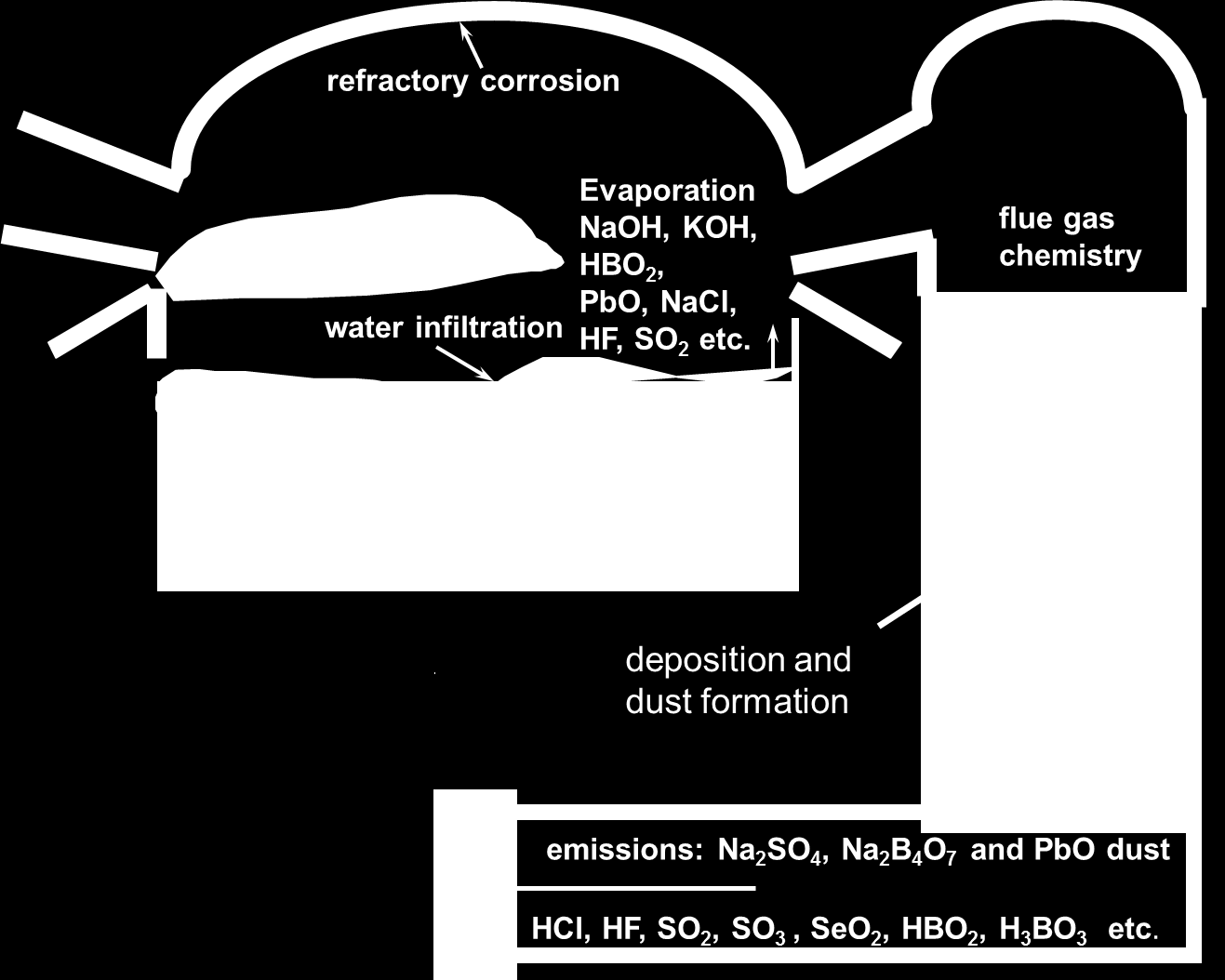
58 Emissions from glass furnaces Important factors: Temperature of the glass melt surface Composition of the glass melt, especially the contents of volatile components Sodium sulfate added Composition of the furnace combustion atmosphere, Gas velocity at the melt surface Residence time of the glass melt in the furnace or the specific surface area of the melt Foaming of the glass melt 58
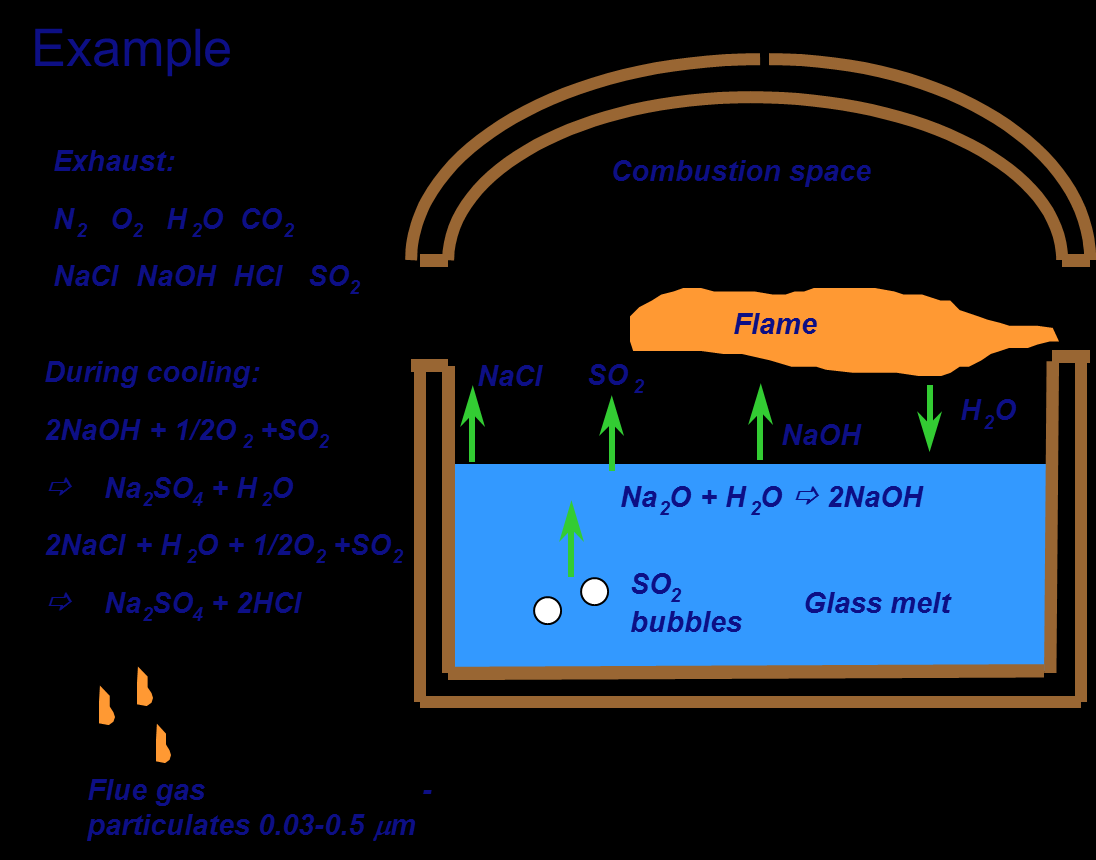
59 Evaporation processes Evaporation processes are the main cause of fine dust emissions of most glass melting furnaces. 59
60 Refractories 60
61 Refractories and furnace lifetime The furnace lifetime depends directly on refractory quality Lifetimes for melting tanks based on AZS fused cast (Alumina Zircon Silica) refractories Container glass furnaces: Float glass: Tableware soda-lime-silica glass: years* years* 6-8 years Selection of appropriate refractories is crucial * Hot repairs included during campaign: - plates of AZS or Chromium oxide covering soldier blocks - repairs of open joints & holes with patch - ceramic welding by metal/metal oxide powder (oxytherm) [email protected] 61
62 Refractory selection General aspects Not only the chemical composition, but the microstructure and macrostructure of the material (grain sizes, binding phases) determine refractory behavior Impurities generally decrease the refractory quality For combustion chamber applications refractory (crown) temperatures may reach levels between 1550 and 1700 C (higher temperatures typically observed in furnaces for borosilicate glasses or glassceramics) The refractory materials, exposed to molten glass, are operated at about C in most cases. In regenerators temperatures levels between 1550 C (at the top) and 500 C (at the bottom) can be observed [email protected] 62
63 Refractory selection General aspects Important factors to consider include: Temperature resistance and stability at high temperatures Thermal shock resistance (especially during first heating) Thermal expansion Thermal conductivity Mechanical resistance / Deformation under load Corrosion resistance (e.g. different behavior in acid or basic environments) Costs! [email protected] 63
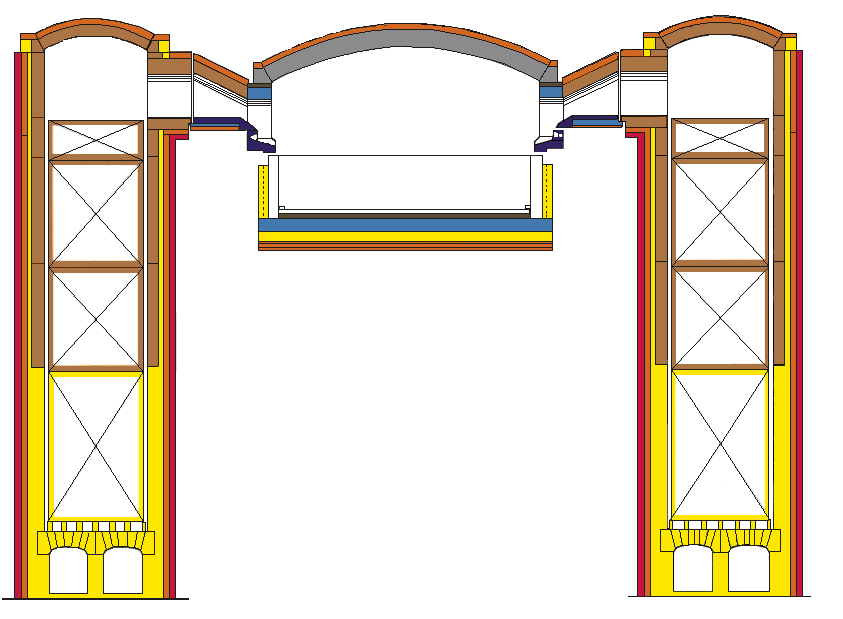
64 Application of refractories in melting furnaces Superstructure melting end Crown Burner port Palissade Air cooling Melting tank Regenerator Example of cross section of cross fired regenerative furnace. (supplied by Philips Lighting) Checker work 64
65 Bottom and sidewall of a furnace Furnace walls are built up in different layers, in order to comply with the requirements of: a) Corrosion resistance b) Obtain the required temperature c) Achieve sufficient thermal insulation Fused cast AZS Pavement Metal line & Side wall Cooling wind Fireclay Porous Brick (alumino silicate based) Castable or Ramming mix concrete Bonded AZS/Zircon silicate Fireclay or sillimanite Insulating bricks Fibre board Zircon silicate/ bonded AZS Fireclay Insulating porous alumino-silicate based bricks [email protected] 65
66 Refractory corrosion The selected refractory material should not react with the environment to which it is exposed. In contact with glass melt: hardly any parts of the refractory materials may dissolve or detach into the melt (resulting in inhomogeneity, cords, undesired colorization of the glass) & no reactions should occur, that create bubbles. Release of the gases entrapped within the refractory should be limited by selecting refractory with low amounts of gaseous inclusions. Refractory materials in contact with molten glass should not contain nitrides or carbon impurities, the contents of polyvalent ions (Fe 3+ /Fe 2+, Ti 4+ /Ti 2+ ) should be low to avoid redox reactions and gas formation [email protected] 66
67 Corrosion of refractories Example of corrosion of refractories at the metal line 67
68 Regenerator refractories The top layers of the checkers are exposed to high temperatures and carry-over Volatile products from the cooling flue gases, originating from the glass melt, condense and are deposited on the surfaces of the checker work. Corrosion & damage to porous refractory is often severe, due to repeated solidifying & melting of the sodium sulfate. Dust (from carry-over of sand, glass dust, dolomite, limestone, or condensed material) can be captured in the top layers of the checkers Avoid corrosion problems by the selection of refractory materials 68
69 Examples of refractory corrosion mechanisms Process of silica attack and breast wall corrosion by alkali silicate run down silica crown superstructure ZrSiO 4 AZS Attack of silica by alkali vapors (NaOH) Run down of alkali silicate melt Formation of alkali-alumino-silicate slag with some dissolved ZrO 2 glass level tank sidewall insulation AZS sidewall blocks AZS bottom blocks [email protected] 69
70 Effect of metals contamination on furnace lifetime Metal (such as lead) may form drops which fall at the bottom of the furnace and provoke accelerated corrosion. This is called downward drilling Downward drilling of liquid lead Metallic lead 70
71 Conclusions 1/2 A continuous glass melting tank is designed to ensure a series of processes (melting, fining, homogenization ) essential for the quality of the glass produced Minimum residence time of the particles (from the batch) is crucial Good homogenization is directly dependent on the convection flows in the melting tank, shortcuts should be avoided Different designs of continuous furnaces exist (cross-fired or endport fired regenerative, recuperative, oxy-fuel, all-electric ), and the choice depends notably on the type of glass produced Good heat transfer from the combustion chamber (flames) to the melt is essential. Once again, redox plays a major role in the absorption behavior of the glass melt [email protected] 71
72 Conclusions 2/2 Several strategies can be applied to promote convection flows in the furnace (adjustment of fuel distribution, weirs, bubblers, boosting ) The lifetime of a furnace is highly dependent on the quality of the refractories used Refractory corrosion may be particularly detrimental to the furnace lifetime In this lecture, we reviewed the processes happening in the melting tank, up to the working end, where glass is conditioned to present the best properties (homogeneity, absence of defects, temperature/viscosity) for the forming process (may it be for bottles, plate glass, fibers ) These aspects will be presented during this IMI/NFG Spring 2015 course on Glass Processing [email protected] 72
73 Home assignment A multiple choice questionnaire (MCQ) including questions on industrial glass melting tanks, process steps and refractories is provided with this lecture The MCQ will be available online on IMI s website [email protected] 73
74 References and further reading Book Introduction to Glass Science and Technology, J. Shelby (RSC publishing, 2 nd edition 2005) Book Fundamentals of Inorganic Glasses, A. Varshneya (Elsevier, 1993) Book Glass Furnaces: Design, Construction and Operation, W. Trier and K. Loewenstein (Society of Glass Technology, 1987) Glass Technology journals (e.g. Eur. J. of Glass Science and Technology) NCNG s Glass Technology course and handbook 2013 Proceedings of GlassTrend meetings and seminars ( Proceedings of Glass Problem Conferences (Wiley, every year) Youtube video: Production of Glass Bottles - How it's made [email protected] 74


75 Thank you for your attention Questions? Visit us in Eindhoven Contact me via 75
Glass Melting Technology
 Glass Melting Technology Perfect Solutions for the Glass Industry 2 Contents Regenerative Air Preheating page 5 Regenerative End-fired Furnaces page 6 Regenerative Cross-fired Furnaces page 7 Recuperative
HANDY MANUAL GLASS INDUSTRY. Output of a Seminar on Energy Conservation in Glass Industry. Sponsored by
 HANDY MANUAL GLASS INDUSTRY Output of a Seminar on Energy Conservation in Glass Industry Sponsored by United Nations Industrial Development Organization (UNIDO) and Ministry of International Trade and
Practical Examples of Heat Regenerative System at Steelmaking Works
 2nd India-Japan Energy Forum Practical Examples of Heat Regenerative System at Steelmaking Works On Monday 4 February 2008 in Delhi Nisshin Steel Co., Ltd. Yukio Tomita 1 Structure of the Regenerative
Sulfur Tail Gas Thermal Oxidizer Systems By Peter Pickard
 Sulfur Tail Gas Thermal Oxidizer Systems By Peter Pickard Introduction SRU s (Sulfur Recovery Units) are critical pieces of equipment in refineries and gas plants. SRUs remove sulfur compounds from certain
The soot and scale problems
 Dr. Albrecht Kaupp Page 1 The soot and scale problems Issue Soot and scale do not only increase energy consumption but are as well a major cause of tube failure. Learning Objectives Understanding the implications
EXTRACTION OF METALS
 1 EXTRACTION OF METALS Occurrence ores of some metals are very common (iron, aluminium) others occur only in limited quantities in selected areas ores need to be purified before being reduced to the metal
COKE PRODUCTION FOR BLAST FURNACE IRONMAKING
 COKE PRODUCTION FOR BLAST FURNACE IRONMAKING By Hardarshan S. Valia, Scientist, Ispat Inland Inc INTRODUCTION A world class blast furnace operation demands the highest quality of raw materials, operation,
Lecture 35: Atmosphere in Furnaces
 Lecture 35: Atmosphere in Furnaces Contents: Selection of atmosphere: Gases and their behavior: Prepared atmospheres Protective atmospheres applications Atmosphere volume requirements Atmosphere sensors
LASER CUTTING OF STAINLESS STEEL
 LASER CUTTING OF STAINLESS STEEL Laser inert gas cutting is the most applicable process type used for cutting of stainless steel. Laser oxygen cutting is also applied in cases where the cut face oxidation
Iron and Steel Manufacturing
 Pollution Prevention and Abatement Handbook WORLD BANK GROUP Effective July 1998 Iron and Steel Manufacturing Industry Description and Practices Steel is manufactured by the chemical reduction of iron
Chapter 5 - Aircraft Welding
 Chapter 5 - Aircraft Welding Chapter 5 Section A Study Aid Questions Fill in the Blanks 1. There are 3 types of welding:, and, welding. 2. The oxy acetylene flame, with a temperature of Fahrenheit is produced
Optimising Glass Melting Processes with Energy & Mass Balance Calculations
 Optimising Glass Melting Processes with Energy & Mass Balance Calculations Hans Mahrenholtz, Linde AG, Andre Ommer, OGIS GmbH, Germany Introduction Glass manufacturers are constantly under pressure to
Control Device Requirements Charts For Oil and Gas Handling and Production Facilities
 Device Charts For Oil and Gas Handling and Production Facilities Purpose/Scope: The purpose of this document is to provide standardized guidance for use by the regulated community and air permit reviewers,
Efficiency on a large scale CFB Steam Boilers
 Efficiency on a large scale CFB Steam Boilers Circulating Fluidized Bed Steam Boiler The Circulating Fluidized Bed Steam Boiler is an offering from Bosch Thermotechnology a member of the worldwide Bosch
Description of Thermal Oxidizers
 Description of Thermal Oxidizers NESTEC, Inc. is a full service equipment supplier specializing in solutions for plant emission problems. The benefit in working with NESTEC, Inc. is we bring 25+ years
Originators of the Flexible Water Tube design
 BRYAN FLEXIBLE WATER TUBE AB SERIES STEAM AND WATER BOILER 900,000 TO 3,000,000 BTUH FORCED DRAFT GAS, OIL OR DUAL FUEL FIRED Water Boiler AB120-W-FDGO Steam Boiler AB250-S-150-FDG Originators of the Flexible
Coal Properties, Sampling & Ash Characteristics by Rod Hatt Coal Combustion, Inc. Versailles, KY 859-873-0188
 Coal Properties, Sampling & Ash Characteristics by Rod Hatt Coal Combustion, Inc. Versailles, KY 859-873-0188 Introduction The Powder River Coal is classified as sub-bituminous ranked coal. Coal rank is
to control the heat alongside the boiler to protect the more sensitive metal components against thermal, erosive and corrosive degradation
 Testing procedures for refractory material in bottom grid of biomass/waste-fired CFBs 1 Karol Nicia, Edgardo Coda Zabetta 2 Mikko Hupa, Leena Hupa 1 Foster Wheeler Oy, Varkaus, Finland 2 Process Chemistry
North American Stainless
 Introduction: North American Stainless Flat Products Stainless Steel Grade Sheet 309S (S30908)/ EN1.4833 SS309 is a highly alloyed austenitic stainless steel used for its excellent oxidation resistance,
Influence of Belt Furnace on Glass-to-Metal Seal Process
 Influence of Belt Furnace on Glass-to-Metal Seal Process Introduction The glass, under suitable conditions, will bond well to a wide variety of metals and alloys which has led to the development of many
R&D on Oil-Burning, Environment-Friendly, High-Efficiency Boiler
 [N.2.1.1] R&D on Oil-Burning, Environment-Friendly, High-Efficiency Boiler (Environment-Friendly, High-Efficiency Boiler Group) Takashi Murakawa, Yasuhiro Kotani, Kazuhiro Kamijo, Koichi Tsujimoto, Hiroshi
CHAPTER 7 THE DEHYDRATION AND SWEETENING OF NATURAL GAS
 CHAPTER 7 THE DEHYDRATION AND SWEETENING OF NATURAL GAS Natural gases either from natural production or storage reservoirs contain water, which condense and form solid gas hydrates to block pipeline flow
Introduction to Computational Fluid Dynamics (CFD) for Combustion. www.reaction-eng.com (801) 364-6925
 Introduction to Computational Fluid Dynamics (CFD) for Combustion www.reaction-eng.com (801) 364-6925 What is CFD? CFD stands for Computational Fluid Dynamics CFD uses computers to represent (or model)
North American Stainless
 North American Stainless Flat Products Stainless Steel Grade Sheet 310S (S31008)/ EN 1.4845 Introduction: SS310 is a highly alloyed austenitic stainless steel designed for elevated-temperature service.
Chapter 18 Temperature, Heat, and the First Law of Thermodynamics. Problems: 8, 11, 13, 17, 21, 27, 29, 37, 39, 41, 47, 51, 57
 Chapter 18 Temperature, Heat, and the First Law of Thermodynamics Problems: 8, 11, 13, 17, 21, 27, 29, 37, 39, 41, 47, 51, 57 Thermodynamics study and application of thermal energy temperature quantity
Secondary Lead Smelting
 Secondary Lead Smelting Secondary Lead Smelting Objectives Describe the basic smelting process terms: smelting, refining, and alloying List key chemicals associated with secondary lead smelting Define
Specific Volume of Liquid (Column 7). The volume per unit of mass in cubic feet per pound.
 Steam Tables What They Are How to Use Them The heat quantities and temperature/ pressure relationships referred to in this Handbook are taken from the Properties of Saturated Steam table. Definitions of
Energy Efficient Operations and Maintenance Strategies for Boilers
 Energy Efficient Operations and Maintenance Strategies for Boilers Large, complex and widely used, industrial boilers are major consumers of fuel. Proper operations and maintenance (O&M) procedures must
Product Information Sheet. Fiberfrax Blanket and Mat Products
 Product Information Sheet Fiberfrax Blanket and Mat Products Introduction The Fiberfrax blanket and mat product family is a group of lightweight, thermally efficient ceramic fiber insulating materials
1.3 Properties of Coal
 1.3 Properties of Classification is classified into three major types namely anthracite, bituminous, and lignite. However there is no clear demarcation between them and coal is also further classified
A discussion of condensate removal systems for clarifier and thickener drives for water and wastewater facilities.
 A discussion of condensate removal systems for clarifier and thickener drives for water and wastewater facilities. Richard L. Dornfeld, BSME, P.E. Staff Engineer September 25, 2014 Moisture can be a problem
HEAT RECOVERY OPTIONS FOR DRYERS AND OXIDIZERS
 HEAT RECOVERY OPTIONS FOR DRYERS AND OXIDIZERS William K. Scullion, Application Engineering Leader, MEGTEC Systems, De Pere, WI Introduction Competitive pressures continuously motivate us to examine our
Weld Cracking. An Excerpt from The Fabricators' and Erectors' Guide to Welded Steel Construction. The James F. Lincoln Arc Welding Foundation
 Weld Cracking An Excerpt from The Fabricators' and Erectors' Guide to Welded Steel Construction The James F. Lincoln Arc Welding Foundation Weld Cracking Several types of discontinuities may occur in welds
CENTRIFUGAL CASTING. Email: [email protected] [email protected]
 CENTRIFUGAL CASTING Amit M Joshi (B.Engg. Mechanical, A.M.I.Prod.E, A.I.E) Dept. of Metallurgical Engg. & Material Science, Indian Institute of Technology Bombay, India. Email: [email protected] [email protected]
Drill Pipe Hard-facing
 Drill Pipe Hard-facing GLOBAL PROTECTION AGAINST WEAR AND TEAR Oxyacetylene Rods Flux- and Metal Cored Wires Electrodes PTA - Welding Oxyacetylene Welding and Spray Powders Flame Spraying FLSP Arc Spraying
CONTENTS. ZVU Engineering a.s., Member of ZVU Group, WASTE HEAT BOILERS Page 2
 WASTE HEAT BOILERS CONTENTS 1 INTRODUCTION... 3 2 CONCEPTION OF WASTE HEAT BOILERS... 4 2.1 Complex Solution...4 2.2 Kind of Heat Exchange...5 2.3 Heat Recovery Units and Their Usage...5 2.4 Materials
POROUS BURNER - A New Approach to Infrared
 Page: 1 POROUS BURNER - A New Approach to Infrared 1. Preface There are several possibilities to produce infrared radiation in the technical sense. Regarding the source of energy you can distinguish between
Optimization Design for Sulfur Dioxide Flow Monitoring Apparatus in Thermal Power Plants Hao-wei Hu 1, a, Xue Yang 1, b and Xiao-wei Song 1, c
 International Conference on Information Sciences, Machinery, Materials and Energy (ICISMME 2015) Optimization Design for Sulfur Dioxide Flow Monitoring Apparatus in Thermal Power Plants Hao-wei Hu 1, a,
Steam Generator Boilers Compact Steam Boilers. Rapid Start-Up Safe in Operation
 Steam Generator Boilers Compact Steam Boilers Rapid Start-Up Safe in Operation AB&CO TT BOILERS The boiler maker AB&CO TT BOILERS LTD. have since the middle sixties produced industrial boilers and heaters
Name: Class: Date: 10. Some substances, when exposed to visible light, absorb more energy as heat than other substances absorb.
 Name: Class: Date: ID: A PS Chapter 13 Review Modified True/False Indicate whether the statement is true or false. If false, change the identified word or phrase to make the statement true. 1. In all cooling
Interested in conducting your own webinar? Email [email protected]
 Interested in conducting your own webinar? Email [email protected] IR Applications in the Real World Archive www.process-heating.com Add to your favorites IR Applications in the Real World What it
Forms of Energy. Freshman Seminar
 Forms of Energy Freshman Seminar Energy Energy The ability & capacity to do work Energy can take many different forms Energy can be quantified Law of Conservation of energy In any change from one form
STAYFLEX CORROSION CONTROL AND THERMAL INSULATION SYSTEM
 STAYFLEX CORROSION CONTROL AND THERMAL INSULATION SYSTEM Installed in Pre-engineered Steel Buildings Provides Lowest Cost Construction Method for CORROSIVE AND WET Environments PREFERRED SOLUTIONS, INC.
Burners for Glass Melting Furnaces
 Burners for Glass Melting Furnaces Neil Simpson, Eclipse Incorporated, USA Introduction In the late 1980 s and early 1990 s a consortium of gas utilities named NGNOX was formed to investigate the natural
Lecture 23: Terrestrial Worlds in Comparison. This lecture compares and contrasts the properties and evolution of the 5 main terrestrial bodies.
 Lecture 23: Terrestrial Worlds in Comparison Astronomy 141 Winter 2012 This lecture compares and contrasts the properties and evolution of the 5 main terrestrial bodies. The small terrestrial planets have
North American Stainless
 North American Stainless Long Products Stainless Steel Grade Sheet 2205 UNS S2205 EN 1.4462 2304 UNS S2304 EN 1.4362 INTRODUCTION Types 2205 and 2304 are duplex stainless steel grades with a microstructure,
COMBUSTION. In order to operate a heat engine we need a hot source together with a cold sink
 COMBUSTION In order to operate a heat engine we need a hot source together with a cold sink Occasionally these occur together in nature eg:- geothermal sites or solar powered engines, but usually the heat
Welding. Module 19.2.1
 Welding Module 19.2.1 Hard Soldering Hard soldering is a general term for silver soldering and brazing. These are very similar thermal joining processes to soft soldering in as much that the parent metal
I. STEAM GENERATION, BOILER TYPES
 I. STEAM GENERATION, BOILER TYPES and BOILER PLANT SYSTEMS 1 Steam Generation Water s Unique Properties: High Thermal Capacity (Specific Heat) High Critical Temperature Ideal Medium for Heat Delivery High
HAZARD RISK ASSESSMENT
 HAZARD RISK ASSESSMENT Mt Grace Batchelor Magnesium Project A hazard risk assessment was undertaken to identify and assess the consequences of unplanned incidents that may pose safety, environmental risks,
The mechanical properties of metal affected by heat treatment are:
 Training Objective After watching this video and reviewing the printed material, the student/trainee will learn the basic concepts of the heat treating processes as they pertain to carbon and alloy steels.
8001782 Owner s Manual
 8001782 Digital Infrared Thermometer Owner s Manual Introduction This instrument is a portable, easy to use compact-size digital thermometer with laser sighting designed for one hand operation. The meter
2nd IEA Oxyfuel Combustion Conference
 2nd IEA Oxyfuel Combustion Conference Oxyfuel Combustion with Hitachi's DST - Burner at Vattenfall's 30Wth Pilot Plant at Schwarze Pumpe S. Rehfeldt, F.-P. Schiffer, P. Weckes, C. Bergins, K.-D. Tigges
TODAY S THERMAL OXIDIZER SOLUTIONS TO MEET TOMORROW S CHALLENGES
 Callidus Oxidizers for Waste Destruction TODAY S THERMAL OXIDIZER SOLUTIONS TO MEET TOMORROW S CHALLENGES Thermal oxidizer systems Catalytic oxidizer systems Callidus, experts in Thermal Oxidizers Wide
Unit 6: EXTRUSION. Difficult to form metals like stainless steels, nickel based alloys and high temperature metals can also be extruded.
 1 Unit 6: EXTRUSION Introduction: Extrusion is a metal working process in which cross section of metal is reduced by forcing the metal through a die orifice under high pressure. It is used to produce cylindrical
The Three Heat Transfer Modes in Reflow Soldering
 Section 5: Reflow Oven Heat Transfer The Three Heat Transfer Modes in Reflow Soldering There are three different heating modes involved with most SMT reflow processes: conduction, convection, and infrared
Basic Properties and Application of Auto Enamels
 Basic Properties and Application of Auto Enamels Composition of Ceramic Automotive Glass Enamels Ceramic automotive glass colours are glass enamels that fire on to the glass during the bending process
SC2000 CEMENT BONDING PROCEDURES
 Pg.1 SC2000 CEMENT BONDING PROCEDURES Widely recognized as the world s finest cold vulcanizing cement REMA SC2000 is the solution to your industrial bonding problems. By using REMA UTR20 hardener with
A GUIDE TO SELECTING YOUR INDUSTRIAL OVEN
 A GUIDE TO SELECTING YOUR INDUSTRIAL OVEN Application 1 The first step in selecting an industrial oven is defining the required heat application that your oven will be used for. Heat processing is extensively
Convection, Conduction & Radiation
 Convection, Conduction & Radiation There are three basic ways in which heat is transferred: convection, conduction and radiation. In gases and liquids, heat is usually transferred by convection, in which
Modern Sand Reclamation Technologies for Economy, Environment Friendliness and Energy Efficiency
 Modern Sand Reclamation Technologies for Economy, Environment Friendliness and Energy Efficiency Aniruddha Ghosh GM, The Wesman Engineering Co. Ltd, Kolkata ABSTRACT Unlike green sand, chemically-bonded
Energy Efficiency in Steam Systems
 Energy Efficiency in Steam Systems Fundamentals of Energy Efficiency: An Introductory Workshop April 2008 John S. Raschko, Ph.D. Mass. Office of Technical Assistance www.mass.gov/envir/ota (617) 626-1093
ODS Alloys in Coal-Fired Heat Exchangers Prototypes and Testing
 ODS Alloys in Coal-Fired Heat Exchangers Prototypes and Testing 2010 ODS Alloy Workshop San Diego, California November 17 18, 2010 John P. Hurley Senior Research Advisor Energy & Environmental Research
WORD DEFINITION WORD (NATIONAL LANGUAGE)
 WELDING GLOSSARY The Glossary has been created as part of the Migration for Development in the Western Balkans (MIDWEB) project, which received financial assistance from the European Commission IPA 2009
Hot Water Boilers and Controls Why Condensing Boilers are Different. Presented Oct. 14, 2008 Long Island Chapter, ASHRAE
 Hot Water Boilers and Controls Why Condensing Boilers are Different Presented Oct. 14, 2008 Long Island Chapter, ASHRAE H.W. Boilers and Controls Major types of boilers Advantages and disadvantages Resistance
Steel production. Furnace linings made from carbon and graphite are applied for the production of primary iron.
 Steel production Furnace linings made from carbon and graphite are applied for the production of primary iron. Graphite electrodes and nipples (connecting pins) are applied for the production of steel.
ALUMINUM. BestPractices Assessment Case Study. Alcoa North American Extrusions Implements Energy Use Assessments at Multiple Facilities.
 ALUMINUM BestPractices Assessment Case Study August 2001 OFFICE OF INDUSTRIAL TECHNOLOGIES ENERGY EFFICIENCY AND RENEWABLE ENERGY, U.S. DEPARTMENT OF ENERGY BENEFITS Assesses core systems commonly found
3 - Atomic Absorption Spectroscopy
 3 - Atomic Absorption Spectroscopy Introduction Atomic-absorption (AA) spectroscopy uses the absorption of light to measure the concentration of gas-phase atoms. Since samples are usually liquids or solids,
Aluminium Production. Introduction The aluminium production process. Hall-Héroult Prebake Cell Pechiney technology Inert anode
 Aluminium Production Introduction The aluminium production process Hall-Héroult Prebake Cell Pechiney technology Inert anode Aluminium Production: intro Aluminium can be produced by using anodes and cathodes
Metals and Non-metals. Comparison of physical properties of metals and non metals
 Metals and Non-metals Comparison of physical properties of metals and non metals PHYSICAL PROPERTY METALS NON-METALS Physical State Metallic lustre (having a shining surface) Mostly solids (Liquid -mercury)
Gas-Fired, Residential Storage Type Water Heaters
 Consulting, Resource, Education, Training, and Support Services for Home Inspectors A candle loses no light when it lights another candle. Gas-Fired, Residential Storage Type Water Heaters Most inspectors
SULFUR RECOVERY UNIT. Thermal Oxidizer
 SULFUR RECOVERY UNIT Thermal Oxidizer BURNERS FLARES INCINERATORS PARTS & SERVICE SULFUR RECOVERY UNIT Thermal Oxidizer Tail Gas Thermal Oxidizer designed and built to GOST-R requirements. Zeeco can meet
Low Emission - Low Maintenance Burner Design
 Reliability & Maintenance Conference & Exhibition May 24-27, 2005 Ernest N. Morial Convention Center New Orleans, Louisiana Low Emission - Low Maintenance Burner Design Presented By: Scott D. Reed Vice
Calculate Available Heat for Natural Gas Fuel For Industrial Heating Equipment and Boilers
 For Industrial Heating Equipment and Boilers Prepared for California Energy Commission (CEC) Prepared By: Southern California Gas Company (A Sempra Energy Utility) E3M Inc. May 2012 i Disclaimer The CEC
Laser beam sintering of coatings and structures
 Laser beam sintering of coatings and structures Anne- Maria Reinecke, Peter Regenfuß, Maren Nieher, Sascha Klötzer, Robby Ebert, Horst Exner Laserinstitut Mittelsachsen e.v. an der Hochschule Mittweida,
Waste Incineration Plants
 Waste Incineration Plants Modern Technology for a better Environmental Welcome at Hafner! We Manufacture Systems for Energy Recovery from Wastes and Biomass as well as for Treatment of Hazardous Wastes.
Overview of Waste Heat Recovery for Power and Heat
 Overview of Waste Heat Recovery for Power and Heat Dave Sjoding Northwest Clean Energy Application Center Washington State University Extension Energy Program Waste Heat Recovery for Power and Heat Workshop
FXA 2008. Candidates should be able to : Define and apply the concept of specific heat capacity. Select and apply the equation : E = mcδθ
 UNIT G484 Module 3 4.3.3 Thermal Properties of Materials 1 Candidates should be able to : Define and apply the concept of specific heat capacity. Select and apply the equation : E = mcδθ The MASS (m) of
LEAD CRYSTAL. User Manual. Valve-regulated lead-crystal batteries Energy storage Cells
 Engineering Production Sales LEAD CRYSTAL Valve-regulated lead-crystal batteries Energy storage Cells User Manual www.axcom-battery-technology.de [email protected] Chapter 1: 1. Introduction
CABINET. A Clean Burn Heat Exchanger provides approximately 200% more surface area for capturing combustion heat. You get more heat from less oil.
 Lanair Clean Burn CABINET Lanair's lightweight heat exchanger provides very little travel for the heat to be picked-up and ultimately be transferred to your shop. It uses a 2-pass design made up of 12
Evaluating Thermal & Catalytic Oxidation Technology for VOC, HAP & Odor Abatement. John Strey
 Evaluating Thermal & Catalytic Oxidation Technology for VOC, HAP & Odor Abatement John Strey Experience Installing Quality Equipment Since 1987 Over 3,000 Air Abatement Systems Installed Worldwide Unbiased
Vapor Chambers. Figure 1: Example of vapor chamber. Benefits of Using Vapor Chambers
 Vapor Chambers A vapor chamber is a high-end thermal management device that can evenly dissipate heat from a small source to a large platform of area (see Figure 1). It has a similar construction and mechanism
In this experiment, we will use three properties to identify a liquid substance: solubility, density and boiling point..
 Identification of a Substance by Physical Properties 2009 by David A. Katz. All rights reserved. Permission for academic use provided the original copyright is included Every substance has a unique set
TEACHER BACKGROUND INFORMATION THERMAL ENERGY
 TEACHER BACKGROUND INFORMATION THERMAL ENERGY In general, when an object performs work on another object, it does not transfer all of its energy to that object. Some of the energy is lost as heat due to
WATER WALL BOILER FOR AIR AND OXYGEN FIRED CLAUS SULPHUR RECOVERY UNITS
 WATER WALL BOILER FOR AIR AND OXYGEN FIRED CLAUS SULPHUR RECOVERY UNITS Abstract Mahin RAMESHNI, P.E. Technical Director, Sulphur Technology [email protected] WorleyParsons 125 West Huntington
This document was prepared in conjunction with work accomplished under Contract No. DE-AC09-96SR18500 with the U. S. Department of Energy.
 This document was prepared in conjunction with work accomplished under Contract No. DE-AC09-96SR18500 with the U. S. Department of Energy. DISCLAIMER This report was prepared as an account of work sponsored
Product Information Sheet
 Distributed by Thermal Products Company, Inc. Product Information Sheet Fiberfrax Blanket and Mat Products Introduction The Fiberfrax blanket and mat product family is a group of lightweight, thermally
Mixtures. reflect. How is seawater different from pure water? How is it different from rocky soil?
 reflect Everything around us is made out of tiny bits of matter. These particles may combine in different ways to produce new materials. Sometimes we need to separate the parts of a material. If we know
TRIAL CHEMICAL CLEANING OF FOULED APH BASKETS
 TRIAL CHEMICAL CLEANING OF FOULED APH BASKETS Dr. Abhay Kumar Sahay, AGM(CC OS) Bijay Manjul, AGM( Operation) Kahalgaon Boiler has three inputs Steam generator 1. WATER 2. COAL 3. AIR Burner Air preheater
LECTURE 28 to 29 ACCUMULATORS FREQUENTLY ASKED QUESTIONS
 LECTURE 28 to 29 ACCUMULATORS FREQUENTLY ASKED QUESTIONS 1. Define an accumulator and explain its function A hydraulic accumulator is a device that stores the potential energy of an incompressible fluid
CONDENSATION IN REFRIDGERATED BUILDINGS
 CONDENSATION IN REFRIDGERATED BUILDINGS By: Steve Salisbury Nov. 10, 2010 (revised Nov. 14, 2013) Introduction The following discussion reviews the basic causes of condensation in refrigerated buildings
Module 5: Combustion Technology. Lecture 34: Calculation of calorific value of fuels
 1 P age Module 5: Combustion Technology Lecture 34: Calculation of calorific value of fuels 2 P age Keywords : Gross calorific value, Net calorific value, enthalpy change, bomb calorimeter 5.3 Calculation
Problems in Welding of High Strength Aluminium Alloys
 Singapore Welding Society Newsletter, September 1999 Problems in Welding of High Strength Aluminium Alloys Wei Zhou Nanyang Technological University, Singapore E-mail: [email protected] Pure aluminium has
CHAPTER 6 THE TERRESTRIAL PLANETS
 CHAPTER 6 THE TERRESTRIAL PLANETS MULTIPLE CHOICE 1. Which of the following is NOT one of the four stages in the development of a terrestrial planet? 2. That Earth, evidence that Earth differentiated.
Free piston Stirling engine for rural development
 Free piston Stirling engine for rural development R. Krasensky, Intern, Stirling development, [email protected] W. Rijssenbeek, Managing director, [email protected] Abstract: This paper presents
Energy Saving Solutions. Bob Montgomery Technical Solutions Specialist Waterloo Manufacturing
 Energy Saving Solutions Bob Montgomery Technical Solutions Specialist Waterloo Manufacturing Combustion Efficiency Measure Heat Recovery Energy Saving Solutions Upgrade Repair Replace Audits Financial
Topic Page Contents Page
 Heat energy (11-16) Contents Topic Page Contents Page Heat energy and temperature 3 Latent heat energy 15 Interesting temperatures 4 Conduction of heat energy 16 A cooling curve 5 Convection 17 Expansion
This chapter is devided into two sections:
 This chapter is devided into two sections: Page Installation requirements........................................................................ 127 The installation process..........................................................................
Waste to Energy in Düsseldorf. for a clean city.
 Waste to Energy in Düsseldorf for a clean city. Waste Management in Düsseldorf. Düsseldorf s public utilities company known as Stadtwerke Düsseldorf operates a waste to energy plant (WtE) that has been