
Carl Perkins Program Self-Evaluation for FY 2014 Kansas Board of Regents - Career and Technical Education
|
|
|
- Jason Park
- 9 years ago
- Views:
Transcription
1 Carl Perkins Program Self-Evaluation for FY 2014 Kansas Board of Regents - Career and Technical Education Institution: Flint Hills Technical College Perkins Program: Business Administrative Technology Lead Instructor(s): Don Eusey, Lori Moore, and Kenda O Mara Date: January 4, 2013 The purpose of the Carl Perkins Technical Education Act of 2006 is to continuously improve the quality of Career and Technical Education programs. Federal legislation specifies that the Kansas Board of Regents must monitor the performance of local institutions receiving funding. Program Self-Evaluation: Each of the following Core Indicators and Topics is directly connected to requirements set forth in the Perkins legislation. Please see the Resource Guide at the end of this document for a description of the Core Indicator values and the required Perkins Program Improvement elements. Based upon your analysis and an in-depth knowledge about your Perkins program, please evaluate your target and actual core indicator values for FY 2012 and the program topics for the past 2 3 academic years and provide recommended Improvement Strategies. Note: This evaluation is program specific; institutional elements will be addressed in the Institutional Self-Evaluation. Self- Evaluation Categories Core Indicators of Performance Strengthen Academic & Technical Skills Link Secondary/Postsecondary CTE All Aspects of an Industry Use of Technology Professional Development Program Evaluation Initiate, Improve, Expand, & Modernize CTE Sufficient Size, Scope & Quality Core Indicators of Performance Technical Skill Attainment (1P1) Target: 87.75% Actual number: 18 Actual %: 100% Meets or exceeds target (highlight successful activities) N/A (CIP code not included on KBOR Technical skill/credential list) Credential, Certificate, Diploma Attainment (2P1) Target: 80.57% Actual number: 18 Actual %: 50% Meets or exceeds target (highlight successful activities) We will encourage students to use the Student Success Center for tutoring if they need additional assistance outside of the classroom. We are implementing student/instructor meetings mid-semester to discuss progress and concerns individually with students. A peer tutor from within the program was hired to support students needing extra assistance.

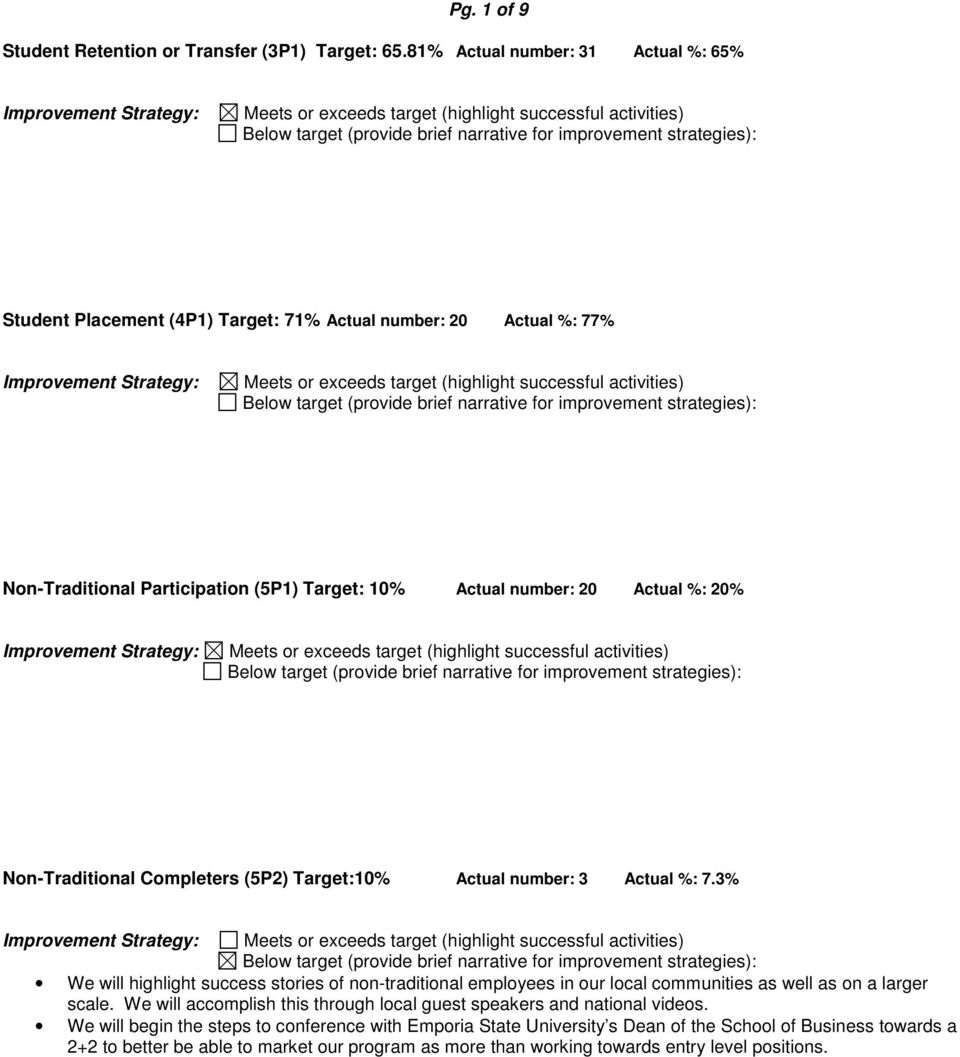
2 Pg. 1 of 9 Student Retention or Transfer (3P1) Target: 65.81% Actual number: 31 Actual %: 65% Meets or exceeds target (highlight successful activities) Student Placement (4P1) Target: 71% Actual number: 20 Actual %: 77% Meets or exceeds target (highlight successful activities) Non-Traditional Participation (5P1) Target: 10% Actual number: 20 Actual %: 20% Meets or exceeds target (highlight successful activities) Non-Traditional Completers (5P2) Target:10% Actual number: 3 Actual %: 7.3% Meets or exceeds target (highlight successful activities) We will highlight success stories of non-traditional employees in our local communities as well as on a larger scale. We will accomplish this through local guest speakers and national videos. We will begin the steps to conference with Emporia State University s Dean of the School of Business towards a 2+2 to better be able to market our program as more than working towards entry level positions.
3 Pg. 2 of 9 Required Perkins Program Improvement Elements: 1) Strengthen Academic & Technical Skills Perkins Legislation: Strengthen the academic and career and technical skills of student participating in career and technical education programs, by strengthening the academic and technical education components of such programs through the integration of academics with career and technical education programs through a coherent sequence of courses, such as career and technical programs of study described in section 122 (1)(A) Section 135(b)(1) Developed BAT 126 Leadership I, BAT 127 Leadership II, BAT 226 Leadership III, and BAT 227 Leadership IV - Traditional and Online. Delivered BAT 212 Business Communications in hybrid format. PAC meeting from Fall 2012 reviewed outcomes/competencies (review minutes). Offer additional BAT courses in hybrid format, beginning with BAT 113 Business Accounting, BAT 122 Desktop Publishing, BAT 217 Office Management II and BAT 247 Administrative Assistant. 2)Link Secondary/Postsecondary CTE Perkins Legislation: Link career and technical education at the secondary level and career and technical education at the postsecondary level, including by offering the relevant elements of not less than 1 career and technical education program of study described in section 122 (1)(4) Section 135 (b)(2) We accept advanced placement from high school for BAT 113 Accounting. BAT Faculty attends local Career Clusters Consortium meetings, attends the annual state conference, and will be presenting. We allow high school Junior and Seniors to enroll in the BAT Program. A representative of Emporia High School s Business Education department is a member of our PAC. Attempt to have faculty participate in Emporia High School Business Education Advisory Committee. 3) All Aspects of an Industry

4 Perkins Legislation: Provide students with strong experience in and understanding of all aspects of an industry, which may include work-based learning experiences.section 135 (b)(3) List new internship sites per database. Guest speakers Janice Yingst, HR at TFI. Fields Trips to Camp Alexander for teamwork. New advisory board members include Dan Slater, Barbara Railsback and Renee Bass. Moved CTSO from BPA to PBL. Students compete at both state and national levels for Phi Beta Lambda in a variety of CTE topics. We will continue updating our list of possible internship sites. We will work to implement field trips for associate level courses. 4) Use of Technology Pg. 3 of 9 Perkins Legislation: Develop, improve, or expand the use of technology in career and technical education. Section 135 (b)(4) We have both hybrid and online courses. New equipment / Training Lab in the DC classrooms. Update various softwares as resources allow such as QuickBooks and MS Office. We will be updating Microsoft Office Software to The software program ZOOM will be used in some online courses. 5) Professional Development Perkins Legislation: Provide professional development programs that are consistent with section 122 to secondary and postsecondary to teachers, faculty, administrators, and career guidance and academic counselors who are involved in integrated career and technical education programs. Section 135 (b)(5) NBEA Annual Conference PBL NLC - Presented

5 IAAP memberships KBEA Conference and office held (Kim Dhority) Don Eusey attending Instructional Design Technology classes at ESU Continue effective strategies. 6) Program Evaluation Perkins Legislation: Develop and implement evaluations of career and technical education programs carried out under this title, including an assessment of how the needs of special populations are being met. Section 135 (b)(6) Various MOS certifications are obtained by students. Faculty review the Pre/Post test results at the end of May Faculty will implement OPAC certification for all Freshman Microsoft courses and continue with MOS certification for associate level courses. 7) Initiate, Improve, Expand and Modernize CTE Pg. 4 of 9 Perkins Legislation: Initiate, improve, expand, and modernize quality career and technical education programs, including relevant technology. Section 135 (b)(7) Within the BAT program Hybrid and Online instruction are offered. Faculty are updating curriculum and changing graduation requirements (Outlook). A new training lab with 12 workstations, computers, telephone lines, fax/copy/scanner/printer were installed at the new downtown campus. We will revise the outcome matrix for the BAT program per the suggestion of the PAC. We have changed the program to implement OPAC certification for all freshman level Microsoft courses.

6 8) Sufficient Size, Scope & Quality Perkins Legislation: Provide services and activities that are of sufficient size, scope, and quality to be effective. Section 135 (b)(8) Effectiveness is gauged by internship employer surveys, course assessments, and program assessments. Certifications are available for all BAT students. A third full-time instructor was hired to replace two part-time instructors to improve instructor availability for students. We will revamp our FOCUS session with potential students to improve the interaction of the program for those students. Faculty helped work a fair booth to assist with recruitment and marketing. Collaborate to present to high school business classes the advantage of entering the program as a junior or senior high school student. 9) Special Populations (specifically, gender non-traditional students) Perkins Legislation: Provide activities to prepare *special populations, including single parents and displaced homemakers who are enrolled in career and technical education programs, for high skill, high wage, or high demand occupations that will lead to self-sufficiency.section 135(b)(9) *Individuals with disabilities, economically disadvantaged families, gender nontraditional training, single parents, displaced homemakers, limited English proficiency. BAT offers Online/Hybrid courses. A partnership has been developed with Adult Education/Customized Training to offer workshops and outreach for dislocated workers. We partner with the Student Success Center for students who need assistance obtaining study skills. A peer tutor from the program has been hired to assist with program specific courses. Continue effective methods of online/hybrid courses and partnering with Adult Education. Create partnership with ESU writing lab for students with limited English writing proficiency. Request that we highlight gender non-traditional students in program promotional materials. 10) Program Advisory Committees Pg. 5 of 9 Perkins Legislation: To involve parents, businesses, and labor organization as appropriate, in the design implementation, and evaluation of CTE programs. Section 135(c)(1)
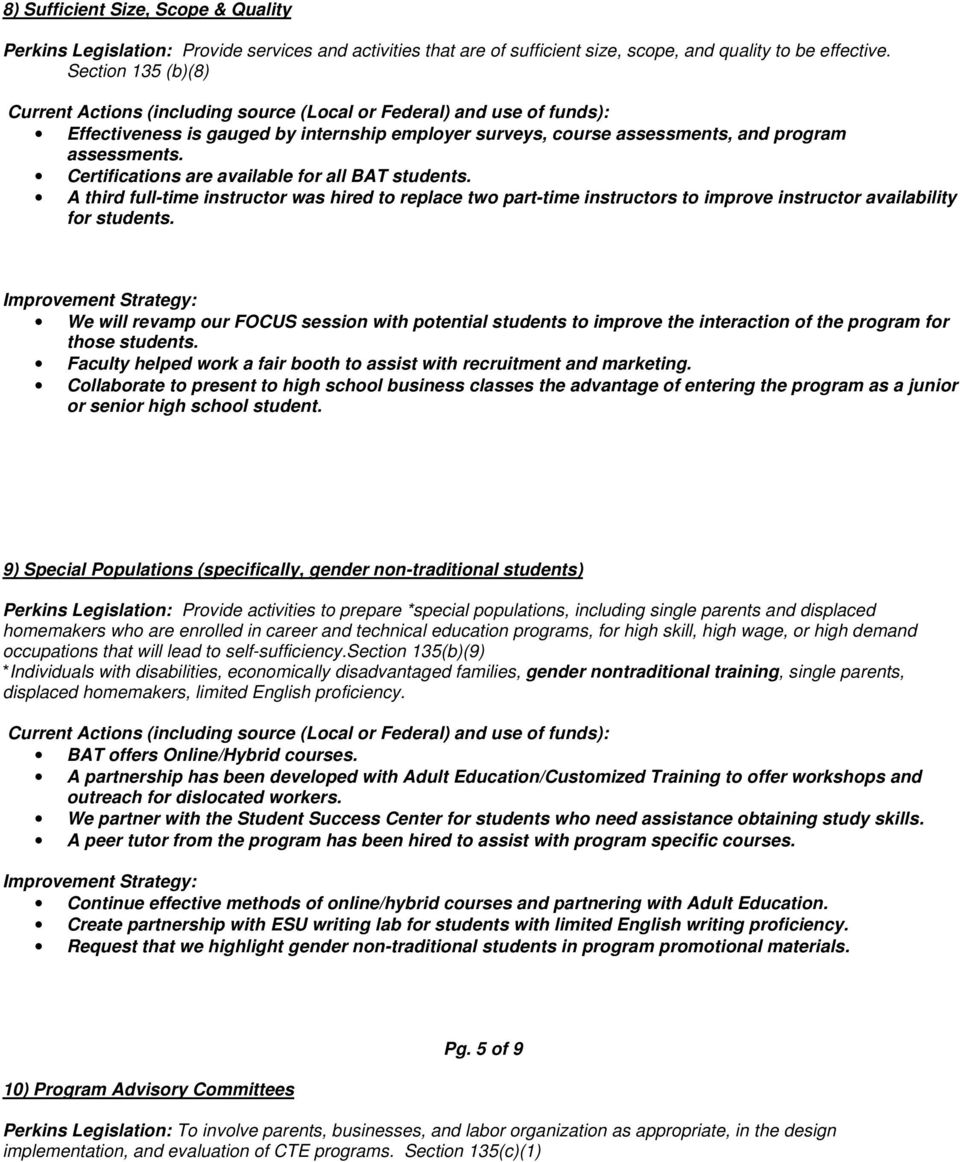
7 We have two advisory committee meetings per year. Faculty will maintain strong relationships within business and industry to provide knowledgeable PAC members. To the best of my knowledge, the evaluations and improvement strategies contained in this Carl Perkins Program Self- Evaluation accurately depict this Career and Technical Education program. This self-evaluation was thoroughly discussed with the institution s administration. Signature of Lead Instructor(s): Signature of Administrator: Date Discussed: Program Self-Evaluation discussion to be held prior to site visit in March Pg. 6 of 9 Resource Guide

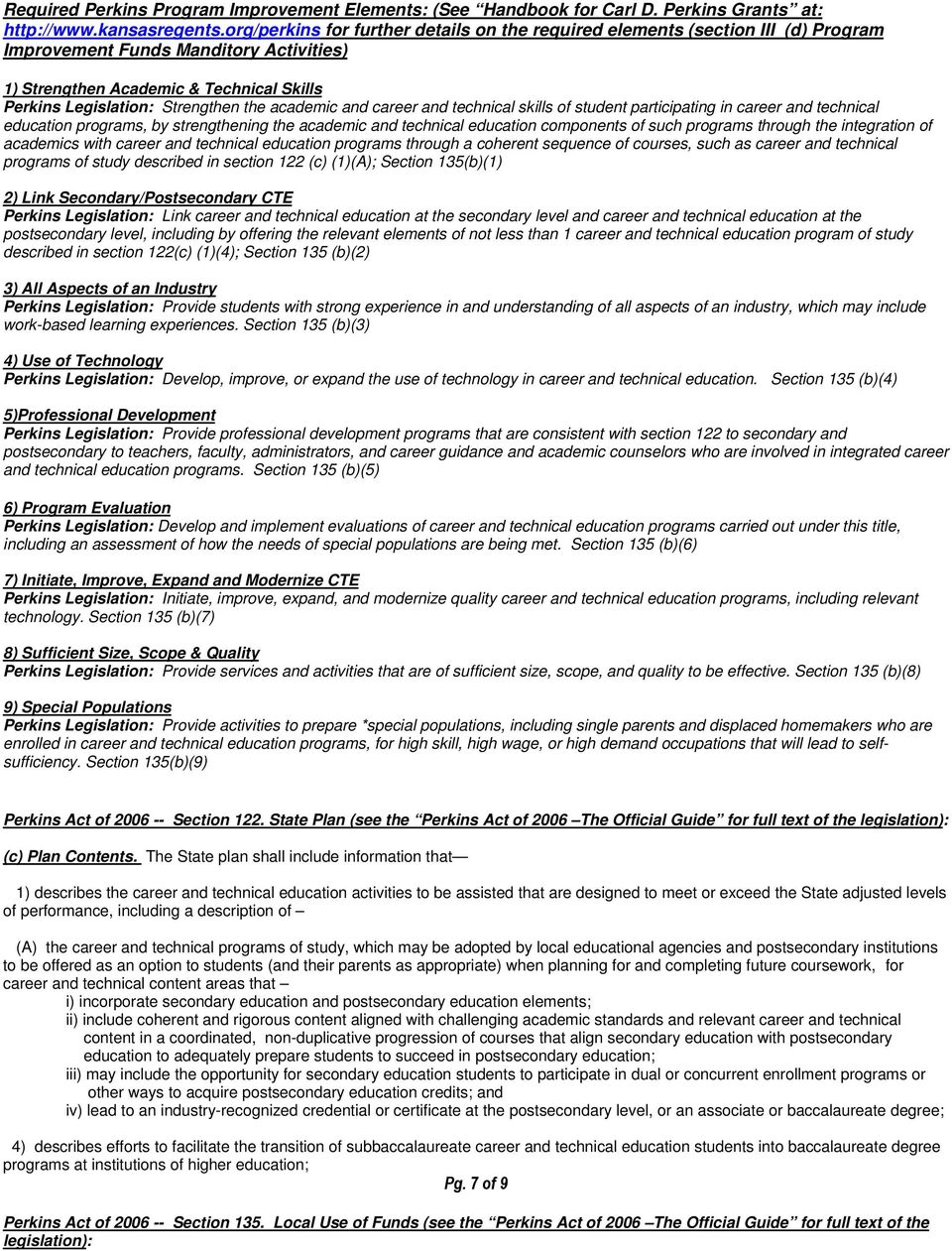
8 Required Perkins Program Improvement Elements: (See Handbook for Carl D. Perkins Grants at: for further details on the required elements (section III (d) Program Improvement Funds Manditory Activities) 1) Strengthen Academic & Technical Skills Perkins Legislation: Strengthen the academic and career and technical skills of student participating in career and technical education programs, by strengthening the academic and technical education components of such programs through the integration of academics with career and technical education programs through a coherent sequence of courses, such as career and technical programs of study described in section 122 (c) (1)(A); Section 135(b)(1) 2) Link Secondary/Postsecondary CTE Perkins Legislation: Link career and technical education at the secondary level and career and technical education at the postsecondary level, including by offering the relevant elements of not less than 1 career and technical education program of study described in section 122(c) (1)(4); Section 135 (b)(2) 3) All Aspects of an Industry Perkins Legislation: Provide students with strong experience in and understanding of all aspects of an industry, which may include work-based learning experiences. Section 135 (b)(3) 4) Use of Technology Perkins Legislation: Develop, improve, or expand the use of technology in career and technical education. Section 135 (b)(4) 5)Professional Development Perkins Legislation: Provide professional development programs that are consistent with section 122 to secondary and postsecondary to teachers, faculty, administrators, and career guidance and academic counselors who are involved in integrated career and technical education programs. Section 135 (b)(5) 6) Program Evaluation Perkins Legislation: Develop and implement evaluations of career and technical education programs carried out under this title, including an assessment of how the needs of special populations are being met. Section 135 (b)(6) 7) Initiate, Improve, Expand and Modernize CTE Perkins Legislation: Initiate, improve, expand, and modernize quality career and technical education programs, including relevant technology. Section 135 (b)(7) 8) Sufficient Size, Scope & Quality Perkins Legislation: Provide services and activities that are of sufficient size, scope, and quality to be effective. Section 135 (b)(8) 9) Special Populations Perkins Legislation: Provide activities to prepare *special populations, including single parents and displaced homemakers who are enrolled in career and technical education programs, for high skill, high wage, or high demand occupations that will lead to selfsufficiency. Section 135(b)(9) Perkins Act of Section 122. State Plan (see the Perkins Act of 2006 The Official Guide for full text of the legislation): (c) Plan Contents. The State plan shall include information that 1) describes the career and technical education activities to be assisted that are designed to meet or exceed the State adjusted levels of performance, including a description of (A) the career and technical programs of study, which may be adopted by local educational agencies and postsecondary institutions to be offered as an option to students (and their parents as appropriate) when planning for and completing future coursework, for career and technical content areas that i) incorporate secondary education and postsecondary education elements; ii) include coherent and rigorous content aligned with challenging academic standards and relevant career and technical content in a coordinated, non-duplicative progression of courses that align secondary education with postsecondary education to adequately prepare students to succeed in postsecondary education; iii) may include the opportunity for secondary education students to participate in dual or concurrent enrollment programs or other ways to acquire postsecondary education credits; and iv) lead to an industry-recognized credential or certificate at the postsecondary level, or an associate or baccalaureate degree; 4) describes efforts to facilitate the transition of subbaccalaureate career and technical education students into baccalaureate degree programs at institutions of higher education; Pg. 7 of 9 Perkins Act of Section 135. Local Use of Funds (see the Perkins Act of 2006 The Official Guide for full text of the legislation):
9 (b) Requirements for Uses of Funds. Funds made available to eligible receipients under this part shall be used to support career and technical education programs that (1) strength the academic and career and technical skills of students participating in career and technical education programs, by strengthening the academic and career and technical education components of such programs through the integration of academics with career and technical education programs through a coherent sequence of courses, such as career and technical programs of study described in section 122 (c) (1) (A), to ensure learning in (A) the core academic subjects (as defined in section 9101 of the Elementary and Secondary Education Act of 1965); and (B) career and technical education subjects; (2) link career and technical education at the secondary level and career and technical education at the postsecondary level, including by offering the relevant elements of not less than one career and technical program of study described in section 122 (c) (1) (A); (3) provide students with strong experience in and understanding of all aspects of an industry, which may include work-based learning experiences; (4) develop, improve, or expand the use of technology in career and technical education, which may include (A) training of career and technical education teachers, faculty and administrators to use technology, which may include distance learning; (B) providing career and technical education students with the academic and career and technical skills (including the mathematics and science knowledge that provides a strong basis for such skills) that lead to entry into the technology fields; or (C) encouraging schools to collaborate with technology industries to offer voluntary internships and mentoring programs, including programs that improve the mathematics and science knowledge of students; (5) provide professional development programs that are consistent with section 122 to secondary and postsecondary teachers, faculty, administrators, and career guidance and academic counselors who are involved in integrated career and technical education programs, including (A) in-service and preservice training on (i) effective integration and use of challenging academic and career and technical education provided jointly with academic teachers to the extent practicable; (ii) effective teaching skills based on research that includes promising practices; (iii) effective practices to improve parental and community involvement; and (iv) effective use of scientifically based research and data to improve instruction; (B) support of education programs for teachers of career and technical education in public schools and other public school personnel who are involved in the direct delivery of educational services to career and technical education students, to ensure that such teachers and personnel stay current with all aspects of an industry; (C) internship programs that provide relevant business experience; and (D) programs designed to train teachers specifically in the effective use and application of technology to improve instruction; (6) develop and implement evaluations of the career and technical education programs carried out with funds under this title, including an assessment of how the needs of special populations are being met; (7) initiate, improve, expand and modernize quality career and technical education programs, including relevant technology; (8) provide services and activities that are of sufficient size, scope and quality to be effective; and (9) provide activities to prepare special populations, including single parents and displaced homemakers who are enrolled in career and technical education programs, for high skill, high wage or high demand occupations that will lead to self-sufficiency. Postsecondary Core Indicators of Performance Pg. 8 of 9

10 1P1 - Technical Skill Attainment Student attainment of challenging career and technical skill proficiencies, including student achievement on technical assessments, that are aligned with industry-recognized standards, if available and appropriate. Measures any student identified as a concentrator who attempted a technical skill assessment test. Numerator = number of CTE concentrators who passed technical skill assessments that are aligned with industryrecognized standards, if available and appropriate, during the reporting year Denominator = number of CTE concentrators who attempted technical skills assessments during the reporting year Note: A list of Technical Skill Assessment Tools can be found on the KSPSD web site. 2P1 - Credential, Certificate, or Degree Student attainment of an industry-recognized credential, a certificate, or a degree. Measures concentrators who earned an award and are NO LONGER enrolled in postsecondary education. Numerator = number of CTE concentrators who receive an industry-recognized credential, a certificate, or a degree during the reporting year Denominator = number of CTE concentrators who left post-secondary education during the reporting year 3P1 - Student Retention and Transfer Student retention in postsecondary education or transfer to a baccalaureate degree program. Measures concentrators who were enrolled during the reporting year and remained in postsecondary education the following fall. All students who earned an award or an industry recognized credential are REMOVED from the analysis. Numerator = number of CTE concentrators who remained enrolled in their original postsecondary institution or transferred to another 2- or 4- year postsecondary institution during the reporting year and who were enrolled in postsecondary education in the fall of the previous reporting year Denominator = number of CTE concentrators who were enrolled in postsecondary education in the fall of the previous reporting year and who did not earn an industry-recognized credential, a certificate, or a degree in the previous reporting year 4P1 - Student Placement (Follow-up) Student placement in military service or apprenticeship programs or placement or retention in employment, including placement in high skill, high wage, or high demand occupations or professions. Measures placement of all concentrators who are no longer enrolled in postsecondary education. Only students who have completed, earned an industry recognized credential or have dropped out of postsecondary education are included in the analysis. Numerator = number of CTE concentrators who were placed or retained in employment or placed in military service o apprenticeship programs in the 2 nd quarter following the program year in which they left postsecondary education (i.e., unduplicated placement status for CTE concentrators who graduated by June 30, 2010 would be assessed between October 1, 2010 and December 31, 2010) Denominator = number of CTE concentrators who left postsecondary education during the reporting year 5P1 - Nontraditional Participation -- Student participation in career and technical education programs that lead to employment in nontraditional fields. [Sec 113(b)(2)(B)]. Measures all participants and concentrators enrolled in gender underrepresented programs. Numerator = number of CTE participants from underrepresented gender groups who participated in a program that leads to employment in nontraditional fields during the reporting year Denominator = number of CTE participants who participated in a program that leads to employment in nontraditional fields during the reporting year 5P2 - Nontraditional Completion Student completion of career and technical education programs that lead to employment in nontraditional fields. [Sec 113(b)(2)(B)]. Measures all nontraditional concentrators who earned an award in a gender underrepresented program. Numerator = number of CTE concentrators from underrepresented gender groups who completed a program that leads to employment in nontraditional fields during the reporting year Denominator = number of CTE concentrators who completed a program that leads to employment in nontraditional fields during the reporting year Note: A list of gender nontraditional occupations can be found on the KSPSD website. Pg. 9 of 9

Reference Document #1: 2015-2016 Perkins Application. Program Improvement Required and Permissive Uses of Funds
 Reference Document #1: 2015-2016 Perkins Application Program Improvement Required and Permissive Uses of Funds SEC. 135. LOCAL USES OF FUNDS. ``(a) General Authority.--Each eligible recipient that receives
Carl Perkins Recipient On site Monitoring Preparation Documentation. FY16 Fiscal Year
 Carl Perkins Recipient On site Monitoring Preparation Documentation FY16 Fiscal Year Review Area Strategies for Improvement: Academic Achievement Recipient encourages high expectations and strong academic
Section II Part B Perkins Career and Technical Education Act (Title IC) Final Report. Program Information by TOP Code. Retain in District Audit Files
 TOP CODE(s) [2, 4 or 6 digit] Program Title Section 135(b) Requirements Check the corresponding Section II Part A form for the Met/Unmet Requirements for Use of Funds. Note: Each TOP Code identified for
Perkins Grant Overview
 Perkins Grant Overview Introduction: The Carl D. Perkins Career and Technical Education grant is grant funding that is awarded from the US Government to the states and then allocated to various schools
SCHOOL ALLOCATION MEMORANDUM NO. 62, FY 2016
 DIVISION OF FINANCE 52 Chambers Street, New York, NY, 10007 SCHOOL ALLOCATION MEMORANDUM NO. 62, FY 2016 DATE: September 15, 2015 TO: FROM: Community Superintendents High School Superintendents Children
STUDENT DEFINITIONS. CTE Participant: A secondary student who has earned credit in any CTE course.
 STUDENT DEFINITIONS Secondary Level: CTE Participant: A secondary student who has earned credit in any CTE course. CTE Concentrator: A secondary student who has earned three (3) or more credits in two
CAREER AND TECHNICAL EDUCATION PROGRAM STANDARDS
 CAREER AND TECHNICAL EDUCATION PROGRAM STANDARDS Introduction The Career and Technical Education (CTE) Program Standards are designed to empower students to live, learn and work as productive citizens
PRIMARY AND SECONDARY EDUCATION EDUCATIONAL STANDARDS - VOCATIONAL EDUCATION ESTABLISHMENT OF ACADEMIC AND TECHNICAL STANDARDS
 TITLE 6 CHAPTER 33 PART 2 PRIMARY AND SECONDARY EDUCATION EDUCATIONAL STANDARDS - VOCATIONAL EDUCATION ESTABLISHMENT OF ACADEMIC AND TECHNICAL STANDARDS 6.33.2.1 ISSUING AGENCY: Public Education Department
Nebraska State Plan For Career Technical Education
 Nebraska State Plan For Career Technical Education In Fulfillment of the Requirements of the Carl D. Perkins Career and Technical Education Improvement Act of 2006 P. L. 109-270 Nebraska Department of
The Board shall review and approve all district plans and applications for the use of state and/or federal funds supporting CTE.
 BP 6178(a) Instruction CAREER TECHNICAL EDUCATION The Governing Board desires to provide a comprehensive technical education (CTE) program in the secondary grades which integrates core academic instruction
BOARD POLICY 6178 Page 1 of 5 CAREER TECHNICAL EDUCATION INSTRUCTION EFFECTIVE: OCTOBER 13, 2015 REVISED:
 Page 1 of 5 SUBJECT: ORIGINATING OFFICE: CAREER TECHNICAL EDUCATION ASSISTANT SUPERINTENDENT, CURRICULUM AND INSTRUCTION EFFECTIVE: OCTOBER 13, 2015 REVISED: The Board of Trustees desires to provide a
SMUHSD CTE Incentive Grant Application
 2016-17 CTE Incentive Grant - SMUHSD Approved Application Overview SMUHSD has been allocated $1,133,057.00 from the California Department of Education to support and develop highly qualified career technical
Perkins IV, Title I-C Application (& Final Report)
 Perkins IV, Title I-C Application (& Final Report) 05-06 Title of Proposed Project/Activity Department/Division Project Director Modernize Diesel Instruction DIESEL/HUMAN SERVICES AND TECHNOLOGY Noemi
Perkins IV, Title I-C Application (& Final Report)
 Perkins IV, Title I-C Application (& Final Report) 2015-2016 Title of Proposed Project/Activity Department/Division Project Director Development of Engineering Technician Program ENGINEERING/ BUSINESS
CHAPTER 120 REGULATIONS GOVERNING CAREER AND TECHNICAL EDUCATION. Part I General Provisions
 Virginia Administrative Code: 8VAC20-120 CHAPTER 120 REGULATIONS GOVERNING CAREER AND TECHNICAL EDUCATION Part I General Provisions 8VAC20-120-10. Authority to promulgate; requirements for compliance with
One Hundred Ninth Congress of the United States of America
 S. 250 One Hundred Ninth Congress of the United States of America AT THE SECOND SESSION Begun and held at the City of Washington on Tuesday, the third day of January, two thousand and six An Act To amend
RENEWING CAREER AND TECHNICAL EDUCATION IN COLORADO
 RENEWING CAREER AND TECHNICAL EDUCATION IN COLORADO A summary of the Colorado State Plan for Implementation of the Carl D. Perkins Career and Technical Education Act of 2006 Prepared by the Colorado Community
CTSO. Fe d e ra l Pe r k i n s Fu n d s. For the Support of Career and Technical Student Organizations
 CTSO Gu i d e t o Ac c e s s i n g Fe d e ra l Pe r k i n s Fu n d s For the Support of Career and Technical Student Organizations CTSO Gu i d e t o Ac c e s s i n g Fe d e ra l Perkins Funds For the
Perkins Core Performance Indicator Instructions DEFINITIONS
 Perkins Core Performance Indicator Instructions DEFINITIONS Federal Definition of a CTE Concentrator: a postsecondary/adult student who: (1) completes at least 12 academic or CTE credits (excluding developmental)
New Jersey Department of Education Carl D. Perkins Career and Technical Education Act of 2006 Postsecondary Monitoring Tool (Revised 11/29/2012)
 (Revised 11/29/2012) Date(s) of Visit Reviewers Signatures: College Name County Chief School Administrator Project Director & Staff Postsecondary Allocations Postsecondary Federal: State: Date of Substantial
California Community Colleges Career Education Education (CTE) Certification of the CTE Online Allocation Agreement
 Career Education Education (CTE) Certification of the CTE Online Allocation Agreement District: CHABOT-LAS POSITAS CCD Amount Encumbered: Amount Encumbered: $966,154 COLLEGE/DISTRICT CERTIFICATION The
CAREER CLUSTER GUIDANCE HANDBOOK
 CAREER CLUSTER GUIDANCE HANDBOOK Kansas Career & Technical Education Kansas Career Cluster Pathway Design Models Effective School Year 2016-2017 KANSAS CAREER & TECHNICAL EDUCATION Kansas secondary Career
INDIANA STANDARDS FOR CAREER AND TECHNICAL PROGRAMS
 INDIANA STANDARDS FOR CAREER AND TECHNICAL PROGRAMS 1 Table of Contents Introduction...1 Accountability System...3 Preface...4 Standards for All Career and Technical Program Areas**...5 Student Safety...6
PERKINS POSTSECONDARY PERFORMANCE INDICATORS. Shinlan Liu New Jersey Department of Education 609-633-1056 [email protected].
 PERKINS POSTSECONDARY PERFORMANCE INDICATORS Shinlan Liu New Jersey Department of Education 609-633-1056 [email protected] 1P1 Technical Skill Attainment Denominator: Number of CTE concentrators
Qualifications Manual For Postsecondary Career and Technical Personnel
 Qualifications Manual For Postsecondary Career and Technical Personnel Revised December 2010 2 TABLE OF CONTENTS Acknowledgements... 1 Introduction... 2 Credentials for Postsecondary Career and Technical
REVISING AND RECRUITING: REACHING OUT TO THE EARLY EDUCATION WORKFORCE. Anne McLaughlin Danielle Holland Community College of Baltimore County
 REVISING AND RECRUITING: REACHING OUT TO THE EARLY EDUCATION WORKFORCE Anne McLaughlin Danielle Holland Community College of Baltimore County Our Goals Offer the best program possible for current and future
P-Measure Reports and Documentation
 P-Measure Reports and Documentation STATE LEVEL REPORTS FOR CONSOLIDATED ANNUAL REPORT (C.A.R.) Numerator and Denominator Counts as follows: TOTAL Male, Female, Gender Unknown American Indian or Alaska
WIOA Getting Down to Business
 WIOA Getting Down to Business Rochelle J. Daniels Rochelle J. Daniels, Attorney / Consultant 954 205 25 82 [email protected] 1 Changes to Board Membership Committees Function s WIOA In A Nutshell Regionalism
WEB DESIGN AND DEVELOPMENT CURRICULUM FRAMEWORK
 WEB DESIGN AND CURRICULUM FRAMEWORK This document was prepared by: Office of Career, Technical, and Adult Education Nevada Department of Education 755 N. Roop Street, Suite 201 Carson City, NV 89701 The
What isthe Purpose of Career and Technical Education?
 What isthe Purpose of Career and Technical Education? Educate students for a range of career options through 16 Career Clusters and over 79 pathways-acte Fulfill employer needs in high-skill, high-wage,
American Association of Community Colleges Association of Community College Trustees
 American Association of Community Colleges Association of Community College Trustees AACC and ACCT Policy Recommendations for Reauthorization of the Carl D. Perkins Career and Technical Education Act The
CONNECTING CAREER AND TECHNICAL EDUCATION WITH THE COLLEGE AND CAREER READINESS AGENDA
 Introduction Policymakers and educators around the nation are wrestling with an important challenge how to raise expectations for high school achievement, while increasing relevance and engagement in learning
Advisory Council and Committee Handbook Career and Technology Education
 Advisory Council and Committee Handbook Career and Technology Education Molly M. Spearman State Superintendent of Education Julie Fowler, Ph.D. Deputy Superintendent Division of College and Career Readiness
11 HB186/SCSFA/1 A BILL TO BE ENTITLED AN ACT
 SENATE SUBSTITUTE TO HB186 AS PASSED SENATE A BILL TO BE ENTITLED AN ACT 1 2 3 4 5 6 7 8 9 10 11 12 13 14 15 16 17 18 To amend Chapter 2 of Title 20 of the Official Code of Georgia Annotated, relating
Teacher Education Plan
 Teacher Education Plan Prepared by: Deborah Lo, Dean of the UAS School of Education Eric Madsen, Dean of the UAF School of Education Mary Snyder, Dean of the UAA College of Education John Pugh, Chancellor,
Building Pathways to Postsecondary 2.0 Summits
 Building Pathways to Postsecondary 2.0 Summits 2014-2015 Paula Palmer, JoAnn Simser, and Pakou Yang Minnesota Department of Education Minnesota State Colleges and Universities Leading for educational excellence
How To Get A Law Enforcement Degree In Florida
 Florida Department of Education Curriculum Framework 2014 2015 Program Title: Program Type: Career Cluster: Crossover from Correctional Officer to Law Enforcement Officer Career Preparatory Law, Public
Florida Department of Education Curriculum Framework PSAV
 Florida Department of Education Curriculum Framework 2014 2015 Program Title: Program Type: Career Cluster: Florida Law Enforcement Academy Career Preparatory Law, Public Safety & Security Program Number
HR 2272 Conference Report STEM Education Provisions Summary
 HR 2272 Conference Report STEM Education Provisions Summary Title I Office of Science and Technology Policy (OSTP) Directs the President to convene a National Science and Technology Summit not more than
HVAC and Plumbing Technology
 HVAC and Plumbing Technology Expansion of Existing Program State Submission Mark Wilson, President May 2013 TABLE OF CONTENTS Executive Summary... 2 Identification and Description of the Program... 2 Objectives
VIDEO PRODUCTION CURRICULUM FRAMEWORK
 VIDEO PRODUCTION CURRICULUM FRAMEWORK This document was prepared by: Office of Career, Technical, and Adult Education Nevada Department of Education 755 N. Roop Street, Suite 201 Carson City, NV 89701
Dental Assistant Diploma
 Dental Assistant Diploma New Program State Submission Steve Buchholz, Dean of Accreditation and Advancement July 2015 TABLE OF CONTENTS Executive Summary... 2 Identification and Description of the Program...
Texas CTE Overview. Academic and CTE Integration. Career Clusters. CTE Delivery System
 Texas CTE Overview Academic and CTE Integration Texas has implemented two sets of standards for CTE: the Texas Essential Knowledge and Skills for Career and Technical Education and Texas Essential Knowledge
A Survey of Needs and Services for Postsecondary Nontraditional Students
 A Survey of Needs and Services for Postsecondary Nontraditional Students Part III: A Survey of School Departments As an initiative for the Perkins Career and Technical Education Grant, this survey is designed
POLICY ISSUES IN BRIEF
 ISSUES AND SOLUTIONS for Career and Technical Education in Virginia 2015 Educators and business representatives from across Virginia, along with 10 organizations representing Career and Technical Education
PROGRAM REVIEW I. PROGRAM GOALS
 Program Assessment Delgado Community College has an established Office of Curriculum, Assessment, and Program Development. A major function of this Office is the on-going review of all instructional program
Ch. 338 INTERIM STANDARDS FOR COLLEGE PROG 22 338.1 CHAPTER 338. INTERIM STANDARDS FOR TECHNICAL COLLEGE PROGRAMS
 Ch. 338 INTERIM STANDARDS FOR COLLEGE PROG 22 338.1 CHAPTER 338. INTERIM STANDARDS FOR TECHNICAL COLLEGE PROGRAMS Sec. 338.1. Scope and purpose. 338.2. Definitions. 338.3. Program approval procedures.
Brief Description: Providing a coordinated approach to creating an adequate supply of wellqualified mathematics and science teachers.
 Washington State House of Representatives Office of Program Research Education Committee BILL ANALYSIS Brief Description: Providing a coordinated approach to creating an adequate supply of wellqualified
High School Career Academies: A 40-Year Proven Model for Improving College and Career Readiness
 High School Career Academies: A 40-Year Proven Model for Improving College and Career Readiness By Betsy Brand Executive Director, American Youth Policy Forum Commissioned by The National Career Academy
Inspection judgements Key to judgements: Grade 1 is outstanding; grade 2 is good; grade 3 is requires improvement; grade 4 is inadequate
 Teesside University Initial Teacher Education (ITE) inspection report 28-31 January 2013 This inspection was carried out by three of Her Majesty s Inspectors and one additional inspector in accordance
AUTOMOTIVE TECHNOLOGY CURRICULUM FRAMEWORK
 AUTOMOTIVE TECHNOLOGY CURRICULUM FRAMEWORK This document was prepared by: Office of Career, Technical, and Adult Education Nevada Department of Education 755 N. Roop Street, Suite 201 Carson City, NV 89701
Options for Awarding Credit Toward Policy 6116 High School Graduation
 INDEPENDENT STUDY The following Independent Study options are approved by the Smyrna Board of Education as means for awarding credit toward high school graduation. In all cases listed, the option or options
Provide a brief description of the purpose, methodology and products/outcomes of the project.
 Application: 16004-2P1, 3P1and 4P1 Best Practices and Performance Improvement Plan Ideas Institution: Temple College All institutions are tasked with using specific performance improvement plans and data
Atlanta College and Career Academy Frequently Asked Questions DRAFT 1. General Questions
 Atlanta College and Career Academy Frequently Asked Questions DRAFT 1. General Questions 1.1. What is a College and Career Academy? Modern approach to technical and vocational education as well as a national
Lord Fairfax Community College ACCOMPLISHMENT OF 2004-05 Goals in Support of Achieving Dateline 2009 Report Date: June 2005
 Lord Fairfax Community College ACCOMPLISHMENT OF 2004-05 Goals in Support of Achieving Dateline 2009 Report Date: June 2005 Enrollment - The VCCS must serve at least 16,000 new students by 2009. 1. Conduct
84 th Texas Legislature Enrolled Bills
 84 th Texas Legislature Enrolled Bills 84 th Texas Legislature Enrolled Bills Enrolled bills pertaining to Career & Technical Education (CTE): HB 18 HB 1430 HB1431 HB 2349 HB 2628 HB 3062 HB 2014 84 th
DUAL CREDIT IN KENTUCKY. A significant body of research indicates that a high school diploma is not sufficient for
 DUAL CREDIT IN KENTUCKY A significant body of research indicates that a high school diploma is not sufficient for the skills required in most jobs of the 21 st century. As educators strive to provide students
Curriculum and CTE: Everything you ever wanted to know but were afraid. Kris Costa Articulation Liaison Statewide Pathways Project
 Curriculum and CTE: Everything you ever wanted to know but were afraid to ask Kris Costa Articulation Liaison Statewide Pathways Project Michelle Pilati Faculty Coordinator Course Identification Numbering