
COLLEGE OF HUMANITIES. Part 4. College Rules for Degrees and Diplomas
|
|
|
- Theodora Bates
- 10 years ago
- Views:
Transcription
1 COLLEGE OF HUMANITIES HANDBOOK FOR 2012 VOLUME 1 Part 4 College Rules for Degrees and Diplomas

2

3 College of Humanities Rules 65 COLLEGE OF HUMANITIES RULES Definition of Terms College Academic Affairs Board (CAAB): The College of Humanities Academic Affairs Board. College refers to the College of Humanities. Dean and Head of School(s) refers to the following six Dean and Head of Schools in the College: Dean and Head of School of Applied Human Sciences (SAHS); Dean and Head of School of Arts (SoA); Dean and Head of School of Built Environment and Development Studies (SoBEDS); Dean and Head of School of Education (SoE); Dean and Head of School of Religion, Philosophy and Classics (SRPC); and Dean and Head of School of Social Sciences (SSS). Extended programme is a Bachelor of Social Science qualification that extends over a fouryear period, and incorporates prescribed foundation modules, and mainstream modules that are extended through additional tutorials. National Senior Certificate (NSC) is the Grade 12 results that are used as one of the main criteria for admission by the University. The inclusion of any programme, course of study or module in this Handbook does not imply that the College of Humanities is compelled to offer it. COLLEGE RULES FOR CERTIFICATES, DIPLOMAS AND DEGREES HUM1 Precedence The General Academic Rules of the University of KwaZulu-Natal shall, take precedence over all rules and where applicable, also apply to all the qualifications offered in the College. HUM2 Applicability Except with the permission of Senate, the rules for degrees, diplomas and certificates offered in the College shall apply. HUM3 Qualifications The following certificates, diplomas and degrees are awarded:

4 College of Humanities Rules 66 UNDERGRADUATE Certificates Certificate in Education Advanced Certificate in Education Diplomas Diploma in Community and Development Studies Diploma in Jazz and Popular Music Diploma in Music Performance National Professional Diploma in Education Bachelor Degrees Bachelor of Architectural Studies Bachelor of Arts Bachelor of Community and Development Studies Bachelor of Education Bachelor of Music Bachelor of Practical Music Bachelor of Social Science Bachelor of Social Work Bachelor of Theology POSTGRADUATE Postgraduate Certificate Postgraduate Certificate in Education Postgraduate Diploma Postgraduate Diploma in Arts Postgraduate Diploma in Higher Education Postgraduate Diploma in Social Science Honours Bachelor of Arts Honours Bachelor of Community & Development Studies Honours Bachelor of Criminology Honours Bachelor of Education Honours Bachelor of Library and Information Science Honours Bachelor of Social Science Honours Bachelor of Theology Honours Masters (by Coursework and/or Research) Master of Architecture Master of Arts Master of Arts in Fine Art Master of Criminology Master of Development Studies CE ACE DipCommDev DipJazzPop DipMusicPerf NPDE BAS BA BCommDev BEd BMus MPracMus BSocSc BSW BTh PGCE PGDipArt PGDipEd PGDipSocSc BAHons BCommDevHons BCrimHons BEdHons BBiblHons BSocScHons BThHons MArch MA MAFA MCrim MDevStud

5 College of Humanities Rules 67 Master of Education Master of Housing Master of Information Studies Master of Music Master of Population Studies Master of Science in Urban and Regional Planning Master of Social Science Master of Social Work Master of Theology Master of Town and Regional Planning Doctoral Degree by Research Doctor of Philosophy Senior (Unsupervised) Doctoral Degrees Doctor of Architecture Doctor of Education Doctor of Literature Doctor of Music Doctor of Social Science Doctor of Theology MEd MHous MIS MMus MPopStud MScURP MSocSc MSW MTh MTRP PhD DArch DEd DLitt DMus DSocSc DTh HUM4 General Structure of Certificates, Diplomas and Degrees To qualify for Certificates, Diplomas and Bachelor degrees students are required to obtain the minimum credits indicated in Table 1. Table 1 No Qualification Credits 1 Undergraduate Certificates Undergraduate Diploma (3-years) Bachelor s Degrees (3-years) Bachelor s Degrees (4-years) Postgraduate Certificate in Education Postgraduate Diplomas Honours Master of Arts Master of Education Master of Social Science Doctoral qualification 384
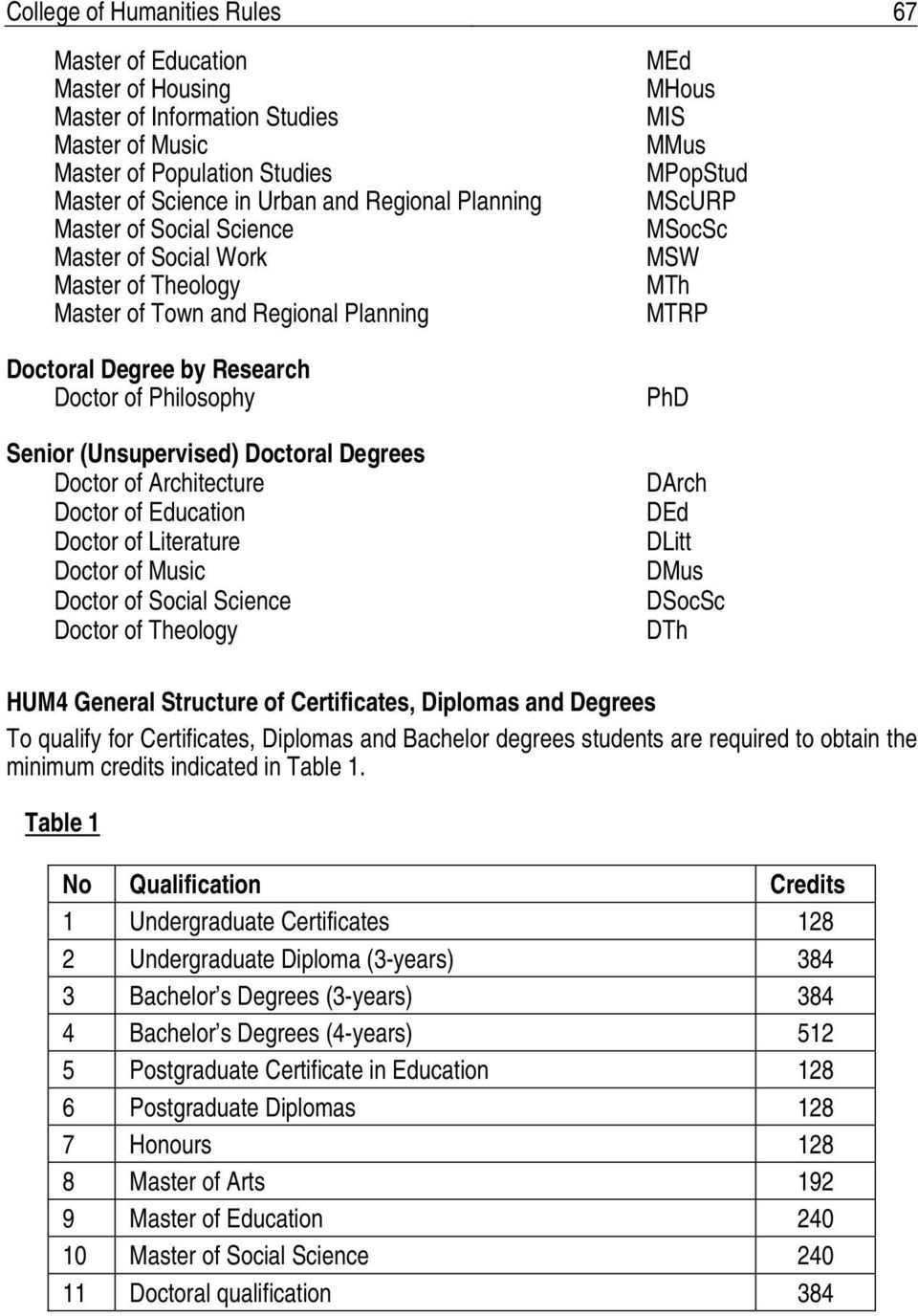
6 College of Humanities Rules 68 HUM5 Bachelor s Degree Structure a) To qualify for a Bachelor s degree, students must obtain at least 96 credits at levels one and two and 128 credits at level three and must register for additional modules, ensuring that they accumulate a minimum of 384 credits for a three-year degree. These qualifications extend over a minimum of six semesters. b) Four-year degrees have an additional minimum requirement of 128 credits in the fourthyear of study. These qualifications extend over a minimum of eight semesters. c) At least 64 credits per annum must be chosen from modules offered by the College (as listed in the syllabus section of this Handbook). d) Students registered for the general Bachelor of Arts must complete 16 credits in a language that was not their first language in Grade 12. e) No more than one major can be selected from outside this College (as listed in this Handbook). Students whose first language at Grade 12 is not English, may take any of the following 16- credit modules in order to fulfil the language requirement: ACLE102 LING102 ACLT001 ELDV001 ACCS110 DRAM 101 ACCS120 CCCV101 MECS101 ZULM203 (only to be taken in the second year of study) HUM6 Limitations Except with the prior permission of the College, students may not register for more than 80 credits in any semester. Credit will not be given for modules taken in excess of this limit unless with the permission of the College, prior to the start of the semester/year concerned. HUM7 Progression and Suspension a) In order to proceed to the second level of study, a student must pass at least 80 credits at the first level. b) Students who have, by the end of their fourth semester of registration, have completed 128 at first year and a minimum of 80 credits at second year, shall be eligible to proceed to the third level of study. c) Except with the permission of the College, any candidate who has registered for and failed a module after three attempts, shall not be eligible for readmission to that module. Semesters Main Stream BEd and BSS (at least 16 at Level 2) (at least 64 at Level 2) 192 (at least 32 at Level 2)

7 College of Humanities Rules (at least 96 at Level 2 or 3) 224 (at least 64 at Level 2) (at least 96 at Level 2 and 256 (at least 96 at Level 2 or 3) 48 at Level 3) (at least 80 at Level 3) 288 (at least 96 at Level 2 and 32 at Level 3) (3-year qualification 320 (at least 64 at Level 3) complete) (at least 96 at Level 3) (3-year qualification complete) (4-year qualification: at least 96 at Level 3) (4-year qualification: at least 64 at Level 7) (4-year qualification complete) HUM8 Changes of Qualification 1. Students may not change from one undergraduate qualification to another within the College: a) more than twice; or b) later than at the commencement of their third level of study. 2. Students from the Bachelor of Social Science Extended Programme (BSS4), who meet specific criteria and in consultation with the College may change their qualifications at the end of the first semester. HUM9 Award of BEd Cum Laude and Summa Cum Laude In addition to General Rule BR7(a) and (b) the award of the Bachelor of Education degree Cum Laude or Summa Cum Laude will follow the requirements prescribed in rules HUM-BED6 and HUM-BED7 respectively. HUM10 Distinctions for Certificates and Diplomas The award of distinctions will follow the requirements prescribed in the General Academic Rules of the University. HUM11 Humanities Extended Programme This a 4-year Bachelor of Social Science (BSS4) degree, also known as the Humanities Extended Programme (HEP) which extends over eight semesters. HUM12 Structured Degrees a) Structured Bachelor s degrees shall bear a descriptor indicative of the specific specialisation.

8 College of Humanities Rules 70 b) The descriptor may refer either to a disciplinary major (BA in Drama and Performance Studies) or to the defining component of a curriculum of cognate modules whose credit value shall not be less than the minimum credit value of a disciplinary major (BSocSc in International Studies). c) The Rules pertaining to the general studies BA/BSocSc degrees shall be applicable to the structured Bachelor s degrees, except for to the language requirement. d) At least 128 credits must be for modules taken at the third level. e) These qualifications extend over six semesters. HUM13 Admission to Bachelor s Study 1. Degrees: Regular Selection a) Applicants who have obtained the National Senior Certificate (for degree study) examinations must achieve at least an Academic Performance Score (APS) of 26 points with at least one of the following modules at Level 5: any language (HL or FAL), Business Studies, Consumer Studies, Dramatic Arts, Economics, Geography, History, Information Technology, Life Sciences, Mathematical Literacy, Music, Religion Studies, Visual Arts. b) In addition to (a) above, candidates shall be eligible to apply to register for undergraduate qualifications if they are in possession of a matriculation exemption with at least 32 points. These are the minimum requirements that will ensure that an applicant can be considered for admission to the majority of degrees offered by this College, subject to the availability of places. 2. Degrees with Additional or Different Requirements Applicants for the following degrees must meet additional and/or different requirements for admission: Bachelor of Architectural Studies Bachelor of Music, and other degrees involving practical skills in music BA/BSS in Philosophy, Politics & Law BA/BSS (Legal Studies) An APS of 30 with Mathematics at Level 5, PLUS a portfolio of creative work, an essay, and completion of a questionnaire Audition and tests (in addition to an APS of 26) An APS of Degrees: Alternative Selection a) Applicants with a National Senior Certificate (for degree study) and an APS of with English (HL or FAL) and Life Orientation at Level 4, will have to undergo further admission procedures, which will involve a test. Depending on the applicants performance in the test and on their educational background and subject to the availability of places, they may:

9 College of Humanities Rules 71 i) gain admission to study for the degree they have chosen; ii) gain admission to the BSocSc (Four-Year) Extended Curriculum programme; iii) be refused admission. b) Applicants who do not hold either a National Senior Certificate (for degree study) or a Senior Certificate with Endorsement or a Certificate of Exemption may qualify to be admitted to degree study in one of the following ways: i) Acceptance into the Humanities Extended Programme in exceptional cases. ii) Selection under HESA s Mature Age provision. Mature Age applicants must be at least twenty-three years of age or turning twenty-three in their first year of registration for the degree, and must have passed, at Matriculation (Grade 12) level (with an E symbol or better), at least one subject at the Higher Grade and at least three subjects at the Standard Grade. Applicants will be required to write an entrance test. iii) Acceptance into the Industrial and Working Life Project (Howard College Campus only). Workers College diplomates may be considered for access to part-time study in this programme. Selection will be done in conjunction with the Workers College. iv) Acceptance into the BA in Music via recognition of prior learning. v) Acceptance into BA, BSocSc. BComDev or BEd, provided the applicant has a Certificate in Education from UKZN and undergoes further admission procedures and testing. HUM14 Holders of School-Leaving Qualifications other than the South African Matriculation Applicants with School-leaving qualifications other than the National Senior Certificate (for degree study) will be considered for admission in terms of the regulations in force at the time of their application. International applicants will also need to produce proof of their proficiency in English. COLLEGE ACADEMIC RULES FOR EXTENDED PROGRAMMES, CERTIFICATES, DIPLOMAS, and BACHELOR S DEGREES Humanities Extended Curriculum Programme (BSS4) HUM-HEC1 Duration The programme will extend over a minimum of eight semesters (4 years) of full-time registration, at the end of which students that have successfully completed all the required modules will graduate with a Bachelor of Social Science.

10 College of Humanities Rules 72 HUM-HEC2 Structure of the BSS (Four-Year) Extended Curricula a) First Year Students must take all of the following modules: Semester One ACLT001 Academic Literacy A 16FC ELDV001 English Language Development A 16FC BCLT001 Basic Computer Literacy 8FC BNMR001 Basic Numeracy* 8FC One elective chosen from ETHS101 Ethics 1: Applied Global Ethics 16C POLS101 Introduction to Political Science 16C PSYC101 Introduction to Psychology A 16C SOCY101 Introduction to Sociology 16C * Only for students with a maximum APS of 3 for Maths or 4 for Maths Literacy Semester Two ACLT100 Exploring Literacies in the Humanities 16C Two electives chosen from ETHS102 Life, Sexuality & Death 16C POLS102 Introduction to Global Politics 16C PSYC102 Introduction to Psychology B 16C SOCY102 Introduction to South African Society 16C HUM-HEC3 DP Policy (applicable only to students taking Foundation modules) In order to qualify for a DP Certificate for each module, students must: I. attend at least 90% of all counselling workshops, lectures and tutorials; II. submit all assignments punctually. HUM-HEC4 Progression a) Students are permitted to register for only 48 credits in each semester of this qualification. b) In each semester of the second year of the qualification, students must choose one mainstream module from one of the following: Ethics, Political Science, Psychology and Sociology. (These module offerings could change from time to time) c) Normal College progression rules will apply from second year. d) A student who fails two language/literacy modules in the first year must register for ACCS110 in the first semester of their second year. e) In special circumstances, either for excellent students or if a student needs to repeat a module, permission may be granted for them to register for a maximum of 64 credits per semester. However, these requests will be considered on merit and permission will be granted at the discretion of the College. f) Only students who have gained at least 48 credits by the end of the first year may proceed to second year. g) Any foundational modules failed in the first semester must be passed in the second semester.

11 College of Humanities Rules 73 Bachelor of Social Science (Industrial and Working Life Programme) HUM-IWLP1 Admission 1. Should have completed at least one Workers' College diploma with an average mark of 60% or above. 2. Should write and pass the Entry Test of UKZN. 3. Should be in a position to attend classes every Friday, including the Winter School which is held in June/July each year. 4. Pay an applicable registration fee to the Worker s College. HUM-IWLP2 Progression The Industrial and Working Life Programme (IWLP) is a self-funded programme that offers workers from certain trade unions the opportunity to enrol for a degree in the Social Sciences. Students major in Sociology and in Industrial, Organisational and Labour Studies, and complete their degree part-time over a five-year period. The programme serves the perceived need for trade unionists to develop their capacities to enable them to engage more effectively in debates, to undertake their own research, and to evaluate critically and analyse economic and social phenomena. YEAR 1 Semester Modules Credits Semester 1 ACLE 102 Academic Learning in English SOCY101 Introduction to Sociology Winter School SOCY110 Development Activism in Africa 16 Semester 2 SOCY102 Introduction to South African Society IOLS101 Workers and Industrialisation in SA Total Credits - 80 YEAR 2 Semester Modules Credits Semester 1 LIIS120 Internet Expertise or ECON111 Intro to Economic Concepts CMDV101 Introduction to Community Development Theory Winter School Economic Activism in the Information Age 16 Semester 2 Community Perspective Module IOLS204: Trade Unions in South Africa IOLS202 Globalisation & World Class Manufactng Total Credits - 80 YEAR 3 Semester Modules Credits Semester 1 IOLS201 Organising Production IOLS205 Introduction to Labour Markets SOCY201 Classical Sociology Theory Winter School Work Placement for Experiential Learning 16 Semester 2 SOCY202 Social Change To be advised Total Credits - 80

12 College of Humanities Rules 74 YEAR 4 Semester Modules Credits Semester 1 IOLS301 Organisational Restructuring & Change IOLS302 Diversity & Equity in the Workplace Winter School To be advised 16 Semester 2 SOCY301 Contemporary Sociological Theory SOCY302 Contemporary Theory - Theorist(s) Total Credits - 80 YEAR 5 Semester Modules Credits Semester 1 32C from SOCY305 Research Design - An Introduction 32 SOCY306 Social Issues - Practice and Theory (16C) SOCY308 Social Issues - Specific Examples (16C) Semester 2 SOCY309 Research Practice - a Project (16C) IOLS303 Labour, Capital & State in Contemporary SA IOLS305 Economic Policy, Labour Markets & Jobs Total Credits 64 Total Credits for Degree Music Foundation Programme and Certificate The Music Foundation Programme is a broad-based, self-funded programme that provides foundation work for all music students. It provides a preliminary year of study for students who cannot be admitted to a degree or to either the Diploma in Music Performance or the Diploma in Jazz and Popular Music. Students who have already been admitted to diploma or degree study but who need remedial work in one or more areas, may register for one or more of these modules. Completion of this programme does not grant automatic access to further study. Admission Requirements: a National Senior Certificate, Senior Certificate or equivalent qualification, and successful completion of an audition. Notional study hours for each module are given in brackets. First Semester Second Semester Basic Aural Perception A (80) Basic Aural Perception B (80) Preliminary Music Ensemble A (80) Preliminary Music Ensemble B (80) Basic Performance Skills [including improvisation] A (80) Basic Performance Skills [including improvisation] B (80) Introduction to Keyboard A (80) Introduction to Keyboard B (80) Fundamentals of Music Theory A (80) Fundamentals of Music Theory B (80) Preliminary Practical Study A (160) Preliminary Practical Study B (160) English for Musicians A (80) English for Musicians B (80) Total notional hours for semester: 640 Total notional hours for semester: 640

13 College of Humanities Rules 75 Certificate in Education (Undergraduate) HUM-CEd1 Admission 1. A candidate is eligible to apply for selection to register provided they have: (a) National Senior Certificate, and (b) Three years experience relevant to the area of study 2. The selection process may include academic ranking and other criteria as approved by the College HUM Ced2 Specialisations Students shall register for one of the following specialised curricula: a) Participatory Development (CEWL) b) Workplace Learning (CEPD) HUM Ced3 Curriculum Total credits for the Certificate in Education: 128 credits Specialisations: a) Participatory Development: Students are required to register for All of the following modules: EDAE101 Introduction to Adult Education 101 (16C) EDAE102 Introduction to Development 102 (16C) EDAE104 Development in Practice 104 (16C) EDAE105 Development in Practice 105 (16C) EDAE121 Lifelong Learning 121 (16C) EDAE123 Facilitation and Instructional Techniques 123 (16C) AND Two of the following modules: EDAE106 Adult Basic Education and Training 106 (16C) and EDAE107 Adult Basic Education and Training 107 (16C) or EDAE108 Conflict Transformation 108 (16C) and EDAE109 Conflict Transformation 109 (16C) or EDAE110 Entrepreneurship 110 (16C) and EDAE111 Entrepreneurship 111 (16C) or EDAE112 Landcare 112 (16C) and EDAE113 Landcare 113 (16C) or EDAE114 Leadership and Management of NGOs 114 (16C) and EDAE115 Leadership and Management of NGOs 115 (16C) or EDAE116 Local Government 116 (16C) and EDAE117 Local Government 117 (16C) or EDAE138 Economic Justice I (16C) and EDAE139 Economic Justice II (16C)

14 College of Humanities Rules 76 or EDAE140 EDAE141 Water Management for Household Systems I (16C) and Water Management for Household Systems II (16C) b) Workplace Learning Specialisation: Students are required to register for All of the following modules: EDAE101 Introduction to Adult Learning 101 (16C) EDAE118 Diversity and Learning 118 (16C) EDAE119 Training Context and Legislation 119 (16C) EDAE120 Assessment of Workplace Learning 120 (16C) EDAE121 Lifelong Learning 121 (16C) EDAE123 Facilitation and Instructional Techniques 123 (16C) AND Two modules from the following: EDAE104 Development in Practice 104 (16C) EDAE105 Development in Practice 105 (16C) EDAE124 Programme Planning 124 (16C) EDAE125 Workplace Literacy 125 (16C) HUM-CEd4 Duration This qualification extends over a minimum of at least two semesters of full-time study or four semesters of part-time study. Advanced Certificate in Education (ACE) HUM-ACE1 Admission 1. A candidate is eligible to apply for selection to register provided he/she has an approved education qualification at Relative Education Qualification Value (REQV) 13 or higher 2. The selection process may include academic ranking and other criteria as approved by the College. HUM-ACE2 Curriculum This qualification consists of a minimum of at least 128 credits. Students shall register for one of the following specialised curricula (a) Biological Sciences EDBS121 Biology of Cells (16C) EDBS122 Genetics, heredity and biotechnology (16C) EDBS123 Evolution and Diversity (16C) EDBS124 Curriculum and Assessment in Biology (16C) EDBS125 Life processes in animals (16C) EDBS126 Reproduction in animals & life processes in plants (16C) EDBS127 Ecology (16C) EDBS128 Learning and Teaching Biology (16C) (b) Education Leadership, Management and Policy EDCS103 Curriculum development and assessment (16C) EDMN103 Human Resource development (16C) EDMN104 Human Resource management (16C) EDMN106 Issues in the Management and Governance of Schools (16C)

15 College of Humanities Rules 77 (c) (d) (e) (f) EDMN108 Leadership and development of self (16C) EDMN110 Quality Assurance and Whole School Development (16C) EDMN111 Self-Managing Schools (16C) EDMN112 The School as a Learning Organisation (16C) History Education FET EDHS102 History Education Research Project (16C) EDHS103 Teaching African History (16C) EDHS104 Teaching South African History (16C) EDHS105 The nature of History (16C) EDHS106 Using sources to teach history (16C) EDHS107 Approaches to Teaching and the Assessment of History (16C) EDPD101 Learning and Teaching (16C) EDPD102 Education Policy and Professionalism (16C) Information Communication Technology Integration (ICT) EDPD103 Learning, Thinking and Teaching with ICT (16C) EDPD104 ICT in Schools (16C) EDPD137 ICT and the Roles of the Educator (16C) EDPD138 Assessment for ICT Integration (16C) And 64 Credits from the following modules EDPD108 Designing Web Pages (8C) EDPD109 Developing Classroom Resources for Science (8C) EDPD110 Developing Classroom Resources for Maths (8C) EDPD111 ICT Maths Resources for Educators (8C) EDPD112 ICT Planning for Schools (16C) EDPD113 ICT Leadership in Schools (16C) EDPD114 ICT Science Resources for Educators (8C) EDPD115 Learning with Projects (16C) EDPD116 Working with Information (16C) EDPD134 Facilitating ICT Integration for Teachers (16C) EDPD136 Choosing and Evaluating Educational Software (8C) Language Education EDLE101 Academic Literacy for Language Education (16C) EDLE103 Language Acquisition (16C) EDLE104 Language Pedagogy (16C) EDLE105 Media in the Classroom (16C) EDLE106 Reading and Writing for Teaching (16C) EDLE107 Issues in Language Teaching (16C) EDPD101 Learning and Teaching (16C) EDPD102 Education Policy and Professionalism (16C) Mathematics FET EDMA121 Education Studies for Mathematics (16C) EDMA141 Professional Practice in Teaching Mathematics (16C) EDPD101 Learning and Teaching (16C) EDPD102 Education Policy and Professionalism (16C) And 64 credits from the following modules EDMA109 Mathematics 601 (16C) EDMA110 Mathematics 602 (16C)

16 College of Humanities Rules 78 (g) (h) (i) (j) EDMA111 Mathematics 610 (16C) EDMA112 Mathematics 620 (16C) EDMA113 Mathematics 630 (16C) EDMA114 Mathematics 640 (16C) Mathematics GET EDMA105 Mathematics Education 1A (16C) EDMA106 Mathematics Education 1B (16C) EDMA115 Curriculum Studies in Mathematics 1A (16C) EDMA116 Curriculum Studies in Mathematics 1B (16C) EDMA117 Curriculum Studies in Mathematics 2A (16C) EDMA118 Curriculum Studies in Mathematics 2B (16C) EDPD101 Learning and Teaching (16C) EDPD102 Education Policy and Professionalism (16C) Mathematical Literacy EDPD102 Education Policy and Professionalism (16C) EDMA108 Professional Practice in Mathematics (16C) EDMA138 Data Handling in Mathematical Literacy (16C) EDMA139 Functional Relationships in Mathematical Literacy (16C) EDMA140 Number and Operations in Mathematical Literacy (16C) EDMA142 Space Shape and Measurement in Mathematical Literacy (16C) EDMA143 Teaching and Learning Mathematics in the FET (16C) EDPD101 Learning and Teaching (16C) Mathematics Science and Technology GET EDMA145 GET Mathematics 1 (16C) EDPD102 Education Policy and Professionalism (16C) EDPD101 Learning and Teaching (16C) EDSE137 GET Science 1 (16C) EDTE105 Mechanical Systems for Technology Education (16C) And 32 credits from the following modules EDMA146 GET Mathematics 2 (16C) EDSE138 GET Science 2 (16C) EDTE106 Processing & Manufacturing for Technology Education (16C) And 16 credits from the following modules provided that the module chosen must be in one of the discipline areas chosen at level 2. EDMA147 GET Mathematics 3 (16C) EDSE139 GET Science 3 (16C) EDTE107 Structures & Materials for Technology Education (16C) Natural Sciences EDNS101 Education Studies for Natural Science (16C) EDNS102 Natural Science 610 (16C) EDNS103 Natural Science 620 (16C) EDNS104 Natural Science 630 (16C) EDNS105 Natural Science 640 (16C) EDNS106 Professional Practice in Natural Science (16C) EDPD101 Learning and Teaching (16C) EDPD102 Education Policy and Professionalism (16C)

17 College of Humanities Rules 79 (k) Physical Science EDPD101 Learning and Teaching (16C) EDPD102 Education Policy and Professionalism (16C) EDSE110 Chemistry Education 1A (16C) EDSE111 Chemistry Education 2A (16C) EDSE112 Chemistry Education 2B (16C) EDSE113 Physics Education 1A (16C) EDSE114 Physics Education 2A (16C) EDSE115 Physics Education 2B (16C) (l) School Library Development and Management EDPD101 Learning and Teaching (16C) EDPD102 Education Policy and Professionalism (16C) EDPD119 Education Studies for School Library Development (16C) EDPD120 Professional Practice in School Library Development (16C) EDPD121 School Library Development and Management 610 (16C) EDPD123 School Library Development and Management 630 (16C) EDPD124 School Library Development and Management 640 (16C) EDPD125 School Library Development and Management 620 (16C) (m) School Management and Leadership EDMN114 Understanding School Leadership & Management (16C) EDMN115 Managing Teaching and Learning (16C) EDMN116 Leading and Managing People (16C) EDMN117 Managing Organizational Systems & Resources (16C) EDMN118 Managing Policy Planning and Governance (16C) EDMN121 Practical Management and Leadership (16C) and 32 credits from the following modules EDMN110 Quality Assurance & Whole School Development (16C) EDMN112 The School as a Learning Organisation (16C) EDMN119 Mentoring and Induction (16C) EDMN120 Planning and Conducting Assessment (16C) EDPD113 ICT Leadership in Schools (16C) EDPD104 ICT in Schools (16C) (n) Technology Education EDPD102 Education Policy and Professionalism (16C) EDTE103 Foundations and issues in Technology Education (16C) EDTE104 Information & Communication for Technology Education (16C) EDTE105 Mechanical systems for Technology Education (16C) EDTE106 Processing and manufacturing for Technology Education (16C) EDTE107 Structures and materials for Technology Education (16C) EDTE108 Teaching practice for Technology Education (16C) EDTE109 Electrical systems for Technology Education (16C) (o) Values and Human Rights in Education EDSJ105 Race Gender and Class (16C) EDSJ106 Social Equity in Professional Practice (16C) EDSJ107 Social Issues in Education (16C) EDSJ108 The Educator s Pastoral Role (16C) And 32 credits from the following elective modules

18 College of Humanities Rules 80 EDSJ102 Human Rights and Values in Education (16C) EDSJ103 Integrating Values & Human Rights in the Curriculum (16C) EDSJ104 Language and Diversity (16C) EDSJ110 Foundations in Human Rights and Values (16C) and two approved modules from this or another specialisation. Diploma in Jazz and Popular Music Diploma in Music Performance HUM-DJP1 Admission Candidates shall be eligible to apply for the qualification of Diploma in Jazz and Popular Music or Diploma in Music Performance if they hold a National Senior Certificate (for diploma study), equivalent qualification or alternative access certificate approved by Senate. In addition they must; a. successfully complete an audition demonstrating proficiency deemed adequate to pursue the anticipated first level course of study in singing, playing an instrument or African Music and Dance; b. demonstrate their ability to read music and their knowledge of the basic rudiments of music; and c. complete a diagnostic English proficiency test. HUM-DJP2 Progression The curriculum for the Diploma in Jazz and Popular Music and for the Diploma in Music Performance shall extend over a minimum of six consecutive semesters of full-time study. Students shall not be permitted to progress to the third year of study unless they have obtained credit for all the modules prescribed for the first year of study and at least a further 80 credits for modules prescribed in the second year of study (208 credits altogether). HUM-DJP3 Transfer to a Degree Programme A candidate holding an NSC (or has a Senate Exemption) who wishes to transfer from the Diploma in Jazz and Popular Music or the Diploma in Music Performance to the BMus, the BA in Music or the BA in Music and Drama Performance degree programmes must: a) have passed all the Diploma modules prescribed for the first semester; and b) have passed the module ACLE102 Academic Learning in English; and c) receive the Dean and Head of School s approval for the transfer. Structure: Diploma in Jazz and Popular Music CREDITS FIRST LEVEL First Practical Study 1A and 1B ( ) Workshop in Jazz & Popular Music 1A and 1B (8 + 8) Music Ensemble 1A and 1B (DipJP) (8 + 8) Jazz & Popular Music Theory 1A and 1B (8 + 8)

19 College of Humanities Rules 81 Aural Perception 1A and 1B (8 + 8) Jazz & Popular Music History 1A and 1B (8 + 8) ALE (or other English language module) (16) Total credits: 128 SECOND LEVEL First Practical Study 2A and 2B ( ) Workshop in Jazz & Popular Music 2A and 2B (8 + 8) Music Ensemble 2A and 2B (DipJP) (8 + 8) Jazz & Popular Music Theory 2A and 2B (8 + 8) Aural Perception 2A and 2B (8 + 8) *Composition & Arranging in J&PM 1A and 1B (8 + 8) Jazz & Popular Music History 2A and 2B (8 + 8) Total credits: 128 THIRD LEVEL (Diploma exit level) First Practical Study 3A and 3B ( ) Music Ensemble 3A and 3B (DipJP) (8 + 8) Jazz & Popular Music Theory 3A and 3B (8 + 8) Each student chooses to specialise in TWO of the following disciplines: Performance Composition & Arranging Electro-Acoustic Music Music Education by selecting TWO options to the value of 32 credits each from the following list: Performance in Jazz & Popular Music 1A and 1B (examination recital) Composition & Arranging in J&PM 2A and 2B Electro-Acoustic Music 1A and 1B Music Education 1A and 1B ( ) ( ) ( ) ( ) Total credits: 128 Notes: Over the 3 years of the Diploma, the content of the modules entitled Composition & Arranging in Jazz and Popular Music may include such topics as song writing, big-band arranging, jingle writing, and film music. Structure: Diploma in Music Performance Students must gain credit for the following common modules and also for the specialist modules in Western Classical Music or African Music and Dance or Opera or Choral Studies, as outlined below: LEVEL ONE Common Modules Introduction to Music Fundamentals A and B ( ) or Music Theory and Perception 1A and 1B ( ) ELDV001 English Language Development A (0 credits) and/or ELDV100 English Language Development B and/or ACLE102 Academic Learning in English (16)

20 College of Humanities Rules 82 Note: English Language Development A and/or B may be required according to recommendations based on a diagnostic language test. Students intending to register for a BA in Music or in Music and Drama Performance or for the BMus degree must pass the language module approved for such purposes. Specialised Modules Classical Music African Music and Dance First Practical Study 1A & 1B (16+16) African Music and Dance 1A & 1B (16+16) Music Ensemble 1A & 1B (8+8) Music Ensemble 1A & 1B (African Music Ensemble) (8+8) * (32) ALE (16) + **Elective (16) or ** (32) Opera Choral Studies First Practical Study 1A & 1B (16+16) Choral Studies 1A & 1B (16+16) Music Ensemble 1A & 1B (8+8) Music Ensemble 1A & 1B (8+8) Song, Culture and History 1A & 1B (8+8) Song, Culture and History 1A & 1B (8+8) Vocal Workshop¹ 1A & 1B (8+8) Vocal Workshop¹ 1A & 1B (8+8) Total for level One 128 credits Note. Vocal Workshop includes Movement, Stagecraft, Italian/German for singers, keyboard skills. LEVEL TWO Classical Music African Music and Dance First Practical Study 2A & 2B ( ) African Music and Dance 2A & 2B ( ) Music Ensemble 2A & 2B (8 + 8) Music Ensemble 2A & 2B (African Music Ensemble) (8 + 8) Introductory Music Theory & Perception A (16) or Elective (16) *Elective (16) Introductory Music Theory & Perception B (16) Elective (16) Or *Elective (16) * (48) ** (48) Opera Choral Studies First Practical Study 2A & 2B (16+16) Choral Studies 2A & 2B (16+16) Music Ensemble 2A & 2B (8+8) Music Ensemble 2A & 2B (8+8) Introductory Music Theory and Perception A and B (16+16) or Music Theory and Perception 2A & 2B ( ) Introductory Music Theory and Perception A and B (16+16) or Music Theory and Perception 2A & 2B ( ) Song, Culture and History 2A & 2B (8+8) Song, Culture and History 2A & 2B (8+8) Vocal Workshop¹ 2A & 2B (8+8) Vocal Workshop¹ 2A & 2B (8+8) Languages for Singers A & B (8+8) Languages for Singers A & B (8+8) Total for Level Two 128 credits LEVEL THREE Classical Music African Music and Dance First Practical Study 3A & 3B ( ) African Music and Dance 3A & 3B (16+16)

21 College of Humanities Rules 83 or Performance 1A & 1B (16+16) Music Ensemble 3A & 3B (8+8) Music Ensemble 3A & 3B (African Music Ensemble) (8+8) * (80) African Music Outreach: Music Education (16) African Music Outreach: Community Development (16) ** (48) Opera Choral Studies First Practical Study 3A & 3B (16+16) Choral Studies 3A & 3B (16+16) Music Ensemble 3A & 3B (8+8) Music Ensemble 3A & 3B (8+8) Intermediate Music Theory and Perception A & B ( ) or (16+16) Intermediate Music Theory and Perception A & B ( ) or (16+16) Vocal Teaching Method A (16) Vocal Teaching Method A (16) Performance 1A & 1B (16+16) Advanced Musical Studies 1A & 1B (Choral) (16+16) Total for Level Three 128 credits * for Specialisation in Classical Music Popular & Traditional Musics: Africa & Beyond (16) Western Classical Music: An Introduction (16) Music Culture and History 2A, 2B, 3A, 3B (16 each) Introductory Music Theory and Perception A and B (16 each) Other electives with approval of School Intermediate Music Theory and Perception A and B (16 each) Music Theory and Perception 2A, 2B, 3A, 3B (16 each) Second Practical Study 1A, 1B, 2A, 2B (16 each) ** for Specialisation in African Music and Dance Basic Computer Literacy (0) - recommended Festivals and Performances (16C) Academic Learning in English (16) Contemporary Leaders and Related Sites African Music Outreach: Documentation (16) Introductory Music Theory and Perception A, B Arts Administration (16) (16 each) English Language Development B (16) Popular and Traditional Musics: Africa and LIIS120 Internet Expertise (16) Beyond (16) IsiZulu 101, 102, 201, 202 (16 each) Second Practical Study 1A, 1B, 2A, 2B (16 each) IsiZulu Language Studies 101, 102, 201, 202 (16 each) Keyboard Studies 1A, 1B, 2A, 2B (16 each) Introduction to Tourism (16C) Choral Studies 1A, 1B, 2A, 2B, 3A, 3B (16 each) Introduction to Cultural & Heritage Tourism (16C) Introduction to Media Studies (16) Principles of Tourism Marketing (16C) Other electives with approval of School
22 College of Humanities Rules 84 National Professional Diploma in Education (NPDE) HUM-NPD1 Admission to NPDE 1. A candidate is eligible to apply for selection to register for the National Professional Diploma in Education (General Education and Training) provided he/she is a currently serving educator with either: a) A recognised teaching qualification at Relative Education Qualification Value (REQV) 11 or 12; or b) A recognised teaching qualification REQV 10 and a minimum of FIVE (5) years teaching experience; 2. A candidate is eligible to apply for selection to register for the National Professional Diploma in Education (Further Education and Training Vocational Training) provided he/she is a currently serving college lecturer with qualifications and experience in technical subjects equivalent to a minimum of a year s post- School education. 3. The selection process may include academic ranking and other criteria as approved by the College. HUM-NPD2 Curriculum. Specialisations in the NPDE 1. All students shall obtain 384 credits. 2. Candidates shall register for one of the specialised curricula below. 3. Students registered for the GET specialisations, shall complete one of the curricula listed under A. 4. Students registered for the FET specialisation shall complete the curriculum listed under section B. A. General Education and Training (GET) All of the following modules: EDPD128 Communication 101 (16C) EDPD133 HIV/AIDS Education 113 (16C) EDPD140 Communication 102 (16C) EDPD141 Teaching and Learning 141 (16C) EDPD142 Teaching and Learning 142 (16C) EDPD154 Professional Practice 154 (16C) EDPD161 Teaching Practice 161 (16C) EDPD162 Practice Teaching162 (16C) EDPD163 Practice Teaching 163 (16C) EDPD201 Communication 201 (16C) EDPD202 Communication 202 (16C) EDPD214 Functional Numeracy 214 (16C) EDPD218 Identities, Images and Values 218 (16C) EDPD224 Numeracy 224 (8C) EDPD241 Teaching and Learning 241 (16C) EDPD242 Teaching and Learning 242 (16C) And one of the following curricula:
23 College of Humanities Rules 85 (i) Foundation Phase EDPD107 Literacy 107 (16C) EDPD122 Foundation Phase Numeracy 122 (16C) EDPD129 Foundation Phase Numeracy 121 (16C) EDPD135 Life Skills 117 (16C) EDPD207 Literacy 207 (16C) EDPD217 Life Skills 217 (16C) (ii) Intermediate Phase EDPD105 Language, Literacy and Communication 105 (16C) EDPD106 Language, Literacy and Communication 106 (8C) EDPD139 Life Orientation 116 (8C) EDPD219 Human and Social Sciences 219 (16C) EDPD227 Mathematical Literacy and Mathematical Sciences 227 (16C) EDPD228 Mathematical Literacy and Mathematical Sciences 228 (8C) EDPD235 Natural Science and Technology 235 (16C) (iii) Senior Phase EDPD205 Language, Literacy and Communication 205 (16C) EDPD206 Language, Literacy and Communication 206 (16C) EDPD215 Life Orientation 215 (16C) EDPD216 Life Orientation 216 (16C) and EDPD229 Mathematical Literacy and Mathematical Sciences 229 (16C) EDPD230 Mathematical Literacy and Mathematical Sciences 230 (16C) or EDPD232 Natural Science 232 (16C) EDPD233 Natural Science 233 (16C) or EDPD237 Technology 237 (16C) EDPD238 Technology 238 (16C) B. Further Education and Training - Vocational Training (VT) All of the following modules: EDAE126 Communication 1 (16C) EDAE127 Numeracy 1 (16C) EDAE128 Foundations of FET 1 (16C) EDAE129 Instruction and Learning 1 (16C) EDAE130 Curriculum Design and Assessment 1 (16C) EDAE131 Administration and Classroom Management 1 (16C) EDAE132 Practical Teaching 1 (16C) EDAE200 Communication 2 (16C) EDAE201 Numeracy 2 (16C) EDAE202 Foundations of FET 2 (16C) EDAE203 Instruction and Learning 2 (16C) EDAE204 Curriculum Design and Assessment 2 (16C) EDAE205 Administration and Classroom Management 2 (16C) EDAE206 Practical Teaching 2 (16C) EDAE301 Professional Practice 3 (16C) EDAE401 Professional Practice 4 (16C)
24 College of Humanities Rules 86 HUM-NPD3 Exemption from modules in the NPDE 1. Students with prior professional qualifications may be granted exemption with credit from modules up to a maximum of 128 credits. 2. Students with appropriate experience, who can demonstrate competency in relation to specific modules, may be granted exemption from such modules and be awarded Recognition of Prior Learning (RPL) credit for them to a maximum of 128 credits. 3. No student admitted under HUM-NPD1 (b) may be exempted from more than 128 credits in total. RULES FOR (THREE-YEAR) BACHELOR DEGREES Bachelor of Arts Bachelor of Social Science HUM-UG1 Duration The specific curriculum for these degrees is listed under the Rules of Combination and shall extend over a minimum of six academic semesters. HUM-UG2 Majors a) Students for the general studies Bachelor of Arts must select at least one major from List A below. The other major may be selected from List A, List B or List C below. b) Students for the general studies Bachelor of Social Science must select one major from List B below. The other major may be selected from List A, List B, or List C below. c) Only one major may be selected from List C. List A: BA Majors* Afrikaans en Nederlands Ethics Studies Latin Applied Language Studies Fine Art Linguistics Art History French Media and Cultural Studies Biblical Studies German Music Classical Civilisation Greek Philosophy Cultural and Heritage Tourism History Political Science Drama and Performance Studies IsiZulu Translation Studies English Studies Italian List B: BSocSc Majors* Anthropology Community Development Criminology Development Studies Economic History Education and Development Ethics Studies Geography History Industrial, Organisational and Labour Studies Industrial Psychology Media and Cultural Studies Philosophy Political Science Psychology Sociology
25 College of Humanities Rules 87 List C: Majors from other Colleges accepted for the BA and/or BSocSc* Computer Science Management Economics Marketing Human Resource Management Mathematics Information Systems & Technology Statistics Legal Studies * Some of these majors are available are available on only one of the two campuses. Please see Undergraduate Curricula in the Section entitled INFORMATION FOR STUDENTS for more detailed information. RULES OF COMBINATION 1. Afrikaans en Nederlands Afrikaans remains one of the most widely used languages in South Africa. A wide variety of courses for prospective teachers, translators and language practitioners from undergraduate to PhD level in Afrikaans and Dutch are on offer. All modules are flexible to allow students to specialise in Afrikaans, Dutch, Literature or Language. Structure of the Major AFRN130 Inleidende Kortkuns en Taal (16C) AFRN150 Afrikaanse Media en Kultuur (16C) AFRN210 Kortkuns en Taalkunde (16C) AFRN220 Taal - en Letterkunde (16C) AFRN310 Gevorderde Afrikaans/Nederlands 1A AFRN330 Gevorderde Afrikaans/Nederlands 2A (16C) (16C) AFRN320 Gevorderde Afrikaans/Nederlands 1B AFRN340 Gevorderde Afrikaans/Nederlands 2B (16C) (16C) 2. Anthropology Anthropology is the study of humankind, its common roots and the sources of its rich diversity. The discipline s uniqueness lies in its global, comparative, and diachronic perspective. Anthropologists believe that a true understanding of the human condition can only be achieved by studying the distant as well as the near, the ancient as well as the modern. Different branches of the discipline focus on different aspects of human experience, such as how our species evolved, how traditions of thought and behaviour are learned, how and why cultures change or persist. As the global village and its development challenges expand, people who possess different values, religions, customs and perspectives increasingly find themselves competing for scarce resources while trying to live together. For such reasons, there is a growing demand for the expertise and methodologies of people trained in anthropology. Structure of the Major ANTH101 Introduction to Anthropology (16C) ANTH102 Culture & Society in Africa (16C) ANTH201 Culture, Health & Illness(16C) ANTH202 Families & Households (16C) ANTH301 Applied Anthropology (32C) ANTH302 Research plus Special Topic (32C)
26 College of Humanities Rules Applied Language Studies (Not offered in 2012) Applied Language Studies is a discipline that deepens capacity to study, understand and use language to communicate more powerfully and develop professional expertise in educational and organizational discourse, language planning and policy making, and language learning and teaching. It also examines language in relation to issues of identity, power, gender, sexism and racism in various professional contexts. Structure of the Major APLS101 Language, Society & Power (16C) APLS102 Understanding Literacy (16C) APLS202 Intercultural Communication (16C) APLS203 Further Studies in Applied Linguistics (16C) APLS201 Understanding Language Structure (16C) APLS301 Discourse in Professional Contexts (16C) APLS302 Globalization, Language and Power (16C) APLS303 Communication for Professional Purposes APLS304 World English (16C) (16C) APLS305 Further Studies in Applied Linguistics (16C) 4. Art History Art History as a major comprises courses in Art History and selected courses in cognate subjects, as set out in the table below. Structure of the Major One of:* AHIS110 Western Art (16C) CCCV101 Classical Civilisation 1A (16C) CCCV102 Classical Civilisation 1B (16C) PHIL102 Philosophy & Ethics from Ancient to Modern (16C) One of:* CCCV201 Classical Civilisation 2A (16C) AHIS210 Africa: Art of a Continent (16C) CCCV202 Classical Civilisation 2B (16C) MECS201 Screen Studies (16C) MECS202 Introduction to Cultural Studies (16C) AHIS310 20th Century Art, Visual Culture & Theory I (16C) AHIS320 20th Century Art, Visual Culture & Theory II (16C) Art and Museum Practice: AHIS330 (16C) Contemporary African Art: AHIS340 (16C) * Please note that the same module cannot serve two majors; for example, Classical Civilisation 201 cannot form part of a major in Art History and a major in Classical Civilisation at the same time. 5. Biblical Studies Structure of the Major BIST110 Introduction to the New Testament (16C) BIST120 Introduction to the Old Testament (16C) BIST210 Text, Interpretation and Culture (16C) BIST220 Critical Tools for Biblical Studies (16C) BIST310 Biblical Theology (16C) and 48 credits from any three of the following modules (16C each): BIST320 New Testament Texts BIST331 Old Testament Exegesis BIST330 Old Testament Texts BIST360 Biblical Studies Cluster Elective BIST341 New Testament Exegesis (in Greek) BIST340 New Testament Exegesis (in English)
27 College of Humanities Rules Classics Classics is in general terms the study of ancient civilisations, particularly those of ancient Greece and Rome. The discipline offers three study-routes, which can be followed independently or in combination through the BA and the BSocSc (General Studies) degrees: Classical Civilisation (the study of literatures, mythologies, art and archaeology, history and culture, with particular focus on aspects of the ancient Mediterranean world relevant to today); Classical Greek language and literature; and Classical Latin language and literature. In all these studyroutes, students acquire skills of analytical and comparative thinking, articulate and intelligent use of written and spoken language, and broad cultural literacy. 7. Classics: Classical Civilisation The major normally consists of six Classical Civilisation semester-modules. Classical Latin and Classical Greek modules may also form part of the Classical Civilisation major, but credit for these modules cannot be claimed later for a major in Classical Latin or Classical Greek. Structure of the Major CCCV101 Classical Civilisation 1A (16C) CCCV102 Classical Civilisation 1B (16C) CCCV201/203* (16C) CCCV202/204* (16C) CCCV301/305* (16C) CCCV302/306* (16C) Additional Classics Module A** (16C) Additional Classics Module B** (16C) Notes: * CCCV203, 204, 305 and 306 will be offered on the Howard College Campus only. ** On the Howard College campus these modules will consist of a research project, web site construction, or Latin and Greek language study; on the Pietermaritzburg campus these modules will consist of further specialised Classical Civilisation topics. Structure of the Major CCGK101 Greek 1A (16C) CCGK201 Greek 2A (16C) CCGK301 Greek 3A (32C) 8. Classics: Greek CCGK102 Greek 1B (16C) CCGK201 Greek 2B (16C) CCGK301 Greek 3B (32C) Structure of the Major CCLT101 Latin 1A (16C) CCLT201 Latin 2A (16C) CCLT301 Latin 3A (32C) 9. Classics: Latin CCLT102 Latin 1B (16C) CCLT202 Latin 2B (16C) CCLT302 Latin 3B (32C)
28 College of Humanities Rules 90 Structure of the Major CMDV101 Intro to Community Development Theory (16C) CMDV203 Development Theories (16C) CMDV301 Issues in Community Development (32C) 10. Community Development CMDV104 Institutions in Community Development (16C) CMDV201 Community Economic Dev. (16C) or CMDV202 Programme/Project Planning (16C) CMDV303 Local Govt & Community Dev. (32C) or CMDV302 Community-Based Learning (32C) 11. Computer Science Offered by the College of Agriculture, Engineering and Science Structure of the Major Year 1 COMP100 (16), COMP102 (16), MATH130 (16), MATH140 (16) Year 2 COMP200 (16), COMP201 (16), 16C from MATH at Level 2 Year 3 Pietermaritzburg: COMP304 (16), 313 (16), 314 (16), 315 (16) Westville: COMP314 (16), 315 (16), two of (COMP300 (16), 301 (16), 304 (16), 305 (16), 306 (16), 313 (16), 3158 (16)) 12. Criminology Criminology is a multi-faceted discipline that examines the development of Criminology: trends, patterns and types of crime: adult and juvenile offenders and their motivations for crime: victims and their vulnerability to crime, and the justice system and its management of crime. Structure of the Major CRIM101 Fundamental Criminology A (16C) CRIM102 Fundamental Criminology B (16C) CRIM201 Contemporary Crime Issues (16C) CRIM203 Victimology (16C) CRIM301 Criminal Justice (16C) CRIM302 Corrections (16C) CRIM303 Reaction to Crime (16C) CRIM304 Investigative Criminology (16C) Note: In addition to the modules listed above, students who intend to take Honours in Criminology must complete the module CRIM305 Research Methodology. This module is available as a corequisite for students majoring in Criminology and intending to take Honours, but it cannot replace any of the modules listed above. 13. Cultural and Heritage Tourism Cultural and Heritage Tourism is an inter-disciplinary field of study which focuses on various aspects of local culture and heritage and on the implications of their development as tourist attractions.
29 College of Humanities Rules 91 Structure of the Major CHTM101 Introduction to Tourism (16C) CHTM201 Policy and Law in Heritage Tourism (16C) CHTM308 Tourism Policy (16C) CHTM302 Economic Dev. & Tourism (16C) CHTM102 Intro to Cultural & Heritage Tourism (16C) One of: CHTM206 Principles of Tourism Marketing (16C) CHTM209 Survey of Heritage Sites in S.A. (16C) CHTM304 Research Methods and IT for Heritage Tourism (16C) CHTM307 Theories of Tourism, Culture & Heritage (16C) 14. Development Studies Development Studies is an inter-disciplinary major that introduces the student to the variety of issues and debates concerning economic and social development both in the context of South Africa and internationally. The course seeks to provide students with a foundation towards a practical and critical understanding of the development issues at hand, with a strong emphasis on the nature of North-South relationships and how these determine global economic development. Structure of the Major ECHS101 Political Economy of Food (16C) (Recommended) ECHS209 Capitalism and Development (16C) OR ECHS205 Political Ecology (16C) ECHS303 Development in a Changing World Economy (32C) ECHS102 Globalisation Then and Now (16C) (Recommended) ECHS210 Development in Southern Africa (16C) ECHS304 Key Themes in Development Today (32C) Please note that students who major in Development Studies may NOT choose Economic History as their other major. At the first level, ECHS101 and ECHS102 are recommended but are not prerequisites for Development Studies 2. Suggested co-majors are: Community Development, Economics; Geography; History; Industrial, Organisational and Labour Studies; Political Science; Anthropology; Sociology. 15. Digital Arts Structure of the Major Level 1 Semester 1 Semester 2 DIGA110 Introduction to Digital Media (16C) DIGA101 Introduction to Digital Arts (16C) Level 2 Semester 1 Semester 2 DIGA201 Applied Digital Arts (16C) DIGA210 Film Studies (16C) Level 3 Semester 1 Semester 2 DIGA301 Advanced Digital Arts I (16C) DIGA310 Advanced Film Studies (16C) DIGA302 Advanced Digital Arts 2 (16C) DIGA311 Digital Theory (16C)
30 College of Humanities Rules Drama and Performance Studies Drama and Performance Studies involves the creation, performance and appreciation of drama, dance, theatre and theatre-related media, as well as the study of applied drama for education and development, in theory and practice, within the local and global contexts. It promotes personal growth with special emphasis on cognitive, social and communication skills by developing internal and external personal resources and modes of critical thinking. Structure of the Major (Howard College) DRAM101 Drama & Performance Studies 101 (16C) DRAM102 Drama & Performance Studies 102 (16C) DRAM201 Drama & Performance Studies 201 (16C) DRAM301 Drama & Performance Studies 301 (16C) DRAM302 Drama & Performance Studies 302: Elective (16C) DRAM205 Drama & Performance Studies 205 (16C) DRAM304 Drama & Performance Studies 304 (16C) DRAM305 Drama & Performance Studies 305: Elective (16C) Structure of the Major (Pietermaritzburg) DRAM101 Drama & Performance Studies 101 (16C) DRAM102 Drama & Performance Studies 102 (16C) DRAM201 Drama & Performance Studies 201 (16C) DRAM204 Drama & Performance Studies 204 (16C) Level 300 Level 300 DRAM306 Acting and Dance (16C) DRM309 Directing and Choreography (16C) DRAM307 Education and Development A (16C) DRAM311 Education and Development B (16C) Level 300 Elective Modules Level 300 Elective Modules DRAM308 Scriptwriting (16C) DRAM310 Playwriting (16C) DRAM303 Production* (16C) DRAM303 Production* (16C) * This is the compulsory production module required for a major. It is taken once only. 17. Economic History Economic History examines the broad thrust of economic growth and economic structure through the ages. It provides a grounding in ideas about history, society and economics as a foundation for an understanding of the world we live in. It is a logical foundation for students who want a general picture of development. The focus lies in modern economic history of the world with an emphasis on the situation in South Africa and in Africa more generally. Structure of the Major Semester 1 Semester 2 ECHS101 Political Economy of Food (16C) ECHS102 Globalisation Then and Now (16C) (Recommended) (Recommended) ECHS209 Capitalism and Development (16C) ECHS208 Southern Africa & the World Economy (16C) ECHS305 Economic Change in Tropical Africa ECHS306 Regional Economic Change (32C) (32C) Notes (i) Students who major in Economic History may not take Development Studies as their other major. (ii) ECHS101 and ECHS102 are recommended but are not prerequisites for Economic History 2. (iii) Suggested co-majors are: Community Development, Economics; Geography; History; Industrial, Organisational and Labour Studies; Political Science; Anthropology; Sociology.
31 College of Humanities Rules Economics Offered by the College of Law & Management Studies Structure of the Major Semester 1 Semester 2 Year 1 ECON101 ECON102 Year 2 ECON201 ECON202 Year 3 ECON301/ECON310; ECON305 ECON309; ECON Education and Development There is worldwide recognition of the importance of education in achieving a sustainable future for all. Education is seen as key in poverty alleviation, environmental sustainability, removal of prejudice and economic growth. This major explores these themes and equips graduates to enter into the burgeoning field of training, capacity building, development, policy design, teaching and education research generally. Structure of Major First Year EDDE110 Education and Development 110 (16C) EDDE120 Education and Development 120 (16C) Second Year EDDE210 Education Development and Power (16C) EDDE220 Comparative Studies in Education and Development (16C) Third Year EDDE301 Environment & Sustainability: Education Development (16C) EDDE302 Issues in Education and Development (16C) EDDE303 Service Learning for Education and Development (16C) EDDE304 Rural Education and Development (16C) 20. English English Studies covers important areas of language and composition as part of its concern with developing critical and communicative skills, and extends its interest in expressive modes into translation and creative writing. Both the material and the skills taught in English Studies have proved themselves extremely adaptable: apart from excelling in the field of English Studies itself, students have gone on to careers that include education, the media, law, public administration, and management. In order to complete the major, all students must take eight modules across three levels of study. Not all modules are necessarily available on both campuses. Structure of the Major 1 st year: ENGL101 Introduction to English Studies A (16C) or approved cognate (16C) both modules ENGL102 Introduction to English Studies B (16C) 2 nd year: two modules from At least one of ENGL201, 202, 203, 206, (all 16C) Not more than one of CHTM210 Literary Tourism in KZN (16C) or
32 College of Humanities Rules 94 3 rd year: four modules from TRIC202 Translation and Intercultural Communication (16C) ENGL301, 302, 303, 305, 306, 307, 308, 309 (all 16C) 21. Ethics Studies Ethics Studies deals in an inter-disciplinary way with behaviour, traditions and institutions that seek to foster that which is judged to be right and good by society s main value-systems, drawing on historical, comparative, philosophical and scientific insights, with a strong emphasis on applied ethical issues. Structure of the Major Semester 1 Semester 2 Level 1 One of: ETHS101 Ethics 1: Applied Global Ethics (16) ETHS102 Ethics 1: Life, Sexuality and Death (16C) PHIL102 Philosophy & Ethics from Ancient to Modern (16C) Level 2 PHIL203: Ways of Reasoning (16C) ETHS201 The Ethics of Power (16C) Level 3 ETHS303 African Ethics and the Post Colonial ETHS302 Ethics 3: Ethics in the Workplace (16C) Condition (16C) and either ETHS305 Professional Ethics (16C) ETHS304 Ethics & Literature (16C) or PHIL305 Philosophy and Society (16C) Note: Students cannot major in both Ethics and Philosophy. 22. Fine Art Fine Art offers a range of courses in drawing, painting, printmaking, ceramics and digital art. Courses may include a theoretical component related to studio practice. Level 300 students may work using flexible interdisciplinary methods. Structure of the major Students wishing to major in Fine Art should ensure that they complete two modules (32 credits) in their chosen area of specialisation, two drawing modules or 2 Digital Arts modules (should they wish to pursue Digital Art at the third level) and two Art History modules. These modules must be selected from the following list: At level 100 (first year): 48 credits selected from AHIS110 Western Art (16C) DIGA101 Introduction to Digital Arts (16C) FIAR101 Fine Art 1: Drawing & Design (16C) FIAR102 Fine Art 1: Two-Dimensional Studio-Work (16C) FIAR103 Fine Art 1: Ceramics (16C) At level 200 (second year): 48 credits selected from AHIS210 Africa: Art of a Continent(16C)
33 College of Humanities Rules 95 DIGA201 Applied Digital Arts (16C) FIAR201 PC Fine Art 2: Expressive Drawing (16C) FIAR202 PC Fine Art 2: Two-Dimensional Studio-Work(16C) FIAR203 P1 Fine Art 2: Ceramics(16C) At level 300 (third year): 64 credits selected from the following list (Please note that FIAR301 P1 is a prerequisite for FIAR302 P2 and FIAR303P1 is a prerequisite for FIAR304 P2): FIAR301 P1 Fine Art 3: Studio-Work A (32C) FIAR302 P2 Fine Art 3: Studio-Work B (32C) FIAR303 P1 Fine Art 3: Applied Digital Arts 3A (16C) FIAR304 P2 Fine Art 3: Applied Digital Arts 3B (16C) From time to time, this list of modules may be amended. For further information contact the head of discipline. 23. French French is an international language which is spoken in more than twenty countries in Africa; it is valued highly as a vehicle for literature, thought, diplomacy, and is the third most useful language for business (Bloomberg rankings). The quickening pace of African co-operation, of globalization, with its developing opportunities for employment, makes a thorough knowledge of the language and culture of France and Francophone countries particularly relevant and rewarding. The discipline offers stimulating, high-quality courses which anticipate the changing needs of our society. It seeks to provide a thorough knowledge of the language so as to allow our students to use French in the working world; a critical understanding of the culture of France which has contributed to shaping today's world and provided concepts and paradigms which continue to influence contemporary South Africa and the world; a challenge, through the confrontation of our world with the ideas contained in Francophone literature and thought; an education, by teaching students to think critically and to express themselves logically and articulately, thus enabling them to communicate broadly in the family of nations. Structure of the Major Semester 1 Semester 2 Year 1 FREN101 French 1A French for Beginners FREN102 French 1B French for Beginners (16C) (16C) Year 2 FREN201 French 2A: Intermediate French FREN202 French 2B: Intermediate French (16C) (16C) Year 3 FREN301 French 3A: Advanced French (32C) FREN302 French 3B: Advanced French (32C) Please note that persons who have Grade 12 French or have obtained other formal or informal qualifications in French may, at the discretion of the School, start with French level 2.
34 College of Humanities Rules 96 Structure of the Major Level 1 (32 credits) Level 2 (32 credits) 24. Geography Offered by the College of Agriculture, Engineering and Science Semester 1 Semester 2 GEOG110 Human Environments (16C) ENVS120 Environmental Systems (16C) ENVS210 Biophysical Environments of Southern Africa (16C) Level 3 (64 credits) * Offered at Howard College only ** Offered at Pietermaritzburg only GEOG220 Geographies of Urban and Rural Change (16C) ENVS211 Geographic Information Systems is highly recommended but not compulsory 48 credits from: GEOG325**(16), 301(16), 330*(16), 314*(16), ENVS322(16); and 16 credits from ENVS314**(16), 315(16), 316(16), 25. German German is spoken in numerous countries all over the world. With an estimated 100 million mother tongue speakers it is by far the most widely spoken first language in the European Union. As the German economy is the strongest in Europe and one of the strongest in the world, knowledge of German is immensely valuable for business and trade. Worldwide, German is a leading language in the sciences, especially in the field of engineering, in literature and the arts, history, philosophy and music. In South Africa, German is a heritage language as well as one of the major languages of tourism. The German Programme at UKZN offers a full German Studies major with a focus on the language and culture as well as a limited programme at post-graduate level. Besides, German participates in interdisciplinary modules like Comparative Literature and Culture and Translation Studies. We offer well-developed and up-to-date language instruction from the beginner's to the advanced level (German 1A 3B). Our students acquire both functional and communicative skills in German and at the same time profound knowledge about the culture, politics and economies of the German-speaking countries. Our discipline also offers a number of courses and items that explore German scientific writing as well as literature and culture in English translation. These are aimed at helping students to tap into the vast scientific and literary knowledge base and learn to reflect critically about familiar and foreign contexts. Structure of the Major Semester 1 Semester 2 Year 1 GERM101 German 1A (16C) GERM102 German 1B (16C) Year 2 GERM201 German 2A (16C) GERM202 German 2B (16C) Year 3 GERM301 German 3A (32C) GERM302 German 3B (32C) Please note that persons who have Grade 12 German or have obtained other formal or informal qualifications in German may at the discretion of the School start with German 2A.
35 College of Humanities Rules History South Africa is changing fast, as is the global order in which we live. Understanding change, and managing it at personal and social levels, depends to a large extent on our appreciation and understanding of history. Courses and projects aim to help students to understand how major issues in today s world and in South Africa have come about - in the wider world, huge imbalances of power and wealth, skewed development, racial, gender and religious bigotry, rampant consumerism and environmental degradation; and in South Africa, the need to consolidate democracy, to expand urban and rural development, to raise levels of education and social welfare, to combat racism and other forms of discrimination and to promote a sense of national identity. The discipline gives students the opportunity to enter the exciting world of historical study and to apply what they learn to their own experience. Structure of the Major Semester 1 Semester 2 Level 1 HIST104 Making of the Modern World (16C) HIST105 Empires of the Modern World (16C) Level 2 HIST201 Culture & History: 19th & 20th Century HIST206 Law, Crime and Society in History (16C) KZN (16C) Level 3 HIST301 Topics in African History (32C) HIST302 Topics in 20 th Century History (32C) 27. Industrial, Organisational and Labour Studies Industrial, Organisational and Labour Studies is a two-year major that coordinates modules leading to very relevant themes - the world of work, its people, and the processes and organisations involved in work. The focus is on the local, the national and, importantly, the global context of productive activity. Structure of the Major Level 1 Semester 1 Semester 2 SOCY101 Introduction to Sociology (16C) IOLS101 Workers and Industrialisation in SA (16C) Level 2 Semester 1 Semester 2 IOLS201 Organising Production (8C) IOLS202 Globalisation & World-Class Manufacturing IOLS205 Introduction to Labour Markets (8C) (8C) IOLS204 Trade Unions in South Africa (8C) Level 3 Semester 1 Semester 2 IOLS301 Organisational Restructuring & Change (16) IOLS303 Labour, Capital & State in Contemporary SA (16) Any two of the following IOLS302 Diversity & Equity in the Workplace (16) IOLS304 Implementing Workplace Change (16) IOLS305 Econ. Policy, Labour Markets & Jobs (16) IOLS306 Labour and Globalisation (16)
36 College of Humanities Rules 98 Structure of the Major ISTN101 ISTN Information Systems and Technology Offered by the College of Law and Management Studies ISTN102 ISTN212 8 x 8-credit modules at Level 3 make a major 29. IsiZulu The School of Arts offers two majors; Bridging Major This is a version of the mother-tongue major for students whose mother tongue/home language is IsiZulu or another Nguni language, or for students who are fully fluent in IsiZulu or another Nguni language, but who have not done IsiZulu as a school subject for Grade 12. It is effectively for mother-tongue IsiZulu speakers who have been schooled at the old Model C primary schools, and for speakers of other languages who have grown up in close proximity to IsiZulu speakers. The bridging major differs from the mother-tongue major only at Level (a) IsiZulu (Mother-Tongue) This major is for students who enter at Level 100 with a Grade 12 pass in IsiZulu, or Nguni, (first language) and/or with IsiZulu or another Nguni language as mother tongue or home language. Structure ZULM 101 Introduction to IsiZulu A (16C) ZULM102 Introduction to IsiZulu B (16C) ZULM201 Advanced IsiZulu A (16C) ZULM202 Advanced IsiZulu B (16C) ZULM301 Sociolinguistics & Lang. Planning (16C) ZULM305 Traditional & Modern Poetry (16C) Level 300 IsiZulu elective (16C) Level 300 IsiZulu elective (16C) 29 (b) IsiZulu (Non-Mother Tongue) Language Studies This major is for students whose mother tongue is not IsiZulu or another Nguni language, and who do not have IsiZulu (first language) as a Grade 12 subject. Structure ZULN101 Basic IsiZulu Language Studies A (16C) ZULN102 Basic IsiZulu Language Studies B (16C) ZULN201 Intermediate IsiZulu Language Studies A ZULN202 Intermediate IsiZulu Language Studies B (16C) (16C) ZULN301 Advanced IsiZulu Language Stud. A (16C) ZULN302 Advanced IsiZulu Language Stud. B (16C) ZULN303 Advanced IsiZulu Literature A (16C) ZULN304 Advanced IsiZulu Literature B (16C) Structure of the Bridging Major Bridging IsiZulu A (16C) ZULM201 Advanced IsiZulu A (16C) ZULM301 Sociolinguistics & Language Planning (16C) Level 300 IsiZulu elective (16C) Bridging IsiZulu B (16C) ZULM202 Advanced IsiZulu B (16C) ZULM305 Traditional & Modern Poetry (16C) Level 300 IsiZulu elective (16C)
37 College of Humanities Rules Italian An education in Italian language and culture is the basis for an understanding of present day Italy and its place in globalized workforces and marketplaces. Not only has Italian culture long had a major impact on civilization throughout the world but today Italian style and the made - in Italy phenomenon sets trends in the fields of design, fashion and gastronomy. Emphasis is placed on the connection between the study of language and the study of history and the arts, as many of the great traditions in European literature, music, painting, sculpture and thought have their origins in Italy. Linguistic diversity in Italy constitutes a permanent challenge and one of the purposes of the course is to develop a critical understanding of Italian culture in the broadest sense. Italian Studies has applications for careers in international business, diplomacy, design and fine arts. The study of Italian language is also an excellent complement to studies in areas such as economics, political science, law, history, music, art, drama and film. Structure of the Major Semester 1 Semester 2 Year 1 ITAL101 Italian 1A (16C) ITAL102 Italian 1B (16C) Year 2 ITAL201 Italian 2A (16C) ITAL202 Italian 2B (16C) Year 3 ITAL301 Italian 3A (32C) ITAL302 Italian 3B (32C) 31. Legal Studies Offered by the School of Law The modules that make up the Legal Studies major are offered by the School of Law. Please note that, with the exception of Jurisprudence (see note below), the modules listed below are the only Law modules that can be taken for credit in a BA or BSocSc degree. Further, it is important to note that only students who intend to major in Legal Studies will be allowed to register for Introduction to Law and Aspects of South African Law, and that the prerequisite for proceeding to Legal Studies 2 is a combined average of at least 60% for these two first-year modules. Structure of the Major Year 1 LAWS1IL Introduction to Law (16C) LAWS1AS Aspects of South African Law (16C) Year 2 LAWS2LP Law of Persons (8C) LAWS2CS Constitutional Law (16C) LAWS2LR Legal Research, Writing & Reasoning (8C) Year 3 LAWS3CR Criminal Law (16C) LAWS3FM Family Law (16C) Note: LAWS3DL Delict (16C) LAWS3HR Human Rights (8C) LAWS3LW Interpretation of Law (8C) Jurisprudence (LAWS3JP) may be taken as an additional Law module by students who are majoring in Legal Studies. This concession is subject to approval from the School of Law.
38 College of Humanities Rules Linguistics Linguistics is the scientific study of language. Modules offered in the Linguistics undergraduate programme systematically equip students with skills in analysing language structure, language in society and language as a cognitive ability of humans. These skills qualify students to work in a wide range of areas requiring a sound knowledge and understanding of how language is organised structurally and put to use. Included in these are, for example, translation and interpretation; media and publishing; law; speech therapy; tourism and public relations; language teaching; language policy consultancy; human resources management and intercultural communication. Structure of the Major Year First Semester Second Semester First LING101 Understanding Language (16C) LING102 Introduction to Language Study (16C) Second LING201 Language and Diversity (16C) LING204 The Multilingual Mind (16C) Third LING301 Language and Power (32C) LING302 Comparing Languages (32C) 33. Management Offered by the College of Law & Management Studies Structure of the Major Year Semester 1 Semester 2 First MGNT102 Management 120 Second Third HRMG2HR Intro to Human Resources MARK2MK Introduction to Marketing MGNT307 Corporate Strategy MGNT310 Business Ethics SCMA2OP Intro to Supply-Chain Management ENTR2ER Introduction to Entrepreneurship MGNT315 International Business MGNT314 Technology Management 34. Marketing Offered by the College of Law & Management Studies Structure of the Major Year Semester 1 Semester 2 First MGNT102 Management 120 Second HRMG2HR Intro to Human Resources MARK2MK Introduction to Marketing SCMA2OP Intro to Supply-Chain Management ENTR2ER Introduction to Entrepreneurship Third MARK301 Consumer Behaviour MARK302 Integrated Marketing Communication MARK303 Marketing Research MARK305 Special Topics in Marketing
39 College of Humanities Rules Mathematics Offered by the College of Agriculture, Engineering and Science Structure of the Major Year 1 MATH130(16), 140(16) Year 2 MATH212(16), 251(16) Year 3 Pietermaritzburg: MATH310(16), 323(16), 340(16), (MATH322(16) or 334(16)) Westville: MATH310(16), 340(16), 32C from (MATH301(16), 327(16), 334(16), 338(16), 342(16), 344(16), 346(16), 347(16), 356(16)) 36. Media and Cultural Studies Media and Cultural Studies is a cluster of disciplines related to the study of the modern mass media such as newspapers, radio, film, television and the new digital media. Although the main focus of the undergraduate degree is on the theoretical analysis and understanding of these media, we do also offer students some opportunities to develop their practical skills in media production. In order to complete the major students must take eight modules (PMB) and seven modules (HC) across three levels of study, including modules that are designated as compulsory. Note: not all modules are necessarily available on both campuses. Structure of the Major 1 st year - PMB MECS101 - Writing and the Media (16C) MECS102 - Introduction to Media Studies (16C) 1 st year - HC MECS102 Introduction to Media Studies (16C) Repeated S1 & S2 2 nd year: MECS201 Screen Studies (16C) (HC and PMB) MECS202 Introduction to Cultural Studies (16C) (PMB) 2 modules (32C) from: MECS212 Public Relations (16C) (HC and PMB) 3 rd year: MECS301 Advanced Cultural Studies (16C) (HC) MECS302 Cinema Studies (16C) (HC and PMB) 4 modules (64C) from: MECS311 Writing for the Media (16C) (PMB) MECS312 Advertising and Marketing (16C) (PMB) MECS321 New Media Studies (16C) (HC and PMB) MECS322 Television Studies (16C) (HC and PMB) 37. Music Music practices can facilitate intercultural communication and understanding as well as contribute to the construction of one s own identity. The flexible structure of the music major allows students to tailor their study to their existing skills and their career interests, whether these be education, community development, music journalism, cultural tourism, music and arts administration and event management, music technology, or music research.
40 College of Humanities Rules 102 Structure of the Major Popular & Traditional Musics: Africa and Beyond (16C) Second-level music module other than Music Ensemble 2A or 2B (16C)* Third-level music modules other than Music Western Classical Music: An Introduction (16C) Second-level music module other than Music Ensemble 2A or 2B (16C)* Third-level music modules other than Music Ensemble 3A or 3B (32C)* Ensemble 3A or 3B (32C)* * Students who major in African Music and Dance must also register for Music Ensemble A and B at each level of study. 38. Philosophy Philosophy means the love of wisdom. Students of Philosophy explore ideas about our world and ourselves, examining them systematically and critically, in order to work out what we should believe. Philosophy gives you the opportunity to carefully question, think about, write about, and discuss fundamental aspects of your existence. At the same time it fosters essential skills in analysing, constructing and evaluating arguments, critical reading, problem solving, and independent thinking. Structure of the Major (Core modules are indicated in bold) 1 st year PHIL101 Introduction to Philosophy PHIL102 Philosophy and Ethics - from ancient to modern (16) 2 nd year 2 modules from: (32C) 3 rd year 4 modules from: (64C) PHIL201 Political Philosophy PHIL203 Ways of Reasoning PHIL205 Being and Knowing PHIL206 Ethics: Knowledge and Values PHIL209 Philosophy of Religion PHIL212 Cognitive Science PHIL301 Study of a Central Philosophical Problem PHIL302 Cognitive Processes, Language & Consciousness PHIL303: Issues in Ethical Theory PHIL304 African Philosophy and Ethics PHIL305: Philosophy and Society PHIL306 History of Philosophy - Key Thinker/Episode PHIL307 Philosophy of Mind PHIL308 Study of a Contemporary Philosopher 39. Political Science Political Science modules at the University of KwaZulu-Natal draw students into the systematic study of power and its exercise at the global, regional, national and local levels. The Discipline offers modules on the politics of South and Southern Africa, comparative politics and government, African politics, international relations and international political economy, the politics of developing countries and political theory. The Political Science major is structured so that students become familiar with each of the principal fields of political studies. Students, subject to College progression rules, may take any of the modules on a stand-alone basis.
41 College of Humanities Rules 103 The major in Political Science must include the two first level modules and at least one 16- credit module at second or third year levels taken in each of the following five areas: 1. Political Theory 2. International Relations/International Studies 3. South African Politics 4. Comparative Politics 5. African Political Studies/Politics of Development The remaining 16 credits can be taken in any field of study offered within the discipline. Relevant Economic History/Development Studies modules may, as electives, satisfy the African Political Studies / Politics of Development requirement. A maximum of two elective modules may be taken from the Economic History/Development Studies list to satisfy the major. Structure of the Major POLS101 Introduction to Political Science (16C) POLS102 Introduction to Global Politics (16C) POLS201 Issues in International Affairs (16C) [Howard College] Level 200 Political Science elective (16C) [PMB] POLS301 Modern Political Thought (16C) Level 300 Political Science elective (16C) POLS201 Issues in International Affairs (16C) [PMB] Level 200 Political Science elective (16C) [Howard College] POLS303 Political Change in Developing Regions (16C) POLS304 Comparative Govt & Politics (16C) 128 credits 40. Psychology Psychology encompasses broadly the scientific study of mental processes and individual and social behaviour. It includes a wide range of fields of study such as thinking, personality, development and social behaviour. It is grounded in systematic theory and research, thus making the study of research methods core to the discipline. Undergraduate psychological studies provide a general introduction to the field and a formative base for further specialisation toward a variety of professional qualifications within the discipline. Structure of the Major PSYC101 Introduction to Psychology A (16C) PSYC102 Introduction to Psychology B (16C) PSYC201 Introduction to Research (16C) Psychology electives at level 200 to the value of 16 credits PSYC301 Measurement, Experiment & Observation (16C) Psychology electives at level 300 to the value of 48 credits Structure of the Major in Industrial Psychology (Howard College) PSYC101 Introduction to Psychology A (16C) PSYC102 Introduction to Psychology B (16C) PSYC207 Industrial Psychology 2A (16C) PSYC208 Industrial Psychology 2B (16C) PSYC319 Organisational Development (16C) PSYC326 Labour Relations: Context, Law and Practice (16C) PSYC320 Learning for the Workplace (16C) PSYC321 Work: Health and Ergonomics (16C)
42 College of Humanities Rules 104 Notes 1 Students majoring in Industrial Psychology (only) should complete PSYC201 - Introduction to Research (16C) at the 2 nd year level, as a prerequisite for 3 rd year level Industrial Psychology modules. 2 PMB students wishing to major in Industrial Psychology will be able to take Industrial Psychology Level 2 modules at PMB, but they will have to transfer to Howard College for Level 3 of Industrial Psychology. 41. Sociology Sociology is concerned with the way in which we live in the social world, how we live with other people. Offered as individual modules, and as a major subject, Sociology, firstly, teaches students to think critically and to question what may seem obvious; and, secondly, provides skills such as research, accessing information, evaluating and presenting information, and becoming aware of ethical considerations in the practices of the discipline. Structure of the Major Level 1: Semester 1 Level 1: Semester 2 SOCY101 Introduction to Sociology (16C) SOCY102 Intro to South African Society (16C) OR IOLS101 Workers and Industrialisation in SA (16C) Level 2: Semester 1 Level 2: Semester 2 SOCY201 Classical Sociology Theory (16C) SOCY202 Social Change (16C) Level 3: Semester 1 Level 3: Semester 2 Howard College Howard College SOCY301 Contemporary Sociological Theory (16C) plus SOCY302 Contemporary Theory - Theorists (16C) Pietermaritzburg EITHER SOCY305 Research Design - An Introduction (16C) plus SOCY309 Research Practice - a Project (16C) OR SOCY306 Social Issues - Practice and Theory (16C) plus SOCY308 Social Issues - Specific Examples (16C) Pietermaritzburg SOCY305 Research Design - an Introduction (16C) and any three of: SOCY301 Contemporary Sociological Theory (16C) SOCY303 Contemporary Theory Field of Theory (16C) SOCY304 Social Studies in Conservation (16C) SOCY310 Culture, Communication & Development (16C) The Sociology major is offered on the Howard College and Pietermaritzburg campuses only, although modules in Sociology may be available to students on the Westville campus, subject to demand and staff resources.
43 College of Humanities Rules Statistics Offered by the College of Agriculture, Engineering and Science Structure of the Major Year 1 MATH130 (16), 140 (16), STAT130 (16), 140 (16) Year 2 MATH212 (16), 251 (16), STAT230 (16), 240 (16) Year 3 Pietermaritzburg: STAT301 (16), 305 (16), 350 (16), 360 (16) Westville: STAT301 (16), 320 (16), 330 (16), 350 (16) 43. Translation Studies Owing to the increased demand for qualified translators, text editors and publishers in South Africa with its eleven official languages, a degree with Translation Studies as major is a very desirable option. Even if the whole programme in Translation Studies is not undertaken, Translation courses in a general degree can be valuable assets to journalists, media experts and language practitioners. To major in Translation Studies students have to do two modules of a language in their first year and complete 2 Translation Studies modules in their second year plus another four at third-year level. In addition they must major in one of the languages listed below. The degree structure for students wishing to major in Translation Studies is as follows: Structure of the Major 1 st Level French/Italian/German/Afrikaans (16C) French/Italian/German/Afrikaans (16C) 2 nd Level 3 rd Level TRAN210 Introduction to Translation 1 (16C) TRAN310 Translation Theory 1 (16C) TRAN330 Practical Translation 1 (16C) TRIC202 Translation & Intercultural Communication (16C) TRAN320 Translation Theory 2 (16C) TRAN340 Practical Translation 2 (16C) STRUCTURED BACHELOR DEGREES Bachelor of Architectural Studies HUM-BAS1 Eligibility Applicants are required to submit a portfolio of creative work, to write an essay, and to complete a questionnaire; and should have passed Mathematics at Level 5. They must also obtain an APS of at least 30. HUM-BAS2 Structure of the Degree The following modules are offered for the degree of Bachelor of Architectural Studies, shown in the order in which they must normally be taken:
44 College of Humanities Rules 106 Level 1 1 st Semester 2 nd Semester ARCH101 Architectural Design & Technology 1A (32) ARCH102 Architectural Design & Technology 1B (32) ARCH103 Theory of Architecture 1A (8) ARCH104 Theory of Architecture 1B (8) ARCH105 History of Architecture 1A (8) ARCH106 History of Architecture 1B (8) ARCH107 Building Science (Solar Geometry) (8) ARCH108 Building Science 1 (Solar Movement)(8) ARCH109 Theory of Structures 1A (8) ARCH110 Theory of Structures 1B (8) 128 credits Level 2 ARCH201 Architectural Design & Technology 2A (32) ARCH202 Architectural Design & Technology 2B (32) ARCH203 Theory of Architecture 2A (8) ARCH204 Theory of Architecture 2B ARCH205 History of Architecture 2A (8) ARCH206 History of Architecture 2B ARCH207 Building Science (Electricity & Illumin) (8) ARCH208 Building Science (Heat in Buildings) (8) ARCH209 Theory of Structures 2A ARCH210 Theory of Structures 2B 128 credits Level 3 ARCH301 Architectural Design & Technology 3A (32) ARCH301 Architectural Design & Technology 3B (32) ARCH303 Theory of Architecture 3A (8) ARCH301 Theory of Architecture 3B (8) ARCH305 History of Architecture 3A (8) ARCH301 History of Architecture 3B (8) ARCH307 Building Science (Acoustics) (8) ARCH301 Building Science (Passive Solar Design (8) ARCH309 Theory of Structures 3A (8) ARCH301 Theory of Structures 3B (8) 128 credits A Comprehensive Review of all work is undertaken at the end of Semester 3. Bachelor of Arts in Biblical Studies Level 1 1 st Semester 2 nd Semester BIST110 Introduction to the New Testament (16) BIST120 Introduction to the Old Testament (16) (48C) (48C) 128 credits Level 2 BIST210 Text, Interpretation and Culture (16) BIST220 Critical Tools for Biblical Study (16) (48C) (48C) Level 3 BIST310 Biblical Theology (16) And 112C from BIST320 New Testament Texts (16) BIST330 Old Testament Texts (16) BIST331 Old Testament Exegesis (16) BIST340 New Testament Exegesis in English (16) BIST341 New Testament Exegesis in Greek (16) BIST360 Cluster Elective (16) BIST370 Special Focus (16) BILA310 Hellenistic Greek (16) BILA320 Hellenistic Greek (16) 128 credits 128 credits
45 College of Humanities Rules 107 Bachelor of Arts in Cognitive Science Cognitive Science is the name for a coalition of separate disciplines that together attempt to understand the nature of information processing in humans and other systems. Traditional core disciplines in cognitive science include computer science, linguistics, psychology and philosophy. Students must take two of the following four modules as majors: Computer Science, Linguistics, Philosophy, and Psychology. The Computer Science major is offered on the Westville Campus. Students taking this major are also required to take Mathematics. Level One First Semester Second Semester At least 16 credits each towards majors in at least At least 16 credits each towards majors in at least two of the following: two of the following: Philosophy Philosophy Computer Science Computer Science Psychology Psychology Linguistics Linguistics Elective modules to bring semester total to 64 Elective modules to bring semester total to 64 Level Two First Semester Second Semester PHIL212 Cognitive Science (16C) At least 16 credits each at second-year level At least 16 credits each at second-year level towards majors in at least two of the following: towards majors in at least two of the following: Computer Science Computer Science Philosophy Philosophy Linguistics Linguistics Psychology Psychology Elective modules to bring semester total to 64 Elective modules to bring semester total to 64 Level Three First Semester PHIL 302: Cognitive Processes, Language and Consciousness (Compulsory 16-credit module, can count towards the major in Philosophy) At least 32 credits each at third-year level towards majors in two of the following: Computer Science* Philosophy Linguistics Psychology Second Semester At least 32 credits at third-year level towards majors in two of the following: Computer Science Philosophy Linguistics Psychology Bachelor of Arts in Cultural and Heritage Tourism This is a specialised degree intended to produce experts who are able to act as managers, administrators, entrepreneurs, tour operators, researchers and educators in the heritage field or cultural tourism industry. Graduates will be sensitized to the current debates in this interdisciplinary field of study, where heritage extends beyond historical sites and artefacts to include the environment and contemporary cultural practices.
46 College of Humanities Rules 108 Level 1 (128 credits) Compulsory CHTM101 Introduction to Tourism (16) CHTM102 Introduction to Cultural & Heritage Tourism (16) ECON111 Intro to Economic Concepts (16) One Elective (16) that contribute a total of 64 credits, chosen from the following: ANTH101 Introduction to Anthropology (16) CMDV101 Introduction to Community Development Theory (16) FREN101 French 1A: French for Beginners (16) GEOG110 Human Environments (16) GERM101 German 1A Introduction to German Language 1 (16) HIST104 The Making of the Modern World (16) LIIS120 Internet Expertise (16) POLS101 Introduction to Political Science (16) Other electives with the permission of the School (16) Level 2 (128 credits) Compulsory CHTM201 Policy and Law in Heritage Tourism (16) CHTM202 Environmental Impact of Tourism (16) CHTM206 Principles of Tourism Marketing (16) CHTM209 Survey of Heritage Sites in S.A. (16) CHTM204 Heritage Tourism and the Zulu Kings (16) Core electives: Select at least one of the following second-semester electives CHTM210 Literary Tourism (16) CHTM211 Festivals and Events Tourism (16) Other electives to complete 128 credits Consult the School (16) Level 3 (128 credits) Compulsory CHTM302 Economic Development and Tourism (16) CHTM304 Research Methods and IT for Heritage Tourism (16) CHTM307 Theories of Tourism, Culture & Heritage (16) CHTM308 Tourism Policy, Planning & Development (16) Core electives: select at least two CHTM303 Contemporary Leaders and Related Sites (16) CHTM305 Indigenous Rock Art (16) CHTM306 Oral Heritage (16) Other electives that contribute to a total of 128 credits Any other relevant module in consultation with the School (16) Total credits 384
47 College of Humanities Rules 109 Bachelor of Arts in Drama and Performance Studies This programme requires relevant Drama modules, with cognate modules.. Level One 32C in Drama 128C in total Level Two DRAM101 Drama & Performance Studies 101 (16C) and 3 other 16-credit modules on offer within the School DRAM201 Drama & Performance Studies 201 (16C) DRAM203* Production (16C) DRAM102 Drama & Performance Studies 102 (16C) and 3 other 16-credit modules on offer within the School DRAM203* Production (16C) DRAM204 Drama & Performance Studies 204 (16C) 64C in Drama 128C in total Level Three 96C in Drama 128C in total from within the School to make up 64C. CORE DRAM306 Acting & Dance (16C) DRAM307 Education & Development A (16C) ELECTIVE: Choose one of DRAM308 Scriptwriting (16C) DRAM303 Production* (16C) and 1 other 16-credit module within the School DRAM270 Special Topics (16C) (acceptance by audition/interview) from within the School to make up 64C CORE DRAM 309 Directing & Choreography (16C) DRAM310 Playwriting (16C) ELECTIVE: Choose one of DRAM311 Education & Development B (16C) DRAM303 Production* (16C) and 1 other 16-credit module within the School * Students must include ONE Production module, but may do both within the BA in Drama and Performance Studies. Both DRAM203 and DRAM303 can be taken, but only ONCE each. Bachelor of Social Science in Geography & Environmental Management The purpose of this interdisciplinary programme, which is offered on both the Howard College Campus and the Pietermaritzburg Campus, is to produce graduates who have a sound knowledge of, and training in, the various theoretical and practical aspects of environmental management for use in the management of environmental problems. The degree is structured around a core of Geography, Environmental Sciences and Environmental Management modules that must be taken to third level. In addition, students training involves exposure to a range of elective modules in social science disciplines complementary to the focus on environmental management. Level 1 Semester 1 (64 credits) Semester 2 (64 credits) Core GEOG110 Human Environments (16C) ENVS120 Environmental Systems (16C) Modules Core (minimum of 32C per ECHS101* Political Econ. of Food (16C) ECON101 Ppls of Microeconomics (16C) MGNT110** Management 110 (16C) POLS101 Intro to Political Science (16C) ECHS102* Globalisation Then and Now (16C) ECON102 Principles of Macroeconomics (16C) MGNT102 Management 120 (16C) POLS102 Intro to Global Politics (16C)
48 College of Humanities Rules 110 semester) (maximum of 16C per semester) PSYC101 Intro to Psychology A (16C) SOCY101 Intro to Sociology (16C) Or other electives with permission of School ACLE102* Acad. Learning in English (16C) ANTH101* Intro. to Anthropology (16C) CMDV101* Community Development (16C) CHTM101* Introduction to Tourism (16C) HIST104 Making of Modern World (16C) MECS102* Intro. to Media Studies (16C) PHIL101 Intro. to Philosophy (16C) COMP104 Comp. Lit. for the Humanities () Or other electives with permission of School PSYC102 Intro to Psychology B (16C) SOCY102 Intro to SA Society (16C) Or other electives with permission of School ACLE102* Academic Learning in English (16C) ANTH102* Culture & Society in Africa (16C) CMDV104* Institutions in Community (16C) CMDV105* Capacity Devel. for Transf. (16C) CHTM102* Intro Cultural & Herit. Tourism (16C) ETHS102 Life, Sexuality and Death (16C) HIST105 Empires of the Modern World (16C) MECS102* Introduction to Media Studies (16C) PHIL102 Phil. & Ethics Ancient to Modern (16C) Or other electives with permission of School Level 2 Semester 1 (64 credits) Semester 2 (64 credits) Core ENVS210 Biophysical Environs of SA (16C) Modules ETHS204* Environmental Phil. & Ethics (maximum of 32C per semester (16C) AMET210** Agrometeorology (16C) ECHS205* Political Ecology (16C) ECHS209* Capitalism & Devel. (16C) ECON201 Intermediate Macroecon (16C) SSCI212** Intro to Soil Science (8C) POLS201 Issues in Internatl Affairs (16C) Management Level 2 PHIL201* Political Philosophy (16C) SOCY201 Classical Soci. Theory (16C) or other electives with permission of School GEOG220 Geog of Urban & Rural Change (16C) ENVS211 GIS (16C) AMET212** Environmental Instruments (16C) ECHS210* Development in SA (16C) ETHS201 The Ethics of Power (16C) Management Level 2 POLS203* Politics & Public Policy in SA (16C) SOCY202 Social Change (16C) or other electives with permission of School Level 3 Semester 1 (64C) Semester 1 (64C) Core ENVS322 Environmental Management (16C) Module Core (minimum of 32C) GEOG301 Tourism Studies (16C) GEOG314* Land Issues & Rural Devel. (16C) GEOG325** Geography of Development ENVS316 GIS and Remote Sensing (16C) GEOG330 Sustainable Cities (16C) (maximum of 32C) (16C) ECHS303* Devel. in Changing World (32C) Economics Level 3 Management Level 3 SOCY301 Contemp Soc. Thought (16C) POLS301 Modern Political Thought (16) POLS302* Political Communication (16C) or other electives with permission of School * Offered at Howard College only ** Offered at Pietermaritzburg only Unmarked modules are offered on both campuses. ECHS304* Key Themes (32C) Economics Level 3 Management Level 3 POLS303 PoliChange in Devel. Regions (16) POLS304 Comparative Govt and Politics (16C) SOCY306 Social Issues - Practice & Theory (16) SOCY308 Social Issues Specific Examples (16C) or other electives with permission of School
49 College of Humanities Rules 111 Bachelor of Social Science in Government, Business and Ethics This degree curriculum is designed to combine training in the Government and Business fields with a strong foundation in Ethics and Applied Ethics. Participants in the programme will have the opportunity to develop an understanding of, inter alia, the nature, responsibilities and values of good citizenship, the importance of intellectual probity, critical thinking and analysis and the development of innovative research and learning techniques, the societal norms, values and varied cultures that shape domestic and global worlds, and ethics in the pursuit of a variety of entrepreneurial initiatives. Structure In order to fulfil the requirements for a BSocSc (Government, Business and Ethics), each candidate shall complete the following: Government, Business and Ethics Level 1 Semester 1 Semester 2 At least 32C in 3 combinations of these Majors ECON101 Principles of Microeconomics (16C) ETHS101 Applied Global Ethics (16C) PHIL101 Introduction to Philosophy (16C) ECON102 Principles of Macroeconomics (16C) MGNT102 Management 120 (16C) ETHS102 Ethics 1: Life, Sexuality and Death (16C) PHIL102 Philosophy and Ethics from Ancient to Modern (16C) POLS101 Intro to Political Science (16C) POLS102Introduction to Global Politics (16C) Level 2 Semester 1 Semester 2 ECON201 Economics 2A Intermediate ECON202 Economics 2B Intermediate Macroecon & Macroecon & Applicat (16C) Applicat (16C) At least 32C in the 3 combinations that commenced in 1 st year ENTR2EN Intro to Entrepreneurship (8C) and SCMA2OP Intro to SCM (8C) HRMG2HR Intro to HRM (8C) and MARK2MK Intro to Marketing (8C) PHIL203 Ways of Reasoning (16C) PHIL205Being and Knowing (16C) Level 3 Semester 1 Semester 2 ECON314 Quantitative Economics (16C) ECON311 Labour Economics (16C) ECON340 Monetary Economics (16C) ECON330 Applied Microeconomics (16C) ECON370 Development Econ (16C) ECON360 International Trade (16C) At least 64C in 2 of the combinations that commenced in 1 st and 2 nd year ETHS301 Advanced Issues (16C) ETHS303 Ethics & the Postcolonial Condition (16C) PHIL301 Study of a Central Philosophical Problem (16C) PHIL304 African Philosophy (16C) POLS301 Modern Political Thought (16C) POLS307 SA: Apartheid & After (16C) POLS308 International Relations (16C) ETHS302Ethics in the Workplace () (16C) ETHS304Professional Ethics () (16C) PHIL305Philosophy and Society (16C) PHIL307Philosophy of Mind (16C) POLS303 Political Change in Dev. Regions (16C) POLS304 Comparative Government & Politics (16C) POLS309 Comparative Asian Politics & Dev (16C)
50 College of Humanities Rules 112 POLS311 Independent Research 1: (16C) POLS312 Independent Research 2: (16C) POLS318 African Political Thought ()(16C) POLS310 Policy Issues & Community Service (16C) POLS311 Independent Research 1 (16C) POLS312 Independent Research 2 (16C) POLS320 Seminal Issues in Political Ethics (16C) Bachelor of Social Science in Housing Assessment of Housing Technology and Housing Theory and Practice is based on continuous assessment and portfolio-based examinations, for which no supplementary examinations are granted. First Semester Level 1 HOUS101 Housing Technology 1A (16C) HOUS103 Housing Theory & Practice 1A (16C) CMDV101 Intro. to Community Development Theory (16C) ECON111 Intro to Economic Concepts (16C) Level 2 HOUS201 Housing Technology 2A (16C) HOUS203 Housing Theory & Practice 2A (16C) LAWS2LC* Introduction to Commercial Law (16C) GEOG110* Human Environments (16C) Level 3 HOUS301 Housing Theory and Policy (32C) Second Semester HOUS102 Housing Technology 1B (16C) HOUS104 Housing Theory & Practice 1B (16C) EDUN104* Integrated Business Studies for Management (16C) MGNT102* Management 120 (16C) 128 credits HOUS202 Housing Technology 2B (16C) HOUS204 Housing Theory & Practice 2B (16C) LAWS2CB* Special Topics in Business Law (16C) ENPD2EB* Construction Economics & Management 2B (16C) 128 credits HOUS302 Housing Implementation and Management (32C) HOUS306 Sustainable Human Settlements (16C) HOUS304 Estate Management (8C) *Property Studies (ENPD3PS) (16C) HOUS305 Project Management for Housing (16C) A further 8C module 128 credits * Please refer to relevant College Handbooks for detailed syllabus descriptions of these modules. Bachelor of Social Science in Industrial, Organisational & Labour Studies The programme provides the successful student with a critical ability, broad knowledge about the world of work, the skills of accessing and utilizing information and an awareness of both the promise and fulfilment of work as well as the alienation and exploitation that for many people accompany the need to work. Structure Level One (128 Credits) Semester 1 Semester 2 SOCY101 Introduction to Sociology (16C) LIIS120 Internet Expertise (16C) to the value of 32/48 credits IOLS101 Workers and Industrialisation in SA (16C) ECON111 Intro to Economic Concepts (16C) to the value of 32 credits Level Two (128 Credits) Semester 1 Semester 2 IOLS205: Introduction to Labour Markets (8C) IOLS204: Trade Unions in South Africa (8C)
51 College of Humanities Rules 113 IOLS201: Organising Production (8C) IOLS202 Globalisation & World Class Manufactng (8C) Two of the following: LIIS120 Internet Expertise (for those who did not do ECHS210 Development in Southern Africa (16C) this module in 1 st year) (16C) ECON202 Intermediate Microeconomics (16C) Two/three electives* (32/48C) MGNT2BE Intro to Ethics & Bus Ethics for Acct & Mngt (16C) PSYC208 Industrial Psychology 2B (16C) SOCY202 Social Change (16C) One elective (16C) Level Three (128 Credits) Semester 1 Semester 2 IOLS301 Organisational Restructng & Change (16) IOLS303 Labour, Capital, State in Contemp SA (16) 32 credits from: ECHS303 Development in a Changing World Economy (32C) SOCY301 Contemporary Sociological Theory (16C) SOCY302 Contemporary Theory Theorist(s) (16C) IOLS302 Diversity & Equity in the Workplace (16C) IOLS304 Implementing Workplace Change (16C) IOLS305 Econ. Policy, Labour Markets & Jobs (16C) IOLS306 Labour and Globalisation (16C) Bachelor of Arts in International Studies Level 1 Semester 1 Semester 2 ECON101 Principles of Microeconomics (16C) ECON102 Principles of Macroeconomics (16C) Choose two majors from this list HIST104 Making of the Modern World (16C) MECS101 Writing and the Media () (16C) POLS101 Introduction to Political Science () (16C) SOCY101 Introduction to Sociology () (16C) HIST105 Empires of the Modern World (16C) MECS102 Introduction to Media Studies () (16C) POLS102 Introduction to Global Politics (16C) SOCY102 Introduction to South African Society () (16C) Level 2 Semester 1 Semester 2 ECON201 Intermediate Microecon & ECON202 Intermediate Macroecon & Application Application (16C) (16C) Continue with the two majors from this list HIST201 Culture & History: 19 th and 20 th Century KZN (16C) MECS202 Media in South Africa (16C) POLS204 Politics & Law in South Africa (16C) POLS206 Contemporary African Politics & Development (16C) SOCY201 Classical Sociological Theory (16C) HIST202 Law and Society (16C) MECS201 Screen Studies (16C) MECS212 Public Relations (16C) POLS201 Issues in International Affairs (16C) POLS207 History of Political Thought (16C) SOCY202 Social Change (16C) Level 3 Semester 1 Semester 2 Continue ECON314 Quantitative Economic (16C) ECON311 Labour Economics (16C) with the ECON340 Monetary Economics (16C) ECON330 Applied Microeconomics (16C)
52 College of Humanities Rules 114 two majors from this list ECON370 Development Economics (16C) HIST301 Topics in SA History (32C) MECS312 Corporate Communication (16C) MECS322 Television Studies (16C) POLS301 Modern Political Thought (16C) POLS307 SA: Apartheid & After (16C) POLS308 International Relations (16C) POLS311 Independent Research 1 (16C) POLS312 Independent Research 2 (16C) POLS318 African Political Thought (16C) SOCY301 Contemporary Soc. Theory (16C) SOCY305 Research Design: An Intro.(16C) ECON360 International Trade (16C) HIST302 Topics in 20 th Century History (32C) MECS311Writing for the Media (16C) MECS321New Media Studies (16C) POLS303 Political Change in Dev. Regions (16C) POLS304 Comparative Government & Politics (16C) POLS309 Comparative Asian Politics & Devel. (16C) POLS310 Policy Issues & Community Service ()(16C) POLS311 Independent Research 1 (16C) POLS312 Independent Research 2 (16C) POLS320 Seminal Issues in Political Ethics (16C) SOCY303 Contemporary Theory (16C) SOCY304 Social Studies in Conservation ()(16C) SOCY307 Social Issues, Rural & Development (16C) SOCY310 Culture, communication & Development (16C) Bachelor of Arts in Music The BA in Music offers students an opportunity to specialise in music to a greater extent than is possible in the general BA degree. The curriculum includes both the academic and the practical study of music and is flexible so that it can be tailored to students career plans. a) Students may be advised to take a particular language module according to the College's assessment of their language requirements. b) Students who choose African Music and Dance must include Music Ensemble A and B at each level. c) Students must complete at least 32 credits in non-music modules at first, second, or third level and at least 224 credits in music modules at first, second, and third level. Thus students may choose whether to study music or non-music modules for 128 credits of the 384-credit degree. This allows students to complete a second major, should they wish to do so. Students pursuing the BA in Music degree will be permitted to graduate with a minimum of two modules (namely, Music plus at least one non- Music module) instead of the four that are usually mandatory for the BA degree. Students majoring in African Music and Dance are encouraged to take modules from Cultural and Heritage Tourism in consultation with the Dean and Head of School. Structure (modules belonging to the Music Major in bold) Level 1 ( credits) Popular & Traditional Musics: Africa and Beyond (16C) First-level language module* (16C) Other music** or non-music modules except Song, Culture and History 1A (32C 48 C)*** Western Classical Music: An Introduction (16C) Other music** or non-music modules except Song, Culture and History 1B (16C 64C)***
53 College of Humanities Rules 115 Level 2 ( credits) Level 3 (128 credits) Music module other than Music Ensemble 2A or 2B (16C) Other music or non-music modules (32-64C)*** Music module(s) other than Music Ensemble 3A or 3B (32C) Other music or non-music modules (32C)*** Music module other than Music Ensemble 2A or 2B (16C) Other music or non-music modules (32-64C)*** Music module(s) other than Music Ensemble 3A or 3B (32C) Other music or non-music modules (32C)*** * Students may be advised to take a particular language module according to the College assessment of their language requirements. ** Students who choose African Music and Dance must include Music Ensemble A and B at each level. Bachelor of Arts in Music and Drama Performance This programme has a strongly practical focus in music and drama. It has been designed to cater primarily for students hoping for a versatile career in performance, in fields such as theatre, cabaret, radio, television, or film, with a specific emphasis on the particular South African context. a) To be accepted for the degree, students must perform well enough in an audition to register for African Music and Dance 1A or for either First Practical Study 1A or Second Practical Study 1A. b) Students majoring in African Music and Dance must take Music Ensemble A and B (8C + 8C) at each level, instead of one 16C elective per level. c) The School administers a diagnostic test to determine whether students should register for Introduction to Fundamentals or Music Theory 1A. d) Students will be advised to take a particular language module according to the College s assessment of their language requirements. A student who needs English Language Development A and/or B will then also have to complete Academic Learning in English. recommended for students registering for African Music and Dance: Keyboard Studies, Second Practical Study, IsiZulu, Music Ensemble. Notes: I. It is essential that students who register for this programme consult with the Dean and Head of School before registration, to ensure that they structure their options correctly. II. No audition is required for entry into Drama and Performance Studies modules. Structure Semester One Semester Two Level One (128C) Drama & Performance Studies 101 Drama & Performance Studies 102 African Music & Dance 1A* Or First Practical Study 1A* Or Second Practical Study 1A* African Music & Dance 1B* Or First Practical Study 1B Or Second Practical Study 1B Introduction to Music Fundamentals A (Or Music Theory 1A**) Introduction to Music Fundamentals B (Or Music Theory 1B) 1 English Language Course*** Elective
54 College of Humanities Rules 116 Level Two (128C) Drama & Performance Studies 201 Drama & Performance Studies 205 NB: At least 96 of the required 128 credits in 2nd year, must be level 2 modules. African Music & Dance 2A* Or First Practical Study 2A Or Second Practical Study 2A African Music & Dance 2B* Or First Practical Study 2B Or Second Practical Study 2B Music Elective Music Elective Level Three (128C), all of which must be from level 3 modules Arts Administration Drama & Performance Studies 301 Drama & Performance Studies Elective African Music & Dance 3A* Or First Practical Study 3A Or Second Practical Study 3A Elective at Third Level (which can be Music) African Music Outreach: Music Education is recommended for students who have taken African Music and Dance Elective (16 credits) Drama & Performance Studies 304 Drama & Performance Studies Elective African Music & Dance 3B* Or First Practical Study 3B Or Second Practical Study 3B Elective at Third Level (which can be Music) African Music Outreach: Community Development is recommended for students who have taken African Music and Dance * To be accepted for the degree, students must perform well enough in an audition to register for African Music and Dance 1A or for either First Practical Study 1A or Second Practical Study 1A. NB Students majoring in African Music and Dance must take Music Ensemble A and B (8C + 8C) at each level, instead of one 16C elective per level. ** The School of Arts administers a diagnostic test to determine whether students should register for Introduction to Fundamentals or Music Theory 1A. *** Students will be advised to take a particular language module according to the College assessment of their language requirements. A student who needs English Language Development A and/or B will then also have to complete Academic Learning in English. recommended for students registering for African Music and Dance: Keyboard Studies, Second Practical Study, IsiZulu, Music Ensemble. Notes: 1. It is essential that students who register for this programme consult with the School before registration, to ensure that they structure their options correctly. 2. No audition is required for entry into Drama and Performance Studies modules. Bachelor of Arts or Bachelor of Social Science in Philosophy, Politics and Law The Philosophy, Politics and Law degree offers a structured programme constructed out of those three disciplines, with a focus on two of them and the relation between those two. The central core course, Ways of Reasoning, draws the disciplines together, and the programme is rounded off by the capstone module Philosophy and Society, together with the alternative final-year modules of Jurisprudence (Philosophy and Law) and Philosophy and Modern Political Thought (Political Science and Philosophy).
55 College of Humanities Rules 117 HUM-PPL1 Admission Admission to this degree requires 30 APS, as per the requirements of the School of Law. To graduate with a BA or BSocSc (Philosophy, Politics and Law) students must i) complete at least 128 credits in Philosophy, 64 of those credits being at level 3. ii) complete at least 64 credits in either Politics or Legal Studies (or a combination of the two) at level 3. iii) complete at least 32 credits in the third discipline. iv) complete POLS301 Modern Political Thought if they do any Politics modules at level 3. v) complete LAWS3JP Jurisprudence if they do any Legal Studies modules at level 3. vi) fulfil the general requirements of a BA or BSocSc degree. Usual Structure of the Programme Level One (128 credits) First Semester Second Semester PHIL101 Introduction to Philosophy (16) PHIL102: Philosophy and Ethics from Ancient to LAWS1IL Introduction to Law (16C) Modern (16C) POLS101 Introduction to Political Science (16) LAWS1AS Aspects of SA Law (16C) Elective (16C) POLS102 Introduction to Global Politics (16C) Elective (16C) Level Two (128 credits) First Semester Second Semester PHIL203 Ways of Reasoning (16) PHIL205 Being and Knowing (16) At least 16C of recommended electives from the following and/or electives to a maximum of 64 credits per semester POLS204 Politics & Law in South Africa (16) POLS201 Issues in International Affairs (16) LAWS2LP Law of Persons (8) and LAWS2CS Constitutional Law (16) LAWS2LR Legal Research, Writing & Reason (8) Level Three (128 credits) Choose 2 from the following 3 Majors, with a minimum of 64 credits each First Semester Second Semester PHIL301 Study of a Central Phil. Problem (16) PHIL305 Philosophy and Society (16) PHIL304 African Philosophy (16) PHIL307 Philosophy of Mind (16) POLS301 Modern Political Thought (16C) POLS307 South Africa: Apartheid & After (16C) POLS308 International Relations (16C) POLS311 Independent Research 1 (16C) POLS312 Independent Research 2 (16C) POLS318 African Political Thought (16C) LAWS3CR Criminal Law (16C) LAWS3FM Family Law (16C) POLS303 Political Change in Dev. Regions (16C) POLS304 Comparative Government & Politics (16C) POLS309 Comparative Asian Politics & Dev (16C) POLS310 Policy Issues & Community Service (16C) POLS311 Independent Research 1 (16C) POLS312 Independent Research 2 (16C) POLS320 Seminal Issues in Political Ethics (16C) LAWS3HR Human Rights (8C) LAWS3LW Interpretation of Statutes (8C) LAWS3JP Jurisprudence (16C)
56 College of Humanities Rules 118 Bachelor of Arts or Bachelor of Social Science in Politics, Philosophy and Economics (Not offered in 2012) The disciplines of political science, philosophy and economics have long been regarded as cognate. Few aspects of economic behaviour are without political dimensions, and political behaviour and processes can seldom be understood without knowledge of economics. To understand and explain such phenomena adequately one needs to adopt a theoretical stance which, in turn, requires skills in conceptual analysis and abstract reasoning. There is no better disciplinary basis for such abstract reasoning than training in philosophy. HUM-PPE1 Curriculum To graduate with a BA or BSocSc (PPE) students must successfully major in at least two of the three component disciplines and must successfully complete all the first and second level modules required for the third discipline. In addition, students should, in consultation with the Dean and Head of School, choose at least two appropriate semesters of mathematics (preferably including statistics), or recognized equivalents, at the first level. Finally, specific to this degree programme, there will be an interdisciplinary seminar taught at the third-year level, participation in which will be compulsory. In the exceptional case of a student who chooses, and is permitted, to major in all three modules, the requirement that he or she participate in this interdisciplinary seminar will be waived. Structure of the Programme LEVEL ONE First Semester Second Semester POLS101 POLS102 PHIL101 PHIL102 ECON101 ECON102 Mathematics¹ Mathematics ¹ Several different options are available for satisfying the Mathematics requirement of the programme. The School will, in the light of their individual circumstances and backgrounds, advise students on which route to follow in satisfying the Mathematics requirement. LEVEL TWO First Semester POLS201 PHIL201 or 212 ECON201 Language or other elective Second Semester POLS203 PHIL205 or PHIL206 ECON202 Language or other elective Notes 1. PPE students are urged to choose two semesters of a language (other than their mother tongue) in their second year. This might be a foreign language, a South African language, Greek or Latin. Students may, however, in consultation with their academic advisors, choose in each semester of their second year a subject other than a language. 2. Students who plan to continue to the Masters programme and who wish to study econometrics at that level will be urged to take appropriate modules in Mathematics and/or Statistics. Such students
57 College of Humanities Rules 119 would also need to take Economics as one of their majors. LEVEL THREE First Semester At least two of: Political Science 301* Political Science 302 AND/OR Philosophy 301 Philosophy 302/303/304 AND/OR 32 credits of Level-3 Economics Second Semester At least two of: Political Science 303* Political Science 304* AND/OR Philosophy 305 Philosophy 306/308 AND/OR 32 credits of Level-3 Economics AND Political Science 305: PPE Seminar - Wealth of the World, Poverty of Nations 1 This module is compulsory unless Political Science 306 is taken or an approved alternative module is taken. * If available, POLS306 (Wealth of the World, Poverty of Nations 2) may be taken in lieu of one of these modules. Notes 1. Students will normally have passed all the Political Science, Philosophy and Economics modules at both first and second levels in order to participate in the PPE Seminar. 2. Students who wish to major in all three subjects in one year must gain the permission of the Dean and Head of School in order to do so. 3. Students who choose to major in all three subjects will be exempted from participation in the Seminar. Bachelor of Social Science in Psychology Students must complete the relevant Psychology modules, as listed below. FIRST SEMESTER PSYC101 Introduction to Psychology A (16C) Any electives at Level 1 to the value of 48C PSYC201 Introduction to Research (16 C) (prerequisite for PSYC301) PSYC218 Organisational Theory (8C) PSYC219 Organisational Behaviour (8C) SECOND SEMESTER Level 1 PSYC102 Introduction to Psychology B (16C) Any electives at Level 1 to the total value of 48C Level 2 PSYC220 Psychology at work (8C) PSYC221 Work and careers (8C) Any psychology electives at Level 200 to the value of 32C Any electives at level 200 to the value of 48C Level 3 PSYC319 Organisational Development (32C) PSYC326 Labour Relations: Context, Law and Practice (16C) PSYC301 Measurement, Experiment & Observation (16C) PSYC320 Learning for the Workplace (16C) PSYC321 Work: Heakth and Ergonomics (16C) Any Psychology electives at Level 300 to make up 48C.
58 College of Humanities Rules 120 Bachelor of Arts in Visual Art Fine Art offers a range of modules in drawing, painting, printmaking, ceramics and digital art. Modules may include a theoretical component related to studio practice. Level 3 students may work using flexible interdisciplinary methods. At level 100 (first year): 128 credits selected from DIGA101 Introduction to Digital Arts (16C) DIGA110 Introduction to Digital Media (16) FIAR101 Fine Art 1: Drawing & Design (16C) FIAR102 Fine Art 1: Two-Dimensional Studio-Work (16C) FIAR103 Fine Art 1: Ceramics (16C) Approved electives in other subjects to the maximum value of 48 credits. At level 200 (second year): 128 credits selected from DIGA201 Applied Digital Art (16C) FIAR201 Fine Art 2: Expressive Drawing FIAR202 Fine Art 2: Two-Dimensional Studio-Work(16C) FIAR203 Fine Art 2: Ceramics(16C) AHIS210 Africa: Art of a Continent (16C) Approved electives in other subjects to the maximum value of 48 credits At level 300 (third year): 128 credits selected from FIAR301 Fine Art 3: Studio-Work A (32C) FIAR302 Fine Art 3: Studio-Work B (32C) FIAR303 Fine Art 3: Applied Digital Arts 3A (16C) FIAR304 Fine Art 3: Applied Digital Arts 3B (16C) AHIS310* 20 th Century Art, Visual Culture & Theory I (16C) AHIS320* 20 th Century Art, Visual Culture & Theory II (16C) AHIS330* Art and Museum Practice (16C) AHIS340* Contemporary African Art (16C) Notes: i) Entry to third year has a minimum of two modules in Drawing, one in Art History, one in Digital Theory and two modules in the intended Level-3 area of specialisation. ii) At third year level, students must complete at least 32 credits from AHIS310, 320, 330 and 340. iii) In 2013 FIAR303 and 304 will be replaced by DIGA301 and 302 and a new DIGA module will be added to the above selection. Bachelor of Community and Development Studies (Howard College) (Incorporating the Diploma in Community and Development Studies) First Level (128 credits) CMDV101 Introduction to Community Development Theory (16C) CMDV105 Capacity Development for Transformation (16C) CMDV104 Institutions in Community Development (16C) to the value of 80 credits*
59 College of Humanities Rules 121 Second (Diploma) Level (128 credits) CMDV201 Community Economic Development (16C) CMDV203 Development Theories (16C) CMDV202 Programme/Project Planning (16C) CMDV204 Facilitating Community Development Practice (16C) to the value of 64 credits* Third Level (128 credits) CMDV301 Issues in Community Development (32C) or CMDV304 Community Profiling (16C) and CMDV305 Population and Community Development (16C) CMDV302 Community-Based Learning (32C) CMDV303 Local Government & Community Development (32C) to the value of 32 credits* * Please consult with the School for Community Development for guidance in the selection of electives. Bachelor of Theology HUM-BTH1 Structure a) Students shall complete BIST110 and 120. With permission of Dean and Head of School, two modules of another language may be permitted in fulfilment of this requirement. b) Students intending to major in Practical Theology are required to do two level 2 Practical Theology modules. HUM-BTH2 Majors a) The following majors are offered: Biblical Studies History of Christianity Practical Theology Systematic Theology The Bachelor of Theology (BTh) degree prepares students either for the ordained ministry in a Christian church, or for a wider engagement in society from a theologically responsible position. The degree introduces students to the four basic disciplines of theology, namely Biblical Studies and Literature, the History of Christianity, Practical Theology and Systematic Theology in the first two years, and then students are able to major in one or two of these disciplines in the third year. Structure Each module is worth 16 credits. Students must take at least 4 modules at Level 3 in the discipline in which they major - see below.
60 College of Humanities Rules 122 Level One (128 Credits) Semester 1 Semester 2 BIST110 Introduction to the New Testament BIST120 Introduction to the Old Testament BILA110 Introduction to Classical Hebrew or approved Language module BILA120 Introduction to Hellenistic Greek or approved Language module HICH110 History of Christianity: Introduction PRTH110 Introduction to Practical Theology SYTH110 History, Truth and Worldviews SYTH120 Intro to Theological Methods Level Two (128Credits) Semester 1 Semester 2 BIST210 Text, Interpretation and Culture BIST220 Critical Tools for Biblical Study HICH210 History of Christianity: The Reformation RELG101 Introduction to Religion SYTH210 Selected Christian Doctrines SYTH222 Christian Ethics Elective PRTH220 Introduction to Christian Education Level Three (128 Credits) Semester 1 Semester 2 SYTH310 Systematic Theology BIST310 Biblical Theology PRTH341 Christian Counselling HICH311 History of Christianity: Modern Period Elective 1* Choose an elective from the Major Elective 3* Choose an elective from the Major Elective 2* Choose an elective from the Major or a 300-level module from another theological discipline. Elective 4* Choose an elective from the Major or a 300-level module from another theological discipline * Students must take at least 4 modules at Level 3 in the discipline in which they major - see below. Major Components (From which the electives are to be chosen) Notes: i) In total, students require 8 modules (128 credits) at the 300 level. ii) 4 of these 8 modules are compulsory: SYTH310; PRTH341; BIST310; and HICH311 iii) 3 of the remaining 4 modules must contribute to the major iv) The remaining module is a 300-level elective chosen from any of the other modules listed below v) Not all of the following modules are offered every year. Biblical Studies BIST310 Biblical Theology¹ BIST320 New Testament Texts BIST330 Old Testament Texts BIST331 Old Testament Exegesis BIST340 New Testament Exegesis in English History of Christianity HICH311 Modern Period¹ HICH321 Research Seminar HICH340 Cluster Elective HICH350 Cross-Disciplinary Module Systematic Theology SYTH310 Systematic Theology¹ SYTH320 Theology & Ethics BIST341 New Testament Exegesis in Greek BIST360 Cluster Elective BIST370 Special Focus BILA310 Hellenistic Greek BILA320 Hellenistic Greek HICH370 Special Focus SYTH310 Systematic Theology SYTH320 Theology & Ethics SYTH330 African Theology SYTH350 Special Focus SYTH370 Lutheran Theology
61 College of Humanities Rules 123 SYTH330 African Theology SYTH340 Cluster Elective Practical Theology PRTH310 Community Development PRTH330 Congregational Skills PRTH341 Christian Counselling¹ PRTH350 Missiology: Church Growth Note: All BTh students are required to take this module at third year. SYTH380 Political and Economic Ethics HICH311 History of Christianity: Modern Period PRTH370 Special Focus 1 PRTH371 Special Focus 2 PRTH381 Cluster Elective PRTH383 Church Life and Faith SYTH380 Political and Economic Ethics RULES FOR (FOUR-YEAR) BACHELOR DEGREES Bachelor of Education (BEd) HUM-BEd1 Specialisations Students must register for one of the following specialised curricula: Early Childhood Development (includes Foundation Phase) Foundation and Intermediate Phases Intermediate and Senior Phases Senior Phase and FET Further Education and Training (FET) HUM-BEd2 Curriculum Candidates for the degree shall complete one of the following curricula and shall obtain at least 512 credits. (1) All students must complete the following core components of the curriculum: (a) EDES213 Education Studies 210 (16C) EDES220 Education Studies 220 (8C) EDES310 Education Studies 310 (16C) EDES320 Education Studies 320 (16C) EDES410 Education Studies 410 (16C) EDES420 Education Studies 420 (16C) EDES110 Professional Studies 110 (16C) EDES120 Professional Studies 120 (8C) EDES210 Professional Studies 210 (8C) EDTP120 Teaching Practice 120 (8C) EDTP220 Teaching Practice 220 (8C) EDTP320 Teaching Practice 320 (8C) EDTP420 Teaching Practice 420 (8C) (b) EDLE100 Academic Literacy for Undergraduate Students (16C) EDCM101 Computer Literacy (8C) EDMA135 Basic Mathematics for Educators (16C), or EDMA144 Mathematics for Life and Teaching (16C) (Students with a grade 12 pass in Mathematics may be exempt from these Mathematics modules without credit)
62 College of Humanities Rules 124 (c) Any one of the following modules: EDHS101 Africa in a Globalizing World (16C) EDSJ101 Diversity and Learning (16C) EDPY101 Perspectives on Human Nature (16C) EDMA119 Mathematics 110 (16C) EDES101 Critical Inquiry in Early Childhood Development * (16C) * (Not for Senior and FET specialisations) Any other foundational module approved by the Dean and Head of School (d) Two modules in a second language from the following: EDAF110 Afrikaans Kommunikasie 110 (16C) and EDAF120 Afrikaans Kommunikasie 120 (16C) or EDZU110 Communication in isizulu 110 (16C) and EDZU120 Communication in isizulu 120 (16C) or EDZU111 Conversational isizulu 110 (16C) and EDZU121 Conversational isizulu 120 (16C) Provided that: (i) students registered for either the Senior and FET or FET specialisations need do only one module in a second language from either EDAF110 or EDZU111 or where they can demonstrate communicative competence in a second official language they may be exempt from this requirement without credit. (ii) students may with the permission of the Dean and Head of School fulfil this requirement by studying one of the other official languages (iii) international students may, with the permission of the Dean and Head of School, be exempt without credit from this requirement. (2) In addition to the core components in (1) above, students must complete one of the following specialist components: (a) Students who register for the Early Childhood Development specialisation must include the following components: (i) One of the following modules: EDLE100 Academic Literacy for Undergraduate Students (16C) EDEN110 English Communication 110 (16C) (ii) All of the following modules: EDMA134 Primary Mathematics Education 110 (16C) EDMA211 Primary Mathematics Education 210 (16C) EDLE120 Language and Literacy 120 (16C) EDLE220 Language and Literacy 220 (16C) EDLE320 Language and Literacy 320 (16C) EDPY300 Life Skills Learning Area Studies (16C) EDES240 Professional Studies 240 (8C) (iii) All seven of the compulsory modules in list A (below) (iv) At least two further modules from lists A, B or D (b) Students who register for the Foundation and Intermediate Phase specialisation must include the following components: (i) One of the following modules:
63 College of Humanities Rules 125 EDLE100 Academic Literacy for Undergraduate Students (16C) EDEN110 English Communication 110 (16C) (ii) All of the following modules: EDMA134 Primary Mathematics Education 110 (16C) EDMA211 Primary Mathematics Education 210 (16C) EDMA311 Primary Mathematics Education 311 (16C) EDLE120 Language and Literacy 120 (16C) EDLE220 Language and Literacy 220 (16C) EDLE320 Language and Literacy 320 (16C) EDAR200 Arts and Culture Learning Area Studies (16C) EDAC200 Life Orientation & EMS Learning Area Studies (16C) EDNS310 Natural Science & Technology Learning Area Studies (16C) EDPY300 Life Skills Learning Area Studies (16C) EDES221 Professional Studies 220 (8C) (iii) At least five modules from lists A, B or D provided that at least two modules shall be at level 300 (c) Students who register for the Intermediate and Senior Phase specialisation must include the following components: (i) One of the following modules: EDEN101 English Language Course (16C) EDEN110 English Communication 110 (16C) (ii) All of the following modules: EDMA211 Primary Mathematics Education 210 (16C) EDMA311 Primary Mathematics Education 311 (16C) EDLE220 Language and Literacy 220 (16C) EDLE320 Language and Literacy 320 (16C) EDAR200 Arts and Culture Learning Area Studies (16C) EDAC200 Life Orientation & EMS Learning Area Studies (16C) EDNS310 Natural Science & Technology Learning Area Studies (16C) EDES221 Professional Studies 220 (8C) (iii) Six modules from List B to construct two Learning Area specialisations in the combinations indicated in that list provided that one of the Learning Areas must be Mathematics, Natural Science or Technology. (iv) At least four Learning Area methodology modules from List C with two modules in each Learning Area selected. (d) Students who register for the Senior Phase and FET specialisation must include the following components: (i) EDLE100 Academic Literacy for Undergraduate Students (16C) (ii) EDES230 Professional Studies 230 (8C) (iii) One 16 credit module in a second language provided that international students and students who can demonstrate communicative competence in a second official may, with the permission of the Dean, be exempt without credit. (iv) At least five subject specialisation modules from List D in one subject specialisation.
64 College of Humanities Rules 126 (v) Six modules from List B to construct two Learning Area specialisations in the combinations indicated in that list provided that one of the Learning Areas must be Mathematics, Natural Science or Technology. (vi) Three subject methodology modules from List E appropriate to the subject specialisation chosen from List D. (vii) At least four Learning Area methodology modules from List C with two modules in each Learning Area (e) Students who register for the FET specialisation must include the following components: (i) EDLE100 Academic Literacy for Undergraduate Students (ii) EDES230 Professional Studies 230 (8C) (iii) At least twelve subject specialisation modules from List D with at least 5 modules each in two separate specialisations. (iv) At least six subject methodology modules from List E appropriate to the subject specialisations chosen from List D. (v) Additional modules from any listed in this rule and as approved by the Dean and Head of School, to meet the credits specified for this qualification. LIST A - ECD and Foundation specialisation and other elective modules EDSE136 Alternative Perspectives on Science (16C) EDLE102 Children s Literature (16C) EDES301 *Creative Arts in ECD (16C) EDES401 *Curriculum Development in ECD (16C) EDLA201 *Integrated Learning Area Studies: Life Skills (16C) EDES402 Introduction to Research in ECD (16C) EDES100 *Issues and Perspectives in ECD (16C) EDMA126 *Numeracy in the Early Years (16C) EDPY101 Perspectives on Human Nature (16C) EDES111 *Reception Year Studies (16C) EDES202 *Understanding Child Development for ECD (16C) * indicates compulsory modules for ECD specialisation LIST B - Learning area specialisation modules Arts and Culture Learning Area EDAR110 Arts and Culture 110 (16C) EDAR120 Arts and Culture 120 (16C) EDAR210 Arts and Culture 210 (16C) Economic Management Sciences Learning Area EDAC210 Accounting Education 210 (16C) EDBU210 Business Management 210 (16C) And either EDAC220 Accounting Education 220 (16C) or EDBU220 Business Management 220 (16C) Language and Literacy Learning Area EDEN210 English Major 210 (16C)
65 College of Humanities Rules 127 EDEN220 English Major 220 (16C) EDEN310 English Major 310 (16C) or EDAF210 Afrikaans 210 (16C) EDAF220 Afrikaans 220 (16C) EDAF310 Afrikaans 310 (16C) or EDZU210 isizulu (mother tongue) 210 (16C) EDZU220 isizulu (mother tongue) 220 (16C) EDZU310 isizulu (mother tongue) 310 (16C) or EDZU212 isizulu (non-mother tongue) 210 (16C) EDZU222 isizulu (non-mother tongue) 220 (16C) EDZU312 isizulu (non-mother tongue) 310 (16C) Life Orientation Learning Area EDLF110 Life Orientation 110 (16C) EDLF120 Life Orientation 120 (16C) EDLF210 Life Orientation 210 (16C) Mathematics Learning Area EDMA210 Mathematics for Educators 210 (16C) EDMA220 Mathematics for Educators 220 (16C) EDMA310 Mathematics for Educators 310 (16C) Natural Sciences Learning Area EDNS110 Natural Science 110 (16C) EDNS120 Natural Science 120 (16C) EDNS210 Natural Science 210 (16C) Social Sciences Learning Area EDGG210 Geography for Educators 210 (16C) and EDHS210 History for Educators 210 (16C) And either EDGG220 Geography for Educators 220 (16C) or EDHS220 History for Educators 220 (16C) Technology Learning Area EDTE111 Technology Education 111 (16C) EDTE121 Technology Education 121 (16C) EDTE210 Technology Education 210 (16C) EDTE220 Technology Education 220 (16C) EDTE310 Technology Education 310 (16C) EDTE320 Technology Education 320 (16C) LIST C - Learning Area Methodology Modules (8 credits each) EDAR201 Arts and Culture Method 1 (8C) and EDAR301 Arts and Culture Method 2 (8C) EDAC201 Accounting Method 1 (8C) and EDBU201 Business Management Method 1 (8C) EDGG201 Geography for Educators Method 1 (8C) and EDHS201 History for Educators Method 1 (8C)
66 College of Humanities Rules 128 EDTE201 EDTE301 EDMA201 EDMA301 EDLF201 EDLF202 EDNS201 EDNS202 EDEN201 EDEN301 EDAF201 EDAF301 EDZU201 EDZU301 EDZU202 EDZU302 Technology Education Method 1 (8C) and Technology Education Method 2 (8C) Mathematics for Educators Method 1 (8C) and Mathematics for Educators Method 2 (8C) Life Orientation Method 1 (8C) and Life Orientation Method 2 (8C) Natural Science Method 1 (8C) and Natural Science Method 2 (8C) English Major Method 1 (8C) and English Major Method 2 (8C) Afrikaans Method 1 (8C) and Afrikaans Method 2 (8C) isizulu (mother tongue) Method 1 (8C) and isizulu (mother tongue) Method 2 (8C) isizulu (non-mother tongue) Method 1(8C) and isizulu (non-mother tongue) Method 2 (8C) LIST D - FET Subject Specialisation Modules (All modules are 16 credits) Codes Titles EDAC210, 220, 310, 320, 410, 420 Accounting Education 210, 220, 310, 320, 410, 420 EDAF210, 220, 310, 320, 410, 420 Afrikaans 210, 220, 310, 320, 410, 420 EDBS210, 220, 310, 320, 410, 420 Biological Science for Educators 210, 220, 310, 320, 410, 420 EDBU210, 220, 310, 320, 410, 420 Business Management 210, 220, 310, 320, 410, 420 EDCM210, 220, 310, 320, 410, 420 Computer Science Education 210, 220, 310, 320, 410, 420 EDDR210, 220, 310, 320, 410, 420 Drama Education 210, 220, 310, 320, 410, 420 EDEN210, 220, 310, 320, 410, 420 English Major 210, 220, 310, 320, 410, 420 EDGG210, 220, 310, 320, 410, 420 Geography for Educators 210, 220, 310, 320, 410, 420 EDHS210, 220, 310, 320, 410, 420 History for Educators 210, 220, 310, 320, 410, 420 EDIS210, 220, 310, 320, 410, 420 Information Systems Education 210, 220, 310, 320, 410, 420 EDMA210, 220, 310, 320, 410, 420 Mathematics for Educators 210, 220, 310, 320, 410, 420 EDPS210, 220, 310, 320, 410, 420 Physical Science for Educators 210, 220, 310, 320, 410, 420 EDSP210, 220, 310, 320, 410, 420 Sports Science for Educators 210, 220, 310, 320, 410, 420 EDTD210, 220, 310, 320, 410, 420 Technical Drawing 210, 220, 310, 320, 410, 420 EDTT210, 220, 310, 320, 410, 420 Travel and Tourism Education 210, 220, 310, 320, 410, 420 EDZU210, 220, 310, 320, 410, 420 isizulu (mother tongue) 210, 220, 310, 320, 410, 420 LIST E - Subject Methodology Modules (all modules are 8 credits) Codes Titles EDAC201, 301, 401 Accounting Method 1, 2, 3 EDAF201, 301, 401 Afrikaans Method 1, 2, 3 EDBS201, 301, 401 Biological Science Method 1, 2, 3
67 College of Humanities Rules 129 EDBU201, 301, 401 Business Management Method 1, 2, 3 EDCM201, 301, 401 Computer Science Education Method 1, 2, 3 EDDR201, 301, 401 Drama Education Method 1, 2, 3 EDEB201, 301, 401 English Major Method 1, 2, 3 EDGG201, 301, 401 Geography for Educators Method 1, 2, 3 EDHS201, 301, 401 History for Educators Method 1, 2, 3 EDIS201, 301, 401 Information Systems Education Method 1, 2, 3 EDMA201, 301, 401 Mathematics for Educators Method 1, 2, 3 EDPS201, 301, 401 Physical Science for Educators Method 1, 2, 3 EDSP201, 301, 401 Sports Science for Educators Method 1, 2, 3 EDTD201, 301, 401 Technical Drawing Method 1, 2, 3 EDTT201, 301, 401 Travel and Tourism Education Method 1, 2, 3 EDAC201, 301, 401 isizulu (mother tongue) Method 1, 2, 3 HUM-BEd3 Language Proficiency Candidates shall demonstrate a standard of proficiency, as determined by Senate, in at least two official languages one of which must be at a standard appropriate as a medium of instruction in Schools. HUM-BEd4 Assessment The assessment of students' work in a module will be based on examinations, course work and practical work in such combinations as may be prescribed by Senate. The examiners may require viva voce questioning of students in addition to such written and practical examinations as may be prescribed by Senate. 1. Students who, by virtue of their conduct are found to have contravened the Code of Professional Ethics of the South African Council of Educators shall be excluded from further study towards the BEd qualification. Prior to such exclusion the student shall be given the opportunity to be heard. 2. Students who do not demonstrate a level of competence which, in accordance with criteria approved by Board would enable them to practice as an educator, may be excluded from further study towards the BEd qualification. Prior to such exclusion the student shall be given the opportunity to be heard. HUM-BEd5 Award of the BEd cum laude In addition to General Rule BR7 (a), the degree of Bachelor of Education shall be awarded cum laude if a student obtains a minimum of 75% in EDTP420. HUM-BEd6 Award of the BEd summa cum laude In addition to General Rule BR7 (b), the degree of Bachelor of Education shall be awarded summa cum laude if a student obtains a minimum of 75% in both EDTP320 and EDTP420.
68 College of Humanities Rules 130 Bachelor of Music The BMus degree provides a specialised professional training that combines practical work and music theory with the study of music from historical, critical, anthropological and sociological perspectives. Nine areas of specialisation are offered within the BMus degree: African Music and Dance, Composition, Jazz Studies, Music Education, Music Technology, Musicology and Ethnomusicology, Orchestral Performance, Performance, and Popular Music Studies. Within the BMus programme, students may take a limited number of modules other than music. The BMus degree requires four years of full-time study. HUM-MUS1 Admission Candidates must meet the normal College requirements for admission to degree study, and have successfully completed an audition and aural perception test as well as a diagnostic music theory test administered by the academic staff in Music; or (alternative route) must successfully complete all modules prescribed for the first semester of the Diploma in Jazz and Popular Music or the Diploma in Music Performance and including the module Academic Learning in English. Common modules and specialist modules Students shall obtain credit for the following common modules as well as for the specialist modules in one of the specialist fields offered: COMMON MODULES 1st Year 2nd Year 3rd Year 4th Year Popular & Traditional Musics (16) Introduction to Western Classical Music (16) Intro to Music Fundamentals A & B or Music Theory and Perception 1A & 1B (16+16) Music Ensemble 1A & 1B (8+8) First Practical Study 1A & 1B or African Music & Dance 1A & 1B (16+16) Approved Language Module (16) Music, Culture & History 2A (16) Music, Culture & History 2B (16) Introductory Music Theory & Perception A & B or Music Theory & Perception 2A & 2B (16+16) Music Ensemble 2A & 2B (8+8) Keyboard Studies 1A (or, if exempt, Elective) (16) First Practical Study 2A & 2B or African Music & Dance 2A & 2B (16+16) Elective(s) (16) Music, Culture & History 3A (16) Music, Culture & History 3B (16) IntermediateMusic Theory & Perception A & B or Keyboard Studies 1B (or, if exempt, Elective) plus * (16+16) First Practical Study 3A & 3B or African Music & Dance 3A & 3B (16+16) * only if Theory 2A& 2B already passed) Music Ensemble 3A & 3B (8+8) (48)* (*Must include Keyboard
69 College of Humanities Rules 131 Notes (i) Studies 1B if not exempt and not already passed) Students must complete either Music Theory & Perception 1A, 1B, 2A and 2B or Music Fundamentals 1A and 1B, Introductory Theory and Perception A and B, and Intermediate Theory and Perception A and B. (ii) Students who specialise in Performance and Orchestral Performance shall normally choose instead of First Practical Study 3A and First Practical Study 3B. See Note (iii) below. (iii) Keyboard Studies is compulsory for all BMus students except those who are studying piano or pipe organ or who are exempted on the basis of an audition. SPECIALISATIONS Specialisation 3rd Year 4th Year African Music & Dance African Music Outreach: Education African Music & Dance Performance (16) A (16) African Music Outreach: Community African Music & Dance Performance Development (16) B (16) Musicology & Ethnomusicology 1A (16) African Music Outreach: Documentation (16) Composition Composition 1 (32) Composition 2 (32) Jazz Studies Jazz Performance 1A (16) Note: Students specialising in Jazz Performance 1B (16) Jazz Studies must take Jazz Workshop 1A, 1B, 2A, & 2B as electives. Music Education Music Education 1A (16) Music Education 1B (16) Musicology Ethnomusicology & Music Technology Electro-Acoustic Music 1A (16) Electro-Acoustic Music 1B (16) Jazz Performance 2A (16) Jazz Performance 2B (16) Jazz Composition & Arranging 1A (16) Jazz Composition & Arranging 1B (16) Music Education 2A (32) Music Education 2B (32) Musicology & Ethnomusicology 1A Music Research: Methods (32) (16) Music Research: History and Ideas Musicology & Ethnomusicology 1B (32) (16) Electro-Acoustic Music 2A (32) Electro-Acoustic Music 2B (32) Specialisation 2nd Year 3rd Year 4th Year Orchestral Orchestral Performance 1A Orchestral Performance 2A Orchestral Performance 3A (32) Performance (16) (16) Orchestral Performance 3B (32) [replaces Elective(s)] Orchestral Performance 2B Orchestral Performance 1B (16) (16) [replaces Elective(s)]
70 College of Humanities Rules 132 Performance Performance 1A (16) Performance 1B (16) Popular Music Studies Notes: (i) Performance 2A (32) Performance 2B (32) Electro-Acoustic Music 1A Thinking Popular Music (32) (16) Popular Music Production in SA Electro-Acoustic Music 1B (32) (16) It is recommended that (a) students specialising in Popular Music Studies take Jazz Workshop 1A and 1B as electives, and (b) students specialising in Music Education take Foundations for Music Education A & B. (ii) Popular Music students who complete First Practical Study 2B have a choice between First Practical Study 3A/B, African Music & Dance 1A/B, or Drama and Performance Studies 101/102. (iii) Popular Music students who complete African Music and Dance 2B have a choice between African Music and Dance 3A/B, First Practical Study 1A/B, Performance 1A/B or Drama and Performance Studies 101/102. ELECTIVES Advanced Musical Studies 1A, 1B (16 each) African Music and Dance 1A, 1B, 2A, 2B (16 each) Choral Studies 1A, 1B, 2A, 2B, 3A, 3B (16 each) Electro-Acoustic Music 1A, 1B (16 each) Electro-Acoustic Music: Live Sound Reinforcement (16) Electro-Acoustic Music: Deejaying (16) First Practical Study 4A, 4B (16 each) Foundations for Music Education A, B (16 each) Instrumental Teaching Method 1A, 1B (16 each) Jazz Workshop 1A, 1B, 2A, 2B (16 each) Keyboard Studies 1A, 1B, 2A, 2B (16 each) Languages for Singers A, B (16 each) Music Ensemble 4A, 4B (8 each) Music Education 1A, 1B (16 each) Music Theory and Perception 3A, 3B (16 each) Musicology and Ethnomusicology 1A, 1B (16 each) Orchestral Performance 1A, 1B (16 each) Second Practical Study 1A, 1B, 2A, 2B, 3A, 3B, 4A, 4B (16 each) Short Independent Study A, B (16 each) Notes (i) By arrangement with the Academic Co-ordinator, elective(s) can also be taken from other discipline(s) or option(s). (ii) The First and Second Practical Studies shall be selected, at the discretion of the relevant Academic Co-ordinator, from the following: Piano, Piano Chamber Music, Harpsichord; Organ; any of the main string, woodwind, brass or percussion orchestral instruments; Guitar; Harp; Voice; Recorder; drums and percussion instruments; acoustic and electric bass; all saxophones and brass instruments; acoustic and electric guitar; piano and electric keyboards; conducting.
71 College of Humanities Rules 133 (iii) Students who specialise in Performance and Orchestral Performance shall normally choose instead of First Practical Study 3A and First Practical Study 3B, provided that those students who play a second instrument at the level required for First Practical Study 3A and First Practical Study 3B may be admitted to the course at the discretion of the relevant Academic Coordinator. Bachelor of Practical Music Students who wish to complete a four-year Bachelor of Practical Music degree must initially register for the Diploma in Jazz and Popular Music or for the Diploma in Music Performance, and follow the Bachelors curriculum for the first three years. The BPracMus is offered with the following specialisations: Jazz and Popular Music, African Music and Dance, Choral Studies and Opera Studies. FOURTH LEVEL CREDITS Jazz and Popular Music Each student continues a specialisation commenced at the third level by taking two further modules (to the value of 64 credits) from the relevant discipline below: Performance in Jazz & Popular Music 2A and 2B (examination recital) Composition & Arranging in J&PM 3A and 3B Electro-Acoustic Music 2A and 2B Music Education 2A and 2B ( ) to the value of 64 credits from the following list: Music Ensemble 4A and/or 4B (8 each) African Music & Dance 1A and/or 1B (16 each) Arts Administration (16) Any other modules (including electives not taken earlier) approved by the School) (16 or 32 each) (64) Total credits: 128 Notes 1. All modules are semester-modules. 2. The content of the modules entitled Composition & Arranging in Jazz and Popular Music may include such topics as song writing, big-band arranging, jingle writing, and film music. FOURTH LEVEL African Music and Dance African Music and Dance Performance A and B Music Ensemble 4A and 4B African Music Outreach: Documentation Electro-Acoustic Music: Live Sound to the value of 48 credits from the following list: Music Education 1A and 1B (16 each) Electro-Acoustic Music: Deejaying (16) in IsiZulu and Drama and Performance Studies Other electives with permission from the School CREDITS (80) (48) Total credits: 128
72 College of Humanities Rules 134 FOURTH LEVEL Choral Studies Choral Studies 4A & 4B Vocal Development Method A & B Supplementary Keyboard Skills A & B Choral Composing and Arranging A & B Ensemble Direction A & B FOURTH LEVEL Opera Studies (Stream 1 Performance) Performance 2A & 2B Advanced Vocal Teaching Method A & B Supplementary Keyboard Skills A & B Advanced Language Skills for Singers A & B FOURTH LEVEL Opera Studies (Stream 2 Pedagogy) First Practical Study 4A & 4B Advanced Vocal Teaching Method A & B Supplementary Keyboard Skills A & B Advanced Language Skills for Singers A & B Elective (1 st semester) Reading and Repertoire (2 nd semester) CREDITS Total Credits: 128 CREDITS Total Credits: 128 CREDITS Total Credits: 128 Bachelor of Social Work The purpose of the undergraduate Social Work programme is to provide graduates with knowledge, skills, values and competencies for practice in governmental and nongovernmental organisations or as private practitioners within urban and/or rural contexts. South African Council for Social Service Professions From their second year of study all students registered for the Bachelor of Social Work are required to register with the South African Council for Social Service Professions and are bound by the Council s regulations. A once-off fee is charged for registration with the Council as a student social worker. Students will be advised of their responsibilities and the fee requirement at the beginning of the second year of study. Students may not undertake any practice course in social work unless they are registered as student social workers. Failure to comply with this requirement is a criminal offence. It is the students responsibility to ensure that they are registered with the Council. Students will be required to provide proof of registration with the Council in order to register for the level 3 and 4 practice modules. This degree will comprise 528 credits, to be made up as follows:
73 College of Humanities Rules 135 Level Modules Credits ONE SOWK102 Human Behaviour & the Social Environment SOWK103 Social Work and Developmental Social Welfare SOWK112 Fields of Practice and Organisations in Social Work SOWK113 Introduction to Professional Social Work Practice 2 nd Major: First and Second Semester Total: 144 TWO THREE FOUR SOWK202 Child, Youth and Family Centred Work SOWK203 Helping Theories in Social Work SOWK211 Working with Individuals and Families SOWK212 Working with Groups 2 nd Major: First and Second Semester 2 SOWK305 Engaging Communities in Action SOWK303 Critical Theory & Anti-Oppressive Practice SOWK320 Social Work Practice 3 2 nd Major: First and Second Semester SOWK401 Advanced Clinical Methods SOWK402 Gender, AIDS and Violence SOWK403 Social Policy SOWK4AP Advanced Social Work Practice SOWK4RP Research Methods and Research Report Majors may come from the following list: Anthropology Community Development Psychology Sociology Recommended electives are any of the above or: Any IsiZulu language module (for non-isizulu speakers only) OR Academic Learning in English OR Computer Literacy Criminology Total: Total: Total: 128 RULES FOR POSTGRADUATE CERTIFICATES AND DIPLOMAS POSTGRADUATE CERTIFICATE IN EDUCATION (PGCE) HUM-PGC1: Admission A candidate may apply for selection provided they have obtained a relevant bachelor degree, or an equivalent qualification approved by Senate as suitable for School teaching in the
74 College of Humanities Rules 136 Foundation, Intermediate and Further Education phases of Schooling. Total credits for the Postgraduate Certificate in Education is 128. HUM-PGC2 Prohibition of registration for modules Students may only register for modules as indicated in the curriculum. HUM-PGC3 Curriculum (1) Candidates must register for one of the following specialisations: Further Education and Training (FET) Senior Phase of General Education and FET Senior Phase of General Education and Training Foundation Phase of General Education and Training (2) All candidates must complete all of the following modules EDPD610 Education and Professional Development 610 (16C) EDPD620 Education and Professional Development 620 (16C) EDPD630 Education and Professional Development 630 (16C) EDTP601 School Experience 610 (16C) EDTP602 School Experience 620 (16C) (3) Candidates who register for the Further Education and Training specialisation must complete one of the following combinations: Combination A: (i) Two Teaching Subject specialisation (FET) modules for which a minimum of 64 credits (with at least 32 credits at NQF level 6) have previously been obtained in an undergraduate degree AND (ii) one other appropriate module at NQF level 5 or higher, with the permission of the Dean and Head of School. Combination B: (i) One Teaching Subject specialisation (FET) module for which a minimum of 64 credits (with at least 32 credits at NQF level 6) have previously been obtained in an undergraduate degree; (ii) one Learning Area studies (GET) module AND (iii) one other appropriate module at NQF level 5 or higher, with the permission of the Dean. (4) Candidates who register for the Senior Phase of General Education and Training and FET specialisation must complete: (i) one Teaching Subject specialisation (FET) module for which a minimum of 64 credits (with at least 32 credits at NQF level 6) have previously been obtained in an undergraduate degree; (ii) one Learning Area studies (GET) module (in Mathematics, Natural Sciences or Technology), and (iii) one other module from the list of electives below. With the permission of the Dean and Head of School, the candidate may replace this elective with another appropriate module at NQF level 5 or higher.
75 College of Humanities Rules 137 (5) Candidates who register for the Senior Phase of General Education and Training specialisation must complete: (i) one Learning Area Studies (GET) module (in Mathematics, Natural Sciences or Technology), and (ii) two Learning Area Studies (GET) modules congruent with the learning area for which a minimum of 32 credits at NQF level 5 have previously been obtained in an undergraduate degree. (6) Candidates who register for the Foundation Phase of General Education and Training specialization must complete the following three modules: EDES601 Numeracy for Foundation Phase (16C) EDES602 Literacy for Foundation Phase (16C) EDES603 Life Skills for Foundation Phase (16C) (7) Elective Modules Learning Area Studies Modules EDAR604 Arts and Culture Learning Area Studies (16C) EDBU605 Economics and Management Sciences Learning Area Studies (16C) EDLE604 Languages Learning Area Studies (16C) EDLF604 Life Orientation Learning Area Studies (16C) EDMA606 Mathematics Learning Area Studies (16C) EDNS604 Natural Sciences Learning Area Studies (16C) EDSS604 Social Sciences Learning Area Studies (16C) EDTE604 Technology Learning Area Studies (16C) Teaching Specialisation Modules EDAC604 Accounting Teaching 401 (16C) EDAF604 Afrikaans (A) Teaching 401 (16C) EDAF605 Afrikaans (B) Teaching 401 (16C) EDBS604 Biology/ Life Sciences Teaching 401 (16C) EDBU604 Business Economics Teaching 401 (16C) EDBU606 Economics Teaching 401 (16C) EDCM604 Computer Science/ Information Technology Teaching 401 (16C) EDCM605 Computyping Teaching 401 (16C) EDDR605 Dance Teaching 401 (16C) EDDR604 Drama Teaching 401 (16C) EDEN604 English (A) Teaching 401 (16C) EDEN605 English (B) Teaching 401 (16C) EDGG604 Geography Teaching 401 (16C) EDHS604 History Teaching 401 (16C) EDLE605 French Teaching 401 (16C) EDLE606 German Teaching 401 (16C) EDMA604 Mathematics Teaching 401 (16C) EDMA605 Mathematical Literacy Teaching 401 (16C) EDPD654 Agricultural Science Teaching 401 (16C) EDPD655 Home Economics/ Consumer Studies Teaching 401 (16C) EDPD656 Library and Information Management Specialisation (16C) EDPD657 Music Teaching 401 (16C) EDPD658 Visual Art/ Fine Art Teaching 401 (16C)
76 College of Humanities Rules 138 EDPS604 EDSG604 EDSS605 EDSP604 EDTD604 EDTT604 EDTT605 EDZU604 EDZU605 Physical Sciences Teaching 401 (16C) Guidance and Counselling Specialisation 401 (16C) Religion Teaching 401 (16C) Sports Science Teaching 401 (16C) Technical Drawing Teaching 401 (16C) Travel and Tourism Teaching 401 (16C) Hospitality Studies Teaching 401 (16C) Zulu (A) Teaching 401 (16C) Zulu (B) Teaching 401 (16C) HUM-PGC4 Progression 1. Students who, by virtue of their conduct are found to have contravened the Code of Professional Ethics of the South African Council of Educators shall be excluded from further study towards the PGCE qualification, save, prior that the student shall be given the opportunity to be heard. 2. Students who do not demonstrate a level of competence which, in accordance with criteria approved by Board would enable them to practice as an educator, may be excluded from further study towards the PGCE qualification, save, prior that the student shall be given the opportunity to be heard. HUM-PGC5 Award of the PGCE with distinction The Certificate may be awarded with distinction if a student: 1. completes all the requirements for the Certificate in the minimum time, 2. obtains a credit weighted average of 75%; 3. achieves at least 75% in EDTP620 POSTGRADUATE DIPLOMAS Unless otherwise stated, these qualifications have a minimum of 128 credits HUM-PDG1: Admission Students shall be eligible to apply for selection to register for a Postgraduate Diploma if they: (a) have previously been awarded a Bachelors Degree or (b) have a professional qualification, practical experience or other qualification acceptable to Senate. 1. Applied Social Sciences (Pietermaritzburg) PODS601 Public Policy Analysis (32C) PODS602 Governance in South Africa (32C) SOCY707 Rural Studies, Gender and Development 1 (32C) PODS607 Contemporary Policy Issues in South Africa (32C) OR an appropriate/qualifying module chosen from offerings within the Faculty, and subject to the Academic Co-coordinator s approval
77 College of Humanities Rules Community Development (Howard College) The Postgraduate Diploma in Community and Development Studies offers a foundation for understanding contemporary issues in Community Development. The course will broaden the experience of people in community development practice who work in such specific areas as health education, worker education, environmental education and training, rural development and local government, agriculture, public works programmes, etc. It will empower students to function effectively and expand their knowledge in a rapidly changing micro and macro development environment. CMDV609 Principles of Community Development (32C) CMDV612 Research Design 1 (16) CMDV613 Research Methods 1 (16) CMDV605 Independent Study: Community Development (32C) CMDV601 Advanced Community Economic Development (16C) CMDV602 Ethical Issues and Social Responsibility (16C) CMDV606 Power, Participation and Social Change (16C) CMDV607 Major Issues in Community Development (16C) CMDV611 Project Management and Sustainability (16C) 3. Fine Arts (Pietermaritzburg) HUM-PDFA1: Admission Students shall be eligible to apply for this qualification if they have previously been awarded a relevant Bachelor s Degree from a recognised Tertiary Institution. Core Module FIAR601 or FIAR602 FIAR701 FIAR702 FIAR703 Studio Specialisation A (64C) Studio Specialisation B (64C) Studio Specialisation A (32C) Studio Specialisation B (64C) Honours Research Paper: Fine Art (32C) Core Module PSYC640 PSYC641 PSYC642 PSYC643 PSYC644 PSYC645 PSYC Health Promotion (Howard College) The Renaissance of Health Promotion (16C) Models of Health Behaviour (16C) Planned Behaviour Change (16C) Research Methods: Psychology (16C) Research Proposal: Psychology (16C) Interventions: Methods and Approaches (32C) Programme Development (16C)
78 College of Humanities Rules Information Studies (Pietermaritzburg) The aim of the Programme is to provide appropriate and academically excellent education at both undergraduate and postgraduate levels in Library and Information Studies (LIS). The Programme addresses the need for knowledge and skills in information management and information storage and retrieval in a variety of situations, as well as in information literacy, information and communication technology, and records and archives management. This qualification is made up of a minimum of 160 credits. Candidates must complete the following ten modules: LIIS610 Descriptive Cataloguing (16C) LIIS620 Information Sciences and Agencies (16C) LIIS630 Management of Information Agencies (16C) LIIS640 Information Users and Use (16C) LIIS641 Information Delivery Systems (16C) LIIS652 Information Searching and Retrieval (16C) LIIS660 Subject Analysis (16C) LIIS670 Automation of Information Centres (16C) LIIS672 Digital Libraries (16C) LIIS680 Records and Documents Management (16C) Candidates without previous practical experience in an approved Library must complete a Fieldwork and Placement component. Additionally, candidates without previous practical experience in an approved Library must complete a Fieldwork and Placement component. 6. Museology (Pietermaritzburg) HUM-PDM1 Admission To be eligible to apply for selection to register for the qualification of Postgraduate Diploma in Museology, candidates must have completed a major in a field relevant to museum work. HUM-PDM2: Curriculum Requirements and Duration Students shall complete five modules at Level 600 (160 credits). MUSM601 Museum Studies: History and Philosophy (32C) MUSM602 Museum Studies: Collection Management (32C) MUSM603 Museum Studies: Museums and the Public (32C) MUSM604 Museum Studies: Preventive Conservation (32C) MUSM605 Museum Studies: Internship (32C) 7. Records and Archival Management (Pietermaritzburg) This qualification may not be offered in Students shall complete five modules at Level 600 (160 credits).
79 College of Humanities Rules 141 LIIS680 LIIS681 LIIS682 LIIS683 LIIS684 LIIS610 LIIS630 LIIS640 LIIS652 LIIS670 LIIS672 Records and Documents Management (16C) Management of Records Systems (16C) Archival Administration (16C) Preservation and Conservation (16C) Managing Electronic and Audiovisual Resources (16C) Descriptive Cataloguing (16C) Management of Information Agencies (16C) Information Users and Use (16C) Information Searching and Retrieval (16C) Automation of Information Centres (16C) Digital Libraries (16C) Additionally, candidates without previous practical experience in an approved Facility must complete a Fieldwork and Placement component. Students are required to engage in practical experience, equivalent to at least three week s work in specialised Records and Archival Centres and Agencies approved by the Dean and Head of School. 8. Psychological Counselling (Howard College) Students shall complete the following modules: PSYC610 Advanced Psychological Counselling (8C) PSYC611 Advanced Psychological Assessment (8C) PSYC612 Community Interventions (8C) PSYC613 Advanced Psychological Assessment Practical (8C) PSYC614 Advanced Psychological Counselling Practical (8C) PSYC616 Counselling Practice (8C) PSYC615 Community Interventions Practical (8C) PSYC617 HIV/AIDS Counselling (8C) OR PSYC618 Career Counselling (8C) PSYC619 Practicum Placement (32C) PSYC620 Directed Study (32C) RULES FOR HONOURS DEGREES Bachelor of Arts Honours HUM-BAH1 Admission Criteria: A minimum of 55% average across all modules of the major at level 3 is required for an application to an Honours degree. Many disciplines have limited capacity and practice a competitive selection through which places will be allocated on the basis of high academic achievement as well as considerations of equity. Some disciplines may require a portfolio of
80 College of Humanities Rules 142 work as a prerequisite for selection. These qualifications require a minimum of 128 credits. This is a one-year coursework programme with research project component. 1. Afrikaans en Nederlands (Howard College & Pietermaritzburg) Afrikaans bly een van die mees algemeen gebruikte tale in Suid-Afrika. n Wye verskeidenheid nagraadse kursusse vir voornemende of diensdoende onderwysers, letterkundiges, vertalers en taalpraktisyns tot op PhD-vlak in Afrikaans en Nederlands word aangebied. Die modules laat studente toe om in Afrikaans, Nederlands, Letterkunde of Taalkunde te spesialiseer. Language of instruction: Programmes are taught through the medium of Afrikaans. Students registered in this programme are required to submit essays and write examinations in Afrikaans. Students registered in other programmes may submit essays and write examinations in English. Reading is almost exclusively in Afrikaans and English, with limited recourse to Dutch research papers. AFRN720 Afrikaans/Nederlandse Prosa (32C) AFRN721 Afrikaans/Nederlandse Drama (32C) AFRN722 Afrikaans/Nederlandse Digkuns (32C) AFRN723 Literatuurwetenskap/Linguistiek (32C) AFRN724 Jeugliteratuur (32C) AFRN725 Nederlands in Vertaling (32C) AFRN726 Vertaling en Redigering (32C) AFRN727 Spesiale Onderwerpe (32C) AFRN728 Kommunikatiewe Onderrig (32C) AFRN729 Taal/Letterkunde (32C) Research AFRN7RP Begeleide Skripsie: Afrikaans en Nederlands (32C) 2. Applied Language Studies (Pietermaritzburg) This qualification may not be available in The postgraduate programmes in Applied Language Studies offers training in applied linguistics, psycholinguistics, sociolinguistics, discourse analysis and language learning and teaching theory. APLS710 Research Methods in Applied Linguistics (32C) APLS711 Advanced Academic Communication (Science) (16C) APLS712 Advanced Academic Communication (General) (16C) APLS721 Literacy in Society (32C) APLS740 Applied Linguistics in the Classroom (32C) APLS741 Language Education in South Africa (32C) APLS742 Sociolinguistics and Language Teaching (32C) APLS743 Psycholinguistics and the Classroom (32C) APLS745 Language Learning and Teaching Theory (32C)
81 College of Humanities Rules 143 APLS750 APLS755 APLS770 Research APLS7RP 3. Art History Core module AHIS7RP AHIS720 AHIS730 AHIS740 AHIS741 AHIS750 AHIS770 Discourse as Social Practice (32C) English Language Teaching (16C) Special Topics in Applied Linguistics (32C) Honours Project: Applied Language Studies (32C) Research Project: Art History (32C) Issues in Art and Art Theory (32C) Issues in Art and Visual Culture (I) (32C) Selected Issues in Art History (32C) African Art and Culture (32C) Issues in Art and Visual Culture (II) (32C) Special Topics in Art History (32C) 4. Classics (Classical Civilisation / Greek / Latin) The postgraduate programmes in Classics offer students an introduction to research in Classics. Students must normally have a major in Classics (Classical Civilisation/Latin/Greek) in the Bachelors degree to enter the programme. However, students from other disciplines may take up to 64 credits in the Classics Honours programme as electives towards the degree in their core discipline. (Howard College) CLAS701 Research Methodology in Classics (32C) CLAS703 Classical Languages A (16C) CLAS704 Classical Languages B (16C) CLAS705 Literature (Greek or Latin Author) 1 (16C) CLAS706 Literature (Greek or Latin Author) 2 (16C) CLAS707 Literature (Greek or Latin Genre) 1 (16C) CLAS708 Literature (Greek or Latin Genre) 2 (16C) CLAS709 Classical Archaeology 1(16C) CLAS710 Classical Archaeology 2 (16C) CLAS711 Ancient History 1 (16C) CLAS712 Ancient History 2 (16C) CLAS713 Ancient Philosophy 1 (16C) CLAS714 Ancient Philosophy 2 (16C) CLAS715 Comparative Culture 1 (16C) CLAS716 Comparative Culture 2 (16C) (Pietermaritzburg) CLAS722 Socio-Historical Topic (32C) CLAS770 Special Topics in Classics (32C)
82 College of Humanities Rules 144 CLAS720 CLAS721 CLAS723 CLAS730 CLAS731 CLAS732 CLAS740 CLAS741 CLAS742 Research CLAS7RP Author, Genre or Literary Topic 1 (32C) Author, Genre or Literary Topic 2 (32C) Gender and Sexuality in Antiquity (32C) Greek Author/Genre/Literary Topic 1 (32C) Greek Author/Genre/Literary Topic 2 (32C) Greek Language and Translation (32C) Latin Author/Genre/Literary Topic 1 (32C) Latin Author/Genre/Literary Topic 2 (32C) Latin Language and Translation (32C) Research Project: Classics (32C) 5. Cognitive Science The BAHons in Cognitive Science is open to students with majors in any two of the following modules: Computer Science, Linguistics, Philosophy and Psychology. (Students with different majors may be considered, and should approach the Dean and Head of School). The degree combines core modules in cognitive science and a research project with an opportunity to continue graduate level study in the modules in which particular students majored. Core Module PHIL707 Topics in Distributed Cognition (32C) PHIL708 Directed Research in Cognitive Science (32C) AND/OR COMP700 Honours Project in Computer Science (32C) An additional 64 credits of Honours-level electives in Computer Science and/or Linguistics and/or Philosophy and/or Psychology. (An additional 32 credits of Honours-level electives for candidates taking both PHIL708 and the Honours Project in Computer Science.) 6. Conflict Transformation and Peace Studies (Howard College & Pietermaritzburg) The postgraduate programme in Conflict Transformation and Peace Studies is intended for students with a Bachelors degree in any of the social sciences or related disciplines who intend to gain high level of expertise and skills in conflict transformation and peace issues at the graduate level either for the purpose of working in government, international organizations and non-governmental organizations focusing on peace, human rights, conflict prevention, mediation, and development, or for using it as a stepping stone to a career in research in the aforesaid areas. Students with or without work experience will find the programme useful as a career option. All the three programmes are offered at both Howard College and Pietermaritzburg campuses. The elective modules of the Honours programme are available only in the campuses indicated by their code names. The students have the option of choosing other elective modules of equivalent credits of the same level within the School of Social Sciences, or from cognate Schools in consultation with the College.
83 College of Humanities Rules 145 Semester 1 (64 Credits) POLS730 Issues and Themes in Peace Studies (16C) POLS731 Theory & Practice of Conflict Transformation (16) POLS723 Advanced Studies in International Relations 1 (16C) Module to be selected from any other comparable programme (16C) Semester 2 (64 Credits) POLS732 Recovering from Conflict (16C) POLS733 Research Methods in Conflict Transformation (16C) POLS7RP Honours Research Project (32C) ANTH703 Understanding AIDS in Africa (16C) ANTH707 Globalisation, Migrancy and Diaspora Studies (16C) CMDV710 Project Planning, Management, Implementation and Evaluation (16C) POLS714 Ethics of Conflict, Diplomacy and Peace (16C) THEO730 Critical Reflection on Development Praxis (16C) THEO736 Issues of Masculinity and Gender (16C) Students have the option of exchanging the elective module 1 above for an alternative module from another post-graduate programme offered in the College. 7. Culture, Communication and Media Studies (Howard College) This graduate programme offers students the opportunity to gain highly marketable research and practical skills while also allowing them to focus their work in a number of specialised areas. Emphasis will be on media sociology and development. CCMS712 Visual Anthropology/Documentary Film (32C) CCMS714 Media in the Global World (32C) CCMS717 Development, Communication and Culture (32C) CCMS718 Communication for Participatory Development (32C) CCMS770 Special Topics: Culture/Communication/Media (32C) In addition to the above modules, students may select from Media and Cultural Studies modules. 8. Culture and Heritage Tourism (Howard College) The BA Honours in Tourism is designed to provide specialised in-depth knowledge of the tourism industry and cultural heritage sector, impart advance research skills and analytical skills based on a thorough understanding of critical concepts and theoretical framework. This will enable success candidates to become specialist and competent experts in the tourism and heritage sector, who can not only conduct, but in fact provide leadership in such crucial areas as policy formulation, impact assessment, research, development, strategic analysis and planning. The BA Honours is offered on the Howard College Campus and the following modules are required:
84 College of Humanities Rules 146 CHTM701 Representation of Culture and Heritage in Tourism (32C) CHTM702 Sustainable Tourism Development (32C) CHTM703 Principles of Tourism Management (16C) CHTM7RP Postgraduate Research Project (32C) Students must complete one elective of at least 16C.The following modules are options, but students should preferably elect modules that build up on their undergraduate electives. ANTH701 Local knowledge and Sustainable Development (16C) ANTH707 Globalisation, Migrancy and Diaspora Studies (16C) CMDV708 Systems and Processes in Community Development CMDV709 Principles of Community Development IOLS702 Theories and Concept for the World of Work (16C) PPOL702 Democracy and Public Policy in South Africa (32C) POLS703 Political Communication: Mediated Democracies (32C) RSTR709 African Religion and Culture in Southern Africa (16C) SOCY707 Rural Studies, Gender and Development (32C) SOCY709 Communication and Development (32C) 9. Drama and Performance Studies (Howard College & Pietermaritzburg) At the postgraduate level of Drama and Performance Studies, students investigate and propose apposite paradigms to research and theorise the local cultural/performance polysystem as well as the global context, and experience the dialectical interrelationship between theory and practice through the production and analysis of performance forms. Howard College (Theatre Studies Specialisation) DRAM703 Directing - and the Actor (32C) DRAM704 Acting - and the Director (32C) (Dance Studies Specialisation) DRAM708 Contemporary Dance - History and Aesthetics (32C) DRAM709 Dance in Education (32C) (Not offered in 2012) Core Module (Applied Theatre Specialisation) DRAM714 Theatre of Debate: Creating Community Dialogue (32C) The core modules of any one of the above specialisations qualify as elective modules for the other two specialisations. Other DRAM705 Theorising the Act : Local and Global Context (32C) DRAM710 Nation, Culture, Performance and the Body (32C) DRAM712 Multi/Inter/Intraculturalism and Performance (32C) DRAM713 The Politics of Performance (32C) (Not offered in 2012) DRAM7RP Honours Research Paper: Drama and Performance Studies (32C) Pietermaritzburg Core Module DRAM7RP Honours Research Paper: Drama and Performance Studies (32C)
85 College of Humanities Rules 147 DRAM720 DRAM721 DRAM722 DRAM770 Topics in Theatre Studies (32C) Applied Participatory Drama (32C) Performance Studies (32C) Special Topics in Drama (32C) 10. Economic History (Howard College) The Honours programme has a strong emphasis on South Africa, Africa and development issues. Modules focus on giving students a broad general introduction to a field of interest, as well as reflecting the research interests of staff. Students may proceed to Masters programmes in the fields of Economic History, Development Studies and Planning. Core Module ECHS701 Economic History: Concepts and Methods (32C) ECHS7RP Research Paper: Economic History (32C) ECHS702 Environmental History/Policy (32C) ECHS703 Labour, Agriculture and Rural Development (32C) ECHS704 African Economic History (32C) ECHS705 Global Governance and African Political Economy (32C) 11. English Studies (Howard College & Pietermaritzburg) This postgraduate programme covers the rise of English Studies as a discipline, both in South Africa and worldwide. The course modules are designed to introduce higher-level students to the various historical movements and critical discourses that have shaped the subject of English as we know it today, and to stimulate their research interests. In addition to considering different literary forms of the past in their contexts, the modules also focus on theoretical issues around the production of literary and non-literary cultural texts. These include the politics of gender in Western European and African writing, and the responses to colonisation in the so-called new englishes of the postcolonial world. The importance is recognised, too, of new areas of critical concern for English studies that have emerged in recent years, such as orality, the expression of identity in terms of mass and popular culture, including advertising and the built environment, and creative writing. Howard College ENGL701 Renaissance and Cultural Politics 1/2 (32C) ENGL704 Modern and Postmodern Texts 1/2 (32C) (not offered in 2012) ENGL705 Mediating South African Identities 1/2 (32C) ENGL706 SA Literature and Landscape 1/2 (32C) (not offered in 2012) ENGL710 Special Topics: Literary and Cultural Studies 1/2 (32C) ENGL711 Gender and Writing 1/2 (32C) ENGL712 Creative Writing 1/2 (32C) ENGL713 Autobiography and Identity 1/2 (32C)
86 College of Humanities Rules 148 ENGL714 Critical Theory 1/2 (32C) (Highly recommended for students wishing to pursue their studies beyond Honours level.) ENGL716 Writing across Worlds 1/2 (32C) TRIC702 Intercultural Communication and Translation 1/2 (32C) (Pietermaritzburg) ENGL702 Romanticism and Revolt 1/2 (32C) ENGL703 The Victorian Age in Fiction 1/2 (32C) ENGL704 Modern and Postmodern Texts 1/2 (32C) ENGL705 Mediating South African Identities 1/2 (32C) (not offered in 2012) ENGL706 SA Literature and Landscape 1/2 (32C) (not offered in 2012) ENGL710 Special Topics: Literary and Cultural Studies 1/2 (32C) ENGL715 Narrative and Critique 1/2 (32C) (not offered in 2012) ENGL717 Countercultures A/B (32C) Research ENGL7RP Research Paper: English Studies (32C) 12. Ethics Studies (Pietermaritzburg) ETHS703 Comparative and Applied Ethics (32C) SOCY703 Research Design and Statistics (32C) PHIL710 Development Ethics (32C) Research ETHS7RP Research Paper (32C) Note: Graduate modules in Ethics Studies may not be offered in Fine Art (Pietermaritzburg) FIAR701 FIAR702 FIAR703 Studio Specialisation A (32C) Studio Specialisation B (64C) Honours Research Paper: Fine Art (32C) 14. French (Howard College & Pietermaritzburg) The programme offered in French aims to train and qualify students to work professionally with language and/or literature at an advanced level. In the context of globalisation on this continent, where French is widely spoken, the French Programme offers students a particular vocational path and equips them to become active players in the fields of literature, diplomacy, tourism and business. FREN708 Culture Littéraire (32C) FREN710 Teaching Internship (32C) FREN720 African Literature in French (32C) FREN730 French Translation, Part 1 (32C) FREN731 French Translation, Part 2 (32C)
87 College of Humanities Rules 149 FREN770 FREN771 Research FREN7RP Special Topics in French Studies (32C) Special Topics in French Literature (32C) Research Paper: French (32C) 15. Gender Studies (Howard College) The postgraduate programmes in Gender Studies offers an interdisciplinary approach to current debates on gender. It is a complex field to which many different discourses contribute: feminism, men s studies, queer studies. All focus on how gender is theorised as a concept, how it operates in the lives of individuals; and how it functions as a social practice via institutional and cultural technologies. A number of interesting and relevant themes inform training in Gender Studies. Honours/Masters students whose home Programme is Gender Studies are required to complete two compulsory modules: Gender, Politics and Theory (Semester 1) and Genders, Sexualities, Cultures & Histories (Semester 1), and two electives in semester 2 (listed below). Students may also, in consultation with the Dean and Head of School, register for modules in cognate programmes. In cases where PhD students have no prior training in Gender Studies, such students will be required to complete Gender, Politics and Theory before proceeding to the proposal stage of the degree. GEST701 Gender, Politics and Theory (32C) GEST706 Gender, Sexualities, Cultures and Histories (32C) GEST702 Gender, Education and School Violence (32C) GEST703 Gender and Health: Core Debates in Context (32C) GEST704 Gender and Language (32C) GEST705 Gender and Media (32C) 16. German (Howard College) Masters by Research Full Time GERM8FM Dissertation: German (192C) Part Time GERM8MD Dissertation: German (192C) 17. History (Howard College & Pietermaritzburg) Modules are designed for students who plan to pursue careers as academic historians. Students may decide to pursue teaching careers at the secondary School level, as well as careers in curriculum development, publishing, research and policy making in the Public Service. The Programme also offers computer skills and rigorous intellectual training to students who may wish to pursue other professions.
88 College of Humanities Rules 150 Howard College HIST700 Theory and Method in Historical Research (32C) HIST701 African States in Comparative Perspective (32C) HIST702 Epidemics and Social Change (32C)* HIST703 Gender and the Politics of History (32C) HIST704 Independent Reading Course (32C) HIST705 Race and Racism in Historical Perspective (32C) HIST706 Visualising History: Photography & its Uses (32C) HIST707 Critical Approaches to Public & Oral Histories (32C) An Elective may also be chosen from appropriate/qualifying offerings within the College, subject to the School s approval. Pietermaritzburg HIST740 History, Culture and Society (32C) HIST7RP Research Paper: History (32C) HIST711 Land and Conflict in Africa* (32C) POLS722 Political Change in Africa (32C) An Elective may also be chosen from appropriate/qualifying offerings within the College, subject to the School s approval. 18. Industrial, Organisational and Labour Studies (Howard College) Industrial, Organisational and Labour Studies is an inter-disciplinary programme, with a thematic focus on industrial societies and the world of work. The teaching and research programme is informed by five areas of interest and expertise: globalisation; workplace culture and identity; gender and the workplace; organisational change and development; and industrial relations and conflict resolution. Prerequisites: The requirement for admission at the Honours level is a Bachelors degree (or equivalent qualification) with a major subject in a relevant area that would provide students with an appropriate background. Industrial Psychology, Development Studies, Industrial Sociology and Industrial, Organisational and Labour Studies are particularly relevant. IOLS702 Theories and Concepts for the World of Work (16C) IOLS703 Research Methods: IOLS (32C) Other Modules (which may be either Core or Elective, depending on which theme the degree package emphasises) IOLS704 New Economy: Systems, Logistics, Global Flows (32C) (not offered in 2012) IOLS705 Information Technology, Work and Equity (32C) IOLS706 Difference and Diversity in the Workplace (32C) IOLS707 Women, Work and Employment (32C) (not offered in 2012)
89 College of Humanities Rules 151 IOLS708 Workplace Change in South Africa (16C) IOLS709 Culture and Work (32C) (not offered in 2012) IOLS710 Globalisation: Flexible Work and Labour Unions (32C) 19. International Relations (Howard College & Pietermaritzburg) The postgraduate programme in International Relations is intended for students with a Bachelors degree in any of the social sciences or related disciplines who wish to gain knowledge specific to the discipline of International Relations. It is ideal for students who wish to work in government, diplomatic missions, intergovernmental organizations, multinational companies, and international nongovernmental organizations as diplomats or professional. Basically, the qualification is very specialised as compared to Political Science and would serve to enhance further its degree holder s competence in the area of International Relations All the three programmes are offered at both Howard College and Pietermaritzburg campuses. The elective modules of the Honours programme are available only in the campuses indicated by their code names. The students have the option of choosing other elective modules of equivalent credits of the same level within the College, or from cognate Schools in consultation with the School of Social Sciences. 20. IsiZulu Studies (Howard College & Pietermaritzburg) Entry at the Honours level requires a Bachelors degree, or equivalent qualification, with IsiZulu as a major. ZULU7RP Research Paper: IsiZulu (32C) ZULU704 Teaching IsiZulu as an Additional Language (32C) ZULU709 Comparative African Literature (32C) ZULU710 IsiZulu Heritage and Culture (32C) ZULU711 Lexicography (32C) ZULU714 Translation and Interpreting (32C) ZULU716 Terminography and Editing (32C) ZULU717 Contemporary IsiZulu Literature (32C) ZULU718 Theories of Orality and the Zulu Tradition (32C) ZULU719 Onomastics (32C) 21. Linguistics (Howard College) The integrated Linguistics postgraduate programmes offer advanced training and expertise in applied and general linguistics and is of particular relevance to language practitioners who want to further their professional development with insights into language structure, acquisition and use. Modules in the Linguistics postgraduate programme offer an understanding of the formal and mental representation of linguistic knowledge and cover topics in the areas of language planning, language contact, as well as language, power and ideology.
90 College of Humanities Rules 152 LING701 LING702 LING703 LING704 LING707 LING708 LING709 LING710 LING711 LING714 Teaching Language Structure (32C) Language, Ideology and Power (32C) Language, Society and Identity (32C) Language Teaching Pedagogy (32C) Language Acquisition and Learning (32C) Language, Contact and Diversity (32C) Directed Study in Linguistics (32C) Syntactic Analysis (32C) Topics in Psycholinguistics (32C) Language Processing (32C) 22. Media and Cultural Studies (Howard College & Pietermaritzburg) In addition to the above modules students may select from the Centre for Communication, Media and Society modules listed under Culture, Communication and Media Studies. Howard College (Please note that only some of these electives will be offered in any given year). MECS702 Contemporary Film Theory (32C) (not offered in 2012) MECS718 Consumer Culture (32C) MECS770 Special Topics: Media/Cultural Studies (32C) MECS7SD Short Dissertation: MECS (96C) In addition to the above modules students may select from the CCMS modules listed under Culture, Communication and Media Studies. Pietermaritzburg MECS704 Critical Methodology (32C) MECS7RP Research Project (32C) Choose 2 of the following: MECS708 Strategic Corporate Communication (32C) MECS709 Video Production (32C) MECS710 Advanced Video Production (32C) MECS770 Special Topics: Media/Cultural Studies (32C) 23. Music (Howard College) Music programmes provide, for example, the music and audio industries, cultural tourism, teaching at all levels (particularly in our increasingly multicultural world), music journalism and broadcasting, the film industry, music research, music administration, music therapy, and marketing in the music industry. For students with appropriate backgrounds in music, the more practical programmes provide a stepping-stone to a career as a performer (in classical, jazz or popular music), or to a variety of careers involving the composing and arranging of music. Offered in the first semester: MUSC7AD Advanced Electro-Acoustic Music MUSC7EV Ethnographic and Video Documentation of Performance and Ritual
91 College of Humanities Rules 153 MUSC7LA Electro-Acoustic Music 2A MUSC7MA Music Education 2A MUSC7PM Thinking Popular Music MUSC7RM Music Research: Methods MUSC7SM South African Music: Traditional, Marabi and Beyond Offered in the second semester: MUSC7EC Public Sector Ethnomusicology and Community Development MUSC7LB Electro-Acoustic Music 2B MUSC7MB Music Education 2B MUSC7PS Popular Music Production in Southern Africa MUSC7RH Music Research: History and Ideas MUSC7TM Theorising Music in Society Offered in both semesters: MUSC7AP Applied Electro-Acoustics: Advanced Project MUSC7IA Independent Study A MUSC7IB Independent Study B MUSC7JP Public Jazz Performance MUSC7PP Electro-Acoustics: Professional Practice MUSC7RP Honours Project (Long) MUSC7RR Reading or Repertoire Study (16C) MUSC7RZ Honours Project (Short) (16C) MUSC7XA Performance 2A / Performance A MUSC7XB Performance 2B / Performance B In the list below, the Core modules specific to each are noted, where applicable. Every candidate is required to assemble the balance of his/her Programme in consultation with the School. PROGRAMME 1: MUSIC TECHNOLOGY Either MUSC7RP Honours Project (Long) or MUSC7RZ Honours Project (Short) and MUSC7LA Electro-Acoustic Music 2A and MUSC7LB Electro-Acoustic Music 2B PROGRAMME 2: INTERCULTURAL MUSIC EDUCATION Either MUSC7RP Honours Project (Long) or MUSC7RZ Honours Project (Short) and MUSC7MA Music Education 2A and MUSC7MB Music Education 2B PROGRAMME 3: ETHNOMUSICOLOGY Either MUSC7RP Honours Project (Long) or MUSC7RZ Honours Project (Short) and MUSC7RH Music Research: History and Ideas
92 College of Humanities Rules 154 PROGRAMME 4: APPLIED ETHNOMUSICOLOGY Either MUSC7RP Honours Project (Long) or MUSC7RZ Honours Project (Short) and MUSC7EC Public Sector Ethnomusicology and Community Development, and MUSC7EV Ethnographic & Video Documentation of Performance & Ritual PROGRAMME 5: POPULAR MUSIC STUDIES Either MUSC7RP Honours Project (Long) or MUSC7RZ Honours Project (Short) and MUSC7PM Thinking Popular Music and MUSC7PS Popular Music Production in Southern Africa PROGRAMME 6: MUSICOLOGY AND ETHNOMUSICOLOGY Either MUSC7RP Honours Project (Long) or MUSC7RZ Honours Project (Short) and either MUSC7TM Theorising Music in Society or MUSC7RH Music Research: History and Ideas PROGRAMME 7: SOUTH AFRICAN MUSICS Either MUSC7RP Honours Project (Long) or MUSC7RZ Honours Project (Short) and MUSC7SM South African Music: Traditional, Marabi and Beyond, and one of MUSC7EC Public Sector Ethnomusicology and Community Development MUSC7EV Ethnographic and Video Documentation of Performance and Ritual Honours Either MUSC7RP Honours Project (Long) or MUSC7RZ Honours Project (Short), and MUSC7XA Performance 2A, and one of MUSC7XB Performance 2B MUSC7JP Public Jazz Performance Research / Performance / Composition MUSC7RP Honours Project: Music (32C: Long ) MUSC7RZ Honours Project: Music (16C: Short ) 24. Philosophy (Howard College & Pietermaritzburg) The Philosophy Programme offers postgraduate modules and research degrees from Honours through to doctoral degrees. At all levels of graduate study an attempt is made to strike a
93 College of Humanities Rules 155 balance between the interests of graduate students, and the specialisations, interests and current research of academic staff. The particular Honours and coursework Masters modules on offer consequently vary somewhat from year to year, although modules designated as core are typically offered every year. Furthermore, most of the graduate modules are open to students from Programmes other than Philosophy. PHIL701 Political Philosophy (32C) PHIL702 Contemporary Continental Philosophy (32C) PHIL703 Meta-Ethics (32C) PHIL704 Metaphysics (32C) PHIL705 Advanced Study of a Philosophical Problem (32C) PHIL706 Directed Study in Philosophy (32C) PHIL707 Topics in Distributed Cognition (32C) PHIL708 Directed Research in Cognitive Science (32C) PHIL709 Directed Investigations in Cognitive Science (16C) PHIL710 Development Ethics (32C) Research PHIL7RP Research Project: Philosophy (32C) 25. Political Science (Howard College & Pietermaritzburg) The postgraduate programme in Political Science incorporates both theoretical and policyoriented components designed to impart advanced skills in the fields of Politics and International Relations. The modules on offer aim to equip students to put those skills to use in researching and analyzing the complexities of national, regional and global politics. The Honours Programme entails the successful completion of a total combination of four elements which will include a research essay of approximately 12,000 words. Howard College POLS702 International Relations and Global Politics (32C) POLS703 Political Communication: Mediated Democracies (32C) POLS704 Cities, States and the Politics of Urban Management (32C) POLS705 The Political Economy of Southern Africa (32C) POLS706 Political Philosophy in Context (32C) POLS708 Women and State (32C) POLS710 Selected Readings 1: Political Science (16C) POLS711 Selected Readings 2: Political Science (32C) POLS726 Political Economy of Competitiveness (32C) PPOL701 Research Methodology in a Policy Context (32C) PPOL702 Democracy and Public Policy in South Africa (32C) ECHS702 Environmental History / Policy (32C) ECHS703 Labour, Agriculture & Rural Development (32C) ECHS704 African Economic History (32C) ECHS705 Global Governance and African Political Economy (32C)
94 College of Humanities Rules 156 Pietermaritzburg POLS706 POLS712 POLS714 POLS716 POLS720 POLS721 POLS722 POLS723 POLS724 Research POLS7RP GOBE7RP Political Philosophy in Context Corruption, Sleaze and Politics (16C) Ethics of Conflict, Diplomacy and Peace (16C) Foundations of Political Inquiry (16C) New Theories of Democracy (32C) International Political Economy (32C) Political Change in Africa (32C) Advanced Studies in International Relations 1 (16C) Advanced Studies in International Relations 2 (32C) Research Project: Political Science (32C) Research Project: Government, Business & Ethics (32C) 26. Politics, Philosophy, Economics (Howard College) There is an acute need in South Africa for graduates who will be able to participate in public life with the specific range of skills and knowledge that a postgraduate PPE degree provides. Such graduates will be philosophically literate, thoroughly conversant with the discourses of political analysis, and able both to deploy effectively the rigorous technical skills imparted by a good training in Economics. The module combinations in the degree programmes reflect the 'natural' cognateness of these three disciplines. Multi-disciplinary in character, the PPE degrees offer some level of flexibility at each level of study, particularly with respect to additional elective modules. POLS701 POLS706 PHIL701 ECON4MI ECON4MA State and Justice in Modern Political Theory (32C) or approved equivalent Political Philosophy in Context (32C) OR Political Philosophy (32C) Microeconomics (16C) Macroeconomics (16C) Subject to the School s approval, and at his discretion, an appropriate/ qualifying Elective from Political Science or Philosophy or Economics, or another discipline OR A Research Project planned in consultation with the School. Research PPHE7RP Research Project: Politics, Philosophy, Economics (32C) 27. Psychology (Howard College & Pietermaritzburg) The School of Applied Human Sciences offers a wide range of Psychology modules and qualifications at both the undergraduate and postgraduate levels, as well as professional training leading to registration with the Professional Board for Psychology of the Health Professions Council of South Africa.
95 College of Humanities Rules 157 Applicants should have obtained an aggregate of at least 55% in their undergraduate psychology modules, and have majored in the required number of undergraduate psychology modules. The number of places available limits acceptance, hence selection is primarily on merit of the undergraduate psychology programme. Howard College PSYC701 Research Fundamentals (32C) PSYC702 Literature Review with Research Proposal (16C) OR PSYC7RP Research Project: Psychology (32C) List A (Modules to a maximum value of 32C from this list) PSYC703 Counselling and Therapeutics (16C) PSYC704 Psychological Assessment (16C) PSYC705 Neuropsychology (16C) PSYC706 Psychopathology (16C) List B PSYC708 Psychology of Diversity (16C) PSYC711 Identities and Work (16C) PSYC713 Learning-Teaching Praxis (16C) PSYC714 Social History of Psychology (16C) PSYC715 Psychological Investigations (16C) PSYC717 Organizational Studies (16C) PSYC718 Psychology and Society (16C) PSYC719 Community Interventions (16C) PSYC720 Social Psychology (16C) PSYC721 Psychology and Health Promotion (16C) PSYC722 Gender and Sexuality (16C) PSYC727 HIV/AIDS and Service Learning (16C) PSYC728 Industrial Psychology in Context (16C) PSYC729 Introduction to Narrative Practices in Psychology (16C) PSYC730 Narrative Lives: Constructing Youth Identities (16C) PSYC731 Trauma in Context (16C) Pietermaritzburg PSYC701 Research Fundamentals (32C) PSYC707 Conceptual Foundations (32C) PSYC723 Theory of Applied Psychology (32C) OR PSYC716 Special Topics in Psychology (16C) Research Project PSYC7RP Research Project: Psychology (32C) OR PSYC702 Literature Review with Research Proposal (16C)
96 College of Humanities Rules Public Policy (Howard College) The postgraduate programmes in Public Policy provide students with an in-depth understanding of contemporary public issues and the policy process. The programme develops the analytical and research capacities of students so that they are able to contribute effectively to public policy analysis, debates, implementation, and to policy-relevant social and political research. Students for whom this programme has been designed see a role for themselves in public life, especially in the policy arena, whether in government, the corporate sector, the academy or the non-government sector. PPOL701 Research Methodology in a Policy Context (32C) PPOL702 Democracy and Public Policy in South Africa (32C) PPOL704 Public Policy Conceptualisation, Design and Development (32C) A further 32 credit module is chosen in consultation with the School. 29. Religion The School of Religion, Philosophy and Classics (SRPC) offers the following postgraduate programmes in Religion: a. Religion and Social Transformation; b. Religion Education. 29.a. Religion and Social Transformation (Howard College) The Programme in Religion and Social Transformation advances inter- and crossreligious/cultural understanding empowers previously disadvantaged religions and cultures and seeks to contribute to the efficient functioning of a diverse South African society. Graduates are critical researchers, administrators and managers in areas covered by the modules taken as part of each qualification. With respect to religious and cultural institutions, heritage tourism, conflict management, marketing, journalism, practical ministry, teaching and/or tertiary education and research, graduates are able pro-actively to address issues of social transformation. In addition they will be able to plan research, conduct it in a participatory manner, and work towards the empowering of people and the alleviation of conflict and discontent. Semester 1 RELG701 Research Methodology in Religion and Theology (16C) RELG702 Method and Theory in Religion and Theology (16C) One of the following electives, to be taken in consultation with the School: RSTR704 Introduction to African Religion and History (32C) RSTR705 African Culture and Christian Literature (32C) RSTR706 Text and Interpretation (32C) RSTR707 Primary and Secondary Sources in Islam (32C) RSTR708 Directed Study: Religion and Social Transformation 1 (32C)
97 College of Humanities Rules 159 Semester 2 Core Module RSTR7RP Research Project: Religion and Social Transformation (32C) Two of the following electives, to be taken in consultation with the School: RSTR709 African Religion and Culture in Southern Africa (16C) RSTR710 Selected Issues in African Religion and Culture (16C) RSTR711 African Theology and Anthropology (16C) RSTR712 Pastoral Care (16C) RSTR713 Psychology and Christian Counselling (16C) RSTR714 Christian Ethics (16C) RSTR715 Women in Church and Society in an African Context (16C) RSTR716 History of Christianity in Africa (16C) RSTR717 Current Issues in Christian Theology (16C) RSTR718 Christianity, Justice and Peace (16C) RSTR719 Church Administration and Management (16C) RSTR720 Christianity and Labour (16C) RSTR721 A Study of Asian History through Religion (16C) RSTR722 Ritual, Ideology and Power in Asian Studies (16C) RSTR723 Indic Seminar on Society and Culture (16C) RSTR724 Islam in South Africa (16C) RSTR725 the Contemporary Muslim World (16C) RSTR726 Biomedical Ethics and Islam (16C) RSTR727 Islamic Political Thought (16C) RSTR728 Islamic Theology: Philosophy and Mysticism (16C) RSTR729 Comparative and Intertextual Studies (16C) RSTR730 Religious Literature and Development (16C) RSTR731 Religious Literature, Science and Technology (16C) RSTR732 Translation and Exegetical Studies (16C) RSTR733 Review of Contemporary Religious Literature (16C) RSTR734 Directed Study: Religion and Social Transformation 2 (16C) RSTR735 Directed Study: Religion and Social Transformation 3 (16C) 29.b. Religion Education (Howard College) The Programme in Religion Education focuses on an inter- and cross-religious and crosscultural understanding of Southern African society and how it articulates with African and global religious realities. Practical work in this area fosters greater understanding, appreciation of diversity, and contributes to the development of an inter-active multi-religious and multicultural society. The Programme produces graduates for the teaching of Religion in Schools. In line with the Religion Education policy of the Department of Education, it prepares graduates to teach religion with a multi-faith approach. Semester 1 RELG701 Research Methodology in Religion and Theology (16C) RELG702 Method and Theory in Religion and Theology (16C)
98 College of Humanities Rules 160 One of the following electives, to be taken in consultation with the School: RSTR704 Introduction to African Religion and History (32C) RSTR705 African Culture and Christian Literature (32C) RSTR706 Text and Interpretation (32C) RSTR707 Primary and Secondary Sources in Islam (32C) Semester 2 Core Module RLED7RP Research Project: Religion Education (32C) Two of the following electives: RLED705 Religious Education Psychology (16C) RLED706 Current Issues: Religion and Culture Education (16C) RSTR717 Current Issues in Christian Theology (16C) RSTR724 Islam in South Africa (16C) RSTR730 Religious Literature and Development (16C) 30. Sociology (Howard College & Pietermaritzburg) Postgraduate degrees in Sociology provide an understanding of some of the major issues that concern Sociology into the twenty-first century. They build the critical and analytical abilities of students to enable them to engage in theoretical and policy debates in a wide range of areas. Postgraduate degrees in Sociology provide theoretical and practical training in social research methodology and, through campus specialisation and links with other units, enable focused approaches in areas such as Public Policy and Development, Population Studies, Gender Studies, Race and Racism, Education, Health, Environmental Studies, Communication and Development, and Urban Studies. SOCY702 Contemporary Social Theory 1 (32C) SOCY703 Research Design and Statistics (32C) Honours candidates must take a further two (64C) at the 700 level, one of the must be (although both may be) from Sociology. The other Elective may be from another Discipline, subject to permission being granted by both Sociology and that Discipline. SOCY705 South African Society in Transition 1/2 (32C) SOCY706 Urban Sociology 1/2 (32c) SOCY707 Rural Studies, Gender and Development 1/2 (32C) SOCY708 Policing and Social Control 1/2 (32c) SOCY709 Communication and Development (32C) SOCY710 Environmental Issues and Society 1/2 (32C SOCY711 the Sociology of Education 1/2 (32C) SOCY712 the Sociology of Health 1/2 (32C) SOCY713 Feminism and Gender in South Africa 1/2 (32C) SOCY714 Race Thinking and Thinking about Race 1/2 (32C) SOCY716 Young People and Social Identities 1/2 (32C)
99 College of Humanities Rules 161 SOCY717 SOCY718 Research SOCY7RP Social Movements 1/2 (32C) Families 1/2 (32C) Research Project: Sociology (32C) 31. Translation Studies (Howard College) To be admitted to the Postgraduate Diploma or Honours Programmes, candidates must be in possession of a Bachelor s degree with a language major and must be able to demonstrate a sufficiently high level of competency in another language. An Honours degree (or four-year Bachelors degree) is a prerequisite for admission to the Masters Programme. Under certain circumstances, non-graduates with relevant experience may be considered for admission to the postgraduate programmes. Core Module TRAN7RP Research Project: Translation Studies (32C) TRAN720 Translation Theory (32C) TRAN722 Translating: Target Language (32C) An additional 32 credit elective module must be selected in consultation with the Head of Discipline. Bachelor of Education Honours (BEdHons) HUM-EH1 Specialisations Candidates shall register for one of the following specialised curricula: Adult Education Comparative Education and Development Curriculum Studies Educational Leadership, Management and Policy Educational Psychology Education and Development Gender Education History Education Language and Media Studies School Guidance and Counselling Science and Mathematics Education Social Justice Education Social Science Education Teacher Education and Professional Development Technology Education
100 College of Humanities Rules 162 HUM-EH2 Curriculum Candidates for the BEdHons degree shall obtain at least 128 credits in order to qualify for the degree by constructing a curriculum from one of the specialisation options listed below, provided that: (i) Except where otherwise indicated, each curriculum shall include the following modules: EDRS732 Independent Research Project (32C) EDRS701 Understanding Research (16C) (ii) A variation to the requirements of any specialisation may be approved at the discretion of the Dean and Head of School. (iii) Equivalent and relevant post-graduate modules offered by another Faculty may be substituted in any curriculum subject to the approval of the Dean and Head of School and to a maximum value of 16 credits. (All modules carry 16 credits unless otherwise indicated) 1. Adult Education Both of the following modules: EDAE702 Adult Learning EDAE705 Foundations of Adult Education Two of the following modules EDAE703 Adult Literacy and Adult Basic Education and Training EDAE704 Curriculum in Adult Education EDAE712 Skills Development One additional module from this or any BEd Honours specialisation, or from the list of electives listed at the end of this section, subject to the approval of the Dean 2. Curriculum Studies All of the following modules: EDCS702 Curriculum; Context and Change EDCS703 Curriculum: Change and Development EDCS704 Curriculum as Practice EDPD701 Assessment in Education One additional module from this or any BEd Honours specialisation, or from the list of electives listed at the end of this section, subject to the approval of the Dean. 3. Education and Development All of the following modules: EDDE701 Introduction to Education and Development EDDE702 Advanced Theories of Education and Development EDDE704 Comparative Studies in Education and Development Two additional modules can be accumulated by selecting either: EDSJ701 Introduction to Social Justice Education, and EDSJ708 Pedagogy for Social Justice; or EDAE703 Adult Literacy and ABET and EDAE705 Foundations of Adult Education,
101 College of Humanities Rules Education Leadership, Management, and Policy All of the following modules: EDMN705 Introduction to Education Policy, Planning and Development EDMN706 Managing Change in Education EDMN708 Managing People in Education EDMN712 Introduction to Education Leadership and Management One additional module from this or any BEd Honours specialisation, or from the list of electives listed at the end of this section, subject to the approval of the Dean 5. Educational Psychology All of the following modules: EDLF714 Life Skills Education EDMG701 Introduction to Inclusive Education EDPY701 Human Development and Learning EDPY707 School Psycho-Educational Support One additional module from this or any BEd Honours specialisation, or from the list of electives listed at the end of this section, subject to the approval of the Dean. 6. Gender and Education All of the following modules: EDGE701 Gender and Education EDGE702 Gender, Curriculum and Identity EDGE703 Gender regimes and Justice EDMN701 Gender and Education Management One additional module from this or any BEd Honours specialisation, or from the list of electives listed at the end of this section, subject to the approval of the Dean. 7. History Education All of the following modules: EDHS701 Issues in teaching African history EDHS702 History and Social Science Education through film and ICT EDHS703 Teaching Historical Literacy EDHS704 Problems in Historical Understanding One additional module from this or any BEd Honours specialisation, or from the list of electives listed at the end of this section, subject to the approval of the Dean. 8. Language and Media Studies Both of the following modules: EDLE702 Language in Education EDLE705 Critical awareness of Language and Media Two of the following modules EDLE700 Understanding Academic Literacy EDLE701 Language, Learning and Teaching in Multicultural Societies EDLE703 Narrative in Education One additional module from this or any BEd Honours specialisation, or from the list of electives listed at the end of this section, subject to the approval of the Dean.
102 College of Humanities Rules School Guidance and Counselling All of the following modules: EDSG701 Assessment and Diagnostic Skills EDSG702 Ethical Considerations EDSG703 Inclusive Education and Learner Support EDSG704 Practical Work for Guidance & Counselling EDSG705 Psychopathology of Childhood and Adolescence EDSG706 School Guidance and Counselling EDSG709 Psychological Interventions EDRS701 Understanding Research Notes: 1. This specialisation only available to students with a Psychology major or equivalent. 2. Students who complete the School Guidance and Counselling specialisation may apply to be registered with the Health Profession Council of SA (HPCSA). 10. Science and Maths Education Four of the following modules: EDSM702 Curriculum Development in Science and Mathematics Education EDSM703 Issues in Science and Mathematics Education EDSM704 Assessment in Science and Mathematics Education EDSM705 Teaching and learning in Science and Mathematics Education II EDSM707 Teaching and learning in Science and Mathematics Education I One additional module from this or any BEd Honours specialisation, or from the list of electives listed at the end of this section, subject to the approval of the Dean I 11. Social Justice Education EDSJ701 Introduction to Social Justice Education (compulsory) Three of the following modules: EDSJ702 Race, Racism and Education EDSJ704 Education and Social Inequality EDSJ706 Diversity and Education One other module from any BEd Honours specialisation, or from the list of electives listed at the end of this section, subject to the approval of the Dean. 12. Social Sciences Education EDHS705 Perspectives in Social Science Education (compulsory) Three of the following modules: EDAR701 Critical issues in Arts and Culture Education EDBU701 Teaching and Learning in Business Education EDHS703 Teaching Historical Literacy EDHS706 Using Film & ICT to Teach Social Sc Education EDLF701 Contemporary issues in Life Orientation Education EDTT701 Introduction to Travel and Tourism Education One other module from any BEd Honours specialisation, or from the list of electives listed at the end of this section, subject to the approval of the Dean.
103 College of Humanities Rules Teacher Education and Professional Development Four of the following modules: EDPD704 Mentoring in Schools EDPD705 Personal and Professional Identities in Teaching EDPD707 Teacher Education and Professional Development EDPD711 Teachers and Curriculum One other module from any BEd Honours specialisation, or from the list of electives listed at the end of this section, subject to the approval of the Dean 14. Technology Education All of the following modules: EDTE701 Curriculum Development in Technology Education EDTE702 Design for Technology Education EDTE703 Indigenous Science and Technology EDTE704 Research in Technology Education One other module approved in the BEd Honours Programme 15. Additional Elective modules (all specialisations) EDDE704 Comparative Studies in Education and Development EDMN710 Management of HIV/AIDS and Reproductive Health EDTT701 Travel and Tourism Bachelor of Library and Information Science Honours The aim of the Programme is to provide appropriate and academically excellent education at both undergraduate and postgraduate levels in Library and Information Studies (LIS). The Programme addresses the need for knowledge and skills in information management and information storage and retrieval in a variety of situations, as well as in information literacy, information and communication technology, and records and archives management. The Honours and Masters programmes and the Postgraduate Diploma in Information Studies have been accredited by the Library Association of Great Britain and by the South African Institute of Library and Information Science, currently the Library and Information Association of South Africa (LIASA). SOCY703 Research Design and Statistics (32C) LIIS711 Information Management (32C) LIIS712 Knowledge Management (32C) LIIS713 Web-based Information Systems (32C) LIIS730 Development Librarianship (32C) LIIS732 Children s Books (32C) LIIS735 Information Centres Management (32C) LIIS736 User Studies (32C) LIIS737 Records and Archives Management (32C) LIIS739 Bibliography (32C) LIIS740 Special Topics/Independent Study A (32C) LIIS741 Special Topics/Independent Study B (32C)
104 College of Humanities Rules 166 Bachelor of Social Science Honours 1. Anthropology (Howard College) Anthropology is the study of humankind, its common roots and the sources of its rich diversity. The discipline s uniqueness lies in its global, comparative, and diachronic perspective. Anthropologists believe that a true understanding of the human condition can only be achieved by studying the distant as well as the near, the ancient as well as the modern. Different branches of the discipline focus on different aspects of human experience, such as how our species evolved, how traditions of thought and behaviour are learned, how and why cultures change or persist. As the global village and its development challenges expand, people who possess different values, religions, customs and perspectives increasingly find themselves competing for scarce resources while trying to live together. For such reasons, there is a growing demand for the expertise and methodologies of people trained in anthropology. ANTH701 ANTH702 ANTH703* ANTH704 ANTH705 ANTH707 Research ANTH7RP Local Knowledge and Sustainable Development (16C) The Development of Anthropological Theory (16C) Understanding AIDS in Africa (16C) South African Ethnography (16C) Ethnographic Research Methods (16C) Globalisation, Migrancy and Diaspora Studies (16C) Honours Project: Anthropology (32C) 2. Community Development (Howard College) The postgraduate qualifications offer a foundation for understanding contemporary issues in Community Development. The Honours Programme is intended for people who work in the broad field of community development as development practitioners or development managers. Trainers and development policy makers will also find it useful. The course will broaden the experience of people in community development practice who work in such specific areas as health education, worker education, environmental education and training, rural development and local government, agriculture, public works programmes, etc. It will empower students to function effectively and expand their knowledge in a rapidly changing micro and macro development environment. CMDV709 Principles of Community Development (32C) CMDV712 Research Design 2 CMDV713 Research Methods 2 CMDV7PR Research Project: Community Development (32C) CMDV706 Power, Participation and Social Change (16C) CMDV708 Systems and Processes in Community Development (16C)
105 College of Humanities Rules 167 CMDV710 CMDV711 Project Planning, Implementation, Management and Evaluation (16C) Advanced Community Economic Development (16C) 3. Criminology (Howard College) CRIM701 Current Theoretical Debates (16C) CRIM702 Victim Studies (16C) CRIM704 Criminal Investigations (16C) CRIM7RZ Research Paper: Criminology (32C) One 16 credit elective must be selected in consultation with the Academic Leader of Discipline. 4. Geography and Environmental Management (Howard College & Pietermaritzburg) GEOG700 Concepts and Methods in Geography (16C) GEOG740 Geography Sciences Research Project (48C) Modules to the value of at least 32 credits from the following: GEOG735 Rural Development and Land Reform (16C) ENVS751 Contemporary Environmental Issues (16C) GEOG731 Environmental Politics (16C) GEOG733 Natural Resources and Sustainable Land Use (16C) GEOG744 Tourism Studies (16C) GEOG726 Urban Governance: Managing Sustainable Cities (16C) GEOG727 Urban Studies (16C) Modules to the value of not more than 32 credits from the following: ENVS720 Advanced Remote Sensing (16C) ENVS712 Analytical GIS and Advanced Spatial Modelling (16C) ENVS722 Applied Geomorphology (16C) ENVS723 Advanced Biogeography (16C) ENVS741 Coastal Geomorphology (16C) ENVS711 Air Pollution (16C) ENVS708 Biogeography of Invasive Species (16C) Subject to the School s permission, a candidate may include in his/her degree package up to 32C of qualifying chosen from disciplines other than Geography and Environmental Management. 5. Government, Business and Ethics (Pietermaritzburg & Westville) The qualification is constructed as follows: A research project (32C) Government module(s) (32C) Ethics module(s) (32C) Business module(s) (32C)
106 College of Humanities Rules 168 An elective module chosen from appropriate/qualifying offerings as approved by the School (16C or 32C) Note 1: The Research Project must be planned, and the coursework modules selected, in consultation with the School. (Please be aware that not every one of the listed modules will necessarily be on offer every year.) Note 2: Applicants should bear in mind that they will have to comply with the admission criteria of each of the disciplines contributing to this multi-disciplinary programme. Government (Pietermaritzburg) POLS712 Corruption, Sleaze and Politics (16C) POLS714 Ethics of Conflict, Diplomacy and Peace (16C) POLS716 Foundations of Political Inquiry (16C) POLS720 New Theories of Democracy (32C) POLS721 International Political Economy (32C) POLS722 Political Change in Africa (32C) POLS724 Advanced Studies in International Relations 2 (32C) Ethics (Pietermaritzburg) PHIL703 Meta-Ethics (32C) PHIL706 Directed Study in Philosophy (32C) Either one of the following modules: POLS712 Corruption, Sleaze and Politics (16C) POLS714 Ethics of Conflict, Diplomacy and Peace (16C) Human Resource Management (Westville) HRMG706 Leadership & Change Management (16C) HRMG7AO Employment Law 1 (16C) HRMG7FO Human Resource Management (16C) HRMG7RM Research Methodology in HR Management (16C) Management (Pietermaritzburg & Westville) MGNT7AP Corporate Strategy (16C) MGNT7BH Business Behaviour (16C) MGNT7BP Special Topics in Advanced Business Studies (16C) MGNT7E Research Methodology in Management (16C) Economics (Pietermaritzburg & Westville) ECON706 Public Finance (16C) ECON742 Industrial Economics (16C) ECON7CS Economics of Conflict and Security (16C) ECON7DT Mathematics for Economists (16C) ECON7EN Environmental Economics (16C) ECON7IE Intermediate Econometrics (16C) ECON7MA Macroeconomics (16C) ECON7MI Microeconomics (16C) 6. Policy and Development Studies (Pietermaritzburg) The purpose of the Programme is to realise a high degree of sustained proficiency in both scholarship and professional training at all postgraduate levels in a combination of policy and development studies. The aim is to produce skilled practitioners who can help attend to the
107 College of Humanities Rules 169 needs of governance and development, especially in South Africa, but also in comparable societies. Consequently this Programme is both academic and vocational in its thrust. PODS701 Public Policy Analysis (32C) PODS702 Governance in South Africa (32C) SOCY703 Research Design and Statistics (32C) (choose one from the list below) SOCY707 Rural Studies, Gender and Development 1 (32C) SOCY709 Communication and Development (32C) SOCY710 Environmental Issues and Society 1 (32C) LIIS711 Information Management (32C) LIIS712 Knowledge Management (32C) LIIS713 Web-based Information Systems (32C) LIIS737 Records and Archives Management (32C) Bachelor of Theology Honours Students are required to select a Programme from the following list: African Theology Biblical Studies Catholic Theology Christian Spirituality Evangelical Theology Gender and Religion History of Christianity Industrial Mission Ministerial Studies Historical and Modern Theologies Theology and Development RULES FOR MASTERS DEGREES HUM-MA1 Admission A minimum of 60% average across all modules of the Honours degree. Many disciplines have limited capacity and practice a competitive selection through which places will be allocated on the basis of high academic achievement as well as considerations of equity. Some disciplines may require a portfolio of work as a prerequisite for selection. These qualifications require a minimum of two semesters and also a minimum of 192 credits. Master of Architecture HUM-MAR1 Entry Requirements Students shall be eligible to apply for selection to register for the qualification of Master of Architecture (Research) if they have previously been awarded the degree of Bachelor of Architecture (Advanced) of the University, or have been admitted to the status thereof. HUM-MAR2 Practical Training Requirements for this are as follows:
108 College of Humanities Rules 170 (a) The minimum period of practical training is twelve months. (b) The training shall take place under the supervision of a registered architect and shall be recorded on the forms prescribed under the Practical Training Scheme of the South African Council for the Architectural Profession. (c) Whilst it is considered important that practical training should take place in an architect s office, alternative forms of experience may be motivated for in writing. (d) Submission for approval of records of practical experience shall be made to the Dean and Head of School at the end of the period of practical training and before admission to the Master of Architecture degree. Master of Architecture by Coursework (320C) Semester 1 ARCH801 Architectural Design and Urbanism (32C) ARCH802 Theory of Architecture and Urbanism (16C) ARCH803 History of Urban Settlements (16C) ARCH806 Research Methods for Architects (16C) Semester 2 ARCH804 Advanced Architectural Design (32C) ARCH805 Applied Architectural Technology (16C) ARCH807 Architectural Design Dissertation Proposal (16C) ARCH812 Materials and Failures (16C) Semester 3 ARCH808 Dissertation: Architectural Design (80C) Semester 4 ARCH809 Simulated Office Project (32C) ARCH810 Professional Practice (16C) ARCH811 Law for Architects (16C) One Elective module (16C) Modules to the value of 16 credits chosen from: ARCH813 Architectural Conservation (16C) ARCH814 Independent Studies (16C) ARCH815 Landscape Architecture (16C) ARCH816 Special Studies in Architecture (16C) ARCH818 Project Management (16C) Master of Architecture by Research Full Time ARCH8FM Dissertation: Architecture (192C) Part Time ARCH8MD Dissertation: Architecture (192C)
109 College of Humanities Rules 171 Master of Arts and Master of Social Science 1. Afrikaans en Nederlands (Howard College and Pietermaritzburg) A. Masters by Coursework Core modules AFRN8SD Kort Dissertasie: Afrikaans en Nederlands (96C) Choose 3 of the following: AFRN830 Begeleide Leesprojek (32C) AFRN820 Afrikaans/Nederlandse Prosa (32C) AFRN821 Afrikaans/Nederlandse Drama (32C) AFRN822 Afrikaans/Nederlandse Digkuns (32C) AFRN823 Literatuurwetenskap/Linguistiek (32C) AFRN824 Jeugliteratuur (32C) AFRN825 Nederlands in Vertaling (32C) AFRN826 Vertaling en Redigering (32C) AFRN827 Spesiale Onderwerpe (32C) AFRN828 Kommunikatiewe Onderrig (32C) AFRN829 Taal/Letterkunde (32C) B. Masters by Research AFRN8MD Dissertasie: Afrikaans en Nederlands (192C) 2. Anthropology (Howard College) Masters by Research: Part Time ANTH8MD Dissertation: Anthropology (192C) Masters by Research: Full Time ANTH8FM Dissertation: Anthropology (192C) 3. Applied Language Studies (Pietermaritzburg) A. Masters by Coursework APLS810 Research Methods in Applied Linguistics (32C) APLS8SD Short Dissertation: Applied Language Studies (96C) Choose 6 of the following: APLS821 Literacy in Society (32C) APLS840 Applied Linguistics in the Classroom (32C) APLS841 Language Education in South Africa (32C) APLS842 Sociolinguistics and Language Teaching (32C) APLS843 Psycholinguistics and the Classroom (32C) APLS845 Language Learning and Teaching Theory (32C) APLS850 Discourse as Social Practice (32C)
110 College of Humanities Rules 172 B. Masters by Research APLS8MD Dissertation: Applied Language Studies (192C) 4. Art History (Pietermaritzburg) Masters by Research AHIS8MD Dissertation: Art History (192C) 5. Classics (Howard College and Pietermaritzburg)) Students who choose the MA option normally have a strong interest in languages, while those who do the MSocSc are usually those intending to study the material culture of the ancient Greek and Roman worlds. A. Masters by Coursework Core (Howard College or Pietermaritzburg) CLAS8SD Short Dissertation: Classics (96C) (Howard College) Choose 6 of the following: CLAS805 Literature (Greek or Latin Author) 1 (16C) CLAS806 Literature (Greek or Latin Author) 2 (16C) CLAS807 Literature (Greek or Latin Genre) 1 (16C) CLAS808 Literature (Greek or Latin Genre) 2 (16C) CLAS809 Classical Archaeology 1(16C) CLAS810 Classical Archaeology 2 (16C) CLAS811 Ancient History 1 (16C) CLAS812 Ancient History 2 (16C) CLAS813 Ancient Philosophy 1 (16C) CLAS814 Ancient Philosophy 2 (16C) CLAS815 Comparative Culture 1 (16C) CLAS816 Comparative Culture 2 (16C) (Pietermaritzburg) Choose 3 of the following: CLAS820 Author, Genre or Literary Topic 1 (32C) CLAS821 Author, Genre or Literary Topic 2 (32C) CLAS823 Gender and Sexuality in Antiquity (32C) CLAS830 Greek Author/Genre/Literary Topic 1 (32C) CLAS831 Greek Author/Genre/Literary Topic 2 (32C) CLAS832 Greek Language and Translation (32C) CLAS840 Latin Author/Genre/Literary Topic 1 (32C) CLAS841 Latin Author/Genre/Literary Topic 2 (32C) CLAS842 Latin Language and Translation (32C) CLAS822 Socio-Historical Topic (32C) CLAS870 Special Topics in Classics (32C)
111 College of Humanities Rules 173 B. Masters by Research (Howard College or Pietermaritzburg) Full Time CLAS8FM Part Time CLAS8MD Dissertation: Classics (192C) Dissertation: Classics (192C) 6. Cognitive Science (Howard College) This qualification enables students to pursue research in the interdisciplinary field of cognitive science, and will enable registration at doctoral level in suitable cognitive science programmes. Entrance requirements: Admission will be granted to students with an honours degree in a field relevant to cognitive science, including Cognitive Science, Computer Science, Economics, Psychology, Linguistics, and Philosophy. Admission will be subject to a suitable supervisor s being available for the envisaged dissertation or thesis component, and, in the case of a coursework degree, on the student s meeting admission criteria for the specific intended graduate modules. A. Masters by Coursework COSC8CD Coursework Dissertation: Cognitive Science (128C) Coursework modules for a further 64C Any coursework modules relevant to Cognitive Science may be taken towards this degree, but admission to individual modules will require approval of the School/s offering the modules. Among the modules relevant to Cognitive Science in the College are: LING807 Language Acquisition and Learning (32C) LING810 Syntactic Analysis (32C) LING 811 Topics in Psycholinguistics (32C) LING814 Language Processing (32C) PHIL806 Directed Study in Philosophy (32C) PSYC803 Psychopathology (32C) PSYC814 Research Methods in Psychology (32C) PSYC822 Quantitative Methods (32C) B. Masters by Research Full Time COSC8FM Dissertation: Cognitive Science (192C) Part Time COSC8MD Dissertation: Cognitive Science (192C)
112 College of Humanities Rules Community Development (Howard College) A. Masters by Coursework CMDV812 Sustainable Community Development (16C) CMDV815 Developmental Local Government (32C) CMDV820 Research Methods (32C) CMDV8SD Short Dissertation: Community Development (96C) Choose one of the following: CMDV811 Community Economic Development (16C) CMDV814 Indigenous Knowledge Systems (16C) B. Masters by Research Full Time CMDV8FM Dissertation: Community & Development Studies (192C) Part Time CMDV8MD Dissertation: Community & Development Studies (192C) 8. Conflict Transformation and Peace Studies (Howard College & Pietermaritzburg) A. Masters by Coursework CTPS825 Research Design and Implementation (32C) POLS830 Advanced Themes in Conflict Transformation (32C) POLS831 Theory and Practice of Non-Violence (16C) CTPS8SD Masters Research Project: Short Dissertation (96C) Choose 32 credits from: POLS802 International Relations and Global Politics (32C) POLS811 Selected readings 2: Political Science (32) POLS823 Advanced Studies in International Relations (16) POLS833 Human Rights & International Humanitarian Law (16C) POLS834 African Approaches to Conflict Transformation (16C) Other Modules totalling up to 16 Credits (with approval) B. Masters by Research POLS825 Research Design and Implementation (32C) CTPS8SD Masters Research Project: Dissertation (192C) 9. Criminology (Howard College) Masters by Research: Full Time CRIM8FM Dissertation: Criminology (192C) Masters by Research: Part Time CRIM8MD Dissertation: Criminology (192C)
113 College of Humanities Rules Culture, Communication and Media Studies (Howard College) This graduate programme offers interdisciplinary Honours, Masters and PhD degrees. It offers students the opportunity to gain highly marketable research and practical skills while also allowing them to focus their work in a number of specialised areas. Emphasis will be on media sociology and development. A. Masters by Coursework CCMS8SD Short Dissertation: CCMS (96C) or CCMS8CDHC Coursework Dissertation: CCMS (128C) Choose 2 or 3 of the following to make up 192 credits CCMS807H1 Journalism and Media Theory (32C) CCMS812H2 Visual Anthropology/Documentary Film (32C) CCMS814H1 Media in the Global World (32C) CCMS817H1 Development, Communication and Culture (32C) CCMS818H2 Communication for Participatory Development (32C) CCMS870H1 Special Topics: Culture/Communication/Media (32C) In addition to the above modules, students may select from the MECS modules listed under Media and Cultural Studies an Elective chosen from appropriate/qualifying offerings within the College, subject to the School s approval. All coursework modules are offered subject to a minimum enrolment, and professional electives also require prior intermediate computer literacy. Some electives may not be offered in any given year. B. Masters by Research Full Time CCMS8FM Dissertation: CCMS (192C) Part Time CCMS8MD Dissertation: CCMS (192C) 11. Culture and Heritage Tourism (Howard College) Masters by Research Full Time CHTM8FM Masters in Tourism (by thesis) Part Time CHTM8MD Masters in Tourism (by thesis) 12. Drama and Performance Studies (Howard College and Pietermaritzburg) A. Masters by Coursework (Howard College) There are two coursework options available to candidates, one of which requires a 66.6% dissertation ( words) and the other a 50% short dissertation ( words). For the first
114 College of Humanities Rules 176 option, candidates are required to complete TWO coursework modules (64C) and submit a dissertation (128C). For the second option, candidates are required to complete THREE coursework modules (96C) and submit a short dissertation (96C). (the Programme strongly recommends that candidates register for the first option.) Either DRAM8CD Coursework Dissertation: Drama and Performance Studies (128C) or DRAM8SD Short Dissertation: Drama and Performance Studies (96C) Recommended Module (Theatre Studies Specialisation) DRAM805 Theorising the Act : Local and Global Context (32C) Recommended Module (Dance Studies Specialisation) DRAM810 Nation, Culture, Performance and the Body (32C) Recommended Module (Applied Theatre Specialisation) DRAM814 Theatre of Debate: Creating Community Dialogue (32C) The core module of any one of the above specialisations qualifies as an elective module for the other two specialisations. Other (to make up 192 credits) DRAM803 Directing - and the Actor (32C) DRAM804 Acting - and the Director (32C) DRAM808 Contemporary Dance - History and Aesthetics (32C) DRAM809 Dance in Education (32C) (Not offered in 2012) DRAM812 Multi/Inter/Intraculturalism and Performance (32C) DRAM813 The Politics of Performance (32C) (Not offered in 2012) DRAM819 Research Methodologies and Applications (32C) An Elective may be chosen from appropriate/qualifying offerings within the College, subject to the School s approval. B. Masters by Coursework (Pietermaritzburg) Core Module DRAM8SD Short Dissertation: Drama and Performance Studies (96C) Choose 3 of the following: DRAM830 Product-oriented Applied Drama (32C) DRAM840 Independent Production (32C) DRAM850 Special Elective in Drama (32C) DRAM870 Special Topics in Drama (32C) An Elective may be chosen from appropriate/qualifying offerings within the College, subject to the School s approval. C. Masters by Research Full Time DRAM8FM Dissertation: Drama and Performance Studies (192C) Part Time DRAM8MD Dissertation: Drama and Performance Studies (192C)
115 College of Humanities Rules Economic History (Howard College) Students may be accepted into Masters programmes in the fields of Economic History, Development Studies or Planning. A. Masters by Coursework Either ECHS8CD Coursework Dissertation: Economic History (128C) or ECHS8SD Short Dissertation: Economic History (96C) Choose 2 or 3 from the following to make up 192 credits ECHS802 Environmental History/Policy (32C) ECHS803 Labour, Agriculture and Rural Development (32C) ECHS804 African Economic History (32C) ECHS805 Global Governance and African Political Economy (32C) B. Masters by Research Full Time ECHS8FM Full Dissertation: Economic History (192C) Part Time ECHS8MD Full Dissertation: Economic History (192C) 14. English Studies (Howard College and Pietermaritzburg) A. Masters by Coursework Either ENGL8SDHC PC Short Dissertation: English Studies (96C) or ENGL8CDHC PB Coursework Dissertation: English Studies (128C) (Howard College) Choose 2 or 3 to make up 192 credits ENGL801 Renaissance and Cultural Politics 1/2 (32C) ENGL804 Modern and Postmodern Texts 1/2 (32C) (not offered in 2012) ENGL805 Mediating South African Identities 1/2 (32C) ENGL806 SA Literature and Landscape 1/2 (32C) (not offered in 2012) ENGL810 Special Topics: Literary and Cultural Studies 1/2 (32C) ENGL811 Gender and Writing 1/2 (32C) ENGL812 Creative Writing 1/2 (32C) ENGL813 Autobiography and Identity 1/2 (32C) ENGL814 Critical Theory 1/2 (32C) ENGL816 Writing across Worlds 1/2 (32C) TRIC802 Intercultural Communication and Translation 1/2 (32C) (Pietermaritzburg) Choose 2 or 3 to make up 192 credits ENGL802 Romanticism and Revolt 1/2 (32C)
116 College of Humanities Rules 178 ENGL803 The Victorian Age in Fiction 1/2 (32C) ENGL804 Modern and Postmodern Texts 1/2 (32C) ENGL805 Mediating South African Identities 1/2 (32C) (not offered in 2012) ENGL806 SA Literature and Landscape 1/2 (32C) (not offered in 2012) ENGL810 Special Topics: Literary and Cultural Studies 1/2 (32C) ENGL815 Narrative and Critique 1/2 (32C) (not offered in 2012) ENGL817 Countercultures A/B (32C) B. Masters by Research Full Time ENGL8FM Dissertation: English Studies (192C) Part Time ENGL8MD Dissertation: English Studies (192C) 15. Fine Arts Masters by Coursework FIAR800 MAFA Studio-Work (96C) FIAR890 MAFA Research Component (96C) 16. French (Howard College and Pietermaritzburg) Masters by Coursework Full Time FREN8FM Dissertation: French (192C) Part Time FREN8MD Dissertation: French (192C) 17. Gender studies (Howard College) A. Masters by Coursework GEST801 Gender, Politics and Theory (32C) GEST806 Gender, Sexualities, Cultures and Histories (32C) GEST8SD Short Dissertation: Gender Studies (96C) Choose 1 of the following: GEST802 Gender, Education and School Violence (32C) GEST803 Gender and Health: Core Debates in Context (32C) GEST804 Gender and Language (32C) GEST805 Gender and Media (32C) B. Masters by Research Full Time GEST8FM Dissertation: Gender Studies (192C) Part Time
117 College of Humanities Rules 179 GEST8MD Dissertation: Gender Studies (192C) 18. German (Howard College) Masters by Coursework Full Time GERM8FM Dissertation: German (192C) Part Time GERM8MD Dissertation: German (192C) 19. History (Howard College and Pietermaritzburg) A. Masters by Coursework HIST8S Short Dissertation: History (96C) (Howard College) Choose 3 of the following: HIST801 African States in Comparative Perspective (32C) HIST802 Epidemics and Social Change (32C)* HIST803 Gender and the Politics of History (32C) HIST804 Independent Reading Course (32C) HIST805 Race and Racism in Historical Perspective (32C) HIST806 Visualising History: Photography & its Uses (32C) HIST807 Critical Approaches to Public & Oral Histories (32C) HIST800 Theory and Method in Historical Research (32C) An Elective may also be chosen from appropriate/qualifying offerings within the College, subject to the School s approval. (Pietermaritzburg) Choose 3 of the following: HIST811 Land and Conflict in Africa* (32C) HIST840 History, Culture and Society* (32C) POLS822 Political Change in Africa (32C) An alternative Elective may be chosen from appropriate/qualifying offerings within the College, subject to the School s approval. B. Masters by Research Full Time HIST8FMHC Dissertation: History (192C) Part Time HIST8MD Dissertation: History (192C) 20. Industrial, Organisational and Labour Studies (Howard College) A. Masters by Coursework Either IOLS8CD Coursework Dissertation (128C)
118 College of Humanities Rules 180 or IOLS8SD Short Dissertation: IOLS (96C) Other Modules (which may be either Core or Elective, depending on which theme the degree package emphasizes) to make up 192 credits IOLS804 New Economy: Systems, Logistics, Global Flows (32C) (not offered in 2012) IOLS805 Information Technology, Work and Equity (32C) IOLS806 Difference and Diversity in the Workplace (32C) IOLS807 Women, Work and Employment (32C) (not offered in 2012) IOLS808 Workplace Change in South Africa (16C) IOLS809 Culture and Work (32C) (not offered in 2012) IOLS810 Globalisation: Flexible Work and Labour Unions (32C) IOLS802 Theories and Concepts for the World of Work (16C) IOLS803 Research Methods: IOLS (32C) IOLS812 Work, Workers and Livelihoods (32C) B. Masters by Research Full Time IOLS8FM Dissertation: IOLS (192C) Part Time IOLS8MD Dissertation: IOLS (192C) 21. IsiZulu Studies (Howard College and Pietermaritzburg) A. Masters by Coursework ZULU8SDH Short Dissertation: IsiZulu (96C) Choose 3 of the following: ZULU812 Language Planning (32C) ZULU815 Eco-Tourism (32C) ZULU820 IsiZulu Phonology, Morphology and Syntax (32C) ZULU821 Linking Linguistics with Lexicography (32C) B. Masters by Research Full Time ZULU8FM Dissertation: IsiZulu (192C) Part Time ZULU8MD Dissertation: IsiZulu (192C) 22. Linguistics (Howard College) A. Masters by Coursework Either LING8SD Short Dissertation: Linguistics (96C) or
119 College of Humanities Rules 181 LING8CD Coursework Dissertation: Linguistics (128C) Choose 2 or 3 of the following to make up 192 credits LING801 Teaching Language Structure (32C) LING802 Language, Ideology and Power (32C) LING803 Language, Society and Identity (32C) LING804 Language Teaching Pedagogy (32C) LING807 Language Acquisition and Learning (32C) LING808 Language, Contact and Diversity (32C) LING809 Directed Study in Linguistics (32C) LING810 Syntactic Analysis (32C) LING811 Topics in Psycholinguistics (32C) LING814 Language Processing (32C) B. Masters by Research Full Time LING8FM Dissertation: Linguistics (192C) Part Time LING8MD Dissertation: Linguistics (192C) 23. Media and Cultural Studies (Howard College and Pietermaritzburg) A. Masters by coursework (Howard College) MECSSD Short Dissertation: MECS (96C) (Please note that only some of these electives will be offered in any given year) Choose 96 credits from the following MECS802 Contemporary Film Theory (32C) (not offered in 2012) MECS818 Consumer Culture (32C) In addition to the above modules students may select from the modules listed under Culture, Communication and Media Studies. B. Masters by Research (Howard College and Pietermaritzburg) Full Time MECS8FM Part Time MECS8MD 24. Music (Howard College) Dissertation: MECS (192C) Dissertation: MECS (192C) HUM-MMUS1 Progression Every Masters student is assigned to one of the home Programmes listed below. Most of the Programmes combine a research component and taught modules and are therefore known as Coursework Programmes. And most Coursework Programmes, while prescribing one or more Core (i.e. compulsory) modules, also make room for other modules to be chosen. The Core/Elective system in Music operates on the basis that which is Core for any one Programme qualifies as Elective for all the others during the same semester. In addition, there
120 College of Humanities Rules 182 is the possibility of choosing an Elective, in consultation with the Dean and Head of School, from appropriate offerings within the College. The following are the Core/Elective modules contributing to the various postgraduate Coursework Programmes on offer (all modules carry 32 credits unless otherwise indicated): In the list of Masters Programmes that follows, the Core modules specific to each are noted, where applicable. Every candidate is required to assemble the balance of his/her Programme in consultation with the Dean and Head of School. First semester: MUSC8AD Advanced Electro-Acoustic Music MUSC8LA Electro-Acoustic Music 2A MUSC8EV Ethnographic and Video Documentation of Performance and Ritual MUSC8MA Music Education 2A MUSC8RM Music Research: Methods MUSC8PM Thinking Popular Music MUSC8SM South African Music: Traditional, Marabi and Beyond Second semester: MUSC8LB Electro-Acoustic Music 2B MUSC8MB Music Education 2B MUSC8RH Music Research: History and Ideas MUSC8PS Popular Music Production in Southern Africa MUSC8EC Public Sector Ethnomusicology and Community Development MUSC8TM Theorising Music in Society Both semesters: MUSC8AP Applied Electro-Acoustics: Advanced Project MUSC8PP Electro-Acoustics: Professional Practice MUSC8IA Independent Study A MUSC8IB Independent Study B MUSC8XA Performance 2A / Performance A MUSC8XB Performance 2B / Performance B MUSC8JC Portfolio of Jazz Compositions and Arrangements MUSC8JP Public Jazz Performance MUSC8RR Reading or Repertoire Study [16] In the list of Masters Programmes that follows, the Core modules specific to each are noted, where applicable. Every candidate is required to assemble the balance of his/her Programme in consultation with the School. PROGRAMME 1: MUSIC TECHNOLOGY MUSC8AD Advanced Electro-Acoustic Music + MUSC8AP Applied Electro-Acoustics (Advanced Project) + MUSC8PP Electro-Acoustics (Professional Practice). An Elective may be taken in place of the normal Masters research paper.
121 College of Humanities Rules 183 PROGRAMME 2: INTERCULTURAL MUSIC EDUCATION MUSC8RM Music Research: Methods PROGRAMME 3: ETHNOMUSICOLOGY MUSC8RM Music Research: Methods PROGRAMME 4: APPLIED ETHNOMUSICOLOGY MUSC8RM Music Research: Methods PROGRAMME 5: POPULAR MUSIC STUDIES MUSC8RM Music Research: Methods PROGRAMME 7: SOUTH AFRICAN MUSICS MUSC8RM Music Research: Methods PROGRAMME 8: JAZZ PERFORMANCE, COMPOSITION AND ARRANGING MUSC8JC Portfolio of Jazz Compositions and Arrangements MUSC8JP Public Jazz Performance may be taken in place of the normal research paper. PROGRAMME 9: COMPOSITION (WESTERN CLASSICAL OR JAZZ) MUSC8KO Full Portfolio (192C) OR MUSC8KE Longer Portfolio (144C) MUSC8RA Research Article (48C) OR MUSC8KF Shorter Portfolio (96C) MUSC8RM Music Research: Methods (32C) MUSC8TR Treatise (64C) PROGRAMME 10: MUSIC PERFORMANCE (WESTERN CLASSICAL OR JAZZ) MUSC8XR Full Public Recital (192C) OR MUSC8XE Longer Public Recital (144C) MUSC8RA Research Article (48C) OR MUSC8XF Shorter Public Recital (96C) MUSC8RM Music Research: Methods (32C) MUSC8TR Treatise (64C)
122 College of Humanities Rules Philosophy (Howard College and Pietermaritzburg) A. Masters by Coursework PHIL8CD Coursework Dissertation: Philosophy (128C) Choose 2 from the following PHIL801 Political Philosophy (32C) PHIL802 Contemporary Continental Philosophy (32C) PHIL803 Meta-Ethics (32C) PHIL804 Metaphysics (32C) PHIL805 Advanced Study of a Philosophical Problem (32C) PHIL806 Directed Study in Philosophy (32C) B. Masters by Research Full Time PHIL8FM Dissertation: Philosophy (192C) Part Time PHIL8MD Dissertation: Philosophy (192C) 26. Policy and Development (Pietermaritzburg) Masters by Coursework PODS801 Managing Public Policy (32C) PODS804 Civil Society and Public Policy (16C) PODS805 Policy Monitoring and Evaluation (16C) PODS8SD Short Dissertation: Policy and Development Studies (96C) Choose 1 of the following PODS807 Comparative Public Policy (32C) PODS811 Public Policy Analysis (32C) (Not for candidates who have completed PODS601/PODS701) PODS812P2 Governance in South Africa (32C) (Not for candidates who have completed PODS602/PODS702) An appropriate qualifying module chosen with the School s approval. Masters Candidates, who have not previously completed Research Design and Statistics (SOCY703/SOCY803), or an equivalent, must take that module instead of an Elective-atchoice. 27. Political Science (Howard College and Pietermaritzburg)) A. Masters by Coursework POLS8CD Coursework Dissertation: Political Science (128C) OR
123 College of Humanities Rules 185 POLS8SD Short Dissertation: Political Science (96C) (Howard College) Choose 2 or 3 of the following to make up 192 credits: POLS802 International Relations and Global Politics (32C) POLS803 Political Communication: Mediated Democracies (32C) POLS804 Cities, States and the Politics of Urban Management (32C) POLS805 the Political Economy of Southern Africa (32C) POLS806 Political Philosophy in Context (32C) POLS808 Women and State (32C) POLS810 Selected Readings 1: Political Science (16C) POLS811 Selected Readings 2: Political Science (32C) POLS826 Political Economy of Competitiveness (32C) PPOL801 Research Methodology in a Policy Context (32C) PPOL802 Democracy and Public Policy in South Africa (32C) ECHS802 Environmental History / Policy (32C) ECHS803 Labour, Agriculture & Rural Development (32C) ECHS804 African Economic History (32C) ECHS805 Global Governance and African Political Economy (32C) (Pietermaritzburg) Choose 2 or 3 of the following to make up 192 credits: POLS806 Political Philosophy in Context POLS820 New Theories of Democracy (32C) POLS821 International Political Economy (32C) POLS822 Political Change in Africa (32C) POLS823 Advanced Studies in International Relations 1 (16C) POLS824 Advanced Studies in International Relations 2 (32C) POLS810 Selected Readings 1: Political Science (16C) POLS811 Selected Readings 2: Political Science (32C) B. Masters by Research Full Time POLS8FM Dissertation: Political Science (192C) Part Time POLS8MD Dissertation: Political Science (192C) 28. Politics, Philosophy and Economics (Howard College and Pietermaritzburg) A. Masters by Coursework Prospective Masters Candidates should consult with the School. B. Masters by Research Full Time PPHE8FM Dissertation: Politics, Philosophy, Economics (192C) Part Time PPHE8MD Dissertation: Politics, Philosophy, Economics (192C)
124 College of Humanities Rules Psychology (Howard College and Pietermaritzburg) A. Masters by Coursework 29.a. Clinical, Counselling & Education (Howard College & Pietermaritzburg) Educational Psychology offered at Pietermaritzburg only) PSYC801 Interventions: Methods and Approaches (16C) PSYC802 Psychological Practice (32C) PSYC803 Psychopathology (16C) PSYC804 Psychological Assessment (16C) PSYC805 Community Interventions (16C) PSYC8SD Short Dissertation: Psychology (96C) 29.b. Health Promotion (Howard College) PSYC811 Ideology and Health (16C) PSYC812 Theoretical Foundations of Health Promotion (16C) PSYC813 Planning and Evaluation of HP Interventions (16C) PSYC814 Research Methods in Psychology (16C) PSYC815 Health Promotion Practice (32C) PSYC8SD Short Dissertation: Psychology (96C) 29.c. Health Research Ethics (Pietermaritzburg) Offered in Pietermaritzburg (some modules are sourced in Pretoria [Pta]). PSYC8RA Research Article: Psychology (48C) PSYC850 Philosophy for Health Researchers [Pta] (24C) PSYC852 Institutionalizing Ethical Review of Research [Pta] (8C) Plus the following 14 modules PSYC851 Introduction to Bioethics [Pta] (8C) PSYC853 Human Rights for Health Researchers [Pta] (8C) PSYC854 Introduction to Health Law & Health Research [Pta] (8C) PSYC840 Evaluating Research Designs [Pta] (8C) PSYC849 Critical Issues in Informed Consent (8C) PSYC844 Behaviour and Research (8C) PSYC843 Professional Ethics in Health Research (8C) PSYC842 Culture, Morality and Comparative Ethics (8C) PSYC847 Ethical Issues in Women s Health Research (8C) PSYC845 Ethical Issues in Community-Based Research (8C) PSYC855 Ethical Issues in International Research (8C) PSYC856 Children and Health Research (8C) PSYC846 Ethical Issues in HIV Vaccine Trials (8C) PSYC848 Religion and Ethics in Health Research (8C)
125 College of Humanities Rules d. Industrial Psychology (Howard College) PSYC861 Conflict Resolution (16C) PSYC862 Group Processes, Consultation and Intervention (16C) PSYC863 Individual Counselling Intervention (16C) PSYC865 Psychological Studies (16C) OR an Elective chosen from appropriate/qualifying offerings within the College, in consultation with the School. PSYC867 Human Resource Development (16C) PSYC870 Psychological Assessment (Industrial) (16C) PSYC8SD Short Dissertation: Psychology (96C) 29.e. Psychology and Society (Howard College) Core Module PSYC8CDHB Coursework Dissertation: Psychology (128C) Choose 4 modules from the following PSYC872 AIDS, Race and Gender (16C) PSYC868 Trauma and Violence (16C) PSYC865 Psychological Studies (16C) PSYC873 Psychology and Social Theory (16C) PSYC871 Psychoanalysis and Social Theory (16C) PSYC866 Learning, Development and Change (16C) PSYC874 A Psychology of Childhood (16C) 29.f. Research Psychology (Pietermaritzburg) PSYC8CD Coursework Dissertation: Psychology (128C) Choose 4 from the following: PSYC821 Community Project (16C) PSYC822 Quantitative Methods (16C) PSYC823 Qualitative Methods (16C) PSYC824 Applied Research (16C) PSYC825 Specialisation Module (16C) B. Masters by Research Full Time PSYC8FM Part Time PSYC8MD Dissertation: Psychology (192C) Dissertation: Psychology (192C) 30. Public Policy (Howard College) A. Masters by Coursework PPOL8SD Short Dissertation: Public Policy (96C)
126 College of Humanities Rules 188 Choose 3 of the following: PPOL801 Research Methodology in a Policy Context (32C) (for candidates who have not previously completed PPOL701) PPOL802 Democracy and Public Policy in South Africa (32C) (for candidates who have not previously completed PPOL702) PPOL806 Public Policy: Implementation and Project Management (32C) PPOL808 Public Policy: Monitoring, Evaluation, Analysis (32C) B. Masters by Research Full Time PPOL8FM Dissertation: Public Policy (192C) Part Time PPOL8MD Dissertation: Public Policy (192C) 31. Religion and Social Transformation (Howard College) A. Masters by Coursework RELG801 Research Methodology in Religion and Theology (16C) RELG802 Method and Theory in Religion and Theology (16C) RSTR803 Directed Study: Religion and Social Transformation (32C) RSTR8CD Coursework Dissertation: Religion and Social Transformation (128C) B. Masters by Research Full Time RSTR8FM Dissertation: Religion and Social Transformation (192C) Part Time RSTR8MD Dissertation: Religion and Social Transformation (192C) 32. Religious Education (Pietermaritzburg) A. Masters by Coursework RELG801 Research Methodology in Religion and Theology (16C) RELG802 Method and Theory in Religion and Theology (16C) RLED803 Directed Study: Religion Education (32C) RLED8CD Coursework Dissertation: Religion Education (128C) B. Masters by Research Full Time RLED8FM Dissertation: Religion Education (192C) Part Time RLED8MD Dissertation: Religion Education (192C)
127 College of Humanities Rules Social Policy (Howard College) The Two-Year Programme (320C) (Not offered in 2012) Political change in South Africa, as well as powerful global forces, have resulted in a process of major policy changes in virtually all spheres of the country s social and economic life in recent years. This process of transformation has created the need for a considerable increase in personnel trained in the analysis of social and economic issues and policies. The purpose of the Social Policy Programme is to give graduates the knowledge and skills necessary for social policy analysis and developmental management, in responsible positions in the public service, NGO s and other developmental institutions; thus helping to meet the challenge of managing change in South Africa and the broader southern African region. Level one: students are to complete 4 modules in the first semester and 4 modules in the second semester from the list provided below SOCP801 Research Methods and Statistics (32C) SOCP803 Economic Concepts for Development Studies (16C) SOCP805 Critical and Research Skills (16C) SOCP806 Economics of Development (16C) SOCP807 Introduction to Development Studies (16C) SOCP814 Research Report (16C) Choose 2 of the following: SOCP802 Agriculture, Land Reform & Rural Development (16C) SOCP804 Urban, Local and Regional Development (16C) SOCP808 Employment and Labour Studies (16C) SOCP812 Governance, Democracy and Development (16C) Level two: Core Module SOCP8CD Coursework Dissertation (128C) Choose 3 of the following: SOCP811 South African Economic Issues (16C) SOCP813 Local Government & Administration & Finance (16C) SOCP815 Issues in Environmental and Development (16C) SOCP817 Globalisation and its Local Implications (16C) SOCP819 Project Management (16C) SOCP821 Inequality and Social Welfare (16C) Any other approved Module (16C) 34. Social Work (Howard College) Masters by Research Full Time SOWK8FM Dissertation: Social Work (192C)
128 College of Humanities Rules 190 Part Time SOWK8MD Dissertation: Social Work (192C) 35. Translation Studies (Howard College) Masters by Coursework TRAN8MD M Thesis in Translation Studies (96C) Choose 3 of the following: TRAN820 Translation Theory (32C) TRAN821 Linguistics for Translation (32C) TRAN822 Translating: Target Language (32C) TRAN823 Translating: Source Language (32C) Master of Child Care and Protection This qualification is offered by the School of Applied Human Sciences in conjunction with the School of Law. HUM-MSW2 MCHPR (Child Care and Protection) Admission to the programme shall on the basis of selection by staff teaching in the programme. Student numbers may be limited in accordance with the capacity available in a particular semester. Prospective students must hold a four-year University degree (or separate degrees requiring a total of at least four years of University study). Such degree/s shall include at least eight semester modules (or their equivalent as decided by the selectors) in Law and/or Social Work and/or Psychology and/or Criminology and/or Police Science and/or any other modules regarded by the selectors as sufficiently relevant. Details regarding the degree structure and modules offered can be found in the College of Law and Management Studies handbook. Master of Development Studies Howard College Candidates in possession of an Honours degree, or equivalent, enrol in the one-year (2- semester) programme. Candidates not in possession of an Honours degree, or equivalent, enrol in the two-year (4-semester) programme. All offerings are subject to change at the discretion of the Dean and Head of School. All of the modules listed below carry 16 credits, except where otherwise indicated.
129 College of Humanities Rules 191 A. Masters by Coursework One- Year Programme (192 credits) DEVS803 Comparative Development Problems and Policies (16C) DEVS807 Economics of Development 1 (16C) DEVS819 Poverty and Inequality (16C) or DEVS823 Social Policy (16C) DEVS821 Research Methods 2 (16C) DEVS8SD Short Dissertation (96C) Choose 2 from the following: DEVS801 Agriculture and Rural Development (16C) DEVS802 Civil Society and Development (16C) DEVS804 Demographic Methods 1 (16C) DEVS805 Demographic Methods 2 (16C) DEVS806 Development Management (16C) DEVS808 Economics of Development 2 (16C) DEVS809 Fertility and Nuptiality (16C) DEVS810 Gender and Development (16C) (not offered in 2012) DEVS811 HIV/AIDS in Southern Africa (16C) DEVS812 Industrialisation (16C) DEVS813 Informal Economy, Globalisation & Development (16C) (not offered 2012) DEVS814 Introduction to Population Studies (16C) DEVS815 Migration and Urbanisation (16C) DEVS816 Population and Development (16C) DEVS817 Population and Health (16C) DEVS818 Political Economy of the Welfare State (16C) DEVS822 Sexual and Reproductive Health (16C) (not offered in 2012) DEVS824 South African Development Problems and Policies (16C) DEVS825 State, Institutions and Development (16C) (not offered in 2012) DEVS829 Environment and Development (16C) B. Masters by Coursework Two-Year Programme (320 credits) DEVS803 Comparative Development Problems and Policies (16C) DEVS807 Economics of Development 1 (16C) DEVS808 Economics of Development 2 (16C) DEVS819 Poverty and Inequality (16C) DEVS820 Research Methods 1 (16C) DEVS821 Research Methods 2 (16C) DEVS823 Social Policy (16C) DEVS824 South African Development Problems and Policies (16C) DEVS8SD Short Dissertation (96C) A further six modules chosen from available/qualifying electives. (Consult the one-year Programme list.). Alternatively, any other 16C modules approved by the School.
130 College of Humanities Rules 192 Master of Education HUM-MEd1 Registration 1. Candidates shall register for the degree by research only, or by coursework and dissertation. 2. Candidates for the degree by research only shall register for the degree of Master of Education 3. Candidates for the degree by coursework and dissertation shall register for one of the following specialised curricula: Master of Education in a) Adult Education b) Curriculum Studies c) Educational Leadership, Management and Policy d) Educational Psychology e) Gender Education f) Higher Education g) Language and Media Studies h) Mathematics Education i) Professional Development and Higher Education j) Science Education k) Social Justice and Education HUM-MEd2 Curriculum for the MEd by coursework 1. Candidates for the degree by coursework and dissertation shall obtain at least 240 credits in order to qualify for the degree by constructing a curriculum which comprises, sixty (60) credits in research methodology, sixty (60) credits in the area of specialisation and a one hundred and twenty (120) credit dissertation, provided that: 2. The 60 credits in research methodology shall be obtained through the completion of the three following modules: EDRS800 Discourses in Educational Research (20C) EDRS807 Research Methodologies in Education (20C) EDRS808 Research Proposal Development and Skills Training (20C) 3. The 60 credits in the area of specialisation shall be obtained through the completion of any three of the modules listed below for the specialisation for which students are registered: (a) Adult Education EDAE801 Adult Learning Studies (20C) EDAE802 Adult Education and Rural Development (20C) EDAE804 Theories of Adult Education (20C) EDAE805 Lifelong Education and Global Citizenship (20C) EDAE806 Policy Studies in Adult Education (20C) EDAE807 Workplace Learning (20C) EDAE808 Issues in Further Education and Training (20C)
131 College of Humanities Rules 193 EDAE809 EDAE810 EDAE811 EDAE812 EDHE820 EDSJ812 Indigenous Knowledge Systems (20C) Curriculum Studies in Adult Education (20C) Critical Thinkers (20C) Adult Education, Civil Society and Social Movements (20C) Issues in Adult Literacy and Basic Education (20C) Peace Education and Conflict Resolution (20C) (b) Curriculum Studies EDCS815 Theorising Curriculum (compulsory) (20C) And any two of the following modules: EDCS801 Curriculum Policy in Developing Countries (20C) EDCS802 Contemporary Issues in Curriculum (20C) EDCS804 Theory and Experience of Curriculum Evaluation (20C) EDCS805 Curriculum Development: Analysis and Evaluation (20C) EDCS807 Curriculum in Context (20C) EDCS809 Curriculum Change and Professional Development (20C) EDCS810 Curriculum Design and Development (20C) EDCS812 Curriculum Policy and Practice (20C) (c) Educational Leadership, Management and Policy EDMN802 Education Policy Planning and Development in South Africa (20C) EDMN809 Managing Educational Change (20C) EDMN810 Management of Human Resources in Education (20C) EDMN811 Educational Leadership and Management (20C) EDMN812 Management of Finance and External Relations (20C) EDRS804 Effective Schools: Research, Theory and Practice (20C) (d) Educational Psychology EDPY801 Issues in Psychology of Education (20C) EDPY802 Psychological Assessments in Education (20C) EDPY805 Psychological Interventions in Education (20C) EDPY807 Psychology of Learning and Teaching (20C) EDPY809 Pastoral Care and Counselling in School and Community (20C) EDSJ809 Inclusive Education Theory and Practice (20C) (e) Gender Education EDGE801 Health, Sexuality and AIDS in Education (20C) EDGE802 Violence, Gender and Schooling (20C) EDGE804 Gender and Curriculum (20C) EDGE805 Masculinity and Schooling (20C) (f) Higher Education EDAE805 Lifelong Education and Global Citizenship (20C) EDHE801 Issues in Higher Education (20C) EDHE802 Research and Professional Internship (20C) EDHE803 Web-based Learning and Teaching Practice (20C) EDHE805 Experiential Learning in Higher Education (20C) EDHE806 Assessment in Higher Education (20C) EDHE807 Curriculum Development and Design in Higher Education (20C)
132 College of Humanities Rules 194 EDHE809 EDHE810 EDHE813 EDHE814 EDHE815 EDHE816 EDHE817 EDHE818 EDHE819 EDHE821 EDHE822 Quality Assurance in Higher Education (20C) Student Development and Learning (20C) Research and Supervision in Higher Education (20C) Materials Development in Higher Education (20C) Teaching in your Discipline (20C) Mentoring in Higher Education (20C) Organisational Development and Leadership in Higher Education (20C) Student Affairs Administration in Higher Education (20C) Education Leadership and Management in Higher Education (20C) Language and Discourse in Higher Education (20C) Higher Education Practice (20C) (g) Language and Media Studies At least one module from each group Group A EDLE802 Language and Education (20C) EDLE803 Foundations of Language Development (20C) EDLE804 Contemporary Issues in Language (20C) Group B EDME801 Theory and Practice of Media Education (20C) EDME802 Studying Representation and Texts (20C) EDME803 Cinematic Television and Documentary Narratives (20C) EDME804 The Teaching of Texts (20C) (h) Mathematics Education EDMA802 Mathematics in Perspective (20C) EDMA803 Research, Theory, Practice and Mathematics (20C) EDMA804 Mathematics Modelling Application and Technology (20C) EDMA805 Mathematical Investigation (20C) EDMA806 History and Philosophy of Mathematics & Mathematics Education (20C) EDMA807 Learning and Teaching Mathematics (20C) EDMA808 Social, Cultural & Political Perspectives and Practices (20C) EDMA809 Issues and Developments in Mathematics Education (20C) EDMA810 Current Issues and Frontiers in Mathematics Education (20C) (i) TeacherDevelopment Studies EDPD801 Current Issues and Frontiers in Teacher Development (20C) EDPD802 Discourses in Professional Development and Training (20C) EDPD804 Researching Teacher Education and Training (20C) (j) Science Education EDAE803 African Studies in Science Education (20C) EDSE801 Environmental Education: Trends in Policy and Practice (20C) EDSE802 Problem solving and investigations in Science (20C) EDSE803 Teaching and Learning Science in Context (20C) EDSE804 Current Issues and Frontiers in Science Education (20C) EDSE805 Specialist Studies in learning Science (20C) EDSJ810 Issues and Developments in Science Education (20C)
133 College of Humanities Rules 195 (k) Social Justice and Education Both the following modules: EDSJ811 Social Identities and Education (20C) EDSJ813 Social Foundations, Social Justice & Education (20C) and one of the following modules: EDAE805 Lifelong Education and Global Citizenship (20C) EDAE811 Critical Thinkers (20C) EDCS815 Theorizing Curriculum (20C) EDGE801 Health, Sexuality and AIDS in Education (20C) EDGE802 Violence, Gender and Schooling (20C) EDGE804 Gender and Curriculum (20C) EDGE805 Masculinity and Schooling (20C) EDSJ803 Disability and Inclusion (20C) EDSJ809 Inclusive Education: Theory and Practice (20C) EDSJ812 Peace Ed & Conflict Resolution (20C) Master of Housing Howard College Two-Year Programme (320C) HOUS801 Housing Theory and Practice (32C) HOUS802 Advanced Housing Policy and Finance (32C) HOUS803 Project Management and Evaluation (32C) HOUS804 Housing Implementation (32C) HOUS809 Dissertation Methodology: Housing (16C) TNPL802 Layout and Sub-Division (32C) TNPL819 Local Area Analysis (16C) HOUS8SD Short Dissertation: Housing (96C) Choose 32 credits from the following: (The Elective(s) must be chosen in consultation with the School) DEVS806 Development Management (16C) DEVS823 Social Policy (16C) DEVS825 State, Institutions and Development (16C) (not offered in 2012) HOUS805 Project Packaging (32C) HOUS807 Special Housing Studies A (32C) HOUS808 Special Housing Studies B (32C) TNPL801 Implementation in Integrated Development Planning (16C) TNPL807 Special Planning Studies A (32C) TNPL805 Local Economic Development (16C) TNPL808 Special Planning Studies B (32C) TNPL815 Integrated Development Planning (32C) Alternatively, an Elective chosen, in consultation with the School, from appropriate/qualifying offerings within cognate, or other, fields.
134 College of Humanities Rules 196 Master of Library and Information Science B. Masters by Coursework (192 credits) Pietermaritzburg LIIS830 Issues in Library and Information Science (32C) LIIS831 Research Proposal (32C) LIIS833 Advanced Literature Searching & Evaluation (16C) LIIS834 Data Analysis & Presentation (16) LIIS8SD Short Coursework Dissertation: Library and Information Science (96C) C. Masters by Research LIIS8MD Dissertation: Library and Information Science (192C) Master of Population Studies Howard College A. Masters by Coursework Two- Year Programme (320 credits) DEVS804 Demographic Methods 1 (16C) DEVS809 Fertility and Nuptiality (16C) DEVS814 Introduction to Population Studies (16C) DEVS816 Population and Development (16C) DEVS820 Research Methods 1 (16C) DEVS821 Research Methods 2 (16C) DEVS8SD Short Dissertation (96C) A further eight modules from the following list, subject to the School s approval: DEVS803HC Comparative Development Problems and Policies (16C) DEVS805HC Demographic Methods 2 (16C) DEVS806HC Development Management (16C) DEVS807HC Economics of Development 1 (16C) DEVS813HC Informal Economy, Globalisation and Development (16C) DEVS811HC HIV/AIDS in Southern Africa (16C) DEVS815HC Migration and Urbanisation (16C) DEVS817HC Population and Health (16C) DEVS818HC Political Economy of the Welfare State (16C) DEVS819HC Poverty and Inequality (16C) DEVS822HC Sexual and Reproductive Health (16C) (not offered in2012) DEVS823HC Social Policy (16C) DEVS824HC South African Development Problems and Policies (16C) DEVS825HC State, Institutions and Development (16C) (not offered in 2012) DEVS829HC Environment and Development (16C)
135 College of Humanities Rules 197 B. Masters by Coursework One - Year Programme (192 credits) DEVS804 Demographic Methods 1 (16C) DEVS809 Fertility and Nuptiality (16C) DEVS814 Introduction to Population Studies (16C) DEVS816 Population and Development (16C) DEVS821 Research Methods 2 (16C) DEVS8SD Short Dissertation (96C) Elective One additional module from the following list, alternatively, any other 16C module approved by the School. DEVS805 Demographic Methods 2 DEVS811 HIV/AIDS in Southern Africa DEVS813 Informal Economy, Globalisation and Development DEVS815 Migration and Urbanisation DEVS817 Population and Health DEVS819 Poverty and Inequality DEVS822 Sexual and Reproductive Health (not offered in 2012) DEVS823 Social Policy DEVS829 Environment and Development C. Masters by Research DEVS8MD Research Dissertation: (192C) Master of Social Work Howard College HUM-MSW1: Admission Admission to Masters Level is conditional upon the completion of a four-year Bachelors degree in Social Work or an Honours degree (or equivalent) to a standard acceptable to the Dean and Head of School. The qualification is offered in three ways: A. Coursework Masters: Family Therapy B. Coursework Masters: Welfare Policy and Social Development C. Masters by Research Dissertation Candidates select an area of interest and work independently with the assistance of a research supervisor. Candidates are expected to attend at least three workshops for which Continuing Professional Development points may be allocated. A. Masters by Coursework (Family Therapy) SOWK811 Family Therapy Theory (32C) SOWK812 Family Therapy Practice (32C) SOWK815 Management in Human Service Organisations (32C)
136 College of Humanities Rules 198 or SOWK802 Advanced Social Work Theory (32C) SOWK8SD Short Dissertation: Social Work (96C) B. Masters by Coursework (Welfare Policy and Social Development) SOWK802 Advanced Social Work Theory (32C) SOWK803 Social Policy and Social Development (32C) SOWK815 Management in Human Service Organisations (32C) SOWK8SD Short Dissertation: Social Work (96C) C. Masters by Research Full Time SOWK8FM Dissertation: Social Work (192C) Part Time SOWK8MD Dissertation: Social Work (192C) Master of Theology Pietermaritzburg A. Masters by Coursework Every candidate must choose a specialisation from the following list: African Christianity Gender and Religion African Theology History of Christianity Biblical Translation Industrial Mission Biblical Studies Ministerial Studies Catholic Theology Historical and Modern Theologies Christian Spirituality Theology and Development Evangelical Theology Every Masters candidate, regardless of specialisation, must register for THEO8CD Coursework Dissertation: Theology (128C). Additionally, every Masters candidate must take a compulsory ( core ) module that is specific to his/her specialisation. Most of the core modules count 32 credits; in a few instances, two compulsory modules, each worth 16 credits, are prescribed. The creditvalues of all core coursework modules are indicated in the list of organized by specialisation that is set forth below. The balance of 32 credits required for the award of the degree is accounted for by chosen from a common list. Each Elective on this list is worth 16 credits, so two have to be chosen, in consultation with the School. for each specialization: a. African Christianity THEO th- Century Christian Theology in Africa (16C) THEO803 Christian Faith and Primal Religion (16C)
137 College of Humanities Rules 199 b. African Theology THEO th -Century Christian Theology in Africa (16C) THEO803 Christian Faith and Primal Religion (16C) c. Biblical Translation THEO th -Century Christian Theology in Africa (16C) THEO803 Christian Faith and Primal Religion (16C) d. Biblical Studies THEO810 Advanced Biblical Interpretation (32C) e. Catholic Theology THEO811 Advanced Studies in Catholic Theology (32C) f. Christian Spirituality THEO814 Advanced Studies in Christian Spirituality (32C) g. Gender and Religion THEO839 Gender, Tradition and the Church in Africa (32C) h. History of Christianity THEO818 Advanced History of Missions and Churches (32C) i. Industrial Mission THEO823PC Advanced Studies in Industrial Mission (32C) j. Ministerial Studies THEO840 Transforming Christian Pastoral Ministry (32C) k. Historical and Modern Theologies THEO805 Advanced Theology in the African Context (32C) l. Theology and Development THEO843 People, Power and Faith (32C) : THEO804 the Bible in African Christianity (16C) THEO807 Studies in African Instituted Churches (16C) THEO808 the Bible and the Social Sciences (16C) THEO809 Exegesis of Selected Biblical Texts (16C) THEO812 Issues in Catholic Theology (16C) THEO813 Theology of Medieval Women Mystics (16C) THEO815 Psychology and Spirituality (16C) THEO816 Contemporary Issues in Christianity (16C) THEO817 History and Theology of the Reformation (16C) THEO819 Retrieving Oral Memories (16C) THEO820 Aspects of Theological Method (16C) THEO821 Southern African Christianity (16C) THEO822 Christian Social Ethics (16C) THEO824 Renaissance of African Socialism (16C) THEO825 the Bible and Development (16C) THEO826 African Approaches to Pastoral Counselling (16C) THEO827 Clinical Pastoral Education (16C) THEO828 Supervised Pastoral Education (16C) THEO830 Church and AIDS (16C) THEO831 Critical Reflection on Development Praxis (16C)
138 College of Humanities Rules 200 THEO832 Selected Biblical Texts in Greek or Hebrew 1 (16C) THEO833 Selected Biblical Texts in Greek or Hebrew 2 (16C) THEO834 Selected Biblical Texts in Greek or Hebrew 3 (16C) THEO835 Biblical Hermeneutics: Women and Gender (16C) THEO836 Issues of Masculinity and Gender (16C) THEO837 Theologies of Transformation (16C) THEO838 Key Themes in Christian Faith (16C) THEO842 Church, Land and Development (16C) THEO844 Biblical Greek for Indigenous Translation (16C) THEO845 Biblical Hebrew for Indigenous Translation (16C) B. Masters by Research THEO8MD Dissertation: Theology (192C) Master of Town and Regional Planning Howard College Masters by Coursework Two- Year Programme (320 credits) TNPL803 Planning Theory and Public Policy (16C) TNPL806 Professional Practice (Planning) (8C) TNPL812 Planning Law (8C) TNPL813 Development and Planning of Cities (16C) TNPL814 Dissertation Proposal (16C) TNPL815 Integrated Development Planning (32C) TNPL817 Urban Spatial Policy (8C) TNPL818 Environmental Planning (8C) TNPL819 Local Area Analysis (16C) TNPL820 Local Spatial Planning (16C) TNPL821 Regional Development (16C) TNPL8SD Short Dissertation: Planning (96C) to the value of 64 credits. Of these at least 32C must be chosen from Planning and/or Housing offerings, while not more than 32C may be chosen from appropriate/qualifying offerings within cognate, or other, fields. Please note that all must be chosen in consultation with the School. Master of Science in Urban and Regional Planning Howard College A. MSc in Urban and Regional Planning (Environment and Planning) Masters by Coursework Two- Year Programme (320 credits) ENVS712 Analytical GIS and Advanced Spatial Modelling (16C) TNPL803 Planning Theory and Public Policy (16C) TNPL806 Professional Practice (Planning) (8C)
139 College of Humanities Rules 201 TNPL812 Planning Law (8C) TNPL814 Dissertation Proposal (16C) TNPL815 Integrated Development Planning (32C) TNPL817 Urban Spatial Policy (8C) TNPL818 Environmental Planning (8C) TNPL819 Local Area Analysis (16C) TNPL820 Local Spatial Planning (16C) TNPL8SD Short Dissertation: Planning (96C) to the value of 32 credits chosen, in consultation with the School, from appropriate offerings in Planning or Geography and Environmental Management or any cognate discipline. B. MSc in Urban and Regional Planning (Development Planning) Masters by Coursework Two- Year Programme (320 credits) DEVS803 Comparative Development Problems and Policies (16C) DEVS807 Economics of Development 1 (16C) DEVS820 Research Methods 1 (16C) TNPL803 Planning Theory and Public Policy (16C) TNPL806 Professional Practice (Planning) (8C) TNPL812 Planning Law (8C) TNPL813 Development and Planning of Cities (16C) TNPL814 Dissertation Proposal (16C) TNPL815 Integrated Development Planning (32C) TNPL8SD Short Dissertation: Planning (96C) Modules to the value of 32 credits from Development Studies offerings AND Modules to the value of 32 credits from Planning offerings AND A module to the value of 16 credits from Development Studies OR from Planning OR from offerings in cognate, or other, fields. C. MSc in Urban and Regional Planning by Research Full Time TNPL8FM Dissertation: Planning (192C) Part Time TNPL8MD Dissertation: Planning (192C)
140 College of Humanities Rules 202 RULES FOR DOCTORAL DEGREES HUM-PHD1: Admission A minimum of 60% average for a relevant Masters degree. Many disciplines have limited capacity and practice a competitive selection through which places will be allocated on the basis of high academic achievement as well as considerations of equity. Some disciplines may require a portfolio of work as a prerequisite for selection. These qualifications require a minimum of 384 credits.
Postgraduate Certificate in Education (PGCE) is offered in the following specialisations:
 College of Humanities School of Education Programmes offered Doctor of Philosophy Tel: +27 (0)31 260 7865 Fax: +27 (0)31 260 7594 Email: [email protected] Bachelor of Education Honours and Master of
Structured Degrees. BA in Cultural and Heritage Tourism (H)
 Structured Degrees Structured or focused degrees are programmes that follow a set curriculum, unlike the general studies degrees mentioned above. These degrees do not involve a major; instead they include
FACULTY OF HUMANITIES
 RULES FOR DEGREES AND DIPLOMAS See the General Rules applicable to all Faculties. The Rules that follow apply to the Faculty of Humanities only. The following degrees and diplomas may be awarded in the
SCHOOL OF LANGUAGES AND COMMUNICATION STUDIES RULES
 SCHOOL OF LANGUAGES AND COMMUNICATION STUDIES RULES SLC1. DEFINITIONS AND EXPLANATIONS (TC\13 " B1 Definitions and Explanations) Discipline: Programme: Qualification: Syllabus: Compulsory ancillary module:
POSTGRADUATE PROGRAMMES. DEGREES v DIPLOMAS. Faculty of Education
 POSTGRADUATE PROGRAMMES DEGREES v DIPLOMAS Faculty of Education FACULTY OF EDUCATION INDEX POSTGRADUATE PROGRAMMES The University reserves the right, at any time, should circumstance dictate, to make changes
CALENDAR. 2. Where do I find the printed versions of the Calendar parts?
 CALENDAR 1. Amendments, Liability and Accuracy 1.1. In this publication any expression signifying one of the genders includes the other gender equally, unless inconsistent with the context. 1.2. The University
How To Get A Social Work Degree In Hku.Hku.Hk
 FACULTY OF SOCIAL 93 SOCIAL DEGREES OFFERED Website: http://www.hku.hk/socsc/ Title Abbreviation to be used JUPAS Code in the application form Bachelor of Social Sciences BSS 6717 BSocSc Bachelor of Social
Bachelor of Bachelor of Education (Honours)
 Bachelor of Bachelor of Education (Honours) Detailed Course Requirements The 2016 Monash University Handbook will be available from October 2015. This document contains interim 2016 course requirements
POLICIES, ADMINISTRATIVE PROCEDURES AND GUIDELINES ADMISSION POLICY PART ONE: ADMISSION POLICY AS FROM 2009
 POLICIES, ADMINISTRATIVE PROCEDURES AND GUIDELINES 1. INTRODUCTION ADMISSION POLICY PART ONE: ADMISSION POLICY AS FROM 2009 The University of the Western Cape has been at the forefront of South Africa
EDUCATION ACT (CAP. 327)
 Legal Notice 11 of 2005 Malta Government Gazette No. 17,712 25 January 2005 Amended by: Legal Notice 112 of 2008 Malta Government Gazette No. 18,222 4 April 2008 Legal Notice 290 of 2009 Malta Government
How To Take A Minor
 Make a Major difference to your degree. Flexible Learning at Southampton 2 Studying a Minor subject allows you to broaden your educational experience Make a Major difference to your degree by choosing
GENERAL AND SPECIAL REQUIREMENTS FOR TEACHERS OF RECOGNISED SUBJECTS IN MAINSTREAM POST- PRIMARY EDUCATION
 GENERAL AND SPECIAL REQUIREMENTS FOR TEACHERS OF RECOGNISED SUBJECTS IN MAINSTREAM POST- PRIMARY EDUCATION REQUIREMENTS FOR RECOGNITION AS A SUBJECT TEACHER The following Requirements must be satisfied
POSTGRADUATE PROGRAMMES DEGREES DIPLOMAS. Faculty of Education
 POSTGRADUATE PROGRAMMES DEGREES DIPLOMAS Faculty of Education FACULTY OF EDUCATION INDEX POSTGRADUATE PROGRAMMES The University reserves the right, at any time, should circumstance dictate, to make changes
Faculty of Military Science. Dean: Prof MS Tshehla MSc (UL), PhD (Cape Town) CALENDAR 2015 PART 13
 Faculty of Military Science Dean: Prof MS Tshehla MSc (UL), PhD (Cape Town) CALENDAR 2015 PART 13 CALENDAR 1. Amendments, liability and accuracy 1.1. In this publication any expression signifying one of
FACULTY OF COMMERCE. All 3 components of the NBT must be written: AL, QL and Mathematics. AL & QL scores of Intermediate
 FACULTY OF COMMERCE Degree with Streams Bachelor of Business Science specialising in: Finance Finance with Accounting Marketing Organisational Psychology Quantitative Management Financial Accounting: General
ARTS FACULTY OF ARTS: B.A. Bachelor of Arts GENERAL
 ARTS FACULTY OF ARTS: B.A. Bachelor of Arts GENERAL B.A. General: A 90 credit hour degree which provides a general education in the Humanities and Social Sciences with a concentration in at least two subject
Humanities. Faculty of
 Faculty of Humanities The Faculty of Humanities offers a wide variety of courses and disciplines in the Arts, the Social Sciences, the Performing and Creative Arts, and Education. The Arts sector of the
EDUCATION ACT (CAP. 327)
 As approved by Senate of 18 June 2015 EDUCATION ACT (CAP. 327) Bye-Laws of 2015 in terms of the General Regulations for University Postgraduate Awards, 2008 for the Degree of Master in Teaching and Learning
A. Bachelor of Arts Degree
 A. Bachelor of Arts Degree The University offers a Major or Honours programme within the Bachelor of Arts Degree. Both programmes have the following basic requirements: 1. Successful completion of 120
Section 4 GRADUATION AND DEGREE REqUIREMENTS
 Section 4 GRADUATION and DEGREE Requirements 42 Catalog Rights marin.edu Catalog Rights The catalog sets forth graduation requirements for achieving an associate degree, and these requirements may change
UNIVERSITY OF ZULULAND FACULTY OF EDUCATION POSTGRADUATE CERTIFICATES
 POST GRADUATE CERTIFICATES Postgraduate Certificate in Education - EPGCE 1/2 Purpose KwaZulu-Natal is a largely rural province. When colleges of education were closed down, the province was left with only
FACULTY OF ARTS. DEAN: Professor John M Caughie MA Chief Adviser of Studies: Heather Lloyd BA PhD DATES OF SEMESTERS. Page.
 Calendar 2004-05 UNIVERSITY of GLASGOW FACULTY OF ARTS DEAN: Professor John M Caughie MA Chief Adviser of Studies: Heather Lloyd BA PhD DATES OF SEMESTERS Semester 1: 28th September 2004-21st January 2005
FACULTY OF EDUCATION. DEAN: Dr Hirek Kwiatkowski MA MEd PhD Chief Adviser of Studies: Kevin Clancy MA MLitt MEd DATES OF SEMESTERS
 Calendar 2004-05 UNIVERSITY of GLASGOW FACULTY OF EDUCATION DEAN: Dr Hirek Kwiatkowski MA MEd PhD Chief Adviser of Studies: Kevin Clancy MA MLitt MEd DATES OF SEMESTERS Semester 1: 28th September 2004-21st
DEGREE REQUIREMENTS FOR SOCIOLOGY MAJORS COURSE TRACKING SHEET. (A summary of the degree requirements for Sociology majors is attached)
 DEGREE REQUIREMENTS FOR SOCIOLOGY MAJORS COURSE TRACKING SHEET (A summary of the degree requirements for Sociology majors is attached) I. Sociology (30 Hours) 1051 2707 2708 4086 Core Sociology Electives
FACULTY OF EDUCATION. MEd Degree, DEd Degree, PhD (Education) Degree
 FACULTY OF EDUCATION MEd Degree, DEd Degree, PhD (Education) Degree INFMATION F GRADUATE STUDENTS ABOUT THE MEd degree, DEd degree and PhD (Education) degree BECOME PART OF A VIBRANT RESEARCH COMMUNITY
approval of the University Court, has the power to make regulations on any matters in order to give effect to these instruments.
 Undergraduate Senate Regulations 2014-15 1. COURT RESOLUTIONS The University has the power to confer degrees under the various Court Ordinances and Resolutions detailed below. The full text of each can
CHAPTER FOUR: PROGRAMS & COURSES
 CHAPTER FOUR: PROGRAMS & COURSES Chapter 4 DEGREE AND PROGRAM OFFERINGS Algoma University offers a wide variety of degree programs both three and four years, at the undergraduate level. As well, the University
Faculty of Education. Change is progress. Know it. Become one of us. PO Box 339, Bloemfontein, 9300 T: +27(0)51 401 9111 [email protected] www.ufs.ac.
 Faculty of Education 2015 Change is progress. Know it. Become one of us. PO Box 339, Bloemfontein, 9300 T: +27(0)51 401 9111 [email protected] www.ufs.ac.za Faculty The Faculty of Education is located on
LAGOS STATE UNIVERSITY, OJO POSTGRADUATE SCHOOL www.lasu.edu.ng E-mail: [email protected]
 LAGOS STATE UNIVERSITY, OJO POSTGRADUATE SCHOOL www.lasu.edu.ng E-mail: [email protected] ADVERTISEMENT FOR ADMISSION INTO POSTGRADUATE PROGRAMMES FOR THE 2016/2017 ACADEMIC SESSION The Postgraduate
BENUE STATE UNIVERSITY, MAKURDI-NIGERIA ADMISSION INTO POSTGRADUATE PROGRAMMES 2016/2017 ACADEMIC SESSION
 BENUE STATE UNIVERSITY, MAKURDI-NIGERIA (Postgraduate School) ADMISSION INTO POSTGRADUATE PROGRAMMES 2016/2017 ACADEMIC SESSION 1. FACULTY OF ARTS a. Department of Languages and Linguistics M.A. Linguistics
University of Illinois at Chicago Transfer Requirements Guide
 University of Illinois at Chicago Transfer Requirements Guide The Transfer Requirements Guide lists the courses at Harold Washington College that meet the general education requirements of the UIC College
Undergraduate Programs
 SIMON FRASER UNIVERSITY THINKING OF THE WORLD FACULTY OF EDUCATION Undergraduate Programs 1 BACHELOR OF GENERAL STUDIES (EDUCATION) The Bachelor of General Studies (BGS) (Education) is a degree program
FACULTY RULES FACULTY OF COMMERCE
 FACULTY RULES FACULTY OF COMMERCE General Information Bachelor of Business Science The degree of Bachelor of Business Science is a four-year career-focused degree premised on the application of quantitative
COURSE REGULATIONS SCHOOL OF EDUCATION BACHELOR OF EDUCATION / BACHELOR OF BEHAVIOURAL SCIENCE COURSE CODES: 3427, 3119 & 3130
 COURSE REGULATIONS SCHOOL OF EDUCATION BACHELOR OF EDUCATION / BACHELOR OF BEHAVIOURAL SCIENCE Early Childhood and Care: 0-8 YEARS (3427) - BEd(ECEC)/BBehSc Primary (3119) - BEd(Prim)/BBehSc Secondary
Education. griffith.edu.au/education. How your hippocampus helps you learn. At a glance. Dr Sarah Prestridge. Education
 At a glance es: Students: 3500+ Research and Academic Centres: 2 Undergraduate degrees: 6 degrees: 11 Rankings: ranked top 100 in the world* * QS World University Rankings by Subject 2015 Griffith s School
Pratt Community College TRANSFER PROGRAM TO THE UNIVERSITY OF KANSAS. College of Liberal Arts & Sciences B.A. and B.G.S.
 Pratt Community College TRANSFER PROGRAM TO THE UNIVERSITY OF KANSAS College of Liberal Arts & Sciences B.A. and B.G.S. Majors included in the College of Liberal Arts & Sciences are listed below tables.
DEPARTMENT OF HISTORY & PHILOSOPHY HISTORY MAJOR
 DEPARTMENT OF HISTORY & PHILOSOPHY HISTORY MAJOR History encompasses the study of human experiences and institutions from ancient times to the present. By studying the development in time of politics,
RULES FOR DEGREES AND DIPLOMAS IN THE COLLEGE OF AGRICULTURE, ENGINEERING AND SCIENCE...
 Contents RULES FOR DEGREES AND DIPLOMAS IN THE COLLEGE OF AGRICULTURE, ENGINEERING AND SCIENCE... 59 Definition of Terms... 59 General Rules in College of Agriculture Engineering and Science... 60 The
700.B0. Dawson College. Liberal Arts
 5 700.B0 Dawson College Liberal Arts Dawson College P R O G RA M i n fo r m at I O N Liberal Arts is an Honours pre-university program based on the belief in disciplined learning. The curriculum is composed
EDUCATION ACT (CAP. 327)
 Legal Notice 24 of 2006 - Malta Government Gazette No. 17,874-3 February 2006 Amended by: Legal Notice 80 of 2007 Malta Government Gazette No. 18,058 30 March 2007 Legal Notice 222 of 2008 Malta Government
DIVISION OF ACADEMIC AFFAIRS
 UNIVERSITY OF EDUCATION, WINNEBA DIVISION OF ACADEMIC AFFAIRS PROGRAMMES 2014/2015 ACADEMIC YEAR Applications are invited from qualified applicants for admission into the following Postgraduate programmes
NSW INSTITUTE OF TEACHERS
 NSW INSTITUTE OF TEACHERS SUBJECT CONTENT REQUIREMENTS FOR TEACHING IN A NSW PRIMARY OR SECONDARY SCHOOL (ABRIDGED) October 2011 Eligibility for Accreditation to Teach You are eligible for accreditation
ASSOCIATE IN ARTS. NOTE: The general education requirements below apply to all concentrations.
 ASSOCIATE IN ARTS GENERAL STUDIES (63 hrs. min.) School of Liberal Arts, 505-428-1370 This curriculum is designed for students who need maximum academic flexibility to meet requirements for transfer or
B.A. Digital Arts and Animation: 3D Animation Concentration. B.A. Digital Arts and Animation: 3D Modeling Concentration
 Redwood City, California Lower Division Major Preparation Articulation Agreement: 2014 2015 Catalog The following tables are the assessments of the courses between and. This table will be used in assessing
COLLEGE OF SOCIAL SCIENCES
 Calendar 2011-12 COLLEGE OF SOCIAL SCIENCES HEAD OF COLLEGE: Professor Anne Anderson Dean of Graduate Studies: Dr Ralf St Clair Dean of Learning & Teaching: Professor Tom Guthrie DATES OF SEMESTERS Semester
DIE AFRIKAANSE PROTESTANTSE AKADEMIE NPC
 DIE AFRIKAANSE PROTESTANTSE AKADEMIE NPC Registration number: 2002/031756/08 Registered with the Department of Higher Education and Training as a private higher education institution under the Higher Education
CURRICULUM OF THE MASTER S PROGRAM IN ARCHITECTURE AT THE ACADEMY OF FINE ARTS VIENNA (MArch)
 Academy of Fine Arts Vienna Institute for Art and Architecture Curriculum Commission for Architecture CURRICULUM OF THE MASTER S PROGRAM IN ARCHITECTURE AT THE ACADEMY OF FINE ARTS VIENNA (MArch) Table
Childhood and Special Education/Inclusive Education
 Master of Science in Education: Childhood and Special Education/Inclusive Education Dual Initial Certification Program Childhood 1-6 and Students with Disabilities 1-6 Program Overview The Master of Science
REGULATIONS FOR THE DEGREE OF MASTER OF EDUCATION (MEd)
 247 REGULATIONS FOR THE DEGREE OF MASTER OF EDUCATION (MEd) (See also General Regulations) Any publication based on work approved for a higher degree should contain a reference to the effect that the work
REGULATIONS FOR THE DEGREE OF MASTER OF EDUCATION (MEd)
 215 REGULATIONS FOR THE DEGREE OF MASTER OF EDUCATION (MEd) (See also General Regulations) Any publication based on work approved for a higher degree should contain a reference to the effect that the work
UNIVERSITY OF EDUCATION, WINNEBA
 UNIVERSITY OF EDUCATION, WINNEBA UNIVERSITY OF EDUCATION, WINNEBA DIVISION OF ACADEMIC AFFAIRS PROGRAMMES 2013/2014 ACADEMIC YEAR Applications are invited from qualified applicants for admission into the
RESEARCH DEGREES BY EXAMINATION AND DISSERTATION COURSE REGULATIONS 2001-2002
 TITLES OF RESEARCH DEGREES Research degrees (PhD, MPhil, MA/MSc by Research) normally take the title of the academic department in which they are studied. The following departments have received approval
UNDERGRADUATE ACADEMIC PROGRAMS
 UNDERGRADUATE ACADEMIC PROGRAMS Academic Discipline Degree Major Minor Concentration Endorsement Certificate Online Accounting BA Africa Studies Asia Studies Associate in Arts AA Audio Production Audio
EDUCATION STUDIES TRIPOS
 University of Cambridge: Programme Specifications Every effort has been made to ensure the accuracy of the information contained in this programme specification. At the time of publication, the programme
Faculty of Arts and Social Sciences. Dean: Prof JP Hattingh MA, DPhil (Stell) CALENDAR 2013 PART 4
 Faculty of Arts and Social Sciences Dean: Prof JP Hattingh MA, DPhil (Stell) CALENDAR 2013 PART 4 Table of Contents 1. General Information... 5 2. Degrees, Diplomas and Certificates in the Faculty of Arts
How To Get A Bachelor Of Liberal Arts And Science
 Bachelor of Liberal Arts & Science (BLAS) Presented by Associate Dean (Science): Professor Fiona White Degree Co-Director (Arts): Dr Benjamin Miller Bachelor of Liberal Arts and Science (BLAS) Students
FACULTY OF EDUCATION UNDERGRADUATE PROGRAMS
 FACULTY OF EDUCATION UNDERGRADUATE PROGRAMS Post Baccalaureate Diploma (Education) The Post Baccalaureate Program (Education) offers students who hold a Bachelor's or advanced degree the opportunity to
Bachelor of Education Honours (120 NQF credits)
 1 Bachelor of Education Honours (120 NQF credits) 2014 will be the last in-take of any new students as the programme is being restructured Programme leader: J D Gilmour Length of programme: Every candidate
2015-2016 Articulation Manual
 2015-2016 Articulation Manual Ringling College of Art and Design For more information please visit: www.ringling.edu Mission Ringling College of Art and Design recognizes that artists and designers play
Psychology, Early Childhood Studies, Counselling Date specification last up-dated May 2014
 Child Psychology Final award Intermediate awards available UCAS code Details of professional body accreditation BSc (Hons) Cert. HE, DipHE, BSc C823 British Psychological Society Relevant QAA Benchmark
The 2016 Monash University Handbook will be available from October 2015. This document contains interim 2016 course requirements information.
 Master of Education Detailed Course Requirements The 2016 Monash University Handbook will be available from October 2015. This document contains interim 2016 course requirements information. Description
Bachelor of Arts. Online Tutorial Academic Advising
 Bachelor of Arts Online Tutorial Academic Advising Purpose of this Session To review the specific requirements for the Bachelor of Arts program Assist students in selecting appropriate courses and creating
Associate of Arts and Science Degree Worksheet 2011-2012 Academic Year
 Associate of Arts and Science Degree Worksheet 2011-2012 Academic Year Student Name: Placement Test Results (if applicable): MATH - ENGLISH - If you have any questions about degree requirements, please
MASTER OF EDUCATIONAL LEADERSHIP IN EARLY CHILDHOOD
 EDUCATIONAL LEADERSHIP IN EARLY CHILDHOOD 01 EDUCATIONAL LEADERSHIP IN EARLY CHILDHOOD The University of Canberra The University of Canberra (UC), established in 1968, is located in Australia s national
ASSOCIATE DEGREE OF BUSINESS COURSE OUTLINE 2015. Information correct as of August 2014. Provider CRICOS Code 00020G Higher Education Provider
 GOVERNMENT OF WESTERN AUSTRALIA ASSOCIATE DEGREE OF BUSINESS COURSE OUTLINE 2015 Information correct as of August 2014. Provider CRICOS Code 00020G Higher Education Provider The Administrative Information
(i) Department of Animal Science The Department offers M.Sc. and Ph.D Programmes with specialization in:
 AVAILABLE HIGHER DEGREE PROGRAMMES MASTER AND DOCTOR OF PHILOSOPHY DEGREE PROGRAMMES (A) FACULTY OF AGRICULTURE (i) Department of Animal Science The Department offers M.Sc. and Ph.D Programmes with specialization
PROGRAMME SPECIFICATION
 PROGRAMME SPECIFICATION 1 Awarding Institution Newcastle University 2 Teaching Institution Newcastle University 3 Final Award MSc 4 Programme Title MSc International Spatial Planning 5 Programme Code 5177
B.A. Honours (Psychology) Prospectus 2015
 UNIVERSITY of the WESTERN CAPE DEPARTMENT of PSYCHOLOGY Private Bag X 17, Bellville 7535, South Africa, Telephone: +27 21 959 2283/2453 (Departmental Secretaries) Telephone: +27 21 959 3095 (Psych Honours
In line with the QAA criminology benchmark statements on learning outcome thresholds the programme aims to:
 Course Record Information Name and Level of final and Intermediate Awards Awarding Body Location of Delivery Mode of Study UW Course Code JACS Code UCAS Code QAA Subject Benchmarking Group Professional
2013 Course Enrolment Guide
 2013 Course Enrolment Guide School of Arts and Sciences Strathfield, NSW Bachelor of Arts (For students commencing in 2013 only) Information last updated on 17 April 2013 Students should note that the
 THE LESTER AND SALLY ENTIN FACULTY OF HUMANITIES School of Jewish Studies School of History School of Cultural Studies School of Philosophy School of Education 069 Department of Geography and the Human
Animation Program Articulation
 Memorandum of Understanding (2015-2016) Santa Monica College This document is intended both as a memorandum of understanding for college counselors and as a guide for students transferring into Woodbury
General Requirements for all Elliott School Bachelor of Arts Degrees. I. Introduction to the Major
 Elliott School bachelor's degrees engage students with global issues through multi- and interdisciplinary approaches. Students begin their studies in the first year with foundational courses in political
graduate diploma in Education
 graduate diploma in Education Secondary MINIMUM ENTRY REQUIREMENTS FOR TEACHING AREAS www.uq.edu.au/education Table of Contents Overview... 4 Minimum Entry Requirements... 4 Self-Assessment Tool Are You
PROGRAMMES IN THE DEPARTMENT OF THEATRE ARTS AND FILM TECHNOLOGY
 PROGRAMMES IN THE DEPARTMENT OF THEATRE ARTS AND FILM TECHNOLOGY UNDERGRADUATE PROGRAMMES ENTRY REQUIREMENTS. These are same as those for admissions to the School of Visual and performing Arts. There will
DOCTOR OF EDUCATION (Ed.D.) DEGREE PROGRAM IN CURRICULUM AND INSTRUCTION WITH EMPHASIS IN CURRICULUM STUDIES
 DOCTOR OF EDUCATION (Ed.D.) DEGREE PROGRAM IN CURRICULUM AND INSTRUCTION WITH EMPHASIS IN CURRICULUM STUDIES Department of Instruction and Teacher Education College of Education University of South Carolina
Psychology Program Articulation
 Memorandum of Understanding (2015-2016) Pasadena City College This document is intended both as a memorandum of understanding for college counselors and as a guide for students transferring into Woodbury
Liberal Arts with an Emphasis in Arts and Humanities Associate in Arts Degree
 Liberal Arts with an Emphasis in Arts and Humanities Associate in Arts Degree The A.A. in Liberal Arts with an emphasis in Arts and Humanities provides students with a broad perspective on culture and
Meeting the degree requirements is the student s responsibility.
 ACADEMIC REQUIREMENTS Please note that these requirements apply to students entering Vesalius College during the academic year 2014/15. Students who entered in previous years are bound by the requirements
POSTGRADUATE PROGRAMME REGULATIONS AND SYLLABUSES 2015-2016. Master of Education (MEd) Introduction
 Master of Education (MEd) Introduction The School of Education at Cave Hill aims to be a centre of excellence with respect to teaching, research and human resource development in education for the Eastern
2014 Social Work Course Information CONTENTS
 2014 Social Work Course Information CONTENTS Working with People 2 Careers in the Social Work 3 Pathways to a Professional Qualification 4 Application and Enrolment 5 Bachelor of Social Work Regulations
MUSIC. Curricula Available to Music Majors. Administered by the Department of Music and Theatre. Bachelor of Music
 Iowa State University 06-07 MUSIC Administered by the Department of Music and Theatre Undergraduate Study The Department of Music and Theatre offers a strong undergraduate music program, where students
FACULTY OF ENGINEERING
 Calendar 2003-04 UNIVERSITY of GLASGOW FACULTY OF ENGINEERING DEAN: Professor John W Hancock BSc PHD DATES OF SEMESTERS Semester 1: 30th September 2003-23rd January 2004 Christmas Vacation: 22nd December
Bachelor of Business Administration (BBA) Degree Completion Program
 Bachelor of Business Administration (BBA) Degree Completion Program Note that the intended audience for the BBA degree completion program is the graduate of an AA or AS with a liberal arts and/or science
Calendar 2010-11 DEGREES, DIPLOMAS AND CERTIFICATES AWARDED IN CONJUNCTION WITH THE GLASGOW SCHOOL OF ART
 Calendar 2010-11 DEGREES, DIPLOMAS AND CERTIFICATES AWARDED IN CONJUNCTION WITH THE GLASGOW SCHOOL OF ART Contents Page Appeals 4 Introduction.. 4 Degrees of Bachelor of Arts in Design and Bachelor of
UNIVERSITY OF MISSOURI ST. LOUIS & ST. LOUIS COMMUNITY COLLEGE TRANSFER GUIDE
 UNIVERSITY OF MISSOURI ST. LOUIS & ST. LOUIS COMMUNITY COLLEGE TRANSFER GUIDE This Guide is intended for the use of prospective transfer students to the University of Missouri St. Louis (UMSL) who plan
DEPARTMENT OF SOCIOLOGY
 DEPARTMENT OF SOCIOLOGY The Department of Sociology offers courses in Sociology (SOC) and two degrees in Sociology, the undergraduate Bachelor of Arts (B.A.) in Sociology and the graduate degree, the Master
Your course opportunities CENTRE FOR CAREER & PERSONAL DEVELOPMENT. Faculty of Education
 Your course opportunities CENTRE FOR CAREER & PERSONAL DEVELOPMENT Faculty of Education 2 Centre for Career & Personal Development A place for career building Faculty of Education Centre for Career & Personal
FACULTY OF LAW, BUSINESS AND SOCIAL SCIENCES
 Calendar 2005-06 UNIVERSITY of GLASGOW FACULTY OF LAW, BUSINESS AND SOCIAL SCIENCES DEAN: Professor Noreen Burrows LLB PhD FRSA Chief Adviser of Studies (Social Sciences): Mr John W Lewis MSc Senior Adviser
INTERDISCIPLINARY SOCIAL SCIENCES. San Jose State University. Multiple Subject Teacher Preparation Program
 INTERDISCIPLINARY SOCIAL SCIENCES San Jose State University Multiple Subject Teacher Preparation Program SOCIAL SCIENCES MULTIPLE SUBJECT TEACHER PREPARATION PROGRAM Student Handbook SJSU Department of
HEYTHROP COLLEGE, UNIVERSITY OF LONDON. 1. Title: MA Philosophy of Religion and Ethics in Education
 HEYTHROP COLLEGE, UNIVERSITY OF LONDON Programme Specification 1. Title: MA Philosophy of Religion and Ethics in Education 2, Awarding institution Heythrop College, University of London 3. Teaching institution
MN TRANSFER CURRICULUM
 MN TRANSFER CURRICULUM The Minnesota Transfer Curriculum (MnTC) is the format in which general education is accomplished within the public two- and four-year colleges and universities in Minnesota. The
Programme Specification. BA (Hons) Education Studies. Valid from: March 2014 Faculty of Humanities and Social Sciences
 Programme Specification BA (Hons) Studies Valid from: March 2014 Faculty of Humanities and Social Sciences SECTION 1: GENERAL INFORMATION Awarding body: Teaching institution and location: Final award:
GENERAL EDUCATION PROGRAM. Introduction. Learning Outcomes
 GENERAL EDUCATION PROGRAM Introduction The Virginia State University (VSU) General Education Program is founded on the principles of academic excellence and personal growth and comprises the core curriculum
REGULATIONS FOR THE DEGREE OF BACHELOR OF CRIMINAL JUSTICE (BCJ)
 917 REGULATIONS FOR THE DEGREE OF BACHELOR OF CRIMINAL JUSTICE (BCJ) (See also General Regulations and Regulations for First Degree Curricula) Definitions BCJ 1 In these Regulations, and in the Syllabuses
Admission After 3 Years University - Education
 Academic Handbook, Admission, Education Page 1 Admission After 3 Years University - Education EDUCATION (S.1829, S.1987, S.2143, S.2968, S.4417, S.89-13, S.90-56, S.91-13, S.91-133, S.91-134, S.92-122,