
Guide to Organic Certification
|
|
|
- Elvin Carr
- 9 years ago
- Views:
Transcription
1 Washington State Dept. of Agriculture Guide to Organic Certification A Resource for Organic Operations Crop Producers Livestock Producers Handlers Processors Brokerage & Marketing Companies Retailers & Restaurants AGR (R/12/08)

2 Page 2 Phone: [email protected] Table of Contents Section One: General Certification Information Organic Program Staff 4 Organic Advisory Board 6 Seven Steps to Certification 8 Frequently Asked Questions & Answers 9 Tips on Completing Your Organic Application Packet 13 Materials Approved for Use in Organic Production & Handling 16 Recordkeeping Requirements 18 Organic Labeling and Product Composition Requirements 20 Transitional Certification Program 24 Transitional Product Labeling Requirements 25 How to File a Complaint 26 Section Two: Organic Producers - Crops and Livestock Crop Producer Information 28 Seed and Planting Stock Guidelines 32 Organic Seed Decision Tree & Seed Resources 34 Livestock Producer Information 36 Section Three: Organic Handlers and Processors Handler & Processor Information 40 Brokerage & Marketing Company Certification 45 Retail Store & Restaurant Certification 46 Section Four: Additional Resources 48

3 Washington State Dept. of Agriculture Page 3 To get a copy of the WSDA Organic Rules and Regulations Book, a companion to this Guide, contact our office or refer to our website. The WSDA Organic Rules and Regulations Book includes the following: USDA National Organic Standards WSDA Organic Standards and Regulations WSDA Organic Certification Fee Information Washington State Department of Agriculture 1111 Washington Street PO Box Olympia, WA PHONE (360) FAX (360) [email protected] WEBSITE AGR PUB (R/12/08) Updates to WSDA publications are available on our website. Do you need this publication in an alternate format? Please contact the WSDA Receptionist at (360) or TTY Relay (800)

4 Page 4 Phone: [email protected] Organic Program Staff Contact Information Acting Director of Agriculture Robert W. Gore Organic Program Manager Miles McEvoy, , [email protected] Assistant Program Manager Les Eklund, , [email protected] Organic Certification Coordinators Brenda Book, , [email protected] Handler/Processor Certification & International Programs. Linda Condon, , [email protected] Crop Producer Certification. Katherine Withey, , [email protected] Livestock Producer Certification & Materials Registration Program. Administrative Coordinator Kristy Jones, , [email protected] Administrative Support and Certification Fee Contact for Producers. Receptionist Elizabeth Apley, , [email protected] Receptionist, Administrative Support, and Certification Fee Contact for Handlers and Processors. Customer Service Specialist Christa Bemis, , [email protected] Administrative Support and Export Document Assistant. Material Review Specialist Lisa Brines, , [email protected] Evaluates materials for brand name material registration.

5 Washington State Dept. of Agriculture Page 5 Organic Certification Specialists Renee Delaney, , [email protected] Producer and Livestock Reviewer. Jennifer Gridley, , [email protected] Handler/Processor and Producer Reviewer. Michelle Lucero, , [email protected] Handler/Processor and Producer Reviewer. Scott Rice, , [email protected] Producer Reviewer. Organic Certification Inspectors Eastern Washington Del Long, , [email protected] Supervises Eastern Washington Inspectors & Inspector for Tri-Cities Area. Jeff Collins, Chelan, , [email protected] Inspector for North Central Washington. Lee Graham, Moses Lake, , [email protected] Inspector for Central Washington. Mike Haskett, Yakima, , [email protected] Inspector for Yakima Area. Mike Hackett, Mt. Vernon, , [email protected] Inspector for North Western Washington. Western Washington Erin Mirrett, Vancouver, , [email protected] Inspector for Oregon & Southwest Washington. John Morrison, Spokane, , [email protected] Inspector for Spokane Area. David Simpson, Olympia, , [email protected] Inspector for Western Washington. Georgana Webster, Lynden, , [email protected] Inspector for Washington & Oregon. Livestock Specialty.

6 Page 6 Phone: [email protected] Organic Advisory Board The Washington State Department of Agriculture s (WSDA) Organic Advisory Board (OAB) was established in 1987 to advise WSDA concerning the implementation of the WSDA. The OAB consists of organic farmers, processors, handlers, and other interested parties. The group meets 3-4 times a year to discuss the management and operation of the and recommend policy for the Program. Organic Advisory Board Goals 1. Establish, maintain and when needed, adapt a sound, long-term financial plan for the Organic Food Program. 2. Monitor and give input regarding the USDA s National Organic Program (NOP), the WSDA International Organic Programs, and prepare the for compliance as needed. a) Develop policies consistent with federal regulation changes. b) Make recommendations to the National Organic Standards Board (NOSB). c) Anticipate and prepare for possible problems arising from federal and international regulation changes. d) Determine the priorities for the for necessary actions arising from federal and international regulation changes. 3. Improve the quality of the services to clients. a) Maintain a high standard of integrity. b) Simplify and clarify regulations, increase effectiveness. c) Encourage dialogue within the state s organic food industry through public input at Organic Advisory Board meetings. d) Constantly improve quality of service. 4. Promote the and improve public awareness and confidence in it. a) Support and work with other organizations active in sustainable agriculture. b) Encourage guests from other organizations to observe and/or participate in OAB meetings. 5. Continually improve the effectiveness of the OAB decision making process. Organic Advisory Board Membership 1. Each board member is appointed to a renewable three-year term. 2. The board shall consist of at least 12 members representing the following categories: a) Growers - The majority of the board will be composed of different size growers with a balance between large and small growers sought. Growers are represented from most agricultural areas of the state with a balance also sought between growers of different crops. i) Tree Fruit - North Central Washington (Chelan, Douglas, Okanogan counties) ii) Tree Fruit - South Central Washington (Yakima, Grant, Benton, Franklin counties) iii) Vegetable Eastern Washington (East of the Cascades) iv) Vegetable Western Washington (West of the Cascades) v) Grain vi) Livestock b) Processors - Processor of organic products c) Handlers - Wholesalers and retail distributors of organic products d) Consumer - Promotes organic agriculture to consumers e) Industry Supporter - Promotes organic agriculture from a related field f) Research & Education - Promotes organic agriculture through research and/or education g) Environmentalist - Promotes organic agriculture from a environmental field h) At-Large - Additional members appointed by the OAB

7 Washington State Dept. of Agriculture Page 7 Selection of Board Members New members are selected by the OAB nominating committee, consisting of 3 members who work with program staff to recruit members for the board. The nominating committee will recommend candidates for open positions at regular board meetings. Upon recommendation by the OAB, new member applications are then sent to the WSDA director s office for approval and appointment. Contact the WSDA office if you are interested in becoming a member of the WSDA Organic Advisory Board. Organic Advisory Board Meetings Certified operations and the public are always welcome to attend OAB meetings, but please be sure to contact our office so we can allow time for your comments if you are bringing an issue to the board. Meeting locations rotate around the state. Current Organic Advisory Board Members Luis Acuña - CF Fresh, Sedro Woolley Aaron Avila - GS Long Company Inc., Yakima Harold V. Austin IV - Zirkle Fruit Company, Selah Michele Catalano - Consumer, Seattle Dan Dufault - Emmanuel Enterprises, Inc., Plymouth Evonne Dyksterhuis - Small Planet Foods/ General Mills, Inc., Sedro Woolley David Granatstein - Washington State University, Wenatchee Jay Gordon - Gordon Dairy, Inc., Elma Steve Hallstrom - Let Us Farm, Oakville John Hyer - Challenger Farm/Desert Ridge Produce, Moses Lake Jerry Pipitone - Pipitone Farms, Rock Island Paul Shepard - The Markets, LLC, Bellingham Eiko Vojkovich - Skagit River Ranch, Sedro Woolley Refer to the Organic Advisory Board page on our website for current Organic Advisory Board member contact information, meeting agendas and notes, or an application to become a new member.

8 Page 8 Phone: [email protected] Seven Steps to Certification Step 1: Contact WSDA. Contact the WSDA to request an application packet specific to your type of operation. Or visit our website to download electronically fillable forms. Step 2: Read the WSDA Certification Guide and WSDA Organic Rules and Regulations Book. The Guide to Organic Certification and the WSDA Organic Rules and Regulations Book contain information on organic standards, the organic certification process, and requirements specific to your business. Use these guides as tools to navigate through the process. Step 3: Complete the application packet and submit fees that pertain to your business. Refer to the section titled Tips for Completing your Application Packet within this guide, and the instructions on the different forms to complete your application packet. If you have questions regarding the forms, or the fees associated with organic certification, please contact our staff at [email protected] or (360) Step 4: Application review and approval. Your application packet, including your Organic System Plan, will be evaluated for completeness and compliance with the USDA National Organic Standards. You will be notified if additional information is necessary to complete the review of your application packet. If no additional information is needed, you will be notified that a complete packet has been received and your inspector will contact you to schedule an inspection. Step 5: Organic inspection. An Organic Field Inspector will contact you to schedule an inspection of your business. Inspections are scheduled when the inspector can observe the practices used to produce or handle organic products and talk to someone knowledgeable about the operation. The inspector will be evaluating your management practices for with organic crops and products, as well as your practices to protect organic crops and products from contamination. You will need to have all related records available for review at the inspection. Inspections may take from 1 to 8 hours depending on the size and nature of your business. Step 6: Inspection report review. After the inspection of your business has occurred, the inspector submits a report to the Olympia office and it is evaluated for compliance with the USDA National Organic Standards. The Inspection Report records whether you are following the Organic System Plan that was approved by the Olympia office, and if there are any areas of noncompliance with your practices and the production or handling of organic crops and products. Step 7: Certification status notification. If the inspection verifies that your system is compliant with the USDA National Organic Standards, and all outstanding from the application review have been resolved, you will be issued an Organic Certificate. If areas of noncompliance were identified, the violation must be resolved prior to receiving organic certification. The certification process takes an average of 3 1/2 months for new applicants. Submit your application packet early in the season to accommodate the certification process.

9 Washington State Dept. of Agriculture Page 9 Frequently Asked Questions & Answers What are the USDA National Organic Standards and the National Organic Program? The National Organic Standards are the United States Department of Agriculture s (USDA) regulation to which all products sold, labeled, or represented in the United States as organic must be compliant with. The National Organic Program (NOP) develops, implements, and administers national production, handling, and labeling standards for organic agricultural products. The NOP also accredits third party certifying agents (foreign and domestic) to inspect and evaluate organic production and handling operations and certify businesses that meet USDA standards. How do I get a complete copy of the National Organic Standards? Contact our office at (360) or [email protected] to get a hardcopy of the WSDA Organic Rules and Regulations Book. The Rules and Regulations Book contains both the USDA National Organic Standards and Washington State Organic Standards and Regulations. You may also visit the WSDA Organic Food Program website ( or the USDA National Organic Program website for complete copies or updates to the standards ( What is the National Organic Standards Board? The Organic Foods Production Act of 1990, part of the 1990 Farm Bill, authorized the US Secretary of Agriculture to appoint a 15-member National Organic Standards Board (NOSB). The Board s main mission is to assist the Secretary in developing standards for substances to be used in organic production. The NOSB also advises the Secretary on other aspects of implementing the National Organic Program. The NOSB receives and reviews petitions from the public and industry, and makes recommendations, to remove or add substances to the National List of Allowed and Prohibited Substances. Their website is a source for those wishing to petition the NOSB or view past and current recommendations. How is organic production defined? The National Organic Standards define organic production as a system that is managed in accordance with the USDA regulations, to respond to site-specific conditions by integrating cultural, biological, and mechanical practices that foster cycling of resources, promote ecological balance, and conserve biodiversity. Organic products are produced without the use of: 1. Synthetic substances and ingredients, except for those listed in Section and Section , 2. Natural substances that are prohibited in Section and Section , 3. Nonagricultural substances, except for those listed in Section , 4. Nonorganic agricultural substances, except for those listed in Section , 5. Excluded methods (genetically modified organisms), 6. Ionizing radiation, and 7. Sewage sludge. Do I need to be certified? Operations, or portions of operations, that produce or handle agricultural products that are intended to be sold, labeled, or represented in the US as "100 percent organic," "organic," or "made with organic ingredients" must be certified by a USDA accredited certifying agency. However, producers and handling operations (including processing) that sell less than $5,000 a year in organic agricultural products do not need to be certified to make an organic claim. Although exempt from certification, these producers and handlers must still abide by the USDA National Organic Standards and are subject to
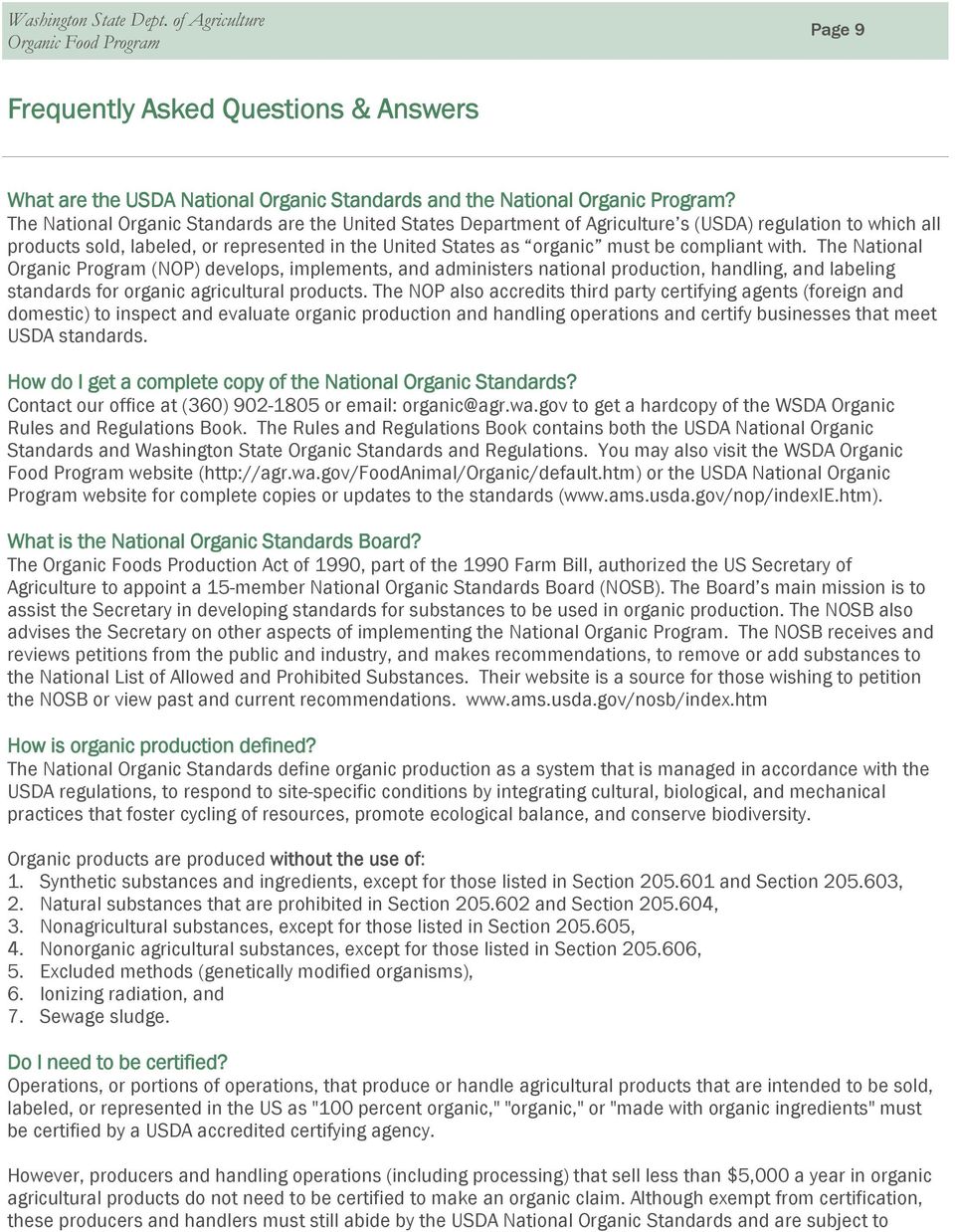
10 Page 10 Phone: surveillance inspections. Additionally, retail operations and some handlers (brokers, grocers, and distributors) are not required to be certified. Exempt or excluded handlers and processors may choose to obtain certification due to market demands, or to increase consumer confidence of their products and practices. Exemptions from certification Handlers and Processors that sell less than $5,000 worth of organic products. However, these exempt agriculture products cannot be identified as organic in the ingredient statement of another operation s manufactured product. Retail food establishments. Processors that produce products with less than 70 percent organic ingredients. Processors that produce products that limit their organic claims to the information panel, or ingredient statement, of the label. Exclusions from certification Handlers that only handle packaged organic food products (e.g. brokers, grocery distributors, cold storage warehouses). A complete list of the exemptions and exclusions from certification, as well as the requirements for compliance, are outlined in Section of the National Organic Standards. The details around labeling agricultural products produced on an exempt or excluded operation are outlined in Section How long does it take to get certified as an organic food producer or handler? The certification process takes an average of 3 1/2 months. Incomplete application packets will delay the certification process. Application packets should be submitted early in the season to allow time for the inspection and review process. Organic crops may not be certified after they have been harvested, and organic processed products may not be certified after they have been processed and realeased. What is the cost of organic certification? The fees associated with organic certification are based on your gross annual income of organic crops or products, as well as the type of certification services being requested. The WSDA fee schedules are outlined in the WSDA Organic Rules and Regulations Book (WAC ), as well as within the application packets. Certification fees must be submitted annually. Are application forms available on-line? Yes, copies of all application packet forms can be found at the WSDA Website: agr.wa.gov/foodanimal/organic/default.htm. Forms are available in PDF format and may be saved and filled out electronically. If you complete the forms electronically, print them and mail the hard copies to the Olympia office. How often do I have to renew my application for certification? Organic certification is an annual process and to remain compliant, an operation must annually renew their certification. An application, organic system plan update, and fee needs to be submitted each year. Renewal application packets are mailed in December for producers and in January for handlers and processors. To avoid late fees of $100 per month, renewal applications must be postmarked by February 1st for producers and March 1st for handlers and processors. What happens if I do not renew my certification? If you do not intend to renew your certification you must contact WSDA to withdraw from the program. Failure to renew or withdraw from certification will result in WSDA taking compliance action against your operation and may lead to suspension of your organic certification.

11 Washington State Dept. of Agriculture Page 11 When are Organic Certificates updated? Renewal applicants may receive their updated certificate after their renewal application packet is reviewed, provided that there are no outstanding compliance issues, the application packet is complete, and no major changes are planned that would require an inspection prior to approval. Operations that do not receive an updated certificate at the time of their renewal review will be issued a certificate following the review of your annual inspection report, provided no compliance issues are identified. How often will my business be inspected? Certified organic businesses are inspected at least once each year. The inspector will evaluate and audit production and handling areas as well as records related to organic products. In addition, the WSDA conducts additional inspections if needed to verify compliance, or if requested by an applicant. Surveillance inspections of certified operations, and of markets where organic products are sold, are also conducted to monitor compliance with organic standards. What happens if I don t show up at my annual organic food inspection? If you do not show up for your scheduled annual organic inspection, you will be charged $40 per hour for the inspection after it is rescheduled, including travel expenses. Will samples of organic products be taken and tested? As part of the certification process, WSDA collects samples and analyzes them for pesticide residues or other prohibited substances. Samples are collected at approximately 10% of certified operations each year. These samples are sent to a State laboratory for chemical residue analysis. Operations are not charged an additional fee for the screening of prohibited materials. What happens if my farm or business practices are out of compliance with the Organic Standards? If WSDA finds violations of the National Organic Standards, compliance action is taken. The type of compliance action depends on the severity of the violation. A Notice of Noncompliance is sent to an operation for violations that are correctable. An operation is given a timeline to correct the violation and submit any required information to WSDA. A follow up inspection is often conducted to verify that the corrected actions have been implemented. Major violations include applying a prohibited substance to an organic crop or site, selling a conventional product as organic, failure to respond to a Notice of Noncompliance, or for other violations that are not correctable. A Notice of Denial, a Notice of Proposed Suspension, or a Notice of Proposed Revocation of certification is issued for major violations. Operations are given the opportunity to appeal WSDA s decision with the National Organic Program, or request mediation with WSDA before the denial, suspension, or revocation becomes effective. Any operation that knowingly sells or labels a noncompliant product as organic is subject to a federal civil penalty of up to $11,000 and may be subject to further fines under the Washington State Organic Food Products Act.. What is The Organic Quarterly? The Organic Quarterly is published by the WSDA to keep our certified organic producers, processors and handlers updated on current events within the state and federal programs. Past issues are posted on our website at: We look forward to comments and feedback, or send us a question and we may address it in the next issue.
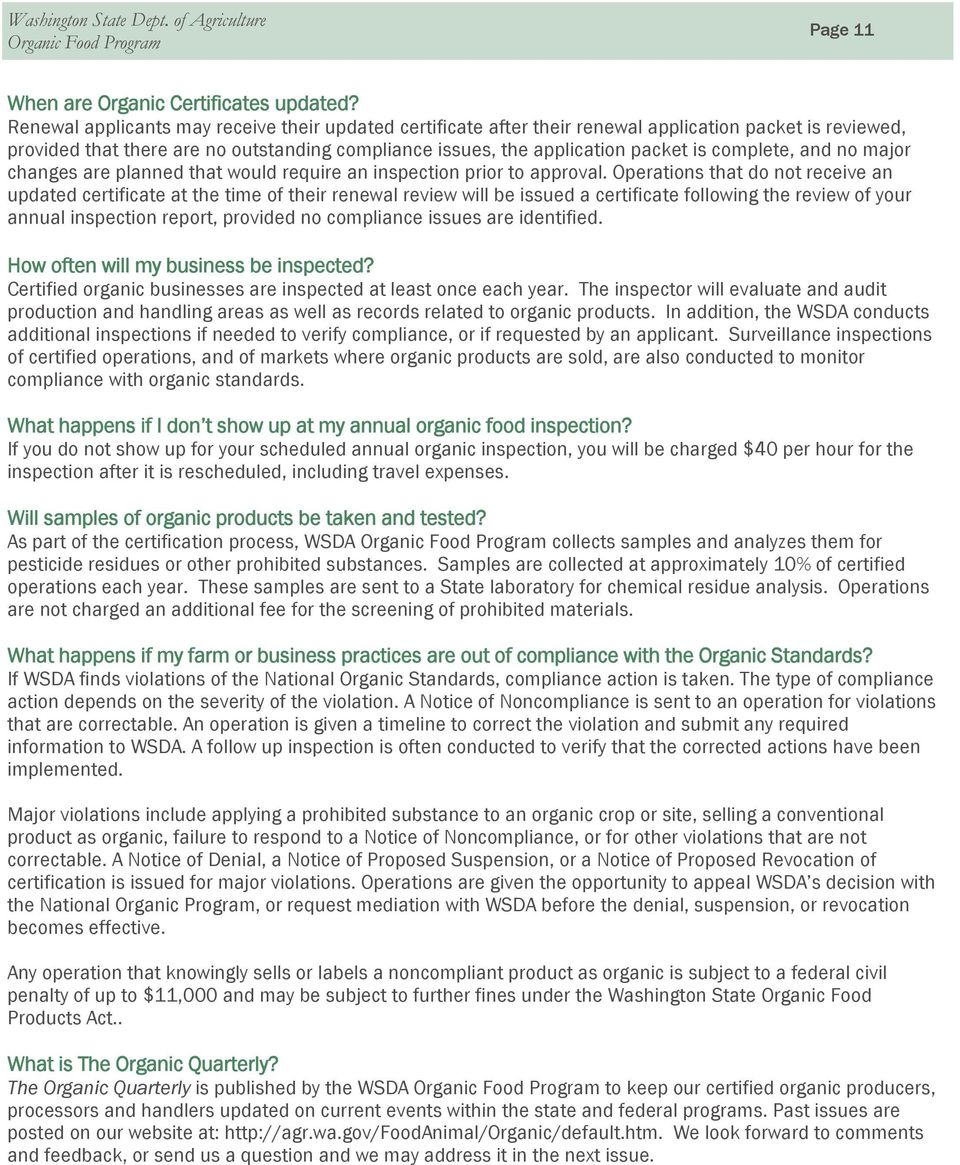
12 Page 12 Phone: How do I get my crops or products certified in accordance with International Organic Standards? The term organic has a different definition and meaning in countries around the world. Certification under the USDA National Organic Standards does not verify compliance of a product being sold in a country with their own set of organic regulations. The WSDA International Organic Program provides verification of products in accordance with international organic standards. Operations that participate in this additional program ensure access of their organic products to key international markets that do not accept US Organic Certification as verification of organic compliance. The WSDA International Programs are designed as an addendum to US National Organic Program Certification; applicants for certification must first meet the requirements of the US National Organic Standards before any additional international certifications are granted. An application for the WSDA International Organic Program includes an evaluation of organic products in accordance with Europe, Canada, and Japan requirements. If you would like an application or more information on the WSDA International Organic Program, please contact our office at (360) or [email protected]. Do you have more questions about organic certification? Refer to the Producer and/or Handler and Processor Sections of this Guide for answers to frequently asked questions related to your business. Or contact our office: WSDA 1111 Washington Street PO Box Olympia, WA PHONE (360) FAX (360) [email protected] WEBSITE

13 Washington State Dept. of Agriculture Page 13 Tips on Completing Your Application Packet The following is a quick reference to the most common forms in the WSDA Organic Application Packets. Use this information to help guide you through your paperwork and ensure you are completing the necessary information for certification. Please note that required information and forms differ slightly depending on whether you are a new or a renewing certified operation. Please refer to the instructions on the actual application packet forms for additional tips and specific clarification on completing your application packet. Application for Organic Certification This form is a formal request for a business to be evaluated by WSDA for compliance with the National Organic Standards. The form captures the details regarding the location and mailing address of the operation, as well as the contact information for the person overseeing organic production or handling. Organic Operator Agreement The Organic Operator Agreement captures the details regarding the structure and organization of the business seeking certification. An organization s UBI (Universal Business Identification) Number must be provided along with the names of the responsible individuals for the operation. The information provided in this document must be consistent with the information listed on the your business license, and/or with the information filed with the Secretary of State s office. Section of the National Organic Standards outlines the general requirements for operations seeking certification. By signing the Operator Agreement you are agreeing to comply with the requirements of the National Organic Standards. An Organic Operator Agreement must be signed by an authorized representative of your operation and must be submitted in order for WSDA to process your application. Please read this agreement carefully to ensure you understand the basic requirements of certification. Organic System Plan The National Organic Standards require all operations seeking certification to develop an organic system plan that is agreed to by the certified producer or handler and by an accredited certifying agent. New applicants for certification are required to complete a full and very detailed Organic System Plan. Once certified, an operation must update their system plan on an annual basis and report any changes to what had previously been submitted to and approved by WSDA. The organic system plan must include the following: A description of practices and procedures - including the frequency with which they will be performed, A list and detailed information regarding each substance to be used in organic production or handling, A description of the monitoring practices and frequency the practices will be performed, A description of the recordkeeping system that demonstrates compliance with the National Organic Standards, A description of the practices in place to prevent commingling of organic and non-organic products, A description of the practices in place to prevent contamination of organic products with prohibited substances, Any additional information required by the certifying agent in order to evaluate compliance. Complete all sections of the Organic System Plan with as much detail as possible. If a section does not apply to your specific business, please indicate that on the form. The more details you provide on your Organic System Plan, the smoother the inspection and certification process will be.

14 Page 14 Phone: Organic Fee Form and Organic Sales Summary The Organic Fee Form helps ensure the correct new or renewal fees are submitted with your application packet. Organic Certification fees are based on your annual gross income from organic products. New applicants are asked to provide an estimate of their annual gross income of organic products. Renewing applicants are asked for the total gross annual income generated from organic products. Details on WSDA Organic Program fees are outlined in the WSDA Organic Rules and Regulations Book, as well as on the fee forms themselves. The Organic Sales, or Gross Annual Income, Summary is only required for renewing applicants. All gross annual income received for organic products during the previous certification year must be provided. Gross revenue may have been generated from the actual sale of the organic product, or from the service fee that was received for processing or handling organic products for another company. Renewing applicants must ensure all products or crops that appear on your organic certificate are accounted for on the Sales Summary. If no sales for a particular product occurred, this should be specifically noted. It is important to provide accurate information on the Sales Summary, as these details will be audited during your inspection. Production Yield Form Producers Only The Production Yield Form is used to gain an understanding of the production capacity of your operation and to find out how much organic product you produced in the previous year. If you are a new applicant, an estimate of your production and yield amounts is needed. The details in this form will be used as a starting point during the production audit portion of your inspection. It is important to provide details about all crops listed on your certificate, and note if you did not have yields for a particular organic crop listed on your certificate in a given year. Organic Site Application and Previous Land Use Declaration Producers Only The Site Application captures information on the specific site, field, or block of land that is to be certified. Information such as the site s acreage, the crops being produced, the surrounding land use, as well as the history of the land must be provided. A separate Site Application must be submitted for each site seeking certification. Additionally, an accurate and up-to-date map must be submitted that shows the site and identifies the borders of the site with the adjacent land. Organic Product Summary Handlers and Processors Only The Organic Product Summary provides a space for you to identify the new products your company would like certified, and/or the products that your company would like to continue certification of for the upcoming year. This form also provides a place for renewing applicants to note any products that have been discontinued or have gone through formula or label changes. You must ensure you provide a complete and accurate list of the organic products you would like certified. Organic Product Formulation Form Processors Only The Organic Product Formulation Form must be filled out for each NEW product your company would like certified. The National Organic Standards divides products into four labeling categories based on the organic composition of the product. The Product Formulation Form captures the details regarding the ingredients and processing aids used in an organic product formulation, or recipe. The details provided on this form enable WSDA staff to evaluate the product s organic composition and ensure compliance with the National Organic Standards. New products may be added to your existing organic certificate throughout the year upon the submission of the Product Formulation Form and the necessary accompanying documentation. This form may also be used to report any changes to your product s formulation. See the instruction sheet that accompanies the Product Formulation Form for more details on what information should be submitted for new products.
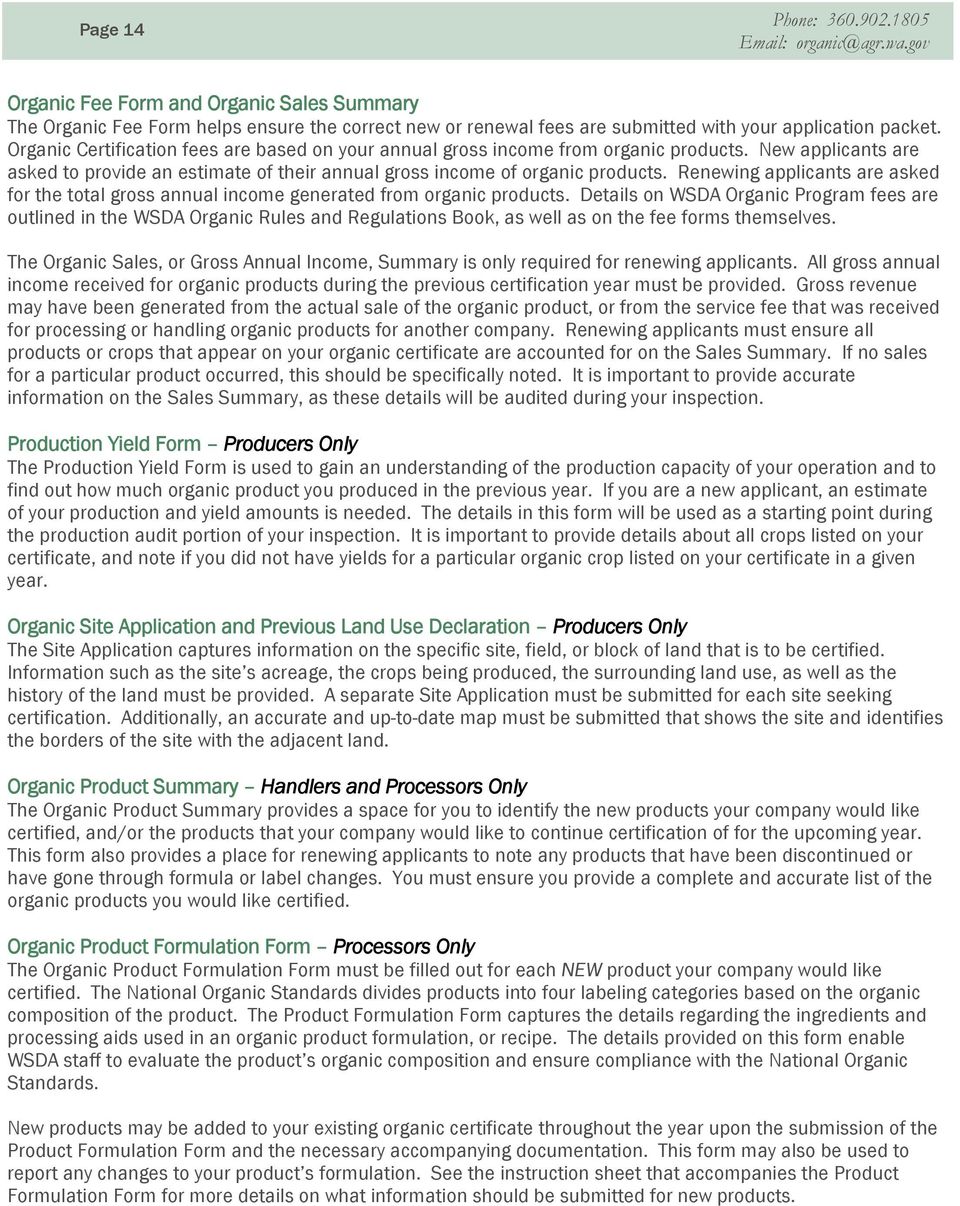
15 Washington State Dept. of Agriculture Page 15 Application Forms Are Available Online Copies of all application forms can be found at the WSDA Website: FoodAnimal/Organic/default.htm. Forms are available in both PDF format and may be saved and filled out electronically. If you complete the forms electronically you will need to print them and mail the hard copies to the Olympia office along with your certification fee and original signature by an authorized representative. The certification process takes an average of 3 1/2 months for new applicants. Submit applications early in the season to accommodate the certification process. WSDA 1111 Washington Street PO Box Olympia, WA PHONE (360) FAX (360) [email protected] WEBSITE

16 Page 16 Phone: Materials Approved for Use in Organic Production & Handling In order to comply with National Organic Standards, producers and handlers use input materials and substances that are in compliance with the regulation. Both the active ingredients in a substance, as well as any inert or minor ingredients, must fully comply with the National Organic Standards to be used in or on organic crops, products, or sites. The National List, Sections of the National Organic Standards, outlines the allowed and prohibited substances that can be used in organic production and handling. The National List can be found in the WSDA Organic Rules and Regulations Book or at the National Organic Program website: The WSDA Brand Name Material List (BNML) Through our Material Registration Program, WSDA has evaluated the formulations of the products on the Brand Name Material List and determined that they comply with the National Organic Standards. Producers and handlers may use the products on this list and have confidence that their use will not negatively affect the status of their certification. The WSDA BNML can be found at the website: WSDA does not endorse or guarantee any of the products listed on the BNML. In addition, manufacturers are not required to register their products; therefore it is not a comprehensive list of materials that meet organic standards. Please refer to the National List of Allowed and Prohibited Substances for the complete list of generic substances that may be used in organic production. You are also encouraged to contact our office with questions regarding compliance with the National Organic Standards. Updates to the BNML A hardcopy of the Brand Name Material List is published every January and sent to all WSDA certified organic operators. Updates are published on a quarterly basis in the s newsletter, The Organic Quarterly, with scheduled publication dates in April, July and October. The BNML updates can also be located on our website: The updates includes new products added to the Brand Name Material List as well noting products which have been removed from the List. WARNING!! Prior to using any substance in an organic operation, carefully evaluate the status of the material according to the National Organic Standards and the current WSDA Brand Name Material List. Substances change on an annual basis, due to withdrawal from registration, reformulation or company change. Use of an unapproved substance may result in a loss of organic certification for 36 months. Keeping the Olympia office informed of all materials that you plan on using before you use them is required, will help to ensure compliance, and will help you avoid accidental application of a prohibited material.

17 Washington State Dept. of Agriculture Page 17 Crop Production The National Organic Standards allow the use of all natural substances unless they are specifically prohibited (for example: strychnine and nicotine are prohibited). Conversely, synthetic substances are prohibited unless they are specifically allowed according to the National Organic Standards. Sections and contain the list of allowed and prohibited substances for use in organic crop production. Soil fertility may be maintained or improved through the application of natural or approved synthetic fertilizers. Many approved synthetic fertilizers have restrictions or annotations regarding their use and should be considered carefully prior to their application. Natural and approved synthetic substances are also used for insect, weed and disease control in organic farming systems when a preventative plan is not adequate to avert pest pressure. Livestock Materials approved and prohibited for use in organic livestock production can be found in the National Organic Standards, Section and These material lists include the requirements around feed additives, vaccines and biologics, medications, and any other production aid used in an organic livestock system. Natural substances are approved for use in organic livestock systems, such as herbal remedies or naturally derived enzymes. All synthetic medications are prohibited, unless specifically allowed in Section Prior to using a material in livestock production, evaluate the substance carefully and verify there are no synthetic binders, colors or artificial flavors in the product. Processing Aids A processing aid is any substance used during processing that does not become an ingredient or is present at insignificant levels in the finished food product. Examples of processing aids include defoamers, enzymes or filters. To use a processing aid with a product labeled as 100% organic the aid must be certified organic. To use a processing aid with an organic product labeled as organic, or made with organic (specific ingredients or food groups), the aid must be an approved agricultural product, or must be listed in Section of the National List. Post Harvest Materials A post harvest material is a substance that is used on a raw organic crop prior to packaging or processing of the crop. Examples of post harvest materials include floatation agents, food contact sanitizers, waxes, and sprouting inhibitors. In order to use a post harvest material directly on an organic crop product, the material must be an approved natural product, or must be listed in Section of the National Organic Standards and used in accordance with any noted annotations. Organic Material Review Institute (OMRI) WSDA is a member of the Organic Material Review Institute, giving us access to their Organic Products List. This list, accessed on the internet at is an additional resource for materials that are approved for use in organic food production and handling. OMRI also publishes a Generic Material List that gives more information on a specific generic material and whether it can be used on an organic operation. If you would like a hard copy of the OMRI Organic Product List or Generic Material List, please contact our office. Environmental Protection Agency (EPA) The Environmental Protection Agency reviews pesticides for use in organic production. These pesticide products are labeled with the phrase for organic production and may include the following logo:

18 Page 18 Phone: Recordkeeping Requirements National Organic Standards Section Recordkeeping by certified operations A major requirement of the National Organic Standards is the maintenance of all records related to organic production and handling. These records must be available during an inspection and must be easily understood. An audit of your records will be conducted during an organic inspection to verify certification requirements have been followed. Complete and accurate records must be kept that track the organic products from seed to harvest, or from receiving through final sale and shipping. Use the following information to help you determine what types of records the inspector may need to look at during your inspection. Please note that this list is only to be used as guidance, and is not a list of all required records. Organic Producer Recordkeeping Information Seeds and Transplants, Including Cover Crop and Pasture Seeds Invoices (seed packages, and labels can be useful). Verification of organic production for seeds and transplants (organic certificates). Verification of attempts to obtain organic seeds or transplants (phone logs, catalogs, seed supplier letters). Application Records For All Farm Inputs Application Records for ground and foliar applied materials such as fertilizers, manure, compost, soil amendments, foliar micronutrient sprays, pesticides, acidifiers, spreader / stickers, etc. Invoices or receipts for all input purchases including custom applicator invoices. Materials used that are not a WSDA or OMRI approved brand name: the inspector may request verification that the material is approved for use in organic production. If a custom mix is used, the individual ingredients must be listed. Post harvest materials (materials used on crop after harvesting). Production Records Cultivating, weeding, flaming, planting dates. Farm activity log, invoices for services (mowing, spreading manure, seeding, etc.). Farm consultant recommendations. Soil and tissue analysis reports. Harvest Records Yield records (number of bins, pounds, tons, cartons, CSA shares, etc.). Shipping, warehouse or processor delivery receipts, delivery summaries. Custom harvest: records or information on harvester and equipment cleaning. Sales Records Direct marketers: records may include farmer s market records, CSA sales, sales receipts, and daily market sales or bank deposits. Wholesaler marketers: records may include warehouse and processor sales summaries, pool closings; sales invoices. Livestock Operations Organic verification for all feed, including pasture, grain, hay or silage (organic certificates and invoices). Grain invoices with weights from your grain company.

19 Washington State Dept. of Agriculture Page 19 Somatic cell counts for the last 6 months. Animal medical treatment records (including vaccinations). Animal sale or purchase records if applicable. New Sites Material application records to verify that the land has been under organic management for at least 36 months prior to harvest. Cropping history or land use for at least 3 years. If the land was previously certified organic, have the Organic Certificate available. Lease Agreements for any leased ground Documents and maps from other agricultural agencies (NRCS, Farm Service, etc) Organic Handler & Processor Recordkeeping Information Receiving Records and Ingredient or Product Compliance Records Information detailing the amount of product received by your operation and information detailing the organic status or compliance of an incoming product: Current organic certificate for each supplier of organic products or ingredients must be on hand. All organic products sold in the United States must have documentation that verifies the product was certified by a USDA National Organic Program accredited certification agency and that the product was specifically certified according to USDA National Organic Standards. Compliance affidavits. Field or bin tickets. Clean truck/equipment affidavits. Invoices, purchase orders, bill of ladings, scale tickets. Contracts. Certificates of analyses or Product Specification Sheets. Storage and Production Records Information detailing the handling or processing of organic products at your operation: Equipment clean-out logs. Product specification sheets and ingredient inspection forms. Batch recipes and product formulations. Ingredient usage reports and production logs. QC reports. Waste and shrinkage logs. Inventory reports for ingredients and finished products. Packaging reports. Pest management records. Shipping Records Information detailing the sale of finished product from your operation: Pallet/tote tickets and scale tickets. Certificates of analyses. Purchase orders and sales journals. Shipping logs and bills of lading. Export records and transaction certificates.

20 Page 20 Phone: Organic Labeling and Product Composition Requirements All product labels and marketing information that make an organic claim must comply with Subpart D of the USDA National Organic Standards (Sections ). These sections outline product composition requirements, along with labeling requirements for the different composition categories. Types of organic labels that are regulated by the National Organic Standards include: Retail Packages Nonretail Containers (Containers for Storage and Shipping Only) Livestock Feed Labels In addition, the National Organic Standards outlines requirements for the labeling of non-packaged products sold at retail stores (such as bulk containers), as well as the labeling of products that are produced at operations that are exempt or excluded from certification. Refer to Sections within the National Organic Standards for details on these types of label claims. Retail Packages (Sections , ) Retail packages are divided into different categories by the USDA National Organic Standards. These categories are based on the amount of organic ingredients in the product. The formula for calculating the percentage of organic ingredients in a product is outlined in Section of the National Organic Standards. 100% Organic Claims MUST: Be made entirely of 100% organic ingredients and processing aids (excluding added water and salt). Identify all organic ingredients as organic on the ingredient statement if it is a multi-ingredient product. Include the statement Certified Organic by Washington State Department of Agriculture. This statement must be located directly adjacent to the name of the manufacturer or distributor of the product. Optional: The USDA Organic Seal in the colors set forth by the National Organic Program. The WSDA Organic Seal (WSDA has separate Producer, Handler and Processor seals be sure the correct one is used). 100% qualifier (the percentage or organic ingredients in the product). Organic Claims MUST: Be at least 95% organic ingredients (excluding added water and salt). All agricultural ingredients must be organic unless they are listed in Section of the National Organic Standards AND are demonstrated to not be commercially available in an organic form. Identify all organic ingredients as organic on the ingredient statement. Include the statement Certified Organic by Washington State Department of Agriculture. This statement must be located directly adjacent to the name of the manufacturer or distributor of the product. All non-agricultural ingredients must be in Section of the National Organic Standards and must be used in accordance with any annotations that are noted. Optional: Display the percentage of organic ingredients. Display the USDA Organic Seal in the colors set forth by the National Organic Standards. Display the WSDA Organic logo (WSDA has separate Producer, Handler, and Processor seals. Please ensure that the appropriate seal is used).

21 Washington State Dept. of Agriculture Page 21 Made with Organic (Specified Ingredients) Claims MUST: Be 70% or more organic ingredients. Indicate all ingredients as organic on the ingredient panel. Include the statement Certified by Washington State Department of Agriculture. This statement must be located directly adjacent to the name of the manufacturer or distributor of the product. Non organic ingredients must not be produced using prohibited practices (Genetically Modified, Sewage Sludge, Ionizing Radiation). MUST NOT: Use the USDA Seal Optional: Indicate the % of organic ingredients. Display the WSDA Organic logo (WSDA has separate Producer, Handler and Processor seals be sure the correct one is used). Display the statement Made with Organic (specified ingredients or food groups). The statement may not list more than three ingredients or three food groups. Organic Claims in Information Panel Only - Less than 70% Organic Ingredients MUST: Identify organic ingredients as organic in the ingredient statement if the % of organic ingredients is displayed in the information panel. MUST NOT: Be labeled as organic on the principal display panel. Use the USDA Seal. Use the WSDA Seal. Optional: Indicate the % of organic ingredients on the information panel. Products may have more than 70% organic ingredients. If all organic claims are limited to the information panel, the product is exempt from certification under the National Organic Standards (Section ).
22 Page 22 Phone: Nonretail Container Any container used for shipping or storage of an organic agricultural product and is not used in the retail display. (Section , ) MUST: Must be traceable back to an organic product and must display the production lot number of the product if applicable. Optional: Identify the product as organic. Display special handling instructions needed to maintain the organic integrity of the product. Display the USDA Organic Seal in the colors set forth by the National Organic Standards. Display the WSDA Organic logo (WSDA has separate Producer, Handler, and Processor seals. Please ensure that the appropriate seal is used.). Although not required, WSDA highly encourages all storage and shipping packages to include the statement Certified Organic by Washington State Dept. of Agriculture to ensure better tracking and transparency of the product s organic certification. Livestock Feed (Section , ) MUST: Consist of 100% organically produced agricultural ingredients, if labeled 100% organic. Consist of organically produced agricultural ingredients and only those nonorganic ingredients listed as allowed under Section , if labeled organic. Include the statement Certified by Washington State Department of Agriculture. This statement must be located directly adjacent to the name of the manufacturer or distributor of the product. Comply with other Federal agency or State feed labeling requirements as applicable MUST NOT: Use animal drugs, including hormones to promote growth. Provide feed supplements or additives in amounts above those needed for adequate nutrition and health maintenance for the species at is specific stage of life. Use plastic pellets for roughage. Use formulations containing urea or manure. Use mammalian or poultry slaughter by-products. Use feed, feed additives, and feed supplements in violation of the Federal Food, Drug, and Cosmetic Act. Optional: Display the percentage of organic ingredients. Display the USDA Organic Seal in the colors set forth by the National Organic Standards. Display the WSDA Organic logo (WSDA has separate Producer, Handler, and Processor seals. Please ensure that the appropriate seal is used.). Use the word, organic, or an asterisk or other reference mark which is defined on the package to identify ingredients that are organically produced. Water or salt included as ingredients cannot be identified as organic.
23 Washington State Dept. of Agriculture Page 23 Washington State Department of Agriculture 1111 Washington Street PO Box Olympia, WA PHONE (360) FAX (360) WEBSITE
24 Page 24 Phone: Transitional Certification Program Organic certification requires land to be free of prohibited material applications for 36 months prior to the harvest of a crop. Land undergoing this waiting period is considered transitioning into organic status. Prior to the implementation of the USDA National Organic Standards, WSDA required transitional certification for land that was in the process of transitioning into organic production. However, the USDA National Organic Program did not adopt transitional certification as part of the federal regulation that went into affect October Through a unique program under Washington State Law (RCW and WAC ), WSDA Organic Food Program continues to offer transitional certification on a voluntary basis for producers that wish to market their products as transitional. Products certified as transitional must meet the same production and handling requirements as an organically certified product, except that the land must have no applications of prohibited materials for one year prior to harvest, rather than the three years required for organic ; All other USDA National Organic Standards for organic crop production, handling and/or processing must be met by the producer. Transitional certification ensures the integrity of the future organic claim due to the fact that a producer is working with a third party inspection body during the 36 month time period before land qualifies for organic certification; the land is monitored and ensures compliance with organic standards during the transitional period. Annual inspections occur along with annual applications to WSDA. Due to the fact that transitional producers must meet all organic requirements, operations that wish to apply for transitional certification simply complete the same forms that an organic grower completes, the WSDA Organic Crop Producer Application Packet. After a review of the producer s system plan and an inspection of the sites, approved sites may receive: 1st year Transitional Certification (no prohibited materials have been applied to the land for 12 months prior to harvest), or 2nd year Transitional Certification (no prohibited materials have been applied to the land for 24 months prior to harvest). A farm or producer may have both transitional sites and organic sites under the same certification number. Please note that WSDA does not offer transitional livestock certification.
25 Washington State Dept. of Agriculture Page 25 Transitional Product Labeling Requirements Transitional products do not meet the USDA National Organic Standards as a certified organic product. It is therefore important that it is made clear to consumers that transitional products are not organic products. In order to allow producers the transitional market opportunity, as well as to ensure transitionally certified products do not violate the federal organic labeling standards, WSDA has developed specific labeling and advertising requirements for Certified Transitional Products. These requirements include: 1. No reference to "organic" may be on a certified transitional package, label, or related marketing information; organic claims are prohibited for transitionally certified products. 2. A certification statement that identifies Washington State Department of Agriculture as the certifier of the product is required on both nonretail (wholesale) and retail packages and labels. Example: Certified Transitional by Washington State Department of Agriculture. This statement must be located directly below or adjacent to the name of the final handler or distributor of the product. 3. The WSDA Transitional Producer Certification Logo may be used to identify products that have been certified as transitional by WSDA. 4. Current documentation verifying the product s transitional certification status (i.e. WSDA Transitional Producer Certificate) must be maintained by the operation that is packaging, labeling, or marketing the product as transitional. 5. All transitional labels and related marketing information must be forwarded to the WSDA office for approval prior to use.
26 Page 26 Phone: How to File a Complaint Who can file a complaint? Any person may file a complaint if he or she believes a violation of the USDA National Organic Standards or Washington State Organic Regulations has occurred, or is about to occur. How are complaints filed? If you wish to file a complaint regarding violations to the organic standards or concerning the performance of the WSDA, contact our offices by phone, fax, , or mail: WSDA 1111 Washington Street PO Box Olympia, WA PHONE (360) FAX (360) [email protected] WEBSITE What information is needed? When you file a complaint please include as much relevant information as possible, including names, phone numbers, location of alleged violation, and other information as appropriate to the complaint. The information gathered when the complaint is first received is often the most important because it is the information from which WSDA bases the rest of the investigation: what we do, who we contact, even whether or not the complaint is legitimate and warrants further investigation. Including your name and contact information allows our staff to follow up with additional clarifying questions and ensures we have the information needed to enforce organic standards. How does WSDA respond to complaints? The takes each complaint seriously and investigates complaints. Complaints are processed and addressed in an orderly and timely manner and in accordance with our program complaint procedures. Complaints come from various sources and may come directly from the consumer or other parties, such as the local retail store or a certified organic operation. They are usually received by telephone, but complaints may be received in writing or even face to face. Once a complaint is received our staff evaluates the best way to investigate the complaint. Inspections and samples may be taken if there are allegations of mislabeling or use of prohibited substances. If violations are found, actions are taken to enforce the organic standards. Actions may include but are not limited to: issuing a Notice of Noncompliance, Notice of Denial of Certification, Notice of Proposed Suspension or Revocation of Certification, forwarding the complaint to USDA for federal investigation, assessment of civil penalties. A written resolution of the complaint is completed for all complaints received. WSDA attempts to resolve all complaints within 90 days of receiving the complaint. Some complaints take a longer period of time to resolve due to the time involved in collecting facts or legal procedures. At the end of the process a copy of the written resolution is provided to the complainant.
27 Washington State Dept. of Agriculture Page 27
28 Page 28 Phone: Organic Crop Producer Information Can I grow both organic and conventional crops on the same farm? Yes. Adequate buffer zones must be in place to prevent the unintended application (i.e. spray drift) of a prohibited substance on an organic crop and procedures must be in place to prevent organic crops from being contaminated. Recordkeeping must clearly delineate between organic and conventional crops. How can I determine what fertilizers, pest control substances and other materials I am allowed to use in organic farming? Please refer to National List of Allowed and Prohibited Substances, Section through of the National Organic Standards, to determine what materials are approved for use in organic production. You may also refer to the WSDA Brand Name Material List (BNML) and the Organic Materials Review Institute lists ( for materials that have been determine compliant. The Environmental Protection Agency (EPA) does not currently maintain a list of approved pesticide materials, however product labels that state for organic production and which include the EPA logo, are also allowed for organic crop production. The use of a material that is not currently approved can result in the loss of certification. Contact the Organic Food Program for approval before you apply the materials on your operation. All materials need to be included on your Organic Cropping System Plan, or updates to your plan. For more information on materials allowed for use in organic production, refer to the Materials Section within this Guide. What are the requirements around the use of manure with organic crops? Raw animal manure must be composted unless it is: Applied to land used for a crop not intended for human consumption; Incorporated into the soil not less than 120 days prior to the harvest of a product whose edible portion has direct contact with the soil surface or soil particles; or Incorporated into the soil not less than 90 days prior to the harvest of a product whose edible portion does not have direct contact with the soil surface or soil particles; I make compost on my farm with manure from my neighbor who told me he composts his manure. Can I apply it to my crops outside of the time restrictions? You may apply the compost outside of the time restrictions only if your neighbor has composted his manure following requirements specified in the National Organic Standards Section (c)(2) and you have the records that verify this requirement. Until either you or your neighbor has composted the manure to meet the organic regulations, it is considered raw and you must apply it outside of the 90/120 day time restrictions. I make compost from vegetable trimmings, wood chips and food scraps. Is there any sort of time restriction that I must follow before I can apply this compost to my fields? No, as long as your compost does not contain manure, you may apply it any time. If I grow perennials, do I need to grow a cover crop? Yes. For perennial cropping systems, grow cover crops in alleys, between rows or as hedgerows to introduce biological diversity in lieu of crop rotation. Organic cover crop seeds are required when commercially available.
29 Washington State Dept. of Agriculture Page 29 Do I need to rotate my crop from each year if I plant a green manure and till it into the soil between crops? No, a green manure crop between plantings of the same crop satisfies the crop rotation requirements (Section ), provided this practice maintains or improves the soil organic matter content, provides pest management on the site, manages deficient or excess plant nutrients, and provides erosion control. Do annual transplants have to be organic? The National Organic Standards requires that organic producers use organic annual seedlings. No exception. Do I have to use organic seeds? Yes, however the National Organic Standards allow conventional non-treated seeds to be used if organic seeds are not commercially available. For more information on the organic standards for seeds and planting stock, please refer to the Seeds and Planting Stock Guidelines on the following pages. Do I need to notify WSDA if my organic system plan changes during the year? The Organic System Plan should describe your plans for producing organic crops or livestock and include a list of all inputs you are planning to use. It is understood that environmental, economic, and other reasons can cause you to modify this plan as the year progresses. The National Organic Standards require that certified operations notify their certifying agent prior to making any changes to your organic system plan. The following are examples of situations that would require you to notify the WSDA : Apply a prohibited substance to any field, production unit, product or site in organic production, whether it was a direct application or drift from neighboring area. Use a new type of fertilizer, crop production aid, or pest control material that is not included in your Organic System Plan. NOTE: Substitutions of one material for another do not require prior notification, i.e., substituting approved Bt products. Add acreage or add a site to organic production (you must submit a Site Application at least 3 1/2 days before the harvest of the crop on the new site). Remove a site or a portion of a site from organic production. Develop a new label for your organic products. Purchase organic crops or products from other producers for resale by your operation. Begin processing organic food products or handle organic products produced by other organic producers; Change any portion of a certified operation that may affect your compliance with the National Organic Standards. WSDA 1111 Washington Street PO Box Olympia, WA PHONE (360) FAX (360) [email protected] WEBSITE
30 Page 30 Phone: What if I want to add or remove a site from organic or transitional certification? Adding Acreage If you are applying for an additional site to be certified, you must complete a Site Application. If the site has been managed by a different operator than you in the past three years, the previous manager will need to submit a signed Previous Land Use Declaration. Contact the to receive the forms or go to our web site and download them. Site forms must be submitted at least 3 1/2 months before your expected harvest. A pre-harvest inspection is required for any crop to be evaluated for organic or transitional status. Requests for certification of new sites after your annual inspection will be charged for the additional inspection and evaluation. Removing a Site or Acreage You must notify the WSDA if you are removing acreage from organic certification. The WSDA must be notified prior to treating the site or acreage with a prohibited material. Once you have notified the WSDA, the site or acreage will be removed from your Organic Food Certificate. Any crops harvested from a site that has been removed from certification are considered conventional crops and cannot be sold, labeled or represented as organic or transitional crops. What documents do I need to have available for review during my organic food inspection? Refer to the Recordkeeping Section of this Guide for information on the types of records that you should maintain and have available during your inspection. Do I need to be a certified processor or handler if I am currently certified as an organic food producer? Handling - In general, organic handler certification is required if you sell, distribute, pack, or label organic products for other organic producers or farmers. The costs for organic food handler certification are based on the total gross annual sales, or service fees, you collect for the handling of products that are not produced on your farming operation. However, if you are handling additional organic products through a retail food establishment such as a farmers market, farm stand, or through a community supported agriculture program, you are not required to be certified separately as a handler. This part of the business must be disclosed as part your Organic System Plan and records that verify the organic status of the handled products must be maintained and must be available for review during your producer inspection. Processing - Organic Processor Certification is required if you engage in changing an organic food into a different form or product. Processing includes, but is not limited to: canning, freezing, drying, dehydrating, cooking, pressing, powdering, packaging, baking, heating, mixing, grinding, churning, separating, extracting, cutting, fermenting, eviscerating, preserving, jarring, or slaughtering. If you are processing organic products that are produced on your farm, you must apply for processing certification. However, the costs for organic processor certification are included in the fees you pay to maintain your producer certification. If you process organic food that is not produced on your farm, or you custom process for another farm or business, the costs for organic processor certification are based on the total gross annual income you collect for processing these products (income may be in the form of sales or service fees that are received).
31 Washington State Dept. of Agriculture Page 31 Are there other requirements that I need to comply with to market my crops? Farms with a gross annual income of $12,000 or more must obtain a business license from the State of Washington ( or If you sell your crops through wholesale markets, additional permits or licenses may be required by city or county governments. Consult with your county extension office for details. If you sell your crops through direct markets, review The Handbook of Regulations for Direct Farm Marketing, The Green Book for a comprehensive guide to the regulations you must comply with. To get a copy of The Green Book contact the Small Farm Direct Marketing Program ( ) or visit the web site:
32 Page 32 Phone: Seed and Planting Stock Guidelines National Organic Standards Section Seeds and Planting Stock Standards (a) The producer must use organically grown seeds, annual seedlings, and planting stock: Except, That, (1) Nonorganically produced, untreated seeds and planting stock may be used to produce an organic crop when an equivalent organically produced variety is not commercially available, Except, That, organically produced seed must be used for the production of edible sprouts; (2) Nonorganically produced seeds and planting stock that have been treated with a substance included on the National List of synthetic substances allowed for use in organic crop production may be used to produce an organic crop when an equivalent organically produced or untreated variety is not commercially available; (3) Nonorganically produced annual seedlings may be used to produce an organic crop when a temporary variance has been granted in accordance with (a)(2); (4) Nonorganically produced planting stock to be used to produce a perennial crop may be sold, labeled, or represented as organically produced only after the planting stock has been maintained under a system of organic management for a period of no less than 1 year; and (5) Seeds, annual seedlings, and planting stock treated with prohibited substances may be used to produce an organic crop when the application of the materials is a requirement of Federal or State phytosanitary regulations. Definitions: Commercially Available: The ability to obtain a production input in an appropriate form, quality, or quantity to fulfill an essential function in a system of organic production or handling. National List: A list of allowed and prohibited substances in the National Organic Standards. Transplant: A seedling that has been removed from its original place of production, transported & replanted. Annual Seedling: A plant grown from seed that will complete it s life cycle or produce a harvestable yield within the same cropping year or season in which it was planted. Planting Stock: Any plant or plant tissue other than annual seedlings but including rhizomes, shoots, leaf or stem cuttings, roots, or tubers, used in plant production or propagation. Excluded methods (GMOs): A variety of methods used to genetically modify organisms or influence their growth and development by means that are not possible under natural conditions of processes and are not considered compatible with organic production. Such methods include cell fusion, microencasulation and macroencapsulation, and recombinant DNA technology (including gene deletion, gene doubling, introducing a foreign gene, and changing the positions of genes when achieved by recombinant DNA technology). Such methods do not include the use of traditional breeding, conjugation, fermentation, hybridization, in vitro fertilization, or tissue culture. Certification Criteria and Record Keeping Strategies: Organic seed and annual seedlings are required to be used unless they are documented to be commercially unavailable. This requirement includes cover crops and forages. Sprouts are specifically required to be produced with organic seed only. Verification of all seed sources and their compliance with the National Organic Standards is required to be maintained in a grower s files. This includes invoices, organic certification verification and commercial unavailability documentation. Conventional seed treatments are not allowed. Seed Treatments are permitted if all ingredients are documented to comply with the National Organic Standards. Inoculants must be documented to meet National Organic Standards, including verification that the treatment isn t a produced from genetically modified organisms.
33 Washington State Dept. of Agriculture Page 33 Verifying Commercial Unavailability: Producers must use organic seed. If organic seed is not available, non-organic seed (untreated) may be used. Organic producers must search for organic seeds and document the unavailability of organic seeds if nonorganic seeds are used. Documenting the unavailability of organic seeds should include the following steps: Contact three or more organic seed suppliers and document whether organic seeds are available. Organic producers should ensure that you are contacting seed suppliers that offer organic seed varieties. Document on the Organic Seed Availability Form (AGR 2261) all seeds used. If non-organic seeds are used document the reasons why organic seeds were not available. Reasons why organic seeds are may not be commercially available: Retail packets may not be the appropriate form/quantity for your operation. Unsuitable variety for your production system or specific market (i.e., disease resistance, fruit size). Documented quality concerns from on-farm variety. Letters from seed suppliers verifying no equivalent organic seed available.. Note: The cost of organic seed is not valid justification for the use of non-organic seeds. Genetically Modified Organisms: Genetically Modified Organisms (GMOs) are not allowed in organic production per Section of the National Organic Standards. Common GMO Crops and Seed Materials: Alfalfa, Barley, Canola, Cantaloupe, Corn, Cotton, Dry Beans, Flax, Mustard, Oats, Papaya, Peanuts, Potato, Radicchio, Rapeseed, Rice, Rye, Safflower, Sorghum, Soybean, Squash, Sugarcane, Sugar Beet, Sunflower, Sweet Potato, Tobacco, Tomato, Watermelon, Wheat, Zucchini. Forage and Legume Inoculants. Refer to the Seed Resources on the next page for a detailed list of genetically modified crops currently being produced.
34 Page 34 Phone: Organic Seed Decision Tree Is this seed Organic? Yes. Keep Organic Certificate from supplier, or certifier statement, on file along with seed invoices that show organic status. No. Look for equivalent seed from multiple sources. Document availability based on quantity, quality, and form. Once multiple attempts to source organic seed are made without success, nonorganic seeds may be used. Yes. Genetically modified seeds are prohibited. Has nonorganic seed been produced using excluded methods (GMOs)? No. Has nonorganic seed been treated? Yes. All seed treatment ingredients must be approved under the National Organic Standards and the seed treatment must be approved by WSDA as part of your Organic System Plan. No. Nonorganic, untreated seeds may be used.
35 Washington State Dept. of Agriculture Page 35 Resources for Organic Seeds: The following organizations provide helpful information and resources for locating organic seed. Organic Seed Alliance - ATTRA, Seed Supplier Search - USDA Database of GMO crops for food/feed: Organic Materials Review Institute (OMRI), seed sources database OMRI Materials Lists by Category or Product - Certified Organic Seed Sourcing Service - Refer to the Resource Section of this Guide for more resources on Organic Farming.
36 Page 36 Phone: Organic Livestock Producer Information What is organic livestock? Organic livestock production requires that animals be fed 100% organic feed, have access to pasture for ruminants and access to the outdoors for non ruminants, and prohibits the use of antibiotics and hormones. Organic livestock must be under organic management for a specific period of time. Organic livestock operators must maintain or improve soil and water quality and provide living conditions and health care practices that meet organic standards. (Sections , , ) What are the organic livestock producer standards? The National Organic Standards contain specific requirements for organic livestock production. The following sections are specific to organic livestock production: Livestock origin Section Livestock feed Section Livestock health care Section Livestock living conditions Section Approved and prohibited materials for health care, feed supplements, feed additives or for other purposes are listed in the National Organic Standards Sections and What is an Organic Livestock System Plan? Your Organic Livestock System Plan is a management plan that you develop that is specific to your operation. WSDA will provide you with a form that addresses the various parts of the Standards for livestock production and you must complete it with details of how you will manage your organic livestock. This plan includes, but is not limited to, the following information: Description of preventative measures taken to deter illnesses in the livestock, the practices to be followed to eradicate a disease, and medications that may be given (both approved and non-approved) if an illness occurs. List of production input materials, including: composition and sources of feed rations, maps of fields used for crops or forages, grazing rotation schedule, any medications that may be given to the animals. Description of record keeping system used to preserve the identity of the organic product. Do I need to submit a separate system plan for organic livestock and organic crops? WSDA provides a separate system plan for ruminant livestock production and non-ruminant livestock production. The type of system plan you must complete depends on the type of animals that are under organic management. For instance, an organic dairy would complete an Organic Ruminant Livestock System Plan, while an organic egg producer must complete an Organic Non-Ruminant Livestock System Plan. If you manage both ruminant and non-ruminant animals, you must fill out both system plans. In addition, if you raise crops other than livestock feed (such as vegetables or tree fruit), you must also complete the Organic Cropping System Plan. If you are unsure about which System Plan you should complete, please contact our office.
37 Washington State Dept. of Agriculture Page 37 What livestock records do I need to maintain? In order to verify compliance with organic standards, the following records must be maintained: All medications administered (dates, dosages, and sources); All feed bought or raised (including receipts, sources, organic certificates, labels, etc.); All feed supplements used (receipts, labels, sources, dates and quantity given to livestock); The weight of slaughter animals at slaughter or hanging carcass weight; Purchase and sales records for livestock and livestock products (dates, weights, quantities, description, etc.); All materials used in the on-site production of crops for feed (receipts, source, dates, & quantity applied) and Sales records of finished product. Refer to the Recordkeeping Section of this Guide for more information on the types of records to maintain and have available at your inspection. Where can I find information on Organic Livestock Feed? National Organic Standards, Section , requires the producer of an organic livestock operation to provide livestock with a total feed ration that is organically produced and handled. Contact our office to obtain a list of WSDA certified livestock feed processors or producers. USDA Agricultural Marketing Service also provides pricing and availability information for organic livestock feed from the USDA Agricultural Marketing Service. They are generally updated on a weekly basis and are also available by calling (515) Upper Midwest Organic Grain and Feedstuff Eastern Corn Belt Organic Grain Feedstuff National Hay, Feed & Seed Weekly Summary How do I find an approved slaughter or cut and wrap facility? Slaughter facilities as well as cut and wrap facilities must be certified in order for the final product to be labeled organic. Please verify the certification status of each facility you would like to use prior to processing any livestock or livestock products. You must maintain a copy of the facility s organic certificate and have it available at each announced inspection. Contact our office to obtain a list of WSDA certified slaughter or cut and wrap facilities.
38 Page 38 Phone: What licenses are involved with handling organic eggs? If you are producing and marketing organic eggs, you may be required to obtain an egg handlers license through Washington State Department of Licensing. Contact the WSDA Food Safety Program in Olympia at to get information on the licensing procedure. If you are selling eggs directly to consumers, review The Handbook of Regulations for Direct Farm Marketing, The Green Book for a comprehensive guide to the regulations you must comply with. To get a copy of The Green Book contact the Small Farm Direct Marketing Program ( ) or visit the web site: agr.wa.gov/marketing/smallfarm/greenbook.htm. Other Livestock Related Resources: Appropriate Technology Transfer to Rural Areas (ATTRA) Offers a wide variety of publications and information regarding sustainable agriculture. They offer a comprehensive section on organic livestock production. Many publications can be downloaded from the Internet or ordered from the website. American Holistic Veterinary Medicinal Association The website contains information about conferences, a book store, and a comprehensive veterinarian listing by state. Mailing Address: 2214 Old Emmorton Road Bel Air, Maryland 2101 Phone: (410) Agricultural Market Resource Center (AgMRC) - Dairy industry resource page. Also includes case studies and highlighted dairy producers in the United States. O Dairy Yahoo Group An discussion group for organic dairy producers and other members of the industry. Sponsored by Northeast Organic Dairy Producers Association (NODPA). Refer to the Resource Section of this Guide for more resources on Organic Farming. WSDA 1111 Washington Street PO Box Olympia, WA PHONE (360) FAX (360) [email protected] WEBSITE
39 Washington State Dept. of Agriculture Page 39
40 Page 40 Phone: Organic Handler and Processor Information What is a Handler? A handler is someone who sells, brokers, distributes, packs, or labels organic products. Handlers of organic products must maintain the identity of organic food and prevent contamination with prohibited substances. Organic products are identical in appearance to nonorganic products, therefore all labels and documents must clearly identify the product as organic. Handlers of organic products must demonstrate that they have procedures in place to maintain the identity and segregation of organic products at all times. What is a Processor? A processor is someone who engages in canning, freezing, drying, dehydrating, cooking, pressing, powdering, packaging, baking, heating, mixing, grinding, churning, separating, extracting, cutting, fermenting, eviscerating, preserving, jarring, slaughtering or otherwise processing of organic food products. Processed organic products contain organically grown ingredients and does not contain artificially derived preservatives, colorings, flavorings or other artificial additives. Processed organic products that have both organic and nonorganic ingredients have specific labeling restrictions on the use of the term organic. What are the requirements for handlers and processors of organic food? Processors and handlers must complete and submit an application packet including an Organic System Plan. Procedures must be in place to ensure that no commingling or misidentification occurs between organic products and non-organic products. Prohibited substances used within the processing or handling facility must not come in contact with or contaminate the organic products. A list of all ingredients used in organic products must be provided. All organic ingredients must be certified according to National Organic Standards, by National Organic Program accredited certification agencies. Labels for all organic products must be submitted and approved prior to obtaining organic certification. All organic products must be processed with only approved minor ingredients and processing aids. How do I determine what input substances are approved for use with organic products? Post Harvest Materials - A post harvest material is a substance that is used on a raw organic crop prior to packaging or processing of the crop. Examples of post harvest materials include floatation agents, food contact sanitizers, waxes, and sprouting inhibitors. In order to use a post harvest material directly on an organic crop product, the material must be an approved natural product, or must be listed in Section of the National Organic Standards and used in accordance with any noted annotations. Ingredients - Organically labeled products must contain organically certified ingredients. However, depending on the labeling claims that you wish to make, there may be an allowance for some approved minor nonorganic ingredients in your product. Refer to the Organic Labeling and Product Composition Section of this Guide for more details on the different labeling categories and the requirements of each. The instruction sheet that accompanies the Product Formulation Form also provides details on the different requirements for nonorganic minor ingredients. Processing Aid - According to the National Organic Standards, a processing aid is defined as (a) substance that is added to a food during processing, but is removed in some manner from the food before it is packaged in its finished form; (b) a substance that is added to a food during processing, is converted into constituents normally present in the food, and does not significantly increase the amount of the constituents naturally found in the food; and (c) a substance that is added to a food for its technical or functional effect in the processing, but is present in the finished food at insignificant levels and does not have any technical or functional effect in that food. Examples of processing aids include defoamers, enzymes or filters.
41 Washington State Dept. of Agriculture Page 41 To use a processing aid with a product labeled as 100% organic the aid must be certified organic. To use a processing aid with an organic product labeled as organic, or made with organic (specific ingredients or food groups), the aid must be an approved agricultural product, or must be listed in Section of the National List. Pest Control - The National Organic Standards require a certified operation to implement management practices to prevent pests. These preventative practices include the removal of pest habitat, food sources and breeding areas, good sanitation, sealed doors and windows, air curtains, and prevention of access to the facility. Environmental factors such as temperature, light, humidity, atmosphere, and air circulation may be used to prevent pests. Control of pests may also be accomplished by mechanical or physical controls including, but not limited to, traps, light, sound, or lures and repellants that use organically approved substances. If these measures are not effective, a synthetic substance that does not appear on the National List, may be used, provided WSDA approves use of the substance, method of application, and measures taken to prevent contact with ingredients or organic products. Use of pest control products must be documented and included as part of your Organic System Plan. What kind of documentation is needed to demonstrate a substance used with my product complies with the National Organic Standards? Documentation must be on file and must be submitted to the WSDA for all inputs used during the handling or processing of organic products. This documentation must include enough information to determine if the input substance complies with the National Organic Standards and any noted annotations. If using a substance that has been registered and approved by WSDA Material Registration Program, or by the Organic Materials Review Institute (OMRI), a copy of the registration certificate should be maintained. For other input materials, full disclosure of the product s composition is required. This disclosure may be provided in the form of technical data sheets from the manufacturer, material safety data sheets, or a copy of the product s label. Additional statements or information from your supplier may also be needed on the manufacturing process of the substance to ensure it meets noted annotations outlined in Sections , , or In order to use a nonorganic minor ingredient in an organic product, verification must be obtained that the ingredient has been produced without the use of excluded methods (genetically modified organisms), ionizing radiation, and sewage sludge. Verification that no genetically modified organisms were used in the production of certain nonagricultural ingredients or processing aids may also be required. The instruction sheet that accompanies the Product Formulation Form provides details on the different requirements for nonorganic minor ingredients and processing aids.
42 Page 42 Phone: Can I use the same equipment and containers for both organic and conventional products? Yes. The National Organic Standards do not require certified operations to have designated equipment for organic products. The same equipment and containers may be used, provided adequate steps are taken to: 1). prevent any commingling of organic and nonorganic products, and 2) prevent any contamination of organic products with prohibited substances. The cleaning of all equipment between conventional and organic product handling and processing can ensure the protection of organic products. Reusable bags or containers that have been in contact with prohibited substance cannot be used unless the bag or container has been thoroughly cleaned and presents no risk of contamination. What kind of cleaning products can I use on my equipment and food contact surfaces? The National Organic Standards does not contain an approved list of cleansers and sanitizers that may be used on food contact equipment. Organic handlers and processors should follow all appropriate and mandated food safety protocols and FDA regulations regarding cleaning and sanitizing equipment and food contact surfaces. The Organic Standards do require that handling practices and procedures prevent contamination of organic products, including from the use of cleansers and sanitizers. Depending on the products you use, intervening steps are often required to ensure residues of materials are not present. These steps may include a potable water rinse, complete evaporation of the substance prior to processing, purging of equipment with organic products that will be sold as conventional, or even routine residue testing by your operation. Your procedures around cleaning and sanitizing food contact surfaces must be included in your Organic System Plan, and the implementation of your procedures before and during organic handling or processing must be documented. During your application review and inspection, WSDA staff will evaluate the procedures you have in place around the use of equipment cleansers and sanitizers. What documents do I need to have available for review during my organic food inspection? Complete and accurate records must be kept that track the organic food products from receiving through final sale or shipping. An audit of your practices will take place during your organic food inspection to ensure that appropriate records are being kept. Records should include, but are not limited to: Receiving records Purchase orders Bills of lading Scale tickets Organic certificates Inventory records Batch recipes Production logs Cleaning and sanitation logs Waste logs Pest management records Sales and shipping documentation Refer to the Recordkeeping Section of this Guide for more information on the types of records to maintain and have available at an inspection.
43 Washington State Dept. of Agriculture Page 43 How do I add new product to my existing certification? WSDA Certified Organic Handlers and Processors are welcome to submit new products for review to our office at any point throughout the year. However, operations that submit products for review and evaluation outside of the annual renewal cycle will be charged $40.00 per hour, with a minimum charge of one hour. You will be billed for this fee upon completion of our office s review of your product. Requests for a product review does not guarantee certification. Additional on site inspections may also be required before approval of a new product or new product line. To add a new product to your certification, or request the approval of a revised product, please submit the following: Handlers and Brokerage/Marketing Companies: A copy of the organic certificate and the label for all new organic products must be submitted and approved for the product to be added to your organic certificate. Processors: A product formulation, label, organic certificates for all organic ingredients, and information regarding any non-organic ingredient and/or processing aid, must be submitted and approved in order for the new product to be added to your organic certificate. Please refer to the instruction sheet that accompanies the Product Formulation Form for more details on what must be submitted. The review time for a new product request can take up to four weeks! This timeline may be longer if additional information is needed. Please keep this timeline in mind when developing your new product and scheduling marketing and product launch dates. I have a contract to pack an organic product into a label that is owned by another business. Is it correct that this product and label are my customer s responsibility to ensure they have been approved for compliance? The National Organic Standards require all operations that sell, label, or represent products as organic to be certified, and requires all information on the compliance of an organic product and label to be approved by the certifier of the operation. Even if you do not own the organic product being handled by your operation, you are taking responsibility for the compliance of the claims being made on the product. If you are handling, processing, or repacking a product for another company (a private label) you must submit the information to WSDA for review prior to the handling of the product. This is true even if you are contracting with a company that is also certified by WSDA. Your file, and certification, is not connected to any other operation; if your contractor provides you with new organic labels, those labels need to be submitted and approved specifically for your operation and as a part of your certification. In addition, if your company is using a label that lists a certification agency other than Washington State Depart. of Agriculture, a copy of the Organic Certificate corresponding to the agency on the label must be submitted.
44 Page 44 Phone: Do I need to notify WSDA if my organic system plan changes during the year? The Organic System Plan should describe your plans for handling or processing organic products and include a list of all inputs you plan to use. It is understood that environmental, economic, and other reasons can cause you to modify this plan as the year progresses. The National Organic Standards requires that certified operations notify their certifying agent prior to making any changes that could affect the integrity of organic products. The following are examples of situations that would require you to notify the WSDA : Contamination of an organic ingredient or product with a prohibited material. Make a change to the types of inputs used at your operation (cleaning/sanitation of food contact surfaces, post harvest materials, processing aids, pest control substances, boiler water additives, etc.). Add a new packing or processing line to your organic certification (NOTE: An inspection may be required prior to certification). Move your facility to a new location. Utilize a new label for your organic products. Sell, label, or represent a new product as organic. Begin packing or processing products for another entity, using their brand name label. Change in the person overseeing organic production. Change to any portion of a certified operation that may affect your compliance with the National Organic Standards. WSDA 1111 Washington Street PO Box Olympia, WA PHONE (360) FAX (360) [email protected] WEBSITE What other Licenses are required to process organic products in Washington State? If you are cutting, mixing (salad mixes, mixing sprouts), re-packing products, roasting coffee, and/or processing any food and beverage products for wholesale distribution you are required to be licensed as a Wholesale Food Processor with WSDA Food Safety Division. Contact the Food Safety Program in Olympia at to get information on the licensing procedure. Additional licenses may also be required by the county health department. Contact your local office to find out what your county requires. If you sell your processed products through direct markets, review The Handbook of Regulations for Direct Farm Marketing, The Green Book for a comprehensive guide to the regulations you must comply with. To get a copy of The Green Book contact the Small Farm Direct Marketing Program ( ) or visit the web site:
45 Washington State Dept. of Agriculture Page 45 Brokerage and Marketing Company Certification What is a Brokerage or Marketing Company? A brokerage or marketing company can act as an agent for others in negotiating a sales contract with others, or works with custom processors and handlers to create a product that will be sold under the company s branded label. Brokerages or marketing companies do not physically handle products, and may or may not take legal title to the product. Under the National Organic Standards, a brokerage or marketing company would be considered a Handling Operation. Are Brokerages and Marketing Companies required to be certified? Brokerages and marketing companies are excluded from certification. Due to the fact that brokerages and marketing companies do not physically handle or process raw organic ingredients or products, they are not required to be certified under the National Organic Standards Exemptions and exclusions from certification. (b) Exclusions. (1) A handling operation or portion of a handling operation is excluded from the requirements of this part, except for the requirements for the prevention of commingling and contact with prohibited substances as set forth in with respect to any organically produced products, if such operation or portion of the operation only sells organic agricultural products labeled as "100 percent organic," "organic," or "made with organic (specified ingredients or food group(s))" that: (i) Are packaged or otherwise enclosed in a container prior to being received or acquired by the operation; and (ii) Remain in the same package or container and are not otherwise processed while in the control of the handling operation. However, excluded handlers such as a brokerage or marketing company may choose to obtain certification due to market demands, or to increase consumer confidence of products. What are the requirements for Brokerage and Marketing Company Certification? If a brokerage or marketing company chooses to obtain certification, they must comply with the handling requirements outlined by the National Organic Standards. These requirements include, but are not limited to, the following: Brokerages and Marketing Companies must submit an application packet including an Organic System Plan. Records must be maintained that verify the organic status of the products handled by the operation as well as records that disclose all activities and transactions of the operation in regards to organic products. Procedures must be in place to ensure that no commingling or misidentification occurs between organic food products and non-organic food products handled by the operation. Custom marketing labels for all organic food products must be submitted and approved prior to obtaining organic certification. How are certification fees determined for a Brokerage or Marketing Company? A brokerage or marketing company pays certification fees according to the WSDA Handler Fee Schedule. The fee schedule is based on gross annual income from organic products. Your business income may be in the form of sales revenue or a service fee collected for the brokering of organic food products. Please contact our office with questions on how to determine your organic certification fee.
46 Page 46 Phone: Retail Store and Restaurant Certification How is a retailer defined by the Organic Standards? According to the National Organic Standards, a retail food establishment is a restaurant; delicatessen; bakery; grocery store; or any retail outlet with an in-store restaurant, delicatessen, bakery, salad bar, or other eat-in or carry-out service of processed or prepared raw and ready-to-eat-food. Are retail stores and restaurants that sell organic products required to be certified? According to the National Organic Standards, retail food establishments are exempt and excluded from organic certification Exemptions and exclusions from certification. (a) Exemptions. (2) A handling operation that is a retail food establishment or portion of a retail food establishment that handles organically produced agricultural products but does not process them is exempt from the requirements in this part. (b) Exclusions. (2) A handling operation that is a retail food establishment or portion of a retail food establishment that processes, on the premises of the retail food establishment, raw and ready-to-eat food from agricultural products that were previously labeled as "100 percent organic," "organic," or "made with organic (specified ingredients or food group(s))" is excluded from the requirements in this part, except: (i) The provisions for prevention of contact of organic products with prohibited substances set forth in with respect to any organically produced ingredients used in an agricultural product; (ii) The labeling provisions of and ; and (iii) The recordkeeping provisions in paragraph (c) of this section. Exempt and excluded retail food establishments may choose to obtain certification due to market demands, or to increase consumer confidence of products. Operations that do not chose to be certified must comply with the National Organic Standards when handling organic products to ensure the organic integrity remains intact. What are the requirements for retail store and restaurant certification? If a retail store or restaurant chooses to obtain certification, they must comply with the handling requirements outlined in the National Organic Standards including, but not limited to, the following: Retail Stores and Restaurants must submit an application packet including an Organic System Plan. Procedures must be in place to ensure that no commingling or misidentification occurs between organic food products and non-organic food products. Prohibited substances used within the facility must not come in contact with or contaminate the organic food products. Labels or menus making organic claims must be submitted and approved prior to obtaining organic certification. For more information on the requirements for retail certification, refer to the document titled Retailer Information How to Comply With Organic Standards on the WSDA website or within the Retail Store and Restaurant application packet. What are the fees associated with retail store and restaurant certification? A retail store or restaurant pays certification fees according to the WSDA Retailer Fee Schedule. The fee schedule is based on the gross annual income received from organic products.
47 Washington State Dept. of Agriculture Page 47 How are the requirements for Retail Store and Restaurant Certification different than those of county health departments? Retailers should follow all appropriate and mandated food safety protocols and FDA regulations regarding cleaning and sanitizing equipment and food contact substances. Substances used as cleaners or sanitizers must be addressed outlined in your Organic System Plan and adequate steps must be taken to eliminate the risk of contamination of the organic product (i.e. potable water rinse). Refer to page 41 in this Guide for further information on cleaning and sanitizing equipment and food contact surfaces. Can Certified Retailers sell and use nonorganic products and ingredients? Yes. Organic certification does not require an operation to sell organic products only. If an operation chooses to sell both conventional and organic products, adequate preventative steps and measures must be in place to prevent the commingling of the organic products with nonorganic products. Some examples of preventative measures include, but are not limited to, properly labeling organic products on displays or properly labeling the organic ingredients within a menu, not reusing bags or containers that were in contact with unapproved substances, and designating organic only storage areas. Can Certified Retailers sell and use produce from a local farm that is not certified organic? Farms that produce less than $5,000 in gross annual agricultural sales are exempt from going through the organic certification process. These farms may still use the term organic in identifying their products as long as the farm is managed in accordance with the National Organic Standards. Retailers that buy product from an exempt operation may also identify this product as organic in retail displays, but may not identify this product as being certified organic. The seal, logo, or other identifying mark of a certifying agent and the USDA Organic seal may not be displayed in conjunction with this product. However, retailers that buy product from an exempt operation and use the product as an ingredient in a multiingredient product, may not identify the exempt ingredient as organic. Refer to Section of the National Organic Standards for the full requirements of labeling products produced on exempt or excluded operations. Does the Organic Certificate for a Retailer list all organic products sold by the business? Depending on the type of operation, WSDA may not certify a retail store or restaurant for individual products. Once certified, the WSDA Organic Certificate for a retail store or restaurant would list the departments or portion of the operation that is certified. For example, a grocery store may have its produce department certified, or a restaurant may be certified to handle organic food products.
48 Page 48 Phone: Additional Resources The WSDA is available to answer your questions pertaining to issues of organic certification. Feel free to call us or log on to our website for up to date certification information. For questions regarding on-farm technical questions and farm marketing information, please refer to the following list of helpful resources. Many of these resources are available in Spanish language formats and are indicated as such below. Research & Education ATTRA: National Sustainable Agriculture Information Service (English) 7 a.m. to 7 p.m. Central Time or (Español) 8 a.m. to 5 p.m. Pacific Time. In-depth publications on production practices, alternative crop and livestock enterprises, innovative marketing, organic certification, and highlights of local, regional, USDA and other federal sustainable ag activities. On the ATTRA website you can also find a comprehensive list of providers of certified organic seed. Bio-Integral Resource Center BIRC is a nonprofit organization offering over 25 years of insight, experience and leadership in the development and communication of least-toxic, sustainable and environmentally sound Integrated Pest Management (IPM) methods. BIRC publishes two journals, the IPM Practitioner and Common Sense Pest Control Quarterly. They produce pamphlets, articles for the general public, technical manuals and a resource directory. Biological Control Guide to Natural Enemies in North America, Cornell University This guide provides photographs and descriptions of biological control (or biocontrol) agents of insect, disease and weed pests in North America. It is also a tutorial on the concept and practice of biological control and integrated pest management (IPM). Center for Sustaining Agriculture and Natural Resources, Washington State University csanr.wsu.edu Publications, research specialists and other resource information. Organic Farming Research Foundation ofrf.org OFRF sponsors research related to organic farming; disseminates research results to organic farmers and to growers interested in adopting organic production systems; and educates the public and decision-makers about organic farming issues. Organic Fertilizer Calculator smallfarms.oregonstate.edu/organic-fertilizer-calculator This Excel-based calculator can help you save time and money and avoid excessive or deficient fertilizer applications. Compare the cost, nutrient value and nitrogen availability of organic materials and plan the most balanced and cost-effective fertilizer program for your farm.
49 Washington State Dept. of Agriculture Page 49 Organic Seed Alliance On-Farm Variety Trials: A Guide for Organic Vegetable, Herb and Flower Production This publication of the USDA Risk Management Agency and the Organic Seed Alliance offers information on how to conduct seed trials on your farm. The publication s aim is to teach producers how to conduct on-farm variety trials and use the results of trials to direct their variety selection and seed purchasing choices in a manner that minimizes farm risk. Research Institute for Organic Agriculture A leading source of information and documentation for organic agriculture. The Rodale Institute Rodale Institute puts its 60 years of sustainable farming experience and extensive research to work to provide farmers with the know-how, tools and techniques they need to succeed. Among the many useful items on the website is an online Organic Transition Course that offers comprehensive information for farmers transitioning to organic; an Organic System Plan tool to help farmers assemble the necessary documentation to apply for certification; and a host of other organic news, research and public forum resources. Soil Testing Laboratories WSU resource offering links for gardeners and farmers to resources on soil sampling, soil testing, and soil test interpretation. University of California Santa Cruz Center for Agroecology and Sustainable Food Systems casfs.ucsc.edu The Center for Agroecology & Sustainable Food Systems is a research, education, and public service program at the University of California, Santa Cruz, dedicated to increasing ecological sustainability and social justice in the food and agriculture system. University of California Sustainable Research and Education Program (UC SAREP) Publications (online and other), conferences, grants, database, news resources, related links USDA Sustainable Agriculture Research and Education Program Sustainable Agriculture Network SARE helps advance farming systems that are profitable, environmentally sound and good for communities through a nationwide research and education grants program. Washington Conservation Districts Conservation districts work with landowners on a voluntary basis, providing incentive-based conservation help on private lands. Conservation districts are a unique form of non-regulatory government, matching local needs with technical and financial resources to help landowners solve on-the-ground conservation issues.
50 Page 50 Phone: Washington State University Extension ext.wsu.edu WSU Extension offers numerous resources to state farmers from small farm marketing to grazing systems to much more. Contact your local extension office for more information. The number above can put you in touch with your local extension office. Washington State University Extension, Food Processing Provides assistance and support to the food and related industries in the Northwest to improve their competitiveness. The focus of the program is on safety and quality of the food supply, improving efficiencies within the operations, management of risks and security of the products, facilities and workers. Offers training, seminars, and workshops. Washington State University Tree Fruit Research and Extension Center (TFREC) WSU s Tree Fruit Research and Extension Center (TFREC) is dedicated to the tree fruit sciences and features a cooperative, multidisciplinary approach to tree fruit production in the 21st century. Organic Industry Farming Sourcebook The goal of this publication is to compile extensive information on soil, pest control, seeds and certifications systems related to regional sustainable agricultural practices for vegetable, fruit and grain production all in one place. Cascade Harvest Coalition Cascade Harvest Coalition is a non-profit organization dedicated to re-localizing the food system in Washington State by more directly connecting consumers and producers. Institute of Food Science and Technology Founded in 1964, IFST was established to advance the science of food science and technology, its education and application, for the benefit, safety and health of the public. It is independent of government, industry, lobby or special interest groups and many of its educational activities are run by a registered charity (the IFST Trust Fund). International Federation of Organic Agriculture Movements (IFOAM) IFOAM is the worldwide umbrella organization for the organic movement, uniting more than 750 member organizations in 108 countries establishing standards and offering conferences, an accreditation program and various useful publications. Natural Food Network Provides in-depth news, information, direction, research and data resources to all segments of the organic and natural product industries. In addition to a search engine for organic ingredients, they offer a comprehensive hard copy directory of certified suppliers in North America.
51 Washington State Dept. of Agriculture Page 51 Northwest Food Processors Association NWFPA is an advocate for members interests and a resource for enhancing their capabilities. Oregon Tilth Oregon Tilth is a nonprofit organization supporting and promoting biologically sound and socially equitable agriculture through education, research, advocacy, and certification. Oregon Tilth advocates sustainable approaches to agricultural production systems and processing, handling and marketing. Organic Materials Review Institute (OMRI) seeds.omri.org Spanish language site: omri.org/espanol_text.html OMRI provides organic certifiers, growers, manufacturers and suppliers an independent review of products intended for use in certified organic production, handling and processing. The OMRI Brand Name Products List can be found on their website and is updated regularly. OMRI also offers a database of certified organic seed, the goal of which is to provide a single place to find supplies of commercially available organic seeds and planting stock. Organic Processing Magazine Organic Processing Magazine is the only business-to-business publication for the organic food, fiber and personal care industries that provides expert insights and shares practical, proven strategies to help the industry successfully manage operations and systems to meet the challenges of this expanding market. Organic Trade Association (OTA) OTA represents the organic industry in Canada and the United States. It is made up of growers, farmer associations, processors, retailers, distributors, shippers, brokers, consultants and certifiers. The association is concerned with all aspects of the organic agriculture industry, including production, markets and legislation. It sponsors the annual All Things Organic food show and maintains an extensive website with fact sheets and search tools to locate a variety of inputs and markets. Provender Alliance Provender Alliance is a non-profit membership organization providing networking, outreach and education to natural foods and related companies doing business in the Northwest. Members currently represent nearly 200 retailers, distributors, manufacturers, brokers, consultants and individuals from the Northwest. Their website includes numerous useful links. Puget Sound Fresh An online database of producers that covers the 12 counties that touch Puget Sound in Washington State, searchable by specific crop, type of operation, farm name and county. A chart of Farmers' Markets is also available online. Soil Association United Kingdom environmental organization promoting sustainable, organic farming and human health. Their website offers a host of information for both producers and consumers that is applicable to users worldwide.
52 Page 52 Phone: Tilth Producers of Washington A membership organization of over 400 growers, Tilth Producers fosters and promotes ecologically sound, sustainable agriculture in the interest of environmental preservation, human health and social equity. Their website offers information on issues pertaining to Washington organic farmers. Each year the organization hosts an informative conference providing an opportunity for growers to learn the latest in research, share their successes and network with fellow growers. USDA National Organic Program (USDA NOP) The NOP website includes organic regulations, a current list of USDA-NOP accredited certifying agents, consumer information, and guidance on the interpretation of the National Organic Standards. USDA National Organic Standards Board (USDA NOSB) The National Organic Standards Board s (NOSB) main mission is to assist the Secretary in developing standards for substances to be used in organic production. The NOSB also advises the Secretary on other aspects of implementing the national organic program. The NOSB receives petitions, and makes recommendations, to remove or add substances to the National List of Allowed and Prohibited Substances. This website is a source for those wishing to petition the NOSB or view past and current recommendations. Washington State Department of Agriculture Food Safety Program The Food Safety Program licenses all food processors in Washington State. Food Processing is the handling or processing of any food in any manner of preparation for sale for human consumption. Marketing Agricultural Market Resource Center (AgMRC) products/livestock/dairy/organic_dairy.cfm Organic dairy industry resource page. Also includes case studies and highlighted dairy producers in the United States. Farmer-Chef Connection and Fishermen-Chef Connection A directory for chefs and retailers to source local products, and for fishermen and farmers to sell products directly to restaurants and retailers. Searchable by specific product, business name and by location. The Food Alliance Non-profit organization working to increase the awareness of the link between environmentally friendly farming practices and protection of Northwest natural resources, crop specific sustainable standards and marketing label.
53 Washington State Dept. of Agriculture Page 53 The Green Book: The Handbook of Regulations for Direct Farm Marketing agr.wa.gov/marketing/smallfarm/greenbook.htm A comprehensive handbook designed to help farmers become familiar with Washington State regulations associated with direct marketing of farm products. Highlights include information on licensing, taxation and insurance; direct marketing strategies; information on selling specific products such as eggs, meat, nursery products and processed foods; product labeling information; and numerous other useful topics. Also available in Spanish. Growing Washington Local Farm Store This site allows you to purchase and pre-order fresh farm products from local growers, giving you the option of having the products delivered to your door. This site allows you to order food from a variety of local farms and enjoy the benefits of one delivery or pick-up, one invoice and one ordering system. Your order reduces transportation costs and energy use helps Washington farmers feed Washington residents. The Non-GMO Report monthly magazine The Organic & Non-GMO Report is a monthly newsletter that provides information you need to respond to the challenges of genetically modified (GM) foods. They also annually publish the Non-GMO Sourcebook, a buyers guide to suppliers of non-gmo seeds, grains, ingredients, and foods, including organic seed sources. Puget Sound Fresh dnr.metrokc.gov/wlr/farms/index.htm Puget Sound Fresh is a program of King County which promotes the buying of locally produced food. USDA Economic Research Service Briefing Room Organic Farming and Marketing Organic Farming Issues Center Organic Wholesale Prices USDA Foreign Agricultural Service Organic Products Washington State Farmers Market Association The Washington State Farmers Market Association s mission is to support and promote vibrant and sustainable farmers markets in Washington State. Visit their site for a directory of all farmers markets as well as information for markets and vendors in the state.
54 Page 54 Phone: Useful Printed Resources on Organic Farming Organic Tree Fruit Management Linda Edwards. Certified Organic Associations of British Columbia. Available from IFM, Organic Apple Production Manual S. Swezey et al. University of California DANR. Order from Managing Cover Crops Profitably Sustainable Agriculture Network. Building Soils for Better Crops F. Magdoff and H. Van Es. Sustainable Agriculture Network. Steel in the Field: A Farmers Guide to Weed Management Tools G. Bowman (ed.). Sustainable Agriculture Network. The Real Dirt: Farmers Tell about Organic and Low-Input Practices in the Northeast (2nd printing). Northeast Organic and Sustainable Farmers Network. Sustainable Agriculture Network. Sustainable Agriculture in Temperate Zones C. Francis et al. J. Wiley and Sons, New York. 487 pp. Ecological Management of Agricultural Weeds M. Liebman et al. Cambridge University Press. 544 pp. Organic Field Crop Handbook. Canadian Organic Growers. Organic Livestock Handbook. Canadian Organic Growers. Washington State Department of Agriculture 1111 Washington Street PO Box Olympia, WA PHONE (360) FAX (360) [email protected] WEBSITE
NATIONAL ORGANIC PROGRAM APPLICATION & ORGANIC SYSTEM PLAN - PROCESSING/HANDLING
 NATIONAL ORGANIC PROGRAM APPLICATION & ORGANIC SYSTEM PLAN - PROCESSING/HANDLING 1 of 17 SECTION 1. GENERAL INFORMATION: Name of Operation: Address: City: State: Zip Code: Mailing Address (if different):
Overview of the PCA/CCA Role in Providing Nutrient and Pest Control Advice to Organic Growers
 Overview of the PCA/CCA Role in Providing Nutrient and Pest Control Advice to Organic Growers Steve Beckley Organic Fertilizer Association of California/Ca Certified Crop Advisers Organic Fertilizer Association
Chapter 3 - Additional rules for the certification program: Organic Production Methods (USDA NOP)
 Chapter 3 - Additional rules for the certification program: Organic Production Methods (USDA NOP) TABLE OF CONTENTS Article 3.1 Samples for USDA NOP... 2 Article 3.2 Classification of non-conformities
United States Department of Agriculture Office of Inspector General
 United States Department of Agriculture Office of Inspector General United States Department of Agriculture Office of Inspector General Washington, D.C. 20250 DATE: February 27, 2012 AUDIT NUMBER: 01601-0001-Te
 1400 Independence Avenue, SW. Room 2646-S, STOP 0268 Washington, DC 20250-0201 Applicant Name: BioAgriCert s.r.l. (BAC) Est. Number: N/A Physical Address: Via dei Macabraccia 8 40033 Casalechhio di Reno
Information on Certificates of Organic Operation. Recommendation
 Date: _March 18, 2005 FORMAL RECOMMENDATION BY THE NATIONAL ORGANIC STANDARDS BOARD (NOSB) TO THE NATIONAL ORGANIC PROGRAM (NOP) Subject: Chair: Information on Certificates of Organic Operation Jim Riddle
O r g a n i c f o o d i s a g r o w t h i n d u s t r y. F i n d o u t a b o u t s o m e o f t h e j o b s t h a t b r i n g o r g a n i c s f r o m
 O r g a n i c f o o d i s a g r o w t h i n d u s t r y. F i n d o u t a b o u t s o m e o f t h e j o b s t h a t b r i n g o r g a n i c s f r o m t h e f a r m a n d t h e f a c t o r y t o y o u r
11 III. Create additional market opportunities for New Hampshire producers who are not
 Rep. Moynihan, Coos 2 October, 13 13-23h 08/ Amendment to HB 660-FN 1 Amend the bill by replacing all after the enacting clause with the following: 3 1 New Subdivision; Genetically Engineered. Foods. Amend.
Food Safety Challenges Facing the Pistachio Industry. Bob Klein, Manager Advisory Committee of Pistachios California Pistachio Research Board
 Food Safety Challenges Facing the Pistachio Industry Bob Klein, Manager Advisory Committee of Pistachios California Pistachio Research Board QUALITY PRODUCT = SAFE PRODUCT Safety part science, part consumer
U.S. SOYBEAN SUSTAINABILITY ASSURANCE PROTOCOL
 US SOYBEAN SUSTAINABILITY ASSURANCE PROTOCOL A Sustainability System That Delivers MARCH 2013 Since 1980, US farmers increased soy production by 96% while using 8% less energy US SOYBEAN SUSTAINABILITY
HOW TO IMPORT FOREIGN SOIL and HOW TO MOVE SOIL within the UNITED STATES
 Circular Q-330.300-2 Soil (01/2001) U.S. Department of Agriculture Animal and Plant Health Inspection Service Plant Protection and Quarantine 4700 River Road, Unit 133 Riverdale, Maryland 20737-1228 HOW
Guidelines and Good Use Practices for the Use of Seed Applied Products and of Treated Seed (May 2014)
 Guidelines and Good Use Practices for the Use of Seed Applied Products and of Treated Seed (May 2014) Prepared by the Seed Applied Technologies Committee (SAT-Com) of the International Seed Federation
NSF International Non-GMO Project Verification Guidance Document
 NSF International Non-GMO Project Verification Guidance Document Table of Contents > NSF Document Overview > Inputs > Input Compliance Documentation > Segregation > Testing Requirement > Acceptable IP
PRIOR NOTICE OF IMPORTED FOOD SHIPMENTS A
 U.S. Food and Drug Administration Protecting the U.S. Food Supply U.S. Department of Health and Human Services What You Need to Know About PRIOR NOTICE OF IMPORTED FOOD SHIPMENTS A Small Entity Compliance
Adapted to fresh fruit exports and to cooperatives or farmer associations exporting directly or exporters with outgrower groups
 EXAMPLE DOCUMENT DESCRIBING AN INTERNAL CONTROL SYSTEM For organic group certification Adapted to fresh fruit exports and to cooperatives or farmer associations exporting directly or exporters with outgrower
INFORMATION ON CHANGES IN CPCC AF, CB, F&V, FO, PPM, TE, AB, LB, PY and CROPS RULES IN IFA VERSION 5.0-2 Publication 1 st July 2016
 1. Background for Changes The main reason for issuing Version 5.0-2 was the amendment in Compliance Criteria of 4.1.2 of the Fruit and Vegetables module. In the first edition of V5.0 it was indicated that
FOOD FACILITIES REGISTRATION OF. Protecting the U.S. Food Supply. What You Need to Know About
 U.S. Food and Drug Administration Protecting the U.S. Food Supply U.S. Department of Health and Human Services What You Need to Know About REGISTRATION OF FOOD FACILITIES FDA Food Security Information
Fayette County Appraisal District
 Fayette County Appraisal District Agricultural Guidelines July 7, 2010 A SUPPLEMENT TO THE STATE OF TEXAS PROPERTY TAX MANUAL FOR THE APPRAISAL OF AGRICULTUAL LAND AND WILDLIFE MANAGEMENT ACTIVITIES AND
environmental stewardship
 environmental stewardship environmental legacy When Amway was founded in 1959, it marketed only one product: L.O.C. Multi- Purpose Cleaner. L.O.C. established our environmental commitment because only
Information Description: AG-FFRT-S-15-0002 Bid invitation number: 2000002950 Purchasing Group: AMS-Fruit and Veg
 United States Department of Agriculture Agricultural Marketing Service Commodity Procurement Staff 1400 Independence Avenue, S.W. Room 3522-S, STOP 0239 Washington, DC 20250-0239 Purchasing Group: AMS-Fruit
POLICY REGARDING PEST MANAGEMENT ON CITY PROPERTY
 POLICY REGARDING PEST MANAGEMENT ON CITY PROPERTY 1. The purpose of this policy is to eliminate or reduce pesticide use to the greatest possible extent. The City of Madison agrees with the US EPA that
Administrative Policy Reminders. Changing Bank Accounts. Civil Rights/Discrimination Complaint Process. Nondiscrimination Statement
 Farm Service Agency Annual Policy Reminders Farm Service Agency works hard to get information to you in a timely manner regarding our programs and policies. This document provides a list of important FSA
The certification process
 TS004(COS)v01 The certification process for COSMOS standard Standard in force available on www.cosmos-standard.org or sent on request. 1 Contents I. When to apply... 3 II. The different steps in the certification
Wildlife Habitat Conservation and Management Program
 Wildlife Habitat Conservation and Management Program Manual for Counties and Cities Oregon Department of Fish and Wildlife 2015 Table of Contents 1. Introduction Purpose of the habitat program Objective
NATIONAL ORGANIC PROGRAM: CORRECTIVE ACTION REPORT
 1400 Independence Avenue, SW. Room 2646-S, STOP 0268 Washington, DC 20250-0201 NATIONAL ORGANIC PROGRAM: CORRECTIVE ACTION REPORT AUDIT AND REVIEW PROCESS The National Organic Program (NOP) conducted a
Guidance for Industry
 Guidance for Industry Questions and Answers Regarding Registration of Food Facilities (Edition 2) Final Guidance Comments and suggestions regarding this document may be submitted at any time. Submit comments
Certification. Septic Tank Contractors
 Certification I. Certification Required Chapter 290-5-26-.17 provides for certification and de-certification of septic tank contractors, inspection personnel, pumpers, soil scientists and maintenance personnel.
CONTROL PROCESS NATURAL ORIGIN AND ORGANIC CANDLES AND HOME FRAGRANCES
 TS004(GPA)v03en v25/11/2015 CONTROL PROCESS NATURAL ORIGIN AND ORGANIC CANDLES AND HOME FRAGRANCES The aim of the present document is to describe the key steps of the control process. This document is
Effective Dates and FDA Requirements in the FDA Food Safety Modernization Act Prepared by Hogan Lovells US LLP, February 2011
 in the FDA Food Safety Modernization Act Prepared by Hogan Lovells US LLP, February 2011 Provision Facility Registration Food facilities are required to register with FDA every 2 years, starting in 2012,
MSC Group Chain of Custody (CoC) Guidance for Non-Reduced Risk Groups
 MSC Group Chain of Custody (CoC) Guidance for Non-Reduced Risk Groups 1. About this document This document is a non-normative guidance document intended to help companies understand CoC requirements. The
Guidance for Industry What You Need To Know About Registration of Food Facilities Small Entity Compliance Guide
 Guidance for Industry What You Need To Know About Registration of Food Facilities Small Entity Compliance Guide Additional copies are available from: Office of Compliance, HFS-607 Center for Food Safety
Copyright, Language, and Version Notice The official language of this [Certification Protocol] is English. The current version of the [Certification
![Copyright, Language, and Version Notice The official language of this [Certification Protocol] is English. The current version of the [Certification](/thumbs/28/12972204.jpg "Copyright, Language, and Version Notice The official language of this [Certification Protocol] is English. The current version of the [Certification") Copyright, Language, and Version Notice The official language of this [Certification Protocol] is English. The current version of the [Certification Protocol] is maintained on the Bonsucro website: www.bonsucro.com.
Copyright, Language, and Version Notice The official language of this [Certification Protocol] is English. The current version of the [Certification Protocol] is maintained on the Bonsucro website: www.bonsucro.com.
Organic Certification of Vegetable Operations
 Organic Certification of Vegetable Operations By Jim Riddle Organic Outreach Coordinator University of Minnesota http://swroc.cfans.umn.edu www.organicecology.umn.edu http://www.cfans.umn.edu www.eorganic.info
GENERAL OPERATIONS MANUAL FOR ASTM PRODUCT CERTIFICATION PROGRAM
 GENERAL OPERATIONS MANUAL FOR ASTM PRODUCT CERTIFICATION PROGRAM INTERNATIONAL Standards Worldwide Issued September 25, 2012 Version 5.0 BY AMERICAN SOCIETY FOR TESTING AND MATERIALS INTERNATIONAL ASTM
CONSULTATION DELIVERING LIFETIME ASSURED BEEF
 CONSULTATION DELIVERING LIFETIME ASSURED BEEF January 2015 (Responses by Friday 27 th March 2015) 1 1 INTRODUCTION EXECUTIVE SUMMARY Cattle are currently considered assured under the Red Tractor scheme
Final Document. As approved by RSPO Executive Board. 25 November 2011. RSPO will transform markets to make sustainable palm oil the norm
 Final Document As approved by RSPO Executive Board 25 November 2011 RSPO will transform markets to make sustainable palm oil the norm CONTENTS 1. Introduction... 3 2. Scope... 3 3. How to use this document...
FAIR FOR LIFE SOCIAL & FAIR TRADE CERTIFICATION PROGRAMME. VERSION DECEMBER 2013 applicable from May 2014 onwards
 FAIR FOR LIFE SOCIAL & FAIR TRADE CERTIFICATION PROGRAMME VERSION DECEMBER 2013 applicable from May 2014 onwards CONTROL MODULE 1: LABELLING AND CONTROL CRITERIA CONTROL MODULES OF THE FAIR FOR LIFE PROGRAMME
Schweppes Australia Head Office Level 5, 111 Cecil Street South Melbourne Victoria 3205. www.schweppesaustralia.com.au
 Schweppes Australia Head Office Level 5, 111 Cecil Street South Melbourne Victoria 3205 www.schweppesaustralia.com.au Quality Management Systems 1. Quality Management Systems develop, implement, verify
GMO CONTAMINATION PREVENTION
 UNIVERSITY OF MINNESOTA Southwest Research and Outreach Center GMO CONTAMINATION PREVENTION What Does it Take? By Jim Riddle, Organic Outreach Coordinator Best Management Practices for Producers of GMO
Texas Pesticide Recertification Course Accreditation Guide
 Texas Pesticide Recertification Course Accreditation Guide Texas Department of Agriculture PO Box 12847 Austin, TX 78711 (512) 463-7476 http://www.texasagriculture.gov Revised 10/21/2013 Page 1 Pesticide
Would you like to know more about the
 Your Net Worth Ag Decision Maker Statement File C3-20 Would you like to know more about the current financial situation of your farming operation? A simple listing of the property you own and the debts
Environmental Monitoring
 Environmental Monitoring For the import of oilseed rape from event T45 (ACS-BNØØ8-2) for food, feed and industrial uses 1. Introduction Authorisation holders have the obligation to implement, if appropriate,
Proposed amendment to Part XV of the Health of Animals Regulations. July 2012. Presentation during comment period
 Proposed amendment to Part XV of the Health of Animals Regulations July 2012 Presentation during comment period 2011 Her Majesty the Queen in Right of Canada (Canadian Food Inspection Agency), all rights
Fresh Business Practices for Food & Beverage to Meet Today s Top 3 Issues
 to Meet Today s Top 3 Issues Prepared exclusively for Sage Software by Industry Directions, Inc. www.industrydirections.com Table of Contents Intro...3 Appealing and Fresh... 3 Compliant and Safe... 4
Risk Management for Greenhouse and Nursery Growers in the United States
 Risk Management for Greenhouse and Nursery Growers in the United States Dr. Robin G. Brumfield, Specialist in Farm Management Dr. Edouard K. Mafoua, Research Associate in Agricultural Economics Rutgers,
ACE Recall Plus SM. Consumer Goods Application Form
 Please answer the following questions to provide ACE with the information necessary to properly evaluate your product recall insurance. This information is not only vital for evaluating your exposure;
DOWNTOWN COLLEGE PARK FARMERS MARKET VENDOR HANDBOOK - 2014 SEASON
 DOWNTOWN COLLEGE PARK FARMERS MARKET VENDOR HANDBOOK - 2014 SEASON Please read this vendor handbook carefully. It outlines the rules and guidelines for the Downtown College Park Farmers Market. If accepted
System Basics for the certification of sustainable biomass and bioenergy
 ISCC 201 System Basics System Basics for the certification of sustainable biomass and bioenergy ISCC 11-03-15 V 2.3-EU Copyright notice ISCC 2011 This ISCC document is protected by copyright. It is freely
Ohio Pesticide Law Summary of Changes/Requirements for the Landscape, Lawn and Nursery
 Ohio Pesticide Law Summary of Changes/Requirements for the Landscape, Lawn and Nursery Joanne Kick-Raack State Pesticide Coordinator Pesticide Education Program The Ohio State University Extension On July
Decree N 152 (24 January 2013) Administrative Measure on Inspection, Quarantine and Supervision of Imports and Exports of Dairy products
 Decree N 152 (24 January 2013) Administrative Measure on Inspection, Quarantine and Supervision of Imports and Exports of Dairy products Chapter 1 General Principle Article 1 In order to enhance inspection,
Recruiting Farmers to Your Market
 Washington State Farmers Market Management Toolkit Recruiting Farmers to Your Market Chapter 6: Happy Vendors, Happy Managers December 2012 While some farmers markets in Washington State have too many
2016 -- H 7082 S T A T E O F R H O D E I S L A N D
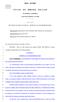 LC00 01 -- H 0 S T A T E O F R H O D E I S L A N D IN GENERAL ASSEMBLY JANUARY SESSION, A.D. 01 A N A C T RELATING TO FOOD AND DRUGS -- GENETICALLY-ENGINEERED FOODS Introduced By: Representatives Hull,
Self-Audit Checklist
 Page 1 Company Name: Date of audit: Date of last audit performed: Name of person performing self-audit: Signature: Name of person responsible for quality system: Signature: Number of non-compliances: Page
KEY - Ethical Certifications and Memberships
 KEY - Ethical Certifications and Memberships Australian BMP Cotton The Australian BMP Cotton trademark is the consumer s guarantee that the branded textile product they are buying is made of Australian
Base Recall Program September 2003
 Base Recall Program September 2003 Table of Content 1. Introduction 1 Page 2. Situation 1 Product Recall Plan 1-2 3. Mock Recall Procedure 3 4. Situation 2 Consumer Menu Item Complaint Recall Plan 4-5
FAIR TRADE SUSTAINABILITY ALLIANCE. (FairTSA)
 FAIR TRADE SUSTAINABILITY ALLIANCE (FairTSA) CONSOLIDATED STANDARDS FOR THE PRODUC OF AGRICULTURAL PRODUCTS, PROCESSED FOODS, WILD COLLECTED PLANTS, HANDICRAFTS, AND PERSONAL CARE PRODUCTS Date of Publication:
FSIS Security Guidelines for Food Processors
 United States Department of Agriculture Food Safety and Inspection Service FSIS Security Guidelines for Food Processors Food Security Plan Management Dear Establishment Owner/Operator: The Food Safety
RSPO Supply Chain Certification Standard. For organizations seeking or holding certification
 RSPO Supply Chain Certification Standard For organizations seeking or holding certification Adopted by the RSPO Board of Governors on 21 November 2014 Contents 1. Introduction... 3 2. Scope... 4 3. How
Keeping It Legal: Regulations and Licenses for Growing and Selling Food in Oregon
 Keeping It Legal: Regulations and Licenses for Growing and Selling Food in Oregon Adapted from Growing Farms Online, a comprehensive training program for beginning farmers, from the OSU Small Farms Program.
Position Description for Conservation Specialist
 Position Description for Conservation Specialist Position Summary This Conservation Specialist position is focused primarily on helping to conserve natural resources associated with small farms. Wildlife
If Your Farm Is Organic, Must It Be GMO-Free?
 If Your Farm Is Organic, Must It Be GMO-Free? Organic Farmers, Genetically Modified Organisms, and the Law September 2007 By Jill E. Krueger Farmers Legal Action Group, Inc. 360 North Robert Street, Suite
Using Enterprise Budgets To Make Decisions about Your Farm Richar d Carkner
 PNW0535 Using Enterprise Budgets To Make Decisions about Your Farm Richar d Carkner A Pacific Northwest Extension Publication Washington Oregon Idaho Enterprise budgets are important decision making tools.
NEW JERSEY ADMINISTRATIVE CODE TITLE 8, CHAPTER 7 LICENSURE OF PERSONS FOR PUBLIC HEALTH POSITIONS. Authority. N.J.S.A. 26:1A-38 et seq.
 NEW JERSEY ADMINISTRATIVE CODE TITLE 8, CHAPTER 7 LICENSURE OF PERSONS FOR PUBLIC HEALTH POSITIONS Authority N.J.S.A. 26:1A-38 et seq. Amendments in bold adopted December 7, 1998 SUBCHAPTER 1. GENERAL
SECTION 6. The Codex code of practice on good animal feeding
 SECTION 6 The Codex code of practice on good animal feeding 60 The Codex code of practice on good animal feeding SECTION 6 61 CODE OF PRACTICE ON GOOD ANIMAL FEEDING CAC/RCP 54-2004 SECTION 1. INTRODUCTION
Licensed Child Care in Washington State. A guide for child care providers
 Licensed Child Care in Washington State A guide for child care providers At the Department of Early Learning (DEL), we work every day to help make sure children in Washington grow up safe, healthy and
Certification process ECOCERT Ecological & Recycled Textile Standard
 Certification process ECOCERT Ecological & Recycled Textile Standard Annex 5 - Ecological & Recycled Textiles Standard - ERTS 1 Contents 1/ Ecological & Recycled Textile Standard... p3 2/ ERTS certification
9.1 OBJECTIVE... 9-1 9.2 SCOPE... 9-1 9.3 REQUIRED FORMS AND REFERENCES... 9-1. 9.3.1 Forms... 9-1. 9.3.2 References... 9-1
 9.1 OBJECTIVE.................................................................. 9-1 9.2 SCOPE..................................................................... 9-1 9.3 REQUIRED FORMS AND REFERENCES..........................................
Technical/Business Planning: For Small-Scale Oilseed Processing and Biodiesel Production
 Agricultural Marketing Resource Center Value-added Agriculture Profile Iowa State University November 2008 Technical/Business Planning: For Small-Scale Oilseed Processing and Biodiesel Production By Gary
InnoVeg. Horticulture Australia Limited. Front cover CASE STUDY. Direct Sales and Food Safety
 InnoVeg Horticulture Australia Limited Front cover CASE STUDY Direct Sales and Food Safety Content Introduction 02 Direct sales 02 Pros and cons 03 Why does food safety matter and how do we manage it?
It s all about managing food. Food Recall Plan Template For Food Manufacturers
 It s all about managing food. Food Recall Plan Template For Food Manufacturers What to Do In The Event Of a Product Recall Every Food Distributor and Food Manufacturer must track the products they manufacture
TRACEABILITY IN THE FOOD SUPPLY CHAIN
 Department of Health and Human Services OFFICE OF INSPECTOR GENERAL TRACEABILITY IN THE FOOD SUPPLY CHAIN Daniel R. Levinson Inspector General March 2009 Office of Evaluation and Inspections The Office
LOW INTEREST LOANS FOR AGRICULTURAL CONSERVATION
 LOW INTEREST LOANS FOR AGRICULTURAL CONSERVATION LILAC MANUAL LOW INTEREST LOANS FOR AGRICULTURAL CONSERVATION TABLE OF CONTENTS Introduction... 3 General Eligibility... 4 Specific Eligibility Criteria
Manufacturers and Distributors of Fertilizers and Related Products. Dear Applicant:
 To: Manufacturers and Distributors of Fertilizers and Related Products Dear Applicant: Enclosed are the forms for licensing your company and registering your products in Wisconsin, along with copies of
FUN FACES OF WISCONSIN AGRICULTURE CAREER GUIDE
 FUN FACES OF WISCONSIN AGRICULTURE CAREER GUIDE Activity Length: Exploring Agricultural Careers each worksheet will take 30 minutes Career Ag Mag Activity- 45 minutes Student Objectives: Explore agricultural
Your Global Inspection Solution
 Your Global Inspection Solution Seafood Inspection Services of the U.S. Department of Commerce NOAA Fisheries Inspection, Grading and Certification Services Third Party Verification Audits Training and
Forest Stewardship Council United Kingdom
 FSC CHAIN OF CUSTODY CERTIFICATION The FSC System There are two parts to the FSC system: 1. Forest Management certification which makes sure that the forest is managed to high standards covering social,
ADOPTED REGULATION OF THE DIVISION OF PUBLIC AND BEHAVIORAL HEALTH OF THE DEPARTMENT OF HEALTH AND HUMAN SERVICES. LCB File No.
 ADOPTED REGULATION OF THE DIVISION OF PUBLIC AND BEHAVIORAL HEALTH OF THE DEPARTMENT OF HEALTH AND HUMAN SERVICES LCB File No. R004-14 Effective April 1, 2014 EXPLANATION Matter in italics is new; matter
ARTICLE 2. PERMITS, LICENSES, AND CERTIFICATION R3-3-207. Agricultural Pest Control Advisor License; Examination; Fee; Renewal; Exemption A.
 ARTICLE 2. PERMITS, LICENSES, AND CERTIFICATION R3-3-207. Agricultural Pest Control Advisor License; Examination; Fee; Renewal; Exemption A. An individual shall not act as a PCA without a valid PCA license
Public Perceptions of Labeling Genetically Modified Foods
 Public Perceptions of Labeling Genetically Modified Foods Working Paper 2013-01 William K. Hallman, Ph.D. Cara L. Cuite, Ph.D. Xenia K. Morin, Ph.D. Release date: November 1, 2013 For more information:
CCOF CERTIFICATION SERVICES, LLC 2155 Delaware Ave, Suite 150 Santa Cruz, CA 95060 (831) 423-2263 [email protected] www.ccof.org
 CCOF CERTIFICATION SERVICES, LLC 2155 Delaware Ave, Suite 150 Santa Cruz, CA 95060 (831) 423-2263 [email protected] www.ccof.org September 2015 TABLE OF CONTENTS TABLE OF CONTENTS... 2 INTRODUCTION... 3 SECTION
American Forest Foundation (AFF) 2010-2015 Standards of Sustainability for Forest Certification
 American Forest Foundation (AFF) 2010-2015 Standards of Sustainability for Forest Certification Standards Prologue The American Forest Foundation s (AFF) 2010-2015 Standards of Sustainability for Forest
Enterprise Budget User Guide
 Enterprise Budget User Guide An Accompanying Guide to the Southwest British Columbia Small-Scale Farm Enterprise Budgets Institute for Sustainable Food Systems Kwantlen Polytechnic University Technical
MeriCal Quality Profile
 January 5, 2015 Dear Valued Customer, Since the implementation of new federal regulations, MeriCal Inc. has received a large volume of questionnaires and surveys regarding our services and procedures.
COMMONWEALTH OF PENNSYLVANIA AGRICULTURAL SECURITY AREA HANDBOOK
 COMMONWEALTH OF PENNSYLVANIA AGRICULTURAL SECURITY AREA HANDBOOK Bureau of Farmland Preservation 2301 North Cameron Street Harrisburg, PA 17110 Phone: 717-783-3167 Fax: 717-772-8798 www.agriculture.state.pa.us
Organic Food Federation Storage, Warehouse & Transport Standard
 Organic Food Federation Storage, Warehouse & Transport Standard 2009 by Organic Food Federation 31 Turbine Way, Eco Tech Business Park, Swaffham, Norfolk, PE37 7XD. Tel: 01760 720444 Fax: 01760 720790
NC SBI QUALITY ASSURANCE PROGRAM
 NC SBI QUALITY ASSURANCE PROGRAM for the SBI Reviewed by: Deputy Assistant Director Bill Weis Date: Approved by: Assistant Director Jerry Richardson Date: Originating Unit: SBI Effective Date: July 25,
FOOD AND AGRICULTURAL CODE SECTION
 SECTION 47000-47003 47000. The Legislature finds and declares all of the following with regard to the direct marketing of agricultural products: (a) Direct marketing of agricultural products benefits the
A Guide to the GAP Certification Process
 A Guide to the GAP Certification Process Preparing for the USDA GAP (Good Agricultural Practices) Audit Amber D. Vallotton Horticulture Agent VCE-Rockingham County 965 Pleasant Valley Road Harrisonburg,
Providing Safe and Effective Pest Management Solutions for Specialty Crop Growers
 2008 Year in Review Providing Safe and Effective Pest Management Solutions for Specialty Crop Growers 2008 IR-4 Accomplishments IR-4 Data Led To... Food Use In 2008 the US Environmental Protection Agency
JOB ANNOUNCEMENT. Nursery Manager DEGREE AND CURRICULUM:
 Horticulture Nursery Manager Associate degree in Horticulture or related degree. Will consider all qualified agriculture degrees. Manages nursery to grow horticultural plants, such as trees, shrubs, flowers,
Section 4 RADIATION SAFETY RULES AND REGULATIONS
 Page RR- 1 Section 4 RADIATION SAFETY RULES AND REGULATIONS UW Environmental Health and Safety Page RR-3 A. Historical Perspective Standards and regulations for radiation protection have been evolving