
American Forest Foundation (AFF) Standards of Sustainability for Forest Certification
|
|
|
- Jessica Ray
- 10 years ago
- Views:
Transcription
1 American Forest Foundation (AFF) Standards of Sustainability for Forest Certification Standards Prologue The American Forest Foundation s (AFF) Standards of Sustainability for Forest Certification promote the vitality of renewable forest resources while protecting environmental, economic and social benefits and work to increase public understanding of all benefits of sustainable forestry. They are based on North American and Pan- European guidelines for sustainable forest management, encourage adaptive management, and serve as the basis for the American Tree Farm System (ATFS) certification program. Forest owners and managers who follow the AFF Standards of Sustainability are encouraged to promote the American Tree Farm System program by displaying appropriate signs and participating in relevant program activities. The AFF Standards of Sustainability address aspects of sustainable forest management and incorporate eight standards with various performance measures and indicators. ATFS qualified Tree Farm inspectors, group managers, and accredited third-party assessors will conduct field verification of landowner conformance to the AFF Standards as prescribed by ATFS policies and procedures. All AFF sustainability elements (standards, performance measures and indicators) are important and will be considered in reviews. Responsibilities, task, or obligations that are phrased with the word must, are core elements that are required to be certified by the American Tree Farm System. Note: Bold type throughout this document denotes words or phrases defined in the attached glossary. An asterisk symbol (*) indicates guidance provided in the appendix document. This document was prepared at the direction of the AFF Board of Trustees. It was developed by the Independent Standards Review Panel under the process described by the AFF Standards Setting Procedures. Guidance documents (third-party auditing, internal monitoring, and landowner guidance) for implementation and interpretations will be used to clarify requirements of the Standards. Standard 1: Commitment to Practicing Sustainable Forestry Forest owner demonstrates commitment to forest vitality by developing and implementing a sustainable forest management plan. Performance Measure 1.1 Forest owner must have and implement a written forest management plan consistent with the size of the forest and the scale and intensity of the forest activities. Indicator Management plan must be active, adaptive, and embody the landowner s current objectives, remain appropriate for the land certified, and reflect the current state of knowledge about forestry and natural resource management. Indicator Management plans must: clearly state landowner s objectives, describe desired forest condition, include management activities aimed at reaching the desired forest condition AFF Standards of Sustainability 1

2 and landowner s objectives, document a feasible strategy for activity implementation, and include a tract map accurately depicting significant forest related resources. Where present, and relevant to the property, the plan must address the following resource elements: forest health, soil, water, wood and fiber production, threatened and endangered species, special sites, invasive species, integrated pest management, and high conservation value forests. Where present, relevant to the property, and consistent with landowner s objectives, the plan preparer may consider, describe and evaluate the following resource elements: fire, wetlands, desired species (fish, wildlife and plant), recreation, aesthetic quality, biomass and carbon. Indicator 1.1.3* Forest owner should monitor for changes that could interfere with the management objectives as stated in management plan (e.g., presence of invasive species, pest outbreaks, and indications of trespass). When problems are found, reasonable actions are taken. Standard 2: Compliance with Laws Forest management activities comply with all relevant federal, state and local laws, regulations and ordinances. Performance Measure 2.1 Forest owner must comply with all relevant federal, state, county, and municipal laws, regulations, and ordinances. Indicator Forest owner must comply with all relevant laws, regulations and ordinances and will correct conditions that led to adverse regulatory actions, if any. Indicator Forest owner should obtain advice from appropriate professionals, or contractors who are trained in, and familiar with, relevant laws, regulations and ordinances. Standard 3: Reforestation and Afforestation Forest owner completes timely restocking of desired species of trees on harvested sites and nonstocked areas where tree growing is consistent with land use practices and the forest owner s management objectives. Performance Measure 3.1 Reforestation or afforestation must be achieved by a suitable process that ensures adequate stocking levels. Indicator Harvested forest land must achieve adequate stocking of desired species reflecting the forest owner s management objectives, within five years after harvest, or within a time interval as specified by applicable regulation. AFF Standards of Sustainability 2

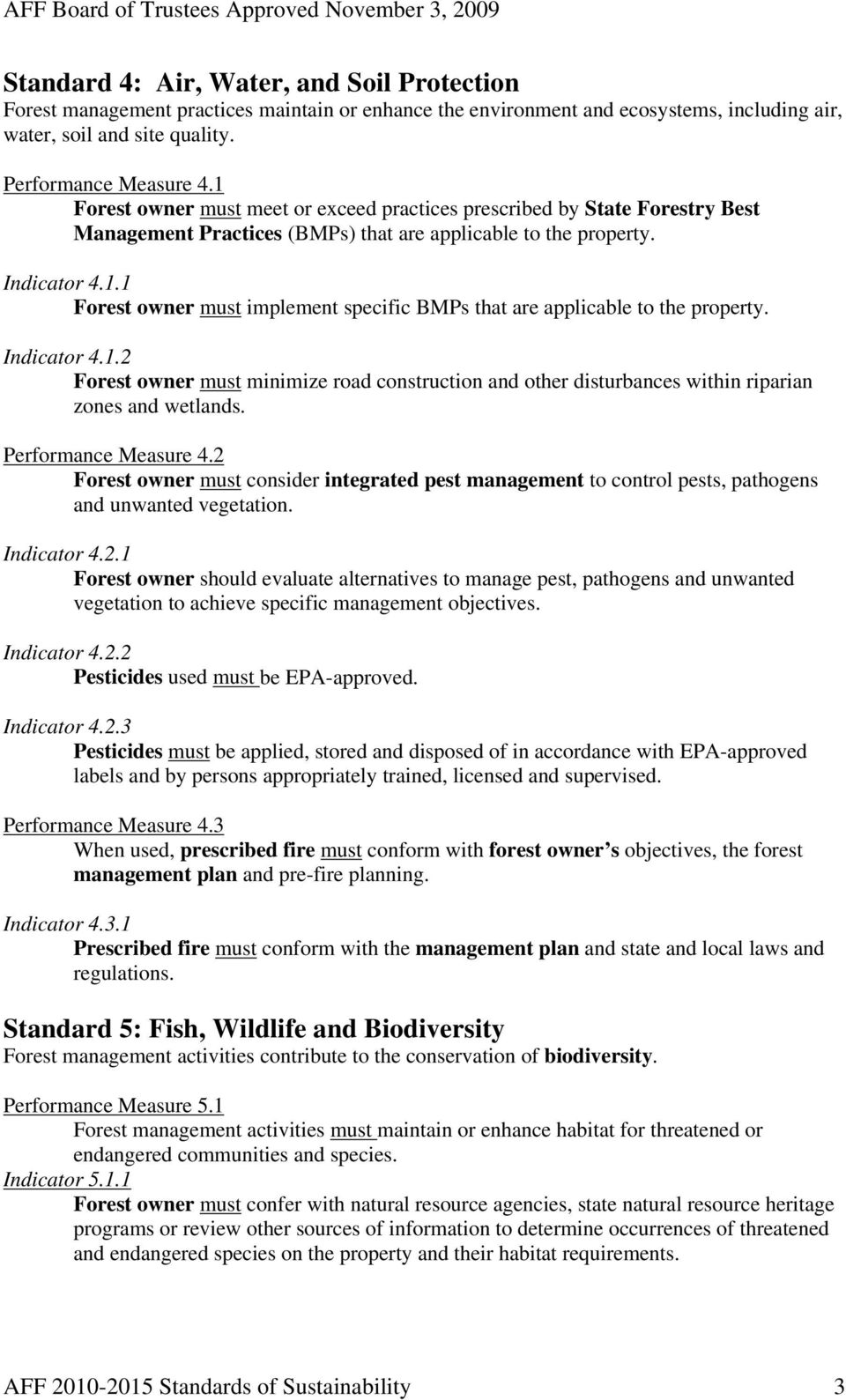
3 Standard 4: Air, Water, and Soil Protection Forest management practices maintain or enhance the environment and ecosystems, including air, water, soil and site quality. Performance Measure 4.1 Forest owner must meet or exceed practices prescribed by State Forestry Best Management Practices (BMPs) that are applicable to the property. Indicator Forest owner must implement specific BMPs that are applicable to the property. Indicator Forest owner must minimize road construction and other disturbances within riparian zones and wetlands. Performance Measure 4.2 Forest owner must consider integrated pest management to control pests, pathogens and unwanted vegetation. Indicator Forest owner should evaluate alternatives to manage pest, pathogens and unwanted vegetation to achieve specific management objectives. Indicator Pesticides used must be EPA-approved. Indicator Pesticides must be applied, stored and disposed of in accordance with EPA-approved labels and by persons appropriately trained, licensed and supervised. Performance Measure 4.3 When used, prescribed fire must conform with forest owner s objectives, the forest management plan and pre-fire planning. Indicator Prescribed fire must conform with the management plan and state and local laws and regulations. Standard 5: Fish, Wildlife and Biodiversity Forest management activities contribute to the conservation of biodiversity. Performance Measure 5.1 Forest management activities must maintain or enhance habitat for threatened or endangered communities and species. Indicator Forest owner must confer with natural resource agencies, state natural resource heritage programs or review other sources of information to determine occurrences of threatened and endangered species on the property and their habitat requirements. AFF Standards of Sustainability 3
4 Indicator Forest management activities must incorporate measures to protect identified threatened and endangered species. Performance Measure 5.2 Forest owner should address the desired species (fish, aquatic, wildlife, and plant) and/or desired forest communities in the management plan and forest management activities. Indicator Forest owner should consult available and accessible information on management of the forest for desired species (fish, aquatic, wildlife, and plant) and/or forest communities and integrate it into forest management. Performance Measure 5.3 Forest owner should make practical efforts to prevent, eradicate or otherwise control invasive species. Indicator Forest owner should make practical efforts to prevent, eradicate or otherwise control invasive species using a range of integrated pest management methods. Performance Measure 5.4 Forest management activities should maintain or enhance rare species and high conservation value forests. Indicator Appropriate to the scale and intensity of the situation, forest management activities should incorporate measures to protect or mitigate impacts on rare species and identified high conservation value forests. Standard 6: Forest Aesthetics Forest management plans and management activities recognize the value of forest aesthetics. Performance Measure 6.1 Forest owner should manage the visual impacts of forest management activities consistent with the size of the forest, the scale and intensity of forest management activities and the location of the property. Indicator Forest management activities should apply visual quality measures compatible with appropriate silvicultural practices. Standard 7: Protect Special Sites Special sites are managed in ways that recognize their unique historical, archeological, cultural, geological, biological or ecological characteristics. Performance Measure 7.1 Forest management activities must maintain special sites. AFF Standards of Sustainability 4

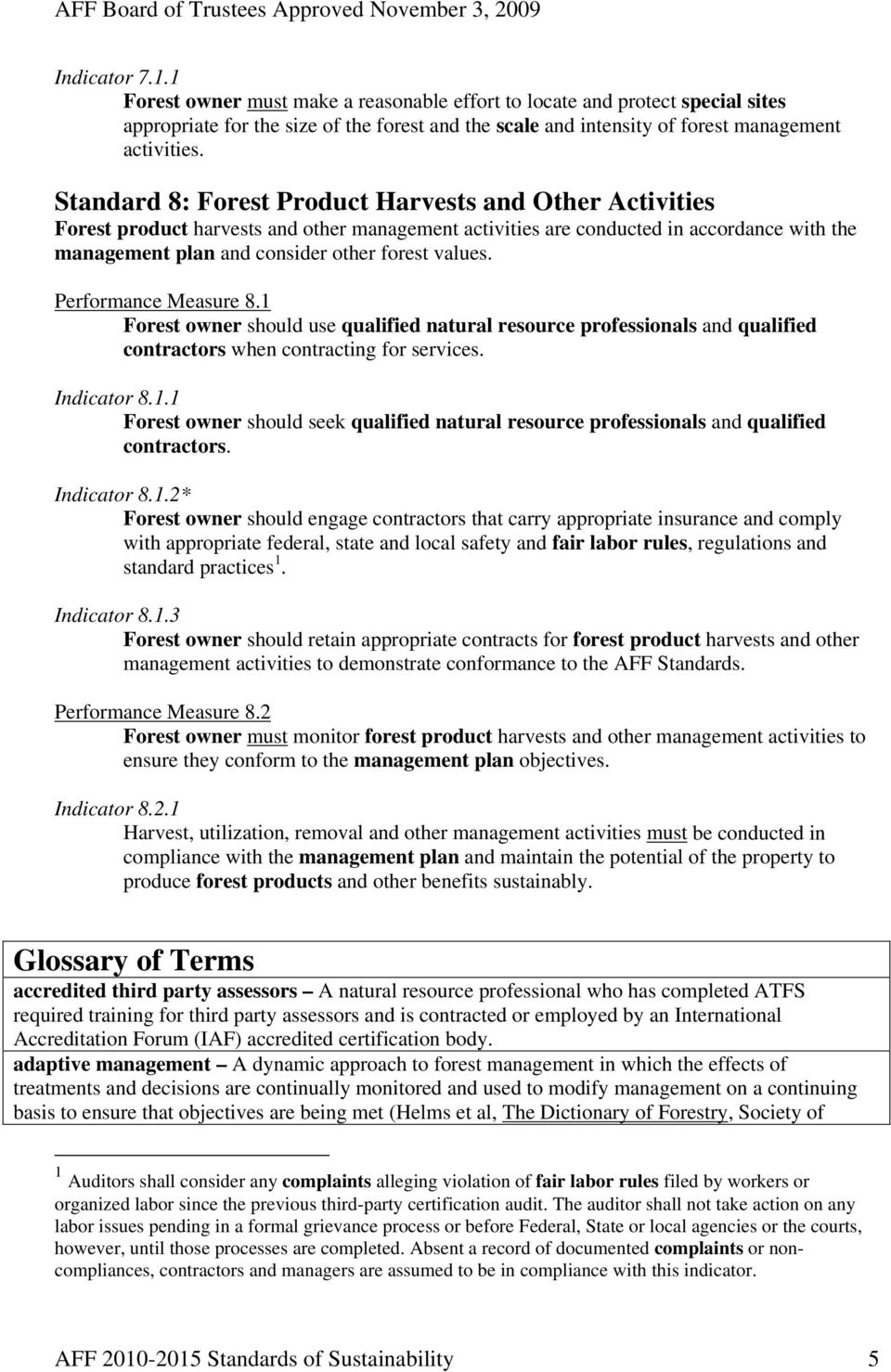
5 Indicator Forest owner must make a reasonable effort to locate and protect special sites appropriate for the size of the forest and the scale and intensity of forest management activities. Standard 8: Forest Product Harvests and Other Activities Forest product harvests and other management activities are conducted in accordance with the management plan and consider other forest values. Performance Measure 8.1 Forest owner should use qualified natural resource professionals and qualified contractors when contracting for services. Indicator Forest owner should seek qualified natural resource professionals and qualified contractors. Indicator 8.1.2* Forest owner should engage contractors that carry appropriate insurance and comply with appropriate federal, state and local safety and fair labor rules, regulations and standard practices 1. Indicator Forest owner should retain appropriate contracts for forest product harvests and other management activities to demonstrate conformance to the AFF Standards. Performance Measure 8.2 Forest owner must monitor forest product harvests and other management activities to ensure they conform to the management plan objectives. Indicator Harvest, utilization, removal and other management activities must be conducted in compliance with the management plan and maintain the potential of the property to produce forest products and other benefits sustainably. Glossary of Terms accredited third party assessors A natural resource professional who has completed ATFS required training for third party assessors and is contracted or employed by an International Accreditation Forum (IAF) accredited certification body. adaptive management A dynamic approach to forest management in which the effects of treatments and decisions are continually monitored and used to modify management on a continuing basis to ensure that objectives are being met (Helms et al, The Dictionary of Forestry, Society of 1 Auditors shall consider any complaints alleging violation of fair labor rules filed by workers or organized labor since the previous third-party certification audit. The auditor shall not take action on any labor issues pending in a formal grievance process or before Federal, State or local agencies or the courts, however, until those processes are completed. Absent a record of documented complaints or noncompliances, contractors and managers are assumed to be in compliance with this indicator. AFF Standards of Sustainability 5
6 American Foresters, 1998) adverse regulatory actions Written warning, citations or fines issued by law enforcement or regulatory bodies. biodiversity The variety and abundance of life forms, processes, functions and structures of plants, animals and other living organisms, including the relative complexity of species, communities, gene pools and ecosystems at spatial scales that range from local through regional to global (Helms et al, The Dictionary of Forestry, Society of American Foresters, 1998). complaint Labor complaints are those with formal documentation filed through the state s fair labor practices board or similar body. desired species Those species of flora and fauna designated in the landowner s management plan and not known to cause negative impacts on the local environment. fair labor rules Include federal, state and local labor legislation and international labor standards cited in Programme for the Endorsement of Forest Certification schemes (PEFC) Annex 3, Chapter 3.3. forest owner Landowner or designated representative such as, but not limited to, professional resource manager, family member, trustee, etc. forest product [Forest Produce] Any raw material yielded by a forest. Generally defined in Forest Acts or Ordinances, and subdivided conventionally into major forest products, i.e. timber and fuelwood, and minor forest products, i.e. all other products including leaves, fruit, grass, fungi, resins, gums, animal parts, water, soil, gravel, stone and other minerals on forest land (F. C. Ford Robertson, Terminology of Forest Science Technology, Practice, and Products, Society of American Foresters, forest vitality The health and sustainability of a forest. group manager The individual(s) designated by the Independently Managed Group organization to manage the administrative affairs of implementing and achieving the AFF Standards and Standard Operating Procedures for group programs (SOP-01) for an ATFS certified independently managed group program. Please refer to the ATFS Group Certification Process documentation. high conservation value forests Forests of outstanding and critical importance due to their environmental, social, biodiversity or landscape values. Due to the small scale and low-intensity of family forest operations, informal assessment of HCVF occurrence through consultation with experts or review of available and accessible information is appropriate. integrated pest management The maintenance of destructive agents, including insects, at tolerable levels by planned use of a variety of preventative, suppressive, or regulatory tactics and strategies that are ecologically and economically efficient and socially acceptable (Helms et al, The Dictionary of Forestry, Society of American Foresters, 1998). A pest control strategy that uses a variety of complementary strategies including: mechanical devices, physical devices, genetic, biological or cultural management and chemical management (US EPA). invasive species Non-native species whose introduction does or is likely to cause economic or environmental harm or harm to human health (Executive Order (Feb. 3, 1999). landowner Entity that holds title to the property to be certified. management plan Documents that guide actions and that change in response to feedback and changed conditions, goals, objectives and policies. Management plans may incorporate several documents including, but not limited to, harvest plans, activity implementation schedules, permits, research, etc. For the purposes of the American Tree Farm System eligible management plans, plan amendments may include letters, notes, and other forms of informal updates in addition to formal plan revisions. pesticide Pesticides include chemicals commonly known as herbicides and insecticides. prescribed fire A fire ignited by management to meet specific objectives (Helms et al, The Dictionary of Forestry, Society of American Foresters, 1998). AFF Standards of Sustainability 6

7 qualified contractor Forest contractors who have completed certification, licensing, recommended training and education programs offered in their respective states. qualified natural resource professional A person who by training and experience can make forest management recommendations. Examples include foresters, soil scientists, hydrologists, forest engineers, forest ecologists, fishery and wildlife biologists or technically trained specialists in such fields. qualified Tree Farm inspector A natural resource professional who has completed ATFS required training for certifying forested properties and is eligible to inspect properties on behalf of ATFS. ATFS requires all trained inspectors meet approved eligibility requirements. rare species A plant or animal or community that is vulnerable to extinction or elimination. scale The extent of forest operations on the landscape/certified property. special sites Those areas offering unique historical, archeological, cultural, geological, biological or ecological value. Special Sites include: A. Historical, archaeological, cultural and ceremonial sites or features of importance to the forest owner; B. Sites of importance to wildlife such as rookeries, refuges, fish spawning grounds, vernal ponds and shelters of hibernating animals; C. Unique ecological communities like relic old-growth, springs, glades, savannas, fens and bogs; and D. Geological features such as terminal moraines, cliffs and caves. state forestry best management practice(s) (BMPs) Forestry BMPs are generally accepted forest management guidelines that have been developed by state forestry agencies with broad public stakeholder input. sustainability The capacity of forests, ranging from stands to ecoregions, to maintain their health, productivity, diversity and overall integrity, in the long run, in the context of human activity (Helms et al, The Dictionary of Forestry, Society of American Foresters, 1998). sustainable forest management The practice of meeting the forest resource needs and values of the present without compromising the similar capability of future generations (Helms et al, The Dictionary of Forestry, Society of American Foresters, 1998). Note AFF s Standards of Sustainability reflect criteria of sustainability based on the Montreal Process, 1993, and the Pan-European Operational- Level Guidelines (PEOLGs). visual quality measures Modifications of forestry practices in consideration of public view, including timber sale layout, road and log landing locations, intersections with public roadways, distributing logging residue, tree retention, timing of operations and other factors relevant to the scale and location of the project. AFF Standards of Sustainability 7

864 653-7224 SFI INC. LAUNCHES NEW STANDARD LEADS FOREST CERTIFICATION FORWARD
 FOR IMMEDIATE RELEASE Contact: Rick Cantrell January 12, 2010 SFI Vice President and COO 864 653-7224 SFI INC. LAUNCHES NEW STANDARD LEADS FOREST CERTIFICATION FORWARD WASHINGTON Sustainable Forestry Initiative
Integration of Forestry & Wildlife Management
 Integration of Forestry & Wildlife Management By Ken Negray Regional Certification Manager, NewPage Corp & member of the KY SIC Committee Abstract: Kentucky SIC (Sustainable Forestry Initiative Implementation
PEFC: GLOBAL ASSURANCE OF SUSTAINABLE FOREST MANAGEMENT
 PEFC: GLOBAL ASSURANCE OF SUSTAINABLE FOREST MANAGEMENT CONSUMERS TODAY want to know they are buying wood and paper products from reliable, responsible suppliers. Their expectations are high because the
Wildlife Habitat Conservation and Management Program
 Wildlife Habitat Conservation and Management Program Manual for Counties and Cities Oregon Department of Fish and Wildlife 2015 Table of Contents 1. Introduction Purpose of the habitat program Objective
SUSTAINABLE FOREST MANAGEMENT PLAN SKEENA BUSINESS AREA
 SUSTAINABLE FOREST MANAGEMENT PLAN SKEENA BUSINESS AREA NORTH COAST, KALUM AND SKEENA-STIKINE OPERATIONS Approved: Norman H. Parry, Timber Sales Manager Date: September 5, 2007 Table of Contents 1 INTRODUCTION
3: Swedwood Karelia s logging plans are questioned based on the perception that the operation plans to cut HCVF.
 21 December 2011 Statement from NEPCon and the Rainforest Alliance regarding the re-certification of Swedwood Karelia LLC (FSC registration code SW-FM/COC-002041) and complaints filed by Protect the Forest
Revising the Nantahala and Pisgah Land Management Plan Preliminary Need to Change the Existing Land Management Plan
 Revising the Nantahala and Pisgah Land Management Plan Preliminary Need to Change the Existing Land Management Plan Throughout the Plan 1. There is a fundamental need for the revised plan to address how
Controlled Wood. - a guide for FSC Chain of Custody certified companies. For more information about FSC chain of custody certification:
 For more information about FSC chain of custody certification: Controlled Wood Produced by: FSC International Center Charles-de-Gaulle Strasse 5 53113 Bonn, Germany Phone : + 49 (0)228 367 66 0 Fax : +
DEPARTMENT OF FORESTRY DRAFT REVISED NATIONAL FOREST POLICY OF MALAWI
 DEPARTMENT OF FORESTRY DRAFT REVISED NATIONAL FOREST POLICY OF MALAWI July, 2013 1. Foreword 2. Preface 3. Introduction 4. Policy linkages 5. Broad Policy Direction 6. Policy Priority Areas Provides the
Restoring Anadromous Fish Habitat in Big Canyon Creek Watershed. Summary Report 2002
 Restoring Anadromous Fish Habitat in Big Canyon Creek Watershed Summary Report 2002 DOE/BP-00005268-5 November 2002 This Document should be cited as follows: "Restoring Anadromous Fish Habitat in Big Canyon
Third-Party Forest Certification in British Columbia
 Third-Party Forest Certification in British Columbia WWW.BCFORESTINFORMATION.COM [email protected] APRIL 2008 Offering Extra Assurance of Well-Managed Forests British Columbia s forest industry has developed
Technology For Adaptation. Forestry Conservation Management. Dr. Javier Aliaga Lordemann
 Technology For Adaptation. Forestry Conservation Management Dr. Javier Aliaga Lordemann Forests has more carbon store than the currently carbon free atmosphere. By contrast, are important sources of emissions
U.S. SOYBEAN SUSTAINABILITY ASSURANCE PROTOCOL
 US SOYBEAN SUSTAINABILITY ASSURANCE PROTOCOL A Sustainability System That Delivers MARCH 2013 Since 1980, US farmers increased soy production by 96% while using 8% less energy US SOYBEAN SUSTAINABILITY
Introduction to protection goals, ecosystem services and roles of risk management and risk assessment. Lorraine Maltby
 Introduction to protection goals, ecosystem services and roles of risk management and risk assessment. Lorraine Maltby Problem formulation Risk assessment Risk management Robust and efficient environmental
Fire Management needs assessment and priority actions
 Needs Assessment Questionnaire Fire Management needs assessment and priority actions In the introduction of the guidelines it is said that the Principles and Strategic Actions can serve as a checklist
RESTORATION & REVITALIZATION
 RESTORATION & REVITALIZATION Legal preservation has not proved to be sufficient to preserve natural communities. Restoration activities are diverse and includes revitalization of natural communities which
One Major Six Concentrations. Department of Environmental Conservation University of Massachusetts Amherst
 One Major Six Concentrations Natural Resources Conservation Undergraduate Major Department of Environmental Conservation University of Massachusetts Amherst Conserving Earth s biological diversity and
VIENNA RESOLUTION 4 CONSERVING AND ENHANCING FOREST BIOLOGICAL DIVERSITY IN EUROPE
 FOURTH MINISTERIAL CONFERENCE ON THE PROTECTION OF FORESTS IN EUROPE 28 30 April 2003, Vienna, Austria VIENNA RESOLUTION 4 CONSERVING AND ENHANCING FOREST BIOLOGICAL DIVERSITY IN EUROPE 1. Recognising
Alaska Forest Pest Control Supplemental Information. Category Twelve
 Alaska Forest Pest Control Supplemental Information Category Twelve In general, applicators who apply pesticides to property other than their own, or act as a pesticide consultant must obtain certification
APPLICATION FOR CLASSIFICATION OF FOREST LAND
 To the Chief, Division of Forestry: APPLICATION FOR CLASSIFICATION OF FOREST LAND In accordance with sections 5713.22-.26 of the Ohio Revised Code, I hereby apply for the classification of certain lands
Appendix C. Municipal Planning and Site Restoration Considerations
 Appendix C Municipal Planning and Site Restoration Considerations 67 68 Appendix C - Municipal Planning and Site Restoration Considerations This appendix contains best practice standards for site planning
AGENDA ITEM 6. R-14-148 Meeting 14-34 December 10, 2014 AGENDA ITEM
 R-14-148 Meeting 14-34 December 10, 2014 AGENDA ITEM AGENDA ITEM 6 Adoption of a Final Environmental Impact Report for the Integrated Pest Management Program, and Approval of the Integrated Pest Management
BC Timber Sales Provincial Sustainable Forest Management Plan SUSTAINABLE FORESTRY INITIATIVE (SFI ) 2010-2014 Standard
 BC Timber Sales Provincial Sustainable Forest Management Plan SUSTAINABLE FORESTRY INITIATIVE (SFI ) 2010-2014 Standard Updated: May 1, 2013 Table of Contents 1 INTRODUCTION... 1 1.1 Background... 2 1.2
Integrated Pest Management
 Chapter 2 Integrated Pest Management In This Chapter Keywords After learning the information in this chapter, you will be able to: 1. Define Integrated Pest Management (IPM). 2. List and describe the 5
Conservation Tax Credit Regulations Chapter 391-1-6 A-1 RULES OF GEORGIA DEPARTMENT OF NATURAL RESOURCES CHAPTER 391-1-6
 Conservation Tax Credit Regulations Chapter 391-1-6 A-1 RULES OF GEORGIA DEPARTMENT OF NATURAL RESOURCES CHAPTER 391-1-6 GEORGIA CONSERVATION TAX CREDIT PROGRAM TABLE OF CONTENTS 391-1-6-.01 Purpose and
1.7.0 Floodplain Modification Criteria
 1.7.0 Floodplain Modification Criteria 1.7.1 Introduction These guidelines set out standards for evaluating and processing proposed modifications of the 100- year floodplain with the following objectives:
FSC STANDARD FSC CONTROLLED WOOD STANDARD FOR FOREST MANAGEMENT ENTERPRISES. FSC-STD-30-010 (Version 2-0) EN
 FOREST STEWARDSHIP COUNCIL INTERNATIONAL CENTER FSC STANDARD FSC CONTROLLED WOOD STANDARD FOR FOREST MANAGEMENT ENTERPRISES FSC-STD-30-010 (Version 2-0) EN 2006 Forest Stewardship Council A.C. All rights
CHAPTER 2: APPROACH AND METHODS APPROACH
 CHAPTER 2: APPROACH AND METHODS APPROACH Given Hawaii s biological uniqueness on a global scale, the Comprehensive Wildlife Conservation Strategy (CWCS) recognizes the importance of protecting all native
Heritage Place Code. Heritage Place Code
 1 Application This Code will apply in assessing building work (including demolition), reconfiguring a lot or operational work where: on a premises that includes a heritage place within a heritage precinct
Post-Wildfire Clean-Up and Response in Houston Toad Habitat Best Management Practices
 Post-Wildfire Clean-Up and Response in Houston Toad Habitat Best Management Practices Purpose The purpose of this document is to provide guidance and recommendations for minimizing potential impacts to
Introduction to Integrated Pest Management. John C. Wise, Ph.D. Michigan State University MSU Trevor Nichols Research Complex
 Introduction to Integrated Pest Management John C. Wise, Ph.D. Michigan State University MSU Trevor Nichols Research Complex What is Integrated Pest Management? Integrated Pest Management (IPM) New concept;
Appendix A. The Marine Life Protection Act (MLPA)
 Appendix A. The Marine Life Protection Act (MLPA) THE PEOPLE OF THE STATE OF CALIFORNIA DO ENACT AS FOLLOWS: SECTION 1. Chapter 10.5 (commencing with Section 2850) is added to Division 3 of the Fish and
MINNESOTA DEPARTMENT OF NATURAL RESOURCES. Division of Forestry
 MINNESOTA DEPARTMENT OF NATURAL RESOURCES Division of Forestry Other major programs: Private Forest Management Urban and Community Forestry Insect and Disease Management Urban and Community Forestry
Queensland Parks and Wildlife Service PEST MANAGEMENT PLAN
 QPWS Pest Management Plan Queensland Parks and Wildlife Service PEST MANAGEMENT PLAN 2010-2015 A plan to meet obligations under the Land Protection (Pest and Stock Route Management) Act (2002) Version:
Smoke Management Plan
 Smoke Management Plan December 2007 TABLE OF CONTENTS 1.0 Introduction 3 2.0 Background 6 3.0 Smoke Management Plan 7 3.1 Authorization to Burn 10 3.2 Minimizing Air Pollutant Emissions 11 3.3 Smoke Management
IMPLEMENTING ECOSYSTEM BASED INTEGRATED RESOURCE MANAGEMENT IN NOVA SCOTIA
 IMPLEMENTING ECOSYSTEM BASED INTEGRATED RESOURCE MANAGEMENT IN NOVA SCOTIA Bruce Stewart, Forest Ecologist, RPF, Peter Neily, Forest Ecologist, RPF Nova Scotia Department of Natural Resources, Truro, Nova
Colorado Natural Heritage Program
 CNHP s mission is to preserve the natural diversity of life by contributing the essential scientific foundation that leads to lasting conservation of Colorado's biological wealth. Colorado Natural Heritage
College of Agriculture
 100 INTRODUCTION TO ESTRY. (3) A brief coverage of the general fields of forestry; development and importance; tree growth; principal forest regions and important timber species; forest management practices;
Creating Green Jobs within the Environment and Culture sector.
 Creating Green Jobs within the Environment and Culture sector. Matilda Skosana Environmental Programmes (ILO Definition): 1. DEFINITION OF GREEN JOB. Jobs are green when they help reduce negative environmental
Department of Forest and
 Colorado State University 1 Department of Forest and Rangeland Stewardship Office in Forestry Building, Room 123 (970) 491-6911 warnercnr.colostate.edu/frs-home (http://warnercnr.colostate.edu/ frws-home)
Green Infrastructure Case Study Template
 Green Infrastructure Case Study Template The aim of the exercise is to provide information on how the elements of the Green Infrastructure Strategy are implemented at national level and to provide case
GENERAL SPECIFICATION
 R64 - PAVEMENT MARKING August 1996 GENERAL SPECIFICATION G10 CONSTRUCTION ENVIRONMENTAL MANAGEMENT PLAN Date JUNE 2012 Department 1 DOT Spec R64 of Infrastructure, Energy and Resources Index DEPARTMENT
How To Write A Listing Policy For A Species At Risk Act
 Fisheries and Oceans Canada Species at Risk Act Listing Policy and Directive for Do Not List Advice DFO SARA Listing Policy Preamble The Fisheries and Oceans Canada (DFO) Species at Risk Act (SARA) Listing
WEED MANAGEMENT PLAN FOR. (NAME of PROPERTY or MANAGED AREA) (TOWN or COUNTY, STATE) (TIME PERIOD; e.g. 1996-2000)
 (WEED MANAGEMENT PLAN OUTLINE FOR PUBLIC LAND MANAGERS) (Note: This outline is a modification of a weed management plan template produced by The Nature Conservancy) WEED MANAGEMENT PLAN FOR (NAME of PROPERTY
Forest-Climate Working Group:
 Forest-Climate Working Group: Policy Platform 1 Forest-Climate Working Group: Policy Platform Endorsing Organizations American Bird Conservancy American Forest & Paper Association American Forest Foundation
Chapter 4. Consultation and Coordination
 24253 24254 24255 24256 24257 24258 24259 24260 24261 24262 24263 24264 24265 Chapter 4. Consultation and Coordination Preparers and Contributors The following individuals and Forest Service staff groups
Using Aerial Photography to Measure Habitat Changes. Method
 Then and Now Using Aerial Photography to Measure Habitat Changes Method Subject Areas: environmental education, science, social studies Conceptual Framework Topic References: HIIIB, HIIIB1, HIIIB2, HIIIB3,
ERP: Willamette-Ecosystem Services Project
 ERP: Willamette-Ecosystem Services Project Presented by Iris Goodman to NAS Sustainability R&D Forum October 17-18, 2007 Conserving ecosystem services through proactive decision-making making Linking Human
Use: Cooperative farming as a habitat management tool to enhance and restore refuge grasslands
 Compatibility Determination Use: Cooperative farming as a habitat management tool to enhance and restore refuge grasslands District Name: Minnesota Valley Wetland Management District Establishing and Acquisition
CORPORATE POLICY STATEMENT NO. 12 MANAGEMENT OF PEST ANIMALS
 1. OBJECTIVE CORPORATE POLICY STATEMENT NO. 12 MANAGEMENT OF PEST ANIMALS August 2015 To provide direction and guidance for the management of pest animals on lands and waters managed by the Department
SFI MAINE S SFI IMPLEMENTATION COMMITTEE S PRINCIPLES, CRITERIA, AND RESPONSIBILITIES
 SFI MAINE S SFI IMPLEMENTATION COMMITTEE S PRINCIPLES, CRITERIA, AND RESPONSIBILITIES For Determining How Certified Logging Professional Programs Will Be Evaluated For Endorsement by the Maine SFI Implementation
EFB 496.10/696.03 Online Wetland Restoration Techniques Class Syllabus
 EFB 496.10/696.03 Wetland Restoration Techniques Online Class Syllabus SUNY-ESF College of Environmental Science and Forestry Summer Session II 2015 Wetland Restoration Techniques is a graduate and undergraduate
THE NATURAL RESOURCES AND ENVIRONMENT ORDINANCE (CAP. 84 - LAWS OF SARAWAK, 1958 Ed.)
 THE NATURAL RESOURCES AND ENVIRONMENT ORDINANCE (CAP. 84 - LAWS OF SARAWAK, 1958 Ed.) THE NATURAL RESOURCES AND ENVIRONMENT (PRESCRIBED ACTIVITIES) ORDER, 1994 (Made under section 11A(1)) (Incorporating
High Conservation Value Forests 3.1. Old Growth Forests. Management & Monitoring Framework
 High Conservation Value Forests 3.1 Old Growth Forests Management & Monitoring Framework HCV 3: Forest areas that are in or contain rare, threatened or endangered ecosystems. HCVF 3.1 Old Growth Areas
3. Which relationship can correctly be inferred from the data presented in the graphs below?
 1. Recent evidence indicates that lakes in large areas of New York State are being affected by acid rain. The major effect of acid rain in the lakes is (1) an increase in game fish population levels (3)
National Marine Sanctuaries Act
 Please note: This text is from the fourth edition of Federal Historic Preservation Laws, published in 2006 by the National Center for Cultural Resources, National Park Service, Department of the Interior.
Chain of Custody of Forest Based Products - Requirements
 PEFC INTERNATIONAL STANDARD Requirements for PEFC scheme users PEFC ST 2002:2013 2012-12-04 Enquiry Draft Chain of Custody of Forest Based Products - Requirements PEFC Council World Trade Center 1, 10
SEC. 4001. PURPOSE. SEC. 4002. DEFINITIONS. SEC. 4003. COLLABORATIVE FOREST LANDSCAPE RESTORATION PROGRAM.
 TITLE IV--FOREST LANDSCAPE RESTORATION SEC. 4001. PURPOSE. The purpose of this title is to encourage the collaborative, sciencebased ecosystem restoration of priority forest landscapes through a process
CHAPTER 24: ENVIRONMENTAL MANAGEMENT
 Central Eyre Iron Project Environmental Impact Statement CHAPTER 24: ENVIRONMENTAL MANAGEMENT CHAPTER 24 ENVIRONMENTAL MANAGEMENT COPYRIGHT Copyright Iron Road Limited, 2015 All rights reserved This document
Asian Longhorned Beetle Control Program
 United States Department of Agriculture Animal and Plant Health Inspection Service Asian Longhorned Beetle Control Program Environmental Assessment, December 1996 United States Department of Agriculture
United States-Peru Environmental Cooperation 2011-2014 Work Program
 United States-Peru Environmental Cooperation 2011-2014 Work Program The Environmental Cooperation Commission (ECC), established pursuant to Article III of the Environmental Cooperation Agreement (ECA)
IPM Plan for Campus Landscape
 Created June 2014 IPM Plan for Campus Landscape Statement of Purpose The purpose of this integrated pest management (IPM) plan is to guide the use of environmentally sensitive pest management strategies
Global Environment Facility GEF OPERATIONAL PROGRAM #13 ON CONSERVATION AND SUSTAINABLE USE OF BIOLOGICAL DIVERSITY IMPORTANT TO AGRICULTURE
 Global Environment Facility GEF OPERATIONAL PROGRAM #13 ON CONSERVATION AND SUSTAINABLE USE OF BIOLOGICAL DIVERSITY IMPORTANT TO AGRICULTURE CONTENTS Introduction..1 Convention Guidance... 2 Agricultural
Integrated Pest Management Plan
 Integrated Pest Management Plan ENVIRONMENTAL HEALTH & SAFETY Version 1.2 October 21, 2015 Table of Contents A. Introduction...1 B. Scope...1 C. Responsibilities...2 1. Department...2 2. Supervisor...3
Markets for Ecosystem Services on Agricultural Lands: Experience and Outlook in the United States
 Markets for Ecosystem Services on Agricultural Lands: Experience and Outlook in the United States Frank Casey Conservation Economics and Finance Program Defenders of Wildlife Presented at the Biodiversity
As stewards of the land, farmers must protect the quality of our environment and conserve the natural resources that sustain it by implementing
 N A T U R A L R E S O U R C E C O N S E R V A T I O N As stewards of the land, farmers must protect the quality of our environment and conserve the natural resources that sustain it by implementing conservation
SANTA BARBARA COUNTY COMPREHENSIVE PLAN LOMPOC AREA
 SANTA BARBARA COUNTY COMPREHENSIVE PLAN LOMPOC AREA A. LAND USE ELEMENT INTERPRETIVE GUIDELINES B. COMMUNITY BENEFITS C. COUNTY ACTION ITEMS Adopted by the Board of Supervisors November 9, 1999 A. Santa
The current institutional and legal context for biodiversity conservation and management is characterised by the following features:
 National BiodiversityStrategyandActionPlan (NBSAP),St. Lucia page 8 Resource tenure and access Most agricultural lands, and a majority of forest lands, are privately owned. Two significant trends can be
Marine Stewardship Council
 Marine Stewardship Council MSC Fishery Standard Principles and Criteria for Sustainable Fishing Version 1.1 1 st May 2010 Committees responsible for this Standard This standard is intended to be used on
NATURAL RESOURCES DEGREES AND CERTIFICATES. Environmental Conservation A.S. Degree (formerly Natural Resources)
 Area: Science and Engineering Dean: Dr. Rina Roy Phone: (916) 484-8107 Counseling: (916) 484-8572 DEGREES AND CERTIFICATES Environmental Conservation A.S. Degree (formerly Natural Resources) Environmental
A Functional Classification System for Marine Protected Areas in the United States
 A Functional Classification System for Marine Protected Areas in the United States The U.S. Classification System: An Objective Approach for Understanding the Purpose and Effects of MPAs as an Ecosystem
FORESTED VEGETATION. forests by restoring forests at lower. Prevent invasive plants from establishing after disturbances
 FORESTED VEGETATION Type of strategy Protect General cold adaptation upland and approach subalpine forests by restoring forests at lower Specific adaptation action Thin dry forests to densities low enough
REPUBLIC OF TURKEY MINISTRY OF FORESTRY AND WATER AFFAIRS
 REPUBLIC OF TURKEY MINISTRY OF FORESTRY AND WATER AFFAIRS Turkey s position in the World Prof. Dr. Veysel EROĞLU Minister of Forestry and Water Affairs The Ministry of Forestry and Water Affairs, formerly
Dutch Procurement Criteria for Timber
 Dutch Procurement Criteria for Timber PRINCIPLES AND CRITERIA FOR: SUSTAINABLE FOREST MANAGEMENT (SFM) CHAIN OF CUSTODY AND LOGO USE (CoC) DEVELOPMENT, APPLICATION AND MANAGEMENT OF CERTIFICATION SYSTEMS
Protected Area Categories and Management Objectives
 Protected Area Categories and Management Objectives A protected area is defined as: An area of land and/or sea especially dedicated to the protection and maintenance of biological diversity, and of natural
CRP Mid-Contract Management Option: Integrated Wildlife Management (645)
 CRP Mid-Contract Management Option: Integrated Wildlife Management (645) Conservation Practice Job Sheet ID - CRP, JS-20 Revised August 2013 The purpose of mid-contract management activities is to enhance
Kristina Veidemane, Baltic Environmental Forum Panevezys, 12.05.2015
 Priority 2 Protection and restoration of biodiversity and soil and promotion of ecosystem services, including through Natura 2000, and green infrastructure Kristina Veidemane, Baltic Environmental Forum
Oregon. Climate Change Adaptation Framework
 Oregon Climate Change Adaptation Framework Oregon Environmental Quality Commission Climate Change Adaptation Framework Presentation at a glance: Purposes of the framework Participating agencies Climate
TOWN OF WOODSIDE RESOLUTION ADOPTING AN UPDATED INTEGRATED PEST MANAGEMENT POLICY
 TOWN OF WOODSIDE Report to Town Council Agenda Item 3 Prepared by: Kevin Bryant, Assistant Town Manager September 27, 2011 Approved by: Susan George, Town Manager SUBJECT: RESOLUTION ADOPTING AN UPDATED
DEPARTMENT OF ENVIRONMENTAL QUALITY Environmental Assessment
 DEPARTMENT OF ENVIRONMENTAL QUALITY Environmental Assessment Water Protection Bureau Name of Project: Applicant: Ueland Land Development LLC Type of Project: Proposed discharge of treated domestic wastewater
Forest Stewardship Council
 using the Minimum list of applicable laws, regulations and nationally-ratified international treaties, conventions and agreements What is this document to be used for? This document has been developed
Photo by Jeff Thibodeau, Helios Land Design
 SECTION 11 REFERENCES Photo by Jeff Thibodeau, Helios Land Design PUBLIC REVIEW DRAFT Cape Cod Commission, Affordable Housing Funds, Memo from Paul Ruchinskas to County Commissioners, January 4, 2006.
Flora and Fauna. Section 4.9: Flora and Fauna
 Flora and Fauna Section 4.9: Flora and Fauna BACK OF TAB 81 4.9 Flora and Fauna Objectives Ensure protection of the significant natural environment in and around Sydney Airport Minimise the propagation
Past and Current Research on Natural Resource Issues in the Blue Mountains
 Past and Current Research on Natural Resource Issues in the Blue Mountains Recreation, Hunting, Access Livestock Production (and Wild Ungulate Ecology) Restoration Timber Harvest, Production Biodiversity,